EP2423185A1 - Neuartige wässrige Resorcin-Formaldehyd-Latex-Dispersionen, haftungsverbesserte Fasern, Verfahren zu deren Herstellung und deren Verwendung - Google Patents
Neuartige wässrige Resorcin-Formaldehyd-Latex-Dispersionen, haftungsverbesserte Fasern, Verfahren zu deren Herstellung und deren Verwendung Download PDFInfo
- Publication number
- EP2423185A1 EP2423185A1 EP20110177348 EP11177348A EP2423185A1 EP 2423185 A1 EP2423185 A1 EP 2423185A1 EP 20110177348 EP20110177348 EP 20110177348 EP 11177348 A EP11177348 A EP 11177348A EP 2423185 A1 EP2423185 A1 EP 2423185A1
- Authority
- EP
- European Patent Office
- Prior art keywords
- formaldehyde
- resorcinol
- latex
- fibers
- aqueous
- Prior art date
- Legal status (The legal status is an assumption and is not a legal conclusion. Google has not performed a legal analysis and makes no representation as to the accuracy of the status listed.)
- Granted
Links
- 229920000126 latex Polymers 0.000 title claims abstract description 55
- 239000004816 latex Substances 0.000 title claims abstract description 54
- 239000006185 dispersion Substances 0.000 title claims abstract description 53
- 239000000835 fiber Substances 0.000 title claims abstract description 28
- 238000000034 method Methods 0.000 title claims description 14
- 238000002360 preparation method Methods 0.000 title claims description 7
- GHMLBKRAJCXXBS-UHFFFAOYSA-N resorcinol Chemical compound OC1=CC=CC(O)=C1 GHMLBKRAJCXXBS-UHFFFAOYSA-N 0.000 claims abstract description 31
- 239000000203 mixture Substances 0.000 claims abstract description 30
- 229920001971 elastomer Polymers 0.000 claims abstract description 18
- 239000000853 adhesive Substances 0.000 claims abstract description 17
- 230000001070 adhesive effect Effects 0.000 claims abstract description 17
- 238000009472 formulation Methods 0.000 claims abstract description 17
- 239000003795 chemical substances by application Substances 0.000 claims abstract description 15
- 239000012783 reinforcing fiber Substances 0.000 claims abstract description 15
- JBKVHLHDHHXQEQ-UHFFFAOYSA-N epsilon-caprolactam Chemical compound O=C1CCCCCN1 JBKVHLHDHHXQEQ-UHFFFAOYSA-N 0.000 claims abstract description 14
- 150000002118 epoxides Chemical class 0.000 claims abstract description 11
- 230000003213 activating effect Effects 0.000 claims abstract description 9
- 239000000806 elastomer Substances 0.000 claims abstract description 9
- 229920000728 polyester Polymers 0.000 claims abstract description 9
- 239000005060 rubber Substances 0.000 claims abstract description 9
- 238000001035 drying Methods 0.000 claims abstract description 7
- 150000003951 lactams Chemical class 0.000 claims abstract description 6
- 150000002923 oximes Chemical class 0.000 claims abstract description 6
- 229920001223 polyethylene glycol Polymers 0.000 claims abstract description 6
- ISWSIDIOOBJBQZ-UHFFFAOYSA-N Phenol Chemical compound OC1=CC=CC=C1 ISWSIDIOOBJBQZ-UHFFFAOYSA-N 0.000 claims abstract description 5
- 239000004952 Polyamide Substances 0.000 claims abstract description 5
- 125000000732 arylene group Chemical group 0.000 claims abstract description 5
- 229920002647 polyamide Polymers 0.000 claims abstract description 5
- WSFSSNUMVMOOMR-UHFFFAOYSA-N Formaldehyde Chemical compound O=C WSFSSNUMVMOOMR-UHFFFAOYSA-N 0.000 claims description 46
- 150000001718 carbodiimides Chemical group 0.000 claims description 23
- 150000001875 compounds Chemical class 0.000 claims description 9
- DGXAGETVRDOQFP-UHFFFAOYSA-N 2,6-dihydroxybenzaldehyde Chemical compound OC1=CC=CC(O)=C1C=O DGXAGETVRDOQFP-UHFFFAOYSA-N 0.000 claims description 8
- 229920001577 copolymer Polymers 0.000 claims description 7
- 229920003048 styrene butadiene rubber Polymers 0.000 claims description 6
- 229910052799 carbon Inorganic materials 0.000 claims description 5
- 101150033167 PSBR gene Proteins 0.000 claims description 2
- 229920001084 poly(chloroprene) Polymers 0.000 claims description 2
- NIXOWILDQLNWCW-UHFFFAOYSA-M Acrylate Chemical compound [O-]C(=O)C=C NIXOWILDQLNWCW-UHFFFAOYSA-M 0.000 claims 2
- 239000012190 activator Substances 0.000 claims 1
- JCOJVKFKIOBIRH-UHFFFAOYSA-N buta-1,3-diene;pyridine;styrene Chemical compound C=CC=C.C1=CC=NC=C1.C=CC1=CC=CC=C1 JCOJVKFKIOBIRH-UHFFFAOYSA-N 0.000 claims 1
- 229920006149 polyester-amide block copolymer Polymers 0.000 claims 1
- -1 carbodiimide compound Chemical class 0.000 abstract description 6
- 125000002947 alkylene group Chemical group 0.000 abstract description 2
- 125000002993 cycloalkylene group Chemical group 0.000 abstract description 2
- 125000000217 alkyl group Chemical group 0.000 abstract 2
- 239000002202 Polyethylene glycol Substances 0.000 abstract 1
- 125000000753 cycloalkyl group Chemical group 0.000 abstract 1
- 229960001755 resorcinol Drugs 0.000 description 11
- HEMHJVSKTPXQMS-UHFFFAOYSA-M Sodium hydroxide Chemical compound [OH-].[Na+] HEMHJVSKTPXQMS-UHFFFAOYSA-M 0.000 description 6
- 239000000443 aerosol Substances 0.000 description 6
- 239000012948 isocyanate Substances 0.000 description 6
- 239000000126 substance Substances 0.000 description 6
- XLYOFNOQVPJJNP-UHFFFAOYSA-N water Substances O XLYOFNOQVPJJNP-UHFFFAOYSA-N 0.000 description 6
- 150000002513 isocyanates Chemical class 0.000 description 5
- 238000012360 testing method Methods 0.000 description 5
- UPMLOUAZCHDJJD-UHFFFAOYSA-N 4,4'-Diphenylmethane Diisocyanate Chemical compound C1=CC(N=C=O)=CC=C1CC1=CC=C(N=C=O)C=C1 UPMLOUAZCHDJJD-UHFFFAOYSA-N 0.000 description 4
- 239000002270 dispersing agent Substances 0.000 description 4
- 239000007787 solid Substances 0.000 description 4
- DVKJHBMWWAPEIU-UHFFFAOYSA-N toluene 2,4-diisocyanate Chemical class CC1=CC=C(N=C=O)C=C1N=C=O DVKJHBMWWAPEIU-UHFFFAOYSA-N 0.000 description 4
- RUELTTOHQODFPA-UHFFFAOYSA-N toluene 2,6-diisocyanate Chemical class CC1=C(N=C=O)C=CC=C1N=C=O RUELTTOHQODFPA-UHFFFAOYSA-N 0.000 description 4
- 231100000331 toxic Toxicity 0.000 description 4
- 230000002588 toxic effect Effects 0.000 description 4
- 238000009736 wetting Methods 0.000 description 4
- 239000000080 wetting agent Substances 0.000 description 4
- LFSYUSUFCBOHGU-UHFFFAOYSA-N 1-isocyanato-2-[(4-isocyanatophenyl)methyl]benzene Chemical compound C1=CC(N=C=O)=CC=C1CC1=CC=CC=C1N=C=O LFSYUSUFCBOHGU-UHFFFAOYSA-N 0.000 description 3
- 239000004760 aramid Substances 0.000 description 3
- 229920003235 aromatic polyamide Polymers 0.000 description 3
- 239000003054 catalyst Substances 0.000 description 3
- 125000005442 diisocyanate group Chemical group 0.000 description 3
- 239000004744 fabric Substances 0.000 description 3
- 238000004519 manufacturing process Methods 0.000 description 3
- 239000000463 material Substances 0.000 description 3
- 229920000139 polyethylene terephthalate Polymers 0.000 description 3
- 239000005020 polyethylene terephthalate Substances 0.000 description 3
- 238000003756 stirring Methods 0.000 description 3
- 238000011282 treatment Methods 0.000 description 3
- QGZKDVFQNNGYKY-UHFFFAOYSA-N Ammonia Chemical compound N QGZKDVFQNNGYKY-UHFFFAOYSA-N 0.000 description 2
- 241000416162 Astragalus gummifer Species 0.000 description 2
- CURLTUGMZLYLDI-UHFFFAOYSA-N Carbon dioxide Chemical compound O=C=O CURLTUGMZLYLDI-UHFFFAOYSA-N 0.000 description 2
- 244000043261 Hevea brasiliensis Species 0.000 description 2
- ZBVOEVQTNYNNMY-UHFFFAOYSA-N O=P1=CCCC1 Chemical class O=P1=CCCC1 ZBVOEVQTNYNNMY-UHFFFAOYSA-N 0.000 description 2
- 239000005062 Polybutadiene Substances 0.000 description 2
- 229920001615 Tragacanth Polymers 0.000 description 2
- 239000000654 additive Substances 0.000 description 2
- 239000002318 adhesion promoter Substances 0.000 description 2
- IISBACLAFKSPIT-UHFFFAOYSA-N bisphenol A Chemical compound C=1C=C(O)C=CC=1C(C)(C)C1=CC=C(O)C=C1 IISBACLAFKSPIT-UHFFFAOYSA-N 0.000 description 2
- 239000003995 emulsifying agent Substances 0.000 description 2
- 229920003052 natural elastomer Polymers 0.000 description 2
- 229920001194 natural rubber Polymers 0.000 description 2
- 239000004033 plastic Substances 0.000 description 2
- 229920003023 plastic Polymers 0.000 description 2
- 229920000642 polymer Polymers 0.000 description 2
- 235000011121 sodium hydroxide Nutrition 0.000 description 2
- 239000003381 stabilizer Substances 0.000 description 2
- 239000000196 tragacanth Substances 0.000 description 2
- 229940116362 tragacanth Drugs 0.000 description 2
- 235000010487 tragacanth Nutrition 0.000 description 2
- NNOZGCICXAYKLW-UHFFFAOYSA-N 1,2-bis(2-isocyanatopropan-2-yl)benzene Chemical compound O=C=NC(C)(C)C1=CC=CC=C1C(C)(C)N=C=O NNOZGCICXAYKLW-UHFFFAOYSA-N 0.000 description 1
- FKTHNVSLHLHISI-UHFFFAOYSA-N 1,2-bis(isocyanatomethyl)benzene Chemical compound O=C=NCC1=CC=CC=C1CN=C=O FKTHNVSLHLHISI-UHFFFAOYSA-N 0.000 description 1
- AZYRZNIYJDKRHO-UHFFFAOYSA-N 1,3-bis(2-isocyanatopropan-2-yl)benzene Chemical compound O=C=NC(C)(C)C1=CC=CC(C(C)(C)N=C=O)=C1 AZYRZNIYJDKRHO-UHFFFAOYSA-N 0.000 description 1
- VGHSXKTVMPXHNG-UHFFFAOYSA-N 1,3-diisocyanatobenzene Chemical compound O=C=NC1=CC=CC(N=C=O)=C1 VGHSXKTVMPXHNG-UHFFFAOYSA-N 0.000 description 1
- ALQLPWJFHRMHIU-UHFFFAOYSA-N 1,4-diisocyanatobenzene Chemical compound O=C=NC1=CC=C(N=C=O)C=C1 ALQLPWJFHRMHIU-UHFFFAOYSA-N 0.000 description 1
- CDMDQYCEEKCBGR-UHFFFAOYSA-N 1,4-diisocyanatocyclohexane Chemical compound O=C=NC1CCC(N=C=O)CC1 CDMDQYCEEKCBGR-UHFFFAOYSA-N 0.000 description 1
- SBJCUZQNHOLYMD-UHFFFAOYSA-N 1,5-Naphthalene diisocyanate Chemical compound C1=CC=C2C(N=C=O)=CC=CC2=C1N=C=O SBJCUZQNHOLYMD-UHFFFAOYSA-N 0.000 description 1
- FEUFNKALUGDEMQ-UHFFFAOYSA-N 2-isocyanato-1,3-di(propan-2-yl)benzene Chemical compound CC(C)C1=CC=CC(C(C)C)=C1N=C=O FEUFNKALUGDEMQ-UHFFFAOYSA-N 0.000 description 1
- TUXCXMHJNIUFQU-UHFFFAOYSA-N 5,6-diisocyanato-1,5-di(propan-2-yl)cyclohexa-1,3-diene Chemical compound CC(C)C1=CC=CC(N=C=O)(C(C)C)C1N=C=O TUXCXMHJNIUFQU-UHFFFAOYSA-N 0.000 description 1
- VHUUQVKOLVNVRT-UHFFFAOYSA-N Ammonium hydroxide Chemical compound [NH4+].[OH-] VHUUQVKOLVNVRT-UHFFFAOYSA-N 0.000 description 1
- 239000005057 Hexamethylene diisocyanate Substances 0.000 description 1
- 239000005058 Isophorone diisocyanate Substances 0.000 description 1
- IIGAAOXXRKTFAM-UHFFFAOYSA-N N=C=O.N=C=O.CC1=C(C)C(C)=C(C)C(C)=C1C Chemical compound N=C=O.N=C=O.CC1=C(C)C(C)=C(C)C(C)=C1C IIGAAOXXRKTFAM-UHFFFAOYSA-N 0.000 description 1
- HDONYZHVZVCMLR-UHFFFAOYSA-N N=C=O.N=C=O.CC1CCCCC1 Chemical compound N=C=O.N=C=O.CC1CCCCC1 HDONYZHVZVCMLR-UHFFFAOYSA-N 0.000 description 1
- 239000002174 Styrene-butadiene Substances 0.000 description 1
- 230000004913 activation Effects 0.000 description 1
- 229910021529 ammonia Inorganic materials 0.000 description 1
- 239000000908 ammonium hydroxide Substances 0.000 description 1
- 239000002585 base Substances 0.000 description 1
- 150000003819 basic metal compounds Chemical class 0.000 description 1
- 239000003637 basic solution Substances 0.000 description 1
- 239000011324 bead Substances 0.000 description 1
- 239000001569 carbon dioxide Substances 0.000 description 1
- 229910002092 carbon dioxide Inorganic materials 0.000 description 1
- 150000001732 carboxylic acid derivatives Chemical class 0.000 description 1
- 230000000052 comparative effect Effects 0.000 description 1
- 238000009833 condensation Methods 0.000 description 1
- 230000005494 condensation Effects 0.000 description 1
- 239000000470 constituent Substances 0.000 description 1
- KORSJDCBLAPZEQ-UHFFFAOYSA-N dicyclohexylmethane-4,4'-diisocyanate Chemical compound C1CC(N=C=O)CCC1CC1CCC(N=C=O)CC1 KORSJDCBLAPZEQ-UHFFFAOYSA-N 0.000 description 1
- GYZLOYUZLJXAJU-UHFFFAOYSA-N diglycidyl ether Chemical compound C1OC1COCC1CO1 GYZLOYUZLJXAJU-UHFFFAOYSA-N 0.000 description 1
- 230000008030 elimination Effects 0.000 description 1
- 238000003379 elimination reaction Methods 0.000 description 1
- 238000002474 experimental method Methods 0.000 description 1
- 238000000227 grinding Methods 0.000 description 1
- RRAMGCGOFNQTLD-UHFFFAOYSA-N hexamethylene diisocyanate Chemical compound O=C=NCCCCCCN=C=O RRAMGCGOFNQTLD-UHFFFAOYSA-N 0.000 description 1
- 230000003301 hydrolyzing effect Effects 0.000 description 1
- NIMLQBUJDJZYEJ-UHFFFAOYSA-N isophorone diisocyanate Chemical compound CC1(C)CC(N=C=O)CC(C)(CN=C=O)C1 NIMLQBUJDJZYEJ-UHFFFAOYSA-N 0.000 description 1
- 229910052751 metal Inorganic materials 0.000 description 1
- 239000002184 metal Substances 0.000 description 1
- 229920003986 novolac Polymers 0.000 description 1
- 239000003960 organic solvent Substances 0.000 description 1
- 150000002902 organometallic compounds Chemical class 0.000 description 1
- 239000002245 particle Substances 0.000 description 1
- 150000002989 phenols Chemical class 0.000 description 1
- GWLJTAJEHRYMCA-UHFFFAOYSA-N phospholane Chemical class C1CCPC1 GWLJTAJEHRYMCA-UHFFFAOYSA-N 0.000 description 1
- 150000003018 phosphorus compounds Chemical class 0.000 description 1
- 229920002857 polybutadiene Polymers 0.000 description 1
- 239000005056 polyisocyanate Substances 0.000 description 1
- 229920001228 polyisocyanate Polymers 0.000 description 1
- 229920003225 polyurethane elastomer Polymers 0.000 description 1
- 230000003014 reinforcing effect Effects 0.000 description 1
- 150000003839 salts Chemical class 0.000 description 1
- 239000000243 solution Substances 0.000 description 1
- 238000009987 spinning Methods 0.000 description 1
- 238000003860 storage Methods 0.000 description 1
- 150000003512 tertiary amines Chemical class 0.000 description 1
- 229920001187 thermosetting polymer Polymers 0.000 description 1
- 150000003568 thioethers Chemical class 0.000 description 1
- 238000004073 vulcanization Methods 0.000 description 1
Classifications
-
- C—CHEMISTRY; METALLURGY
- C08—ORGANIC MACROMOLECULAR COMPOUNDS; THEIR PREPARATION OR CHEMICAL WORKING-UP; COMPOSITIONS BASED THEREON
- C08K—Use of inorganic or non-macromolecular organic substances as compounding ingredients
- C08K5/00—Use of organic ingredients
- C08K5/16—Nitrogen-containing compounds
- C08K5/29—Compounds containing one or more carbon-to-nitrogen double bonds
-
- C—CHEMISTRY; METALLURGY
- C08—ORGANIC MACROMOLECULAR COMPOUNDS; THEIR PREPARATION OR CHEMICAL WORKING-UP; COMPOSITIONS BASED THEREON
- C08G—MACROMOLECULAR COMPOUNDS OBTAINED OTHERWISE THAN BY REACTIONS ONLY INVOLVING UNSATURATED CARBON-TO-CARBON BONDS
- C08G8/00—Condensation polymers of aldehydes or ketones with phenols only
- C08G8/04—Condensation polymers of aldehydes or ketones with phenols only of aldehydes
- C08G8/08—Condensation polymers of aldehydes or ketones with phenols only of aldehydes of formaldehyde, e.g. of formaldehyde formed in situ
- C08G8/20—Condensation polymers of aldehydes or ketones with phenols only of aldehydes of formaldehyde, e.g. of formaldehyde formed in situ with polyhydric phenols
- C08G8/22—Resorcinol
-
- C—CHEMISTRY; METALLURGY
- C08—ORGANIC MACROMOLECULAR COMPOUNDS; THEIR PREPARATION OR CHEMICAL WORKING-UP; COMPOSITIONS BASED THEREON
- C08L—COMPOSITIONS OF MACROMOLECULAR COMPOUNDS
- C08L61/00—Compositions of condensation polymers of aldehydes or ketones; Compositions of derivatives of such polymers
- C08L61/04—Condensation polymers of aldehydes or ketones with phenols only
- C08L61/06—Condensation polymers of aldehydes or ketones with phenols only of aldehydes with phenols
- C08L61/12—Condensation polymers of aldehydes or ketones with phenols only of aldehydes with phenols with polyhydric phenols
-
- C—CHEMISTRY; METALLURGY
- C08—ORGANIC MACROMOLECULAR COMPOUNDS; THEIR PREPARATION OR CHEMICAL WORKING-UP; COMPOSITIONS BASED THEREON
- C08L—COMPOSITIONS OF MACROMOLECULAR COMPOUNDS
- C08L79/00—Compositions of macromolecular compounds obtained by reactions forming in the main chain of the macromolecule a linkage containing nitrogen with or without oxygen or carbon only, not provided for in groups C08L61/00 - C08L77/00
-
- C—CHEMISTRY; METALLURGY
- C09—DYES; PAINTS; POLISHES; NATURAL RESINS; ADHESIVES; COMPOSITIONS NOT OTHERWISE PROVIDED FOR; APPLICATIONS OF MATERIALS NOT OTHERWISE PROVIDED FOR
- C09J—ADHESIVES; NON-MECHANICAL ASPECTS OF ADHESIVE PROCESSES IN GENERAL; ADHESIVE PROCESSES NOT PROVIDED FOR ELSEWHERE; USE OF MATERIALS AS ADHESIVES
- C09J161/00—Adhesives based on condensation polymers of aldehydes or ketones; Adhesives based on derivatives of such polymers
- C09J161/04—Condensation polymers of aldehydes or ketones with phenols only
- C09J161/06—Condensation polymers of aldehydes or ketones with phenols only of aldehydes with phenols
- C09J161/12—Condensation polymers of aldehydes or ketones with phenols only of aldehydes with phenols with polyhydric phenols
-
- C—CHEMISTRY; METALLURGY
- C08—ORGANIC MACROMOLECULAR COMPOUNDS; THEIR PREPARATION OR CHEMICAL WORKING-UP; COMPOSITIONS BASED THEREON
- C08L—COMPOSITIONS OF MACROMOLECULAR COMPOUNDS
- C08L2201/00—Properties
- C08L2201/54—Aqueous solutions or dispersions
Definitions
- the present invention relates to novel aqueous resorcinol-formaldehyde latex dispersions, adhesion-enhanced fibers, processes for their preparation and their use for improving the adhesion in the tire.
- Carbodiimides are widely used to treat tire cords, see US-A-3867181 and DE-A-1770495 , These treatments are performed to improve the hydrolytic stability of PET fibers.
- DE-A-2326540 Polyisocyanates containing polycarbodiimides are described. However, these methods are based on undesirable organic solvents and are uneconomical.
- Resorcinol-formaldehyde-latex dispersions have prevailed especially in the tire sector, as they improve the adhesion of the plastic fabric (cord) to the rubber.
- blocked isocyanates are added to the RFL dip with caprolactam (see US A 20080300347 ). These in turn have the disadvantage that in the further process toxic monomeric isocyanates are eliminated.
- EP-A 2159241 the use of microencapsulated dimeric diphenylmethane-4,4'-diisocyanate and diphenylmethane-2,4-diisocyanate (MDI) to improve the adhesion-promoting properties known.
- MDI diphenylmethane-2,4-diisocyanate
- the substances described here have the disadvantages that they are expensive and commercially unavailable and can also cleave toxic monomeric diisocyanates.
- the object of the present invention was therefore to provide aqueous resorcinol-formaldehyde-latex dispersions which can be used to improve adhesion and do not have the disadvantages of the prior art.
- the present invention therefore provides aqueous resorcinol-formaldehyde-latex dispersions containing at least one carbodiimide based on compounds of the formula (I)
- m is an integer from 1 to 500, preferably from 1 to 20,
- R C 1 -C 18 -alkylene, C 5 -C 18 -cycloalkylene, arylene and / or C 7 -C 12 -aralkylene
- carbodiimides Due to their production, the carbodiimides are frequently produced in mixtures of monomeric, oligomeric and / or polymeric carbodiimides. These mixtures are included in the subject matter of the invention.
- lactams particularly preferably caprolactam, phenols, novolaks, resorcinol, oxime, polyethylene glycols and / or epoxides.
- the compounds of the formulas (I) to (V) are commercially available, for example from Rhein Chemie Rheinau GmbH, or can be prepared by the processes familiar to the person skilled in the art, as described, for example, in US Pat DE-A-11 30 594 or US 2,840,589 or by the condensation of diisocyanates with elimination of carbon dioxide at elevated temperatures, for example at 40 ° C to 200 ° C, in the presence of catalysts.
- catalysts for example, strong bases or phosphorus compounds have been proven.
- phospholene oxides, phospholidines or phospholine oxides and the corresponding sulfides are used.
- tertiary amines basic metal compounds, carboxylic acid metal salts and non-basic organometallic compounds can be used.
- All diisocyanates are suitable for the preparation of the carbodiimides and / or polycarbodiimides used, preference being given in the context of the present invention to using carbodiimides and / or polycarbodiimides which are based on C 1 -C 4 -alkyl-substituted aromatic isocyanates, such as, for example, Toluene diisocyanate, 2,6-tolylene diisocyanate, a mixture of 2,4-tolylene diisocyanate and 2,6-tolylene diisocyanate, hexamethylene diisocyanate, cyclohexane-1,4-diisocyanate, xylylene diisocyanate, isophorone diisocyanate, 2,6-diisopropylphenyl isocyanate, 2,4,6-triisopropylphenyl 1,3-diisocyanate, 2,4,6-triethylphenyl-1,3-diisocyan
- carbodiimides and / or polycarbodiimides are based on 2,4-tolylene diisocyanate and 2,6-tolylene diisocyanate or a mixture of 2,4-tolylene diisocyanate and tolylene 2,6-diisocyanate.
- the solid carbodiimides used particularly preferably have a particle size of ⁇ 50 ⁇ m.
- the aqueous resorcinol-formaldehyde-latex dispersions according to the invention may contain further additives, such as e.g. rheological aids (anti-settling agents), e.g. Borchi®Gel ALA (OMG Borchers GmbH) or Kelzan® S available from Monsanto or Tragacanth available from R.T. Vanderbilt, stabilizers, emulsifiers, wetting and / or dispersing agents, e.g. Tamol® NN 9104 from BASF AG or Aerosol® OT45 from Cytec Surface Specialties GmbH, Dispersogen® HR from Clariant International Ltd.
- rheological aids e.g. Borchi®Gel ALA (OMG Borchers GmbH) or Kelzan® S available from Monsanto or Tragacanth available from R.T. Vanderbilt
- stabilizers emulsifiers
- wetting and / or dispersing agents e.g. Tamol® NN
- the resorcinol-formaldehyde-latex dispersions according to the invention are at least one dispersion of the individual components resorcinol and formaldehyde and / or formaldehyde together with a precondensate of resorcinol and formaldehyde (eg Rhenosin® T from Rhein Chemie Rheinau GmbH and Penacolite ® 50 available from Indspec Chemical Corp.) and one or more of the latex dispersion mentioned below.
- a precondensate of resorcinol and formaldehyde eg Rhenosin® T from Rhein Chemie Rheinau GmbH and Penacolite ® 50 available from Indspec Chemical Corp.
- XSBR latex carboxylated styrene-butadiene copolymers
- HS-SBR latex styrene-butadiene copolymers
- NBR latex nitrile-butadiene copolymers
- CR latex CR latex (polychloroprene)
- PSBR latex pyridine-styrene Butadiene-vinylpyridine copolymer latexes, styrene-butadiene-vinylpyridine copolymer latices (eg, Pliocord VP 106, US Pat. available from Eliochem) are preferred.
- These are commercial substances which are e.g. are available from Polymer Latex GmbH or Eliokem.
- the resorcinol-formaldehyde-latex dispersion is preferably obtained by stirring in a basic aqueous mixture of resorcinol and formaldehyde or preferably a basic aqueous mixture of formaldehyde and the precondensate of resorcinol and formaldehyde in a basic aqueous latex mixture.
- the ratio of resorcinol to formaldehyde is preferably 1: 1 to 2.5: 1.
- the ratio of latex, based on its solids content, to the condensate of resorcinol and formaldehyde is preferably from 10: 1 to 4: 1, more preferably 6: 1.
- aqueous basic solutions used are preferably aqueous sodium hydroxide and / or ammonium hydroxide solutions. In this case, pH values of 10 to 11 are preferred.
- the carbodiimides are preferably used in amounts of 0.5 to 10%, more preferably 5-8%, based on the solids content in the resorcinol-formaldehyde latex dispersion.
- the present invention furthermore relates to a process for the preparation of the resorcinol-formaldehyde-latex dispersions according to the invention, according to which at least one of the compounds of the formula (I) to (V), in bulk or in the form of an aqueous dispersion, is converted into the resorcinol-formaldehyde-latex Dispersion is stirred
- the aqueous dispersion of the compounds of the formula (I) to (V) are formed preferably by stirring the compounds of the formula (I) to (V), optionally with the addition of further additives, such as. B. rheological aids (anti-settling agent), such as. B. Borchi®Gel ALA (OMG Borchers GmbH) or Kelzan® S, available from the company Monsanto, or Tragacanth, available from R.T. Vanderbilt, stabilizers, emulsifiers, wetting and / or dispersing agents, e.g. Tamol® NN 9104 from BASF AG or Aerosol® OT45 from Cytec Surface Specialties GmbH, Dispersogen® HR from Clariant International Ltd. in water.
- B. rheological aids anti-settling agent
- B. Borchi®Gel ALA OMG Borchers GmbH
- Kelzan® S available from the company Monsanto, or Tragacanth, available from R.T. Vanderbilt
- the proportions of carbodiimides in the abovementioned aqueous dispersion are preferably 1-80%, more preferably 40-60%.
- the present invention also relates to adhesive formulations comprising at least one inventive aqueous resorcinol-formaldehyde-latex dispersion and additionally an activating agent.
- Activation agents in the sense of the invention are e.g. Epoxides such as Glycidyl ether GE 500 from Raschig, Bisphenol A Epoxynovolac from Editya Birla Chemical etc.
- the at least one activating agent according to the invention is preferably stirred into the resorcinol-formaldehyde-latex dispersion, wherein a different metering sequence is not precluded.
- the present invention further provides processes for improving the adhesion of reinforcing fibers to crosslinked rubber or elastomers, after which the reinforcing fibers (fibers, cord) are introduced into the adhesive formulation according to the invention and then dried or the reinforcing fibers (fibers, cord) are treated in one or more steps with one and / or more of the components of the adhesive formulation of the invention.
- the fiber in the latter treatment in several steps with first one and / or several components of the adhesive formulation according to the invention, the fiber can be dried in the meantime.
- the crosslinked rubber or elastomers are preferably (SBR-styrene-butadiene rubber, (BR) -butadiene rubber, (NR-) natural rubber, (IR-) synthetic natural rubber, polyurethane elastomers or mixtures thereof.
- both preactivated (pretreated) and non-preactivated reinforcing fibers can be used.
- the preactivated (pretreated) reinforcing fibers are e.g. polyester- or aramid-based fibers which have been treated with a size during their manufacture (spinning).
- Commercially available products are e.g. at the company KoSa under KoSa Type 793 and KoSa Type 748.
- the sizes contain epoxides in many cases.
- the non-pretreated reinforcing fibers are e.g. polyester or aramid based fibers.
- Commercially available products are e.g. KoSa Type 792.
- Also included in this invention is a process for improving the adhesion of reinforcing fibers to crosslinked rubber or elastomers, after which preactivated (pretreated) reinforcing fibers are incorporated into the aqueous resorcinol-formaldehyde-latex dispersion of the invention and then dried.
- fibers in addition to fibers, also means yarns, cords, as well as reinforcing fabrics, based on e.g. Polyester or aramid, such as u.a. Polyethylene terephthalate-based fibers.
- the present invention further provides adhesion-improved fibers obtainable by contacting the activating agent-pretreated fibers with at least one aqueous resorcinol-formaldehyde latex dispersion according to the invention or by contacting a non-pretreated fiber with at least one adhesive formulation according to the invention, and then drying (fixing) at temperatures of 180 - 260 ° C.
- the present invention furthermore relates to the use of the resorcinol-formaldehyde-latex dispersion according to the invention optionally in the presence of activating agents for improving the adhesion between reinforcing fibers and elastomers in tires, drive belts, conveyor belts and / or hoses.
- Aerosol® OT 75 wetting / dispersing agent, available from Cytec Surface Specialties GmbH,
- Penacolite® 50 a resorcinol-formaldehyde precondensate available from Indpec Chemical Corp. as well
- Pliocord® VP 106 a 41% solids styrene-butadiene-vinylpyridine copolymer latex, available from Eliokem.
- Table 1 summarizes the quantities used to prepare an aqueous dispersion: ⁇ b> Table 1: ⁇ / b> material
- Example 1 Ex. 2 TDI carbodiimide 100 Addolink® CBM 100 Aerosol® OT 75 2.4 2.4 water 91 91 Kelzan® S, 3% in water 9 9
- Table 2 presents the compositions of adhesive formulations for the treatment of preactivated polyester fibers: ⁇ b> Table 2: ⁇ / b> material
- Example 3 erf
- Example 4 VV
- the pre-drying of the treated fibers was carried out at about 135 ° C for about 60 s, the fixation at 230 ° C for 120 s.
- Vulcanization and adhesion testing were performed according to ASTM D4393.
- the test elastomer mixture used was Dunlop SP 5320, available from Dunlop, and an activated PET yarn.
- the adhesion promoters according to the invention have significant ecological and operational advantages over the compounds known in the prior art.
Landscapes
- Chemical & Material Sciences (AREA)
- Organic Chemistry (AREA)
- Health & Medical Sciences (AREA)
- Chemical Kinetics & Catalysis (AREA)
- Medicinal Chemistry (AREA)
- Polymers & Plastics (AREA)
- Treatments For Attaching Organic Compounds To Fibrous Goods (AREA)
- Adhesives Or Adhesive Processes (AREA)
- Compositions Of Macromolecular Compounds (AREA)
- Manufacture Of Macromolecular Shaped Articles (AREA)
- Polyurethanes Or Polyureas (AREA)
Abstract
Description
- Die vorliegenden Erfindung betrifft neuartige wässrige Resorcin-Formaldehyd-Latex-Dispersionen, haftungsverbesserte Fasern, Verfahren zu deren Herstellung und deren Verwendung zur Haftungsverbesserung im Reifen.
- Carbodiimide werden häufig zur Behandlung von Reifencords eingesetzt, siehe
US-A-3867181 undDE-A-1770495 . Diese Behandlungen werden zur Verbesserung der Hydrolysestabilität von PET-Fasern durchgeführt. InDE-A-2326540 werden Polyisocyanate, die Polycarbodiimide beinhalten, beschrieben. Diese Verfahren basieren jedoch auf unerwünschten organischen Lösemitteln und sind unwirtschaftlich. - Resorcin-Formaldehyd-Latex-Dispersionen (RFL-Dip) haben sich insbesondere im Reifenbereich durchgesetzt, da diese die Haftung des Kunststoffgewebes (Cord) zum Gummi verbessern.
- Im Fall von Polyester als Cord-Material besteht jedoch der Nachteil, dass die haftungsvermittelnden Eigenschaften des RFL-Dips nicht ausreichend sind.
- Es wurde daher versucht, durch Zugabe von dimeren Isocyanaten diesen Nachteil zu beseitigen, was allerdings an der geringen Performance und der geringere Lagerstabilität scheiterte.
- Um die Haftung bei der Verwendung von Polyester-Cord zum Reifen/Gummi zu verbessern werden dem RFL-Dip mit Caprolactamen geblockte Isocyanate zugesetzt (siehe
US A 20080300347 ). Diese haben wiederum den Nachteil, dass im weiteren Prozess toxische monomere Isocyanate abgespalten werden. - Des Weiteren ist aus
EP-A 2159241 der Einsatz von mikroverkapseltem dimerem Diphenylmethan-4,4'-diisocyanat und Diphenylmethan-2,4-diisocyanat (MDI) zur Verbesserung der haftungsvermittelnden Eigenschaften bekannt. Die hier beschriebenen Substanzen haben jedoch die Nachteile, dass diese teuer und kommerziell nicht verfügbar sind und ebenfalls toxische monomere Diisocyanate abspalten können. - Aufgabe der vorliegenden Erfindung war daher, wässrige Resorcin-Formaldehyd-Latex-Dispersionen bereitzustellen, die zur Verbesserung der Haftung einsetzbar sind und die Nachteile des Standes der Technik nicht aufweisen.
- Überraschenderweise wurde nun gefunden, dass neuartige wässrige Resorcin-Formaldehyd-Latex-Dispersionen, enthaltend bestimmte Carbodiimide eine exzellente Haftung des Kunststoffgewebes (Cord) zum Gummi gewährleisten. Diese haben den Vorteil, dass diese bei der Verarbeitung im weiteren Prozess, keine giftige monomere Isocyanate abspalten und durch einfache Produktionsverfahren hergestellt werden können.
- Gegenstand der vorliegenden Erfindung sind daher wässrige Resorcin-Formaldehyd-Latex-Dispersionen, enthaltend mindestens ein Carbodiimid auf Basis von Verbindungen der Formel (I)
R'-(-N=C=N-R-)m-R" (I),
in der
m einer ganzen Zahl von 1 bis 500, bevorzugt von 1 bis 20 entspricht,
R = C1-C18-Alkylen, C5-C18-Cycloalkylen, Arylen und/oder C7-C12- Aralkylen,
R' = R-NCO, R-NHCONHR1, R-NHCONR1R2, R-NHCOOR3 oder R-NHCO-R5 und
R"= -NCO, -NHCONHR1, -NHCONR1R2 , -NHCO-R5 oder -NHCOOR3 ist,
wobei in R' unabhängig voneinander R1 und R2 gleich oder verschieden sind und einen C1-C6-Alkyl-, C6-C10-Cycloalkyl- oder C7-C12-Aralkylrest darstellen und R3 eine der Bedeutungen von R1 hat oder einen Polyester- oder einen Polyamidrest oder -(CH2)1-(O-(CH2)k-O)g-R4, -C6H4(OH) oder - C6H3(OH)-((CH2)h-C6H4(OH))y,
und R5 = Epoxid, Phenol, Oxim, Resorcin, Polyethylenglykole und/oder Lactam, bevorzugt Caprolactam,
mit 1= 1-3, k= 1-3, g = 0-12, h = 1-2 und y = 1-50
und
R4 H oder C1-C4-Alkyl bedeutet. - Ebenfalls einsetzbar sind auch Gemische von Carbodiiimiden der Formel (I), inklusive der entsprechenden Oligomere und/oder Polymere.
- In einer besonders bevorzugten Ausführungsform der Erfindung entsprechen die Carbodiimide den Formeln (II bis V)

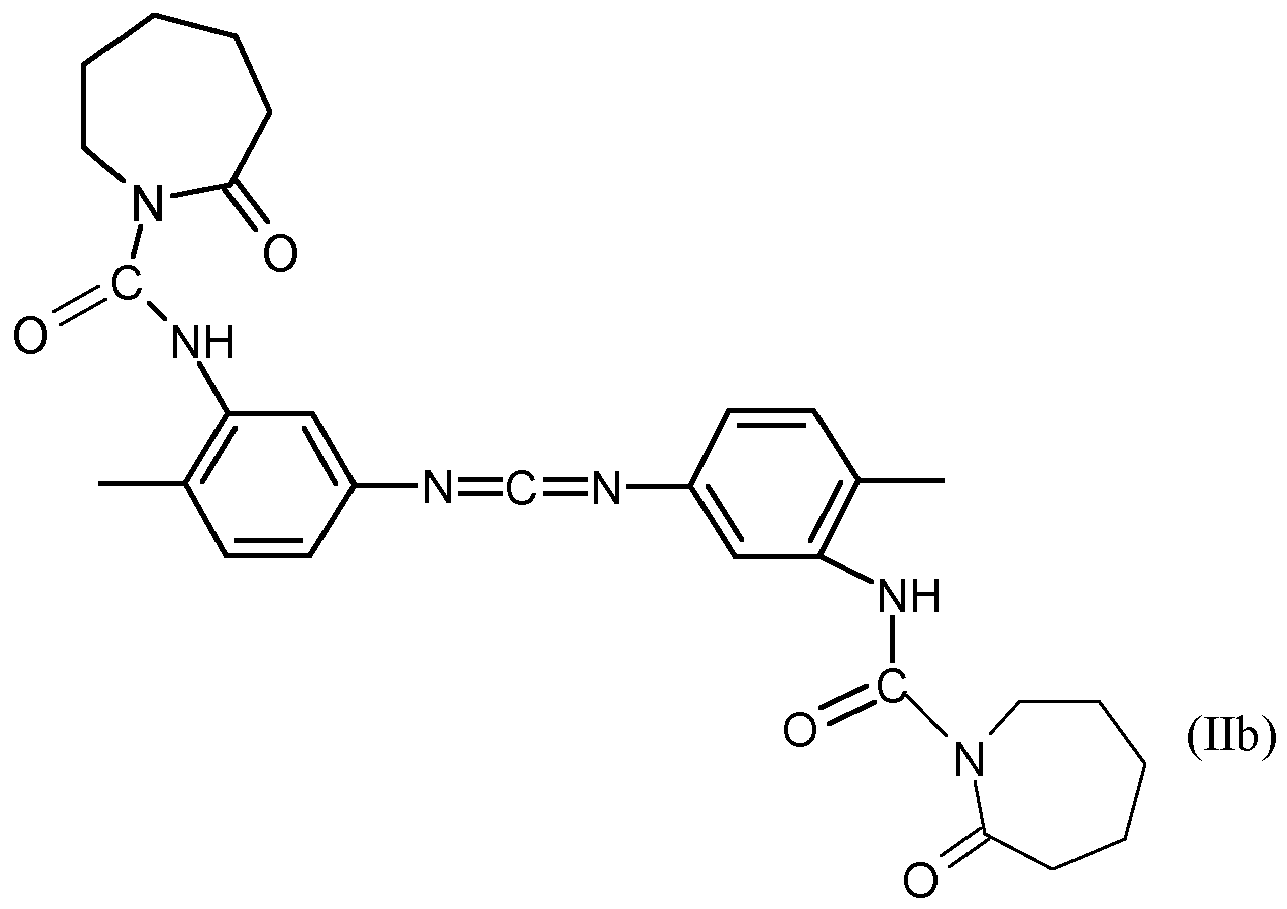

und/oder sterisch gehinderte Carbodiimide der Formel (IV)
und/oder wasserlösliche Carbodiimide der Formel (V)
und R3 =C1-C6-Alkyl-, C6-C10-Cycloalkyl- oder C7-C12-Aralkylrest oder einen Polyester- oder einen Polyamidrest oder -(CH2)1-(O-(CH2)k-O)g-R4bedeutet,
mit 1= 1-3, k= 1-3, g = 0-12 und
R4= H oder C1-C4-Alkyl. - Herstellungsbedingt fallen die Carbodiimide häufig im Gemischen aus monomeren, oligomeren und/oder polymeren Carbodiimiden an. Diese Gemische sind vom Gegenstand der Erfindung mitumfasst.
- Ebenfalls einsetzbar sind Verbindungen der Formeln (I) bis (IV), die geblockt sind z.B. mit Lactamen, besonders bevorzugt Caprolactam, Phenolen, Novolacken, Resorcin, Oxim, Polyethylenglykolen und/oder Epoxiden.
- Der Rahmen der Erfindung erfasst alle oben stehenden und im Folgenden aufgeführten allgemeinen oder in Vorzugsbereichen genannten Restedefinitionen, Indizes, Parameter und Erläuterungen untereinander, also auch zwischen den jeweiligen Bereichen und Vorzugsbereichen in beliebiger Kombination.
- Die Verbindungen nach Formel (I) bis (V) sind kommerziell erhältlich, z.B. bei der Firma Rhein Chemie Rheinau GmbH oder lassen sich nach den dem Fachmann geläufigen Verfahren herstellen, wie z.B. beschrieben in
DE-A-11 30 594 oderUS 2 840 589 oder durch die Kondensation von Diisocyanaten unter Abspaltung von Kohlendioxid bei erhöhten Temperaturen, z.B. bei 40 °C bis 200 °C, in Gegenwart von Katalysatoren. Als Katalysatoren haben sich z.B. starke Basen oder Phosphorverbindungen bewährt. Vorzugsweise werden Phospholenoxide, Phospholidine oder Phospholinoxide sowie die entsprechenden Sulfide verwendet. Ferner können als Katalysatoren tertiäre Amine, basisch reagierende Metallverbindungen, Carbonsäuremetallsalze und nicht basische Organometallverbindungen verwendet werden. - Zur Herstellung der eingesetzten Carbodiimide und/oder Polycarbodiimide eignen sich alle Diisocyanate, wobei im Rahmen der vorliegenden Erfindung bevorzugt Carbodiimide und/oder Polycarbodiimide verwendet werden, die auf C1- bis C4-Alkyl substituierten aromatischen Isocyanaten aufbauen, wie z.B. 2,4-Toluylendiisocyanat, 2,6-Toluylendiisocyanat, ein Gemisch aus 2,4-Toluylendiisocyanat und 2,6-Toluylendiisocyanat, Hexamethylendiisocyanat, Cyclohexan-1,4-diisocyanat, Xylylendiisocyanat, Isophorondiisocyanat, 2,6-Diisopropylphenylisocyanat, 2,4,6-Triisopropylphenyl-1,3-diisocyanat, 2,4,6-Triethylphenyl-1,3-diisocyanat, 2,4,6-Trimethylphenyl-1,3-diisocyanat, 2,4'-Diisocyanatodiphenylmethan, 3,3',5,5'-Tetraisopropyl-4,4'-diisocya-nato-diphenylmethan, 3,3',5,5'-Tetraethyl-4,4'-di-isocyanatodiphenylmethan, Tetramethylxyloldiisocyanat, 1,5-Naphthalindiisocyanat, 4,4'-Diphenylmethandiisocyanat, 2,4'-Diphenyl-methandiisocyanat, 2,2'-Diphenylmethandiisocyanat, 4,4'-Diphenyldimethyl-methandiisocyanat, 1,3-Phenylendiisocyanat, 1,4-Phenylendiisocyanat, Dicyclohexylmethan-4,4'-diisocyanat, Dicyclohexylmethan-2,4'-diisocyanat, Dicyclohexylmethan-2,2'-diisocyanat, Methylcyclohexandiisocyanat, Tetramethylxylylendiisocyanat, 2,6-Diisopropylphenylen-isocyanat und 1,3,5-Triisopropylbenzol-2,4-diisocyanat oder deren Gemische, oder auf substituierten Aralkylen, wie 1,3-Bis-(1-methyl-1-isocyanato-ethyl)-benzol, basieren. Besonders bevorzugt ist es, wenn die Carbodiimide und/oder Polycarbodiimide auf 2,4-Toluylendiisocyanat und 2,6-Toluylendiisocyanat oder einem Gemisch aus 2,4-Toluylendiisocyanat und 2,6-Toluylendiisocyanat basieren.
- In einer weiteren Ausführungsform der vorliegenden Erfindung ist es auch möglich, eine Mischung verschiedener Carbodiimide einzusetzen.
- Die eingesetzten festen Carbodiimide weisen besonders bevorzugt eine Teilchengröße von < 50µm auf.
- In einer Ausführungsform der Erfindung können die erfindungsgemäßen wässrigen Resorcin-Formaldehyd-Latex-Dispersionen noch weitere Zusatzstoffe enthalten, wie z.B. rheologische Hilfsmittel (Antiabsetzmittel), wie z.B. Borchi®Gel ALA (OMG Borchers GmbH) oder Kelzan® S, erhältlich bei der Firma Monsanto, oder auch Tragacanth, erhältlich bei der Firma R.T. Vanderbilt, Stabilisatoren, Emulgatoren, Netz- und/oder Dispergiermittel, wie z.B. Tamol® NN 9104 der Firma BASF AG oder Aerosol® OT45 der Firma Cytec Surface Specialities GmbH, Dispersogen® HR der Firma Clariant International Ltd.
- Bei den Resorcin-Formaldehyd-Latex-Dispersionen im Sinne der Erfindung handelt es sich um mindestens eine Dispersion der Einzelkomponenten Resorcin und Formaldehyd und/oder Formaldehyd zusammen mit einem Vorkondensat aus Resorcin und Formaldehyd (z.B. Rhenosin® T der Firma Rhein Chemie Rheinau GmbH und Penacolite® 50 erhältlich bei der Firma Indspec Chemical Corp.) und einer oder mehreren der nachstehend genannten Latex-Dispersion.
- Als Latex-Dispersion im Sinne der Erfindung kommen alle im Stand der Technik bekannten Latices in Frage, wie z.B. XSBR-Latex (carboxylierte Styrol-Butadien-Copolymere), HS-SBR-Latex (Styrol-Butadien-Copolymere), Nitril-Butadien-Copolymere (NBR-Latex), CR-Latex (Polychloropren), PSBR-Latex (Pyridin-Styrol-Butadien-Copolymere) und/oder Acrylat-Latex (Reinacrylat- und Styrol-Acrylat-Copolymere) und/oder Styrol-Butadien-Vinylpyridin-Copolymer-Latices, wobei Styrol-Butadien-Vinylpyridin-Copolymer-Latices (z.B. Pliocord VP 106, erhältlich bei der Firma Eliochem) bevorzugt sind. Dabei handelt es sich um handelsübliche Substanzen, die z.B. erhältlich sind bei der Polymer Latex GmbH oder der Firma Eliokem.
- Die Resorcin-Formaldehyd-Latex-Dispersion wird dabei vorzugsweise durch Einrühren einer basischen wässrigen Mischung aus Resorcin und Formaldehyd oder vorzugsweise einer basischen wässrigen Mischung aus Formaldehyd und dem Vorkondensat aus Resorcin und Formaldehyd in einer basischen wässrigen Latexmischung erhalten.
- Das Verhältnis von Resorcin zu Formaldehyd beträgt vorzugsweise 1:1 1 bis 2,5: 1.
- Das Verhältnis von Latex, bezogen auf dessen Festkörperanteil, zu dem Kondensat aus Resorcin und Formaldehyd liegt vorzugsweise bei 10:1 bis 4: 1, besonders bevorzugt 6:1.
- Bei den eingesetzten wässrigen basischen Lösungen handelt es sich vorzugsweise um wässrige Natrium-Hydroxid- und/oder Ammonium-Hydroxid-Lösungen. Dabei sind pH-Werte von 10 - 11 bevorzugt.
- Die Carbodiimide werden dabei vorzugsweise in Mengen von 0,5 bis 10 %, besonders bevorzugt 5-8 %, bezogen auf den Feststoffanteil in der Resorcin-Formaldehyd-Latex-Dispersion, eingesetzt.
- Gegenstand der vorliegenden Erfindung ist zudem ein Verfahren zur Herstellung der erfindungsgemäßen Resorcin-Formaldehyd-Latex-Dispersionen, wonach mindestens eine der Verbindungen der Formel (I) bis (V) in Substanz oder in Form einer wässrigen Dispersion in die Resorcin-Formaldehyd-Latex-Dispersion eingerührt wird
- Die wässrige Dispersion der Verbindungen der Formel (I) bis (V) entstehen dabei vorzugsweise durch Einrühren der Verbindungen der Formel (I) bis (V), gegebenenfalls unter Zugabe von weiteren Additiven, wie z. B. rheologische Hilfsmittel (Antiabsetzmittel), wie z. B. Borchi®Gel ALA (OMG Borchers GmbH) oder Kelzan® S, erhältlich bei der Firma Firma Monsanto, oder auch Tragacanth, erhältlich bei der Firma R.T. Vanderbilt, Stabilisatoren, Emulgatoren, Netz- und/oder Dispergiermittel, wie z.B. Tamol® NN 9104 der Firma BASF AG oder Aerosol® OT45 der Firma Cytec Surface Specialities GmbH, Dispersogen® HR der Firma Clariant International Ltd. in Wasser.
- Die Anteile an Carbodiimden in der vorgenannten wässrigen Dispersion betragen vorzugsweise 1-80 %, besonders bevorzugt 40 - 60%.
- Für den Rühr-/Vermahlprozess können handelsübliche Maschinen eingesetzt werden, wie z.B. Perlmühle, Dissolver und/oder Blattrührer.
- Gegenstand der vorliegenden Erfindung sind zudem Haftmittelformulierungen, enthaltend mindestens eine erfindungsgemäße wässrige Resorcin-Formaldehyd-Latex-Dispersion und zusätzlich ein Aktivierungsmittel.
- Aktivierungsmittel im Sinne der Erfindung sind z.B. Epoxide, wie Glycidylether GE 500 der Firma Raschig, Bisphenol A Epoxynovolac der Firma Editya Birla Chemical etc..
- Zur Herstellung der Haftmittelformulierungen werden dabei vorzugsweise die erfindungsgemäßen mindestens ein Aktivierungsmittel in die Resorcin-Formaldehyd-Latex-Dispersion eingerührt, wobei eine andere Dosierreihenfolge nicht ausgeschlossen ist.
- Gegenstand der vorliegenden Erfindung ist zudem Verfahren zur Verbesserung der Haftung von Verstärkungsfasern auf vernetztem Kautschuk oder Elastomeren, wonach die Verstärkungsfasern (Fasern, Cord) in die erfindungsgemäße Haftmittelformulierung eingebracht und anschließend getrocknet werden oder die Verstärkungsfasern (Fasern, Cord) in ein oder mehreren Schritten mit einem und/oder mehreren der Bestandteilen der erfindungsgemäßen Haftmittelformulierung behandelt werden.
- Insbesondere bei der letztgenannten Behandlung in mehreren Schritten mit zunächst einem und/oder mehreren Bestandteilen der erfindungsgemäßen Haftmittelformulierung, kann die Faser zwischenzeitlich auch getrocknet werden.
- Sofern das vorgenannte erfindungsgemäße Verfahren in mehreren Schritten mit einem oder mehreren Bestandteilen der erfindungsgemäßen Haftmittelformulierung durchgeführt wird, sind beispielsweise folgende Ausführungsformen möglich:
- So kann beispielsweise die Verstärkungsfaser zunächst in mindestens ein Epoxid eingebracht, gegebenenfalls getrocknet, und anschließend in die erfindungsgemäße Resorcin-Formaldehyd-Latex-Dispersion eingebracht werden, oder
- die Verstärkungsfaser wird zunächst in eine Dispersion aus mindestens einem Epoxid und mindestens einem Carbodiimid der Formeln (I) bis (V) eingebracht, gegebenenfalls getrocknet, und anschließend in eine Latex-Dispersion, die auch Resorcin und Formaldehyd oder Formaldehyd und ein Resorcin-Formaldehyd-Vorkondensat enthält, eingebracht.
- Bei dem vernetzten Kautschuk oder Elastomeren handelt es sich dabei vorzugsweise um (SBR-Styrol-Butadien-Kautschuk, (BR-) Butadien-Kautschuk, (NR-) Naturkautschuk, (IR-) synthetischer Naturkautschuk, Polyurethan-Elastomere oder Mischungen hieraus.
- In den vorgenannten Fällen können sowohl voraktivierte (vorbehandelte), als auch nicht voraktivierte Verstärkungsfasern eingesetzt werden.
- Bei den voraktivierten (vorbehandelten) Verstärkungsfasern handelt es sich um z.B. polyester- oder aramidbasierte Fasern, die während ihrer Herstellung (Spinnen) mit einer Schlichte behandelt wurden. Kommerziell erhältliche Produkte sind z.B. bei der Firma KoSa unter KoSa Type 793 und KoSa Type 748. Die Schlichten enthalten in vielen Fällen Epoxide.
- Bei den nicht-vorbehandelten Verstärkungsfasern handelt es sich um z.B. polyester- oder aramidbasierte Fasern. Kommerziell erhältliche Produkte sind z.B. KoSa Type 792.
- Ebenfalls mitumfasst von dieser Erfindung ist auch ein Verfahren zur Verbesserung der Haftung von Verstärkungsfasern auf vernetztem Kautschuk oder Elastomeren, wonach voraktivierte (vorbehandelte) Verstärkungsfasern in die erfindungsgemäße wässrige Resorcin-Formaldehyd-Latex-Dispersion eingebracht und anschließend getrocknet werden.
- Unter dem Begriff Fasern werden im Sinne der Erfindung neben Fasern auch Garne, Cords, als auch Verstärkungsgewebe verstanden, auf Basis von z.B. Polyester oder Aramid, wie u.a. Polyethylenterephthalat-basierte Fasern.
- Gegenstand der vorliegenden Erfindung sind zudem haftungsverbesserte Fasern, erhältlich durch Inkontaktbringen der mit Aktivierungsmittel vorbehandelten Fasern mit mindestens einer erfindungsgemäßen wässrigen Resorcin-Formaldehyd-Latex-Dispersion oder durch Inkontaktbringen einer nicht-vorbehandelten Faser mit mindestens einer erfindungsgemäßen Haftmittelformulierung, und einer anschließenden Trocknung (Fixierung) bei Temperaturen von 180 - 260 °C.
- Gegenstand der vorliegenden Erfindung ist zudem die Verwendung der erfindungsgemäßen Resorcin-Formaldehyd-Latex-Dispersion gegebenenfalls in Anwesenheit von Aktivierungsmitteln zur Verbesserung der Haftfestigkeit zwischen Verstärkungsfasern und Elastomeren in Reifen, Antriebsriemen, Transportbändern und/oder Schläuchen.
- Die nachfolgenden Beispiele dienen der Erläuterung der Erfindung, ohne dabei limitierend zu wirken.
- TDI-Carbodiimid, ein Carbodiimid gemäß Formel (IIb),
- Addolink® CBM, Caprolactamblockiertes MDI (4,4-Diphenylmethandiisocyanat), erhältlich bei der Fa. Rhein Chemie Rheinau GmbH,
- Aerosol® OT 75, Netz/Dispergiermittel, erhältlich bei der Firma Cytec Surface Specialties GmbH,
- Kelzan® S, Antiabsetzmittel, erhältlich bei der Firma Monsanto,
- Penacolite® 50, ein Resorcin-Formaldehyd-Vorkondensat, erhältlich bei der Firma Indspec Chemical Corp sowie
- Pliocord® VP 106, ein Styrol-Butadien-Vinylpyridin-Copolymer-Latex mit 41 % Feststoffanteil, erhältlich bei der Firma Eliokem.
- Tabelle 1 fasst die Einsatzmengen zur Herstellung einer wässrigen Dispersion zusammen:
Tabelle 1: Material Bsp. 1 Bsp. 2 TDI-Carbodiimid 100 Addolink ® CBM 100 Aerosol® OT 75 2,4 2,4 Wasser 91 91 Kelzan® S, 3% in Wasser 9 9 - Die Einsatzmengen sind in Gew. Teilen angegeben.
- Die wässrige Dispersionen wurden dabei wie folgt hergestellt:
- Wasser und Netz/Dispergiermittel (Aerosol® OT 75) wurden zusammengegeben und gelöst/gemischt. Anschließend wurde TDI-Carbodiimid, bzw. Addolink® CBM zugesetzt und im Dissolver homogenisiert. Danach wurde die frisch hergestellte Kelzan® S-Präparation eingemischt und homogenisiert.
- Tabelle 2 gibt die Zusammensetzungen von Haftmittelformulierungen zur Behandlung von voraktivierten Polyesterfasern wieder:
Tabelle 2: Material Bsp. 3 (erf) Bsp. 4 (VV) Bsp. 5 (VV) wässrige TDI-Carbodimid-Dispersion gemäß Bsp. 1 28 wässrige Addolink® CBM-Dispersion gemäß Bsp. 2 28 Wasser 367,3 367,3 395,3 Natronlauge (10 % -ig) 6 6 6 Penacolite® 50 42,4 42,4 42,4 Formaldehyd (37 %-ig) 20,5 20,5 20,5 Pliocord VP 106 411 411 411 Ammoniak (25 %-ig) 24,7 24,7 24,7 VV= Vergleichsbeispiel, erf= erfindungsgemäß; die Einsatzmengen sind in Gew. Teilen angegeben. - Die Vortrocknung der behandelten Fasern erfolgte bei ca. 135 °C für ca. 60 s, die Fixierung bei 230 °C für 120 s.
- Vulkanisierung und Haftungsprüfung wurden nach ASTM D4393 durchgeführt. Als Testelastomermischung kam Dunlop SP 5320, erhältlich bei der Firma Dunlop, und ein aktiviertes PET-Garn zur Anwendung.
- Die Ergebnisse der Haftprüfung werden in Tabelle 3 zusammengefasst:
Tabelle 3: Test Einheit Beispiele TDI-Carbo-diimid (Bsp. 3) Addolink CBM (Bsp. 4) ohne Haftvermittler (Bsp. 5) Streifen-Test (Haftung) N/2,5cm 250 - 300 250 - 300 200-250 - Aus den Versuchen ist klar ersichtlich, dass die erfindungsgemäßen Resorcin-Formaldehyd Latex-Dispersionen eine extrem gute Haftung zeigen und dabei im Vergleich zum Stand der Technik deutlich leichter herstellbar und damit wirtschaftlicher sind und zudem bei der Trocknung im Rahmen der Thermofixierung keine giftigen momeren Isocyanate abspalten. Damit weisen die erfindungsgemäßen Haftvermittler ökologisch und arbeitstechnisch gegenüber den im Stand der Technik bekannten Verbindungen deutliche Vorteile auf.
Claims (10)
- Wässrige Resorcin-Formaldehyd-Latex-Dispersion, enthaltend mindestens ein Carbodiimid auf Basis von Verbindungen der Formel (I)
R'-(-N=C=N-R-)m-R" (I),
in der
m einer ganzen Zahl von 1 bis 500 entspricht,
R = C1-C18-Alkylen, C5-C18-Cycloalkylen, Arylen und/oder C7-C12- Aralkylen, R' = R-NCO, R-NHCONHR1, R-NHCONR1R2, R-NHCOOR3 oder R-NHCO-R5 und R"= -NCO, -NHCONHR1, -NHCONR1R2, -NHCO-R5, oder -NHCOOR3 ist,
wobei in R' unabhängig voneinander R1 und R2 gleich oder verschieden sind und einen C1-C6-Alkyl-, C6-C10-Cycloalkyl- oder C7-C12-Aralkylrest darstellen und R3 eine der Bedeutungen von R1 hat oder einen Polyester- oder einen Polyamidrest oder -(CH2)1-(O-(CH2)k-O)g-R4, -C6H4(OH) oder -C6H3(OH)-((CH2)h-C6H4(OH))y,
und R5 = Epoxid, Phenol, Oxim, Resorcin, Polyethylenglykole und/oder Lactam, bevorzugt Caprolactam,
mit 1= 1-3, k= 1-3, g = 0-12, h = 1-2 und y = 1-50 bedeutet,
und
R4 = H oder C1-C4-Alkyl. - Wässrige Resorcin-Formaldehyd-Latex-Dispersion, nach Anspruch 1, dadurch
gekennzeichnet, dass es sich bei dem Carbodiimid um Verbindungen der Formeln


und R3 = C1-C6-Alkyl-, C6-C10-Cycloalkyl- oder C7-C12-Aralkylrest, einen Polyester- oder Polyamidrest oder -(CH2)1-(O-(CH2)k-O)g-R4 bedeutet,
mit 1= 1-3, k= 1-3, g = 0-12 und
R4= H oder C1-C4-Alkyl, handelt. - Wässrige Resorcin-Formaldehyd-Latex-Dispersion nach Anspruch 1 oder 2, dadurch gekennzeichnet, dass es sich bei der Resorcin-Formaldehyd-Latex-Dispersion um eine Dispersion der Einzelkomponenten Resorcin und Formaldehyd und/oder Formaldehyd zusammen mit einem Vorkondensat aus Resorcin und Formaldehyd und einer oder mehreren der Latex-Dispersionen, ausgewählt aus der Gruppe: carboxylierte Styrol-Butadien-Copolymere (XSBR-Latex), Nitril-Butadien-Copolymere (NBR-Latex), Polychloropren (CR-Latex), Pyridin-Styrol-Butadien-Copolymere (PSBR-Latex) und/oder Reinacrylat- und/oder Styrol-Acrylat-Copolymere (Acrylat-Latex) und/oder Styrol-Butadien-Vinylpyridin-Copolymer-Latices, handelt.
- Verfahren zur Herstellung von wässrigen Resorcin-Formaldehyd-Latex-Dispersionen nach einem oder mehreren der Ansprüche 1 bis 3, dadurch gekennzeichnet, dass mindestens ein Carbodiimid nach einem oder mehreren der Ansprüche 1 bis 3 in die Resorcin-Formaldehyd-Latex-Dispersion eingerührt wird.
- Haftmittelformulierung, enthaltend eine wässrige Resorcin-Formaldehyd-Latex-Dispersion nach einem oder mehreren der Ansprüche 1 bis 3 und zusätzlich mindestens ein Aktivierungsmittel.
- Haftmittelformulierung nach Anspruch 5, dadurch gekennzeichnet, dass das Aktivierungsmittel mindestens ein Epoxid ist.
- Verfahren zur Verbesserung der Haftung von Verstärkungsfasern mit vernetztem Kautschuk und/oder Elastomeren, dadurch gekennzeichnet, dass- die Fasern in eine Haftmittelformulierung nach Anspruch 5 oder 6 eingebracht und anschließend getrocknet werden oder- die Fasern in ein oder mehreren Schritten mit einem und/oder mehreren der Bestandteilen der Haftmittelformulierung nach Anspruch 5 oder 6 behandelt werden.
- Verfahren zur Verbesserung der Haftung von Verstärkungsfasern mit vernetzten Kautschuken oder Elastomeren, dadurch gekennzeichnet, dass die voraktivierten Fasern in eine wässrige Resorcin-Formaldehyd-Latex-Dispersion nach einem oder mehreren der Ansprüche 1 bis 3 eingebracht und anschließend getrocknet werden.
- Haftungsverbesserte Fasern, erhältlich durch Inkontaktbringen der mit Aktivierungsmittel vorbehandelten Fasern mit mindestens einer wässrigen Resorcin-Formaldehyd-Latex-Dispersion nach einem oder mehreren der Ansprüche 1 bis 3 oder durch Inkontaktbringen einer nicht-vorbehandelten Faser mit mindestens einer Haftmittelformulierung nach Anspruch 5 oder 6 und eine anschließenden Trocknung (Fixierung) bei Temperaturen von 180 bis 260 °C.
- Verwendung der wässrige Resorcin-Formaldehyd-Latex-Dispersionen nach einem oder mehreren der Ansprüche 1 bis 3 gegebenenfalls in Anwesenheit von Aktivierungsmitteln zur Verbesserung der Haftfestigkeit zwischen Verstärkungsfasern und Elastomeren in Reifen, Antriebsriemen, Transportbändern und/oder Schläuchen.
Priority Applications (1)
| Application Number | Priority Date | Filing Date | Title |
|---|---|---|---|
| EP11177348.7A EP2423185B1 (de) | 2010-08-30 | 2011-08-12 | Neuartige wässrige resorcin-formaldehyd-latex-dispersionen, haftungsverbesserte fasern, verfahren zu deren herstellung und deren verwendung |
Applications Claiming Priority (5)
| Application Number | Priority Date | Filing Date | Title |
|---|---|---|---|
| EP10174548 | 2010-08-30 | ||
| EP10189268 | 2010-10-28 | ||
| EP10192089 | 2010-11-22 | ||
| EP11158814 | 2011-03-18 | ||
| EP11177348.7A EP2423185B1 (de) | 2010-08-30 | 2011-08-12 | Neuartige wässrige resorcin-formaldehyd-latex-dispersionen, haftungsverbesserte fasern, verfahren zu deren herstellung und deren verwendung |
Publications (2)
| Publication Number | Publication Date |
|---|---|
| EP2423185A1 true EP2423185A1 (de) | 2012-02-29 |
| EP2423185B1 EP2423185B1 (de) | 2017-03-01 |
Family
ID=44645553
Family Applications (1)
| Application Number | Title | Priority Date | Filing Date |
|---|---|---|---|
| EP11177348.7A Not-in-force EP2423185B1 (de) | 2010-08-30 | 2011-08-12 | Neuartige wässrige resorcin-formaldehyd-latex-dispersionen, haftungsverbesserte fasern, verfahren zu deren herstellung und deren verwendung |
Country Status (10)
| Country | Link |
|---|---|
| US (1) | US8481619B2 (de) |
| EP (1) | EP2423185B1 (de) |
| JP (1) | JP5859773B2 (de) |
| KR (1) | KR101884019B1 (de) |
| CN (1) | CN102432932B (de) |
| BR (1) | BRPI1104031A2 (de) |
| CA (1) | CA2750986A1 (de) |
| MX (1) | MX2011008990A (de) |
| RU (1) | RU2576270C2 (de) |
| TW (1) | TWI519509B (de) |
Families Citing this family (9)
| Publication number | Priority date | Publication date | Assignee | Title |
|---|---|---|---|---|
| WO2012150181A1 (de) * | 2011-05-05 | 2012-11-08 | Rhein Chemie Rheinau Gmbh | Carbodiimide aus trisubstituierten aromatischen isocyanaten, ein verfahren zu deren herstellung und deren verwendung |
| CN103540282B (zh) * | 2013-09-16 | 2015-07-08 | 浙江农林大学 | 一种脲醛树脂木材胶黏剂改性剂及其应用 |
| ES2616281T3 (es) * | 2014-06-04 | 2017-06-12 | Lanxess Deutschland Gmbh | Bis[3 isopropenil-alfa,alfa-dimetilbencil]carbodiimida, procedimiento para su preparación y su uso |
| ES2622379T3 (es) * | 2014-07-14 | 2017-07-06 | Lanxess Deutschland Gmbh | Procedimiento para la estabilización de plástico de base biológica a base de resina de poliéster |
| WO2017073647A1 (ja) * | 2015-10-29 | 2017-05-04 | 三ツ星ベルト株式会社 | 伝動ベルト用心線の製造方法並びに処理剤及び処理用キット |
| JP6349369B2 (ja) * | 2015-10-29 | 2018-06-27 | 三ツ星ベルト株式会社 | 伝動ベルト用心線の製造方法並びに処理剤及び処理用キット |
| KR20180124856A (ko) * | 2016-03-15 | 2018-11-21 | 니폰 제온 가부시키가이샤 | 중합체 라텍스의 제조 방법 |
| JP7710317B2 (ja) * | 2020-06-03 | 2025-07-18 | バンドー化学株式会社 | 接着剤組成物、接着構造体及びベルト |
| WO2022065206A1 (ja) * | 2020-09-23 | 2022-03-31 | 株式会社ブリヂストン | ゴム-樹脂間接着剤組成物、有機繊維コード-ゴム複合体及びタイヤ |
Citations (11)
| Publication number | Priority date | Publication date | Assignee | Title |
|---|---|---|---|---|
| US2840589A (en) | 1957-06-14 | 1958-06-24 | Du Pont | Di(3-isocyanato-4-methylphenyl) carbodiimide |
| DE1130594B (de) | 1956-07-30 | 1962-05-30 | Du Pont | Verfahren zur Herstellung von gegebenenfalls modifizierten Polykondensationsprodukten mití¬N?C?N-Brueckengliedern |
| DE1770495A1 (de) | 1968-05-25 | 1971-11-11 | Bayer Ag | Stabilisierte Polyaethylenglykolterephthalate |
| US3661623A (en) * | 1969-10-03 | 1972-05-09 | Goodyear Tire & Rubber | Heat stable polyester cord reinforced rubber structure and method of making |
| DE2326540A1 (de) | 1972-06-23 | 1974-01-17 | Goodyear Tire & Rubber | Verfahren zur behandlung eines reifenkordgewebes |
| US3867181A (en) | 1967-04-03 | 1975-02-18 | Fiber Industries Inc | Stabilized polyester yarn having a carbodiimide coating and process of making |
| US4159363A (en) * | 1978-04-20 | 1979-06-26 | The General Tire & Rubber Company | Compositions of Br or Cl containing polymers and polycarbodiimides |
| US4477619A (en) * | 1982-10-08 | 1984-10-16 | The B. F. Goodrich Company | Preparation of fabric for bonding to rubber |
| US5498747A (en) * | 1994-05-12 | 1996-03-12 | Basf Aktiengesellschaft | Carbodiimides and/or oligomeric polycarbodiimides based on 1,3-bis (1-methyl-1-isocyanatoethyl)benzene, their preparation, and their use as hydrolysis stabilizers |
| US20080300347A1 (en) | 2005-10-31 | 2008-12-04 | Ems-Chemie Ag | Adhesive Formulation, Method for Production and Use Thereof |
| EP2159241A1 (de) | 2009-04-09 | 2010-03-03 | Isochem Kautschuk GmbH | Verfahren zur Herstellung von oligomeren Diphenylmethan-4,4'- und/oder Diphenylmethan-2,4'-diisocyanat-uretdionen |
Family Cites Families (10)
| Publication number | Priority date | Publication date | Assignee | Title |
|---|---|---|---|---|
| JPS5328727A (en) * | 1976-08-27 | 1978-03-17 | Teijin Ltd | Production of polyester fiber material |
| DE3517333A1 (de) * | 1985-05-14 | 1986-11-20 | Basf Ag, 6700 Ludwigshafen | Verfahren zur herstellung stabiler dispersionen feinteiliger polyisocyanate und deren verwendung |
| DE3726268A1 (de) * | 1987-06-24 | 1989-01-05 | Bayer Ag | Textiles flaechengebilde mit reaktivharz |
| JP3629041B2 (ja) * | 1994-06-10 | 2005-03-16 | 日清紡績株式会社 | 水性テトラメチルキシリレンカルボジイミド |
| US5717031A (en) * | 1995-06-21 | 1998-02-10 | Lord Corporation | Aqueous adhesive compositions |
| JP3853935B2 (ja) * | 1997-10-06 | 2006-12-06 | 松本油脂製薬株式会社 | ポリエステル繊維の接着性改善法 |
| JP2001064878A (ja) * | 1999-08-26 | 2001-03-13 | Toray Ind Inc | ホース補強用ポリエステル繊維の製造方法およびホース |
| US20020122938A1 (en) * | 2001-01-04 | 2002-09-05 | Fisher Chad Daniel | Single dip adhesive |
| EP1664161A1 (de) * | 2003-09-12 | 2006-06-07 | Teijin Twaron B.V. | Zweischrittverfahren zum tauchen von kunstfaser |
| EP2423186B1 (de) * | 2010-08-30 | 2017-05-31 | LANXESS Deutschland GmbH | Neuartige haftvermittler auf basis von carbodiimiden, haftvermittlerhaltige, wässrige resorcin-formaldehyd-latex-dispersionen, haftungsverbesserte fasern, verfahren zu deren herstellung und deren verwendung |
-
2011
- 2011-08-12 EP EP11177348.7A patent/EP2423185B1/de not_active Not-in-force
- 2011-08-23 US US13/215,272 patent/US8481619B2/en not_active Expired - Fee Related
- 2011-08-26 MX MX2011008990A patent/MX2011008990A/es active IP Right Grant
- 2011-08-29 TW TW100130840A patent/TWI519509B/zh not_active IP Right Cessation
- 2011-08-29 BR BRPI1104031-9A patent/BRPI1104031A2/pt not_active Application Discontinuation
- 2011-08-29 CA CA 2750986 patent/CA2750986A1/en not_active Abandoned
- 2011-08-29 JP JP2011185788A patent/JP5859773B2/ja not_active Expired - Fee Related
- 2011-08-29 RU RU2011135870/05A patent/RU2576270C2/ru not_active IP Right Cessation
- 2011-08-29 KR KR1020110086282A patent/KR101884019B1/ko not_active Expired - Fee Related
- 2011-08-30 CN CN201110253178.3A patent/CN102432932B/zh not_active Expired - Fee Related
Patent Citations (11)
| Publication number | Priority date | Publication date | Assignee | Title |
|---|---|---|---|---|
| DE1130594B (de) | 1956-07-30 | 1962-05-30 | Du Pont | Verfahren zur Herstellung von gegebenenfalls modifizierten Polykondensationsprodukten mití¬N?C?N-Brueckengliedern |
| US2840589A (en) | 1957-06-14 | 1958-06-24 | Du Pont | Di(3-isocyanato-4-methylphenyl) carbodiimide |
| US3867181A (en) | 1967-04-03 | 1975-02-18 | Fiber Industries Inc | Stabilized polyester yarn having a carbodiimide coating and process of making |
| DE1770495A1 (de) | 1968-05-25 | 1971-11-11 | Bayer Ag | Stabilisierte Polyaethylenglykolterephthalate |
| US3661623A (en) * | 1969-10-03 | 1972-05-09 | Goodyear Tire & Rubber | Heat stable polyester cord reinforced rubber structure and method of making |
| DE2326540A1 (de) | 1972-06-23 | 1974-01-17 | Goodyear Tire & Rubber | Verfahren zur behandlung eines reifenkordgewebes |
| US4159363A (en) * | 1978-04-20 | 1979-06-26 | The General Tire & Rubber Company | Compositions of Br or Cl containing polymers and polycarbodiimides |
| US4477619A (en) * | 1982-10-08 | 1984-10-16 | The B. F. Goodrich Company | Preparation of fabric for bonding to rubber |
| US5498747A (en) * | 1994-05-12 | 1996-03-12 | Basf Aktiengesellschaft | Carbodiimides and/or oligomeric polycarbodiimides based on 1,3-bis (1-methyl-1-isocyanatoethyl)benzene, their preparation, and their use as hydrolysis stabilizers |
| US20080300347A1 (en) | 2005-10-31 | 2008-12-04 | Ems-Chemie Ag | Adhesive Formulation, Method for Production and Use Thereof |
| EP2159241A1 (de) | 2009-04-09 | 2010-03-03 | Isochem Kautschuk GmbH | Verfahren zur Herstellung von oligomeren Diphenylmethan-4,4'- und/oder Diphenylmethan-2,4'-diisocyanat-uretdionen |
Also Published As
| Publication number | Publication date |
|---|---|
| BRPI1104031A2 (pt) | 2015-03-24 |
| JP5859773B2 (ja) | 2016-02-16 |
| CA2750986A1 (en) | 2012-02-29 |
| JP2012046750A (ja) | 2012-03-08 |
| CN102432932B (zh) | 2016-03-16 |
| CN102432932A (zh) | 2012-05-02 |
| EP2423185B1 (de) | 2017-03-01 |
| MX2011008990A (es) | 2012-03-15 |
| RU2576270C2 (ru) | 2016-02-27 |
| TWI519509B (zh) | 2016-02-01 |
| US8481619B2 (en) | 2013-07-09 |
| RU2011135870A (ru) | 2013-03-27 |
| KR101884019B1 (ko) | 2018-07-31 |
| US20120071595A1 (en) | 2012-03-22 |
| KR20120021233A (ko) | 2012-03-08 |
| TW201215589A (en) | 2012-04-16 |
Similar Documents
| Publication | Publication Date | Title |
|---|---|---|
| EP2423185B1 (de) | Neuartige wässrige resorcin-formaldehyd-latex-dispersionen, haftungsverbesserte fasern, verfahren zu deren herstellung und deren verwendung | |
| EP2423186B1 (de) | Neuartige haftvermittler auf basis von carbodiimiden, haftvermittlerhaltige, wässrige resorcin-formaldehyd-latex-dispersionen, haftungsverbesserte fasern, verfahren zu deren herstellung und deren verwendung | |
| EP3597816B1 (de) | Tauchbadzusammensetzungen zur behandlung von verstärkungseinlagen | |
| EP0198343B1 (de) | Carbodiimidgruppen enthaltende Isocyanat-Derivate, ein Verfahren zu Ihrer Herstellung und ihre Verwendung als Zusatzmittel für wässrige Lösungen oder Dispersionen von Kunststoffen | |
| DE2323131A1 (de) | Verstaerkte elastomere verbundmaterialien und verfahren zum verbinden der verstaerkenden elemente mit der elastomeren struktur | |
| DE69520814T2 (de) | Klebstoffzusammensetzungen für Gummi und Fasern; synthetische Fasern zur Gummiverstärkung und faserverstärkte Gummistrukturen | |
| DE69305422T2 (de) | Wässrige Flüssigkeit zur Behandlung von Glasfaser-Cord, Glasfaser-Cord zur Verstärkung von Gummi und verstärktes Gummiprodukt | |
| EP2441785B1 (de) | Neue Dispersionsklebstoffe, ein Verfahren zu deren Herstellung und deren Verwendung | |
| EP1518874B1 (de) | Monomerarmes Gemisch, enthaltend polymeres MDI | |
| EP3597686A1 (de) | Tauchbadzusammensetzungen zur behandlung von verstärkungseinlagen | |
| DE1470971C3 (de) | Verfahren zum Kleben von Polyester faden, garnen oder geweben mit naturh chem oder synthetischem Kautschuk | |
| EP0257225B1 (de) | Wärmesensible Polyurethan-dispersionen | |
| DE10317738A1 (de) | Verfahren zur Herstellung eines Polyesterfaserkords zum Verstärken von Kautschukmaterialien | |
| DE2059621B2 (de) | Verfahren zur herstellung von faserverstaerkten kautschukvulkanisaten | |
| DE3121382A1 (de) | Haftende ueberzugsmasse und damit ueberzogene glasfasern | |
| DE2522963B2 (de) | Verfahren zur Herstellung einer wäßrigen Polyisocyanat-Dispersion und deren Verwendung zum Tauchüberziehen von Polyesterunterlagen | |
| EP3103914A1 (de) | Haftmittelzusammensetzung für organische fasern und verfahren zur behandlung von organischen fasern | |
| EP2423247A1 (de) | Neuartige wässrige Resorcin-Formaldehyd-Latex-Dispersionen, ein Verfahren zu deren Herstellung und deren Verwendung | |
| DE3136556A1 (de) | Mehrkomponentenpolyesterfasermaterial, insbesondere zum verstaerken von gummiartikeln und verfahren zu seiner herstellung | |
| DE3109505A1 (de) | Textilgewebeverbund | |
| DE3601126A1 (de) | Verfahren zum behandeln von aromatischen polyamidfasern | |
| WO1996007780A1 (de) | Verfahren zur herstellung von cellulosefasern | |
| JP2541319B2 (ja) | ゴム補強用繊維材料の処理方法 | |
| EP2460649A1 (de) | Elastomer-Faser-Verbund, Verfahren zur Herstellung und dessen Verwendung | |
| WO2013144261A2 (de) | Cellulosische filamente mit verbesserter thermostabilität |
Legal Events
| Date | Code | Title | Description |
|---|---|---|---|
| AK | Designated contracting states |
Kind code of ref document: A1 Designated state(s): AL AT BE BG CH CY CZ DE DK EE ES FI FR GB GR HR HU IE IS IT LI LT LU LV MC MK MT NL NO PL PT RO RS SE SI SK SM TR |
|
| AX | Request for extension of the european patent |
Extension state: BA ME |
|
| PUAI | Public reference made under article 153(3) epc to a published international application that has entered the european phase |
Free format text: ORIGINAL CODE: 0009012 |
|
| 17P | Request for examination filed |
Effective date: 20120829 |
|
| GRAP | Despatch of communication of intention to grant a patent |
Free format text: ORIGINAL CODE: EPIDOSNIGR1 |
|
| INTG | Intention to grant announced |
Effective date: 20160922 |
|
| STAA | Information on the status of an ep patent application or granted ep patent |
Free format text: STATUS: GRANT OF PATENT IS INTENDED |
|
| GRAS | Grant fee paid |
Free format text: ORIGINAL CODE: EPIDOSNIGR3 |
|
| GRAA | (expected) grant |
Free format text: ORIGINAL CODE: 0009210 |
|
| STAA | Information on the status of an ep patent application or granted ep patent |
Free format text: STATUS: THE PATENT HAS BEEN GRANTED |
|
| AK | Designated contracting states |
Kind code of ref document: B1 Designated state(s): AL AT BE BG CH CY CZ DE DK EE ES FI FR GB GR HR HU IE IS IT LI LT LU LV MC MK MT NL NO PL PT RO RS SE SI SK SM TR |
|
| REG | Reference to a national code |
Ref country code: GB Ref legal event code: FG4D Free format text: NOT ENGLISH |
|
| REG | Reference to a national code |
Ref country code: CH Ref legal event code: EP Ref country code: AT Ref legal event code: REF Ref document number: 871121 Country of ref document: AT Kind code of ref document: T Effective date: 20170315 |
|
| REG | Reference to a national code |
Ref country code: IE Ref legal event code: FG4D Free format text: LANGUAGE OF EP DOCUMENT: GERMAN |
|
| RAP2 | Party data changed (patent owner data changed or rights of a patent transferred) |
Owner name: LANXESS DEUTSCHLAND GMBH |
|
| REG | Reference to a national code |
Ref country code: DE Ref legal event code: R096 Ref document number: 502011011708 Country of ref document: DE |
|
| REG | Reference to a national code |
Ref country code: DE Ref legal event code: R081 Ref document number: 502011011708 Country of ref document: DE Owner name: LANXESS DEUTSCHLAND GMBH, DE Free format text: FORMER OWNER: RHEIN-CHEMIE RHEINAU GMBH, 68219 MANNHEIM, DE |
|
| REG | Reference to a national code |
Ref country code: NL Ref legal event code: FP |
|
| REG | Reference to a national code |
Ref country code: LT Ref legal event code: MG4D |
|
| REG | Reference to a national code |
Ref country code: FR Ref legal event code: PLFP Year of fee payment: 7 |
|
| PG25 | Lapsed in a contracting state [announced via postgrant information from national office to epo] |
Ref country code: GR Free format text: LAPSE BECAUSE OF FAILURE TO SUBMIT A TRANSLATION OF THE DESCRIPTION OR TO PAY THE FEE WITHIN THE PRESCRIBED TIME-LIMIT Effective date: 20170602 Ref country code: NO Free format text: LAPSE BECAUSE OF FAILURE TO SUBMIT A TRANSLATION OF THE DESCRIPTION OR TO PAY THE FEE WITHIN THE PRESCRIBED TIME-LIMIT Effective date: 20170601 Ref country code: LT Free format text: LAPSE BECAUSE OF FAILURE TO SUBMIT A TRANSLATION OF THE DESCRIPTION OR TO PAY THE FEE WITHIN THE PRESCRIBED TIME-LIMIT Effective date: 20170301 Ref country code: HR Free format text: LAPSE BECAUSE OF FAILURE TO SUBMIT A TRANSLATION OF THE DESCRIPTION OR TO PAY THE FEE WITHIN THE PRESCRIBED TIME-LIMIT Effective date: 20170301 Ref country code: FI Free format text: LAPSE BECAUSE OF FAILURE TO SUBMIT A TRANSLATION OF THE DESCRIPTION OR TO PAY THE FEE WITHIN THE PRESCRIBED TIME-LIMIT Effective date: 20170301 |
|
| PG25 | Lapsed in a contracting state [announced via postgrant information from national office to epo] |
Ref country code: ES Free format text: LAPSE BECAUSE OF FAILURE TO SUBMIT A TRANSLATION OF THE DESCRIPTION OR TO PAY THE FEE WITHIN THE PRESCRIBED TIME-LIMIT Effective date: 20170301 Ref country code: RS Free format text: LAPSE BECAUSE OF FAILURE TO SUBMIT A TRANSLATION OF THE DESCRIPTION OR TO PAY THE FEE WITHIN THE PRESCRIBED TIME-LIMIT Effective date: 20170301 Ref country code: LV Free format text: LAPSE BECAUSE OF FAILURE TO SUBMIT A TRANSLATION OF THE DESCRIPTION OR TO PAY THE FEE WITHIN THE PRESCRIBED TIME-LIMIT Effective date: 20170301 Ref country code: SE Free format text: LAPSE BECAUSE OF FAILURE TO SUBMIT A TRANSLATION OF THE DESCRIPTION OR TO PAY THE FEE WITHIN THE PRESCRIBED TIME-LIMIT Effective date: 20170301 Ref country code: BG Free format text: LAPSE BECAUSE OF FAILURE TO SUBMIT A TRANSLATION OF THE DESCRIPTION OR TO PAY THE FEE WITHIN THE PRESCRIBED TIME-LIMIT Effective date: 20170601 |
|
| PG25 | Lapsed in a contracting state [announced via postgrant information from national office to epo] |
Ref country code: CZ Free format text: LAPSE BECAUSE OF FAILURE TO SUBMIT A TRANSLATION OF THE DESCRIPTION OR TO PAY THE FEE WITHIN THE PRESCRIBED TIME-LIMIT Effective date: 20170301 Ref country code: SK Free format text: LAPSE BECAUSE OF FAILURE TO SUBMIT A TRANSLATION OF THE DESCRIPTION OR TO PAY THE FEE WITHIN THE PRESCRIBED TIME-LIMIT Effective date: 20170301 Ref country code: EE Free format text: LAPSE BECAUSE OF FAILURE TO SUBMIT A TRANSLATION OF THE DESCRIPTION OR TO PAY THE FEE WITHIN THE PRESCRIBED TIME-LIMIT Effective date: 20170301 Ref country code: RO Free format text: LAPSE BECAUSE OF FAILURE TO SUBMIT A TRANSLATION OF THE DESCRIPTION OR TO PAY THE FEE WITHIN THE PRESCRIBED TIME-LIMIT Effective date: 20170301 |
|
| PG25 | Lapsed in a contracting state [announced via postgrant information from national office to epo] |
Ref country code: SM Free format text: LAPSE BECAUSE OF FAILURE TO SUBMIT A TRANSLATION OF THE DESCRIPTION OR TO PAY THE FEE WITHIN THE PRESCRIBED TIME-LIMIT Effective date: 20170301 Ref country code: PL Free format text: LAPSE BECAUSE OF FAILURE TO SUBMIT A TRANSLATION OF THE DESCRIPTION OR TO PAY THE FEE WITHIN THE PRESCRIBED TIME-LIMIT Effective date: 20170301 Ref country code: PT Free format text: LAPSE BECAUSE OF FAILURE TO SUBMIT A TRANSLATION OF THE DESCRIPTION OR TO PAY THE FEE WITHIN THE PRESCRIBED TIME-LIMIT Effective date: 20170703 Ref country code: IS Free format text: LAPSE BECAUSE OF FAILURE TO SUBMIT A TRANSLATION OF THE DESCRIPTION OR TO PAY THE FEE WITHIN THE PRESCRIBED TIME-LIMIT Effective date: 20170701 |
|
| REG | Reference to a national code |
Ref country code: DE Ref legal event code: R097 Ref document number: 502011011708 Country of ref document: DE |
|
| PLBE | No opposition filed within time limit |
Free format text: ORIGINAL CODE: 0009261 |
|
| STAA | Information on the status of an ep patent application or granted ep patent |
Free format text: STATUS: NO OPPOSITION FILED WITHIN TIME LIMIT |
|
| PG25 | Lapsed in a contracting state [announced via postgrant information from national office to epo] |
Ref country code: DK Free format text: LAPSE BECAUSE OF FAILURE TO SUBMIT A TRANSLATION OF THE DESCRIPTION OR TO PAY THE FEE WITHIN THE PRESCRIBED TIME-LIMIT Effective date: 20170301 |
|
| 26N | No opposition filed |
Effective date: 20171204 |
|
| PG25 | Lapsed in a contracting state [announced via postgrant information from national office to epo] |
Ref country code: SI Free format text: LAPSE BECAUSE OF FAILURE TO SUBMIT A TRANSLATION OF THE DESCRIPTION OR TO PAY THE FEE WITHIN THE PRESCRIBED TIME-LIMIT Effective date: 20170301 |
|
| REG | Reference to a national code |
Ref country code: CH Ref legal event code: PL |
|
| PG25 | Lapsed in a contracting state [announced via postgrant information from national office to epo] |
Ref country code: MC Free format text: LAPSE BECAUSE OF FAILURE TO SUBMIT A TRANSLATION OF THE DESCRIPTION OR TO PAY THE FEE WITHIN THE PRESCRIBED TIME-LIMIT Effective date: 20170301 |
|
| GBPC | Gb: european patent ceased through non-payment of renewal fee |
Effective date: 20170812 |
|
| PG25 | Lapsed in a contracting state [announced via postgrant information from national office to epo] |
Ref country code: LI Free format text: LAPSE BECAUSE OF NON-PAYMENT OF DUE FEES Effective date: 20170831 Ref country code: CH Free format text: LAPSE BECAUSE OF NON-PAYMENT OF DUE FEES Effective date: 20170831 |
|
| REG | Reference to a national code |
Ref country code: LU Ref legal event code: PD Owner name: LANXESS DEUTSCHLAND GMBH; DE Free format text: FORMER OWNER: LANXESS DEUTSCHLAND GMBH Effective date: 20180301 |
|
| REG | Reference to a national code |
Ref country code: NL Ref legal event code: PD Owner name: LANXESS DEUTSCHLAND GMBH; DE Free format text: DETAILS ASSIGNMENT: CHANGE OF OWNER(S), MERGE; FORMER OWNER NAME: RHEIN CHEMIE RHEINAU GMBH Effective date: 20180228 Ref country code: IE Ref legal event code: MM4A |
|
| REG | Reference to a national code |
Ref country code: FR Ref legal event code: PLFP Year of fee payment: 8 |
|
| REG | Reference to a national code |
Ref country code: BE Ref legal event code: PD Owner name: LANXESS DEUTSCHLAND GMBH; DE Free format text: DETAILS ASSIGNMENT: CHANGE OF OWNER(S), FUSION; FORMER OWNER NAME: RHEIN CHEMIE RHEINAU GMBH Effective date: 20180528 |
|
| PG25 | Lapsed in a contracting state [announced via postgrant information from national office to epo] |
Ref country code: GB Free format text: LAPSE BECAUSE OF NON-PAYMENT OF DUE FEES Effective date: 20170812 Ref country code: IE Free format text: LAPSE BECAUSE OF NON-PAYMENT OF DUE FEES Effective date: 20170812 |
|
| PGFP | Annual fee paid to national office [announced via postgrant information from national office to epo] |
Ref country code: LU Payment date: 20180726 Year of fee payment: 8 Ref country code: BE Payment date: 20180614 Year of fee payment: 8 |
|
| PG25 | Lapsed in a contracting state [announced via postgrant information from national office to epo] |
Ref country code: MT Free format text: LAPSE BECAUSE OF FAILURE TO SUBMIT A TRANSLATION OF THE DESCRIPTION OR TO PAY THE FEE WITHIN THE PRESCRIBED TIME-LIMIT Effective date: 20170301 |
|
| REG | Reference to a national code |
Ref country code: AT Ref legal event code: MM01 Ref document number: 871121 Country of ref document: AT Kind code of ref document: T Effective date: 20170812 |
|
| PGFP | Annual fee paid to national office [announced via postgrant information from national office to epo] |
Ref country code: FR Payment date: 20180712 Year of fee payment: 8 Ref country code: IT Payment date: 20180823 Year of fee payment: 8 Ref country code: NL Payment date: 20180815 Year of fee payment: 8 Ref country code: DE Payment date: 20180731 Year of fee payment: 8 |
|
| PG25 | Lapsed in a contracting state [announced via postgrant information from national office to epo] |
Ref country code: AT Free format text: LAPSE BECAUSE OF NON-PAYMENT OF DUE FEES Effective date: 20170812 |
|
| PGFP | Annual fee paid to national office [announced via postgrant information from national office to epo] |
Ref country code: TR Payment date: 20180806 Year of fee payment: 8 |
|
| PG25 | Lapsed in a contracting state [announced via postgrant information from national office to epo] |
Ref country code: HU Free format text: LAPSE BECAUSE OF FAILURE TO SUBMIT A TRANSLATION OF THE DESCRIPTION OR TO PAY THE FEE WITHIN THE PRESCRIBED TIME-LIMIT; INVALID AB INITIO Effective date: 20110812 |
|
| PG25 | Lapsed in a contracting state [announced via postgrant information from national office to epo] |
Ref country code: CY Free format text: LAPSE BECAUSE OF NON-PAYMENT OF DUE FEES Effective date: 20170301 |
|
| PG25 | Lapsed in a contracting state [announced via postgrant information from national office to epo] |
Ref country code: MK Free format text: LAPSE BECAUSE OF FAILURE TO SUBMIT A TRANSLATION OF THE DESCRIPTION OR TO PAY THE FEE WITHIN THE PRESCRIBED TIME-LIMIT Effective date: 20170301 |
|
| REG | Reference to a national code |
Ref country code: DE Ref legal event code: R119 Ref document number: 502011011708 Country of ref document: DE |
|
| REG | Reference to a national code |
Ref country code: NL Ref legal event code: MM Effective date: 20190901 |
|
| PG25 | Lapsed in a contracting state [announced via postgrant information from national office to epo] |
Ref country code: LU Free format text: LAPSE BECAUSE OF NON-PAYMENT OF DUE FEES Effective date: 20190812 |
|
| REG | Reference to a national code |
Ref country code: BE Ref legal event code: MM Effective date: 20190831 |
|
| PG25 | Lapsed in a contracting state [announced via postgrant information from national office to epo] |
Ref country code: DE Free format text: LAPSE BECAUSE OF NON-PAYMENT OF DUE FEES Effective date: 20200303 Ref country code: AL Free format text: LAPSE BECAUSE OF FAILURE TO SUBMIT A TRANSLATION OF THE DESCRIPTION OR TO PAY THE FEE WITHIN THE PRESCRIBED TIME-LIMIT Effective date: 20170301 Ref country code: FR Free format text: LAPSE BECAUSE OF NON-PAYMENT OF DUE FEES Effective date: 20190831 Ref country code: NL Free format text: LAPSE BECAUSE OF NON-PAYMENT OF DUE FEES Effective date: 20190901 |
|
| PG25 | Lapsed in a contracting state [announced via postgrant information from national office to epo] |
Ref country code: IT Free format text: LAPSE BECAUSE OF NON-PAYMENT OF DUE FEES Effective date: 20190812 Ref country code: BE Free format text: LAPSE BECAUSE OF NON-PAYMENT OF DUE FEES Effective date: 20190831 |
|
| PG25 | Lapsed in a contracting state [announced via postgrant information from national office to epo] |
Ref country code: TR Free format text: LAPSE BECAUSE OF NON-PAYMENT OF DUE FEES Effective date: 20190812 |