EP2417437B1 - Verfahren und vorrichtung zum nachweis von pharmazeutika in einer probe - Google Patents
Verfahren und vorrichtung zum nachweis von pharmazeutika in einer probe Download PDFInfo
- Publication number
- EP2417437B1 EP2417437B1 EP10719424.3A EP10719424A EP2417437B1 EP 2417437 B1 EP2417437 B1 EP 2417437B1 EP 10719424 A EP10719424 A EP 10719424A EP 2417437 B1 EP2417437 B1 EP 2417437B1
- Authority
- EP
- European Patent Office
- Prior art keywords
- sample
- fluorescence lifetime
- fluorescent emission
- intensity
- warfarin
- Prior art date
- Legal status (The legal status is an assumption and is not a legal conclusion. Google has not performed a legal analysis and makes no representation as to the accuracy of the status listed.)
- Not-in-force
Links
- 238000000034 method Methods 0.000 title claims description 44
- 239000003814 drug Substances 0.000 title description 16
- PJVWKTKQMONHTI-UHFFFAOYSA-N warfarin Chemical compound OC=1C2=CC=CC=C2OC(=O)C=1C(CC(=O)C)C1=CC=CC=C1 PJVWKTKQMONHTI-UHFFFAOYSA-N 0.000 claims description 78
- 229960005080 warfarin Drugs 0.000 claims description 78
- 239000003146 anticoagulant agent Substances 0.000 claims description 23
- 229940127219 anticoagulant drug Drugs 0.000 claims description 23
- 210000004369 blood Anatomy 0.000 claims description 19
- 239000008280 blood Substances 0.000 claims description 19
- 230000005284 excitation Effects 0.000 claims description 19
- 238000005259 measurement Methods 0.000 claims description 16
- 210000002381 plasma Anatomy 0.000 claims description 14
- 229930003448 Vitamin K Natural products 0.000 claims description 9
- SHUZOJHMOBOZST-UHFFFAOYSA-N phylloquinone Natural products CC(C)CCCCC(C)CCC(C)CCCC(=CCC1=C(C)C(=O)c2ccccc2C1=O)C SHUZOJHMOBOZST-UHFFFAOYSA-N 0.000 claims description 9
- 235000019168 vitamin K Nutrition 0.000 claims description 9
- 239000011712 vitamin K Substances 0.000 claims description 9
- 150000003721 vitamin K derivatives Chemical class 0.000 claims description 9
- 229940046010 vitamin k Drugs 0.000 claims description 9
- 230000003042 antagnostic effect Effects 0.000 claims description 8
- 238000010521 absorption reaction Methods 0.000 claims description 6
- 238000000611 regression analysis Methods 0.000 claims description 5
- 230000001678 irradiating effect Effects 0.000 claims description 4
- 150000004775 coumarins Chemical class 0.000 claims 1
- 229940079593 drug Drugs 0.000 description 15
- 102000008100 Human Serum Albumin Human genes 0.000 description 13
- 108091006905 Human Serum Albumin Proteins 0.000 description 13
- LOKCTEFSRHRXRJ-UHFFFAOYSA-I dipotassium trisodium dihydrogen phosphate hydrogen phosphate dichloride Chemical compound P(=O)(O)(O)[O-].[K+].P(=O)(O)([O-])[O-].[Na+].[Na+].[Cl-].[K+].[Cl-].[Na+] LOKCTEFSRHRXRJ-UHFFFAOYSA-I 0.000 description 11
- 239000002953 phosphate buffered saline Substances 0.000 description 11
- 238000002474 experimental method Methods 0.000 description 9
- 102000004169 proteins and genes Human genes 0.000 description 8
- 108090000623 proteins and genes Proteins 0.000 description 8
- 230000015271 coagulation Effects 0.000 description 7
- 238000005345 coagulation Methods 0.000 description 7
- 230000006870 function Effects 0.000 description 6
- 230000001225 therapeutic effect Effects 0.000 description 6
- 230000000694 effects Effects 0.000 description 5
- LFQSCWFLJHTTHZ-UHFFFAOYSA-N Ethanol Chemical compound CCO LFQSCWFLJHTTHZ-UHFFFAOYSA-N 0.000 description 4
- ZYGHJZDHTFUPRJ-UHFFFAOYSA-N coumarin Chemical compound C1=CC=C2OC(=O)C=CC2=C1 ZYGHJZDHTFUPRJ-UHFFFAOYSA-N 0.000 description 4
- 238000001514 detection method Methods 0.000 description 4
- 238000010586 diagram Methods 0.000 description 4
- 238000012544 monitoring process Methods 0.000 description 4
- 102000004506 Blood Proteins Human genes 0.000 description 3
- 108010017384 Blood Proteins Proteins 0.000 description 3
- 239000000872 buffer Substances 0.000 description 3
- 238000001161 time-correlated single photon counting Methods 0.000 description 3
- VYPSYNLAJGMNEJ-UHFFFAOYSA-N Silicium dioxide Chemical compound O=[Si]=O VYPSYNLAJGMNEJ-UHFFFAOYSA-N 0.000 description 2
- FAPWRFPIFSIZLT-UHFFFAOYSA-M Sodium chloride Chemical compound [Na+].[Cl-] FAPWRFPIFSIZLT-UHFFFAOYSA-M 0.000 description 2
- 101000621954 Synechococcus sp. (strain JA-2-3B'a(2-13)) Vitamin K epoxide reductase homolog Proteins 0.000 description 2
- 102100023485 Vitamin K epoxide reductase complex subunit 1 Human genes 0.000 description 2
- 230000002429 anti-coagulating effect Effects 0.000 description 2
- 230000006399 behavior Effects 0.000 description 2
- 229960000956 coumarin Drugs 0.000 description 2
- 235000001671 coumarin Nutrition 0.000 description 2
- 230000001419 dependent effect Effects 0.000 description 2
- 238000011161 development Methods 0.000 description 2
- 238000001506 fluorescence spectroscopy Methods 0.000 description 2
- 238000001727 in vivo Methods 0.000 description 2
- 230000005764 inhibitory process Effects 0.000 description 2
- 230000003993 interaction Effects 0.000 description 2
- 238000011835 investigation Methods 0.000 description 2
- 230000003287 optical effect Effects 0.000 description 2
- 238000011002 quantification Methods 0.000 description 2
- 238000005316 response function Methods 0.000 description 2
- 239000000243 solution Substances 0.000 description 2
- 239000002904 solvent Substances 0.000 description 2
- 238000012360 testing method Methods 0.000 description 2
- 102000014914 Carrier Proteins Human genes 0.000 description 1
- 108010078791 Carrier Proteins Proteins 0.000 description 1
- KRKNYBCHXYNGOX-UHFFFAOYSA-K Citrate Chemical compound [O-]C(=O)CC(O)(CC([O-])=O)C([O-])=O KRKNYBCHXYNGOX-UHFFFAOYSA-K 0.000 description 1
- 206010053567 Coagulopathies Diseases 0.000 description 1
- 102000004190 Enzymes Human genes 0.000 description 1
- 108090000790 Enzymes Proteins 0.000 description 1
- 239000007836 KH2PO4 Substances 0.000 description 1
- 102000004316 Oxidoreductases Human genes 0.000 description 1
- 108090000854 Oxidoreductases Proteins 0.000 description 1
- 102100027378 Prothrombin Human genes 0.000 description 1
- 108010094028 Prothrombin Proteins 0.000 description 1
- 230000009471 action Effects 0.000 description 1
- 239000000654 additive Substances 0.000 description 1
- 230000003321 amplification Effects 0.000 description 1
- 238000004458 analytical method Methods 0.000 description 1
- 238000013459 approach Methods 0.000 description 1
- 230000023555 blood coagulation Effects 0.000 description 1
- 230000003139 buffering effect Effects 0.000 description 1
- 238000005119 centrifugation Methods 0.000 description 1
- 238000002983 circular dichroism Methods 0.000 description 1
- 230000035602 clotting Effects 0.000 description 1
- 238000004891 communication Methods 0.000 description 1
- 238000004590 computer program Methods 0.000 description 1
- 125000000332 coumarinyl group Chemical group O1C(=O)C(=CC2=CC=CC=C12)* 0.000 description 1
- 239000008367 deionised water Substances 0.000 description 1
- 229910021641 deionized water Inorganic materials 0.000 description 1
- 238000000502 dialysis Methods 0.000 description 1
- 208000037265 diseases, disorders, signs and symptoms Diseases 0.000 description 1
- BNIILDVGGAEEIG-UHFFFAOYSA-L disodium hydrogen phosphate Chemical compound [Na+].[Na+].OP([O-])([O-])=O BNIILDVGGAEEIG-UHFFFAOYSA-L 0.000 description 1
- 229910000397 disodium phosphate Inorganic materials 0.000 description 1
- 208000035475 disorder Diseases 0.000 description 1
- 238000007876 drug discovery Methods 0.000 description 1
- 238000004836 empirical method Methods 0.000 description 1
- 230000005281 excited state Effects 0.000 description 1
- 239000000835 fiber Substances 0.000 description 1
- 238000002189 fluorescence spectrum Methods 0.000 description 1
- 230000037406 food intake Effects 0.000 description 1
- 235000012631 food intake Nutrition 0.000 description 1
- 230000006872 improvement Effects 0.000 description 1
- 238000011534 incubation Methods 0.000 description 1
- 238000009434 installation Methods 0.000 description 1
- 238000006317 isomerization reaction Methods 0.000 description 1
- 230000010534 mechanism of action Effects 0.000 description 1
- 230000037323 metabolic rate Effects 0.000 description 1
- 229910000402 monopotassium phosphate Inorganic materials 0.000 description 1
- 208000010125 myocardial infarction Diseases 0.000 description 1
- 238000003199 nucleic acid amplification method Methods 0.000 description 1
- 238000005192 partition Methods 0.000 description 1
- 230000035699 permeability Effects 0.000 description 1
- 230000000144 pharmacologic effect Effects 0.000 description 1
- GNSKLFRGEWLPPA-UHFFFAOYSA-M potassium dihydrogen phosphate Chemical compound [K+].OP(O)([O-])=O GNSKLFRGEWLPPA-UHFFFAOYSA-M 0.000 description 1
- 229940039716 prothrombin Drugs 0.000 description 1
- 238000011160 research Methods 0.000 description 1
- 210000002966 serum Anatomy 0.000 description 1
- 238000002741 site-directed mutagenesis Methods 0.000 description 1
- 239000011780 sodium chloride Substances 0.000 description 1
- 239000011877 solvent mixture Substances 0.000 description 1
- 230000003595 spectral effect Effects 0.000 description 1
- 238000004611 spectroscopical analysis Methods 0.000 description 1
- 238000007619 statistical method Methods 0.000 description 1
- 238000003756 stirring Methods 0.000 description 1
- 239000000126 substance Substances 0.000 description 1
- 239000000725 suspension Substances 0.000 description 1
- 238000002560 therapeutic procedure Methods 0.000 description 1
- 238000000108 ultra-filtration Methods 0.000 description 1
- 238000012795 verification Methods 0.000 description 1
- XLYOFNOQVPJJNP-UHFFFAOYSA-N water Chemical compound O XLYOFNOQVPJJNP-UHFFFAOYSA-N 0.000 description 1
Images


Classifications
-
- G—PHYSICS
- G01—MEASURING; TESTING
- G01N—INVESTIGATING OR ANALYSING MATERIALS BY DETERMINING THEIR CHEMICAL OR PHYSICAL PROPERTIES
- G01N21/00—Investigating or analysing materials by the use of optical means, i.e. using sub-millimetre waves, infrared, visible or ultraviolet light
- G01N21/62—Systems in which the material investigated is excited whereby it emits light or causes a change in wavelength of the incident light
- G01N21/63—Systems in which the material investigated is excited whereby it emits light or causes a change in wavelength of the incident light optically excited
- G01N21/64—Fluorescence; Phosphorescence
- G01N21/6408—Fluorescence; Phosphorescence with measurement of decay time, time resolved fluorescence
Definitions
- the invention relates to a method for measuring a vitamin K antagonizing anticoagulant present in a sample and an apparatus for performing the method.
- warfarin is a vitamin K antagonizing anticoagulant derived from coumarin.
- Warfarin is a clinically important drug widely used in the treatment of thrombolic disorders such as heart attacks and stroke.
- VKOR vitamin-K dependent reductase
- VKOR vitamin-K dependent reductase
- HSA human serum albumin
- said publication discloses a method for discriminating between warfarin in various states, the method comprising: irradiating the sample with light from a light source for exciting warfarin through its absorption of the light, the excitation of the sample resulting in a fluorescent emission from the sample, measuring the fluorescent emission from the sample, determining a fluorescence lifetime of the fluorescent emission of the sample and determining an intensity of the fluorescent emission at the fluorescence lifetime.
- one drawback of the current art is its inability to directly from a sample collected from a patient, said sample consisting of human blood or blood plasma, accurately and rapidly determine amount of warfarin present.
- a method for measuring a vitamin K antagonizing anticoagulant present in a sample comprising: irradiating the sample with light from a light source for exciting the anticoagulant through its absorption of the light, the excitation of the sample resulting in a fluorescent emission from the sample; measuring the fluorescent emission from the sample; determining a fluorescence lifetime of the fluorescent emission of the sample; determining an intensity (amplitude) of the fluorescent emission at the fluorescence lifetime; and determining an amount of the anticoagulant, as a function of the intensity of the fluorescent emission at the fluorescence lifetime.
- the fluorescence lifetime and the intensity described above may be referred to as a first fluorescence lifetime and a first intensity, in which case the method may comprise: determining i) a second or ii) a second and a third fluorescence lifetime of the fluorescent emission of the sample; determining intensities of the fluorescent emission at the respective fluorescence lifetime; and determining the amount of the anticoagulant, as a function of the intensities of the fluorescent emission at the respective fluorescence lifetimes.
- Determining an amount of warfarin may comprise the possibility to determine a concentration of warfarin, as a concentration-value is associated with an amount-value. Accordingly, an "amount” can herein be read as a “concentration” and vice versa, as long as the concentration-value may be determined by using the amount-value in combination with a volume-value of the sample.
- the apparatus specially adapted for performing the method are specially adapted for performing the method
- a light source arranged to irradiate the sample with light for exciting the anticoagulant through its absorption of the light, the excitation of the sample resulting in a fluorescent emission from the sample; measuring means arranged to measure the fluorescent emission from the sample; and at least one processor characterised in that the processor is configured to i) determine a fluorescence lifetime of the fluorescent emission of the sample, ii) determine an intensity of the fluorescent emission at the fluorescence lifetime, and iii) determine an amount of the anticoagulant, as a function of the intensity of the fluorescent emission at the fluorescence lifetime.
- the processor can be configured to execute any of the features described above and below in association with the inventive method.
- a second or a second and a third fluorescence lifetime with associated intensities may be determined and used for estimating the amount.
- warfarin-detection and - quantification methods which can discriminate between warfarin in various states, e.g. bound to a protein or free in plasma.
- the invention provides a time-resolved fluorescence spectroscopic detection and quantification of warfarin bound to a protein or free in plasma.
- this facilitates a novel alternative method for the efficient and direct monitoring of warfarin's effect on blood coagulation.
- an apparatus 102 has a receptacle 118 which contains a sample 116 to be analyzed for the presence of a pharmaceutical such as warfarin or any other derivate of coumarin.
- An excitation light source 114 for repeatedly irradiating the sample 116 with pulses of excitation light is provided.
- the light source 114 is preferably a pulsed laser but may also be a light emitting diode.
- a light source driving and controlling unit 112 comprises a laser power supply and is arranged to generate a triggering signal 110 to a photon timing unit 124.
- the repetition rate of the excitation light is sufficiently low to allow a substantial decay of the fluorescence of the sample 116 before the next exciting pulse.
- a pulsing frequency of for example around 1 MHz would commonly be appropriate.
- the duration of the pulse of excitation light should be significantly shorter than the fluorescence lifetime of the fluorophore (i.e. the pharmaceutical) in order to obtain reliable lifetime measurements.
- a typical fluorophore has a fluorescence lifetime in the range of 0.02-20 ns and a suitable length of the light pulse would be in the order of 0.001 ns.
- the frequency of the pulse is an example of a parameter typically adjusted for the sample under investigation.
- the light source 114 and the light source driving and controlling unit 112 facilitates adjustment of other parameters such as the number of pulses and the intensity of the excitation light in order to account for e. g. the amount of fluorophore in the sample, the needed accuracy in the result etc..
- Light sources e. g. pulsed lasers or light emitting diodes, with the characteristics described above and with driving and controlling units therefore are known in the art and commercially available.
- a photodetector 120 Positioned adjacent to the receptacle 118 containing the sample 116 is a photodetector 120 which has the purpose of detecting the emitted fluorescent photons.
- Different optical components are placed between the sample 118 and the detector 120. For example several lenses are used to maximize the amount of fluorescent light collected from the sample 118 and to focus the light onto the detector 120.
- dichroic mirrors and filters may be used to select a range of wavelength and prevent the excitation light from reaching the detector 120 and only let the light having a range of wavelength corresponding to the fluorescence spectrum of the fluorophore reach the detector 120.
- An optical component may also be used to split the beam of the fluorescent light into several beams that are then directed to different detectors.
- This beam-splitting can be achieved in different ways, e. g. by using a beam splitter cube or by using multi-branch fiber optics.
- Such components are well known in the art and are commercially available on the market.
- the photodetector 120 preferably comprises a photon counting photomultiplier tube (PMT) but other detectors such as an avalanche photodiode can be used.
- the signal from the photodetector 120 is typically amplified in a pre-amplifier 122. After amplification, the signal can go through a discriminator unit that remove any unwanted noise from the signal and only leave the electrical pulses generated by the photons on the PMT. The discriminator unit is then connected to a photon timing unit 124.
- the photon timing unit 124 comprises a fast analogue-to-digital converter (A/D converter) and a memory for storing datapoints. As discussed above, it is possible for more than one photon per excitation, resulting from the excitation light pulse, to be recorded by the photodetector 120 and the photon timing unit 124. A photon detected by the PMT will give rise to an output pulse and to identify a PMT pulse position in time a suitable number (such as 6-10) data points per pulse are collected.
- A/D converter fast analogue-to-digital converter
- the collected data points are analyzed by an arrival time determination module 126, which is realized as a software program module residing either within the photon timing unit 124 or alternatively within an external computer 130, to determine the arrival time of the fluorescence photons. Examples of suitable algorithms for arrival time determination are known within the art and implemented in presently available equipments.
- An analyzing module 132 is arranged to receive and analyze a dataset of photon arrival times from the arrival time determination module 126.
- This module 132 is preferably a software program module 131 implemented in and executed on the computer 130.
- the computer 130 is a microprocessor with an associated memory device (not shown) but may be a conventional PC.
- the microprocessor 130 is equipped with communication means (not shown) connected to other units of the system 102.
- Installed in and executing on the microprocessor 130 is also a software program module for measurement control 133.
- the installation of and execution of the software modules 126, 132 and 133 per se can be done in various ways and in various computer configurations.
- the measurement control unit 133 can be executed in a PC suitable for laboratory conditions
- the arrival time determination module 126 can be incorporated within the photon timing unit
- the analyzing module 132 in a special purpose machine can be designed for the high computational speed needed for certain analysis.
- the photodetector 120, the pre-amplifier 122 and the photon timing unit 124 may in combination be seen as measuring means arranged to measure the fluorescent emission from the sample 116, while the computer 130 may be the processor that executes software instructions that implement the method described below.
- the apparatus 102 is preferably incorporated in a small portable unit 202 as illustrated in Fig. 2 .
- This unit 202 has a LCD display 204 for user interaction and maneuvering buttons 206, 208 for operating the device via commands like "on/off", "perform measurement” etc.
- a receptacle 210 is arranged on the front side of the device 202 for receiving the sample, and the remaining components of the apparatus of Fig. 1 are arranged internal of the portable device 202.
- the device 202 is powered by an internal battery but an adaptor unit may be used as well.
- the method may be implemented as software instructions, i.e. a computer program code for carrying out methods disclosed herein may for development convenience be written in a high-level programming language such as Java, C, and/or C++ but also in other programming languages, such as, but not limited to, interpreted languages. Some modules or routines may be written in assembly language or even microcode to enhance performance and/or memory usage. It will be further appreciated that the functionality of any or all of the functional steps of the method may also be implemented using discrete hardware components, one or more application specific integrated circuits, or a programmed digital signal processor or microcontroller.
- the sample 116 is irradiated 304 with light from the light source 114 which excites the anticoagulant through the anticoagulants absorption of the light.
- the excitation of the sample 116 results in a fluorescent emission from the sample 116, and this fluorescent emission is measured 306.
- a fluorescence lifetime ⁇ 1 of the fluorescent emission is determined 308, and after this an intensity A 1 of the fluorescent emission at the fluorescence lifetime ⁇ 1 is determined 310.
- an amount or concentration c of the anticoagulant is determined 312 as a function of the intensity A 1 at the fluorescence lifetime ⁇ 1 .
- a second fluorescence lifetime ⁇ 2 of the fluorescent emission of the sample 116 may be determined 308b, which can be is done simultaneously with the determining of the first fluorescence lifetime ⁇ 1 .
- An intensity A 2 of the fluorescent emission at the second fluorescence lifetime ⁇ 2 is also determined 310b (at the same time and in the same manner as the determining of the first intensity A 1 ).
- the amount is determined 312b also as a function of the second intensity A 2 at the second fluorescence lifetime ⁇ 2 by using the values of ⁇ 2 and A 2 in a manner similar with using of ⁇ 1 and A 1 .
- a third fluorescence lifetime ⁇ 3 and a third intensity A 3 at the third fluorescence lifetime ⁇ 3 may be determined and used in a similar manner. This, in combination with the second lifetime ⁇ 2 and intensity A 2 , is particularly relevant if warfarin's binding to HSA shall be taken into account when determining the best (unique) therapeutic window for different individuals.
- excitation at 334 nm yielded information on the interaction of a deprotonated form of warfarin and HSA with three clearly distinguishable fluorescence lifetimes with ⁇ 1 ⁇ 100ps, ⁇ 2 ⁇ 1-1.5ns and ⁇ 3 ⁇ 3-4ns.
- the deprotonated forms of warfarin contribute to the observed emission.
- Isolated warfarin in PBS yielded an unresolved excited state lifetime, i.e. ⁇ 1 ⁇ 100ps.
- the determination of the amount c may comprise comparing the intensity A 1 , A 2 , A 3 of the at least one fluorescence lifetime ⁇ 1 , ⁇ 2 , ⁇ 3 with a known intensity value A ref1 , A ref2 , A ref3 associated with a certain (known) amount value c ref .
- the determination of c may comprise comparing at least one fluorescence lifetime ⁇ 1 , ⁇ 2 , ⁇ 3 with a known fluorescence lifetime ⁇ ref1 , ⁇ ref2 , ⁇ ref3 associated with a certain amount value c ref .
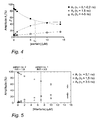
- Fig. 4 This comparison operation is further illustrated by the diagram of Fig. 4 where the x-axis represents the total amount of warfarin (which is related to the amount of warfarin) present in a sample of human blood (which substantially corresponds the amount present in a PBS buffer), and the y-axis represents the measured intensity values (A ref1 , A ref2 , A ref3 ) as a percentage of the total amount a warfarin (c ref ), i. e the sum of A ref1 , A ref2 and A ref3 is 100% or 1.00 . Since each intensity (amplitude) is associated with rather constant fluorescence lifetimes ( ⁇ ref1 , ⁇ ref2 , ⁇ ref3 ) it is possible to determine how much warfarin is bound to protein and how much that is not.
- the x-axis represents the total amount of warfarin (which is related to the amount of warfarin) present in a sample of human blood (which substantially corresponds the amount present in a PBS buffer)
- the intensity values and fluorescence lifetimes of Fig. 4 corresponds the reference values A ref1 , A ref2 , A ref3 , and ⁇ ref1 , ⁇ ref2 , ⁇ ref3 , and by knowing A 1 , A 2 , A 3 and ⁇ 1 , ⁇ 2 , ⁇ 3 and by comparing these values with the reference values the amount of warfarin may be read from the diagram.
- the determination of the amount c may comprise using regression analysis for fitting at least one (but preferably all) intensity value A 1 , A 2 , A 3 of a fluorescence lifetime ⁇ 1 , ⁇ 2 , ⁇ 3 with a known intensity value A ref1 , A ref2 , A ref3 associated with a certain amount value c ref .
- the same applies for the fluorescence lifetime ⁇ 1 , ⁇ 2 , ⁇ 3 i.e. the determination of the amount c may comprise using regression analysis for fitting at least one fluorescence lifetime ⁇ 1 , ⁇ 2 , ⁇ 3 with a known fluorescence lifetime ⁇ ref1 , ⁇ ref2 , ⁇ ref3 associated with a certain amount value c ref .
- the method may also comprise calculating a probability distribution when determining 310 an intensity value A 1 , A 2 , A 3 of the fluorescent emission at the fluorescence lifetime ⁇ 1 , ⁇ 2 , ⁇ 3 .
- the publicly available GNU Scientific Library may be used.
- the measuring of the fluorescent emission from the sample comprises performing time-resolved fluorescence spectroscopic measurements.
- the light from the light source used has a substantially constant wavelength, and has more particularly a wavelength suitable for excitation of warfarin, such as a wavelength between 305 nm to 350 nm, or more specifically 334 nm.
- the sample 116 may be stirred when performing the measuring of the fluorescent emission, which means that the receptacle comprises stirring-means.
- a blood sample from a patient may typically exhibit a first fluorescence lifetime ⁇ 1 with a measured intensity value A m of 0.51.
- the measured amount of warfarin c m is then 6.25 ⁇ M.
- the measured intensity of the first fluorescence lifetime is compared with known intensity values (the values on the y-axis of Fig. 4 ) associated with a certain warfarin amount value (the values of the x-axis of Fig. 4 ). Since the proper curve (the one for the first fluorescence lifetime) is used, the determination of the amount also includes comparing the measured fluorescence lifetime with a known fluorescence lifetime (i.e. with one of the curves of the diagram in Fig. 4 ) associated with a certain warfarin amount-value.
- the amount of warfarin is divided by the volume of the sample for which the amount was determined. Moreover, the distribution of A 1 , A 2 , A 3 may be used for analyzing the state of warfarin (unbound or a type of bound warfarin).
- the amount of warfarin can also be used to determine a coagulation time of the blood.
- Coagulation time is however often individual for the patient from which the sample was taken, and for correlating the coagulation time with an amount/concentration value of warfarin empirical methods can be used, i.e. a set of coagulation times are determined for a set of blood samples having different amount/concentration values of warfarin.
- this correlation is done knowing the warfarin amount/concentration value is sufficient for determining whether the drug is within its therapeutic window.
- the time-resolved fluorescence spectroscopic measurements were performed on a time-correlated single-photon counting (TCSPC) system, IBH 5000M (Jobin Yvon IBH Ltd., Glasgow, UK).
- TCSPC time-correlated single-photon counting
- the fluorescence lifetimes (decay times) ⁇ i with associated amplitudes A i were determined using a light emitting diode, NanoLED-17 (HORIBA Jobin Yvon IBH) producing 334 nm (warfarin-human blood plasma binding experiments in PBS) and excitation pulses at 1.0 MHz repetition rates.
- a single grating monochromator Model 5000M IBH with a spectral bandwidth set to 32 nm was used.
- the data were collected in 4048 channels and the time-calibration was 13.4 ps/channel.
- the fluorescence emission was detected by an IBH TBX-04 photon detection module under TCSPC conditions, and the full width at half maximum (fwhm) of the instrumental response function was typically around 560 ps, which was measured with a suspension of silica particles (Ludox TMA-34 Sigma-Aldrich) dissolved in deionized water.
- Freshly frozen plasma were obtained and initially human blood was collected in tubes with additives of citrate.
- plasma was separated by centrifugation at 3000 - 3500xg at room temperature for 20 min and finally stored at -80°C.
- the buffer used was phosphate-buffered saline (PBS) consisting of 0.5 M Na 2 HPO 4 (Scharlau)/KH 2 PO 4 (Merck) and 0.1 M NaCl at pH 7.3.
- PBS phosphate-buffered saline
- Table 1 Lifetimes (ns) Amplitude (%) [Warfarin] ⁇ M ⁇ 1 ⁇ 2 ⁇ 3 A 1 A 2 A 3 ⁇ 2 PLASMA 0 0.07 1.9 8.4 87 7 6 1.04 (14 mg/mL) 0.5 0.07 1.8 7.8 84 11 6 1.09 10 0.15 1.5 4.3 44 43 14 1.18 HSA (0.65 mg/mL) 10 0.22 1.3 3.7 25 46 29 0.82
- INR International Normalized Ratio
- Fig. 5 graphically illustrates the numbers of table 2, where the results of the measurements for the patients (dashed vertical lines) can be found in relation to the measurements of the spiked samples.
- the amplitude values for patient no. 1 corresponds to an amount of warfarin of 7 ⁇ M
- the amplitude values for patient no. 2 corresponds to approximately 0,2 ⁇ M.
- the experiments show a clear correlation between the INR, i.e. the coagulation of the blood, and the amount of warfarin in the blood.
Landscapes
- Health & Medical Sciences (AREA)
- Nuclear Medicine, Radiotherapy & Molecular Imaging (AREA)
- Physics & Mathematics (AREA)
- Life Sciences & Earth Sciences (AREA)
- Chemical & Material Sciences (AREA)
- Analytical Chemistry (AREA)
- Biochemistry (AREA)
- General Health & Medical Sciences (AREA)
- General Physics & Mathematics (AREA)
- Immunology (AREA)
- Pathology (AREA)
- Investigating, Analyzing Materials By Fluorescence Or Luminescence (AREA)
- Investigating Or Analysing Biological Materials (AREA)
Claims (11)
- Verfahren zum Messen eines in einer Probe (116) vorhandenen Vitamin-K-antagonisierenden Antikoagulans, wobei das Verfahren Folgendes umfasst:Bestrahlen (304) der Probe (116) mit Licht von einer Lichtquelle (114) zum Anregen des Antikoagulans durch seine Absorption des Lichts, wobei die Anregung der Probe (116) zu einer Fluoreszenzemission aus der Probe (116) führt,Messen (306) der Fluoreszenzemission der Probe (116),Bestimmen (308) einer Fluoreszenz-Lebensdauer (τ1) der Fluoreszenzemission aus der Probe (116),Bestimmen (310) einer Intensität (A1) der Fluoreszenzemission bei der Fluoreszenz-Lebensdauer (τ1) ,dadurch gekennzeichnet, dass
die Probe aus Humanblut oder -blutplasma besteht und dass eine Menge (c) des Antikoagulans als Funktion der Intensität (A1) der Fluoreszenzemission bei der Fluoreszenz-Lebensdauer (τ1) bestimmt wird (312). - Verfahren nach Anspruch 1, welches ferner folgende Schritte umfasst:Bestimmen (308b) einer zweiten Fluoreszenz-Lebensdauer (τ2) der Fluoreszenzemission aus der Probe (116), Bestimmen (310b) einer Intensität (A2) der Fluoreszenzemission bei der zweiten Fluoreszenz-Lebensdauer (τ2) ,Bestimmen (312b) der Menge (c) des Antikoagulans als Funktion der Intensität (A2) der Fluoreszenzemission bei der zweiten Fluoreszenz-Lebensdauer (τ2).
- Verfahren nach Anspruch 2, welches ferner folgende Schritte umfasst:Bestimmen (308c) einer dritten Fluoreszenz-Lebensdauer (τ3) der Fluoreszenzemission aus der Probe (116),Bestimmen (310c) einer Intensität (A3) der Fluoreszenzemission mit der dritten Fluoreszenz-Lebensdauer (τ3) undBestimmen (312c) der Menge (c) des Antikoagulans als Funktion der Intensität (A3) der Fluoreszenzemission bei der dritten Fluoreszenz-Lebensdauer (τ3).
- Verfahren nach einem der Ansprüche 1-3, wobei die Bestimmung (312) der Menge (c) das Vergleichen der Intensität (A1; A2; A3) mindestens einer Fluoreszenz-Lebensdauer (τ1; τ2; τ3) mit einem bekannten Intensitätswert (AVergleich1; AVergleich2; AVergleich3), der mit einem bestimmten Mengenwert (Cvergleich) assoziiert ist, umfasst.
- Verfahren nach einem der Ansprüche 1-4, wobei die Bestimmung (312) der Menge (c) das Vergleichen mindestens einer Fluoreszenz-Lebensdauer (τ1; τ2; τ3) mit einer bekannten Fluoreszenz-Lebensdauer (τVergleich1; τVergleich2; τVergleich3), die mit einem bestimmten Mengenwert (Cvergleich) assoziiert ist, umfasst.
- Verfahren nach einem der Ansprüche 1-5, wobei die Bestimmung (312) der Menge (c) das Verwenden einer Regressionsanalyse zum Anpassen mindestens eines Intensitätswerts (A1; A2; A3) einer Fluoreszenz-Lebensdauer (τ1; τ2; τ3) mit einem bekannten Intensitätswert (AVergleich1; AVergleich2; AVergleich3), der mit einem bestimmten Mengenwert (CVergleich) assoziiert ist, umfasst.
- Verfahren nach einem der Ansprüche 1-6, wobei die Bestimmung (312) der Menge (c) das Verwenden einer Korrelation zwischen mindestens einer Fluoreszenz-Lebensdauer (τ1; τ2; τ3) und mindestens einer bekannten Fluoreszenz-Lebensdauer (τVergleich1; τVergleich2; τVergleich3) die mit einem bestimmten Mengenwert (Cvergleich) assoziiert ist, umfasst.
- Verfahren nach einem der Ansprüche 1-7, wobei das Messen (306) der Fluoreszenzemission der Probe (116) das Durchführen von zeitauflösenden fluoreszenzspektroskopischen Messungen umfasst.
- Verfahren nach einem der Ansprüche 1-8, wobei es sich bei dem Vitamin-K-antagonisierenden Antikoagulans um ein synthetisches Derivat von Kumarin handelt.
- Verfahren nach einem der Ansprüche 1-9, wobei es sich bei dem Vitamin-K-antagonisierenden Antikoagulans um Warfarin handelt.
- Apparat, der speziell zum Durchführen des Verfahrens nach einem der Ansprüche 1-10 angepasst ist, umfassend:eine Lichtquelle (114), die angeordnet ist, um die Probe (116) mit Licht zum Anregen des Antikoagulans durch seine Absorption des Lichts zu bestrahlen (304), wobei die Anregung der Probe (116) zu einer Fluoreszenzemission aus der Probe (116) führt,Messmittel (120, 122, 124), die angeordnet sind, um die Fluoreszenzemission aus der Probe (116) zu messen, undmindestens einen Prozessor (130), dadurch gekennzeichnet, dass der Prozessor konfiguriert ist, um eine Fluoreszenz-Lebensdauer (τ1) der Fluoreszenzemission aus der Probe (116) zu messen, umeine Intensität (A1) der Fluoreszenz-Emission bei der Fluoreszenz-Lebensdauer (τ1) zu bestimmen und umeine Menge (c) des Antikoagulans als Funktion der Intensität (A1) der Fluoreszenz-Emission bei der Fluoreszenz-Lebensdauer (τ1) zu bestimmen.
Applications Claiming Priority (2)
| Application Number | Priority Date | Filing Date | Title |
|---|---|---|---|
| SE0950225A SE533680C2 (sv) | 2009-04-07 | 2009-04-07 | Metod och anordning för detektering av läkemedel i ett prov |
| PCT/SE2010/050326 WO2010117320A1 (en) | 2009-04-07 | 2010-03-25 | Method and apparatus for detecting pharmaceuticals in a sample |
Publications (2)
| Publication Number | Publication Date |
|---|---|
| EP2417437A1 EP2417437A1 (de) | 2012-02-15 |
| EP2417437B1 true EP2417437B1 (de) | 2013-07-03 |
Family
ID=42262251
Family Applications (1)
| Application Number | Title | Priority Date | Filing Date |
|---|---|---|---|
| EP10719424.3A Not-in-force EP2417437B1 (de) | 2009-04-07 | 2010-03-25 | Verfahren und vorrichtung zum nachweis von pharmazeutika in einer probe |
Country Status (7)
| Country | Link |
|---|---|
| US (1) | US8841633B2 (de) |
| EP (1) | EP2417437B1 (de) |
| JP (1) | JP5596124B2 (de) |
| AU (1) | AU2010235233B2 (de) |
| CA (1) | CA2758063C (de) |
| SE (1) | SE533680C2 (de) |
| WO (1) | WO2010117320A1 (de) |
Families Citing this family (5)
| Publication number | Priority date | Publication date | Assignee | Title |
|---|---|---|---|---|
| CN102650596B (zh) * | 2011-02-24 | 2014-06-18 | 中国科学技术大学 | 时间分辨荧光光谱测硼仪控制单元及应用其的测硼方法 |
| DE102011055330B4 (de) * | 2011-11-14 | 2024-10-31 | Leica Microsystems Cms Gmbh | Verfahren zum Messen der Lebensdauer eines angeregten Zustandes in einer Probe |
| JP6595204B2 (ja) * | 2015-04-24 | 2019-10-23 | 株式会社島津製作所 | 光学分析装置 |
| EP3729055B1 (de) | 2017-12-22 | 2025-11-05 | Radiometer Medical ApS | Verfahren und sensor zum erfassen des vorhandenseins oder fehlens einer verunreinigung |
| JP7633102B2 (ja) * | 2021-06-22 | 2025-02-19 | 浜松ホトニクス株式会社 | 蛍光寿命計測のバックグラウンド除去方法及び標的物質の定量方法 |
Family Cites Families (9)
| Publication number | Priority date | Publication date | Assignee | Title |
|---|---|---|---|---|
| JPS61241639A (ja) * | 1985-04-19 | 1986-10-27 | Hitachi Ltd | 反応試料分析装置 |
| US6046051A (en) * | 1997-06-27 | 2000-04-04 | Hemosense, Inc. | Method and device for measuring blood coagulation or lysis by viscosity changes |
| DE19955607A1 (de) * | 1999-11-19 | 2001-06-07 | November Ag Molekulare Medizin | Medikament oder aufeinander abgestimmte Kombination von Medikamenten |
| JP4459390B2 (ja) * | 2000-06-08 | 2010-04-28 | 浜松ホトニクス株式会社 | 蛍光測定方法、蛍光測定装置及びそれを用いた試料評価装置 |
| JP2004090517A (ja) * | 2002-09-02 | 2004-03-25 | Seiko Epson Corp | 印刷装置およびカートリッジ |
| WO2005001451A2 (en) * | 2003-02-24 | 2005-01-06 | Cdex, Inc. | System and methods for detection and identification of chemical substances |
| EP1612541A1 (de) | 2003-04-04 | 2006-01-04 | National Institute of Advanced Industrial Science and Technology | Quantitatives reaktionsmittel, verfahren und geräte einer substanz unter verwendung der fluoreszenzlebensdauer |
| CN1879020B (zh) | 2003-09-03 | 2010-11-03 | 受体有限责任公司 | 使用组合的人工受体的传感器 |
| JP2007033159A (ja) | 2005-07-25 | 2007-02-08 | Assay Corp | 蛍光分子で標識された測定対象物質 |
-
2009
- 2009-04-07 SE SE0950225A patent/SE533680C2/sv unknown
-
2010
- 2010-03-25 JP JP2012504653A patent/JP5596124B2/ja active Active
- 2010-03-25 EP EP10719424.3A patent/EP2417437B1/de not_active Not-in-force
- 2010-03-25 CA CA2758063A patent/CA2758063C/en active Active
- 2010-03-25 WO PCT/SE2010/050326 patent/WO2010117320A1/en not_active Ceased
- 2010-03-25 US US13/263,399 patent/US8841633B2/en active Active
- 2010-03-25 AU AU2010235233A patent/AU2010235233B2/en not_active Ceased
Also Published As
| Publication number | Publication date |
|---|---|
| AU2010235233A1 (en) | 2011-11-03 |
| CA2758063C (en) | 2015-12-15 |
| SE0950225A1 (sv) | 2010-10-08 |
| WO2010117320A1 (en) | 2010-10-14 |
| SE533680C2 (sv) | 2010-11-30 |
| AU2010235233B2 (en) | 2013-11-28 |
| EP2417437A1 (de) | 2012-02-15 |
| CA2758063A1 (en) | 2010-10-14 |
| JP5596124B2 (ja) | 2014-09-24 |
| US8841633B2 (en) | 2014-09-23 |
| US20120032095A1 (en) | 2012-02-09 |
| JP2012523006A (ja) | 2012-09-27 |
Similar Documents
| Publication | Publication Date | Title |
|---|---|---|
| AU2008279755B2 (en) | Measuring amount of bound and combined nitric oxide in blood | |
| Jarvi et al. | The influence of oxygen depletion and photosensitizer triplet‐state dynamics during photodynamic therapy on accurate singlet oxygen luminescence monitoring and analysis of treatment dose response | |
| US8841633B2 (en) | Method and apparatus for detecting pharmaceuticals in a sample | |
| EP4317947B1 (de) | Fluoreszenzmessvorrichtung | |
| RU2004123207A (ru) | Способ анализа гемоглобина и система для его осуществления | |
| Lazzari et al. | Detection of mercury in air by time-resolved laser-induced breakdown spectroscopy technique | |
| US20040137637A1 (en) | Breath gas analyzer for diagnosing diabetes and method of use thereof | |
| WO2014168734A1 (en) | Time-resolved laser-induced fluorescence spectroscopy systems and uses thereof | |
| JP2013518270A (ja) | 特に、血中グルコースを測定するための、測定装置および測定方法 | |
| JP2009519717A (ja) | 位相を固定した配列決定のための方法およびシステム | |
| Koo et al. | Reagentless blood analysis by near-infrared Raman spectroscopy | |
| JP3889334B2 (ja) | 化学発光および蛍光の経時変化測定装置および方法 | |
| JP2010175251A (ja) | 表面増強ラマン分光測定方法及び本方法を用いた表面増強ラマン分光装置 | |
| US11467151B1 (en) | Phosphorescence oxygen analyzer and uses thereof | |
| US20240159678A1 (en) | Method and apparatus for detection of radical species | |
| Paredes et al. | Influence of the solvent on the ground-and excited-state buffer-mediated proton-transfer reactions of a xanthenic dye | |
| Näther et al. | Temporal and spectral separation of singlet oxygen luminescence from near infrared emitting photosensitizers | |
| JP5846364B2 (ja) | 水質評価方法及び水質評価装置 | |
| CN121762505A (zh) | 一种维生素b6衍生物的检测方法 | |
| Bukowski et al. | Two-photon-excited phase-resolved fluorescence spectroscopy | |
| JP2005207886A (ja) | 複数の発光の経時変化を測定する装置および方法 | |
| CN117074300A (zh) | 样本分析仪及其控制方法 | |
| Gupta et al. | Fluorescence photobleaching and recovery of human breast tissues and tissue phantoms | |
| JP2004501347A (ja) | 混合物の分析方法 | |
| Rüttinger et al. | Comparison of Fluorescence Lifetime Correlation Spectroscopy and Background Corrected Fluorescence Correlation Spectroscopy |
Legal Events
| Date | Code | Title | Description |
|---|---|---|---|
| PUAI | Public reference made under article 153(3) epc to a published international application that has entered the european phase |
Free format text: ORIGINAL CODE: 0009012 |
|
| 17P | Request for examination filed |
Effective date: 20111028 |
|
| AK | Designated contracting states |
Kind code of ref document: A1 Designated state(s): AT BE BG CH CY CZ DE DK EE ES FI FR GB GR HR HU IE IS IT LI LT LU LV MC MK MT NL NO PL PT RO SE SI SK SM TR |
|
| DAX | Request for extension of the european patent (deleted) | ||
| 17Q | First examination report despatched |
Effective date: 20120910 |
|
| GRAP | Despatch of communication of intention to grant a patent |
Free format text: ORIGINAL CODE: EPIDOSNIGR1 |
|
| GRAS | Grant fee paid |
Free format text: ORIGINAL CODE: EPIDOSNIGR3 |
|
| GRAA | (expected) grant |
Free format text: ORIGINAL CODE: 0009210 |
|
| RAP1 | Party data changed (applicant data changed or rights of an application transferred) |
Owner name: SENSIKAL AB |
|
| RIN1 | Information on inventor provided before grant (corrected) |
Inventor name: ROSENGREN, ANNIKA M. Inventor name: NICHOLLS, IAN A. Inventor name: KARLSSON, BJORN C.G. Inventor name: ANDERSSON, PER OLA |
|
| AK | Designated contracting states |
Kind code of ref document: B1 Designated state(s): AT BE BG CH CY CZ DE DK EE ES FI FR GB GR HR HU IE IS IT LI LT LU LV MC MK MT NL NO PL PT RO SE SI SK SM TR |
|
| REG | Reference to a national code |
Ref country code: GB Ref legal event code: FG4D |
|
| REG | Reference to a national code |
Ref country code: AT Ref legal event code: REF Ref document number: 620046 Country of ref document: AT Kind code of ref document: T Effective date: 20130715 Ref country code: CH Ref legal event code: EP |
|
| REG | Reference to a national code |
Ref country code: IE Ref legal event code: FG4D |
|
| REG | Reference to a national code |
Ref country code: DE Ref legal event code: R096 Ref document number: 602010008239 Country of ref document: DE Effective date: 20130829 |
|
| PG25 | Lapsed in a contracting state [announced via postgrant information from national office to epo] |
Ref country code: SI Free format text: LAPSE BECAUSE OF FAILURE TO SUBMIT A TRANSLATION OF THE DESCRIPTION OR TO PAY THE FEE WITHIN THE PRESCRIBED TIME-LIMIT Effective date: 20130703 |
|
| REG | Reference to a national code |
Ref country code: AT Ref legal event code: MK05 Ref document number: 620046 Country of ref document: AT Kind code of ref document: T Effective date: 20130703 |
|
| REG | Reference to a national code |
Ref country code: NL Ref legal event code: VDEP Effective date: 20130703 |
|
| REG | Reference to a national code |
Ref country code: LT Ref legal event code: MG4D |
|
| PG25 | Lapsed in a contracting state [announced via postgrant information from national office to epo] |
Ref country code: SE Free format text: LAPSE BECAUSE OF FAILURE TO SUBMIT A TRANSLATION OF THE DESCRIPTION OR TO PAY THE FEE WITHIN THE PRESCRIBED TIME-LIMIT Effective date: 20130703 Ref country code: CY Free format text: LAPSE BECAUSE OF FAILURE TO SUBMIT A TRANSLATION OF THE DESCRIPTION OR TO PAY THE FEE WITHIN THE PRESCRIBED TIME-LIMIT Effective date: 20130814 Ref country code: PT Free format text: LAPSE BECAUSE OF FAILURE TO SUBMIT A TRANSLATION OF THE DESCRIPTION OR TO PAY THE FEE WITHIN THE PRESCRIBED TIME-LIMIT Effective date: 20131104 Ref country code: IS Free format text: LAPSE BECAUSE OF FAILURE TO SUBMIT A TRANSLATION OF THE DESCRIPTION OR TO PAY THE FEE WITHIN THE PRESCRIBED TIME-LIMIT Effective date: 20131103 Ref country code: BE Free format text: LAPSE BECAUSE OF FAILURE TO SUBMIT A TRANSLATION OF THE DESCRIPTION OR TO PAY THE FEE WITHIN THE PRESCRIBED TIME-LIMIT Effective date: 20130703 Ref country code: NO Free format text: LAPSE BECAUSE OF FAILURE TO SUBMIT A TRANSLATION OF THE DESCRIPTION OR TO PAY THE FEE WITHIN THE PRESCRIBED TIME-LIMIT Effective date: 20131003 Ref country code: LT Free format text: LAPSE BECAUSE OF FAILURE TO SUBMIT A TRANSLATION OF THE DESCRIPTION OR TO PAY THE FEE WITHIN THE PRESCRIBED TIME-LIMIT Effective date: 20130703 Ref country code: HR Free format text: LAPSE BECAUSE OF FAILURE TO SUBMIT A TRANSLATION OF THE DESCRIPTION OR TO PAY THE FEE WITHIN THE PRESCRIBED TIME-LIMIT Effective date: 20130703 Ref country code: AT Free format text: LAPSE BECAUSE OF FAILURE TO SUBMIT A TRANSLATION OF THE DESCRIPTION OR TO PAY THE FEE WITHIN THE PRESCRIBED TIME-LIMIT Effective date: 20130703 |
|
| PG25 | Lapsed in a contracting state [announced via postgrant information from national office to epo] |
Ref country code: GR Free format text: LAPSE BECAUSE OF FAILURE TO SUBMIT A TRANSLATION OF THE DESCRIPTION OR TO PAY THE FEE WITHIN THE PRESCRIBED TIME-LIMIT Effective date: 20131004 Ref country code: LV Free format text: LAPSE BECAUSE OF FAILURE TO SUBMIT A TRANSLATION OF THE DESCRIPTION OR TO PAY THE FEE WITHIN THE PRESCRIBED TIME-LIMIT Effective date: 20130703 Ref country code: PL Free format text: LAPSE BECAUSE OF FAILURE TO SUBMIT A TRANSLATION OF THE DESCRIPTION OR TO PAY THE FEE WITHIN THE PRESCRIBED TIME-LIMIT Effective date: 20130703 Ref country code: FI Free format text: LAPSE BECAUSE OF FAILURE TO SUBMIT A TRANSLATION OF THE DESCRIPTION OR TO PAY THE FEE WITHIN THE PRESCRIBED TIME-LIMIT Effective date: 20130703 Ref country code: NL Free format text: LAPSE BECAUSE OF FAILURE TO SUBMIT A TRANSLATION OF THE DESCRIPTION OR TO PAY THE FEE WITHIN THE PRESCRIBED TIME-LIMIT Effective date: 20130703 Ref country code: ES Free format text: LAPSE BECAUSE OF FAILURE TO SUBMIT A TRANSLATION OF THE DESCRIPTION OR TO PAY THE FEE WITHIN THE PRESCRIBED TIME-LIMIT Effective date: 20131014 |
|
| PG25 | Lapsed in a contracting state [announced via postgrant information from national office to epo] |
Ref country code: CY Free format text: LAPSE BECAUSE OF FAILURE TO SUBMIT A TRANSLATION OF THE DESCRIPTION OR TO PAY THE FEE WITHIN THE PRESCRIBED TIME-LIMIT Effective date: 20130703 |
|
| PG25 | Lapsed in a contracting state [announced via postgrant information from national office to epo] |
Ref country code: DK Free format text: LAPSE BECAUSE OF FAILURE TO SUBMIT A TRANSLATION OF THE DESCRIPTION OR TO PAY THE FEE WITHIN THE PRESCRIBED TIME-LIMIT Effective date: 20130703 Ref country code: EE Free format text: LAPSE BECAUSE OF FAILURE TO SUBMIT A TRANSLATION OF THE DESCRIPTION OR TO PAY THE FEE WITHIN THE PRESCRIBED TIME-LIMIT Effective date: 20130703 Ref country code: SK Free format text: LAPSE BECAUSE OF FAILURE TO SUBMIT A TRANSLATION OF THE DESCRIPTION OR TO PAY THE FEE WITHIN THE PRESCRIBED TIME-LIMIT Effective date: 20130703 Ref country code: RO Free format text: LAPSE BECAUSE OF FAILURE TO SUBMIT A TRANSLATION OF THE DESCRIPTION OR TO PAY THE FEE WITHIN THE PRESCRIBED TIME-LIMIT Effective date: 20130703 Ref country code: CZ Free format text: LAPSE BECAUSE OF FAILURE TO SUBMIT A TRANSLATION OF THE DESCRIPTION OR TO PAY THE FEE WITHIN THE PRESCRIBED TIME-LIMIT Effective date: 20130703 |
|
| PLBE | No opposition filed within time limit |
Free format text: ORIGINAL CODE: 0009261 |
|
| STAA | Information on the status of an ep patent application or granted ep patent |
Free format text: STATUS: NO OPPOSITION FILED WITHIN TIME LIMIT |
|
| PG25 | Lapsed in a contracting state [announced via postgrant information from national office to epo] |
Ref country code: IT Free format text: LAPSE BECAUSE OF FAILURE TO SUBMIT A TRANSLATION OF THE DESCRIPTION OR TO PAY THE FEE WITHIN THE PRESCRIBED TIME-LIMIT Effective date: 20130703 |
|
| 26N | No opposition filed |
Effective date: 20140404 |
|
| REG | Reference to a national code |
Ref country code: DE Ref legal event code: R097 Ref document number: 602010008239 Country of ref document: DE Effective date: 20140404 |
|
| PG25 | Lapsed in a contracting state [announced via postgrant information from national office to epo] |
Ref country code: LU Free format text: LAPSE BECAUSE OF FAILURE TO SUBMIT A TRANSLATION OF THE DESCRIPTION OR TO PAY THE FEE WITHIN THE PRESCRIBED TIME-LIMIT Effective date: 20140325 |
|
| REG | Reference to a national code |
Ref country code: IE Ref legal event code: MM4A |
|
| PG25 | Lapsed in a contracting state [announced via postgrant information from national office to epo] |
Ref country code: IE Free format text: LAPSE BECAUSE OF NON-PAYMENT OF DUE FEES Effective date: 20140325 |
|
| PG25 | Lapsed in a contracting state [announced via postgrant information from national office to epo] |
Ref country code: MT Free format text: LAPSE BECAUSE OF FAILURE TO SUBMIT A TRANSLATION OF THE DESCRIPTION OR TO PAY THE FEE WITHIN THE PRESCRIBED TIME-LIMIT Effective date: 20130703 |
|
| REG | Reference to a national code |
Ref country code: FR Ref legal event code: PLFP Year of fee payment: 7 |
|
| PG25 | Lapsed in a contracting state [announced via postgrant information from national office to epo] |
Ref country code: SM Free format text: LAPSE BECAUSE OF FAILURE TO SUBMIT A TRANSLATION OF THE DESCRIPTION OR TO PAY THE FEE WITHIN THE PRESCRIBED TIME-LIMIT Effective date: 20130703 |
|
| PG25 | Lapsed in a contracting state [announced via postgrant information from national office to epo] |
Ref country code: MC Free format text: LAPSE BECAUSE OF FAILURE TO SUBMIT A TRANSLATION OF THE DESCRIPTION OR TO PAY THE FEE WITHIN THE PRESCRIBED TIME-LIMIT Effective date: 20130703 |
|
| PG25 | Lapsed in a contracting state [announced via postgrant information from national office to epo] |
Ref country code: BG Free format text: LAPSE BECAUSE OF FAILURE TO SUBMIT A TRANSLATION OF THE DESCRIPTION OR TO PAY THE FEE WITHIN THE PRESCRIBED TIME-LIMIT Effective date: 20130703 |
|
| PG25 | Lapsed in a contracting state [announced via postgrant information from national office to epo] |
Ref country code: HU Free format text: LAPSE BECAUSE OF FAILURE TO SUBMIT A TRANSLATION OF THE DESCRIPTION OR TO PAY THE FEE WITHIN THE PRESCRIBED TIME-LIMIT; INVALID AB INITIO Effective date: 20100325 Ref country code: TR Free format text: LAPSE BECAUSE OF FAILURE TO SUBMIT A TRANSLATION OF THE DESCRIPTION OR TO PAY THE FEE WITHIN THE PRESCRIBED TIME-LIMIT Effective date: 20130703 |
|
| REG | Reference to a national code |
Ref country code: FR Ref legal event code: PLFP Year of fee payment: 8 |
|
| REG | Reference to a national code |
Ref country code: FR Ref legal event code: PLFP Year of fee payment: 9 |
|
| PG25 | Lapsed in a contracting state [announced via postgrant information from national office to epo] |
Ref country code: MK Free format text: LAPSE BECAUSE OF FAILURE TO SUBMIT A TRANSLATION OF THE DESCRIPTION OR TO PAY THE FEE WITHIN THE PRESCRIBED TIME-LIMIT Effective date: 20130703 |
|
| PGFP | Annual fee paid to national office [announced via postgrant information from national office to epo] |
Ref country code: GB Payment date: 20220321 Year of fee payment: 13 Ref country code: DE Payment date: 20220322 Year of fee payment: 13 Ref country code: CH Payment date: 20220310 Year of fee payment: 13 |
|
| PGFP | Annual fee paid to national office [announced via postgrant information from national office to epo] |
Ref country code: FR Payment date: 20220317 Year of fee payment: 13 |
|
| REG | Reference to a national code |
Ref country code: DE Ref legal event code: R119 Ref document number: 602010008239 Country of ref document: DE |
|
| REG | Reference to a national code |
Ref country code: CH Ref legal event code: PL |
|
| GBPC | Gb: european patent ceased through non-payment of renewal fee |
Effective date: 20230325 |
|
| PG25 | Lapsed in a contracting state [announced via postgrant information from national office to epo] |
Ref country code: GB Free format text: LAPSE BECAUSE OF NON-PAYMENT OF DUE FEES Effective date: 20230325 |
|
| PG25 | Lapsed in a contracting state [announced via postgrant information from national office to epo] |
Ref country code: LI Free format text: LAPSE BECAUSE OF NON-PAYMENT OF DUE FEES Effective date: 20230331 Ref country code: GB Free format text: LAPSE BECAUSE OF NON-PAYMENT OF DUE FEES Effective date: 20230325 Ref country code: FR Free format text: LAPSE BECAUSE OF NON-PAYMENT OF DUE FEES Effective date: 20230331 Ref country code: DE Free format text: LAPSE BECAUSE OF NON-PAYMENT OF DUE FEES Effective date: 20231003 Ref country code: CH Free format text: LAPSE BECAUSE OF NON-PAYMENT OF DUE FEES Effective date: 20230331 |