EP2415519A1 - Kohlenmonoxidreduktionskatalysator für rauchartikel und verfahren zu seiner herstellung - Google Patents
Kohlenmonoxidreduktionskatalysator für rauchartikel und verfahren zu seiner herstellung Download PDFInfo
- Publication number
- EP2415519A1 EP2415519A1 EP10758867A EP10758867A EP2415519A1 EP 2415519 A1 EP2415519 A1 EP 2415519A1 EP 10758867 A EP10758867 A EP 10758867A EP 10758867 A EP10758867 A EP 10758867A EP 2415519 A1 EP2415519 A1 EP 2415519A1
- Authority
- EP
- European Patent Office
- Prior art keywords
- catalyst
- carbon monoxide
- particles
- iron
- transition metal
- Prior art date
- Legal status (The legal status is an assumption and is not a legal conclusion. Google has not performed a legal analysis and makes no representation as to the accuracy of the status listed.)
- Withdrawn
Links
Images
Classifications
-
- A—HUMAN NECESSITIES
- A24—TOBACCO; CIGARS; CIGARETTES; SIMULATED SMOKING DEVICES; SMOKERS' REQUISITES
- A24B—MANUFACTURE OR PREPARATION OF TOBACCO FOR SMOKING OR CHEWING; TOBACCO; SNUFF
- A24B15/00—Chemical features or treatment of tobacco; Tobacco substitutes, e.g. in liquid form
- A24B15/18—Treatment of tobacco products or tobacco substitutes
- A24B15/28—Treatment of tobacco products or tobacco substitutes by chemical substances
- A24B15/281—Treatment of tobacco products or tobacco substitutes by chemical substances the action of the chemical substances being delayed
- A24B15/282—Treatment of tobacco products or tobacco substitutes by chemical substances the action of the chemical substances being delayed by indirect addition of the chemical substances, e.g. in the wrapper, in the case
-
- A—HUMAN NECESSITIES
- A24—TOBACCO; CIGARS; CIGARETTES; SIMULATED SMOKING DEVICES; SMOKERS' REQUISITES
- A24B—MANUFACTURE OR PREPARATION OF TOBACCO FOR SMOKING OR CHEWING; TOBACCO; SNUFF
- A24B15/00—Chemical features or treatment of tobacco; Tobacco substitutes, e.g. in liquid form
- A24B15/18—Treatment of tobacco products or tobacco substitutes
- A24B15/28—Treatment of tobacco products or tobacco substitutes by chemical substances
-
- A—HUMAN NECESSITIES
- A24—TOBACCO; CIGARS; CIGARETTES; SIMULATED SMOKING DEVICES; SMOKERS' REQUISITES
- A24B—MANUFACTURE OR PREPARATION OF TOBACCO FOR SMOKING OR CHEWING; TOBACCO; SNUFF
- A24B15/00—Chemical features or treatment of tobacco; Tobacco substitutes, e.g. in liquid form
- A24B15/18—Treatment of tobacco products or tobacco substitutes
- A24B15/28—Treatment of tobacco products or tobacco substitutes by chemical substances
- A24B15/287—Treatment of tobacco products or tobacco substitutes by chemical substances by inorganic substances only
- A24B15/288—Catalysts or catalytic material, e.g. included in the wrapping material
-
- A—HUMAN NECESSITIES
- A24—TOBACCO; CIGARS; CIGARETTES; SIMULATED SMOKING DEVICES; SMOKERS' REQUISITES
- A24D—CIGARS; CIGARETTES; TOBACCO SMOKE FILTERS; MOUTHPIECES FOR CIGARS OR CIGARETTES; MANUFACTURE OF TOBACCO SMOKE FILTERS OR MOUTHPIECES
- A24D1/00—Cigars; Cigarettes
- A24D1/02—Cigars; Cigarettes with special covers
-
- B—PERFORMING OPERATIONS; TRANSPORTING
- B01—PHYSICAL OR CHEMICAL PROCESSES OR APPARATUS IN GENERAL
- B01J—CHEMICAL OR PHYSICAL PROCESSES, e.g. CATALYSIS OR COLLOID CHEMISTRY; THEIR RELEVANT APPARATUS
- B01J23/00—Catalysts comprising metals or metal oxides or hydroxides, not provided for in group B01J21/00
- B01J23/70—Catalysts comprising metals or metal oxides or hydroxides, not provided for in group B01J21/00 of the iron group metals or copper
- B01J23/74—Iron group metals
- B01J23/745—Iron
-
- B—PERFORMING OPERATIONS; TRANSPORTING
- B01—PHYSICAL OR CHEMICAL PROCESSES OR APPARATUS IN GENERAL
- B01J—CHEMICAL OR PHYSICAL PROCESSES, e.g. CATALYSIS OR COLLOID CHEMISTRY; THEIR RELEVANT APPARATUS
- B01J35/00—Catalysts, in general, characterised by their form or physical properties
- B01J35/40—Catalysts, in general, characterised by their form or physical properties characterised by dimensions, e.g. grain size
-
- B—PERFORMING OPERATIONS; TRANSPORTING
- B01—PHYSICAL OR CHEMICAL PROCESSES OR APPARATUS IN GENERAL
- B01J—CHEMICAL OR PHYSICAL PROCESSES, e.g. CATALYSIS OR COLLOID CHEMISTRY; THEIR RELEVANT APPARATUS
- B01J35/00—Catalysts, in general, characterised by their form or physical properties
- B01J35/60—Catalysts, in general, characterised by their form or physical properties characterised by their surface properties or porosity
-
- B—PERFORMING OPERATIONS; TRANSPORTING
- B01—PHYSICAL OR CHEMICAL PROCESSES OR APPARATUS IN GENERAL
- B01J—CHEMICAL OR PHYSICAL PROCESSES, e.g. CATALYSIS OR COLLOID CHEMISTRY; THEIR RELEVANT APPARATUS
- B01J37/00—Processes, in general, for preparing catalysts; Processes, in general, for activation of catalysts
- B01J37/08—Heat treatment
- B01J37/082—Decomposition and pyrolysis
- B01J37/086—Decomposition of an organometallic compound, a metal complex or a metal salt of a carboxylic acid
Definitions
- the present invention relates to a carbon monoxide reduction catalyst for smoking articles and a method for producing the same.
- Patent Literature 1 discloses that nano-scale metal particles or nano-scale metal oxide particles are carried on carrier particles having a high surface area and are added in shredded tobacco and the like in order to convert carbon monoxide into carbon dioxide.
- Patent Literature 2 describes that a partially reducing additive in the form of nano-particles is added as a carbon monoxide reduction agent to a cut tobacco filler.
- Patent Literature 3 describes that nano-particles of, for example, a metal oxide are physically deposited on, for example, a tobacco cut filler, as an oxidizer that converts carbon monoxide into carbon dioxide.
- these three Patent Literatures disclose the use of nano-particles of a metal oxide.
- nano-particles are not easily handled when they are applied to smoking articles, giving rise to the complexity of a process of producing smoking articles.
- a nano-catalyst is supported by a carrier and therefore, the production cost tends to increase because the carrier is used.
- Patent Literature 4 discloses that when a carbonaceous heat source used in smoking articles is produced, a carbonaceous heat source material is treated with a sol containing a metal oxide precursor to be converted into a metal oxide catalyst that converts carbon monoxide into a harmless material.
- the inventors of the present invention have confirmed that if a nano-scale catalyst is used, the nano-particles are coagulated at high temperatures and the catalyst is significantly deteriorated in the capability to oxidize carbon monoxide.
- a carbon monoxide reduction catalyst for smoking articles comprising particles, 90% by volume or more of which have a particle diameter within a range of 1 to 100 ⁇ m, each particle comprising a transition metal oxide generated by heating a transition metal salt of an organic acid.
- a method for producing a catalyst reducing carbon monoxide in tobacco mainstream smoke comprising heating particles of a transition metal salt of an organic acid.
- the particles of the carbon monoxide reduction catalyst of the present invention are not nano-particles and therefore have superior handling characteristics in the production of smoking articles such as cigarettes.
- the carbon monoxide reduction catalyst of the present invention is not coagulated and keeps the capability to oxidize carbon monoxide.
- the carbon monoxide reduction catalyst of the present invention needs no carrier which is necessary for a general catalyst.
- the production method of the present invention does not require a complicated process.
- a carbon monoxide reduction catalyst according to the present invention is in the form of particles and 90% by volume or more of the particles have particle diameters within the range of from 1 to 100 ⁇ m.
- Each particle comprises a transition metal oxide produced by heating a transition metal salt of an organic acid.
- the catalyst of the present invention is different from a conventional catalyst consisting of nano-particles.
- 10% or more by volume of the catalyst particles have particle diameters of less than 1 ⁇ m, the particles are too small and there is therefore a tendency that the particles are coagulated, bringing about handling difficulty.
- 10% by volume or more of the catalyst particles have particle diameters exceeding 100 ⁇ m, the catalyst cannot be highly dispersed when it is added to a filler material or cigarette paper in the production of smoking articles and this is disadvantageous.
- the particle size distribution of the catalyst particles may be measured using, for example, the LA-910 laser diffraction/scattering type particle size distribution measuring device manufactured by Horiba Ltd.
- the carbon monoxide reduction catalyst of the present invention preferably has a BET specific surface area of 10 to 200 m 2 /g.
- the BET specific surface area is less than 10 m 2 /g, the catalyst tends to be deteriorated in the carbon monoxide capability and this is undesirable.
- the BET specific surface area exceeds 200 m 2 /g, it is highly possible that the production process is complicated.
- the BET specific surface area can be measured by the multi-point method measurement according to the nitrogen adsorption method using a specific surface area/pore distribution measuring device ASAP2010 manufactured by Shimadzu Corporation.
- the carbon monoxide reduction catalyst of the present invention preferably has nanopores having an average pore diameter within the range of from 2 to 20 nm.
- the average pore diameter is less than 2 nm, water molecules necessary for a shift reaction (CO + H 2 O ⁇ CO 2 + H 2 ) on the surface of the catalyst scarcely penetrate into the pores and the carbon monoxide reduction capability is sometimes deteriorated.
- the average pore diameter exceeds 20 nm on the other hand, the contact efficiency between carbon monoxide and the catalyst is sometimes deteriorated.
- the pore size distribution can be measured using the mercury intrusion porosimetry. In the measurement of the pore size distribution, for example, a full automatic pore size distribution measuring device (Pore Master 60-GT, manufactured by Quanta Chrome Co.) may be used.
- the carbon monoxide reduction catalyst of the present invention comprises a transition metal oxide generated by heating particles of a transition metal salt of an organic acid.
- the transition metal is preferably at least one metal selected from the group consisting of Ti, Mn, Fe, Co, Ni, Cu, Y, Zr, Nb, Mo, Ru, Rh, Pd, Ag, Ce, Ir, Pt and Au.
- iron is particularly preferable.
- iron it is assumed that because iron forms an octahedral 6-coordination structure, the ligands are detached at high temperatures to form a metal oxide which is not coagulated and has a stable structure, which is therefore considered to be superior in carbon monoxide reduction capability at high temperatures.
- organic acid fumaric acid or citric acid is preferable though any organic acids may be used.
- iron citrate and iron fumarate are particularly preferable as the transition metal salt of an organic acid.
- the catalyst for smoking articles according to the present invention has superior handling characteristics in the production of smoking articles because it is not nano-particles. Because the catalyst for smoking articles according to the present invention has a nanopore structure showing a pore distribution with an average pore diameter ranging from 2 to 20 nm though it is not nano-sized, it achieves a BET specific surface area as high as 10 to 200 m 2 /g. Further, since the catalyst of the present invention is not nano-particles, it is not coagulated at high temperatures, can keep a high BET specific surface area as it is and can keep its carbon monoxide reduction capability. Further, the catalyst of the present invention unnecessarily needs a carrier which is usually required for catalysts.
- the organic acid transition metal salt particles are preferably heated (or baked) at 200 to 700°C.
- the heating temperature is less than 200°C, there is a fear that the organic acid is insufficiently decomposed with the result that the catalyst obtained after the heating tends to be deteriorated in performance.
- the heating temperature exceeds 700°C on the other hand, the prepared catalyst tends to be deteriorated in carbon monoxide reduction capability.
- the organic acid transition metal salt particles are preferably heated (or baked) particularly at 500 to 600°C. The heating is carried out preferably for 0.1 to 5 hours and more preferably for 0.5 to 3 hours.
- the above organic acid transition metal salt particles are preferably heated in an atmosphere of CO 2 , N 2 , H 2 O or CO gas or in an atmosphere of a mixture of two or more of these gases. It is particularly preferable to heat the organic acid transition metal salt particles in the above gas mixture atmosphere.
- the gas mixture include a gas mixture of CO 2 : 5 to 20 mol%/N 2 : balance, a gas mixture of CO: 1 to 10 mol%/ CO 2 : 5 to 20 mol%/H 2 O: 5 to 20 mol%/N 2 : balance and a gas mixture of H 2 O: 5 to 20 mol%/N 2 : balance.
- the organic acid transition metal salt particles which are the raw material preferably have particle diameters of from 1 to 100 ⁇ m.
- the organic acid transition metal salt particles which are the raw material by itself have no pore, pores are formed, for example, by the decomposition of the organic acid part of the organic acid transition metal salt while substantially keeping original particle diameters, resulting in increase of BET specific surface area when the organic acid transition metal salt particles are heated under the above heating condition and particularly in the above gas atmosphere.
- the BET surface area which depends on pore diameter, can be adjusted by the heating temperature and heating time of the organic acid transition metal salt particles.
- organic acid transition metal salt particles 90% by volume or more of which have particle diameters of 1 to 100 ⁇ m are heated/baked at the above heating temperature (particularly 500 to 600°C) for the above heating time (particularly 0.5 to 3 hours) in the gas atmosphere (particularly in the above preferable gas mixture atmosphere), the above BET specific surface area and average pore diameter can be attained.
- the creation of the transition metal oxide when the organic acid transition metal salt is heated can be confirmed by powder X-ray diffraction analysis.
- powder X-ray diffractometer an automatic X-ray diffractometer (MXP3, manufactured by Mac Science) may be used.
- the catalyst particles When a smoking article is manufactured using the carbon monoxide reduction catalyst of the present invention, the catalyst particles may be sprayed on/applied to, or kneaded in, cigarette paper or tobacco filler, or added when cigarette paper is made.
- the particle diameter of the catalyst particles for smoking articles is more preferably 1 to 30 ⁇ m. Particles of less than 1 ⁇ m, which are close to nano-scale particles, have slight difficulty in handling. Further, if the particle diameter is too large, this is disadvantageous because the catalyst cannot be highly dispersed when it is carried on a filler material or cigarette paper.
- the particle diameter of the catalyst particles is even more preferably about 1 ⁇ m.
- catalysts according to the present invention were prepared from catalyst precursors, and the performance of the catalysts was evaluated.
- iron citrate (Example 1) or iron fumarate (Example 2) containing iron as an element in an amount shown in Table 1 below was used.
- iron citrate a product manufactured by Nacalai Tesque Co., Ltd.
- iron fumarate a product manufactured by Wako Pure Chemical Industries, Ltd.
- each organic acid iron salt particles which passed through a 75 ⁇ m screen were used. The average BET specific surface area of these particles was found by the multi-point method measurement according to the nitrogen adsorption method using a specific surface area/pore distribution measuring device ASAP2010 (manufactured by Shimadzu Corporation). The results are described also in Table 1. A sample was statically allowed to stand at ambient temperature under reduced pressure prior to the measurement of BET specific surface area (this applies also to the following measurements of BET specific surface area).
- the above organic acid iron salts (iron citrate and iron fumarate) were respectively converted into iron oxide by heating the salt at 600°C in a gas atmosphere containing 10 mol% of CO 2 with the balance of nitrogen for 3 hours. It was confirmed that, by an automatic X-ray diffractometer (MXP3, manufactured by Mac Science), iron citrate and iron fumarate were each converted into Fe 3 O 4 by this heat treatment. At this time, the product obtained after the above heat treatment was finely divided by using an agate mortar and filled in a glass sample plate to analyze. The condition of analysis was as follows: X-ray: Cu K ⁇ ray, power: 40 kV, 20 mA, scanning speed: 4 deg/minute. Further, the average BET surface area of the obtained catalyst was measured in the same manner as above. The results are shown also in Table 1.
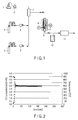
- FIG. 1 is a schematic structural view of a device for analyzing the catalytic performance (carbon monoxide reduction capability) of a catalyst.
- the catalysts obtained in Examples 1 and 2 were respectively filled in a reaction tube 9 disposed in a heating furnace 8.
- Carbon monoxide (CO) and carbon dioxide (CO 2 ) were supplied from gas cylinders 3 and 5 through mass flowmeters 4 and 6 respectively, while water was weighed by an electronic balance 1 and supplied by a metering pump 2.
- the above water was made to flow through an evaporator 7 (200°C) together with the above CO gas and CO 2 gas.
- the water was vaporized into water vapor.
- a model gas (CO: 4 mol%, CO 2 : 8 mol%, H 2 O: 10 mol%, nitrogen: balance) was prepared in the evaporator 7.
- the flow rate of the model gas was set such that its space velocity (SV) was 500,000 h -1 and made to flow through the layer of the catalyst (hereinafter referred to simply as a "packed bed") filled in the reaction tube 9.
- the packed bed was heated until the temperature reached 600°C and then, the packed bed was kept at that temperature. Then, the model gas was made to flow for 3.5 hours.
- PG is a pressure gauge
- TIC is a temperature gauge used to measure the temperature of the tube wall of the reaction tube 9
- TI is a temperature gauge used to measure the temperature of the packed bed.
- the temperature measured by the temperature gauge TIC was used as a control monitor temperature when heating the reaction tube 9 by the furnace 8.
- the gas flowed out of the reaction tube 9 was made to flow through a cooling trap 10 and then, the amount of carbon monoxide was quantitatively measured in predetermined time intervals by an infrared gas analyzer 11 (VIA-510, manufactured by Horiba Ltd., according to the nondispersive infrared absorption method).
- VIA-510 manufactured by Horiba Ltd., according to the nondispersive infrared absorption method.
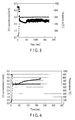
- FIG. 2 and FIG. 3 A variation with time in the measured concentration of CO in the gas discharged from the reaction tube 9 is shown in FIG. 2 and FIG. 3 .
- FIG. 2 a variation in the concentration of CO with time in the case of using the catalyst of Example 1 is shown by the square mark and the temperature of the packed bed is shown by the triangle mark.
- FIG. 3 a variation in the concentration of CO with time in the case of using the catalyst of Example 2 is shown by the solid
- the performance of a catalyst consisting of a Fe 3 O 4 nano-powder was evaluated in the same manner as in Examples 1 and 2 except that the powder was filled in the reaction tube 9. The results are shown in FIG. 4 and in Table 1.
- a variation in the concentration of CO with time in the case of using the Fe 3 O 4 nano-powder is shown by the square mark and the temperature of the packed bed is shown by the triangle mark.
- the concentration of CO is increased with time at 600°C when the Fe 3 O 4 nano-powder is used as the catalyst.
- CO oxidation amount A value obtained by multiplying a difference (mol%) in concentration between carbon monoxide in the model gas and carbon monoxide in the gas discharged from the reaction tube by the flow rate (amount by mol per hour) of the model gas to the obtained vale with respect to time (3.5 hours), and by the integrated value by the flow rate (mol per hour) of carbon monoxide gas to integrate the obtained value with respect to time.
- CO/Fe Co oxidation amount per mol an iron element.
- CO removal rate Conversion rate of CO into CO 2 .
- the catalysts of Examples 1 and 2 significantly oxidized carbon monoxide.
- the amount of carbon monoxide oxidized by each iron oxide derived from iron citrate of Example 1 and from iron fumarate of Example 2 was higher than that of the iron oxide nano-powder of Comparative Example 1.
- the amount of oxidized carbon monoxide per mol of iron was higher in Examples 1 and 2 than in Comparative Example 1, so that a higher catalyst efficiency was obtained in Examples 1 and 2 than in Comparative Example 1.
- Example 1 had the same level as Comparative Example 1 and Example 2 achieved a higher removal rate than Comparative Example 1.
- the average BET specific surface area of each catalyst obtained in Examples 1 and 2 was higher than that of the catalyst obtained in Comparative Example 1, and particularly the catalyst (derived from iron fumarate) of Example 2 had a very high value.
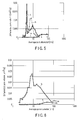
- the line a (triangular mark) shows the results of iron citrate
- the line c square mark
- the line b shows the results of the catalyst after its performance has been evaluated.
- the catalyst (Fe 3 O 4 ) particles derived from iron citrate have nanopores (line c) though the iron citrate particles have almost no pore (line a). Further, the Fe 3 O 4 particles maintain a nanopore structure even after heated at 600°C for 3.5 hours (line b).
- the pore distribution of the iron fumarate particles used in Example 2 and the pore distribution of the catalyst (Fe 3 O 4 derived from iron fumarate) particles prepared in Example 2 after the above catalyst performance was evaluated were measured in the same manner as in Example 3A. The results are shown in FIG. 6 .
- the line a triangular mark
- the line b circular mark
- the iron fumarate particles have almost no nanopore (line a).
- the catalyst (Fe 3 O 4 ) particles prepared in Example 2 have nanopores and the nano-structure is maintained even after they are heat-treated at 600°C for 3.5 hours.
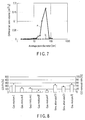
- the pore distribution of the Fe 3 O 4 nano-powder (manufactured by Sigma-Aldrich Corporation) used in Comparative Example 1 and the pore distribution of the nano-powder after the above catalyst performance was evaluated were measured in the same manner as in Example 3A. The results are shown in FIG. 7 . It is clarified from FIG. 7 that though the Fe 3 O 4 nano-powder has nanopores as shown by the line a (square mark) in FIG. 7 before the evaluation of the catalyst performance (heated at 600°C for 3.5 hours), almost of the nanopore structure disappears after the catalyst performance is evaluated as shown by the line b (circular mark). Specifically, it is clarified that disintegration of nanopores caused by the coagulation of primary particles occurs. This is considered to be the reason why the carbon monoxide reduction capability is deteriorated during evaluation of catalyst performance in Comparative Example 1.
- a catalyst (Fe 3 O 4 ) was prepared from iron fumarate in the same manner as in Example 2 except that the temperature in the preparation of the catalyst was changed to 500°C (Example 4) and 700°C (Example 5) from 600°C. The generation of Fe 3 O 4 was confirmed in the same manner as in Example 2.
- Example 2 The performance of the catalyst was evaluated in the same manner as in Example 2 except that the catalyst obtained in this example was used. The results are shown in Table 2. The results of evaluation of Example 2 are described again in Table 2. Table 2 Precursor Heating temperature in the prepartion of the catalyst Catalyst Amount of iron a) Performance of catalyst Compound Compound CO oxidation amount b) CO/Fe c) CO removal rate d) - °C - g mmol % % % Ex. 4 Iron (II) fumarate 500 Fe 3 O 4 0.15 180.5 218.2 201.1 1 44.6 Ex. 2 600 Fe 3 O 4 0.15 180.5 243.7 224.6 51.7 Ex. 5 700 Fe 3 O 4 0.15 180.5 94 86.6 21.7 a), b), c) and d) are the same as those in Stable 1.
- the catalyst (Example 2) obtained by heating at 600°C exhibited the highest oxidation amount of carbon monoxide, the highest oxidation amount of carbon monoxide per mol of an iron element and the highest carbon monoxide removal rate.
- the catalyst (Example 4) obtained by heating at 500°C also exhibited a high catalyst performance.
- the catalyst (Example 5) obtained by heating at 700°C was deteriorated in the oxidation amount of carbon monoxide, oxidation amount of carbon monoxide per mol of an iron element and carbon monoxide removal rate.
- a catalyst (Fe 3 O 4 ) was prepared in the same manner as in Example 2 except that the gas atmosphere to be used was changed to an atmosphere of each of the following 8 types of gas mixtures from the atmosphere of a gaseous mixture of 10 mol% CO 2 /balance N 2 .
- the generation of Fe 3 O 4 was confirmed in the same manner as in Example 2.
- the performance of the obtained catalyst was evaluated in the same manner as in Example 2.
- the calculated maximum CO oxidation amount per mol of an iron element (see Notes b and c in Table 1) is shown in FIG. 8 .
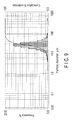
- the grain size distribution of iron oxide derived from iron fumarate prepared in Example 2 was measured.
- the grain size distribution was measured using a laser diffraction/scattering type grain size distribution measuring device (trade name: LA-910, manufactured by Horiba Ltd.).
- LA-910 manufactured by Horiba Ltd.
- FIG. 9 Looking at the frequency in FIG. 9 , 90% or more of the particles have a size ranging from 1 to 100 ⁇ m with the center grain diameter being 28.55 ⁇ m. This measurement is made by the laser diffraction/scattering method and is based on calculation of grain size distribution on volume basis.
- Example 2 145 g of the catalyst (iron oxide derived from iron fumarate) obtained in Example 2 and 15 g of flax pulp (manufactured by Rinsel Company) were dispersed in 2000 g of an organic solvent (mixture solution of ethanol and lecithin [90 : 0.5 by weight]) to prepare a slurry.
- This slurry was cast into a sheet form, or made to flow on a manual paper making tool manufactured by overlapping a 16 mesh stainless wire gauge on a 200 mesh stainless wire gauge to manufacture tobacco cigarette paper having a basis weight of 50 g/m 2 .
- iron oxide derived from iron fumarate was dispersed in 30 ml of a mixture solution of ethanol and lecithin to prepare a slurry.
- the above slurry was sprayed using an atomizer such that the amount of iron oxide was 10% by weight based on the weight of shredded tobacco, thereby enabling the addition of iron oxide to the shredded tobacco.
Landscapes
- Chemical & Material Sciences (AREA)
- Chemical Kinetics & Catalysis (AREA)
- Organic Chemistry (AREA)
- Engineering & Computer Science (AREA)
- Materials Engineering (AREA)
- Toxicology (AREA)
- General Chemical & Material Sciences (AREA)
- Health & Medical Sciences (AREA)
- General Health & Medical Sciences (AREA)
- Inorganic Chemistry (AREA)
- Physics & Mathematics (AREA)
- Thermal Sciences (AREA)
- Catalysts (AREA)
- Manufacture Of Tobacco Products (AREA)
- Cigarettes, Filters, And Manufacturing Of Filters (AREA)
Applications Claiming Priority (2)
| Application Number | Priority Date | Filing Date | Title |
|---|---|---|---|
| JP2009091210 | 2009-04-03 | ||
| PCT/JP2010/056021 WO2010114096A1 (ja) | 2009-04-03 | 2010-04-01 | 喫煙物品用一酸化炭素低減触媒およびその製造方法 |
Publications (2)
| Publication Number | Publication Date |
|---|---|
| EP2415519A1 true EP2415519A1 (de) | 2012-02-08 |
| EP2415519A4 EP2415519A4 (de) | 2014-02-12 |
Family
ID=42828385
Family Applications (1)
| Application Number | Title | Priority Date | Filing Date |
|---|---|---|---|
| EP10758867.5A Withdrawn EP2415519A4 (de) | 2009-04-03 | 2010-04-01 | Kohlenmonoxidreduktionskatalysator für rauchartikel und verfahren zu seiner herstellung |
Country Status (5)
| Country | Link |
|---|---|
| US (1) | US8349763B2 (de) |
| EP (1) | EP2415519A4 (de) |
| JP (1) | JP5323176B2 (de) |
| TW (1) | TW201041527A (de) |
| WO (1) | WO2010114096A1 (de) |
Cited By (1)
| Publication number | Priority date | Publication date | Assignee | Title |
|---|---|---|---|---|
| CN103564637A (zh) * | 2013-11-03 | 2014-02-12 | 云南瑞升烟草技术(集团)有限公司 | 一种降低造纸法再造烟叶烟气co释放量的方法 |
Family Cites Families (28)
| Publication number | Priority date | Publication date | Assignee | Title |
|---|---|---|---|---|
| NL293155A (de) * | 1963-03-04 | |||
| US4506684A (en) * | 1978-08-02 | 1985-03-26 | Philip Morris Incorporated | Modified cellulosic smoking material and method for its preparation |
| JPS5881441A (ja) * | 1981-11-11 | 1983-05-16 | Nippon Shokubai Kagaku Kogyo Co Ltd | 排ガス浄化用触媒の製法 |
| IT1167673B (it) * | 1983-12-05 | 1987-05-13 | Enichimica Spa | Procedimento perfezionato per la preparazione di catalizzatori di alchilazione |
| US4532229A (en) * | 1983-12-14 | 1985-07-30 | Exxon Research And Engineering Co. | Process for preparing a Fe-Co catalyst slurry system for alpha olefin production |
| US4624942A (en) * | 1985-07-03 | 1986-11-25 | Air Products And Chemicals, Inc. | Iron on mixed zirconia-titania substrate Fischer-Tropsch catalyst and method of making same |
| US4624967A (en) * | 1985-12-06 | 1986-11-25 | Exxon Research & Engineering Company | Fe-Co catalyst slurry system for use in alpha olefin production |
| US5468266A (en) | 1993-06-02 | 1995-11-21 | Philip Morris Incorporated | Method for making a carbonaceous heat source containing metal oxide |
| CN1083742A (zh) * | 1993-07-29 | 1994-03-16 | 周红星 | 双功能多金属氧化物催化剂 |
| US5580839A (en) * | 1994-09-30 | 1996-12-03 | University Of Kentucky Research Foundation | Binary ferrihydrite catalysts |
| JPH0986928A (ja) * | 1994-10-04 | 1997-03-31 | Nissan Motor Co Ltd | Aサイト欠損型ペロブスカイト複合酸化物及びそれを用いた触媒 |
| US6060420A (en) | 1994-10-04 | 2000-05-09 | Nissan Motor Co., Ltd. | Composite oxides of A-site defect type perovskite structure as catalysts |
| JP3706422B2 (ja) * | 1995-11-21 | 2005-10-12 | ダイセル化学工業株式会社 | たばこエレメントおよびその製造方法 |
| DE19756249A1 (de) * | 1996-12-18 | 1998-06-25 | Nitto Chemical Industry Co Ltd | Verfahren zur Herstellung einer aus kleinen Teilchen bestehenden Eisen-Antimon enthaltenden Oxid-Zusammensetzung, die hohe Druckfestigkeit aufweist |
| US7565680B1 (en) * | 2000-06-30 | 2009-07-21 | Comcast Ip Holdings I, Llc | Advanced set top terminal having a video call feature |
| US6484367B1 (en) * | 2001-05-15 | 2002-11-26 | Panduit Corp. | Cable tie with bent locking device and method of manufacture therefor |
| US6769437B2 (en) * | 2002-04-08 | 2004-08-03 | Philip Morris Incorporated | Use of oxyhydroxide compounds for reducing carbon monoxide in the mainstream smoke of a cigarette |
| PL204274B1 (pl) | 2002-04-12 | 2009-12-31 | Philip Morris Products | Kompozycja ciętego wypełniacza, papieros i sposób wytwarzania papierosa |
| US7271126B2 (en) * | 2002-05-15 | 2007-09-18 | Sud-Chemie Inc. | Catalyst for the dehydrogenation of ethyl benzene to STYRENE prepared with a high purity iron precursor |
| US7037876B2 (en) * | 2002-05-15 | 2006-05-02 | Sud-Chemie Inc. | High temperature shift catalyst prepared with a purity iron precursor |
| US7939463B1 (en) * | 2002-05-15 | 2011-05-10 | Sud-Chemie Inc. | Preparation of iron oxides |
| WO2003097236A1 (en) * | 2002-05-15 | 2003-11-27 | Süd-Chemie AG | Fischer-tropsch catalyst prepared with a high purity iron precursor |
| US20040007498A1 (en) * | 2002-07-11 | 2004-01-15 | Gislason Jason J. | Desulfurization and novel compositions for same |
| US6864384B2 (en) * | 2002-11-27 | 2005-03-08 | The Standard Oil Company | Preparation of vanadium antimony oxide based catalysts using nano-scale iron |
| US9107452B2 (en) | 2003-06-13 | 2015-08-18 | Philip Morris Usa Inc. | Catalyst to reduce carbon monoxide in the mainstream smoke of a cigarette |
| TW200520698A (en) * | 2003-09-15 | 2005-07-01 | Rothmans Benson & Hedges | Treatment of mainstream smoke constituents by use of oxygen storage and donor metal oxide oxidation catalyst |
| US8051859B2 (en) | 2003-10-27 | 2011-11-08 | Philip Morris Usa Inc. | Formation and deposition of sputtered nanoscale particles in cigarette manufacture |
| US9220301B2 (en) * | 2006-03-16 | 2015-12-29 | R.J. Reynolds Tobacco Company | Smoking article |
-
2010
- 2010-04-01 EP EP10758867.5A patent/EP2415519A4/de not_active Withdrawn
- 2010-04-01 JP JP2011507291A patent/JP5323176B2/ja not_active Expired - Fee Related
- 2010-04-01 WO PCT/JP2010/056021 patent/WO2010114096A1/ja not_active Ceased
- 2010-04-02 TW TW099110292A patent/TW201041527A/zh unknown
-
2011
- 2011-09-30 US US13/250,259 patent/US8349763B2/en not_active Expired - Fee Related
Cited By (1)
| Publication number | Priority date | Publication date | Assignee | Title |
|---|---|---|---|---|
| CN103564637A (zh) * | 2013-11-03 | 2014-02-12 | 云南瑞升烟草技术(集团)有限公司 | 一种降低造纸法再造烟叶烟气co释放量的方法 |
Also Published As
| Publication number | Publication date |
|---|---|
| JP5323176B2 (ja) | 2013-10-23 |
| US20120015803A1 (en) | 2012-01-19 |
| EP2415519A4 (de) | 2014-02-12 |
| JPWO2010114096A1 (ja) | 2012-10-11 |
| TW201041527A (en) | 2010-12-01 |
| US8349763B2 (en) | 2013-01-08 |
| WO2010114096A1 (ja) | 2010-10-07 |
Similar Documents
| Publication | Publication Date | Title |
|---|---|---|
| EP2415362B1 (de) | Zigarette und verfahren zur bearbeitung eines zigarettenmaterials | |
| JP5372007B2 (ja) | 喫煙物品およびその製造方法、並びに一酸化炭素低減剤の製造方法 | |
| EP2431092B1 (de) | Abgasreinigungskatalysator und verfahren zu seiner herstellung | |
| JP5715726B2 (ja) | 実質的に面心立方構造を有するルテニウム微粒子およびその製造方法 | |
| CN105727952B (zh) | 废气净化催化剂及其制造方法 | |
| JP4119652B2 (ja) | 炭化水素分解用触媒及びその製造法 | |
| JP2009061432A (ja) | 複合酸化物、パティキュレート酸化触媒およびディーゼルパティキュレートフィルタ | |
| AU2005224127B2 (en) | Gold and reducible oxide-based composition, method for the preparation and the use thereof in the form of a catalyst, in particular for carbon monoxide oxidation | |
| JPH08283022A (ja) | TiO2 系複合超微粒子及びその製造方法 | |
| RU2532924C1 (ru) | Катализатор окислительной конверсии углеводородных газов с получением оксида углерода и водорода | |
| US8349763B2 (en) | Carbon monoxide reduction catalyst for smoking articles and method for producing the same | |
| JP2024503471A (ja) | メタン改質用触媒及びその製造方法 | |
| JP2008207161A (ja) | 空気浄化材製造方法および空気浄化材および空気浄化装置および空気浄化方法 | |
| JP2010172849A (ja) | 一酸化炭素酸化触媒、その製造方法、及び一酸化炭素除去フィルター | |
| KR102212649B1 (ko) | 백금-이산화티탄 촉매, 이의 제조 방법, 및 이의 제조장치 | |
| JP2013236998A (ja) | 一酸化炭素除去触媒、一酸化炭素除去フィルター、及び一酸化炭素除去触媒の製造方法 | |
| JP6466330B2 (ja) | 一酸化炭素メタン化触媒組成物及び一酸化炭素メタン化触媒 | |
| JP5105709B2 (ja) | 水性ガスシフト反応触媒 | |
| CN107552066A (zh) | 一种Fe‑Mn‑Zr复合氧化物催化剂及其制备方法和应用 | |
| Woźniak et al. | Divergent influence of {1 1 1} vs.{1 0 0} crystal planes and Yb3+ dopant on CO oxidation paths in mixed nano-sized oxide Au/Ce1− xYbxO2− x/2 (x= 0 or 0.1) systems | |
| JP7165345B2 (ja) | アミン系化合物の分解方法及びアミン系化合物分解触媒 | |
| KR102224326B1 (ko) | 가스상 암모니아 제거를 위한 백금 콜로이드계 백금/바나듐/티타니아 촉매 및 그 제조방법 | |
| WO2019239936A1 (ja) | 多孔質酸化鉄触媒体 | |
| Gajalakshmi et al. | CALCIUM-BORO-PHOSPHATES SUPPORTED NiO CATALYST FOR ENHANCED OXIDATION OF CARBON MONOXIDE AND HYDROCARBONS | |
| CN118807738A (zh) | 负载型铈基催化剂及其制备方法和用途 |
Legal Events
| Date | Code | Title | Description |
|---|---|---|---|
| PUAI | Public reference made under article 153(3) epc to a published international application that has entered the european phase |
Free format text: ORIGINAL CODE: 0009012 |
|
| 17P | Request for examination filed |
Effective date: 20110930 |
|
| AK | Designated contracting states |
Kind code of ref document: A1 Designated state(s): AT BE BG CH CY CZ DE DK EE ES FI FR GB GR HR HU IE IS IT LI LT LU LV MC MK MT NL NO PL PT RO SE SI SK SM TR |
|
| DAX | Request for extension of the european patent (deleted) | ||
| A4 | Supplementary search report drawn up and despatched |
Effective date: 20140110 |
|
| RIC1 | Information provided on ipc code assigned before grant |
Ipc: A24B 15/28 20060101ALI20140103BHEP Ipc: A24D 1/02 20060101ALI20140103BHEP Ipc: B01J 35/10 20060101ALI20140103BHEP Ipc: B01J 23/745 20060101AFI20140103BHEP |
|
| STAA | Information on the status of an ep patent application or granted ep patent |
Free format text: STATUS: EXAMINATION IS IN PROGRESS |
|
| 17Q | First examination report despatched |
Effective date: 20171031 |
|
| GRAP | Despatch of communication of intention to grant a patent |
Free format text: ORIGINAL CODE: EPIDOSNIGR1 |
|
| STAA | Information on the status of an ep patent application or granted ep patent |
Free format text: STATUS: GRANT OF PATENT IS INTENDED |
|
| INTG | Intention to grant announced |
Effective date: 20190708 |
|
| STAA | Information on the status of an ep patent application or granted ep patent |
Free format text: STATUS: THE APPLICATION IS DEEMED TO BE WITHDRAWN |
|
| 18D | Application deemed to be withdrawn |
Effective date: 20191119 |