EP2393077A2 - Anzeigevorrichtung - Google Patents
Anzeigevorrichtung Download PDFInfo
- Publication number
- EP2393077A2 EP2393077A2 EP11168213A EP11168213A EP2393077A2 EP 2393077 A2 EP2393077 A2 EP 2393077A2 EP 11168213 A EP11168213 A EP 11168213A EP 11168213 A EP11168213 A EP 11168213A EP 2393077 A2 EP2393077 A2 EP 2393077A2
- Authority
- EP
- European Patent Office
- Prior art keywords
- unit
- complex member
- convex portion
- substrate
- display apparatus
- Prior art date
- Legal status (The legal status is an assumption and is not a legal conclusion. Google has not performed a legal analysis and makes no representation as to the accuracy of the status listed.)
- Withdrawn
Links
Images




Classifications
-
- H—ELECTRICITY
- H10—SEMICONDUCTOR DEVICES; ELECTRIC SOLID-STATE DEVICES NOT OTHERWISE PROVIDED FOR
- H10K—ORGANIC ELECTRIC SOLID-STATE DEVICES
- H10K59/00—Integrated devices, or assemblies of multiple devices, comprising at least one organic light-emitting element covered by group H10K50/00
- H10K59/80—Constructional details
- H10K59/87—Passivation; Containers; Encapsulations
- H10K59/871—Self-supporting sealing arrangements
- H10K59/872—Containers
-
- G—PHYSICS
- G09—EDUCATION; CRYPTOGRAPHY; DISPLAY; ADVERTISING; SEALS
- G09F—DISPLAYING; ADVERTISING; SIGNS; LABELS OR NAME-PLATES; SEALS
- G09F9/00—Indicating arrangements for variable information in which the information is built-up on a support by selection or combination of individual elements
- G09F9/30—Indicating arrangements for variable information in which the information is built-up on a support by selection or combination of individual elements in which the desired character or characters are formed by combining individual elements
-
- G—PHYSICS
- G09—EDUCATION; CRYPTOGRAPHY; DISPLAY; ADVERTISING; SEALS
- G09F—DISPLAYING; ADVERTISING; SIGNS; LABELS OR NAME-PLATES; SEALS
- G09F9/00—Indicating arrangements for variable information in which the information is built-up on a support by selection or combination of individual elements
- G09F9/30—Indicating arrangements for variable information in which the information is built-up on a support by selection or combination of individual elements in which the desired character or characters are formed by combining individual elements
- G09F9/33—Indicating arrangements for variable information in which the information is built-up on a support by selection or combination of individual elements in which the desired character or characters are formed by combining individual elements being semiconductor devices, e.g. diodes
-
- G—PHYSICS
- G09—EDUCATION; CRYPTOGRAPHY; DISPLAY; ADVERTISING; SEALS
- G09F—DISPLAYING; ADVERTISING; SIGNS; LABELS OR NAME-PLATES; SEALS
- G09F9/00—Indicating arrangements for variable information in which the information is built-up on a support by selection or combination of individual elements
- G09F9/30—Indicating arrangements for variable information in which the information is built-up on a support by selection or combination of individual elements in which the desired character or characters are formed by combining individual elements
- G09F9/35—Indicating arrangements for variable information in which the information is built-up on a support by selection or combination of individual elements in which the desired character or characters are formed by combining individual elements being liquid crystals
-
- H—ELECTRICITY
- H04—ELECTRIC COMMUNICATION TECHNIQUE
- H04N—PICTORIAL COMMUNICATION, e.g. TELEVISION
- H04N5/00—Details of television systems
- H04N5/64—Constructional details of receivers, e.g. cabinets or dust covers
-
- H—ELECTRICITY
- H10—SEMICONDUCTOR DEVICES; ELECTRIC SOLID-STATE DEVICES NOT OTHERWISE PROVIDED FOR
- H10K—ORGANIC ELECTRIC SOLID-STATE DEVICES
- H10K59/00—Integrated devices, or assemblies of multiple devices, comprising at least one organic light-emitting element covered by group H10K50/00
- H10K59/80—Constructional details
- H10K59/87—Passivation; Containers; Encapsulations
- H10K59/871—Self-supporting sealing arrangements
-
- H—ELECTRICITY
- H10—SEMICONDUCTOR DEVICES; ELECTRIC SOLID-STATE DEVICES NOT OTHERWISE PROVIDED FOR
- H10K—ORGANIC ELECTRIC SOLID-STATE DEVICES
- H10K59/00—Integrated devices, or assemblies of multiple devices, comprising at least one organic light-emitting element covered by group H10K50/00
- H10K59/80—Constructional details
- H10K59/87—Passivation; Containers; Encapsulations
- H10K59/871—Self-supporting sealing arrangements
- H10K59/8721—Metallic sealing arrangements
-
- H—ELECTRICITY
- H10—SEMICONDUCTOR DEVICES; ELECTRIC SOLID-STATE DEVICES NOT OTHERWISE PROVIDED FOR
- H10K—ORGANIC ELECTRIC SOLID-STATE DEVICES
- H10K59/00—Integrated devices, or assemblies of multiple devices, comprising at least one organic light-emitting element covered by group H10K50/00
- H10K59/80—Constructional details
- H10K59/87—Passivation; Containers; Encapsulations
- H10K59/871—Self-supporting sealing arrangements
- H10K59/8722—Peripheral sealing arrangements, e.g. adhesives, sealants
Definitions
- aspects of the present invention relate to display apparatuses, and more particularly, to display apparatuses including an encapsulation unit having improved rigidity.
- a flat display apparatus includes a display unit on a lower substrate and an encapsulation substrate disposed on the display unit to protect the display unit. Also, the sealing unit is disposed between the lower substrate and the encapsulation substrate.
- the flat display apparatus is easily deformed or damaged by heat. To prevent this damage, a thick lower substrate or a thick encapsulation substrate may be formed. However, in this case, if an external force due to thermal residual stress of the sealing unit is applied to the flat display apparatus, a rigidity of the display apparatus may be greatly weakened and disbanding may occur along the sealing unit due to a peel stress.
- aspects of the present invention provide display apparatuses including an encapsulation unit having an improved structure for increasing the rigidity of the encapsulation unit by using a reinforcement member.
- a display apparatus including a display unit disposed on a substrate; an encapsulation facing the display unit including: a metal layer; and a complex member, including a base unit and a convex portion that protrudes upward from the base unit.
- the display apparatus may further include a sealing unit disposed between the substrate and the encapsulation unit and apart from the display unit, the sealing unit bonding the substrate and the encapsulation unit to the sealing unit.
- the sealing unit may comprise an epoxy resin.
- the convex portion may extend from the base unit in a direction away from the substrate and wherein the convex portion has a shape of a rectangular plate.
- the convex portion may have a shape of a square plate.
- the convex portion may have a shape of a rectangular ring.
- the convex portion may have a shape of a square ring.
- the convex portion may comprise: a first convex portion extending from the base unit in a direction away from the substrate and having a shape of a rectangular plate; and a second convex portion having a shape of an oval ring, an X-shape, or a stripe shape, and protruding upward from the first convex portion.
- the first convex portion may have a shape of a square plate.
- the convex portion may further comprise a protrusion protruding from an upper surface.
- the convex portion may further comprise an extension portion extending from an edge of the encapsulation unit and surrounding an edge of the substrate.
- the complex member may include a resin matrix and carbon fibers, wherein the metal layer is disposed nearer to the substrate than the complex member is.
- the carbon fibers may comprise first carbon fibers arranged in a first direction and second carbon fibers arranged in a second direction crossing the first direction.
- the carbon fibers may be woven by being arranged in a horizontal direction and a vertical direction.
- a thermal expansion rate of the carbon fibers is smaller than a thermal expansion rate of the substrate.
- the complex member may be formed of layers each including the resin matrix and the carbon fibers.
- some of the carbon fibers are arranged in at least one of the layers in a first direction, and others of the carbon fibers are arranged in another layer of the layers in a second direction, and the first direction and the second direction cross each other.
- the first direction and second direction may cross each other at right angles; that is, the second direction may be perpendicular to the second direction.
- a display apparatus including: a display unit disposed on a substrate; an encapsulation unit facing the display unit, the encapsulation unit including: a metal layer; a complex member; and at least one rib formed on an upper surface of the complex member; and a sealing unit disposed between the substrate and the encapsulation unit and apart from the display unit to bond the substrate and the encapsulation unit to the sealing unit.
- the rib may extend in a lengthwise direction of the complex member.
- the complex member may include a protrusion protruding from an upper surface.
- the complex member may include an extension portion extending from an edge of the encapsulation unit to surround an edge of the substrate.
- the complex member may include: a resin matrix; and carbon fibers, wherein the metal layer is disposed nearer to the substrate than the complex member is.
- a display apparatus including: a display unit disposed on a substrate; an encapsulation unit facing the display unit, the encapsulation unit comprising: a metal layer; a complex member; and a reinforcement member formed on an upper surface of the complex member; and a sealing unit disposed apart from the display unit between the substrate and the encapsulation unit to bond the substrate and the encapsulation unit to the sealing unit.
- the reinforcement member may be a convex portion protruding upwards from a base unit of the complex member, and wherein the reinforcement member is formed as a single unit with the complex member.
- the reinforcement member may be at least one rib that is formed on an upper surface of the complex member.
- FIG. 1 is a cross-sectional view of a display apparatus 100A, according to an embodiment of the present invention.
- FIGS. 2 and 3 are schematic views illustrating a complex member 180A illustrated in FIG. 1 .
- the display apparatus 100A includes a substrate 110, a display unit 130, an encapsulation unit 190A, and a sealing unit 150.
- the substrate 110 is formed of a transparent glass having SiO 2 as a main component.
- aspects of the present invention are not limited thereto and may also be formed of other transparent plastic materials.
- the plastic material of the substrate 110 include polyethersulphone (PES), polyacrylate (PAR), polyetherimide (PEI), polyethyelenen napthalate (PEN), polyethyeleneterepthalate (PET), polyphenylene sulfide (PPS), polyallylate, polyimide, poly carbonate (PC), cellulose triacetate (TAC), cellulose acetate propionate (CAP), and other similar materials.
- a plurality of processes are performed to form the display unit 130 on the substrate 110, and heat is applied during these processes, which causes the substrate 110 to expand.
- the expansion of the substrate 110 reduces durability of the display apparatus 100A and precision of the display unit 130. Accordingly, the substrate 110 has a low thermal expansion rate, for example, 3*10 -6 /K to 4*10 -6 /K.
- the display unit 130 comprises an organic light emitting device, a liquid crystal display apparatus, etc., and is disposed on the substrate 110.
- the encapsulation unit 190A is disposed so as to face the display unit 130.
- the encapsulation unit 190A protects the display unit 130 from water or oxygen, or other similar impurities or elements, from the outside.
- the encapsulation unit 190A includes a metal layer 170 and a complex member 180A.
- the complex member 180A is formed on the metal layer 170. That is, the complex member 180A is disposed farther from the display unit 130 than the metal layer 170 is.
- the sealing unit 150 is hardened by heat to bond both the substrate 110 and the encapsulation unit 190A to the sealing unit 150.
- the encapsulation unit 190A may expand while heat is applied to the sealing unit 150. If the degree to which the encapsulation unit 190A is expanded by the heat is increased, a bonding force between the substrate 110 and the encapsulation unit 190A is reduced. In such a case, the durability of the display apparatus 100A may weaken.
- the encapsulation unit 190A includes the complex member 180A having a low thermal expansion rate and thus is not greatly expanded.
- the complex member 180A has a thermal expansion rate that is lower than or similar to that of the substrate 110.
- the complex member 180A may include, as illustrated in FIGS. 2 and 3 , a resin matrix and a plurality of carbon fibers.
- the complex member 180A may include a resin matrix 181 and a plurality of carbon fibers 182.
- the complex member 180A is formed of the carbon fibers 182 impregnated in the resin matrix 181.
- the carbon fibers 182 are arranged to cross one another in rows and columns. That is, the carbon fibers 182 include carbon fibers arranged in an X-axis direction of FIG. 2 and carbon fibers 182 arranged in a Y-axis direction of FIG. 2 . Accordingly, the complex member 180A having a uniform and low thermal expansion rate over the entire area may be formed.
- the carbon fibers 182 are arranged perpendicularly across one another.
- aspects of the present invention are not limited thereto, and an angle at which the carbon fibers 182 are arranged across one another may be determined such that the complex member 180A has a desired thermal expansion rate.
- the carbon fibers 182 are woven in a latitudinal and longitudinal direction.
- the carbon fibers 182 arranged in the X-axis direction of FIG. 2 and the carbon fibers 182 arranged in the Y-axis direction of FIG. 2 may be woven as a fabric. Consequently, a durability of the complex member 180A is increased.
- the carbon fibers 182 have a lower thermal expansion rate than the substrate 110.
- the thermal expansion rate of the carbon fibers 182 in a lengthwise direction is a negative (-) value.
- the carbon fibers 182 do not absorb moisture, thus increasing the ability of the encapsulation unit 190A to prevent water penetration.
- the resin matrix 181 has a thermal expansion rate of 15*10 -6 /K to 120*10 -6 /K.
- the complex member 180A having a predetermined thermal expansion rate is formed by mixing the carbon fibers 182 and the resin matrix 181. That is, the complex member 180A having a thermal expansion rate lower than or a similar to a thermal expansion rate of the substrate 110 is formed.
- the complex member 180A is controlled to have the predetermined thermal expansion rate by adjusting an amount of the carbon fibers 182 and an amount of the resin matrix 181.
- the complex member 180A includes layers, and each of the layers includes a resin matrix and carbon fibers. Also, each of the layers is formed of carbon fibers impregnated in the resin matrix. Each layer of the complex member 180A is formed to have carbon fibers arranged in a predetermined direction, and the layers are stacked on top of each other. Accordingly, the complex member 180A having the carbon fibers arranged to thereby cross one another is easily formed.
- the complex member 180A includes a first layer 183A, a second layer 183B, a third layer 183C, and a fourth layer 183D. Each of the first through fourth layers 183A to 183D respectively includes a resin matrix 181A, 181 B, 181 C, and 181 D and carbon fibers 182A, 182B, 182C, and 182D, respectively.
- a direction of the carbon fibers 182A and 182D of the first layer 183A and the fourth layer 183D is disposed so as to cross a direction of the carbon fibers 182B and 182C of the second layer 183B and the third layer 183C.
- the carbon fibers 182A and 182D of the first layer 183A and the fourth layer 183D are arranged in a first direction (Y-axis direction of FIG. 3 )
- the carbon fibers 182B and 182C of the second layer 183B and the third layer 183C are arranged in a second direction (X-axis direction of FIG. 3 ).
- the first direction and the second direction cross each other so as to be perpendicular to each other, as shown in FIG. 3 .
- first direction and the second direction may cross each other at other suitable angles.
- the carbon fibers 182A and 182D of the first layer 183A and the fourth layer 183D and the carbon fibers 182B and 182C of the second layer 183B and the third layer 183C may be arranged at various angles.
- a shape of the encapsulation unit 190A is determined by a shape of the complex member 180A.
- the complex member 180A is molded as a hot plate by using a mold.
- a convex portion 185 of the encapsulation unit 190A that protrudes in a direction away from the display unit 130 is formed as a single unit with the complex member 180A and the metal layer 170.
- the convex portion 185 increases a height and a surface area of the complex member 180A.
- a surface moment of inertia is increased so as to increase rigidity of the encapsulation unit 190A and to prevent bending.
- a height of the encapsulation unit 190A is three times a thickness of a typical flat encapsulation unit, the surface moment of inertia is increased by about 27 times (3 ⁇ 3), and thus the rigidity of the encapsulation unit 190A is significantly increased.
- a concave portion 189 is formed inside the encapsulation unit 190A due to the convex portion of the encapsulation unit 190A.
- the encapsulation unit 190A and the display unit 130 are prevented from contacting each other.
- the shape of the complex member 180A will be described later in detail with reference to FIGS. 4 through 8 .
- the metal layer 170 has a denser structure than the complex member 180A.
- the metal layer 170 and the complex member 180A are used together to prevent water and foreign materials from penetrating the display unit 130.
- the metal layer 170 has a higher thermal expansion rate than the complex member 180A.
- the metal layer 170 has a greater thermal expansion rate than the substrate 110.
- the encapsulation unit 190A includes the complex member 180A, a total thermal expansion rate of the encapsulation unit 190A is low.
- the thermal expansion rate of the encapsulation unit 190A is effectively maintained low.
- the sealing unit 150 is disposed between the substrate 110 and the encapsulation unit 190A.
- the sealing unit 150 is formed around the display unit 130.
- the sealing unit 150 bonds the substrate 110 and the encapsulation unit 190A to the sealing unit 150 and includes a thermosetting resin.
- the sealing unit 150 may include an epoxy resin.
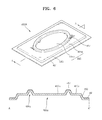
- FIGS. 4 through 8 are perspective views illustrating various shapes of the complex member 180A of FIG. 1 .
- a complex member 280A includes a base unit 281, a convex portion 285 that protrudes from the base unit 281 to a predetermined height, and an inclination unit 283 connecting the base unit 281 and the convex portion 285.
- the complex member 280A has a first surface facing the substrate 110 and a second surface opposite to the first surface. A first surface of the base unit 281 contacts the sealing unit 150.
- the convex portion 285 is rectangular and protrudes upward from the base unit 281 in a direction away from the substrate 110. Thus a total height and a surface area of the complex member 280A are increased.
- a concave portion 289 is formed inside the complex member 280A due to the convex portion 285.
- a metal layer 170 is formed under the complex member 280A.
- a complex member 380A includes a base unit 381, a convex portion 385 that protrudes from the base unit 381 to a predetermined height, and an inclination unit 383 connecting the base unit 381 and the convex portion 385.
- the complex member 380A has a first surface facing the substrate 110 and a second surface opposite to the first surface.
- the base unit 381 includes a first region 381 a whose first surface contacts the sealing unit 150 and a second region 381 b having a rectangular shape with four curved corners.
- the convex portion 385 borders the first region 381 a and the second region 381 b.
- the convex portion 385 has a shape of a rectangular ring.
- the convex portion 385 protrudes upward from the base unit 381 in a direction away from the substrate 110, and thus a total height of the complex member 380A is increased.
- a concave portion 389 having a rectangular ring shape is formed inside the complex member 380A due to the convex portion 385.
- a metal layer 170 is disposed under the complex member 380A.
- a getter may be further disposed in the concave portion 389.
- a complex member 480A includes a base unit 481, a first convex portion 485 that protrudes from the base unit 481 to a predetermined height, an inclination unit 483 connecting the base unit 481 and the first convex portion 485, and a second convex portion 487 that protrudes from the first convex portion 485 to another predetermined height.
- the complex member 480A has a first surface facing the substrate 110 and a second surface opposite to the first surface.
- a first surface of the base unit 481 contacts the sealing unit 150.
- the first convex portion 485 has a shape of a rectangular plate.
- the first convex portion 485 includes a first region 485a and a second region 485b, the second region 485b having an oval shape.
- the second convex portion 487 borders the first region 485a and the second region 485b.
- the second convex portion 487 has a shape of an oval ring, and protrudes upward from the first convex portion 485.
- the first convex portion 485 and the second convex portion 487 sequentially protrude upward from the base unit 481 in a direction away from the substrate 110.
- a total height and surface area of the complex member 480A are increased.
- a rectangular concave portion 489a is formed inside the complex member 480A due to the first convex portion 485.
- An oval-shaped concave portion 489b is further formed in the rectangular concave portion 489a due to the second convex portion 487.
- a metal layer 170 is disposed under the complex member 480A.
- a getter may be further disposed in the concave portions 489a and 489b.
- a complex member 580A includes a base unit 581 and a first convex portion 585 that protrudes from the base unit 581 to a predetermined height.
- the complex member 580A also includes an inclination unit 583 connecting the base unit 581 and the first convex portion 585, and a second convex portion 587 that protrudes from the first convex portion 585 to another predetermined height.
- the complex member 580A has a first surface facing the substrate 110 and a second surface opposite to the first surface.
- a first surface of the base unit 581 contacts the sealing unit 150.
- the first convex portion 585 has a shape of a rectangular plate.
- the second convex portion 587 protrudes upward from the first convex portion 585.
- the second convex portion 587 has an X-shape such that lines of the X-shape extend in a diagonal direction across the complex member 580A.
- the second convex portion 587 is formed of a center portion 587e and ribs 587a, 587b, 587c, and 587d, each having a stripe shape extending from the center portion 587e.
- the first convex portion 585 and the second convex portion 587 sequentially protrude upward from the base unit 581 in a direction away from the substrate 110. As such, a total height and surface area of the complex member 580A are increased.
- a rectangular concave portion 589a is formed inside the complex member 580A by the first convex portion 585.
- An X-shaped concave portion 589b is further formed in the rectangular concave portion 589a due to the second convex portion 587.
- a metal layer 170 is formed under the complex member 580A.
- a getter may be further disposed in the concave portions 589a and 589b.
- the complex member 680A includes a base unit 681 and a first convex portion 685 that protrudes from the base unit 681 to a predetermined height.
- the complex member 680A also includes an inclination unit 683 connecting the base unit 681 and the first convex portion 685, and a second convex portion 687 that protrudes from the first convex portion 685 to another predetermined height.
- the complex member 680A has a first surface facing the substrate 110 and a second surface opposite to the first surface. A first surface of the base unit 681 contacts the sealing unit 150.
- the first convex portion 685 has a shape of a rectangular plate.
- the second convex portion 687 is formed of at least one rib. As shown in FIG. 8 , the second convex portion 687 is formed of ribs 687a, 687b, 687c, 687d, and 687e, which each have a stripe shape and are arranged to be parallel. In the current embodiment, five ribs are illustrated in FIG. 8 . However, aspects of the present invention are not limited thereto, and the second convex portion 687 may have any suitable number of ribs in a variety of suitable patterns.
- the first convex portion 685 and the second convex portion 687 sequentially protrude upward from the base unit 681 in a direction away from the substrate 110.
- a total height of the complex member 680A is increased.
- a rectangular concave portion 689a is formed in the complex member 680A due to the first convex portion 685.
- Concave portions 689b, each having a stripe shape, are further formed in the rectangular concave portion 689a due to the ribs 687a through 687e formed in the second convex portion 687.
- a metal layer 170 is disposed under the complex member 680A.
- a getter may be further disposed in the concave portions 689a and 689b.
- FIG. 9 is a cross-sectional view illustrating a display apparatus 100B according to another embodiment of the present invention.
- the display apparatus 100B includes a substrate 110, a display unit 130, an encapsulation unit 190B, and a sealing unit 150.
- the display apparatus 100B of FIG. 9 is generally the same as the display apparatus 100A of FIG. 1 , except for a shape of a complex member 180B. Thus, descriptions of repeated components will be omitted below.
- the encapsulation unit 190B is disposed so as to face the display unit 130.
- the encapsulation unit 190B protects the display unit 130 from water, oxygen and other foreign materials coming from outside of the display apparatus 100B.
- the encapsulation unit 190B includes a metal layer 170 and a complex member 180B.
- the complex member 180B is formed on the metal layer 170. That is, the complex member 180B is disposed further away from the display unit 130 than the metal layer 170 is.
- the complex member 180B includes a resin matrix and carbon fibers as illustrated in FIGS. 2 and 3 .
- a shape of the encapsulation unit 190B is determined by a shape of the complex member 180B.
- the complex member 180B is molded as a hot plate by using a mold.
- the encapsulation unit 190B includes a convex portion 185 separated from the display unit 130.
- a total height and surface area of the encapsulation unit 190B are increased. Accordingly, by increasing a surface moment of inertia by increasing the total height of the encapsulation unit 190B, rigidity of the encapsulation unit 190B is increased without increasing the thickness or weight of the encapsulation unit 190B. By increasing a rigidity of the encapsulation unit 190B, bending of the encapsulation unit 190B may be prevented.
- the encapsulation unit 190B may further include a protrusion 160 formed in an area of an upper surface of the encapsulation unit 190B.
- the protrusion 160 is a connection member connecting an external device (not shown), such as a printed circuit board (PCB), to the display apparatus 100B.
- the protrusion 160 may have a bolt shape having a threaded outer surface, or other suitable shapes.
- the protrusion 160 is formed as a single unit with the complex member 180B of the encapsulation unit 190B and as an uppermost layer of the complex member 180B. Positions, heights of the protrusion 160 and the number of protrusions 160 are determined according to a type of external devices to be connected to the display apparatus 100B. However, aspects of the present invention are not limited thereto, and the protrusion 160 may be formed to not be a single unit with the complex member 180B and the position, height and number of protrusions 160 may be determined according to other suitable requirements.
- FIGS. 10 through 15 are perspective views illustrating various shapes of the complex member 180B of FIG. 9 .
- perspective views of the complex member 180B are illustrated, and in lower portions of FIGS. 10 through 15 , cross-sectional views of the complex member 180B taken along a line A-A' in FIGS. 10-15 and a line B-B' in FIGS. 13-15 of the above perspective views are illustrated.
- a complex member 280B includes a base unit 281, a convex portion 285 that protrudes from the base unit 281 to a predetermined height, and an inclination unit 283 connecting the base unit 281 and the convex portion 285.
- the complex member 280B has a first surface facing the substrate 110 and a second surface opposite to the first surface. A first surface of the base unit 281 contacts the sealing unit 150.
- At least one protrusion 260 is formed on an upper surface of the convex portion 285 to connect to an external device (not shown).
- the convex portion 285 protrudes upward from the base unit 281 in a direction away from the substrate 110, and thus a total height and surface area of the complex member 280B are increased.
- a concave portion 289 is formed in the complex member 280B due to the convex portion 285.
- a metal layer 170 is disposed under the complex member 280B.
- a getter may be further disposed in the concave portion 289.
- a complex member 380B includes a base unit 381, a convex portion 385 that protrudes from the base unit 381 to a predetermined height, and an inclination unit 383 connecting the base unit 381 and the convex portion 385.
- the complex member 380B has a first surface facing the substrate 110 and a second surface opposite to the first surface.
- the base unit 381 includes a first region 381 a whose first surface contacts the sealing unit 150 and a second region 381 b having a rectangular shape with four curved corners. The first region 381 a and the second region 381 b are bordered by the convex portion 385.
- At least one protrusion 360 is formed in the second region 381 b of the base unit 381 to connect to an external device (not shown).
- the convex portion 385 has a shape of a rectangular ring.
- the convex portion 385 protrudes upward from the base unit 381 in a direction away from the substrate 110, and thus the total height of the complex member 380B is increased.
- a concave portion 389 having a rectangular ring shape is formed inside the complex member 380B due to the convex portion 385.
- a metal layer 170 is disposed under the complex member 380B. Although not required in all aspects of the present invention, a getter may be further disposed in the concave portion 389.
- a complex member 480B includes a base unit 481, a first convex portion 485 that protrudes from the base unit 481 to a predetermined height, an inclination unit 483 connecting the base unit 481 and the first convex portion 485, and a second convex portion 487 that protrudes from the first convex portion 485 to another predetermined height.
- the complex member 480B has a first surface facing the substrate 110 and a second surface opposite to the first surface. A first surface of the base unit 481 contacts the sealing unit 150.
- the first convex portion 485 has a shape of a rectangular plate.
- the first convex portion 485 includes a first region 485a and a second region 485b, the second region 485b having an oval shape.
- the first region 485a and the second region 485b are bordered by the second convex portion 487.
- At least one protrusion 460 is formed in the second region 485b of the first convex portion 485 to connect to an external device (not shown).
- the second convex portion 487 has an oval ring shape, and protrudes upward from the first convex portion 485.
- the first convex portion 485 and the second convex portion 487 sequentially protrude upward from the base unit 481 in a direction away from the substrate 110.
- a total height and surface area of the complex member 480B are increased.
- a rectangular concave portion 489a is formed inside the complex member 480B due to the first convex portion 485.
- An oval-shaped concave portion 489b is further formed in the rectangular concave portion 489a due to the second convex portion 487.
- a metal layer 170 is disposed under the complex member 480B.
- a getter may be further disposed in the concave portions 489a and 489b.
- a complex member 580B includes a base unit 581 and a first convex portion 585 that protrudes from the base unit 581 to a predetermined height.
- the complex member 580B also includes an inclination unit 583 connecting the base unit 581 and the first convex portion 585, and a second convex portion 587 that protrudes from the first convex portion 585 to another predetermined height.
- the complex member 580B has a first surface facing the substrate 110 and a second surface opposite to the first surface. A first surface of the base unit 581 contacts the sealing unit 150.
- the first convex portion 585 has a shape of a rectangular plate.
- the second convex portion 587 protrudes upward from the first convex portion 585.
- the second convex portion 587 has an X-shape, such that lines of the X-shape extend in diagonal directions of the complex member 580B.
- the second convex portion 587 is formed of a center portion 587e and ribs 587a, 587b, 587c, and 587d.
- the ribs 587a to 587d each have a stripe shape that branches from the center portion 587e.
- At least one protrusion 560 is formed between two adjacent ones of the ribs 587a, 587b, 587c, and 587d to connect to an external device (not shown).
- a total height and surface area of the complex member 580B are increased.
- a rectangular concave portion 589a is formed inside the complex member 580B due to the first convex portion 585.
- An X-shaped concave portion 589b is further formed in the rectangular concave portion 589a by the second convex portion 587.
- a metal layer 170 is formed under the complex member 580B.
- complex members 680B and 680B' each include a base unit 681 and a first convex portion 685 that protrudes from the base unit 681 to a predetermined height.
- the complex members 680B and 680B' also include an inclination unit 683 connecting the base unit 681 and the first convex portion 685, and a second convex portion 687 that protrudes from the first convex portion 685 to another predetermined height.
- Each of the complex members 680B and 680B' has a first surface facing the substrate 110 and a second surface opposite to the first surface. A first surface of the base unit 681 contacts the sealing unit 150.
- the first convex portion 685 has a shape of a rectangular plate.
- the second convex portion 687 is formed of at least one rib. As shown in FIGS. 14 and 15 , ribs 687a, 687b, 687c, 687d, and 687e have a stripe shape and are arranged to be parallel to each other. According to the present embodiment, five ribs are illustrated in FIGS. 14 and 15 , however, aspects of the present invention are not limited thereto and the second convex portion 687 may be formed of other suitable numbers of ribs.
- At least one protrusion 660a is formed on the at least one of the ribs 687a, 687b, 687c, 687d, and 687e to connect to an external device (not shown).
- at least one protrusion 660b is formed between at least two of the ribs 687a, 687b, 687c, 687d, and 687e formed on the first convex portion 685 to connect to an external device (not shown).
- the protrusions 660a are formed on some of the ribs 687a to 687e
- the protrusions 660b are formed between some of the ribs 687a to 687e.
- a total height and surface area of the complex member 680B are increased.
- a rectangular concave portion 689a is formed inside the complex member 680B due to the first convex portion 685.
- Concave portions 689b, each having a stripe shape, are further formed in the rectangular concave portion 689a due to the ribs 687a through 687e formed in the second convex portion 687.
- a metal layer 170 is formed under the complex member 680B.
- a getter may be further disposed in the concave portions 689a and 689b.
- FIG. 16 is a cross-sectional view illustrating a display apparatus 100C according to another embodiment of the present invention.
- FIGS. 17 through 21 are perspective views illustrating various shapes of the complex member of FIG. 16 .
- the display apparatus 100C includes a substrate 110, a display unit 130, an encapsulation unit 190C, and a sealing unit 150.
- the display apparatus 100C of FIG. 16 is generally the same as the display apparatus 100A of FIG. 1 .
- a shape of a complex member 180C is different from the shape of the complex member 180A of the display apparatus 100A of FIG. 1 .
- description of repeated components will be omitted below.
- the encapsulation unit 190C is disposed to face the display unit 130.
- the encapsulation unit 190C includes a metal layer 170 and the complex member 180C.
- the complex member 180C is formed on the metal layer 170. That is, the complex member 180C is disposed farther away from the display unit 130 than the metal layer 170 is.
- the complex member 180C includes a resin matrix and carbon fibers as illustrated in FIGS. 2 and 3 .
- a shape of the encapsulation unit 190C is determined by a shape of the complex member 180C.
- the complex member 180C is molded as a hot plate by using a mold.
- aspects of the present invention are not limited thereto and the complex member 180C may be formed using other suitable methods.
- the encapsulation unit 190C includes a convex portion 185 extending in a direction away from the display unit 130 to thereby increase the height and surface area of the encapsulation unit 190C. Accordingly, a surface moment of inertia is increased by increasing a total height of the encapsulation unit 190C without increasing a thickness or weight of the encapsulation unit 190C.
- a rigidity of the encapsulation unit 190C is increased so as to prevent bending.
- a concave portion 189 is formed in the encapsulation unit 190C due to the convex portion. Thus, even when a getter is formed in the concave portion 189, contact between the encapsulation unit 190C and the display unit 130 may be prevented.
- the complex member 180C of the encapsulation unit 190C may have various shapes as illustrated in FIGS. 4 through 8 . Also, the complex member 180C may include a protrusion (not shown) formed in an area of an upper surface of the complex member 180C to connect to an external device, as illustrated in FIGS. 10 through 15 .
- the complex member 180C includes an extension portion 140 that extends from an edge of the complex member 180C along the substrate 110 in a vertical direction in order to protect the substrate 110.
- the extension portion 140 is formed as a single unit with the complex member 180C.
- the extension portion 140 is formed to surround edges of the substrate 110 to prevent the edge from colliding with other objects. Accordingly, the encapsulation unit 190C ensures increased rigidity but also a durable structure with respect to handling or dynamic impact.
- the complex member 180C has various shapes as shown by complex members 280C, 380C, 480C, 580C, and 680C illustrated in FIGS. 17 through 21 .
- the complex members 280C, 380C, 480C, 580C, and 680C respectively include extension portions 240, 340, 440, 540, and 640 extending from edges thereof along the substrate 110 in a vertical direction.
- the extension portions 140 to 640 are formed to surround all edges of the substrate 110. Additionally, a portion of each of the extension portions 140 to 640 is formed to be opened as illustrated in FIGS. 17 through 21 .
- the extension portions 140 to 640 are formed to cover circuit wiring that extends out of the substrate 110. Alternatively, the open portion of each of the extension portions 140 to 640 is disposed in a manner corresponding to the circuit wiring to increase convenience of assembly during an assembling process.
- FIGS. 17 through 21 Other components of the display apparatus 100C illustrated in FIGS. 17 through 21 are the same as those in FIGS. 4 through 8 and FIGS. 10 through 15 , and thus descriptions thereof will be omitted below.
- FIG. 22 is a cross-sectional view illustrating a display apparatus 100D according to another embodiment of the present invention.
- FIGS. 23 and 24 are perspective views illustrating various shapes of a complex member 180D of FIG. 22 .
- the display apparatus 100D includes a substrate 110, a display unit 130, an encapsulation unit 190D, and a sealing unit 150.
- the display apparatus 100D of FIG. 22 is generally the same as the display apparatus 100A of FIG. 1 except that a shape of an encapsulation unit 190D is different from a shape of the encapsulation unit 190A of the display apparatus 100A of FIG. 1 .
- descriptions of repeated components will be omitted below.
- the encapsulation unit 190D is disposed so as to face the display unit 130.
- the encapsulation unit 190D includes a metal layer 170 and the complex member 180D.
- the complex member 180D is formed on the metal layer 170. That is, the complex member 180D is disposed farther away from the display unit 130 than the metal layer 170 is.
- the complex member 180D includes a resin matrix and a plurality of carbon fibers, as illustrated in FIGS. 2 and 3 .
- the complex member 180D is flat, and a rib 120 protrudes in a form of a wallboard along a lengthwise direction from an upper surface of the complex member 180D.
- the rib 120 includes ribs 120a and 120d at two opposing edges of the rib 120 and extending along the lengthwise direction of the complex member 180D. Ribs 120b and 120c are formed interior to the ribs 120a and 120d on the complex member 180D. The ribs 120b and 120c are parallel to the ribs 120a and 120d.
- the rib 120 is formed as a single body with the complex member 180D and is extended therefrom.
- the rib 120 increases a surface moment of inertia of a cross-section of the complex member 180D in order to reduce drooping or twist distortion.
- the complex member 180D is formed using a pultrusion method, and thus may be manufactured at reduced cost compared to a manufacturing method which uses the above-described mold.
- aspects of the present invention are not limited to the above, and the complex member 180D may be formed using other suitable methods.
- protrusions 125 are formed on a portion of the upper surface of the complex member 180D.
- the protrusions 125 are a connection member that connects an external device (not shown), such as a PCB, to the display apparatus 100D.
- the protrusions 125 may have a bolt shape having a threaded outer surface.
- the protrusions 125 are each formed as a single unit with the complex member 180D of the encapsulation unit 190D and are each formed as a single unit with an uppermost layer of the complex member 180B. Positions or a number of the protrusions 125 are determined according to a type of the external devices to be connected to the display apparatus 100D.
- a separate protrusion 125 for example, a bolt-shaped connection member, may be inserted into a predetermined position of the complex member 180D before the complex member 180D is crystallized, and then be fixed by hardening the complex member 180D.
- the complex member 180D may include an extension portion that is extended from an edge of the complex member 180D along the substrate 110 in a vertical direction.
- the extension portion protects the substrate 110 as illustrated in FIGS. 17 through 21 .
- the extension portion is formed as a single unit with the complex member 180D.
- the extension portion is formed to surround an edge of the substrate 110 to prevent the edge of the substrate 110 from colliding with other objects. Accordingly, the encapsulation unit 190C obtains not only stably increased rigidity but also a durable structure with respect to handling or dynamic impact.
- the display apparatus includes an encapsulation unit including a thin and light-weight complex member and a metal layer formed as a single unit.
- a reinforcement member formed on an upper surface of the complex member, increases a surface moment of inertia of the complex member. Thus, rigidity of the encapsulation unit is increased.
- the reinforcement member may be convex portions formed on the base unit of the complex member as a single unit with the complex member or at least one rib formed on the upper surface of the complex member.
- the complex member has a three-dimensional shape and thus instrumental rigidity of the display apparatus may be increased. In other words, bending can be prevented, and rigidity and drop reliability may be increased.
- the display apparatus does not have to include a bezel for maintaining rigidity or an adhesive tape for adhering the bezel to the encapsulation unit.
- the convex portions are formed on the complex member so as to form a three-dimensional shape and form a concave portion in an inner portion of the complex member. Accordingly, a material such as a getter may be easily inserted between the encapsulation unit and a lower substrate.
- the edges of the complex member protrude toward the lower substrate, thereby stably increasing rigidity and protecting the edges of the lower substrate.
- additional components or connection portions connecting to the external device such as a PCB may be eliminated.
- the encapsulation unit is formed to have various shapes without increasing a thickness of the encapsulation unit to thereby increase a surface moment of inertia. Accordingly, a light-weight and slim display apparatus with increased rigidity can be manufactured at low cost.
Landscapes
- Engineering & Computer Science (AREA)
- Physics & Mathematics (AREA)
- General Physics & Mathematics (AREA)
- Theoretical Computer Science (AREA)
- Multimedia (AREA)
- Signal Processing (AREA)
- Chemical & Material Sciences (AREA)
- Crystallography & Structural Chemistry (AREA)
- Devices For Indicating Variable Information By Combining Individual Elements (AREA)
- Electroluminescent Light Sources (AREA)
- Cathode-Ray Tubes And Fluorescent Screens For Display (AREA)
- Liquid Crystal (AREA)
Applications Claiming Priority (1)
| Application Number | Priority Date | Filing Date | Title |
|---|---|---|---|
| KR1020100051974A KR101798487B1 (ko) | 2010-06-01 | 2010-06-01 | 표시 장치 |
Publications (2)
| Publication Number | Publication Date |
|---|---|
| EP2393077A2 true EP2393077A2 (de) | 2011-12-07 |
| EP2393077A3 EP2393077A3 (de) | 2015-07-29 |
Family
ID=44118058
Family Applications (1)
| Application Number | Title | Priority Date | Filing Date |
|---|---|---|---|
| EP11168213.4A Withdrawn EP2393077A3 (de) | 2010-06-01 | 2011-05-31 | Anzeigevorrichtung |
Country Status (5)
| Country | Link |
|---|---|
| US (1) | US8487533B2 (de) |
| EP (1) | EP2393077A3 (de) |
| JP (1) | JP5836624B2 (de) |
| KR (1) | KR101798487B1 (de) |
| CN (1) | CN102270748B (de) |
Families Citing this family (4)
| Publication number | Priority date | Publication date | Assignee | Title |
|---|---|---|---|---|
| US9188323B2 (en) * | 2010-10-20 | 2015-11-17 | Semiconductor Energy Laboratory Co., Ltd. | Lighting device |
| CN106920888A (zh) * | 2015-12-24 | 2017-07-04 | 群创光电股份有限公司 | 发光装置及其制作方法 |
| CN109309171B (zh) * | 2018-09-29 | 2020-07-07 | 广州国显科技有限公司 | 有机电致发光器件及其制备方法、柔性显示装置 |
| KR20230036625A (ko) * | 2021-09-07 | 2023-03-15 | 삼성디스플레이 주식회사 | 표시 장치 |
Family Cites Families (35)
| Publication number | Priority date | Publication date | Assignee | Title |
|---|---|---|---|---|
| JPH06325868A (ja) * | 1993-03-15 | 1994-11-25 | Fuji Electric Co Ltd | 薄膜エレクトロルミネセンスパネル |
| JPH07169567A (ja) * | 1993-12-16 | 1995-07-04 | Idemitsu Kosan Co Ltd | 有機el素子 |
| JP2001118674A (ja) * | 1999-10-19 | 2001-04-27 | Auto Network Gijutsu Kenkyusho:Kk | 有機el表示装置 |
| JP2001290434A (ja) * | 2000-04-04 | 2001-10-19 | Nec Corp | 表示装置 |
| KR20030044665A (ko) | 2001-11-30 | 2003-06-09 | 오리온전기 주식회사 | 유기 el 패널용 봉지 커버 |
| CA2472965A1 (en) | 2002-01-25 | 2003-08-07 | Sumitomo Bakelite Co., Ltd | Transparent composite composition |
| JP2003229249A (ja) * | 2002-02-06 | 2003-08-15 | Canon Electronics Inc | 有機エレクトロルミネッセンスパネル |
| KR20030083528A (ko) * | 2002-04-23 | 2003-10-30 | 주식회사 대한전광 | 수직전기공급선을 구비한 유기전계발광소자 모듈 |
| TW589915B (en) * | 2002-05-24 | 2004-06-01 | Sanyo Electric Co | Electroluminescence display device |
| JP2004014267A (ja) | 2002-06-06 | 2004-01-15 | Nippon Sheet Glass Co Ltd | El素子用封止板、及び該封止板多面取り用マザーガラス基板 |
| US6998776B2 (en) | 2003-04-16 | 2006-02-14 | Corning Incorporated | Glass package that is hermetically sealed with a frit and method of fabrication |
| KR100669369B1 (ko) * | 2003-10-16 | 2007-01-15 | 삼성에스디아이 주식회사 | 플라즈마 표시장치 |
| JP2005317942A (ja) * | 2004-03-29 | 2005-11-10 | Toray Ind Inc | 電気・電子機器 |
| KR100570997B1 (ko) * | 2004-06-29 | 2006-04-13 | 삼성에스디아이 주식회사 | 평판 표시 장치 |
| JP2006085920A (ja) * | 2004-09-14 | 2006-03-30 | Nippon Steel Corp | 有機el背面キャップ |
| KR101227132B1 (ko) * | 2004-11-05 | 2013-01-28 | 엘지디스플레이 주식회사 | 유기 전계발광표시소자 및 그 제조방법 |
| JP2006185643A (ja) * | 2004-12-27 | 2006-07-13 | Optrex Corp | 有機elパネル |
| US7167365B2 (en) * | 2005-01-17 | 2007-01-23 | Chunghwa Picture Tubes, Ltd. | Back plate structure and plasma display apparatus |
| US20070020451A1 (en) * | 2005-07-20 | 2007-01-25 | 3M Innovative Properties Company | Moisture barrier coatings |
| JP2007073405A (ja) * | 2005-09-08 | 2007-03-22 | Konica Minolta Holdings Inc | 有機エレクトロルミネッセンス素子及びそれを用いた表示装置 |
| TWI428241B (zh) | 2005-10-26 | 2014-03-01 | 住友化學股份有限公司 | 經浸漬樹脂之底板及其製造方法 |
| US7537504B2 (en) | 2005-12-06 | 2009-05-26 | Corning Incorporated | Method of encapsulating a display element with frit wall and laser beam |
| JP4837471B2 (ja) * | 2006-02-20 | 2011-12-14 | 三星モバイルディスプレイ株式會社 | 有機電界発光表示装置及びその製造方法 |
| KR20070121974A (ko) | 2006-06-23 | 2007-12-28 | 엘지.필립스 엘시디 주식회사 | 유기 발광 표시 장치 및 그의 제조방법 |
| KR100747367B1 (ko) * | 2006-07-12 | 2007-08-07 | 엘지전자 주식회사 | 전계 발광 소자 |
| WO2008057045A1 (en) * | 2006-11-06 | 2008-05-15 | Agency For Science, Technology And Research | Nanoparticulate encapsulation barrier stack |
| KR100847003B1 (ko) | 2006-11-21 | 2008-07-17 | 대덕전자 주식회사 | 인쇄 회로 기판을 위한 탄소 섬유 보강재 |
| JP4867743B2 (ja) * | 2007-03-27 | 2012-02-01 | パナソニック電工株式会社 | 有機elモジュール |
| KR101458899B1 (ko) | 2007-03-28 | 2014-11-10 | 삼성디스플레이 주식회사 | 표시 장치 및 그 제조 방법 |
| EP2001047A1 (de) * | 2007-06-07 | 2008-12-10 | Semiconductor Energy Laboratory Co, Ltd. | Halbleiterbauelement |
| CN201178100Y (zh) * | 2007-10-16 | 2009-01-07 | 西安海晶光电科技有限公司 | 带有机太阳能电池的有机电致发光显示屏 |
| KR101925772B1 (ko) * | 2008-07-10 | 2018-12-06 | 가부시키가이샤 한도오따이 에네루기 켄큐쇼 | 발광 장치 및 전자 기기 |
| KR20110114325A (ko) * | 2010-04-13 | 2011-10-19 | 삼성모바일디스플레이주식회사 | 표시 장치 |
| KR101808730B1 (ko) * | 2010-10-22 | 2017-12-14 | 삼성디스플레이 주식회사 | 유기 발광 표시 장치 |
| KR101804554B1 (ko) * | 2010-11-01 | 2017-12-05 | 삼성디스플레이 주식회사 | 표시 장치 및 유기 발광 표시 장치 |
-
2010
- 2010-06-01 KR KR1020100051974A patent/KR101798487B1/ko active Active
-
2011
- 2011-01-11 US US13/004,527 patent/US8487533B2/en active Active
- 2011-04-08 CN CN201110090163.XA patent/CN102270748B/zh active Active
- 2011-04-12 JP JP2011088148A patent/JP5836624B2/ja active Active
- 2011-05-31 EP EP11168213.4A patent/EP2393077A3/de not_active Withdrawn
Non-Patent Citations (1)
| Title |
|---|
| None |
Also Published As
| Publication number | Publication date |
|---|---|
| CN102270748B (zh) | 2016-12-07 |
| US8487533B2 (en) | 2013-07-16 |
| KR20110132133A (ko) | 2011-12-07 |
| JP2011253177A (ja) | 2011-12-15 |
| US20110289809A1 (en) | 2011-12-01 |
| CN102270748A (zh) | 2011-12-07 |
| KR101798487B1 (ko) | 2017-11-17 |
| EP2393077A3 (de) | 2015-07-29 |
| JP5836624B2 (ja) | 2015-12-24 |
Similar Documents
| Publication | Publication Date | Title |
|---|---|---|
| US12295248B2 (en) | Display assembly, manufacturing method therefor, and display device | |
| US10897820B2 (en) | Printed wiring board, printed circuit board, and electronic device | |
| US10269280B2 (en) | Display device and method of manufacturing the same | |
| US8816212B2 (en) | Flexible device and fabricating method thereof | |
| US12488710B2 (en) | Display device and manufacturing method of display device | |
| US11034128B2 (en) | Protection tape for printed circuit board and display device including the same | |
| EP2393077A2 (de) | Anzeigevorrichtung | |
| JP2017112108A (ja) | 有機発光表示装置 | |
| KR102710098B1 (ko) | 엘이디 디스플레이 모듈 조립체 | |
| CN114677918B (zh) | 柔性显示面板及其制备方法 | |
| KR102341794B1 (ko) | 가요성 표시 장치 및 그 제조 방법 | |
| CN217238987U (zh) | 显示组件及电子设备 | |
| US10717253B2 (en) | Display device and method of manufacturing the same | |
| US20140078700A1 (en) | Circuit board device and electronic device | |
| US8068345B2 (en) | Electronic device | |
| CN119012861A (zh) | 折叠显示面板及显示装置 | |
| FI127173B (fi) | Venyvä rakenne käsittäen johtavan polun ja menetelmä rakenteen valmistamiseksi | |
| US11895904B2 (en) | Display panel | |
| US20260001804A1 (en) | Manufacturing method of window glass | |
| CN113851055B (zh) | 一种显示模组及其制备方法、拼接显示装置 | |
| US20220295653A1 (en) | Connection member and display device including same | |
| CN120932549A (zh) | 柔性显示屏及其制备方法和显示设备 | |
| KR20250038257A (ko) | 표시 장치 및 이의 제조 방법 | |
| KR20140036894A (ko) | 가요성 표시판의 제조 방법 |
Legal Events
| Date | Code | Title | Description |
|---|---|---|---|
| AK | Designated contracting states |
Kind code of ref document: A2 Designated state(s): AL AT BE BG CH CY CZ DE DK EE ES FI FR GB GR HR HU IE IS IT LI LT LU LV MC MK MT NL NO PL PT RO RS SE SI SK SM TR |
|
| AX | Request for extension of the european patent |
Extension state: BA ME |
|
| PUAI | Public reference made under article 153(3) epc to a published international application that has entered the european phase |
Free format text: ORIGINAL CODE: 0009012 |
|
| RAP1 | Party data changed (applicant data changed or rights of an application transferred) |
Owner name: SAMSUNG DISPLAY CO., LTD. |
|
| RIC1 | Information provided on ipc code assigned before grant |
Ipc: G09F 9/35 20060101ALI20150120BHEP Ipc: G09F 9/30 20060101AFI20150120BHEP Ipc: G09F 9/33 20060101ALI20150120BHEP Ipc: H01L 51/52 20060101ALI20150120BHEP |
|
| PUAL | Search report despatched |
Free format text: ORIGINAL CODE: 0009013 |
|
| AK | Designated contracting states |
Kind code of ref document: A3 Designated state(s): AL AT BE BG CH CY CZ DE DK EE ES FI FR GB GR HR HU IE IS IT LI LT LU LV MC MK MT NL NO PL PT RO RS SE SI SK SM TR |
|
| AX | Request for extension of the european patent |
Extension state: BA ME |
|
| RIC1 | Information provided on ipc code assigned before grant |
Ipc: H01L 51/52 20060101ALI20150622BHEP Ipc: G09F 9/35 20060101ALI20150622BHEP Ipc: G09F 9/33 20060101ALI20150622BHEP Ipc: G09F 9/30 20060101AFI20150622BHEP |
|
| RAP1 | Party data changed (applicant data changed or rights of an application transferred) |
Owner name: SAMSUNG DISPLAY CO., LTD. |
|
| 17P | Request for examination filed |
Effective date: 20160128 |
|
| RBV | Designated contracting states (corrected) |
Designated state(s): AL AT BE BG CH CY CZ DE DK EE ES FI FR GB GR HR HU IE IS IT LI LT LU LV MC MK MT NL NO PL PT RO RS SE SI SK SM TR |
|
| STAA | Information on the status of an ep patent application or granted ep patent |
Free format text: STATUS: THE APPLICATION HAS BEEN WITHDRAWN |
|
| 18W | Application withdrawn |
Effective date: 20170823 |