EP2374795B1 - Sulfonsäurederivate polycyclischer Farbstoffe für analytische Anwendungen - Google Patents
Sulfonsäurederivate polycyclischer Farbstoffe für analytische Anwendungen Download PDFInfo
- Publication number
- EP2374795B1 EP2374795B1 EP11158120.3A EP11158120A EP2374795B1 EP 2374795 B1 EP2374795 B1 EP 2374795B1 EP 11158120 A EP11158120 A EP 11158120A EP 2374795 B1 EP2374795 B1 EP 2374795B1
- Authority
- EP
- European Patent Office
- Prior art keywords
- oder
- dyes
- hydrocarbon group
- group
- vii
- Prior art date
- Legal status (The legal status is an assumption and is not a legal conclusion. Google has not performed a legal analysis and makes no representation as to the accuracy of the status listed.)
- Expired - Lifetime
Links
- 0 CC*(*)CC1=CC(C)(C)N(*)c2c1cccc2 Chemical compound CC*(*)CC1=CC(C)(C)N(*)c2c1cccc2 0.000 description 16
- NNJVYAJRGJTZPP-UHFFFAOYSA-N CCN(C(C)(C)C=C(C)c1c2)c1cc(O1)c2C(c(c(C(OCC)=O)c(c(Cl)c2Cl)Cl)c2Cl)=C2C1=CC1=[N+](CC)C(C)(C)C=C(CS(Cl)(=O)=O)C1=C2 Chemical compound CCN(C(C)(C)C=C(C)c1c2)c1cc(O1)c2C(c(c(C(OCC)=O)c(c(Cl)c2Cl)Cl)c2Cl)=C2C1=CC1=[N+](CC)C(C)(C)C=C(CS(Cl)(=O)=O)C1=C2 NNJVYAJRGJTZPP-UHFFFAOYSA-N 0.000 description 1
- RZVWBASHHLFBJF-UHFFFAOYSA-N COC(C1CCNCC1)=O Chemical compound COC(C1CCNCC1)=O RZVWBASHHLFBJF-UHFFFAOYSA-N 0.000 description 1
Classifications
-
- C—CHEMISTRY; METALLURGY
- C07—ORGANIC CHEMISTRY
- C07D—HETEROCYCLIC COMPOUNDS
- C07D401/00—Heterocyclic compounds containing two or more hetero rings, having nitrogen atoms as the only ring hetero atoms, at least one ring being a six-membered ring with only one nitrogen atom
- C07D401/02—Heterocyclic compounds containing two or more hetero rings, having nitrogen atoms as the only ring hetero atoms, at least one ring being a six-membered ring with only one nitrogen atom containing two hetero rings
- C07D401/12—Heterocyclic compounds containing two or more hetero rings, having nitrogen atoms as the only ring hetero atoms, at least one ring being a six-membered ring with only one nitrogen atom containing two hetero rings linked by a chain containing hetero atoms as chain links
-
- C—CHEMISTRY; METALLURGY
- C07—ORGANIC CHEMISTRY
- C07D—HETEROCYCLIC COMPOUNDS
- C07D215/00—Heterocyclic compounds containing quinoline or hydrogenated quinoline ring systems
- C07D215/02—Heterocyclic compounds containing quinoline or hydrogenated quinoline ring systems having no bond between the ring nitrogen atom and a non-ring member or having only hydrogen atoms or carbon atoms directly attached to the ring nitrogen atom
- C07D215/12—Heterocyclic compounds containing quinoline or hydrogenated quinoline ring systems having no bond between the ring nitrogen atom and a non-ring member or having only hydrogen atoms or carbon atoms directly attached to the ring nitrogen atom with substituted hydrocarbon radicals attached to ring carbon atoms
-
- C—CHEMISTRY; METALLURGY
- C07—ORGANIC CHEMISTRY
- C07D—HETEROCYCLIC COMPOUNDS
- C07D215/00—Heterocyclic compounds containing quinoline or hydrogenated quinoline ring systems
- C07D215/02—Heterocyclic compounds containing quinoline or hydrogenated quinoline ring systems having no bond between the ring nitrogen atom and a non-ring member or having only hydrogen atoms or carbon atoms directly attached to the ring nitrogen atom
- C07D215/12—Heterocyclic compounds containing quinoline or hydrogenated quinoline ring systems having no bond between the ring nitrogen atom and a non-ring member or having only hydrogen atoms or carbon atoms directly attached to the ring nitrogen atom with substituted hydrocarbon radicals attached to ring carbon atoms
- C07D215/14—Radicals substituted by oxygen atoms
-
- C—CHEMISTRY; METALLURGY
- C07—ORGANIC CHEMISTRY
- C07D—HETEROCYCLIC COMPOUNDS
- C07D215/00—Heterocyclic compounds containing quinoline or hydrogenated quinoline ring systems
- C07D215/02—Heterocyclic compounds containing quinoline or hydrogenated quinoline ring systems having no bond between the ring nitrogen atom and a non-ring member or having only hydrogen atoms or carbon atoms directly attached to the ring nitrogen atom
- C07D215/16—Heterocyclic compounds containing quinoline or hydrogenated quinoline ring systems having no bond between the ring nitrogen atom and a non-ring member or having only hydrogen atoms or carbon atoms directly attached to the ring nitrogen atom with hetero atoms or with carbon atoms having three bonds to hetero atoms with at the most one bond to halogen, e.g. ester or nitrile radicals, directly attached to ring carbon atoms
- C07D215/20—Oxygen atoms
-
- C—CHEMISTRY; METALLURGY
- C07—ORGANIC CHEMISTRY
- C07D—HETEROCYCLIC COMPOUNDS
- C07D215/00—Heterocyclic compounds containing quinoline or hydrogenated quinoline ring systems
- C07D215/02—Heterocyclic compounds containing quinoline or hydrogenated quinoline ring systems having no bond between the ring nitrogen atom and a non-ring member or having only hydrogen atoms or carbon atoms directly attached to the ring nitrogen atom
- C07D215/16—Heterocyclic compounds containing quinoline or hydrogenated quinoline ring systems having no bond between the ring nitrogen atom and a non-ring member or having only hydrogen atoms or carbon atoms directly attached to the ring nitrogen atom with hetero atoms or with carbon atoms having three bonds to hetero atoms with at the most one bond to halogen, e.g. ester or nitrile radicals, directly attached to ring carbon atoms
- C07D215/38—Nitrogen atoms
-
- C—CHEMISTRY; METALLURGY
- C07—ORGANIC CHEMISTRY
- C07D—HETEROCYCLIC COMPOUNDS
- C07D221/00—Heterocyclic compounds containing six-membered rings having one nitrogen atom as the only ring hetero atom, not provided for by groups C07D211/00 - C07D219/00
- C07D221/02—Heterocyclic compounds containing six-membered rings having one nitrogen atom as the only ring hetero atom, not provided for by groups C07D211/00 - C07D219/00 condensed with carbocyclic rings or ring systems
- C07D221/04—Ortho- or peri-condensed ring systems
- C07D221/18—Ring systems of four or more rings
-
- C—CHEMISTRY; METALLURGY
- C07—ORGANIC CHEMISTRY
- C07D—HETEROCYCLIC COMPOUNDS
- C07D405/00—Heterocyclic compounds containing both one or more hetero rings having oxygen atoms as the only ring hetero atoms, and one or more rings having nitrogen as the only ring hetero atom
- C07D405/02—Heterocyclic compounds containing both one or more hetero rings having oxygen atoms as the only ring hetero atoms, and one or more rings having nitrogen as the only ring hetero atom containing two hetero rings
- C07D405/12—Heterocyclic compounds containing both one or more hetero rings having oxygen atoms as the only ring hetero atoms, and one or more rings having nitrogen as the only ring hetero atom containing two hetero rings linked by a chain containing hetero atoms as chain links
-
- C—CHEMISTRY; METALLURGY
- C07—ORGANIC CHEMISTRY
- C07D—HETEROCYCLIC COMPOUNDS
- C07D413/00—Heterocyclic compounds containing two or more hetero rings, at least one ring having nitrogen and oxygen atoms as the only ring hetero atoms
- C07D413/02—Heterocyclic compounds containing two or more hetero rings, at least one ring having nitrogen and oxygen atoms as the only ring hetero atoms containing two hetero rings
- C07D413/12—Heterocyclic compounds containing two or more hetero rings, at least one ring having nitrogen and oxygen atoms as the only ring hetero atoms containing two hetero rings linked by a chain containing hetero atoms as chain links
-
- C—CHEMISTRY; METALLURGY
- C07—ORGANIC CHEMISTRY
- C07D—HETEROCYCLIC COMPOUNDS
- C07D471/00—Heterocyclic compounds containing nitrogen atoms as the only ring hetero atoms in the condensed system, at least one ring being a six-membered ring with one nitrogen atom, not provided for by groups C07D451/00 - C07D463/00
- C07D471/02—Heterocyclic compounds containing nitrogen atoms as the only ring hetero atoms in the condensed system, at least one ring being a six-membered ring with one nitrogen atom, not provided for by groups C07D451/00 - C07D463/00 in which the condensed system contains two hetero rings
- C07D471/04—Ortho-condensed systems
-
- C—CHEMISTRY; METALLURGY
- C07—ORGANIC CHEMISTRY
- C07D—HETEROCYCLIC COMPOUNDS
- C07D491/00—Heterocyclic compounds containing in the condensed ring system both one or more rings having oxygen atoms as the only ring hetero atoms and one or more rings having nitrogen atoms as the only ring hetero atoms, not provided for by groups C07D451/00 - C07D459/00, C07D463/00, C07D477/00 or C07D489/00
- C07D491/02—Heterocyclic compounds containing in the condensed ring system both one or more rings having oxygen atoms as the only ring hetero atoms and one or more rings having nitrogen atoms as the only ring hetero atoms, not provided for by groups C07D451/00 - C07D459/00, C07D463/00, C07D477/00 or C07D489/00 in which the condensed system contains two hetero rings
- C07D491/04—Ortho-condensed systems
-
- C—CHEMISTRY; METALLURGY
- C07—ORGANIC CHEMISTRY
- C07D—HETEROCYCLIC COMPOUNDS
- C07D491/00—Heterocyclic compounds containing in the condensed ring system both one or more rings having oxygen atoms as the only ring hetero atoms and one or more rings having nitrogen atoms as the only ring hetero atoms, not provided for by groups C07D451/00 - C07D459/00, C07D463/00, C07D477/00 or C07D489/00
- C07D491/12—Heterocyclic compounds containing in the condensed ring system both one or more rings having oxygen atoms as the only ring hetero atoms and one or more rings having nitrogen atoms as the only ring hetero atoms, not provided for by groups C07D451/00 - C07D459/00, C07D463/00, C07D477/00 or C07D489/00 in which the condensed system contains three hetero rings
- C07D491/14—Ortho-condensed systems
-
- C—CHEMISTRY; METALLURGY
- C07—ORGANIC CHEMISTRY
- C07D—HETEROCYCLIC COMPOUNDS
- C07D491/00—Heterocyclic compounds containing in the condensed ring system both one or more rings having oxygen atoms as the only ring hetero atoms and one or more rings having nitrogen atoms as the only ring hetero atoms, not provided for by groups C07D451/00 - C07D459/00, C07D463/00, C07D477/00 or C07D489/00
- C07D491/22—Heterocyclic compounds containing in the condensed ring system both one or more rings having oxygen atoms as the only ring hetero atoms and one or more rings having nitrogen atoms as the only ring hetero atoms, not provided for by groups C07D451/00 - C07D459/00, C07D463/00, C07D477/00 or C07D489/00 in which the condensed system contains four or more hetero rings
-
- C—CHEMISTRY; METALLURGY
- C07—ORGANIC CHEMISTRY
- C07D—HETEROCYCLIC COMPOUNDS
- C07D498/00—Heterocyclic compounds containing in the condensed system at least one hetero ring having nitrogen and oxygen atoms as the only ring hetero atoms
- C07D498/02—Heterocyclic compounds containing in the condensed system at least one hetero ring having nitrogen and oxygen atoms as the only ring hetero atoms in which the condensed system contains two hetero rings
- C07D498/04—Ortho-condensed systems
-
- C—CHEMISTRY; METALLURGY
- C07—ORGANIC CHEMISTRY
- C07D—HETEROCYCLIC COMPOUNDS
- C07D498/00—Heterocyclic compounds containing in the condensed system at least one hetero ring having nitrogen and oxygen atoms as the only ring hetero atoms
- C07D498/12—Heterocyclic compounds containing in the condensed system at least one hetero ring having nitrogen and oxygen atoms as the only ring hetero atoms in which the condensed system contains three hetero rings
- C07D498/14—Ortho-condensed systems
-
- C—CHEMISTRY; METALLURGY
- C09—DYES; PAINTS; POLISHES; NATURAL RESINS; ADHESIVES; COMPOSITIONS NOT OTHERWISE PROVIDED FOR; APPLICATIONS OF MATERIALS NOT OTHERWISE PROVIDED FOR
- C09B—ORGANIC DYES OR CLOSELY-RELATED COMPOUNDS FOR PRODUCING DYES, e.g. PIGMENTS; MORDANTS; LAKES
- C09B11/00—Diaryl- or thriarylmethane dyes
- C09B11/04—Diaryl- or thriarylmethane dyes derived from triarylmethanes, i.e. central C-atom is substituted by amino, cyano, alkyl
- C09B11/10—Amino derivatives of triarylmethanes
- C09B11/24—Phthaleins containing amino groups ; Phthalanes; Fluoranes; Phthalides; Rhodamine dyes; Phthaleins having heterocyclic aryl rings; Lactone or lactame forms of triarylmethane dyes
-
- C—CHEMISTRY; METALLURGY
- C09—DYES; PAINTS; POLISHES; NATURAL RESINS; ADHESIVES; COMPOSITIONS NOT OTHERWISE PROVIDED FOR; APPLICATIONS OF MATERIALS NOT OTHERWISE PROVIDED FOR
- C09B—ORGANIC DYES OR CLOSELY-RELATED COMPOUNDS FOR PRODUCING DYES, e.g. PIGMENTS; MORDANTS; LAKES
- C09B11/00—Diaryl- or thriarylmethane dyes
- C09B11/28—Pyronines ; Xanthon, thioxanthon, selenoxanthan, telluroxanthon dyes
-
- C—CHEMISTRY; METALLURGY
- C09—DYES; PAINTS; POLISHES; NATURAL RESINS; ADHESIVES; COMPOSITIONS NOT OTHERWISE PROVIDED FOR; APPLICATIONS OF MATERIALS NOT OTHERWISE PROVIDED FOR
- C09B—ORGANIC DYES OR CLOSELY-RELATED COMPOUNDS FOR PRODUCING DYES, e.g. PIGMENTS; MORDANTS; LAKES
- C09B19/00—Oxazine dyes
-
- C—CHEMISTRY; METALLURGY
- C09—DYES; PAINTS; POLISHES; NATURAL RESINS; ADHESIVES; COMPOSITIONS NOT OTHERWISE PROVIDED FOR; APPLICATIONS OF MATERIALS NOT OTHERWISE PROVIDED FOR
- C09B—ORGANIC DYES OR CLOSELY-RELATED COMPOUNDS FOR PRODUCING DYES, e.g. PIGMENTS; MORDANTS; LAKES
- C09B21/00—Thiazine dyes
-
- C—CHEMISTRY; METALLURGY
- C09—DYES; PAINTS; POLISHES; NATURAL RESINS; ADHESIVES; COMPOSITIONS NOT OTHERWISE PROVIDED FOR; APPLICATIONS OF MATERIALS NOT OTHERWISE PROVIDED FOR
- C09B—ORGANIC DYES OR CLOSELY-RELATED COMPOUNDS FOR PRODUCING DYES, e.g. PIGMENTS; MORDANTS; LAKES
- C09B57/00—Other synthetic dyes of known constitution
- C09B57/02—Coumarine dyes
Definitions
- the invention relates to sulfonic acid group-containing dyes.
- the dyes according to the invention are used in particular for labeling analytes, for example for labeling biomolecules.
- Dyes from the class of coumarin, xanthene, oxazine dyes and related derivatives are preferably used in chemical, biological and medical analysis as labeling groups due to their very good spectral properties, in particular their fluorescence ( J. Slavik, Fluorescent Probes in Cellular and Molecular Biology, CRC Press, Boca Raton, Ann Arbor, London, Tokyo, 1994 ).
- a large number of long-wavelength xanthene dyes (rhodamines, etc.) are described in US Pat EP 0567622 B1 , Marking dyes from the class of oxazines are disclosed in U.S. Patent Nos.
- solubility for example in aqueous systems, is required. In other cases, just the opposite, good solubility in non-polar environment, such as cell membranes, desired.
- the invention relates to a process for the preparation of polycyclic dyes, characterized in that compounds of the formulas II ', V' - VII ' to corresponding compounds of general formulas II, V - VII sulfonated, and the compounds of the general formulas II, V - VII then hydrogenated to give corresponding tetrahydroquinolines of the general formulas II ", V" - VII ".
- R 1 is hydrogen or a saturated or unsaturated, straight-chain, branched or cyclic hydrocarbon group having up to 20 C atoms, for example polyether, phenyl, phenylalkyl having 1-3 C atoms in the chain, where the hydrocarbon groups are optionally heteroatoms, such as oxygen , Sulfur or nitrogen atoms, or / and one or more substituents, preferably selected from halogens, hydroxyl, amino, sulfo, phospho, carboxy, carbonyl, alkoxy or / and alkoxycarbonyl groups, R 2 , R 3 , R 4 , R 5 , R 6 , R 7 and R 8 are each independently hydrogen, halogen, a hydroxy, amino, sulfo or carboxy or aldehyde group or a saturated or unsaturated, straight chain,
- R 1 is an aryl or alkyl radical
- R 2 and R 3 are each methyl and R 4 is hydrogen.
- R 1 is an aryl or alkyl radical
- R 2 and R 3 are each methyl
- R 4 is hydrogen
- R 7 is a hydroxy or methoxy group.
- R 1 is an aryl or alkyl radical
- R 2 and R 3 are each methyl
- R 4 is hydrogen
- R 6 is a nitroso, formyl or hydroxymethyl group.
- R 1 are bridged with R 8 and form a ring system, in particular a 5- or 6-membered ring.
- the preferred dyes used or illustrated are representatives of the classes listed below - but not limited to these classes - the general formulas II - VII.
- dyes of Class III and V - VII which have a symmetric chromophoric system, it is according to the invention by Choice of reactants possible to introduce two - the same or different -SO 2 X groups. By subsequent hydrogenation, it is possible in the same way as in the educts I to produce corresponding dyes with tetrahydroquinoline end groups.
- sulfonic acid or its salt is preferably converted into a sulfochloride and this subsequently reacted with a nucleophile (for example amino or mercapto group).
- a nucleophile for example amino or mercapto group.
- the sulfonation is possible, for example, in concentrated sulfuric acid, optionally mixed with oleum.
- the sulfonic acid derivatives of both the precursors and the dyes can be in a simple manner with phosphorus oxychloride, phosphorus pentachloride or thionyl chloride, preferably in admixture with React dimethylformamide to sulfochloride.
- the sulfochlorides can be isolated easily in almost all cases.
- the sulfochlorides react with various nucleophiles, preferably with primary or secondary amines, to give corresponding sulfonamide derivatives.
- the physical and / or chemical properties of the compounds thus obtained depend very crucially on the nature of the amine used, as will be explained in more detail later - also by way of examples.
- heteroatoms as used herein includes, in particular, oxygen, sulfur and nitrogen atoms.
- substituted includes, unless stated otherwise, in particular halogen, hydroxyl, amino, sulfo, phospho, carboxy, alkoxy and alkoxycarbonyl groups with, if present, 1-10 C atoms.
- Either the precursors (item 1) or the finished dyes (item 2) can be derivatized.
- the sulfonated compound is preferably reacted at room temperature in benzene with phosphorus pentachloride.
- phosphorus pentachloride common reagents such as phosphorus oxychloride, phosphorus pentachloride or thionyl chloride.
- the reaction is carried out in an anhydrous inert solvent, preferably benzene.
- the sulfochloride can be converted by simple reaction with almost any primary and secondary amines into a corresponding sulfonamide. Reactions of the sulfochloride with other nucleophiles (thiols, alcohols, etc.) are also possible. Optionally, the resulting stable sulfonamide can be further derivatized (saponification of carboxylic ester groups or the like).
- the 1,2-dihydroquinoline can be e.g. hydrogenated palladium-catalyzed with hydrogen at the sulfonic acid stage and thus converted into a 1,2,3,4-tetrahydroquinoline.
- This hydrogenated quinoline can then be subjected to the same synthetic route (see Figure 1).
- Unsymmetrical dyes are obtained in the case of rhodamines, for example by the reaction of phthalic anhydride with an aminophenol or hydrogenated 7-hydroxy or 7-methoxyquinoline and the subsequent reaction of the benzophenone derivative formed, for example, with a second dihydro or tetrahydroquinoline, now about an inventive Sulfonamide derivative can be used.
- the representatives of other classes of dyes e.g. Coumarins, carbopyronines, amidopyrylium dyes, oxazines, etc.
- dyes can be subsequently sulfonated at the 4-methyl group.
- a similar process is in the patent application WO 99/15517 described for xanthene dyes.
- a subsequent sulfonation also succeeds in many other polycyclic dyes. This considerably simplifies the synthesis of the sulfonamide derivatives according to the invention.
- the sulfonated dyes thus obtained are surprisingly likewise convertible into sulfochlorides, as described above in the case of the educts, without the chromophore being changed or destroyed in the process.
- a mixture of thionyl chloride and dimethylformamide is preferably used.
- the sulfochlorides can be isolated and purified as perchlorates.
- the isolated Farbstoffsulfochloride can be used in a known manner directly as a marker for amino groups in biomolecules.
- the sulfochlorides thus obtained can also be reacted with almost any primary and secondary amines, as described above for the quinoline precursors. It is particularly easy to obtain the dyes of the invention in this way.
- the spectral properties such as absorption and fluorescence maximum, extinction coefficient and the fluorescence quantum yield of the dyes, practically not affected.
- the dyes - depending on the used primary or secondary amine - convey a variety of new properties. Because the amine can carry almost any other functional groups. Thus, for example, Introduce cyano, mercapto, halogen, sulfonic acid, hydroxy, alkenyl groups, etc. into the dye by our method.
- the lipophilic character increases, and the compound is soluble in nonpolar media and membranes and can thus be used for the detection of membrane properties or for molecular distance measurements.
- the water solubility of a dye can be improved if the amine in turn carries sulfonic or phosphonic acid groups or has polyether chains. The latter also make the compound more soluble in many organic solvents. In addition, unwanted nonspecific interactions with substrate or vessel walls can thereby be reduced.
- One type of cyclic polyethers are the crown ethers used for the fluorescence-sensitive detection of cations, which as aza derivatives can also be coupled to dye molecules via the method described here.
- bichromo-phoric systems in which energy transfer (FRET) takes place between the chromophores can also be prepared by the process described.
- the compound prepared according to the invention can be coupled to a carrier and / or a biomolecule by known methods.
- dyes can be used for labeling, which in itself or not via a coupling-capable carboxyl group.
- any suitable material may be selected, for example, porous glass, plastics, ion exchange resins, dextrans, cellulose, cellulose derivatives or / and hydrophilic polymers.
- the biomolecules are preferably selected from peptides, polypeptides, nucleotides, nucleosides, nucleic acids, nucleic acid analogs and / or haptens.
- a common method for the covalent labeling of biomolecules is the active ester method familiar to a person skilled in the art.
- the amine used is therefore a carboxylic acid having terminal amino group and medium chain length.
- the commercially available 4-methylaminobutyric acid, 4-piperidinecarboxylic acid, 6-aminohexanoic acid, etc. as an amine in accordance with the invention.
- dyestuffs having a couplable carboxyl group are obtained.
- the labeling group used and thus the analyte can be easily detected by their absorption and / or fluorescence.
- the compounds obtained can be used as labeling groups and thus the analyte in methods for the qualitative and / or quantitative determination of an analyte.
- the determination can be carried out in aqueous fluids, eg samples of body fluids, such as blood, serum, plasma or urine, wastewater samples or food.
- the method can be carried out either as a wet test, for example in a cuvette, or as a dry test on a corresponding reagent carrier.
- the determination of the analytes can take place via a single reaction or by a sequence of reactions.
- the use of the compounds obtained shows very good results in chemical and in particular in medical and biological detection methods for the determination of an analyte.
- the compounds can be used in all known chemical, medical and biological detection methods in which fluorescent dyes are suitable as labeling groups. Such methods are known in the art and therefore need not be further elaborated.
- the resulting compound is covalently coupled to a receptor specific for the analyte to be detected.
- the specific receptor is any suitable compound or molecule, preferably it is a peptide, polypeptide or nucleic acid.
- the compounds or conjugates of these compounds can be used, for example, in nucleic acid hybridization methods or immunochemical methods. Such methods are described, for example, in Sambrook et al., Molecular Cloning, A Laboratory Manual, 1989, Cold Spring Harbor ,
- An essential advantage of the process described is the unlimited applicability to all dyes, for their synthesis, the di- and tetrahydroquinolines described above can be used. It is thus possible to select by selecting the chromophore exactly the dyes that appear particularly suitable for the desired application because of their spectroscopic properties, the position of the absorption and fluorescence maxima, the solubility properties, the fluorescence decay time and the level of quantum yield.
- the preparation of compounds of the invention succeeds according to the methods described above in a simple and cost-effective manner, as will be explained in the following examples.
- the compounds thus prepared are easy to handle and show good stability and shelf life.
- the dyes according to formulas II-VII are preferably used for the labeling of analytes, in particular biomolecules (peptides, nucleotides, etc.) via which NH 2 or SH groups.
- active esters with, for example, N-hydroxysuccinimide
- the dyes according to formulas II-VII can be used for coupling to free amino groups of other dyes (FRET pairs).
- the crystalline residue is suspended in ethanol, filtered with suction from sodium sulfate and the organic phase is concentrated on a rotary evaporator to dryness.
- the resinous residue crystallizes on addition of acetone. It is again filtered off, washed with acetone and dried under vacuum over phosphorus pentoxide.
- the crude product obtained can be used without further purification steps in the next stage. Yield 82%.
- Methyl (1-ethyl-2,2-dimethyl-1,2-dihydro-quinol-4-yl-methanesulphonyl) -piperidine-4-carboxylate (10) are dissolved in 1.5 ml of dry dimethylformamide and concentrated at -5 ° C Dropped reaction mixture. After completion of the addition is heated to 80 ° C for 50 minutes. The reaction solution is poured onto ice water and mixed with chloroform. It is adjusted to pH 12 with 20% sodium hydroxide solution and extracted several times with chloroform. The organic phase is washed with 10% sodium carbonate solution and dried over anhydrous sodium sulfate.
- N, N-diethyl (1-ethyl-2,2-dimethyl-1,2-dihydroquinol-4-yl) -methanesulfonamide (11) is carried out analogously to compound (10) using compound (9) with diethylamine ,
- the column chromatographic isolation of the product is carried out on silica gel with a chloroform after Ethanol gradient. Yield 79%.
- ESI mass spectrum: m / z 337 (MH + )
Landscapes
- Chemical & Material Sciences (AREA)
- Organic Chemistry (AREA)
- Plural Heterocyclic Compounds (AREA)
- Nitrogen Condensed Heterocyclic Rings (AREA)
- Investigating Or Analyzing Non-Biological Materials By The Use Of Chemical Means (AREA)
- Investigating Or Analysing Materials By The Use Of Chemical Reactions (AREA)
Description
- Die Erfindung betrifft Sulfonsäuregruppen-enthaltende Farbstoffe. Die erfindungsgemäßen Farbstoffe finden insbesondere Anwendung zur Markierung von Analyten, beispielsweise zur Markierung von Biomolekülen.
- Farbstoffe aus der Klasse der Cumarin-, der Xanthen-, der Oxazinfarbstoffe sowie verwandte Derivate werden aufgrund ihrer sehr guten spektralen Eigenschaften, insbesondere ihrer Fluoreszenz, bevorzugt in der chemischen, biologischen und medizinischen Analytik als Markierungsgruppen eingesetzt (J. Slavik, Fluorescent Probes in Cellular and Molecular Biology, CRC Press, Boca Raton, Ann Arbor, London, Tokyo, 1994). Eine große Anzahl von langwelligen Xanthen-Farbstoffen (Rhodamine etc.) werden beschrieben in
EP 0567622 B1 . Markierungsfarbstoffe aus der Klasse der Oxazine werden offenbart inEP 0747447 B1 . Sulfonsäurederivate von Xanthen-Farbstoffen sind beschrieben inWO 99/15517 WO 00/64986 WO 00/64987 - Zur Verwendung als Markierungsgruppen für Analyte ist neben einer einfachen und zuverlässigen Nachweisbarkeit eine gute Löslichkeit, z.B. in wässrigen Systemen, erforderlich. In anderen Fällen ist, gerade umgekehrt, gute Löslichkeit in unpolarer Umgebung, z.B. Zellmembranen, erwünscht.
- Von entscheidender Bedeutung für die Anwendbarkeit als Markierungsgruppen für Analyte oder in ähnlichen Verfahren sind also je nach den konkreten Bedingungen bestimmte spezifische Eigenschaften, über die der Fluorophor zusätzlich zu seinen optischen Eigenschaften verfügen sollte. Diese sind bei den Farbstoffen der genannten Patente entweder gar nicht oder, wenn überhaupt, nur sehr umständlich durch Farbstoffsynthese unter Verwendung entsprechender Edukte zu erreichen.
- Eine Aufgabe der vorliegenden Erfindung bestand deshalb darin, bestimmte physikalische und/oder chemische Eigenschaften - etwa die Löslichkeit in bestimmten Medien, die Tendenz zu unspezifischen Wechselwirkungen mit Substraten und/oder Gefäßwänden oder Kopplungsfähigkeit . - dieser Farbstoffe in einfacher Weise - auch nachträglich - zu modifizieren, ohne die sehr guten spektralen Eigenschaften der Farbstoffe wesentlich zu verändern.
- Die Erfindung betrifft polycyclische Farbstoffe der allgemeinen Formel II", V"-VII"


- R1 Wasserstoff oder eine Kohlenwasserstoffgruppe mit 1-20 C-Atomen bedeutet, wobei die Kohlenwasserstoffgruppe gegebenenfalls ein oder mehrere Heteroatome oder/und einen oder mehrere Substituenten enthalten kann,
- R2, R3, R4, R5, R6, R7 und R8 bei jedem Auftreten unabhängig voneinander Wasserstoff, Halogen, eine Hydroxy-, Amino-, Sulfo-, Carboxy- oder Aldehydgruppe oder eine Kohlenwasserstoffgruppe mit 1-20 C-Atomen bedeutet, wobei die Kohlenwasserstoffgruppe gegebenenfalls ein oder mehrere Heteroatome oder/und einen oder mehrere Substituenten enthalten kann, oder die Reste R1 und R8 zusammen ein Ringsystem bilden,
- R' Wasserstoff oder eine Kohlenwasserstoffgruppe mit 1-20 C-Atomen bedeutet, wobei die Kohlenwasserstoffgruppe gegebenenfalls ein oder mehrere Heteroatome oder/und einen oder mehrere Substituenten enthalten kann,
- R bei jedem Auftreten unabhängig voneinander Wasserstoff, Halogen, eine Hydroxy-, Amino-, Sulfo-, Carboxy- oder Aldehydgruppe oder eine Kohlenwasserstoffgruppe mit 1-20 C-Atomen bedeutet, wobei die Kohlenwasserstoffgruppe gegebenenfalls ein oder mehrere Heteroatome oder/und einen oder mehrere Substituenten enthalten kann, oder die Reste R' und R zusammen ein Ringsystem bilden, das eine oder mehrere Mehrfachbindungen enthalten kann,
- R13 bei jedem Auftreten unabhängig voneinander Wasserstoff oder eine Kohlenwasserstoffgruppe mit 1-20 C-Atomen bedeutet, wobei die Kohlenwasserstoffgruppe gegebenenfalls ein oder mehrere Heteroatome oder/und einen oder mehrere Substituenten enthalten kann, wobei R13 insbesondere Wasserstoff, Aryl, Carboxyphenyl, Alkyl, Perfluoralkyl, Cycloalkyl, Pyridyl oder Carboxypyridyl) darstellt,
- X OH, Halogen, -O-R9, -S-R10 oder -NR11R12 bedeutet, wobei R9, R10, R11 und R12 jeweils unabhängig voneinander Wasserstoff oder einen C1 bis C20 Kohlenwasserstoffrest bedeuten, welcher gegebenenfalls ein oder mehrere Heteroatome oder einen oder mehrere Substituenten enthalten kann,
- Y in Formel VI" O, S oder C(R)2 darstellt, und
- A- ein Anion bedeutet.
- Ferner betrifft die Erfindung ein Verfahren zur Herstellung von polycyclischen Farbstoffen dadurch gekennzeichnet, dass man Verbindungen der Formeln II', V' - VII'


- Hierin beschrieben wird die Darstellung von Verbindungen der allgemeinen Formeln I a und I b


- Sowie ihre Verwendung zur Darstellung von Farbstoffen, die z.B. als Markierungsgruppen in einem Verfahren zum Nachweis von Analyten eingesetzt werden können, wobei
R1 Wasserstoff oder eine gesättigte oder ungesättigte, geradkettige, verzweigte oder cyclische Kohlenwasserstoffgruppe mit bis zu 20 C-Atomen, z.B. Polyether, Phenyl, Phenylalkyl mit 1-3 C-Atomen in der Kette bedeuten, wobei die Kohlenwasserstoffgruppen gegebenenfalls Heteroatome, wie Sauerstoff-, Schwefel- oder Stickstoffatome, oder/und einen oder mehrere Substituenten, vorzugsweise ausgewählt aus Halogenen, Hydroxy-, Amino-, Sulfo-, Phospho-, Carboxy-, Carbonyl-, Alkoxy- oder/und Alkoxycarbonylgruppen, enthalten können,
R2, R3, R4, R5, R6, R7 und R8 jeweils unabhängig Wasserstoff, Halogen, eine Hydroxy-, Amino-, Sulfo- oder Carboxy- oder Aldehydgruppe oder eine gesättigte oder ungesättigte, geradkettige, verzweigte oder cyclische Kohlenwasserstoffgruppe mit bis zu 20 C-Atomen bedeuten, wobei die Kohlenwasserstoffgruppen Alkyl-, Alkenyl-, Alkinyl-, Cycloalkyl-, Aryl, insbesondere Phenyl-, oder/und Heteroarylreste umfassen und gegebenenfalls auch Heteroatome, wie Sauerstoff-, Schwefel- oder Stickstoffatome, oder/und mehrere Substituenten, vorzugsweise ausgewählt aus Halogenen, Hydroxy-, Amino-, Phospho-, Sulfo-, Carboxy-, Carbonyl-, Alkoxy- oder/und Alkoxycarbonylgruppen, enthalten können, oder der Rest R8 mit R1 ein Ringsystem bilden, das eine oder mehrere Mehrfachbindungen enthalten kann, und
X Halogen, eine Hydroxy-, Alkoxy-, Alkylthio- oder Aminogruppe bedeuten, wobei die gegebenenfalls vorhandenen Kohlenwasserstoffreste dieser Gruppen insbesondere Alkyl-, Alkenyl-, Alkinyl-, Cycloalkyl-, Aryl, insbesondere Phenyl-, oder/und Heteroarylreste umfassen und gegebenenfalls auch Heteroatome, wie Sauerstoff-, Schwefel- oder Stickstoffatome, oder/und mehrere Substituenten, vorzugsweise ausgewählt aus Halogenen, Hydroxy-, Amino-, Phospho-, Sulfo-, Carboxy-, Carbonyl-, Alkoxy- oder/und Alkoxycarbonylgruppen, enthalten können. - Bei bevorzugten Ausführungsformen bedeutet R1 einen Aryl- oder Alkylrest, R2 und R3 jeweils Methyl und R4 Wasserstoff.
- In weiteren besonders bevorzugten Formen bedeutet R1 einen Aryl- oder Alkylrest, R2 und R3 jeweils Methyl, R4 Wasserstoff und R7 eine Hydroxy- oder Methoxygruppe.
- In noch weiteren besonders bevorzugten Formen bedeutet R1 einen Aryl- oder Alkylrest, R2 und R3 jeweils Methyl, R4 Wasserstoff und R6 eine Nitroso-, Formyl- oder eine Hydroxymethylgruppe.
- In einer weiteren Verbindungsklasse sind R1 mit R8 verbrückt und bilden ein Ringsystem, insbesondere einen 5- oder 6-gliedrigen Ring.
- Die vorzugsweise verwendeten bzw. dargestellten Farbstoffe sind Vertreter der nachfolgend zusammengestellten Klassen - aber nicht auf diese Klassen beschränkt- der allgemeinen Formeln II - VII. Bei Farbstoffen der Klassen III und V - VII, die über ein symmetrisches chromophores System verfügen, ist es erfindungsgemäß durch Wahl der Edukte möglich, zwei - gleiche oder verschiedene-SO2X-Gruppen einzuführen. Durch nachträgliche Hydrierung ist es in gleicher Weise wie bei den Edukten I möglich, entsprechende Farbstoffe mit Tetrahydrochinolin-Endgruppen herzustellen.

II Cumarine 
III Xanthenfarbstoffe Y=O, S, Se 
IV Rhodol-Farbstoffe 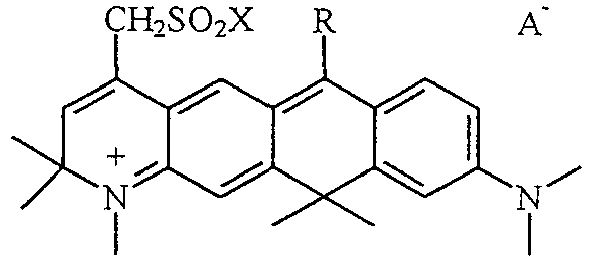
V Carbopyronine 
VI Azin-Farbstoffe Y = O (Oxazine), S (Thiazine), CR2 (Carbazine) 
VII Amidopyryliumfarbstoffe - Der Begriff Heteroatome, wie hierin verwendet, umfasst insbesondere Sauerstoff-, Schwefel- und Stickstoffatome.
- Der Begriff Substituenten umfasst, soweit nicht anders angegeben, insbesondere Halogen, Hydroxy-, Amino-, Sulfo-, Phospho-, Carboxy-, Alkoxy- sowie Alkoxycarbonylgruppen mit, soweit vorhanden, 1-10 C-Atomen.
- Zur Darstellung der erfindungsgemäßen Verbindungen werden folgende allgemeine Verfahren angewendet. Es können entweder die Vorstufen (Punkt 1) oder die fertigen Farbstoffe (Punkt 2) derivatisiert werden.
- Ausgehend von einem nach literaturbekannten Methoden, z.B. durch die Kondensation eines Anilinderivats mit Mesityloxid und anschließende N-Alkylierung, dargestellten 7-Alkoxy-2,2,4-trimethyl-1,2-dihydrochinolin wird folgendermaßen vorgegangen:

- Beispielhafte Darstellung hierin beschriebener Verbindungen. Es wird ausgehend von 1-Ethyl-7-methoxy-2,2,4-trimethyl-1,2-dihydrochinolin über die Zwischenstufen der Sulfonsäure und des Sulfochlorids schließlich ein Sulfonamid-Derivat erhalten. Durch intermediäre Hydrierung lässt sich das entsprechende 1,2,3,4-Tetrahydrochinolin-Derivat erhalten.
- Durch Verrühren des Dihydrochinolins mit einem Gemisch aus konzentrierter Schwefelsäure und Oleum bei Raumtemperatur erhält man ein an der 4-Methylgruppe sulfoniertes Produkt. Diese Sulfonsäure oder ihr Salz kann leicht in das Sulfochlorid überführt werden. Dazu wird die sulfonierte Verbindung bevorzugt bei Raumtemperatur in Benzol mit Phosphorpentachlorid umgesetzt. Allgemein verwendet man für die Darstellung des Sulfochlorids gebräuchliche Reagenzien wie Phosphoroxychlorid, Phosphorpentachlorid oder Thionylchlorid. Die Reaktion wird in einem wasserfreien inerten Lösungsmittel, vorzugsweise Benzol, ausgeführt.
- Das Sulfochlorid kann durch einfache Umsetzung mit fast beliebigen primären und sekundären Aminen in ein entsprechendes Sulfonamid überführt werden. Umsetzungen des Sulfochlorids mit anderen Nucleophilen (Thiole, Alkohole etc.) sind ebenfalls möglich. Gegebenenfalls kann das erhaltene stabile Sulfonamid weiter derivatisiert werden (Verseifung von Carbonestergruppen o.ä.).
- Das 1,2-Dihydrochinolin lässt sich z.B. auf der Stufe der Sulfonsäure palladiumkatalysiert mit Wasserstoff hydrieren und so in ein 1,2,3,4-Tetrahydrochinolin überführen. Dieses hydrierte Chinolin kann anschließend dem gleichen Syntheseweg unterworfen werden (siehe Abbildung 1).
- Mit den so erhaltenen Sulfonsäuren, ihren Salzen oder bevorzugt den Sulfonamid-Derivaten werden die nachfolgenden Farbstoffsynthesen nach den dem Fachmann bekannten Darstellungsmethoden durchgeführt:
- Symmetrische Rhodaminfarbstoffe lassen sich z.B. durch die Kondensation des beschriebenen Sulfonamid-Derivats mit Phthalsäureanhydrid erhalten. Andere Xanthenfarbstoffe, wie z.B. Trifluormethyl-, Pyronin- oder Rosaminfarbstoffe, erhält man durch Kondensation mit den entsprechenden Säureanhydriden (Trifluoressigsäureanhydrid) oder Aldehyden (Benzaldehyd etc.).
- Unsymmetrische Farbstoffe erhält man im Falle der Rhodamine z.B. durch die Umsetzung von Phthalsäureanhydrid mit einem Aminophenol oder hydriertem 7-Hydroxy- bzw. 7-Methoxychinolin und die anschließende Umsetzung des gebildeten Benzophenon-Derivats, z.B. mit einem zweiten Dihydro- oder Tetrahydrochinolin, wobei jetzt etwa ein erfindungsgemäßes Sulfonamid-Derivat zum Einsatz kommen kann.
- Die Vertreter anderer Farbstoffklassen, wie z.B. Cumarine, Carbopyronine, Amidopyryliumfarbstoffe, Oxazine usw., lassen sich mit den Sulfonsäuren, ihren Salzen oder den Sulfonamid-Derivaten der erwähnten oder ähnlicher Chinolinvorstufen nach literaturbekannten Methoden herstellen. Das heißt, in den bekannten Syntheseverfahren können die erfindungsgemäßen Verbindungen überraschenderweise problemlos für die Darstellung der Farbstoffe eingesetzt werden.
- Erfindungsgemäß können Farbstoffe nachträglich an der 4-Methylgruppe sulfoniert werden. Ein ähnliches Verfahren ist in der Patentanmeldung
WO 99/15517 - Die so erhaltenen sulfonierten Farbstoffe sind erstaunlicherweise ebenfalls - wie oben im Falle der Edukte beschrieben - in Sulfochloride überführbar, ohne dass der Chromophor dabei verändert oder zerstört wird. Hier wird neben Phosphoroxychlorid und/oder Phosphorpentachlorid bevorzugt eine Mischung aus Thionylchlorid und Dimethylformamid verwendet. Die Sulfochloride können als Perchlorate isoliert und gereinigt werden. Die isolierten Farbstoffsulfochloride lassen sich in bekannter Weise direkt als Marker für Aminogruppen in Biomolekülen einsetzen. Die so gewonnenen Sulfochloride können aber auch - wie oben für die Chinolin-Vorstufen beschrieben - mit fast beliebigen primären und sekundären Aminen umgesetzt werden. Man kann auf diese Weise besonders einfach die erfindungsgemäßen Farbstoffe erhalten.
- Durch die Einführung der Sulfonsäuregruppe und ihre Derivatisierung werden die spektralen Eigenschaften, wie Absorptions- und Fluoreszenzmaximum, Extinktionskoeffizient sowie die Fluoreszenzquantenausbeute der Farbstoffe, praktisch nicht beeinflusst.
- Durch das beschriebene Verfahren kann man aber auf einfache Weise oder sogar nachträglich den Farbstoffen - je nach verwendetem primären oder sekundären Amin - eine Vielfalt neuer Eigenschaften vermitteln. Denn das Amin kann fast beliebige weitere funktionelle Gruppen tragen. So lassen sich z.B. Cyano-, Mercapto-, Halogen-, Sulfonsäure-, Hydroxy-, Alkenyl-Gruppen etc. durch unser Verfahren in den Farbstoff einführen.
- Trägt das verwendete Amin z.B. längere Alkylketten, z.B. C10 bis C30, so erhöht sich der lipophile Charakter, und die Verbindung ist in unpolaren Medien und Membranen löslich und kann so zum Nachweis von Membraneigenschaften oder zu molekularen Abstandsmessungen eingesetzt werden.
- Die Wasserlöslichkeit eines Farbstoffs lässt sich verbessern, wenn das Amin wiederum Sulfon- oder Phosphonsäuregruppen trägt oder über Polyetherketten verfügt. Letztere machen die Verbindung auch in vielen organischen Lösungsmitteln besser löslich. Auch lassen sich dadurch ungewünschte unspezifische Wechselwirkungen mit Substrat oder Gefäßwänden vermindern. Eine Art cyclischer Polyether stellen die für den fluoreszenzsensitiven Kationennachweis verwendeten Kronenether dar, die als Aza-Derivate auch über die hier beschriebene Methode an Farbstoffmoleküle gekoppelt werden können. Ferner lassen sich nach dem beschriebenen Verfahren auch bichromöphore Systeme darstellen, in denen Energieübertragung (FRET) zwischen den Chromophoren stattfindet.
- Trägt das Amin Substituenten, die zur kovalenten Kopplung fähig sind, z.B. -COOH, -NH2, -OH oder/und -SH, so kann die erfindungsgemäß hergestellte Verbindung nach bekannten Methoden an einen Träger und/oder an ein Biomolekül gekoppelt werden. Durch dieses Vorgehen können somit Farbstoffe zur Markierung verwendet werden, die an sich nicht über eine kopplungsfähige Carboxylgruppe o.ä. verfügen, wie es bei den in
WO 99/15517 - Eine gängige Methode zur kovalenten Markierung von Biomolekülen ist die dem Fachmann vertraute Aktivestermethode. In einer bevorzugten Weise wird deshalb als Amin eine Carbonsäure mit terminaler Aminogruppe und mittlerer Kettenlänge eingesetzt. So lassen sich z.B. die käufliche 4-Methylaminobuttersäure, 4-Piperidincarbonsäure, 6-Aminohexansäure usw. als Amin in erfindungsgemäßer Weise einsetzen. Man erhält nach der Sulfonamidverknüpfung also Farbstoffe, die über eine koppelbare Carboxylgruppe verfügen. Nach der Ankopplung an primäre Aminogruppen geeigneter Biomoleküle lässt sich die verwendete Markierungsgruppe und damit der Analyt leicht durch ihre Absorption und/oder Fluoreszenz nachweisen.
- Die erhaltenen Verbindungen können als Markierungsgruppen und damit der Analyt in Verfahren zur qualitativen oder/und quantitativen Bestimmung eines Analyten verwendet werden. Die Bestimmung kann in wässrigen Flüssigkeiten, z.B. Proben von Körperflüssigkeiten, wie etwa Blut, Serum, Plasma oder Urin, Abwasserproben oder Lebensmitteln, durchgeführt werden. Das Verfahren kann sowohl als Nasstest, z.B. in einer Küvette, oder als Trockentest auf einem entsprechenden Reagenzträger durchgeführt werden. Die Bestimmung der Analyten kann dabei über eine einzige Reaktion oder durch eine Sequenz von Reaktionen erfolgen. Die Verwendung der erhaltenen Verbindungen zeigt dabei sehr gute Ergebnisse in chemischen und insbesondere in medizinischen und biologischen Nachweisverfahren zur Bestimmung eines Analyten.
- Die Verbindungen können in allen bekannten chemischen, medizinischen und biologischen Nachweisverfahren, in denen Fluoreszenzfarbstoffe als Markierungsgruppen geeignet sind, verwendet werden. Derartige Verfahren sind dem Fachmann bekannt und müssen deshalb nicht weiter ausgeführt werden.
- In einer besonders bevorzugten Ausführungsform wird die erhaltene Verbindung kovalent an einen für den nachzuweisenden Analyten spezifischen Rezeptor gekoppelt. Der spezifische Rezeptor ist jede geeignete Verbindung oder jedes geeignete Molekül, vorzugsweise ist es ein Peptid, Polypeptid oder eine Nukleinsäure. Die Verbindungen oder Konjugate dieser Verbindungen können beispielsweise in Nukleinsäure-Hybridisierungsverfahren oder immunchemischen Verfahren verwendet werden. Derartige Verfahren sind beispielsweise beschrieben in Sambrook et al., Molecular Cloning, A Laboratory Manual, 1989, Cold Spring Harbor.
- Ein wesentlicher Vorteil des beschriebenen Verfahrens ist die uneingeschränkte Anwendbarkeit auf alle Farbstoffe, für deren Synthese die oben beschriebenen Di- und Tetrahydrochinoline verwendet werden können. Man ist also in der Lage, durch die Auswahl des Chromophors genau die Farbstoffe auszuwählen, die aufgrund ihrer spektroskopischen Eigenschaften, der Lage der Absorptions- und Fluoreszenzmaxima, der Löslichkeitseigenschaften, der Fluoreszenzabklingzeit und der Höhe der Quantenausbeute für die gewünschte Anwendung besonders geeignet erscheinen.
- Die Herstellung von erfindungsgemäßen Verbindungen gelingt nach den vorne beschriebenen Methoden in einfacher und kostengünstiger Weise, wie in den nachfolgenden Beispielen erläutert wird. Die so hergestellten Verbindungen sind unproblematisch handhabbar und zeigen eine gute Stabilität und Lagerfähigkeit.
- Hierin beschrieben werden die Herstellung und Verwendung von Dihydrochinolin- und Tetrahydrochinolin-Derivaten entsprechend Formeln Ia und Ib mit X = OH (Sulfonsäuren); X = Cl, Br, I (Sulfonylhalogenide, bevorzugt Chloride); X = NR1R2 mit R1 und R2=substituiertes Alkyl, Aryl etc. (Sulfonamide); X = OR oder SR mit R = Alkyl, Aryl etc. (Sulfonsäureester, Thiosulfonsäure-S-Ester), sowie die Verwendung von Verbindungen entsprechend Formeln Ia und Ib zur Herstellung polycyclischer Farbstoffe entsprechend Formeln II - VII.
- Hierin beschrieben werden weiterhin die Herstellung und Verwendung polycyclischer Farbstoffe entsprechend Formeln II - VII durch direkte Einführung von ein oder mehreren Substituenten SO2X in bekannte Farbstoffe mit Dihydrochinolin- oder Tetrahydrochinolin-Endgruppen, ausgenommen X = OH in Verbindungen entsprechend Formel III mit Y = O und Formel IV.
- Die Farbstoffe entsprechend Formeln II - VII werden vorzugsweise zur Markierung von Analyten, insbesondere Biomolekülen (Peptide, Nucleotide etc.), über deren NH2- bzw. SH-Gruppen eingesetzt.
- Die Farbstoffe entsprechend Formeln II - VII mit X = Cl (Sulfonylchlorid) können auch zur Kopplung mit Aminogruppen eines Analyten verwendet werden.
- Ferner beschrieben wird die Verwendung der Farbstoffe entsprechend Formeln II - VII mit X = NR1R2 und R1 = COOH-substituiertes Alkyl oder Aryl zur Bildung von Aktivestern (mit z.B. N-Hydroxysuccinimid) und nachfolgende Kopplung an Aminogruppen eines Analyten. Zudem können die Farbstoffe entsprechend Formeln II - VII zur Kopplung an freie Aminogruppen anderer Farbstoffe (FRET-Pärchen) verwendet werden.
- Konkrete Beispiele für erfindungsgemäße Verbindungen sind in den Tabellen 1 bis 3 dargestellt.
Tabelle 1: Chinolylsulfonsäuren und deren Derivate Beispiel Struktur Summenformel Masse MH+ nicht erfindungsgemäß 1 
C19H27NO6S 398 nicht erfindungsgemäß 2 
C19H29NO6S 400 nicht erfindungsgemäß 3 
C14H21NO4S 300 nicht erfindungsgemäß 4 
C13H19NO4S 286 nicht erfindungsgemäß 5 
C13H18N2O5S 315 nicht erfindungsgemäß 6 
C17H27NO7S2 421 nicht erfindungsgemäß 7 
C13H19NO4S 286 nicht erfindungsgemäß 8 
C14H19N03S 284 nicht erfindungsgemäß 9 
C14H18ClNO2S 302 nicht erfindungsgemäß 10 
C21H30N2O4S 407 nicht erfindungsgemäß 11 
C18H28N2O2S 337 nicht erfindungsgemäß 12 
C22H36N2O2S 393 nicht erfindungsgemäß 13 
C22H30N2O5S 435 nicht erfindungsgemäß 14 
C22H32N2O5S 437 nicht erfindungsgemäß 15 
C15H21NO4S 312 nicht erfindungsgemäß 16 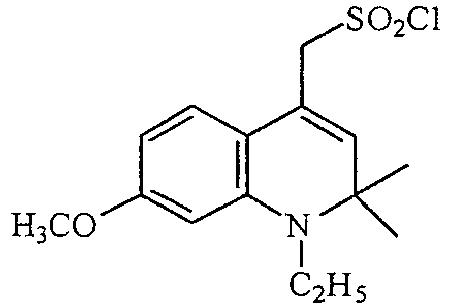
C15H22ClNO3S 330 nicht erfindungsgemäß 17 
C22H32N2O5S 437 nicht erfindungsgemäß 18 
C14H19NO4S 298 nicht erfindungsgemäß 19 
C14H20ClNO3S 318 nicht erfindungsgemäß 20 
C21H32N2O5S 425 nicht erfindungsgemäß 21 
C22H38N2O3S 411 nicht erfindungsgemäß 22 
C20H30N2O4S 395 nicht erfindungsgemäß 23 
C21H34N2O4S 459 nicht erfindungsgemäß 24 
C18H29N3O2S 352 nicht erfindungsgemäß 25 
C33H58N2O2S 547 nicht erfindungsgemäß 26 
C34H60N2O2S 561 nicht erfindungsgemäß 27 
C20H32N2O2S2 397 nicht erfindungsgemäß 28 
C18H28N2O4S 369 nicht erfindungsgemäß 29 
C18H28N2O8S3 497 nicht erfindungsgemäß 30 
C24H38N2O6S 483 nicht erfindungsgemäß 31 
C19H26N2O5S2 427 nicht erfindungsgemäß 32 
C16H23NO2S2 341 nicht erfindungsgemäß 33 
C19H29NO2S2 367 Tabelle 2a: Cumarinfarbstoffe mit Sulfonsäure-Gruppe Spektrale Daten in Ethanol: λa Absorptionsmaximum, λf Fluoreszenzmaximum Name Struktur λa/nm λf/nm nicht erfindungsgemäß 34 
394 468 AZ 59 35 
383 455 AZ 100 nicht erfindungsgemäß 36 
394 469 AZ 101 Tabelle 2b: Rhodaminfarbstoffe mit Sulfonsäure-Gruppe Spektrale Daten in Ethanol: λa Absorptionsmaximum, λf Fluoreszenzmaximum Name Struktur (Anion A-) λa/nm λf/nm nicht erfindungsgemäß 37 
592 612 JA 317 nicht erfindungsgemäß 38 
621 642 JA 325 nicht erfindungsgemäß 39 
562 587 AZ 58 nicht erfindungsgemäß 40 
623 645 JA 407 nicht erfindungsgemäß 41 
623 644 JA 407-E Tabelle 2c: Oxazinfarbstoffe mit Sulfonsäure-Gruppe Spektrale Daten in Ethanol: λa Absorptionsmaximum, λf Fluoreszenzmaximum Name Struktur (Anion A-) λa/nm λf/nm 42 
655 680 JA 378 nicht erfindungsgemäß 43 
675 699 JA 379 nicht erfindungsgemäß 44 
674 699 JA 322 nicht erfindungsgemäß 45 
673 698 JA 324-S 46 
655 679 JA 326 47 
654 678 JA 329 nicht erfindungsgemäß 48 
694 717 JA 410 nicht erfindungsgemäß 49 
674 695 JA 331 50 
654 678 JA 366 51 
653 676 JA 403 52 
678 699 JA 404 nicht erfindungsgemäß 53 
694 715 JA 408 Tabelle 2d: Carbopyroninfarbstoffe mit Sulfonsäure-Gruppe Spektrale Daten in Ethanol: λa Absorptionsmaximum, λf Fluoreszenzmaximum Name Farbstoff (Anion A-) λa/nm λf/nm nicht erfindungsgemäß 54 
637 664 JA 323 nicht erfindungsgemäß 55 
648 675 AZ 30 nicht erfindungsgemäß 56 
648 674 AZ 31 nicht erfindungsgemäß 57 
649 674 AZ 35 nicht erfindungsgemäß 58 
641 666 AZ 8-SO3H nicht erfindungsgemäß 59 
647 675 AZ 9-SO3H nicht erfindungsgemäß 60 
637 664 AZ 10-SO3H nicht erfindungsgemäß 61 
664 688 AZ 11-SO3H nicht erfindungsgemäß 62 
647 674 AZ 12-SO3H Tabelle 2e: Amidopyryliumfarbstoffe mit Sulfonsäure-Gruppe Spektrale Daten in Ethanol: λa Absorptionsmaximum, λf Fluoreszenzmaximum Name Struktur (Anion A-) λa/nm λf/nm nicht erfindungsgemäß 63 
635 695 NK 32 64 
610 668 NK 34 Tabelle 3a: Sulfonsäurederivate erfindungsgemäßer Cumarinfarbstoffe Spektrale Daten in Ethanol: λa Absorptionsmaximum, λf Fluoreszenzmaximum Name Struktur λa/nm λf/nm nicht erfindungsgemäß 65 
394 468 AZ 96 nicht erfindungsgemäß 66 
393 468 AZ 97 nicht erfindungsgemäß 67 
394 467 AZ 98 nicht erfindungsgemäß 68 
393 469 AZ 99 Tabelle 3b: Sulfonsäurederivate erfindungsgemäßer Rhodaminfarbstoffe Spektrale Daten in Ethanol: λa Absorptionsmaximum, λf Fluoreszenzmaximum Name Struktur (Anion A-) λa/nm λf/nm nicht erfindungsgemäß 69 
542 567 AZ 49 nicht erfindungsgemäß 70 
561 587 AZ 50 nicht erfindungsgemäß 71 
624 644 AZ 84 nicht erfindungsgemäß 72 
624 644 AZ 85 nicht erfindungsgemäß 73 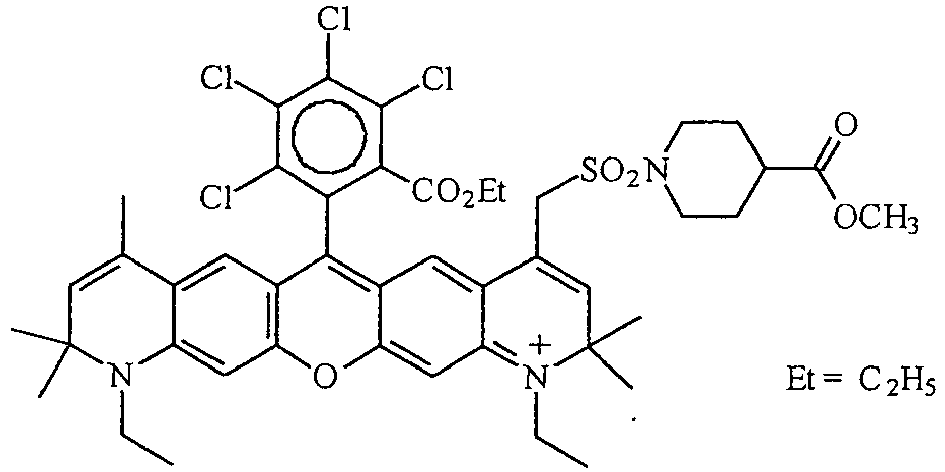
624 645 AZ 86 nicht erfindungsgemäß 74 
623 644 AZ 88 nicht erfindungsgemäß 75 
624 644 AZ 89 nicht erfindungsgemäß 76 
624 645 AZ 90 nicht erfindungsgemäß 77 
624 644 AZ 87 nicht erfindungsgemäß 78 
624 644 AZ 93 nicht erfindungsgemäß 79 
624 646 AZ 94 nicht erfindungsgemäß 80 
624 644 AZ 95 nicht erfindungsgemäß 81 
624 646 AZ 91 nicht erfindungsgemäß 82 
624 644 AZ 92 Tabelle 3c: Sulfonsäurederivate erfindungsgemäßer Oxazinfarbstoffe Spektrale Daten in Ethanol: λa Absorptionsmaximum, λf Fluoreszenzmaximum Name Struktur (Anion A-) λa/nm λf/nm 83 
654 680 AZ 46 84 
654 679 JA 403 ME 85 
653 677 AZ 54 86 
654 679 AZ 55 87 
653 678 AZ 56 nicht erfindungsgemäß 88 
678 699 AZ 52 89 
653 677 AZ 57 90 
654 678 AZ 102 nicht erfindungsgemäß 91 
678 717 AZ 73 nicht erfindungsgemäß 92 
678 715 AZ 74 nicht erfindungsgemäß 93 
679 715 AZ 75 nicht erfindungsgemäß 94 
678 715 AZ 76 nicht erfindungsgemäß 95 
678 716 AZ 77 nicht erfindungsgemäß 96 
677 714 AZ 78 nicht erfindungsgemäß 97 
678 716 AZ 79 nicht erfindungsgemäß 98 
678 715 AZ 80 nicht erfindungsgemäß 99 
679 715 AZ 81 Tabelle 3d: Sulfonsäurederivate erfindungsgemäßer Carbopyroninfarbstoffe Spektrale Daten in Ethanol: λa Absorptionsmaximum, λf Fluoreszenzmaximum Name Struktur (Anion A-) λa/nm λf/nm nicht erfindungsgemäß 100 
634 658 AZ 48 nicht erfindungsgemäß 101 
635 661 AZ 64 nicht erfindungsgemäß 102 
634 661 AZ 65 nicht erfindungsgemäß 103 
635 663 AZ 66 nicht erfindungsgemäß 104 
635 663 AZ 67 nicht erfindungsgemäß 105 
634 662 AZ 68 nicht erfindungsgemäß 106 
634 661 AZ 69 nicht erfindungsgemäß 107 
634 662 AZ 70 nicht erfindungsgemäß 108 
634 662 AZ 71 nicht erfindungsgemäß 109 
635 661 AZ 72 nicht erfindungsgemäß 110 
634 661 AZ 82 nicht erfindungsgemäß 111 
635 663 AZ 83 Tabelle 3e: Sulfonsäurederivate erfindungsgemäßer Trifluormethyl-substituierter Xanthenfarbstoffe Spektrale Daten in Ethanol: λa Absorptionsmaximum, λf Fluoreszenzmaximum Name Struktur (Anion A-) λa/nm λf/nm nicht erfindungsgemäß 112 
665 694 AZ 51 nicht erfindungsgemäß 113 
664 694 AZ 63 nicht erfindungsgemäß 114 
651 680 AZ 60 nicht erfindungsgemäß 115 
652 680 AZ 62 nicht erfindungsgemäß 116 
652 679 AZ 61 - Die Erfindung wird durch nachfolgende Beispiele näher erläutert. Es sind sowohl Beispiele für die Herstellung der sulfonierten Chinolinvorstufen und ihre Derivatisierung als auch Beispiele für die Synthese und Modifizierung von Farbstoffen aus den entsprechend sulfonierten Chinolinen angegeben. Die als Ausgangsverbindungen für die unter 1. beschriebenen Verbindungen verwendeten Dihydro- und Tetrahydrochinoline und primären bzw. sekundären Amine sind entweder kommerziell erhältlich oder nach literaturbekannten Synthesen oder dem Fachmann bekannten Verfahren darzustellen. Dies trifft auch für die Ausgangsfarbstoffe der unter 2. beschriebenen Farbstoffderivate zu.
- Zur Darstellung von (1-Ethyl-2,2-dimethyl-1,2-dihydrochinol-4-yl)-methansulfonsäure (8) werden 6,0 g (21 mmol) 1-Ethyl-2,2,4-dimethyl-1,2-dihydrochinolin unter Eiskühlung in einem Gemisch aus 10 ml konzentrierter Schwefelsäure und Oleum im Verhältnis 5:1 gelöst. Es wird 20 Stunden bei Raumtemperatur verrührt. Das Reaktionsgemisch wird auf Eis gegossen und mit 20 %iger Natronlauge unter Eis/Methanol-Kühlung alkalisch gestellt (pH12). Zur Entfernung des nicht umgesetzten Edukts wird mit Chloroform extrahiert und die wässrige Phase bis zur Trockene am Rotationsverdampfer eingeengt. Der kristalline Rückstand wird in Ethanol suspendiert, vom Natriumsulfat abgesaugt und die organische Phase am Rotationsverdampfer zur Trockene eingeengt. Der harzige Rückstand kristallisiert bei Zugabe von Aceton. Es wird erneut abgesaugt, mit Aceton gewaschen und unter Vakuum über Phosphorpentoxid getrocknet. Das erhaltene Rohprodukt kann ohne weitere Reinigungsschritte in der nächsten Stufe eingesetzt werden. Ausbeute 82 %.
ESI-Massenspektrum: m/z = 282 (MH+)
NMR (DMSO-d6): C H 3 CH2-, 0.97ppm, T, 3; -C H 2 -N, 3.39ppm, Q, 2; 2x C H 3 -, 1.31 ppm, S, 6; =C H , 5.74ppm, S, 1; -C H 2 SO3H, 4.27ppm, S, 2; H aromat, 7.15-7,58ppm, M, 4. - Zur Darstellung von (1-Ethyl-2,2-dimethyl-1,2-dihydrochinol-4-yl)-methansulfonsäure-chlorid (9) werden 2,5 g (8,8 mmol) (1-Ethyl-2,2-dimethyl-1,2-dihydrochinol-4-yl)-methansulfonsäure (8) in 70 ml trockenem Benzol suspendiert und bei Raumtemperatur portionsweise mit Phosphorpentachlorid 4,6 g (22,2 mmol) versetzt. Die Reaktionsmischung färbt sich zunächst gelb, später gelborange. Der weiße Niederschlag wird nach 1.5 Stunden abfiltriert und mit kaltem trockenem Benzol gewaschen. Es wird im Vakuum über Phosphorpentoxid getrocknet. Das erhaltene Säurechlorid wird ohne weitere Reinigung sofort in der nächsten Stufe eingesetzt.
Ausbeute 75 %.
ESI-Massenspektrum: m/z = 300 (MH+) - Zur Darstellung von (1-Ethyl-2,2-dimethyl-1,2-dihydrochinol-4-yl-methansulfonyl)-piperidin-4-carbonsäuremethylester (10) werden 2 g (6,6 mmol) (1-Ethyl-2,2-dimethyl-1,2-dihydrochinol-4-yl)-methansulfonsäurechlorid (9) in 40 ml trockenem Acetonitril gelöst und mit einem Eisbad gekühlt. Man versetzt tropfenweise mit 1,13 g (7,9 mmol) 4-Piperidincarbonsäuremethylester gefolgt von 0,85 g (6,6 mmol) Diisopropylethylamin. Die Reaktionsmischung wird 30 Minuten bei Raumtemperatur verrührt. Man versetzt mit Wasser und extrahiert mit Chloroform, wäscht mit 10 %iger kalter Sodalösung und trocknet über wasserfreiem Natriumsulfat. Das Lösungsmittel wird am Rotationsverdampfer abdestilliert und der Rückstand an Kieselgel mit einem von Chloroform nach Ethanol verlaufenden Gradienten säulenchromatographisch gereinigt. Ausbeute 82 %.
ESI-Massenspektrum: m/z = 407 (MH+) - Zur Darstellung von 1-(1-Ethyl-6-formyl-2,2-dimethyl-1,2-dihydrochinol-4-yl-methan-sulfonyl)-piperidin-4-carbonsäuremethylester (13) werden 3 ml trockenes Dimethylformamid im Eis/Methanol Bad auf -10 °C gekühlt und tropfenweise mit 0,45 ml (4,9 mmol) Phosphoroxidtrichlorid versetzt. Die Reaktionsmischung wird 20 Minuten bei -5 °C verrührt. (1-Ethyl-2,2-dimethyl-1,2-dihydrochinol-4-yl-methansulfonyl)-piperidin-4-carbonsäure-methylester (10) werden in 1,5 ml trockenem Dimethylformamid gelöst und bei -5 °C dem Reaktionsgemisch zugetropft. Nach beendeter Zugabe wird 50 Minuten auf 80 °C erhitzt. Die Reaktionslösung wird auf Eiswasser gegossen und mit Chloroform versetzt. Es wird mit 20 %iger Natronlauge auf pH12 eingestellt und mehrmals mit Chloroform extrahiert. Die organische Phase wird mit 10 %iger Sodalösung gewaschen und über wasserfreiem Natriumsulfat getrocknet. Das erhaltene Rohprodukt wird am Rotationsverdampfer unter Vakuum zur Trockene eingeengt und an Kieselgel über einem von Chloroform nach Ethanol verlaufenden Gradienten säulenchromatographisch gereinigt.
Ausbeute 88 %.
ESI-Massenspektrum: m/z = 435 (MH+)
NMR (CDCl3): C H 3 CH2-, 1.22ppm, T, 3; -C H 2 -N, 3.41 ppm, Q, 2; 2x C H 3 -, 1.42ppm, S, 6; =C H , 5.63ppm, S, 1; -C H 2 SO2N, 4.00ppm, S, 2; H -5 aromat, 7.59ppm, S, 1; H -7 aromat, 7.57ppm, D, 1; H -8 aromat, 6.55ppm, D, 1; H- C=O, 9.68ppm, S, 1; -O-C H 3 , 3.63ppm, S, 1; C H (Piperidin)-C=O, 2.31 ppm, M, 1; N-C HH' (Piperidin), 2.83ppm u. 3.52ppm; M, 2,2; HC-C HH' (Piperidin), 1.67ppm u. 1.83ppm; M, 2,2. - Zur Darstellung von 1-(1-Ethyl-6-hydroxymethyl-2,2-dimethyl-1,2-dihydrochinol-4-yl-methansulfonyl)-piperidin-4.-carbonsäuremethylester (14) werden 1 g (2,3 mmol) 1-(1-Ethyl-6-formyl-2,2-dimethyl-1,2-dihydrochinol-4-yl-methansulfonyl)-piperidin-4-carbonsäuremethylester (13) in 10 ml Ethanol gelöst und unter Eiskühlung mit 0,05g Natriumborhydrid versetzt, wobei eine deutliche Gasentwicklung mit Schäumen zu beobachten ist. Es wird 50 Minuten bei Raumtemperatur verrührt. Zur Zersetzung des Überschusses an Reduktionsmittel wird tropfenweise mit 1 N Salzsäure versetzt bis kein Schäumen mehr zu beobachten ist (pH7). Man gießt auf 50 ml Wasser und extrahiert 3 mal mit 20 ml Chloroform. Die vereinigten organischen Phasen werden über wasserfreiem Natriumsulfat getrocknet und das Lösungsmittel am Rotationsverdampfer bis zur Trockene abdestilliert. Der erhaltene Rückstand wird an Kieselgel mit einem von Chloroform nach Ethanol verlaufenden Gradienten säulenchromatographisch gereinigt.
Ausbeute 88 %.
ESI-Massenspektrum: m/z = 435 (MH+)
NMR (CDCl3): C H 3 CH2-, 1.10ppm, T, 3; -C H 2 -N, 3.25ppm, Q, 2; 2x C H 3 -, 1.27ppm, S, 6; =C H, 5.53ppm, S, 1; -C H 2 SO2N, 3.96ppm, S, 2; H -5 aromaten, 7.10ppm, S, 1; H -7 aromaten, 7.05ppm, D, 1; H -8 aromaten, 6.46ppm, D, 1; H 2 C-OH, 4.47ppm, S, 1; -O-C H 3 , 3.57ppm, S, 1; C H (Piperidin)-C=O, 2.29ppm, M, 1; N-C HH' (Piperidin), 2.82ppm u. 3.53ppm; M, 2,2; HC-C HH' (Piperidin), 1.68ppm u. 1.73ppm; M, 2,2; -CH2-O H , nn. - Zur Darstellung von (1-Methyl-7-methoxy-2,2-dimethyl-1,2,3,4-tetrahydrochinol-4-yl)-methansulfonsäure (3) werden 5,0 g (1-Methyl-7-methoxy-2,2-dimethyl-1,2-dihydrochinol-4-yl)-methansulfonsäure werden in 100 ml Methanol gelöst und mit 0,5 g 10 %igem Palladium auf Aktivkohle versetzt. Das Reaktionsgemisch wird im Autoklaven 18 Stunden bei 70 bar und Raumtemperatur hydriert. Man filtriert und engt am Rotationsverdampfer zur Trockene ein. Der erhaltene Feststoff lässt sich ohne weitere Reinigung in der nächsten Stufe einsetzen.
Ausbeute 90 %.
ESI-Massenspektrum: m/z = 270 (MH+) - Die Darstellung von N,N-Diethyl-(1-Ethyl-2,2-dimethyl-1,2-dihydrochinol-4-yl)-methansulfonamid (11) erfolgt analog Verbindung (10) unter Verwendung von Verbindung (9) mit Diethylamin. Die säulenchromatographische Isolierung des Produktes erfolgt an Kieselgel mit einem von Chloroform nach Ethanol verlaufenden Gradienten.
Ausbeute 79 %.
ESI-Massenspektrum: m/z = 337 (MH+) - Die Darstellung von (1-Ethyl-2,2-dimethyl-1,2-dihydrochinol-4-yl)-N-octyl-methansulfonamid (12) erfolgt analog Verbindung (10) unter Verwendung von Verbindung (9) mit n-Octylamin. Die säulenchromatographische Isolierung des Produktes erfolgt an Kieselgel mit einem von Chloroform nach Ethanol verlaufenden Gradienten.
Ausbeute 81 %
ESI-Massenspektrum: m/z = 393 (MH+) - Zur Darstellung von (1-Ethyl-7-methoxy-2,2-dimethyl-1,2-dihydrochinol-4-yl)-methansulfonsäure (15) werden 20 g (8,6 mmol) 1-Ethyl-7-methoxy-2,2,4-dimethyl-1,2-dihydrochinolin unter Eiskühlung in einem Gemisch aus 10 ml konzentrierter Schwefelsäure und Oleum im Verhältnis 5:1 gelöst. Es wird 20 Stunden bei Raumtemperatur verrührt. Das Reaktionsgemisch wird auf Eis gegossen und mit 20 %iger Natronlauge unter Eis/Methanol Kühlung alkalisch gestellt (pH12). Zur Entfernung des nicht umgesetzten Edukts wird mit Chloroform extrahiert und die wässrige Phase zur Trockene am Rotationsverdampfer eingeengt. Der kristalline Rückstand wird säulenchromatographisch an Kieselgel mit einem von Chloroform nach Ethanol verlaufenden Gradienten gereinigt.
Ausbeute 86 %.
ESI-Massenspektrum: m/z = 312 (MH+)
NMR (DMSO-d6): C H 3 CH2-, 1.09ppm, T, 3; -C H 2 -N, 3.25ppm, Q, 2; 2x C H 3 -, 1.24ppm, S, 6; =C H , 5.28ppm, S, 1; -C H 2 SO3H, 3.43ppm, S, 2; H -5 aromat, 6.04ppm, D, 1; H -6 aromat, 7.17ppm, D, 1; H -8 aromat, 5.93ppm, S, 1; CH3O-, 3.68ppm, S, 3. - Die Darstellung von (1-Ethyl-7-methoxy-2,2-dimethyl-1,2-dihydrochinol-4-yl)-methan-sulfonsäurechlorid (16) erfolgt analog Verbindung (9) aus Verbindung (15) und Phosphorpentachlorid in trockenem Benzol. Das erhaltene Säurechlorid wird sofort zur weiteren Umsetzung eingesetzt.
Ausbeute 73 %.
ESI-Massenspektrum: m/z = 330 (MH+) - Die Darstellung von (1-Ethyl-7-methoxy-2,2-dimethyl-1,2-dihydrochinol-4-yl-methansulfonyl)-piperidin-4-carbonsäuremethylester (17) erfolgt analog Verbindung (10) aus Verbindung (16) in trockenem Acetonitril bei Raumtemperatur.
Ausbeute 69 %.
ESI-Massenspektrum: m/z = 437 (MH+)
NMR (CDCl3): C H 3 CH2-, 1.15ppm, T, 3; -C H 2 -N, 3.27ppm, Q, 2; 2x C H 3 -, 1.31ppm, S, 6; =C H , 5.41 ppm, S, 1; -C H 2 SO2N, 3.97ppm, S, 2; H -5 aromat, 6.17ppm, D, 1; H -6 aromat, 7.07ppm, D, 1; H -8 aromat, 6.09ppm, S, 1; -O-C H 3 , 3.77ppm, S, 1; C H (Piperidin)-C=O, 2.31ppm, M, 1; N-C HH' (Piperidin), 2.82ppm u. 3.63ppm; M, 2,2; HC-C HH' (Piperidin), 1.63ppm u. 1.80ppm; M, 2,2; O=C-OC H 3 , 3.63, S, 3. - Zur Darstellung von (1-Ethyl-7-hydroxy-2,2-dimethyl-1,2-dihydrochinol-4-yl)-methan-sulfonsäure (18) werden 5 g (16,1 mmol) (1-Ethyl-7-methoxy-2,2-dimethyl-1,2-dihydrochinol-4-yl)-methansulfonsäure (16) in 10 ml 48 %iger Bromwasserstoffsäure suspendiert und 2 Stunden zum Rückfluss erhitzt. Man gießt auf Eis, versetzt mit Chloroform und neutralisiert mit 20 %iger Natronlauge. Die organische Phase wird abgetrennt und die wässrige Phase am Rotationsverdampfer im Vakuum zur Trockene einrotiert. Der Rückstand wird in heißem Ethanol suspendiert, filtriert und das Filtrat erneut bis zur Trockene einrotiert. Das so erhaltene Produkt wird ohne weitere Reinigung in der nächsten Stufe eingesetzt.
Ausbeute 91 %.
ESI-Massenspektrum: m/z = 298 (MH+) - Die Darstellung von (1-Methyl-7-methoxy-2,2-dimethyl-1,2,3,4-tetrahydrochinol-4-yl)-methansulfonsäurechlorid (19) erfolgt analog Verbindung (16) unter Verwendung von Verbindung (3) und Phosphorpentachlorid mit dem Unterschied, dass 18 Stunden bei Raumtemperatur verrührt wird.
Ausbeute 78 %.
ESI-Massenspektrum: m/z = 317 (MH+) - Die Darstellung von (1-Methyl-7-methoxy-2,2-dimethyl-1,2,3,4-tetrahydrochinol-4-yl-methansulfonyl)-piperidin-4-carbonsäuremethylester (20) erfolgt analog Verbindung (10) aus Verbindung (19) mit 4-Piperidincarbonsäuremethylester in trockenem Acetonitril. Die säulenchromatographische Isolierung erfolgt an Kieselgel mit einem von Chloroform nach Ethanol verlaufenden Gradienten.
Ausbeute 69 %.
ESI-Massenspektrum: m/z = 425 (MH+) - Die Darstellung von (1-Methyl-7-methoxy-2,2-dimethyl-1,2,3,4-tetrahydrochinol-4-yl)-N-octyl-methansulfonamid (21) erfolgt analog Verbindung (10) aus Verbindung (19) mit n-Octylamin in trockenem Acetonitril. Die säulenchromatographische Isolierung erfolgt an Kieselgel mit einem von Chloroform nach Ethanol verlaufenden Gradienten.
Ausbeute 69 %.
ESI-Massenspektrum: m/z = 411 (MH+) - 1,2 g (4,93 mmol) 4-(6-Hydroxymethyl-2,2,4-trimethyl-2H-chinol-1-yl)-buttersäure-ethylester werden zusammen mit 0,72 g (4,93 mmol) 1-Ethyl-6-isopropenyl-indolin in 20 ml trockenem Dichlormethan gelöst und auf -5 °C gekühlt. Man versetzt tropfenweise mit 7 ml einer 1 molaren Lösung von Bortrichlorid in Dichlormethan. Das Reaktionsgemisch wird 2 Stunden bei Raumtemperatur verrührt, das Lösungsmittel am Rotationsverdampfer entfernt und der Rückstand in konzentrierter Schwefelsäure gelöst. Die Reaktionsmischung wird 4 Stunden bei Raumtemperatur verrührt. Man tropft in eiskaltes Ethanol, versetzt mit 0,8 g Tetrabutylammoniummetaperiodat und erhitzt kurz zum Sieden. Man lässt abkühlen, versetzt mit Wasser und nimmt den Farbstoff in Chloroform auf. Es wird über wasserfreiem Natriumsulfat getrocknet und die Farbstofflösung am Rotationsverdampfer zur Trockene eingeengt. Das erhaltene Farbstoffrohprodukt wird an Kieselgel mit einem von Chloroform nach Ethanol verlaufenden Gradienten säulenchromatographisch gereinigt.
Ausbeute 45 %.
ESI-Massenspektrum: m/z = 565 (M+)
Absorptionsmaximum: λa = 648 nm (in Ethanol) - 100 mg (0,21 mmol) JA 403 werden in 8 ml trockenem Acetonitril gelöst und im kalten Wasserbad gekühlt. Man versetzt mit 4 Tropfen trockenem Dimethylformamid gefolgt von 6 Tropfen frisch destilliertem Thionylchlorid. Es wird 45 Minuten verrührt. Die Umsetzung erfolgt quantitativ. Das Reaktionsgemisch wird in einem Eisbad gekühlt. Die Farbstofflösung wird in eine mit Eis/Methanol gekühlte 20 %ige Natriumperchloratlösung getropft. Der sich in feinen Kristallen abscheidende Farbstoff wird abgesaugt, mit wenig kaltem Wasser gewaschen und im Ölpumpenvakuum über Phosphorpentoxid getrocknet. Der Farbstoff kann ohne zusätzliche Reinigung für weitere Umsetzungen eingesetzt werden.
Ausbeute 81 %.
ESI-Massenspektrum: m/z = 502 (M+)
Absorptionsmaximum: λa = 650 nm (Acetonitril) - 10 mg (0.017 mmol) AZ 46 werden in 5 ml trockenem Acetonitril gelöst und mit 5 ml einer 10 mmolaren Lösung aus Benzylamin in trockenem Acetonitril versetzt. Das Reaktionsgemisch wird 20 Minuten bei Raumtemperatur verrührt. Die Reaktionslösung wird zur Trockene einrotiert und an Kieselgel mit einem von Chloroform nach Ethanol verlaufenden Gradienten säulenchromatographisch gereinigt. Ausbeute 88 %.
ESI-Massenspektrum: m/z = 573 (M+)
Absorptionsmaximum: λa = 653 nm (in Ethanol) - Die Synthese erfolgt analog zur Darstellung von AZ 102 unter Verwendung einer 10 mmolaren Lösung von 4-Piperidincarbonsäuremethylester. Die Isolierung erfolgt säulenchromatographisch an Kieselgel mit einem von Chloroform nach Ethanol verlaufenden Gradienten.
Ausbeute 91 %.
ESI-Massenspektrum: m/z = 609 (M+)
Absorptionsmaximum: λa = 652 (in Ethanol) - 10 mg (0,014 mmol) AZ 56 werden in 20 ml Acetonitril Wasser 1:1 gelöst und mit 0,5 ml 2 N Salzsäure versetzt. Die Reaktionsmischung wird 7 Stunden zum Rückfluss erhitzt. Die Farbstofflösung wird unter Vakuum eingeengt und an Kieselgel mit einem von Chloroform nach Ethanol verlaufenden Gradienten säulenchromatographisch gereinigt.
Ausbeute 62 %.
ESI-Massenspektrum: m/z = 595 (M+)
Absorptionsmaximum: λa = 652 nm (in Ethanol) - 500 mg (1,7 mmol) (1-Ethyl-7-hydroxy-2,2-dimethyl-1,2-dihydroChinol-4-yl)-methan-sulfonsäure (18), 440 mg (3,4 mmol) Acetessigsäureethylester und 460 mg trockenes Zinkchlorid werden in 40 ml absolutem Ethanol suspendiert und 24 Stunden zum Rückfluss erhitzt. Die Reaktionsmischung wird filtriert, am Rotationsverdampfer bis zur Trockene eingeengt und der Rückstand an Kieselgel mit einem von Chloroform nach Ethanol verlaufenden Gradienten säulenchromatographisch gereinigt.
Ausbeute 60 %.
ESI-Massenspektrum: m/z = 364 (MH+)
Absorptionsmaximum: λa = 394 nm (in Ethanol) - Die Synthese erfolgt analog AZ 46 unter Verwendung von JA 407-E mit Thionylchlorid/DMF in trockenem Acetonitril. Der erhaltene Farbstoff wird als Perchlorat isoliert und getrocknet. Das Farbstoffsulfochlorid kann ohne weitere Reinigung sofort weiter umgesetzt werden.
Ausbeute 81 %.
ESI-Massenspektrum: m/z = 811 (M+)
Absorptionsmaximum: λa = 623 nm (in Ethanol) - Die Darstellung erfolgt analog AZ 102 unter Verwendung von AZ 84 und n-Octylamin in trockenem Acetonitril. Die säulenchromatographische Isolierung erfolgt an Kieselgel mit einem von Chloroform nach Ethanol verlaufenden Gradienten.
Ausbeute 73 %.
ESI-Massenspektrum: m/z = 904 (M+) - Die Darstellung erfolgt analog Verbindung (9) aus AZ 59 mit Phosphorpentachlorid in Benzol wobei 6 Stunden bei Raumtemperatur verrührt wird.
Ausbeute 63 %.
ESI-Massenspektrum: m/z = 383.2 (MH+)
Absorptionsmaximum: λa = 392 nm (in Ethanol) - Die Darstellung erfolgt analog AZ 102 aus AZ 96 mit 4-Piperidincarbonsäuresäureethylester. Die säulenchromatographische Isolierung erfolgt an Kieselgel mit einem von Chloroform nach Ethanol verlaufenden Gradienten.
Ausbeute 76 %.
ESI-Massenspektrum: m/z = 489.2 (MH+)
Absorptionsmaximum: λa = 393 nm (in Ethanol) - 100 mg (0,17 mmol) JA 403 werden mit 0,5 ml Dimethylsulfat in 20 ml trockenem Acetonitril gelöst und für ca. 5 Stunden zum Rückfluss erhitzt. Die Reaktion wird dünnschicht-chromatographisch verfolgt. Nach Beendigung der Umsetzung wird die Reaktionsmischung zur Trockne eingeengt, in wenig Chloroform aufgenommen und der Rückstand an Kieselgel mit einem von Chloroform nach Ethanol verlaufenden Gradienten säulenchromatographisch gereinigt.
Ausbeute 70 %.
ESI-Massenspektrum: m/z = 498 (M+)
Absorptionsmaximum: λa = 654 nm (in Ethanol) - Ferner werden die folgenden Punkte beschrieben:
- Punkt 1:
Verfahren zur Herstellung von Dihydrochinolinverbindungen der allgemeinen Formel Ia oder von Tetrahydrochinolinverbindungen der allgemeinen Formel Ib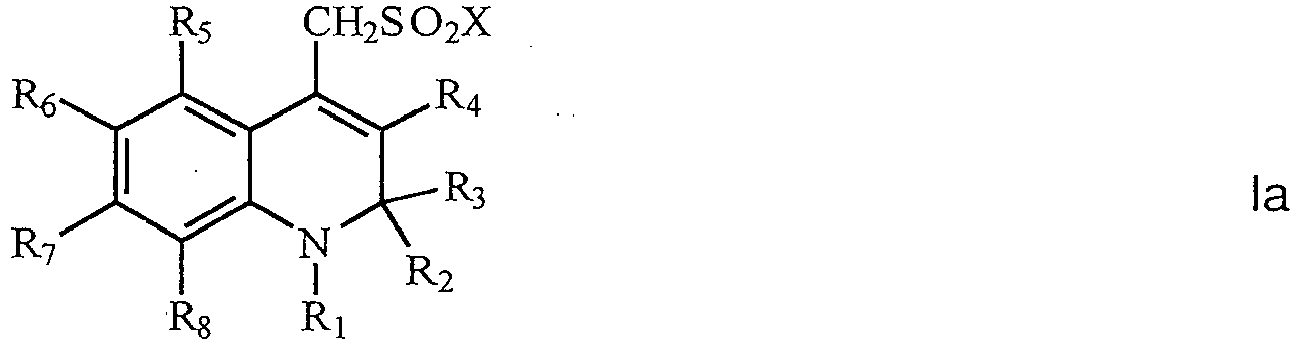

R2, R3, R4, R5, R6, R7 und R8 bei jedem Auftreten unabhängig voneinander Wasserstoff, Halogen, eine Hydroxy-, Amino-, Sulfo-, Carboxy- oder Aldehydgruppe oder eine Kohlenwasserstoffgruppe mit 1-20 C-Atomen bedeutet, wobei die Kohlenwasserstoffgruppe gegebenenfalls ein oder mehrere Heteroatome oder/und einen oder mehrere Substituenten enthalten kann, oder die Reste R1 und R8 zusammen ein Ringsystem bilden und
X OH, Halogen, -O-R9, -S-R10 oder -NR11R12 bedeutet, wobei R9, R10, R11 und R12 unabhängig voneinander Wasserstoff oder einen C1 bis C20 Kohlenwasserstoffrest bedeuten, welcher gegebenenfalls ein oder mehrere Heteroatome oder/und einen oder mehrere Substituenten enthalten kann,
dadurch gekennzeichnet,
dass man die entsprechenden Verbindungen I'a
- Punkt 2:
Verfahren nach Punkt 1,
dadurch gekennzeichnet,
dass man die Sulfonierung mittels konzentrierter Schwefelsäure durchführt. - Punkt 3:
Verfahren nach Punkt 1 oder 2,
dadurch gekennzeichnet,
dass man die bei der Sulfonierung gebildete Sulfonsäuregruppe derivatisiert. - Punkt 4:
Verfahren nach Punkt 3,
dadurch gekennzeichnet,
dass man die Sulfonsäuregruppe zum Sulfochlorid umsetzt. - Punkt 5:
Verfahren nach Punkt 3 oder 4,
dadurch gekennzeichnet,
dass man die Sulfochloridgruppe mit einem primären oder sekundären Amin zum Sulfonamid umsetzt. - Punkt 6:
Dihydrochinolinverbindung der allgemeinen Formel Ia oder Tetrahydrochinolinverbindung der allgemeinen Formel Ib

R2, R3, R4, R5, R6, R7 und R8 bei jedem Auftreten unabhängig voneinander Wasserstoff, Halogen, eine Hydroxy-, Amino-, Sulfo-, Carboxy- oder Aldehydgruppe oder eine Kohlenwasserstoffgruppe mit 1-20 C-Atomen bedeutet, wobei die Kohlenwasserstoffgruppe gegebenenfalls ein oder mehrere Heteroatome oder/und einen oder mehrere Substituenten enthalten kann, oder die Reste R1 und R8 zusammen ein Ringsystem bilden und
X OH, Halogen, -O-R9, -S-R10 oder -NR11R12 bedeutet, wobei R9, R10, R11 und R12 jeweils unabhängig voneinander Wasserstoff oder einen C1 bis C20 Kohlenwasserstoffrest bedeuten, welcher gegebenenfalls ein oder mehrere Heteroatome oder/und einen oder mehrere Substituenten, insbesondere -SO3H, -PO3H2 und -COOH enthalten kann. - Punkt 7: Verbindung nach Punkt 6,
worin R1 einen Aryl- oder Alkylrest, insbesondere einen C5 bis C15-Aryl- oder einen C1 bis C20-Alkylrest darstellt, R2 und R3 Methyl sind und R4 Wasserstoff bedeutet. - Punkt 8:
Verbindung nach Punkt 6 oder 7, dadurch gekennzeichnet,
dass R7 einen Hydroxy- oder Methoxyrest darstellt. - Punkt 9:
Verfahren nach einem der Punkte 6 bis 8,
dadurch gekennzeichnet,
dass R6 eine Nitrosogruppe darstellt. - Punkt 10:
Verfahren nach einem der Punkte 6 bis 7,
dadurch gekennzeichnet,
dass R6 eine Formyl- oder eine Hydroxymethylgruppe darstellt. - Punkt 11:
Verbindung nach einem der Punkte 6 bis 10,
dadurch gekennzeichnet,
dass X Halogen, insbesondere Cl bedeutet. - Punkt 12:
Verbindung nach einem der Punkte 6 bis 11,
dadurch gekennzeichnet,
dass X den Rest -NR11R12 darstellt, wobei die Reste R11 und R12 wie in Punkt 6 definiert sind. - Punkt 13:
Verfahren zur Herstellung von -SO2X enthaltenden Farbstoffen der allgemeinen Formeln II bis VII


R13 bei jedem Auftreten unabhängig voneinander Wasserstoff oder eine Kohlenwasserstoffgruppe mit 1-20 C-Atomen bedeutet, wobei die Kohlenwasserstoffgruppe gegebenenfalls ein oder mehrere Heteroatome oder/und einen oder mehrere Substituenten enthalten kann, wobei R13 insbesondere Wasserstoff, Aryl, Carboxyphenyl, Alkyl, Perfluoralkyl, Cycloalkyl, Pyridyl oder Carboxypyridyl darstellt,
X OH, Halogen, -O-R9, -S-R10 oder -NR11R12 bedeutet, wobei R9, R10, R11 und R12 jeweils unabhängig voneinander Wasserstoff oder einen C1 bis C20 Kohlenwasserstoffrest bedeuten, welcher gegebenenfalls ein oder mehrere Heteroatome oder einen oder mehrere Substituenten enthalten kann, und
Y in Formel III O, S oder Se sowie Y in Formel VI O, S oder C(R)2 bedeutet
dadurch gekennzeichnet,
dass man entsprechende Verbindungen der Formeln II' bis VII'


- Punkt 14:
Verwendung einer Verbindung nach einem der Punkte 6 bis 12 oder erhältlich gemäß dem Verfahren nach einem der Punkte 1 bis 5 zur Herstellung von polycyclischen Farbstoffen. - Punkt 15:
Verwendung nach Punkt 14 zur Herstellung von polycyclischen Farbstoffen der Formeln II bis VII. - Punkt 16:
Verfahren zur Herstellung polycyclischer Farbstoffe,
dadurch gekennzeichnet,
dass man Verbindungen, welche eine Dihydrochinolinendgruppe mit einer 4-Methylgruppe aufweisen, sulfoniert, - gegebenenfalls zum Tetrahydrochinolin hydriert - mit der Maßgabe, dass der polycyclische Farbstoff keine Verbindung der Formel III mit Y = O und X = OH oder der Formel IV mit X = OH ist. - Punkt 17:
Polycyclischer Farbstoff erhältlich gemäß dem Verfahren nach einem der Punkte 13 bis 16. - Punkt 18:
Polycyclischer Farbstoff der allgemeinen Formel II bis VII


R' Wasserstoff oder eine Kohlenwasserstoffgruppe mit 1-20 C-Atomen bedeutet, wobei die Kohlenwasserstoffgruppe gegebenenfalls ein oder mehrere Heteroatome oder/und einen oder mehrere Substituenten enthalten kann,
R bei jedem Auftreten unabhängig voneinander Wasserstoff, Halogen, eine Hydroxy-, Amino-, Sulfo-, Carboxy- oder Aldehydgruppe oder eine Kohlenwasserstoffgruppe mit 1-20 C-Atomen bedeutet, wobei die Kohlenwasserstoffgruppe gegebenenfalls ein oder mehrere Heteroatome oder/und einen oder mehrere Substituenten enthalten kann, oder die Reste R' und R zusammen ein Ringsystem bilden, das eine oder mehrere Mehrfachbindungen enthalten kann,
R13 bei jedem Auftreten unabhängig voneinander Wasserstoff oder eine Kohlenwasserstoffgruppe mit 1-20 C-Atomen bedeutet, wobei die Kohlenwasserstoffgruppe gegebenenfalls ein oder mehrere Heteroatome oder/und einen oder mehrere Substituenten enthalten kann, wobei R13 insbesondere Wasserstoff, Aryl, Carboxyphenyl, Alkyl, Perfluoralkyl, Cycloalkyl, Pyridyl oder Carboxypyridyl darstellt,
X OH, Halogen, -O-R9, -S-R10 oder -NR11R12 bedeutet, wobei R9, R10, R11 und R12 jeweils unabhängig voneinander Wasserstoff oder einen C1 bis C20 Kohlenwasserstoffrest bedeuten, welcher gegebenenfalls ein oder mehrere Heteroatome oder einen oder mehrere Substituenten enthalten kann, und
Y in Formel III O, S, oder Se sowie Y in Formel VI O, S oder C(R)2 darstellt,
mit der Maßgabe, dass der Farbstoff keine Verbindung der allgemeinen Formel III mit Y = O und X = OH oder der allgemeinen Formel IV mit X = OH ist. - Punkt 19:
Polycyclischer Farbstoff nach Punkt 17 oder 18,
dadurch gekennzeichnet,
dass X Halogen, insbesondere CI, bedeutet. - Punkt 20:
Polycyclischer Farbstoff nach Punkt 17 oder 18,
dadurch gekennzeichnet,
dass X für den Rest -NR11R12 steht, wobei die Reste R11 und R12 wie in Punkt 18 definiert sind. - Punkt 21:
Polycyclischer Farbstoff nach Punkt 20,
dadurch gekennzeichnet,
dass R11 oder/und R12 einen mit -COOH substituierten Alkyl- oder Arylrest darstellt. - Punkt 22:
Verwendung eines Farbstoffs nach einem der Punkte 17 bis 21 zur Markierung eines Analyten. - Punkt 23:
Verwendung nach Punkt 22,
dadurch gekennzeichnet,
dass es sich bei dem Analyten um ein Biomolekül, insbesondere um ein Peptid oder ein Nukleotid, handelt. - Punkt 24:
Verwendung nach Punkt 22 oder 23,
dadurch gekennzeichnet,
dass die Markierung durch Bindung des Farbstoffs an eine NH2- oder SH-Gruppe des Analyten erfolgt. - Punkt 25:
Verwendung eines Farbstoffs nach Punkt 19 zur Markierung eines Analyten, wobei die Bindung des Farbstoffs durch Kopplung an eine Aminogruppe des Analyten erfolgt. - Punkt 26:
Verwendung eines Farbstoffs nach Punkt 21 zur Markierung eines Analyten, wobei die Bindung des - z.B. als NHS-Ester aktivierten - Farbstoffs durch Kopplung an eine Aminogruppe des Analyten erfolgt. - Punkt 27:
Verwendung eines Farbstoffes nach einem der Punkte 17 bis 21 zur Kopplung an einen weiteren Farbstoff. - Punkt 28:
Verwendung nach Punkt 27,
dadurch gekennzeichnet,
dass die Kopplung über eine Aminogruppe des weiteren Farbstoffs erfolgt und dadurch ein FRET-Pärchen gebildet wird.
Claims (11)
- Polycyclischer Farbstoff der allgemeinen Formel II", V" - VII"


R1 Wasserstoff oder eine Kohlenwasserstoffgruppe mit 1-20 C-Atomen bedeutet, wobei die Kohlenwasserstoffgruppe gegebenenfalls ein oder mehrere Heteroatome oder/und einen oder mehrere Substituenten enthalten kann,
R2, R3, R4, R5, R6, R7 und R8 bei jedem Auftreten unabhängig voneinander Wasserstoff, Halogen, eine Hydroxy-, Amino-, Sulfo-, Carboxy- oder Aldehydgruppe oder eine Kohlenwasserstoffgruppe mit 1-20 C-Atomen bedeutet, wobei die Kohlenwasserstoffgruppe gegebenenfalls ein oder mehrere Heteroatome oder/und einen oder mehrere Substituenten enthalten kann, oder die Reste R1 und R8 zusammen ein Ringsystem bilden,
R' Wasserstoff oder eine Kohlenwasserstoffgruppe mit 1-20 C-Atomen bedeutet, wobei die Kohlenwasserstoffgruppe gegebenenfalls ein oder mehrere Heteroatome oder/und einen oder mehrere Substituenten enthalten kann,
R bei jedem Auftreten unabhängig voneinander Wasserstoff, Halogen, eine Hydroxy-, Amino-, Sulfo-, Carboxy- oder Aldehydgruppe oder eine Kohlenwasserstoffgruppe mit 1-20 C-Atomen bedeutet, wobei die Kohlenwasserstoffgruppe gegebenenfalls ein oder mehrere Heteroatome oder/und einen oder mehrere Substituenten enthalten kann, oder die Reste R' und R zusammen ein Ringsystem bilden, das eine oder mehrere Mehrfachbindungen enthalten kann,
R13 bei jedem Auftreten unabhängig voneinander Wasserstoff oder eine Kohlenwasserstoffgruppe mit 1-20 C-Atomen bedeutet, wobei die Kohlenwasserstoffgruppe gegebenenfalls ein oder mehrere Heteroatome oder/und einen oder mehrere Substituenten enthalten kann, wobei R13 insbesondere Wasserstoff, Aryl, Carboxyphenyl, Alkyl, Perfluoralkyl, Cycloalkyl, Pyridyl oder Carboxypyridyl darstellt,
X OH, Halogen, -O-R9, -S-R10 oder -NR11R12 bedeutet, wobei R9, R10, R11 und R12 jeweils unabhängig voneinander Wasserstoff oder einen C1 bis C20 Kohlenwasserstoffrest bedeuten, welcher gegebenenfalls ein oder mehrere Heteroatome oder einen oder mehrere Substituenten enthalten kann,
Y in Formel VI" O, S oder C(R)2 darstellt, und
A- ein Anion bedeutet. - Polycyclischer Farbstoff nach Anspruch 1,
dadurch gekennzeichnet,
dass X Halogen, insbesondere CI, bedeutet. - Polycyclischer Farbstoff nach Anspruch 1,
dadurch gekennzeichnet,
dass X für den Rest -NR11R12 steht, wobei die Reste R11 und R12 wie in Anspruch 1 definiert sind. - Polycyclischer Farbstoff nach Anspruch 3,
dadurch gekennzeichnet,
dass R11 oder/und R12 einen mit -COOH substituierten Alkyl- oder Arylrest darstellt. - Polycyclischer Farbstoff nach Anspruch 1,
dadurch gekennzeichnet,
dass er aus der Gruppe bestehend aus


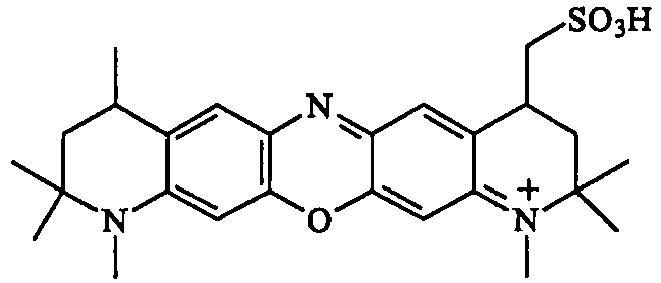


- Verfahren zur Herstellung von polycyclischen Farbstoffen nach einem der Ansprüche 1 bis 5,
dadurch gekennzeichnet,
dass man Verbindungen der Formeln II', V' - VII'


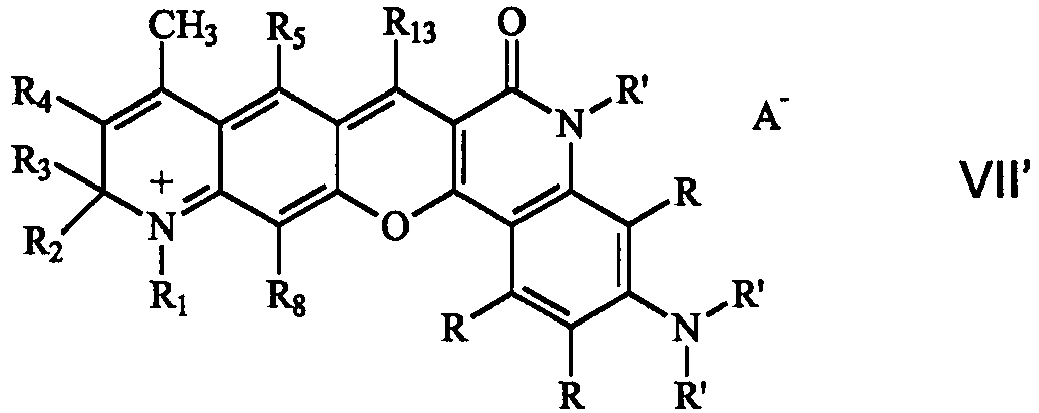

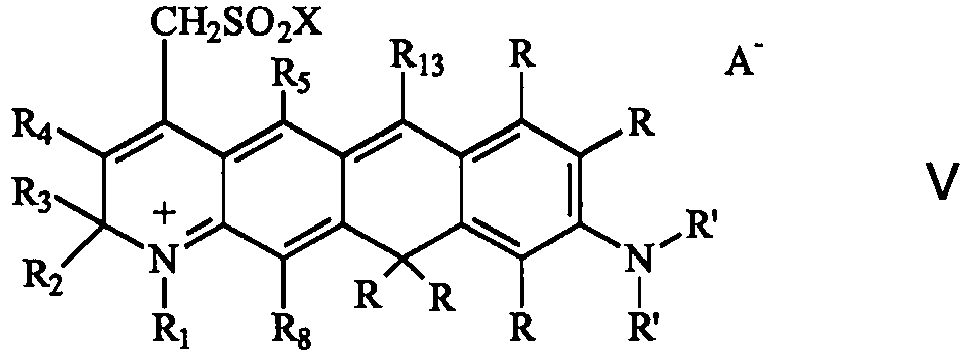


- Verwendung eines Farbstoffs nach einem der Ansprüche 1 bis 5 zur Markierung eines Analyten.
- Verwendung nach Anspruch 7,
dadurch gekennzeichnet,
dass es sich bei dem Analyten um ein Biomolekül, insbesondere um ein Peptid oder ein Nukleotid, handelt. - Verwendung nach Anspruch 7 oder 8,
dadurch gekennzeichnet,
dass die Markierung durch Bindung des Farbstoffs an eine NH2- oder SH-Gruppe des Analyten erfolgt. - Verwendung eines Farbstoffes nach einem der Ansprüche 1 bis 5 zur Kopplung an einen weiteren Farbstoff.
- Verwendung nach Anspruch 10,
dadurch gekennzeichnet,
dass die Kopplung über eine Aminogruppe des weiteren Farbstoffs erfolgt und dadurch ein FRET-Pärchen gebildet wird.
Applications Claiming Priority (2)
| Application Number | Priority Date | Filing Date | Title |
|---|---|---|---|
| DE10329860A DE10329860A1 (de) | 2003-07-02 | 2003-07-02 | Sulfonamidderivate polycyclischer Farbstoffe für analytische Anwendungen |
| EP04763083A EP1648870B1 (de) | 2003-07-02 | 2004-07-02 | Sulfonsäurederivate polycyclischer farbstoffe für analytische anwendungen |
Related Parent Applications (2)
| Application Number | Title | Priority Date | Filing Date |
|---|---|---|---|
| EP04763083A Division EP1648870B1 (de) | 2003-07-02 | 2004-07-02 | Sulfonsäurederivate polycyclischer farbstoffe für analytische anwendungen |
| EP04763083.5 Division | 2004-07-02 |
Publications (2)
| Publication Number | Publication Date |
|---|---|
| EP2374795A1 EP2374795A1 (de) | 2011-10-12 |
| EP2374795B1 true EP2374795B1 (de) | 2016-03-16 |
Family
ID=33521266
Family Applications (3)
| Application Number | Title | Priority Date | Filing Date |
|---|---|---|---|
| EP11151145.7A Expired - Lifetime EP2332918B1 (de) | 2003-07-02 | 2004-07-02 | Sulfonamidderivate polycyclischer Farbstoffe für analytische Anwendungen |
| EP04763083A Expired - Lifetime EP1648870B1 (de) | 2003-07-02 | 2004-07-02 | Sulfonsäurederivate polycyclischer farbstoffe für analytische anwendungen |
| EP11158120.3A Expired - Lifetime EP2374795B1 (de) | 2003-07-02 | 2004-07-02 | Sulfonsäurederivate polycyclischer Farbstoffe für analytische Anwendungen |
Family Applications Before (2)
| Application Number | Title | Priority Date | Filing Date |
|---|---|---|---|
| EP11151145.7A Expired - Lifetime EP2332918B1 (de) | 2003-07-02 | 2004-07-02 | Sulfonamidderivate polycyclischer Farbstoffe für analytische Anwendungen |
| EP04763083A Expired - Lifetime EP1648870B1 (de) | 2003-07-02 | 2004-07-02 | Sulfonsäurederivate polycyclischer farbstoffe für analytische anwendungen |
Country Status (5)
| Country | Link |
|---|---|
| US (3) | US9035042B2 (de) |
| EP (3) | EP2332918B1 (de) |
| AT (1) | ATE529407T1 (de) |
| DE (1) | DE10329860A1 (de) |
| WO (1) | WO2005003086A2 (de) |
Families Citing this family (35)
| Publication number | Priority date | Publication date | Assignee | Title |
|---|---|---|---|---|
| DE10329860A1 (de) * | 2003-07-02 | 2005-01-20 | Atto-Tec Gmbh | Sulfonamidderivate polycyclischer Farbstoffe für analytische Anwendungen |
| US7772271B2 (en) | 2004-07-14 | 2010-08-10 | Ptc Therapeutics, Inc. | Methods for treating hepatitis C |
| EP1771169A1 (de) | 2004-07-14 | 2007-04-11 | PTC Therapeutics, Inc. | Verfahren zur behandlung von hepatitis c |
| US7781478B2 (en) | 2004-07-14 | 2010-08-24 | Ptc Therapeutics, Inc. | Methods for treating hepatitis C |
| US7868037B2 (en) | 2004-07-14 | 2011-01-11 | Ptc Therapeutics, Inc. | Methods for treating hepatitis C |
| JP2008507518A (ja) | 2004-07-22 | 2008-03-13 | ピーティーシー セラピューティクス,インコーポレーテッド | C型肝炎を治療するためのチエノピリジン |
| WO2007135368A2 (en) | 2006-05-18 | 2007-11-29 | Solexa Limited | Dye compounds and the use of their labelled conjugates |
| US7745645B2 (en) | 2007-01-22 | 2010-06-29 | Pierce Biotechnology, Inc. | Sulfonamide derivatives of xanthene compounds |
| US20090236541A1 (en) * | 2008-03-24 | 2009-09-24 | General Electric Company | System and Methods for Optical Imaging |
| US20100143258A1 (en) * | 2008-12-05 | 2010-06-10 | General Electric Company | Tumor margin imaging agents |
| US8436170B2 (en) | 2009-02-03 | 2013-05-07 | Biotium, Inc. | Xanthene dyes comprising a sulfonamide group |
| EP2253635B1 (de) | 2009-04-28 | 2014-03-19 | Max-Planck-Gesellschaft zur Förderung der Wissenschaften e.V. | Neuartige hydrophile und lipophile Rhodamine für Markierungs- und Abbildungszwecke |
| WO2011068569A1 (en) | 2009-12-04 | 2011-06-09 | Biotium, Inc. | Heterocycle-substituted xanthene dyes |
| US8623324B2 (en) | 2010-07-21 | 2014-01-07 | Aat Bioquest Inc. | Luminescent dyes with a water-soluble intramolecular bridge and their biological conjugates |
| EP2722388B1 (de) | 2011-06-16 | 2017-08-09 | Nippon Steel & Sumikin Eco-Tech Corporation | Nukleinsäuresonde zur analyse von nukleinsäuren |
| US9164086B2 (en) | 2011-10-18 | 2015-10-20 | Max-Planck-Gesellschaft Zur Foerderung Der Wissenschaften E.V. | Fluorescent dyes with phosphorylated hydroxymethyl groups and their use in light microscopy and imaging techniques |
| ES2701750T3 (es) | 2012-10-16 | 2019-02-25 | Abbott Molecular Inc | Procedimientos para secuenciar un ácido nucleico |
| ES2805004T3 (es) | 2013-08-19 | 2021-02-10 | Abbott Molecular Inc | Análogos de nucleótidos |
| US10040850B2 (en) | 2013-10-08 | 2018-08-07 | Ascendis Pharma A/S | Protecting group comprising a purification tag |
| US10093967B2 (en) | 2014-08-12 | 2018-10-09 | The Regents Of The University Of Michigan | Detection of nucleic acids |
| WO2016044451A1 (en) | 2014-09-17 | 2016-03-24 | Northwestern University | Probes and assays for measuring e3 ligase activity |
| CA2970353C (en) | 2015-01-20 | 2021-07-06 | Biosearch Technologies, Inc. | Coumarin-based compounds and related methods |
| WO2016210147A1 (en) | 2015-06-23 | 2016-12-29 | Abbott Molecular Inc. | Egfr assay |
| JP2019513345A (ja) | 2016-02-10 | 2019-05-30 | ザ リージェンツ オブ ザ ユニバーシティ オブ ミシガン | 核酸の検知 |
| CN106220619B (zh) * | 2016-04-25 | 2018-11-30 | 中节能万润股份有限公司 | 一种含有氧杂蒽结构的有机化合物及其应用 |
| US10337051B2 (en) | 2016-06-16 | 2019-07-02 | The Regents Of The University Of California | Methods and compositions for detecting a target RNA |
| EP3592768B1 (de) | 2017-03-08 | 2024-12-25 | The Regents of The University of Michigan | Analytnachweis |
| EP3461814A1 (de) * | 2017-09-29 | 2019-04-03 | ATTO-TEC GmbH | Neue poly-sulfonierte fluoreszenz-farbstoffe |
| WO2020028729A1 (en) | 2018-08-01 | 2020-02-06 | Mammoth Biosciences, Inc. | Programmable nuclease compositions and methods of use thereof |
| EP3841205A4 (de) | 2018-08-22 | 2022-08-17 | The Regents of The University of California | Crispr/cas-effektor-polypeptide vom variantentyp v und verfahren zur verwendung davon |
| WO2020046809A1 (en) | 2018-08-27 | 2020-03-05 | The Regents Of The University Of California | Reporter nucleic acids for type v crispr-mediated detection |
| EP3931313A2 (de) | 2019-01-04 | 2022-01-05 | Mammoth Biosciences, Inc. | Verbesserungen an programmierbarer nuklease und zusammensetzungen und verfahren zur nukleinsäureamplifikation und -detektion |
| EP4219700A1 (de) | 2019-03-07 | 2023-08-02 | The Regents of the University of California | Crispr-cas-effektorpolypeptide und verfahren zur verwendung davon |
| EP4097247B1 (de) | 2020-01-29 | 2025-10-01 | The Regents of The University of Michigan | Analytnachweis |
| WO2021167807A1 (en) | 2020-02-19 | 2021-08-26 | Polymer Forge, Inc. | Microarrays |
Family Cites Families (27)
| Publication number | Priority date | Publication date | Assignee | Title |
|---|---|---|---|---|
| HU182010B (en) | 1979-02-21 | 1983-12-28 | Chinoin Gyogyszer Es Vegyeszet | Novel 2,2-dimethyl-1,2-dihydro-quinoline derivatives having anti-oxidant activity |
| HU185208B (en) | 1979-07-06 | 1984-12-28 | Material Vegyipari Sz | Process for producing the water-soluble derivatives of 6,6-methylene-bis/2,2,4-trimetyl-1,2-dihidric quinoline/ |
| HU188100B (en) * | 1981-06-16 | 1986-03-28 | Material Vegyipari Sz,Hu | Process for producing loposoluble and/or limitidly water soluble derivatives of 2,2-dimethyl-4-mathane-sulfoacid-1,2-dihydro-quinolina |
| GB2148920B (en) | 1983-10-26 | 1987-11-04 | Kodak Ltd | Disperse and acid azo dyes from phenylamines and 1,2-dihydroquinoline couplers |
| GB2148919B (en) | 1983-10-26 | 1987-05-13 | Kodak Ltd | Disperse and acid azo dyes having 1,2-dihydroquinoline couplers |
| GB2148918B (en) | 1983-10-26 | 1987-11-18 | Kodak Ltd | Disperse and acid azo dyes having 1,2-dihydroquinoline couplers and heterocyclic diazos |
| GB2148917B (en) | 1983-10-26 | 1987-05-13 | Kodak Ltd | Disperse and acid azo dyes from 2-aminothiophene and 1,2-dihydroquinoline couplers |
| HU194734B (en) | 1985-07-11 | 1988-03-28 | Jozsef Bara | Process for production of medical and applicable for human consumption products suitable for treatment and/or prevention of diseases caused by free-radical reactions |
| HU200165B (en) | 1987-04-22 | 1990-04-28 | Material Vegyipari Szoevetkeze | Process for producing dihydroquinoline derivatives, as well as pharmaceutical compositions, fodders and fodder premixes comprising such compounds |
| US6013531A (en) * | 1987-10-26 | 2000-01-11 | Dade International Inc. | Method to use fluorescent magnetic polymer particles as markers in an immunoassay |
| US5202338A (en) | 1990-10-31 | 1993-04-13 | Vilmos Bar | Dihydroquinoline derivatives, pharmaceutical compositions and methods of use of dihydroquinoline derivatives as modulators of the arachidonic acid cascade |
| US5750409A (en) | 1991-11-18 | 1998-05-12 | Boehringer Mannheim Gmbh | Pentacyclic compounds and their use as absorption or fluorescent dyes |
| DE4137934A1 (de) | 1991-11-18 | 1993-05-19 | Boehringer Mannheim Gmbh | Neue pentacyklische verbindungen und ihre verwendung als absorptions- oder fluoreszenzfarbstoffe |
| DE19521231A1 (de) | 1995-06-10 | 1996-12-12 | Boehringer Mannheim Gmbh | Neue Oxazinfarbstoffe und ihre Verwendung als Fluoreszenzmarker |
| US6130101A (en) * | 1997-09-23 | 2000-10-10 | Molecular Probes, Inc. | Sulfonated xanthene derivatives |
| DE19824535A1 (de) * | 1998-06-03 | 1999-12-09 | Roche Diagnostics Gmbh | Neue Rhodamin-Derivate und deren Verwendung |
| JP3886271B2 (ja) * | 1998-11-27 | 2007-02-28 | シスメックス株式会社 | 赤芽球の分類計数用試薬及び分類計数方法 |
| DE19919120A1 (de) | 1999-04-27 | 2000-11-02 | Drexhage Karl Heinz | Neue Amidopyrylium-Fluoreszenz-Farbstoffe |
| DE19919119A1 (de) * | 1999-04-27 | 2000-11-02 | Drexhage Karl Heinz | Neue Carbopyronin-Fluoreszenz-Farbstoffe |
| US6221600B1 (en) | 1999-10-08 | 2001-04-24 | Board Of Regents, The University Of Texas System | Combinatorial oligonucleotide PCR: a method for rapid, global expression analysis |
| WO2001059149A2 (en) | 2000-02-11 | 2001-08-16 | Cellomics, Inc. | Peptide biosensors for anthrax protease |
| CA2417816A1 (en) * | 2000-08-04 | 2002-02-14 | Molecular Probes, Inc. | Derivatives of 1,2-dihydro-7-hydroxyquinolines containing fused rings |
| US20050158708A1 (en) | 2001-06-06 | 2005-07-21 | Iris Alroy | Methods and compositions related to tagging of membrane surface proteins |
| US6660110B1 (en) * | 2002-04-08 | 2003-12-09 | The United States Of America As Represented By The Administrator Of The National Aeronautics And Space Administration | Heat treatment devices and method of operation thereof to produce dual microstructure superalloy disks |
| DE10259374A1 (de) * | 2002-12-18 | 2004-07-08 | Atto-Tec Gmbh | Carboxamid-substituierte Farbstoffe für analytische Anwendungen |
| DE10329860A1 (de) * | 2003-07-02 | 2005-01-20 | Atto-Tec Gmbh | Sulfonamidderivate polycyclischer Farbstoffe für analytische Anwendungen |
| DE102010042634A1 (de) * | 2010-10-19 | 2012-04-19 | Atto-Tec Gmbh | Neue Amin-substituierte tricyclische Fluoreszenzfarbstoffe |
-
2003
- 2003-07-02 DE DE10329860A patent/DE10329860A1/de not_active Withdrawn
-
2004
- 2004-07-02 AT AT04763083T patent/ATE529407T1/de active
- 2004-07-02 WO PCT/EP2004/007248 patent/WO2005003086A2/de not_active Ceased
- 2004-07-02 EP EP11151145.7A patent/EP2332918B1/de not_active Expired - Lifetime
- 2004-07-02 EP EP04763083A patent/EP1648870B1/de not_active Expired - Lifetime
- 2004-07-02 US US10/563,079 patent/US9035042B2/en active Active
- 2004-07-02 EP EP11158120.3A patent/EP2374795B1/de not_active Expired - Lifetime
-
2011
- 2011-03-25 US US13/071,921 patent/US8614317B2/en not_active Expired - Fee Related
- 2011-03-25 US US13/071,901 patent/US8846924B2/en not_active Expired - Lifetime
Also Published As
| Publication number | Publication date |
|---|---|
| WO2005003086A3 (de) | 2006-02-23 |
| EP2332918A1 (de) | 2011-06-15 |
| US8846924B2 (en) | 2014-09-30 |
| WO2005003086A2 (de) | 2005-01-13 |
| EP1648870A2 (de) | 2006-04-26 |
| US20110172420A1 (en) | 2011-07-14 |
| DE10329860A1 (de) | 2005-01-20 |
| ATE529407T1 (de) | 2011-11-15 |
| US8614317B2 (en) | 2013-12-24 |
| EP2374795A1 (de) | 2011-10-12 |
| US20110190486A1 (en) | 2011-08-04 |
| EP2332918B1 (de) | 2014-08-06 |
| US9035042B2 (en) | 2015-05-19 |
| EP1648870B1 (de) | 2011-10-19 |
| US20060179585A1 (en) | 2006-08-17 |
Similar Documents
| Publication | Publication Date | Title |
|---|---|---|
| EP2332918B1 (de) | Sulfonamidderivate polycyclischer Farbstoffe für analytische Anwendungen | |
| DE60007982T2 (de) | Erweiterte rhodaminverbindungen verwendbar als fluoreszierende markierungsmittel | |
| DE69817165T2 (de) | Sulfonierte xanthenderivate | |
| DE69731179T3 (de) | Fluorierte xanthenderivate | |
| EP1576059B1 (de) | Carboxamid-substituierte farbstoffe für analytische anwendungen | |
| EP2630195B1 (de) | Neue amin-substituierte tricyclische fluoreszenzfarbstoffe | |
| EP0567622B1 (de) | Neue pentacyclische verbindungen und ihre verwendung als absorptions- oder fluoreszenzfarbstoffe | |
| DE69624623T2 (de) | Versteifte Monomethin-Cyaninfarbstoffe | |
| EP1054039B1 (de) | Neue Fluoreszenzfarbstoffe und ihre Verwendung als Fluoreszenzmarker | |
| EP1273584A1 (de) | Verbindungen auf der Basis von 2-bzw. 4-Chromenyliden-Merocyaninen und ihre Verwendung | |
| EP1173520B1 (de) | Neue amidopyrylium-fluoreszenz-farbstoffe | |
| DE2317230A1 (de) | Verfahren zur herstellung von aromaten und heteroaromaten | |
| DE60316849T2 (de) | Verfahren zur herstellung von topotecan aus 10-hydroxy-4-(s) camtothecin | |
| EP3247710B1 (de) | Cumarinbasierte verbindungen und zugehörige verfahren | |
| DE69719071T2 (de) | Phenanthridiniumderivate | |
| DE102018124199B4 (de) | Neue Fluoreszenzfarbstoffe, deren Synthese und neue Analyseverfahren für die Glycan-Analytik | |
| EP0937089A1 (de) | Neue knoevenagel-kondensationsprodukte, verfahren zu deren herstellung und verwendung | |
| DE19744257B4 (de) | Beta-Carboline und deren Verwendung zur Behandlung von malignen und anderen, auf pathologischen Zellproliferationen beruhenden Erkrankungen | |
| WO1998020013A9 (de) | Neue knoevenagel-kondensationsprodukte, verfahren zu deren herstellung und verwendung | |
| WO2000034394A2 (de) | Pyridin- und chinolin-farbstoffe als marker für biomoleküle, polymere, arzneistoffe und partikel | |
| WO2021198433A1 (de) | Fluoreszenzfarbstoffe mit hohem stokes shift auf der basis von verbrückten benzopyryliumsalzen | |
| EP0229897A1 (de) | Alpha1-adrenerg blockierende Theophyllinderivate | |
| EP0342157A2 (de) | Aromatische Säuren | |
| DE2022503B2 (de) | Benzodiazepine und Verfahren zu ihrer Herste,Jung |
Legal Events
| Date | Code | Title | Description |
|---|---|---|---|
| PUAI | Public reference made under article 153(3) epc to a published international application that has entered the european phase |
Free format text: ORIGINAL CODE: 0009012 |
|
| 17P | Request for examination filed |
Effective date: 20110314 |
|
| AC | Divisional application: reference to earlier application |
Ref document number: 1648870 Country of ref document: EP Kind code of ref document: P |
|
| AK | Designated contracting states |
Kind code of ref document: A1 Designated state(s): AT BE BG CH CY CZ DE DK EE ES FI FR GB GR HU IE IT LI LU MC NL PL PT RO SE SI SK TR |
|
| 17Q | First examination report despatched |
Effective date: 20140130 |
|
| GRAP | Despatch of communication of intention to grant a patent |
Free format text: ORIGINAL CODE: EPIDOSNIGR1 |
|
| RIC1 | Information provided on ipc code assigned before grant |
Ipc: C07D 215/14 20060101ALI20150814BHEP Ipc: C07D 413/12 20060101ALI20150814BHEP Ipc: C07D 491/14 20060101ALI20150814BHEP Ipc: C07D 405/12 20060101ALI20150814BHEP Ipc: C07D 491/22 20060101ALI20150814BHEP Ipc: C07D 471/04 20060101ALI20150814BHEP Ipc: C07D 498/14 20060101ALI20150814BHEP Ipc: C07D 221/18 20060101ALI20150814BHEP Ipc: G01N 33/58 20060101ALI20150814BHEP Ipc: C07D 498/04 20060101ALI20150814BHEP Ipc: C07D 215/12 20060101AFI20150814BHEP Ipc: C07D 491/04 20060101ALI20150814BHEP Ipc: C07D 401/12 20060101ALI20150814BHEP Ipc: C07D 215/38 20060101ALI20150814BHEP Ipc: C07D 215/20 20060101ALI20150814BHEP |
|
| INTG | Intention to grant announced |
Effective date: 20150909 |
|
| GRAS | Grant fee paid |
Free format text: ORIGINAL CODE: EPIDOSNIGR3 |
|
| GRAA | (expected) grant |
Free format text: ORIGINAL CODE: 0009210 |
|
| AC | Divisional application: reference to earlier application |
Ref document number: 1648870 Country of ref document: EP Kind code of ref document: P |
|
| AK | Designated contracting states |
Kind code of ref document: B1 Designated state(s): AT BE BG CH CY CZ DE DK EE ES FI FR GB GR HU IE IT LI LU MC NL PL PT RO SE SI SK TR |
|
| REG | Reference to a national code |
Ref country code: GB Ref legal event code: FG4D Free format text: NOT ENGLISH |
|
| REG | Reference to a national code |
Ref country code: CH Ref legal event code: EP |
|
| REG | Reference to a national code |
Ref country code: IE Ref legal event code: FG4D Free format text: LANGUAGE OF EP DOCUMENT: GERMAN |
|
| REG | Reference to a national code |
Ref country code: AT Ref legal event code: REF Ref document number: 781082 Country of ref document: AT Kind code of ref document: T Effective date: 20160415 |
|
| REG | Reference to a national code |
Ref country code: DE Ref legal event code: R096 Ref document number: 502004015147 Country of ref document: DE |
|
| REG | Reference to a national code |
Ref country code: NL Ref legal event code: MP Effective date: 20160316 |
|
| REG | Reference to a national code |
Ref country code: FR Ref legal event code: PLFP Year of fee payment: 13 |
|
| PG25 | Lapsed in a contracting state [announced via postgrant information from national office to epo] |
Ref country code: GR Free format text: LAPSE BECAUSE OF FAILURE TO SUBMIT A TRANSLATION OF THE DESCRIPTION OR TO PAY THE FEE WITHIN THE PRESCRIBED TIME-LIMIT Effective date: 20160617 Ref country code: FI Free format text: LAPSE BECAUSE OF FAILURE TO SUBMIT A TRANSLATION OF THE DESCRIPTION OR TO PAY THE FEE WITHIN THE PRESCRIBED TIME-LIMIT Effective date: 20160316 |
|
| PG25 | Lapsed in a contracting state [announced via postgrant information from national office to epo] |
Ref country code: NL Free format text: LAPSE BECAUSE OF FAILURE TO SUBMIT A TRANSLATION OF THE DESCRIPTION OR TO PAY THE FEE WITHIN THE PRESCRIBED TIME-LIMIT Effective date: 20160316 Ref country code: SE Free format text: LAPSE BECAUSE OF FAILURE TO SUBMIT A TRANSLATION OF THE DESCRIPTION OR TO PAY THE FEE WITHIN THE PRESCRIBED TIME-LIMIT Effective date: 20160316 |
|
| PG25 | Lapsed in a contracting state [announced via postgrant information from national office to epo] |
Ref country code: EE Free format text: LAPSE BECAUSE OF FAILURE TO SUBMIT A TRANSLATION OF THE DESCRIPTION OR TO PAY THE FEE WITHIN THE PRESCRIBED TIME-LIMIT Effective date: 20160316 Ref country code: PL Free format text: LAPSE BECAUSE OF FAILURE TO SUBMIT A TRANSLATION OF THE DESCRIPTION OR TO PAY THE FEE WITHIN THE PRESCRIBED TIME-LIMIT Effective date: 20160316 |
|
| PG25 | Lapsed in a contracting state [announced via postgrant information from national office to epo] |
Ref country code: SK Free format text: LAPSE BECAUSE OF FAILURE TO SUBMIT A TRANSLATION OF THE DESCRIPTION OR TO PAY THE FEE WITHIN THE PRESCRIBED TIME-LIMIT Effective date: 20160316 Ref country code: PT Free format text: LAPSE BECAUSE OF FAILURE TO SUBMIT A TRANSLATION OF THE DESCRIPTION OR TO PAY THE FEE WITHIN THE PRESCRIBED TIME-LIMIT Effective date: 20160718 Ref country code: ES Free format text: LAPSE BECAUSE OF FAILURE TO SUBMIT A TRANSLATION OF THE DESCRIPTION OR TO PAY THE FEE WITHIN THE PRESCRIBED TIME-LIMIT Effective date: 20160316 Ref country code: CZ Free format text: LAPSE BECAUSE OF FAILURE TO SUBMIT A TRANSLATION OF THE DESCRIPTION OR TO PAY THE FEE WITHIN THE PRESCRIBED TIME-LIMIT Effective date: 20160316 Ref country code: RO Free format text: LAPSE BECAUSE OF FAILURE TO SUBMIT A TRANSLATION OF THE DESCRIPTION OR TO PAY THE FEE WITHIN THE PRESCRIBED TIME-LIMIT Effective date: 20160316 |
|
| REG | Reference to a national code |
Ref country code: DE Ref legal event code: R097 Ref document number: 502004015147 Country of ref document: DE |
|
| PG25 | Lapsed in a contracting state [announced via postgrant information from national office to epo] |
Ref country code: IT Free format text: LAPSE BECAUSE OF FAILURE TO SUBMIT A TRANSLATION OF THE DESCRIPTION OR TO PAY THE FEE WITHIN THE PRESCRIBED TIME-LIMIT Effective date: 20160316 Ref country code: BE Free format text: LAPSE BECAUSE OF NON-PAYMENT OF DUE FEES Effective date: 20160731 |
|
| PLBE | No opposition filed within time limit |
Free format text: ORIGINAL CODE: 0009261 |
|
| STAA | Information on the status of an ep patent application or granted ep patent |
Free format text: STATUS: NO OPPOSITION FILED WITHIN TIME LIMIT |
|
| PG25 | Lapsed in a contracting state [announced via postgrant information from national office to epo] |
Ref country code: DK Free format text: LAPSE BECAUSE OF FAILURE TO SUBMIT A TRANSLATION OF THE DESCRIPTION OR TO PAY THE FEE WITHIN THE PRESCRIBED TIME-LIMIT Effective date: 20160316 |
|
| 26N | No opposition filed |
Effective date: 20161219 |
|
| PG25 | Lapsed in a contracting state [announced via postgrant information from national office to epo] |
Ref country code: BG Free format text: LAPSE BECAUSE OF FAILURE TO SUBMIT A TRANSLATION OF THE DESCRIPTION OR TO PAY THE FEE WITHIN THE PRESCRIBED TIME-LIMIT Effective date: 20160616 |
|
| REG | Reference to a national code |
Ref country code: CH Ref legal event code: PL |
|
| PG25 | Lapsed in a contracting state [announced via postgrant information from national office to epo] |
Ref country code: MC Free format text: LAPSE BECAUSE OF FAILURE TO SUBMIT A TRANSLATION OF THE DESCRIPTION OR TO PAY THE FEE WITHIN THE PRESCRIBED TIME-LIMIT Effective date: 20160316 |
|
| PG25 | Lapsed in a contracting state [announced via postgrant information from national office to epo] |
Ref country code: CH Free format text: LAPSE BECAUSE OF NON-PAYMENT OF DUE FEES Effective date: 20160731 Ref country code: LI Free format text: LAPSE BECAUSE OF NON-PAYMENT OF DUE FEES Effective date: 20160731 |
|
| REG | Reference to a national code |
Ref country code: IE Ref legal event code: MM4A |
|
| PG25 | Lapsed in a contracting state [announced via postgrant information from national office to epo] |
Ref country code: SI Free format text: LAPSE BECAUSE OF FAILURE TO SUBMIT A TRANSLATION OF THE DESCRIPTION OR TO PAY THE FEE WITHIN THE PRESCRIBED TIME-LIMIT Effective date: 20160316 |
|
| REG | Reference to a national code |
Ref country code: FR Ref legal event code: PLFP Year of fee payment: 14 |
|
| PG25 | Lapsed in a contracting state [announced via postgrant information from national office to epo] |
Ref country code: IE Free format text: LAPSE BECAUSE OF NON-PAYMENT OF DUE FEES Effective date: 20160702 |
|
| PG25 | Lapsed in a contracting state [announced via postgrant information from national office to epo] |
Ref country code: LU Free format text: LAPSE BECAUSE OF NON-PAYMENT OF DUE FEES Effective date: 20160702 |
|
| REG | Reference to a national code |
Ref country code: AT Ref legal event code: MM01 Ref document number: 781082 Country of ref document: AT Kind code of ref document: T Effective date: 20160702 |
|
| PG25 | Lapsed in a contracting state [announced via postgrant information from national office to epo] |
Ref country code: AT Free format text: LAPSE BECAUSE OF NON-PAYMENT OF DUE FEES Effective date: 20160702 |
|
| PG25 | Lapsed in a contracting state [announced via postgrant information from national office to epo] |
Ref country code: CY Free format text: LAPSE BECAUSE OF FAILURE TO SUBMIT A TRANSLATION OF THE DESCRIPTION OR TO PAY THE FEE WITHIN THE PRESCRIBED TIME-LIMIT Effective date: 20160316 Ref country code: HU Free format text: LAPSE BECAUSE OF FAILURE TO SUBMIT A TRANSLATION OF THE DESCRIPTION OR TO PAY THE FEE WITHIN THE PRESCRIBED TIME-LIMIT; INVALID AB INITIO Effective date: 20040702 |
|
| PG25 | Lapsed in a contracting state [announced via postgrant information from national office to epo] |
Ref country code: TR Free format text: LAPSE BECAUSE OF FAILURE TO SUBMIT A TRANSLATION OF THE DESCRIPTION OR TO PAY THE FEE WITHIN THE PRESCRIBED TIME-LIMIT Effective date: 20160316 |
|
| REG | Reference to a national code |
Ref country code: FR Ref legal event code: PLFP Year of fee payment: 15 |
|
| P01 | Opt-out of the competence of the unified patent court (upc) registered |
Effective date: 20230515 |
|
| PGFP | Annual fee paid to national office [announced via postgrant information from national office to epo] |
Ref country code: GB Payment date: 20230720 Year of fee payment: 20 |
|
| PGFP | Annual fee paid to national office [announced via postgrant information from national office to epo] |
Ref country code: FR Payment date: 20230725 Year of fee payment: 20 Ref country code: DE Payment date: 20230630 Year of fee payment: 20 |
|
| REG | Reference to a national code |
Ref country code: DE Ref legal event code: R071 Ref document number: 502004015147 Country of ref document: DE |
|
| PG25 | Lapsed in a contracting state [announced via postgrant information from national office to epo] |
Ref country code: GB Free format text: LAPSE BECAUSE OF EXPIRATION OF PROTECTION Effective date: 20240701 |
|
| REG | Reference to a national code |
Ref country code: GB Ref legal event code: PE20 Expiry date: 20240701 |
|
| PG25 | Lapsed in a contracting state [announced via postgrant information from national office to epo] |
Ref country code: GB Free format text: LAPSE BECAUSE OF EXPIRATION OF PROTECTION Effective date: 20240701 |