EP2373633B1 - Verfahren zur herstellung von triazincarbamaten unter verwendung von chlorformiaten - Google Patents
Verfahren zur herstellung von triazincarbamaten unter verwendung von chlorformiaten Download PDFInfo
- Publication number
- EP2373633B1 EP2373633B1 EP09796353.2A EP09796353A EP2373633B1 EP 2373633 B1 EP2373633 B1 EP 2373633B1 EP 09796353 A EP09796353 A EP 09796353A EP 2373633 B1 EP2373633 B1 EP 2373633B1
- Authority
- EP
- European Patent Office
- Prior art keywords
- chloroformate
- substituted
- aryl
- heterocycle
- bis
- Prior art date
- Legal status (The legal status is an assumption and is not a legal conclusion. Google has not performed a legal analysis and makes no representation as to the accuracy of the status listed.)
- Not-in-force
Links
- -1 trazine carbamates Chemical class 0.000 title claims description 40
- AOGYCOYQMAVAFD-UHFFFAOYSA-N chlorocarbonic acid Chemical class OC(Cl)=O AOGYCOYQMAVAFD-UHFFFAOYSA-N 0.000 title claims description 5
- 238000004519 manufacturing process Methods 0.000 title claims 2
- 229910052757 nitrogen Inorganic materials 0.000 claims description 37
- MZRVEZGGRBJDDB-UHFFFAOYSA-N N-Butyllithium Chemical compound [Li]CCCC MZRVEZGGRBJDDB-UHFFFAOYSA-N 0.000 claims description 36
- 238000006243 chemical reaction Methods 0.000 claims description 32
- 239000000203 mixture Substances 0.000 claims description 24
- 238000000034 method Methods 0.000 claims description 22
- UIIMBOGNXHQVGW-UHFFFAOYSA-M Sodium bicarbonate Chemical compound [Na+].OC([O-])=O UIIMBOGNXHQVGW-UHFFFAOYSA-M 0.000 claims description 18
- 125000003358 C2-C20 alkenyl group Chemical group 0.000 claims description 16
- FZFAMSAMCHXGEF-UHFFFAOYSA-N chloro formate Chemical compound ClOC=O FZFAMSAMCHXGEF-UHFFFAOYSA-N 0.000 claims description 15
- JYEUMXHLPRZUAT-UHFFFAOYSA-N 1,2,3-triazine Chemical group C1=CN=NN=C1 JYEUMXHLPRZUAT-UHFFFAOYSA-N 0.000 claims description 13
- 150000001341 alkaline earth metal compounds Chemical class 0.000 claims description 11
- 125000004433 nitrogen atom Chemical group N* 0.000 claims description 10
- 230000009021 linear effect Effects 0.000 claims description 9
- 229910000030 sodium bicarbonate Inorganic materials 0.000 claims description 9
- 239000002904 solvent Substances 0.000 claims description 7
- CDBYLPFSWZWCQE-UHFFFAOYSA-L Sodium Carbonate Chemical compound [Na+].[Na+].[O-]C([O-])=O CDBYLPFSWZWCQE-UHFFFAOYSA-L 0.000 claims description 6
- NRDQFWXVTPZZAZ-UHFFFAOYSA-N butyl carbonochloridate Chemical compound CCCCOC(Cl)=O NRDQFWXVTPZZAZ-UHFFFAOYSA-N 0.000 claims description 6
- 125000004430 oxygen atom Chemical group O* 0.000 claims description 6
- 125000005373 siloxane group Chemical group [SiH2](O*)* 0.000 claims description 6
- 125000001424 substituent group Chemical group 0.000 claims description 6
- NINIDFKCEFEMDL-UHFFFAOYSA-N Sulfur Chemical group [S] NINIDFKCEFEMDL-UHFFFAOYSA-N 0.000 claims description 5
- 125000004432 carbon atom Chemical group C* 0.000 claims description 5
- YOETUEMZNOLGDB-UHFFFAOYSA-N 2-methylpropyl carbonochloridate Chemical compound CC(C)COC(Cl)=O YOETUEMZNOLGDB-UHFFFAOYSA-N 0.000 claims description 4
- MMWCQWOKHLEYSP-UHFFFAOYSA-N BisPhenol A bis(chloroformate) Chemical compound C=1C=C(OC(Cl)=O)C=CC=1C(C)(C)C1=CC=C(OC(Cl)=O)C=C1 MMWCQWOKHLEYSP-UHFFFAOYSA-N 0.000 claims description 4
- IRDQNLLVRXMERV-UHFFFAOYSA-N CCCC[Na] Chemical compound CCCC[Na] IRDQNLLVRXMERV-UHFFFAOYSA-N 0.000 claims description 4
- VTYYLEPIZMXCLO-UHFFFAOYSA-L Calcium carbonate Chemical compound [Ca+2].[O-]C([O-])=O VTYYLEPIZMXCLO-UHFFFAOYSA-L 0.000 claims description 4
- 150000001875 compounds Chemical class 0.000 claims description 4
- PQLFROTZSIMBKR-UHFFFAOYSA-N ethenyl carbonochloridate Chemical compound ClC(=O)OC=C PQLFROTZSIMBKR-UHFFFAOYSA-N 0.000 claims description 4
- NXPHGHWWQRMDIA-UHFFFAOYSA-M magnesium;carbanide;bromide Chemical compound [CH3-].[Mg+2].[Br-] NXPHGHWWQRMDIA-UHFFFAOYSA-M 0.000 claims description 4
- DVSDBMFJEQPWNO-UHFFFAOYSA-N methyllithium Chemical compound C[Li] DVSDBMFJEQPWNO-UHFFFAOYSA-N 0.000 claims description 4
- AHWALFGBDFAJAI-UHFFFAOYSA-N phenyl carbonochloridate Chemical compound ClC(=O)OC1=CC=CC=C1 AHWALFGBDFAJAI-UHFFFAOYSA-N 0.000 claims description 4
- NHKJPPKXDNZFBJ-UHFFFAOYSA-N phenyllithium Chemical compound [Li]C1=CC=CC=C1 NHKJPPKXDNZFBJ-UHFFFAOYSA-N 0.000 claims description 4
- BWHMMNNQKKPAPP-UHFFFAOYSA-L potassium carbonate Chemical compound [K+].[K+].[O-]C([O-])=O BWHMMNNQKKPAPP-UHFFFAOYSA-L 0.000 claims description 4
- CAEWJEXPFKNBQL-UHFFFAOYSA-N prop-2-enyl carbonochloridate Chemical compound ClC(=O)OCC=C CAEWJEXPFKNBQL-UHFFFAOYSA-N 0.000 claims description 4
- WDOFXZCTWAIHIJ-UHFFFAOYSA-N 2-chloropropyl carbonochloridate Chemical compound CC(Cl)COC(Cl)=O WDOFXZCTWAIHIJ-UHFFFAOYSA-N 0.000 claims description 3
- AUKORMQZRYQYGI-UHFFFAOYSA-N 4-carbonochloridoyloxybutyl carbonochloridate Chemical compound ClC(=O)OCCCCOC(Cl)=O AUKORMQZRYQYGI-UHFFFAOYSA-N 0.000 claims description 3
- CAQWNKXTMBFBGI-UHFFFAOYSA-N C.[Na] Chemical compound C.[Na] CAQWNKXTMBFBGI-UHFFFAOYSA-N 0.000 claims description 3
- 229910000028 potassium bicarbonate Inorganic materials 0.000 claims description 3
- 239000011736 potassium bicarbonate Substances 0.000 claims description 3
- TYJJADVDDVDEDZ-UHFFFAOYSA-M potassium hydrogencarbonate Chemical compound [K+].OC([O-])=O TYJJADVDDVDEDZ-UHFFFAOYSA-M 0.000 claims description 3
- RAMTXCRMKBFPRG-UHFFFAOYSA-N prop-2-ynyl carbonochloridate Chemical compound ClC(=O)OCC#C RAMTXCRMKBFPRG-UHFFFAOYSA-N 0.000 claims description 3
- 229910000029 sodium carbonate Inorganic materials 0.000 claims description 3
- ZNCPFRVNHGOPAG-UHFFFAOYSA-L sodium oxalate Chemical compound [Na+].[Na+].[O-]C(=O)C([O-])=O ZNCPFRVNHGOPAG-UHFFFAOYSA-L 0.000 claims description 3
- KSMWLICLECSXMI-UHFFFAOYSA-N sodium;benzene Chemical compound [Na+].C1=CC=[C-]C=C1 KSMWLICLECSXMI-UHFFFAOYSA-N 0.000 claims description 3
- 239000000126 substance Substances 0.000 claims description 3
- QVCQPIJMAAOGKX-UHFFFAOYSA-N (2,4,5-trimethylphenyl)thiourea Chemical compound CC1=CC(C)=C(NC(N)=S)C=C1C QVCQPIJMAAOGKX-UHFFFAOYSA-N 0.000 claims description 2
- GCCKNHYFOVQZRG-UHFFFAOYSA-N (2-chlorophenyl)methyl carbonochloridate Chemical compound ClC(=O)OCC1=CC=CC=C1Cl GCCKNHYFOVQZRG-UHFFFAOYSA-N 0.000 claims description 2
- VDLQSPNQAVRJND-UHFFFAOYSA-N (2-methoxyphenyl) carbonochloridate Chemical compound COC1=CC=CC=C1OC(Cl)=O VDLQSPNQAVRJND-UHFFFAOYSA-N 0.000 claims description 2
- XOFZPIYYMJUNRG-UHFFFAOYSA-N (4-methylphenyl) carbonochloridate Chemical compound CC1=CC=C(OC(Cl)=O)C=C1 XOFZPIYYMJUNRG-UHFFFAOYSA-N 0.000 claims description 2
- KIUPCUCGVCGPPA-UHFFFAOYSA-N (5-methyl-2-propan-2-ylcyclohexyl) carbonochloridate Chemical compound CC(C)C1CCC(C)CC1OC(Cl)=O KIUPCUCGVCGPPA-UHFFFAOYSA-N 0.000 claims description 2
- JUUBFHLPTCPVBO-UHFFFAOYSA-N 2,2-dimethylpropyl carbonochloridate Chemical compound CC(C)(C)COC(Cl)=O JUUBFHLPTCPVBO-UHFFFAOYSA-N 0.000 claims description 2
- IFOIGJKHVZBFPR-UHFFFAOYSA-N 2-[2-(2-carbonochloridoyloxyethoxy)ethoxy]ethyl carbonochloridate Chemical compound ClC(=O)OCCOCCOCCOC(Cl)=O IFOIGJKHVZBFPR-UHFFFAOYSA-N 0.000 claims description 2
- SVDDJQGVOFZBNX-UHFFFAOYSA-N 2-chloroethyl carbonochloridate Chemical compound ClCCOC(Cl)=O SVDDJQGVOFZBNX-UHFFFAOYSA-N 0.000 claims description 2
- RTGLJCSUKOLTEM-UHFFFAOYSA-N 2-ethylhexyl carbonochloridate Chemical compound CCCCC(CC)COC(Cl)=O RTGLJCSUKOLTEM-UHFFFAOYSA-N 0.000 claims description 2
- FOHSVPIFZASOED-UHFFFAOYSA-N 2-fluoroethyl carbonochloridate Chemical compound FCCOC(Cl)=O FOHSVPIFZASOED-UHFFFAOYSA-N 0.000 claims description 2
- NDYYWMXJZWHRLZ-UHFFFAOYSA-N 2-methoxyethyl carbonochloridate Chemical compound COCCOC(Cl)=O NDYYWMXJZWHRLZ-UHFFFAOYSA-N 0.000 claims description 2
- DYMSNXTUZQZFSM-UHFFFAOYSA-N 4,6-dimethyl-[1,2]oxazolo[5,4-b]pyridin-3-amine Chemical compound CC1=CC(C)=C2C(N)=NOC2=N1 DYMSNXTUZQZFSM-UHFFFAOYSA-N 0.000 claims description 2
- OTDWRXBRYNVCDN-UHFFFAOYSA-N 4-chlorobutyl carbonochloridate Chemical compound ClCCCCOC(Cl)=O OTDWRXBRYNVCDN-UHFFFAOYSA-N 0.000 claims description 2
- 229910010084 LiAlH4 Inorganic materials 0.000 claims description 2
- NGYHNWRKMRIRFH-UHFFFAOYSA-N N-(1,5,6,7-tetrahydroindol-4-ylidene)hydroxylamine Chemical compound ON=C1CCCC2=C1C=CN2 NGYHNWRKMRIRFH-UHFFFAOYSA-N 0.000 claims description 2
- HSDAJNMJOMSNEV-UHFFFAOYSA-N benzyl chloroformate Chemical compound ClC(=O)OCC1=CC=CC=C1 HSDAJNMJOMSNEV-UHFFFAOYSA-N 0.000 claims description 2
- MFKKPMUEGDJJSL-UHFFFAOYSA-N but-2-ynyl carbonochloridate Chemical compound CC#CCOC(Cl)=O MFKKPMUEGDJJSL-UHFFFAOYSA-N 0.000 claims description 2
- SFGWUXNQJVLABT-UHFFFAOYSA-N but-3-ynyl carbonochloridate Chemical compound ClC(=O)OCCC#C SFGWUXNQJVLABT-UHFFFAOYSA-N 0.000 claims description 2
- 229910000019 calcium carbonate Inorganic materials 0.000 claims description 2
- QOPVNWQGBQYBBP-UHFFFAOYSA-N chloroethyl chloroformate Chemical compound CC(Cl)OC(Cl)=O QOPVNWQGBQYBBP-UHFFFAOYSA-N 0.000 claims description 2
- BNIILDVGGAEEIG-UHFFFAOYSA-L disodium hydrogen phosphate Chemical compound [Na+].[Na+].OP([O-])([O-])=O BNIILDVGGAEEIG-UHFFFAOYSA-L 0.000 claims description 2
- 229910000397 disodium phosphate Inorganic materials 0.000 claims description 2
- RIFGWPKJUGCATF-UHFFFAOYSA-N ethyl chloroformate Chemical compound CCOC(Cl)=O RIFGWPKJUGCATF-UHFFFAOYSA-N 0.000 claims description 2
- 125000005843 halogen group Chemical group 0.000 claims description 2
- KIWBRXCOTCXSSZ-UHFFFAOYSA-N hexyl carbonochloridate Chemical compound CCCCCCOC(Cl)=O KIWBRXCOTCXSSZ-UHFFFAOYSA-N 0.000 claims description 2
- 239000012280 lithium aluminium hydride Substances 0.000 claims description 2
- 239000001095 magnesium carbonate Substances 0.000 claims description 2
- ZLNQQNXFFQJAID-UHFFFAOYSA-L magnesium carbonate Chemical compound [Mg+2].[O-]C([O-])=O ZLNQQNXFFQJAID-UHFFFAOYSA-L 0.000 claims description 2
- 229910000021 magnesium carbonate Inorganic materials 0.000 claims description 2
- JRUFQZPDRRGHEF-UHFFFAOYSA-N naphthalen-1-yl carbonochloridate Chemical compound C1=CC=C2C(OC(=O)Cl)=CC=CC2=C1 JRUFQZPDRRGHEF-UHFFFAOYSA-N 0.000 claims description 2
- 125000000449 nitro group Chemical group [O-][N+](*)=O 0.000 claims description 2
- VFXVAXFIFHSGNR-UHFFFAOYSA-N octyl carbonochloridate Chemical compound CCCCCCCCOC(Cl)=O VFXVAXFIFHSGNR-UHFFFAOYSA-N 0.000 claims description 2
- 229910000027 potassium carbonate Inorganic materials 0.000 claims description 2
- AMMGCGVWJMRTQI-UHFFFAOYSA-N prop-1-en-2-yl carbonochloridate Chemical compound CC(=C)OC(Cl)=O AMMGCGVWJMRTQI-UHFFFAOYSA-N 0.000 claims description 2
- QQKDTTWZXHEGAQ-UHFFFAOYSA-N propyl carbonochloridate Chemical compound CCCOC(Cl)=O QQKDTTWZXHEGAQ-UHFFFAOYSA-N 0.000 claims description 2
- ODZPKZBBUMBTMG-UHFFFAOYSA-N sodium amide Chemical compound [NH2-].[Na+] ODZPKZBBUMBTMG-UHFFFAOYSA-N 0.000 claims description 2
- YSRNNNUOTGPDFU-UHFFFAOYSA-N triazin-4-yl carbamate Chemical compound NC(=O)OC1=CC=NN=N1 YSRNNNUOTGPDFU-UHFFFAOYSA-N 0.000 claims description 2
- RYFMWSXOAZQYPI-UHFFFAOYSA-K trisodium phosphate Chemical compound [Na+].[Na+].[Na+].[O-]P([O-])([O-])=O RYFMWSXOAZQYPI-UHFFFAOYSA-K 0.000 claims description 2
- 229910000406 trisodium phosphate Inorganic materials 0.000 claims description 2
- GALYPIBNZHDQSU-UHFFFAOYSA-N OC(Cl)=O.COC(Cl)=O Chemical compound OC(Cl)=O.COC(Cl)=O GALYPIBNZHDQSU-UHFFFAOYSA-N 0.000 claims 2
- VLKZOEOYAKHREP-UHFFFAOYSA-N n-Hexane Chemical compound CCCCCC VLKZOEOYAKHREP-UHFFFAOYSA-N 0.000 description 39
- XMJHPCRAQCTCFT-UHFFFAOYSA-N methyl chloroformate Chemical compound COC(Cl)=O XMJHPCRAQCTCFT-UHFFFAOYSA-N 0.000 description 24
- RYHBNJHYFVUHQT-UHFFFAOYSA-N 1,4-Dioxane Chemical compound C1COCCO1 RYHBNJHYFVUHQT-UHFFFAOYSA-N 0.000 description 23
- HEMHJVSKTPXQMS-UHFFFAOYSA-M Sodium hydroxide Chemical compound [OH-].[Na+] HEMHJVSKTPXQMS-UHFFFAOYSA-M 0.000 description 21
- 239000002244 precipitate Substances 0.000 description 21
- YMWUJEATGCHHMB-UHFFFAOYSA-N Dichloromethane Chemical compound ClCCl YMWUJEATGCHHMB-UHFFFAOYSA-N 0.000 description 18
- VEXZGXHMUGYJMC-UHFFFAOYSA-N Hydrochloric acid Chemical compound Cl VEXZGXHMUGYJMC-UHFFFAOYSA-N 0.000 description 16
- 239000007787 solid Substances 0.000 description 15
- LGEXGKUJMFHVSY-UHFFFAOYSA-N 2-n,4-n,6-n-trimethyl-1,3,5-triazine-2,4,6-triamine Chemical compound CNC1=NC(NC)=NC(NC)=N1 LGEXGKUJMFHVSY-UHFFFAOYSA-N 0.000 description 14
- IJGRMHOSHXDMSA-UHFFFAOYSA-N Atomic nitrogen Chemical compound N#N IJGRMHOSHXDMSA-UHFFFAOYSA-N 0.000 description 14
- 239000011541 reaction mixture Substances 0.000 description 14
- 150000003918 triazines Chemical class 0.000 description 12
- 238000001816 cooling Methods 0.000 description 11
- VEJURAFKCPNLMT-UHFFFAOYSA-N 1-[4,6-bis[methyl(methylcarbamoyl)amino]-1,3,5-triazin-2-yl]-1,3-dimethylurea Chemical compound CNC(=O)N(C)C1=NC(N(C)C(=O)NC)=NC(N(C)C(=O)NC)=N1 VEJURAFKCPNLMT-UHFFFAOYSA-N 0.000 description 10
- XLYOFNOQVPJJNP-UHFFFAOYSA-N water Substances O XLYOFNOQVPJJNP-UHFFFAOYSA-N 0.000 description 10
- 239000011734 sodium Substances 0.000 description 9
- WYURNTSHIVDZCO-UHFFFAOYSA-N Tetrahydrofuran Chemical compound C1CCOC1 WYURNTSHIVDZCO-UHFFFAOYSA-N 0.000 description 8
- 125000000623 heterocyclic group Chemical group 0.000 description 8
- 150000003254 radicals Chemical class 0.000 description 8
- OTCZXRXGTSRCTN-UHFFFAOYSA-N 1,3-dimethyl-1-[4-(methylamino)-6-[methyl(methylcarbamoyl)amino]-1,3,5-triazin-2-yl]urea Chemical compound CNC(=O)N(C)C1=NC(NC)=NC(N(C)C(=O)NC)=N1 OTCZXRXGTSRCTN-UHFFFAOYSA-N 0.000 description 7
- XEKOWRVHYACXOJ-UHFFFAOYSA-N Ethyl acetate Chemical compound CCOC(C)=O XEKOWRVHYACXOJ-UHFFFAOYSA-N 0.000 description 6
- 239000003513 alkali Substances 0.000 description 6
- 150000001340 alkali metals Chemical class 0.000 description 6
- MUDDTEOJNNKWCP-UHFFFAOYSA-N carbamic acid;triazine Chemical class NC(O)=O.C1=CN=NN=C1 MUDDTEOJNNKWCP-UHFFFAOYSA-N 0.000 description 6
- 239000000706 filtrate Substances 0.000 description 6
- 238000002360 preparation method Methods 0.000 description 6
- 235000017557 sodium bicarbonate Nutrition 0.000 description 6
- 125000006711 (C2-C12) alkynyl group Chemical group 0.000 description 5
- 229910052783 alkali metal Inorganic materials 0.000 description 5
- 238000001035 drying Methods 0.000 description 5
- 238000001704 evaporation Methods 0.000 description 5
- 230000008020 evaporation Effects 0.000 description 5
- 238000010992 reflux Methods 0.000 description 5
- PMZURENOXWZQFD-UHFFFAOYSA-L Sodium Sulfate Chemical compound [Na+].[Na+].[O-]S([O-])(=O)=O PMZURENOXWZQFD-UHFFFAOYSA-L 0.000 description 4
- 150000001339 alkali metal compounds Chemical class 0.000 description 4
- 125000000217 alkyl group Chemical group 0.000 description 4
- 239000002585 base Substances 0.000 description 4
- 230000015572 biosynthetic process Effects 0.000 description 4
- WERYXYBDKMZEQL-UHFFFAOYSA-N butane-1,4-diol Chemical compound OCCCCO WERYXYBDKMZEQL-UHFFFAOYSA-N 0.000 description 4
- 229910052938 sodium sulfate Inorganic materials 0.000 description 4
- 235000011152 sodium sulphate Nutrition 0.000 description 4
- WEVYAHXRMPXWCK-UHFFFAOYSA-N Acetonitrile Chemical compound CC#N WEVYAHXRMPXWCK-UHFFFAOYSA-N 0.000 description 3
- UHOVQNZJYSORNB-UHFFFAOYSA-N Benzene Chemical compound C1=CC=CC=C1 UHOVQNZJYSORNB-UHFFFAOYSA-N 0.000 description 3
- 0 C*(C(N(C)c1nc([N+](C)C(OC)=O)nc(*(C)C(OC)=O)n1)=O)c1nc(N(C)C(OC)=O)nc(N(C)C(*2)C2OC)n1 Chemical compound C*(C(N(C)c1nc([N+](C)C(OC)=O)nc(*(C)C(OC)=O)n1)=O)c1nc(N(C)C(OC)=O)nc(N(C)C(*2)C2OC)n1 0.000 description 3
- 239000004971 Cross linker Substances 0.000 description 3
- RTZKZFJDLAIYFH-UHFFFAOYSA-N Diethyl ether Chemical compound CCOCC RTZKZFJDLAIYFH-UHFFFAOYSA-N 0.000 description 3
- XTHFKEDIFFGKHM-UHFFFAOYSA-N Dimethoxyethane Chemical compound COCCOC XTHFKEDIFFGKHM-UHFFFAOYSA-N 0.000 description 3
- 229920000877 Melamine resin Polymers 0.000 description 3
- ZMXDDKWLCZADIW-UHFFFAOYSA-N N,N-Dimethylformamide Chemical compound CN(C)C=O ZMXDDKWLCZADIW-UHFFFAOYSA-N 0.000 description 3
- YXFVVABEGXRONW-UHFFFAOYSA-N Toluene Chemical compound CC1=CC=CC=C1 YXFVVABEGXRONW-UHFFFAOYSA-N 0.000 description 3
- 150000004657 carbamic acid derivatives Chemical class 0.000 description 3
- JDSHMPZPIAZGSV-UHFFFAOYSA-N melamine Chemical compound NC1=NC(N)=NC(N)=N1 JDSHMPZPIAZGSV-UHFFFAOYSA-N 0.000 description 3
- 239000003973 paint Substances 0.000 description 3
- 125000004434 sulfur atom Chemical group 0.000 description 3
- DHKHKXVYLBGOIT-UHFFFAOYSA-N 1,1-Diethoxyethane Chemical compound CCOC(C)OCC DHKHKXVYLBGOIT-UHFFFAOYSA-N 0.000 description 2
- WBZDBAJXGJHQFO-UHFFFAOYSA-N 1-[4,6-bis(methylamino)-1,3,5-triazin-2-yl]-1,3-dimethylurea Chemical compound CNC(=O)N(C)C1=NC(NC)=NC(NC)=N1 WBZDBAJXGJHQFO-UHFFFAOYSA-N 0.000 description 2
- FMACOGSACRRIMK-UHFFFAOYSA-N 2-carbonochloridoyloxyethyl carbonochloridate Chemical compound ClC(=O)OCCOC(Cl)=O FMACOGSACRRIMK-UHFFFAOYSA-N 0.000 description 2
- QTBSBXVTEAMEQO-UHFFFAOYSA-M Acetate Chemical compound CC([O-])=O QTBSBXVTEAMEQO-UHFFFAOYSA-M 0.000 description 2
- CSCPPACGZOOCGX-UHFFFAOYSA-N Acetone Chemical compound CC(C)=O CSCPPACGZOOCGX-UHFFFAOYSA-N 0.000 description 2
- HEDRZPFGACZZDS-UHFFFAOYSA-N Chloroform Chemical compound ClC(Cl)Cl HEDRZPFGACZZDS-UHFFFAOYSA-N 0.000 description 2
- FKLJPTJMIBLJAV-UHFFFAOYSA-N Compound IV Chemical compound O1N=C(C)C=C1CCCCCCCOC1=CC=C(C=2OCCN=2)C=C1 FKLJPTJMIBLJAV-UHFFFAOYSA-N 0.000 description 2
- 229910010082 LiAlH Inorganic materials 0.000 description 2
- IMNFDUFMRHMDMM-UHFFFAOYSA-N N-Heptane Chemical compound CCCCCCC IMNFDUFMRHMDMM-UHFFFAOYSA-N 0.000 description 2
- OFBQJSOFQDEBGM-UHFFFAOYSA-N Pentane Chemical compound CCCCC OFBQJSOFQDEBGM-UHFFFAOYSA-N 0.000 description 2
- 239000002253 acid Substances 0.000 description 2
- 229910052784 alkaline earth metal Inorganic materials 0.000 description 2
- 125000003342 alkenyl group Chemical group 0.000 description 2
- 125000003118 aryl group Chemical group 0.000 description 2
- QVGXLLKOCUKJST-UHFFFAOYSA-N atomic oxygen Chemical compound [O] QVGXLLKOCUKJST-UHFFFAOYSA-N 0.000 description 2
- IPWBHCTWOIFYJA-UHFFFAOYSA-N carbamic acid;triazine Chemical class NC(O)=O.NC(O)=O.NC(O)=O.C1=CN=NN=C1 IPWBHCTWOIFYJA-UHFFFAOYSA-N 0.000 description 2
- MVPPADPHJFYWMZ-UHFFFAOYSA-N chlorobenzene Chemical compound ClC1=CC=CC=C1 MVPPADPHJFYWMZ-UHFFFAOYSA-N 0.000 description 2
- RWGFKTVRMDUZSP-UHFFFAOYSA-N cumene Chemical compound CC(C)C1=CC=CC=C1 RWGFKTVRMDUZSP-UHFFFAOYSA-N 0.000 description 2
- 125000001495 ethyl group Chemical group [H]C([H])([H])C([H])([H])* 0.000 description 2
- 125000002887 hydroxy group Chemical group [H]O* 0.000 description 2
- 125000001449 isopropyl group Chemical group [H]C([H])([H])C([H])(*)C([H])([H])[H] 0.000 description 2
- QPJVMBTYPHYUOC-UHFFFAOYSA-N methyl benzoate Chemical compound COC(=O)C1=CC=CC=C1 QPJVMBTYPHYUOC-UHFFFAOYSA-N 0.000 description 2
- 125000002496 methyl group Chemical group [H]C([H])([H])* 0.000 description 2
- 125000001624 naphthyl group Chemical group 0.000 description 2
- 125000001997 phenyl group Chemical group [H]C1=C([H])C([H])=C(*)C([H])=C1[H] 0.000 description 2
- 239000000047 product Substances 0.000 description 2
- 230000035484 reaction time Effects 0.000 description 2
- 229920006395 saturated elastomer Polymers 0.000 description 2
- PVGBHEUCHKGFQP-UHFFFAOYSA-N sodium;n-[5-amino-2-(4-aminophenyl)sulfonylphenyl]sulfonylacetamide Chemical compound [Na+].CC(=O)NS(=O)(=O)C1=CC(N)=CC=C1S(=O)(=O)C1=CC=C(N)C=C1 PVGBHEUCHKGFQP-UHFFFAOYSA-N 0.000 description 2
- 238000006467 substitution reaction Methods 0.000 description 2
- YROXIXLRRCOBKF-UHFFFAOYSA-N sulfonylurea Chemical class OC(=N)N=S(=O)=O YROXIXLRRCOBKF-UHFFFAOYSA-N 0.000 description 2
- 229910052717 sulfur Inorganic materials 0.000 description 2
- 239000011593 sulfur Substances 0.000 description 2
- LZDKZFUFMNSQCJ-UHFFFAOYSA-N 1,2-diethoxyethane Chemical compound CCOCCOCC LZDKZFUFMNSQCJ-UHFFFAOYSA-N 0.000 description 1
- CYSGHNMQYZDMIA-UHFFFAOYSA-N 1,3-Dimethyl-2-imidazolidinon Chemical compound CN1CCN(C)C1=O CYSGHNMQYZDMIA-UHFFFAOYSA-N 0.000 description 1
- JCNDWHRWLKKWOA-UHFFFAOYSA-N 1,3-dimethyl-1-[4-(methylcarbamoylamino)-6-[methyl(methylcarbamoyl)amino]-1,3,5-triazin-2-yl]urea Chemical compound CNC(=O)NC1=NC(N(C)C(=O)NC)=NC(N(C)C(=O)NC)=N1 JCNDWHRWLKKWOA-UHFFFAOYSA-N 0.000 description 1
- GDXHBFHOEYVPED-UHFFFAOYSA-N 1-(2-butoxyethoxy)butane Chemical compound CCCCOCCOCCCC GDXHBFHOEYVPED-UHFFFAOYSA-N 0.000 description 1
- VRBJDKDGUYGVHN-UHFFFAOYSA-N 1-(4,6-diamino-1,3,5-triazin-2-yl)-3-methylurea Chemical compound CNC(=O)NC1=NC(N)=NC(N)=N1 VRBJDKDGUYGVHN-UHFFFAOYSA-N 0.000 description 1
- ZDDGYIQSRPHLCT-UHFFFAOYSA-N 1-[(4,6-diamino-1,3,5-triazin-2-yl)amino]pyrrolidine-2,5-dione Chemical compound NC1=NC(N)=NC(NN2C(CCC2=O)=O)=N1 ZDDGYIQSRPHLCT-UHFFFAOYSA-N 0.000 description 1
- IEBMGMZPOGZRIY-UHFFFAOYSA-N 1-[4,6-bis[butylcarbamoyl(methyl)amino]-1,3,5-triazin-2-yl]-3-butyl-1-methylurea Chemical compound CCCCNC(=O)N(C)C1=NC(N(C)C(=O)NCCCC)=NC(N(C)C(=O)NCCCC)=N1 IEBMGMZPOGZRIY-UHFFFAOYSA-N 0.000 description 1
- RRXRWSTZXYIRFD-UHFFFAOYSA-N 1-[4-(dimethylamino)-6-(methylcarbamoylamino)-1,3,5-triazin-2-yl]-3-methyl-1-(methylcarbamoyl)urea Chemical compound CNC(=O)NC1=NC(N(C)C)=NC(N(C(=O)NC)C(=O)NC)=N1 RRXRWSTZXYIRFD-UHFFFAOYSA-N 0.000 description 1
- NNNKUYXLHZOYSY-UHFFFAOYSA-N 1-[4-(dimethylamino)-6-[methyl(methylcarbamoyl)amino]-1,3,5-triazin-2-yl]-1,3-dimethylurea Chemical compound CNC(=O)N(C)C1=NC(N(C)C)=NC(N(C)C(=O)NC)=N1 NNNKUYXLHZOYSY-UHFFFAOYSA-N 0.000 description 1
- AVDONXZYJKXGNA-UHFFFAOYSA-N 1-[4-[(2,5-dioxopyrrolidin-1-yl)amino]-6-(methylcarbamoylamino)-1,3,5-triazin-2-yl]-3-methyl-1-(methylcarbamoyl)urea Chemical compound CNC(=O)N(C1=NC(=NC(=N1)NC(NC)=O)NN1C(CCC1=O)=O)C(NC)=O AVDONXZYJKXGNA-UHFFFAOYSA-N 0.000 description 1
- OVPRIEXHLSEDSG-UHFFFAOYSA-N 1-[4-[(2,5-dioxopyrrolidin-1-yl)amino]-6-(methylcarbamoylamino)-1,3,5-triazin-2-yl]-3-methylurea Chemical compound CNC(=O)NC1=NC(NC(=O)NC)=NC(NN2C(CCC2=O)=O)=N1 OVPRIEXHLSEDSG-UHFFFAOYSA-N 0.000 description 1
- SOWOILWRCMQPBK-UHFFFAOYSA-N 1-[4-amino-6-(dimethylamino)-1,3,5-triazin-2-yl]-3-methylurea Chemical compound CNC(=O)NC1=NC(N)=NC(N(C)C)=N1 SOWOILWRCMQPBK-UHFFFAOYSA-N 0.000 description 1
- TYUGQEBLQBRZLU-UHFFFAOYSA-N 1-[4-amino-6-(methylamino)-1,3,5-triazin-2-yl]-1,3-dimethylurea Chemical compound CNC(=O)N(C)C1=NC(N)=NC(NC)=N1 TYUGQEBLQBRZLU-UHFFFAOYSA-N 0.000 description 1
- HNOFCWXMVIHSEC-UHFFFAOYSA-N 1-[4-amino-6-(methylcarbamoylamino)-1,3,5-triazin-2-yl]-3-methylurea Chemical compound CNC(=O)NC1=NC(N)=NC(NC(=O)NC)=N1 HNOFCWXMVIHSEC-UHFFFAOYSA-N 0.000 description 1
- ZCWBVXYLYCGVHJ-UHFFFAOYSA-N 1-[4-amino-6-[(2,5-dioxopyrrolidin-1-yl)amino]-1,3,5-triazin-2-yl]-3-methylurea Chemical compound CNC(=O)NC1=NC(N)=NC(NN2C(CCC2=O)=O)=N1 ZCWBVXYLYCGVHJ-UHFFFAOYSA-N 0.000 description 1
- FYLUTCRASGEECQ-UHFFFAOYSA-N 1-[4-amino-6-[methyl(methylcarbamoyl)amino]-1,3,5-triazin-2-yl]-1,3-dimethylurea Chemical compound CNC(=O)N(C)C1=NC(N)=NC(N(C)C(=O)NC)=N1 FYLUTCRASGEECQ-UHFFFAOYSA-N 0.000 description 1
- RRQYJINTUHWNHW-UHFFFAOYSA-N 1-ethoxy-2-(2-ethoxyethoxy)ethane Chemical compound CCOCCOCCOCC RRQYJINTUHWNHW-UHFFFAOYSA-N 0.000 description 1
- 125000000069 2-butynyl group Chemical group [H]C([H])([H])C#CC([H])([H])* 0.000 description 1
- LVVRSRYXKCKALW-UHFFFAOYSA-N 2-n,2-n,4-n,4-n-tetramethyl-1,3,5-triazine-2,4,6-triamine Chemical compound CN(C)C1=NC(N)=NC(N(C)C)=N1 LVVRSRYXKCKALW-UHFFFAOYSA-N 0.000 description 1
- SXPIROLPYODZEU-UHFFFAOYSA-N 2-n,2-n,4-n,6-n-tetramethyl-1,3,5-triazine-2,4,6-triamine Chemical compound CNC1=NC(NC)=NC(N(C)C)=N1 SXPIROLPYODZEU-UHFFFAOYSA-N 0.000 description 1
- IEFWDQQGFDLKFK-UHFFFAOYSA-N 2-n,2-n-dimethyl-1,3,5-triazine-2,4,6-triamine Chemical compound CN(C)C1=NC(N)=NC(N)=N1 IEFWDQQGFDLKFK-UHFFFAOYSA-N 0.000 description 1
- CHOSFPFCXKKOHO-UHFFFAOYSA-N 2-n,4-n-dimethyl-1,3,5-triazine-2,4,6-triamine Chemical compound CNC1=NC(N)=NC(NC)=N1 CHOSFPFCXKKOHO-UHFFFAOYSA-N 0.000 description 1
- 125000001494 2-propynyl group Chemical group [H]C#CC([H])([H])* 0.000 description 1
- SAUUEEFRSFKITN-UHFFFAOYSA-N 3-chloropropyl formate Chemical compound ClCCCOC=O SAUUEEFRSFKITN-UHFFFAOYSA-N 0.000 description 1
- BVKZGUZCCUSVTD-UHFFFAOYSA-M Bicarbonate Chemical class OC([O-])=O BVKZGUZCCUSVTD-UHFFFAOYSA-M 0.000 description 1
- SDDLEVPIDBLVHC-UHFFFAOYSA-N Bisphenol Z Chemical compound C1=CC(O)=CC=C1C1(C=2C=CC(O)=CC=2)CCCCC1 SDDLEVPIDBLVHC-UHFFFAOYSA-N 0.000 description 1
- YHAZLWIXUDQMQF-UHFFFAOYSA-N C(C(=O)O)NC(C(N)O)(C(N)O)C(N)O Chemical class C(C(=O)O)NC(C(N)O)(C(N)O)C(N)O YHAZLWIXUDQMQF-UHFFFAOYSA-N 0.000 description 1
- KXDHJXZQYSOELW-UHFFFAOYSA-M Carbamate Chemical compound NC([O-])=O KXDHJXZQYSOELW-UHFFFAOYSA-M 0.000 description 1
- XDTMQSROBMDMFD-UHFFFAOYSA-N Cyclohexane Chemical compound C1CCCCC1 XDTMQSROBMDMFD-UHFFFAOYSA-N 0.000 description 1
- SNRUBQQJIBEYMU-UHFFFAOYSA-N Dodecane Natural products CCCCCCCCCCCC SNRUBQQJIBEYMU-UHFFFAOYSA-N 0.000 description 1
- 239000004593 Epoxy Substances 0.000 description 1
- FXHOOIRPVKKKFG-UHFFFAOYSA-N N,N-Dimethylacetamide Chemical compound CN(C)C(C)=O FXHOOIRPVKKKFG-UHFFFAOYSA-N 0.000 description 1
- SECXISVLQFMRJM-UHFFFAOYSA-N N-Methylpyrrolidone Chemical compound CN1CCCC1=O SECXISVLQFMRJM-UHFFFAOYSA-N 0.000 description 1
- LDFBLPQDWNHIKK-UHFFFAOYSA-N N=C=O.N=C=O.N=C=O.C1=CN=NN=C1 Chemical compound N=C=O.N=C=O.N=C=O.C1=CN=NN=C1 LDFBLPQDWNHIKK-UHFFFAOYSA-N 0.000 description 1
- CTQNGGLPUBDAKN-UHFFFAOYSA-N O-Xylene Chemical compound CC1=CC=CC=C1C CTQNGGLPUBDAKN-UHFFFAOYSA-N 0.000 description 1
- XBDQKXXYIPTUBI-UHFFFAOYSA-M Propionate Chemical compound CCC([O-])=O XBDQKXXYIPTUBI-UHFFFAOYSA-M 0.000 description 1
- UIIMBOGNXHQVGW-DEQYMQKBSA-M Sodium bicarbonate-14C Chemical compound [Na+].O[14C]([O-])=O UIIMBOGNXHQVGW-DEQYMQKBSA-M 0.000 description 1
- WSNSMPZJJIYZCV-UHFFFAOYSA-N [Na]C Chemical compound [Na]C WSNSMPZJJIYZCV-UHFFFAOYSA-N 0.000 description 1
- WITPRUKIHAMIAQ-UHFFFAOYSA-N [Na]C1=CC=CC=C1 Chemical compound [Na]C1=CC=CC=C1 WITPRUKIHAMIAQ-UHFFFAOYSA-N 0.000 description 1
- KXKVLQRXCPHEJC-UHFFFAOYSA-N acetic acid trimethyl ester Natural products COC(C)=O KXKVLQRXCPHEJC-UHFFFAOYSA-N 0.000 description 1
- 239000012190 activator Substances 0.000 description 1
- 230000001476 alcoholic effect Effects 0.000 description 1
- 150000001298 alcohols Chemical class 0.000 description 1
- 229910001514 alkali metal chloride Inorganic materials 0.000 description 1
- 229910001617 alkaline earth metal chloride Chemical class 0.000 description 1
- HSFWRNGVRCDJHI-UHFFFAOYSA-N alpha-acetylene Natural products C#C HSFWRNGVRCDJHI-UHFFFAOYSA-N 0.000 description 1
- IMHBYKMAHXWHRP-UHFFFAOYSA-N anilazine Chemical compound ClC1=CC=CC=C1NC1=NC(Cl)=NC(Cl)=N1 IMHBYKMAHXWHRP-UHFFFAOYSA-N 0.000 description 1
- 125000005428 anthryl group Chemical group [H]C1=C([H])C([H])=C2C([H])=C3C(*)=C([H])C([H])=C([H])C3=C([H])C2=C1[H] 0.000 description 1
- 150000004945 aromatic hydrocarbons Chemical class 0.000 description 1
- 125000004429 atom Chemical group 0.000 description 1
- 125000001797 benzyl group Chemical group [H]C1=C([H])C([H])=C(C([H])=C1[H])C([H])([H])* 0.000 description 1
- 239000011230 binding agent Substances 0.000 description 1
- 125000000484 butyl group Chemical group [H]C([*])([H])C([H])([H])C([H])([H])C([H])([H])[H] 0.000 description 1
- LZHDRPCUUIPYDP-UHFFFAOYSA-N carbamic acid;1,3,5-triazine-2,4,6-triamine Chemical class NC(O)=O.NC(O)=O.NC(O)=O.NC1=NC(N)=NC(N)=N1 LZHDRPCUUIPYDP-UHFFFAOYSA-N 0.000 description 1
- 239000004202 carbamide Substances 0.000 description 1
- 239000007795 chemical reaction product Substances 0.000 description 1
- 238000010276 construction Methods 0.000 description 1
- 150000005676 cyclic carbonates Chemical class 0.000 description 1
- 125000000753 cycloalkyl group Chemical group 0.000 description 1
- 125000000582 cycloheptyl group Chemical group [H]C1([H])C([H])([H])C([H])([H])C([H])([H])C([H])(*)C([H])([H])C1([H])[H] 0.000 description 1
- 125000000113 cyclohexyl group Chemical group [H]C1([H])C([H])([H])C([H])([H])C([H])(*)C([H])([H])C1([H])[H] 0.000 description 1
- 125000001511 cyclopentyl group Chemical group [H]C1([H])C([H])([H])C([H])([H])C([H])(*)C1([H])[H] 0.000 description 1
- 125000001559 cyclopropyl group Chemical group [H]C1([H])C([H])([H])C1([H])* 0.000 description 1
- 125000002704 decyl group Chemical group [H]C([H])([H])C([H])([H])C([H])([H])C([H])([H])C([H])([H])C([H])([H])C([H])([H])C([H])([H])C([H])([H])C([H])([H])* 0.000 description 1
- 125000005070 decynyl group Chemical group [H]C([H])([H])C([H])([H])C([H])([H])C([H])([H])C([H])([H])C([H])([H])C([H])([H])C([H])([H])C#C* 0.000 description 1
- 229940019778 diethylene glycol diethyl ether Drugs 0.000 description 1
- NKDDWNXOKDWJAK-UHFFFAOYSA-N dimethoxymethane Chemical compound COCOC NKDDWNXOKDWJAK-UHFFFAOYSA-N 0.000 description 1
- 125000003438 dodecyl group Chemical group [H]C([H])([H])C([H])([H])C([H])([H])C([H])([H])C([H])([H])C([H])([H])C([H])([H])C([H])([H])C([H])([H])C([H])([H])C([H])([H])C([H])([H])* 0.000 description 1
- 230000008030 elimination Effects 0.000 description 1
- 238000003379 elimination reaction Methods 0.000 description 1
- KLKFAASOGCDTDT-UHFFFAOYSA-N ethoxymethoxyethane Chemical compound CCOCOCC KLKFAASOGCDTDT-UHFFFAOYSA-N 0.000 description 1
- 125000002534 ethynyl group Chemical group [H]C#C* 0.000 description 1
- 238000000769 gas chromatography-flame ionisation detection Methods 0.000 description 1
- 150000004820 halides Chemical class 0.000 description 1
- 229910052736 halogen Inorganic materials 0.000 description 1
- 150000002367 halogens Chemical class 0.000 description 1
- 125000003187 heptyl group Chemical group [H]C([*])([H])C([H])([H])C([H])([H])C([H])([H])C([H])([H])C([H])([H])C([H])([H])[H] 0.000 description 1
- 230000002363 herbicidal effect Effects 0.000 description 1
- 125000005842 heteroatom Chemical group 0.000 description 1
- 125000004051 hexyl group Chemical group [H]C([H])([H])C([H])([H])C([H])([H])C([H])([H])C([H])([H])C([H])([H])* 0.000 description 1
- 125000004435 hydrogen atom Chemical group [H]* 0.000 description 1
- 239000002917 insecticide Substances 0.000 description 1
- 239000002608 ionic liquid Substances 0.000 description 1
- 125000000959 isobutyl group Chemical group [H]C([H])([H])C([H])(C([H])([H])[H])C([H])([H])* 0.000 description 1
- 239000012948 isocyanate Substances 0.000 description 1
- 150000002513 isocyanates Chemical class 0.000 description 1
- 238000002955 isolation Methods 0.000 description 1
- 239000007788 liquid Substances 0.000 description 1
- AUHZEENZYGFFBQ-UHFFFAOYSA-N mesitylene Substances CC1=CC(C)=CC(C)=C1 AUHZEENZYGFFBQ-UHFFFAOYSA-N 0.000 description 1
- 125000001827 mesitylenyl group Chemical group [H]C1=C(C(*)=C(C([H])=C1C([H])([H])[H])C([H])([H])[H])C([H])([H])[H] 0.000 description 1
- 229940095102 methyl benzoate Drugs 0.000 description 1
- 125000002757 morpholinyl group Chemical group 0.000 description 1
- 125000000740 n-pentyl group Chemical group [H]C([H])([H])C([H])([H])C([H])([H])C([H])([H])C([H])([H])* 0.000 description 1
- 125000001400 nonyl group Chemical group [H]C([*])([H])C([H])([H])C([H])([H])C([H])([H])C([H])([H])C([H])([H])C([H])([H])C([H])([H])C([H])([H])[H] 0.000 description 1
- 125000005071 nonynyl group Chemical group C(#CCCCCCCC)* 0.000 description 1
- TVMXDCGIABBOFY-UHFFFAOYSA-N octane Chemical compound CCCCCCCC TVMXDCGIABBOFY-UHFFFAOYSA-N 0.000 description 1
- 125000002347 octyl group Chemical group [H]C([*])([H])C([H])([H])C([H])([H])C([H])([H])C([H])([H])C([H])([H])C([H])([H])C([H])([H])[H] 0.000 description 1
- 125000005069 octynyl group Chemical group [H]C([H])([H])C([H])([H])C([H])([H])C([H])([H])C([H])([H])C([H])([H])C#C* 0.000 description 1
- 239000012074 organic phase Substances 0.000 description 1
- 229910052760 oxygen Inorganic materials 0.000 description 1
- 239000001301 oxygen Substances 0.000 description 1
- 239000012071 phase Substances 0.000 description 1
- 125000004193 piperazinyl group Chemical group 0.000 description 1
- 125000003386 piperidinyl group Chemical group 0.000 description 1
- 229920000728 polyester Polymers 0.000 description 1
- 229920002635 polyurethane Polymers 0.000 description 1
- 239000004814 polyurethane Substances 0.000 description 1
- 235000015497 potassium bicarbonate Nutrition 0.000 description 1
- 125000002924 primary amino group Chemical group [H]N([H])* 0.000 description 1
- KDIDLLIMHZHOHO-UHFFFAOYSA-N prop-2-ynyl formate Chemical compound O=COCC#C KDIDLLIMHZHOHO-UHFFFAOYSA-N 0.000 description 1
- 125000001436 propyl group Chemical group [H]C([*])([H])C([H])([H])C([H])([H])[H] 0.000 description 1
- 125000002568 propynyl group Chemical group [*]C#CC([H])([H])[H] 0.000 description 1
- 238000000746 purification Methods 0.000 description 1
- 239000002994 raw material Substances 0.000 description 1
- 239000012048 reactive intermediate Substances 0.000 description 1
- 238000007086 side reaction Methods 0.000 description 1
- SYXYWTXQFUUWLP-UHFFFAOYSA-N sodium;butan-1-olate Chemical compound [Na+].CCCC[O-] SYXYWTXQFUUWLP-UHFFFAOYSA-N 0.000 description 1
- 239000007858 starting material Substances 0.000 description 1
- 238000003756 stirring Methods 0.000 description 1
- 125000005017 substituted alkenyl group Chemical group 0.000 description 1
- 125000000547 substituted alkyl group Chemical group 0.000 description 1
- 229940124530 sulfonamide Drugs 0.000 description 1
- YLQBMQCUIZJEEH-UHFFFAOYSA-N tetrahydrofuran Natural products C=1C=COC=1 YLQBMQCUIZJEEH-UHFFFAOYSA-N 0.000 description 1
- 125000003507 tetrahydrothiofenyl group Chemical group 0.000 description 1
- 238000007056 transamidation reaction Methods 0.000 description 1
- 238000005809 transesterification reaction Methods 0.000 description 1
- 125000002948 undecyl group Chemical group [H]C([*])([H])C([H])([H])C([H])([H])C([H])([H])C([H])([H])C([H])([H])C([H])([H])C([H])([H])C([H])([H])C([H])([H])C([H])([H])[H] 0.000 description 1
- 239000008096 xylene Substances 0.000 description 1
Classifications
-
- C—CHEMISTRY; METALLURGY
- C07—ORGANIC CHEMISTRY
- C07D—HETEROCYCLIC COMPOUNDS
- C07D251/00—Heterocyclic compounds containing 1,3,5-triazine rings
- C07D251/02—Heterocyclic compounds containing 1,3,5-triazine rings not condensed with other rings
- C07D251/12—Heterocyclic compounds containing 1,3,5-triazine rings not condensed with other rings having three double bonds between ring members or between ring members and non-ring members
- C07D251/26—Heterocyclic compounds containing 1,3,5-triazine rings not condensed with other rings having three double bonds between ring members or between ring members and non-ring members with only hetero atoms directly attached to ring carbon atoms
- C07D251/40—Nitrogen atoms
- C07D251/54—Three nitrogen atoms
- C07D251/70—Other substituted melamines
-
- C—CHEMISTRY; METALLURGY
- C09—DYES; PAINTS; POLISHES; NATURAL RESINS; ADHESIVES; COMPOSITIONS NOT OTHERWISE PROVIDED FOR; APPLICATIONS OF MATERIALS NOT OTHERWISE PROVIDED FOR
- C09D—COATING COMPOSITIONS, e.g. PAINTS, VARNISHES OR LACQUERS; FILLING PASTES; CHEMICAL PAINT OR INK REMOVERS; INKS; CORRECTING FLUIDS; WOODSTAINS; PASTES OR SOLIDS FOR COLOURING OR PRINTING; USE OF MATERIALS THEREFOR
- C09D167/00—Coating compositions based on polyesters obtained by reactions forming a carboxylic ester link in the main chain; Coating compositions based on derivatives of such polymers
-
- C—CHEMISTRY; METALLURGY
- C09—DYES; PAINTS; POLISHES; NATURAL RESINS; ADHESIVES; COMPOSITIONS NOT OTHERWISE PROVIDED FOR; APPLICATIONS OF MATERIALS NOT OTHERWISE PROVIDED FOR
- C09D—COATING COMPOSITIONS, e.g. PAINTS, VARNISHES OR LACQUERS; FILLING PASTES; CHEMICAL PAINT OR INK REMOVERS; INKS; CORRECTING FLUIDS; WOODSTAINS; PASTES OR SOLIDS FOR COLOURING OR PRINTING; USE OF MATERIALS THEREFOR
- C09D7/00—Features of coating compositions, not provided for in group C09D5/00; Processes for incorporating ingredients in coating compositions
- C09D7/40—Additives
- C09D7/60—Additives non-macromolecular
- C09D7/63—Additives non-macromolecular organic
-
- C—CHEMISTRY; METALLURGY
- C08—ORGANIC MACROMOLECULAR COMPOUNDS; THEIR PREPARATION OR CHEMICAL WORKING-UP; COMPOSITIONS BASED THEREON
- C08K—Use of inorganic or non-macromolecular organic substances as compounding ingredients
- C08K5/00—Use of organic ingredients
- C08K5/16—Nitrogen-containing compounds
- C08K5/205—Compounds containing groups, e.g. carbamates
-
- C—CHEMISTRY; METALLURGY
- C08—ORGANIC MACROMOLECULAR COMPOUNDS; THEIR PREPARATION OR CHEMICAL WORKING-UP; COMPOSITIONS BASED THEREON
- C08K—Use of inorganic or non-macromolecular organic substances as compounding ingredients
- C08K5/00—Use of organic ingredients
- C08K5/16—Nitrogen-containing compounds
- C08K5/34—Heterocyclic compounds having nitrogen in the ring
- C08K5/3467—Heterocyclic compounds having nitrogen in the ring having more than two nitrogen atoms in the ring
- C08K5/3477—Six-membered rings
- C08K5/3492—Triazines
Definitions
- the present invention relates to a process for the preparation of triazine carbamates according to claim 1.
- the DE102004018543 A1 also describes carbamate-containing triazine derivatives which serve as crosslinkers for paints having improved properties. The preparation of the carbamates will not be discussed further.
- the DE10259672 describes the preparation of alkoxycarbonylamino-triazines by the reaction of di- and triamino-tricines with cyclic carbonates, but requiring large amounts of base.
- EP 0 559 044 A1 describes the preparation of herbicidal sulfonylurea salts by means of a two-stage reaction.
- sulfonamide salts (IIa) are reacted with carbamates (III) to give sulfonylurea salts (I).
- carbamates used are obtained by reaction of triazines (IV) with a maximum of two substituted amino radicals with chloroformates. The reaction takes place in the presence of sodium bicarbonate or potassium bicarbonate.
- EP 0 226 536 A2 describes the preparation of (di) alkoxycarbonyl-amino-s-triazine derivatives and their use as insecticides. These are by implementation of Triazine derivatives having a maximum of two substituted amino radicals with a reactive acid derivative, such as an acid halide, in the presence of a base, such as alkali and alkaline earth metal carbonates and bicarbonates.
- a reactive acid derivative such as an acid halide
- the object of the invention was to develop a new process which is simple to carry out, gives good yields, preferably over 90%, and avoids the abovementioned disadvantages.
- C 1 -C 50 alkyl refers to radicals such as methyl, ethyl, n -propyl, isopropyl, n -butyl, isobutyl, s -butyl, t -butyl, amyl, t -amyl, hexyl , Heptyl, octyl, nonyl, Decyl, undecyl, dodecyl, and longer chain radicals.
- Preferred C 1 -C 50 alkyl groups are methyl, ethyl, propyl, isopropyl and butyl.
- C 5 -C 20 -cycloalkyl includes inter alia the groups cyclopropyl, cyclopentyl, cyclohexyl, cycloheptyl and higher-linked rings.
- C 5 -C 20 aryl refers to aromatic hydrocarbons, for example, phenyl, benzyl, naphthyl, or anthryl.
- C 2 -C 20 heterocycle refers to optionally substituted rings of 2-20 C atoms containing from 1 to 4 heteroatoms, such as oxygen, sulfur and / or nitrogen, especially nitrogen, either alone or in conjunction with sulfur - or oxygen ring atoms have. These rings may be saturated or fully unsaturated or partially unsaturated, with fully saturated rings being preferred.
- Preferred heterocyclic rings include piperidinyl, morpholinyl, piperazinyl, 2-amino-imidazoyl, tetrahydrofurano, pyrrolo, tetrahydrothiophenyl.
- C 2 -C 20 alkenyl denotes a radical comprising a double bond, which may be substituted or unsubstituted. Stereergomerism is not essential and all stereoisomers can be used for a particular substituted alkenyl.
- C 2 -C 12 alkynyl refers to a radical of the formula C 2 -C 12 -C ⁇ C-.
- Examples of C 2 -C 12 alkynyls include ethynyl, propynyl or propargyl, 2-butynyl, 2-pentynyl, 3-pentynyl, 2-hexynyl, 3-hexynyl, 4-hexynyl, 2-heptynyl, 3-heptynyl, 4-heptynyl, 5-heptynyl, as well as octynyl, nonynyl, decynyl, undecynyl, dodecynyl, and di- and tri- ines of straight and branched alkyl chains.
- Preferred are those alkynyl radicals in which the triple bond is terminal.
- substituted when used with “alkyl”, “alkenyl”, etc., refers to the substitution of one or more atoms, typically H atoms, by one or more of the following substituents, preferably by one or two of the following substituents : Halogen, hydroxy, protected hydroxy, oxo, protected oxo, C 3 -C 7 cycloalkyl, phenyl, naphthyl, amino, protected amino, monosubstituted amino, protected monosubstituted amino, disubstituted amino.
- substituents are generally denkabr.
- the substituted alkyl groups, aryl groups, alkenyl groups may be substituted once or more, and preferably 1 or 2 times, with the same or different substituents.
- the alkali metal or alkaline earth metal compound used in addition to its action as an activator, can ideally also be used to bind the HCl released in the form of an alkali metal or alkaline earth metal chloride.
- alkali metal or alkaline earth metal compounds are selected from a group comprising NaHCO 3 , KHCO 3 , Na 2 CO 3 , K 2 CO 3 , MgCO 3 , CaCO 3 , Na 3 PO 4 , Na 2 HPO 4 , Na acetate , Disodium oxalate, butyllithium, methyllithium, phenyllithium, methylsodium, butylsodium, phenylsodium, methylmagnesium bromide, LiAlH 4 , sodium amide, preference being given to using NaHCO 3 , Na 2 CO 3 and butyllithium.
- the alkali and alkaline earth compounds are used in an amount of 0.05 to 1.2 mol equivalents, based on the reacted HN groups. In this case, 0.5 to 1.2 mol equivalents of alkali metal and alkaline earth metal compounds, more preferably 0.8 to 1.2 mol equivalents of alkali metal and alkaline earth metal compounds, are preferably used.
- alkali metal or alkaline earth metal compound in stoichiometric amounts or in slight excess, based on the NH groups to be reacted, ensures a rapid progress of the reaction.
- reaction mixture is advantageously added to a further substance which binds the liberated HCl and thus further accelerates the progress of the reaction.
- the further substance is used in amounts of 0.5 to 1.5 mol equivalents per NH groups to be reacted.
- the process is advantageously carried out in bulk, the chloroformate of the formula V or of the formula VI also acting as solvent, and / or in another suitable solvent.
- the reaction is carried out in solution.
- Suitable solvents for carrying out the process according to the invention are tetrahydrofuran, diethyl ether, dimethoxymethane, dimethoxyethane, diethoxymethane, diethoxyethane, ethylene glycol dimethyl ether, ethylene glycol diethyl ether, ethylene glycol dibutyl ether, diethylene glycol diethyl ether, dioxane, acetone, methylene chloride, chloroform, benzene, toluene, xylene, mesitylene, cumene, chlorobenzene, pentane, Hexane, cyclohexane, heptane, octane, acetonitrile, methyl acetate, ethyl acetate, methyl benzoate, N, N-dimethylformamide, N, N-dimethylacetamide, N-methylpyrrolidone, 1,3-dimethylimidazolidinone
- the inventive method is usually carried out at a temperature of 0 to 200 ° C. It has proved to be particularly advantageous if a temperature profile is passed through during the reaction.
- the reaction is started at low temperatures and then slowly increased to the desired final temperature.
- the reaction is advantageously started at temperatures between 0 ° C and 20 ° C (room temperature), and then increased to a selected final temperature between 20 ° C to 200 ° C. Higher reaction temperatures make possible a double substitution on an NH 2 group of the triazine used.
- the reaction according to the invention is carried out such that the triazine compound IV is initially introduced in a suitable solvent, the alkali or alkaline earth metal compound is added at low temperature, and then the chloroformate is added. Subsequently, advantageously, an increase in the temperature to complete the reaction takes place.
- the isolation and purification of the reaction product is carried out by methods known in the art.
- chloroformates are methyl chloroformate, butyl chloroformate, phenyl chloroformate, allyl chloroformate, ethylene bis (chloroformate), isobutyl chloroformate, vinyl chloroformate, 1,4-butanediol bis (chloroformate), bisphenol A bis (chloroformate), chloropropyl formate and propargyl formate.
- the triazine carbamates I formed by the process according to the invention can advantageously react with elimination of the hydroxyl compound R 2 -OH with a further triazine compound IV, so that polynuclear triazine compounds, in particular 2 to 20-ring triazine compounds, are formed.
- This reaction corresponds in principle to a transesterification or a transamidation.
- a urea bond is thus formed from the carbamate compound, whereby two triazine nucleus are linked together.
- the chloroformate is usually added to a mixture of triazine and alkali or alkaline earth metal compound. If this addition is rapid, it hardly results in the formation of Mehrkemharmen. On the other hand, if the addition is slow, the reaction described above and thus the formation of multicomponent compounds is intensified.
- the triazine carbamates obtainable by the process according to the invention are valuable raw materials, e.g. for the paint industry.
- the triazine carbamates can be used both as crosslinkers and to form binders e.g. in polyester, polyurethane or epoxy based paints.
- a 250 ml three-necked flask equipped with stirrer, reflux condenser and nitrogen inlet is charged with 5.0 g (29.7 mmol) of N, N ', N "-trimethylmelamine and 10.0 g (119 mmol) of sodium bicarbonate in 75 ml of dry methylene chloride 20 ml (259 mmol) of methyl chloroformate are added dropwise at room temperature, the mixture is then warmed to 40 ° C.
- Butyllithium (1.6 molar in hexane) is stirred for one hour, then 30 ml (0.389 mol) of methyl chloroformate in 30 ml of dioxane are added dropwise rapidly with intensive cooling over a period of 15 minutes and the mixture is brought to room temperature
- the solution is then concentrated to a large extent and the precipitate formed is filtered off, and the precipitate is dried to give 27.3 g of white solid which consists of 1.8% N, N'-di (methylcarbamoyl) -N, N ', N "-trimethylmelamine, 79.5% N, N', N" -tri (methylarbamoyl) -N, N ', N " -trimethylmelamine, 13.4% of the dinuclear species of formula (VI
- a pH of 6 is adjusted with NaOH solution and stirred for about 1 h to decompose excess methyl chloroformate.
- the solution is then largely concentrated and the resulting precipitate is filtered off.
- a pH of 6 is adjusted with NaOH solution and stirred for about 1 h to decompose excess methyl chloroformate.
- the solution is then largely concentrated and the resulting precipitate is filtered off. Drying of the precipitate gives 6.9 g of white solid which consists of 40.4% N '- (methylcarbamoyl) -N, N-dimethylmelamine, 47.8% N', N "-di (methylcarbamoyl) -N, N dimethylmelamine and 10.4% N ', N', N "-tri (methylcarbamoyl) -N, N-dimethylmelamine.
- succinimidomelamine succinimidomelamine are dissolved in 80 ml of dioxane and cooled to 10 ° C. Then, at 10 ° C., 59 ml (0.106 mol) of n-butyllithium (1.6 molar in hexane) are added dropwise. It is stirred for an hour. Subsequently, 5.1 ml (0.066 mol) of methyl chloroformate in 10 ml of dioxane are added dropwise with intensive cooling. After complete addition, the mixture is stirred for 2 h at 10 ° C and then allowed to warm to room temperature and stirred for a further 20 h.
Landscapes
- Chemical & Material Sciences (AREA)
- Organic Chemistry (AREA)
- Life Sciences & Earth Sciences (AREA)
- Engineering & Computer Science (AREA)
- Materials Engineering (AREA)
- Wood Science & Technology (AREA)
- Chemical Kinetics & Catalysis (AREA)
- Organic Low-Molecular-Weight Compounds And Preparation Thereof (AREA)
Description
- Die vorliegende Erfindung betrifft ein Verfahren zur Herstellung von Triazincarbamten nach Anspruch 1.
- Die
US5,084,541 beschreibt Tricarbamoyltriazine (Triazintricarbamate, Melamintricarbamate), die ausgehend von Triazintriisocyanat durch Umsetzung mit verschiedenen Alkoholen synthetisiert werden. Diese stets dreifach substituierten Produkte können beispielsweise als Vernetzer eingesetzt werden. Nachteil dieses Verfahren ist, dass das Isocyanat als eine hochreaktive Zwischenstufe isoliert werden muss. Auch können auf diese Weise maximal Triazin-tri-carbamate hergestellt werden. - Die
DE102004018543 A1 beschreibt ebenfalls carbamatgruppenhaltige Triazinderivate, die als Vernetzer für Lacke mit verbesserten Eigenschaften dienen. Auf die Herstellung der Carbamate wird nicht weiter eingegangen. - Die
DE10259672 beschreibt die Herstellung von Alkoxycarbonylamino-triazinen durch die Umsetzung von Di- und Triamino-trizinen mit cyclischen Carbonaten, wobei aber große Mengen an Base benötigt werden. - Die
US 6,063,922 beschreibt Triazincarbamate, die aus einer Umsetzung mit Melamin und acyclischen organischen Carbonaten in Gegenwart von starken Basen gebildet werden. Dabei werden stets Bi- oder Tricarbamate gebildet. Nachteilig ist bei diesem Verfahren die Verwendung einer Base, die in großen Mengen zugegeben werden muss, um ausreichende Umsätze zu erzielen. Auch wird die Umsetzung von Melamin mit Butylchlorformiat in Anwesenheit von alkoholischem Natriumbutoxid beschrieben. Allerdings liefert diese Umsetzung nur geringe Ausbeuten, da es zu zahlreichen Nebenreaktionen kommen kann. -
EP 0 559 044 A1 beschreibt die Herstellung von herbiziden Sulfonylharnstoffsalzen mittels einer zweistufigen Reaktion. In der zweiten Reaktionsstufe werden Sulfonamidsalte (IIa) mit Carbamten (III) zu Sulfonylharnstoffsalzen (I) umgesetzt. Die verwendeten Carbamate werden durch Umsatz von Triazinen (IV) mit maximal zwei substituierten Aminoresten mit Chlorameisensäureestern erhalten. Die Reaktion erfolgt in Anwesenheit von Natriumhydrogencarbonat oder Kaliumhydrogencarbonat. -
EP 0 226 536 A2 beschreibt die Herstellung von (Di)alkoxycarbonyl- Amino-s-Triazinderivaten und deren Verwendung als Insektizide. Diese werden durch Umsetzung von Triazinderivaten mit maximal zwei substituierten Aminoresten mit einem reaktionsfähigen Säurederivat, wie zum Beispiel einem Säurehalogenid, in Gegenwart einer Base, wie zum Beispiel Alkali- und Erdalkalimetallcarbonate und -hydrogencarbonate erhalten. - Aufgabe der Erfindung war es ein neues Verfahren zu entwickeln, das einfach durchzuführen ist, gute Ausbeuten, bevorzugt über 90%, liefert und die oben erwähnten Nachteile vermeidet.
- Es hat sich nun überraschenderweise gezeigt, dass die Herstellung von mindestens einem Triazincarbamat der Formel I

R3 einen mit seinem zentralen Stickstoffatom an ein C-Atom des Triazinringes der Struktur der Formel (I) gebundenen Rest der Formel R5-N-R6 bedeutet,
R4 einen mit dem Stickstoffatom an ein C-Atom des Triazinringes der Struktur der Formel (I) gebundenen Rest der Formel R7-N-R8 bedeutet,
R6 und R8 unabhängig voneinander H, Q2, -CO-O-R2, -CO-R9 oder -CO-O-R10 und
R1, R5 und R7 unabhängig voneinander Q2, -CO-O-R2 , -CO-R9 oder -CO-O-R10 bedeuten, wobei - Q2 jeweils ein lineares oder verzweigtes C1-C50-Alkyl, C5-C20-Cycloalkyl, C5-C20-Aryl, C1-C50-alkylsubstituiertes C5-C20-Aryl, C2-C20-Heterocyclus, C2-C20-alkenylsubstituiertes C2-C20-Heterocyclus, C1-C50-Alkylsubstituiertes C2-C20-Heterocyclus, C2-C20-Alkenyl, C2-C12-Alkinyl oder C2-C20-alkenylsubstituiertes C5-C20-Aryl, das jeweils durch ein oder mehrere Sauerstoffatome, Schwefelatome, substituierte und/oder unsubstituierte Stickstoffatome, durch Doppelbindungen, Siloxangruppen und/oder durch ein oder mehrere Gruppen des Typs -C(O)O-, -OC(O)-, -C(O)-, -NHC(O)O-, -OC(O)NH-und/oder -OC(O)O- unterbrochen sein kann, ist,
- R11 jeweils ein lineares oder verzweigtes C1-C50-Alkyl, C5-C20-Cycloalkyl, C5-C20-Aryl, C1-C50-alkylsubstituiertes C5-C20-Aryl, C2-C20-Heterocyclus, C2-C20-alkenylsubstituiertes C2-C20-Heterocyclus, C1-C50-Alkylsubstituiertes C2-C20-Heterocyclus, C2-C20-Alkenyl, C2-C12-Alkinyl oder C2-C20-alkenylsubstituiertes C5-C20-Aryl, das jeweils durch ein oder mehrere Sauerstoffatome, Schwefelatome, substituierte und/oder unsubstituierte Stickstoffatome, durch Doppelbindungen, Siloxangruppen und/oder durch ein oder mehrere Gruppen des Typs -C(O)O-, -OC(O)-, -C(O)-, -NHC(O)O-, -OC(O)NH-und/oder -OC(O)O- unterbrochen sein kann, ist,
- Wie hierin verwendet, bezeichnet der Begriff "C1-C50-Alkyl" Reste, wie Methyl, Ethyl, n-Propyl, Isopropyl, n-Butyl, Isobutyl, s-Butyl, t-Butyl, Amyl, t-Amyl, Hexyl, Heptyl, Octyl, Nonyl, Decyl, Undecyl, Dodecyl, und längerkettige Reste. Bevorzugte C1-C50-Alkylgruppen sind Methyl, Ethyl, Propyl, Isopropyl und Butyl.
- Der Begriff "C5-C20-Cycloalkyl" umfasst u.a. die Gruppen Cyclopropyl, Cyclopentyl, Cyclohexyl, Cycloheptyl und höhergliedrige Ringe.
- Der Begriff "C5-C20-Aryl", wie hierin verwendet, bezeichnet aromatische Kohlenwasserstoffe, beispielsweise Phenyl, Benzyl, Naphthyl, oder Anthryl.
- Der Begriff "C2-C20-Heterocyclus" bezeichnet fakultativ substituierte Ringe mit 2-20-C-Atomen, die 1 bis 4 Heteroatome, wie etwa Sauerstoff, Schwefel und/oder Stickstoff, insbesondere Stickstoff, entweder alleine oder in Zusammenhang mit Schwefel- oder Sauerstoffringatomen haben. Diese Ringe können gesättigt oder vollständig ungesättigt oder teilweise ungesättigt sein, wobei vollständig gesättigte Ringe bevorzugt werden. Bevorzugte heterozyklische Ringe schließen Piperidinyl, Morpholinyl, Piperazinyl, 2-Amino-Imidazoyl, Tetrahydrofurano, Pyrrolo, Tetrahydrothiophenyl ein.
- Der Begriff "C2-C20-Alkenyl" bezeichnet einen Rest umfassend eine Doppelbindung, wobei dieser substituiert oder unsubstituiert vorliegen kann. Die Stereolsomerie ist nicht wesentlich und alle Stereoisomere können für ein jeweiliges substituiertes Alkenyl verwendet werden.
- Der Begriff "C2-C12-Alkinyl", wie hier verwendet, bezeichnet einen Rest der Formel C2-C12-C≡C-. Beispiele für C2-C12-Alkinyle schließen ein: Ethinyl, Propinyl oder Propargyl, 2-Butinyl, 2-Pentinyl, 3-Pentinyl, 2-Hexinyl, 3-Hexinyl, 4-Hexinyl, 2-Heptinyl, 3-Heptinyl, 4-Heptinyl, 5-Heptinyl, sowie Octinyl, Noninyl, Decinyl, Undecinyl, Dodecinyl, sowie Di- und Tri-ine von geraden und verzweigten Alkylketten. Bevorzugt sind solche Alkinylreste, bei denen die Dreifachbindung endständig ist.
- Der Begriff "substituiert", in Verwendung mit "Alkyl", "Alkenyl" etc., bezeichnet die Substitution eines oder mehrerer Atome, in der Regel H-Atome, durch einen oder mehrere der folgenden Substituenten, bevorzugt durch einen oder zwei der folgenden Substituenten: Halogen, Hydroxy, geschütztes Hydroxy, Oxo, geschütztes Oxo, C3-C7-Cycloalkyl, Phenyl, Naphtyl, Amino, geschütztes Amino, monosubstituiertes Amino, geschütztes monosubstituiertes Amino, disubstituiertes Amino. Weitere Substituenten sind generell denkabr. Die substituierten Alkygruppen, Arylgruppen, Alkenylgruppen, können einmal oder mehrfach substituiert sein und bevorzugt 1- oder 2-mal, mit denselben oder unterschiedlichen Substituenten.
- In dem erfindungsgemäßen Verfahren werden auch beliebige Mischungen verschiedener Triazine der Formel IV als Ausgangsverbindungen eingesetzt und umgesetzt. Es werden somit die entsprechenden Mischungen der Triazincarbamate (I) erhalten.
- Die ablaufende Reaktion ist beispielhaft in der folgenden Reaktionsgleichung dargestellt:

- Die eingesetzte Alkali- oder Erdalkalimetallverbindung kann neben ihrer Wirkung als Aktivator idealerweise auch dazu genutzt werden, um das frei werdende HCl in Form eines Alkali- oder Erdalkalimetallchlorid zu binden.
- Wie oben erwähnt werden im erfindungsgemäßen Verfahren Alkali- oder Erdalkalimetallverbindungen aus einer Gruppe umfassend NaHCO3, KHCO3, Na2CO3, K2CO3, MgCO3, CaCO3, Na3PO4, Na2HPO4, Na-acetat, Dinatriumoxalat, Butyllithium, Methyllithium, Phenyllithium, Methylnatrium, Butylnatrium, Phenylnatrium, Methylmagnesiumbromid, LiAlH4, Natriumamid eingesetzt, wobei bevorzugt NaHCO3, Na2CO3 und Butyllithium verwendet werden.
- Die Alkali- und Erdalkaliverbindungen werden in einer Menge von 0,05 bis 1,2 mol Äquivalente bezogen auf die umzusetzenden HN-Gruppen eingesetzt. Bevorzugt werden dabei 0,5 bis 1,2 mol Äquivalente an Alkali- und Erdalkaliverbindungen, insbesondere bevorzugt 0,8 bis 1,2 mol Äquivalente an Alkali- und Erdalkaliverbindungen, eingesetzt.
- Ein Einsatz der Alkali- oder Erdalkalimetallverbindung in stöchiometrischen Mengen oder in leichtem Überschuss, bezogen auf die umzusetzenden NH-Gruppen, gewährleistet einen raschen Fortgang der Reaktion.
- Gegebenenfalls wird der Reaktionsmischung vorteilhafterweise ein weiterer Stoff zugesetzt, der das frei werdende HCl bindet und so den Reaktionsfortgang weiter beschleunigt.
- dabei von Vorteil, wenn der weitere Stoff in Mengen von 0,5 bis 1,5 mol Äquivalente pro umzusetzende NH-Gruppen eingesetzt wird.
- Im erfindungsgemäßen Verfahren werden je Moläquivalent NH-Gruppen im Triazin der Formel IV 0,7 bis 10,0 Mol, bevorzugt 0,9 bis 7,0 Mol an Chlorformiat der Formel V oder der Formel VI verwendet.
- Das Verfahren wird vorteilhafterweise in Substanz, wobei das Chlorformiat der Formel V oder der Formel VI auch als Lösungsmittel fungiert, und/oder in einem anderen geeigneten Lösungsmittel durchgeführt werden. Bevorzugt wird die Reaktion in Lösung durchgeführt.
- Geeignete Lösungsmittel zur Durchführung des erfindungsgemäßen Verfahren sind Tetrahydrofuran, Diethylether, Dimethoxymethan, Dimethoxyethan, Diethoxymethan, Diethoxyethan, Ethylenglykoldimethylether, Ethylenglykoldiethylether, Ethylenglykoldibutylether, Diethylenglykoldiethylether, Dioxan, Aceton, Methylenchlorid, Chloroform, Benzen, Toluen, Xylen, Mesitylen, Cumen, Chlorbenzen, Pentan, Hexan, Cyclohexan, Heptan, Octan, Acetonitril, Methylacetat, Ethylacetat, Methylbenzoat, N,N-Dimethylformamid, N,N-Dimethylacetamid, N-Methylpyrrolidon, 1,3-Dimethylimidazolidinon sowie die dem Fachmann als ionische Flüssigkeiten bekannten Lösungsmittel.
- Das erfindungsgemäße Verfahren wird üblicherweise bei einer Temperatur von 0 bis 200 °C, durchgeführt. Als besonders vorteilhaft hat es sich erwiesen, wenn während der Reaktion ein Temperaturprofil durchlaufen wird.
- Idealerweise wird die Reaktion bei tiefen Temperaturen begonnen und dann langsam bis zur gewünschten Endtemperatur erhöht. Die Reaktion wird vorteilhafterweise bei Temperaturen zwischen 0°C und 20°C (Raumtemperatur), gestartet wird und dann bis zu einer ausgewählten Endtemperatur zwischen 20°C bis 200°C, erhöht. Höhere Reaktionstemperaturen ermöglichen dabei eine Doppelsubstitution an einer NH2-Gruppe des eingesetzten Triazins.
- Vorteilhafterweise wird die erfindungsgemäße Reaktion so durchgeführt, dass die Triazinverbindung IV im geeigneten Lösungsmittel vorgelegt wird, mit der Alkali- oder Erdalkalimetallverbindung bei tiefer Temperatur versetzt wird und anschließend das Chlorformiat zugegeben wird. Anschließend erfolgt vorteilhafterweise eine Erhöhung der Temperatur zur Vervollständigung der Reaktion. Die Isolierung und Reinigung des Reaktionsproduktes erfolgt nach dem Fachmann bekannten Verfahren.
- Vorteilhafterweise werden als Chlorformiate Methylchlorformiat, Butylchlorformiat, Phenylchlorformiat, Benzylchlorformiat, Menthylchlorformiat, 1-Chlorethylchlorformiat, 1-Naphthylchlorformiat, 2-Chlorethylchlorformiat, 2-Chlorbenzylchlorformiat, 2-Chlorphenylchlorformiat, 2-Ethylhexylchlorformiat, 2-Fluorethylchlorformiat, 2-Methoxyethylchlorformiat, 2-Methoxyphenylchlorformiat, 2-Nitrophenylchlorformiat, 2-Chlorpropylchlorformiat, 4-Chlorbutylchlorformiat, Allylchlorformiat, Cetylchlorformiat, Ethylchlorformiat, Ethylen-bis(chlorformiat), Hexylchlorformiat, Isobutylchlorformiat, Isopropenylchlorformiat, Neopentylchlorformiat, Octylchlorformiat, Tolylchlorformiat, Propargylchlorformiat, Propylchlorformiat, Vinylchlorformiat, 1,4-Butandiol-bis(chlorformiat), 2-Butyn-1-ylchlorformiat, 3-Butyn-1-ylchlorformiat, Bisphenol-A-bis(chlorformiat), Bisphenol-Z-bis(chlorformiat), Triethylenglycol-bis(chlorformiat) und/oder 1,4-Phenylen-bis(chlorformiat) verwendet.
- Bevorzugt verwendete Chlorformiate sind Methylchlorformiat, Butylchlorformiat, Phenylchlorformiat, Allylchlorformiat, Ethylen-bis(chlorformiat), Isobutylchlorformiat, Vinylchlorformiat, 1,4-Butandiol-bis(chlorformiat), Bisphenol-A-bis(chlorformiat), Chlorpropylformiat und Propargylformiat.
- Die nach dem erfindungsgemäßen Verfahren gebildeten Triazincarbamate I können vorteilhafterweise unter Abspaltung der Hydroxylverbindung R2-OH mit einer weiteren Triazinverbindung IV reagieren, so dass mehrkernige Triazinverbindungen, insbesondere 2-bis 20- kernige Triazinverbindungen, entstehen. Diese Reaktion entspricht im Prinzip einer Umesterung bzw. einer Umamidierung. Letztlich wird so aus der Carbamatverbindung eine Harnstoffbindung aufgebaut, wodurch zwei Triazinkeme miteinander verknüpft werden.
- Da diese Reaktion bei Vorhandensein der geeigneten Gruppen auch mehrmals ablaufen kann, ist so der Aufbau von mehrkernigen Triazinkomplexen möglich. Die Häufigkeit dieser Reaktion kann durch die Wahl der Reaktionsbedingungen gezielt gesteuert werden.
- Auch über eine Variation der Dosierreihenfolge und der Dosiergeschwindigkeit ist es möglich, die Häufigkeit der Bildung von Mehrkemverbindungen zu steuern. So wird üblicherweise das Chlorformiat zu einer Mischung aus Triazin und Alkali- oder Erdalkalimetallverbindung zugegeben. Erfolgt diese Zugabe rasch, so kommt es kaum zur Bildung von Mehrkemverbindungen. Erfolgt die Zugabe hingegen langsam, so kommt es verstärkt zur oben beschriebenen Reaktion und damit zur Bildung von Mehrkemverbindungen.
- Bei den nach dem erfindungsgemäßen Verfahren erhältlichen Triazincarbamaten handelt es sich um wertvolle Rohstoffe z.B. für die Lackindustrie. Die Triazincarbamate können sowohl als Vernetzer als auch zum Aufbau von Bindemitteln z.B. in Polyester-, Polyurethan- oder Epoxybasierten Lacken verwendet werden.
- Die Erfindung wird nachfolgend an mehreren Ausführungsbeispielen erörtert.
- In einem Reaktor ausgestattet mit Rührer, Rückflusskühler und Stickstoffeinlass werden 100g N,N',N"-Trimethylmelamin, 200g Natriumhydrogencarbonat, und 1,0 l Methylchlorformiat in 1,5 l trockenem Dichlormethan vorgelegt und langsam bis zum Rückfluss erhitzt. Während der gesamten Reaktion wird ein leichter Stickstoffstrom im System aufrechterhalten. Nach 7,5 h wird auf Raumtemperatur abgekühlt und es werden 200g Natriumsulfat zugegeben. Anschließend wird die Mischung filtriert und das Filtrat wird am Rotationsverdampfer eingeengt und über Nacht im Vakuum getrocknet. Man erhält 192 g eines farblosen Feststoffes, der zu 96,8% aus N,N',N"-Tri-(methylcarbamoyl)-N,N',N"-trimethylmelamin besteht.
- In einem Schlenkkolben werden 1,0g N,N',N"-Trimethylmelamin und 2,0g Natriumhydrogencarbonat in 10 ml trockenem THF vorgelegt und anschließend werden bei Raumtemperatur 5 ml Methylchlorformiat zugegeben und gerührt. Nach 40 h werden 2,0 g Natriumsulfat zugegeben, filtriert und das Filtrat eingeengt und im Vakuum getrocknet. Man erhält 1,6 g eines weißen Feststoffes, der zu 18% aus N,N'-Di-(methylcarbamoyl)-N,N',N"-trimethylmelamin und zu 81% aus N,N',N"-Tri-(methylcarbamoyl)-N,N',N"-trimethylmelamin besteht.
- In einem Schlenkkolben werden 1,0g N,N',N"-Trimethylmelamin und 2,0g Natriumhydrogencarbonat in 15 ml trockenem Ethylacetat vorgelegt und anschließend werden bei Raumtemperatur 5 ml Methylchlorformiat zugegeben und gerührt. Nach 15 h werden 2,0 g Natriumsulfat zugegeben, filtriert und das Filtrat eingeengt und im Vakuum getrocknet. Man erhält 1,3 g eines weißen Feststoffes, der zu 23% aus N-(Methylcarbamoyl)-N,N',N"-trimethylmelamin, 32% aus N,N'-Di-(methylcarbamoyl)-N,N',N"-trimethylmelamin und zu 43% aus N,N',N",Tri-(methylcarbamoyl)-N,N',N"-trimethylmelamin besteht.
- In einem 250ml Dreihalskoben ausgestattet mit Rührer, Rückflusskühler und Stickstoffeinlass werden 5,0 g (29,7 mmol) N,N',N"-Trimethylmelamin und 10,0 g (119 mmol) Natriumhydrogencarbonat in 75 ml trockenem Methylenchlorid vorgelegt und auf 30°C erwärmt. Anschließend werden 20 ml (259 mmol) Methylchlorformiat zugetropft. Daraufhin wird bei 30°C gerührt und die Zunahme an gebildetem N,N',N"-Tri-(methylcarbamoyl)-N,N',N"-trimethylmelamin mittels GC/FID bestimmt. Der folgenden Tabelle 1 sind die Werte zu entnehmen.
Tabelle 1: Bildung von N,N',N"-Tri-(methylcarbamoyl)-N,N',N"-trimethylmelamin in Abhängigkeit von der Reaktionszeit Reaktionszeit/ h Produktgehalt/ m% 3 18,5 20 54 25,5 69 44 76 - In einem 250ml Dreihalskoben ausgestattet mit Rührer, Rückflusskühler und Stickstoffeinlass werden 5,0 g (29,7 mmol) N,N',N"-Trimethylmelamin und 10,0 g (119 mmol) Natriumhydrogencarbonat in 75 ml trockenem Methylenchlorid vorgelegt. Anschließend werden 20 ml (259 mmol) Methylchlorformiat bei Raumtemperatur zugetropft. Daraufhin wird auf 40°C erwärmt. Nach 3h wird auf Raumtemperatur abgekühlt und es werden 10g Natriumsulfat zugegeben. Anschließend wird die Mischung filtriert und das Filtrat wird am Rotationsverdampfer eingeengt und über Nacht im Vakuum getrocknet. Man erhält 16,3 g eines farblosen Feststoffes der aus 7% N-(Methylcarbamoyl)-N,N',N"-trimethylmelamin, 38% N,N'-Di-(methylcarbamoyl)-N,N',N"-trimethylmelamin und 55% N,N',N"-Tri-(methylcarbamoyl)-N,N',N"-trimethylmelamin besteht.
- In einem 250ml Dreihalskoben ausgestattet mit Rührer, Rückflusskühler und Stickstoffeinlass werden 5,0 g (29,7 mmol) N,N',N"-Trimethylmelamin und 10,0 g (119 mmol) Natriumhydrogencarbonat in 75 ml trockenem Methylenchlorid vorgelegt. Anschließend werden 50 ml (648 mmol) Methylchlorformiat bei Raumtemperatur zugetropft. Daraufhin wird auf 40°C erwärmt. Nach 3h wird auf Raumtemperatur abgekühlt und es werden 10g Natriumsulfat zugegeben. Anschließend wird die Mischung filtriert und das Filtrat wird am Rotationsverdampfer eingeengt und über Nacht im Vakuum getrocknet. Man erhält 18,4 g eines farblosen Feststoffes der aus 21% N,N'-Di-(methylcarbamoyl)-N,N',N"-trimethylmelamin und 79% N,N',N"-Tri-(methylcarbamoyl)-N,N',N"-trimethylmelamin besteht.
- In einem 500 ml Rundkolben werden 15,0 g (0,09 mol) N,N',N"-Trimethylmelamin in 240 ml Dioxan aufgelöst und auf 10°C gekühlt. Dann werden bei 10°C 157 ml (0,283 mol) n-Butyllithium (1,6 molar in Hexan) zugetropft. Es wird eine Stunde gerührt. Anschließend werden 30 ml (0,389 mol) Methylchlorformiat in 30 ml Dioxan unter intensiver Kühlung in einem Zeitraum von 15 min rasch zugetropft. Nach beendeter Zugabe wird auf Raumtemperatur erwärmen gelassen und weitere 20 h gerührt. Dann wird die Reaktionsmischung in 600 ml Salzsäure (pH = 2) gegossen, wobei sich eine klare Lösung bildet. Mit NaOH-Lösung wird ein pH-Wert von 6 eingestellt und ca. 1 h gerührt, um überschüssiges Methylchlorformiat zu zersetzen. Dann wird die Lösung weitgehend eingeengt und der sich dabei bildende Niederschlag abfiltriert. Nach Trocknung des Niederschlages erhält man 27,3 g weißen Feststoff der aus 1,8 % N,N'-Di-(methylcarbamoyl)-N,N',N"-trimethylmelamin, 79,5% N,N',N"-Tri-(methylarbamoyl)-N,N',N"-trimethylmelamin, 13,4 % der unten abgebildeten zweikernigen Spezies der Formel (VII) und 4,2% analogen drei- und vierkernigen Spezies besteht.

- In einem 500 ml Rundkolben werden 15,0 g (0,09 mol) N,N',N"-Trimethylmelamin in 240 ml Dioxan aufgelöst und auf 10°C gekühlt. Dann werden bei 10°C 157 ml (0,283 mol) n-Butyllithium (1,6 molar in Hexan) zugetropft. Es wird eine Stunde gerührt. Anschließend werden 30 ml (0,389 mol) Methylchlorformiat in 30 ml Dioxan über einen Zeitraum von 45 min langsam zugetropft. Nach beendeter Zugabe wird auf Raumtemperatur erwärmen gelassen und weitere 20 h gerührt. Dann wird die Reaktionsmischung in 600 ml Salzsäure (pH = 2) gegossen wobei sich eine klare Lösung bildet. Mit NaOH-Lösung wird ein pH-Wert von 6 eingestellt und ca. 1 h gerührt um überschüssiges Methylchlorformiat zu zersetzen. Dann wird die Lösung weitgehend eingeengt und der sich dabei bildende Niederschlag abfiltriert. Nach Trocknung des Niederschlages erhält man 29,2 g weißen Feststoff der aus 0,1 % N,N'-Di-(methylcarbamoyl)-N,N',N"-trimethylmelamin, 17,1% N,N',N"-Tri-(methylcarbamoyl)-N,N',N"-trimethylmelamin, 17,9 % der abgebildeten zweikernigen Spezies der Formel (XIV) und 60,3% analogen drei- und vierkernigen Spezies besteht.
- In einem 250 ml Rundkolben werden 5,0 g (0,03 mol) N,N',N"-Trimethylmelamin in 80 ml THF aufgelöst und auf 0°C gekühlt. Dann werden bei 0°C 59 ml (0,106 mol) n-Butyllithium (1,6 molar in Hexan) zugetropft. Es wird eine Stunde gerührt. Anschließend werden 14,5 ml (0,188 mol) Methylchlorformiat in 15 ml THF unter intensiver Kühlung zugetropft. Nach beendeter Zugabe wird noch 2 h bei 0°C gerührt und dann auf Raumtemperatur erwärmen gelassen und weitere 20 h gerührt. Dann wird die Reaktionsmischung in 200 ml Wasser/HCl (pH = 2) gegossen, wobei sich eine klare Lösung bildet. Mit NaOH-Lösung wird ein pH-Wert von 6 eingestellt und ca. 1 h gerührt um überschüssiges Methylchlorformiat zu zersetzen. Dann wird die Lösung weitgehend eingeengt und der sich dabei bildende Niederschlag abfiltriert. Nach Trocknung des Niederschlages erhält man 9,7 g weißen Feststoff der aus 2,3 % N,N'-Di-(methylcarbamoyl)-N,N',N"-trimethylmelamin, 85,2% N,N',N"-Tri-(methylcarbamoyl)-N,N',N"-trimethylmelamin und 12,5 % der zweikernigen Spezies der Formel (XIV) besteht.
- In einem 250 ml Rundkolben werden 5,0 g (0,03 mol) N,N',N"-Trimethylmelamin in 80 ml Dioxan aufgelöst und auf 10°C gekühlt. Dann werden bei 10°C 84 ml (0,151 mol) n-Butyllithium (1,6 molar in Hexan) zugetropft. Es wird eine Stunde gerührt. Anschließend werden 20,7 ml (0,268 mol) Methylchlorformiat in 20 ml Dioxan unter intensiver Kühlung zugetropft. Nach beendeter Zugabe wird noch 2 h bei 10°C gerührt und dann auf Raumtemperatur erwärmen gelassen und weitere 20 h gerührt. Dann wird die Reaktionsmischung in 200 ml Wasser/HCl (pH = 2) gegossen, wobei sich eine klare Lösung bildet. Mit NaOH-Lösung wird ein pH-Wert von 6 eingestellt und ca. 1 h gerührt um überschüssiges Methylchlorformiat zu zersetzen. Dann wird die Lösung weitgehend eingeengt und der sich dabei bildende Niederschlag abfiltriert. Nach Trocknung des Niederschlages erhält man 10,6 g weißen Feststoff der aus 5,6 % N,N'-Di-(methylcarbamoyl)-N,N',N"-trimethylmelamin, 78,8% N,N',N"-Tri-(methylcarbamoyl)-N,N',N"-trimethylmelamin und 15,6 % der zweikernigen Spezies VI besteht.
- In einem 250 ml Rundkolben werden 5,0 g (0,03 mol) N,N',N"-Trimethylmelamin in 80 ml Dioxan aufgelöst und auf 10°C gekühlt. Dann werden bei 10°C 59 ml (0,106 mol) n-Butyllithium (1,6 molar in Hexan) zugetropft. Es wird eine Stunde gerührt. Anschließend werden 14,5 ml (0,188 mol) Methylchlorformiat in 15 ml Dioxan unter intensiver Kühlung zugetropft. Nach beendeter Zugabe wird noch 2 h bei 10°C gerührt und dann auf Raumtemperatur erwärmen gelassen und weitere 20 h gerührt. Dann wird die Reaktionsmischung in 200 ml Wasser/HCl (pH = 2) gegossen wobei sich eine klare Lösung bildet. Mit NaOH-Lösung wird ein pH-Wert von 6 eingestellt und ca. 1 h gerührt um überschüssiges Methylchlorformiat zu zersetzen. Dann wird die Lösung weitgehend eingeengt und der sich dabei bildende Niederschlag abfiltriert. Nach Trocknung des Niederschlages erhält man 10,6 g weißen Feststoff der aus 2,8 % N,N'-Di-(methylcarbamoyl)-N,N',N"-trimethylmelamin, 87,5% N,N',N"-Tri-(methylcarbamoyl)-N,N',N"-trimethylmelamin und 9,7 % der zweikernigen Spezies VI besteht.
- In einem 250 ml Rundkolben werden 4,62 g (0,03 mol) N,N'-Dimethylmelamin in 80 ml Dioxan aufgelöst und auf 10°C gekühlt. Dann werden bei 10°C 59 ml (0,106 mol) n-Butyllithium (1,6 molar in Hexan) zugetropft. Es wird eine Stunde gerührt. Anschließend werden 5,1 ml (0,066 mol) Methylchlorformiat in 10 ml Dioxan unter intensiver Kühlung zugetropft. Nach beendeter Zugabe wird noch 2 h bei 10°C gerührt und dann auf Raumtemperatur erwärmen gelassen und weitere 20 h gerührt. Dann wird die Reaktionsmischung in 200 ml Wasser/HCl (pH = 2) gegossen, wobei sich eine klare Lösung bildet. Mit NaOH-Lösung wird ein pH-Wert von 6 eingestellt und ca. 1 h gerührt um überschüssiges Methylchlorformiat zu zersetzen. Dann wird die Lösung weitgehend eingeengt und der sich dabei bildende Niederschlag abfiltriert. Nach Trocknung des Niederschlages erhält man 6,7 g weißen Feststoff der aus 62,4 % N-(Methylcarbamoyl)-N,N'-dimethylmelamin, 23,9% N,N'-Di-(methylcarbamoyl)-N,N'-dimethylmelamin und 7,3 % N,N',N"-Tri-(methylcarbamoyl)-N,N'-dimethylmelamin besteht.
- In einem 250 ml Rundkolben werden 3,78 g (0,03 mol) Melamin in 80 ml Dioxan suspendiert und auf 10°C gekühlt. Dann werden bei 10°C 59 ml (0,106 mol) n-Butyllithium (1,6 molar in Hexan) zugetropft. Es wird eine Stunde gerührt. Anschließend werden 8,05 ml (0,104 mol) Methylchlorformiat in 12 ml Dioxan unter intensiver Kühlung zugetropft. Nach beendeter Zugabe wird noch 2 h bei 10°C gerührt und dann auf Raumtemperatur erwärmen gelassen und weitere 20 h gerührt. Im Verlauf der Zeit bildet sich eine klare Lösung. Dann wird die Reaktionsmischung in 200 ml Wasser/HCl (pH = 2) gegossen, wobei sich eine klare Lösung bildet. Mit NaOH-Lösung wird ein pH-Wert von 6 eingestellt und ca. 1 h gerührt, um überschüssiges Methylchlorformiat zu zersetzen. Dann wird die Lösung weitgehend eingeengt und der sich dabei bildende Niederschlag abfiltriert. Nach Trocknung des Niederschlages erhält man 3,3 g weißen Feststoff, der aus 69 % N-(Methylcarbamoyl)-melamin, 25,7% N,N'-Di-(methylcarbamoyl)-melamin und 5,3 % N,N',N"-Tri-(methylcarbamoyl)-melamin besteht.
- In einem 250 ml Rundkolben werden 5,0 g (0,03 mol) N,N',N"-Trimethylmelamin in 80 ml Dioxan aufgelöst und auf 10°C gekühlt. Dann werden bei 10°C 59 ml (0,106 mol) n-Butyllithium (1,6 molar in Hexan) zugetropft. Es wird eine Stunde gerührt. Anschließend werden 23,9 ml (0,188 mol) Butylchlorformiat in 25 ml Dioxan unter intensiver Kühlung zugetropft. Nach beendeter Zugabe wird noch 2 h bei 10°C gerührt und dann auf Raumtemperatur erwärmen gelassen und weitere 20 h gerührt. Dann wird die Reaktionsmischung in 200 ml Wasser/HCl (pH = 2) gegossen wobei sich 2 Phasen bilden. Mit NaOH-Lösung wird ein pH-Wert von 6 eingestellt und ca. 1 h gerührt um überschüssiges Butylchlorformiat zu zersetzen. Dann wird die Lösung mit 3x mit Methylenchlorid extrahiert und die organische Phase zur Gänze eingeengt. Man erhält 15,8 g einer klaren Flüssigkeit der aus 8,4 % N,N'-Di-(butylcarbamoyl)-N,N',N"-trimethylmelamin und 90,4 % N,N',N"-Tri-(butylcarbamoyl)-N,N',N"-trimethylmelamin besteht.
- In einem 250 ml Rundkolben werden 5,0 g (0,03 mol) N,N',N"-Trimethylmelamin in 80 ml Dioxan aufgelöst und auf 10°C gekühlt. Dann werden bei 10°C 59 ml (0,106 mol) n-Butyllithium (1,6 molar in Hexan) zugetropft. Es wird eine Stunde gerührt. Anschließend werden 23,2 g (0,108 mol) 1,4-Butandiol-bis(chlorformiat) in 25 ml Dioxan unter intensiver Kühlung zugetropft. Nach beendeter Zugabe wird noch 2 h bei 10°C gerührt und dann auf Raumtemperatur erwärmen gelassen und weitere 20 h gerührt. Dann wird die Reaktionsmischung in 200 ml Wasser/HCl (pH = 2) gegossen wobei sich eine klare Lösung bildet. Mit NaOH-Lösung wird ein pH-Wert von 6 eingestellt und ca. 1 h gerührt um überschüssiges Butylchlorformiat zu zersetzen. Dann wird die Lösung weitgehend eingeengt und der sich dabei bildende Niederschlag abfiltriert. Nach Trocknung des Niederschlages erhält man 15,8 g weißen Feststoff der aus 74,7 % der zweikernigen Spezies nach Abbildung XV und 18,4 % entsprechenden dreikernigen Spezies sowie 6,2 % vierkernigen Spezies.

- In einem 250 ml Rundkolben werden 5,0 g (0,027 mol) N,N,N',N"-Tetramethylmelamin in 80 ml Dioxan aufgelöst und auf 10°C gekühlt. Dann werden bei 10°C 59 ml (0,106 mol) n-Butyllithium (1,6 molar in Hexan) zugetropft. Es wird eine Stunde gerührt. Anschließend werden 15,4 ml (0,20 mol) Methylchlorformiat in 20 ml Dioxan unter intensiver Kühlung zugetropft. Nach beendeter Zugabe wird noch 2 h bei 10°C gerührt und dann auf Raumtemperatur erwärmen gelassen und weitere 20 h gerührt. Dann wird die Reaktionsmischung in 200 ml Wasser/HCl (pH = 2) gegossen wobei sich eine klare Lösung bildet. Mit NaOH-Lösung wird ein pH-Wert von 6 eingestellt und ca. 1 h gerührt um überschüssiges Methylchlorformiat zu zersetzen. Dann wird die Lösung weitgehend eingeengt und der sich dabei bildende Niederschlag abfiltriert. Nach Trocknung des Niederschlages erhält man 8,4 g weißen Feststoff der aus 18,4 % N'-(Methylcarbamoyl)-N,N,N',N"-tetramethylmelamin und 80,6 % N',N"-Di-(methylcarbamoyl)-N,N,N',N"-tetramethylmelamin besteht.
- In einem 250 ml Rundkolben werden 4,62 g (0,03 mol) N,N-Dimethylmelamin in 80 ml Dioxan aufgelöst und auf 10°C gekühlt. Dann werden bei 10°C 59 ml (0,106 mol) n-Butyllithium (1,6 molar in Hexan) zugetropft. Es wird eine Stunde gerührt. Anschließend werden 5,1 ml (0,066 mol) Methylchlorformiat in 10 ml Dioxan unter intensiver Kühlung zugetropft. Nach beendeter Zugabe wird noch 2 h bei 10°C gerührt und dann auf Raumtemperatur erwärmen gelassen und weitere 20 h gerührt. Dann wird die Reaktionsmischung in 200 ml Wasser/HCl (pH = 2) gegossen, wobei sich eine klare Lösung bildet. Mit NaOH-Lösung wird ein pH-Wert von 6 eingestellt und ca. 1 h gerührt um überschüssiges Methylchlorformiat zu zersetzen. Dann wird die Lösung weitgehend eingeengt und der sich dabei bildende Niederschlag abfiltriert. Nach Trocknung des Niederschlages erhält man 6,9 g weißen Feststoff der aus 40,4 % N'-(Methylcarbamoyl)-N,N-dimethylmelamin, 47,8 % N',N"-Di-(methylcarbamoyl)-N,N-dimethylmelamin und 10,4 % N',N',N"-Tri-(methylcarbamoyl)-N,N-dimethylmelamin besteht.
- In einem 250 ml Rundkolben werden 6,3 g (0,03 mol) Succinimidomelamin in 80 ml Dioxan aufgelöst und auf 10°C gekühlt. Dann werden bei 10°C 59 ml (0,106 mol) n-Butyllithium (1,6 molar in Hexan) zugetropft. Es wird eine Stunde gerührt. Anschließend werden 5,1 ml (0,066 mol) Methylchlorformiat in 10 ml Dioxan unter intensiver Kühlung zugetropft. Nach beendeter Zugabe wird noch 2 h bei 10°C gerührt und dann auf Raumtemperatur erwärmen gelassen und weitere 20 h gerührt. Dann wird die Reaktionsmischung in 200 ml Wasser/HCl (pH = 2) gegossen, wobei sich eine klare Lösung bildet. Mit NaOH-Lösung wird ein pH-Wert von 6 eingestellt und ca. 1 h gerührt um überschüssiges Methylchlorformiat zu zersetzen. Dann wird die Lösung weitgehend eingeengt und der sich dabei bildende Niederschlag abfiltriert. Nach Trocknung des Niederschlages erhält man 7,9 g weißen Feststoff der aus 28,2 % N'-(Methylcarbamoyl)-succinimidomelamin, 65,4 % N',N"-Di-(methylcarbamoyl)-succinimidomelamin und 5,9 % N',N',N"-Tri-(methylcarbamoyl)-succinimidomelamin besteht.
R9 einen Rest der allgemeinen Formel (II)

R10 einen Rest der allgemeinen Formel (III)


mit mindestens einem Chlorformiat der allgemeinen Formel (V)


Claims (10)
- Verfahren zur Herstellung von mindestens einem Triazincarbamat der Formel I

R3 einen mit seinem zentralen Stickstoffatom an ein C-Atom des Triazinringes der Struktur der Formel (I) gebundenen Rest der Formel R5-N-R6 bedeutet,
R4 einen mit dem Stickstoffatom an ein C-Atom des Triazinringes der Struktur der Formel (I) gebundenen Rest der Formel R7 -N-R8 bedeutet,
R6 und R8 unabhängig voneinander H, Q2, -CO-O-R2 , -CO-R9 oder -CO-O-R10 und
R1, R5 und R7 unabhängig voneinander Q2, -CO-O-R2 , -CO-R9 oder -CO-O-R10 bedeuten, wobei- Q2 jeweils ein lineares oder verzweigtes C1-C50-Alkyl, C5-C20-Cycloalkyl, C5-C20-Aryl, C1-C50-alkylsubstitutiertes C5-C20-Aryl, C2-C20-Heterocyclus, C2-C20-alkenylsubstituiertes C2-C20-Heterocyclus, C1-C50-Alkylsubstituiertes C2-C20-Heterocyclus, C2-C20-Alkenyl, C2-C12-Alkinyl oder C2-C20-alkenylsubstituiertes C5-C20-Aryl, das jeweils durch ein oder mehrere Sauerstoffatome, Schwefelatome, substituierte und/oder unsubstituierte Stickstoffatome, durch Doppelbindungen, Siloxangruppen und/oder durch ein oder mehrere Gruppen des Typs -C(O)O-, -OC(O)-, -C(O)-, -NHC(O)O-, -OC(O)NH- und/oder -OC(O)O- unterbrochen sein kann, ist,R2 ein lineares oder verzweigtes C1-C50-Alkyl, C5-C20-Cycloalkyl, C5-C20-Aryl, C1-C50-alkylsubstituiertes C5-C20-Aryl, C2-C20-Heterocyclus, C2-C20-alkenylsubstituiertes C2-C20-Heterocyclus, C1-C50-Alkylsubstituiertes C2-C20-Heterocyclus, C2-C12-Alkinyl, C2-C20-Alkenyl oder C2-C20-alkenylsubstituiertes C5-C20-Aryl, das jeweils durch ein oder mehrere Sauerstoffatome, Schwefelatome, substituierte und/oder unsubstituierte Stickstoffatome, durch Doppelbindungen, Siloxangruppen und/oder durch ein oder mehrere Gruppen des Typs -C(O)O-, -OC(O)-, -C(O)-, -NHC(O)O-, -OC(O)NH- und/oder -OC(O)O- unterbrochen sein kann und/oder ein oder mehrere Halogenatome und/oder Nitrogruppen als Substituenten aufweist, ist,
R9 einen Rest der allgemeinen Formel (II)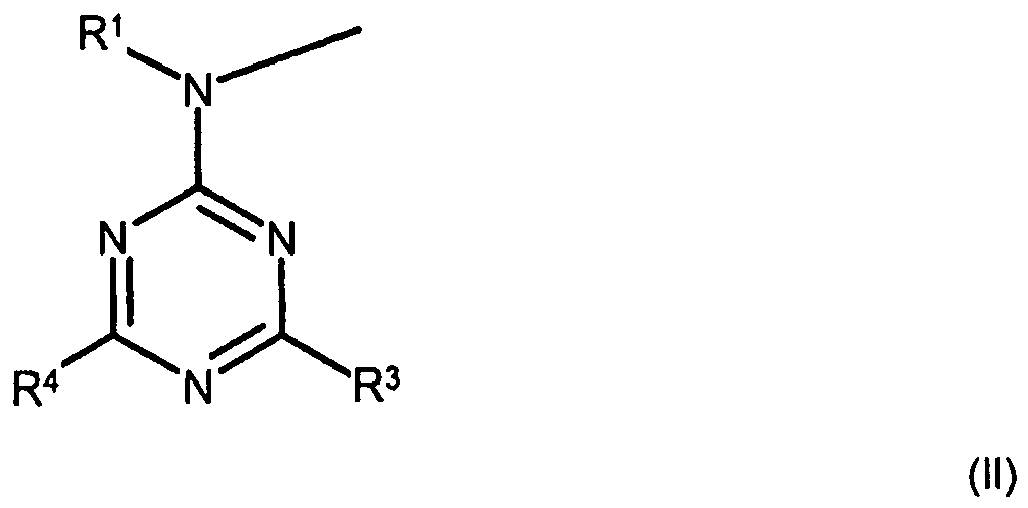
R10 einen Rest der allgemeinen Formel (III)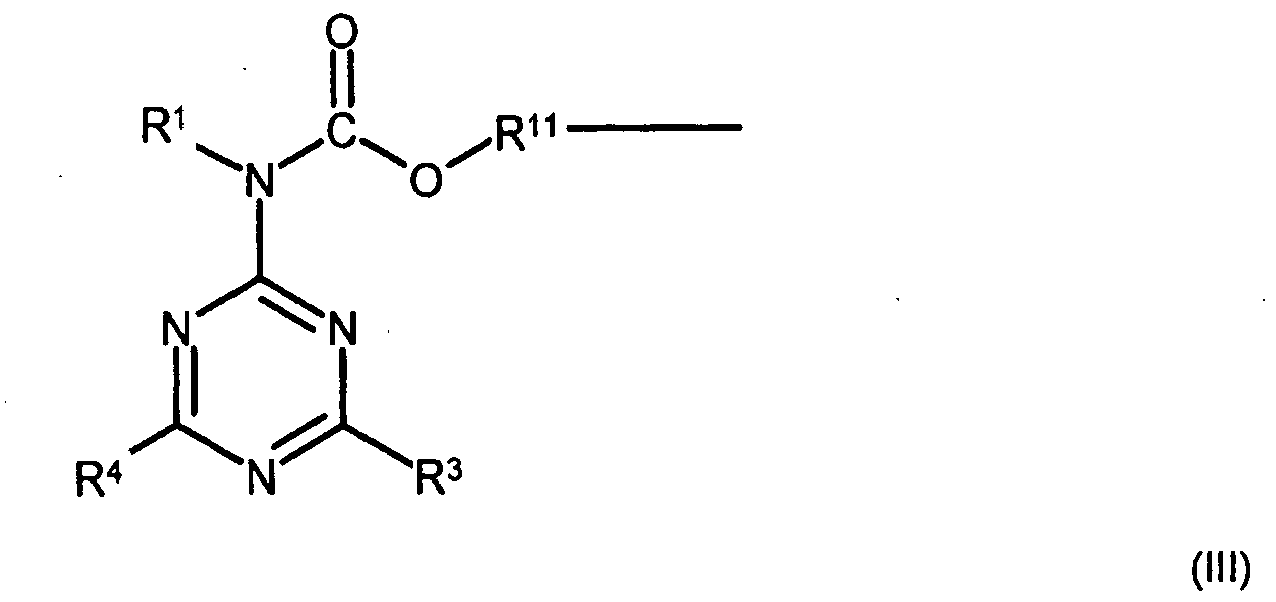 - R11 jeweils ein lineares oder verzweigtes C1-C50-Alkyl, C5-C20-Cycloalkyl, C5-C20-Aryl, C1-C50-alkylsubstituiertes C5-C20-Aryl, C2-C20-Heterocyclus, C2-C20-alkenylsubstituiertes C2-C20-Heterocyclus, C1-C50-Alkylsubstituiertes C2-C20-Heterocyclus, C2-C20-Alkenyl, C2-C12-Alkinyl, oder C2-C20-alkenylsubstituiertes C5-C20-Aryl, das jeweils durch ein oder mehrere Sauerstoffatome, Schwefelatome, substituierte und/oder unsubstituierte Stickstoffatome, durch Doppelbindungen, Siloxangruppen und/oder durch ein oder mehrere Gruppen des Typs -C(O)O-, -OC(O)-, -C(O)-, -NHC(O)O-, -OC(O)NH- und/oder -OC(O)O- unterbrochen sein kann, ist,gekennzeichnet durch
die Umsetzung von mindestens einem Triazin der Formel IV
mit mindestens einem Chlorformiat der allgemeinen Formel (V)

- Verfahren nach Anspruch 1, dadurch gekennzeichnet, dass als Chlorformiat Methylchlorformiat, Butylchlorformiat, Phenylchlorformiat, Benzylchlorformiat, Menthylchlorformiat, 1-Chlorethylchlorformiat, 1-Naphthylchlorformiat, 2-Chlorethylchlorformiat, 2-Chlorbenzylchlorformiat, 2-Chlorphenylchlorformiat, 2-Ethylhexylchlorformiat, 2-Flourethylchlorformiat, 2-Methoxyethylchlorformiat, 2-Methoxyphenylchlorformiat, 2-Nitrophenylchlorformiat, 2-Chlorpropylchlorformiat, 4-Chlorbutylchlorformiat, Allylchlorformiat, Cetylchlorformiat, Ethylchlorformiat, Ethylen-bis(chlorformiat), Hexylchlorformiat, Isobutylchlorformiat, Isopropenylchlorformiat, Neopentylchlorformiat, Octylchlorformiat, Tolylchlorformiat, Propargylchlorformiat, Propylchlorformiat, Vinylchlorformiat, 1,4-Butandiol-bis(chlorformiat), 2-Butyn-1-ylchlorformiat, 3-Butyn-1-ylchlorformiat, Bisphenol-A-bis(chlorformiat), Bisphenol-Z-bis(chlorformiat), Triethylenglycol-bis(chlorformiat), 1,4-Phenylen-bis(chlorformiat) oder beliebige Mischungen davon eingesetzt wird.
- Verfahren nach Anspruch 2, dadurch gekennzeichnet, dass als Chlorformiat Methylchlorformiat, Butylchlorformiat, Phenylchlorformiat, Allylchlorformiat, Ethylen-bis(chlorformiat), Isobutylchlorformiat, Vinylchlorformiat, 1,4-Butandiol-bis(chlorformiat), 2-Chlorpropylchlorformiat, Propargylchlorformiat oder Bisphenol-A-bis(chlorformiat) eingesetzt werden.
- Verfahren nach einem der vorhergehenden Ansprüche, dadurch gekennzeichnet, dass als Alkali- oder Erdalkaliverbindung Butyllithium, NaHCO3 oder Na2CO3 verwendet wird.
- Verfahren nach einem der vorhergehenden Ansprüche, dadurch gekennzeichnet, dass pro NH-Gruppen des Triazins 0,05 bis 1,2 mol Äquivalente an Alkali- und Erdalkaliverbindungen, bevorzugt 0,5 bis 1,2 mol Äquivalente, insbesondere bevorzugt 0,8 bis 1,2 mol Äquivalente, eingesetzt werden.
- Verfahren nach einem der vorhergehenden Ansprüchen, dadurch gekennzeichnet, dass die Reaktion bei Temperaturen von 0 bis 200°C durchgeführt wird.
- Verfahren nach einem der vorhergehenden Ansprüchen, dadurch gekennzeichnet, dass während der Reaktion ein Temperaturprofil durchlaufen wird.
- Verfahren nach Anspruch 7, dadurch gekennzeichnet, dass die Reaktion bei niederen Temperaturen, insbesondere bei Temperaturen zwischen 0°C und 20°C, gestartet wird und dann bis zu einer ausgewählten Endtemperatur, insbesondere Temperaturen zwischen 20°C bis 200°C, erhöht wird.
- Verfahren nach einem der vorhergehenden Ansprüche, dadurch gekennzeichnet, dass pro Moläquivalent NH-Gruppen des Triazins 0,7 bis 10,0 Mol, bevorzugt 0,9 bis 7,0, Chlorformiat eingesetzt werden.
- Verfahren nach einem der vorhergehenden Ansprüche, dadurch gekennzeichnet, dass die Reaktion in einem Lösungsmittel oder in Substanz, wobei das Chlorformiat gemäß Formel (V) und/oder (VI) als Lösungsmittel fungiert, durchgeführt wird.
Applications Claiming Priority (2)
| Application Number | Priority Date | Filing Date | Title |
|---|---|---|---|
| DE102008061139A DE102008061139A1 (de) | 2008-12-09 | 2008-12-09 | Verfahren zur Herstellung von Triazincarbamaten unter Verwendung von Chlorformiaten |
| PCT/EP2009/066538 WO2010066683A1 (de) | 2008-12-09 | 2009-12-07 | Verfahren zur herstellung von triazincarbamaten unter verwendung von chlorformiaten |
Publications (2)
| Publication Number | Publication Date |
|---|---|
| EP2373633A1 EP2373633A1 (de) | 2011-10-12 |
| EP2373633B1 true EP2373633B1 (de) | 2014-04-16 |
Family
ID=41809045
Family Applications (1)
| Application Number | Title | Priority Date | Filing Date |
|---|---|---|---|
| EP09796353.2A Not-in-force EP2373633B1 (de) | 2008-12-09 | 2009-12-07 | Verfahren zur herstellung von triazincarbamaten unter verwendung von chlorformiaten |
Country Status (5)
| Country | Link |
|---|---|
| US (1) | US20110295001A1 (de) |
| EP (1) | EP2373633B1 (de) |
| CN (1) | CN102245582B (de) |
| DE (1) | DE102008061139A1 (de) |
| WO (1) | WO2010066683A1 (de) |
Families Citing this family (1)
| Publication number | Priority date | Publication date | Assignee | Title |
|---|---|---|---|---|
| CN112441923A (zh) * | 2020-12-08 | 2021-03-05 | 湖南国发精细化工科技有限公司 | 一种光气合成氯甲酸正辛酯的方法 |
Family Cites Families (9)
| Publication number | Priority date | Publication date | Assignee | Title |
|---|---|---|---|---|
| CH588213A5 (de) * | 1974-07-25 | 1977-05-31 | Ciba Geigy Ag | |
| PH23300A (en) * | 1985-12-02 | 1989-06-30 | Ciba Geigy Ag | (di) alkoxy carbonylamino-s-triazine derivatives and the use thereof against pests which are parasite of domestic animals and cultivated plants |
| US5084541A (en) | 1988-12-19 | 1992-01-28 | American Cyanamid Company | Triazine crosslinking agents and curable compositions |
| EP0559044A1 (de) * | 1992-03-05 | 1993-09-08 | Bayer Ag | Verfahren zur Herstellung von Sulfonylharnstoff-Salzen |
| TW328955B (en) | 1993-05-14 | 1998-04-01 | Cytec Tech Corp | Process for preparing bis- or tris-carbamate functional 1,3,5-triazines, substantially halogen contamination free crosslinker compositions and new bis-or tris-carbamate functional 1,3,5-triazines |
| CA2270384A1 (en) * | 1996-10-30 | 1998-05-07 | Kuang-Jong Wu | Liquid cross-linker compositions containing 1,3,5-triazine carbamate/aminoplast resin mixtures |
| EP1440065B1 (de) * | 2001-10-23 | 2010-10-06 | Basf Se | Verfahren zur herstellung von alkoxycarbonylamino-triazinen |
| DE10259672A1 (de) | 2002-12-18 | 2004-07-01 | Basf Ag | Verfahren zur Herstellung von Alkoxycarbonylamino-triazinen |
| DE102004018543A1 (de) * | 2004-04-14 | 2005-11-10 | Basf Ag | Carbamatgruppenhaltige Triazinderivate |
-
2008
- 2008-12-09 DE DE102008061139A patent/DE102008061139A1/de not_active Ceased
-
2009
- 2009-12-07 US US13/133,488 patent/US20110295001A1/en not_active Abandoned
- 2009-12-07 EP EP09796353.2A patent/EP2373633B1/de not_active Not-in-force
- 2009-12-07 CN CN200980148745.XA patent/CN102245582B/zh not_active Expired - Fee Related
- 2009-12-07 WO PCT/EP2009/066538 patent/WO2010066683A1/de not_active Ceased
Also Published As
| Publication number | Publication date |
|---|---|
| EP2373633A1 (de) | 2011-10-12 |
| WO2010066683A1 (de) | 2010-06-17 |
| DE102008061139A1 (de) | 2010-06-10 |
| US20110295001A1 (en) | 2011-12-01 |
| CN102245582A (zh) | 2011-11-16 |
| CN102245582B (zh) | 2014-05-14 |
Similar Documents
| Publication | Publication Date | Title |
|---|---|---|
| EP2373633B1 (de) | Verfahren zur herstellung von triazincarbamaten unter verwendung von chlorformiaten | |
| DE2318170A1 (de) | Heterocyclische diisocyanate | |
| WO1993010086A1 (de) | Verfahren zur herstellung von n-(arylsulfonyl)-carbamid-säure-derivaten und den in diesem verfahren verwendbaren intermedieren | |
| DE3906910A1 (de) | Verfahren zur herstellung von n-sulfonyl-harnstoffen | |
| DE69427827T2 (de) | Verfahren zur Herstellung von Sulfonylharnstoffderivaten und Zwischenprodukte für dieses Verfahren | |
| DE2326358A1 (de) | S-triazin-derivate und ihre herstellung und anwendung | |
| DE2227919A1 (de) | Verfahren zur herstellung von benzimidazol-2-yl-carbaminsaeure-alkylestern | |
| EP0037971A2 (de) | Trisubstituierte Cyanguanidine, Verfahren zu ihrer Herstellung sowie ihre Verwendung als Fungizide | |
| DE1668170C (de) | ||
| EP0018583A1 (de) | Verfahren zur Herstellung von Aryl-mono-,-di- und/oder-polyurethanen | |
| DE1668170B2 (de) | N-octahydro-1,2,4-methenopentalenyl(5)-harnstoffe, verfahren zu deren herstellung und deren verwendung als herbizide | |
| DE1916932A1 (de) | Verfahren zur Herstellung von N,N'-substituierten 2,4,5-Triketo-imidazolidinen | |
| EP2344510B1 (de) | 1,4,2-diazaphospholidin-derivate | |
| DE3411202C2 (de) | Verfahren zur Herstellung von 2-Amino-s-triazinen | |
| DE1142599B (de) | Verfahren zur Herstellung von Carbaminsaeureestern | |
| DE1962797C3 (de) | ||
| DE2237549B2 (de) | Mycophenolsäureester-Derivate, Verfahren zu deren Herstellung und diese Verbindungen enthaltende Arzneimittel | |
| EP0148755B1 (de) | 2-Phenoxy-phenylsulfonylisocyanat | |
| DD211111A1 (de) | Verfahren zur herstellung von substituierten 6-imino-2,4-dioxo-perhydro-1,3,5-triazinen | |
| EP0000030A1 (de) | Schwefelhaltige Diurethane, Verfahren zu deren Herstellung und deren Verwendung als Herbizide | |
| AT209906B (de) | Verfahren zur Herstellung von neuen Dicarbamaten aliphatischer 1, 3-Diole | |
| EP0233571A2 (de) | Verfahren zur Herstellung von Pyridinolcarbamat | |
| DE2901334A1 (de) | Neue harnstoffderivate | |
| DE2200648A1 (de) | Verfahren zur Herstellung von monosubstituierten 1-Carbamoyl-2-benzimidazolyl-carbamaten | |
| DE1568554C3 (de) | Sulfamoyl-phenylharnstoffe sowie Verfahren zu ihrer Herstellung |
Legal Events
| Date | Code | Title | Description |
|---|---|---|---|
| PUAI | Public reference made under article 153(3) epc to a published international application that has entered the european phase |
Free format text: ORIGINAL CODE: 0009012 |
|
| 17P | Request for examination filed |
Effective date: 20110707 |
|
| AK | Designated contracting states |
Kind code of ref document: A1 Designated state(s): AT BE BG CH CY CZ DE DK EE ES FI FR GB GR HR HU IE IS IT LI LT LU LV MC MK MT NL NO PL PT RO SE SI SK SM TR |
|
| RIN1 | Information on inventor provided before grant (corrected) |
Inventor name: BURGER, MARTIN Inventor name: ARNOLD, MANFRED Inventor name: HAHN, CHRISTOPH Inventor name: FRANK, WILLY Inventor name: POSER, SVEN Inventor name: DICKE, RENE Inventor name: ENDESFELDER, ANDREAS |
|
| DAX | Request for extension of the european patent (deleted) | ||
| RIN1 | Information on inventor provided before grant (corrected) |
Inventor name: ARNOLD, MANFRED Inventor name: DICKE, RENE Inventor name: BURGER, MARTIN Inventor name: HAHN, CHRISTOPH Inventor name: POSER, SVEN Inventor name: FRANK, WILLY Inventor name: ENDESFELDER, ANDREAS |
|
| 17Q | First examination report despatched |
Effective date: 20121023 |
|
| RIC1 | Information provided on ipc code assigned before grant |
Ipc: C08K 5/3492 20060101ALI20130814BHEP Ipc: C09D 7/12 20060101ALI20130814BHEP Ipc: C07D 251/70 20060101AFI20130814BHEP Ipc: C08K 5/205 20060101ALI20130814BHEP Ipc: C09D 167/00 20060101ALI20130814BHEP |
|
| GRAP | Despatch of communication of intention to grant a patent |
Free format text: ORIGINAL CODE: EPIDOSNIGR1 |
|
| INTG | Intention to grant announced |
Effective date: 20130923 |
|
| GRAS | Grant fee paid |
Free format text: ORIGINAL CODE: EPIDOSNIGR3 |
|
| GRAA | (expected) grant |
Free format text: ORIGINAL CODE: 0009210 |
|
| AK | Designated contracting states |
Kind code of ref document: B1 Designated state(s): AT BE BG CH CY CZ DE DK EE ES FI FR GB GR HR HU IE IS IT LI LT LU LV MC MK MT NL NO PL PT RO SE SI SK SM TR |
|
| REG | Reference to a national code |
Ref country code: GB Ref legal event code: FG4D Free format text: NOT ENGLISH |
|
| REG | Reference to a national code |
Ref country code: CH Ref legal event code: EP |
|
| REG | Reference to a national code |
Ref country code: AT Ref legal event code: REF Ref document number: 662470 Country of ref document: AT Kind code of ref document: T Effective date: 20140515 |
|
| REG | Reference to a national code |
Ref country code: IE Ref legal event code: FG4D Free format text: LANGUAGE OF EP DOCUMENT: GERMAN |
|
| REG | Reference to a national code |
Ref country code: DE Ref legal event code: R096 Ref document number: 502009009214 Country of ref document: DE Effective date: 20140522 |
|
| REG | Reference to a national code |
Ref country code: CH Ref legal event code: NV Representative=s name: SCHMAUDER AND PARTNER AG PATENT- UND MARKENANW, CH |
|
| REG | Reference to a national code |
Ref country code: NL Ref legal event code: T3 |
|
| REG | Reference to a national code |
Ref country code: LT Ref legal event code: MG4D |
|
| PG25 | Lapsed in a contracting state [announced via postgrant information from national office to epo] |
Ref country code: GR Free format text: LAPSE BECAUSE OF FAILURE TO SUBMIT A TRANSLATION OF THE DESCRIPTION OR TO PAY THE FEE WITHIN THE PRESCRIBED TIME-LIMIT Effective date: 20140717 Ref country code: IS Free format text: LAPSE BECAUSE OF FAILURE TO SUBMIT A TRANSLATION OF THE DESCRIPTION OR TO PAY THE FEE WITHIN THE PRESCRIBED TIME-LIMIT Effective date: 20140816 Ref country code: NO Free format text: LAPSE BECAUSE OF FAILURE TO SUBMIT A TRANSLATION OF THE DESCRIPTION OR TO PAY THE FEE WITHIN THE PRESCRIBED TIME-LIMIT Effective date: 20140716 Ref country code: FI Free format text: LAPSE BECAUSE OF FAILURE TO SUBMIT A TRANSLATION OF THE DESCRIPTION OR TO PAY THE FEE WITHIN THE PRESCRIBED TIME-LIMIT Effective date: 20140416 Ref country code: CY Free format text: LAPSE BECAUSE OF FAILURE TO SUBMIT A TRANSLATION OF THE DESCRIPTION OR TO PAY THE FEE WITHIN THE PRESCRIBED TIME-LIMIT Effective date: 20140416 Ref country code: BG Free format text: LAPSE BECAUSE OF FAILURE TO SUBMIT A TRANSLATION OF THE DESCRIPTION OR TO PAY THE FEE WITHIN THE PRESCRIBED TIME-LIMIT Effective date: 20140716 Ref country code: LT Free format text: LAPSE BECAUSE OF FAILURE TO SUBMIT A TRANSLATION OF THE DESCRIPTION OR TO PAY THE FEE WITHIN THE PRESCRIBED TIME-LIMIT Effective date: 20140416 |
|
| PG25 | Lapsed in a contracting state [announced via postgrant information from national office to epo] |
Ref country code: PL Free format text: LAPSE BECAUSE OF FAILURE TO SUBMIT A TRANSLATION OF THE DESCRIPTION OR TO PAY THE FEE WITHIN THE PRESCRIBED TIME-LIMIT Effective date: 20140416 Ref country code: SE Free format text: LAPSE BECAUSE OF FAILURE TO SUBMIT A TRANSLATION OF THE DESCRIPTION OR TO PAY THE FEE WITHIN THE PRESCRIBED TIME-LIMIT Effective date: 20140416 Ref country code: ES Free format text: LAPSE BECAUSE OF FAILURE TO SUBMIT A TRANSLATION OF THE DESCRIPTION OR TO PAY THE FEE WITHIN THE PRESCRIBED TIME-LIMIT Effective date: 20140416 Ref country code: LV Free format text: LAPSE BECAUSE OF FAILURE TO SUBMIT A TRANSLATION OF THE DESCRIPTION OR TO PAY THE FEE WITHIN THE PRESCRIBED TIME-LIMIT Effective date: 20140416 Ref country code: HR Free format text: LAPSE BECAUSE OF FAILURE TO SUBMIT A TRANSLATION OF THE DESCRIPTION OR TO PAY THE FEE WITHIN THE PRESCRIBED TIME-LIMIT Effective date: 20140416 |
|
| PG25 | Lapsed in a contracting state [announced via postgrant information from national office to epo] |
Ref country code: PT Free format text: LAPSE BECAUSE OF FAILURE TO SUBMIT A TRANSLATION OF THE DESCRIPTION OR TO PAY THE FEE WITHIN THE PRESCRIBED TIME-LIMIT Effective date: 20140818 |
|
| REG | Reference to a national code |
Ref country code: DE Ref legal event code: R097 Ref document number: 502009009214 Country of ref document: DE |
|
| PG25 | Lapsed in a contracting state [announced via postgrant information from national office to epo] |
Ref country code: EE Free format text: LAPSE BECAUSE OF FAILURE TO SUBMIT A TRANSLATION OF THE DESCRIPTION OR TO PAY THE FEE WITHIN THE PRESCRIBED TIME-LIMIT Effective date: 20140416 Ref country code: RO Free format text: LAPSE BECAUSE OF FAILURE TO SUBMIT A TRANSLATION OF THE DESCRIPTION OR TO PAY THE FEE WITHIN THE PRESCRIBED TIME-LIMIT Effective date: 20140416 Ref country code: DK Free format text: LAPSE BECAUSE OF FAILURE TO SUBMIT A TRANSLATION OF THE DESCRIPTION OR TO PAY THE FEE WITHIN THE PRESCRIBED TIME-LIMIT Effective date: 20140416 Ref country code: SK Free format text: LAPSE BECAUSE OF FAILURE TO SUBMIT A TRANSLATION OF THE DESCRIPTION OR TO PAY THE FEE WITHIN THE PRESCRIBED TIME-LIMIT Effective date: 20140416 Ref country code: CZ Free format text: LAPSE BECAUSE OF FAILURE TO SUBMIT A TRANSLATION OF THE DESCRIPTION OR TO PAY THE FEE WITHIN THE PRESCRIBED TIME-LIMIT Effective date: 20140416 |
|
| PLBE | No opposition filed within time limit |
Free format text: ORIGINAL CODE: 0009261 |
|
| STAA | Information on the status of an ep patent application or granted ep patent |
Free format text: STATUS: NO OPPOSITION FILED WITHIN TIME LIMIT |
|
| 26N | No opposition filed |
Effective date: 20150119 |
|
| PG25 | Lapsed in a contracting state [announced via postgrant information from national office to epo] |
Ref country code: IT Free format text: LAPSE BECAUSE OF FAILURE TO SUBMIT A TRANSLATION OF THE DESCRIPTION OR TO PAY THE FEE WITHIN THE PRESCRIBED TIME-LIMIT Effective date: 20140416 |
|
| REG | Reference to a national code |
Ref country code: DE Ref legal event code: R097 Ref document number: 502009009214 Country of ref document: DE Effective date: 20150119 |
|
| PG25 | Lapsed in a contracting state [announced via postgrant information from national office to epo] |
Ref country code: BE Free format text: LAPSE BECAUSE OF NON-PAYMENT OF DUE FEES Effective date: 20141231 |
|
| PG25 | Lapsed in a contracting state [announced via postgrant information from national office to epo] |
Ref country code: SI Free format text: LAPSE BECAUSE OF FAILURE TO SUBMIT A TRANSLATION OF THE DESCRIPTION OR TO PAY THE FEE WITHIN THE PRESCRIBED TIME-LIMIT Effective date: 20140416 Ref country code: LU Free format text: LAPSE BECAUSE OF FAILURE TO SUBMIT A TRANSLATION OF THE DESCRIPTION OR TO PAY THE FEE WITHIN THE PRESCRIBED TIME-LIMIT Effective date: 20141207 |
|
| REG | Reference to a national code |
Ref country code: IE Ref legal event code: MM4A |
|
| PG25 | Lapsed in a contracting state [announced via postgrant information from national office to epo] |
Ref country code: IE Free format text: LAPSE BECAUSE OF NON-PAYMENT OF DUE FEES Effective date: 20141207 |
|
| REG | Reference to a national code |
Ref country code: FR Ref legal event code: PLFP Year of fee payment: 7 |
|
| PG25 | Lapsed in a contracting state [announced via postgrant information from national office to epo] |
Ref country code: SM Free format text: LAPSE BECAUSE OF FAILURE TO SUBMIT A TRANSLATION OF THE DESCRIPTION OR TO PAY THE FEE WITHIN THE PRESCRIBED TIME-LIMIT Effective date: 20140416 |
|
| PG25 | Lapsed in a contracting state [announced via postgrant information from national office to epo] |
Ref country code: MC Free format text: LAPSE BECAUSE OF FAILURE TO SUBMIT A TRANSLATION OF THE DESCRIPTION OR TO PAY THE FEE WITHIN THE PRESCRIBED TIME-LIMIT Effective date: 20140416 |
|
| PG25 | Lapsed in a contracting state [announced via postgrant information from national office to epo] |
Ref country code: TR Free format text: LAPSE BECAUSE OF FAILURE TO SUBMIT A TRANSLATION OF THE DESCRIPTION OR TO PAY THE FEE WITHIN THE PRESCRIBED TIME-LIMIT Effective date: 20140416 Ref country code: HU Free format text: LAPSE BECAUSE OF FAILURE TO SUBMIT A TRANSLATION OF THE DESCRIPTION OR TO PAY THE FEE WITHIN THE PRESCRIBED TIME-LIMIT; INVALID AB INITIO Effective date: 20091207 Ref country code: MT Free format text: LAPSE BECAUSE OF FAILURE TO SUBMIT A TRANSLATION OF THE DESCRIPTION OR TO PAY THE FEE WITHIN THE PRESCRIBED TIME-LIMIT Effective date: 20140416 |
|
| REG | Reference to a national code |
Ref country code: FR Ref legal event code: PLFP Year of fee payment: 8 |
|
| PGFP | Annual fee paid to national office [announced via postgrant information from national office to epo] |
Ref country code: GB Payment date: 20161222 Year of fee payment: 8 Ref country code: CH Payment date: 20161221 Year of fee payment: 8 |
|
| PGFP | Annual fee paid to national office [announced via postgrant information from national office to epo] |
Ref country code: FR Payment date: 20161222 Year of fee payment: 8 |
|
| PG25 | Lapsed in a contracting state [announced via postgrant information from national office to epo] |
Ref country code: MK Free format text: LAPSE BECAUSE OF FAILURE TO SUBMIT A TRANSLATION OF THE DESCRIPTION OR TO PAY THE FEE WITHIN THE PRESCRIBED TIME-LIMIT Effective date: 20140416 |
|
| REG | Reference to a national code |
Ref country code: CH Ref legal event code: PL |
|
| GBPC | Gb: european patent ceased through non-payment of renewal fee |
Effective date: 20171207 |
|
| REG | Reference to a national code |
Ref country code: FR Ref legal event code: ST Effective date: 20180831 |
|
| PG25 | Lapsed in a contracting state [announced via postgrant information from national office to epo] |
Ref country code: FR Free format text: LAPSE BECAUSE OF NON-PAYMENT OF DUE FEES Effective date: 20180102 |
|
| PG25 | Lapsed in a contracting state [announced via postgrant information from national office to epo] |
Ref country code: GB Free format text: LAPSE BECAUSE OF NON-PAYMENT OF DUE FEES Effective date: 20171207 Ref country code: LI Free format text: LAPSE BECAUSE OF NON-PAYMENT OF DUE FEES Effective date: 20171231 Ref country code: CH Free format text: LAPSE BECAUSE OF NON-PAYMENT OF DUE FEES Effective date: 20171231 |
|
| PGFP | Annual fee paid to national office [announced via postgrant information from national office to epo] |
Ref country code: NL Payment date: 20181219 Year of fee payment: 10 Ref country code: DE Payment date: 20181210 Year of fee payment: 10 Ref country code: AT Payment date: 20181220 Year of fee payment: 10 |
|
| REG | Reference to a national code |
Ref country code: DE Ref legal event code: R119 Ref document number: 502009009214 Country of ref document: DE |
|
| REG | Reference to a national code |
Ref country code: NL Ref legal event code: MM Effective date: 20200101 |
|
| REG | Reference to a national code |
Ref country code: AT Ref legal event code: MM01 Ref document number: 662470 Country of ref document: AT Kind code of ref document: T Effective date: 20191207 |
|
| PG25 | Lapsed in a contracting state [announced via postgrant information from national office to epo] |
Ref country code: NL Free format text: LAPSE BECAUSE OF NON-PAYMENT OF DUE FEES Effective date: 20200101 |
|
| PG25 | Lapsed in a contracting state [announced via postgrant information from national office to epo] |
Ref country code: DE Free format text: LAPSE BECAUSE OF NON-PAYMENT OF DUE FEES Effective date: 20200701 |
|
| PG25 | Lapsed in a contracting state [announced via postgrant information from national office to epo] |
Ref country code: AT Free format text: LAPSE BECAUSE OF NON-PAYMENT OF DUE FEES Effective date: 20191207 |