EP2350640B1 - Dispositif pour le contrôle de la qualité d'un lubrifiant et procédé pour le contrôle du fonctionnement d'un équipement industriel utilisant un lubrifiant - Google Patents
Dispositif pour le contrôle de la qualité d'un lubrifiant et procédé pour le contrôle du fonctionnement d'un équipement industriel utilisant un lubrifiant Download PDFInfo
- Publication number
- EP2350640B1 EP2350640B1 EP09760178.5A EP09760178A EP2350640B1 EP 2350640 B1 EP2350640 B1 EP 2350640B1 EP 09760178 A EP09760178 A EP 09760178A EP 2350640 B1 EP2350640 B1 EP 2350640B1
- Authority
- EP
- European Patent Office
- Prior art keywords
- lubricant
- engine
- industrial apparatus
- distribution assembly
- physicochemical
- Prior art date
- Legal status (The legal status is an assumption and is not a legal conclusion. Google has not performed a legal analysis and makes no representation as to the accuracy of the status listed.)
- Active
Links
Images

Classifications
-
- G—PHYSICS
- G01—MEASURING; TESTING
- G01N—INVESTIGATING OR ANALYSING MATERIALS BY DETERMINING THEIR CHEMICAL OR PHYSICAL PROPERTIES
- G01N33/00—Investigating or analysing materials by specific methods not covered by groups G01N1/00 - G01N31/00
- G01N33/26—Oils; Viscous liquids; Paints; Inks
- G01N33/28—Oils, i.e. hydrocarbon liquids
- G01N33/2888—Lubricating oil characteristics, e.g. deterioration
-
- G—PHYSICS
- G01—MEASURING; TESTING
- G01N—INVESTIGATING OR ANALYSING MATERIALS BY DETERMINING THEIR CHEMICAL OR PHYSICAL PROPERTIES
- G01N33/00—Investigating or analysing materials by specific methods not covered by groups G01N1/00 - G01N31/00
- G01N33/26—Oils; Viscous liquids; Paints; Inks
- G01N33/28—Oils, i.e. hydrocarbon liquids
- G01N33/2835—Specific substances contained in the oils or fuels
- G01N33/2858—Metal particles
-
- G—PHYSICS
- G01—MEASURING; TESTING
- G01N—INVESTIGATING OR ANALYSING MATERIALS BY DETERMINING THEIR CHEMICAL OR PHYSICAL PROPERTIES
- G01N33/00—Investigating or analysing materials by specific methods not covered by groups G01N1/00 - G01N31/00
- G01N33/26—Oils; Viscous liquids; Paints; Inks
- G01N33/28—Oils, i.e. hydrocarbon liquids
- G01N33/30—Oils, i.e. hydrocarbon liquids for lubricating properties
Definitions
- the present invention relates to the field of measuring, continuously or discontinuously, the evolution of the quality of a lubricant circulating in industrial equipment.
- the invention relates more specifically to a device for measuring the evolution of the characteristics of a lubricant in an industrial equipment, such as a material in operation, for example a motor or a machine.
- the present invention also relates to a method for controlling the operation of an industrial equipment, for example an engine, in particular a thermal engine, or a machine, for example a rotating machine, by monitoring the quality of its lubricant.
- an industrial equipment for example an engine, in particular a thermal engine, or a machine, for example a rotating machine, by monitoring the quality of its lubricant.
- the present invention relates to the control of marine engines, for example four-stroke type or two-stroke, by the analysis of circulating oils and / or recovered in said engines.
- the machines may be generators, turbines, in particular gas or steam turbines, reducers, multipliers, hydraulic presses, machine tools, compressors, transformers, or even thermal equipment using hot oil circuits.
- the motors may be industrial equipment installed in any mobile system of the so-called "automotive" domain, for example in ships, trucks, vehicles, competition cars, agricultural equipment, handling equipment and / or transport, coaches or trains.
- 4-stroke engines can have a fast or semi-fast cycle.
- Engines of the first type are low to moderate horsepower motors (15 to 200 kW per cylinder) derived from land-based engines and using distillate-type fuels such as low-sulfur marine diesel. Their operating speed is in general of the order of 1200 revolutions per minute. These engines are used for the propulsion of small vessels and as power generation units on larger vessels.
- Semi-fast four-stroke marine engines are medium-to-high horsepower (500 to 2,000 kW per cylinder) engines of similar design to fast four-stroke engines, but differ from the latter in their larger size.
- piston cylinder assembly These motors generally use a fuel called bunker oil or heavy oil (Heavy Fuel Oil) which, because of its high sulfur content, requires a lubricant to total base number (BN as Base Number) high, generally between 30 and 65 mg of KOH / g of lubricant.
- bunker oil or heavy oil Heavy Fuel Oil
- the operating speed of the semi-fast four-stroke marine engines is between 300 and 600 revolutions per minute. These engines are used for the propulsion of many ships, such as Ro-Ro units, cargo ships, tankers, ferries and even some container carriers. They can also be used as power generation units on large ships or in diesel power plants.
- two-stroke marine engines have a very different operation from that of two-stroke marine engines, especially with regard to their lubrication mode. Indeed, two-stroke marine engines are very slow engines, from high to very high power range (2000 to 6000 kW per cylinder). These engines are always made up of two separately lubricated parts, namely the lubricated lubricated cylinder piston assembly lost by the highly viscous cylinder oil, usually SAE grade 50 or 60, and the oil lubricated crank shaft system viscous, usually grade SAE 30.
- bunker fuel which, because of its very high sulfur content, generally requires total base number (BN) cylinder oils of up to 100 mg KOH / g. oil.
- the lubricant While circulating through the internal circuits of engines or machines the lubricant will collect contamination and / or wear materials of said engines or machines. As a result, the lubricant will degrade more or less rapidly during the operation of the industrial equipment. The lubricant therefore contains a lot of valuable information on the operation of the engine or the machine, on any contamination, on its mechanical state and consequently on its present and future functional performance.
- the various degradations and / or contaminations of the lubricant during service in the engine or the machine can lead to corrosions and / or irreversible damage to the sensitive parts of the engine or the machine, leading, for example, to the modification of the BN of the lubricant. , the modification of its viscosity, the appearance of metal particles, the evolution of the water content of the lubricant, etc.
- the present invention makes it possible to measure and analyze, continuously or discontinuously, to obtain better control, better use and better protection of the engine or the machine.
- These acids gases may be formed from the combustion of fuel oils, which include sulfur oxides (SO 2, SO 3), which are then hydrolyzed upon contact with moisture present in the flue gas and / or in 'oil. This hydrolysis generates sulfurous acid (HSO 3 ) or sulfuric acid (H 2 SO 4 ).
- the acids formed must be neutralized, especially to preserve the surface of the shirts and to avoid excessive corrosive wear. This is usually done by reaction with basic sites included in the lubricant.
- the neutralization capacity of an oil can be determined by its BN or Base Number in English, characterizing its basicity. It is usually measured according to ASTM D-2896 and is expressed in equivalent weight of potash per gram of oil, or mg of KOH / g.
- the BN is a standard criterion for adjusting the basicity of oils to the sulfur content of fuel oil used as a motor fuel, in order to neutralize the sulfur contained in said fuel and likely to be converted into sulfuric acid.
- Switching between these two categories of fuel oil may require adaptation of the operating conditions of the engine, in particular the use of appropriate cylinder lubricants.
- a first solution to optimize the cylinder lubrication of a slow two-stroke engine is then the selection of the lubricant with a BN adapted to the fuel oil and the operating conditions of the engine.
- This optimization reduces the operating flexibility of the engine and requires a high degree of technical skill of the crew in defining the conditions under which switching from one type of lubricant to another must be achieved.
- Another alternative is to have a single lubricant and optimize the operating conditions of the engine (lubrication rate or other combustion parameters) depending on the fuel used.
- This optimization could be achieved by a continuous or batch analysis of the BN of the lubricant in order to maintain the required adequacy between said BN of said lubricant and the sulfur content of the fuel supplying the engine; the objective obviously being to avoid the operation of the BN motor too low which is responsible for irreversible corrosion of the engine piston piston sensitive parts and a rapid deterioration of the functional performance of the lubricant inside the cylinder.
- the mechanical wear of a four-stroke or two-stroke engine must be controlled and, above all, controlled by analyzing certain physicochemical or intrinsic characteristics of its lubricant.
- certain metals not limiting Fe, Pb, Ni, Cr, Al, Cu, Sb, Ag
- the presence of this (these) compound (s) can mean a phenomenon of tearing in the sensitive parts of the engine, thus resulting in a destruction partial or even significant engine. It is therefore important, even essential, to detect the phenomenon of wear of the metal parts of the engine at the earliest, or even from its origin. This detection must therefore go through a rigorous and constant analytical monitoring of the lubricant during the operation of the engine.
- the control of the viscosity of the lubricant also makes it possible to rapidly detect the pollution of said lubricant with another fluid, for example the fuel, the fuel, the coolant or another lubricant.
- the lubricant circulating in a machine or a motor therefore contributes to providing many functions essential to the operation of an engine or a machine, but it will suffer damage during said operation as indicated above. It is therefore necessary to monitor the characteristics of the lubricant in use in order to prevent corrosions, damage or damage to machinery and / or engines.
- the significant delays due to the transport of the samples before analysis can be generating phenomena of degeneration of the latter, or even the appearance of microorganisms in these same samples, for example in contact with the air and the possible humidity relative in the transport vials of said samples, which may cause a more or less significant bias on the results of certain types of analyzes.
- the analyzes are relatively simple to carry out with these "mini-laboratories", on the other hand the analysis techniques are limited, the periodicity of the measurements is generally of a few days to a week and especially they require a manpower trained and qualified to ship's edge.
- the proposed solutions are expensive, requiring bulky equipment, a skilled operator, requiring a relatively long period of time between taking the sample and the result of the analysis, and presenting risks of loss of sample or contamination thereof and / or can not be quickly applied to the system to be studied.
- the object of the present invention is to overcome all or part of these disadvantages by proposing a device and a method for obtaining directly on the lubricant in service, analysis results continuously or discontinuously, to ensure the early detection of a degradation, a contamination of the lubricant and thus allow the optimization and / or the control of the operation of a machine or an engine, in particular thermal, and more precisely marine, from the monitoring of the quality of its lubricant.
- the device Due to its small footprint on the one hand, and its high modularity on the other hand, the device is easily adaptable on virtually all engines or machines.
- the dimensions of the distribution set, support of the functional component can range from 100 mm to 300 mm for its length, and from 20 mm to 70 mm for its width, as well as its height.
- the footprint is therefore limited and may be less than or equal to 300 mm x 70 mm x 70 mm.
- the conduit module is attached to the flat face of the body of the distribution assembly in accordance with ANSI / ISA-76.00.02-2002 and more recently IEC 62339-1: 2006.
- the dispensing assembly may include a sample preparation device, in particular arranged on a pipeline module.
- This distribution set can be a unit of sample heating or cooling, pressure reduction, control and / or flow control, specific filtration to prepare the sample for a particular analysis or multiple analyzes according to the parameter (s) (s) to measure.
- At least one functional component is connected to a pipeline module in accordance with NESSI (New Sampling and Sensor Initiative) recommendations for sampling systems.
- NESSI New Sampling and Sensor Initiative
- this functional component is a micro-sensor or a microanalyser, also called in the MEMs technique (Micro Electro Mechanical system) or NEM (Nano Electro Mechanical system), for measuring the temperature and / or the pressure of the lubricant, viscosity, BN, or the amount of undissolved iron particles contained in the lubricant.
- the microsensor or the microanalyser is adapted to a pipeline module.
- microanalysers are marketed, for example, by the Schlumberger or Vectron MEM companies, in particular under the trade names Excalibur or ViSmart TM, respectively.
- This last measure can in particular detect an accidental cause due to a water inlet clean to the engine, or specific to the refrigerant circuit of the lubricant, or due to a malfunction of ancillary equipment filtration, separation and treatment of the lubricant.
- each microanalyzer is chosen for the determination of one or more characteristic (s) well-defined (s). There can therefore be as many microanalysers as characteristics, or set of physico-chemical or intrinsic characteristics to control. In particular, each physico-chemical or intrinsic measured characteristic is associated with a particular microanalyzer or micro-sensor.
- an electronic and / or computer system for measuring the signal or signals generated by said microanalysers, makes it possible to format and quantify said signals, ultimately, their exploitation in an automated control system of at least a functional parameter and / or composition, respectively on the industrial equipment and / or lubricant.
- the dispensing assembly of the device according to the invention is disposed on a pipe located downstream of the engine representative of the product on which the control must be exercised.
- the lubricant can be taken from a pressure point of the lubrication circuit, for example several bars.
- the supply of the lubricant dispensing assembly can be a pressure point of the industrial equipment.
- the sampled oil is introduced into the distribution assembly, analyzed by at least one microanalyzer, and then reinjected into said lubrication circuit.
- two similar devices may be arranged upstream and downstream of the industrial equipment.
- a similar distribution assembly can be equipped in the same way filter and functional component (s) and be arranged upstream of the engine or machine. This can make it possible to quantify more precisely, by means of an analysis of the results before and after the industrial equipment, for example a wear rate of said industrial equipment, or a monitoring of the proper functioning of the auxiliary circuits and of the treatment of the lubricant (cooling, filtration or possible pollution by water or other fluid).
- the small dimensions and the significant modularity of the device and, more specifically, of the support distribution assembly of the ducting module or modules, itself or themselves (s) support (s) of at least one functional component, can allow a location of said distribution assembly in situ on the marine engine, that is to say closer to the industrial equipment.
- Continuous monitoring of at least one physico-chemical characteristic is a real-time, uninterrupted response from measured by the microanalyzer. This is the case of monitoring the quality of the lubricating oil of four-stroke semi-rapid to two-stroke high speed marine engines for system oils.
- the discontinuous monitoring of at least one physico-chemical characteristic is a cyclic response of the quantity measured by the microanalyzer.
- a slow two-stroke marine engine for which the distribution assembly is first filled by the lubricant , then isolated from the circuit of said lubricant, to allow analysis by the micro sensor or the microanalyzer.
- a new cycle is then repeated, spaced a few tens of seconds, or even minutes or just hours, depending on the type of measurement (s) to be made in accordance with the type (s) of phenomenon (s) engine or machine to detect or monitor.
- the lubricant sampled can be reinjected continuously after analysis in the lubrication circuit of the industrial equipment.
- the continuous monitoring of at least one physicochemical or intrinsic characteristic can be achieved in particular for the lubricating oils of the four-stroke semi-rapid to fast marine engines and the slow two-stroke engine oil systems.
- the discontinuous monitoring of at least one physico-chemical or intrinsic characteristic can be achieved for the cylinder oils of marine engines two slow times.
- the functional parameter of the industrial equipment may be the power of the engine, the nature of the lubricant and / or the lubrication rate.
- This document finally relates to the use of the device and method that are the subject of the present invention on board a ship for controlling the operation of an engine, in particular a four-stroke engine that is semi-rapid to fast or slow two-stroke engine.
- this document relates to the use of the device or method according to the invention to optimize certain operating parameters, such as the engine lubrication rate, particularly in the case of two-phase engines. slow time.
- this document relates to the use of the device or method according to the invention for optimizing the BN value of the lubricant, in particular as a function of the rate of sulfur measured, for example in real time, on fuel, especially fuel oil.
- this document relates to the use of the device or method according to the invention to optimize the formulation of the lubricant continuously, that is to say in real time and according to the results of the micro-sensors, and / or microanalysers, and thus reduce the lubricant consumption to the minimum level required for the proper functioning of the engine or equipment, and also improve the environmental impact by reducing emissions in the atmosphere.
- This optimization can in particular be carried out according to the sulfur content measured in the fuel oil.
- this variant can be more easily achieved to the extent that the ship has a mixing unit (base oil / additives / booster ).
- the invention can also be used, for example, for controlling the operation of a machine, for example rotating, or simply because of its small dimensions, the on-board control of the operation of an automobile engine, or even competition for its use at the limits of its mechanical performance.
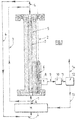
- the lubricant is taken continuously from a point (A) of the engine lubrication circuit (M). At point (A) the pressure may vary, for example, from 1 to 5 bar.
- the lubricant sampling point is here unique and located downstream of the engine (M).
- the lubricant is introduced, through the pipe (1), into the distribution assembly (2), said dispensing assembly (2) being by-passed through the pipe (3), in which the lubricant circulates, to ensure the flow rate correct in the engine lubrication circuit (M).
- the lubricant is reinjected into the lubrication circuit (in this case a closed circuit) via the pipe (4).
- the dispensing assembly (2) consists of a body (5) on which and more precisely on one of its flat faces, is fixed a channeling module (6).
- This duct module (6) allows the lubricant supply to analyze the functional component (8).
- a filter (7) may be present, and in particular be arranged in the longitudinal axis of the distribution assembly, this filter making it possible to ensure the filtration of the lubricant before its introduction into the channeling module (6) and ultimately into the functional component (8).
- the distribution assembly (2) may consist of several planar faces on which are arranged several channeling modules (6), themselves connected to several functional components (8), also called microsensors or microanalysers or MEMs or Spring rolls. This last configuration allows, from a very small analysis space, to obtain the answers of several microanalysers, that is to say the responses of the measurements of several physicochemical or intrinsic characteristics determined in real time on the lubricant.
- the functional component (8) emits a signal representative of the characteristic being measured which will be shaped in the said measuring system (10) to then control the automated system (12) via the electrical connection (11).
- a single cylinder (C) of the two-stroke engine (M) is shown on the figure 2 , but the device described applies to each of the cylinders of the marine engine.
- the cylinder (C) of the two-stroke marine engine (M) is supplied with new oil via the pipe (26); the lubrication system of the cylinder being of the lost lubricant type, also called "lost lubrication" in the profession.
- the oil dripping, contaminated by the products of combustion, is taken at the low point (A) of the cylinder, at atmospheric pressure, and flows discontinuously through the pipe (25) in the distribution assembly (20). via a collector (27).
- the flow rate in the manifold (27) may vary, for example, from 0.1 to 30% of the initial greasing rate.
- a pre-treatment device for the dripping oil (28) is arranged in the collection system (27) for example to exert a first filtration of the lubricant before its analysis.
- information for tracking and optimization is sent to the motor M via the link (32) or, if the ship is equipped for example with an automated assembly of the engine lubrication rate, orders to change this lubrication rate via the electrical connection (33).
- the device and method which are the subject of the present invention, make it possible to reduce lubricant consumption at the level minimum required, to control the functioning of the engine in order to exploit it at the optimal level, but also to detect effectively a variation of the BN, a variation of the viscosity, a start of tearing of metal, a water inlet accidental in the lubricant circuit and thus be able to react quickly before the aggravation of the phenomenon that can lead to more or less partial destruction of the engine and the immobilization of said engine or equipment and ultimately, the immobilization of the ship in high sea.
Landscapes
- Chemical & Material Sciences (AREA)
- Health & Medical Sciences (AREA)
- Engineering & Computer Science (AREA)
- Life Sciences & Earth Sciences (AREA)
- Medicinal Chemistry (AREA)
- Biochemistry (AREA)
- General Chemical & Material Sciences (AREA)
- Food Science & Technology (AREA)
- Chemical Kinetics & Catalysis (AREA)
- Physics & Mathematics (AREA)
- Analytical Chemistry (AREA)
- Oil, Petroleum & Natural Gas (AREA)
- General Health & Medical Sciences (AREA)
- General Physics & Mathematics (AREA)
- Immunology (AREA)
- Pathology (AREA)
- Lubrication Details And Ventilation Of Internal Combustion Engines (AREA)
- Lubrication Of Internal Combustion Engines (AREA)
- Lubricants (AREA)
Applications Claiming Priority (2)
| Application Number | Priority Date | Filing Date | Title |
|---|---|---|---|
| FR0805846A FR2937422B1 (fr) | 2008-10-22 | 2008-10-22 | Dispositif pour le controle de la qualite d'un lubrifiant et procede pour le controle du fonctionnement d'un equipement industriel utilisant un lubrifiant |
| PCT/FR2009/051999 WO2010046591A1 (fr) | 2008-10-22 | 2009-10-20 | Dispositif pour le controle de la qualite d'un lubrifiant et procede pour le controle du fonctionnement d'un equipement industriel utilisant un lubrifiant |
Publications (2)
| Publication Number | Publication Date |
|---|---|
| EP2350640A1 EP2350640A1 (fr) | 2011-08-03 |
| EP2350640B1 true EP2350640B1 (fr) | 2016-08-10 |
Family
ID=40800470
Family Applications (1)
| Application Number | Title | Priority Date | Filing Date |
|---|---|---|---|
| EP09760178.5A Active EP2350640B1 (fr) | 2008-10-22 | 2009-10-20 | Dispositif pour le contrôle de la qualité d'un lubrifiant et procédé pour le contrôle du fonctionnement d'un équipement industriel utilisant un lubrifiant |
Country Status (7)
| Country | Link |
|---|---|
| EP (1) | EP2350640B1 (enExample) |
| JP (1) | JP5886047B2 (enExample) |
| KR (1) | KR101611491B1 (enExample) |
| ES (1) | ES2602050T3 (enExample) |
| FR (1) | FR2937422B1 (enExample) |
| PT (1) | PT2350640T (enExample) |
| WO (1) | WO2010046591A1 (enExample) |
Families Citing this family (5)
| Publication number | Priority date | Publication date | Assignee | Title |
|---|---|---|---|---|
| FR3032530B1 (fr) | 2015-02-06 | 2021-10-22 | Total Marketing Services | Installation et procede de suivi de l'evolution de la qualite d'un lubrifiant |
| FR3032531B1 (fr) * | 2015-02-06 | 2017-03-10 | Total Marketing Services | Installation et procede de suivi de l'evolution de la basicite d'un lubrifiant |
| FR3052261B1 (fr) | 2016-06-02 | 2021-12-31 | Total Marketing Services | Installation et procede de suivi de l'evolution de la qualite d'un lubrifiant, methode de suivi et utilisation d'une telle methode pour la determination de la teneur en fer d'un lubrifiant |
| FR3052259B1 (fr) | 2016-06-02 | 2023-08-25 | Avenisense | Capteur, procede de calibration d'un capteur et methode automatisee de suivi en ligne de l'evolution d'un corps liquide |
| KR102022636B1 (ko) * | 2017-06-21 | 2019-09-18 | 주식회사 포스코 | 윤활유의 오염도 측정장치 및 이를 포함하는 윤활유 순환 시스템 |
Family Cites Families (23)
| Publication number | Priority date | Publication date | Assignee | Title |
|---|---|---|---|---|
| JPS57146996A (en) * | 1981-03-06 | 1982-09-10 | Hino Motors Ltd | Oil deterioration alarm device |
| JPS6176938A (ja) * | 1984-09-22 | 1986-04-19 | Showa Sangyo Kk | エンジンオイル等の液体汚濁測定器 |
| JPS61187608A (ja) * | 1985-02-15 | 1986-08-21 | Koushinraido Hakuyo Suishin Plant Gijutsu Kenkyu Kumiai | 内燃機関用ピストンリングの摩耗検出方法および内燃機関用ピストンリング |
| JPH0665843B2 (ja) * | 1986-04-14 | 1994-08-24 | 三菱重工業株式会社 | シリンダ注油装置 |
| JPS6446004A (en) * | 1987-08-12 | 1989-02-20 | Toshiba Corp | Hydraulic fluid monitor |
| JPH0736267Y2 (ja) * | 1989-11-16 | 1995-08-16 | 三菱重工業株式会社 | 清浄装置付き油サンプリング装置 |
| JP3367758B2 (ja) * | 1994-06-23 | 2003-01-20 | 三菱重工業株式会社 | 内燃機関のシリンダライナ温度コントロール装置 |
| US6101371A (en) * | 1998-09-12 | 2000-08-08 | Lucent Technologies, Inc. | Article comprising an inductor |
| DE10112691C5 (de) * | 2001-03-16 | 2017-10-05 | Man Diesel & Turbo, Filial Af Man Diesel & Turbo Se, Tyskland | Verfahren zum Betreiben eines Zweitakt-Großdieselmotors sowie Zweitakt-Großdieselmotor |
| JP4029604B2 (ja) * | 2001-11-29 | 2008-01-09 | 日本精工株式会社 | 転がり軸受 |
| US6779505B2 (en) * | 2002-04-23 | 2004-08-24 | Exxonmobil Research And Engineering Company | Method of employing instrumentation to efficiently modify a lubricant's flow rate or properties in an operating all-loss lubricating system |
| US7104112B2 (en) * | 2002-09-27 | 2006-09-12 | Honeywell International Inc. | Phased micro analyzer IV |
| US7024920B2 (en) * | 2003-09-30 | 2006-04-11 | Rockwell Automation Technologies, Inc. | Lubricity measurement using MEMs sensor |
| JP4189967B2 (ja) * | 2004-02-18 | 2008-12-03 | 東京瓦斯株式会社 | 異物検出システム |
| JP3682460B1 (ja) * | 2004-04-09 | 2005-08-10 | 株式会社ディーゼルユナイテッド | 運動機関 |
| AU2005245996A1 (en) * | 2004-05-21 | 2005-12-01 | Atonomics A/S | Surface acoustic wave sensor comprising a hydrogel |
| US20060270050A1 (en) * | 2005-05-24 | 2006-11-30 | Texaco Development Corporation | Method and test kit for the determination of iron content of in-use lubricants |
| JP4999040B2 (ja) * | 2005-12-09 | 2012-08-15 | Necトーキン株式会社 | 圧電膜積層構造体およびその製造方法 |
| FR2899302B1 (fr) * | 2006-03-28 | 2011-06-10 | Eif | Ensemble de distribution de fluide et utilisation correspondante. |
| JP2008026044A (ja) * | 2006-07-19 | 2008-02-07 | Ntn Corp | 潤滑剤劣化検出装置および検出装置付き軸受 |
| JP2008209182A (ja) * | 2007-02-26 | 2008-09-11 | Seiko Epson Corp | 検出装置、センサ及び電子機器 |
| FR2923475B1 (fr) * | 2007-11-09 | 2009-12-18 | Commissariat Energie Atomique | Procede de realisation d'un dispositif a membrane suspendue |
| JP5203148B2 (ja) * | 2008-11-20 | 2013-06-05 | Jfeアドバンテック株式会社 | 流体含有磁性粉濃度検出装置 |
-
2008
- 2008-10-22 FR FR0805846A patent/FR2937422B1/fr not_active Expired - Fee Related
-
2009
- 2009-10-20 EP EP09760178.5A patent/EP2350640B1/fr active Active
- 2009-10-20 PT PT97601785T patent/PT2350640T/pt unknown
- 2009-10-20 WO PCT/FR2009/051999 patent/WO2010046591A1/fr not_active Ceased
- 2009-10-20 KR KR1020117011627A patent/KR101611491B1/ko not_active Expired - Fee Related
- 2009-10-20 ES ES09760178.5T patent/ES2602050T3/es active Active
- 2009-10-20 JP JP2011532688A patent/JP5886047B2/ja not_active Expired - Fee Related
Also Published As
| Publication number | Publication date |
|---|---|
| JP5886047B2 (ja) | 2016-03-16 |
| EP2350640A1 (fr) | 2011-08-03 |
| FR2937422B1 (fr) | 2010-12-10 |
| FR2937422A1 (fr) | 2010-04-23 |
| WO2010046591A1 (fr) | 2010-04-29 |
| JP2012506513A (ja) | 2012-03-15 |
| PT2350640T (pt) | 2016-11-14 |
| ES2602050T3 (es) | 2017-02-17 |
| KR20110073612A (ko) | 2011-06-29 |
| KR101611491B1 (ko) | 2016-04-11 |
Similar Documents
| Publication | Publication Date | Title |
|---|---|---|
| EP2350640B1 (fr) | Dispositif pour le contrôle de la qualité d'un lubrifiant et procédé pour le contrôle du fonctionnement d'un équipement industriel utilisant un lubrifiant | |
| AU2002352578A1 (en) | Method for determining residual fuel and insolubles contamination in used marine engine lubricants using uv-visible spectroscopy and chemometrics | |
| Chybowski et al. | Analysis of fuel properties in the context of the causes of three marine auxiliary engines failure–a case study | |
| Gonçalves et al. | Analysis of the influence of gasoline adulteration on lubricant degradation and internal combustion engine performance | |
| Lappi et al. | Evaluation of thermal optical analysis method of elemental carbon for marine fuel exhaust | |
| EP3254101B1 (fr) | Installation et procédé de suivi de l'évolution de la basicité d'un lubrifiant | |
| Bailey et al. | On-line diesel engine oil consumption measurement | |
| Lopes et al. | The influence of biodiesel fuel quality on modern diesel vehicle performance | |
| CN120404132A (zh) | 一种重载无人平台传动行星排污染耐受度试验系统及评估方法 | |
| CN111721513A (zh) | 一种船舶柴油机磨损的分析方法 | |
| Uy et al. | Correlating laboratory oil aerosol coking rig tests to diesel engine tests to understand the mechanisms responsible for turbocharger compressor coking | |
| EP3254102B1 (fr) | Installation et procédé de suivi de l'évolution de la qualité d'un lubrifiant | |
| Wasil et al. | Life assessment of PM, gaseous emissions, and oil usage in modern marine outboard engines | |
| FR2883377A1 (fr) | Procede de saisie quantitative de deux polluants d'un fluide | |
| Ales et al. | Tribotechnical diagnostics of agricultural machines | |
| Thinprukgam et al. | Degradation Factors of Semi-Synthetic Lubricant Oil for Gasoline-CNG Engine | |
| Famakinwa | The environmental effect on condition based monitoring of cylinder liners by machine learning & oil analysis | |
| Macián et al. | Comparative study of engine oil performance on CNG/diesel engines on an urban transport fleet | |
| Burk et al. | Are the traditional methods for determining depletion of total base number providing adequate engine protection? | |
| SIMION et al. | PRELIMINARY PHYSICAL–CHEMICAL ANALYSES USED IN THE EVALUATION OF “IN SERVICE” MARINE DIESEL ENGINE LUBRICATING | |
| Ferreira et al. | Analysis of the Influence of Gasoline Adulteration on Lubricant Degradation and Internal Combustion Engine Performance | |
| Furch | Trends and the Possibility of Using Tribodiagnostic in Internal Combustion Engines of Combat Vehicles during Maintenance | |
| Rigol | Monitoring concept to detect engine oil condition degradations to support a reliable drive operation | |
| WO2017137274A1 (fr) | Appareil d'analyse a la sensibilite a la formation de depot dans un carburant, notamment dans un carburant utilise en aeronautique | |
| Aydın et al. | The Effects of The Use of EB Diesel Fuels on Engine Lubricating Oil in Single Cylinder Diesel Engine |
Legal Events
| Date | Code | Title | Description |
|---|---|---|---|
| PUAI | Public reference made under article 153(3) epc to a published international application that has entered the european phase |
Free format text: ORIGINAL CODE: 0009012 |
|
| 17P | Request for examination filed |
Effective date: 20110510 |
|
| AK | Designated contracting states |
Kind code of ref document: A1 Designated state(s): AT BE BG CH CY CZ DE DK EE ES FI FR GB GR HR HU IE IS IT LI LT LU LV MC MK MT NL NO PL PT RO SE SI SK SM TR |
|
| DAX | Request for extension of the european patent (deleted) | ||
| RAP1 | Party data changed (applicant data changed or rights of an application transferred) |
Owner name: TOTAL MARKETING SERVICES |
|
| 17Q | First examination report despatched |
Effective date: 20150717 |
|
| GRAP | Despatch of communication of intention to grant a patent |
Free format text: ORIGINAL CODE: EPIDOSNIGR1 |
|
| INTG | Intention to grant announced |
Effective date: 20160404 |
|
| GRAS | Grant fee paid |
Free format text: ORIGINAL CODE: EPIDOSNIGR3 |
|
| GRAA | (expected) grant |
Free format text: ORIGINAL CODE: 0009210 |
|
| AK | Designated contracting states |
Kind code of ref document: B1 Designated state(s): AT BE BG CH CY CZ DE DK EE ES FI FR GB GR HR HU IE IS IT LI LT LU LV MC MK MT NL NO PL PT RO SE SI SK SM TR |
|
| REG | Reference to a national code |
Ref country code: GB Ref legal event code: FG4D Free format text: NOT ENGLISH |
|
| REG | Reference to a national code |
Ref country code: CH Ref legal event code: EP Ref country code: AT Ref legal event code: REF Ref document number: 819515 Country of ref document: AT Kind code of ref document: T Effective date: 20160815 |
|
| REG | Reference to a national code |
Ref country code: IE Ref legal event code: FG4D Free format text: LANGUAGE OF EP DOCUMENT: FRENCH |
|
| REG | Reference to a national code |
Ref country code: DE Ref legal event code: R096 Ref document number: 602009040266 Country of ref document: DE |
|
| REG | Reference to a national code |
Ref country code: FR Ref legal event code: PLFP Year of fee payment: 8 |
|
| REG | Reference to a national code |
Ref country code: PT Ref legal event code: SC4A Ref document number: 2350640 Country of ref document: PT Date of ref document: 20161114 Kind code of ref document: T Free format text: AVAILABILITY OF NATIONAL TRANSLATION Effective date: 20161108 |
|
| REG | Reference to a national code |
Ref country code: NL Ref legal event code: FP |
|
| REG | Reference to a national code |
Ref country code: LT Ref legal event code: MG4D |
|
| REG | Reference to a national code |
Ref country code: AT Ref legal event code: MK05 Ref document number: 819515 Country of ref document: AT Kind code of ref document: T Effective date: 20160810 |
|
| PG25 | Lapsed in a contracting state [announced via postgrant information from national office to epo] |
Ref country code: HR Free format text: LAPSE BECAUSE OF FAILURE TO SUBMIT A TRANSLATION OF THE DESCRIPTION OR TO PAY THE FEE WITHIN THE PRESCRIBED TIME-LIMIT Effective date: 20160810 Ref country code: IS Free format text: LAPSE BECAUSE OF FAILURE TO SUBMIT A TRANSLATION OF THE DESCRIPTION OR TO PAY THE FEE WITHIN THE PRESCRIBED TIME-LIMIT Effective date: 20161210 Ref country code: FI Free format text: LAPSE BECAUSE OF FAILURE TO SUBMIT A TRANSLATION OF THE DESCRIPTION OR TO PAY THE FEE WITHIN THE PRESCRIBED TIME-LIMIT Effective date: 20160810 Ref country code: LT Free format text: LAPSE BECAUSE OF FAILURE TO SUBMIT A TRANSLATION OF THE DESCRIPTION OR TO PAY THE FEE WITHIN THE PRESCRIBED TIME-LIMIT Effective date: 20160810 Ref country code: NO Free format text: LAPSE BECAUSE OF FAILURE TO SUBMIT A TRANSLATION OF THE DESCRIPTION OR TO PAY THE FEE WITHIN THE PRESCRIBED TIME-LIMIT Effective date: 20161110 |
|
| REG | Reference to a national code |
Ref country code: ES Ref legal event code: FG2A Ref document number: 2602050 Country of ref document: ES Kind code of ref document: T3 Effective date: 20170217 |
|
| PG25 | Lapsed in a contracting state [announced via postgrant information from national office to epo] |
Ref country code: LV Free format text: LAPSE BECAUSE OF FAILURE TO SUBMIT A TRANSLATION OF THE DESCRIPTION OR TO PAY THE FEE WITHIN THE PRESCRIBED TIME-LIMIT Effective date: 20160810 Ref country code: SE Free format text: LAPSE BECAUSE OF FAILURE TO SUBMIT A TRANSLATION OF THE DESCRIPTION OR TO PAY THE FEE WITHIN THE PRESCRIBED TIME-LIMIT Effective date: 20160810 Ref country code: GR Free format text: LAPSE BECAUSE OF FAILURE TO SUBMIT A TRANSLATION OF THE DESCRIPTION OR TO PAY THE FEE WITHIN THE PRESCRIBED TIME-LIMIT Effective date: 20161111 Ref country code: PL Free format text: LAPSE BECAUSE OF FAILURE TO SUBMIT A TRANSLATION OF THE DESCRIPTION OR TO PAY THE FEE WITHIN THE PRESCRIBED TIME-LIMIT Effective date: 20160810 Ref country code: AT Free format text: LAPSE BECAUSE OF FAILURE TO SUBMIT A TRANSLATION OF THE DESCRIPTION OR TO PAY THE FEE WITHIN THE PRESCRIBED TIME-LIMIT Effective date: 20160810 |
|
| PG25 | Lapsed in a contracting state [announced via postgrant information from national office to epo] |
Ref country code: RO Free format text: LAPSE BECAUSE OF FAILURE TO SUBMIT A TRANSLATION OF THE DESCRIPTION OR TO PAY THE FEE WITHIN THE PRESCRIBED TIME-LIMIT Effective date: 20160810 Ref country code: EE Free format text: LAPSE BECAUSE OF FAILURE TO SUBMIT A TRANSLATION OF THE DESCRIPTION OR TO PAY THE FEE WITHIN THE PRESCRIBED TIME-LIMIT Effective date: 20160810 |
|
| REG | Reference to a national code |
Ref country code: DE Ref legal event code: R097 Ref document number: 602009040266 Country of ref document: DE |
|
| PG25 | Lapsed in a contracting state [announced via postgrant information from national office to epo] |
Ref country code: SK Free format text: LAPSE BECAUSE OF FAILURE TO SUBMIT A TRANSLATION OF THE DESCRIPTION OR TO PAY THE FEE WITHIN THE PRESCRIBED TIME-LIMIT Effective date: 20160810 Ref country code: BG Free format text: LAPSE BECAUSE OF FAILURE TO SUBMIT A TRANSLATION OF THE DESCRIPTION OR TO PAY THE FEE WITHIN THE PRESCRIBED TIME-LIMIT Effective date: 20161110 Ref country code: SM Free format text: LAPSE BECAUSE OF FAILURE TO SUBMIT A TRANSLATION OF THE DESCRIPTION OR TO PAY THE FEE WITHIN THE PRESCRIBED TIME-LIMIT Effective date: 20160810 Ref country code: DK Free format text: LAPSE BECAUSE OF FAILURE TO SUBMIT A TRANSLATION OF THE DESCRIPTION OR TO PAY THE FEE WITHIN THE PRESCRIBED TIME-LIMIT Effective date: 20160810 Ref country code: CZ Free format text: LAPSE BECAUSE OF FAILURE TO SUBMIT A TRANSLATION OF THE DESCRIPTION OR TO PAY THE FEE WITHIN THE PRESCRIBED TIME-LIMIT Effective date: 20160810 |
|
| REG | Reference to a national code |
Ref country code: CH Ref legal event code: PL |
|
| PLBE | No opposition filed within time limit |
Free format text: ORIGINAL CODE: 0009261 |
|
| STAA | Information on the status of an ep patent application or granted ep patent |
Free format text: STATUS: NO OPPOSITION FILED WITHIN TIME LIMIT |
|
| 26N | No opposition filed |
Effective date: 20170511 |
|
| REG | Reference to a national code |
Ref country code: IE Ref legal event code: MM4A |
|
| PG25 | Lapsed in a contracting state [announced via postgrant information from national office to epo] |
Ref country code: LI Free format text: LAPSE BECAUSE OF NON-PAYMENT OF DUE FEES Effective date: 20161031 Ref country code: CH Free format text: LAPSE BECAUSE OF NON-PAYMENT OF DUE FEES Effective date: 20161031 |
|
| PG25 | Lapsed in a contracting state [announced via postgrant information from national office to epo] |
Ref country code: SI Free format text: LAPSE BECAUSE OF FAILURE TO SUBMIT A TRANSLATION OF THE DESCRIPTION OR TO PAY THE FEE WITHIN THE PRESCRIBED TIME-LIMIT Effective date: 20160810 Ref country code: LU Free format text: LAPSE BECAUSE OF NON-PAYMENT OF DUE FEES Effective date: 20161020 |
|
| REG | Reference to a national code |
Ref country code: FR Ref legal event code: PLFP Year of fee payment: 9 |
|
| PG25 | Lapsed in a contracting state [announced via postgrant information from national office to epo] |
Ref country code: IE Free format text: LAPSE BECAUSE OF NON-PAYMENT OF DUE FEES Effective date: 20161020 |
|
| PG25 | Lapsed in a contracting state [announced via postgrant information from national office to epo] |
Ref country code: HU Free format text: LAPSE BECAUSE OF FAILURE TO SUBMIT A TRANSLATION OF THE DESCRIPTION OR TO PAY THE FEE WITHIN THE PRESCRIBED TIME-LIMIT; INVALID AB INITIO Effective date: 20091020 Ref country code: CY Free format text: LAPSE BECAUSE OF FAILURE TO SUBMIT A TRANSLATION OF THE DESCRIPTION OR TO PAY THE FEE WITHIN THE PRESCRIBED TIME-LIMIT Effective date: 20160810 |
|
| PG25 | Lapsed in a contracting state [announced via postgrant information from national office to epo] |
Ref country code: MT Free format text: LAPSE BECAUSE OF FAILURE TO SUBMIT A TRANSLATION OF THE DESCRIPTION OR TO PAY THE FEE WITHIN THE PRESCRIBED TIME-LIMIT Effective date: 20160810 Ref country code: MC Free format text: LAPSE BECAUSE OF FAILURE TO SUBMIT A TRANSLATION OF THE DESCRIPTION OR TO PAY THE FEE WITHIN THE PRESCRIBED TIME-LIMIT Effective date: 20160810 Ref country code: MK Free format text: LAPSE BECAUSE OF FAILURE TO SUBMIT A TRANSLATION OF THE DESCRIPTION OR TO PAY THE FEE WITHIN THE PRESCRIBED TIME-LIMIT Effective date: 20160810 |
|
| REG | Reference to a national code |
Ref country code: FR Ref legal event code: PLFP Year of fee payment: 10 |
|
| PGFP | Annual fee paid to national office [announced via postgrant information from national office to epo] |
Ref country code: NL Payment date: 20221019 Year of fee payment: 14 Ref country code: FR Payment date: 20221031 Year of fee payment: 14 |
|
| PGFP | Annual fee paid to national office [announced via postgrant information from national office to epo] |
Ref country code: TR Payment date: 20221017 Year of fee payment: 14 Ref country code: PT Payment date: 20221006 Year of fee payment: 14 Ref country code: IT Payment date: 20221026 Year of fee payment: 14 Ref country code: GB Payment date: 20221020 Year of fee payment: 14 Ref country code: ES Payment date: 20221222 Year of fee payment: 14 Ref country code: DE Payment date: 20221019 Year of fee payment: 14 |
|
| PGFP | Annual fee paid to national office [announced via postgrant information from national office to epo] |
Ref country code: BE Payment date: 20221019 Year of fee payment: 14 |
|
| REG | Reference to a national code |
Ref country code: DE Ref legal event code: R119 Ref document number: 602009040266 Country of ref document: DE |
|
| REG | Reference to a national code |
Ref country code: NL Ref legal event code: MM Effective date: 20231101 |
|
| REG | Reference to a national code |
Ref country code: BE Ref legal event code: MM Effective date: 20231031 |
|
| GBPC | Gb: european patent ceased through non-payment of renewal fee |
Effective date: 20231020 |
|
| PG25 | Lapsed in a contracting state [announced via postgrant information from national office to epo] |
Ref country code: GB Free format text: LAPSE BECAUSE OF NON-PAYMENT OF DUE FEES Effective date: 20231020 |
|
| PG25 | Lapsed in a contracting state [announced via postgrant information from national office to epo] |
Ref country code: NL Free format text: LAPSE BECAUSE OF NON-PAYMENT OF DUE FEES Effective date: 20231101 |
|
| PG25 | Lapsed in a contracting state [announced via postgrant information from national office to epo] |
Ref country code: NL Free format text: LAPSE BECAUSE OF NON-PAYMENT OF DUE FEES Effective date: 20231101 Ref country code: GB Free format text: LAPSE BECAUSE OF NON-PAYMENT OF DUE FEES Effective date: 20231020 Ref country code: FR Free format text: LAPSE BECAUSE OF NON-PAYMENT OF DUE FEES Effective date: 20231031 Ref country code: DE Free format text: LAPSE BECAUSE OF NON-PAYMENT OF DUE FEES Effective date: 20240501 |
|
| PG25 | Lapsed in a contracting state [announced via postgrant information from national office to epo] |
Ref country code: PT Free format text: LAPSE BECAUSE OF NON-PAYMENT OF DUE FEES Effective date: 20240422 |
|
| PG25 | Lapsed in a contracting state [announced via postgrant information from national office to epo] |
Ref country code: PT Free format text: LAPSE BECAUSE OF NON-PAYMENT OF DUE FEES Effective date: 20240422 Ref country code: BE Free format text: LAPSE BECAUSE OF NON-PAYMENT OF DUE FEES Effective date: 20231031 |
|
| REG | Reference to a national code |
Ref country code: ES Ref legal event code: FD2A Effective date: 20241202 |
|
| PG25 | Lapsed in a contracting state [announced via postgrant information from national office to epo] |
Ref country code: IT Free format text: LAPSE BECAUSE OF NON-PAYMENT OF DUE FEES Effective date: 20231020 |
|
| PG25 | Lapsed in a contracting state [announced via postgrant information from national office to epo] |
Ref country code: IT Free format text: LAPSE BECAUSE OF NON-PAYMENT OF DUE FEES Effective date: 20231020 |
|
| PG25 | Lapsed in a contracting state [announced via postgrant information from national office to epo] |
Ref country code: ES Free format text: LAPSE BECAUSE OF NON-PAYMENT OF DUE FEES Effective date: 20231021 |
|
| PG25 | Lapsed in a contracting state [announced via postgrant information from national office to epo] |
Ref country code: ES Free format text: LAPSE BECAUSE OF NON-PAYMENT OF DUE FEES Effective date: 20231021 |