EP2345798A2 - Antriebsvorrichtung und Verfahren für deren Betrieb - Google Patents
Antriebsvorrichtung und Verfahren für deren Betrieb Download PDFInfo
- Publication number
- EP2345798A2 EP2345798A2 EP20100007885 EP10007885A EP2345798A2 EP 2345798 A2 EP2345798 A2 EP 2345798A2 EP 20100007885 EP20100007885 EP 20100007885 EP 10007885 A EP10007885 A EP 10007885A EP 2345798 A2 EP2345798 A2 EP 2345798A2
- Authority
- EP
- European Patent Office
- Prior art keywords
- drive device
- medium
- drive
- ionic liquid
- cooling
- Prior art date
- Legal status (The legal status is an assumption and is not a legal conclusion. Google has not performed a legal analysis and makes no representation as to the accuracy of the status listed.)
- Withdrawn
Links
- 238000000034 method Methods 0.000 title claims abstract description 6
- 238000001816 cooling Methods 0.000 claims abstract description 34
- 239000002826 coolant Substances 0.000 claims abstract description 32
- 239000000314 lubricant Substances 0.000 claims abstract description 28
- 239000012530 fluid Substances 0.000 claims abstract description 25
- 230000001050 lubricating effect Effects 0.000 claims abstract description 21
- 239000000203 mixture Substances 0.000 claims abstract description 18
- 238000005461 lubrication Methods 0.000 claims abstract description 10
- -1 C 4 alkylsulfonate Chemical class 0.000 claims description 277
- 239000002608 ionic liquid Substances 0.000 claims description 51
- 239000007788 liquid Substances 0.000 claims description 31
- 150000001768 cations Chemical class 0.000 claims description 18
- 238000000926 separation method Methods 0.000 claims description 11
- 238000002844 melting Methods 0.000 claims description 10
- 230000008018 melting Effects 0.000 claims description 10
- 150000001450 anions Chemical class 0.000 claims description 9
- XLYOFNOQVPJJNP-UHFFFAOYSA-N water Substances O XLYOFNOQVPJJNP-UHFFFAOYSA-N 0.000 claims description 9
- 150000008052 alkyl sulfonates Chemical class 0.000 claims description 5
- AFVFQIVMOAPDHO-UHFFFAOYSA-M Methanesulfonate Chemical compound CS([O-])(=O)=O AFVFQIVMOAPDHO-UHFFFAOYSA-M 0.000 claims description 4
- XYFCBTPGUUZFHI-UHFFFAOYSA-O phosphonium Chemical compound [PH4+] XYFCBTPGUUZFHI-UHFFFAOYSA-O 0.000 claims description 4
- ITMCEJHCFYSIIV-UHFFFAOYSA-N triflic acid Chemical compound OS(=O)(=O)C(F)(F)F ITMCEJHCFYSIIV-UHFFFAOYSA-N 0.000 claims description 4
- NJMWOUFKYKNWDW-UHFFFAOYSA-N 1-ethyl-3-methylimidazolium Chemical compound CCN1C=C[N+](C)=C1 NJMWOUFKYKNWDW-UHFFFAOYSA-N 0.000 claims description 3
- RAXXELZNTBOGNW-UHFFFAOYSA-O Imidazolium Chemical compound C1=C[NH+]=CN1 RAXXELZNTBOGNW-UHFFFAOYSA-O 0.000 claims description 3
- 230000002706 hydrostatic effect Effects 0.000 claims description 3
- YNAVUWVOSKDBBP-UHFFFAOYSA-O morpholinium Chemical compound [H+].C1COCCN1 YNAVUWVOSKDBBP-UHFFFAOYSA-O 0.000 claims description 3
- JUJWROOIHBZHMG-UHFFFAOYSA-O pyridinium Chemical compound C1=CC=[NH+]C=C1 JUJWROOIHBZHMG-UHFFFAOYSA-O 0.000 claims description 3
- 238000000354 decomposition reaction Methods 0.000 claims 1
- 238000009825 accumulation Methods 0.000 abstract 5
- 239000001257 hydrogen Substances 0.000 description 28
- 229910052739 hydrogen Inorganic materials 0.000 description 28
- 125000005842 heteroatom Chemical group 0.000 description 27
- 150000003254 radicals Chemical class 0.000 description 27
- 125000003118 aryl group Chemical group 0.000 description 22
- 125000002496 methyl group Chemical group [H]C([H])([H])* 0.000 description 21
- 125000000524 functional group Chemical group 0.000 description 19
- 229910052736 halogen Inorganic materials 0.000 description 19
- 150000002367 halogens Chemical class 0.000 description 19
- UFHFLCQGNIYNRP-UHFFFAOYSA-N Hydrogen Chemical compound [H][H] UFHFLCQGNIYNRP-UHFFFAOYSA-N 0.000 description 18
- 125000000217 alkyl group Chemical group 0.000 description 16
- 125000001495 ethyl group Chemical group [H]C([H])([H])C([H])([H])* 0.000 description 16
- 125000000623 heterocyclic group Chemical group 0.000 description 16
- 125000003545 alkoxy group Chemical group 0.000 description 14
- 125000004104 aryloxy group Chemical group 0.000 description 14
- IJGRMHOSHXDMSA-UHFFFAOYSA-N Atomic nitrogen Chemical compound N#N IJGRMHOSHXDMSA-UHFFFAOYSA-N 0.000 description 12
- QVGXLLKOCUKJST-UHFFFAOYSA-N atomic oxygen Chemical compound [O] QVGXLLKOCUKJST-UHFFFAOYSA-N 0.000 description 10
- 229910052799 carbon Inorganic materials 0.000 description 10
- 229910052760 oxygen Inorganic materials 0.000 description 10
- 239000001301 oxygen Substances 0.000 description 10
- 239000012808 vapor phase Substances 0.000 description 10
- 150000002431 hydrogen Chemical class 0.000 description 9
- 125000004434 sulfur atom Chemical group 0.000 description 9
- 229910052757 nitrogen Inorganic materials 0.000 description 8
- 125000001841 imino group Chemical group [H]N=* 0.000 description 7
- 125000004108 n-butyl group Chemical group [H]C([H])([H])C([H])([H])C([H])([H])C([H])([H])* 0.000 description 7
- OKTJSMMVPCPJKN-UHFFFAOYSA-N Carbon Chemical compound [C] OKTJSMMVPCPJKN-UHFFFAOYSA-N 0.000 description 6
- 125000004432 carbon atom Chemical group C* 0.000 description 6
- 239000007789 gas Substances 0.000 description 6
- 125000000959 isobutyl group Chemical group [H]C([H])([H])C([H])(C([H])([H])[H])C([H])([H])* 0.000 description 6
- 238000002156 mixing Methods 0.000 description 6
- 125000001280 n-hexyl group Chemical group C(CCCCC)* 0.000 description 6
- 125000000740 n-pentyl group Chemical group [H]C([H])([H])C([H])([H])C([H])([H])C([H])([H])C([H])([H])* 0.000 description 6
- 150000003839 salts Chemical class 0.000 description 6
- 229920006395 saturated elastomer Polymers 0.000 description 6
- 125000001731 2-cyanoethyl group Chemical group [H]C([H])(*)C([H])([H])C#N 0.000 description 5
- 125000000954 2-hydroxyethyl group Chemical group [H]C([*])([H])C([H])([H])O[H] 0.000 description 5
- 125000004122 cyclic group Chemical group 0.000 description 5
- 239000007791 liquid phase Substances 0.000 description 5
- 125000004123 n-propyl group Chemical group [H]C([H])([H])C([H])([H])C([H])([H])* 0.000 description 5
- 239000000654 additive Substances 0.000 description 4
- 125000001797 benzyl group Chemical group [H]C1=C([H])C([H])=C(C([H])=C1[H])C([H])([H])* 0.000 description 4
- 150000001721 carbon Chemical group 0.000 description 4
- 238000002485 combustion reaction Methods 0.000 description 4
- 125000004093 cyano group Chemical group *C#N 0.000 description 4
- 238000007710 freezing Methods 0.000 description 4
- 230000008014 freezing Effects 0.000 description 4
- 150000002391 heterocyclic compounds Chemical class 0.000 description 4
- 150000002894 organic compounds Chemical class 0.000 description 4
- 125000001997 phenyl group Chemical group [H]C1=C([H])C([H])=C(*)C([H])=C1[H] 0.000 description 4
- 125000004398 2-methyl-2-butyl group Chemical group CC(C)(CC)* 0.000 description 3
- 125000004918 2-methyl-2-pentyl group Chemical group CC(C)(CCC)* 0.000 description 3
- 125000004922 2-methyl-3-pentyl group Chemical group CC(C)C(CC)* 0.000 description 3
- 125000004493 2-methylbut-1-yl group Chemical group CC(C*)CC 0.000 description 3
- 125000004917 3-methyl-2-butyl group Chemical group CC(C(C)*)C 0.000 description 3
- 125000004919 3-methyl-2-pentyl group Chemical group CC(C(C)*)CC 0.000 description 3
- 125000004921 3-methyl-3-pentyl group Chemical group CC(CC)(CC)* 0.000 description 3
- 125000006201 3-phenylpropyl group Chemical group [H]C1=C([H])C([H])=C(C([H])=C1[H])C([H])([H])C([H])([H])C([H])([H])* 0.000 description 3
- 125000004920 4-methyl-2-pentyl group Chemical group CC(CC(C)*)C 0.000 description 3
- ZAMOUSCENKQFHK-UHFFFAOYSA-N Chlorine atom Chemical compound [Cl] ZAMOUSCENKQFHK-UHFFFAOYSA-N 0.000 description 3
- 125000002015 acyclic group Chemical group 0.000 description 3
- 125000001931 aliphatic group Chemical group 0.000 description 3
- QGZKDVFQNNGYKY-UHFFFAOYSA-O ammonium group Chemical group [NH4+] QGZKDVFQNNGYKY-UHFFFAOYSA-O 0.000 description 3
- 239000003990 capacitor Substances 0.000 description 3
- 125000003178 carboxy group Chemical group [H]OC(*)=O 0.000 description 3
- 239000000460 chlorine Substances 0.000 description 3
- 229910052801 chlorine Inorganic materials 0.000 description 3
- 150000001875 compounds Chemical class 0.000 description 3
- 230000008878 coupling Effects 0.000 description 3
- 238000010168 coupling process Methods 0.000 description 3
- 238000005859 coupling reaction Methods 0.000 description 3
- 238000001704 evaporation Methods 0.000 description 3
- 125000002887 hydroxy group Chemical group [H]O* 0.000 description 3
- 125000001972 isopentyl group Chemical group [H]C([H])([H])C([H])(C([H])([H])[H])C([H])([H])C([H])([H])* 0.000 description 3
- 125000001449 isopropyl group Chemical group [H]C([H])([H])C([H])(*)C([H])([H])[H] 0.000 description 3
- 239000002184 metal Substances 0.000 description 3
- 125000004433 nitrogen atom Chemical group N* 0.000 description 3
- 125000003538 pentan-3-yl group Chemical group [H]C([H])([H])C([H])([H])C([H])(*)C([H])([H])C([H])([H])[H] 0.000 description 3
- 239000012071 phase Substances 0.000 description 3
- 125000002914 sec-butyl group Chemical group [H]C([H])([H])C([H])([H])C([H])(*)C([H])([H])[H] 0.000 description 3
- 125000000391 vinyl group Chemical group [H]C([*])=C([H])[H] 0.000 description 3
- 229920002554 vinyl polymer Polymers 0.000 description 3
- 239000002918 waste heat Substances 0.000 description 3
- FKTXDTWDCPTPHK-UHFFFAOYSA-N 1,1,1,2,3,3,3-heptafluoropropane Chemical group FC(F)(F)[C](F)C(F)(F)F FKTXDTWDCPTPHK-UHFFFAOYSA-N 0.000 description 2
- AMKUSFIBHAUBIJ-UHFFFAOYSA-N 1-hexylpyridin-1-ium Chemical compound CCCCCC[N+]1=CC=CC=C1 AMKUSFIBHAUBIJ-UHFFFAOYSA-N 0.000 description 2
- XDEQOBPALZZTCA-UHFFFAOYSA-N 1-octylpyridin-1-ium Chemical compound CCCCCCCC[N+]1=CC=CC=C1 XDEQOBPALZZTCA-UHFFFAOYSA-N 0.000 description 2
- BSKHPKMHTQYZBB-UHFFFAOYSA-N 2-methylpyridine Chemical compound CC1=CC=CC=N1 BSKHPKMHTQYZBB-UHFFFAOYSA-N 0.000 description 2
- ITQTTZVARXURQS-UHFFFAOYSA-N 3-methylpyridine Chemical compound CC1=CC=CN=C1 ITQTTZVARXURQS-UHFFFAOYSA-N 0.000 description 2
- RTZKZFJDLAIYFH-UHFFFAOYSA-N Diethyl ether Chemical compound CCOCC RTZKZFJDLAIYFH-UHFFFAOYSA-N 0.000 description 2
- SNRUBQQJIBEYMU-UHFFFAOYSA-N Dodecane Natural products CCCCCCCCCCCC SNRUBQQJIBEYMU-UHFFFAOYSA-N 0.000 description 2
- LYCAIKOWRPUZTN-UHFFFAOYSA-N Ethylene glycol Chemical compound OCCO LYCAIKOWRPUZTN-UHFFFAOYSA-N 0.000 description 2
- OAICVXFJPJFONN-UHFFFAOYSA-N Phosphorus Chemical compound [P] OAICVXFJPJFONN-UHFFFAOYSA-N 0.000 description 2
- JUJWROOIHBZHMG-UHFFFAOYSA-N Pyridine Chemical compound C1=CC=NC=C1 JUJWROOIHBZHMG-UHFFFAOYSA-N 0.000 description 2
- KAESVJOAVNADME-UHFFFAOYSA-N Pyrrole Chemical compound C=1C=CNC=1 KAESVJOAVNADME-UHFFFAOYSA-N 0.000 description 2
- NINIDFKCEFEMDL-UHFFFAOYSA-N Sulfur Chemical compound [S] NINIDFKCEFEMDL-UHFFFAOYSA-N 0.000 description 2
- 230000002528 anti-freeze Effects 0.000 description 2
- 230000005540 biological transmission Effects 0.000 description 2
- 230000015572 biosynthetic process Effects 0.000 description 2
- WERYXYBDKMZEQL-UHFFFAOYSA-N butane-1,4-diol Chemical class OCCCCO WERYXYBDKMZEQL-UHFFFAOYSA-N 0.000 description 2
- 150000003857 carboxamides Chemical class 0.000 description 2
- 125000001028 difluoromethyl group Chemical group [H]C(F)(F)* 0.000 description 2
- 125000003438 dodecyl group Chemical group [H]C([H])([H])C([H])([H])C([H])([H])C([H])([H])C([H])([H])C([H])([H])C([H])([H])C([H])([H])C([H])([H])C([H])([H])C([H])([H])C([H])([H])* 0.000 description 2
- 230000008020 evaporation Effects 0.000 description 2
- 125000004216 fluoromethyl group Chemical group [H]C([H])(F)* 0.000 description 2
- 150000002334 glycols Chemical class 0.000 description 2
- 125000006343 heptafluoro propyl group Chemical group 0.000 description 2
- 125000004051 hexyl group Chemical group [H]C([H])([H])C([H])([H])C([H])([H])C([H])([H])C([H])([H])C([H])([H])* 0.000 description 2
- 125000005246 nonafluorobutyl group Chemical group FC(F)(F)C(F)(F)C(F)(F)C(F)(F)* 0.000 description 2
- 239000003921 oil Substances 0.000 description 2
- 150000002892 organic cations Chemical class 0.000 description 2
- 125000006340 pentafluoro ethyl group Chemical group FC(F)(F)C(F)(F)* 0.000 description 2
- 229910052698 phosphorus Inorganic materials 0.000 description 2
- 239000011574 phosphorus Substances 0.000 description 2
- 125000002924 primary amino group Chemical group [H]N([H])* 0.000 description 2
- KCXFHTAICRTXLI-UHFFFAOYSA-N propane-1-sulfonic acid Chemical compound CCCS(O)(=O)=O KCXFHTAICRTXLI-UHFFFAOYSA-N 0.000 description 2
- 125000000020 sulfo group Chemical group O=S(=O)([*])O[H] 0.000 description 2
- 229910052717 sulfur Inorganic materials 0.000 description 2
- 239000011593 sulfur Substances 0.000 description 2
- 125000003944 tolyl group Chemical group 0.000 description 2
- 125000002023 trifluoromethyl group Chemical group FC(F)(F)* 0.000 description 2
- 125000004454 (C1-C6) alkoxycarbonyl group Chemical group 0.000 description 1
- KCUGPPHNMASOTE-UHFFFAOYSA-N 1,2,3-trimethylimidazol-1-ium Chemical compound CC=1N(C)C=C[N+]=1C KCUGPPHNMASOTE-UHFFFAOYSA-N 0.000 description 1
- KLNYRFBLEYSXHW-UHFFFAOYSA-N 1,2-diethylpyridin-1-ium Chemical compound CCC1=CC=CC=[N+]1CC KLNYRFBLEYSXHW-UHFFFAOYSA-N 0.000 description 1
- JXKFTCYRLIOPQE-UHFFFAOYSA-N 1,2-dimethyl-3-octylimidazol-1-ium Chemical compound CCCCCCCC[N+]=1C=CN(C)C=1C JXKFTCYRLIOPQE-UHFFFAOYSA-N 0.000 description 1
- UMZDENILBZKMFY-UHFFFAOYSA-N 1,2-dimethylpyridin-1-ium Chemical compound CC1=CC=CC=[N+]1C UMZDENILBZKMFY-UHFFFAOYSA-N 0.000 description 1
- NOBVKAMFUBMCCA-UHFFFAOYSA-N 1,3,4,5-tetramethylimidazol-1-ium Chemical compound CC1=C(C)[N+](C)=CN1C NOBVKAMFUBMCCA-UHFFFAOYSA-N 0.000 description 1
- CDIWYWUGTVLWJM-UHFFFAOYSA-N 1,3,4-trimethylimidazol-1-ium Chemical compound CC1=C[N+](C)=CN1C CDIWYWUGTVLWJM-UHFFFAOYSA-N 0.000 description 1
- HVVRUQBMAZRKPJ-UHFFFAOYSA-N 1,3-dimethylimidazolium Chemical compound CN1C=C[N+](C)=C1 HVVRUQBMAZRKPJ-UHFFFAOYSA-N 0.000 description 1
- YAUDCIYPLNVQLB-UHFFFAOYSA-N 1,4,5-trimethyl-3-octylimidazol-1-ium Chemical compound CCCCCCCCN1C=[N+](C)C(C)=C1C YAUDCIYPLNVQLB-UHFFFAOYSA-N 0.000 description 1
- CASWLBSPGZUOFP-UHFFFAOYSA-N 1,4-dimethyl-3-octylimidazol-1-ium Chemical compound CCCCCCCCN1C=[N+](C)C=C1C CASWLBSPGZUOFP-UHFFFAOYSA-N 0.000 description 1
- ZYWSJXQRTWKCSV-UHFFFAOYSA-N 1,5-diethyl-2-methylpyridin-1-ium Chemical compound CCC1=CC=C(C)[N+](CC)=C1 ZYWSJXQRTWKCSV-UHFFFAOYSA-N 0.000 description 1
- XUAXVBUVQVRIIQ-UHFFFAOYSA-N 1-butyl-2,3-dimethylimidazol-3-ium Chemical compound CCCCN1C=C[N+](C)=C1C XUAXVBUVQVRIIQ-UHFFFAOYSA-N 0.000 description 1
- GYZXRPOUUZKBAT-UHFFFAOYSA-N 1-butyl-2-ethylpyridin-1-ium Chemical compound CCCC[N+]1=CC=CC=C1CC GYZXRPOUUZKBAT-UHFFFAOYSA-N 0.000 description 1
- BHIGPVGNEXDQBL-UHFFFAOYSA-N 1-butyl-2-methylpyridin-1-ium Chemical compound CCCC[N+]1=CC=CC=C1C BHIGPVGNEXDQBL-UHFFFAOYSA-N 0.000 description 1
- RIDWYWYHKGNNOF-UHFFFAOYSA-N 1-butyl-3,4,5-trimethylimidazol-3-ium Chemical compound CCCCN1C=[N+](C)C(C)=C1C RIDWYWYHKGNNOF-UHFFFAOYSA-N 0.000 description 1
- YQVWRENWRRGCAE-UHFFFAOYSA-N 1-butyl-3-dodecylimidazol-3-ium Chemical compound CCCCCCCCCCCC[N+]=1C=CN(CCCC)C=1 YQVWRENWRRGCAE-UHFFFAOYSA-N 0.000 description 1
- VZGDWXRMRQTAPB-UHFFFAOYSA-N 1-butyl-3-ethyl-2-methylpyridin-1-ium Chemical compound CCCC[N+]1=CC=CC(CC)=C1C VZGDWXRMRQTAPB-UHFFFAOYSA-N 0.000 description 1
- JYARJXBHOOZQQD-UHFFFAOYSA-N 1-butyl-3-ethylimidazol-1-ium Chemical compound CCCC[N+]=1C=CN(CC)C=1 JYARJXBHOOZQQD-UHFFFAOYSA-N 0.000 description 1
- SEXHGTIIWVRNCW-UHFFFAOYSA-N 1-butyl-3-hexadecylimidazol-3-ium Chemical compound CCCCCCCCCCCCCCCC[N+]=1C=CN(CCCC)C=1 SEXHGTIIWVRNCW-UHFFFAOYSA-N 0.000 description 1
- FBYLUDUZJBTVKE-UHFFFAOYSA-N 1-butyl-3-hexylimidazol-3-ium Chemical compound CCCCCC[N+]=1C=CN(CCCC)C=1 FBYLUDUZJBTVKE-UHFFFAOYSA-N 0.000 description 1
- IQQRAVYLUAZUGX-UHFFFAOYSA-N 1-butyl-3-methylimidazolium Chemical compound CCCCN1C=C[N+](C)=C1 IQQRAVYLUAZUGX-UHFFFAOYSA-N 0.000 description 1
- SFDHXQFDRRXIQD-UHFFFAOYSA-N 1-butyl-3-octylimidazol-3-ium Chemical compound CCCCCCCC[N+]=1C=CN(CCCC)C=1 SFDHXQFDRRXIQD-UHFFFAOYSA-N 0.000 description 1
- UDUANKMWNRSRHS-UHFFFAOYSA-N 1-butyl-3-tetradecylimidazol-3-ium Chemical compound CCCCCCCCCCCCCC[N+]=1C=CN(CCCC)C=1 UDUANKMWNRSRHS-UHFFFAOYSA-N 0.000 description 1
- MCMFEZDRQOJKMN-UHFFFAOYSA-N 1-butylimidazole Chemical compound CCCCN1C=CN=C1 MCMFEZDRQOJKMN-UHFFFAOYSA-N 0.000 description 1
- REACWASHYHDPSQ-UHFFFAOYSA-N 1-butylpyridin-1-ium Chemical compound CCCC[N+]1=CC=CC=C1 REACWASHYHDPSQ-UHFFFAOYSA-N 0.000 description 1
- UAGDLNCPPXLUJE-UHFFFAOYSA-N 1-dodecyl-2-ethylpyridin-1-ium Chemical compound CCCCCCCCCCCC[N+]1=CC=CC=C1CC UAGDLNCPPXLUJE-UHFFFAOYSA-N 0.000 description 1
- OMPLFUALYIEKNF-UHFFFAOYSA-N 1-dodecyl-2-methylpyridin-1-ium Chemical compound CCCCCCCCCCCC[N+]1=CC=CC=C1C OMPLFUALYIEKNF-UHFFFAOYSA-N 0.000 description 1
- MKMZBNMOMCOCOA-UHFFFAOYSA-N 1-dodecyl-3-ethyl-2-methylpyridin-1-ium Chemical compound CCCCCCCCCCCC[N+]1=CC=CC(CC)=C1C MKMZBNMOMCOCOA-UHFFFAOYSA-N 0.000 description 1
- SXZFAXBXUMMDRX-UHFFFAOYSA-N 1-dodecyl-3-ethylimidazol-1-ium Chemical compound CCCCCCCCCCCC[N+]=1C=CN(CC)C=1 SXZFAXBXUMMDRX-UHFFFAOYSA-N 0.000 description 1
- ILQHIGIKULUQFQ-UHFFFAOYSA-N 1-dodecyl-3-methylimidazolium Chemical compound CCCCCCCCCCCCN1C=C[N+](C)=C1 ILQHIGIKULUQFQ-UHFFFAOYSA-N 0.000 description 1
- LMOWRYYEJQFKGZ-UHFFFAOYSA-N 1-dodecyl-3-octylimidazol-1-ium Chemical compound CCCCCCCCCCCC[N+]=1C=CN(CCCCCCCC)C=1 LMOWRYYEJQFKGZ-UHFFFAOYSA-N 0.000 description 1
- FFYRIXSGFSWFAQ-UHFFFAOYSA-N 1-dodecylpyridin-1-ium Chemical compound CCCCCCCCCCCC[N+]1=CC=CC=C1 FFYRIXSGFSWFAQ-UHFFFAOYSA-N 0.000 description 1
- IRGDPGYNHSIIJJ-UHFFFAOYSA-N 1-ethyl-2,3-dimethylimidazol-3-ium Chemical compound CCN1C=C[N+](C)=C1C IRGDPGYNHSIIJJ-UHFFFAOYSA-N 0.000 description 1
- FUZQTBHDJAOMJB-UHFFFAOYSA-N 1-ethyl-2-methylpyridin-1-ium Chemical compound CC[N+]1=CC=CC=C1C FUZQTBHDJAOMJB-UHFFFAOYSA-N 0.000 description 1
- LNCAFWKXQYNUFX-UHFFFAOYSA-N 1-ethyl-3,4,5-trimethylimidazol-3-ium Chemical compound CCN1C=[N+](C)C(C)=C1C LNCAFWKXQYNUFX-UHFFFAOYSA-N 0.000 description 1
- UNVFUDQXHWCYDC-UHFFFAOYSA-N 1-ethyl-3-hexadecylimidazol-3-ium Chemical compound CCCCCCCCCCCCCCCC[N+]=1C=CN(CC)C=1 UNVFUDQXHWCYDC-UHFFFAOYSA-N 0.000 description 1
- KRJBDLCQPFFVAX-UHFFFAOYSA-N 1-ethyl-3-hexylimidazol-3-ium Chemical compound CCCCCC[N+]=1C=CN(CC)C=1 KRJBDLCQPFFVAX-UHFFFAOYSA-N 0.000 description 1
- JKPTVNKULSLTHA-UHFFFAOYSA-N 1-ethyl-3-octylimidazol-3-ium Chemical compound CCCCCCCC[N+]=1C=CN(CC)C=1 JKPTVNKULSLTHA-UHFFFAOYSA-N 0.000 description 1
- YXRBLBNHFRVPSY-UHFFFAOYSA-N 1-ethyl-3-tetradecylimidazol-3-ium Chemical compound CCCCCCCCCCCCCC[N+]=1C=CN(CC)C=1 YXRBLBNHFRVPSY-UHFFFAOYSA-N 0.000 description 1
- OIDIRWZVUWCCCO-UHFFFAOYSA-N 1-ethylpyridin-1-ium Chemical compound CC[N+]1=CC=CC=C1 OIDIRWZVUWCCCO-UHFFFAOYSA-N 0.000 description 1
- OPVAFCQZNIZLRH-UHFFFAOYSA-N 1-hexadecyl-2-methylpyridin-1-ium Chemical compound CCCCCCCCCCCCCCCC[N+]1=CC=CC=C1C OPVAFCQZNIZLRH-UHFFFAOYSA-N 0.000 description 1
- DCLKMMFVIGOXQN-UHFFFAOYSA-N 1-hexadecyl-3-methylimidazol-3-ium Chemical compound CCCCCCCCCCCCCCCCN1C=C[N+](C)=C1 DCLKMMFVIGOXQN-UHFFFAOYSA-N 0.000 description 1
- WIAFMINWRRVYEP-UHFFFAOYSA-N 1-hexadecyl-3-octylimidazol-1-ium Chemical compound CCCCCCCCCCCCCCCC[N+]=1C=CN(CCCCCCCC)C=1 WIAFMINWRRVYEP-UHFFFAOYSA-N 0.000 description 1
- SWWLEHMBKPSRSI-UHFFFAOYSA-N 1-hexyl-2,3-dimethylimidazol-3-ium Chemical compound CCCCCCN1C=C[N+](C)=C1C SWWLEHMBKPSRSI-UHFFFAOYSA-N 0.000 description 1
- OLRSYSUCJIKFOL-UHFFFAOYSA-N 1-hexyl-2-methylpyridin-1-ium Chemical compound CCCCCC[N+]1=CC=CC=C1C OLRSYSUCJIKFOL-UHFFFAOYSA-N 0.000 description 1
- RVEJOWGVUQQIIZ-UHFFFAOYSA-N 1-hexyl-3-methylimidazolium Chemical compound CCCCCCN1C=C[N+](C)=C1 RVEJOWGVUQQIIZ-UHFFFAOYSA-N 0.000 description 1
- BMKLRPQTYXVGNK-UHFFFAOYSA-N 1-methyl-3-tetradecylimidazol-1-ium Chemical compound CCCCCCCCCCCCCCN1C=C[N+](C)=C1 BMKLRPQTYXVGNK-UHFFFAOYSA-N 0.000 description 1
- MCTWTZJPVLRJOU-UHFFFAOYSA-O 1-methylimidazole Chemical compound CN1C=C[NH+]=C1 MCTWTZJPVLRJOU-UHFFFAOYSA-O 0.000 description 1
- LCXKRHUGCUOJJN-UHFFFAOYSA-N 1-octyl-3-tetradecylimidazol-3-ium Chemical compound CCCCCCCCCCCCCC[N+]=1C=CN(CCCCCCCC)C=1 LCXKRHUGCUOJJN-UHFFFAOYSA-N 0.000 description 1
- 125000004343 1-phenylethyl group Chemical group [H]C1=C([H])C([H])=C(C([H])=C1[H])C([H])(*)C([H])([H])[H] 0.000 description 1
- SIHFYNZIBKOFFK-UHFFFAOYSA-N 1-tetradecylpyridin-1-ium Chemical compound CCCCCCCCCCCCCC[N+]1=CC=CC=C1 SIHFYNZIBKOFFK-UHFFFAOYSA-N 0.000 description 1
- RAXXELZNTBOGNW-UHFFFAOYSA-N 1H-imidazole Chemical group C1=CNC=N1 RAXXELZNTBOGNW-UHFFFAOYSA-N 0.000 description 1
- GIWQSPITLQVMSG-UHFFFAOYSA-O 2,3-dimethylimidazolium ion Chemical compound CC1=[NH+]C=CN1C GIWQSPITLQVMSG-UHFFFAOYSA-O 0.000 description 1
- 125000001917 2,4-dinitrophenyl group Chemical group [H]C1=C([H])C(=C([H])C(=C1*)[N+]([O-])=O)[N+]([O-])=O 0.000 description 1
- KLIDCXVFHGNTTM-UHFFFAOYSA-N 2,6-dimethoxyphenol Chemical group COC1=CC=CC(OC)=C1O KLIDCXVFHGNTTM-UHFFFAOYSA-N 0.000 description 1
- 125000003456 2,6-dinitrophenyl group Chemical group [H]C1=C([H])C(=C(*)C(=C1[H])[N+]([O-])=O)[N+]([O-])=O 0.000 description 1
- 125000000022 2-aminoethyl group Chemical group [H]C([*])([H])C([H])([H])N([H])[H] 0.000 description 1
- 125000001340 2-chloroethyl group Chemical group [H]C([H])(Cl)C([H])([H])* 0.000 description 1
- 125000003006 2-dimethylaminoethyl group Chemical group [H]C([H])([H])N(C([H])([H])[H])C([H])([H])C([H])([H])* 0.000 description 1
- YKZAWSIPYMCKTA-UHFFFAOYSA-N 2-ethyl-1-hexadecylpyridin-1-ium Chemical compound CCCCCCCCCCCCCCCC[N+]1=CC=CC=C1CC YKZAWSIPYMCKTA-UHFFFAOYSA-N 0.000 description 1
- LAZBQCSALWFNRK-UHFFFAOYSA-N 2-ethyl-1-hexylpyridin-1-ium Chemical compound CCCCCC[N+]1=CC=CC=C1CC LAZBQCSALWFNRK-UHFFFAOYSA-N 0.000 description 1
- BJMBCVIFMXOIIH-UHFFFAOYSA-N 2-ethyl-1-methylpyridin-1-ium Chemical compound CCC1=CC=CC=[N+]1C BJMBCVIFMXOIIH-UHFFFAOYSA-N 0.000 description 1
- NJTLATCJDPHVMV-UHFFFAOYSA-N 2-ethyl-1-octylpyridin-1-ium Chemical compound CCCCCCCC[N+]1=CC=CC=C1CC NJTLATCJDPHVMV-UHFFFAOYSA-N 0.000 description 1
- HRDVJODPWYQQCG-UHFFFAOYSA-N 2-ethyl-1-tetradecylpyridin-1-ium Chemical compound CCCCCCCCCCCCCC[N+]1=CC=CC=C1CC HRDVJODPWYQQCG-UHFFFAOYSA-N 0.000 description 1
- 125000004200 2-methoxyethyl group Chemical group [H]C([H])([H])OC([H])([H])C([H])([H])* 0.000 description 1
- UAAXLYUGYHRBLE-UHFFFAOYSA-N 2-methyl-1-octylpyridin-1-ium Chemical compound CCCCCCCC[N+]1=CC=CC=C1C UAAXLYUGYHRBLE-UHFFFAOYSA-N 0.000 description 1
- FCPJQWAQQWCBII-UHFFFAOYSA-N 2-methyl-1-tetradecylpyridin-1-ium Chemical compound CCCCCCCCCCCCCC[N+]1=CC=CC=C1C FCPJQWAQQWCBII-UHFFFAOYSA-N 0.000 description 1
- 125000000094 2-phenylethyl group Chemical group [H]C1=C([H])C([H])=C(C([H])=C1[H])C([H])([H])C([H])([H])* 0.000 description 1
- 125000003903 2-propenyl group Chemical group [H]C([*])([H])C([H])=C([H])[H] 0.000 description 1
- RDTIFYBSPQERAS-UHFFFAOYSA-O 3,4,5-trimethyl-1h-imidazol-3-ium Chemical compound CC=1NC=[N+](C)C=1C RDTIFYBSPQERAS-UHFFFAOYSA-O 0.000 description 1
- BLHTXORQJNCSII-UHFFFAOYSA-O 3,5-dimethyl-1h-imidazol-3-ium Chemical compound CC1=C[N+](C)=CN1 BLHTXORQJNCSII-UHFFFAOYSA-O 0.000 description 1
- 125000004975 3-butenyl group Chemical group C(CC=C)* 0.000 description 1
- MCMFEZDRQOJKMN-UHFFFAOYSA-O 3-butyl-1h-imidazol-3-ium Chemical compound CCCCN1C=C[NH+]=C1 MCMFEZDRQOJKMN-UHFFFAOYSA-O 0.000 description 1
- JMTFLSQHQSFNTE-UHFFFAOYSA-O 3-dodecyl-1h-imidazol-3-ium Chemical compound CCCCCCCCCCCCN1C=C[NH+]=C1 JMTFLSQHQSFNTE-UHFFFAOYSA-O 0.000 description 1
- KANKBJJYRFLSIR-UHFFFAOYSA-N 3-ethyl-1,4-dimethylimidazol-1-ium Chemical compound CCN1C=[N+](C)C=C1C KANKBJJYRFLSIR-UHFFFAOYSA-N 0.000 description 1
- GVHIIOWNAUSAPT-UHFFFAOYSA-N 3-ethyl-1-hexadecyl-2-methylpyridin-1-ium Chemical compound CCCCCCCCCCCCCCCC[N+]1=CC=CC(CC)=C1C GVHIIOWNAUSAPT-UHFFFAOYSA-N 0.000 description 1
- DLCGJBUWOXTQBD-UHFFFAOYSA-N 3-ethyl-1-hexyl-2-methylpyridin-1-ium Chemical compound CCCCCC[N+]1=CC=CC(CC)=C1C DLCGJBUWOXTQBD-UHFFFAOYSA-N 0.000 description 1
- IWDFHWZHHOSSGR-UHFFFAOYSA-O 3-ethyl-1h-imidazol-3-ium Chemical compound CCN1C=C[NH+]=C1 IWDFHWZHHOSSGR-UHFFFAOYSA-O 0.000 description 1
- SBMAVGCFVCQWMA-UHFFFAOYSA-N 3-ethyl-2-methyl-1-octylpyridin-1-ium Chemical compound CCCCCCCC[N+]1=CC=CC(CC)=C1C SBMAVGCFVCQWMA-UHFFFAOYSA-N 0.000 description 1
- YBQNFGJPJGULSW-UHFFFAOYSA-N 3-ethyl-2-methyl-1-tetradecylpyridin-1-ium Chemical compound CCCCCCCCCCCCCC[N+]1=CC=CC(CC)=C1C YBQNFGJPJGULSW-UHFFFAOYSA-N 0.000 description 1
- ORIZJEOWAFVTGA-UHFFFAOYSA-O 3-hexadecyl-1h-imidazol-3-ium Chemical compound CCCCCCCCCCCCCCCCN1C=C[NH+]=C1 ORIZJEOWAFVTGA-UHFFFAOYSA-O 0.000 description 1
- QOXOZONBQWIKDA-UHFFFAOYSA-N 3-hydroxypropyl Chemical group [CH2]CCO QOXOZONBQWIKDA-UHFFFAOYSA-N 0.000 description 1
- WXMVWUBWIHZLMQ-UHFFFAOYSA-N 3-methyl-1-octylimidazolium Chemical compound CCCCCCCCN1C=C[N+](C)=C1 WXMVWUBWIHZLMQ-UHFFFAOYSA-N 0.000 description 1
- KLMZKZJCMDOKFE-UHFFFAOYSA-O 3-octyl-1h-imidazol-3-ium Chemical compound CCCCCCCCN1C=C[NH+]=C1 KLMZKZJCMDOKFE-UHFFFAOYSA-O 0.000 description 1
- TZMGRMKTZVQDMX-UHFFFAOYSA-O 3-tetradecyl-1h-imidazol-3-ium Chemical compound CCCCCCCCCCCCCCN1C=C[NH+]=C1 TZMGRMKTZVQDMX-UHFFFAOYSA-O 0.000 description 1
- 125000004042 4-aminobutyl group Chemical group [H]C([*])([H])C([H])([H])C([H])([H])C([H])([H])N([H])[H] 0.000 description 1
- 125000004800 4-bromophenyl group Chemical group [H]C1=C([H])C(*)=C([H])C([H])=C1Br 0.000 description 1
- 125000006283 4-chlorobenzyl group Chemical group [H]C1=C([H])C(=C([H])C([H])=C1Cl)C([H])([H])* 0.000 description 1
- SXIFAEWFOJETOA-UHFFFAOYSA-N 4-hydroxy-butyl Chemical group [CH2]CCCO SXIFAEWFOJETOA-UHFFFAOYSA-N 0.000 description 1
- HSFKRYDUVJTWHM-UHFFFAOYSA-N 5-ethyl-1,2-dimethylpyridin-1-ium Chemical compound CCC1=CC=C(C)[N+](C)=C1 HSFKRYDUVJTWHM-UHFFFAOYSA-N 0.000 description 1
- ZCYVEMRRCGMTRW-UHFFFAOYSA-N 7553-56-2 Chemical compound [I] ZCYVEMRRCGMTRW-UHFFFAOYSA-N 0.000 description 1
- WKBOTKDWSSQWDR-UHFFFAOYSA-N Bromine atom Chemical compound [Br] WKBOTKDWSSQWDR-UHFFFAOYSA-N 0.000 description 1
- UIOAQJNADLELPQ-UHFFFAOYSA-N C[C]1OCCO1 Chemical group C[C]1OCCO1 UIOAQJNADLELPQ-UHFFFAOYSA-N 0.000 description 1
- PXGOKWXKJXAPGV-UHFFFAOYSA-N Fluorine Chemical compound FF PXGOKWXKJXAPGV-UHFFFAOYSA-N 0.000 description 1
- PQBAWAQIRZIWIV-UHFFFAOYSA-N N-methylpyridinium Chemical compound C[N+]1=CC=CC=C1 PQBAWAQIRZIWIV-UHFFFAOYSA-N 0.000 description 1
- XUIMIQQOPSSXEZ-UHFFFAOYSA-N Silicon Chemical compound [Si] XUIMIQQOPSSXEZ-UHFFFAOYSA-N 0.000 description 1
- 125000002777 acetyl group Chemical group [H]C([H])([H])C(*)=O 0.000 description 1
- 125000003342 alkenyl group Chemical group 0.000 description 1
- 150000001449 anionic compounds Chemical class 0.000 description 1
- 125000004429 atom Chemical group 0.000 description 1
- 125000001164 benzothiazolyl group Chemical group S1C(=NC2=C1C=CC=C2)* 0.000 description 1
- 125000004541 benzoxazolyl group Chemical group O1C(=NC2=C1C=CC=C2)* 0.000 description 1
- 125000002619 bicyclic group Chemical group 0.000 description 1
- 238000009835 boiling Methods 0.000 description 1
- GDTBXPJZTBHREO-UHFFFAOYSA-N bromine Substances BrBr GDTBXPJZTBHREO-UHFFFAOYSA-N 0.000 description 1
- 229910052794 bromium Inorganic materials 0.000 description 1
- 239000001273 butane Substances 0.000 description 1
- 125000002915 carbonyl group Chemical group [*:2]C([*:1])=O 0.000 description 1
- 125000002091 cationic group Chemical group 0.000 description 1
- NEUSVAOJNUQRTM-UHFFFAOYSA-N cetylpyridinium Chemical compound CCCCCCCCCCCCCCCC[N+]1=CC=CC=C1 NEUSVAOJNUQRTM-UHFFFAOYSA-N 0.000 description 1
- 125000004218 chloromethyl group Chemical group [H]C([H])(Cl)* 0.000 description 1
- 125000000068 chlorophenyl group Chemical group 0.000 description 1
- 239000000470 constituent Substances 0.000 description 1
- 230000007797 corrosion Effects 0.000 description 1
- 238000005260 corrosion Methods 0.000 description 1
- 125000000392 cycloalkenyl group Chemical group 0.000 description 1
- 125000000113 cyclohexyl group Chemical group [H]C1([H])C([H])([H])C([H])([H])C([H])(*)C([H])([H])C1([H])[H] 0.000 description 1
- 125000004210 cyclohexylmethyl group Chemical group [H]C([H])(*)C1([H])C([H])([H])C([H])([H])C([H])([H])C([H])([H])C1([H])[H] 0.000 description 1
- 125000000640 cyclooctyl group Chemical group [H]C1([H])C([H])([H])C([H])([H])C([H])([H])C([H])(*)C([H])([H])C([H])([H])C1([H])[H] 0.000 description 1
- 125000001511 cyclopentyl group Chemical group [H]C1([H])C([H])([H])C([H])([H])C([H])(*)C1([H])[H] 0.000 description 1
- 125000004851 cyclopentylmethyl group Chemical group C1(CCCC1)C* 0.000 description 1
- 125000002704 decyl group Chemical group [H]C([H])([H])C([H])([H])C([H])([H])C([H])([H])C([H])([H])C([H])([H])C([H])([H])C([H])([H])C([H])([H])C([H])([H])* 0.000 description 1
- 125000004188 dichlorophenyl group Chemical group 0.000 description 1
- 125000004212 difluorophenyl group Chemical group 0.000 description 1
- 125000005805 dimethoxy phenyl group Chemical group 0.000 description 1
- 125000002147 dimethylamino group Chemical group [H]C([H])([H])N(*)C([H])([H])[H] 0.000 description 1
- ZZVUWRFHKOJYTH-UHFFFAOYSA-N diphenhydramine Chemical group C=1C=CC=CC=1C(OCCN(C)C)C1=CC=CC=C1 ZZVUWRFHKOJYTH-UHFFFAOYSA-N 0.000 description 1
- 125000005982 diphenylmethyl group Chemical group [H]C1=C([H])C([H])=C(C([H])=C1[H])C([H])(*)C1=C([H])C([H])=C([H])C([H])=C1[H] 0.000 description 1
- 150000002148 esters Chemical class 0.000 description 1
- 229910052731 fluorine Inorganic materials 0.000 description 1
- 239000011737 fluorine Substances 0.000 description 1
- 239000000446 fuel Substances 0.000 description 1
- 239000003517 fume Substances 0.000 description 1
- 125000002541 furyl group Chemical group 0.000 description 1
- 125000003187 heptyl group Chemical group [H]C([*])([H])C([H])([H])C([H])([H])C([H])([H])C([H])([H])C([H])([H])C([H])([H])[H] 0.000 description 1
- WGCNASOHLSPBMP-UHFFFAOYSA-N hydroxyacetaldehyde Natural products OCC=O WGCNASOHLSPBMP-UHFFFAOYSA-N 0.000 description 1
- 125000001041 indolyl group Chemical group 0.000 description 1
- 230000004941 influx Effects 0.000 description 1
- 239000003112 inhibitor Substances 0.000 description 1
- 229910001412 inorganic anion Inorganic materials 0.000 description 1
- 239000011630 iodine Substances 0.000 description 1
- 229910052740 iodine Inorganic materials 0.000 description 1
- 125000004184 methoxymethyl group Chemical group [H]C([H])([H])OC([H])([H])* 0.000 description 1
- 239000002480 mineral oil Substances 0.000 description 1
- 235000010446 mineral oil Nutrition 0.000 description 1
- 125000003518 norbornenyl group Chemical group C12(C=CC(CC1)C2)* 0.000 description 1
- 125000002868 norbornyl group Chemical group C12(CCC(CC1)C2)* 0.000 description 1
- 125000002347 octyl group Chemical group [H]C([*])([H])C([H])([H])C([H])([H])C([H])([H])C([H])([H])C([H])([H])C([H])([H])C([H])([H])[H] 0.000 description 1
- 150000002891 organic anions Chemical class 0.000 description 1
- 125000000636 p-nitrophenyl group Chemical group [H]C1=C([H])C(=C([H])C([H])=C1*)[N+]([O-])=O 0.000 description 1
- 125000005496 phosphonium group Chemical group 0.000 description 1
- 239000010695 polyglycol Substances 0.000 description 1
- 229920000151 polyglycol Polymers 0.000 description 1
- 229920000642 polymer Polymers 0.000 description 1
- WGYKZJWCGVVSQN-UHFFFAOYSA-N propylamine Chemical group CCCN WGYKZJWCGVVSQN-UHFFFAOYSA-N 0.000 description 1
- PBMFSQRYOILNGV-UHFFFAOYSA-N pyridazine Chemical compound C1=CC=NN=C1 PBMFSQRYOILNGV-UHFFFAOYSA-N 0.000 description 1
- UMJSCPRVCHMLSP-UHFFFAOYSA-N pyridine Natural products COC1=CC=CN=C1 UMJSCPRVCHMLSP-UHFFFAOYSA-N 0.000 description 1
- 125000004076 pyridyl group Chemical group 0.000 description 1
- CZPWVGJYEJSRLH-UHFFFAOYSA-P pyrimidine-1,3-diium Chemical compound C1=C[NH+]=C[NH+]=C1 CZPWVGJYEJSRLH-UHFFFAOYSA-P 0.000 description 1
- 230000002040 relaxant effect Effects 0.000 description 1
- 150000003334 secondary amides Chemical class 0.000 description 1
- 229910052710 silicon Inorganic materials 0.000 description 1
- 239000010703 silicon Substances 0.000 description 1
- 239000000126 substance Substances 0.000 description 1
- 125000001424 substituent group Chemical group 0.000 description 1
- 125000000542 sulfonic acid group Chemical group 0.000 description 1
- RWSOTUBLDIXVET-UHFFFAOYSA-O sulfonium group Chemical group [SH3+] RWSOTUBLDIXVET-UHFFFAOYSA-O 0.000 description 1
- 239000004094 surface-active agent Substances 0.000 description 1
- 150000003511 tertiary amides Chemical class 0.000 description 1
- 125000001544 thienyl group Chemical group 0.000 description 1
- 150000003568 thioethers Chemical class 0.000 description 1
- 230000001988 toxicity Effects 0.000 description 1
- 231100000419 toxicity Toxicity 0.000 description 1
- 125000003866 trichloromethyl group Chemical group ClC(Cl)(Cl)* 0.000 description 1
- GBXQPDCOMJJCMJ-UHFFFAOYSA-M trimethyl-[6-(trimethylazaniumyl)hexyl]azanium;bromide Chemical compound [Br-].C[N+](C)(C)CCCCCC[N+](C)(C)C GBXQPDCOMJJCMJ-UHFFFAOYSA-M 0.000 description 1
- 125000002221 trityl group Chemical group [H]C1=C([H])C([H])=C([H])C([H])=C1C([*])(C1=C(C(=C(C(=C1[H])[H])[H])[H])[H])C1=C([H])C([H])=C([H])C([H])=C1[H] 0.000 description 1
- 125000005023 xylyl group Chemical group 0.000 description 1
Images
Classifications
-
- F—MECHANICAL ENGINEERING; LIGHTING; HEATING; WEAPONS; BLASTING
- F01—MACHINES OR ENGINES IN GENERAL; ENGINE PLANTS IN GENERAL; STEAM ENGINES
- F01M—LUBRICATING OF MACHINES OR ENGINES IN GENERAL; LUBRICATING INTERNAL COMBUSTION ENGINES; CRANKCASE VENTILATING
- F01M1/00—Pressure lubrication
- F01M1/12—Closed-circuit lubricating systems not provided for in groups F01M1/02 - F01M1/10
-
- F—MECHANICAL ENGINEERING; LIGHTING; HEATING; WEAPONS; BLASTING
- F01—MACHINES OR ENGINES IN GENERAL; ENGINE PLANTS IN GENERAL; STEAM ENGINES
- F01K—STEAM ENGINE PLANTS; STEAM ACCUMULATORS; ENGINE PLANTS NOT OTHERWISE PROVIDED FOR; ENGINES USING SPECIAL WORKING FLUIDS OR CYCLES
- F01K15/00—Adaptations of plants for special use
- F01K15/02—Adaptations of plants for special use for driving vehicles, e.g. locomotives
-
- F—MECHANICAL ENGINEERING; LIGHTING; HEATING; WEAPONS; BLASTING
- F01—MACHINES OR ENGINES IN GENERAL; ENGINE PLANTS IN GENERAL; STEAM ENGINES
- F01K—STEAM ENGINE PLANTS; STEAM ACCUMULATORS; ENGINE PLANTS NOT OTHERWISE PROVIDED FOR; ENGINES USING SPECIAL WORKING FLUIDS OR CYCLES
- F01K23/00—Plants characterised by more than one engine delivering power external to the plant, the engines being driven by different fluids
- F01K23/02—Plants characterised by more than one engine delivering power external to the plant, the engines being driven by different fluids the engine cycles being thermally coupled
- F01K23/06—Plants characterised by more than one engine delivering power external to the plant, the engines being driven by different fluids the engine cycles being thermally coupled combustion heat from one cycle heating the fluid in another cycle
- F01K23/10—Plants characterised by more than one engine delivering power external to the plant, the engines being driven by different fluids the engine cycles being thermally coupled combustion heat from one cycle heating the fluid in another cycle with exhaust fluid of one cycle heating the fluid in another cycle
-
- F—MECHANICAL ENGINEERING; LIGHTING; HEATING; WEAPONS; BLASTING
- F01—MACHINES OR ENGINES IN GENERAL; ENGINE PLANTS IN GENERAL; STEAM ENGINES
- F01K—STEAM ENGINE PLANTS; STEAM ACCUMULATORS; ENGINE PLANTS NOT OTHERWISE PROVIDED FOR; ENGINES USING SPECIAL WORKING FLUIDS OR CYCLES
- F01K25/00—Plants or engines characterised by use of special working fluids, not otherwise provided for; Plants operating in closed cycles and not otherwise provided for
- F01K25/06—Plants or engines characterised by use of special working fluids, not otherwise provided for; Plants operating in closed cycles and not otherwise provided for using mixtures of different fluids
- F01K25/065—Plants or engines characterised by use of special working fluids, not otherwise provided for; Plants operating in closed cycles and not otherwise provided for using mixtures of different fluids with an absorption fluid remaining at least partly in the liquid state, e.g. water for ammonia
-
- F—MECHANICAL ENGINEERING; LIGHTING; HEATING; WEAPONS; BLASTING
- F01—MACHINES OR ENGINES IN GENERAL; ENGINE PLANTS IN GENERAL; STEAM ENGINES
- F01K—STEAM ENGINE PLANTS; STEAM ACCUMULATORS; ENGINE PLANTS NOT OTHERWISE PROVIDED FOR; ENGINES USING SPECIAL WORKING FLUIDS OR CYCLES
- F01K27/00—Plants for converting heat or fluid energy into mechanical energy, not otherwise provided for
- F01K27/02—Plants modified to use their waste heat, other than that of exhaust, e.g. engine-friction heat
-
- F—MECHANICAL ENGINEERING; LIGHTING; HEATING; WEAPONS; BLASTING
- F01—MACHINES OR ENGINES IN GENERAL; ENGINE PLANTS IN GENERAL; STEAM ENGINES
- F01P—COOLING OF MACHINES OR ENGINES IN GENERAL; COOLING OF INTERNAL-COMBUSTION ENGINES
- F01P3/00—Liquid cooling
- F01P3/12—Arrangements for cooling other engine or machine parts
-
- F—MECHANICAL ENGINEERING; LIGHTING; HEATING; WEAPONS; BLASTING
- F01—MACHINES OR ENGINES IN GENERAL; ENGINE PLANTS IN GENERAL; STEAM ENGINES
- F01P—COOLING OF MACHINES OR ENGINES IN GENERAL; COOLING OF INTERNAL-COMBUSTION ENGINES
- F01P9/00—Cooling having pertinent characteristics not provided for in, or of interest apart from, groups F01P1/00 - F01P7/00
- F01P9/02—Cooling by evaporation, e.g. by spraying water on to cylinders
Definitions
- the invention relates to a drive device with the preamble features of claim 1, which is used in particular for driving a vehicle, and a method for their operation.
- vehicle drives stationary drive devices come into consideration.
- Generic drive systems with drive machines such as internal combustion engines, turbines such as gas turbines, electric motors, fuel cells or expansion machines in the form of screw or Kolbenexpandern, typically have several fluid circuits, each serving different purposes.
- these include a closed cooling circuit for liquid cooling of the prime mover or driven by this component.
- a mixture of water and antifreeze, for example glycol is typically used as the cooling medium.
- additional additives are added to achieve high chemical and thermal stability.
- the cooling is usually carried out by means of a flow through parts of the housing of the drive machine at a moderate pressure and temperatures below 115 ° C for the cooling medium.
- additionally separately applied cooling circuit for example, for piston cooling or for cooling the storage of turbine shafts in exhaust gas turbochargers may be used.
- a lubricant circuit is usually present as a further fluid circuit in which mineral oil-based, synthetic or semisynthetic oils are supplied to the storage components.
- lubricants in particular with regard to the viscosity, such as to reduce the viscosity at high temperature to achieve low-viscosity oils, set.
- waste heat for example, in the exhaust gas of an internal combustion engine, used for the evaporation of a working medium in an evaporator, wherein the resulting vapor phase for performing mechanical work is supplied to an expander and then re-enters the evaporator via a capacitor as a liquid phase.
- a disadvantage of the known operating fluids for steam cycle processes is their toxicity, so that expensive precautions must be taken to safely prevent leakage of the operating fluid, or its gas phase. When used in vehicles, especially motor vehicles, but this can not be complete in terms of possible accident hazards be excluded. Further, respectively adapted operating media arise for the operation of vehicle retarders as well as for hydraulic systems of vehicle steering.
- the invention is therefore based on the object to provide a drive device with a simplification of the cooling system and the lubricant circuit. Furthermore, for an advantageous embodiment, the structural design and the operation of additional and auxiliary units, such as a Dampf Vietnamese wastewater, a retarder and systems for internal combustion and steering assistance to simplify.
- the invention is based on the use of a total operating medium for the drive device, which is able to meet different requirements for the operation of the cooling system on the one hand and the lubricant circuit to the other.
- the overall operating medium additionally serves to operate a steam cycle device and / or a retarder and / or other hydraulically operated systems, for example for braking or steering a motor vehicle.
- a total operating medium according to the invention a liquid mixture is proposed which comprises one or more ionic liquids and an evaporable liquid. In this case, water is particularly preferably used as the evaporable liquid. Further, additional additives may be added.
- An ionic liquid is a salt with a melting point of less than 100 ° C at 1 bar.
- the ionic liquid in its pure form has a melting point of less than 70 ° C, more preferably less than 30 ° C, and most preferably less than 0 ° C at 1 bar.
- the ionic liquid under normal conditions (1 bar, 21 ° C), that is, at room temperature, liquid.
- Ionic liquids are characterized by a barely measurable vapor pressure. Furthermore, it is possible to choose chemically inert and temperature-stable ionic liquids, so that the possibility arises of adapting a total operating medium stored in a collecting reservoir to the intended use by changing the proportions of the mixture. For this purpose, an at least partial separation of the ionic liquid from the vaporizable liquid can be carried out by means of a separation device, so that different mixing ratios between the ionic liquid and the vaporizable liquid are set and, in the limit, the mixture constituents ionic liquid and vaporizable liquid are substantially pure.
- the ionic liquid or an ionic liquid-enriched exhaust from the overall operating medium can serve as a lubricating medium for operating a lubricant circuit. Due to the high temperature stability of the ionic liquid, the design of the lubricant circuit is simplified. In this case, it is possible in particular to dispense with a separate cooling device and instead to supply the heated lubricating medium to the cooling system of the drive machine, in particular to a reservoir for the cooling medium or in turn to the collecting reservoir for the overall operating medium.
- a fume enriched with the vaporizable liquid or the substantially pure vaporizable liquid can serve as the cooling medium.
- the total operating medium can be fed directly into the cooling circuit.
- a further designed drive device to provide a steam cycle device, the working medium in turn the total operating medium or a deduction from the Total operating medium is.
- the separation device for separating the ionic liquid and the vaporizable liquid is particularly preferably designed as an evaporator, to which the waste heat of the drive device is supplied. By evaporating at least a portion of the vaporizable liquid, a liquid phase enriched by the ionic liquid and a vapor phase are created, which is fed to an expander for the purpose of relaxing and performing mechanical work.
- a separator downstream of the evaporator may be used to separate vapor and liquid phases.
- the expander is connected on the output side to a reservoir provided with a sufficient buffer volume for the cooling medium, so that it is possible to dispense with a capacitor on the secondary side to the expander.
- the ionic liquid in the uniform overall operating medium is preferably additionally assigned the task of antifreeze protection.
- the choice of the anion-cation pairing of the ionic liquid sets the melting point of the mixture with the vaporizable liquid as above freezing point.
- a minimum proportion of 0.01% by weight is assumed for the ionic liquid and the vaporizable liquid in the overall operating medium.
- a lower melting point of the mixture below -5 ° C, more preferably below -10 ° C and more preferably below -30 ° C.
- normal pressure conditions are assumed (1013 mbar).
- the respective system pressure is used to set the melting point temperature as the reference pressure.
- the characteristic of a melting point lying below the freezing point of the vaporizable liquid should apply to the total operating medium at least in a mixing ratio range which is present in the collecting reservoir of a stopped, cold drive device.
- a weight fraction of the vaporizable liquid of at least 10 gw .-% and at most 90 gw .-% is assumed, more preferred for this is the interval from 20 gw .-% to 80 gw .-%.
- Particularly preferred in the case of a cold system is a weight ratio of the ionic liquid to vaporizable liquid which is in the range of 60:40 to 40:60.
- the melting point of the mixture below -5 ° C, more preferably below -10 ° C and more preferably below -30 ° C.
- the mixing ratio in the total operating medium may shift with increasing temperature. This may result in substantially complete separation of the ionic liquid from the overall operating medium. It is within the scope of the invention conceivable to change the mixing ratio in operation to temperature so far that the temperature condition for the melting point of the mixture, as lying below the freezing point of the vaporizable liquid, is no longer satisfied for certain operating phases. This will be understood as part of an advantageous embodiment of the invention. After the plant has stopped, the mixing ratio in the collection reservoir is returned to ensure frost protection again.
- Preferred ionic liquids for carrying out the invention contain at least one organic compound as cation, most preferably containing only organic compounds as cations.
- Suitable organic cations are, in particular, organic compounds containing heteroatoms, such as nitrogen, sulfur or phosphorus.
- Particular preference is given to organic compounds having at least one, preferably exactly one cationic group selected from an ammonium group, an oxonium group, a sulfonium group or a phosphonium group.
- ionic liquids come into consideration, which contain as anion a C1 to C4 alkyl sulfonate, preferably methyl sulfonate, a fully or partially fluorinated C1 to C4 alkyl sulfonate, preferably trifluoromethylsulfonate.
- Particularly preferred ionic liquids are those which are a cation of the formula IV a (pyridinium) or IV e (imidazolium) or IV x (phosphonium) or IV y (morpholinium) and as anion a C 1 to C 4 alkylsulfonate, preferably a methylsulfonate or partially fluorinated C1 to C4 alkyl sulfonate, preferably trifluoromethylsulfonate, or in a very particularly preferred embodiment consist exclusively of such a cation and anion.
- the ionic liquids are salts with ammonium cations, including compounds with tetravalent nitrogen and located positive charge on the nitrogen or aromatic ring systems with at least one, preferably one or two, more preferably two nitrogen atoms in the ring system and a delocalized positive charge.
- ammonium cations are the imidazolium cations, which are understood to mean all compounds having an imidazolium ring system and optionally any desired substituents on the carbon and / or nitrogen atoms of the ring system.
- the anion may be an organic or inorganic anion.
- Particularly preferred ionic liquids consist exclusively of the salt of an organic cation with one of the anions listed below.
- the molar weight of the ionic liquids is preferably less than 2000 g / mol, more preferably less than 1500 g / mol, more preferably less than 1000 g / mol, and most preferably less than 750 g / mol; in a particular embodiment, the molecular weight is between 100 and 750 or between 100 and 500 g / mol.
- Suitable ionic liquids are, in particular, salts of the general formula I below [A] n + [Y] n- (I) where n is 1, 2, 3 or 4, [A] + is an ammonium cation, an oxonium cation, a sulfonium cation or a phosphonium cation and [Y] n- is a trivalent or tetravalent anion is;
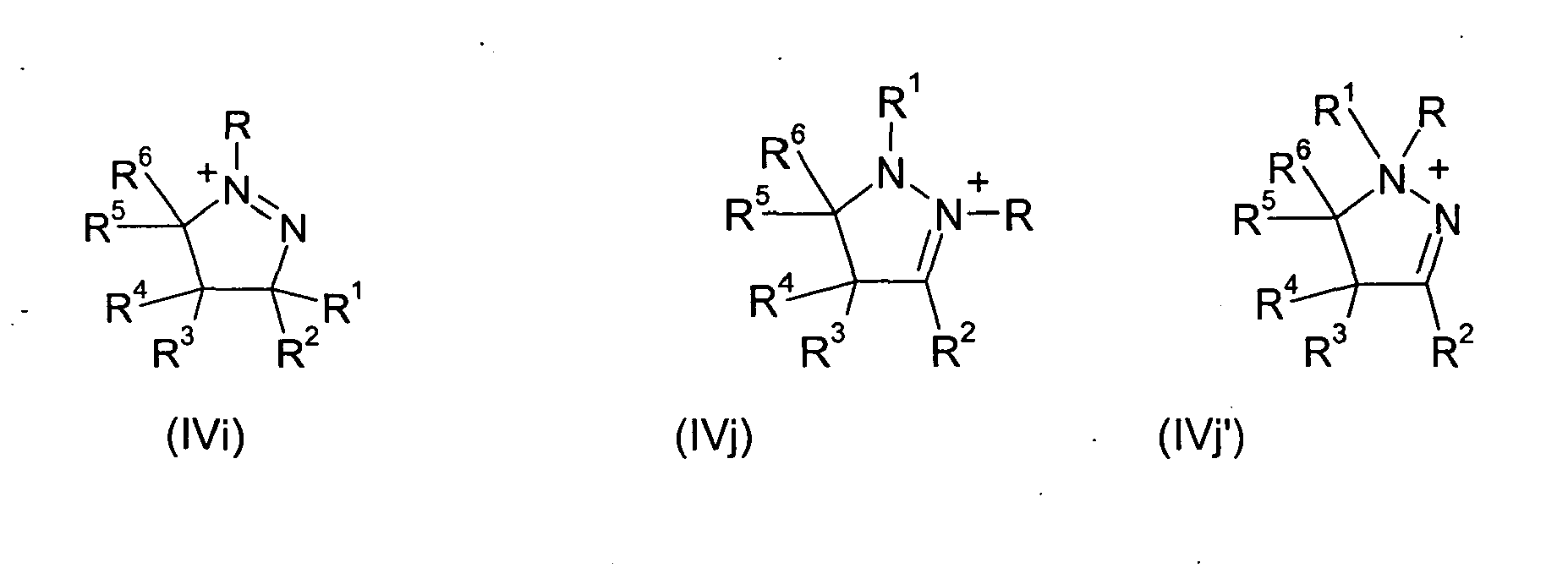
- Suitable cations are, for example, the cations of the general formulas (IVa) to (IVy) and oligomers containing these structures.
- morpholinium can be chosen.
- Another suitable cation is also a phosphonium cation of the general formula (IVy) and oligomers containing this structure.
- the radical R is a carbon-containing organic, saturated or unsaturated, acyclic or cyclic, aliphatic, aromatic or araliphatic, unsubstituted or interrupted by 1 to 5 heteroatoms or functional groups radical having 1 to 20 carbon atoms;
- radicals R 1 to R 9 independently of one another are hydrogen, a sulfo group or a carbon-containing organic, saturated or unsaturated, acyclic or cyclic, aliphatic, aromatic or araliphatic, unsubstituted or interrupted by 1 to 5 heteroatoms or functional groups having 1 to 20 carbon atoms, wherein the radicals R 1 to R 9 , which in the abovementioned formulas (IV) are bonded to a carbon atom (and not to a heteroatom), additionally may also stand for halogen or a functional group; or
- two adjacent radicals from the series R 1 to R 9 together also for a divalent, carbon-containing organic, saturated or unsaturated, acyclic or cyclic, aliphatic, aromatic or araliphatic, unsubstituted or interrupted by 1 to 5 heteroatoms or functional groups radical or substituted 1 to 30 carbon atoms.
- the radicals R 1 to R 9 are, in the cases in which those in the above formulas (IV) to a carbon atom (and not to a heteroatom) bound also be bound directly via the heteroatom.
- Fractional groups and heteroatoms can also be directly adjacent, so that combinations of several adjacent atoms, such as -O- (ether), -S- (thioether), -COO- (ester), - CONH- (secondary amide) or -CONR'- (tertiary amide) are included, for example, di (C 1 -C 4 alkyl) amino, C 1 -C 4 alkyloxycarbonyl or C 1 -C 4 alkyloxy.
- Halogens are fluorine, chlorine, bromine and iodine.
- the radical R preferably stands for
- the radical R is unbranched and unsubstituted C 1 -C 18 -alkyl, such as, for example, methyl, ethyl, 1-propyl, 1-butyl, 1-pentyl, 1-hexyl, 1-heptyl, 1-octyl, 1 Decyl, 1-dodecyl, 1-tetradecyl, 1-hexadecyl, 1-octadecyl, in particular methyl, ethyl, 1-butyl and 1-octyl and CH 3 O- (CH 2 CH 2 O) p -CH 2 CH 2 - and CH 3 CH 2 O- (CH 2 CH 2 O) p -CH 2 CH 2 - with p equal to 0 to 3.
- C 1 -C 18 -alkyl such as, for example, methyl, ethyl, 1-propyl, 1-butyl, 1-pentyl, 1-hexyl, 1-heptyl, 1-octy
- radicals R 1 to R 9 are preferably each independently
- aryl, alkyl, aryloxy, alkyloxy, halogen, heteroatoms and / or heterocycles C 1 - to C 18 -alkyl it is preferably methyl, ethyl, 1-propyl, 2-propyl, 1-butyl , 2-butyl, 2-methyl-1-propyl (isobutyl), 2-methyl-2-propyl (tert-butyl), 1-pentyl, 2-pentyl, 3-pentyl, 2-methyl-1-butyl, 3-methyl-1-butyl, 2-methyl-2-butyl, 3-methyl-2-butyl, 2,2-dimethyl-1-propyl, 1-hexyl, 2-hexyl, 3-hexyl, 2-methyl 1-pentyl, 3-methyl-1-pentyl, 4-methyl-1-pentyl, 2-methyl-2-pentyl, 3-methyl-2-pentyl, 4-methyl-2-pentyl, 2-methyl-3 pentyl
- aryl, alkyl, aryloxy, alkyloxy, halogen, heteroatoms and / or heterocycles C 6 -C 12 aryl is preferably phenyl, tolyl, xylyl, ⁇ -naphthyl, ⁇ -naphthyl, 4- Diphenylyl, chlorophenyl, dichlorophenyl, trichlorophenyl, difluorophenyl, methylphenyl, dimethylphenyl, trimethylphenyl, ethylphenyl, diethylphenyl, iso-propylphenyl, t-butylphenyl, dodecylphenyl, methoxyphenyl, dimethoxyphenyl, ethoxyphenyl, hexyloxyphenyl, methylnaphthyl, isopropylnaphthyl, chloronaphthyl
- C 5 -C 12 -cycloalkyl optionally substituted by functional groups, aryl, alkyl, aryloxy, alkyloxy, halogen, heteroatoms and / or heterocycles is preferably cyclopentyl, cyclohexyl, cyclooctyl, cyclododecyl, methylcyclopentyl, dimethylcyclopentyl, methylcyclohexyl, dimethylcyclohexyl , Diethylcyclohexyl, butylcyclohexyl, methoxycyclohexyl, dimethoxycyclohexyl, diethoxycyclohexyl, butylthiocyclohexyl, chlorocyclohexyl, dichlorocyclohexyl, dichlorocyclopentyl, C q F 2 (qa) (1-b ) H 2a-b with q ⁇ 30, 0 ⁇ a ⁇ q and
- An optionally substituted by functional groups, aryl, alkyl, aryloxy, alkyloxy, halogen, heteroatoms and / or heterocycles substituted five- to six-membered, oxygen, nitrogen and / or sulfur atoms containing heterocycle is preferably furyl, thiophenyl, pyrryl, Pyridyl, indolyl, benzoxazolyl, dioxolyl, dioxo, benzimidazolyl, benzthiazolyl, dimethylpyridyl, methylquinolyl, dimethylpyrryl, methoxyfuryl, dimethoxypyridyl or difluoropyridyl.
- Two adjacent radicals together form an unsaturated, saturated or aromatic, optionally substituted by functional groups, aryl, alkyl, aryloxy, alkyloxy, halogen, heteroatoms and / or heterocycles and optionally substituted by one or more oxygen and / or sulfur atoms and / or one or more several substituted or unsubstituted imino groups interrupted ring, it is preferably 1,3-propylene, 1,4-butylene, 1,5-pentylene, 2-oxa-1,3-propylene, 1-oxa-1,3- propylene, 2-oxa-1,3-propylene, 1-oxa-1,3-propenylene, 3-oxa-1,5-pentylene, 1-aza-1,3-propenylene, 1-C 1 -C 4 - Alkyl 1-aza-1,3-propenylene, 1,4-buta-1,3-dienylene, 1-aza-1,4-buta-1,3-dienylene or 2-aza-1,
- radicals contain oxygen and / or sulfur atoms and / or substituted or unsubstituted imino groups
- the number of oxygen and / or sulfur atoms and / or imino groups is not restricted. As a rule, it is not more than 5 in the radical, preferably not more than 4, and very particularly preferably not more than 3.
- radicals contain heteroatoms, then between two heteroatoms there are generally at least one carbon atom, preferably at least two carbon atoms.
- radicals R 1 to R 9 are each independently
- Hydrogen unbranched or branched unsubstituted or monosubstituted to hydroxyl, halogen, phenyl, cyano, C 1 -C 6 alkoxycarbonyl and / or sulfonic acid substituted C 1 -C 18 alkyl having a total of 1 to 20 carbon atoms, such as methyl, ethyl, 1-propyl, 2-propyl, 1-butyl, 2-butyl, 2-methyl-1-propyl (isobutyl), 2-methyl-2-propyl (tert-butyl), 1-pentyl, 2-pentyl, 3 Pentyl, 2-methyl-1-butyl, 3-methyl-1-butyl, 2-methyl-2-butyl, 3-methyl-2-butyl, 2,2-dimethyl-1-propyl, 1-hexyl, 2 Hexyl, 3-hexyl, 2-methyl-1-pentyl, 3-methyl-1-pentyl, 4-methyl-1-pentyl, 2-methyl
- the radicals R 1 to R 9 independently of one another are hydrogen or C 1 -C 18 -alkyl, such as, for example, methyl, ethyl, 1-butyl, 1-pentyl, 1-hexyl, 1-heptyl, 1-octyl, for phenyl, for 2-hydroxyethyl, for 2-cyanoethyl, for 2- (methoxycarbonyl) ethyl, for 2- (ethoxycarbonyl) ethyl, for 2- (n-butoxycarbonyl) ethyl, for N, N-dimethylamino, for N, N -Diethylamino, for chlorine and for CH 3 O- (CH 2 CH 2 O) p -CH 2 CH 2 - and CH 3 CH 2 O- (CH 2 CH 2 O) p CH 2 CH 2 - with p is 0 to third
- R 1 to R 5 is methyl, ethyl or chlorine and the remaining R 1 to R 5 are hydrogen;
- R 3 is dimethylamino and the remaining radicals R 1 , R 2 , R 4 and R 5 are hydrogen; all radicals R 1 to R 5 are hydrogen;
- R 2 is carboxy or carboxamide and the remaining radicals R 1 , R 2 , R 4 and R 5 are hydrogen; or
- R 1 and R 2 or R 2 and R 3 is 1,4-buta-1,3-dienylene and the remaining radicals R 1 , R 2 , R 4 and R 5 are hydrogen;
- R 1 to R 5 are hydrogen; or one of the radicals R 1 to R 5 is methyl or ethyl and the remaining radicals R 1 to R 5 are hydrogen.
- pyridinium ions (IVa) which may be mentioned are 1-methylpyridinium, 1-ethylpyridinium, 1- (1-butyl) pyridinium, 1- (1-hexyl) pyridinium, 1- (1-octyl) pyridinium, 1- (1 Hexyl) pyridinium, 1- (1-octyl) pyridinium, 1- (1-dodecyl) pyridinium, 1- (1-tetradecyl) pyridinium, 1- (1-hexadecyl) pyridinium, 1,2-dimethyl pyridinium , 1-ethyl-2-methylpyridinium, 1- (1-butyl) -2-methylpyridinium, 1- (1-hexyl) -2-methylpyridinium, 1- (1-octyl) -2-methylpyridinium, 1- (1 dodecyl) -2-methylpyridinium, 1- (1-tetradec
- R 1 to R 4 are hydrogen; or one of the radicals R 1 to R 4 is methyl or ethyl and the remaining radicals R 1 to R 4 are hydrogen.
- R 1 is hydrogen, methyl or ethyl and R 2 to R 4 are independently hydrogen or methyl; or
- R 1 is hydrogen, methyl or ethyl
- R 2 and R 4 are methyl and R 3 is hydrogen.
- R 1 is hydrogen, methyl or ethyl and R 2 to R 4 are independently hydrogen or methyl; R 1 is hydrogen, methyl or ethyl, R 2 and R 4 are methyl and R 3 is hydrogen; R 1 to R 4 are methyl; or R 1 to R 4 are methyl hydrogen.
- R 1 is hydrogen, methyl, ethyl, 1-propyl, 1-butyl, 1-pentyl, 1-hexyl, 1-octyl, 2-hydroxyethyl or 2-cyanoethyl and R 2 to R 4 are independently hydrogen, methyl or ethyl.
- imidazolium ions may be mentioned 1-methylimidazolium, 1-ethylimidazolium, 1- (1-butyl) -imidazolium, 1- (1-octyl) -imidazolium, 1- (1-dodecyl) -imidazolium, 1- (1-tetradecyl) -imidazolium, 1- (1-hexadecyl) -imidazolium, 1,3-dimethylimidazolium, 1-ethyl-3-methylimidazolium, 1- (1-butyl ) -3-methylimidazolium, 1- (1-butyl) -3-ethylimidazolium, 1- (1-hexyl) -3-methylimidazolium, 1- (1-hexyl) -3-methylimidazolium, 1- (1-hexyl) -3-ethylimidazolium, 1- (1-hexyl) -3-methylimidazolium
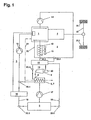
- FIG. 1 is schematically simplified a drive device according to the invention can be seen.
- the drive device comprises an engine 1 in the form of an internal combustion engine, which acts via a gear 4 on a shaft 22 with the drive wheels 23.1, 23.2.
- the drive device comprises a cooling system 2 with a coolant pump 14 and an air / cooling medium heat exchanger 12 to which a fan 13 is assigned.
- the prime mover 1 is cooled.
- the drive device comprises a Lubricant circuit 3, which supplies the drive machine 1 via a lubricant pump 15 lubricating medium.
- the cooling system 2 and the lubricant circuit 3 are fluidically connected by producing the cooling medium and the lubricating medium as a withdrawal from a total operating medium.
- the total operating medium is stored in a collecting reservoir 5 and comprises an ionic liquid and a vaporizable liquid, in particular water.
- the total operating medium is conveyed via the primary pump 17 and arrives at the separation or partial separation of the ionic liquid from the evaporable liquid to a separating device 6, in the present case an evaporator 7. This is acted upon via the exhaust gas guide 24 from the engine 1 with a heat flow.
- the lubricant circuit 3 Another deduction from the evaporator 7 of an enriched with the ionic liquid lubricant leads to the lubricant circuit 3.
- the lubricant can be stored with appropriate switching of the valve 20.4 in the reservoir for the lubricant 16. With sufficient filling of the reservoir for the lubricating medium 16, the influx from the evaporator 7 at the valve 20.4 can be turned off completely.
- no separate heat exchanger for cooling in the lubricant circuit 3 is provided due to the high temperature resistance of the ionic liquid.
- the enriched with the ionic liquid lubricant medium is also used for cooling a high-temperature component of the drive machine.
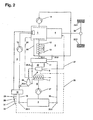
- FIG. 2 Another embodiment of the invention is in FIG. 2 outlined.
- Sketchy illustrated is the coupling of further fluidic circuits to the reservoir for the lubricating medium 16, in detail, it is a connection to Air compressor lubrication 29, a connection to the steering hydraulic system 30, a connection to the retarder hydraulics 31 and a connection to a hydrostatic drive 32.
- an expander 9 reaching connection to the expander lubrication 28 is provided.
- at least a part of said fluidic connections may originate from the collection reservoir 5.
- FIG. 2 an embodiment with a downstream of the evaporator 7 separator 26 in which a separation of the vapor and liquid phases is made.
- the vapor phase is fed to the expander 9 and the liquid phase to the reservoir for the lubricating medium 16.
- the mechanical power generated by the expander 9 is transmitted to the drive train by means of a preferably switchable expander coupling 27.
- the coupling takes place on the secondary side of the transmission 4.
Landscapes
- Engineering & Computer Science (AREA)
- Chemical & Material Sciences (AREA)
- Combustion & Propulsion (AREA)
- Mechanical Engineering (AREA)
- General Engineering & Computer Science (AREA)
- Physics & Mathematics (AREA)
- Thermal Sciences (AREA)
- Lubricants (AREA)
Abstract
Die Erfindung betrifft eine Antriebsvorrichtung, insbesondere für einen Fahrzeugantrieb, umfassend eine Antriebsleistung erzeugende Antriebsmaschine (1), ein Kühlsystem (2) für die Flüssigkeitskühlung der Antriebsmaschine und/oder einer Komponente der Antriebsvorrichtung, die von der Antriebsmaschine wenigstens mittelbar mit Antriebsleistung versorgt wird, wobei im Kühlsystem ein Kühlmedium zirkuliert; einen Schmierstoffkreislauf (3) für die Schmierung wenigstens einer bewegbaren Komponente der Antriebsvorrichtung mit einem Schmiermedium, wobei die Antriebsvorrichtung ferner ein Sammelreservoir (5) umfasst, in dem ein Gesamtbetriebsmedium, das eine Mischung aus einer ionischen Flüssigkeit und einer verdampfbaren Flüssigkeit umfasst, bevorratet ist, wobei das Kühlsystem und der Schmierstoffkreislauf mit dem Sammelreservoir wenigstens mittelbar fluidisch verbunden sind, um Schmiermedium und Kühlmedium aus dem Gesamtbetriebsmedium abzuziehen.
Description
- Die Erfindung betrifft eine Antriebsvorrichtung mit den oberbegrifflichen Merkmalen von Anspruch 1, die insbesondere zum Antrieb eines Fahrzeugs dient, sowie ein Verfahren für deren Betrieb. Neben Fahrzeugantrieben kommen stationäre Antriebsvorrichtungen in Betracht.
- Gattungsgemäße Antriebssysteme mit Antriebsmaschinen, wie beispielsweise Verbrennungsmotoren, Turbinen wie Gasturbinen, Elektromotoren, Brennstoffzellen oder Expansionsmaschinen in Form von Schrauben- oder Kolbenexpandern, weisen typischerweise mehrere Flüssigkeitskreisläufe auf, die jeweils unterschiedlichen Zwecken dienen. Üblicherweise umfassen diese einen geschlossenen Kühlkreislauf zur Flüssigkeitskühlung der Antriebsmaschine oder einer von dieser angetriebenen Komponente. Dabei wird als Kühlmedium typischerweise eine Mischung aus Wasser und Frostschutzmittel, beispielsweise Glykol, verwendet. Des Weiteren werden zur Erzielung einer hohen chemischen und thermischen Stabilität zusätzliche Additive beigemischt. Die Kühlung erfolgt üblicherweise mittels einer Durchströmung von Teilen des Gehäuses der Antriebsmaschine bei einem moderaten Überdruck und Temperaturen unter 115 °C für das Kühlmedium. Für hochbelastete Motoren können zusätzlich separat angelegte Kühlkreislaufe, beispielsweise zur Kolbenkühlung oder zur Kühlung der Lagerung von Turbinenwellen bei Abgasturboladern, verwendet werden.
- Des Weiteren liegt üblicherweise als weiterer Flüssigkeitskreislauf ein Schmierstoffkreislauf vor, in dem mineralölbasierte, synthetische oder halbsynthetische Öle den Lagerungskomponenten zugeführt werden. Dabei sind Schmiermittel insbesondere im Hinblick auf die Viskosität, etwa zur Verringerung der Viskosität bei hoher Temperatur zum Erzielen von Leichtlaufölen, einzustellen.
- Eine wiederum hiervon abweichende Anforderung ergibt sich für Hydraulikmedien, insbesondere für Bremsflüssigkeiten. Diese müssen hygroskopisch sein, um das Entstehen von Wassertropfen innerhalb eines geschlossenen Bremskreises zu vermeiden und so Blasenbildungen beim Erhitzen ausschließen zu können. Die generelle Anforderung eines hohen Siedepunkts erfüllen die heute üblicherweise verwendeten Polyglykolverbindungen und die zugeschlagenen Additive, beispielsweise Korrosionsschutzmittel.
- Ferner sehen energieeffiziente Antriebsvorrichtungen Zusatz- oder Sekundärantriebe zur Abwärmenutzung der primären Antriebsmaschine vor. Hierzu wird Abwärme, beispielsweise im Abgas einer Verbrennungskraftmaschine, zur Verdampfung eines Arbeitsmediums in einem Verdampfer ausgenutzt, wobei die so entstehende Dampfphase zur Verrichtung mechanischer Arbeit einem Expander zugeführt wird und sodann über einen Kondensator als Flüssigphase erneut in den Verdampfer eintritt.
- Aus der
DE 103 28 289 B3 ist als Arbeitsmedium für eine Dampfkreisprozessvorrichtung eine Mischung aus Wasser und wenigstens einer heterozyklischen Verbindung sowie einem Zusatz mischbarer Polymere, tensidischer und/oder sonstiger organischer Schmiermittel bekannt. Als heterozyklische Verbindungen werden insbesondere 2-Methylpyridin, 3-Methylpyridin, Pyridin, Pyrrol und Pyridazin vorgeschlagen. Dabei wird mittels der heterozyklischen Verbindung der Gefrierpunkt der Betriebsflüssigkeit unterhalb 0 °C eingestellt. Zugleich bildet die heterozyklische Verbindung mit Wasser ein Azeotrop, sodass diese zusammen mit dem Wasseranteil im Dampferzeuger in die Gasphase übergeht. Hierbei werden Schmiermittel ebenfalls in der Dampfphase zur Ausführung einer Selbstschmierung zum Expander transportiert. - Nachteilig an den bekannten Betriebsflüssigkeiten für Dampfkreisprozesse ist deren Toxizität, sodass aufwendige Vorkehrungen getroffen werden müssen, um einen Austritt der Betriebsflüssigkeit, beziehungsweise ihrer Gasphase, sicher zu verhindern. Bei einer Verwendung in Fahrzeugen, insbesondere Kraftfahrzeugen, kann dies allerdings im Hinblick auf mögliche Unfallgefahren nicht vollständig ausgeschlossen werden. Weitere, jeweils angepasste Betriebsmedien, ergeben sich für den Betrieb von Fahrzeugretardern sowie für hydraulische Systeme der Fahrzeuglenkung.
- Der Erfindung liegt daher die Aufgabe zugrunde, eine Antriebsvorrichtung mit einer Vereinfachung des Kühlsystems und des Schmierstoffkreislaufes anzugeben. Des Weiteren sind für eine vorteilhafte Ausführung die konstruktive Ausgestaltung sowie der Betrieb von Zusatz- und Nebenaggregaten, wie einer Dampfkreisprozessvorrichtung, eines Retarders sowie von Systemen zur Brennkraft- und Lenkungsunterstützung, zu vereinfachen.
- Die der Erfindung zugrunde liegende Aufgabe wird durch die Merkmale der unabhängigen Ansprüche gelöst. Vorteilhafte Ausgestaltungen ergeben sich aus den Unteransprüchen.
- Die Erfindung beruht auf der Verwendung eines Gesamtbetriebsmediums für die Antriebsvorrichtung, das in der Lage ist, unterschiedliche Anforderungen zum Betrieb des Kühlsystems zum einen und des Schmierstoffkreislaufes zum anderen zu erfüllen. Gemäß einer vorteilhaften Weitergestaltung dient das Gesamtbetriebsmedium zusätzlich zum Betrieb einer Dampfkreisprozessvorrichtung und/oder eines Retarders und/oder weiterer hydraulisch betriebener Systeme, zum Beispiel zum Bremsen oder Lenken eines Kraftfahrzeugs. Als Gesamtbetriebsmedium wird erfindungsgemäß eine Flüssigkeitsmischung vorgeschlagen, die eine oder mehrere ionische Flüssigkeiten und eine verdampfbare Flüssigkeit umfasst. Dabei wird besonders bevorzugt Wasser als verdampfbare Flüssigkeit verwendet. Ferner können zusätzliche Additive zugesetzt werden.
- Eine ionische Flüssigkeit ist ein Salz mit einem Schmelzpunkt kleiner 100 °C bei 1 bar. Vorzugsweise hat die ionische Flüssigkeit in Reinform einen Schmelzpunkt kleiner 70 °C, besonders bevorzugt kleiner 30 °C und ganz besonders bevorzugt kleiner 0 °C bei 1 bar. Für eine besonders bevorzugte Ausführungsform ist die ionische Flüssigkeit unter Normalbedingungen (1 bar, 21 °C), das heißt bei Raumtemperatur, flüssig.
- Ionische Flüssigkeiten zeichnen sich durch einen kaum messbaren Dampfdruck aus. Des Weiteren können chemisch inerte und temperaturstabile ionische Flüssigkeiten gewählt werden, sodass sich die Möglichkeit eröffnet, ein in einem Sammelreservoir bevorratetes Gesamtbetriebsmedium durch eine Veränderung der Mischungsanteile dem vorgesehenen Verwendungszweck anzupassen. Hierzu kann mittels einer Abscheidevorrichtung eine wenigstens teilweise Trennung der ionischen Flüssigkeit von der verdampfbaren Flüssigkeit vorgenommen werden, sodass unterschiedliche Mischungsverhältnisse zwischen der ionischen Flüssigkeit und der verdampfbaren Flüssigkeit eingestellt und im Limit die Mischungsbestandteile ionische Flüssigkeit und verdampfbare Flüssigkeit im Wesentlichen in Reinform vorliegen.
- So kann die ionische Flüssigkeit oder ein mit ionischer Flüssigkeit angereicherter Abzug aus dem Gesamtbetriebsmedium als Schmiermedium zum Betrieb eines Schmierstoffkreislaufes dienen. Aufgrund der hohen Temperaturstabilität der ionischen Flüssigkeit ist die Ausgestaltung des Schmierstoffkreislaufs vereinfacht. Dabei kann insbesondere auf eine separate Kühleinrichtung verzichtet werden und stattdessen das erhitzte Schmiermedium dem Kühlsystem der Antriebsmaschine, insbesondere einem Reservoir für das Kühlmedium oder wiederum dem Sammelreservoir für das Gesamtbetriebsmedium, zugeführt werden.
- Ein mit der verdampfbaren Flüssigkeit angereicherter Abzug oder die im Wesentlichen reine verdampfbare Flüssigkeit kann als Kühlmedium dienen. Alternativ kann das Gesamtbetriebsmedium direkt in den Kühlkreislauf eingespeist werden. Ferner besteht für eine weitergestaltete Antriebsvorrichtung die Möglichkeit, eine Dampfkreisprozessvorrichtung vorzusehen, deren Arbeitsmedium wiederum das Gesamtbetriebsmedium oder ein Abzug aus dem Gesamtbetriebsmedium ist. Besonders bevorzugt wird hierzu die Abscheidevorrichtung zur Trennung der ionischen Flüssigkeit und der verdampfbaren Flüssigkeit als Verdampfer ausgebildet, dem die Abwärme der Antriebsvorrichtung zugeführt wird. Durch Abdampfen wenigstens eines Teils der verdampfbaren Flüssigkeit entsteht eine durch die ionische Flüssigkeit angereicherte Flüssigphase und eine Dampfphase, die zur Entspannung und Verrichtung mechanischer Arbeit einem Expander zugeleitet wird. Für eine alternative Ausgestaltung kann zur Trennung von Dampf- und Flüssigphase ein dem Verdampfer nachgeschalteter Separator verwendet werden. Für eine vorteilhafte Ausgestaltung wird der Expander ausgangsseitig an ein mit einem hinreichenden Puffervolumen versehenen Reservoir für das Kühlmedium angeschlossen, sodass auf einen Kondensator sekundärseitig zum Expander verzichtet werden kann.
- Zusätzlich zur Funktion als Teil eines Schmiermediums ist der ionischen Flüssigkeit im einheitlichen Gesamtbetriebsmedium bevorzugt zusätzlich die Aufgabe einer Frostschutzsicherung zugeordnet. Dabei wird durch die Wahl der Anionen-Kationen-Paarung der ionischen Flüssigkeit der Schmelzpunkt der Mischung mit der verdampfbaren Flüssigkeit als über dem Gefrierpunkt liegend eingestellt.
- Ferner wird von einem Mindestanteil von 0,01 Gew.-% jeweils für die ionische Flüssigkeit und die verdampfbare Flüssigkeit im Gesamtbetriebsmedium ausgegangen. Besonders bevorzugt wird ein tieferliegender Schmelzpunkt der Mischung unterhalb -5 °C, besonders bevorzugt unterhalb -10 °C und weiter bevorzugt unterhalb -30 °C. Dabei werden im Hinblick auf die bevorzugten Temperaturschwellen für ein belüftetes System Normaldruckbedingungen angenommen (1013 mbar). Für ein geschlossenes System wird der jeweilige Systemdruck zur Einstellung der Schmelzpunktemperatur als Referenzdruck herangezogen.
- Dabei soll für das Gesamtbetriebsmedium das Merkmal eines unterhalb des Gefrierpunkts der verdampfbaren Flüssigkeit liegenden Schmelzpunkts wenigstens in einem Mischungsverhältnisbereich gelten, das im Sammelreservoir einer stillgesetzten, kalten Antriebsvorrichtung vorliegt. Bevorzugt wird ein Gewichtsanteil der verdampfbaren Flüssigkeit von wenigstens 10 gw.-% und höchstens 90 gw.-% angenommen, stärker bevorzugt wird hierfür das Intervall von 20 gw.-% bis 80 gw.-%. Besonders bevorzugt wird für den Fall eines kalten Systems ein Gewichtsverhältnis der ionischen Flüssigkeit zu verdampfbarer Flüssigkeit, das im Bereich von 60:40 bis 40:60 liegt. Besonders bevorzugt liegt für die voranstehend genannten Mischungsverhältnisse der Schmelzpunkt der Mischung unterhalb -5 °C, besonders bevorzugt unterhalb -10 °C und weiter bevorzugt unterhalb -30 °C.
- Beim Betrieb kann sich mit zunehmender Temperatur das Mischungsverhältnis im Gesamtbetriebsmedium verschieben. Dies kann bis zur im Wesentlichen vollständigen Abtrennung der ionischen Flüssigkeit vom Gesamtbetriebsmedium führen. Dabei ist es im Rahmen der Erfindung denkbar, das Mischungsverhältnis im Betrieb auf Temperatur so weit zu verändern, dass die Temperaturbedingung für den Schmelzpunkt der Mischung, als unterhalb des Gefrierpunkts der verdampfbaren Flüssigkeit liegend, für bestimmte Betriebsphasen nicht mehr erfüllt ist. Dies wird noch als Teil einer vorteilhaften Ausgestaltung der Erfindung verstanden. Nach dem Anlagenstillstand wird das Mischungsverhältnis im Sammelreservoir wieder zurückgeführt, um die Frostsicherheit erneut sicherzustellen.
- Bevorzugte ionische Flüssigkeiten zur Ausführung der Erfindung enthalten zumindest eine organische Verbindung als Kation, ganz besonders bevorzugt enthalten sie ausschließlich organische Verbindungen als Kationen. Geeignete organische Kationen sind insbesondere organische Verbindungen mit Heteroatomen, wie Stickstoff, Schwefel oder Phosphor. Besonders bevorzugt handelt es sich um organische Verbindungen mit mindestens einer, vorzugsweise genau einer kationischen Gruppe, ausgewählt aus einer Ammonium-Gruppe, einer Oxonium-Gruppe, einer Sulfonium-Gruppe oder einer Phosphonium-Gruppe.
- Insbesondere kommen ionische Flüssigkeiten in Betracht, die als Anion ein C1 bis C4 -Alkylsulfonat, vorzugsweise Methylsulfonat, ein ganz oder teilweise fluoriertes C1 bis C4 Alkylsulfonat, vorzugsweise Trifluormethylsulfonat enthalten. Besonders bevorzugte ionische Flüssigkeiten sind solche, welche ein Kation der Formel IV a ( Pyridinium) oder IV e (Imidazolium) oder IV x (Phosphonium) oder IV y (Morpholinium) und als Anion ein C1 bis C4-Alkylsulfonat, vorzugsweise Methylsulfonat, ein ganz oder teilweise fluoriertes C1 bis C4 Alkylsulfonat, vorzugsweise Trifluormethylsulfonat enthalten, beziehungsweise in einer ganz besonders bevorzugten Ausführungsform ausschließlich aus einem derartigen Kation und Anion bestehen.
- In einer besonderen Ausführungsform handelt es sich bei den ionischen Flüssigkeiten um Salze mit Ammonium-Kationen, worunter Verbindungen mit vierbindigem Stickstoff und lokalisierter positiver Ladung am Stickstoff oder aromatische Ringsysteme mit mindestens einem, vorzugsweise einem oder zwei, besonders bevorzugt zwei Stickstoffatomen im Ringsystem und einer delokalisierten positiven Ladung verstanden werden.
- Besonders bevorzugte Ammonium-Kationen sind die Imidazolium-Kationen, worunter alle Verbindungen mit einem lmidazolium-Ringsystem und gegebenenfalls beliebigen Substituenten an den Kohlenstoff- und/oder Stickstoffatomen des Ringsystems verstanden werden.
- Bei dem Anion kann es sich um ein organisches oder anorganisches Anion handeln. Besonders bevorzugte ionische Flüssigkeiten bestehen ausschließlich aus dem Salz eines organischen Kations mit einem der nachstehend genannten Anionen.
- Das Molgewicht der ionischen Flüssigkeiten ist vorzugsweise kleiner 2000g/mol, besonders bevorzugt kleiner 1500 g/mol, besonders bevorzugt kleiner 1000 g/mol und ganz besonders bevorzugt kleiner 750 g/mol; in einer besonderen Ausführungsform liegt das Molgewicht zwischen 100 und 750 bzw. zwischen 100 und 500 g/mol.
- Geeignete ionische Flüssigkeiten sind insbesondere Salze der nachstehenden allgemeinen Formel I
[A]n + [Y]n- (I)
in der n für 1, 2, 3 oder 4 steht, [A]+ für ein Ammonium-Kation, ein Oxonium-Kation, ein Sulfonium-Kation oder ein Phosphonium-Kation und [Y]n- für ein ein-, zwei-, drei- oder vierwertiges Anion steht; - Oder gemischte Salze der allgemeinen Formeln (II)
[A1]+[A2]+ [Y]2- (IIa);
[A1]+[A2]+[A3]+[Y]3- (IIb);
oder
[A1]+[A2]+[A3]+[A4]+[Y]4- (IIC),
wobei [A1]+, [A2]+, [A3]+ und [A4]+ unabhängig voneinander aus den für [A]+ genannten Gruppen ausgewählt sind und [Y]n- die unter B1) genannte Bedeutung besitzt; oder
oder gemischte Salze der allgemeinen Formeln (III)
[A1]+[A2]+[A3]+[M1]+[Y]4- (IIIa);
[A1]+[A2]+[M1]+[M2]+[Y]4- (IIIb);
[A1]+[M1]+[M2]+[M3]+[Y]4- (IIIc);
[A1]+[A2]+[M1]+ [Y]3- (IIId);
[A1]+[A2]+[M1]+[Y]3- (IIIe);
[A1]+[M1]+[Y]2- (IIIf);
[A1]+[A2]+[M1]+[Y]4- (IIIg);
[A1]+[A2]+[M1]+M4- (IIIh);
[A1]+[M5]3+[Y]4- (IIIi);
oder
[A1]+[M4]2+[Y]3- (IIIj)
wobei [A1]+, [A2]+ und [A3]+ unabhängig voneinander aus den für [A]+ genannten Gruppen ausgewählt sind, [Y]n- die unter B1) genannte Bedeutung besitzt und [M1]+, [M2]+, [M3]+ einwertige Metallkationen, [M4]2+ zweiwertige Metallkationen und [M5]3+ dreiwertige Metallkationen bedeuten;
oder Gemische hiervon. - Bevorzugt sind ionische Flüssigkeiten in denen das Kation [A]+ ein Ammonium-Kation ist, welches im Allgemeinen 1 bis 5, bevorzugt 1 bis 3 und besonders bevorzugt 1 bis 2 Stickstoffatome enthält.
- Geeignete Kationen sind beispielsweise die Kationen der allgemeinen Formeln (IVa) bis (IVy)




- Ferner kann Morpholinium gewählt werden.
- Ein weiteres, geeignetes Kation ist auch ein Phosphonium-Kation der allgemeinen Formel (IVy)

- In den oben genannten Formeln (IVa) bis (IVy) stehen der Rest R für einen Kohlenstoff enthaltenden organischen, gesättigten oder ungesättigten, acyclischen oder cyclischen, aliphatischen, aromatischen oder araliphatischen, unsubstituierten oder durch 1 bis 5 Heteroatome oder funktionelle Gruppen unterbrochenen oder substituierten Rest mit 1 bis 20 Kohlenstoffatomen; und
- die Reste R1 bis R9 unabhängig voneinander für Wasserstoff, eine Sulfo-Gruppe oder einen Kohlenstoff enthaltenden organischen, gesättigten oder ungesättigten, acyclischen oder cyclischen, aliphatischen, aromatischen oder araliphatischen, unsubstituierten oder durch 1 bis 5 Heteroatome oder funktionelle Gruppen unterbrochenen oder substituierten Rest mit 1 bis 20 Kohlenstoffatomen, wobei die Reste R1 bis R9, welche in den oben genannten Formeln (IV) an ein Kohlenstoffatom (und nicht an ein Heteroatom) gebunden sind, zusätzlich auch für Halogen oder eine funktionelle Gruppe stehen können; oder
- zwei benachbarte Reste aus der Reihe R1 bis R9 zusammen auch für einen zweibindigen, Kohlenstoff enthaltenden organischen, gesättigten oder ungesättigten, acyclischen oder cyclischen, aliphatischen, aromatischen oder araliphatischen, unsubstituierten oder durch 1 bis 5 Heteroatome oder funktionelle Gruppen unterbrochenen oder substituierten Rest mit 1 bis 30 Kohlenstoffatomen.
- Als Heteroatome kommen bei der Definition der Reste R und R1 bis R9 prinzipiell alle Heteroatome in Frage, welche in der Lage sind, formell eine -CH2-, eine -CH=, eine -C≡ oder eine =C= -Gruppe zu ersetzen. Enthält der den Kohlenstoff enthaltende Rest Heteroatome, so sind Sauerstoff, Stickstoff, Schwefel, Phosphor und Silizium bevorzugt. Als bevorzugte Gruppen seien insbesondere -O-, -S-, - SO-, -SO2-, -NR'-, -N=, -PR'-, -POR'- und -SiR'2- genannt, wobei es sich bei den Resten R' um den verbleibenden Teil des Kohlenstoff enthaltenden Rests handelt. Die Reste R1 bis R9 können dabei in den Fällen, in denen diese in den oben genannten Formeln (IV) an ein Kohlenstoffatom (und nicht an ein Heteroatom) gebunden sind, auch direkt über das Heteroatom gebunden sein.
- Als funktionelle Gruppen kommen prinzipiell alle funktionellen Gruppen in Frage, welche an ein Kohlenstoffatom oder ein Heteroatom gebunden sein können. Als geeignete Beispiele seien -OH (Hydroxy), =O (insbesondere als Carbonylgruppe), -NH2 (Amino), =NH (Imino), -COOH (Carboxy), -CONH2 (Carboxamid), -SO3H (Sulfo) und -CN (Cyano) genannt. Fuktionelle Gruppen und Heteroatome können auch direkt benachbart sein, so dass auch Kombinationen aus mehreren benachbarten Atomen, wie etwa -O- (Ether), -S- (Thioether), -COO- (Ester), - CONH- (sekundäres Amid) oder -CONR'- (tertiäres Amid), mit umfasst sind, beispielsweise Di-(C1-C4-alkyl)-amino, C1-C4-Alkyloxycarbonyl oder C1-C4-Alkyloxy.
- Als Halogene seien Fluor, Chlor, Brom und Iod genannt.
- Bevorzugt steht der Rest R für
- unverzweigtes oder verzweigtes, unsubsituiertes oder ein bis mehrfach mit Hydroxy, Halogen, Phenyl, Cyano, C1- bis C6-Alkoxycarbonyl und/oder Sulfonsäure substituiertes C1- bis C18-Alkyl mit insgesamt 1 bis 20 Kohlenstoffatomen, wie beispielsweise Methyl, Ethyl, 1-Propyl, 2-Propyl, 1-Butyl, 2-Butyl, 2-Methyl-1-propyl (Isobutyl), 2-Methyl-2-propyl (tert.-Butyl), 1-Pentyl, 2-Pentyl, 3-Pentyl, 2-Methyl-1-butyl, 3-Methyl-1-butyl, 2-Methyl-2-butyl, 3-Methyl-2-butyl, 2,2-Dimethyl1-propyl, 1-Hexyl, 2-Hexyl, 3-Hexyl, 2-Methyl-1-pentyl, 3-Methyl-1-pentyl, 4-Methyl-1-pentyl, 2-Methyl-2-pentyl, 3-Methyl-2-pentyl, 4-Methyl-2-pentyl, 2-Methyl-3-pentyl, 3-Methyl-3-pentyl, 2,2-Dimethyl-1-butyl, 2,3-Dimethyl-1-butyl, 3,3-Dimethyl-1-butyl, 2-Ethyl-1-butyl, 2,3-Dimethyl-2-butyl, 3,3-Dimethyl-2-butyl, 1-Heptyl, 1-Octyl, 1-Nonyl, 1-Decyl, 1-Undecyl, 1-Dodecyl, 1-Tetradecyl, 1-Hexadecyl, 1-Octadecyl, 2-Hydroxyethyl, Benzyl, 3-Phenylpropyl, 2-Cyanoethyl, 2-(Methoxycarbonyl)-ethyl, 2-(Ethoxycarbonyl)-ethyl, 2-(n-Butoxycarbonyl)-ethyl, Trifluormethyl, Difluormethyl, Fluormethyl, Pentafluorethyl, Heptafluorpropyl, Heptafluorisopropyl, Nonafluorbutyl, Nonafluorisobutyl, Undecylfluorpentyl, Undecylfluorisopentyl, 6-Hydroxyhexyl und Propylsulfonsäure; Glykole, Butylenglykole und deren Oligomere mit 1 bis 100 Einheiten und einem Wasserstoff oder einem C1- bis C8-Alkyl als Endgruppe, wie beispielsweise RAO-(CHRB-CH2-O)p-CHRB-CH2- oder RAO-(CH2CH2CH2CH2O)p-CH2CH2CH2CH2O- mit RA und RB bevorzugt Wasserstoff, Methyl oder Ethyl und p bevorzugt 0 bis 3, insbesondere 3-Oxabutyl, 3-Oxapentyl, 3,6-Dioxaheptyl, 3,6-Dioxaoctyl, 3,6,9-Trioxadecyl, 3,6,9-Trioxaundecyl, 3,6,9,12-Tetraoxatridecyl und 3,6,9,12-Tetraoxatetradecyl; Vinyl; und N,N-Di-C1-C6-alkylamino, wie beispielsweise N,N-Dimethylamino und N,N-Diethylamino.
- Besonders bevorzugt steht der Rest R für unverzweigtes und unsubstituiertes C1-C18-Alkyl, wie beispielsweise Methyl, Ethyl, 1-Propyl, 1-Butyl, 1-Pentyl, 1-Hexyl, 1-Heptyl, 1-Octyl, 1-Decyl, 1-Dodecyl, 1-Tetradecyl, 1-Hexadecyl, 1-Octadecyl, insbesondere für Methyl, Ethyl, 1-Butyl und 1-Octyl sowie für CH3O-(CH2CH2O)p-CH2CH2- und CH3CH2O-(CH2CH2O)p-CH2CH2- mit p gleich 0 bis 3.
- Bevorzugt stehen die Reste R1 bis R9 unabhängig voneinander für
- Wasserstoff;
Halogen;
eine funktionelle Gruppe;
gegebenenfalls durch funktionelle Gruppen, Aryl, Alkyl, Aryloxy, Alkyloxy, Halogen, Heteroatome und/oder Heterocyclen substituiertes und/oder durch ein oder mehrere Sauerstoff- und/oder Schwefelatome und/oder ein oder mehrere substituierte oder unsubstituierte Iminogruppen unterbrochenes C1-C18-Alkyl; gegebenenfalls durch funktionelle Gruppen, Aryl, Alkyl, Aryloxy, Alkyloxy, Halogen, Heteroatome und/oder Heterocyclen substituiertes und/oder durch ein oder mehrere Sauerstoff- und/oder Schwefelatome und/oder ein oder mehrere substituierte oder unsubstituierte Iminogruppen unterbrochenes C2-C18-Alkenyl; gegebenenfalls durch funktionelle Gruppen, Aryl, Alkyl, Aryloxy, Alkyloxy, Halogen, Heteroatome und/oder Heterocyclen substituiertes C6-C12-Aryl; gegebenenfalls durch funktionelle Gruppen, Aryl, Alkyl, Aryloxy, Alkyloxy, Halogen, Heteroatome und/oder Heterocyclen substituiertes C5-C12-Cycloalkyl; gegebenenfalls durch funktionelle Gruppen, Aryl, Alkyl, Aryloxy, Alkyloxy, Halogen, Heteroatome und/oder Heterocyclen substituiertes C5-C12-Cycloalkenyl; oder
einen gegebenenfalls durch funktionelle Gruppen, Aryl, Alkyl, Aryloxy, Alkyloxy, Halogen, Heteroatome und/oder Heterocyclen substituierten fünf- bis sechsgliedrigen, Sauerstoff-, Stickstoff- und/oder Schwefelatome aufweisenden Heterocyclus bedeuten; oder
zwei benachbarte Reste zusammen für
einen ungesättigten, gesättigten oder aromatischen, gegebenenfalls durch funktionelle Gruppen, Aryl, Alkyl, Aryloxy, Alkyloxy, Halogen, Heteroatome und/oder Heterocyclen substituierten und gegebenenfalls durch ein oder mehrere Sauerstoff- und/oder Schwefelatome und/oder ein oder mehrere substituierte oder unsubstituierte Iminogruppen unterbrochenen Ring. - Bei gegebenenfalls durch funktionelle Gruppen, Aryl, Alkyl, Aryloxy, Alkyloxy, Halogen, Heteroatome und/oder Heterocyclen substituiertem C1- bis C18-Alkyl handelt es sich bevorzugt um Methyl, Ethyl, 1-Propyl, 2-Propyl, 1-Butyl, 2-Butyl, 2-Methyl-1-propyl (Isobutyl), 2-Methyl-2-propyl (tert.-Butyl), 1-Pentyl, 2-Pentyl, 3-Pentyl, 2-Methyl-1-butyl, 3-Methyl-1-butyl, 2-Methyl-2-butyl, 3-Methyl-2-butyl, 2,2-Dimethyl-1-propyl, 1-Hexyl, 2-Hexyl, 3-Hexyl, 2-Methyl-1-pentyl, 3-Methyl-1-pentyl, 4-Methyl-1-pentyl, 2-Methyl-2-pentyl, 3-Methyl-2-pentyl, 4-Methyl-2-pentyl, 2-Methyl-3-pentyl, 3-Methyl-3-pentyl, 2,2-Dimethyl-1-butyl, 2,3-Dimethyl-1-butyl, 3,3-Dimethyl-1-butyl, 2-Ethyl-1-butyl, 2,3-Dimethyl-2-butyl, 3,3-Dimethyl-2-butyl, Heptyl, Octyl, 2-Etylhexyl, 2,4,4-Trimethylpentyl, 1,1,3,3-Tetramethylbutyl, 1-Nonyl, 1-Decyl, 1-Undecyl, 1-Dodecyl, 1-Tridecyl, 1-Tetradecyl, 1-Pentadecyl, 1-Hexadecyl, 1-Heptadecyl, 1-Octadecyl, Cyclopentylmethyl, 2-Cyclopentylethyl, 3-Cyclopentylpropyl, Cyclohexylmethyl, 2-Cyclohexylethyl, 3-Cyclohexylpropyl, Benzyl (Phenylmethyl), Diphenylmethyl (Benzhydryl), Triphenylmethyl, 1-Phenylethyl, 2-Phenylethyl, 3-Phenylpropyl, α,a-Dimethylbenzyl, p-Tolylmethyl, 1-(p-Butylphenyl)-ethyl, p-Chlorbenzyl, 2,4-Dichlorbenzyl, p-Methoxybenzyl, m-Ethoxybenzyl, 2-Cyanoethyl, 2-Cyanopropyl, 2-Methoxycarbonylethyl, 2-Ethoxycarbonylethyl, 2-Butoxycarbonylpropyl, 1,2-Di-(methoxycarbonyl)-ethyl, Methoxy, Ethoxy, Formyl, 1,3-Dioxolan-2-yl, 1,3-Dioxan-2-yl, 2-Methyl-1,3-dioxolan-2-yl, 4-Methyl-1,3-dioxolan-2-yl, 2-Hydroxyethyl, 2-Hydroxypropyl, 3-Hydroxypropyl, 4-Hydroxybutyl, 6-Hydroxyhexyl, 2-Aminoethyl, 2-Aminopropyl, 3-Aminopropyl, 4-Aminobutyl, 6-Aminohexyl, 2-Methylaminoethyl, 2-Methylaminopropyl, 3-Methylaminopropyl, 4-Methylaminobutyl, 6-Methylaminohexyl, 2-Dimethylaminoethyl, 2-Dimethylaminopropyl, 3-Dimethylaminopropyl, 4-Dimethylaminobutyl, 6-Dimethylaminohexyl, 2-Hydroxy-2,2-dimethylethyl, 2-Phenoxyethyl, 2-Phenoxypropyl, 3-Phenoxypropyl, 4-Phenoxybutyl, 6-Phenoxyhexyl, 2-Methoxyethyl, 2-Methoxypropyl, 3-Methoxypropyl, 4-Methoxybutyl, 6-Methoxyhexyl, 2-Ethoxyethyl, 2-Ethoxypropyl, 3-Ethoxypropyl, 4-Ethoxybutyl, 6-Ethoxyhexyl, Acetyl, CqF2(q-a)+(1-b)H2a+b mit q gleich 1 bis 30, 0 ≤ a ≤ q und b = 0 oder 1 (beispielsweise CF3, C2F5, CH2CH2-C(q-2)F2(q-2)+1, C6F13, C8F17) C10F21, C12F25), Chlormethyl, 2-Chlorethyl, Trichlormethyl, 1,1-Dimethyl-2-chlorethyl, Methoxymethyl, 2-Butoxyethyl, Diethoxymethyl, Diethoxyethyl, 2-Isopropoxyethyl, 2-Butoxypropyl, 2-Octyloxyethyl, 2-Methoxyisopropyl, 2-(Methoxycarbonyl)-ethyl, 2-(Ethoxycarbonyl)-ethyl, 2-(n-Butoxycarbonyl)-ethyl, Butylthiomethyl, 2-Dodecylthioethyl, 2-Phenylthioethyl, 5-Hydroxy-3-oxa-pentyl, 8-Hydroxy-3,6-dioxa-octyl, 11-Hydroxy-3,6,9-trioxa-undecyl, 7-Hydroxy-4-oxa-heptyl, 11-Hydroxy-4,8-dioxa-undecyl, 15-Hydroxy-4,8,12-trioxa-pentadecyl, 9-Hydroxy-5-oxa-nonyl, 14-Hydroxy-5,10-dioxa-tetradecyl, 5-Methoxy-3-oxa-pentyl, 8-Methoxy-3,6-dioxa-octyl, 11-Methoxy-3,6,9-trioxa-undecyl, 7-Methoxy-4-oxa-heptyl, 11-Methoxy-4,8-dioxa-undecyl, 15-Methoxy-4,8,12-trioxa-pentadecyl, 9-Methoxy-5-oxa-nonyl, 14-Methoxy-5,10-dioxa-tetradecyl, 5-Ethoxy-3-oxa-pentyl, 8-Ethoxy-3,6-dioxa-octyl, 11-Ethoxy-3,6,9-trioxa-undecyl, 7-Ethoxy-4-oxa-heptyl, 11-Ethoxy-4,8-dioxa-undecyl, 15-Ethoxy-4,8,12-trioxa-pentadecyl, 9-Ethoxy-5-oxa-nonyl oder 14-Ethoxy-5,10-oxa-tetradecyl. Bei gegebenenfalls durch funktionelle Gruppen, Aryl, Alkyl, Aryloxy, Alkyloxy, Halogen, Heteroatome und/oder Heterocyclen substituiertes und/oder durch ein oder mehrere Sauerstoff- und/oder Schwefelatome und/oder ein oder mehrere substituierte oder unsubstituierte Iminogruppen unterbrochenes C2-C18-Alkenyl handelt es sich bevorzugt um Vinyl, 2-Propenyl, 3-Butenyl, cis-2-Butenyl, trans-2-Butenyl oder CqF2(q-a)-(1-b)H2a-b mit q ≤ 30, 0 ≤ a ≤ q und b = 0 oder 1.
- Bei gegebenenfalls durch funktionelle Gruppen, Aryl, Alkyl, Aryloxy, Alkyloxy, Halogen, Heteroatome und/oder Heterocyclen substituiertes C6-C12-Aryl handelt es sich bevorzugt um Phenyl, Tolyl, Xylyl, α-Naphthyl, β-Naphthyl, 4-Diphenylyl, Chlorphenyl, Dichlorphenyl, Trichlorphenyl, Difluorphenyl, Methylphenyl, Dimethylphenyl, Trimethylphenyl, Ethylphenyl, Diethylphenyl, iso-Propylphenyl, tert.-Butylphenyl, Dodecylphenyl, Methoxyphenyl, Dimethoxyphenyl, Ethoxyphenyl, Hexyloxyphenyl, Methylnaphthyl, Isopropylnaphthyl, Chlornaphthyl, Ethoxynaphthyl, 2,6-Dimethylphenyl, 2,4,6-Trimethylphenyl, 2,6-Dimethoxyphenyl, 2,6-Dichlorphenyl, 4-Bromphenyl, 2-Nitrophenyl, 4-Nitrophenyl, 2,4-Dinitrophenyl, 2,6-Dinitrophenyl, 4-Dimethylaminophenyl, 4-Acetylphenyl, Methoxyethylphenyl, Ethoxymethylphenyl, Methylthiophenyl, Isopropylthiophenyl oder tert.-Butylthiophenyl oder C6F(5-a)Ha mit 0 ≤ a ≤ 5.
- Bei gegebenenfalls durch funktionelle Gruppen, Aryl, Alkyl, Aryloxy, Alkyloxy, Halogen, Heteroatome und/oder Heterocyclen substituiertes C5- bis C12-Cycloalkyl handelt es sich bevorzugt um Cyclopentyl, Cyclohexyl, Cyclooctyl, Cyclododecyl, Methylcyclopentyl, Dimethylcyclopentyl, Methylcyclohexyl, Dimethylcyclohexyl, Diethylcyclohexyl, Butylcyclohexyl, Methoxycyclohexyl, Dimethoxycyclohexyl, Diethoxycyclohexyl, Butylthiocyclohexyl, Chlorcyclohexyl, Dichlorcyclohexyl, Dichlorcyclopentyl, CqF2(q-a)(1-b)H2a-b mit q ≤ 30, 0 ≤ a ≤ q und b = 0 oder 1 sowie ein gesättigtes oder ungesättigtes bicyclisches System wie z.B. Norbornyl oder Norbornenyl.
- Bei gegebenenfalls durch funktionelle Gruppen, Aryl, Alkyl, Aryloxy, Alkyloxy, Halogen, Heteroatome und/oder Heterocyclen substituiertes C5- C12-Cycloalkenyl handelt es sich bevorzugt um 3-Cyclopentenyl, 2-Cyclohexenyl, 3-Cyclohexenyl, 2,5-Cydohexadienyl oder CqF2(q-a)-3(1-b)H2a-3b mit q ≤ 30, 0 ≤ a ≤ q und b = 0 oder 1.
- Bei einen gegebenenfalls durch funktionelle Gruppen, Aryl, Alkyl, Aryloxy, Alkyloxy, Halogen, Heteroatome und/oder Heterocyclen substituierten fünf- bis sechsgliedrigen, Sauerstoff-, Stickstoff- und/oder Schwefelatome aufweisenden Heterocyclus handelt es sich bevorzugt um Furyl, Thiophenyl, Pyrryl, Pyridyl, Indolyl, Benzoxazolyl, Dioxolyl, Dioxyl, Benzimidazolyl, Benzthiazolyl, Dimethylpyridyl, Methylchinolyl, Dimethylpyrryl, Methoxyfuryl, Dimethoxypyridyl oder Difluorpyridyl.
- Bilden zwei benachbarte Reste gemeinsam einen ungesättigten, gesättigten oder aromatischen, gegebenenfalls durch funktionelle Gruppen, Aryl, Alkyl, Aryloxy, Alkyloxy, Halogen, Heteroatome und/oder Heterocyclen substituierten und gegebenenfalls durch ein oder mehrere Sauerstoff- und/oder Schwefelatome und/oder ein oder mehrere substituierte oder unsubstituierte Iminogruppen unterbrochenen Ring, so handelt es sich bevorzugt um 1,3-Propyfen, 1,4-Butylen, 1,5-Pentylen, 2-Oxa-1,3-propylen, 1-Oxa-1,3-propylen, 2-Oxa-1,3-propylen, 1-Oxa-1,3-propenylen, 3-Oxa-1,5-pentylen, 1-Aza-1,3-propenylen, 1-C1-C4-Alkyl-1-aza-1,3-propenylen, 1,4-Buta-1,3-dienylen, 1-Aza-1,4-buta-1,3-dienylen oder 2-Aza-1,4-buta-1,3-dienylen.
Enthalten die oben genannten Reste Sauerstoff- und/oder Schwefelatome und/oder substituierte oder unsubstituierte Iminogruppen, so ist die Anzahl der Sauerstoff- und/oder Schwefelatome und/oder Iminogruppen nicht beschränkt. In der Regel beträgt sie nicht mehr als 5 in dem Rest, bevorzugt nicht mehr als 4 und ganz besonders bevorzugt nicht mehr als 3. - Enthalten die oben genannten Reste Heteroatome, so befinden sich zwischen zwei Heteroatomen in der Regel mindestens ein Kohlenstoffatom, bevorzugt mindestens zwei Kohlenstoffatome.
- Besonders bevorzugt stehen die Reste R1 bis R9 unabhängig voneinander für
- Wasserstoff;
unverzweigtes oder verzweigtes, unsubsituiertes oder ein bis mehrfach mit Hydroxy, Halogen, Phenyl, Cyano, C1-C6-Alkoxycarbonyl und/oder Sulfonsäure subsituiertes C1-C18-Alkyl mit insgesamt 1 bis 20 Kohlenstoffatomen, wie beispielsweise Methyl, Ethyl, 1-Propyl, 2-Propyl, 1-Butyl, 2-Butyl, 2-Methyl-1-propyl (Isobutyl), 2-Methyl-2-propyl (tert.-Butyl), 1-Pentyl, 2-Pentyl, 3-Pentyl, 2-Methyl-1-butyl, 3-Methyl-1-butyl, 2-Methyl-2-butyl, 3-Methyl-2-butyl, 2,2-Dimethyl-1-propyl, 1-Hexyl, 2-Hexyl, 3-Hexyl, 2-Methyl-1-pentyl, 3-Methyl-1-pentyl, 4-Methyl-1-pentyl, 2-Methyl-2-pentyl, 3-Methyl-2-pentyl, 4-Methyl-2-pentyl, 2-Methyl-3-pentyl, 3-Methyl-3-pentyl, 2,2-Dimethyl-1-butyl, 2,3-Dimethyl-1-butyl, 3,3-Dimethyl-1-butyl, 2-Ethyl-1-butyl, 2,3-Dimethyl-2-butyl, 3,3-Dimethyl-2-butyl, 1-Heptyl, 1-Octyl, 1-Nonyl, 1-Decyl, 1-Undecyl, 1-Dodecyl, 1-Tetradecyl, 1-Hexadecyl, 1-Octadecyl, 2-Hydroxyethyl, Benzyl, 3-Phenylpropyl, 2-Cyanoethyl, 2-(Methoxycarbonyl)-ethyl, 2-(Ethoxycarbonyl)-ethyl, 2-(n-Butoxy-carbonyl)-ethyl, Trifluormethyl, Difluormethyl, Fluormethyl, Pentafluorethyl, Heptafluorpropyl, Heptafluorisopropyl, Nonafluorbutyl, Nonafluorisobutyl, Undecylfluorpentyl, Undecylfluorisopentyl, 6-Hydroxyhexyl und Propylsulfonsäure;
Glykole, Butylenglykole und deren Oligomere mit 1 bis 100 Einheiten und einem Wasserstoff oder einem C1-C8-Alkyl als Endgruppe, wie beispielsweise RAO-(CHR8-CH2-O)p-CHRB-CH2- oder RAO-(CH2CH2CH2CH2O)p-CH2CH2CH2CH2O- mit RA und RB bevorzugt Wasserstoff, Methyl oder Ethyl und p bevorzugt 0 bis 3, insbesondere 3-Oxabutyl, 3-Oxapentyl, 3,6-Dioxaheptyl, 3,6-Dioxaoctyl, 3,6,9-Trioxadecyl, 3,6,9-Trioxaundecyl, 3,6,9,12-Tetraoxatridecyl und 3,6,9,12-Tetraoxatetradecyl;
Vinyl; und
N,N-Di-C1-C6-alkyl-amino, wie beispielsweise N,N-Dimethylamino und N,N-Diethylamino. - Ganz besonders bevorzugt stehen die Reste R1 bis R9 unabhängig voneinander für Wasserstoff oder C1-C18-Alkyl, wie beispielsweise Methyl, Ethyl, 1-Butyl, 1-Pentyl, 1-Hexyl, 1-Heptyl, 1-Octyl, für Phenyl, für 2-Hydroxyethyl, für 2-Cyanoethyl, für 2-(Methoxycarbonyl)ethyl, für 2-(Ethoxycarbonyl)ethyl, für 2-(n-Butoxycarbonyl)ethyl, für N,N-Dimethylamino, für N,N-Diethylamino, für Chlor sowie für CH3O-(CH2CH2O)p-CH2CH2- und CH3CH2O-(CH2CH2O)pCH2CH2- mit p gleich 0 bis 3.
- Ganz besonders bevorzugt sind ionische Flüssigkeiten, bei denen das Kation [A]+ ein Pyridiniumion (IVa) ist, bei dem
- einer der Reste R1 bis R5 Methyl, Ethyl oder Chlor ist und die verbleibenden Reste R1 bis R5 Wasserstoff sind;
R3 Dimethylamino ist und die verbleibenden Reste R1, R2, R4 und R5 Wasserstoff sind;
alle Reste R1 bis R5 Wasserstoff sind;
R2 Carboxy oder Carboxamid ist und die verbleibenden Reste R1, R2, R4 und R5 Wasserstoff sind; oder
R1 und R2 oder R2 und R3 1,4-Buta-1,3-dienylen ist und die verbleibenden Reste R1, R2, R4 und R5 Wasserstoff sind; - und insbesondere ein solches, bei dem
- R1 bis R5 Wasserstoff sind; oder
einer der Reste R1 bis R5 Methyl oder Ethyl ist und die verbleibenden Reste R1 bis R5 Wasserstoff sind. - Als ganz besonders bevorzugte Pyridiniumionen (IVa) seien genannt 1-Methylpyridinium, 1-Ethylpyridinium, 1-(1-Butyl)pyridinium, 1-(1-Hexyl)pyridinium, 1-(1-Octyl)pyridinium, 1-(1-Hexyl)-pyridinium, 1-(1-Octyl)-pyridinium, 1-(1-Dodecyl)-pyridinium, 1-(1-Tetradecyl)-pyridinium, 1-(1-Hexadecyl)-pyridinium, 1,2-Dimethylpyridinium, 1-Ethyl-2-methylpyridinium, 1-(1-Butyl)-2-methylpyridinium, 1-(1-Hexyl)-2-methylpyridinium, 1-(1-Octyl)-2-methylpyridinium, 1-(1-Dodecyl)-2-methylpyridinium,
1-(1-Tetradecyl)-2-methylpyridinium, 1-(1-Hexadecyl)-2-methylpyridinium, 1-Methyl-2-ethylpyridinium, 1,2-Diethylpyridinium, 1-(1-Butyl)-2-ethylpyridinium, 1-(1-Hexyl)-2-ethylpyridinium, 1-(1-Octyl)-2-ethylpyridinium, 1-(1-Dodecyl)-2-ethylpyridinium,
1-(1-Tetradecyl)-2-ethylpyridinium, 1-(1-Hexadecyl)-2-ethylpyridinium, 1,2-Dimethyl-5-ethyl-pyridinium, 1,5-Diethyl-2-methyl-pyridinium, 1-(1-Butyl)-2-methyl-3-ethyl-pyridinium, 1-(1-Hexyl)-2-methyl-3-ethyl-pyridinium und 1-(1-Octyl)-2-methyl-3-ethyl-pyridinium, 1-(1-Dodecyl)-2-methyl-3-ethyl-pyridinium, 1-(1-Tetradecyl)-2-methyl-3-ethyl-pyridinium und 1-(1-Hexadecyl)-2-methyl-3-ethylpyridinium. - Ganz besonders bevorzugt sind ionische Flüssigkeiten, bei denen das Kation [A]+ ein Pyridaziniumion (IVb) ist, bei dem
- R1 bis R4 Wasserstoff sind; oder
einer der Reste R1 bis R4 Methyl oder Ethyl ist und die verbleibenden Reste R1 bis R4 Wasserstoff sind. - Ganz besonders bevorzugt sind ionische Flüssigkeiten, bei denen das Kation [A]+ ein Pyrimidiniumionen (IVc) ist, bei dem
- R1 Wasserstoff, Methyl oder Ethyl ist und R2 bis R4 unabhängig voneinander Wasserstoff oder Methyl sind; oder
- R1 Wasserstoff, Methyl oder Ethyl ist, R2 und R4 Methyl sind und R3 Wasserstoff ist.
- Ganz besonders bevorzugt sind ionische Flüssigkeiten, bei denen das Kation [A]+ ein Pyraziniumionen (IVd) ist, bei dem
- R1 Wasserstoff, Methyl oder Ethyl ist und R2 bis R4 unabhängig voneinander Wasserstoff oder Methyl sind;
R1 Wasserstoff, Methyl oder Ethyl ist, R2 und R4 Methyl sind und R3 Wasserstoff ist;
R1 bis R4 Methyl sind; oder
R1 bis R4 Methyl Wasserstoff sind. - Ganz besonders bevorzugt sind ionische Flüssigkeiten, bei denen das Kation [A]+ ein Imidazoliumion (IVe) ist, bei dem
- R1 Wasserstoff, Methyl, Ethyl, 1-Propyl, 1-Butyl, 1-Pentyl, 1-Hexyl, 1-Octyl, 2-Hydroxyethyl oder 2-Cyanoethyl und R2 bis R4 unabhängig voneinander Wasserstoff, Methyl oder Ethyl sind.
- Als ganz besonders bevorzugte Imidazoliumionen (IVe) seien genannt 1-Methylimidazolium, 1-Ethylimidazolium, 1-(1-Butyl)-imidazolium, 1-(1-Octyl)-imidazolium,
1-(1-Dodecyl)-imidazolium, 1-(1-Tetradecyl)-imidazolium, 1-(1-Hexadecyl)-imidazolium, 1,3-Dimethylimidazolium, 1-Ethyl-3-methylimidazolium, 1-(1-Butyl)-3-methylimidazolium, 1-(1-Butyl)-3-ethylimidazolium, 1-(1-Hexyl)-3-methylimidazolium, 1-(1-Hexyl)-3-ethyl-imidazolium, 1-(1-Hexyl)-3-butyl-imidazolium, 1-(1-Octyl)-3-methylimidazolium, 1-(1-Octyl)-3-ethylimidazolium, 1-(1-Octyl)-3-butylimidazolium, 1-(1-Dodecyl)-3-methylimidazolium, 1-(1-Dodecyl)-3-ethylimidazolium, 1-(1-Dodecyl)-3-butylimidazolium, 1-(1-Dodecyl)-3-octylimidazolium, 1-(1-Tetradecyl)-3-methylimidazolium, 1-(1-Tetradecyl)-3-ethylimidazolium, 1-(1-Tetradecyl)-3-butylimidazolium, 1-(1-Tetradecyl)-3-octylimidazolium, 1-(1-Hexadecyl)-3-methylimidazolium, 1-(1-Hexadecyl)-3-ethylimidazolium, 1-(1-Hexadecyl)-3-butylimidazolium, 1-(1-Hexadecyl)-3-octylimidazolium, 1,2-Dimethylimidazolium, 1,2,3-Trimethylimidazolium, 1-Ethyl-2,3-dimethylimidazolium, 1-(1-Butyl)-2,3-dimethylimidazolium, 1-(1-Hexyl)-2,3-dimethyl-imidazolium, 1-(1-Octyl)-2,3-dimethylimidazolium, 1,4-Dimethylimidazolium, 1,3,4-Trimethylimidazolium, 1,4-Dimethyl-3-ethylimidazolium, 3-butylimidazolium, 1,4-Dimethyl-3-octylimidazolium, 1,4,5-Trimethylimidazolium, 1,3,4,5-Tetramethylimidazolium, 1,4,5-Trimethyl-3-ethylimidazolium, 1,4,5-Trimethyl-3-butylimidazolium und 1,4,5-Trimethyl-3-octylimidazolium. - Nachfolgend werden exemplarische Ausführungsbeispiele der Erfindung anhand von Figurendarstellungen genauer beschrieben. In diesen ist im Einzelnen Folgendes dargestellt:
- Figur 1
- zeigt eine erfindungsgemäße Antriebsvorrichtung in einer Ausgestaltung mit einer zusätzlichen Dampfkreisprozessvorrichtung, für die ein einheitliches Betriebsmedium vorgesehen ist.
- Figur 2
- zeigte eine Weitergestaltung der Antriebsvorrichtung aus
Figur 1 . - Aus
Figur 1 ist schematisch vereinfacht eine erfindungsgemäße Antriebsvorrichtung ersichtlich. Für das vorliegende Ausführungsbeispiel umfasst die Antriebsvorrichtung eine Antriebsmaschine 1 in Form einer Verbrennungskraftmaschine, die über ein Getriebe 4 auf eine Welle 22 mit den Antriebsrädern 23.1, 23.2 wirkt. Die Antriebsvorrichtung umfasst ein Kühlsystem 2 mit einer Kühlmittelpumpe 14 und einem Luft-/Kühlmedium-Wärmetauscher 12, dem ein Ventilator 13 zugeordnet ist. Für die vorliegende Ausführung wird die Antriebsmaschine 1 gekühlt. Des Weiteren umfasst die Antriebsvorrichtung einen Schmierstoffkreislauf 3, der der Antriebsmaschine 1 über eine Schmierstoffpumpe 15 Schmiermedium zuleitet. - Erfindungsgemäß werden das Kühlsystem 2 und der Schmierstoffkreislauf 3 fluidisch verbunden, indem das Kühlmedium und das Schmiermedium als Abzug aus einem Gesamtbetriebsmedium hergestellt werden. Dabei wird das Gesamtbetriebsmedium in einem Sammelreservoir 5 bevorratet und umfasst eine ionische Flüssigkeit und eine verdampfbare Flüssigkeit, insbesondere Wasser. Gefördert wird das Gesamtbetriebsmedium über die Primärpumpe 17 und gelangt zur Trennung oder Teilseparierung der ionischen Flüssigkeit von der verdampfbaren Flüssigkeit zu einer Abscheidevorrichtung 6, vorliegend einem Verdampfer 7. Dieser wird über die Abgasführung 24 aus der Antriebsmaschine 1 mit einem Wärmestrom beaufschlagt. Hierdurch tritt eine Verdampfung eines Teils der verdampfbaren Flüssigkeit ein, die den Verdampfer 7 am Auslass für die Dampfphase 8 verlässt. Diese Dampfphase durchläuft einen Expander 9 einer Dampfkreisprozessvorrichtung 10, die einen elektrischen Generator 20 antreibt, wobei die Dampfphase unter Entspannung mechanische Arbeit verrichtet. Nachfolgend zum Expander 9 kann ein im Einzelnen nicht dargestellter Kondensator angeordnet sein oder gemäß dem vorliegenden Ausführungsbeispiel eine unmittelbare Einspeisung in ein Reservoir 11 für das Kühlmedium erfolgen. Dann wird über das Ventil 20.3 zum Betrieb der Dampfkreisprozessvorrichtung 10 Kühlmedium zur Verwendung als Arbeitsmedium zum Verdampfer 7 zurückgeführt.
- Aus dem Reservoir für das Kühlmedium 11 erfolgt über das Ventil 20.1 eine Zuströmung zum Kühlkreislauf des Kühlsystems 2. Der Rücklauf des aufgeheizten Kühlmediums kann nach entsprechender Schaltung des Ventils 20.2 zum Reservoir für das Kühlmedium 11 zurückführen, wobei vorteilhafterweise das darin befindliche Kühlmedium, das zugleich Arbeitsmedium der Dampfkreisprozessvorrichtung 10 ist, vor dem Eintritt in den Verdampfer 7 vorgewärmt werden kann. Steigt die Temperatur im Reservoir für das Kühlmedium 11 über einen vorgegebenen Temperaturwert, kann bei entsprechender Schaltung der Ventile 20.1, 20.2 das Reservoir für das Kühlmedium 11 bei der Zirkulation des Kühlmediums umgangen werden. Des Weiteren besteht ein Bypass 25 zur Umgehung des Luft-/Kühlmedium- Wärmetauschers 12 im Fall einer kalten Antriebsmaschine 1.
- Ein weiterer Abzug vom Verdampfer 7 eines mit der ionischen Flüssigkeit angereicherten Schmiermediums führt zum Schmierstoffkreislauf 3. Dabei kann das Schmiermedium bei entsprechender Schaltung des Ventils 20.4 im Reservoir für das Schmiermedium 16 bevorratet werden. Bei hinreichender Füllung des Reservoirs für das Schmiermedium 16 kann der Zustrom aus dem Verdampfer 7 am Ventil 20.4 gänzlich abgestellt werden. Für die vorliegende Ausgestaltung wird aufgrund der hohen Temperaturbeständigkeit der ionischen Flüssigkeit kein separater Wärmetauscher zur Kühlung im Schmierstoffkreislauf 3 vorgesehen. Ein solcher ist jedoch denkbar, wenn das mit der ionischen Flüssigkeit angereicherte Schmiermedium zugleich zur Kühlung einer Hochtemperaturkomponente der Antriebsmaschine verwendet wird.
- Über die Rücklaufleitungen 18 und 19 kann ein Rücklauf vom Reservoir für das Kühlmedium 11 und vom Reservoir für das Schmiermedium 16 zum Sammelreservoir 5 bei einer entsprechenden Schaltung der Ventile 20.5 und 20.6 erfolgen. Dies wird insbesondere beim Stillsetzen der Antriebsvorrichtung der Fall sein, soweit der Frostschutz durch einen niedrigen Schmelzpunkt der Mischung aus ionischer Flüssigkeit und verdampfbarer Flüssigkeit im Gesamtbetriebsmedium sichergestellt werden muss.
- Ein weiteres Ausführungsbeispiel der Erfindung ist in
Figur 2 skizziert. Dabei werden für Komponenten, die mit der Ausgestaltung gemäßFigur 1 übereinstimmen, die gleichen Bezugszeichen verwendet. Skizzenhaft dargestellt ist die Ankopplung weiterer fluidischer Kreisläufe an das Reservoir für das Schmiermedium 16, im Einzelnen handelt es sich um eine Verbindung zur Luftkompressorschmierung 29, eine Verbindung zur Lenksystem-Hydraulik 30, eine Verbindung zur Retarder-Hydraulik 31 und eine Verbindung zu einem Hydrostatikantrieb 32. Ferner ist eine zum Expander 9 reichende Verbindung zur Expanderschmierung 28 vorgesehen. Für eine nicht dargestellte Ausgestaltungsalternative kann wenigstens ein Teil der genannten fluidischen Verbindungen vom Sammelreservoir 5 ausgehen. - Ferner zeigt
Figur 2 eine Ausführung mit einem dem Verdampfer 7 nachgeschalteten Separator 26, in dem eine Trennung der Dampf- und Flüssigphasen vorgenommen wird. Dabei wird die Dampfphase dem Expander 9 und die Flüssigphase dem Reservoir für das Schmiermedium 16 zugeleitet. Des Weiteren wir für das dargestellte Ausführungsbespiel die vom Expander 9 erzeugte mechanische Leistung mittels einer vorzugsweise schaltbaren Expandereinkopplung 27 zum Antriebsstrang übertragen. Vorliegend erfolgt die Einkopplung auf der Sekundärseite des Getriebes 4. - Weitere Ausgestaltungen der Erfindung in Rahmen der nachfolgenden Schutzansprüche sind denkbar. Insbesondere besteht die Möglichkeit, dem Gesamtbetriebsmedium zusätzlich Additive zuzuführen oder eine solche Zumischung in einem Teilbereich des mit dem Sammelreservoir 5 verbundenen fluidischen System auszuführen. Dabei wird besonders bevorzugt, zur Anpassung an eine bestimmte Funktion lokal eine ionische Flüssigkeit zuzugeben, die vor der Rückführung zum Sammelreservoir 5 wiederum abscheidbar ist. Dabei ist eine Aufbereitung des Flüssigkeitsabzugs zur Verwendung in einem Bremssystem möglich.
-
- 1
- Antriebsmaschine
- 2
- Kühlsystem
- 3
- Schmierstoffkreislauf
- 4
- Getriebe
- 5
- Sammelreservoir
- 6
- Abscheidevorrichtung
- 7
- Verdampfer
- 8
- Auslass für die Dampfphase
- 9
- Expander
- 10
- Dampfkreisprozessvorrichtung
- 11
- Reservoir für das Kühlmedium
- 12
- Luft-/Kühlmedium-Wärmetauscher
- 13
- Ventilator
- 14
- Kühlmittelpumpe
- 15
- Schmierstoffpumpe
- 16
- Reservoir für das Schmiermedium
- 17
- Primärpumpe
- 18, 19
- Rücklaufleitung
- 20
- elektrischer Generator
- 20.1,20.2, 20.3, 20.4, 20.5, 20.6
- Ventil
- 22
- Welle
- 23.1, 23.2
- Antriebsrad
- 24
- Abgasführung
- 25
- Bypass
- 26
- Separator
- 27
- Expandereinkopplung
- 28
- Verbindung zur Expanderschmierung
- 29
- Verbindung zur Luftkompressorschmierung
- 30
- Verbindung zur Lenksystem-Hydraulik
- 31
- Verbindung zur Retarder-Hydraulik
- 32
- Verbindung zu einem Hydrostatikantrieb
Claims (16)
- Antriebsvorrichtung, insbesondere für einen Fahrzeugantrieb, umfassend1.1 eine Antriebsleistung erzeugende Antriebsmaschine (1);1.2 ein Kühlsystem (2) für die Flüssigkeitskühlung der Antriebsmaschine (1) und/oder einer Komponente der Antriebsvorrichtung, die von der Antriebsmaschine (1) wenigstens mittelbar mit Antriebsleistung versorgt wird, wobei im Kühlsystem (2) ein Kühlmedium zirkuliert;1.3 einen Schmierstoffkreislauf (3) für die Schmierung wenigstens einer bewegbaren Komponente der Antriebsvorrichtung mit einem Schmiermedium,
dadurch gekennzeichnet, dass1.4 die Antriebsvorrichtung ferner ein Sammelreservoir (5) umfasst, in dem ein Gesamtbetriebsmedium, das eine Mischung aus wenigstens einer ionischen Flüssigkeit und wenigstens einer verdampfbaren Flüssigkeit umfasst, bevorratet ist, wobei das Kühlsystem (2) und der Schmierstoffkreislauf (3) mit dem Sammelreservoir (5) wenigstens mittelbar fluidisch verbunden sind, um Schmiermedium und Kühlmedium aus dem Gesamtbetriebsmedium abzuziehen. - Antriebsvorrichtung nach Anspruch 1, dadurch gekennzeichnet, dass die verdampfbare Flüssigkeit Wasser ist.
- Antriebsvorrichtung nach einem der Ansprüche 1 oder 2, dadurch gekennzeichnet, dass das Gesamtbetriebsmedium wenigstens im Sammelreservoir (5) einen Mindestgewichtsanteil der ionischen Flüssigkeit und der verdampfbare Flüssigkeit aufweist, der jeweils wenigstens 0,01 Gw.-% beträgt.
- Antriebsvorrichtung nach einem der vorausgehenden Ansprüche, dadurch gekennzeichnet, dass die Schmelztemperatur des Gesamtbetriebsmediums wenigstens im Sammelreservoir (5) unter 0 °C, bevorzugt unter -5 °C, stärker bevorzugt unter -10 °C und besonders bevorzugt unter -30 °C liegt.
- Antriebsvorrichtung nach einem der vorausgehenden Ansprüche, dadurch gekennzeichnet, dass die Antriebsvorrichtung ferner eine Abscheidevorrichtung (6) umfasst, die die ionische Flüssigkeit und die verdampfbare Flüssigkeit im Gesamtbetriebsmedium wenigstens teilweise trennt.
- Antriebsvorrichtung nach Anspruch 5, dadurch gekennzeichnet, dass die Abscheidevorrichtung (6) einen Verdampfer (7) und/oder einen Separator (26) umfasst, wobei der Verdampfer (7) und/oder der Separator (26) wenigstens mittelbar mit einem Expander (9) einer Dampfkreisprozessvorrichtung (10) in fluidischer Verbindung stehen.
- Antriebsvorrichtung nach Anspruch 6, dadurch gekennzeichnet, dass der Expander (9) abstromseitig mit dem Reservoir für das Kühlmedium (11) in Verbindung steht.
- Antriebsvorrichtung nach einem der vorausgehenden Ansprüche, ferner umfassend Mittel zur Einstellung des Konzentrationsverhältnisses von ionischer Flüssigkeit zur verdampfbaren Flüssigkeit im Schmiermedium und/oder im Kühlmedium .
- Antriebsvorrichtung nach einem der vorausgehenden Ansprüche, dadurch gekennzeichnet, dass das Sammelreservoir (5) und/oder Reservoir für das Schmiermedium (16) eine Verbindung zur Expanderschmierung (28) und/oder eine Verbindung zur Luftkompressorschmierung (29) und/oder eine Verbindung zur Lenksystem-Hydraulik (30) und/oder eine Verbindung zur Retarder-Hydraulik (31) und/oder eine Verbindung zu einem Hydrostatikantrieb (32) und/oder eine Verbindung zu einem Bremssystem umfassen.
- Antriebsvorrichtung nach einem der vorausgehenden Ansprüche, dadurch gekennzeichnet, dass das Sammelreservoir (5) fluidisch mit einem Retarder und/oder einem Lenksystem und/oder einem Bremssystem zum Betrieb mit einem aus dem Gesamtbetriebsmedium abgezogenen Hydraulikmedium verbunden ist.
- Antriebsvorrichtung nach einem der vorausgehenden Ansprüche, dadurch gekennzeichnet, dass die Zersetzungstemperatur der ionischen Flüssigkeit höher als 200 °C und bevorzugt höher als 300 °C und insbesondere höher als 350 °C liegt.
- Antriebsvorrichtung nach einem der vorausgehenden Ansprüche, dadurch gekennzeichnet, dass das Anion der ionischen Flüssigkeit ein C1- bis C4-Alkylsulfonat, vorzugsweise Methylsulfonat, oder ein ganz oder teilweise fluoriertes C1- bis C4-Alkylsulfonat, vorzugsweise Trifluormethylsulfonat, ist.
- Antriebsvorrichtung nach einem der vorausgehenden Ansprüche, dadurch gekennzeichnet, dass das Kation der ionischen Flüssigkeit durch die Formel IV a ( Pyridinium) oder IV e ( Imidazolium) oder IV x (Phosphonium) oder IV y (Morpholinium) festgelegt ist und das Anion der ionischen Flüssigkeit ein C1- bis C4-Alkylsulfonat, vorzugsweise Methylsulfonat, oder ein ganz oder teilweise fluoriertes C1- bis C4-Alkylsulfonat, vorzugsweise Trifluormethylsulfonat, ist.
- Antriebsvorrichtung nach einem der vorausgehenden Ansprüche, dadurch gekennzeichnet, dass die ionische Flüssigkeit als Kationen 1-Ethyl-3-Methyl-Imidazolium (EMIM) umfasst und das Anion aus der Gruppe gewählt ist, die durch HSO4 -, MeSO3 - und CF3SO3 - gebildet wird.
- Antriebsvorrichtung nach einem der vorausgehenden Ansprüche, dadurch gekennzeichnet, dass im Gesamtbetriebsmedium eine Mischung aus wenigstens zwei ionischen Flüssigkeit vorliegt.
- Verfahren zum Betrieb einer Antriebsvorrichtung mit16.1 einer eine Antriebsleistung erzeugenden Antriebsmaschine (1);16.2 einem Kühlsystem (2) für die Flüssigkeitskühlung der Antriebsmaschine (1) und/oder einer Komponente der Antriebsvorrichtung, die von der Antriebsmaschine wenigstens mittelbar mit Antriebsleistung versorgt wird, wobei im Kühlsystem (1) ein Kühlmedium zirkuliert;16.3 einem Schmierstoffkreislauf (3) für die Schmierung wenigstens einer bewegbaren Komponente der Antriebsvorrichtung mit einem Schmiermedium,
gekennzeichnet durch die Verfahrensmerkmale16.4 einer Zuführung eines Gesamtbetriebsmediums aus einem Sammelreservoir (5) zu einer Abscheidevorrichtung (6);16.5 wenigstens teilweise Trennung der Mischung aus ionischer Flüssigkeit und der verdampfbarer Flüssigkeit des Gesamtbetriebsmediums in der Abscheidevorrichtung (6) und16.6 Zuführen eines Kühlmediums mit einem gegenüber dem Gesamtbetriebsmedium erhöhten Gewichtsanteil an ionischer Flüssigkeit von der Abscheidevorrichtung (6) zum Kühlsystem (2) und16.7 Zuführen des Gesamtbetriebsmediums oder eines Abzugs des Gesamtbetriebsmediums als Schmiermedium zum Schmierstoffkreislauf (3).
Applications Claiming Priority (1)
| Application Number | Priority Date | Filing Date | Title |
|---|---|---|---|
| DE200910035861 DE102009035861B3 (de) | 2009-07-31 | 2009-07-31 | Antriebsvorrichtung und Verfahren für deren Betrieb |
Publications (1)
| Publication Number | Publication Date |
|---|---|
| EP2345798A2 true EP2345798A2 (de) | 2011-07-20 |
Family
ID=43495640
Family Applications (1)
| Application Number | Title | Priority Date | Filing Date |
|---|---|---|---|
| EP20100007885 Withdrawn EP2345798A2 (de) | 2009-07-31 | 2010-07-29 | Antriebsvorrichtung und Verfahren für deren Betrieb |
Country Status (3)
| Country | Link |
|---|---|
| US (1) | US8991179B2 (de) |
| EP (1) | EP2345798A2 (de) |
| DE (1) | DE102009035861B3 (de) |
Families Citing this family (12)
| Publication number | Priority date | Publication date | Assignee | Title |
|---|---|---|---|---|
| DE102007006420A1 (de) * | 2007-02-05 | 2008-08-07 | Voith Patent Gmbh | Kraftfahrzeugantriebsstrang eines Kraftfahrzeugs mit einem Druckluftsystem |
| WO2010083198A1 (en) * | 2009-01-13 | 2010-07-22 | Avl North America Inc. | Hybrid power plant with waste heat recovery system |
| DE102009035861B3 (de) * | 2009-07-31 | 2011-02-24 | Voith Patent Gmbh | Antriebsvorrichtung und Verfahren für deren Betrieb |
| AT509394B1 (de) * | 2010-02-05 | 2012-01-15 | Man Nutzfahrzeuge Oesterreich | Verfahren zum betrieb eines kolbenexpanders eines dampfmotors |
| GB2509740A (en) * | 2013-01-11 | 2014-07-16 | Dearman Engine Company Ltd | Cryogenic engine combined with a power generator |
| DE102014206023B4 (de) * | 2014-03-31 | 2023-12-28 | Rolls-Royce Solutions GmbH | System für einen thermodynamischen Kreisprozess, Anordnung mit einer Brennkraftmaschine und einem System, Verfahren zum Schmieren einer Expansionseinrichtung in einem System für einen thermodynamischen Kreisprozess, und Kraftfahrzeug |
| US9562462B2 (en) * | 2014-11-10 | 2017-02-07 | Allison Transmission, Inc. | System and method for powertrain waste heat recovery |
| US10215097B2 (en) | 2015-12-08 | 2019-02-26 | General Electric Company | Thermal management system |
| US10648365B2 (en) | 2015-12-08 | 2020-05-12 | General Electric Company | Gas turbine engine bearing sump and lubricant drain line from cooling passage |
| US20170159564A1 (en) * | 2015-12-08 | 2017-06-08 | General Electric Company | Thermal management system |
| JP6277216B2 (ja) * | 2016-03-17 | 2018-02-07 | 本田技研工業株式会社 | 車両用動力伝達装置の油圧システム |
| DE102018122702A1 (de) * | 2018-09-17 | 2020-03-19 | Man Truck & Bus Se | Kühlsystem und Verfahren zum Konfigurieren eines Kühlsystems |
Citations (1)
| Publication number | Priority date | Publication date | Assignee | Title |
|---|---|---|---|---|
| DE10328289B3 (de) | 2003-06-23 | 2005-01-05 | Enginion Ag | Arbeitsmedium für Dampfkreisprozesse |
Family Cites Families (21)
| Publication number | Priority date | Publication date | Assignee | Title |
|---|---|---|---|---|
| US3973398A (en) * | 1975-09-12 | 1976-08-10 | Deere & Company | Hydraulic system and automatically shiftable direction control valve therefor |
| JPS56138409A (en) * | 1980-03-29 | 1981-10-29 | Yoichi Higuchi | Appliances attached to make more practical torque- causing equipment employing heat of cooling water and exhaust gas |
| IT1145761B (it) * | 1981-04-29 | 1986-11-12 | Enzo Guidoboni | Motore a combustione interna che realizza il ciclo termodinamico con un nuovo procedimento |
| JP2558520B2 (ja) * | 1989-04-10 | 1996-11-27 | 鹿島建設株式会社 | バイナリー・サイクル動力回収装置 |
| DE19502717C1 (de) * | 1995-01-28 | 1996-05-30 | Mtu Friedrichshafen Gmbh | Aufgeladene, mehrzylindrische Brennkraftmaschine mit Abgasrückführung |
| US5667051A (en) * | 1995-03-01 | 1997-09-16 | Sundstrand Corporation | Hydraulic control and lubrication system with compressed air pre-heat circuit for rapid response at low ambient temperatures |
| JP2001271609A (ja) * | 2000-01-18 | 2001-10-05 | Honda Motor Co Ltd | 内燃機関の廃熱回収装置 |
| CA2425433A1 (en) * | 2000-10-10 | 2003-04-09 | Makoto Uda | Rankine cycle system for internal combustion engine |
| JP4071552B2 (ja) * | 2001-07-10 | 2008-04-02 | 本田技研工業株式会社 | ランキンサイクル装置 |
| DE10259488A1 (de) * | 2002-12-19 | 2004-07-01 | Bayerische Motoren Werke Ag | Wärmekraftmaschine |
| US7174732B2 (en) * | 2003-10-02 | 2007-02-13 | Honda Motor Co., Ltd. | Cooling control device for condenser |
| DE102004024289A1 (de) * | 2004-05-15 | 2005-12-15 | Deere & Company, Moline | Kühlsystem für ein Fahrzeug |
| DE102005007100A1 (de) * | 2005-02-16 | 2006-08-17 | Solvent Innovation Gmbh | Prozess- bzw. Arbeitsmaschine mit ionischer Flüssigkeit als Betriebsflüssigkeit |
| DE102005008104A1 (de) * | 2005-02-21 | 2006-09-21 | Behr Gmbh & Co. Kg | Wärmeübertragungssystem |
| DE102005026916A1 (de) * | 2005-06-10 | 2006-12-14 | Linde Ag | Verdichter und Verfahren zum Schmieren und/oder Kühlen eines Verdichters |
| US8091360B2 (en) * | 2005-08-03 | 2012-01-10 | Amovis Gmbh | Driving device |
| DE102006009973A1 (de) * | 2006-03-03 | 2007-09-06 | Cognis Ip Management Gmbh | Bei Raumtemperatur flüssige Verbindungen |
| JP4864689B2 (ja) * | 2006-04-17 | 2012-02-01 | 株式会社デンソー | 流体機械およびランキンサイクル |
| DE102007020086B3 (de) * | 2007-04-26 | 2008-10-30 | Voith Patent Gmbh | Betriebsflüssigkeit für einen Dampfkreisprozess und Verfahren für dessen Betrieb |
| DE102007043373A1 (de) * | 2007-09-12 | 2009-03-19 | Voith Patent Gmbh | Verdampfer für eine Dampfkreisprozessvorrichtung |
| DE102009035861B3 (de) * | 2009-07-31 | 2011-02-24 | Voith Patent Gmbh | Antriebsvorrichtung und Verfahren für deren Betrieb |
-
2009
- 2009-07-31 DE DE200910035861 patent/DE102009035861B3/de not_active Expired - Fee Related
-
2010
- 2010-07-28 US US12/844,908 patent/US8991179B2/en not_active Expired - Fee Related
- 2010-07-29 EP EP20100007885 patent/EP2345798A2/de not_active Withdrawn
Patent Citations (1)
| Publication number | Priority date | Publication date | Assignee | Title |
|---|---|---|---|---|
| DE10328289B3 (de) | 2003-06-23 | 2005-01-05 | Enginion Ag | Arbeitsmedium für Dampfkreisprozesse |
Also Published As
| Publication number | Publication date |
|---|---|
| DE102009035861B3 (de) | 2011-02-24 |
| US20110023483A1 (en) | 2011-02-03 |
| US8991179B2 (en) | 2015-03-31 |
Similar Documents
| Publication | Publication Date | Title |
|---|---|---|
| DE102009035861B3 (de) | Antriebsvorrichtung und Verfahren für deren Betrieb | |
| EP2326802B1 (de) | Betriebsflüssigkeit für eine dampfkreisprozessvorrichtung und ein verfahren für deren betrieb | |
| EP1753837B1 (de) | Verwendung von arbeitsstoffpaaren für absorptionswärmepumpen, absorptionskältemaschinen und wärmetransformatoren | |
| DE102007020086B3 (de) | Betriebsflüssigkeit für einen Dampfkreisprozess und Verfahren für dessen Betrieb | |
| EP2509935B1 (de) | Verfahren zur isomerisierung eines gesättigten, verzweigten und zyklischen kohlenwasserstoffs | |
| EP2379684A2 (de) | Mischungen hydrophober und hydrophiler ionischer flüssigkeiten und ihre verwendung in flüssigkeitsringverdichtern | |
| AU2006234319B2 (en) | Solubility of cellulose in ionic liquids with addition of amino bases | |
| JP5260276B2 (ja) | イオン性液体中のセルロース溶液 | |
| WO2008000666A1 (de) | Verfahren zur acylierung von cellulose mit gezieltem durchschnittlichen polymerisationsgrad | |
| WO2005019183A1 (de) | Verfahren zur herstellung von gereinigten 1,3-substituierten imidazoliumsalzen | |
| WO2006029884A1 (de) | Verfahren zum betrieb eines flüssigringverdichters | |
| EP2476869A1 (de) | Schmierung volumetrisch arbeitender Expansionsmaschinen | |
| WO2008095853A1 (de) | Dmc-katalysatoren, verfahren zu deren herstellung und verwendung davon | |
| WO2009036857A2 (de) | Verdampfer für eine dampfkreisprozessvorrichtung | |
| DE102010028583A1 (de) | Abbau von Polyurethanen in Gegenwart spezieller ionischer Flüssigkeiten und einem geringen Wasseranteil | |
| EP2473574A2 (de) | Ionische flüssigkeiten mit verbesserter viskosität | |
| WO2008138832A1 (de) | Absorptionswärmepumpen, absorptionskältemaschinen und wärmetransformatoren mit schwefeldioxid als kältemittel | |
| JP2013113683A (ja) | イオン液体の評価方法 | |
| DE102005003115A1 (de) | Verfahren zur Abdichtung rotierender Wellen | |
| DE102012008844A1 (de) | Vorrichtung zur Energierückgewinnung aus einem Abwärmstrom einer Verbrennungskraftmaschine in einem Fahrzeug mit einem Arbeitsmedium-Kreislauf und Verfahren zum Betrieb einer Vorrichtung zur Energierückgewinnung aus einem Abwärmestrom einer Verbrennungskraftmaschine | |
| DE102006004917B4 (de) | Vorrichtung und Verfahren zur Kühlung und zur Erzeugung elektrischer Energie sowie Bearbeitungsverfahren und Einrichtung hierfür | |
| DE102009051294A1 (de) | Gefrierschutzmittel | |
| DE102012024022B4 (de) | Vorrichtung zum Umwandeln von thermischer Energie mittels eines thermodynamischen Kreisprozesses | |
| DE102008043580A1 (de) | Schmiermittel, welche ein Alkanolamin enthalten | |
| WO2015039649A1 (de) | Betriebsmittel für einen dampfkreisprozess |
Legal Events
| Date | Code | Title | Description |
|---|---|---|---|
| PUAI | Public reference made under article 153(3) epc to a published international application that has entered the european phase |
Free format text: ORIGINAL CODE: 0009012 |
|
| AK | Designated contracting states |
Kind code of ref document: A2 Designated state(s): AL AT BE BG CH CY CZ DE DK EE ES FI FR GB GR HR HU IE IS IT LI LT LU LV MC MK MT NL NO PL PT RO SE SI SK SM TR |
|
| AX | Request for extension of the european patent |
Extension state: BA ME RS |
|
| RAP1 | Party data changed (applicant data changed or rights of an application transferred) |
Owner name: STEAMDRIVE GMBH |
|
| STAA | Information on the status of an ep patent application or granted ep patent |
Free format text: STATUS: THE APPLICATION IS DEEMED TO BE WITHDRAWN |
|
| 18D | Application deemed to be withdrawn |
Effective date: 20150203 |