EP2342104B1 - Feststellanordnung für eine feststellbremse - Google Patents
Feststellanordnung für eine feststellbremse Download PDFInfo
- Publication number
- EP2342104B1 EP2342104B1 EP09736822.9A EP09736822A EP2342104B1 EP 2342104 B1 EP2342104 B1 EP 2342104B1 EP 09736822 A EP09736822 A EP 09736822A EP 2342104 B1 EP2342104 B1 EP 2342104B1
- Authority
- EP
- European Patent Office
- Prior art keywords
- nose
- tooth
- auxiliary
- engagement
- pawl
- Prior art date
- Legal status (The legal status is an assumption and is not a legal conclusion. Google has not performed a legal analysis and makes no representation as to the accuracy of the status listed.)
- Not-in-force
Links
Images

Classifications
-
- B—PERFORMING OPERATIONS; TRANSPORTING
- B60—VEHICLES IN GENERAL
- B60T—VEHICLE BRAKE CONTROL SYSTEMS OR PARTS THEREOF; BRAKE CONTROL SYSTEMS OR PARTS THEREOF, IN GENERAL; ARRANGEMENT OF BRAKING ELEMENTS ON VEHICLES IN GENERAL; PORTABLE DEVICES FOR PREVENTING UNWANTED MOVEMENT OF VEHICLES; VEHICLE MODIFICATIONS TO FACILITATE COOLING OF BRAKES
- B60T7/00—Brake-action initiating means
- B60T7/02—Brake-action initiating means for personal initiation
- B60T7/04—Brake-action initiating means for personal initiation foot actuated
- B60T7/045—Brake-action initiating means for personal initiation foot actuated with locking and release means, e.g. providing parking brake application
-
- B—PERFORMING OPERATIONS; TRANSPORTING
- B60—VEHICLES IN GENERAL
- B60T—VEHICLE BRAKE CONTROL SYSTEMS OR PARTS THEREOF; BRAKE CONTROL SYSTEMS OR PARTS THEREOF, IN GENERAL; ARRANGEMENT OF BRAKING ELEMENTS ON VEHICLES IN GENERAL; PORTABLE DEVICES FOR PREVENTING UNWANTED MOVEMENT OF VEHICLES; VEHICLE MODIFICATIONS TO FACILITATE COOLING OF BRAKES
- B60T11/00—Transmitting braking action from initiating means to ultimate brake actuator without power assistance or drive or where such assistance or drive is irrelevant
- B60T11/04—Transmitting braking action from initiating means to ultimate brake actuator without power assistance or drive or where such assistance or drive is irrelevant transmitting mechanically
-
- B—PERFORMING OPERATIONS; TRANSPORTING
- B60—VEHICLES IN GENERAL
- B60T—VEHICLE BRAKE CONTROL SYSTEMS OR PARTS THEREOF; BRAKE CONTROL SYSTEMS OR PARTS THEREOF, IN GENERAL; ARRANGEMENT OF BRAKING ELEMENTS ON VEHICLES IN GENERAL; PORTABLE DEVICES FOR PREVENTING UNWANTED MOVEMENT OF VEHICLES; VEHICLE MODIFICATIONS TO FACILITATE COOLING OF BRAKES
- B60T7/00—Brake-action initiating means
- B60T7/02—Brake-action initiating means for personal initiation
- B60T7/08—Brake-action initiating means for personal initiation hand actuated
- B60T7/10—Disposition of hand control
- B60T7/102—Disposition of hand control by means of a tilting lever
- B60T7/104—Disposition of hand control by means of a tilting lever with a locking mechanism
-
- Y—GENERAL TAGGING OF NEW TECHNOLOGICAL DEVELOPMENTS; GENERAL TAGGING OF CROSS-SECTIONAL TECHNOLOGIES SPANNING OVER SEVERAL SECTIONS OF THE IPC; TECHNICAL SUBJECTS COVERED BY FORMER USPC CROSS-REFERENCE ART COLLECTIONS [XRACs] AND DIGESTS
- Y10—TECHNICAL SUBJECTS COVERED BY FORMER USPC
- Y10T—TECHNICAL SUBJECTS COVERED BY FORMER US CLASSIFICATION
- Y10T74/00—Machine element or mechanism
- Y10T74/20—Control lever and linkage systems
- Y10T74/20576—Elements
- Y10T74/20582—Levers
- Y10T74/20612—Hand
-
- Y—GENERAL TAGGING OF NEW TECHNOLOGICAL DEVELOPMENTS; GENERAL TAGGING OF CROSS-SECTIONAL TECHNOLOGIES SPANNING OVER SEVERAL SECTIONS OF THE IPC; TECHNICAL SUBJECTS COVERED BY FORMER USPC CROSS-REFERENCE ART COLLECTIONS [XRACs] AND DIGESTS
- Y10—TECHNICAL SUBJECTS COVERED BY FORMER USPC
- Y10T—TECHNICAL SUBJECTS COVERED BY FORMER US CLASSIFICATION
- Y10T74/00—Machine element or mechanism
- Y10T74/20—Control lever and linkage systems
- Y10T74/20576—Elements
- Y10T74/20636—Detents
- Y10T74/20672—Lever engaging rack
- Y10T74/20684—Lever carried pawl
Definitions
- the invention relates to a locking arrangement for a parking brake for locking a tensioned under brake part according to the preamble of claim 1.
- a first brake member has a toothing, in which a provided on a second brake part pawl engages with an engagement nose and thus secures the two parts against each other in rotational movement.
- a locking arrangement is provided, for example, for locking the brake lever to a lever holder, or for setting a Bremsseilnachstellvorraum when the brake lever is raised and the freewheeling of the adjuster is to be blocked.
- DE 102 12 673 A1 shows a locking arrangement for locking a held under tension of a spring, designed as a cable tensioning disk and pivotable about a main axis brake part, in which a toothing with a plurality of adjacent teeth is provided on the cable tension disc.
- a pawl pivotable about a pawl is pivotally mounted on a brake lever which has an engaging end biased toward the teeth engagement nose of three teeth, which is formed such that all three teeth of the engagement lug in evenly spaced coincide with the pitch of the teeth and can fully engage in the teeth.
- EP 1 258 405 A1 shows a Festellan onion according to the preamble of claim 1, comprising a brake lever, a fixed part with a toothing with a plurality of adjacent teeth, and an engaging in the toothing, the fixed part opposite to the brake lever levered pivotable about a jack pin first latch. Further, an engaging in the toothing, the fixed part opposite to the brake lever levered, arranged around the pawl pin second pawl is arranged on the locking arrangement.
- the first pawl has a first engagement lug which engages the toothing, wherein the first pawl is pivotable relative to the fixed part.
- first pawl on a rectilinear slot, which slot around the pawl pin forms an articulation, wherein a pivoting of the first pawl about the pawl pin and a translational movement of the first pawl along the slot is possible.
- the second pawl has a second engagement nose centrally and a third engagement nose on an end opposite the first engagement nose, which engagement lugs can be brought into engagement with the teeth of the stationary part.
- the second pawl has a curved elongated hole, which slot is also arranged around the pawl pin, so that a pivoting about the pawl pin and a tilting movement along the curved slot is possible.
- the first pawl is biased toward the fixed part by a spring which is fixed at one end to a portion of the first pawl and at another end in a hole in the brake lever.
- the pawl pin is also attached to the brake lever, so that the pawl substantially follows a movement of the brake lever, wherein, depending on the translational position of the pawl relative to the brake lever, the force application direction of the spring changes.
- the second pawl is biased at its third engagement nose having end by a pivotally mounted tension spring in a direction away from the toothing, the tension spring is the other end pivotally supported on a pin on the brake lever, so that when tightening the brake lever, the second pawl not comes into engagement with the teeth.
- the first latch and the second pawl pass through a bearing surface of the first pawl and a projection of the second pawl in an "extended” tightening of the brake actuating lever with each other, so that the transferred from the spring to the first pawl, then changed bias voltage are also transmitted to the second pawl can.
- the brake lever is articulated to the fixed part on a rear pivot axis defining a major axis. When the brake operating lever is actuated, the brake lever and thus the first pawl and the second pawl pivot about the toothing.
- a plane connecting a center axis of the pawl pin and the main axis pivots relative to the pawls, wherein a point of application of the end of the spring moves from one side of the plane to a lower side of the plane and therefore the direction of bias of the first pawl around the ratchet link in a first direction changes so that the second engagement lug is pushed away from the toothing and pressed against the toothing and engages with this.
- the proportion of the bias of the first engagement lug is released in a second direction of the toothing, so that the engagement lug detaches from the toothing in the first direction.
- EP 0 509 870 A1 shows in a first embodiment, a locking arrangement of a handbrake, comprising a lever pivotable about a main axis, to which lever a pawl is articulated by a ratchet, wherein the pawl can be brought with an engagement nose and a guide nose with a low coefficient of friction in engagement with a toothing.
- the guide lug of the engagement lug advances and distances it from the toothing, since the guide lug slides along a toothed comb of the toothing, so that a simple tightening of the lever is made possible.
- both lugs engage in the toothing and the guide lug in contact with the toothing in front of the engagement lug.
- EP 0 509 870 A1 shows in a second embodiment, a modified form of the guide nose, in which case the guide nose is arranged on a pivot lever arranged between the pawl and the toothing.
- the pivot lever has on the side opposite the guide nose and the pawl side facing a projection, wherein during a tightening of the brake lever, the guide lug slides on the one hand along the toothing and on the other hand the projection holds the pawl and thus the engagement lug out of engagement with the toothing.
- the distance between the peaks of the guide lug and the engagement lug is a non-integer multiple of the tooth width of one of the teeth of the toothing.
- DE 102 17 473 C1 shows a device for adjustment of a cable tension of a cable, comprising a lever with a relative to the lever rotatably mounted on a pivoting lever about an axis of rotation gear with a toothing.
- the gear disc is biased about the axis of rotation on the one hand in a clamping direction of the cable through the cable and on the other hand by an opposite to the clamping direction of the cable exciting spiral spring, wherein the coil spring so prevents sagging of the cable.
- a riveted on the lever pawl engages with an engagement nose in the teeth when the lever pivots about a fixed axis relative to the pivot lever.
- a sliding surface arranged fixedly to the engagement nose and arranged at one end of the pawl engages with the toothing and presses the engagement nose into a gap between two teeth of the toothing, the toothed disk being displaced from the lever by the sliding surface is turned.
- a peripheral teeth on the lever is used only for smoking. If the lever is pivoted, then the Engagement nose with the teeth in engagement and tightening a brake by further pivoting of the lever is made possible.
- US 4,872,368 A shows a locking arrangement for a foot brake, comprising a toothing, a pawl pivotable about a pawl with a first engagement nose and a second engagement nose.
- the two engagement lugs can alternately engage in the toothing and thus achieve a determination of the pawl against the toothing.
- JP 09 267729 A shows in a first embodiment, a doublfeststellbremsan extract with a arranged on a pedal toothing, a pawl with a slot, with which slot the pawl is pivotally mounted about a pawl pin.
- the pawl is formed substantially triangular and has at its end facing the toothing on a first engagement nose and a second engagement nose, which can each engage individually in the toothing.
- the pawl is biased by a leg spring either in the direction of the first engagement lug about the pawl journal or in the direction of the second engagement lug about the pawl journal. The direction depends on the position of the pedal and the previous position of the pawl.
- a pivoting of the pawl is limited by a zwischem the pawl and the toothing stop arranged.
- the locking arrangement according to the invention for locking a held under tension brake part has on one brake part a toothing with a plurality of adjacent teeth, and on the other brake part a pawl pivotable about a pawl, which has at least one engagement lug which projects at an engagement end of the pawl and biased in the direction of the toothing, so that upon pivoting the engagement nose can effectively prevent reverse rotation by engaging between two adjacent teeth of the toothing.
- the articulation and the toothing are pivotable relative to each other about a main axis, wherein expediently one of the two brake parts is designed to be non-rotatable to the main axis.
- the pawl is in addition to the engagement nose associated with an auxiliary nose, which is arranged spaced from the engagement nose, it being ensured that upon pivoting of the pawl in the direction of the toothing first the auxiliary nose comes into abutment.
- the auxiliary nose forms a kind of auxiliary bearing point about which the engagement nose can pivot a little way, so that the engagement nose is defined guided into a space between two teeth of the toothing.
- the toothing may be formed as a toothed segment.
- the distance of the effective surfaces of the engagement nose and the auxiliary nose is ensured in that the engagement nose is inserted in a stable position between two teeth of the toothing.
- This is done according to the following principle: If the auxiliary tooth is arranged in a stable position, the pivoting about the auxiliary bearing formed by the auxiliary tooth in the toothing ensures safe and reliable positioning of the engagement nose between two adjacent teeth of the toothing and thus reliable fixing.
- the non-integer distance to the engagement nose ensures that the engagement nose is not in any case an area is pivoted in, in which the engagement nose would assume a metastable position.
- the engagement nose always reaches a stable position. More preferably, a value of one quarter tooth is added to the integer teeth spacing to determine the distance between the meshing tooth and the auxiliary tooth.
- the metastable zone which should be avoided, usually makes no more than a maximum of 15% of a tooth pitch or a tooth width, so that it is ensured that the engagement tooth and the auxiliary tooth do not come into contact with such a metastable zone simultaneously.
- the auxiliary nose is expediently arranged closer to a plane connecting the pawl linkage and the main axis than the engagement nose. Ideally, it is ensured that the plane connecting the two axes, that is to say pawl linkage and main axis, during the depositing movement is punctured by the auxiliary tooth forming an auxiliary bearing in the course of the further placement of the pawl, so that the force acts essentially on the engagement nose and these reliably engages in the toothing. Due to the effective leverage, however, in each case this results in that the force acting on the engagement nose is greater than that which acts on the auxiliary nose.
- the auxiliary nose is spaced from the engagement nose by a plurality of teeth, and precedes the engagement nose with respect to the teeth in the tightening direction.
- the distance between the engagement nose and the auxiliary nose constitutes at least several teeth, that is to say the multiple of the pitch or tooth width of the toothing, preferably twice, possibly up to more than five times and as a rule not more than about seven to ten teeth; In general, the distance also depends on the selected tooth pitch, with a non-integer spacing is preferred. It follows that the teeth or the toothed segment is designed to be longer according to this number of teeth, as required for the actual locking.
- the teeth will be anyway equipped with additional teeth to be able to apply a stronger tension with relaxing brake cable can.
- a number of teeth can be selected that corresponds to a tightening angle of 2 °, increased or decreased by an amount less than 1, that is, for example, a value of 2.25 teeth for one tooth per angular degree, or 4.25 teeth for two teeth each angle degrees.
- a value which is a tightening angle of 3 °, 4 ° or 5 ° enlarged or reduced by a fraction smaller than 1.
- a suitable moment is achieved even at a relatively short distance.
- a gap corresponding to a tooth width is provided between the engaging nose and the auxiliary nose.
- this gap will be a non-integer multiple of a tooth width.
- the pawl associated auxiliary nose is preferably disposed on the pawl itself, wherein optionally a pivotable arrangement via a connecting joint or a one-piece design with the pawl is possible.
- the one-piece design has the advantage that a reliable engagement kinematics can be achieved by the known distance to the engagement nose, a specific bearing is not required and the pawl can be easily made.
- the auxiliary nose is narrower than the engagement nose, wherein the engagement nose is usually designed so that it can penetrate fully between two adjacent teeth of the toothing.
- the distance to the auxiliary nose is a non-integer multiple of the tooth width, this leads to full penetration of the engagement lug in the toothing to the fact that the auxiliary nose can not completely penetrate into a corresponding recess between two other teeth of the toothing, but rather from the low point of the tooth Tals moved out between two adjacent teeth becomes.
- the auxiliary nose is formed narrower than the engagement nose, the difference is approximately one-quarter to one-half of the dimensions of the engagement nose.
- the engagement nose also much thicker, to prevent this ever penetrates into the teeth, in particular as a ball or the like, which can be reliably and reproducibly centered by two tooth tips of the teeth and thus define an auxiliary bearing can.
- the locking pawl is expediently prestressed in the direction of the toothing, wherein, according to a first embodiment, this can be done by a spring acting on the locking pawl, which is provided only for this purpose.
- the locking pawl can also be designed as a double-armed lever, and the bias can be done by a spring member which biases either formed by a first of the two lever arms pawl against the other lever arm, or in the case of a rigid or semi-rigid configuration of the two Lever arms by a spring which biases the second of the two lever arms, in particular pulls.
- the ratchet linkage is equipped with play, whereby the rolling of the auxiliary nose on the toothing is particularly favored, and it is ensured that it does not come to an unintentional blocking of the rolling motion to the auxiliary linkage especially in the metastable impact situation of the auxiliary nose on the teeth.
- the play in the manner of a slot or an ellipse-shaped eye hole in certain orientations particularly preferred, wherein a noise can be suppressed by an easily deformable socket, but it can be used as a game immanente tolerance in the camp.
- the eye bore may also have a defined gap with respect to the inserted pin, which is preferably provided on the side opposite the auxiliary nose.
- the auxiliary nose is preferably formed tooth-shaped, whereby with the exception of the percentage of low probability metastable contact with the tooth flank of a tooth of the teeth a reliable and reproducible intervention in the teeth takes place to form a momentary positive connection.
- auxiliary nose it is possible to form the auxiliary nose with other geometries, for example as a ball or in Kalottenform or as a small gear segment, which favor the rolling movement particularly.
- the auxiliary nose is arranged closer to the Klinkenanlenkung than the engagement nose, wherein due to the pawl movement when pulled over the teeth, the engagement nose is further disengaged than the auxiliary nose, with the result that the auxiliary nose rattles substantially with noise on the teeth ,
- the characteristic rattle noise can be reduced as in the prior art by split pawls or the like, but preferably also by the fact that the auxiliary nose comprises a damping arrangement, for example, uses the game in the pawl linkage.
- the auxiliary nose can be formed of a particularly resistant and nevertheless soft plastic.
- a damping arrangement may be formed by an attenuator, for example of an elastomeric material, which is arranged in the pawl link and lines a gap, so that the attenuator dampens noise and vibration.
- the attenuator may be formed as a thickened portion of a bush, for example made of Teflon, which lines the gap.
- the bias of the auxiliary nose and the engagement nose by a common spring member, so that the auxiliary nose does not require its own biasing device relative to the engagement nose, as would be the case when the auxiliary nose would be biased automatically. Due to the lever ratios, the effective force on the engagement lug is greater than on the auxiliary lug, so that the final determination of the locking arrangement is performed by the engagement lug.
- the engagement nose has a tooth projecting in the direction of the toothing, which, when it engages in the toothing, is engaged substantially positively between two adjacent teeth or their mutually facing tooth flanks. It is possible to form the engagement nose as a small toothed segment, in particular as a segment of two teeth, whereby the holding security on the toothing is further increased, namely by that tooth of the toothing, which penetrates between the adjacent teeth of the formed as a double tooth engagement nose, reliable is form-fitting.
- the toothing extends along the circumference of a circle, and thus forms a tooth comb which extends in a circle around the main axis.
- the ratchet linkage can be effectively pivoted about a constant radius which is concentric with the circumference of the toothing.
- it is possible to adapt the gearing to the respectively selected pivoting curve for example, when the pawl is displaced along a curve, as it is achieved for example by a four-bar arrangement.
- the toothing is arranged on a fixed part of a parking brake, in particular, the toothing as a toothed segment, which is fixed to the fixed part, be formed.
- the fixed part can be produced inexpensively, while the particularly wear-resistant toothing as a toothed segment, for example as a cemented carbide sintered part, formed and can be supported on the fixed part.
- the toothing on a moving part, in which case preferably the Klinkenanlenkung is selected to be fixed relative to the moving toothing.
- the locking arrangement for fixing a brake lever is formed on a lever holder of a parking brake, in which case, for example, the teeth on the Lever holder and the pawl is fixed to the brake lever, wherein the brake lever is formed pivotable about the major axis and the toothing around, so that upon completion of the tightening movement of the brake lever, the engagement lug of the pawl locks the brake lever against the teeth of the lever holder.
- a second preferred use is that a brake member biased against the outgoing direction of a brake member forms a brake cable adjuster, and is provided with a gearing which is fixed by a pawl when the brake is actuated by the brake lever to prevent the brake cable adjuster gives way.
- the pawl can connect the Bremsseilnachstell observed with a brake lever, so that they can be tightened together.
- the brake lever may optionally be configured as a handle for a hand brake or as a pedal for a foot parking brake.
- a parking brake according to the invention is characterized by a locking arrangement according to the invention and has a brake operating lever which is pivotally mounted on a lever holder. If the toothing is arranged with a plurality of adjacent teeth on the lever holder, then the pawl is pivotably fixed with the biased against the tooth engagement lug on the brake lever, wherein the brake lever can be locked by engaging in the tooth engagement lug.
- a release device is required by means of which the pawl or the engagement nose can be lifted from the toothing, which is usually designed as a push button on the handle and a occidentalfeststellbremse as a manually operable handle at a Handfeststellbremse is.
- the pawl has in this case the auxiliary nose, which, based on the teeth, the engagement nose is offset by a multiple of the tooth width of the toothing in the braking direction, and thus enables an auxiliary bearing point.
- the pawl is suitably biased by a spring unit in the direction of engagement, wherein the spring unit at the same time can bias the release device against its actuation direction.
- the release device can then advantageously pivot the pawl against the bias of the spring unit, which excludes accidental actuation disengaged.
- the pawl linkage is expediently provided on the brake actuating lever, and the brake actuating lever pivots when tightening the pawl linkage about an at least approximately constant distance to the toothing around it in order to ensure the most uniform forces and uninterrupted locking positions.
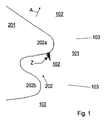
- Fig. 1 the case of the occurrence of a "half-locking" is explained, in which the engagement nose of a locking pawl takes only a metastable position with respect to a toothing and there is a risk of slipping as a result of shock.
- the toothing 101 has a plurality of teeth 102 and has an approximately circular segment-like course, wherein a tooth depression 103 is provided between adjacent teeth 102.
- a latch 201 is pivoted when tightening the parking brake in the direction of arrow A until the brake lever is stored.
- the pawl 201 has in the illustrated embodiment, a double-toothed engagement nose 202, with an upper tooth 202a and a lower tooth 202b.
- This zone Z which is shown as a segment of the radius of the tooth 102, is in principle possible on each tooth in the corresponding part of the pivoting path of the pawl 201 and jeopardizes the safety of the passengers of vehicles equipped with corresponding parking brakes.
- the beginning and end points of zone Z, which are located in Fig. 1 are shown correspond to an angular range of about 13.5 °, this angle is expressed as a pivot angle about the major axis. This means that it should be avoided for the engagement nose on each tooth 102, in the range of about 13.5 ° in contact.
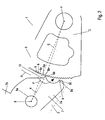
- Fig. 2 and 3 show a preferred embodiment of a parking brake 1 according to the invention, which is designed as a handbrake and which has a brake lever 2 shown only partially shown, which is hinged about a connected to the body lever holder 3 in a main axis 4 pivotally.
- the articulation in the main axis 4 is formed in the usual manner as a bearing for the brake lever.
- a toothing 5 is arranged on a circular segment with a constant radius about the main axis 4, in which the pitch is selected, for example, so that each tooth 1 ° pivot angle of the brake lever represents, so that the pitch of the teeth 1 tooth / angular degree. Between adjacent teeth 6 of the toothing 5 a recess 6 a is formed, which is provided approximately in the middle between the ridges 6 b of the teeth 6.
- the toothing 5 is formed integrally with the lever holder 3, but it is possible to provide a toothed segment for this purpose, which is fixed to the lever holder 3, for example caulked is.
- a pawl 7 is pivotally mounted about a pawl axis 8, wherein the bearing is designed as riveted pin, which passes through a corresponding hole 8a of the pawl and in which the rotational mobility is ensured by a arranged in the bore 8a bush made of Teflon.
- the pawl 7 essentially comprises two lever arms 7a and 7b, wherein the first lever arm 7a comprises an engagement nose 9 and an auxiliary nose 10, and the second lever 7b has an abutment for a guided in a handle push rod, so that the push rod, the second lever 7b can push backwards upon actuation of a corresponding release device, so that the engagement lug 9 is disengaged from the toothing 5.
- the brake lever must first be briefly raised.
- the pawl 7 is biased by a spring relative to the brake lever 2 in the direction of the toothing 5, so that when the release device is not actuated the pawl 7 is pressed under the bias of the spring in the direction of engagement on the toothing 5.
- Fig. 2 shows that when tightening the brake lever 2 in the locking direction A, the auxiliary nose 10, which is located closer to the pawl axis 8 as the engagement lug 9, pulled over the teeth 6 of the teeth 5 is generated and thereby overcoming the bias of the spring, the characteristic chattering movement. If the tightening movement A is terminated, the auxiliary tooth 10 thus first comes into contact with the toothing 5, this optionally in a metastable half-locking zone takes place, or in a region which leads to a stable engagement of the auxiliary tooth 10 in a valley 6b between two adjacent teeth 6.
- the bias of the spring which presses the pawl 7 in the direction of the toothing 5 causes the engagement lug 9 is pivoted further in the direction of the toothing.
- the contact point between the auxiliary nose 10 and the toothing 5 defines an auxiliary bearing point, which causes the pivoting of the engagement nose 9 not only takes place about the pawl axis 8, but at the same time pivoting about the auxiliary bearing point, as indicated by the arrow P.
- a game is used in the pawl link 8a, which prevents the pawl 7 blocks in the position corresponding to the auxiliary bearing point. The game allows a yielding of the pawl linkage 8a, so that the engagement lug 9 can always be engaged in the toothing 5 even when the auxiliary lug 10 is in contact.
- the engagement nose 9 is designed as a double-tooth engagement nose, wherein the actual engagement nose is formed by the upper engagement tooth 9a, while the second engagement tooth 9b essentially serves to engage behind the engagement tooth 9a supporting tooth 6 of the teeth 5. But it is also possible that the locking takes place primarily by the second engagement tooth 9b.
- the tooth comb of the auxiliary nose 10 and the engagement teeth 9a, 9b of the engagement nose 9 based on the course of the toothing 5, spaced by a 7 1 ⁇ 4 tooth width of the toothing 5, which corresponds to a pitch of 1 tooth / angle 7.25 °.
- the engagement nose 10 is narrower than the teeth 9a, 9b of the auxiliary nose 9 is formed so that the auxiliary nose 10 in full seat of the engagement nose 9 despite the non-integer distance, based on the pitch of the teeth 5, not jammed, but the narrower Auxiliary nose 10 is pressed a little way out of the recess 6b, without affecting the secure locking of the parking brake 1 by the locked in the toothing 5 engagement nose 9.
- the auxiliary nose 10 is disposed near the connection plane E, preferably not further than two tooth widths removed, and in particular the opening angle a of the connecting line between the main axis 4 and auxiliary bearing as small as possible or is equal to three times the value of the tooth width, that is 3 °.
- the engagement nose 9 is pivoted in any case outside of a half-locking zone in the teeth 5 and thus achieves reliable and reproducible stable engagement position.
- the pawl 7 pivots about the auxiliary bearing point formed by the auxiliary nose 10.
- the preset non-integer spacing of the auxiliary nose 10 to the engagement nose 9 ensures that the engagement nose 9 in no case reaches a metastable contact position on the toothing 5, and thereby safely penetrates into a depression 6b.
- zone Z which are located in Fig. 1 are shown are spaced apart by an angular range of about 13.5 °, this angle is expressed as a pivot angle about the main axis 4.
- a release device is actuated, which presses a push rod against a facing surface of the lever arm 7b, and this pivots against the bias of the pawl 7 acting spring about the pawl axis 8.
- the brake lever 2 can then back to his stowed lowered position.
- the engagement lug 9 is deposited in a storage area immediately in front of the toothing 5, while the auxiliary lug 10 already projects into the toothing 5 by the amount of its distance from the engagement lug. Starting from this position, the parking brake 1 can be tightened again in the direction A.
- the engagement nose 9 comprises two teeth 9a, 9b. It is understood that the engagement nose can also be formed with only one tooth, or with more than two teeth.
Landscapes
- Engineering & Computer Science (AREA)
- Transportation (AREA)
- Mechanical Engineering (AREA)
- Braking Elements And Transmission Devices (AREA)
- Braking Arrangements (AREA)
Applications Claiming Priority (3)
| Application Number | Priority Date | Filing Date | Title |
|---|---|---|---|
| DE102008049333 | 2008-09-29 | ||
| DE102008056752A DE102008056752B4 (de) | 2008-09-29 | 2008-11-11 | Feststellanordnung für eine Feststellbremse |
| PCT/EP2009/007005 WO2010034521A2 (de) | 2008-09-29 | 2009-09-29 | Feststellanordnung für eine feststellbremse |
Publications (2)
| Publication Number | Publication Date |
|---|---|
| EP2342104A2 EP2342104A2 (de) | 2011-07-13 |
| EP2342104B1 true EP2342104B1 (de) | 2013-11-06 |
Family
ID=41394926
Family Applications (1)
| Application Number | Title | Priority Date | Filing Date |
|---|---|---|---|
| EP09736822.9A Not-in-force EP2342104B1 (de) | 2008-09-29 | 2009-09-29 | Feststellanordnung für eine feststellbremse |
Country Status (7)
| Country | Link |
|---|---|
| US (1) | US8783131B2 (https=) |
| EP (1) | EP2342104B1 (https=) |
| JP (1) | JP2012504074A (https=) |
| CN (1) | CN102216132B (https=) |
| DE (1) | DE102008056752B4 (https=) |
| ES (1) | ES2445574T3 (https=) |
| WO (1) | WO2010034521A2 (https=) |
Families Citing this family (2)
| Publication number | Priority date | Publication date | Assignee | Title |
|---|---|---|---|---|
| US9616863B2 (en) * | 2011-01-07 | 2017-04-11 | Dura Operating, Llc | Park brake lock mechanism with enhanced locking |
| CN217074654U (zh) | 2021-09-28 | 2022-07-29 | 浙江春风动力股份有限公司 | 全地形车 |
Family Cites Families (11)
| Publication number | Priority date | Publication date | Assignee | Title |
|---|---|---|---|---|
| US4872368A (en) * | 1988-07-28 | 1989-10-10 | Orscheln Co. | Push-to-release cable operating apparatus |
| FR2675103B1 (fr) * | 1991-04-15 | 1993-08-06 | Rockwell Abs France | Frein a main pour vehicule. |
| JP2544905Y2 (ja) * | 1991-12-27 | 1997-08-20 | 豊田鉄工株式会社 | パーキングブレーキ操作装置 |
| JPH09267729A (ja) * | 1996-04-01 | 1997-10-14 | Toyota Motor Corp | 足踏式パーキングブレーキ装置 |
| JP2001071875A (ja) * | 1999-06-28 | 2001-03-21 | Kuroishi Tekko Kk | 車両用パーキングブレーキ装置 |
| JP2001233188A (ja) * | 2000-02-25 | 2001-08-28 | Kuroishi Tekko Kk | 車両用パーキングブレーキ装置 |
| US6662676B2 (en) * | 2001-07-24 | 2003-12-16 | Dura Global Technologies | Parking brake system having multi-tooth, self-engaging self-adjust pawl |
| DE10212673B4 (de) * | 2002-03-22 | 2006-04-20 | Daimlerchrysler Ag | Feststellbremse für ein Kraftfahrzeug |
| DE10217473C1 (de) * | 2002-04-19 | 2003-10-30 | Daimler Chrysler Ag | Vorrichtung zur selbsttätigen Nachstellung der Seilzugspannung eines Seilzuges |
| JP2008044567A (ja) * | 2006-08-21 | 2008-02-28 | Otsuka Koki Co Ltd | マニュアルブレーキ装置 |
| CN201080181Y (zh) * | 2007-07-05 | 2008-07-02 | 比亚迪股份有限公司 | 一种脚踏式驻车制动装置 |
-
2008
- 2008-11-11 DE DE102008056752A patent/DE102008056752B4/de not_active Expired - Fee Related
-
2009
- 2009-09-29 EP EP09736822.9A patent/EP2342104B1/de not_active Not-in-force
- 2009-09-29 US US13/121,225 patent/US8783131B2/en active Active
- 2009-09-29 ES ES09736822.9T patent/ES2445574T3/es active Active
- 2009-09-29 WO PCT/EP2009/007005 patent/WO2010034521A2/de not_active Ceased
- 2009-09-29 CN CN200980143503.1A patent/CN102216132B/zh not_active Expired - Fee Related
- 2009-09-29 JP JP2011528257A patent/JP2012504074A/ja active Pending
Also Published As
| Publication number | Publication date |
|---|---|
| WO2010034521A3 (de) | 2010-06-10 |
| CN102216132A (zh) | 2011-10-12 |
| ES2445574T3 (es) | 2014-03-04 |
| DE102008056752A1 (de) | 2010-11-11 |
| DE102008056752B4 (de) | 2012-11-15 |
| US20110239812A1 (en) | 2011-10-06 |
| EP2342104A2 (de) | 2011-07-13 |
| CN102216132B (zh) | 2015-04-22 |
| JP2012504074A (ja) | 2012-02-16 |
| US8783131B2 (en) | 2014-07-22 |
| WO2010034521A2 (de) | 2010-04-01 |
Similar Documents
| Publication | Publication Date | Title |
|---|---|---|
| DE19715764C2 (de) | Neigungseinstellbeschlag mit Freischwenkeinrichtung für eine Rückenlehne eines Kraftfahrzeugsitzes | |
| DE19654395C1 (de) | Nocken zur lösbaren Verriegelung eines Bauteils, insbesondere an einem Kraftfahrzeugsitz | |
| DE2645097C3 (de) | Gelenkbeschlag für Sitze, insbesondere Kraftfahrzeugsitze | |
| EP1989960B1 (de) | Rastbeschlag | |
| DE3038912A1 (de) | Gelenkbeschlag fuer fahrzeugsitze mit einer neigungseinstellbaren rueckenlehne | |
| DE102008061037B3 (de) | Fahrzeugsitz mit Klinkenanordnung | |
| EP0869888B1 (de) | Feststellbremse für kraftfahrzeuge, fahrzeuganhänger oder dergleichen | |
| EP3915829B1 (de) | Fahrzeugsitzbeschlag und fahrzeugsitz | |
| DE19859239C1 (de) | Neigungsverstellbeschlag für Teilbereiche von Kraftfahrzeugsitzen z. B. Rückenlehnen | |
| DE19936733C2 (de) | Betätigungseinrichtung für eine Feststellbremse | |
| DE975780C (de) | Vorgelege fuer einen Sitz von Kraftfahrzeugen od. dgl. | |
| EP2342104B1 (de) | Feststellanordnung für eine feststellbremse | |
| DE4235078C2 (de) | Verstellbeschlag mit Freischwenkeinrichtung für die Rückenlehne von Fahrzeugsitzen, insbesondere Kraftfahrzeugsitzen | |
| DE10235349B4 (de) | Kraftfahrzeugsitz mit einer neigungseinstellbaren und klappbaren Rückenlehne | |
| DE4102312C2 (de) | Sitzschiene für Fahrzeugsitze, insbesondere für Kraftfahrzeugsitze | |
| DE19811094A1 (de) | Längsverstellvorrichtung für einen Sitz, insbesondere Kraftfahrzeugsitz | |
| DE3333056C2 (https=) | ||
| DE10010641B4 (de) | Nachstelleinrichtung für einen Seilzug | |
| EP1584265B1 (de) | Rastbeschlag | |
| DE2730885B1 (de) | Schloß für Sicherheitsgurte | |
| DE112006000723B4 (de) | Vorrichtung zum Betätigen einer Bremse für ein Kraftfahrzeug | |
| DE19957749C1 (de) | Verriegelungsanordnung | |
| DE102004062575B3 (de) | Feststellbremse für ein Fahrzeug | |
| EP2070735B1 (de) | Spannvorrichtung für eine Reifenkette | |
| DE102008059281A1 (de) | Betätigungseinrichtung für Festellbremse |
Legal Events
| Date | Code | Title | Description |
|---|---|---|---|
| PUAI | Public reference made under article 153(3) epc to a published international application that has entered the european phase |
Free format text: ORIGINAL CODE: 0009012 |
|
| 17P | Request for examination filed |
Effective date: 20110325 |
|
| AK | Designated contracting states |
Kind code of ref document: A2 Designated state(s): AT BE BG CH CY CZ DE DK EE ES FI FR GB GR HR HU IE IS IT LI LT LU LV MC MK MT NL NO PL PT RO SE SI SK SM TR |
|
| AX | Request for extension of the european patent |
Extension state: AL BA RS |
|
| DAX | Request for extension of the european patent (deleted) | ||
| GRAP | Despatch of communication of intention to grant a patent |
Free format text: ORIGINAL CODE: EPIDOSNIGR1 |
|
| INTG | Intention to grant announced |
Effective date: 20130416 |
|
| GRAS | Grant fee paid |
Free format text: ORIGINAL CODE: EPIDOSNIGR3 |
|
| GRAP | Despatch of communication of intention to grant a patent |
Free format text: ORIGINAL CODE: EPIDOSNIGR1 |
|
| INTG | Intention to grant announced |
Effective date: 20130816 |
|
| GRAA | (expected) grant |
Free format text: ORIGINAL CODE: 0009210 |
|
| AK | Designated contracting states |
Kind code of ref document: B1 Designated state(s): AT BE BG CH CY CZ DE DK EE ES FI FR GB GR HR HU IE IS IT LI LT LU LV MC MK MT NL NO PL PT RO SE SI SK SM TR |
|
| REG | Reference to a national code |
Ref country code: GB Ref legal event code: FG4D Free format text: NOT ENGLISH |
|
| REG | Reference to a national code |
Ref country code: CH Ref legal event code: EP |
|
| REG | Reference to a national code |
Ref country code: AT Ref legal event code: REF Ref document number: 639240 Country of ref document: AT Kind code of ref document: T Effective date: 20131215 |
|
| REG | Reference to a national code |
Ref country code: IE Ref legal event code: FG4D Free format text: LANGUAGE OF EP DOCUMENT: GERMAN |
|
| REG | Reference to a national code |
Ref country code: DE Ref legal event code: R096 Ref document number: 502009008290 Country of ref document: DE Effective date: 20140102 |
|
| REG | Reference to a national code |
Ref country code: ES Ref legal event code: FG2A Ref document number: 2445574 Country of ref document: ES Kind code of ref document: T3 Effective date: 20140304 |
|
| REG | Reference to a national code |
Ref country code: NL Ref legal event code: VDEP Effective date: 20131106 |
|
| REG | Reference to a national code |
Ref country code: LT Ref legal event code: MG4D |
|
| PG25 | Lapsed in a contracting state [announced via postgrant information from national office to epo] |
Ref country code: HR Free format text: LAPSE BECAUSE OF FAILURE TO SUBMIT A TRANSLATION OF THE DESCRIPTION OR TO PAY THE FEE WITHIN THE PRESCRIBED TIME-LIMIT Effective date: 20131106 Ref country code: NL Free format text: LAPSE BECAUSE OF FAILURE TO SUBMIT A TRANSLATION OF THE DESCRIPTION OR TO PAY THE FEE WITHIN THE PRESCRIBED TIME-LIMIT Effective date: 20131106 Ref country code: NO Free format text: LAPSE BECAUSE OF FAILURE TO SUBMIT A TRANSLATION OF THE DESCRIPTION OR TO PAY THE FEE WITHIN THE PRESCRIBED TIME-LIMIT Effective date: 20140206 Ref country code: SE Free format text: LAPSE BECAUSE OF FAILURE TO SUBMIT A TRANSLATION OF THE DESCRIPTION OR TO PAY THE FEE WITHIN THE PRESCRIBED TIME-LIMIT Effective date: 20131106 Ref country code: FI Free format text: LAPSE BECAUSE OF FAILURE TO SUBMIT A TRANSLATION OF THE DESCRIPTION OR TO PAY THE FEE WITHIN THE PRESCRIBED TIME-LIMIT Effective date: 20131106 Ref country code: LT Free format text: LAPSE BECAUSE OF FAILURE TO SUBMIT A TRANSLATION OF THE DESCRIPTION OR TO PAY THE FEE WITHIN THE PRESCRIBED TIME-LIMIT Effective date: 20131106 Ref country code: IS Free format text: LAPSE BECAUSE OF FAILURE TO SUBMIT A TRANSLATION OF THE DESCRIPTION OR TO PAY THE FEE WITHIN THE PRESCRIBED TIME-LIMIT Effective date: 20140306 |
|
| PG25 | Lapsed in a contracting state [announced via postgrant information from national office to epo] |
Ref country code: LV Free format text: LAPSE BECAUSE OF FAILURE TO SUBMIT A TRANSLATION OF THE DESCRIPTION OR TO PAY THE FEE WITHIN THE PRESCRIBED TIME-LIMIT Effective date: 20131106 |
|
| PG25 | Lapsed in a contracting state [announced via postgrant information from national office to epo] |
Ref country code: PT Free format text: LAPSE BECAUSE OF FAILURE TO SUBMIT A TRANSLATION OF THE DESCRIPTION OR TO PAY THE FEE WITHIN THE PRESCRIBED TIME-LIMIT Effective date: 20140306 |
|
| PG25 | Lapsed in a contracting state [announced via postgrant information from national office to epo] |
Ref country code: EE Free format text: LAPSE BECAUSE OF FAILURE TO SUBMIT A TRANSLATION OF THE DESCRIPTION OR TO PAY THE FEE WITHIN THE PRESCRIBED TIME-LIMIT Effective date: 20131106 |
|
| REG | Reference to a national code |
Ref country code: DE Ref legal event code: R097 Ref document number: 502009008290 Country of ref document: DE |
|
| PG25 | Lapsed in a contracting state [announced via postgrant information from national office to epo] |
Ref country code: RO Free format text: LAPSE BECAUSE OF FAILURE TO SUBMIT A TRANSLATION OF THE DESCRIPTION OR TO PAY THE FEE WITHIN THE PRESCRIBED TIME-LIMIT Effective date: 20131106 Ref country code: SK Free format text: LAPSE BECAUSE OF FAILURE TO SUBMIT A TRANSLATION OF THE DESCRIPTION OR TO PAY THE FEE WITHIN THE PRESCRIBED TIME-LIMIT Effective date: 20131106 Ref country code: PL Free format text: LAPSE BECAUSE OF FAILURE TO SUBMIT A TRANSLATION OF THE DESCRIPTION OR TO PAY THE FEE WITHIN THE PRESCRIBED TIME-LIMIT Effective date: 20131106 |
|
| PLBE | No opposition filed within time limit |
Free format text: ORIGINAL CODE: 0009261 |
|
| STAA | Information on the status of an ep patent application or granted ep patent |
Free format text: STATUS: NO OPPOSITION FILED WITHIN TIME LIMIT |
|
| PG25 | Lapsed in a contracting state [announced via postgrant information from national office to epo] |
Ref country code: DK Free format text: LAPSE BECAUSE OF FAILURE TO SUBMIT A TRANSLATION OF THE DESCRIPTION OR TO PAY THE FEE WITHIN THE PRESCRIBED TIME-LIMIT Effective date: 20131106 |
|
| 26N | No opposition filed |
Effective date: 20140807 |
|
| REG | Reference to a national code |
Ref country code: DE Ref legal event code: R097 Ref document number: 502009008290 Country of ref document: DE Effective date: 20140807 |
|
| PG25 | Lapsed in a contracting state [announced via postgrant information from national office to epo] |
Ref country code: SI Free format text: LAPSE BECAUSE OF FAILURE TO SUBMIT A TRANSLATION OF THE DESCRIPTION OR TO PAY THE FEE WITHIN THE PRESCRIBED TIME-LIMIT Effective date: 20131106 |
|
| PG25 | Lapsed in a contracting state [announced via postgrant information from national office to epo] |
Ref country code: MC Free format text: LAPSE BECAUSE OF FAILURE TO SUBMIT A TRANSLATION OF THE DESCRIPTION OR TO PAY THE FEE WITHIN THE PRESCRIBED TIME-LIMIT Effective date: 20131106 Ref country code: LU Free format text: LAPSE BECAUSE OF FAILURE TO SUBMIT A TRANSLATION OF THE DESCRIPTION OR TO PAY THE FEE WITHIN THE PRESCRIBED TIME-LIMIT Effective date: 20140929 |
|
| REG | Reference to a national code |
Ref country code: CH Ref legal event code: PL |
|
| PG25 | Lapsed in a contracting state [announced via postgrant information from national office to epo] |
Ref country code: BE Free format text: LAPSE BECAUSE OF NON-PAYMENT OF DUE FEES Effective date: 20140930 |
|
| REG | Reference to a national code |
Ref country code: IE Ref legal event code: MM4A |
|
| PG25 | Lapsed in a contracting state [announced via postgrant information from national office to epo] |
Ref country code: LI Free format text: LAPSE BECAUSE OF NON-PAYMENT OF DUE FEES Effective date: 20140930 Ref country code: CH Free format text: LAPSE BECAUSE OF NON-PAYMENT OF DUE FEES Effective date: 20140930 |
|
| PG25 | Lapsed in a contracting state [announced via postgrant information from national office to epo] |
Ref country code: IE Free format text: LAPSE BECAUSE OF NON-PAYMENT OF DUE FEES Effective date: 20140929 |
|
| REG | Reference to a national code |
Ref country code: AT Ref legal event code: MM01 Ref document number: 639240 Country of ref document: AT Kind code of ref document: T Effective date: 20140929 |
|
| PG25 | Lapsed in a contracting state [announced via postgrant information from national office to epo] |
Ref country code: AT Free format text: LAPSE BECAUSE OF NON-PAYMENT OF DUE FEES Effective date: 20140929 |
|
| PG25 | Lapsed in a contracting state [announced via postgrant information from national office to epo] |
Ref country code: SM Free format text: LAPSE BECAUSE OF FAILURE TO SUBMIT A TRANSLATION OF THE DESCRIPTION OR TO PAY THE FEE WITHIN THE PRESCRIBED TIME-LIMIT Effective date: 20131106 |
|
| PG25 | Lapsed in a contracting state [announced via postgrant information from national office to epo] |
Ref country code: CY Free format text: LAPSE BECAUSE OF FAILURE TO SUBMIT A TRANSLATION OF THE DESCRIPTION OR TO PAY THE FEE WITHIN THE PRESCRIBED TIME-LIMIT Effective date: 20131106 Ref country code: GR Free format text: LAPSE BECAUSE OF FAILURE TO SUBMIT A TRANSLATION OF THE DESCRIPTION OR TO PAY THE FEE WITHIN THE PRESCRIBED TIME-LIMIT Effective date: 20140207 Ref country code: MT Free format text: LAPSE BECAUSE OF FAILURE TO SUBMIT A TRANSLATION OF THE DESCRIPTION OR TO PAY THE FEE WITHIN THE PRESCRIBED TIME-LIMIT Effective date: 20131106 Ref country code: BG Free format text: LAPSE BECAUSE OF FAILURE TO SUBMIT A TRANSLATION OF THE DESCRIPTION OR TO PAY THE FEE WITHIN THE PRESCRIBED TIME-LIMIT Effective date: 20131106 |
|
| PG25 | Lapsed in a contracting state [announced via postgrant information from national office to epo] |
Ref country code: TR Free format text: LAPSE BECAUSE OF FAILURE TO SUBMIT A TRANSLATION OF THE DESCRIPTION OR TO PAY THE FEE WITHIN THE PRESCRIBED TIME-LIMIT Effective date: 20131106 Ref country code: HU Free format text: LAPSE BECAUSE OF FAILURE TO SUBMIT A TRANSLATION OF THE DESCRIPTION OR TO PAY THE FEE WITHIN THE PRESCRIBED TIME-LIMIT; INVALID AB INITIO Effective date: 20090929 |
|
| REG | Reference to a national code |
Ref country code: FR Ref legal event code: PLFP Year of fee payment: 8 |
|
| REG | Reference to a national code |
Ref country code: FR Ref legal event code: PLFP Year of fee payment: 9 |
|
| PG25 | Lapsed in a contracting state [announced via postgrant information from national office to epo] |
Ref country code: MK Free format text: LAPSE BECAUSE OF FAILURE TO SUBMIT A TRANSLATION OF THE DESCRIPTION OR TO PAY THE FEE WITHIN THE PRESCRIBED TIME-LIMIT Effective date: 20131106 |
|
| REG | Reference to a national code |
Ref country code: FR Ref legal event code: PLFP Year of fee payment: 10 |
|
| P01 | Opt-out of the competence of the unified patent court (upc) registered |
Effective date: 20230425 |
|
| PGFP | Annual fee paid to national office [announced via postgrant information from national office to epo] |
Ref country code: GB Payment date: 20230920 Year of fee payment: 15 Ref country code: CZ Payment date: 20230921 Year of fee payment: 15 |
|
| PGFP | Annual fee paid to national office [announced via postgrant information from national office to epo] |
Ref country code: FR Payment date: 20230928 Year of fee payment: 15 Ref country code: DE Payment date: 20230920 Year of fee payment: 15 |
|
| PGFP | Annual fee paid to national office [announced via postgrant information from national office to epo] |
Ref country code: ES Payment date: 20231124 Year of fee payment: 15 |
|
| PGFP | Annual fee paid to national office [announced via postgrant information from national office to epo] |
Ref country code: IT Payment date: 20230927 Year of fee payment: 15 |
|
| REG | Reference to a national code |
Ref country code: DE Ref legal event code: R119 Ref document number: 502009008290 Country of ref document: DE |
|
| PG25 | Lapsed in a contracting state [announced via postgrant information from national office to epo] |
Ref country code: CZ Free format text: LAPSE BECAUSE OF NON-PAYMENT OF DUE FEES Effective date: 20240929 |
|
| GBPC | Gb: european patent ceased through non-payment of renewal fee |
Effective date: 20240929 |
|
| PG25 | Lapsed in a contracting state [announced via postgrant information from national office to epo] |
Ref country code: DE Free format text: LAPSE BECAUSE OF NON-PAYMENT OF DUE FEES Effective date: 20250401 |
|
| PG25 | Lapsed in a contracting state [announced via postgrant information from national office to epo] |
Ref country code: GB Free format text: LAPSE BECAUSE OF NON-PAYMENT OF DUE FEES Effective date: 20240929 |
|
| PG25 | Lapsed in a contracting state [announced via postgrant information from national office to epo] |
Ref country code: IT Free format text: LAPSE BECAUSE OF NON-PAYMENT OF DUE FEES Effective date: 20240929 |
|
| PG25 | Lapsed in a contracting state [announced via postgrant information from national office to epo] |
Ref country code: FR Free format text: LAPSE BECAUSE OF NON-PAYMENT OF DUE FEES Effective date: 20240930 |
|
| REG | Reference to a national code |
Ref country code: ES Ref legal event code: FD2A Effective date: 20251031 |
|
| PG25 | Lapsed in a contracting state [announced via postgrant information from national office to epo] |
Ref country code: ES Free format text: LAPSE BECAUSE OF NON-PAYMENT OF DUE FEES Effective date: 20240930 |