EP2334278B1 - Systeme und verfahren zur motoriksteuerung mittels stimulation einer substitutstelle für einen betroffenen bereich - Google Patents
Systeme und verfahren zur motoriksteuerung mittels stimulation einer substitutstelle für einen betroffenen bereich Download PDFInfo
- Publication number
- EP2334278B1 EP2334278B1 EP09815119.4A EP09815119A EP2334278B1 EP 2334278 B1 EP2334278 B1 EP 2334278B1 EP 09815119 A EP09815119 A EP 09815119A EP 2334278 B1 EP2334278 B1 EP 2334278B1
- Authority
- EP
- European Patent Office
- Prior art keywords
- stimulation
- swallowing
- stimulus
- automatic
- sensory
- Prior art date
- Legal status (The legal status is an assumption and is not a legal conclusion. Google has not performed a legal analysis and makes no representation as to the accuracy of the status listed.)
- Active
Links
Images






Classifications
-
- A—HUMAN NECESSITIES
- A61—MEDICAL OR VETERINARY SCIENCE; HYGIENE
- A61H—PHYSICAL THERAPY APPARATUS, e.g. DEVICES FOR LOCATING OR STIMULATING REFLEX POINTS IN THE BODY; ARTIFICIAL RESPIRATION; MASSAGE; BATHING DEVICES FOR SPECIAL THERAPEUTIC OR HYGIENIC PURPOSES OR SPECIFIC PARTS OF THE BODY
- A61H39/00—Devices for locating or stimulating specific reflex points of the body for physical therapy, e.g. acupuncture
-
- A—HUMAN NECESSITIES
- A61—MEDICAL OR VETERINARY SCIENCE; HYGIENE
- A61B—DIAGNOSIS; SURGERY; IDENTIFICATION
- A61B5/00—Measuring for diagnostic purposes; Identification of persons
- A61B5/02—Detecting, measuring or recording for evaluating the cardiovascular system, e.g. pulse, heart rate, blood pressure or blood flow
- A61B5/0205—Simultaneously evaluating both cardiovascular conditions and different types of body conditions, e.g. heart and respiratory condition
- A61B5/02055—Simultaneously evaluating both cardiovascular condition and temperature
-
- A—HUMAN NECESSITIES
- A61—MEDICAL OR VETERINARY SCIENCE; HYGIENE
- A61B—DIAGNOSIS; SURGERY; IDENTIFICATION
- A61B5/00—Measuring for diagnostic purposes; Identification of persons
- A61B5/48—Other medical applications
- A61B5/4833—Assessment of subject's compliance to treatment
-
- A—HUMAN NECESSITIES
- A61—MEDICAL OR VETERINARY SCIENCE; HYGIENE
- A61H—PHYSICAL THERAPY APPARATUS, e.g. DEVICES FOR LOCATING OR STIMULATING REFLEX POINTS IN THE BODY; ARTIFICIAL RESPIRATION; MASSAGE; BATHING DEVICES FOR SPECIAL THERAPEUTIC OR HYGIENIC PURPOSES OR SPECIFIC PARTS OF THE BODY
- A61H23/00—Percussion or vibration massage, e.g. using supersonic vibration; Suction-vibration massage; Massage with moving diaphragms
-
- A—HUMAN NECESSITIES
- A61—MEDICAL OR VETERINARY SCIENCE; HYGIENE
- A61H—PHYSICAL THERAPY APPARATUS, e.g. DEVICES FOR LOCATING OR STIMULATING REFLEX POINTS IN THE BODY; ARTIFICIAL RESPIRATION; MASSAGE; BATHING DEVICES FOR SPECIAL THERAPEUTIC OR HYGIENIC PURPOSES OR SPECIFIC PARTS OF THE BODY
- A61H39/00—Devices for locating or stimulating specific reflex points of the body for physical therapy, e.g. acupuncture
- A61H39/007—Stimulation by mechanical vibrations, e.g. ultrasonic
-
- A—HUMAN NECESSITIES
- A61—MEDICAL OR VETERINARY SCIENCE; HYGIENE
- A61H—PHYSICAL THERAPY APPARATUS, e.g. DEVICES FOR LOCATING OR STIMULATING REFLEX POINTS IN THE BODY; ARTIFICIAL RESPIRATION; MASSAGE; BATHING DEVICES FOR SPECIAL THERAPEUTIC OR HYGIENIC PURPOSES OR SPECIFIC PARTS OF THE BODY
- A61H39/00—Devices for locating or stimulating specific reflex points of the body for physical therapy, e.g. acupuncture
- A61H2039/005—Devices for locating or stimulating specific reflex points of the body for physical therapy, e.g. acupuncture by means of electromagnetic waves, e.g. I.R., U.V. rays
-
- A—HUMAN NECESSITIES
- A61—MEDICAL OR VETERINARY SCIENCE; HYGIENE
- A61H—PHYSICAL THERAPY APPARATUS, e.g. DEVICES FOR LOCATING OR STIMULATING REFLEX POINTS IN THE BODY; ARTIFICIAL RESPIRATION; MASSAGE; BATHING DEVICES FOR SPECIAL THERAPEUTIC OR HYGIENIC PURPOSES OR SPECIFIC PARTS OF THE BODY
- A61H2205/00—Devices for specific parts of the body
- A61H2205/04—Devices for specific parts of the body neck
-
- A—HUMAN NECESSITIES
- A61—MEDICAL OR VETERINARY SCIENCE; HYGIENE
- A61H—PHYSICAL THERAPY APPARATUS, e.g. DEVICES FOR LOCATING OR STIMULATING REFLEX POINTS IN THE BODY; ARTIFICIAL RESPIRATION; MASSAGE; BATHING DEVICES FOR SPECIAL THERAPEUTIC OR HYGIENIC PURPOSES OR SPECIFIC PARTS OF THE BODY
- A61H39/00—Devices for locating or stimulating specific reflex points of the body for physical therapy, e.g. acupuncture
- A61H39/002—Using electric currents
-
- A—HUMAN NECESSITIES
- A61—MEDICAL OR VETERINARY SCIENCE; HYGIENE
- A61H—PHYSICAL THERAPY APPARATUS, e.g. DEVICES FOR LOCATING OR STIMULATING REFLEX POINTS IN THE BODY; ARTIFICIAL RESPIRATION; MASSAGE; BATHING DEVICES FOR SPECIAL THERAPEUTIC OR HYGIENIC PURPOSES OR SPECIFIC PARTS OF THE BODY
- A61H39/00—Devices for locating or stimulating specific reflex points of the body for physical therapy, e.g. acupuncture
- A61H39/06—Devices for heating or cooling such points within cell-life limits
-
- A—HUMAN NECESSITIES
- A61—MEDICAL OR VETERINARY SCIENCE; HYGIENE
- A61N—ELECTROTHERAPY; MAGNETOTHERAPY; RADIATION THERAPY; ULTRASOUND THERAPY
- A61N1/00—Electrotherapy; Circuits therefor
- A61N1/02—Details
- A61N1/025—Digital circuitry features of electrotherapy devices, e.g. memory, clocks, processors
-
- A—HUMAN NECESSITIES
- A61—MEDICAL OR VETERINARY SCIENCE; HYGIENE
- A61N—ELECTROTHERAPY; MAGNETOTHERAPY; RADIATION THERAPY; ULTRASOUND THERAPY
- A61N1/00—Electrotherapy; Circuits therefor
- A61N1/18—Applying electric currents by contact electrodes
- A61N1/32—Applying electric currents by contact electrodes alternating or intermittent currents
- A61N1/36—Applying electric currents by contact electrodes alternating or intermittent currents for stimulation
- A61N1/36003—Applying electric currents by contact electrodes alternating or intermittent currents for stimulation of motor muscles, e.g. for walking assistance
-
- A—HUMAN NECESSITIES
- A61—MEDICAL OR VETERINARY SCIENCE; HYGIENE
- A61N—ELECTROTHERAPY; MAGNETOTHERAPY; RADIATION THERAPY; ULTRASOUND THERAPY
- A61N1/00—Electrotherapy; Circuits therefor
- A61N1/18—Applying electric currents by contact electrodes
- A61N1/32—Applying electric currents by contact electrodes alternating or intermittent currents
- A61N1/36—Applying electric currents by contact electrodes alternating or intermittent currents for stimulation
- A61N1/36007—Applying electric currents by contact electrodes alternating or intermittent currents for stimulation of urogenital or gastrointestinal organs, e.g. for incontinence control
-
- A—HUMAN NECESSITIES
- A61—MEDICAL OR VETERINARY SCIENCE; HYGIENE
- A61N—ELECTROTHERAPY; MAGNETOTHERAPY; RADIATION THERAPY; ULTRASOUND THERAPY
- A61N1/00—Electrotherapy; Circuits therefor
- A61N1/18—Applying electric currents by contact electrodes
- A61N1/32—Applying electric currents by contact electrodes alternating or intermittent currents
- A61N1/36—Applying electric currents by contact electrodes alternating or intermittent currents for stimulation
- A61N1/36014—External stimulators, e.g. with patch electrodes
- A61N1/36017—External stimulators, e.g. with patch electrodes with leads or electrodes penetrating the skin
-
- A—HUMAN NECESSITIES
- A61—MEDICAL OR VETERINARY SCIENCE; HYGIENE
- A61N—ELECTROTHERAPY; MAGNETOTHERAPY; RADIATION THERAPY; ULTRASOUND THERAPY
- A61N1/00—Electrotherapy; Circuits therefor
- A61N1/18—Applying electric currents by contact electrodes
- A61N1/32—Applying electric currents by contact electrodes alternating or intermittent currents
- A61N1/36—Applying electric currents by contact electrodes alternating or intermittent currents for stimulation
- A61N1/36014—External stimulators, e.g. with patch electrodes
- A61N1/36025—External stimulators, e.g. with patch electrodes for treating a mental or cerebral condition
Definitions
- the present disclosure relates generally to systems and methods for treating and managing neurological disease comorbidities. More specifically, the present disclosure relates generally to systems and methods for treating and managing diseases and disorders affecting the muscles of the neck and/or pharynx.
- dysphagia a swallowing disorder that affects the central nervous system thereby weakening neuromuscular control and effectively reducing the ability to properly swallow
- dysphagia is a particularly life threatening disorder placing persons at risk of aspiration pneumonia.
- Patients at risk of aspiration pneumonia have a 17% survival rate over three years (Pick et al., 1996).
- Estimates are that over 7 million persons in the U.S.
- a neurological disease or disorder such as stroke, traumatic brain injury, brain tumors, Parkinson's disease, multiple sclerosis (Humbert, Lynch and Ludlow, in preparation 2008) and other neurological diseases and over 300,000 persons develop a swallowing disorder as a result of a neurological disease or disorder in the United States each year.
- neurological diseases or disorders such as stroke, traumatic brain injury, brain tumors, Parkinson's disease, multiple sclerosis (Humbert, Lynch and Ludlow, in preparation 2008) and other neurological diseases and over 300,000 persons develop a swallowing disorder as a result of a neurological disease or disorder in the United States each year.
- Over 50 % of patients with neurological diseases or disorders are at risk of aspiration pneumonia because of loss of central nervous system control of their swallowing resulting in either delayed or reduced elevation of the hyolaryngeal complex, which does not allow them to prevent food or liquid from entering the airway (Lundy et al., 1999).
- the hyoid and larynx are raised by about 20
- WO 2007/123746 teaches a device for volitional swallowing with a substitute sensor system according to the preamble of claim 1.
- a device and methods for treating a subject with dysphagia or other neurological disease, neurological disorder, neurological injury, neurological impairment or neurodegenerative disease that affects voluntary motor control of the hyoid, pharynx, larynx, oropharyngeal are, is disclosed.
- the device of the invention can also be used to treat a subject with a speech disorder.
- a device of the invention generally comprises a vibrotactile stimulator for applying at least one stimulus to the outside surface of a subject's neck.
- the at least one stimulus comprises a vibrational stimulus, an auditory stimulus, a temperature stimulus, a visual stimulus, an olfactory stimulus, a gustatory stimulus, or a combination thereof.
- the vibrotactile stimulator comprises at least a vibrational transducer; a manual stimulation module to manually engage the vibrational transducer; an automatic stimulation module to automatically engage the vibrational transducer; and a manual counter and/or an automatic counter for determining the number of times the manual stimulation module and/or the automatic stimulation module is engaged.
- the vibrational transducer produces a wave having a frequency of about 50 Hz to about 70 Hz. In certain embodiments, the vibrational transducer produces a wave having a frequency of 59 Hz.
- the automatic stimulation module comprises an automatic timer.
- the automatic timer can include an automatic clock to initiate the onset of the automatic stimulation module; an adjustable clock to initiate the automatic stimulation module at an adjustable interval of about 0.5 s to about 30 minutes; and an adjustable timer that allows for setting the duration of stimulation of about 100 ms to about 10 s.
- a device of the invention also generally comprises a connector for attaching the vibrotactile stimulator to an outside surface of the subject's neck.
- the connector can be adjusted by an adjustment mechanism for positioning a contact section of the vibrotactile stimulator substantially over the subject's larynx.
- a device of the invention also generally comprises a switch control communicatively connected to the vibrotactile stimulator to selectively engage the manual stimulation module and the automatic stimulation module.
- a device of the invention can also include one or more physiological sensors electrically coupled to the vibrotactile stimulator; a swallowing receptor comprising a piezoelectric stretch receptor; a battery, contained within the vibrotactile stimulator, acting as a power supply for the device; and a control box for selecting one or more of the stimulus mode, stimulus type, stimulus rate, and stimulus amplitude.
- the physiological sensors can include movement sensors, temperature sensors, skin color sensors, hematocrit sensors, oxygenation sensors, and blood pressure sensors.
- a swallowing receptor comprises a piezoelectric accelerometric movement sensor.
- a device of the invention can also include a digital clock generator for producing an initial clock signal having a first frequency range; a digital decade counter for receiving the initial clock signal and producing sequential pulses having a second frequency range; and a motor responsive to the sequential pulses for producing vibrations on the subject's larynx, having a third frequency range.
- the initial clock signal is adjustable and comprises a frequency.
- the frequency of the clock signal comprises about one signal every 3 minutes to about one signal every 30 minutes.
- the second frequency range is about 1 Hz to about 10 Hz, or about 20 Hz to about 75 Hz, or about 30 Hz to about 60 Hz with durations of about 10 ms to 500 ms.
- the third frequency range is about 15 to about 200 Hz or between about 20 and about 100 Hz.
- the motor can include a planetary gearbox. In an embodiment, the motor produces a vibrational frequency of about 50 Hz to about 70 Hz.
- Methods for treating a subject with dysphagia or other neurological disease, neurological disorder, neurological injury, neurological impairment or neurodegenerative disease that affects voluntary motor control of the hyoid, pharynx, larynx, oropharyngeal area, or hyolaryngeal complex disorder with a device of the invention are also disclosed.
- the methods can also be used to treat a subject with a speech disorder.
- Methods for inducing a swallowing reflex in a subject to prevent drooling and/or aspiration of the subject's own secretions are disclosed.
- the secretions can be saliva and/or mucus.
- the methods generally comprise applying a device of the invention to an outside surface of the subject's neck substantially over the subject's larynx and configuring an automatic timer to activate the vibrotactile stimulator to induce the swallowing reflex.
- activation of the vibrotactile stimulator produces vibrations at a frequency of about 40 Hz to about 70 Hz and applies pressure of about 1 psi to about 14 psi to the subject's neck during an onset period.
- the onset period comprises about 10 ms to about 1.5 s, about 50 ms to about 750 ms, or about 100 ms to about 500 ms.
- an automatic timer of the device of the invention is configured to activate the vibrotactile stimulator at an interval of about once every 3 minutes to about once every 30 minutes.
- the methods generally comprise applying a device of the invention to an outside surface of the subject's neck substantially over the subject's larynx; downloading data from the vibrotactile stimulator after a period of use of the device by the subject; and analyzing to data to determine if the subject is at risk of aspiration from their own secretions.
- the subject activates the device to induce volitional swallowing and the device records the data to allow a health professional to determine if the subject is at risk.
- methods for monitoring patient compliance with a training or therapy regime are disclosed.
- the methods generally comprise applying a device of claim 1 to an outside surface of the patient's neck substantially over the patient's larynx, wherein the patient activates the device to induce volitional swallowing; downloading data from the vibrotactile stimulator after a period of use of the device by the patient; and analyzing to data to determine the patient's compliance with the training or therapy regime.
- the present disclosure relates generally to systems and methods for treating and managing neurological disease co-morbidities and disorders affecting the volitional control of muscles that are involved in raising and lowering the hyoid/larynx and/or pharynx in the neck.
- Systems and methods that produce deglutition stimulation and vocalization stimulation and/or combinations of these are disclosed.
- these types of stimulation may be volitionally coordinated and controlled electrically, mechanically, chemically or biologically.
- the combined use of button press training with simultaneous vibratory pressure stimulation on the neck region of the larynx is employed to facilitate voluntary control of swallowing. This method and systems of the disclosure are particularly useful for treating and managing subjects having dysphagia.
- the device of the invention is applied to an exterior surface of the throat area and not inside the mouth or the pharynx.
- a device placed inside the mouth or the oropharynx will interfere with eating.
- the device disclosed by Park et al., covers the mucosa in part of the mouth or the roof of the mouth thereby interfering with normal sensation for controlling the movement of the food or liquid in the mouth using sensory feedback between the tongue and the roof of the mouth.
- the present disclosure is aimed at providing simultaneous sensory facilitation to areas unaffected by sensory deficits such as the skin overlying the throat area and the vibratory sensors in the musculature and cartilages in the throat area and the thyroid cartilage in particular.
- Vibratory stimulation of the thyroid cartilage and the sternothyroid muscle has already been shown to have powerful effects on voice (Loucks, Poletto, Saxon, & Ludlow, 2005).
- the methods and systems of the present disclosure differ from other previous approaches in that the patient initiates the stimulation themselves immediately prior to swallowing and such stimulation is to an area that will not interfere with oral and pharyngeal movement and sensation during swallowing.
- Figure 1 depicts a device for treating dysphagia or a speech disorder.
- a band 101 may be wrapped around the neck for dysphagia treatment.
- the band 101 may include a vibrator 102 such that the vibrator 102 may be positioned over the larynx to provide sensory stimulation.
- a designated contact section 120 of the vibrator 102 is positioned to be in contact with the outside of a subject's throat over the larynx.
- the band 101 can include an adjustment mechanism 125 for tailorable positioning of the contact section 120 over the subject's larynx.
- actuator 103 such as a button, switch or other equivalent actuator communicatively connected to vibrator 102, on a utensil 104, such as a spoon, fork, or knife, held by the subject 105
- the vibrator 102 is engaged and transmits vibrational energy to the throat and the larynx.
- Actuator 103 can be covered when not in use.
- actuator 103 may be a button in a small cover that is reversibly slid over the top of a spoon handle or spoon handle shaped mount.
- the actuator 103 can be independent of the utensil.
- actuator 103 is a remote switch that may or may not be physically connected to the stimulating device.
- a device to control one or more vibrator operating can be provided.
- a control box (not shown) having appropriate switches, knobs, or dials can be provided to set a stimulus type, a stimulus rate (set or increasing) and/or a stimulus amplitude (set or increasing).
- the control box can include features to determine stimulus duration.
- the control box can be configured to allow for stimulation for a specific duration of time upon activation of actuator 103 or as long as actuator 103 is depressed. In one example embodiment the duration of stimulation is about 6 seconds to about 25 seconds.
- instructions can be provided to the subject 105 for practice of initiating the sensory stimulation immediately prior to the subject's 105 own initiation of a motor act such as swallowing.
- the initiation may be coordinated by viewing on a display screen 106 a movement feedback signal 107.
- the movement feedback signal 107 can be provided, for example, by a piezoelectric or pressure sensor 108 also contained in the neck wrap 101, which can be displayed on a display screen 106 when the motor movement begins.
- a piezoelectric accelerometric movement sensor is contained in the neck wrap 101.
- the signal 109 from the button 103, initiating sensory stimulation, can be presented on the same display screen 106 for the subject 105 and a trainer to observe when the actuator 103 was activated for sensory stimulation in relation to the onset of the motor act or swallow. In this manner, the subject can learn to optimize the timing of the sensory switch to occur about 600 ms to about 200 ms prior to the onset of their motor act of swallowing. It will be appreciated that actuation of the vibrator 102 via the actuator 103 may be accomplished via a hardwired connection or wireless telemetry. Similarly, communication between the movement sensor and the (display may be hardwired or by wireless telemetry to relieve the subj ect 105 from the hardwired devices.
- Figure 2 an illustration 200 of the neural circuitry involved in the concurrent use of hand control and substitute sensory stimulation to enhance volitional swallowing is shown. More specifically, Figure 2 illustrates the neural circuitry in using hand control 203 to trigger volitional swallowing 204 along with simultaneous sensory stimulation 201 which goes to the cortex 202. This is implemented after button press training described above with respect to Figure 1 . Elicitation of the swallowing reflex and safety in swallowing is dependent upon sensory feedback 201 to the brain from sensory mechanoreceptors in the upper airway. If sensory input is withdrawn, persons feel that they can no longer swallow and are at significant increase of aspiration during swallowing (Jafari et al., 2003). The neural circuitry enhances cortical motor control 202 of swallowing coincident with substitution of sensory input 203 from stimulation of the throat area to trigger brain stem circuitry to trigger reflexive swallowing 204 simultaneous with volitional swallowing.
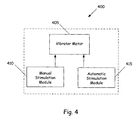
- FIG. 4 a general block diagram of a vibrotactile stimulator 400 is shown according to principles of the present disclosure.
- the vibrotactile stimulator 400 can be used in example system 100.
- the vibrotactile stimulator 400 is pressed against the outside surface of subject's throat to stimulate the larynx such that with coordination, the vibrotactile stimulator 400 can be used to enhance volitional control of swallowing.
- the vibrotactile stimulator 400 may be secured or connected to a connector or a band that can be subsequently wrapped around the subject's neck. In this manner, a designated contact section of the vibrotactile stimulator 400 can be positioned on the subject's neck to stimulate the throat and larynx.
- the connector can include an adjustment mechanism for a fine adjustment of the contact section over the subject's larynx. In certain embodiment, the adjustment mechanism shifts the position of the vibrotactile stimulator 400 within a circle having an area of about 0.01 to about 10 cm2; about 0.25 to about 5 cm 2 , or about 0.5 to about 2.5 cm 2 .
- the vibrotactile stimulator 400 includes a manual stimulation module 410 operatively configured to allow a user to manually operate the vibrotactile stimulator 400 by pressing, or otherwise activating, an external actuator that communicatively connected to the vibrotactile stimulator 400.
- the actuator can engage a vibrational transducer to transmit energy to a subject's larynx.
- the actuator is a pushbutton ON switch that when pressed, or activated, energizes a vibrator motor 405 that vibrates at a desired frequency a periodic pressure wave that can transmit vibrational energy to the subject's larynx.
- the ON switch when the ON switch is released the vibration produced by the vibrator motor 405 is terminated. There is no delay between pressing the ON switch and the vibration to the throat area.
- the manual stimulation module 410 may be engaged during activities such as eating, drinking, and swallowing to prevent aspiration with patients having dysphagia.
- the vibrotactile stimulator 400 includes an automatic stimulation module 415 operatively configured to automatically energize the vibrator motor 405.
- the automatic stimulation module 415 enables the subject or caregiver to programmably define vibrator motor 405 operating parameters such as duration, vibrational frequency, and amplitude.
- the automatic stimulation module 415 can function to periodically energize the vibrator motor 405 to induce swallowing throughout the course of a day, thereby reducing saliva aspiration (and in general for saliva control) for subjects afflicted with dysphagia, for subjects with neurological disorders who have uncontrolled drooling, and for subjects with cerebral palsy who have uncontrolled drooling.
- the automatic stimulation module 415 includes an automatic timer circuit to facilitate the periodical energizing of the vibrational motor 405, as described in further detail below.
- the automatic timer provides for continuous practice throughout the day, which is required for rehabilitation of speech and/or swallowing disorders (Ludlow et al., 2008; Robbins et al., 2008). Automatic stimulation occurring at regular intervals of one every 3 minutes to one every 30 minutes will induce regular swallowing to eliminate drooling.
- the vibrotactile stimulator 400 may include a printed circuit board (PCB).
- the PCB may comprise a plurality of discrete electrical components such as transistors, capacitors, inductors, resistors and functional integrated circuitry such as a processor, a memory element, such as read-only memory (ROM) and/or random access memory (RAM), a field programmable logic array (FPGA) 1320, and input/output circuitry.
- ROM read-only memory
- RAM random access memory
- FPGA field programmable logic array
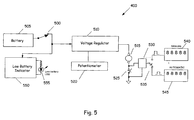
- FIG. 5 an example vibrotactile stimulator block diagram is shown as a possible implementation of the vibrotactile stimulator of Figure 4 .
- a battery 505 supplies power to a three terminal voltage regulator 510.
- the voltage regulator 510 is used as an adjustable current source to control vibrator motor 515 vibrational frequency. In practice, this may be accomplished by utilizing an external adjustable potentiometer 520.
- a switch control 525 such as a pushbutton, switch or other equivalent actuator is provided to enable the user to selectively engage the manual stimulation module 410 or automatic stimulation module 415.
- the switch control 525 is communicatively connected to an external actuator such as a control box or a spoon.
- the switch control 525 is manipulated to electrically load a switch interface 530 such that a count select mechanism 535 is actuated.
- a manual counter 540 is enabled when the user operates the vibrotactile stimulator 400 in the manual mode, and an automatic counter 545 is engaged when automatic stimulation is employed, as described further below.
- the automatic stimulation module 415 may be implemented with an automatic timer circuit such that the switch control 525 can be controlled by the automatic timer circuit to actuate the count select mechanism 535, thereby engaging the automatic counter 545 and energizing the vibrator motor 405.
- the counters 540, 545 are internally mounted to the vibrotactile stimulator 400.
- the manual counter 540 records the total number of times a subject engages the manual stimulation module 410.
- the automatic counter records the number of times the automatic stimulation module 415 is engaged.
- the counters 540, 545 may be interrogated, or equivalently read, and reset manually after the total number of counts are recorded.
- a wireless data interrogation using one of many technologies, such as Blue Tooth may be performed to transfer the information to an external application.
- the quantitative information provided by the counters 540, 545 may provide, for example, an investigator or caregiver quantitative information regarding patient compliance and information regarding the effectiveness of the vibrotactile stimulator 400.
- the manual counter 540 and the automatic counter 545 can be provided with their own internal power supplies so that cumulative counts are not lost when the power switch 500 is disengaged.
- the vibrotactile stimulator 400 may include a low battery indicator 550 such that if the battery 505 voltage drops below a specified voltage level an indicator specifying that event is generated. In the example embodiment an LED "Low Battery” indicator 555 comes on.
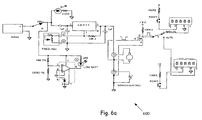
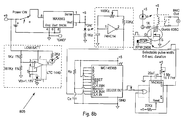
- a circuit diagram 600 is shown illustrating one embodiment of a vibrotactile stimulator block diagram of Figure 5 .
- example circuit diagram 600 is only an example circuit architecture and that the vibrotactile stimulator 400 may be implemented via any suitable architecture.
- both passive and discrete electrical components are chosen such that component attributes and tolerances fit a known specification.
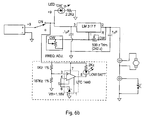
- An alternative example circuit diagram 605 of the vibrotactile stimulator block diagram of Figure 5 is shown in Figure 6b .
- the automatic timer module is communicatively connected to the vibrotactile stimulator 400 as shown in Figure 4 .
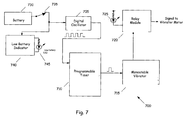
- the automatic timer circuit 700 may actuate the count select mechanism 535, thereby engaging the automatic counter 545 and energizing the vibrator motor 405 for a predetermined period of time.
- the automatic timer circuit 700 comprises of a digital oscillator 705 having an adjustable oscillating frequency of about 2.2 Hz to about 28 Hz.
- the output signal of the digital oscillator 705 is routed to a programmable timer 710 set to divide the periodic digital input signal by 4096.
- the input clock frequency from the digital oscillator 705 to the programmable timer 710 will determine when an output pulse is generated.
- the output pulse period may be generated in a range from about 3 to about 30 minutes.
- the programmable timer 710 output pulse triggers an adjustable monostable multivibrator 715.
- An output pulse width of the adjustable monostable multivibrator 715 sets the "On" time for the vibrator motor 515 (as shown in Figure 5 ) by energizing a relay through a transistor switch.
- the transistor switch and relay control is integral to relay module 720.
- An LED 725 indicates that the relay has been activated, which is used to energize the vibrator motor 515 in the automatic mode.
- the selected time period may be about 5 to about 15 seconds.
- the automatic timer circuit 700 is powered by a battery 730 or other equivalent power source and a power switch 735. Additionally the automatic timer circuit 700 may also include a low battery indicator 740 such that if the battery 730 voltage drops below a specified voltage level an indicator specifying that event is generated. In the example embodiment an LED "Low Battery” indicator 745 comes on. It will be appreciated that the battery 730, the power switch 735, the low battery indicator 740 and the LED 745 may be used to power the vibrotactile stimulator 400 as shown in Figure 5 .
- a circuit diagram 800 is shown illustrating a one embodiment of the automatic timer circuit as shown in Figure 7 .
- example circuit diagram 800 is only an example circuit architecture and that the automatic timer circuit 700 may be implemented via any suitable electrical architecture. Additionally, in the example embodiment both passive and discrete electrical components are chosen such that component attributes and tolerances fit a known specification.
- An alternative example circuit diagram 805 of the automatic timer circuit as shown in Figure 7 is shown in Figure 8b .
- the manual counter 540, the automatic counter 545, and the automatic timer circuit 700 can be incorporated into a single functional counter and timer module that is mounted internally and communicatively connected to the vibrotactile stimulator 400.
- the vibrotactile stimulator 900 is a battery- powered device that sequentially activates one or more small DC vibrator motors as described herein.
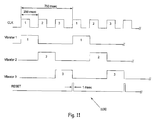
- An adjustable digital clock can set the timing for separate events. The clock frequency can be adjusted between about 1 and about 10 Hz.
- This clock in conjunction with a digital decade counter, generates sequential pulses that control the individual vibrators "On" and "Off' duration. At the end of the pulse cycle, a short reset pulse is generated to reset the decade counter and begin the next cycle of pulses.
- a subject can control the vibrotactile stimulator 900 by pressing an external pushbutton "ON" switch.
- the switch will also activate an LED indicator light and will generate a digital pulse that can be used for coordinating various recording devices.
- the vibration pulses will stop.
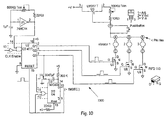
- FIG. 10 a diagram of an example circuit 1000 of the vibrotactile stimulator 900 as shown in Figure 9 is depicted.
- Figure 11 is a diagram 1100 depicting a clock based sequential vibrator control as implemented with the vibrotactile stimulator 900 of Figure 9 .
- Figure 12 depicts a diagram of the controller box 1200 for the vibrotactile stimulator 900 as shown in Figure 9 .
- the controller box 1200 may set one or more vibrotactile stimulator 900 operating parameters.
- an operating parameter may include a stimulus type, a stimulus rate (set or increasing) an amplitude (set or increasing), or a combination thereof.
- the control box may be configured to allow for stimulation for a specific duration upon activation of the button or as long as the button is depressed. In an embodiment, the duration of stimulation is about 2 seconds to about 6 seconds.
- a vibrator motor vibrating frequency of about 30 Hz to about 60 Hz is particularly effective in eliciting the swallowing reflex.
- the vibrator motor may be a low voltage DC motor with a planetary gearbox utilized to generate the effective frequency.
- the gearbox reduces the output rotation per minute (RPM) to the desired range and increase the available torque.
- An eccentrically loaded mass is attached to the output shaft to generate the vibration.
- the mass weight can be changed to increase or decrease the vibration amplitude.
- a lightweight, sealed aluminum tube encapsulates the motor assembly.
- the vibrator motor may utilize a sleeve shaft for the output shaft.
- the vibrator motor may utilize a ball bearing shaft for the output shaft.
- one or more vibrator motors can be placed on the front of the neck over the region of the thyroid cartilage.
- the one or more vibrator motors may be held in place by a rigid/semi-rigid holder or one or more straps.
- the vibrators may be arranged on the inside of the holder to suit the neck dimensions of the individual patient/user.
- An elastic strap may be attached to the outside of the holder and is wrapped to attach in the back of the patient/user's neck to hold the holder in place.
- a small, battery powered portable box connects to the button that is pressed to drive the vibrators.
- the device is supplied to the patient/user who is trained in its use by a speech-pathologist or other professional with knowledge of swallowing, speech or voice disorders.
- the stimulation device of the invention can be covered by a disposable cover, such as a plastic or a cloth cover.
- Stimulators may be contained within a stretchable device such as a wrap with Velcro and is adjustable for individual patient bodies. Vibrator and electrical stimulators are preferably positioned close to the skin.
- the stimulation device of the invention includes one or more sensors of physiology, such as temperature, skin color, hematocrit, oxygenation, blood pressure and the like.
- the device reports results by a display and or by electromagnetic transmission and monitors and/or records swallowing events.
- a device of the present invention can monitor the presence (and optionally depth) of a swallowing event via a piezoelectric stretch receptor or other sensor on or in the band around the neck, and/or at the surface over the larynx. (See Holzer and Ludlow, 1996; Burnett et al, 2005).
- the systems and devices of the invention can be used to treat a number of conditions and disorders including, but not limited to, stroke, cerebral hemorrhage, traumatic brain injury, dysphagia, post surgery to brain, Parkinson's disease, multiple sclerosis, birth defects, ALS, cerebral palsy, CNS injury, supranuclear palsy, and any other neurological disease, neurological disorder, neurological injury, neurological impairment or neurodegenerative disease that affects voluntary motor control of the hyoid, pharynx, larynx, oropharyngeal area, or hyolaryngeal complex.
- Neurological impairments that are contemplated include reflex actions that involve interactions between afferent and efferent paths, at the spinal cord or in the brain stem, as well as higher order interactions in the primary motor cortex of the hemispheres.
- the systems and methods of the present disclosure apply to patients who have lost or partially lost the ability to voluntarily control motor functions but also to patients who were born with birth defects that have prevented them from having voluntary motor control, such as cerebral palsy.
- the systems and methods of the present disclosure are also applicable to treating various speech motor control disorders such as stuttering and laryngeal dystonia.
- motor control refers to the ability to control muscle activity at will.
- the invention is applicable to the ability to swallow at will.
- patients with dysphagia which is the complete or partial loss of the ability to swallow, can be treated with the methods of the present invention.
- the disease or disorder reduces or delays motor control of swallowing and/or results in delayed or reduced elevation of the hyolaryngeal complex, which does not allow the patient to prevent food or liquid from entering the airway.
- the methods generally comprise stimulating a substitute site for the area with a system or device according to the invention, thereby triggering the motor control of the affected area.
- the term “recovering” as used herein includes within its meaning obtaining the ability to volitionally control motor functions.
- “Volitionally” as used herein means at the will of the patient.
- a "substitute site” as used herein means an area of the body that is capable of eliciting a desired reflex but is not a sensory region that is able to elicit reflex in impaired patients.
- Subjects are often not responsive to stimulation in the oral and pharyngeal cavities but remain sensate to vibratory stimulation to the areas of the human head which include anatomical structures (e.g., muscles, nerves or connective tissue) that work in concert to affect deglutition.
- anatomical structures e.g., muscles, nerves or connective tissue
- substitute stimulation can be used to enhance the volitional elicitation of swallowing.
- patients with dysphagia following neurological disease usually have sensory loss in the oropharyngeal area (Aviv et al., 1996; Aviv, Sacco, Mohr et al., 1997; Aviv, Sacco, Thomson et al., 1997) which is normally required to be sensate in order to elicit safe swallowing without aspiration in normal volunteers (Jafari, Prince, Kim, & Paydarfar, 2003).
- the present invention uses sensory triggering in "substitute sites" to enhance the elicitation of reflex and volitional swallowing, such as stimulation of afferents from the laryngeal area contained in the superior laryngeal area (Jean, 1984), (Dubner, Sessle, & Storey, 1978), (Dick, Oku, Romaniuk, & Cherniack, 1993; Ootani, Umezaki, Shin, & Murata, 1995).
- the site for stimulation can be adjusted depending upon the desired motor control.
- the affected area is the area of the body responsible for swallowing, speech, or voice.
- the affected area is the oropharyngeal area.
- the substitute site is the area of the throat over the larynx.
- the recovered motor control is volitional swallowing.
- mechanoreceptors in the skin will be activated providing feedback to the brain stem and brain to assist with triggering voluntary initiation of swallowing, speech or voice.
- mechanical stimulation induces movement of the thyroid cartilage and of the extrinsic and intrinsic laryngeal muscles in the region including: the platysma, the sternohyoid, the sternothyroid, the thyrohyoid, cricothyroid and the thyroarytenoid muscles.
- Some of these muscles contain muscle spindles.
- the muscle spindle afferents can provide sensory feedback to the central nervous system to assist with triggering voluntary initiation of the muscles for swallowing, speech and voice initiation.
- the stimulation is asserted immediately before a volitional attempt to move or carry out the physiological impaired function, such as swallowing or speaking.
- the stimulation comprises an onset period in which the stimulation is asserted about 1 second to about 10 seconds before, about 0.1 second to about 1 second before, about 0.2 second to about 0.5 second before, or about 0.2 second to about 0.4 second before the volitional attempt.
- the stimulation may also be asserted at the same time as the volitional attempt.
- the stimulation of the affected body part is made via a system or device according to the present disclosure before the volitional attempt.
- the sensory modality for stimulation includes but is not limited to vibratory stimulation, pressure stimulation, auditory stimulation, temperature stimulation, visual stimulation, electrical stimulation, olfactory stimulation, taste stimulation, and combinations thereof.
- the stimulation may be controlled electrically, mechanically, chemically, biologically or by any other method known to the skilled artisan.
- the stimulation is vibratory, tactile, pressure, or a combination thereof.
- the stimulation is vibro-tactile.
- vibration stimulation is combined with another stimulation, such as electrical skin surface stimulation (same timing or different).
- Vibratory stimulation desirably is applied at a frequency of about 1 to about 100 Hz, about 5 to about 70 Hz, about 30 to 60 Hz, about 50 to about 60 Hz, about 55 to about 60 Hz, or about 58 to about 60 Hz.
- the pressure and/or electrical stimulation desirably is applied at a frequency of about 50, about 51, about 52, about 53, about 54, about 55, about 56, about 57, about 58, about 59, or about 60 Hz.
- the amplitude of vibration preferably may be, for example, about 1 micron to about 2 mm. Amplitudes of about 100 micron to about 1 mm are useful.
- the vibrator produces a sequential wave of pressure across bars (such as 1 to 5 oblong bars) at about 0.5 to about 30 times per second, and more preferably about 2 to about 25 times, more preferably about 5 to about 10 times per second.
- the pressures are about 1 psi to about 14 psi with rise times of about 2 ms to about 500 ms and more desirably rise times of about 4 to about 150 ms.
- Electrical stimulation should be applied at a rate of 30 Hz at low levels of less than about 2 mA over a small area of 1 cm 2 or 25 mA over a large area (about 10 cm 2 ) or greater, or less if the area is smaller (less than about 10cm 2 ), such as about 0.01 to about 10 mA, about 0.1 to about 7 mA, about 0.5 to about 5 mA, or about 1-3 mA to assure only sensory stimulation is occurring and not resulting in muscle contraction. Levels that do not exceed about 10 mA, about 7 mA, about 5 mA, about 4 mA, about 3 mA, and more desirably about 2 mA, are particularly useful.
- the electrical stimulation comprises biphasic pulses (about 50 to about 300 microsecond pulses for example) of about 1 to about 5 mA of current at about 15 to about 60 Hz.
- biphasic pulses about 50 to about 300 microsecond pulses for example
- care must be taken to assure that muscle contraction is not occurring as stimulation of muscles in the throat area pull the hyoid downward and interfere with swallowing (Humbert et al., 2006; Ludlow et al., 2007).
- the amplitude of the stimulation (measured as energy output or more directly as electrical current or vibration displacement etc) and/or the rate of the stimulation pulse increases during the swallowing activity.
- the duration of stimulation is set to the average measured, or expected duration of the patient's swallow.
- the stimulation lasts as long as the swallow is perceived to occur, or as long as a switch is activated.
- the stimulation will only be turned on by the patient when swallowing and will remain off when the patient is not swallowing.
- the patient that can activate a system or device of the invention stimulates their throat over the larynx thereby eliciting reflex swallowing.
- the stimulation is vibratory, tactile, pressure, or a combination thereof.
- the stimulation is vibrotactile.
- the patient controls the stimulation via an actuator communicatively connected to the stimulator. The vibrotactile stimulate of the system and methods of the present invention provides substitute sensation to assist with eliciting swallowing while training the patient to volitionally control swallowing to substitute for their loss of reflexive swallowing.
- a system can train the patient to press a button, switch or other equivalent actuator communicatively connected to the stimulator immediately before wanting to swallow thereby providing an alternate sensory input via vibrotactile stimulation (or other similar sensory modalities) to the throat area to enhance volitional control of swallowing of saliva.
- FIG 2 illustrates the neural circuitry in using hand control 203 to trigger volitional swallowing 204 along with simultaneous sensory stimulation 201 which goes to the cortex 202. This is implemented after button press training described above with respect to Figure 1 . Elicitation of the swallowing reflex and safety in swallowing is dependent upon sensory feedback 201 to the brain from sensory mechanoreceptors in the upper airway. If sensory input is withdrawn, persons feel that they can no longer swallow and are at significant increase of aspiration during swallowing (Jafari et al., 2003).
- the neural circuitry enhances cortical motor control 202 of swallowing coincident with substitution of sensory input 203 from stimulation of the throat area to trigger brain stem circuitry to trigger reflexive swallowing 204 simultaneous with volitional swallowing.
- a device that provides an alternative sensory input to the brain such as vibrotactile stimulation
- the patient can regain volitional swallowing control readying them to swallow safely first with their own saliva and later to ingest small amounts of food in a controlled volitional fashion.
- volitional control over swallowing the patient can substitute voluntary swallowing for their loss of reflexive swallowing.
- the automatic timer of the systems and devices of the inventions can be used to stimulate the initiation of swallowing on a regular basis to prevent drooling and/or aspiration of the patient's own secretions.
- a device of the invention is not dependent upon manual activation by the patient and can be set to initiate swallowing without a user input at a predetermined or variable interval.
- the automatic timer can be configured to initiate swallowing of saliva to prevent aspiration of secretions from drooling during sleeping.
- Methods for automatically stimulating swallowing on a regular basis or set interval generally comprise applying a device of the invention to an outside surface of the subject's neck substantially over the subject's larynx and configuring an automatic timer to activate the vibrotactile stimulator to induce the swallowing reflex.
- activation of the vibrotactile stimulator produces vibrations at a frequency of about 40 Hz to about 70 Hz and applies pressure of about 1 psi to about 14 psi to the subject's neck during an onset period.
- the onset period comprises about 10 ms to about 1.5 s, about 50 ms to about 750 ms, or about 100 ms to about 500 ms.
- an automatic timer of the device of the invention is configured to activate the vibrotactile stimulator at an interval of about 1 to about 5 minutes.
- an automatic timer is configured to activate the vibrotactile stimulator once every 3 minutes to about once every 30 minutes for a durations of about 10 ms to about 20 s during which pulsed stimulation is produced at vibrations of about 1 to 300 Hz lasting about 200 ms to about 10 s to induce the swallowing reflex, wherein activation of the vibrotactile stimulator is pulsed at a particular rate and lasts for a particular interval produces vibrations at a frequency of about 40 Hz to about 70 Hz and applies pressure of about 1 psi (6.894757 kPa) to about 14 psi (96.53 kPa) to the subjects's neck during an onset period.
- a device can be configured with a counter and timer system to aid in monitoring a patient's use of the device.
- the counter and timer system can be used to determine or measure frequency of use including how often the patient uses the device, which mode the patient uses, how long and when the device is stimulated, and the like.
- the data generated by the counter and timer system can be used, for example, to determine compliance with a training or therapy regime. Such data can be used to modify a treatment or training program and/or can alert caretakers to a risk of drooling or aspiration of secretions due to limited use of the system.
- Methods for identifying a subject at risk of aspiration from their own secretions generally comprise applying a device of the invention to an outside surface of the subject's neck substantially over the subject's larynx; downloading data from the vibrotactile stimulator after a period of use of the device by the subject; and analyzing to data to determine if the subject is at risk of aspiration from their own secretions due to limited use.
- the subject activates the device to induce volitional swallowing and the device records the data to allow a health professional to determine if the subject is at risk, due to limited use.
- Methods for monitoring patient compliance with a training or therapy regime generally comprise applying a device of claim 1 to an outside surface of the patient's neck substantially over the patient's larynx, wherein the patient activates the device to induce volitional swallowing; downloading data from the vibrotactile stimulator after a period of use of the device by the patient; and analyzing to data to determine the patient's compliance with the training or therapy regime.
- a band may be wrapped around the neck, with an inflatable balloon(s) positioned over the larynx.
- an inflatable balloon(s) positioned over the larynx.
- the balloon Upon activation (e.g. by a switch, such as a button) by the user (one who wears the device, or under orders from the wearer) the balloon inflates and puts pressure on the larynx.
- a controller box is contemplated that may be set to the stimulus type, the stimulus rate (set or increasing) and amplitude (set or increasing) parameters and whether the duration would be set or stay for 2 to 6 seconds or as long as the button is pressed.
- the device that stimulates the substitute site is a pressure applying device that attaches to the body by, for example, a Velcro, strap, rubber band, belt, bandage, garment, ace bandage, wire, string, piezoelectric band or film, and/or combination of these or by any other method known in the art.
- the stimulating device may include a contact pressure builder such as a balloon, inflatable tube that inflates to a desired pressure or volume.
- a contact pressure builder such as a balloon, inflatable tube that inflates to a desired pressure or volume.
- the art of blood pressure monitors includes devices and methods that may be used as part of the device of the present invention.
- a neck wrap is used that positions the pressure applying device to the throat area above the larynx and is adjustable via VELCRO® or any other adjustment means.
- a small point such as an area as small as about 0.02 square centimeter on the throat over the larynx may be pressed, although larger areas of, for example, about 01. to about 10 cm 2 , about 0.25. to about 5 cm 2 , about 0.5 to about 2.5 cm 2 areas may be used.
- a desirable area is a 2 cm circle.
- the total pressure (calculated as an integrated sum measurement of pressure times surface area) is placed on the throat over the larynx cartilage and not over surrounding muscle.
- such selective pressure is achieved, to obtain satisfactory results.
- vibratory energy similarly is selectively confined on the throat over the larynx versus the surrounding muscle.
- less than about 50%, about 25, about 10%, about 5% or even less pressure is applied to neck muscles.
- the stimulation may be cold, vibration, heat, and/or low levels of electrical stimulation capable of inducing a sensory stimulus but not high enough to induce muscle contraction, that condition or disorders or a combination thereof.
- the systems and devices of the present disclosure can be used in methods for treating impairment of reflexive swallowing due to intubation.
- Many patients are intubated to maintain the airway for ventilation, including following loss of consciousness due to brain injury or stroke or following coronary artery bypass graft.
- extubation of the endotracheal tube occurs.
- Figure 3 shows a conceptualization 300 of events post brain injury, placing patients at high risk of aspiration post extubation with tracheotomy due to reduced afferent stimulation in the upper airway and restricted oral intake, limiting return of reflexive swallowing.
- the present invention can provide volitional control for patients with motor control disorders affecting speech and voice.
- Persons who stutter usually have difficulty with speech initiation and have speech "blocks" when the patient undergoes a loss of volitional control over the laryngeal muscles in particular. This loss of volitional control is manifested as delay in voluntary initiation of muscle contraction or vocal fold movement or an interference due to chronic laryngeal muscle contractions or sustained vocal fold closure.
- Several studies have suggested that adults who stutter may have increased thresholds to kinesthetic or vibratory stimulation during speech (De Nil & Abbs, 1991).
- the device and methods of the present invention can enhance vibratory sensory input to persons who stutter.
- the present invention increases vibrotactile input to the central nervous system in persons who stutter thereby enhancing their volitional control for speech.
- a mechanical displacement is applied to the larynx according to the methods of the invention, it stimulates proprioceptors in the strap muscles, producing a reflexive sternothyroid muscle contraction (Loucks et al., 2005). Because extrinsic laryngeal muscles have a high muscle spindle density, stretch or vibratory stimuli applied to the larynx will serve to enhance muscle activity in this region.
- the present invention can provide enhanced volitional control for patients with Spasmodic Dysphonia and Laryngeal Dystonia.
- Spasmodic dysphonia is a laryngeal focal dystonia, which produces voice abnormalities during speech similar to stuttering.
- These patients have particular difficulties initiating voicing during speech (Bielamowicz & Ludlow, 2000; C. L. Ludlow, Baker, Naunton, & Hallett, 1988; C. L. Ludlow & Connor, 1987; C. L. Ludlow, Hallett, Sedory, Fujita, & Naunton, 1990) and are often slow to initiate laryngeal muscle activity and have problems maintaining vocal fold vibration during speech.
- Various embodiments of the present invention differ both in concept and in function from prior systems in that the patient/user presses a button to initiate vibrotactile stimulation to aid their ability to initiate speech/voice onset.
- the vibratory signal is initiated before the patient attempts to initiate speech and will aid in their volitional control of speech initiation.
- the VocalTech® device for example only detects speech after it has started and can only be triggered by the patient/user's own speech.
- the VocalTech® device utilizes a feedback of the patient/user's speech and no other inputs. Therefore if the patient is unable to initiate speech and/or voice, the vibratory signal cannot be initiated.
- the lack of initiation of the vibratory signal is further exacerbated as there is a delay between the onset of the patient's speech and the onset of the vibratory and auditory feedback. Therefore the VocalTech® device is unable to enhance the patient's ability to onset speech as it is dependent upon the speaker being able to initiate speech.
- the device and the system of the present disclosure assists patients with speech initiation as the vibratory stimulus precedes the person's speech initiation by enhancing mechanical sensory input to cortical control centers for speech.
- Other auditory masking or delayed or frequency altered feedback devices such as SpeechEasy® also alter or delay the speaker's acoustic speech signal and also require that the speaker is able to initiate speech before the feedback can occur. Therefore these other devices differ both in concept and function from the present invention.
- the present invention is a portable device that can be supplied to adults who stutter and persons with dysphonia to provide stimulation before speech to enhance triggering and controlling voice onset and maintenance for speech.
- the device of the present disclosure can be used in everyday speaking situations. Patients could purchase the device to use in everyday life to enhance volitional control while speaking.
- kits that include at least one stimulating device of the present disclosure, a container for the device, and instructions for using the device.
- the kit comprises a device of the invention that is adapted to be placed in contact with an affected body part, such as the larynx, a container for the device, a switch activated by a patient, and instructions for using the device.
- the instructions desirably include at least one instruction corresponding to one or more method steps disclosed herein.
- a power supply such as a battery is contained within the stimulating device.
- disposable covers are included that cover the stimulator during use.
- the stimulating device includes at least one pump that increases pressure within a chamber such as balloon(s) or tube(s).
- the device further may include a pressure, stretch, volume, power or other sensor to monitor pressure exerted by the device.
- the device further includes a switch for setting the amount of desired pressure or movement and/or low levels of electrical stimulation on the skin to increase sensation in the skin in the region overlying the larynx. Switches also may exist for setting frequency and or amplitude of the stimulation.
- electrical stimulation may assist swallowing either by augmenting hyo-laryngeal elevation (Freed, Freed, Chatbum, & Christian, 2001; Leelamanit, Limsakul, & Geater, 2002) or by increasing sensory input to the central nervous system to enhance the elicitation of swallowing (Park, O'Neill, & Martin, 1997; Power et al., 2004).
- the current density is greatest at the skin surface, and diminishes with depth through the platysma underlying the skin and subcutaneous fat (Sobotta, 1990). Accordingly, as the current is increased in amplitude, increasingly deeper muscles may be recruited, albeit with less efficiency.
- Such muscles include the anterior belly of the digastric, which can either lower the mandible or pull the hyoid upward depending upon whether the mouth is held closed. Deeper still are the mylohyoid and geniohyoid muscles, which pull the hyoid bone upward and toward the mandible, respectively. These muscles are much less likely to be activated by surface stimulation, however, because of their greater depth.
- the current will be greater at the skin with less intensity to the underlying platysma muscle with further reduction to the underlying sternohyoid and omohyoid muscles (Sobotta, 1990), which pull the hyoid downward and backward towards the sternum.
- the electrical field strength would be even further diminished if it reaches the deeper thyrohyoid muscle, which brings the larynx and hyoid together and the sternothyroid muscle, which lowers the larynx towards the sternum.
- the sensory threshold which was the lowest current level at which the participant reported a "tingling" sensation on the skin, was identified. Stimulation at the sensory threshold level did not produce movement on videofluoroscopic recordings and was the lowest level at which participants sensed the stimulation on the skin. Movement was first observed when participants first reported a "tugging" sensation, usually around 7 or 8 mA. The maximum motor level was the highest current level a participant could tolerate without discomfort during stimulation on the neck. The sensory and motor levels independently for each set of electrodes was determined. The VitalStim® device cycles automatically from “on” to “off' to “on” again for 1 second every minute. Because the change in stimulation is ramped, this cycling process takes up to 4 s.
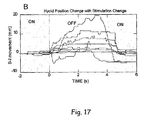
- the video of each trial was captured off-line using Peak Motus 8, a 2D motion measurement system (ViconPeak, Centennial, CO 80112).
- the system was equipped with a video capture board at -60 fields/s (-30 frames/s) and a frame size of 608 X 456 pixels.
- the radius of the ball bearing (9.5 mm) was used for all measurement calibrations in the horizontal and vertical directions.
- An investigator used a cursor to identify the points on the most anterior-inferior corner of the second and fourth vertebra on each video frame and a straight line was drawn between these two points to define the y axis. When either the second or fourth vertebra was not visible, the bottom anterior-inferior corner of the first and third vertebrae were used in the same fashion.
- the x and y coordinates for all points were determined in mm relative to the anterior-inferior corner of the second vertebra serving as the origin with anterior and superior points being positive and posterior and inferior points being negative for direction of movement of the hyoid.
- Four points were marked for each frame, the anterior-inferior points of the two interspersed vertebrae, the anterior inferior point of the hyoid bone and the most posterior and superior point in the subglottal air column (to track the position of the larynx).
- the time series plots of the x and y points of the hyoid bone and the y coordinate of the larynx were exported from Peak Modus into Microsoft Excel and then into Systat 11 (Systat Software, Inc., Richmond, CA) for analysis.
- Systat 11 Systat Software, Inc., Richmond, CA
- the frame when the stimulation cycled from "on” to "off' was added to the file and used to sort measures into stimulation "on” and stimulation "off. All of the position data were then corrected to place the starting position at zero on both the x and y axes for each subject and then the mean hyoid (x,y) and larynx (y) positions were computed for the stimulation "on” and stimulation "off 1 conditions for each subject.
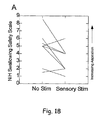
- the NIH Swallowing Safety Scale captured the abnormalities seen in this patient group, which involved pooling and a lack of esophageal entry with and without penetration and aspiration.
- SSS Safety Scale
- a score of 1 was assigned for the occurrence of each the following abnormalities: pooling in the vallecula, penetration into the vestibule from the hypopharynx, pooling in the pyriform, and back up penetration from the pyriform into the laryngeal vestibule.
- the amount of the bolus material entering and clearing from the upper esophagus was rated as 3 if none entered, 2 if a minimal amount entered, 1 if a moderate amount entered and 0 if all of the bolus was cleared through the upper esophagus.
- the total number of aspirations in each swallowing sample were counted. Only normal swallows received a total of 0 on this scale and the maximum score could reach as high as 13 depending upon the number of aspirations or other abnormalities in bolus flow that occurred in a single swallow.
- ICCs were computed between the two sets of ratings on each scale from the first 21 trials that were reanalyzed.
- Cohen's Kappa was computed for the two sets of ratings of each component item of the NIH-SSS using Systat 11 (Systat Software, Inc., Richmond, CA).
- Systat 11 Systat Software, Inc., Richmond, CA.
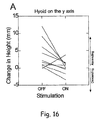
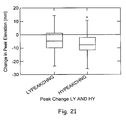
- a one-sample directional t-test was used to test for a lowering of the hyoid bone on the y axis between "off and "on” stimulation.
- a one-sample directional t-test was used to test for a retraction of the hyoid bone on the x axis in the "off' and "on” stimulation conditions within subjects.
- a one-sample directional t- test was used to test for a lowering of the subglottal air column between the two conditions.
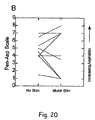
- Pearson correlation coefficients using a Bonferroni corrected p value of 0.025 for statistical significance were computed between both the participant's mean initial severity on the Pen-Asp scale and the NIH-SSS and changes in mean ratings during the sensory stimulation to determine if participant characteristics predicted the degree of benefit. Similarly, Pearson correlation coefficients were computed between the extent to which the hyoid was pulled down in the neck during stimulation at rest and the change in participants' mean ratings for swallowing on the Pen-Asp scale and the NIH-SSS using a Bonferroni corrected p value of 0.025 for statistical significance.
- the ICC for the movement of the hyoid bone on the y axis in the on and off stimulation conditions were 0.99 and 0.94 respectively and for hyoid movement on the x axis were 0.94 and 0.87.
- the ICCs for the larynx on the y axis in the stimulation "on” and “off' positions were 0.58 and 0.66 respectively indicating much less reliability on these measures. Because the movement of the larynx was extremely small, ranging from a mean position of 0.4 mm in the stimulation "on” to 0.18 mm in the "off' condition, measurement variability contributed to the variance on this measure.
- the ICC was 0.965 on the PenAsp scale and 0.764 on the NIH-SSS. Because of concerns about the reliability of the NIH-SSS, we implemented more detailed judging rules for each item where disagreement occurred. A second set of 18 reliability measures using the new judging rules resulted in an ICC for the NIH-SSS that was 0.925, demonstrating adequate reliability when using the scale once the judging rules were developed and implemented.
- NIH-SSS captures pharyngeal pooling and failed esophageal entry in contrast with the Pen-Asp scale, which only measures aspiration and penetration, sensory stimulation may be somewhat helpful in those patients who have reduced ability to clear the bolus from the airway.
Landscapes
- Health & Medical Sciences (AREA)
- Life Sciences & Earth Sciences (AREA)
- Rehabilitation Therapy (AREA)
- Animal Behavior & Ethology (AREA)
- General Health & Medical Sciences (AREA)
- Public Health (AREA)
- Veterinary Medicine (AREA)
- Epidemiology (AREA)
- Pain & Pain Management (AREA)
- Physical Education & Sports Medicine (AREA)
- Engineering & Computer Science (AREA)
- Cardiology (AREA)
- Biomedical Technology (AREA)
- Surgery (AREA)
- Heart & Thoracic Surgery (AREA)
- Physics & Mathematics (AREA)
- Biophysics (AREA)
- Pathology (AREA)
- Medical Informatics (AREA)
- Molecular Biology (AREA)
- Physiology (AREA)
- Mechanical Engineering (AREA)
- Pulmonology (AREA)
- Percussion Or Vibration Massage (AREA)
- Rehabilitation Tools (AREA)
- Electrotherapy Devices (AREA)
Claims (15)
- Vorrichtung, mit:i) einem vibrotaktilen Stimulator (400) zur Anwendung mindestens einer Stimulierung an der Außen-Oberfläche des Nackens einer Person, wobei der vibrotaktile Stimulator mindestens umfasst:(a) einen Vibrations-Wandler (405);(b) ein Modul zur manuellen Stimulierung (410) zum manuellen In-Eingriff-Bringen des Vibrations-Wandlers; und(c) ein automatisches Stimulierungs-Modul (415) zum automatischen In-Eingriff-Bringen des Vibrations-Wandlers;ii) einem Verbinder (101) zum Befestigen des vibrotaktilen Stimulators an der Außen-Oberfläche des Nackens einer Person, wobei der Verbinder einen Einstellungs-Mechanismus (125) zum Positionieren eines Kontakt-Abschnitts im Wesentlichen über dem Kehlkopf einer Person umfasst; undiii) einer Schalt-Steuerung (525), kommunizierend verbunden mit dem vibrotaktilen Stimulator, zum selektiven In-Eingriff-Bringen des Moduls zur manuellen Stimulierung und des automatischen Stimulierungs-Moduls; unddadurch gekennzeichnet, dass der vibrotaktile Stimulator umfasst:(d) einen Hand-Zähler (540) zum Bestimmen der Anzahl von Malen, die das Modul zur manuellen Stimulierung in Eingriff gebracht worden ist, und einen automatischen Zähler (545) zum Bestimmen der Anzahl von Malen, die das automatische Stimulierungs-Modul in Eingriff gebracht worden ist.
- Vorrichtung nach Anspruch 1, wobei der Einstellungs-Mechanismus die Position des Kontakt-Abschnitts in einem Kreis mit einer Fläche von 0,1 bis 10 cm2, 0,25 bis 5 cm2 oder 0,5 bis 2,5 cm2 verschiebt.
- Vorrichtung nach Anspruch 1, wobei das automatische Stimulierungs-Modul einen automatischen Zeitgeber (700) umfasst.
- Vorrichtung nach Anspruch 1, wobei die mindestens eine Stimulierung umfasst:eine Vibrations-Stimulierung; undmindestens eine anschließende Druckwelle, eine auditorische Stimulierung, eine Temperatur-Stimulierung, eine visuelle Stimulierung, eine olfaktorische Stimulierung und eine geschmackliche Stimulierung.
- Vorrichtung nach Anspruch 1, wobei der Vibrations-Wandler eine Welle erzeugt, die eine Amplitude von 1 µm bis 2 mm oder 100 µm bis 1 mm aufweist und/oder wobei der Vibrations-Wandler eine Welle erzeugt, die eine Frequenz von 50 Hz bis 70 Hz aufweist.
- Vorrichtung nach Anspruch 1, weiterhin umfassend:iv) einen oder mehrere physiologische Sensoren, die elektrisch an den vibrotaktilen Stimulator gekoppelt sind;v) einen Schluck-Rezeptor, umfassend einen piezoelektrischen Beschleunigungs-Bewegungs-Sensor;vi) eine Batterie (505), enthalten in dem vibrotaktilen Stimulator, die als Stromquelle für die Vorrichtung dient; undvii) einen Steuerungskasten (1200) zur Auswahl von einer oder mehreren von dem Stimulierungs-Modus, der Stimulierungs-Art, der Stimulierungs-Rate und der Stimulierungs-Amplitude.
- Vorrichtung nach Anspruch 1, wobei der vibrotaktile Stimulator mindestens einen Motor oder eine Pumpe umfasst.
- Vorrichtung nach Anspruch 6, wobei der eine oder die mehreren physiologischen Sensoren ausgewählt sind aus der Gruppe, bestehend aus Bewegungs-Sensoren, Temperatur-Sensoren, Hautfarbe-Sensoren, Hämatokrit-Sensoren, Oxygenierungs-Sensoren und Blutdruck-Sensoren.
- Vorrichtung nach Anspruch 1, wobei der vibrotaktile Stimulator umfasst:viii) einen digitalen Takt-Generator zum Erzeugen eines Initial-Takt-Signals mit einem ersten Frequenz-Bereich;ix) einen digitalen Dekaden-Zähler zum Empfang des Initial-Takt-Signals und Erzeugen eines folgenden Impulses mit einem zweiten Frequenz-Bereich; undx) einen Motor ansprechbar auf die folgenden Impulse zur Erzeugung von Vibrationen mit einem dritten Frequenz-Bereich am Kehlkopf einer Person.
- Vorrichtung nach Anspruch 9, wobei das Initial-Takt-Signal einstellbar ist und eine Frequenz von einem Signal jede 3 Minuten bis zu einem Signal jede 30 Minuten umfasst.
- Vorrichtung nach Anspruch 9, wobei der zweite Frequenz-Bereich zur Impuls-Stimulierung 1 Hz bis 10 Hz oder 20 Hz bis 75 Hz oder 30 Hz bis 60 Hz ist.
- Vorrichtung nach Anspruch 9, wobei der dritte Frequenz-Bereich 15 bis 200 Hz oder 20 bis 100 Hz ist.
- Vorrichtung nach Anspruch 9, wobei der Motor ein Planetengetriebe umfasst.
- Vorrichtung nach Anspruch 1, wobei der vibrotaktile Stimulator Druck von 1 psi (6,894757 kPa) bis 14 psi (96,53 kPa) auf den Nacken einer Person anwendet.
- Vorrichtung nach Anspruch 3, wobei der automatische Zeitgeber umfasst:xi) einen automatischen Takt zum Starten des Einsatzes des automatischen Stimulierungs-Moduls;xii) einen einstellbaren Takt zum Starten der Impuls-Stimulierung bei einem einstellbaren Intervall von 0,5 s bis 30 Minuten; undxiii) einen einstellbaren Zeitgeber, der Einstellen der Dauer für Impuls-Stimulierung von 0,1 bis 500 ms gestattet.
Applications Claiming Priority (2)
| Application Number | Priority Date | Filing Date | Title |
|---|---|---|---|
| US12/211,633 US8388561B2 (en) | 2005-07-01 | 2008-09-16 | Systems and methods for recovery from motor control via stimulation to a substituted site to an affected area |
| PCT/US2009/057158 WO2010033594A2 (en) | 2008-09-16 | 2009-09-16 | Systems and methods for recovery from motor control via stimulation to a substituted site to an affected area |
Publications (3)
| Publication Number | Publication Date |
|---|---|
| EP2334278A2 EP2334278A2 (de) | 2011-06-22 |
| EP2334278A4 EP2334278A4 (de) | 2014-08-06 |
| EP2334278B1 true EP2334278B1 (de) | 2016-11-16 |
Family
ID=42040271
Family Applications (1)
| Application Number | Title | Priority Date | Filing Date |
|---|---|---|---|
| EP09815119.4A Active EP2334278B1 (de) | 2008-09-16 | 2009-09-16 | Systeme und verfahren zur motoriksteuerung mittels stimulation einer substitutstelle für einen betroffenen bereich |
Country Status (6)
| Country | Link |
|---|---|
| US (2) | US8388561B2 (de) |
| EP (1) | EP2334278B1 (de) |
| JP (2) | JP2012502747A (de) |
| AU (1) | AU2009293277B2 (de) |
| CA (1) | CA2737478C (de) |
| WO (1) | WO2010033594A2 (de) |
Cited By (1)
| Publication number | Priority date | Publication date | Assignee | Title |
|---|---|---|---|---|
| US11850205B2 (en) | 2019-04-19 | 2023-12-26 | Passy-Muir, Inc. | Methods of vibrationally exciting a laryngeal nerve |
Families Citing this family (61)
| Publication number | Priority date | Publication date | Assignee | Title |
|---|---|---|---|---|
| US8388561B2 (en) * | 2005-07-01 | 2013-03-05 | The United States Of America, As Represented By The Secretary, Department Of Health And Human Services | Systems and methods for recovery from motor control via stimulation to a substituted site to an affected area |
| EP1917067A1 (de) * | 2005-07-01 | 2008-05-07 | The Government of the United States of America as represented by The Secretary of the Department of Health and Human Services | Systeme und verfahren zur wiederherstellung der motorischen kontrolle durch stimulation einer substituierten stelle auf einem betroffenen bereich |
| US8449445B2 (en) | 2006-03-30 | 2013-05-28 | The United States Of America, As Represented By The Secretary, Department Of Health And Human Services | Device for volitional swallowing with a substitute sensory system |
| US8092355B2 (en) * | 2007-09-01 | 2012-01-10 | Mortimer Bruce J P | System and method for vibrotactile guided motional training |
| JP5055502B2 (ja) * | 2008-03-10 | 2012-10-24 | 日立コンシューマエレクトロニクス株式会社 | 生体検査装置 |
| FR2940904B1 (fr) * | 2009-01-13 | 2012-08-31 | Urgo Laboratoires | Systeme de mesure de pression d'interface |
| CN102576386B (zh) * | 2009-10-22 | 2016-05-18 | 皇家飞利浦电子股份有限公司 | 用于处理吞咽困难的系统和方法 |
| US8983610B2 (en) | 2009-11-18 | 2015-03-17 | Case Western Reserve University | Hybrid method for modulating upper airway function in a subject |
| DE102010000390A1 (de) | 2010-02-11 | 2011-08-11 | Forschungszentrum Jülich GmbH, 52428 | Vorrichtung und Verfahren zur Behandlung eines Patienten mit Vibrations-, Tast- und/oder Thermoreizen |
| US9888864B2 (en) | 2010-03-12 | 2018-02-13 | Inspire Medical Systems, Inc. | Method and system for identifying a location for nerve stimulation |
| EP2575600B1 (de) * | 2010-06-07 | 2019-04-24 | The Medical College Of Wisconsin, Inc. | Erkennung und behandlung von dysfunktionen des oberen speiseröhrentrakts |
| WO2012050200A1 (ja) | 2010-10-14 | 2012-04-19 | 国立大学法人電気通信大学 | 刺激信号生成装置及び刺激信号生成方法 |
| EP2665408B1 (de) * | 2011-01-18 | 2021-08-11 | University Health Network (UHN) | Vorrichtung zur erkennung von schluckstörungen |
| US8666300B2 (en) * | 2011-04-29 | 2014-03-04 | Steven M. Haimowitz | Educational program assessment using curriculum progression pathway analysis |
| US9731131B2 (en) | 2011-12-07 | 2017-08-15 | Med-El Elektromedizinische Geraete Gmbh | Pacemaker for unilateral vocal cord autoparalysis |
| US9345885B2 (en) | 2011-12-07 | 2016-05-24 | Med-El Elektromedizinische Geraete Gmbh | Pacemaker for unilateral vocal cord autoparalysis |
| US9050462B2 (en) * | 2011-12-07 | 2015-06-09 | Med-El Elektromedizinische Geraete Gmbh | Pacemaker for spasmodic dysphonia |
| WO2013113023A1 (en) * | 2012-01-26 | 2013-08-01 | Neurostream Technologies G.P. | Neural monitoring methods and systems for treating pharyngeal disorders |
| WO2013149213A1 (en) * | 2012-03-29 | 2013-10-03 | Pitman Michael J | Method and apparatus for the treatment of spasmodic dysphonia |
| US9375568B2 (en) * | 2012-08-31 | 2016-06-28 | University Of Florida Research Foundation, Inc. | Controlling coughing and swallowing |
| SG11201501600RA (en) | 2012-09-07 | 2015-04-29 | Hyogo College Medicine | Swallowing assist device |
| US20140276270A1 (en) | 2013-03-13 | 2014-09-18 | Passy-Muir, Inc. | Systems and methods for stimulating swallowing |
| ES2663028T3 (es) * | 2013-10-16 | 2018-04-10 | Koninklijke Philips N.V. | Un dispositivo de conversión de un movimiento de un usuario en una tensión |
| WO2015163710A1 (ko) * | 2014-04-24 | 2015-10-29 | 경상대학교산학협력단 | 도전율 단층 영상법을 이용한 상기도 폐쇄 양상의 영상화 및 진단장치 |
| EP3135192A4 (de) * | 2014-04-24 | 2018-01-24 | KIM, Sang Wook | Vorrichtung zur bildgebung und diagnose von obstruktionsstörungen des oberen atemwegs mithilfe von leitfähigkeitstomographie |
| TWI551262B (zh) * | 2014-06-04 | 2016-10-01 | 長庚醫療財團法人 | 刀具結構 |
| US20160030280A1 (en) * | 2014-07-31 | 2016-02-04 | Sensory Neurostimulation, Inc. | Non-Contact Sonic Treatment for Restless Legs Syndrome |
| JP2017523854A (ja) | 2014-08-11 | 2017-08-24 | ザ メディカル カレッジ オブ ウィスコンシン インクThe Medical College Of Wisconsin, Inc. | 飲み込み訓練装置 |
| US10398902B2 (en) | 2015-03-27 | 2019-09-03 | Equility Llc | Neural stimulation method and system with audio output |
| US10327984B2 (en) | 2015-03-27 | 2019-06-25 | Equility Llc | Controlling ear stimulation in response to image analysis |
| US11364380B2 (en) | 2015-03-27 | 2022-06-21 | Elwha Llc | Nerve stimulation system, subsystem, headset, and earpiece |
| US10406376B2 (en) | 2015-03-27 | 2019-09-10 | Equility Llc | Multi-factor control of ear stimulation |
| US10512783B2 (en) | 2015-03-27 | 2019-12-24 | Equility Llc | User interface method and system for ear stimulation |
| US9987489B2 (en) | 2015-03-27 | 2018-06-05 | Elwha Llc | Controlling ear stimulation in response to electrical contact sensing |
| US20160279021A1 (en) * | 2015-03-27 | 2016-09-29 | Elwha Llc | Vibratory ear stimulation system and method |
| US10589105B2 (en) | 2015-03-27 | 2020-03-17 | The Invention Science Fund Ii, Llc | Method and system for controlling ear stimulation |
| WO2016168664A1 (en) * | 2015-04-15 | 2016-10-20 | The Board Of Trustees Of The Leland Stanford Junior University | Cutaneous stimulation devices and methods of using the same |
| EP3184094B1 (de) * | 2015-12-22 | 2019-10-30 | Braun GmbH | Massagevorrichtung |
| US11031117B2 (en) * | 2016-04-18 | 2021-06-08 | Vmas Solutions, Inc. | Systems and methods for reducing stress |
| US11000437B2 (en) | 2016-04-18 | 2021-05-11 | Vmas Solutions Inc. | System and method for reducing stress |
| CN105997009A (zh) * | 2016-07-01 | 2016-10-12 | 张民 | 一种可穿戴口吃矫正装置及一种口吃矫正衣 |
| WO2018156217A2 (en) * | 2016-11-04 | 2018-08-30 | Sommetrics, Inc. | Pressure control system, device and method for opening an airway |
| IT201700005161A1 (it) | 2017-01-18 | 2018-07-18 | Viktor S R L | Metodo ed apparecchiatura di elettrostimolazione |
| KR101962676B1 (ko) * | 2017-08-02 | 2019-07-31 | 순천향대학교 산학협력단 | 섬유근접센서를 이용한 삼킴장애 재활 피드백 치료 장치 및 방법 |
| US11144125B2 (en) | 2017-12-07 | 2021-10-12 | First-Light Usa, Llc | Hands-free switch system |
| WO2019152135A1 (en) | 2018-01-30 | 2019-08-08 | Apex Neuro Inc. | Devices and methods for delivering mechanical stimulation to nerve, mechanoreceptor, and cell targets |
| JP6516174B1 (ja) * | 2018-09-28 | 2019-05-22 | 医療法人ライフサポート | 嚥下運動補助装具 |
| TWI739333B (zh) * | 2019-06-24 | 2021-09-11 | 日商J工藝股份有限公司 | 吞嚥醫療裝置、佩戴單元及用以執行與吞嚥相關的醫療動作之程式產品 |
| GB201909176D0 (en) * | 2019-06-26 | 2019-08-07 | Royal College Of Art | Wearable device |
| CN110974230B (zh) * | 2019-12-09 | 2025-01-10 | 广州医科大学附属第一医院 | 振动检测仪及振动检测方法 |
| EP4076621A1 (de) * | 2019-12-17 | 2022-10-26 | Cakmak, Yusuf Ozgur | Nicht-invasive stimulationsvorrichtung zur synchronen stimulation des musculus sternocleidomastoideus und vier der kutanen zervikalnervenäste mit ihren autonomen verbindungen |
| US11553313B2 (en) | 2020-07-02 | 2023-01-10 | Hourglass Medical Llc | Clench activated switch system |
| US12380798B2 (en) | 2020-07-02 | 2025-08-05 | Hourglass Medical Llc | Switch system for operating a controlled device |
| EP4291969B1 (de) | 2021-02-12 | 2025-06-25 | Hourglass Medical LLC | Klenchsteuerungszubehör für am kopf getragene vorrichtungen |
| EP4327186B1 (de) * | 2021-04-21 | 2026-01-28 | Hourglass Medical LLC | Verfahren für systeme mit bewegungssteuerung der muskeln zur sprachaustastung |
| US20220409475A1 (en) * | 2021-06-25 | 2022-12-29 | Lindsay Leanne McMurren | Adult pleasure enhancement neck pressure cuff with safety release |
| KR102591028B1 (ko) * | 2021-07-23 | 2023-10-19 | 주식회사 알에스리햅 | 연하장애용 전기 자극 치료 장치 및 방법 |
| CN116098608B (zh) * | 2021-11-10 | 2024-09-10 | 复旦大学 | 喉部运动信息捕获系统 |
| WO2024076458A1 (en) | 2022-10-04 | 2024-04-11 | Hourglass Medical Llc | Eyeglasses nose piece switch |
| CN116650308A (zh) * | 2023-07-31 | 2023-08-29 | 苏州索迩电子技术有限公司 | 一种按摩头及喉部按摩器 |
| WO2025244038A1 (ja) * | 2024-05-21 | 2025-11-27 | 学校法人 聖マリアンナ医科大学 | 振動刺激装置、振動刺激器具、及び治療方法 |
Family Cites Families (52)
| Publication number | Priority date | Publication date | Assignee | Title |
|---|---|---|---|---|
| US6343232B1 (en) | 1966-08-19 | 2002-01-29 | Mower Chf Treatment Irrevocable Trust | Augmentation of muscle contractility by biphasic stimulation |
| US4143648A (en) | 1977-04-13 | 1979-03-13 | Behavioral Controls, Inc. | Portable therapeutic apparatus having patient responsive feedback means |
| US4685448A (en) | 1983-10-11 | 1987-08-11 | University Of Pittsburgh | Vocal tactile feedback method and associated apparatus |
| JP2522493B2 (ja) * | 1987-08-13 | 1996-08-07 | 松下電工株式会社 | マッサ−ジ機 |
| US5086788A (en) | 1988-06-13 | 1992-02-11 | Castel John C | Hand-held physiological stimulation applicator |
| US5111814A (en) | 1990-07-06 | 1992-05-12 | Thomas Jefferson University | Laryngeal pacemaker |
| US5174287A (en) | 1991-05-28 | 1992-12-29 | Medtronic, Inc. | Airway feedback measurement system responsive to detected inspiration and obstructive apnea event |
| JP3323259B2 (ja) * | 1992-12-28 | 2002-09-09 | 松下電工株式会社 | たたきマッサージ機 |
| US5350407A (en) | 1992-12-30 | 1994-09-27 | Telectronics Pacing Systems, Inc. | Implantable stimulator having quiescent and active modes of operation |
| US5562718A (en) | 1994-06-03 | 1996-10-08 | Palermo; Francis X. | Electronic neuromuscular stimulation device |
| US5897579A (en) | 1994-09-15 | 1999-04-27 | Mount Sinai School Of Medicine | Method of relieving airway obstruction in patients with bilateral vocal impairment |
| JP3080548B2 (ja) * | 1994-10-27 | 2000-08-28 | 東芝テック株式会社 | 血行促進器 |
| JPH0984845A (ja) | 1995-09-25 | 1997-03-31 | Nippon Tansan Gas Co Ltd | ピッチカウンター付き心肺蘇生用背板 |
| US7039468B2 (en) | 1995-10-27 | 2006-05-02 | Esd Limited Liability Company | Method and apparatus for treating oropharyngeal disorders with electrical stimulation |
| US7280873B2 (en) | 1995-10-27 | 2007-10-09 | Esd, Llc | Treatment of oropharyngeal disorders by application of neuromuscular electrical stimulation |
| US6198970B1 (en) | 1995-10-27 | 2001-03-06 | Esd Limited Liability Company | Method and apparatus for treating oropharyngeal respiratory and oral motor neuromuscular disorders with electrical stimulation |
| US5891185A (en) | 1995-10-27 | 1999-04-06 | Esd Limited Liability Company | Method and apparatus for treating oropharyngeal disorders with electrical stimulation |
| US5725564A (en) | 1995-10-27 | 1998-03-10 | Esd Limited Liability Company | Method and apparatus for treating dysphagia with electrical stimulation |
| US5876498A (en) | 1996-12-20 | 1999-03-02 | Moms, Inc. | Apparatus for preserving solder paste in the manufacturing of printed circuit board assemblies |
| US5781508A (en) * | 1997-05-29 | 1998-07-14 | The United States Of America As Represented By The Secretary Of The Navy | Optimizing the compressional wave energy response of an elastic fluid-filled cylinder |
| US5871508A (en) | 1997-08-06 | 1999-02-16 | Medtronic, Inc. | Apparatus for cardiac pacing in transplant |
| DE69832394T2 (de) | 1997-09-08 | 2006-08-03 | Densei Inc., Sapporo | Elektrischer kunstkehlkopf |
| KR100257879B1 (ko) | 1998-02-19 | 2000-06-01 | 소호연 | 동물훈련장치 및 그 제어방법 |
| ATE358454T1 (de) | 1998-10-06 | 2007-04-15 | Bio Control Medical Ltd | Vorrichtung zur behandlung von inkontinenz |
| US6039679A (en) | 1999-08-09 | 2000-03-21 | Yu; Simon S. C. | Electronic dumbbell |
| US6795807B1 (en) | 1999-08-17 | 2004-09-21 | David R. Baraff | Method and means for creating prosody in speech regeneration for laryngectomees |
| US6393323B1 (en) | 2000-01-31 | 2002-05-21 | Mcgill University | Electronic stimulator implant for modulating and synchronizing bladder and sphincter function |
| US20020049479A1 (en) | 2000-10-20 | 2002-04-25 | Pitts Walter C. | Method and apparatus for creating afferents to prevent obstructive sleep apnea |
| US6484053B2 (en) | 2000-11-29 | 2002-11-19 | Pairash Thajchayapong | Method and apparatus for treating poor laryngeal-elevation disorder with sequential-high voltage electrical stimulation |
| US7039359B2 (en) * | 2000-12-07 | 2006-05-02 | Intermec Ip Corp. | RFID interrogator having customized radio parameters with local memory storage |
| CA2408656C (en) * | 2001-10-17 | 2016-06-21 | Rehabilicare, Inc. | Electrical nerve stimulation stimulator |
| AU2003245258A1 (en) | 2002-05-03 | 2003-11-17 | Afferent Corporation | A method and apparatus for enhancing neurophysiologic performance |
| US20080077192A1 (en) | 2002-05-03 | 2008-03-27 | Afferent Corporation | System and method for neuro-stimulation |
| US7606623B2 (en) | 2002-09-27 | 2009-10-20 | The United States Of America As Represented By The Department Of Health And Human Services | Methods and devices for intramuscular stimulation of upper airway and swallowing muscle groups |
| US7725175B2 (en) * | 2002-12-04 | 2010-05-25 | Kinetic Muscles, Inc. | System and method for neuromuscular reeducation |
| US20040133133A1 (en) * | 2003-01-07 | 2004-07-08 | Samantha Dreimann | Massage device |
| US7182738B2 (en) * | 2003-04-23 | 2007-02-27 | Marctec, Llc | Patient monitoring apparatus and method for orthosis and other devices |
| US20050049453A1 (en) | 2003-08-25 | 2005-03-03 | Faulkner Roger W. | Hydraulically driven vibrating massagers |
| US20050059909A1 (en) | 2003-09-11 | 2005-03-17 | Burgess Dorothy M. | Cervical heat and vibration massage apparatus |
| US20060030794A1 (en) | 2004-05-21 | 2006-02-09 | Sarah Nation | Human monitoring apparatus |
| US20050267388A1 (en) | 2004-05-26 | 2005-12-01 | Hanna Joseph P | Method and apparatus for relief of headache |
| GB0425632D0 (en) * | 2004-11-22 | 2004-12-22 | Bioaccelerate Ltd | Device |
| EP1917067A1 (de) * | 2005-07-01 | 2008-05-07 | The Government of the United States of America as represented by The Secretary of the Department of Health and Human Services | Systeme und verfahren zur wiederherstellung der motorischen kontrolle durch stimulation einer substituierten stelle auf einem betroffenen bereich |
| US8388561B2 (en) * | 2005-07-01 | 2013-03-05 | The United States Of America, As Represented By The Secretary, Department Of Health And Human Services | Systems and methods for recovery from motor control via stimulation to a substituted site to an affected area |
| US20070073361A1 (en) | 2005-09-23 | 2007-03-29 | Bioq, Inc. | Medical device for restoration of autonomic and immune functions impaired by neuropathy |
| JP4526472B2 (ja) | 2005-12-02 | 2010-08-18 | 仁敬 越久 | 嚥下障害治療装置 |
| US7660636B2 (en) | 2006-01-04 | 2010-02-09 | Accelerated Care Plus Corp. | Electrical stimulation device and method for the treatment of dysphagia |
| US8449445B2 (en) | 2006-03-30 | 2013-05-28 | The United States Of America, As Represented By The Secretary, Department Of Health And Human Services | Device for volitional swallowing with a substitute sensory system |
| EP2025362B1 (de) | 2007-08-16 | 2011-12-14 | Biotronik CRM Patent AG | Stimulationssystem zur Behandlung von Dysphagien |
| CN105126210B (zh) | 2008-04-15 | 2018-06-12 | 特鲁德尔医学国际公司 | 吞咽空气脉冲疗法口器及其使用方法 |
| US8983610B2 (en) | 2009-11-18 | 2015-03-17 | Case Western Reserve University | Hybrid method for modulating upper airway function in a subject |
| CN101716394B (zh) | 2009-12-21 | 2012-11-14 | 四川大学 | 治疗吞咽障碍的低频脉冲电磁仪 |
-
2008
- 2008-09-16 US US12/211,633 patent/US8388561B2/en active Active
-
2009
- 2009-09-16 CA CA2737478A patent/CA2737478C/en active Active
- 2009-09-16 AU AU2009293277A patent/AU2009293277B2/en active Active
- 2009-09-16 JP JP2011527935A patent/JP2012502747A/ja active Pending
- 2009-09-16 WO PCT/US2009/057158 patent/WO2010033594A2/en not_active Ceased
- 2009-09-16 EP EP09815119.4A patent/EP2334278B1/de active Active
-
2013
- 2013-02-26 US US13/777,907 patent/US8808207B2/en active Active
- 2013-10-11 JP JP2013213610A patent/JP5827981B2/ja active Active
Cited By (1)
| Publication number | Priority date | Publication date | Assignee | Title |
|---|---|---|---|---|
| US11850205B2 (en) | 2019-04-19 | 2023-12-26 | Passy-Muir, Inc. | Methods of vibrationally exciting a laryngeal nerve |
Also Published As
| Publication number | Publication date |
|---|---|
| AU2009293277B2 (en) | 2014-03-06 |
| WO2010033594A3 (en) | 2010-05-27 |
| EP2334278A4 (de) | 2014-08-06 |
| US8388561B2 (en) | 2013-03-05 |
| CA2737478A1 (en) | 2010-03-25 |
| US8808207B2 (en) | 2014-08-19 |
| CA2737478C (en) | 2018-02-27 |
| EP2334278A2 (de) | 2011-06-22 |
| WO2010033594A2 (en) | 2010-03-25 |
| AU2009293277A1 (en) | 2010-03-25 |
| US20130225954A1 (en) | 2013-08-29 |
| US20090187124A1 (en) | 2009-07-23 |
| JP2014042835A (ja) | 2014-03-13 |
| JP2012502747A (ja) | 2012-02-02 |
| JP5827981B2 (ja) | 2015-12-02 |
Similar Documents
| Publication | Publication Date | Title |
|---|---|---|
| EP2334278B1 (de) | Systeme und verfahren zur motoriksteuerung mittels stimulation einer substitutstelle für einen betroffenen bereich | |
| US11850203B2 (en) | Systems and methods for stimulating swallowing | |
| EP2382958B1 (de) | Systems zur Wiedergewinnung der motorischen Steuerung mittels Stimulation einer Ersatzstelle eines betroffenen Bereichs | |
| EP3934736B1 (de) | Tragbare periphere nervenstimulation zur behandlung von krankheiten unter verwendung rhythmischer biologischer verfahren | |
| AU2014202506B2 (en) | Device for recovery from motor control via stimulation to a substituted site to an affected area |
Legal Events
| Date | Code | Title | Description |
|---|---|---|---|
| PUAI | Public reference made under article 153(3) epc to a published international application that has entered the european phase |
Free format text: ORIGINAL CODE: 0009012 |
|
| 17P | Request for examination filed |
Effective date: 20110408 |
|
| AK | Designated contracting states |
Kind code of ref document: A2 Designated state(s): AT BE BG CH CY CZ DE DK EE ES FI FR GB GR HR HU IE IS IT LI LT LU LV MC MK MT NL NO PL PT RO SE SI SK SM TR |
|
| AX | Request for extension of the european patent |
Extension state: AL BA RS |
|
| DAX | Request for extension of the european patent (deleted) | ||
| A4 | Supplementary search report drawn up and despatched |
Effective date: 20140709 |
|
| RIC1 | Information provided on ipc code assigned before grant |
Ipc: A61H 39/06 20060101ALI20140703BHEP Ipc: A61H 1/00 20060101ALI20140703BHEP Ipc: A61N 1/36 20060101ALI20140703BHEP Ipc: A61H 23/02 20060101AFI20140703BHEP |
|
| GRAP | Despatch of communication of intention to grant a patent |
Free format text: ORIGINAL CODE: EPIDOSNIGR1 |
|
| INTG | Intention to grant announced |
Effective date: 20160607 |
|
| GRAS | Grant fee paid |
Free format text: ORIGINAL CODE: EPIDOSNIGR3 |
|
| GRAA | (expected) grant |
Free format text: ORIGINAL CODE: 0009210 |
|
| GRAT | Correction requested after decision to grant or after decision to maintain patent in amended form |
Free format text: ORIGINAL CODE: EPIDOSNCDEC |
|
| AK | Designated contracting states |
Kind code of ref document: B1 Designated state(s): AT BE BG CH CY CZ DE DK EE ES FI FR GB GR HR HU IE IS IT LI LT LU LV MC MK MT NL NO PL PT RO SE SI SK SM TR |
|
| REG | Reference to a national code |
Ref country code: GB Ref legal event code: FG4D |
|
| REG | Reference to a national code |
Ref country code: CH Ref legal event code: EP |
|
| REG | Reference to a national code |
Ref country code: IE Ref legal event code: FG4D |
|
| REG | Reference to a national code |
Ref country code: AT Ref legal event code: REF Ref document number: 845196 Country of ref document: AT Kind code of ref document: T Effective date: 20161215 |
|
| REG | Reference to a national code |
Ref country code: DE Ref legal event code: R096 Ref document number: 602009042521 Country of ref document: DE |
|
| PG25 | Lapsed in a contracting state [announced via postgrant information from national office to epo] |
Ref country code: LV Free format text: LAPSE BECAUSE OF FAILURE TO SUBMIT A TRANSLATION OF THE DESCRIPTION OR TO PAY THE FEE WITHIN THE PRESCRIBED TIME-LIMIT Effective date: 20161116 |
|
| REG | Reference to a national code |
Ref country code: NL Ref legal event code: MP Effective date: 20161116 |
|
| REG | Reference to a national code |
Ref country code: LT Ref legal event code: MG4D |
|
| REG | Reference to a national code |
Ref country code: AT Ref legal event code: MK05 Ref document number: 845196 Country of ref document: AT Kind code of ref document: T Effective date: 20161116 |
|
| PG25 | Lapsed in a contracting state [announced via postgrant information from national office to epo] |
Ref country code: NL Free format text: LAPSE BECAUSE OF FAILURE TO SUBMIT A TRANSLATION OF THE DESCRIPTION OR TO PAY THE FEE WITHIN THE PRESCRIBED TIME-LIMIT Effective date: 20161116 Ref country code: GR Free format text: LAPSE BECAUSE OF FAILURE TO SUBMIT A TRANSLATION OF THE DESCRIPTION OR TO PAY THE FEE WITHIN THE PRESCRIBED TIME-LIMIT Effective date: 20170217 Ref country code: NO Free format text: LAPSE BECAUSE OF FAILURE TO SUBMIT A TRANSLATION OF THE DESCRIPTION OR TO PAY THE FEE WITHIN THE PRESCRIBED TIME-LIMIT Effective date: 20170216 Ref country code: SE Free format text: LAPSE BECAUSE OF FAILURE TO SUBMIT A TRANSLATION OF THE DESCRIPTION OR TO PAY THE FEE WITHIN THE PRESCRIBED TIME-LIMIT Effective date: 20161116 Ref country code: LT Free format text: LAPSE BECAUSE OF FAILURE TO SUBMIT A TRANSLATION OF THE DESCRIPTION OR TO PAY THE FEE WITHIN THE PRESCRIBED TIME-LIMIT Effective date: 20161116 |
|
| PG25 | Lapsed in a contracting state [announced via postgrant information from national office to epo] |
Ref country code: FI Free format text: LAPSE BECAUSE OF FAILURE TO SUBMIT A TRANSLATION OF THE DESCRIPTION OR TO PAY THE FEE WITHIN THE PRESCRIBED TIME-LIMIT Effective date: 20161116 Ref country code: ES Free format text: LAPSE BECAUSE OF FAILURE TO SUBMIT A TRANSLATION OF THE DESCRIPTION OR TO PAY THE FEE WITHIN THE PRESCRIBED TIME-LIMIT Effective date: 20161116 Ref country code: PT Free format text: LAPSE BECAUSE OF FAILURE TO SUBMIT A TRANSLATION OF THE DESCRIPTION OR TO PAY THE FEE WITHIN THE PRESCRIBED TIME-LIMIT Effective date: 20170316 Ref country code: PL Free format text: LAPSE BECAUSE OF FAILURE TO SUBMIT A TRANSLATION OF THE DESCRIPTION OR TO PAY THE FEE WITHIN THE PRESCRIBED TIME-LIMIT Effective date: 20161116 Ref country code: HR Free format text: LAPSE BECAUSE OF FAILURE TO SUBMIT A TRANSLATION OF THE DESCRIPTION OR TO PAY THE FEE WITHIN THE PRESCRIBED TIME-LIMIT Effective date: 20161116 Ref country code: AT Free format text: LAPSE BECAUSE OF FAILURE TO SUBMIT A TRANSLATION OF THE DESCRIPTION OR TO PAY THE FEE WITHIN THE PRESCRIBED TIME-LIMIT Effective date: 20161116 |
|
| PG25 | Lapsed in a contracting state [announced via postgrant information from national office to epo] |
Ref country code: CZ Free format text: LAPSE BECAUSE OF FAILURE TO SUBMIT A TRANSLATION OF THE DESCRIPTION OR TO PAY THE FEE WITHIN THE PRESCRIBED TIME-LIMIT Effective date: 20161116 Ref country code: SK Free format text: LAPSE BECAUSE OF FAILURE TO SUBMIT A TRANSLATION OF THE DESCRIPTION OR TO PAY THE FEE WITHIN THE PRESCRIBED TIME-LIMIT Effective date: 20161116 Ref country code: RO Free format text: LAPSE BECAUSE OF FAILURE TO SUBMIT A TRANSLATION OF THE DESCRIPTION OR TO PAY THE FEE WITHIN THE PRESCRIBED TIME-LIMIT Effective date: 20161116 Ref country code: DK Free format text: LAPSE BECAUSE OF FAILURE TO SUBMIT A TRANSLATION OF THE DESCRIPTION OR TO PAY THE FEE WITHIN THE PRESCRIBED TIME-LIMIT Effective date: 20161116 Ref country code: EE Free format text: LAPSE BECAUSE OF FAILURE TO SUBMIT A TRANSLATION OF THE DESCRIPTION OR TO PAY THE FEE WITHIN THE PRESCRIBED TIME-LIMIT Effective date: 20161116 |
|
| REG | Reference to a national code |
Ref country code: FR Ref legal event code: PLFP Year of fee payment: 9 |
|
| REG | Reference to a national code |
Ref country code: DE Ref legal event code: R097 Ref document number: 602009042521 Country of ref document: DE |
|
| PG25 | Lapsed in a contracting state [announced via postgrant information from national office to epo] |
Ref country code: IT Free format text: LAPSE BECAUSE OF FAILURE TO SUBMIT A TRANSLATION OF THE DESCRIPTION OR TO PAY THE FEE WITHIN THE PRESCRIBED TIME-LIMIT Effective date: 20161116 Ref country code: SM Free format text: LAPSE BECAUSE OF FAILURE TO SUBMIT A TRANSLATION OF THE DESCRIPTION OR TO PAY THE FEE WITHIN THE PRESCRIBED TIME-LIMIT Effective date: 20161116 Ref country code: BE Free format text: LAPSE BECAUSE OF FAILURE TO SUBMIT A TRANSLATION OF THE DESCRIPTION OR TO PAY THE FEE WITHIN THE PRESCRIBED TIME-LIMIT Effective date: 20161116 Ref country code: BG Free format text: LAPSE BECAUSE OF FAILURE TO SUBMIT A TRANSLATION OF THE DESCRIPTION OR TO PAY THE FEE WITHIN THE PRESCRIBED TIME-LIMIT Effective date: 20170216 |
|
| PLBE | No opposition filed within time limit |
Free format text: ORIGINAL CODE: 0009261 |
|
| STAA | Information on the status of an ep patent application or granted ep patent |
Free format text: STATUS: NO OPPOSITION FILED WITHIN TIME LIMIT |
|
| 26N | No opposition filed |
Effective date: 20170817 |
|
| PG25 | Lapsed in a contracting state [announced via postgrant information from national office to epo] |
Ref country code: SI Free format text: LAPSE BECAUSE OF FAILURE TO SUBMIT A TRANSLATION OF THE DESCRIPTION OR TO PAY THE FEE WITHIN THE PRESCRIBED TIME-LIMIT Effective date: 20161116 |
|
| PG25 | Lapsed in a contracting state [announced via postgrant information from national office to epo] |
Ref country code: MC Free format text: LAPSE BECAUSE OF FAILURE TO SUBMIT A TRANSLATION OF THE DESCRIPTION OR TO PAY THE FEE WITHIN THE PRESCRIBED TIME-LIMIT Effective date: 20161116 |
|
| REG | Reference to a national code |
Ref country code: IE Ref legal event code: MM4A |
|
| PG25 | Lapsed in a contracting state [announced via postgrant information from national office to epo] |
Ref country code: LU Free format text: LAPSE BECAUSE OF NON-PAYMENT OF DUE FEES Effective date: 20170916 |
|
| PG25 | Lapsed in a contracting state [announced via postgrant information from national office to epo] |
Ref country code: IE Free format text: LAPSE BECAUSE OF NON-PAYMENT OF DUE FEES Effective date: 20170916 |
|
| REG | Reference to a national code |
Ref country code: FR Ref legal event code: PLFP Year of fee payment: 10 |
|
| PG25 | Lapsed in a contracting state [announced via postgrant information from national office to epo] |
Ref country code: MT Free format text: LAPSE BECAUSE OF NON-PAYMENT OF DUE FEES Effective date: 20170916 |
|
| PG25 | Lapsed in a contracting state [announced via postgrant information from national office to epo] |
Ref country code: HU Free format text: LAPSE BECAUSE OF FAILURE TO SUBMIT A TRANSLATION OF THE DESCRIPTION OR TO PAY THE FEE WITHIN THE PRESCRIBED TIME-LIMIT; INVALID AB INITIO Effective date: 20090916 |
|
| PG25 | Lapsed in a contracting state [announced via postgrant information from national office to epo] |
Ref country code: CY Free format text: LAPSE BECAUSE OF NON-PAYMENT OF DUE FEES Effective date: 20161116 |
|
| PG25 | Lapsed in a contracting state [announced via postgrant information from national office to epo] |
Ref country code: MK Free format text: LAPSE BECAUSE OF FAILURE TO SUBMIT A TRANSLATION OF THE DESCRIPTION OR TO PAY THE FEE WITHIN THE PRESCRIBED TIME-LIMIT Effective date: 20161116 |
|
| PG25 | Lapsed in a contracting state [announced via postgrant information from national office to epo] |
Ref country code: TR Free format text: LAPSE BECAUSE OF FAILURE TO SUBMIT A TRANSLATION OF THE DESCRIPTION OR TO PAY THE FEE WITHIN THE PRESCRIBED TIME-LIMIT Effective date: 20161116 |
|
| PG25 | Lapsed in a contracting state [announced via postgrant information from national office to epo] |
Ref country code: IS Free format text: LAPSE BECAUSE OF FAILURE TO SUBMIT A TRANSLATION OF THE DESCRIPTION OR TO PAY THE FEE WITHIN THE PRESCRIBED TIME-LIMIT Effective date: 20170316 |
|
| REG | Reference to a national code |
Ref country code: DE Ref legal event code: R082 Ref document number: 602009042521 Country of ref document: DE |
|
| REG | Reference to a national code |
Ref country code: CH Ref legal event code: U11 Free format text: ST27 STATUS EVENT CODE: U-0-0-U10-U11 (AS PROVIDED BY THE NATIONAL OFFICE) Effective date: 20251001 |
|
| PGFP | Annual fee paid to national office [announced via postgrant information from national office to epo] |
Ref country code: DE Payment date: 20250702 Year of fee payment: 17 |
|
| PGFP | Annual fee paid to national office [announced via postgrant information from national office to epo] |
Ref country code: GB Payment date: 20250703 Year of fee payment: 17 |
|
| PGFP | Annual fee paid to national office [announced via postgrant information from national office to epo] |
Ref country code: FR Payment date: 20250708 Year of fee payment: 17 |
|
| PGFP | Annual fee paid to national office [announced via postgrant information from national office to epo] |
Ref country code: CH Payment date: 20251001 Year of fee payment: 17 |