EP2310110B1 - Solution absorbante a base de n,n,n',n'-tetramethylhexane-1,6-diamine et d'une amine comportant des fonctions amine primaire ou secondaire et procede d'elimination de composes acides d'un effluent gazeux - Google Patents
Solution absorbante a base de n,n,n',n'-tetramethylhexane-1,6-diamine et d'une amine comportant des fonctions amine primaire ou secondaire et procede d'elimination de composes acides d'un effluent gazeux Download PDFInfo
- Publication number
- EP2310110B1 EP2310110B1 EP09784286.8A EP09784286A EP2310110B1 EP 2310110 B1 EP2310110 B1 EP 2310110B1 EP 09784286 A EP09784286 A EP 09784286A EP 2310110 B1 EP2310110 B1 EP 2310110B1
- Authority
- EP
- European Patent Office
- Prior art keywords
- absorbent solution
- acid
- acid compounds
- diamine
- tetramethylhexane
- Prior art date
- Legal status (The legal status is an assumption and is not a legal conclusion. Google has not performed a legal analysis and makes no representation as to the accuracy of the status listed.)
- Active
Links
Images

Classifications
-
- B—PERFORMING OPERATIONS; TRANSPORTING
- B01—PHYSICAL OR CHEMICAL PROCESSES OR APPARATUS IN GENERAL
- B01D—SEPARATION
- B01D53/00—Separation of gases or vapours; Recovering vapours of volatile solvents from gases; Chemical or biological purification of waste gases, e.g. engine exhaust gases, smoke, fumes, flue gases, aerosols
- B01D53/34—Chemical or biological purification of waste gases
- B01D53/46—Removing components of defined structure
- B01D53/62—Carbon oxides
-
- B—PERFORMING OPERATIONS; TRANSPORTING
- B01—PHYSICAL OR CHEMICAL PROCESSES OR APPARATUS IN GENERAL
- B01D—SEPARATION
- B01D53/00—Separation of gases or vapours; Recovering vapours of volatile solvents from gases; Chemical or biological purification of waste gases, e.g. engine exhaust gases, smoke, fumes, flue gases, aerosols
- B01D53/14—Separation of gases or vapours; Recovering vapours of volatile solvents from gases; Chemical or biological purification of waste gases, e.g. engine exhaust gases, smoke, fumes, flue gases, aerosols by absorption
- B01D53/1493—Selection of liquid materials for use as absorbents
-
- C—CHEMISTRY; METALLURGY
- C07—ORGANIC CHEMISTRY
- C07C—ACYCLIC OR CARBOCYCLIC COMPOUNDS
- C07C211/00—Compounds containing amino groups bound to a carbon skeleton
- C07C211/01—Compounds containing amino groups bound to a carbon skeleton having amino groups bound to acyclic carbon atoms
- C07C211/02—Compounds containing amino groups bound to a carbon skeleton having amino groups bound to acyclic carbon atoms of an acyclic saturated carbon skeleton
- C07C211/09—Diamines
- C07C211/12—1,6-Diaminohexanes
-
- C—CHEMISTRY; METALLURGY
- C07—ORGANIC CHEMISTRY
- C07C—ACYCLIC OR CARBOCYCLIC COMPOUNDS
- C07C215/00—Compounds containing amino and hydroxy groups bound to the same carbon skeleton
- C07C215/02—Compounds containing amino and hydroxy groups bound to the same carbon skeleton having hydroxy groups and amino groups bound to acyclic carbon atoms of the same carbon skeleton
- C07C215/04—Compounds containing amino and hydroxy groups bound to the same carbon skeleton having hydroxy groups and amino groups bound to acyclic carbon atoms of the same carbon skeleton the carbon skeleton being saturated
- C07C215/06—Compounds containing amino and hydroxy groups bound to the same carbon skeleton having hydroxy groups and amino groups bound to acyclic carbon atoms of the same carbon skeleton the carbon skeleton being saturated and acyclic
- C07C215/08—Compounds containing amino and hydroxy groups bound to the same carbon skeleton having hydroxy groups and amino groups bound to acyclic carbon atoms of the same carbon skeleton the carbon skeleton being saturated and acyclic with only one hydroxy group and one amino group bound to the carbon skeleton
-
- C—CHEMISTRY; METALLURGY
- C10—PETROLEUM, GAS OR COKE INDUSTRIES; TECHNICAL GASES CONTAINING CARBON MONOXIDE; FUELS; LUBRICANTS; PEAT
- C10L—FUELS NOT OTHERWISE PROVIDED FOR; NATURAL GAS; SYNTHETIC NATURAL GAS OBTAINED BY PROCESSES NOT COVERED BY SUBCLASSES C10G OR C10K; LIQUIFIED PETROLEUM GAS; USE OF ADDITIVES TO FUELS OR FIRES; FIRE-LIGHTERS
- C10L3/00—Gaseous fuels; Natural gas; Synthetic natural gas obtained by processes not covered by subclass C10G, C10K; Liquefied petroleum gas
- C10L3/06—Natural gas; Synthetic natural gas obtained by processes not covered by C10G, C10K3/02 or C10K3/04
- C10L3/10—Working-up natural gas or synthetic natural gas
-
- C—CHEMISTRY; METALLURGY
- C10—PETROLEUM, GAS OR COKE INDUSTRIES; TECHNICAL GASES CONTAINING CARBON MONOXIDE; FUELS; LUBRICANTS; PEAT
- C10L—FUELS NOT OTHERWISE PROVIDED FOR; NATURAL GAS; SYNTHETIC NATURAL GAS OBTAINED BY PROCESSES NOT COVERED BY SUBCLASSES C10G OR C10K; LIQUIFIED PETROLEUM GAS; USE OF ADDITIVES TO FUELS OR FIRES; FIRE-LIGHTERS
- C10L3/00—Gaseous fuels; Natural gas; Synthetic natural gas obtained by processes not covered by subclass C10G, C10K; Liquefied petroleum gas
- C10L3/06—Natural gas; Synthetic natural gas obtained by processes not covered by C10G, C10K3/02 or C10K3/04
- C10L3/10—Working-up natural gas or synthetic natural gas
- C10L3/101—Removal of contaminants
- C10L3/102—Removal of contaminants of acid contaminants
-
- B—PERFORMING OPERATIONS; TRANSPORTING
- B01—PHYSICAL OR CHEMICAL PROCESSES OR APPARATUS IN GENERAL
- B01D—SEPARATION
- B01D2251/00—Reactants
- B01D2251/80—Organic bases or salts
-
- B—PERFORMING OPERATIONS; TRANSPORTING
- B01—PHYSICAL OR CHEMICAL PROCESSES OR APPARATUS IN GENERAL
- B01D—SEPARATION
- B01D2257/00—Components to be removed
- B01D2257/30—Sulfur compounds
-
- B—PERFORMING OPERATIONS; TRANSPORTING
- B01—PHYSICAL OR CHEMICAL PROCESSES OR APPARATUS IN GENERAL
- B01D—SEPARATION
- B01D2257/00—Components to be removed
- B01D2257/50—Carbon oxides
- B01D2257/504—Carbon dioxide
-
- B—PERFORMING OPERATIONS; TRANSPORTING
- B01—PHYSICAL OR CHEMICAL PROCESSES OR APPARATUS IN GENERAL
- B01D—SEPARATION
- B01D2258/00—Sources of waste gases
- B01D2258/05—Biogas
-
- B—PERFORMING OPERATIONS; TRANSPORTING
- B01—PHYSICAL OR CHEMICAL PROCESSES OR APPARATUS IN GENERAL
- B01D—SEPARATION
- B01D2258/00—Sources of waste gases
- B01D2258/06—Polluted air
-
- B—PERFORMING OPERATIONS; TRANSPORTING
- B01—PHYSICAL OR CHEMICAL PROCESSES OR APPARATUS IN GENERAL
- B01D—SEPARATION
- B01D53/00—Separation of gases or vapours; Recovering vapours of volatile solvents from gases; Chemical or biological purification of waste gases, e.g. engine exhaust gases, smoke, fumes, flue gases, aerosols
- B01D53/34—Chemical or biological purification of waste gases
- B01D53/74—General processes for purification of waste gases; Apparatus or devices specially adapted therefor
- B01D53/77—Liquid phase processes
-
- Y—GENERAL TAGGING OF NEW TECHNOLOGICAL DEVELOPMENTS; GENERAL TAGGING OF CROSS-SECTIONAL TECHNOLOGIES SPANNING OVER SEVERAL SECTIONS OF THE IPC; TECHNICAL SUBJECTS COVERED BY FORMER USPC CROSS-REFERENCE ART COLLECTIONS [XRACs] AND DIGESTS
- Y02—TECHNOLOGIES OR APPLICATIONS FOR MITIGATION OR ADAPTATION AGAINST CLIMATE CHANGE
- Y02C—CAPTURE, STORAGE, SEQUESTRATION OR DISPOSAL OF GREENHOUSE GASES [GHG]
- Y02C20/00—Capture or disposal of greenhouse gases
- Y02C20/40—Capture or disposal of greenhouse gases of CO2
-
- Y—GENERAL TAGGING OF NEW TECHNOLOGICAL DEVELOPMENTS; GENERAL TAGGING OF CROSS-SECTIONAL TECHNOLOGIES SPANNING OVER SEVERAL SECTIONS OF THE IPC; TECHNICAL SUBJECTS COVERED BY FORMER USPC CROSS-REFERENCE ART COLLECTIONS [XRACs] AND DIGESTS
- Y02—TECHNOLOGIES OR APPLICATIONS FOR MITIGATION OR ADAPTATION AGAINST CLIMATE CHANGE
- Y02P—CLIMATE CHANGE MITIGATION TECHNOLOGIES IN THE PRODUCTION OR PROCESSING OF GOODS
- Y02P20/00—Technologies relating to chemical industry
- Y02P20/151—Reduction of greenhouse gas [GHG] emissions, e.g. CO2
Definitions
- the present invention relates to the absorption of acid compounds (H 2 S, CO 2 , COS, CS 2 , mercaptans, ...) contained in a gas by means of an aqueous absorbent solution comprising the combination of a tertiary diamine particular, N, N, N ', N'-tetramethylhexane-1,6-diamine, and a particular primary or secondary amine, to obtain a monophasic absorbent solution under the acid gas absorption conditions such as CO 2 .
- the invention is advantageously applicable to the treatment of natural gas and gas of industrial origin.
- gaseous effluents that can be treated is various, and may be mentioned without limitation the synthesis gases, the combustion fumes, the refinery gases, the gases obtained at the bottom of the Claus process, the fermentation gases of biomass, cement gases and blast furnace gases.
- All these gases contain acidic compounds such as carbon dioxide (CO 2 ), hydrogen sulphide (H 2 S), carbon oxysulphide (COS), carbon disulfide (CS 2 ) and mercaptans (RSH). , mainly methyl mercaptan (CH 3 SH), ethyl mercaptan (CH 3 CH 2 SH) and propylmercaptans (CH 3 CH 2 CH 2 SH).
- CO 2 is the acid compound that is to be removed.
- carbon dioxide is one of the greenhouse gases largely produced by different human activities and has a direct impact on air pollution.
- the first step which is the deacidification, aims to eliminate acidic compounds such as carbon dioxide (CO 2 ), but also hydrogen sulfide (H 2 S), carbon oxysulfide (COS), carbon disulfide (CS 2 ) and mercaptans (RSH), mainly methyl mercaptan (CH 3 SH), ethyl mercaptan (CH 3 CH 2 SH) and propyl mercaptans (CH 3 CH 2 CH 2 SH).
- acidic compounds such as carbon dioxide (CO 2 ), but also hydrogen sulfide (H 2 S), carbon oxysulfide (COS), carbon disulfide (CS 2 ) and mercaptans (RSH), mainly methyl mercaptan (CH 3 SH), ethyl mercaptan (CH 3 CH 2 SH) and propyl mercaptans (CH 3 CH 2 CH 2 SH).
- the generally accepted specifications for the deacidified gas are 2% CO 2 , or 50 ppm CO 2 to subsequently liquefy the natural gas; 4 ppm H 2 S, and 10 to 50 ppm volume of total sulfur.
- the dehydration step then controls the water content of the deacidified gas against transport specifications.
- the degassing stage of natural gas ensures the dew point of hydrocarbons in natural gas, again depending on transport specifications.
- Deacidification is therefore often carried out first, in particular in order to eliminate toxic acid gases such as H 2 S in the first stage of the process chain and to avoid the pollution of the different unit operations by these acidic compounds. including the dehydration section and the heavier hydrocarbon condensation and separation section.
- Deacidification of gaseous effluents is usually carried out by washing with an absorbent solution.
- the absorbent solution makes it possible to absorb the acid compounds present in the gaseous effluent (in particular H 2 S, mercaptans, CO 2 , COS, CS 2 ).
- the solvents commonly used today are aqueous solutions of primary, secondary or tertiary alkanolamine, in combination with a possible physical solvent.
- the document FR 2 820 430 which proposes methods of deacidification of gaseous effluents.
- Another example is the patent US 6,852,144 which describes a method of removing acidic compounds from hydrocarbons. The method uses a water-methyldiethanolamine or water-triethanolamine absorbent solution containing a high proportion of a compound belonging to the following group: piperazine and / or methylpiperazine and / or morpholine.
- the absorbed CO 2 reacts with the amine present in solution according to a reversible exothermic reaction, well known to those skilled in the art and leading to the formation of hydrogenocarbonates, carbonates and or carbamates, allowing elimination of CO 2 in the gas to be treated.
- the absorbed H 2 S reacts with the amine present in solution according to a reversible exothermic reaction, well known to those skilled in the art and leading to the formation of hydrogen sulfide.
- Another essential aspect of industrial gas treatment operations or industrial fumes is the step of regeneration of the separating agent.
- regeneration by expansion, and / or distillation and / or entrainment by a vaporized gas called "stripping gas" is generally envisaged.
- these degradation reactions limit the operating conditions of the process, in particular the temperature at which the regeneration of the solvent is carried out.
- increasing the regenerator temperature by 10 ° C doubles the rate of thermal degradation of MonoEthanolAmine.
- Regeneration of aqueous solutions of alkanolamines, such as MonoEthanolAmine is therefore carried out at regenerator bottom temperatures of the order of 110 ° C, see 130 ° C for more stable amines, such as MethylDiEthanolAmine.
- the acid gases CO 2 , H 2 S, COS, CS 2 , etc.
- the acid gas may be sent to a treatment unit, or compressed to be reinjected and sequestered.
- the present invention therefore aims to overcome one or more of the disadvantages of the prior art by providing a method for removing acidic compounds such as CO 2 , H 2 S, COS, CS 2 and mercaptans. of a gas by the use of the combination of two specific amines whose properties make it possible, while retaining a monophasic absorbent solution under the acid gas absorption conditions, to limit the flow of absorbent solution to be used, in particular to low partial pressure of acid gas, and which have a very high stability.
- acidic compounds such as CO 2 , H 2 S, COS, CS 2 and mercaptans.
- a first subject of the invention is an aqueous absorbent solution comprising the combination of N, N, N ', N'-tetramethylhexane-1,6-diamine of formula (I) and an activator of formula (II) or (III).
- the invention also relates to the application of said process for the elimination of acidic compounds to the treatment of natural gas or to the treatment of gases of industrial origin, in particular CO 2 capture after combustion.
- the group R is independent and therefore is not connected to any of the groups R1 to R7.
- the group R can be linked by R3 or R7 to the aromatic ring of formula (II), so as to form a 5- or 6-membered heterocycle.
- the group R is independent and therefore the group R is not connected to the group R1 or R2.
- the group R can be connected to one of the groups R 1 or R 2 so as to form a heterocycle with 5 or 6 atoms.
- the group R3 is independent and therefore not connected to the group R1 or R2.
- the group R3 may be connected to R1 or R2 so as to form a heterocycle with 5 or 6 atoms.
- the absorbent solution advantageously comprises from 10 to 90% by weight of N, N, N ', N'-tetramethylhexane-1,6-diamine, preferably from 20 to 60% by weight of N, N, N', N'-tetramethylhexane. 1,6-diamine, and very preferably 30 to 50% by weight of N, N, N ', N'-tetramethylhexane-1,6-diamine.
- the absorbing solution comprises a non-zero amount and less than 50% by weight, preferably 20% by weight, of an activating organic compound of formula (II) or (III).
- the absorbent solution may comprise a physical solvent.
- the absorbent solution may comprise an organic or inorganic acid.
- the absorption step so as to obtain a gaseous effluent depleted in acidic compounds and an absorbent solution loaded with monophasic acidic compounds, the step of absorption being followed by at least one liquid-liquid separation step of the absorbent solution loaded with acid compounds, diphasic obtained after heating the absorbent solution, then at least one step of fractional regeneration of the absorbent solution loaded with acidic compounds .
- the absorption step of the acidic compounds is carried out at a pressure of between 1 bar and 120 bars, and at a temperature of between 30 ° C. and 100 ° C.
- the thermal regeneration step is carried out at a pressure of between 1 bar and 10 bar and a temperature of between 100 ° C. and 180 ° C.
- the regeneration in the distillation column is carried out at a temperature of between 155 and 165 ° C. and at a pressure of between 6 and 8.5 bars in the case where it is desired to reinject the acid gases.
- the regeneration in the distillation column is carried out at a temperature of 115 and 130 ° C. and at a pressure of between 1.7 and 3 bar in the cases where the acid gas is sent to the atmosphere or in a downstream treatment process, such as a Claus process or a tail gas treatment process.
- a first step of expansion of the absorbent solution loaded with acidic compounds is carried out before the regeneration step.
- a second step of relaxation of the absorbent solution loaded with acidic compounds is carried out, the second expansion step being carried out after the first expansion step and before the regeneration step, the absorbent solution being heated before undergoing the reaction. second stage of relaxation.
- the invention also relates to a process according to the invention for the treatment of natural gas.
- the invention also relates to a process according to the invention for the treatment of gases of industrial origin, preferably for the capture of CO 2 .
- the present invention proposes to eliminate the acidic compounds of a gaseous effluent by using the combination of two types of amine compounds in aqueous solution.
- the absorbent solution is an aqueous solution based on TMHDA, which has the property of reacting reversibly with acidic compounds, such as H 2 S and CO 2 .
- TMHDA in the aqueous phase has the property of forming two separable liquid phases when it has absorbed a determined quantity of acidic compounds, such as CO 2 .
- the aqueous solution of TMHDA forms two liquid phases when its charge rate (number of moles of acidic compounds captured by one mole of amine of the absorbing solution) exceeds a demixing critical load rate, that is, a load level threshold.
- a load level threshold When placed in contact in the absorption column, the loading rate of the absorbent solution increases as the acid compounds contained in the gas are absorbed.
- the solution When introducing the aqueous solution of TMHDA into the absorption column, the solution is monophasic.
- the charge rate of the absorbent solution may exceed the critical demixing loading rate and, therefore, the absorbing solution may separate into two phases.
- the flow of acidic compounds transferred from the gas to the solution would be strongly impacted and the column height should be adapted accordingly. This phenomenon therefore poses serious problems of implementation, and given the complexity of the system, is difficult to model.
- the present invention proposes to mix the TMHDA with specific activators which have the property of eliminating the phenomenon of demixing by raising the CO 2 loading rate.
- composition of the absorbent solution according to the invention is detailed below.
- aqueous compositions based on N, N, N ', N'-TetraMethylHexane-1,6-DiAmin, or TMHDA, activated by a primary or secondary amine of formula (II) or (III) are of interest as an absorbent solution in all acid gas treatment processes (natural gas, combustion fumes, etc.).
- N, N, N ', N'-tetramethylhexane-1,6-diamine has a greater absorption capacity with acid gases (CO 2 , H 2 S, COS, SO 2 , CS 2 and mercaptans) than the alkanolamines conventionally used.
- acid gases CO 2 , H 2 S, COS, SO 2 , CS 2 and mercaptans
- the molecule of N, N, N ', N'-Tetramethylhexane-1,6-diamine is interesting for its resistance to degradation, especially thermal. Therefore, it is possible to regenerate the solvent at a higher temperature and thus to obtain an acid gas at higher pressure if this is of interest in the case of reinjection of acid gas. This is particularly interesting in the case of post-combustion CO 2 capture where the acid gas must be compressed before reinjection and sequestration.
- the addition of a few wt% of a primary or secondary amine of formula (II) or (III) does not change this conclusion because, given its low concentration, the rate of degradation of this molecule is slow.
- the primary amines of formulas (II) and (III) are also of interest for their resistance to degradation.
- the use of an aqueous absorbent solution according to the invention makes it possible to save on the operating costs of the deacidification unit, and on the investment cost and the operating costs associated with the compression of the acid gas.
- the aqueous solutions of N, N, N ', N'-TetraMethylHexane-1,6-DiAmin, or TMHDA, activated by a primary or secondary amine of formula (II) or (III) have the particularity of being able to be implemented in a deacidification process, with fractional regeneration by heating as described in document FR 2,898,284 .
- N, N, N ', N'-TetraMethylHexane-1,6-DiAmine can be prepared according to various synthetic routes known to those skilled in the art, described for example in the documents JP 1998-341556 , EP 1998-105636 , JP 1994-286224 , JP 1993-25241 , EP 1993-118476 , EP 1988-309343 , JP 1986-124298 , JP 1985- 147734 , DE 1985-3523074 , JP 1983-238221 , and JP 1983-234589 .
- the absorbent solutions according to the invention can be used to deacidify the following gaseous effluents: natural gas, synthesis gases, combustion fumes, refinery gases, gases obtained at the bottom of the Claus process, the gases of fermentation of biomass, cement gas, incinerator fumes.
- gaseous effluents contain one or more of the following acidic compounds: CO 2 , H 2 S, mercaptans, COS, CS 2 .
- the combustion fumes are produced in particular by the combustion of hydrocarbons, biogas, coal in a boiler or for a combustion gas turbine, for example for the purpose of producing electricity. These fumes have a temperature of between 20 and 60 ° C., a pressure of between 1 and 5 bars and may comprise between 50 and 80% of nitrogen, between 5 and 40% carbon dioxide, between 1 and 20% oxygen, and some impurities such as SOx and NOx, if they have not been removed downstream of the deacidification process.
- Natural gas consists mainly of gaseous hydrocarbons, but can contain several of the following acidic compounds: CO 2 , H 2 S, mercaptans, COS, CS 2 .
- the content of these acidic compounds is very variable and can be up to 40% for CO 2 and H 2 S.
- the temperature of the natural gas can be between 20 ° C and 100 ° C.
- the pressure of the natural gas to be treated may be between 10 and 120 bar.
- the N, N, N ', N'-tetramethylhexane-1,6-diamine may be in variable concentration, for example between 10% and 90% by weight, preferably between 20% and 60% by weight, very preferably between 30% and 60% by weight. % and 50% by weight in the aqueous solution.
- the compounds of general formula (II) or (III) have a non-zero concentration, for example less than 50% by weight, or even 30% by weight, preferably less than 20% by weight, very preferably less than 10% by weight, in the aqueous solution.
- the absorbent solution may contain at least 10% by weight of water, in general between 10% and 90% by weight of water, very preferably at least 50% by weight, for example between 60 to 70% by weight of water.
- the absorbent solution according to the invention contains from 62 to 68% by weight of water, from 32 to 38% by weight of amines containing N, N, N ', N'-Tetramethylhexane-1, 6-diamine mixed with at least one primary or secondary amine of formula (II) or (III) as an activator, the activator representing between 1 and 10% by weight of the final absorbent solution.
- This type of formulation is particularly interesting in the case of capture of CO 2 in industrial fumes, or treatment of natural gas containing CO 2 above the desired specification. Indeed, for this type of applications, it is sought to increase the capture kinetics of CO 2 , in order to reduce the height of the absorption columns.
- the primary or secondary amine activated N, N, N ', N'-tetramethylhexane-1,6-diamine absorbent solution of formula (II) or (III) may comprise other organic compounds.
- the absorbent solution according to the invention may contain organic compounds which are not reactive with respect to acidic compounds (commonly called "physical solvents"), which make it possible to increase the solubility of at least one or more acidic compounds of the gaseous effluent.
- the absorbent solution may comprise between 5% and 50% by weight of physical solvent such as alcohols, glycol ethers, lactams, N-alkylated pyrrolidones, N-alkylated piperidones, cyclotetramethylenesulfone, N-alkylformamides , N-alkylacetamides, ethers-ketones or alkyl phosphates and their derivatives.
- physical solvent such as alcohols, glycol ethers, lactams, N-alkylated pyrrolidones, N-alkylated piperidones, cyclotetramethylenesulfone, N-alkylformamides , N-alkylacetamides, ethers-ketones or alkyl phosphates and their derivatives.
- it may be methanol, tetraethyleneglycoldimethylether, sulfolane or N-formyl morpholine.
- an absorbent solution for deacidifying a gaseous effluent is carried out schematically by performing an absorption step followed by a regeneration step.
- the absorption step consists of contacting the gaseous effluent containing the acidic compounds to be removed with the absorbing solution in a C1 absorption column.
- the gaseous effluent to be treated ( ⁇ 1) and the absorbent solution ( ⁇ 4) feed the column C1.
- the organic compounds provided with an amine function of the absorbent solution ( ⁇ 4) react with the acidic compounds contained in the effluent ( ⁇ 1) so as to obtain a gaseous effluent depleted in acidic compounds ( ⁇ 2) which leaves at the top of column C1 and an absorbent solution enriched in acidic compounds ( ⁇ 3) which leaves at the bottom of column C1.
- the absorbent solution enriched in acidic compounds ( ⁇ 3) is sent to an exchanger E1, where it is heated by the flow ( ⁇ 6) from the regeneration column C2.
- the absorbent solution charged and heated at the outlet of the exchanger E1 ( ⁇ 5) feeds the distillation column (or regeneration column) C2 in which the regeneration of the absorbent solution loaded with acidic compounds takes place.
- the regeneration step therefore consists in particular in heating and, optionally, expanding, the absorbent solution enriched in acidic compounds in order to release the acidic compounds which come out at the top of column C2 in gaseous form ( ⁇ 7).
- the regenerated absorbent solution that is to say depleted in acidic compounds ( ⁇ 6), leaves at the bottom of the column C2, then passes into the exchanger E1, in which it gives heat to the flow ( ⁇ 3) as previously described.
- the regenerated and cooled absorbent solution ( ⁇ 4) is then recycled to the absorption column C1.
- the absorption step of the acidic compounds can be carried out at a pressure of between 1 bar and 120 bar, preferably between 20 bar and 100 bar for the treatment of a natural gas, preferably between 1 and 3 bar for the treatment industrial fumes, and at a temperature between 20 ° C and 100 ° C, preferably between 30 ° C and 90 ° C, even more preferably between 30 ° C and 60 ° C.
- the process according to the invention has an excellent capacity of absorption of the acidic compounds when the temperature in the absorption column C1 is between 30 ° C. and 60 ° C.
- the regeneration step of the process according to the invention can be carried out by thermal regeneration, optionally supplemented by one or more expansion steps.
- the thermal regeneration step is carried out at a temperature of between 100 ° C. and 180 ° C., preferably between 130 ° C. and 170 ° C., and at a pressure of between 1 bar and 10 bars.
- the regeneration in the distillation column is carried out at a temperature of between 155 and 165 ° C. and at a pressure of between 6 and 8.5 bars in the case where it is desired to reinject the acid gases.
- the regeneration in the distillation column is carried out at a temperature of 115 ° C. and 130 ° C. and at a pressure of between 1.7 and 3 bars in the case where the acid gas is sent to the atmosphere or in a downstream treatment process, such as a Claus process or a tail gas treatment process.
- a downstream treatment process such as a Claus process or a tail gas treatment process.
- a demixing phenomenon for a given absorbent solution can be induced by a rise in temperature.
- Said demixing phenomenon can be controlled by the choice of the operating conditions of the process and / or the composition of the absorbent solution.
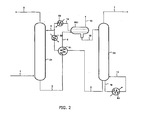
- variants ( Fig. 2 ) of the process according to the invention can be implemented, in particular a fractional regeneration by heating the absorbing solution.
- an absorbent solution for deacidifying a gaseous effluent is carried out schematically by performing an absorption step, followed by a step of heating the absorbent solution, followed by a liquid-liquid separation step of the absorbent solution, followed by a regeneration step.
- the absorption step consists of contacting the gaseous effluent containing the acidic compounds to be removed with the absorbing solution in a C1 absorption column.
- the gaseous effluent to be treated ( ⁇ 1) and the absorbent solution ( ⁇ 4) feed the column C1.
- the organic compounds provided with an amine function of the absorbent solution ( ⁇ 4) react with the acidic compounds contained in the effluent ( ⁇ 1) so as to obtain a gaseous effluent depleted in acidic compounds ( ⁇ 2) which leaves at the top of column C1 and an absorbent solution enriched in acidic compounds ( ⁇ 3) which leaves at the bottom of column C1.
- the heating step consists of raising the temperature of the absorbent solution ( ⁇ 3), for example through a heat exchanger E1, to obtain a two-phase solution ( ⁇ 5).
- the two-phase solution ( ⁇ 5) is sent to a decanter BS1, in which the liquid-liquid separation step consists of separating the two phases obtained in the heating step by sending the acid-rich phase ( ⁇ 12) to the regeneration column C2, and returning the lean phase acid gas ( ⁇ 14), after possible passage in an exchanger E3, to the absorption column C1.
- the liquid-liquid separation step consists of separating the two phases obtained in the heating step by sending the acid-rich phase ( ⁇ 12) to the regeneration column C2, and returning the lean phase acid gas ( ⁇ 14), after possible passage in an exchanger E3, to the absorption column C1.
- the gas phase released by heating the absorbent solution ( ⁇ 3) in the exchanger E1 is separated from the liquid phases in BS1 and discharged through the pipe (-13).
- the regeneration step thus consists in particular in heating in the distillation column C2 and, optionally, in expanding, the absorbent solution enriched in acidic compounds ( ⁇ 12) in order to release the acidic compounds which come out at the top of column C2 in gaseous form ( ⁇ 7).
- the regenerated absorbent solution that is to say depleted in acidic compounds ( ⁇ 6), leaves at the bottom of the column C2, then passes into the exchanger E1, in which it gives heat to the flow ( ⁇ 3) as previously described.
- the regenerated and cooled absorbent solution ( ⁇ 4) after optional passage in a new exchanger E2, is then recycled to the absorption column C1.
- a portion of the absorbent solution is removed through the conduit ( ⁇ 10), heated in the reboiler R1, and then reintroduced into the bottom of the column C2 through the conduit (-11).
- the absorption step of the acidic compounds can be carried out at a pressure of between 1 bar and 120 bar, preferably between 20 bar and 100 bar for the treatment of a natural gas, preferably between 1 and 3 bar for the treatment industrial fumes, and at a temperature between 20 ° C and 100 ° C, preferably between 30 ° C and 90 ° C, even more preferably between 30 ° C and 60 ° C.
- the process according to the invention has an excellent capacity of absorption of the acidic compounds when the temperature in the absorption column C1 is between 30 ° C. and 60 ° C.
- the regeneration step of the process according to the invention can be carried out by thermal regeneration, optionally supplemented by one or more expansion steps.
- the thermal regeneration step is carried out at a temperature of between 100 ° C. and 180 ° C. and at a pressure of between 1 bar and 10 bars.
- the regeneration in the distillation column is carried out at a temperature of between 155 and 165 ° C. and at a pressure of between 6 and 8.5 bars in the case where it is desired to reinject the acid gases.
- the regeneration in the distillation column is carried out at a temperature of 115 ° C. and 130 ° C. and at a pressure of between 1.7 and 3 bars in the case where the acid gas is sent to the atmosphere or in a downstream treatment process, as a Claus process or a tail gas treatment process.
- Absorbent solutions used in these examples are aqueous solutions of N, N, N ', N'-tetramethylhexane-1,6-diamine in combination with a compound of general formula (II) or (III).
- the compounds of general formula (II) used as examples are TetraHydroIsoQuinoline (THIQ) and N-MethylBenzylAmine (N-MetBzA).
- the compounds of general formula (III) used by way of example are N-ButylPiperazine (N-ButPz) and n-butylamine.
- Formulation A TMHDA + THIQ + H 2 O Formulation B TMHDA + N-MetBzA + H 2 O Formulation C TMHDA + N-ButPz + H 2 O Formulation D TMHDA + n-butylamine + H 2 O
- the demixing phenomenon can be controlled by the nature of the activator which is added to an aqueous solution of N, N, N ', N'-Tetramethylhexane-1,6-diamine.
- the composition of the gas to be treated ie the partial pressure of CO 2
- the temperature of the absorbing solution liquid-liquid phase separation can occur (demixing phenomenon).
- concentrations of amines and given water ie concentrations of amines and given water
- the CO 2 partial pressure and therefore the CO 2 loading rate ( ⁇ n acid gas / amine ) at equilibrium.
- the solvent is two-phase
- the two liquid phases can be taken and analyzed to determine their composition (chromatographic analysis, acid-base or volumetric determination).
- the absorbing solution can be used in a deacidification process, or in a method of deacidification with fractional regeneration by heating, as described in figure 2 .
- An absorbent solution based on N, N, N ', N'-Tetramethylhexane-1,6-diamine activated by a compound of general formula (II) or (III) is particularly suitable for this type of process, because it allows be monophasic under the operating conditions corresponding to that of the absorber (ie generally 40 ° C), and diphasic beyond the charge / effluent exchanger (ie generally 90 ° C), and with liquid-liquid phase separation fast.
- concentration of the amines and charge ratio number of moles of acid gas captured relative to the number of moles of amine
- A for example for a concentration of N, N, N ', N'-Tetramethylhexane-1,6-diamine of 30% by weight. and a concentration of 5% by weight TetraHydroIsoQuinoline at 90 ° C for various partial pressures of acid gas in equilibrium with the absorbent solution.
- phase rich in CO 2 ie lower phase
- the concentration of the activator is always higher in the upper phase than in the lower phase. This is another advantage of type A formulations, since the concentration of the activator can be further increased to increase CO 2 capture kinetics, without the latter penalizing the regeneration step. Indeed, from the liquid-liquid separation performed after the charge / effluent exchanger, a portion of the activator circulates in a loop in the absorber.
- the capture capacity of the TMHDA is very little affected by the substitution of a few percent by weight of the TMHDA by a few percents weight of activator, especially at low partial pressure of CO 2 .
- N, N, N ', N'-Tetramethylhexane-1,6-diamine molecule has the particularity of being very resistant to the damage that can occur in a deacidification unit.
- Activators of general formula (II) and (III) also have the distinction of being very resistant to damage that may occur in a deacidification unit.
- aqueous solutions of amine can be degraded in a closed reactor, heated to a temperature T, and pressurized with a partial pressure PP of different gases (CO 2 , O 2 , H 2 S, N 2 ).
- the liquid phase is stirred using a magnetic bar. After a certain period of time, a sample of the liquid phase can be taken and analyzed by various techniques, in particular by gas chromatography.
- TD % AT min e - AT min e ⁇ ° AT min e ⁇ °
- [Amine] is the concentration of the amine in the degraded sample
- [Amine] ° is the concentration of the amine in the non-degraded solution.
- the concentration of the activators can be very low (for example 2.5% by weight, see Example 1 section 1-B /). Furthermore, in the case of an implementation of the regenerated fractionation process by heating, a large part of the activator turns in a loop in the absorber (see Example 1 section 2 /). Thus, the concentration of activator in the regenerator, where most of the degradation reactions take place due to high temperature, can be extremely low.
- the table below gives the degradation rate TD of different aqueous solutions of amine, at a temperature of 140 ° C., in the absence and in the presence of different acid gases.
- the table below gives the degradation rate TD of various aqueous solutions of amine, for a temperature of 180 ° C., in the absence and in the presence of acid gas, which is representative of the degradations that could occur at the bottom of the regenerator, if it is desired to obtain a high pressure acid gas for reinjection applications.
- the table below gives the degradation rate TD of various aqueous solutions of activators such as TetraHydroIsoQuinoline and N-MethylBenzylamine corresponding to the general formula (II), and various aqueous solutions of activators well known to the human being. job, for a temperature of 140 ° C on the one hand in the presence of CO 2 and on the other hand in the presence of O 2 .
Landscapes
- Chemical & Material Sciences (AREA)
- Organic Chemistry (AREA)
- Oil, Petroleum & Natural Gas (AREA)
- Engineering & Computer Science (AREA)
- General Chemical & Material Sciences (AREA)
- Chemical Kinetics & Catalysis (AREA)
- Analytical Chemistry (AREA)
- Health & Medical Sciences (AREA)
- Environmental & Geological Engineering (AREA)
- Biomedical Technology (AREA)
- Gas Separation By Absorption (AREA)
- Treating Waste Gases (AREA)
- Carbon And Carbon Compounds (AREA)
- Industrial Gases (AREA)
Applications Claiming Priority (2)
| Application Number | Priority Date | Filing Date | Title |
|---|---|---|---|
| FR0804304A FR2934172B1 (fr) | 2008-07-28 | 2008-07-28 | Solution absorbante a base de n,n,n'n'-tetramethylhexane -1,6-diamine et procede d'elimination de composes acides d'un effluent gazeux |
| PCT/FR2009/000901 WO2010012883A2 (fr) | 2008-07-28 | 2009-07-21 | Solution absorbante a base de n,n,n',n'-tétraméthylhexane- 1,6-diamine et d'une amine particuliere comportant des fonctions amine primaire ou secondaire et procédé d'elimination de composes acides d'un effluent gazeux |
Publications (2)
| Publication Number | Publication Date |
|---|---|
| EP2310110A2 EP2310110A2 (fr) | 2011-04-20 |
| EP2310110B1 true EP2310110B1 (fr) | 2015-09-09 |
Family
ID=40409904
Family Applications (3)
| Application Number | Title | Priority Date | Filing Date |
|---|---|---|---|
| EP09784286.8A Active EP2310110B1 (fr) | 2008-07-28 | 2009-07-21 | Solution absorbante a base de n,n,n',n'-tetramethylhexane-1,6-diamine et d'une amine comportant des fonctions amine primaire ou secondaire et procede d'elimination de composes acides d'un effluent gazeux |
| EP09784288A Withdrawn EP2318119A1 (fr) | 2008-07-28 | 2009-07-21 | Procede d ' elimination de composes acides d ' un effluent gazeux avec une solution absorbante a base de n,n,n'-tetramethyl-1,6-hexanediamine |
| EP09784287A Withdrawn EP2318120A1 (fr) | 2008-07-28 | 2009-07-21 | Solution absorbante a base d'une amine tertiaire ou encombree et d'un activateur particulier et procédé d'elimination de composes acides d'un effluent gazeux |
Family Applications After (2)
| Application Number | Title | Priority Date | Filing Date |
|---|---|---|---|
| EP09784288A Withdrawn EP2318119A1 (fr) | 2008-07-28 | 2009-07-21 | Procede d ' elimination de composes acides d ' un effluent gazeux avec une solution absorbante a base de n,n,n'-tetramethyl-1,6-hexanediamine |
| EP09784287A Withdrawn EP2318120A1 (fr) | 2008-07-28 | 2009-07-21 | Solution absorbante a base d'une amine tertiaire ou encombree et d'un activateur particulier et procédé d'elimination de composes acides d'un effluent gazeux |
Country Status (8)
| Country | Link |
|---|---|
| US (2) | US20110176981A1 (enExample) |
| EP (3) | EP2310110B1 (enExample) |
| JP (1) | JP2011528993A (enExample) |
| CN (1) | CN102105207A (enExample) |
| AU (1) | AU2009275767B2 (enExample) |
| CA (1) | CA2731061C (enExample) |
| FR (1) | FR2934172B1 (enExample) |
| WO (3) | WO2010012885A1 (enExample) |
Families Citing this family (44)
| Publication number | Priority date | Publication date | Assignee | Title |
|---|---|---|---|---|
| JP5812867B2 (ja) * | 2009-12-11 | 2015-11-17 | 公益財団法人地球環境産業技術研究機構 | 高圧用二酸化炭素吸収剤並びに高圧二酸化炭素吸収及び回収方法 |
| FR2956038B1 (fr) * | 2010-02-08 | 2013-11-22 | Inst Francais Du Petrole | Procede de desacidification d'un gaz par une solution absorbante avec liberation d'un effluent gazeux a partir de la solution absorbante et lavage de cet effluent par la solution absorbante regeneree |
| EP2481466A1 (de) * | 2011-01-31 | 2012-08-01 | Siemens Aktiengesellschaft | Vorrichtung und Verfahren zum Aufreinigen eines mit Nitrosamin verunreinigten Produktes einer Prozessanlage |
| EP2532412A1 (de) * | 2011-06-10 | 2012-12-12 | Evonik Degussa GmbH | Absorptionsmedium und Verfahren zur Absorption eines sauren Gases aus einer Gasmischung |
| BR112014008497A2 (pt) | 2011-11-14 | 2017-04-11 | Evonik Degussa Gmbh | método e dispositivo para a separação de gases acídicos a partir de uma mistura de gás |
| FR2983087B1 (fr) * | 2011-11-30 | 2014-01-10 | IFP Energies Nouvelles | Procede d'elimination de composes acides d'un effluent gazeux avec une solution absorbante a base de bis(amino-3-propyl) ethers ou de (amino-2-ethyl)-(amino-3-propyl) ethers |
| CN102553396B (zh) * | 2011-12-23 | 2014-06-04 | 武汉凯迪工程技术研究总院有限公司 | 一种高效低能耗捕集电站烟气中二氧化碳的方法及其设备 |
| DE102012200566A1 (de) | 2012-01-16 | 2013-07-18 | Evonik Degussa Gmbh | Verfahren zur Absorption von CO2 aus einer Gasmischung |
| DE102012200907A1 (de) | 2012-01-23 | 2013-07-25 | Evonik Industries Ag | Verfahren und Absorptionsmedium zur Absorption von CO2 aus einer Gasmischung |
| US9636628B2 (en) | 2012-02-08 | 2017-05-02 | Research Institute Of Innovative Technology For The Earth | Aqueous solution which efficiently absorbs and recovers carbon dioxide in exhaust gas, and method for recovering carbon dioxide using same |
| DE102012207509A1 (de) | 2012-05-07 | 2013-11-07 | Evonik Degussa Gmbh | Verfahren zur Absorption von CO2 aus einer Gasmischung |
| CA2876683A1 (en) | 2012-06-15 | 2013-12-19 | Dow Global Technologies Llc | Process for the treatment of liquefied hydrocarbons using 3-(piperazine-1-yl)propane-1,2-diol compounds |
| JP5272099B1 (ja) * | 2012-07-26 | 2013-08-28 | 新日鉄住金エンジニアリング株式会社 | 二酸化炭素回収方法 |
| DE102012222157A1 (de) | 2012-12-04 | 2014-06-05 | Evonik Industries Ag | Verfahren zur Absorption von CO2 aus einer Gasmischung |
| FR2999448B1 (fr) * | 2012-12-18 | 2015-10-09 | IFP Energies Nouvelles | Procede de captage du co2 par adsorption |
| RU2637336C2 (ru) * | 2012-12-21 | 2017-12-04 | ЭкссонМобил Рисерч энд Энджиниринг Компани | Аминовое промотирование для улавливания co2 |
| BR112015020067A2 (pt) * | 2013-02-25 | 2017-07-18 | Nippon Steel & Sumitomo Metal Corp | líquido para absorver e coletar dióxido de carbono em gás e método para coletar dióxido de carbono com o uso do mesmo |
| US9266102B2 (en) | 2013-03-29 | 2016-02-23 | The University Of Kentucky Research Foundation | Catalysts and methods of increasing mass transfer rate of acid gas scrubbing solvents |
| US9468883B2 (en) | 2013-03-29 | 2016-10-18 | The University Of Kentucky Research Foundation | Solvent and method for removal of an acid gas from a fluid stream |
| US9409125B2 (en) | 2013-03-29 | 2016-08-09 | The University Of Kentucky Research Foundation | Method of increasing mass transfer rate of acid gas scrubbing solvents |
| FR3011746B1 (fr) * | 2013-10-15 | 2016-09-30 | Ifp Energies Now | Utilisation d'une solution absorbante dans un procede de desacidification d'un gaz pour limiter la corrosion d'equipements en acier faiblement allie |
| FR3014101B1 (fr) * | 2013-11-29 | 2015-11-13 | IFP Energies Nouvelles | Solution absorbante a base de n,n,n',n'-tetramethyl-1,6-hexanediamine et de n,n,n',n'-tetramethyldiaminoether et procede d'elimination de composes acides d'un effluent gazeux |
| FR3014328B1 (fr) * | 2013-12-09 | 2017-05-19 | Ifp Energies Now | Solution absorbante a base de n,n,n',n'-tetramethyl-1,6-hexanediamine et d'une diamine secondaire de la famille des alkylpiperazines et procede d'elimination de composes acides d'un effluent gazeux |
| FR3014327B1 (fr) * | 2013-12-09 | 2017-05-19 | Ifp Energies Now | Solution absorbante a base de n,n,n',n'-tetramethyl-1,6-hexanediamine et d'une diamine secondaire de la famille des alkyldiamines et procede d'elimination de composes acides d'un effluent gazeux |
| JP6121894B2 (ja) * | 2013-12-25 | 2017-04-26 | 株式会社東芝 | 酸性ガス除去装置及び酸性ガス除去方法 |
| JP2015205238A (ja) * | 2014-04-18 | 2015-11-19 | 株式会社東芝 | 二酸化炭素回収装置および二酸化炭素回収方法 |
| FR3021049B1 (fr) | 2014-05-16 | 2016-05-27 | Ifp Energies Now | Nouvelles diamines tertiaires beta-hydroxylees, leur procede de synthese et leur utilisation pour l'elimination de composes acides d'un effluent gazeux |
| FR3020965B1 (fr) | 2014-05-16 | 2016-05-27 | Ifp Energies Now | Solution absorbante a base de diamines tertiaires beta hydroxylees et procede d'elimination de composes acides d'un effluent gazeux |
| AU2015218491A1 (en) * | 2014-08-29 | 2016-03-17 | Commonwealth Scientific And Industrial Research Organisation | Absorbent solution for absorption of acid gas and process for absorption of acid gas |
| FR3026652A1 (fr) * | 2014-10-06 | 2016-04-08 | Ifp Energies Now | Procede d'elimination de composes acides d'un effluent gazeux avec une solution absorbante a base de diamines appartenant a la famille du 1,3-diamino-2-propanol |
| CN104645780B (zh) * | 2015-02-04 | 2016-06-08 | 中国华能集团清洁能源技术研究院有限公司 | 一种捕集二氧化碳的变温浓缩吸收剂及其使用方法 |
| DE102015212749A1 (de) | 2015-07-08 | 2017-01-12 | Evonik Degussa Gmbh | Verfahren zur Entfeuchtung von feuchten Gasgemischen |
| FR3045401B1 (fr) * | 2015-12-17 | 2018-02-02 | IFP Energies Nouvelles | Solution absorbante a base de derives hydroxyles de la 1,6-hexanediamine et procede d'elimination de composes acides d'un effluent gazeux |
| EP3257843A1 (en) | 2016-06-14 | 2017-12-20 | Evonik Degussa GmbH | Method of preparing a high purity imidazolium salt |
| DE102016210481B3 (de) | 2016-06-14 | 2017-06-08 | Evonik Degussa Gmbh | Verfahren zum Reinigen einer ionischen Flüssigkeit |
| EP3257568B1 (de) | 2016-06-14 | 2019-09-18 | Evonik Degussa GmbH | Verfahren zur entfeuchtung von feuchten gasgemischen mit ionischen flüssigkeiten |
| DE102016210484A1 (de) | 2016-06-14 | 2017-12-14 | Evonik Degussa Gmbh | Verfahren zur Entfeuchtung von feuchten Gasgemischen |
| DE102016210483A1 (de) | 2016-06-14 | 2017-12-14 | Evonik Degussa Gmbh | Verfahren und Absorptionsmittel zur Entfeuchtung von feuchten Gasgemischen |
| DE102016210478A1 (de) | 2016-06-14 | 2017-12-14 | Evonik Degussa Gmbh | Verfahren zur Entfeuchtung von feuchten Gasgemischen |
| JP7026938B2 (ja) * | 2018-01-24 | 2022-03-01 | 学校法人神戸学院 | 低エネルギー型の二酸化炭素発生方法、及び該方法に使用するための二酸化炭素発生剤 |
| CN108822908A (zh) * | 2018-06-27 | 2018-11-16 | 中国石油化工股份有限公司 | 一种天然气有机硫脱除剂及其制备方法 |
| WO2022176534A1 (ja) * | 2021-02-22 | 2022-08-25 | 学校法人神戸学院 | 大気由来の二酸化炭素の吸収剤 |
| US11612854B2 (en) | 2021-06-24 | 2023-03-28 | Research Triangle Institute | Non-aqueous solvent CO2 capture in rotating packed bed |
| GB2622087A (en) * | 2022-09-02 | 2024-03-06 | Johnson Matthey Plc | Carbon dioxide removal unit |
Family Cites Families (18)
| Publication number | Priority date | Publication date | Assignee | Title |
|---|---|---|---|---|
| GB752372A (en) * | 1953-03-23 | 1956-07-11 | Bataafsche Petroleum | Aqueous amine solutions and a method of reducing corrosion of corrodible metal surfaces in contact with aqueous amine solutions |
| US4389383A (en) * | 1980-05-27 | 1983-06-21 | Union Carbide Corporation | Regenerable process for the selective removal of sulfur dioxide from effluent gases |
| JPH078839B2 (ja) * | 1986-05-29 | 1995-02-01 | 東レ株式会社 | N,n,n′,n′−テトラメチル−1.6−ヘキサンジアミンの製造方法 |
| US5039424A (en) * | 1988-09-28 | 1991-08-13 | Tosoh Corporation | Method for treating an amine-containing waste water |
| JP2748435B2 (ja) * | 1988-09-28 | 1998-05-06 | 東ソー株式会社 | アミン含有廃水の処理方法 |
| FR2743083B1 (fr) * | 1995-12-28 | 1998-01-30 | Inst Francais Du Petrole | Procede de deshydratation, de desacidification et de degazolinage d'un gaz naturel, utilisant un melange de solvants |
| DE19947845A1 (de) | 1999-10-05 | 2001-04-12 | Basf Ag | Verfahren zum Entfernen von COS aus einem Kohlenwasserstoff-Fluidstrom und Waschflüssikgkeit zur Verwendung in derartigen Verfahren |
| FR2820430B1 (fr) | 2001-02-02 | 2003-10-31 | Inst Francais Du Petrole | Procede de desacidification d'un gaz avec lavage des hydrocarbures desorbes lors de la regeneration du solvant |
| GB0108386D0 (en) * | 2001-04-04 | 2001-05-23 | Bp Exploration Operating | Process |
| FR2861403B1 (fr) * | 2003-10-27 | 2006-02-17 | Inst Francais Du Petrole | Procede de purification d'un gaz naturel par adsorption des mercaptans |
| JP5030371B2 (ja) * | 2004-04-15 | 2012-09-19 | 三菱重工業株式会社 | 吸収液、吸収液を用いたco2又はh2s又はその双方の除去装置及び方法 |
| TWI362566B (en) * | 2004-06-30 | 2012-04-21 | Dainippon Ink & Chemicals | Composition for antireflection coating and pattern forming method |
| US7323100B2 (en) * | 2004-07-16 | 2008-01-29 | Conocophillips Company | Combination of amorphous materials for hydrocracking catalysts |
| JP2006240966A (ja) * | 2005-03-07 | 2006-09-14 | Research Institute Of Innovative Technology For The Earth | 排ガス中の二酸化炭素を吸収及び脱離して回収する方法 |
| FR2895273B1 (fr) * | 2005-12-22 | 2008-08-08 | Inst Francais Du Petrole | Procede de desacidification d'un gaz avec une solution absorbante a regeneration fractionnee avec controle de la teneur en eau de la solution |
| FR2898284B1 (fr) * | 2006-03-10 | 2009-06-05 | Inst Francais Du Petrole | Procede de desacidification d'un gaz par solution absorbante avec regeneration fractionnee par chauffage. |
| FR2900841B1 (fr) * | 2006-05-10 | 2008-07-04 | Inst Francais Du Petrole | Procede de desacidification avec extraction des composes reactifs |
| CA2861539C (en) * | 2006-05-18 | 2016-01-12 | Norbert Asprion | Carbon dioxide absorbent requiring less regeneration energy |
-
2008
- 2008-07-28 FR FR0804304A patent/FR2934172B1/fr active Active
-
2009
- 2009-07-21 EP EP09784286.8A patent/EP2310110B1/fr active Active
- 2009-07-21 JP JP2011520542A patent/JP2011528993A/ja active Pending
- 2009-07-21 US US13/056,446 patent/US20110176981A1/en not_active Abandoned
- 2009-07-21 EP EP09784288A patent/EP2318119A1/fr not_active Withdrawn
- 2009-07-21 CN CN2009801306350A patent/CN102105207A/zh active Pending
- 2009-07-21 WO PCT/FR2009/000903 patent/WO2010012885A1/fr not_active Ceased
- 2009-07-21 WO PCT/FR2009/000901 patent/WO2010012883A2/fr not_active Ceased
- 2009-07-21 WO PCT/FR2009/000902 patent/WO2010012884A1/fr not_active Ceased
- 2009-07-21 CA CA2731061A patent/CA2731061C/fr active Active
- 2009-07-21 EP EP09784287A patent/EP2318120A1/fr not_active Withdrawn
- 2009-07-21 AU AU2009275767A patent/AU2009275767B2/en active Active
- 2009-07-21 US US13/056,507 patent/US8845787B2/en active Active
Also Published As
| Publication number | Publication date |
|---|---|
| WO2010012884A1 (fr) | 2010-02-04 |
| US20110176981A1 (en) | 2011-07-21 |
| CA2731061C (fr) | 2015-03-17 |
| JP2011528993A (ja) | 2011-12-01 |
| WO2010012883A2 (fr) | 2010-02-04 |
| AU2009275767A1 (en) | 2010-02-04 |
| US8845787B2 (en) | 2014-09-30 |
| CA2731061A1 (fr) | 2010-02-04 |
| EP2318120A1 (fr) | 2011-05-11 |
| FR2934172B1 (fr) | 2011-10-28 |
| WO2010012883A3 (fr) | 2010-03-25 |
| EP2318119A1 (fr) | 2011-05-11 |
| WO2010012885A1 (fr) | 2010-02-04 |
| FR2934172A1 (fr) | 2010-01-29 |
| CN102105207A (zh) | 2011-06-22 |
| EP2310110A2 (fr) | 2011-04-20 |
| AU2009275767B2 (en) | 2016-05-12 |
| US20110185901A1 (en) | 2011-08-04 |
Similar Documents
| Publication | Publication Date | Title |
|---|---|---|
| EP2310110B1 (fr) | Solution absorbante a base de n,n,n',n'-tetramethylhexane-1,6-diamine et d'une amine comportant des fonctions amine primaire ou secondaire et procede d'elimination de composes acides d'un effluent gazeux | |
| EP1656983B1 (fr) | Procédé de désacidification d'un gaz avec une solution absorbante à régénération fractionnée | |
| US8313718B2 (en) | Method and composition for removal of mercaptans from gas streams | |
| EP2512630A1 (fr) | Procede d'elimination de composes acides d'un effluent gazeux avec une solution absorbante a base de diamines | |
| EP2776141B1 (fr) | Procédé d'élimination de composes acides d'un effluent gazeux avec une solution absorbante a base de dihydroxyalkylamines possédant un encombrement stérique sévère de l'atome d'azote | |
| WO2013174902A1 (fr) | Procede d'elimination selective du sulfure d'hydrogene de melanges gazeux et utilisation d'un thioalcanol pour l'elimination selective du sulfure d'hydrogene | |
| WO2011080406A1 (fr) | Procede d ' elimination de composes acides d ' un effluent gazeaux avec une solution absorbante a base de triamines | |
| WO2014001664A1 (fr) | Solution absorbante a base de diamines tertiaires appartenant a la famille des aminoethylmorpholines encombrees et procede d'élimination de composes acides d'un effluent gazeux | |
| EP2785435B1 (fr) | Procede d'elimination de composes acides d'un effluent gazeux avec une solution absorbante a base de bis(amino-3-propyl)ethers ou de (amino-2-ethyl)-(amino-3-propyl)ethers | |
| EP3148674B1 (fr) | Solution absorbante contenant un mélange de 1,2-bis-(2-diméthylaminoéthoxy)-éthane et de 2-[2-(2-diméthylaminoéthoxy)-éthoxy]-éthanol, et procédé d'élimination de composés acides d'un effluent gazeux | |
| EP4076702B1 (fr) | Procede d'élimination de composes acides d'un effluent gazeux avec une solution absorbante d'amines tertiaires | |
| FR2958180A1 (fr) | Procede de desacidification d'un gaz par une solution absorbante, avec section de lavage acide | |
| EP2836287A1 (fr) | Procede de traitement d'un flux gazeux par absorption utilisant un compose de formule ch3 - (och2) n-0-ch3 | |
| WO2014114862A2 (fr) | Solution absorbante a base d'une amine tertiaire ou encombree et d'un activateur particulier et procédé d'elimination de composes acides d'un effluent gazeux | |
| AU2011320717B2 (en) | Use of 2-(3-aminopropoxy)ethan-1-ol as an absorbent to remove acidic gases | |
| WO2011138517A1 (fr) | Solution absorbante a base de ν,ν,ν',ν'- tétraéthyldiéthylènetriamine et procédé d'elimination de composes acides d'un effluent gazeux | |
| WO2014087075A1 (fr) | Solution absorbante a base d'amines appartenant a la famille des n-alkyl-hydroxypiperidines et procede d'élimination de composes acides d'un effluent gazeux avec une telle solution | |
| WO2016193257A1 (fr) | Procede d'elimination de composes acides d'un effluent gazeux avec une solution absorbante a base d'aminoethers tel que le bis-(3-dimethylaminopropoxy)-1,2-ethane | |
| FR3014101A1 (fr) | Solution absorbante a base de n,n,n',n'-tetramethyl-1,6-hexanediamine et de n,n,n',n'-tetramethyldiaminoether et procede d'elimination de composes acides d'un effluent gazeux | |
| FR3014328A1 (fr) | Solution absorbante a base de n,n,n',n'-tetramethyl-1,6-hexanediamine et d'une diamine secondaire de la famille des alkylpiperazines et procede d'elimination de composes acides d'un effluent gazeux | |
| US20120280176A1 (en) | Method and Composition for Removal of Mercaptans from Gas Streams | |
| FR2990879A1 (fr) | Procede de decarbonatation de fumees. | |
| FR2957268A1 (fr) | Solution absorbante a base de multiamines aromatiques et procede d'elimination de composes acides d'un effluent gazeux |
Legal Events
| Date | Code | Title | Description |
|---|---|---|---|
| PUAI | Public reference made under article 153(3) epc to a published international application that has entered the european phase |
Free format text: ORIGINAL CODE: 0009012 |
|
| 17P | Request for examination filed |
Effective date: 20110228 |
|
| AK | Designated contracting states |
Kind code of ref document: A2 Designated state(s): AT BE BG CH CY CZ DE DK EE ES FI FR GB GR HR HU IE IS IT LI LT LU LV MC MK MT NL NO PL PT RO SE SI SK SM TR |
|
| AX | Request for extension of the european patent |
Extension state: AL BA RS |
|
| DAX | Request for extension of the european patent (deleted) | ||
| 17Q | First examination report despatched |
Effective date: 20130702 |
|
| GRAP | Despatch of communication of intention to grant a patent |
Free format text: ORIGINAL CODE: EPIDOSNIGR1 |
|
| INTG | Intention to grant announced |
Effective date: 20150212 |
|
| GRAS | Grant fee paid |
Free format text: ORIGINAL CODE: EPIDOSNIGR3 |
|
| GRAA | (expected) grant |
Free format text: ORIGINAL CODE: 0009210 |
|
| AK | Designated contracting states |
Kind code of ref document: B1 Designated state(s): AT BE BG CH CY CZ DE DK EE ES FI FR GB GR HR HU IE IS IT LI LT LU LV MC MK MT NL NO PL PT RO SE SI SK SM TR |
|
| REG | Reference to a national code |
Ref country code: GB Ref legal event code: FG4D Free format text: NOT ENGLISH |
|
| REG | Reference to a national code |
Ref country code: AT Ref legal event code: REF Ref document number: 747641 Country of ref document: AT Kind code of ref document: T Effective date: 20150915 Ref country code: CH Ref legal event code: EP |
|
| REG | Reference to a national code |
Ref country code: IE Ref legal event code: FG4D Free format text: LANGUAGE OF EP DOCUMENT: FRENCH |
|
| REG | Reference to a national code |
Ref country code: DE Ref legal event code: R096 Ref document number: 602009033555 Country of ref document: DE |
|
| PG25 | Lapsed in a contracting state [announced via postgrant information from national office to epo] |
Ref country code: LV Free format text: LAPSE BECAUSE OF FAILURE TO SUBMIT A TRANSLATION OF THE DESCRIPTION OR TO PAY THE FEE WITHIN THE PRESCRIBED TIME-LIMIT Effective date: 20150909 Ref country code: GR Free format text: LAPSE BECAUSE OF FAILURE TO SUBMIT A TRANSLATION OF THE DESCRIPTION OR TO PAY THE FEE WITHIN THE PRESCRIBED TIME-LIMIT Effective date: 20151210 Ref country code: FI Free format text: LAPSE BECAUSE OF FAILURE TO SUBMIT A TRANSLATION OF THE DESCRIPTION OR TO PAY THE FEE WITHIN THE PRESCRIBED TIME-LIMIT Effective date: 20150909 Ref country code: LT Free format text: LAPSE BECAUSE OF FAILURE TO SUBMIT A TRANSLATION OF THE DESCRIPTION OR TO PAY THE FEE WITHIN THE PRESCRIBED TIME-LIMIT Effective date: 20150909 |
|
| REG | Reference to a national code |
Ref country code: NO Ref legal event code: T2 Effective date: 20150909 |
|
| REG | Reference to a national code |
Ref country code: LT Ref legal event code: MG4D |
|
| REG | Reference to a national code |
Ref country code: AT Ref legal event code: MK05 Ref document number: 747641 Country of ref document: AT Kind code of ref document: T Effective date: 20150909 |
|
| REG | Reference to a national code |
Ref country code: NL Ref legal event code: FP |
|
| PG25 | Lapsed in a contracting state [announced via postgrant information from national office to epo] |
Ref country code: HR Free format text: LAPSE BECAUSE OF FAILURE TO SUBMIT A TRANSLATION OF THE DESCRIPTION OR TO PAY THE FEE WITHIN THE PRESCRIBED TIME-LIMIT Effective date: 20150909 Ref country code: ES Free format text: LAPSE BECAUSE OF FAILURE TO SUBMIT A TRANSLATION OF THE DESCRIPTION OR TO PAY THE FEE WITHIN THE PRESCRIBED TIME-LIMIT Effective date: 20150909 Ref country code: SE Free format text: LAPSE BECAUSE OF FAILURE TO SUBMIT A TRANSLATION OF THE DESCRIPTION OR TO PAY THE FEE WITHIN THE PRESCRIBED TIME-LIMIT Effective date: 20150909 |
|
| PG25 | Lapsed in a contracting state [announced via postgrant information from national office to epo] |
Ref country code: CZ Free format text: LAPSE BECAUSE OF FAILURE TO SUBMIT A TRANSLATION OF THE DESCRIPTION OR TO PAY THE FEE WITHIN THE PRESCRIBED TIME-LIMIT Effective date: 20150909 Ref country code: EE Free format text: LAPSE BECAUSE OF FAILURE TO SUBMIT A TRANSLATION OF THE DESCRIPTION OR TO PAY THE FEE WITHIN THE PRESCRIBED TIME-LIMIT Effective date: 20150909 Ref country code: IT Free format text: LAPSE BECAUSE OF FAILURE TO SUBMIT A TRANSLATION OF THE DESCRIPTION OR TO PAY THE FEE WITHIN THE PRESCRIBED TIME-LIMIT Effective date: 20150909 Ref country code: IS Free format text: LAPSE BECAUSE OF FAILURE TO SUBMIT A TRANSLATION OF THE DESCRIPTION OR TO PAY THE FEE WITHIN THE PRESCRIBED TIME-LIMIT Effective date: 20160109 Ref country code: SK Free format text: LAPSE BECAUSE OF FAILURE TO SUBMIT A TRANSLATION OF THE DESCRIPTION OR TO PAY THE FEE WITHIN THE PRESCRIBED TIME-LIMIT Effective date: 20150909 |
|
| PG25 | Lapsed in a contracting state [announced via postgrant information from national office to epo] |
Ref country code: PL Free format text: LAPSE BECAUSE OF FAILURE TO SUBMIT A TRANSLATION OF THE DESCRIPTION OR TO PAY THE FEE WITHIN THE PRESCRIBED TIME-LIMIT Effective date: 20150909 Ref country code: RO Free format text: LAPSE BECAUSE OF FAILURE TO SUBMIT A TRANSLATION OF THE DESCRIPTION OR TO PAY THE FEE WITHIN THE PRESCRIBED TIME-LIMIT Effective date: 20150909 Ref country code: AT Free format text: LAPSE BECAUSE OF FAILURE TO SUBMIT A TRANSLATION OF THE DESCRIPTION OR TO PAY THE FEE WITHIN THE PRESCRIBED TIME-LIMIT Effective date: 20150909 Ref country code: PT Free format text: LAPSE BECAUSE OF FAILURE TO SUBMIT A TRANSLATION OF THE DESCRIPTION OR TO PAY THE FEE WITHIN THE PRESCRIBED TIME-LIMIT Effective date: 20160111 |
|
| REG | Reference to a national code |
Ref country code: DE Ref legal event code: R097 Ref document number: 602009033555 Country of ref document: DE |
|
| PLBE | No opposition filed within time limit |
Free format text: ORIGINAL CODE: 0009261 |
|
| STAA | Information on the status of an ep patent application or granted ep patent |
Free format text: STATUS: NO OPPOSITION FILED WITHIN TIME LIMIT |
|
| REG | Reference to a national code |
Ref country code: FR Ref legal event code: PLFP Year of fee payment: 8 |
|
| 26N | No opposition filed |
Effective date: 20160610 |
|
| PG25 | Lapsed in a contracting state [announced via postgrant information from national office to epo] |
Ref country code: DK Free format text: LAPSE BECAUSE OF FAILURE TO SUBMIT A TRANSLATION OF THE DESCRIPTION OR TO PAY THE FEE WITHIN THE PRESCRIBED TIME-LIMIT Effective date: 20150909 Ref country code: SI Free format text: LAPSE BECAUSE OF FAILURE TO SUBMIT A TRANSLATION OF THE DESCRIPTION OR TO PAY THE FEE WITHIN THE PRESCRIBED TIME-LIMIT Effective date: 20150909 |
|
| PG25 | Lapsed in a contracting state [announced via postgrant information from national office to epo] |
Ref country code: BE Free format text: LAPSE BECAUSE OF NON-PAYMENT OF DUE FEES Effective date: 20160731 |
|
| REG | Reference to a national code |
Ref country code: DE Ref legal event code: R119 Ref document number: 602009033555 Country of ref document: DE |
|
| REG | Reference to a national code |
Ref country code: CH Ref legal event code: PL |
|
| PG25 | Lapsed in a contracting state [announced via postgrant information from national office to epo] |
Ref country code: MC Free format text: LAPSE BECAUSE OF FAILURE TO SUBMIT A TRANSLATION OF THE DESCRIPTION OR TO PAY THE FEE WITHIN THE PRESCRIBED TIME-LIMIT Effective date: 20150909 |
|
| PG25 | Lapsed in a contracting state [announced via postgrant information from national office to epo] |
Ref country code: DE Free format text: LAPSE BECAUSE OF NON-PAYMENT OF DUE FEES Effective date: 20170201 Ref country code: CH Free format text: LAPSE BECAUSE OF NON-PAYMENT OF DUE FEES Effective date: 20160731 Ref country code: LI Free format text: LAPSE BECAUSE OF NON-PAYMENT OF DUE FEES Effective date: 20160731 |
|
| REG | Reference to a national code |
Ref country code: IE Ref legal event code: MM4A |
|
| PG25 | Lapsed in a contracting state [announced via postgrant information from national office to epo] |
Ref country code: IE Free format text: LAPSE BECAUSE OF NON-PAYMENT OF DUE FEES Effective date: 20160721 |
|
| REG | Reference to a national code |
Ref country code: FR Ref legal event code: PLFP Year of fee payment: 9 |
|
| PG25 | Lapsed in a contracting state [announced via postgrant information from national office to epo] |
Ref country code: LU Free format text: LAPSE BECAUSE OF NON-PAYMENT OF DUE FEES Effective date: 20160721 |
|
| PG25 | Lapsed in a contracting state [announced via postgrant information from national office to epo] |
Ref country code: SM Free format text: LAPSE BECAUSE OF FAILURE TO SUBMIT A TRANSLATION OF THE DESCRIPTION OR TO PAY THE FEE WITHIN THE PRESCRIBED TIME-LIMIT Effective date: 20150909 Ref country code: HU Free format text: LAPSE BECAUSE OF FAILURE TO SUBMIT A TRANSLATION OF THE DESCRIPTION OR TO PAY THE FEE WITHIN THE PRESCRIBED TIME-LIMIT; INVALID AB INITIO Effective date: 20090721 Ref country code: CY Free format text: LAPSE BECAUSE OF FAILURE TO SUBMIT A TRANSLATION OF THE DESCRIPTION OR TO PAY THE FEE WITHIN THE PRESCRIBED TIME-LIMIT Effective date: 20150909 |
|
| PG25 | Lapsed in a contracting state [announced via postgrant information from national office to epo] |
Ref country code: MT Free format text: LAPSE BECAUSE OF FAILURE TO SUBMIT A TRANSLATION OF THE DESCRIPTION OR TO PAY THE FEE WITHIN THE PRESCRIBED TIME-LIMIT Effective date: 20150909 Ref country code: TR Free format text: LAPSE BECAUSE OF FAILURE TO SUBMIT A TRANSLATION OF THE DESCRIPTION OR TO PAY THE FEE WITHIN THE PRESCRIBED TIME-LIMIT Effective date: 20150909 Ref country code: MK Free format text: LAPSE BECAUSE OF FAILURE TO SUBMIT A TRANSLATION OF THE DESCRIPTION OR TO PAY THE FEE WITHIN THE PRESCRIBED TIME-LIMIT Effective date: 20150909 |
|
| REG | Reference to a national code |
Ref country code: FR Ref legal event code: PLFP Year of fee payment: 10 |
|
| PG25 | Lapsed in a contracting state [announced via postgrant information from national office to epo] |
Ref country code: BG Free format text: LAPSE BECAUSE OF FAILURE TO SUBMIT A TRANSLATION OF THE DESCRIPTION OR TO PAY THE FEE WITHIN THE PRESCRIBED TIME-LIMIT Effective date: 20150909 |
|
| P01 | Opt-out of the competence of the unified patent court (upc) registered |
Free format text: CASE NUMBER: APP_25525/2025 Effective date: 20250528 |
|
| PGFP | Annual fee paid to national office [announced via postgrant information from national office to epo] |
Ref country code: NL Payment date: 20250724 Year of fee payment: 17 |
|
| PGFP | Annual fee paid to national office [announced via postgrant information from national office to epo] |
Ref country code: NO Payment date: 20250718 Year of fee payment: 17 |
|
| PGFP | Annual fee paid to national office [announced via postgrant information from national office to epo] |
Ref country code: GB Payment date: 20250722 Year of fee payment: 17 |
|
| PGFP | Annual fee paid to national office [announced via postgrant information from national office to epo] |
Ref country code: FR Payment date: 20250725 Year of fee payment: 17 |