EP2303562B1 - Stratifie etanche a l'air et anticrevaison pour objet pneumatique - Google Patents
Stratifie etanche a l'air et anticrevaison pour objet pneumatique Download PDFInfo
- Publication number
- EP2303562B1 EP2303562B1 EP20090768898 EP09768898A EP2303562B1 EP 2303562 B1 EP2303562 B1 EP 2303562B1 EP 20090768898 EP20090768898 EP 20090768898 EP 09768898 A EP09768898 A EP 09768898A EP 2303562 B1 EP2303562 B1 EP 2303562B1
- Authority
- EP
- European Patent Office
- Prior art keywords
- styrene
- composition
- elastomer
- phr
- laminate according
- Prior art date
- Legal status (The legal status is an assumption and is not a legal conclusion. Google has not performed a legal analysis and makes no representation as to the accuracy of the status listed.)
- Not-in-force
Links
Images
Classifications
-
- B—PERFORMING OPERATIONS; TRANSPORTING
- B32—LAYERED PRODUCTS
- B32B—LAYERED PRODUCTS, i.e. PRODUCTS BUILT-UP OF STRATA OF FLAT OR NON-FLAT, e.g. CELLULAR OR HONEYCOMB, FORM
- B32B25/00—Layered products comprising a layer of natural or synthetic rubber
- B32B25/14—Layered products comprising a layer of natural or synthetic rubber comprising synthetic rubber copolymers
-
- B—PERFORMING OPERATIONS; TRANSPORTING
- B29—WORKING OF PLASTICS; WORKING OF SUBSTANCES IN A PLASTIC STATE IN GENERAL
- B29C—SHAPING OR JOINING OF PLASTICS; SHAPING OF MATERIAL IN A PLASTIC STATE, NOT OTHERWISE PROVIDED FOR; AFTER-TREATMENT OF THE SHAPED PRODUCTS, e.g. REPAIRING
- B29C73/00—Repairing of articles made from plastics or substances in a plastic state, e.g. of articles shaped or produced by using techniques covered by this subclass or subclass B29D
- B29C73/16—Auto-repairing or self-sealing arrangements or agents
- B29C73/18—Auto-repairing or self-sealing arrangements or agents the article material itself being self-sealing, e.g. by compression
- B29C73/20—Auto-repairing or self-sealing arrangements or agents the article material itself being self-sealing, e.g. by compression the article material only consisting in part of a deformable sealing material
-
- B—PERFORMING OPERATIONS; TRANSPORTING
- B29—WORKING OF PLASTICS; WORKING OF SUBSTANCES IN A PLASTIC STATE IN GENERAL
- B29C—SHAPING OR JOINING OF PLASTICS; SHAPING OF MATERIAL IN A PLASTIC STATE, NOT OTHERWISE PROVIDED FOR; AFTER-TREATMENT OF THE SHAPED PRODUCTS, e.g. REPAIRING
- B29C73/00—Repairing of articles made from plastics or substances in a plastic state, e.g. of articles shaped or produced by using techniques covered by this subclass or subclass B29D
- B29C73/16—Auto-repairing or self-sealing arrangements or agents
- B29C73/163—Sealing compositions or agents, e.g. combined with propellant agents
-
- B—PERFORMING OPERATIONS; TRANSPORTING
- B32—LAYERED PRODUCTS
- B32B—LAYERED PRODUCTS, i.e. PRODUCTS BUILT-UP OF STRATA OF FLAT OR NON-FLAT, e.g. CELLULAR OR HONEYCOMB, FORM
- B32B25/00—Layered products comprising a layer of natural or synthetic rubber
- B32B25/04—Layered products comprising a layer of natural or synthetic rubber comprising rubber as the main or only constituent of a layer, which is next to another layer of the same or of a different material
- B32B25/08—Layered products comprising a layer of natural or synthetic rubber comprising rubber as the main or only constituent of a layer, which is next to another layer of the same or of a different material of synthetic resin
-
- B—PERFORMING OPERATIONS; TRANSPORTING
- B32—LAYERED PRODUCTS
- B32B—LAYERED PRODUCTS, i.e. PRODUCTS BUILT-UP OF STRATA OF FLAT OR NON-FLAT, e.g. CELLULAR OR HONEYCOMB, FORM
- B32B25/00—Layered products comprising a layer of natural or synthetic rubber
- B32B25/18—Layered products comprising a layer of natural or synthetic rubber comprising butyl or halobutyl rubber
-
- B—PERFORMING OPERATIONS; TRANSPORTING
- B32—LAYERED PRODUCTS
- B32B—LAYERED PRODUCTS, i.e. PRODUCTS BUILT-UP OF STRATA OF FLAT OR NON-FLAT, e.g. CELLULAR OR HONEYCOMB, FORM
- B32B27/00—Layered products comprising a layer of synthetic resin
- B32B27/30—Layered products comprising a layer of synthetic resin comprising vinyl (co)polymers; comprising acrylic (co)polymers
- B32B27/302—Layered products comprising a layer of synthetic resin comprising vinyl (co)polymers; comprising acrylic (co)polymers comprising aromatic vinyl (co)polymers, e.g. styrenic (co)polymers
-
- B—PERFORMING OPERATIONS; TRANSPORTING
- B32—LAYERED PRODUCTS
- B32B—LAYERED PRODUCTS, i.e. PRODUCTS BUILT-UP OF STRATA OF FLAT OR NON-FLAT, e.g. CELLULAR OR HONEYCOMB, FORM
- B32B7/00—Layered products characterised by the relation between layers; Layered products characterised by the relative orientation of features between layers, or by the relative values of a measurable parameter between layers, i.e. products comprising layers having different physical, chemical or physicochemical properties; Layered products characterised by the interconnection of layers
- B32B7/04—Interconnection of layers
- B32B7/12—Interconnection of layers using interposed adhesives or interposed materials with bonding properties
-
- B—PERFORMING OPERATIONS; TRANSPORTING
- B60—VEHICLES IN GENERAL
- B60C—VEHICLE TYRES; TYRE INFLATION; TYRE CHANGING; CONNECTING VALVES TO INFLATABLE ELASTIC BODIES IN GENERAL; DEVICES OR ARRANGEMENTS RELATED TO TYRES
- B60C1/00—Tyres characterised by the chemical composition or the physical arrangement or mixture of the composition
- B60C1/0008—Compositions of the inner liner
-
- B—PERFORMING OPERATIONS; TRANSPORTING
- B60—VEHICLES IN GENERAL
- B60C—VEHICLE TYRES; TYRE INFLATION; TYRE CHANGING; CONNECTING VALVES TO INFLATABLE ELASTIC BODIES IN GENERAL; DEVICES OR ARRANGEMENTS RELATED TO TYRES
- B60C19/00—Tyre parts or constructions not otherwise provided for
- B60C19/12—Puncture preventing arrangements
- B60C19/122—Puncture preventing arrangements disposed inside of the inner liner
-
- B—PERFORMING OPERATIONS; TRANSPORTING
- B60—VEHICLES IN GENERAL
- B60C—VEHICLE TYRES; TYRE INFLATION; TYRE CHANGING; CONNECTING VALVES TO INFLATABLE ELASTIC BODIES IN GENERAL; DEVICES OR ARRANGEMENTS RELATED TO TYRES
- B60C5/00—Inflatable pneumatic tyres or inner tubes
- B60C5/12—Inflatable pneumatic tyres or inner tubes without separate inflatable inserts, e.g. tubeless tyres with transverse section open to the rim
- B60C5/14—Inflatable pneumatic tyres or inner tubes without separate inflatable inserts, e.g. tubeless tyres with transverse section open to the rim with impervious liner or coating on the inner wall of the tyre
-
- C—CHEMISTRY; METALLURGY
- C08—ORGANIC MACROMOLECULAR COMPOUNDS; THEIR PREPARATION OR CHEMICAL WORKING-UP; COMPOSITIONS BASED THEREON
- C08L—COMPOSITIONS OF MACROMOLECULAR COMPOUNDS
- C08L53/00—Compositions of block copolymers containing at least one sequence of a polymer obtained by reactions only involving carbon-to-carbon unsaturated bonds; Compositions of derivatives of such polymers
- C08L53/02—Compositions of block copolymers containing at least one sequence of a polymer obtained by reactions only involving carbon-to-carbon unsaturated bonds; Compositions of derivatives of such polymers of vinyl-aromatic monomers and conjugated dienes
-
- C—CHEMISTRY; METALLURGY
- C08—ORGANIC MACROMOLECULAR COMPOUNDS; THEIR PREPARATION OR CHEMICAL WORKING-UP; COMPOSITIONS BASED THEREON
- C08L—COMPOSITIONS OF MACROMOLECULAR COMPOUNDS
- C08L53/00—Compositions of block copolymers containing at least one sequence of a polymer obtained by reactions only involving carbon-to-carbon unsaturated bonds; Compositions of derivatives of such polymers
- C08L53/02—Compositions of block copolymers containing at least one sequence of a polymer obtained by reactions only involving carbon-to-carbon unsaturated bonds; Compositions of derivatives of such polymers of vinyl-aromatic monomers and conjugated dienes
- C08L53/025—Compositions of block copolymers containing at least one sequence of a polymer obtained by reactions only involving carbon-to-carbon unsaturated bonds; Compositions of derivatives of such polymers of vinyl-aromatic monomers and conjugated dienes modified
-
- B—PERFORMING OPERATIONS; TRANSPORTING
- B29—WORKING OF PLASTICS; WORKING OF SUBSTANCES IN A PLASTIC STATE IN GENERAL
- B29L—INDEXING SCHEME ASSOCIATED WITH SUBCLASS B29C, RELATING TO PARTICULAR ARTICLES
- B29L2030/00—Pneumatic or solid tyres or parts thereof
-
- B—PERFORMING OPERATIONS; TRANSPORTING
- B32—LAYERED PRODUCTS
- B32B—LAYERED PRODUCTS, i.e. PRODUCTS BUILT-UP OF STRATA OF FLAT OR NON-FLAT, e.g. CELLULAR OR HONEYCOMB, FORM
- B32B2270/00—Resin or rubber layer containing a blend of at least two different polymers
-
- B—PERFORMING OPERATIONS; TRANSPORTING
- B32—LAYERED PRODUCTS
- B32B—LAYERED PRODUCTS, i.e. PRODUCTS BUILT-UP OF STRATA OF FLAT OR NON-FLAT, e.g. CELLULAR OR HONEYCOMB, FORM
- B32B2307/00—Properties of the layers or laminate
- B32B2307/50—Properties of the layers or laminate having particular mechanical properties
- B32B2307/542—Shear strength
-
- B—PERFORMING OPERATIONS; TRANSPORTING
- B32—LAYERED PRODUCTS
- B32B—LAYERED PRODUCTS, i.e. PRODUCTS BUILT-UP OF STRATA OF FLAT OR NON-FLAT, e.g. CELLULAR OR HONEYCOMB, FORM
- B32B2307/00—Properties of the layers or laminate
- B32B2307/70—Other properties
- B32B2307/724—Permeability to gases, adsorption
- B32B2307/7242—Non-permeable
-
- B—PERFORMING OPERATIONS; TRANSPORTING
- B32—LAYERED PRODUCTS
- B32B—LAYERED PRODUCTS, i.e. PRODUCTS BUILT-UP OF STRATA OF FLAT OR NON-FLAT, e.g. CELLULAR OR HONEYCOMB, FORM
- B32B2605/00—Vehicles
-
- C—CHEMISTRY; METALLURGY
- C08—ORGANIC MACROMOLECULAR COMPOUNDS; THEIR PREPARATION OR CHEMICAL WORKING-UP; COMPOSITIONS BASED THEREON
- C08L—COMPOSITIONS OF MACROMOLECULAR COMPOUNDS
- C08L21/00—Compositions of unspecified rubbers
-
- C—CHEMISTRY; METALLURGY
- C08—ORGANIC MACROMOLECULAR COMPOUNDS; THEIR PREPARATION OR CHEMICAL WORKING-UP; COMPOSITIONS BASED THEREON
- C08L—COMPOSITIONS OF MACROMOLECULAR COMPOUNDS
- C08L23/00—Compositions of homopolymers or copolymers of unsaturated aliphatic hydrocarbons having only one carbon-to-carbon double bond; Compositions of derivatives of such polymers
- C08L23/02—Compositions of homopolymers or copolymers of unsaturated aliphatic hydrocarbons having only one carbon-to-carbon double bond; Compositions of derivatives of such polymers not modified by chemical after-treatment
- C08L23/18—Homopolymers or copolymers of hydrocarbons having four or more carbon atoms
- C08L23/20—Homopolymers or copolymers of hydrocarbons having four or more carbon atoms having four to nine carbon atoms
- C08L23/22—Copolymers of isobutene; Butyl rubber; Homopolymers or copolymers of other iso-olefins
-
- Y—GENERAL TAGGING OF NEW TECHNOLOGICAL DEVELOPMENTS; GENERAL TAGGING OF CROSS-SECTIONAL TECHNOLOGIES SPANNING OVER SEVERAL SECTIONS OF THE IPC; TECHNICAL SUBJECTS COVERED BY FORMER USPC CROSS-REFERENCE ART COLLECTIONS [XRACs] AND DIGESTS
- Y10—TECHNICAL SUBJECTS COVERED BY FORMER USPC
- Y10S—TECHNICAL SUBJECTS COVERED BY FORMER USPC CROSS-REFERENCE ART COLLECTIONS [XRACs] AND DIGESTS
- Y10S428/00—Stock material or miscellaneous articles
- Y10S428/912—Puncture healing layer
-
- Y—GENERAL TAGGING OF NEW TECHNOLOGICAL DEVELOPMENTS; GENERAL TAGGING OF CROSS-SECTIONAL TECHNOLOGIES SPANNING OVER SEVERAL SECTIONS OF THE IPC; TECHNICAL SUBJECTS COVERED BY FORMER USPC CROSS-REFERENCE ART COLLECTIONS [XRACs] AND DIGESTS
- Y10—TECHNICAL SUBJECTS COVERED BY FORMER USPC
- Y10T—TECHNICAL SUBJECTS COVERED BY FORMER US CLASSIFICATION
- Y10T152/00—Resilient tires and wheels
- Y10T152/10—Tires, resilient
- Y10T152/10495—Pneumatic tire or inner tube
- Y10T152/10666—Automatic sealing of punctures [e.g., self-healing, etc.]
- Y10T152/10675—Using flowable coating or composition
-
- Y—GENERAL TAGGING OF NEW TECHNOLOGICAL DEVELOPMENTS; GENERAL TAGGING OF CROSS-SECTIONAL TECHNOLOGIES SPANNING OVER SEVERAL SECTIONS OF THE IPC; TECHNICAL SUBJECTS COVERED BY FORMER USPC CROSS-REFERENCE ART COLLECTIONS [XRACs] AND DIGESTS
- Y10—TECHNICAL SUBJECTS COVERED BY FORMER USPC
- Y10T—TECHNICAL SUBJECTS COVERED BY FORMER US CLASSIFICATION
- Y10T428/00—Stock material or miscellaneous articles
- Y10T428/31504—Composite [nonstructural laminate]
- Y10T428/31826—Of natural rubber
-
- Y—GENERAL TAGGING OF NEW TECHNOLOGICAL DEVELOPMENTS; GENERAL TAGGING OF CROSS-SECTIONAL TECHNOLOGIES SPANNING OVER SEVERAL SECTIONS OF THE IPC; TECHNICAL SUBJECTS COVERED BY FORMER USPC CROSS-REFERENCE ART COLLECTIONS [XRACs] AND DIGESTS
- Y10—TECHNICAL SUBJECTS COVERED BY FORMER USPC
- Y10T—TECHNICAL SUBJECTS COVERED BY FORMER US CLASSIFICATION
- Y10T428/00—Stock material or miscellaneous articles
- Y10T428/31504—Composite [nonstructural laminate]
- Y10T428/31826—Of natural rubber
- Y10T428/31833—Next to aldehyde or ketone condensation product or addition polymer from unsaturated monomers
- Y10T428/31837—Including polyene monomers
-
- Y—GENERAL TAGGING OF NEW TECHNOLOGICAL DEVELOPMENTS; GENERAL TAGGING OF CROSS-SECTIONAL TECHNOLOGIES SPANNING OVER SEVERAL SECTIONS OF THE IPC; TECHNICAL SUBJECTS COVERED BY FORMER USPC CROSS-REFERENCE ART COLLECTIONS [XRACs] AND DIGESTS
- Y10—TECHNICAL SUBJECTS COVERED BY FORMER USPC
- Y10T—TECHNICAL SUBJECTS COVERED BY FORMER US CLASSIFICATION
- Y10T428/00—Stock material or miscellaneous articles
- Y10T428/31504—Composite [nonstructural laminate]
- Y10T428/31844—Of natural gum, rosin, natural oil or lac
-
- Y—GENERAL TAGGING OF NEW TECHNOLOGICAL DEVELOPMENTS; GENERAL TAGGING OF CROSS-SECTIONAL TECHNOLOGIES SPANNING OVER SEVERAL SECTIONS OF THE IPC; TECHNICAL SUBJECTS COVERED BY FORMER USPC CROSS-REFERENCE ART COLLECTIONS [XRACs] AND DIGESTS
- Y10—TECHNICAL SUBJECTS COVERED BY FORMER USPC
- Y10T—TECHNICAL SUBJECTS COVERED BY FORMER US CLASSIFICATION
- Y10T428/00—Stock material or miscellaneous articles
- Y10T428/31504—Composite [nonstructural laminate]
- Y10T428/31855—Of addition polymer from unsaturated monomers
-
- Y—GENERAL TAGGING OF NEW TECHNOLOGICAL DEVELOPMENTS; GENERAL TAGGING OF CROSS-SECTIONAL TECHNOLOGIES SPANNING OVER SEVERAL SECTIONS OF THE IPC; TECHNICAL SUBJECTS COVERED BY FORMER USPC CROSS-REFERENCE ART COLLECTIONS [XRACs] AND DIGESTS
- Y10—TECHNICAL SUBJECTS COVERED BY FORMER USPC
- Y10T—TECHNICAL SUBJECTS COVERED BY FORMER US CLASSIFICATION
- Y10T428/00—Stock material or miscellaneous articles
- Y10T428/31504—Composite [nonstructural laminate]
- Y10T428/31855—Of addition polymer from unsaturated monomers
- Y10T428/31909—Next to second addition polymer from unsaturated monomers
- Y10T428/31924—Including polyene monomers
Definitions
- the present invention relates to barrier layers to the inflation gases, as well as self-sealing puncture layers ( "self-sealing"), for sealing any holes due to perforations in service, as well as the use of such layers in pneumatic objects.
- the document FR-A-2,886,581 has a tire comprising such sealed layers.
- the radially inner face has an airtight layer (or more generally any inflation gas) which allows the swelling and maintaining the pressure of the tire.
- airtight layer or more generally any inflation gas
- Its sealing properties enable it to guarantee a relatively low rate of pressure loss, making it possible to maintain the swollen bandage in normal operating condition for a sufficient duration, normally of several weeks or several months. It also serves to protect the carcass reinforcement from the diffusion of air from the interior space to the bandage.
- inner liner waterproof inner liner
- Self-sealing compositions capable of achieving such an objective, by definition capable of ensuring automatically, that is to say without any external intervention, the sealing of a tire in case of perforation of the latter by a foreign body such as a nail, are particularly difficult to develop.
- a self-sealing layer In order to be usable, a self-sealing layer must satisfy many conditions of a physical and chemical nature. In particular, it must be effective over a very wide range of operating temperatures throughout the life of the tires. It must be able to close the hole when the piercing object remains in place; at the expulsion of the latter, it must be able to fill the hole and make the tire tight.
- the paper US Patent 4,113,799 (or FR-A-2,318,042 ) has proposed as a self-sealing layer a composition comprising a combination of partially crosslinked high and low molecular weight butyl rubbers, possibly in the presence of a small portion of thermoplastic styrene elastomer.
- said composition comprises from 55 to 70% by weight of a tackifier.
- the document US-A-4,228,839 has proposed as a self-sealing layer for a tire a rubber mixture containing a first polymeric material which degrades by irradiation, such as polyisobutylene, and a second polymeric material which crosslinks by irradiation, preferably a butyl rubber.
- butyl rubbers exhibit significant hysteretic losses, moreover over a wide temperature spectrum, a disadvantage which affects the layers or compositions themselves, whether of gas-tight type such as self-sealing type, with a sharp increase in hysteresis and a significant penalty for the rolling resistance of pneumatic tires using such compositions.
- EP-B1-1 090 069 has certainly proposed self-sealing compositions devoid of butyl rubber, whose specific formulation comprises per 100 parts by weight of a thermoplastic elastomer based on styrene, 80 to 140 parts of a liquid plasticizer, 110 to 190 parts a tackifying resin and 2 to 20 parts of an additive.
- a large amount of tackifying resin in addition to the higher industrial cost it induces for the tires, can also penalize the rolling resistance of the tires because of a risk of excessive stiffening of the self-sealing composition.
- the invention particularly relates to the use of such a laminate in a pneumatic object such as a tire, particularly when said composition or said laminate is disposed on the inner wall of said object or tire.
- the present invention particularly relates to the use of the above laminate in tires intended to equip tourism-type motor vehicles, SUV (" Sport Utility Vehicles "), two wheels (including bicycles, motorcycles), airplanes, such as industrial vehicles chosen from vans, "heavy goods vehicles” - that is, metros, buses, road transport vehicles (trucks, tractors, trailers), off-the-road vehicles such as agricultural or civil engineering vehicles -, other transport or handling vehicles.
- SUV Sport Utility Vehicles
- two wheels including bicycles, motorcycles
- airplanes such as industrial vehicles chosen from vans, "heavy goods vehicles” - that is, metros, buses, road transport vehicles (trucks, tractors, trailers), off-the-road vehicles such as agricultural or civil engineering vehicles -, other transport or handling vehicles.
- the invention also relates per se to any pneumatic object, in particular a pneumatic tire, comprising a laminate according to the invention.
- any range of values designated by the expression "between a and b" represents the range of values from more than a to less than b (i.e. terminals a and b excluded) while any range of values designated by the term “from a to b” means the range from a to b (i.e., including the strict limits a and b).
- elastomer or "diene” rubber By elastomer or "diene" rubber, it should be remembered that, in a known manner, an elastomer derived at least in part (ie a homopolymer or a copolymer) from monomers dienes (monomers bearing two carbon-carbon double bonds, conjugated or no) ; this elastomer is by definition of the unsaturated type since it still contains, after polymerization, at least one carbon-carbon double bond per starting diene unit.
- Styrene thermoplastic elastomers are thermoplastic elastomers in the form of styrene-based block copolymers.
- thermoplastic polymers and elastomers consist in a known manner of rigid polystyrene blocks connected by flexible elastomer blocks, for example polybutadiene, polyisoprene or poly (ethylene / butylene). They are often triblock elastomers with two rigid segments connected by a flexible segment. The rigid and flexible segments can be arranged linearly, star or connected. These TPS elastomers may also be diblock elastomers with a single rigid segment connected to a flexible segment.
- each of these segments or blocks contains at least more than 5, usually more than 10 base units (e.g., styrene units and isoprene units for a styrene / isoprene / styrene block copolymer).
- base units e.g., styrene units and isoprene units for a styrene / isoprene / styrene block copolymer.
- first composition airtight layer
- elastomer composition based on a diene elastomer capable of performing the function of airtight film (or more generally gases).
- this airtight layer has a thickness greater than 0.05 mm, more preferably between 0.05 and 6 mm (for example from 0.1 to 2 mm).
- the diene elastomer (majority elastomer, by definition, in the airtight composition) is chosen from the group consisting of polybutadienes (BR), synthetic polyisoprenes (IR), natural rubber (NR ), butadiene copolymers, isoprene copolymers and mixtures of these elastomers.
- BR polybutadienes
- IR synthetic polyisoprenes
- NR natural rubber
- butadiene copolymers butadiene copolymers
- isoprene copolymers and mixtures of these elastomers.
- Such copolymers are more preferably selected from the group consisting of butadiene-styrene copolymers (SBR), isoprene-butadiene copolymers (BIR), isoprene-styrene copolymers (SIR), isoprene-isobutylene copolymers ( IIR), isoprene-butadiene-styrene copolymers (SBIR) and mixtures of such copolymers.
- SBR butadiene-styrene copolymers
- BIR isoprene-butadiene copolymers
- SIR isoprene-styrene copolymers
- IIR isoprene-isobutylene copolymers
- SBIR isoprene-butadiene-styrene copolymers
- the diene elastomer of the first composition is preferably selected from the group consisting of the elastomers BR, IR, NR, SBR, BIR, SIR, IIR, SBIR and mixtures of such copolymers.
- the first composition comprises a butyl rubber.
- butyl rubber should be understood in a known manner a copolymer of isobutylene and isoprene (abbreviated IIR), and the halogenated versions, preferably chlorinated or brominated, of this type of copolymer.
- the butyl rubber is a halogenated butyl rubber or a halogenated and non-halogenated butyl blend.
- Butyl rubber can be used alone or in combination with one or more other elastomer (s), especially diene elastomers (s) such as for example natural rubber or synthetic polyisoprene.
- the level of butyl rubber in the first composition is greater than 70 phr, more preferably in a range of 80 to 100 phr.
- a second, self-sealing composition is used, the essential characteristic of which is that it comprises at least 50 phr (that is to say from 50 phr to 100 phr) of a saturated TPS elastomer. extended with more than 200 pce of oil.
- this puncture-resistant layer has a thickness greater than 0.3 mm, more preferably between 0.5 and 10 mm (for example between 1 and 5 mm).
- the saturated TPS elastomer (predominantly elastomer, by definition, in the self-sealing composition) is selected from the group consisting of styrene / ethylene / butylene (SEB), styrene / ethylene / propylene (SEP) block copolymers, styrene / ethylene / ethylene / propylene (SEEP), styrene / ethylene / butylene / styrene (SEBS), styrene / ethylene / propylene / styrene (SEPS), styrene / ethylene / ethylene / propylene / styrene (SEEPS) and mixtures thereof copolymers.
- SEB styrene / ethylene / butylene
- SEP styrene / ethylene / propylene
- SEEP styrene /
- said elastomer is selected from the group consisting of SEBS copolymers, SEPS copolymers and mixtures of these copolymers.
- the levels of styrene in each TPS elastomer previously described is between 5 and 50%.
- the thermoplastic nature of the elastomer may decrease significantly while above the maximum recommended, the elasticity of the composition may be affected.
- the styrene content is more preferably between 10 and 40%, in particular between 15 and 35%.
- the Tg (measured by DSC ( Differential Scanning Calorimetry ) according to ASTM D3418, 1999) of the saturated TPS elastomer is less than -20 ° C., more preferentially less than -40 ° C. vs.
- a value of Tg greater than these minima, implying a higher Tg of the composition itself, may reduce the performance of the self-sealing composition when used at a very low temperature; for such use, the Tg of the saturated TPS elastomer is more preferably still below -50 ° C.
- the number-average molecular weight (denoted Mn) of the saturated TPS elastomer is preferably between 50,000 and 500,000 g / mol, more preferably between 75,000 and 450,000.
- the cohesion between the chains TPS elastomer, due to dilution (amount of extender) may be affected; on the other hand, an increase in the temperature of use may affect the mechanical properties, including the properties at break, resulting in reduced performance "hot”.
- a mass Mn that is too high can be detrimental to the flexibility of the composition, at the recommended oil extension rates.
- a value in the range of 250,000 to 400,000 is particularly well suited, in particular to a use of the self-sealing composition in a tire.
- the molecular weight Mn is determined in known manner, by steric exclusion chromatography (SEC).
- SEC steric exclusion chromatography
- the sample is solubilized beforehand in tetrahydrofuran at a concentration of approximately 1 g / l; then the solution is filtered on a 0.45 ⁇ m porosity filter before injection.
- the equipment used is a chromatographic chain "WATERS alliance”.
- the elution solvent is tetrahydrofuran, the flow rate 0.7 ml / min, the system temperature 35 ° C and the analysis time 90 min.
- a set of four WATERS columns in series, of trade names "STYRAGEL" ("HMW7", “HMW6E” and two "HT6E" is used.
- the injected volume of the solution of the polymer sample is 100 ⁇ l.
- the detector is a differential refractometer "WATERS 2410" and its associated software for the exploitation of chromatographic data is the “WATERS MILLENIUM” system.
- the calculated average molar masses relate to a calibration curve made with polystyrene standards.
- VTC TPE group VTC TPE group
- Dryflex eg "Dryflex 967100”
- Medium-Mediprene (eg” Mediprene 500 000M ")
- Multibase eg” Multiflex G00 "
- the level of saturated TPS elastomer is greater than 70 phr, more preferably within a range of 80 to 100 phr.
- the saturated TPS elastomer previously described may advantageously constitute all of the elastomer matrix of the self-sealing composition (ie 100 phr).
- the second essential constituent of the self-sealing composition is an extender oil (or plasticizing oil) used at a very high level, greater than 200 phr - more than 200 parts by weight per hundred parts of total elastomer (ie, saturated TPS elastomer plus elastomer (s) complementary (s) where appropriate) - preferably greater than 250 phr.
- extender oil or plasticizing oil
- extension oil preferably of a slightly polar nature, capable of extending and plasticizing elastomers, especially thermoplastics, may be used.
- these oils are liquids (that is to say, as a reminder, substances having the ability to eventually take the shape of their container), as opposed especially to resins that are inherently solid.
- the extender oil is chosen from the group consisting of polyolefinic oils (that is to say derived from the polymerization of olefins, monoolefins or diolefins), paraffinic oils, naphthenic oils (low or high viscosity), aromatic oils, mineral oils, and mixtures of these oils.
- the extender oil is selected from the group consisting of polybutenes, paraffinic oils and mixtures of these oils.
- polyisobutylene oils are sold in particular by the company Univar under the name "Dynapak Poly” (eg "Dynapak Poly 190"), by BASF under the names “Glissopal” (eg “Glissopal 1000") or "Oppanol "(eg” Oppanol B12 "); paraffinic oils are marketed for example by Exxon under the name “Telura 618” or by Repsol under the name "Extensol 51".
- the number-average molecular mass (Mn) of the extender oil is preferably between 200 and 30,000 g / mol, more preferably between 300 and 10,000 g / mol.
- Mn number-average molecular mass
- the number average molecular weight (Mn) of the extender oil is determined by SEC, the sample being solubilized beforehand in tetrahydrofuran at a concentration of about 1 g / l; then the solution is filtered on a 0.45 ⁇ m porosity filter before injection.
- the equipment is the chromatographic chain "WATERS alliance”.
- the elution solvent is tetrahydrofuran, the flow rate is 1 ml / min, the temperature of the system is 35 ° C. and the analysis time is 30 minutes.
- the injected volume of the solution of the polymer sample is 100 ⁇ l.
- the detector is a differential refractometer "WATERS 2410" and its associated chromatographic data exploitation software is the system “WATERS MILLENIUM”.
- the calculated average molar masses relate to a calibration curve made with polystyrene standards.
- the extension oil content be between 200 and 900 phr, more preferably between 250 and 850 phr.
- the self-sealing composition may be too rigid for some applications while beyond the maximum recommended, there is a risk of insufficient cohesion of the composition.
- the level of extender oil is more preferably between 300 and 800 phr, in particular for use of the self-sealing composition in a tire.
- an elastomer composition whose essential characteristic is to comprise at least 30 phr (that is to say from 30 phr to 100 phr), preferably at least 50 phr (that is to say from 50 phr to 100 phr) of an unsaturated type TPS elastomer.
- the unsaturated TPS elastomer is selected from the group consisting of styrene / butadiene (SB), styrene / isoprene (SI), styrene / butadiene / butylene (SBB), styrene / butadiene / isoprene (SBI) block copolymers, styrene / butadiene / styrene (SBS), styrene / butadiene / butylene / styrene (SBBS), styrene / isoprene / styrene (SIS), styrene / butadiene / isoprene / styrene (SBIS) and mixtures of these copolymers.
- SB styrene / butadiene
- SI styrene / isoprene
- this unsaturated TPS elastomer is a triblock type copolymer selected from the group consisting of styrene / butadiene / styrene (SBS), styrene / butadiene / butylene / styrene (SBBS), styrene / isoprene / styrene (SIS) block copolymers.
- SBS styrene / butadiene / styrene
- SBBS styrene / butadiene / butylene / styrene
- SIS styrene / isoprene / styrene
- the styrene content of the unsaturated TPS elastomer is between 5 and 50%, more preferably between 10 and 50%. and 40%, especially between 15 and 35%.
- the average molecular weight in number (Mn) of the saturated TPS elastomer is between 50,000 and 500,000 g / mol, more preferably between 75,000 and 450,000 g / mol.
- the level of unsaturated TPS elastomer is greater than 70 phr, more preferably within a range of 80 to 100 phr.
- the unsaturated TPS elastomer previously described may advantageously constitute the entire elastomer matrix of the composition (ie 100 phr).
- Unsaturated TPS elastomers such as, for example, SBS, SIS or SBBS, are also well known and commercially available, for example from Kraton under the name “Kraton D” (eg, products D1161, D1118, D1116, D1163 for examples).
- SIS and SBS elastomers from Dynasol under the name "Calprene” (eg, products C405, C411, C412 for examples of SBS elastomers) or from Asahi under the name "Tuftec” (eg, product P1500 for an example SBBS elastomer).
- the third adhesive composition may or may not comprise, according to the particular applications used, a liquid plasticizing agent (at room temperature, ie 23 ° C.) whose role is to plasticize the adhesive. Unsaturated TPS elastomer and thus give more flexibility to the adhesive interphase.
- liquid plasticizer it is present at a level preferably between 0 and 100 phr, more preferably between 5 and 50 phr, in particular in a range of 10 to 40 phr, value domains which represent an excellent compromise. between ease of implementation of the adhesive layer on the one hand, adhesion efficiency on the other hand of the latter to the other two layers of the laminate.
- this liquid plasticizer may consist of an extender oil as described in the preceding paragraph, in particular chosen from the group consisting of polybutene oils such as polyisobutylene, paraffinic oils and mixtures of these oils.
- this liquid plasticizer may consist of a liquid elastomer, that is to say having a low molecular weight, typically less than 50,000, preferably less than 30,000 g / mol . It may be in particular a liquid diene elastomer such as IR, SBR, BR.
- the thickness of the adhesive interphase may vary to a large extent, for example between 0.01 and 0.5 mm, depending in particular on the mode of deposition of said adhesive layer on the one and / or the other of the two layers previously described.
- spray deposition will make it possible to achieve very thin thicknesses that may even be less than 10 ⁇ m.
- the adhesive layer is coextruded with the anti-puncture layer.
- the laminate of the invention may comprise the various additives, in particular those usually present in the airtight layers or the self-sealing layers known to those skilled in the art, these additives being typically present in a small amount (preferably at low temperatures). rates less than 20 phr, more preferably less than 10 phr).
- Examples include reinforcing fillers such as carbon black or silica, non-reinforcing or inert fillers, coloring agents that can be advantageously used for coloring the compositions, and lamellar fillers that further improve the seal (eg phyllosilicates such as kaolin).
- the self-sealing composition does not require the use of plasticizing or tackifying hydrocarbon resin
- the invention also applies to cases where such a resin would be used.
- the term "resin” is reserved, by definition, for a compound which is solid on the one hand at room temperature (23 ° C.) (as opposed to a liquid plasticizer such as an oil), on the other hand compatible (that is to say miscible with the rate used) with the elastomer composition for which it is intended, so as to act as a true diluent.
- hydrocarbon resins By way of examples of such hydrocarbon resins, mention may be made of those selected from the group consisting of homopolymer or copolymer resins of cyclopentadiene (abbreviated as CPD) or dicyclopentadiene (abbreviated to DCPD), terpene homopolymer or copolymer resins. C5 homopolymer or copolymer resins, and mixtures of these resins.
- CPD cyclopentadiene
- DCPD dicyclopentadiene
- the three previously described layers could also comprise, again according to a minor weight fraction relative to the elastomer.
- polymers other than elastomers such as for example thermoplastic polymers.
- the laminate of the invention described above is a solid (at 23 ° C) and elastic compound, which is characterized in particular, thanks to its specific formulation, by a very high flexibility and very high deformability.
- pneumatic objects examples include pneumatic boats, balls or balls used for play or sport.
- Such a laminate is preferably disposed on the inner wall of the pneumatic object, covering it completely or at least in part, but it can also be completely integrated into its internal structure.
- the embodiment of the invention may vary, the first airtight layer such as the second self-sealing layer comprising in fact, several preferential ranges of thickness.
- the first airtight layer such as the second self-sealing layer comprising in fact, several preferential ranges of thickness.
- the first airtight layer such as the second self-sealing layer comprising in fact, several preferential ranges of thickness.
- the preferred thickness may be between 1 and 3 mm.
- the preferred thickness may be between 2 and 10 mm.
- the laminate according to the invention has the advantage of presenting, in a very wide range of tire operating temperature, virtually no penalty in terms of resistance to rolling compared to a tire having no self-sealing layer.
- the self-sealing composition of the laminate of the invention very significantly improves the closing speed of the hole, in particular during the delayed removal of a perforating object.
- the usual self-sealing compositions have a high creepability. During the rolling of pneumatic tires, they are often driven from the sidewall of these bandages under the effect of centrifugal forces and accumulate under their top part. This is not the case for the compositions recommended by the present invention which can be arranged throughout the inner part of the tires.
- the three layers of the above laminate can be assembled by any suitable means, for example by a simple cooking operation, preferably under pressure (for example about ten minutes at 150 ° C. under 16 bars).
- the multilayer laminate of the invention is advantageously usable in pneumatic tires of all types of vehicles, in particular in tires for passenger vehicles likely to run at very high speeds or tires for industrial vehicles such as heavy goods vehicles capable of driving and operate under conditions of particularly high internal temperatures.
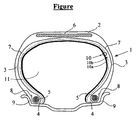
- the single appended figure shows very schematically (without respecting a specific scale), a radial section of a tire according to the invention.
- This tire 1 has a crown 2 reinforced by a crown reinforcement or belt 6, two sidewalls 3 and two beads 4, each of these beads 4 being reinforced with a rod 5.
- the crown 2 is surmounted by a tread represented in this schematic figure.
- a carcass reinforcement 7 is wound around the two rods 5 in each bead 4, the upturn 8 of this armature 7 being for example disposed towards the outside of the tire 1 which is shown here mounted on its rim 9.
- the carcass reinforcement 7 is in known manner constituted of at least one sheet reinforced by so-called "radial” cables, for example textile or metal, that is to say that these cables are arranged substantially parallel to each other and s' extend from one bead to the other so as to form an angle of between 80 ° and 90 ° with the median circumferential plane (plane perpendicular to the axis of rotation of the tire which is located halfway between the two beads 4 and goes through the middle of the crown frame 6).
- radial cables for example textile or metal
- the tire 1 is characterized in that its inner wall comprises a multi-layer laminate (10) comprising at least two layers (10a, 10b), self-sealing thanks to its first layer (10a) and airtight thanks to at its second layer (lOb).
- a multi-layer laminate 10 comprising at least two layers (10a, 10b), self-sealing thanks to its first layer (10a) and airtight thanks to at its second layer (lOb).
- the two layers (10a, 10b) substantially cover the entire inner wall of the tire, extending from one flank to the other, at least up to the level of the tire hook. rim when the tire is in the mounted position.
- the layer 10a could, however, cover only part of the airtight zone (layer 10b), for example only the crown area of the tire or extend at least from the top zone. to the shoulders or mid-flank (equator) of the bandage.
- the laminate is arranged in such a way that the first self-sealing layer (10a) is radially outermost in the tire, with respect to the other layer (10b), as shown schematically on the attached figure.
- the self-sealing layer (10a) covers the airtight layer (10b) on the side of the internal cavity 11 of the tire 1.
- this layer (10a) ) is radially innermost, then disposed between the sealing layer (10b) and the remainder of the structure of the bandage 1.
- the layer 10b (thickness 0.7 to 0.8 mm) is based on butyl rubber, has a conventional formulation for an " inner liner "(" inner liner ”) which usually defines, in a bandage conventional pneumatic tire, the radially inner face of said tire for protecting the carcass reinforcement from the diffusion of air from the interior of the tire.
- This layer 10b airtight thus allows the swelling and pressure maintenance of the bandage 1; its sealing properties enable it to guarantee a relatively low rate of pressure loss, making it possible to maintain the swollen bandage, in normal operating condition, for a sufficient duration, normally of several weeks or several months.
- the layer 10a consists of a self-sealing composition comprising the two essential constituents that are a SEBS elastomer ("G1654" from the Kraton company (with a styrene content of about 30%, a Tg close to -60 ° C and a Mn value of the order of 150,000 g / mol), and a polyisobutylene extension oil (“Dynapak 190" from the company Univar - Mn of the order of 1000 g / mol) at a weight rate of about 550 phr.
- SEBS elastomer "G1654" from the Kraton company (with a styrene content of about 30%, a Tg close to -60 ° C and a Mn value of the order of 150,000 g / mol)
- Dynapak 190 from the company Univar - Mn of the order of 1000 g / mol
- the above self-sealing composition was prepared as follows.
- the mixture of the two constituents SEBS and oil
- was conventionally produced, using a twin-screw extruder (L / D 40), at a temperature typically above the melting temperature of the composition ( about 190 ° C).
- the extruder used included a feed (hopper) for the SEBS and a pressurized liquid injection pump for the polyisobutylene extension oil; it was provided with a die for extruding the product to the desired dimensions.
- the layer 10a thus disposed between the layer 10b and the cavity 11 of the tire, provides the tire effective protection against pressure loss due to accidental perforations, allowing the automatic closure of these perforations.
- the composition serving as a self-sealing layer undergoes several constraints.
- said composition creates a sealed contact zone all around the body.
- the flexibility of the self-sealing composition allows it to interfere in openings of minimal size. This interaction between the self-sealing composition and the foreign body gives a seal to the area affected by the latter.
- a perforation In case of accidental or voluntary removal of the foreign body, a perforation remains: it is likely to create a more or less important leak, depending on its size.
- the self-sealing composition subjected to the effect of hydrostatic pressure, is sufficiently flexible and deformable to seal, by deforming, the perforation, preventing leakage of inflation gas.
- the flexibility of the self-sealing composition makes it possible to easily withstand the forces of the surrounding walls, even during the phases of deformation of the loaded tire and while driving.
- This third layer devoid of liquid plasticizer, consists of elastomer SIS (Kraton D1161), it was obtained by extrusion as the previous layer 10a.
- the tire provided with its airtight and puncture-resistant laminate (10) as described above can advantageously be made before vulcanization (or firing).
- the laminate is simply applied conventionally to the desired location.
- the vulcanization is then carried out conventionally.
- the diene elastomers and TPS support the constraints related to the vulcanization step.
- An advantageous manufacturing variant, for those skilled in the tire industry will for example consist, in a first step, in laying flat, together or separately, the anti-puncture layer and the adhesive interphase directly on a drum. in the form of a bilayer final structure of suitable thickness (for example 2 to 6 mm), before covering the latter with the airtight layer and then the rest of the structure of the tire, according to manufacturing techniques well known to those skilled in the art.
Landscapes
- Engineering & Computer Science (AREA)
- Mechanical Engineering (AREA)
- Chemical & Material Sciences (AREA)
- Health & Medical Sciences (AREA)
- Chemical Kinetics & Catalysis (AREA)
- Medicinal Chemistry (AREA)
- Polymers & Plastics (AREA)
- Organic Chemistry (AREA)
- Compositions Of Macromolecular Compounds (AREA)
- Laminated Bodies (AREA)
- Sealing Material Composition (AREA)
Applications Claiming Priority (2)
| Application Number | Priority Date | Filing Date | Title |
|---|---|---|---|
| FR0854155A FR2932712B1 (fr) | 2008-06-24 | 2008-06-24 | Stratifie etanche a l'air et anticrevaison pour objet pneumatique. |
| PCT/EP2009/003948 WO2009156049A1 (fr) | 2008-06-24 | 2009-06-03 | Stratifie etanche a l'air et anticrevaison pour objet pneumatique |
Publications (2)
| Publication Number | Publication Date |
|---|---|
| EP2303562A1 EP2303562A1 (fr) | 2011-04-06 |
| EP2303562B1 true EP2303562B1 (fr) | 2013-01-16 |
Family
ID=40361555
Family Applications (1)
| Application Number | Title | Priority Date | Filing Date |
|---|---|---|---|
| EP20090768898 Not-in-force EP2303562B1 (fr) | 2008-06-24 | 2009-06-03 | Stratifie etanche a l'air et anticrevaison pour objet pneumatique |
Country Status (7)
| Country | Link |
|---|---|
| US (1) | US8999513B2 (enExample) |
| EP (1) | EP2303562B1 (enExample) |
| JP (1) | JP5615810B2 (enExample) |
| KR (1) | KR101593722B1 (enExample) |
| CN (1) | CN102066097B (enExample) |
| FR (1) | FR2932712B1 (enExample) |
| WO (1) | WO2009156049A1 (enExample) |
Families Citing this family (22)
| Publication number | Priority date | Publication date | Assignee | Title |
|---|---|---|---|---|
| FR2955588B1 (fr) * | 2010-01-28 | 2012-03-09 | Michelin Soc Tech | Composition d'elastomere pour objet pneumatique, a propriete auto-obturante |
| FR2962456B1 (fr) * | 2010-05-20 | 2012-09-21 | Michelin Soc Tech | Procede de fabrication d'un cable metallique multicouches gomme in situ par un elastomere thermoplastique insature |
| FR2962453B1 (fr) * | 2010-05-20 | 2012-09-21 | Michelin Soc Tech | Cable metallique a trois couches, gomme in situ par un elastomere thermoplastique insature |
| JP5243512B2 (ja) | 2010-06-29 | 2013-07-24 | 住友ゴム工業株式会社 | 空気入りタイヤの製造方法および空気入りタイヤ |
| JP5247852B2 (ja) | 2010-11-05 | 2013-07-24 | 住友ゴム工業株式会社 | 空気入りタイヤの製造方法 |
| JP4944239B1 (ja) | 2010-11-17 | 2012-05-30 | 住友ゴム工業株式会社 | 空気入りタイヤの製造方法 |
| JP5225431B2 (ja) | 2010-12-06 | 2013-07-03 | 住友ゴム工業株式会社 | ストリップ、その製造方法および空気入りタイヤの製造方法 |
| FR2975044B1 (fr) | 2011-05-12 | 2013-06-14 | Michelin Soc Tech | Pneumatique pourvu d'une bande de roulement comprenant un elastomere thermoplastique |
| FR2975045B1 (fr) * | 2011-05-12 | 2013-06-14 | Michelin Soc Tech | Pneumatique dont la zone sommet est pourvue d'une sous-couche comportant un elastomere thermoplastique |
| ITMI20112360A1 (it) * | 2011-12-22 | 2013-06-23 | Pirelli | Pneumatico auto-sigillante per ruote di veicoli |
| FR2988644B1 (fr) * | 2012-04-02 | 2014-04-11 | Michelin & Cie | Procede de rechapage d'un pneumatique dont la zone sommet est pourvue d'une sous-couche comportant un elastomere thermoplastique |
| JP5443554B2 (ja) * | 2012-08-01 | 2014-03-19 | 住友ゴム工業株式会社 | インナーライナーを備えた空気入りタイヤ |
| FR2995559B1 (fr) | 2012-09-17 | 2014-09-05 | Michelin & Cie | Pneumatique pourvu d'une bande de roulement comprenant un elastomere thermoplastique et du noir de carbone |
| CN103834336A (zh) * | 2013-08-14 | 2014-06-04 | 洛阳骏腾能源科技有限公司 | 一种用于改进车辆轮胎性能的高分子材料 |
| WO2017075069A1 (en) | 2015-10-27 | 2017-05-04 | Berry Plastics Corporation | Multi-layer film |
| WO2018009783A1 (en) | 2016-07-07 | 2018-01-11 | Berry Global, Inc. | Multi-layer film |
| FR3067282A1 (fr) * | 2017-06-13 | 2018-12-14 | Compagnie Generale Des Etablissements Michelin | Stratifie multicouche |
| FR3067283A1 (fr) * | 2017-06-13 | 2018-12-14 | Compagnie Generale Des Etablissements Michelin | Stratifie multicouche |
| WO2019018175A1 (en) * | 2017-07-20 | 2019-01-24 | Bridgestone Americas Tire Operations, Llc | PERFORATION-RESISTANT TUBE |
| FR3089149A3 (fr) * | 2018-12-03 | 2020-06-05 | Michelin & Cie | Stratifié comprenant une couche de liaison comprenant un initiateur radicalaire |
| FR3103491B1 (fr) * | 2019-11-27 | 2021-10-22 | Michelin & Cie | Composition auto-obturante pour objet pneumatique |
| CN114891312B (zh) * | 2022-05-18 | 2023-07-25 | 浙江大学 | 一种响应机械力可以发生形状变换的膜材料及其制备方法 |
Family Cites Families (22)
| Publication number | Priority date | Publication date | Assignee | Title |
|---|---|---|---|---|
| GB1599405A (en) * | 1977-08-11 | 1981-09-30 | Dunlop Ltd | Puncture sealants |
| US4228839A (en) * | 1978-08-03 | 1980-10-21 | The Firestone Tire & Rubber Company | Self-sealing pneumatic tire |
| JPS63212108A (ja) * | 1987-02-27 | 1988-09-05 | Ohtsu Tire & Rubber Co Ltd | パンク防止層を有するタイヤ |
| BR9306346A (pt) * | 1992-05-13 | 1998-06-30 | Raychem Ltd | Géis |
| US7344568B2 (en) * | 1994-04-19 | 2008-03-18 | Applied Elastomerics, Inc. | Tear resistant gels, composites, and liner articles |
| US6329459B1 (en) * | 1996-09-23 | 2001-12-11 | Bridgestone Corporation | Extended syndiotactic polystyrene-elastomeric block copolymers |
| KR100277523B1 (ko) * | 1998-05-30 | 2001-01-15 | 김호균 | 타이어 펑크방지 조성물 및 그 도포방법 |
| JP4232926B2 (ja) * | 1999-06-03 | 2009-03-04 | 住友ゴム工業株式会社 | 空気入りタイヤの製造方法 |
| US6397910B1 (en) * | 2000-01-12 | 2002-06-04 | The Goodyear Tire & Rubber Company | Retreaded tire having tread with oil rich rubber-based adhesive |
| CN2414934Y (zh) * | 2000-01-14 | 2001-01-17 | 建大工业股份有限公司 | 改良结构的防爆轮胎 |
| EP1714802B1 (en) * | 2001-09-14 | 2008-11-05 | The Yokohama Rubber Co., Ltd. | Pneumatic tire having an adhesive sealant layer |
| JP2005068173A (ja) * | 2003-08-21 | 2005-03-17 | Yokohama Rubber Co Ltd:The | 粘接着剤組成物及びそれを用いた空気入りタイヤ |
| JP2005126654A (ja) * | 2003-10-22 | 2005-05-19 | Masstech:Kk | タイヤチューブに注入可能なタイヤパンクレス化軟質樹脂材料 |
| JP3720349B2 (ja) * | 2003-12-24 | 2005-11-24 | 株式会社 型善 | タイヤチューブ内に溶液状樹脂を注入する装置 |
| JP5076895B2 (ja) * | 2005-05-09 | 2012-11-21 | 横浜ゴム株式会社 | 積層体及びそれを用いた空気入りタイヤ |
| FR2886581B1 (fr) * | 2005-06-02 | 2009-07-03 | Michelin Soc Tech | Pneumatique comportant une couche etanche separee de la structure de base |
| JP2006341679A (ja) * | 2005-06-08 | 2006-12-21 | Katazen:Kk | タイヤ、及びその製造方法 |
| WO2007100021A1 (ja) * | 2006-02-23 | 2007-09-07 | The Yokohama Rubber Co., Ltd. | 積層体及びそれを用いた空気入りタイヤ |
| FR2910478B1 (fr) * | 2006-12-22 | 2009-03-06 | Michelin Soc Tech | Composition auto-obturante pour objet pneumatique |
| CN100377895C (zh) * | 2007-01-12 | 2008-04-02 | 张海龙 | 耐扎、防弹、防漏安全轮胎及制造方法和所用防漏材料 |
| FR2917010B1 (fr) * | 2007-06-08 | 2009-08-21 | Michelin Soc Tech | Stratifie multicouches etanche aux gaz et anti-crevaison et objet pneumatique le comportant |
| FR2923409B1 (fr) * | 2007-11-09 | 2009-12-18 | Michelin Soc Tech | Objet pneumatique pourvu d'une composition auto-obturante |
-
2008
- 2008-06-24 FR FR0854155A patent/FR2932712B1/fr not_active Expired - Fee Related
-
2009
- 2009-06-03 US US13/001,120 patent/US8999513B2/en not_active Expired - Fee Related
- 2009-06-03 CN CN2009801236428A patent/CN102066097B/zh not_active Expired - Fee Related
- 2009-06-03 WO PCT/EP2009/003948 patent/WO2009156049A1/fr not_active Ceased
- 2009-06-03 KR KR1020117001692A patent/KR101593722B1/ko not_active Expired - Fee Related
- 2009-06-03 EP EP20090768898 patent/EP2303562B1/fr not_active Not-in-force
- 2009-06-03 JP JP2011513906A patent/JP5615810B2/ja not_active Expired - Fee Related
Also Published As
| Publication number | Publication date |
|---|---|
| CN102066097B (zh) | 2013-10-16 |
| KR101593722B1 (ko) | 2016-02-12 |
| WO2009156049A1 (fr) | 2009-12-30 |
| CN102066097A (zh) | 2011-05-18 |
| JP5615810B2 (ja) | 2014-10-29 |
| US20110180193A1 (en) | 2011-07-28 |
| EP2303562A1 (fr) | 2011-04-06 |
| FR2932712B1 (fr) | 2010-08-20 |
| FR2932712A1 (fr) | 2009-12-25 |
| US8999513B2 (en) | 2015-04-07 |
| KR20110046448A (ko) | 2011-05-04 |
| JP2011525434A (ja) | 2011-09-22 |
Similar Documents
| Publication | Publication Date | Title |
|---|---|---|
| EP2303562B1 (fr) | Stratifie etanche a l'air et anticrevaison pour objet pneumatique | |
| EP2303563B1 (fr) | Composition elastomere auto-obturante | |
| EP2125949B1 (fr) | Objet pneumatique | |
| EP2209608B1 (fr) | Objet pneumatique pourvu d'une composition auto-obturante | |
| EP2167332B1 (fr) | Stratifie multicouches et anche aux gaz et anti-crevaison et objet pneumatique le comportant | |
| EP2373476B1 (fr) | Objet pneumatique pourvu d'une couche auto-obturante et etanche aux gaz, a base d'elastomere thermoplastique et d'une huile d'extension | |
| EP2373486B1 (fr) | Stratifie multicouche etanche a l'air pour objet pneumatique | |
| EP2152529B1 (fr) | Objet pneumatique pourvu d'une couche étanche aux gaz a base d'un élastomère thermoplastique | |
| EP2167328B1 (fr) | Objet pneumatique pourvu d'une couche etanche aux gaz a base d'un elastomere thermoplastique et d'une charge lamellaire | |
| EP2318202B1 (fr) | Composition auto-obturante pour objet pneumatique | |
| FR2916680A1 (fr) | Objet pneumatique pourvu d'une couche etanche aux gaz a base d'un elastomere thermoplastique et d'une huile polybutene | |
| FR2939142A1 (fr) | Objet pneumatique pourvu d'une couche etanche aux gaz a base de deux elastomeres thermoplastiques | |
| WO2010063428A1 (fr) | Objet pneumatique pourvu d'une couche etanche aux gaz a base d'un elastomere thermoplastique et de microspheres thermoplastiques expansees | |
| WO2021105590A1 (fr) | Composition auto-obturante pour objet pneumatique |
Legal Events
| Date | Code | Title | Description |
|---|---|---|---|
| PUAI | Public reference made under article 153(3) epc to a published international application that has entered the european phase |
Free format text: ORIGINAL CODE: 0009012 |
|
| 17P | Request for examination filed |
Effective date: 20110124 |
|
| AK | Designated contracting states |
Kind code of ref document: A1 Designated state(s): AT BE BG CH CY CZ DE DK EE ES FI FR GB GR HR HU IE IS IT LI LT LU LV MC MK MT NL NO PL PT RO SE SI SK TR |
|
| AX | Request for extension of the european patent |
Extension state: AL BA RS |
|
| DAX | Request for extension of the european patent (deleted) | ||
| GRAP | Despatch of communication of intention to grant a patent |
Free format text: ORIGINAL CODE: EPIDOSNIGR1 |
|
| RIC1 | Information provided on ipc code assigned before grant |
Ipc: B29C 73/16 20060101AFI20120416BHEP Ipc: B29C 73/20 20060101ALI20120416BHEP Ipc: B60C 1/00 20060101ALI20120416BHEP Ipc: B32B 25/14 20060101ALN20120416BHEP Ipc: C09K 3/10 20060101ALI20120416BHEP Ipc: B60C 5/14 20060101ALI20120416BHEP Ipc: B60C 19/12 20060101ALI20120416BHEP Ipc: C08L 53/02 20060101ALI20120416BHEP |
|
| RAP1 | Party data changed (applicant data changed or rights of an application transferred) |
Owner name: MICHELIN RECHERCHE ET TECHNIQUE S.A. Owner name: COMPAGNIE GENERALE DES ETABLISSEMENTS MICHELIN |
|
| GRAJ | Information related to disapproval of communication of intention to grant by the applicant or resumption of examination proceedings by the epo deleted |
Free format text: ORIGINAL CODE: EPIDOSDIGR1 |
|
| GRAP | Despatch of communication of intention to grant a patent |
Free format text: ORIGINAL CODE: EPIDOSNIGR1 |
|
| RIC1 | Information provided on ipc code assigned before grant |
Ipc: B29C 73/20 20060101ALI20120918BHEP Ipc: C08L 53/02 20060101ALI20120918BHEP Ipc: B60C 1/00 20060101ALI20120918BHEP Ipc: B32B 25/14 20060101ALN20120918BHEP Ipc: B29C 73/16 20060101AFI20120918BHEP Ipc: C09K 3/10 20060101ALI20120918BHEP Ipc: B60C 5/14 20060101ALI20120918BHEP Ipc: B60C 19/12 20060101ALI20120918BHEP |
|
| RIC1 | Information provided on ipc code assigned before grant |
Ipc: C09K 3/10 20060101ALI20120925BHEP Ipc: C08L 53/02 20060101ALI20120925BHEP Ipc: B32B 25/14 20060101ALN20120925BHEP Ipc: B29C 73/16 20060101AFI20120925BHEP Ipc: B60C 5/14 20060101ALI20120925BHEP Ipc: B60C 1/00 20060101ALI20120925BHEP Ipc: B60C 19/12 20060101ALI20120925BHEP Ipc: B29C 73/20 20060101ALI20120925BHEP |
|
| GRAS | Grant fee paid |
Free format text: ORIGINAL CODE: EPIDOSNIGR3 |
|
| GRAA | (expected) grant |
Free format text: ORIGINAL CODE: 0009210 |
|
| AK | Designated contracting states |
Kind code of ref document: B1 Designated state(s): AT BE BG CH CY CZ DE DK EE ES FI FR GB GR HR HU IE IS IT LI LT LU LV MC MK MT NL NO PL PT RO SE SI SK TR |
|
| REG | Reference to a national code |
Ref country code: GB Ref legal event code: FG4D Free format text: NOT ENGLISH |
|
| REG | Reference to a national code |
Ref country code: CH Ref legal event code: EP |
|
| REG | Reference to a national code |
Ref country code: IE Ref legal event code: FG4D Free format text: LANGUAGE OF EP DOCUMENT: FRENCH |
|
| REG | Reference to a national code |
Ref country code: AT Ref legal event code: REF Ref document number: 593638 Country of ref document: AT Kind code of ref document: T Effective date: 20130215 Ref country code: CH Ref legal event code: EP |
|
| REG | Reference to a national code |
Ref country code: DE Ref legal event code: R096 Ref document number: 602009012862 Country of ref document: DE Effective date: 20130314 |
|
| REG | Reference to a national code |
Ref country code: AT Ref legal event code: MK05 Ref document number: 593638 Country of ref document: AT Kind code of ref document: T Effective date: 20130116 |
|
| REG | Reference to a national code |
Ref country code: NL Ref legal event code: VDEP Effective date: 20130116 |
|
| REG | Reference to a national code |
Ref country code: LT Ref legal event code: MG4D |
|
| PG25 | Lapsed in a contracting state [announced via postgrant information from national office to epo] |
Ref country code: LT Free format text: LAPSE BECAUSE OF FAILURE TO SUBMIT A TRANSLATION OF THE DESCRIPTION OR TO PAY THE FEE WITHIN THE PRESCRIBED TIME-LIMIT Effective date: 20130116 Ref country code: AT Free format text: LAPSE BECAUSE OF FAILURE TO SUBMIT A TRANSLATION OF THE DESCRIPTION OR TO PAY THE FEE WITHIN THE PRESCRIBED TIME-LIMIT Effective date: 20130116 Ref country code: ES Free format text: LAPSE BECAUSE OF FAILURE TO SUBMIT A TRANSLATION OF THE DESCRIPTION OR TO PAY THE FEE WITHIN THE PRESCRIBED TIME-LIMIT Effective date: 20130427 Ref country code: NO Free format text: LAPSE BECAUSE OF FAILURE TO SUBMIT A TRANSLATION OF THE DESCRIPTION OR TO PAY THE FEE WITHIN THE PRESCRIBED TIME-LIMIT Effective date: 20130416 Ref country code: SE Free format text: LAPSE BECAUSE OF FAILURE TO SUBMIT A TRANSLATION OF THE DESCRIPTION OR TO PAY THE FEE WITHIN THE PRESCRIBED TIME-LIMIT Effective date: 20130116 Ref country code: IS Free format text: LAPSE BECAUSE OF FAILURE TO SUBMIT A TRANSLATION OF THE DESCRIPTION OR TO PAY THE FEE WITHIN THE PRESCRIBED TIME-LIMIT Effective date: 20130516 Ref country code: BG Free format text: LAPSE BECAUSE OF FAILURE TO SUBMIT A TRANSLATION OF THE DESCRIPTION OR TO PAY THE FEE WITHIN THE PRESCRIBED TIME-LIMIT Effective date: 20130416 |
|
| PG25 | Lapsed in a contracting state [announced via postgrant information from national office to epo] |
Ref country code: GR Free format text: LAPSE BECAUSE OF FAILURE TO SUBMIT A TRANSLATION OF THE DESCRIPTION OR TO PAY THE FEE WITHIN THE PRESCRIBED TIME-LIMIT Effective date: 20130417 Ref country code: NL Free format text: LAPSE BECAUSE OF FAILURE TO SUBMIT A TRANSLATION OF THE DESCRIPTION OR TO PAY THE FEE WITHIN THE PRESCRIBED TIME-LIMIT Effective date: 20130116 Ref country code: FI Free format text: LAPSE BECAUSE OF FAILURE TO SUBMIT A TRANSLATION OF THE DESCRIPTION OR TO PAY THE FEE WITHIN THE PRESCRIBED TIME-LIMIT Effective date: 20130116 Ref country code: PT Free format text: LAPSE BECAUSE OF FAILURE TO SUBMIT A TRANSLATION OF THE DESCRIPTION OR TO PAY THE FEE WITHIN THE PRESCRIBED TIME-LIMIT Effective date: 20130516 Ref country code: PL Free format text: LAPSE BECAUSE OF FAILURE TO SUBMIT A TRANSLATION OF THE DESCRIPTION OR TO PAY THE FEE WITHIN THE PRESCRIBED TIME-LIMIT Effective date: 20130116 Ref country code: SI Free format text: LAPSE BECAUSE OF FAILURE TO SUBMIT A TRANSLATION OF THE DESCRIPTION OR TO PAY THE FEE WITHIN THE PRESCRIBED TIME-LIMIT Effective date: 20130116 Ref country code: LV Free format text: LAPSE BECAUSE OF FAILURE TO SUBMIT A TRANSLATION OF THE DESCRIPTION OR TO PAY THE FEE WITHIN THE PRESCRIBED TIME-LIMIT Effective date: 20130116 |
|
| PG25 | Lapsed in a contracting state [announced via postgrant information from national office to epo] |
Ref country code: HR Free format text: LAPSE BECAUSE OF FAILURE TO SUBMIT A TRANSLATION OF THE DESCRIPTION OR TO PAY THE FEE WITHIN THE PRESCRIBED TIME-LIMIT Effective date: 20130116 |
|
| PG25 | Lapsed in a contracting state [announced via postgrant information from national office to epo] |
Ref country code: DK Free format text: LAPSE BECAUSE OF FAILURE TO SUBMIT A TRANSLATION OF THE DESCRIPTION OR TO PAY THE FEE WITHIN THE PRESCRIBED TIME-LIMIT Effective date: 20130116 Ref country code: EE Free format text: LAPSE BECAUSE OF FAILURE TO SUBMIT A TRANSLATION OF THE DESCRIPTION OR TO PAY THE FEE WITHIN THE PRESCRIBED TIME-LIMIT Effective date: 20130116 Ref country code: SK Free format text: LAPSE BECAUSE OF FAILURE TO SUBMIT A TRANSLATION OF THE DESCRIPTION OR TO PAY THE FEE WITHIN THE PRESCRIBED TIME-LIMIT Effective date: 20130116 Ref country code: CZ Free format text: LAPSE BECAUSE OF FAILURE TO SUBMIT A TRANSLATION OF THE DESCRIPTION OR TO PAY THE FEE WITHIN THE PRESCRIBED TIME-LIMIT Effective date: 20130116 Ref country code: RO Free format text: LAPSE BECAUSE OF FAILURE TO SUBMIT A TRANSLATION OF THE DESCRIPTION OR TO PAY THE FEE WITHIN THE PRESCRIBED TIME-LIMIT Effective date: 20130116 |
|
| PLBE | No opposition filed within time limit |
Free format text: ORIGINAL CODE: 0009261 |
|
| STAA | Information on the status of an ep patent application or granted ep patent |
Free format text: STATUS: NO OPPOSITION FILED WITHIN TIME LIMIT |
|
| PG25 | Lapsed in a contracting state [announced via postgrant information from national office to epo] |
Ref country code: CY Free format text: LAPSE BECAUSE OF FAILURE TO SUBMIT A TRANSLATION OF THE DESCRIPTION OR TO PAY THE FEE WITHIN THE PRESCRIBED TIME-LIMIT Effective date: 20130116 |
|
| 26N | No opposition filed |
Effective date: 20131017 |
|
| BERE | Be: lapsed |
Owner name: CIE GENERALE DES ETABLISSEMENTS MICHELIN Effective date: 20130630 Owner name: MICHELIN RECHERCHE ET TECHNIQUE S.A. Effective date: 20130630 |
|
| PG25 | Lapsed in a contracting state [announced via postgrant information from national office to epo] |
Ref country code: IT Free format text: LAPSE BECAUSE OF FAILURE TO SUBMIT A TRANSLATION OF THE DESCRIPTION OR TO PAY THE FEE WITHIN THE PRESCRIBED TIME-LIMIT Effective date: 20130116 |
|
| PG25 | Lapsed in a contracting state [announced via postgrant information from national office to epo] |
Ref country code: MC Free format text: LAPSE BECAUSE OF FAILURE TO SUBMIT A TRANSLATION OF THE DESCRIPTION OR TO PAY THE FEE WITHIN THE PRESCRIBED TIME-LIMIT Effective date: 20130116 |
|
| REG | Reference to a national code |
Ref country code: CH Ref legal event code: PL |
|
| REG | Reference to a national code |
Ref country code: DE Ref legal event code: R097 Ref document number: 602009012862 Country of ref document: DE Effective date: 20131017 |
|
| GBPC | Gb: european patent ceased through non-payment of renewal fee |
Effective date: 20130603 |
|
| REG | Reference to a national code |
Ref country code: IE Ref legal event code: MM4A |
|
| PG25 | Lapsed in a contracting state [announced via postgrant information from national office to epo] |
Ref country code: BE Free format text: LAPSE BECAUSE OF NON-PAYMENT OF DUE FEES Effective date: 20130630 |
|
| PG25 | Lapsed in a contracting state [announced via postgrant information from national office to epo] |
Ref country code: CH Free format text: LAPSE BECAUSE OF NON-PAYMENT OF DUE FEES Effective date: 20130630 Ref country code: LI Free format text: LAPSE BECAUSE OF NON-PAYMENT OF DUE FEES Effective date: 20130630 Ref country code: GB Free format text: LAPSE BECAUSE OF NON-PAYMENT OF DUE FEES Effective date: 20130603 Ref country code: IE Free format text: LAPSE BECAUSE OF NON-PAYMENT OF DUE FEES Effective date: 20130603 |
|
| PG25 | Lapsed in a contracting state [announced via postgrant information from national office to epo] |
Ref country code: MT Free format text: LAPSE BECAUSE OF FAILURE TO SUBMIT A TRANSLATION OF THE DESCRIPTION OR TO PAY THE FEE WITHIN THE PRESCRIBED TIME-LIMIT Effective date: 20130116 |
|
| PG25 | Lapsed in a contracting state [announced via postgrant information from national office to epo] |
Ref country code: TR Free format text: LAPSE BECAUSE OF FAILURE TO SUBMIT A TRANSLATION OF THE DESCRIPTION OR TO PAY THE FEE WITHIN THE PRESCRIBED TIME-LIMIT Effective date: 20130116 |
|
| PG25 | Lapsed in a contracting state [announced via postgrant information from national office to epo] |
Ref country code: LU Free format text: LAPSE BECAUSE OF NON-PAYMENT OF DUE FEES Effective date: 20130603 Ref country code: MK Free format text: LAPSE BECAUSE OF FAILURE TO SUBMIT A TRANSLATION OF THE DESCRIPTION OR TO PAY THE FEE WITHIN THE PRESCRIBED TIME-LIMIT Effective date: 20130116 Ref country code: HU Free format text: LAPSE BECAUSE OF FAILURE TO SUBMIT A TRANSLATION OF THE DESCRIPTION OR TO PAY THE FEE WITHIN THE PRESCRIBED TIME-LIMIT; INVALID AB INITIO Effective date: 20090603 |
|
| REG | Reference to a national code |
Ref country code: FR Ref legal event code: PLFP Year of fee payment: 8 |
|
| REG | Reference to a national code |
Ref country code: FR Ref legal event code: PLFP Year of fee payment: 9 |
|
| REG | Reference to a national code |
Ref country code: FR Ref legal event code: PLFP Year of fee payment: 10 |
|
| PGFP | Annual fee paid to national office [announced via postgrant information from national office to epo] |
Ref country code: FR Payment date: 20220628 Year of fee payment: 14 |
|
| PGFP | Annual fee paid to national office [announced via postgrant information from national office to epo] |
Ref country code: DE Payment date: 20220620 Year of fee payment: 14 |
|
| REG | Reference to a national code |
Ref country code: DE Ref legal event code: R119 Ref document number: 602009012862 Country of ref document: DE |
|
| PG25 | Lapsed in a contracting state [announced via postgrant information from national office to epo] |
Ref country code: DE Free format text: LAPSE BECAUSE OF NON-PAYMENT OF DUE FEES Effective date: 20240103 |
|
| PG25 | Lapsed in a contracting state [announced via postgrant information from national office to epo] |
Ref country code: FR Free format text: LAPSE BECAUSE OF NON-PAYMENT OF DUE FEES Effective date: 20230630 |