EP2299514A1 - Secondary battery - Google Patents
Secondary battery Download PDFInfo
- Publication number
- EP2299514A1 EP2299514A1 EP08800949A EP08800949A EP2299514A1 EP 2299514 A1 EP2299514 A1 EP 2299514A1 EP 08800949 A EP08800949 A EP 08800949A EP 08800949 A EP08800949 A EP 08800949A EP 2299514 A1 EP2299514 A1 EP 2299514A1
- Authority
- EP
- European Patent Office
- Prior art keywords
- tabs
- pad
- secondary battery
- out device
- conductive layer
- Prior art date
- Legal status (The legal status is an assumption and is not a legal conclusion. Google has not performed a legal analysis and makes no representation as to the accuracy of the status listed.)
- Withdrawn
Links
- 239000011148 porous material Substances 0.000 claims description 29
- 238000003466 welding Methods 0.000 claims description 17
- 238000000608 laser ablation Methods 0.000 claims description 3
- 238000004519 manufacturing process Methods 0.000 description 4
- XEEYBQQBJWHFJM-UHFFFAOYSA-N Iron Chemical compound [Fe] XEEYBQQBJWHFJM-UHFFFAOYSA-N 0.000 description 2
- PXHVJJICTQNCMI-UHFFFAOYSA-N Nickel Chemical compound [Ni] PXHVJJICTQNCMI-UHFFFAOYSA-N 0.000 description 2
- 230000007423 decrease Effects 0.000 description 2
- 239000008151 electrolyte solution Substances 0.000 description 2
- 239000012528 membrane Substances 0.000 description 2
- HBBGRARXTFLTSG-UHFFFAOYSA-N Lithium ion Chemical compound [Li+] HBBGRARXTFLTSG-UHFFFAOYSA-N 0.000 description 1
- XAGFODPZIPBFFR-UHFFFAOYSA-N aluminium Chemical compound [Al] XAGFODPZIPBFFR-UHFFFAOYSA-N 0.000 description 1
- 230000009286 beneficial effect Effects 0.000 description 1
- 238000010586 diagram Methods 0.000 description 1
- 238000007599 discharging Methods 0.000 description 1
- 230000000694 effects Effects 0.000 description 1
- 238000004146 energy storage Methods 0.000 description 1
- 238000005516 engineering process Methods 0.000 description 1
- 238000004880 explosion Methods 0.000 description 1
- 239000011888 foil Substances 0.000 description 1
- 238000010438 heat treatment Methods 0.000 description 1
- 229910052742 iron Inorganic materials 0.000 description 1
- 229910001416 lithium ion Inorganic materials 0.000 description 1
- 229910052751 metal Inorganic materials 0.000 description 1
- 239000002184 metal Substances 0.000 description 1
- 239000007769 metal material Substances 0.000 description 1
- 238000012986 modification Methods 0.000 description 1
- 230000004048 modification Effects 0.000 description 1
- 229910052759 nickel Inorganic materials 0.000 description 1
- 238000013021 overheating Methods 0.000 description 1
- 239000000243 solution Substances 0.000 description 1
- 229910001220 stainless steel Inorganic materials 0.000 description 1
- 239000010935 stainless steel Substances 0.000 description 1
- 210000000352 storage cell Anatomy 0.000 description 1
- 239000010409 thin film Substances 0.000 description 1
Images


Classifications
-
- H—ELECTRICITY
- H01—ELECTRIC ELEMENTS
- H01M—PROCESSES OR MEANS, e.g. BATTERIES, FOR THE DIRECT CONVERSION OF CHEMICAL ENERGY INTO ELECTRICAL ENERGY
- H01M50/00—Constructional details or processes of manufacture of the non-active parts of electrochemical cells other than fuel cells, e.g. hybrid cells
- H01M50/10—Primary casings; Jackets or wrappings
- H01M50/147—Lids or covers
-
- H—ELECTRICITY
- H01—ELECTRIC ELEMENTS
- H01M—PROCESSES OR MEANS, e.g. BATTERIES, FOR THE DIRECT CONVERSION OF CHEMICAL ENERGY INTO ELECTRICAL ENERGY
- H01M10/00—Secondary cells; Manufacture thereof
- H01M10/04—Construction or manufacture in general
- H01M10/0431—Cells with wound or folded electrodes
-
- H—ELECTRICITY
- H01—ELECTRIC ELEMENTS
- H01M—PROCESSES OR MEANS, e.g. BATTERIES, FOR THE DIRECT CONVERSION OF CHEMICAL ENERGY INTO ELECTRICAL ENERGY
- H01M50/00—Constructional details or processes of manufacture of the non-active parts of electrochemical cells other than fuel cells, e.g. hybrid cells
- H01M50/50—Current conducting connections for cells or batteries
- H01M50/528—Fixed electrical connections, i.e. not intended for disconnection
-
- H—ELECTRICITY
- H01—ELECTRIC ELEMENTS
- H01M—PROCESSES OR MEANS, e.g. BATTERIES, FOR THE DIRECT CONVERSION OF CHEMICAL ENERGY INTO ELECTRICAL ENERGY
- H01M50/00—Constructional details or processes of manufacture of the non-active parts of electrochemical cells other than fuel cells, e.g. hybrid cells
- H01M50/50—Current conducting connections for cells or batteries
- H01M50/531—Electrode connections inside a battery casing
-
- H—ELECTRICITY
- H01—ELECTRIC ELEMENTS
- H01M—PROCESSES OR MEANS, e.g. BATTERIES, FOR THE DIRECT CONVERSION OF CHEMICAL ENERGY INTO ELECTRICAL ENERGY
- H01M50/00—Constructional details or processes of manufacture of the non-active parts of electrochemical cells other than fuel cells, e.g. hybrid cells
- H01M50/50—Current conducting connections for cells or batteries
- H01M50/531—Electrode connections inside a battery casing
- H01M50/536—Electrode connections inside a battery casing characterised by the method of fixing the leads to the electrodes, e.g. by welding
-
- Y—GENERAL TAGGING OF NEW TECHNOLOGICAL DEVELOPMENTS; GENERAL TAGGING OF CROSS-SECTIONAL TECHNOLOGIES SPANNING OVER SEVERAL SECTIONS OF THE IPC; TECHNICAL SUBJECTS COVERED BY FORMER USPC CROSS-REFERENCE ART COLLECTIONS [XRACs] AND DIGESTS
- Y02—TECHNOLOGIES OR APPLICATIONS FOR MITIGATION OR ADAPTATION AGAINST CLIMATE CHANGE
- Y02E—REDUCTION OF GREENHOUSE GAS [GHG] EMISSIONS, RELATED TO ENERGY GENERATION, TRANSMISSION OR DISTRIBUTION
- Y02E60/00—Enabling technologies; Technologies with a potential or indirect contribution to GHG emissions mitigation
- Y02E60/10—Energy storage using batteries
Definitions
- the present invention relates to a secondary battery, in particular, to a connecting structure between tabs and a cover plate of the secondary battery.
- a lithium-ion secondary battery is composed of a negative polar plate, a positive polar plate, an electrolytic solution and a membrane between the positive and negative polar plates for preventing a short circuit.
- the positive polar plate and the negative polar plate are formed as a thin plate or a foil.
- the electrical polar plates and the membrane therebetween are orderly stacked or helically wound so as to form a core, which is in turn embedded into a battery container made of a stainless steel, a nickel plated iron, an aluminum metal or a stacked flexible package thin film. Then, after electrolytic solution is injected into the battery container, the battery container is sealed and the battery is formed.
- the core is electrically connected to external components by a connection between tabs connected to the polar plates and a pole or a cover plate.
- the tabs are welded at the pole of the cover plate.
- a heavy current is discharged, for example, in a hybrid electrical vehicle (HEV) or an electrical vehicle (EV)
- HEV hybrid electrical vehicle
- EV electrical vehicle
- a connection at places such as the tabs and the pole is broken or inactive, a serious heating may occur, resulting in an overheating, even a failure, of the battery.
- the safety and cycle life of the battery may be influenced.
- the welding position may not be controlled accurately when a plurality of tabs are connected to the pole, which is unfavorable for the control of technology and quality.
- the present invention aims to overcome the above-mentioned disadvantages.
- the present invention provides a secondary battery, which improves the connection between a plurality of tabs and the pole, reduces the internal resistance of the battery and decreases the heat produced by the battery.
- the secondary battery comprises a core and a cover plate, wherein tabs are protruded from an end of the core, the tabs comprises positive tabs and negative tabs.
- the secondary battery is characterized in that a tab lead-out device is provided at the end of the core, the tab lead-out device comprises an insulating layer adjacent to the end of the core and a conductive layer away from the end of the core, the tabs are electrically connected to the conductive layer, and the conductive layer is electrically connected to the cover plate.
- the tab lead-out device is of a structure that the insulating layer and conductive layer are formed integratedly.
- the tab lead-out device is in a shape of a disk.
- Pores are disposed in the tab lead-out device, the tabs passes through the pores and are then electrically connected to the conductive layer.
- the pores in the tab lead-out device are in a shape of sectors.
- the tabs protrude from an outer edge of the tab lead-out device and are then electrically connected to the conductive layer.
- the tab lead-out device comprises an insulating pad and a first pad.
- the insulating pad forms the insulating layer
- the first pad forms the conductive layer.
- the insulating pad and the first pad are in a shape of a disk.
- the insulating pad is provided with pores
- the first pad is provided with pores.
- the tabs passes through the pores in the insulating pad and the pores in the first pad and are then electrically connected to the first pad.
- the pores in the insulating pad and the pores in the first pad are in a shape of sectors.
- the tabs protrude from outer edges of the insulating pad and the first pad and are then electrically connected to the first pad.
- the secondary battery further comprises a connector and a second pad stacked between the conductive layer of the tab lead-out device and the cover plate.
- the tabs are compacted between the second pad and the conductive layer of the tab lead-out device by the connector.
- the second pad is provided with pores at positions corresponding to the tabs.
- the connector is a bolt connector.
- a screw of the bolt connector is fixedly disposed on the conductive layer of the tab lead-out device.
- the second pad is compacted on the conductive layer of the tab lead-out device by the nut.
- the conductive layer of the tab lead-out device is electrically connected to the cover plate by the connector.
- a pole is disposed on the cover plate.
- the connector is electrically connected to the pole on the cover plate.
- connection between the tabs and the conductive layer of the tab lead-out device is a welding connection.
- connection between the tabs and the conductive layer of the tab lead-out device is a laser ablation welding connection.
- the positive tabs and negative tabs comprise a plurality of positive tabs and a plurality of negative tabs, respectively.
- the plurality of positive tabs are located at one end of the core, the plurality of negative tabs are located at the other end of the core.
- connection between the plurality of tabs and the conductive layer of the tab lead-out device is a welding connection.
- the plurality of tabs are welded to the conductive layer of the tab lead-out device at corresponding positions, respectively.
- a tab lead-out device is provided, so that the tabs are electrically connected to the tab lead-out device fixedly and thus the connecting points of the tabs are reliable and stable.
- Pores are disposed at fixed positions in the tab lead-out device. This ensures that the connecting positions of the tabs, for example, welding positions, are accurate and consistent and the welding can be performed conveniently, which are beneficial to improve the production efficiency. In particularly, for a core with a plurality of tabs, it is ensured that the welding position of each tab is accurate.
- a second pad is provided. By the mechanical compact of the second pad, it is ensured that the tabs of the core are reliably connected to the pole. The effective contact area between the tabs and the pole is also increased.
- a laser ablation welding is applied between the tabs and the tab lead-out device, which further improves the conductive efficiency, ensures the battery performance when discharging, reduces the internal resistance of the battery, decreases the heat produced by battery and improves the battery cycle life.
- the tab lead-out device, the second pad and the cover plate are tightly contacted, which ensures the stable fixation of the core.
- the connecting structure between the tabs and the pole of the battery is simple and convenient to be assembled. The manufacture is economical, and it is easy for the line production and convenient for the industrialized production.
- the present invention is very suitable for the cylinder battery with multiple tabs and a large size.
- the core may be fixed efficiently, the vibration resistance and the compact resistance of battery are improved, and then the safety performance of the battery is improved. So, it is suitable for the battery of hybrid electrical vehicle and electrical vehicle, and it also can be used for the large-sized energy storage cell.
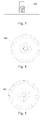
- Figure 1 is a structural schematic diagram of a first embodiment of the present invention
- Figure 2 is a structural view of the insulating pad in Figure 1 ;
- Figure 3 is a structural view of the first pad in Figure 1 ;
- Figure 4 is a top view of Figure 3 ;
- Figure 5 is a structural view of the second pad in Figure 1 ;
- Figure 6 is a structural view of the cover plate in Figure 1 ;
- Figure 7 is a structural view of the tab lead-out device of a second embodiment of the present invention.
- Figure 8 is a structural view of the tab lead-out device of a third embodiment of the present invention.
- a secondary battery as shown in Figure 1 , comprises a cover plate 1, a connector, a tab lead-out device, a second pad 3 and a core 7.
- the tab lead-out device includes an insulating pad 6 and a first pad 5.
- the insulting pad 6 constitutes an insulting layer.
- the first pad 5 constitutes a conductive layer.
- the connector includes a nut 2 and a screw 502 fixed to the first pad.
- Battery polar plates are wound to form the core 7 in a cylinder shape.
- a plurality of tabs 4 are protruded from each end of the core 7.
- the tabs at one end of the core 7 are positive tabs, and those at the other end are negative tabs.
- the tabs at both ends are connected to the cover plate via connections having a same structure.
- the insulting pad 6 is circular, and is placed at an end of the core 7. As shown in Figure 2 , pores 601 in the form of discontinuous sectors are disposed at the insulting pad 6.
- the first pad 5 is stacked on the insulting pad 6.
- pores 501 in the form of discontinuous sectors are disposed in the first pad 5, and a screw 502 having screw threads is further disposed at the center of the first pad 5.
- An upper end of the screw 502 passes through a center hole of the insulting pad 6.
- a lower end of the screw 502 passes through a center hole of the second pad 3.
- the second pad 3 is fastened with the first pad by a nut 2.
- pores 301 are disposed in the second pad 3.
- the cover plate 1 as shown in Figure 6 is placed on the second pad 3.
- a pole 104 is provided on the cover plate 1.
- a center hole 101 is disposed at the center of the pole 104.
- the cover plate 1 further comprises an infusing hole 102 and an explosion proof hole 103.
- the first pad 5, the second pad 6, the tabs 4, the cover plate 1, the pole 104 are made of conductive metal material.
- the cover plate 1 is insulated from the pole 4.
- the tabs 4 pass through the pores 601 of the insulting pad 6 and the pores 501 of the first pad and protrude from the insulting pad 6. Then, the tabs 4 are planished on the first pad 5 and are welded to the first pad 5 by a laser spot welding or a continuous welding.
- the second pad 3 is placed on the first pad 5. That is, the screw 502 of the first pad passes through the center hole of the second pad 3, so that the tabs 4 are located between the two metal pads and then clamped by screwing the nut 2.
- the cover plate 1 is placed so that the center hole 101 of the cover plate 1 tightly combines with a slick portion of the upper end of the screw 502 of the first pad 5, both of which are then welded together by the laser welding.
- the center hole 101 has a shape matching with that of the upper end of the screw 502, which may be circular, quadrate or the like.
- the step of welding the tabs 4 to the first pad 5 may also be carried out after the second pad 3 is placed.
- the tabs 4 may be welded to the first pad 5 through the pores 301 of the second pad by the laser spot welding or the continuous welding.
- the poles 104 may be not provided on the cover plate on one end of the core 7.
- the positive tabs or the negative tabs may be electrically connected to the conductive cover plate 1 directly.
- both of the positive tabs and the negative tabs are placed at a same end of the core 7.
- electrical connections for connecting the positive, negative tabs with two poles disposed on the cover plate, respectively, are electrically insulated from each other by an insulating component.
- a secondary battery comprises a cover plate, a connector, a tab lead-out device, a second pad and a core.
- the secondary battery according to this embodiment differs from that of the embodiment 1 in that the tab lead-out device of the battery is of a structure that the insulating layer and the conductive layer are integratedly formed.
- the tab lead-out device is divided into an upper layer and a lower layer.
- the upper layer is a conductive layer
- the lower layer is an insulting layer.
- the tabs pass from the lower portion of the insulting layer through the pores of the tab lead-out device and then are welded on the conductive layer.
- a secondary battery comprises a cover plate, a connector, a tab lead-out device, a second pad and a core.
- the secondary battery according to the this embodiment differs from that of the embodiment 2 in that no pore is disposed in the tab lead-out device.
- the tabs protrude an edge of the tab lead-out device from the lower portion of the insulating layer and are welded on the conductive layer.
Landscapes
- Chemical & Material Sciences (AREA)
- Chemical Kinetics & Catalysis (AREA)
- Electrochemistry (AREA)
- General Chemical & Material Sciences (AREA)
- Engineering & Computer Science (AREA)
- Manufacturing & Machinery (AREA)
- Connection Of Batteries Or Terminals (AREA)
- Sealing Battery Cases Or Jackets (AREA)
Applications Claiming Priority (2)
| Application Number | Priority Date | Filing Date | Title |
|---|---|---|---|
| CN200810067717.2A CN101604737B (zh) | 2008-06-13 | 2008-06-13 | 一种二次电池 |
| PCT/CN2008/072460 WO2009149607A1 (zh) | 2008-06-13 | 2008-09-23 | 一种二次电池 |
Publications (1)
| Publication Number | Publication Date |
|---|---|
| EP2299514A1 true EP2299514A1 (en) | 2011-03-23 |
Family
ID=41416352
Family Applications (1)
| Application Number | Title | Priority Date | Filing Date |
|---|---|---|---|
| EP08800949A Withdrawn EP2299514A1 (en) | 2008-06-13 | 2008-09-23 | Secondary battery |
Country Status (6)
| Country | Link |
|---|---|
| US (1) | US8609277B2 (enExample) |
| EP (1) | EP2299514A1 (enExample) |
| JP (1) | JP5355688B2 (enExample) |
| KR (1) | KR101184039B1 (enExample) |
| CN (1) | CN101604737B (enExample) |
| WO (1) | WO2009149607A1 (enExample) |
Cited By (2)
| Publication number | Priority date | Publication date | Assignee | Title |
|---|---|---|---|---|
| CN102324470A (zh) * | 2011-09-26 | 2012-01-18 | 河南迈奇能源技术有限公司 | 一种电池盖组 |
| CN110226244A (zh) * | 2017-06-02 | 2019-09-10 | 株式会社Lg化学 | 二次电池 |
Families Citing this family (14)
| Publication number | Priority date | Publication date | Assignee | Title |
|---|---|---|---|---|
| KR101116501B1 (ko) * | 2010-05-07 | 2012-02-24 | 에스비리모티브 주식회사 | 관통 및 압괴 안전성이 향상된 이차 전지 |
| KR101222311B1 (ko) * | 2010-06-14 | 2013-01-15 | 로베르트 보쉬 게엠베하 | 이차 전지 |
| KR20110123462A (ko) * | 2010-05-07 | 2011-11-15 | 에스비리모티브 주식회사 | 이차 전지 |
| CN101867032B (zh) * | 2010-02-09 | 2013-01-02 | 湖南科力远新能源股份有限公司 | 一种正极焊极耳的方法 |
| CN102339968B (zh) * | 2011-09-15 | 2014-06-04 | 苏州星恒电源有限公司 | 一种方形动力锂电池极耳连接结构及连接方法 |
| CN102637893A (zh) * | 2012-04-09 | 2012-08-15 | 温岭市恒泰电池有限公司 | 一种方形锂电池 |
| CN102608541A (zh) * | 2012-04-10 | 2012-07-25 | 天津量诺科技发展有限公司 | 一种锂离子电池的电芯快速封装测试模具 |
| KR101586530B1 (ko) * | 2013-03-11 | 2016-01-21 | 주식회사 엘지화학 | 양극 탭 상에 절연층을 포함하는 양극 및 이를 포함하는 이차 전지 |
| CN106784440B (zh) * | 2017-01-04 | 2021-11-19 | 上海电气国轩新能源科技(苏州)有限公司 | 圆柱电池弹压式盖帽 |
| CN110379943A (zh) * | 2019-06-20 | 2019-10-25 | 金能电池(东莞)有限公司 | 一种带胶垫的柱状电池 |
| CN111430593B (zh) * | 2020-05-18 | 2024-06-07 | 联动天翼新能源有限公司 | 一种圆柱电池绝缘片、外壳卷芯的组装方法及圆柱电池 |
| CN116250128B (zh) * | 2021-02-09 | 2024-10-01 | 宁德时代新能源科技股份有限公司 | 电池单体、电池、用电装置以及制备电池单体的方法 |
| CN114284644B (zh) * | 2021-12-22 | 2024-02-20 | 远景动力技术(江苏)有限公司 | 转接结构及包含其的全极耳卷芯、全极耳电池 |
| CN117175148A (zh) * | 2022-05-25 | 2023-12-05 | 瑞浦兰钧能源股份有限公司 | 一种二次电池组件、二次电池及其装配方法 |
Family Cites Families (15)
| Publication number | Priority date | Publication date | Assignee | Title |
|---|---|---|---|---|
| US5849431A (en) * | 1995-09-27 | 1998-12-15 | Sony Corporation | High capacity secondary battery of jelly roll type |
| JPH10261401A (ja) * | 1997-03-17 | 1998-09-29 | Fujitsu Ltd | 電 池 |
| JP3743781B2 (ja) * | 1997-03-27 | 2006-02-08 | 日本電池株式会社 | 非水電解質二次電池 |
| JP3906519B2 (ja) * | 1997-04-30 | 2007-04-18 | 宇部興産株式会社 | 電池用電極とこれを用いた電池 |
| JP3713978B2 (ja) | 1998-09-25 | 2005-11-09 | 松下電器産業株式会社 | 巻回型電池 |
| JP4266546B2 (ja) * | 2001-09-11 | 2009-05-20 | 三洋電機株式会社 | 筒型電池 |
| JP2003142146A (ja) * | 2001-10-31 | 2003-05-16 | Japan Storage Battery Co Ltd | 電 池 |
| JP2005322415A (ja) * | 2002-04-30 | 2005-11-17 | Nok Corp | 封口板 |
| JP4792697B2 (ja) | 2003-12-24 | 2011-10-12 | パナソニック株式会社 | 二次電池 |
| KR100536253B1 (ko) * | 2004-03-24 | 2005-12-12 | 삼성에스디아이 주식회사 | 이차 전지 |
| KR20060097603A (ko) | 2005-03-09 | 2006-09-14 | 산요덴키가부시키가이샤 | 전지 및 그 제조 방법 |
| JP2006252890A (ja) * | 2005-03-09 | 2006-09-21 | Sanyo Electric Co Ltd | 筒型二次電池及びその製造方法 |
| KR20060111838A (ko) * | 2005-04-25 | 2006-10-30 | 삼성에스디아이 주식회사 | 원통형 리튬 이차 전지 및 이의 제조 방법 |
| CN2824317Y (zh) * | 2005-06-27 | 2006-10-04 | 东莞新能源电子科技有限公司 | 铝壳圆柱形锂离子电池 |
| EP1946393A4 (en) * | 2005-09-02 | 2011-06-08 | A123 Systems Inc | BATTERY CELL DESIGN AND METHOD FOR THEIR CONSTRUCTION |
-
2008
- 2008-06-13 CN CN200810067717.2A patent/CN101604737B/zh active Active
- 2008-09-23 KR KR1020117000843A patent/KR101184039B1/ko active Active
- 2008-09-23 US US12/997,715 patent/US8609277B2/en active Active
- 2008-09-23 WO PCT/CN2008/072460 patent/WO2009149607A1/zh not_active Ceased
- 2008-09-23 EP EP08800949A patent/EP2299514A1/en not_active Withdrawn
- 2008-09-23 JP JP2011512812A patent/JP5355688B2/ja active Active
Non-Patent Citations (1)
| Title |
|---|
| See references of WO2009149607A1 * |
Cited By (2)
| Publication number | Priority date | Publication date | Assignee | Title |
|---|---|---|---|---|
| CN102324470A (zh) * | 2011-09-26 | 2012-01-18 | 河南迈奇能源技术有限公司 | 一种电池盖组 |
| CN110226244A (zh) * | 2017-06-02 | 2019-09-10 | 株式会社Lg化学 | 二次电池 |
Also Published As
| Publication number | Publication date |
|---|---|
| JP5355688B2 (ja) | 2013-11-27 |
| WO2009149607A1 (zh) | 2009-12-17 |
| KR101184039B1 (ko) | 2012-09-18 |
| KR20110063424A (ko) | 2011-06-10 |
| US20110159358A1 (en) | 2011-06-30 |
| JP2011523183A (ja) | 2011-08-04 |
| CN101604737B (zh) | 2014-03-12 |
| US8609277B2 (en) | 2013-12-17 |
| CN101604737A (zh) | 2009-12-16 |
Similar Documents
| Publication | Publication Date | Title |
|---|---|---|
| US8609277B2 (en) | Secondary battery | |
| JP5703573B2 (ja) | 二次電池 | |
| EP2254176B1 (en) | Rechargeable battery | |
| CN102035012B (zh) | 二次电池以及形成二次电池的方法 | |
| KR101222376B1 (ko) | 이차전지 | |
| WO2010017782A1 (zh) | 电池极耳与盖板的连接结构及装配方法 | |
| US20130196210A1 (en) | Lithium Secondary Battery Having Multi-Directional Lead-Tab Structure | |
| US9627677B2 (en) | Rechargeable battery | |
| EP2306546A1 (en) | Connection structure for electrode ear of electric core with cover board | |
| JP2010212241A (ja) | 2次電池 | |
| CN101651186A (zh) | 一种电池极耳与盖板的装配方法 | |
| CN103069615A (zh) | 叠层型电池 | |
| CN201266633Y (zh) | 一种圆柱电池 | |
| EP3512007B1 (en) | Electrode component, electrode assembly and rechargeable battery | |
| JP6429820B2 (ja) | 電気化学デバイス | |
| JP2017183619A (ja) | 蓄電デバイス | |
| KR101800030B1 (ko) | 전극 조립체 및 그를 포함하는 이차 전지 | |
| JP6044454B2 (ja) | 蓄電装置モジュール | |
| KR102468048B1 (ko) | 낮은 저항의 원통형 전지셀 | |
| JP2014022153A (ja) | 蓄電装置 | |
| JP2010245221A (ja) | キャパシタ及びこれを用いたキャパシタ装置 | |
| KR20080016047A (ko) | 이차 전지 | |
| KR20070078853A (ko) | 절연성 코팅의 전극 탭을 포함하고 있는 젤리-롤형이차전지 | |
| JP2003249269A (ja) | 非水電解質二次電池 | |
| CN101651187A (zh) | 一种电池极耳与盖板的连接结构 |
Legal Events
| Date | Code | Title | Description |
|---|---|---|---|
| PUAI | Public reference made under article 153(3) epc to a published international application that has entered the european phase |
Free format text: ORIGINAL CODE: 0009012 |
|
| 17P | Request for examination filed |
Effective date: 20101227 |
|
| AK | Designated contracting states |
Kind code of ref document: A1 Designated state(s): AT BE BG CH CY CZ DE DK EE ES FI FR GB GR HR HU IE IS IT LI LT LU LV MC MT NL NO PL PT RO SE SI SK TR |
|
| AX | Request for extension of the european patent |
Extension state: AL BA MK RS |
|
| DAX | Request for extension of the european patent (deleted) | ||
| REG | Reference to a national code |
Ref country code: HK Ref legal event code: DE Ref document number: 1155854 Country of ref document: HK |
|
| STAA | Information on the status of an ep patent application or granted ep patent |
Free format text: STATUS: THE APPLICATION IS DEEMED TO BE WITHDRAWN |
|
| 18D | Application deemed to be withdrawn |
Effective date: 20130403 |
|
| REG | Reference to a national code |
Ref country code: HK Ref legal event code: WD Ref document number: 1155854 Country of ref document: HK |