EP2278136A2 - Zweitakt-Verbrennungsmotor - Google Patents
Zweitakt-Verbrennungsmotor Download PDFInfo
- Publication number
- EP2278136A2 EP2278136A2 EP10007150A EP10007150A EP2278136A2 EP 2278136 A2 EP2278136 A2 EP 2278136A2 EP 10007150 A EP10007150 A EP 10007150A EP 10007150 A EP10007150 A EP 10007150A EP 2278136 A2 EP2278136 A2 EP 2278136A2
- Authority
- EP
- European Patent Office
- Prior art keywords
- scavenging
- piston
- internal combustion
- combustion engine
- stroke internal
- Prior art date
- Legal status (The legal status is an assumption and is not a legal conclusion. Google has not performed a legal analysis and makes no representation as to the accuracy of the status listed.)
- Withdrawn
Links
Images



Classifications
-
- F—MECHANICAL ENGINEERING; LIGHTING; HEATING; WEAPONS; BLASTING
- F02—COMBUSTION ENGINES; HOT-GAS OR COMBUSTION-PRODUCT ENGINE PLANTS
- F02B—INTERNAL-COMBUSTION PISTON ENGINES; COMBUSTION ENGINES IN GENERAL
- F02B25/00—Engines characterised by using fresh charge for scavenging cylinders
- F02B25/14—Engines characterised by using fresh charge for scavenging cylinders using reverse-flow scavenging, e.g. with both outlet and inlet ports arranged near bottom of piston stroke
-
- F—MECHANICAL ENGINEERING; LIGHTING; HEATING; WEAPONS; BLASTING
- F02—COMBUSTION ENGINES; HOT-GAS OR COMBUSTION-PRODUCT ENGINE PLANTS
- F02B—INTERNAL-COMBUSTION PISTON ENGINES; COMBUSTION ENGINES IN GENERAL
- F02B33/00—Engines characterised by provision of pumps for charging or scavenging
- F02B33/02—Engines with reciprocating-piston pumps; Engines with crankcase pumps
- F02B33/04—Engines with reciprocating-piston pumps; Engines with crankcase pumps with simple crankcase pumps, i.e. with the rear face of a non-stepped working piston acting as sole pumping member in co-operation with the crankcase
-
- F—MECHANICAL ENGINEERING; LIGHTING; HEATING; WEAPONS; BLASTING
- F02—COMBUSTION ENGINES; HOT-GAS OR COMBUSTION-PRODUCT ENGINE PLANTS
- F02B—INTERNAL-COMBUSTION PISTON ENGINES; COMBUSTION ENGINES IN GENERAL
- F02B33/00—Engines characterised by provision of pumps for charging or scavenging
- F02B33/02—Engines with reciprocating-piston pumps; Engines with crankcase pumps
- F02B33/28—Component parts, details or accessories of crankcase pumps, not provided for in, or of interest apart from, subgroups F02B33/02 - F02B33/26
-
- F—MECHANICAL ENGINEERING; LIGHTING; HEATING; WEAPONS; BLASTING
- F02—COMBUSTION ENGINES; HOT-GAS OR COMBUSTION-PRODUCT ENGINE PLANTS
- F02F—CYLINDERS, PISTONS OR CASINGS, FOR COMBUSTION ENGINES; ARRANGEMENTS OF SEALINGS IN COMBUSTION ENGINES
- F02F1/00—Cylinders; Cylinder heads
- F02F1/18—Other cylinders
- F02F1/22—Other cylinders characterised by having ports in cylinder wall for scavenging or charging
-
- F—MECHANICAL ENGINEERING; LIGHTING; HEATING; WEAPONS; BLASTING
- F02—COMBUSTION ENGINES; HOT-GAS OR COMBUSTION-PRODUCT ENGINE PLANTS
- F02B—INTERNAL-COMBUSTION PISTON ENGINES; COMBUSTION ENGINES IN GENERAL
- F02B75/00—Other engines
- F02B75/02—Engines characterised by their cycles, e.g. six-stroke
- F02B2075/022—Engines characterised by their cycles, e.g. six-stroke having less than six strokes per cycle
- F02B2075/025—Engines characterised by their cycles, e.g. six-stroke having less than six strokes per cycle two
Definitions
- the present invention relates to two-stroke internal combustion engines comprising one pair or a plurality of pairs of scavenging passages that adopt a reverse scavenging sestem, and more specifically to two-stroke internal combustion engines that are capable of suppressing the short-circuiting of fresh charge (unburnt air-fuel mixture), while at the same time also being capable of improving scavenging efficiency, combustion efficiency, and the like, as well as of improving the durability and output stability of the cylinder and the piston.
- a spark plug is disposed at a head portion of a cylinder.
- An intake port, a scavenging port, and an exhaust port that are opened/closed by a piston are formed in a barrel portion of the cylinder. There are no independent strokes dedicated to intake and exhaust alone. And one cycle of the engine is completed with two strokes of the piston.
- an air-fuel mixture is drawn into a crankchamber below the piston from the intake port, while the air-fuel mixture is pre-pressurized by a down-stroke of the piston and the pre-pressurized air-fuel mixture is blown out from the scavenging port into a combustion actuating chamber above the piston, thereby exhausting the combustion waste gas to the exhaust port.
- the scavenging of the combustion waste gas is performed utilizing the gas flow of the air-fuel mixture.
- the pressure difference between the crankchamber and a point in the scavenging passages downstream of the throttling holes becomes greater as compared to a case where no throttling holes are provided, and the air-fuel mixture of the crankchamber bursts out from the throttling holes at once and flow downstream thereof.
- the pressure and flow speed of the scavenging gas are increased as compared to a case where the vicinity of the scavenging inlets of the scavenging passages is not throttled, and the scavenging gas that has passed through the throttling holes is blown out into the combustion actuating chamber from scavenging outlets while expanding rapidly and generating a predetermined turbulence.
- Patent Documents 4 and 5 those in which scavenging passages comprise, in large part, passage portions with partitions (formed by portions of a cylinder bore wall surface portion), and in which communication portions, bypass grooves or the like are provided in or adjacent to the scavenging passages in order to place (a portion of) the fresh charge within the scavenging passages or the crankchamber in direct contact with an outer circumferential portion (skirt portion) of the piston.
- the piston By thus placing the cold fresh charge in direct contact with the outer circumferential portion of the piston, the piston is effectively cooled, along with which a rise in the temperature of the cylinder in contact therewith is suppressed as well. Deformation of and damage to the piston and the cylinder caused by heat become less likely to occur, and it is held that durability and the like are thus improved.
- the crown of the piston is exposed to high temperatures of 300°C and above, and the side surface on the exhaust side is also similarly placed in a high-temperature state.
- the intake side is cooled by fresh charge of approximately ambient temperature.
- the temperature of scavenging inlet portions in particular is considerably lower (50°C to 100°C) than that of the partition portions since the scavenging passages are filled with unburnt fuel-air mixture.
- the piston that slides within the cylinder thus must travel back and forth within a significant temperature gradient, such as that described above, that accompanies the presence/absence of partitions. Consequently, there is a greater chance that heat deformation resistance and durability would be compromised.
- the piston slides within the cylinder while rocking to the left and right (because the upward and downward movement of the piston is converted into a rotational movement by a con rod and a crankshaft).
- portions of the cylinder bore wall surface i.e., left and right side surface portions
- the area of the surface that supports the lateral movement of the piston becomes insufficient
- the piston bearing capacity of the cylinder drops
- durability and output stability are compromised.
- the temperature gradient within the cylinder becomes uneven, which may cause deformation by heat, accompanied by a drop in output. It may also cause biased contact of the piston relative to the cylinder, damage to the piston rings, and compromised durability of the piston itself as well.
- the present invention is made in view of such circumstances, and an object thereof is to provide a loop-scavenged two-stroke internal combustion engine that is capable of effectively suppressing the short-circuiting of fresh charge, while at the same time being capable of further improving scavenging efficiency, combustion efficiency, etc, as well as of improving the durability and output stability of the cylinder and the piston.
- a two-stroke internal combustion engine basically comprises one pair or a plurality of pairs of scavenging passages that adopt a reverse scavenging sestem in such a manner as to communicate a combustion actuating chamber, which is formed above a piston, with a crankchamber, wherein at least one pair of the scavenging passages comprises, in large part, passage portions with partitions, and a cutout opening or a through-hole, which serves as a scavenging inlet, the upper portion or the whole of which is substantially triangular where it becomes narrower towards the upper side, is formed in a lower end portion of at least one of the partitions.
- the upper portion or the whole of at least one of the scavenging inlets is of a substantially triangular shape that widens at a substantially constant rate of change towards a lower end.
- the scavenging inlet should preferably be such that its vertex angle is set at 130 degrees or less.
- the scavenging inlet is formed in a lower end portion of at least one of the partitions of the scavenging passages located on the intake port side.
- the scavenging inlet formed in the lower end portion of the partition is of a substantially triangular shape that becomes narrower towards the upper side or, more preferably, is such that its opening width widens at a substantially constant rate of change towards the lower end, when the fresh charge that is compressed at the crankchamber flows into the scavenging passage through the scavenging inlet, the fresh charge is pushed in at a single focused point. Consequently, the flow speed of the scavenging flow increases and scavenging efficiency improves, thereby suppressing short-circuiting and reducing THC, while at the same time bringing about improvements in fuel economy and output.
- the scavenging inlet is of a substantially triangular shape, it becomes possible to reduce the opening area of the scavenging inlet as compared to a conventional device having a scavenging inlet of a substantially rectangular shape while securing an amount of air-fuel mixture that is necessary for the above-mentioned improvements in fuel economy and output.
- the area of the cylinder bore wall surface which is the sliding surface for the piston, increases and, consequently, the stiffness (strength) of the cylinder increases, thereby making it possible to enhance the durability and output stability of the cylinder and the piston.
- the scavenging inlet is of a substantially triangular shape, changes in the piston sliding area of the cylinder become more constant and gradual as compared to a conventional device having a substantially rectangular scavenging inlet, making it possible to avoid rapid changes in the piston bearing capacity of the cylinder. Consequently, deformation of and/or damage to the piston and the cylinder, as well as accompanying output drops and the like, become less likely, making it possible to further enhance the durability and output stability of the cylinder and the piston.
- the rate of temperature change that the circumferential surface of the piston passing by the scavenging inlet portion is subjected to can be made substantially constant. Consequently, rapid temperature changes of the circumferential surface of the piston are prevented, thereby making it possible to improve the heat deformation resistance and durability of the piston.
- the scavenging inlet is of a substantially triangular shape, thereby making the opening area smaller than its conventional counterpart, it becomes difficult for the highly viscous lubrication oil within the air-fuel mixture to enter the scavenging passages, and the separated lubrication oil thus accumulates within the crankcase. Consequently, such effects as a further improvement in seizure resistance, etc., are also achieved.
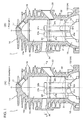
- Fig. 1(A) is a vertical sectional view of an embodiment (first embodiment) of a loop-scavenged two-stroke internal combustion engine according to the present invention
- Fig. 1(B) is a vertical sectional view of a conventional example of a loop-scavenged two-stroke internal combustion engine
- Fig. 2 is a sectional view taken along and as viewed in the direction of arrows X-X in Fig. 1(A) .
- corresponding parts or parts with like functions are designated with like reference numerals.
- the illustrated loop-scavenged two-stroke internal combustion engine 1 is a small air-cooled two-stroke gasoline engine of a four-port scavenging system used in portable powered equipment and the like, comprising a cylinder 10 in which a piston 20 is inserted and fitted, wherein an upper crankcase 12A, which constitutes the upper half of a crankcase 12, is integrally formed below the cylinder 10.
- An unillustrated lower crankcase is fastened in a sealed state below the upper crankcase 12A by means of, for example, four through bolts.
- the crankcase 12 defines a crankchamber 18 below the cylinder 10, and rotatably supports, via a main bearing, a crankshaft that reciprocates the piston 20 via a con rod.
- Plural cooling fins 16 are provided on an outer circumferential portion of the cylinder 10.
- a squish dome shaped (hemispherical) combustion chamber portion 15a constituting a combustion actuating chamber 15 is provided at a head portion of the cylinder 10.
- a mounting hole (internal thread portion) 17 by which a spark plug (not shown) is installed is formed in the combustion chamber portion 15a.
- an exhaust port 34 is provided on one side of the barrel portion of the cylinder 10, and an intake port 33 is provided on the other side of the barrel portion at a lower position than the exhaust port 34 (in Fig. 2 , the exhaust port 34 and the intake port 33 are shown as if they are located at the same height).
- first scavenging passages 31, 31 located on the side of the exhaust port 34 and a pair of second scavenging passages 32, 32 located on the opposite side to the exhaust port 34 (i.e., on the side of the intake port 33), which adopt a reverse scavenging sestem (Schnuerle-scavenging system), are provided from the cylinder 10 to the upper crankcase 12A.
- the first and second scavenging passages 31, 31 and 32, 32 are so provided as to be symmetrical about a central vertical section F-F that bisects the intake port 33 and the exhaust port 34.
- the first and second scavenging passages 31, 31 and 32, 32 are, in large part, passage portions with partitions 31k, 31k and 32k, 32k, respectively. Their lower ends open to a main bearing receiving face (half-cylindrical surface) 14 of the upper crankcase 12A.
- first scavenging outlets 31b, 31 b and second scavenging outlets 32b, 32b that open into the combustion actuating chamber 15 are respectively provided at the upper ends (downstream ends) of the first scavenging passages 31, 31 and the second scavenging passages 32, 32.
- the first scavenging outlets 31b, 31b and the second scavenging outlets 32b, 32b are provided at the same height, and their upper end height is made lower than the upper end of the exhaust port 34 by a predetermined amount.
- the first scavenging outlets 31b, 31b and the second scavenging outlets 32b, 32b are such that, when the piston 20 moves downward, both pairs open simultaneously following a slight delay from the exhaust port 34.
- the scavenging inlets (cutout openings) 32a, 32a formed in the lower end portions of the partitions 32k, 32k of the second scavenging passages 32, 32 located on the side of the intake port 33 are of a substantially triangular shape that becomes narrower towards the upper side. More specifically, they are of a substantially triangular shape where, as shown enlarged in Fig. 3 , the left and right sides that form a vertex angle ⁇ are substantially formed of straight lines except for the vicinity of the vertex (rounded corner portion from manufacturing), that is, a substantially triangular shape whose opening width widens at a substantially constant rate of change towards the lower end.
- the opening area and height of the scavenging inlets (cutout openings) 32a, 32a are made to be smaller and lower than the opening area and height of the substantially rectangular scavenging inlets (cutout openings) 31a, 31a formed in the first scavenging passages 31, 31 located on the side of the exhaust port 34.
- the scavenging inlets (cutout openings) 32a, 32a of the substantially triangular shape have their vertex portions located at center portions thereof in their width direction, and the vertex angles ⁇ thereof are set at 130 degrees or below.
- the shapes of the respective cutout openings 31 a, 31 a and 32a, 32a of the first and second scavenging passages 31, 31 and 32, 32 of the conventional example (prior art) are substantially rectangular as in the cutout openings 31a, 31a of the first scavenging passages 31, 31 in the present embodiment.
- the opening area and height of the scavenging inlets (cutout openings) 32a, 32a formed in the second scavenging passages 32, 32 located on the side of the intake port 33 in the prior art are made to be larger and higher than the opening area and height of the scavenging inlets (cutout openings) 31 a, 31 a formed in the first scavenging passages 31, 31 located on the side of the exhaust port 34, and are such that they are generally open wider.
- an air-fuel mixture from an air-fuel mixture generating means such as a carburetor or the like that is not shown in the drawings, is drawn into and captured in the crankchamber 18 from the intake port 33.
- the piston 20 is pressed downward by the combustion gas.
- the air-fuel mixture within the crankchamber 18 and the scavenging passages 31, 31 and 32, 32 is compressed by the piston 20, while at the same time the exhaust port 34 is opened first, and as the piston 20 moves further downward, the respective scavenging outlets 31b, 31b and 32b, 32b at the downstream ends of the scavenging passages 31, 31 and 32, 32 are opened simultaneously.
- the scavenging inlets (cutout openings) 32a, 32a formed in the lower end portions of the partitions 32k, 32k of the second scavenging passages 32, 32 are of the substantially triangular shape that becomes narrower towards the upper side, or more specifically of the substantially triangular shape whose opening width widens at a substantially constant rate of change towards the lower end, when the fresh charge that is compressed at the crankchamber 18 flows into the scavenging passages through the scavenging inlets 32a, 32a, the fresh charge is pushed in at a single focused point. Consequently, the flow speed of the scavenging flow increases and scavenging efficiency improves, thereby suppressing short-circuiting and reducing THC, while at the same time bringing about improvements in fuel economy, and output.
- the scavenging inlets 32a, 32a are of a substantially triangular shape and the opening areas of the scavenging inlets are made smaller than those of a conventional device having substantially rectangular scavenging inlets, the flow speed of the scavenging flow becomes even faster. Consequently, a further reduction in THC, and further improvements in fuel economy and output are achieved. Further, because the opening areas of the scavenging inlets are made small, the area of the cylinder bore wall surface, which is the sliding surface for the piston, increases, as a result of which the stiffness (strength) of the cylinder increases, making it possible to enhance the durability and output stability of the cylinder and the piston.
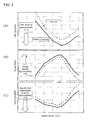
- Fig. 4(A) indicates THC emission, (B) output (power), and (C) specific fuel consumption (S.F.C.). From these results, it was confirmed that with the present invention, as compared to the prior art and across the entire operating revolution rate range (6,000 to 11,000 rpm), THC drops by approximately 15%, output rises by approximately 2 %, and specific fuel consumption drops by approximately 5 %.
- the scavenging inlets 32a, 32a are of a substantially triangular shape, changes in the piston sliding area of the cylinder 10 become more constant and gradual as compared to a conventional device having substantially rectangular scavenging inlets, making it possible to avoid rapid changes in the piston bearing capacity of the cylinder 10. Consequently, deformation of and/or damage to the piston 20 and the cylinder 10, as well as accompanying output drops and the like, become less likely, making it possible to further enhance the durability and output stability of the cylinder 10 and the piston 20.
- the rate of temperature change that the circumferential surface of the piston passing by the scavenging inlet portion is subjected to in relation to temperature changes accompanying the presence/absence of partitions becomes substantially constant. Consequently, rapid temperature changes of the circumferential surface of the piston are prevented, thereby making it possible to improve the heat deformation resistance and durability of the piston.
- the scavenging inlets 32a, 32a are of a substantially triangular shape and their opening areas are made small, it becomes difficult for the highly viscous lubrication oil within the air-fuel mixture to enter the scavenging passages, and the separated lubrication oil thus accumulates within the crankcase. Consequently, such effects as a further improvement in seizure resistance, etc., are achieved.
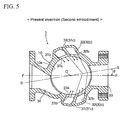
- Fig. 5 shows a horizontal section of the second embodiment of a two-stroke internal combustion engine according to the present invention (corresponding to Fig. 2 which shows a horizontal section of the first embodiment).
- the scavenging passages 31, 31 and 32, 32 are so provided as to be symmetrical about an inclined vertical section S-S that is inclined, as viewed planarly, by a predetermined angle ⁇ relative to a central vertical section F-F that bisects the intake port 33.
- the exhaust port 34 is so provided as to be eccentric relative to the central vertical section F-F as viewed planarly. In all other respects, it is configured in the same manner as the first embodiment.
- the substantially triangular scavenging inlet (cutout opening) 32a is formed in both of the partitions 32k, 32k of the scavenging passages 32, 32 located on the side of the intake port 33 among the two pairs of scavenging passages 31, 31 and 32, 32
- the substantially triangular scavenging inlet 32a may also be formed in only one of the partitions 32k, 32k instead.
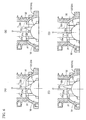
- substantially triangular scavenging inlets 32a, 32a may instead have such shapes as those of scavenging inlets 32i and 32j shown in Figs. 6(A) and (B) where the vertex portions are skewed to one side in the width direction (i.e., the shape of a substantially right-angled triangle or a parallelogram including a substantially right-angled triangle).
- the throttling effect produced by virtue of the substantially triangular shape can be added while securing sufficient heat deformation resistance of the cylinder and the piston by way of the partitions.
- the vertex angle ⁇ of the scavenging inlet be 130° or below.
- the scavenging inlets 32a, 32i, 32j, 32v and 32u mentioned above are defined as being such that their overall shapes are substantially triangular where they become narrower towards the upper side, they are by no means limited as such.
- the shape of the scavenging inlet may instead be such that, as in scavenging inlets 32p and 32q respectively shown in Figs. 7(E) and (F) for example, its upper portion is of a substantially triangular shape that becomes narrower towards the upper side (preferably with a vertex angle ⁇ of 130° or below), and its lower portion is of a substantially rectangular shape; the overall shape thus substantially being a pentagon, a quadrilateral (trapezium), or the like.
Landscapes
- Engineering & Computer Science (AREA)
- Chemical & Material Sciences (AREA)
- Combustion & Propulsion (AREA)
- Mechanical Engineering (AREA)
- General Engineering & Computer Science (AREA)
- Cylinder Crankcases Of Internal Combustion Engines (AREA)
- Supercharger (AREA)
Applications Claiming Priority (1)
| Application Number | Priority Date | Filing Date | Title |
|---|---|---|---|
| JP2009172991A JP2011027019A (ja) | 2009-07-24 | 2009-07-24 | 2サイクルエンジン |
Publications (2)
| Publication Number | Publication Date |
|---|---|
| EP2278136A2 true EP2278136A2 (de) | 2011-01-26 |
| EP2278136A3 EP2278136A3 (de) | 2011-10-19 |
Family
ID=43087881
Family Applications (1)
| Application Number | Title | Priority Date | Filing Date |
|---|---|---|---|
| EP10007150A Withdrawn EP2278136A3 (de) | 2009-07-24 | 2010-07-12 | Zweitakt-Verbrennungsmotor |
Country Status (3)
| Country | Link |
|---|---|
| US (1) | US20110017182A1 (de) |
| EP (1) | EP2278136A3 (de) |
| JP (1) | JP2011027019A (de) |
Cited By (1)
| Publication number | Priority date | Publication date | Assignee | Title |
|---|---|---|---|---|
| EP2415987B1 (de) * | 2010-08-02 | 2018-12-12 | Yamabiko Corporation | Zweitaktverbrennungsmotor mit Umkehrspülung |
Families Citing this family (4)
| Publication number | Priority date | Publication date | Assignee | Title |
|---|---|---|---|---|
| JP5658188B2 (ja) * | 2012-02-28 | 2015-01-21 | 株式会社丸山製作所 | ピストン製造用金型及びピストン製造方法 |
| SE539758C2 (en) * | 2014-12-04 | 2017-11-21 | Powercell Sweden Ab | Catalytic burner arragement |
| CN205315134U (zh) * | 2016-01-16 | 2016-06-15 | 浙江中马园林机器股份有限公司 | 扫气道外置式低排气缸 |
| CN113503214A (zh) * | 2021-07-19 | 2021-10-15 | 浙江派尼尔科技股份有限公司 | 一种小型汽油机用封闭式低排回流扫气通路气缸 |
Citations (6)
| Publication number | Priority date | Publication date | Assignee | Title |
|---|---|---|---|---|
| JPS63239341A (ja) * | 1987-03-25 | 1988-10-05 | Sanshin Ind Co Ltd | 2サイクルエンジンのシリンダスリ−ブ |
| JPH06257504A (ja) | 1993-03-08 | 1994-09-13 | Toshihiko Yamamoto | 2サイクルエンジン |
| JPH11315722A (ja) | 1998-04-30 | 1999-11-16 | Tanaka Kogyo Kk | 2サイクルエンジン |
| JP2000034926A (ja) | 1998-07-16 | 2000-02-02 | Kioritz Corp | 二サイクル内燃機関及びそのシリンダ |
| JP4082868B2 (ja) | 2001-02-05 | 2008-04-30 | 株式会社共立 | 2サイクル内燃エンジン |
| JP2008274804A (ja) | 2007-04-26 | 2008-11-13 | Ihi Shibaura Machinery Corp | 2サイクルエンジン |
Family Cites Families (16)
| Publication number | Priority date | Publication date | Assignee | Title |
|---|---|---|---|---|
| US1899217A (en) * | 1931-02-25 | 1933-02-28 | Continental Motors Corp | Internal combustion engine |
| US4016850A (en) * | 1974-02-22 | 1977-04-12 | Brunswick Corporation | Ported cylinder construction for a two-cycle engine |
| JPS5273211A (en) * | 1975-12-16 | 1977-06-18 | Kawasaki Heavy Ind Ltd | Two cycle engine |
| JPH0733768B2 (ja) * | 1987-12-10 | 1995-04-12 | 三菱重工業株式会社 | 2サイクルエンジンの可変式掃気通路 |
| JPH02102318A (ja) * | 1988-10-08 | 1990-04-13 | Mitsubishi Heavy Ind Ltd | 2サイクルエンジンの掃気通路 |
| US4969329A (en) * | 1989-05-05 | 1990-11-13 | General Motors Corporation | Two cycle engine with exhaust emission control |
| JPH102207A (ja) * | 1996-06-14 | 1998-01-06 | Honda Motor Co Ltd | 2ストローク内燃機関のオイル潤滑構造 |
| JP2000034924A (ja) * | 1998-07-17 | 2000-02-02 | Kioritz Corp | 2サイクル内燃エンジン |
| US6223705B1 (en) * | 1998-07-17 | 2001-05-01 | Kioritz Corporation | Two-stroke internal combustion engine |
| DE10064719B4 (de) * | 2000-12-22 | 2013-12-12 | Andreas Stihl Ag & Co. | Zweitaktmotor mit Ladungsschichtung |
| DE10241213A1 (de) * | 2002-09-06 | 2004-03-18 | Andreas Stihl Ag & Co. | Verfahren zum Betrieb eines Zweitaktmotors mit Gemischansaugung |
| US20040065280A1 (en) * | 2002-10-04 | 2004-04-08 | Homelite Technologies Ltd. | Two-stroke engine transfer ports |
| JP4272001B2 (ja) * | 2003-06-23 | 2009-06-03 | 川崎重工業株式会社 | 2サイクルエンジン |
| JP4373135B2 (ja) * | 2003-06-09 | 2009-11-25 | 川崎重工業株式会社 | 空気掃気型の2サイクルエンジン |
| JP4309418B2 (ja) * | 2006-10-27 | 2009-08-05 | 株式会社共立 | 2サイクル内燃エンジン |
| JP4878265B2 (ja) * | 2006-11-09 | 2012-02-15 | ハスクバーナ・ゼノア株式会社 | 2サイクルエンジン |
-
2009
- 2009-07-24 JP JP2009172991A patent/JP2011027019A/ja active Pending
-
2010
- 2010-07-12 EP EP10007150A patent/EP2278136A3/de not_active Withdrawn
- 2010-07-23 US US12/842,625 patent/US20110017182A1/en not_active Abandoned
Patent Citations (6)
| Publication number | Priority date | Publication date | Assignee | Title |
|---|---|---|---|---|
| JPS63239341A (ja) * | 1987-03-25 | 1988-10-05 | Sanshin Ind Co Ltd | 2サイクルエンジンのシリンダスリ−ブ |
| JPH06257504A (ja) | 1993-03-08 | 1994-09-13 | Toshihiko Yamamoto | 2サイクルエンジン |
| JPH11315722A (ja) | 1998-04-30 | 1999-11-16 | Tanaka Kogyo Kk | 2サイクルエンジン |
| JP2000034926A (ja) | 1998-07-16 | 2000-02-02 | Kioritz Corp | 二サイクル内燃機関及びそのシリンダ |
| JP4082868B2 (ja) | 2001-02-05 | 2008-04-30 | 株式会社共立 | 2サイクル内燃エンジン |
| JP2008274804A (ja) | 2007-04-26 | 2008-11-13 | Ihi Shibaura Machinery Corp | 2サイクルエンジン |
Cited By (1)
| Publication number | Priority date | Publication date | Assignee | Title |
|---|---|---|---|---|
| EP2415987B1 (de) * | 2010-08-02 | 2018-12-12 | Yamabiko Corporation | Zweitaktverbrennungsmotor mit Umkehrspülung |
Also Published As
| Publication number | Publication date |
|---|---|
| EP2278136A3 (de) | 2011-10-19 |
| US20110017182A1 (en) | 2011-01-27 |
| JP2011027019A (ja) | 2011-02-10 |
Similar Documents
| Publication | Publication Date | Title |
|---|---|---|
| US5628295A (en) | Two-stroke internal combustion engine | |
| CN102562257B (zh) | 双循环发动机 | |
| US20020104493A1 (en) | Two-stroke internal combustion engine | |
| EP2278137B1 (de) | Zweitaktverbrennungsmotor | |
| US6205962B1 (en) | Two-cycle internal combustion engine with enhanced lubrication | |
| EP2278136A2 (de) | Zweitakt-Verbrennungsmotor | |
| US8800508B2 (en) | Loop scavenged two-stroke internal combustion engine | |
| US9121330B2 (en) | Porting system for a turbo-charged loop scavenged two-stroked engine | |
| US6223705B1 (en) | Two-stroke internal combustion engine | |
| JP2011080412A (ja) | 2サイクルエンジン | |
| JP4726201B2 (ja) | 2サイクル内燃エンジン | |
| CN216008688U (zh) | 一种二冲程发动机 | |
| JP3773507B2 (ja) | 2サイクル内燃エンジン | |
| JP5060459B2 (ja) | 2サイクルエンジン | |
| JP2000283008A (ja) | 二サイクルエンジンの燃料噴射装置 | |
| US20120006308A1 (en) | Piston for a Two-Stroke Engine | |
| Eto et al. | Development of High-Performance 25 cm 3 Two-Stroke SI Engine for Light Weight Arborist-Chainsaw | |
| AU2010101401A4 (en) | Two Stroke Induction Ports | |
| JP5594026B2 (ja) | 2サイクルエンジンおよびそれを備えたエンジン作業機 | |
| CN113153519A (zh) | 一种二冲程发动机 | |
| JP3066973U (ja) | 二行程シリンダ | |
| JP2012177309A (ja) | 4ストロークエンジン | |
| WO2012132628A1 (ja) | 2ストロークエンジン | |
| WO2012132658A1 (ja) | 2ストロークエンジン | |
| GB2350153A (en) | Blowerflow injected two-stroke engine |
Legal Events
| Date | Code | Title | Description |
|---|---|---|---|
| PUAI | Public reference made under article 153(3) epc to a published international application that has entered the european phase |
Free format text: ORIGINAL CODE: 0009012 |
|
| AK | Designated contracting states |
Kind code of ref document: A2 Designated state(s): AL AT BE BG CH CY CZ DE DK EE ES FI FR GB GR HR HU IE IS IT LI LT LU LV MC MK MT NL NO PL PT RO SE SI SK SM TR |
|
| AX | Request for extension of the european patent |
Extension state: BA ME RS |
|
| PUAL | Search report despatched |
Free format text: ORIGINAL CODE: 0009013 |
|
| AK | Designated contracting states |
Kind code of ref document: A3 Designated state(s): AL AT BE BG CH CY CZ DE DK EE ES FI FR GB GR HR HU IE IS IT LI LT LU LV MC MK MT NL NO PL PT RO SE SI SK SM TR |
|
| AX | Request for extension of the european patent |
Extension state: BA ME RS |
|
| RIC1 | Information provided on ipc code assigned before grant |
Ipc: F02B 33/04 20060101ALI20110909BHEP Ipc: F02B 33/14 20060101ALI20110909BHEP Ipc: F02B 25/02 20060101AFI20110909BHEP |
|
| 17P | Request for examination filed |
Effective date: 20120329 |
|
| 17Q | First examination report despatched |
Effective date: 20130912 |
|
| STAA | Information on the status of an ep patent application or granted ep patent |
Free format text: STATUS: THE APPLICATION IS DEEMED TO BE WITHDRAWN |
|
| 18D | Application deemed to be withdrawn |
Effective date: 20150203 |