EP2269959A1 - Crystallization-resistant glass compositions suitable for manufacturing glass frits for microreactors - Google Patents
Crystallization-resistant glass compositions suitable for manufacturing glass frits for microreactors Download PDFInfo
- Publication number
- EP2269959A1 EP2269959A1 EP10178616A EP10178616A EP2269959A1 EP 2269959 A1 EP2269959 A1 EP 2269959A1 EP 10178616 A EP10178616 A EP 10178616A EP 10178616 A EP10178616 A EP 10178616A EP 2269959 A1 EP2269959 A1 EP 2269959A1
- Authority
- EP
- European Patent Office
- Prior art keywords
- mol
- glass
- frit
- composition
- substrate
- Prior art date
- Legal status (The legal status is an assumption and is not a legal conclusion. Google has not performed a legal analysis and makes no representation as to the accuracy of the status listed.)
- Withdrawn
Links
- 239000011521 glass Substances 0.000 title claims abstract description 115
- 239000000203 mixture Substances 0.000 title claims abstract description 95
- 238000002425 crystallisation Methods 0.000 title claims description 25
- 230000008025 crystallization Effects 0.000 title claims description 25
- 238000004519 manufacturing process Methods 0.000 title abstract description 9
- VYPSYNLAJGMNEJ-UHFFFAOYSA-N Silicium dioxide Chemical compound O=[Si]=O VYPSYNLAJGMNEJ-UHFFFAOYSA-N 0.000 claims abstract description 84
- KKCBUQHMOMHUOY-UHFFFAOYSA-N Na2O Inorganic materials [O-2].[Na+].[Na+] KKCBUQHMOMHUOY-UHFFFAOYSA-N 0.000 claims abstract description 35
- 229910052906 cristobalite Inorganic materials 0.000 claims abstract description 33
- 239000000377 silicon dioxide Substances 0.000 claims abstract description 32
- 229910011255 B2O3 Inorganic materials 0.000 claims abstract description 31
- JKWMSGQKBLHBQQ-UHFFFAOYSA-N diboron trioxide Chemical group O=BOB=O JKWMSGQKBLHBQQ-UHFFFAOYSA-N 0.000 claims abstract description 31
- 238000005245 sintering Methods 0.000 claims abstract description 28
- 229910052905 tridymite Inorganic materials 0.000 claims abstract description 28
- 229910052681 coesite Inorganic materials 0.000 claims abstract description 27
- 229910052682 stishovite Inorganic materials 0.000 claims abstract description 27
- 239000005388 borosilicate glass Substances 0.000 claims abstract description 21
- 239000000758 substrate Substances 0.000 claims description 64
- 239000000945 filler Substances 0.000 claims description 7
- 229910000500 β-quartz Inorganic materials 0.000 claims description 7
- 229910000323 aluminium silicate Inorganic materials 0.000 claims description 6
- 229910000174 eucryptite Inorganic materials 0.000 claims description 4
- CNLWCVNCHLKFHK-UHFFFAOYSA-N aluminum;lithium;dioxido(oxo)silane Chemical compound [Li+].[Al+3].[O-][Si]([O-])=O.[O-][Si]([O-])=O CNLWCVNCHLKFHK-UHFFFAOYSA-N 0.000 claims description 2
- 229910052644 β-spodumene Inorganic materials 0.000 claims description 2
- PNEYBMLMFCGWSK-UHFFFAOYSA-N aluminium oxide Inorganic materials [O-2].[O-2].[O-2].[Al+3].[Al+3] PNEYBMLMFCGWSK-UHFFFAOYSA-N 0.000 abstract description 25
- FUJCRWPEOMXPAD-UHFFFAOYSA-N Li2O Inorganic materials [Li+].[Li+].[O-2] FUJCRWPEOMXPAD-UHFFFAOYSA-N 0.000 abstract description 14
- XUCJHNOBJLKZNU-UHFFFAOYSA-M dilithium;hydroxide Chemical compound [Li+].[Li+].[OH-] XUCJHNOBJLKZNU-UHFFFAOYSA-M 0.000 abstract description 13
- 229910052593 corundum Inorganic materials 0.000 abstract description 12
- 229910001845 yogo sapphire Inorganic materials 0.000 abstract description 12
- 238000000034 method Methods 0.000 description 29
- CHWRSCGUEQEHOH-UHFFFAOYSA-N potassium oxide Chemical compound [O-2].[K+].[K+] CHWRSCGUEQEHOH-UHFFFAOYSA-N 0.000 description 29
- 239000013078 crystal Substances 0.000 description 15
- 239000000463 material Substances 0.000 description 15
- 239000003513 alkali Substances 0.000 description 13
- 238000013461 design Methods 0.000 description 12
- 230000008569 process Effects 0.000 description 12
- 239000002419 bulk glass Substances 0.000 description 11
- 239000012530 fluid Substances 0.000 description 11
- 239000000126 substance Substances 0.000 description 11
- 238000006243 chemical reaction Methods 0.000 description 10
- 238000001816 cooling Methods 0.000 description 10
- 238000010304 firing Methods 0.000 description 10
- 239000002253 acid Substances 0.000 description 8
- 238000010438 heat treatment Methods 0.000 description 8
- RVTZCBVAJQQJTK-UHFFFAOYSA-N oxygen(2-);zirconium(4+) Chemical compound [O-2].[O-2].[Zr+4] RVTZCBVAJQQJTK-UHFFFAOYSA-N 0.000 description 8
- 229910001928 zirconium oxide Inorganic materials 0.000 description 8
- ZOXJGFHDIHLPTG-UHFFFAOYSA-N Boron Chemical compound [B] ZOXJGFHDIHLPTG-UHFFFAOYSA-N 0.000 description 6
- ODINCKMPIJJUCX-UHFFFAOYSA-N Calcium oxide Chemical compound [Ca]=O ODINCKMPIJJUCX-UHFFFAOYSA-N 0.000 description 6
- 229910052796 boron Inorganic materials 0.000 description 6
- 229910052731 fluorine Inorganic materials 0.000 description 6
- 239000000376 reactant Substances 0.000 description 6
- 238000012360 testing method Methods 0.000 description 6
- RZVAJINKPMORJF-UHFFFAOYSA-N Acetaminophen Chemical compound CC(=O)NC1=CC=C(O)C=C1 RZVAJINKPMORJF-UHFFFAOYSA-N 0.000 description 5
- 238000007906 compression Methods 0.000 description 5
- 230000006835 compression Effects 0.000 description 5
- 230000000694 effects Effects 0.000 description 5
- 238000001000 micrograph Methods 0.000 description 5
- 239000005297 pyrex Substances 0.000 description 5
- 239000010453 quartz Substances 0.000 description 5
- 230000001052 transient effect Effects 0.000 description 5
- 238000004458 analytical method Methods 0.000 description 4
- 238000000137 annealing Methods 0.000 description 4
- 239000002585 base Substances 0.000 description 4
- 239000000292 calcium oxide Substances 0.000 description 4
- BRPQOXSCLDDYGP-UHFFFAOYSA-N calcium oxide Chemical compound [O-2].[Ca+2] BRPQOXSCLDDYGP-UHFFFAOYSA-N 0.000 description 4
- 238000002474 experimental method Methods 0.000 description 4
- 238000000227 grinding Methods 0.000 description 4
- 238000005259 measurement Methods 0.000 description 4
- 238000005498 polishing Methods 0.000 description 4
- 239000000843 powder Substances 0.000 description 4
- 238000012545 processing Methods 0.000 description 4
- PXGOKWXKJXAPGV-UHFFFAOYSA-N Fluorine Chemical compound FF PXGOKWXKJXAPGV-UHFFFAOYSA-N 0.000 description 3
- WHXSMMKQMYFTQS-UHFFFAOYSA-N Lithium Chemical compound [Li] WHXSMMKQMYFTQS-UHFFFAOYSA-N 0.000 description 3
- HEMHJVSKTPXQMS-UHFFFAOYSA-M Sodium hydroxide Chemical compound [OH-].[Na+] HEMHJVSKTPXQMS-UHFFFAOYSA-M 0.000 description 3
- 230000008901 benefit Effects 0.000 description 3
- 238000000280 densification Methods 0.000 description 3
- 239000011737 fluorine Substances 0.000 description 3
- 230000004907 flux Effects 0.000 description 3
- 229910052744 lithium Inorganic materials 0.000 description 3
- 229910052751 metal Inorganic materials 0.000 description 3
- 239000002184 metal Substances 0.000 description 3
- 238000001053 micromoulding Methods 0.000 description 3
- 238000002156 mixing Methods 0.000 description 3
- 239000002245 particle Substances 0.000 description 3
- 230000000750 progressive effect Effects 0.000 description 3
- 239000011734 sodium Substances 0.000 description 3
- ZLMJMSJWJFRBEC-UHFFFAOYSA-N Potassium Chemical compound [K] ZLMJMSJWJFRBEC-UHFFFAOYSA-N 0.000 description 2
- 229910004298 SiO 2 Inorganic materials 0.000 description 2
- XUIMIQQOPSSXEZ-UHFFFAOYSA-N Silicon Chemical compound [Si] XUIMIQQOPSSXEZ-UHFFFAOYSA-N 0.000 description 2
- CDBYLPFSWZWCQE-UHFFFAOYSA-L Sodium Carbonate Chemical compound [Na+].[Na+].[O-]C([O-])=O CDBYLPFSWZWCQE-UHFFFAOYSA-L 0.000 description 2
- 230000015572 biosynthetic process Effects 0.000 description 2
- 238000009835 boiling Methods 0.000 description 2
- 150000004649 carbonic acid derivatives Chemical class 0.000 description 2
- 238000011161 development Methods 0.000 description 2
- 230000018109 developmental process Effects 0.000 description 2
- 238000005530 etching Methods 0.000 description 2
- 238000009472 formulation Methods 0.000 description 2
- 230000006872 improvement Effects 0.000 description 2
- 239000012535 impurity Substances 0.000 description 2
- 239000007788 liquid Substances 0.000 description 2
- 238000000465 moulding Methods 0.000 description 2
- 229910052700 potassium Inorganic materials 0.000 description 2
- 239000011591 potassium Substances 0.000 description 2
- 230000035939 shock Effects 0.000 description 2
- 229910052710 silicon Inorganic materials 0.000 description 2
- 239000010703 silicon Substances 0.000 description 2
- 239000002904 solvent Substances 0.000 description 2
- OYPRJOBELJOOCE-UHFFFAOYSA-N Calcium Chemical compound [Ca] OYPRJOBELJOOCE-UHFFFAOYSA-N 0.000 description 1
- DGAQECJNVWCQMB-PUAWFVPOSA-M Ilexoside XXIX Chemical compound C[C@@H]1CC[C@@]2(CC[C@@]3(C(=CC[C@H]4[C@]3(CC[C@@H]5[C@@]4(CC[C@@H](C5(C)C)OS(=O)(=O)[O-])C)C)[C@@H]2[C@]1(C)O)C)C(=O)O[C@H]6[C@@H]([C@H]([C@@H]([C@H](O6)CO)O)O)O.[Na+] DGAQECJNVWCQMB-PUAWFVPOSA-M 0.000 description 1
- 239000000020 Nitrocellulose Substances 0.000 description 1
- 238000002441 X-ray diffraction Methods 0.000 description 1
- 150000007513 acids Chemical class 0.000 description 1
- 229910052782 aluminium Inorganic materials 0.000 description 1
- XAGFODPZIPBFFR-UHFFFAOYSA-N aluminium Chemical compound [Al] XAGFODPZIPBFFR-UHFFFAOYSA-N 0.000 description 1
- 229940072049 amyl acetate Drugs 0.000 description 1
- PGMYKACGEOXYJE-UHFFFAOYSA-N anhydrous amyl acetate Natural products CCCCCOC(C)=O PGMYKACGEOXYJE-UHFFFAOYSA-N 0.000 description 1
- 238000013459 approach Methods 0.000 description 1
- 230000004888 barrier function Effects 0.000 description 1
- 239000011230 binding agent Substances 0.000 description 1
- 230000033228 biological regulation Effects 0.000 description 1
- KGBXLFKZBHKPEV-UHFFFAOYSA-N boric acid Chemical compound OB(O)O KGBXLFKZBHKPEV-UHFFFAOYSA-N 0.000 description 1
- 239000004327 boric acid Substances 0.000 description 1
- 239000011575 calcium Substances 0.000 description 1
- 229910052791 calcium Inorganic materials 0.000 description 1
- 150000001768 cations Chemical class 0.000 description 1
- 239000000919 ceramic Substances 0.000 description 1
- 229910010293 ceramic material Inorganic materials 0.000 description 1
- 229910000420 cerium oxide Inorganic materials 0.000 description 1
- 230000008859 change Effects 0.000 description 1
- 238000001311 chemical methods and process Methods 0.000 description 1
- 239000007795 chemical reaction product Substances 0.000 description 1
- 239000011248 coating agent Substances 0.000 description 1
- 238000000576 coating method Methods 0.000 description 1
- 150000001875 compounds Chemical class 0.000 description 1
- 238000010276 construction Methods 0.000 description 1
- 238000005260 corrosion Methods 0.000 description 1
- 230000007797 corrosion Effects 0.000 description 1
- 230000008878 coupling Effects 0.000 description 1
- 238000010168 coupling process Methods 0.000 description 1
- 238000005859 coupling reaction Methods 0.000 description 1
- 238000005336 cracking Methods 0.000 description 1
- 238000005520 cutting process Methods 0.000 description 1
- 238000004031 devitrification Methods 0.000 description 1
- 238000007571 dilatometry Methods 0.000 description 1
- 238000005553 drilling Methods 0.000 description 1
- 238000005516 engineering process Methods 0.000 description 1
- 230000007613 environmental effect Effects 0.000 description 1
- 239000000835 fiber Substances 0.000 description 1
- 239000002241 glass-ceramic Substances 0.000 description 1
- MNWFXJYAOYHMED-UHFFFAOYSA-M heptanoate Chemical compound CCCCCCC([O-])=O MNWFXJYAOYHMED-UHFFFAOYSA-M 0.000 description 1
- 230000003116 impacting effect Effects 0.000 description 1
- 230000006698 induction Effects 0.000 description 1
- 239000003112 inhibitor Substances 0.000 description 1
- 150000002500 ions Chemical group 0.000 description 1
- 229910001947 lithium oxide Inorganic materials 0.000 description 1
- 230000004807 localization Effects 0.000 description 1
- 238000003754 machining Methods 0.000 description 1
- 150000002739 metals Chemical class 0.000 description 1
- 230000003278 mimic effect Effects 0.000 description 1
- 238000012544 monitoring process Methods 0.000 description 1
- 229920001220 nitrocellulos Polymers 0.000 description 1
- 230000003287 optical effect Effects 0.000 description 1
- TWNQGVIAIRXVLR-UHFFFAOYSA-N oxo(oxoalumanyloxy)alumane Chemical compound O=[Al]O[Al]=O TWNQGVIAIRXVLR-UHFFFAOYSA-N 0.000 description 1
- BMMGVYCKOGBVEV-UHFFFAOYSA-N oxo(oxoceriooxy)cerium Chemical compound [Ce]=O.O=[Ce]=O BMMGVYCKOGBVEV-UHFFFAOYSA-N 0.000 description 1
- PXXKQOPKNFECSZ-UHFFFAOYSA-N platinum rhodium Chemical compound [Rh].[Pt] PXXKQOPKNFECSZ-UHFFFAOYSA-N 0.000 description 1
- 229920000642 polymer Polymers 0.000 description 1
- 229920001296 polysiloxane Polymers 0.000 description 1
- 229910001950 potassium oxide Inorganic materials 0.000 description 1
- 238000005086 pumping Methods 0.000 description 1
- 230000009467 reduction Effects 0.000 description 1
- 238000011160 research Methods 0.000 description 1
- 238000012827 research and development Methods 0.000 description 1
- 238000012552 review Methods 0.000 description 1
- 238000005070 sampling Methods 0.000 description 1
- 239000005368 silicate glass Substances 0.000 description 1
- 229910052708 sodium Inorganic materials 0.000 description 1
- 229910000029 sodium carbonate Inorganic materials 0.000 description 1
- 229910001948 sodium oxide Inorganic materials 0.000 description 1
- 230000009466 transformation Effects 0.000 description 1
- 239000002699 waste material Substances 0.000 description 1
- XLYOFNOQVPJJNP-UHFFFAOYSA-N water Substances O XLYOFNOQVPJJNP-UHFFFAOYSA-N 0.000 description 1
- 230000004580 weight loss Effects 0.000 description 1
- 229910021489 α-quartz Inorganic materials 0.000 description 1
Images





Classifications
-
- C—CHEMISTRY; METALLURGY
- C03—GLASS; MINERAL OR SLAG WOOL
- C03C—CHEMICAL COMPOSITION OF GLASSES, GLAZES OR VITREOUS ENAMELS; SURFACE TREATMENT OF GLASS; SURFACE TREATMENT OF FIBRES OR FILAMENTS MADE FROM GLASS, MINERALS OR SLAGS; JOINING GLASS TO GLASS OR OTHER MATERIALS
- C03C8/00—Enamels; Glazes; Fusion seal compositions being frit compositions having non-frit additions
- C03C8/02—Frit compositions, i.e. in a powdered or comminuted form
-
- B—PERFORMING OPERATIONS; TRANSPORTING
- B01—PHYSICAL OR CHEMICAL PROCESSES OR APPARATUS IN GENERAL
- B01J—CHEMICAL OR PHYSICAL PROCESSES, e.g. CATALYSIS OR COLLOID CHEMISTRY; THEIR RELEVANT APPARATUS
- B01J19/00—Chemical, physical or physico-chemical processes in general; Their relevant apparatus
-
- B—PERFORMING OPERATIONS; TRANSPORTING
- B01—PHYSICAL OR CHEMICAL PROCESSES OR APPARATUS IN GENERAL
- B01L—CHEMICAL OR PHYSICAL LABORATORY APPARATUS FOR GENERAL USE
- B01L3/00—Containers or dishes for laboratory use, e.g. laboratory glassware; Droppers
-
- C—CHEMISTRY; METALLURGY
- C03—GLASS; MINERAL OR SLAG WOOL
- C03C—CHEMICAL COMPOSITION OF GLASSES, GLAZES OR VITREOUS ENAMELS; SURFACE TREATMENT OF GLASS; SURFACE TREATMENT OF FIBRES OR FILAMENTS MADE FROM GLASS, MINERALS OR SLAGS; JOINING GLASS TO GLASS OR OTHER MATERIALS
- C03C3/00—Glass compositions
- C03C3/04—Glass compositions containing silica
- C03C3/076—Glass compositions containing silica with 40% to 90% silica, by weight
- C03C3/089—Glass compositions containing silica with 40% to 90% silica, by weight containing boron
-
- C—CHEMISTRY; METALLURGY
- C03—GLASS; MINERAL OR SLAG WOOL
- C03C—CHEMICAL COMPOSITION OF GLASSES, GLAZES OR VITREOUS ENAMELS; SURFACE TREATMENT OF GLASS; SURFACE TREATMENT OF FIBRES OR FILAMENTS MADE FROM GLASS, MINERALS OR SLAGS; JOINING GLASS TO GLASS OR OTHER MATERIALS
- C03C3/00—Glass compositions
- C03C3/04—Glass compositions containing silica
- C03C3/076—Glass compositions containing silica with 40% to 90% silica, by weight
- C03C3/089—Glass compositions containing silica with 40% to 90% silica, by weight containing boron
- C03C3/091—Glass compositions containing silica with 40% to 90% silica, by weight containing boron containing aluminium
-
- C—CHEMISTRY; METALLURGY
- C03—GLASS; MINERAL OR SLAG WOOL
- C03C—CHEMICAL COMPOSITION OF GLASSES, GLAZES OR VITREOUS ENAMELS; SURFACE TREATMENT OF GLASS; SURFACE TREATMENT OF FIBRES OR FILAMENTS MADE FROM GLASS, MINERALS OR SLAGS; JOINING GLASS TO GLASS OR OTHER MATERIALS
- C03C3/00—Glass compositions
- C03C3/04—Glass compositions containing silica
- C03C3/076—Glass compositions containing silica with 40% to 90% silica, by weight
- C03C3/089—Glass compositions containing silica with 40% to 90% silica, by weight containing boron
- C03C3/091—Glass compositions containing silica with 40% to 90% silica, by weight containing boron containing aluminium
- C03C3/093—Glass compositions containing silica with 40% to 90% silica, by weight containing boron containing aluminium containing zinc or zirconium
-
- B—PERFORMING OPERATIONS; TRANSPORTING
- B01—PHYSICAL OR CHEMICAL PROCESSES OR APPARATUS IN GENERAL
- B01J—CHEMICAL OR PHYSICAL PROCESSES, e.g. CATALYSIS OR COLLOID CHEMISTRY; THEIR RELEVANT APPARATUS
- B01J2219/00—Chemical, physical or physico-chemical processes in general; Their relevant apparatus
- B01J2219/00781—Aspects relating to microreactors
- B01J2219/00819—Materials of construction
- B01J2219/00831—Glass
-
- B—PERFORMING OPERATIONS; TRANSPORTING
- B01—PHYSICAL OR CHEMICAL PROCESSES OR APPARATUS IN GENERAL
- B01J—CHEMICAL OR PHYSICAL PROCESSES, e.g. CATALYSIS OR COLLOID CHEMISTRY; THEIR RELEVANT APPARATUS
- B01J2219/00—Chemical, physical or physico-chemical processes in general; Their relevant apparatus
- B01J2219/00781—Aspects relating to microreactors
- B01J2219/00889—Mixing
-
- B—PERFORMING OPERATIONS; TRANSPORTING
- B01—PHYSICAL OR CHEMICAL PROCESSES OR APPARATUS IN GENERAL
- B01L—CHEMICAL OR PHYSICAL LABORATORY APPARATUS FOR GENERAL USE
- B01L3/00—Containers or dishes for laboratory use, e.g. laboratory glassware; Droppers
- B01L3/50—Containers for the purpose of retaining a material to be analysed, e.g. test tubes
- B01L3/502—Containers for the purpose of retaining a material to be analysed, e.g. test tubes with fluid transport, e.g. in multi-compartment structures
- B01L3/5027—Containers for the purpose of retaining a material to be analysed, e.g. test tubes with fluid transport, e.g. in multi-compartment structures by integrated microfluidic structures, i.e. dimensions of channels and chambers are such that surface tension forces are important, e.g. lab-on-a-chip
Definitions
- the invention is directed to crystallization-free glass frits that are suitable for the manufacturing of glass microreactor using micro-molding technology and to the glass compositions used to make such frits; and in particular to glass frits that exhibit resistance to thermal shock and have excellent chemical durability.
- microreactors are finding application in pharmaceutical and biological research, development and analysis.
- a microreactor is a device that enables chemical reactions, either gaseous or liquid, to be done on the low milliliter scale (5-10 ml) as opposed to earlier laboratory “bench top” or pilot plant scales that varied in size from many tens of milliliters to liters in the former and up to a hundred liters, or more, in the latter.
- the microreactor is generally a continuous flow reactor that brings the reaction components together in a small reactor channel.
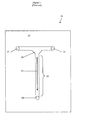
- FIG. 1 is a top view illustrating one of the simplest designs, a "T-shaped" microreactor 10.
- a T-shape is etched into a plate 20 to a selected depth (for example, 50 ⁇ m deep by 100 ⁇ m wide) and the etched plate is then covered with another plate (14 in Figure 2 ) so that the etched portion form an enclosed channel.
- the cover plate has openings (three illustrated in Figure 1 ) so that fluids (gaseous or liquid) can be added and removed from the reactor, A reaction is carried out by pumping a first fluid containing a first reactant through opening 22 and a second fluid containing a second reactant through opening 24.
- FIG. 1 is a side view illustrating etched plate 20, top plate 14, openings 22, 24 and 30, and fluid illustrated as light grey in the reactor.
- the dashed line 16 illustrates the junction of plates 14 and 20.
- microreactors While materials such as metals, silicon and certain polymers can be used to fabricate microreactors, these materials are not well suited for chemical reactions at high temperature and/or that use corrosive reactants. As a result of the foregoing problems, a simplified method for making microreactors is desirous; and it is further desired that such reactors be made of glass or ceramic materials due to their high thermal stability and their chemical durability and/or inertness to the vast majority of chemicals and solvents.
- a frit is a powdered glass that sinters to form a structure that incorporates, for example, microreaetor features and/or elements.
- the frit is typically sandwiched between two substrate layers that may themselves incorporate some microreactor elements such as the openings for reactant(s) entry and exit, control leads for heaters and other elements, some of which have been described above.
- the resulting "sandwiched" microreactor must be "fluid tight” so that reactants and/or solvents do not escape.
- 2004/0152580 A1 (assigned to Coming Incorporated) describes borosilicate glass compositions and their use to make microfluidic devices such as the microreactors described above.
- the problem with PYREX ® glass frits is that they undergo devitrification (that is, crystals of different materials are formed) during sintering at temperatures in the range of 700-800 °C.
- devitrification that is, crystals of different materials are formed
- U.S. 2004/0152580 A1 proposed that alumina be added to the borosilicate glass composition.
- the addition of alumina causes the sintering ability of the frit to decrease and reduces the fluidity of the frit.
- the materials describes in U.S. 2004/0152580 A1 resulted in an improved frit material, further improvements are needed to both frit compositions and to the method of making frits that can be used in microreactors.
- the present invention is directed to improved compositions that can be used to make glass frits that can be used in microreactor and the methods of making such frits.
- the invention is directed to glass compositions having a low softening, point low CTE, high acid and alkali chemical resistance, and high crystallization resistance that are suitable for manufacturing glass frits for microreactors.
- the glasses of the invention are borosilicate glasses containing either (a) lithium oxide plus aluminum oxide or (b) sodium oxide or potassium oxide.
- the glasses of the invention have a crystallized depth layer, as measured by the HTS method described herein using bulk glass, of less than 30 ⁇ m, preferably less than 20 ⁇ m, and most preferable 10 ⁇ m or less.
- the substrates used in practicing the invention can have a CTE in the range of 25-40 x 10 -7 /°C, preferably in the range of 30 to 40 x 10 -7 /°C
- the invention is directed to glasses, and frits made therefrom, having the following compositions:
- the glass compositions according to the invention that are suitable for frit use have a crystallized depth layer, as measured by the HTS method described herein using bulk glass, of less than 30 ⁇ m as measured after sintering on frit bars, preferably less than 20 ⁇ m, and most preferable 10 ⁇ m or less. Further, the glass compositions have a softening point less than 825 °C, preferably less than 800 °C, and CTE ⁇ 35 x 10 -7 /°C.
- Figure 1 is a top view of a microreactor having a T-shaped reaction structure microreactor that has been etched into a substrate.
- Figure 2 is a side view of the microreactor of Figure 1 that further illustrates the placement of a top plate over the substrate having the reactor structure etched therein.
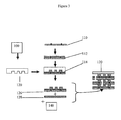
- Figure 3 illustrates a process for making a microreactor, in this illustration the microreactor being a multi-level complex design.
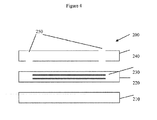
- Figure 4 is a side view of a microreactor illustrating a bottom substrate, a frit with the microreactor design therein as represented by the horizontal lines and a top substrate having at least openings for the entry and exit of fluids.
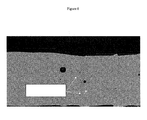
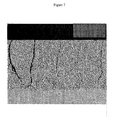
- Figure 5 is a microphotograph of a B 2 O 3 /Al 2 O 3 /Li 2 O/SiO 2 glass frit according to the invention illustrating that the frits according to the invention do not crystallize even when alumina particles are present as a result of steps such as cutting and grinding using alumina saws and grinding devices.
- Figure 6 is a microphotograph illustrating the crystals found in a composition containing fluorine and the oxides of sodium, lithium, aluminum, calcium, boron and silicon.
- Figure 7 is a microphotograph illustrating a composition not of the invention containing alumina and lithium that contains an amount of stuffed ⁇ -quartz crystals after sintering.
- Figure 8 is a microphotograph of a glass composition according to the invention that shows no crystallization after sintering.
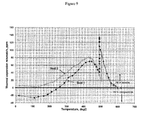
- Figure 9 is an illustration of the thermal expansion dynamic mismatch curves for composition 723 CWF frit layers in slight tension or compression.
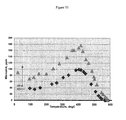
- Figure 10 illustrates of the mismatch in the butt seal using a BM 5 composition frit and Eagle 2000 substrate following 680 °C presintering and 800 °C sintering.
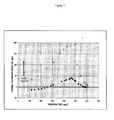
- Figure 11 illustrates butt seal mismatch for composition BM 5-721UP on Eagle 2000 substrate.
- Figure 12 illustrates butt seal mismatch for composition BM 5-721UP on Eagle 2000 substrate, presintered and sintered cooling data with 1 hour 38 minute hold at 526 °C and a cooling rate of 4 °C/minute.
- Figure 13 illustrates thermal expansion mismatch versus time for a BM 5-721UP frit on Eagle 2000 substrate (presintered and sintered) during a hold at 526 °C.
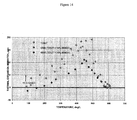
- Figure 14 illustrates butt seal mismatch for BM 5-721UP, Blend 6500 and Blend 6513 frits on Eagle 2000 substrate after presintering and sintering.
- a process for the manufacturing of microreactors can be based on micro-molding of glass frit structures onto a substrate and then covering the frit with an appropriate cover layer of material. This process is based on the micro-molding techniques disclosed in U.S. Patent No. 5,853,446 (the '446 patent) that are used to make formed glass structures that are particularly useful for forming barrier rib structures for use in plasma display units.
- Figure 2 of the '446 patent illustrates a frit bonded (adhered) to the substrate.
- two substrates first or bottom and second or top substrates
- the frit would be sandwiched between them as illustrated in Figure 4 of this application.
- the first firing step or heat treatment is made at a temperature at which the viscosity of the frit is approximately 1 x 10 10 poise and for a time in the range of 25-40 minutes to ensure initial densification of the frits glass composition.
- This first heat treatment is needed to achieve sufficient frit structure strength and to provide adequate adhesion of the frit layer to a substrate prior to any further processing or machining (for example: dicing, drilling, polishing, etching or other processing steps).
- a second firing or heat treatment step (also called the sintering or curing cycle) is needed to seal the stacked layers and the frit and the substrate together, complete full densification and achieve gas tightness of the frit structures.
- This final curing is made at a frit viscosity of approximately 1 x 10 7 poise for a time in the range 20-45 minutes.
- FIG. 3 illustrates, in a very general way, a molding process for making a microreactor, in this case a microreactor having a complex, multi-layer design.
- Box 100 represents the mask design and production of the master mold which is used to make a production mold 120 out of a material such as a silicone,
- a suitable substrate 110 is selected and the frit composition 112 is placed on substrate 110.
- the mold 120 is then applied to the composition 114 on substrate 110 to form the frit design as indicated at 126; and after removal of the mold the composition is pre-sintered as described above.
- a top substrate 128 is placed over the frit/substrate combination represented by 126 and appropriate openings are drilled as indicated by numeral 140.
- FIG 4 represents a very simple microreactor such as the T-shaped microreactor illustrated in Figure 1 .
- the microreactor 200 is comprised of a bottom substrate 210, a molded frit 220 with the reactor design therein as represented by 230 and top substrate 240 that has openings 250 therethrough for the entry and exit of fluids.
- the substrate glasses are commercially available borosilicate and boroaluminosilicate glasses such as Corning 7740, 1737, 7761 and Eagle 2000 glasses, all of which are commercially available.
- Frits of the present invention are made from glass compositions that have a crystallized depth layer, as measured by the HTS method described herein using bulk glass, of less than 30 ⁇ m as measured after sintering on frit bars, preferably less than 20 ⁇ m, and most preferable 10 ⁇ m or less.
- the glass substrate be made of a low thermal expansion glass, preferably one having a thermal expansion in the range of 25 to 40 x 10 -7 /°C, preferably in the range of 30 to 40 x 10 -7 /°C.
- the material used to make the frit should be made of a low thermal expansion material; should also have a softening point temperature that does not exceed 850 °C, and preferably less than 800 °C, in order to prevent deformation (creping) of the substrate 1737 or Eagle 2000 during firing; should have high crystallization resistance in order to insure full densification and good strength; and should have a high chemical resistance to acids and alkalies (the higher the better).
- the frit compositions according to the invention satisfy these criteria.
- a preferred composition is:
- Borosilicate glass powders described in the present invention were prepared from quartz, anhydrous boric oxide, boric acid, calcined alumina, alkali carbonates and, optionally, alkaline-earth carbonates. After mixing, the vitrifiable mixture was melted in an induction furnace at 1650 °C for 6 hours in a platinum-rhodium crucible. The melted glasses were then quenched in water and milled under dry conditions using an alumina ball mill. The ball-milled powder was then sieved (to ⁇ 63 ⁇ m) and paste samples were prepared from the sieved powder mixed with wax material (for example, MX4462) by molding a flat layer onto a selected substrate; for example, a Coming 1737 or Eagle 2000 glass substrate. The samples were then heated (pre -sintered and sintered) according to the two-step process described above.
- wax material for example, MX4462
- XRD x-ray diffraction
- SEM scanning electron microscope
- the extent of crystallization was compared from one composition to another by measuring the thickness of the crystallized layer and the dimensions of the crystals.
- HTS values of 30 ⁇ m or less are preferred, with values less than 20 ⁇ m being especially preferred.
- a glass having a HTS value of approximately 10 ⁇ m or less is deemed to be totally amorphous when used in powder form after the two-step firing process.
- the polishing of the glass piece used for the HTS test was carried out using cerium oxide and standard glass polishing methods known in the art, for example, methods described or referenced in the Handbook of Ceramic Grinding and Polishing, eds. I.M. Marinescu et al (Park Ridge, NJ USA, Noyes Publications 2000), pp. 374-389 .
- the thermal expansion of the frits was measured by thermal mechanical analysis ("TMA") or by dilatometry.
- Glasses according to the invention have a coefficient of thermal expansion (CTE), measured as bulk glass, in the range of 25-40 x 10 -7 /°C.
- CTE coefficient of thermal expansion
- the CTE value should be smaller than that of the substrate glass in order to avoid tensile stresses building up during use and fracturing the reactor.
- the glasses of the invention also have a softening point less than 800 °C. As a general rule, the softening point of the frit glass should be less than that of the substrate. Consequently, some adjustment of the glass composition may be necessary if the substrate glass is changed. Seal stresses were examined via polarimetric techniques and mismatch as a function of temperature also recorded.
- Alumina in a borosilicate glass composition inhibits, and may even prevent, the formation of polymorph silica crystals in alkali borosilicate frits.
- the softening point temperature of the glass, or a glass frit made with the composition increases drastically. Consequently, in order to maintain a low softening point and to satisfy maximum processing temperature requirements, it is necessary to add flux components, or to increase the amount of the flux components if they are already present, to balance the alumina effect. Since a strong coupling occurs in glass networks between Li+ and Al3+, Li 2 O was selected as the flux material to soften the glass.
- a borosilicate glass composition designated in Table 1 as REAC 66 was found to have good crystallization resistance and very good chemical resistance. This glass composition contains Al 2 O 3 and Li 2 O. However, even if crystallization of polymorph silica crystals is actually inhibited by alumina, there is always a concern that when alumina and lithium are present together in a frit composition, a minor amount of stuffed ⁇ -quartz crystals will frequently still occur during sintering (see Figure 6 , Sample REAC 70).
- the invention has resulted in new alkali borosilicate frits which are more resistant to crystallization than prior compositions.
- the sintered structures made with these frits remained totally amorphous after the two-firing step process.
- the new frits do not crystallize during sintering even if particles such as alumina particles (see Figure 5 ) coming from grinding or others impurities are present into the paste before sintering, This great level of crystallization resistance is achieved by increasing the boron content of the glass frit composition.
- the glasses designate BM 5 and 723 CWF bulk glass exhibit only a small amount of crystallization after the long duration heat treatment of the HTS test.
- a crystallized layer depth measured from the top surface is only 10 ⁇ m versus, for example, 226 ⁇ m for 7740 glass processed under similar conditions. [See Figure 7 for a microphotograph of the crystallized layer for the 7740 glass]. While the 7761 glass has a high crystallization resistance, it also has a high softening point which is undesirable for matching 1737 or Eagle2000. Consequently, a lower softening point glass having the high crystallization resistance of the 7761 glass was discovered as disclosed herein.
- the glass compositions according to the invention have very good level of acid resistance, their acid resistance as determined by DIN 12116 (see Tables 1 and 2) being similar to 7740 glass which is a Pyrex® glass used to make laboratory glassware (see values for BM 5 and BM 7). However, by increasing boron content above 13% (mol), there is some lowering of the alkali resistance (ISO 695 values in Tables 1 and 2)) of the glasses. Values for alkali tests increase from 102 mg/dm2 (7740 glass) to values of 374 and 1220 for the BM 5 and 723 CWF compositions, respectively.
- the magnitude and sign of seal stress can be managed over a large temperature range by adjusting the thermal cycle on cooling step that occurs after the final assembly.
- all frit layers of 723 CWF are typically in slight tension after cooling as shown in thermal expansion dynamic mismatch curves (see Figure 9 ). It is also possible to design a cooling schedule containing an annealing hold period which will place the 723 CWF frit into mild compression. This imparts a real advantage to the compositions of the invention because one can reach compression or tension for the frit structures with a single composition.
- the glass compositions according to the invention impart an advantage over previously known borosilicate glass frits by providing new families of borosilicate frits that have similar properties of thermal expansion, chemical stability and viscosity as Pyrex® 7740 or 7761 frit glasses, and additionally have a very strong crystallization resistance not found in glass frits made from 7740 glass.
- the new frits according to the invention did not crystallize during the two-firing steps as used in conducting the experiments reported herein in spite of the presence of impurities that may be present in the paste.
- the glass frit compositions according to the invention can form hermetic sintered channels on glass substrates in accordance with the process described in US Patent 5,853,446 (3).
- microreactor channels formed in the frits are vitreous, translucent, chemically durable and resistant to thermal shock.
- the frits can also be matched to different substrate materials, for example a 1737 or Eagle2000 substrate, over a large temperature range (300°C), and the sign and magnitude of mismatch can be tailored by the thermal cycle.
- Tables 1 and 2 describe a number of glass compositions that were prepared and evaluated for use as frits.
- Compositions REAC 66, 720 CWF and BM 5 were found to most closely match frit requirement for substrates made of 1737 glass which is commercially available from Coming Incorporated.
- Other glass compositions that can be used are the REAC 70 and REAC 82 which have a crystalline layer less than 20 ⁇ m, All glass composition according to the invention have a CTE close matched to substrate CTE values and also have softening points that are below that of the substrate and are below 825 °C to ensure that the glass can be properly sealed to the substrate without requiring high temperatures that may induce the composition to form crystals or deform the substrate.
- amorphous 1737 is a Coming Pyrex® glass formulation with excellent acid and alkali resistance Table 2 % mol 7761 BM 3 BM 4 BM 5 BM 6 BM 7 SiO 2 82.1 79.9 79.2 78.1 76.4 74.5 B 2 O 3 16.4 16.6 16.7 20.4 22.1 23.9 K 2 O 1.5 3.5 4.2 1.5 1.5 1.5 1.5 Bulk glass CTE (x10-71°C) 26.8 31.7 37.4 30 31.6 32.3 Softening point (°C) 842 788 782 783 764 758 HTS: crystalline phase (XRD) crist. crist. crist. crist. crist. crist.
- a preferred substrate for microreactor devices is Corning's commercially available Eagle 2000 glass. Because the glass frits defining the microreactor structure seal directly to the substrate, CTE compatibility between the substrate and the frit is a major concern.
- the CTE of the Eagle 2000 glass is in the range of 30-32 x 10 -7 /°C. While, as indicated above in Experiment 1, the 7761 and 7740 glasses could be used as frit materials, they are not ideal for the Eagle 2000 substrate because either the softening point is too high or because they fail the crystallization test. Ideally, the softening point should be less than 800 °C, preferable less than approximately 780 °C, and the crystallized layer should be less than 30 ⁇ m and preferably 10 ⁇ m or less.
- BM 5 glass shown above in Table 2 meets both these criteria.
- a series of experiments was performed to optimize the BM 5 composition for use with the Eagle 2000 substrate. This was carried out by replacing K 2 O with Na 2 O in the composition.
- Table 3 gives the results of these experiments.
- BM 5 - 721 UP is the same composition as BM 5 in Table 2. Table 3.
- ⁇ T ⁇ T ⁇ ⁇ g - ⁇ f
- Figure 10 shows expansion mismatch data obtained on a butt seal sample of BM-5 frit (melted as 721UJ), and Eagle 2000 glass.
- the butt seal sample was first fired to 680 °C for presintering, re-heated in a different furnace (one equipped with a polarimeter) to approximately 580 °C to relieve all mismatch strains, and then cooled slowly to monitor the re-appearance of the mismatch strains. Following this, the sample was then heated to 800 °C for sintering, and then re-heated in the polarimeter furnace as per the above procedure, so that mismatch strains corresponding to the sintering schedule could be measured during cooling.
- mismatch values shown in Figure 10 correspond to those in the substrate glass at the frit-substrate interface.
- mismatch values >0 i.e., positive
- transient values for the frit measured during the sintering schedule approach 180 ppm, a high strain state, and one not desired for a seal involving brittle materials.
- Preferred glass composition have mismatch values less than -20 (that is, are more negative than -20), and preferably less than -50
- BM-5 despite its good expansion compatibility with 1737 seen in Table 2, does not have the best expansion-match to the lower CTE substrate, Eagle 2000.
- BM-5 is a potassium borosilicate glass.
- replacement of modifying cations such as potassium in a silicate glass by species of smaller size (but with the same charge) results in a lower CTE, since the higher field strength of the substituting ions produce an overall tightening of the silica tetrahedral framework.
- fillers The effect of fillers is to adjust the CTE of the frit to achieve a more acceptable mismatch.
- a blend the fillers that have been used to lower CTE of the resulting frit mixture (termed "a blend") have been low CTE compounds obtained through the glass ceramic process.
- materials that can be used as fillers include:
- the invention can be further considered as being directed to a microreactor having at least the elements of a first substrate, a second substrate and a microreactor frit between the two substrates; where at least one of the top and bottom substrates has an entry opening and/or an exit opening for the entry and exit of the reaction fluids that are passed through the microreactor, and the frit has at least one channel, passageway or path from the entry opening to the exit opening, the frit being made of any glass composition recited herein.
- the microreactor can also have baffles for mixing, heating elements with leads passing through the frit of a substrate, addition openings for the entry of additional substance to the reaction fluids while they travel from the entry opening to the exit opening, sensors with leads, sample ports and other elements such as are known in the art for monitoring, sampling, heating, and cooling.
- the microreactor can contain a single frit or a plurality of microreactor frits as has been described herein and is illustrated in exemplary manner in Figure 3 .
- Preferred glass compositions include:
Landscapes
- Chemical & Material Sciences (AREA)
- Chemical Kinetics & Catalysis (AREA)
- Organic Chemistry (AREA)
- Life Sciences & Earth Sciences (AREA)
- Engineering & Computer Science (AREA)
- General Chemical & Material Sciences (AREA)
- Geochemistry & Mineralogy (AREA)
- Materials Engineering (AREA)
- Health & Medical Sciences (AREA)
- Clinical Laboratory Science (AREA)
- Glass Compositions (AREA)
Priority Applications (1)
| Application Number | Priority Date | Filing Date | Title |
|---|---|---|---|
| EP10178616A EP2269959A1 (en) | 2005-11-30 | 2006-11-30 | Crystallization-resistant glass compositions suitable for manufacturing glass frits for microreactors |
Applications Claiming Priority (3)
| Application Number | Priority Date | Filing Date | Title |
|---|---|---|---|
| EP05292534 | 2005-11-30 | ||
| EP10178616A EP2269959A1 (en) | 2005-11-30 | 2006-11-30 | Crystallization-resistant glass compositions suitable for manufacturing glass frits for microreactors |
| EP06830211A EP1963235B1 (en) | 2005-11-30 | 2006-11-30 | Crystallization-resistant glass compositions suitable for manufacturing glass frits for microreactors |
Related Parent Applications (1)
| Application Number | Title | Priority Date | Filing Date |
|---|---|---|---|
| EP06830211.6 Division | 2006-11-30 |
Publications (1)
| Publication Number | Publication Date |
|---|---|
| EP2269959A1 true EP2269959A1 (en) | 2011-01-05 |
Family
ID=35788300
Family Applications (2)
| Application Number | Title | Priority Date | Filing Date |
|---|---|---|---|
| EP06830211A Not-in-force EP1963235B1 (en) | 2005-11-30 | 2006-11-30 | Crystallization-resistant glass compositions suitable for manufacturing glass frits for microreactors |
| EP10178616A Withdrawn EP2269959A1 (en) | 2005-11-30 | 2006-11-30 | Crystallization-resistant glass compositions suitable for manufacturing glass frits for microreactors |
Family Applications Before (1)
| Application Number | Title | Priority Date | Filing Date |
|---|---|---|---|
| EP06830211A Not-in-force EP1963235B1 (en) | 2005-11-30 | 2006-11-30 | Crystallization-resistant glass compositions suitable for manufacturing glass frits for microreactors |
Country Status (8)
| Country | Link |
|---|---|
| US (3) | US20070123410A1 (enExample) |
| EP (2) | EP1963235B1 (enExample) |
| JP (1) | JP5355090B2 (enExample) |
| KR (1) | KR20080072082A (enExample) |
| CN (1) | CN101316799B (enExample) |
| AT (1) | ATE506330T1 (enExample) |
| DE (1) | DE602006021471D1 (enExample) |
| WO (1) | WO2007063092A1 (enExample) |
Families Citing this family (44)
| Publication number | Priority date | Publication date | Assignee | Title |
|---|---|---|---|---|
| US20070123410A1 (en) * | 2005-11-30 | 2007-05-31 | Morena Robert M | Crystallization-free glass frit compositions and frits made therefrom for microreactor devices |
| EP2065347A1 (en) * | 2007-11-30 | 2009-06-03 | Corning Incorporated | Durable frit composition and composites and devices comprised thereof |
| JP2010530294A (ja) * | 2007-05-18 | 2010-09-09 | コーニング インコーポレイテッド | ガラスのマイクロ流体装置およびその製造方法 |
| US7767135B2 (en) | 2007-10-19 | 2010-08-03 | Corning Incorporated | Method of forming a sintered microfluidic device |
| EP2216093A1 (en) | 2009-01-30 | 2010-08-11 | Corning Incorporated | In situ formation and deposition of palladium Pd(0) in reactors |
| TW201103626A (en) * | 2009-04-28 | 2011-02-01 | Corning Inc | Microreactors with connectors sealed thereon; their manufacture |
| KR101228694B1 (ko) * | 2010-12-03 | 2013-02-01 | 삼성전기주식회사 | 소결 조제용 나노 사이즈 글라스 분말 및 그 제조 방법 |
| WO2013063280A1 (en) | 2011-10-25 | 2013-05-02 | Corning Incorporated | Delamination resistant pharmaceutical glass containers containing active pharmaceutical ingredients |
| US9517966B2 (en) | 2011-10-25 | 2016-12-13 | Corning Incorporated | Glass compositions with improved chemical and mechanical durability |
| EP3305737B1 (en) | 2011-10-25 | 2020-02-12 | Corning Incorporated | Glass compositions with improved chemical and mechanical durability |
| CN104066695B (zh) | 2011-10-25 | 2019-02-12 | 康宁股份有限公司 | 具有改善的化学和机械耐久性的碱土金属铝硅酸盐玻璃组合物 |
| US10350139B2 (en) | 2011-10-25 | 2019-07-16 | Corning Incorporated | Pharmaceutical glass packaging assuring pharmaceutical sterility |
| US9714729B2 (en) | 2011-11-30 | 2017-07-25 | Corning Incorporated | Complex structures in refractory bodies and methods of forming |
| US9359251B2 (en) | 2012-02-29 | 2016-06-07 | Corning Incorporated | Ion exchanged glasses via non-error function compressive stress profiles |
| US20140117559A1 (en) * | 2012-03-30 | 2014-05-01 | Paul A. Zimmerman | Process and material for preventing deleterious expansion of high aspect ratio copper filled through silicon vias (tsvs) |
| US10273048B2 (en) | 2012-06-07 | 2019-04-30 | Corning Incorporated | Delamination resistant glass containers with heat-tolerant coatings |
| WO2014055840A2 (en) | 2012-10-04 | 2014-04-10 | Corning Incorporated | Compressively stressed laminated glass article via photosensitive glass and method of making the article |
| CN104936912A (zh) * | 2012-10-04 | 2015-09-23 | 康宁股份有限公司 | 具有玻璃层和玻璃陶瓷层的制品以及该制品的制造方法 |
| US9700485B2 (en) | 2013-04-24 | 2017-07-11 | Corning Incorporated | Delamination resistant pharmaceutical glass containers containing active pharmaceutical ingredients |
| US9707154B2 (en) | 2013-04-24 | 2017-07-18 | Corning Incorporated | Delamination resistant pharmaceutical glass containers containing active pharmaceutical ingredients |
| US9700486B2 (en) | 2013-04-24 | 2017-07-11 | Corning Incorporated | Delamination resistant pharmaceutical glass containers containing active pharmaceutical ingredients |
| US9707155B2 (en) | 2013-04-24 | 2017-07-18 | Corning Incorporated | Delamination resistant pharmaceutical glass containers containing active pharmaceutical ingredients |
| US9713572B2 (en) | 2013-04-24 | 2017-07-25 | Corning Incorporated | Delamination resistant pharmaceutical glass containers containing active pharmaceutical ingredients |
| US9839579B2 (en) | 2013-04-24 | 2017-12-12 | Corning Incorporated | Delamination resistant pharmaceutical glass containers containing active pharmaceutical ingredients |
| US9603775B2 (en) | 2013-04-24 | 2017-03-28 | Corning Incorporated | Delamination resistant pharmaceutical glass containers containing active pharmaceutical ingredients |
| US9849066B2 (en) | 2013-04-24 | 2017-12-26 | Corning Incorporated | Delamination resistant pharmaceutical glass containers containing active pharmaceutical ingredients |
| US9717648B2 (en) | 2013-04-24 | 2017-08-01 | Corning Incorporated | Delamination resistant pharmaceutical glass containers containing active pharmaceutical ingredients |
| US9707153B2 (en) | 2013-04-24 | 2017-07-18 | Corning Incorporated | Delamination resistant pharmaceutical glass containers containing active pharmaceutical ingredients |
| US9717649B2 (en) | 2013-04-24 | 2017-08-01 | Corning Incorporated | Delamination resistant pharmaceutical glass containers containing active pharmaceutical ingredients |
| US11079309B2 (en) | 2013-07-26 | 2021-08-03 | Corning Incorporated | Strengthened glass articles having improved survivability |
| US9517968B2 (en) | 2014-02-24 | 2016-12-13 | Corning Incorporated | Strengthened glass with deep depth of compression |
| TWI697403B (zh) | 2014-06-19 | 2020-07-01 | 美商康寧公司 | 無易碎應力分布曲線的玻璃 |
| CN206580739U (zh) | 2014-10-08 | 2017-10-24 | 康宁股份有限公司 | 玻璃基制品 |
| US10150698B2 (en) | 2014-10-31 | 2018-12-11 | Corning Incorporated | Strengthened glass with ultra deep depth of compression |
| DK3215471T3 (da) | 2014-11-04 | 2022-01-17 | Corning Inc | Dybe, ubrydelige belastningsprofiler og fremgangsmåde til fremstilling |
| JP6701541B2 (ja) * | 2014-11-25 | 2020-05-27 | 日本電気硝子株式会社 | ガラス粉末、複合粉末及び絵付層付き低膨張基板 |
| WO2016084627A1 (ja) * | 2014-11-25 | 2016-06-02 | 日本電気硝子株式会社 | ガラス粉末、複合粉末及び絵付層付き低膨張基板 |
| US11613103B2 (en) | 2015-07-21 | 2023-03-28 | Corning Incorporated | Glass articles exhibiting improved fracture performance |
| US9701569B2 (en) | 2015-07-21 | 2017-07-11 | Corning Incorporated | Glass articles exhibiting improved fracture performance |
| JP6881312B2 (ja) * | 2015-10-30 | 2021-06-02 | 日本電気硝子株式会社 | 結晶性ガラス封止材 |
| KR102393206B1 (ko) | 2015-12-11 | 2022-05-03 | 코닝 인코포레이티드 | 금속 산화물 농도 구배를 포함하는 융합-형성가능한 유리계 제품 |
| CN109071316B (zh) | 2016-04-08 | 2020-03-27 | 康宁股份有限公司 | 包含金属氧化物浓度梯度的玻璃基制品 |
| EP3397597B1 (en) | 2016-04-08 | 2023-11-08 | Corning Incorporated | Glass-based articles including a stress profile comprising two regions, and methods of making |
| JP2018019033A (ja) * | 2016-07-29 | 2018-02-01 | 太陽誘電株式会社 | コイル部品及びその製造方法 |
Citations (7)
| Publication number | Priority date | Publication date | Assignee | Title |
|---|---|---|---|---|
| EP0297255A2 (de) * | 1987-07-02 | 1989-01-04 | Schott Glaswerke | Borosilikatglas |
| JPH08333157A (ja) * | 1994-08-19 | 1996-12-17 | Hitachi Ltd | 配線基板、その製造方法、非晶質ガラス、配線基板用セラミック組成物、電子回路装置、電子計算機用モジュール、および電子計算機 |
| US5853446A (en) | 1996-04-16 | 1998-12-29 | Corning Incorporated | Method for forming glass rib structures |
| DE10337362A1 (de) * | 2002-08-24 | 2004-03-04 | Schott Glas | Borosilicatglas und seine Verwendungen |
| EP1426345A1 (en) * | 2002-12-03 | 2004-06-09 | Corning Incorporated | Borosilicate glass compositions and uses therof |
| US20040206391A1 (en) * | 2001-09-28 | 2004-10-21 | Guillaume Guzman | Microfluidic device and manufacture thereof |
| EP1963235B1 (en) * | 2005-11-30 | 2011-04-20 | Corning Incorporated | Crystallization-resistant glass compositions suitable for manufacturing glass frits for microreactors |
Family Cites Families (50)
| Publication number | Priority date | Publication date | Assignee | Title |
|---|---|---|---|---|
| US2319816A (en) * | 1938-10-29 | 1943-05-25 | Polaroid Corp | Light polarizer and process of manufacture |
| US3499976A (en) * | 1964-10-02 | 1970-03-10 | Jerome H Lemelson | Magnetic recording apparatus and method for moving a transducer into engagement with a selected portion of a record |
| US3499776A (en) * | 1966-07-13 | 1970-03-10 | Owens Illinois Inc | Alkali metal borosilicate glass compositions containing zirconia |
| US3653863A (en) * | 1968-07-03 | 1972-04-04 | Corning Glass Works | Method of forming photochromic polarizing glasses |
| US3540793A (en) * | 1968-07-03 | 1970-11-17 | Corning Glass Works | Photochromic polarizing glasses |
| US3873329A (en) * | 1973-07-02 | 1975-03-25 | Corning Glass Works | Glass-ceramic article |
| US3954485A (en) * | 1974-09-16 | 1976-05-04 | Corning Glass Works | Silver-free polarizing photochromic glasses |
| US4017318A (en) * | 1976-01-02 | 1977-04-12 | Corning Glass Works | Photosensitive colored glasses |
| US4125405A (en) * | 1976-11-05 | 1978-11-14 | Corning Glass Works | Colored, dichroic, birefringent glass articles produced by optical alteration of additively-colored glasses containing silver and silver halides |
| US4125404A (en) * | 1976-11-05 | 1978-11-14 | Corning Glass Works | Photochromic glasses exhibiting dichroism, birefringence and color adaptation |
| US4134747A (en) * | 1977-03-16 | 1979-01-16 | Corning Glass Works | Method of forming transparent and opaque portions in a reducing atmosphere glass |
| US4118214A (en) * | 1977-06-22 | 1978-10-03 | Corning Glass Works | Treating polychromatic glass in reducing atmospheres |
| US4226628A (en) * | 1979-07-30 | 1980-10-07 | Corning Glass Works | Cuprous copper and/or silver halophosphate glasses |
| US4282022A (en) * | 1980-04-28 | 1981-08-04 | Corning Glass Works | Method for making polarizing glasses through extrusion |
| US4304584A (en) * | 1980-04-28 | 1981-12-08 | Corning Glass Works | Method for making polarizing glasses by extrusion |
| US4315991A (en) * | 1980-12-19 | 1982-02-16 | Corning Glass Works | Very low expansion sealing frits |
| FR2558152B1 (fr) * | 1984-01-13 | 1992-03-27 | Corning Glass Works | Verres a usage ophtalmique de faible densite, absorbant les radiations ultraviolettes et ayant une haute transmission dans le visible et lentilles correctrices constituees de ces verres |
| US4726981A (en) * | 1985-06-10 | 1988-02-23 | Corning Glass Works | Strengthened glass articles and method for making |
| US5057018A (en) * | 1986-05-13 | 1991-10-15 | American Dental Association - Health Foundation | Microcrystalline inserts for megafilled composite dental restorations |
| US4814297A (en) * | 1987-04-01 | 1989-03-21 | Corning Glass Works | Strengthened glass article and method |
| US4980318A (en) * | 1989-05-10 | 1990-12-25 | Corning Incorporated | High refractive index photochromic glasses |
| US4979975A (en) * | 1989-08-07 | 1990-12-25 | Corning Incorporated | Fast response photosensitive opal glasses |
| US5071793A (en) * | 1990-08-23 | 1991-12-10 | Aluminum Company Of America | Low dielectric inorganic composition for multilayer ceramic package |
| EP0518610B1 (en) * | 1991-06-14 | 1995-10-18 | COOKSON GROUP plc | Glass compositions |
| US5374595A (en) * | 1993-01-22 | 1994-12-20 | Corning Incorporated | High liquidus viscosity glasses for flat panel displays |
| US5413971A (en) * | 1993-09-14 | 1995-05-09 | Mcpherson; Donald M. | Laser absorbing filter glass |
| GB9319971D0 (en) * | 1993-09-28 | 1993-11-17 | Cookson Group Plc | Cobalt glass compositions for coatings |
| US5430573A (en) * | 1993-12-15 | 1995-07-04 | Corning Incorporated | UV-absorbing, polarizing glass article |
| US5625427A (en) * | 1993-12-15 | 1997-04-29 | Corning Incorporated | Ophthalmic lens |
| US5517356A (en) * | 1993-12-15 | 1996-05-14 | Corning Incorporated | Glass polarizer for visible light |
| GB9401818D0 (en) * | 1994-01-31 | 1994-03-23 | Cookson Group Plc | Glass compositions |
| US5534041A (en) * | 1994-11-07 | 1996-07-09 | Corning Incorporated | Method of making laser eyewear protection |
| US5540745A (en) * | 1994-11-07 | 1996-07-30 | Corning Incorporated | Glasses for laser protection |
| TW346478B (en) * | 1995-09-14 | 1998-12-01 | Nippon Electric Glass Co | Glasses for fluorescent lamp |
| JPH0986955A (ja) * | 1995-09-29 | 1997-03-31 | Murata Mfg Co Ltd | 絶縁体用ガラス組成物、絶縁体ペースト、および厚膜印刷回路 |
| WO1998024624A1 (en) * | 1996-12-04 | 1998-06-11 | Corning Incorporated | Broadband contrast polarizing glass |
| EP1017642A4 (en) * | 1997-04-24 | 2002-06-26 | Corning Inc | METHOD FOR PRODUCING GLASS WITH POLARIZING AND NON-POLARIZING AREAS |
| US6444076B1 (en) * | 1997-06-26 | 2002-09-03 | Corning Incorporated | Optical devices and their method of assembly |
| JPH11116272A (ja) * | 1997-10-20 | 1999-04-27 | Murata Mfg Co Ltd | 高周波用ガラス粉末およびそれを用いた電気絶縁層 |
| DE69825722T2 (de) * | 1998-02-04 | 2005-08-25 | Corning Inc. | Substrat zum Drucken einer Matrize |
| JP3287303B2 (ja) * | 1998-02-27 | 2002-06-04 | 株式会社村田製作所 | 誘電体磁器組成物およびそれを用いたセラミック電子部品 |
| US6912087B1 (en) * | 1998-05-14 | 2005-06-28 | Corning Incorporated | Ultra-thin glass polarizers and method of making same |
| EP0999459A3 (en) | 1998-11-03 | 2001-12-05 | Corning Incorporated | UV-visible light polarizer and methods |
| US6536236B2 (en) * | 1999-03-23 | 2003-03-25 | Corning, Incorporated | Method of making a polarizing glass |
| US6466297B1 (en) * | 1999-07-02 | 2002-10-15 | Merck Patent Geselleschaft Mit Beschrankter Haftung | Method of preparing a broadband reflective polarizer |
| US6635592B1 (en) * | 1999-11-29 | 2003-10-21 | Nippon Electric Glass Co., Ltd. | Tungsten seal glass for fluorescent lamp |
| DE10041853C1 (de) * | 2000-08-25 | 2002-02-28 | Gmd Gmbh | Konfigurierbares Mikroreaktornetzwerk |
| JP3995902B2 (ja) * | 2001-05-31 | 2007-10-24 | Hoya株式会社 | 情報記録媒体用ガラス基板及びそれを用いた磁気情報記録媒体 |
| US6563639B1 (en) * | 2002-01-24 | 2003-05-13 | Corning Incorporated | Polarizing glasses |
| JP3772123B2 (ja) * | 2002-03-19 | 2006-05-10 | オリンパス株式会社 | 微小流路素子 |
-
2006
- 2006-11-08 US US11/594,657 patent/US20070123410A1/en not_active Abandoned
- 2006-11-30 AT AT06830211T patent/ATE506330T1/de not_active IP Right Cessation
- 2006-11-30 DE DE602006021471T patent/DE602006021471D1/de active Active
- 2006-11-30 EP EP06830211A patent/EP1963235B1/en not_active Not-in-force
- 2006-11-30 WO PCT/EP2006/069107 patent/WO2007063092A1/en not_active Ceased
- 2006-11-30 KR KR1020087015704A patent/KR20080072082A/ko not_active Withdrawn
- 2006-11-30 CN CN2006800446410A patent/CN101316799B/zh not_active Expired - Fee Related
- 2006-11-30 JP JP2008542760A patent/JP5355090B2/ja not_active Expired - Fee Related
- 2006-11-30 EP EP10178616A patent/EP2269959A1/en not_active Withdrawn
-
2010
- 2010-01-25 US US12/692,662 patent/US20100120603A1/en not_active Abandoned
-
2012
- 2012-03-08 US US13/415,286 patent/US8252708B2/en not_active Expired - Fee Related
Patent Citations (8)
| Publication number | Priority date | Publication date | Assignee | Title |
|---|---|---|---|---|
| EP0297255A2 (de) * | 1987-07-02 | 1989-01-04 | Schott Glaswerke | Borosilikatglas |
| JPH08333157A (ja) * | 1994-08-19 | 1996-12-17 | Hitachi Ltd | 配線基板、その製造方法、非晶質ガラス、配線基板用セラミック組成物、電子回路装置、電子計算機用モジュール、および電子計算機 |
| US5853446A (en) | 1996-04-16 | 1998-12-29 | Corning Incorporated | Method for forming glass rib structures |
| US20040206391A1 (en) * | 2001-09-28 | 2004-10-21 | Guillaume Guzman | Microfluidic device and manufacture thereof |
| DE10337362A1 (de) * | 2002-08-24 | 2004-03-04 | Schott Glas | Borosilicatglas und seine Verwendungen |
| EP1426345A1 (en) * | 2002-12-03 | 2004-06-09 | Corning Incorporated | Borosilicate glass compositions and uses therof |
| US20040152580A1 (en) | 2002-12-03 | 2004-08-05 | Paulo Marques | Borsilicate glass compositions and uses thereof |
| EP1963235B1 (en) * | 2005-11-30 | 2011-04-20 | Corning Incorporated | Crystallization-resistant glass compositions suitable for manufacturing glass frits for microreactors |
Non-Patent Citations (3)
| Title |
|---|
| "Annual Book of f ASTM Standards", vol. 15.02, 2002, article "Standard Practice for Making Reference Glass-Metal Butt Seals and Testing for Expansion Characteristics by Polarimetric Methods", pages: 514 - 519 |
| H.E. HAGY: "Proceeding of the Thirteenth International Thermal Expansion Symposium", 1999, TECHNOMIC PUBLISHING CO., article "A Review and Recent Developments of Photoelastic Techniques for the Measurement of Thermal Expansion Differentials using Glass Seals", pages: 279 - 290 |
| I.M. MARINESCU ET AL: "Handbook of Ceramic Grinding and Polishing", 2000, NOYES PUBLICATIONS, pages: 374 - 389 |
Also Published As
| Publication number | Publication date |
|---|---|
| JP2009517319A (ja) | 2009-04-30 |
| US20100120603A1 (en) | 2010-05-13 |
| CN101316799A (zh) | 2008-12-03 |
| WO2007063092A1 (en) | 2007-06-07 |
| ATE506330T1 (de) | 2011-05-15 |
| DE602006021471D1 (de) | 2011-06-01 |
| US20120172191A1 (en) | 2012-07-05 |
| US8252708B2 (en) | 2012-08-28 |
| EP1963235A1 (en) | 2008-09-03 |
| JP5355090B2 (ja) | 2013-11-27 |
| CN101316799B (zh) | 2013-03-27 |
| US20070123410A1 (en) | 2007-05-31 |
| EP1963235B1 (en) | 2011-04-20 |
| KR20080072082A (ko) | 2008-08-05 |
Similar Documents
| Publication | Publication Date | Title |
|---|---|---|
| EP1963235B1 (en) | Crystallization-resistant glass compositions suitable for manufacturing glass frits for microreactors | |
| EP3717423B1 (en) | Black lithium silicate glass ceramics | |
| EP3919454A1 (en) | Zircon compatible, ion exchangeable glass with high damage resistance | |
| CN105683106A (zh) | 含硼和磷的可离子交换玻璃 | |
| US10427972B2 (en) | Transparent silicate glasses with high fracture toughness | |
| KR102804605B1 (ko) | 블랙 베타-스포듀민 리튬 실리케이트 유리 세라믹 | |
| WO2008127565A2 (en) | Sealing materials, devices utilizing such materials and a method of making such devices | |
| EP2065347A1 (en) | Durable frit composition and composites and devices comprised thereof | |
| WO2019060474A1 (en) | TRANSPARENT SILICATE GLASSES WITH EXCHANGEABLE IONS AND HAVING HIGH BREAK RESISTANCE | |
| Kim et al. | Effects of Al2O3 on (1− x)[SrO–SiO2–B2O3]–xAl2O3 glass sealant for intermediate temperature solid oxide fuel cell | |
| Sharma et al. | A new formulation of barium–strontium silicate glasses and glass-ceramics for high-temperature sealant | |
| Sharma et al. | Synergic effect of V2O5 and P2O5 on the sealing properties of barium–strontium–alumino-silicate glass/glass–ceramics | |
| Shelby | Properties and morphology of barium germanate glasses | |
| EP3728149B1 (en) | Sealing compositions | |
| Oliver | Crystal nucleation and growth in soda-lime-silica glasses. | |
| Agersted et al. | Commercial alkaline earth boroaluminosilicate glasses for sealing solid oxide cell stacks. Part I: Development of glass‐ceramic microstructure and thermomechanical properties | |
| EP3728150B1 (en) | Sealing compositions | |
| CN105246848B (zh) | 含有硬硼酸钙石的新钠钙硅酸盐玻璃组合物及其制备方法 | |
| Pagnotta | Packaging Glasses from Containers to Encapsulation: Composition, Performance, and Sustainability Pathways | |
| Kölker | A systematic approach to fibre glass development | |
| da Rocha Fernandes | Development of lithium disilicate based glass-ceramics | |
| Goel | Clinopyroxene based glasses and glass-ceramics for functional applications | |
| Quillen | Silicon nitride joining using a Sr-celsian-based glass interlayer |
Legal Events
| Date | Code | Title | Description |
|---|---|---|---|
| PUAI | Public reference made under article 153(3) epc to a published international application that has entered the european phase |
Free format text: ORIGINAL CODE: 0009012 |
|
| AC | Divisional application: reference to earlier application |
Ref document number: 1963235 Country of ref document: EP Kind code of ref document: P |
|
| AK | Designated contracting states |
Kind code of ref document: A1 Designated state(s): AT BE BG CH CY CZ DE DK EE ES FI FR GB GR HU IE IS IT LI LT LU LV MC NL PL PT RO SE SI SK TR |
|
| AX | Request for extension of the european patent |
Extension state: AL BA HR MK RS |
|
| 17P | Request for examination filed |
Effective date: 20110701 |
|
| 17Q | First examination report despatched |
Effective date: 20130403 |
|
| STAA | Information on the status of an ep patent application or granted ep patent |
Free format text: STATUS: THE APPLICATION IS DEEMED TO BE WITHDRAWN |
|
| 18D | Application deemed to be withdrawn |
Effective date: 20130716 |