EP2258188B1 - Picolinafen enthaltende herbizide Mischungen - Google Patents
Picolinafen enthaltende herbizide Mischungen Download PDFInfo
- Publication number
- EP2258188B1 EP2258188B1 EP10175396.0A EP10175396A EP2258188B1 EP 2258188 B1 EP2258188 B1 EP 2258188B1 EP 10175396 A EP10175396 A EP 10175396A EP 2258188 B1 EP2258188 B1 EP 2258188B1
- Authority
- EP
- European Patent Office
- Prior art keywords
- component
- herbicidal
- mixture according
- plants
- herbicidal mixture
- Prior art date
- Legal status (The legal status is an assumption and is not a legal conclusion. Google has not performed a legal analysis and makes no representation as to the accuracy of the status listed.)
- Expired - Lifetime
Links
Classifications
-
- A—HUMAN NECESSITIES
- A01—AGRICULTURE; FORESTRY; ANIMAL HUSBANDRY; HUNTING; TRAPPING; FISHING
- A01N—PRESERVATION OF BODIES OF HUMANS OR ANIMALS OR PLANTS OR PARTS THEREOF; BIOCIDES, e.g. AS DISINFECTANTS, AS PESTICIDES OR AS HERBICIDES; PEST REPELLANTS OR ATTRACTANTS; PLANT GROWTH REGULATORS
- A01N43/00—Biocides, pest repellants or attractants, or plant growth regulators containing heterocyclic compounds
- A01N43/34—Biocides, pest repellants or attractants, or plant growth regulators containing heterocyclic compounds having rings with one nitrogen atom as the only ring hetero atom
- A01N43/40—Biocides, pest repellants or attractants, or plant growth regulators containing heterocyclic compounds having rings with one nitrogen atom as the only ring hetero atom six-membered rings
Definitions
- the invention relates to herbicidal compositions comprising a mixture of the components A and B and, if desired, the component C, and at least one liquid and / or solid carrier and, if desired, at least one surface-active substance.
- the invention relates to processes for the preparation of these mixtures or compositions and to processes for controlling undesired plant growth.
- the mixtures according to the invention show a synergistic effect; the compatibility of the herbicidally active components A) and B) for certain crops is generally retained. However, it may be desirable to use a component C) in an amount that exhibits a safening effect.
- Picolinafen is known from EP 447 004 ,
- the active compounds of the present invention may be present in the form of the pure enantiomers as well as racemates or diastereomer mixtures.
- active compounds in the form of their agricultural useful salts and as far as carboxylic acids are concerned may also be used in the form of their agricultural useful esters, thioesters and amides.
- Suitable cations are in particular alkali metal cations, such as lithium, sodium or potassium or alkaline earth metal cations, such as magnesium or calcium.
- organic cations such as phosphonium ions, sulfonium ions, preferably tri- (C 1 -C 4 -alkyl) sulfonium, such as trimethylsulfonium, sulfoxonium ions, preferably tri- (C 1 -C 4 -alkyl) sulfoxonium.
- ammonium in which case if desired, one to four hydrogen atoms by C 1 -C 4 alkyl, hydroxy-C 1 -C 4 alkyl, C 1 -C 4 alkoxy-C 1 -C 4 alkyl, hydroxy-C 1 C 4 alkoxy C 1 -C 4 alkyl, phenyl or benzyl may be substituted, preferably ammonium, methyl ammonium, dimethyl ammonium, trimethyl ammonium, tetramethyl ammonium, tetraethyl ammonium, isopropyl ammonium, diisopropyl ammonium, tetrabutyl ammonium, ethanol ammonium, diethanol ammonium, 2- (2-hydroxy -ethoxy) ethylammonium, benzyltrimethylammonium or benzyltriethylammonium, into consideration.
- Anions of useful acid addition salts are primarily halides such as fluorides, chlorides, bromides or iodides, nitrates, hydrogen sulfates, sulfates, dihydrogen phosphates, hydrogen phosphates, phosphates, methyl sulfates, bicarbonates and carbonates.
- esters are straight-chain or branched C 1 -C 10 -alkyl esters, in particular methyl, ethyl, propyl, isopropyl, butyl, isobutyl or isooctyl esters, or straight-chain or branched C 1 -C 4 -alkoxy-C 1 C 4 alkyl esters, in particular methoxyethyl, ethoxyethyl or Butoxyethylester into consideration.
- Thioesters are, for example, the straight-chain or branched C 1 -C 10 -alkyl thioesters, in particular ethylthioesters.
- Methylamides or dimethylamides may be used as amides, as well as anilides such as the anilide itself or 2-chloroanilide.
- quinmerac by its ethanolammonium, dimethanolammonium, methylammonium, dimethylammonium, trimethylammonium, isopropylammonium or 2- (2-hydroxyeth-oxy) -ethylammonium salts, without methyl or dimethylamides, their anilides or 2-chloroanilides, and methyl, ethyl, propyl, isopropyl, butyl, isobutyl, isooctyl, methoxyethyl, ethoxyethyl, butoxyethyl ester or their ethylthioesters.
- the components A and B are applied in a synergistically effective amount, usually the mixing ratios of the components A) to B) in a weight ratio of 1: 0.1 to 1:50, preferably from 1: 0.2 to 1:20.
- the mixing ratios of the components A) to B) to C) are in a weight ratio of 1: 0, 1: 0, 1 to 1:50:10, preferably 1: 0.2: 0 , 2 to 1: 20: 4.
- the present invention is also directed to herbicidal compositions comprising a herbicidally effective amount of a herbicidal mixture (containing components A) and B) and, if desired, C) as described above), at least one liquid and / or solid carrier, and optionally at least one surfactant contain.
- the herbicidal mixtures and herbicidal compositions according to the invention can very well combat in crops such as maize, cereals, rice and soya, in particular in cereals, weeds and grass weeds, without damaging the crop; an effect that occurs especially at low application rates.
- the synergistic herbicidal mixtures according to the invention and herbicidal agents can be used in a further number of crop plants to eliminate unwanted plants.
- the following cultures may be considered: Allium cepa, Ananas comosus, Arachis hypogaea, Asparagus officinalis, Beta vulgaris spp. altissima, Beta vulgaris spp. rapeseed, Brassica napus var. napus, Brassica napus var. napo-brassica, Brassica rapa var.
- herbicidal mixtures and herbicidal compositions of the invention may also be used in crops tolerant to the action of herbicides by breeding, including genetic engineering techniques.
- genetically modified cereal plants which are resistant to glyphosate or to herbicidal ALS inhibitors, such as sulfonylureas or imidazolinones.
- the mixtures according to the invention or the herbicidal compositions containing them can be prepared, for example, in the form of directly sprayable aqueous solutions, powders, suspensions, even high-percentage aqueous, oily or other suspensions or dispersions, emulsions, oil dispersions, pastes, dusts, scattering agents or granules by spraying, Nebulizing, dusting, scattering or pouring are applied.
- the herbicidal compositions contain components A) and B) and, if desired, C) and the auxiliaries customary for the formulation of crop protection agents.
- Suitable inert additives are mineral oil fractions of medium to high boiling point, such as kerosene or diesel oil, coal tar oils and oils of vegetable or animal origin, aliphatic, cyclic and aromatic hydrocarbons, e.g. Paraffin, tetrahydronaphthalene, alkylated naphthalenes or their derivatives, alkylated benzenes or their derivatives, alcohols such as methanol, ethanol, propanol, butanol, cyclohexanol, ketones such as cyclohexanone, strongly polar solvents such as N-methylpyrrolidone or water into consideration.
- mineral oil fractions of medium to high boiling point such as kerosene or diesel oil, coal tar oils and oils of vegetable or animal origin, aliphatic, cyclic and aromatic hydrocarbons, e.g. Paraffin, tetrahydronaphthalene, alkylated naphthalenes or their derivatives, alkyl
- Aqueous application forms can be prepared from emulsion concentrates, suspensions, pastes, wettable powders or water-dispersible granules by adding water.
- the components A), B) and, if desired, C) as such or dissolved in an oil or solvent can be homogenized in water by means of wetting agents, tackifiers, dispersants or emulsifiers.
- concentrates consisting of active substance, wetting, adhesion, dispersing or emulsifying agent and possibly solvent or oil, which are suitable for dilution with water.
- Surfactants include the alkali, alkaline earth, ammonium salts of aromatic sulfonic acids, e.g. Lignin, phenol, naphthalene and dibutylnaphthalenesulfonic acid, as well as fatty acids, alkyl and alkylarylsulfonates, alkyl, lauryl ether and fatty alcohol sulfates, as well as salts of sulfated hexa-, hepta- and octadecanols and of fatty alcohol glycol ethers, condensation products of sulfonated naphthalene and its Derivatives with formaldehyde, condensation products of naphthalene or naphthalenesulfonic acids with phenol and formaldehyde, polyoxy-ethylenoctylphenolether, ethoxylated isooctyl, octyl or nonylphenol, alkylphenyl, Tribut
- Powders, litter and dusts can be prepared by mixing or jointly grinding the synergistic herbicidal mixture or the individual active ingredients with a solid carrier.
- Granules for example coated, impregnated and homogeneous granules, can be prepared by binding the active compounds to solid carriers.
- Solid carriers are mineral earths such as silicic acids, silica gels, silicates, talc, kaolin, limestone, lime, chalk, bolus, loess, clay, dolomite, diatomaceous earth, calcium and magnesium sulfate, magnesium oxide, ground plastics, fertilizers, such as ammonium sulfate, Ammonium phosphate, ammonium nitrate, ureas and vegetable products such as cereal flour, tree bark, wood and nutshell flour, cellulose powder or other solid carriers.
- concentrations of the mixtures according to the invention in the ready-to-use formulations can be varied within wide ranges.
- the formulations contain from about 0.001 to 98 wt .-%, preferably 0.01 to 95 wt .-%, in particular 0.5 to 90 wt .-%, of active ingredients.
- the active compounds of components A) and B) and, if desired, C) may be formulated together, but also separately, and / or applied together or separately to the plants, their habitat and / or seeds.
- the active ingredients are applied simultaneously. But it is also possible to deploy them separately.
- herbicidal mixtures or herbicidal compositions according to the invention may be used together with other pesticides or separately, for example with agents for controlling pests or phytopathogenic fungi or bacteria.
- agents for controlling pests or phytopathogenic fungi or bacteria are also of interest.
- miscibility with mineral salt solutions which are used for the elimination of Emährungs- and trace element deficiencies.
- Non-phytotoxic oils and oil concentrates may also be added.
- the application of the mixtures and herbicidal compositions according to the invention can be carried out in the preemergence or postemergence process. If the active ingredients are less compatible with certain crops, then application techniques may be employed whereby the herbicidal agents are sprayed by the sprayers so as not to hit the leaves of the sensitive crop if possible, while the active ingredients affect the leaves underneath growing undesirable plants or the uncovered floor surface (post-directed, lay-by).
- the herbicidal compositions according to the invention are supplied to the plants primarily by foliar spraying during postemergence treatment.
- the application can be carried out, for example, with water as a carrier by conventional spraying techniques with spray amounts of about 100 to 1000 l / ha.
- An application of the funds in the so-called “low volume” and “ultra-low-volume” method is just as possible as their application in the form of so-called granules.
- the application rate of picolinafen is generally from 0.01 to 0.5 kg / ha of active substance (a.S.).
- the application rate of component B) is generally from 0.01 to 2.0 kg / ha of active substance (a.S.).
- the application rate of component C) is generally from 0.01 to 0.5 kg / ha of active substance (a.S.).
- the harmful plants had different sizes and stages of development, on average they had 5 to 20 cm depending on the growth habit.
- the herbicidally active compounds of components A) and B) and, if desired, the safener C) were successively or jointly, the latter partly as tank mix, partly in finished formulation, applied.
- the latter partly as tank mix, partly in finished formulation, applied.
- emulsions aqueous solutions or suspensions, water being used as the distribution medium (300-400 l / ha).
- the field trials were carried out with the help of a mobile parcel spraying machine.
- the experimental period lasted for 3 to 8 weeks, with the stocks also being observed at later times.
- the damage by the herbicidal agents was evaluated on a scale of 0% to 100% compared to untreated control plots. 0 means no damage and 100 means complete destruction of the plants.
- the herbicidal mixtures according to the invention have a higher herbicidal activity at appropriate application rates in postemergence than would be expected according to Colby on the basis of the observed effects of the individual components when used alone.
Landscapes
- Life Sciences & Earth Sciences (AREA)
- Agronomy & Crop Science (AREA)
- Pest Control & Pesticides (AREA)
- Plant Pathology (AREA)
- Health & Medical Sciences (AREA)
- Engineering & Computer Science (AREA)
- Dentistry (AREA)
- General Health & Medical Sciences (AREA)
- Wood Science & Technology (AREA)
- Zoology (AREA)
- Environmental Sciences (AREA)
- Agricultural Chemicals And Associated Chemicals (AREA)
Description
- Die vorliegende Erfindung betrifft eine herbizide Mischung, enthaltend
- A) Picolinafen (I)
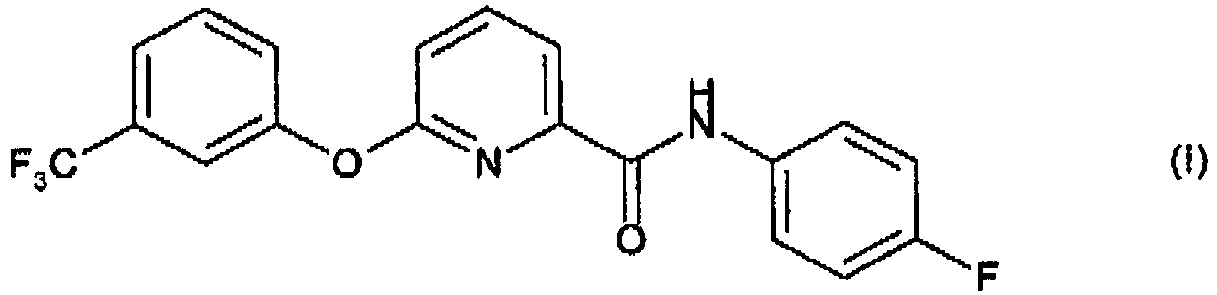
und - B) Quinmerac
oder dessen landwirtschaftlich brauchbare Salze oder dessen landwirtschaftlich brauchbare Ester, Thioester oder Amide;
in einer synergistisch wirksamen Menge
und gewünschtenfalls - C) ein Safener ausgewählt aus der Gruppe Isoxadifen, Mefenpyr und Cloquintocet.
- Außerdem betrifft die Erfindung herbizide Mittel, enthaltend eine Mischung aus den Komponenten A und B und gewünschtenfalls der Komponente C, sowie mindestens eines flüssigen und/oder festen Trägerstoffes und gewünschtenfalls mindestens eines grenzflächen-aktiven Stoff.
- Des weiteren betrifft die Erfindung Verfahren zur Herstellung dieser Mischungen bzw. Mittel sowie Verfahren zur Bekämpfung von unerwünschten Pflanzenwuchs.
- Aus
WO 01/35740 WO 01/74157 WO 00/78147 WO 02/15694 US 2002/039968 .WO 94/07368 WO 01/26466 EP 0 381 907 ,US 5 877 116 undEP 0 208 245 beschreiben synergistische Mischungen von Chinolincarbonsäuren, bzw. Quinclorac und oder Quinmerac mit anderen Herbiziden. Es ist grundsätzlich bei Pflanzenschutzmitteln wünschenswert, die spezifische Wirkung eines Wirkstoffes zu erhöhen und die Wirksicherheit zu steigern. Der vorliegenden Erfindung lag daher die Aufgabe zugrunde, die Wirkung von Picolinafen zu erhöhen. - Demgemäß wurden die eingangs definierten Mischungen gefunden. Des weiteren wurden herbizide Mittel gefunden, die diese Mischungen enthalten, sowie Verfahren zu deren Herstellung und Verfahren zur Bekämpfung von unerwünschten Pflanzenwuchs. Bei letztgenannten Verfahren ist es unerheblich, ob die Komponenten A, B und gewünschtenfalls C gemeinsam oder getrennt formuliert und ausgebracht werden und in welcher Reihenfolge die Applikation bei getrennter Ausbringung erfolgt.
- Die erfindungsgemäßen Mischungen zeigen einen synergistischen Effekt; die Verträglichkeit der herbizid wirksamen Komponenten A) und B) für bestimmte Kulturpflanzen bleibt dabei im allgemeinen erhalten. Es kann jedoch wünschenswert sein eine Komponente C), in einer Menge, die einen Safening Effekt zeigt, einzusetzen.
- Picolinafen ist bekannt aus
EP 447 004 - Quinmerac ist bekannt aus "Agricultural Chemicals", Book II Herbicides, 1993, S. 233.
- Die Safener der Komponente C) sind bekannt aus
- B. Hock, C. Fedtke, R.R. Schmidt, 1. Auflage, Thieme 1995 (Cloquinocet (S. 266));
- Agrow 293 (28.11.97) (Mefenpyr);
- Agrow 324 (12.03.99) (Isoxadifen).
- Die Wirkstoffe der vorliegenden Erfindung können in Form der reinen Enantiomere als auch als Racemate oder Diastereomerengemische vorliegen bzw. verwendet werden.
- Weiterhin können die Wirkstoffe in Form ihrer landwirtschaftlichen brauchbaren Salze und soweit es sich um Carbonsäuren handelt ebenso in Form ihrer landwirtschaftlichen brauchbaren Ester, Thioester und Amide verwendet werden.
- Im allgemeinen kommen die Salze derjenigen Kationen, die Säureadditionssalze derjenigen Säuren oder die Ester, Thioester und Amide in Betracht, deren Kationen bzw. Anionen bzw. Ester, Thioester und Amide, die herbizide Wirkung bzw. die Safening Wirkung nicht negativ beeinträchtigen.
- Es kommen als Kationen insbesondere Alkalimetallkationen, wie Lithium, Natrium oder Kalium oder Erdalkalimetallkationen, wie Magnesium oder Calcium in Betracht. Weiterhin kommen organische Kationen wie Phosphoniumionen, Sulfoniumionen, vorzugsweise Tri-(C1-C4-alkyl)sulfonium, wie Trimethylsulfonium, Sulfoxoniumionen, vorzugsweise Tri-(C1-C4-alkyl)sulfoxonium verwendet werden. Ebenso kommt Ammonium, wobei hier gewünschtenfalls ein bis vier Wasserstoffatome durch C1-C4-Alkyl, Hydroxy-C1-C4-alkyl, C1-C4-Alkoxy-C1-C4-alkyl, Hydroxy-C1-C4-alkoxy-C1-C4-alkyl, Phenyl oder Benzyl ersetzt sein können, vorzugsweise Ammonium, Methylammonium, Dimethylammonium, Trimethylammonium, Tetramethylammonium, Tetraethylammonium, Isopropylammonium, Diisopropylammonium, Tetrabutylammonium, Ethanolammonium, Diethanolammonium, 2-(2-Hydroxy-ethoxy)ethylammonium, Benzyltrimethylammonium oder Benzyltriethylammonium, in Betracht.
- Anionen von brauchbaren Säureadditionssalzen sind in erster Linie Halogenide, wie Fluoride, Chloride, Bromide oder Iodide, Nitrate, Hydrogensulfate, Sulfate, Dihydrogenphosphate, Hydrogenphosphate, Phosphate, Methylsulfate, Hydrogencarbonate und Carbonate.
- Als Ester kommen beispielsweise geradkettige oder verzweigte C1-C10-Alkylester, insbesondere Methyl-, Ethyl-, Propyl-, Isopropyl-, Butyl-, Isobutyl- oder Isooctylester, oder geradkettige oder verzweigte C1-C4-Alkoxy-C1-C4-alkylester, insbesondere Methoxyethyl-, Ethoxyethyl- oder Butoxyethylester in Betracht. Thioester sind beispielsweise die geradkettigen oder verzweigten C1-C10-Alkylthioester, insbesondere Ethylthioester. Als Amide können u.a. Methyl- oder Dimethylamide verwendet werden, sowie Anilide, wie beispielsweise das Anilid selbst oder 2-Chloranilid.
- Bevorzugt sind diejenigen Mischungen, bei denen Quinmerac als Trimethylsulfonium, Ammonium-, Natrium-, Kalium-, Magnesium- oder Calcium-Salz vorliegt.
- Ebenso sind diejenigen Mischungen bevorzugt bei denen Quinmerac durch seine Ethanolammonium-, Dimethanolammonium-, Methylammonium-, Dimethylammonium-, Trimethylammonium-, Isopropylammonium- oder 2-(2-Hydroxyeth-oxy)-ethylammonium-Salze, ohne Methyl- oder Dimethylamide, ihre Anilide oder 2-Chloranilide, sowie Methyl, Ethyl, Propyl Isopropyl-, Butyl-, Isobutyl-, Isooctyl-, Methoxyethyl-, Ethoxyethyl-, butoxyethylester oder ihre Ethylthioester ersetzt ist.
- In einer weiteren besonders bevorzugten Ausführungsform enthält die erfindungsgemäße herbizide Mischung
- A) Picolinafen, oder dessen landwirtschaftlich brauchbares Salz
und - B) Quinmerac sowie dessen landwirtschaftlich brauchbares Salz oder dessen landwirtschaftlich brauchbare Ester, Thioester oder Amid
in einer synergistisch wirksamen Menge
und - C) ein Safener ausgewählt aus der Gruppe Isoxadifen, vorzugsweise Isoxadifen "Säure" oder Isoxadifen-ethyl, insbesondere Isoxadifen-ethyl; Mefenpyr, vorzugsweise Mefenpyr "Säure" oder Mefenpyr-diethyl, insbesondere Mefenpyr-diethyl; und Cloquintocet, vorzugsweise Cloquintocet "Säure", Cloquintocet-mexyl oder Cloquintocet-mexyl x n Hydrat (n = 2 bis 6), insbesondere Cloquintocet-mexyl.
- Die entsprechenden Bevorzugungen gelten in Analogie zu den obigen Ausführungen.
- Die Komponenten A und B werden in einer synergetisch wirksamen Menge appliziert, üblicherweise liegen die Mischungsverhältnisse der Komponenten A) zu B) in einem Gewichtsverhältnis von 1:0,1 bis 1:50, bevorzugt von 1:0,2 bis 1:20.
- Wird ein Safener C) mitverwendet, so liegen die Mischungsverhältnisse der Komponenten A) zu B) zu C) in einem Gewichtsverhältnis von 1:0, 1:0, 1 bis 1:50:10, bevorzugt von 1:0,2:0,2 bis 1:20:4.
- Die vorliegende Erfindung ist auch auf herbizide Mittel gerichtet, die eine herbizid wirksame Menge einer herbiziden Mischung (enthaltend die Komponenten A) und B) sowie gewünschtenfalls C) wie voranstehend beschrieben), mindestens einen flüssigen und/oder festen Trägerstoff und gewünschtenfalls mindestens einen grenzflächenaktiven Stoff enthalten.
- Die erfindungsgemäßen herbiziden Mischungen und herbiziden Mittel können in Kulturen wie Mais, Getreide, Reis und Soja, insbesondere in Getreide, Unkräuter und Schadgräser sehr gut bekämpfen, ohne die Kulturpflanze zu schädigen; ein Effekt, der vor allem auch bei niedrigen Aufwandmengen auftritt.
- Unter Berücksichtigung der Vielseitigkeit der Applikationsmethoden können die erfindungsgemäßen synergistischen herbiziden Mischungen und herbiziden Mittel noch in einer weiteren Zahl von Kulturpflanzen zur Beseitigung unerwünschter Pflanzen eingesetzt werden. In Betracht kommen beispielsweise folgende Kulturen: Allium cepa, Ananas comosus, Arachis hypogaea, Asparagus officinalis, Beta vulgaris spp. altissima, Beta vulgaris spp. rapa, Brassica napus var. napus, Brassica napus var. napo-brassica, Brassica rapa var. silvestris, Camellia sinensis, Carthamus tinctorius, Carya illinoinensis, Citrus limon, Citrus sinensis, Coffea arabica (Coffea canephora, Coffea liberica), Cucumis sativus, Cynodon dactylon, Daucus carota, Elaeis guineensis, Fragaria vesca, Glycine max, Gossypium hirsutum, (Gossypium arboreum, Gossypium herbaceum, Gossypium vitifolium), Helianthus annuus, Hevea brasiliensis, Hordeum vulgare, Humulus lupulus, Ipomoea batatas, Juglans regia, Lens culinaris, Linum usitatissimum, Lycopersicon lycopersicum, Malus spp., Manihot esculenta, Medicago sativa, Musa spp., Nicotiana tabacum (N.rustica), Olea europaea, Oryza sativa, Phaseolus lunatus, Phaseolus vulgaris, Picea abies, Pinus spp., Pisum sativum, Prunus avium, Prunus persica, Pyrus communis, Ribes sylvestre, Ricinus communis, Saccharum officinarum. Secale cereale, Solanum tuberosum, Sorghum bicolor (s. vulgere), Theobroma cacao, Trifolium pratense, Triticum aestivum, Triticum durum, Vicia faba, Vitis vinifera und Zea mays.
- Darüber hinaus können die erfindungsgemäßen herbiziden Mischungen und herbiziden Mittel auch in Kulturen, die durch Züchtung, einschließlich gentechnischer Methoden, gegen die Wirkung von Herbiziden tolerant sind, verwandt werden. In Betracht kommen vorzugsweise gentechnisch veränderte Getreidepflanzen, die gegen Glyphosate oder gegen herbizide ALS-Inhibitoren, wie beispielsweise Sulfonylharnstoffe oder Imidazolinone resistent sind.
- Die erfindungsgemäßen Mischungen, bzw. die sie enthaltenden herbiziden Mittel können beispielsweise in Form von direkt versprühbaren wäßrigen Lösungen, Pulvern, Suspensionen, auch hochprozentigen wäßrigen, öligen oder sonstigen Suspensionen oder Dispersionen, Emulsionen, Öldispersionen, Pasten, Stäubemitteln, Streumitteln oder Granulaten durch Versprühen, Vernebeln, Verstäuben, Verstreuen oder Gießen angewendet werden.
- Die Anwendungsformen richten sich nach den Verwendungszwecken; sie sollten in jedem Fall möglichst die feinste Verteilung der erfindungsgemäßen Wirkstoffe gewährleisten.
- Die herbiziden Mittel enthalten die Komponenten A) und B) sowie gewünschtenfalls C) und die für die Formulierung von Pflanzenschutzmitteln üblichen Hilfsstoffe.
- Als inerte Zusatzstoffe kommen Mineralölfraktionen von mittlerem bis hohem Siedepunkt, wie Kerosin oder Dieselöl, ferner Kohlenteeröle sowie Öle pflanzlichen oder tierischen Ursprungs, aliphatische, cyclische und aromatische Kohlenwasserstoffe, z.B. Paraffin, Tetrahydronaphthalin, alkylierte Naphthaline oder deren Derivate, alkylierte Benzole oder deren Derivate, Alkohole wie Methanol, Ethanol, Propanol, Butanol, Cyclohexanol, Ketone wie Cyclohexanon, stark polare Lösungsmittel, wie N-Methylpyrrolidon oder Wasser in Betracht.
- Wäßrige Anwendungsformen können aus Emulsionskonzentraten, Suspensionen, Pasten, netzbaren Pulvern oder wasserdispergierbaren Granulaten durch Zusatz von Wasser bereitet werden. Zur Herstellung von Emulsionen, Pasten oder Öldispersionen können die Komponenten A), B) und gewünschtenfalls C) als solche oder in einem Öl oder Lösungsmittel gelöst, mittels Netz-, Haft-, Dispergier- oder Emulgiermittel in Wasser homogenisiert werden. Es können aber auch aus wirksamer Substanz, Netz-, Haft-, Dispergier- oder Emulgiermittel und eventuell Lösungsmittel oder Öl bestehende Konzentrate hergestellt werden, die zur Verdünnung mit Wasser geeignet sind.
- Als grenzflächenaktive Stoffe kommen die Alkali-, Erdalkali-, Ammoniumsalze von aromatischen Sulfonsäuren, z.B. Lignin-, Phenol-, Naphthalin- und Dibutylnaphthalinsulfonsäure, sowie von Fettsäuren, Alkyl- und Alkylarylsulfonaten, Alkyl-, Laurylether- und Fettalkoholsulfaten, sowie Salze sulfatierter Hexa-, Hepta- und Octadecanolen sowie von Fettalkoholglykolether, Konden-sationsprodukte von sulfoniertem Naphthalin und seiner Derivate mit Formaldehyd, Kondensationsprodukte des Naphthalins bzw. der Naphthalinsulfonsäuren mit Phenol und Formaldehyd, Polyoxy-ethylenoctylphenolether, ethoxyliertes Isooctyl-, Octyl- oder Nonylphenol, Alkylphenyl-, Tributylphenylpolyglykolether, Alkylarylpolyetheralkohole, Isotridecylalkohol, Fettalkoholethylen-oxid-Kondensate, ethoxyliertes Rizinusöl, Polyoxyethylenalkyl-ether oder Polyoxypropylenalkylether, Laurylalkoholpolyglykol-etheracetat, Sorbitester, Lignin-Sulfitablaugen oder Methyl-cellulose in Betracht.
- Pulver-, Streu- und Stäubemittel können durch Mischen oder gemeinsames Vermahlen der synergistischen herbiziden Mischung bzw. der einzelnen Wirkstoffe mit einem festen Trägerstoff hergestellt werden.
- Granulate, z.B. Umhüllungs-, Imprägnierungs- und Homogengranulate können durch Bindung der Wirkstoffe an feste Trägerstoffe hergestellt werden. Feste Trägerstoffe sind Mineralerden wie Kieselsäuren, Kieselgele, Silikate, Talkum, Kaolin, Kalkstein, Kalk, Kreide, Bolus, Löß, Ton, Dolomit, Diatomeenerde, Calcium- und Magnesiumsulfat, Magnesiumoxid, gemahlene Kunststoffe, Düngemittel, wie Ammoniumsulfat, Ammoniumphosphat, Ammoniumnitrat, Harnstoffe und pflanzliche Produkte wie Getreidemehl, Baumrinden-, Holz- und Nußschalenmehl, Cellulosepulver oder andere feste Trägerstoffe.
- Die Konzentrationen der erfindungsgemäßen Mischungen in den anwendungsfertigen Zubereitungen können in weiten Bereichen variiert werden. Im allgemeinen enthalten die Formulierungen etwa von 0,001 bis 98 Gew.-%, vorzugsweise 0,01 bis 95 Gew.-%, insbesondere 0,5 bis 90 Gew.-%, an Wirkstoffen.
- Die Wirkstoffe der Komponenten A) und B) sowie gewünschtenfalls C) können gemeinsam, aber auch getrennt formuliert werden und/oder gemeinsam oder getrennt auf die Pflanzen, deren Lebensraum und/oder Samen ausgebracht werden. Bevorzugt werden die Wirkstoffe gleichzeitig appliziert. Es ist aber auch möglich diese getrennt auszubringen.
- Außerdem kann es von Nutzen sein, die erfindungsgemäßen herbiziden Mischungen bzw. herbiziden Mittel noch mit weiteren Pflanzenschutzmitteln gemeinsam oder getrennt anzuwenden, beispielsweise mit Mitteln zur Bekämpfung von Schädlingen oder phytopathogenen Pilzen bzw. Bakterien. Von Interesse ist ferner die Mischbarkeit mit Mineralsalzlösungen, welche zur Behebung von Emährungs- und Spurenelementmängeln eingesetzt werden. Es können auch nichtphytotoxische Öle und Ölkonzentrate zugesetzt werden.
- Die Applikation der erfindungsgemäßen Mischungen und herbiziden Mittel kann im Vorauflauf- oder im Nachauflaufverfahren erfolgen. Sind die Wirkstoffe für gewisse Kulturpflanzen weniger verträglich, so können Ausbringungstechniken angewandt werden, bei welchen die herbiziden Mittel mit Hilfe der Spritzgeräte so gespritzt werden, daß die Blätter der empfindlichen Kulturpflanzen nach Möglichkeit nicht getroffen werden, während die Wirkstoffe auf die Blätter darunter wachsender unerwünschter Pflanzen oder die unbedeckte Bodenfläche gelangen (post-directed, lay-by).
- Die erfindungsgemäßen herbiziden Mittel werden bei der Nachauflaufbehandlung den Pflanzen vornehmlich durch Blattspritzung zugeführt. Dabei kann die Ausbringung z.B. mit Wasser als Trägerstoff durch übliche Spritztechniken mit Spritzbrühenmengen von etwa 100 bis 1000 I/ha erfolgen. Eine Anwendung der Mittel im sogenannten "Low Volume"- und "Ultra-low-Volume"-Verfahren ist ebenso möglich wie ihre Applikation in Form von sogenannten Granulaten.
- Die erforderliche Aufwandmenge an reiner Wirkstoffmischung, d.h. A) und B) sowie gewünschtenfalls C) ohne Formulierungshilfsmittel beträgt je nach Zusammensetzung des Pflanzenbestandes, in Abhängigkeit der Entwicklungsstadien der Pflanzen, der klimatischen Verhältnisse sowie der Anwendungstechnik, im allgemeinen 0,001 bis 3,0 kg/ha, vorzugsweise 0,01 bis 2,5 kg/ha, insbesondere 0,01 bis 1,0 kg/ha aktive Substanz (s.S.)
- Die Aufwandmenge von Picolinafen beträgt in der Regel von 0,01 bis 0,5 kg/ha aktive Substanz (a.S.).
- Die Aufwandmenge der Komponente B) beträgt in der Regel von 0,01 bis 2,0 kg/ha aktive Substanz (a.S.).
- Die Aufwandmenge der Komponente C) beträgt in der Regel von 0,01 bis 0,5 kg/ha aktive Substanz (a.S.).
- Die Applikation der erfindungsgemäßen Mischungen erfolgte im Vorauflaufverfahren oder im Nachauflaufverfahren (Blattbehandlung).
- Es handelte sich teils um Gewächshausversuche und teils um Freilandversuche auf Kleinparzellen (auf einem Standort mit sandigem Lehm (pH 6.2 bis 7.0) bzw. sandigem Ton (pH 5.0 bis 6.7) als Boden).
- Die Schadpflanzen hatten unterschiedliche Größen und Entwicklungsstadien, im Durchschnitt hatten sie 5 bis 20 cm je nach Wuchsform.
- Die herbizid wirksamen Verbindungen der Komponenten A) und B) sowie gewünschtenfalls der Safener C) wurden nacheinander oder gemeinsam, letzteres teils als Tankmischung, teils in Fertigformulierung, ausgebracht. Und zwar in Form von Emulsionen, wäßrigen Lösungen oder Suspensionen, wobei als Verteilungsmittel Wasser (300 - 400 l/ha) diente. Bei den Freilandversuchen erfolgte die Ausbringung mit Hilfe einer fahrbaren Parzellenspritzmaschine.
- Die Versuchsperiode erstreckte sich über 3 bis 8 Wochen, wobei die Bestände auch noch zu späteren Zeiten beobachtet wurden.
- Die Schädigung durch die herbiziden Mittel wurde anhand einer Skala von 0 % bis 100 % im Vergleich zu unbehandelten Kontrollparzellen bewertet. Dabei bedeutet 0 keine Schädigung und 100 eine völlige Zerstörung der Pflanzen.
- In den folgenden Beispielen wird die Wirkung der erfindungsgemäß verwendbaren herbiziden Mittel gezeigt, ohne die Möglichkeit weiterer Anwendungen auszuschließen.
- Bei diesen Beispielen wurde nach der Methode von S. R. Colby (Calculating synergistic and antagonistic responses of herbicid combinations, Weeds 15, 20 ff (1967)) derjenige Wert E errechnet, der bei einer nur additiven Wirkung der Einzelwirkstoffe zu erwarten ist.
- Die Berechnung erfolgt nach

wobei - X =
- Prozentsatz der herbiziden Wirkung von Komponente A) bei einer Aufwandmenge a;
- Y =
- Prozentsatz der herbiziden Wirkung von Komponente B) bei einer Aufwandmenge b;
- E =
- zu erwartende herbizide Wirkung der Komponenten A) + B) bei Aufwandmengen a + b (in %);
- Ist der beobachtete Wert höher als der nach Colby errechnete Wert E, so liegt eine synergistische Wirkung vor.
- Die erfindungsgemäßen herbiziden Mischungen haben bei entsprechenden Aufwandmengen im Nachauflauf eine höhere herbizide Wirkung, als nach Colby auf Grund der beobachteten Wirkungen der Einzelkomponenten bei alleiniger Anwendung zu erwarten wäre.
Claims (8)
- Herbizide Mischung, enthaltendA) Picolinafen (I)

undB) Quinmerac
oder dessen landwirtschaftlich brauchbare Salze oder dessen landwirtschaftlich brauchbare Ester, Thioester oder Amide
in einer synergistisch wirksamen Menge. - Herbizide Mischung nach Anspruch 1, enthaltend als Komponente C) einen Safener ausgewählt aus der Gruppe Isoxadifen, Mefenpyr und Cloquintocet.
- Herbizide Mischung nach den Ansprüchen 1 oder 2, dadurch gekennzeichnet, daß die Komponente A) und die Komponente B) in einem Gewichtsverhältnis von 1:0,1 bis 1:50 vorliegen.
- Herbizide Mischung nach Anspruch 2, dadurch gekennzeichnet, dass die Komponente A), die Komponente B) und die Komponente C) in einem Gewichtsverhältnis von 1:0,1:0,1 bis 1:50:10 vorliegen.
- Herbizide Mittel, enthaltend eine herbizid wirksame Menge einer Mischung gemäß den Ansprüchen 1 bis 4, mindestens einen inerten flüssigen und/oder festen Trägerstoff und gewünschtenfalls mindestens einen grenzflächenaktiven Stoff.
- Verfahren zur Herstellung von herbiziden Mitteln nach Anspruch 5, dadurch gekennzeichnet, dass man Komponente A), Komponente B) und gewünschtenfalls C), mindestens einen inerten flüssigen und/oder festen Trägerstoff und gewünschtenfalls einen grenzflächenaktiven Stoff mischt.
- Verfahren zur Bekämpfung unerwünschten Pflanzenwuchses, dadurch gekennzeichnet, dass man eine herbizide Mischung gemäß den Ansprüchen 1 bis 4 vor, während und/oder nach dem Auflaufen von unerwünschten Pflanzen ausbringt, wobei die Komponenten A), B) und gewünschtenfalls C) gleichzeitig, gemeinsam oder getrennt, oder nacheinander appliziert werden können.
- Verfahren zur Bekämpfung unerwünschten Pflanzenwuchses gemäß Anspruch 7, dadurch gekennzeichnet, dass die Blätter der Kulturpflanzen und der unerwünschten Pflanzen behandelt werden.
Priority Applications (1)
| Application Number | Priority Date | Filing Date | Title |
|---|---|---|---|
| PL10175396T PL2258188T3 (pl) | 2003-03-13 | 2004-03-12 | Mieszaniny chwastobójcze zawierające pikolinafen |
Applications Claiming Priority (2)
| Application Number | Priority Date | Filing Date | Title |
|---|---|---|---|
| US45397503P | 2003-03-13 | 2003-03-13 | |
| EP04719990A EP1605757B1 (de) | 2003-03-13 | 2004-03-12 | Picolinafen enthaltende herbizide mischungen |
Related Parent Applications (4)
| Application Number | Title | Priority Date | Filing Date |
|---|---|---|---|
| EP04719990.6 Division | 2004-03-12 | ||
| EP04719990A Division EP1605757B1 (de) | 2003-03-13 | 2004-03-12 | Picolinafen enthaltende herbizide mischungen |
| WOPCT/EP2004/002633 Previously-Filed-Application | 2004-03-12 | ||
| PCT/EP2004/002633 Previously-Filed-Application WO2004081129A2 (de) | 2003-03-13 | 2004-03-12 | Picolinafen enthaltende herbizide mischungen |
Publications (3)
| Publication Number | Publication Date |
|---|---|
| EP2258188A2 EP2258188A2 (de) | 2010-12-08 |
| EP2258188A3 EP2258188A3 (de) | 2012-06-06 |
| EP2258188B1 true EP2258188B1 (de) | 2014-03-05 |
Family
ID=32990849
Family Applications (5)
| Application Number | Title | Priority Date | Filing Date |
|---|---|---|---|
| EP10175393A Withdrawn EP2258187A3 (de) | 2003-03-13 | 2004-03-12 | Picolinafen enthaltende herbizide Mischungen |
| EP10175397A Withdrawn EP2258189A3 (de) | 2003-03-13 | 2004-03-12 | Picolinafen enthaltende herbizide Mischungen |
| EP04719990A Expired - Lifetime EP1605757B1 (de) | 2003-03-13 | 2004-03-12 | Picolinafen enthaltende herbizide mischungen |
| EP10175396.0A Expired - Lifetime EP2258188B1 (de) | 2003-03-13 | 2004-03-12 | Picolinafen enthaltende herbizide Mischungen |
| EP10175390A Withdrawn EP2258186A3 (de) | 2003-03-13 | 2004-03-12 | Picolinafen enthaltende herbizide Mischungen |
Family Applications Before (3)
| Application Number | Title | Priority Date | Filing Date |
|---|---|---|---|
| EP10175393A Withdrawn EP2258187A3 (de) | 2003-03-13 | 2004-03-12 | Picolinafen enthaltende herbizide Mischungen |
| EP10175397A Withdrawn EP2258189A3 (de) | 2003-03-13 | 2004-03-12 | Picolinafen enthaltende herbizide Mischungen |
| EP04719990A Expired - Lifetime EP1605757B1 (de) | 2003-03-13 | 2004-03-12 | Picolinafen enthaltende herbizide mischungen |
Family Applications After (1)
| Application Number | Title | Priority Date | Filing Date |
|---|---|---|---|
| EP10175390A Withdrawn EP2258186A3 (de) | 2003-03-13 | 2004-03-12 | Picolinafen enthaltende herbizide Mischungen |
Country Status (18)
| Country | Link |
|---|---|
| US (1) | US7846872B2 (de) |
| EP (5) | EP2258187A3 (de) |
| JP (1) | JP5291879B2 (de) |
| KR (1) | KR20050114645A (de) |
| CN (1) | CN1758850A (de) |
| AR (1) | AR043615A1 (de) |
| AU (1) | AU2004220342B2 (de) |
| BR (1) | BRPI0408232A (de) |
| CA (1) | CA2518566C (de) |
| CL (2) | CL2004000523A1 (de) |
| DK (2) | DK2258188T3 (de) |
| EA (1) | EA009959B1 (de) |
| ES (2) | ES2387618T3 (de) |
| MX (1) | MXPA05009115A (de) |
| NZ (1) | NZ542199A (de) |
| PL (2) | PL2258188T3 (de) |
| UA (1) | UA83215C2 (de) |
| WO (1) | WO2004081129A2 (de) |
Families Citing this family (25)
| Publication number | Priority date | Publication date | Assignee | Title |
|---|---|---|---|---|
| EP1827106A2 (de) * | 2004-12-17 | 2007-09-05 | Syngeta Participations AG | Herbizidzusammensetzungen mit prosulfocars |
| BE1018402A3 (nl) * | 2009-07-16 | 2010-10-05 | Globachem | Synergie tussen quinmerac, clomazone en diflufenican in herbicide samenstellingen voor het bestrijden van onkruid in land- en tuinbouwgewassen. |
| US8338334B2 (en) | 2010-10-27 | 2012-12-25 | Dow Agrosciences, Llc | Synergistic herbicidal composition containing fluroxypyr and quinclorac |
| KR101787355B1 (ko) * | 2010-10-27 | 2017-10-19 | 다우 아그로사이언시즈 엘엘씨 | 플루록시피르 및 퀸클로락을 함유하는 상승작용적 제초제 조성물 |
| CN102919239A (zh) * | 2012-11-20 | 2013-02-13 | 李福元 | 一种大蒜专用除草剂组合物制剂及其应用 |
| CN102919229B (zh) * | 2012-11-26 | 2014-04-16 | 联保作物科技有限公司 | 一种除草组合物 |
| AR094004A1 (es) * | 2012-12-18 | 2015-07-01 | Bayer Cropscience Ag | Agentes herbicidas que contienen tri-alato |
| WO2014138561A1 (en) | 2013-03-08 | 2014-09-12 | Dow Agrosciences Llc | Herbicidal compositions comprising isoxaben and aminopyralid |
| US20150099637A1 (en) * | 2013-10-06 | 2015-04-09 | Bomi Framroze | New method to improve the performance of herbicide formulations |
| BR112017015652B1 (pt) | 2015-01-22 | 2022-06-07 | BASF Agro B.V. | Combinação herbicida, método de controle de vegetação indesejável e método de tratamento por extermínio de vegetação |
| KR102549057B1 (ko) | 2015-07-10 | 2023-06-29 | 바스프 아그로 비.브이. | 신메틸린 및 아세토클로르 또는 프레틸라클로르를 포함하는 제초제 조성물 |
| US20180184658A1 (en) | 2015-07-10 | 2018-07-05 | BASF Agro B.V. | Herbicidal composition comprising cinmethylin and saflufenacil |
| EP3319435B1 (de) | 2015-07-10 | 2020-02-19 | BASF Agro B.V. | Herbizidzusammensetzung enthaltend cinmethylin und clomazone |
| US11219212B2 (en) | 2015-07-10 | 2022-01-11 | BASF Agro B.V. | Herbicidal composition comprising cinmethylin and imazamox |
| EA201890262A1 (ru) * | 2015-07-10 | 2018-07-31 | Басф Агро Б.В. | Гербицидная композиция, которая содержит цинметилин и специфические ингибиторы фитоендесатуразы |
| CN107846889B (zh) | 2015-07-10 | 2020-12-08 | 巴斯夫农业公司 | 包含环庚草醚和派罗克杀草砜的除草组合物 |
| KR20180027580A (ko) * | 2015-07-10 | 2018-03-14 | 바스프 아그로 비.브이. | 신메틸린 및 특정한 퀴놀린카르복실산을 포함하는 제초제 조성물 |
| DK3319434T3 (da) | 2015-07-10 | 2019-07-29 | Basf Agro Bv | Herbicidsammensætning, der omfatter cinmethylin og pethoxamid |
| EA201890268A1 (ru) | 2015-07-10 | 2018-07-31 | Басф Агро Б.В. | Гербицидная композиция, которая содержит цинметилин и диметенамид |
| BR112018000490A2 (pt) | 2015-07-10 | 2018-09-11 | Basf Agro Bv | uso de (±)-2-exo-(2-metilbenzilóxi)-1-metil-4-isopropil-7-oxabiciclo[2.2.1]heptano, método de controle da vegetação indesejável, uso e composição herbicida |
| US11219215B2 (en) | 2015-07-10 | 2022-01-11 | BASF Agro B.V. | Herbicidal composition comprising cinmethylin and specific inhibitors of protoporphyrinogen oxidase |
| CN107771810A (zh) * | 2016-08-30 | 2018-03-09 | 南京华洲药业有限公司 | 一种含麦草畏与氟吡草胺的除草组合物及其应用 |
| US11497213B2 (en) * | 2018-09-04 | 2022-11-15 | Purdue Research Foundation | Synergistic effect of isoxaben and cellulosin as a herbicide |
| US11938121B2 (en) | 2020-04-15 | 2024-03-26 | Purdue Research Foundation | Treatment of infections and biofilm formation using a cellulose synthase inhibitor |
| CN112790192A (zh) * | 2021-02-03 | 2021-05-14 | 安徽润农腾辉生物科技有限公司 | 一种包含氟吡酰草胺的三元除草组合物 |
Family Cites Families (20)
| Publication number | Priority date | Publication date | Assignee | Title |
|---|---|---|---|---|
| US3537840A (en) | 1967-11-07 | 1970-11-03 | Uniroyal Inc | Synergistic herbicidal composition of sodium n-naphthyl phthalamic acid and 4 - (methylsulfonyl)-2,6-dinitro-n,n-dipropylaniline |
| DE2217722C2 (de) | 1972-04-13 | 1982-11-04 | Basf Ag, 6700 Ludwigshafen | Herbizid |
| US3884672A (en) | 1972-09-13 | 1975-05-20 | Gulf Research Development Co | Synergistic chemical control of nutsedge with combination of a 1-methyl-4-phenyl-pyridinium salt and a cyclopropylamino-triazine herbicide |
| DE3176347D1 (en) * | 1980-06-27 | 1987-09-17 | Ciba Geigy Ag | Synergistic agents and method for the selective control of weeds, particularly in cereals and soybeans |
| DE3524319A1 (de) | 1985-07-08 | 1987-01-08 | Basf Ag | Herbizide und wachstumsregulierende mittel auf basis von chinolinderivaten |
| DE3536035A1 (de) | 1985-10-09 | 1987-04-09 | Hoechst Ag | Herbizide mittel |
| EP0230596B1 (de) | 1985-12-30 | 1992-01-02 | Stauffer Chemical Company | Synergistische, herbizide Kombinationen und Verfahren zur Anwendung |
| GB8630697D0 (en) | 1986-12-23 | 1987-02-04 | May & Baker Ltd | Compositions of matter |
| FR2625410A1 (fr) * | 1988-01-06 | 1989-07-07 | Rhone Poulenc Agrochimie | Association herbicide synergique a base de bifenox et d'isoxaben |
| FR2639185B1 (fr) * | 1988-11-22 | 1991-01-25 | Rhone Poulenc Agrochimie | Produit herbicide, son utilisation et procede pour la lutte selective contre les mauvaises herbes dans les cultures de riz et de cereales |
| US5665673A (en) | 1988-12-29 | 1997-09-09 | Anderson; Richard J. | Potentiating herbicidal compositions |
| GB9005965D0 (en) | 1990-03-16 | 1990-05-09 | Shell Int Research | Herbicidal carboxamide derivatives |
| CN1074646C (zh) * | 1992-10-06 | 2001-11-14 | 国际壳牌研究有限公司 | 除草剂混合物 |
| DE69723750T2 (de) * | 1996-03-13 | 2004-06-03 | Syngenta Participations Ag | Herbizide Kombinationen |
| GB9914213D0 (en) | 1999-06-17 | 1999-08-18 | Rhone Poulenc Agrochimie | New herbicidal compositions |
| CZ20021306A3 (cs) * | 1999-10-14 | 2003-01-15 | Basf Corporation | Synergické herbicidní způsoby a kompozice |
| EP1351571A2 (de) | 1999-11-17 | 2003-10-15 | Bayer CropScience AG | Selektive herbizide auf basis von 2,6-disubstituierten pyridin-derivaten |
| HUP0300564A3 (en) * | 2000-04-04 | 2005-11-28 | Basf Ag | Synergistic herbicidal composition and its use |
| US6894003B2 (en) * | 2000-06-23 | 2005-05-17 | Basf Aktiengesellschaft | Enhancement of the activity of carotenoid biosynthesis inhibitor herbicides |
| EP1313369B1 (de) * | 2000-08-25 | 2005-06-29 | Basf Aktiengesellschaft | Herbizide mischungen |
-
2004
- 2004-03-12 BR BRPI0408232-0A patent/BRPI0408232A/pt not_active Application Discontinuation
- 2004-03-12 CL CL200400523A patent/CL2004000523A1/es unknown
- 2004-03-12 NZ NZ542199A patent/NZ542199A/en not_active IP Right Cessation
- 2004-03-12 PL PL10175396T patent/PL2258188T3/pl unknown
- 2004-03-12 DK DK10175396.0T patent/DK2258188T3/da active
- 2004-03-12 US US10/548,841 patent/US7846872B2/en not_active Expired - Fee Related
- 2004-03-12 AU AU2004220342A patent/AU2004220342B2/en not_active Ceased
- 2004-03-12 EP EP10175393A patent/EP2258187A3/de not_active Withdrawn
- 2004-03-12 EA EA200501358A patent/EA009959B1/ru not_active IP Right Cessation
- 2004-03-12 WO PCT/EP2004/002633 patent/WO2004081129A2/de not_active Ceased
- 2004-03-12 EP EP10175397A patent/EP2258189A3/de not_active Withdrawn
- 2004-03-12 MX MXPA05009115A patent/MXPA05009115A/es active IP Right Grant
- 2004-03-12 JP JP2006504681A patent/JP5291879B2/ja not_active Expired - Fee Related
- 2004-03-12 KR KR1020057016846A patent/KR20050114645A/ko not_active Ceased
- 2004-03-12 CA CA2518566A patent/CA2518566C/en not_active Expired - Fee Related
- 2004-03-12 PL PL04719990T patent/PL1605757T3/pl unknown
- 2004-03-12 ES ES04719990T patent/ES2387618T3/es not_active Expired - Lifetime
- 2004-03-12 EP EP04719990A patent/EP1605757B1/de not_active Expired - Lifetime
- 2004-03-12 EP EP10175396.0A patent/EP2258188B1/de not_active Expired - Lifetime
- 2004-03-12 ES ES10175396.0T patent/ES2455965T3/es not_active Expired - Lifetime
- 2004-03-12 EP EP10175390A patent/EP2258186A3/de not_active Withdrawn
- 2004-03-12 DK DK04719990.6T patent/DK1605757T3/da active
- 2004-03-12 CN CNA2004800067646A patent/CN1758850A/zh active Pending
- 2004-03-15 AR ARP040100857A patent/AR043615A1/es unknown
- 2004-12-03 UA UAA200509526A patent/UA83215C2/uk unknown
-
2009
- 2009-11-17 CL CL2009002097A patent/CL2009002097A1/es unknown
Also Published As
Similar Documents
| Publication | Publication Date | Title |
|---|---|---|
| EP1605757B1 (de) | Picolinafen enthaltende herbizide mischungen | |
| EP1477063B1 (de) | Synergistische herbizide Mischungen enthaltend ein Derivat eines Sulfonylharnstoffes und Dicamba | |
| DE60017475T2 (de) | Synergistische herbizide Zusammensetzungen und Verfahren | |
| EP2140763B1 (de) | Synergische herbizide Mittel | |
| DE4444708A1 (de) | Verwendung von Herbiziden vom Auxin-Typ zur Behandlung von transgenen Kulturpflanzen | |
| EP2434884B1 (de) | Synergistische herbizid-kombinationen enthaltend tembotrione | |
| EP0861026B1 (de) | Synergistische herbizide mischungen, enthaltend cyclohexenonoximether | |
| EP1085808B1 (de) | Herbizide mischung, enthaltend ein 3 heterocyclyl-substituiertes benzoylderivat | |
| EP1158857B1 (de) | Herbizide mischung, enthaltend ein 3-heterocyclyl-substituiertes benzoylderivat und ein adjuvant | |
| DE60316453T2 (de) | Synergistische herbizide zusammensetzungen | |
| EP1315420B1 (de) | Herbizide mischungen | |
| EP2928301A1 (de) | Verfahren zur bekämpfung von resistenten schadpflanzen | |
| EP0431545A2 (de) | Selektive herbizide Mittel und fungizide Mittel | |
| EP1139760B1 (de) | Cyclohexenonoximether / (glyphosate / gluphosinate) - suspensionskonzentrate | |
| DE3803667A1 (de) | Mittel zur verminderung der transpiration von pflanzen | |
| WO2000035287A1 (de) | Herbizide mischungen auf basis von quizalofop und n-phosphonomethylglycin | |
| DE4428982C1 (de) | Neue synergistische Herbizide, insbesondere zur Bekämpfung von Ackerfuchsschwanz | |
| DE19857604A1 (de) | Herbizide Mischungen auf der Basis von 2-(4-aryloxyphenoxy)-propionsäure und N-Phosphonomethylglycin bzw. dessen Salzen |
Legal Events
| Date | Code | Title | Description |
|---|---|---|---|
| PUAI | Public reference made under article 153(3) epc to a published international application that has entered the european phase |
Free format text: ORIGINAL CODE: 0009012 |
|
| AC | Divisional application: reference to earlier application |
Ref document number: 1605757 Country of ref document: EP Kind code of ref document: P |
|
| AK | Designated contracting states |
Kind code of ref document: A2 Designated state(s): AT BE BG CH CY CZ DE DK EE ES FI FR GB GR HU IE IT LI LU MC NL PL PT RO SE SI SK TR |
|
| PUAL | Search report despatched |
Free format text: ORIGINAL CODE: 0009013 |
|
| AK | Designated contracting states |
Kind code of ref document: A3 Designated state(s): AT BE BG CH CY CZ DE DK EE ES FI FR GB GR HU IE IT LI LU MC NL PL PT RO SE SI SK TR |
|
| RIC1 | Information provided on ipc code assigned before grant |
Ipc: A01N 43/40 20060101AFI20120427BHEP Ipc: A01N 25/32 20060101ALN20120427BHEP Ipc: A01P 13/02 20060101ALI20120427BHEP Ipc: A01N 43/42 20060101ALI20120427BHEP |
|
| 17P | Request for examination filed |
Effective date: 20121206 |
|
| 17Q | First examination report despatched |
Effective date: 20130320 |
|
| GRAJ | Information related to disapproval of communication of intention to grant by the applicant or resumption of examination proceedings by the epo deleted |
Free format text: ORIGINAL CODE: EPIDOSDIGR1 |
|
| GRAP | Despatch of communication of intention to grant a patent |
Free format text: ORIGINAL CODE: EPIDOSNIGR1 |
|
| GRAP | Despatch of communication of intention to grant a patent |
Free format text: ORIGINAL CODE: EPIDOSNIGR1 |
|
| RIC1 | Information provided on ipc code assigned before grant |
Ipc: A01N 43/42 20060101ALI20130822BHEP Ipc: A01N 43/40 20060101AFI20130822BHEP Ipc: A01P 13/02 20060101ALI20130822BHEP Ipc: A01N 25/32 20060101ALN20130822BHEP |
|
| INTG | Intention to grant announced |
Effective date: 20130904 |
|
| RIC1 | Information provided on ipc code assigned before grant |
Ipc: A01N 43/42 20060101ALI20130827BHEP Ipc: A01N 43/40 20060101AFI20130827BHEP Ipc: A01N 25/32 20060101ALN20130827BHEP Ipc: A01P 13/02 20060101ALI20130827BHEP |
|
| GRAS | Grant fee paid |
Free format text: ORIGINAL CODE: EPIDOSNIGR3 |
|
| GRAA | (expected) grant |
Free format text: ORIGINAL CODE: 0009210 |
|
| AC | Divisional application: reference to earlier application |
Ref document number: 1605757 Country of ref document: EP Kind code of ref document: P |
|
| AK | Designated contracting states |
Kind code of ref document: B1 Designated state(s): AT BE BG CH CY CZ DE DK EE ES FI FR GB GR HU IE IT LI LU MC NL PL PT RO SE SI SK TR |
|
| REG | Reference to a national code |
Ref country code: GB Ref legal event code: FG4D Free format text: NOT ENGLISH |
|
| REG | Reference to a national code |
Ref country code: CH Ref legal event code: EP |
|
| REG | Reference to a national code |
Ref country code: AT Ref legal event code: REF Ref document number: 654237 Country of ref document: AT Kind code of ref document: T Effective date: 20140315 |
|
| REG | Reference to a national code |
Ref country code: IE Ref legal event code: FG4D Free format text: LANGUAGE OF EP DOCUMENT: GERMAN |
|
| REG | Reference to a national code |
Ref country code: ES Ref legal event code: FG2A Ref document number: 2455965 Country of ref document: ES Kind code of ref document: T3 Effective date: 20140416 |
|
| REG | Reference to a national code |
Ref country code: DE Ref legal event code: R096 Ref document number: 502004014548 Country of ref document: DE Effective date: 20140417 |
|
| REG | Reference to a national code |
Ref country code: DK Ref legal event code: T3 Effective date: 20140523 |
|
| REG | Reference to a national code |
Ref country code: NL Ref legal event code: VDEP Effective date: 20140305 |
|
| PG25 | Lapsed in a contracting state [announced via postgrant information from national office to epo] |
Ref country code: FI Free format text: LAPSE BECAUSE OF FAILURE TO SUBMIT A TRANSLATION OF THE DESCRIPTION OR TO PAY THE FEE WITHIN THE PRESCRIBED TIME-LIMIT Effective date: 20140305 Ref country code: CY Free format text: LAPSE BECAUSE OF FAILURE TO SUBMIT A TRANSLATION OF THE DESCRIPTION OR TO PAY THE FEE WITHIN THE PRESCRIBED TIME-LIMIT Effective date: 20140305 Ref country code: SE Free format text: LAPSE BECAUSE OF FAILURE TO SUBMIT A TRANSLATION OF THE DESCRIPTION OR TO PAY THE FEE WITHIN THE PRESCRIBED TIME-LIMIT Effective date: 20140305 |
|
| PGFP | Annual fee paid to national office [announced via postgrant information from national office to epo] |
Ref country code: IT Payment date: 20140325 Year of fee payment: 11 |
|
| REG | Reference to a national code |
Ref country code: PL Ref legal event code: T3 |
|
| PG25 | Lapsed in a contracting state [announced via postgrant information from national office to epo] |
Ref country code: EE Free format text: LAPSE BECAUSE OF FAILURE TO SUBMIT A TRANSLATION OF THE DESCRIPTION OR TO PAY THE FEE WITHIN THE PRESCRIBED TIME-LIMIT Effective date: 20140305 Ref country code: NL Free format text: LAPSE BECAUSE OF FAILURE TO SUBMIT A TRANSLATION OF THE DESCRIPTION OR TO PAY THE FEE WITHIN THE PRESCRIBED TIME-LIMIT Effective date: 20140305 Ref country code: RO Free format text: LAPSE BECAUSE OF FAILURE TO SUBMIT A TRANSLATION OF THE DESCRIPTION OR TO PAY THE FEE WITHIN THE PRESCRIBED TIME-LIMIT Effective date: 20140305 Ref country code: BG Free format text: LAPSE BECAUSE OF FAILURE TO SUBMIT A TRANSLATION OF THE DESCRIPTION OR TO PAY THE FEE WITHIN THE PRESCRIBED TIME-LIMIT Effective date: 20140605 |
|
| REG | Reference to a national code |
Ref country code: CH Ref legal event code: PL |
|
| PG25 | Lapsed in a contracting state [announced via postgrant information from national office to epo] |
Ref country code: SK Free format text: LAPSE BECAUSE OF FAILURE TO SUBMIT A TRANSLATION OF THE DESCRIPTION OR TO PAY THE FEE WITHIN THE PRESCRIBED TIME-LIMIT Effective date: 20140305 |
|
| REG | Reference to a national code |
Ref country code: DE Ref legal event code: R097 Ref document number: 502004014548 Country of ref document: DE |
|
| PG25 | Lapsed in a contracting state [announced via postgrant information from national office to epo] |
Ref country code: PT Free format text: LAPSE BECAUSE OF FAILURE TO SUBMIT A TRANSLATION OF THE DESCRIPTION OR TO PAY THE FEE WITHIN THE PRESCRIBED TIME-LIMIT Effective date: 20140707 |
|
| REG | Reference to a national code |
Ref country code: IE Ref legal event code: MM4A |
|
| PLBE | No opposition filed within time limit |
Free format text: ORIGINAL CODE: 0009261 |
|
| STAA | Information on the status of an ep patent application or granted ep patent |
Free format text: STATUS: NO OPPOSITION FILED WITHIN TIME LIMIT |
|
| PG25 | Lapsed in a contracting state [announced via postgrant information from national office to epo] |
Ref country code: CH Free format text: LAPSE BECAUSE OF NON-PAYMENT OF DUE FEES Effective date: 20140331 Ref country code: LI Free format text: LAPSE BECAUSE OF NON-PAYMENT OF DUE FEES Effective date: 20140331 Ref country code: IE Free format text: LAPSE BECAUSE OF NON-PAYMENT OF DUE FEES Effective date: 20140312 Ref country code: MC Free format text: LAPSE BECAUSE OF FAILURE TO SUBMIT A TRANSLATION OF THE DESCRIPTION OR TO PAY THE FEE WITHIN THE PRESCRIBED TIME-LIMIT Effective date: 20140305 |
|
| 26N | No opposition filed |
Effective date: 20141208 |
|
| REG | Reference to a national code |
Ref country code: DE Ref legal event code: R097 Ref document number: 502004014548 Country of ref document: DE Effective date: 20141208 |
|
| REG | Reference to a national code |
Ref country code: AT Ref legal event code: MM01 Ref document number: 654237 Country of ref document: AT Kind code of ref document: T Effective date: 20140312 |
|
| PG25 | Lapsed in a contracting state [announced via postgrant information from national office to epo] |
Ref country code: SI Free format text: LAPSE BECAUSE OF FAILURE TO SUBMIT A TRANSLATION OF THE DESCRIPTION OR TO PAY THE FEE WITHIN THE PRESCRIBED TIME-LIMIT Effective date: 20140305 |
|
| PG25 | Lapsed in a contracting state [announced via postgrant information from national office to epo] |
Ref country code: AT Free format text: LAPSE BECAUSE OF NON-PAYMENT OF DUE FEES Effective date: 20140312 |
|
| PG25 | Lapsed in a contracting state [announced via postgrant information from national office to epo] |
Ref country code: IT Free format text: LAPSE BECAUSE OF NON-PAYMENT OF DUE FEES Effective date: 20150312 |
|
| REG | Reference to a national code |
Ref country code: FR Ref legal event code: PLFP Year of fee payment: 13 |
|
| PG25 | Lapsed in a contracting state [announced via postgrant information from national office to epo] |
Ref country code: GR Free format text: LAPSE BECAUSE OF FAILURE TO SUBMIT A TRANSLATION OF THE DESCRIPTION OR TO PAY THE FEE WITHIN THE PRESCRIBED TIME-LIMIT Effective date: 20140606 |
|
| PG25 | Lapsed in a contracting state [announced via postgrant information from national office to epo] |
Ref country code: HU Free format text: LAPSE BECAUSE OF FAILURE TO SUBMIT A TRANSLATION OF THE DESCRIPTION OR TO PAY THE FEE WITHIN THE PRESCRIBED TIME-LIMIT; INVALID AB INITIO Effective date: 20040312 Ref country code: TR Free format text: LAPSE BECAUSE OF FAILURE TO SUBMIT A TRANSLATION OF THE DESCRIPTION OR TO PAY THE FEE WITHIN THE PRESCRIBED TIME-LIMIT Effective date: 20140305 Ref country code: BE Free format text: LAPSE BECAUSE OF FAILURE TO SUBMIT A TRANSLATION OF THE DESCRIPTION OR TO PAY THE FEE WITHIN THE PRESCRIBED TIME-LIMIT Effective date: 20140331 Ref country code: LU Free format text: LAPSE BECAUSE OF NON-PAYMENT OF DUE FEES Effective date: 20140312 |
|
| REG | Reference to a national code |
Ref country code: FR Ref legal event code: PLFP Year of fee payment: 14 |
|
| REG | Reference to a national code |
Ref country code: FR Ref legal event code: PLFP Year of fee payment: 15 |
|
| PGFP | Annual fee paid to national office [announced via postgrant information from national office to epo] |
Ref country code: FR Payment date: 20210326 Year of fee payment: 18 |
|
| PGFP | Annual fee paid to national office [announced via postgrant information from national office to epo] |
Ref country code: DK Payment date: 20210319 Year of fee payment: 18 Ref country code: GB Payment date: 20210326 Year of fee payment: 18 Ref country code: PL Payment date: 20210301 Year of fee payment: 18 |
|
| PGFP | Annual fee paid to national office [announced via postgrant information from national office to epo] |
Ref country code: DE Payment date: 20210329 Year of fee payment: 18 Ref country code: CZ Payment date: 20210312 Year of fee payment: 18 |
|
| PGFP | Annual fee paid to national office [announced via postgrant information from national office to epo] |
Ref country code: ES Payment date: 20210415 Year of fee payment: 18 |
|
| REG | Reference to a national code |
Ref country code: DE Ref legal event code: R119 Ref document number: 502004014548 Country of ref document: DE |
|
| REG | Reference to a national code |
Ref country code: DK Ref legal event code: EBP Effective date: 20220331 |
|
| PG25 | Lapsed in a contracting state [announced via postgrant information from national office to epo] |
Ref country code: CZ Free format text: LAPSE BECAUSE OF NON-PAYMENT OF DUE FEES Effective date: 20220312 |
|
| GBPC | Gb: european patent ceased through non-payment of renewal fee |
Effective date: 20220312 |
|
| PG25 | Lapsed in a contracting state [announced via postgrant information from national office to epo] |
Ref country code: GB Free format text: LAPSE BECAUSE OF NON-PAYMENT OF DUE FEES Effective date: 20220312 Ref country code: FR Free format text: LAPSE BECAUSE OF NON-PAYMENT OF DUE FEES Effective date: 20220331 Ref country code: DE Free format text: LAPSE BECAUSE OF NON-PAYMENT OF DUE FEES Effective date: 20221001 |
|
| PG25 | Lapsed in a contracting state [announced via postgrant information from national office to epo] |
Ref country code: DK Free format text: LAPSE BECAUSE OF NON-PAYMENT OF DUE FEES Effective date: 20220331 |
|
| REG | Reference to a national code |
Ref country code: ES Ref legal event code: FD2A Effective date: 20230428 |
|
| PG25 | Lapsed in a contracting state [announced via postgrant information from national office to epo] |
Ref country code: ES Free format text: LAPSE BECAUSE OF NON-PAYMENT OF DUE FEES Effective date: 20220313 |
|
| PG25 | Lapsed in a contracting state [announced via postgrant information from national office to epo] |
Ref country code: PL Free format text: LAPSE BECAUSE OF NON-PAYMENT OF DUE FEES Effective date: 20220312 |