EP2236340A1 - Behälter für Betriebsstoffe von Kraftfahrzeugen - Google Patents
Behälter für Betriebsstoffe von Kraftfahrzeugen Download PDFInfo
- Publication number
- EP2236340A1 EP2236340A1 EP10168759A EP10168759A EP2236340A1 EP 2236340 A1 EP2236340 A1 EP 2236340A1 EP 10168759 A EP10168759 A EP 10168759A EP 10168759 A EP10168759 A EP 10168759A EP 2236340 A1 EP2236340 A1 EP 2236340A1
- Authority
- EP
- European Patent Office
- Prior art keywords
- container
- support structure
- plastic sintered
- sintered layer
- insertion element
- Prior art date
- Legal status (The legal status is an assumption and is not a legal conclusion. Google has not performed a legal analysis and makes no representation as to the accuracy of the status listed.)
- Granted
Links
Images

Classifications
-
- B—PERFORMING OPERATIONS; TRANSPORTING
- B60—VEHICLES IN GENERAL
- B60K—ARRANGEMENT OR MOUNTING OF PROPULSION UNITS OR OF TRANSMISSIONS IN VEHICLES; ARRANGEMENT OR MOUNTING OF PLURAL DIVERSE PRIME-MOVERS IN VEHICLES; AUXILIARY DRIVES FOR VEHICLES; INSTRUMENTATION OR DASHBOARDS FOR VEHICLES; ARRANGEMENTS IN CONNECTION WITH COOLING, AIR INTAKE, GAS EXHAUST OR FUEL SUPPLY OF PROPULSION UNITS IN VEHICLES
- B60K15/00—Arrangement in connection with fuel supply of combustion engines or other fuel consuming energy converters, e.g. fuel cells; Mounting or construction of fuel tanks
- B60K15/03—Fuel tanks
-
- B—PERFORMING OPERATIONS; TRANSPORTING
- B29—WORKING OF PLASTICS; WORKING OF SUBSTANCES IN A PLASTIC STATE IN GENERAL
- B29C—SHAPING OR JOINING OF PLASTICS; SHAPING OF MATERIAL IN A PLASTIC STATE, NOT OTHERWISE PROVIDED FOR; AFTER-TREATMENT OF THE SHAPED PRODUCTS, e.g. REPAIRING
- B29C41/00—Shaping by coating a mould, core or other substrate, i.e. by depositing material and stripping-off the shaped article; Apparatus therefor
- B29C41/02—Shaping by coating a mould, core or other substrate, i.e. by depositing material and stripping-off the shaped article; Apparatus therefor for making articles of definite length, i.e. discrete articles
- B29C41/04—Rotational or centrifugal casting, i.e. coating the inside of a mould by rotating the mould
- B29C41/06—Rotational or centrifugal casting, i.e. coating the inside of a mould by rotating the mould about two or more axes
-
- B—PERFORMING OPERATIONS; TRANSPORTING
- B29—WORKING OF PLASTICS; WORKING OF SUBSTANCES IN A PLASTIC STATE IN GENERAL
- B29C—SHAPING OR JOINING OF PLASTICS; SHAPING OF MATERIAL IN A PLASTIC STATE, NOT OTHERWISE PROVIDED FOR; AFTER-TREATMENT OF THE SHAPED PRODUCTS, e.g. REPAIRING
- B29C41/00—Shaping by coating a mould, core or other substrate, i.e. by depositing material and stripping-off the shaped article; Apparatus therefor
- B29C41/02—Shaping by coating a mould, core or other substrate, i.e. by depositing material and stripping-off the shaped article; Apparatus therefor for making articles of definite length, i.e. discrete articles
- B29C41/20—Shaping by coating a mould, core or other substrate, i.e. by depositing material and stripping-off the shaped article; Apparatus therefor for making articles of definite length, i.e. discrete articles incorporating preformed parts or layers, e.g. moulding inserts or for coating articles
-
- B—PERFORMING OPERATIONS; TRANSPORTING
- B60—VEHICLES IN GENERAL
- B60K—ARRANGEMENT OR MOUNTING OF PROPULSION UNITS OR OF TRANSMISSIONS IN VEHICLES; ARRANGEMENT OR MOUNTING OF PLURAL DIVERSE PRIME-MOVERS IN VEHICLES; AUXILIARY DRIVES FOR VEHICLES; INSTRUMENTATION OR DASHBOARDS FOR VEHICLES; ARRANGEMENTS IN CONNECTION WITH COOLING, AIR INTAKE, GAS EXHAUST OR FUEL SUPPLY OF PROPULSION UNITS IN VEHICLES
- B60K13/00—Arrangement in connection with combustion air intake or gas exhaust of propulsion units
- B60K13/04—Arrangement in connection with combustion air intake or gas exhaust of propulsion units concerning exhaust
-
- B—PERFORMING OPERATIONS; TRANSPORTING
- B29—WORKING OF PLASTICS; WORKING OF SUBSTANCES IN A PLASTIC STATE IN GENERAL
- B29C—SHAPING OR JOINING OF PLASTICS; SHAPING OF MATERIAL IN A PLASTIC STATE, NOT OTHERWISE PROVIDED FOR; AFTER-TREATMENT OF THE SHAPED PRODUCTS, e.g. REPAIRING
- B29C43/00—Compression moulding, i.e. applying external pressure to flow the moulding material; Apparatus therefor
- B29C43/006—Pressing and sintering powders, granules or fibres
-
- B—PERFORMING OPERATIONS; TRANSPORTING
- B29—WORKING OF PLASTICS; WORKING OF SUBSTANCES IN A PLASTIC STATE IN GENERAL
- B29L—INDEXING SCHEME ASSOCIATED WITH SUBCLASS B29C, RELATING TO PARTICULAR ARTICLES
- B29L2031/00—Other particular articles
- B29L2031/712—Containers; Packaging elements or accessories, Packages
-
- B—PERFORMING OPERATIONS; TRANSPORTING
- B29—WORKING OF PLASTICS; WORKING OF SUBSTANCES IN A PLASTIC STATE IN GENERAL
- B29L—INDEXING SCHEME ASSOCIATED WITH SUBCLASS B29C, RELATING TO PARTICULAR ARTICLES
- B29L2031/00—Other particular articles
- B29L2031/712—Containers; Packaging elements or accessories, Packages
- B29L2031/7172—Fuel tanks, jerry cans
-
- B—PERFORMING OPERATIONS; TRANSPORTING
- B60—VEHICLES IN GENERAL
- B60K—ARRANGEMENT OR MOUNTING OF PROPULSION UNITS OR OF TRANSMISSIONS IN VEHICLES; ARRANGEMENT OR MOUNTING OF PLURAL DIVERSE PRIME-MOVERS IN VEHICLES; AUXILIARY DRIVES FOR VEHICLES; INSTRUMENTATION OR DASHBOARDS FOR VEHICLES; ARRANGEMENTS IN CONNECTION WITH COOLING, AIR INTAKE, GAS EXHAUST OR FUEL SUPPLY OF PROPULSION UNITS IN VEHICLES
- B60K15/00—Arrangement in connection with fuel supply of combustion engines or other fuel consuming energy converters, e.g. fuel cells; Mounting or construction of fuel tanks
- B60K15/03—Fuel tanks
- B60K2015/03032—Manufacturing of fuel tanks
- B60K2015/03039—Manufacturing of fuel tanks made of a combination of non metallic and metallic materials
-
- B—PERFORMING OPERATIONS; TRANSPORTING
- B60—VEHICLES IN GENERAL
- B60K—ARRANGEMENT OR MOUNTING OF PROPULSION UNITS OR OF TRANSMISSIONS IN VEHICLES; ARRANGEMENT OR MOUNTING OF PLURAL DIVERSE PRIME-MOVERS IN VEHICLES; AUXILIARY DRIVES FOR VEHICLES; INSTRUMENTATION OR DASHBOARDS FOR VEHICLES; ARRANGEMENTS IN CONNECTION WITH COOLING, AIR INTAKE, GAS EXHAUST OR FUEL SUPPLY OF PROPULSION UNITS IN VEHICLES
- B60K15/00—Arrangement in connection with fuel supply of combustion engines or other fuel consuming energy converters, e.g. fuel cells; Mounting or construction of fuel tanks
- B60K15/03—Fuel tanks
- B60K2015/03328—Arrangements or special measures related to fuel tanks or fuel handling
- B60K2015/03348—Arrangements or special measures related to fuel tanks or fuel handling for supplying additives to fuel
-
- F—MECHANICAL ENGINEERING; LIGHTING; HEATING; WEAPONS; BLASTING
- F01—MACHINES OR ENGINES IN GENERAL; ENGINE PLANTS IN GENERAL; STEAM ENGINES
- F01N—GAS-FLOW SILENCERS OR EXHAUST APPARATUS FOR MACHINES OR ENGINES IN GENERAL; GAS-FLOW SILENCERS OR EXHAUST APPARATUS FOR INTERNAL-COMBUSTION ENGINES
- F01N2610/00—Adding substances to exhaust gases
- F01N2610/02—Adding substances to exhaust gases the substance being ammonia or urea
-
- F—MECHANICAL ENGINEERING; LIGHTING; HEATING; WEAPONS; BLASTING
- F01—MACHINES OR ENGINES IN GENERAL; ENGINE PLANTS IN GENERAL; STEAM ENGINES
- F01N—GAS-FLOW SILENCERS OR EXHAUST APPARATUS FOR MACHINES OR ENGINES IN GENERAL; GAS-FLOW SILENCERS OR EXHAUST APPARATUS FOR INTERNAL-COMBUSTION ENGINES
- F01N2610/00—Adding substances to exhaust gases
- F01N2610/14—Arrangements for the supply of substances, e.g. conduits
- F01N2610/1406—Storage means for substances, e.g. tanks or reservoirs
-
- F—MECHANICAL ENGINEERING; LIGHTING; HEATING; WEAPONS; BLASTING
- F01—MACHINES OR ENGINES IN GENERAL; ENGINE PLANTS IN GENERAL; STEAM ENGINES
- F01N—GAS-FLOW SILENCERS OR EXHAUST APPARATUS FOR MACHINES OR ENGINES IN GENERAL; GAS-FLOW SILENCERS OR EXHAUST APPARATUS FOR INTERNAL-COMBUSTION ENGINES
- F01N3/00—Exhaust or silencing apparatus having means for purifying, rendering innocuous, or otherwise treating exhaust
- F01N3/08—Exhaust or silencing apparatus having means for purifying, rendering innocuous, or otherwise treating exhaust for rendering innocuous
- F01N3/10—Exhaust or silencing apparatus having means for purifying, rendering innocuous, or otherwise treating exhaust for rendering innocuous by thermal or catalytic conversion of noxious components of exhaust
- F01N3/18—Exhaust or silencing apparatus having means for purifying, rendering innocuous, or otherwise treating exhaust for rendering innocuous by thermal or catalytic conversion of noxious components of exhaust characterised by methods of operation; Control
- F01N3/20—Exhaust or silencing apparatus having means for purifying, rendering innocuous, or otherwise treating exhaust for rendering innocuous by thermal or catalytic conversion of noxious components of exhaust characterised by methods of operation; Control specially adapted for catalytic conversion
- F01N3/206—Adding periodically or continuously substances to exhaust gases for promoting purification, e.g. catalytic material in liquid form, NOx reducing agents
- F01N3/2066—Selective catalytic reduction [SCR]
-
- Y—GENERAL TAGGING OF NEW TECHNOLOGICAL DEVELOPMENTS; GENERAL TAGGING OF CROSS-SECTIONAL TECHNOLOGIES SPANNING OVER SEVERAL SECTIONS OF THE IPC; TECHNICAL SUBJECTS COVERED BY FORMER USPC CROSS-REFERENCE ART COLLECTIONS [XRACs] AND DIGESTS
- Y02—TECHNOLOGIES OR APPLICATIONS FOR MITIGATION OR ADAPTATION AGAINST CLIMATE CHANGE
- Y02A—TECHNOLOGIES FOR ADAPTATION TO CLIMATE CHANGE
- Y02A50/00—TECHNOLOGIES FOR ADAPTATION TO CLIMATE CHANGE in human health protection, e.g. against extreme weather
- Y02A50/20—Air quality improvement or preservation, e.g. vehicle emission control or emission reduction by using catalytic converters
-
- Y—GENERAL TAGGING OF NEW TECHNOLOGICAL DEVELOPMENTS; GENERAL TAGGING OF CROSS-SECTIONAL TECHNOLOGIES SPANNING OVER SEVERAL SECTIONS OF THE IPC; TECHNICAL SUBJECTS COVERED BY FORMER USPC CROSS-REFERENCE ART COLLECTIONS [XRACs] AND DIGESTS
- Y10—TECHNICAL SUBJECTS COVERED BY FORMER USPC
- Y10T—TECHNICAL SUBJECTS COVERED BY FORMER US CLASSIFICATION
- Y10T29/00—Metal working
- Y10T29/49—Method of mechanical manufacture
- Y10T29/49826—Assembling or joining
- Y10T29/49885—Assembling or joining with coating before or during assembling
-
- Y—GENERAL TAGGING OF NEW TECHNOLOGICAL DEVELOPMENTS; GENERAL TAGGING OF CROSS-SECTIONAL TECHNOLOGIES SPANNING OVER SEVERAL SECTIONS OF THE IPC; TECHNICAL SUBJECTS COVERED BY FORMER USPC CROSS-REFERENCE ART COLLECTIONS [XRACs] AND DIGESTS
- Y10—TECHNICAL SUBJECTS COVERED BY FORMER USPC
- Y10T—TECHNICAL SUBJECTS COVERED BY FORMER US CLASSIFICATION
- Y10T29/00—Metal working
- Y10T29/49—Method of mechanical manufacture
- Y10T29/4998—Combined manufacture including applying or shaping of fluent material
- Y10T29/49982—Coating
Definitions
- the invention relates to a container for consumables of motor vehicles.
- Such containers in particular fuel tank, are usually found as attachments z.
- attachments z As in commercial vehicles, where they are often realized as riveted or welded, alternatively as a plastic container.
- a need has arisen in recent years - due to growing demands on the environmental compatibility of such vehicles - for containers for operating materials whose function exceeds that of a conventional fuel tank or the like.
- urea in the exhaust system of commercial vehicles as part of measures to denitrify diesel exhaust gases. This created a need for tanks that are suitable for carrying the required, chemically aggressive urea.
- the present invention is therefore based on the object to provide a container for supplies of motor vehicles, which is chemically stable both to the entrained fuel and to additives.
- the container for the operating materials of motor vehicles in the way is realized that it has a support structure and the inside of the support structure is at least partially covered with a plastic sintered layer.
- the support structure may be made of a relatively stiff material, such as a metal, on which the thin plastic sintered layer is applied.
- the plastic sintered layer can be created, for example, by heating the container as a whole after the support structure has been formed, and subsequently introducing a plastic powder into its interior, where it melts on the hot support structure and thus forms the said layer.
- An advantage of this arrangement is that, due to the rigidity of the support structure due to the choice of material, it can be made thin and also the plastic sintered layer as a layer of small thickness sufficiently fulfills its function.
- results over conventional solutions in which a finished plastic container is introduced into an outer stabilizing shell the advantage that the interior of the outer shell, in the present case, the support structure of the container, can be much better utilized.
- the proposed container is a stiff and light structure.
- the proposed solution makes it possible to dispense almost completely with additional devices for fixing the plastic to the inside of the support structure, since a firm connection is already produced by the sintering process.
- the direct sintering of the plastic sintered layer also has considerable production engineering advantages. Since the support structure itself is used as a sintering tool, almost any container shapes can be realized even for small quantities with little effort, so that the container according to the invention can be adapted to a variety of frame geometries, for example for special vehicles in a simple manner.
- the solution according to the invention provides an easy way of realizing integrated multiple, in particular double containers.
- the integration of the container within a support structure has the advantage that not every sub-container must be secured by means of two or more brackets on the vehicle frame, but that the integrated container can be mounted as a whole with only two brackets on a vehicle frame.
- the plastic sintered layer in the interior of the container can be further mechanically stabilized, for example, by virtue of the container having one or more undercuts on its inside, possibly due to the manufacturing process.
- the undercuts mentioned have the effect that they cause an additional mechanical stabilization of the plastic sintered layer, so that a detachment of the Plastic sintered layer is effectively prevented from the inside of the support structure.
- the plastic sintered layer can be made thinner than would be possible without undercuts; As a result, a further weight saving can be realized in this way.
- the undercuts can be realized in particular as a side effect in the production of the structure of the container: In a composite of several segments container, the required undercuts arise almost automatically to the z. B. riveted or welded by means of, for example, an orbital joint joints.
- the undercuts can also be realized in that through openings are formed by the support structure with a suitable geometry. Under passages are to be understood in particular the opening for the filler neck or an opening for the introduction of a level sensor in the tank.
- the undercut can be easily formed by a circumferential, spaced from the inside of the support structure flange or by a rib structure.
- Another measure for improving the adhesion between plastic sintered layer and the inside of the support structure can be achieved, in particular, by introducing an additional adhesion layer between the plastic sintered layer and the inside of the support structure. In this way, the necessary for the mechanical stability of the plastic sintered layer thickness can be further reduced.
- An advantageous choice for the plastic sintered layer consists in a high-pressure polyethylene, which has the required chemical inertness with respect to the entrained supplies;
- the thickness of the sintered layer has proven to be about 1-25 mm, in particular about 2 to 3 mm or 5 to 10 mm.
- One possible method for producing said container is that first the support structure is assembled from metallic individual parts, for example welded. Subsequently, the thus assembled structure is heated and the plastic sintered material is introduced into the interior of the support structure, where it deposits on the inside of the support structure, melts and thus forms the desired plastic sintered layer.
- the container during the sintering process in motion in particular be kept in rotation.
- the adhesive layer can already be applied to the individual segments prior to assembly of the support structure.
- the plastic sintered layer already apply before joining the support structure; that is, essentially, in the above-mentioned method, to move the first step, namely the joining of the individual segments, to the end of the process.
- this approach offers, since in this case the already coated structure does not heat again must be, as would be the case, for example, when assembling the container by welding.
- the plastic sintered layer is introduced into the container after joining the support structure, it is advisable to introduce the plastic material through an opening of the support structure, such as the filler neck, provided in any case. It is also conceivable to introduce the plastic material through a further opening in the interior of the container.
- the range of about 160 to 200 ° C has been proven.
- the container has a first part container whose inner side is at least partially covered with a plastic sintered layer. At least a second sub-container, which is designed to be closed relative to the first sub-container, adjoins this first sub-container.
- the two sub-containers are connected by means of a weld with each other, wherein the weld extends along a projection on the first part of the container at a distance of at least 100mm, in particular at least 200mm.
- the first sub-tank may in particular be a urea tank, which is welded to the second sub-tank designed as a fuel tank.
- the abovementioned projection of the first partial container has the effect that the weld, by means of which the two containers are connected to one another, has a sufficiently large distance from the internally coated first partial container Melting and thus to avoid damage to the plastic sintered layer in the interior of the first part of the container during the welding process.
- a distance of the weld of about 150 mm from the first part container has proven to be advantageous;
- distances from 0 to 3000, in particular from 0 to 1000 mm are conceivable.
- the container may further include an insert member extending through the support structure into the interior of the container, wherein the insert member is at least partially covered by the plastic sintered layer.
- the insertion element may be, for example, a capacitive or mechanical level sensor, a heating element or a combined element of level sensor and heating element. Such a push-in element can be used in particular for heating a first sub-container designed as a urea container.
- the heater can be realized as electrical resistance heating or as a cooling water heater.
- the said distance of the auxiliary structure from the insertion element leads to no hitting of the insertion element on the auxiliary structure occurring during the vibrations occurring during normal driving operation; the auxiliary structure only prevents excessive deformation or positional changes of the insertion element.
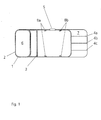
- Fig. 1 shows a fuel tank for commercial vehicles with a support structure 1 and an applied on the inside of the support structure 1 plastic sintered layer 2 and a filler neck 5.
- the plastic sintered layer 2 in this case has a thickness of about 2 to 3 mm. In the present exemplary embodiment, it covers the entire inner surface of the vehicle tank, in particular also the surface of the baffle 3 and of the urea container 6 designed as a separate container.
- FIG. 2 shows a variant of a container, wherein the container has the two sub-containers 6 and 11, which are connected to each other by means of the circumferential weld 9.
- the partial container 6 is a urea container with a plastic sintered layer 2.
- the partial container 11 is a fuel container in which a plastic inner coating is not required.
- the part container 11 further includes a filler neck 5.
- the encircling weld seam 9 is spaced apart from the internally coated sub-container 6 by means of the projection 10 by approximately 150 mm, so that welding of the carrying structures 1 of the two sub-containers 6 and 11 can take place without jeopardizing the plastic sintered layer 2. In this way, the production of the container according to the invention is substantially simplified.
- treads 4a, 4b, 4c are formed in an additional segment 7 of the sub-tank 11.
- the insertion element 13 which is designed as a level sensor with an integrated heating element. Also, the insertion element 13 is - as well as the inside of the sub-container 6 - covered by the plastic sintered layer 2. In addition, the insertion element 13 is mechanically stabilized by the arranged in the lower region of the sub-container 6 also covered with the plastic sintered layer 2 auxiliary structure 14 in such a way that the auxiliary structure 14 is arranged at a distance of a few millimeters from the insertion element 13 and a strong Bending or change in position of the insertion element 13 prevents.
- the passage opening 16 which is pierced by the filler neck 15.
- the geometry of the filler neck 15 is chosen so that the filler neck 15 widens in the direction of the interior of the sub-tank 6. In this way, an undercut is created by which the hold of the plastic sintered layer 2 on the inside of the sub-container 6 is further improved.
Landscapes
- Engineering & Computer Science (AREA)
- Mechanical Engineering (AREA)
- Chemical & Material Sciences (AREA)
- Combustion & Propulsion (AREA)
- Transportation (AREA)
- Life Sciences & Earth Sciences (AREA)
- Sustainable Development (AREA)
- Sustainable Energy (AREA)
- Cooling, Air Intake And Gas Exhaust, And Fuel Tank Arrangements In Propulsion Units (AREA)
- Lining Or Joining Of Plastics Or The Like (AREA)
- Details Of Rigid Or Semi-Rigid Containers (AREA)
Abstract
Description
- Die Erfindung betrifft einen Behälter für Betriebsstoffe von Kraftfahrzeugen. Derartige Behälter, insbesondere Kraftstoffbehälter, finden sich üblicherweise als Anbauteile z. B. bei Nutzfahrzeugen, wo sie oftmals als genietete oder geschweißte, alternativ als Kunststoffbehälter realisiert sind. Gerade im Nutzfahrzeugbereich entstand jedoch in den letzten Jahren - bedingt durch wachsende Anforderungen an die Umweltverträglichkeit derartiger Fahrzeuge - ein Bedarf an Behältern für Betriebsstoffe, deren Funktion über die eines konventionellen Kraftstofftanks o. ä. hinausgeht. So wurde es beispielsweise in jüngerer Zeit erforderlich, im Rahmen der Maßnahmen zur Entstickung von Dieselabgasen Harnstoff im Abgassystem von Nutzfahrzeugen einzusetzen. Damit entstand ein Bedarf an Tanks, die zum Mitführen des benötigten, chemisch aggressiven Harnstoffs geeignet sind.
- Der vorliegenden Erfindung liegt daher die Aufgabe zugrunde, einen Behälter für Betriebsstoffe von Kraftfahrzeugen anzugeben, der chemisch stabil sowohl gegenüber dem mitgeführten Kraftstoff als auch gegenüber Additiven ist.
- Erfindungsgemäß wird diese Aufgabe dadurch gelöst, dass der Behälter für die Betriebsstoffe von Kraftfahrzeugen in der Weise realisiert wird, dass er eine Tragstruktur aufweist und die Innenseite der Tragstruktur mindestens teilweise mit einer Kunststoff-Sinterschicht bedeckt ist. Dabei kann die Tragstruktur aus einem vergleichsweise steifen Material, wie beispielsweise einem Metall, gefertigt sein, auf der die dünne Kunststoff-Sinterschicht aufgebracht ist. Die Kunststoff-Sinterschicht kann beispielsweise dadurch geschaffen werden, dass nach der Ausformung der Tragstruktur der Behälter insgesamt erhitzt wird und nachfolgend ein Kunststoffpulver in seinen Innenraum eingebracht wird, wo es an der heißen Tragstruktur aufschmilzt und damit die genannte Schicht bildet.
- Ein Vorteil dieser Anordnung besteht darin, dass aufgrund der durch die Wahl des Materials bedingten Steifigkeit der Tragstruktur diese dünn gewählt werden kann und auch die Kunststoff-Sinterschicht als Schicht von geringer Dicke ihre Funktion in ausreichendem Maße ausfüllt. Darüber hinaus ergibt sich gegenüber konventionellen Lösungen, bei denen ein fertiger Kunststoffbehälter in eine äußere stabilisierende Hülle eingebracht wird, der Vorteil, dass der Innenraum der äußeren Hülle, im vorliegenden Fall also der Tragstruktur des Behälters, wesentlich besser ausgenutzt werden kann. Insgesamt stellt der vorgeschlagene Behälter eine steife und dabei leichte Struktur dar.
- Hinzu kommt, dass es die vorgeschlagene Lösung ermöglich, nahezu vollständig auf zusätzliche Vorrichtungen zur Fixierung des Kunststoffes an der Innenseite der Tragstruktur zu verzichten, da bereits durch den Sinterprozess eine feste Verbindung hergestellt wird.
- Auf diese Weise können insbesondere Kraftstoffbehälter für Kraftfahrzeuge wie auch Behälter für fluide oder nicht fluide Kraft- oder Betriebsstoffe wie Hydraulikflüssigkeit, Biodiesel oder Harnstoff geschaffen werden. Ein Vorteil der Kunststoffbeschichtung der Behälterinnenseite besteht dabei darin, dass die Kunststoffschicht üblicherweise chemisch inert ist, d. h. dass sie durch den im Behälter aufbewahrten Betriebsstoff nicht angegriffen wird. Damit wird dem verbreiteten Problem des Auslösens von Metall, insbesondere von Aluminiumionen, aus der Aluminiumtragstruktur des Behälters durch den teilweise aggressiven Betriebsstoff wie insbesondere Harnstoff wirkungsvoll begegnet.
- Das direkte Aufsintern der Kunststoff-Sinterschicht hat darüber hinaus erhebliche produktionstechnische Vorteile. Da die Tragstruktur selbst als Sinterwerkzeug verwendet wird, lassen sich nahezu beliebige Behälterformen auch für kleine Stückzahlen mit geringem Aufwand realisieren, so dass die erfindungsgemäßen Behälter an verschiedenste Rahmengeometrien beispielsweise für Sonderfahrzeuge auf einfache Weise angepasst werden können.
- Ferner schafft die erfindungsgemäße Lösung eine einfache Möglichkeit, integrierte Mehrfach-, insbesondere Doppelbehälter zu realisieren. Die Integration der Behälter innerhalb einer Tragstruktur hat dabei den Vorteil, dass nicht jeder Teilbehälter für sich mittels zweier oder mehrerer Konsolen am Fahrzeugrahmen befestigt werden muss, sondern dass der integrierte Behälter als Ganzes mit lediglich zwei Konsolen an einem Fahrzeugrahmen angebracht werden kann.
- Die Kunststoff-Sinterschicht im Inneren des Behälters kann mechanisch beispielsweise dadurch weiter stabilisiert werden, dass der Behälter an seiner Innenseite - gegebenenfalls bedingt durch den Fertigungsprozess - eine oder mehrere Hinterschneidungen aufweist. Die genannten Hinterschneidungen haben dabei den Effekt, dass sie eine zusätzliche mechanische Stabilisierung der Kunststoff-Sinterschicht bewirken, so dass ein Ablösen der Kunststoff-Sinterschicht von der Innenseite der Tragstruktur wirkungsvoll unterbunden wird. Dies führt dazu, dass die Kunststoff-Sinterschicht dünner gewählt werden kann, als es ohne Hinterschneidungen möglich wäre; im Ergebnis lässt sich auf diese Weise eine weitere Gewichtseinsparung realisieren.
- Die Hinterschneidungen können insbesondere als Nebeneffekt bei der Herstellung der Struktur des Behälters realisiert werden: Bei einem aus mehreren Segmenten zusammengesetzten Behälter ergeben sich die erforderlichen Hinterschneidungen quasi automatisch an den z. B. genieteten oder auch mittels beispielsweise einer Orbitalnaht geschweißten Fügestellen. Darüber hinaus lassen sich die Hinterschneidungen auch dadurch verwirklichen, dass Durchtrittsöffnungen durch die Tragstruktur mit einer geeigneten Geometrie ausgebildet werden. Unter Durchtrittsöffnungen sind dabei insbesondere die Öffnung für den Tankstutzen oder eine Öffnung für das Einbringen eines Füllstandssensors in den Tank zu verstehen. Die Hinterschneidung kann auf einfache Weise durch einen umlaufenden, von der Innenseite der Tragstruktur beabstandeten Flansch oder durch eine Rippenstruktur gebildet werden. Darüber hinaus ist es denkbar, einen sich in Richtung des Innenraumes des Behälters bspw. konisch erweiternden Stutzen vorzusehen, wodurch ein Abziehen der Kunststoff-Sinterschicht nach innen ebenfalls wirksam erschwert wird.
- Eine weitere Maßnahme zur Verbesserung der Haftung zwischen Kunststoff-Sinterschicht und der Innenseite der Tragstruktur kann insbesondere dadurch erreicht werden, dass zwischen die Kunststoff-Sinterschicht und die Innenseite der Tragstruktur eine zusätzliche Haftschicht eingebracht wird. Auf diese Weise kann die zur mechanischen Stabilität der Kunststoff-Sinterschicht notwendige Schichtdicke weiter reduziert werden.
- Eine vorteilhafte Wahl für die Kunststoff-Sinterschicht besteht in einem Hochdruck-Polyäthylen, das die erforderliche chemische Inertheit gegenüber den mitzuführenden Betriebsstoffen aufweist; als Dicke der Sinterschicht haben sich ca. 1-25 mm, insbesondere ca. 2 bis 3 mm bzw. 5 bis 10 mm bewährt.
- Ein mögliches Verfahren zur Herstellung des genannten Behälters besteht darin, dass zunächst die Tragstruktur aus metallischen Einzelteilen zusammengefügt, beispielsweise geschweißt wird. Nachfolgend wird die so zusammengefügte Struktur erhitzt und das Kunststoff-Sintermaterial wird in den Innenraum der Tragstruktur eingebracht, wo es sich an der Innenseite der Tragstruktur niederschlägt, aufschmilzt und somit die gewünschte Kunststoff-Sinterschicht bildet.
- Um eine gleichmäßige Verteilung des Kunststoff-Sintermaterials im Innenraum des Behälters zu erreichen, kann der Behälter während des Sinterprozesses in Bewegung, insbesondere in Rotation gehalten werden.
- Als Zwischenschritt nach dem Erhitzen der Tragstruktur und vor Einbringen des Kunststoff-Sintermaterials hat es sich bewährt, eine zusätzliche Haftschicht auf die Innenseite der Tragstruktur aufzubringen. Alternativ kann die Haftschicht auch bereits auf die Einzelsegmente vor dem Zusammenfügen der Tragstruktur aufgebracht werden. Ebenso ist es denkbar, z. B. bei genieteten Behältern, auch die Kunststoff-Sinterschicht bereits vor dem Zusammenfügen der Tragstruktur aufzubringen; d. h. im wesentlichen, in dem vorstehend genannten Verfahren den ersten Schritt, nämlich das Zusammenfügen der Einzelsegmente, an das Ende des Prozesses zu verlegen. Insbesondere bei genieteten Tragstrukturen bietet sich diese Vorgehensweise an, da in diesem Fall die bereits beschichtete Struktur nicht noch einmal erhitzt werden muss, wie es beispielsweise bei einem Zusammenfügen des Behälters durch Schweißen der Fall wäre.
- In den Fällen, in denen die Kunststoff-Sinterschicht nach Zusammenfügen der Tragstruktur in den Behälter eingebracht wird, empfiehlt es sich, das Kunststoffmaterial durch eine ohnehin vorgesehene Öffnung der Tragstruktur, wie beispielsweise den Einfüllstutzen, einzubringen. Es ist ebenso denkbar, das Kunststoffmaterial durch eine weitere Öffnung in den Innenraum des Behälters einzubringen.
- Als vorteilhafter Temperaturbereich zum Aufsintern der Kunststoff-Sinterschicht hat sich der Bereich von ca. 160 bis 200 °C bewährt.
- In einer weiteren vorteilhaften Ausführungsform der Erfindung weist der Behälter einen ersten Teilbehälter auf, dessen Innenseite mindestens teilweise mit einer Kunststoff-Sinterschicht bedeckt ist. An diesen ersten Teilbehälter schließt sich mindestens ein zweiter Teilbehälter an, der gegenüber dem ersten Teilbehälter abgeschlossen ausgebildet ist. Die beiden Teilbehälter sind mittels einer Schweißnaht mit einander verbunden, wobei die Schweißnaht entlang einer Auskragung an dem ersten Teilbehälter in einem Abstand von mindestens 100mm, insbesondere mindestens 200mm verläuft.
- Dabei kann es sich bei dem ersten Teilbehälter insbesondere um einen Harnstoffbehälter handeln, der an den als Kraftstoffbehälter ausgebildeten zweiten Teilbehälter angeschweißt ist. Die oben genannte Auskragung des ersten Teilbehälters hat dabei die Wirkung, dass die Schweißnaht, mittels derer die beiden Behälter mit einander verbunden werden, von dem innenbeschichteten ersten Teilbehälter einen hinreichend großen Abstand aufweißt, um ein Aufschmelzen und damit eine Schädigung der Kunststoff-Sinterschicht im Inneren des ersten Teilbehälters während des Schweißvorganges zu vermeiden. Für eine Ausführung der beiden Behälter aus Aluminium mit ca. 2 mm Wandstärke hat sich ein Abstand der Schweißnaht von ca. 150 mm von dem ersten Teilbehälter als vorteilhaft erwiesen; abhängig von der verwendeten Schweißtechnologie sind Abstände von 0 bis 3000, insbesondere von 0 bis 1000 mm denkbar.
- Der Behälter kann ferner ein Einschubelement aufweisen, das sich durch die Tragstruktur hindurch in den Innenraum des Behälters erstreckt, wobei das Einschubelement mindestens teilweise von der Kunststoff-Sinterschicht bedeckt ist. Bei dem Einschubelement kann es sich beispielsweise um einen kapazitiven oder mechanischen Füllstandssensor, ein Heizelement oder ein kombiniertes Element aus Füllstandssensor und Heizelement handeln. Ein derartiges Einschubelement kann insbesondere zur Beheizung eines als Harnstoffbehälters ausgebildeten ersten Teilbehälters verwendet werden. Die Heizung kann dabei als elektrische Widerstandsheizung oder auch als Kühlwasserheizung realisiert werden.
- Eine Problematik der Verwendung eines Einschubelementes in Harnstoffbehältern besteht darin, dass derartige Einschubelemente in den Fällen, in denen sich bei niedrigen Temperaturen des Harnstoffes feste Kristalle bilden, erhebliche mechanische Belastungen des Einschubelementes auftreten, die zu einer Verbiegung oder im Extremfall zu einer Zerstörung des Einschubelementes führen. Dieser Gefahr kann dadurch wirksam begegnet werden, dass im Bereich des dem Innenraum des Behälters zugewandten Endes des Einschubelementes, insbesondere in einem Abstand von ca. 5-10 mm von dem Einschubelement, eine Hilfsstruktur angeordnet ist, durch die einer Positionsveränderung oder einer Verformung des Einschubelementes entgegengewirkt wird.
- Der genannte Abstand der Hilfsstruktur von dem Einschubelement führt dazu, dass bei dem im normalen Fahrbetrieb auftretenden Schwingungen kein Schlagen des Einschubelementes an der Hilfsstruktur auftritt; die Hilfsstruktur unterbindet lediglich zu große Deformationen oder Positionsveränderungen des Einschubelementes.
- Nachfolgend wird ein Ausführungsbeispiel der Erfindung anhand der
Figuren 1 und2 prinzipmäßig beschrieben. -
Fig. 1 zeigt einen Kraftstoffbehälter für Nutzfahrzeuge mit einer Tragstruktur 1 und einer auf der Innenseite der Tragstruktur 1 aufgebrachten Kunststoff-Sinterschicht 2 sowie einem Einfüllstutzen 5. Die Kunststoff-Sinterschicht 2 weist dabei eine Dicke von ca. 2 bis 3 mm auf. Sie bedeckt im vorliegenden Ausführungsbeispiel die gesamte Innenoberfläche des Fahrzeugtanks, insbesondere auch die Oberfläche der Schwallwand 3 und des als separaten Behälter ausgebildeten Harnstoffbehälters 6. - Durch die umlaufenden Hinterschneidungen 8a und 8b, die ebenfalls von der Kunststoff-Sinterschicht 2 bedeckt sind, wird diese zusätzlich mechanisch stabilisiert und an der Innenseite der Tragstruktur 1 festgehalten. In einem zusätzlichen Segment 7 des Kraftstoffbehälters sind die Trittstufen 4a, 4b, 4c ausgebildet.
-
Figur 2 zeigt eine Variante eines Behälters, wobei der Behälter die beiden Teilbehälter 6 und 11 aufweist, die miteinander mittels der umlaufenden Schweißnaht 9 verbunden sind. Dabei handelt es sich bei dem Teilbehälter 6 um einen Harnstoffbehälter mit einer Kunststoff-Sinterschicht 2. Bei dem Teilbehälter 11 handelt es sich um einen Kraftstoffbehälter, bei dem ein Kunststoff-Innenbeschichtung nicht erforderlich ist. Der Teilbehälter 11 weist ferner einen Einfüllstutzen 5 auf. Die umlaufende Schweißnaht 9 ist von dem innenbeschichteten Teilbehälter 6 mittels der Auskragung 10 um ca. 150 mm beabstandet ausgebildet, so dass ein Verschweißen der Tragstrukturen 1 der beiden Teilbehälter 6 und 11 ohne Gefährdung der Kunststoff-Sinterschicht 2 erfolgen kann. Auf diese Weise wird die Produktion des erfindungsgemäßen Behälters wesentlich vereinfacht. - Auch in diesem Ausführungsbeispiel sind in einem zusätzlichen Segment 7 des Teilbehälters 11 die Trittstufen 4a, 4b, 4c ausgebildet.
- In dem Teilbehälter 6 ist das in der
Figur 2 schematisch dargestellte Einschubelement 13 angeordnet, das als Füllstandssensor mit einem integriertem Heizelement ausgebildet ist. Auch das Einschubelement 13 ist - wie auch die Innenseite des Teilbehälters 6 - von der Kunststoff-Sinterschicht 2 bedeckt. Darüber hinaus wird das Einschubelement 13 von der im unteren Bereich des Teilbehälters 6 angeordneten ebenfalls mit der Kunststoff-Sinterschicht 2 bedeckten Hilfsstruktur 14 mechanisch in der Weise stabilisiert, dass die Hilfsstruktur 14 in einem Abstand von wenigen Millimetern von dem Einschubelement 13 angeordnet ist und eine starke Verbiegung oder Positionsänderung des Einschubelementes 13 unterbindet. - Ferner befindet sich im oberen Bereich des Teilbehälters 6 die Durchtrittsöffnung 16, die von dem Einfüllstutzen 15 durchstoßen wird. Die Geometrie des Einfüllstutzens 15 ist dabei so gewählt, dass sich der Einfüllstutzen 15 in Richtung des Inneren des Teilbehälters 6 erweitert. Auf diese Weise wird eine Hinterschneidung geschaffen, durch die der Halt der Kunststoff-Sinterschicht 2 an der Innenseite des Teilbehälters 6 weiter verbessert wird.
Claims (17)
- Behälter für Betriebsstoffe von Kraftfahrzeugen, wobei der Behälter eine Tragstruktur (1) aufweist und die Innenseite der Tragstruktur mindestens teilweise mit einer Kunststoff-Sinterschicht (2) bedeckt ist,
dadurch gekennzeichnet, dass
die Innenseite des Behälters mindestens eine Hinterschneidung (8a,b) aufweist. - Behälter nach Anspruch 1,
dadurch gekennzeichnet, dass
es sich bei dem Behälter um einen Kraftstoffbehälter handelt. - Behälter nach Anspruch 1,
dadurch gekennzeichnet, dass
es sich bei dem Behälter um einen Harnstoffbehälter (6) handelt. - Behälter nach Anspruch 1,
dadurch gekennzeichnet, dass
die mindestens eine Hinterschneidung im Bereich einer Durchtrittsöffnung (15) in der Tragstruktur (1) angeordnet ist. - Behälter nach einem der vorangehenden Ansprüche,
dadurch gekennzeichnet, dass
der Behälter aus mehreren Segmenten zusammengesetzt ist. - Behälter nach einem der vorangehenden Ansprüche,
dadurch gekennzeichnet, dass
zwischen der Kunststoff-Sinterschicht (2) und der Tragstruktur (1) mindestens bereichsweise eine zusätzliche Haftschicht angeordnet ist. - Behälter nach einem der vorangehenden Ansprüche,
dadurch gekennzeichnet, dass
die Kunststoff-Sinterschicht (2) aus einem Hochdruck-Polyethylen besteht. - Behälter nach einem der vorangehenden Ansprüche,
dadurch gekennzeichnet, dass
die Kunststoff-Sinterschicht (2) eine Dicke von 1 bis 25 mm, insbesondere von ca. 5 bis 10 mm aufweist. - Behälter nach einem der vorangehenden Ansprüche,
dadurch gekennzeichnet, dass
die Tragstruktur (1) aus Aluminium besteht. - Behälter für Betriebsstoffe von Kraftfahrzeugen, wobei der Behälter eine Tragstruktur (1) aufweist und die Innenseite der Tragstruktur mindestens teilweise mit einer Kunststoff-Sinterschicht (2) bedeckt ist,
dadurch gekennzeichnet, dass
der Behälter ein Einschubelement (13) aufweist, das sich durch die Tragstruktur (1) hindurch in den Innenraum des Behälters erstreckt, wobei das Einschubelement (13) mindestens teilweise von der Kunststoff-Sinterschicht (2) bedeckt ist. - Behälter nach Anspruch 10,
dadurch gekennzeichnet, dass
es sich bei dem Einschubelement (13) um einen Füllstandssensor handelt. - Behälter nach Anspruch 10 oder 11,
dadurch gekennzeichnet, dass
das Einschubelement (13) ein Heizelement aufweist. - Behälter nach einem der vorangehenden Ansprüche 10-12,
dadurch gekennzeichnet, dass
im Bereich des dem Innenraum des Behälters zugewandten Endes des Einschubelementes (13), insbesondere in einem Abstand von ca. 5 bis 10 mm von dem Einschubelement (13), eine Hilfsstruktur (14) angeordnet ist, durch die einer Positionsveränderung oder einer Verformung des Einschubelementes (13) entgegengewirkt wird. - Verfahren zur Herstellung eines Behälters für Betriebsstoffe von Kraftfahrzeugen mit einer Tragstruktur mit den folgenden Verfahrensschritten- Zusammenfügen der Tragstruktur (1) aus metallischen Einzelteilen- Erhitzen der zusammengefügten Tragstruktur (1)- Einbringen von Kunststoff-Sintermaterial in den Innenraum der Tragstruktur (1).
- Verfahren nach Anspruch 14,
dadurch gekennzeichnet, dass
nach Erhitzen der zusammengefügten Tragstruktur (1) und vor Einbringen von Kunststoff-Sintermaterial in den Innenraum der Tragstruktur eine zusätzliche Haftschicht auf die Tragstruktur (1) aufgebracht wird. - Verfahren nach einem der vorangehenden Ansprüche 14 oder 15,
dadurch gekennzeichnet, dass
das Kunststoff-Sintermaterial durch einen Einfüllstutzen (5) in den Innenraum der Tragstruktur (1) eingebracht wird. - Verfahren nach einem der vorangehenden Ansprüche 14 bis 16,
dadurch gekennzeichnet, dass
die zusammengefügte Tragstruktur (1) auf ca. 180°C erhitzt wird.
Applications Claiming Priority (3)
| Application Number | Priority Date | Filing Date | Title |
|---|---|---|---|
| DE102006001428 | 2006-01-10 | ||
| DE102006054208.8A DE102006054208B4 (de) | 2006-01-10 | 2006-11-15 | Behälter für Betriebsstoffe von Kraftfahrzeugen |
| EP07702612.8A EP1971502B2 (de) | 2006-01-10 | 2007-01-08 | Behälter für betriebsstoffe von kraftfahrzeugen |
Related Parent Applications (3)
| Application Number | Title | Priority Date | Filing Date |
|---|---|---|---|
| EP07702612.8 Division | 2007-01-08 | ||
| EP07702612.8A Division EP1971502B2 (de) | 2006-01-10 | 2007-01-08 | Behälter für betriebsstoffe von kraftfahrzeugen |
| EP07702612.8A Division-Into EP1971502B2 (de) | 2006-01-10 | 2007-01-08 | Behälter für betriebsstoffe von kraftfahrzeugen |
Publications (3)
| Publication Number | Publication Date |
|---|---|
| EP2236340A1 true EP2236340A1 (de) | 2010-10-06 |
| EP2236340B1 EP2236340B1 (de) | 2014-08-27 |
| EP2236340B2 EP2236340B2 (de) | 2017-12-27 |
Family
ID=38170065
Family Applications (2)
| Application Number | Title | Priority Date | Filing Date |
|---|---|---|---|
| EP10168759.8A Not-in-force EP2236340B2 (de) | 2006-01-10 | 2007-01-08 | Behälter für betriebsstoffe von kraftfahrzeugen |
| EP07702612.8A Not-in-force EP1971502B2 (de) | 2006-01-10 | 2007-01-08 | Behälter für betriebsstoffe von kraftfahrzeugen |
Family Applications After (1)
| Application Number | Title | Priority Date | Filing Date |
|---|---|---|---|
| EP07702612.8A Not-in-force EP1971502B2 (de) | 2006-01-10 | 2007-01-08 | Behälter für betriebsstoffe von kraftfahrzeugen |
Country Status (4)
| Country | Link |
|---|---|
| US (2) | US8181808B2 (de) |
| EP (2) | EP2236340B2 (de) |
| DE (1) | DE102006054208B4 (de) |
| WO (1) | WO2007080078A1 (de) |
Cited By (1)
| Publication number | Priority date | Publication date | Assignee | Title |
|---|---|---|---|---|
| DE102011011367B4 (de) * | 2011-02-16 | 2016-06-16 | Eichenauer Heizelemente Gmbh & Co. Kg | Verfahren zum Herstellen einer Tankheizung |
Families Citing this family (11)
| Publication number | Priority date | Publication date | Assignee | Title |
|---|---|---|---|---|
| DE102007053227A1 (de) | 2007-11-06 | 2009-05-14 | Erhard & Söhne GmbH | Kraftstoffbehälter |
| EP2116406B1 (de) * | 2008-05-09 | 2018-08-08 | MAGNA STEYR Fuel Systems GmbH Werk Schwäbisch Gmünd | Behälter für Betriebsstoffe und Verfahren zu dessen Herstellung |
| DE102008023073A1 (de) | 2008-05-09 | 2009-11-12 | Erhard & Söhne GmbH | Behälter für Betriebsstoffe und Verfahren zu dessen Herstellung |
| DE202008017593U1 (de) | 2008-06-16 | 2010-02-11 | Erhard & Söhne GmbH | Innenbeschichteter Behälter für Betriebsstoffe von Kraftfahrzeugen |
| AT10684U1 (de) * | 2008-08-06 | 2009-08-15 | Alutech Gmbh | Tank für betriebsmittel von kraftfahrzeugen |
| AT10685U1 (de) * | 2008-09-03 | 2009-08-15 | Alutech Gmbh | Verfahren zur herstellung eines mehrkammertanks |
| DE102008048777A1 (de) † | 2008-09-24 | 2010-03-25 | Erhard & Söhne GmbH | Behälter mit Kunststoff-Sinterschicht |
| DE102009029345A1 (de) * | 2009-09-10 | 2011-03-24 | Robert Bosch Gmbh | Kraftstoffsystem mit reduzierter Anzahl an Komponenten aus katalytisch auf den Kraftstoff wirkenden Materialien |
| DE102009029362A1 (de) * | 2009-09-11 | 2011-03-24 | Erhard & Söhne GmbH | Behaelter zur Aufnahme eines Kraft- und/oder Betriebsstoffes fuer Fahrzeuge |
| DE102010042230A1 (de) * | 2010-10-08 | 2012-04-12 | Eos Gmbh Electro Optical Systems | Verfahren zum Beschichten von Objekten, insbesondere solchen Objekten, die durch ein generatives Fertigungsverfahren hergestellt wurden |
| DE102014118720A1 (de) | 2014-12-16 | 2016-06-16 | Continental Automotive Gmbh | Vorrichtung zur Bereitstellung eines flüssigen Additivs |
Citations (5)
| Publication number | Priority date | Publication date | Assignee | Title |
|---|---|---|---|---|
| WO1991009732A1 (en) * | 1989-12-15 | 1991-07-11 | Tonen Sekiyukagaku K.K. | Sulfonated multilayer container and a method for producing the same |
| US5567296A (en) * | 1993-01-19 | 1996-10-22 | Luch; Daniel | Process for producing vehicular fuel tanks |
| DE19930347A1 (de) * | 1999-07-02 | 2001-01-11 | Vaw Ver Aluminium Werke Ag | Aluminiumbauteil |
| US20030209550A1 (en) * | 2002-05-07 | 2003-11-13 | Visteon Global Technologies, Inc. | Low permeation pinchoff connection for bridging a barrier layer and method of making same |
| GB2390582A (en) * | 2002-07-11 | 2004-01-14 | Visteon Global Tech Inc | Low permeation multilayered polymer fuel tank |
Family Cites Families (25)
| Publication number | Priority date | Publication date | Assignee | Title |
|---|---|---|---|---|
| US2316116A (en) * | 1939-10-26 | 1943-04-06 | Case Co J I | Tank |
| DE1669151C3 (de) * | 1967-06-22 | 1976-01-02 | Bayer Ag, 5090 Leverkusen | Kunststoffpulver für das Tauch- und Spritzbeschichtungsverfahren |
| US4625892A (en) * | 1983-09-14 | 1986-12-02 | Poly Processing Company, Inc. | Polyolefin tank within a metallic tank |
| FR2590550B1 (fr) * | 1985-11-26 | 1988-01-15 | Atochem | Recipients composites metalloplastiques assembles par soudure et leur procede de fabrication |
| US4874104A (en) * | 1988-01-12 | 1989-10-17 | Josef Klammer | Hot water storage tank |
| US5379507A (en) * | 1988-04-11 | 1995-01-10 | State Industries, Inc. | Method of manufacturing a tank |
| DE202004020303U1 (de) * | 1990-06-26 | 2005-04-07 | Bonar Plastics Gmbh | Heizrohranbindung |
| JPH08511323A (ja) † | 1993-04-07 | 1996-11-26 | エド カナダ リミテッド | ライナ/外部機構直結式の流体圧力容器のボス−ライナ取付装置 |
| US5518141A (en) † | 1994-01-24 | 1996-05-21 | Newhouse; Norman L. | Pressure vessel with system to prevent liner separation |
| US5979692A (en) † | 1998-03-13 | 1999-11-09 | Harsco Corporation | Boss for composite pressure vessel having polymeric liner |
| US6146709A (en) * | 1998-07-15 | 2000-11-14 | Institute Of Gas Technolgy | Method for application of protective polymer coating |
| DE19841770A1 (de) † | 1998-09-11 | 2000-04-06 | Siemens Ag | Vorrichtung und Verfahren zur Füllstandsmessung |
| DE19842336C2 (de) * | 1998-09-16 | 2001-03-22 | Mannesmann Vdo Ag | Kraftstoffbehälter für ein Kraftfahrzeug |
| US6371323B1 (en) * | 1998-12-15 | 2002-04-16 | Clemmer Technologies Inc. | Poly-steel double wall tank |
| US6296014B1 (en) † | 1999-01-12 | 2001-10-02 | Toyoda Gosei Co., Ltd. | Check valve and fuel tank with check valve attached thereto |
| US20030068434A1 (en) * | 2001-08-21 | 2003-04-10 | Moore James B. | Method for bonding thermoplastic films to metal surfaces of cylinders, vessels and component parts |
| EP1350654A1 (de) † | 2002-03-21 | 2003-10-08 | Alutech Gesellschaft m.b.H. | Fahrzeugtank |
| DE20219608U1 (de) † | 2002-12-05 | 2003-06-12 | Erhard & Söhne GmbH, 73525 Schwäbisch Gmünd | Behälter zur Aufnahme von Betriebsstoffen |
| DE20314249U1 (de) † | 2003-09-13 | 2003-11-06 | Erhard & Söhne GmbH, 73525 Schwäbisch Gmünd | Kraftstofftank |
| US20050127078A1 (en) * | 2003-12-11 | 2005-06-16 | Vorenkamp Erich J. | Fuel tank assembly and method of assembly |
| SE525972C2 (sv) † | 2004-02-06 | 2005-06-07 | Scania Cv Abp | Ureatank för ett motorfordon |
| US20050173433A1 (en) * | 2004-02-11 | 2005-08-11 | Spahr Timothy A. | Fuel container having contiguous unbonded polyacetal/polyolefin layers |
| EA200900035A1 (ru) * | 2004-04-06 | 2009-04-28 | Е.И. Дюпон Де Немур Энд Компани | Облицованные резервуары для транспортировки химикатов |
| SE0403154L (sv) † | 2004-12-21 | 2006-03-28 | Volvo Lastvagnar Ab | Behållare för rinnande material |
| DE202006002035U1 (de) † | 2006-01-10 | 2006-04-27 | Erhard & Söhne GmbH | Innenbeschichteter Behälter für Betriebsstoffe von Kraftfahrzeugen |
-
2006
- 2006-11-15 DE DE102006054208.8A patent/DE102006054208B4/de not_active Revoked
-
2007
- 2007-01-08 EP EP10168759.8A patent/EP2236340B2/de not_active Not-in-force
- 2007-01-08 US US12/160,405 patent/US8181808B2/en not_active Expired - Fee Related
- 2007-01-08 WO PCT/EP2007/000089 patent/WO2007080078A1/de not_active Ceased
- 2007-01-08 EP EP07702612.8A patent/EP1971502B2/de not_active Not-in-force
-
2012
- 2012-03-16 US US13/422,287 patent/US8714390B2/en active Active
Patent Citations (5)
| Publication number | Priority date | Publication date | Assignee | Title |
|---|---|---|---|---|
| WO1991009732A1 (en) * | 1989-12-15 | 1991-07-11 | Tonen Sekiyukagaku K.K. | Sulfonated multilayer container and a method for producing the same |
| US5567296A (en) * | 1993-01-19 | 1996-10-22 | Luch; Daniel | Process for producing vehicular fuel tanks |
| DE19930347A1 (de) * | 1999-07-02 | 2001-01-11 | Vaw Ver Aluminium Werke Ag | Aluminiumbauteil |
| US20030209550A1 (en) * | 2002-05-07 | 2003-11-13 | Visteon Global Technologies, Inc. | Low permeation pinchoff connection for bridging a barrier layer and method of making same |
| GB2390582A (en) * | 2002-07-11 | 2004-01-14 | Visteon Global Tech Inc | Low permeation multilayered polymer fuel tank |
Cited By (1)
| Publication number | Priority date | Publication date | Assignee | Title |
|---|---|---|---|---|
| DE102011011367B4 (de) * | 2011-02-16 | 2016-06-16 | Eichenauer Heizelemente Gmbh & Co. Kg | Verfahren zum Herstellen einer Tankheizung |
Also Published As
| Publication number | Publication date |
|---|---|
| EP1971502A1 (de) | 2008-09-24 |
| US8714390B2 (en) | 2014-05-06 |
| DE102006054208A1 (de) | 2007-07-12 |
| EP2236340B2 (de) | 2017-12-27 |
| US8181808B2 (en) | 2012-05-22 |
| US20100219218A1 (en) | 2010-09-02 |
| WO2007080078A1 (de) | 2007-07-19 |
| DE102006054208B4 (de) | 2016-04-07 |
| EP2236340B1 (de) | 2014-08-27 |
| EP1971502B1 (de) | 2013-12-04 |
| EP1971502B2 (de) | 2016-05-11 |
| US20120168446A1 (en) | 2012-07-05 |
Similar Documents
| Publication | Publication Date | Title |
|---|---|---|
| EP2236340B1 (de) | Behälter für Betriebsstoffe von Kraftfahrzeugen | |
| EP3046813B1 (de) | Fügeverfahren | |
| DE102007062524B3 (de) | Verfahren zur Herstellung eines Hybridbauteils und Hybridbauteil | |
| DE102008005286A1 (de) | Verfahren zum Verbinden von Bauteilen eines Kraftwagens | |
| DE102008051997A1 (de) | Dachrahmenelement in Hybridbauweise für ein Fahrzeug | |
| DE102009035324A1 (de) | Karosserieelement für ein Fahrzeug und Verfahren zur Herstellung eines Karosserieelements | |
| DE102005016492A1 (de) | Energie speicherndes Behältnis für ein Kraftfahrzeug | |
| AT409547B (de) | Bauelement und verfahren zu dessen herstellung | |
| EP2058161B1 (de) | Kraftstoffbehälter | |
| DE102009040930B4 (de) | Heizbarer Flüssigkeitsbehälter aus Kunststoffmaterial und Verfahren zu seiner Herstellung | |
| DE10333678B4 (de) | Verfahren zum Herstellen eines abschnittweise verstärkten rohrförmigen Trägers aus Metall, insbesondere für Tragstrukturen in Kraftfahrzeugen | |
| DE102008023073A1 (de) | Behälter für Betriebsstoffe und Verfahren zu dessen Herstellung | |
| WO2008064848A1 (de) | Verfahren zum herstellen eines nutzfahrzeugtanks | |
| DE202006002035U1 (de) | Innenbeschichteter Behälter für Betriebsstoffe von Kraftfahrzeugen | |
| DE102015100968A1 (de) | Verfahren zur Herstellung einer Kraftfahrzeugkarosserie in Mischbauweise | |
| DE102008028277A1 (de) | Innenbeschichteter Behälter für Betriebsstoffe von Kraftfahrzeugen | |
| DE102010012722A1 (de) | Versteifungsstrebe für ein Kraftfahrzeug | |
| DE102023118493A1 (de) | Körperstruktur für ein fahrzeug mit verstärkungselement | |
| DE102019201415A1 (de) | Karosserieteil und Verfahren zum Herstellen eines Karosserieteils | |
| DE102011077458A1 (de) | Verfahren zum Verschweißen von Bauteilen eines Kraftfahrzeuges, Schweißbaugruppe sowie Fahrzeugsitz für ein Kraftfahrzeug | |
| DE102021130029A1 (de) | Trägeranordnung für eine Karosserie eines Kraftwagens | |
| EP2116406B1 (de) | Behälter für Betriebsstoffe und Verfahren zu dessen Herstellung | |
| DE102010034939A1 (de) | Kraftfahrzeugkarosserie, Kraftfahrzeug und Verfahren zum Zusammenbau einer Kraftfahrzeugkarosserie | |
| DE102014013211A1 (de) | Verfahren zur Herstellung einer Falzverbindung zwischen einem Innenteil und einem Außenteil | |
| DE19528432B4 (de) | Anordnung eines Behälters in einem Hohlraum |
Legal Events
| Date | Code | Title | Description |
|---|---|---|---|
| PUAI | Public reference made under article 153(3) epc to a published international application that has entered the european phase |
Free format text: ORIGINAL CODE: 0009012 |
|
| 17P | Request for examination filed |
Effective date: 20100707 |
|
| AC | Divisional application: reference to earlier application |
Ref document number: 1971502 Country of ref document: EP Kind code of ref document: P |
|
| AK | Designated contracting states |
Kind code of ref document: A1 Designated state(s): AT BE BG CH CY CZ DE DK EE ES FI FR GB GR HU IE IS IT LI LT LU LV MC NL PL PT RO SE SI SK TR |
|
| 17Q | First examination report despatched |
Effective date: 20111216 |
|
| GRAP | Despatch of communication of intention to grant a patent |
Free format text: ORIGINAL CODE: EPIDOSNIGR1 |
|
| INTG | Intention to grant announced |
Effective date: 20140317 |
|
| GRAS | Grant fee paid |
Free format text: ORIGINAL CODE: EPIDOSNIGR3 |
|
| RAP1 | Party data changed (applicant data changed or rights of an application transferred) |
Owner name: MAGNA STEYR FUEL SYSTEMS GMBH WERK SCHWAEBISCH GMU |
|
| GRAA | (expected) grant |
Free format text: ORIGINAL CODE: 0009210 |
|
| AC | Divisional application: reference to earlier application |
Ref document number: 1971502 Country of ref document: EP Kind code of ref document: P |
|
| AK | Designated contracting states |
Kind code of ref document: B1 Designated state(s): AT BE BG CH CY CZ DE DK EE ES FI FR GB GR HU IE IS IT LI LT LU LV MC NL PL PT RO SE SI SK TR |
|
| REG | Reference to a national code |
Ref country code: GB Ref legal event code: FG4D Free format text: NOT ENGLISH |
|
| REG | Reference to a national code |
Ref country code: CH Ref legal event code: EP |
|
| REG | Reference to a national code |
Ref country code: AT Ref legal event code: REF Ref document number: 684344 Country of ref document: AT Kind code of ref document: T Effective date: 20140915 |
|
| REG | Reference to a national code |
Ref country code: IE Ref legal event code: FG4D Free format text: LANGUAGE OF EP DOCUMENT: GERMAN |
|
| REG | Reference to a national code |
Ref country code: DE Ref legal event code: R096 Ref document number: 502007013408 Country of ref document: DE Effective date: 20141009 |
|
| REG | Reference to a national code |
Ref country code: LT Ref legal event code: MG4D |
|
| REG | Reference to a national code |
Ref country code: NL Ref legal event code: VDEP Effective date: 20140827 |
|
| PG25 | Lapsed in a contracting state [announced via postgrant information from national office to epo] |
Ref country code: ES Free format text: LAPSE BECAUSE OF FAILURE TO SUBMIT A TRANSLATION OF THE DESCRIPTION OR TO PAY THE FEE WITHIN THE PRESCRIBED TIME-LIMIT Effective date: 20140827 Ref country code: FI Free format text: LAPSE BECAUSE OF FAILURE TO SUBMIT A TRANSLATION OF THE DESCRIPTION OR TO PAY THE FEE WITHIN THE PRESCRIBED TIME-LIMIT Effective date: 20140827 Ref country code: GR Free format text: LAPSE BECAUSE OF FAILURE TO SUBMIT A TRANSLATION OF THE DESCRIPTION OR TO PAY THE FEE WITHIN THE PRESCRIBED TIME-LIMIT Effective date: 20141128 Ref country code: SE Free format text: LAPSE BECAUSE OF FAILURE TO SUBMIT A TRANSLATION OF THE DESCRIPTION OR TO PAY THE FEE WITHIN THE PRESCRIBED TIME-LIMIT Effective date: 20140827 Ref country code: LT Free format text: LAPSE BECAUSE OF FAILURE TO SUBMIT A TRANSLATION OF THE DESCRIPTION OR TO PAY THE FEE WITHIN THE PRESCRIBED TIME-LIMIT Effective date: 20140827 Ref country code: PT Free format text: LAPSE BECAUSE OF FAILURE TO SUBMIT A TRANSLATION OF THE DESCRIPTION OR TO PAY THE FEE WITHIN THE PRESCRIBED TIME-LIMIT Effective date: 20141229 Ref country code: BG Free format text: LAPSE BECAUSE OF FAILURE TO SUBMIT A TRANSLATION OF THE DESCRIPTION OR TO PAY THE FEE WITHIN THE PRESCRIBED TIME-LIMIT Effective date: 20141127 |
|
| PG25 | Lapsed in a contracting state [announced via postgrant information from national office to epo] |
Ref country code: LV Free format text: LAPSE BECAUSE OF FAILURE TO SUBMIT A TRANSLATION OF THE DESCRIPTION OR TO PAY THE FEE WITHIN THE PRESCRIBED TIME-LIMIT Effective date: 20140827 Ref country code: CY Free format text: LAPSE BECAUSE OF FAILURE TO SUBMIT A TRANSLATION OF THE DESCRIPTION OR TO PAY THE FEE WITHIN THE PRESCRIBED TIME-LIMIT Effective date: 20140827 Ref country code: IS Free format text: LAPSE BECAUSE OF FAILURE TO SUBMIT A TRANSLATION OF THE DESCRIPTION OR TO PAY THE FEE WITHIN THE PRESCRIBED TIME-LIMIT Effective date: 20141227 |
|
| PG25 | Lapsed in a contracting state [announced via postgrant information from national office to epo] |
Ref country code: NL Free format text: LAPSE BECAUSE OF FAILURE TO SUBMIT A TRANSLATION OF THE DESCRIPTION OR TO PAY THE FEE WITHIN THE PRESCRIBED TIME-LIMIT Effective date: 20140827 |
|
| PG25 | Lapsed in a contracting state [announced via postgrant information from national office to epo] |
Ref country code: SK Free format text: LAPSE BECAUSE OF FAILURE TO SUBMIT A TRANSLATION OF THE DESCRIPTION OR TO PAY THE FEE WITHIN THE PRESCRIBED TIME-LIMIT Effective date: 20140827 Ref country code: RO Free format text: LAPSE BECAUSE OF FAILURE TO SUBMIT A TRANSLATION OF THE DESCRIPTION OR TO PAY THE FEE WITHIN THE PRESCRIBED TIME-LIMIT Effective date: 20140827 Ref country code: EE Free format text: LAPSE BECAUSE OF FAILURE TO SUBMIT A TRANSLATION OF THE DESCRIPTION OR TO PAY THE FEE WITHIN THE PRESCRIBED TIME-LIMIT Effective date: 20140827 Ref country code: IT Free format text: LAPSE BECAUSE OF FAILURE TO SUBMIT A TRANSLATION OF THE DESCRIPTION OR TO PAY THE FEE WITHIN THE PRESCRIBED TIME-LIMIT Effective date: 20140827 Ref country code: DK Free format text: LAPSE BECAUSE OF FAILURE TO SUBMIT A TRANSLATION OF THE DESCRIPTION OR TO PAY THE FEE WITHIN THE PRESCRIBED TIME-LIMIT Effective date: 20140827 Ref country code: CZ Free format text: LAPSE BECAUSE OF FAILURE TO SUBMIT A TRANSLATION OF THE DESCRIPTION OR TO PAY THE FEE WITHIN THE PRESCRIBED TIME-LIMIT Effective date: 20140827 |
|
| REG | Reference to a national code |
Ref country code: DE Ref legal event code: R026 Ref document number: 502007013408 Country of ref document: DE |
|
| PG25 | Lapsed in a contracting state [announced via postgrant information from national office to epo] |
Ref country code: PL Free format text: LAPSE BECAUSE OF FAILURE TO SUBMIT A TRANSLATION OF THE DESCRIPTION OR TO PAY THE FEE WITHIN THE PRESCRIBED TIME-LIMIT Effective date: 20140827 |
|
| PLBI | Opposition filed |
Free format text: ORIGINAL CODE: 0009260 |
|
| PLAX | Notice of opposition and request to file observation + time limit sent |
Free format text: ORIGINAL CODE: EPIDOSNOBS2 |
|
| PG25 | Lapsed in a contracting state [announced via postgrant information from national office to epo] |
Ref country code: BE Free format text: LAPSE BECAUSE OF NON-PAYMENT OF DUE FEES Effective date: 20150131 |
|
| 26 | Opposition filed |
Opponent name: ALUTECH GESELLSCHAFT M.B.H. Effective date: 20150520 |
|
| REG | Reference to a national code |
Ref country code: CH Ref legal event code: PL |
|
| PG25 | Lapsed in a contracting state [announced via postgrant information from national office to epo] |
Ref country code: LU Free format text: LAPSE BECAUSE OF FAILURE TO SUBMIT A TRANSLATION OF THE DESCRIPTION OR TO PAY THE FEE WITHIN THE PRESCRIBED TIME-LIMIT Effective date: 20150108 |
|
| PG25 | Lapsed in a contracting state [announced via postgrant information from national office to epo] |
Ref country code: MC Free format text: LAPSE BECAUSE OF FAILURE TO SUBMIT A TRANSLATION OF THE DESCRIPTION OR TO PAY THE FEE WITHIN THE PRESCRIBED TIME-LIMIT Effective date: 20140827 |
|
| PLBB | Reply of patent proprietor to notice(s) of opposition received |
Free format text: ORIGINAL CODE: EPIDOSNOBS3 |
|
| PG25 | Lapsed in a contracting state [announced via postgrant information from national office to epo] |
Ref country code: LI Free format text: LAPSE BECAUSE OF NON-PAYMENT OF DUE FEES Effective date: 20150131 Ref country code: CH Free format text: LAPSE BECAUSE OF NON-PAYMENT OF DUE FEES Effective date: 20150131 |
|
| REG | Reference to a national code |
Ref country code: IE Ref legal event code: MM4A |
|
| PG25 | Lapsed in a contracting state [announced via postgrant information from national office to epo] |
Ref country code: SI Free format text: LAPSE BECAUSE OF FAILURE TO SUBMIT A TRANSLATION OF THE DESCRIPTION OR TO PAY THE FEE WITHIN THE PRESCRIBED TIME-LIMIT Effective date: 20140827 |
|
| REG | Reference to a national code |
Ref country code: FR Ref legal event code: PLFP Year of fee payment: 10 |
|
| PG25 | Lapsed in a contracting state [announced via postgrant information from national office to epo] |
Ref country code: IE Free format text: LAPSE BECAUSE OF NON-PAYMENT OF DUE FEES Effective date: 20150108 |
|
| REG | Reference to a national code |
Ref country code: AT Ref legal event code: MM01 Ref document number: 684344 Country of ref document: AT Kind code of ref document: T Effective date: 20150108 |
|
| PG25 | Lapsed in a contracting state [announced via postgrant information from national office to epo] |
Ref country code: AT Free format text: LAPSE BECAUSE OF NON-PAYMENT OF DUE FEES Effective date: 20150108 |
|
| REG | Reference to a national code |
Ref country code: FR Ref legal event code: PLFP Year of fee payment: 11 |
|
| PG25 | Lapsed in a contracting state [announced via postgrant information from national office to epo] |
Ref country code: HU Free format text: LAPSE BECAUSE OF FAILURE TO SUBMIT A TRANSLATION OF THE DESCRIPTION OR TO PAY THE FEE WITHIN THE PRESCRIBED TIME-LIMIT; INVALID AB INITIO Effective date: 20070108 |
|
| PG25 | Lapsed in a contracting state [announced via postgrant information from national office to epo] |
Ref country code: TR Free format text: LAPSE BECAUSE OF FAILURE TO SUBMIT A TRANSLATION OF THE DESCRIPTION OR TO PAY THE FEE WITHIN THE PRESCRIBED TIME-LIMIT Effective date: 20140827 |
|
| PUAH | Patent maintained in amended form |
Free format text: ORIGINAL CODE: 0009272 |
|
| STAA | Information on the status of an ep patent application or granted ep patent |
Free format text: STATUS: PATENT MAINTAINED AS AMENDED |
|
| 27A | Patent maintained in amended form |
Effective date: 20171227 |
|
| AK | Designated contracting states |
Kind code of ref document: B2 Designated state(s): AT BE BG CH CY CZ DE DK EE ES FI FR GB GR HU IE IS IT LI LT LU LV MC NL PL PT RO SE SI SK TR |
|
| REG | Reference to a national code |
Ref country code: DE Ref legal event code: R102 Ref document number: 502007013408 Country of ref document: DE |
|
| REG | Reference to a national code |
Ref country code: FR Ref legal event code: PLFP Year of fee payment: 12 |
|
| PG25 | Lapsed in a contracting state [announced via postgrant information from national office to epo] |
Ref country code: LV Free format text: LAPSE BECAUSE OF FAILURE TO SUBMIT A TRANSLATION OF THE DESCRIPTION OR TO PAY THE FEE WITHIN THE PRESCRIBED TIME-LIMIT Effective date: 20140827 |
|
| REG | Reference to a national code |
Ref country code: DE Ref legal event code: R082 Ref document number: 502007013408 Country of ref document: DE Representative=s name: RAUSCH, GABRIELE, DIPL.-PHYS. DR.RER.NAT., DE Ref country code: DE Ref legal event code: R081 Ref document number: 502007013408 Country of ref document: DE Owner name: MAGNA ENERGY STORAGE SYSTEMS GMBH WERK SCHWAEB, DE Free format text: FORMER OWNER: MAGNA STEYR FUEL SYSTEMS GMBH WERK SCHWAEBISCH GMUEND, 73529 SCHWAEBISCH GMUEND, DE |
|
| PGFP | Annual fee paid to national office [announced via postgrant information from national office to epo] |
Ref country code: FR Payment date: 20230124 Year of fee payment: 17 |
|
| PGFP | Annual fee paid to national office [announced via postgrant information from national office to epo] |
Ref country code: GB Payment date: 20230119 Year of fee payment: 17 Ref country code: DE Payment date: 20230123 Year of fee payment: 17 |
|
| REG | Reference to a national code |
Ref country code: DE Ref legal event code: R119 Ref document number: 502007013408 Country of ref document: DE |
|
| GBPC | Gb: european patent ceased through non-payment of renewal fee |
Effective date: 20240108 |
|
| PG25 | Lapsed in a contracting state [announced via postgrant information from national office to epo] |
Ref country code: DE Free format text: LAPSE BECAUSE OF NON-PAYMENT OF DUE FEES Effective date: 20240801 |
|
| PG25 | Lapsed in a contracting state [announced via postgrant information from national office to epo] |
Ref country code: GB Free format text: LAPSE BECAUSE OF NON-PAYMENT OF DUE FEES Effective date: 20240108 |
|
| PG25 | Lapsed in a contracting state [announced via postgrant information from national office to epo] |
Ref country code: FR Free format text: LAPSE BECAUSE OF NON-PAYMENT OF DUE FEES Effective date: 20240131 |
|
| PG25 | Lapsed in a contracting state [announced via postgrant information from national office to epo] |
Ref country code: GB Free format text: LAPSE BECAUSE OF NON-PAYMENT OF DUE FEES Effective date: 20240108 Ref country code: FR Free format text: LAPSE BECAUSE OF NON-PAYMENT OF DUE FEES Effective date: 20240131 Ref country code: DE Free format text: LAPSE BECAUSE OF NON-PAYMENT OF DUE FEES Effective date: 20240801 |