EP2232565B1 - Sodium/molybdenum composite metal powders, products thereof, and methods for producing photovoltaic cells - Google Patents
Sodium/molybdenum composite metal powders, products thereof, and methods for producing photovoltaic cells Download PDFInfo
- Publication number
- EP2232565B1 EP2232565B1 EP20090700939 EP09700939A EP2232565B1 EP 2232565 B1 EP2232565 B1 EP 2232565B1 EP 20090700939 EP20090700939 EP 20090700939 EP 09700939 A EP09700939 A EP 09700939A EP 2232565 B1 EP2232565 B1 EP 2232565B1
- Authority
- EP
- European Patent Office
- Prior art keywords
- sodium
- molybdenum
- metal powder
- composite metal
- slurry
- Prior art date
- Legal status (The legal status is an assumption and is not a legal conclusion. Google has not performed a legal analysis and makes no representation as to the accuracy of the status listed.)
- Not-in-force
Links
Images



Classifications
-
- B—PERFORMING OPERATIONS; TRANSPORTING
- B22—CASTING; POWDER METALLURGY
- B22F—WORKING METALLIC POWDER; MANUFACTURE OF ARTICLES FROM METALLIC POWDER; MAKING METALLIC POWDER; APPARATUS OR DEVICES SPECIALLY ADAPTED FOR METALLIC POWDER
- B22F3/00—Manufacture of workpieces or articles from metallic powder characterised by the manner of compacting or sintering; Apparatus specially adapted therefor ; Presses and furnaces
- B22F3/12—Both compacting and sintering
- B22F3/14—Both compacting and sintering simultaneously
- B22F3/15—Hot isostatic pressing
-
- H—ELECTRICITY
- H10—SEMICONDUCTOR DEVICES; ELECTRIC SOLID-STATE DEVICES NOT OTHERWISE PROVIDED FOR
- H10F—INORGANIC SEMICONDUCTOR DEVICES SENSITIVE TO INFRARED RADIATION, LIGHT, ELECTROMAGNETIC RADIATION OF SHORTER WAVELENGTH OR CORPUSCULAR RADIATION
- H10F77/00—Constructional details of devices covered by this subclass
- H10F77/30—Coatings
- H10F77/306—Coatings for devices having potential barriers
- H10F77/311—Coatings for devices having potential barriers for photovoltaic cells
-
- C—CHEMISTRY; METALLURGY
- C23—COATING METALLIC MATERIAL; COATING MATERIAL WITH METALLIC MATERIAL; CHEMICAL SURFACE TREATMENT; DIFFUSION TREATMENT OF METALLIC MATERIAL; COATING BY VACUUM EVAPORATION, BY SPUTTERING, BY ION IMPLANTATION OR BY CHEMICAL VAPOUR DEPOSITION, IN GENERAL; INHIBITING CORROSION OF METALLIC MATERIAL OR INCRUSTATION IN GENERAL
- C23C—COATING METALLIC MATERIAL; COATING MATERIAL WITH METALLIC MATERIAL; SURFACE TREATMENT OF METALLIC MATERIAL BY DIFFUSION INTO THE SURFACE, BY CHEMICAL CONVERSION OR SUBSTITUTION; COATING BY VACUUM EVAPORATION, BY SPUTTERING, BY ION IMPLANTATION OR BY CHEMICAL VAPOUR DEPOSITION, IN GENERAL
- C23C14/00—Coating by vacuum evaporation, by sputtering or by ion implantation of the coating forming material
- C23C14/06—Coating by vacuum evaporation, by sputtering or by ion implantation of the coating forming material characterised by the coating material
- C23C14/14—Metallic material, boron or silicon
-
- C—CHEMISTRY; METALLURGY
- C23—COATING METALLIC MATERIAL; COATING MATERIAL WITH METALLIC MATERIAL; CHEMICAL SURFACE TREATMENT; DIFFUSION TREATMENT OF METALLIC MATERIAL; COATING BY VACUUM EVAPORATION, BY SPUTTERING, BY ION IMPLANTATION OR BY CHEMICAL VAPOUR DEPOSITION, IN GENERAL; INHIBITING CORROSION OF METALLIC MATERIAL OR INCRUSTATION IN GENERAL
- C23C—COATING METALLIC MATERIAL; COATING MATERIAL WITH METALLIC MATERIAL; SURFACE TREATMENT OF METALLIC MATERIAL BY DIFFUSION INTO THE SURFACE, BY CHEMICAL CONVERSION OR SUBSTITUTION; COATING BY VACUUM EVAPORATION, BY SPUTTERING, BY ION IMPLANTATION OR BY CHEMICAL VAPOUR DEPOSITION, IN GENERAL
- C23C14/00—Coating by vacuum evaporation, by sputtering or by ion implantation of the coating forming material
- C23C14/22—Coating by vacuum evaporation, by sputtering or by ion implantation of the coating forming material characterised by the process of coating
- C23C14/34—Sputtering
- C23C14/3407—Cathode assembly for sputtering apparatus, e.g. Target
- C23C14/3414—Metallurgical or chemical aspects of target preparation, e.g. casting, powder metallurgy
-
- C—CHEMISTRY; METALLURGY
- C23—COATING METALLIC MATERIAL; COATING MATERIAL WITH METALLIC MATERIAL; CHEMICAL SURFACE TREATMENT; DIFFUSION TREATMENT OF METALLIC MATERIAL; COATING BY VACUUM EVAPORATION, BY SPUTTERING, BY ION IMPLANTATION OR BY CHEMICAL VAPOUR DEPOSITION, IN GENERAL; INHIBITING CORROSION OF METALLIC MATERIAL OR INCRUSTATION IN GENERAL
- C23C—COATING METALLIC MATERIAL; COATING MATERIAL WITH METALLIC MATERIAL; SURFACE TREATMENT OF METALLIC MATERIAL BY DIFFUSION INTO THE SURFACE, BY CHEMICAL CONVERSION OR SUBSTITUTION; COATING BY VACUUM EVAPORATION, BY SPUTTERING, BY ION IMPLANTATION OR BY CHEMICAL VAPOUR DEPOSITION, IN GENERAL
- C23C4/00—Coating by spraying the coating material in the molten state, e.g. by flame, plasma or electric discharge
- C23C4/04—Coating by spraying the coating material in the molten state, e.g. by flame, plasma or electric discharge characterised by the coating material
- C23C4/06—Metallic material
- C23C4/08—Metallic material containing only metal elements
-
- H—ELECTRICITY
- H10—SEMICONDUCTOR DEVICES; ELECTRIC SOLID-STATE DEVICES NOT OTHERWISE PROVIDED FOR
- H10F—INORGANIC SEMICONDUCTOR DEVICES SENSITIVE TO INFRARED RADIATION, LIGHT, ELECTROMAGNETIC RADIATION OF SHORTER WAVELENGTH OR CORPUSCULAR RADIATION
- H10F10/00—Individual photovoltaic cells, e.g. solar cells
- H10F10/10—Individual photovoltaic cells, e.g. solar cells having potential barriers
- H10F10/16—Photovoltaic cells having only PN heterojunction potential barriers
- H10F10/167—Photovoltaic cells having only PN heterojunction potential barriers comprising Group I-III-VI materials, e.g. CdS/CuInSe2 [CIS] heterojunction photovoltaic cells
-
- H—ELECTRICITY
- H10—SEMICONDUCTOR DEVICES; ELECTRIC SOLID-STATE DEVICES NOT OTHERWISE PROVIDED FOR
- H10F—INORGANIC SEMICONDUCTOR DEVICES SENSITIVE TO INFRARED RADIATION, LIGHT, ELECTROMAGNETIC RADIATION OF SHORTER WAVELENGTH OR CORPUSCULAR RADIATION
- H10F77/00—Constructional details of devices covered by this subclass
- H10F77/10—Semiconductor bodies
- H10F77/12—Active materials
- H10F77/126—Active materials comprising only Group I-III-VI chalcopyrite materials, e.g. CuInSe2, CuGaSe2 or CuInGaSe2 [CIGS]
-
- H—ELECTRICITY
- H10—SEMICONDUCTOR DEVICES; ELECTRIC SOLID-STATE DEVICES NOT OTHERWISE PROVIDED FOR
- H10F—INORGANIC SEMICONDUCTOR DEVICES SENSITIVE TO INFRARED RADIATION, LIGHT, ELECTROMAGNETIC RADIATION OF SHORTER WAVELENGTH OR CORPUSCULAR RADIATION
- H10F77/00—Constructional details of devices covered by this subclass
- H10F77/10—Semiconductor bodies
- H10F77/16—Material structures, e.g. crystalline structures, film structures or crystal plane orientations
- H10F77/169—Thin semiconductor films on metallic or insulating substrates
- H10F77/1694—Thin semiconductor films on metallic or insulating substrates the films including Group I-III-VI materials, e.g. CIS or CIGS
-
- H—ELECTRICITY
- H10—SEMICONDUCTOR DEVICES; ELECTRIC SOLID-STATE DEVICES NOT OTHERWISE PROVIDED FOR
- H10F—INORGANIC SEMICONDUCTOR DEVICES SENSITIVE TO INFRARED RADIATION, LIGHT, ELECTROMAGNETIC RADIATION OF SHORTER WAVELENGTH OR CORPUSCULAR RADIATION
- H10F77/00—Constructional details of devices covered by this subclass
- H10F77/20—Electrodes
- H10F77/206—Electrodes for devices having potential barriers
- H10F77/211—Electrodes for devices having potential barriers for photovoltaic cells
-
- B—PERFORMING OPERATIONS; TRANSPORTING
- B22—CASTING; POWDER METALLURGY
- B22F—WORKING METALLIC POWDER; MANUFACTURE OF ARTICLES FROM METALLIC POWDER; MAKING METALLIC POWDER; APPARATUS OR DEVICES SPECIALLY ADAPTED FOR METALLIC POWDER
- B22F2998/00—Supplementary information concerning processes or compositions relating to powder metallurgy
- B22F2998/10—Processes characterised by the sequence of their steps
-
- B—PERFORMING OPERATIONS; TRANSPORTING
- B22—CASTING; POWDER METALLURGY
- B22F—WORKING METALLIC POWDER; MANUFACTURE OF ARTICLES FROM METALLIC POWDER; MAKING METALLIC POWDER; APPARATUS OR DEVICES SPECIALLY ADAPTED FOR METALLIC POWDER
- B22F2999/00—Aspects linked to processes or compositions used in powder metallurgy
-
- Y—GENERAL TAGGING OF NEW TECHNOLOGICAL DEVELOPMENTS; GENERAL TAGGING OF CROSS-SECTIONAL TECHNOLOGIES SPANNING OVER SEVERAL SECTIONS OF THE IPC; TECHNICAL SUBJECTS COVERED BY FORMER USPC CROSS-REFERENCE ART COLLECTIONS [XRACs] AND DIGESTS
- Y02—TECHNOLOGIES OR APPLICATIONS FOR MITIGATION OR ADAPTATION AGAINST CLIMATE CHANGE
- Y02E—REDUCTION OF GREENHOUSE GAS [GHG] EMISSIONS, RELATED TO ENERGY GENERATION, TRANSMISSION OR DISTRIBUTION
- Y02E10/00—Energy generation through renewable energy sources
- Y02E10/50—Photovoltaic [PV] energy
- Y02E10/541—CuInSe2 material PV cells
-
- Y—GENERAL TAGGING OF NEW TECHNOLOGICAL DEVELOPMENTS; GENERAL TAGGING OF CROSS-SECTIONAL TECHNOLOGIES SPANNING OVER SEVERAL SECTIONS OF THE IPC; TECHNICAL SUBJECTS COVERED BY FORMER USPC CROSS-REFERENCE ART COLLECTIONS [XRACs] AND DIGESTS
- Y02—TECHNOLOGIES OR APPLICATIONS FOR MITIGATION OR ADAPTATION AGAINST CLIMATE CHANGE
- Y02P—CLIMATE CHANGE MITIGATION TECHNOLOGIES IN THE PRODUCTION OR PROCESSING OF GOODS
- Y02P70/00—Climate change mitigation technologies in the production process for final industrial or consumer products
- Y02P70/50—Manufacturing or production processes characterised by the final manufactured product
-
- Y—GENERAL TAGGING OF NEW TECHNOLOGICAL DEVELOPMENTS; GENERAL TAGGING OF CROSS-SECTIONAL TECHNOLOGIES SPANNING OVER SEVERAL SECTIONS OF THE IPC; TECHNICAL SUBJECTS COVERED BY FORMER USPC CROSS-REFERENCE ART COLLECTIONS [XRACs] AND DIGESTS
- Y10—TECHNICAL SUBJECTS COVERED BY FORMER USPC
- Y10T—TECHNICAL SUBJECTS COVERED BY FORMER US CLASSIFICATION
- Y10T428/00—Stock material or miscellaneous articles
- Y10T428/12—All metal or with adjacent metals
-
- Y—GENERAL TAGGING OF NEW TECHNOLOGICAL DEVELOPMENTS; GENERAL TAGGING OF CROSS-SECTIONAL TECHNOLOGIES SPANNING OVER SEVERAL SECTIONS OF THE IPC; TECHNICAL SUBJECTS COVERED BY FORMER USPC CROSS-REFERENCE ART COLLECTIONS [XRACs] AND DIGESTS
- Y10—TECHNICAL SUBJECTS COVERED BY FORMER USPC
- Y10T—TECHNICAL SUBJECTS COVERED BY FORMER US CLASSIFICATION
- Y10T428/00—Stock material or miscellaneous articles
- Y10T428/31504—Composite [nonstructural laminate]
- Y10T428/31678—Of metal
Definitions
- This invention relates molybdenum-containing materials and coatings in general and more specifically to molybdenum coatings suitable for use in the manufacture of photovoltaic cells.
- Molybdenum coatings are well-known in the art and may be applied by a variety of processes in a wide variety of applications.
- One application for molybdenum coatings is in the production ofphotovoltaic cells. More specifically, one type of high-efficiency polycrystalline thin film photovoltaic cell involves an absorber layer comprising CuInGaSe2. Such photovoltaic cells are commonly referred to as "CIGS" photovoltaic cells after the elements comprising the absorber layer.
- the CuInGaSe2 absorber layer is formed or "grown" on a soda-lime glass substrate having a molybdenum film deposited thereon.
- CIGS cells may be made lighter and may be readily conformed to a variety of shapes. While such cells have been made and are being used, the flexible substrates involved do not contain sodium. Consequently, the performance of CIGS cells manufactured on such substrates may be improved by doping the molybdenum layer with sodium. See, for example, Jae Ho Yun et al., Thin Solid Films, 515, 2007, 5876-5879 .
- a method for producing a composite metal powder according to one embodiment of the invention may comprise: Providing a supply of molybdenum metal powder; providing a supply of a sodium compound; combining the molybdenum metal powder and the sodium compound with a liquid to form a slurry, feeding the slurry into a stream of hot gas; and recovering the composite metal powder. Also disclosed is a composite metal powder produced according to this process.
- Another embodiment for producing a composite metal powder may comprise: Providing a supply of molybdenum metal powder; providing a supply of a sodium molybdate powder; combining the molybdenum metal powder and the sodium molybdate powder with water to form a slurry; feeding the slurry into a stream of hot gas; and recovering the composite metal powder. Also disclosed is a composite metal powder produced in accordance with this process.
- Also disclosed is a method for producing a metal article that comprises: Producing a supply of a composite metal powder by: providing a supply of molybdenum metal powder; providing a supply of a sodium compound; combining the molybdenum metal powder and the sodium compound with a liquid to form a slurry, feeding the slurry into a stream of hot gas; recovering the composite metal powder, and consolidating the composite metal powder to form the metal article, the metal article comprising a sodium/molybdenum metal matrix. Also disclosed is a metal article produced accordance with this method.
- a method for producing a photovoltaic cell in accordance with the teachings provided herein may comprise: Providing a substrate; depositing a sodium/molybdenum metal layer on the substrate; depositing an absorber layer on the sodium/molybdenum metal layer; and depositing a junction partner layer on the absorber layer, wherein depositing a sodium/molybdenum metal layer comprises:
- a method for depositing a sodium/molybdenum film on a substrate may comprise: Providing a supply of a composite metal powder comprising molybdenum and sodium; and depositing the composite metal powder on the substrate by thermal spraying.
- Another method for depositing a film on a substrate may comprise: Sputtering a target comprising a sodium/molybdenum metal matrix, sputtered material from the target forming the sodium/molybdenum film.
- Another method for coating a substrate may comprise: Providing a supply of composite metal powder comprising molybdenum and sodium; and evaporating the composited metal powder to form a sodium/molybdenum film.
- a method for coating a substrate may comprise: Providing a supply of a composite metal powder comprising molybdenum and sodium; mixing the supply of composite metal powder with a vehicle, and depositing the mixture of the composite metal powder and the vehicle on the substrate by printing.
- a process or method 10 for producing a sodium/molybdenum composite metal powder 12 is illustrated in Figure 1 and, briefly described, may comprise a supply of a molybdenum metal powder 14 and a supply of a sodium compound 16, such as, for example, sodium molybdate (Na 2 MoO 4 ) powder.
- the molybdenum metal powder 14 and sodium molybdate powder 16 are combined with a liquid 18, such as water, to form a slurry 20.
- the slurry 20 may then be spray dried, e.g., by a pulse combustion spray dryer 22, in order to produce the sodium/molybdenum composite metal powder 12.
- the sodium/molybdenum composite metal powder 12 may be used in its as-recovered or “green” form as a feedstock 24 for a variety of processes and applications, many of which are shown and described herein, and others of which will become apparent to persons having ordinary skill in the art after having become familiar with the teachings provided herein.
- the "green" composite metal powder 12 may be further processed, e.g., by sintering 26, by classification 28, or combinations thereof, before being used as feedstock 24.
- the sodium/molybdenum composite metal powder feedstock 24 (e.g., in either the "green” form or in the processed form) may be used in a thermal spray deposition process 30 in order to deposit a sodium/molybdenum film 32 on a substrate 34, as best seen in Figure 3 .
- Such sodium/molybdenum films 32 may be used to advantage in a wide variety of applications.
- the sodium/molybdenum film 32 may comprise a portion of a photovoltaic cell 36 and may be used to improve the efficiency of the photovoltaic cell 36.
- the composite metal powder 12 may also be used as a feedstock 24 in a printing process 38 which may also be used to form a sodium/molybdenum film or coating 32' on substrate 34.
- the composite metal powder feedstock 24, again in either its "green” form or in its processed form, may be consolidated at step 40 in order to produce a metal product 42, such as a sputter target 44.
- the metal product 42 may be used "as is” directly from consolidation 40.
- the consolidated product may be further processed, e.g., by sintering 46, in which case the metal product 42 will comprise a sintered metal product.
- the metal product 42 comprises a sputter target 44 (i.e., in either a sintered form or an unsintered form)
- the sputter target 44 may be used in a sputter deposition apparatus (not shown) in order to deposit a sodium/molybdenum film 32" on substrate 34. See Figure 3 .
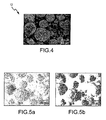
- the sodium/molybdenum composite metal powder 12 comprises a plurality of generally spherically-shaped particles that are themselves agglomerations of smaller particles. Accordingly, the composite metal powder 12 may be characterized herein in the alternative as "soccer balls" formed of "BB's.” Moreover, and as is evidenced by Figures 5a and 5b , the sodium is highly dispersed within the molybdenum.
- the sodium/molybdenum composite powders of the present invention are not mere combinations of sodium metal powders and molybdenum metal powders, but rather comprise substantially homogeneous dispersions or composite mixtures of sodium and molybdenum sub-particles that are fused or agglomerated together.
- the sodium/molybdenum metal powder composite is also of high density and possesses favorable flow characteristics.
- exemplary sodium/molybdenum composite metal powders 12 produced in accordance with the teachings provided herein may have Scott densities in a range of about 2 g/cc to about 3 g/cc. Hall flowabilities range from less than about 35s/50g to as low as 30s/50g for the various example compositions shown and described herein.
- a significant advantage of the present invention is that it provides a metallic combination of molybdenum and sodium that is otherwise difficult or impossible to achieve by conventional methods.
- the sodium/molybdenum composite metal powder comprises a powdered material, it is not a mere mixture of sodium and molybdenum particles. Instead, the sodium and molybdenum sub-particles are actually fused together, so that individual particles of the powdered metal product comprise both sodium and molybdenum. Accordingly, powdered feedstocks 24 comprising the sodium/molybdenum composite powders according to the present invention will not separate (e.g., due to specific gravity differences) into sodium particles and molybdenum particles.
- coatings or films produced from the sodium/molybdenum composite metal powders will have compositions that are similar to the compositions of the sodium/molybdenum metal powders since such deposition processes do not rely on the codeposition of separate molybdenum and sodium particles that would each have different deposition rates.
- the composite metal powders disclosed herein are also characterized by high densities and flowabilities, thereby allowing the composite metal powders to be used to advantage in a wide variety of power metallurgy processes that are now known in the art or that may be developed in the future.
- the sodium molybdenum composite metal powders may be readily used in a wide variety of thermal spray deposition apparatus and associated processes to deposit sodium/molybdenum films or coatings on various substrates.
- the powders may also be readily used in a wide variety of consolidation processes, such as cold and hot isostatic pressing processes as well as pressing and sintering processes.
- the high flowability allows the powders disclosed herein to readily fill mold cavities, whereas the high densities minimizes shrinkage that may occur during subsequent sintering.
- Sintering can be accomplished by heating in an inert atmosphere or in hydrogen to further reduce oxygen content of the compact.
- the sodium/molybdenum composite metal powders may be used to form sputter targets, which may then be used in subsequent sputter deposition processes to form sodium/molybdenum films and coatings.
- such sodium/molybdenum films may used to increase the energy conversion efficiencies of photovoltaic cells.
- sodium/molybdenum composite metal powders 12 of the present invention methods for producing them, and how they may be used to produce sodium/molybdenum coatings or films on substrates, various embodiments of the composite powders, as well as methods for producing and using the composite powders will now be described in detail.
- a method 10 for producing sodium/molybdenum composite powders 12 may comprise a supply of molybdenum metal powder 14 and a supply of a sodium compound 16.
- the molybdenum metal power 14 may comprise a molybdenum metal powder having a particle size in a range of about 0.1 ⁇ m to about 15 ⁇ m, although molybdenum metal powders 14 having other sizes may also be used.
- Molybdenum metal powders suitable for use in the present invention are commercially available from Climax Molybdenum, a Freeport-McMoRan Company, and from Climax Molybdenum Company, a Freeport-McMoRan Company, Ft. Madison Operations, Ft. Madison, Iowa (US). Alternatively, molybdenum metal powders from other sources may be used as well.
- the sodium compound 16 may comprise sodium molybdate, either in its anhydrous form (i.e., Na 2 MoO 4 ) or as the dihydrate (i.e., Na 2 MoO 4 ⁇ 2H 2 O), although other sodium-containing materials including, but not limited to elemental sodium, Na 2 O, and Na(OH), maybe used.
- Sodium molybdate is usually available in powder form and may comprise any of a wide range of sizes.
- the particle size ofthe sodium molybdate powder 16 is not particularly critical in embodiments wherein water is used as the liquid 18, because sodium molybdate is soluble in water.
- Sodium molybdate powders suitable for use in the present invention are commercially available from Climax Molybdenum, a Freeport-McMoRan Company, Ft. Madison Operations, of Ft. Madison, Iowa (US). Alternatively, sodium molybdate may be obtained from other sources.
- the molybdenum metal powder 14 and sodium molybdate 16 may be mixed with a liquid 18 to form a slurry 20.
- the liquid 18 may comprise deionized water, although other liquids, such as alcohols, volatile liquids, organic liquids, and various mixtures thereof, may also be used, as would become apparent to persons having ordinary skill in the art after having become familiar with the teachings provided herein. Consequently, the present invention should not be regarded as limited to the particular liquids 18 described herein.
- a binder 48 may be used as well, although the addition of a binder 48 is not required. Binders 48 suitable for use in the present invention include, but are not limited to, polyvinyl alcohol (PVA), Carbowax, and mixtures thereof.
- the binder 48 may be mixed with the liquid 18 before adding the molybdenum metal powder 14 and the sodium molybdate 16.
- the binder 48 could be added to the slurry 20, i.e., after the molybdenum metal 14 and sodium molybdate 16 have been combined with liquid 18.
- the slurry 20 may comprise from about 15% to about 25% by weight liquid (e.g., either liquid 18 alone, or liquid 18 combined with binder 48), with the balance comprising the molybdenum metal powder 14 and the sodium compound 16.
- the sodium compound 16 e.g., sodium molybdate
- the sodium compound 16 may be added in amounts suitable to provide the composite metal powder 12 and/or final product with the desired amount of "retained” sodium. Because the amount of retained sodium will vary depending on a wide range of factors, the present invention should not be regarded as limited to the provision of the sodium compound 16 in any particular amounts.
- Factors that may affect the amount of sodium compound 16 that is to be provided in slurry 20 include, but are not limited to, the particular product that is to be produced, the particular "downstream" processes that may be employed, e.g., depending on whether the sodium/molybdenum composite metal powder 12 is sintered, and on whether the desired quantity of retained sodium is to be in the powder feedstock (e.g., 24) or in a deposited film or coating (e.g., 32, 32', 32").
- the mixture of molybdenum metal 14 and sodium molybdate 16 may comprise from about 1 % by weight to about 15% by weight sodium molybdate 18.
- slurry 20 may comprise from about 0% by weight (i.e., no binder) to about 2% by weight binder 48.
- the balance of slurry 20 may comprise molybdenum metal powder 14 (e.g., in amounts ranging from about 58% by weight to about 84% by weight) and sodium molybdate 16 (e.g., in amounts ranging from about 1 % by weight to about 15% by weight).
- Slurry 22 may then be spray dried by any of a wide range of processes that are now known in the art or that may be developed in the future in order to produce the composite metal powder product 12, as would become apparent to persons having ordinary skill in the art after having become familiar with the teachings provided herein. Consequently, the present invention should not be regarded as limited to any particular drying process.
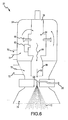
- the slurry 20 is spray dried in a pulse combustion spray dryer 22. More specifically, pulse combustion spray dryer 22 maybe ofthe type shown and described in U.S. Patent Application Publication No. US 2006/0219056, of Larink, Jr. , entitled “Metal Powders and Methods for Producing the Same," which is specifically incorporated herein by reference for all that it discloses.
- slurry 20 may be fed into pulse combustion spray dryer 22, whereupon slurry 20 impinges a stream of hot gas (or gases) 50, which are pulsed at or near sonic speeds.
- the sonic pulses of hot gas 50 contact the slurry 20 and drive-off substantially all of the water and form the composite metal powder product 12.
- the temperature of the pulsating stream of hot gas 50 may be in a range of about 300°C to about 800°C, such as about 465°C to about 537°C, and more preferably about 500°C.
- the temperature of the pulsating stream of hot gas 50 is below the melting point of the slurry constituents, but not below the melting point of elemental sodium.
- the slurry 20 is usually not in contact with the hot gases 50 long enough to transfer a significant amount of heat to the slurry 20, which is significant because of the low melting point of sodium metal.
- the slurry 20 is generally heated to a temperature in the range of about 93°C to about 121°C during contact with the pulsating stream of hot gas 50.
- the pulsating stream of hot gas 50 may be produced by a pulse combustion system 22 of the type that is well-known in the art and readily commercially available.
- the pulse combustion system 22 may comprise a pulse combustion system of the type shown and described in U.S. Patent Application Publication No. 2006/0219056 .
- combustion air 51 may be fed (e.g., pumped) through an inlet 52 into the outer shell 54 of the pulse combustion system 22 at low pressure, whereupon it flows through a unidirectional air valve 56. The air then enters a tuned combustion chamber 58 where fuel is added via fuel valves or ports 60.
- the fuel-air mixture is then ignited by a pilot 62, creating a pulsating stream of hot combustion gases 64 which may be pressurized to a variety of pressures, e.g., in a range of about 15,000 Pa (about 2.2 psi) to about 20,000 Pa (about 3 psi) above the combustion fan pressure.
- the pulsating stream ofhot combustion gases 64 rushes down tailpipe 66 toward the atomizer 68.
- quench air 70 maybe fed through an inlet 72 and maybe blended with the hot combustion gases 64 in order to attain a pulsating stream ofhot gases 50 having the desired temperature.
- the slurry 20 is introduced into the pulsating stream of hot gases 50 via the atomizer 68.
- the atomized slurry may then disperse in the conical outlet 74 and thereafter enter a conventional tall-form drying chamber (not shown). Further downstream, the composite metal powder product 12 may be recovered using standard collection equipment, such as cyclones and/or baghouses (also not shown).
- the air valve 56 is cycled open and closed to alternately let air into the combustion chamber 58 and close for the combustion thereof.
- the air valve 56 may be reopened for a subsequent pulse just after the previous combustion episode.
- the reopening then allows a subsequent air charge (e.g., combustion air 51) to enter.
- the fuel valve 60 then re-admits fuel, and the mixture auto-ignites in the combustion chamber 58, as described above.
- This cycle of opening and closing the air valve 56 and combusting the fuel in the chamber 58 in a pulsing fashion may be controllable at various frequencies, e.g., from about 80 Hz to about 110 Hz, although other frequencies may also be used.
- the "green" sodium/molybdenum composite metal powder product 12 produced by the pulse combustion spray drying process described herein is illustrated in Figures 4, 5a, and 5b , and comprises a plurality of generally spherically-shaped particles that are themselves agglomerations of smaller particles.
- the sodium is highly dispersed within the molybdenum, comprising a substantially homogeneous dispersion or composite mixture of sodium and molybdenum sub-particles that are fused together.
- Figure 5a is a spectral map produced by energy dispersive x-ray spectroscopy ("EDS”) that illustrates the presence of sodium within the sample of the composite metal material 12 that is shown in Figure 4.
- EDS energy dispersive x-ray spectroscopy
- Figure 5b is a spectral map produced by energy dispersive x-ray spectroscopy that shows the presence of molybdenum within the sample. As can be seen by comparing Figures 4 and 5a and 5b , the sodium is generally evenly and widely dispersed throughout the composite metal powder product 12.
- the composite metal powder product 12 produced in accordance with the teachings provided herein will comprise a wide range of sizes, and particles having sizes ranging from about 1 ⁇ m to about 100 ⁇ m, such as, for example, sizes ranging from about 5 ⁇ m to about 45 ⁇ m and from about 45 ⁇ m to about 90 ⁇ m, can be readily produced by the following the teachings provided herein.
- the composite metal powder product 12 may be classified e.g., at step 28 ( Figure 2 ), if desired, to provide a product 12 having a more narrow size range.
- Sieve analyses of various exemplary composite metal powder products 12 are provided in Figure 7 , which is a plot of the particle size distributions (by U.S. Tyler mesh) of the "green" composite metal powder product 12 produced by slurry compositions comprising 3, 7, 9, and 15% by weight sodium molybdate 18.
- the sodium/molybdenum composite metal powder 12 is also of high density and is generally quite flowable.
- Exemplary composite metal powder products 12 have Scott densities (i.e., apparent densities) in a range of about 2 g/cc to about 3 g/cc, as identified in the various Examples set forth herein. Hall flowabilities range from about 35s/50g to as low as 30s/50g, again as identified in the various Examples set forth herein.
- One example composition i.e., Example 12
- the pulse combustion system 22 provides a pulsating stream of hot gases 50 into which is fed the slurry 20.
- the contact zone and contact time are very short, the time of contact often being on the order of a fraction of a microsecond.
- the physical interactions of hot gas 50, sonic waves, and slurry 20 produces the composite metal powder product 12.
- the liquid component 18 of slurry 20 is substantially removed or driven away by the sonic (or near sonic) pulse waves of hot gas 50.
- the short contact time also ensures that the slurry components are minimally heated, e.g., to levels on the order of about 93 °C to about 121 °C at the end of the contact time, temperatures which are sufficient to evaporate the liquid component 18.
- residual amounts ofliquid may remain in the resulting "green" composite metal powder product 12.
- Any remaining liquid 18 may be driven-off (e.g., partially or entirely), by a subsequent sintering or heating step 26. See Figure 2 .
- the heating or sintering process 26 is conducted at a moderate temperatures in order to drive off the liquid components and oxygen, but not substantial quantities of sodium. Some sodium may be lost during heating 26, which will reduce the amount of retained sodium in the sintered or feedstock product 24. It is also generally preferred, but not required, to conduct the heating 26 in a hydrogen atmosphere in order to minimize oxidation of the composite metal powder 12.
- Retained oxygen is low, less than about 6%, and generally less than about 2%, as indicated in the Examples provided below.
- Heating 26 may be conducted at temperatures within a range of about 500°C to about 825 °C. Alternatively, temperatures as high as 1050°C maybe used for short periods of time. However, such higher temperatures will usually reduce the amount of retained sodium in the final product.
- the agglomerations of the metal powder product preferably retain their shapes (in many cases, though not necessarily, substantially spherical), even after the heating step 26.
- Flowability data (Hall data) in heated and/or green forms are also generally very good (e.g., in a range of about 30-35 s/50g), as described relative to the Examples provided herein.
- a variety of sizes of agglomerated products may be produced during the drying process, and it may be desirable to further separate or classify the composite metal powder product 12 into a metal powder product having a size range within a desired product size range.
- most of the composite metal powder material produced will comprise particle sizes in a wide range (e.g., from about 1 ⁇ m to about 150 ⁇ m), with a substantial amount of product being in the range of about 5 ⁇ m to about 45 ⁇ m (i.e., -325 U.S. Tyler mesh) and again in the range of about 45 ⁇ m to 90 ⁇ m (i.e., -170+325 U.S. Tyler mesh). See Figure 7 .
- a process hereof may yield a substantial percentage of product in this product size range; however, there may be remainder products, particularly the smaller products, outside the desired product size range which may be recycled through the system, though liquid (e.g., water) would again have to be added to create an appropriate slurry composition. Such recycling is an optional alternative (or additional) step or steps.
- the composite metal powder 12 may be used in its as-recovered or "green” form as a feedstock 24 for a variety of processes and applications, several of which are shown and described herein, and others of which will become apparent to persons having ordinary skill in the art after having become familiar with the teachings provided herein.
- the "green" composite metal powder product 12 may be further processed, such as, for example, by heating or sintering 26, by classification 28, and/or combinations thereof, before being used as feedstock 24.
- the sodium/molybdenum composite metal powder 12 may be used in various apparatus and processes to deposit sodium/molybdenum films on substrates.
- such sodium/molybdenum films can be used to advantage in the fabrication of photovoltaic cells.
- the energy conversion efficiency of a CIGS photovoltaic cell can be increased if sodium is allowed to diffuse into the molybdenum layer typically used to form an ohmic contact of the photovoltaic cell.
- efficiency gains are automatically realized in CIGS structures wherein the molybdenum ohmic contact is deposited on a soda-glass substrate.
- they are not realized in structures wherein soda-glass is not used as a substrate.
- a photovoltaic cell 36 may comprise a substrate 34 on which a sodium/molybdenum film 32, 32', 32" may be deposited.
- the substrate 34 may comprise any of a wide range of substrates such as, for example, stainless steel, flexible poly films, or other substrate materials now known in the art or that may be developed in the future that are, or would be, suitable for such devices.
- a sodium/molybdenum film 32, 32', 32" may then be deposited on the substrate 34 by any of a wide range of processes now known in the art or that may be developed in the future, but utilizing in some form the sodium/molybdenum composite metal powder material 12.
- the sodium/molybdenum film may be deposited by thermal spray deposition, by printing, by evaporation, or by sputtering.
- an absorber layer 76 may be deposited on the sodium/molybdenum film.
- the absorber layer 76 may comprise one or more selected from the group consisting of copper, indium, and selenium.
- the absorber layer 76 may be deposited by any of a wide range of methods known in the art or that may be developed in the future that are, or would be, suitable for the intended application. Consequently, the present invention should not be regarded as limited to any particular deposition process.
- junction partner layer 78 may be deposited on the absorber layer 76.
- Junction partner layer 78 may comprise one or more selected from the group consisting of cadmium sulfide and zinc sulfide.
- a transparent conductive oxide layer 80 may be deposited on junction partner layer 78 to form the photovoltaic cell 36.
- Junction partner layer 78 and transparent conductive oxide layer 80 may be deposited by any of a wide range processes and methods now known in the art or that may be developed in the future that are, or would be, suitable for depositing these materials. Consequently, the present invention should not be regarded as limited to any particular deposition process.
- the sodium/molybdenum layer or film 32, 32', 32" may be deposited by any of a wide range of processes. Generally speaking, it is believed that sodium concentrations of about 1% by weight will be sufficient to provide the desired efficiency enhancements. Accordingly, the retained sodium present in the feedstock material 24 maybe adjusted or varied as necessary in order to provide the desired level of sodium in the resulting sodium/molybdenum film 32. Generally speaking, retained sodium levels ranging from about 0.2% by weight to about 3.5% by weight in the feedstock material 24 will be sufficient to provide the desired degree of sodium enrichment in the sodium/molybdenum film 32.
- such retained sodium levels may be achieved in "green” and sintered (i.e., heated) feedstock material 24 produced by slurries 20 containing from about 3 wt.% to about 15 wt.% sodium molybdate.
- a sodium/molybdenum film 32 may be deposited by a thermal spray process 30 utilizing the feedstock material 24.
- Thermal spray process 30 may be accomplished by using any of a wide variety of thermal spray guns and operated in accordance with any of a wide range of parameters in order to deposit on substrate 34 a sodium/molybdenum film 32 having the desired thickness and properties.
- thermal spray processes are well known in the art and because persons having ordinary skill in the art would be capable of utilizing such processes after having become familiar with the teachings provided herein, the particular thermal spray process 30 that may be utilized will not be described in further detail herein.
- a sodium/molybdenum film 32' maybe deposited on substrate 34 by a printing process 38 utilizing the feedstock material 24.
- Feedstock material 24 may be mixed with a suitable vehicle (not shown) to form an "ink” or "paint” that may then be deposited on substrate 34 by any of a wide range of printing processes.
- a suitable vehicle not shown
- printing processes are well known in the art and could be readily implemented by persons having ordinary skill in the art after having become familiar with the teachings provided herein, the particular printing process 38 that may be utilized will not be described in further detail herein.
- a sodium/molybdenum film 32" maybe deposited on substrate 34 by an evaporation process 39 utilizing the feedstock material 24.
- evaporation process 39 would involve placing the feedstock material 24 in a crucible (not shown) of a suitable evaporation apparatus (also not shown).
- the feedstock material 24 could be placed in the crucible either in the form of a loose powder, pressed pellets, or other consolidated forms, or in any combination thereof.
- the feedstock material 24 would the be heated in the crucible until it evaporates, whereupon the evaporated material would be deposited on substrate 34, forming the sodium/molybdenum film 32".
- Evaporation process 39 may utilize any of a wide range of evaporation apparatus now known in the art or that may be developed in the future that could be used to evaporate the feedstock material 24 and deposit film 32" on substrate 34. Consequently, the present invention should not be regarded as limited to use with any particular evaporation apparatus operated in accordance with any particular parameters. Moreover, because such evaporation apparatus are well known in the art and could be readily implemented by persons having ordinary skill in the art after having become familiar with the teachings provided herein, the particular evaporation apparatus that may be utilized will not be described in further detail herein.
- a sodium/molybdenum film 32"' may be deposited on substrate 34 by a sputter deposition process.
- the feedstock material 24 would be processed or formed into a sputter target 44, which would then be sputtered in order to form the film 32"'.
- Any of a wide range of sputter deposition apparatus that are now known in the art or that may be developed in the future could be used to sputter deposit film 32"' on substrate 34. Consequently, the present invention should not be regarded as limited to use with any particular sputter deposition apparatus operated in accordance with any particular parameters.
- the sputter target 44 may comprise a metal product 42 that maybe fabricated by consolidating or forming the sodium/molybdenum composite metal powder 12 at step 40.
- the sputter target 44 could be formed by thermal spraying 30.
- the feedstock material 24, in either its "green” form or processed form may be consolidated or formed in step 40 to produce the metal product (e.g., sputter target 44).
- the consolidation process 40 may comprise any of a wide range of compaction, pressing, and forming processes now known in the art or that may be developed in the future that would be suitable for the particular application. Consequently, the present invention should not be regarded as limited to any particular consolidation process.
- the consolidation process 40 may comprise any of a wide range of cold isostatic pressing processes or any of a wide range of hot isostatic pressing processes that are well-known in the art.
- cold and hot isostatic pressing processes generally involve the application of considerable pressure and heat (in the case of hot isostatic pressing) in order to consolidate or form the composite metal powder feedstock material 24 into the desired shape.
- Hot isostatic pressing processes may be conducted at temperatures of 900 °C or greater, depending on the green density of the sodium/molybdenum composite metal powder compact and the retained sodium loss that could be tolerated in the final product.
- the resulting metal product 42 (e.g., sputter target 44) may be used "as is" or may be further processed.
- the metal product 42 may be heated or sintered at step 46 in order to further increase the density of the metal product 42. It may be desirable to conduct such a heating process 46 in a hydrogen atmosphere in order to minimize the likelihood that the metal product 42 will become oxidized. Generally speaking, it will be preferred to conduct such heating at temperatures below about 825°C as higher temperatures may result in substantial reductions in the amount of retained sodium, although higher temperatures (e.g., temperatures of 1050°C or greater) could be used.
- the resulting metal product 42 may also be machined if necessary or desired before being placed in service. Such machining could be done regardless of whether the final product 42 was sintered.
- Various ratios ofthe powders 14 and 16 were combined with deionized water to form the slurries 20. More specifically, the slurries 20 utilized for the various examples comprised about 20% by weight water (i.e., liquid 18), with the remainder being molybdenum metal and sodium molybdate powders.
- the ratio of molybdenum metal powder to sodium molybdate was varied in the various examples to range from about 3% by weight to about 15% by weight sodium molybdate. More specifically, the Examples involved amounts of 3, 7, 9, and 15 weight percent sodium molybdate.
- the slurries 20 were then fed into the pulse combustion spray drying system 22 in the manner described herein.
- the temperature of the pulsating stream of hot gases 50 was controlled to be within a range of about 465 °C to about 537°C.
- the pulsating stream ofhot gases 50 produced by the pulse combustion system 22 substantially drove-off the water from the slurry 20 to form the composite metal powder product 12.
- the contact zone and contact time were very short, the contact zone on the order of about 5.1 cm and the time of contact being on the order of 0.2 microseconds.
- the resulting metal powder product 12 comprised agglomerations of smaller particles that were substantially solid (i.e., not hollow) and having generally spherical shapes.
- An SEM photo of a "green" sodium/molybdenum composite metal powder 12 produced by a slurry 20 comprising 9% by weight sodium molybdate is presented in Figure 4 .
- Data in Tables I and II are presented for the various examples in both "green” form, and after being sintered or heated in a hydrogen atmosphere at the temperatures and for the times specified. Data are also presented for screened green material (+325 mesh moly) as also indicated in Tables I and II.
Landscapes
- Chemical & Material Sciences (AREA)
- Engineering & Computer Science (AREA)
- Mechanical Engineering (AREA)
- Metallurgy (AREA)
- Chemical Kinetics & Catalysis (AREA)
- Materials Engineering (AREA)
- Organic Chemistry (AREA)
- Manufacturing & Machinery (AREA)
- Physics & Mathematics (AREA)
- Plasma & Fusion (AREA)
- Powder Metallurgy (AREA)
- Manufacture Of Metal Powder And Suspensions Thereof (AREA)
- Life Sciences & Earth Sciences (AREA)
- Sustainable Development (AREA)
- Sustainable Energy (AREA)
Applications Claiming Priority (2)
| Application Number | Priority Date | Filing Date | Title |
|---|---|---|---|
| US12/013,263 US20090181179A1 (en) | 2008-01-11 | 2008-01-11 | Sodium/Molybdenum Composite Metal Powders, Products Thereof, and Methods for Producing Photovoltaic Cells |
| PCT/US2009/030561 WO2009089421A1 (en) | 2008-01-11 | 2009-01-09 | Sodium/molybdenum composite metal powders, products thereof, and methods for producing photovoltaic cells |
Publications (3)
| Publication Number | Publication Date |
|---|---|
| EP2232565A1 EP2232565A1 (en) | 2010-09-29 |
| EP2232565A4 EP2232565A4 (en) | 2012-07-25 |
| EP2232565B1 true EP2232565B1 (en) | 2014-03-12 |
Family
ID=40850871
Family Applications (1)
| Application Number | Title | Priority Date | Filing Date |
|---|---|---|---|
| EP20090700939 Not-in-force EP2232565B1 (en) | 2008-01-11 | 2009-01-09 | Sodium/molybdenum composite metal powders, products thereof, and methods for producing photovoltaic cells |
Country Status (8)
| Country | Link |
|---|---|
| US (3) | US20090181179A1 (enExample) |
| EP (1) | EP2232565B1 (enExample) |
| JP (1) | JP5574978B2 (enExample) |
| KR (1) | KR101533133B1 (enExample) |
| CN (1) | CN101919062B (enExample) |
| MY (1) | MY157342A (enExample) |
| TW (1) | TWI405723B (enExample) |
| WO (1) | WO2009089421A1 (enExample) |
Families Citing this family (18)
| Publication number | Priority date | Publication date | Assignee | Title |
|---|---|---|---|---|
| US8197885B2 (en) * | 2008-01-11 | 2012-06-12 | Climax Engineered Materials, Llc | Methods for producing sodium/molybdenum power compacts |
| EP2591133A2 (en) * | 2010-07-09 | 2013-05-15 | Climax Engineered Materials, LLC | Potassium / molybdenum composite metal powders, powder blends, products thereof, and methods for producing photovoltaic cells |
| WO2012069995A2 (en) * | 2010-11-23 | 2012-05-31 | Somont Gmbh | Methods and apparatus for applying a connection agent to atleast a connector for connection atleast a solar cell |
| US9150958B1 (en) | 2011-01-26 | 2015-10-06 | Apollo Precision Fujian Limited | Apparatus and method of forming a sputtering target |
| JP5766966B2 (ja) * | 2011-01-31 | 2015-08-19 | 新日鐵住金株式会社 | Na含有Moターゲット及びその製造方法 |
| US8632745B1 (en) | 2012-12-21 | 2014-01-21 | Ut-Battelle, Llc | Method and apparatus for controlling stoichiometry in multicomponent materials |
| CN103045925B (zh) * | 2013-01-29 | 2015-01-28 | 洛阳高新四丰电子材料有限公司 | 一种钼钠合金旋转溅射管形靶材的制备工艺 |
| CN103160791B (zh) * | 2013-03-26 | 2015-04-22 | 无锡舒玛天科新能源技术有限公司 | 一种钠掺杂钼平面溅射靶材的制备方法 |
| CN103196933A (zh) * | 2013-03-27 | 2013-07-10 | 金堆城钼业股份有限公司 | 钼化合物/钼合金粉末掺杂元素分布微观均匀性检测方法 |
| CN103898345B (zh) * | 2014-04-29 | 2016-04-06 | 金堆城钼业股份有限公司 | 一种钼钠合金材料的制备方法 |
| CN104117685B (zh) * | 2014-07-30 | 2016-08-24 | 金堆城钼业股份有限公司 | 一种钼酸钠掺杂钼粉的制备方法 |
| CN108603295A (zh) | 2016-01-29 | 2018-09-28 | 惠普发展公司,有限责任合伙企业 | 金属连接的粒子制品 |
| KR101632381B1 (ko) * | 2016-02-12 | 2016-07-08 | 주식회사 엔이피 | 철계금속과립분말을 이용한 철계금속부품 제조방법 |
| CN107452818A (zh) * | 2017-08-16 | 2017-12-08 | 蚌埠兴科玻璃有限公司 | 一种铜铟镓硒薄膜太阳能电池背电极及其制备方法 |
| CN111836719B (zh) * | 2018-02-09 | 2023-06-09 | 惠普发展公司,有限责任合伙企业 | 三维打印系统 |
| CN110904374B (zh) * | 2019-12-17 | 2021-08-10 | 株洲硬质合金集团有限公司 | 一种钠掺杂钼合金材料的制备方法 |
| CN116875946A (zh) * | 2023-07-27 | 2023-10-13 | 洛阳汇晶新材料科技有限公司 | 一种钼钠合金靶材制备工艺 |
| CN118808654B (zh) * | 2024-09-18 | 2025-02-28 | 洛阳科威钨钼有限公司 | 一种高镀膜性能钼钠合金靶材的制备方法 |
Family Cites Families (30)
| Publication number | Priority date | Publication date | Assignee | Title |
|---|---|---|---|---|
| US3071463A (en) * | 1960-05-17 | 1963-01-01 | Sylvania Electric Prod | Method of producing sintered metal bodies |
| US3617358A (en) * | 1967-09-29 | 1971-11-02 | Metco Inc | Flame spray powder and process |
| US4146388A (en) * | 1977-12-08 | 1979-03-27 | Gte Sylvania Incorporated | Molybdenum plasma spray powder, process for producing said powder, and coatings made therefrom |
| US4376055A (en) * | 1979-09-12 | 1983-03-08 | Elco Corporation | Process for making highly sulfurized oxymolybdenum organo compounds |
| JPS6066425A (ja) * | 1983-09-22 | 1985-04-16 | Nippon Telegr & Teleph Corp <Ntt> | Lsi電極用の高純度モリブデンタ−ゲツトならびに高純度モリブデンシリサイドタ−ゲツトおよびその製造方法 |
| DE3441851A1 (de) * | 1984-11-15 | 1986-06-05 | Murex Ltd., Rainham, Essex | Molybdaenlegierung |
| US4714468A (en) * | 1985-08-13 | 1987-12-22 | Pfizer Hospital Products Group Inc. | Prosthesis formed from dispersion strengthened cobalt-chromium-molybdenum alloy produced by gas atomization |
| DE3837782A1 (de) * | 1988-11-08 | 1990-05-10 | Starck Hermann C Fa | Sauerstoffhaltiges molybdaenmetallpulver sowie verfahren zu dessen herstellung |
| US5063021A (en) * | 1990-05-23 | 1991-11-05 | Gte Products Corporation | Method for preparing powders of nickel alloy and molybdenum for thermal spray coatings |
| US5346678A (en) * | 1992-09-25 | 1994-09-13 | The United States Of America As Represented By The United States Department Of Energy | Production of high specific activity silicon-32 |
| US5523048A (en) * | 1994-07-29 | 1996-06-04 | Alliant Techsystems Inc. | Method for producing high density refractory metal warhead liners from single phase materials |
| SE9402672D0 (sv) * | 1994-08-10 | 1994-08-10 | Hoeganaes Ab | Chromium containing materials having high tensile strength |
| DE4442824C1 (de) * | 1994-12-01 | 1996-01-25 | Siemens Ag | Solarzelle mit Chalkopyrit-Absorberschicht |
| US6022395A (en) * | 1998-03-24 | 2000-02-08 | Osram Sylvania Inc. | Method for increasing tap density of molybdenum powder |
| JPH11274534A (ja) * | 1998-03-25 | 1999-10-08 | Yazaki Corp | I−iii−vi族系化合物半導体及びこれを用いた薄膜太陽電池 |
| US6102979A (en) * | 1998-08-28 | 2000-08-15 | The United States Of America As Represented By The United States Department Of Energy | Oxide strengthened molybdenum-rhenium alloy |
| FR2816641B1 (fr) * | 2000-11-13 | 2003-08-01 | Dacral Sa | UTILISATION DE MoO3, COMME AGENT ANTICORROSION, ET COMPOSITION DE REVETEMENT CONTENANT UN TEL AGENT |
| JP3857547B2 (ja) * | 2001-07-09 | 2006-12-13 | 独立行政法人科学技術振興機構 | 噴霧熱分解法による微粒子の製造方法 |
| US6593213B2 (en) * | 2001-09-20 | 2003-07-15 | Heliovolt Corporation | Synthesis of layers, coatings or films using electrostatic fields |
| US6793907B1 (en) * | 2002-07-29 | 2004-09-21 | Osram Sylvania Inc. | Ammonium dodecamolybdomolybdate and method of making |
| JP2005146406A (ja) * | 2003-10-23 | 2005-06-09 | Zenhachi Okumi | 微粒子の製造方法及びそのための装置 |
| JP4228223B2 (ja) * | 2004-04-27 | 2009-02-25 | 日本新金属株式会社 | スパッタリング用高純度金属Mo焼結ターゲットの製造に原料粉末として用いるのに適した高純度金属Mo粗粒粉末 |
| US20060062926A1 (en) * | 2004-05-17 | 2006-03-23 | Richardson H W | Use of sub-micron copper salt particles in wood preservation |
| US20050254987A1 (en) * | 2004-05-17 | 2005-11-17 | Lhoucine Azzi | Binder for powder metallurgical compositions |
| US20060042728A1 (en) * | 2004-08-31 | 2006-03-02 | Brad Lemon | Molybdenum sputtering targets |
| US7524353B2 (en) * | 2004-10-21 | 2009-04-28 | Climax Engineered Materials, Llc | Densified molybdenum metal powder and method for producing same |
| US7276102B2 (en) * | 2004-10-21 | 2007-10-02 | Climax Engineered Materials, Llc | Molybdenum metal powder and production thereof |
| US7470307B2 (en) * | 2005-03-29 | 2008-12-30 | Climax Engineered Materials, Llc | Metal powders and methods for producing the same |
| US20070295390A1 (en) * | 2006-05-05 | 2007-12-27 | Nanosolar, Inc. | Individually encapsulated solar cells and solar cell strings having a substantially inorganic protective layer |
| US20080057203A1 (en) * | 2006-06-12 | 2008-03-06 | Robinson Matthew R | Solid group iiia particles formed via quenching |
-
2008
- 2008-01-11 US US12/013,263 patent/US20090181179A1/en not_active Abandoned
-
2009
- 2009-01-09 KR KR1020107017378A patent/KR101533133B1/ko not_active Expired - Fee Related
- 2009-01-09 MY MYPI2010003217A patent/MY157342A/en unknown
- 2009-01-09 JP JP2010542366A patent/JP5574978B2/ja not_active Expired - Fee Related
- 2009-01-09 WO PCT/US2009/030561 patent/WO2009089421A1/en not_active Ceased
- 2009-01-09 EP EP20090700939 patent/EP2232565B1/en not_active Not-in-force
- 2009-01-09 CN CN200980102060.1A patent/CN101919062B/zh not_active Expired - Fee Related
- 2009-01-10 TW TW98100845A patent/TWI405723B/zh not_active IP Right Cessation
-
2011
- 2011-03-02 US US13/038,578 patent/US8465692B2/en not_active Expired - Fee Related
-
2014
- 2014-08-01 US US14/449,514 patent/US20140342497A1/en not_active Abandoned
Also Published As
| Publication number | Publication date |
|---|---|
| US20110147208A1 (en) | 2011-06-23 |
| CN101919062A (zh) | 2010-12-15 |
| CN101919062B (zh) | 2014-02-19 |
| TWI405723B (zh) | 2013-08-21 |
| EP2232565A1 (en) | 2010-09-29 |
| WO2009089421A1 (en) | 2009-07-16 |
| KR20100129268A (ko) | 2010-12-08 |
| US8465692B2 (en) | 2013-06-18 |
| EP2232565A4 (en) | 2012-07-25 |
| MY157342A (en) | 2016-05-31 |
| HK1151389A1 (zh) | 2012-01-27 |
| US20140342497A1 (en) | 2014-11-20 |
| US20090181179A1 (en) | 2009-07-16 |
| JP5574978B2 (ja) | 2014-08-20 |
| TW200942492A (en) | 2009-10-16 |
| KR101533133B1 (ko) | 2015-07-01 |
| JP2011511886A (ja) | 2011-04-14 |
Similar Documents
| Publication | Publication Date | Title |
|---|---|---|
| EP2232565B1 (en) | Sodium/molybdenum composite metal powders, products thereof, and methods for producing photovoltaic cells | |
| US8197885B2 (en) | Methods for producing sodium/molybdenum power compacts | |
| US20120006676A1 (en) | Potassium/molybdenum composite metal powders, powder blends, products thereof, and methods for producing photovoltaic cells | |
| EP2589571A1 (en) | Powder, sintered body and sputtering target, each containing elements cu, in, ga and se, and method for producing the powder | |
| DE112011100332B4 (de) | Oxidverdampfungsmaterial, dessen verwendung und solarzelle | |
| CN101245443B (zh) | 靶材以及该靶材所制造的薄膜 | |
| HK1151389B (en) | Sodium/molybdenum composite metal powders, products thereof, and methods for producing photovoltaic cells | |
| HK1164785B (en) | Sodium/molybdenum powder compacts and methods for producing the same |
Legal Events
| Date | Code | Title | Description |
|---|---|---|---|
| PUAI | Public reference made under article 153(3) epc to a published international application that has entered the european phase |
Free format text: ORIGINAL CODE: 0009012 |
|
| 17P | Request for examination filed |
Effective date: 20100708 |
|
| AK | Designated contracting states |
Kind code of ref document: A1 Designated state(s): AT BE BG CH CY CZ DE DK EE ES FI FR GB GR HR HU IE IS IT LI LT LU LV MC MK MT NL NO PL PT RO SE SI SK TR |
|
| AX | Request for extension of the european patent |
Extension state: AL BA RS |
|
| DAX | Request for extension of the european patent (deleted) | ||
| A4 | Supplementary search report drawn up and despatched |
Effective date: 20120625 |
|
| RIC1 | Information provided on ipc code assigned before grant |
Ipc: H01L 31/00 20060101AFI20120619BHEP |
|
| GRAP | Despatch of communication of intention to grant a patent |
Free format text: ORIGINAL CODE: EPIDOSNIGR1 |
|
| INTG | Intention to grant announced |
Effective date: 20131029 |
|
| GRAS | Grant fee paid |
Free format text: ORIGINAL CODE: EPIDOSNIGR3 |
|
| GRAA | (expected) grant |
Free format text: ORIGINAL CODE: 0009210 |
|
| AK | Designated contracting states |
Kind code of ref document: B1 Designated state(s): AT BE BG CH CY CZ DE DK EE ES FI FR GB GR HR HU IE IS IT LI LT LU LV MC MK MT NL NO PL PT RO SE SI SK TR |
|
| REG | Reference to a national code |
Ref country code: GB Ref legal event code: FG4D |
|
| REG | Reference to a national code |
Ref country code: CH Ref legal event code: EP |
|
| REG | Reference to a national code |
Ref country code: AT Ref legal event code: REF Ref document number: 656797 Country of ref document: AT Kind code of ref document: T Effective date: 20140315 |
|
| REG | Reference to a national code |
Ref country code: IE Ref legal event code: FG4D |
|
| REG | Reference to a national code |
Ref country code: DE Ref legal event code: R096 Ref document number: 602009022379 Country of ref document: DE Effective date: 20140424 |
|
| REG | Reference to a national code |
Ref country code: NL Ref legal event code: VDEP Effective date: 20140312 |
|
| PG25 | Lapsed in a contracting state [announced via postgrant information from national office to epo] |
Ref country code: LT Free format text: LAPSE BECAUSE OF FAILURE TO SUBMIT A TRANSLATION OF THE DESCRIPTION OR TO PAY THE FEE WITHIN THE PRESCRIBED TIME-LIMIT Effective date: 20140312 Ref country code: NO Free format text: LAPSE BECAUSE OF FAILURE TO SUBMIT A TRANSLATION OF THE DESCRIPTION OR TO PAY THE FEE WITHIN THE PRESCRIBED TIME-LIMIT Effective date: 20140612 |
|
| REG | Reference to a national code |
Ref country code: AT Ref legal event code: MK05 Ref document number: 656797 Country of ref document: AT Kind code of ref document: T Effective date: 20140312 |
|
| REG | Reference to a national code |
Ref country code: LT Ref legal event code: MG4D |
|
| PG25 | Lapsed in a contracting state [announced via postgrant information from national office to epo] |
Ref country code: CY Free format text: LAPSE BECAUSE OF FAILURE TO SUBMIT A TRANSLATION OF THE DESCRIPTION OR TO PAY THE FEE WITHIN THE PRESCRIBED TIME-LIMIT Effective date: 20140312 Ref country code: SE Free format text: LAPSE BECAUSE OF FAILURE TO SUBMIT A TRANSLATION OF THE DESCRIPTION OR TO PAY THE FEE WITHIN THE PRESCRIBED TIME-LIMIT Effective date: 20140312 Ref country code: FI Free format text: LAPSE BECAUSE OF FAILURE TO SUBMIT A TRANSLATION OF THE DESCRIPTION OR TO PAY THE FEE WITHIN THE PRESCRIBED TIME-LIMIT Effective date: 20140312 |
|
| PG25 | Lapsed in a contracting state [announced via postgrant information from national office to epo] |
Ref country code: HR Free format text: LAPSE BECAUSE OF FAILURE TO SUBMIT A TRANSLATION OF THE DESCRIPTION OR TO PAY THE FEE WITHIN THE PRESCRIBED TIME-LIMIT Effective date: 20140312 Ref country code: LV Free format text: LAPSE BECAUSE OF FAILURE TO SUBMIT A TRANSLATION OF THE DESCRIPTION OR TO PAY THE FEE WITHIN THE PRESCRIBED TIME-LIMIT Effective date: 20140312 |
|
| PG25 | Lapsed in a contracting state [announced via postgrant information from national office to epo] |
Ref country code: BE Free format text: LAPSE BECAUSE OF FAILURE TO SUBMIT A TRANSLATION OF THE DESCRIPTION OR TO PAY THE FEE WITHIN THE PRESCRIBED TIME-LIMIT Effective date: 20140312 Ref country code: IS Free format text: LAPSE BECAUSE OF FAILURE TO SUBMIT A TRANSLATION OF THE DESCRIPTION OR TO PAY THE FEE WITHIN THE PRESCRIBED TIME-LIMIT Effective date: 20140712 Ref country code: BG Free format text: LAPSE BECAUSE OF FAILURE TO SUBMIT A TRANSLATION OF THE DESCRIPTION OR TO PAY THE FEE WITHIN THE PRESCRIBED TIME-LIMIT Effective date: 20140612 Ref country code: RO Free format text: LAPSE BECAUSE OF FAILURE TO SUBMIT A TRANSLATION OF THE DESCRIPTION OR TO PAY THE FEE WITHIN THE PRESCRIBED TIME-LIMIT Effective date: 20140312 Ref country code: EE Free format text: LAPSE BECAUSE OF FAILURE TO SUBMIT A TRANSLATION OF THE DESCRIPTION OR TO PAY THE FEE WITHIN THE PRESCRIBED TIME-LIMIT Effective date: 20140312 Ref country code: CZ Free format text: LAPSE BECAUSE OF FAILURE TO SUBMIT A TRANSLATION OF THE DESCRIPTION OR TO PAY THE FEE WITHIN THE PRESCRIBED TIME-LIMIT Effective date: 20140312 Ref country code: NL Free format text: LAPSE BECAUSE OF FAILURE TO SUBMIT A TRANSLATION OF THE DESCRIPTION OR TO PAY THE FEE WITHIN THE PRESCRIBED TIME-LIMIT Effective date: 20140312 |
|
| PG25 | Lapsed in a contracting state [announced via postgrant information from national office to epo] |
Ref country code: ES Free format text: LAPSE BECAUSE OF FAILURE TO SUBMIT A TRANSLATION OF THE DESCRIPTION OR TO PAY THE FEE WITHIN THE PRESCRIBED TIME-LIMIT Effective date: 20140312 Ref country code: AT Free format text: LAPSE BECAUSE OF FAILURE TO SUBMIT A TRANSLATION OF THE DESCRIPTION OR TO PAY THE FEE WITHIN THE PRESCRIBED TIME-LIMIT Effective date: 20140312 Ref country code: SK Free format text: LAPSE BECAUSE OF FAILURE TO SUBMIT A TRANSLATION OF THE DESCRIPTION OR TO PAY THE FEE WITHIN THE PRESCRIBED TIME-LIMIT Effective date: 20140312 Ref country code: PL Free format text: LAPSE BECAUSE OF FAILURE TO SUBMIT A TRANSLATION OF THE DESCRIPTION OR TO PAY THE FEE WITHIN THE PRESCRIBED TIME-LIMIT Effective date: 20140312 |
|
| REG | Reference to a national code |
Ref country code: DE Ref legal event code: R097 Ref document number: 602009022379 Country of ref document: DE |
|
| PG25 | Lapsed in a contracting state [announced via postgrant information from national office to epo] |
Ref country code: PT Free format text: LAPSE BECAUSE OF FAILURE TO SUBMIT A TRANSLATION OF THE DESCRIPTION OR TO PAY THE FEE WITHIN THE PRESCRIBED TIME-LIMIT Effective date: 20140714 |
|
| PLBE | No opposition filed within time limit |
Free format text: ORIGINAL CODE: 0009261 |
|
| STAA | Information on the status of an ep patent application or granted ep patent |
Free format text: STATUS: NO OPPOSITION FILED WITHIN TIME LIMIT |
|
| PG25 | Lapsed in a contracting state [announced via postgrant information from national office to epo] |
Ref country code: DK Free format text: LAPSE BECAUSE OF FAILURE TO SUBMIT A TRANSLATION OF THE DESCRIPTION OR TO PAY THE FEE WITHIN THE PRESCRIBED TIME-LIMIT Effective date: 20140312 |
|
| 26N | No opposition filed |
Effective date: 20141215 |
|
| REG | Reference to a national code |
Ref country code: DE Ref legal event code: R097 Ref document number: 602009022379 Country of ref document: DE Effective date: 20141215 |
|
| PG25 | Lapsed in a contracting state [announced via postgrant information from national office to epo] |
Ref country code: IT Free format text: LAPSE BECAUSE OF FAILURE TO SUBMIT A TRANSLATION OF THE DESCRIPTION OR TO PAY THE FEE WITHIN THE PRESCRIBED TIME-LIMIT Effective date: 20140312 |
|
| PG25 | Lapsed in a contracting state [announced via postgrant information from national office to epo] |
Ref country code: SI Free format text: LAPSE BECAUSE OF FAILURE TO SUBMIT A TRANSLATION OF THE DESCRIPTION OR TO PAY THE FEE WITHIN THE PRESCRIBED TIME-LIMIT Effective date: 20140312 |
|
| REG | Reference to a national code |
Ref country code: CH Ref legal event code: PL |
|
| PG25 | Lapsed in a contracting state [announced via postgrant information from national office to epo] |
Ref country code: LU Free format text: LAPSE BECAUSE OF FAILURE TO SUBMIT A TRANSLATION OF THE DESCRIPTION OR TO PAY THE FEE WITHIN THE PRESCRIBED TIME-LIMIT Effective date: 20150109 |
|
| PG25 | Lapsed in a contracting state [announced via postgrant information from national office to epo] |
Ref country code: MC Free format text: LAPSE BECAUSE OF FAILURE TO SUBMIT A TRANSLATION OF THE DESCRIPTION OR TO PAY THE FEE WITHIN THE PRESCRIBED TIME-LIMIT Effective date: 20140312 |
|
| PG25 | Lapsed in a contracting state [announced via postgrant information from national office to epo] |
Ref country code: LI Free format text: LAPSE BECAUSE OF NON-PAYMENT OF DUE FEES Effective date: 20150131 Ref country code: CH Free format text: LAPSE BECAUSE OF NON-PAYMENT OF DUE FEES Effective date: 20150131 |
|
| REG | Reference to a national code |
Ref country code: IE Ref legal event code: MM4A |
|
| REG | Reference to a national code |
Ref country code: FR Ref legal event code: PLFP Year of fee payment: 8 |
|
| PG25 | Lapsed in a contracting state [announced via postgrant information from national office to epo] |
Ref country code: IE Free format text: LAPSE BECAUSE OF NON-PAYMENT OF DUE FEES Effective date: 20150109 |
|
| PGFP | Annual fee paid to national office [announced via postgrant information from national office to epo] |
Ref country code: DE Payment date: 20160127 Year of fee payment: 8 |
|
| PGFP | Annual fee paid to national office [announced via postgrant information from national office to epo] |
Ref country code: GB Payment date: 20160127 Year of fee payment: 8 Ref country code: FR Payment date: 20160126 Year of fee payment: 8 |
|
| PG25 | Lapsed in a contracting state [announced via postgrant information from national office to epo] |
Ref country code: GR Free format text: LAPSE BECAUSE OF FAILURE TO SUBMIT A TRANSLATION OF THE DESCRIPTION OR TO PAY THE FEE WITHIN THE PRESCRIBED TIME-LIMIT Effective date: 20140613 |
|
| PG25 | Lapsed in a contracting state [announced via postgrant information from national office to epo] |
Ref country code: MT Free format text: LAPSE BECAUSE OF FAILURE TO SUBMIT A TRANSLATION OF THE DESCRIPTION OR TO PAY THE FEE WITHIN THE PRESCRIBED TIME-LIMIT Effective date: 20140312 |
|
| PG25 | Lapsed in a contracting state [announced via postgrant information from national office to epo] |
Ref country code: HU Free format text: LAPSE BECAUSE OF FAILURE TO SUBMIT A TRANSLATION OF THE DESCRIPTION OR TO PAY THE FEE WITHIN THE PRESCRIBED TIME-LIMIT; INVALID AB INITIO Effective date: 20090109 |
|
| REG | Reference to a national code |
Ref country code: DE Ref legal event code: R119 Ref document number: 602009022379 Country of ref document: DE |
|
| PG25 | Lapsed in a contracting state [announced via postgrant information from national office to epo] |
Ref country code: TR Free format text: LAPSE BECAUSE OF FAILURE TO SUBMIT A TRANSLATION OF THE DESCRIPTION OR TO PAY THE FEE WITHIN THE PRESCRIBED TIME-LIMIT Effective date: 20140312 |
|
| GBPC | Gb: european patent ceased through non-payment of renewal fee |
Effective date: 20170109 |
|
| REG | Reference to a national code |
Ref country code: FR Ref legal event code: ST Effective date: 20170929 |
|
| PG25 | Lapsed in a contracting state [announced via postgrant information from national office to epo] |
Ref country code: FR Free format text: LAPSE BECAUSE OF NON-PAYMENT OF DUE FEES Effective date: 20170131 |
|
| PG25 | Lapsed in a contracting state [announced via postgrant information from national office to epo] |
Ref country code: DE Free format text: LAPSE BECAUSE OF NON-PAYMENT OF DUE FEES Effective date: 20170801 Ref country code: GB Free format text: LAPSE BECAUSE OF NON-PAYMENT OF DUE FEES Effective date: 20170109 |
|
| PG25 | Lapsed in a contracting state [announced via postgrant information from national office to epo] |
Ref country code: MK Free format text: LAPSE BECAUSE OF FAILURE TO SUBMIT A TRANSLATION OF THE DESCRIPTION OR TO PAY THE FEE WITHIN THE PRESCRIBED TIME-LIMIT Effective date: 20140312 |