EP2226381B1 - Verfahren zur kultivierung von zellen zur produktion von substanzen - Google Patents
Verfahren zur kultivierung von zellen zur produktion von substanzen Download PDFInfo
- Publication number
- EP2226381B1 EP2226381B1 EP10152393.4A EP10152393A EP2226381B1 EP 2226381 B1 EP2226381 B1 EP 2226381B1 EP 10152393 A EP10152393 A EP 10152393A EP 2226381 B1 EP2226381 B1 EP 2226381B1
- Authority
- EP
- European Patent Office
- Prior art keywords
- glucose
- dgl
- qglc
- cells
- limitation
- Prior art date
- Legal status (The legal status is an assumption and is not a legal conclusion. Google has not performed a legal analysis and makes no representation as to the accuracy of the status listed.)
- Expired - Lifetime
Links
Images




Classifications
-
- C—CHEMISTRY; METALLURGY
- C12—BIOCHEMISTRY; BEER; SPIRITS; WINE; VINEGAR; MICROBIOLOGY; ENZYMOLOGY; MUTATION OR GENETIC ENGINEERING
- C12N—MICROORGANISMS OR ENZYMES; COMPOSITIONS THEREOF; PROPAGATING, PRESERVING, OR MAINTAINING MICROORGANISMS; MUTATION OR GENETIC ENGINEERING; CULTURE MEDIA
- C12N5/00—Undifferentiated human, animal or plant cells, e.g. cell lines; Tissues; Cultivation or maintenance thereof; Culture media therefor
- C12N5/0018—Culture media for cell or tissue culture
-
- C—CHEMISTRY; METALLURGY
- C07—ORGANIC CHEMISTRY
- C07K—PEPTIDES
- C07K14/00—Peptides having more than 20 amino acids; Gastrins; Somatostatins; Melanotropins; Derivatives thereof
- C07K14/435—Peptides having more than 20 amino acids; Gastrins; Somatostatins; Melanotropins; Derivatives thereof from animals; from humans
- C07K14/705—Receptors; Cell surface antigens; Cell surface determinants
- C07K14/70596—Molecules with a "CD"-designation not provided for elsewhere
-
- C—CHEMISTRY; METALLURGY
- C12—BIOCHEMISTRY; BEER; SPIRITS; WINE; VINEGAR; MICROBIOLOGY; ENZYMOLOGY; MUTATION OR GENETIC ENGINEERING
- C12P—FERMENTATION OR ENZYME-USING PROCESSES TO SYNTHESISE A DESIRED CHEMICAL COMPOUND OR COMPOSITION OR TO SEPARATE OPTICAL ISOMERS FROM A RACEMIC MIXTURE
- C12P21/00—Preparation of peptides or proteins
- C12P21/02—Preparation of peptides or proteins having a known sequence of two or more amino acids, e.g. glutathione
-
- C—CHEMISTRY; METALLURGY
- C07—ORGANIC CHEMISTRY
- C07K—PEPTIDES
- C07K2319/00—Fusion polypeptide
-
- C—CHEMISTRY; METALLURGY
- C07—ORGANIC CHEMISTRY
- C07K—PEPTIDES
- C07K2319/00—Fusion polypeptide
- C07K2319/30—Non-immunoglobulin-derived peptide or protein having an immunoglobulin constant or Fc region, or a fragment thereof, attached thereto
-
- C—CHEMISTRY; METALLURGY
- C12—BIOCHEMISTRY; BEER; SPIRITS; WINE; VINEGAR; MICROBIOLOGY; ENZYMOLOGY; MUTATION OR GENETIC ENGINEERING
- C12N—MICROORGANISMS OR ENZYMES; COMPOSITIONS THEREOF; PROPAGATING, PRESERVING, OR MAINTAINING MICROORGANISMS; MUTATION OR GENETIC ENGINEERING; CULTURE MEDIA
- C12N2500/00—Specific components of cell culture medium
- C12N2500/30—Organic components
- C12N2500/34—Sugars
Definitions
- the invention relates to a method for the cultivation of cells for the production of immunoglobulins or fragments of immunoglobulins according to the preamble of claim 1.
- cell cultures are used in fermentative processes. It can be distinguished processes in which the cell cultures are genetically unchanged and form their own metabolites and in which the organisms are genetically modified so that they either own substances, such as proteins, propagates or foreign substances produce, for example, proteins.
- the organisms producing the substances are supplied with a nutrient medium which guarantees the survival of the organisms and enables the production of the desired target compound.
- a variety of culture media are known that allow fermentation.
- One of the most important components of the culture media is glucose.
- efforts are regularly made in a fermentation approach to maintain a minimum concentration of glucose in order to optimize the yield of the target compound.
- the Japanese Patent Application 001 101 882 A discloses a culture method for mammalian cells in which a minimum concentration of 0.2 mmol / L of glucose is maintained.
- the US 544 39 68 discloses one Cultivation method, in which a glucose limitation takes place. However, the method does not result in a higher specific production rate of the cells over the non-limiting feeding.
- the WO 98/41611 discloses a three-step method for cultivating mammalian cells under glucose limitation, which involves a batch phase for the reduction of the glucose concentration, followed by a fed-batch phase, in which the glucose limitation leads to a conversion of the cell metabolism ("metabolic shift"). ) and finally a phase of continuous litigation.
- the degree of glucose limitation is defined in the document by the ratio of lactate produced to glucose consumed ( ⁇ 1).
- the method should be particularly simple to carry out, with minimal measurement and control effort, and be particularly economical.
- the object is surprisingly achieved in that the cultivation of an immunoglobulin or a fragment of an immunoglobulin-producing cell line is carried out under supply of a nutrient medium in such a way that adjusts a glucose limitation in the culture solution.
- the degree of glucose limitation can be defined as the ratio of the observed specific glucose consumption rate to the maximum specific glucose consumption rate known for these cells.
- DGL lies within the boundaries between DGL conservation and 1, with DGL conservation complete growth limitation means and 1 means no limitation or complete glucose excess.
- the degree of glucose limitation converges to a minimum value
- the DGL is greater than or equal to the DGL, which leads to the maintenance of the cell, (maintenance metabolism)
- the growth medium must be such that glucose is limited at first.
- the space / time yield is increased at a given cell density.
- the amount of glucose available per cell is reduced in such a way that the glucose predominantly enters the maintenance metabolism and thus the product and less cell growth.
- glucose costs are saved because less glucose is needed.
- a very high product concentration is achieved. This can lead to a reduction of the processing costs.
- the process according to the invention makes it possible to increase the production of immunoglobulins or fragments of immunoglobulins, without a cell line additionally having to be genetically modified for the implementation of the process according to the invention.
- Increasing the product titer allows the production of a desired amount of immunoglobulins or fragments of immunoglobulins in a smaller culture volume, resulting in lower investment costs.
- the process according to the invention is started either as a batch and as a continuous process, or it consists of a batch and a fed-batch process, wherein the process is started as a batch and continued as a fed-batch process.
- the cells should preferably be in a continuous procedure with cell retention, z. B. spin filter (perfusion culture) are cultivated. All common types of culture vessels, such as stirred tanks, and cell retention mechanisms, such as spin filters, ultrasound or settler are suitable.
- the culture system should enable high cell densities.
- a cell retention is realized, so that the cell density can not fall when glucose limitation occurs. This leads to a further reduction in the DGL as the viable cell density increases and the glucose feed remains constant.
- the high cell density allows the DGL to drop below a value of 0.4 at a set flow rate on the order of the maximum growth rate. For example, flow rates of 0.03 - 0.05 h -1 can be used for the CHO MUC2-GFP-C-term cell used and the CHO / MUC1-IgG2a PH3744 / 25 cell used.
- the feeding strategy with glucose can therefore be as follows:
- the amount of glucose added is not increased with increasing living cell density in order to avoid glucose limitation.
- the amount of glucose fed in should be such that the DGL falls below the required values, namely DGL less ⁇ 0.5, preferably ⁇ 0.4, particularly preferably ⁇ 0.3.
- the amount of glucose fed in is preferably not greater than 50%, more preferably not greater than 35% of that which the maximum living cell count to be expected in the system in conventional, non-glucose-limited process control can maximize.
- the amount of glucose fed in can be slowly increased, but should not allow for a DGL greater than 0.5, preferably greater than 0.4.
- the amount of added glucose can be affected in a continuous process by the media inflow rate and the glucose concentration in the feed medium.
- the decisive factor is that the mass flow of added glucose during the process is not increased or only to such an extent that the DGL reaches or falls below a value of less than 0.5, preferably less than 0.4 and this is then no longer exceeded.
- the figures show exemplary test results.
- Table 1 shows the experimental data from the application of the method according to the invention with the CHO MUC1 / IgG2a PH 3744/25 cell.
- Table 2 shows the experimental data from the use of the method according to the invention with the CHO MUC2-GFP-C-terminal cell.
- the procedure according to the invention can be carried out with different production cell lines.
- the cell lines can be used as wild type or as genetically modified, recombinant cells.
- the genetic modification can be carried out, for example, by insertion of additional genes of the same organism or another organism into the DNA, or a vector, or in the enhancement of the activity or expression of a gene by introducing a more effective promoter, for example from CMV.
- the genes can code for different proteins, for example for proteins, such as fusion proteins or for antibodies.
- cell lines may be exemplified: mammalian cells such as CHO cell lines such as CHO-K1, BHK such as BHK-21, hybridomas, NS / 0, other myeloma cells and insect cells or other higher cells. Particularly preferred is the use of cells that do not preferentially produce growth coupled.
- a recombinant CHO cell line whose productivity can be increased with the procedure according to the invention is the cell line CHO MUC1 / IgG2a, PH 3744/25, with which the glycoprotein MUC1-IgG2a can be secreted.
- Another CHO cell line, CHO MUC2-GFP-C-term is capable of secreted secretion of a MUC2-GFP-C-term fusion protein when subjected to the procedure of this invention.
- any glucose-containing medium can be used in principle, which is not limiting with respect to other components.
- ProCHO4-CDM can be mentioned.
- media based on known formulations such as, for example, IMDM, DMEM or Ham's F12, which have been optimized for the procedure according to the invention such that only glucose limitation occurs. This can be achieved, for example, by making other components more concentrated relative to glucose.
- the pH range is preferably between 6.7 and 7.7, more preferably between 7 and 7.3. However, other pH ranges are also conceivable.
- the temperature range is preferably between 35 ° C - 38.5 ° C, more preferably 37 ° C for CHO MUC1-IgG2a. But there are also other temperature ranges conceivable, such as ⁇ 35 ° C, in which there is no irreversible destruction of the product.
- substances such as glycoproteins, fusion proteins, antibodies, proteins can generally be produced, examples of which are MUC1-IgG2a, MUC2-GFP-C-term, EPO, interferons, cytokines, growth factors, hormones, PA, immunoglobulins or fragments of immunoglobulins.
- FIG. 1 shows a procedure example of the glucose feed.
- a constant amount of glucose is added.
- this is achieved by a constant media flow rate, the glucose concentration in the media feed being constant.
- the media flow rate is not increased with increasing living cell density. The process was started as a batch before the continuous procedure began.
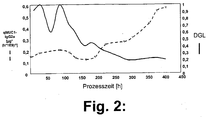
- FIG. 2 shows that in this procedure the DGL decreases in the course of the process, and finally a value below 0.4 achieved. While this happens, the specific productivity increases and finally reaches a value that is four times higher than that before falling below the DGL value of 0.4.
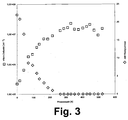
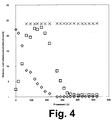
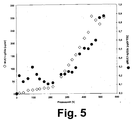
- FIG. 3 It can be seen that in the method according to the invention the living cell density runs against a maximum value, which can then be held while the residual glucose concentration goes to zero in the course. This occurs even though glucose is being supplied. As the residual glucose concentration falls, the specific glucose uptake rate of organisms begins to decline. During this time, the viable cell count can still increase. In addition to the decrease in the specific glucose uptake rate, the specific lactate formation rate also decreases, which initially leads to a slower increase, then to a decrease in the lactate concentration in the culture vessel. Finally, the lactate concentration in the culture vessel approaches zero, as is FIG. 4 can be seen. So there is a significant change in cell metabolism. As FIG.
- Table 1 shows data on the fermentation of MUC1-IgG2a.
- FIGS. 6 to 10 Analogous to the FIGS. 1 to 5 describe FIGS. 6 to 10 the results of the application of the method according to the invention with CHO MUC2-GFP-C-term cells.
- Table 2 shows data on the fermentation of MUC2-GFP-C-term.
- the process according to the invention can also be operated as a fed-batch (feeding process), in addition to the perfusion process just described.
- the production culture is supplied once or recurrently, batchwise or continuously with glucose-containing medium or a separate glucose solution in a manner such that the DGL preferably has the value of 0.5, more preferably 0.4 and even better 0.3 below. Possible here is also a repetitive fed-batch.
Landscapes
- Life Sciences & Earth Sciences (AREA)
- Health & Medical Sciences (AREA)
- Chemical & Material Sciences (AREA)
- Organic Chemistry (AREA)
- Engineering & Computer Science (AREA)
- Zoology (AREA)
- Biotechnology (AREA)
- Wood Science & Technology (AREA)
- Genetics & Genomics (AREA)
- Bioinformatics & Cheminformatics (AREA)
- Biomedical Technology (AREA)
- General Health & Medical Sciences (AREA)
- Biochemistry (AREA)
- Microbiology (AREA)
- General Engineering & Computer Science (AREA)
- Molecular Biology (AREA)
- Proteomics, Peptides & Aminoacids (AREA)
- Cell Biology (AREA)
- Chemical Kinetics & Catalysis (AREA)
- General Chemical & Material Sciences (AREA)
- Gastroenterology & Hepatology (AREA)
- Medicinal Chemistry (AREA)
- Biophysics (AREA)
- Toxicology (AREA)
- Immunology (AREA)
- Micro-Organisms Or Cultivation Processes Thereof (AREA)
- Preparation Of Compounds By Using Micro-Organisms (AREA)
Description
- Die Erfindung betrifft ein Verfahren zur Kultivierung von Zellen zur Produktion von Immunglobulinen oder Fragmenten von Immunglobulinen nach dem Oberbegriff des Anspruchs 1.
- Bei der Produktion von Substanzen, insbesondere Proteinen, werden Zellkulturen in fermentativen Prozessen eingesetzt. Es können dabei Prozesse unterschieden werden, bei denen die Zellkulturen genetisch unverändert sind und eigene Stoffwechselprodukte bilden und bei denen die Organismen genetisch so modifiziert sind, daß sie entweder eigene Substanzen, beispielsweise Proteine, vermehrt, oder fremde Substanzen beispielsweise Proteine produzieren. Die die Substanzen produzierenden Organismen werden dabei mit einem Nährmedium versorgt, welches das Überleben der Organismen garantiert und die Produktion der gewünschten Zielverbindung ermöglicht. Für diese Zwecke sind eine Vielzahl von Kulturmedien bekannt, die eine Fermentation ermöglichen. Einer der wichtigsten Bestandteile der Kulturmedien ist die Glukose. Nach dem Stand der Technik ist man regelmäßig bemüht in einem Fermentationsansatz eine Mindestkonzentration an Glukose aufrecht zu erhalten, um die Ausbeute an Zielverbindung zu optimieren. Die
japanische Patentanmeldung 001 101 882 A US 544 39 68 offenbart ein Kultivierungsverfahren, bei dem eine Glukoselimitierung erfolgt. Das Verfahren führt jedoch nicht zu einer höheren spezifischen Produktionsrate der Zellen gegenüber der nicht limitierenden Fütterung. - Die
WO 98/41611 - Es ist die Aufgabe der Erfindung ein Verfahren zur Kultivierung von Zellen zu schaffen, mit dem die Produktivität einer einzelnen Zelle an Produkt gesteigert wird und bei dem hohe Zelldichten ermöglicht werden. Es soll eine hohe Raum-/Zeit-Ausbeute an Produkt ermöglicht werden.
- Das Verfahren soll besonders einfach in der Durchführung, mit minimalem Meß- und Regelaufwand verbunden, und besonders wirtschaftlich sein.
- Ausgehend vom Oberbegriff des Anspruchs 1 wird die Aufgabe überraschenderweise dadurch gelöst, daß die Kultivierung einer Immunglobulin oder eines Fragmentes eines Immunglobulins produzierende Zellinie unter Zufuhr eines Nährmediums in der Weise erfolgt, daß sich in der Kulturlösung eine Glukoselimitierung einstellt. Der Grad der Glukoselimitierung kann definiert werden, als das Verhältnis der beobachteten spezifischen Glukoseverbrauchsrate zur maximal für diese Zellen bekannten spezifischen Glukoseverbrauchsrate. Der Grad der Glukoselimitierung DGL = qGlc/qGlcmax (qGlc = momentane beobachtete, spezifische Glukoseverbrauchsrate; qGlcmax = maximal für diese Zellen bekannten spezifischen Glukoseverbrauchsrate). DGL liegt in den Grenzen zwischen DGLErhaltung und 1, wobei DGLErhaltung völlige Wachstumslimitierung bedeutet und 1 bedeutet keinerlei Limitierung bzw. völliger Glukoseüberschuß.
- Zusammen mit der Glukoselimitierung erfolgt ein kontinuierlicher Rückgang der Restglukosekonzentration auf eine stationäre Konzentration in der Kulturlösung, die größer 0 mmol/l, jedoch kleiner als 1 mmol/l, bevorzugt kleiner als 0,5 mmol/l ist. Es ist zu beobachten, daß mit Sinken des DGL ein weiterer Anstieg der Lebendzelldichte im Kulturgefäß erfolgen kann. Mit zunehmender Glukoselimitierung konvergiert die Zelldichte dann gegen einen Maximalwert. Daraus resultiert, daß der Grad der Glukoselimitierung gegen einen minimalen Wert konvergiert, dabei ist der DGL erfindungsgemäß größer oder gleich dem DGL, welcher zur Erhaltung der Zelle führt, (maintenance Stoffwechsel) DGLErhaltung = qGlCErhaltung/qGlCmax (qGlcErhaltung = bei reinem Erhaltungsstoffwechsel beobachtete spezifische Glukoseverbrauchsrate; qGlcmax = maximal für diese Zellen bekannte spezifische Glukoseverbrauchsrate), und kleiner 0,5, vorzugsweise kleiner 0,4, besonders bevorzugt kleiner 0,3.
- Charakteristisch ist jedoch, daß mit der Abnahme der Glukosekonzentration keine Abnahme der Zellkonzentration in der Lösung erfolgt. Mit zunehmender Glukoselimitierung, also bei sinkendem DGL-Wert, erhöht sich die spezifische Produktivität einer Zelle. Da die Lebendzelldichte im Kulturgefäß nicht absinkt, führt dies zu einer Erhöhung der Raum-Zeit Ausbeute. Mit Eintreten der Glukoselimitierung geht phänomenologisch eine Erniedrigung der spezifischen Laktatbildungsrate einher. Die Laktatbildungsrate konvergiert gegen einen Minimalwert. Dies führt dazu, dass die Restlaktatkonzentration im Kulturgefäß absinkt, maximal gegen 0 geht. Mit der Glukoselimitierung kommt es also zu einer Umstellung des Zellmetabolismus.
- Wichtig ist dabei, daß es vor Einsetzen der Glukoselimitierung zu keiner weiteren Limitierung durch andere Substrate kommt. Daher muß das Wachstumsmedium so beschaffen sein, daß Glukose zuerst limitiert ist.
- Mit dem erfindungsgemäßen Verfahren wird die Raum-/ZeitAusbeute bei gegebener Zelldichte erhöht. Durch das erfindungsgemäße Verfahren wird die pro Zelle zur Verfügung stehende Menge an Glukose derart vermindert, daß die Glukose überwiegend in den Erhaltungsstoffwechsel und verbunden damit das Produkt und weniger in Zellwachstum eingeht. Dadurch, daß ein geringer Medienzufluss nötig ist, werden Kosten für Glukose gespart, da weniger Glukose benötigt wird. Zudem wird eine sehr hohe Produktkonzentration erreicht. Dies kann zur Senkung der Aufarbeitungskosten führen. Das erfindungsgemäße Verfahren ermöglicht insbesondere die Steigerung der Produktion von Immunglobulinen oder Fragmenten von Immunglobulinen, ohne daß eine Zellinie für die Umsetzung des erfindungsgemäßen Verfahrens zusätzlich genetisch verändert werden muss. Die Erhöhung des Produkttiters ermöglicht die Produktion einer gewünschten Menge an Immunglobulinen oder Fragmenten von Immunglobulinen in einem kleineren Kultivierungsvolumen, was zu geringeren Investitionskosten führt.
- Das erfindungsgemäße Verfahren wird entweder als Batch gestartet und als kontinuierlicher Prozess fortgeführt, oder es besteht aus einer Batch und einer Fed-Batch Verfahrensweise, wobei das Verfahren als Batch gestartet und als Fed-Batch Prozess fortgeführt wird.
- Die Zellen sollen vorzugsweise in kontinuierlicher Verfahrensweise mit Zellrückhaltung, z. B. Spinfilter (Perfusionskultur) kultiviert werden. Dabei sind alle gängigen Arten von Kulturgefäßen, wie zum Beispiel Rührkessel, und Zellrückhaltemechanismen, wie beispielsweise Spinfilter, Ultraschall oder Settler geeignet. Vorzugsweise sollte das Kultursystem hohe Zelldichten ermöglichen. Vorzugsweise wird eine Zellrückhaltung realisiert, damit die Zelldichte bei Auftreten der Glukoselimitierung nicht absinken kann. Dies führt dazu, dass bei steigender Lebendzelldichte und gleichbleibender Glukosezufütterung, der DGL weiter verringert wird. Die hohe Zelldichte ermöglicht ein Absinken des DGL unter einen Wert von 0,4 bei einer eingestellten Durchflussrate in einer Größenordnung der maximalen Wachstumsrate. So können beispielhaft Durchflussraten von 0,03 - 0,05 h-1 für die verwendete CHO MUC2-GFP-C-term Zelle, sowie die verwendete CHO/MUC1-IgG2a PH3744/25 Zelle angewendet werden.
- Um eine Verringerung des DGL zu erreichen, kann die Fütterungsstrategie mit Glukose demnach wie folgt erfolgen: Die Menge an zugefütterter Glukose wird nicht mit zunehmender Lebendzelldichte erhöht, um eine Glukoselimitierung zu vermeiden. Dabei sollte die Menge an zugefütterter Glukose so gewählt sein, dass der DGL die erforderlichen Werte unterschreitet, nämlich DGL kleiner ≤ 0,5, vorzugsweise ≤ 0,4, besonders bevorzugt ≤ 0,3. Daraus resultiert, daß die Menge zugefütterter Glukose vorzugsweise nicht grösser als 50 %, besonders bevorzugt nicht grösser als 35 % dessen ist, was die im System bei herkömmlicher, nicht glukoselimitierter Prozeßführung zu erwartende Lebendzellzahl maximal verbrauchen kann. Nach Umstellung des Zellmetabolismus (Laktatstoffwechel und Produktivität) kann die Menge zugefütterter Glukose langsam erhöht werden, sollte dabei jedoch nicht einen DGL von größer als 0,5, vorzugsweise größer als 0,4 ermöglichen. Dies führt zu einer weiteren Erhöhung der Lebendzelldichte bei gleichbleibend hoher Produktivität und damit erhöhter Raum-/Zeit-Ausbeute. Die Menge zugeführter Glukose kann in einem kontinuierlichen Prozeß durch die Medienzuflußrate und die Glukosekonzentration im Zufütterungsmedium beeinflußt werden. Maßgeblich ist, dass der Massenfluss an zugeführter Glukose während des Prozesses nicht oder nur in solchem Maße erhöht wird, daß der DGL einen Wert von kleiner 0,5, vorzugsweise kleiner 0,4 erreicht oder unterschreitet und dieser dann nicht mehr überschritten wird.
- Vorteilhafte Weiterbildungen der Erfindung sind in den Unteransprüchen angegeben.
- Im Folgenden soll die Erfindung in ihren Einzelheiten dargestellt werden.
- Die Figuren zeigen beispielhafte Versuchsergebnisse.
- Es zeigt:
- Fig.1:
- Zunahme der vitalen Zellzahl [ml-1] und Darstellung der Mediendurchflußrate [h-1] gegen die Prozesszeit [h] für die Produktion von MUC1-IgG2a aus CHO MUCl/IgG2a PH3744/25 Zellen im Perfusionsreaktor.
- Fig.2:
- Spezifische Produktivität an MUC1-IgG2a [µg/(h*E9 Zellen)] und DGL gegen die Prozesszeit im Perfusionsreaktor.
- Fig.3:
- Zunahme der vitalen Zellzahl [ml-1] und mM Restglukose, aufgetragen gegen die Prozesszeit [h] für die Produktion von MUC1-IgG2a aus CHO MUC1/IgG2a PH3744/25 Zellen im Perfusionsreaktor.
- Fig.4:
- Glukose- und Laktatkonzentration sowie Konzentration von Glukose im Medienzulauf [mmol/l], aufgetragen gegen die Prozesszeit [h] für die Produktion von MUC1-IgG2a aus CHO MUC1/IgG2a PH3744/25 Zellen im Perfusionsreaktor.
- Fig.5:
- Zunahme der Konzentration an MUC1-IgG2a [µg/ml] und qMUC1-IgG2a [µg/(h*E9 Zellen)] gegen die Zeit [h] für die Produktion von MUC1-IgG2a aus CHO MUC1/IgG2a PH3744/25 Zellen im Perfusionsreaktor.
- Fig.6:
- Zunahme der vitalen Zellzahl [ml-1] und Darstellung der Mediendurchflußrate [h-1] gegen die Prozesszeit [h] für die Produktion von MUC2-GFP-C-term aus CHO MUC2-GFP-C-term Zellen im Perfusionsreaktor.
- Fig.7:
- Spezifische Produktivität an MUC2-GFP-C-term [nmol/(h*E9 Zellen)] und DGL gegen die Prozesszeit im Perfusionsreaktor.
- Fig.8:
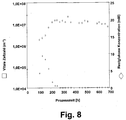
- Zunahme der vitalen Zellzahl [ml-1] und Restglukose [mM], aufgetragen gegen die Prozesszeit [h] für die Produktion von MUC2-GFP-C-term aus CHO MUC2-GFP-C-term Zellen im Perfusionsreaktor.
- Fig.9:
- Glukose- und Laktatkonzentration sowie Konzentration von Glukose im Medienzulauf [mmol/l], aufgetragen gegen die Prozesszeit [h] für die Produktion von MUC2-GFP-C-term aus CHO MUC2-GFP-C-term Zellen im Perfusionsreaktor.
- Fig.10:
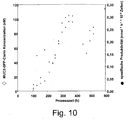
- Zunahme der Konzentration an MUC2-GFP-C-term [nM] und qMUC2-GFP-C-term [nmol/(h*E9 Zellen)] gegen die Zeit [h] für die Produktion von MUC2-GFP-C-term aus CHO MUC2-GFP-C-term Zellen im Perfusionsreaktor.
- Weiterhin zeigt Tabelle 1 die Versuchsdaten aus der Anwendung des erfindungsgemäßen Verfahrens mit der CHO MUC1/IgG2a PH 3744/25 Zelle.
- In Tabelle 2 sind die Versuchsdaten aus der Anwendung des erfindungsgemäßen Verfahrens mit der CHO MUC2-GFP-C-term Zelle dargestellt.
- Die erfindungsgemäße Verfahrensweise kann mit verschiedenen Produktionszellinien durchgeführt werden. Die Zellinien können als Wildtyp oder als genetisch modifizierte, rekombinante Zellen eingesetzt werden. Die genetische Modifikation kann beispielsweise durch Insertion von zusätzlichen Genen des gleichen Organismus oder eines anderen Organismus in die DNA, oder einen Vektor erfolgen, oder in der Verstärkung der Aktivität bzw. Expression eines Gens durch Einbringen eines wirksameren Promotors, zum Beispiel aus CMV. Die Gene können für verschiedene Proteine kodieren, beispielsweise für Proteine, wie Fusionsproteine oder für Antikörper.
- Folgende Zellinien können beispielhaft genannt werden: Säugerzellen, wie CHO Zellinien, wie zum Beispiel CHO-K1, BHK, wie BHK-21, Hybridoma, NS/0, andere Myelomazellen und Insektenzellen oder andere höhere Zellen. Besonders bevorzugt ist die Verwendung von Zellen, die nicht vorzugsweise wachstumsgekoppelt produzieren.
- Eine rekombinante CHO Zellinie deren Produktivität mit der erfindungsgemäßen Verfahrensweise gesteigert werden kann ist die Zellinie CHO MUC1/IgG2a, PH 3744/25, mit der das Glykoprotein MUC1-IgG2a sekretiert werden kann. Eine weitere CHO Zellinie, nämlich CHO MUC2-GFP-C-term, ist befähigt ein Fusionsprotein MUC2-GFP-C-term gesteigert zu sekretieren, wenn sie der erfindungsgemäßen Verfahrensweise unterzogen wird.
- Als Kulturmedium kann prinzipiell jedes glukosehaltige Medium eingesetzt werden, welches bezüglich anderer Komponenten nicht limitierend ist. Beispielhaft kann ProCHO4-CDM genannt werden. Es können auch Medien basierend auf bekannten Rezepturen, wie zum Beispiel IMDM, DMEM oder Ham's F12 eingesetzt werden, die so auf die erfindungsgemäße Verfahrensweise optimiert wurden, daß lediglich Glukoselimitierung auftritt. Dies kann zum Beispiel dadurch erreicht werden, dass andere Komponenten im Verhältnis zur Glukose höher konzentriert werden. Generell ist es auch möglich die Glukose separat vom Medium zu zu dosieren.
- Der pH Bereich liegt vorzugsweise zwischen 6,7 - 7,7, besonders bevorzugt zwischen 7 - 7,3. Jedoch sind auch andere pH-Bereiche denkbar.
- Der Temperaturbereich liegt vorzugsweise zwischen 35 °C - 38,5 °C, besonders bevorzugt bei 37 °C für CHO MUC1-IgG2a. Es sind aber auch andere Temperaturbereiche denkbar, wie beispielsweise < 35 °C, bei denen es nicht zur irreversiblen Zerstörung des Produkts kommt.
- Mit dem erfindungsgemäßen Kultivierungsverfahren können Substanzen, wie Glykoproteine, Fusionsproteine, Antikörper, Proteine im Allgemeinen produziert werden, von denen beispielhaft MUC1-IgG2a, MUC2-GFP-C-term, EPO, Interferone, Cytokine, Wachstumsfaktoren, Hormone, PA, Immunglobuline oder Fragmente von Immunglobulinen, genannt werden können.
-
Figur 1 zeigt den Verlauf der Lebendzelldichte (cv) an CHO/MUC1-IgG2a Zellen und der Mediendurchflußrate (D) gegen die Prozesszeit (h) im Perfusionsreaktor. In ihr ist: - ▪ Die Mediendurchflußrate (1/h) und
- • die Lebendzelldichte (1/ml).
-
Figur 2 zeigt die spezifische Produktivität an MUC1-IgG2a (qMUC1-IgG2a) und DGL gegen die Prozesszeit im Perfusionsreaktor. In ihr ist: - Die spezifische Produktivität (µg/hE9 Zellen),
- - DGL (degree of glucose limitation).
-
Figur 3 zeigt eine Graphik, in der auf der linken Seite die vitale Zellzahl [ml-1] und auf der rechten Seite die Konzentration der Restglukose [mM] gegen die Prozesszeit [h] für die Produktion von MUC1-IgG2 in CHO MUC1/IgG2a PH3744/25 aufgetragen ist. In ihr ist: - □ vitale Zellzahl und
- 0 Glukose.
- In
Figur 4 ist die Glukose- und Laktatkonzentration sowie die Glukosekonzentration im Medienzulauf [mmol/l] gegen die Prozesszeit [h] aufgetragen. In ihr sind die Kurven mit - □ Laktatkonzentrationskurven und
- 0 Glukosekonzentrationskurven.
- In
Figur 5 ist die Konzentration von MUC1-IgG2a [µg/ml] auf der linken Seite sowie qMUC1-IgG2a [µg/(h*E9 Zellen)] auf der rechten Seite der Graphik gegen die Zeit [h] aufgetragen. In ihr sind: - • q spezifische Produktivität an MUC1-IgG2a (µg/hE9 Zellen) und
- 0 Konzentration an MUC1-IgG2a (mg/l).
-
Figur 6 zeigt den Verlauf der Lebendzelldichte (cv) an CHO/MUC2-GFP Zellen und der Mediendurchflußrate (D) gegen die Prozesszeit (h) im Perfusionsreaktor. In ihr ist: - ▪ Die Mediendurchflußrate (1/h) und
- • die Lebendzelldichte (1/ml).
-
Figur 7 zeigt die spezifische Produktivität an MUC2-GFP-C-term (qMUC2-GFP-C-term) und DGL gegen die Prozeßzeit im Perfusionsreaktor. In ihr ist: - Die spezifische Produktivität (nmol/hE9 Zellen),
- - DGL (degree of glucose limitation).
-
Figur 8 zeigt eine Graphik, in der auf der linken Seite die vitale Zellzahl [ml-1] und auf der rechten Seite die Konzentration der Restglukose [mM] gegen die Prozesszeit [h] für die Produktion von MUC2-GFP-C-term in CHO MUC/IgG2a PH3744/25 aufgetragen ist. In ihr ist: - □ vitale Zellzahl und
- 0 Glukose.
- In
Figur 9 ist die Glukose- und Laktatkonzentration sowie die Glukosekonzentration im Medienzulauf [mmol/l] gegen die Prozesszeit [h] aufgetragen. In ihr sind die Kurven mit - □ Laktatkonzentrationskurven und
- 0 Glukosekonzentrationskurven.
- In
Figur 10 ist die Konzentration von MUC2-GFP-C-term [nM] auf der linken Seite sowie qMUC2-GFP-C-term [nmol/(h*E9 Zellen)] auf der rechten Seite der Graphik gegen die Zeit [h] aufgetragen. In ihr sind: - • q spezifische Produktivität an MUC2-GFP-C-term (nmol/hE9 Zellen) und
- ◊ Konzentration an MUC2-GFP-C-term (nM).
-
Figur 1 zeigt eine Verfahrensweise beispielhaft betreffend die Glukosezufütterung. In kontinuierlicher Perfusionskultur wird eine konstante Menge Glukose zugefüttert. Im gezeigten Beispiel wird dies durch eine konstante Mediendurchflußrate erreicht, wobei die Glukosekonzentration im Medienzulauf konstant ist. Die Mediendurchflußrate wird nicht mit zunehmender Lebendzelldichte erhöht. Der Prozess wurde als Batch begonnen, bevor die kontinuierliche Verfahrensweise begann. -
Figur 2 zeigt, daß bei dieser Verfahrensweise der DGL im Verlaufe des Prozesses sinkt, und schließlich einen Wert unter 0,4 erreicht. Während dies geschieht, steigt die spezifische Produktivität an und erreicht schließlich einen Wert der um das 4-fache höher ist, als der vor Unterschreiten des DGL-Wertes von 0,4. - Aus
Figur 3 wird ersichtlich, dass bei dem erfindungsgemäßen Verfahren die Lebendzelldichte gegen einen Maximalwert läuft, der dann gehalten werden kann, während die Restglukosekonzentration im Verlauf gegen null geht. Dies tritt ein, obwohl Glukose zugeführt wird. Während des Absinkens der Restglukosekonzentration, beginnt die spezifische Glukoseaufnahmerate der Organismen zu sinken. Während dessen kann die Lebendzellzahl noch ansteigen. Parallel zum Rückgang der spezifischen Glukoseaufnahmerate sinkt auch die spezifische Laktatbildungsrate, was zunächst zu einem verlangsamten Anstieg, dann zu einem Abfall der Laktatkonzentration im Kulturgefäß führt. Schließlich läuft die Laktatkonzentration im Kulturgefäß gegen null, wie ausFigur 4 zu entnehmen ist. Es liegt also eine deutliche Umstellung des Zellmetabolismus vor. WieFigur 5 zu entnehmen ist, findet verbunden mit der Umstellung des Zellmetabolismus ein Anstieg der spezifischen Produktivität auf etwa das 4-fache gegenüber dem Zeitpunkt vor der Umstellung des Zellmetabolismus statt. Der Anstieg der spezifischen Produktivität bei mindestens gleichbleibenden, oder sogar noch ansteigenden Zelldichten während der beschriebenen Phase führt schließlich zu einem markanten Anstieg des Produkttiters im Kulturüberstand, wieFigur 5 zu entnehmen ist, und damit zu einer erhöhten Raum-/Zeit-Ausbeute. - Tabelle 1 zeigt Daten zur Fermentation von MUC1-IgG2a.
- Analog zu den
Figuren 1 bis 5 beschreibenFiguren 6 bis 10 die Ergebnisse der Anwendung des erfindungsgemäßen Verfahrens mit CHO MUC2-GFP-C-term Zellen. - Tabelle 2 zeigt Daten zur Fermentation von MUC2-GFP-C-term. Produktionstechnisch kann das erfindungsgemäße Verfahren außer nach dem eben beschriebenen Perfusionsverfahren auch als Fed-Batch (Zufütterungsverfahren) betrieben werden.
- In einem Fed-Batch-Betrieb wird die Produktionskultur einmal oder wiederkehrend, bzw. chargenweise oder kontinuierlich mit glukosehaltigem Medium oder einer separaten Glukoselösung in einer Art und Weise versorgt, daß der DGL vorzugsweise den Wert von 0,5, besonders bevorzugt 0,4 und noch besser 0,3 unterschreitet. Möglich ist hier auch ein repetitiver Fed-Batch.
- Sowohl in der perfusiven Verfahrensweise als auch im Fed-Batch wird der Prozeß als Batch begonnen.
Tabelle 1: Prozesszeit CV D Glukose Feed Glukose Laktat MUC1-IgG2a qMUC1-IgG2a DGL h 1/ml 1/h mmol/l mmol/l mmol/l µg/ml µg/(h*E9) 0 2,23E+05 0 0 22,07 2,5 2,62 16,63 2,83E+05 0 0 20,89 5,1 3,59 0,21 0,92 40,52 6,48E+05 0 0 16,75 10,84 5,77 0,14 0,99 68 1,78E+06 0 0 8,74 20,1 14,21 0,17 0,61 94 2,14E+06 0,035 23,89 8,08 19,48 15,49 0,30 1,00 120 3,70E+06 0,035 23,89 5,84 22,35 18,02 0,22 0,72 136,5 4,68E+06 0,035 23,89 4,30 22,02 19,95 0,17 0,62 163,5 7,02E+06 0,035 23,89 3,17 22,66 22,67 0,14 0,40 187,5 6,96E+06 0,035 23,89 1,79 20,77 22,44 0,11 0,44 215,5 8,85E+06 0,035 23,89 1,04 17,46 28,24 0,13 0,35 264,75 1,30E+07 0,035 23,89 - 8,45 67,03 0,22 0,24 287 1,54E+07 0,035 23,89 - 5,25 89,42 0,22 0,20 310 1,64E+07 0,035 23,89 - 2,77 113,28 0,25 0,19 331 2,27E+07 0,035 23,89 - 1,24 133,80 0,24 0,14 352,4 1,45E+07 0,035 23,89 - 0,82 152,87 0,29 0,21 376,3 1,42E+07 0,035 23,89 - 0,53 182,52 0,45 0,22 404,4 1,58E+07 0,035 23,89 - 0,44 218,51 0,51 0,20 428 1,78E+07 0,035 23,89 - 0,58 241,75 0,50 0,17 448,4 2,08E+07 0,035 23,89 - 0,55 305,39 0,55 0,15 473,63 1,35E+07 0,035 23,89 - 0,55 290,52 0,60 0,23 496,8 9,30E+06 0,035 23,89 - 0,51 274,94 0,85 0,33 521,82 1,53E+07 0,035 23,89 - 0,56 301,12 0,87 0,20 Daten zur Fermentation von MUC1-IgG2a Tabelle 2: Prozeßzeit Vitale Zellzahl D Glukose Feed Glukose Laktat MUC2-GFP-C-term qProdukt DGL h 1/ml 1/h mmol/l mmol/l mmol/l nM nmol/(h*E9) 0,5 7,50E+04 0 0 21,37 3,12 0,00 106 1,80E+06 0 0 4,25 21,1 1,66 0,01 0,44 106,01 0,035 23,89 8,92 130 2,20E+06 0,035 23,89 9,36 7,71 0,14 0,66 154 2,90E+06 0,035 23,89 8,32 18,23 10,72 0,05 1,00 182,38 6,83E+06 0,035 23,89 5,58 19,28 14,08 0,17 0,53 212,9 1,19E+07 0,035 23,89 1,65 18,78 26,15 0,12 0,33 237,2 1,44E+07 0,035 23,89 0,54 13,84 38,37 0,11 0,26 254 1,48E+07 0,035 23,89 0,52 9,81 50,08 0,13 0,24 278 1,20E+07 0,035 23,89 - 5,19 65,63 0,20 0,35 302 1,40E+07 0,035 23,89 - 2,05 81,53 0,27 0,29 326 1,20E+07 0,035 23,89 - 0,7 88,03 0,30 0,34 349,9 2,16E+07 0,035 23,89 - 0,33 104,60 0,28 0,19 374 1,20E+07 0,035 23,89 - 0,26 104,03 0,28 0,34 0,035 23,89 - 84,47 0,035 23,89 - 75,16 446 1,10E+07 0,035 23,89 - 0,19 64,81 0,37 470 1,10E+07 0,035 23,89 - 0,53 52,36 0,37 494 1,40E+07 0,035 23,89 - 0,32 69,63 0,24 0,29 518 1,30E+07 0,035 23,89 - 79,34 0,26 0,32 0,035 23,89 - 93,94 0,035 23,89 - 0,35 104,57 595,8 1,01E+07 0,035 23,89 - 0,25 113,89 Daten zur Fermentation von MUC2-GFP-Cterm
Claims (15)
- Verfahren zur Kultivierung von CHO Zellen zur Produktion von Immunglobulinen oder Fragmenten von Immunglobulinen,
dadurch gekennzeichnet,
daß eine Substanzen produzierende CHO Zelle unter Glukoselimitierung DGL kultiviert wird,
wobei der Grad der Glukoselimitierung DGL = qGlc/qGlcmax mit qGlc = beobachtete momentane spezifische Glukoseverbrauchsrate und qGlcmax = maximal für diese CHO Zellen bekannten spezifischen Glukoseverbrauchsrate größer als der DGL ist, welcher zur ausschließlichen Erhaltung DGLErhaltung der CHO Zelle führt, und ≤ 0,5 ist,
wobei der DGLErhaltung = qGlcErhaltung/qGlcmax ist, mit qGlcErhaltung = bei reinem Erhaltungsstoffwechsel beobachtete spezifische Glukoseverbrauchsrate und qGlcmax = maximal für diese CHO Zellen bekannten spezifischen Glukoseverbrauchsrate, wobei die Menge zugefütterter Glukose nicht größer als 50 % dessen ist, was die ohne Glukoselimitierung maximal erwartete Zellzahl maximal verbrauchen kann,
wobei ein glukosehaltiges Medium eingesetzt wird, welches bezüglich anderer Nährstoffkomponenten nicht vor Eintreten der Glukoselimitierung limitierend ist, wobei das Verfahren als Batch gestartet und als kontinuierlicher Prozeß fortgeführt wird, wobei vor Beginn des kontinuierlichen Prozesses die Kultur als Batch betrieben wird. - Verfahren nach Anspruch 1, dadurch gekennzeichnet, daß der DGL ≤ 0,4 oder ≤ 0,3 ist.
- Verfahren nach Anspruch 1 oder 2, dadurch gekennzeichnet, daß die Menge zugefütterter Glukose nicht größer als 35 % dessen ist, was die ohne Glukoselimitierung maximal erwartete Zellzahl maximal verbrauchen kann.
- Verfahren nach einem der Ansprüche 1 bis 3, dadurch gekennzeichnet, daß die Glukose separat von anderen Substraten gefüttert wird.
- Verfahren nach einem der Ansprüche 1 bis 4, dadurch gekennzeichnet, daß es in einem pH-Bereich von 6,7 - 7,7 durchgeführt wird.
- Verfahren nach einem der Ansprüche 1 bis 5, dadurch gekennzeichnet, daß es in einem Temperaturbereich zwischen 35°C und 38,5°C durchgeführt wird.
- Verfahren nach einem der Ansprüche 1 bis 6, dadurch gekennzeichnet, daß es in kontinuierlicher Verfahrensweise mit zumindest partieller Zellrückhaltung betrieben wird.
- Verfahren nach einem der Ansprüche 1 bis 7, dadurch gekennzeichnet, daß es mit nicht wachstumsgekoppelt produzierenden Zellen durchgeführt wird.
- Verfahren zur Kultivierung von CHO Zellen zur Produktion von Immunglobulinen oder Fragmenten von Immunglobulinen,
dadurch gekennzeichnet,
daß eine Substanzen produzierende CHO Zelle unter Glukoselimitierung DGL kultiviert wird,
wobei der Grad der Glukoselimitierung DGL = qGlc/qGlcmax mit qGlc = beobachtete momentane spezifische Glukoseverbrauchsrate und qGlcmax = maximal für diese CHO Zellen bekannten spezifischen Glukoseverbrauchsrate größer als der DGL ist, welcher zur ausschließlichen Erhaltung DGLErhaltung der CHO Zelle führt, und ≤ 0,5 ist,
wobei der DGLErhaltung = qGlcErhaltung/qGlcmax ist, mit qGlcErhaltung = bei reinem Erhaltungsstoffwechsel beobachtete spezifische Glukoseverbrauchsrate und qGlcmax = maximal für diese CHO Zellen bekannten spezifischen Glukoseverbrauchsrate, wobei die Menge zugefütterter Glukose nicht größer als 50 % dessen ist, was die ohne Glukoselimitierung maximal erwartete Zellzahl maximal verbrauchen kann,
wobei ein glukosehaltiges Medium eingesetzt wird, welches bezüglich anderer Nährstoffkomponenten nicht vor Eintreten der Glukoselimitierung limitierend ist, wobei das Verfahren aus einer Batch und einer Fed-Batch Verfahrensweise besteht, wobei das Verfahren als Batch gestartet und als Fed-Batch Prozeß fortgeführt wird. - Verfahren nach Anspruch 9, dadurch gekennzeichnet, daß der DGL ≤ 0,4 oder ≤ 0,3 ist.
- Verfahren nach Anspruch 9 oder 10, dadurch gekennzeichnet, daß die Menge zugefütterter Glukose nicht größer als 35 % dessen ist, was die ohne Glukoselimitierung maximal erwartete Zellzahl maximal verbrauchen kann.
- Verfahren nach einem der Ansprüche 9 bis 11, dadurch gekennzeichnet, daß die Glukose separat von anderen Substraten gefüttert wird.
- Verfahren nach einem der Ansprüche 9 bis 12, dadurch gekennzeichnet, daß es in einem pH-Bereich von 6,7 - 7,7 durchgeführt wird.
- Verfahren nach einem der Ansprüche 9 bis 13, dadurch gekennzeichnet, daß es in einem Temperaturbereich zwischen 35°C und 38,5°C durchgeführt wird.
- Verfahren nach einem der Ansprüche 9 bis 14, dadurch gekennzeichnet, daß es mit nicht wachstumsgekoppelt produzierenden Zellen durchgeführt wird.
Priority Applications (3)
| Application Number | Priority Date | Filing Date | Title |
|---|---|---|---|
| EP10176622.8A EP2275530B1 (de) | 2002-11-27 | 2003-11-07 | Verfahren zur Kultivierung von Zellen zur Produktion von Substanzen |
| SI200332473A SI2226381T1 (sl) | 2002-11-27 | 2003-11-07 | Postopek za gojenje celic za proizvodnjo snovi |
| CY20161100413T CY1117558T1 (el) | 2002-11-27 | 2016-05-13 | Μεθοδος για καλλιεργεια κυτταρων για παραγωγη ουσιων |
Applications Claiming Priority (2)
| Application Number | Priority Date | Filing Date | Title |
|---|---|---|---|
| DE10255508A DE10255508A1 (de) | 2002-11-27 | 2002-11-27 | Verfahren zur Kultivierung von Zellen zur Produktion von Substanzen |
| EP03767406A EP1585810B1 (de) | 2002-11-27 | 2003-11-07 | Verfahren zur kultivierung von zellen zur produktion von substanzen |
Related Parent Applications (4)
| Application Number | Title | Priority Date | Filing Date |
|---|---|---|---|
| PCT/DE2003/003693 Previously-Filed-Application WO2004048556A1 (de) | 2002-11-27 | 2003-11-07 | Verfahren zur kultivierung von zellen zur produktion von substanzen |
| EP03767406.6 Division | 2003-11-07 | ||
| EP03767406A Division EP1585810B1 (de) | 2002-11-27 | 2003-11-07 | Verfahren zur kultivierung von zellen zur produktion von substanzen |
| WOPCT/DE03/03693 Previously-Filed-Application | 2003-11-07 |
Related Child Applications (3)
| Application Number | Title | Priority Date | Filing Date |
|---|---|---|---|
| EP10176622.8A Division EP2275530B1 (de) | 2002-11-27 | 2003-11-07 | Verfahren zur Kultivierung von Zellen zur Produktion von Substanzen |
| EP10176622.8A Previously-Filed-Application EP2275530B1 (de) | 2002-11-27 | 2003-11-07 | Verfahren zur Kultivierung von Zellen zur Produktion von Substanzen |
| EP10176622.8A Division-Into EP2275530B1 (de) | 2002-11-27 | 2003-11-07 | Verfahren zur Kultivierung von Zellen zur Produktion von Substanzen |
Publications (2)
| Publication Number | Publication Date |
|---|---|
| EP2226381A1 EP2226381A1 (de) | 2010-09-08 |
| EP2226381B1 true EP2226381B1 (de) | 2016-03-09 |
Family
ID=32318751
Family Applications (3)
| Application Number | Title | Priority Date | Filing Date |
|---|---|---|---|
| EP10176622.8A Expired - Lifetime EP2275530B1 (de) | 2002-11-27 | 2003-11-07 | Verfahren zur Kultivierung von Zellen zur Produktion von Substanzen |
| EP10152393.4A Expired - Lifetime EP2226381B1 (de) | 2002-11-27 | 2003-11-07 | Verfahren zur kultivierung von zellen zur produktion von substanzen |
| EP03767406A Expired - Lifetime EP1585810B1 (de) | 2002-11-27 | 2003-11-07 | Verfahren zur kultivierung von zellen zur produktion von substanzen |
Family Applications Before (1)
| Application Number | Title | Priority Date | Filing Date |
|---|---|---|---|
| EP10176622.8A Expired - Lifetime EP2275530B1 (de) | 2002-11-27 | 2003-11-07 | Verfahren zur Kultivierung von Zellen zur Produktion von Substanzen |
Family Applications After (1)
| Application Number | Title | Priority Date | Filing Date |
|---|---|---|---|
| EP03767406A Expired - Lifetime EP1585810B1 (de) | 2002-11-27 | 2003-11-07 | Verfahren zur kultivierung von zellen zur produktion von substanzen |
Country Status (12)
| Country | Link |
|---|---|
| US (2) | US20060127975A1 (de) |
| EP (3) | EP2275530B1 (de) |
| JP (2) | JP4469283B2 (de) |
| AT (1) | ATE462013T1 (de) |
| CY (2) | CY1110267T1 (de) |
| DE (2) | DE10255508A1 (de) |
| DK (2) | DK1585810T3 (de) |
| ES (3) | ES2340377T3 (de) |
| HU (1) | HUE028862T2 (de) |
| PT (1) | PT1585810E (de) |
| SI (3) | SI2275530T1 (de) |
| WO (1) | WO2004048556A1 (de) |
Families Citing this family (16)
| Publication number | Priority date | Publication date | Assignee | Title |
|---|---|---|---|---|
| AU736282B2 (en) | 1997-03-21 | 2001-07-26 | Chugai Seiyaku Kabushiki Kaisha | A preventive or therapeutic agent for sensitized T cell- mediated diseases comprising IL-6 antagonist as an active ingredient |
| UA80091C2 (en) | 2001-04-02 | 2007-08-27 | Chugai Pharmaceutical Co Ltd | Remedies for infant chronic arthritis-relating diseases and still's disease which contain an interleukin-6 (il-6) antagonist |
| GB2401040A (en) | 2003-04-28 | 2004-11-03 | Chugai Pharmaceutical Co Ltd | Method for treating interleukin-6 related diseases |
| PT1623019E (pt) | 2003-05-15 | 2010-07-20 | Wyeth Llc | ALIMENTAÃO COM GLUCOSE DE MODO LIMITADO PARA CULTURA DE CéLULAS ANIMAIS |
| PE20091174A1 (es) | 2007-12-27 | 2009-08-03 | Chugai Pharmaceutical Co Ltd | Formulacion liquida con contenido de alta concentracion de anticuerpo |
| DE102008002210A1 (de) * | 2008-06-04 | 2009-12-10 | Evonik Degussa Gmbh | Verfahren zur fermentativen Herstellung von Erythropoietin |
| AU2015203309B2 (en) * | 2009-10-26 | 2016-05-05 | Chugai Seiyaku Kabushiki Kaisha | Method for the production of a glycosylated immunoglobulin |
| EP4406615A3 (de) * | 2009-10-26 | 2024-12-11 | F. Hoffmann-La Roche AG | Verfahren zur herstellung eines glykosylierten immunglobulins |
| AU2016210748B2 (en) * | 2009-10-26 | 2018-03-01 | Chugai Seiyaku Kabushiki Kaisha | Method for the production of a glycosylated immunoglobulin |
| TWI537386B (zh) * | 2009-12-22 | 2016-06-11 | Dsm智慧財產有限公司 | 由發酵法獲得的6-胺己酸製備己內醯胺 |
| EP2638067A2 (de) | 2010-11-08 | 2013-09-18 | Genentech, Inc. | Subkutan verabreichter anti-il-6-rezeptorantikörper |
| KR102248581B1 (ko) | 2013-07-04 | 2021-05-06 | 에프. 호프만-라 로슈 아게 | 혈청 샘플 중 항-약물 항체를 검출하기 위한 간섭-억제된 면역분석 |
| ES3005909T3 (en) | 2014-03-19 | 2025-03-17 | Pfizer | Method of cell culture |
| EP4446338A3 (de) | 2015-09-23 | 2025-05-07 | Pfizer Inc. | Zellen und verfahren zur zellkultur |
| CA3121884A1 (en) | 2018-12-06 | 2020-06-11 | Pfizer Inc. | Cells with reduced inhibitor production and methods of use thereof |
| WO2025088516A1 (en) | 2023-10-26 | 2025-05-01 | Pfizer Inc. | Method of forming multi-specific antibodies from homodimer antibodies and pharmaceutical product including multi-specific antibodies thus obtained |
Family Cites Families (9)
| Publication number | Priority date | Publication date | Assignee | Title |
|---|---|---|---|---|
| US4657863A (en) * | 1982-07-02 | 1987-04-14 | Celanese Corporation | Stabilization of a mutant microorganism population |
| JPH066054B2 (ja) * | 1987-10-15 | 1994-01-26 | 帝人株式会社 | 動物細胞の培養方法 |
| EP0527760B1 (de) * | 1990-04-03 | 1995-07-19 | Genentech, Inc. | Methoden und zusammensetzungen zur impfung gegen hiv |
| GB9022545D0 (en) * | 1990-10-17 | 1990-11-28 | Wellcome Found | Culture medium |
| US5252216A (en) * | 1992-03-24 | 1993-10-12 | Smithkline Beecham Corporation | Protein purification |
| EP0592692B1 (de) * | 1992-05-01 | 1997-07-02 | Teijin Limited | Fed-batch-Verfahren für Proteine sekretierende Zellen |
| GB9506249D0 (en) * | 1995-03-27 | 1995-05-17 | Karobio Ab | Media for insect cell cultures |
| WO1998041611A1 (en) * | 1997-03-20 | 1998-09-24 | Regents Of The University Of Minnesota | Process for the continuous culture of cells |
| US6338964B1 (en) * | 1999-05-07 | 2002-01-15 | Bayer Corporation | Process and medium for mammalian cell culture under low dissolved carbon dioxide concentration |
-
2002
- 2002-11-27 DE DE10255508A patent/DE10255508A1/de not_active Withdrawn
-
2003
- 2003-11-07 WO PCT/DE2003/003693 patent/WO2004048556A1/de not_active Ceased
- 2003-11-07 SI SI200332602T patent/SI2275530T1/sl unknown
- 2003-11-07 SI SI200331791T patent/SI1585810T1/sl unknown
- 2003-11-07 ES ES03767406T patent/ES2340377T3/es not_active Expired - Lifetime
- 2003-11-07 HU HUE10152393A patent/HUE028862T2/en unknown
- 2003-11-07 ES ES10152393.4T patent/ES2567161T3/es not_active Expired - Lifetime
- 2003-11-07 PT PT03767406T patent/PT1585810E/pt unknown
- 2003-11-07 EP EP10176622.8A patent/EP2275530B1/de not_active Expired - Lifetime
- 2003-11-07 ES ES10176622T patent/ES2749217T3/es not_active Expired - Lifetime
- 2003-11-07 AT AT03767406T patent/ATE462013T1/de active
- 2003-11-07 DK DK03767406.6T patent/DK1585810T3/da active
- 2003-11-07 DK DK10152393.4T patent/DK2226381T3/en active
- 2003-11-07 DE DE50312554T patent/DE50312554D1/de not_active Expired - Lifetime
- 2003-11-07 EP EP10152393.4A patent/EP2226381B1/de not_active Expired - Lifetime
- 2003-11-07 SI SI200332473A patent/SI2226381T1/sl unknown
- 2003-11-07 EP EP03767406A patent/EP1585810B1/de not_active Expired - Lifetime
- 2003-11-07 JP JP2004554195A patent/JP4469283B2/ja not_active Expired - Lifetime
- 2003-11-07 US US10/535,581 patent/US20060127975A1/en not_active Abandoned
-
2010
- 2010-01-19 JP JP2010009094A patent/JP5221573B2/ja not_active Expired - Lifetime
- 2010-06-11 CY CY20101100518T patent/CY1110267T1/el unknown
-
2014
- 2014-01-21 US US14/160,336 patent/US20140329277A1/en not_active Abandoned
-
2016
- 2016-05-13 CY CY20161100413T patent/CY1117558T1/el unknown
Also Published As
| Publication number | Publication date |
|---|---|
| EP2226381A1 (de) | 2010-09-08 |
| ES2567161T3 (es) | 2016-04-20 |
| EP2275530B1 (de) | 2019-08-07 |
| EP1585810A1 (de) | 2005-10-19 |
| DK2226381T3 (en) | 2016-04-11 |
| DE50312554D1 (de) | 2010-05-06 |
| CY1117558T1 (el) | 2017-04-26 |
| DE10255508A1 (de) | 2004-06-17 |
| EP1585810B1 (de) | 2010-03-24 |
| JP2006507821A (ja) | 2006-03-09 |
| US20060127975A1 (en) | 2006-06-15 |
| SI1585810T1 (sl) | 2010-06-30 |
| ES2340377T3 (es) | 2010-06-02 |
| EP2275530A2 (de) | 2011-01-19 |
| JP5221573B2 (ja) | 2013-06-26 |
| ATE462013T1 (de) | 2010-04-15 |
| ES2749217T3 (es) | 2020-03-19 |
| JP2010110331A (ja) | 2010-05-20 |
| CY1110267T1 (el) | 2015-01-14 |
| JP4469283B2 (ja) | 2010-05-26 |
| US20140329277A1 (en) | 2014-11-06 |
| PT1585810E (pt) | 2010-05-05 |
| HUE028862T2 (en) | 2017-01-30 |
| SI2275530T1 (sl) | 2019-11-29 |
| WO2004048556A1 (de) | 2004-06-10 |
| SI2226381T1 (sl) | 2016-05-31 |
| DK1585810T3 (da) | 2010-06-07 |
| EP2275530A3 (de) | 2012-05-23 |
Similar Documents
| Publication | Publication Date | Title |
|---|---|---|
| EP2226381B1 (de) | Verfahren zur kultivierung von zellen zur produktion von substanzen | |
| EP1036179B2 (de) | Verfahren zur herstellung von polypeptiden mit geeigneter glykosilierung | |
| DE69432340T2 (de) | Rekombinante DNS mit dem Interferon-alpha Promotor | |
| DE60313188T2 (de) | Verfahren und medien zur kontrolle der sialysierung von proteinen, die von säugetierzellen produziert werden | |
| DE3486216T2 (de) | Hybrid-DNS-Synthesis von reifen insulinähnlichen Wachstumsfaktoren. | |
| DE102008002210A1 (de) | Verfahren zur fermentativen Herstellung von Erythropoietin | |
| DE3787551T2 (de) | Proteinproduktion mittels Zellkultur. | |
| DE69311873T2 (de) | Fed-batch-Verfahren für Proteine sekretierende Zellen | |
| DE69426723T2 (de) | Nährboden zur Züchtung tierischer Zellen oder Zellen die Antikörper produzieren | |
| DE69430975T2 (de) | Verfahren zur Herstellung von Proteinen | |
| EP0411501B1 (de) | Optimierte Fermentationsverfahren zur Herstellung von Fremdproteinen in E.coli | |
| DE3641824A1 (de) | Verfahren und vorrichtung zur kultivierung immobilisierter oder adhaerierter saeugerzellen sowie dessen verwendung bei der herstellung von proteinen | |
| EP0776975B1 (de) | Verfahren zur Nutzung des Hefe-ADH-II-Promotorsystems zur biotechnologischen Produktion heterologer Proteine in hohen Ausbeuten | |
| DE69530176T3 (de) | Verfahren zur Herstellung von Protein | |
| EP0300425B1 (de) | Verfahren zur Herstellung von Proteinen in löslicher Form | |
| DE3687796T2 (de) | Verkuerzter phosphoglycerat-kinase-promotor. | |
| AT397812B (de) | Verfahren zur expression von genen unter kontrolle des lac-operators | |
| EP1354052A2 (de) | Dna-sequenz aus kluyveromyces marxianus mit regulatorischen bereichen zur expression von proteinen | |
| DE3889143T2 (de) | Verfahren zur Herstellung von L-Phenylalanin durch rekombinantes E.coli. | |
| CN118497304A (zh) | 一种降低cho细胞表达抗体中高甘露糖修饰比例的方法 | |
| EP0470520A2 (de) | Verfahren zur Herstellung von Peptiden und Polypeptiden in einem zellfreien Translationssystem | |
| DD257271A1 (de) | Verfahren zur herstellung von menschlichem wachstumshormon (somatotropin) | |
| DE3104900A1 (de) | Verfahren zur herstellung von interferon ii und stabilisierte klone zur durchfuehrung des verfahrens | |
| DD292023A5 (de) | Verfahren zur erhoehung der expression rekombinanter gene in escherichia coli |
Legal Events
| Date | Code | Title | Description |
|---|---|---|---|
| PUAI | Public reference made under article 153(3) epc to a published international application that has entered the european phase |
Free format text: ORIGINAL CODE: 0009012 |
|
| AC | Divisional application: reference to earlier application |
Ref document number: 1585810 Country of ref document: EP Kind code of ref document: P |
|
| AK | Designated contracting states |
Kind code of ref document: A1 Designated state(s): AT BE BG CH CY CZ DE DK EE ES FI FR GB GR HU IE IT LI LU MC NL PT RO SE SI SK TR |
|
| RIN1 | Information on inventor provided before grant (corrected) |
Inventor name: ESSERS, RUTH Inventor name: LINK, THOMAS Inventor name: NOLL, THOMAS Inventor name: GAETGENS, JOCHEN |
|
| RIN1 | Information on inventor provided before grant (corrected) |
Inventor name: SKOPNIK, KERSTIN Inventor name: WANDREY, CHRISTIAN Inventor name: GAETGENS, JOCHEN Inventor name: ESSERS, RUTH Inventor name: LINK, THOMAS Inventor name: NOLL, THOMAS |
|
| RIN1 | Information on inventor provided before grant (corrected) |
Inventor name: LINK, THOMAS Inventor name: GAETGENS, JOCHEN Inventor name: WANDREY, CHRISTIAN Inventor name: NOLL, THOMAS Inventor name: SKOPNIK, KERSTIN Inventor name: ESSERS, RUTH |
|
| 17P | Request for examination filed |
Effective date: 20110308 |
|
| 17Q | First examination report despatched |
Effective date: 20110527 |
|
| REG | Reference to a national code |
Ref country code: DE Ref legal event code: R079 Ref document number: 50315422 Country of ref document: DE Free format text: PREVIOUS MAIN CLASS: C12N0005000000 Ipc: C12P0021080000 |
|
| RIC1 | Information provided on ipc code assigned before grant |
Ipc: C12N 5/07 20100101ALI20150608BHEP Ipc: C12P 21/08 20060101AFI20150608BHEP |
|
| GRAP | Despatch of communication of intention to grant a patent |
Free format text: ORIGINAL CODE: EPIDOSNIGR1 |
|
| INTG | Intention to grant announced |
Effective date: 20150923 |
|
| GRAS | Grant fee paid |
Free format text: ORIGINAL CODE: EPIDOSNIGR3 |
|
| GRAA | (expected) grant |
Free format text: ORIGINAL CODE: 0009210 |
|
| AC | Divisional application: reference to earlier application |
Ref document number: 1585810 Country of ref document: EP Kind code of ref document: P |
|
| AK | Designated contracting states |
Kind code of ref document: B1 Designated state(s): AT BE BG CH CY CZ DE DK EE ES FI FR GB GR HU IE IT LI LU MC NL PT RO SE SI SK TR |
|
| REG | Reference to a national code |
Ref country code: GB Ref legal event code: FG4D Free format text: NOT ENGLISH |
|
| REG | Reference to a national code |
Ref country code: AT Ref legal event code: REF Ref document number: 779576 Country of ref document: AT Kind code of ref document: T Effective date: 20160315 Ref country code: CH Ref legal event code: EP |
|
| REG | Reference to a national code |
Ref country code: IE Ref legal event code: FG4D Free format text: LANGUAGE OF EP DOCUMENT: GERMAN |
|
| REG | Reference to a national code |
Ref country code: DK Ref legal event code: T3 Effective date: 20160407 |
|
| REG | Reference to a national code |
Ref country code: PT Ref legal event code: SC4A Free format text: AVAILABILITY OF NATIONAL TRANSLATION Effective date: 20160329 |
|
| REG | Reference to a national code |
Ref country code: RO Ref legal event code: EPE |
|
| REG | Reference to a national code |
Ref country code: ES Ref legal event code: FG2A Ref document number: 2567161 Country of ref document: ES Kind code of ref document: T3 Effective date: 20160420 |
|
| REG | Reference to a national code |
Ref country code: DE Ref legal event code: R096 Ref document number: 50315422 Country of ref document: DE |
|
| REG | Reference to a national code |
Ref country code: SE Ref legal event code: TRGR |
|
| REG | Reference to a national code |
Ref country code: NL Ref legal event code: FP |
|
| REG | Reference to a national code |
Ref country code: EE Ref legal event code: FG4A Ref document number: E011966 Country of ref document: EE Effective date: 20160519 |
|
| REG | Reference to a national code |
Ref country code: SK Ref legal event code: T3 Ref document number: E 21070 Country of ref document: SK Ref country code: GR Ref legal event code: EP Ref document number: 20160400938 Country of ref document: GR Effective date: 20160628 |
|
| REG | Reference to a national code |
Ref country code: FR Ref legal event code: PLFP Year of fee payment: 14 |
|
| REG | Reference to a national code |
Ref country code: DE Ref legal event code: R097 Ref document number: 50315422 Country of ref document: DE |
|
| PLBE | No opposition filed within time limit |
Free format text: ORIGINAL CODE: 0009261 |
|
| STAA | Information on the status of an ep patent application or granted ep patent |
Free format text: STATUS: NO OPPOSITION FILED WITHIN TIME LIMIT |
|
| REG | Reference to a national code |
Ref country code: HU Ref legal event code: AG4A Ref document number: E028862 Country of ref document: HU |
|
| 26N | No opposition filed |
Effective date: 20161212 |
|
| REG | Reference to a national code |
Ref country code: FR Ref legal event code: PLFP Year of fee payment: 15 |
|
| REG | Reference to a national code |
Ref country code: FR Ref legal event code: PLFP Year of fee payment: 16 |
|
| REG | Reference to a national code |
Ref country code: EE Ref legal event code: MM4A Ref document number: E011966 Country of ref document: EE Effective date: 20211130 |
|
| PG25 | Lapsed in a contracting state [announced via postgrant information from national office to epo] |
Ref country code: EE Free format text: LAPSE BECAUSE OF NON-PAYMENT OF DUE FEES Effective date: 20211130 |
|
| REG | Reference to a national code |
Ref country code: EE Ref legal event code: TH4A Ref document number: E011966 Country of ref document: EE |
|
| PGFP | Annual fee paid to national office [announced via postgrant information from national office to epo] |
Ref country code: NL Payment date: 20221014 Year of fee payment: 20 Ref country code: FR Payment date: 20221020 Year of fee payment: 20 |
|
| PGFP | Annual fee paid to national office [announced via postgrant information from national office to epo] |
Ref country code: TR Payment date: 20221101 Year of fee payment: 20 Ref country code: SK Payment date: 20221018 Year of fee payment: 20 Ref country code: SE Payment date: 20221109 Year of fee payment: 20 Ref country code: RO Payment date: 20221031 Year of fee payment: 20 Ref country code: PT Payment date: 20221026 Year of fee payment: 20 Ref country code: MC Payment date: 20221027 Year of fee payment: 20 Ref country code: LU Payment date: 20221013 Year of fee payment: 20 Ref country code: IT Payment date: 20221114 Year of fee payment: 20 Ref country code: IE Payment date: 20221026 Year of fee payment: 20 Ref country code: GB Payment date: 20221012 Year of fee payment: 20 Ref country code: FI Payment date: 20221027 Year of fee payment: 20 Ref country code: ES Payment date: 20221205 Year of fee payment: 20 Ref country code: EE Payment date: 20221013 Year of fee payment: 20 Ref country code: DK Payment date: 20221026 Year of fee payment: 20 Ref country code: DE Payment date: 20221012 Year of fee payment: 20 Ref country code: CZ Payment date: 20221017 Year of fee payment: 20 Ref country code: CY Payment date: 20221013 Year of fee payment: 20 Ref country code: BG Payment date: 20220930 Year of fee payment: 20 Ref country code: AT Payment date: 20221027 Year of fee payment: 20 |
|
| PGFP | Annual fee paid to national office [announced via postgrant information from national office to epo] |
Ref country code: SI Payment date: 20221017 Year of fee payment: 20 Ref country code: HU Payment date: 20221018 Year of fee payment: 20 Ref country code: GR Payment date: 20221026 Year of fee payment: 20 Ref country code: CH Payment date: 20221201 Year of fee payment: 20 Ref country code: BE Payment date: 20221014 Year of fee payment: 20 |
|
| REG | Reference to a national code |
Ref country code: DE Ref legal event code: R071 Ref document number: 50315422 Country of ref document: DE |
|
| REG | Reference to a national code |
Ref country code: NL Ref legal event code: MK Effective date: 20231106 |
|
| REG | Reference to a national code |
Ref country code: DK Ref legal event code: EUP Expiry date: 20231107 |
|
| REG | Reference to a national code |
Ref country code: CH Ref legal event code: PL |
|
| REG | Reference to a national code |
Ref country code: ES Ref legal event code: FD2A Effective date: 20231124 |
|
| REG | Reference to a national code |
Ref country code: GB Ref legal event code: PE20 Expiry date: 20231106 |
|
| REG | Reference to a national code |
Ref country code: BE Ref legal event code: MK Effective date: 20231107 |
|
| REG | Reference to a national code |
Ref country code: SK Ref legal event code: MK4A Ref document number: E 21070 Country of ref document: SK Expiry date: 20231107 |
|
| REG | Reference to a national code |
Ref country code: AT Ref legal event code: MK07 Ref document number: 779576 Country of ref document: AT Kind code of ref document: T Effective date: 20231107 |
|
| REG | Reference to a national code |
Ref country code: SE Ref legal event code: EUG |
|
| PG25 | Lapsed in a contracting state [announced via postgrant information from national office to epo] |
Ref country code: SK Free format text: LAPSE BECAUSE OF EXPIRATION OF PROTECTION Effective date: 20231107 |
|
| PG25 | Lapsed in a contracting state [announced via postgrant information from national office to epo] |
Ref country code: GB Free format text: LAPSE BECAUSE OF EXPIRATION OF PROTECTION Effective date: 20231106 |
|
| PG25 | Lapsed in a contracting state [announced via postgrant information from national office to epo] |
Ref country code: ES Free format text: LAPSE BECAUSE OF EXPIRATION OF PROTECTION Effective date: 20231108 |
|
| PG25 | Lapsed in a contracting state [announced via postgrant information from national office to epo] |
Ref country code: SK Free format text: LAPSE BECAUSE OF EXPIRATION OF PROTECTION Effective date: 20231107 Ref country code: SI Free format text: LAPSE BECAUSE OF EXPIRATION OF PROTECTION Effective date: 20231108 Ref country code: PT Free format text: LAPSE BECAUSE OF EXPIRATION OF PROTECTION Effective date: 20231116 Ref country code: IE Free format text: LAPSE BECAUSE OF EXPIRATION OF PROTECTION Effective date: 20231107 Ref country code: GB Free format text: LAPSE BECAUSE OF EXPIRATION OF PROTECTION Effective date: 20231106 Ref country code: ES Free format text: LAPSE BECAUSE OF EXPIRATION OF PROTECTION Effective date: 20231108 Ref country code: CZ Free format text: LAPSE BECAUSE OF EXPIRATION OF PROTECTION Effective date: 20231107 |