EP2214818B1 - Procédé de préparation d'un catalyseur comprenant du palladium - Google Patents
Procédé de préparation d'un catalyseur comprenant du palladium Download PDFInfo
- Publication number
- EP2214818B1 EP2214818B1 EP08871363.1A EP08871363A EP2214818B1 EP 2214818 B1 EP2214818 B1 EP 2214818B1 EP 08871363 A EP08871363 A EP 08871363A EP 2214818 B1 EP2214818 B1 EP 2214818B1
- Authority
- EP
- European Patent Office
- Prior art keywords
- palladium
- catalyst
- range
- support
- volume
- Prior art date
- Legal status (The legal status is an assumption and is not a legal conclusion. Google has not performed a legal analysis and makes no representation as to the accuracy of the status listed.)
- Active
Links
Images
Classifications
-
- B—PERFORMING OPERATIONS; TRANSPORTING
- B01—PHYSICAL OR CHEMICAL PROCESSES OR APPARATUS IN GENERAL
- B01J—CHEMICAL OR PHYSICAL PROCESSES, e.g. CATALYSIS OR COLLOID CHEMISTRY; THEIR RELEVANT APPARATUS
- B01J23/00—Catalysts comprising metals or metal oxides or hydroxides, not provided for in group B01J21/00
- B01J23/38—Catalysts comprising metals or metal oxides or hydroxides, not provided for in group B01J21/00 of noble metals
- B01J23/54—Catalysts comprising metals or metal oxides or hydroxides, not provided for in group B01J21/00 of noble metals combined with metals, oxides or hydroxides provided for in groups B01J23/02 - B01J23/36
- B01J23/56—Platinum group metals
- B01J23/58—Platinum group metals with alkali- or alkaline earth metals
-
- B—PERFORMING OPERATIONS; TRANSPORTING
- B01—PHYSICAL OR CHEMICAL PROCESSES OR APPARATUS IN GENERAL
- B01J—CHEMICAL OR PHYSICAL PROCESSES, e.g. CATALYSIS OR COLLOID CHEMISTRY; THEIR RELEVANT APPARATUS
- B01J37/00—Processes, in general, for preparing catalysts; Processes, in general, for activation of catalysts
- B01J37/02—Impregnation, coating or precipitation
- B01J37/0201—Impregnation
- B01J37/0211—Impregnation using a colloidal suspension
-
- B—PERFORMING OPERATIONS; TRANSPORTING
- B01—PHYSICAL OR CHEMICAL PROCESSES OR APPARATUS IN GENERAL
- B01J—CHEMICAL OR PHYSICAL PROCESSES, e.g. CATALYSIS OR COLLOID CHEMISTRY; THEIR RELEVANT APPARATUS
- B01J37/00—Processes, in general, for preparing catalysts; Processes, in general, for activation of catalysts
- B01J37/06—Washing
-
- B—PERFORMING OPERATIONS; TRANSPORTING
- B01—PHYSICAL OR CHEMICAL PROCESSES OR APPARATUS IN GENERAL
- B01J—CHEMICAL OR PHYSICAL PROCESSES, e.g. CATALYSIS OR COLLOID CHEMISTRY; THEIR RELEVANT APPARATUS
- B01J37/00—Processes, in general, for preparing catalysts; Processes, in general, for activation of catalysts
- B01J37/16—Reducing
-
- C—CHEMISTRY; METALLURGY
- C10—PETROLEUM, GAS OR COKE INDUSTRIES; TECHNICAL GASES CONTAINING CARBON MONOXIDE; FUELS; LUBRICANTS; PEAT
- C10G—CRACKING HYDROCARBON OILS; PRODUCTION OF LIQUID HYDROCARBON MIXTURES, e.g. BY DESTRUCTIVE HYDROGENATION, OLIGOMERISATION, POLYMERISATION; RECOVERY OF HYDROCARBON OILS FROM OIL-SHALE, OIL-SAND, OR GASES; REFINING MIXTURES MAINLY CONSISTING OF HYDROCARBONS; REFORMING OF NAPHTHA; MINERAL WAXES
- C10G45/00—Refining of hydrocarbon oils using hydrogen or hydrogen-generating compounds
- C10G45/32—Selective hydrogenation of the diolefin or acetylene compounds
- C10G45/34—Selective hydrogenation of the diolefin or acetylene compounds characterised by the catalyst used
- C10G45/40—Selective hydrogenation of the diolefin or acetylene compounds characterised by the catalyst used containing platinum group metals or compounds thereof
-
- C—CHEMISTRY; METALLURGY
- C10—PETROLEUM, GAS OR COKE INDUSTRIES; TECHNICAL GASES CONTAINING CARBON MONOXIDE; FUELS; LUBRICANTS; PEAT
- C10G—CRACKING HYDROCARBON OILS; PRODUCTION OF LIQUID HYDROCARBON MIXTURES, e.g. BY DESTRUCTIVE HYDROGENATION, OLIGOMERISATION, POLYMERISATION; RECOVERY OF HYDROCARBON OILS FROM OIL-SHALE, OIL-SAND, OR GASES; REFINING MIXTURES MAINLY CONSISTING OF HYDROCARBONS; REFORMING OF NAPHTHA; MINERAL WAXES
- C10G45/00—Refining of hydrocarbon oils using hydrogen or hydrogen-generating compounds
- C10G45/58—Refining of hydrocarbon oils using hydrogen or hydrogen-generating compounds to change the structural skeleton of some of the hydrocarbon content without cracking the other hydrocarbons present, e.g. lowering pour point; Selective hydrocracking of normal paraffins
- C10G45/60—Refining of hydrocarbon oils using hydrogen or hydrogen-generating compounds to change the structural skeleton of some of the hydrocarbon content without cracking the other hydrocarbons present, e.g. lowering pour point; Selective hydrocracking of normal paraffins characterised by the catalyst used
- C10G45/62—Refining of hydrocarbon oils using hydrogen or hydrogen-generating compounds to change the structural skeleton of some of the hydrocarbon content without cracking the other hydrocarbons present, e.g. lowering pour point; Selective hydrocracking of normal paraffins characterised by the catalyst used containing platinum group metals or compounds thereof
-
- B—PERFORMING OPERATIONS; TRANSPORTING
- B01—PHYSICAL OR CHEMICAL PROCESSES OR APPARATUS IN GENERAL
- B01J—CHEMICAL OR PHYSICAL PROCESSES, e.g. CATALYSIS OR COLLOID CHEMISTRY; THEIR RELEVANT APPARATUS
- B01J35/00—Catalysts, in general, characterised by their form or physical properties
- B01J35/30—Catalysts, in general, characterised by their form or physical properties characterised by their physical properties
- B01J35/391—Physical properties of the active metal ingredient
- B01J35/394—Metal dispersion value, e.g. percentage or fraction
-
- B—PERFORMING OPERATIONS; TRANSPORTING
- B01—PHYSICAL OR CHEMICAL PROCESSES OR APPARATUS IN GENERAL
- B01J—CHEMICAL OR PHYSICAL PROCESSES, e.g. CATALYSIS OR COLLOID CHEMISTRY; THEIR RELEVANT APPARATUS
- B01J35/00—Catalysts, in general, characterised by their form or physical properties
- B01J35/30—Catalysts, in general, characterised by their form or physical properties characterised by their physical properties
- B01J35/396—Distribution of the active metal ingredient
- B01J35/397—Egg shell like
-
- B—PERFORMING OPERATIONS; TRANSPORTING
- B01—PHYSICAL OR CHEMICAL PROCESSES OR APPARATUS IN GENERAL
- B01J—CHEMICAL OR PHYSICAL PROCESSES, e.g. CATALYSIS OR COLLOID CHEMISTRY; THEIR RELEVANT APPARATUS
- B01J35/00—Catalysts, in general, characterised by their form or physical properties
- B01J35/60—Catalysts, in general, characterised by their form or physical properties characterised by their surface properties or porosity
- B01J35/61—Surface area
- B01J35/613—10-100 m2/g
-
- B—PERFORMING OPERATIONS; TRANSPORTING
- B01—PHYSICAL OR CHEMICAL PROCESSES OR APPARATUS IN GENERAL
- B01J—CHEMICAL OR PHYSICAL PROCESSES, e.g. CATALYSIS OR COLLOID CHEMISTRY; THEIR RELEVANT APPARATUS
- B01J35/00—Catalysts, in general, characterised by their form or physical properties
- B01J35/60—Catalysts, in general, characterised by their form or physical properties characterised by their surface properties or porosity
- B01J35/61—Surface area
- B01J35/615—100-500 m2/g
Definitions
- the catalysts for the selective hydrogenation of the unsaturated hydrocarbon compounds present in the hydrocarbon cuts are often based on palladium, in the form of small metal particles deposited on a support which can be a refractory oxide in the form of beads, extrudates, trilobes or in forms having other geometries.
- the palladium content and the size of the palladium particles are among the criteria that have an importance on the activity and the selectivity of the catalysts.
- the macroscopic distribution of the metal particles in the support is also an important criterion, mainly in the context of rapid and consecutive reactions such as selective hydrogenations. These elements generally need to be in a crust at the periphery of the support in order to avoid problems of intragranular material transfer that can lead to defects in activity and a loss of selectivity.
- the present invention aims to obtain catalysts having a catalytic activity greater than that of the catalysts of the prior art.
- the density of palladium particles in the prior art is calculated for catalysts in which the palladium is distributed in crust.
- the patent US5929261 describes catalysts comprising a crust of up to 5 ⁇ m of metals. These catalysts are obtained by impregnation or spraying (spraying according to the Anglo-Saxon terminology) of metal floors on hot substrates.
- the catalyst of Example 1 is a palladium on alumina catalyst comprising 0.05% by weight of palladium, the BET surface area of the alumina being 290 m 2 / g.
- the sizes of palladium particles are between 2 and 4 nm and the alumina spheres have a diameter of between 1.5 and 4 mm. This results in a palladium particle density of between 200 and 6600 Pd / ⁇ m 2 particles.
- Example 1 corresponds to a catalyst comprising 0.017% by weight of palladium.
- This catalyst is obtained by impregnation of an acid solution of palladium on spheres of alumina alpha 6 m 2 / g and 4 mm diameter.
- the nanoparticles of Pd have sizes of between 2.5 and 4 mm. It follows from Palladium particle density of between 170 and 750 Pd / ⁇ m 2 particles.
- Example 1 corresponds to the preparation of a monometallic catalyst comprising 0.35% by weight of palladium. The preparation is carried out by impregnation of a solution of palladium nitrate on alumina beads having a BET surface area of 35 m 2 / g and a mean diameter of 3 mm. According to the method of preparation employed, the palladium nanoparticles have sizes of between 4 and 4.5 mm. This results in a palladium particle density of between 150 and 250 Pd / ⁇ m 2 particles.
- the invention relates to the preparation of a catalyst comprising palladium.
- the porous support is in the form of beads.
- the pore volume of the support is generally between 0.1 and 1.5 cm 3 / g, preferably between 0.5 and 1.3 cm 3 / g.
- the alkali metal is generally selected from the group consisting of lithium, sodium, potassium, rubidium and cesium, preferably lithium, sodium and potassium, very preferably sodium and potassium. Even more preferably, the alkali metal is sodium.
- the alkaline earth metal is generally selected from the group consisting of magnesium, calcium, strontium and barium, preferably magnesium and calcium, most preferably magnesium.
- the alkali metal when present, is homogeneously distributed through the support with a coefficient R between 0.8 and 1.2.
- the alkaline earth metal when present, is distributed homogeneously through the support with a coefficient R between 0.8 and 1.2.
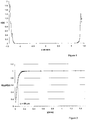
- the distribution profiles of the elements within the catalyst grains are obtained by a Castaing microprobe. At least 30 points of analysis are carried out along the diameter of the ball or the extrusion at a rate of about ten points on the crust of the active element (here palladium) and about ten points at the grain center.
- the distribution profile c ( x ) for x ⁇ [- r ; + r ] is thus obtained with c the local concentration of the element, r the radius of the ball or extrusion and x the position of the point d analysis along the grain diameter in relation to the center of this grain.
- the figure 1 shows an example of a profile obtained.
- the distribution of the elements is characterized by a dimensionless R coefficient weighting the local concentration by a weight increasing according to the position on the diameter.
- R ⁇ - r r c x x 2 dx / r 2 3 ⁇ - r r c x dx
- an element whose concentration is uniform has a coefficient R equal to 1
- a dome-deposited element concentration at the core greater than the concentration at the edges of the support
- a crust-distributed element concentration at edges larger than the concentration in the core of the support
- Castaing microprobe analysis gives the values of the concentrations in a finite number of values of x, R is thus evaluated numerically by integration methods well known to those skilled in the art. Preferably, R is determined by the trapezoidal method.
- the distribution of the alkaline element is defined as homogeneous when the distribution coefficient R defined above is between 0.8 and 1.2.
- the distribution of the alkaline earth element is defined as homogeneous when the distribution coefficient R defined above is between 0.8 and 1.2.
- the crustal thickness is defined as the distance to the edge of the grain containing 80% of the element.
- the cumulative quantity Q ( y ) of the element in the grain is calculated as a function of the distance y at the edge of the grain.
- the figure 2 shows an example of a cumulative quantity.
- the density of palladium particles is named De.
- Measurements of metal dispersions are carried out by chemisorption of carbon monoxide CO, on the previously reduced catalyst under 1 liter of hydrogen per hour and per gram of catalyst, with a temperature rise of 300 ° C./h and a plateau of two hours at 150 ° C. The catalyst is then flushed for 1 hour at 150 ° C. under helium and then cooled to 25 ° C. under helium.
- the chemisorption of CO is carried out at 25 ° C. in a dynamic manner according to the usual practices known to those skilled in the art, it leads to a chemisorbed volume of CO, from which the person skilled in the art can calculate the number of chemisorbed CO molecules. .
- a stoichiometric ratio of one CO molecule per atom of surface Pd is taken into account to calculate the number of surface Pd atoms.
- the dispersion is expressed as% of surface Pd atoms relative to all the Pd atoms present in the catalyst sample.
- the average size of the crystallites is deduced from these dispersion measurements, by applying the particle dispersion-size relationships known to those skilled in the art and described in " Physico-chemical analysis of industrial catalysts, Chapter I, Technip Publishing, Paris 2001 ".
- the number of Pd atoms per metal particle as a function of particle size is determined by the model of Van Hardeveld and Hartog ( R. Van Hardeveld, F. Hartog, Surf. Sci., 15 (1969) 189 ).
- the pH, the residence time of the colloidal suspension and the specific surface of the support are set in their respective intervals.
- the palladium content of between 0.05 and 2% by weight is then adjusted in order to obtain a density of palladium particles in the crust of between 1500 and 4100 palladium particles per ⁇ m 2 .
- the palladium content of between 0.05 and 2% by weight, the residence time of the colloidal suspension and the specific surface area of the support are set in their respective ranges.
- the pH is then adjusted to obtain a density of palladium particles in the crust of between 1500 and 4100 palladium particles per ⁇ m 2 .
- the colloidal suspension is generally obtained by hydrolysis of the palladium cation in an aqueous medium, which leads to the formation of particles of oxides or hydroxides of palladium in suspension.
- the aqueous solution of alkali metal hydroxides or alkaline earth hydroxides is generally selected from the group consisting of aqueous solutions of sodium hydroxide, aqueous solutions of magnesium hydroxide, even more preferably, it is an aqueous solution of sodium hydroxide.
- the precursor salt of palladium is generally selected from the group consisting of palladium chloride, palladium nitrate and palladium sulfate. Very preferably, the precursor salt of palladium is palladium nitrate.
- the aqueous solution 2 comprising at least one palladium precursor salt and then the aqueous solution 1 comprising at least one alkali or alkaline earth hydroxide are generally poured into the apparatus. Solutions 1 and 2 can be poured simultaneously into the equipment. Preferably, the aqueous solution 2 and then the aqueous solution 1 are poured into the apparatus.
- the colloidal suspension generally remains in the apparatus for a residence time of between 0 and 20 hours.
- the pH of the colloidal suspension can be modified during this residence time by adding amounts of acid or base compatible with the stability of the colloidal suspension.
- the preparation temperature is between 5 ° C and 40 ° C and preferably between 15 ° C and 35 ° C.
- the palladium concentration is preferably between 5 and 150 millimoles per liter, more preferably between 8 and 80 millimoles per liter.
- step b) depositing the colloidal suspension prepared in step a) by impregnation on a support, preferably on alumina
- the colloidal suspension prepared in step a) is then impregnated on a support.
- the support may optionally undergo a set of treatments before the impregnation step, such as calcinations or hydrations.
- the support may also already comprise one or more metal elements before the impregnation of the colloidal suspension.
- Metal elements may also be introduced into the colloidal suspension. These metal elements can be introduced either by conventional techniques or by using the method according to the present invention.
- the colloidal suspension is preferably poured onto the support. This process can be carried out either discontinuously, that is to say that the step of preparation of the colloidal suspension precedes the impregnation step on the support and that most of the colloidal suspension is sent in a only once to the impregnation stage, either continuously, that is to say that the product obtained in step a) is sent continuously after adjusting the residence time of the colloidal suspension in step b ).
- a process may be cited as a continuous process, in which solutions 1 and 2 are poured simultaneously into a tank which flows continuously into an area comprising the support to be impregnated.
- step b) maturation of the impregnated support during step b) for a period of between 0.5 and 40 hours
- the impregnated support is usually wet-matured for 0.5 to 40 hours, preferably for 1 to 30 hours.
- the precursor of the catalyst is generally dried in order to eliminate all or part of the water introduced during the impregnation, preferably at a temperature of between 50 and 250 ° C., more preferably between 70 ° C. and 200 ° C. C.
- the drying is generally carried out under combustion air of a hydrocarbon, preferably methane, or in heated air comprising between 0 and 80 grams of water per kilogram of combustion air, an oxygen content of between 5% and 25% volume and a carbon dioxide content between 0% and 10% volume.
- a hydrocarbon preferably methane
- heated air comprising between 0 and 80 grams of water per kilogram of combustion air, an oxygen content of between 5% and 25% volume and a carbon dioxide content between 0% and 10% volume.
- the catalyst is generally calcined in combustion air, preferably a methane combustion air comprising between 40 and 80 grams of water per kg of combustion air, an oxygen content of between 5% and 15% by volume. and a CO2 level between 4% and 10% volume.
- the calcining temperature is generally between 250 ° C and 900 ° C, preferably between about 300 ° C and about 500 ° C.
- the calcination time is generally between 0.5 hours and 5 hours.
- step f) reducing the oxide thus supported obtained in step e), preferably using hydrogen gas.
- the catalyst is generally reduced.
- This step is preferably carried out in the presence of a reducing gas, either in situ, that is to say in the reactor where the catalytic conversion is carried out, or ex-situ.
- this step is carried out at a temperature between 80 ° C and 180 ° C, even more preferably between 100 ° C and 160 ° C.
- the reduction is carried out in the presence of a reducing gas comprising between 25 vol% and 100 vol% of hydrogen, preferably 100% of hydrogen.
- a reducing gas comprising between 25 vol% and 100 vol% of hydrogen, preferably 100% of hydrogen.
- the hydrogen is optionally supplemented with an inert gas for reduction, preferably argon, nitrogen or methane.
- the reduction generally comprises a temperature rise phase and then a landing.
- the duration of the reduction stage is generally between 1 and 10 hours, preferably between 2 and 8 hours.
- the WH is generally between 150 and 1000, preferably between 300 and 900 liters of reducing gas per hour and per liter of catalyst.
- the catalyst may contain one or more promoter metals.
- the promoter metal or metals may be introduced during the preparation of the support, on the support already formed, during step a) or after steps b) c) d) e) or f).
- the catalyst obtained with the process according to the invention can be used in processes involving transformation of organic compounds.
- the catalyst can be used in processes comprising hydrogenation reactions of compounds having aromatic functions, ketones, aldehydes, acids or nitro, hydrogenation of carbon monoxide to C1-C6 alcohols, methanol or dimethyl- ether, isomerization or hydro-isomerization reactions, hydrogenolysis, and generally reactions involving cuts or formations of carbon-carbon bonds.
- the operating conditions generally used for these reactions are as follows: a temperature of between 0 ° C. and 500 ° C., preferably of between 25 ° C. and 350 ° C., a pressure of between 0.1 and 20 MPa, preferably between 0.1. and 10 MPa, a hourly volume velocity (VVH) of between 0.1 and 50 h -1 , preferably between 0.5 and 20 h -1 for a liquid charge; and between 500 and 30,000 h -1 , preferably between 500 and 15,000 h -1 for a gaseous feed.
- VVH hourly volume velocity
- the molar ratio of hydrogen to feedstock is between 1 and 500 liters per liter, preferably between 10 and 150 liters per liter.
- the catalyst can also be used in the hydrogenation reactions of compounds having acetylenic, diene, olefinic functions.
- the catalysts obtained with the process according to the invention are used for the reactions of selective hydrogenation of polyunsaturated hydrocarbon fractions resulting from steam cracking and / or catalytic cracking, preferably polyesters. unsaturated hydrocarbons from steam cracking.
- hydrocarbon conversion processes such as steam cracking or catalytic cracking are operated at high temperature and produce a wide variety of unsaturated molecules such as ethylene, propylene, butenes linear, isobutene, pentenes as well as unsaturated molecules containing up to about 15 carbon atoms.
- polyunsaturated compounds acetylene, propadiene and methylacetylene (or propyne), 1-2 and 1-3 butadiene, vinylacetylene and ethylacetylene, and other polyunsaturated compounds whose boiling point corresponds to the essence fraction C5 + .
- the C3 steam cracking cut can have the following average composition: of the order of 90% by weight propylene, of the order of 3 to 8% by weight of propadiene and methylacetylene, the remainder being essentially propane. In some C3 cuts, between 0.1 and 2% by weight of C2 and C4 may also be present.
- the specifications for the concentrations of these polyunsaturated compounds for petrochemical and polymerization units are very low: 20-30 ppm by weight of MAPD (MethylAcetylene and PropaDiene) for propylene chemical grade and less than 10 ppm by weight or up to 1 ppm weight for the quality "polymerization".
- MAPD MetalAcetylene and PropaDiene
- a steam cracking C4 cut has, for example, the following average molar composition: 1% butane, 46.5% butene, 51% butadiene, 1.3% vinylacetylene (VAC) and 0.2% butyne.
- VAC vinylacetylene
- C4 cuts between 0.1 and 2% by weight of C3 and C5 may also be present. Again the specifications are severe: diolefin content strictly less than 10 ppm weight for a C4 cut that will be used in petrochemical or polymerization.
- a C5 steam cracking cut has, for example, the following mass-average composition: 21% of pentanes, 45% of pentenes and 34% of pentadienes.
- the selective hydrogenation process has progressively imposed itself to eliminate the polyunsaturated compounds of the C3 to C5 petroleum fractions mentioned, because this process allows the conversion of the most unsaturated compounds to the alkenes. corresponding by avoiding total saturation and thus the formation of the corresponding alkanes.
- the selective hydrogenation can be carried out in the gas or liquid phase, preferably in the liquid phase.
- a reaction in the liquid phase makes it possible to lower the energy cost and to increase the cycle time of the catalysts.
- the pressure is generally between 1 and 3 MPa, the temperature between 2 and 50 ° C and the molar ratio hydrogen / (polyunsaturated compounds to be hydrogenated) between 0.1 and 4, preferably between 1 and 2.
- the pressure is generally between 1 and 3 MPa, the temperature between 40 and 120 ° C. and the molar ratio hydrogen / (polyunsaturated compounds to be hydrogenated) between 0.1 and 4, preferably between 1 and 2.
- Steam cracking produces mainly ethylene, propylene, a C4 cut and steam cracking gasoline also known as pyrolysis gasoline.
- the charge is a pyrolysis gasoline.
- the pyrolysis gasoline corresponds to a section whose boiling point is generally between 0 ° C. and 250 ° C., preferably between 10 ° C. and 220 ° C.
- This charge generally comprises the C5-C12 cut with traces of C3, C4, C13, C14, C15 (for example between 0.1 to 3% by weight for each of these cuts).
- the selective hydrogenation of a pyrolysis gasoline consists of bringing the charge to be treated into contact with hydrogen introduced in excess into one or more reactors containing the hydrogenation catalyst.
- the hydrogen flow rate is adjusted in order to dispose of it in sufficient quantity to theoretically hydrogenate all the diolefins, acetylenics and alkenyl aromatics and to maintain an excess of hydrogen at the reactor outlet.
- the molar ratio of hydrogen / (polyunsaturated compounds to be hydrogenated) is generally between 1 and 2
- the temperature is generally between 40 ° C. and 200 ° C., preferably between At 50 and 180 ° C.
- the space hourly velocity (corresponding to the volume of hydrocarbon per volume of catalyst per hour) is generally between 0.5 h -1 and 10 h -1, preferably between 1 h -1 and 5 h -1.
- h-1 and the pressure is generally between 1.0 MPa and 6.5 MPa, preferably between 2.0 MPa and 3.5 MPa.
- colloidal suspensions are prepared at 25 ° C in all the examples which follow.
- An aqueous solution of palladium nitrate Pd (NO 3 ) 2 is prepared at 25 ° C. by diluting 3.5 g of a solution of palladium nitrate Pd (NO 3 ) 2 containing 8.5% by weight of palladium, with deionized water to a volume that corresponds to the pore volume of the alumina support.
- the pH of the solution is 0.7.
- This solution is then impregnated on 100 gram of a type ⁇ - Al 2 O 3 alumina whose S BET is 130 m 2 / g.
- This alumina is in the form of beads whose average diameter is 3 mm.
- Catalyst A obtained was dried in air at 120 ° C and then calcined for 2 hours at 450 ° C under a combustion air flow with a WH of 500 liters of combustion air per liter of catalyst per hour.
- the combustion air contains about 60 g of water per kg of air, 10% by volume of oxygen and 7% by volume of carbon dioxide.
- Catalyst A contains 0.3% Pd.
- the characterization of the catalyst by a microprobe of Castaing leads to 80% of the Pd located in a crust with a thickness of 250 ⁇ m.
- the catalyst Before the chemisorption of CO and the catalytic test, the catalyst is finally reduced under a hydrogen flow of WH 500 liters of hydrogen per liter of catalyst per hour, with a temperature rise rate of 300 ° C./h and a plateau at 150 ° C for 2 hours.
- the volume of chemisorbed CO is 0.365 ml / g, ie a metal dispersion of 53%, which corresponds to an average particle size of 2.3 nm, ie 440 Pd atoms / particle.
- Example 2a (non-compliant catalyst Ba)
- the residence time of the colloidal suspension in the apparatus before impregnation is 15 minutes for Examples 2a, 2b and 3 which follow.
- a colloidal suspension of Pd oxide is prepared with stirring at 25 ° C. by diluting 3.5 g of a solution of palladium nitrate Pd (NO 3 ) 2 containing 8.5% by weight of palladium Pd with approximately 20 ml. demineralised water, then add about 10 ml of a sodium hydroxide solution to reach a pH of 1.6. The suspension is then diluted with deionized water to a volume which corresponds to the pore volume of the alumina support.
- This solution is then impregnated on 59 g of a ⁇ - Al 2 O 3 type alumina, the S BET of which is 130 m 2 / g.
- This alumina is in the form of beads whose average diameter is 3 mm.
- the Catalyst Ba obtained is dried under air at a WH of 500 liters of air per liter of catalyst per hour, with a temperature rise of 25 ° C. to 120 ° C. for 8 hours, followed by a 2 hour stage. at 120 ° C.
- the catalyst is then calcined under a combustion air flow at a WH of 500 liters of combustion air per liter of catalyst per hour, with a rate of temperature rise of about 300 ° C. per hour, followed by a 2 hour stage at 450 ° C.
- the combustion air contains about 60 g of water per kg of air, 10% by volume of oxygen and 7% by volume of carbon dioxide.
- Catalyst Ba contains 0.5% Pd.
- the characterization of the catalyst by a Castaing microprobe makes it possible to calculate a crust with a thickness of approximately 91 ⁇ m.
- the catalyst Before the chemisorption of CO and the catalytic test, the catalyst is finally reduced under a hydrogen flow of WH 500 liters of hydrogen per liter of catalyst per hour, with a temperature rise rate of 300 ° C./h and a plateau at 150 ° C for 2 hours.
- the volume of chemisorbed CO is 0.583 ml / g, ie a metal dispersion of 51%, which corresponds to a particle size of approximately 2.4 nm, ie 490 Pd atoms / particle.
- a colloidal suspension of Pd oxide is prepared with stirring at 25 ° C. by diluting 3.5 g of a solution of palladium nitrate Pd (NO 3 ) 2 containing 8.5% by weight of Pd palladium with about 10 ml of demineralised water, then added to about 20 ml of a sodium hydroxide solution to reach a pH of 12.1. The suspension is then diluted with deionized water to a volume which corresponds to the pore volume of the alumina support.
- This solution is then impregnated on 59 g of a ⁇ - Al 2 O 3 type alumina, the S BET of which is 130 m 2 / g.
- This alumina is in the form of beads whose average diameter is 3 mm.
- the catalyst Bb obtained is dried under air at a WH of 500 liters of air per liter of catalyst per hour, with a temperature rise of 25 ° C. to 120 ° C. for 8 hours, followed by a stop of 2 hours. at 120 ° C.
- the catalyst is then calcined under a combustion air flow at a WH of 500 liters of combustion air per liter of catalyst and per hour, with a temperature rise rate of about 300 ° C per hour, followed by a step of 2 hours at 450 ° C.
- the combustion air contains about 60 g of water per kg of air, 10% by volume of oxygen and 7% by volume of carbon dioxide.
- Catalyst Bb contains 0.5% Pd.
- the catalyst Before the chemisorption of CO and the catalytic test, the catalyst is finally reduced under a flow of hydrogen VVH 500 liters of hydrogen per liter of catalyst per hour, with a temperature rise rate of 300 ° C / h and a plateau at 150 ° C for 2 hours.
- the volume of chemisorbed CO is 0.551 ml / g, ie a metal dispersion of 48%, which corresponds to a particle size of approximately 2.5 nm, ie approximately 536 Pd atoms / particle.
- a colloidal suspension of Pd oxide is prepared with stirring at 25 ° C. by diluting 3.5 g of a solution of palladium nitrate Pd (NO 3 ) 2 containing 8.5% by weight of palladium Pd with approximately 20 ml. demineralized water, then add about 10 ml of a sodium hydroxide solution to reach a pH of 1.7. The suspension is then diluted with demineralized water to a volume which corresponds to the pore volume of 59 g of the alumina support.
- This solution is then impregnated on 59 g of a ⁇ - Al 2 O 3 type alumina, the S BET of which is 130 m 2 / g.
- This alumina is in the form of beads whose average diameter is 3 mm.
- a step of maturation of the impregnated support before drying for a period of 20 hours is carried out under air in a confined and humid environment.
- the catalyst C obtained is dried under air at a WH of 500 liters of air per liter of catalyst per hour, with a temperature rise of 25 ° C. to 120 ° C. for 8 hours, followed by a stop of 2 hours. at 120 ° C.
- the catalyst is then calcined under a combustion air flow at a WH of 500 liters of combustion air per liter of catalyst per hour, with a rate of temperature rise of about 300 ° C. per hour, followed by a 2 hour stage at 450 ° C.
- the combustion air contains about 60 g of water per kg of air, 10% by volume of oxygen and 7% by volume of carbon dioxide.
- Catalyst C contains 0.5% Pd.
- the characterization of the catalyst by a Castaing microprobe leads to 80% Pd on a crust with a thickness of approximately 75 ⁇ m.
- the catalyst Before the chemisorption of CO and the catalytic test, the catalyst is finally reduced under a hydrogen flow of WH 500 liters of hydrogen per liter of catalyst per hour, with a temperature rise rate of 300 ° C./h and a plateau at 150 ° C for 2 hours.
- the volume of chemisorbed CO is 0.576 ml / g, ie a metal dispersion of 50%, which corresponds to a particle size of approximately 2.4 nm, ie approximately 490 Pd atoms / particle.
- Example 4 Catalytic Test in Hydrogenation of a Styrene-Isoprene Mixture in the Presence of S.
- the catalysts are then subjected to a hydrogenation test in a perfectly stirred batch reactor of the "Grignard" type. To do this, the reduced catalyst balls are fixed in the air protected in an annular basket located around the stirring device.
- the baskets used in the reactors are Robinson Mahonnay type.
- the hydrogenation is carried out in the liquid phase.
- composition of the filler is as follows: 8% styrene weight, 8% isoprene weight, 10 ppm S introduced as pentanethiol, 100 ppm S introduced as thiophene, the solvent being n-heptane.
- the test is carried out under a constant pressure of 3.5 MPa of hydrogen and at a temperature of 45 ° C.
- the products of the reaction are analyzed by gas chromatography.
- the catalytic activities are expressed in moles of H 2 consumed per minute and per mole of accessible Pd and are reported in Table 1.
- Table 1 Measured activities in hydrogenation of a styrene-isoprene mixture in the presence of sulfur Activity* Catalyst A (not compliant) 76 Catalyst Ba (non-compliant) 140 Catalyst Bb (non-compliant) 110 Catalyst C (according to the invention) 177 * in (moles H 2 ) / [min ⁇ (mole of accessible Pd)]
- Catalysts Ba and Bb which have a particle density of Pd within the defined range have substantially higher intrinsic catalytic activity than Catalyst A whose Pd particle density is lower than the defined range.
- Catalyst C which has both a density within the defined range and a homogeneous distribution of Na within the bead has a catalytic activity substantially greater than the activity of catalysts Ba and Bb whose particle density is within the defined range but whose distribution of Na is not homogeneous within the catalyst ball.
- the residence time of the colloidal suspension in the equipment before impregnation is 30 minutes for Examples 5 to 8.
- a colloidal suspension of Pd oxide is prepared with stirring at 25 ° C. by diluting 0.58 g of a solution of palladium nitrate Pd (NO 3 ) 2 containing 8.5% by weight of palladium Pd with approximately 35 ml. demineralized water, then add about 10 ml of a sodium hydroxide solution to reach a pH of 2.3. Suspension is then diluted with deionized water to a volume which corresponds to the pore volume of the alumina support.
- This solution is then impregnated on 90 g of a ⁇ - Al 2 O 3 type alumina, the S BET of which is 130 m 2 / g.
- This alumina is in the form of beads whose average diameter is 3 mm.
- a step of maturation of the impregnated support before drying for a period of 20 hours is carried out under air in a confined and humid environment.
- the catalyst D obtained is dried in air at a WH of 500 liters of air per liter of catalyst per hour, with a temperature rise of 25 ° C. to 120 ° C. for 8 hours, followed by a plateau of 2 hours. at 120 ° C.
- the catalyst is then calcined under a combustion air flow at a WH of 500 liters of combustion air per liter of catalyst per hour, with a rate of temperature rise of about 300 ° C. per hour, followed by a 2 hour stage at 450 ° C.
- the combustion air contains about 60 g of water per kg of air, 10% by volume of oxygen and 7% by volume of carbon dioxide.
- Catalyst D contains 0.055% Pd.
- the characterization of the catalyst by a Castaing microprobe shows that 80% of the Pd is distributed over a crust with a thickness of approximately 27 ⁇ m.
- the catalyst Before the chemisorption of CO and the catalytic test, the catalyst is finally reduced under a flow of hydrogen VVH 500 liters of hydrogen per liter of catalyst per hour, with a temperature rise rate of 300 ° C / h and a plateau at 150 ° C for 2 hours.
- the volume of chemisorbed CO is 0.071 ml / g, ie a metal dispersion of 56%, which corresponds to a particle size of approximately 2.1 nm, ie 340 Pd atoms / particles.
- a colloidal suspension of Pd oxide is prepared with stirring at 25 ° C. by diluting 1.16 g of a solution of palladium nitrate Pd (NO 3 ) 2 containing 8.5% by weight of palladium Pd with approximately 40 ml. demineralized water, then add about 10 ml of a sodium hydroxide solution to reach a pH of 2.3. The suspension is then diluted with deionized water to a volume which corresponds to the pore volume of the alumina support.
- This solution is then impregnated on 102 g of a ⁇ - Al 2 O 3 type alumina, the S BET of which is 130 m 2 / g.
- This alumina is in the form of beads whose average diameter is 3 mm.
- a step of maturation of the impregnated support before drying for a period of 20 hours is carried out under air in a confined and humid environment.
- the catalyst E obtained is dried under air at a VVH of 500 liters of air per liter of catalyst per hour, with a temperature rise of 25 ° C. to 120 ° C. for 8 hours, followed by a plateau of 2 hours. at 120 ° C.
- the catalyst is then calcined under a combustion air flow at a WH of 500 liters of combustion air per liter of catalyst per hour, with a rate of temperature rise of about 300 ° C. per hour, followed by a 2 hour stage at 450 ° C.
- the combustion air contains about 60 g of water per kg of air, 10% by volume of oxygen and 7% by volume of carbon dioxide.
- Catalyst E contains 0.097% Pd.
- the characterization of the catalyst by a Castaing microprobe shows that 80% of the Pd is distributed over a crust with a thickness of approximately 30 ⁇ m.
- the catalyst Before the chemisorption of CO and the catalytic test, the catalyst is finally reduced under a hydrogen flow of WH 500 liters of hydrogen per liter of catalyst per hour, with a temperature rise rate of 300 ° C./h and a plateau at 150 ° C for 2 hours.
- the volume of chemisorbed CO is 0.127 ml / g, ie a metal dispersion of 57%, which corresponds to a particle size of about 2.1 nm, ie 340 Pd atoms / particles.
- a colloidal suspension of Pd oxide is prepared with stirring at 25 ° C. by dilution of 2.3 g of a solution of palladium nitrate Pd (NO 3 ) 2 containing 8.5% by weight of palladium Pd with approximately 45 ml. demineralized water, then add about 10 ml of a sodium hydroxide solution to reach a pH of 2.4. The suspension is then diluted with deionized water to a volume which corresponds to the pore volume of the alumina support.
- This solution is then impregnated on 111 g of a ⁇ - Al 2 O 3 type alumina, the S BET of which is 130 m 2 / g.
- This alumina is in the form of beads whose average diameter is 3 mm.
- a step of maturation of the impregnated support before drying for a period of 20 hours is carried out under air in a confined and humid environment.
- the catalyst F obtained is dried in air at a VVH of 500 liters of air per liter of catalyst per hour, with a temperature rise of 25 ° C. to 120 ° C. for 8 hours, followed by a 2 hour stage. at 120 ° C.
- the catalyst is then calcined under a combustion air flow at a WH of 500 liters of combustion air per liter of catalyst per hour, with a rate of temperature rise of about 300 ° C. per hour, followed by a 2 hour stage at 450 ° C.
- the combustion air contains about 60 g of water per kg of air, 10% by volume of oxygen and 7% by volume of carbon dioxide.
- Catalyst F contains 0.176% Pd.
- the characterization of the catalyst by a Castaing microprobe shows that 80% of the Pd is distributed over a crust with a thickness of about 31 ⁇ m.
- the catalyst Before the chemisorption of CO and the catalytic test, the catalyst is finally reduced under a flow of hydrogen VVH 500 liters of hydrogen per liter of catalyst per hour, with a temperature rise rate of 300 ° C / h and a plateau at 150 ° C for 2 hours.
- the volume of chemisorbed CO is 0.231 ml / g, ie a metal dispersion of 57%, which corresponds to a particle size of approximately 2.1 nm, ie 340 Pd atoms / particles.
- a colloidal suspension of Pd oxide is prepared with stirring at 25 ° C. by diluting 3.45 g of a solution of palladium nitrate Pd (NO 3 ) 2 containing 8.5% by weight of palladium Pd with approximately 55 ml. demineralized water, then add about 10 ml of a sodium hydroxide solution to reach a pH of 2.4. The suspension is then diluted with deionized water to a volume which corresponds to the pore volume of the alumina support.
- This solution is then impregnated on 133 g of a ⁇ - Al 2 O 3 type alumina, the S BET of which is 130 m 2 / g.
- This alumina is in the form of beads whose average diameter is 3 mm.
- a step of maturation of the impregnated support before drying for a period of 20 hours is carried out under air in a confined and humid environment.
- the catalyst G obtained is dried under air at a WH of 500 liters of air per liter of catalyst per hour, with a rise in temperature of 25 ° C. to 120 ° C. for 8 hours, followed by a plateau of 2 hours. at 120 ° C.
- the catalyst is then calcined under a combustion air flow at a WH of 500 liters of combustion air per liter of catalyst per hour, with a rate of temperature rise of about 300 ° C. per hour, followed by a 2 hour stage at 450 ° C.
- the combustion air contains about 60 g of water per kg of air, 10% by volume of oxygen and 7% by volume of carbon dioxide.
- Catalyst G contains 0.22% Pd.
- the catalyst Before the chemisorption of CO and the catalytic test, the catalyst is finally reduced under a hydrogen flow of WH 500 liters of hydrogen per liter of catalyst per hour, with a temperature rise rate of 300 ° C./h and a plateau at 150 ° C for 2 hours.
- the volume of chemisorbed CO is 0.287 ml / g, ie a metal dispersion of 57%, which corresponds to a particle size of about 2.1 nm, ie 340 Pd atoms / particles.
- the catalysts are then subjected to a hydrogenation test in a perfectly stirred batch reactor of the "Grignard" type.
- the hydrogenation is carried out in the liquid phase.
- composition of the filler is 6.3% by weight of 1,3-butadiene, the solvent being n-heptane.
- the test is carried out under a constant pressure of 0.5 MPa of hydrogen and at a temperature of 5 ° C.
- Catalysts E and F whose particle density is within the defined range, have an intrinsic catalytic activity greater than a factor of 2 in catalyst D, the Pd particle density of which is below the defined range, and greater than one factor 1.5 to the catalyst G whose particle density of Pd is greater than the defined range.
Landscapes
- Chemical & Material Sciences (AREA)
- Engineering & Computer Science (AREA)
- Organic Chemistry (AREA)
- Chemical Kinetics & Catalysis (AREA)
- Materials Engineering (AREA)
- Oil, Petroleum & Natural Gas (AREA)
- General Chemical & Material Sciences (AREA)
- Crystallography & Structural Chemistry (AREA)
- Catalysts (AREA)
- Organic Low-Molecular-Weight Compounds And Preparation Thereof (AREA)
- Production Of Liquid Hydrocarbon Mixture For Refining Petroleum (AREA)
- Low-Molecular Organic Synthesis Reactions Using Catalysts (AREA)
Applications Claiming Priority (2)
| Application Number | Priority Date | Filing Date | Title |
|---|---|---|---|
| FR0707699A FR2922784B1 (fr) | 2007-10-29 | 2007-10-29 | Catalyseur comprenant du palladium et son application en hydrogenation selective |
| PCT/FR2008/001506 WO2009092879A2 (fr) | 2007-10-29 | 2008-10-24 | Catalyseur comprenant du palladium et son application hydrogenation selective |
Publications (2)
| Publication Number | Publication Date |
|---|---|
| EP2214818A2 EP2214818A2 (fr) | 2010-08-11 |
| EP2214818B1 true EP2214818B1 (fr) | 2019-05-08 |
Family
ID=39480315
Family Applications (1)
| Application Number | Title | Priority Date | Filing Date |
|---|---|---|---|
| EP08871363.1A Active EP2214818B1 (fr) | 2007-10-29 | 2008-10-24 | Procédé de préparation d'un catalyseur comprenant du palladium |
Country Status (6)
| Country | Link |
|---|---|
| US (1) | US8637719B2 (enExample) |
| EP (1) | EP2214818B1 (enExample) |
| JP (1) | JP5281091B2 (enExample) |
| CN (1) | CN101998883B (enExample) |
| FR (1) | FR2922784B1 (enExample) |
| WO (1) | WO2009092879A2 (enExample) |
Families Citing this family (37)
| Publication number | Priority date | Publication date | Assignee | Title |
|---|---|---|---|---|
| FR2922784B1 (fr) | 2007-10-29 | 2011-05-13 | Inst Francais Du Petrole | Catalyseur comprenant du palladium et son application en hydrogenation selective |
| WO2011107565A1 (en) * | 2010-03-05 | 2011-09-09 | Shell Internationale Research Maatschappij B.V. | Hydrogenation catalyst |
| FR2991197B1 (fr) * | 2012-05-31 | 2014-08-22 | IFP Energies Nouvelles | Catalyseur comprenant du palladium et de l'argent et son application en hydrogenation selective |
| FR2990882B1 (fr) * | 2012-05-24 | 2015-05-15 | IFP Energies Nouvelles | Procede de preparation d'un catalyseur a base d'un metal du groupe viii et contenant du silicium et procede d'hydrogenation selective mettant en oeuvre ledit catalyseur |
| FR2993795B1 (fr) * | 2012-07-25 | 2016-01-08 | IFP Energies Nouvelles | Procede de preparation de catalyseurs a base de particules metalliques de dispersion controlee |
| CN104001526B (zh) * | 2014-06-13 | 2016-04-13 | 西南化工研究设计院有限公司 | 一种用于醋酸加氢制乙醇的催化剂及制备方法 |
| JP6565019B2 (ja) * | 2015-11-17 | 2019-08-28 | 株式会社三井E&Sマシナリー | 触媒の製造方法、触媒、および触媒の使用 |
| US10752563B2 (en) | 2016-03-31 | 2020-08-25 | Zeon Corporation | Hydrogenation method |
| FR3051685B1 (fr) * | 2016-05-30 | 2018-06-08 | IFP Energies Nouvelles | Procede de preparation d'un catalyseur d'hydrogenation selective . |
| FR3051684B1 (fr) * | 2016-05-30 | 2020-09-04 | Ifp Energies Now | Catalyseur d'hydrogenation selective comprenant un support extrude |
| FR3059252B1 (fr) * | 2016-11-29 | 2018-11-16 | IFP Energies Nouvelles | Catalyseur d’hydrogenation selective de coupes c3 de vapocraquage et/ou de craquage catalytique |
| FR3059253B1 (fr) * | 2016-11-29 | 2020-01-17 | IFP Energies Nouvelles | Catalyseur d'hydrogenation selective d'une coupe d'hydrocarbures c3. |
| WO2018207038A1 (en) | 2017-05-10 | 2018-11-15 | Sabic Global Technologies B.V. | Systems and methods for isoprene purification |
| US10981149B2 (en) * | 2019-03-18 | 2021-04-20 | Uop Llc | Dehydrogenation catalyst with optimum modifier profile index |
| FR3099388B1 (fr) | 2019-07-31 | 2021-07-16 | Ifp Energies Now | Catalyseur comprenant une phase active de nickel sous forme de petites particules repartie en croute et un alliage nickel cuivre |
| FR3099386B1 (fr) | 2019-07-31 | 2021-07-16 | Ifp Energies Now | Catalyseur comprenant une phase active de nickel repartie en croute et un alliage nickel cuivre |
| FR3099391B1 (fr) | 2019-07-31 | 2021-10-29 | Ifp Energies Now | Catalyseur comprenant une phase active de nickel sous forme de petites particules repartie en croute |
| FR3099387B1 (fr) | 2019-07-31 | 2021-10-29 | Ifp Energies Now | Catalyseur comprenant une phase active de nickel repartie en croute |
| FR3099389B1 (fr) | 2019-07-31 | 2021-07-16 | Ifp Energies Now | Catalyseur comprenant une phase active de nickel soufre repartie en croute |
| FR3110864B1 (fr) | 2020-05-29 | 2022-07-01 | Ifp Energies Now | Procede de preparation d’un catalyseur comprenant une phase active de nickel repartie en croute et un alliage nickel cuivre |
| FR3110867B1 (fr) | 2020-05-29 | 2022-07-01 | Ifp Energies Now | Procede de preparation d’un catalyseur comprenant une phase active de nickel repartie en croute obtenu a partir de sels fondus |
| FR3110863A1 (fr) | 2020-05-29 | 2021-12-03 | IFP Energies Nouvelles | Procede de preparation d’un catalyseur comprenant une phase active de nickel repartie en croute obtenu a partir de sels fondus et un alliage nickel cuivre |
| FR3110866B1 (fr) | 2020-05-29 | 2022-07-01 | Ifp Energies Now | Procede de preparation d’un catalyseur comprenant une phase active de nickel repartie en croute |
| FR3110865A1 (fr) | 2020-05-29 | 2021-12-03 | IFP Energies Nouvelles | Procede de preparation d’un catalyseur comprenant une phase active de nickel sous forme de petites particules repartie en croute et un alliage nickel cuivre |
| FR3110862A1 (fr) | 2020-05-29 | 2021-12-03 | IFP Energies Nouvelles | Procede de preparation d’un catalyseur comprenant une phase active de nickel sous forme de petites particules repartie en croute |
| CN115069246B (zh) * | 2021-03-15 | 2023-08-15 | 中国石油化工股份有限公司 | 一种负载型银催化剂及其制备方法和应用 |
| FR3125440B1 (fr) | 2021-07-22 | 2026-04-24 | Ifp Energies Now | Procede de preparation d’un catalyseur comprenant une phase active de nickel repartie en croute via impregnation d’heptanol |
| FR3125439B1 (fr) | 2021-07-22 | 2025-10-31 | Ifp Energies Now | Procede de preparation d’un catalyseur comprenant une phase active de nickel repartie en croute via impregnation d’hexanol |
| CN117651608A (zh) * | 2021-08-13 | 2024-03-05 | 庄信万丰股份有限公司 | 用于三效催化应用的含硫有机化合物辅助的金属纳米粒子合成 |
| TWI806307B (zh) * | 2021-12-24 | 2023-06-21 | 光洋應用材料科技股份有限公司 | 鈀觸媒與其製作方法 |
| FR3132647A1 (fr) | 2022-02-14 | 2023-08-18 | IFP Energies Nouvelles | Procede de preparation d’un catalyseur comprenant une phase active de palladium et de cuivre |
| FR3132646A1 (fr) | 2022-02-14 | 2023-08-18 | IFP Energies Nouvelles | Catalyseur comprenant une phase active de palladium et de cuivre |
| CN117960163B (zh) * | 2022-10-25 | 2026-07-28 | 中国石油化工股份有限公司 | 一种Pd催化剂、制备方法及精制环己基苯的方法和所得环己基苯 |
| FR3150965B1 (fr) | 2023-07-10 | 2025-06-27 | Ifp Energies Now | Catalyseur comprenant du cuivre et un element de la colonne iiia |
| FR3150966A1 (fr) | 2023-07-10 | 2025-01-17 | IFP Energies Nouvelles | Procede d’hydrogenation mettant en œuvre un catalyseur comprenant du cuivre et un element de la colonne iiia |
| FR3151509A1 (fr) | 2023-07-28 | 2025-01-31 | IFP Energies Nouvelles | Procédé de préparation d’un catalyseur comprenant une phase active de nickel repartie en croute via imprégnation d’acide hexanoïque ou d’acide heptanoïque |
| FR3151508A1 (fr) | 2023-07-28 | 2025-01-31 | IFP Energies Nouvelles | Procédé de préparation d’un catalyseur comprenant une phase active de nickel repartie en croute via imprégnation de décanol |
Family Cites Families (13)
| Publication number | Priority date | Publication date | Assignee | Title |
|---|---|---|---|---|
| EP0686615B2 (fr) * | 1994-06-09 | 2007-06-27 | Institut Francais Du Petrole | Procédé d'hydrogénation catalytique et catalyseur utilisable dans ce procédé |
| DE4443701C1 (de) * | 1994-12-08 | 1996-08-29 | Degussa | Schalenkatalysator, Verfahren zu seiner Herstellung und seine Verwendung |
| US6054409A (en) * | 1995-06-06 | 2000-04-25 | Institut Francais Du Petrole | Selective hydrogenation catalyst and a process using that catalyst |
| US6596243B1 (en) * | 1996-06-20 | 2003-07-22 | Honda Giken Kogyo Kabushiki Kaisha | Catalyst element for purifying exhaust gases from internal combustion engine |
| FR2782280B1 (fr) * | 1998-08-12 | 2000-09-22 | Inst Francais Du Petrole | Catalyseurs supportes utilisables dans des reactions de transformation de composes organiques |
| FR2792550B1 (fr) * | 1999-04-26 | 2001-06-01 | Inst Francais Du Petrole | Catalyseur comprenant un element des groupes 8,9 et 10 presentant une bonne accessibilite et son utilisation dans un procede de deshydrogenation des paraffines |
| US6534438B1 (en) * | 2000-07-26 | 2003-03-18 | Bp Chemicals Limited | Catalyst composition |
| JP4082559B2 (ja) * | 2001-11-22 | 2008-04-30 | 日本碍子株式会社 | 触媒体及びその製造方法 |
| US7605108B2 (en) * | 2004-07-08 | 2009-10-20 | Nissan Motor Co., Ltd. | Catalyst, exhaust gas purification catalyst, and method for manufacturing same |
| US7521393B2 (en) * | 2004-07-27 | 2009-04-21 | Süd-Chemie Inc | Selective hydrogenation catalyst designed for raw gas feed streams |
| US7569510B2 (en) * | 2006-02-27 | 2009-08-04 | Philip Morris Usa Inc. | Catalysts to reduce carbon monoxide such as in the mainstream smoke of a cigarette |
| EP2055367A3 (en) * | 2007-01-25 | 2009-05-27 | Nissan Motor Co., Ltd. | Exhaust gas purifying catalyst and manufacturing method thereof |
| FR2922784B1 (fr) | 2007-10-29 | 2011-05-13 | Inst Francais Du Petrole | Catalyseur comprenant du palladium et son application en hydrogenation selective |
-
2007
- 2007-10-29 FR FR0707699A patent/FR2922784B1/fr active Active
-
2008
- 2008-10-24 CN CN200880113931.5A patent/CN101998883B/zh active Active
- 2008-10-24 JP JP2010531556A patent/JP5281091B2/ja active Active
- 2008-10-24 WO PCT/FR2008/001506 patent/WO2009092879A2/fr not_active Ceased
- 2008-10-24 EP EP08871363.1A patent/EP2214818B1/fr active Active
- 2008-10-24 US US12/740,240 patent/US8637719B2/en active Active
Non-Patent Citations (1)
| Title |
|---|
| None * |
Also Published As
| Publication number | Publication date |
|---|---|
| WO2009092879A2 (fr) | 2009-07-30 |
| JP5281091B2 (ja) | 2013-09-04 |
| US8637719B2 (en) | 2014-01-28 |
| CN101998883A (zh) | 2011-03-30 |
| FR2922784A1 (fr) | 2009-05-01 |
| CN101998883B (zh) | 2014-01-29 |
| US20100236986A1 (en) | 2010-09-23 |
| EP2214818A2 (fr) | 2010-08-11 |
| WO2009092879A3 (fr) | 2010-02-25 |
| JP2011500327A (ja) | 2011-01-06 |
| FR2922784B1 (fr) | 2011-05-13 |
Similar Documents
| Publication | Publication Date | Title |
|---|---|---|
| EP2214818A2 (fr) | Catalyseur comprenant du palladium et son application hydrogenation selective | |
| EP2669005B1 (fr) | Procédé de préparation d'un catalyseur comprenant du palladium et de l'argent utile en hydrogenation selective | |
| EP2249963B1 (fr) | Catalyseur d'hydrogenation selective et son procede de preparation | |
| EP2474354B1 (fr) | Nouveau procédé de preparation de catalyseurs à base de palladium et utilisation de ces catalyseurs en hydrogénation selective | |
| EP4003588B1 (fr) | Procede de preparation d'un catalyseur comprenant une phase active de nickel repartie en croute | |
| WO2015055380A1 (fr) | Procede d'hydrogenation selective mettant en œuvre un catalyseur contenant du cuivre et au moins un metal choisi parmi le nickel ou le cobalt | |
| EP3326713B1 (fr) | Catalyseur d'hydrogenation selective d'une coupe d'hydrocarbures c3 | |
| EP1935488B1 (fr) | Procédé de préparation d'un catalyseur préparé par imprégnation d'une solution aqueuse contenant des particules sous forme oxyde, hydroxyde ou oxy(hydroxy)de d'un cation en interaction avec une espèce moléculaire d'un métal du groupe viii et procédé d'hydrogénation selective avec ce catalyseur | |
| EP2135670B1 (fr) | Catalyseur d'hydrogénation sélective | |
| EP4157521B1 (fr) | Procede de preparation d'un catalyseur comprenant une phase active de nickel repartie en croute | |
| EP3463656B1 (fr) | Catalyseur d'hydrogenation selective comprenant un support extrude | |
| EP3463657B1 (fr) | Procede de preparation d'un catalyseur d'hydrogenation selective | |
| FR2993795A1 (fr) | Procede de preparation de catalyseurs a base de particules metalliques de dispersion controlee | |
| EP3332869B1 (fr) | Catalyseur d'hydrogenation selective de coupes c3 de vapocraquage et/ou de craquage catalytique | |
| WO2022090023A1 (fr) | Catalyseur d'hydrogenation selective a base de palladium sur un support en oxyde de zinc | |
| FR3134016A1 (fr) | Catalyseur a base de palladium et de fluor sur un support d’alumine | |
| FR3134015A1 (fr) | Catalyseur a base de palladium et de zinc sur un support d’alumine | |
| WO2024017701A1 (fr) | Procede de preparation d'un catalyseur comprenant un metal du groupe viii a partir d'une alumine alpha | |
| FR3132646A1 (fr) | Catalyseur comprenant une phase active de palladium et de cuivre | |
| FR3132647A1 (fr) | Procede de preparation d’un catalyseur comprenant une phase active de palladium et de cuivre | |
| WO2024017702A1 (fr) | Procede de preparation d'un catalyseur comprenant un metal du groupe viii et un support sous la forme d'un monolithe ou d'une mousse enduit d'alumine alpha | |
| WO2025011954A1 (fr) | Catalyseur comprenant du cuivre et un element de la colonne iiia | |
| FR3150966A1 (fr) | Procede d’hydrogenation mettant en œuvre un catalyseur comprenant du cuivre et un element de la colonne iiia |
Legal Events
| Date | Code | Title | Description |
|---|---|---|---|
| PUAI | Public reference made under article 153(3) epc to a published international application that has entered the european phase |
Free format text: ORIGINAL CODE: 0009012 |
|
| AK | Designated contracting states |
Kind code of ref document: A2 Designated state(s): AT BE BG CH CY CZ DE DK EE ES FI FR GB GR HR HU IE IS IT LI LT LU LV MC MT NL NO PL PT RO SE SI SK TR |
|
| AX | Request for extension of the european patent |
Extension state: AL BA MK RS |
|
| 17P | Request for examination filed |
Effective date: 20100825 |
|
| RAP1 | Party data changed (applicant data changed or rights of an application transferred) |
Owner name: IFP ENERGIES NOUVELLES |
|
| RBV | Designated contracting states (corrected) |
Designated state(s): AT BE BG CH CY CZ DE DK EE ES FI FR GB GR HR HU IE IS IT LI LT LU LV MC MT NL NO PL PT RO SE SI SK TR |
|
| RIN1 | Information on inventor provided before grant (corrected) |
Inventor name: THOMAZEAU, CECILE Inventor name: PETIT-CLAIR, CARINE Inventor name: FISCHER, LARS Inventor name: VERDON, CATHERINE Inventor name: SORBIER, LOIC |
|
| RIN1 | Information on inventor provided before grant (corrected) |
Inventor name: SORBIER, LOIC Inventor name: FISCHER, LARS Inventor name: PETIT-CLAIR, CARINE Inventor name: VERDON, CATHERINE Inventor name: THOMAZEAU, CECILE |
|
| RIN1 | Information on inventor provided before grant (corrected) |
Inventor name: PETIT-CLAIR, CARINE Inventor name: FISCHER, LARS Inventor name: SORBIER, LOIC Inventor name: THOMAZEAU, CECILE Inventor name: VERDON, CATHERINE |
|
| DAX | Request for extension of the european patent (deleted) | ||
| 17Q | First examination report despatched |
Effective date: 20140718 |
|
| RAP1 | Party data changed (applicant data changed or rights of an application transferred) |
Owner name: IFP ENERGIES NOUVELLES |
|
| STAA | Information on the status of an ep patent application or granted ep patent |
Free format text: STATUS: EXAMINATION IS IN PROGRESS |
|
| GRAP | Despatch of communication of intention to grant a patent |
Free format text: ORIGINAL CODE: EPIDOSNIGR1 |
|
| STAA | Information on the status of an ep patent application or granted ep patent |
Free format text: STATUS: GRANT OF PATENT IS INTENDED |
|
| INTG | Intention to grant announced |
Effective date: 20190107 |
|
| GRAS | Grant fee paid |
Free format text: ORIGINAL CODE: EPIDOSNIGR3 |
|
| GRAA | (expected) grant |
Free format text: ORIGINAL CODE: 0009210 |
|
| STAA | Information on the status of an ep patent application or granted ep patent |
Free format text: STATUS: THE PATENT HAS BEEN GRANTED |
|
| AK | Designated contracting states |
Kind code of ref document: B1 Designated state(s): AT BE BG CH CY CZ DE DK EE ES FI FR GB GR HR HU IE IS IT LI LT LU LV MC MT NL NO PL PT RO SE SI SK TR |
|
| REG | Reference to a national code |
Ref country code: GB Ref legal event code: FG4D Free format text: NOT ENGLISH |
|
| REG | Reference to a national code |
Ref country code: CH Ref legal event code: EP Ref country code: AT Ref legal event code: REF Ref document number: 1129324 Country of ref document: AT Kind code of ref document: T Effective date: 20190515 |
|
| REG | Reference to a national code |
Ref country code: DE Ref legal event code: R096 Ref document number: 602008060047 Country of ref document: DE |
|
| REG | Reference to a national code |
Ref country code: IE Ref legal event code: FG4D Free format text: LANGUAGE OF EP DOCUMENT: FRENCH |
|
| REG | Reference to a national code |
Ref country code: NL Ref legal event code: FP |
|
| REG | Reference to a national code |
Ref country code: LT Ref legal event code: MG4D |
|
| PG25 | Lapsed in a contracting state [announced via postgrant information from national office to epo] |
Ref country code: FI Free format text: LAPSE BECAUSE OF FAILURE TO SUBMIT A TRANSLATION OF THE DESCRIPTION OR TO PAY THE FEE WITHIN THE PRESCRIBED TIME-LIMIT Effective date: 20190508 Ref country code: PT Free format text: LAPSE BECAUSE OF FAILURE TO SUBMIT A TRANSLATION OF THE DESCRIPTION OR TO PAY THE FEE WITHIN THE PRESCRIBED TIME-LIMIT Effective date: 20190908 Ref country code: NO Free format text: LAPSE BECAUSE OF FAILURE TO SUBMIT A TRANSLATION OF THE DESCRIPTION OR TO PAY THE FEE WITHIN THE PRESCRIBED TIME-LIMIT Effective date: 20190808 Ref country code: SE Free format text: LAPSE BECAUSE OF FAILURE TO SUBMIT A TRANSLATION OF THE DESCRIPTION OR TO PAY THE FEE WITHIN THE PRESCRIBED TIME-LIMIT Effective date: 20190508 Ref country code: LT Free format text: LAPSE BECAUSE OF FAILURE TO SUBMIT A TRANSLATION OF THE DESCRIPTION OR TO PAY THE FEE WITHIN THE PRESCRIBED TIME-LIMIT Effective date: 20190508 Ref country code: HR Free format text: LAPSE BECAUSE OF FAILURE TO SUBMIT A TRANSLATION OF THE DESCRIPTION OR TO PAY THE FEE WITHIN THE PRESCRIBED TIME-LIMIT Effective date: 20190508 Ref country code: ES Free format text: LAPSE BECAUSE OF FAILURE TO SUBMIT A TRANSLATION OF THE DESCRIPTION OR TO PAY THE FEE WITHIN THE PRESCRIBED TIME-LIMIT Effective date: 20190508 |
|
| PG25 | Lapsed in a contracting state [announced via postgrant information from national office to epo] |
Ref country code: LV Free format text: LAPSE BECAUSE OF FAILURE TO SUBMIT A TRANSLATION OF THE DESCRIPTION OR TO PAY THE FEE WITHIN THE PRESCRIBED TIME-LIMIT Effective date: 20190508 Ref country code: BG Free format text: LAPSE BECAUSE OF FAILURE TO SUBMIT A TRANSLATION OF THE DESCRIPTION OR TO PAY THE FEE WITHIN THE PRESCRIBED TIME-LIMIT Effective date: 20190808 Ref country code: GR Free format text: LAPSE BECAUSE OF FAILURE TO SUBMIT A TRANSLATION OF THE DESCRIPTION OR TO PAY THE FEE WITHIN THE PRESCRIBED TIME-LIMIT Effective date: 20190809 |
|
| REG | Reference to a national code |
Ref country code: AT Ref legal event code: MK05 Ref document number: 1129324 Country of ref document: AT Kind code of ref document: T Effective date: 20190508 |
|
| PG25 | Lapsed in a contracting state [announced via postgrant information from national office to epo] |
Ref country code: CZ Free format text: LAPSE BECAUSE OF FAILURE TO SUBMIT A TRANSLATION OF THE DESCRIPTION OR TO PAY THE FEE WITHIN THE PRESCRIBED TIME-LIMIT Effective date: 20190508 Ref country code: RO Free format text: LAPSE BECAUSE OF FAILURE TO SUBMIT A TRANSLATION OF THE DESCRIPTION OR TO PAY THE FEE WITHIN THE PRESCRIBED TIME-LIMIT Effective date: 20190508 Ref country code: AT Free format text: LAPSE BECAUSE OF FAILURE TO SUBMIT A TRANSLATION OF THE DESCRIPTION OR TO PAY THE FEE WITHIN THE PRESCRIBED TIME-LIMIT Effective date: 20190508 Ref country code: DK Free format text: LAPSE BECAUSE OF FAILURE TO SUBMIT A TRANSLATION OF THE DESCRIPTION OR TO PAY THE FEE WITHIN THE PRESCRIBED TIME-LIMIT Effective date: 20190508 Ref country code: EE Free format text: LAPSE BECAUSE OF FAILURE TO SUBMIT A TRANSLATION OF THE DESCRIPTION OR TO PAY THE FEE WITHIN THE PRESCRIBED TIME-LIMIT Effective date: 20190508 Ref country code: SK Free format text: LAPSE BECAUSE OF FAILURE TO SUBMIT A TRANSLATION OF THE DESCRIPTION OR TO PAY THE FEE WITHIN THE PRESCRIBED TIME-LIMIT Effective date: 20190508 |
|
| REG | Reference to a national code |
Ref country code: DE Ref legal event code: R097 Ref document number: 602008060047 Country of ref document: DE |
|
| PG25 | Lapsed in a contracting state [announced via postgrant information from national office to epo] |
Ref country code: IT Free format text: LAPSE BECAUSE OF FAILURE TO SUBMIT A TRANSLATION OF THE DESCRIPTION OR TO PAY THE FEE WITHIN THE PRESCRIBED TIME-LIMIT Effective date: 20190508 |
|
| PLBE | No opposition filed within time limit |
Free format text: ORIGINAL CODE: 0009261 |
|
| STAA | Information on the status of an ep patent application or granted ep patent |
Free format text: STATUS: NO OPPOSITION FILED WITHIN TIME LIMIT |
|
| PG25 | Lapsed in a contracting state [announced via postgrant information from national office to epo] |
Ref country code: TR Free format text: LAPSE BECAUSE OF FAILURE TO SUBMIT A TRANSLATION OF THE DESCRIPTION OR TO PAY THE FEE WITHIN THE PRESCRIBED TIME-LIMIT Effective date: 20190508 |
|
| 26N | No opposition filed |
Effective date: 20200211 |
|
| PG25 | Lapsed in a contracting state [announced via postgrant information from national office to epo] |
Ref country code: PL Free format text: LAPSE BECAUSE OF FAILURE TO SUBMIT A TRANSLATION OF THE DESCRIPTION OR TO PAY THE FEE WITHIN THE PRESCRIBED TIME-LIMIT Effective date: 20190508 |
|
| PG25 | Lapsed in a contracting state [announced via postgrant information from national office to epo] |
Ref country code: MC Free format text: LAPSE BECAUSE OF FAILURE TO SUBMIT A TRANSLATION OF THE DESCRIPTION OR TO PAY THE FEE WITHIN THE PRESCRIBED TIME-LIMIT Effective date: 20190508 Ref country code: SI Free format text: LAPSE BECAUSE OF FAILURE TO SUBMIT A TRANSLATION OF THE DESCRIPTION OR TO PAY THE FEE WITHIN THE PRESCRIBED TIME-LIMIT Effective date: 20190508 |
|
| REG | Reference to a national code |
Ref country code: CH Ref legal event code: PL |
|
| PG25 | Lapsed in a contracting state [announced via postgrant information from national office to epo] |
Ref country code: LU Free format text: LAPSE BECAUSE OF NON-PAYMENT OF DUE FEES Effective date: 20191024 Ref country code: LI Free format text: LAPSE BECAUSE OF NON-PAYMENT OF DUE FEES Effective date: 20191031 Ref country code: CH Free format text: LAPSE BECAUSE OF NON-PAYMENT OF DUE FEES Effective date: 20191031 |
|
| GBPC | Gb: european patent ceased through non-payment of renewal fee |
Effective date: 20191024 |
|
| PG25 | Lapsed in a contracting state [announced via postgrant information from national office to epo] |
Ref country code: IE Free format text: LAPSE BECAUSE OF NON-PAYMENT OF DUE FEES Effective date: 20191024 Ref country code: GB Free format text: LAPSE BECAUSE OF NON-PAYMENT OF DUE FEES Effective date: 20191024 |
|
| PG25 | Lapsed in a contracting state [announced via postgrant information from national office to epo] |
Ref country code: CY Free format text: LAPSE BECAUSE OF FAILURE TO SUBMIT A TRANSLATION OF THE DESCRIPTION OR TO PAY THE FEE WITHIN THE PRESCRIBED TIME-LIMIT Effective date: 20190508 |
|
| PG25 | Lapsed in a contracting state [announced via postgrant information from national office to epo] |
Ref country code: IS Free format text: LAPSE BECAUSE OF FAILURE TO SUBMIT A TRANSLATION OF THE DESCRIPTION OR TO PAY THE FEE WITHIN THE PRESCRIBED TIME-LIMIT Effective date: 20190908 |
|
| PG25 | Lapsed in a contracting state [announced via postgrant information from national office to epo] |
Ref country code: MT Free format text: LAPSE BECAUSE OF FAILURE TO SUBMIT A TRANSLATION OF THE DESCRIPTION OR TO PAY THE FEE WITHIN THE PRESCRIBED TIME-LIMIT Effective date: 20190508 Ref country code: HU Free format text: LAPSE BECAUSE OF FAILURE TO SUBMIT A TRANSLATION OF THE DESCRIPTION OR TO PAY THE FEE WITHIN THE PRESCRIBED TIME-LIMIT; INVALID AB INITIO Effective date: 20081024 |
|
| PGFP | Annual fee paid to national office [announced via postgrant information from national office to epo] |
Ref country code: NL Payment date: 20251027 Year of fee payment: 18 |
|
| PGFP | Annual fee paid to national office [announced via postgrant information from national office to epo] |
Ref country code: DE Payment date: 20251028 Year of fee payment: 18 |
|
| PGFP | Annual fee paid to national office [announced via postgrant information from national office to epo] |
Ref country code: FR Payment date: 20251027 Year of fee payment: 18 |
|
| PGFP | Annual fee paid to national office [announced via postgrant information from national office to epo] |
Ref country code: BE Payment date: 20251027 Year of fee payment: 18 |