EP2204095A1 - Mischkristalle, Verfahren zu deren Herstellung und Verwendung in der Herstellung von Backwaren - Google Patents
Mischkristalle, Verfahren zu deren Herstellung und Verwendung in der Herstellung von Backwaren Download PDFInfo
- Publication number
- EP2204095A1 EP2204095A1 EP08172799A EP08172799A EP2204095A1 EP 2204095 A1 EP2204095 A1 EP 2204095A1 EP 08172799 A EP08172799 A EP 08172799A EP 08172799 A EP08172799 A EP 08172799A EP 2204095 A1 EP2204095 A1 EP 2204095A1
- Authority
- EP
- European Patent Office
- Prior art keywords
- ammonium
- sodium
- mixed crystals
- ppm
- crystallization
- Prior art date
- Legal status (The legal status is an assumption and is not a legal conclusion. Google has not performed a legal analysis and makes no representation as to the accuracy of the status listed.)
- Granted
Links
- 239000013078 crystal Substances 0.000 title claims abstract description 69
- 238000000034 method Methods 0.000 title claims abstract description 16
- 238000004519 manufacturing process Methods 0.000 title claims description 27
- 235000010855 food raising agent Nutrition 0.000 claims abstract description 62
- 238000002425 crystallisation Methods 0.000 claims abstract description 37
- 230000008025 crystallization Effects 0.000 claims abstract description 37
- 229920000642 polymer Polymers 0.000 claims abstract description 30
- 239000001913 cellulose Substances 0.000 claims abstract description 23
- 229920002678 cellulose Polymers 0.000 claims abstract description 22
- ATRRKUHOCOJYRX-UHFFFAOYSA-N Ammonium bicarbonate Chemical compound [NH4+].OC([O-])=O ATRRKUHOCOJYRX-UHFFFAOYSA-N 0.000 claims description 53
- 239000001099 ammonium carbonate Substances 0.000 claims description 52
- 235000012538 ammonium bicarbonate Nutrition 0.000 claims description 43
- 229910000013 Ammonium bicarbonate Inorganic materials 0.000 claims description 41
- 239000001814 pectin Substances 0.000 claims description 31
- 235000015173 baked goods and baking mixes Nutrition 0.000 claims description 29
- 239000002253 acid Substances 0.000 claims description 28
- 235000010987 pectin Nutrition 0.000 claims description 24
- 235000010980 cellulose Nutrition 0.000 claims description 22
- 239000000203 mixture Substances 0.000 claims description 20
- 150000003839 salts Chemical class 0.000 claims description 19
- 239000001768 carboxy methyl cellulose Substances 0.000 claims description 18
- -1 Methyl ethyl Chemical group 0.000 claims description 15
- 229920001277 pectin Polymers 0.000 claims description 15
- DGAQECJNVWCQMB-PUAWFVPOSA-M Ilexoside XXIX Chemical compound C[C@@H]1CC[C@@]2(CC[C@@]3(C(=CC[C@H]4[C@]3(CC[C@@H]5[C@@]4(CC[C@@H](C5(C)C)OS(=O)(=O)[O-])C)C)[C@@H]2[C@]1(C)O)C)C(=O)O[C@H]6[C@@H]([C@H]([C@@H]([C@H](O6)CO)O)O)O.[Na+] DGAQECJNVWCQMB-PUAWFVPOSA-M 0.000 claims description 14
- ZLMJMSJWJFRBEC-UHFFFAOYSA-N Potassium Chemical compound [K] ZLMJMSJWJFRBEC-UHFFFAOYSA-N 0.000 claims description 14
- 229910052700 potassium Inorganic materials 0.000 claims description 14
- 239000011591 potassium Substances 0.000 claims description 14
- 229910052708 sodium Inorganic materials 0.000 claims description 14
- 239000011734 sodium Substances 0.000 claims description 14
- 230000015572 biosynthetic process Effects 0.000 claims description 13
- 229920002134 Carboxymethyl cellulose Polymers 0.000 claims description 12
- 235000010948 carboxy methyl cellulose Nutrition 0.000 claims description 12
- QGZKDVFQNNGYKY-UHFFFAOYSA-O Ammonium Chemical compound [NH4+] QGZKDVFQNNGYKY-UHFFFAOYSA-O 0.000 claims description 11
- 238000002360 preparation method Methods 0.000 claims description 10
- 235000010443 alginic acid Nutrition 0.000 claims description 9
- 230000008569 process Effects 0.000 claims description 9
- 235000010413 sodium alginate Nutrition 0.000 claims description 9
- 239000000661 sodium alginate Substances 0.000 claims description 9
- 229920000084 Gum arabic Polymers 0.000 claims description 8
- 229920002472 Starch Polymers 0.000 claims description 8
- 235000010489 acacia gum Nutrition 0.000 claims description 8
- 239000000205 acacia gum Substances 0.000 claims description 8
- DPXJVFZANSGRMM-UHFFFAOYSA-N acetic acid;2,3,4,5,6-pentahydroxyhexanal;sodium Chemical compound [Na].CC(O)=O.OCC(O)C(O)C(O)C(O)C=O DPXJVFZANSGRMM-UHFFFAOYSA-N 0.000 claims description 8
- 239000000783 alginic acid Substances 0.000 claims description 8
- 235000010407 ammonium alginate Nutrition 0.000 claims description 8
- 239000000728 ammonium alginate Substances 0.000 claims description 8
- 235000012501 ammonium carbonate Nutrition 0.000 claims description 8
- 235000010410 calcium alginate Nutrition 0.000 claims description 8
- 239000000648 calcium alginate Substances 0.000 claims description 8
- 239000008112 carboxymethyl-cellulose Substances 0.000 claims description 8
- 235000010418 carrageenan Nutrition 0.000 claims description 8
- 239000000679 carrageenan Substances 0.000 claims description 8
- 239000000665 guar gum Substances 0.000 claims description 8
- 235000010417 guar gum Nutrition 0.000 claims description 8
- 235000010408 potassium alginate Nutrition 0.000 claims description 8
- 239000000737 potassium alginate Substances 0.000 claims description 8
- 235000019812 sodium carboxymethyl cellulose Nutrition 0.000 claims description 8
- 229920001027 sodium carboxymethylcellulose Polymers 0.000 claims description 8
- 239000008107 starch Substances 0.000 claims description 8
- 235000019698 starch Nutrition 0.000 claims description 8
- PYMYPHUHKUWMLA-UHFFFAOYSA-N 2,3,4,5-tetrahydroxypentanal Chemical compound OCC(O)C(O)C(O)C=O PYMYPHUHKUWMLA-UHFFFAOYSA-N 0.000 claims description 7
- 235000019824 amidated pectin Nutrition 0.000 claims description 7
- 235000013305 food Nutrition 0.000 claims description 7
- 239000001923 methylcellulose Substances 0.000 claims description 7
- 235000010981 methylcellulose Nutrition 0.000 claims description 7
- 235000010409 propane-1,2-diol alginate Nutrition 0.000 claims description 7
- 239000000770 propane-1,2-diol alginate Substances 0.000 claims description 7
- 235000013804 distarch phosphate Nutrition 0.000 claims description 6
- 239000001245 distarch phosphate Substances 0.000 claims description 6
- 235000010979 hydroxypropyl methyl cellulose Nutrition 0.000 claims description 6
- 239000001866 hydroxypropyl methyl cellulose Substances 0.000 claims description 6
- BWHMMNNQKKPAPP-UHFFFAOYSA-L potassium carbonate Chemical compound [K+].[K+].[O-]C([O-])=O BWHMMNNQKKPAPP-UHFFFAOYSA-L 0.000 claims description 6
- IXPNQXFRVYWDDI-UHFFFAOYSA-N 1-methyl-2,4-dioxo-1,3-diazinane-5-carboximidamide Chemical compound CN1CC(C(N)=N)C(=O)NC1=O IXPNQXFRVYWDDI-UHFFFAOYSA-N 0.000 claims description 5
- 229920000615 alginic acid Polymers 0.000 claims description 5
- 238000009472 formulation Methods 0.000 claims description 5
- 239000001341 hydroxy propyl starch Substances 0.000 claims description 5
- 235000010977 hydroxypropyl cellulose Nutrition 0.000 claims description 5
- 239000001863 hydroxypropyl cellulose Substances 0.000 claims description 5
- 235000013828 hydroxypropyl starch Nutrition 0.000 claims description 5
- 229920000609 methyl cellulose Polymers 0.000 claims description 5
- 235000013809 polyvinylpolypyrrolidone Nutrition 0.000 claims description 5
- 239000001253 polyvinylpolypyrrolidone Substances 0.000 claims description 5
- 235000013855 polyvinylpyrrolidone Nutrition 0.000 claims description 5
- 239000001267 polyvinylpyrrolidone Substances 0.000 claims description 5
- 108090000765 processed proteins & peptides Proteins 0.000 claims description 5
- 102000004196 processed proteins & peptides Human genes 0.000 claims description 5
- 229940005550 sodium alginate Drugs 0.000 claims description 5
- 235000010493 xanthan gum Nutrition 0.000 claims description 5
- 239000000230 xanthan gum Substances 0.000 claims description 5
- 244000215068 Acacia senegal Species 0.000 claims description 4
- 241000416162 Astragalus gummifer Species 0.000 claims description 4
- 229920002148 Gellan gum Polymers 0.000 claims description 4
- 229920000161 Locust bean gum Polymers 0.000 claims description 4
- DLRVVLDZNNYCBX-UHFFFAOYSA-N Polydextrose Polymers OC1C(O)C(O)C(CO)OC1OCC1C(O)C(O)C(O)C(O)O1 DLRVVLDZNNYCBX-UHFFFAOYSA-N 0.000 claims description 4
- HDSBZMRLPLPFLQ-UHFFFAOYSA-N Propylene glycol alginate Chemical compound OC1C(O)C(OC)OC(C(O)=O)C1OC1C(O)C(O)C(C)C(C(=O)OCC(C)O)O1 HDSBZMRLPLPFLQ-UHFFFAOYSA-N 0.000 claims description 4
- 239000004373 Pullulan Substances 0.000 claims description 4
- CDBYLPFSWZWCQE-UHFFFAOYSA-L Sodium Carbonate Chemical compound [Na+].[Na+].[O-]C([O-])=O CDBYLPFSWZWCQE-UHFFFAOYSA-L 0.000 claims description 4
- 240000001058 Sterculia urens Species 0.000 claims description 4
- 235000015125 Sterculia urens Nutrition 0.000 claims description 4
- 229920001615 Tragacanth Polymers 0.000 claims description 4
- 235000013770 acetylated oxidized starch Nutrition 0.000 claims description 4
- 239000001073 acetylated oxidized starch Substances 0.000 claims description 4
- 235000010419 agar Nutrition 0.000 claims description 4
- 229960001126 alginic acid Drugs 0.000 claims description 4
- 150000004781 alginic acids Chemical class 0.000 claims description 4
- KPGABFJTMYCRHJ-YZOKENDUSA-N ammonium alginate Chemical compound [NH4+].[NH4+].O1[C@@H](C([O-])=O)[C@@H](OC)[C@H](O)[C@H](O)[C@@H]1O[C@@H]1[C@@H](C([O-])=O)O[C@@H](O)[C@@H](O)[C@H]1O KPGABFJTMYCRHJ-YZOKENDUSA-N 0.000 claims description 4
- 229960002681 calcium alginate Drugs 0.000 claims description 4
- OKHHGHGGPDJQHR-YMOPUZKJSA-L calcium;(2s,3s,4s,5s,6r)-6-[(2r,3s,4r,5s,6r)-2-carboxy-6-[(2r,3s,4r,5s,6r)-2-carboxylato-4,5,6-trihydroxyoxan-3-yl]oxy-4,5-dihydroxyoxan-3-yl]oxy-3,4,5-trihydroxyoxane-2-carboxylate Chemical compound [Ca+2].O[C@@H]1[C@H](O)[C@H](O)O[C@@H](C([O-])=O)[C@H]1O[C@H]1[C@@H](O)[C@@H](O)[C@H](O[C@H]2[C@H]([C@@H](O)[C@H](O)[C@H](O2)C([O-])=O)O)[C@H](C(O)=O)O1 OKHHGHGGPDJQHR-YMOPUZKJSA-L 0.000 claims description 4
- 229920001525 carrageenan Polymers 0.000 claims description 4
- 229940113118 carrageenan Drugs 0.000 claims description 4
- 229920001577 copolymer Polymers 0.000 claims description 4
- 235000010947 crosslinked sodium carboxy methyl cellulose Nutrition 0.000 claims description 4
- 239000001767 crosslinked sodium carboxy methyl cellulose Substances 0.000 claims description 4
- 235000010944 ethyl methyl cellulose Nutrition 0.000 claims description 4
- 239000001761 ethyl methyl cellulose Substances 0.000 claims description 4
- 239000000216 gellan gum Substances 0.000 claims description 4
- 235000010492 gellan gum Nutrition 0.000 claims description 4
- 229920003088 hydroxypropyl methyl cellulose Polymers 0.000 claims description 4
- UFVKGYZPFZQRLF-UHFFFAOYSA-N hydroxypropyl methyl cellulose Chemical compound OC1C(O)C(OC)OC(CO)C1OC1C(O)C(O)C(OC2C(C(O)C(OC3C(C(O)C(O)C(CO)O3)O)C(CO)O2)O)C(CO)O1 UFVKGYZPFZQRLF-UHFFFAOYSA-N 0.000 claims description 4
- 239000000231 karaya gum Substances 0.000 claims description 4
- 235000010494 karaya gum Nutrition 0.000 claims description 4
- 239000000252 konjac Substances 0.000 claims description 4
- 235000010485 konjac Nutrition 0.000 claims description 4
- 235000010420 locust bean gum Nutrition 0.000 claims description 4
- 239000000711 locust bean gum Substances 0.000 claims description 4
- 235000013807 monostarch phosphate Nutrition 0.000 claims description 4
- 239000001248 monostarch phosphate Substances 0.000 claims description 4
- 235000013808 oxidized starch Nutrition 0.000 claims description 4
- 239000001254 oxidized starch Substances 0.000 claims description 4
- 235000013803 phosphated distarch phosphate Nutrition 0.000 claims description 4
- 239000001239 phosphated distarch phosphate Substances 0.000 claims description 4
- 235000013856 polydextrose Nutrition 0.000 claims description 4
- 239000001259 polydextrose Substances 0.000 claims description 4
- 229920001282 polysaccharide Polymers 0.000 claims description 4
- 239000005017 polysaccharide Substances 0.000 claims description 4
- 150000004804 polysaccharides Chemical class 0.000 claims description 4
- MZYRDLHIWXQJCQ-YZOKENDUSA-L potassium alginate Chemical compound [K+].[K+].O1[C@@H](C([O-])=O)[C@@H](OC)[C@H](O)[C@H](O)[C@@H]1O[C@@H]1[C@@H](C([O-])=O)O[C@@H](O)[C@@H](O)[C@H]1O MZYRDLHIWXQJCQ-YZOKENDUSA-L 0.000 claims description 4
- 235000019423 pullulan Nutrition 0.000 claims description 4
- 235000013826 starch sodium octenyl succinate Nutrition 0.000 claims description 4
- 239000001334 starch sodium octenyl succinate Substances 0.000 claims description 4
- 239000000213 tara gum Substances 0.000 claims description 4
- 235000010491 tara gum Nutrition 0.000 claims description 4
- 235000010487 tragacanth Nutrition 0.000 claims description 4
- 239000000196 tragacanth Substances 0.000 claims description 4
- 229940116362 tragacanth Drugs 0.000 claims description 4
- 229920001285 xanthan gum Polymers 0.000 claims description 4
- UHVMMEOXYDMDKI-JKYCWFKZSA-L zinc;1-(5-cyanopyridin-2-yl)-3-[(1s,2s)-2-(6-fluoro-2-hydroxy-3-propanoylphenyl)cyclopropyl]urea;diacetate Chemical compound [Zn+2].CC([O-])=O.CC([O-])=O.CCC(=O)C1=CC=C(F)C([C@H]2[C@H](C2)NC(=O)NC=2N=CC(=CC=2)C#N)=C1O UHVMMEOXYDMDKI-JKYCWFKZSA-L 0.000 claims description 4
- GJCOSYZMQJWQCA-UHFFFAOYSA-N 9H-xanthene Chemical compound C1=CC=C2CC3=CC=CC=C3OC2=C1 GJCOSYZMQJWQCA-UHFFFAOYSA-N 0.000 claims description 3
- 239000004604 Blowing Agent Substances 0.000 claims description 3
- 239000001856 Ethyl cellulose Substances 0.000 claims description 3
- IAYPIBMASNFSPL-UHFFFAOYSA-N Ethylene oxide Chemical compound C1CO1 IAYPIBMASNFSPL-UHFFFAOYSA-N 0.000 claims description 3
- UFHFLCQGNIYNRP-UHFFFAOYSA-N Hydrogen Chemical compound [H][H] UFHFLCQGNIYNRP-UHFFFAOYSA-N 0.000 claims description 3
- 229920002153 Hydroxypropyl cellulose Polymers 0.000 claims description 3
- 229920000805 Polyaspartic acid Polymers 0.000 claims description 3
- 125000002947 alkylene group Chemical group 0.000 claims description 3
- 239000002537 cosmetic Substances 0.000 claims description 3
- 235000010951 enzymatically hydrolysed carboxymethyl cellulose Nutrition 0.000 claims description 3
- 239000003669 enzymatically hydrolysed carboxymethyl cellulose Substances 0.000 claims description 3
- 235000019325 ethyl cellulose Nutrition 0.000 claims description 3
- 125000005842 heteroatom Chemical group 0.000 claims description 3
- 235000013825 hydroxy propyl distarch phosphate Nutrition 0.000 claims description 3
- 239000001310 hydroxy propyl distarch phosphate Substances 0.000 claims description 3
- 239000000825 pharmaceutical preparation Substances 0.000 claims description 3
- 229940127557 pharmaceutical product Drugs 0.000 claims description 3
- 108010064470 polyaspartate Proteins 0.000 claims description 3
- 229920000523 polyvinylpolypyrrolidone Polymers 0.000 claims description 3
- 229920000036 polyvinylpyrrolidone Polymers 0.000 claims description 3
- 229910000027 potassium carbonate Inorganic materials 0.000 claims description 3
- 235000011181 potassium carbonates Nutrition 0.000 claims description 3
- 238000003786 synthesis reaction Methods 0.000 claims description 3
- LUEWUZLMQUOBSB-FSKGGBMCSA-N (2s,3s,4s,5s,6r)-2-[(2r,3s,4r,5r,6s)-6-[(2r,3s,4r,5s,6s)-4,5-dihydroxy-2-(hydroxymethyl)-6-[(2r,4r,5s,6r)-4,5,6-trihydroxy-2-(hydroxymethyl)oxan-3-yl]oxyoxan-3-yl]oxy-4,5-dihydroxy-2-(hydroxymethyl)oxan-3-yl]oxy-6-(hydroxymethyl)oxane-3,4,5-triol Chemical compound O[C@H]1[C@@H](O)[C@H](O)[C@@H](CO)O[C@H]1O[C@@H]1[C@@H](CO)O[C@@H](O[C@@H]2[C@H](O[C@@H](OC3[C@H](O[C@@H](O)[C@@H](O)[C@H]3O)CO)[C@@H](O)[C@H]2O)CO)[C@H](O)[C@H]1O LUEWUZLMQUOBSB-FSKGGBMCSA-N 0.000 claims description 2
- SMZOUWXMTYCWNB-UHFFFAOYSA-N 2-(2-methoxy-5-methylphenyl)ethanamine Chemical compound COC1=CC=C(C)C=C1CCN SMZOUWXMTYCWNB-UHFFFAOYSA-N 0.000 claims description 2
- NIXOWILDQLNWCW-UHFFFAOYSA-N 2-Propenoic acid Natural products OC(=O)C=C NIXOWILDQLNWCW-UHFFFAOYSA-N 0.000 claims description 2
- 229920001817 Agar Polymers 0.000 claims description 2
- 244000247812 Amorphophallus rivieri Species 0.000 claims description 2
- 235000001206 Amorphophallus rivieri Nutrition 0.000 claims description 2
- 229920002785 Croscarmellose sodium Polymers 0.000 claims description 2
- 241000195493 Cryptophyta Species 0.000 claims description 2
- 241001428166 Eucheuma Species 0.000 claims description 2
- 241000206672 Gelidium Species 0.000 claims description 2
- 229920002581 Glucomannan Polymers 0.000 claims description 2
- 244000068988 Glycine max Species 0.000 claims description 2
- 235000010469 Glycine max Nutrition 0.000 claims description 2
- 229920002907 Guar gum Polymers 0.000 claims description 2
- 229920002752 Konjac Polymers 0.000 claims description 2
- 229920000168 Microcrystalline cellulose Polymers 0.000 claims description 2
- 229920002985 Phosphated distarch phosphate Polymers 0.000 claims description 2
- 229920001100 Polydextrose Polymers 0.000 claims description 2
- 239000004372 Polyvinyl alcohol Substances 0.000 claims description 2
- 229920001218 Pullulan Polymers 0.000 claims description 2
- UIIMBOGNXHQVGW-DEQYMQKBSA-M Sodium bicarbonate-14C Chemical compound [Na+].O[14C]([O-])=O UIIMBOGNXHQVGW-DEQYMQKBSA-M 0.000 claims description 2
- 229920002125 Sokalan® Polymers 0.000 claims description 2
- 239000001882 Soybean hemicellulose Substances 0.000 claims description 2
- 235000013827 acylated distarch adipate Nutrition 0.000 claims description 2
- 239000001318 acylated distarch adipate Substances 0.000 claims description 2
- 235000013802 acylated distarch phosphate Nutrition 0.000 claims description 2
- 239000001240 acylated distarch phosphate Substances 0.000 claims description 2
- 235000013829 acylated starch Nutrition 0.000 claims description 2
- 239000001339 acylated starch Substances 0.000 claims description 2
- 239000008272 agar Substances 0.000 claims description 2
- 125000001797 benzyl group Chemical group [H]C1=C([H])C([H])=C(C([H])=C1[H])C([H])([H])* 0.000 claims description 2
- LZBIYPIDWSGLOV-UHFFFAOYSA-N dimethyl(prop-2-enyl)azanium;chloride Chemical compound [Cl-].C[NH+](C)CC=C LZBIYPIDWSGLOV-UHFFFAOYSA-N 0.000 claims description 2
- 229940046240 glucomannan Drugs 0.000 claims description 2
- 229960002154 guar gum Drugs 0.000 claims description 2
- 229920003145 methacrylic acid copolymer Polymers 0.000 claims description 2
- 229940016286 microcrystalline cellulose Drugs 0.000 claims description 2
- 239000008108 microcrystalline cellulose Substances 0.000 claims description 2
- 235000019813 microcrystalline cellulose Nutrition 0.000 claims description 2
- 239000004584 polyacrylic acid Substances 0.000 claims description 2
- 229940035035 polydextrose Drugs 0.000 claims description 2
- 229920001223 polyethylene glycol Polymers 0.000 claims description 2
- 229920001451 polypropylene glycol Polymers 0.000 claims description 2
- 229920002451 polyvinyl alcohol Polymers 0.000 claims description 2
- 239000011736 potassium bicarbonate Substances 0.000 claims description 2
- 229910000028 potassium bicarbonate Inorganic materials 0.000 claims description 2
- 235000015497 potassium bicarbonate Nutrition 0.000 claims description 2
- TYJJADVDDVDEDZ-UHFFFAOYSA-M potassium hydrogencarbonate Chemical compound [K+].OC([O-])=O TYJJADVDDVDEDZ-UHFFFAOYSA-M 0.000 claims description 2
- 235000010421 processed eucheuma seaweed Nutrition 0.000 claims description 2
- 239000000640 processed eucheuma seaweed Substances 0.000 claims description 2
- 125000001436 propyl group Chemical group [H]C([*])([H])C([H])([H])C([H])([H])[H] 0.000 claims description 2
- 229910000029 sodium carbonate Inorganic materials 0.000 claims description 2
- 235000017550 sodium carbonate Nutrition 0.000 claims description 2
- 229960003975 potassium Drugs 0.000 claims 5
- 229920000107 Acetylated distarch adipate Polymers 0.000 claims 1
- 229910019142 PO4 Inorganic materials 0.000 claims 1
- NBIIXXVUZAFLBC-UHFFFAOYSA-K phosphate Chemical compound [O-]P([O-])([O-])=O NBIIXXVUZAFLBC-UHFFFAOYSA-K 0.000 claims 1
- 239000010452 phosphate Substances 0.000 claims 1
- 229940086066 potassium hydrogencarbonate Drugs 0.000 claims 1
- 229940082509 xanthan gum Drugs 0.000 claims 1
- 239000000654 additive Substances 0.000 abstract description 10
- 230000000996 additive effect Effects 0.000 abstract description 8
- CURLTUGMZLYLDI-UHFFFAOYSA-N Carbon dioxide Chemical compound O=C=O CURLTUGMZLYLDI-UHFFFAOYSA-N 0.000 description 24
- 239000003795 chemical substances by application Substances 0.000 description 24
- 239000000047 product Substances 0.000 description 16
- 238000003860 storage Methods 0.000 description 15
- QGZKDVFQNNGYKY-UHFFFAOYSA-N Ammonia Chemical compound N QGZKDVFQNNGYKY-UHFFFAOYSA-N 0.000 description 14
- 239000001569 carbon dioxide Substances 0.000 description 12
- 229910002092 carbon dioxide Inorganic materials 0.000 description 12
- KXDHJXZQYSOELW-UHFFFAOYSA-M Carbamate Chemical compound NC([O-])=O KXDHJXZQYSOELW-UHFFFAOYSA-M 0.000 description 11
- BVKZGUZCCUSVTD-UHFFFAOYSA-L Carbonate Chemical compound [O-]C([O-])=O BVKZGUZCCUSVTD-UHFFFAOYSA-L 0.000 description 11
- 239000007789 gas Substances 0.000 description 11
- 239000001692 EU approved anti-caking agent Substances 0.000 description 10
- 238000005755 formation reaction Methods 0.000 description 10
- XLYOFNOQVPJJNP-UHFFFAOYSA-N water Chemical compound O XLYOFNOQVPJJNP-UHFFFAOYSA-N 0.000 description 9
- 125000000217 alkyl group Chemical group 0.000 description 7
- 229910021529 ammonia Inorganic materials 0.000 description 7
- 235000013312 flour Nutrition 0.000 description 7
- 239000000843 powder Substances 0.000 description 7
- UIIMBOGNXHQVGW-UHFFFAOYSA-M Sodium bicarbonate Chemical compound [Na+].OC([O-])=O UIIMBOGNXHQVGW-UHFFFAOYSA-M 0.000 description 6
- KRKNYBCHXYNGOX-UHFFFAOYSA-N citric acid Chemical compound OC(=O)CC(O)(C(O)=O)CC(O)=O KRKNYBCHXYNGOX-UHFFFAOYSA-N 0.000 description 6
- 229910001868 water Inorganic materials 0.000 description 6
- BVKZGUZCCUSVTD-UHFFFAOYSA-M Bicarbonate Chemical compound OC([O-])=O BVKZGUZCCUSVTD-UHFFFAOYSA-M 0.000 description 5
- BVCZEBOGSOYJJT-UHFFFAOYSA-N ammonium carbamate Chemical compound [NH4+].NC([O-])=O BVCZEBOGSOYJJT-UHFFFAOYSA-N 0.000 description 5
- 150000003868 ammonium compounds Chemical class 0.000 description 5
- 125000003710 aryl alkyl group Chemical group 0.000 description 5
- 150000004649 carbonic acid derivatives Chemical class 0.000 description 5
- KXDHJXZQYSOELW-UHFFFAOYSA-N carbonic acid monoamide Natural products NC(O)=O KXDHJXZQYSOELW-UHFFFAOYSA-N 0.000 description 5
- 229920003086 cellulose ether Polymers 0.000 description 5
- ZLNQQNXFFQJAID-UHFFFAOYSA-L magnesium carbonate Chemical compound [Mg+2].[O-]C([O-])=O ZLNQQNXFFQJAID-UHFFFAOYSA-L 0.000 description 5
- 239000001095 magnesium carbonate Substances 0.000 description 5
- 229910000021 magnesium carbonate Inorganic materials 0.000 description 5
- YLGXILFCIXHCMC-JHGZEJCSSA-N methyl cellulose Chemical compound COC1C(OC)C(OC)C(COC)O[C@H]1O[C@H]1C(OC)C(OC)C(OC)OC1COC YLGXILFCIXHCMC-JHGZEJCSSA-N 0.000 description 5
- 239000012452 mother liquor Substances 0.000 description 5
- 239000004131 EU approved raising agent Substances 0.000 description 4
- 240000004808 Saccharomyces cerevisiae Species 0.000 description 4
- 125000000129 anionic group Chemical group 0.000 description 4
- 229920006318 anionic polymer Polymers 0.000 description 4
- 150000001875 compounds Chemical class 0.000 description 4
- 239000002245 particle Substances 0.000 description 4
- 238000000926 separation method Methods 0.000 description 4
- HEMHJVSKTPXQMS-UHFFFAOYSA-M Sodium hydroxide Chemical compound [OH-].[Na+] HEMHJVSKTPXQMS-UHFFFAOYSA-M 0.000 description 3
- 238000005054 agglomeration Methods 0.000 description 3
- 230000002776 aggregation Effects 0.000 description 3
- 125000003178 carboxy group Chemical group [H]OC(*)=O 0.000 description 3
- 229920006317 cationic polymer Polymers 0.000 description 3
- 238000006243 chemical reaction Methods 0.000 description 3
- 230000000052 comparative effect Effects 0.000 description 3
- 238000002474 experimental method Methods 0.000 description 3
- 239000004615 ingredient Substances 0.000 description 3
- 230000035515 penetration Effects 0.000 description 3
- 229910000030 sodium bicarbonate Inorganic materials 0.000 description 3
- 235000017557 sodium bicarbonate Nutrition 0.000 description 3
- 238000003756 stirring Methods 0.000 description 3
- 235000000346 sugar Nutrition 0.000 description 3
- 238000012360 testing method Methods 0.000 description 3
- VTYYLEPIZMXCLO-UHFFFAOYSA-L Calcium carbonate Chemical compound [Ca+2].[O-]C([O-])=O VTYYLEPIZMXCLO-UHFFFAOYSA-L 0.000 description 2
- 108010010803 Gelatin Proteins 0.000 description 2
- GOOHAUXETOMSMM-UHFFFAOYSA-N Propylene oxide Chemical compound CC1CO1 GOOHAUXETOMSMM-UHFFFAOYSA-N 0.000 description 2
- VYPSYNLAJGMNEJ-UHFFFAOYSA-N Silicium dioxide Chemical compound O=[Si]=O VYPSYNLAJGMNEJ-UHFFFAOYSA-N 0.000 description 2
- 240000008042 Zea mays Species 0.000 description 2
- 235000005824 Zea mays ssp. parviglumis Nutrition 0.000 description 2
- 235000002017 Zea mays subsp mays Nutrition 0.000 description 2
- 150000007513 acids Chemical class 0.000 description 2
- 230000002411 adverse Effects 0.000 description 2
- 125000001931 aliphatic group Chemical group 0.000 description 2
- 229910000288 alkali metal carbonate Inorganic materials 0.000 description 2
- 150000008041 alkali metal carbonates Chemical class 0.000 description 2
- ZQKXOSJYJMDROL-UHFFFAOYSA-H aluminum;trisodium;diphosphate Chemical compound [Na+].[Na+].[Na+].[Al+3].[O-]P([O-])([O-])=O.[O-]P([O-])([O-])=O ZQKXOSJYJMDROL-UHFFFAOYSA-H 0.000 description 2
- 230000008901 benefit Effects 0.000 description 2
- FUFJGUQYACFECW-UHFFFAOYSA-L calcium hydrogenphosphate Chemical compound [Ca+2].OP([O-])([O-])=O FUFJGUQYACFECW-UHFFFAOYSA-L 0.000 description 2
- GUPPESBEIQALOS-UHFFFAOYSA-L calcium tartrate Chemical compound [Ca+2].[O-]C(=O)C(O)C(O)C([O-])=O GUPPESBEIQALOS-UHFFFAOYSA-L 0.000 description 2
- 235000011035 calcium tartrate Nutrition 0.000 description 2
- 239000001427 calcium tartrate Substances 0.000 description 2
- 150000004657 carbamic acid derivatives Chemical class 0.000 description 2
- 150000007942 carboxylates Chemical group 0.000 description 2
- 125000002091 cationic group Chemical group 0.000 description 2
- 235000015165 citric acid Nutrition 0.000 description 2
- 239000011248 coating agent Substances 0.000 description 2
- 238000000576 coating method Methods 0.000 description 2
- 239000000470 constituent Substances 0.000 description 2
- 238000010924 continuous production Methods 0.000 description 2
- 235000005822 corn Nutrition 0.000 description 2
- 238000000354 decomposition reaction Methods 0.000 description 2
- 235000019700 dicalcium phosphate Nutrition 0.000 description 2
- 238000001035 drying Methods 0.000 description 2
- 230000000694 effects Effects 0.000 description 2
- 238000000855 fermentation Methods 0.000 description 2
- 230000004151 fermentation Effects 0.000 description 2
- 239000003337 fertilizer Substances 0.000 description 2
- 229920001821 foam rubber Polymers 0.000 description 2
- 235000013373 food additive Nutrition 0.000 description 2
- 239000002778 food additive Substances 0.000 description 2
- 239000008273 gelatin Substances 0.000 description 2
- 229920000159 gelatin Polymers 0.000 description 2
- 235000019322 gelatine Nutrition 0.000 description 2
- 235000011852 gelatine desserts Nutrition 0.000 description 2
- 230000012010 growth Effects 0.000 description 2
- JVTAAEKCZFNVCJ-UHFFFAOYSA-N lactic acid Chemical compound CC(O)C(O)=O JVTAAEKCZFNVCJ-UHFFFAOYSA-N 0.000 description 2
- 239000000395 magnesium oxide Substances 0.000 description 2
- CPLXHLVBOLITMK-UHFFFAOYSA-N magnesium oxide Inorganic materials [Mg]=O CPLXHLVBOLITMK-UHFFFAOYSA-N 0.000 description 2
- HQKMJHAJHXVSDF-UHFFFAOYSA-L magnesium stearate Chemical compound [Mg+2].CCCCCCCCCCCCCCCCCC([O-])=O.CCCCCCCCCCCCCCCCCC([O-])=O HQKMJHAJHXVSDF-UHFFFAOYSA-L 0.000 description 2
- AXZKOIWUVFPNLO-UHFFFAOYSA-N magnesium;oxygen(2-) Chemical compound [O-2].[Mg+2] AXZKOIWUVFPNLO-UHFFFAOYSA-N 0.000 description 2
- 230000004048 modification Effects 0.000 description 2
- 238000012986 modification Methods 0.000 description 2
- BDRTVPCFKSUHCJ-UHFFFAOYSA-N molecular hydrogen;potassium Chemical compound [K].[H][H] BDRTVPCFKSUHCJ-UHFFFAOYSA-N 0.000 description 2
- 235000016337 monopotassium tartrate Nutrition 0.000 description 2
- 229920005615 natural polymer Polymers 0.000 description 2
- 235000014594 pastries Nutrition 0.000 description 2
- 229920001515 polyalkylene glycol Polymers 0.000 description 2
- 239000011148 porous material Substances 0.000 description 2
- 235000011005 potassium tartrates Nutrition 0.000 description 2
- 229920001592 potato starch Polymers 0.000 description 2
- 239000002244 precipitate Substances 0.000 description 2
- 230000002028 premature Effects 0.000 description 2
- 230000001681 protective effect Effects 0.000 description 2
- 108090000623 proteins and genes Proteins 0.000 description 2
- 102000004169 proteins and genes Human genes 0.000 description 2
- 235000011004 sodium tartrates Nutrition 0.000 description 2
- 235000013599 spices Nutrition 0.000 description 2
- 239000000126 substance Substances 0.000 description 2
- 239000004094 surface-active agent Substances 0.000 description 2
- 239000002562 thickening agent Substances 0.000 description 2
- MLIKYFGFHUYZAL-UHFFFAOYSA-K trisodium;hydron;phosphonato phosphate Chemical compound [Na+].[Na+].[Na+].OP([O-])(=O)OP([O-])([O-])=O MLIKYFGFHUYZAL-UHFFFAOYSA-K 0.000 description 2
- LNAZSHAWQACDHT-XIYTZBAFSA-N (2r,3r,4s,5r,6s)-4,5-dimethoxy-2-(methoxymethyl)-3-[(2s,3r,4s,5r,6r)-3,4,5-trimethoxy-6-(methoxymethyl)oxan-2-yl]oxy-6-[(2r,3r,4s,5r,6r)-4,5,6-trimethoxy-2-(methoxymethyl)oxan-3-yl]oxyoxane Chemical compound CO[C@@H]1[C@@H](OC)[C@H](OC)[C@@H](COC)O[C@H]1O[C@H]1[C@H](OC)[C@@H](OC)[C@H](O[C@H]2[C@@H]([C@@H](OC)[C@H](OC)O[C@@H]2COC)OC)O[C@@H]1COC LNAZSHAWQACDHT-XIYTZBAFSA-N 0.000 description 1
- 125000004178 (C1-C4) alkyl group Chemical group 0.000 description 1
- 125000004209 (C1-C8) alkyl group Chemical group 0.000 description 1
- FHVDTGUDJYJELY-UHFFFAOYSA-N 6-{[2-carboxy-4,5-dihydroxy-6-(phosphanyloxy)oxan-3-yl]oxy}-4,5-dihydroxy-3-phosphanyloxane-2-carboxylic acid Chemical compound O1C(C(O)=O)C(P)C(O)C(O)C1OC1C(C(O)=O)OC(OP)C(O)C1O FHVDTGUDJYJELY-UHFFFAOYSA-N 0.000 description 1
- 241000894006 Bacteria Species 0.000 description 1
- OYPRJOBELJOOCE-UHFFFAOYSA-N Calcium Chemical compound [Ca] OYPRJOBELJOOCE-UHFFFAOYSA-N 0.000 description 1
- 241000282994 Cervidae Species 0.000 description 1
- ZZSNKZQZMQGXPY-UHFFFAOYSA-N Ethyl cellulose Chemical compound CCOCC1OC(OC)C(OCC)C(OCC)C1OC1C(O)C(O)C(OC)C(CO)O1 ZZSNKZQZMQGXPY-UHFFFAOYSA-N 0.000 description 1
- 235000002917 Fraxinus ornus Nutrition 0.000 description 1
- 244000182067 Fraxinus ornus Species 0.000 description 1
- 229920001479 Hydroxyethyl methyl cellulose Polymers 0.000 description 1
- 229920003012 Hydroxypropyl distarch phosphate Polymers 0.000 description 1
- 235000021355 Stearic acid Nutrition 0.000 description 1
- FEWJPZIEWOKRBE-UHFFFAOYSA-N Tartaric acid Natural products [H+].[H+].[O-]C(=O)C(O)C(O)C([O-])=O FEWJPZIEWOKRBE-UHFFFAOYSA-N 0.000 description 1
- WYURNTSHIVDZCO-UHFFFAOYSA-N Tetrahydrofuran Chemical compound C1CCOC1 WYURNTSHIVDZCO-UHFFFAOYSA-N 0.000 description 1
- CIUQDSCDWFSTQR-UHFFFAOYSA-N [C]1=CC=CC=C1 Chemical compound [C]1=CC=CC=C1 CIUQDSCDWFSTQR-UHFFFAOYSA-N 0.000 description 1
- 230000002378 acidificating effect Effects 0.000 description 1
- 239000002535 acidifier Substances 0.000 description 1
- 230000009471 action Effects 0.000 description 1
- 230000001476 alcoholic effect Effects 0.000 description 1
- 229940072056 alginate Drugs 0.000 description 1
- 239000003513 alkali Substances 0.000 description 1
- 229910001413 alkali metal ion Inorganic materials 0.000 description 1
- 150000001340 alkali metals Chemical class 0.000 description 1
- 229910001420 alkaline earth metal ion Inorganic materials 0.000 description 1
- 150000001336 alkenes Chemical class 0.000 description 1
- 125000004948 alkyl aryl alkyl group Chemical group 0.000 description 1
- 150000001412 amines Chemical class 0.000 description 1
- PRKQVKDSMLBJBJ-UHFFFAOYSA-N ammonium carbonate Chemical class N.N.OC(O)=O PRKQVKDSMLBJBJ-UHFFFAOYSA-N 0.000 description 1
- 235000011162 ammonium carbonates Nutrition 0.000 description 1
- 239000002585 base Substances 0.000 description 1
- 238000010009 beating Methods 0.000 description 1
- 230000009286 beneficial effect Effects 0.000 description 1
- 235000015895 biscuits Nutrition 0.000 description 1
- 238000007664 blowing Methods 0.000 description 1
- 235000008429 bread Nutrition 0.000 description 1
- 235000014121 butter Nutrition 0.000 description 1
- 229910052791 calcium Inorganic materials 0.000 description 1
- 229910000019 calcium carbonate Inorganic materials 0.000 description 1
- BRPQOXSCLDDYGP-UHFFFAOYSA-N calcium oxide Chemical compound [O-2].[Ca+2] BRPQOXSCLDDYGP-UHFFFAOYSA-N 0.000 description 1
- 239000000292 calcium oxide Substances 0.000 description 1
- ODINCKMPIJJUCX-UHFFFAOYSA-N calcium oxide Inorganic materials [Ca]=O ODINCKMPIJJUCX-UHFFFAOYSA-N 0.000 description 1
- 239000008116 calcium stearate Substances 0.000 description 1
- 235000013539 calcium stearate Nutrition 0.000 description 1
- 125000002057 carboxymethyl group Chemical group [H]OC(=O)C([H])([H])[*] 0.000 description 1
- 239000000969 carrier Substances 0.000 description 1
- 150000001768 cations Chemical class 0.000 description 1
- 230000007547 defect Effects 0.000 description 1
- 235000014113 dietary fatty acids Nutrition 0.000 description 1
- 238000002845 discoloration Methods 0.000 description 1
- 238000004090 dissolution Methods 0.000 description 1
- 238000009826 distribution Methods 0.000 description 1
- 235000013399 edible fruits Nutrition 0.000 description 1
- 235000014103 egg white Nutrition 0.000 description 1
- 210000000969 egg white Anatomy 0.000 description 1
- 235000013601 eggs Nutrition 0.000 description 1
- 150000002170 ethers Chemical class 0.000 description 1
- 229920001249 ethyl cellulose Polymers 0.000 description 1
- 125000001495 ethyl group Chemical group [H]C([H])([H])C([H])([H])* 0.000 description 1
- 238000011156 evaluation Methods 0.000 description 1
- 239000003925 fat Substances 0.000 description 1
- 235000019197 fats Nutrition 0.000 description 1
- 239000000194 fatty acid Substances 0.000 description 1
- 229930195729 fatty acid Natural products 0.000 description 1
- 150000004665 fatty acids Chemical class 0.000 description 1
- 239000000835 fiber Substances 0.000 description 1
- 239000000945 filler Substances 0.000 description 1
- 235000012432 gingerbread Nutrition 0.000 description 1
- 239000003292 glue Substances 0.000 description 1
- 235000012907 honey Nutrition 0.000 description 1
- 229910052739 hydrogen Inorganic materials 0.000 description 1
- 239000001257 hydrogen Substances 0.000 description 1
- 125000004435 hydrogen atom Chemical class [H]* 0.000 description 1
- 229920001477 hydrophilic polymer Polymers 0.000 description 1
- 125000002887 hydroxy group Chemical group [H]O* 0.000 description 1
- DVROLKBAWTYHHD-UHFFFAOYSA-N hydroxy propyl distarch phosphate Chemical compound OC1C(O)C(OC)OC(CO)C1OC(O)CCOC1C(OC2C(C(O)C(OC3C(C(OP(O)(=O)OC4C(C(O)C(OC)OC4CO)O)C(C)OC3CO)O)OC2COC2C(C(O)C(OC)C(CO)O2)O)O)OC(CO)C(OC)C1O DVROLKBAWTYHHD-UHFFFAOYSA-N 0.000 description 1
- 238000007373 indentation Methods 0.000 description 1
- 150000002500 ions Chemical class 0.000 description 1
- 230000001788 irregular Effects 0.000 description 1
- 125000000959 isobutyl group Chemical group [H]C([H])([H])C([H])(C([H])([H])[H])C([H])([H])* 0.000 description 1
- 238000002955 isolation Methods 0.000 description 1
- 125000001449 isopropyl group Chemical group [H]C([H])([H])C([H])(*)C([H])([H])[H] 0.000 description 1
- 238000004898 kneading Methods 0.000 description 1
- 239000004310 lactic acid Substances 0.000 description 1
- 235000014655 lactic acid Nutrition 0.000 description 1
- 239000007788 liquid Substances 0.000 description 1
- HCWCAKKEBCNQJP-UHFFFAOYSA-N magnesium orthosilicate Chemical compound [Mg+2].[Mg+2].[O-][Si]([O-])([O-])[O-] HCWCAKKEBCNQJP-UHFFFAOYSA-N 0.000 description 1
- 239000000391 magnesium silicate Substances 0.000 description 1
- 229910052919 magnesium silicate Inorganic materials 0.000 description 1
- 235000019792 magnesium silicate Nutrition 0.000 description 1
- 235000019359 magnesium stearate Nutrition 0.000 description 1
- 235000013310 margarine Nutrition 0.000 description 1
- 239000003264 margarine Substances 0.000 description 1
- 125000002496 methyl group Chemical group [H]C([H])([H])* 0.000 description 1
- 238000003801 milling Methods 0.000 description 1
- 238000002156 mixing Methods 0.000 description 1
- 125000004108 n-butyl group Chemical group [H]C([H])([H])C([H])([H])C([H])([H])C([H])([H])* 0.000 description 1
- 125000004123 n-propyl group Chemical group [H]C([H])([H])C([H])([H])C([H])([H])* 0.000 description 1
- QIQXTHQIDYTFRH-UHFFFAOYSA-N octadecanoic acid Chemical compound CCCCCCCCCCCCCCCCCC(O)=O QIQXTHQIDYTFRH-UHFFFAOYSA-N 0.000 description 1
- OQCDKBAXFALNLD-UHFFFAOYSA-N octadecanoic acid Natural products CCCCCCCC(C)CCCCCCCCC(O)=O OQCDKBAXFALNLD-UHFFFAOYSA-N 0.000 description 1
- 150000002924 oxiranes Chemical class 0.000 description 1
- 150000003018 phosphorus compounds Chemical class 0.000 description 1
- 229920003023 plastic Polymers 0.000 description 1
- 239000004033 plastic Substances 0.000 description 1
- 230000001932 seasonal effect Effects 0.000 description 1
- 125000002914 sec-butyl group Chemical group [H]C([H])([H])C([H])([H])C([H])(*)C([H])([H])[H] 0.000 description 1
- 150000004760 silicates Chemical class 0.000 description 1
- 239000000377 silicon dioxide Substances 0.000 description 1
- 150000003388 sodium compounds Chemical class 0.000 description 1
- 239000007787 solid Substances 0.000 description 1
- 125000006850 spacer group Chemical group 0.000 description 1
- 235000020354 squash Nutrition 0.000 description 1
- 239000008117 stearic acid Substances 0.000 description 1
- 238000006467 substitution reaction Methods 0.000 description 1
- 125000001273 sulfonato group Chemical group [O-]S(*)(=O)=O 0.000 description 1
- 229920001059 synthetic polymer Polymers 0.000 description 1
- 239000000454 talc Substances 0.000 description 1
- 229910052623 talc Inorganic materials 0.000 description 1
- 239000011975 tartaric acid Substances 0.000 description 1
- 235000002906 tartaric acid Nutrition 0.000 description 1
- 230000009967 tasteless effect Effects 0.000 description 1
- 125000000999 tert-butyl group Chemical group [H]C([H])([H])C(*)(C([H])([H])[H])C([H])([H])[H] 0.000 description 1
- 238000005979 thermal decomposition reaction Methods 0.000 description 1
- NLVXSWCKKBEXTG-UHFFFAOYSA-N vinylsulfonic acid Chemical compound OS(=O)(=O)C=C NLVXSWCKKBEXTG-UHFFFAOYSA-N 0.000 description 1
Images






Classifications
-
- A—HUMAN NECESSITIES
- A21—BAKING; EDIBLE DOUGHS
- A21D—TREATMENT OF FLOUR OR DOUGH FOR BAKING, e.g. BY ADDITION OF MATERIALS; BAKING; BAKERY PRODUCTS
- A21D10/00—Batters, dough or mixtures before baking
- A21D10/002—Dough mixes; Baking or bread improvers; Premixes
- A21D10/005—Solid, dry or compact materials; Granules; Powders
-
- A—HUMAN NECESSITIES
- A21—BAKING; EDIBLE DOUGHS
- A21D—TREATMENT OF FLOUR OR DOUGH FOR BAKING, e.g. BY ADDITION OF MATERIALS; BAKING; BAKERY PRODUCTS
- A21D2/00—Treatment of flour or dough by adding materials thereto before or during baking
- A21D2/08—Treatment of flour or dough by adding materials thereto before or during baking by adding organic substances
- A21D2/14—Organic oxygen compounds
- A21D2/145—Acids, anhydrides or salts thereof
-
- A—HUMAN NECESSITIES
- A21—BAKING; EDIBLE DOUGHS
- A21D—TREATMENT OF FLOUR OR DOUGH FOR BAKING, e.g. BY ADDITION OF MATERIALS; BAKING; BAKERY PRODUCTS
- A21D2/00—Treatment of flour or dough by adding materials thereto before or during baking
- A21D2/08—Treatment of flour or dough by adding materials thereto before or during baking by adding organic substances
- A21D2/14—Organic oxygen compounds
- A21D2/18—Carbohydrates
- A21D2/188—Cellulose; Derivatives thereof
-
- A—HUMAN NECESSITIES
- A21—BAKING; EDIBLE DOUGHS
- A21D—TREATMENT OF FLOUR OR DOUGH FOR BAKING, e.g. BY ADDITION OF MATERIALS; BAKING; BAKERY PRODUCTS
- A21D2/00—Treatment of flour or dough by adding materials thereto before or during baking
- A21D2/08—Treatment of flour or dough by adding materials thereto before or during baking by adding organic substances
- A21D2/36—Vegetable material
-
- A—HUMAN NECESSITIES
- A61—MEDICAL OR VETERINARY SCIENCE; HYGIENE
- A61P—SPECIFIC THERAPEUTIC ACTIVITY OF CHEMICAL COMPOUNDS OR MEDICINAL PREPARATIONS
- A61P43/00—Drugs for specific purposes, not provided for in groups A61P1/00-A61P41/00
Definitions
- the present invention relates to mixed crystals containing a) leavening agent and b) 0.1 to 5000 ppm by weight of anticaking agent, based on the total amount of the leavening agent, in the form of at least one polymer, wherein when using hydrophilic cellulose derivatives as anticaking agent whose amount is smaller 100 ppm by weight, based on the total amount of the raising agent, reduced.
- the present invention relates to the production of mixed crystals and their use in the production of baked goods, as an acidity regulator in food, in the manufacture of cosmetic products, in the synthesis and formulation of pharmaceutical products, as well as blowing agents in industrial processes such. As the production of foam rubber or for fire extinguishing formulations.
- the present invention relates to the production of baked goods.
- a gas is produced in the dough before and / or during the baking process, or the dough is mixed with gas in order to produce porosity in the finished baked goods by the gas bubbles.
- the dough is mixed with a gas, usually air, before baking, for example by vigorously beating the dough or one of its constituents before mixing.
- a gas usually air
- the best known embodiment is the addition of egg whites to the dough. It is also possible to introduce a gas such as air through nozzles in the dough. Also known are methods in which steam loosens the dough, for example, in the production of puff pastry.
- the most commonly used gas is carbon dioxide or carbon dioxide mixed with ammonia and water vapor.
- Carbon dioxide is produced, for example, biologically in the course of the fermentation of constituents of the dough by yeasts (yeast dough) and / or lactic acid bacteria (in the so-called sourdough).
- yeast dough yeast dough
- lactic acid bacteria in the so-called sourdough
- carbon dioxide, or the carbon dioxide, ammonia and water vapor mixture is also chemically produced by baking additives, so-called leavening agents or colloquially "baking powder", which are added to the dough.
- Raising agents generally contain at least one carbonate and, if this does not decompose solely by increasing the temperature, an acidic or acid-forming substance.
- they also contain carbamate (old name: "carbaminate”).
- the carbonate and / or carbamate is selected according to the baked goods to be prepared, for example, is commonly used for gingerbread or honey cake potassium carbonate for low-baked goods sodium bicarbonate (old name: “sodium bicarbonate”), ammonium bicarbonate ("Ammoniumbicarbonat", abbreviated “ABC”), as the sole Carbonate or in admixture with ammonium carbamate ("ammonium carbonate").
- the acid or the acid generator must not adversely affect the taste - also together with the non-volatile residues of the carbonate or carbamate.
- compounds such as tartaric acid or its salts, such as potassium, sodium, potassium hydrogen and / or calcium tartrate, citric acid, calcium hydrogen phosphate, sodium hydrogen pyrophosphate or sodium aluminum phosphate are used.
- the leavening agent contains an acid or an acid generator, it is usually added a release agent that prevents the formation of premature carbon dioxide by reaction of the carbonate with the acid or acid generator, this is usually the addition of flour or starch.
- ammonium compounds ABC and ammonium carbamate decompose without residue into carbon dioxide, ammonia and water solely by raising the temperature to at least 60 ° C. At typical baking temperatures, all three components are gaseous and therefore all increase the porosity of the baked goods. These compounds are therefore typically used without the addition of an acid or an acid generator, so that the addition of the release agent is unnecessary.
- an anti-caking agent is often added to prevent the formation of lumps or larger agglomerates in a powder (called “caking” or “anti-caking”), referred to as “caking.” None to do with the production of bakery products, biscuits or the term “raising agent” for substances that lead to porosity in the baked goods, except its root word).
- anti-caking agent corn flour, magnesium oxide or magnesium carbonate in an amount of 2000 to 10,000 ppm by weight are usually used for this purpose.
- inorganic salts are further mixed with the anti-caking agents.
- EP-A 1 161 872 discloses the use of anti-caking agents based on hydrophilic cellulose derivatives.
- Preferred hydrophilic polymeric cellulose derivatives are sodium carboxymethylcellulose. It is disclosed that the cellulose derivative in an amount of at least 100 ppm by weight, based on the total amount of the raising agent, more preferably at least 500 ppm by weight, for example, with 1000 ppm by weight, is used.
- Hydrophilic cellulose derivatives are found in baked goods not only as anti-caking agents, but are also used as fiber in an amount of typically 5 to 20 wt .-% based on the baked good ( US 4,678,672 and GB 745,926 ). Furthermore, the use of carboxymethylcellulose as thickener in a customary amount of 0.5 to 1 wt .-% based on the baked good is known ( EP-A 399 995 ).
- anti-caking agents are carboxymethyl cellulose-based glues which are mixed with fillers such as calcium carbonate or calcium oxide ( DD-A 117 787 ), synthetic polymers such as carboxymethylcellulose or methylcellulose and a surfactant ( US 3,388,990 / US 5,472,476 ), Hydroxypropylcellulose, sodium carboxymethylcellulose or hydroxypropylmethylcellulose ( EP-A 246 719 ) or sodium carboxymethylcellulose and a surfactant ( SU-A 1570255 ) used.
- fillers such as calcium carbonate or calcium oxide ( DD-A 117 787 )
- synthetic polymers such as carboxymethylcellulose or methylcellulose and a surfactant ( US 3,388,990 / US 5,472,476 ), Hydroxypropylcellulose, sodium carboxymethylcellulose or hydroxypropylmethylcellulose ( EP-A 246 719 ) or sodium carboxymethylcellulose and a surfactant ( SU-A 1570255 ) used.
- a disadvantage of the prior art is that in the known baking process using conventional baking agent, the formation of undesirably large gas bubbles and consequently unwanted large cavities in the baking can not be completely suppressed despite the use of anti-caking agents. These large cavities often go far beyond the desired pore diameter of 0.1 - about 5 mm of the pores in the baked goods. This leads to an undesirably high proportion of rejects, since such baking contains individual very large cavities, but otherwise predominantly areas with undesirably low porosity, which makes the baked goods hard and often unsightly. If the large cavities on the surface of the pastry occur during the baking process, the then thin layer of dough on the top baked much faster ready and then has an unsightly dark brown to black discoloration. These baked goods are then not salable and increase the rejects during production.
- anti-caking agent is used in the leavening agent in order to reduce the entanglement and thus agglomeration of the leavening agent crystals.
- the anticaking agent is thus used as a spacer or for coating / coating the rough crystal structure ( EP-A 1 161 872 ) to top it off.
- this mixture of raising agent and anti-caking agent when used in the continuous process for the production of baked goods disadvantageous.
- these mixtures are introduced in powder form via a metering device. To prevent caking of the mixture in the metering device, this is constantly shaken. However, the shaking causes unfortunately a separation of the raising agent and the anti-caking agent. Consequently, the anti-caking agent is no longer uniform in the leavening agent and it can lead to the occurrence of caking and thus to the undesirable formation of unevenly large cavities in the baking and consequently to increased rejects.
- caking ie the formation and lumps or larger agglomerates, is still an unsolved problem in the storage and use of leavening agents.
- the caking causes the formation of undesirably large cavities and thus uneven distribution of cavities.
- the object of the present invention is accordingly to provide a modified leavening agent which, compared with the prior art, is less readily agglomerated and / or whose agglomerates can easily be loosened up again.
- the cause of agglomeration i. the crystalline form of the leavening agent may be modified rather than merely minimizing the effect of the crystal form.
- this modified baking agent should still form a free-flowing powder despite the use of only very small amounts of auxiliaries, even when stored for a long time, which remains precisely metered when used in automated / continuous baking lines. In particular, should be avoided in the production of baked goods, the formation of undesirably large cavities.
- mixed crystal is understood in the present invention to mean that the crystallization aid (component b) in and / or on the leavening agent crystal (component a), i. in the crystal and / or on / at the crystal surface.
- the mixed crystals thus represent a modified leavening agent.
- free-flowing in the present invention is understood to mean that the product after e.g. a storage or transport in bags after their opening does not fall out in the form of one or more chunks, i. is strongly clumped, but flows freely out of the bag / rausrieselt.
- lump-free is understood in the present invention that the free-flowing powder is free of agglomerates that have formed during storage.
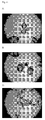
- the mixed crystals of the invention have a uniform, round, smooth and thus nonverbackende crystal structure (see Figures 3 A / B, 4 A / B and 5).
- the raising agent (component a) contains at least one carbonate.
- Carbonates are or will be selected from carbonates whose use in foodstuffs is harmless and which, like their decomposition products, do not lead to an unpleasant taste of the finished baked goods.
- Suitable carbonates which are contained individually or in a mixture, are known to the person skilled in the art and typically alkali metal carbonates and bicarbonates, in particular sodium carbonate, sodium bicarbonate, potassium carbonate and potassium bicarbonate and ammonium carbonate and ammonium bicarbonate are used.
- ammonium carbonate and ammonium bicarbonate which may additionally also contain ammonium carbamate.
- the carbonate is ammonium bicarbonate and / or ammonium carbonate.
- the carbonate is particularly preferably ammonium bicarbonate (also called ammonium bicarbonate).
- the mean particle diameters of the carbonates used are generally from 50 to 1000 .mu.m, preferably from 75 to 700 .mu.m, preferably from 150 to 500 .mu.m.
- the raising agent additionally contains one or more carbamate (s).
- carbamate is or are such carbamates are chosen, the use of which is harmless in food and which as well as their decomposition products do not lead to unpleasant taste of the finished baked goods.
- a suitable carbamate is, for example, ammonium carbamate.
- the amount of carbamate is preferably 10 to 90 wt .-%, based on the total amount of the leavening agent, preferably 30 to 70 wt .-%, in particular about 50% wt .-%.
- the mixture of equal parts of ammonium carbamate and ammonium bicarbonate is also referred to as ammonium carbonate.
- the leavening agent used contains components which do not decompose or do not decompose sufficiently when heated to typical baking temperatures of, for example, 100 to 200 ° C.
- the leavening agent additionally contains an acid or an acidifier.
- the acid or acid generator is a compound or mixture of compounds known for this purpose, for example potassium, sodium, potassium hydrogen and / or calcium tartrate, citric acid, calcium hydrogen phosphate, sodium hydrogen pyrophosphate and / or sodium aluminum phosphate. If the leavening agent contains acid or acid generator, the amount of acid or acid generator is preferably as much as for the reaction of the leavening agent and thus the Release of carbon dioxide is needed.
- this amount can vary greatly.
- sodium bicarbonate and for common acid carriers a range of 60 to 250 wt .-%, based on the total amount of the raising agent, preferably 75 to 225 wt .-%.
- the leavening agent contains an acid or acid generator
- a release agent which prevents premature carbon dioxide formation by reaction of the carbonate with the acid or acid generator.
- release agents are known, preferably flour and / or starch.
- the mean particle diameters of the acids or acid images used are generally from 50 to 1000 .mu.m, preferably from 75 to 700 .mu.m, preferably from 150 to 500 .mu.m.
- the said carbonates, carbamates, acids or acid formers, as well as release agents are commercially available.
- the crystallization aid (component b) preferably contains at least one crystallization-influencing polymer.
- crystallization-affecting in the present invention means that the added polymer influences the crystal form of the resulting crystals in a suitable manner. Under the influence of the crystallization-influencing polymers, the crystals have a smooth and regular structure. This structure is in contrast to the crystal structure without crystallization-influencing polymer, which is characterized by disruptive growths and other crystal forms with irregular and rough surface.
- the polymer is preferably hydrophilic. Uncharged, anionic and / or cationic crystallization-affecting polymers can be used.
- mixtures of different non-charged, different anionic and / or different cationic polymers can be used in addition to individual polymers.
- uncharged polymers can also be used as mixture components for anionic and / or cationic polymer blends.
- these polymers are advantageously chosen so that both the polymer itself and any thermal decomposition products in the amounts typically contained or formed are suitable as a food additive and do not affect the bakery products produced in terms of taste.
- polymers of natural origin or those obtained by modification of natural polymers are used, which are approved tasteless and food law.
- Preferred as charged natural polymers are hydrophilic polymers based on sugar derivatives and / or peptides, in particular from the areas of (hetero) polysaccharides and / or (poly) peptides.
- heteropolysaccharides are usually obtained by fermentation or by isolation from natural sources.
- hetero polysaccharides with carboxyl or sulfonate side chains, in particular with unmodified carboxyl groups (eg pectin and / or alginate) and with modified carboxyl groups (eg amidated pectin).
- unmodified carboxyl groups eg pectin and / or alginate
- modified carboxyl groups eg amidated pectin
- Advantageous anionic polymers are, for example, polyacrylic acid and its salts with ammonium, sodium or potassium, polymethacylic acid and its salts with ammonium, sodium or potassium, acrylic acid and its salts with ammonium, sodium or potassium, methacrylic acid copolymers and their salts ammonium, sodium or potassium, Acrylic acid-maleic acid copolymers and their salts with ammonium, sodium or potassium.
- the said anionic polymers may further contain vinylsulfonic acid in variable proportions.
- anionic polymers may have partially esterified groups, it being possible for both alcoholic components to be aliphatic and derivatized components based on end-capped polyalkylene glycols.
- both ethylene oxide and propylene oxide and higher alkylene oxides can be used alone or in the form of random or block polymers.
- polyaspartic acid and its salts with mono- and divalent cations is preferred.
- Particularly preferred are the salts of polyaspartic acid with ammonium, sodium and potassium.
- Advantageous cationic polymers are for example polymines, polyvinylamines and copolymers with polyvinyl alcohol and / or poly-dimethyl-allyl-ammonium chloride.
- nonionic polymers are, for example, polyethylene glycols, polypropylene glycols, random and block polymers based on ethylene oxide with alkylene oxides, in particular propylene oxide and / or butylene oxide.
- these also have an additional end group closure on one or both sides with aliphatic end groups.
- polyvinylpyrrolidone and / or polyvinylpolypyrrolidone is preferred.
- those polymers which are already approved as food additives are preferred, such as, for example: alginic acid (E 400), sodium alginate (E 401), potassium alginate (E 402), ammonium alginate (E 403), calcium alginate (E 404), propylene glycol alginate (E.
- crystallization aids selected from the group consisting of alginic acid (E 400), sodium alginate (E 401), potassium alginate (E 402), ammonium alginate (E 403), calcium alginate (E 404), propylene glycol alginate (E 405), pectin (E 440 ), amidated pectin (E 440), carrageenan (E 407), gellan (E 418), gum arabic (E414), karaya (E 416), tragacanth (E 412) and / or xanthan (E 415), most preferably Pectin (E 440) and / or amidated pectin (E 440).
- linear and / or branched (poly) peptides are preferred.
- Particularly preferred in the field of (poly) peptides are gelatin qualities.
- Suitable cellulose derivatives are, for example, cellulose ethers. These are cellulose derivatives which formally result from the substitution of hydrogen atoms on the hydroxyl groups of the cellulose by alkyl and / or arylalkyl groups, these alkyl and / or arylalkyl groups being able to be substituted by functional nonionic, anionic and / or cationic groups.
- the alkyl groups are usually C1-C8 alkyl groups, which may be straight-chain or branched.
- the alkyl group is preferably a C 1 -C 4 -alkyl group, for example methyl, ethyl, n-propyl, isopropyl, n-butyl, sec-butyl, isobutyl or tert-butyl.
- the alkyl group may be substituted with an aromatic radical to the arylalkyl group, for example with a phenyl radical.
- a preferred arylalkyl group is benzyl.
- the alkyl or arylalkyl group may be functionally substituted, for example with hydroxy, carboxy or carboxylate groups.
- carboxylate groups are present, corresponding counterions are also contained, for example, alkali ions such as sodium or potassium, or ammonium ions.
- alkali ions such as sodium or potassium, or ammonium ions.
- CMC carboxymethylcellulose
- Na-CMC sodium carboxymethylcellulose
- Cellulose mixed ethers containing more than one type of alkyl-arylalkyl or functionally-substituted alkyl group may also be used.
- Preferred hydrophilic polymeric cellulose derivatives are methyl-ethyl, propyl, carboxymethyl-hydroxyethyl, hydroxipropyl-methylhydroxyethyl, methylhydroxipropyl, methylhydroxibutyl, ethylhydroxyethyl, carboxymethylhydroxyethyl and / or benzylcellulose.
- carboxymethylcelluloses the sodium compound is preferred.
- the raising agent contains sodium carboxymethylcellulose.
- the cellulose ethers are prepared in a known manner, typically by the action of alkyl or arylalkyl halides, epoxides or activated olefins on bases (for example sodium hydroxide) activated cellulose.
- Cellulose ethers are common commodities that are commonly used as thickening agents, even in food. Cellulose ethers are available, for example, under the trademark "Tylose”, high purity cellulose ethers for food applications under the trademark “Tylopur”, high purity Na-CMC under the trademark “Tylopur C” from Clariant GmbH.
- Suitable counterions besides hydrogen are also alkali metal and / or alkaline earth metal ions, as well as substituted or unsubstituted amines, for example ammonia.
- the mixed crystals preferably contain the crystallization assistant in an amount of from 0.5 to 5000 ppm by weight, based on the raising agent, preferably from 0.5 to 2000 ppm by weight, more preferably from 1 to 1000 ppm by weight, in particular of 1 to 500 ppm by weight, very particularly preferably from 1 to 100 ppm by weight, moreover preferably from 1 to 50 ppm by weight, further preferably from 1 to 20 ppm by weight.
- the amount of hydrophilic cellulose derivatives in the leavening agent is preferably less than 80 ppm by weight, based on the leavening agent, preferably between 0.5 and 50 ppm by weight, in particular between 1 and 20% by weight. ppm.
- the present invention relates to the process for the preparation of the mixed crystals according to the invention, which is characterized in that the crystallization aid is added before and / or during the crystallization step of the leavening agent.
- the crystallization aid is added to the mother liquor from which the leavening agent is crystallized out.
- the crystallization aid of the usually circulated mother liquor, in which the carbonate and optionally bicarbonate and carbamate is prepared and crystallized added is added.
- ammonium compounds such as ammonium carbonate, bicarbonate and carbamate are prepared by reacting the appropriate amounts of ammonia, typically 10 to 20%, and excess carbon dioxide, typically 30 to 65% in aqueous mother liquor, at the appropriate pressure, typically 1 to 6 bar and temperature, typically 30 to 65 ° C, followed by crystallization, separation and drying of the precipitate.
- the dosage of the crystallization aid in the mother liquor corresponds in continuous processes after a phase of concentration of the present in the separated crystals amount of mixture component.
- these can optionally be added to further auxiliaries;
- known anti-caking agents such as corn flour, magnesium oxide and / or magnesium carbonate or known release agents such as salts of fatty acids, for example stearic acid, calcium and / or magnesium stearate, silicates, silica, talc or other conventional anti-caking agents.
- known anti-caking agents such as corn flour, magnesium oxide and / or magnesium carbonate or known release agents such as salts of fatty acids, for example stearic acid, calcium and / or magnesium stearate, silicates, silica, talc or other conventional anti-caking agents.
- it is an advantage of the method according to the invention that such additives can be greatly reduced in content or even completely dispensed with the use. Dosages of Over 5000 ppm of magnesium carbonate is generally beneficial only at extreme storage temperatures and times.
- the present invention relates to the use of the mixed crystals according to the invention for the production of baked goods, as acidity regulator in other foods, in the manufacture of cosmetic products, in the synthesis and formulation of pharmaceutical products, as well as blowing agents in industrial processes such.
- the present invention relates to a process for the preparation of baked goods, which is characterized in that the mixed crystals according to the invention are used as a modified leavening agent.
- the method for producing baked goods is therefore further characterized in that a dough is prepared, usually a starch source such as flour and / or potato starch, a protein source such as protein, often fats such as butter, oil and / or margarine, and usually other ingredients such as Contains sugar, spices, fruits or the like.
- the ingredients are intensively mechanically mixed as usual, for example by stirring or kneading.
- other ingredients can also be used which also result in porosity in the baked goods being produced, such as yeast and / or sourdough, as well as increasing the porosity by blowing gases such as air into the dough.
- the leavening agent may also be premixed with individual components of the dough prior to the actual dough preparation. It can also be mixed with dry components of the dough, for example flour, sugar, spices, other flavorings and / or dry egg to a baking mixture from which is prepared by the addition of liquid, a dough and then baked.
- the amount of modified crystal form added leavening agent is chosen to set the desired porosity, which is easily optimized by means of a few routine experiments.
- the amount of leavening agent is chosen so that per 100 g of the starch source used (eg flour and / or potato starch) advantageously 1.5 to 3.5 g of gases (carbon dioxide, ammonia and / or water vapor), preferably 2 to 3 g of gases, especially 2.35 to 2.85 g of gases are developed.
- the starch source used eg flour and / or potato starch
- gases carbon dioxide, ammonia and / or water vapor
- the advantage of the present invention is that the mixed crystals according to the invention have a round shape and smooth surfaces.
- the mixed crystals according to the invention as modified leavening agents, substantially less and, moreover, loosenable agglomerates are formed more easily.
- the crystallization aid having the raising agent is in a mixed crystal, it can not at any time lead to undesirable separation.
- FIG. 4A (5 ppm) 5th 30.8 131.2 0.75
- FIG. 4B (25 ppm) 6.
- FIG. 4C (1000 ppm) gelatin ABC [g] Water [g] Additive [mg] 7th 30.8 131.2 0.31
- FIG. 5 (10 ppm)
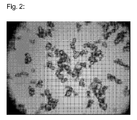
- FIG. 2 and 4C clearly shows the agglomeration tendency of the ammonium bicarbonate crystals.
- the mixed crystals according to the invention ( Figures 3 A / B, 4 A / B and 5), however, have at the same magnification only individual crystals that show no tendency to agglomerate.
- ABS ammonium bicarbonate
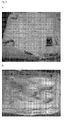
- Table 3.1 ABC of the prior art, 500 ppm MgCO 3 Mixed crystals of ABC and 2 ppm pectin, 500 ppm MgCO 3 Load: 1 ton ( FIG. 7A) ( FIG. 7B) Storage: 1 month Rating: 4 1 ABC of the prior art, 3000 ppm MgCO 3 Mixed crystals of ABC and 2 ppm pectin, 3000 ppm MgCO 3 Load: 2 tons ( FIG. 8A) ( FIG.
- FIG. 7 While the ABC is strongly caked according to the prior art and also when moving the powder larger lumps remain, the mixed crystals according to the invention with pectin are very free flowing and absolutely lump-free.
- FIG. 8 While the ABC of the prior art is very strongly baked and even when the bag bursts, large, solid lumps remain, the mixed crystals of the invention with pectin are readily free-flowing. The small lumps disappear when moving the goods.
- FIG. 9 While the state-of-the-art ABC is highly caked, the mixed crystals with pectin have good free-flowing properties without the formation of lumps. 4. Flowability after storage compared to EP 1 161 872
Landscapes
- Life Sciences & Earth Sciences (AREA)
- Engineering & Computer Science (AREA)
- Food Science & Technology (AREA)
- Health & Medical Sciences (AREA)
- Molecular Biology (AREA)
- General Health & Medical Sciences (AREA)
- Bioinformatics & Cheminformatics (AREA)
- Nuclear Medicine, Radiotherapy & Molecular Imaging (AREA)
- Organic Chemistry (AREA)
- Pharmacology & Pharmacy (AREA)
- General Chemical & Material Sciences (AREA)
- Animal Behavior & Ethology (AREA)
- Chemical Kinetics & Catalysis (AREA)
- Public Health (AREA)
- Veterinary Medicine (AREA)
- Chemical & Material Sciences (AREA)
- Medicinal Chemistry (AREA)
- General Preparation And Processing Of Foods (AREA)
- Bakery Products And Manufacturing Methods Therefor (AREA)
- Saccharide Compounds (AREA)
- Compositions Of Macromolecular Compounds (AREA)
- Cosmetics (AREA)
- Processes Of Treating Macromolecular Substances (AREA)
- Inorganic Compounds Of Heavy Metals (AREA)
- Preparation Of Clay, And Manufacture Of Mixtures Containing Clay Or Cement (AREA)
- Compositions Of Oxide Ceramics (AREA)
Abstract
Description
- Die vorliegende Erfindung betrifft Mischkristalle enthaltend a) Backtriebmittel und b) 0,1 bis 5000 Gew.-ppm Antibackmittel, bezogen auf die Gesamtmenge des Backtriebmittels, in Form von mindestens einem Polymer, wobei beim Einsatz von hydrophilen Cellulosederivaten als Antibackmittel sich deren Menge auf kleiner 100 Gew.-ppm, bezogen auf die Gesamtmenge des Backtriebmittels, reduziert.
Ferner betrifft die vorliegende Erfindung die Herstellung der Mischkristalle und deren Verwendung in der Herstellung von Backwaren, als Säureregulator in Speisen, in der Herstellung von Kosmetikprodukten, in der Synthese und Formulierung von Pharmaprodukten, sowie als Treibmittel in technischen Verfahren wie z. B. die Herstellung von Moosgummi oder für Feuerlöschformulierungen.
Darüber hinaus betrifft die vorliegende Erfindung die Herstellung von Backwaren. - Zur Herstellung von porösen Backwaren wird im Teig vor und/oder während des Backvorgangs ein Gas erzeugt oder der Teig mit Gas versetzt, um im fertigen Backwerk durch die Gasblasen Porosität zu erzeugen. Im einfachsten Fall wird der Teig vor dem Backen mit einem Gas, meist Luft, versetzt, etwa durch intensives Schlagen des Teigs oder eines seiner Bestandteile vor dem Vermischen. Die bekannteste Ausführungsform ist die Zugabe von Eischnee zum Teig. Es ist genauso möglich, ein Gas wie Luft durch Düsen in den Teig einzubringen. Ebenso bekannt sind Verfahren, bei denen Wasserdampf den Teig lockert, beispielsweise bei der Herstellung von Blätterteig. Das meist verwendete Gas ist jedoch Kohlendioxid oder Kohlendioxid im Gemisch mit Ammoniak und Wasserdampf. Kohlendioxid wird beispielsweise biologisch im Zuge der Vergärung von Bestandteilen des Teigs durch Hefen (Hefeteig) und/oder Milchsäurebakterien (im so genannten Sauerteig) erzeugt. Alternativ oder zusätzlich zur Verwendung von Hefe oder Sauerteig wird Kohlendioxid, oder das Kohlendioxid-, Ammoniak- und Wasserdampfgemisch auch chemisch durch Backzusätze, so genannte Backtriebmittel oder Umgangssprachlich "Backpulver", erzeugt, die dem Teig zugesetzt werden.
- Backtriebmittel enthalten im Allgemeinen mindestens ein Carbonat und, falls sich dieses nicht allein durch Temperaturerhöhung zersetzt, eine saure oder säurebildende Substanz. Sie enthalten wahlweise neben Carbonat auch Carbamat (alter Name: "Carbaminat"). Das Carbonat und/oder Carbamat wird dem herzustellenden Backwerk entsprechend gewählt, beispielsweise wird für Leb- oder Honigkuchen häufig Kaliumcarbonat verwendet, für Flachbackwaren Natriumhydrogencarbonat (alter Name: "Natriumbicarbonat"), Ammoniumhydrogencarbonat ("Ammoniumbicarbonat", abgekürzt "ABC"), als alleiniges Carbonat oder im Gemisch mit Ammoniumcarbamat ("Ammoniumcarbonat"). Die Säure oder der Säurebildner darf - auch zusammen mit den sich nicht verflüchtigenden Resten des Carbonats oder Carbamats - den Geschmack nicht negativ beeinflussen. Typischerweise werden Verbindungen wie Weinsäure oder ihre Salze, etwa Kalium-, Natrium-, Kaliumhydrogen- und/oder Calciumtartrat, Citronensäure, Calciumhydrogenphosphat, Natriumhydrogenpyrophosphat oder Natriumaluminiumphosphat verwendet. Wenn das Backtriebmittel eine Säure oder einen Säurebildner enthält, wird ihm meist ein Trennmittel zugegeben, das die vorzeitige Kohlendioxidbildung durch Reaktion des Carbonats mit der Säure oder dem Säurebildner verhindert, üblich ist hierfür der Zusatz von Mehl oder Stärke. Die genannten Ammoniumverbindungen ABC und Ammoniumcarbaminat zersetzen sich allein durch Temperaturerhöhung auf mindestens 60°C rückstandsfrei in Kohlendioxid, Ammoniak und Wasser. Bei typischen Backtemperaturen fallen alle drei Komponenten gasförmig an und führen daher sämtlich zu einer Erhöhung der Porosität des Backwerks. Diese Verbindungen werden daher typischerweise ohne Zusatz einer Säure oder eines Säurebildners verwendet, so dass sich der Zusatz des Trennmittels erübrigt.
- Ullmanns Encyklopädie der technischen Chemie, 3. Auflage, Urban & Schwarzenhäuser, München - Berlin 1953, Stichwort "Backpulver" oder Ullmann's Encyclopedia of Industrial Chemistry, Sixth Ed., 1999 Electronic Release, Wiley-VCH, Weinheim 1999, Stichwort "Bread and other baked Products", dort Punkt 2.6: "Leavening Agents", geben einen zusammenfassenden Überblick über die bekannten Verfahren zur Herstellung poröser Backwaren unter Verwendung von Backtriebmitteln. Die Herstellung von Ammoniumverbindungen wie Ammoniumcarbonat, -bicarbonat und -carbaminat durch Umsetzung von dem gewünschten Produkt entsprechenden Mengen Ammoniak und Kohlendioxid in wässriger Mutterlauge, bei dem Produkt entsprechend gewählten Drücken und Temperaturen, gefolgt von Abtrennung und Trocknung des Niederschlags, ist ebenso seit langem bekannt und beispielsweise in Ullmann's Encyclopedia of Industrial Chemistry, Sixth Ed., 1999 Electronic Release, Wiley-VCH, Weinheim 1999, Stichwort "Ammonium Compounds", insbesondere Punkt 4.: "Ammonium Carbonates", beschrieben. Die Herstellung der Alkalicarbonate und -hydrogencarbonate ist ebenso bekannt.
- Obwohl bei typischen Backtemperaturen diese Ammoniumverbindungen gasförmig anfallen, wird häufig ein Antibackmittel zugesetzt, um das als "Verbacken", englisch "caking", bezeichnete Entstehen von Klumpen oder größeren Agglomeraten in einem Pulver zu verhindern (der Begriff "Verbacken" oder "Antibackmittel" hat außer seinem Wortstamm nichts mit der Herstellung von Backwaren, Gebäck oder dem Begriff "Backtriebmittel" für Stoffe, die zu Porosität im Backwerk führen, zu tun). Als Antibackmittel werden hierfür üblicherweise Maismehl, Magnesiumoxid oder Magnesiumcarbonat in einer Menge von 2000 bis 10000 Gew.-ppm verwendet. Gegebenenfalls werden ferner anorganische Salze mit den Antibackmitteln vermischt.
-
EP-A 1 161 872 offenbart den Einsatz von Antibackmitteln auf Basis von hydrophilen Cellulosederivaten. Als bevorzugte hydrophile polymere Cellulosederivate werden Natriumcarboxymethylcellulose genannt. Es wird offenbart, dass das Cellulosederivat in einer Menge von mindestens 100 Gew.-ppm, bezogen auf die Gesamtmenge des Backtriebmittels, besonders bevorzugt mindestens 500 Gew.-ppm, beispielsweise mit 1000 Gew.-ppm, eingesetzt wird. - Hydrophile Cellulosederivate finden sich in Backwaren nicht nur als Antibackmittel, sondern werden ferner als Ballaststoffe in einer Menge von typischerweise 5 bis 20 Gew.-% bezogen auf die Backware verwendet (
US 4,678,672 undGB 745,926 EP-A 399 995 - Der Einsatz von Antibackmitteln ist des weiteren bei Düngemitteln weit verbreitet, da die Düngemittel aufgrund der nur saisonalen Verwendung vergleichsweise lagerstabil sein müssen.
- Als Antibackmittel werden beispielsweise Leime auf Basis von Carboxymethylcellulose, die mit Füllstoffen wie Calciumcarbonat oder Calciumoxid vermischt sind (
DD-A 117 787 US 3,388,990 /US 5,472,476 ), Hydroxypropylcellulose, Natriumcarboxymethylcellulose oder Hydroxypropylmethylcellulose (EP-A 246 719 SU-A 1570255 - Im Stand der Technik wird ferner offenbart, die anorganischen Salze mit einem Schutzfilm zu überziehen. Als Schutzfilm werden beispielsweise Polysaccharide und ihre Derivate beschrieben, insbesondere Stärke, Cellulose, Manna, Natriumalginat, Methylcellulose, Carboxymethylstärke und Carboxymethylcellulose (
DE-A 28 21 703 ,WO 98/56595 EP-A 461 886 DE-A 24 35 008 ) eingesetzt. Gegebenenfalls können weitere Antibackmittel wie Magnisiumsilikat (WO 94/24860 WO 94/24994 US 5,482,702 ) oder Phosphorverbindungen (US 5,468,716 ) eingesetzt werden. - Nachteilig am Stand der Technik ist, dass bei den bekannten Backverfahren unter Verwendung üblicher Backtriebmittel die Bildung von unerwünscht großen Gasblasen und in Folge davon unerwünscht großen Hohlräume im Backwerk trotz Verwendung von Antibackmitteln nicht gänzlich unterdrückt werden kann. Diese großen Hohlräume gehen häufig weit über den gewünschten Porendurchmesser von 0,1 - ca. 5 mm der Poren im Backwerk hinaus. Dies führt zu einem unerwünscht hohen Anteil an Ausschuss, da solches Backwerk zwar einzelne sehr große Hohlräume, aber ansonsten überwiegend Bereiche mit unerwünscht niedriger Porosität enthält, was das Backwerk hart und häufig auch unansehnlich macht. Wenn die großen Hohlräume an der Oberfläche des Backwerkes auftreten so wird beim Backprozess die dann dünne Teigschicht on der Oberseite wesentlich schneller fertig gebacken und weist dann eine unschöne dunkelbraune bis schwarze Verfärbung auf. Diese Backwaren sind dann nicht verkaufsfähig und erhöhen den Ausschuss bei der Produktion.
- Das Verbacken der gängigen Backtriebmittel beruht unter anderem auf der Kristallform der Produkte. Die technisch gut verfügbaren Salze weisen durch Aufwachsungen und andere Kristallfehler eine sehr raue Struktur auf. Diese Kristallformen können aufgrund der rauen Struktur sehr leicht verhaken und es bilden sich mechanisch stabile Brücken zwischen den einzelnen Kristallen. Diese stabilen Brücken bewirken die bekannt hohe Verbackungsneigung der Produkte. In der
Figur 1 ist ein Ammoniumbicarbonat-Agglomerat abgebildet, das üblicherweise im Stand der Technik als Backtriebmittel eingesetzt wird. - Im Stand der Technik wird demnach Antibackmittel im Backtriebmittel eingesetzt, um das Verhaken und somit Agglomerieren der Backtriebmittelkristalle zu reduzieren. Das Antibackmittel wird folglich als Abstandshalten oder zum Beschichten/Coaten der rauen Kristallstruktur (
EP-A 1 161 872 ), um diese abzurunden, eingesetzt. - Ferner sind diese Mischung aus Backtriebmittel und Antibackmittel beim Einsatz im kontinuierlichen Prozess zur Herstellung von Backwaren (automatisierte Backstraßen) nachteilig. Typischerweise werden diese Mischungen in Pulverform über eine Dosiervorrichtung eingebracht. Um ein Verbacken der Mischung in der Dosiervorrichtung zu verhindern, wird diese ständig gerüttelt. Das Rütteln bewirkt aber leider eine Separation des Backtriebmittels und des Antibackmittels. Folglich liegt das Antibackmittel nicht mehr gleichmäßig im Backtriebmittel vor und es kann zum Auftreten von Verbackungen und somit zur unerwünschten Bildung von ungleichmäßig großen Hohlräumen im Backwerk und folglich zu vermehrten Ausschuss kommen.
- Ein weiterer Nachteil der Backtriebmittel aus dem Stand der Technik stellt deren geringe Lagerfähigkeit dar. Insbesondere bei der im Anwendungsgebiet üblichen Lagerung unter Druck werden im Stand der Technik schon nach wenigen Tagen Verbackungen sowohl bei den gecoateten Backtriebmitteln als auch bei der reinen pulvrigen Mischung aus Backtriebmittel und Antibackmittel festgestellt. Eine Lagerung unter Druck ist üblich, da aus Platzmangel die jeweiligen Säcke übereinander gelagert werden.
- Folglich stellen trotz Verwendung von Antibackmitteln Verbackungen, d.h. das Entstehen und Klumpen oder größeren Agglomeraten, bei der Lagerung und dem Einsatz von Backtriebmitteln immer noch ein ungelöstes Problem dar. Die Verbackungen bewirken die Bildung von unerwünscht großen Hohlräumen und somit eine ungleichmäßige Verteilungen von Hohlräumen.
- Die Aufgabe der vorliegenden Erfindung ist demnach, ein modifiziertes Backtriebmittel bereitzustellen, das im Vergleich zum Stand der Technik weniger leicht agglomeriert und/oder deren Agglomerate sich einfach wieder auflockern lassen. Ferner soll im Vergleich zum Stand der Technik erstmals die Ursache des Agglomerisierens, d.h. die Kristallform des Backtriebmittels modifiziert werden, anstatt lediglich die Auswirkung der Kristallform zu minimieren. Darüber hinaus soll dieses modifizierte Backtriebmittel trotz Einsatz nur sehr niedriger Mengen an Hilfsmittel auch bei langer Lagerung noch ein freifließendes Pulver bilden, das bei Verwendung in automatiserten/kontinuierlichen Backstraßen genau dosierbar bleibt. Insbesondere soll bei der Herstellung von Backwaren die Bildung von unerwünscht großen Hohlräumen vermieden werden.
- Überraschenderweise wurde gefunden, dass Mischkristalle enthaltend
- a) Backtriebmittel
- b) 0,1 bis 5000 Gew.-ppm Kristallisationshilfsmittel, bezogen auf die Gesamtmenge des Backtriebmittels, in Form von mindestens einem Polymer, wobei auch Mischungen verschiedener Polymere verwendbar sind,
wobei beim Einsatz von hydrophilen Cellulosederivaten als Kristallisationshilfsmittel sich deren Menge auf kleiner 100 Gew.- ppm, bezogen auf die Gesamtmenge des Backtriebmittels reduziert, - Unter dem Begriff Mischkristall wird bei der vorliegenden Erfindung verstanden, dass das Kristallisationshilfsmittel (Komponente b) im und/oder auf dem Backtriebmittelkristall (Komponente a), d.h. im Kristall und/oder auf/an der Kristalloberfläche, vorliegt.
- Die Mischkristalle stellen folglich ein modifiziertes Backtriebmittel dar.
- Unter dem Begriff "rieselfähig" wird bei der vorliegenden Erfindung verstanden, dass das Produkt nach z.B. einer Lagerung oder einem Transport in Säcken nach deren Öffnen nicht in Form von einem oder mehreren Brocken heraus fällt, d.h. stark verklumpt ist, sondern frei aus dem Sack ausfließt / herausrieselt.
- Unter dem Begriff "klumpenfrei" wird bei der vorliegenden Erfindung verstanden, dass das rieselfähige Pulver frei von Agglomeraten, die sich während der Lagerung gebildet haben, ist.
- Die erfindungsgemäßen Mischkristalle weisen eine gleichmäßige, runde, glatte und somit nichtverbackende Kristallstruktur auf (siehe
Figuren 3 A/B, 4 A/B und 5). - Es bilden sich bei der Lagerung und bei der Anwendung wesentlich weniger und darüber hinaus leichter wieder auflockerbare Agglomerate und Verbackungen als bei Backtriebmitteln aus dem Stand der Technik.
- Das Backtriebmittel (Komponente a) enthält mindestens ein Carbonat. Als Carbonat wird oder werden solche Carbonate gewählt, deren Verwendung in Nahrungsmitteln unbedenklich ist und die ebenso wie ihre Zersetzungsprodukte nicht zu unangenehmen Geschmack der fertigen Backwaren führen. Geeignete Carbonate, die einzeln oder im Gemisch enthalten sind, sind dem Fachmann bekannt und typischerweise werden Alkalicarbonate und -hydrogencarbonate, insbesondere Natriumcarbonat, Natriumhydrogencarbonat, Kaliumcarbonat und Kaliumhydrogencarbonat sowie Ammoniumcarbonat und Ammoniumhydrogencarbonat verwendet.
- Ebenso geeignet ist das üblicherweise als "Hirschhornsalz" bezeichnete Gemisch aus Ammoniumcarbonat und Ammoniumhydrogencarbonat, das zusätzlich auch Ammoniumcarbamat enthalten kann.
- Vorzugsweise ist das Carbonat Ammoniumhydrogencarbonat und/oder Ammoniumcarbonat. Besonders bevorzugt ist das Carbonat Ammoniumhydrogencarbonat (auch Ammoniumbicarbonat genannt).
- Die mittleren Partikeldurchmesser der eingesetzten Carbonate liegen im allgemeinen bei 50 bis 1000 µm, vorzugsweise bei 75 bis 700 µm, bevorzugt bei 150 bis 500 µm.
- Wahlweise enthält das Backtriebmittel zusätzlich ein oder mehrere Carbamat(e). Als Carbamat wird oder werden solche Carbamate gewählt, deren Verwendung in Nahrungsmitteln unbedenklich ist und die ebenso wie ihre Zersetzungsprodukte nicht zu unangenehmen Geschmack der fertigen Backwaren führen. Ein geeignetes Carbamat ist beispielsweise Ammoniumcarbamat.
- Falls das Backtriebmittel Carbamat enthält, beträgt die Menge an Carbamat vorzugsweise 10 bis 90 Gew.-%, bezogen auf die Gesamtmenge des Backtriebmittels, bevorzugt 30 bis 70 Gew.-%, insbesondere ca. 50% Gew.-%. Das Gemisch aus gleichen Teilen Ammoniumcarbamat und Ammoniumbicarbonat wird auch als Ammoniumcarbonat bezeichnet.
- Wenn das eingesetzte Backtriebmittel Komponenten enthält, die sich beim Erwärmen auf typische Backtemperaturen von beispielsweise 100 bis 200 °C nicht oder nicht ausreichend zersetzen, enthält das Backtriebmittel zusätzlich eine Säure oder einen Säurebildner. Die Säure oder der Säurebildner ist eine für diesen Verwendungszweck bekannte Verbindung oder Verbindungsgemisch, beispielsweise Kalium-, Natrium-, Kaliumhydrogen- und/oder Calciumtartrat, Citronensäure, Calciumhydrogenphosphat, Natriumhydrogenpyrophosphat und/oder Natriumaluminiumphosphat. Falls das Backtriebmittel Säure oder Säurebildner enthält, beträgt die Menge an Säure oder Säurebildner vorzugsweise so viel, wie zur Umsetzung des Backtriebmittels und damit zur Freisetzung von Kohlendioxid benötigt wird. Je nach Säurestärke, Anzahl der Protonen pro Molekül und Molgewicht der Säure und des Backtriebmittels kann diese Menge stark unterschiedlich sein. Als Beispiel gilt bei Verwendung von Natriumbicarbonat und für gebräuchliche Säureträger ein Bereich von 60 bis 250 Gew.-%, bezogen auf die Gesamtmenge des Backtriebmittels, bevorzugt 75 bis 225 Gew.-%.
- Wenn das Backtriebmittel eine Säure oder einen Säurebildner enthält, wird ihm vorzugsweise auch ein Trennmittel zugegeben, das die vorzeitige Kohlendioxidbildung durch Reaktion des Carbonats mit der Säure oder dem Säurebildner verhindert. Derartige Trennmittel sind bekannt, bevorzugt sind Mehl und/oder Stärke.
- Die mittleren Partikeldurchmesser der eingesetzten Säuren oder Säurebilder liegen im allgemeinen bei 50 bis 1000 µm, vorzugsweise bei 75 bis 700 µm, bevorzugt bei 150 bis 500 µm.
- Die genannten Carbonate, Carbamate, Säuren oder Säurenbildner, sowie Trennmittel sind kommerziell erhältlich.
- Das Kristallisationshilfsmittel (Komponente b) beinhaltet bevorzugt mindestens ein kristallisationsbeeinflussendes Polymer. Unter dem Begriff "kristallisationsbeeinflussend" wird in der vorliegenden Erfindung verstanden, dass das zugesetzte Polymer die Kristallform der entstehenden Krisalle in geeigneter Art und Weise beeinflußt. Unter der Einwirkung der kristallisationsbeeinflussenden Polymere weisen die Kristalle eine glatte und regelmäßige Struktur auf. Diese Struktur steht im Gegensatz zur Kristallstruktur ohne kristallisationsbeeinflussendes Polymer, die durch störende Aufwachsungen und andere Kristallformen mit unregelmäßiger und rauer Oberfläche gekennzeichnet ist.
- Ferner ist das Polymer bevorzugt hydrophil. Es können ungeladene, anionische und/oder kationische kristallisationsbeeinflussende Polymere verwendet werden.
- Ferner können neben einzelnen Polymeren auch Mischungen aus verschiedenen nichtgeladenen, verschiedenen anionischen und/oder verschiedenen kationischen Polymeren eingesetzt werden. Daneben können auch nichtgeladene Polymere als Mischungskomponenten für anionische und/oder kationische Polymermischunge verwendet werden.
- Diese Polymere werden aus offensichtlichen Gründen vorteilhaft so gewählt, dass sowohl das Polymer selbst wie auch etwaige thermische Abbauprodukte in den typischerweise enthaltenen oder entstehenden Mengen als Lebensmittelzusatzstoff geeignet sind und die hergestellten Backwaren geschmacklich nicht beeinträchtigen. Vorzugsweise werden Polymere natürlichen Ursprungs oder solche, die durch Modifikation natürlicher Polymere entstehen, verwendet, die geschmacksneutral und lebensmittelrechtlich zugelassen sind.
- Als geladene natürliche Polymere sind hydrophile Polymere auf Basis von Zuckerderivaten und/oder Peptiden bevorzugt, insbesondere aus den Bereichen der (Hetero)Polysaccharide und/oder (Poly)Peptide.
- Diese Heteropolysaccharide werden üblicherweise durch Fermentation oder durch Isolierung aus natürlichen Quellen gewonnen.
- Besonders bevorzugt sind geladene (Hetero)Polysaccharide mit Carboxyl- oder Sulfonat-Seitenketten, insbesondere mit nichtmodifizierten Carboxylgruppen (z. B. Pektin und/oder Alginat) und mit modifizierten Carboxylgruppen (z. B. amidiertes Pektin).
- Vorteilhafte anionische Polymere stellen beispielsweise Polyacrylsäure und deren Salze mit Ammonium, Natrium oder Kalium, Polymethacylsäure und deren Salze mit Ammonium, Natrium oder Kalium, Acrylsäure und deren Salze mit Ammonium, Natrium oder Kalium, Methacrylsäure-Copolymere und deren Salze Ammonium, Natrium oder Kalium, Acrylsäure-Maleinsäure-Copolymere und deren Salze mit Ammonium, Natrium oder Kalium dar.
- Die genannten anionischen Polymere können ferner Vinylsulfonsäure in veränderlichen Anteilen enthalten.
- Alle genannten anionischen Polymere können teilveresterte Gruppen aufweisen, wobei als Alkoholkomponenten sowohl aliphatische als auch derivatisierte Komponenten auf Basis von endgruppenverschlossenen Polyalkylenglykole sein können. Für die Herstellung der Polyalkylenglykole können sowohl Ethylenoxid als auch Propylenoxid und höhere Alkylenoxide allein oder in Form von Random oder Blockpolymeren verwendet werden.
- Ferner ist Polyasparaginsäure und deren Salze mit mono- und divalenten Kationen bevorzugt. Besonders bevorzugt sind die Salze der Polyasparaginsäure mit Ammonium, Natrium und Kalium.
- Vorteilhafte kationische Polymere stellen beispielsweise Polymine, Polyvinylamine und Copolymere mit Polyvinylalkohol und/oder Poly-dimethyl-allyl-ammoniumchlorid dar.
- Vorteilhafte nicht-ionische Polymere stellen beispielsweise Polyethylenglykole, Polypropylenglykole, Random und Blockpolymere auf Basis Ethylenoxid mit Alkylenoxiden, insbesondere Propylenoxid und/oder Butylenoxid dar. Gegebenenfalls weisen diese ferner einen zusätzlichen Endgruppenverschluss auf einer oder beiden Seiten mit aliphatischen Endgruppen auf. Ferner ist Polyvinylpyrrolidon und/oder Polyvinylpolypyrrolidon bevorzugt.
- Insbesondere sind solche Polymere bevorzugt, die bereits eine Zulassung als Lebensmittelzusatzstoff aufweisen, wie beispielsweise: Alginsäure (E 400), Natriumalginat (E 401), Kaliumalginat (E 402), Ammoniumalginat (E 403), Calciumalginat (E 404), Propylenglycolalginat (E 405), Agar-Agar (E 406), Carrageen (E 407), Verarbeitete Eucheuma-Algen (E 407a), Johannisbrotkernmehl (E 410), Guarkernmehl (E 412), Traganth (E 412), Gummi arabicum (E414), Xanthan (E 415), Karaya (E 416), Tarakernmehl (E 417), Gellan (E 418), Komjak-Gummi/Konjak-glucomannan (E 425), Sojabohnen-Polyose (E426), Pektin/Amidiertes Pektin (E 440), Mikrokristalline Cellulose/cellulosepulver (E 460), Methylcellulose (E 461), Ethylcellulose (E 462), Hydroxypropylcellulose (E 463), Hydroxypropylmethylcellulose (E 464), Ethylmethylcellulose (E 465), Carboxymethylcellulose/Natriumcarboxymethylcellulose (E 466), Vernetzte Natriumcarboxymethylcellulose (E 468), enzymatisch hydrolysierte Carboxymethylcellulose (E 469), Polydextrose (E 1200), Polyvinylpyrrolidon (E 1201), Polyvinylpolypyrrolidon (E 1202), Pullulan (E 1204), Oxidierte Stärke (E 1404), Monostärkephosphat (E 1410), Distärkephosphat (E 1412), Phosphatiertes Distärkephosphat (E 1413), Acetyliertes Distärkephosphat (E 1414), Acetylierte Stärke (E 1420), Acetylierte Distärkeadipat (E 1422), Hydroxypropylstärke (E 1440), Hydroxypropyldistärkephosphat (E 1442), Stärkenatriumoctenylsuccinat (E 1450), Acetylierte oxydierte Stärke (E 1451).
- Besonders bevorzugt sind Kristallisationshilfsmittel ausgewählt aus der Gruppe bestehend aus Alginsäure ( E 400), Natriumalginat (E 401), Kaliumalginat (E 402), Ammoniumalginat (E 403), Calciumalginat (E 404), Propylenglycolalginat (E 405), Pektin (E 440), amidiertes Pektin (E 440), Carrageen (E 407), Gellan (E 418), Gummi Arabicum (E414), Karaya (E 416), Traganth (E 412) und/oder Xanthan (E 415), ganz besonders bevorzugt Pektin (E 440) und/oder amidiertes Pektin (E 440).
- Ferner sind als Kristallisationshilfsmittel lineare und/oder verzweigte (Poly)Peptide bevorzugt. Besonders bevorzugt im Bereich der (Poly)Peptide sind Gelatinequalitäten.
- Geeignete Cellulosederivate sind beispielsweise Celluloseether. Dies sind Cellulosederivate, die formal durch Substitution von Wasserstoffatomen an den Hydroxigruppen der Cellulose durch Alkyl- und/oder Arylalkylgrupen hervorgehen, wobei diese Alkyl- und/oder Arylalkylgruppen durch funktionelle nichtionische, anionische und/oder kationische Gruppen substituiert sein können. Die Alkylgruppen sind üblicherweise C1- C8 Alkylgruppen, die geradkettig oder verzweigt sein können. Vorzugsweise ist die Alkylgruppe eine C1-C4-Alkylgruppe, beispielsweise Methyl, Ethyl, n-Propyl, iso-Propyl, n-Butyl, sec.-Butyl, iso-Butyl oder tert.-Butyl. Die Alkylgruppe kann mit einem aromatischen Rest zur Arylalkylgruppe substituiert sein, beispielsweise mit einem Phenylrest. Eine bevorzugte Arylalkylgruppe ist Benzyl. Die Alkyl- oder Arylalkylgruppe kann funktionell substituiert sein, beispielsweise mit Hydroxi-, Carboxi- oder Carboxilatgruppen. Sofern Carboxilatgruppen enthalten sind, sind auch entsprechende Gegenionen enthalten, beispielsweise Alkaliionen wie Natrium oder Kalium, oder Ammoniumionen. Ist nur von "Carboximethylcellulose" (oft als "CMC" abgekürzt) die Rede, ist üblicherweise Natrium-carboximethylcellulose gemeint (gelegentlich auch als "Na-CMC" abgekürzt). Es können auch Cellulose-mischether verwendet werden, die mehr als eine Art Alkyl-Arylalkyl- oder funktionell substitutierte Alkylgruppe enthalten.
- Bevorzugte hydrophile polymere Cellulosederivate sind Methyl- Ethyl-, Propyl-, Carboximethyl- Hydroxiethyl-, Hydroxipropyl- Methylhydroxidethyl-, Methylhydroxipropyl-, Methylhydroxibutyl-, Ethylhydroxidethyl-, Carboximethylhydroxiethyl- und/oder Benzylcellulose. Unter den Carboximethylcellulosen ist die Natriumverbindung bevorzugt. In bevorzugter Weise enthält das Backtriebmittel Natriumcarboximethylcellulose.
- Die Celluloseether werden auf bekanntem Wege hergestellt, typischerweise durch Einwirkung von Alkyl- oder Arylalkylhalogeniden, Epoxiden oder aktivierten Olefinen auf mit Basen (beispielsweise Natronlauge) aktivierte Cellulose. Celluloseether sind gängige Handelswaren, die - auch in Lebensmitteln - üblicherweise als Verdickungsmittel verwendet werden. Celluloseether sind beispielsweise unter der Marke "Tylose", hochreine Celluloseether für Lebensmittelanwendungen unter der Marke "Tylopur", hochreine Na-CMC unter der Marke "Tylopur C" von Clariant GmbH erhältlich.
- Als Gegenionen kommen neben Wasserstoff auch Alkali- und/oder Erdalkali-lonen, sowie substituierte oder unsubstituierte Amine, beispielsweise Ammoniak, in Frage.
- Die Herstellung der genannten Polymere ist allgemein bekannt und in gängiger Fachliteratur nachzulesen.
- Die Mischkristalle enthalten das Kristallisationshilfsmittel vorzugsweise in einer Menge von 0,5 bis 5000 Gew.-ppm, bezogen auf das Backtriebmittel, bevorzugt von 0,5 bis 2000 Gew.-ppm, besonders bevorzugt von 1 bis 1000 Gew.-ppm, insbesondere von 1 bis 500 Gew.-ppm, ganz besonders bevorzugt von 1 bis 100 Gew.-ppm, darüber hinaus bevorzugt von 1 bis 50 Gew.-ppm, des weiteren bevorzugt von 1 bis 20 Gew.-ppm.
- Falls hydrophile Cellulosederivate als Kristallisationshilfsmittel eingesetzt werden, beträgt die Menge an hydrophilen Cellulosederivaten im Backtriebmittel vorzugsweise weniger als 80 Gew.-ppm, bezogen auf das Backtriebmittel, bevorzugt zwischen 0,5 und 50 Gew.-ppm, insbesondere zwischen 1 und 20 Gew.-ppm.
- Die Steigerung der Menge an Kristallisationshilfsmittel über einen Höchstwert führt zu negativen Einflüssen auf die gewünschte Kristallmodifizierung und Kristallisationsneigung. Im Fall des Einsatzes von hydrophilen Cellulosederivaten als Kristallisationshilfsmittel werden bereits ab einem Wert von ca. 100 Gew.-ppm unerwünschte Ausbildungen von Stabkristallen anstatt kugelförmigen Kristallen erhalten (siehe
Figur 4 C) . - Diese Stabkristalle neigen wiederum zum Verhaken und somit zum Verbacken, ähnlich wie das Ammoniumbicarbonat aus dem Stand der Technik (siehe
Figur 1 ). Zusätzlich werden sie nach einiger Zeit feucht und bilden dann eine klebrige Masse.
Unter Verwendung von mehr als 5000 Gew.-ppm Kristallisationshilfsmittel werden überwiegend sehr große Kristalle und/oder Kristalle mit raueren Oberflächen erhalten. Die großen Kristalle müssten dann vor einem Einsatz vermahlen werden. Das Vermahlen würde einen zusätzlichen, kostenintensiven Verfahrensschritt bedeuten, der ferner die Gefahr der Herstellung von Teilchen mit rauen Oberflächen in sich trägt. - Ferner betrifft die vorliegende Erfindung das Verfahren zur Herstellung der erfindungsgemäßen Mischkristalle, das dadurch gekennzeichnet ist, dass das Kristallisationshilfsmittel vor und/oder während des Kristallisationsschritts des Backtriebmittels zugegeben wird.
- Bevorzugt wird das Kristallisationshilfsmittel der Mutterlauge, aus der das Backtriebmittel auskristallisiert wird, zugegeben. Hierbei wird das Kristallisationshilfsmittel der üblicherweise im Kreis gefahrenen Mutterlauge, in der das Carbonat und gegebenenfalls Hydrogencarbonat und Carbamat hergestellt und auskristallisiert wird, zugesetzt.
- Das Verfahren zur Herstellung der Backtriebmittel ist dem Fachmann seit langem bekannt. Beispielsweise werden Ammoniumverbindungen wie Ammoniumcarbonat, - bicarbonat und -carbaminat durch Umsetzung von den entsprechenden Mengen Ammoniak, typischerweise 10 bis 20 %, und im Überschuss zugegebenen Kohlendioxid, typischerweise 30 bis 65 % in wässriger Mutterlauge, bei dem entsprechenden Druck, typischerweise 1 bis 6 bar und Temperatur, typischerweise 30 bis 65 °C gefolgt von Kristallisation, Abtrennung und Trocknung des Niederschlags hergestellt.
- Eine detaillierte Beschreibung der Herstellung von Backtriebmitteln findet sich beispielsweise in Ullmann's Encyclopedia of Industrial Chemistry, 2008 Edition.
- Die Dosiermenge des Kristallisationshilfsmittels in die Mutterlauge entspricht bei kontinuierlichen Verfahren nach einer Phase der Aufkonzentration der in den abgetrennten Kristallen vorhandenen Menge an Mischungskomponente.
- Nach der Herstellung der erfindungsgemäßen Mischkristalle können diesen wahlweise weitere Hilfsstoffe zugesetzt werden; beispielsweise bekannte Antibackmittel wie Maismehl, Magnesiumoxid und/oder Magnesiumcarbonat oder bekannte Trennmittel wie Salze von Fettsäuren, beispielsweise Stearinsäure, Calcium- und/oder Magnesiumstearat, Silikate, Siliziumdioxid, Talkum oder andere gebräuchliche Antibackmittel. Es ist jedoch ein Vorzug des erfindungsgemäßen Verfahrens, dass solche Zusätze im Gehalt stark reduziert oder sogar völlig auf den Einsatz verzichtet werden kann. Dosierungen von über 5000 ppm Magnesiumcarbonat sind im Allgemeinen nur bei extremen Lagertemperaturen und -zeiten von Vorteil.
- Ferner betrifft die vorliegende Erfindung die Verwendung der erfindungsgemäßen Mischkristalle zur Herstellung von Backwaren, als Säureregulator in anderen Speisen, in Herstellung von Kosmetikprodukten, in der Synthese und Formulierung von Pharmaprodukten, sowie als Treibmittel in technischen Verfahren wie z. B. die Herstellung von Moosgummi oder für Feuerlöschformulierungen.
- Ferner betrifft die vorliegende Erfindung ein Verfahren zur Herstellung von Backwaren, das dadurch gekennzeichnet ist, dass die erfindungsgemäßen Mischkristalle als modifiziertes Backtriebmittel eingesetzt werden.
- Das Verfahren zur Herstellung von Backwaren wird ansonsten auf üblicher, dem Fachmann bekannter Weise durchgeführt.
- Das Verfahren zur Herstellung von Backwaren ist folglich ferner dadurch gekennzeichnet, dass ein Teig zubereitet wird, der üblicherweise eine Stärkequelle wie Mehl und/oder Kartoffelstärke, eine Proteinquelle wie Eiweiß, häufig Fette wie Butter, Öl und/oder Margarine, und meist weitere Zutaten wie Zucker, Gewürze, Früchte oder ähnliches enthält. Die Zutaten werden wie üblich intensiv mechanisch vermischt, beispielsweise durch Rühren oder Kneten. Neben dem Backtriebmittel können weitere Zutaten verwendet werden, die ebenfalls zu Porosität in den erzeugten Backwaren führen, beispielsweise Hefe und/oder Sauerteig, ebenso kann die Porosität durch Einblasen von Gasen wie Luft in den Teig erhöht werden. Das Backtriebmittel kann wahlweise auch vor der eigentlichen Teigzubereitung mit einzelnen Komponenten des Teigs vorvermischt werden. Es kann ferner mit trockenen Komponenten des Teigs, beispielsweise Mehl, Zucker, Gewürzen, sonstigen Geschmacksstoffen und/oder Trockenei zu einer Backmischung vermischt werden, aus der durch Zugabe von Flüssigkeit ein Teig hergestellt und anschließend gebacken wird.
- Die Menge des zugesetzten, Backtriebmittels mit modifizierter Kristallform wird so gewählt, dass die gewünschte Porosität eingestellt wird, dies ist mittels weniger Routineversuche leicht zu optimieren.
- Üblicherweise wird die Menge an Backtriebmittel so gewählt, dass pro 100 g der eingesetzten Stärkequelle (z. B. Mehl und/oder Kartoffelstärke) vorteilhaft 1,5 bis 3,5 g Gase (Kohlendioxid, Ammoniak und/oder Wasserdampf), bevorzugt 2 bis 3 g Gase, insbesondere 2,35 bis 2,85 g Gase entwickelt werden.
- Werden unporösere Backwaren hergestellt, ist die Menge entsprechend zu verringern; und für porösere entsprechend zu erhöhen.
- Der Vorteil der vorliegenden Erfindung liegt darin, dass die erfindungsgemäßen Mischkristalle eine runde Form und glatte Oberflächen aufweisen. Somit bilden sich bei der Lagerung und bei der Anwendung der erfindungsgemäßen Mischkristalle als modifiziertes Backtriebmittel wesentlich weniger und darüber hinaus leichter wieder auflockerbare Agglomerate.
- Da das Kristallisationshilfsmittel mit dem Backtriebmittel in einem Mischkristall vorliegt, kann es ferner zu keiner Zeit zu einer unerwünschten Separation führen.
- Darüber hinaus wird das Ziel der Verhinderung von Verbackungen bereits mit einer sehr geringen Menge an Kristallisationshilfsmittel erreicht. Ferner ist kein zusätzlicher Verfahrensschritt zur Herstellung des Backtriebsmittels erforderlich.
- Es lassen sich Backwaren einer gut steuerbaren Porosität herstellen.
- Ammoniumbicarbonat (ABC), Wasser und Additiv wurden gemäß Tabelle 1 auf 40 °C unter Rühren erwärmt. Nach kompletter Lösung wurde schnell auf 0°C unter Rühren abgekühlt. Die entstandenen Kristalle wurden abgekühlt, getrocknet und unter dem Mikroskop mit einer Vergrößerung von 20:1 begutachtet.
Tabelle 1: Blindversuch ABC [g] Wasser [g] Additiv 1. (Vergleichsversuch) 30,8 131,2 0 Figur 2 Pektin ABC [g] Wasser [g] Additiv [mg] 2. 30,8 131,2 0,31 Figur 3A (10 ppm) 3. 30,8 131,2 1,5 Figur 3B (50 ppm) Tylose ABC [g] Wasser [g] Additiv [mg] 4. 30,8 131,2 0,15 Figur 4A (5 ppm) 5. 30,8 131,2 0,75 Figur 4B (25 ppm) 6. (Vergleichsversuch, in Analogie zur EP 1 161 872 )30,8 131,2 31 Figur 4C (1000 ppm) Gelatine ABC [g] Wasser [g] Additiv [mg] 7. 30,8 131,2 0,31 Figur 5 (10 ppm) - Die Ergebnisse sind in den
Figuren 2 bis 5 dargestellt. - Aus
Figur 2 und4C ist deutlich die Agglomerationsneigung der Ammoniumbicarbonat-Kristalle zu erkennen. Die erfindungsgemäßen Mischkristalle (Figuren 3 A/B, 4 A/B und 5) hingegen weisen bei gleicher Vergrößerung nur einzelne Kristalle auf, die keine Agglomerationsneigung zeigen. -
- Probe 1: Mischkristalle aus ABC und 2 ppm Pektin, 3000 ppm Magnesimcarboant als Antibackmittel
- Probe 2: ABC ohne Zugabe von Kristallisationshilfsmittel (Stand der Technik), 3000 ppm Magnesiumcarbonat als Antibackmittel
- Beide Proben wurden 2 Wochen unter einem Lagerdruck von 1,25 kPa gelagert. Anschließend wurde das Penetrometer auf der Mitte des gelagerten Produkts gelegt und nach und nach mit höheren Gewichten belastet. Die Schichtdicke betrug 15 mm. Die Ergebnisse sind in der Tabelle 2 und in der
Figur 6 dargestellt.Tabelle 2: Gewicht des Kegels [g] Probe 1 Probe 2 Eindringtiefe [mm] Eindringtiefe [mm] 0 0 0 170 3 1 350 5 1 531 10 3 713 12 3 896 15 3 1081 3 1267 5 1454 5 1642 5 1831 5 2021 5 2206 5 2391 5 2579 5 - Während bei der Probe 2 der Kegel nur schubweise (Plateaus in der Eindringtiefe-Gewichtskurve) und auch bei höherer Gewichtsbelastung nicht tief ins Produkt eindrang, sank der Kegel bei der Probe 1 nahezu proportional mit steigendem Gewicht in das Produkt, bis das Produkt vollständig verdrängt war.
- Aus den Ergebnissen der Tabelle 2 geht hervor, dass die erfindungsgemäßen Mischkristalle (Probe 1) im Vergleich zum Stand der Technik (Probe 2) sehr gut rieselfähig sind und nicht einmal unter Druck ansatzweise Verbackungen aufweisen. Die Probe aus dem Stand der Technik (Probe 2) weist allerdings bereits bei geringem Druck Verbackungen auf.
- Für den Lagerversuch wurden 25-kg-Kunststoffsäcke mit frisch produzierter Ware befüllt und mit Gewicht (Paletten mit Lagerware) belastet. Anschließend wurden die Säcke geöffnet und begutachtet. Die Lagerungsbedingungen sind in Tabelle 3.1 bis 3.3 zusammengefasst.
- Der Verbackungsgrad von Ammoniumbicarbonat (ABC) wurde in einer Skala von 1 bis 5 eingestuft.
-
- 1 =
- ABC ist klumpenfrei und gut rieselfähig
- 2 =
- ABC ist leicht auflockerbar und dann gut rieselfähig; es bleiben keine Klümpchen zurück
- 3 =
- ABC ist auflockerbar und dann rieselfähig; es bleiben Klümpchen zurück
- 4 =
- ABC ist schwer auflockerbar und dann bedingt rieselfähig; es bleiben größere Klümpchen zurück
- 5 =
- ABC nicht auflockerbar / nicht rieselfähig
- Allen Proben der folgenden Tabellen wurden nach der Kristallisation zusätzlich die angegebenen Mengen von Magnesiumcarbonat als Antibackmittel zugesetzt.
Tabelle 3.1: ABC nach Stand der Technik, 500 ppm MgCO3 Mischkristalle aus ABC und 2 ppm Pektin, 500 ppm MgCO3 Belastung: 1 Tonne ( Figur 7 A) ( Figur 7 B) Lagerung: 1 Monat Bewertung: 4 1 Tabelle 3.2: ABC nach Stand der Technik, 3000 ppm MgCO3 Mischkristalle aus ABC und 2 ppm Pektin, 3000 ppm MgCO3 Belastung: 2 Tonnen ( Figur 8 A) ( Figur 8 B) Lagerung: 5 Monate Bewertung: 5 2 Tabelle 3.3: ABC nach Stand der Technik, 8000 ppm MgCO3 Mischkristalle aus ABC und 2 ppm Pektin, 8000 ppm MgCO3 Belastung: 2 Tonnen ( Figur 9 A) ( Figur 9 B) Lagerung: 6 Monate Bewertung: 4 1 -
Figur 7 : Während das ABC nach Stand der Technik stark verbacken ist und auch beim Bewegen des Pulvers größere Klumpen verbleiben, sind die erfindungsgemäßen Mischkristalle mit Pektin sehr gut rieselfähig und absolut klümpchenfrei. -
Figur 8 : Während das ABC nach Stand der Technik sehr stark verbacken ist und selbst bei Aufstoßen des Sackes große, feste Klumpen übrigbleiben, sind die erfindungsgemäßen Mischkristalle mit Pektin gut rieselfähig. Die kleinen Klümpchen verschwinden beim Bewegen der Ware. -
Figur 9 : Während das ABC nach Stand der Technik stark verbacken ist, sind die Mischkristalle mit Pektin gut rieselfähig ohne die Bildung von Klümpchen.
4. Rieselfähigkeit nach Lagerung im Vergleich zuEP 1 161 872 - Es wurde eine ca. 5 mm dicke Schicht aus ABC-Mischkristallen mit 25 ppm und 1000 ppm Tylose mit ca. 6 cm Durchmesser für 10 Minuten unter einem Gewicht von 13,75 kg gelagert (ca. 500 g/cm2 Druck). Danach wurde das verdichtete Produkt durch Anheben des Papiers auf ein weiteres Papier umgefüllt und der Verbackungsgrad anhand der Skala aus Beispiel 3 beurteilt.
Tabelle 4: ABC mit 1000 ppm Tylose (Vergleichsbeispiel in Analogie zur EP 1 161 872) ABC mit 25 ppm Tylose 10 Minuten bei 500 g/cm2 ( Figur 10 A) ( Figur 10 B) Druck Ergebnis: 3 1 - Anmerkung: Die Angabe "ppm" in den Beispielen steht für Gew.-ppm.
Claims (13)
- Mischkristalle enthaltenda) Backtriebmittelb) 0,1 bis 5000 Gew.-ppm Kristallisationshilfsmittel, bezogen auf die Gesamtmenge des Backtriebmittels, in Form von mindestens einem Polymer,
wobei beim Einsatz von hydrophilen Cellulosederivaten als Kristallisationshilfsmittel sich deren Menge auf kleiner 100 Gew.- ppm, bezogen auf die Gesamtmenge des Backtriebmittels, reduziert. - Mischkristalle nach Anspruch 1, wobei das Kristallisationshilfsmittel mindestens ein hydrophiles, kristallisationsbeeinflussendes Polymer beinhaltet.
- Mischkristalle nach Anspruch 1 oder 2, wobei das Kristallisationshilfsmittel mindestens ein Polymer auf Basis von (Hetero)Polysacchariden und/oder (Poly)Peptiden beinhaltet.
- Mischkristalle nach den Ansprüchen 1 bis 3, wobei die Komponente b) 0,5 bis 2000 Gew.-ppm Kristallisationshilfsmittel in Form von mindestens einem Polymer beinhaltet, wobei beim Einsatz von hydrophilen Cellulosederivaten als Kristallisationshilfsmittel sich deren Menge auf kleiner 80 Gew.- ppm reduziert.
- Mischkristalle nach den Ansprüchen 1 bis 4, wobei die Komponente b) 1 bis 100 Gew.-ppm Kristallisationshilfsmittel in Form von mindestens einem Polymer beinhaltet, wobei beim Einsatz von hydrophilen Cellulosederivaten als Kristallisationshilfsmittel sich deren Menge auf 1 bis 50 Gew.- ppm reduziert.
- Mischkristalle nach den Ansprüchen 1 bis 5, wobei als Komponente b) Polyacrylsäure oder deren Salze mit Ammonium, Natrium oder Kalium, Polymethacylsäure oder deren Salze mit Ammonium, Natrium oder Kalium, Acrylsäure oder deren Salze mit Ammonium, Natrium oder Kalium, Methacrylsäure-Copolymere oder deren Salze Ammonium, Natrium oder Kalium, Acrylsäure-Maleinsäure-Copolymere oder deren Salze mit Ammonium, Natrium oder Kalium, Polyasparaginsäure oder deren Salze,
Polymine, Polyvinylamine und Copolymere mit Polyvinylalkohol und/oder Poly-dimethyl-allyl-ammoniumchlorid
Polyethylenglykole, Polypropylenglykole, Random und Blockpolymere auf Basis Ethylenoxid mit Alkylenoxiden
Methyl- Ethyl-, Propyl-, Carboximethyl- Hydroxiethyl-, Hydroxipropyl- Methylhydroxidethyl-, Methylhydroxipropyl-, Methylhydroxibutyl-, Ethylhydroxidethyl-, Carboximethylhydroxiethyl- und/oder Benzylcellulose
Alginsäure (E 400), Natriumalginat (E 401), Kaliumalginat (E 402), Ammoniumalginat (E 403), Calciumalginat (E 404), Propylenglycolalginat (E 405), Agar-Agar (E 406), Carrageen (E 407), Verarbeitete Eucheuma-Algen (E 407a), Johannisbrotkernmehl (E 410), Guarkernmehl (E 412), Traganth (E 412), Gummi arabicum (E414), Xanthan (E 415), Karaya (E 416), Tarakernmehl (E 417), Gellan (E 418), Komjak-Gummi/Konjak-glucomannan (E 425), Sojabohnen-Polyose (E426), Pektin/Amidiertes Pektin (E 440), Mikrokristalline Cellulose/cellulosepulver (E 460), Methylcellulose (E 461), Ethylcwellulose (E 462), Hydroxypropylcellulose (E 463), Hydroxypropylmethylcellulose (E 464), Ethylmethylcellulose (E 465), Carboxymethylcellulose/Natriumcarboxymethylcellulose (E 466), Vernetzte Natriumcarboxymethylcellulose (E 468), enzymatisch hydrolysierte Carboxymethylcellulose (E 469), Polydextrose (E 1200), Polyvinylpyrrolidon (E 1201), Polyvinylpolypyrrolidon (E 1202), Pullulan (E 1204), Oxidierte Stärke (E 1404), Monostärkephosphat (E 1410), Distärkephosphat (E 1412), Phosphatiertes Distärkephosphat (E 1413), Acetyliertes Distärkephosphat (E 1414), Acetylierte Stärke (E 1420), Acetylierte Distärkeadipat (E 1422), Hydroxypropylstärke (E 1440), Hydroxypropyldistärkephosphat (E 1442), Stärkenatriumoctenylsuccinat (E 1450), Acetylierte oxydierte Stärke (E 1451), verwendet werden. - Mischkristalle nach den Ansprüchen 1 bis 6, wobei die Komponente b) ausgewählt ist aus der Gruppe bestehend aus Alginsäure (E 400), Natriumalginat (E 401), Kaliumalginat (E 402), Ammoniumalginat (E 403), Calciumalginat (E 404), Propylenglycolalginat (E 405), Pektin (E 440), amidiertes Pektin (E 440), Carrageen (E 407), Gellan (E 418), Gummi Arabicum (E414), Karaya (E 416), Traganth (E 412) und Xanthan (E 415).
- Mischkristalle nach Anspruch 1, wobei als Komponente b) Pektin und/oder amidiertes Pektin (E 440) verwendet wird.
- Mischkristalle nach den Ansprüchen 1 bis 8, wobei als Backtriebmittel Natriumcarbonat, Natriumhydrogencarbonat, Kaliumcarbonat, Kaliumhydrogencarbonat, Ammoniumcarbonat und/oder Ammoniumhydrogencarbonat verwendet wird.
- Mischkristalle nach den Ansprüchen 1 bis 8, wobei als Backtriebmittel Ammoniumhydrogencarbonat verwendet wird.
- Verfahren zur Herstellung der Mischkristalle nach den Ansprüchen 1 bis 10, dadurch gekennzeichnet, dass das Kristallisationshilfsmittel vor und/oder während des Kristallisationsschritts des Backtriebmittels zugegeben wird.
- Verfahren zur Herstellung von Backwaren, dadurch gekennzeichnet, dass die Mischkristalle nach den Ansprüchen 1 bis 10 als modifiziertes Backtriebmittel eingesetzt werden.
- Verwendung der Mischkristalle nach den Ansprüchen 1 bis 10 zur Herstellung von Backwaren, als Säureregulator in Speisen, in Herstellung von Kosmetikprodukten, in der Synthese und Formulierung von Pharmaprodukten, sowie als Treibmittel in technischen Verfahren.
Priority Applications (22)
| Application Number | Priority Date | Filing Date | Title |
|---|---|---|---|
| ES08172799T ES2362460T3 (es) | 2008-12-23 | 2008-12-23 | Cristales mixtos, procedimiento para su obtención y utilización en la fabricación de productos de panadería. |
| AT08172799T ATE505084T1 (de) | 2008-12-23 | 2008-12-23 | Mischkristalle, verfahren zu deren herstellung und verwendung in der herstellung von backwaren |
| PL08172799T PL2204095T3 (pl) | 2008-12-23 | 2008-12-23 | Mieszane kryształy, sposób ich wytwarzania i zastosowanie do wytwarzania wyrobów piekarniczych |
| DE502008003203T DE502008003203D1 (de) | 2008-12-23 | 2008-12-23 | Mischkristalle, Verfahren zu deren Herstellung und Verwendung in der Herstellung von Backwaren |
| EP08172799A EP2204095B1 (de) | 2008-12-23 | 2008-12-23 | Mischkristalle, Verfahren zu deren Herstellung und Verwendung in der Herstellung von Backwaren |
| BRPI0923471A BRPI0923471B1 (pt) | 2008-12-23 | 2009-12-16 | cristais mistos, e, processos para produzir os cristais mistos, e para produzir produtos assados |
| DK09797021.4T DK2381790T3 (da) | 2008-12-23 | 2009-12-16 | Blandingskrystaller, fremgangsmåde til fremstilling heraf |
| RS20130150A RS52736B (sr) | 2008-12-23 | 2009-12-16 | Mešoviti kristali, postupak za njihovo dobijanje i primena u proizvodnji pekarskih proizvoda |
| US13/141,855 US9894905B2 (en) | 2008-12-23 | 2009-12-16 | Mixed crystals, method for the production thereof and use thereof in the production of baked goods |
| PCT/EP2009/067301 WO2010072637A1 (de) | 2008-12-23 | 2009-12-16 | Mischkristalle, verfahren zu deren herstellung und verwendung in der herstellung von backwaren |
| MX2011006881A MX2011006881A (es) | 2008-12-23 | 2009-12-16 | Cristales mixtos, metodo para la produccion de los mismos y uso de los mismos en la produccion de articulos horneados. |
| BR122017026283-1A BR122017026283B1 (pt) | 2008-12-23 | 2009-12-16 | uso de cristais mistos |
| EP09797021A EP2381790B1 (de) | 2008-12-23 | 2009-12-16 | Mischkristalle, verfahren zu deren herstellung und verwendung in der herstellung von backwaren |
| MYPI20112890 MY152432A (en) | 2008-12-23 | 2009-12-16 | Mixed crystals, method for the production thereof and use thereof in the production of baked goods |
| HRP20130375AT HRP20130375T1 (hr) | 2008-12-23 | 2009-12-16 | Mješoviti kristali, postupak za njihovo dobijanje i primjena u proizvodnji pekarskih proizvoda |
| PL09797021T PL2381790T3 (pl) | 2008-12-23 | 2009-12-16 | Mieszane kryształy, sposób ich wytwarzania i zastosowanie do wytwarzania pieczywa |
| CA2747988A CA2747988C (en) | 2008-12-23 | 2009-12-16 | Mixed crystals, method for the production thereof and use thereof in the production of baked goods |
| CN2009801571553A CN102325455B (zh) | 2008-12-23 | 2009-12-16 | 混合晶体、其生产方法及其在生产焙烤食品中的用途 |
| ES09797021T ES2407995T3 (es) | 2008-12-23 | 2009-12-16 | Cristales mixtos, procedimiento para su obtención y empleo en la obtención de productos de panificación |
| TN2011000317A TN2011000317A1 (en) | 2008-12-23 | 2011-06-23 | Mixed crystals, method for the production thereof and use thereof in the production of baked goods |
| HR20110488T HRP20110488T1 (hr) | 2008-12-23 | 2011-07-01 | Miješani kristali, postupak njihove proizvodnje i njihova primjena u proizvodnji pekarskih proizvoda |
| US15/866,532 US10609931B2 (en) | 2008-12-23 | 2018-01-10 | Mixed crystals, method for the production thereof and use thereof in the production of baked goods |
Applications Claiming Priority (1)
| Application Number | Priority Date | Filing Date | Title |
|---|---|---|---|
| EP08172799A EP2204095B1 (de) | 2008-12-23 | 2008-12-23 | Mischkristalle, Verfahren zu deren Herstellung und Verwendung in der Herstellung von Backwaren |
Publications (2)
| Publication Number | Publication Date |
|---|---|
| EP2204095A1 true EP2204095A1 (de) | 2010-07-07 |
| EP2204095B1 EP2204095B1 (de) | 2011-04-13 |
Family
ID=40600205
Family Applications (2)
| Application Number | Title | Priority Date | Filing Date |
|---|---|---|---|
| EP08172799A Not-in-force EP2204095B1 (de) | 2008-12-23 | 2008-12-23 | Mischkristalle, Verfahren zu deren Herstellung und Verwendung in der Herstellung von Backwaren |
| EP09797021A Active EP2381790B1 (de) | 2008-12-23 | 2009-12-16 | Mischkristalle, verfahren zu deren herstellung und verwendung in der herstellung von backwaren |
Family Applications After (1)
| Application Number | Title | Priority Date | Filing Date |
|---|---|---|---|
| EP09797021A Active EP2381790B1 (de) | 2008-12-23 | 2009-12-16 | Mischkristalle, verfahren zu deren herstellung und verwendung in der herstellung von backwaren |
Country Status (16)
| Country | Link |
|---|---|
| US (2) | US9894905B2 (de) |
| EP (2) | EP2204095B1 (de) |
| CN (1) | CN102325455B (de) |
| AT (1) | ATE505084T1 (de) |
| BR (2) | BR122017026283B1 (de) |
| CA (1) | CA2747988C (de) |
| DE (1) | DE502008003203D1 (de) |
| DK (1) | DK2381790T3 (de) |
| ES (2) | ES2362460T3 (de) |
| HR (2) | HRP20130375T1 (de) |
| MX (1) | MX2011006881A (de) |
| MY (1) | MY152432A (de) |
| PL (2) | PL2204095T3 (de) |
| RS (1) | RS52736B (de) |
| TN (1) | TN2011000317A1 (de) |
| WO (1) | WO2010072637A1 (de) |
Families Citing this family (5)
| Publication number | Priority date | Publication date | Assignee | Title |
|---|---|---|---|---|
| US9786811B2 (en) | 2011-02-04 | 2017-10-10 | Cree, Inc. | Tilted emission LED array |
| CN103947914A (zh) * | 2014-05-14 | 2014-07-30 | 王和绥 | 一种食品膨松剂 |
| CN105028547A (zh) * | 2015-06-29 | 2015-11-11 | 广州市天惠食品有限公司 | 一种食品膨松剂及其制备方法 |
| NL2019117B1 (en) * | 2017-06-23 | 2019-01-07 | Top B V | Method for the production of protein and fiber rich airy food product |
| CN111484224A (zh) * | 2020-03-09 | 2020-08-04 | 杭州埃莫森环保科技有限公司 | 利用污泥制造防板结生态营养土的方法及系统 |
Citations (25)
| Publication number | Priority date | Publication date | Assignee | Title |
|---|---|---|---|---|
| US1643951A (en) * | 1926-02-01 | 1927-10-04 | Leo Albert | Food composition |
| GB745926A (en) | 1952-11-20 | 1956-03-07 | Merck & Co Inc | Improvements in or relating to wafers and the like bakery products |
| US2791508A (en) * | 1952-08-30 | 1957-05-07 | Rivoche Eugene Joel | Food products and method of making the same |
| US3388990A (en) | 1964-06-20 | 1968-06-18 | Kao Corp | Method of preventing the caking of substances apt to cake |
| DE2435008A1 (de) | 1973-07-23 | 1975-02-06 | Novo Terapeutisk Labor As | Verfahren zum ueberziehen von in wasser loeslichen oder dispergierbaren partikeln nach der fliessbettechnik |
| US3930032A (en) * | 1975-02-04 | 1975-12-30 | Us Army | Baking powder of improved stability and method of producing same |
| DD117787A3 (de) | 1972-11-17 | 1976-02-05 | ||
| DE2821703A1 (de) | 1977-05-18 | 1978-11-23 | Tomoji Tanaka | Zusammensetzung fuer kaeltemischungen |
| US4678672A (en) | 1984-03-14 | 1987-07-07 | Nabisco Brands, Inc. | Reduced calorie crackers and processes for producing same |
| EP0246719A2 (de) | 1986-05-21 | 1987-11-25 | Kao Corporation | Mittel zur Verhinderung des Zusammenbackens von Düngemitteln |
| EP0399995A1 (de) | 1989-05-24 | 1990-11-28 | Maresi Markenartikelvertrieb Gesellschaft m.b.H. | Verfahren zur Herstellung eines Backwerkes sowie Formkörper aus Backwerk |
| EP0461886A1 (de) | 1990-06-12 | 1991-12-18 | Tosoh Corporation | Verfahren um das Zusammenbacken von Pulver zu verhindern |
| WO1994024860A1 (en) | 1993-04-23 | 1994-11-10 | Church & Dwight Company, Inc. | Free-flowing bicarbonate fungicide compositions |
| WO1994024994A1 (en) | 1993-04-27 | 1994-11-10 | Church & Dwight Company, Inc. | Hydrophilic polymer-coated microcrystallites of bicarbonate ingredient |
| US5468716A (en) | 1993-04-23 | 1995-11-21 | Church & Dwight Co., Inc. | Bicarbonate fungicide product with a combination of surfactant ingredients |
| US5472476A (en) | 1993-02-16 | 1995-12-05 | Cfpi | Anticlumping composition and anticlumping process for fertilizers |
| US5482702A (en) | 1993-04-27 | 1996-01-09 | Church & Dwight Co., Inc. | Hydrophilic polymer-coated microcrystallites of bicarbonate salt |
| WO1997012607A1 (en) * | 1995-10-03 | 1997-04-10 | Church & Dwight Company, Inc. | Chewing gum product with plaque-inhibiting benefits |
| WO1998056595A1 (en) | 1997-06-10 | 1998-12-17 | Fuji Hunt Photographic Chemicals, Inc. | Free-flowable powder lithographic fountain solution concentrate and method of use |
| WO2001005246A2 (en) * | 1999-07-19 | 2001-01-25 | Danisco A/S | A process for the preparation of a composition comprising at least one emulsifier and at least one edible fibre |
| EP1161872A2 (de) | 2000-06-09 | 2001-12-12 | Basf Aktiengesellschaft | Verfahren zur Herstellung eines hydrophilen Cellulosederivates und das Produkt enthaltende Backwaren |
| EP1260147A2 (de) * | 2001-03-26 | 2002-11-27 | Unilever N.V. | Verfahren zur Verbesserung der Lebensmittelsleistung |
| WO2004048418A2 (en) * | 2002-11-26 | 2004-06-10 | Hercules Incorporated | Soluble, associative carboxymethylcellulose, method of making, and uses thereof |
| US20050118326A1 (en) * | 2003-10-16 | 2005-06-02 | Anfinsen Jon R. | Reduced digestible carbohydrate food having reduced blood glucose response |
| US20050233046A1 (en) * | 2004-04-05 | 2005-10-20 | Fmc Corporation | MCC/hydrocolloid stabilizers and edible compositions comprising the same |
Family Cites Families (7)
| Publication number | Priority date | Publication date | Assignee | Title |
|---|---|---|---|---|
| DE117787C (de) | ||||
| US3170796A (en) * | 1962-07-17 | 1965-02-23 | Procter & Gamble | Packaged culinary mix for preparing rich baked goods |
| RU1570255C (ru) | 1988-05-05 | 1992-11-23 | Bocharov V V | Состав дл предотвращени слеживаемости карбамида |
| CN1025907C (zh) * | 1991-07-07 | 1994-09-14 | 中山大学 | 一种食品复合膨松剂的生产方法 |
| DE60308583T2 (de) * | 2002-03-29 | 2007-08-23 | Asahi Glass Co., Ltd. | Verfahren zur Herstellung kristalliner Partikel aus Natriumwasserstoffcarbonat mit geringer Zusammenhaftungseigenschaft sowie diese Partikel |
| CN100391347C (zh) * | 2004-03-04 | 2008-06-04 | 深圳市海川实业股份有限公司 | 双效泡打粉及其生产方法 |
| ATE415826T1 (de) * | 2005-12-13 | 2008-12-15 | Nestec Sa | Selbstschäumende küchenhilfsmittel und verfahren |
-
2008
- 2008-12-23 ES ES08172799T patent/ES2362460T3/es active Active
- 2008-12-23 DE DE502008003203T patent/DE502008003203D1/de active Active
- 2008-12-23 PL PL08172799T patent/PL2204095T3/pl unknown
- 2008-12-23 EP EP08172799A patent/EP2204095B1/de not_active Not-in-force
- 2008-12-23 AT AT08172799T patent/ATE505084T1/de active
-
2009
- 2009-12-16 BR BR122017026283-1A patent/BR122017026283B1/pt active IP Right Grant
- 2009-12-16 MY MYPI20112890 patent/MY152432A/en unknown
- 2009-12-16 RS RS20130150A patent/RS52736B/sr unknown
- 2009-12-16 DK DK09797021.4T patent/DK2381790T3/da active
- 2009-12-16 HR HRP20130375AT patent/HRP20130375T1/hr unknown
- 2009-12-16 MX MX2011006881A patent/MX2011006881A/es active IP Right Grant
- 2009-12-16 CA CA2747988A patent/CA2747988C/en active Active
- 2009-12-16 PL PL09797021T patent/PL2381790T3/pl unknown
- 2009-12-16 EP EP09797021A patent/EP2381790B1/de active Active
- 2009-12-16 WO PCT/EP2009/067301 patent/WO2010072637A1/de not_active Ceased
- 2009-12-16 CN CN2009801571553A patent/CN102325455B/zh active Active
- 2009-12-16 BR BRPI0923471A patent/BRPI0923471B1/pt active IP Right Grant
- 2009-12-16 US US13/141,855 patent/US9894905B2/en active Active
- 2009-12-16 ES ES09797021T patent/ES2407995T3/es active Active
-
2011
- 2011-06-23 TN TN2011000317A patent/TN2011000317A1/fr unknown
- 2011-07-01 HR HR20110488T patent/HRP20110488T1/hr unknown
-
2018
- 2018-01-10 US US15/866,532 patent/US10609931B2/en active Active
Patent Citations (25)
| Publication number | Priority date | Publication date | Assignee | Title |
|---|---|---|---|---|
| US1643951A (en) * | 1926-02-01 | 1927-10-04 | Leo Albert | Food composition |
| US2791508A (en) * | 1952-08-30 | 1957-05-07 | Rivoche Eugene Joel | Food products and method of making the same |
| GB745926A (en) | 1952-11-20 | 1956-03-07 | Merck & Co Inc | Improvements in or relating to wafers and the like bakery products |
| US3388990A (en) | 1964-06-20 | 1968-06-18 | Kao Corp | Method of preventing the caking of substances apt to cake |
| DD117787A3 (de) | 1972-11-17 | 1976-02-05 | ||
| DE2435008A1 (de) | 1973-07-23 | 1975-02-06 | Novo Terapeutisk Labor As | Verfahren zum ueberziehen von in wasser loeslichen oder dispergierbaren partikeln nach der fliessbettechnik |
| US3930032A (en) * | 1975-02-04 | 1975-12-30 | Us Army | Baking powder of improved stability and method of producing same |
| DE2821703A1 (de) | 1977-05-18 | 1978-11-23 | Tomoji Tanaka | Zusammensetzung fuer kaeltemischungen |
| US4678672A (en) | 1984-03-14 | 1987-07-07 | Nabisco Brands, Inc. | Reduced calorie crackers and processes for producing same |
| EP0246719A2 (de) | 1986-05-21 | 1987-11-25 | Kao Corporation | Mittel zur Verhinderung des Zusammenbackens von Düngemitteln |
| EP0399995A1 (de) | 1989-05-24 | 1990-11-28 | Maresi Markenartikelvertrieb Gesellschaft m.b.H. | Verfahren zur Herstellung eines Backwerkes sowie Formkörper aus Backwerk |
| EP0461886A1 (de) | 1990-06-12 | 1991-12-18 | Tosoh Corporation | Verfahren um das Zusammenbacken von Pulver zu verhindern |
| US5472476A (en) | 1993-02-16 | 1995-12-05 | Cfpi | Anticlumping composition and anticlumping process for fertilizers |
| WO1994024860A1 (en) | 1993-04-23 | 1994-11-10 | Church & Dwight Company, Inc. | Free-flowing bicarbonate fungicide compositions |
| US5468716A (en) | 1993-04-23 | 1995-11-21 | Church & Dwight Co., Inc. | Bicarbonate fungicide product with a combination of surfactant ingredients |
| WO1994024994A1 (en) | 1993-04-27 | 1994-11-10 | Church & Dwight Company, Inc. | Hydrophilic polymer-coated microcrystallites of bicarbonate ingredient |
| US5482702A (en) | 1993-04-27 | 1996-01-09 | Church & Dwight Co., Inc. | Hydrophilic polymer-coated microcrystallites of bicarbonate salt |
| WO1997012607A1 (en) * | 1995-10-03 | 1997-04-10 | Church & Dwight Company, Inc. | Chewing gum product with plaque-inhibiting benefits |
| WO1998056595A1 (en) | 1997-06-10 | 1998-12-17 | Fuji Hunt Photographic Chemicals, Inc. | Free-flowable powder lithographic fountain solution concentrate and method of use |
| WO2001005246A2 (en) * | 1999-07-19 | 2001-01-25 | Danisco A/S | A process for the preparation of a composition comprising at least one emulsifier and at least one edible fibre |
| EP1161872A2 (de) | 2000-06-09 | 2001-12-12 | Basf Aktiengesellschaft | Verfahren zur Herstellung eines hydrophilen Cellulosederivates und das Produkt enthaltende Backwaren |
| EP1260147A2 (de) * | 2001-03-26 | 2002-11-27 | Unilever N.V. | Verfahren zur Verbesserung der Lebensmittelsleistung |
| WO2004048418A2 (en) * | 2002-11-26 | 2004-06-10 | Hercules Incorporated | Soluble, associative carboxymethylcellulose, method of making, and uses thereof |
| US20050118326A1 (en) * | 2003-10-16 | 2005-06-02 | Anfinsen Jon R. | Reduced digestible carbohydrate food having reduced blood glucose response |
| US20050233046A1 (en) * | 2004-04-05 | 2005-10-20 | Fmc Corporation | MCC/hydrocolloid stabilizers and edible compositions comprising the same |
Non-Patent Citations (3)
| Title |
|---|
| "Ullmann's Encyclopedia of Industrial Chemistry", 1999, WILEY-VCH, article "Electronic Release" |
| "Ullmann's Encyclopedia of Industrial Chemistry", 2008 |
| URBAN; SCHWARZENHÄUSER: "Ullmanns Encyklopädie der technischen Chemie", 1953 |
Also Published As
| Publication number | Publication date |
|---|---|
| ES2407995T3 (es) | 2013-06-17 |
| HRP20130375T1 (hr) | 2013-05-31 |
| TN2011000317A1 (en) | 2012-12-17 |
| US10609931B2 (en) | 2020-04-07 |
| PL2381790T3 (pl) | 2013-07-31 |
| DK2381790T3 (da) | 2013-05-13 |
| MY152432A (en) | 2014-09-30 |
| HRP20110488T1 (hr) | 2011-07-31 |
| RS52736B (sr) | 2013-08-30 |
| CA2747988C (en) | 2017-03-28 |
| PL2204095T3 (pl) | 2011-09-30 |
| BR122017026283B1 (pt) | 2020-10-27 |
| ATE505084T1 (de) | 2011-04-15 |
| BRPI0923471B1 (pt) | 2018-11-06 |
| ES2362460T3 (es) | 2011-07-05 |
| US20180255791A1 (en) | 2018-09-13 |
| US9894905B2 (en) | 2018-02-20 |
| EP2204095B1 (de) | 2011-04-13 |
| BRPI0923471A2 (pt) | 2015-07-28 |
| WO2010072637A1 (de) | 2010-07-01 |
| DE502008003203D1 (de) | 2011-05-26 |
| EP2381790A1 (de) | 2011-11-02 |
| CA2747988A1 (en) | 2010-07-01 |
| CN102325455A (zh) | 2012-01-18 |
| US20110257272A1 (en) | 2011-10-20 |
| MX2011006881A (es) | 2011-08-03 |
| CN102325455B (zh) | 2013-07-24 |
| EP2381790B1 (de) | 2013-02-20 |
Similar Documents
| Publication | Publication Date | Title |
|---|---|---|
| DE60007298T3 (de) | Methylcellulose mit verbesserter gelfestigkeit | |
| EP2204095B1 (de) | Mischkristalle, Verfahren zu deren Herstellung und Verwendung in der Herstellung von Backwaren | |
| DD238718A5 (de) | Verfahren zur herstellung eines im wesentlichen freifliessenden pulvererzeugnisses | |
| EP2503894B1 (de) | Verfahren zur herstellung von backwaren | |
| AU2013270719B2 (en) | Particulate composition for food products comprising an emulsifier | |
| DE2241960A1 (de) | Freifliessendes granulat zur tablettenherstellung | |
| EP1161872A2 (de) | Verfahren zur Herstellung eines hydrophilen Cellulosederivates und das Produkt enthaltende Backwaren | |
| EP2520171B1 (de) | Mehlverbesserer | |
| DE2906803A1 (de) | Essbarer ueberzug fuer backwaren und gebratene lebensmittel und verfahren zu seiner herstellung | |
| JP7399513B1 (ja) | 澱粉含有組成物の物性改良剤及び澱粉含有組成物の物性改良方法、並びに澱粉含有組成物 | |
| EP2911653B1 (de) | Filmbeschichtungszusammensetzung | |
| DE2116841C3 (de) | Verfahren zur Herstellung eines trockenen, vitalen und leicht dispergierbaren Weizengkitens | |
| DE2804634A1 (de) | Verbesserte mehlersatzstoffe | |
| DE2604235C2 (de) | Trockenes pulverförmiges Glutenprodukt, Verfahren zu seiner Herstellung und dessen Verwendung | |
| CH542590A (de) | Verfahren zur Herstellung pulverförmiger, wasserdispergierbarer Lebensmittelemulgatoren | |
| DE2020572A1 (de) | Verfahren zur Herstellung von Backwaren unter Verwendung von Hefe als Teiglockerungsmittel | |
| AT244911B (de) | Äußerlich trocken erscheinende, frei fließfähige Granalien und Verfahren zum Stabilisieren einer chemischen Substanz mit Hilfe dieser Granalien | |
| DE2116841B2 (de) | Verfahren zur herstellung eines trockenen, vitalen und leicht dispergierbaren weizenglutens | |
| DE202026100955U1 (de) | Mikropelletpartikel zur verzögerten Freisetzung mit γ-Aminobuttersäure | |
| JP2024146851A (ja) | グルテン改質剤 | |
| DE20314685U1 (de) | Thermoplastisch verarbeitbare Masse | |
| DE1934124B2 (de) | Verfahren zur Herstellung pulverförmiger, wasserdispergierbarer Lebensmittelemulgatoren | |
| DE102006033187A1 (de) | Pulverförmiges Gelantineprodukt und Verfahren zu dessen Herstellung | |
| DE1492973B (de) | Pulverförmiger, leicht dispergierbarer, nativer Weizenkleber | |
| DE2036973B2 (de) | Verfahren zur Herstellung eines pulverfSrmigen Frischhaltemittels für unter Verwendung von Weizenmehl hergestellte Backwaren |
Legal Events
| Date | Code | Title | Description |
|---|---|---|---|
| PUAI | Public reference made under article 153(3) epc to a published international application that has entered the european phase |
Free format text: ORIGINAL CODE: 0009012 |
|
| 17P | Request for examination filed |
Effective date: 20081223 |
|
| AK | Designated contracting states |
Kind code of ref document: A1 Designated state(s): AT BE BG CH CY CZ DE DK EE ES FI FR GB GR HR HU IE IS IT LI LT LU LV MC MT NL NO PL PT RO SE SI SK TR |
|
| AX | Request for extension of the european patent |
Extension state: AL BA MK RS |
|
| GRAP | Despatch of communication of intention to grant a patent |
Free format text: ORIGINAL CODE: EPIDOSNIGR1 |
|
| GRAS | Grant fee paid |
Free format text: ORIGINAL CODE: EPIDOSNIGR3 |
|
| GRAA | (expected) grant |
Free format text: ORIGINAL CODE: 0009210 |
|
| AKX | Designation fees paid |
Designated state(s): AT BE BG CH CY CZ DE DK EE ES FI FR GB GR HR HU IE IS IT LI LT LU LV MC MT NL NO PL PT RO SE SI SK TR |
|
| AK | Designated contracting states |
Kind code of ref document: B1 Designated state(s): AT BE BG CH CY CZ DE DK EE ES FI FR GB GR HR HU IE IS IT LI LT LU LV MC MT NL NO PL PT RO SE SI SK TR |
|
| REG | Reference to a national code |
Ref country code: GB Ref legal event code: FG4D Free format text: NOT ENGLISH |
|
| REG | Reference to a national code |
Ref country code: CH Ref legal event code: EP |
|
| REG | Reference to a national code |
Ref country code: IE Ref legal event code: FG4D Free format text: LANGUAGE OF EP DOCUMENT: GERMAN |
|
| REF | Corresponds to: |
Ref document number: 502008003203 Country of ref document: DE Date of ref document: 20110526 Kind code of ref document: P |
|
| REG | Reference to a national code |
Ref country code: DE Ref legal event code: R096 Ref document number: 502008003203 Country of ref document: DE Effective date: 20110526 |
|
| REG | Reference to a national code |
Ref country code: HR Ref legal event code: TUEP Ref document number: P20110488 Country of ref document: HR |
|
| REG | Reference to a national code |
Ref country code: ES Ref legal event code: FG2A Ref document number: 2362460 Country of ref document: ES Kind code of ref document: T3 Effective date: 20110705 |
|
| REG | Reference to a national code |
Ref country code: NL Ref legal event code: T3 Ref country code: RO Ref legal event code: EPE |
|
| REG | Reference to a national code |
Ref country code: GR Ref legal event code: EP Ref document number: 20110401075 Country of ref document: GR Effective date: 20110614 |
|
| REG | Reference to a national code |
Ref country code: HR Ref legal event code: T1PR Ref document number: P20110488 Country of ref document: HR |
|
| REG | Reference to a national code |
Ref country code: NO Ref legal event code: T2 Effective date: 20110413 |
|
| LTIE | Lt: invalidation of european patent or patent extension |
Effective date: 20110413 |
|
| REG | Reference to a national code |
Ref country code: PL Ref legal event code: T3 |
|
| PG25 | Lapsed in a contracting state [announced via postgrant information from national office to epo] |
Ref country code: SE Free format text: LAPSE BECAUSE OF FAILURE TO SUBMIT A TRANSLATION OF THE DESCRIPTION OR TO PAY THE FEE WITHIN THE PRESCRIBED TIME-LIMIT Effective date: 20110413 Ref country code: PT Free format text: LAPSE BECAUSE OF FAILURE TO SUBMIT A TRANSLATION OF THE DESCRIPTION OR TO PAY THE FEE WITHIN THE PRESCRIBED TIME-LIMIT Effective date: 20110816 Ref country code: LT Free format text: LAPSE BECAUSE OF FAILURE TO SUBMIT A TRANSLATION OF THE DESCRIPTION OR TO PAY THE FEE WITHIN THE PRESCRIBED TIME-LIMIT Effective date: 20110413 |
|
| REG | Reference to a national code |
Ref country code: IE Ref legal event code: FD4D |
|
| PG25 | Lapsed in a contracting state [announced via postgrant information from national office to epo] |
Ref country code: SI Free format text: LAPSE BECAUSE OF FAILURE TO SUBMIT A TRANSLATION OF THE DESCRIPTION OR TO PAY THE FEE WITHIN THE PRESCRIBED TIME-LIMIT Effective date: 20110413 Ref country code: FI Free format text: LAPSE BECAUSE OF FAILURE TO SUBMIT A TRANSLATION OF THE DESCRIPTION OR TO PAY THE FEE WITHIN THE PRESCRIBED TIME-LIMIT Effective date: 20110413 Ref country code: CY Free format text: LAPSE BECAUSE OF FAILURE TO SUBMIT A TRANSLATION OF THE DESCRIPTION OR TO PAY THE FEE WITHIN THE PRESCRIBED TIME-LIMIT Effective date: 20110413 Ref country code: IS Free format text: LAPSE BECAUSE OF FAILURE TO SUBMIT A TRANSLATION OF THE DESCRIPTION OR TO PAY THE FEE WITHIN THE PRESCRIBED TIME-LIMIT Effective date: 20110813 Ref country code: LV Free format text: LAPSE BECAUSE OF FAILURE TO SUBMIT A TRANSLATION OF THE DESCRIPTION OR TO PAY THE FEE WITHIN THE PRESCRIBED TIME-LIMIT Effective date: 20110413 |
|
| REG | Reference to a national code |
Ref country code: HU Ref legal event code: AG4A Ref document number: E011654 Country of ref document: HU |
|
| PG25 | Lapsed in a contracting state [announced via postgrant information from national office to epo] |
Ref country code: EE Free format text: LAPSE BECAUSE OF FAILURE TO SUBMIT A TRANSLATION OF THE DESCRIPTION OR TO PAY THE FEE WITHIN THE PRESCRIBED TIME-LIMIT Effective date: 20110413 Ref country code: IE Free format text: LAPSE BECAUSE OF FAILURE TO SUBMIT A TRANSLATION OF THE DESCRIPTION OR TO PAY THE FEE WITHIN THE PRESCRIBED TIME-LIMIT Effective date: 20110413 |
|
| PLBE | No opposition filed within time limit |
Free format text: ORIGINAL CODE: 0009261 |
|
| STAA | Information on the status of an ep patent application or granted ep patent |
Free format text: STATUS: NO OPPOSITION FILED WITHIN TIME LIMIT |
|
| PG25 | Lapsed in a contracting state [announced via postgrant information from national office to epo] |
Ref country code: DK Free format text: LAPSE BECAUSE OF FAILURE TO SUBMIT A TRANSLATION OF THE DESCRIPTION OR TO PAY THE FEE WITHIN THE PRESCRIBED TIME-LIMIT Effective date: 20110413 Ref country code: SK Free format text: LAPSE BECAUSE OF FAILURE TO SUBMIT A TRANSLATION OF THE DESCRIPTION OR TO PAY THE FEE WITHIN THE PRESCRIBED TIME-LIMIT Effective date: 20110413 |
|
| 26N | No opposition filed |
Effective date: 20120116 |
|
| REG | Reference to a national code |
Ref country code: DE Ref legal event code: R097 Ref document number: 502008003203 Country of ref document: DE Effective date: 20120116 |
|
| PG25 | Lapsed in a contracting state [announced via postgrant information from national office to epo] |
Ref country code: MC Free format text: LAPSE BECAUSE OF NON-PAYMENT OF DUE FEES Effective date: 20111231 |
|
| PG25 | Lapsed in a contracting state [announced via postgrant information from national office to epo] |
Ref country code: MT Free format text: LAPSE BECAUSE OF FAILURE TO SUBMIT A TRANSLATION OF THE DESCRIPTION OR TO PAY THE FEE WITHIN THE PRESCRIBED TIME-LIMIT Effective date: 20110413 |
|
| PG25 | Lapsed in a contracting state [announced via postgrant information from national office to epo] |
Ref country code: LU Free format text: LAPSE BECAUSE OF NON-PAYMENT OF DUE FEES Effective date: 20111223 |
|
| REG | Reference to a national code |
Ref country code: FR Ref legal event code: PLFP Year of fee payment: 8 |
|
| REG | Reference to a national code |
Ref country code: FR Ref legal event code: PLFP Year of fee payment: 9 |
|
| REG | Reference to a national code |
Ref country code: FR Ref legal event code: PLFP Year of fee payment: 10 |
|
| REG | Reference to a national code |
Ref country code: HR Ref legal event code: ODRP Ref document number: P20110488 Country of ref document: HR Payment date: 20181206 Year of fee payment: 11 |
|
| REG | Reference to a national code |
Ref country code: HR Ref legal event code: ODRP Ref document number: P20110488 Country of ref document: HR Payment date: 20191206 Year of fee payment: 12 |
|
| PGFP | Annual fee paid to national office [announced via postgrant information from national office to epo] |
Ref country code: NL Payment date: 20191223 Year of fee payment: 12 Ref country code: BG Payment date: 20191223 Year of fee payment: 12 |
|
| PGFP | Annual fee paid to national office [announced via postgrant information from national office to epo] |
Ref country code: FR Payment date: 20191230 Year of fee payment: 12 Ref country code: GR Payment date: 20191227 Year of fee payment: 12 Ref country code: BE Payment date: 20191223 Year of fee payment: 12 |
|
| PGFP | Annual fee paid to national office [announced via postgrant information from national office to epo] |
Ref country code: AT Payment date: 20191223 Year of fee payment: 12 |
|
| PGFP | Annual fee paid to national office [announced via postgrant information from national office to epo] |
Ref country code: IT Payment date: 20191223 Year of fee payment: 12 Ref country code: ES Payment date: 20200123 Year of fee payment: 12 Ref country code: GB Payment date: 20191226 Year of fee payment: 12 Ref country code: DE Payment date: 20200227 Year of fee payment: 12 |
|
| PGFP | Annual fee paid to national office [announced via postgrant information from national office to epo] |
Ref country code: CH Payment date: 20200113 Year of fee payment: 12 |
|
| REG | Reference to a national code |
Ref country code: HR Ref legal event code: ODRP Ref document number: P20110488 Country of ref document: HR Payment date: 20201203 Year of fee payment: 13 |
|
| PGFP | Annual fee paid to national office [announced via postgrant information from national office to epo] |
Ref country code: RO Payment date: 20201209 Year of fee payment: 13 Ref country code: HU Payment date: 20201202 Year of fee payment: 13 Ref country code: NO Payment date: 20201218 Year of fee payment: 13 Ref country code: HR Payment date: 20201203 Year of fee payment: 13 Ref country code: CZ Payment date: 20201222 Year of fee payment: 13 |
|
| PGFP | Annual fee paid to national office [announced via postgrant information from national office to epo] |
Ref country code: PL Payment date: 20201127 Year of fee payment: 13 |
|
| PGFP | Annual fee paid to national office [announced via postgrant information from national office to epo] |
Ref country code: TR Payment date: 20201208 Year of fee payment: 13 |
|
| REG | Reference to a national code |
Ref country code: DE Ref legal event code: R119 Ref document number: 502008003203 Country of ref document: DE |
|
| REG | Reference to a national code |
Ref country code: CH Ref legal event code: PL |
|
| REG | Reference to a national code |
Ref country code: NL Ref legal event code: MM Effective date: 20210101 |
|
| REG | Reference to a national code |
Ref country code: AT Ref legal event code: MM01 Ref document number: 505084 Country of ref document: AT Kind code of ref document: T Effective date: 20201223 |
|
| GBPC | Gb: european patent ceased through non-payment of renewal fee |
Effective date: 20201223 |
|
| REG | Reference to a national code |
Ref country code: BE Ref legal event code: MM Effective date: 20201231 |
|
| PG25 | Lapsed in a contracting state [announced via postgrant information from national office to epo] |
Ref country code: NL Free format text: LAPSE BECAUSE OF NON-PAYMENT OF DUE FEES Effective date: 20210101 |
|
| PG25 | Lapsed in a contracting state [announced via postgrant information from national office to epo] |
Ref country code: AT Free format text: LAPSE BECAUSE OF NON-PAYMENT OF DUE FEES Effective date: 20201223 Ref country code: BG Free format text: LAPSE BECAUSE OF NON-PAYMENT OF DUE FEES Effective date: 20210630 Ref country code: IT Free format text: LAPSE BECAUSE OF NON-PAYMENT OF DUE FEES Effective date: 20201223 Ref country code: FR Free format text: LAPSE BECAUSE OF NON-PAYMENT OF DUE FEES Effective date: 20201231 |
|
| PG25 | Lapsed in a contracting state [announced via postgrant information from national office to epo] |
Ref country code: CH Free format text: LAPSE BECAUSE OF NON-PAYMENT OF DUE FEES Effective date: 20201231 Ref country code: GB Free format text: LAPSE BECAUSE OF NON-PAYMENT OF DUE FEES Effective date: 20201223 Ref country code: DE Free format text: LAPSE BECAUSE OF NON-PAYMENT OF DUE FEES Effective date: 20210701 Ref country code: LI Free format text: LAPSE BECAUSE OF NON-PAYMENT OF DUE FEES Effective date: 20201231 Ref country code: GR Free format text: LAPSE BECAUSE OF NON-PAYMENT OF DUE FEES Effective date: 20210707 |
|
| REG | Reference to a national code |
Ref country code: ES Ref legal event code: FD2A Effective date: 20220412 |
|
| REG | Reference to a national code |
Ref country code: HR Ref legal event code: PBON Ref document number: P20110488 Country of ref document: HR Effective date: 20211223 |
|
| REG | Reference to a national code |
Ref country code: NO Ref legal event code: MMEP |
|
| PG25 | Lapsed in a contracting state [announced via postgrant information from national office to epo] |
Ref country code: RO Free format text: LAPSE BECAUSE OF NON-PAYMENT OF DUE FEES Effective date: 20211223 Ref country code: ES Free format text: LAPSE BECAUSE OF NON-PAYMENT OF DUE FEES Effective date: 20201224 Ref country code: CZ Free format text: LAPSE BECAUSE OF NON-PAYMENT OF DUE FEES Effective date: 20211223 Ref country code: BE Free format text: LAPSE BECAUSE OF NON-PAYMENT OF DUE FEES Effective date: 20201231 |
|
| PG25 | Lapsed in a contracting state [announced via postgrant information from national office to epo] |
Ref country code: NO Free format text: LAPSE BECAUSE OF NON-PAYMENT OF DUE FEES Effective date: 20211231 Ref country code: HR Free format text: LAPSE BECAUSE OF NON-PAYMENT OF DUE FEES Effective date: 20211223 |
|
| PG25 | Lapsed in a contracting state [announced via postgrant information from national office to epo] |
Ref country code: HU Free format text: LAPSE BECAUSE OF NON-PAYMENT OF DUE FEES Effective date: 20211224 |
|
| PG25 | Lapsed in a contracting state [announced via postgrant information from national office to epo] |
Ref country code: PL Free format text: LAPSE BECAUSE OF NON-PAYMENT OF DUE FEES Effective date: 20211223 |
|
| PG25 | Lapsed in a contracting state [announced via postgrant information from national office to epo] |
Ref country code: TR Free format text: LAPSE BECAUSE OF NON-PAYMENT OF DUE FEES Effective date: 20211223 |