EP2200203A2 - Optical add/drop multiplexing system, optical add/drop multiplexer and optical pathway detour program - Google Patents
Optical add/drop multiplexing system, optical add/drop multiplexer and optical pathway detour program Download PDFInfo
- Publication number
- EP2200203A2 EP2200203A2 EP09177843A EP09177843A EP2200203A2 EP 2200203 A2 EP2200203 A2 EP 2200203A2 EP 09177843 A EP09177843 A EP 09177843A EP 09177843 A EP09177843 A EP 09177843A EP 2200203 A2 EP2200203 A2 EP 2200203A2
- Authority
- EP
- European Patent Office
- Prior art keywords
- optical
- wavelength
- pathway
- transponder
- wave
- Prior art date
- Legal status (The legal status is an assumption and is not a legal conclusion. Google has not performed a legal analysis and makes no representation as to the accuracy of the status listed.)
- Withdrawn
Links
- 230000003287 optical effect Effects 0.000 title claims abstract description 267
- 230000037361 pathway Effects 0.000 title claims abstract description 209
- 230000008859 change Effects 0.000 claims description 31
- 230000005540 biological transmission Effects 0.000 claims description 26
- 230000010365 information processing Effects 0.000 claims description 5
- 238000010586 diagram Methods 0.000 description 35
- 238000000034 method Methods 0.000 description 20
- 239000013307 optical fiber Substances 0.000 description 16
- 238000004088 simulation Methods 0.000 description 11
- 238000004891 communication Methods 0.000 description 4
- 239000000835 fiber Substances 0.000 description 4
- 230000008569 process Effects 0.000 description 4
- 101100188716 Beauveria bassiana (strain ARSEF 2860) OpS1 gene Proteins 0.000 description 3
- 230000006870 function Effects 0.000 description 3
- 238000012790 confirmation Methods 0.000 description 2
- 230000007246 mechanism Effects 0.000 description 2
- 238000012546 transfer Methods 0.000 description 2
- 239000000470 constituent Substances 0.000 description 1
- 230000007423 decrease Effects 0.000 description 1
- 238000012545 processing Methods 0.000 description 1
Images






Classifications
-
- H—ELECTRICITY
- H04—ELECTRIC COMMUNICATION TECHNIQUE
- H04J—MULTIPLEX COMMUNICATION
- H04J14/00—Optical multiplex systems
- H04J14/02—Wavelength-division multiplex systems
- H04J14/0201—Add-and-drop multiplexing
- H04J14/0202—Arrangements therefor
- H04J14/021—Reconfigurable arrangements, e.g. reconfigurable optical add/drop multiplexers [ROADM] or tunable optical add/drop multiplexers [TOADM]
- H04J14/0212—Reconfigurable arrangements, e.g. reconfigurable optical add/drop multiplexers [ROADM] or tunable optical add/drop multiplexers [TOADM] using optical switches or wavelength selective switches [WSS]
-
- H—ELECTRICITY
- H04—ELECTRIC COMMUNICATION TECHNIQUE
- H04J—MULTIPLEX COMMUNICATION
- H04J14/00—Optical multiplex systems
- H04J14/02—Wavelength-division multiplex systems
- H04J14/0201—Add-and-drop multiplexing
- H04J14/0202—Arrangements therefor
- H04J14/0206—Express channels arrangements
-
- H—ELECTRICITY
- H04—ELECTRIC COMMUNICATION TECHNIQUE
- H04J—MULTIPLEX COMMUNICATION
- H04J14/00—Optical multiplex systems
- H04J14/02—Wavelength-division multiplex systems
- H04J14/0201—Add-and-drop multiplexing
- H04J14/0202—Arrangements therefor
- H04J14/0204—Broadcast and select arrangements, e.g. with an optical splitter at the input before adding or dropping
-
- H—ELECTRICITY
- H04—ELECTRIC COMMUNICATION TECHNIQUE
- H04J—MULTIPLEX COMMUNICATION
- H04J14/00—Optical multiplex systems
- H04J14/02—Wavelength-division multiplex systems
- H04J14/0201—Add-and-drop multiplexing
- H04J14/0202—Arrangements therefor
- H04J14/0205—Select and combine arrangements, e.g. with an optical combiner at the output after adding or dropping
Definitions
- the present invention relates to an optical add/drop multiplexing system, an optical add/drop multiplexer, and an optical pathway detour program, and particularly to an optical add/drop multiplexing system, an optical add/drop multiplexer, and an optical pathway detour program for realizing a change route of an optical pathway.
- optical signals with specific wavelengths of the multiplexed optical signals are demultiplexed to be output to specific ports.
- Optical connectors of a multiplex/demultiplex wavelength switch are fixedly assigned to wavelengths, and transponders are coupled to the optical connectors of the multiplex/demultiplex wavelength switch through optical fibers.
- the wavelengths of the transponders are fixed.
- the OpS controls light-emitting operations of optical transmitters of transponders and switch operations of multiplex/demultiplex wavelength switches for routes and wavelengths set to the physically-set transponders, and performs an optical pathway opening operation, as described in Japanese Patent Application Laid-Open No. 2002-198981 . Therefore, in order to change an optical pathway to a different route and a different wavelength, it is necessary to switch the connection of an optical fiber connected to the optical connector of the multiplex/demultiplex wavelength switch to a different optical connector.
- the wavelength of an optical pathway to be opened can be arbitrarily selected.
- it is impossible to change a wavelength at the OADM node and it is necessary to equalize wavelengths used in a WDM section ranging from a starting point to an end point of an optical pathway. Therefore, in a state where opening and deleting of optical pathways are repeated, the same wavelength may not be emptied in any sections on a route to be newly opened. That is, an optical pathway cannot be newly opened in this state.
- the wavelength itself in each section is emptied, an optical pathway cannot be opened, thus reducing the usability of network resources.
- an optical add/drop multiplexing system including: a first optical add/drop multiplexer; a second optical add/drop multiplexer; a third optical add/drop multiplexer; and an information processing device for controlling plural optical add/drop multiplexers, wherein a first transponder included in the first optical add/drop multiplexer includes a change device of a transmission wavelength of an optical pathway between the first optical add/drop multiplexer and the second optical add/drop multiplexer, output ports of a second transponder included in the second optical add/drop multiplexer include a first output port connected to the first optical add/drop multiplexer and a second output port connected to the third optical add/drop multiplexer, the second transponder includes an output port selection device, the change device of a transmission wavelength changes a transmission wavelength, and the output port selection device switches the output ports under control of the information processing device.
- an optical add/drop multiplexer including: a first optical amplifier for amplifying a first wavelength-division multiplex signal from a first route direction and a second wavelength-division multiplex signal from a first multiplex/demultiplex wavelength switch; a second optical amplifier for amplifying a third wavelength-division multiplex signal from a second route direction and a fourth wavelength-division multiplex signal from a second multiplex/demultiplex wavelength switch; the first multiplex/demultiplex wavelength switch which separates the wavelength-division multiplex signal from the first optical amplifier into a first through wave and a first drop wave to multiplex a second through wave with a first add wave; the second multiplex/demultiplex wavelength switch which separates the wavelength-division multiplex signal from the second optical amplifier into the second through wave and a second drop wave to multiplex the first through wave with a second add wave; a first transponder which receives an optical signal of the first drop wave; a second transponder which transmits an optical signal of the first drop wave;
- an optical add/drop multiplexer including: a first optical amplifier for amplifying a first wavelength-division multiplex signal from a first route direction and a second wavelength-division multiplex signal from a first multiplex/demultiplex wavelength switch; a second optical amplifier for amplifying a third wavelength-division multiplex signal from a second route direction and a fourth wavelength-division multiplex signal from a second multiplex/demultiplex wavelength switch; the first multiplex/demultiplex wavelength switch which separates the wavelength-division multiplex signal from the first optical amplifier into a first through wave and a first drop wave to multiplex a second through wave with a first add wave; the second multiplex/demultiplex wavelength switch which separates the wavelength-division multiplex signal from the second optical amplifier into the second through wave and a second drop wave to multiplex the first through wave with a second add wave; a first transponder which receives an optical signal of the first drop wave; a second transponder which transmits an optical signal of the first drop wave;
- a pathway detour program which allows a computer to function as: a device for checking empty waves in a section to be opened; a device for confirming switch states of respective wavelengths of end nodes in the section to be opened; a device for confirming presence or absence of an optical pathway on a detour route side of a wavelength in which the switch is in an off state; a device for determining whether or not a pathway can be opened in the section to be opened; a device for performing a change route for an opened optical pathway into a different wavelength; and a device for opening a pathway in the section to be opened.
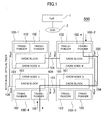
- FIG. 1 is a block diagram of an optical network.
- an optical network 500 includes a Dense Wavelength Division Multiplexing (DWDM) ring network 400, an OpS 1, and a Data Communication Network (DCN) 2.
- the ring network 400 is configured in such a manner that four Optical Add/Drop Multiplexer (OADM) nodes 100 are connected to each other through inter-node optical fibers 104.
- OADM Optical Add/Drop Multiplexer
- An OADM block 101 and plural transponders 102 are mounted in each OADM node 100.
- the OpS 1 controls plural OADM nodes 100 to open an optical pathway 200.
- a client signal input to or output from ports of the transponders 102 includes 10GbE, a GbE signal, STM-64/OC-192, STM-16/OC-48, STM-4/OC-12 and the like.
- Each OADM node 100 has an OSC (Optical Supervisory Channel) function exclusively for supervisory control, in addition to a main line.
- the OpS 1 and the OADM nodes 100 are logically connected as a network in which the OADM nodes 100-1 and 100-2 connected to the DCN 2 serve as gateways.
- the OSC By using the OSC, the OpS 1 performs remote supervisory control for the OADM nodes 100 with the use of a TL1 command and the like.
- connection ports of each OADM block 101 for the inter-node optical fibers 104 one is defined as “west direction”, and the other is defined as “east direction”.
- FIG. 2 is a hardware block diagram of an OADM.
- the OADM node 100 includes two optical amplifiers 105, two multiplex/demultiplex wavelength switches 107, an IF block 108, and an inner-device supervisory control block 106.
- Each optical amplifier 105 collectively amplifies a wavelength-multiplexed optical signal into an optical signal power suitable for transmission between the nodes, without converting the same into an electric signal.
- Each multiplex/demultiplex wavelength switch 107 separates the wavelength-multiplexed optical signal received from the optical amplifier 105, and drops or adds arbitrary wavelengths. Alternatively, each multiplex/demultiplex wavelength switch 107 performs wavelength multiplexing again after the signal passes therethrough, and transmits the multiplexed signal to the optical amplifier 105.
- the IF block 108 has one transponder 102 for each wavelength.
- Each transponder 102 converts the client signal received from the port into a signal format, an optical signal power, and a wavelength signal appropriate for wavelength multiplexing, and transmits the converted signal to the multiplex/demultiplex wavelength switch 107. Further, each transponder 102 converts an arbitrary wavelength separated by the multiplex/demultiplex wavelength switch 107 into a signal format, an optical signal power, and a wavelength signal appropriate for being connected to an external terminal device, and transmits the converted signal to the port.
- the inner-device supervisory control block 106 has a function of performing device setting under control of the OpS 1.
- the OpS 1 is a general information processing device such as a Personal Computer (PC) or Work Station (WS).
- the OpS 1 installs therein software for managing the optical pathways 200, and is started by an operator.
- FIG. 3 is a functional block diagram of the OpS.
- the OpS 1 includes an input device 4, an output device 5, an arithmetic operation block 6, a communication operation block 7, and a database block 8.
- the arithmetic operation block 6 includes an optical pathways operation block 60, and a pathway-opening simulation operation block 61.
- the database block 8 holds a node connection information table 65, an SW information table 66, a pathway information table 67, and a wavelength select switch connection information table 68.
- the arithmetic operation block 6 allows the optical pathways operation block 60 to perform an optical pathway-opening operation.
- the arithmetic operation block 6 allows the pathway-opening simulation operation block 61 to perform a pathway-opening simulation operation.
- the arithmetic operation block 6 sends a control command to the OADM nodes 100 through the communication operation block 7.
- the database block 8 holds information necessary for the pathway-opening operation and the pathway-opening simulation operation.
- FIG. 4 is a hardware block diagram of the OpS.
- the OpS 1 includes a central processing unit (CPU) 10, a main memory 11, a Hard Disk Drive (HDD) 12 as an auxiliary memory device, the input device 4, and the output device 5, all of which are connected to each other through internal communication lines 13.
- CPU central processing unit
- HDD Hard Disk Drive
- the optical pathways operation block 60 and the pathway-opening simulation operation block 61 of FIG. 3 are realized by the CPU 10 executing a program held in the memory 11.
- FIG. 5 a configuration of the multiplex/demultiplex wavelength switch configured by a wavelength select switch.
- FIG. 5 is a diagram for explaining a mechanism of multiplexer and demultiplexer of optical signals.
- the multiplex/demultiplex wavelength switch 107 includes an optical demultiplexing block 109 and an optical multiplexing block 110.
- the optical multiplexing block 110 multiplexes a through signal 116 with optical signals 113 having different n wavelengths added from the transponder by using a wavelength select switch ADD module 111, and then, outputs the multiplexed signal to the inter-node optical fiber 104 through the optical amplifier 105.
- the optical demultiplexing block 109 demultiplexes an input wavelength-division multiplex signal into optical signals having arbitrary n wavelengths, and outputs demultiplexed optical signals 112 to the transponder 102.
- a transmission optical fiber from the transponder 102 is connected to the optical multiplexing block 110.
- a reception optical fiber to the transponder 102 is connected to the optical demultiplexing block 109.
- Each wavelength passing through the multiplex/demultiplex wavelength switch 107 is in any one of states of add, drop, through, and off.
- the add/drop state means that the multiplex/demultiplex wavelength switch adds or drops an optical signal from/to the adjacent OADM node into a particular wavelength, and transmits or receives the optical signal to/from the transponder.
- the through state means that a particular wavelength of an optical signal from the adjacent OADM node is not transmitted or received to/from the transponder, but is transmitted to another adjacent OADM node.
- the off state means that an optical signal having a particular wavelength is not allowed to pass through.
- a signal for the adjacent OADM node is output from the multiplex/demultiplex wavelength switch 107 to the optical amplifier 105.
- the signal for the adjacent OADM node is amplified by the optical amplifier 105, and then, transmitted to the adjacent OADM node. Since the pump power of the optical signal from the adjacent OADM node decreases, the optical signal is amplified by the optical amplifier 105 to be output to the multiplex/demultiplex wavelength switch 107.
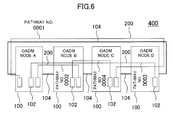
- FIG. 6 is a block diagram of the OADM ring network.
- the OADM ring network 400 includes four OADM nodes 100.
- Plural transponders 102 are mounted in each OADM node 100.
- the transponder 102 set at a particular wavelength in one OADM node 100 is connected to that with the same wavelength in another OADM node 100 on a one-on-one basis. This connection is referred to as an optical pathway 200.
- the OADM ring network 400 has four optical pathways (pathway Nos. 0001 to 0004) opened. Three transponders 102 are mounted in the OADM node A.
- the OADM node A is an end node of the optical pathway No. 0001 connected to the transponder of the OADM node C through the OADM node D, the optical pathway No. 0002 connected to the OADM node B, and the optical pathway No. 0003 connected to the transponder of the OADM node D through the OADM node B and the OADM node C.
- the OADM ring network 400 includes the optical pathway No. 0004 connected from the OADM node B to the OADM node C.
- the pathway No. 0001 and the pathway No. 0003 pass through the inter-node optical fiber 104 between the OADM node C and the OADM node D. Therefore, it is impossible to set the pathway No. 0001 and the pathway No. 0003 at the same wavelength. As similar to the above, it is impossible to set the pathway No. 0003 and the pathway No. 0004 at the same wavelength. This is similarly applied to the pathway No. 0002 and the pathway No. 0003.
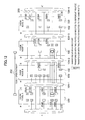
- FIG. 7 is a diagram for explaining a state in which plural optical pathways are opened in the OADM ring.
- a at the left end is connected to A' at the right end through the inter-node optical fiber 104-4.
- the OADM node A to the OADM node D form the OADM network 400.
- the maximum n wavelengths are multiplexed to be transmitted in the inter-node optical fibers. Boxes in each OADM node represent the transponders 102.
- Positions of the transponders 102 in the vertical direction correspond to wavelengths.
- Solid lines connecting between the transponders 102 represent states in which the optical pathways are opened.
- dashed lines represent states of empty waves.
- the numbers given to the optical pathways are the pathway numbers, each of which uniquely identifies the optical pathway.
- the transponders 102 are illustrated while being distinguished from each other by a difference (1 port or 2 ports) in the number of ports on the OADM block 101 side and by a connection state (different routes or the same route) in the case of 2 ports.
- Each of the transponders 102A and 102B, each having two ports on the OADM side has a 2x1/1x2 optical switch on the OADM side.
- the different routes means that two ports on the OADM side are located on the west and east sides.
- the same route means that both two ports on the OADM side are located on the west side or on the east side.
- those having two ports with the different routes are represented as transponders 102A, whereas those having two ports with the same route are represented as transponders 102B.
- a variable wavelength optical transponder is disposed at each transponder 102B on the transmission route side.
- the transponder 102B switches a transmission wavelength.
- the optical switch may not be provided, but only the variable wavelength optical transponder may be provided at the transponder 102B on the transmission route side. In this case, however, it is necessary to change the control of the wavelength select switch of the OADM node on the reception side.
- the variable wavelength optical transponder may be disposed at the other transponders 102/102A.
- FIG. 8 is a diagram for explaining a procedure of performing a change route by detouring an opened optical pathway to the opposite route.
- FIG. 9 is a diagram for explaining a procedure of a change route by replacing an opened optical pathway with a different wavelength.
- each of the transponders 102A mounted in the OADM node A and the OADM node D has two ports. Each port can be connected to one of the routes in the east and west directions, and two routes can be set at different wavelengths.
- Each of the transponders 102A of the OADM node A and the OADM node D is connected to both of the multiplex/demultiplex wavelength switch connected in the west direction and the multiplex/demultiplex wavelength switch connected in the east direction of the OADM node, and two ports are connected to different routes.
- two transponders 102A When an optical pathway is opened, two transponders 102A are connected to each other with one port of each transponder (the optical pathway shown by the solid line). In the case of detouring to the opposite route, two transponders 102A open an optical pathway with the other port of each transponder (the optical pathway shown by the dashed line), transmission and reception of a signal are switched to the detour route, and then, the used optical pathway is deleted.
- the transponder 102B of the OADM node A allows two ports to be connected to the multiplex/demultiplex wavelength switch connected in the east direction.
- the transponder 102B of the OADM node D allows two ports to be connected to the multiplex/demultiplex wavelength switch connected in the west direction.
- two transponders 102B When an optical pathway is opened, two transponders 102B are connected to each other with one port of each transponder (the optical pathway shown by the solid line). In the case of a change route, two transponders 102B newly open an optical pathway of a different wavelength with the other port of each transponder (the optical pathway shown by the dashed line), transmission and reception of a signal are switched, and then, the used optical pathway is deleted.
- the already-opened optical pathway is detoured to the opposite route or is switched to a different wavelength on the same route, so that the change route of the optical pathway is performed to open the new optical pathway.
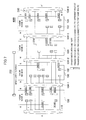
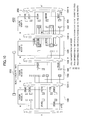
- FIG. 10 to FIG. 12 there will be described an example of the change route performed when the new optical pathway 202 from the OADM node A to the OADM node C through the OADM node B is opened in the OADM ring network of FIG. 7 .
- FIG. 10 to FIG. 12 are diagrams for explaining a procedure of the change route.
- all wavelengths are used in the inter-node fiber 104-1 between the OADM node A and the OADM node B. Therefore, empty waves are secured by moving an optical pathway existing at a section to be opened.
- the target optical pathways to be moved are those passing between the OADM node A and the OADM node B, and between the OADM node B and the OADM node C.
- the target optical pathways to be moved in the OADM node A are those with the pathway Nos. 0685, 0158, 1603, 1102, and 0683.
- the optical pathways with the pathway Nos. 0685, 0158, 1603, and 0683 are not connected to the opposite ports of the transponders 102A of the OADM nodes at both end points of the newly open pathway. Accordingly, the optical pathways cannot be physically detoured to the opposite direction.
- the optical pathway with the pathway No. 1102 can be detoured to the opposite direction because it is connected to the opposite ports of the transponders 102A.
- optical pathway can be physically detoured, empty states of waves on the detour route are checked. If there is any wavelength to which the optical pathway can be detoured, a detour operation is performed using the wavelength, so that resources for a newly open pathway are secured.
- the optical pathway If there is no wavelength to which the optical pathway can be detoured, it is further checked whether or not there is any optical pathway, present on the detour route, which can be switched to a different wavelength on the same route. Then, if the switching can be performed, a detour operation is performed by moving the optical pathway to the different wavelength, so that resources for a newly open pathway are secured.
- the pathway No. 1102 can be physically detoured. However, the same wavelength is not emptied on the detour route from the OADM node A to the OADM node C through the OADM node D. Therefore, among the optical pathways present on the route, it is checked whether or not there is any optical pathway which can be changed to a different wavelength.
- the transponders 102B at both ends of the pathway No. 5168 have the connection ports to the same route. Accordingly, the pathway can be changed to a wavelength No. 2 or 4 of the empty wave.
- a transmission wavelength to the transmission route side is moved from a wavelength No. 7 to a wavelength No. 4.
- the wavelength No. 7 becomes an empty state.
- the wavelength select switch is switched to detour the optical pathway to the opposite direction.
- the wavelength No. 7 becomes an empty state on the route from the OADM node A to the OADM node C through the OADM node B.
- the new optical pathway 202 from the OADM node A to the OADM node C through the OADM node B is opened using the wavelength No. 7.
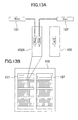
- FIGS. 13 are a diagram for explaining mounting of OADM node packages.
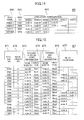
- FIG. 14 is a diagram for explaining a node connection information table.
- FIG. 15 is a diagram for explaining a pathway information table.
- FIG. 16 is a diagram for explaining an SW information table.
- FIG. 17 is a diagram for explaining a wavelength select switch connection information table.
- FIG. 13A represents a diagram for explaining connection of the transponder to the multiplex/demultiplex wavelength switch
- FIG. 13B represents a front diagram of the OADM node.
- the OADM node has a two-shelf configuration, portions illustrated as bookshelves are shelves. Further, each shelf is referred to as a unit. Furthermore, portions illustrated as books are packages in which the components are mounted. Moreover, the multiplex/demultiplex wavelength switches 107 are arranged above the shelves.
- FIG. 13A is an enlarged diagram of a part of FIG. 13B .
- the packages are the transponder 102A and the transponder 102.
- the wavelength select switch-side port (west) and the wavelength select switch-side port (east) are provided, and are connected to the wavelength select switch (west) and the wavelength select switch (east), respectively, through optical fibers.
- the wavelength select switch-side ports (west/east) are provided, and are connected to the wavelength select switches (west/east) through optical fibers (not shown).
- the wavelength select switch-side port (west/east) and the wavelength select switch-side port (west/east) are provided, and are connected to the wavelength select switch (west) and the wavelength select switch (east), respectively, through optical fibers.
- a mounting position of the package is defined by a shelf number, a unit number, and a package number.
- the shelf on the left side is a shelf 1
- the shelf on the right side is a shelf 2.
- units 3 to 5 are provided in order from the bottom of the shelf 1.
- the packages are numbered 1 to 16 in order from the left. Namely, the mounting position of the transponder 102A of FIG. 13A is represented as 1.5.10.
- the node connection information table 65 is a table which is preliminarily registered by an operator.
- the node connection information table 65 contains respective fields of a ring name 651, a ring No. 652, and a connection configuration 653 for registering connection information between the OADM nodes.
- Each of the ring name 651 and the ring No. 652 is information for uniquely identifying the OADM ring 400.
- the connection configuration 653 of the OADM nodes the OADM nodes connected on the east side are sequentially registered from an arbitrary node in the ring.
- a ring name of Chiba-1 shown in FIG. 14 includes four OADM nodes.
- the node A of the east side corresponds to the node B
- the node B on the east side corresponds to the node C
- the node C on the east side corresponds to the node D
- the node D on the east side corresponds to the node A.
- the OpS 1 recognizes connection states of the OADM nodes connected on the east side and on the west side in the OADM ring 400.
- the pathway information table 67 manages information of opened optical pathways.
- the pathway information table 67 contains fields of a pathway No. 671, a wavelength No.
- an OADM node ID 673 of a starting point of a pathway a starting point direction 674 of a pathway, an end-point OADM node ID 675, an open direction 676 of a pathway viewed from an end-point OADM node, and a relay OADM node 677.
- the pathway No. 671 is an ID for uniquely determining an optical pathway and is generated and set by the OpS 1 when a pathway is opened.
- the wavelength No. 672 is a wavelength used by the optical pathway.
- the OADM node IDs 673 and 675 are OADM nodes accommodating transponders at the ends of the optical pathway.
- the pathway direction 674 and 676 manage the directions (east/west) of the optical pathway from the OADM nodes which terminates the optical pathway.
- the relay OADM node 677 is a list of the OADM node IDs which relay the optical pathways. It should be noted that the pathway information table 67 in FIG. 15 shows a state of FIG. 7 .
- the SW information table 66 contains a wavelength No. 661 and fields 662 to 665 in which switch states in the east direction and the west direction are set to the respective OADM nodes existing in the OADM ring.
- the switch states manage any one of the states of add/drop, through, and off.
- the add state means that an optical signal is transmitted from the transponder to the optical multiplexing block of the multiplex/demultiplex wavelength switch.
- the drop state means that an optical signal is transmitted from the optical demultiplexing block of the multiplex/demultiplex wavelength switch to the transponder.
- the through state means that an optical signal is allowed to pass through the east side and the west side of the wavelength select switch from the west side and the east side thereof, respectively.
- the off state means that an optical signal is not allowed to pass through. It should be noted that the SW information table 67 in FIG. 16 shows a state of FIG. 7 .
- the wavelength select switch connection information table 68 contains respective fields of an OADM node ID 681, a mounted-position information 682 of the transponder, the number 683 of ports on the wavelength select switch side, wavelength select switch connection information 684, a pathway No. 685, and an operation system route 686.
- the OADM node ID 681 and the mounted-position information 682 specify the mounted position of the transponder 102.
- the number 683 of ports on the wavelength select switch side indicates the number of ports connectable from the transponder to the wavelength select switch. The change route to a detour route is possible in the case of two ports, but is impossible in the case of one port.
- the wavelength select switch connection information 684 indicates the wavelength select switch connected to the transponder.
- the wavelength select switch connection information 684 can register two routes for the transponder having two ports mounted, and only one route can be registered. In this case, the other route is unused.
- the pathway No. 685 is the same as the pathway No. 671 of the pathway information table 67.
- the operation system 686 indicates the multiplex/demultiplex wavelength switch 107 operated by the transponder 102.
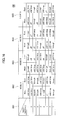
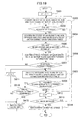
- FIG. 18 is a flowchart of an opening process of a new optical pathway by the OpS.
- the OpS 1 accepts information of OADM nodes at the starting point and the end point of a pathway to be opened and the transponders from an operator (S501).
- the OpS 1 refers to the pathway information table 67 and the wavelength select switch connection information table stored in the database block 8. Further, the OpS 1 checks whether or not the transponder mounted in the OADM node specified when a new optical pathway is opened is used by another optical pathway by referring to the OADM node IDs 673 and 675, the relay OADM node ID 677, and the wavelength No. 672 of the pathway information table 67, and checks empty waves in the section to be opened (S502). The OpS 1 determines whether or not a new optical pathway can be opened (S503). If an empty wave is present (S503: YES), the OpS 1 uses the empty wave to open an optical pathway (S508), and the flow is completed.
- the OpS 1 rearranges the optical pathway on the DB to simulate whether or not the wavelength in the section can be emptied (S504).
- the OpS 1 determines whether or not a new optical pathway can be opened on the basis of the result of the simulation (S505). If the pathway can be opened (S505: YES), the OpS 1 performs the change route of the opened optical pathway (S506).
- the OpS 1 confirms whether or not all wavelengths in the section where a new optical pathway is to be opened are emptied (S507). If all wavelengths are emptied (YES), the OpS1 opens a new optical pathway (S508), and a flow is completed.
- the OpS 1 performs the change route of the opened optical pathway again (S506). If a new optical pathway cannot be opened in S505 (NO), the OpS 1 terminates the process.
- the OpS 1 confirms the switch states of the respective wavelengths on the east side of the node A from the wavelength No. 1 in order in the SW information table 66 ( FIG. 16 ).
- the OpS 1 confirms the switch states of the respective wavelengths on the west side of the node A. Only when the switches of the respective wavelengths on the west side are in the off states, the wavelengths become possible detour routes.
- the switch of the wavelength No. 7 on the west side of the node A is in the off state.
- the OpS 1 checks the switch states of all nodes on the detour route in the wavelength number where the switches of the wavelength are in the off states. If an optical pathway is present on the detour route, the OpS 1 confirms whether or not the route can be changed to a different wavelength by referring to the wavelength select switch connection information table 66 for the optical pathway. In the SW information table 66, the OpS 1 confirms the switch states of the wavelength No. 7 of the node D and the node C. In the SW information table 66, the node D on the west side and the node C on the east side are in the add/drop states.
- the OpS 1 can recognize that one transponder of the node C is provided with two ports on the east side, one transponder of the node D is provided with two ports on the west side, and they have the same pathway No. 5168.
- the OpS 1 confirms the switch states on the west side of the node D from the wavelength No. 1. If the switch is in the off state, the OpS 1 confirms the switch state on the east side of the next node in the wavelength number.
- the wavelength Nos. 2 and 4 on the west side of the node D are in the off states, so that the OpS 1 confirms the switch states of the wavelength Nos. 2 and 4 on the east side of the node C.
- the switches of the wavelength Nos. 2 and 4 on the east side of the node C are in the off states, so that the OpS 1 can recognize that the pathway can be shifted to the wavelength 2 or 4.
- the OpS 1 can empty the wavelength of the wavelength No. 7 from the node A to the node C through the node B, and can open a new optical pathway.
- FIG. 19 is a detailed flowchart of Step 504 of FIG. 18 .
- the concrete method is as shown in Figs. 10 and 11 .
- a detour to the opposite direction is limited to the same wavelength for simplification of the operation.
- the detour operation is not limited to the same wavelength.
- the OpS 1 initially sets counters n and m for a loop operation at 1 (S601).
- n is a counter of wavelengths
- m is a counter of pathways.
- the OpS 1 confirms the switch state of a wavelength No. n of the end-point node of a new optical pathway by using the SW information table 68 ( FIG. 17 ) (S602).
- the OpS1 determines whether or not the switch is in the add/drop state (S603).
- the OpS 1 adds 1 to the counter n because the node is not an end-point of the optical pathway (S612), to determine whether or not n is the maximum value (S613). If n is not the maximum value (S613: NO), the OpS 1 returns to Step 602. If n is the maximum value (S613: YES), the change route of the optical pathway cannot be performed. Accordingly, the result of the simulation shows that a new pathway cannot be opened (S614), and the flow is completed.
- the OpS 1 confirms the SW state of the wavelength No. n in the opposite direction by using the SW information management table 66, and refers to the wavelength select switch connection information table 68 to confirm the connection state of the transponder of the optical pathway (S604).
- the OpS 1 determines whether or not the switch is in the off state and a detour can be performed (S605). If the result of the confirmation shows that the switch is not in the off state or the opposite port of the transponder of the optical pathway is not connected (S605: NO), 1 is added to the counter n (S612) to determine whether or not n is the maximum value (S613). If n is not the maximum value, the SW state of the wavelength No. n of the end-point node of the new optical pathway is confirmed again (S602).
- Step 605 If the result of the confirmation in Step 605 shows that the switch is in the off state and the opposite port of the transponder of the optical pathway is connected (YES), the OpS 1 confirms the optical pathway on the detour route side of the wavelength No. n by using the pathway information table (S606). The OpS 1 determines whether or not any optical pathway on the detour route side is present (S607). If no optical pathway is present (S607: NO), the OpS1 determines that a new pathway can be opened (S615), and the simulation is completed.
- the result of the determination on presence or absence of an optical pathway on the detour route side shows that if an optical pathway is present (S607: YES), the OpS 1 refers to the wavelength No. n and the optical pathway m in the wavelength select switch connection information table 68 (S608). On the basis of the result of the reference of the wavelength No. n and the optical pathway m in the wavelength select switch connection information table, the OpS 1 determines whether or not the optical pathway m can be changed to a different wavelength (S609).
- the OpS 1 adds 1 to the counter n (S612) to determine whether or not n is the maximum value (S613). If n is not the maximum value, the SW state of the wavelength No. n of the end-point node of the new optical pathway is confirmed again (S602). If n is the maximum value, the OpS 1 cannot perform the change route of the optical pathway. Accordingly, the result of the simulation shows that a new pathway cannot be opened (S614), and the simulation is completed.
- Step 609 If the wavelength can be changed in Step 609 (YES), all optical pathways with the wavelength No. n can be changed to a different wavelength (S610). If another optical pathway with the wavelength No. n is present (S610: NO), 1 is added to m (S611), and the wavelength No. n and the optical pathway m in the wavelength select switch connection information table are referred to again (S608). When all optical pathways are confirmed in Step 610, the OpS 1 determines that a new optical pathway can be opened (S615) to terminate the flow.
Landscapes
- Engineering & Computer Science (AREA)
- Computer Networks & Wireless Communication (AREA)
- Signal Processing (AREA)
- Optical Communication System (AREA)
- Small-Scale Networks (AREA)
Applications Claiming Priority (1)
| Application Number | Priority Date | Filing Date | Title |
|---|---|---|---|
| JP2008319870A JP5121687B2 (ja) | 2008-12-16 | 2008-12-16 | 光分岐多重システムおよび光分岐多重装置 |
Publications (1)
| Publication Number | Publication Date |
|---|---|
| EP2200203A2 true EP2200203A2 (en) | 2010-06-23 |
Family
ID=41572417
Family Applications (1)
| Application Number | Title | Priority Date | Filing Date |
|---|---|---|---|
| EP09177843A Withdrawn EP2200203A2 (en) | 2008-12-16 | 2009-12-03 | Optical add/drop multiplexing system, optical add/drop multiplexer and optical pathway detour program |
Country Status (4)
| Country | Link |
|---|---|
| US (1) | US20100150551A1 (enExample) |
| EP (1) | EP2200203A2 (enExample) |
| JP (1) | JP5121687B2 (enExample) |
| CN (1) | CN101754060B (enExample) |
Families Citing this family (11)
| Publication number | Priority date | Publication date | Assignee | Title |
|---|---|---|---|---|
| JP5708081B2 (ja) * | 2011-03-16 | 2015-04-30 | 富士通株式会社 | 光ネットワークシステム |
| JP5776330B2 (ja) * | 2011-05-25 | 2015-09-09 | 富士通株式会社 | 波長再配置方法及びノード装置 |
| US9083485B2 (en) * | 2012-04-12 | 2015-07-14 | Fujitsu Limited | Defragmentation of optical networks |
| JP6017867B2 (ja) * | 2012-07-09 | 2016-11-02 | 日本電信電話株式会社 | 光通信方法、光送信器、光受信器、信号分離回路、及び光通信システム |
| US10855377B2 (en) | 2013-08-30 | 2020-12-01 | Nec Corporation | Optical transmission apparatus, optical reception apparatus, optical communication apparatus, optical communication system, and methods of controlling them |
| JP2015216427A (ja) * | 2014-05-07 | 2015-12-03 | 富士通株式会社 | 伝送装置 |
| CN107078812B (zh) * | 2014-10-01 | 2019-11-12 | 日本电气株式会社 | 节点设备和用于控制节点设备的方法 |
| JP6476894B2 (ja) * | 2015-01-20 | 2019-03-06 | 富士通株式会社 | 光増幅器アレイ、及びこれを用いた光伝送装置 |
| CN110582032B (zh) * | 2018-06-11 | 2022-03-11 | 台达电子工业股份有限公司 | 智能定义光隧道网络系统与网络系统控制方法 |
| JP7306433B2 (ja) * | 2019-08-14 | 2023-07-11 | 日本電気株式会社 | 光送信装置、光受信装置、光通信装置、光通信システム、及びこれらの制御方法 |
| JP7548295B2 (ja) * | 2020-03-27 | 2024-09-10 | 日本電気株式会社 | 光通信システム、故障原因推定装置、故障解析装置及び光通信システムの故障解析方法 |
Family Cites Families (10)
| Publication number | Priority date | Publication date | Assignee | Title |
|---|---|---|---|---|
| JPH0993279A (ja) * | 1995-09-28 | 1997-04-04 | Nippon Telegr & Teleph Corp <Ntt> | リングネットワーク装置 |
| US6850515B2 (en) * | 2001-01-30 | 2005-02-01 | The Regents Of The University Of California | Optical layer multicasting using a single sub-carrier header and a multicast switch with active header insertion via light circulation |
| CN100346588C (zh) * | 2001-10-29 | 2007-10-31 | 上海贝尔有限公司 | 用于波分复用光网的双纤双向通道/复用段倒换环系统 |
| US7003225B2 (en) * | 2002-04-05 | 2006-02-21 | Pts Corporation | Survivable ring transmission system with multiple protection classes |
| JP2004135238A (ja) * | 2002-10-15 | 2004-04-30 | Nippon Telegr & Teleph Corp <Ntt> | 光分岐挿入装置 |
| JP2004153307A (ja) * | 2002-10-28 | 2004-05-27 | Nippon Telegr & Teleph Corp <Ntt> | 光分岐挿入装置 |
| US7283741B2 (en) * | 2003-06-06 | 2007-10-16 | Intellambda Systems, Inc. | Optical reroutable redundancy scheme |
| JP2005012267A (ja) * | 2003-06-16 | 2005-01-13 | Nippon Telegraph & Telephone West Corp | パス設定方法およびパス設定プログラム |
| JP4024265B2 (ja) * | 2005-12-05 | 2007-12-19 | 沖電気工業株式会社 | ノード、光通信ネットワーク、光パス予約方法及びプログラム |
| JP4826451B2 (ja) * | 2006-11-29 | 2011-11-30 | 株式会社日立製作所 | 光増幅器を備えた光伝送装置 |
-
2008
- 2008-12-16 JP JP2008319870A patent/JP5121687B2/ja not_active Expired - Fee Related
-
2009
- 2009-12-03 EP EP09177843A patent/EP2200203A2/en not_active Withdrawn
- 2009-12-03 US US12/630,444 patent/US20100150551A1/en not_active Abandoned
- 2009-12-04 CN CN2009102531517A patent/CN101754060B/zh not_active Expired - Fee Related
Also Published As
| Publication number | Publication date |
|---|---|
| JP5121687B2 (ja) | 2013-01-16 |
| CN101754060A (zh) | 2010-06-23 |
| US20100150551A1 (en) | 2010-06-17 |
| JP2010147577A (ja) | 2010-07-01 |
| CN101754060B (zh) | 2013-05-01 |
Similar Documents
| Publication | Publication Date | Title |
|---|---|---|
| EP2200203A2 (en) | Optical add/drop multiplexing system, optical add/drop multiplexer and optical pathway detour program | |
| US8116629B2 (en) | Reconfigurable optical add drop multiplexer core device, procedure and system using such device, optical light distributor, and coupling-ratio assigning procedure | |
| JP5682256B2 (ja) | 光挿入装置および光分岐装置 | |
| US9520959B2 (en) | Optical drop apparatus, optical add apparatus, and optical add/drop apparatus | |
| JP5614129B2 (ja) | 光分岐挿入装置 | |
| EP2979383B1 (en) | Optical switch | |
| US7133616B2 (en) | Wavelength-selective routing using an optical add/drop architecture | |
| EP2991253A1 (en) | Reconfigurable add/drop multiplexing in optical networks | |
| JP2014022865A (ja) | 光信号分岐装置、および光信号挿入装置 | |
| US20190305869A1 (en) | Add/drop multiplexer, network system, transmission method, non-transitory computer readable medium, and management device | |
| JP5858162B2 (ja) | 波長多重化装置、障害発生箇所特定方法およびプログラム | |
| WO2020195912A1 (ja) | 光分岐挿入装置及び光分岐挿入装置を使用した光伝送システム | |
| EP2982066B1 (en) | Optical switch | |
| US11722235B2 (en) | Optical branch insertion device and optical branch insertion method | |
| US9025915B2 (en) | Method and module for switching optical signals having different modes of propagation | |
| US8977129B2 (en) | Multi-degree reconfigurable optical add-drop multiplexing | |
| WO2020255466A1 (ja) | 海底光分岐装置、海底光ケーブルシステム、切替方法、及び非一時的なコンピュータ可読媒体 | |
| JP5450274B2 (ja) | 光経路制御方法 | |
| US20250168537A1 (en) | Optical communication apparatus and optical communication method | |
| KR100594736B1 (ko) | 파장선택 스위치 및 파장선택 방법 | |
| EP2928097A1 (en) | Optical switching | |
| JP2013187701A (ja) | 光ノード装置及びその制御方法 | |
| KR20000033945A (ko) | 파장분할다중방식 광전송망에서의 동적 라우팅 기능을 갖는 파장분할다중 전송장치 | |
| KR20080051776A (ko) | 채널 통과/결합 광 모듈 및 이를 이용한 oadm노드에서의 채널 통과/결합 방법 | |
| JP2007081563A (ja) | 光信号送受信装置、光信号合分波装置及び光通信ネットワーク |
Legal Events
| Date | Code | Title | Description |
|---|---|---|---|
| PUAI | Public reference made under article 153(3) epc to a published international application that has entered the european phase |
Free format text: ORIGINAL CODE: 0009012 |
|
| 17P | Request for examination filed |
Effective date: 20100226 |
|
| AK | Designated contracting states |
Kind code of ref document: A2 Designated state(s): AT BE BG CH CY CZ DE DK EE ES FI FR GB GR HR HU IE IS IT LI LT LU LV MC MK MT NL NO PL PT RO SE SI SK SM TR |
|
| AX | Request for extension of the european patent |
Extension state: AL BA RS |
|
| STAA | Information on the status of an ep patent application or granted ep patent |
Free format text: STATUS: THE APPLICATION HAS BEEN WITHDRAWN |
|
| 18W | Application withdrawn |
Effective date: 20150423 |