EP2197927B1 - Thermoplastisch vereinbartes aminoplastharz, duroplastische feinstfaservliese sowie verfahren und anlage zu ihrer herstellung - Google Patents
Thermoplastisch vereinbartes aminoplastharz, duroplastische feinstfaservliese sowie verfahren und anlage zu ihrer herstellung Download PDFInfo
- Publication number
- EP2197927B1 EP2197927B1 EP08840068.4A EP08840068A EP2197927B1 EP 2197927 B1 EP2197927 B1 EP 2197927B1 EP 08840068 A EP08840068 A EP 08840068A EP 2197927 B1 EP2197927 B1 EP 2197927B1
- Authority
- EP
- European Patent Office
- Prior art keywords
- process according
- substituted
- alcohol
- value
- aldehyde
- Prior art date
- Legal status (The legal status is an assumption and is not a legal conclusion. Google has not performed a legal analysis and makes no representation as to the accuracy of the status listed.)
- Active
Links
Images



Classifications
-
- D—TEXTILES; PAPER
- D04—BRAIDING; LACE-MAKING; KNITTING; TRIMMINGS; NON-WOVEN FABRICS
- D04H—MAKING TEXTILE FABRICS, e.g. FROM FIBRES OR FILAMENTARY MATERIAL; FABRICS MADE BY SUCH PROCESSES OR APPARATUS, e.g. FELTS, NON-WOVEN FABRICS; COTTON-WOOL; WADDING ; NON-WOVEN FABRICS FROM STAPLE FIBRES, FILAMENTS OR YARNS, BONDED WITH AT LEAST ONE WEB-LIKE MATERIAL DURING THEIR CONSOLIDATION
- D04H3/00—Non-woven fabrics formed wholly or mainly of yarns or like filamentary material of substantial length
- D04H3/02—Non-woven fabrics formed wholly or mainly of yarns or like filamentary material of substantial length characterised by the method of forming fleeces or layers, e.g. reorientation of yarns or filaments
-
- C—CHEMISTRY; METALLURGY
- C08—ORGANIC MACROMOLECULAR COMPOUNDS; THEIR PREPARATION OR CHEMICAL WORKING-UP; COMPOSITIONS BASED THEREON
- C08G—MACROMOLECULAR COMPOUNDS OBTAINED OTHERWISE THAN BY REACTIONS ONLY INVOLVING UNSATURATED CARBON-TO-CARBON BONDS
- C08G12/00—Condensation polymers of aldehydes or ketones with only compounds containing hydrogen attached to nitrogen
- C08G12/02—Condensation polymers of aldehydes or ketones with only compounds containing hydrogen attached to nitrogen of aldehydes
- C08G12/40—Chemically modified polycondensates
- C08G12/42—Chemically modified polycondensates by etherifying
- C08G12/424—Chemically modified polycondensates by etherifying of polycondensates based on heterocyclic compounds
- C08G12/425—Chemically modified polycondensates by etherifying of polycondensates based on heterocyclic compounds based on triazines
- C08G12/427—Melamine
-
- D—TEXTILES; PAPER
- D01—NATURAL OR MAN-MADE THREADS OR FIBRES; SPINNING
- D01D—MECHANICAL METHODS OR APPARATUS IN THE MANUFACTURE OF ARTIFICIAL FILAMENTS, THREADS, FIBRES, BRISTLES OR RIBBONS
- D01D5/00—Formation of filaments, threads, or the like
- D01D5/08—Melt spinning methods
- D01D5/098—Melt spinning methods with simultaneous stretching
- D01D5/0985—Melt spinning methods with simultaneous stretching by means of a flowing gas (e.g. melt-blowing)
-
- D—TEXTILES; PAPER
- D01—NATURAL OR MAN-MADE THREADS OR FIBRES; SPINNING
- D01F—CHEMICAL FEATURES IN THE MANUFACTURE OF ARTIFICIAL FILAMENTS, THREADS, FIBRES, BRISTLES OR RIBBONS; APPARATUS SPECIALLY ADAPTED FOR THE MANUFACTURE OF CARBON FILAMENTS
- D01F6/00—Monocomponent artificial filaments or the like of synthetic polymers; Manufacture thereof
- D01F6/58—Monocomponent artificial filaments or the like of synthetic polymers; Manufacture thereof from homopolycondensation products
- D01F6/74—Monocomponent artificial filaments or the like of synthetic polymers; Manufacture thereof from homopolycondensation products from polycondensates of cyclic compounds, e.g. polyimides, polybenzimidazoles
-
- D—TEXTILES; PAPER
- D04—BRAIDING; LACE-MAKING; KNITTING; TRIMMINGS; NON-WOVEN FABRICS
- D04H—MAKING TEXTILE FABRICS, e.g. FROM FIBRES OR FILAMENTARY MATERIAL; FABRICS MADE BY SUCH PROCESSES OR APPARATUS, e.g. FELTS, NON-WOVEN FABRICS; COTTON-WOOL; WADDING ; NON-WOVEN FABRICS FROM STAPLE FIBRES, FILAMENTS OR YARNS, BONDED WITH AT LEAST ONE WEB-LIKE MATERIAL DURING THEIR CONSOLIDATION
- D04H1/00—Non-woven fabrics formed wholly or mainly of staple fibres or like relatively short fibres
- D04H1/40—Non-woven fabrics formed wholly or mainly of staple fibres or like relatively short fibres from fleeces or layers composed of fibres without existing or potential cohesive properties
- D04H1/42—Non-woven fabrics formed wholly or mainly of staple fibres or like relatively short fibres from fleeces or layers composed of fibres without existing or potential cohesive properties characterised by the use of certain kinds of fibres insofar as this use has no preponderant influence on the consolidation of the fleece
- D04H1/4326—Condensation or reaction polymers
-
- D—TEXTILES; PAPER
- D04—BRAIDING; LACE-MAKING; KNITTING; TRIMMINGS; NON-WOVEN FABRICS
- D04H—MAKING TEXTILE FABRICS, e.g. FROM FIBRES OR FILAMENTARY MATERIAL; FABRICS MADE BY SUCH PROCESSES OR APPARATUS, e.g. FELTS, NON-WOVEN FABRICS; COTTON-WOOL; WADDING ; NON-WOVEN FABRICS FROM STAPLE FIBRES, FILAMENTS OR YARNS, BONDED WITH AT LEAST ONE WEB-LIKE MATERIAL DURING THEIR CONSOLIDATION
- D04H1/00—Non-woven fabrics formed wholly or mainly of staple fibres or like relatively short fibres
- D04H1/40—Non-woven fabrics formed wholly or mainly of staple fibres or like relatively short fibres from fleeces or layers composed of fibres without existing or potential cohesive properties
- D04H1/54—Non-woven fabrics formed wholly or mainly of staple fibres or like relatively short fibres from fleeces or layers composed of fibres without existing or potential cohesive properties by welding together the fibres, e.g. by partially melting or dissolving
- D04H1/56—Non-woven fabrics formed wholly or mainly of staple fibres or like relatively short fibres from fleeces or layers composed of fibres without existing or potential cohesive properties by welding together the fibres, e.g. by partially melting or dissolving in association with fibre formation, e.g. immediately following extrusion of staple fibres
-
- D—TEXTILES; PAPER
- D04—BRAIDING; LACE-MAKING; KNITTING; TRIMMINGS; NON-WOVEN FABRICS
- D04H—MAKING TEXTILE FABRICS, e.g. FROM FIBRES OR FILAMENTARY MATERIAL; FABRICS MADE BY SUCH PROCESSES OR APPARATUS, e.g. FELTS, NON-WOVEN FABRICS; COTTON-WOOL; WADDING ; NON-WOVEN FABRICS FROM STAPLE FIBRES, FILAMENTS OR YARNS, BONDED WITH AT LEAST ONE WEB-LIKE MATERIAL DURING THEIR CONSOLIDATION
- D04H3/00—Non-woven fabrics formed wholly or mainly of yarns or like filamentary material of substantial length
- D04H3/005—Synthetic yarns or filaments
- D04H3/009—Condensation or reaction polymers
-
- D—TEXTILES; PAPER
- D04—BRAIDING; LACE-MAKING; KNITTING; TRIMMINGS; NON-WOVEN FABRICS
- D04H—MAKING TEXTILE FABRICS, e.g. FROM FIBRES OR FILAMENTARY MATERIAL; FABRICS MADE BY SUCH PROCESSES OR APPARATUS, e.g. FELTS, NON-WOVEN FABRICS; COTTON-WOOL; WADDING ; NON-WOVEN FABRICS FROM STAPLE FIBRES, FILAMENTS OR YARNS, BONDED WITH AT LEAST ONE WEB-LIKE MATERIAL DURING THEIR CONSOLIDATION
- D04H3/00—Non-woven fabrics formed wholly or mainly of yarns or like filamentary material of substantial length
- D04H3/08—Non-woven fabrics formed wholly or mainly of yarns or like filamentary material of substantial length characterised by the method of strengthening or consolidating
- D04H3/16—Non-woven fabrics formed wholly or mainly of yarns or like filamentary material of substantial length characterised by the method of strengthening or consolidating with bonds between thermoplastic filaments produced in association with filament formation, e.g. immediately following extrusion
-
- Y—GENERAL TAGGING OF NEW TECHNOLOGICAL DEVELOPMENTS; GENERAL TAGGING OF CROSS-SECTIONAL TECHNOLOGIES SPANNING OVER SEVERAL SECTIONS OF THE IPC; TECHNICAL SUBJECTS COVERED BY FORMER USPC CROSS-REFERENCE ART COLLECTIONS [XRACs] AND DIGESTS
- Y10—TECHNICAL SUBJECTS COVERED BY FORMER USPC
- Y10T—TECHNICAL SUBJECTS COVERED BY FORMER US CLASSIFICATION
- Y10T442/00—Fabric [woven, knitted, or nonwoven textile or cloth, etc.]
- Y10T442/60—Nonwoven fabric [i.e., nonwoven strand or fiber material]
- Y10T442/608—Including strand or fiber material which is of specific structural definition
- Y10T442/609—Cross-sectional configuration of strand or fiber material is specified
Definitions
- the present invention relates to a thermoplastically processable aminoplast resin, a process for their preparation, a thermosetting Feinstmaschinevlies, a process and a plant for the production of thermoset Feinstmaschinevliesen of thermoplastically processable aminoplast resins, especially melamine resins, and the use of thermoset Feinstmaschinevlieses.
- fiber materials which are chemically resistant, flame-retardant, easy to process, inexpensive to produce and without danger to man and the environment.
- Applications of such fiber materials are, for example, protective clothing or the interior fittings of vehicles and hotel furniture / room textiles for public facilities, where high demands are placed on the resistance to flames, also engine insulation material or filter materials for industrial processes.
- Thermosetting materials based on triazine resins are very well suited for the applications mentioned and form a group of flame retardant, chemically resistant and inexpensive to produce in large quantities starting materials.
- Uncrosslinked low molecular weight melamine resin precondensates have a too low melt viscosity for these processing methods and can only be processed as highly filled molding compositions with long cycle times with hardening of the products ( Woebcken, W., Kunststoff-Handbuch Bd. 10 "Thermosets", Carl Hanser Verl. Kunststoff 1988, pp. 266-274 ).
- Fibers ( EP 0093 965 A1 ), Foams ( EP 0017671 A1 ) or coatings ( WO 96/20239 A1 ) of melamine resins can only be prepared from solutions of the melamine resin precondensates with hardening during molding because of the low melt viscosity of the melamine resin precondensates.
- the DE10056398 describes a processable from the melt triazine-formaldehyde resin, which after a complex Three-stage process is produced.
- the precuring takes place in this case at relatively high temperatures (160-200 ° C) in an extruder, whereby a substantial pre-hardening is required and thus a high softening point above 100 ° C, which in turn is due to a narrow processing window.
- fibers can be produced by known processes ( DE10038030 . WO 2006/100041 ).
- DE10038030 are - in contrast to the method described here, wherein nonwovens are produced in a one-step process from etherified melamine resins (so-called MER) - produced from the resulting staple fibers virtually no 100% melamine resin based fabric.
- MER etherified melamine resins
- Natural fibers exist as staple fibers defined by length and fineness.
- Synthetic fibers of melamine resins according to the already mentioned processes which are more suitable than the natural fibers because of their preferred chemical and physical properties, are processed in accordance with methods known from the prior art by processing steps, such as carding, to form a thread or to produce a textile surface. These processing steps are complex, expensive and lead to an unsatisfactory result, since fiber damage occurs and usually to ensure the Processability a combination with other fiber types is required.
- fibers based on polyaramid are used in practice, which increases the complexity of the production and significantly increases the production costs of such textile surfaces.
- polyaramid m- and p-aramid
- thermoset Feinstmaschinevliesen A process for the production of thermoset Feinstmaschinevliesen is in WO 2006/100041 described.
- the nonwovens obtained by this process have great advantages over fiber materials obtainable by other processes, but their properties are still further improved. In particular, their flexibility, strength and stability in the further processing into finished products is still to be improved.
- WO 2004/056900 A1 relates to a synthesis process for the preparation of etherified melamine resin condensates, wherein in a first reaction step an etherified melamine resin precondensate is prepared in alcoholic solution, this precondensate is concentrated in the presence of further alcohols or diols, and that concentrated precondensate is reacted in a second reaction step in a mixer. Methylolation and etherification can be carried out simultaneously.
- WO 2006/024544 discloses modified aminotriazine resins producible by the reaction of a modified Aminotriazine resin melt with an aminotriazine.
- the condensation products may be partially or fully etherified. These are reacted in a further reaction step partially or completely with aliphatic C4-C18 alcohols or aromatic alcohols, diols or polyols, so that polymers are built up with high molecular weights.
- the aminotriazine resins produced have viscosities between 450 to 12,000 Pa * s.
- WO 2004/092239 A1 relates to a process for the continuous synthesis of a melamine resin, for which in a first reaction stage melamine, an aldehyde and an alcohol are reacted, and the reaction mixture is then separated into a high-solids and low-solids phase.
- WO 02/40564 relates to a process for the preparation of triazine-aldehyde resins, wherein an aminotriazine is reacted with an aldehyde, wherein the resulting resin is then subjected to etherification with an alcohol and precuring at temperatures of 160 to 200 °.
- the resulting aminoplast resin is characterized by a softening temperature above 100 ° C.
- WO 2006/136457 relates to etherified melamine resins preparable by reacting melamine, formaldehyde and alkanol, which may have after transetherification viscosities in the range between 2 and 200 Pa * s at 130 ° C.
- the melamine resins have molecular weights between 1500 and 200,000.
- thermoplastically processable aminoplast resin This object is achieved by a method for producing a thermoplastically processable aminoplast resin.
- the aminoplast resin which can be prepared by the process according to the invention by a viscosity between 0.1 to 200 Pas, preferably between 1 to 150 Pas, more preferably between 3 to 100 Pas, at temperatures between 90 to 150 ° C, preferably between 100 to 150 ° C, more preferably between 110 to 140 ° C over a period of at least 15 minutes, preferably characterized by at least 20 minutes, more preferably of at least 30 minutes.
- the produced aminoplast resin has a viscosity between 3 and 100 Pas over a period of at least 25 minutes at a temperature of 130 ° C.
- the resin thus exhibits sufficient stability under the usual processing conditions of thermoplastic technologies such as e.g. Extrusion, injection molding or blow molding.
- the resin according to the invention is not subject to any or only minimal crosslinking or self-condensation in the stated period of time, so that it can be melt-processed.
- the aminoplast resins of the invention have a glass transition temperature Tg of more than 40 ° C, preferably between 40 ° C and 80 ° C, more preferably between 45 ° C and 65 ° C.
- Tg glass transition temperature
- the glass transition temperature Tg is meant the temperature at which amorphous or partially crystalline polymers change from the liquid or rubber-elastic state to the hard-elastic state.
- the resins according to the invention are preferably present as solid resins.
- the inventive method is in a simple two-step process.
- the aminoplast resins according to the invention can accordingly be prepared in a two-stage process, it being possible to dispense with the otherwise customary additional step of the extrusion.
- the resin is obtained after removal of the excess solvent, especially the excess alcohol.
- the resin of the invention is condensed only to a small degree and therefore has a wide processing window.
- the aminotriazine compound used in step a) is selected from a group comprising melamine, C 1 -C 50 -alkyl-substituted melamine, C 5 -C 20 -cycloalkyl-substituted melamine, guanamine or benzoguanamine. More preferably, melamine, acetoguanamine and benzoguanamine or any mixtures thereof are used.
- C 1 -C 12 -aldehydes which have one or more aldehyde groups are preferred as the aldehyde; particularly suitable are formaldehyde, acetaldehyde, glutaraldehyde, glyoxal or trimethylolacetaldehyde.
- the aldehydes can be used both as an aqueous solution and as a pure substance. Particularly suitable 30-50% formalin solutions and para-formaldehyde have been found.
- the alcohol used is preferably C 1 -C 12 -alcohols which have one or more alcohol groups. Particularly suitable are methanol, butanol, hexanol, butanediol, trimethylolpropane or ethoxylates.
- C 1 -C 50 alkyl refers to radicals such as methyl, ethyl, n-propyl, isopropyl, n-butyl, Isobutyl, s -butyl, t -butyl, amyl, t -amyl, hexyl, heptyl, octyl, nonyl, decyl, undecyl, dodecyl, and longer chain radicals.
- Preferred C 1 -C 50 alkyl groups are methyl, ethyl, propyl, isopropyl and butyl.
- C 5 -C 20 -cycloalkyl includes inter alia the groups cyclopropyl, cyclopentyl, cyclohexyl, cycloheptyl and higher-linked rings.
- C 5 -C 20 aryl refers to aromatic hydrocarbons, for example, phenyl, benzyl, naphthyl, or anthryl.
- C 2 -C 20 heterocycle refers to optionally substituted rings of 2-20 C atoms containing from 1 to 4 heteroatoms, such as oxygen, sulfur and / or nitrogen, especially nitrogen, either alone or in conjunction with sulfur - or oxygen ring atoms have. These rings may be saturated or fully unsaturated or partially unsaturated, with fully saturated rings being preferred.
- Preferred heterocyclic rings include piperidinyl, morpholinyl, piperazinyl, 2-amino-imidazoyl, tetrahydrofurano, pyrrolo, tetrahydrothiophenyl.
- C 2 -C 20 alkenyl denotes a radical comprising a double bond, which may be substituted or unsubstituted. Stereoisomerism is not essential and all stereoisomers can be used for a particular substituted alkenyl.
- C 2 -C 12 alkynyl refers to a radical of the formula C 2 -C 12 -C ⁇ C-.
- Examples of C 2 -C 12 alkynyls include ethynyl, propynyl or propargyl, 2-butynyl, 2-pentynyl, 3-pentynyl, 2-hexynyl, 3-hexynyl, 4-hexynyl, 2-heptynyl, 3-heptynyl, 4-heptynyl, 5-heptynyl, and octynyl, Noninyl, decynyl, undecynyl, dodecynyl, and di- and tri-ine of straight and branched alkyl chains. Preferred are those alkynyl radicals in which the triple bond is terminal.
- substituted when used with “alkyl”, “alkenyl”, etc., refers to the substitution of one or more atoms, typically H atoms, by one or more of the following substituents, preferably by one or two of the following substituents : Halogen, hydroxy, protected hydroxy, oxo, protected oxo, C 3 -C 7 cycloalkyl, phenyl, naphthyl, amino, protected amino, monosubstituted amino, protected monosubstituted amino, disubstituted amino.
- substituents are generally denkabr.
- the substituted alkyl groups, aryl groups, alkenyl groups may be substituted once or more, and preferably 1 or 2 times, with the same or different substituents.
- the molar ratio of aminotriazine compound to aldehyde in step a) has a value of 1: 1.3 to 1: 3.
- the molar ratio of alcohol to amino resin forming agent in step a) has a value of 1:25 to 15: 1, preferably 1: 5 to 10: 1.
- the solids content of the product formed in step a) is between 20 and 60%, preferably between 32 to 51%.
- the two-stage process according to the invention for the preparation of the resins is characterized by: a) simultaneous reaction of at least one aminotriazine compound of the general formula (I) with at least one aldehyde and at least one alcohol, and b)
- step a) takes place advantageously at temperatures of 80-150 ° C.
- both a constant temperature during the entire reaction can be present as well as a temperature profile to go through.
- the reaction takes place in two thin-film evaporators connected in series.
- a first thin-film evaporator is operated at 80 to 130 ° C
- the second thin-film evaporator is operated at 130 to 150 ° C depending on the throughput.
- the temperature in the first thin-film evaporator is 130 ° C. and in the second thin-film evaporator 140 ° C.
- a pressure of 1-16 bar is preferably present in the reaction, wherein both a constant pressure during the entire reaction is applied, as well as a pressure profile can be run through.
- the pressure is dependent on the temperature, since the vapor pressure of the solvent used during the reaction is established and no additional pressure is applied.
- a pH of 5.3-7.8, in particular a pH of 5.5-6.9 is present in stage a).
- the adjustment of the pH is preferably carried out by adding an organic or inorganic acid, an ion exchange resin or a zeolite.
- suitable acids are hydrochloric acid, Nitric acid, sulfuric acid, formic acid or acetic acid.
- suitable ion exchangers are chloromethylated and trimethylamine-aminated copolymers of styrene and divinylbenzene, sulfonated copolymers of styrene and divinylbenzene and m-phenylenediamine-formaldehyde copolymers.
- the resins of the invention for the production of fibers, fibrids, nonwovens or fabrics, according to the skilled person known spinning process.
- the resins according to the invention can be processed into nonwoven fabrics in the so-called "melt blow” process.
- the resins according to the invention are also suitable for use as binders and / or additives in wood plastic composites (WPC), molding compounds or molding compositions.
- aminoplast resins according to the invention are particularly suitable for the production of nonwovens, in particular superfine nonwovens.
- the ultrafine nonwoven fabric of thermoplastically processable aminoplast resins preferably melamine resins
- the ultrafine nonwoven fabric of thermoplastically processable aminoplast resins is characterized in particular by the diameter of the fibers constituting it and the density of their association.
- the density of their linkage fiber structure
- Branching points are a point at which two or more fibers running in their respective longitudinal direction converge at a point and are physically connected by fusion.
- the mean number of branch points per unit area is denoted by N p .
- N P_mm When referring to the unit area of a square millimeter, this parameter is denoted by N P_mm .
- Branch Arms A branch arm is the arm of a fiber running between two branch points and not interrupted by any further branch points.
- the average number of branch arms per unit area is denoted by N A.
- N A_mm When referring to the unit area of a square millimeter, this parameter is denoted by N A_mm .
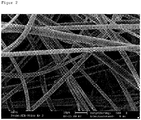
- Fig. 1 an electron micrograph of an embodiment of the ultrafine nonwoven fabric according to the invention shown. Branch points are indicated by circles and branch arms by triangles.
- branching parameters electron micrographs of a microfiber nonwoven fabric can be evaluated. Branching arms and branching points of the uppermost position facing the observer are counted. It makes sense to average the parameters, in particular the number of branch arms and the number of branch points, using statistical methods.
- the Feinstmaschinevliesstoff may comprise a network that contains between 1 and 1000 n A branch arms and between 1 and 300 P n branch points per square millimeter. Preference is given to those microfiber nonwovens which have a mean fiber diameter 0.1 to 100 micrometers, preferably from 0.5 to 40 micrometers, more preferably from 0.5 to 20 micrometers, most preferably from 0.5 to 10 micrometers.
- the mean fiber diameter is the average of the fiber diameter of the fibers, which were used to determine the branching parameters.
- the ultrafine nonwoven fabric which can be described in this way is produced from the thermoplastically processable aminoplast resins according to the invention.
- a superfibrous nonwoven fabric that can be described in this way can also be made of etherified melamine resin in a further embodiment, as described, for example, in US Pat WO2006 / 100041 described.
- the microfiber nonwoven fabric is obtained by an improved process.
- the process described here is a modified melt blown process which is characterized in particular by the amount and type of processing additive or the geometry of the spinnerets used or the blowing air quantity and temperature or the air humidity or the hardening gas concentration and residence time in the sorption tunnel or the time. and characterize temperature control of the aftertreatment or a combination of these sizes.
- the procedure is carried out in a plant consisting of several modules.
- the fibers are deposited, for example, on a continuous screen belt or a screen drum.
- amino resins according to the invention or the resins which according to the WO 2006/100041 have been prepared are thermoplastically processable, it can in their application at very long residence times, which occur especially in dead spaces of the melt-carrying equipment parts, crosslinks, ie to increase the viscosity to solidification, come.
- the viscosity and the softening point of the resins are lowered.
- the lowering of the viscosity is desirable because on the one hand the processing temperature lowered, but on the other hand, the fiber diameter can be reduced.
- a low softening point or a low glass transition temperature Tg of the resins leads to the result that the random mass of microfibers sticks in an uncontrollable manner during the deposition on the screen belt. It is not possible to produce soft non-bonded or non-bonded nonwovens.
- the low molecular weight alcohols can be removed from the ultrafine fibers by means of suitable temperature control in the meltblowing shaft and the adhesion tendency can be suppressed.
- the temperature is advantageously set in the upper part between 100 ° C and 250 ° C, in the lower part between 30 ° C and 50 ° C.
- the temperature of the fiber-air mixture is lowered to a temperature between 30 ° C and 50 ° C by admixing cold secondary air.
- an aminoplast resin melt in particular a melamine melt, which is melted, for example, in an extruder, is forced through spinnerets.
- the nozzles are located in the top of cones (angle of the cones of 10 ° to 90 °), at which hot air flows with a temperature between 150 ° C and 300 ° C at high speed.
- the temperature of the blowing air is 200 ° C to 250 ° C.
- the control of the relative humidity of the blowing air has an important influence on the subsequent crosslinkability of the resulting web.
- spinnerets are used which are characterized by a capillary diameter of 0.2 mm to 1 mm, preferably 0.4 mm to 0.7 mm, with a capillary length of about 1 mm. These nozzle parameters allow the spinning of thinner fibers.
- Such smaller diameter fibers in combination with the particular spatial structure characterized by the aforesaid values for branch arms and branch points per unit area, result in nonwovens of significantly increased elasticity.
- dry air is used in this process.
- moist air as a consequence too high densification of the fibers occurs, accompanied by a loss of the advantageous mechanical properties of the nonwoven.
- the ultrafine fibers are blown with the blown air, which mixes with ambient air, in a turbulence shaft on a sieve belt as a fiber separator.
- the air is sucked off with a suction fan, which is located under the sieve belt.
- the fine fibers are separated from the air stream by the sieve belt and deposited on the sieve belt as random stock to form a loose fleece.
- the nominal capacity of the air extraction is a multiple of the amount of blown air.
- the ratio of blown air and suction quantity is adjusted so that the ultrafine fibers can cool down to approx. 50 ° C.
- the fine fibers formed have a disordered small-part crimp structure which promotes web formation and nonwoven cohesion.
- the loose fleece is compacted and conveyed via a sieve belt into a sorption module.
- the Feinstmaschinewirrlage is traversed by gaseous HCl contained circulating air.
- a defined amount of HCl is absorbed by the finest fibers.
- the HCl content of the circulating air is from 0.0 to 5% by volume, preferably from 0.0 to 3.5% by volume, most preferably from 0.0 to 0.5% by volume.
- the HCl concentration In the fumigation room, it is measured in real time and regulated by varying the amount of HCl added.
- the sorption tunnel is operated at a low vacuum to ensure that no HCl-containing air escapes. This negative pressure causes air to be sucked in at the nonwoven inlet and outlet openings of the sorption and neutralization tunnel. Since atmospheric moisture can lead to uncontrolled bonding of the nonwoven fabric, there may be chambers at the nonwoven inlet and nonwoven outlet openings of the sorption or neutralization tunnel which are exposed to dry air.
- the Feinstmaschinewirrlage After passing through the sorption tunnel the Feinstmaschinewirrlage is further promoted on the screen belt in the neutralization tunnel. There, the fleece is flowed through with dry air, which contains according to a preferred embodiment of ammonia for neutralization. As a result, located between the ultrafine HCl is neutralized.
- the Feinstmaschinewirrlage produced according to the above information is aftertreated in a further step.
- the random orientation is subjected to a higher temperature in two stages according to a predetermined regime over a controlled period of time.
- the total residence time in the hardening tunnel is between 2 and 10 minutes.
- the temperature is first increased stepwise to 100.degree. C. to 140.degree. C. within a few seconds and then increased to 200.degree. To 230.degree. C. within a few seconds in a further subsequent step.
- the Feinstmaschinewirrlage is between 1 and 5 minutes of the first Temperature and between 1 and 5 minutes of the second, higher temperature stage exposed.
- methanol is split off from the ultrafine fiber baffle made of uncured melamine resin. This softens the finest fibers. By softening the fibers, the self-adhesion of the random layer and thus the formation of intrinsically bonded nonwoven structures is supported with suitable process control. By increasing the temperature in the second temperature stage, the microfibers further crosslink, and the mechanical strength of the resulting web structure increases.
- the micro fiber fabric formed in the hardening tunnel is conveyed with a wire belt into a tempering tunnel.
- the temperature is gradually increased to a final temperature of 240-300 ° C.
- this temperature increase is carried out for 2 to 20 minutes; while the residence time in the annealing tunnel is between 2 and 20 minutes.
- the residence time in the annealing tunnel can be designed as multi-floor apparatus. In this last stage, the produced Feinstmaschinevlies cures completely.
- the microfibrous non-woven fabric obtained by melt-blowing, HCl-curing, temperature-curing and tempering is further solidified by a needling step and then wound on rolls.
- HCl concentration in the sorption module and the residence time of the produced Feinstmaschinewirrlage in this module is decisive for the thermal load capacity of the fine fiber material produced. This is determined by thermogravimetric determination. The highest decomposition temperature of 400 to 405 ° C is achieved with a low HCl concentration (0 to 0.3% by volume) and a short residence time in the HCl module (about 1 minute).
- the tempering step of 2 to 20 minutes has the consequence that the fleece undergoes a significant increase in its fineness-related breaking strength by about 30% compared to the untreated fleece.
- Example 1 Preparation of a first thermoplastically processible aminoplast resin
- This reaction mixture is reacted at a reaction temperature of 90 ° C and a total reaction time of 35 min, with elapse 25 minutes to the clear point and the further cooking time after the clear point at 10 min.
- the reaction progress is measured concomitantly with NIR at 220 nm.
- the etherified Aminotriazinharzkondensat dissolved in the water-methanol mixture is transferred from the storage container by means of a membrane pump with 50kg / h in a first vacuum thin-film evaporator, in which the solution of the etherified Aminotriazinharzkondensats at 125 ° C and 150 mbar to a highly concentrated Aminotriazinharzates, which has a solids content of 60% by weight and a content of water / methanol of 40% by mass, is concentrated.
- the highly concentrated solution of the etherified aminotriazine resin is transferred to a second vacuum thin-film evaporator and concentrated at 135 ° C to a melt having a solids content of 99% by weight and a water / methanol content of 1 mass%.
- This melt is immediately after the 2nd vacuum thin-film evaporator pumped with a melt pump to a roll granulator and cooled there to RT. It produces scales of about 10 mm in size and 0.5 mm in thickness.
- the glass transition temperature is 60 ° C.
- the viscosity of the resins thus obtained is about 30 to 40 Pas at 130 ° C and increases over a period of 50 min to a maximum of 70 Pas.
- This reaction mixture is reacted at a reaction temperature of 90 ° C and a total reaction time of 35 min, with elapse 25 minutes to the clear point and the further cooking time after the clear point at 10 min.
- the reaction progress is measured concomitantly with NIR at 220nm.
- the etherified Aminotriazinharzkondensat dissolved in the water-methanol mixture is transferred from the storage tank by means of a membrane pump in a first vacuum thin film evaporator at 50 kg / h, in which the solution of the etherified Aminotriazinharzkondensats at 125 ° C and 150 mbar to a highly concentrated aminotriazine resin solution having a solids content of 60 Mass% and a content of water / methanol of 40 mass%, is concentrated.
- the highly concentrated solution of the etherified aminotriazine resin is transferred to a second vacuum thin-film evaporator and concentrated at 135 ° C to a melt having a solids content of 99% by weight and a water / methanol content of 1 mass%.
- This melt is immediately after the 2nd vacuum thin-film evaporator pumped with a melt pump to a roll granulator and cooled there to RT. It produces scales of about 10 mm in size and 0.5 mm in thickness.
- the glass transition temperature is 50 ° C.
- the viscosity of the resins thus obtained is about 15 to 20 Pas at 130 ° C and increases over a period of 55 min to a maximum of 60 Pas.
- This reaction mixture is reacted at a reaction temperature of 90 ° C and a total reaction time of 45 min, with 15 minutes pass to the clear point and the further cooking time after the clear point at 30 min.
- the reaction progress is measured concomitantly with NIR at 220nm.
- the etherified Aminotriazinharzkondensat dissolved in the water-methanol mixture is transferred from the storage tank by means of a membrane pump in a first vacuum thin film evaporator at 50 kg / h, in which the solution of the etherified Aminotriazinharzkondensats at 125 ° C and 150 mbar to a highly concentrated aminotriazine resin solution having a solids content of 60 Mass% and a content of water / methanol of 40 mass%, is concentrated.
- the highly concentrated solution of the etherified aminotriazine resin is transferred to a second vacuum thin-film evaporator and concentrated at 135 ° C to a melt having a solids content of 99% by weight and a water / methanol content of 1 mass%.
- This melt is immediately after the 2nd vacuum thin-film evaporator pumped with a melt pump to a roll granulator and cooled there to RT. It produces scales of about 10 mm in size and 0.5 mm in thickness.
- the glass transition temperature is 50 ° C.
- the viscosity of the resins thus obtained is about 15 to 20 Pas at 130 ° C and increases over a period of 40 minutes to a maximum of 65 Pas.
- This reaction mixture is reacted at a reaction temperature of 115 ° C and a total reaction time of 25 min, the clear point when reaching the reaction temperature occurs (measured with NIR 220nm) and the further cooking time after the clear point is 25 min.
- the reaction pressure is 1.4 bar.
- the etherified Aminotriazinharzkondensat dissolved in the water-methanol mixture is transferred from the storage container by means of a membrane pump in a first vacuum thin-film evaporator at 35 kg / h, in which the solution of etherified Aminotriazinharzkondensats at 130 ° C and 950 mbar to a highly concentrated Aminotriazinharzates which has a solids content of 75 Mass% and a water content of 25% by mass, is concentrated.
- the highly concentrated solution of the aminotriazine resin is transferred to a second vacuum thin-film evaporator and concentrated at 135 ° C. to a melt which has a solids content of 98.5-99.0% by weight and a water content of 1.0-1.5% by mass. has.
- This melt is immediately after the 2nd vacuum thin-film evaporator pumped with a melt pump to a roll granulator and cooled there to RT. It produces scales of about 10 mm in size and 0.5 mm in thickness.
- the glass transition temperature is 60 ° C.
- the viscosity of the resins thus obtained is about 10 to 15 Pas at 130 ° C and increases over a period of 30 min to a maximum of 75 Pas.
- Example 5 Preparation of a pressure elastic thermoset nonwoven
- Example 1 With a twin screw extruder "Eurolab 16" from THERMO PRISM the resin is melted according to Example 1 at a working temperature of 130 ° C, the melt fed through a channel three quadruple spinning pumps and then through 12 meltblown single nozzles, which are arranged over a width of 30 cm , pressed with a total throughput of 24.1 g / min.
- the nozzle capillaries have a diameter of 0.7 mm and a length of 5mm.
- the blown air has a temperature of 215 ° C and a pre-pressure of 2 bar.
- the mixture of blown air and the melamine resin fibers leaving the meltblown nozzles is passed at a distance of 55 cm to a moving at a speed of 1.2 m / min screen belt, and the fibers are deposited into a loose fleece.
- the fleece is then flowed through for 30 s of 0.5% HCl gas-containing dry air and then exchanged in the fiber spaces located HCl gas / air mixture by air, which has a maximum of 5% relative humidity.
- the nonwoven After a rest period of 20 minutes, the nonwoven is heated from room temperature to 260 ° C. within 30 minutes and thereby cured.
- the resulting nonwoven body is highly cross-linked and has a pronounced compressive elastic behavior with a 100% recovery at a 1 minute load of 10 g / cm 2 .
- the preparation of the HIPE®ESIN MER fleece was carried out at a room air of 23 ° C and 42% rel. Humidity.
- the structure of the cured fleece body shows the following SEM image ( Fig. 1 ). According to the method described above, the number of branch points is 153 / mm 2 ; the number of branch arms is 476 / mm 2 .
- FIG. 1 shows an SEM image (200 times magnification) of a sample according to Example 1.
- the fibers have a diameter of about 10 microns and smaller.
- branch points are symbolized by circles and branch arms by triangles.
- a resin is melted according to Example 3 at a working temperature of 135 ° C, fed the melt via a channel three quadruple spinning pumps and then through 12 meltblown single nozzles, which are arranged over a width of 30 cm , pressed with a total throughput of 21 g / min.
- the nozzle capillaries have a diameter of 0.4 mm and a length of 5mm.
- the blown air has a temperature of 213 ° C and a pre-pressure of 3 bar.
- the mixture of blown air and the resulting HIPE®ESIN MER fibers leaving the meltblown nozzles is passed at a distance of 80 cm to a moving at a speed of 0.7 m / min screen belt, and the HIPE®ESIN MER fibers become filed a loose fleece.
- the fleece is then 55 sec. Traversed by 0.9% HCl gas contained dry air and then exchanged in the fiber spaces located HCl gas / air mixture by air having a maximum of 5% relative humidity. Subsequently, the fleece 30 sec. With air containing 1% ammonia gas flows through, then runs in a belt dryer "Syntronic 100" and is heated in the first stage to 110 ° C and in a second stage to 215 ° C and cured.
- the fleeces have a loose structure, are glued only at a few fiber cross points and are characterized by a textile handle. They can be solidified by needling.
- the cured fibers have an average titer of 1.66 dtex.
- the fiber strength depends on the thermal curing and tempering. Curing / annealing temperature strain fineness-related strength (° C) (%) (CN / tex) 215 5.84 13, 9 250 5.77 16.3 280 5.70 19.1
- the production of the nonwovens was carried out in a room air of 26 ° C and 31% rel. Humidity.
- the structure of the cured fleece body is in the SEM image (500x magnification) in FIG. 2 shown.
- the average fiber size is less than 10 microns, in particular about 5 microns.
- the number of branching points determined by the method described above is 34 / mm 2 ; the number of branch arms is 102 / mm 2 .
- thermogravimetry the thermal resistance of the pattern annealed at 280 ° C of Example 2 was determined.
- the decomposition temperature is 387 ° C; the loss of mass in the range of 200 ° C to 387 ° C is about 4.8%.
- Example 7 Preparation of a nonwoven with the addition of an alcohol to the resin melt
- hot blown air (same process conditions) is also added in addition to the row of nozzles via plates which are designed as flow rectifiers (see FIG. 7 ).
- the mixture of air leaving the injector and the melamine resin fibers formed is placed on top of one another Speed of 1.2 m / min moving screen belt passed, and the fibers are deposited into a loose fleece.
- the fleece is then flowed through for 30 s of 0.5% HCl gas-containing dry air and then exchanged in the fiber spaces located HCl gas / air mixture by air, which has a maximum of 5% relative humidity.
- the nonwoven After a rest period of 20 minutes, the nonwoven is heated from room temperature to 260 ° C. within 30 minutes and thereby cured.
- the resulting nonwoven body is highly cross-linked and has a pronounced compressive elastic behavior with a 100% recovery at a 1 minute load of 10 g / cm 2 .
- the preparation of the HIPE®ESIN MER fleece was carried out at a room air of 23 ° C and 42% rel. Humidity.
- Fig. 4 an embodiment of a spinning system is shown, which contains a spinning module which is also suitable, inter alia, for the production of the ultrafine fiber webs described above and in the context of the described method. It should be noted that the embodiment of the spinning unit and the spinning module is not limited to the described Feinstmaschinevliese and the methods described.
- a resin for example, of the type "HIPE®ESIN MER 2,5F" is prepared according to WO 2006/100041 in the form of metered flakes with average dimensions L / H / B of 5/5 / 0.5 delivered in airtight bags or big bags and stored in a solid storage.
- the sacks or big bags are emptied into an intermediate storage bin (01-B01).
- the size of the temporary storage container is chosen so that it does not have to be filled at night.
- the MER is transported from the intermediate storage tank to a twin-screw extruder (01-R01) with a gravimetric metering device (01-X01) and melted in it. Since the resin may contain inhomogeneities, the screw of the extruder contains conventional homogenizing elements.
- the MER is hygroscopic. In the presence of water u.U. unwanted hydrolysis reactions from. To avoid moisture absorption, all equipment in which the resin can come into contact with ambient air, e.g. the intermediate storage tank (01-B01) and the feed hopper of gravimetric metering and extruder, superimposed with dry air.
- a tool with concentric bore (transition from 8 to 0), in which the MER melt is conveyed into the inlet pipe of the melt pump.
- the pump 01-P01 conveys the melt through the melt filter 01-F01 in the circuit to the modules of the spinning beam.
- a continuous melt filter 01-F01 is arranged, with which impurities that were either already contained in the supplied resin or spun in the melt-carrying system of the plant part, are discharged from the melt stream. Since the melt is circulated, it is important to avoid accumulation of impurities and remove impurities.
- a pressure reducing valve is installed with which a pre-pressure> 20 bar can be kept before each melt pump.
- the partial flows are conveyed from the melt line via the shortest route to the modules of the spinner.
- the MER melt is pressed by the melt pumps (type: planetary gear pump with 4 planetary gears) of the spinning beam through the downstream nozzles.
- melt filter In front of each nozzle is a melt filter, which retains further impurities (gel particles).
- the nozzles are in pointed cones (angles of 10 ° to 90 °) at which the hot air (temperature between 150 ° C and 300 ° C) with velocity e.g. flows between 0.1 and 5 m / s, in particular between 0.5 and 2 m / s. In the present case, a speed of 1 m / s is used.
- the cones are thermally insulated from the blown air. This makes it possible to increase the temperature of the blown air, which blows the melt into ultrafine fibers, far above the curing temperature of the MER, which results in particularly fine-denier fibers without causing the nozzles to overgrow.
- blowing air dry compressed air is used.
- the blown air is heated to a temperature of 200 ° C to 300 ° C with the heat exchanger 01-W03.
- the temperature of the blowing air is regulated.
- Fig. 5 is shown in a schematic manner in spin bars (compared to the Fig. 4 turned by 90 degrees).
- An embodiment of a spinning beam consists of individual modules with a length of 30 cm each.
- Fig. 5 are two rows of four modules shown, the arranged one behind the other.
- the nozzles of the modules are offset from each other.
- the melt supply of the individual modules takes place via the in Fig. 4 already shown ring line, which is flowed through at high speed by the melt.
- the melt pump is designed as a planetary gear.
- Each of the melt pumps has a sun gear and four planetary gears, so that a total of four pumping mechanisms are present.
- Each of the nozzles shown here only schematically is associated with a melt pumping mechanism.
- the nozzles are arranged in a kind of cluster of four nozzles per planetary gear, the nozzles are not on a straight line.
- Fig. 6 is an embodiment of a part of the spinning device, namely a spinning module shown from below and in side view.
- the spinning module consists of three planetary gear spinning pumps, each with 4 gear pairs, of which a designated A equal length melt lines lead to the spinnerets.
- the four spinnerets, each associated with a planetary gear pump, are equidistant on a circular arc.
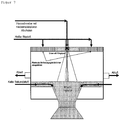
- Fig. 7 an embodiment of a meltblowing shaft is shown, in which the spinning beam is mounted.
- an injector At a small distance (10 cm to 30 cm) from the nozzle is an injector, in which the blown air / fiber stream with cold, sucked dry secondary air and cooled to about 45 ° C.
- the mixture of air leaving the injector and the melamine resin fibers formed is passed to a moving belt at a speed of 1.2 m / min, and the fibers are laid down to a loose web.
Landscapes
- Engineering & Computer Science (AREA)
- Textile Engineering (AREA)
- Chemical & Material Sciences (AREA)
- Chemical Kinetics & Catalysis (AREA)
- General Chemical & Material Sciences (AREA)
- Health & Medical Sciences (AREA)
- Mechanical Engineering (AREA)
- Medicinal Chemistry (AREA)
- Polymers & Plastics (AREA)
- Organic Chemistry (AREA)
- Phenolic Resins Or Amino Resins (AREA)
- Nonwoven Fabrics (AREA)
- Treatments For Attaching Organic Compounds To Fibrous Goods (AREA)
Description
- Die vorliegende Erfindung betrifft ein thermoplastisch verarbeitbares Aminoplastharz, ein Verfahren zu deren Herstellung, ein duroplastisches Feinstfaservlies, ein Verfahren und eine Anlage zur Herstellung von duroplastischen Feinstfaservliesen aus thermoplastisch verarbeitbaren Aminoplastharzen, insbesondere Melaminharzen, und die Verwendung des duroplastischen Feinstfaservlieses.
- In verschiedenen Bereichen der verarbeitenden Industrie besteht ein hoher Bedarf an Fasermaterialien, welche chemisch resistent, schwer entflammbar, leicht zu verarbeiten, preiswert herzustellen und ohne Gefahr für Mensch und Umwelt sein sollen. Anwendungsbereiche solcher Fasermaterialien sind zum Beispiel Schutzkleidung oder die Innenausstattung von Fahrzeugen und Hotelmöbel/Raumtextilien für öffentliche Einrichtungen, wo hohe Anforderungen an die Widerstandsfähigkeit gegenüber Flammen gestellt werden, weiterhin Dämmungsmaterial für Motoren oder Filtermaterialien für industrielle Prozesse.
- Duroplastische Werkstoffe auf Basis von Triazinharzen, wie zum Beispiel Melamin-Formaldehyd-Harze, sind für die genannten Anwendungen sehr gut geeignet und bilden eine Gruppe von schwer entflammbaren, chemisch resistenten und preiswert in großer Menge herstellbaren Ausgangsmaterialien.
- Von Nachteil bei der Herstellung von Fasern oder Schäumen, Halbzeugen oder Formstoffen, wie z.B. Beschichtungen, Schichtpressstoffen, Laminaten, Formstoffen im Haushaltsbereich und der Elektroindustrie aus Triazinharzen ist jedoch deren schwierige Verarbeitbarkeit nach üblichen thermo-plastischen Verarbeitungsverfahren wie Extrusion, Spritzguss oder Blasformen, da hoch-molekulare Melaminharze vernetzt und unschmelzbar sind.
- Unvernetzte niedermolekulare Melaminharz-Vorkondensate besitzen eine zu geringe Schmelzviskosität für diese Verarbeitungsverfahren und können lediglich als hochgefüllte Formmassen bei langen Zykluszeiten unter Härtung der Erzeugnisse verarbeitet werden (Woebcken, W., Kunststoff-Handbuch Bd. 10 "Duroplaste", Carl Hanser Verl. München 1988, S. 266-274).
- Fasern (
EP 0093 965 A1 ), Schäume (EP 0017671 A1 ) oder Beschichtungen (WO 96/20239 A1 - Darüber hinaus führen die flüchtigen Nebenprodukte bei der Polykondensation der Aminoplastvorkondensate zu Mikroporen oder Rissen in der Oberfläche der Produkte. Somit entstehen Materialien, die eine herabgesetzte Resistenz gegenüber Umwelteinflüssen besitzen.
- Die
DE10056398 beschreibt ein aus der Schmelze verarbeitbares Triazin-Formaldehyd-Harz, welches nach einem aufwendigen dreistufigen Verfahren hergestellt wird. Die Vorhärtung erfolgt in diesem Fall bei relativ hohen Temperaturen (160-200°C) in einem Extruder, wodurch eine weitgehende Vorhärtung bedingt ist und damit ein hoher Erweichungspunkt oberhalb von 100°C, wodurch wiederum ein enges Verarbeitungsfenster bedingt ist. - Aus Melaminharzen sind nach bekannten Verfahren Faserstoffe herstellbar (
DE10038030 ,WO 2006/100041 ). Im Falle der Herstellung nach Verfahren gemäßDE10038030 sind - im Gegensatz zum hier beschriebenen Verfahren, wobei Vliesstoffe in einem einstufigen Prozess aus veretherten Melaminharzen (sogenannten MER) produziert werden - aus den dabei entstehenden Stapelfasern praktisch keine zu 100% auf Melaminharz basierenden textilen Flächengebilde herstellbar. Dadurch ist die Verwendung von solchen Melaminharzfasern in den genannten Anwendungen eingeschränkt bzw. erfordert weitere, in der Regel flammresistente Fasern zur Gewährleistung der geforderten Eigenschaften. - Technologien und Prozesse der textilen Flächenbildung sind wesentlich von der auf der Verwendung von Naturfasern beruhenden Tradition beeinflusst. Naturfasern liegen als Stapelfasern vor, die durch Länge und Feinheit definiert sind. Synthetische Fasern aus Melaminharzen nach den bereits genannten Verfahren, welche wegen ihrer bevorzugten chemischen und physikalischen Eigenschaften für die genannten Verwendungen besser geeignet sind als jede Naturfaser, werden gemäß den aus dem Stand der Technik bekannten Verfahren durch Bearbeitungsschritte wie u.a. Kardieren verarbeitet, um daraus einen Faden bzw. eine textile Fläche herzustellen. Diese Verarbeitungsschritte sind komplex, aufwendig und führen zu einem unbefriedigenden Ergebnis, da Faserschädigungen auftreten und in der Regel zur Gewährleistung der Verarbeitbarkeit eine Kombination mit anderen Faserarten erforderlich ist.
- In der Praxis werden beispielsweise Fasern auf Basis von Polyaramid (m- und p-Aramid) eingesetzt, was die Komplexität der Herstellung erhöht und die Herstellkosten solcher textilen Flächen deutlich heraufsetzt. Insbesondere wäre es für die genannten Verwendungen von großem Interesse, ein Vliesstoff ("Nonwoven") zur Verwendung als hitze- und flammfeste Sperrschicht in Schutzkleidung, Dämm-Materialien und textilen Filtermaterialien zur Verfügung zu stellen.
- Ein Verfahren zur Herstellung von duroplastischen Feinstfaservliesen ist in
WO 2006/100041 beschrieben. Die mit diesem Verfahren erhaltenen Vliese weisen große Vorteile gegenüber mit anderen Verfahren erhältlichen Fasermaterialien auf, sind aber in ihren Eigenschaften noch weiter verbesserungsfähig. Insbesondere ist ihre Flexibilität, Beanspruchbarkeit und Stabilität bei der Weiterverarbeitung zu fertigen Endprodukten noch zu verbessern. -
WO 2004/056900 A1 betrifft ein Syntheseverfahren zur Herstellung von veretherten Melaminharzkondensaten, wobei in einem ersten Reaktionsschritt ein verethertes Melaminharzvorkondensat in alkoholischer Lösung hergestellt wird, dieses Vorkondensat in Gegenwart von weiteren Alkoholen oder Diolen aufkonzentriert wird, und dass aufkonzentrierte Vorkondensat in einem zweiten Reaktionsschritt in einem Mischer umgesetzt wird. Methylolierung und Veretherung können gleichzeitig durchgeführt werden. -
WO 2006/024544 offenbart modifizierte Aminotriazinharze, herstellbar durch die Reaktion einer modifizierten Aminotriazinharzschmelze mit einem Aminotriazin. In den modifizierten Aminotriazinharzen können die Kondensationsprodukte teilweise oder vollständig verethert vorliegen. Diese werden in einem weiteren Reaktionsschritt teilweise oder vollständig mit aliphatischen C4-C18-Alkoholen oder aromatischen Alkoholen, Diolen oder Polyolen umgesetzt, so dass Polymere mit hohen Molmassen aufgebaut werden. Die hergestellten Aminotriazinharze weisen Viskositäten zwischen 450 bis 12.000 Pa*s auf. -
WO 2004/092239 A1 betrifft ein Verfahren zur kontinuierlichen Synthese eines Melaminharzes, wobei hierfür in einer ersten Reaktionsstufe Melamin, ein Aldehyd und ein Alkohol umgesetzt werden, und das Reaktionsgemisch anschließend in eine feststoffreiche und feststoffarme Phase aufgetrennt wird. -
WO 02/40564 -
WO 2006/136457 betrifft veretherte Melaminharze herstellbar durch Umsetzung von Melamin, Formaldehyd und Alkanol, die nach Umetherung Viskositäten im Bereich zwischen 2 und 200 Pa*s bei 130°C aufweisen können. Die Melaminharze weisen Molmassen zwischen 1500 und 200.000 auf. - Ausgehend vom dargelegten Stand der Technik ist es Aufgabe der vorliegenden Erfindung, ein Verfahren zur Herstellung eines nach thermoplastischen Methoden verarbeitbares Aminoplastharz zur Verfügung zu stellen, wobei das Aminoplastharz einfach herstellbar ist, ein breites Verarbeitungsfenster aufweist und insbesondere zur Herstellung von Fasern und faserhaltigen Vliesstoffen geeignet ist.
- Diese Aufgabe wird gelöst durch ein Verfahren zur Herstellung eines thermoplastisch verarbeitbares Aminoplastharzes.
- Demnach ist das mit dem erfindungsgemäßen Verfahren herstellbare Aminoplastharz durch eine Viskosität zwischen 0,1 bis 200 Pas, bevorzugt zwischen 1 bis 150 Pas, insbesondere bevorzugt zwischen 3 bis 100 Pas, bei Temperaturen zwischen 90 bis 150°C, bevorzugt zwischen 100 bis 150°C, insbesondere bevorzugt zwischen 110 bis 140°C über einen Zeitraum von mindestens 15 Minuten, bevorzugt von mindestens 20 Minuten, insbesondere bevorzugt von mindestens 30 Minuten gekennzeichnet.
- Das hergestellte Aminoplastharz weist bei einer Temperatur von 130°C eine Viskosität zwischen 3 bis 100 Pas über einen Zeitraum von mindestens 25 Minuten auf.
- Das Harz weist somit eine ausreichende Stabilität unter den üblichen Verarbeitungsbedingungen von Thermoplasttechnologien wie z.B. Extrusion, Spritzguss oder Blasformen auf. Das erfindungsgemäße Harz unterliegt im angegebenen Zeitraum keiner bzw. lediglich einer minimalen Vernetzung bzw. Eigenkondensation, so dass es thermoplastisch verarbeitbar ist.
- Die Aminoplastharze der Erfindung weisen eine Glasübergangstemperatur Tg von mehr als 40°C, bevorzugt zwischen 40°C und 80°C auf, besonders bevorzugt zwischen 45°C und 65°C. Unter der Glasübergangstemperatur Tg ist dabei die Temperatur zu verstehen, bei der amorphe oder teilkristalline Polymere vom flüssigen oder gummielastischen Zustand in den hartelastischen Zustand übergehen.
- Die Aminoplastharze weisen vorteilhafterweise eine Molmasse von Mw = 150-1000 g/mol, insbesondere zwischen 150 und 600 g/mol auf.
- Unter Normalbedingungen (Raumtemperatur, 1 bar Luftdruck) liegen die erfindungsgemäßen Harze bevorzugt als Festharze vor.
- Das erfindungsgemäße Verfahren ist in ein einfaches zweistufiges Verfahren.
- Demnach ist das thermoplastisch verarbeitbares, verethertes Aminoplastharz herstellbar durch:
- a) Gleichzeitige Umsetzung mindestens einer Triazinverbindung mit mindestens einem Aldehyd und mindestens einem Alkohol, wobei die Triazinverbindung der allgemeinen Formel (I)

- R2 Q1 oder einen mit seinem zentralen Stickstoffatom an den Triazinring der Struktur der Formel (I) gebundenen Rest der Formel R4 -N-R5 bedeutet, wobei
Q1 ein lineares oder verzweigtes C1-C50-Alkyl oder einen cyclischen Substituenten in Form eines C5-C20-Cycloalkyls, eines C5-C20-Aryls, eines C1-C20-alkylsubstituierten C5-C20-Aryls, C2-C20-Heterocyclus, C2-C20-alkenylsubstituiertes C2-C20-Heterocyclus, C1-C50-Alkylsubstituiertes C2-C20-Heterocyclus, eines C2-C20-Alkenyl, eines C2-C20-alkenylsubstituierten C5-C20-Aryls, eines C2-C12-Alkinyl oder eines Imids von cyclischen gesättigten oder ungesättigten Carbonsäuren, wobei das C1-C50-Alkyl oder der cyclische Substituent durch ein oder mehrere Sauerstoffatome, Schwefelatome, substituierte und/oder unsubstituierte Stickstoffatome und/oder durch ein oder mehrere Gruppen des Typs -C(O)O-, -OC(O)-, -C(O)-, -NHC(O)O-, -OC(O)NH- und/oder-OC(O)O- unterbrochen sein kann, ist, - R3 Q1 oder einen mit seinem zentralen Stickstoffatom an den Triazinring der Struktur der Formel (I) gebundenen Rest der Formel R6 -N-R7 bedeutet,
- R1 , R4 , R5 , R6 und R7 unabhängig voneinander H oder Q2 bedeuten, wobei
- Q2 jeweils lineares oder verzweigtes C1-C50-Alkyl, C5-C20-Cycloalkyl, C5-C20-Aryl, C1-C20-alkylsubstituiertes C5-C20-Aryl, C2-C20-Heterocyclus, C2-C20-alkenylsubstituiertes C2-C20-Heterocyclus, C1-C50-Alkylsubstituiertes C2-C20-Heterocyclus, C2-C20-Alkenyl, C2-C20-alkenylsubstituiertes C5-C20-Aryl oder C2-C12-Alkinyl, das jeweils durch ein oder mehrere Sauerstoffatome, Schwefelatome, substituierte und/oder unsubstituierte Stickstoffatome und/oder durch ein oder mehrere Gruppen des Typs -C(O)O-, -OC(O)-, -C(O)-,-NHC(O)O-, -OC(O)NH- und/oder -OC(O)O- unterbrochen sein kann und/oder weitere funktionelle Gruppen wie -OH, - NH2, -NHR1, SH, Halogen aufweisen kann, ist,
- R2 Q1 oder einen mit seinem zentralen Stickstoffatom an den Triazinring der Struktur der Formel (I) gebundenen Rest der Formel R4 -N-R5 bedeutet, wobei
- b) Entfernung von überschüssigem Alkohol und Wasser unter gleichzeitiger Vorhärtung, bei Temperaturen von 80 - 150°C und Drücken von 100 - 400 mbar.
- Nicht umgesetzter Alkohol wird somit bereits während des Verfahrens entfernt.
- Die erfindungsgemäßen Aminoplastharze sind demnach in einem zweistufigen Verfahren herstellbar, wobei auf den sonst üblichen zusätzlichen Schritt der Extrusion verzichtet werden kann. Das Harz wird bereits nach der Entfernung des überschüssigen Lösungsmittels, insbesondere des überschüssigen Alkohols, erhalten. Durch den Verzicht auf den Schritt der Extrusion ist das erfindungsgemäße Harz nur zu einem geringen Grad kondensiert und weist daher ein breites Verarbeitungsfenster auf.
- Vorteilhafterweise ist die in Stufe a) verwendete Aminotriazinverbindung ausgewählt aus einer Gruppe umfassend Melamin, C1-C50-alkylsubstituiertes Melamin, C5-C20-cycloalkylsubstituiertes Melamin, Guanamin oder Benzoguanamin. Besonders bevorzugt werden Melamin, Acetoguanamin und Benzoguanamin oder beliebige Mischungen davon verwendet.
- Bevorzugt als Aldehyd werden C1- bis C12-Aldehyde eingesetzt, die eine oder mehrere Aldehydgruppen aufweisen, besonders geeignet sind Formaldehyd, Acetaldehyd, Glutaraldehyd, Glyoxal oder Trimethylolacetaldehyd. Die Aldehyde können dabei sowohl als wässrige Lösung als auch als Reinsubstanz verwendet werden. Als besonders geeignet haben sich 30-50%ige Formalinlösungen und para-Formaldehyd erwiesen.
- Bevorzugt als Alkohol werden C1- bis C12-Alkohole eingesetzt, die eine oder mehrere Alkoholgruppen aufweisen. Besonders geeignet sind Methanol, Butanol, Hexanol, Butandiol, Trimthylolpropan oder Ethoxylate.
- Wie hierin verwendet, bezeichnet der Begriff "C1-C50-Alkyl" Reste, wie Methyl, Ethyl, n-Propyl, Isopropyl, n-Butyl, Isobutyl, s-Butyl, t-Butyl, Amyl, t-Amyl, Hexyl, Heptyl, Octyl, Nonyl, Decyl, Undecyl, Dodecyl, und längerkettige Reste. Bevorzugte C1-C50-Alkylgruppen sind Methyl, Ethyl, Propyl, Isopropyl und Butyl.
- Der Begriff "C5-C20-Cycloalkyl" umfasst u.a. die Gruppen Cyclopropyl, Cyclopentyl, Cyclohexyl, Cycloheptyl und höhergliedrige Ringe.
- Der Begriff "C5-C20-Aryl", wie hierin verwendet, bezeichnet aromatische Kohlenwasserstoffe, beispielsweise Phenyl, Benzyl, Naphthyl, oder Anthryl.
- Der Begriff "C2-C20-Heterocyclus" bezeichnet fakultativ substituierte Ringe mit 2-20-C-Atomen, die 1 bis 4 Heteroatome, wie etwa Sauerstoff, Schwefel und/oder Stickstoff, insbesondere Stickstoff, entweder alleine oder in Zusammenhang mit Schwefel- oder Sauerstoffringatomen haben. Diese Ringe können gesättigt oder vollständig ungesättigt oder teilweise ungesättigt sein, wobei vollständig gesättigte Ringe bevorzugt werden. Bevorzugte heterozyklische Ringe schließen Piperidinyl, Morpholinyl, Piperazinyl, 2-Amino-Imidazoyl, Tetrahydrofurano, Pyrrolo, Tetrahydrothiophenyl ein.
- Der Begriff "C2-C20-Alkenyl" bezeichnet einen Rest umfassend eine Doppelbindung, wobei dieser substituiert oder unsubstituiert vorliegen kann. Die Stereoisomerie ist nicht wesentlich und alle Stereoisomere können für ein jeweiliges substituiertes Alkenyl verwendet werden.
- Der Begriff "C2-C12-Alkinyl", wie hier verwendet, bezeichnet einen Rest der Formel C2-C12-C≡C-. Beispiele für C2-C12-Alkinyle schließen ein: Ethinyl, Propinyl oder Propargyl, 2-Butinyl, 2-Pentinyl, 3-Pentinyl, 2-Hexinyl, 3-Hexinyl, 4-Hexinyl, 2-Heptinyl, 3-Heptinyl, 4-Heptinyl, 5-Heptinyl, sowie Octinyl, Noninyl, Decinyl, Undecinyl, Dodecinyl, sowie Di- und Tri-ine von geraden und verzweigten Alkylketten. Bevorzugt sind solche Alkinylreste, bei denen die Dreifachbindung endständig ist.
- Der Begriff "substituiert", in Verwendung mit "Alkyl", "Alkenyl" etc., bezeichnet die Substitution eines oder mehrerer Atome, in der Regel H-Atome, durch einen oder mehrere der folgenden Substituenten, bevorzugt durch einen oder zwei der folgenden Substituenten: Halogen, Hydroxy, geschütztes Hydroxy, Oxo, geschütztes Oxo, C3-C7-Cycloalkyl, Phenyl, Naphtyl, Amino, geschütztes Amino, monosubstituiertes Amino, geschütztes monosubstituiertes Amino, disubstituiertes Amino. Weitere Substituenten sind generell denkabr. Die substituierten Alkygruppen, Arylgruppen, Alkenylgruppen, können einmal oder mehrfach substituiert sein und bevorzugt 1- oder 2-mal, mit denselben oder unterschiedlichen Substituenten. Das molare Verhältnis von Aminotriazinverbindung zu Aldehyd in Stufe a) weist einen Wert von 1:1,3 bis 1:3 auf.
- Des Weiteren ist es von Vorteil, wenn das molare Verhältnis von Alkohol zu Aminoplastbildner in Stufe a) einen Wert von 1:25 bis 15:1, bevorzugt 1:5 bis 10:1 aufweist.
- Der Feststoffgehalt des in Stufe a) gebildeten Produktes liegt zwischen 20 und 60 %, bevorzugt zwischen 32 bis 51 %.
- Das erfindungsgemäße zweistufige Verfahren zur Herstellung der Harze ist gekennzeichnet durch: a) gleichzeitige Umsetzung mindestens einer Aminotriazinverbindung der allgemeinen Formel (I) mit mindestens einem Aldehyd und mindestens einem Alkohol, und b)
- Entfernung von überschüssigem Alkohol und Wasser unter gleichzeitiger Vorhärtung bei Temperaturen von 80-150°C und Drücken von 100-400 mbar.
- Die Umsetzung in Stufe a) erfolgt dabei vorteilhafterweise bei Temperaturen von 80-150 °C. Dabei kann sowohl eine konstante Temperatur während der gesamten Umsetzung vorliegen als auch ein Temperaturprofil durchlaufen werden.
- Bei Durchführung des Verfahrens in einem Dünnfilmverdampfer erfolgt die Umsetzung in zwei hintereinander geschalteten Dünnfilmverdampfern. Ein erster Dünnfilmverdampfer wird bei 80 bis 130°C betrieben, wohingegen der zweite Dünnfilmverdampfer in Abhängigkeit vom Durchsatz bei 130 bis 150°C betrieben wird. In einer bevorzugten Ausführungsform liegt die Temperatur im ersten Dünnfilmverdampfer bei einem Durchsatz von 50 kg/h Aminoplastharz bei 120°C und im zweiten Dünnfilmverdampfer bei 135°C. Bei einem Durchsatz von 60kg/h Aminoplastharz liegt die Temperatur im ersten Dünnfilmverdampfer hingegen bei 130°C und im zweiten Dünnfilmverdampfer bei 140°C.
- In der Stufe a) liegt bei der Umsetzung bevorzugt ein Druck von 1-16 bar vor, wobei sowohl ein konstanter Druck während der gesamten Umsetzung anliegt, als auch ein Druckprofil durchlaufen werden kann. Der Druck ist dabei abhängig von der Temperatur, da sich der Dampfdruck des während der Umsetzung verwendeten Lösungsmittels einstellt und kein zusätzlicher Druck aufgegeben wird.
- Mit Vorteil liegt in der Stufe a) ein pH-Wert von 5,3-7,8, insbesondere ein pH-Wert von 5,5-6,9 vor. Die Einstellung des pH-Wertes erfolgt bevorzugt durch Zugabe einer organischen oder anorganischen Säure, eines Ionentauscherharzes oder eines Zeolithen. Beispiele für geeignete Säuren sind Salzsäure, Salpetersäure, Schwefelsäure, Ameisensäure oder Essigsäure. Beispiele für geeignete Ionentauscher sind chlormethylierte und Trimethylamin-aminierte Copolymere aus Styren und Divinylbenzen, sulfonierte Copolymere aus Styren und Divinylbenzen und m-Phenylendiamin-Formaldehyd-Copolymere.
- In einer Ausführungsform wird das Reaktionsprodukt nach Stufe
- a) durch Erhöhung des pH-Wertes, bevorzugt auf pH>8,5, stabilisiert. Beispiele für geeignete Laugen sind Natronlauge und Kalilauge.
Als Reaktoren zur Durchführung der Verfahrensstufe a) sind Rührreaktoren mit Bodenablass und absteigendem Kühler geeignet.
Geeignete Apparate zur Entfernung von überschüssigem Alkohol und gebildetem Wasser unter gleichzeitiger Vorhärtung in Stufe - b) sind zum Beispiel Dünnschichtverdampfer, Fallfilmverdampfer, Kurzwegfilmverdampfer oder Verdampfer für Medien hoher Viskosität der Firma List.
- Besonders geeignet sind die erfindungsgemäßen Harze für die Herstellung von Fasern, Fibriden, Vliesen oder Geweben, nach dem Fachmann bekannten Spinnverfahren. Insbesondere können die erfindungsgemäßen Harze im so genannten "Melt Blow"-Verfahren zu Vliesstoffen (non-woven) verarbeitet werden. Ferner sind die erfindungsgemäßen Harze auch zur Verwendung als Bindemittel und/oder Zuschlagstoff in Wood Plastic Composites (WPC), Pressmassen oder Formmassen geeignet.
- Wie erwähnt sind die erfindungsgemäßen Aminoplastharze insbesondere zur Herstellung von Vliesen, insbesondere Feinstfaservliesstoffen geeignet.
- Der Feinstfaservliesstoff aus thermoplastisch verarbeitbaren Aminoplastharzen, bevorzugt Melaminharzen ist insbesondere durch den Durchmesser der ihn konstituierenden Fasern sowie die Dichte deren Verknüpfung gekennzeichnet. Zur Beschreibung der Dichte ihrer Verknüpfung (Faserstruktur) werden dabei die folgenden Größen definiert.
- Verzweigungspunkte: Ein Verzweigungspunkt ist ein solcher Punkt, an dem zwei oder mehr in ihrer jeweiligen Längsrichtung laufende Fasern an einem Punkt zusammenlaufen und durch Verschmelzen physisch miteinander verbunden sind. Die mittlere Anzahl von Verzweigungspunkten pro Flächeneinheit wird mit NP bezeichnet. Bei Bezug auf die Flächeneinheit eines Quadratmillimeters wird dieser Parameter mit NP_mm bezeichnet.
- Verzweigungsarme: Ein Verzweigungsarm ist der jeweils zwischen zwei Verzweigungspunkten laufende, durch keine weiteren Verzweigungspunkte unterbrochene Arm einer Faser. Die mittlere Anzahl von Verzweigungsarmen pro Flächeneinheit wird mit NA bezeichnet. Bei Bezug auf die Flächeneinheit eines Quadratmillimeters wird dieser Parameter mit NA_mm bezeichnet.
- Beispielhaft ist in
Fig. 1 eine elektronenmikroskopische Aufnahme einer Ausführungsform des erfindungsgemäßen Feinstfaservliesstoffes gezeigt. Verzweigungspunkte sind durch Kreise sowie Verzweigungsarme durch Dreiecke gekennzeichnet. - Zur Bestimmung der Verzweigungsparameter können elektronenmikroskopische Aufnahmen eines Feinstfaservliesstoffes ausgewertet werden. Es werden dabei Verzweigungsarme und Verzweigungspunkte der obersten, dem Betrachter zugewandten Lage gezählt. Dabei ist es sinnvoll, die Parameter, insbesondere die Anzahl der Verzweigungsarme und die Anzahl der Verzweigungspunkte, über statistische Verfahren zu mitteln.
- Der Feinstfaservliesstoff kann ein Netzwerk aufweisen, welches zwischen 1 und 1000 nA Verzweigungsarme und zwischen 1 und 300 nP Verzweigungspunkte pro Quadratmillimeter enthält. Bevorzugt sind dabei solche Feinstfaservliesstoffe, welche einen mittleren Faserdurchmesser 0,1 bis 100 Mikrometer, bevorzugt von 0,5 bis 40 Mikrometer, weiter bevorzugt von 0,5 bis 20 Mikrometer, am meisten bevorzugt von 0,5 bis 10 Mikrometer, aufweisen.
- Der mittlere Faserdurchmesser ist dabei der Durchschnitt der Faserdurchmesser der Fasern, die zur Ermittlung der Verzweigungsparameter herangezogen wurden.
- In einer Ausführungsform wird der so beschreibbare Feinstfaservliesstoff aus den erfindungsgemäßen thermoplastisch verarbeitbaren Aminoplastharzen hergestellt.
- Ein so beschreibbarer Feinstfaservliesstoff kann aber auch in einer weiteren Ausführungsform aus veretherten Melamin-Harz, wie es beispielsweise in der
WO2006/100041 beschrieben ist, hergestellt werden. Gegenüber dem dort gezeigten Verfahren wird der Feinstfaservliesstoff allerdings durch ein verbessertes Verfahren erhalten. - Beim hier beschriebenen Verfahren handelt es sich um ein modifiziertes Melt Blown-Verfahren, das sich insbesondere durch Menge und Art eines Verarbeitungsadditiv oder die Geometrie der verwendeten Spinndüsen oder die Blasluftmenge und -temperatur oder die Luftfeuchte oder die Härtergaskonzentration und Verweilzeit im Sorptionstunnel oder die Zeit- und Temperaturführung der Nachbehandlung oder eine Kombination dieser Größen charakterisieren lässt.
- Das Verfahren wird in einer Anlage durchgeführt, die aus mehreren Modulen besteht. Die Fasern werden beispielsweise auf einem kontinuierlichen Siebband oder einer Siebtrommel abgeschieden.
- Obwohl die erfindungsgemäßen Aminoplastharze oder die Harze, die gemäß der
WO 2006/100041 hergestellt wurden, thermoplastisch verarbeitbar sind, kann es bei ihrer Anwendung bei sehr langen Verweilzeiten, die insbesondere in Toträumen der schmelzeführenden Anlagenteile auftreten, zu Vernetzungen, d.h. zur Erhöhung der Viskosität bis zur Verfestigung, kommen. - Es wurde gefunden, dass dieses Problem durch Zugabe von Alkoholen, insbesondere niedermolekularen Alkoholen wie z.B. Methanol oder Butanol, weitestgehend gelöst werden kann. Demzufolge ist es von Vorteil, der Schmelze der erfindungsgemäßen Aminoplastharze oder der Harze, die gemäß der
WO 2006/100041 hergestellt wurden, im Extruder niedermolekulare Alkohole zuzumischen. Dadurch wird die Viskosität des Harzes erniedrigt und die Verarbeitungsstabilität des Harzes weiter erhöht. - Durch die Zumischung der niedermolekularen Alkohole werden die Viskosität und der Erweichungspunkt der Harze erniedrigt. Die Erniedrigung der Viskosität ist erwünscht, da einerseits die Verarbeitungstemperatur abgesenkt, andererseits aber der Faserdurchmesser reduziert werden kann.
- Ein niedriger Erweichungspunkt bzw. eine niedrige Glasübergangstemperatur Tg der Harze führt dazu, dass die Wirrlage von Feinstfasern bei der Abscheidung auf dem Siebband auf unkontrollierbare Weise verklebt. Es ist nicht möglich, weiche wenig oder nicht miteinander verklebte Vliese herzustellen.
- Es wurde gefunden, dass durch geeignete Temperaturführung im Schmelzeblasschacht die niedermolekularen Alkohole aus den Feinstfasern entfernt und die Verklebungsneigung zurückgedrängt werden kann.
- Dazu wird die Temperatur vorteilhafterweise im oberen Teil zwischen 100°C und 250°C, im unteren Teil zwischen 30°C und 50°C eingestellt.
- Im unteren Teil des Schmelzeblasschachtes wird durch Zumischung kalter Sekundärluft die Temperatur der Faser-Luftmischung auf eine Temperatur zwischen 30°C und 50°C abgesenkt.
- Überflüssige Luft kann über die Abluftöffnungen entweichen.
- Gemäß einem Aspekt der vorliegenden Erfindung wird eine Aminoplastharzschmelze, insbesondere eine Melaminharzschmelze, die beispielsweise in einem Extruder aufgeschmolzen wird, durch Spinndüsen gedrückt. Die Düsen befinden sich in der Spitze von Kegeln (Winkel der Kegel von 10° bis 90°), an denen heiße Luft mit einer Temperatur zwischen 150°C und 300°C mit hoher Geschwindigkeit entlangströmt. Vorzugsweise ist die Temperatur der Blasluft 200°C bis 250°C. Die Kontrolle der relativen Feuchte der Blasluft hat dabei einen wichtigen Einfluss auf die spätere Vernetzbarkeit des entstehenden Vlieses.
- Gemäß einem weiteren Aspekt der Erfindung werden dabei Spinndüsen verwendet, welche sich durch einen Kapillardurchmesser von 0,2mm bis 1 mm, vorzugsweise von 0,4 mm bis 0,7 mm, bei einer Kapillarlänge von ca. 1 mm auszeichnen. Diese Düsenparameter erlauben das Erspinnen von dünneren Fasern.
- Solche Fasern geringeren Durchmessers führen in Kombination mit der besonderen Raumstruktur, die durch die vorstehend genannten Werte für Verzweigungsarme und Verzweigungspunkte pro Flächeneinheit charakterisiert ist, zu Vliesstoffen deutlich erhöhter Elastizität.
- Vorteilhafterweise wird bei diesem Verfahren trockene Luft eingesetzt. In Anwesenheit von feuchter Luft kommt es in der Folge zu einer zu hohen Verdichtung der Fasern, begleitet von einem Verlust der vorteilhaften mechanischen Eigenschaften des Vlieses.
- Die Feinstfasern werden mit der Blasluft, die sich mit Umgebungsluft mischt, in einem Verwirbelungsschacht auf ein Siebband als Faserabscheider geblasen. Die Luft wird mit einem Sauggebläse, welches sich unter dem Siebband befindet, abgesaugt. Durch das Siebband werden die Feinstfasern vom Luftstrom getrennt und als Wirrlage zu einem lockeren Vlies auf dem Siebband abgelegt. Die Nennleistung der Luftabsaugung beträgt ein Mehrfaches der Blasluftmenge. Dabei wird das Verhältnis von Blasluft und Absaugmenge so eingestellt, dass sich die Feinstfasern auf ca. 50°C abkühlen können.
- Die gebildeten Feinstfasern weisen eine ungeordnete kleinteilige Kräuselstruktur auf, welche die Vliesbildung und den Vlieszusammenhalt fördert.
- Das lockere Vlies wird gegebenenfalls verdichtet und über ein Siebband in ein Sorptionsmodul gefördert. In einem Sorptionstunnel wird die Feinstfaserwirrlage von gasförmiger HCl enthaltener Umluft durchströmt. Dabei wird eine definierte HCl-Menge von den Feinstfasern aufgenommen. Der HCl-Gehalt der Umluft beträgt 0,0 bis 5 Vol%, vorzugsweise 0,0 bis 3,5 Vol%, am meisten bevorzugt 0,0 bis 0,5 Vol%. Die HCl-Konzentration im Begasungsraum wird in Echtzeit gemessen und durch Verändern der zudosierten Menge HCl geregelt.
- Der Sorptionstunnel wird mit einem geringen Unterdruck betrieben, um sicherzustellen, dass keine HCl-haltige Luft austritt. Dieser Unterdruck führt dazu, dass an den Vlieseintritts- und Austrittsöffnungen des Sorptions- und Neutralisationstunnels Luft angesaugt wird. Da Luftfeuchtigkeit zur unkontrollierten Verklebung des Vlieses führen kann, können sich an den Vlieseintritts- und Vliesaustrittsöffnungen des Sorptions- bzw. Neutralisierungstunnels Kammern befinden, welche mit trockener Luft beaufschlagt werden.
- Nach Durchfahren des Sorptionstunnels wird die Feinstfaserwirrlage auf dem Siebband weiter in den Neutralisationstunnel gefördert. Dort wird das Vlies mit trockener Luft durchströmt, die gemäß einer bevorzugten Ausführungsform Ammoniak zur Neutralisierung enthält. Dadurch wird zwischen den Feinstfasern befindliches HCl neutralisiert.
- Die gemäß den vorstehend gemachten Angaben hergestellte Feinstfaserwirrlage wird in einem weiteren Schritt nachbehandelt. Dabei wird in einem Härtungstunnel die Wirrlage nach einem vorgegebenen Regime über eine kontrollierte Zeit hinweg in zwei Stufen einer höheren Temperatur ausgesetzt.
- Die Gesamtverweilzeit im Härtungstunnel liegt dabei zwischen 2 und 10 Minuten. Die Temperatur wird nach Einfahren in den Härtungstunnel dabei innerhalb weniger Sekunden zunächst schrittweise auf 100°C bis 140°C erhöht und danach in einer weiteren nachfolgenden Stufe wiederum innerhalb weniger Sekunden auf 200 bis 230°C erhöht. Dabei wird die Feinstfaserwirrlage zwischen 1 und 5 Minuten der ersten Temperatur sowie zwischen 1 und 5 Minuten der zweiten, höheren Temperaturstufe ausgesetzt.
- Durch die Temperaturerhöhung wird aus der aus nicht gehärtetem Melaminharz bestehenden Feinstfaserwirrlage Methanol abgespalten. Dadurch erweichen die Feinstfasern. Durch das Erweichen der Fasern wird bei geeigneter Prozessführung die Eigenverklebung der Wirrlage und damit die Bildung eigenverfestigter Vliesstrukturen unterstützt. Durch die Erhöhung der Temperatur in der zweiten Temperaturstufe vernetzen die Feinstfasern weiter, und die mechanische Festigkeit der entstehenden Vliesstruktur nimmt zu.
- Zweckmäßigerweise wird in einem weiteren Verfahrensschritt, der auch als räumlich und/oder zeitlich getrennter Nachbehandlungsschritt ausgeführt werden kann, das im Härtungstunnel gebildete Feinstfaservlies mit einem Siebband in einen Tempertunnel gefördert. Dort wird die Temperatur schrittweise auf eine Endtemperatur von 240-300°C erhöht. Vorzugsweise wird diese Temperaturerhöhung über 2 bis 20 Minuten ausgeführt; dabei liegt die Verweilzeit im Tempertunnel zwischen 2 und 20 Minuten. Zur Erzielung einer hohen Verweilzeit kann der Tempertunnel als Mehretagenapparat ausgeführt sein. In dieser letzten Stufe härtet das hergestellte Feinstfaservlies vollständig aus.
- Gemäß einer bevorzugten Ausführungsform der vorliegenden Erfindung wird das durch Melt-Blown, HCl-Härtung, Temperatur-Härtung und Tempern erhaltene Feinstfaservlies durch einen Vernadelungsschritt weiter verfestigt und anschließend auf Rollen gewickelt.
- Ein wichtiger Parameter für die Eigenschaften des hergestellten Vlieses ist die Konzentration von HCl im Sorptionsmodul sowie die Verweilzeit der hergestellten Feinstfaserwirrlage in diesem Modul. Die HCl-Konzentration in der Umluft sowie die Verweildauer der Wirrlage im genannten Modul sind entscheidend für die thermische Belastbarkeit des hergestellten Feinstfasermaterials. Diese wird über thermogravimetrische Bestimmung ermittelt. Die höchste Zersetzungstemperatur von 400 bis 405 °C wird mit einer geringen HCl-Konzentration (0 bis 0,3 Vol%) und einer kurzen Verweilzeit im HCl-Modul (ca. 1 Minute) erzielt.
- Der Temperschritt von 2 bis 20 Minuten hat zur Folge, dass das Vlies eine deutliche Erhöhung seiner feinheitsbezogenen Reißkraft um ca. 30% gegenüber dem unbehandelten Vlies erfährt.
- Weiterhin ist überraschend, dass das so herstellbare Vlies im Gegensatz zu den aus dem Stand der Technik bekannten Vliesen vernadelt werden kann.
- Die Erfindung wird weiter charakterisiert durch die folgenden Figuren und Beispiele. Dabei zeigen:
- Fig. 1
- eine Rasterelektronenmikroskopische Aufnahme (REM) einer Ausführungsform des erfindungsgemäßen Feinstfaservliesstoffes. Verzweigungspunkte sind durch Kreise sowie Verzweigungsarme durch Dreiecke gekennzeichnet.
- Fig. 2
- eine weitere Rasterelektronenmikroskopische Aufnahme (REM) einer Ausführungsform des erfindungsgemäßen Feinstfaservliesstoffes.
- Fig. 3
- die thermogravimetrische Bestimmung der Zersetzungstemperatur des in Beispiel 2 hergestellten Vlieses;
- Fig. 4
- ein Fließschema einer Ausführungsform einer Spinnanlage mit einem Spinnmodul;
- Fig. 5
- eine schematische Darstellung des Spinnbalkens;
- Fig. 6
- eine Ansicht einer Ausführungsform des Spinnbalkens von unten.
- Fig. 7
- eine schematische Darstellung des Schmelzeblasschachtes gemäß einem Ausführungsbeispiel
- In einem 100 1 Rührreaktor wird durch Eintragen von 20,0 kg Melamin, 38,1 kg Methanol und als Aldehydkomponente 25,7 kg Formaldehyd (37%ig) methanolstabilisiert sowie 0,08 kg p-Toluolsulfonsäure ein Reaktionsgemisch hergestellt.
- Dieses Reaktionsgemisch wird bei einer Reaktionstemperatur von 90°C und einer Gesamtreaktionszeit von 35 min umgesetzt, wobei 25 min bis zum Klarpunkt verstreichen und die weitere Kochzeit nach dem Klarpunkt bei 10 min liegt. Der Reaktionsfortschritt wird begleitend mit NIR bei 220 nm gemessen.
- Nach der Gesamtkochzeit von 35 min wird auf 40°C abgekühlt. Der pH-Wert liegt nun typisch bei 6,8. Durch Zugabe von 20%iger Kalilauge wird ein pH-Wert von 10 eingestellt. Der Feststoffgehalt liegt bei 38%. Dieses erhaltene Harzsirup wird bei RT gelagert.
- Das im Wasser-Methanol-Gemisch gelöste veretherte Aminotriazinharzkondensat wird vom Lagerbehälter mittels Membranpumpe mit 50kg/h in einen ersten Vakuumdünnfilmverdampfer überführt, in dem die Lösung des veretherten Aminotriazinharzkondensats bei 125°C und 150 mbar zu einer hochkonzentrierten Aminotriazinharzlösung, die einen Feststoffanteil von 60 Masse% und einen Gehalt an Wasser/Methanol von 40 Masse% besitzt, eingeengt wird.
- Nachfolgend wird die hochkonzentrierte Lösung des veretherten Aminotriazinharzes in einen zweiten Vakuumdünnfilmverdampfer überführt und bei 135°C zu einer Schmelze eingeengt, die einen Feststoffanteil von 99 Masse% und einen Gehalt an Wasser/Methanol von 1 Masse% besitzt.
- Diese Schmelze wird sogleich nach dem 2. Vakuumdünnfilmverdampfer mit einer Schmelzepumpe zu einem Walzengranulator gepumpt und dort auf RT gekühlt. Es entstehen Schuppen von ca. 10 mm Größe und 0,5 mm Dicke. Die Glasübergangstemperatur liegt bei 60°C. Die Molekulargewichte liegen bei Mw=300g/mol. Die Viskosität der so erhaltenen Harze beträgt bei 130°C ca. 30 bis 40 Pas und steigt über einen Zeitraum von 50 min auf maximal 70 Pas.
- In einem 100 1 Rührreaktor wird durch Eintragen von 20,0 kg Melamin, 38,1 kg Methanol, 0,82 kg Trimethyolopropan und als Aldehydkomponente 25,7 kg Formaldehyd (37%ig) methanolstabilisiert sowie 0,08 kg p-Toluolsulfonsäure ein Reaktionsgemisch hergestellt.
- Dieses Reaktionsgemisch wird bei einer Reaktionstemperatur von 90°C und einer Gesamtreaktionszeit von 35 min umgesetzt, wobei 25 min bis zum Klarpunkt verstreichen und die weitere Kochzeit nach dem Klarpunkt bei 10 min liegt. Der Reaktionsfortschritt wird begleitend mit NIR bei 220nm gemessen.
- Nach der Gesamtkochzeit von 35 min wird auf 40°C abgekühlt. Der pH-Wert liegt nun bei 6,8. Durch Zugabe von 20%iger Kalilauge wird ein pH-Wert von 10 eingestellt. Der Feststoffgehalt liegt bei 39%. Dieses erhaltene Harzsirup wird bei RT gelagert.
- Das im Wasser-Methanol-Gemisch gelöste veretherte Aminotriazinharzkondensat wird vom Lagerbehälter mittels Membranpumpe in einen ersten Vakuumdünnfilmverdampfer mit 50 kg/h überführt, in dem die Lösung des veretherten Aminotriazinharzkondensats bei 125°C und 150 mbar zu einer hochkonzentrierten Aminotriazinharzlösung, die einen Feststoffanteil von 60 Masse% und einen Gehalt an Wasser/Methanol von 40 Masse% besitzt, eingeengt wird.
- Nachfolgend wird die hochkonzentrierte Lösung des veretherten Aminotriazinharzes in einen zweiten Vakuumdünnfilmverdampfer überführt und bei 135°C zu einer Schmelze eingeengt, die einen Feststoffanteil von 99 Masse% und einen Gehalt an Wasser/Methanol von 1 Masse% besitzt.
- Diese Schmelze wird sogleich nach dem 2. Vakuumdünnfilmverdampfer mit einer Schmelzepumpe zu einem Walzengranulator gepumpt und dort auf RT gekühlt. Es entstehen Schuppen von ca. 10 mm Größe und 0,5 mm Dicke. Die Glasübergangstemperatur liegt bei 50°C. Die Molekulargewichte liegen bei Mw=400g/mol. Die Viskosität der so erhaltenen Harze beträgt bei 130°C ca. 15 bis 20 Pas und steigt über einen Zeitraum von 55 min auf maximal 60 Pas.
- In einem 100 1 Rührreaktor wird durch Eintragen von 19,15 kg Melamin, 31,0 kg Methanol, 0,726 kg Trimethyolopropan und als Aldehydkomponente 30,8 kg Formaldehyd (37%ig) methanolstabilisiert sowie 0,08 kg p-Toluolsulfonsäure ein Reaktionsgemisch hergestellt.
- Dieses Reaktionsgemisch wird bei einer Reaktionstemperatur von 90°C und einer Gesamtreaktionszeit von 45 min umgesetzt, wobei 15 min bis zum Klarpunkt verstreichen und die weitere Kochzeit nach dem Klarpunkt bei 30 min liegt. Der Reaktionsfortschritt wird begleitend mit NIR bei 220nm gemessen.
- Nach der Gesamtkochzeit von 45 min wird auf 40°C abgekühlt. Der pH-Wert liegt nun bei 6,6. Durch Zugabe von 20%iger Kalilauge wird ein pH-Wert von 10 eingestellt. Der Feststoffgehalt liegt bei 34%. Dieses erhaltene Harzsirup wird bei RT gelagert.
- Das im Wasser-Methanol-Gemisch gelöste veretherte Aminotriazinharzkondensat wird vom Lagerbehälter mittels Membranpumpe in einen ersten Vakuumdünnfilmverdampfer mit 50 kg/h überführt, in dem die Lösung des veretherten Aminotriazinharzkondensats bei 125°C und 150 mbar zu einer hochkonzentrierten Aminotriazinharzlösung, die einen Feststoffanteil von 60 Masse% und einen Gehalt an Wasser/Methanol von 40 Masse% besitzt, eingeengt wird.
- Nachfolgend wird die hochkonzentrierte Lösung des veretherten Aminotriazinharzes in einen zweiten Vakuumdünnfilmverdampfer überführt und bei 135°C zu einer Schmelze eingeengt, die einen Feststoffanteil von 99 Masse% und einen Gehalt an Wasser/Methanol von 1 Masse% besitzt.
- Diese Schmelze wird sogleich nach dem 2. Vakuumdünnfilmverdampfer mit einer Schmelzepumpe zu einem Walzengranulator gepumpt und dort auf RT gekühlt. Es entstehen Schuppen von ca. 10 mm Größe und 0,5 mm Dicke. Die Glasübergangstemperatur liegt bei 50°C. Die Molekulargewichte liegen bei Mw=600g/mol. Die Viskosität der so erhaltenen Harze beträgt bei 130°C ca. 15 bis 20 Pas und steigt über einen Zeitraum von 40 min auf maximal 65 Pas.
- In einem 100 1 Rührreaktor wird durch Eintragen von 37,9 kg Melamin,12,7 kg vollentsalzetes Wasser, 8,93 kg Trimethyolopropan, 5,16 kg wässrige 0,75%ge Kalilauge und als Aldehydkomponente 34,3 kg Formaldehyd (36,5%ig) melaminstabilisiert ein Reaktionsgemisch hergestellt.
- Dieses Reaktionsgemisch wird bei einer Reaktionstemperatur von 115°C und einer Gesamtreaktionszeit von 25 min umgesetzt, wobei der Klarpunkt bei Erreichen der Reaktionstemperatur eintritt (gemessen mit NIR 220nm) und die weitere Kochzeit nach dem Klarpunkt bei 25 min liegt. Der Reaktionsdruck beträgt 1,4 bar.
- Nach der Gesamtkochzeit von 20 min wird auf 40°C abgekühlt. Der pH-Wert liegt nun bei 9,3. Der Feststoffgehalt liegt bei 59% und die Wasserverträglichekeit bei 0,9-1,1. Dieses erhaltene Harzsirup kann bei RT für maximal 7 Tage gelagert werden.
- Das im Wasser-Methanol-Gemisch gelöste veretherte Aminotriazinharzkondensat wird vom Lagerbehälter mittels Membranpumpe in einen ersten Vakuumdünnfilmverdampfer mit 35 kg/h überführt, in dem die Lösung des veretherten Aminotriazinharzkondensats bei 130°C und 950 mbar zu einer hochkonzentrierten Aminotriazinharzlösung, die einen Feststoffanteil von 75 Masse% und einen Gehalt an Wasser von 25 Masse% besitzt, eingeengt wird.
- Nachfolgend wird die hochkonzentrierte Lösung des Aminotriazinharzes in einen zweiten Vakuumdünnfilmverdampfer überführt und bei 135°C zu einer Schmelze eingeengt, die einen Feststoffanteil von 98,5 - 99,0 Masse% und einen Gehalt an Wasser von 1,0 - 1,5 Masse% besitzt.
- Diese Schmelze wird sogleich nach dem 2. Vakuumdünnfilmverdampfer mit einer Schmelzepumpe zu einem Walzengranulator gepumpt und dort auf RT gekühlt. Es entstehen Schuppen von ca. 10 mm Größe und 0,5 mm Dicke. Die Glasübergangstemperatur liegt bei 60°C. Die Molekulargewichte liegen bei Mw=200g/mol. Die Viskosität der so erhaltenen Harze beträgt bei 130°C ca. 10 bis 15 Pas und steigt über einen Zeitraum von 30 min auf maximal 75 Pas.
- Mit einem Doppelschneckenextruder "Eurolab 16" der Firma THERMO PRISM wird das Harz nach Beispiel 1 bei einer Arbeitstemperatur von 130°C aufgeschmolzen, die Schmelze über einen Kanal drei 4fach Spinnpumpen zugeführt und anschließend durch 12 Meltblowneinzeldüsen, welche über eine Breite von 30 cm angeordnet sind, mit einem Gesamtdurchsatz von 24,1 g/min gepresst. Die Düsenkapillaren haben einen Durchmesser von 0,7 mm und eine Länge von 5mm. Die Blasluft hat eine Temperatur von 215°C und einen Vordruck von 2 bar. Das die Meltblowndüsen verlassende Gemisch von Blasluft und den gebildeten Melaminharzfasern wird in einem Abstand von 55 cm auf ein sich mit einer Geschwindigkeit von 1,2 m/min bewegendes Siebband geleitet, und die Fasern werden zu einem lockeren Vlies abgelegt. Das Vlies wird anschließend 30 s von 0,5% HCl-Gas enthaltender trockener Luft durchströmt und danach das in den Faserzwischenräumen befindliche HCl-Gas/Luftgemisch durch Luft, die maximal 5% relative Feuchte aufweist, ausgetauscht. Nach einer Ruhepause von 20 min wird das Vlies innerhalb von 30 min von Raumtemperatur auf 260°C erwärmt und dabei durchgehärtet. Der erhaltene Vlieskörper ist stark vernetzt und besitzt ein ausgeprägtes druckelastisches Verhalten mit einer Wiedererhohlung von 100% bei einer einminütigen Belastung von 10g/cm2.
- Die Herstellung des HIPE®ESIN MER-Vlieses erfolgte bei einer Raumluft von 23°C und 42% rel. Luftfeuchte.
- Die Struktur des ausgehärteten Vlieskörpers zeigt nachfolgende REM-Aufnahme (
Fig. 1 ). Nach der oben beschriebenen Methode beträgt die Anzahl der Verzweigungspunkte 153/mm2; die Anzahl der Verzweigungsarme liegt bei 476/mm2. -
Figur 1 zeigt eine REM-Aufnahme (200 fache Vergrößerung) eines Musters gemäß Beispiel 1. Die Fasern weisen einen Durchmesser von ca. 10µm und kleiner auf. Beispielhaft sind Verzweigungspunkte durch Kreise und Verzweigungsarme durch Dreiecke symbolisiert. - Mit einem Doppelschneckenextruder "Eurolab 16" der Firma THERMO PRISM wird ein Harz nach Beispiel 3 bei einer Arbeitstemperatur von 135°C aufgeschmolzen, die Schmelze über einen Kanal drei 4fach Spinnpumpen zugeführt und anschließend durch 12 Meltblowneinzeldüsen, welche über eine Breite von 30 cm angeordnet sind, mit einem Gesamtdurchsatz von 21 g/min gepresst. Die Düsenkapillaren haben einen Durchmesser von 0,4 mm und eine Länge von 5mm. Die Blasluft hat eine Temperatur von 213°C und einen Vordruck von 3 bar. Das die Meltblowndüsen verlassende Gemisch von Blasluft und den gebildeten HIPE®ESIN MER-Fasern wird in einem Abstand von 80 cm auf ein sich mit einer Geschwindigkeit von 0,7 m/min bewegendes Siebband geleitet, und die HIPE®ESIN MER-Fasern werden zu einem lockeren Vlies abgelegt. Das Vlies wird anschließend 55 sec. von 0,9% HCl-Gas enthaltener trockener Luft durchströmt und danach das in den Faserzwischenräumen befindliche HCl-Gas/Luftgemisch durch Luft die maximal 5% relative Feuchte aufweist ausgetauscht. Anschließend wird das Vlies 30 sec. mit Luft die 1% Ammoniakgas enthält durchströmt, läuft dann in einem Bandtrockner "Syntronic 100" ein und wird in der ersten Stufe auf 110°C und in einer zweiten Stufe auf 215°C erwärmt und gehärtet. Es schließt sich eine jeweils 10 minütige Temperung bei 250°C und 280°C an. Die Vliese haben einen lockeren Aufbau, sind nur an wenigen Faserkreuzpunkten verklebt und zeichnen sich durch einen textilen Griff aus. Sie lassen sich durch Vernadelung verfestigen.
- Die gehärteten Fasern haben einen mittleren Titer von 1,66 dtex.
- Die Faserfestigkeit ist, wie in nachfolgender Tabelle gelistet, abhängig von der thermischen Härtung und Temperung.
Härtungs-/Temperungstemperatur Dehnung feinheitsbezogene Festigkeit (°C) (%) (cN/tex) 215 5.84 13, 9 250 5,77 16,3 280 5,70 19,1 - Die Herstellung der Vliese erfolgte einer Raumluft von 26°C und 31% rel. Luftfeuchte.
- Die Struktur des ausgehärteten Vlieskörpers ist in der REM-Aufnahme (500fache Vergrößerung) in
Figur 2 dargestellt. Die durchschnittliche Fasergröße liegt dabei unter 10 µm, insbesondere bei ca. 5 µm. - Die nach der oben beschriebenen Methode ermittelte Zahl der Verzweigungspunkte liegt bei 34/mm2; die Anzahl der Verzweigungsarme beträgt 102/mm2.
- Durch die genannte nachträgliche Wärmebehandlung der Vliese (Muster 30x30 cm) erhöhte sich, wie in vorstehender Tabelle dargestellt, die feinheitsbezogene Reißkraft um ca. ein Drittel. Parallel dazu verringerten sich Titer und Dehnung nur geringfügig.
- Durch Thermogravimetrie wurde die thermische Beständigkeit des bei 280°C getemperten Musters aus Beispiel 2 ermittelt. Dabei beträgt die Zersetzungstemperatur 387 °C; der Masseverlust im Bereich von 200°C bis 387°C liegt bei ca. 4,8%.
- Mit einem Doppelschneckenextruder "Eurolab 16" der Firma THERMO PRISM wird HIPE®ESIN MER-Granulat hergestellt gemäß
WO 2006/100041 mit einem Melamin-Formaldehyd Harz mit einem Verhältnis von Melamin zu Formaldehyd von 1 : 2,5 bei einer Arbeitstemperatur von 125°C aufgeschmolzen und flüssiges Butanol in den Schmelzestrom gefördert. Die Harzschmelze wird mit geeigneten Schneckenelementen innig mit dem Butanol gemischt und über einen Schmelzekanal drei 4fach Spinnpumpen zugeführt und anschließend durch 12 Meltblowneinzeldüsen, welche über eine Breite von 30 cm angeordnet sind, mit einem Gesamtdurchsatz von 24,1 g/min gepresst. Die Düsenkapillaren haben einen Durchmesser von 0,7 mm und eine Länge von 5mm. Die Blasluft hat eine Temperatur von 215°C und einen Vordruck von 2 bar. - Zur Stabilisierung des Blasluft/Faserstromes wird neben der Düsenreihe über als Strömungsgleichrichter ausgebildete Platten ebenfalls heiße Blasluft (gleiche Prozessbedingungen) zugegeben (siehe
Figur 7 ). - Überflüssige Luft kann über die Abluftöffnungen entweichen. In geringer Entfernung (10 cm bis 30 cm) von der Düse befindet sich ein Injektor, in dem der Blasluft/Faserstrom mit kalter, trockener Sekundärluft angesaugt und auf ca. 45°C abgekühlt wird (siehe
Figur 7 ). - Das den Injektor verlassende Gemisch von Luft und den gebildeten Melaminharzfasern wird auf ein sich mit einer Geschwindigkeit von 1,2 m/min bewegendes Siebband geleitet, und die Fasern werden zu einem lockeren Vlies abgelegt. Das Vlies wird anschließend 30 s von 0,5% HCl-Gas enthaltender trockener Luft durchströmt und danach das in den Faserzwischenräumen befindliche HCl-Gas/Luftgemisch durch Luft, die maximal 5% relative Feuchte aufweist, ausgetauscht. Nach einer Ruhepause von 20 min wird das Vlies innerhalb von 30 min von Raumtemperatur auf 260°C erwärmt und dabei durchgehärtet. Der erhaltene Vlieskörper ist stark vernetzt und besitzt ein ausgeprägtes druckelastisches Verhalten mit einer Wiedererhohlung von 100% bei einer einminütigen Belastung von 10g/cm2.
- Die Herstellung des HIPE®ESIN MER-Vlieses erfolgte bei einer Raumluft von 23°C und 42% rel. Luftfeuchte.
- In
Fig. 4 ist eine Ausführungsform einer Spinnanlage dargestellt, die ein Spinnmodul enthält das unter anderem Auch zur Herstellung der zuvor beschriebenen Feinstfaservliese und im Rahmen der beschriebenen Verfahren geeignet ist. Es wird darauf hingewiesen, dass die Ausführungsform der Spinnanlage und des Spinnmoduls nicht auf die beschriebenen Feinstfaservliese und die beschriebenen Verfahren beschränkt ist. - In einer Ausführungsform wird ein Harz z.B. des Typs "HIPE®ESIN MER 2,5F" hergestellt gemäß
WO 2006/100041 in Form dosierbarer Schuppen mit mittleren Dimensionen L/H/B von 5/5/0,5 in luftdichten Säcken oder Big-Bags angeliefert und in einem Feststofflager zwischengelagert. - Die Säcke oder Big-Bags werden in einen Zwischenlagerbehälter (01-B01) entleert. Die Größe des Zwischenlagerbehälters wird so gewählt, dass er in der Nacht nicht befüllt werden muss.
- Das MER wird mit einer gravimetrischen Dosiervorrichtung (01-X01) aus dem Zwischenlagerbehälter in einen Doppelschneckenextruder (01-R01) gefördert und in diesem aufgeschmolzen. Da das Harz Inhomoginitäten enthalten kann, enthält die Schnecke des Extruders herkömmliche Homogenisierelemente.
- Das MER ist hygroskopisch. In Gegenwart von Wasser laufen u.U. unerwünschte Hydrolysereaktionen ab. Um Feuchtigkeitsaufnahme zu vermeiden, werden alle Ausrüstungen, in denen das Harz mit Umgebungsluft in Berührung kommen kann, z.B. der Zwischenlagerbehälter (01-B01) und die Einzugstrichter von gravimetrischer Dosierung und Extruder, mit trockener Luft überlagert.
- Am Ausgang des Extruders befindet sich ein Werkzeug mit konzentrischer Bohrung (Übergang von 8 auf O), in dem die MER-Schmelze in die Eingangsrohrleitung der Schmelzepumpe gefördert wird. Die Pumpe 01-P01 fördert die Schmelze durch den Schmelzefilter 01-F01 im Kreislauf zu den Modulen des Spinnbalkens.
- Nach der Pumpe 01-P01 ist ein kontinuierlich arbeitender Schmelzefilter 01-F01 angeordnet, mit dem Verunreinigungen, die entweder im angelieferten Harz bereits enthalten waren oder im schmelzeführenden System des Anlagenteiles Spinnen entstanden sind, aus dem Schmelzestrom ausgetragen werden. Da die Schmelze im Kreislauf gefahren wird, ist es wichtig, eine Anreicherung von Verunreinigungen zu vermeiden und Verunreinigungen auszutragen.
- In der Kreislaufrohrleitung (in
Fig. 4 durch Fettdruck hervorgehoben) ist ein Druckminderventil eingebaut, mit dem vor jeder Schmelzepumpe ein Vordruck > 20 bar gehalten werden kann. - Die Teilströme werden von der Schmelzeringleitung auf kürzestem Wege zu den Modulen des Spinnbalkens gefördert. Die MER-Schmelze wird mit den Schmelzepumpen (Typ: Planetenradpumpe mit 4 Planetenrädern) des Spinnbalkens durch die nachgeordneten Düsen gepresst.
- Vor jeder Düse befindet sich ein Schmelzefilter, der weitere Verunreinigungen(Gelpartikel) zurückhält.
- Die Düsen befinden sich in spitzen Kegeln (Winkel von 10° bis 90°), an denen die heiße Luft (Temperatur zwischen 150°C und 300°C) mit Geschwindigkeit z.B. zwischen 0,1 und 5 m/s, insbesondere zwischen 0,5 und 2 m/s entlangströmt. Im vorliegenden Fall wird eine Geschwindigkeit von einem 1 m/s verwendet.
- Die Kegel sind gegenüber der Blasluft thermisch isoliert. Dadurch ist es möglich, die Temperatur der Blasluft, welche die Schmelze zu Feinstfasern zerbläst, weit über die Härtungstemperatur des MER zu erhöhen, wodurch besonders feintitrige Fasern entstehen, ohne dass es zu einem Zuwachsen der Düsen kommt.
- Als Blasluft wird trockene Druckluft verwandt. Die Blasluft wird mit dem Wärmeübertrager 01-W03 auf eine Temperatur von 200°C bis 300 °C erwärmt. Die Temperatur der Blasluft wird geregelt.
- In
Fig. 5 ist in schematischer Weise in Spinnbalken dargestellt (gegenüber derFig. 4 um 90° gedreht). - Eine Ausführungsform eines Spinnbalken besteht aus Einzelmodulen mit einer Länge von je 30 cm. In der
Fig. 5 sind zwei Reihen mit je vier Modulen dargestellt, die hintereinander angeordnet ist. Die Düsen der Module sind dabei gegeneinander versetzt angeordnet. Die Schmelzeversorgung der Einzelmodule erfolgt über die inFig. 4 bereits dargestellte Ringleitung, die mit hoher Geschwindigkeit von der Schmelze durchströmt ist. - Wie aus
Fig. 6 ersichtlich, ist in dieser Ausführungsform die Schmelzepumpe als eine Planetenradpumpe ausgebildet. Jeder der Schmelzepumpen hat ein Sonnenrad und vier Planetenräder, so dass insgesamt vier Pumpmechanismen vorhanden sind. - Jeder, der hier nur schematisch dargestellten Düsen ist ein Schmelzepumpmechanismus zugeordnet. Die Düsen sind in einer Art Cluster von je vier Düsen pro Planetenradpumpe angeordnet, wobei sich die Düsen nicht auf einer geraden Linie befinden.
- In
Fig. 6 ist eine Ausführungsform eines Teils der Spinnvorrichtung, nämlich ein Spinnmodul von unten und in der Seitenansicht dargestellt. Der Spinnmodul besteht aus drei Planetenrad-Spinnpumpen mit je 4 Zahnradpaaren, von denen eine mit A bezeichnete gleich lange Schmelzeleitungen zu den Spinndüsen führen. Die vier Spinndüsen, die jeweils einer Planetenradpumpe zugeordnet sind, befinden sich äquidistant auf einem Kreisbogen. - In
Fig. 7 ist eine Ausführungsform eines Schmelzeblasschachtes dargestellt, in dem der Spinnbalken montiert ist. - Zur Stabilisierung des Blasluft/Faserstromes wird neben der Düsenreihe, die am Spinnbalken montiert ist, über als Strömungsgleichrichter ausgebildete Platten ebenfalls heiße Blasluft(gleiche Prozessbedingungen) zugegeben.
- Überflüssige Luft kann über die Abluftöffnungen entweichen.
- In geringer Entfernung (10 cm bis 30 cm) von der Düse befindet sich ein Injektor, in dem der Blasluft/Faserstrom mit kalter, trockener Sekundärluft angesaugt und auf ca. 45°C abgekühlt wird.
- Das den Injektor verlassende Gemisch von Luft und den gebildeten Melaminharzfasern wird auf ein sich mit einer Geschwindigkeit von 1,2 m/min bewegendes Siebband geleitet, und die Fasern werden zu einem lockeren Vlies abgelegt.
Claims (14)
- Verfahren zur Herstellung eines thermoplastisch verarbeitbaren Aminoplastharzes , gekennzeichnet durcha) gleichzeitige Umsetzung von mindestens einer Aminotriazinverbindung der allgemeinen Formel (I) mit mindestens einem Aldehyd und mindestens einem Alkohol,
wobei die Triazinverbindung der allgemeinen Formel (I) - R2 Q1 oder einen mit seinem zentralen Stickstoffatom an den Triazinring der Struktur der Formel (I) gebundenen Rest der Formel R4 -N-R5 bedeutet, wobei- Q1 ein lineares oder verzweigtes C1-C50-Alkyl oder einen cyclischen Substituenten in Form eines C5-C20-Cycloalkyls, eines C5-C20-Aryls, eines C1-C20-alkylsubstituierten C5-C20-Aryls, C2-C20-Heterocyclus, C2-C20-alkenylsubstituiertes C2-C20-Heterocyclus, C1-C50-Alkylsubstituiertes C2-C20-Heterocyclus, eines C2-C20-Alkenyl, eines C2-C20-alkenylsubstituierten C5-C20-Aryls, eines C2-C12-Alkinyl oder eines Imids von cyclischen gesättigten oder ungesättigten Carbonsäuren, wobei das C1-C50-Alkyl oder der cyclische Substituent durch ein oder mehrere Sauerstoffatome, Schwefelatome, substituierte und/oder unsubstituierte Stickstoffatome und/oder durch ein oder mehrere Gruppen des Typs -C(O)O-, -OC(O)-, -C(O)-, -NHC(O)O-, -OC(O)NH- und/oder -OC(O)O- unterbrochen sein kann, ist,- R3 Q1 oder einen mit seinem zentralen Stickstoffatom an den Triazinring der Struktur der Formel (I) gebundenen Rest der Formel R6-N-R7 bedeutet,- R1, R4, R5, R6 und R7 unabhängig voneinander H oder Q2 bedeuten, wobei- Q2 jeweils lineares oder verzweigtes C1-C50-Alkyl, C5-C20-Cycloalkyl, C5-C20-Aryl, C1-C20-alkylsubstituiertes C5-C20-Aryl, C2-C20-Heterocyclus, C2-C20-alkenylsubstituiertes C2-C20-Heterocyclus, C1-C50-Alkylsubstituiertes C2-C20-Heterocyclus, C2-C20-Alkenyl, C2-C20-alkenylsubstituiertes C5-C20-Aryl oder C2-C12-Alkinyl, das jeweils durch ein oder mehrere Sauerstoffatome, Schwefelatome, substituierte und/oder unsubstituierte Stickstoffatome und/oder durch ein oder mehrere Gruppen des Typs -C(O)O- -OC(O)-, -C(O)-, -NHC(O)O-, -OC(O)NH- und/oder -OC(O)O-unterbrochen sein kann und/oder weitere funktionelle Gruppen wie -OH, -NH2, -NHR1, SH, Halogen aufweisen kann, ist,wobei das molare Verhältnis von Aminotriazinverbidnung zu Aldehyd in der Stufe a) einen Wert von 1: 1,3 bis 1:3 aufweist, und anschließendeb) Entfernung von überschüssigem Alkohol und Wasser unter gleichzeitiger Vorhärtung, bei Temperaturen von 80 - 150°C und Drücken von 100 - 400 mbar, in zwei hintereinander geschalteten Dünnfilmverdampfern, wobei ein erster Dünnfilmverdampfer bei Temperaturen von 80°C und 130 °C und ein zweiter Dünnfilmverdampfer in Abhängigkeit vom Durchsatz bei 130°C bis 150°C betrieben wird.
so dass ein Festharz- mit einer Viskosität zwischen 3 bis 100 Pa.s bei einer Temperatur von 130°C über einen Zeitraum von mindestens 25 Minuten,- einer Glasübergangstemperatur Tg zwischen 40°C und 80°C, und- einer Molmasse von Mw = 150-1000 g/mol.erhalten wird. - Verfahren nach Anspruch 1, dadurch gekennzeichnet, dass die in Stufe a) verwendete Aminotriazinverbindung ausgewählt ist aus einer Gruppe umfassend Melamin, C1-C50-alkylsubstituiertes Melamin, C5-C20-cycloalkylsubstituiertes Melamin, Guanamin oder Benzoguanamin.
- Verfahren nach Anspruch 1 oder 2 dadurch gekennzeichnet, dass die Umsetzung in Stufe a) bei einer Temperatur von 80-150°C, bei einem Druck von 1-16 bar und einem pH-Wert von 5,3 - 7,8, durchgeführt wird.
- Verfahren nach Anspruch 3, dadurch gekennzeichnet, dass die Umsetzung in Stufe a) bei einem pH-Wert von 5,5 bis 7,5 durchgeführt wird
- Verfahren nach einem der vorhergehenden Ansprüche, dadurch gekennzeichnet, dass nach Stufe a) das Reaktionsprodukt durch Erhöhung des pH-Wertesstabilisiert wird.
- Verfahren nach Anspruch 5, dadurch gekennzeichnet, dass nach Stufe a) das Reaktionsprodukt auf einen pH-Wert > 8,5 stabilisiert wird.
- Verfahren nach einem der vorhergehenden Ansprüche, dadurch gekennzeichnet, dass das molare Verhältnis von Alkohol zu Aminoplastbildner in Stufe a) einen Wert von 1:25 bis 15:1, aufweist.
- Verfahren nach Anspruch 7, dadurch gekennzeichnet, dass das molare Verhältnis von Alkohol zu Aminoplastbildner in Stufe a) einen Wert von 1:5 bis 10:1 aufweist.
- Verfahren nach einem der vorhergehenden Ansprüche, dadurch gekennzeichnet, dass als Aldehyde C1-C12-Aldehyde mit einer oder mehreren Aldehydgruppen verwendet werden.
- Verfahren nach Anspruch 9, dadurch gekennzeichnet, dass als Aldehyde para-Formaldehyd oder 30-50 %ige Formalinlösung verwendet werden.
- Verfahren nach einem der vorhergehenden Ansprüche, dadurch gekennzeichnet, dass als Alkohol ein C1-C12-Alkohl mit einer oder mehreren Alkoholgruppen verwendet wird.
- Verfahren nach Anspruch 11, dadurch gekennzeichnet, dass als Alkohol Methanol, Butanol, Hexanol, Butandiol, Trimetyhlolpropan oder Ethoxylate, verwendet wird.
- Verfahren nach einem der vorhergehenden Ansprüche, dadurch gekennzeichnet, dass der Feststoffgehalt des in Stufe a) gebildeten Produktes zwischen 20 und 60 % liegt.
- Verfahren nach Anspruch 13, dadurch gekennzeichnet, dass der Feststoffgehalt des in Stufe a) gebildeten Produktes zwischen 32 bis 51 % liegt.
Priority Applications (1)
| Application Number | Priority Date | Filing Date | Title |
|---|---|---|---|
| SI200831896T SI2197927T1 (en) | 2007-10-12 | 2008-10-10 | Aromatic resin, which can be thermoplastic, durable finely-fibrous nonwovens, as well as the process and device for their production |
Applications Claiming Priority (3)
| Application Number | Priority Date | Filing Date | Title |
|---|---|---|---|
| DE102007049992A DE102007049992B3 (de) | 2007-10-12 | 2007-10-12 | Verfahren und Anlage zur Herstellung von duroplastischen Feinstfaservliesen |
| DE102008008453 | 2008-02-07 | ||
| PCT/EP2008/063680 WO2009050128A1 (de) | 2007-10-12 | 2008-10-10 | Thermoplastisch vereinbartes aminoplastharz, duroplastische feinstfaservliese sowie verfahren und anlage zu ihrer herstellung |
Publications (2)
| Publication Number | Publication Date |
|---|---|
| EP2197927A1 EP2197927A1 (de) | 2010-06-23 |
| EP2197927B1 true EP2197927B1 (de) | 2017-09-06 |
Family
ID=40328278
Family Applications (1)
| Application Number | Title | Priority Date | Filing Date |
|---|---|---|---|
| EP08840068.4A Active EP2197927B1 (de) | 2007-10-12 | 2008-10-10 | Thermoplastisch vereinbartes aminoplastharz, duroplastische feinstfaservliese sowie verfahren und anlage zu ihrer herstellung |
Country Status (5)
| Country | Link |
|---|---|
| US (1) | US8722779B2 (de) |
| EP (1) | EP2197927B1 (de) |
| CA (1) | CA2701976C (de) |
| SI (1) | SI2197927T1 (de) |
| WO (1) | WO2009050128A1 (de) |
Families Citing this family (1)
| Publication number | Priority date | Publication date | Assignee | Title |
|---|---|---|---|---|
| CN109844203B (zh) * | 2016-10-11 | 2022-07-26 | 东图林根纺织塑料材料检测有限公司 | 低排放三聚氰胺甲醛非织造物和非织造材料 |
Family Cites Families (31)
| Publication number | Priority date | Publication date | Assignee | Title |
|---|---|---|---|---|
| US2915418A (en) * | 1956-11-21 | 1959-12-01 | Rohm & Haas | Non-woven fibrous products |
| FR2052183A6 (de) | 1969-07-25 | 1971-04-09 | Rhodiaceta | |
| AU6368973A (en) | 1972-12-28 | 1975-06-19 | Kuraray Co | Flame-retardant melamine resin |
| NL7411683A (nl) | 1973-09-08 | 1975-03-11 | Hoechst Ag | Gebitumineerde dakbaan. |
| DE2516349C3 (de) * | 1975-04-15 | 1981-03-19 | Cassella Ag, 6000 Frankfurt | Verfahren zur Herstellung von verätherten Methylol-melaminen und -benzoguanaminen |
| DE2915467A1 (de) | 1979-04-17 | 1980-10-30 | Basf Ag | Verfahren zur herstellung von elastischen schaumstoffen auf basis eines melamin/ formaldehyd-kondensationsprodukts |
| DE3216927A1 (de) | 1982-05-06 | 1983-11-10 | Basf Ag, 6700 Ludwigshafen | Verfahren zur herstellung von faeden und fasern, die zu mindestens 80 gew.% aus melamin-formaldenhydkondensaten bestehen |
| DE3534740A1 (de) | 1985-09-28 | 1987-04-09 | Basf Ag | Formkoerper aus melaminharzen mit erhoehter festigkeit |
| DE3922733A1 (de) | 1989-07-11 | 1991-01-24 | Basf Ag | Formkoerper aus melaminharzen mit erhoehter elastizitaet |
| DE4014989A1 (de) | 1990-05-10 | 1991-11-14 | Reifenhaeuser Masch | Anlage fuer die herstellung einer spinnvliesbahn aus verstreckten kunststoff-filamenten |
| US5449748A (en) | 1994-12-27 | 1995-09-12 | Monsanto Company | Preparation of anhydropolyamino acids at temperatures of 350° C. or above |
| US5679042A (en) | 1996-04-25 | 1997-10-21 | Kimberly-Clark Worldwide, Inc. | Nonwoven fabric having a pore size gradient and method of making same |
| DE19617634A1 (de) | 1996-05-02 | 1997-11-06 | Basf Ag | Flammfeste Gewebe auf der Basis von Melamin-Harzfasern |
| DE19620379C2 (de) | 1996-05-21 | 1998-08-13 | Reifenhaeuser Masch | Anlage zur kontinuierlichen Herstellung einer Spinnvliesbahn |
| WO2001064984A1 (en) | 2000-03-02 | 2001-09-07 | Polymer Group, Inc. | Imaged nonwoven fire-retardant fiber blends and process for making same |
| DE10038030A1 (de) | 2000-08-02 | 2002-02-14 | Basf Ag | Flammhemmende Garne und daraus hergestellte Gewebe |
| DE10056398B4 (de) | 2000-11-14 | 2006-12-14 | Fraunhofer-Gesellschaft zur Förderung der angewandten Forschung e.V. | Aus der Schmelze verarbeitbares Aminoharz auf Basis von 1,3,5-Triazinen und Aldehyden |
| AT410211B (de) * | 2000-12-15 | 2003-03-25 | Agrolinz Melamin Gmbh | Halbzeuge und formstoffe aus aminoplasten |
| RU2321602C2 (ru) | 2001-11-19 | 2008-04-10 | АМИ-Агролинц Меламин Интернейшнл ГмбХ | Продукты, особенно формующиеся материалы из полимеров, содержащих сегменты триазина, способ их производства и их использование |
| AR040209A1 (es) | 2002-06-14 | 2005-03-16 | Agrolinz Melamin Gmbh | Material de moldeo de amino resina para productos con flexibilidad mejorada y productos de amino resina con flexibilidad mejorada |
| AT411685B (de) * | 2002-06-14 | 2004-04-26 | Agrolinz Melamin Gmbh | Zusammensetzungen zur herstellung von aminoplasterzeugnissen |
| DE10246472A1 (de) | 2002-09-27 | 2004-04-08 | Agrolinz Melamin Gmbh | Endlosfäden mit hoher Dimensionsstabilität, Hydrolysebeständigkeit und Flammfestigkeit |
| DE10261804B4 (de) | 2002-12-19 | 2008-05-21 | Ami-Agrolinz Melamine International Gmbh | Direktsyntheseverfahren zur Herstellung von veretherten Melaminharzkondensaten, Melaminharzkondensate und deren Verwendung |
| DE10302079B4 (de) | 2003-01-21 | 2006-04-20 | Corovin Gmbh | Vorrichtung und Verfahren zur Herstellung von gekräuselten Spinnvliesfasern oder gekräuselten schmelzgeblasenen Vliesfilamenten aus geschmolzenem thermoplastischen Material |
| DE10313200A1 (de) * | 2003-03-19 | 2004-10-07 | Ami-Agrolinz Melamine International Gmbh | Prepregs für Faserverbunde hoher Festigkeit und Elastizität |
| DE10318481B4 (de) | 2003-04-16 | 2006-09-07 | Ami-Agrolinz Melamine International Gmbh | Verfahren zur kontinuierlichen Synthese eines Melaminflüssigharzes |
| DE102004043213A1 (de) | 2004-09-03 | 2006-03-09 | Ami-Agrolinz Melamine International Gmbh | Modifiziertes Aminotriazinharz und ein Verfahren zu deren Herstellung |
| DE102005013420A1 (de) | 2005-03-21 | 2006-09-28 | Ami-Agrolinz Melamine International Gmbh | Verfahren zur Herstellung von duroplastischen Feinstfaservliesen mit hoher Flamm-, Thermo- und Schallschutzwirkung |
| DE102005029683A1 (de) | 2005-06-20 | 2007-01-04 | Ami-Agrolinz Melamine International Gmbh | Melaminharz |
| DE102006027760A1 (de) | 2006-02-23 | 2007-08-30 | Ami-Agrolinz Melamine International Gmbh | Neue Melamin-Formaldehyd-Kondensationsprodukte mit thermoplastischen Eigenschaften |
| WO2009010546A1 (de) | 2007-07-19 | 2009-01-22 | Basf Se | Unvernetzte, hochverzweigte methyloltriaminotriazinether |
-
2008
- 2008-10-10 EP EP08840068.4A patent/EP2197927B1/de active Active
- 2008-10-10 US US12/682,375 patent/US8722779B2/en active Active
- 2008-10-10 SI SI200831896T patent/SI2197927T1/en unknown
- 2008-10-10 WO PCT/EP2008/063680 patent/WO2009050128A1/de not_active Ceased
- 2008-10-10 CA CA2701976A patent/CA2701976C/en active Active
Non-Patent Citations (1)
| Title |
|---|
| None * |
Also Published As
| Publication number | Publication date |
|---|---|
| EP2197927A1 (de) | 2010-06-23 |
| CA2701976C (en) | 2016-04-12 |
| WO2009050128A1 (de) | 2009-04-23 |
| US20100269318A1 (en) | 2010-10-28 |
| CA2701976A1 (en) | 2009-04-23 |
| SI2197927T1 (en) | 2018-01-31 |
| US8722779B2 (en) | 2014-05-13 |
Similar Documents
| Publication | Publication Date | Title |
|---|---|---|
| DE112011100474B4 (de) | Hochfunktionelles Spinnvlies aus partikelhaltigen Fasern sowie Verfahren zur Erzeugung | |
| DE4136694C2 (de) | Stärkefaser oder Stärke-modifizierte Faser, Verfahren zu ihrer Herstellung sowie ihre Verwendung | |
| DE69312957T2 (de) | Spinnverfahren für polybenzazolfasern | |
| EP1448671B1 (de) | Erzeugnisse, insbesondere formmassen aus triazinsegmente enthaltenden polymeren, verfahren zu deren herstellung und verwendungen | |
| DE1760438C3 (de) | Verfahren zur Herstellung eines Glasfaservlieses | |
| EP1521805B1 (de) | Aminoplast-formmassen für erzeugnisse verbesserter flexibilität und aminoplasterzeugnisse verbesserter flexibilität | |
| EP1936017A1 (de) | Verfahren und Vorrichtung zur Herstellung eines Spinnvlieses aus cellulosischen Filamenten | |
| DE10056398B4 (de) | Aus der Schmelze verarbeitbares Aminoharz auf Basis von 1,3,5-Triazinen und Aldehyden | |
| DE102018120988C5 (de) | Verfahren und Vorrichtung zur Herstellung von extraktarmem Polyamid 6 | |
| EP0795052A1 (de) | Verfahren zur herstellung cellulosischer formkörper und ein garn aus cellulosischen filamenten | |
| DE102004007617B4 (de) | Verfahren zur Herstellung eines Vliesstoffes, Vliesstoff und dessen Verwendung | |
| DE102005013420A1 (de) | Verfahren zur Herstellung von duroplastischen Feinstfaservliesen mit hoher Flamm-, Thermo- und Schallschutzwirkung | |
| WO2009050128A1 (de) | Thermoplastisch vereinbartes aminoplastharz, duroplastische feinstfaservliese sowie verfahren und anlage zu ihrer herstellung | |
| DE102007063664B4 (de) | Duroplastische Feinstfaservliese und deren Verwendung | |
| CN1210117A (zh) | 定向晶须增强聚合物基复合材料的生产工艺 | |
| DE2740728A1 (de) | Selbstverloeschende polymermaterialien und verfahren zur herstellung derselben | |
| EP1034328B1 (de) | Verwendung von melaminharzfasern und isoliermaterialien auf basis von melaminharzfasern und poly(alkylenterephthalat)fasern | |
| EP1716278B1 (de) | Verfahren zur herstellung von vliesstoffen, vliesstoff und dessen verwendung | |
| EP4450691B1 (de) | Verfahren zur herstellung eines formteils und formteil | |
| DE2344559C3 (de) | Wärme- und Flammbeständige Papiere und Verfahren zu ihrer Herstellung | |
| DE3115281C2 (de) | ||
| EP1403405A2 (de) | Endlosfäden mit hoher Dimensionssabilität, Hydrolysebeständigkeit und Flammfestigkeit | |
| DE102004024065A1 (de) | Verfahren zum Herstellen von Endlosformkörpern und Spinnkopf | |
| AT411684B (de) | Erzeugnisse aus triazinsegmente enthaltenden polymeren | |
| EP4110980A1 (de) | Verfahren und vorrichtung zur herstellung von spinnvlies |
Legal Events
| Date | Code | Title | Description |
|---|---|---|---|
| PUAI | Public reference made under article 153(3) epc to a published international application that has entered the european phase |
Free format text: ORIGINAL CODE: 0009012 |
|
| 17P | Request for examination filed |
Effective date: 20100430 |
|
| AK | Designated contracting states |
Kind code of ref document: A1 Designated state(s): AT BE BG CH CY CZ DE DK EE ES FI FR GB GR HR HU IE IS IT LI LT LU LV MC MT NL NO PL PT RO SE SI SK TR |
|
| AX | Request for extension of the european patent |
Extension state: AL BA MK RS |
|
| DAX | Request for extension of the european patent (deleted) | ||
| 17Q | First examination report despatched |
Effective date: 20131107 |
|
| GRAP | Despatch of communication of intention to grant a patent |
Free format text: ORIGINAL CODE: EPIDOSNIGR1 |
|
| RIC1 | Information provided on ipc code assigned before grant |
Ipc: D04H 3/16 20060101ALI20170328BHEP Ipc: C08G 12/42 20060101AFI20170328BHEP Ipc: D01F 6/74 20060101ALI20170328BHEP Ipc: D04H 3/02 20060101ALI20170328BHEP Ipc: D04H 3/009 20120101ALI20170328BHEP Ipc: D04H 1/4326 20120101ALI20170328BHEP Ipc: D01D 5/098 20060101ALI20170328BHEP |
|
| INTG | Intention to grant announced |
Effective date: 20170418 |
|
| GRAS | Grant fee paid |
Free format text: ORIGINAL CODE: EPIDOSNIGR3 |
|
| GRAA | (expected) grant |
Free format text: ORIGINAL CODE: 0009210 |
|
| AK | Designated contracting states |
Kind code of ref document: B1 Designated state(s): AT BE BG CH CY CZ DE DK EE ES FI FR GB GR HR HU IE IS IT LI LT LU LV MC MT NL NO PL PT RO SE SI SK TR |
|
| REG | Reference to a national code |
Ref country code: GB Ref legal event code: FG4D Free format text: NOT ENGLISH |
|
| REG | Reference to a national code |
Ref country code: CH Ref legal event code: EP Ref country code: AT Ref legal event code: REF Ref document number: 925831 Country of ref document: AT Kind code of ref document: T Effective date: 20170915 |
|
| REG | Reference to a national code |
Ref country code: IE Ref legal event code: FG4D Free format text: LANGUAGE OF EP DOCUMENT: GERMAN |
|
| REG | Reference to a national code |
Ref country code: DE Ref legal event code: R096 Ref document number: 502008015606 Country of ref document: DE |
|
| REG | Reference to a national code |
Ref country code: FR Ref legal event code: PLFP Year of fee payment: 10 |
|
| REG | Reference to a national code |
Ref country code: CH Ref legal event code: NV Representative=s name: SCHMAUDER AND PARTNER AG PATENT- UND MARKENANW, CH |
|
| REG | Reference to a national code |
Ref country code: NL Ref legal event code: FP |
|
| REG | Reference to a national code |
Ref country code: LT Ref legal event code: MG4D |
|
| PG25 | Lapsed in a contracting state [announced via postgrant information from national office to epo] |
Ref country code: FI Free format text: LAPSE BECAUSE OF FAILURE TO SUBMIT A TRANSLATION OF THE DESCRIPTION OR TO PAY THE FEE WITHIN THE PRESCRIBED TIME-LIMIT Effective date: 20170906 Ref country code: HR Free format text: LAPSE BECAUSE OF FAILURE TO SUBMIT A TRANSLATION OF THE DESCRIPTION OR TO PAY THE FEE WITHIN THE PRESCRIBED TIME-LIMIT Effective date: 20170906 Ref country code: SE Free format text: LAPSE BECAUSE OF FAILURE TO SUBMIT A TRANSLATION OF THE DESCRIPTION OR TO PAY THE FEE WITHIN THE PRESCRIBED TIME-LIMIT Effective date: 20170906 Ref country code: NO Free format text: LAPSE BECAUSE OF FAILURE TO SUBMIT A TRANSLATION OF THE DESCRIPTION OR TO PAY THE FEE WITHIN THE PRESCRIBED TIME-LIMIT Effective date: 20171206 Ref country code: LT Free format text: LAPSE BECAUSE OF FAILURE TO SUBMIT A TRANSLATION OF THE DESCRIPTION OR TO PAY THE FEE WITHIN THE PRESCRIBED TIME-LIMIT Effective date: 20170906 |
|
| PG25 | Lapsed in a contracting state [announced via postgrant information from national office to epo] |
Ref country code: ES Free format text: LAPSE BECAUSE OF FAILURE TO SUBMIT A TRANSLATION OF THE DESCRIPTION OR TO PAY THE FEE WITHIN THE PRESCRIBED TIME-LIMIT Effective date: 20170906 Ref country code: BG Free format text: LAPSE BECAUSE OF FAILURE TO SUBMIT A TRANSLATION OF THE DESCRIPTION OR TO PAY THE FEE WITHIN THE PRESCRIBED TIME-LIMIT Effective date: 20171206 Ref country code: GR Free format text: LAPSE BECAUSE OF FAILURE TO SUBMIT A TRANSLATION OF THE DESCRIPTION OR TO PAY THE FEE WITHIN THE PRESCRIBED TIME-LIMIT Effective date: 20171207 Ref country code: LV Free format text: LAPSE BECAUSE OF FAILURE TO SUBMIT A TRANSLATION OF THE DESCRIPTION OR TO PAY THE FEE WITHIN THE PRESCRIBED TIME-LIMIT Effective date: 20170906 |
|
| PG25 | Lapsed in a contracting state [announced via postgrant information from national office to epo] |
Ref country code: PL Free format text: LAPSE BECAUSE OF FAILURE TO SUBMIT A TRANSLATION OF THE DESCRIPTION OR TO PAY THE FEE WITHIN THE PRESCRIBED TIME-LIMIT Effective date: 20170906 Ref country code: RO Free format text: LAPSE BECAUSE OF FAILURE TO SUBMIT A TRANSLATION OF THE DESCRIPTION OR TO PAY THE FEE WITHIN THE PRESCRIBED TIME-LIMIT Effective date: 20170906 Ref country code: CZ Free format text: LAPSE BECAUSE OF FAILURE TO SUBMIT A TRANSLATION OF THE DESCRIPTION OR TO PAY THE FEE WITHIN THE PRESCRIBED TIME-LIMIT Effective date: 20170906 |
|
| PG25 | Lapsed in a contracting state [announced via postgrant information from national office to epo] |
Ref country code: IS Free format text: LAPSE BECAUSE OF FAILURE TO SUBMIT A TRANSLATION OF THE DESCRIPTION OR TO PAY THE FEE WITHIN THE PRESCRIBED TIME-LIMIT Effective date: 20180106 Ref country code: EE Free format text: LAPSE BECAUSE OF FAILURE TO SUBMIT A TRANSLATION OF THE DESCRIPTION OR TO PAY THE FEE WITHIN THE PRESCRIBED TIME-LIMIT Effective date: 20170906 Ref country code: SK Free format text: LAPSE BECAUSE OF FAILURE TO SUBMIT A TRANSLATION OF THE DESCRIPTION OR TO PAY THE FEE WITHIN THE PRESCRIBED TIME-LIMIT Effective date: 20170906 |
|
| REG | Reference to a national code |
Ref country code: DE Ref legal event code: R097 Ref document number: 502008015606 Country of ref document: DE |
|
| PG25 | Lapsed in a contracting state [announced via postgrant information from national office to epo] |
Ref country code: MC Free format text: LAPSE BECAUSE OF FAILURE TO SUBMIT A TRANSLATION OF THE DESCRIPTION OR TO PAY THE FEE WITHIN THE PRESCRIBED TIME-LIMIT Effective date: 20170906 |
|
| PLBE | No opposition filed within time limit |
Free format text: ORIGINAL CODE: 0009261 |
|
| STAA | Information on the status of an ep patent application or granted ep patent |
Free format text: STATUS: NO OPPOSITION FILED WITHIN TIME LIMIT |
|
| REG | Reference to a national code |
Ref country code: IE Ref legal event code: MM4A |
|
| PG25 | Lapsed in a contracting state [announced via postgrant information from national office to epo] |
Ref country code: LU Free format text: LAPSE BECAUSE OF NON-PAYMENT OF DUE FEES Effective date: 20171010 Ref country code: DK Free format text: LAPSE BECAUSE OF FAILURE TO SUBMIT A TRANSLATION OF THE DESCRIPTION OR TO PAY THE FEE WITHIN THE PRESCRIBED TIME-LIMIT Effective date: 20170906 |
|
| 26N | No opposition filed |
Effective date: 20180607 |
|
| PG25 | Lapsed in a contracting state [announced via postgrant information from national office to epo] |
Ref country code: MT Free format text: LAPSE BECAUSE OF FAILURE TO SUBMIT A TRANSLATION OF THE DESCRIPTION OR TO PAY THE FEE WITHIN THE PRESCRIBED TIME-LIMIT Effective date: 20170906 |
|
| REG | Reference to a national code |
Ref country code: FR Ref legal event code: PLFP Year of fee payment: 11 |
|
| PG25 | Lapsed in a contracting state [announced via postgrant information from national office to epo] |
Ref country code: IE Free format text: LAPSE BECAUSE OF NON-PAYMENT OF DUE FEES Effective date: 20171010 |
|
| PG25 | Lapsed in a contracting state [announced via postgrant information from national office to epo] |
Ref country code: HU Free format text: LAPSE BECAUSE OF FAILURE TO SUBMIT A TRANSLATION OF THE DESCRIPTION OR TO PAY THE FEE WITHIN THE PRESCRIBED TIME-LIMIT; INVALID AB INITIO Effective date: 20081010 |
|
| PG25 | Lapsed in a contracting state [announced via postgrant information from national office to epo] |
Ref country code: CY Free format text: LAPSE BECAUSE OF NON-PAYMENT OF DUE FEES Effective date: 20170906 |
|
| PG25 | Lapsed in a contracting state [announced via postgrant information from national office to epo] |
Ref country code: TR Free format text: LAPSE BECAUSE OF FAILURE TO SUBMIT A TRANSLATION OF THE DESCRIPTION OR TO PAY THE FEE WITHIN THE PRESCRIBED TIME-LIMIT Effective date: 20170906 |
|
| PG25 | Lapsed in a contracting state [announced via postgrant information from national office to epo] |
Ref country code: PT Free format text: LAPSE BECAUSE OF FAILURE TO SUBMIT A TRANSLATION OF THE DESCRIPTION OR TO PAY THE FEE WITHIN THE PRESCRIBED TIME-LIMIT Effective date: 20170906 |
|
| P01 | Opt-out of the competence of the unified patent court (upc) registered |
Effective date: 20230602 |
|
| PGFP | Annual fee paid to national office [announced via postgrant information from national office to epo] |
Ref country code: SI Payment date: 20251002 Year of fee payment: 18 |
|
| REG | Reference to a national code |
Ref country code: CH Ref legal event code: U11 Free format text: ST27 STATUS EVENT CODE: U-0-0-U10-U11 (AS PROVIDED BY THE NATIONAL OFFICE) Effective date: 20251101 |
|
| PGFP | Annual fee paid to national office [announced via postgrant information from national office to epo] |
Ref country code: NL Payment date: 20251021 Year of fee payment: 18 |
|
| PGFP | Annual fee paid to national office [announced via postgrant information from national office to epo] |
Ref country code: DE Payment date: 20251021 Year of fee payment: 18 |
|
| PGFP | Annual fee paid to national office [announced via postgrant information from national office to epo] |
Ref country code: GB Payment date: 20251022 Year of fee payment: 18 |
|
| PGFP | Annual fee paid to national office [announced via postgrant information from national office to epo] |
Ref country code: AT Payment date: 20251022 Year of fee payment: 18 |
|
| PGFP | Annual fee paid to national office [announced via postgrant information from national office to epo] |
Ref country code: IT Payment date: 20251024 Year of fee payment: 18 |
|
| PGFP | Annual fee paid to national office [announced via postgrant information from national office to epo] |
Ref country code: FR Payment date: 20251029 Year of fee payment: 18 |
|
| PGFP | Annual fee paid to national office [announced via postgrant information from national office to epo] |
Ref country code: BE Payment date: 20251021 Year of fee payment: 18 |
|
| PGFP | Annual fee paid to national office [announced via postgrant information from national office to epo] |
Ref country code: CH Payment date: 20251101 Year of fee payment: 18 |