EP2146836B1 - Verfahren zum herstellen eines formgeschnittenen gegenstandes aus schaumstoff - Google Patents
Verfahren zum herstellen eines formgeschnittenen gegenstandes aus schaumstoff Download PDFInfo
- Publication number
- EP2146836B1 EP2146836B1 EP08749187.4A EP08749187A EP2146836B1 EP 2146836 B1 EP2146836 B1 EP 2146836B1 EP 08749187 A EP08749187 A EP 08749187A EP 2146836 B1 EP2146836 B1 EP 2146836B1
- Authority
- EP
- European Patent Office
- Prior art keywords
- foam
- cut
- shape
- producing
- contour
- Prior art date
- Legal status (The legal status is an assumption and is not a legal conclusion. Google has not performed a legal analysis and makes no representation as to the accuracy of the status listed.)
- Active
Links
Images
Classifications
-
- B—PERFORMING OPERATIONS; TRANSPORTING
- B29—WORKING OF PLASTICS; WORKING OF SUBSTANCES IN A PLASTIC STATE IN GENERAL
- B29C—SHAPING OR JOINING OF PLASTICS; SHAPING OF MATERIAL IN A PLASTIC STATE, NOT OTHERWISE PROVIDED FOR; AFTER-TREATMENT OF THE SHAPED PRODUCTS, e.g. REPAIRING
- B29C44/00—Shaping by internal pressure generated in the material, e.g. swelling or foaming ; Producing porous or cellular expanded plastics articles
- B29C44/34—Auxiliary operations
- B29C44/56—After-treatment of articles, e.g. for altering the shape
- B29C44/5627—After-treatment of articles, e.g. for altering the shape by mechanical deformation, e.g. crushing, embossing, stretching
- B29C44/5654—Subdividing foamed articles to obtain particular surface properties, e.g. on multiple modules
-
- A—HUMAN NECESSITIES
- A47—FURNITURE; DOMESTIC ARTICLES OR APPLIANCES; COFFEE MILLS; SPICE MILLS; SUCTION CLEANERS IN GENERAL
- A47G—HOUSEHOLD OR TABLE EQUIPMENT
- A47G9/00—Bed-covers; Counterpanes; Travelling rugs; Sleeping rugs; Sleeping bags; Pillows
- A47G9/10—Pillows
-
- B—PERFORMING OPERATIONS; TRANSPORTING
- B26—HAND CUTTING TOOLS; CUTTING; SEVERING
- B26D—CUTTING; DETAILS COMMON TO MACHINES FOR PERFORATING, PUNCHING, CUTTING-OUT, STAMPING-OUT OR SEVERING
- B26D3/00—Cutting work characterised by the nature of the cut made; Apparatus therefor
- B26D3/006—Cutting work characterised by the nature of the cut made; Apparatus therefor specially adapted for cutting blocs of plastic material
-
- B—PERFORMING OPERATIONS; TRANSPORTING
- B26—HAND CUTTING TOOLS; CUTTING; SEVERING
- B26D—CUTTING; DETAILS COMMON TO MACHINES FOR PERFORATING, PUNCHING, CUTTING-OUT, STAMPING-OUT OR SEVERING
- B26D3/00—Cutting work characterised by the nature of the cut made; Apparatus therefor
- B26D3/28—Splitting layers from work; Mutually separating layers by cutting
- B26D3/281—Splitting layers from work; Mutually separating layers by cutting the work being simultaneously deformed by the application of pressure to obtain profiled workpieces
-
- B—PERFORMING OPERATIONS; TRANSPORTING
- B26—HAND CUTTING TOOLS; CUTTING; SEVERING
- B26D—CUTTING; DETAILS COMMON TO MACHINES FOR PERFORATING, PUNCHING, CUTTING-OUT, STAMPING-OUT OR SEVERING
- B26D1/00—Cutting through work characterised by the nature or movement of the cutting member or particular materials not otherwise provided for; Apparatus or machines therefor; Cutting members therefor
- B26D1/01—Cutting through work characterised by the nature or movement of the cutting member or particular materials not otherwise provided for; Apparatus or machines therefor; Cutting members therefor involving a cutting member which does not travel with the work
- B26D1/46—Cutting through work characterised by the nature or movement of the cutting member or particular materials not otherwise provided for; Apparatus or machines therefor; Cutting members therefor involving a cutting member which does not travel with the work having an endless band-knife or the like
-
- B—PERFORMING OPERATIONS; TRANSPORTING
- B29—WORKING OF PLASTICS; WORKING OF SUBSTANCES IN A PLASTIC STATE IN GENERAL
- B29C—SHAPING OR JOINING OF PLASTICS; SHAPING OF MATERIAL IN A PLASTIC STATE, NOT OTHERWISE PROVIDED FOR; AFTER-TREATMENT OF THE SHAPED PRODUCTS, e.g. REPAIRING
- B29C37/00—Component parts, details, accessories or auxiliary operations, not covered by group B29C33/00 or B29C35/00
- B29C37/0053—Moulding articles characterised by the shape of the surface, e.g. ribs, high polish
- B29C37/0057—Moulding single grooves or ribs, e.g. tear lines
-
- Y—GENERAL TAGGING OF NEW TECHNOLOGICAL DEVELOPMENTS; GENERAL TAGGING OF CROSS-SECTIONAL TECHNOLOGIES SPANNING OVER SEVERAL SECTIONS OF THE IPC; TECHNICAL SUBJECTS COVERED BY FORMER USPC CROSS-REFERENCE ART COLLECTIONS [XRACs] AND DIGESTS
- Y10—TECHNICAL SUBJECTS COVERED BY FORMER USPC
- Y10T—TECHNICAL SUBJECTS COVERED BY FORMER US CLASSIFICATION
- Y10T428/00—Stock material or miscellaneous articles
- Y10T428/24—Structurally defined web or sheet [e.g., overall dimension, etc.]
- Y10T428/24479—Structurally defined web or sheet [e.g., overall dimension, etc.] including variation in thickness
- Y10T428/24496—Foamed or cellular component
-
- Y—GENERAL TAGGING OF NEW TECHNOLOGICAL DEVELOPMENTS; GENERAL TAGGING OF CROSS-SECTIONAL TECHNOLOGIES SPANNING OVER SEVERAL SECTIONS OF THE IPC; TECHNICAL SUBJECTS COVERED BY FORMER USPC CROSS-REFERENCE ART COLLECTIONS [XRACs] AND DIGESTS
- Y10—TECHNICAL SUBJECTS COVERED BY FORMER USPC
- Y10T—TECHNICAL SUBJECTS COVERED BY FORMER US CLASSIFICATION
- Y10T428/00—Stock material or miscellaneous articles
- Y10T428/24—Structurally defined web or sheet [e.g., overall dimension, etc.]
- Y10T428/24479—Structurally defined web or sheet [e.g., overall dimension, etc.] including variation in thickness
- Y10T428/24496—Foamed or cellular component
- Y10T428/24504—Component comprises a polymer [e.g., rubber, etc.]
-
- Y—GENERAL TAGGING OF NEW TECHNOLOGICAL DEVELOPMENTS; GENERAL TAGGING OF CROSS-SECTIONAL TECHNOLOGIES SPANNING OVER SEVERAL SECTIONS OF THE IPC; TECHNICAL SUBJECTS COVERED BY FORMER USPC CROSS-REFERENCE ART COLLECTIONS [XRACs] AND DIGESTS
- Y10—TECHNICAL SUBJECTS COVERED BY FORMER USPC
- Y10T—TECHNICAL SUBJECTS COVERED BY FORMER US CLASSIFICATION
- Y10T83/00—Cutting
- Y10T83/04—Processes
- Y10T83/0405—With preparatory or simultaneous ancillary treatment of work
- Y10T83/0419—By distorting within elastic limit
- Y10T83/0429—By compressing
-
- Y—GENERAL TAGGING OF NEW TECHNOLOGICAL DEVELOPMENTS; GENERAL TAGGING OF CROSS-SECTIONAL TECHNOLOGIES SPANNING OVER SEVERAL SECTIONS OF THE IPC; TECHNICAL SUBJECTS COVERED BY FORMER USPC CROSS-REFERENCE ART COLLECTIONS [XRACs] AND DIGESTS
- Y10—TECHNICAL SUBJECTS COVERED BY FORMER USPC
- Y10T—TECHNICAL SUBJECTS COVERED BY FORMER US CLASSIFICATION
- Y10T83/00—Cutting
- Y10T83/04—Processes
- Y10T83/0505—With reorientation of work between cuts
-
- Y—GENERAL TAGGING OF NEW TECHNOLOGICAL DEVELOPMENTS; GENERAL TAGGING OF CROSS-SECTIONAL TECHNOLOGIES SPANNING OVER SEVERAL SECTIONS OF THE IPC; TECHNICAL SUBJECTS COVERED BY FORMER USPC CROSS-REFERENCE ART COLLECTIONS [XRACs] AND DIGESTS
- Y10—TECHNICAL SUBJECTS COVERED BY FORMER USPC
- Y10T—TECHNICAL SUBJECTS COVERED BY FORMER US CLASSIFICATION
- Y10T83/00—Cutting
- Y10T83/04—Processes
- Y10T83/0524—Plural cutting steps
Definitions
- the invention relates to a method for producing a molded article of foam, such as a pillow, a mattress, or a shape receptacle for cameras, measuring instruments or other impact-sensitive products.
- the shape comprises a pressure piece or consists of such, which is provided with recesses for the curvature surfaces to be created, through which during compression of the material, the non-pressurized parts of the same bulge and are cut off, whereupon after the release of the pressure, the cut surfaces form the desired curvature surfaces.
- the box-shaped or tubular shape has a bottom bottom with an opening whose edge has the shape of the largest circumference of the cavity, which is to receive the body to be formed.
- the press ram is a disc which fits into the mold parallel to the bottom and can be moved in, so that it compresses the material to be compacted between the ram and the bottom and a part of the molding compound bulges out of the lid opening and with a guided on the surface of the bottom Knife can be cut off.
- From the DE 35 22 192 A1 is a method for producing a body of a blank made of foam, rigid foam or the like. By means of a heating wire, thermal cutter or the like. Known. Several imaginary levels are laid through the blank. Defined points of each tangent of a plane are connected at or outside the blank to corresponding defined points of the corresponding tangent of the adjacent plane at or outside the blank by means of flexible, heat-resistant joints and along these links the cutting element is guided.
- the publication US 4,240,240 discloses an article made of foam by shape cutting.
- the article comprises a first shape or contour cut and at least one second shape cut which is superimposed on the first shape or contour cut and extends to a greater depth of the foam than the first cut.
- the publication FR-A-2 674 183 discloses a method of making a molded article of foam.
- the method comprises the following steps: a) producing a first preliminary version of the article with a first shaped section by depositing the first part of the foam blank pressed into a first negative mold or a) producing a first preliminary version of the first part Object by cutting a first part of the foam blank by contour cut; b) impressing a part of the first pre-version of the object in the region of the first shape or contour section by means of a pressure punch in a second negative mold; and c) producing the object with a shaped cut which is superimposed on the first shape or contour cut by cutting off the part of the first previous version pressed into the second negative mold.
- first negative mold also called first tool pressed.
- the pressed into the negative mold part of the foam is then cut off, for example by means of an oscillating or rotating knife. Relaxed after further transport the foam again and it has then formed in the foam at least a first shape cut corresponding to the first negative mold.
- the negative form can be formed, for example, from wood or aluminum.
- a disadvantage of this approach is that it is not suitable, even complex shape cuts, i. e.g. to bring narrow, angled recesses in larger / different depths in the foam. The boundaries / edges are then cropped inaccurately and the surfaces do not become smooth.
- the publication US-A-4 240 240 discloses an article made of foam by shape cutting comprising a first molding or contour cut, wherein at least one second shape cut superimposed on the first shape or contour cut extends into greater depths of the foam than the first cut.
- the present invention seeks to develop a known method for producing a molded or contour cut object made of foam in that it also allows the precise creation of complex-shaped shaped cuts in the foam.
- shaped cut means in the context of the present invention also recesses or any profiling or contouring in the foam.
- a negative form is also called a tool.
- the invention provides that the foam after a first molding or contour cut as the first step is subjected to at least a second step.
- a part of the remaining after the first step foam is pressed with a form cutting machine in a negative mold, ie a tool. If a shape cutting machine was also used in the first operation, the first and second negative molds are preferably different from each other.
- the impression is preferably made with the aid of a pressure punch. which at least approximately corresponds to the first part of the foam blank which is cut off by means of a shape cut or contour cut as a positive mold. In this way it is ensured that the foam is pressed during the second step in narrow or angled areas of the negative mold.
- the plunger may be made of the same material as the processed foam or of another material such as wood, aluminum or a higher density foam.
- the plunger between pressure roller and foam is placed and preferably in the region of the first shape or contour section with its positive expression on the foam.
- the so pressed into the negative mold part of the foam is then cut along a cutting line and then there is a cut in the same foam.
- the formed during the second step molding or contour cut is superimposed on the first shape section and extends into greater depths of the foam than the first cut.
- the method according to the invention makes it possible, by repeating the described work steps n times, preferably with differently shaped tools, to superimpose any number of cuts of any desired shape on one and the same piece of foam.
- a complex-shaped overall shape cut with sharp contours / boundaries / edges and smooth surfaces can finally be introduced into the foam even at greater depths.
- the inventive method is suitable for foams with different properties in density and surface, for example, for viscoelastic foams, polyether foams or latex foams.
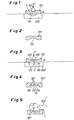
- FIGS. 1-5 show the production of a pillow as an example of a molded article.
- the same technical elements are designated by the same reference numerals.
- FIG. 1 illustrates a first step in which a first part 110 of an originally cuboid foam blank 100 is pressed into a first negative mold 200 '.
- the impressions are made with a force F 'via a roller 300.
- the force F' or the resulting pressure are set individually.
- the pressed into the negative mold part 110 of the foam is cut along the section line S.
- a first shaped cut in the form of a first recess 110 ' is then formed in the foam, as it is in FIG. 2 is shown.
- the relaxed foam then represents a first pre-version 100 'of the final cut molded article to be made.
- Fig. 3 illustrates a second operation, in which a (second) part 120 of the foam is pressed from the first pre-version 110 'of the article into a second negative mold 200 ", which is impressed with a force F".
- the impressions are preferably made with the aid of a pressure punch 400, which acts as a positive Shape is at least approximately complementary to the first shape cut 110 ', and then the foam pressed into the second negative shape is cut along the cut line S ".
- second mold cuts 120 ' are made in the area of the first mold cut 110 in the form of recesses or cuts in the pillow surface, as in FIG Fig. 4 is shown.
- ribs 130 each having an upper surface 132 and lateral edges 134.
- the flanks can run obliquely or straight, so that the ribs 130 are trapezoidal or rectangular.
- FIG. 4 shows the result of the second step; in the present case, the ready-shaped pillow, but lying on his head.
- further steps can be taken to introduce more shape cuts in the pillow, which overlap the respective previous shape cuts and extend into ever greater depths in the foam.
- FIG. 5 shows an application for the present invention shaped pillow in which a person 500 puts his head on the pillow 100 "In the pillow, the first shape cut 110 'provides optimal accommodation for the person's curved head. In addition, the second shape cut causes improved ventilation in the area of the head, so that the person has less sweat when resting on the pillow.
Landscapes
- Engineering & Computer Science (AREA)
- Mechanical Engineering (AREA)
- Life Sciences & Earth Sciences (AREA)
- Forests & Forestry (AREA)
- Health & Medical Sciences (AREA)
- General Health & Medical Sciences (AREA)
- Otolaryngology (AREA)
- Pulmonology (AREA)
- Perforating, Stamping-Out Or Severing By Means Other Than Cutting (AREA)
- Blow-Moulding Or Thermoforming Of Plastics Or The Like (AREA)
- Mattresses And Other Support Structures For Chairs And Beds (AREA)
- Processing And Handling Of Plastics And Other Materials For Molding In General (AREA)
- Manufacture Of Porous Articles, And Recovery And Treatment Of Waste Products (AREA)
- Casting Or Compression Moulding Of Plastics Or The Like (AREA)
Description
- Die Erfindung betrifft ein Verfahren zum Herstellen eines formgeschnittenen Gegenstandes aus Schaumstoff, wie beispielsweise ein Kopfkissen, eine Matratze, oder eine Formaufnahme für Fotoapparate, Messinstrumente oder andere stoßempfindliche Produkte.
- Aus der
DE 1758789 U ist eine Form zur Herstellung gewölbter Flächen an Gegenständen aus porösen, elastischen Stoffen wie Schaumstoff, Schaumgummi und dgl. bekannt. Die Form weist ein Druckstück aus oder besteht aus einem solchen, welches mit Ausnehmungen für die zu erstellenden Wölbungsflächen versehen ist, durch welche beim Zusammendrücken des Stoffes die nicht unter Pressdruck stehenden Teile desselben sich vorwölben und abgeschnitten werden, worauf nach dem Aufheben des Druckes die Schnittflächen die gewünschten Wölbungsflächen bilden. - Aus der
DE 1891607 U ist eine Vorrichtung zum maschinellen Ausschneiden symmetrischer und unsymmetrischer räumlicher Körper aus Kunstschaumstoff-Platten und ähnlichen Werkstoffen bekannt, bei der ein umlaufendes Band-Messer oder -Säge den in eine Form gepressten Schaumstoff schneidet. Dabei wird eine das Werkstück in eine ebene Form drückende zylindrische Druckwalze, die mit einer der Walzen-Umfangs-Geschwindigkeit gleichen Geschwindigkeit in grader Richtung auf einem Arbeitstisch dicht unter der Walze hindurchtransportiert. Hinter der Walze ist ein quer zur Transportrichtung der Form umlaufendes Messer angeordnet, welches den Schaumstoff etwa in seiner Mittelebene durchschneidet, wobei eine Verstellvorrichtung sowohl für den Abstand zwischen Oberkante-Form und Unterkante-Walze, als auch für die Höhenlage des Messers vorgesehen ist. - Aus der
DE 1709739 U ist eine Pressform zum Formen von Körpern aus poröser Masse wie Schaumgummi, Schwammgummi, Kunststoff-Schaum oder dgl. mit unten ausgehöhlter und oben ebener Fläche bekannt. Dabei weist die z.B. kasten- oder röhrenförmige Form unten einen Boden mit einer Öffnung auf, deren Rand die Form des größten Umfanges der Aushöhlung hat, den der zu formende Körper erhalten soll. Als Presstempel dient eine Scheibe, die parallel zum Boden in die Form passt und hineinbewegt werden kann, so dass sie das Pressgut zwischen dem Stempel und dem Boden zusammenpresst und ein Teil der Pressmasse aus der Deckelöffnung sich herauswölbt und mit einem auf der Oberfläche des Bodens geführten Messer abgeschnitten werden kann. - Aus der
DE 35 22 192 A1 ist ein Verfahren zur Herstellung eines Körpers aus einem Rohling aus Schaumstoff, Hartschaum oder dgl. mittels eines Heizdraht-, Thermoschneidgeräts oder dgl. bekannt. Dabei werden mehrere gedachte Ebenen durch den Rohling gelegt. Definierte Punkte jeder Tangenten einer Ebene werden am oder außerhalb des Rohlings mit entsprechenden definierten Punkten der entsprechenden Tangente der benachbarten Ebene am oder außerhalb des Rohlings mittels biegsamer, wärmebeständiger Verbindungen verbunden und entlang dieser Verbindungen wird das Schneidelement geführt. - Die Druckschrift
US 4,240,240 offenbart einen Gegenstand, hergestellt aus Schaumstoff durch Formschneiden. Der Gegenstand umfasst einen ersten Form- oder Konturschnitt und mindestens einen zweiten Formschnitt, welcher dem ersten Form- oder Konturschnitt überlagert ist und in eine größere Tiefe des Schaumstoffs reicht als der erste Schnitt. - Die Druckschrift
FR-A-2 674 183 - Bekannt ist es Konturen in Schaumstoff zu schneiden. Bekannt ist es auch, Formschnitte mit Hilfe einer Durchdrück- bzw. Formschneidemaschine in Schaumstoffe einzubringen. Hierzu wird in einem Arbeitsschritt ein Teil eines ursprünglich z.B. in Blockform vorliegenden Schaumstoff-Rohlings mittels einer Walze in eine erste Negativ-Form, auch erstes Werkzeug genannt, gedrückt. Der in die Negativ-Form gedrückte Teil des Schaumstoffs wird dann beispielsweise mittels eines oszillierenden oder rotierenden Messers abgeschnitten. Nach dem Weitertransport entspannt sich der Schaumstoff wieder und es hat sich dann im Schaumstoff mindestens ein erster Formschnitt entsprechend der ersten Negativ-Form gebildet. Die Negativ-Form kann beispielsweise aus Holz- oder Aluminium gebildet sein.
- Nachteilig an dieser Vorgehensweise ist, dass sie nicht geeignet ist, auch komplexe Formschnitte, d.h. z.B. enge verwinkelte Aussparungen in größeren / unterschiedlichen Tiefen in den Schaumstoff einzubringen. Die Begrenzungen / Kanten werden dann nur ungenau zugeschnitten und die Oberflächen werden nicht glatt.
- Die Druckschrift
US-A-4 240 240 offenbart einen Gegenstand, hergestellt aus Schaumstoff durch Formschneiden, umfassend einen ersten Form- oder Konturschnitt, wobei mindestens ein zweiter Formschnitt, welcher dem ersten Form- oder Konturschnitt überlagert ist, in größere Tiefen des Schaumstoffs reicht als der erste Schnitt. - Schließlich ist aus der französischen Patentanmeldung
FR 2 674 183 - a) Herstellen einer ersten Vorversion des Gegenstandes mit einem ersten Formschnitt durch Abschneiden des in die erste Negativ-Form eingedrückten ersten Teils eines Schaumstoff-Rohlings; oder
- a') Herstellen einer ersten Vorversion des Gegenstandes durch Abschneiden eines ersten Teils des Schaumstoff-Rohlings per Konturschnitt, und
- b) Eindrücken eines Teils der ersten Vorversion des Gegenstands im Bereich des ersten Form- oder Konturschnitts mit Hilfe eines Druckstempels in eine zweite Negativ-Form; und
- c) Herstellen des Gegenstandes mit einem Formschnitt, welcher jeweils dem ersten Form- oder Konturschnitt verlagert ist, durch Abschneiden des in die zweite Negativ-Form eingedrückten Teils der ersten Vorversion.
- Ausgehend von diesem Stand der Technik liegt der Erfindung die Aufgabe zugrunde, ein bekanntes Verfahren zum Herstellen eines form- oder konturgeschnittenen Gegenstandes aus Schaumstoff dahingehend weiterzubilden, dass es auch die präzise Erstellung komplex-geformter Formschnitte in dem Schaumstoff ermöglicht.
- Diese Aufgabe wird durch das in Patentanspruch 1 beanspruchte Verfahren gelöst.
- Der Begriff Formschnitt meint im Rahmen der vorliegenden Erfindung auch Aussparungen oder beliebige Profilierungen oder Konturierungen in dem Schaumstoff. Eine Negativ-Form wird auch als Werkzeug bezeichnet.
- Die Erfindung sieht vor, dass der Schaumstoff nach einem ersten Form- oder Konturschnitt als erstem Arbeitsschritt mindestens einem zweitem Arbeitsschritt unterworfen wird. In dem zweiten Arbeitsschritt wird ein Teil des nach dem ersten Arbeitsschritt verbliebenen Schaumstoffs mit einer Formschneidemaschine in eine Negativ-Form, d.h. ein Werkzeug, gedrückt. Wenn bei dem ersten Arbeitsschritt ebenfalls eine Formschneidemaschine verwendet wurde sind die erste und die zweite Negativ-Form vorzugsweise voneinander verschieden.
- Um während des Eindrückens des Schaumstoffs im Bereich des ersten Form- oder Konturschnitts in die bei dem zweiten Arbeitsschritt verwendete Negativ-Form eine gute Druckverteilung nicht nur nach unten, sondern auch zu den Seiten hin zu erreichen, erfolgt das Eindrücken vorzugsweise mit Hilfe eines Druckstempels, welcher als Positiv-Form zumindest näherungsweise dem per Formschnitt oder per Konturschnitt abgeschnittenen ersten Teil des Schaumstoffrohlings entspricht. Auf diese Weise wird sichergestellt, dass der Schaumstoff während des zweiten Arbeitsschrittes auch in enge oder verwinkelte Bereiche der Negativ-Form hineingedrückt wird.
- Der Druckstempel kann aus dem gleichen Material wie der bearbeitete Schaumstoff oder aus einem anderen Material, wie beispielsweise Holz, Aluminium oder einem Schaum höherer Dichte hergestellt sein.
- Während des zweiten Arbeitsschrittes wird der Druckstempel zwischen Drückwalze und Schaumstoff gelegt und zwar vorzugsweise im Bereich des ersten Form- oder Konturschnitts mit seiner positiven Ausprägung auf den Schaumstoff. Der so in die Negativ-Form eingedrückte Teil des Schaumstoffs wird dann entlang einer Schnittlinie abgeschnitten und es entsteht dann ein Formschnitt in demselben Schaumstoff. Der während des zweiten Arbeitsschrittes hergestellte Form- oder Konturschnitt ist dem ersten Formschnitt überlagert und reicht in größere Tiefen des Schaumstoffs als der erste Schnitt.
- Allgemein ermöglicht das erfindungsgemäße Verfahren durch n-fache Wiederholung der beschriebenen Arbeitsschritte vorzugsweise jeweils mit anders-geformten Werkzeugen eine Überlagerung beliebig vieler und beliebig geformter Schnitte bei ein und demselben Schaumstoffstück. Durch diese schrittweise Bearbeitung kann schließlich ein komplex-geformter Gesamtformschnitt mit scharfen Konturen / Begrenzungen / Kanten und glatten Oberflächen auch in größeren Tiefen in den Schaumstoff eingebracht werden.
- Das erfindungsgemäße Verfahren ist geeignet für Schaumstoffe mit unterschiedlichen Eigenschaften in Dichte und Oberfläche, beispielsweise für viskoelastische Schaumstoffe, Polyether-Schaumstoffe oder Latex-Schäume.
- Das soeben allgemein beschriebene erfindungsgemäße Verfahren wird nachfolgend unter Bezugnahme auf die beigefügten Figuren beispielhaft erläutert, wobei
- Figur 1
- einen ersten Arbeitsschritt gemäß der Erfindung;
- Figur 2
- die erste Vorversion des form- oder konturgeschnittenen Gegenstandes aus Schaumstoff als Ergebnis des ersten Arbeitsschrittes;
- Figur 3
- einen zweiten Arbeitsschritt;
- Figur 4
- den formgeschnittenen Gegenstand nach dem zweiten Arbeitsschritt; und
- Figur 5
- eine Verwendung für den formgeschnittenen Gegenstand
- Die
Figuren 1-5 zeigen die Herstellung eines Kopfkissens als Beispiel für einen formgeschnittenen Gegenstand. In allen Figuren sind gleiche technische Elemente mit gleichen Bezugszeichen bezeichnet. -
Figur 1 veranschaulicht einen ersten Arbeitsschritt, bei dem ein erster Teil 110 eines ursprünglich quaderförmigen Schaumstoffrohlings 100 in eine erste Negativ-Form 200' gedrückt wird. Das Eindrücken erfolgt mit einer Kraft F' über eine Walze 300. Die Kraft F' bzw. der daraus resultierende Druck werden individuell eingestellt. Der in die Negativ-Form eingedrückte Teil 110 des Schaumstoffs wird entlang der Schnittlinie S abgeschnitten. - Nach der Entspannung ist dann in dem Schaumstoff ein erster Formschnitt in Form einer ersten Aussparung 110' ausgebildet, wie er in
Figur 2 gezeigt ist. Der entspannte Schaumstoff repräsentiert dann eine erste Vorversion 100' des letzten Endes herzustellenden formgeschnittenen Gegenstandes. -
Fig. 3 veranschaulicht einen zweiten Arbeitsschritt, bei dem ein (zweiter) Teil 120 des Schaumstoffes von der ersten Vorversion 110' des Gegenstandes in eine zweite Negativ-Form 200" gedrückt wird. Das Eindrücken erfolgt mit einer Kraft F". Um insbesondere im Bereich des ersten Formschnitts 110' während des Eindrückens eine gute Druckverteilung nicht nur nach unten, sondern auch zu den Seiten in die zweite Negativ-Form 200" hinein zu erreichen, erfolgt das Eindrücken vorzugsweise mit Hilfe eines Druckstempels 400, welcher als Positiv-Form zumindest näherungsweise komplementär zu dem ersten Formschnitt 110' geformt ist. Anschließend wird der in die zweite Negativ-Form eingedrückte Schaumstoff entlang der Schnittlinie S" abgeschnitten. - Mit dem zweiten Arbeitsschritt werden im Bereich des ersten Formschnitts 110 zweite Formschnitte 120' in Form von Aussparungen bzw. Einschnitten in die Kissenoberfläche eingebracht wie es in
Fig. 4 gezeigt ist. Auf diese Weise entstehen neben den Einschnitten Rippen 130, die jeweils eine obere Fläche 132 und seitliche Flanken 134 aufweisen. Die Flanken können schräg oder gerade verlaufen, so dass die Rippen 130 trapez- oder rechteckig ausgebildet sind. -
Figur 4 zeigt das Ergebnis des zweiten Arbeitsschrittes; im vorliegenden Fall das fertig formgeschnittene Kopfkissen, allerdings auf dem Kopf liegend. In anderen Fällen können weitere Arbeitsschritte vorgenommen werden, um weitere Formschnitte in das Kopfkissen einzubringen, welche die jeweils vorherigen Formschnitte überlagern und in immer größere Tiefen in dem Schaumstoff reichen. -
Figur 5 zeigt eine Anwendung für das erfindungsgemäß formgeschnittene Kopfkissen, bei der eine Person 500 ihren Kopf auf das Kopfkissen 100" legt. Bei dem Kopfkissen bewirkt der erste Formschnitt 110' eine optimale Aufnahme für den gekrümmten Kopf der Person. Zusätzlich bewirkt der zweite Formschnitt eine verbesserte Lüftung im Bereich des Kopfes, so dass die Person bei Auflage auf dem Kopfkissen weniger schwitzen muss.
Claims (3)
- Verfahren zum Herstellen eines formgeschnittenen Gegenstandes (100") aus Schaumstoff, umfassend mindestens folgende Schritte:a) Herstellen einer ersten Vorversion (100') des Gegenstandes mit einem ersten Formschnitt durch Abschneiden des in eine erste Negativ-Form (200') eingedrückten ersten Teils (110) eines Schaumstoff-Rohlings (100); odera') Herstellen einer ersten Vorversion des Gegenstandes durch Abschneiden eines ersten Teils (110) des Schaumstoff-Rohlings (100) per Konturschnitt; gekennzeichnet durchb) Eindrücken eines Teils (120) der ersten Vorversion (100') des Gegenstandes im Bereich des ersten Form- oder Konturschnitts mit Hilfe eines Druckstempels (300, 400) in eine zweite Negativ-Form (200"),
undc) Herstellen des Gegenstandes (100") mit einem Formschnitt, welcher jeweils dem ersten Form- oder Konturschnitt überlagert ist, durch Abschneiden des in die zweite Negativ-Form eingedrückten Teils (120) der ersten Vorversion, dadurch gekennzeichnet, dass der Druckstempel als Positiv dem per formschnitt oder per Konturschnitt abgeschnittenen ersten Teil (110) des Schaumstoff-Rohlings entspricht. - Verfahren nach Anspruch 1, dadurch gekennzeichnet, dass als erste (200') und zweite (200") Negativ-Formen unterschiedliche Negativ-Formen verwendet werden.
- Verfahren nach einem der vorangegangenen Ansprüche, dadurch gekennzeichnet, dass das Eindrücken eines Teils des Schaumstoffs in eine der Negativ-Formen jeweils mit einem Druck erfolgt, der individuell eingestellt wird, z.B. in Abhängigkeit des jeweils verwendeten Schaumstoff-Materials, oder der Tiefe der bereits zuvor in den Schaumstoff eingebrachten Form- oder Konturschnitte.
Priority Applications (1)
| Application Number | Priority Date | Filing Date | Title |
|---|---|---|---|
| PL08749187T PL2146836T3 (pl) | 2007-05-02 | 2008-04-28 | Sposób wytwarzania wykrywanego kształtowo przedmiotu z tworzywa piankowego |
Applications Claiming Priority (3)
| Application Number | Priority Date | Filing Date | Title |
|---|---|---|---|
| DE102007020850 | 2007-05-02 | ||
| DE200710034136 DE102007034136B3 (de) | 2007-05-02 | 2007-07-21 | Verfahren zum Herstellen eines formgeschnittenen Gegenstandes aus Schaumstoff |
| PCT/EP2008/003415 WO2008135191A1 (de) | 2007-05-02 | 2008-04-28 | Verfahren zum herstellen eines formgeschnittenen gegenstandes aus schaumstoff |
Publications (2)
| Publication Number | Publication Date |
|---|---|
| EP2146836A1 EP2146836A1 (de) | 2010-01-27 |
| EP2146836B1 true EP2146836B1 (de) | 2013-06-05 |
Family
ID=39744484
Family Applications (1)
| Application Number | Title | Priority Date | Filing Date |
|---|---|---|---|
| EP08749187.4A Active EP2146836B1 (de) | 2007-05-02 | 2008-04-28 | Verfahren zum herstellen eines formgeschnittenen gegenstandes aus schaumstoff |
Country Status (15)
| Country | Link |
|---|---|
| US (1) | US8844413B2 (de) |
| EP (1) | EP2146836B1 (de) |
| JP (1) | JP5080638B2 (de) |
| AU (1) | AU2008248957B2 (de) |
| BR (1) | BRPI0810983B1 (de) |
| CA (1) | CA2685903C (de) |
| DE (1) | DE102007034136B3 (de) |
| DK (1) | DK2146836T3 (de) |
| ES (1) | ES2426071T3 (de) |
| MX (1) | MX2009011683A (de) |
| PL (1) | PL2146836T3 (de) |
| PT (1) | PT2146836E (de) |
| RU (1) | RU2435667C2 (de) |
| WO (1) | WO2008135191A1 (de) |
| ZA (1) | ZA200907681B (de) |
Families Citing this family (1)
| Publication number | Priority date | Publication date | Assignee | Title |
|---|---|---|---|---|
| MX394031B (es) * | 2015-10-08 | 2025-03-24 | Precision Foam Tech Pty Ltd | Maquina de corte. |
Citations (2)
| Publication number | Priority date | Publication date | Assignee | Title |
|---|---|---|---|---|
| DE3919035A1 (de) * | 1989-06-10 | 1990-12-13 | Groll & Co | Kopfkissen |
| US5797154A (en) * | 1997-04-30 | 1998-08-25 | Foamex L.P. | Contoured pillow |
Family Cites Families (18)
| Publication number | Priority date | Publication date | Assignee | Title |
|---|---|---|---|---|
| US1145654A (en) * | 1914-02-02 | 1915-07-06 | David W Anderson | Method of making convexed or concaved bodies of felt or other flexible substances. |
| FR1012897A (fr) * | 1950-02-15 | 1952-07-18 | Procédé de fabrication d'objets en matière souple | |
| DE1709739U (de) * | 1955-03-31 | 1955-10-27 | Conrad Zucht | Pressform zum formen von koerpern aus poroeser masse wie schaumgummi od. dgl. |
| DE1758789U (de) * | 1955-11-21 | 1957-12-27 | Helmut Sandler & Co Schulterpo | Form zur herstellung gewoelbter flaechen an gegenstaenden aus poroesen, elastischen stoffen wie schaumstoff, schaumgummi u. dgl. |
| US3154607A (en) * | 1957-10-04 | 1964-10-27 | Fiber Bond Corp | Method of making a cushion |
| NL280575A (de) * | 1961-07-08 | 1900-01-01 | ||
| DE1891607U (de) * | 1964-01-17 | 1964-04-23 | Fritz Kaiser | Vorrichtung zum maschinellen ausschneiden symmetrischer und unsymmetrischer raeumlicher koerper aus kunstschaumstoffplatten. |
| DE1758789B1 (de) | 1967-09-19 | 1971-09-09 | Voest Ag | Einrichtung zur kontinuierlichen messung der temperatur von metallbaedern in schmelz oder frischoefen insbesondere tiegeln oder konverten |
| US3665792A (en) | 1970-02-20 | 1972-05-30 | James S Bush | Method and aparatus for forming foam material |
| US4240240A (en) | 1979-07-16 | 1980-12-23 | Shell Container Systems | Method of making a package having foam inserts |
| DE3522192A1 (de) * | 1985-06-21 | 1987-01-02 | Wolfgang Bach | Verfahren zur herstellung eines koerpers aus einem rohling |
| US4924540A (en) * | 1989-04-21 | 1990-05-15 | The Woodbridge Group | Pillow |
| JP2584072B2 (ja) * | 1989-10-24 | 1997-02-19 | 日本基礎技術株式会社 | スポンジにおける凹部形成方法 |
| RU2031790C1 (ru) * | 1989-11-24 | 1995-03-27 | Вячеслав Алексеевич Марунич | Способ обработки материалов резанием |
| FR2674183A1 (fr) * | 1991-03-21 | 1992-09-25 | Sapronit | Procede et dispositif pour la fabrication de produits en mousse synthetique au pourtour galbe en partant d'un bloc de mousse parallelepipedique. |
| US5523040A (en) * | 1994-10-06 | 1996-06-04 | Baylor College Of Medicine | Method and apparatus for making a custom support |
| JP2003102608A (ja) * | 2001-09-28 | 2003-04-08 | Inoac Corp | 枕 |
| US6899437B2 (en) | 2002-10-02 | 2005-05-31 | Gentax Corporation | Environmentally improved rearview mirror assembly |
-
2007
- 2007-07-21 DE DE200710034136 patent/DE102007034136B3/de active Active
-
2008
- 2008-04-28 MX MX2009011683A patent/MX2009011683A/es active IP Right Grant
- 2008-04-28 US US12/597,191 patent/US8844413B2/en active Active
- 2008-04-28 RU RU2009144540A patent/RU2435667C2/ru active
- 2008-04-28 ES ES08749187T patent/ES2426071T3/es active Active
- 2008-04-28 CA CA 2685903 patent/CA2685903C/en active Active
- 2008-04-28 PL PL08749187T patent/PL2146836T3/pl unknown
- 2008-04-28 WO PCT/EP2008/003415 patent/WO2008135191A1/de not_active Ceased
- 2008-04-28 PT PT87491874T patent/PT2146836E/pt unknown
- 2008-04-28 JP JP2010504566A patent/JP5080638B2/ja active Active
- 2008-04-28 BR BRPI0810983A patent/BRPI0810983B1/pt not_active IP Right Cessation
- 2008-04-28 AU AU2008248957A patent/AU2008248957B2/en not_active Ceased
- 2008-04-28 EP EP08749187.4A patent/EP2146836B1/de active Active
- 2008-04-28 DK DK08749187T patent/DK2146836T3/da active
-
2009
- 2009-11-02 ZA ZA200907681A patent/ZA200907681B/xx unknown
Patent Citations (2)
| Publication number | Priority date | Publication date | Assignee | Title |
|---|---|---|---|---|
| DE3919035A1 (de) * | 1989-06-10 | 1990-12-13 | Groll & Co | Kopfkissen |
| US5797154A (en) * | 1997-04-30 | 1998-08-25 | Foamex L.P. | Contoured pillow |
Also Published As
| Publication number | Publication date |
|---|---|
| JP2010524735A (ja) | 2010-07-22 |
| AU2008248957B2 (en) | 2011-04-07 |
| CA2685903C (en) | 2013-03-12 |
| AU2008248957A1 (en) | 2008-11-13 |
| ZA200907681B (en) | 2010-06-30 |
| DE102007034136B3 (de) | 2008-10-16 |
| DK2146836T3 (da) | 2013-09-02 |
| RU2009144540A (ru) | 2011-06-10 |
| EP2146836A1 (de) | 2010-01-27 |
| CA2685903A1 (en) | 2008-11-13 |
| AU2008248957A9 (en) | 2010-01-21 |
| US8844413B2 (en) | 2014-09-30 |
| PL2146836T3 (pl) | 2013-11-29 |
| ES2426071T3 (es) | 2013-10-21 |
| PT2146836E (pt) | 2013-07-26 |
| RU2435667C2 (ru) | 2011-12-10 |
| AU2008248957A2 (en) | 2010-02-04 |
| BRPI0810983B1 (pt) | 2018-09-25 |
| WO2008135191A1 (de) | 2008-11-13 |
| BRPI0810983A2 (pt) | 2015-01-27 |
| JP5080638B2 (ja) | 2012-11-21 |
| US20110250399A1 (en) | 2011-10-13 |
| MX2009011683A (es) | 2010-02-18 |
Similar Documents
| Publication | Publication Date | Title |
|---|---|---|
| DE60225657T2 (de) | Verfahren und Vorrichtung zum Ausstanzen tiefgezogener Formteile, die noch teilweise mit der Restbahn verbunden sind und damit entformt werden | |
| DE102019127562A1 (de) | Faserformanlage zur herstellung von formteilen aus umweltverträglich abbaubarem fasermaterial | |
| DE60204973T2 (de) | Verfahren zur herstellung einer innenklinge für einen elektrischen rasierapparat | |
| EP1655122B1 (de) | Verfahren zum Hinterspritzen, Hinterpressen oder Quellflussprägen und entsprechendes Formwerkzeug | |
| EP3199124B1 (de) | Verfahren zur herstellung eines dentalen objektes | |
| DE1966224A1 (de) | Verfahren zur Herstellung einer Pressform zur Fertigung von Schuhsohlen,-absaetzen u.dgl. | |
| DE2260742A1 (de) | Verfahren und vorrichtung zur genauen und gleichfoermigen formgebung von metallkoerpern | |
| DE1452590C3 (de) | Verfahren zum Herstellen von Trockenrasietapparat-Scherfolien | |
| DE69006147T2 (de) | Verfahren zum Bearbeiten von Matrizen. | |
| DE102007034136B3 (de) | Verfahren zum Herstellen eines formgeschnittenen Gegenstandes aus Schaumstoff | |
| WO2012107245A1 (de) | Verfahren zur herstellung von innenverkleidungsteilen in einem schäumwerkzeug | |
| DE2436663C3 (de) | Verfahren und Vorrichtung zur Herstellung von Gegenständen aus Kunststoff mit hohem Füllstoffanteil | |
| DE102018206906B4 (de) | Einlegesohlen-Fräsblock und Verfahren zum Herstellen eines solchen Fräsblocks | |
| WO1997015268B1 (de) | Formbandkalander | |
| DE3028296C2 (de) | ||
| EP1470754B1 (de) | Verfahren zum Herstellen von Fleischportionen in einer Umformpresse | |
| DE69831542T2 (de) | Verfahren zur Herstellung eines Formteiles | |
| DE102024130156B3 (de) | Verfahren zum Schlitzen eines Schwamms für ein Fliesenleger-Schwammbrett sowie eine Verwendung hierfür | |
| DE8209206U1 (de) | Stuhlsitz, rueckenlehne oder sitzschale aus pappe oder karton | |
| DE10005500A1 (de) | Verfahren und Vorrichtung zum Herstellen eines tiefgezogenen Waffelproduktes | |
| AT525408B1 (de) | Keksform | |
| WO2007131608A1 (de) | Verfahren zur herstellung eines betonprodukts | |
| DE4107445A1 (de) | Verfahren zur herstellung von stueckseife | |
| DE4129662C1 (en) | Deburring ceramic cup handles by buffing tool - exerts in radial plane between cup handle and tool w.r.t. reciprocal movement | |
| DE870216C (de) | Verfahren zum Herstellen von unregelmaessigen Teilen, insbesondere fuer Schuhwerk |
Legal Events
| Date | Code | Title | Description |
|---|---|---|---|
| PUAI | Public reference made under article 153(3) epc to a published international application that has entered the european phase |
Free format text: ORIGINAL CODE: 0009012 |
|
| 17P | Request for examination filed |
Effective date: 20091112 |
|
| AK | Designated contracting states |
Kind code of ref document: A1 Designated state(s): AT BE BG CH CY CZ DE DK EE ES FI FR GB GR HR HU IE IS IT LI LT LU LV MC MT NL NO PL PT RO SE SI SK TR |
|
| AX | Request for extension of the european patent |
Extension state: AL BA MK RS |
|
| 17Q | First examination report despatched |
Effective date: 20100520 |
|
| DAX | Request for extension of the european patent (deleted) | ||
| REG | Reference to a national code |
Ref country code: DE Ref legal event code: R079 Ref document number: 502008010076 Country of ref document: DE Free format text: PREVIOUS MAIN CLASS: B29C0044560000 Ipc: A47G0009100000 |
|
| GRAJ | Information related to disapproval of communication of intention to grant by the applicant or resumption of examination proceedings by the epo deleted |
Free format text: ORIGINAL CODE: EPIDOSDIGR1 |
|
| GRAP | Despatch of communication of intention to grant a patent |
Free format text: ORIGINAL CODE: EPIDOSNIGR1 |
|
| RIC1 | Information provided on ipc code assigned before grant |
Ipc: A47G 9/10 20060101AFI20120927BHEP Ipc: B26D 3/28 20060101ALI20120927BHEP Ipc: B26D 3/00 20060101ALI20120927BHEP Ipc: B29C 44/56 20060101ALI20120927BHEP |
|
| GRAP | Despatch of communication of intention to grant a patent |
Free format text: ORIGINAL CODE: EPIDOSNIGR1 |
|
| GRAS | Grant fee paid |
Free format text: ORIGINAL CODE: EPIDOSNIGR3 |
|
| RAP1 | Party data changed (applicant data changed or rights of an application transferred) |
Owner name: CELLOFLEX INTERNATIONAL GMBH & CO. KG |
|
| GRAA | (expected) grant |
Free format text: ORIGINAL CODE: 0009210 |
|
| AK | Designated contracting states |
Kind code of ref document: B1 Designated state(s): AT BE BG CH CY CZ DE DK EE ES FI FR GB GR HR HU IE IS IT LI LT LU LV MC MT NL NO PL PT RO SE SI SK TR |
|
| REG | Reference to a national code |
Ref country code: GB Ref legal event code: FG4D Free format text: NOT ENGLISH |
|
| REG | Reference to a national code |
Ref country code: CH Ref legal event code: EP |
|
| REG | Reference to a national code |
Ref country code: AT Ref legal event code: REF Ref document number: 615134 Country of ref document: AT Kind code of ref document: T Effective date: 20130615 |
|
| REG | Reference to a national code |
Ref country code: IE Ref legal event code: FG4D Free format text: LANGUAGE OF EP DOCUMENT: GERMAN |
|
| REG | Reference to a national code |
Ref country code: RO Ref legal event code: EPE |
|
| REG | Reference to a national code |
Ref country code: PT Ref legal event code: SC4A Free format text: AVAILABILITY OF NATIONAL TRANSLATION Effective date: 20130719 |
|
| REG | Reference to a national code |
Ref country code: DE Ref legal event code: R096 Ref document number: 502008010076 Country of ref document: DE Effective date: 20130801 |
|
| REG | Reference to a national code |
Ref country code: CH Ref legal event code: NV Representative=s name: SCHMAUDER AND PARTNER AG PATENT- UND MARKENANW, CH |
|
| REG | Reference to a national code |
Ref country code: SE Ref legal event code: TRGR |
|
| REG | Reference to a national code |
Ref country code: DK Ref legal event code: T3 |
|
| REG | Reference to a national code |
Ref country code: NL Ref legal event code: T3 |
|
| REG | Reference to a national code |
Ref country code: NO Ref legal event code: T2 Effective date: 20130605 |
|
| REG | Reference to a national code |
Ref country code: ES Ref legal event code: FG2A Ref document number: 2426071 Country of ref document: ES Kind code of ref document: T3 Effective date: 20131021 |
|
| PG25 | Lapsed in a contracting state [announced via postgrant information from national office to epo] |
Ref country code: SI Free format text: LAPSE BECAUSE OF FAILURE TO SUBMIT A TRANSLATION OF THE DESCRIPTION OR TO PAY THE FEE WITHIN THE PRESCRIBED TIME-LIMIT Effective date: 20130605 Ref country code: GR Free format text: LAPSE BECAUSE OF FAILURE TO SUBMIT A TRANSLATION OF THE DESCRIPTION OR TO PAY THE FEE WITHIN THE PRESCRIBED TIME-LIMIT Effective date: 20130906 Ref country code: LT Free format text: LAPSE BECAUSE OF FAILURE TO SUBMIT A TRANSLATION OF THE DESCRIPTION OR TO PAY THE FEE WITHIN THE PRESCRIBED TIME-LIMIT Effective date: 20130605 |
|
| REG | Reference to a national code |
Ref country code: LT Ref legal event code: MG4D |
|
| PG25 | Lapsed in a contracting state [announced via postgrant information from national office to epo] |
Ref country code: HR Free format text: LAPSE BECAUSE OF FAILURE TO SUBMIT A TRANSLATION OF THE DESCRIPTION OR TO PAY THE FEE WITHIN THE PRESCRIBED TIME-LIMIT Effective date: 20130605 |
|
| REG | Reference to a national code |
Ref country code: PL Ref legal event code: T3 |
|
| REG | Reference to a national code |
Ref country code: SK Ref legal event code: T3 Ref document number: E 14961 Country of ref document: SK |
|
| PG25 | Lapsed in a contracting state [announced via postgrant information from national office to epo] |
Ref country code: LV Free format text: LAPSE BECAUSE OF FAILURE TO SUBMIT A TRANSLATION OF THE DESCRIPTION OR TO PAY THE FEE WITHIN THE PRESCRIBED TIME-LIMIT Effective date: 20130605 |
|
| PG25 | Lapsed in a contracting state [announced via postgrant information from national office to epo] |
Ref country code: IS Free format text: LAPSE BECAUSE OF FAILURE TO SUBMIT A TRANSLATION OF THE DESCRIPTION OR TO PAY THE FEE WITHIN THE PRESCRIBED TIME-LIMIT Effective date: 20131005 Ref country code: EE Free format text: LAPSE BECAUSE OF FAILURE TO SUBMIT A TRANSLATION OF THE DESCRIPTION OR TO PAY THE FEE WITHIN THE PRESCRIBED TIME-LIMIT Effective date: 20130605 |
|
| PLBE | No opposition filed within time limit |
Free format text: ORIGINAL CODE: 0009261 |
|
| STAA | Information on the status of an ep patent application or granted ep patent |
Free format text: STATUS: NO OPPOSITION FILED WITHIN TIME LIMIT |
|
| 26N | No opposition filed |
Effective date: 20140306 |
|
| REG | Reference to a national code |
Ref country code: DE Ref legal event code: R097 Ref document number: 502008010076 Country of ref document: DE Effective date: 20140306 |
|
| REG | Reference to a national code |
Ref country code: HU Ref legal event code: AG4A Ref document number: E020019 Country of ref document: HU |
|
| PG25 | Lapsed in a contracting state [announced via postgrant information from national office to epo] |
Ref country code: MT Free format text: LAPSE BECAUSE OF FAILURE TO SUBMIT A TRANSLATION OF THE DESCRIPTION OR TO PAY THE FEE WITHIN THE PRESCRIBED TIME-LIMIT Effective date: 20130605 |
|
| REG | Reference to a national code |
Ref country code: FR Ref legal event code: PLFP Year of fee payment: 9 |
|
| PG25 | Lapsed in a contracting state [announced via postgrant information from national office to epo] |
Ref country code: CY Free format text: LAPSE BECAUSE OF FAILURE TO SUBMIT A TRANSLATION OF THE DESCRIPTION OR TO PAY THE FEE WITHIN THE PRESCRIBED TIME-LIMIT Effective date: 20130605 |
|
| PG25 | Lapsed in a contracting state [announced via postgrant information from national office to epo] |
Ref country code: TR Free format text: LAPSE BECAUSE OF FAILURE TO SUBMIT A TRANSLATION OF THE DESCRIPTION OR TO PAY THE FEE WITHIN THE PRESCRIBED TIME-LIMIT Effective date: 20130605 |
|
| REG | Reference to a national code |
Ref country code: FR Ref legal event code: PLFP Year of fee payment: 10 |
|
| REG | Reference to a national code |
Ref country code: FR Ref legal event code: PLFP Year of fee payment: 11 |
|
| P01 | Opt-out of the competence of the unified patent court (upc) registered |
Effective date: 20230517 |
|
| PGFP | Annual fee paid to national office [announced via postgrant information from national office to epo] |
Ref country code: IE Payment date: 20240419 Year of fee payment: 17 |
|
| PGFP | Annual fee paid to national office [announced via postgrant information from national office to epo] |
Ref country code: MC Payment date: 20240422 Year of fee payment: 17 |
|
| PGFP | Annual fee paid to national office [announced via postgrant information from national office to epo] |
Ref country code: RO Payment date: 20240424 Year of fee payment: 17 Ref country code: BG Payment date: 20240419 Year of fee payment: 17 |
|
| PGFP | Annual fee paid to national office [announced via postgrant information from national office to epo] |
Ref country code: NL Payment date: 20250418 Year of fee payment: 18 |
|
| PGFP | Annual fee paid to national office [announced via postgrant information from national office to epo] |
Ref country code: LU Payment date: 20250418 Year of fee payment: 18 |
|
| PGFP | Annual fee paid to national office [announced via postgrant information from national office to epo] |
Ref country code: FI Payment date: 20250424 Year of fee payment: 18 |
|
| PGFP | Annual fee paid to national office [announced via postgrant information from national office to epo] |
Ref country code: PL Payment date: 20250417 Year of fee payment: 18 Ref country code: DE Payment date: 20250422 Year of fee payment: 18 |
|
| PGFP | Annual fee paid to national office [announced via postgrant information from national office to epo] |
Ref country code: GB Payment date: 20250423 Year of fee payment: 18 Ref country code: ES Payment date: 20250529 Year of fee payment: 18 Ref country code: DK Payment date: 20250429 Year of fee payment: 18 |
|
| PGFP | Annual fee paid to national office [announced via postgrant information from national office to epo] |
Ref country code: NO Payment date: 20250424 Year of fee payment: 18 |
|
| PGFP | Annual fee paid to national office [announced via postgrant information from national office to epo] |
Ref country code: IT Payment date: 20250424 Year of fee payment: 18 Ref country code: BE Payment date: 20250418 Year of fee payment: 18 |
|
| PGFP | Annual fee paid to national office [announced via postgrant information from national office to epo] |
Ref country code: PT Payment date: 20250417 Year of fee payment: 18 |
|
| PGFP | Annual fee paid to national office [announced via postgrant information from national office to epo] |
Ref country code: FR Payment date: 20250424 Year of fee payment: 18 |
|
| PGFP | Annual fee paid to national office [announced via postgrant information from national office to epo] |
Ref country code: CH Payment date: 20250501 Year of fee payment: 18 |
|
| PGFP | Annual fee paid to national office [announced via postgrant information from national office to epo] |
Ref country code: AT Payment date: 20250423 Year of fee payment: 18 |
|
| PGFP | Annual fee paid to national office [announced via postgrant information from national office to epo] |
Ref country code: SK Payment date: 20250423 Year of fee payment: 18 |
|
| PGFP | Annual fee paid to national office [announced via postgrant information from national office to epo] |
Ref country code: CZ Payment date: 20250423 Year of fee payment: 18 |
|
| PGFP | Annual fee paid to national office [announced via postgrant information from national office to epo] |
Ref country code: SE Payment date: 20250429 Year of fee payment: 18 |
|
| PGFP | Annual fee paid to national office [announced via postgrant information from national office to epo] |
Ref country code: HU Payment date: 20251008 Year of fee payment: 18 |
|
| PG25 | Lapsed in a contracting state [announced via postgrant information from national office to epo] |
Ref country code: MC Free format text: LAPSE BECAUSE OF NON-PAYMENT OF DUE FEES Effective date: 20250430 |
|
| PG25 | Lapsed in a contracting state [announced via postgrant information from national office to epo] |
Ref country code: BG Free format text: LAPSE BECAUSE OF NON-PAYMENT OF DUE FEES Effective date: 20250428 |
|
| PG25 | Lapsed in a contracting state [announced via postgrant information from national office to epo] |
Ref country code: RO Free format text: LAPSE BECAUSE OF NON-PAYMENT OF DUE FEES Effective date: 20250428 |
|
| PG25 | Lapsed in a contracting state [announced via postgrant information from national office to epo] |
Ref country code: IE Free format text: LAPSE BECAUSE OF NON-PAYMENT OF DUE FEES Effective date: 20250428 |
|
| REG | Reference to a national code |
Ref country code: CH Ref legal event code: U11 Free format text: ST27 STATUS EVENT CODE: U-0-0-U10-U11 (AS PROVIDED BY THE NATIONAL OFFICE) Effective date: 20260501 |