EP2138201A2 - Strangpresswerkzeug und Strangpressverfahren zum Formen eines Schlauchs für eine medizinische Behandlung - Google Patents
Strangpresswerkzeug und Strangpressverfahren zum Formen eines Schlauchs für eine medizinische Behandlung Download PDFInfo
- Publication number
- EP2138201A2 EP2138201A2 EP09003327A EP09003327A EP2138201A2 EP 2138201 A2 EP2138201 A2 EP 2138201A2 EP 09003327 A EP09003327 A EP 09003327A EP 09003327 A EP09003327 A EP 09003327A EP 2138201 A2 EP2138201 A2 EP 2138201A2
- Authority
- EP
- European Patent Office
- Prior art keywords
- molding
- shape
- medical treatment
- treatment tube
- cross
- Prior art date
- Legal status (The legal status is an assumption and is not a legal conclusion. Google has not performed a legal analysis and makes no representation as to the accuracy of the status listed.)
- Withdrawn
Links
- 238000000465 moulding Methods 0.000 title claims abstract description 163
- 238000001125 extrusion Methods 0.000 title claims abstract description 70
- 238000000034 method Methods 0.000 title claims description 43
- 239000012778 molding material Substances 0.000 claims abstract description 72
- 230000002093 peripheral effect Effects 0.000 claims description 60
- 230000008569 process Effects 0.000 claims description 22
- 229920005992 thermoplastic resin Polymers 0.000 claims description 10
- 239000000463 material Substances 0.000 description 23
- 238000004519 manufacturing process Methods 0.000 description 15
- 238000010438 heat treatment Methods 0.000 description 8
- 238000010586 diagram Methods 0.000 description 6
- 238000012545 processing Methods 0.000 description 6
- 206010052428 Wound Diseases 0.000 description 5
- 208000027418 Wounds and injury Diseases 0.000 description 5
- 229920002635 polyurethane Polymers 0.000 description 5
- 239000004814 polyurethane Substances 0.000 description 5
- 238000007664 blowing Methods 0.000 description 4
- 229920005989 resin Polymers 0.000 description 3
- 239000011347 resin Substances 0.000 description 3
- 238000013459 approach Methods 0.000 description 2
- 230000000903 blocking effect Effects 0.000 description 2
- 238000005520 cutting process Methods 0.000 description 2
- 238000013461 design Methods 0.000 description 2
- 239000012530 fluid Substances 0.000 description 2
- 230000001788 irregular Effects 0.000 description 2
- 239000000088 plastic resin Substances 0.000 description 2
- 239000004800 polyvinyl chloride Substances 0.000 description 2
- 229920000915 polyvinyl chloride Polymers 0.000 description 2
- 230000009467 reduction Effects 0.000 description 2
- 229920002050 silicone resin Polymers 0.000 description 2
- 230000015572 biosynthetic process Effects 0.000 description 1
- 230000008859 change Effects 0.000 description 1
- 238000007796 conventional method Methods 0.000 description 1
- 230000003247 decreasing effect Effects 0.000 description 1
- 230000007717 exclusion Effects 0.000 description 1
- 238000001746 injection moulding Methods 0.000 description 1
- 238000003754 machining Methods 0.000 description 1
- 230000007246 mechanism Effects 0.000 description 1
- 239000002184 metal Substances 0.000 description 1
- 230000001151 other effect Effects 0.000 description 1
- 229920001296 polysiloxane Polymers 0.000 description 1
- 238000000926 separation method Methods 0.000 description 1
- 238000007493 shaping process Methods 0.000 description 1
- 238000004513 sizing Methods 0.000 description 1
- 239000000243 solution Substances 0.000 description 1
- 230000009466 transformation Effects 0.000 description 1
Images



Classifications
-
- A—HUMAN NECESSITIES
- A61—MEDICAL OR VETERINARY SCIENCE; HYGIENE
- A61M—DEVICES FOR INTRODUCING MEDIA INTO, OR ONTO, THE BODY; DEVICES FOR TRANSDUCING BODY MEDIA OR FOR TAKING MEDIA FROM THE BODY; DEVICES FOR PRODUCING OR ENDING SLEEP OR STUPOR
- A61M25/00—Catheters; Hollow probes
- A61M25/0009—Making of catheters or other medical or surgical tubes
-
- B—PERFORMING OPERATIONS; TRANSPORTING
- B29—WORKING OF PLASTICS; WORKING OF SUBSTANCES IN A PLASTIC STATE IN GENERAL
- B29C—SHAPING OR JOINING OF PLASTICS; SHAPING OF MATERIAL IN A PLASTIC STATE, NOT OTHERWISE PROVIDED FOR; AFTER-TREATMENT OF THE SHAPED PRODUCTS, e.g. REPAIRING
- B29C48/00—Extrusion moulding, i.e. expressing the moulding material through a die or nozzle which imparts the desired form; Apparatus therefor
- B29C48/03—Extrusion moulding, i.e. expressing the moulding material through a die or nozzle which imparts the desired form; Apparatus therefor characterised by the shape of the extruded material at extrusion
- B29C48/09—Articles with cross-sections having partially or fully enclosed cavities, e.g. pipes or channels
-
- B—PERFORMING OPERATIONS; TRANSPORTING
- B29—WORKING OF PLASTICS; WORKING OF SUBSTANCES IN A PLASTIC STATE IN GENERAL
- B29C—SHAPING OR JOINING OF PLASTICS; SHAPING OF MATERIAL IN A PLASTIC STATE, NOT OTHERWISE PROVIDED FOR; AFTER-TREATMENT OF THE SHAPED PRODUCTS, e.g. REPAIRING
- B29C48/00—Extrusion moulding, i.e. expressing the moulding material through a die or nozzle which imparts the desired form; Apparatus therefor
- B29C48/03—Extrusion moulding, i.e. expressing the moulding material through a die or nozzle which imparts the desired form; Apparatus therefor characterised by the shape of the extruded material at extrusion
- B29C48/09—Articles with cross-sections having partially or fully enclosed cavities, e.g. pipes or channels
- B29C48/11—Articles with cross-sections having partially or fully enclosed cavities, e.g. pipes or channels comprising two or more partially or fully enclosed cavities, e.g. honeycomb-shaped
-
- A—HUMAN NECESSITIES
- A61—MEDICAL OR VETERINARY SCIENCE; HYGIENE
- A61M—DEVICES FOR INTRODUCING MEDIA INTO, OR ONTO, THE BODY; DEVICES FOR TRANSDUCING BODY MEDIA OR FOR TAKING MEDIA FROM THE BODY; DEVICES FOR PRODUCING OR ENDING SLEEP OR STUPOR
- A61M25/00—Catheters; Hollow probes
- A61M25/0021—Catheters; Hollow probes characterised by the form of the tubing
- A61M25/0023—Catheters; Hollow probes characterised by the form of the tubing by the form of the lumen, e.g. cross-section, variable diameter
- A61M25/0026—Multi-lumen catheters with stationary elements
- A61M2025/004—Multi-lumen catheters with stationary elements characterized by lumina being arranged circumferentially
-
- A—HUMAN NECESSITIES
- A61—MEDICAL OR VETERINARY SCIENCE; HYGIENE
- A61M—DEVICES FOR INTRODUCING MEDIA INTO, OR ONTO, THE BODY; DEVICES FOR TRANSDUCING BODY MEDIA OR FOR TAKING MEDIA FROM THE BODY; DEVICES FOR PRODUCING OR ENDING SLEEP OR STUPOR
- A61M25/00—Catheters; Hollow probes
- A61M25/0021—Catheters; Hollow probes characterised by the form of the tubing
- A61M25/0023—Catheters; Hollow probes characterised by the form of the tubing by the form of the lumen, e.g. cross-section, variable diameter
- A61M25/0026—Multi-lumen catheters with stationary elements
- A61M25/0029—Multi-lumen catheters with stationary elements characterized by features relating to least one lumen located at the middle part of the catheter, e.g. slots, flaps, valves, cuffs, apertures, notches, grooves or rapid exchange ports
-
- B—PERFORMING OPERATIONS; TRANSPORTING
- B29—WORKING OF PLASTICS; WORKING OF SUBSTANCES IN A PLASTIC STATE IN GENERAL
- B29C—SHAPING OR JOINING OF PLASTICS; SHAPING OF MATERIAL IN A PLASTIC STATE, NOT OTHERWISE PROVIDED FOR; AFTER-TREATMENT OF THE SHAPED PRODUCTS, e.g. REPAIRING
- B29C2793/00—Shaping techniques involving a cutting or machining operation
- B29C2793/0063—Cutting longitudinally
-
- B—PERFORMING OPERATIONS; TRANSPORTING
- B29—WORKING OF PLASTICS; WORKING OF SUBSTANCES IN A PLASTIC STATE IN GENERAL
- B29C—SHAPING OR JOINING OF PLASTICS; SHAPING OF MATERIAL IN A PLASTIC STATE, NOT OTHERWISE PROVIDED FOR; AFTER-TREATMENT OF THE SHAPED PRODUCTS, e.g. REPAIRING
- B29C48/00—Extrusion moulding, i.e. expressing the moulding material through a die or nozzle which imparts the desired form; Apparatus therefor
- B29C48/001—Combinations of extrusion moulding with other shaping operations
- B29C48/0022—Combinations of extrusion moulding with other shaping operations combined with cutting
-
- B—PERFORMING OPERATIONS; TRANSPORTING
- B29—WORKING OF PLASTICS; WORKING OF SUBSTANCES IN A PLASTIC STATE IN GENERAL
- B29L—INDEXING SCHEME ASSOCIATED WITH SUBCLASS B29C, RELATING TO PARTICULAR ARTICLES
- B29L2031/00—Other particular articles
- B29L2031/60—Multitubular or multicompartmented articles, e.g. honeycomb
-
- B—PERFORMING OPERATIONS; TRANSPORTING
- B29—WORKING OF PLASTICS; WORKING OF SUBSTANCES IN A PLASTIC STATE IN GENERAL
- B29L—INDEXING SCHEME ASSOCIATED WITH SUBCLASS B29C, RELATING TO PARTICULAR ARTICLES
- B29L2031/00—Other particular articles
- B29L2031/753—Medical equipment; Accessories therefor
- B29L2031/7542—Catheters
Definitions
- the present invention relates to an extrusion molding die and extrusion molding method for molding a medical treatment tube used in order to drain fluid from a patient wound or to provide a medicinal solution to a patient wound.
- medical treatment tubes have been used for draining drainage that has accumulated in patient wounds.
- this type of medical treatment tubes there are those that are structured as a silicone molded body, wherein the base end side portion is formed into a cylindrical shape, and the front end side portion, which is resident in the patient wound portion, is structured from a plurality of partitioned flow paths around a central axis.
- slits are formed by cutting away, in the axial direction, the outer peripheral side portions of the wall portions that form the individual flow paths. The provision of these slits increases the size of the opening portions of the medical treatment tube, enabling the efficient aspiration of the drainage fluids.
- the cross-sectional shape of the front end side portion of this type of medical treatment tube is a shape wherein four flow paths are formed by connecting, to the inner surface of the portion that is formed into a ring-shaped, the respective front end portions of the pieces of a portion that is formed into a cross shape, where the portions of the ring-shaped portion corresponding to the intervals between each of the pieces are cut away to form slits, to connect each of the four flow paths to the outside.
- a method for manufacturing a conventional medical treatment tube as described above there is, for example, forming through first extrusion molding a tube wherein the cross-sectional shape forms four flow paths through connecting, to the inner surface of a portion that is formed into a ring shape, each of the front end portions of the pieces of a cross shape.
- the medical treatment tube is formed through providing slits by cutting away, and a processing treatment, the portions of the ring-shaped portion that corresponds to the intervals between the pieces.
- a method of forming the medical treatment tube that is provided with slits directly through the extrusion molding there is, for example, forming through first extrusion molding a tube wherein the cross-sectional shape forms four flow paths through connecting, to the inner surface of a portion that is formed into a ring shape, each of the front end portions of the pieces of a cross shape.
- the viscosity is high when a silicone resin (a non-thermoplastic resin) is used, making it easy to mold into a shape that is close to the shape of the molding space in the extrusion molding die, but when a molding material made from a soft thermal plastic resin, such as soft polyurethane or soft polyvinyl chloride, is used, it is difficult to perform molding, using the conventional extrusion molding method, in the same way as when the silicone resin is used.
- a silicone resin a non-thermoplastic resin
- the present invention is the result of contemplation on the circumstances described above, and the object thereof is to provide an extrusion molding die and an extrusion molding method for molding a medical treatment tube, capable of molding a medical treatment tube with complex shapes with excellent precision, using a molding material made out of resin.
- the structural characteristics of the extrusion molding die for molding the medical treatment tube are in the provision of an extrusion molding guide for molding a medical treatment tube wherein a plurality of flow paths are formed around an axial portion, comprising: an outer shape molding die wherein a hollow portion is formed passing through from the rear portion side to the front end side; and an inner shape molding pin, disposed within the hollow portion of the outer shape molding die, is structured with a land portion so as to form a front end side molding space that is provided with a cross-sectional shape for forming a rear portion side molding space portion between the inner shape molding pin and the inner peripheral wall of the side portion of the rear portion of the hollow portion to form the molding material into a cylinder that is pointed at the front end, wherein the front end portion forms the medical treatment tube between the inner shape molding pin and the inner peripheral surface of the front end side portion of the hollow portion; wherein: in the cross-sectional shape of the front end side molding space portion, the cross-
- the portion side portion of the space for molding formed by the outer shape molding die and the inner shape molding pin, is formed into a rear portion side molding space portion that is cylindrical and pointed at the front end, where the molding material that is molded gradually approaches the thickness of the medical treatment tube from the cylindrical shape that has a large diameter.
- the cross-sectional shape of the front end side molding space portion that is positioned on the front end side has a shape that is different from those of the rear side portion and the front end portion.
- the cross-sectional shape of the rear portion side portion of the front end side molding space portion is a shape wherein the portion that forms at least one of the flow paths of the portion that forms the plurality of flow paths has been removed in the land portion, where the cross-sectional shape of the front end portion is the same as the cross-sectional shape of the medical treatment tube.
- the cross-sectional shape of the rear portion side portion of the front end side molding space portion is a shape wherein the portion that forms at least one of the flow paths of the portion that forms the plurality of flow paths has been removed in the land portion, and thus that portion becomes a space through which the molding material can pass together with the other portions of the space. Because of this, the rear portion side portion has a greater volume of molding material per cross-sectional area than the front end portion of the front end side molding space portion, enabling the provision of adequate molding material to the front end portion from the rear portion side portion of the front end side molding space portion.
- the result is that the molded body that is extruded to the outside from the front end side molding space portion will be an excellent medical treatment tube, provided with the cross-sectional shape of the design.
- the extrusion molding device to which this type of extrusion molding die is attached is provided with a heating cylinder for heating the molding material which is fed into the extrusion molding die, a screw for pushing, to the extrusion molding die side, the molding material that has been placed into the heating cylinder.
- a heating cylinder for heating the molding material which is fed into the extrusion molding die
- a screw for pushing, to the extrusion molding die side, the molding material that has been placed into the heating cylinder.
- the portion with a large cross-sectional shape in the front end side molding space portion enables the rotational torque of the screw to be reduced, enabling the temperature of the molding material to be reduced correspondingly. The result is that is possible to increase the viscosity of the molding material, making it possible to stabilize the shape of the medical treatment through that is molded.
- an extrusion molding die for molding a medical treatment tube as set forth in the present invention is that the front end portion of the outer shape molding die is structured from a plate portion provided with an external surface forming hollow portion for forming a surface along the outside of the molding material that moves from the rear portion side molding space portion, wherein a portion of the land extends to a predetermined position within the external surface forming hollow portion of the plate portion so as to form a flow path, the peripheral surfaces thereof being enclosed by the medical treatment tube that is formed, at the position of the land portion that is positioned within the plate portion.
- the front end portion of the outer shape molding die is structured from a plate that is provided with an external surface molding hollow portion for forming a surface along the outside of the medical treatment tube, where a portion of the land portion extends into the external surface molding hollow portion of the plate portion. Because of this, it is possible to shape a predetermined flow path, of the plurality of flow paths that are provided in the medical treatment tube, into a shape wherein the peripheral surfaces, aside from both ends surfaces, are closed. In this case, there may be a plurality of portions of the land portion that extends into the external surface molding hollow portion of the plate portion. In accordance therewith, it is possible to form a plurality of flow paths, with the peripheral surfaces thereof being closed, in the medical treatment tube.
- a blocking portion is provided in a specified portion of the space on the outer peripheral side of the portion corresponding to the flow path in the hollow portion for forming the outer surface of the plate portion.
- the portion that connects to the outer portion through the slit is formed through the outer shape molding die, even if the surface is one wherein a flow path is formed. Moreover, a predetermined portion of the outer peripheral portion of the land portion is caused to protrude circumferentially to contact a specific portion of a hollow portion for forming the outer surface of the plate portion or a hollow portion of the outer shape molding die, or a small gap into which the molding material is not able to penetrate is formed with the inner peripheral surface of the hollow portion or the inner peripheral surface of the hollow portion for forming the outer shape, to thereby be able to form a slit in the portion corresponding to the portion wherein the land portion protrudes in the medical treatment tube.
- an extrusion molding die for molding a medical treatment tube as set forth in the present invention is that the cross-sectional shape of the front end portion of the front end side molding space portion can form four flow paths by connecting each of the front end portions of space portions of a cross shape to the inner surface of the space portion of a ring shape, formed so that predetermined portions of the space portion of the ring shape may be blocked so that at least one of the four flow paths that can be formed connects to the outside.
- This makes it unnecessary to provide a slit through mechanical processing after molding, because it is possible to mold, through a single extrusion molding step, a medical treatment tube having an irregular shape wherein a slit is provided to connect a predetermined flow path to the outside.
- the ring-shaped space portion in this case is closed, and either a slit may be provided for a single flow path, were slits may be provided for a plurality of two through four flow paths.
- the ring-shaped in this case may be a shape such as a circular shape or an elliptical shape, etc.
- an extrusion molding die for molding a medical treatment tube as set forth in the present invention is that the cross-sectional shape of the front end portion of the front end side molding space portion can form four flow paths by connecting each of the front end portions of space portions of a "H" shape to the inner surface of the space portion of a ring shape, formed so that predetermined portions of the space portion of the ring shape may be blocked so that at least one of the four flow paths that can be formed connects to the outside.
- This makes it unnecessary to provide a slit through mechanical processing after molding, because it is possible to mold, through a single extrusion molding step, a flat medical treatment tube wherein a slit is provided to connect a predetermined flow path to the outside.
- the ring-shaped space portion in this case is closed, and either a slit may be provided for a single flow path, were slits may be provided for a plurality of two through four flow paths.
- the ring-shaped in this case may be a shape such as a circular shape or an elliptical shape, etc.
- an extrusion molding die for molding a medical treatment tube as set forth in the present invention is that the molding material is a soft thermoplastic resin. This makes it possible to obtain an excellent medical treatment tube using a soft thermoplastic resin wherein, normally, it has been difficult to form a medical treatment tube having a complex shape.
- a structural characteristic of an extrusion molding method for a medical treatment tube as set forth in the present invention is a method of extrusion molding a medical treatment tube for molding the medical treatment tube using the aforementioned extrusion molding die comprising: a pointed cylinder molding process for forming the molding material into a cylinder that is pointed at the front end through disposing the inner shape molding pin in the hollow portion of the outer shape molding die and passing the molding material through a rear portion side molding space portion that is a cylinder that is pointed at the front end; an intermediate shape molding process for molding, at the rear portion side portion of the front end side molding space portion, the cylindrical cross-sectional shape of the molding material, which has been formed in the pointed cylinder molding process, into an intermediate shape between the cross-sectional shape of the medical treatment tube and the cylindrical cross-sectional shape, which is a shape wherein the molding material is filled into a portion wherein at least one of the plurality of flow paths is formed; and a final shape molding process for molding, at the front end portion of the front end side forming space portion
- the extrusion molding method for a medical treatment tube having this structure has a pointed cylinder molding process for forming the molding material into a cylinder that is pointed at the front end, an intermediate shape molding process for molding the cross-sectional shape of the material for molding, which has a pointed cylindrical shape, into an intermediate shape between the circular cross-sectional shape and the cross-sectional shape of the medical treatment tube, and a final shape molding process for molding the cross-sectional shape of the molding material that has been molded in the intermediate shape molding process into the cross-sectional shape of the medical treatment tube.
- the cross-sectional shape of the molding material is first transformed from the circular cross-sectional shape of the molding space portion on the rear portion side, which is formed between the hollow portion of the outer shape molding die and the inner shape molding pin, into an intermediate shape that is near to the cross-sectional shape of the medical treatment tube, after which it is transformed into the cross-sectional shape of the final medical treatment tube from this intermediate shape.
- the intermediate shape is formed with the exclusion of at least one portion of the portions that correspond to the plurality of flow paths in the land portion, there is a large volume of the molding material that passes through the intermediate portion, supplying an adequate amount of molding material to the final shape molding process. As a result, the situation wherein the volume of molding material that is provided to final molding process is reduced, preventing the molding of a medical treatment tube with adequate wall thickness, does not occur.
- an extrusion molding method for a medical treatment tube as set forth in the present invention is a method of extrusion molding a medical treatment tube as set forth in claim 6, wherein the cross-sectional shape of the molding material that is formed in the pointed cylinder molding process is formed into a shape provided with four flow paths, each connected to the respective front end portion of the axial portions that are formed in a cross shape on the inner surface of a circular ring-shaped portion, wherein a predetermined portion of the circular ring-shaped portion is cutaway so that at least one of the four flow paths is connected to the outside.
- the present invention enables a reduction in the number of manufacturing processes and a reduction in the manufacturing cost.
- an extrusion molding method for a medical treatment tube as set forth in the present invention is a method of extrusion molding a medical treatment tube as set forth in claim 6, wherein the cross-sectional shape of the molding material that is formed in the pointed cylinder molding process is formed into a shape provided with four flow paths, each connected to the respective front end portion of the axial portions that are formed in a "H" shape on the inner surface of a elliptical ring-shaped portion, wherein a predetermined portion of the elliptical ring-shaped portion is cutaway so that at least one of the four flow paths is connected to the outside.
- yet another structural characteristic of an extrusion molding process for molding a medical treatment tube as set forth in the present invention is that the molding material is a soft thermoplastic resin. This makes it possible to obtain an excellent medical treatment tube using a soft thermoplastic resin wherein, normally, it has been difficult to form a medical treatment tube having a complex shape.
- FIG. 1 illustrates a medical treatment tube 10 formed through this example of embodiment.
- the medical treatment tube 10 is structured from a molded body made from polyurethane (a soft thermoplastic resin as set forth in the present invention), structured from an essentially tubular outer peripheral portion 11, dividing wall portion 12 (the axial portion in the present invention), having a cross-shaped cross-sectional shape, fabricated along the axial direction of the inner portion of the outer peripheral portion 11.
- polyurethane a soft thermoplastic resin as set forth in the present invention
- each piece that forms the dividing wall portion 12 is each connected to the inner surface of the outer peripheral portion 11, dividing the inner portion of the outer peripheral portion 11 into four flow paths 13a, 13b, 13c, and 13d. Additionally, slits 14a, 14b, and 14c for connecting the respective flow paths 13a, 13b, and 13c, said slits corresponding to the flow paths 13a, 13b, and 13c in the outer peripheral portion 11, are each formed parallel to the central axis of the dividing wall portion 12.
- a medical treatment tube 10 is structured in this way can be obtained through molding, using the extrusion molding die 20 illustrated in FIG. 2 , a soft thermoplastic resin material made from polyurethane.
- This extrusion molding die 20 comprises a die main unit 21, a pin 22 that is disposed within the die main unit 21, a land portion 23 that is formed on the front end of the pin 22, and a plate portion 24 that is provided on the front end portion of the die main unit 21.
- the outer shape molding die in the present invention is structured from the die main unit 21 and the place portion 24, and the inner shape molding pin in the present invention is structured from the pin 22 that is provided with the land portion 23.
- the die main unit 21 comprises a pin holder portion 25, made from an essentially rectangular block that is disposed on the rear portion side (the left side in FIG. 2 , where, in the explanation below, the left side of FIG. 2 shall be the rear portion side, and the right side shall be the front portion side or the front end side), and a bushing holder portion 26 that is disposed on the front side of the pin holder portion 25, where bushings 27 and 28 are disposed on the inside of the bushing holder 26.
- a stepped, essentially round, cylindrical hole portion is formed on the inside of the pin holder portion 25 passing through from front to back, where the rear portion side of the hole portion structures a pin holding hole 25a, for holding the rear portion side portions of the pin 22, where the front portion side thereof forms a hollow portion 25b for accommodating the center portion of the pin 22.
- the diameter of the hollow portion 25b is slightly larger than the diameter of the pin holding hole 25a, and a step is formed between the pin holding hole 25a and the hollow portion 25b.
- the rear portion side portion of the hollow portion 25b is formed from an inclined peripheral surface that narrows at the front end from the back end towards the front end so that the front portion side portion of the hollow portion 25b is structured from a peripheral edge having an essentially constant diameter.
- a material channel 29a which extends from a material inlet 29 that is formed on the top surface of the pin holder portion 25, is connected to the upper portion of the rear end side portion of the hollow portion 25b. That is, the material channel 29a is connected perpendicularly relative to the hollow portion 25b.
- a square bushing 27 is disposed with the rear surface thereof in contact with the surface of the pin holder portion 25 on the rear portion side of the hollow portion for attaching the bushing, where a square bushing 28, which is smaller than the bushing 27, is disposed on the front side of the bushing 27 in the hollow portion for attaching the bushing in a state wherein the front front end portion of the square bushing 28 protrudes from the bushing holder 26.
- a hollow portion having a shallow depth (towards the rear) is formed in the center of the front and face of the bushing 27, where the rear portion of the bushing 28 is disposed within this hollow portion.
- An essentially conical hollow portion 27a is formed from the center of the rear and face to the center of the front and face of the bushing 27, where, in the rear end portion of this hollow portion 27a is formed a slight portion having a constant diameter.
- the diameter of the rear end portion of the indented portion 27a is set so as to be identical to the diameter of the front end portion of the hollow portion 25b.
- a small diameter cylindrical hollow portion 28 a is formed from the center of the rear end face of the bushing 28 to the center of the front end face thereof, where the diameter of this hollow portion 28a is set so as to be identical to the diameter of the front end portion of the hollow portion 27a.
- the pin holding hole 25a, the hollow portion 25b, the hollow portion 27a, and the hollow portion 28a are all disposed so that the central axes thereof are all positioned collinearly.
- the pin 22 is structured from: a cylindrical securing portion 22a that is secured within the pin holding hole 25a of the pin holder portion 25; a cylindrical straight portion 22b, which extends forward from the front end of the securing portion 22a, is short in the axial direction, and has a diameter that is slightly larger than that of the securing portion 22a; a cylindrical tapered portion 22c, which extends forward from the front end of the straight portion 22b and becomes gradually thinner towards the front end side; and the land portion 23.
- a gap through which the molding material passes is formed between the outer peripheral surface of the straight portion 22b and the inner peripheral surface of the hollow portion 25b, and between the outer peripheral surface of the tapered portion 22c and the inner peripheral surface of the hollow portion 27a, where the molding space portion on the rear portion side, as set forth in the present invention, is formed by this gap.
- the land portion 23 that forms the front end portion of the pin 22 is disposed at the front end portion of the tapered portion 22c, as illustrated in FIG. 3 and FIG. 4 , and is formed in two rod-shape units as illustrated in FIG. 5 through FIG. 7 . That is, the rear end side portion of the land portion 23, as illustrated in FIG. 6 , is structured from two rod shaped molded portions 23a and 23b that are wedge shaped in the cross-sectional shape thereof. These two rod shaped molded portions 23a and 23b are formed opposite each other, at a gap of 180° in the circumferential direction along the circular arc shaped portion of the outer periphery of the front end surface of the tapered portion 22c, and are disposed in parallel with the axial direction.
- the portion other than the front end portion of the rod shaped portion 23a in this land portion 23 is disposed within the hollow portion 28a of the bushing 28, forming a large gap between the outer peripheral surface of the land portion 23 and the inner peripheral surface of the hollow portion 28 a (including between the rod shaped molded portions 23a and 23b).
- the rear portion side portion of the front end side molding space portion as set forth in the present invention is formed from this gap. That is, the portions that form the flow paths 13a and 13c, of all of those flow paths 13a, etc., that are provided in the medical treatment tube 10, are not provided on the rear end side portion of the front end side molding space portion.
- this molding material when the molding material is supplied from the material inlet 29, this molding material is formed into a round cylinder when it enters into the hollow portion 25b after passing through the material channel 29a, and is formed into a pointed round cylinder in the hollow portion 27a. Furthermore, in the hollow portion 28a, the molding material fills the portion on the inside portion of the hollow portion 28a with the exception of the rod shaped portions 23a and 23b.
- the rod shaped molded portion 23a corresponds to the flow path 13d
- the rod shaped molded portion 23b corresponds to the flow path 13b.
- the cross-sectional shape of the front end side portion of the land portion 23, as shown in FIG. 7 is formed in the shape in which the protrusion 31 is provided in the center of the circular arc shaped portion in the outer peripheral surface of the rod shaped portion 23b.
- the protrusion 31 is structured from an inclined portion that is higher (in the direction of separation from the peripheral surface of the rod shaped molded portion 23b) towards the front, with the rear end portion getting gradually wider on the peripheral surface of the rod shaped molded portion 23b.
- the front edge end of this peripheral side of the protrusion 31 is in contact with the inner peripheral surface of the hollow portion 28a, or forms a slight gap, such that the molding material cannot enter in thereto, with the inner peripheral surface of the hollow portion 28a, where a slit 14b is formed at the portion wherein the protrusion 31 is positioned.
- FIG. 4 (showing a lateral section surface in a state that is rotated by 45° around the axis in FIG. 3 so that the rod shaped molded portions 23 a and 23b are positioned with one directly above the other).
- the front end side portion 32a of this air blowing hole 32 is formed so as to be smaller than the rear portion side portion 32b thereof, and FIG. 8 illustrates the rear portion side portion 32b of the air blowing hole 32 that is formed within the tapered portion 22c.
- the plate portion 24 is formed in the shape of a disk, as illustrated in FIG. 9 and FIG. 10 , where a slit 33, for molding, is formed passing through the center portion thereof in the direction of thickness, where three bolts through holes 34a, 34b, and 34c, which penetrate in the thickness direction, are formed with uniform spacing along the periphery in the outer peripheral side portion.
- the size of the circular shape (the circular shape that is formed by the peripheral edge portion and the dotted line illustrated in FIG. 11 ) that is formed when the peripheral edge portion of the molding slit 33 is completed is formed so as to be the same size as the cross section of the hollow portion 28a.
- the shape of the edge portion of the molding slit 33 is formed in the shape of the edge portion of the end surface of the medical treatment tube 10, with the wedge shaped portion corresponding to the flow path 13d removed.
- closed portions 33a, 33b, and 33c are formed with the same shape as the end surface of the rod shaped molded portion 23b, including the protrusion 31.
- the plate portion 24 that is formed in this way is secured to the front surface of the bushing 28, using a bolt (not shown), in a state wherein the front end portion of the rod shaped molded portion 23a of the land portion 23 is positioned on the portion corresponding to the flow path 13d of the medical treatment tube 10 in the molding slit 33 (a portion that is maintained at a constant distance from the peripheral edge portion in the upper left portion in the FIG. 11 ).
- the front end surface of the rod shaped molded portion 23b and the protrusion 31 are in contact with the center portion of the rear surface of the plate portion 24, or form a gap therewith so as to be small enough that the molding material does not enter therein.
- a space portion having the same shape as the end surface of the medical treatment tube 10, is formed by the molding slit 33 and the rod shaped molded portion 23a, in the center portion of the plate portion 24.
- the front end portion of the front end side molding space portion as set forth in the present invention is formed from this space portion.
- the edge portion of the molding slit 33 in the plate portion 24 illustrated by the solid line in FIG. 11 forms a portion of the outer shape molding die, where in the peripheral surface at the front end portion of the rod-shaped molded portion 23a that is positioned within the molding slit 33 is a portion for forming the inner shape of the medical treatment tube 10.
- the rear portion side portion of the rod shaped molded portion 23b is a portion that shapes the inner shape of the medical treatment tube 10, where the front end side portion of the rod shaped molded portion 23b is a portion for forming the outer shape of the medical treatment tube 10.
- the length of the front end portion wherein the rod shaped molded portion 23a protrudes is set to the same as the thickness of the plate portion 24, and the front end surface of the rod shaped molded portion 23a is positioned so as to be coplanar with the front surface of the plate portion 24.
- the extrusion molding machine on which the extrusion molding die 20 is mounted is provided with all devices and mechanisms necessary for performing extrusion molding using the extrusion molding die 20, such as a connector between the extrusion molding die 20 and the extrusion molding machine, an adapter for feeding the molding material from the material inlet 29 to the material channel 29 a, a heating cylinder for heating the molding material that is fed into the material inlet 29, a screw that is positioned within the heating cylinder, a control device for controlling each device that is equipped peripherally on the extrusion molding die 20.
- a connector between the extrusion molding die 20 and the extrusion molding machine an adapter for feeding the molding material from the material inlet 29 to the material channel 29 a
- a heating cylinder for heating the molding material that is fed into the material inlet 29, a screw that is positioned within the heating cylinder
- a control device for controlling each device that is equipped peripherally on the extrusion molding die 20.
- the extrusion molding die 20 is first heated to the appropriate temperature, following which the molding material that is loaded into a material loading aperture (not shown) is fed by a screw while being heated by the heating cylinder, to pass through an adapter to be filled into the material channel 29a. Following this, the molding material is fed again so that the molding material moves from the material channel 29a into the rear portion side molding space portion.
- the molding material is formed into a cylindrical shape in the gap between the inner peripheral surface of the hollow portion 25b and the outer peripheral surface of the straight portion 22b, and then the molding material is transformed into a cylindrical shape with a gradually decreasing diameter while passing through the gap between the inner peripheral surface of the hollow portion 27a and the outer peripheral surface of the tapered portion 22c.
- the molding material moves from the gap between the inner peripheral surface of the hollow portion 27a and the outer peripheral surface of the tapered portion 22c into the rear portion side portion of the front end side molding space portion that is formed from the inner peripheral surface of the hollow portion 28a and the outer peripheral surface of the rear portion side portion of the land portion 23.
- the cylindrical molding material fills the entirety of the interior portion of the hollow portion 28a illustrated by the dotted line in FIG. 6 , except for the portions of the rod shaped molded portions 23a and 23b.
- the flow paths 13b and 13d are formed here.
- the volume of the molding material per cross-sectional area is greater than that of the front end portion of the gap between the inner peripheral surface of the hollow portion 27a and the outer peripheral surface of the tapered portion 22c.
- the molding material when the molding material moves to the forward side of the rear portion side portion within the front end side molding space portion, the molding material ceases to fill in the portion wherein the protrusion 31 is formed on the inside of the front end side molding space. Because of this, the molding material fills the entirety of the interior portion of the hollow portion 28a illustrated by the dotted line in FIG. 7 , except for the portions of the rod shaped molded portions 23a and 23b and of the protrusion 31.
- the slit 14 is formed here, in addition to the flow paths 13b and 13d.
- the forming material when the forming material reaches the plate portion 24, the forming material is extruded to the outside by passing through the inside of the space portion that is formed from the molding slit 33 and the rod shaped molded portion 23a, while being reduced along the back surface of the plate portion 24.
- the molded body that is extruded to the outside is cooled and contracts to approximately 40% to 70% while maintaining essentially a congruent shape, and then is used as the medical treatment tube 10.
- the molding material is gradually deformed, after heating to the appropriate temperature, while passing from the material channel 29a to the molding slit 33 of the plate portion 24, enabling the forming to be performed easily.
- the molding material that is loaded into the material channel 29a from the material inlet 29 is first formed into a cylindrical shape in the rear portion side molding space portion, and then gradually approaches the thickness of the medical treatment tube 10.
- the land portion 23 that is positioned within the rear portion side portion of the front end side molding space portion is structured from only a rod shaped molded portion 23a, corresponding to the flow path 13d of the medical treatment tube 10, and a rod shaped molded portion 23b corresponding to the flow path 13b.
- the extrusion molding die 20 as set forth in the present example of embodiment enables the formation of a flow path 13d, which is closed on the peripheral surface, through extending the front end side of the rod shaped molded portion 23a to a predetermined portion of the molding slit 33 of the plate portion 24. Furthermore, through establishing the protrusion 31 and the closed portions 33a, 33b, and 33c, the flow paths 13a, 13b, and 13c can be formed connected to the outside through the slits 14a, 14b, and 14c. Because of this, it is possible to form easily the flow paths 13d, having a closed peripheral surface, and flow paths 13a, 13b, and 13c that connect to the outside. Furthermore, given the present example of embodiment, it is possible to mold, with excellent shaping, a medical treatment tube 10 that has a complex shape, even when using polyurethane, which is a soft thermal plastic resin.
- FIG. 12 and FIG. 13 illustrates a medical treatment tube 40 molded using an extrusion molding die as set forth in a second example of embodiment according to the present invention.
- the medical treatment tube 40 is structured from an outer peripheral portion 41 that is essentially elliptical in its cross-sectional shape, and a dividing wall portion 42 (the axial portion in the present invention), having an "H"-shaped cross-sectional shape, fabricated along the axial direction of the inner portion of the outer peripheral portion 41.
- the front end portion of each piece that forms the dividing wall portion 42 is each connected to the inner surface of the outer peripheral portion 41, dividing the inner portion of the outer peripheral portion 41 into four flow paths 43a, 43b, 43c, and 43d.
- slits 44a, 44b, and 44c for connecting the respective flow paths 43a, 43b, and 43c, said slits corresponding to the flow paths 43a, 43b, and 43c in the outer peripheral portion 41, are each formed parallel to the direction in which the dividing wall portion 42 extends.
- a line 45 made from an impermeable material through which x-rays cannot pass, is provided in the portion wherein the flow path 43 is formed on the outer peripheral surface of the medical treatment tube 40. This line 45 is used when confirming, using x-rays, the position of the medical treatment tube 40 that is placed within the body.
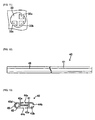
- FIG. 14 through FIG. 16 illustrate the critical portions of a pin 52 (when the securing portion is removed).
- the pin 52 is structured from: a cylindrical straight portion 52a, which extends forward from the front end of a securing portion (not shown) and is short in the axial direction; a conical tapered portion 52b, which extends forward from the front end of the straight portion 52a and becomes gradually thinner towards the front end side; a flat tapered portion 52c which extends forward from the front end of the tapered portion 52b, gradually becomes more elliptical in its cross-section towards the front end side, and which is flat; and a land portion 53.
- the outer shape molding die to which this pin 52 is attached not only has the aforementioned hollow portions 27a and 28a of the bushings 27 and 28 formed so as to be compatible with the flat tapered portion 52c and the land portion 53, but also is structured with a flow path provided in a position forward of the bushing holder portion 26 and the bushings 27 in order to provide an impermeable material to the forming space.
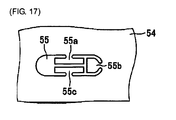
- the front end portion of this outer shape molding die is structured from a plate portion 54 that is provided with a molding slit 55 as illustrated in FIG. 17 .
- a gap through which the molding material passes is formed between the outer peripheral surfaces of the straight portion 52a, the tapered portion 52b, and the flat tapered portion 52c, and the inner peripheral surface of the hollow portions of the outer shape molding die corresponding thereto, where the molding space portion on the rear portion side, as set forth in the present invention, is formed by this gap.
- land portion 53 that structures the front end portion of the pin 52 is disposed at the front end portion of the flat tapered portion 52c, and is formed in two rod-shape units as illustrated in FIG. 14 through FIG. 16 . That is, land portion 53 is structured from two rod shaped molded portions 53a and 53b that are essentially semicircular in the cross-sectional shape thereof. These two rod shaped molded portions 53a and 53b are formed opposite each other with a gap therebetween, each facing the outside, facing circular arc shaped portions of the two sides in the lengthwise direction of the front end surface of the flat tapered portion 52c, and are disposed in parallel with the axial direction.
- the rod shaped molded portions 53a and 53b both extend with the same thickness for both the rear portion side portion and the front portion side portion in the front and back directions, but the center portion is structured from a tapered portion that gradually becomes thinner towards the front than at the back, causing the rod shaped molded portions 53a and 53b to be tapered. Furthermore, the front end portion of the rod shaped molded portion 53a is longer than the front and portion of the rod shaped molded portion 53b.
- a large gap is formed between outer peripheral surface of the land portion 53 and the inner peripheral surface of the hollow portion of the outer shape molding die, and between the rod shaped molded portions 53a and 53b, where the rear portion side portion of the front end side molding space portion as set forth in the present invention is formed from this gap. That is, the portions that form the flow paths 43a and 43c, of all of those flow paths 43a, etc., that are provided in the medical treatment tube 40, are not provided on the rear end side portion of the front end side molding space portion. Consequently, in the rear portion side portion of the front end side molding space portion, of all of those flow paths 43a, etc., that are provided in the medical treatment tube 40, only the portions corresponding to flow paths 43b and 43d are formed.
- the rod shaped molded portion 53a corresponds to the flow path 43d
- the rod shaped molded portion 53b corresponds to the flow path 43b
- the front end portion of an air blowing hole 56 which extends from the rear portion side of the pin 52, is formed on the front end surface of the rod shaped molded portion 53a.
- the plate portion 54 is structured provided with a molding slit 55 instead of the molding slit 33 in the plate portion 24.
- the shape of the edge portion of the molding slit 55 is formed in the shape of the edge of the end of the medical treatment tube 40, with the semicircular portion corresponding to the flow path 43d removed.
- the portions wherein the flow paths 43a, 43b, and 43c, and the slits 44a, 44b, and 44c, are formed in the plate portion 54 are structured from portions 55a, 55b, and 55c that have the same shape as the cross-sectional shape of the respective flow paths 43a, 43b, and 43c, and slits 44a, 44b, and 44c.
- the plate portion 24 that is formed in this way is secured to the front surface of the bushing, by a bolt, in a state wherein the front end portion of the rod shaped molded portion 53a is positioned at a portion corresponding to the flow path 43d in the molding slit 55.
- a space portion having the same shape as the end surface of the medical treatment tube 40, is formed by the molding slit 55 and the rod shaped molded portion 53a, in the center portion of the plate portion 54.
- the front end portion of the front end side molding space portion as set forth in the present invention is formed from this space portion.
- the present example of embodiment enables the molding, through a single injection molding step, of a flat medical treatment tube 40 provided with slits 44a, 44b, and 44 c. Because of this, there is no need for the provision of slits using a machining process after the medical treatment tube 40 is molded. The result is that it is possible to reduce the number of manufacturing processes and to reduce the manufacturing cost.
- the other effects of the second example of embodiment aside from the above are identical to those in the first example of embodiment, discussed above.
- the extrusion molding die and extrusion molding method for a medical treatment tube as set forth in the present invention are not limited to the examples of embodiment described above, but rather can be modified as appropriate within the technical scope of the present invention.
- the medical treatment tube 10, or the like was structured having three slits 14a, etc., slits may instead be provided in portions corresponding to all of the flow paths.
- the slits formed in the medical treatment tube 10, or the like may be one or two slits, or, conversely, no slits may be provided at all.
- the flow paths formed in the medical treatment tube are not limited to four, but instead may be another plurality.
- shape of the medical treatment tube is not limited to those of the examples of embodiment described above, but rather may be varied as appropriate.
- the soft thermoplastic resin from which the medical treatment tube is formed is not limited to polyurethane, but polyvinyl chloride, or other materials may be used instead.
Landscapes
- Engineering & Computer Science (AREA)
- Health & Medical Sciences (AREA)
- Life Sciences & Earth Sciences (AREA)
- Mechanical Engineering (AREA)
- Hematology (AREA)
- Anesthesiology (AREA)
- Biomedical Technology (AREA)
- Heart & Thoracic Surgery (AREA)
- Pulmonology (AREA)
- Animal Behavior & Ethology (AREA)
- General Health & Medical Sciences (AREA)
- Public Health (AREA)
- Veterinary Medicine (AREA)
- Biophysics (AREA)
- Extrusion Moulding Of Plastics Or The Like (AREA)
- Media Introduction/Drainage Providing Device (AREA)
- Medical Preparation Storing Or Oral Administration Devices (AREA)
Applications Claiming Priority (1)
| Application Number | Priority Date | Filing Date | Title |
|---|---|---|---|
| JP2008165730A JP5340654B2 (ja) | 2008-06-25 | 2008-06-25 | 医療用チューブを成形するための押出成形用金型および押出成形方法 |
Publications (2)
| Publication Number | Publication Date |
|---|---|
| EP2138201A2 true EP2138201A2 (de) | 2009-12-30 |
| EP2138201A3 EP2138201A3 (de) | 2010-10-13 |
Family
ID=41152374
Family Applications (1)
| Application Number | Title | Priority Date | Filing Date |
|---|---|---|---|
| EP09003327A Withdrawn EP2138201A3 (de) | 2008-06-25 | 2009-03-06 | Strangpresswerkzeug und Strangpressverfahren zum Formen eines Schlauchs für eine medizinische Behandlung |
Country Status (3)
| Country | Link |
|---|---|
| US (1) | US20090321983A1 (de) |
| EP (1) | EP2138201A3 (de) |
| JP (1) | JP5340654B2 (de) |
Cited By (1)
| Publication number | Priority date | Publication date | Assignee | Title |
|---|---|---|---|---|
| IT201600120563A1 (it) * | 2016-11-29 | 2018-05-29 | Gimac Di Maccagnan Giorgio | Estrusore per manufatti o micro-manufatti multi-lume con disposizione multi-coronale |
Families Citing this family (5)
| Publication number | Priority date | Publication date | Assignee | Title |
|---|---|---|---|---|
| JP6365249B2 (ja) * | 2014-11-06 | 2018-08-01 | 住友ベークライト株式会社 | チューブ製造方法、インダイおよびチューブ製造装置 |
| JP6579701B2 (ja) * | 2015-08-18 | 2019-09-25 | 信越ポリマー株式会社 | ドレーンチューブの製造方法 |
| CN105641794A (zh) * | 2016-03-02 | 2016-06-08 | 广州佳林医疗科技有限公司 | 一种十字引流管及一次成型该引流管的模具和加工方法 |
| CN111202684B (zh) * | 2020-03-13 | 2021-03-12 | 江苏苏云医疗器材有限公司 | 一种鼻胃管结构的加工模具和加工方法 |
| WO2023237739A1 (en) * | 2022-06-10 | 2023-12-14 | Balt Extrusion | Extruder and process for producing hybrid microcatheters |
Citations (1)
| Publication number | Priority date | Publication date | Assignee | Title |
|---|---|---|---|---|
| JPH0217185B2 (de) | 1981-02-26 | 1990-04-19 | Uebusutaa Bureiku Rarii |
Family Cites Families (10)
| Publication number | Priority date | Publication date | Assignee | Title |
|---|---|---|---|---|
| DE1061484B (de) * | 1955-01-11 | 1959-07-16 | Willy Ruesch | Spritzeinrichtung zur Herstellung von mehrlaeufigen Herzkathetern |
| US4465481A (en) * | 1981-02-26 | 1984-08-14 | Innovative Surgical Products, Inc. | Single piece wound drain catheter |
| JPS62214919A (ja) * | 1986-03-18 | 1987-09-21 | Toyoda Gosei Co Ltd | 押出成形品の製造方法 |
| US5116310A (en) * | 1990-07-30 | 1992-05-26 | Helix Medical, Inc. | Multiple lumen wound drain with bypass openings |
| JP2000346246A (ja) * | 1999-06-04 | 2000-12-15 | Kubota Corp | 長尺物保持部材およびその製造方法 |
| JP2002240127A (ja) * | 2000-12-14 | 2002-08-28 | Sumitomo Bakelite Co Ltd | 断面形状可変押出成形用ダイ及びその成形品 |
| JP3559247B2 (ja) * | 2001-03-23 | 2004-08-25 | 株式会社カネカメディックス | チューブの製造方法 |
| US20030219559A1 (en) * | 2002-05-24 | 2003-11-27 | Charles Schryver | Hybrid extruded articles and method |
| US7163388B2 (en) * | 2004-05-19 | 2007-01-16 | Cangen Holdings, Inc. | Method and apparatus for incorporating lumens into the wall of a tubular extrusion |
| JP5147231B2 (ja) * | 2006-12-26 | 2013-02-20 | 日本コヴィディエン株式会社 | 医療用チューブの押出成形用金型および押出成形方法 |
-
2008
- 2008-06-25 JP JP2008165730A patent/JP5340654B2/ja not_active Expired - Fee Related
-
2009
- 2009-03-06 EP EP09003327A patent/EP2138201A3/de not_active Withdrawn
- 2009-05-18 US US12/467,738 patent/US20090321983A1/en not_active Abandoned
Patent Citations (1)
| Publication number | Priority date | Publication date | Assignee | Title |
|---|---|---|---|---|
| JPH0217185B2 (de) | 1981-02-26 | 1990-04-19 | Uebusutaa Bureiku Rarii |
Cited By (3)
| Publication number | Priority date | Publication date | Assignee | Title |
|---|---|---|---|---|
| IT201600120563A1 (it) * | 2016-11-29 | 2018-05-29 | Gimac Di Maccagnan Giorgio | Estrusore per manufatti o micro-manufatti multi-lume con disposizione multi-coronale |
| WO2018100480A1 (en) * | 2016-11-29 | 2018-06-07 | Gimac Di Maccagnan Giorgio | Extruder device for multi-lumen tubular products |
| US11660797B2 (en) | 2016-11-29 | 2023-05-30 | Gimac Di Maccagnan Giorgio | Extruder device for multi-lumen tubular products |
Also Published As
| Publication number | Publication date |
|---|---|
| EP2138201A3 (de) | 2010-10-13 |
| US20090321983A1 (en) | 2009-12-31 |
| JP2010005842A (ja) | 2010-01-14 |
| JP5340654B2 (ja) | 2013-11-13 |
Similar Documents
| Publication | Publication Date | Title |
|---|---|---|
| US8062019B2 (en) | Mold for extrusion molding a medical application tube and extrusion molding method | |
| US20090321983A1 (en) | Extrusion Molding Die and Extrusion Molding Method for Molding a Medical Treatment Tube | |
| EP1252910B1 (de) | Katheter mit mehreren Leitungen | |
| US20170080181A1 (en) | Catheter, catheter production mold, catheter production method | |
| US4842590A (en) | Catheter and method for making | |
| US11439791B2 (en) | Catheter and manufacturing method of catheter | |
| JP6537070B2 (ja) | チューブ、チューブの製造方法、及び金型 | |
| KR20180011455A (ko) | 플렉시블 튜브 및 그 제조장치 | |
| EP3338994B1 (de) | Extrusion mit bevorzugter biegeachse | |
| US4264294A (en) | Profiling die | |
| EP2813256A1 (de) | Ballonschlauch, ballon, ballonkatheter und herstellungsverfahren für den ballonschlauch | |
| US20170136207A1 (en) | Catheter, catheter production mold, catheter production method | |
| JP3559247B2 (ja) | チューブの製造方法 | |
| JPH11347129A (ja) | 医療外科手術用チュ―ブおよびその製造方法 | |
| TW202100333A (zh) | 軟管之製造裝置 | |
| JPH1189939A (ja) | 留置針組立体および内針の製造方法 | |
| JPH09313613A (ja) | 拡張体付カテーテル | |
| JP2000262628A (ja) | 留置針組立体 | |
| WO2015119143A1 (ja) | チューブ、チューブの製造方法、及び金型 | |
| JP6365249B2 (ja) | チューブ製造方法、インダイおよびチューブ製造装置 | |
| JP2019141567A (ja) | カテーテルの製造方法、及びこの製造方法で製造されたカテーテル | |
| JP7071803B2 (ja) | ドレーンチューブの製造方法 | |
| JP2011046047A (ja) | 押出成形金型、押出成形装置および医療用チューブ | |
| JPH11319105A (ja) | 外科用チュ―ブの製造方法 | |
| US20250367401A1 (en) | Method of forming different configurations for the distal tip of catheters, catheters thus formed by the method, and apparatus for effecting the method |
Legal Events
| Date | Code | Title | Description |
|---|---|---|---|
| PUAI | Public reference made under article 153(3) epc to a published international application that has entered the european phase |
Free format text: ORIGINAL CODE: 0009012 |
|
| AK | Designated contracting states |
Kind code of ref document: A2 Designated state(s): AT BE BG CH CY CZ DE DK EE ES FI FR GB GR HR HU IE IS IT LI LT LU LV MC MK MT NL NO PL PT RO SE SI SK TR |
|
| AX | Request for extension of the european patent |
Extension state: AL BA RS |
|
| PUAL | Search report despatched |
Free format text: ORIGINAL CODE: 0009013 |
|
| AK | Designated contracting states |
Kind code of ref document: A3 Designated state(s): AT BE BG CH CY CZ DE DK EE ES FI FR GB GR HR HU IE IS IT LI LT LU LV MC MK MT NL NO PL PT RO SE SI SK TR |
|
| AX | Request for extension of the european patent |
Extension state: AL BA RS |
|
| RIC1 | Information provided on ipc code assigned before grant |
Ipc: A61M 27/00 20060101ALI20100906BHEP Ipc: B29C 47/20 20060101ALI20100906BHEP Ipc: A61M 25/00 20060101AFI20091016BHEP |
|
| 17P | Request for examination filed |
Effective date: 20110413 |
|
| AKX | Designation fees paid |
Designated state(s): AT BE BG CH CY CZ DE DK EE ES FI FR GB GR HR HU IE IS IT LI LT LU LV MC MK MT NL NO PL PT RO SE SI SK TR |
|
| STAA | Information on the status of an ep patent application or granted ep patent |
Free format text: STATUS: THE APPLICATION HAS BEEN WITHDRAWN |
|
| 18W | Application withdrawn |
Effective date: 20121119 |