EP2138141B2 - Herstellungsverfahren für ein kleidungsstück - Google Patents
Herstellungsverfahren für ein kleidungsstück Download PDFInfo
- Publication number
- EP2138141B2 EP2138141B2 EP08738936.7A EP08738936A EP2138141B2 EP 2138141 B2 EP2138141 B2 EP 2138141B2 EP 08738936 A EP08738936 A EP 08738936A EP 2138141 B2 EP2138141 B2 EP 2138141B2
- Authority
- EP
- European Patent Office
- Prior art keywords
- continuous
- sheet
- web
- elastic
- fibers
- Prior art date
- Legal status (The legal status is an assumption and is not a legal conclusion. Google has not performed a legal analysis and makes no representation as to the accuracy of the status listed.)
- Not-in-force
Links
Images




Classifications
-
- A—HUMAN NECESSITIES
- A61—MEDICAL OR VETERINARY SCIENCE; HYGIENE
- A61F—FILTERS IMPLANTABLE INTO BLOOD VESSELS; PROSTHESES; DEVICES PROVIDING PATENCY TO, OR PREVENTING COLLAPSING OF, TUBULAR STRUCTURES OF THE BODY, e.g. STENTS; ORTHOPAEDIC, NURSING OR CONTRACEPTIVE DEVICES; FOMENTATION; TREATMENT OR PROTECTION OF EYES OR EARS; BANDAGES, DRESSINGS OR ABSORBENT PADS; FIRST-AID KITS
- A61F13/00—Bandages or dressings; Absorbent pads
- A61F13/15—Absorbent pads, e.g. sanitary towels, swabs or tampons for external or internal application to the body; Supporting or fastening means therefor; Tampon applicators
-
- A—HUMAN NECESSITIES
- A61—MEDICAL OR VETERINARY SCIENCE; HYGIENE
- A61F—FILTERS IMPLANTABLE INTO BLOOD VESSELS; PROSTHESES; DEVICES PROVIDING PATENCY TO, OR PREVENTING COLLAPSING OF, TUBULAR STRUCTURES OF THE BODY, e.g. STENTS; ORTHOPAEDIC, NURSING OR CONTRACEPTIVE DEVICES; FOMENTATION; TREATMENT OR PROTECTION OF EYES OR EARS; BANDAGES, DRESSINGS OR ABSORBENT PADS; FIRST-AID KITS
- A61F13/00—Bandages or dressings; Absorbent pads
- A61F13/15—Absorbent pads, e.g. sanitary towels, swabs or tampons for external or internal application to the body; Supporting or fastening means therefor; Tampon applicators
- A61F13/15577—Apparatus or processes for manufacturing
- A61F13/15804—Plant, e.g. involving several steps
-
- A—HUMAN NECESSITIES
- A61—MEDICAL OR VETERINARY SCIENCE; HYGIENE
- A61F—FILTERS IMPLANTABLE INTO BLOOD VESSELS; PROSTHESES; DEVICES PROVIDING PATENCY TO, OR PREVENTING COLLAPSING OF, TUBULAR STRUCTURES OF THE BODY, e.g. STENTS; ORTHOPAEDIC, NURSING OR CONTRACEPTIVE DEVICES; FOMENTATION; TREATMENT OR PROTECTION OF EYES OR EARS; BANDAGES, DRESSINGS OR ABSORBENT PADS; FIRST-AID KITS
- A61F13/00—Bandages or dressings; Absorbent pads
- A61F13/15—Absorbent pads, e.g. sanitary towels, swabs or tampons for external or internal application to the body; Supporting or fastening means therefor; Tampon applicators
- A61F13/15577—Apparatus or processes for manufacturing
- A61F13/15707—Mechanical treatment, e.g. notching, twisting, compressing, shaping
- A61F13/15747—Folding; Pleating; Coiling; Stacking; Packaging
-
- A—HUMAN NECESSITIES
- A61—MEDICAL OR VETERINARY SCIENCE; HYGIENE
- A61F—FILTERS IMPLANTABLE INTO BLOOD VESSELS; PROSTHESES; DEVICES PROVIDING PATENCY TO, OR PREVENTING COLLAPSING OF, TUBULAR STRUCTURES OF THE BODY, e.g. STENTS; ORTHOPAEDIC, NURSING OR CONTRACEPTIVE DEVICES; FOMENTATION; TREATMENT OR PROTECTION OF EYES OR EARS; BANDAGES, DRESSINGS OR ABSORBENT PADS; FIRST-AID KITS
- A61F13/00—Bandages or dressings; Absorbent pads
- A61F13/15—Absorbent pads, e.g. sanitary towels, swabs or tampons for external or internal application to the body; Supporting or fastening means therefor; Tampon applicators
- A61F13/15577—Apparatus or processes for manufacturing
- A61F13/15756—Applying tabs, strips, tapes, loops; Knotting the ends of pads
-
- A—HUMAN NECESSITIES
- A61—MEDICAL OR VETERINARY SCIENCE; HYGIENE
- A61F—FILTERS IMPLANTABLE INTO BLOOD VESSELS; PROSTHESES; DEVICES PROVIDING PATENCY TO, OR PREVENTING COLLAPSING OF, TUBULAR STRUCTURES OF THE BODY, e.g. STENTS; ORTHOPAEDIC, NURSING OR CONTRACEPTIVE DEVICES; FOMENTATION; TREATMENT OR PROTECTION OF EYES OR EARS; BANDAGES, DRESSINGS OR ABSORBENT PADS; FIRST-AID KITS
- A61F13/00—Bandages or dressings; Absorbent pads
- A61F13/15—Absorbent pads, e.g. sanitary towels, swabs or tampons for external or internal application to the body; Supporting or fastening means therefor; Tampon applicators
- A61F13/15577—Apparatus or processes for manufacturing
- A61F13/15764—Transferring, feeding or handling devices; Drives
-
- A—HUMAN NECESSITIES
- A61—MEDICAL OR VETERINARY SCIENCE; HYGIENE
- A61F—FILTERS IMPLANTABLE INTO BLOOD VESSELS; PROSTHESES; DEVICES PROVIDING PATENCY TO, OR PREVENTING COLLAPSING OF, TUBULAR STRUCTURES OF THE BODY, e.g. STENTS; ORTHOPAEDIC, NURSING OR CONTRACEPTIVE DEVICES; FOMENTATION; TREATMENT OR PROTECTION OF EYES OR EARS; BANDAGES, DRESSINGS OR ABSORBENT PADS; FIRST-AID KITS
- A61F13/00—Bandages or dressings; Absorbent pads
- A61F13/15—Absorbent pads, e.g. sanitary towels, swabs or tampons for external or internal application to the body; Supporting or fastening means therefor; Tampon applicators
- A61F13/45—Absorbent pads, e.g. sanitary towels, swabs or tampons for external or internal application to the body; Supporting or fastening means therefor; Tampon applicators characterised by the shape
- A61F13/49—Absorbent pads, e.g. sanitary towels, swabs or tampons for external or internal application to the body; Supporting or fastening means therefor; Tampon applicators characterised by the shape specially adapted to be worn around the waist, e.g. diapers, nappies
-
- A—HUMAN NECESSITIES
- A61—MEDICAL OR VETERINARY SCIENCE; HYGIENE
- A61F—FILTERS IMPLANTABLE INTO BLOOD VESSELS; PROSTHESES; DEVICES PROVIDING PATENCY TO, OR PREVENTING COLLAPSING OF, TUBULAR STRUCTURES OF THE BODY, e.g. STENTS; ORTHOPAEDIC, NURSING OR CONTRACEPTIVE DEVICES; FOMENTATION; TREATMENT OR PROTECTION OF EYES OR EARS; BANDAGES, DRESSINGS OR ABSORBENT PADS; FIRST-AID KITS
- A61F13/00—Bandages or dressings; Absorbent pads
- A61F13/15—Absorbent pads, e.g. sanitary towels, swabs or tampons for external or internal application to the body; Supporting or fastening means therefor; Tampon applicators
- A61F13/45—Absorbent pads, e.g. sanitary towels, swabs or tampons for external or internal application to the body; Supporting or fastening means therefor; Tampon applicators characterised by the shape
- A61F13/49—Absorbent pads, e.g. sanitary towels, swabs or tampons for external or internal application to the body; Supporting or fastening means therefor; Tampon applicators characterised by the shape specially adapted to be worn around the waist, e.g. diapers, nappies
- A61F13/49007—Form-fitting, self-adjusting disposable diapers
- A61F13/49009—Form-fitting, self-adjusting disposable diapers with elastic means
- A61F13/49011—Form-fitting, self-adjusting disposable diapers with elastic means the elastic means is located at the waist region
Definitions
- the present invention relates to a method of producing a clothing article.
- Disposable pull-on diapers having not only elasticized waist and leg opening edge portions but an elasticized below-waist portion (a portion below the waist opening edge portion) are known.
- Patent Document 1 discloses a method of producing a pull-on diaper including the steps of securing an elastic member for elasticizing a below-waist portion in its stretched state between two moving webs to make an outer cover elasticized in the machine direction in continuous form, spacedly fixing absorbent bodies to the outer cover of continuous form, and cutting the web assembly into individual diapers.
- a stretch sheet that can be obtained without gathering a sheet material is known for use as a clothing material.
- a transverse feed system a system in which a continuous web assembly having diapers continuous in the diaper transverse direction is cut into individual diapers
- the stretch sheet is extended by the tension applied thereto while moving, and the extension percentage varies with variation of the tension.
- the present invention provides a method of producing a web assembly for use in a clothing article according to claim 1 and method for producing an absorbent diaper according to claim 4.
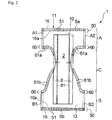
- a disposable pull-on diaper 1 (hereinafter also abbreviated as a diaper 1) illustrated in Figs. 1 through 3 is produced.
- the diaper 1 includes an absorbent body 10 that is substantially oblong.
- the absorbent body 10 includes a liquid permeable topsheet 2, a liquid impermeable or hardly liquid permeable (or water repellent) backsheet 3, and a liquid retentive absorbent core 4 interposed between the sheets 2 and 3.
- the diaper 1 also includes an outer cover 11 disposed on the side of the backsheet 3 (i.e., the garment facing side) of the absorbent body 10.
- the diaper 1 is divided into a front portion A located on the stomach side of a wearer, a rear portion B located on the back side of a wearer, and a crotch portion C located therebetween.
- the outer cover 11 defines the contour of the diaper 1 and, in its flat-out uncontracted state, has a longitudinally middle portion thereof narrowed to have the shape of a sandglass.
- both side edges A1 and A2 of the outer cover 11 in the front portion A and both side edges B1 and B2 of the outer cover in the rear portion B are joined to each other to make a pair of side seals S, S, thereby to form a waist opening 5 and a pair of leg openings 6, 6 of the diaper 1.
- the absorbent body 10 is formed by uniting the topsheet 2, the backsheet 3, and the absorbent core 4.
- the topsheet 2, the backsheet 3, and the absorbent core 4 are of conventional types commonly used in the art.
- the topsheet may be nonwoven fabric of various kinds or perforated film.
- the backsheet may be a resin film or a nonwoven fabric laminated with a resin film.
- the absorbent core 4 may be an aggregate made up of superabsorbent polymer particles and a fibrous material and wrapped in tissue (not shown).
- a side cuff 8 formed of a liquid resistant or water repellent and air permeable material is provided along both sides edges of the absorbent body 10 as illustrated in Fig. 2 .
- At least one elastic member 81 is disposed in its stretched state along near the free edge of each side cuff 8. While the disposable diaper 1 is worn by a wearer, the side cuffs 8 rise to impede the lateral flow of a body fluid.
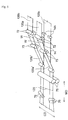
- the side cuff 8 is formed of a cuff-forming sheet 82 as shown in Fig. 3 .
- the cuff-forming sheet 82 extends laterally outward from the absorbent core 4 to provide an extension 82S, which, in an assembled state, wraps around beneath the absorbent core 4 and is secured between the absorbent core 4 and the backsheet 3 or between the backsheet 3 and an inner sheet 13 described below.
- the outer cover 11 has a laminate structure composed of an outer sheet 12 and an inner sheet 13 which is disposed on the side of the absorbent body 10 of the outer sheet 12.
- the outer sheet 12 is composed of a front outer subsheet 12A located in the front portion A, a rear outer subsheet 12B located in the rear portion B, and a crotch outer subsheet 12 C located in the middle part of the crotch portion C.
- the crotch outer subsheet 12 C is joined along its front end and rear end to the end of the front outer subsheet 12A and the end of the rear outer subsheet 12B, respectively, with an adhesive 14.
- the inner sheet 13 is continuous from the front portion A through the crotch portion C to the rear portion B.
- An edge portion (waist portion) 50 along the waist opening 5 in each of the front portion A and the rear portion B of the diaper 1 has a plurality of waist elastic members 51, 51 disposed along the opening edges (waist edges) 5a and 5b of the waist opening 5.
- the waist elastic members 51, 51 are disposed as held or fixed by a waist edge-forming sheet 16 that is disposed in the edge portion (waist portion) 50 in each of the front portion A and the rear portion B of the diaper 1.
- the waist edge-forming sheet 16 is a rectangle with its length extending in the diaper lateral direction over the whole width of the front portion A or the rear portion B.
- the waist edge-forming sheet 16 is folded in two along a folding line 16L.
- the folding line 16L corresponds to the opening edge (waist edge) 5a or 5b defining the waist opening 5.
- Between the facing panels of the thus folded waist edge-forming sheet 16 are secured the waist elastic members 51, 51 with an adhesive (not shown).
- the skin facing panel 16a of the waist edge-forming sheet 16 located the inside of the diaper 1 is bonded to the skin facing side (the side adapted to face the skin of a wearer while worn) of the inner sheet 13 with an adhesive (not shown), while the garment facing panel 16b located the outside of the diaper 1 is bonded to the garment facing side (the side adapted to face the opposite to the skin of a wearer while worn) of the front outer subsheet 12A or the rear outer subsheet 12B, specifically the front end portion of the front outer subsheet 12A along the waist edge 5a or the rear end portion of the rear outer subsheet 12B along the waist edge 5b, with an adhesive 15.
- the outer sheet 12 and the inner sheet 13 of the diaper 1 are bonded to each other along the side seals A1, A2, B1, and B2 by heat sealing, high frequency sealing or ultrasonic sealing. They are also bonded to each other along edges 60 of the leg openings 6 with an adhesive 62.
- the edge portions on the skin facing side of the front outer subsheet 12A and the rear outer subsheet 12B located near the edges 5a, 5b and the inner sheet 13 are also bonded via an adhesive 18.
- the outer sheet 12 and the inner sheet 13 are not bonded together for the most part of the area other than the parts described above. More specifically, the outer sheet 12 and the inner sheet 13 are bonded together in the parts described above and, in addition, in the laterally middle part extending in the diaper longitudinal direction. The outer sheet 12 and the inner sheet 13 are not joined in other than these parts.
- the outer sheet 12 and the inner sheet 13 being not joined over a large area in the front portion A and the rear portion B of the diaper 1 offer the following advantages. Hindrance to stretch of the outer sheet 12 by an applied adhesive is minimized so that the rear portion B and the front portion A exhibit good stretch to provide a snug fit against a wearer's body while worn.
- the area in which the outer cover 11 becomes stiff due to an adhesive applied being so minimized, the diaper feels soft and pleasant to the touch on both the exterior surface thereof and the exposed interior surface of the outer cover 11 which is the part uncovered by the absorbent body 10.
- the outer sheet 12 and the inner sheet 13 are formed of breathable material, such as nonwoven fabric, there is provided a diaper having good breathability and thereby capable of controlling the inside humidity.
- a peripheral portion 60 along each of the leg openings straddling the front portion A, the crotch portion C and the rear portion B has leg elastic members 61a and 61b disposed along the edge of the leg opening.
- the leg elastic members 61a and 61b are secured between the outer sheet 12 and the inner sheet 13 in their stretched state by the adhesive 62.
- a first continuous web 120a and a first continuous web 120b both stretchable in the longitudinal direction are used to provide the front outer subsheet 12A and the rear outer subsheet 12B, respectively;
- a second continuous web 120c, a second continuous web 160a, and a second continuous web 160b each of which is substantially inextensible in the longitudinal direction (i.e., MD) are used to provide the crotch outer subsheet 12C and the opposing waist edge-forming sheets 16, 16, respectively;
- a third continuous web 130 substantially inextensible in the longitudinal direction is used to provide the inner sheet 13.
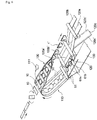
- the first continuous webs 120a and 120b may be longitudinally stretchable sheet webs prepared separately from the line of diaper manufacturing. In the present embodiment, however, the step of stretching the first continuous webs 120a and 120b is preceded by the step of processing non-stretch webs 120' to develop stretchability or the step of processing low-stretch webs 120' to enhance the stretchability to obtain the first continuous webs 120a and 120b as illustrated in Fig. 4 . The thus obtained first continuous webs 120a and 120b are stretched.
- the processing for stretchability development or enhancement used in the present embodiment is in-line processing using a pair of intermeshing corrugated rolls 71. More specifically, the processing is carried out by introducing a continuous web 120' composed of an elastic layer (e.g., an elastic fiber layer, an elastic net sheet or an elastic film) and an inelastic fiber layer on one or both sides of the elastic layer into the nip between the corrugated rollers 71, whereby the inelastic fiber layer is cut, the constituent fibers of the inelastic fiber layer are extended, or the interfiber fusion bonds in the inelastic fiber layer are destroyed.
- an elastic layer e.g., an elastic fiber layer, an elastic net sheet or an elastic film
- each of the corrugated rollers 71 has a number of ridges (teeth) extending in the axial direction spacedly arranged on its periphery, providing grooves between adjacent ridges.
- first continuous webs 120a and 120b are continuously fed and stretched in the longitudinal direction between the pair of corrugated rollers 71 and a pair of nip rollers 73.
- the first continuous webs 120a and 120b in their stretched state are joined to the second continuous webs 120c, 160a, and 160b by overlapping the edge portions of adjoining webs and bonding them with an adhesive.
- one edge portion of the second continuous web 160a as a precursor of a waist edge-forming sheet 16 of the front section A is overlapped on one edge portion of the first continuous web 120a as a precursor of the front outer subsheet 12A, and one edge portion of the second continuous web 120c as a precursor of the crotch outer subsheet 12C is overlapped on the other edge portion of the first continuous web 120a.
- one edge portion of the second continuous web 160b as a precursor of a waist edge-forming sheet 16 of the rear section B is overlapped on one edge portion of the first continuous web 120b as a precursor of the rear outer subsheet 12B, and the other edge portion of the second continuous web 120c as a precursor of the crotch outer subsheet 12C is overlapped on the other edge portion of the first continuous web 120b.
- the adjoining webs do not overlap other than their edge portions.
- the adjoining webs are joined to each other in their overlapping edge portions.
- an adhesive is applied to at least one of the facing sides of the edge portions before the overlapping, and the overlapped edge portions are pressed between a pair of pressure rollers 74.
- the adhesive is preferably applied such that the edge portions of adjoining webs are continuously bonded together in their longitudinal direction. Any adhesive applicator conventionally used in the production of this type of articles may be used with no restriction to apply the adhesive.
- the extension percentage of the first continuous webs 120a and 120b being joined to the second continuous webs 120c, 160a, and 160b may be, for example 10% to 200%, preferably 20% to 150%, more preferably 30% to 120%.
- the extension percentage is defined to be [(length after extension - length before extension)/(length before extension)] x 100. When an original length of 50 mm is extended to 100 mm or 150 mm, the extension percentage is 100% or 200, respectively.
- the width of the edge portions of the first continuous web and the second continuous web to be joined together is desirably as small as possible. Taking into consideration strength of the resulting patched sheet and stability of processing, nevertheless, the width is preferably 5 to 50 mm, more preferably 5 to 20 mm.
- the composite sheet 120 is superposed on a separately fed third continuous web 130 as a precursor of the inner sheet 13 and joined together via an adhesive. As illustrated in Fig. 4 , the composite sheet 120 and the third web 130 are joined with leg elastic members 61a and 61b held therebetween. Specifically, an adhesive for securing the elastic members is applied to one or both of the facing sides of the webs 120 and 130 before the superposing, the elastic members 61a and 61b are introduced therebetween in their stretched state, and the two webs having the elastic members therebetween are pressed between the nip rollers 75.
- the adhesive for securing the elastic members may be applied to the elastic members 61a and 61b or both the elastic members 61a and 61b and the composite sheet 120 and/or the third web 130.
- any applicator conventionally used in the production of this type of articles may be used with no particular restriction.
- a continuous-form absorbent body is cut into individual absorbent bodies 10, which are turned 90° and spacedly fixed on the continuous-form outer cover 110.
- the unnecessary part 111 corresponding to a leg opening is cut out of the continuous-form outer cover 110 with, for example, a rotary cutter or a laser cutter to make a continuous-form diaper 100.
- An adhesive is applied to both edge portions formed of the second continuous webs 160a and 160b of the continuous-form outer cover 110 or the continuous-form diaper 100.
- Waist elastic members 51 are disposed on the edge portions where the adhesive is applied, and the edge portions 160a' and 160b' of the second continuous webs 160a and 160b, respectively, are folded over the third continuous web 130 and secured thereto.
- the continuous-form diaper 100 is then folded in two.
- the folded continuous-form diaper 100 is sealed to form side seals S, S by heat sealing, ultrasonic sealing, high frequency sealing or like means, and the continuous-form diaper 100 is cut into individual disposable pull-on diapers 1 after or simultaneously with the formation of the side seals S, S.
- the diaper 1 can be produced in a usual manner for the production of disposable pull-on diapers in a transverse feed system.
- the adhesive 17 for fixing the absorbent body 10 to the continuous-form outer cover 110 may be applied to either one or both of the absorbent body 10 and the continuous-form outer cover 110. Removal of the unnecessary part 111 for making the leg opening may be carried out before fixing the absorbent body 10 to the continuous-form outer cover 110.
- the diaper 1 having the above described structure can be produced efficiently in a continuous manner.
- a disposable pull-on diaper exhibiting good stretchability in its below-waist portion in the front portion A and the rear portion B can be produced with high finish accuracy in a stable continuous manner despite of using the first continuous webs 120a and 120b having stretchability in the longitudinal direction.
- first continuous webs 120a and 120b as precursors of the rear outer subsheet and the front outer subsheet, respectively are fed by themselves, they easily vary in extension percentage with variation of tension applied thereto while moving because of their longitudinal stretchability. Then, when they are processed, e.g., cut, folded, or combined with other members, positioning error or reduction in processing accuracy is likely to occur with variation in tension in cutting, folding, bonding, or other processing operations.
- the resulting composite sheet 120 hardly extends any further or, may extend slightly but suddenly stop extending further only if it is moved under such a tension that prevents the retractability of the first continuous webs 120a and 120b from contracting the composite sheet 120. Therefore, as long as the composite sheet 120 is placed under at least a certain tension in the moving direction, its extension percentage hardly varies even if the tension applied thereto fluctuates during the movement. As a result, the positioning accuracy or finishing accuracy are improved in various processing operations, such as cutting, folding and joining with other members. According to the present embodiment, in particular, since each of the first continuous webs 120a and 120b is adjoined along both edge portions thereof to substantially inextensible webs, the composite sheet 120 undergoes little variation in extension percentage with variation in tension while moving.
- the method of the present embodiment allows for various processing operations with good accuracy thereby to produce a disposable pull-on diaper (a kind of clothing articles) having good stretchability precisely, stably, and continuously.
- the composite outer sheet 12 requires a reduced amount of a stretch sheet material. This leads to reduction of material cost because a stretch sheet material is generally more expensive than a substantially inextensible sheet material. Moving a stretch sheet as joined with a substantially inextensible sheet which is a member of the clothing article not only reduces the required amount of the extensive stretch sheet but avoids the necessity of a moving mechanism specialized to control the variation of the stretch sheet, thereby enabling the production without requiring excessively large equipment.
- the continuous-form outer cover 110 or a continuous-form diaper 100 is subjected to further processing.
- the processing of the continuous-form outer cover 110 and the continuous-form diaper 100 can be performed with the same high accuracy as described.
- misalignment or positioning error is prevented in, for example, placing the absorbent body 10 on the continuous-form outer cover 110, making a leg hole 101 through the continuous-form outer cover 110 before or after placement of the absorbent body 10, folding the continuous-form outer cover 110 having the absorbent body 10 fixed thereto (i.e., the continuous-form diaper 100), sealing the continuous-form outer cover 110 having the absorbent body 10 fixed thereto (i.e., the continuous-form diaper 100) at a predetermined positions to form a side seal S, and cutting the continuous-form diaper 100 into individual diapers. Disposable pull-on diapers with high finish accuracy can thus be produced stably in a continuous manner.
- the third continuous web as a precursor of the inner sheet is substantially inextensible, the same effects as described are obtained even when a longitudinally extensible web is used as a precursor of the inner sheet because of little variation in extension percentage of the composite sheet 120 with variation in tension.
- the first continuous webs 120a and 120b as precursors of the front outer subsheet 12A and the rear outer subsheet 12B, respectively, are webs having stretchability in the longitudinal direction (MD).
- the second continuous webs 160a and 160b as precursors of the waist edge-forming sheets 16 in the front portion A and the rear portion B, respectively, the second continuous web 120c as a precursor of the crotch outer subsheet 12C, and the third continuous web 130 as a precursor of the inner sheet 13 are webs having substantially no extensibility in the longitudinal direction (MD).
- continuous web having stretchability in the longitudinal direction means a continuous sheet having ability to extent under tension in its longitudinal direction (MD) and retract on release from the tension.
- the stretch sheet preferably has a maximum elongation of at least 100% in the longitudinal direction and, when extended to an elongation of 100% in that direction, retract to a recovery (a recovery from 100% extension) of at least 70%.
- the stretch sheet is preferably more extensible in its longitudinal direction (MD) than its transverse direction (the direction perpendicular to the longitudinal direction, i.e., CD). Specifically, it is preferred that the stretch sheet be extensible largely (having a maximum elongation of 100% or more) in the longitudinal direction and retractable (having a recovery from 100% extension of 70% or more) when released, while be extensible only slightly (e.g., having a maximum elongation of 50% or less) in the transverse direction.
- continuous web having substantially no extensibility in the longitudinal direction means a continuous sheet having no or little extensibility even in a tensioned state during feed so that it undergoes little variation in extension percentage with variation in tension applied.
- the non-stretch sheet preferably has a maximum elongation of 10% or less in the longitudinal direction (MD) (the maximum length after stretch is only 1.1 times the original length), more preferably a maximum elongation of 8% or less in that direction.
- the non-stretch sheet preferably has a maximum elongation of 10% or less, more preferably 8% or less, in both the longitudinal direction and the direction perpendicular thereto.
- a specimen having the same dimension is elongated under the same condition as in the measurement of recovery from extension.
- the elongation at break is taken as a maximum elongation.
- the break point is defined as the point on the extension percentage vs. load curve at which the measured tensile load reaches its maximum value.
- the stretch sheet constituting the first continuous web.
- Preferred examples of the stretch sheet include (1) a sheet having an elastic fiber layer and an extensible fiber layer united to one or both sides of the elastic fiber layer, (2) a sheet having an elastic net sheet and an extensible fiber layer united to one or both sides of the elastic net sheet, (3) a sheet having an elastic film and an extensible fiber layer united to one or both sides of the elastic film, and (4) a stretch sheet having an extensible nonwoven fabric and a large number of elastic filaments arranged to extend in one direction without intersecting with each other and bonded to the extensible nonwoven fabric over their whole length in their substantially nonstretched state.
- Uniting the elastic fiber layer and the extensible fiber layer is carried out by, for example, entangling the fibers of the two fiber layers superposed on each other by hydroentanglement or through-air bonding or bonding the two fiber layers by heat embossing, applying an adhesive, or ultrasonication.
- Examples (1), (2), and (3) do not form part of the claimed invention.
- the sheet (1) is exemplified by (a) a stretch nonwoven fabric having an elastic fiber layer and an inelastic fiber layer, that is substantially inelastic, on at least one side of the elastic fiber layer.
- the elastic fiber layer and the inelastic fiber layer are joined together all over by fusion bonding at fiber intersections while the fibers constituting the elastic fiber layer remain in a fibrous form.
- the inelastic fiber layer has part of its fibers enter the elastic fiber layer and/or the elastic fiber layer has part of its fibers enter the inelastic fiber layer.
- Exemplary and preferred of the sheets (1), (2), and (3) include (b) a stretch sheet having an elastically stretchable elastic layer and an inelastic fiber layers that is substantially inelastic, the stretch sheet being obtained by superposing the two layers on each other, partially joining them, and stretching the resulting laminate sheet.
- the stretch nonwoven fabric (a) is described in more detail.
- the fibers constituting the elastic fiber layer and the fibers constituting the inelastic fiber layer are fusion bonded to each other at their intersections on and near the interfaces between the elastic fiber layer and the inelastic fiber layer.
- the fiber layers are evenly joined together substantially all over their interfaces. Being joined all over, the fiber layers are prevented from separating from each other and forming a gap therebetween.
- the stretch nonwoven fabric has a multilayer structure and yet exhibits integrity like monolithic nonwoven fabric.
- the constituent fibers of the elastic fiber layer remain in a fibrous form is meant that most of the fibers constituting the elastic fiber layer are not in a cohesive film-like state or a cohesive film-like/fibrous mixed state even after application of heat, pressure and so forth.
- the elastic fiber layer has its fibers fusion bonded at their intersections throughout its thickness.
- the inelastic fiber layer has its fibers fusion bonded at their intersections throughout their thickness.
- the inelastic fiber layer is provided on both sides of the elastic fiber layer
- at least one of the inelastic fiber layers has part of its constituent fibers enter the elastic fiber layer and/or the elastic fiber layer has part of its constituent fibers enter at least one of the inelastic fiber layers.
- the web be made up of staple fibers for higher freedom of movement than continuous fibers.
- a through-air process is preferred for having the fibers of the inelastic fiber layer enter the elastic fiber layer and/or having the fibers of the elastic fiber layer enter the inelastic fiber layer.
- a through-air process easily achieves having fibers of a layer enter another layer facing thereto and/or having a layer receive fibers from another layer facing thereto.
- a through-air process easily achieves having the fibers of the inelastic fiber layer enter the elastic fiber layer while retaining the bulk of the inelastic fiber layer.
- the entanglement be achieved only by a through-air process.
- Fiber entanglement by a through-air process is preferably accomplished by properly adjusting the air blowing pressure, air velocity, basis weight and thickness of the fiber layers, the running speeds of the fiber layers, and so on.
- the through-air treatment is preferably carried out under specific conditions.
- part of the fibers of the inelastic fiber web enter the elastic fiber web and, at the same time, the fibers of the inelastic fiber web and/or the fiber of the inelastic fiber web and the fibers of the elastic fiber web are fusion bonded at their intersections.
- the elastic fiber layer has the ability to extend under tension and retract or contract when released from the tension.
- the residual strain is preferably 20% or less, more preferably 10% or less. It is desirable that the elastic fiber layer has the recited residual strain in at least one of the MD and CD, particularly preferably in both the MD and CD.
- the elastic fiber layer is an aggregate of elastic fibers.
- Methods of forming elastic fibers include a melt-blowing method in which a molten resin is extruded through orifices and the extruded molten resin streams are drawn by hot air into fine fibers, a spun bonding method in which a half-molten resin is drawn by cool air or by mechanical drawing, and a blow spinning method, which is a combination of a melt blowing method and a spun bonding method and may be said to be a modified melt blowing method.
- the elastic fiber layer may have the form of a web or nonwoven fabric made of elastic fibers by, for example, blow spinning, spun bonding or melt blowing.
- the elastic fiber layer is particularly preferably a web obtained by blow spinning.
- the fibers that can be used to constitute the elastic fiber layer include those made from thermoplastic elastomers or rubber.
- Thermoplastic elastomers are melt-spinnable using an extruder in the same manner as ordinary thermoplastic resins, and the fibers thus obtained are easy to fusion bond. Therefore, fibers of thermoplastic elastomers are particularly suited for making the stretch nonwoven fabric that has air-through nonwoven as a basic structure.
- the thermoplastic elastomers include styrene elastomers such as SBS, SIS, SEBS, and SEPS, olefin elastomers, polyester elastomers, and polyurethane elastomers. These elastomers may be used either individually or in combination of two or more thereof.
- the inelastic fiber layer is extensible but substantially inelastic.
- the term "extensible” as used herein is intended to include not only a fiber layer whose constituent fibers per se are extensible but also a fiber layer whose constituent fibers are not per se extensible but which shows extensibility as a result of debonding of constituent fibers that have been fusion bonded at their intersections, change of a three-dimensional structure formed of a plurality of constituent fibers fusion-bonded to one another, or breaks of the constituent fibers.
- the fibers that can be used to constitute the inelastic fiber layer include fibers of polyethylene (PE), polypropylene (PP), polyesters (PET and PBT), and polyamides.
- the fibers constituting the inelastic fiber layer may be staple fibers or continuous fibers and hydrophilic or water repellent. Sheath-core or side-by-side conjugate fibers, split fibers, modified cross-section fibers, crimped fibers, and heat shrunken fibers are also useful. These fibers may be used either individually or in combination of two or more thereof.
- the inelastic fiber layer may be a web or nonwoven fabric of continuous filaments or staple fibers.
- the stretch sheet (b) will be described in more detail.
- the stretch sheet is obtained by providing a laminate sheet having an elastically stretchable elastic layer and an inelastic fiber layer, which is substantially inelastic and bonded to one or both sides of the elastic layer in parts in a regular pattern, and stretching the laminate sheet.
- the laminate sheet used to make the stretch sheet is prepared, for example, as follows.
- a fiber web (first inelastic fiber layer) is continuously fed from a carding machine. Elastic fibers are fed on the fiber web to form an elastic layer.
- a fiber web (second inelastic fiber layer) fed from another carding machine is continuously fed on the elastic layer.
- the resulting stack of three layers is subjected to a hot air treatment in a through-air system drier.
- the hot air treated laminate sheet is heat embossed through an embossing unit including an embossing roller having embossing projections regularly arranged on its peripheral surface and an anvil roller facing to the embossing roller.
- the hot air treatment in the drier is for causing the elastic fibers and the inelastic fibers to be fusion bonded or to mutually enter the adjoining fiber layer.
- the hot air treatment may be omitted.
- the elastic layer preferably contains elastic fibers made from an elastic material.
- Elastic materials include thermoplastic elastomers, rubber, and ethylene-propylene copolymers. Thermoplastic elastomers are preferred of them; for they are relatively easily formed into elastic fibers.
- the thermoplastic elastomers include polyurethane elastomers, styrene elastomers (e.g., SBS, SIS, SEBS, and STEPS), olefin elastomers (e.g., ethylene, propylene or butene copolymers), vinyl chloride elastomers, and polyester elastomers. These elastomers may be used either individually or in combination of two or more thereof.
- the proportion of the elastic fibers made from an elastic material in the elastic layer is preferably 50% to 100% by weight, more preferably 75% to 100% by weight.
- the elastic layer may be a film or a net instead of the fiber layer.
- the film or net can be made from the above recited elastic materials.
- the inelastic fiber layer is extensible but substantially inelastic.
- the term "extensible” as used herein is intended to include not only a fiber layer whose constituent fibers per se are extensible but also a fiber layer whose constituent fibers are not per se extensible but which shows extensibility as a result of debonding of constituent fibers that have been fusion bonded at their intersections, change of a three-dimensional structure formed of a plurality of constituent fibers fusion-bonded to one another, or breaks of the constituent fibers.
- the fibers that can be used to constitute the inelastic fiber layer include fibers of polyethylene, polypropylene, polyesters (PET and PBT), nylon and biodegradable resin such as polylactate.
- the fibers constituting the inelastic fiber layer may be staple fibers or continuous fibers and hydrophilic or water repellent. Sheath-core or side-by-side conjugate fibers, split fibers, modified cross-section fibers, crimped fibers, and heat shrunken fibers are also useful. These fibers may be used either individually or in combination of two or more thereof.
- the elastic filaments may be those formed by drawing a filamentous elastic resin in a molten or softened state at a draw ratio 1.1 to 400 (more preferably 4 to 100).
- the elastic resin is exemplified by thermoplastic elastomers and rubber.
- Thermoplastic elastomers are preferred materials because they are melt-spinnable using an extruder in the same manner as ordinary thermoplastic resins, and the filaments thus obtained are easy to fusion bond to nonwoven fabric.
- Various thermoplastic elastomers such as described above as a material of elastic fibers can be used.
- the thermoplastic elastomers may be used either alone or in combination of two or more thereof.
- Conjugate fibers having these resins in a sheath/core or side-by-side configuration are also useful.
- a styrene elastomer, an olefin elastomer, or a combination thereof is particularly preferred in terms of spinnability into elastic filaments, stretch characteristics, and cost.
- the elastic filaments are bonded to the nonwoven fabric in a substantially nonstretched state.
- Modes of bonding the elastic filaments and the nonwoven fabric include fusion bonding and bonding using an adhesive.
- the elastic filaments are fusion bonded to the nonwoven fabric. It is preferred that the elastic filaments be sandwiched in and bonded to two nonwoven fabric layers which may be the same or different.
- the nonwoven fabric to which the elastic filaments are bonded is extensible in the same direction as the extending direction of the elastic filaments.
- the term "extensible” as used herein is intended to include not only nonwoven fabric whose constituent fibers per se are extensible but also nonwoven fabric whose constituent fibers are not per se extensible but which shows extensibility as a result of debonding of constituent fibers that have been bonded at their intersections, change of a three-dimensional structure formed of a plurality of constituent fibers bonded to one another, or breaks of the constituent fibers.
- the elastic filaments preferably have a diameter of 10 to 200 ⁇ m, more preferably 20 to 130 ⁇ m.
- the elastic filament is bonded to nonwoven fabric over the whole length thereof, it is not necessarily implied that all the fibers (of the fibers constituting the nonwoven fabric) in contact with an elastic filament should be bonded to the elastic filament 13 but it is meant that the elastic filaments and the fibers of the nonwoven fabric are bonded to each other without intentionally leaving part of them unbonded. Bonding the elastic filament to the nonwoven fabric over its whole length achieves sufficiently ensured adhesion between the elastic filaments and the nonwoven fabric. Thus the elastic filaments are prevented from separating from the nonwoven fabric when the stretch sheet is stretched. If the elastic filaments separate from the nonwoven fabric, the nonwoven fabric may lift to cause the stretch sheet to wrinkle in a natural state (i.e., relaxed state).
- stretch sheets including the nonwoven fabric formed of mixed fibers containing thermoplastic polyurethane elastomer fibers described in JP 2004-244791A , the extensible composite nonwoven fabric described in JP 9-512313A , the sheet proposed as "a stretchable topsheet for hygienic articles" in JP 3-269145A , the elastic stretch composite sheet described in JP 2001-18315A , the stretch composite nonwoven fabric described in JP 2001-140158A , the composite elastic nonwoven fabric disclosed in JP 9-500936A , and the laminate sheet described in JP 10-29259A .
- Exemplary and preferred of the inextensible sheet for use as the second continuous webs are nonwoven fabric, laminates of nonwoven fabric and resin film, and porous film.
- Exemplary and preferred of the third continuous web that is substantially inextensible in the longitudinal direction are nonwoven fabric, laminates of nonwoven fabric and resin film, and porous film.
- the method of producing a clothing article of the invention further include the step of transversely spreading, i.e., stretching, the composite sheet to correct a wrinkle or transverse contraction of the composite sheet prior to the step of joining the composite sheet with a member of the clothing article.
- the step of joining the composite sheet with a member of the clothing article be carried out with the composite sheet being in the transversely spread state.
- a first continuous webs 120a and 120b having stretchability in the longitudinal direction are stretched between a first pair of nip rollers 72 and a second pair of nip rollers 73 and, as being in the stretched state, joined on their respective edge portions 120a' and 120b' to the respective edge portions of a second continuous web 120c that is substantially inextensible in the longitudinal direction.
- an adhesive 14 is applied by means of an applicator 14A, and the joined webs are pressed between a pair of nip rollers 75.
- a composite sheet 120 as a precursor of the outer sheet 12 of an outer cover.
- the first continuous webs 120a and 120b reduce in width W on being stretched. Since the composite sheet 120 has the first continuous webs 120a and 120b joined to the second continuous web 120c in their stretched state, it can wrinkle or reduce in width due to the retractability of the first continuous webs 120a and 120b when, for example, the longitudinal tension applied thereto is insufficient. If this is the case, the winkle or transverse contraction can easily be corrected by widening the composite sheet.
- the composite sheet with the wrinkle or transverse contraction thus corrected (in a state with the width restored to some extent or with the wrinkle almost eliminated) is fabricated together with other members of a clothing article, such as the web as a precursor of the inner sheet 13. Therefore, the correction step ensures the accuracy of the subsequent processing steps to provide a clothing article with improved finish accuracy.
- both the opposite edge portions of the composite sheet 120 pass between respective pairs of nip rollers 76 in an S-wrapped shape, whereby the composite sheet 120 is spread to correct any wrinkle or transverse contraction.
- Each pair of nip rollers 76, 76 are disposed with their axial direction inclined with respect to the direction perpendicular to the moving direction (MD) of the composite sheet 120 (i.e., the CD).
- the angle of inclination is preferably 0.1° to 20° to a line parallel to the CD (the angle of inclination of a line parallel to the CD is 0°).
- the wrap angle (contact angle) of the web on one nip roller is preferably 3° to 180°, more preferably 3° to 135°, while depending on the outer diameter of the roller. Too large a wrap angle causes the web to serpentine, and too small a wrap angle results in insubstantial spreading of the web.
- the wrap angle is adjusted as appropriate to the material properties of the stretch sheet and a desired spread width.
- each of the first continuous webs 120a and 120b are joined along both edges thereof to the second continuous webs 120c and 160a or 160a, it may be joined along one of its edges to a second continuous web.
- each of first continuous webs 120a and 120b is joined along one of its edge portion 120a' or 120b', respectively, to one of the edge portions 120c', 120c' of an inextensible second continuous web 120c as a precursor of the crotch outer subsheet 12C while leaving the other edge free, i.e., non-joined to an inextensible second continuous web like the second continuous webs 160a and 160b used in the first embodiment.
- a composite sheet 120 composed of the second continuous web 120c and two first continuous webs 120a and 120b is used as a precursor of the outer sheet 12.
- the composite sheet 120 is joined with a substantially inextensible third continuous web 130 as a precursor the inner sheet 13.
- leg elastic members 61a and 61b are joined, not only leg elastic members 61a and 61b but waist elastic members 51, 51 are held therebetween.
- the diaper 1' is produced otherwise in the same manner as in the above described method of producing the diaper 1.
- Also included in the present invention is an embodiment in which one stretchable first continuous web and one substantially inextensible second continuous web are joined to form a continuous composite sheet.
- diapers are produced in a transverse feed system (a system in which a continuous web assembly having diaper precursors continuous in the diaper transverse direction is formed)
- diapers may be produced in a longitudinal feed system (a system in which a continuous web assembly having diaper precursors continuous in the diaper longitudinal direction is formed) as illustrated in Fig. 7 .
- a composite sheet 120 composed of first continuous webs 300 and a second continuous web 200 may be used without being joined with other sheet web (third continuous web).
- the absorbent body 10 is "a member of a clothing article".
- the object (the member of a clothing article) to which the composite sheet composed of the first and second continuous webs is joined on one side thereof is preferably another continuous sheet material.
- the composite sheet and the other continuous sheet material joined thereto are preferably cut simultaneously.
- stretchable first continuous webs 300, 300 are joined in their extended state to each of the opposing edge portions of a substantially inextensible second continuous web 200, respectively, via an adhesive (not shown, preferably a hot melt adhesive) to make a composite sheet 120. Both edge portions of the resulting composite sheet 120 are cut in an arc shape to form leg openings, and absorbent bodies 10 are secured on the composite sheet 120 at an interval.
- diaper fastening means such as fastening tapes
- the continuous web assembly 100 is cut between absorbent bodies 10 into individual taped diapers 1A having stretchable laterally opposite side portions and a non-stretchable laterally middle portion.
- the below-waist portion of the diaper may have its stretchability reduced or be deelasticized by application of treatment, such as heat pressing. Deelasticization of a selected portion may be effected in any kind of clothing articles according to the invention.
- the joining of the edge portions of adjoining first and second continuous webs is achieved by application of an adhesive, it may be performed by heat sealing, high frequency sealing, ultrasonic sealing, or any other means. It is easier by the latter means of joining to join the edge portions of adjoining webs to each other to the very edges of the edge portions and to produce a clothing article with better appearance in a stable manner.
- the clothing articles that can be produced by the method of the invention typically include absorbent articles designed to absorb and retain body fluids, such as pull-on or open-type or taped disposable diapers, pants type sanitary napkins, and incontinence pads.
- the clothing articles also include undergarments, such as briefs and undershirts, and other articles of clothing, like T-shirts, blouses, and dress or sport shirts.
- the foregoing embodiments may be applied without using an absorbent body to the manufacture of disposable panty type underwear.
- the method of producing a clothing article according to the invention allows for accuracy in various processing operations in manufacturing a clothing article containing a stretch sheet. According to the method, a clothing article with good stretchability can be manufactured in a stable continuous manner while reducing the use of an expensive stretch sheet.
Landscapes
- Health & Medical Sciences (AREA)
- Engineering & Computer Science (AREA)
- Life Sciences & Earth Sciences (AREA)
- Animal Behavior & Ethology (AREA)
- Biomedical Technology (AREA)
- Heart & Thoracic Surgery (AREA)
- Vascular Medicine (AREA)
- Epidemiology (AREA)
- General Health & Medical Sciences (AREA)
- Public Health (AREA)
- Veterinary Medicine (AREA)
- Manufacturing & Machinery (AREA)
- Mechanical Engineering (AREA)
- Botany (AREA)
- Absorbent Articles And Supports Therefor (AREA)
- Undergarments, Swaddling Clothes, Handkerchiefs Or Underwear Materials (AREA)
Claims (4)
- Verfahren zur Herstellung einer Materialbahnanordnung zur Verwendung in einem Kleidungsstück, wobei das Verfahren die folgenden Schritte aufweist:(a) Verbinden einer ersten kontinuierlichen Materialbahn (120a, 120b), die eine Dehnbarkeit in ihre Längsrichtung hat, in einem in Längsrichtung gedehnten Zustand entlang eines Kantenabschnitts mit einer in Längsrichtung im Wesentlichen nicht dehnbaren zweiten kontinuierlichen Materialbahn (120c, 160a, 160b; 120c), um ein kontinuierliches zusammengesetztes Flächengebilde (120) herzustellen, wobei Schritt (a) durch Verbinden des Kantenabschnitts der ersten kontinuierlichen Materialbahn (120a, 120b) mit einem Kantenabschnitt der zweiten kontinuierlichen Materialbahn (120c, 160a, 160b; 120c) erfolgt, wobei die erste kontinuierliche Materialbahn (120a, 120b) und die zweite kontinuierliche Materialbahn (120c, 160a, 160b; 120c) mit Ausnahme ihrer Kantenabschnitte nicht überlappen,(b) Verbinden des in Schritt (a) gewonnenen zusammengesetzten Flächengebildes (120) an seiner Seite mit einer dritten kontinuierlichen Materialbahn (130), um eine Materialbahnanordnung (100) herzustellen, und(c) Zuschneiden der in Schritt (b) gewonnenen Materialbahnanordnung (100) in der Länge,wobei die erste kontinuierliche Materialbahn ein dehnbares Flächengebilde mit einem dehnbaren Vliesstoff und einer großen Anzahl elastischer Fasern ist, die angeordnet sind, sich in eine Richtung auszudehnen ohne sich zu überschneiden und in ihrem im Wesentlichen ungedehnten Zustand über ihre ganze Länge mit dem dehnbaren Vliesstoff verbunden sind.
- Verfahren nach Anspruch 1, wobei Schritt (a) unter Verwendung eines Klebstoffs durchgeführt wird.
- Verfahren nach Anspruch 1 oder 2, ferner mit dem Schritt eines transversalen Ausbreitens des zusammengesetzten Flächengebildes (120), um vor Schritt (b) Knitter und transversales Zusammenziehen zu korrigieren, wobei Schritt (b) an dem zusammengesetzten Flächengebilde (120) in seinem ausgebreiteten Zustand durchgeführt wird.
- Verfahren zur Herstellung einer absorbierenden Windel, wobei das Verfahren aufweist:
Herstellung einer Materialbahnanordnung nach einem der Ansprüche 1 bis 3, wobei Schritt (b) der Schritt des Verbindens des zusammengesetzten Flächengebildes (120) mit einer dritten kontinuierlichen Materialbahn (130) ist, um eine Endlos-Außenhülle (110) herzustellen, wobei in einem anschließenden Schritt ein absorbierender Körper (10) an der Außenhülle (110) angebracht wird, um einen absorbierenden Endlos-Artikel herzustellen, und wobei ein weiterer anschließender Schritt (c) der Schritt des Schneidens des absorbierenden Endlos-Artikels in einzelne absorbierende Windeln als Kleidungsstück ist.
Applications Claiming Priority (2)
| Application Number | Priority Date | Filing Date | Title |
|---|---|---|---|
| JP2007086027 | 2007-03-28 | ||
| PCT/JP2008/055748 WO2008123310A1 (ja) | 2007-03-28 | 2008-03-26 | 着用物品の製造方法 |
Publications (4)
| Publication Number | Publication Date |
|---|---|
| EP2138141A1 EP2138141A1 (de) | 2009-12-30 |
| EP2138141A4 EP2138141A4 (de) | 2014-05-21 |
| EP2138141B1 EP2138141B1 (de) | 2016-12-21 |
| EP2138141B2 true EP2138141B2 (de) | 2019-07-31 |
Family
ID=39830798
Family Applications (1)
| Application Number | Title | Priority Date | Filing Date |
|---|---|---|---|
| EP08738936.7A Not-in-force EP2138141B2 (de) | 2007-03-28 | 2008-03-26 | Herstellungsverfahren für ein kleidungsstück |
Country Status (6)
| Country | Link |
|---|---|
| US (1) | US8128771B2 (de) |
| EP (1) | EP2138141B2 (de) |
| JP (1) | JP5363015B2 (de) |
| KR (1) | KR101445092B1 (de) |
| CN (1) | CN101641065B (de) |
| WO (1) | WO2008123310A1 (de) |
Families Citing this family (20)
| Publication number | Priority date | Publication date | Assignee | Title |
|---|---|---|---|---|
| CN102264330B (zh) * | 2009-02-12 | 2014-05-07 | 株式会社瑞光 | 一次性穿着用物品的制造方法 |
| WO2011001944A1 (ja) | 2009-07-01 | 2011-01-06 | 花王株式会社 | パンツ型吸収性物品及びその製造方法 |
| US8753466B2 (en) * | 2009-10-23 | 2014-06-17 | Kimberly-Clark Worldwide, Inc. | Method of making disposable absorbent garments employing elastomeric film laminate body panels |
| US20110098668A1 (en) * | 2009-10-23 | 2011-04-28 | Thorson Russell E | Disposable absorbent garments employing elastomeric film laminate body panels |
| JP5534839B2 (ja) * | 2010-01-29 | 2014-07-02 | ユニ・チャーム株式会社 | 吸収性物品 |
| JP5674345B2 (ja) * | 2010-06-11 | 2015-02-25 | ユニ・チャーム株式会社 | 使い捨ての着用物品 |
| CN103201097B (zh) * | 2010-10-28 | 2015-10-14 | 花王株式会社 | 伸缩性片材的制造方法 |
| JP5896914B2 (ja) * | 2010-11-18 | 2016-03-30 | 株式会社瑞光 | 使い捨て着用物品の製造方法 |
| EP2659871B1 (de) * | 2010-12-28 | 2019-05-15 | Kao Corporation | Anziehbarer bekleidungsartikel und verfahren zur herstellung desselben |
| US8491741B2 (en) | 2010-12-29 | 2013-07-23 | Kimberly-Clark Worldwide, Inc. | Method of forming elastomeric laminates having targeted elastic properties for use in personal care articles |
| JP5897837B2 (ja) * | 2011-07-25 | 2016-03-30 | ユニ・チャーム株式会社 | 吸収性物品の製造装置 |
| US20140274642A1 (en) * | 2013-03-15 | 2014-09-18 | The Procter & Gamble Company | Methods for manufacturing disposable absorbent refastenable articles comprising folded fastening tab members |
| JP5579334B1 (ja) * | 2014-01-14 | 2014-08-27 | ユニ・チャーム株式会社 | 使い捨ておむつ及びその製造方法 |
| WO2017184863A1 (en) | 2016-04-22 | 2017-10-26 | Berry Plastics Corporation | In-line lamination method and apparatus |
| US10888471B2 (en) | 2016-12-15 | 2021-01-12 | The Procter & Gamble Company | Shaped nonwoven |
| AU2018406473B2 (en) | 2018-01-31 | 2024-03-07 | Kimberly-Clark Worldwide, Inc. | Pant-like disposable absorbent articles with improved chassis construction |
| WO2019152008A1 (en) | 2018-01-31 | 2019-08-08 | Kimberly-Clark Worldwide, Inc. | Pant-like disposable absorbent articles with improved chassis construction |
| CN114569334B (zh) | 2018-06-12 | 2023-06-30 | 宝洁公司 | 具有成型的、柔软的和纹理化的非织造织物的吸收制品 |
| CN116322590A (zh) * | 2020-10-02 | 2023-06-23 | 株式会社瑞光 | 穿着物品的制造方法以及通过该方法制造的穿着物品 |
| IT202100004832A1 (it) * | 2021-03-02 | 2022-09-02 | M D Viola Macch S R L | Impianto e processo per la produzione di pannolini a mutandina |
Citations (6)
| Publication number | Priority date | Publication date | Assignee | Title |
|---|---|---|---|---|
| US5985070A (en) † | 1994-12-13 | 1999-11-16 | Scahygiene Product Ab | Method for stretching a web of material in the manufacture of a liquid absorbent article and a device for stretching the web of material |
| US20040122391A1 (en) † | 2002-12-23 | 2004-06-24 | Kimberly-Clark Worldwide, Inc. | Apparatus and method for magnetically controlling a moving web of material |
| WO2006036090A1 (en) † | 2004-09-29 | 2006-04-06 | Sca Hygiene Products Ab | Method for production of disposable absorbent articles |
| WO2006093440A1 (en) † | 2005-03-02 | 2006-09-08 | Sca Hygiene Products Ab | A pant-type absorbent article and method for its manufacture |
| WO2007008127A1 (en) † | 2005-07-14 | 2007-01-18 | Sca Hygiene Products Ab | A pant-type absorbent article having an elastic waistband |
| WO2007133127A1 (en) † | 2006-05-12 | 2007-11-22 | Sca Hygiene Products Ab | A pant-type absorbent article and a method for producing pant-type absorbent articles. |
Family Cites Families (23)
| Publication number | Priority date | Publication date | Assignee | Title |
|---|---|---|---|---|
| JP2613303B2 (ja) | 1990-03-14 | 1997-05-28 | ユニ・チャーム株式会社 | 伸縮性の衛生用品表面シートの製造方法 |
| US6476289B1 (en) * | 1991-02-28 | 2002-11-05 | The Procter & Gamble Company | Garment having elastomeric laminate |
| JP3581373B2 (ja) * | 1992-08-07 | 2004-10-27 | 王子製紙株式会社 | パンツ型の使い捨ておむつ及びその製法 |
| JP3209377B2 (ja) | 1993-04-19 | 2001-09-17 | 花王株式会社 | 吸収性物品の製造方法 |
| CA2125807A1 (en) | 1994-03-14 | 1995-09-15 | Edward Heerman Ruscher | Apparatus and method for stretching an elastomeric material in a cross machine direction |
| JP3054930B2 (ja) | 1996-07-17 | 2000-06-19 | 花王株式会社 | 積層シートおよびその製造方法 |
| JPH11276523A (ja) | 1998-03-30 | 1999-10-12 | Oji Paper Co Ltd | パンツ型使いすて着用物品 |
| JP3865534B2 (ja) | 1999-07-05 | 2007-01-10 | ユニ・チャーム株式会社 | 弾性伸縮性複合シートの製造方法 |
| JP3865546B2 (ja) * | 1999-11-04 | 2007-01-10 | 花王株式会社 | 吸収性物品の製造方法 |
| JP2001140158A (ja) | 1999-11-09 | 2001-05-22 | Chisso Corp | 伸縮性複合化不織布及びこれを用いた吸収性物品 |
| JP3535064B2 (ja) | 2000-03-07 | 2004-06-07 | カネボウ株式会社 | 熱可塑性エラストマー不織布ロールの製造方法並びに製造装置 |
| JP4405057B2 (ja) * | 2000-08-02 | 2010-01-27 | マイコール株式会社 | Td方向にのみ伸縮性を有する弾性複合体を使用したバンドカイロ |
| JP3605584B2 (ja) | 2001-09-13 | 2004-12-22 | ユニ・チャーム株式会社 | パンツ型の使い捨ておむつ |
| SE0200472D0 (sv) | 2002-02-19 | 2002-02-19 | Sca Hygiene Prod Ab | Metod för tillverkning av absorberande artiklar med byxform |
| JP3735586B2 (ja) * | 2002-05-30 | 2006-01-18 | ユニ・チャーム株式会社 | 表示要素形成方法 |
| TW584553B (en) * | 2002-08-06 | 2004-04-21 | Uni Charm Corp | Method for continuously producing disposable wearing article |
| CA2503049A1 (en) * | 2002-10-24 | 2004-05-06 | Advanced Design Concept Gmbh | Elastomeric multicomponent fibers, nonwoven webs and nonwoven fabrics |
| JP4503929B2 (ja) * | 2003-01-14 | 2010-07-14 | ユニ・チャーム株式会社 | 連続して走行するウエブの側縁をガイドする方法およびそのための装置 |
| JP4332627B2 (ja) | 2003-01-24 | 2009-09-16 | 三井化学株式会社 | 混合繊維、ならびに該混合繊維からなる伸縮性不織布およびその製造方法 |
| US7264686B2 (en) * | 2003-12-12 | 2007-09-04 | Kimberly-Clark Worldwide, Inc. | Method of forming a waist band on an absorbent article |
| JP4521214B2 (ja) | 2004-03-30 | 2010-08-11 | 株式会社瑞光 | パンツタイプ着用物品の製造方法 |
| EP1876275B1 (de) | 2005-04-25 | 2011-10-12 | Kao Corporation | Flächengebilde mit stretcheigenschaften sowie herstellungsverfahren dafür |
| US20090211070A1 (en) * | 2008-02-26 | 2009-08-27 | Uwe Schneider | Apparatus And Method For Centering And Spreading A Web |
-
2008
- 2008-03-25 JP JP2008079162A patent/JP5363015B2/ja active Active
- 2008-03-26 KR KR1020097019976A patent/KR101445092B1/ko not_active Expired - Fee Related
- 2008-03-26 EP EP08738936.7A patent/EP2138141B2/de not_active Not-in-force
- 2008-03-26 WO PCT/JP2008/055748 patent/WO2008123310A1/ja not_active Ceased
- 2008-03-26 CN CN200880009577.1A patent/CN101641065B/zh not_active Expired - Fee Related
- 2008-03-26 US US12/593,256 patent/US8128771B2/en not_active Expired - Fee Related
Patent Citations (6)
| Publication number | Priority date | Publication date | Assignee | Title |
|---|---|---|---|---|
| US5985070A (en) † | 1994-12-13 | 1999-11-16 | Scahygiene Product Ab | Method for stretching a web of material in the manufacture of a liquid absorbent article and a device for stretching the web of material |
| US20040122391A1 (en) † | 2002-12-23 | 2004-06-24 | Kimberly-Clark Worldwide, Inc. | Apparatus and method for magnetically controlling a moving web of material |
| WO2006036090A1 (en) † | 2004-09-29 | 2006-04-06 | Sca Hygiene Products Ab | Method for production of disposable absorbent articles |
| WO2006093440A1 (en) † | 2005-03-02 | 2006-09-08 | Sca Hygiene Products Ab | A pant-type absorbent article and method for its manufacture |
| WO2007008127A1 (en) † | 2005-07-14 | 2007-01-18 | Sca Hygiene Products Ab | A pant-type absorbent article having an elastic waistband |
| WO2007133127A1 (en) † | 2006-05-12 | 2007-11-22 | Sca Hygiene Products Ab | A pant-type absorbent article and a method for producing pant-type absorbent articles. |
Also Published As
| Publication number | Publication date |
|---|---|
| US20100059168A1 (en) | 2010-03-11 |
| KR20090123917A (ko) | 2009-12-02 |
| KR101445092B1 (ko) | 2014-09-29 |
| JP2008264525A (ja) | 2008-11-06 |
| WO2008123310A1 (ja) | 2008-10-16 |
| EP2138141A4 (de) | 2014-05-21 |
| EP2138141B1 (de) | 2016-12-21 |
| CN101641065A (zh) | 2010-02-03 |
| EP2138141A1 (de) | 2009-12-30 |
| JP5363015B2 (ja) | 2013-12-11 |
| US8128771B2 (en) | 2012-03-06 |
| CN101641065B (zh) | 2014-05-07 |
Similar Documents
| Publication | Publication Date | Title |
|---|---|---|
| EP2138141B1 (de) | Herstellungsverfahren für ein kleidungsstück | |
| CN101460128B (zh) | 裤型吸湿制件以及裤型吸湿制件的生产方法 | |
| JP5197854B2 (ja) | シャーシ構造を有しているパンツ型用品を製造する方法及び該方法に従って製造されたパンツ型用品 | |
| EP2022453B1 (de) | Einweg-höschenwindel | |
| US8900211B2 (en) | Disposable wearing article | |
| KR102539552B1 (ko) | 전방 또는 후방 개방 측면-폐쇄형 흡수 용품 | |
| US20040068246A1 (en) | Disposable garments with improved elastic filament placement control and methods of producing same | |
| JP4979419B2 (ja) | パンツ型吸収性物品の製造方法 | |
| CN110545771B (zh) | 前或后开口的侧边闭合式吸收制品 | |
| EP3630035B1 (de) | Saugfähige artikel mit geschlossenen seiten und vorder- oder rückseitiger öffnung | |
| JP2008161525A (ja) | 着用物品の製造方法 | |
| KR20090015057A (ko) | 팬티-형 흡수 물품 및 팬티-형 흡수 물품 제조 방법 |
Legal Events
| Date | Code | Title | Description |
|---|---|---|---|
| PUAI | Public reference made under article 153(3) epc to a published international application that has entered the european phase |
Free format text: ORIGINAL CODE: 0009012 |
|
| 17P | Request for examination filed |
Effective date: 20091001 |
|
| AK | Designated contracting states |
Kind code of ref document: A1 Designated state(s): AT BE BG CH CY CZ DE DK EE ES FI FR GB GR HR HU IE IS IT LI LT LU LV MC MT NL NO PL PT RO SE SI SK TR |
|
| DAX | Request for extension of the european patent (deleted) | ||
| A4 | Supplementary search report drawn up and despatched |
Effective date: 20140422 |
|
| RIC1 | Information provided on ipc code assigned before grant |
Ipc: A61F 13/15 20060101AFI20140414BHEP Ipc: A61F 13/49 20060101ALI20140414BHEP |
|
| GRAP | Despatch of communication of intention to grant a patent |
Free format text: ORIGINAL CODE: EPIDOSNIGR1 |
|
| INTG | Intention to grant announced |
Effective date: 20160622 |
|
| GRAS | Grant fee paid |
Free format text: ORIGINAL CODE: EPIDOSNIGR3 |
|
| GRAA | (expected) grant |
Free format text: ORIGINAL CODE: 0009210 |
|
| RAP1 | Party data changed (applicant data changed or rights of an application transferred) |
Owner name: KAO CORPORATION |
|
| AK | Designated contracting states |
Kind code of ref document: B1 Designated state(s): AT BE BG CH CY CZ DE DK EE ES FI FR GB GR HR HU IE IS IT LI LT LU LV MC MT NL NO PL PT RO SE SI SK TR |
|
| REG | Reference to a national code |
Ref country code: GB Ref legal event code: FG4D |
|
| REG | Reference to a national code |
Ref country code: CH Ref legal event code: EP |
|
| REG | Reference to a national code |
Ref country code: IE Ref legal event code: FG4D |
|
| REG | Reference to a national code |
Ref country code: AT Ref legal event code: REF Ref document number: 854830 Country of ref document: AT Kind code of ref document: T Effective date: 20170115 |
|
| REG | Reference to a national code |
Ref country code: DE Ref legal event code: R096 Ref document number: 602008047988 Country of ref document: DE |
|
| PG25 | Lapsed in a contracting state [announced via postgrant information from national office to epo] |
Ref country code: LV Free format text: LAPSE BECAUSE OF FAILURE TO SUBMIT A TRANSLATION OF THE DESCRIPTION OR TO PAY THE FEE WITHIN THE PRESCRIBED TIME-LIMIT Effective date: 20161221 |
|
| REG | Reference to a national code |
Ref country code: SE Ref legal event code: TRGR |
|
| REG | Reference to a national code |
Ref country code: FR Ref legal event code: PLFP Year of fee payment: 10 |
|
| REG | Reference to a national code |
Ref country code: LT Ref legal event code: MG4D |
|
| REG | Reference to a national code |
Ref country code: NL Ref legal event code: MP Effective date: 20161221 |
|
| PG25 | Lapsed in a contracting state [announced via postgrant information from national office to epo] |
Ref country code: LT Free format text: LAPSE BECAUSE OF FAILURE TO SUBMIT A TRANSLATION OF THE DESCRIPTION OR TO PAY THE FEE WITHIN THE PRESCRIBED TIME-LIMIT Effective date: 20161221 Ref country code: NO Free format text: LAPSE BECAUSE OF FAILURE TO SUBMIT A TRANSLATION OF THE DESCRIPTION OR TO PAY THE FEE WITHIN THE PRESCRIBED TIME-LIMIT Effective date: 20170321 Ref country code: GR Free format text: LAPSE BECAUSE OF FAILURE TO SUBMIT A TRANSLATION OF THE DESCRIPTION OR TO PAY THE FEE WITHIN THE PRESCRIBED TIME-LIMIT Effective date: 20170322 |
|
| REG | Reference to a national code |
Ref country code: AT Ref legal event code: MK05 Ref document number: 854830 Country of ref document: AT Kind code of ref document: T Effective date: 20161221 |
|
| PG25 | Lapsed in a contracting state [announced via postgrant information from national office to epo] |
Ref country code: HR Free format text: LAPSE BECAUSE OF FAILURE TO SUBMIT A TRANSLATION OF THE DESCRIPTION OR TO PAY THE FEE WITHIN THE PRESCRIBED TIME-LIMIT Effective date: 20161221 Ref country code: FI Free format text: LAPSE BECAUSE OF FAILURE TO SUBMIT A TRANSLATION OF THE DESCRIPTION OR TO PAY THE FEE WITHIN THE PRESCRIBED TIME-LIMIT Effective date: 20161221 |
|
| PG25 | Lapsed in a contracting state [announced via postgrant information from national office to epo] |
Ref country code: NL Free format text: LAPSE BECAUSE OF FAILURE TO SUBMIT A TRANSLATION OF THE DESCRIPTION OR TO PAY THE FEE WITHIN THE PRESCRIBED TIME-LIMIT Effective date: 20161221 |
|
| PG25 | Lapsed in a contracting state [announced via postgrant information from national office to epo] |
Ref country code: SK Free format text: LAPSE BECAUSE OF FAILURE TO SUBMIT A TRANSLATION OF THE DESCRIPTION OR TO PAY THE FEE WITHIN THE PRESCRIBED TIME-LIMIT Effective date: 20161221 Ref country code: IS Free format text: LAPSE BECAUSE OF FAILURE TO SUBMIT A TRANSLATION OF THE DESCRIPTION OR TO PAY THE FEE WITHIN THE PRESCRIBED TIME-LIMIT Effective date: 20170421 Ref country code: CZ Free format text: LAPSE BECAUSE OF FAILURE TO SUBMIT A TRANSLATION OF THE DESCRIPTION OR TO PAY THE FEE WITHIN THE PRESCRIBED TIME-LIMIT Effective date: 20161221 Ref country code: RO Free format text: LAPSE BECAUSE OF FAILURE TO SUBMIT A TRANSLATION OF THE DESCRIPTION OR TO PAY THE FEE WITHIN THE PRESCRIBED TIME-LIMIT Effective date: 20161221 Ref country code: EE Free format text: LAPSE BECAUSE OF FAILURE TO SUBMIT A TRANSLATION OF THE DESCRIPTION OR TO PAY THE FEE WITHIN THE PRESCRIBED TIME-LIMIT Effective date: 20161221 |
|
| PG25 | Lapsed in a contracting state [announced via postgrant information from national office to epo] |
Ref country code: BG Free format text: LAPSE BECAUSE OF FAILURE TO SUBMIT A TRANSLATION OF THE DESCRIPTION OR TO PAY THE FEE WITHIN THE PRESCRIBED TIME-LIMIT Effective date: 20170321 Ref country code: IT Free format text: LAPSE BECAUSE OF FAILURE TO SUBMIT A TRANSLATION OF THE DESCRIPTION OR TO PAY THE FEE WITHIN THE PRESCRIBED TIME-LIMIT Effective date: 20161221 Ref country code: ES Free format text: LAPSE BECAUSE OF FAILURE TO SUBMIT A TRANSLATION OF THE DESCRIPTION OR TO PAY THE FEE WITHIN THE PRESCRIBED TIME-LIMIT Effective date: 20161221 Ref country code: BE Free format text: LAPSE BECAUSE OF FAILURE TO SUBMIT A TRANSLATION OF THE DESCRIPTION OR TO PAY THE FEE WITHIN THE PRESCRIBED TIME-LIMIT Effective date: 20161221 Ref country code: PT Free format text: LAPSE BECAUSE OF FAILURE TO SUBMIT A TRANSLATION OF THE DESCRIPTION OR TO PAY THE FEE WITHIN THE PRESCRIBED TIME-LIMIT Effective date: 20170421 Ref country code: PL Free format text: LAPSE BECAUSE OF FAILURE TO SUBMIT A TRANSLATION OF THE DESCRIPTION OR TO PAY THE FEE WITHIN THE PRESCRIBED TIME-LIMIT Effective date: 20161221 Ref country code: AT Free format text: LAPSE BECAUSE OF FAILURE TO SUBMIT A TRANSLATION OF THE DESCRIPTION OR TO PAY THE FEE WITHIN THE PRESCRIBED TIME-LIMIT Effective date: 20161221 |
|
| REG | Reference to a national code |
Ref country code: DE Ref legal event code: R026 Ref document number: 602008047988 Country of ref document: DE |
|
| PLBI | Opposition filed |
Free format text: ORIGINAL CODE: 0009260 |
|
| 26 | Opposition filed |
Opponent name: SCA HYGIENE PRODUCTS AB Effective date: 20170915 |
|
| PLAX | Notice of opposition and request to file observation + time limit sent |
Free format text: ORIGINAL CODE: EPIDOSNOBS2 |
|
| REG | Reference to a national code |
Ref country code: CH Ref legal event code: PL |
|
| PG25 | Lapsed in a contracting state [announced via postgrant information from national office to epo] |
Ref country code: DK Free format text: LAPSE BECAUSE OF FAILURE TO SUBMIT A TRANSLATION OF THE DESCRIPTION OR TO PAY THE FEE WITHIN THE PRESCRIBED TIME-LIMIT Effective date: 20161221 Ref country code: MC Free format text: LAPSE BECAUSE OF FAILURE TO SUBMIT A TRANSLATION OF THE DESCRIPTION OR TO PAY THE FEE WITHIN THE PRESCRIBED TIME-LIMIT Effective date: 20161221 |
|
| REG | Reference to a national code |
Ref country code: IE Ref legal event code: MM4A |
|
| PG25 | Lapsed in a contracting state [announced via postgrant information from national office to epo] |
Ref country code: LU Free format text: LAPSE BECAUSE OF NON-PAYMENT OF DUE FEES Effective date: 20170326 |
|
| REG | Reference to a national code |
Ref country code: FR Ref legal event code: PLFP Year of fee payment: 11 |
|
| PG25 | Lapsed in a contracting state [announced via postgrant information from national office to epo] |
Ref country code: IE Free format text: LAPSE BECAUSE OF NON-PAYMENT OF DUE FEES Effective date: 20170326 Ref country code: LI Free format text: LAPSE BECAUSE OF NON-PAYMENT OF DUE FEES Effective date: 20170331 Ref country code: CH Free format text: LAPSE BECAUSE OF NON-PAYMENT OF DUE FEES Effective date: 20170331 Ref country code: SI Free format text: LAPSE BECAUSE OF FAILURE TO SUBMIT A TRANSLATION OF THE DESCRIPTION OR TO PAY THE FEE WITHIN THE PRESCRIBED TIME-LIMIT Effective date: 20161221 |
|
| PLBB | Reply of patent proprietor to notice(s) of opposition received |
Free format text: ORIGINAL CODE: EPIDOSNOBS3 |
|
| PLAB | Opposition data, opponent's data or that of the opponent's representative modified |
Free format text: ORIGINAL CODE: 0009299OPPO |
|
| R26 | Opposition filed (corrected) |
Opponent name: ESSITY HYGIENE AND HEALTH AKTIEBOLAG Effective date: 20170915 |
|
| PG25 | Lapsed in a contracting state [announced via postgrant information from national office to epo] |
Ref country code: MT Free format text: LAPSE BECAUSE OF NON-PAYMENT OF DUE FEES Effective date: 20170326 |
|
| PG25 | Lapsed in a contracting state [announced via postgrant information from national office to epo] |
Ref country code: HU Free format text: LAPSE BECAUSE OF FAILURE TO SUBMIT A TRANSLATION OF THE DESCRIPTION OR TO PAY THE FEE WITHIN THE PRESCRIBED TIME-LIMIT; INVALID AB INITIO Effective date: 20080326 |
|
| PUAH | Patent maintained in amended form |
Free format text: ORIGINAL CODE: 0009272 |
|
| STAA | Information on the status of an ep patent application or granted ep patent |
Free format text: STATUS: PATENT MAINTAINED AS AMENDED |
|
| 27A | Patent maintained in amended form |
Effective date: 20190731 |
|
| AK | Designated contracting states |
Kind code of ref document: B2 Designated state(s): AT BE BG CH CY CZ DE DK EE ES FI FR GB GR HR HU IE IS IT LI LT LU LV MC MT NL NO PL PT RO SE SI SK TR |
|
| REG | Reference to a national code |
Ref country code: DE Ref legal event code: R102 Ref document number: 602008047988 Country of ref document: DE |
|
| REG | Reference to a national code |
Ref country code: SE Ref legal event code: RPEO |
|
| PG25 | Lapsed in a contracting state [announced via postgrant information from national office to epo] |
Ref country code: CY Free format text: LAPSE BECAUSE OF NON-PAYMENT OF DUE FEES Effective date: 20161221 |
|
| PG25 | Lapsed in a contracting state [announced via postgrant information from national office to epo] |
Ref country code: TR Free format text: LAPSE BECAUSE OF FAILURE TO SUBMIT A TRANSLATION OF THE DESCRIPTION OR TO PAY THE FEE WITHIN THE PRESCRIBED TIME-LIMIT Effective date: 20161221 |
|
| PGFP | Annual fee paid to national office [announced via postgrant information from national office to epo] |
Ref country code: GB Payment date: 20220203 Year of fee payment: 15 Ref country code: DE Payment date: 20220203 Year of fee payment: 15 |
|
| PGFP | Annual fee paid to national office [announced via postgrant information from national office to epo] |
Ref country code: SE Payment date: 20220210 Year of fee payment: 15 Ref country code: FR Payment date: 20220209 Year of fee payment: 15 |
|
| REG | Reference to a national code |
Ref country code: DE Ref legal event code: R119 Ref document number: 602008047988 Country of ref document: DE |
|
| REG | Reference to a national code |
Ref country code: SE Ref legal event code: EUG |
|
| GBPC | Gb: european patent ceased through non-payment of renewal fee |
Effective date: 20230326 |
|
| PG25 | Lapsed in a contracting state [announced via postgrant information from national office to epo] |
Ref country code: GB Free format text: LAPSE BECAUSE OF NON-PAYMENT OF DUE FEES Effective date: 20230326 |
|
| PG25 | Lapsed in a contracting state [announced via postgrant information from national office to epo] |
Ref country code: SE Free format text: LAPSE BECAUSE OF NON-PAYMENT OF DUE FEES Effective date: 20230327 Ref country code: GB Free format text: LAPSE BECAUSE OF NON-PAYMENT OF DUE FEES Effective date: 20230326 Ref country code: FR Free format text: LAPSE BECAUSE OF NON-PAYMENT OF DUE FEES Effective date: 20230331 Ref country code: DE Free format text: LAPSE BECAUSE OF NON-PAYMENT OF DUE FEES Effective date: 20231003 |