EP2133385A2 - Herstellung von Komositen aus Polyxadiazol-Polymeren - Google Patents
Herstellung von Komositen aus Polyxadiazol-Polymeren Download PDFInfo
- Publication number
- EP2133385A2 EP2133385A2 EP09005473A EP09005473A EP2133385A2 EP 2133385 A2 EP2133385 A2 EP 2133385A2 EP 09005473 A EP09005473 A EP 09005473A EP 09005473 A EP09005473 A EP 09005473A EP 2133385 A2 EP2133385 A2 EP 2133385A2
- Authority
- EP
- European Patent Office
- Prior art keywords
- polyoxadiazole
- composites
- solution
- mixture
- hydrazine
- Prior art date
- Legal status (The legal status is an assumption and is not a legal conclusion. Google has not performed a legal analysis and makes no representation as to the accuracy of the status listed.)
- Withdrawn
Links
- 0 CC(C)(C)*NC(C(C)(C)N)=O Chemical compound CC(C)(C)*NC(C(C)(C)N)=O 0.000 description 1
Images



Classifications
-
- C—CHEMISTRY; METALLURGY
- C08—ORGANIC MACROMOLECULAR COMPOUNDS; THEIR PREPARATION OR CHEMICAL WORKING-UP; COMPOSITIONS BASED THEREON
- C08G—MACROMOLECULAR COMPOUNDS OBTAINED OTHERWISE THAN BY REACTIONS ONLY INVOLVING UNSATURATED CARBON-TO-CARBON BONDS
- C08G73/00—Macromolecular compounds obtained by reactions forming a linkage containing nitrogen with or without oxygen or carbon in the main chain of the macromolecule, not provided for in groups C08G12/00 - C08G71/00
- C08G73/06—Polycondensates having nitrogen-containing heterocyclic rings in the main chain of the macromolecule
- C08G73/08—Polyhydrazides; Polytriazoles; Polyaminotriazoles; Polyoxadiazoles
-
- C—CHEMISTRY; METALLURGY
- C08—ORGANIC MACROMOLECULAR COMPOUNDS; THEIR PREPARATION OR CHEMICAL WORKING-UP; COMPOSITIONS BASED THEREON
- C08G—MACROMOLECULAR COMPOUNDS OBTAINED OTHERWISE THAN BY REACTIONS ONLY INVOLVING UNSATURATED CARBON-TO-CARBON BONDS
- C08G65/00—Macromolecular compounds obtained by reactions forming an ether link in the main chain of the macromolecule
- C08G65/34—Macromolecular compounds obtained by reactions forming an ether link in the main chain of the macromolecule from hydroxy compounds or their metallic derivatives
- C08G65/38—Macromolecular compounds obtained by reactions forming an ether link in the main chain of the macromolecule from hydroxy compounds or their metallic derivatives derived from phenols
- C08G65/40—Macromolecular compounds obtained by reactions forming an ether link in the main chain of the macromolecule from hydroxy compounds or their metallic derivatives derived from phenols from phenols (I) and other compounds (II), e.g. OH-Ar-OH + X-Ar-X, where X is halogen atom, i.e. leaving group
- C08G65/4006—(I) or (II) containing elements other than carbon, oxygen, hydrogen or halogen as leaving group (X)
-
- C—CHEMISTRY; METALLURGY
- C08—ORGANIC MACROMOLECULAR COMPOUNDS; THEIR PREPARATION OR CHEMICAL WORKING-UP; COMPOSITIONS BASED THEREON
- C08G—MACROMOLECULAR COMPOUNDS OBTAINED OTHERWISE THAN BY REACTIONS ONLY INVOLVING UNSATURATED CARBON-TO-CARBON BONDS
- C08G73/00—Macromolecular compounds obtained by reactions forming a linkage containing nitrogen with or without oxygen or carbon in the main chain of the macromolecule, not provided for in groups C08G12/00 - C08G71/00
- C08G73/06—Polycondensates having nitrogen-containing heterocyclic rings in the main chain of the macromolecule
- C08G73/0605—Polycondensates containing five-membered rings, not condensed with other rings, with nitrogen atoms as the only ring hetero atoms
-
- C—CHEMISTRY; METALLURGY
- C08—ORGANIC MACROMOLECULAR COMPOUNDS; THEIR PREPARATION OR CHEMICAL WORKING-UP; COMPOSITIONS BASED THEREON
- C08J—WORKING-UP; GENERAL PROCESSES OF COMPOUNDING; AFTER-TREATMENT NOT COVERED BY SUBCLASSES C08B, C08C, C08F, C08G or C08H
- C08J5/00—Manufacture of articles or shaped materials containing macromolecular substances
- C08J5/04—Reinforcing macromolecular compounds with loose or coherent fibrous material
-
- C—CHEMISTRY; METALLURGY
- C08—ORGANIC MACROMOLECULAR COMPOUNDS; THEIR PREPARATION OR CHEMICAL WORKING-UP; COMPOSITIONS BASED THEREON
- C08J—WORKING-UP; GENERAL PROCESSES OF COMPOUNDING; AFTER-TREATMENT NOT COVERED BY SUBCLASSES C08B, C08C, C08F, C08G or C08H
- C08J5/00—Manufacture of articles or shaped materials containing macromolecular substances
- C08J5/18—Manufacture of films or sheets
-
- C—CHEMISTRY; METALLURGY
- C08—ORGANIC MACROMOLECULAR COMPOUNDS; THEIR PREPARATION OR CHEMICAL WORKING-UP; COMPOSITIONS BASED THEREON
- C08K—Use of inorganic or non-macromolecular organic substances as compounding ingredients
- C08K3/00—Use of inorganic substances as compounding ingredients
-
- C—CHEMISTRY; METALLURGY
- C08—ORGANIC MACROMOLECULAR COMPOUNDS; THEIR PREPARATION OR CHEMICAL WORKING-UP; COMPOSITIONS BASED THEREON
- C08L—COMPOSITIONS OF MACROMOLECULAR COMPOUNDS
- C08L79/00—Compositions of macromolecular compounds obtained by reactions forming in the main chain of the macromolecule a linkage containing nitrogen with or without oxygen or carbon only, not provided for in groups C08L61/00 - C08L77/00
- C08L79/04—Polycondensates having nitrogen-containing heterocyclic rings in the main chain; Polyhydrazides; Polyamide acids or similar polyimide precursors
-
- C—CHEMISTRY; METALLURGY
- C08—ORGANIC MACROMOLECULAR COMPOUNDS; THEIR PREPARATION OR CHEMICAL WORKING-UP; COMPOSITIONS BASED THEREON
- C08L—COMPOSITIONS OF MACROMOLECULAR COMPOUNDS
- C08L79/00—Compositions of macromolecular compounds obtained by reactions forming in the main chain of the macromolecule a linkage containing nitrogen with or without oxygen or carbon only, not provided for in groups C08L61/00 - C08L77/00
- C08L79/04—Polycondensates having nitrogen-containing heterocyclic rings in the main chain; Polyhydrazides; Polyamide acids or similar polyimide precursors
- C08L79/06—Polyhydrazides; Polytriazoles; Polyamino-triazoles; Polyoxadiazoles
-
- H—ELECTRICITY
- H01—ELECTRIC ELEMENTS
- H01B—CABLES; CONDUCTORS; INSULATORS; SELECTION OF MATERIALS FOR THEIR CONDUCTIVE, INSULATING OR DIELECTRIC PROPERTIES
- H01B1/00—Conductors or conductive bodies characterised by the conductive materials; Selection of materials as conductors
- H01B1/06—Conductors or conductive bodies characterised by the conductive materials; Selection of materials as conductors mainly consisting of other non-metallic substances
- H01B1/12—Conductors or conductive bodies characterised by the conductive materials; Selection of materials as conductors mainly consisting of other non-metallic substances organic substances
- H01B1/124—Intrinsically conductive polymers
- H01B1/127—Intrinsically conductive polymers comprising five-membered aromatic rings in the main chain, e.g. polypyrroles, polythiophenes
-
- H—ELECTRICITY
- H01—ELECTRIC ELEMENTS
- H01M—PROCESSES OR MEANS, e.g. BATTERIES, FOR THE DIRECT CONVERSION OF CHEMICAL ENERGY INTO ELECTRICAL ENERGY
- H01M4/00—Electrodes
- H01M4/02—Electrodes composed of, or comprising, active material
- H01M4/36—Selection of substances as active materials, active masses, active liquids
- H01M4/60—Selection of substances as active materials, active masses, active liquids of organic compounds
-
- H—ELECTRICITY
- H01—ELECTRIC ELEMENTS
- H01M—PROCESSES OR MEANS, e.g. BATTERIES, FOR THE DIRECT CONVERSION OF CHEMICAL ENERGY INTO ELECTRICAL ENERGY
- H01M4/00—Electrodes
- H01M4/02—Electrodes composed of, or comprising, active material
- H01M4/36—Selection of substances as active materials, active masses, active liquids
- H01M4/60—Selection of substances as active materials, active masses, active liquids of organic compounds
- H01M4/602—Polymers
-
- C—CHEMISTRY; METALLURGY
- C08—ORGANIC MACROMOLECULAR COMPOUNDS; THEIR PREPARATION OR CHEMICAL WORKING-UP; COMPOSITIONS BASED THEREON
- C08J—WORKING-UP; GENERAL PROCESSES OF COMPOUNDING; AFTER-TREATMENT NOT COVERED BY SUBCLASSES C08B, C08C, C08F, C08G or C08H
- C08J2379/00—Characterised by the use of macromolecular compounds obtained by reactions forming in the main chain of the macromolecule a linkage containing nitrogen with or without oxygen, or carbon only, not provided for in groups C08J2361/00 - C08J2377/00
- C08J2379/04—Polycondensates having nitrogen-containing heterocyclic rings in the main chain; Polyhydrazides; Polyamide acids or similar polyimide precursors
- C08J2379/06—Polyhydrazides; Polytriazoles; Polyamino-triazoles; Polyoxadiazoles
-
- C—CHEMISTRY; METALLURGY
- C08—ORGANIC MACROMOLECULAR COMPOUNDS; THEIR PREPARATION OR CHEMICAL WORKING-UP; COMPOSITIONS BASED THEREON
- C08K—Use of inorganic or non-macromolecular organic substances as compounding ingredients
- C08K3/00—Use of inorganic substances as compounding ingredients
- C08K3/01—Use of inorganic substances as compounding ingredients characterized by their specific function
- C08K3/013—Fillers, pigments or reinforcing additives
-
- Y—GENERAL TAGGING OF NEW TECHNOLOGICAL DEVELOPMENTS; GENERAL TAGGING OF CROSS-SECTIONAL TECHNOLOGIES SPANNING OVER SEVERAL SECTIONS OF THE IPC; TECHNICAL SUBJECTS COVERED BY FORMER USPC CROSS-REFERENCE ART COLLECTIONS [XRACs] AND DIGESTS
- Y02—TECHNOLOGIES OR APPLICATIONS FOR MITIGATION OR ADAPTATION AGAINST CLIMATE CHANGE
- Y02E—REDUCTION OF GREENHOUSE GAS [GHG] EMISSIONS, RELATED TO ENERGY GENERATION, TRANSMISSION OR DISTRIBUTION
- Y02E60/00—Enabling technologies; Technologies with a potential or indirect contribution to GHG emissions mitigation
- Y02E60/10—Energy storage using batteries
Definitions
- the invention relates to a process for preparing polyoxadiazole composites of polyoxadiazole homopolymers and / or copolymers.
- the invention relates to polyoxadiazole composites and the use of polyoxadiazole composites.
- Polyoxadiazoles have, in addition to high chemical and thermal stability, high glass transition temperatures. They can be processed directly, e.g. are spun into fibers, or coatings can be made from them.
- Polyoxadiazoles are synthesized in various solvents.
- a well-known example is the synthesis of oleum, fuming sulfuric acid, as a solvent. Oleum is a very toxic and corrosive synthetic environment. After the end of the synthesis reaction, excessive neutralization of the medium is required.
- the synthesis of polyoxadiazole in oleum for example in DD 292 919 A5 and DE 24 08 426 C2 described.
- thermoplastic polyoxadiazole polymers have great potential as a construction material due to their mechanical properties.
- the polymerizations were carried out in polar, aprotic solutions such as sulfonolines or diphosphinols using alkali metal bases such as potassium carbonate at elevated temperatures.
- polyoxadiazole composites have been prepared by the addition of fillers ( Souza, FG et al., Journal of Applied Polymer Science 2004, 93, 1631-1637 ; M. Loos et al. Proceedings of the Eurofillers, Hungary (Zalakaros), 2007, 119-120 ; D. Gomes et al., Journal of Membrane Science (2008) doi: 10.1016 / j. memsci. 2007.11.041 ).
- polyoxadiazoles are prepared by the addition of a flexible chain of non-polyoxadiazole polymers into the polyoxadiazole matrix.
- the object of the present invention is to provide polyoxadiazole polymers which are easy to prepare, wherein the Polyoxadiazolpolymere should have a resistance to high temperatures.
- the polyoxadiazole composites according to the invention are used to prepare polyoxadiazole polymers in a one-step, in-situ polycondensation reaction, the polyoxadiazole polymers having improved mechanical properties.
- composites are produced, which are then incorporated into conductive, thermally and chemically stable membranes.
- the heating of the polyphosphoric acid or the mixture in process step a) takes place advantageously under a gas atmosphere, in particular an atmosphere of nitrogen and / or argon with or without water fractions.
- polyoxadiazole composites fibers or films can be prepared, which are used for separation processes or membrane separation processes.
- the polyoxadiazole composites according to the invention can be used as reinforcing agents, for the production of sensors, electrodes or for coatings and lightweight construction materials.
- the preparation of the polyoxadiazole composites by means of a rapid in-situ synthesis process, wherein the polyoxadiazoles produced have a high (average) molecular weight between 200,000 to 424,000 Da.
- the polyoxadiazoles can be dissolved in organic solvents, which then have very good thermal and mechanical properties as density films without filler agglomeration.
- the polyoxadiazole polymers or composites produced have a high elastic modulus or storage modulus of up to 6 GPa at 150 ° C.
- the fillers are functionalized with the polyoxadiazole chains, results in a better dispersion of the fillers in the polyoxadiazole matrix, since the fillers are functionalized with the polyoxadiazole chains.
- the process is characterized by a short or shorter process time, since the functionalization of the fillers and the synthesis of the polyoxadiazoles take place in a reaction process or batch process.
- dicarbonic acid (s) are synonymously dicarboxylic acid (s).
- the filler of the mixture is functionalized in the polyphosphoric acid.
- hydrazine in the form of hydrazine salt in particular hydrazine sulfate salt, is added.
- dicarboxylic acid in the form of dicarboxylic acids having two carboxylic acid groups, preferably aromatic and / or heteroaromatic dicarboxylic acids, and / or derivatives thereof are admixed.
- dicarboxylic acid may also be added in the form of dicarboxylic acid diester or dicarboxylic acid / dicarboxylic acid diester mixtures in process step b).
- the filler consists of carbon nanotubes (CNTs) and / or molecular sieve carbon and / or graphite and / or pyrolyzed polymer particles and / or inorganic particles and / or silica (silica) and / or alumina (alumina) and / or titanium and / or montmorillonite and / or silicates and / or fullerenes and / or zeolite and / or alumina and / or zinc oxide and / or polymer fibers and / or glass fibers.
- CNTs carbon nanotubes
- alumina alumina
- the mixture in particular in process step a) additionally contains auxiliaries, crosslinking agents, plasticizers, blowing agents, lubricants, surfactants, texturants, colorants, pigments, mica, flame retardants, stabilizers, reinforcing fibers, adhesion promoters and / or mixtures thereof.
- auxiliaries crosslinking agents, plasticizers, blowing agents, lubricants, surfactants, texturants, colorants, pigments, mica, flame retardants, stabilizers, reinforcing fibers, adhesion promoters and / or mixtures thereof.
- the polyoxadiazole comprises a polymer having at least one conjugated ring having two nitrogen atoms and one oxygen atom, wherein in particular the polymer is a repeating unit of the structure wherein Y is a group having the structure wherein R and R 'are each groups of 1 to 40 carbon atoms and R "is a hydrogen atom or a group of 1 to 40 carbon atoms, where n and m are natural integers each greater than zero.
- the polyoxadiazole mixture with the composites in particular according to process step c), is dissolved in a solvent, wherein in particular in a further process step, a film or a fiber is cast or formed therefrom.
- the polyoxadiazole composites are dissolved in a solution and processed using a calender, preferably with three rollers, and / or a mixer, prior to casting into a film or forming a fiber.
- the polyoxadiazole composites will be melted prior to casting into a film or forming a fiber.
- polyoxadiazole composites obtainable by carrying out the mentioned process steps.
- the polyoxadiazole composites are characterized in that the composites have a tensile strength up to 6 GPa, preferably at 150 ° C.
- the polyoxadiazole composites have a molecular weight of at least 200,000 daltons.
- average molecular weights of at least 200,000 daltons (Da) to 424,000 daltons (Da) were measured.
- polyoxadiazole composites which according to the above-described Process for producing a membrane or a fiber or a film or as a reinforcing agent or for the production of sensors or electrodes or as a coating and lightweight construction material.
- polyphosphoric acid PPA
- CNT carbon nanotubes
- HS 99%, Aldrich
- HF 4,4'-dicarboxylphenyl-hexafluoropropane
- the molar dilution rate (PPA / HS) and molar monomer rate (HS / HF) were kept constant, corresponding to 10 and 1.2, respectively.
- reaction medium was added to water with 5% by weight of sodium hydroxide (99%, vetech) to precipitate the polymer.
- sodium hydroxide 99%, vetech
- the pH of the polymer suspension as described in the literature ( Gomes et al., Polymer 2004, 45, 4997-5004 ), controlled.
- the polyoxadiazole composites obtained with a yield of 97% are soluble in the solutions NMP (N-methyl-2-pyrrolidone) and DMSO (dimethyl sulfoxide).
- the average molecular weight of the composites was determined by size exclusion chromotography (SEC) in the range of 200,000 to 280,000 Da at a yield of 97 to 99% determined.
- SEC size exclusion chromotography
- a Viscotek chromatograph with Eurogel separation columns SEC 10,000 and PSS Gram 100, 1000 with serial numbers HC286 and 1515161 and a size of 8 x 300 mm was used to determine the average molecular weight of the polymer samples.
- the device was constructed using polystyrene standards (Merck) with an average molecular weight of between 309 to 944,000 g / mole. calibrated. A solution containing 0.05 M lithium bromide in DMAc (dimethylacetamide) was used as a carrier. Solutions containing 0.5% by weight of the polyoxadiazole composites were prefiltered (0.2 ⁇ m) and injected into the chromatographs.
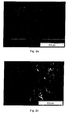
- the morphology of the polyoxadiazole composites was investigated using a LEO 1550VP scanning electron microscope. The samples were previously sputtered with gold in a sputtering device. Scanning electron micrographs show the structure of fluorinated polyoxadiazoles ( Fig. 2a ) and of polyoxadiazole composites produced according to the invention ( Fig. 2b ) recognizable.
- polyphosphoric acid PPA
- CNT carbon nanotubes
- HS 99%, Aldrich
- DPE dicarboxylic diazide-4,4'-diphenyl ether
- the molar dilution ratio (PPA / HS) and the molar monomer rate (HS / DPE) were kept constant at 10 and 1.2, respectively. After a reaction time of 3 hours, the reaction medium was added to water with 5% by weight of sodium hydroxide (99%, vetech) to precipitate the polymer. The pH of this polymer suspension was determined by the known method ( Gomes et al. Polymer 2004, 45, 4997-5004 ) controlled.
- the polyoxadiazole composites which are soluble in the solvents NMP and DMSO, were obtained with a yield of 97%.
- the average molecular weight of the composites was determined by SEC to be 424,000 Da.
- Raman spectra were then recorded from the polymer samples.
- the Raman spectra were recorded on an FT-Raman module RAMII using an Nd: YAG laser excited at 1064 nm.
- Fig. 3a shows the Raman spectrum of carbon nanotubes (CNT) and Fig. 3b the Raman spectrum of polyoxadiazole composites with 10 wt .-% CNT.
- Fig. 3a the D and G bands of the carbon nanotubes at about 1300 cm -1 and 1600 cm -1 , which are both due to defects and modes of graphics, for both the (original) carbon nanotubes ( Fig. 3a ) and for the polyoxadiazole composites ( Fig. 3b ).
- DMSO dimethyl methacrylate
- Fig. 4 a scanning electron micrograph of a dense polyoxadiazole composite film with 1 wt .-% CNT without agglomerates is shown.
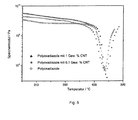
- DMTA Dynamic Mechanical Thermal Analysis
- Fig. 5 the graphs of the DMT analysis of original polyoxadiazole and of polyoxadiazole composites with 0.1 wt% CNT and 1 wt% CNT are shown.
- the diagram in Fig. 5 clearly shows the good stability of the polyoxadiazole composite films of the invention and the high storage modulus for these high concentration polyoxadiazole composites (1 wt% CNT) is about 6 GPa at 150 ° C.
Landscapes
- Chemical & Material Sciences (AREA)
- Chemical Kinetics & Catalysis (AREA)
- Health & Medical Sciences (AREA)
- Organic Chemistry (AREA)
- Polymers & Plastics (AREA)
- Medicinal Chemistry (AREA)
- General Chemical & Material Sciences (AREA)
- Manufacturing & Machinery (AREA)
- Engineering & Computer Science (AREA)
- Electrochemistry (AREA)
- Materials Engineering (AREA)
- Physics & Mathematics (AREA)
- Spectroscopy & Molecular Physics (AREA)
- Macromolecular Compounds Obtained By Forming Nitrogen-Containing Linkages In General (AREA)
- Compositions Of Macromolecular Compounds (AREA)
Abstract
Description
- Die Erfindung betrifft ein Verfahren zum Herstellen von Polyoxadiazol-Kompositen aus Polyoxadiazol-Homopolymeren und/oder -Copolymeren. Darüber hinaus betrifft die Erfindung Polyoxadiazol-Komposite sowie die Verwendung von Polyoxadiazol-Kompositen.
- Polyoxadiazole weisen neben hoher chemischer und thermischer Stabilität hohe Glasübergangstemperaturen auf. Sie können direkt verarbeitet, z.B. zu Fasern versponnen werden, oder es können Beschichtungen aus ihnen hergestellt werden.
- Polyoxadiazole werden in verschiedenen Lösungsmitteln synthetisiert. Ein bekanntes Beispiel ist die Synthese von Oleum, rauchender Schwefelsäure, als Lösungsmittel. Oleum stellt eine sehr toxische und korrosive Syntheseumgebung dar. Nach dem Ende der Synthesereaktion ist eine exzessive Neutralisierung des Mediums erforderlich. Die Synthese von Polyoxadiazol in Oleum ist beispielsweise in
DD 292 919 A5 DE 24 08 426 C2 beschrieben. - Beispielsweise besteht in der Luftfahrtindustrie ein Bedarf an leistungsfähigen Polymeren bzw. Polymerwerkstoffen. Insbesondere haben thermoplastische Polyoxadiazol-Polymere ein großes Potential als Konstruktionswerkstoff aufgrund ihrer mechanischen Eigenschaften. Hierzu wurde in
US-A-5 118 781 vorgeschlagen, durch eine aromatische nucleophile Verdrängungsreaktion von Dihydroxylvinylmonomeren mit aromatischen Dihalogeniten oder aromatischen Dinitroverbindungen Poly(1,3,4-Oxadiazole) zu synthetisieren. Die Polymerisationen wurden in polaren, aprotischen Lösungen wie zum Beispiel Sulfonlane oder Diphynolsulfone unter Verwendung von Alkalimetallbasen wie zum Beispiel Kaliumkarbonat bei erhöhten Temperaturen durchgeführt. - Darüber hinaus wurden Polyoxadiazol-Komposite durch die Hinzufügung von Füllstoffen hergestellt (F.G. Souza et al., Journal of Applied Polymer Science 2004, 93, 1631-1637; M. Loos et al. Proceedings of the Eurofillers, Hungary (Zalakaros), 2007, 119-120; D. Gomes et al., Journal of Membrane Science (2008) doi: 10.1016/j. memsci. 2007.11.041). Überdies wurde in
US 2008/0014440 A1 beschrieben, dass Polyoxadiazole durch die Hinzufügung einer flexiblen Kette von Nicht-Polyoxadiazol-Polymeren in die Polyoxadiazol-Matrix hergestellt werden. - Im Artikel von F.G. Souza et al. (Journal of Applied Polymer Science 2004, 93, 1631-1637) wurden leitfähige Polyoxazoldiazol-Komposite durch Dispergierung von Kohlenschwarzartikeln in Polyoxadiazollösungen in NMP (N-Methyl-2-Pyrrolidon) beschrieben. Da die Füllstoffe nicht funktionalisiert waren, wurden Agglomerate beobachtet. Außerdem haben die Kompositen mit einem höheren Anteil an Kohlenschwarz eine höhere heterogene Morphologie mit irregulären Brüchen gezeigt. Es zeigte sich, dass die Heterogenität starke Auswirkungen auf die Stabilität des Filmes hat.
- Um die Bildung von Agglomeraten zu verhindern, wurde von M. Loos et al. (Proceedings of the Eurofillers, Hungary (Zalakaros), 2007, 119-120) vorgeschlagen, die Füllstoffe zunächst zu funktionalisieren. Hierzu wurden Nanokomposite in zwei Stufen hergestellt. Zunächst wurden Kohlenstoff-Nanoröhrchen (Carbon Nano Tubes (CNT)) in einer Polyphosphorsäure oxidiert. Anschließend wurden die funktionalisierten Kohlenstoff-Nanoröhrchen mit Hydroxyl und Carboxylgruppen zu einer Polyoxadiazolmatrix hinzugefügt, die in einem anderem Reaktionsprozess bzw. Batchprozess synthetisiert wurde.
- Darüber hinaus haben D. Gomes et al., (Journal of Membrane Science (2008) doi: 10.1016/j. memsci. 2007.11.041) beschrieben, dass Polyoxadiazol mit funktionalisierten Siliciumdioxydpartikeln funktionalisiert wurde. Die Kompositen wurden in zwei Stufen hergestellt. Zunächst wurden die Monomere und die Siliciumdioxydpartikel über mehrere Tage, wie von D. Gomes et al. in J. Polym. Sci. Part B: Polym. Phys. 2006, 44, 2278-2298, beschrieben ist, funktionalisiert. Anschließend wurden die funktionalisierten Füllstoffe zu einer Polyoxadiazolmatrix hinzugefügt, die in einem anderen Reaktionsprozess synthetisiert wurde.
- Außerdem haben Baek et al. (in Macromolecules 2004, 37, 8278-8285), S.-J. Oh et al. (in Polymer 2006, 47, 1132-1140) sowie D.H. Wang et al. (in Chem. Mater. 2008, 20, 1502-1515) Polymer(etherketone)-Komposite beschrieben, die über einen in-situ Syntheseprozess von A-B Monomeren in Polyphosphorsäure hergestellt wurden. Hierbei haben Baek et al. (in Macromolecules 2004, 37, 8278-8285) gezeigt, dass die synthetisierten Kompositen eine höhere Löslichkeit in starken Säuren als in gebräuchlichen organischen Lösungen aufwiesen. Von Oh et al. (Polymer 2006, 47, 1132-1140) wurden Komposite vorgestellt, die durch Aufpfropfung von Polyetherketonen auf mehrwandigen Kohlenstoff-Nanoröhrchen durch eine in-situ Polykondensation von A-B Monomeren hergestellt wurden.
- Weiterhin haben Wang et al. (Chem. Mater. 2008, 20, 1502-1515) hyperverzweigte Poly(ether-ketone)-Komposite beschrieben, die eine bessere Löslichkeit, z.B. in aprotischen polaren Lösungsmitteln aufwiesen.
- Ausgehend von diesem Stand der Technik besteht die Aufgabe der vorliegenden Erfindung darin, Polyoxadiazol-Polymere bereitzustellen, die auf einfache Weise herzustellen sind, wobei die Polyoxadiazolpolymere eine Beständigkeit bei hohen Temperaturen aufweisen sollen.
- Gelöst wird diese Aufgabe durch ein Verfahren zum Herstellen von Polyoxadiazol-Kompositen aus Polyoxadiazol-Homopolymeren und/oder -Copolymeren mittels einer, vorzugsweise direkten, Polykondensationsreaktion von A-A (Hydrazin und/oder dessen Derivate) Monomeren und B-B (Dicarboxylsäure und/oder deren Derivate) Monomeren mit einem Füllstoff in Polyphosphorsäure, wobei die folgenden Schritten ausgeführt werden:
- a) der Füllstoff wird in der Polyphosphorsäure durch Erwärmen der Mischung, vorzugsweise unter einer Gasatmosphäre, funktionalisiert,
- b) Hydrazin und/oder dessen Derivate und wenigstens eine Dicarboxylsäure und/oder deren Derivate werden mit der Mischung aus Verfahrensschritt a) zu einer Lösung gemischt,
- c) die Lösung aus Verfahrensschritt b) wird, vorzugsweise unter einer inerten Atmosphäre, erhitzt und
- d) die Polyoxadiazol-Kompositen werden in einer Lösung ausgefällt und insbesondere neutralisiert.
- Durch die erfindungsgemäßen Polyoxadiazol-Kompositen werden Polyoxadiazol-Polymere in einer einstufigen, in-situ Polykondensationsreaktion hergestellt, wobei die Polyoxadiazol-Polymere verbesserte mechanische Eigenschaften aufweisen. Es werden hierbei Komposite hergestellt, die anschließend in leitfähige, thermisch und chemisch stabile Membranen eingebaut werden.
- Das Erhitzen der Polyphosphorsäure bzw. der Mischung im Verfahrensschritt a) erfolgt vorteilhafterweise-unter einer Gasatmosphäre, insbesondere einer Atmosphäre aus Stickstoff und/oder Argon mit oder ohne Wasseranteilen.
- Darüber hinaus können aus den Polyoxadiazol-Kompositen Fasern oder Filme hergestellt werden, die für Trennprozesse bzw. Membrantrennprozesse eingesetzt werden. Außerdem können die erfindungsgemäß hergestellten Polyoxadiazol-Kompositen als Verstärkungsmittel, für die Herstellung von Sensoren, Elektroden oder für Beschichtungen und Leichtbau-Konstruktionswerkstoffe eingesetzt werden.
- Die Herstellung der Polyoxadiazol-Komposite erfolgt mittels eines schnellen in-situ Syntheseprozesses, wobei die hergestellten Polyoxadiazole ein hohes (mittleres) Molekulargewicht zwischen 200.000 bis 424.000 Da aufwiesen. Hierbei sind die Polyoxadiazole in organischen Lösungsmitteln lösbar, die anschließend als Dichtefilme ohne Füllstoffagglomeration sehr gute thermische und mechanische Eigenschaften haben. Beispielsweise weisen die erzeugten Polyoxadiazol-Polymere bzw. -Komposite einen hohen Elastizitätsmodul bzw. Speichermodul von bis zu 6 GPa bei 150°C auf.
- Dadurch, dass die Füllstoffe mit den Polyoxadiazol-Ketten funktionalisiert werden, ergibt sich eine bessere Dispersion der Füllstoffe in der Polyoxadiazol-Matrix, da die Füllstoffe mit den Polyoxadiazol-Ketten funktionalisiert werden. Außerdem zeichnet sich das Verfahren durch eine kurze bzw. kürzere Verfahrensdauer aus, da die Funktionalisierung der Füllstoffe und die Synthese der Polyoxadiazole in einem Reaktionsprozess bzw. Batch-Prozess erfolgen. Mit dem Begriff Dicarbonxylsäure(n) werden synonym Dicarbonsäure(n) bezeichnet.
- Bevorzugterweise wird die Erwärmung der Mischung im Verfahrensschritt a) bei einer Temperatur zwischen 25°C bis 200°C, vorzugsweise bis 180°C, insbesondere zwischen 160°C und 180°C, ausgeführt. Hierbei wird der Füllstoff der Mischung in der Polyphosphorsäure funktionalisiert.
- Bevorzugterweise wird überdies die Erhitzung der Lösung im Verfahrensschritt c) bei einer Temperatur zwischen 100°C bis 200°C, vorzugsweise bis 180°C, insbesondere zwischen 160°C und 180°C, ausgeführt. Außerdem wird die Erhitzung der Lösung im Verfahrensschritt c) für eine Zeitdauer von bis zu 48 Stunden, vorzugsweise von 3 Stunden bis 48 Stunden, insbesondere von 3 bis 16 Stunden, ausgeführt. Hierdurch ergibt sich eine schnelle Verfahrensdauer für die Herstellung von Polyoxadiazol-Polymeren bzw. -Kompositen.
- In einer bevorzugten Ausgestaltung ist außerdem vorgesehen, dass im Verfahrensschritt b) Hydrazin in Form von Hydrazin-Salz, insbesondere Hydrazin-Sulfatsalz, zugemischt wird.
- Darüber hinaus ist es günstig, wenn im Verfahrensschritt b) Dicarboxylsäure in Form von Dicarboxylsäuren mit zwei Carboxylsäuregruppen, vorzugsweise aromatische und/oder heteroaromatische Dicarboxylsäuren, und/oder deren Derivate zugemischt werden.
- Im Rahmen der Erfindung ist es möglich, dass Dicarboxylsäure auch in Form von Dicarboxylsäurediesther oder Dicarboxylsäure/Dicarboxylsäurediesthermischungen im Verfahrensschritt b) zugegeben werden.
- Bevorzugterweise besteht der Füllstoff aus Kohlenstoff-Nanoröhrchen (Carbon Nano Tubes (CNT)) und/oder molekularsiebendem Kohlenstoff und/oder Graphit und/oder pyrolisierten Polymerpartikeln und/oder anorganischen Partikeln und/oder Siliciumdioxid (Kieselerde) und/oder Aluminiumoxid (Tonerde) und/oder Titan und/oder Montmorillonit und/oder Silicaten und/oder Fullerenen und/oder Zeolith und/oder Aluminiumoxid und/oder Zinkoxid und/oder Polymerfasern und/oder Glasfasern.
- Außerdem enthält die Mischung, insbesondere in Verfahrensschritt a) zusätzlich Hilfsmittel, Vernetzungsmittel, Weichmacher, Treibmittel, Schmiermittel, Surfactanten, Texturanten, Farbmittel, Pigmente, Glimmer, Flammhemmer, Stabilisatoren, Verstärkungsfasern, Haftförderer und/oder Mischungen davon. Hierdurch werden entsprechend die hergestellten Polyoxadiazol-Kompositen entsprechend den Anforderungen bei einer vorgesehenen Verwendung, z.B. in Bauteilen oder in Vorrichtungen, konfektioniert.
- Bei dem erfindungsgemäßen Verfahren weist das Polyoxadiazol ein Polymer mit wenigstens einem konjugierten Ring mit zwei Stickstoffatomen und einem Sauerstoffatom auf, wobei insbesondere das Polymer eine Wiederholungseinheit der Struktur


- Darüber hinaus ist in einer Ausgestaltung vorgesehen, dass das Polyoxadiazol-Gemisch mit den Kompositen, insbesondere gemäß Verfahrensschritt c), in einem Lösemittel gelöst wird, wobei insbesondere in einem weiteren Verfahrensschritt hieraus ein Film oder eine Faser gegossen oder gebildet wird.
- Außerdem werden in einem bevorzugten Verfahrensschritt die Polyoxadiazol-Kompositen in einer Lösung gelöst und unter Verwendung eines Kalanders, vorzugsweise mit drei Rollen, und/oder eines Mischers, vor dem Gießen zu einem Film oder Bilden einer Faser bearbeitet.
- Vorzugsweise werden die Polyoxadiazol-Kompositen vor dem Gießen zu einem Film oder dem Bilden einer Faser geschmolzen werden.
- Überdies wird die Aufgabe durch Polyoxadiazol-Komposite gelöst, die durch Ausführung der genannten Verfahrensschritte erhältlich sind. Zur Vermeidung von Wiederholungen wird auf die obigen Ausführungen ausdrücklich verwiesen. Darüber hinaus zeichnen sich die Polyoxadiazol-Kompositen dadurch aus, dass die Kompositen eine Zugfestigkeit bis zu 6 GPa, vorzugsweise bei 150 °C, aufweisen.
- Bevorzugterweise weisen die Polyoxadiazol-Kompositen ein Molekulargewicht von wenigstens 200.000 Dalton auf. Bei erfindungsgemäß hergestellten Polyoxadiazol-Kompositen wurden mittlere Molekulargewichte von wenigstens 200.000 Dalton (Da) bis 424.000 Dalton (Da) gemessen.
- Weiterhin wird die Aufgabe gelöst durch eine Verwendung von Polyoxadiazol-Kompositen, die gemäß dem voranstehend beschriebenen Verfahren hergestellt werden, zur Herstellung einer Membran oder einer Faser oder eines Films oder als Verstärkungsmittel oder zur Herstellung von Sensoren oder Elektroden oder als Beschichtung und Leichtbau-Konstruktionswerkstoff.
- Die Erfindung wird nachstehend ohne Beschränkung des allgemeinen Erfindungsgedankens anhand von Ausführungsbeispielen unter Bezugnahme auf die Zeichnungen beschrieben, wobei bezüglich aller im Text nicht näher erläuterten erfindungsgemäßen Einzelheiten ausdrücklich auf die Zeichnungen verwiesen wird. Es zeigen:
- Fig. 1
- ein Diagramm mit Darstellungen des durchschnittlichen molekularen Gewichts von fluoriertem Polyoxadiazol- Kompositen als Funktion der Reaktionszeit;
- Fig. 2a
- eine Rasterelektronenmikroskopaufnahme von urs- prünglichen fluorierten Polyoxadiazolen,
- Fig. 2b
- eine Rasterelektronenmikroskopaufnahme von erfin- dungsgemäßen fluorierten Polyoxadiazol-Kompositen,
- Fig. 3a
- ein Ramanspektrum von Kohlenstoff-Nanoröhrchen (CNT),
- Fig. 3b
- ein Ramanspektrum von erfindungsgemäßen Polyoxa- diazol-Kompositen mit 10 Gew.-% ,
- Fig. 4
- eine Rasterelektronenmikroskopaufnahme eines Polyo- xadiazol-Kompositfilms mit einem Gew.-% Kohlenstoff- Nanoröhrchen (CNT) und
- Fig.5
- ein Diagramm einer dynamisch-mechanisch-ther- mischen Analyse (DMTA (Dynamic Mechanical Thermal Analysis)) von Polyoxadiazol-Kompositfilmen.
- Zunächst wird Polyphosphorsäure (PPA) in einen Kolben gegeben und auf 60°C unter einer trockenen Stickstoffatmosphäre erhitzt. Anschließend werden Kohlenstoff-Nanoröhrchen (Carbon Nano Tubes (CNT)) zu der Polyphosphorsäure hinzugefügt und durch Umrühren und Aufheizen auf 160°C homogenisiert. Nach 3 Stunden der Funktionalisierung der Kohlenstoff-Nanoröhrchen wird Hydrazinsulfatsalz (HS, > 99%, Aldrich) zu der Mischung hinzugefügt. Nach Auflösung des Hydrazinsulfatsalzes wird 4,4'-Dicarboxylphenyl-Hexafluoropropan (HF, 99%, Aldrich), hinzugegeben.
- Die molare Verdünnungsrate (PPA/HS) und die molare Monomerrate (HS/HF) wurden konstant gehalten und entsprachen 10 bzw. 1,2.
- Nach einer Reaktionszeit von 3 bis 48 Stunden wurde das Rekationsmedium in Wasser mit 5 Gew.-% von Natriumhydroxyd (99%, Vetech) zur Ausfällung des Polymers gegeben. Hierbei wurde der pH-Wert der Polymersuspension, wie in der Literatur beschrieben (Gomes et al., Polymer 2004, 45, 4997-5004), kontrolliert.
- Die mit einer Ausbeute von 97 % erhaltenen Polyoxadiazol-Kompositen sind in den Lösungen NMP (N-Methyl-2-Pyrrolidon) und DMSO (Dimethylsulfoxid) löslich. Das durchschnittliche molekulare Gewicht der Kompositen wurde mittels Größenausschlusschromotographie (Size Exclusion Chromotograhy (SEC)) im Bereich von 200.000 bis 280.000 Da bei einer Ausbeute von 97 bis 99 % ermittelt. Hierzu wurde ein Chromatograph von Viscotek mit Eurogel-Trennsäulen SEC 10.000 und PSS Gram 100, 1000 mit den Seriennummern HC286 und 1515161 und einer Größe von 8 x 300 mm eingesetzt, um das durchschnittliche molekulare Gewicht der Polymerproben zu ermitteln.
- Die Vorrichtung wurde unter Verwendung von Polystyrenstandards (Merck) mit einem durchschnittlichen molekularen Gewicht zwischen 309 bis 944.000 g/Mol. kalibriert. Eine Lösung mit 0,05 M Lithiumbromid in DMAc (Dimethylacetamid) wurde als Träger verwendet. Lösungen mit 0,5 Gew.-% der Polyoxadiazol-Kompositen wurden vorbereitet gefiltert (0,2 µm) und in den Chromatographen injiziert.
- Wie aus
Fig. 1 ersichtlich, wurde bereits nach einer Reaktionszeit von 3 Stunden ein hohes molekulares Gewicht erzielt. - Die Morphologie der Polyoxadiazol-Kompositen wurde mit einem Rasterelektronenmikroskops des Typs LEO 1550VP untersucht. Die Proben wurden vorher mit Gold in einer Sputter-Einrichtung beschichtet bzw. gesputtert. In den Rasterelektronenmikroskopaufnahmen ist die Struktur von fluorierten Polyoxadiazolen (
Fig. 2a ) und von erfindungsgemäß hergestellten Polyoxadiazol-Kompositen (Fig. 2b ) erkennbar. - Aus den beiden Aufnahmen ist erkennbar, dass die ursprüngliche Struktur des hochhydrophoben, fluorierenden Polyoxadiazol (
Fig. 2a ) abgenommen hatte bzw. verlorenging als Ergebnis des Aufpfropfens der Polymere auf die Oberfläche der Kohlenstoff-Nanoröhrchen (CNT). - Zunächst wurde Polyphosphorsäure (PPA) in einen Kolben gegeben und auf 60°C unter einer trockenen Stickstoffatmosphäre erhitzt. Anschließend wurden die Kohlenstoff-Nanoröhrchen (CNT) in die Polyphosphorsäure hinzugegeben und durch Rühren und Aufheizen auf 160°C homogenisiert. Nach einer Stunde der Funktionalisierung der Kohlenstoff-Nanoröhrchen wurde Hydrazinsulfatsalz HS (>99%, Aldrich) zu der Mischung hinzugegeben. Anschließend wurde nach Auflösung des Hydrazinsulfatsalzes Dicarboxyldiazid-4,4'-Diphenylether (DPE, 99%, Aldrich) hinzugefügt.
- Das molare Verdünnungsverhältnis (PPA/HS) und die molare Monomerrate (HS/DPE) wurden bei 10 bzw. 1,2 konstant gehalten. Nach einer Reaktionszeit von 3 Stunden wurde das Reaktionsmedium in Wasser mit 5 Gew.-% Natriumhydroxid (99%, Vetech) gegeben, um das Polymer auszufällen. Der pH-Wert dieser Polymersuspension wurde nach dem bekannten Verfahren (Gomes et al. Polymer 2004, 45, 4997-5004) kontrolliert.
- Die Polyoxadiazol-Kompositen, die löslich in den Lösungsmitteln NMP und DMSO sind, wurden mit einer Ausbeute von 97 % erhalten. Das durchschnittliche molekulare Gewicht der Komposite wurde durch SEC auf 424.000 Da bestimmt.
- Von den Polymerproben wurden anschließend Ramanspektren aufgenommen. Hierbei wurden die Ramanspektren auf einem FT-Raman Modul RAMII unter Verwendung eines Nd:YAG-Lasers, der bei 1.064 nm angeregt wurde, aufgezeichnet.
-
Fig. 3a zeigt das Ramanspektrum von Kohlenstoff-Nanoröhrchen (CNT) undFig. 3b das Ramanspektrum von Polyoxadiazol-Kompositen mit 10 Gew.-% CNT. - Wie aus
Fig. 3a ersichtlich, wurden die D- und G-Bänder von den Kohlenstoff-Nanoröhrchen bei ca. 1.300 cm-1 und 1.600 cm-1, die jeweils auf Defekte und Moden von Graphik zurückzuführen sind, sowohl für die (ursprünglichen) Kohlenstoff-Nanoröhrchen (Fig. 3a ) und für die Polyoxadiazol-Komposite (Fig. 3b ) beobachtet. - Nach der Funktionalisierung der Kohlenstoff-Nanoröhrchen mit Polyoxadiazol (
Fig. 3b ) wurden Banden bei 1613 cm-1, 1506 cm-1, 1290 cm-1, 1168 cm-1 und 997 cm-1 beobachtet, die auf die aromatischen Gruppen in den Hauptketten des Polyoxadiazols zurückzuführen sind. Ein Band bei 1497 cm-1 wurde aufgrund des Oxadiazolrings ebenfalls beobachtet. Darüber hinaus tauchten die Bänder 2. Ordnung G' und D' für die Kohlenstoff-Nanoröhrchen bei 2940 cm-1 bzw. bei 2760 cm-1 (Fig. 3b ) auf. - Homogene Filme wurden aus den Polyoxadiazol-Kompositlösungen mit einer Konzentration von 4 Gew.-% in DMSO gegossen. Nach dem Gießen wurde DMSO in einem Vakuumofen bei 60°C für eine Zeitdauer von 24 Stunden verdampft. Zur Entfernung von Restrückständen am Lösungsmittel wurden die Filme in ein Wasserbad bei 50°C für 48 Stunden eingetaucht und anschließend in einem Vakuumofen bei 60°C 24 Stunden lang getrocknet. Die endgültige Dicke der Filme betrug ungefähr 70 µm.
- In
Fig. 4 ist eine Rasterelektronenmikroskopaufnahme eines dichten Polyoxadiazol-Kompositfilms mit 1 Gew.-% CNT ohne Agglomerate gezeigt. - Die dynamische mechanische thermische Analyse (DMTA) wurde zur Bestimmung des Speichermoduls eingesetzt. Die DMT-Analyse wurde unter Verwendung eines TA-Instruments RSA II mit einem Filmspannungsmode bei einer Frequenz von 1 Hz und einer anfänglichen statischen Kraft von 0,1 N ausgeführt. Die Temperatur wurde von 150°C auf 500°C mit einer Heizrate von 2° / min und einer konstanten Spannung von 0,05 % geändert.
- In
Fig. 5 sind die Schaubilder der DMT Analyse von ursprünglichem Polyoxadiazol sowie von Polyoxadiazol-Kompositen mit 0,1 Gew.-% CNT und 1 Gew.-% CNT dargestellt. Das Schaubild inFig. 5 zeigt deutlich die gute Stabilität der erfindungsgemäßen Polyoxadiazol-Kompositfilme und der hohe Speichermodul für diese Polyoxadiazol-Komposite mit einer hohen Konzentration (1 Gew.-% CNT) beträgt ungefähr 6 GPa bei 150°C.
Claims (15)
- Verfahren zum Herstellen von Polyoxadiazol-Kompositen aus Polyoxadiazol-Homopolymeren und/oder -Copolymeren mittels einer, vorzugsweise direkten, Polykondensationsreaktion von A-A (Hydrazin und/oder dessen Derivate) Monomeren und B-B (Dicarboxylsäure und/oder deren Derivate) Monomeren mit einem Füllstoff in Polyphosphorsäure mit den folgenden Schritten:a) der Füllstoff wird in der Polyphosphorsäure durch Erwärmen der Mischung, vorzugsweise unter einer Gasatmosphäre, funktionalisiert,b) Hydrazin und/oder dessen Derivate und wenigstens eine Dicarboxylsäure und/oder deren Derivate werden mit der Mischung aus Verfahrensschritt a) zu einer Lösung gemischt,c) die Lösung aus Verfahrensschritt b) wird, vorzugsweise unter einer inerten Atmosphäre, erhitzt undd) die Polyoxadiazol-Kompositen werden in einer Lösung ausgefällt und insbesondere neutralisiert.
- Verfahren nach Anspruch 1, dadurch gekennzeichnet, dass die Erwärmung der Mischung im Verfahrensschritt a) bei einer Temperatur zwischen 25°C bis 200°C, vorzugsweise bis 180°C, insbesondere zwischen 160°C und 180°C, ausgeführt wird.
- Verfahren nach Anspruch 1 oder 2, dadurch gekennzeichnet, dass die Erhitzung der Lösung im Verfahrensschritt c) bei einer Temperatur zwischen 100°C bis 200°C, vorzugsweise bis 180°C, insbesondere zwischen 160°C und 180°C, ausgeführt wird.
- Verfahren nach einem der Ansprüche 1 bis 3, dadurch gekennzeichnet, dass die Erhitzung der Lösung im Verfahrensschritt c) für eine Zeitdauer von bis zu 48 Stunden, vorzugsweise von 3 Stunden bis 48 Stunden, insbesondere von 3 bis 16 Stunden, ausgeführt wird.
- Verfahren nach einem der Ansprüche 1 bis 4, dadurch gekennzeichnet, dass im Verfahrensschritt b) Hydrazin in Form von Hydrazin-Salz, insbesondere Hydrazin-Sulfatsalz, zugemischt wird.
- Verfahren nach einem der Ansprüche 1 bis 5, dadurch gekennzeichnet, dass im Verfahrensschritt b) Dicarboxylsäure in Form von Dicarboxylsäuren mit zwei Carboxylsäuregruppen, vorzugszugsweise aromatische und/oder heteroaromatische Dicarboxylsäuren, und/oder deren Derivate zugemischt werden.
- Verfahren nach einem der Ansprüche 1 bis 6, dadurch gekennzeichnet, dass der Füllstoff aus Kohlenstoff-Nanoröhrchen (CNT) und/oder molekularsiebendem Kohlenstoff und/oder Graphit und/oder pyrolisierten Polymerpartikeln und/oder anorganischen Partikeln und/oder Silicium und/oder Aluminium und/oder Titan und/oder Montmorillonit und/oder Silicaten und/oder Fullerenen und/oder Zeolith und/oder Aluminiumoxid und/oder Zinkoxid und/oder Polymerfasern und/oder Glasfasern besteht.
- Verfahren nach einem der Ansprüche 1 bis 7, dadurch gekennzeichnet, dass die Mischung zusätzlich Hilfsmittel, Vernetzungsmittel, Weichmacher, Treibmittel, Schmiermittel, Surfactanten, Texturanten, Farbmittel, Pigmente, Glimmer, Flammhemmer, Stabilisatoren, Verstärkungsfasern, Haftförderer und/oder Mischungen davon enthält.
- Verfahren nach einem der Ansprüche 1 bis 8, dadurch gekennzeichnet, dass das Polyoxadiazol ein Polymer mit wenigstens einem konjugierten Ring mit zwei Stickstoffatomen und einem Sauerstoffatom aufweist, wobei insbesondere das Polymer eine Wiederholungseinheit der Struktur


- Verfahren nach einem der Ansprüche 1 bis 9, dadurch gekennzeichnet, dass das Polyoxadiazol-Gemisch in einem Lösemittel gelöst wird, wobei insbesondere in einem weiteren Verfahrensschritt ein Film oder eine Faser gegossen oder gebildet wird.
- Verfahren nach einem der Ansprüche 1 bis 10, dadurch gekennzeichnet, dass die Polyoxadiazol-Kompositen in einer Lösung gelöst werden und unter Verwendung eines Kalanders, vorzugsweise mit drei Rollen, und/oder eines Mischers, vor dem Gießen zu einem Film oder Bilden einer Faser bearbeitet werden.
- Verfahren nach einem der Ansprüche 1 bis 11, dadurch gekennzeichnet, dass die Polyoxadiazol-Kompositen vor dem Gießen zu einem Film oder dem Bilden einer Faser geschmolzen werden.
- Polyoxadiazol-Komposite, erhältlich durch Ausführung der Verfahrensschritte gemäß den Ansprüchen 1 bis 12.
- Polyoxadiazol-Komposite nach Anspruch 13, dadurch gekennzeichnet, dass die Zusammensetzung eine Zugfestigkeit bis zu 6 GPa, vorzugsweise bei 150°C, aufweist und/oder dass die Komposite ein Molekulargewicht von wenigstens 200.000 Dalton (Da) aufweist.
- Verwendung von Polyoxadiazol-Kompositen, die nach einem der Ansprüche 1 bis 12 hergestellt werden, zur Herstellung einer Membran oder einer Faser oder eines Films oder als Verstärkungsmittel oder zur Herstellung von Sensoren oder Elektroden oder als Beschichtung und Leichtbau-Konstruktionswerkstoff.
Applications Claiming Priority (1)
| Application Number | Priority Date | Filing Date | Title |
|---|---|---|---|
| DE102008027499A DE102008027499A1 (de) | 2008-06-10 | 2008-06-10 | Herstellung von Kompositen aus Polyoxadiazol-Polymeren |
Publications (2)
| Publication Number | Publication Date |
|---|---|
| EP2133385A2 true EP2133385A2 (de) | 2009-12-16 |
| EP2133385A3 EP2133385A3 (de) | 2009-12-23 |
Family
ID=41057243
Family Applications (1)
| Application Number | Title | Priority Date | Filing Date |
|---|---|---|---|
| EP09005473A Withdrawn EP2133385A3 (de) | 2008-06-10 | 2009-04-17 | Herstellung von Komositen aus Polyxadiazol-Polymeren |
Country Status (7)
| Country | Link |
|---|---|
| US (1) | US20090306265A1 (de) |
| EP (1) | EP2133385A3 (de) |
| JP (1) | JP2009299061A (de) |
| KR (1) | KR20090128319A (de) |
| CN (1) | CN101602855A (de) |
| CA (1) | CA2663313A1 (de) |
| DE (1) | DE102008027499A1 (de) |
Families Citing this family (4)
| Publication number | Priority date | Publication date | Assignee | Title |
|---|---|---|---|---|
| EP2676987A1 (de) * | 2012-06-21 | 2013-12-25 | Universidad De Burgos | Vernetztes Aramid |
| US10366419B2 (en) | 2012-11-27 | 2019-07-30 | Roland Storti | Enhanced digital media platform with user control of application data thereon |
| CN105062067B (zh) * | 2015-08-10 | 2017-07-07 | 江苏展宝新材料有限公司 | 一种高导热芳香族聚噁二唑沉析纤维云母绝缘材料及其制备方法和应用 |
| DE112018005383T5 (de) | 2017-09-22 | 2020-06-18 | Sony Corporation | Anzeigeelement, anzeigevorrichtung und elektronische vorrichtung |
Citations (4)
| Publication number | Priority date | Publication date | Assignee | Title |
|---|---|---|---|---|
| DE2408426C2 (de) | 1974-02-21 | 1981-12-03 | Vsesojuznyj naučno-issledovatel'skij i proektnyj institut monomerov, Tula | Verfahren zur Herstellung von Polyarylen-1,3,4-Oxadiazolen und deren Verwendung |
| DD292919A5 (de) | 1990-03-19 | 1991-08-14 | Inst. F. Polymerenchemie "Erich Correns" Der Adw,De | Verfahren zur herstellung von aromatischen polyoxadiazolen |
| US5118781A (en) | 1991-01-22 | 1992-06-02 | Administrator Of The National Aeronautics And Space Administration | Poly(1,3,4-oxadiozoles) via aromatic nucleophilic displacement |
| US20080014440A1 (en) | 2006-07-13 | 2008-01-17 | Kiu-Seung Lee | Polyoxadiazole composite fibers |
Family Cites Families (10)
| Publication number | Priority date | Publication date | Assignee | Title |
|---|---|---|---|---|
| US3644297A (en) * | 1968-01-22 | 1972-02-22 | Furukawa Electric Co Ltd | Novel high temperature resistant resin having n-alkylhydrazide units and a method of producing thereof |
| US4054633A (en) * | 1976-05-13 | 1977-10-18 | Monsanto Company | Process for continuously preparing shaped articles of aromatic oxadiazole or aromatic oxadiazole/N-alkylhydrazide polymers from monomer solutions |
| US4500701A (en) * | 1982-09-27 | 1985-02-19 | Standard Oil Company (Indiana) | Co-polyoxadiazoles based on 5-t-butylisosphthalic acid |
| US4505843A (en) * | 1982-11-17 | 1985-03-19 | Chevron Research Company | Heterodiazole electroactive polymers |
| US4599399A (en) * | 1984-10-25 | 1986-07-08 | Chevron Research Company | Process for the preparation of poly[3,6-N-substituted carbazole-1,3,4-oxadiazole-2,5-diyl] from N-substituted carbazole-3,6-dicarboxylic acid |
| JP2005023154A (ja) * | 2003-06-30 | 2005-01-27 | Hirose Engineering Co Ltd | 青色発光ポリマー、その製造方法およびそれを利用した発光素子 |
| US7309727B2 (en) * | 2003-09-29 | 2007-12-18 | General Electric Company | Conductive thermoplastic compositions, methods of manufacture and articles derived from such compositions |
| DE102007005666A1 (de) * | 2007-01-31 | 2008-08-14 | Gkss-Forschungszentrum Geesthacht Gmbh | Herstellung eines funktionalisierten Polytriazol-Polymers |
| DE102007029542A1 (de) * | 2007-06-25 | 2009-01-02 | Gkss-Forschungszentrum Geesthacht Gmbh | Verfahren zur Herstellung eines sulfonierten Poly (1,3,4-oxadiazol)-Polymers |
| DE102008009068A1 (de) * | 2008-02-13 | 2009-08-27 | Gkss-Forschungszentrum Geesthacht Gmbh | Verfahren zur Herstellung eines Polyoxadiazol-Polymers |
-
2008
- 2008-06-10 DE DE102008027499A patent/DE102008027499A1/de not_active Withdrawn
-
2009
- 2009-04-17 EP EP09005473A patent/EP2133385A3/de not_active Withdrawn
- 2009-04-20 CA CA002663313A patent/CA2663313A1/en not_active Abandoned
- 2009-05-08 KR KR1020090040462A patent/KR20090128319A/ko not_active Withdrawn
- 2009-06-02 JP JP2009133377A patent/JP2009299061A/ja active Pending
- 2009-06-05 CN CNA2009101464587A patent/CN101602855A/zh active Pending
- 2009-06-08 US US12/480,095 patent/US20090306265A1/en not_active Abandoned
Patent Citations (4)
| Publication number | Priority date | Publication date | Assignee | Title |
|---|---|---|---|---|
| DE2408426C2 (de) | 1974-02-21 | 1981-12-03 | Vsesojuznyj naučno-issledovatel'skij i proektnyj institut monomerov, Tula | Verfahren zur Herstellung von Polyarylen-1,3,4-Oxadiazolen und deren Verwendung |
| DD292919A5 (de) | 1990-03-19 | 1991-08-14 | Inst. F. Polymerenchemie "Erich Correns" Der Adw,De | Verfahren zur herstellung von aromatischen polyoxadiazolen |
| US5118781A (en) | 1991-01-22 | 1992-06-02 | Administrator Of The National Aeronautics And Space Administration | Poly(1,3,4-oxadiozoles) via aromatic nucleophilic displacement |
| US20080014440A1 (en) | 2006-07-13 | 2008-01-17 | Kiu-Seung Lee | Polyoxadiazole composite fibers |
Non-Patent Citations (9)
| Title |
|---|
| BAEK ET AL., MACROMOLECULES, vol. 37, 2004, pages 8278 - 8285 |
| D. GOMES ET AL., J. POLYM. SCI. PART B: POLYM. PHYS., vol. 44, 2006, pages 2278 - 2298 |
| D. GOMES ET AL., JOURNAL OF MEMBRANE SCIENCE, 2008 |
| F.G. SOUZA ET AL., JOURNAL OF APPLIED POLYMER SCIENCE, vol. 93, 2004, pages 1631 - 1637 |
| GOMES ET AL., POLYMER, vol. 45, 2004, pages 4997 - 5004 |
| M. LOOS ET AL., PROCEEDINGS OF THE EUROFILLERS, 2007, pages 119 - 120 |
| S.-J. OH ET AL., POLYMER, vol. 47, 2006, pages 1132 - 1140 |
| VON OH ET AL., POLYMER, vol. 47, 2006, pages 1132 - 1140 |
| WANG ET AL., CHEM. MATER., vol. 20, 2008, pages 1502 - 1515 |
Also Published As
| Publication number | Publication date |
|---|---|
| JP2009299061A (ja) | 2009-12-24 |
| EP2133385A3 (de) | 2009-12-23 |
| CN101602855A (zh) | 2009-12-16 |
| KR20090128319A (ko) | 2009-12-15 |
| DE102008027499A1 (de) | 2009-12-17 |
| US20090306265A1 (en) | 2009-12-10 |
| CA2663313A1 (en) | 2009-12-10 |
Similar Documents
| Publication | Publication Date | Title |
|---|---|---|
| EP2266786B1 (de) | Herstellung von Verbundwerkstoffen aus Nanokompositen | |
| DE69802403T2 (de) | Oxidationsbeständige starre aromatische polyimidzusammensetzungen und verfahren zu ihrer herstellung | |
| JP2004538353A (ja) | 伝導性高分子ナノ複合材料を形成する方法及びそれによって製造された材料 | |
| EP1461390A1 (de) | Aus einwandigen kohlenstoffnanoröhren und aromatischem polyamid zusammengesetztes material und verfahren zum herstellen dieses materials | |
| DE10129458A1 (de) | Verbesserte Polymerfolien auf Basis von Polyazolen | |
| WO2018019730A1 (de) | Polyamidblends enthaltend einen polyarylether für lasersinterpulver | |
| DE2635895A1 (de) | Verfahren zur isolierung von polymeren | |
| EP2133385A2 (de) | Herstellung von Komositen aus Polyxadiazol-Polymeren | |
| EP2390281A1 (de) | Verstärkte thermoplastische Formmassen auf Basis von Polyarylenethern | |
| KR100217963B1 (ko) | 도전성 셀룰로오즈 마이크로피브릴 및 이를 혼입한 복합재료 | |
| DE2932589C3 (de) | Polyimidharzmasse sowie Verwendung derselben | |
| EP2236542A1 (de) | Herstellung von Polyazol-Kompositen | |
| Wang et al. | Functionalization of multiwalled carbon nanotubes by amidation and Michael addition reactions and the effect of the functional chains on the properties of waterborne polyurethane composites | |
| DE3024781C2 (de) | Polymerisatmischung und ihre Verwendung zur Herstellung einer Polymerisatlösung in einem dipolaren aprotischen Lösungsmittel | |
| EP0829505A1 (de) | Lösliche Polyarylensulfoxide, ein Verfahren zu deren Herstellung und deren Verwendung | |
| KR101973252B1 (ko) | 열 가역적 자가치유 특성을 갖는 초분자 네트워크 탄소나노튜브 복합체 및 이의 제조 방법 | |
| DE69206670T2 (de) | Mischungen aus Polybenzimidazolen und aromatischen Polyamiden, aromatischen Polyamidhydraziden oder heterocyclische Bindungen enthaltenden aromatischen Polyamiden | |
| Li et al. | Mechanical reinforcement of PBO fibers by dicarboxylic acid functionalized carbon nanotubes through in situ copolymerization | |
| EP1044999B1 (de) | Verfahren zur Oxidation von Polyarylensulfid zu Polyarylensulfoxid mittels Salpetersäure | |
| DE69229694T2 (de) | Verbundwerkstoff | |
| d'Arlas et al. | Surface modification of multiwalled carbon nanotubes via esterification using a biodegradable polyol | |
| DE69123906T2 (de) | Verfahren zur Herstellung eines molekularen Verbundmaterials | |
| US20220098392A1 (en) | Method for producing a modifier for preparing a composite material based on a thermoplastic polymer | |
| DE69431649T2 (de) | Verfahren zur Herstellung von molekularen Verbundmaterialien, die ein steifes aromatisches Polymer enthalten | |
| EP2241585A1 (de) | Polyoxadiazol-Polymere |
Legal Events
| Date | Code | Title | Description |
|---|---|---|---|
| PUAI | Public reference made under article 153(3) epc to a published international application that has entered the european phase |
Free format text: ORIGINAL CODE: 0009012 |
|
| PUAL | Search report despatched |
Free format text: ORIGINAL CODE: 0009013 |
|
| AK | Designated contracting states |
Kind code of ref document: A2 Designated state(s): AT BE BG CH CY CZ DE DK EE ES FI FR GB GR HR HU IE IS IT LI LT LU LV MC MK MT NL NO PL PT RO SE SI SK TR |
|
| AK | Designated contracting states |
Kind code of ref document: A3 Designated state(s): AT BE BG CH CY CZ DE DK EE ES FI FR GB GR HR HU IE IS IT LI LT LU LV MC MK MT NL NO PL PT RO SE SI SK TR |
|
| RIC1 | Information provided on ipc code assigned before grant |
Ipc: H01M 8/10 20060101ALI20091116BHEP Ipc: H01B 1/12 20060101ALI20091116BHEP Ipc: H01L 51/00 20060101ALI20091116BHEP Ipc: C08G 73/00 20060101ALI20091116BHEP Ipc: C08G 73/08 20060101AFI20090915BHEP |
|
| 17P | Request for examination filed |
Effective date: 20100409 |
|
| 17Q | First examination report despatched |
Effective date: 20100507 |
|
| RAP1 | Party data changed (applicant data changed or rights of an application transferred) |
Owner name: HELMHOLTZ-ZENTRUM GEESTHACHT ZENTRUM FUER MATERIAL |
|
| STAA | Information on the status of an ep patent application or granted ep patent |
Free format text: STATUS: THE APPLICATION IS DEEMED TO BE WITHDRAWN |
|
| 18D | Application deemed to be withdrawn |
Effective date: 20121101 |