EP2122169B1 - Fluidarbeitsmaschine - Google Patents
Fluidarbeitsmaschine Download PDFInfo
- Publication number
- EP2122169B1 EP2122169B1 EP07856620.5A EP07856620A EP2122169B1 EP 2122169 B1 EP2122169 B1 EP 2122169B1 EP 07856620 A EP07856620 A EP 07856620A EP 2122169 B1 EP2122169 B1 EP 2122169B1
- Authority
- EP
- European Patent Office
- Prior art keywords
- fluid
- working machine
- rotor
- linear motor
- piston
- Prior art date
- Legal status (The legal status is an assumption and is not a legal conclusion. Google has not performed a legal analysis and makes no representation as to the accuracy of the status listed.)
- Active
Links
Images

Classifications
-
- F—MECHANICAL ENGINEERING; LIGHTING; HEATING; WEAPONS; BLASTING
- F04—POSITIVE - DISPLACEMENT MACHINES FOR LIQUIDS; PUMPS FOR LIQUIDS OR ELASTIC FLUIDS
- F04B—POSITIVE-DISPLACEMENT MACHINES FOR LIQUIDS; PUMPS
- F04B35/00—Piston pumps specially adapted for elastic fluids and characterised by the driving means to their working members, or by combination with, or adaptation to, specific driving engines or motors, not otherwise provided for
- F04B35/04—Piston pumps specially adapted for elastic fluids and characterised by the driving means to their working members, or by combination with, or adaptation to, specific driving engines or motors, not otherwise provided for the means being electric
- F04B35/045—Piston pumps specially adapted for elastic fluids and characterised by the driving means to their working members, or by combination with, or adaptation to, specific driving engines or motors, not otherwise provided for the means being electric using solenoids
-
- F—MECHANICAL ENGINEERING; LIGHTING; HEATING; WEAPONS; BLASTING
- F04—POSITIVE - DISPLACEMENT MACHINES FOR LIQUIDS; PUMPS FOR LIQUIDS OR ELASTIC FLUIDS
- F04B—POSITIVE-DISPLACEMENT MACHINES FOR LIQUIDS; PUMPS
- F04B17/00—Pumps characterised by combination with, or adaptation to, specific driving engines or motors
- F04B17/03—Pumps characterised by combination with, or adaptation to, specific driving engines or motors driven by electric motors
- F04B17/04—Pumps characterised by combination with, or adaptation to, specific driving engines or motors driven by electric motors using solenoids
- F04B17/042—Pumps characterised by combination with, or adaptation to, specific driving engines or motors driven by electric motors using solenoids the solenoid motor being separated from the fluid flow
- F04B17/044—Pumps characterised by combination with, or adaptation to, specific driving engines or motors driven by electric motors using solenoids the solenoid motor being separated from the fluid flow using solenoids directly actuating the piston
-
- F—MECHANICAL ENGINEERING; LIGHTING; HEATING; WEAPONS; BLASTING
- F04—POSITIVE - DISPLACEMENT MACHINES FOR LIQUIDS; PUMPS FOR LIQUIDS OR ELASTIC FLUIDS
- F04B—POSITIVE-DISPLACEMENT MACHINES FOR LIQUIDS; PUMPS
- F04B25/00—Multi-stage pumps
- F04B25/005—Multi-stage pumps with two cylinders
-
- F—MECHANICAL ENGINEERING; LIGHTING; HEATING; WEAPONS; BLASTING
- F04—POSITIVE - DISPLACEMENT MACHINES FOR LIQUIDS; PUMPS FOR LIQUIDS OR ELASTIC FLUIDS
- F04B—POSITIVE-DISPLACEMENT MACHINES FOR LIQUIDS; PUMPS
- F04B25/00—Multi-stage pumps
- F04B25/02—Multi-stage pumps of stepped piston type
-
- F—MECHANICAL ENGINEERING; LIGHTING; HEATING; WEAPONS; BLASTING
- F04—POSITIVE - DISPLACEMENT MACHINES FOR LIQUIDS; PUMPS FOR LIQUIDS OR ELASTIC FLUIDS
- F04B—POSITIVE-DISPLACEMENT MACHINES FOR LIQUIDS; PUMPS
- F04B39/00—Component parts, details, or accessories, of pumps or pumping systems specially adapted for elastic fluids, not otherwise provided for in, or of interest apart from, groups F04B25/00 - F04B37/00
- F04B39/0005—Component parts, details, or accessories, of pumps or pumping systems specially adapted for elastic fluids, not otherwise provided for in, or of interest apart from, groups F04B25/00 - F04B37/00 adaptations of pistons
- F04B39/0011—Component parts, details, or accessories, of pumps or pumping systems specially adapted for elastic fluids, not otherwise provided for in, or of interest apart from, groups F04B25/00 - F04B37/00 adaptations of pistons liquid pistons
-
- F—MECHANICAL ENGINEERING; LIGHTING; HEATING; WEAPONS; BLASTING
- F04—POSITIVE - DISPLACEMENT MACHINES FOR LIQUIDS; PUMPS FOR LIQUIDS OR ELASTIC FLUIDS
- F04B—POSITIVE-DISPLACEMENT MACHINES FOR LIQUIDS; PUMPS
- F04B39/00—Component parts, details, or accessories, of pumps or pumping systems specially adapted for elastic fluids, not otherwise provided for in, or of interest apart from, groups F04B25/00 - F04B37/00
- F04B39/06—Cooling; Heating; Prevention of freezing
-
- F—MECHANICAL ENGINEERING; LIGHTING; HEATING; WEAPONS; BLASTING
- F04—POSITIVE - DISPLACEMENT MACHINES FOR LIQUIDS; PUMPS FOR LIQUIDS OR ELASTIC FLUIDS
- F04B—POSITIVE-DISPLACEMENT MACHINES FOR LIQUIDS; PUMPS
- F04B39/00—Component parts, details, or accessories, of pumps or pumping systems specially adapted for elastic fluids, not otherwise provided for in, or of interest apart from, groups F04B25/00 - F04B37/00
- F04B39/06—Cooling; Heating; Prevention of freezing
- F04B39/064—Cooling by a cooling jacket in the pump casing
-
- F—MECHANICAL ENGINEERING; LIGHTING; HEATING; WEAPONS; BLASTING
- F04—POSITIVE - DISPLACEMENT MACHINES FOR LIQUIDS; PUMPS FOR LIQUIDS OR ELASTIC FLUIDS
- F04F—PUMPING OF FLUID BY DIRECT CONTACT OF ANOTHER FLUID OR BY USING INERTIA OF FLUID TO BE PUMPED; SIPHONS
- F04F1/00—Pumps using positively or negatively pressurised fluid medium acting directly on the liquid to be pumped
- F04F1/06—Pumps using positively or negatively pressurised fluid medium acting directly on the liquid to be pumped the fluid medium acting on the surface of the liquid to be pumped
Definitions
- the invention relates to a fluid working machine for compressing or conveying fluids, in particular for compressing gases to high pressures, with a linear motor, at least one cylinder, a solid-state piston axially movable in the cylinder, at least one between the cylinder and the solid-body piston or the liquid piston formed compression space, and valves for the inlet and the outlet of the fluid, which are arranged in the region of the at least one compression space, wherein the linear motor transmits a translational driving force to the solid-state piston and the solid-state piston is enclosed in the region of the linear motor of a fixed can, so in that a cylinder interior is formed between the solid-body piston and the can.
- Fluid power machines are known in various embodiments and variants of the prior art.
- the fluid working machines can be subdivided first according to whether they are provided for conveying or compressing liquids or gases.
- Fluid power machines used to convey fluids are also commonly referred to as pumps, while fluid power machines are referred to as compressors for compressing gases.
- fluid working machines can also be distinguished by the type of drive force - hydraulic, electric or electro-magnetic - as well as the type of drive movement - rotational or translational.
- the present invention relates to a fluid working machine in which the driving force is generated by a linear motor which exerts a translational driving force on a piston guided in a cylinder directly, that is, without converting a rotational movement via a gear. If a gas is to be compressed with such a fluid working machine, then the machine can also be referred to as a piston compressor or as a linear compressor.
- the linear motor consists essentially of a stator or stator and a rotor or actuator, wherein the linear motor as well as a rotating motor may be formed as an asynchronous or synchronous linear motor.
- the linear motor then corresponds to a developed asynchronous motor with a squirrel-cage rotor or a permanently excited synchronous motor, wherein a traveling field is generated by the coil or winding of the stator instead of a rotating field.
- the power transmission takes place, as in induction machines, either by voltage induction in the squirrel-cage rotor of the asynchronous motor or by interaction with the field of the permanent magnets of the synchronous motor.
- a previously described linear compressor is known in which the magnet of the rotor is fixed to a magnetic frame which is fixedly mounted on an end face of the piston.
- a cooling channel is provided for cooling the linear motor, by which the coil of the stator mounted on a coil holder is cooled with a coolant.
- a pump is provided which promotes oil within a hermetically sealing the linear compressor container through the cooling channel to the coil or the bobbin holder. The returning oil is collected in the lower part of the hermetically sealed container.
- a compressor for a motor vehicle air conditioner with a closed refrigerant circuit which has a compressor housing with a compression space formed therein and a reciprocable in this reciprocating piston, in which a linear motor with variable drive frequency is used as the drive for the compressor to whose reaction part is attached to the compressor chamber side end face of the reciprocating piston.
- the well-known compressor is simple, consists of only a few components and is relatively small-sized. Storage, lubrication and sealing problems should - at least at a pressure level on the high pressure side between 80 and 160 bar - not occur.
- the sealing of the reciprocating piston with respect to the compression space wall by means of conventional ring seals on the reciprocating piston. Since in such a moving seals at least over time, in principle occur leaks to the atmosphere, which is from the DE 102 14 047 A1 known compressor at least not suitable for compression to high pressures (> 150 bar) and not provided.
- the DE 198 46, 711 C2 discloses a high-pressure pump with a solenoid-linear motor, the bobbin on an inner space sealingly enclosing, high-pressure-resistant, non-magnetic sleeve is seated, which is clamped between two housing flanges.
- the housing flanges carry on their outer side to the longitudinal axis of the bobbin aligned spinning cylinder, in which a located in the interior of the sleeve Permanentmagnetstab is arranged, at its over the bobbin and the sleeve beyond both ends in each case a pressure piston is arranged.
- the interior is hermetically sealed. From the seals of the pressure piston transmitted leakage flows into the interior, flows around the permanent magnet rod and builds up a back pressure, so the expensive high-pressure seals between the pressure piston and the pressure cylinders can be omitted
- the US 3,196,797 A discloses a compressor having a linear motor, a cylinder and two pistons axially movable in the cylinder, which are connected to each other via a piston rod having a wider core. Within the cylinder channels are formed through which the liquid can pass from the inlet to the adjoining the piston compression chambers in the cylinder.
- the inlet for the liquid to be compressed is provided in the middle of the linear motor between two coil halves, to which a tube is made via a hollow ring between the two coil halves and connected to the channels.
- the DE 29 37 157 A1 discloses a Kolbenverdrängerpumpe with two displacer, which are connected to each other via a piston rod and slidably disposed in a cylinder back and forth.
- the inlet and the outlet of the liquid via valves which are arranged laterally to the delivery-side cylinder head.
- the known piston displacement pump has a split tube within which the inner body of a magnetic coupling is located. Outside the can, the outer body of the magnetic coupling is arranged.
- the inner body in this case has a relief bore, which serves to ensure the mobility of the piston rod and the two pistons by leakage liquid from one side of the inner body through the relief hole to the other side of the inner body can flow.
- the DE 103 14 007 A1 discloses a piston vacuum pump having a linearly guided piston and a piston driving the controllable magnet assembly having two acted upon by switchable excitation currents, the piston driving working coils.
- a solid-state piston that is axially movable in the cylinder.
- a solid-state piston should be understood to mean (conventional) solid or solid (metal) pistons, as they have been known for a long time.
- the compressors described above have such solid-state pistons.
- a fluid working machine with a liquid piston is for example from DE 10 2004 046 316 A1
- an ionic liquid is preferably used, so that the compressor is also referred to as an "ionic compressor".
- the known compressor has two interconnected cylinders, in each of which a liquid and the gas to be compressed are located. By means of a hydraulic pump, the liquid levels in the two cylinders are varied so that one of the cylinders sucks the gas to be compressed, while in the other cylinder, a compression of the gas takes place.
- the present invention has for its object to provide an initially described fluid working machine for compressing or conveying fluids available, the simplest possible structure a leakage and possibly also lubricant-free compression or delivery of fluids, in particular a compression of gases to high Pressures, allows.
- the compression chamber connected to the can is connected to the fluid inlet side via a conduit or a channel formed in the cylinder or in the housing. H. connected to the suction side of the fluid work machine.
- the pressure in the region of the can is reduced to the low pressure at the fluid inlet side. Internal leaks that occur along the moving piston seals are released to the suction pressure and discharged to the fluid inlet side.
- the required wall thickness of the split tube can be reduced, thereby reducing the electrical losses in an arrangement of the can between the rotor and the coil of the stator.
- An otherwise required at particularly high pressures thick or double-walled design of the can can be eliminated. Irrespective of this, however, the use of a double-walled split tube is possible in order to increase safety, in particular in the case of particularly dangerous gases (toxic, polluting or radioactive gases).
- the arrangement of a split tube can be achieved in a simple way, the freedom from leaks to the atmosphere.
- the leakage occurring when sealing the solid-state piston to the drive and thus to the atmosphere of moving seals due to the principle are avoided by the can.
- the arrangement of the split tube can be sealed to the atmosphere only with static seals.
- the can is arranged in the radial direction between the rotor and the coil of the stator, so that the can encloses the rotor.
- the split tube is thus between the stator and the rotor.
- both the rotor and the coil of the stator are arranged within the can, so that the can encloses the rotor and the stator.
- the can thus serves as a partition between the electric drive system and the fluid-contacting compression chamber or the moving solid-state piston, wherein the can is penetrated by the magnetic field for energy transfer.
- This disadvantage of greater losses does not occur in the second embodiment in which the can encloses the rotor and the stator.
- This embodiment is thus - at least theoretically - advantageous unless it is to be compacted with the fluid working machine aggressive media. In this case, the coil would also be exposed to the aggressive medium in the outer split tube, which can lead to an impairment of the life of the coil.
- the fluid working machine according to the invention can advantageously be constructed simply by arranging the magnets of the rotor directly on the piston. By attaching the magnets of the rotor directly on the piston eliminates the formation and arrangement of a separate magnetic frame. In addition, the radial dimensions of the fluid working machine, in particular of the cylinder can be reduced by this configuration.
- the fluid working machine is designed in multiple stages, d. H. the compression of a gas takes place in at least two, preferably in four stages.
- a single-stage compression is possible, in which case preferably a compensation stage is provided in order to keep the resulting forces necessary for the compression low.
- the solid-state piston has a plurality of sections with different diameters.
- the piston can be composed manufacturing technology of several piston sections.
- the can it is also possible to make the can not made of metal but of a plastic or ceramic.
- the plastic or the ceramic care must be taken to ensure that the canned pipe can withstand the maximum occurring pressure safely.
- a further embodiment of the invention is - as basically known in the art - at least one heat exchanger for recooling the fluid provided.
- a heat exchanger for recooling the fluid provided.
- the coolant required for the recooling of a gas through the heat exchanger can then preferably also be used for cooling the linear motor.
- the cooling is preferably carried out from the outside, d. H. via a housing surrounding the linear motor, so that neither the rotor nor the stator comes into direct contact with the coolant.
- the fluid itself can be used both for re-cooling the fluid and for cooling the linear motor, provided that this is present in a correspondingly cold state. If the gas to be compressed, for example hydrogen, is present in the liquid phase before deep-freezing, then the gas can be used as coolant in the liquid phase.
- the above-described fluid working machine according to the invention is particularly suitable for the compression of gases to high pressures, in particular for the compression of hydrogen to 500 bar or more.
- a linear compressor is particularly suitable for the equipment of hydrogen refueling stations.
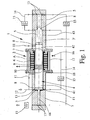
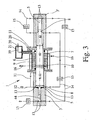
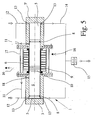
- the Fig. 1 . 3 and 5 show three different embodiments of a fluid working machine 1 according to the invention, wherein the figures are only simplified representations, so that only the essential components for the present invention are shown.
- the fluid working machines 1 shown in the figures serve to compress gases, in particular hydrogen, to a high pressure of, for example, 500 bar. Such fluid working machines 1 can therefore be used advantageously in particular for equipping hydrogen refueling stations.
- the in the Fig. 1 . 3 and 5 1 each have a linear motor 2 for driving a solid-state piston 4 movably arranged in a cylinder 3.
- a linear motor 2 for driving a solid-state piston 4 movably arranged in a cylinder 3.
- a translatory drive force is exerted on the solid-state piston 4, so that the solid-state piston 4 can move axially back and forth within the cylinder 3, 3 '.
- Within the cylinder 3 is at least one compression space 5, for the gas to be compressed, wherein the size of the compression space 5 changes depending on the position of the solid-state piston 4.
- the fluid working machine 1 is formed in a total of 4 stages, so that the compression of the gas takes place in four successive stages. Accordingly, in these two embodiments, four sections 41, 42, 43, 44, each having different diameters, are formed on the solid-body piston 4. Corresponding thereto, the cylinder 3, 3 'has four different sections with different inner diameters, so that a total of four compression chambers 5 are formed.
- the fluid working machine 1 according to Fig. 5 trained only one stage, but this is a double-acting fluid working machine 1, so that on Both sides of the solid-state piston 4 each have a compression space 5 is formed.
- linear motor 2 has a stator with a coil 9 and a rotor with a plurality of magnets 10, wherein the magnets 10 are arranged directly on the solid-state piston 4.
- the can 6 in the radial direction between the rotor, that is, the magnet 10 and the coil 9 of the stator arranged so that the can 6 not only the solid-state piston 4 but also the magnets 10 of the rotor encloses.
- the can 6 is thus between the stator and the rotor, so that the can 6 is penetrated by the magnetic field.
- the compression chamber 5 connected to the can 6 may also be connected directly to the fluid inlet side 12, d. H. the fluid inlet takes place in the compression space 5 connected to the can 6. If the fluid to be compressed has a low temperature, cooling of the linear motor 2 can take place at the same time.
- valves 13 which are arranged in the region of the individual compression chambers 5 and preferably formed as a plate valves.
- the fluid working machines 1 also four intake and exhaust valves 13, respectively.
- Fig. 1 and 3 is also indicated that the individual compression chambers 5 are connected to each other via lines 14, wherein in the individual lines 14 each have a heat exchanger 15 is provided for recooling the compressed gas.
- a coolant circuit 16 for cooling the coil 9 of the stator and thus for cooling the linear motor 2 has a total. The cooling takes place from the outside, that is, via a housing 9 surrounding the coil 9, so that the coil 9 does not come into direct contact with the coolant. Both for re-cooling of the compressed gas in the heat exchangers 15 and for cooling the linear motor 2 while the same coolant can be used.
- the illustrated embodiments of the fluid power machine 1 each have two cylinders 3; 3 ', wherein the linear motor 2 with the split tube 6 or the housing surrounding the linear motor 17 between the two cylinders 3, 3' is arranged.
- the sealing between the end faces of the two cylinders 3, 3 'and the corresponding end faces of the housing 17 takes place via static seals 18th
- the fluid working machines 1 shown in the figures are particularly suitable for compressing gases, preferably hydrogen, to high pressures of, for example, 1000 bar, so that such fluid working machines 1 are particularly suitable for equipping hydrogen refueling stations.
Landscapes
- Engineering & Computer Science (AREA)
- Mechanical Engineering (AREA)
- General Engineering & Computer Science (AREA)
- Physics & Mathematics (AREA)
- Fluid Mechanics (AREA)
- Compressors, Vaccum Pumps And Other Relevant Systems (AREA)
- Reciprocating Pumps (AREA)
- Electromagnetic Pumps, Or The Like (AREA)
- Linear Motors (AREA)
Description
- Die Erfindung betrifft eine Fluidarbeitsmaschine zum Verdichten bzw. Fördern von Fluiden, insbesondere zum Verdichten von Gasen auf hohe Drücke, mit einem Linearmotor, mindestens einem Zylinder, einem in dem Zylinder axial bewegbaren Festkörperkolben, mindestens einem zwischen dem Zylinder und dem Festkörperkolben bzw. dem Flüssigkeitskolben ausgebildeten Kompressionsraum, und Ventilen für den Einlass und den Auslass des Fluids, die im Bereich des mindestens einen Kompressionsraums angeordnet sind, wobei der Linearmotor eine translatorische Antriebskraft auf den Festkörperkolben überträgt und der Festkörperkolben im Bereich des Linearmotors von einem fest angeordneten Spaltrohr umschlossen ist, so dass zwischen dem Festkörperkolben und dem Spaltrohr ein Zylinderinnenraum ausgebildet ist.
- Fluidarbeitsmaschinen sind in verschiedenen Ausführungsformen und Varianten aus dem Stand der Technik bekannt. Die Fluidarbeitsmaschinen kann man dabei zunächst danach unterteilen, ob sie zum Fördern bzw. Verdichten von Flüssigkeiten oder von Gasen vorgesehen sind. Fluidarbeitsmaschinen, die zum Fördern von Flüssigkeiten eingesetzt werden, werden allgemein auch als Pumpen bezeichnet, während Fluidarbeitsmaschinen zum Verdichten von Gasen als Verdichter oder Kompressoren bezeichnet werden. Darüber hinaus können Fluidarbeitsmaschinen auch nach der Art der Antriebskraft - hydraulisch, elektrisch oder elektro-magnetisch - sowie nach der Art der Antriebsbewegung - rotatorisch oder translatorisch - unterschieden werden.
- Die vorliegende Erfindung betrifft eine Fluidarbeitsmaschine, bei der die Antriebskraft von einem Linearmotor erzeugt wird, der auf einen in einem Zylinder geführten Kolben direkt, d. h. ohne Umwandlung einer Drehbewegung über eine Getriebe, eine translatorische Antriebskraft ausübt. Soll mit einer derartigen Fluidarbeitsmaschine ein Gas verdichtet werden, so kann die Maschine auch als Kolbenverdichter oder als Linearkompressor bezeichnet werden. Der Linearmotor besteht dabei im wesentlichen aus einem Stator bzw. Ständer und einem Läufer bzw. Aktuator, wobei der Linearmotor wie auch ein rotierender Motor als Asynchron- oder Synchron-Linearmotor ausgebildet sein kann. Der Linearmotor entspricht dann einem abgewickelten Asynchronmotor mit Kurzschlussläufer oder einem permanent erregten Synchron-Motor, wobei von der Spule bzw. Wicklung des Stators anstelle eines Drehfeldes ein Wanderfeld erzeugt wird. Die Kraftübertragung erfolgt wie bei Drehfeldmaschinen entweder durch Spannungsinduktion im Kurzschlussläufer des Asynchronmotors oder durch Interaktion mit dem Feld der Permanentmagnete des Synchronmotors.
- Aus der
DE 10 2004 055 924 A1 ist ein zuvor beschriebener Linearkompressor bekannt, bei dem der Magnet des Läufers an einem Magnetrahmen befestigt ist, der fest an einer Stirnseite des Kolbens angebracht ist. Bei dem bekannten Linearkompressor ist zur Kühlung des Linearmotors ein Kühlkanal vorgesehen, durch den die auf einem Spulenhalter befestigte Spule des Stators mit einem Kühlmittel gekühlt wird. Hierzu ist eine Pumpe vorgesehen, die Öl innerhalb eines den Linearkompressor hermetisch abdichtenden Behälters durch den Kühlkanal zur Spule bzw. zum Spulenhalter fördert. Das rücklaufende Öl wird dabei im unteren Teil des hermetisch abgedichteten Behälters gesammelt. - Aus der
DE 102 14 047 A1 ist ein Kompressor für eine Kraftfahrzeug-Klimaanlage mit einem geschlossenen Kältemittelkreislauf bekannt, der ein Kompressorgehäuse mit einem darin ausgebildeten Kompressionsraum und einem in diesem hin- und her bewegbaren Hubkolben aufweist, bei dem als Antrieb für den Kompressor ein Linearmotor mit veränderbarer Ansteuerfrequenz eingesetzt ist, an dessen Reaktionsteil an der kompressorraumseitigen Stirnseite der Hubkolben befestigt ist. Der bekannte Kompressor ist einfach aufgebaut, besteht aus nur wenigen Bauteilen und ist relativ kleinbauend. Lagerungs-, Schmierungs- und Dichtungsprobleme sollen - jedenfalls bei einem Druckniveau auf der Hochdruckseite zwischen 80 und 160 bar - nicht auftreten. Die Abdichtung des Hubkolbens gegenüber der Kompressionsraumwandung erfolgt mittels üblicher Ringdichtungen am Hubkolben. Da bei derartig bewegten Dichtungen zumindest im Laufe der Zeit prinzipbedingt Leckagen zur Atmosphäre auftreten, ist der aus derDE 102 14 047 A1 bekannte Kompressor zumindest nicht zum Verdichten bis auf hohe Drücke (> 150 bar) geeignet und auch nicht vorgesehen. - Die
DE 198 46, 711 C2 offenbart eine Hochdruckpumpe mit einem Solenoid-Linear-Motor, dessen Spulenkörper auf einer einen Innenraum dichtend umschließenden, hochdruckfesten, antimagnetischen Hülse sitzt, die zwischen zwei Gehäuseflanschen eingespannt ist. Die Gehäuseflansche tragen auf ihrer Außenseite zur Längsachse des Spulenkörpers ausgerichtete Drückzylinder, in denen ein im Innenraum der Hülse befindlicher Permanentmagnetstab angeordnet ist, an dessen über den Spulenkörper und die Hülse hinausgehenden beiden Enden jeweils ein Druckkolben angeordnet ist. Durch die Hülse ist der Innenraum hermetisch abgedichtet. Von den Dichtungen der Druckkolben durchgelassene Leckflüssigkeit fließt in den Innenraum, umspült den Permanentmagnetstab und baut einen Gegendruck auf, so das aufwendige Hochdruckdichtungen zwischen den Druckkolben und den Druckzylindern entfallen können - Die
US 3,196,797 A offenbart einen Kompressor mit einem Linearmotor, einem Zylinder und zwei in dem Zylinder axial bewegbaren Kolben, die über eine einen breiteren Kern aufweisende Kolbenstange miteinander verbunden sind. Innerhalb des Zylinders sind Kanäle ausgebildet, durch die die Flüssigkeit vom Einlass zu den an die Kolben anschließenden Kompressionsräumen im Zylinder gelangen kann. Bei dem aus derUS 3,196,797 A bekannten Kompressor ist der Einlass für die zu verdichtende Flüssigkeit in der Mitte des Linearmotors zwischen zwei Spulenhälften vorgesehen, wozu ein Rohr über einen hohlen Ring zwischen den beiden Spulenhälften durchgeführt und mit den Kanälen verbunden ist. - Die
DE 29 37 157 A1 offenbart eine Kolbenverdrängerpumpe mit zwei Verdrängerkolben, die über eine Kolbenstange miteinander verbunden und in einem Zylinder hin- und her verschiebbar angeordnet sind. Der Einlass und der Auslass der Flüssigkeit erfolgt über Ventile, die seitlich an den förderseitigen Zylinderkopf angeordnet sind. Die bekannte Kolbenverdrängerpumpe weist ein Spaltrohr auf, innerhalb dessen sich der Innenkörper einer Magnetkupplung befindet. Außerhalb des Spaltrohres ist der Außenkörper der Magnetkupplung angeordnet. Der Innenkörper weist dabei eine Entlastungsbohrung auf, die dazu dient, die Beweglichkeit der Kolbenstange bzw. der beiden Kolben sicherzustellen, indem Leckflüssigkeit von der einen Seite des Innenkörpers durch die Entlastungsbohrung zur anderen Seite des Innenkörpers strömen kann. - Die
DE 103 14 007 A1 offenbart eine Kolbenvakuumpumpe mit einem linear geführten Kolben und einer den Kolben antreibenden steuerbaren Magnetanordnung, die zwei mit umschaltbaren Erregerströmen beaufschlagte, den Kolben antreibende Arbeitsspulen aufweist. - Eingangs ist ausgeführt, dass die Fluidarbeitsmaschine einem in dem Zylinder axial bewegbaren Festkörperkolben aufweist. Unter einem Festkörperkolben sollen dabei im Rahmen der Erfindung (übliche) feste bzw. massive (Metall-) Kolben verstanden werden, wie sie seit langem bekannt sind. Die zuvor beschriebenen Kompressoren weisen derartige Festkörperkolben auf.
- Eine Fluidarbeitsmaschine mit einem Flüssigkeitskolben ist beispielsweise aus der
DE 10 2004 046 316 A1 bekannt, wobei bei dem dort offenbarten Verdichter vorzugsweise eine ionische Flüssigkeit verwendet wird, so dass der Verdichter auch als "ionischer Verdichter" bezeichnet wird. Der bekannte Verdichter weist zwei miteinander verbundene Zylinder auf, in denen sich jeweils eine Flüssigkeit und das zu verdichtende Gas befinden. Mittels einer Hydraulikpumpe werden die Flüssigkeitsstände in den beiden Zylindern derart variiert, dass einer der Zylinder das zu verdichtende Gas ansaugt, während in dem anderen Zylinder eine Verdichtung des Gases erfolgt. - Der vorliegenden Erfindung liegt die Aufgabe zugrunde, eine eingangs beschriebene Fluidarbeitsmaschine zum Verdichten bzw. Fördern von Fluiden zur Verfügung zu stellen, die bei möglichst einfachem Aufbau eine leckage- und möglichst auch schmiermittelfreie Verdichtung bzw. Förderung von Fluiden, insbesondere eine Verdichtung von Gasen auf hohe Drücke, ermöglicht.
- Diese Aufgabe ist bei der eingangs beschriebenen Fluidarbeitsmaschine mit den Merkmalen des Patentanspruchs 1 dadurch gelöst, dass der mit dem Spaltrohr verbundene Kompressionsraum über eine Leitung oder einen Kanal mit der Fluideintrittsseite verbunden ist, so dass der Druck in dem vom Spaltrohr umgebenden Zylinderinnenraum reduziert ist.
- Erfindungsgemäß ist der mit dem Spaltrohr verbundene Kompressionsraum über eine Leitung oder einen im Zylinder oder im Gehäuse ausgebildeten Kanal mit der Fluideintrittsseite, d. h. mit der Saugseite der Fluidarbeitsmaschine verbunden. Durch diese Maßnahme wird der Druck im Bereich des Spaltrohres auf den niedrigen Druck an der Fluideintrittsseite reduziert. Interne Leckagen, die entlang der bewegten Kolbenabdichtungen auftreten, werden auf den Saugdruck entspannt und an die Fluideintrittsseite abgeführt. Dadurch kann die erforderliche Wandstärke des Spaltrohres reduziert werden, wodurch sich bei einer Anordnung des Spaltrohres zwischen dem Läufer und der Spule des Stators die elektrischen Verluste verringern. Eine bei besonders hohen Drücken ansonsten erforderliche dick- oder doppelwandige Ausführung des Spaltrohres kann dadurch entfallen. Unabhängig davon ist jedoch zur Erhöhung der Sicherheit, insbesondere bei besonders gefährlichen Gasen (toxischen, umweltbelastenden oder radioaktiven Gasen) die Verwendung eines doppelwandigen Spaltrohres möglich.
- Durch die Anordnung eines Spaltrohres kann auf einfache Art und Weise die Leckagefreiheit zur Atmosphäre erreicht werden. Die bei Abdichtung des Festkörperkolbens zum Antrieb und somit zur Atmosphäre an bewegten Dichtungen prinzipbedingt auftretenden Leckagen werden durch das Spaltrohr vermieden. Durch die Anordnung des Spaltrohres kann zur Atmosphäre ausschließlich mit statischen Dichtungen abgedichtet werden.
- Gemäß einer ersten vorteilhaften Ausgestaltung der Erfindung ist das Spaltrohr in radialer Richtung zwischen dem Läufer und der Spule des Stators angeordnet, so dass das Spaltrohr den Läufer umschließt. Bei dieser Ausführungsform befindet sich das Spaltrohr somit zwischen dem Stator und dem Läufer. Gemäß einer alternativen Ausgestaltung der Erfindung sind sowohl der Läufer als auch die Spule des Stators innerhalb des Spaltrohres angeordnet, so dass das Spaltrohr den Läufer und den Stator umschließt.
- Bei der ersten Ausführungsvariante dient das Spaltrohr somit als Trennwand zwischen dem elektrischen Antriebssystem und dem fluidberührten Kompressionsraum bzw. dem bewegten Festkörperkolben, wobei das Spaltrohr zur Energieübertragung vom Magnetfeld durchdrungen wird. Dadurch kommt es zu elektrischen Verlusten als Folge von Wirbelströmen im Spaltrohr sowie zu einer Erwärmung des Spaltrohres, so dass der Wirkungsgrad eines Linearmotors mit dazwischen angeordnetem Spaltrohr geringer ist als der Wirkungsgrad eines Linearmotors mit außen liegendem Spaltrohr. Dieser Nachteil der größeren Verluste tritt bei der zweiten Ausführungsvariante, bei der das Spaltrohr den Läufer und den Stator umschließt, nicht auf. Diese Ausführungsform ist somit - zumindest theoretisch - vorteilhaft, es sei denn, dass mit der Fluidarbeitsmaschine aggressive Medien verdichtet werden sollen. In diesem Fall wäre die Spule bei dem außen liegenden Spaltrohr ebenfalls dem aggressiven Medium ausgesetzt, was zu einer Beeinträchtigung der Lebensdauer der Spule fuhren kann.
- Die erfindungsgemäße Fluidarbeitsmaschine kann vorteilhafter Weise dadurch einfach aufgebaut sein, dass die Magnete des Läufers direkt auf dem Kolben angeordnet sind. Durch eine Befestigung der Magnete des Läufers direkt auf dem Kolben entfällt die Ausbildung und Anordnung eines separaten Magnetrahmens. Darüber hinaus können durch diese Ausgestaltung die radialen Abmessungen der Fluidarbeitsmaschine, insbesondere des Zylinders, verringert werden.
- Gemäß einer weiteren bevorzugten Ausgestaltung der Erfindung ist die Fluidarbeitsmaschine mehrstufig ausgebildet, d. h. die Verdichtung eines Gases erfolgt in mindestens zwei, vorzugsweise in vier Stufen. Alternativ dazu ist auch eine einstufige Verdichtung möglich, wobei dann vorzugsweise eine Ausgleichsstufe vorgesehen ist, um die für die Verdichtung notwenigen resultierenden Kräfte gering zu halten. Erfolgt die Verdichtung des Gases mehrstufig, so ist vorteilhafter vorgesehen, dass der Festkörperkolben mehrere Abschnitte mit unterschiedlichen Durchmessern aufweist. Der Kolben kann dabei herstellungstechnisch aus mehreren Kolbenabschnitten zusammengesetzt sein.
- Zur Reduzierung von elektrischen Verlusten, die durch die Verwendung des Spaltrohres auftreten können, ist es darüber hinaus möglich, das Spaltrohr nicht aus Metall sondern aus einem Kunststoff oder aus Keramik herzustellen. Bei der Auswahl des Kunststoffes bzw. der Keramik muss dabei darauf geachtet werden, dass das Spaltrohr auch dem maximal auftretenden Druck sicher standhalten kann.
- Gemäß einer weiteren Ausgestaltung der Erfindung ist - wie im Stand der Technik grundsätzlich bekannt - mindestens ein Wärmetauscher zur Rückkühlung des Fluids vorgesehen. Bei einer mehrstufigen Fluidarbeitsmaschine ist dabei vorzugsweise nach jeder Verdichtungsstufe ein derartiger Wärmetauscher angeordnet. Das zur Rückkühlung eines Gases durch den Wärmetauscher benötigte Kühlmittel kann dann vorzugsweise auch zur Kühlung des Linearmotors verwendet werden. Die Kühlung erfolgt dabei vorzugsweise von außen, d. h. über ein den Linearmotor umgebendes Gehäuse, so dass weder der Läufer noch der Stator direkt mit dem Kühlmittel in Berührung kommt. Alternativ zur Verwendung eines separaten Kühlmittels kann sowohl zur Rückkühlung des Fluids als auch zur Kühlung des Linearmotors das Fluid selber verwendet werden, sofern dieses in einem entsprechend kaltem Zustand vorliegt. Handelt es sich bei dem zu verdichtenden Gas, beispielsweise um Wasserstoff, welches vor der Verdichtung tiefkalt in der Flüssigphase vorliegt, so kann das Gas in der Flüssigphase als Kühlmittel genutzt werden.
- Die zuvor beschriebene erfindungsgemäße Fluidarbeitsmaschine eignet sich insbesondere zur Verdichtung von Gasen auf hohe Drücke, insbesondere zur Verdichtung von Wasserstoff auf 500 bar oder mehr. Damit eignet sich ein derartiger Linearkompressor insbesondere für die Ausrüstung von Wasserstofftankstellen.
- Im einzelnen gibt es nun eine Vielzahl von Möglichkeiten, die erfindungsgemäße Fluidarbeitsmaschine auszugestalten und weiterzubilden. Dazu wird verwiesen auf die dem Patentanspruch 1 nachgeordneten Patentansprüche sowie auf die Beschreibung bevorzugter Ausführungsbeispiele in Verbindung mit der Zeichnung. In der Zeichnung zeigen
- Fig. 1
- ein erstes Ausführungsbeispiel einer erfindungsgemäßen Fluidarbeitsmaschine,
- Fig. 2
- eine vergrößerte Darstellung des Teilbereichs A der Fluidarbeitsmaschine gemäß
Fig. 1 , - Fig. 3
- ein zweites Ausführungsbeispiel einer erfindungsgemäßen Fluidarbeitsmaschine,
- Fig. 4
- eine vergrößerte Darstellung eines Teilbereichs der Fluidarbeitsmaschine gemäß
Fig. 3 , und - Fig. 5
- ein drittes Ausführungsbeispiel einer erfindungsgemäßen Fluidarbeitsmaschine.
- Die
Fig. 1 ,3 und5 zeigen drei unterschiedliche Ausführungsbeispiele einer erfindungsgemäßen Fluidarbeitsmaschine 1, wobei es sich bei den Figuren lediglich um vereinfachte Darstellungen handelt, so dass nur die für die vorliegende Erfindung wesentlichen Bauteile dargestellt sind. Die in den Figuren dargestellten Fluidarbeitsmaschinen 1 dienen zum Verdichten von Gasen, insbesondere von Wasserstoff, auf einen hohen Druck von beispielsweise 500 bar. Derartige Fluidarbeitsmaschinen 1 sind daher insbesondere für die Ausrüstung von Wasserstofftankstellen vorteilhaft einsetzbar. - Die in den
Fig. 1 ,3 und5 dargestellten Fluidarbeitsmaschinen 1 weisen jeweils einen Linearmotor 2 zum Antrieb eines in einem Zylinder 3 bewegbar angeordneten Festkörperkolbens 4 auf. Durch den Einsatz des Linearmotors 2 als Antrieb wird auf den Festkörperkolben 4 eine translatorische Antriebskraft ausgeübt, so dass sich der Festkörperkolben 4 axial innerhalb des Zylinders 3, 3' hin und her bewegen kann. Innerhalb des Zylinders 3 befindet sich mindestens ein Kompressionsraum 5, für das zu verdichtende Gas, wobei sich die Größe des Kompressionsraums 5 in Abhängigkeit von der Position des Festkörperkolbens 4 verändert. - Bei den beiden Ausführungsbeispielen gemäß den
Fig. 1 und3 ist die Fluidarbeitsmaschine 1 insgesamt 4-stufig ausgebildet, so dass die Verdichtung des Gases in vier aufeinanderfolgenden Stufen erfolgt. Entsprechend sind bei diesen beiden Ausführungsbeispielen an dem Festkörperkolben 4 vier Abschnitte 41, 42, 43, 44 mit jeweils unterschiedlichen Durchmessern ausgebildet. Korrespondierend dazu weist auch der Zylinder 3, 3' vier unterschiedliche Abschnitte mit unterschiedlichen Innendurchmessern auf, so dass insgesamt vier Kompressionsräume 5 ausgebildet sind. Im Unterschied dazu ist die Fluidarbeitsmaschine 1 gemäßFig. 5 nur einstufig ausgebildet, wobei es sich hier jedoch um eine doppelt wirkende Fluidarbeitsmaschine 1 handelt, so dass auf beiden Seiten des Festkörperkolbens 4 jeweils ein Kompressionsraum 5 ausgebildet ist. - Allen drei Ausführungsvarianten ist gemeinsam, dass der Festkörperkolben 4 im Bereich des Linearmotors 2 von einem fest angeordneten Spaltrohr 6 umschlossen ist. Durch die Anordnung des Spaltrohres 6 wird dabei eine sichere Abdichtung des Zylinderinnenraums 7 gewährleistet, so dass insgesamt die gewünschte Leckagefreiheit der Fluidarbeitsmaschine 1 auf einfache Art und Weise erreicht wird. Die Leckagefreiheit zur Atmosphäre muss dabei nicht mehr durch die an dem Festkörperkolben 4 angeordneten Kolbenabdichtungen 8 realisiert werden, die die Leckagefreiheit aufgrund ihrer Anordnung und Ausbildung als bewegte Dichtungen prinzipbedingt nicht bzw. nicht dauerhaft und insbesondere nicht schmiermittelfrei gewährleisten können. Die sonst übliche Durchführung der Kolbenstange zum Antrieb entfällt somit, ebenso die dafür erforderlichen bewegten Dichtsysteme. Die-Leckagefreiheit zur Atmosphäre wird somit ausschließlich mit statischen Dichtungen 18 gewährleistet.
- Der in den
Figuren 1 bis 5 dargestellte Linearmotor 2 weist einen Stator mit einer Spule 9 und einen Läufer mit mehreren Magneten 10 auf, wobei die Magnete 10 unmittelbar auf dem Festkörperkolben 4 angeordnet sind. - Bei dem Ausführungsbeispiel gemäß
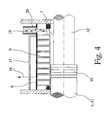
Fig. 1 bzw. entsprechend der vergrößerten Darstellung inFig. 2 ist das Spaltrohr 6 in radialer Richtung zwischen dem Läufer, d. h. den Magneten 10 und der Spule 9 des Stators angeordnet, so dass das Spaltrohr 6 nicht nur den Festkörperkolben 4 sondern auch die Magnete 10 des Läufers umschließt. Bei dieser Ausführungsform befindet sich das Spaltrohr 6 somit zwischen dem Stator und dem Läufer, so dass das Spaltrohr 6 vom magnetischen Feld durchsetzt wird. Im Unterschied dazu sind bei dem Ausführungsbeispiel gemäßFig. 3 bzw. entsprechend der vergrößerten Darstellung inFig. 4 sowohl der Läufer, d. h. die Magnete 10 als auch die Spule 9 des Stators innerhalb des Spaltrohres 6 angeordnet. Bei dieser Ausführungsvariante sind somit nicht nur die Magnete 10 sondern auch die Spule 9 dem Fluid ausgesetzt, welches trotz der Kolbenabdichtung 8 in den Zylinderinnenraum 7 im Bereich des Spaltrohres 6 eintritt. - In den
Fig. 1 ,3 und5 ist angedeutet, dass der mit dem Spaltrohr 6 verbundene Kompressionsraum 5 über eine Leitung 11 mit der Fluideintrittsseite 12 der Fluidarbeitsmaschine 1 verbunden ist. Dies führt dazu, dass interne Leckagen, die trotz der Kolbenabdichtungen 8 zwischen dem Außenumfang des Festkörperkolbens 4 und der Innenwandung des Zylinders 3 auftreten, auf den Saugdruck entspannt und an die Fluideintrittsseite 12 abgeführt werden. Dadurch wird der Druck in dem von dem Spaltrohr 6 umgebenen Zylinderinnenraum 7 reduziert, wodurch das Spaltrohr 6 bei der Ausgestaltung gemäß denFig. 1 und2 bzw. die Spule 9 und das Spaltrohr 6 bei der Ausgestaltung gemäß denFig. 3 und4 nicht unnötig belastet werden. Durch die so erfolgte Reduzierung des Drucks in dem vom Spaltrohr 6 umgebenen Zylinderinnenraum 7 kann eine entsprechend geringere Wandstärke für das Spaltrohr 6 ausgewählt werden, wodurch es zu einer Reduzierung von in dem Spaltrohr 6 auftretenden Wirbelstromverlusten kommt. - Alternativ dazu kann der mit dem Spaltrohr 6 verbundene Kompressionsraum 5 auch direkt mit der Fluideintrittsseite 12 verbunden sein, d. h. der Fluideintritt erfolgt in dem mit dem Spaltrohr 6 verbundene Kompressionsraum 5. Weist das zu verdichtende Fluid eine niedrige Temperatur auf, so kann dadurch gleichzeitig eine Kühlung des Linearmotors 2 erfolgen.
- Wie im Stand der Technik bekannt, erfolgt der Einlaß sowie der Auslaß des zu verdichtenden Gases über Ventile 13, die im Bereich der einzelnen Kompressionsräume 5 angeordnet und vorzugsweise als Plattenventile ausgebildet sind. Durch die anliegenden Differenzdrücke zwischen dem Kompressionsraum 5 und dem jeweiligen Ein- bzw. Auslaß erfolgt dann ein selbsttätiges Öffnen bzw. Schließen der Ventile 13. Da bei den beiden Ausführungsbeispielen gemäß den
Fig. 1 und3 eine vierstufige Verdichtung des Gases erfolgt, weisen die Fluidarbeitsmaschinen 1 auch jeweils vier Einlaß- bzw. Auslaßventile 13 auf. - In den
Fig. 1 und3 ist darüber hinaus angedeutet, dass die einzelnen Kompressionsräume 5 über Leitungen 14 miteinander verbunden sind, wobei in den einzelnen Leitungen 14 jeweils ein Wärmetauscher 15 zur Rückkühlung des komprimierten Gases vorgesehen ist. Darüber hinaus ist in denFig. 1 ,3 und5 noch angedeutet, dass die Fluidarbeitsmaschine 1 einen Kühlmittelkreislauf 16 zur Kühlung der Spule 9 des Stators und somit zur Kühlung des Linearmotors 2 insgesamt aufweist. Die Kühlung erfolgt dabei von außen, d. h. über ein die Spule 9 umgebendes Gehäuse 17, so dass die Spule 9 nicht direkt mit dem Kühlmittel in Berührung kommt. Sowohl zur Rückkühlung des verdichteten Gases in den Wärmetauschern 15 als auch zur Kühlung des Linearmotors 2 kann dabei dasselbe Kühlmittel verwendet werden. - Schließlich ist aus den Figuren noch ersichtlich, dass die dargestellten Ausführungsbeispiele der Fluidarbeitsmaschine 1 jeweils zwei Zylinder 3; 3' aufweisen, wobei der Linearmotor 2 mit dem Spaltröhr 6 bzw. das den Linearmotor z umgebende Gehäuse 17 zwischen den beiden Zylindern 3, 3' angeordnet ist. Die Abdichtung zwischen den Stirnseiten der beiden Zylinder 3, 3' und den korrespondierenden Stirnseiten des Gehäuses 17 erfolgt dabei über statische Dichtungen 18.
- Den
Fig. 3 und4 ist darüber hinaus noch entnehmbar, dass die elektrischen Leitungen 19 zu dem innerhalb des Spaltrohres 6 angeordneten Stator mit Hilfe druckdichter Kabeldurchführungen 20 leckagefrei zum Anschlußkasten 21 geführt sind, wobei auch der Anschlußkasten 21 druckdichte Kabeldurchführungen 20 aufweist, so dass die durch das Spaltrohr 6 gewonnene Leckagefreiheit zur Atmosphäre nicht durch den Anschluss der erforderlichen Leitungen 19 aufgehoben wird. - Die in den Figuren dargestellten Fluidarbeitsmaschinen 1 eignen sich insbesondere zur Verdichtung von Gasen, vorzugsweise von Wasserstoff, auf hohe Drücke von beispielsweise 1000 bar, so dass derartige Fluidarbeitsmaschinen 1 zur Ausrüstung von Wasserstofftankstellen besonders geeignet sind.
Claims (9)
- Fluidarbeitsmaschine zum Verdichten bzw. Fördern von Fluiden, insbesondere zum Verdichten von Gasen auf hohe Drücke, mit einem Linearmotor (2), mindestens einem Zylinder (3), einem in dem Zylinder (3) axial bewegbaren Festkörperkolben (4), mindestens einem zwischen dem Zylinder (3) und dem Festkörperkolben (4) ausgebildeten Kompressionsraum (5) und Ventilen (13) für den Einlass und den Auslass des Fluids, die im Bereich des mindestens einen Kompressionsraums (5) angeordnet sind,
wobei der Linearmotor (2) eine translatorische Antriebskraft auf den Festkörperkolben (4) überträgt, und
wobei der Festkörperkolben (4) im Bereich des Linearmotors (2) von einem fest angeordneten Spaltrohr (6) umschlossen ist, so dass zwischen dem Festkörperkölben (4) und dem Spaltrohr (6) ein Zylinderinnenraum (7) ausgebildet ist,
dadurch gekennzeichnet,
dass der mit dem Spaltrohr (6) verbundene Kompressionsraum über eine Leitung (11) oder einen Kanal mit der Fluideintrittsseite (12) verbunden ist, so dass der Druck in dem vom Spaltrohr (6) umgebenen Zylinderinnenraum (7) reduziert ist. - Fluidarbeitsmaschine nach Anspruch 1, wobei der Linearmotor (2) einen Stator und einen Läufer aufweist, dadurch gekennzeichnet, dass das Spaltrohr (6) in radialer Richtung zwischen dem Läufer und der Spule (9) des Stators angeordnet ist, so dass das Spaltrohr (6) den Läufer umschließt.
- Fluidarbeitsmaschine nach Anspruch 1, wobei der Linearmotor (2) einen Stator und einen Läufer aufweist, dadurch gekennzeichnet, dass sowohl der Läufer als auch die Spule (9) des Stators innerhalb des Spaltrohres (6) angeordnet sind, so dass das Spaltrohr (6) den Läufer und den Stator umschließt.
- Fluidarbeitsmaschine nach Anspruche 2 oder 3, wobei der Läufer Magnete (10) aufweist, dadurch gekennzeichnet, dass die Magnete (10) des Läufers direkt auf dem Kolben (4) angeordnet sind.
- Fluidarbeitsmaschine nach einem der Ansprüche 1 bis 4, dadurch gekennzeichnet, dass die Verdichtung eines Gases mehrstufig erfolgt.
- Fluidarbeitsmaschine nach Anspruch 5, dadurch gekennzeichnet, dass der Festkörperkolben (4) mehrere Abschnitte (41, 42, 43, 44) mit unterschiedlichen Durchmessern aufweist.
- Fluidarbeitsmaschine nach einem der Ansprüche 1 bis 6, dadurch gekennzeichnet, dass ein Kühlmittelkreislauf (16) zur Kühlung des Linearmotors (2), insbesondere zur Kühlung der Spule (7) des Stators ausgebildet ist.
- Fluidarbeitsmaschine nach einem der Ansprüche 1 bis 7, dadurch gekennzeichnet, dass mindestens ein Wärmetauscher (15) zur Rückkühlung des Fluids vorgesehen ist.
- Fluidarbeitsmaschine nach Anspruch 7 und 8, dadurch gekennzeichnet, dass zur Kühlung des Linearmotors (2) und zur Rückkühlung des Fluids dasselbe Kühlmittel oder das zu verdichtende Fluid verwendet wird.
Applications Claiming Priority (2)
| Application Number | Priority Date | Filing Date | Title |
|---|---|---|---|
| DE102006060147A DE102006060147B4 (de) | 2006-12-18 | 2006-12-18 | Fluidarbeitsmaschine |
| PCT/EP2007/010872 WO2008074428A1 (de) | 2006-12-18 | 2007-12-12 | Fluidarbeitsmaschine |
Publications (2)
| Publication Number | Publication Date |
|---|---|
| EP2122169A1 EP2122169A1 (de) | 2009-11-25 |
| EP2122169B1 true EP2122169B1 (de) | 2015-09-23 |
Family
ID=39124605
Family Applications (1)
| Application Number | Title | Priority Date | Filing Date |
|---|---|---|---|
| EP07856620.5A Active EP2122169B1 (de) | 2006-12-18 | 2007-12-12 | Fluidarbeitsmaschine |
Country Status (5)
| Country | Link |
|---|---|
| US (1) | US20110052430A1 (de) |
| EP (1) | EP2122169B1 (de) |
| JP (2) | JP5431953B2 (de) |
| DE (1) | DE102006060147B4 (de) |
| WO (1) | WO2008074428A1 (de) |
Families Citing this family (33)
| Publication number | Priority date | Publication date | Assignee | Title |
|---|---|---|---|---|
| DE102008036528A1 (de) | 2008-08-06 | 2010-02-11 | Bentec Gmbh Drilling & Oilfield Systems | Verfahren zum Betrieb einer mehrpulsigen Kolbenpumpe, mehrpulsige Kolbenpumpe sowie Herstellung einer solchen |
| DE102008060659A1 (de) | 2008-12-08 | 2010-06-10 | Bentec Gmbh Drilling & Oilfield Systems | Klemmvorrichtung für Zylinderbuchsen sowie deren Verwendung und Spülpumpe mit Klemmvorrichtung |
| JP5377162B2 (ja) * | 2009-08-28 | 2013-12-25 | 有限会社いどや | 電磁ポンプ及び此れを用いた電磁ポンプシステム |
| US20110192573A1 (en) * | 2010-02-08 | 2011-08-11 | Harmel Defretin | System and method for moving a first fluid using a second fluid |
| DE102010053091A1 (de) * | 2010-12-01 | 2012-06-06 | Linde Aktiengesellschaft | Mehrstufiger Kolbenverdichter |
| DE102012008811A1 (de) | 2012-04-25 | 2013-10-31 | Bpg Beteiligungs Gmbh | Wärmekraftmaschine |
| DE102012016222A1 (de) | 2012-08-01 | 2014-02-06 | Technische Universität Dresden | Kontinuierlich arbeitende Fluidarbeitsmaschine |
| CN103670996B (zh) * | 2012-09-14 | 2016-02-10 | 胜瑞兰工业设备(苏州)有限公司 | 一种无泄漏式磁力驱动往复泵 |
| EP2725227B1 (de) * | 2012-10-24 | 2015-05-20 | Delphi International Operations Luxembourg S.à r.l. | Pumpenanordnung |
| JP6087713B2 (ja) | 2013-04-24 | 2017-03-01 | 株式会社神戸製鋼所 | 圧縮装置 |
| US11466678B2 (en) * | 2013-11-07 | 2022-10-11 | Gas Technology Institute | Free piston linear motor compressor and associated systems of operation |
| US10323628B2 (en) * | 2013-11-07 | 2019-06-18 | Gas Technology Institute | Free piston linear motor compressor and associated systems of operation |
| DE102013019499A1 (de) | 2013-11-21 | 2015-05-21 | Linde Aktiengesellschaft | Kolbenverdichter und Verfahren zum Verdichten eines tiefkalten, gasförmigen Mediums, insbesondere Wasserstoff |
| JP6163646B2 (ja) * | 2014-05-27 | 2017-07-19 | 株式会社国際電気通信基礎技術研究所 | アクチュエータ装置、ヒューマノイド型ロボットおよびパワーアシスト装置 |
| JP6035590B2 (ja) | 2014-05-27 | 2016-11-30 | 株式会社国際電気通信基礎技術研究所 | アクチュエータ装置、ヒューマノイド型ロボットおよびパワーアシスト装置 |
| JP6276120B2 (ja) * | 2014-06-27 | 2018-02-07 | 株式会社神戸製鋼所 | ガス圧縮装置 |
| DE102014012977A1 (de) * | 2014-09-08 | 2016-03-10 | Albonair Gmbh | Reduktionsmitteldosiersystem mit verbesserter Förderpumpe |
| JP6276154B2 (ja) * | 2014-09-26 | 2018-02-07 | 株式会社神戸製鋼所 | 往復動型圧縮装置 |
| JP2016213314A (ja) * | 2015-05-08 | 2016-12-15 | 富士通株式会社 | 冷却モジュール及び電子機器 |
| DE102015209728A1 (de) * | 2015-05-27 | 2016-12-01 | Robert Bosch Gmbh | Pumpeneinrichtung, Bremssystem |
| CN105443977B (zh) * | 2015-12-28 | 2017-12-26 | 重庆耐德能源装备集成有限公司 | 天然气内冷式液力增压容器 |
| US11118578B2 (en) * | 2017-02-15 | 2021-09-14 | Extiel Holdings, Llc | Internally cooled inline drive compressor |
| CN107605691B (zh) * | 2017-09-08 | 2019-04-02 | 中国神华能源股份有限公司 | 直线驱动柱塞泵、直线驱动乳化液泵系统、及控制方法 |
| AU2018352528B2 (en) * | 2017-10-17 | 2024-01-18 | Board Of Regents, The Univ. Of Texas System | Free piston linear motor compressor and associated systems of operation |
| PL240516B1 (pl) * | 2018-01-09 | 2022-04-19 | Dobrianski Jurij | Maszyna parowa |
| BE1026881B1 (nl) | 2018-12-18 | 2020-07-22 | Atlas Copco Airpower Nv | Zuigercompressor |
| BE1026883B1 (nl) * | 2018-12-18 | 2020-07-22 | Atlas Copco Airpower Nv | Zuigercompressor en werkwijze waarin zulke zuigercompressor wordt toegepast |
| JP7330088B2 (ja) * | 2019-12-16 | 2023-08-21 | 株式会社東芝 | 液体ピストン装置および液体ピストン動作方法 |
| KR102712437B1 (ko) * | 2022-01-19 | 2024-10-02 | 주식회사 에스씨에스 | 리니어 피스톤이 설치된 리니어 압축기용 실린더장치 |
| CN115059597B (zh) * | 2022-07-06 | 2025-07-25 | 九江市浩轩新能源开发有限公司 | 一种电磁液压泵站 |
| IT202400000720A1 (it) * | 2024-01-16 | 2025-07-16 | Bosch Gmbh Robert | Compressore alternativo |
| CN119727286B (zh) * | 2025-02-28 | 2025-06-24 | 德瑞精工(深圳)有限公司 | 一种全密闭式直线电机模组 |
| KR102866556B1 (ko) | 2025-06-23 | 2025-10-01 | 주식회사 티이씨 | 직렬 다중 솔레노이드로 구동되는 이온성 액체 피스톤을 이용한 기체 압축기 및 그 제어방법 |
Family Cites Families (19)
| Publication number | Priority date | Publication date | Assignee | Title |
|---|---|---|---|---|
| US3196797A (en) * | 1961-09-18 | 1965-07-27 | Mario Pagano S P A | Dynamic thrust electromagnetic compressor, particularly suitable for compressing liquid or gaseous substances |
| DE2937157C2 (de) * | 1979-09-13 | 1982-06-16 | Franz Klaus Union Armaturen, Pumpen Gmbh & Co, 4630 Bochum | Kolbenverdrängerpumpe, insbesondere Dosierpumpe |
| US4496287A (en) * | 1980-02-14 | 1985-01-29 | Robert M. Nelson | Sensors for detection of fluid condition, and control systems utilizing their signals |
| NL8204005A (nl) * | 1982-10-18 | 1984-05-16 | Philips Nv | Koelsysteem met twee-traps compressie-inrichting. |
| JPS60125371U (ja) * | 1984-02-03 | 1985-08-23 | 三菱重工業株式会社 | 容積形ポンプまたはブロワ− |
| US4815949A (en) * | 1985-06-24 | 1989-03-28 | Rabson Thomas A | In-well submersible motor with stacked component stator |
| US5354185A (en) * | 1992-10-05 | 1994-10-11 | Aura Systems, Inc. | Electromagnetically actuated reciprocating compressor driver |
| AU8877398A (en) * | 1997-10-04 | 1999-04-27 | Wei-Min Zhang | Linear motor compressor |
| DE19846711C2 (de) * | 1998-10-09 | 2003-05-08 | Trumpf Sachsen Gmbh | Hochdruckpumpe mit Linearmotorantrieb |
| US6183206B1 (en) * | 1999-05-10 | 2001-02-06 | The United States Of America As Represented By The Secretary Of The Air Force | Magnetohydrodynamically-driven compressor |
| DE10149506A1 (de) * | 2001-10-06 | 2003-04-10 | Leybold Vakuum Gmbh | Schwingkolbenantrieb für eine Vakuumpumpe sowie Betriebsverfahren für diesen Antrieb |
| DE10214047A1 (de) * | 2002-03-28 | 2003-10-09 | Volkswagen Ag | Kompressor für eine Fahrzeugklimaanlage |
| DE10314007A1 (de) * | 2003-03-28 | 2004-10-07 | Leybold Vakuum Gmbh | Steuerung einer Kolbenvakuumpumpe |
| JP2005307796A (ja) * | 2004-04-20 | 2005-11-04 | Matsushita Electric Ind Co Ltd | リニア圧縮機 |
| JP2005351255A (ja) * | 2004-06-10 | 2005-12-22 | Kaken Geneqs:Kk | レシプロ圧縮機 |
| DE102004046316A1 (de) * | 2004-09-24 | 2006-03-30 | Linde Ag | Verfahren und Vorrichtung zum Verdichten eines gasförmigen Mediums |
| KR100613514B1 (ko) * | 2004-10-07 | 2006-08-17 | 엘지전자 주식회사 | 리니어 압축기의 토출부 구조 |
| DE102004055924B4 (de) * | 2004-11-19 | 2011-08-18 | Lg Electronics Inc., Seoul | Linearkompressor |
| EP1785625A3 (de) * | 2005-11-10 | 2009-11-25 | LG Electronics Inc. | Linearverdichter |
-
2006
- 2006-12-18 DE DE102006060147A patent/DE102006060147B4/de not_active Expired - Fee Related
-
2007
- 2007-12-12 WO PCT/EP2007/010872 patent/WO2008074428A1/de not_active Ceased
- 2007-12-12 US US12/519,919 patent/US20110052430A1/en not_active Abandoned
- 2007-12-12 EP EP07856620.5A patent/EP2122169B1/de active Active
- 2007-12-12 JP JP2009541843A patent/JP5431953B2/ja active Active
-
2013
- 2013-12-05 JP JP2013252239A patent/JP5868382B2/ja active Active
Also Published As
| Publication number | Publication date |
|---|---|
| DE102006060147A1 (de) | 2008-06-19 |
| JP2010513779A (ja) | 2010-04-30 |
| DE102006060147B4 (de) | 2009-05-14 |
| JP5868382B2 (ja) | 2016-02-24 |
| US20110052430A1 (en) | 2011-03-03 |
| WO2008074428A1 (de) | 2008-06-26 |
| JP2014090663A (ja) | 2014-05-15 |
| JP5431953B2 (ja) | 2014-03-05 |
| EP2122169A1 (de) | 2009-11-25 |
Similar Documents
| Publication | Publication Date | Title |
|---|---|---|
| DE102006060147B4 (de) | Fluidarbeitsmaschine | |
| EP1999375B1 (de) | Verdichtereinheit | |
| EP1069313B1 (de) | Turboverdichter | |
| EP0149219A2 (de) | Plungerpumpe | |
| EP3523537B1 (de) | Halbhermetischer kältemittelverdichter | |
| DE112010003623T5 (de) | Lagerstützsystem für freikolben-stirling maschinen | |
| DE102012202460A1 (de) | Elektromotorische Getriebevorrichtung mit einstückigem Gehäuse | |
| EP3480929B1 (de) | Gekühltes gehäuse für den stator eines direktantriebs | |
| WO2007110275A1 (de) | Verdichtereinheit | |
| EP1963674B1 (de) | Wassergekühlter kolbenverdichter | |
| DE102010064061A1 (de) | Turboverdichter und Verfahren zur Verdichtung von Gas | |
| EP1574714B1 (de) | Pumpenaggregat | |
| EP1857681A2 (de) | Antriebsanordnung für eine Vakuumpumpe | |
| DE29519941U1 (de) | Hydraulisches Pumpenaggregat | |
| DE102011077096A1 (de) | Pendelschieberpumpe | |
| EP2052158A1 (de) | Rotorkühlung für trocken laufende zweiwellen-vakuumpumpen bzw. -verdichter | |
| WO2020094510A1 (de) | Elektrische maschine mit einer fluid-kühleinrichtung | |
| EP2795204B1 (de) | Verdichter | |
| DE102018203264A1 (de) | Hydraulischer Aktor | |
| DE10349752B4 (de) | Motorpumpenaggregat | |
| DE102021102648B4 (de) | Kolbenkompressor, insbesondere für eine Wärmepumpe | |
| DE3248229C1 (de) | Arbeitsmaschine zum Fördern von Gasen und/oder Flüssigkeiten | |
| DE102021207660A1 (de) | Linearverdichter | |
| DE102010015932B4 (de) | Solenoidventil für die Durchstromsteuerung | |
| WO2016193262A1 (de) | Elektrisch angetriebene flüssigkeits-filterpumpe und elektrisch angetriebene flüssigkeits-verdrängerpumpe zur verwendung in der flüssigkeits-filterpumpe |
Legal Events
| Date | Code | Title | Description |
|---|---|---|---|
| PUAI | Public reference made under article 153(3) epc to a published international application that has entered the european phase |
Free format text: ORIGINAL CODE: 0009012 |
|
| 17P | Request for examination filed |
Effective date: 20090715 |
|
| AK | Designated contracting states |
Kind code of ref document: A1 Designated state(s): AT BE BG CH CY CZ DE DK EE ES FI FR GB GR HU IE IS IT LI LT LU LV MC MT NL PL PT RO SE SI SK TR |
|
| DAX | Request for extension of the european patent (deleted) | ||
| 17Q | First examination report despatched |
Effective date: 20100301 |
|
| GRAP | Despatch of communication of intention to grant a patent |
Free format text: ORIGINAL CODE: EPIDOSNIGR1 |
|
| INTG | Intention to grant announced |
Effective date: 20150330 |
|
| GRAS | Grant fee paid |
Free format text: ORIGINAL CODE: EPIDOSNIGR3 |
|
| GRAA | (expected) grant |
Free format text: ORIGINAL CODE: 0009210 |
|
| AK | Designated contracting states |
Kind code of ref document: B1 Designated state(s): AT BE BG CH CY CZ DE DK EE ES FI FR GB GR HU IE IS IT LI LT LU LV MC MT NL PL PT RO SE SI SK TR |
|
| REG | Reference to a national code |
Ref country code: GB Ref legal event code: FG4D Free format text: NOT ENGLISH |
|
| REG | Reference to a national code |
Ref country code: CH Ref legal event code: EP |
|
| REG | Reference to a national code |
Ref country code: AT Ref legal event code: REF Ref document number: 751404 Country of ref document: AT Kind code of ref document: T Effective date: 20151015 |
|
| REG | Reference to a national code |
Ref country code: IE Ref legal event code: FG4D Free format text: LANGUAGE OF EP DOCUMENT: GERMAN |
|
| REG | Reference to a national code |
Ref country code: DE Ref legal event code: R096 Ref document number: 502007014253 Country of ref document: DE |
|
| REG | Reference to a national code |
Ref country code: FR Ref legal event code: PLFP Year of fee payment: 9 |
|
| PG25 | Lapsed in a contracting state [announced via postgrant information from national office to epo] |
Ref country code: LT Free format text: LAPSE BECAUSE OF FAILURE TO SUBMIT A TRANSLATION OF THE DESCRIPTION OR TO PAY THE FEE WITHIN THE PRESCRIBED TIME-LIMIT Effective date: 20150923 Ref country code: GR Free format text: LAPSE BECAUSE OF FAILURE TO SUBMIT A TRANSLATION OF THE DESCRIPTION OR TO PAY THE FEE WITHIN THE PRESCRIBED TIME-LIMIT Effective date: 20151224 Ref country code: LV Free format text: LAPSE BECAUSE OF FAILURE TO SUBMIT A TRANSLATION OF THE DESCRIPTION OR TO PAY THE FEE WITHIN THE PRESCRIBED TIME-LIMIT Effective date: 20150923 Ref country code: FI Free format text: LAPSE BECAUSE OF FAILURE TO SUBMIT A TRANSLATION OF THE DESCRIPTION OR TO PAY THE FEE WITHIN THE PRESCRIBED TIME-LIMIT Effective date: 20150923 |
|
| REG | Reference to a national code |
Ref country code: LT Ref legal event code: MG4D |
|
| REG | Reference to a national code |
Ref country code: NL Ref legal event code: FP |
|
| PG25 | Lapsed in a contracting state [announced via postgrant information from national office to epo] |
Ref country code: SE Free format text: LAPSE BECAUSE OF FAILURE TO SUBMIT A TRANSLATION OF THE DESCRIPTION OR TO PAY THE FEE WITHIN THE PRESCRIBED TIME-LIMIT Effective date: 20150923 |
|
| PG25 | Lapsed in a contracting state [announced via postgrant information from national office to epo] |
Ref country code: SK Free format text: LAPSE BECAUSE OF FAILURE TO SUBMIT A TRANSLATION OF THE DESCRIPTION OR TO PAY THE FEE WITHIN THE PRESCRIBED TIME-LIMIT Effective date: 20150923 Ref country code: CZ Free format text: LAPSE BECAUSE OF FAILURE TO SUBMIT A TRANSLATION OF THE DESCRIPTION OR TO PAY THE FEE WITHIN THE PRESCRIBED TIME-LIMIT Effective date: 20150923 Ref country code: IS Free format text: LAPSE BECAUSE OF FAILURE TO SUBMIT A TRANSLATION OF THE DESCRIPTION OR TO PAY THE FEE WITHIN THE PRESCRIBED TIME-LIMIT Effective date: 20160123 Ref country code: EE Free format text: LAPSE BECAUSE OF FAILURE TO SUBMIT A TRANSLATION OF THE DESCRIPTION OR TO PAY THE FEE WITHIN THE PRESCRIBED TIME-LIMIT Effective date: 20150923 Ref country code: ES Free format text: LAPSE BECAUSE OF FAILURE TO SUBMIT A TRANSLATION OF THE DESCRIPTION OR TO PAY THE FEE WITHIN THE PRESCRIBED TIME-LIMIT Effective date: 20150923 |
|
| PG25 | Lapsed in a contracting state [announced via postgrant information from national office to epo] |
Ref country code: RO Free format text: LAPSE BECAUSE OF FAILURE TO SUBMIT A TRANSLATION OF THE DESCRIPTION OR TO PAY THE FEE WITHIN THE PRESCRIBED TIME-LIMIT Effective date: 20150923 Ref country code: PL Free format text: LAPSE BECAUSE OF FAILURE TO SUBMIT A TRANSLATION OF THE DESCRIPTION OR TO PAY THE FEE WITHIN THE PRESCRIBED TIME-LIMIT Effective date: 20150923 Ref country code: BE Free format text: LAPSE BECAUSE OF NON-PAYMENT OF DUE FEES Effective date: 20151231 Ref country code: PT Free format text: LAPSE BECAUSE OF FAILURE TO SUBMIT A TRANSLATION OF THE DESCRIPTION OR TO PAY THE FEE WITHIN THE PRESCRIBED TIME-LIMIT Effective date: 20160125 |
|
| REG | Reference to a national code |
Ref country code: DE Ref legal event code: R097 Ref document number: 502007014253 Country of ref document: DE |
|
| PG25 | Lapsed in a contracting state [announced via postgrant information from national office to epo] |
Ref country code: LU Free format text: LAPSE BECAUSE OF FAILURE TO SUBMIT A TRANSLATION OF THE DESCRIPTION OR TO PAY THE FEE WITHIN THE PRESCRIBED TIME-LIMIT Effective date: 20151212 Ref country code: MC Free format text: LAPSE BECAUSE OF FAILURE TO SUBMIT A TRANSLATION OF THE DESCRIPTION OR TO PAY THE FEE WITHIN THE PRESCRIBED TIME-LIMIT Effective date: 20150923 |
|
| PLBE | No opposition filed within time limit |
Free format text: ORIGINAL CODE: 0009261 |
|
| STAA | Information on the status of an ep patent application or granted ep patent |
Free format text: STATUS: NO OPPOSITION FILED WITHIN TIME LIMIT |
|
| GBPC | Gb: european patent ceased through non-payment of renewal fee |
Effective date: 20151223 |
|
| 26N | No opposition filed |
Effective date: 20160624 |
|
| PG25 | Lapsed in a contracting state [announced via postgrant information from national office to epo] |
Ref country code: DK Free format text: LAPSE BECAUSE OF FAILURE TO SUBMIT A TRANSLATION OF THE DESCRIPTION OR TO PAY THE FEE WITHIN THE PRESCRIBED TIME-LIMIT Effective date: 20150923 |
|
| REG | Reference to a national code |
Ref country code: IE Ref legal event code: MM4A |
|
| PG25 | Lapsed in a contracting state [announced via postgrant information from national office to epo] |
Ref country code: GB Free format text: LAPSE BECAUSE OF NON-PAYMENT OF DUE FEES Effective date: 20151223 Ref country code: IE Free format text: LAPSE BECAUSE OF NON-PAYMENT OF DUE FEES Effective date: 20151212 |
|
| PG25 | Lapsed in a contracting state [announced via postgrant information from national office to epo] |
Ref country code: SI Free format text: LAPSE BECAUSE OF FAILURE TO SUBMIT A TRANSLATION OF THE DESCRIPTION OR TO PAY THE FEE WITHIN THE PRESCRIBED TIME-LIMIT Effective date: 20150923 |
|
| REG | Reference to a national code |
Ref country code: FR Ref legal event code: PLFP Year of fee payment: 10 |
|
| PG25 | Lapsed in a contracting state [announced via postgrant information from national office to epo] |
Ref country code: HU Free format text: LAPSE BECAUSE OF FAILURE TO SUBMIT A TRANSLATION OF THE DESCRIPTION OR TO PAY THE FEE WITHIN THE PRESCRIBED TIME-LIMIT; INVALID AB INITIO Effective date: 20071212 Ref country code: BG Free format text: LAPSE BECAUSE OF FAILURE TO SUBMIT A TRANSLATION OF THE DESCRIPTION OR TO PAY THE FEE WITHIN THE PRESCRIBED TIME-LIMIT Effective date: 20150923 |
|
| PG25 | Lapsed in a contracting state [announced via postgrant information from national office to epo] |
Ref country code: CY Free format text: LAPSE BECAUSE OF FAILURE TO SUBMIT A TRANSLATION OF THE DESCRIPTION OR TO PAY THE FEE WITHIN THE PRESCRIBED TIME-LIMIT Effective date: 20150923 |
|
| PG25 | Lapsed in a contracting state [announced via postgrant information from national office to epo] |
Ref country code: MT Free format text: LAPSE BECAUSE OF FAILURE TO SUBMIT A TRANSLATION OF THE DESCRIPTION OR TO PAY THE FEE WITHIN THE PRESCRIBED TIME-LIMIT Effective date: 20150923 Ref country code: TR Free format text: LAPSE BECAUSE OF FAILURE TO SUBMIT A TRANSLATION OF THE DESCRIPTION OR TO PAY THE FEE WITHIN THE PRESCRIBED TIME-LIMIT Effective date: 20150923 |
|
| REG | Reference to a national code |
Ref country code: FR Ref legal event code: PLFP Year of fee payment: 11 |
|
| REG | Reference to a national code |
Ref country code: CH Ref legal event code: U11 Free format text: ST27 STATUS EVENT CODE: U-0-0-U10-U11 (AS PROVIDED BY THE NATIONAL OFFICE) Effective date: 20260101 |
|
| PGFP | Annual fee paid to national office [announced via postgrant information from national office to epo] |
Ref country code: AT Payment date: 20251222 Year of fee payment: 19 |
|
| PGFP | Annual fee paid to national office [announced via postgrant information from national office to epo] |
Ref country code: IT Payment date: 20251223 Year of fee payment: 19 |
|
| PGFP | Annual fee paid to national office [announced via postgrant information from national office to epo] |
Ref country code: FR Payment date: 20251222 Year of fee payment: 19 Ref country code: NL Payment date: 20251219 Year of fee payment: 19 |
|
| PGFP | Annual fee paid to national office [announced via postgrant information from national office to epo] |
Ref country code: DE Payment date: 20260217 Year of fee payment: 19 |
|
| PGFP | Annual fee paid to national office [announced via postgrant information from national office to epo] |
Ref country code: CH Payment date: 20260101 Year of fee payment: 19 |