EP2097366B1 - Verfahren zur herstellung von o-chlormethylbenzoesäurechloriden - Google Patents
Verfahren zur herstellung von o-chlormethylbenzoesäurechloriden Download PDFInfo
- Publication number
- EP2097366B1 EP2097366B1 EP00993318A EP00993318A EP2097366B1 EP 2097366 B1 EP2097366 B1 EP 2097366B1 EP 00993318 A EP00993318 A EP 00993318A EP 00993318 A EP00993318 A EP 00993318A EP 2097366 B1 EP2097366 B1 EP 2097366B1
- Authority
- EP
- European Patent Office
- Prior art keywords
- mol
- process according
- lewis acid
- phosgene
- formula
- Prior art date
- Legal status (The legal status is an assumption and is not a legal conclusion. Google has not performed a legal analysis and makes no representation as to the accuracy of the status listed.)
- Expired - Lifetime
Links
- 238000004519 manufacturing process Methods 0.000 title claims abstract 3
- TXZFBHYDQGYOIT-UHFFFAOYSA-N 2-(chloromethyl)benzoyl chloride Chemical class ClCC1=CC=CC=C1C(Cl)=O TXZFBHYDQGYOIT-UHFFFAOYSA-N 0.000 title claims description 25
- YGYAWVDWMABLBF-UHFFFAOYSA-N Phosgene Chemical compound ClC(Cl)=O YGYAWVDWMABLBF-UHFFFAOYSA-N 0.000 claims abstract description 44
- 239000003054 catalyst Substances 0.000 claims abstract description 22
- 238000006243 chemical reaction Methods 0.000 claims abstract description 22
- 238000000034 method Methods 0.000 claims abstract description 19
- 239000002841 Lewis acid Substances 0.000 claims abstract description 17
- 150000007517 lewis acids Chemical class 0.000 claims abstract description 17
- 150000002596 lactones Chemical class 0.000 claims abstract description 13
- 239000007788 liquid Substances 0.000 claims abstract description 7
- 229910052739 hydrogen Inorganic materials 0.000 claims abstract description 6
- 239000001257 hydrogen Substances 0.000 claims abstract description 6
- 239000000539 dimer Substances 0.000 claims abstract description 5
- 239000013638 trimer Substances 0.000 claims abstract description 5
- 229910052736 halogen Inorganic materials 0.000 claims abstract description 4
- 150000002367 halogens Chemical class 0.000 claims abstract description 4
- 150000002431 hydrogen Chemical class 0.000 claims abstract description 3
- 125000004178 (C1-C4) alkyl group Chemical group 0.000 claims abstract 2
- KGBXLFKZBHKPEV-UHFFFAOYSA-N boric acid Chemical compound OB(O)O KGBXLFKZBHKPEV-UHFFFAOYSA-N 0.000 claims description 9
- 239000004327 boric acid Substances 0.000 claims description 8
- FIQMHBFVRAXMOP-UHFFFAOYSA-N triphenylphosphane oxide Chemical compound C=1C=CC=CC=1P(C=1C=CC=CC=1)(=O)C1=CC=CC=C1 FIQMHBFVRAXMOP-UHFFFAOYSA-N 0.000 claims description 7
- 230000003197 catalytic effect Effects 0.000 claims description 4
- 239000010457 zeolite Substances 0.000 claims description 4
- AURDEEIHMPRBLI-UHFFFAOYSA-N 3-methylpyridine Chemical compound CC1=CC=CN=C1.CC1=CC=CN=C1 AURDEEIHMPRBLI-UHFFFAOYSA-N 0.000 claims description 3
- 229910021536 Zeolite Inorganic materials 0.000 claims description 3
- HNPSIPDUKPIQMN-UHFFFAOYSA-N dioxosilane;oxo(oxoalumanyloxy)alumane Chemical compound O=[Si]=O.O=[Al]O[Al]=O HNPSIPDUKPIQMN-UHFFFAOYSA-N 0.000 claims description 3
- 125000002023 trifluoromethyl group Chemical group FC(F)(F)* 0.000 claims description 3
- 150000001639 boron compounds Chemical class 0.000 claims description 2
- 125000004435 hydrogen atom Chemical group [H]* 0.000 claims description 2
- 125000002496 methyl group Chemical group [H]C([H])([H])* 0.000 claims description 2
- 125000001997 phenyl group Chemical class [H]C1=C([H])C([H])=C(*)C([H])=C1[H] 0.000 claims description 2
- XYFCBTPGUUZFHI-UHFFFAOYSA-N Phosphine Chemical compound P XYFCBTPGUUZFHI-UHFFFAOYSA-N 0.000 claims 2
- JUJWROOIHBZHMG-UHFFFAOYSA-N Pyridine Chemical compound C1=CC=NC=C1 JUJWROOIHBZHMG-UHFFFAOYSA-N 0.000 claims 2
- WTEOIRVLGSZEPR-UHFFFAOYSA-N boron trifluoride Chemical compound FB(F)F WTEOIRVLGSZEPR-UHFFFAOYSA-N 0.000 claims 2
- 125000000008 (C1-C10) alkyl group Chemical group 0.000 claims 1
- 229910015900 BF3 Inorganic materials 0.000 claims 1
- 229910000073 phosphorus hydride Inorganic materials 0.000 claims 1
- UMJSCPRVCHMLSP-UHFFFAOYSA-N pyridine Natural products COC1=CC=CN=C1 UMJSCPRVCHMLSP-UHFFFAOYSA-N 0.000 claims 1
- FAQYAMRNWDIXMY-UHFFFAOYSA-N trichloroborane Chemical compound ClB(Cl)Cl FAQYAMRNWDIXMY-UHFFFAOYSA-N 0.000 claims 1
- PASDCCFISLVPSO-UHFFFAOYSA-N benzoyl chloride Chemical class ClC(=O)C1=CC=CC=C1 PASDCCFISLVPSO-UHFFFAOYSA-N 0.000 abstract description 2
- WNZQDUSMALZDQF-UHFFFAOYSA-N 2-benzofuran-1(3H)-one Chemical class C1=CC=C2C(=O)OCC2=C1 WNZQDUSMALZDQF-UHFFFAOYSA-N 0.000 description 46
- IJGRMHOSHXDMSA-UHFFFAOYSA-N Atomic nitrogen Chemical compound N#N IJGRMHOSHXDMSA-UHFFFAOYSA-N 0.000 description 24
- 229910052757 nitrogen Inorganic materials 0.000 description 12
- FYSNRJHAOHDILO-UHFFFAOYSA-N thionyl chloride Chemical compound ClS(Cl)=O FYSNRJHAOHDILO-UHFFFAOYSA-N 0.000 description 12
- 239000000203 mixture Substances 0.000 description 8
- -1 C 1 -C 4 -alkyl Chemical class 0.000 description 7
- RTZKZFJDLAIYFH-UHFFFAOYSA-N Diethyl ether Chemical compound CCOCC RTZKZFJDLAIYFH-UHFFFAOYSA-N 0.000 description 6
- 239000012320 chlorinating reagent Substances 0.000 description 5
- 238000002360 preparation method Methods 0.000 description 5
- 238000003756 stirring Methods 0.000 description 5
- ITQTTZVARXURQS-UHFFFAOYSA-N 3-methylpyridine Chemical compound CC1=CC=CN=C1 ITQTTZVARXURQS-UHFFFAOYSA-N 0.000 description 4
- VEXZGXHMUGYJMC-UHFFFAOYSA-N Hydrochloric acid Chemical compound Cl VEXZGXHMUGYJMC-UHFFFAOYSA-N 0.000 description 4
- 230000000052 comparative effect Effects 0.000 description 4
- 238000004508 fractional distillation Methods 0.000 description 4
- IXCSERBJSXMMFS-UHFFFAOYSA-N hydrogen chloride Substances Cl.Cl IXCSERBJSXMMFS-UHFFFAOYSA-N 0.000 description 4
- 229910000041 hydrogen chloride Inorganic materials 0.000 description 4
- XZMCDFZZKTWFGF-UHFFFAOYSA-N Cyanamide Chemical compound NC#N XZMCDFZZKTWFGF-UHFFFAOYSA-N 0.000 description 3
- QMMFVYPAHWMCMS-UHFFFAOYSA-N Dimethyl sulfide Chemical compound CSC QMMFVYPAHWMCMS-UHFFFAOYSA-N 0.000 description 3
- OKKJLVBELUTLKV-UHFFFAOYSA-N Methanol Chemical compound OC OKKJLVBELUTLKV-UHFFFAOYSA-N 0.000 description 3
- CTQNGGLPUBDAKN-UHFFFAOYSA-N O-Xylene Chemical compound CC1=CC=CC=C1C CTQNGGLPUBDAKN-UHFFFAOYSA-N 0.000 description 3
- YXFVVABEGXRONW-UHFFFAOYSA-N Toluene Chemical compound CC1=CC=CC=C1 YXFVVABEGXRONW-UHFFFAOYSA-N 0.000 description 3
- 238000004821 distillation Methods 0.000 description 3
- CURLTUGMZLYLDI-UHFFFAOYSA-N Carbon dioxide Chemical compound O=C=O CURLTUGMZLYLDI-UHFFFAOYSA-N 0.000 description 2
- QUSNBJAOOMFDIB-UHFFFAOYSA-N Ethylamine Chemical compound CCN QUSNBJAOOMFDIB-UHFFFAOYSA-N 0.000 description 2
- URLKBWYHVLBVBO-UHFFFAOYSA-N Para-Xylene Chemical group CC1=CC=C(C)C=C1 URLKBWYHVLBVBO-UHFFFAOYSA-N 0.000 description 2
- RAHZWNYVWXNFOC-UHFFFAOYSA-N Sulphur dioxide Chemical compound O=S=O RAHZWNYVWXNFOC-UHFFFAOYSA-N 0.000 description 2
- 150000004945 aromatic hydrocarbons Chemical class 0.000 description 2
- 125000003118 aryl group Chemical group 0.000 description 2
- HTZCNXWZYVXIMZ-UHFFFAOYSA-M benzyl(triethyl)azanium;chloride Chemical compound [Cl-].CC[N+](CC)(CC)CC1=CC=CC=C1 HTZCNXWZYVXIMZ-UHFFFAOYSA-M 0.000 description 2
- 230000015572 biosynthetic process Effects 0.000 description 2
- MVPPADPHJFYWMZ-UHFFFAOYSA-N chlorobenzene Chemical compound ClC1=CC=CC=C1 MVPPADPHJFYWMZ-UHFFFAOYSA-N 0.000 description 2
- 239000012043 crude product Substances 0.000 description 2
- HCUYBXPSSCRKRF-UHFFFAOYSA-N diphosgene Chemical compound ClC(=O)OC(Cl)(Cl)Cl HCUYBXPSSCRKRF-UHFFFAOYSA-N 0.000 description 2
- 239000012442 inert solvent Substances 0.000 description 2
- IVSZLXZYQVIEFR-UHFFFAOYSA-N m-xylene Chemical compound CC1=CC=CC(C)=C1 IVSZLXZYQVIEFR-UHFFFAOYSA-N 0.000 description 2
- MPQXHAGKBWFSNV-UHFFFAOYSA-N oxidophosphanium Chemical class [PH3]=O MPQXHAGKBWFSNV-UHFFFAOYSA-N 0.000 description 2
- 238000000746 purification Methods 0.000 description 2
- 150000003222 pyridines Chemical class 0.000 description 2
- 150000003242 quaternary ammonium salts Chemical class 0.000 description 2
- 238000003786 synthesis reaction Methods 0.000 description 2
- WRECIMRULFAWHA-UHFFFAOYSA-N trimethyl borate Chemical compound COB(OC)OC WRECIMRULFAWHA-UHFFFAOYSA-N 0.000 description 2
- UCPYLLCMEDAXFR-UHFFFAOYSA-N triphosgene Chemical class ClC(Cl)(Cl)OC(=O)OC(Cl)(Cl)Cl UCPYLLCMEDAXFR-UHFFFAOYSA-N 0.000 description 2
- XLYOFNOQVPJJNP-UHFFFAOYSA-N water Substances O XLYOFNOQVPJJNP-UHFFFAOYSA-N 0.000 description 2
- ZCYVEMRRCGMTRW-UHFFFAOYSA-N 7553-56-2 Chemical compound [I] ZCYVEMRRCGMTRW-UHFFFAOYSA-N 0.000 description 1
- WKBOTKDWSSQWDR-UHFFFAOYSA-N Bromine atom Chemical compound [Br] WKBOTKDWSSQWDR-UHFFFAOYSA-N 0.000 description 1
- ZAMOUSCENKQFHK-UHFFFAOYSA-N Chlorine atom Chemical compound [Cl] ZAMOUSCENKQFHK-UHFFFAOYSA-N 0.000 description 1
- LFQSCWFLJHTTHZ-UHFFFAOYSA-N Ethanol Chemical compound CCO LFQSCWFLJHTTHZ-UHFFFAOYSA-N 0.000 description 1
- VGGSQFUCUMXWEO-UHFFFAOYSA-N Ethene Chemical compound C=C VGGSQFUCUMXWEO-UHFFFAOYSA-N 0.000 description 1
- 239000005977 Ethylene Substances 0.000 description 1
- PXGOKWXKJXAPGV-UHFFFAOYSA-N Fluorine Chemical compound FF PXGOKWXKJXAPGV-UHFFFAOYSA-N 0.000 description 1
- UFHFLCQGNIYNRP-UHFFFAOYSA-N Hydrogen Chemical compound [H][H] UFHFLCQGNIYNRP-UHFFFAOYSA-N 0.000 description 1
- NINIDFKCEFEMDL-UHFFFAOYSA-N Sulfur Chemical compound [S] NINIDFKCEFEMDL-UHFFFAOYSA-N 0.000 description 1
- UCKMPCXJQFINFW-UHFFFAOYSA-N Sulphide Chemical compound [S-2] UCKMPCXJQFINFW-UHFFFAOYSA-N 0.000 description 1
- 239000004480 active ingredient Substances 0.000 description 1
- 125000005234 alkyl aluminium group Chemical group 0.000 description 1
- 229910052782 aluminium Inorganic materials 0.000 description 1
- 150000001412 amines Chemical class 0.000 description 1
- 150000003863 ammonium salts Chemical class 0.000 description 1
- QVGXLLKOCUKJST-UHFFFAOYSA-N atomic oxygen Chemical compound [O] QVGXLLKOCUKJST-UHFFFAOYSA-N 0.000 description 1
- GDTBXPJZTBHREO-UHFFFAOYSA-N bromine Substances BrBr GDTBXPJZTBHREO-UHFFFAOYSA-N 0.000 description 1
- 229910052794 bromium Inorganic materials 0.000 description 1
- 239000006227 byproduct Substances 0.000 description 1
- 239000001569 carbon dioxide Substances 0.000 description 1
- 229910002092 carbon dioxide Inorganic materials 0.000 description 1
- 238000006555 catalytic reaction Methods 0.000 description 1
- 150000001768 cations Chemical class 0.000 description 1
- 239000007795 chemical reaction product Substances 0.000 description 1
- 229910052801 chlorine Inorganic materials 0.000 description 1
- 239000000460 chlorine Substances 0.000 description 1
- 150000001805 chlorine compounds Chemical class 0.000 description 1
- 238000001816 cooling Methods 0.000 description 1
- 150000005676 cyclic carbonates Chemical class 0.000 description 1
- 238000000354 decomposition reaction Methods 0.000 description 1
- 150000004816 dichlorobenzenes Chemical class 0.000 description 1
- 150000004683 dihydrates Chemical class 0.000 description 1
- 230000007613 environmental effect Effects 0.000 description 1
- 150000002148 esters Chemical class 0.000 description 1
- 238000002474 experimental method Methods 0.000 description 1
- 229910052731 fluorine Inorganic materials 0.000 description 1
- 239000011737 fluorine Substances 0.000 description 1
- 238000012812 general test Methods 0.000 description 1
- 238000010438 heat treatment Methods 0.000 description 1
- 239000002638 heterogeneous catalyst Substances 0.000 description 1
- 239000000543 intermediate Substances 0.000 description 1
- 239000011630 iodine Substances 0.000 description 1
- 229910052740 iodine Inorganic materials 0.000 description 1
- 239000011968 lewis acid catalyst Substances 0.000 description 1
- 238000010327 methods by industry Methods 0.000 description 1
- 229910017464 nitrogen compound Inorganic materials 0.000 description 1
- 150000002830 nitrogen compounds Chemical class 0.000 description 1
- 239000001301 oxygen Substances 0.000 description 1
- 229910052760 oxygen Inorganic materials 0.000 description 1
- 230000000361 pesticidal effect Effects 0.000 description 1
- 150000003003 phosphines Chemical class 0.000 description 1
- 150000003018 phosphorus compounds Chemical class 0.000 description 1
- 125000005506 phthalide group Chemical group 0.000 description 1
- 239000000047 product Substances 0.000 description 1
- RUOJZAUFBMNUDX-UHFFFAOYSA-N propylene carbonate Chemical compound CC1COC(=O)O1 RUOJZAUFBMNUDX-UHFFFAOYSA-N 0.000 description 1
- 239000011541 reaction mixture Substances 0.000 description 1
- 238000007142 ring opening reaction Methods 0.000 description 1
- 150000003839 salts Chemical class 0.000 description 1
- 239000007787 solid Substances 0.000 description 1
- 239000002904 solvent Substances 0.000 description 1
- 238000000859 sublimation Methods 0.000 description 1
- 230000008022 sublimation Effects 0.000 description 1
- 239000011593 sulfur Substances 0.000 description 1
- 229910052717 sulfur Inorganic materials 0.000 description 1
- MJCYPBSRKLJZTB-UHFFFAOYSA-N trifluoroborane;dihydrate Chemical compound O.O.FB(F)F MJCYPBSRKLJZTB-UHFFFAOYSA-N 0.000 description 1
- 239000008096 xylene Substances 0.000 description 1
Classifications
-
- C—CHEMISTRY; METALLURGY
- C07—ORGANIC CHEMISTRY
- C07C—ACYCLIC OR CARBOCYCLIC COMPOUNDS
- C07C51/00—Preparation of carboxylic acids or their salts, halides or anhydrides
-
- C—CHEMISTRY; METALLURGY
- C07—ORGANIC CHEMISTRY
- C07C—ACYCLIC OR CARBOCYCLIC COMPOUNDS
- C07C51/00—Preparation of carboxylic acids or their salts, halides or anhydrides
- C07C51/09—Preparation of carboxylic acids or their salts, halides or anhydrides from carboxylic acid esters or lactones
Definitions
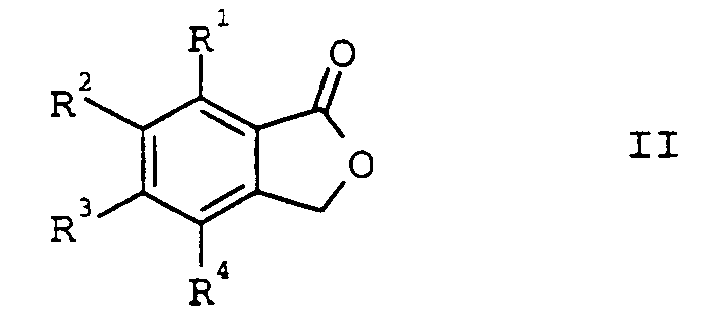
- the present invention relates to a process for the preparation of o-chloromethylbenzoyl chlorides of the formula I, in which R 1 to R 4 may be identical or different and are hydrogen, C 1 -C 4 -alkyl, halogen or trifluoromethyl, by reaction of benzo-fused lactones of the formula II, in which R 1 to R 4 have the abovementioned meaning, with gaseous or liquid phosgene, its dimers or trimers.
- O-chloromethyl-substituted benzoyl chlorides are important intermediates for the preparation of, for example, pesticidal active ingredients as described in the patents EP-A 460 575 .
- EP-A 463 488 WO-A 95/18789 .
- WO-A 95/21154 and WO-A 97/15552 are described.
- o-chloromethyl-substituted benzoyl chlorides can be prepared by reacting benzo-fused lactones with thionyl chloride or phosgene.
- EP-A 676 389 describes the preparation of o-chloromethylbenzoyl chlorides from benzo-fused lactones with thionyl chloride in the presence of a catalyst.
- reaction temperatures 160 to 170 ° C are required in which thionyl chloride already partially decomposes and as a result disturbing by-products are formed.
- quaternary ammonium salts are problematic in environmental terms and have the following process engineering Disadvantages: sublimation can lead to blockage of plant components. Furthermore, the salts are hygroscopic, which can lead to water input and an excess consumption of the chlorinating agent. Finally, the ammonium salts interfere with the distillative purification of the o-chloromethylbenzoic acid chlorides.
- EP-A 583 589 describes a process for the preparation of o-chloromethylbenzoic acid chlorides by phosgenation of benzo-fused lactones in the presence of a catalyst at 170 to 180 ° C.
- phosgene is thermally stable under these conditions, in contrast to thionyl chloride, but the handling of phosgene and its holdup in the cooler at high temperatures by increased safety effort is difficult.
- the reaction product is thermally stressed under these conditions, which can lead to its partial decomposition.
- Triarylphosphinoxide be used as a special type of catalyst for the reaction, which can be dispensed with the use of hydrogen chloride, but this does not lead to an improvement of the required reaction conditions in terms of questionable high reaction temperatures and the necessary safety effort.
- the object of the present invention was therefore to find an economical and process-capable process for the preparation of o-chloromethylbenzoyl chlorides, which does not have the abovementioned disadvantages and nevertheless gives high yields.
- the initially mentioned process is characterized in that the reaction with phosgene, its dimers or trimers takes place in the presence of catalytic amounts of a Lewis acid and catalytic amounts of a phosgenation catalyst.
- phthalides of the general formula II in which R 1 to R 4 may be identical or different and are hydrogen (H), C 1 -C 4 -alkyl, halogen (fluorine, chlorine, bromine or iodine) or trifluoromethyl. Preference is given to using unsubstituted phthalide.
- the chlorinating agent used is preferably gaseous or liquid phosgene. Furthermore, it is also possible to use dimers (trichloromethyl chloroformate, "diphosgene”) or trimers of the phosgene (bis (trichloromethyl) carbonates, "triphosgene”) or mixtures of these chlorinating agents.
- Nitrogen and phosphorus compounds are particularly suitable as the phosgenation catalyst.
- the pyridines of the formula IIIa where R is hydrogen or methyl, and phosphine oxides of the formula IIIb, in which R 'to R "' can be identical or different and are C 1 -C 10 -alkyl or unsubstituted or C 1 -C 4 -alkyl-substituted phenyl and the subscript n is 0 or 1, is particularly preferred 3-methylpyridine ( ⁇ -picoline) and unsubstituted triphenylphosphine oxide.
- liquid Trialkylphosphinoxiden has particular procedural advantages (avoiding handling solids, simple discharge of the distillation residue in the purification).
- Cyanex ® available Tri-C 6 -C 8 alkylphosphine oxides see, for example Cyanex ® 923 Fa. Cyanamid
- the liquid Trialkylphosphinoxide in combination with Lewis acids such as boric tri (C 1 -C 4 alkyl) ester and boric acid have been proven.
- the phosgenation catalyst is generally added in amounts of from 0.1 to 20 mol%, based on the amount of benzo-fused lactone used, and preferably in amounts of from 1 to 10 mol%.
- Lewis acids are boron compounds, in particular BF 3 , BCl 3 or their complexes with oxygen, sulfur or nitrogen compounds, boric acid tri (C 1 -C 4 -alkyl) esters and boric acid (H 3 BO 3 ).
- AlCl 3 , alkylaluminum dichlorides and dialkylaluminum chlorides as well as heterogeneous, Lewis-acidic aluminum silicates of the zeolite type are suitable.
- Particularly preferred are BF 3 , BCl 3 and their complexes with ether (especially diethyl ether), water (dihydrate), alcohol (especially methanol), sulfide (especially dimethyl sulfide) and amine (especially ethylamine).
- etherate and BF 3 dihydrate are particularly suitable.
- Boric acid or boric acid tri (C 1 -C 4 -alkyl) esters are particularly preferably used as Lewis acids. Such processes give excellent yields and have the advantage that the reaction mixtures are free of fluoride ions. This simplifies the entire apparatus technology compared to the analogous reaction with BF 3 as Lewis acid.
- the Lewis acid is added in amounts of from 0.1 to 20 mol%, based on the amount of benzo-fused lactone, preferably from 0.5 to 5 mol%.
- the catalyst used is a previously formed complex of the Lewis acid and the phosgenation catalyst as the catalyst system.
- this complex is used in a concentration of 0.1 to 20 mol% based on the amount of benzo-fused lactone.
- a complex of BF 3 and a methyl-substituted pyridine is used as catalyst, particularly preferred is the BF 3 - ⁇ -picoline complex.
- hydrogen chloride can be introduced in gaseous form to accelerate the ring opening parallel to the phosgene introduction.
- preference is given to omitting the introduction of hydrogen chloride during the synthesis.
- heterogeneous, Lewis acid catalysts such as B. faujasite-type zeolites in which exchangeable cations are partially or completely replaced by protons use.
- a heterogeneously catalyzed reaction has the advantage that it can be carried out in a fixed bed.
- the heterogeneous catalyst is used in amounts of from 0.01 to 10% by weight and preferably in amounts of from 0.1 to 1% by weight, based on the amount of benzo-fused lactone used.
- the reaction temperature is generally 110 to 200 ° C, and preferably 130 to 160 ° C.
- the process is preferably carried out without solvent.
- an inert solvent to phosgene.
- Inert solvents are for.
- aromatic hydrocarbons such as toluene, o-, m- or p-xylene or mixtures thereof
- chlorinated aromatic hydrocarbons such as chlorobenzene or dichlorobenzenes or cyclic carbonates such as ethylene or propylene carbonate.
- the process can be carried out both continuously and discontinuously.
- the catalyst used was 9.3 g (0.1 mol, 5 mol%) of ⁇ -picoline (3-methylpyridine) and 7.9 g (0.04 mol, 2 mol%) of BF 3 -diethyl ether complex ("BF 3 -Etherat ”) added.
- BF 3 -Etherat BF 3 -diethyl ether complex
- the reaction effluent (387 g) contained 95 GC area% o-chloromethylbenzoyl chloride and 2.5 GC area% unreacted phthalide after stripping excess phosgene.
- the distillation of the crude feed produced 350 g of o-chloromethylbenzoyl chloride (93% of theory) with a purity of 97%.
- Comparative Example I shows that among the in WO 99/16743 preferred conditions the phosgenation reaction is not feasible.
- Comparative Example II shows that without the addition of a Lewis acid, the reaction proceeds much more slowly and with lower conversion and, furthermore, a higher amount of the phosgenation catalyst is required.
Landscapes
- Chemical & Material Sciences (AREA)
- Organic Chemistry (AREA)
- Engineering & Computer Science (AREA)
- Oil, Petroleum & Natural Gas (AREA)
- Organic Low-Molecular-Weight Compounds And Preparation Thereof (AREA)
- Low-Molecular Organic Synthesis Reactions Using Catalysts (AREA)
- Catalysts (AREA)
- Pharmaceuticals Containing Other Organic And Inorganic Compounds (AREA)
Description
- Die vorliegende Erfindung betrifft ein Verfahren zur Herstellung von o-Chlormethylbenzoesäurechloriden der Formel I,

- o-Chlormethyl-substituierte Benzoylchloride sind wichtige Zwischenprodukte zur Herstellung von beispielsweise pestiziden Wirkstoffen wie sie in den Patentschriften
EP-A 460 575 EP-A 463 488 WO-A 95/18789 WO-A 95/21154 WO-A 97/15552 - o-Chlormethyl-substituierte Benzoylchloride können zum Beispiel durch Umsetzung von benzokondensierten Lactonen mit Thionylchlorid oder Phosgen hergestellt werden.
- In
EP-A 676 389 - In der
WO-A 99/16743 - Die Reaktionsführung mit Thionylchlorid als chlorierendem Reagenz ist insofern nachteilig, da als Koppelprodukt der Synthese Schwefeldioxid gebildet wird, welches aufgearbeitet oder neutralisiert werden muß. Bei der Verwendung von Phosgen als Chlorierungsmittel fällt lediglich Kohlendioxid an, welches nicht entsorgt werden muß.
-
EP-A 583 589 - In
WO 97/12854 - Aufgabe der vorliegenden Erfindung war es daher ein wirtschaftliches und prozeßfähiges Verfahren zur Herstellung von o-Chlormethylbenzoesäurechloriden zu finden, das die oben aufgeführten Nachteile nicht aufweist und dennoch hohe Ausbeuten liefert.
- Demgemäß wurde das eingangs erwähnte Verfahren gefunden, das dadurch gekennzeichnet ist, daß die Umsetzung mit Phosgen, dessen Dimeren oder Trimeren in Gegenwart katalytischer Mengen einer Lewis-Säure und katalytischer Mengen eines Phosgenierungskatalysators erfolgt.
- Zum Einsatz gelangen benzokondensierte Lactone (Phthalide) der allgemeinen Formel II

- Als Chlorierungsmittel wird vorzugsweise gasförmiges oder flüssiges Phosgen eingesetzt. Weiterhin können auch Dimere (Chlorameisensäuretrichlormethylester, "Diphosgen") oder Trimere des Phosgens (Kohlensäurebis(trichlormethyl)ester, "Triphosgen") oder Gemische dieser Chlorierungsmittel eingesetzt werden.
- Als Phosgenierungskatalysator sind insbesondere Stickstoff- und Phosphorverbindungen geeignet. Beispielsweise sind N,N-disubstituierte Formamide, Hexaalkylguanidiniumsalze, Trialkyl- oder im Arylteil ggf. substituierte Triaryl-Phosphine, Trialkyl- oder im Arylteil ggf. substituierte Triaryl-Phosphinoxide, N-substituierte Imidazole sowie substituierte oder unsubstituierte Pyridine in Betracht zu ziehen. Insbesondere sind die Pyridine der Formel IIIa

und Phosphinoxide der Formel IIIb,
- Der Einsatz von flüssigen Trialkylphosphinoxiden hat insbesondere verfahrenstechnische Vorteile (Vermeidung des Feststoffhandlings, einfacher Austrag des Destillationsrückstandes bei der Aufreinigung). Hier kommen beispielsweise die unter dem Handelsnamen Cyanex® erhältlichen Tri-C6-C8-alkylphosphinoxide(s. z.B. Cyanex® 923 der Fa. Cyanamid) in Betracht. Insbesondere haben sich die flüssigen Trialkylphosphinoxide in der Kombination mit Lewis-Säuren wie Borsäuretri(C1-C4-alkyl)ester und Borsäure bewährt.
- Der Phosgenierungskatalysator wird in der Regel in Mengen von 0,1 bis 20 mol-% bezogen auf die eingesetzte Menge an benzokondensiertem Lacton, und bevorzugt in Mengen von 1 bis 10 mol-% zugesetzt.
- Als Lewis-Säuren eignen sich insbesondere Borverbindungen, wie insbesondere BF3, BCl3 bzw. deren Komplexen mit Sauerstoff-, Schwefel- oder Stickstoffverbindungen, Borsäuretri(C1-C4-alkyl) -ester und die Borsäure (H3BO3) selbst. Desweiteren kommen AlCl3, Alkylaluminiumdichloride und Dialkylaluminiumchloride sowie heterogene, Lewis-saure Aluminiumsilicate vom Zeolith-Typ in Frage. Besonders bevorzugt sind BF3, BCl3 und deren Komplexe mit Ether (insbesondere Diethylether), Wasser (Dihydrat), Alkohol (insbesondere Methanol), Sulfid (insbesondere Dimethylsulfid) und Amin (insbesondere Ethylamin). Insbesondere geeignet sind beispielsweise BF3-Etherat und BF3-Dihydrat.
- Besonders bevorzugt werden Borsäure oder Borsäuretri(C1-C4-alkyl) -ester als Lewis-Säuren eingesetzt. Derartige Verfahren liefern hervorragende Ausbeuten und haben den Vorteil, daß die Reaktionsgemische frei von Fluoridionen sind. Damit vereinfacht sich im Vergleich zur analogen Reaktion mit BF3 als Lewis-Säure die gesamte Apparatetechnik.
- Die Lewis-Säure wird in Mengen von 0,1 bis 20 mol-% bezogen auf die eingesetzte Menge an benzokondensiertem Lacton, bevorzugt 0,5 bis 5 mol-%, zugegeben.
- In einer weiteren bevorzugten Form des Verfahrens wird als Katalysator ein vorher gebildeter Komplex aus der Lewis-Säure und dem Phosgenierungskatalysator als Katalysatorsystem verwendet. In der Regel wird dieser Komplex in einer Konzentration von 0,1 bis 20 mol-% bezogen auf die eingesetzte Menge an benzokondensiertem Lacton eingesetzt. Bevorzugt wird ein Komplex aus BF3 und einem Methyl-substituierten Pyridin als Katalysator verwendet, besonders bevorzugt ist der BF3-β-Picolin-Komplex.
- Optional kann parallel zur Phosgen-Einleitung Chlorwasserstoff zur Beschleunigung der Ringöffnung gasförmig eingeleitet werden. Bevorzugt wird jedoch auf die Einleitung von Chlorwasserstoff während der Synthese verzichtet.
- Weiterhin kann es von Vorteil sein heterogene, Lewis-saure Katalysatoren wie z. B. Zeolithe vom Faujasit-Typ, bei denen austauschbare Kationen teilweise oder vollständig durch Protonen ersetzt sind, einzusetzen. Eine heterogen katalysierte Reaktion hat den Vorteil, daß sie im Festbett durchgeführt werden kann. Der heterogene Katalysator wird in Mengen von 0,01 bis 10 Gewichts-% und bevorzugt in Mengen von 0,1 bis 1 Gewichts-% bezogen auf die eingesetzte Menge an benzokondensiertem Lacton eingesetzt.
- Die Reaktionstemperatur beträgt im allgemeinen 110 bis 200°C und vorzugsweise 130 bis 160°C.
- Das Verfahren wird vorzugsweise ohne Lösungsmittel durchgeführt. Es ist jedoch möglich ein gegen Phosgen inertes Lösungsmittel zuzusetzen. Inerte Lösungsmittel sind z. B. aromatische Kohlenwasserstoffe wie Toluol, o-, m- oder p-Xylol oder deren Gemische, chlorierte aromatische Kohlenwasserstoffe wie Chlorbenzol oder Dichlorbenzolen oder cyclische Carbonate wie Ethylen- oder Propylencarbonat.
- Das Verfahren kann sowohl kontinuierlich als auch diskontinuierlich durchgeführt werden.
- Die nachfolgenden Beispiele sollen das Verfahren weiter erläutern.
- Allgemeine Versuchsbeschreibung für alle Beispiele:
- In einer Phosgenierungsapparatur bestehend aus einem 1 1 Doppelmantelreaktor mit aufgesetzter Intensivkühlungskaskade wurden jeweils 2 mol (268 g) Phthalid vorgelegt und zusammen mit dem jeweiligen Katalysatorsystem aufgeschmolzen. Nach Erwärmung auf 140 °C wurde solange Phosgen eingegast, bis kein Phosgen mehr verbraucht wird (erkennbar am Abfall der Innentemperatur). Danach ließ man eine Stunde bei 140°C nachrühren und strippte dann überschüssiges Phosgen mit Stickstoff bei 100°C. In ausgewählten Beispielen wurde das Produkt bei 1 mbar und 93-95°C durch fraktionierte Destillation isoliert.
- Als Katalysator wurden 9,3 g (0,1 mol, 5 mol-%) β-Picolin (3-Methylpyridin) und 7,9 g (0,04 mol, 2-mol-%) BF3-Diethyletherkomplex ("BF3-Etherat") zugegeben. Innerhalb von 8 h wurden bei 140-145°C insgesamt 218 g (2,18 mol) Phosgen eingegast. Der Reaktionsaustrag (387 g) enthielt nach dem Strippen des überschüssigen Phosgens 95 GC-Flächen-% o-Chlormethylbenzoylchlorid und 2,5 GC-Flächen-% nicht umgesetztes Phthalid. Die Destillation des Rohaustrages erbrachte 350 g o-Chlormethylbenzoylchlorid (93 % der Theorie) mit einer Reinheit von 97 %.
- 392 g (3 mol) Phthalid wurden mit 14 g (0,15 mol) β-Picolin und 12 g (0,06 mol) BF3-Etherat auf 140°C erhitzt. Bei 140-145°C wurden insgesamt 342 g (3,42 mol) Phosgen eingegast. Nach einer Nachreaktion von 1 h wurde das überschüssige Phosgen mit Stickstoff gestrippt. Der Reaktionsaustrag (572 g) enthielt 97 GC-Flächen-% o-Chlormethylbenzoylchlorid und 1 GC-Flächen-% Phthalid.
- Als Katalysator wurden 20 g eines zuvor hergestellten BF3-β-Picolin-Komplexes zugegeben. Innerhalb von 6 h wurden insgesamt 230 g (2,3 mol) Phosgen eingegast. Der Reaktionsaustrag (391 g) enthielt nach dem Strippen des überschüssigen Phosgens 97,2 GC-Flächen-% o-Chlormethylbenzoylchlorid und 0,7 GC-Flächen-% Phthalid. Die Destillation des Rohaustrages erbrachte 334 g o-Chlormethylbenzoylchlorid (88 % der Theorie) mit einer Reinheit von 98,8 %.
- 2 mol Phthalid (268 g) wurden mit 27,8 g Triphenylphosphinoxid (TPPO) (0,1 mol) und 1 g HY-Zeolith GE 1967 vorgelegt. Bei 140-149°C wurden innerhalb von 8 h insgesamt 231 g Phosgen (2,31 mol) eingegast. Nach einer Nachrührzeit von 1 h bei 140°C wurde das überschüssige Phosgen mit Stickstoff gestrippt. Der Austrag (403 g) enthielt 78 GC-Flächen-% o-Chlormethylbenzoylchlorid und 6,8 % Phthalid.
- 2 mol Phthalid (268 g) wurden mit 27,8 g TPPO (0,1 mol) und 7,9 g (0,04 mol) BF3-Etherat vorgelegt. Bei 140-150°C wurden innerhalb von 8 h insgesamt 233 g Phosgen (2,33 mol) eingegast. Nach einer Nachrührzeit von 1 h bei 140°C wurde das überschüssige Phosgen mit Stickstoff gestrippt. Der Austrag (415 g) enthielt 88,4 GC-Flächen-% o-Chlormethylbenzoylchlorid und 0,1 % Phthalid. Die fraktionierte Destillation des Rohaustrages lieferte 363 g (96 % d.T.) o-Chlormethylbenzoylchlorid mit einer Reinheit von 99,8 %.
- Vorgelegt wurden 268 g (2 mol) Phthalid, 9,3 g (0,1 mol) β-Picolin und 50 ml 0,1 molarer Lösung von BCl3 in Xylol. Innerhalb von 8 h wurden bei 140-150°C insgesamt 200 g (2 mol) Phosgen eingegast. Danach ließ man eine Stunde bei 140°C nachrühren. Nach dem Strippen überschüssigen Phosgens mit Stickstoff verblieb ein Austrag von 398 g mit einem Gehalt von 77,2 GC-Flächen-% o-Chlormethylbenzoylchlorid und 10,9 % nicht umgesetzten Phthalids.
- Vorgelegt wurden 268 g (2 mol) Phthalid, 9,3 g (0,1 mol) β-Picolin und 3,1 g (0,05 mol) kristalline Borsäure (Riedel de Haën). Innerhalb von 7 h wurden bei 140-150°C insgesamt 245 g (2,45 mol) Phosgen eingegast. Danach ließ man eine Stunde bei 140°C nachrühren. Nach dem Strippen überschüssigen Phosgens mit Stickstoff verblieb ein Austrag von 380 g mit einem Gehalt von 96 GC-Flächen-% o-Chlormethylbenzoylchlorid und 1,4 % nicht umgesetzten Phthalids. Durch fraktionierte Destillation des Rohaustrages wurden 340 g o-Chlormethylbenzoylchlorid (90 % d. T.) mit einer Reinheit von > 97 % erhalten.
- Vorgelegt wurden 268 g (2 mol) Phthalid, 27,8 g (0,1 mol) TPPO und 3,1 g (0,05 mol) kristalline Borsäure (Riedel de Haën). Innerhalb von 5 h 45 min wurden bei 140-150°C insgesamt 247 g (2,47 mol) Phosgen eingegast. Danach ließ man eine Stunde bei 140°C nachrühren. Nach dem Strippen überschüssigen Phosgens mit Stickstoff verblieb ein Austrag von 411 g mit einem Gehalt von 88 GC-Flächen-% o-Chlormethylbenzoylchlorid und 0,7 % nicht umgesetzten Phthalids. Durch fraktionierte Destillation des Rohaustrages wurden 358 g o-Chlormethylbenzoylchlorid (94 % d. T.) mit einer Reinheit von 98,5 % erhalten.
- Vorgelegt wurden 268 g (2 mol) Phthalid, 27,8 g (0,1 mol) TPPO und 5,2 g (0,05 mol) Borsäuretrimethylester (Aldrich). Innerhalb von 7 h wurden bei 140-150°C insgesamt 256 g (2,56 mol) Phosgen eingegast. Danach ließ man eine Stunde bei 140°C nachrühren. Nach dem Strippen überschüssigen Phosgens mit Stickstoff verblieb ein Austrag von 410 g mit einem Gehalt von 87,6 GC-Flächen-% o-Chlormethylbenzoylchlorid und 1,1 % nicht umgesetzten Phthalids.
- Vorgelegt wurden 2 mol Phthalid, 34,8 g (0,1 mol) Cyanex 923 (Fa. Cyanamid) sowie 3,1 g (0,05 mol) Borsäure. Innerhalb von 4 h wurden bei 141 bis 150°C insgesamt 257 g (2,57 mol) Phosgen eingeleitet. Es wurde eine Stunde bei 140°C nachgerührt und das überschüssige Phosgen mit Stickstoff gestrippt. Der Rohaustrag von 417 g wurde fraktioniert destilliert. Es wurden 352 g (93% d. T.) o-Chlormethylbenzoylchlorid mit einer Reinheit von 98,7% erhalten.
- Vorgelegt wurden 2 mol Phthalid, 34,8 g (0,1 mol) Cyanex 923 (Fa. Cyanamid) sowie 5,2 g (0,05 mol) Borsäuretrimethylester. Innerhalb von 6 h wurden bei 141 bis 150°C insgesamt 244 g (2,44 mol) Phosgen eingeleitet. Es wurde eine Stunde bei 140°C nachgerührt und das überschüssige Phosgen mit Stickstoff gestrippt. Der Rohaustrag von 411 g wurde fraktioniert destilliert. Es wurden 357 g (94% d. T.) o-Chlormethylbenzoylchlorid mit einer Reinheit von 97,7% erhalten.
- Gemäß der allgemeinen Versuchsvorschrift wurden 9,1 g Triethylbenzylammoniumchlorid (TEBA) (0,04 mol, 2 mol-%) und 7,9 g BF3-Etherat (0,04 mol, 2 mol-%) als Katalysatormischung eingesetzt. Innerhalb von 11 h wurden insgesamt 45 g (0,45 mol) Phosgen bei einer Reaktionstemperatur von zunächst 95-100°C (3 h), später bei 140°C eingegast. Nach einer Nachreaktion von 1 h bei 140°C und Strippung des Phosgens enthält der Rohaustrag lediglich 7,7 GC-Flächen-% o-Chlormethylbenzoylchlorid und 91 % unumgesetztes Phthalid.
- Vergleichsbeispiel I zeigt, daß unter den in
WO 99/16743 - 2 mol Phthalid wurden mit 18,6 g β-Picolin (0,2 mol, 10 mol-%) vorgelegt. Bei 142-152°C wurden innerhalb von 10 h parallel 209 g (2,1 mol) Phosgen und 154 g HCl eingegast. Nach Nachrühren und Strippung des überschüssigen Phosgens enthielt der Reaktionsaustrag (380 g) 86 % o-Chlormethylbenzoylchlorid und 6 % unumgesetztes Phthalid.
- Vergleichsbeispiel II zeigt, daß die Reaktion ohne die Zugabe einer Lewis-Säure deutlich langsamer und mit schlechterem Umsatz abläuft und ferner eine höhere Menge des Phosgenierungskatalysators erforderlich ist.
Claims (10)
- Verfahren zur Herstellung von o-Chlormethylbenzoesäurechloriden der Formel I,


dadurch gekennzeichnet, daß man die Umsetzung in Gegenwart katalytischer Mengen einer Lewis-Säure und katalytischer Mengen eines Phosgenierungskatalysators durchführt. - Verfahren gemäß Anspruch 1, dadurch gekennzeichnet, daß als Lewis-Säure eine Borverbindung eingesetzt wird.
- Verfahren gemäß Anspruch 2, dadurch gekennzeichnet, daß als Lewis-Säure Bortrifluorid oder Bortrichlorid in Komplex-gebundener Form eingesetzt wird.
- Verfahren gemäß Anspruch 2, dadurch gekennzeichnet, daß als Lewis-Säure Borsäure oder ein Borsäuretri-C1-C4-alkylester eingesetzt wird.
- Verfahren gemäß Anspruch 1, dadurch gekennzeichnet, daß als Lewis-Säure Aluminiumsilikate vom Zeolith-Typ verwendet werden.
- Verfahren gemäß einem der Ansprüche 1 bis 5, dadurch gekennzeichnet, daß die Lewis-Säure in einer Konzentration von 0,1 bis 20 mol-% bezogen auf das Lacton II eingesetzt wird.
- Verfahren gemäß einem der Ansprüche 1 bis 3 dadurch gekennzeichnet, daß als Katalysator 0,1 bis 20 mol-% eines Komplexes aus Lewis-Säure und Phosgenierungskatalysator eingesetzt werden.
- Verfahren gemäß einem der Ansprüche 1 bis 6, dadurch gekennzeichnet, daß als Phosgenierungskatalysator ein Pyridin der Formel IIIa oder ein Phospin(oxid) der Formel IIIb,

- Verfahren nach Anspruch 8, dadurch gekennzeichnet, daß als Phosgenierungskatalysator 3-Methylpyridin (β-Picolin), Triphenylphosphinoxid oder ein flüssiges Trialkylphosphinoxid verwendet wird.
- Verfahren gemäß einem der Ansprüche 1 bis 8, dadurch gekennzeichnet, daß 0,1 bis 20 mol-% des Phosgenierungskatalysators bezogen auf das Lacton II eingesetzt werden.
Applications Claiming Priority (2)
| Application Number | Priority Date | Filing Date | Title |
|---|---|---|---|
| DE19958601 | 1999-12-06 | ||
| PCT/EP2000/011814 WO2001042183A2 (de) | 1999-12-06 | 2000-11-27 | Verfahren zur herstellung von o-chlormethylbenzoesäurechloriden |
Publications (2)
| Publication Number | Publication Date |
|---|---|
| EP2097366A2 EP2097366A2 (de) | 2009-09-09 |
| EP2097366B1 true EP2097366B1 (de) | 2010-11-10 |
Family
ID=7931493
Family Applications (1)
| Application Number | Title | Priority Date | Filing Date |
|---|---|---|---|
| EP00993318A Expired - Lifetime EP2097366B1 (de) | 1999-12-06 | 2000-11-27 | Verfahren zur herstellung von o-chlormethylbenzoesäurechloriden |
Country Status (17)
| Country | Link |
|---|---|
| US (1) | US6734322B1 (de) |
| EP (1) | EP2097366B1 (de) |
| JP (1) | JP4674029B2 (de) |
| KR (1) | KR100669267B1 (de) |
| CN (1) | CN1222498C (de) |
| AT (1) | ATE487689T1 (de) |
| AU (1) | AU2837201A (de) |
| BR (1) | BR0016214B1 (de) |
| CA (1) | CA2393978A1 (de) |
| CZ (1) | CZ20021980A3 (de) |
| DE (1) | DE50016027D1 (de) |
| DK (1) | DK2097366T3 (de) |
| HU (1) | HUP0203482A3 (de) |
| IL (2) | IL149502A0 (de) |
| MX (1) | MXPA02004964A (de) |
| PL (1) | PL357602A1 (de) |
| WO (1) | WO2001042183A2 (de) |
Families Citing this family (4)
| Publication number | Priority date | Publication date | Assignee | Title |
|---|---|---|---|---|
| MXPA02004965A (es) * | 1999-12-07 | 2002-09-18 | Basf Ag | Metodo para producir cloruros del acido o-clorometilbenzoico. |
| BRPI0514888B1 (pt) | 2004-09-17 | 2015-06-09 | Asahi Kasei Chemicals Corporation | Processo industrial para a separação de um álcool subproduzido em um caso de produção em massa contínua de um carbonato aromático em uma escala industrial |
| CN102160956B (zh) * | 2011-03-08 | 2013-01-02 | 江苏快达农化股份有限公司 | 光气尾气吸收、利用的方法 |
| CN111978226B (zh) | 2018-06-05 | 2022-03-04 | 沈阳化工大学 | 一种三氟乙基硫醚(亚砜)取代苯类化合物及其用途 |
Family Cites Families (5)
| Publication number | Priority date | Publication date | Assignee | Title |
|---|---|---|---|---|
| FR2655334B1 (fr) * | 1989-12-06 | 1992-02-21 | Poudres & Explosifs Ste Nale | Procede de preparation de chlorures d'acides carboxyliques chlores. |
| DE4223382A1 (de) * | 1992-07-16 | 1994-01-20 | Basf Ag | Verfahren zur Herstellung von aromatischen o-Chlormethylcarbonsäurechloriden |
| DE4412316A1 (de) * | 1994-04-11 | 1995-10-12 | Basf Ag | Verfahren zur Herstellung von o-Chlormethylbenzoesäurechloriden |
| TW337519B (en) * | 1995-10-03 | 1998-08-01 | Novartis Ag | Process for the preparation of chloromethyl carbonyl chlorides |
| JP3433319B2 (ja) | 1997-09-30 | 2003-08-04 | コリア リサーチ インスティテュート オブ ケミカル テクノロジー | 塩化o−(カルボアルコキシ)フェニルメタンスルホニル誘導体の製造方法 |
-
2000
- 2000-11-27 AU AU28372/01A patent/AU2837201A/en not_active Abandoned
- 2000-11-27 DE DE50016027T patent/DE50016027D1/de not_active Expired - Lifetime
- 2000-11-27 AT AT00993318T patent/ATE487689T1/de not_active IP Right Cessation
- 2000-11-27 CA CA002393978A patent/CA2393978A1/en not_active Abandoned
- 2000-11-27 WO PCT/EP2000/011814 patent/WO2001042183A2/de not_active Ceased
- 2000-11-27 EP EP00993318A patent/EP2097366B1/de not_active Expired - Lifetime
- 2000-11-27 BR BRPI0016214-0A patent/BR0016214B1/pt not_active IP Right Cessation
- 2000-11-27 MX MXPA02004964A patent/MXPA02004964A/es active IP Right Grant
- 2000-11-27 PL PL00357602A patent/PL357602A1/xx not_active Application Discontinuation
- 2000-11-27 US US10/130,826 patent/US6734322B1/en not_active Expired - Fee Related
- 2000-11-27 HU HU0203482A patent/HUP0203482A3/hu unknown
- 2000-11-27 KR KR1020027007182A patent/KR100669267B1/ko not_active Expired - Fee Related
- 2000-11-27 IL IL14950200A patent/IL149502A0/xx active IP Right Grant
- 2000-11-27 JP JP2001543485A patent/JP4674029B2/ja not_active Expired - Fee Related
- 2000-11-27 DK DK00993318.5T patent/DK2097366T3/da active
- 2000-11-27 CZ CZ20021980A patent/CZ20021980A3/cs unknown
- 2000-11-27 CN CNB008159874A patent/CN1222498C/zh not_active Expired - Fee Related
-
2002
- 2002-05-07 IL IL149502A patent/IL149502A/en not_active IP Right Cessation
Also Published As
| Publication number | Publication date |
|---|---|
| US6734322B1 (en) | 2004-05-11 |
| HUP0203482A2 (hu) | 2003-02-28 |
| DK2097366T3 (da) | 2011-02-21 |
| AU2837201A (en) | 2001-06-18 |
| JP4674029B2 (ja) | 2011-04-20 |
| CZ20021980A3 (cs) | 2002-09-11 |
| WO2001042183A2 (de) | 2001-06-14 |
| BR0016214B1 (pt) | 2010-08-24 |
| CN1391551A (zh) | 2003-01-15 |
| IL149502A0 (en) | 2002-11-10 |
| MXPA02004964A (es) | 2002-09-18 |
| JP2003516374A (ja) | 2003-05-13 |
| PL357602A1 (en) | 2004-07-26 |
| IL149502A (en) | 2007-03-08 |
| KR100669267B1 (ko) | 2007-01-18 |
| CN1222498C (zh) | 2005-10-12 |
| BR0016214A (pt) | 2002-09-17 |
| EP2097366A2 (de) | 2009-09-09 |
| HUP0203482A3 (en) | 2005-11-28 |
| WO2001042183A3 (de) | 2002-05-02 |
| KR20020061630A (ko) | 2002-07-24 |
| DE50016027D1 (de) | 2010-12-23 |
| ATE487689T1 (de) | 2010-11-15 |
| CA2393978A1 (en) | 2001-06-14 |
Similar Documents
| Publication | Publication Date | Title |
|---|---|---|
| EP0623582A2 (de) | Verfahren zur Herstellung von Carbonsäureestern aus Carbonsäurehalogeniden und Alkoholen | |
| EP0623577B1 (de) | Herstellung von Carbonsäurehalogeniden und Carboxylat-Salzen | |
| EP0124002B1 (de) | Verfahren zur Herstellung von aromatischen Verbindungen, die über ein Heteroatom gebundene perfluorierte Seitenketten enthalten | |
| DE2614240C3 (de) | Verfahren zur Herstellung von Acylcyaniden | |
| EP0105494B1 (de) | Verfahren zur Herstellung von Benzthiazolyloxyphenoxypropionsäurederivaten | |
| EP0676389B1 (de) | Verfahren zur Herstellung von 0-Chloromethylbenzoesäurechloriden | |
| EP1265837B1 (de) | Verfahren zur herstellung von o-chlormethylbenzoesäurechloriden | |
| EP2097366A2 (de) | Verfahren zur herstellung von o-chlormethylbenzoesäurechloriden | |
| EP2297126A1 (de) | Verfahren zur herstellung von glycidylestern | |
| EP1068168B1 (de) | Kontinuierliches verfahren zur herstellung von propargylchlorid | |
| DE2064301A1 (de) | Verfahren zur Gewinnung von Diarvl verbindungen | |
| DE2614241A1 (de) | Verfahren zur herstellung von acylcyaniden | |
| EP0090185B1 (de) | Verfahren zur Herstellung von Acetalen und Enoläthern aus Acryloxymethylenverbindungen | |
| EP0302331B1 (de) | Ester von Arylbisperfluoralkylcarbinolen, Verfahren zur Herstellung dieser Verbindungen und der zugrundeliegenden Arylbisperfluoralkylcarbinole | |
| EP1235780B1 (de) | Verfahren zur herstellung von o-chlormethylbenzoesäurechloriden | |
| DE69402832T2 (de) | Verfahren zur herstellung von bis(2-benzoxazolyl)stilbenen | |
| EP0590459B1 (de) | Verfahren zur Herstellung von Difluor- und Chlorfluorbenzodioxolen | |
| EP0266544B1 (de) | Verfahren zur Herstellung von Halogenalkoholen | |
| EP0413264A1 (de) | Verfahren zur Herstellung von Chlorcarbonsäurechloriden | |
| EP0388870A1 (de) | Verfahren zur Herstellung von aliphatischen substituierten Fluorbenzolen | |
| EP0301444A2 (de) | Verfahren zur Herstellung von Arylperfluoralkylketonen | |
| DE19959066C1 (de) | Verfahren zur Herstellung von o-Chlormethylbenzoesäurechloriden | |
| EP0053326B1 (de) | Verfahren zur Herstellung von Pivaloylcyanid | |
| DE10007695A1 (de) | Verfahren zur Herstellung von o-Chlormethylbenzoesäurechloriden | |
| DE3427146A1 (de) | Neue pyridon-derivate |
Legal Events
| Date | Code | Title | Description |
|---|---|---|---|
| PUAI | Public reference made under article 153(3) epc to a published international application that has entered the european phase |
Free format text: ORIGINAL CODE: 0009012 |
|
| 17P | Request for examination filed |
Effective date: 20020909 |
|
| AK | Designated contracting states |
Kind code of ref document: A2 Designated state(s): AT BE CH CY DE DK ES FI FR GB GR IE IT LI LU MC NL PT SE TR |
|
| AX | Request for extension of the european patent |
Extension state: AL LT LV MK RO SI |
|
| GRAP | Despatch of communication of intention to grant a patent |
Free format text: ORIGINAL CODE: EPIDOSNIGR1 |
|
| GRAS | Grant fee paid |
Free format text: ORIGINAL CODE: EPIDOSNIGR3 |
|
| GRAA | (expected) grant |
Free format text: ORIGINAL CODE: 0009210 |
|
| AK | Designated contracting states |
Kind code of ref document: B1 Designated state(s): AT BE CH CY DE DK ES FI FR GB GR IE IT LI LU MC NL PT SE TR |
|
| REG | Reference to a national code |
Ref country code: GB Ref legal event code: FG4D Free format text: NOT ENGLISH |
|
| REG | Reference to a national code |
Ref country code: CH Ref legal event code: EP |
|
| REG | Reference to a national code |
Ref country code: IE Ref legal event code: FG4D Free format text: LANGUAGE OF EP DOCUMENT: GERMAN |
|
| REF | Corresponds to: |
Ref document number: 50016027 Country of ref document: DE Date of ref document: 20101223 Kind code of ref document: P |
|
| PGFP | Annual fee paid to national office [announced via postgrant information from national office to epo] |
Ref country code: FR Payment date: 20101214 Year of fee payment: 11 Ref country code: DK Payment date: 20101124 Year of fee payment: 11 |
|
| REG | Reference to a national code |
Ref country code: DK Ref legal event code: T3 |
|
| PGFP | Annual fee paid to national office [announced via postgrant information from national office to epo] |
Ref country code: CH Payment date: 20101130 Year of fee payment: 11 |
|
| REG | Reference to a national code |
Ref country code: NL Ref legal event code: VDEP Effective date: 20101110 |
|
| PGFP | Annual fee paid to national office [announced via postgrant information from national office to epo] |
Ref country code: GB Payment date: 20101130 Year of fee payment: 11 |
|
| BERE | Be: lapsed |
Owner name: BASF SE Effective date: 20101130 |
|
| PG25 | Lapsed in a contracting state [announced via postgrant information from national office to epo] |
Ref country code: SE Free format text: LAPSE BECAUSE OF FAILURE TO SUBMIT A TRANSLATION OF THE DESCRIPTION OR TO PAY THE FEE WITHIN THE PRESCRIBED TIME-LIMIT Effective date: 20101110 Ref country code: NL Free format text: LAPSE BECAUSE OF FAILURE TO SUBMIT A TRANSLATION OF THE DESCRIPTION OR TO PAY THE FEE WITHIN THE PRESCRIBED TIME-LIMIT Effective date: 20101110 Ref country code: CY Free format text: LAPSE BECAUSE OF FAILURE TO SUBMIT A TRANSLATION OF THE DESCRIPTION OR TO PAY THE FEE WITHIN THE PRESCRIBED TIME-LIMIT Effective date: 20101110 Ref country code: FI Free format text: LAPSE BECAUSE OF FAILURE TO SUBMIT A TRANSLATION OF THE DESCRIPTION OR TO PAY THE FEE WITHIN THE PRESCRIBED TIME-LIMIT Effective date: 20101110 Ref country code: PT Free format text: LAPSE BECAUSE OF FAILURE TO SUBMIT A TRANSLATION OF THE DESCRIPTION OR TO PAY THE FEE WITHIN THE PRESCRIBED TIME-LIMIT Effective date: 20110310 |
|
| PGFP | Annual fee paid to national office [announced via postgrant information from national office to epo] |
Ref country code: DE Payment date: 20110131 Year of fee payment: 11 |
|
| REG | Reference to a national code |
Ref country code: IE Ref legal event code: FD4D |
|
| PG25 | Lapsed in a contracting state [announced via postgrant information from national office to epo] |
Ref country code: GR Free format text: LAPSE BECAUSE OF FAILURE TO SUBMIT A TRANSLATION OF THE DESCRIPTION OR TO PAY THE FEE WITHIN THE PRESCRIBED TIME-LIMIT Effective date: 20110211 Ref country code: MC Free format text: LAPSE BECAUSE OF NON-PAYMENT OF DUE FEES Effective date: 20101130 |
|
| PG25 | Lapsed in a contracting state [announced via postgrant information from national office to epo] |
Ref country code: ES Free format text: LAPSE BECAUSE OF FAILURE TO SUBMIT A TRANSLATION OF THE DESCRIPTION OR TO PAY THE FEE WITHIN THE PRESCRIBED TIME-LIMIT Effective date: 20110221 Ref country code: IE Free format text: LAPSE BECAUSE OF FAILURE TO SUBMIT A TRANSLATION OF THE DESCRIPTION OR TO PAY THE FEE WITHIN THE PRESCRIBED TIME-LIMIT Effective date: 20101110 |
|
| PG25 | Lapsed in a contracting state [announced via postgrant information from national office to epo] |
Ref country code: BE Free format text: LAPSE BECAUSE OF NON-PAYMENT OF DUE FEES Effective date: 20101130 |
|
| PLBE | No opposition filed within time limit |
Free format text: ORIGINAL CODE: 0009261 |
|
| STAA | Information on the status of an ep patent application or granted ep patent |
Free format text: STATUS: NO OPPOSITION FILED WITHIN TIME LIMIT |
|
| 26N | No opposition filed |
Effective date: 20110811 |
|
| REG | Reference to a national code |
Ref country code: DE Ref legal event code: R097 Ref document number: 50016027 Country of ref document: DE Effective date: 20110811 |
|
| PG25 | Lapsed in a contracting state [announced via postgrant information from national office to epo] |
Ref country code: IT Free format text: LAPSE BECAUSE OF FAILURE TO SUBMIT A TRANSLATION OF THE DESCRIPTION OR TO PAY THE FEE WITHIN THE PRESCRIBED TIME-LIMIT Effective date: 20101110 |
|
| REG | Reference to a national code |
Ref country code: AT Ref legal event code: MM01 Ref document number: 487689 Country of ref document: AT Kind code of ref document: T Effective date: 20101127 |
|
| PG25 | Lapsed in a contracting state [announced via postgrant information from national office to epo] |
Ref country code: AT Free format text: LAPSE BECAUSE OF NON-PAYMENT OF DUE FEES Effective date: 20101127 |
|
| REG | Reference to a national code |
Ref country code: CH Ref legal event code: PL |
|
| REG | Reference to a national code |
Ref country code: DK Ref legal event code: EBP |
|
| GBPC | Gb: european patent ceased through non-payment of renewal fee |
Effective date: 20111127 |
|
| PG25 | Lapsed in a contracting state [announced via postgrant information from national office to epo] |
Ref country code: LI Free format text: LAPSE BECAUSE OF NON-PAYMENT OF DUE FEES Effective date: 20111130 Ref country code: CH Free format text: LAPSE BECAUSE OF NON-PAYMENT OF DUE FEES Effective date: 20111130 |
|
| REG | Reference to a national code |
Ref country code: FR Ref legal event code: ST Effective date: 20120731 |
|
| REG | Reference to a national code |
Ref country code: DE Ref legal event code: R119 Ref document number: 50016027 Country of ref document: DE Effective date: 20120601 |
|
| PG25 | Lapsed in a contracting state [announced via postgrant information from national office to epo] |
Ref country code: LU Free format text: LAPSE BECAUSE OF NON-PAYMENT OF DUE FEES Effective date: 20101127 |
|
| PG25 | Lapsed in a contracting state [announced via postgrant information from national office to epo] |
Ref country code: GB Free format text: LAPSE BECAUSE OF NON-PAYMENT OF DUE FEES Effective date: 20111127 Ref country code: DK Free format text: LAPSE BECAUSE OF NON-PAYMENT OF DUE FEES Effective date: 20111130 Ref country code: TR Free format text: LAPSE BECAUSE OF FAILURE TO SUBMIT A TRANSLATION OF THE DESCRIPTION OR TO PAY THE FEE WITHIN THE PRESCRIBED TIME-LIMIT Effective date: 20101110 |
|
| PG25 | Lapsed in a contracting state [announced via postgrant information from national office to epo] |
Ref country code: FR Free format text: LAPSE BECAUSE OF NON-PAYMENT OF DUE FEES Effective date: 20111130 |
|
| PG25 | Lapsed in a contracting state [announced via postgrant information from national office to epo] |
Ref country code: DE Free format text: LAPSE BECAUSE OF NON-PAYMENT OF DUE FEES Effective date: 20120601 |