EP0124002B1 - Verfahren zur Herstellung von aromatischen Verbindungen, die über ein Heteroatom gebundene perfluorierte Seitenketten enthalten - Google Patents
Verfahren zur Herstellung von aromatischen Verbindungen, die über ein Heteroatom gebundene perfluorierte Seitenketten enthalten Download PDFInfo
- Publication number
- EP0124002B1 EP0124002B1 EP84104277A EP84104277A EP0124002B1 EP 0124002 B1 EP0124002 B1 EP 0124002B1 EP 84104277 A EP84104277 A EP 84104277A EP 84104277 A EP84104277 A EP 84104277A EP 0124002 B1 EP0124002 B1 EP 0124002B1
- Authority
- EP
- European Patent Office
- Prior art keywords
- process according
- bonded via
- aromatic compounds
- side chains
- perhalogenated
- Prior art date
- Legal status (The legal status is an assumption and is not a legal conclusion. Google has not performed a legal analysis and makes no representation as to the accuracy of the status listed.)
- Expired
Links
- 238000000034 method Methods 0.000 title claims description 32
- 150000001491 aromatic compounds Chemical class 0.000 title claims description 24
- 125000005842 heteroatom Chemical group 0.000 title claims description 10
- 238000002360 preparation method Methods 0.000 title claims description 6
- 238000004821 distillation Methods 0.000 claims description 17
- 239000003054 catalyst Substances 0.000 claims description 14
- 239000007858 starting material Substances 0.000 claims description 13
- -1 carboxylic acid fluoride Chemical class 0.000 claims description 12
- 239000011541 reaction mixture Substances 0.000 claims description 12
- NINIDFKCEFEMDL-UHFFFAOYSA-N Sulfur Chemical compound [S] NINIDFKCEFEMDL-UHFFFAOYSA-N 0.000 claims description 10
- QVGXLLKOCUKJST-UHFFFAOYSA-N atomic oxygen Chemical compound [O] QVGXLLKOCUKJST-UHFFFAOYSA-N 0.000 claims description 10
- 125000004433 nitrogen atom Chemical group N* 0.000 claims description 10
- 229910052760 oxygen Inorganic materials 0.000 claims description 10
- 239000001301 oxygen Substances 0.000 claims description 10
- VSCWAEJMTAWNJL-UHFFFAOYSA-K aluminium trichloride Chemical compound Cl[Al](Cl)Cl VSCWAEJMTAWNJL-UHFFFAOYSA-K 0.000 claims description 8
- VMPVEPPRYRXYNP-UHFFFAOYSA-I antimony(5+);pentachloride Chemical compound Cl[Sb](Cl)(Cl)(Cl)Cl VMPVEPPRYRXYNP-UHFFFAOYSA-I 0.000 claims description 8
- 125000003118 aryl group Chemical group 0.000 claims description 8
- 125000005843 halogen group Chemical group 0.000 claims description 5
- WTEOIRVLGSZEPR-UHFFFAOYSA-N boron trifluoride Chemical compound FB(F)F WTEOIRVLGSZEPR-UHFFFAOYSA-N 0.000 claims description 4
- 125000002837 carbocyclic group Chemical group 0.000 claims description 3
- 229910015900 BF3 Inorganic materials 0.000 claims description 2
- XFXPMWWXUTWYJX-UHFFFAOYSA-N Cyanide Chemical compound N#[C-] XFXPMWWXUTWYJX-UHFFFAOYSA-N 0.000 claims description 2
- 125000000217 alkyl group Chemical group 0.000 claims description 2
- PQLAYKMGZDUDLQ-UHFFFAOYSA-K aluminium bromide Chemical compound Br[Al](Br)Br PQLAYKMGZDUDLQ-UHFFFAOYSA-K 0.000 claims description 2
- 150000001732 carboxylic acid derivatives Chemical class 0.000 claims description 2
- YRTOIWNETUADLY-UHFFFAOYSA-N chlorosulfonyl nitrate Chemical compound [O-][N+](=O)OS(Cl)(=O)=O YRTOIWNETUADLY-UHFFFAOYSA-N 0.000 claims description 2
- RBTARNINKXHZNM-UHFFFAOYSA-K iron trichloride Chemical compound Cl[Fe](Cl)Cl RBTARNINKXHZNM-UHFFFAOYSA-K 0.000 claims description 2
- 239000011968 lewis acid catalyst Substances 0.000 claims description 2
- GICWIDZXWJGTCI-UHFFFAOYSA-I molybdenum pentachloride Chemical compound Cl[Mo](Cl)(Cl)(Cl)Cl GICWIDZXWJGTCI-UHFFFAOYSA-I 0.000 claims description 2
- ZSRZHCIWJJKHAU-UHFFFAOYSA-N pentachloro-$l^{5}-arsane Chemical compound Cl[As](Cl)(Cl)(Cl)Cl ZSRZHCIWJJKHAU-UHFFFAOYSA-N 0.000 claims description 2
- XJDNKRIXUMDJCW-UHFFFAOYSA-J titanium tetrachloride Chemical compound Cl[Ti](Cl)(Cl)Cl XJDNKRIXUMDJCW-UHFFFAOYSA-J 0.000 claims description 2
- FAQYAMRNWDIXMY-UHFFFAOYSA-N trichloroborane Chemical compound ClB(Cl)Cl FAQYAMRNWDIXMY-UHFFFAOYSA-N 0.000 claims description 2
- 239000005864 Sulphur Substances 0.000 claims 3
- 125000004122 cyclic group Chemical group 0.000 claims 1
- 238000009835 boiling Methods 0.000 description 13
- 239000000203 mixture Substances 0.000 description 12
- KRHYYFGTRYWZRS-UHFFFAOYSA-N Fluorane Chemical compound F KRHYYFGTRYWZRS-UHFFFAOYSA-N 0.000 description 10
- 229910000040 hydrogen fluoride Inorganic materials 0.000 description 10
- 238000006243 chemical reaction Methods 0.000 description 8
- 239000000460 chlorine Substances 0.000 description 8
- 229910052801 chlorine Inorganic materials 0.000 description 8
- 150000001875 compounds Chemical class 0.000 description 8
- 238000003682 fluorination reaction Methods 0.000 description 8
- 229910052717 sulfur Inorganic materials 0.000 description 7
- 239000011593 sulfur Substances 0.000 description 7
- FAPWRFPIFSIZLT-UHFFFAOYSA-M Sodium chloride Chemical compound [Na+].[Cl-] FAPWRFPIFSIZLT-UHFFFAOYSA-M 0.000 description 6
- 229910052731 fluorine Inorganic materials 0.000 description 6
- 150000002222 fluorine compounds Chemical class 0.000 description 5
- 239000002904 solvent Substances 0.000 description 5
- QXZUJWQCEJHYTB-UHFFFAOYSA-N 2-chloro-2-fluoro-1,3-benzodioxole Chemical compound C1=CC=C2OC(F)(Cl)OC2=C1 QXZUJWQCEJHYTB-UHFFFAOYSA-N 0.000 description 4
- 239000006227 byproduct Substances 0.000 description 4
- 238000004587 chromatography analysis Methods 0.000 description 4
- 125000001153 fluoro group Chemical group F* 0.000 description 4
- 239000007789 gas Substances 0.000 description 4
- 239000000047 product Substances 0.000 description 4
- 238000010992 reflux Methods 0.000 description 4
- 238000003756 stirring Methods 0.000 description 4
- WEVYAHXRMPXWCK-UHFFFAOYSA-N Acetonitrile Chemical compound CC#N WEVYAHXRMPXWCK-UHFFFAOYSA-N 0.000 description 3
- UFHFLCQGNIYNRP-UHFFFAOYSA-N Hydrogen Chemical compound [H][H] UFHFLCQGNIYNRP-UHFFFAOYSA-N 0.000 description 3
- 239000003513 alkali Substances 0.000 description 3
- 229910052794 bromium Inorganic materials 0.000 description 3
- 230000007717 exclusion Effects 0.000 description 3
- 150000002431 hydrogen Chemical class 0.000 description 3
- 239000001257 hydrogen Substances 0.000 description 3
- 229910052739 hydrogen Inorganic materials 0.000 description 3
- 239000011780 sodium chloride Substances 0.000 description 3
- 125000001424 substituent group Chemical group 0.000 description 3
- OBKIWULRALUGKZ-UHFFFAOYSA-N 1-(difluoromethoxy)-2-(trichloromethoxy)benzene Chemical compound FC(F)OC1=CC=CC=C1OC(Cl)(Cl)Cl OBKIWULRALUGKZ-UHFFFAOYSA-N 0.000 description 2
- KLWONCZLPWKVKZ-UHFFFAOYSA-N 1-(difluoromethoxy)-2-(trifluoromethoxy)benzene Chemical compound FC(F)OC1=CC=CC=C1OC(F)(F)F KLWONCZLPWKVKZ-UHFFFAOYSA-N 0.000 description 2
- NMNKOUVBELKKTR-UHFFFAOYSA-N 2,2-dichloro-1,3-benzodioxole Chemical compound C1=CC=C2OC(Cl)(Cl)OC2=C1 NMNKOUVBELKKTR-UHFFFAOYSA-N 0.000 description 2
- DGCOGZQDAXUUBY-UHFFFAOYSA-N 2,2-difluoro-1,3-benzodioxole Chemical compound C1=CC=C2OC(F)(F)OC2=C1 DGCOGZQDAXUUBY-UHFFFAOYSA-N 0.000 description 2
- MGKIOAXLPYJSMU-UHFFFAOYSA-N 3-(trifluoromethoxy)benzoyl chloride Chemical compound FC(F)(F)OC1=CC=CC(C(Cl)=O)=C1 MGKIOAXLPYJSMU-UHFFFAOYSA-N 0.000 description 2
- ZAMOUSCENKQFHK-UHFFFAOYSA-N Chlorine atom Chemical compound [Cl] ZAMOUSCENKQFHK-UHFFFAOYSA-N 0.000 description 2
- XEEYBQQBJWHFJM-UHFFFAOYSA-N Iron Chemical compound [Fe] XEEYBQQBJWHFJM-UHFFFAOYSA-N 0.000 description 2
- 229910005948 SO2Cl Inorganic materials 0.000 description 2
- 125000004432 carbon atom Chemical group C* 0.000 description 2
- 239000007795 chemical reaction product Substances 0.000 description 2
- MVPPADPHJFYWMZ-UHFFFAOYSA-N chlorobenzene Chemical compound ClC1=CC=CC=C1 MVPPADPHJFYWMZ-UHFFFAOYSA-N 0.000 description 2
- 239000011737 fluorine Substances 0.000 description 2
- 238000004519 manufacturing process Methods 0.000 description 2
- LQNUZADURLCDLV-UHFFFAOYSA-N nitrobenzene Substances [O-][N+](=O)C1=CC=CC=C1 LQNUZADURLCDLV-UHFFFAOYSA-N 0.000 description 2
- NROKBHXJSPEDAR-UHFFFAOYSA-M potassium fluoride Chemical compound [F-].[K+] NROKBHXJSPEDAR-UHFFFAOYSA-M 0.000 description 2
- 230000035484 reaction time Effects 0.000 description 2
- XLYOFNOQVPJJNP-UHFFFAOYSA-N water Substances O XLYOFNOQVPJJNP-UHFFFAOYSA-N 0.000 description 2
- 125000004178 (C1-C4) alkyl group Chemical group 0.000 description 1
- OCJBOOLMMGQPQU-UHFFFAOYSA-N 1,4-dichlorobenzene Chemical compound ClC1=CC=C(Cl)C=C1 OCJBOOLMMGQPQU-UHFFFAOYSA-N 0.000 description 1
- OLYSFVDXFLRZAQ-UHFFFAOYSA-N 1-(dichloromethoxy)-2-(trifluoromethoxy)benzene Chemical compound FC(F)(F)OC1=CC=CC=C1OC(Cl)Cl OLYSFVDXFLRZAQ-UHFFFAOYSA-N 0.000 description 1
- WNEDJVLATMYQNN-UHFFFAOYSA-N 1-methyl-4-nitro-2-(trifluoromethylsulfanyl)benzene Chemical compound CC1=CC=C([N+]([O-])=O)C=C1SC(F)(F)F WNEDJVLATMYQNN-UHFFFAOYSA-N 0.000 description 1
- 238000004293 19F NMR spectroscopy Methods 0.000 description 1
- QLCDBPBUHSKXHY-UHFFFAOYSA-N 2,2,3,3-tetrafluoro-1,4-benzodioxine Chemical compound C1=CC=C2OC(F)(F)C(F)(F)OC2=C1 QLCDBPBUHSKXHY-UHFFFAOYSA-N 0.000 description 1
- JYGSLPHFBUKVNC-UHFFFAOYSA-N 2,4-dichloro-1-(trifluoromethoxy)benzene Chemical compound FC(F)(F)OC1=CC=C(Cl)C=C1Cl JYGSLPHFBUKVNC-UHFFFAOYSA-N 0.000 description 1
- HIXDQWDOVZUNNA-UHFFFAOYSA-N 2-(3,4-dimethoxyphenyl)-5-hydroxy-7-methoxychromen-4-one Chemical compound C=1C(OC)=CC(O)=C(C(C=2)=O)C=1OC=2C1=CC=C(OC)C(OC)=C1 HIXDQWDOVZUNNA-UHFFFAOYSA-N 0.000 description 1
- NGNBDVOYPDDBFK-UHFFFAOYSA-N 2-[2,4-di(pentan-2-yl)phenoxy]acetyl chloride Chemical group CCCC(C)C1=CC=C(OCC(Cl)=O)C(C(C)CCC)=C1 NGNBDVOYPDDBFK-UHFFFAOYSA-N 0.000 description 1
- UELNPRKBYOMAEX-UHFFFAOYSA-N 2-[chloro(difluoro)methyl]sulfanyl-1-methyl-4-nitrobenzene Chemical compound CC1=CC=C([N+]([O-])=O)C=C1SC(F)(F)Cl UELNPRKBYOMAEX-UHFFFAOYSA-N 0.000 description 1
- LYJCNWQXQAONLO-UHFFFAOYSA-N 4-(trichloromethoxy)benzoyl chloride Chemical compound ClC(=O)C1=CC=C(OC(Cl)(Cl)Cl)C=C1 LYJCNWQXQAONLO-UHFFFAOYSA-N 0.000 description 1
- ZXKKOFJYPRJFIE-UHFFFAOYSA-N 4-(trifluoromethoxy)benzoyl chloride Chemical compound FC(F)(F)OC1=CC=C(C(Cl)=O)C=C1 ZXKKOFJYPRJFIE-UHFFFAOYSA-N 0.000 description 1
- UKJWAZZCGZQPTA-UHFFFAOYSA-N 4-(trifluoromethoxy)benzoyl fluoride Chemical compound FC(=O)C1=CC=C(OC(F)(F)F)C=C1 UKJWAZZCGZQPTA-UHFFFAOYSA-N 0.000 description 1
- ZOXJGFHDIHLPTG-UHFFFAOYSA-N Boron Chemical compound [B] ZOXJGFHDIHLPTG-UHFFFAOYSA-N 0.000 description 1
- WKBOTKDWSSQWDR-UHFFFAOYSA-N Bromine atom Chemical compound [Br] WKBOTKDWSSQWDR-UHFFFAOYSA-N 0.000 description 1
- 0 CC(C1)(C2)CC3(C)CC(*C(F)(F)F)CC2(*)C1C3 Chemical compound CC(C1)(C2)CC3(C)CC(*C(F)(F)F)CC2(*)C1C3 0.000 description 1
- KRHYYFGTRYWZRS-UHFFFAOYSA-M Fluoride anion Chemical compound [F-] KRHYYFGTRYWZRS-UHFFFAOYSA-M 0.000 description 1
- YCKRFDGAMUMZLT-UHFFFAOYSA-N Fluorine atom Chemical compound [F] YCKRFDGAMUMZLT-UHFFFAOYSA-N 0.000 description 1
- 239000002841 Lewis acid Substances 0.000 description 1
- ZOKXTWBITQBERF-UHFFFAOYSA-N Molybdenum Chemical compound [Mo] ZOKXTWBITQBERF-UHFFFAOYSA-N 0.000 description 1
- ATJFFYVFTNAWJD-UHFFFAOYSA-N Tin Chemical compound [Sn] ATJFFYVFTNAWJD-UHFFFAOYSA-N 0.000 description 1
- RTAQQCXQSZGOHL-UHFFFAOYSA-N Titanium Chemical compound [Ti] RTAQQCXQSZGOHL-UHFFFAOYSA-N 0.000 description 1
- 229910001515 alkali metal fluoride Inorganic materials 0.000 description 1
- 229910052782 aluminium Inorganic materials 0.000 description 1
- XAGFODPZIPBFFR-UHFFFAOYSA-N aluminium Chemical compound [Al] XAGFODPZIPBFFR-UHFFFAOYSA-N 0.000 description 1
- 229910052787 antimony Inorganic materials 0.000 description 1
- WATWJIUSRGPENY-UHFFFAOYSA-N antimony atom Chemical compound [Sb] WATWJIUSRGPENY-UHFFFAOYSA-N 0.000 description 1
- 229910052785 arsenic Inorganic materials 0.000 description 1
- RQNWIZPPADIBDY-UHFFFAOYSA-N arsenic atom Chemical compound [As] RQNWIZPPADIBDY-UHFFFAOYSA-N 0.000 description 1
- 230000015572 biosynthetic process Effects 0.000 description 1
- 229910052796 boron Inorganic materials 0.000 description 1
- GDTBXPJZTBHREO-UHFFFAOYSA-N bromine Substances BrBr GDTBXPJZTBHREO-UHFFFAOYSA-N 0.000 description 1
- 150000001649 bromium compounds Chemical class 0.000 description 1
- 239000003153 chemical reaction reagent Substances 0.000 description 1
- 150000001805 chlorine compounds Chemical class 0.000 description 1
- 238000003776 cleavage reaction Methods 0.000 description 1
- 239000000470 constituent Substances 0.000 description 1
- LUHRPTBCPYEDAD-UHFFFAOYSA-N dichloro-[dichloro(fluoro)methyl]sulfanyl-fluoromethane Chemical compound FC(Cl)(Cl)SC(F)(Cl)Cl LUHRPTBCPYEDAD-UHFFFAOYSA-N 0.000 description 1
- 229940117389 dichlorobenzene Drugs 0.000 description 1
- 239000003085 diluting agent Substances 0.000 description 1
- 238000001035 drying Methods 0.000 description 1
- RTZKZFJDLAIYFH-UHFFFAOYSA-N ether Substances CCOCC RTZKZFJDLAIYFH-UHFFFAOYSA-N 0.000 description 1
- 239000000706 filtrate Substances 0.000 description 1
- 238000005755 formation reaction Methods 0.000 description 1
- 238000004508 fractional distillation Methods 0.000 description 1
- 150000004820 halides Chemical class 0.000 description 1
- 229910052736 halogen Inorganic materials 0.000 description 1
- 150000002367 halogens Chemical class 0.000 description 1
- 239000004009 herbicide Substances 0.000 description 1
- 239000002917 insecticide Substances 0.000 description 1
- 239000000543 intermediate Substances 0.000 description 1
- 229910052742 iron Inorganic materials 0.000 description 1
- 150000007517 lewis acids Chemical class 0.000 description 1
- 229910052750 molybdenum Inorganic materials 0.000 description 1
- 239000011733 molybdenum Substances 0.000 description 1
- JCXJVPUVTGWSNB-UHFFFAOYSA-N nitrogen dioxide Inorganic materials O=[N]=O JCXJVPUVTGWSNB-UHFFFAOYSA-N 0.000 description 1
- 239000011698 potassium fluoride Substances 0.000 description 1
- 235000003270 potassium fluoride Nutrition 0.000 description 1
- 238000000926 separation method Methods 0.000 description 1
- 238000007086 side reaction Methods 0.000 description 1
- 239000007787 solid Substances 0.000 description 1
- 229910052718 tin Inorganic materials 0.000 description 1
- 229910052719 titanium Inorganic materials 0.000 description 1
- 239000010936 titanium Substances 0.000 description 1
- 238000010626 work up procedure Methods 0.000 description 1
Classifications
-
- C—CHEMISTRY; METALLURGY
- C07—ORGANIC CHEMISTRY
- C07D—HETEROCYCLIC COMPOUNDS
- C07D319/00—Heterocyclic compounds containing six-membered rings having two oxygen atoms as the only ring hetero atoms
- C07D319/10—1,4-Dioxanes; Hydrogenated 1,4-dioxanes
- C07D319/14—1,4-Dioxanes; Hydrogenated 1,4-dioxanes condensed with carbocyclic rings or ring systems
- C07D319/16—1,4-Dioxanes; Hydrogenated 1,4-dioxanes condensed with carbocyclic rings or ring systems condensed with one six-membered ring
- C07D319/20—1,4-Dioxanes; Hydrogenated 1,4-dioxanes condensed with carbocyclic rings or ring systems condensed with one six-membered ring with substituents attached to the hetero ring
-
- C—CHEMISTRY; METALLURGY
- C07—ORGANIC CHEMISTRY
- C07B—GENERAL METHODS OF ORGANIC CHEMISTRY; APPARATUS THEREFOR
- C07B39/00—Halogenation
-
- C—CHEMISTRY; METALLURGY
- C07—ORGANIC CHEMISTRY
- C07C—ACYCLIC OR CARBOCYCLIC COMPOUNDS
- C07C323/00—Thiols, sulfides, hydropolysulfides or polysulfides substituted by halogen, oxygen or nitrogen atoms, or by sulfur atoms not being part of thio groups
-
- C—CHEMISTRY; METALLURGY
- C07—ORGANIC CHEMISTRY
- C07C—ACYCLIC OR CARBOCYCLIC COMPOUNDS
- C07C41/00—Preparation of ethers; Preparation of compounds having groups, groups or groups
- C07C41/01—Preparation of ethers
- C07C41/18—Preparation of ethers by reactions not forming ether-oxygen bonds
- C07C41/22—Preparation of ethers by reactions not forming ether-oxygen bonds by introduction of halogens; by substitution of halogen atoms by other halogen atoms
-
- C—CHEMISTRY; METALLURGY
- C07—ORGANIC CHEMISTRY
- C07C—ACYCLIC OR CARBOCYCLIC COMPOUNDS
- C07C51/00—Preparation of carboxylic acids or their salts, halides or anhydrides
- C07C51/58—Preparation of carboxylic acid halides
- C07C51/62—Preparation of carboxylic acid halides by reactions not involving the carboxylic acid halide group
-
- C—CHEMISTRY; METALLURGY
- C07—ORGANIC CHEMISTRY
- C07D—HETEROCYCLIC COMPOUNDS
- C07D317/00—Heterocyclic compounds containing five-membered rings having two oxygen atoms as the only ring hetero atoms
- C07D317/08—Heterocyclic compounds containing five-membered rings having two oxygen atoms as the only ring hetero atoms having the hetero atoms in positions 1 and 3
- C07D317/44—Heterocyclic compounds containing five-membered rings having two oxygen atoms as the only ring hetero atoms having the hetero atoms in positions 1 and 3 ortho- or peri-condensed with carbocyclic rings or ring systems
- C07D317/46—Heterocyclic compounds containing five-membered rings having two oxygen atoms as the only ring hetero atoms having the hetero atoms in positions 1 and 3 ortho- or peri-condensed with carbocyclic rings or ring systems condensed with one six-membered ring
Definitions
- the present invention relates to a process for the preparation of aromatic compounds which contain perfluorinated side chains bonded via a hetero atom from aromatic compounds which contain perhalogenated but only partially fluorinated side chains bonded via a hetero atom by treatment with a catalyst.
- Aromatic compounds containing perfluorinated side chains bonded via a heteroatom are important intermediates for the preparation of herbicides (see DE-OS 28 48 531) and insecticides (see DE-OS 28 37 524 and DE-OS 30 23 328). .
- aromatic compounds which contain perfluorinated side chains bonded via a hetero atom can be prepared by reacting the corresponding perchlorinated compounds with hydrogen fluoride.
- the disadvantage here is that an excess of hydrogen fluoride must generally be used, which is difficult to recover or must be destroyed.
- Another disadvantage is that other fluorinated groups present, for. As acid chloride groups, are also fluorinated, which is generally undesirable and means an additional consumption of hydrogen fluoride.
- 4-trifluoromethoxybenzoyl fluoride and / or 4-D i may contain fluorochloromethoxybenzoyl fluoride, but not 4-trifluoromethoxybenzoyl chloride.
- aromatic compounds which contain perhalogenated but only partially fluorinated side chains which are bonded directly to the aromatic core can be converted with the aid of certain Lewis acids into corresponding compounds containing perfluorinated side chains.
- the application of such a reaction to aromatic starting compounds which contain perhalogenated but only partially fluorinated side chains bonded via oxygen, sulfur and / or nitrogen atoms for the preparation of aromatic compounds which contain perfluorinated side chains bonded via such heteroatoms has not been obvious for several reasons . In this case, for example, a large number of different connections can be expected.
- a process has now been found for the preparation of aromatic compounds which contain perfluorinated side chains bonded via a heteroatom, which is characterized in that aromatic compounds which contain perhalogenated but only partially fluorinated via oxygen, sulfur and / or nitrogen atoms Side chains included, treated with a Lewis acid catalyst.
- aromatic compounds can be used in the process according to the invention which contain perhalogenated but only partially fluorinated side chains bonded via oxygen, sulfur and / or nitrogen atoms.
- aromatic compounds can contain further substituents, for example alkyl, aryl or carboxylic acid fluoride. , Carboxylic acid chloride, nitro, sulfochloride, cyanide, O-alkyl, O-aryl and / or halogen groups.
- substituents may be present, but several, for example 2 to 4 identical or different types of these substituents may also be present independently of one another.
- the aromatic compounds can also be substituted with a carbocyclic ring.
- the perhalogenated but only partially fluorinated side chains can contain one or more aromatic compounds per molecule. These side chains can also be in the form of a cycle. This is then preferably bonded to the aromatic nucleus via two heteroatoms.
- the perhalogenated but only partially fluorinated side chains preferably contain 1 or 2 carbon atoms and, as halogen, preferably chlorine and / or bromine in addition to fluorine.
- 2-Fluoro-2-chloro-benzodioxole, 3-difluorochloromethoxy-benzoyl fluoride, 2-difluoromethoxy-trichloromethoxybenzene, 6-nitro-2-chloro-2,3,3-trifluoro-benzo-1,4 are particularly preferred in the process according to the invention -dioxen, 4-difluorochloromethoxy-nitrobenzene, 3-difluorochloromethoxy-nitrobenzene, 4-difluorochloromethoxy-3-methyl-nitrobenzene, 4-difluorochloromethoxy-phenyl chlorocarbonate, 3-difluorochloromethoxy-2,4-dichlorotoluene, 3-difluorochloromethoxy-4,6-dichlorotoluene , 3-difluorochloromethoxy-2,4,6-trichlorotoluene and 2-chloro 2,3,3-trifluor
- the aromatic compounds to be used in the process according to the invention which contain perhalogenated but only partially fluorinated side chains bonded via oxygen, sulfur and / or nitrogen atoms, can be obtained, for example, in a simple manner by fluorination of the corresponding perhalogenated but free of fluorine compounds.
- This fluorination can e.g. B. with hydrogen fluoride or alkali fluorides. Since hydrogen fluoride is generally capable of exchanging all existing halogen atoms for fluorine atoms, special measures must be taken when fluorinating with hydrogen fluoride in order to obtain compounds with only partially fluorinated side chains. Alkali fluorides are generally only able to replace some of the halogen atoms present with fluorine atoms. For this reason, the fluorination of aromatic compounds which contain perhalogenated but fluorine-free side chains bonded via oxygen, sulfur and / or nitrogen atoms is preferably carried out using alkali metal fluorides.
- Suitable catalysts for the process according to the invention are in particular the halides of the elements boron, aluminum, tin, arsenic, antimony, titanium, molybdenum and iron.
- the fluorides, chlorides and bromides of these elements are preferred.
- Aluminum trichloride, aluminum tribromide, boron trichloride, boron trifluoride, arsenic pentachloride, antimony pentachloride, molybdenum pentachloride, titanium tetrachloride and iron trichloride are particularly preferred. If aluminum chloride is used as the catalyst, it is preferably used in a mixture with sodium chloride.
- the catalysts can be used, for example, in amounts of 0.001 to 0.1 mol, based on 1 mol of aromatic compound.
- the treatment with the catalyst can be carried out, for example, at temperatures in the range from 0 to 150.degree. Temperatures in the range from 20 to 140 ° C. are preferred.
- the reaction time can range, for example, from 5 to 600 minutes. In general, reaction times between 30 and 200 minutes are sufficient.
- the process according to the invention is generally carried out without solvents and diluents. However, it is also possible to work in the presence of solvents which are inert to the catalysts. Suitable solvents are, for example, chlorobenzene and dichlorobenzene.
- the process according to the invention is generally carried out under normal pressure, but it can also be carried out under reduced or elevated pressure.
- Lowered pressures are e.g. B. is advantageous if you are producing relatively high-boiling aromatic compounds with perfluorinated side chains bonded via a heteroatom and want to remove them continuously by distillation during the reaction.
- Increased pressures are e.g. B. then advantageous if the boiling point of a component of the reaction mixture at normal pressure is lower than the desired reaction temperature.
- a mixture is generally present which, as component A, contains the aromatic compound prepared and contains perfluorinated side chains bonded via oxygen, sulfur and / or nitrogen atoms, and as component (s) B the corresponding compound (s) Perhalogenated, fluorine-free side chains containing aromatic compound and / or compared to the starting compound lower fluorine aromatic compound (s) and optionally as component (s) C solvent, unreacted starting compound and / or by-products.
- Component A generally has the lowest boiling point, so that it can be removed first during or after the process according to the invention has been carried out. If a solvent boiling below component A has been used, it must be removed before component A is separated off by distillation.
- component (s) B can, after fluorination, for example by means of alkali fluorides, be added to a further approach for carrying out the process according to the invention.
- the unreacted starting compounds which have been separated off can be added directly to a further batch for carrying out the process according to the invention.
- the feed for the process according to the invention contains more fluorine atoms than the fluorine atoms present in the partially fluorinated side chains, e.g. B.
- reaction mixtures are often obtained which do not contain component B, but in addition to the desired end product (component A) possibly small amounts of by-products.
- the work-up is particularly simple since, after component A has been removed by distillation, the residue can be discarded or a further batch can be added to carry out the process of the invention.
- the catalysts used are generally less volatile than components A and B. They therefore generally remain in the residue when working up by distillation and can either be added to another batch for carrying out the process according to the invention or discarded. In cases where the volatility of the catalyst used would interfere with working up by distillation, it is advisable to decompose the catalyst by adding a little water before distillation.
Landscapes
- Chemical & Material Sciences (AREA)
- Organic Chemistry (AREA)
- Chemical Kinetics & Catalysis (AREA)
- Engineering & Computer Science (AREA)
- Oil, Petroleum & Natural Gas (AREA)
- Organic Low-Molecular-Weight Compounds And Preparation Thereof (AREA)
- Heterocyclic Compounds That Contain Two Or More Ring Oxygen Atoms (AREA)
Description
- Die vorliegende Erfindung betrifft ein Verfahren zur Herstellung von aromatischen Verbindungen, die über ein Heteroatom gebundene perfluorierte Seitenketten enthalten aus aromatischen Verbindungen, die über ein Heteroatom gebundene perhalogenierte, aber nur partiell fluorierte Seitenketten enthalten, durch Behandlung mit einem Katalysator.
- Aromatische Verbindungen, die über ein Heteroatom gebundene perfluorierte Seitenketten enthalten, sind wichtige Zwischenprodukte zur Herstellung von Herbiz - den (s. DE-OS 28 48 531) und Insektiziden (s. DE-OS 28 37 524 und DE-OS 30 23 328).
- Es ist bekannt, daß man aromatische Verbindungen, die über ein Heteroatom gebundene perfluorierte Seitenketten enthalten, herstellen kann, indem man die entsprechenden perchlorierten Verbindungen mit Fluorwasserstoff umsetzt. Nachteilig hierbei ist, daß im allgemeinen ein Überschuß an Fluorwasserstoff eingesetzt werden muß, der nur schwierig zurückzugewinnen ist oder vernichtet werden muß. Weiterhin nachteilig ist, daß sonstige vorhandene fluorierbare Gruppen, z. B. Säurechloridgruppen, ebenfalls fluoriert werden, was im allgemeinen unerwünscht ist und einen zusätzlichen Verbrauch an Fluorwasserstoff bedeutet. So ist beispielsweise aus der DE-OS 21 17 650 bekannt; daß man bei der Fluorierung von 4-Trichlormethoxybenzoylchlorid mit Fluorwasserstoff je nach Reaktionsführung 4-Trifluormethoxybenzoylfluorid und/oder 4-Difluorchlormethoxybenzoylfluorid enthalten kann, nicht aber 4-Trifluormethoxybenzoylchlorid.
- Weiterhin ist aus der FR-A-2 329 625 bekannt, daß man aromatische Verbindungen, die direkt an den aromatischen Kem gebundene perhalogenierte, aber nur partiell fluorierte Seitenketten enthalten, mit Hilfe von bestimmten Lewis-Säuren in entsprechende perfluorierte Seitenketten enthaltende Verbindungen überführen kann. Die Anwendung einer solchen Reaktion auf aromatische Ausgangsverbindungen, die über Sauerstoff-, Schwefel- und/oder Stickstoffatome gebundene perhalogenierte, aber nur partiell fluorierte Seitenketten enthalten zur Herstellung von aromatischen Verbindungen, die über solche Heteroatome gebundene perfluorierte Seitenketten enthalten, hat aus mehreren Gründen nicht nahegelegen. Beispielsweise ist in diesem Fall mit der Bildung einer Vielzahl unterschiedlicher Verbindungen zu rechnen. Außerdem ist gemäß J. Org. Chem., Vol. 44, No. 16, 1979, Seiten 2907 bis 2910 mit Nebenreaktionen in erheblichem Umfang (insbesondere mit Teerbildung und Spaltungsreaktionen) zu rechnen, wenn man z. B. Difluorchlormethoxygruppen enthaltende Aromaten mit Halogenatomen enthaltenden Reagentien und/oder Katalysatoren behandelt.
- Es wurde nun ein Verfahren zur Herstellung von aromatischen Verbindungen, die über ein Heteroatom gebundene perfluorierte Seitenketten enthalten, gefunden, das dadurch gekennzeichnet ist, daß man aromatische Verbindungen, die über Sauerstoff-, Schwefel- und/oder Stickstoffatome gebundene perhalogenierte, aber nur partiell fluorierte Seitenketten enthalten, mit einem Lewis-Säure-Katalysator behandelt.
- In das erfindungsgemäße Verfahren können die verschiedensten aromatischen Verbindungen eingesetzt werden, die über Sauerstoff-, Schwefel- und/oder Stickstoffatome gebundene perhalogenierte, aber nur partiell fluorierte Seitenketten enthalten, Diese aromatischen Verbindungen können weitere Substituenten enthalten, beispielsweise Alkyl-, Aryl-, Carbonsäurefluorid-, Carbonsäurechlorid-, Nitro-, Sulfochlorid-, Cyanid-, O-Alkyl-, O-Aryl- und/oder Halogen-Gruppen. Es kann dabei ein derartiger Substituent vorhanden sein, es können aber auch unabhängig voneinander mehrere, beispielsweise 2 bis 4 gleichartige oder verschiedenartige dieser Substituenten vorhanden sein. Die aromatischen Verbindungen können auch mit einem carbocyclischen Ring substituiert sein.
- Von den perhalogenierten, aber nur partiell fluorierten Seitenketten können eine oder mehrere pro Molekül aromatischer Verbindungen enthalten sein. Diese Seitenketten können auch als Zyklus vorliegen. Dieser ist dann vorzugsweise über zwei Heteroatome an den aromatischen Kern gebunden. Die perhalogenierten, aber nur partiell fluorierten Seitenketten enthalten vorzugsweise 1 oder 2 C-Atome und als Halogen neben Fluor vorzugsweise Chlor und/oder Brom.
- Eine bevorzugte Gruppe von in das erfindungsgemäße Verfahren einsetzbaren Verbindungen sind solche der Formel

- R1 für Wasserstoff, C1-C4-Alkyl, C6-C8-Aryl, COF, COCI, NO2, SO2Cl, CN, O-C,-C4-alkyl, O-C6-C8-Aryl, F, CI oder Br steht,
- R2 für Wasserstoff, NO2, SO2Cl, F, Cl oder Br steht,
- R3 für Wasserstoff, COF, COCI, F, Cl oder Br steht, oder
- R1 und R2 gemeinsam für einen carbocyclischen Ring mit 3 bis 4 C-Atomen stehen,
- X für 0, S oder N-C1-C4-Alkyl steht,
- n für 1 oder 2 steht und
- Hal für CI und/oder Br steht.
- Eine weitere bevorzugte Gruppe von in das erfindungsgemäße Verfahren einsetzbaren Verbindungen sind solche der Formel

- R1, R2. R3 und X die bei Formel (I) angegebene Bedeutung haben und
- A für CFHaI, C2FHal3, C2F2Hal2 oder C2F3Hal steht, wobei Hal für CI und/oder Br steht.
- Besonders bevorzugt werden in das erfindungsgemäße Verfahren 2-Fluor-2-chlor-benzodioxol, 3-Difluorchlormethoxy-benzoylfluorid, 2-Difluormethoxy-trichlormethoxybenzol, 6-Nitro-2-chlor-2,3,3-trifluor-benzo-1,4-dioxen, 4-Difluorchlormethoxy-nitrobenzol, 3-Difluorchlormethoxy-nitrobenzol, 4-Difluorchlormethoxy-3-methyl-nitrobenzol, 4-Difluorchlormethoxy-phenylchlorkohlensäureester, 3-Difluorchlormethoxy-2,4-dichlortoluol, 3-Difluorchlormethoxy-4,6-dichlortoluol, 3-Difluorchlormethoxy-2,4.6-trichlortoluol und 2-Chlor 2,3,3-trifluor-1,4-benzodioxen eingesetzt.
- Die in das erfindungsgemäße Verfahren einzusetzenden aromatischen Verbindungen, die über Sauerstoff-, Schwefel- und/oder Stickstoffatome gebundene perhalogenierte, aber nur partiell fluorierte, Seitenketten enthalten, können beispielsweise auf einfache Weise durch Fluorierung der entsprechenden perhalogenierten, aber fiuorfreien Verbindungen erhalten werden. Diese Fluorierung kann z. B. mit Fluorwasserstoff oder Alkalifluoriden durchgeführt werden. Da Fluorwasserstoff im allgemeinen befähigt ist, sämtliche vorhandenen Halogenatome gegen Fluoratome auszutauschen, sind bei der Fluorierung mit Fluorwasserstoff besondere Maßnahmen zu ergreifen, um Verbindungen mit nur partiell fluorierter Seitenkette zu erhalten. Alkalifluoride sind im allgemeinen nur befähigt, einen Teil der vorhandenen Halogenatome gegen Fluoratome auszutauschen. Aus diesem Grund wird die Fluorierung von aromatischen Verbindungen, die über Sauerstoff-, Schwefel- und/oder Stickstoffatome gebundene perhalogenierte, aber fluorfreie Seitenketten enthalten, bevorzugt mit Alkalifluoriden durchgeführt.
- Als Katalysatoren kommen für das erfindungsgemäße Verfahren insbesondere die Halogenide der Elemente Bor, Aluminium, Zinn, Arsen, Antimon, Titan, Molybdän und Eisen in Frage. Bevorzugt sind die Fluoride, Chloride und Bromide dieser Elemente. Besonders bevorzugt sind Aluminiumtrichlorid, Aluminiumtribromid, Bortrichlorid, Bortrifluorid, Arsenpentachlorid, Antimonpentachlorid, Molybdänpentachlorid, Titantetrachlorid und Eisentrichlorid. Sofern Aluminiumchlorid als Katalysator eingesetzt wird, wird dieses vorzugsweise im Gemisch mit Natriumchlorid verwendet.
- Die Katalysatoren können beispielsweise in Mengen von 0,001 bis 0,1 Mol, bezogen auf 1 Mol aromatische Verbindung eingesetzt werden. Bevorzugt ist der Einsatz von 0.005 bis 0.05 Mol Kataiysator, bezogen auf aromatische Verbindung.
- Die Behandlung mit dem Katalysator kann beispielsweise bei Temperaturen im Bereich von 0 bis 150 °C durchgeführt werden. Bevorzugt sind Temperaturen im Bereich von 20 bis 140 °C.
- Die Reaktionszeit kann beispielsweise im Bereich von 5 bis 600 Minuten liegen. Im allgemeinen sind Reaktionszeiten zwischen 30 und 200 Minuten ausreichend.
- Das erfindungsgemäße Verfahren wird im allgemeinen ohne Lösungs- und Verdünnungsmittel durchgeführt. Es ist aber auch möglich, in Gegenwart von gegenüber den Katalysatoren inerten Lösungsmitteln zu arbeiten. Geeignete Lösungsmittel sind beispielsweise Chlorbenzol und Dichlorbenzol.
- Da die Katalysatoren in der Regel wasserempfindlich sind ist es vorteilhaft, das erfindungsgemäße Verfahren unter weitgehendem oder völligem Ausschluß von Feuchtigkeit durchzuführen.
- Das erfindungsgemäße Verfahren wird im allgemeinen bei Normaldruck durchgeführt, es kann jedoch auch bei erniedrigtem oder erhöhtem Druck durchgeführt werden. Erniedrigte Drucke sind z. B. dann von Vorteil, wenn man relativ hochsiedende aromatische Verbindungen mit über ein Heteroatom gebundenen perfluorierten Seitenketten herstellt und diese während der Reaktion kontinuierlich durch Destillation entfernen möchte. Erhöhte Drucke sind z. B. dann von Vorteil, wenn der Siedepunkt einer Komponente des Reaktionsgemisches bei Normaldruck niedriger liegt als die gewünschte Reaktionstemperatur.
- Das erfindungsgemäße Verfahren läßt sich an zwei ausgewählten Beispielen durch folgende Reaktionsgleichungen erläutern :
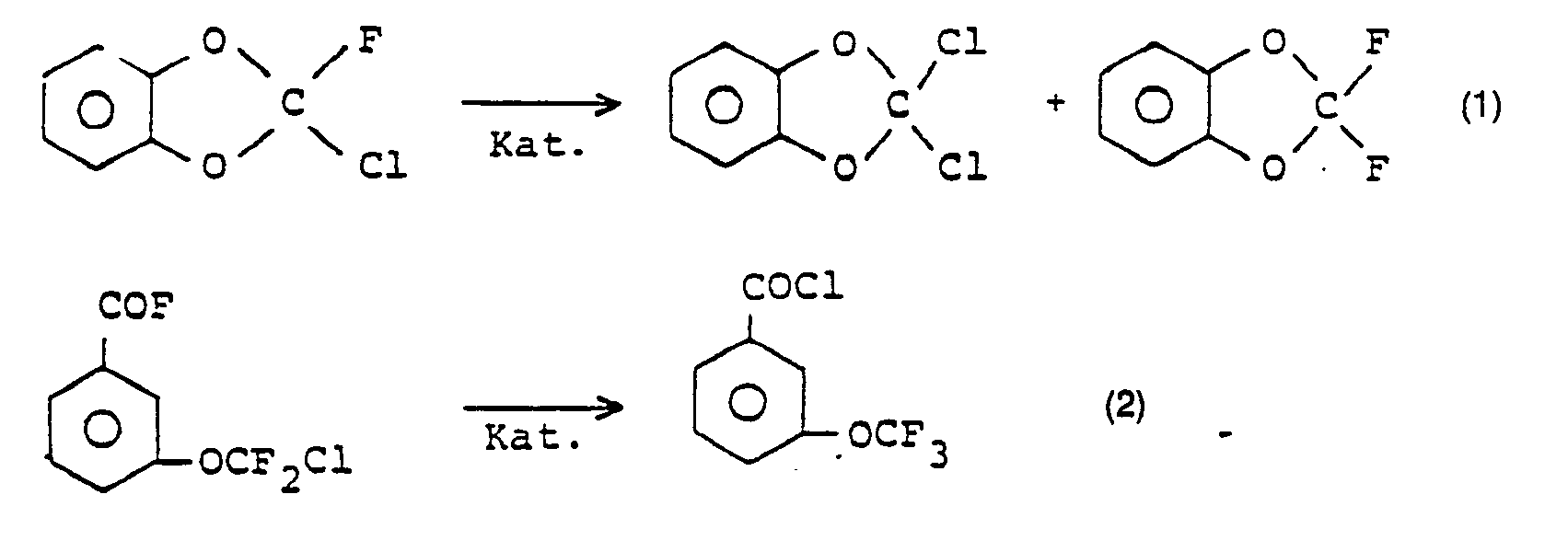
- Nach der Durchfürung des erfindungsgemäßen Verfahrens liegt im allgemeinen ein Gemisch vor, das - als Komponente A die hergestellte, über Sauerstoff-, Schwefel- und/oder Stickstoffatome gebundene, perfluorierte Seitenketten enthaltende aromatische Verbindung, als Komponente(n) B die entsprechende(n) perhalogenierte, fluor- freie Seitenketten enthaltende aromatische Verbindung und/oder gegenüber der Ausgangsverbindung fluorärmere aromatische Verbindung(en) und gegebenenfalls als Komponente(n) C Lösungsmittel, unumgesetzte Ausgangsverbindung und/oder Nebenprodukte enthält.
- Die Aufarbeitung dieser Gemische kann beispielsweise durch Destillation erfolgen. Die Komponente A hat dabei im allgemeinen den niedrigsten Siedepunkt, so daß diese während oder nach der Durchführung des erfindungsgemäßen Verfahrens als erste abgetrennt werden kann. Sofern ein unterhalb der Komponente A siedendes Lösungsmittel eingesetzt wurde, ist dieses vor der destillativen Abtrennung der Komponente A zu entfernen. Im allgemeinen ist es vorteilhaft, aus dem nach der Abtrennung der Komponente A vorliegenden Rückstand auch die Komponente(n) B und, soweit vorhanden, unumgesetzte Ausgangsverbindungen, durch Destillation abzutrennen. Die abgetrennte(n) Komponente(n) B können nach Fluorierung, beispielsweise mittels Alkalifluoriden, einem weiteren Ansatz zur Durchführung des erfindungsgemäßen Verfahrens zugefügt werden. Die abgetrennten unumgesetzten Ausgangsverbindungen können direkt einem weiteren Ansatz zur Durchführung des erfindungsgemäßen Verfahrens zugefügt werden.
- Wenn das Einsatzmaterial für das erfindungsgemäße Verfahren weitere Fluoratome enthält, als die in den partiell fluorierten Seitenketten vorliegenden Fluoratome, z. B. beim Einsatz von 3-Difluorchlormethoxy-benzoylfluorid, fallen häufig Reaktionsgemische an, die keine Komponente B enthalten, sondern neben dem gewünschten Endprodukt (Komponente A), beim Einsatz von 3-Difluorchlormethoxybenzoylfluorid ist das 3- Trifluormethoxy-benzoylchlorid, allenfalls unumgesetztes Ausgangsprodukt und gegebenenfalls geringe Mengen an Nebenprodukten. In solchen Fällen ist die Aufarbeitung besonders einfach, da nach der destillativen Abtrennung der Komponente A der Rückstand verworfen oder einem weiteren Ansatz zur Durchführung des erfindungsgemäßen Verfahrens zugefügt werden kann.
- In vielen Fällen ist es vorteilhaft, die Komponente A während der Reaktion kontinuierlich durch Destillation aus dem Reaktionsgemisch zu entfernen.
- Die eingesetzten Katalysatoren sind im allgemeinen schwerer flüchtig als die Komponenten A und B. Sie verbleiben deshalb bei einer destillativen Aufarbeitung im allgemeinen im Rückstand und können mit diesem entweder erneut einem weiteren Ansatz zur Durchführung des erfindungsgemäßen Verfahrens zugefügt oder verworfen werden. In Fällen, in denen der eingesetzte Katalysator durch seine Flüchtigkeit eine destillative Aufarbeitung stören würde, empfiehlt es sich, den Katalysator vor der Destillation durch Zugabe von wenig Wasser zu zersetzen.
- Es ist ausgesprochen überraschend, daß es mit dem erfindungsgemäßen Verfahren gelingt, aromatische Verbindungen mit über Sauerstoff-, Schwefel- und/oder Stickstoffatome gebundenen perfluorierten Seitenketten in guten Ausbeuten zu erhalten, denn bei der Herstellung dieser Verbindungen durch Fluorierung mit Fluorwasserstoff sind die Ausbeuten niedrig und es fallen größere Mengen an verharzten Nebenprodukten an. die nicht mehr verwertbar sind. Beim erfindungsgemäßen Verfahren werden dagegen nur wenig oder gar keine verharzten Produkte gebildet und unumgesetztes Ausgangsprodukt und/oder niedriger oder nicht fluorierte Nebenprodukte, letztere nach einer Nachfluorierung, können einem weiteren Ansatz zur Durchführung des erfindungsgemäßen Verfahrens zugefügt werden. Siehe hierzu beispielsweise die Beispiele 8 und 9.
- Die folgenden Beispiele erläutern das erfindungsgemäße Verfahren, ohne es in irgendeiner Weise zu beschränken.
- In einer getrockneten Rührapparatur, die mit Rückflußkühler und Trockenrohr versehen war, wurden 40g Kaliumfluorid, das zuvor bei 400 °C getrocknet wurde, und 150 ml getrocknetes Acetonitril vorgelegt. Zu diesem Gemisch wurden bei Raumtemperatur 100 g (0,52 Mol) 2,2-Dichlorbenzodioxol zugetropft und anschließend das Gemisch für 2 Stunden zum Sieden am Rückfluß erhitzt. Anschließend wurd abgekühlt, die festen Bestandteile des Reaktionsgemisches abgesaugt und das Filtrat fraktioniert destilliert. Es wurden 76 g 2-Fluor-2-chlor-benzodioxol (= 91 % der Theorie) mit einem Siedepunkt von 67 bis 70 °C bei 20 mbar und mit einem Brechungsindex von nD 20 von 1,4920 erhalten.
- In einer Rührapparatur, die mit einer Kolonne und Rückflußteiler versehen war, wurden 87 g (0,5 Mol) des gemäß Beispiel 1 hergestellten 2-Fluor-2-chlor-benzodioxols vorgelegt, 1 ml Antimonpentachlorid zugegeben und für 5 Stunden auf 100 °C erhitzt. Anschließend wurde die Sumpftemperatur erhöht und das entstandene 2,2-Difluorbenzodioxol über die Kolonne abdestilliert. Es wurden 38 g 2,2-Difluorbenzodioxol mit einem Siedepunkt von 130 bis 131 °C bei 1 030 mbar und mit einem Brechungsindex von nD 20 von 1,4430 erhalten. Der Sumpf bestand überwiegend aus 2,2-Dichlorbenzodioxol, das ebenfalls durch Destillation gewonnen wurde. Eine gaschromatographische Analyse der Reaktionsmischung vor der Destillation zeigte an, daß dort praktisch nur die beiden Reaktionsprodukte vorlagen und kein Ausgangsmaterial mehr vorhanden war.
- In einer Rührapparatur wurden 50 g 3-Difluorchlor-methoxy-benzoylfluorid vorgelegt und 0.5 ml Antimonpentachlorid zugegeben. Anschließend wurde die Mischung für 3 Stunden bei 100 °C und unter Feuchtigkeitsausschluß gerührt, abgekühlt und der Umwandlungsgrad durch F19-NMR-Spektroskopie bestimmt. Es lag demnach ein Gemisch von 88 Gew.-% 3-Trifluormethoxy-benzoylchlorid und 12 Gew.-% Ausgangsmaterial vor. Durch destillative Auftrennung wurden 37,5 g reines 3-Trifluormethoxy-benzoylchlorid mit einem Siedepunkt von 75 °C bei 13 mbar erhalten.
- In einer getrockneten Rührapparatur wurden 30 g 2-Difluormethoxy-trichlormethoxy-benzol vorgelegt und 1 ml Antimonpentachlorid versetzt. Es setzte eine leicht exotherme Reaktion ein. Anschließend wurde für 4 Stunden bei 80 °C gerührt. Gemäß gaschromatographischer Analyse lagen dann im Reaktionsgemisch 35 Gew.-% 2-Difluormethoxy-trifluormethoxy-benzol und 6 Gew.-% 2-Dichlormethoxytrifluormethoxy-benzol neben Verbindungen mit höherem Chlorgehalt vor. Durch Destillation wurden aus dem Reaktionsgemisch 7,2 g 2-Difluormethoxy-trifluormethoxy-benzol abgetrennt (Siedepunkt : 88 bis 89 °C bei 200 mbar).
- Zu 50 g 6-Nitro-2-chlor-2,3,3-trifluor-benzo-1,4-dioxen wurden 3 Tropfen Antimonpentachlorid gegeben und anschließend unter Feuchtigkeitsausschluß für 3 Stunden auf 140 °C erhitzt. Die gaschromatographische Analyse des Reaktionsgemisches zeigt dann einen Gehalt von 24,8 Gew.-% 6-Nitro-2,2,3,3-tetrafluor-benzo-1,4-dioxen neben 51,2 Gew.-% Ausgangsmaterial und 23,2 Gew.-% 6-Nitro-dichlor-difluor-benzo-1,4-dioxen an. Aus dem Reaktionsgemisch wurden 9,7 g 6-Nitro-2,2,3,3-Tetrafluor-benzo-1,4-dioxen mit einem Siedepunkt von 110 bis 112 °C bei 18 mbar und mit einem Brechungsindex von nD 20 von 1,4750 abgetrennt.
- 60 g 2-Methyl-5-nitrophenylthio-chlordifluormethan wurden mit 2 Tropfen Antimonpentachlorid für 5 Stunden auf 90 °C erhitzt. Danach wurden durch Destillation aus dem Reaktionsgemisch 23 g 2-Methyl-5-nitrophenylthiotrifluormethan mit einem Siedepunkt von 120 °C bei 20 mbar und mit einem Brechnungsindex von nD 20 von 1,5205 abgetrennt. Im Destillationsrückstand befand sich neben wenig Ausgangsmaterial hauptsächlich der Dichlorfluormethylthioether.
- Zu einer Mischung aus 2 g Aluminiumchlorid und 1 g Natriumchlorid wurden 50 g 2,4-Dichlorphenylchlordifluormethylether zugegeben und für 2 Stunden auf 120 °C erhitzt. Eine gaschromatographische Analyse zeigte, daß das Reaktionsgemisch dann 34,4 % 2,4-Dichlorphenyl-trifluormethylether und 25,5 % unumgesetztes Ausgangsmaterial enthielt.
- In einer Rührapparatur, die mit Innenthermometer und einer mit Wilsonspiralen gefüllten Kolonne mit Rückflußteiler versehen war, wurden 200 g 2-Chlor-2,3,3-trifluor-1,4-benzodioxen, 2,9 g Natriumchlorid und 6,6 g Aluminiumchlorid vorgelegt und auf 180 bis 205 °C Innentemperatur erhitzt. Dabei wurde am Kolonnenkopf eine 1. Fraktion in einer Menge von 108 g mit einem Siedepunkt von 145 bis 158 °C bei Normaldruck und einem Brechungsindex von nD 20 von 1,4295 abgenommen. Danach wurde eine 2. Fraktion, im wesentlichen bestehend aus Ausgangsmaterial und anschließend, bei vermindertem Druck, eine 3. Fraktion bei 93 bis 94 °C und 20 mbar erhalten, die im wesentlichen aus 2,2-Dichlor-3,3-difluor-1,4-benzodioxen (nD 20 : 1,4990) bestand. Die 1. Fraktion wurde nochmals destilliert, wobei 76 g Tetrafluorbenzodioxen bei 144 bis 147 °C und 1 030 mbar mit einem Brechungsindex von 1,4220 erhalten wurden.
- In einer Fluorierungsapparatur wurden 500 g Fluorwasserstoff, 5 ml Antimonpentachlorid und 150 g 2-Chlor-2,3.3-trifluor-1,4-benzodioxen für 6 Stunden auf 140 °C erhitzt. Danach wurde überschüssiger Fluorwasserstoff durch Destillation entfernt und der Rückstand einer fraktionierten Destillation unterworfen. Es wurden 27g 2,2,3,3,-Tetrafluor-1,4-benzodioxen mit einem Siedepunkt von 142 bis 146 °C erhalten. Der Rückstand bestand aus einer verharzten Masse. Es konnte kein Ausgangsprodukt mehr isoliert werden.
Claims (8)
Applications Claiming Priority (2)
| Application Number | Priority Date | Filing Date | Title |
|---|---|---|---|
| DE3315147 | 1983-04-27 | ||
| DE19833315147 DE3315147A1 (de) | 1983-04-27 | 1983-04-27 | Verfahren zur herstellung von aromatischen verbindungen, die ueber ein heteroatom gebundene perfluorierte seitenketten enthalten |
Publications (2)
| Publication Number | Publication Date |
|---|---|
| EP0124002A1 EP0124002A1 (de) | 1984-11-07 |
| EP0124002B1 true EP0124002B1 (de) | 1986-11-12 |
Family
ID=6197426
Family Applications (1)
| Application Number | Title | Priority Date | Filing Date |
|---|---|---|---|
| EP84104277A Expired EP0124002B1 (de) | 1983-04-27 | 1984-04-16 | Verfahren zur Herstellung von aromatischen Verbindungen, die über ein Heteroatom gebundene perfluorierte Seitenketten enthalten |
Country Status (4)
| Country | Link |
|---|---|
| US (1) | US4600787A (de) |
| EP (1) | EP0124002B1 (de) |
| JP (1) | JPS59205337A (de) |
| DE (2) | DE3315147A1 (de) |
Families Citing this family (10)
| Publication number | Priority date | Publication date | Assignee | Title |
|---|---|---|---|---|
| US4727187A (en) * | 1984-06-15 | 1988-02-23 | Ciba-Geigy Corporation | Process for the preparation of α, α-difluoroalkyl phenyl ether derivatives |
| FR2579592A1 (fr) * | 1985-03-29 | 1986-10-03 | Rhone Poulenc Spec Chim | Procede de preparation de derives aromatiques 1,1 difluoro perhalogenoalcoxyles ou 1,1 difluoro perhalogenothioalkyles |
| US4950802A (en) * | 1988-12-09 | 1990-08-21 | The Dow Chemical Company | Process for the preparation of aryl trifluoromethyl ethers |
| FR2652812A1 (fr) * | 1989-10-09 | 1991-04-12 | Rhone Poulenc Chimie | Procede de preparation de difluoro-2,2 benzodioxole-1,3. |
| DE4233199A1 (de) * | 1992-10-02 | 1994-04-07 | Bayer Ag | Verfahren zur Herstellung von Difluor- und Chlorfluorbenzodioxolen |
| DE4415435A1 (de) * | 1994-05-03 | 1995-11-09 | Bayer Ag | Benzimidazol-Derivate |
| TR199700975A2 (xx) * | 1996-09-27 | 1998-04-21 | Novartis Ag | Salg�n hastal�k ila�lar� (pepticides). |
| DE19731785A1 (de) * | 1997-07-24 | 1999-01-28 | Bayer Ag | Verfahren zur Herstellung von 2,2,3,3-Tetrafluor-1,4-benzodioxanen, neue o-(2-Brom-1,1,2,2-tetrafluorethoxy)-phenole und neue 2-Brom-1,1,2,2-tetrafluorethoxy-gruppen enthaltende Phenylether |
| US7531700B2 (en) * | 2003-09-24 | 2009-05-12 | E.I. Du Pont De Nemours And Company | Fluorinated arylethers and methods for use thereof |
| CN116354800B (zh) * | 2023-03-28 | 2024-09-24 | 浙江东海新材料科技股份有限公司 | 一种2,5-二氯对苯二甲醚的生产方法 |
Family Cites Families (8)
| Publication number | Priority date | Publication date | Assignee | Title |
|---|---|---|---|---|
| US2776992A (en) * | 1956-03-14 | 1957-01-08 | Du Pont | Trifluoromethylsulfonylphenyldichloracetamidopropandiol |
| US3219690A (en) * | 1959-03-16 | 1965-11-23 | Du Pont | Arylsulfur pentafluorides and their preparation |
| DE2548970C3 (de) * | 1975-11-03 | 1978-05-11 | Bayer Ag, 5090 Leverkusen | Verfahren zur Herstellung von Trichlormethyl-trifluormethyl-benzolen |
| US4110345A (en) * | 1977-03-03 | 1978-08-29 | American Cyanamid Company | 2,2-Difluoro-1,3-benzodioxole-5-(α-alkyl)-acetic acids, and their use for the preparation of insecticides and acaricides |
| US4157344A (en) * | 1978-01-16 | 1979-06-05 | E. I. Du Pont De Nemours And Company | Preparation of aryl trifluoromethyl ethers |
| DE2819788A1 (de) * | 1978-05-05 | 1979-11-08 | Bayer Ag | Benzylester mit fluorsubstituierten aether- und/oder thioaethergruppen und ihre verwendung als insektizide |
| US4496750A (en) * | 1981-09-28 | 1985-01-29 | E. I. Du Pont De Nemours And Company | Cyclic monomers derived from trifluoropyruvate esters |
| US4377711A (en) * | 1981-11-04 | 1983-03-22 | Rhone-Poulenc Industries | Novel aromatic bromopolyfluoroalkyl ethers and method for the preparation thereof |
-
1983
- 1983-04-27 DE DE19833315147 patent/DE3315147A1/de not_active Withdrawn
-
1984
- 1984-04-16 EP EP84104277A patent/EP0124002B1/de not_active Expired
- 1984-04-16 DE DE8484104277T patent/DE3461277D1/de not_active Expired
- 1984-04-23 JP JP59080346A patent/JPS59205337A/ja active Granted
- 1984-04-23 US US06/602,849 patent/US4600787A/en not_active Expired - Fee Related
Non-Patent Citations (1)
| Title |
|---|
| THE JOURNAL OF ORGANIC CHEMISTRY, Band 44, Nr. 16, 3. August 1979, A.E. Feiring, Chemistry in Hydrogen Fluoride. 7. A Novel Synthesis of Aryl Trifluoromethyl Ethers, Seiten 2907-2910. * |
Also Published As
| Publication number | Publication date |
|---|---|
| EP0124002A1 (de) | 1984-11-07 |
| DE3461277D1 (en) | 1987-01-02 |
| US4600787A (en) | 1986-07-15 |
| JPS59205337A (ja) | 1984-11-20 |
| DE3315147A1 (de) | 1984-10-31 |
| JPH0564131B2 (de) | 1993-09-14 |
Similar Documents
| Publication | Publication Date | Title |
|---|---|---|
| EP0124002B1 (de) | Verfahren zur Herstellung von aromatischen Verbindungen, die über ein Heteroatom gebundene perfluorierte Seitenketten enthalten | |
| EP0008734A1 (de) | Verfahren zur Herstellung von 4-Fluoro-3-phenoxy-toluol | |
| DE2708190C2 (de) | Verfahren zur Herstellung von m-Brom-benzotrifluoriden | |
| EP0882004B1 (de) | Verbessertes verfahren zur herstellung von halogenmethylcyclopropanen und besonders reine halogenmethylcyclopropane | |
| EP0560109A2 (de) | Verfahren zur Herstellung von 1-Fluorcyclopropyl-methyl-keton | |
| EP0057844B1 (de) | Verfahren zur Herstellung von Polychlorbenzoylchloriden | |
| EP0045425B1 (de) | Verfahren zur Halogenierung von gegebenenfalls substituierten 4-tert.-Butyltoluolen sowie die daraus erhaltenen Gemische aus gegebenenfalls substituierten 4-tert.-Butylbenzalhalogeniden, 4-tert.-Butylbenzylhalogeniden und 4-tert.-Butylbenzotrihalogeniden | |
| EP0302331B1 (de) | Ester von Arylbisperfluoralkylcarbinolen, Verfahren zur Herstellung dieser Verbindungen und der zugrundeliegenden Arylbisperfluoralkylcarbinole | |
| EP0523668B1 (de) | Verfahren zur Herstellung von Difluorbenzaldehyden | |
| EP0908438B1 (de) | Verfahren zur Herstellung von 2,3,4,5-Tetrafluorbenzolderivaten | |
| EP0365914B1 (de) | Neue Fluor enthaltende und an der CH3-Gruppe gegebenenfalls halogenierte Acetophenone und deren Herstellung aus neuen Fluor enthaltenden Benzonitrilen | |
| DE2739218C2 (de) | ||
| EP0024019A1 (de) | Verfahren zur Herstellung von 4-Fluor-3-phenoxy-toluol | |
| EP2097366B1 (de) | Verfahren zur herstellung von o-chlormethylbenzoesäurechloriden | |
| DE10004717A1 (de) | V.z.H.v.3,5-Bis-(trifluormethyl)-benzoylchloriden u.neue 3,5-Dimethyl-benzoylchloride u.3,5-Bis-(trichlormethyl)-benzoylchloride | |
| EP0266544B1 (de) | Verfahren zur Herstellung von Halogenalkoholen | |
| EP0325126B1 (de) | Fluor enthaltende 1-Arylalkoxytris(dialkylamino)-phosphonium-salze, Verfahren zu deren Herstellung und ihre Verwendung | |
| EP0537540B1 (de) | Verfahren zur radikalischen Chlorierung oder Bromierung von Methylaromaten | |
| EP0542780B1 (de) | Verfahren zur herstellung von weitgehend fluorierten alkylbromiden | |
| CH630592A5 (de) | Verfahren zur herstellung von 2-halogen-4-bromphenolen. | |
| EP0694513B1 (de) | Verfahren zur Herstellung von Chloraromaten | |
| DE3329126A1 (de) | Neue benzokondensierte, tetrachlorierte, heterocyclische verbindungen und ein verfahren zu ihrer herstellung | |
| EP0173153B1 (de) | Neue benzokondensierte, fluorierte, heterocyclische Verbindungen, ein Verfahren zu ihrer Herstellung und ihre Verwendung | |
| EP0045430A1 (de) | Verfahren zur alpha-Bromierung von gegebenenfalls substituierten Fluortoluolen und Gemische von in alpha-Stellung verschieden hoch bromierten, gegebenenfalls substituierten Fluortoluolen | |
| EP0035186A1 (de) | Verfahren zur Herstellung von 3-Brom-4-fluortoluol |
Legal Events
| Date | Code | Title | Description |
|---|---|---|---|
| PUAI | Public reference made under article 153(3) epc to a published international application that has entered the european phase |
Free format text: ORIGINAL CODE: 0009012 |
|
| 17P | Request for examination filed |
Effective date: 19840416 |
|
| AK | Designated contracting states |
Designated state(s): CH DE FR GB IT LI |
|
| GRAA | (expected) grant |
Free format text: ORIGINAL CODE: 0009210 |
|
| AK | Designated contracting states |
Kind code of ref document: B1 Designated state(s): CH DE FR GB IT LI |
|
| ITF | It: translation for a ep patent filed | ||
| ET | Fr: translation filed | ||
| REF | Corresponds to: |
Ref document number: 3461277 Country of ref document: DE Date of ref document: 19870102 |
|
| PLBE | No opposition filed within time limit |
Free format text: ORIGINAL CODE: 0009261 |
|
| STAA | Information on the status of an ep patent application or granted ep patent |
Free format text: STATUS: NO OPPOSITION FILED WITHIN TIME LIMIT |
|
| 26N | No opposition filed | ||
| ITTA | It: last paid annual fee | ||
| PGFP | Annual fee paid to national office [announced via postgrant information from national office to epo] |
Ref country code: DE Payment date: 19960312 Year of fee payment: 13 |
|
| PGFP | Annual fee paid to national office [announced via postgrant information from national office to epo] |
Ref country code: FR Payment date: 19960328 Year of fee payment: 13 |
|
| PGFP | Annual fee paid to national office [announced via postgrant information from national office to epo] |
Ref country code: GB Payment date: 19960409 Year of fee payment: 13 |
|
| PGFP | Annual fee paid to national office [announced via postgrant information from national office to epo] |
Ref country code: CH Payment date: 19960416 Year of fee payment: 13 |
|
| PG25 | Lapsed in a contracting state [announced via postgrant information from national office to epo] |
Ref country code: GB Effective date: 19970416 |
|
| PG25 | Lapsed in a contracting state [announced via postgrant information from national office to epo] |
Ref country code: LI Free format text: LAPSE BECAUSE OF NON-PAYMENT OF DUE FEES Effective date: 19970430 Ref country code: CH Free format text: LAPSE BECAUSE OF NON-PAYMENT OF DUE FEES Effective date: 19970430 |
|
| GBPC | Gb: european patent ceased through non-payment of renewal fee |
Effective date: 19970416 |
|
| REG | Reference to a national code |
Ref country code: CH Ref legal event code: PL |
|
| PG25 | Lapsed in a contracting state [announced via postgrant information from national office to epo] |
Ref country code: FR Free format text: LAPSE BECAUSE OF NON-PAYMENT OF DUE FEES Effective date: 19971231 |
|
| PG25 | Lapsed in a contracting state [announced via postgrant information from national office to epo] |
Ref country code: DE Free format text: LAPSE BECAUSE OF NON-PAYMENT OF DUE FEES Effective date: 19980101 |
|
| REG | Reference to a national code |
Ref country code: FR Ref legal event code: ST |