EP2091045A2 - Informationsaufzeichnungsverfahren - Google Patents
Informationsaufzeichnungsverfahren Download PDFInfo
- Publication number
- EP2091045A2 EP2091045A2 EP09153023A EP09153023A EP2091045A2 EP 2091045 A2 EP2091045 A2 EP 2091045A2 EP 09153023 A EP09153023 A EP 09153023A EP 09153023 A EP09153023 A EP 09153023A EP 2091045 A2 EP2091045 A2 EP 2091045A2
- Authority
- EP
- European Patent Office
- Prior art keywords
- information
- recorded
- recording
- file
- area
- Prior art date
- Legal status (The legal status is an assumption and is not a legal conclusion. Google has not performed a legal analysis and makes no representation as to the accuracy of the status listed.)
- Withdrawn
Links
Images




Classifications
-
- G—PHYSICS
- G11—INFORMATION STORAGE
- G11B—INFORMATION STORAGE BASED ON RELATIVE MOVEMENT BETWEEN RECORD CARRIER AND TRANSDUCER
- G11B20/00—Signal processing not specific to the method of recording or reproducing; Circuits therefor
- G11B20/10—Digital recording or reproducing
-
- G—PHYSICS
- G11—INFORMATION STORAGE
- G11B—INFORMATION STORAGE BASED ON RELATIVE MOVEMENT BETWEEN RECORD CARRIER AND TRANSDUCER
- G11B20/00—Signal processing not specific to the method of recording or reproducing; Circuits therefor
- G11B20/10—Digital recording or reproducing
- G11B20/12—Formatting, e.g. arrangement of data block or words on the record carriers
- G11B20/1217—Formatting, e.g. arrangement of data block or words on the record carriers on discs
-
- G—PHYSICS
- G11—INFORMATION STORAGE
- G11B—INFORMATION STORAGE BASED ON RELATIVE MOVEMENT BETWEEN RECORD CARRIER AND TRANSDUCER
- G11B27/00—Editing; Indexing; Addressing; Timing or synchronising; Monitoring; Measuring tape travel
- G11B27/10—Indexing; Addressing; Timing or synchronising; Measuring tape travel
- G11B27/19—Indexing; Addressing; Timing or synchronising; Measuring tape travel by using information detectable on the record carrier
- G11B27/28—Indexing; Addressing; Timing or synchronising; Measuring tape travel by using information detectable on the record carrier by using information signals recorded by the same method as the main recording
- G11B27/32—Indexing; Addressing; Timing or synchronising; Measuring tape travel by using information detectable on the record carrier by using information signals recorded by the same method as the main recording on separate auxiliary tracks of the same or an auxiliary record carrier
- G11B27/327—Table of contents
- G11B27/329—Table of contents on a disc [VTOC]
-
- G—PHYSICS
- G11—INFORMATION STORAGE
- G11B—INFORMATION STORAGE BASED ON RELATIVE MOVEMENT BETWEEN RECORD CARRIER AND TRANSDUCER
- G11B20/00—Signal processing not specific to the method of recording or reproducing; Circuits therefor
- G11B20/10—Digital recording or reproducing
- G11B2020/10861—Finalising a record carrier after a recording operation, e.g. to ensure compatibility with a ROM medium
-
- G—PHYSICS
- G11—INFORMATION STORAGE
- G11B—INFORMATION STORAGE BASED ON RELATIVE MOVEMENT BETWEEN RECORD CARRIER AND TRANSDUCER
- G11B20/00—Signal processing not specific to the method of recording or reproducing; Circuits therefor
- G11B20/10—Digital recording or reproducing
- G11B2020/10935—Digital recording or reproducing wherein a time constraint must be met
- G11B2020/10972—Management of interruptions, e.g. due to editing
-
- G—PHYSICS
- G11—INFORMATION STORAGE
- G11B—INFORMATION STORAGE BASED ON RELATIVE MOVEMENT BETWEEN RECORD CARRIER AND TRANSDUCER
- G11B20/00—Signal processing not specific to the method of recording or reproducing; Circuits therefor
- G11B20/10—Digital recording or reproducing
- G11B20/12—Formatting, e.g. arrangement of data block or words on the record carriers
- G11B2020/1264—Formatting, e.g. arrangement of data block or words on the record carriers wherein the formatting concerns a specific kind of data
- G11B2020/1288—Formatting by padding empty spaces with dummy data, e.g. writing zeroes or random data when de-icing optical discs
Definitions
- the present invention relates to a method for recording information on a recording medium, and particularly to a method for recording information on a recording medium which requires a finalize process to be performed after information recording to ensure compatibility of a reproducing apparatus.
- a finalize process is a process to arrange data so as to place a read-in area and a read-out area in an inner track and an outer track relative to a user data area of an optical disk respectively. This process is necessary to enable information on a recording disk to be reproduced on DVD-Video reproducing apparatuses.
- This finalize process may be a process in which a read-in area is allocated during formatting, and a read-out area is allocated after information is recorded in a user data area, or may be a process in which after information is recorded in a user data area, a read-in area and a read-out area are allocated.
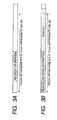
- some information is required to be recorded in an area of inner tracks within diameter of 70 mm on a disk, which is approximately one GB when converted to the amount of information. If a recorded information amount is less than one GB at the start of a finalize process as shown in FIG. 3A , a longer read-out area is recorded as shown in FIG. 3B so that the process satisfies the above standard.
- recording operation cannot be interrupted during recording of a read-out area, a user has to wait until completion of the recording processing of a read-out area.
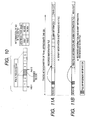
- Japanese Patent Application Laid-Open No. 2005-050444 proposes a method of performing a finalize process in which if a recorded information amount is less than a regular amount value, dummy information (for example, zero data) is added to the end of a normal recorded information file as shown in FIGS. 11A and 11B so that information whose amount is equal to or greater than the regular amount value is recorded.
- FIG. 11A illustrates a method in which dummy information is not managed as a file
- FIG. 11B illustrates a method in which normal recorded information and dummy information are managed as one file. Whether recorded information is a file or not depends on whether or not management information for managing the information as a file is recorded or not.
- a solid arrow from management information points to a file managed by the management information.
- dummy information is not a file because management information for managing the dummy information as a file is not recorded. Recording of dummy information as described above is referred to as padding. In this method, a read-out area to be recorded is not required to be longer, and therefore recording processing can be interrupted while dummy information to be added to a file is being recorded.
- a method of recording information on a recording medium includes: determining whether or not an amount of information recorded in a user data area is equal to or greater than a predetermined value when a finalize process is performed on the recording medium, the user data area being an area of the recording medium and used for information recording; padding an area subsequent to the area in which the information is recorded, by recording dummy information in the subsequent area such that the amount of the information is equal to or greater than the predetermined value, if the amount of the information is less than the predetermined value; and recording management information for managing the dummy information as a file, in the user data area.
- FIGS. 1A, 1B, 1C, 1D and 1E are diagrams illustrating an information recording method of the present invention in a rewritable recording medium.
- FIGS. 2A, 2B, 2C, 2D and 2E are diagrams illustrating an information recording method of the present invention in a write-once recording medium.
- FIGS. 3A and 3B are diagrams illustrating a conventional finalize processing method.
- FIG. 4 is a flowchart of processing according to the present invention.
- FIG. 5 is a flowchart of management information recording processing according to the present invention.
- FIGS. 6A and 6B are diagrams illustrating a pseudo-overwrite using VAT.
- FIG. 7 is a diagram illustrating a structure of VAT.
- FIG. 8 is a diagram illustrating a structure of an information recording apparatus for implementing the present invention.
- FIGS. 9A, 9B, 9C, 9D and 9E are diagrams illustrating a method for recording a normal file after interruption of a finalize process.
- FIG. 10 is a diagram illustrating an address management method of a fragmentally recorded file.
- FIGS. 11A and 11B are diagrams illustrating a conventional padding method.
- FIG. 8 is a block diagram illustrating an example of the structure of a recording and reproducing apparatus in which the information recording method of the present invention can be implemented.
- a recording medium 1 is a DVD-R, a DVD-RW or the like, on which information can be recorded and from which information can be reproduced.
- a recording and reproducing head 2 performs recording and reproducing.
- a disk motor 3 rotates the recording medium 2.
- a recording and reproducing head control unit 4 performs position control of the recording and reproducing head 2.
- a signal processing unit 5 performs demodulation of a signal reproduced by the recording and reproducing head and modulation for recording by the recording and reproducing head.
- An apparatus control unit 6 controls the disk motor 3, the recording and reproducing head control unit 4 and the signal processing unit 5 based on the information recording method of the present invention.
- FIGS. 1A-1E illustrate an example in which the information recording method of the present invention is applied to a rewritable disk such as a DVD-RW.
- a file management format for managing a file recorded on the DVD disk the UDF (Universal Disk Format) standard is used.
- File Entry (hereinafter referred to as FE) in FIGS. 1A-1E is management information for managing a start address of a file and a file size in the UDF standard. An area of the disk in which a real file is recorded can be recognized from FE.
- a finalize process is a process to arrange data so as to allocate a read-in area and a read-out area in an inner track and an outer track of a user data area of an optical disk, respectively. This process is necessary to enable information on a recording disk to be reproduced on DVD-Video reproducing apparatuses.
- This finalize process may be a process in which a read-in area is allocated during formatting, and a read-out area is allocated after information is recorded in a user data area, or may be a process in which after information is recorded in a user data area, a read-in area and a read-out area are allocated.
- FIGS. 1A-1E a solid arrow from an FE points to a file indicated by the FE.
- a predetermined value e.g., one GB
- dummy information zero data
- an instruction to interrupt the process is given from the user during the recording of the dummy information
- an FE is created and recorded in an unrecorded area of a user data area as shown in FIG. 1B .
- This FE is management information indicating the start address and size of the dummy information which has already been recorded at this time point.
- dummy information's FE is overwritten and updated as occasion arises in a similar process.
- dummy information is finally recorded up to the outer limit of tracks within diameter of 70 mm on the disk as shown in FIG. 1D
- updated dummy information's FE is overwritten in a similar way, and read-in and read-out are recorded lastly as shown in FIG. 1E , and the finalize process is thus completed.
- the file of the dummy information is given a special name which is different from normal recorded information's file name, so that the file of the dummy information is discriminated from other files.
- a VAT is an address translation table for converting an address of old management information to an address of new management information. More specifically, a virtual address recorded in an FE is substituted with a logical address recorded in a VAT so as to convert old management information to new management information, so that pseudo-overwrite is achieved.
- FIGS. 6A and 6B are diagrams illustrating overwrite processing of the file using VAT.
- management information called VAT ICB (Information Control Block) is recorded in the end address of a recorded area.
- This management information has a position and a size of the VAT itself as a parameter.
- VAT ICB has the same structure as FE, though their names are different.
- a VAT itself is recorded in a recording area positioned immediately before that of a VAT ICB, its recording area is not particularly limited if it is an unrecorded area on the disk because the recording position and size of the VAT are managed by the VAT ICB. Since the end address of a recorded area in which a VAT ICB is recorded is being managed by management information of DVD's physical specifications as in the case of DVD-RW, the position of VAT ICB can be obtained with reference to this management information.
- FIG. 6A in order to access a file A, the most left FE in FIG. 6A is referenced to first.
- This FE indicates a directory in which the file A exists.
- a directory in UDF is represented by management information called File Identifier Descriptor (hereinafter referred to as FID), which manages directories and filenames under it and addresses of FEs indicating their positions. It is assumed here that an FID is recorded at logical address k and an FE indicating it manages the FID at virtual address m. Because it can be found that the position of the FID is recorded at virtual address m with reference to the FE, the VAT ICB recorded at the end address is accessed.
- FID File Identifier Descriptor
- Whether the position of the FID is recorded at a virtual address or a logical address can be determined from a Partition Reference Number, which is a parameter in the FE. Then, a VAT is accessed because the VAT ICB indicates the VAT. Then, virtual address m is converted to logical address k by the VAT. The obtained logical address k allows access to the FID, which then allows access to the management information FE of the file A, and the file A sequentially.
- the updated file A (new file A in FIG. 6B ) and new FID and FE for managing the new file A are recorded in different areas (the new FID is recorded at logical address k+1 in this example) as shown in FIG. 6B .
- new VAT and VAT ICB are also recorded.
- the FE most left FE in FIG. 6B ) indicating the FID is accessed first as in the case of FIG. 6A .
- the FE indicates the FID using virtual address m
- the new recorded VAT is accessed via the VAT ICB. Because the recorded new VAT indicates that virtual address m is converted to logical address k+1, the FID existing at logical address k+1 allows access to the management information FE of the new file A, and the new file A sequentially.
- FIG. 7 illustrates an actual parameter structure in a VAT.
- a parameter in which a logical address after substitution is stored is called a VAT Entry whose offset starts from 152+L_IU. Entry numbers starting from zero are assigned to VAT Entries, and a virtual address recorded in an FE or the like corresponds to such an entry number.
- a VAT Entry whose entry number is the same value as a virtual address is retrieved, the address is converted to an address of the corresponding VAT Entry, and access is then performed using the converted address.
- FIGS. 6A, 6B in a VAT Entry m (a shading area in FIGS.
- FIGS. 2A-2E illustrate dummy information update processing according to the present invention.
- an FE indicating dummy information directly is added.
- an FID is also added, and the FE is accessed via the FID as described above.
- the amount of recorded information is less than one GB on a write-once disk as shown in FIG. 2A
- an instruction to perform a finalize process is given from a user
- dummy information will be recorded following the recorded information.
- an instruction to interrupt the process is given from the user during the recording of the dummy information, an FE is created and recorded in an unrecorded area of a user data area as shown in FIG. 2B .
- This FE indicates the start address and size of the dummy information which has already been recorded at this time point. Further, a VAT is recorded and a VAT ICB is recorded at the end address, and then the process is interrupted. When an instruction to resume the finalize process is given from the user after the interruption of the process, the recording of the dummy information is resumed following the VAT ICB recorded at the end address of the recorded area. When an instruction to interrupt the process is given again from the user after the process is resumed, an FE of the updated dummy information as shown in FIG. 2C is created and recorded in an unrecorded area different from the area in which the former dummy information's FE is recorded.
- new VAT and VAT ICB are also recorded, so that access to the FE of the updated dummy information is allowed by the new VAT.
- the FE of the updated dummy information manages the dummy information including the dummy information already recorded in FIG. 2B and the newly recorded dummy information altogether, as one fragmentally recorded file. Details of a method for managing a fragmentally recorded file will be described later.
- dummy information's FE, VAT and VAT ICB are recorded and updated in different areas in a similar process as occasion arises, so that the latest dummy information's FE can be accessed using VAT.
- dummy information is finally recorded up to the limit of inner tracks within diameter of 70 mm on the disk as shown in FIG. 2D
- updated dummy information's FE is recorded in a different area in a similar way, and the latest VAT and VAT ICB are recorded.
- read-in and read-out are recorded as shown in FIG. 2E , and the finalize process is thus completed.
- FIG. 10 is a diagram illustrating a method of managing a fragmentally recorded file by ADs using the UDF file format.
- File.A having a size of 160,000 [Byte] which is as large as five blocks is to be recorded from address Addr 1 as shown in FIG. 10 . Because there is a recorded block represented as a shading area, continuous five blocks from Addr 1 cannot be reserved. Therefore, as shown, File.A is fragmentally recorded in first to fifth blocks in FIG. 10 while the recorded block is skipped. ADs in this case are illustrated in the table on the right side of FIG. 10 . In an AD, the size of information which is recorded continuously with the logical start address (Addr 1) of the first block is registered as number of bytes.
- the size of one block in a DVD is 32,768 (Byte), and therefore 65,536 (Byte) corresponding to two blocks is registered as a size.
- a remaining file size is recorded as a size of AD in the final row when the file size is not a multiple of a block size.
- access is performed in an order of these ADs.
- a flow of a finalize process according to the present invention will be described with reference to the flowchart illustrated in FIG. 4 .
- S1 an instruction to perform a finalize process is given from a user
- whether or not the amount of recorded information is equal to or greater than a predetermined value (greater or less than one GB in this example) is determined (S1). If the recorded information is equal to or greater than one GB, read-in and read-out are recorded (S9), and the finalize process is then completed. If the recorded information amount is less than one GB in step S1, dummy information is generated so that the total amount of the recorded information and the dummy information becomes grater than one GB (S2), and recording of the dummy information is started (S3).
- step S41 whether the type of the disk being finalized is rewritable or write-once is checked. If the type is write-once, management information of dummy information is recorded in an unrecorded area (S45), VAT and VAT ICB are recorded in the unrecorded area (S46), and the management information recording processing is then completed. If the type is rewritable in step S41, whether recorded management information of dummy information already exists or not is checked (S42).
- management information of dummy information does not exist, management information of dummy information is recorded in the unrecorded area on the disk (S44), and the management information recording processing is then completed. If it is determined that recorded management information of dummy information already exists in step S42, new management information of the dummy information is written over the recorded management information in the next step (S43), and the management information recording processing is then completed.
- FIGS. 9A-9E are diagrams illustrating a method for recording new information on a rewritable recording medium after interrupting a finalize process.
- dummy information is recorded again following the end address of the recorded information.
- recording of subsequent dummy information is not performed, and read-in and read-out are recorded, and the finalize process is completed.
- the dummy information finally reaches the outer limit of tracks within diameter of 70 mm on the disk as shown in FIG. 9D , read-in and read-out are recorded as shown in FIG. 9E , and the finalize process is completed.
- interruption of a finalize process and recording of new information are performed only once in the above description, it is apparent that interruption of a finalize process and recording of new information can be performed any number of times as far as a recording area of a disk is available.
- a finalize process can be interrupted and new information can be additionally written in a similar way.
- the present invention is not limited to the above described exemplary embodiment, and can be applied in various ways without departing from the scope of the present invention.
- updating processing may be performed using Logical Overwrite, which is employed by UDF revision 2.60.
- a dummy information file may be discriminated from a normal recorded information file by modification to a file attribute instead of a file name.
- a parameter such as File Characteristics of FID or File Type of FE of a dummy information file is changed to a different one (for example, a hidden file attribute) from normal files so that the dummy information file is discriminated.
- a directory dedicated to dummy information files may be created such that a dummy information file is recorded under this directory. Thereby, the dummy information can be discriminated from other files. Further, since dummy information is managed as a file and thus can be discriminated from other data, padding data may be data other than zero data. Further, although former dummy information and new dummy information are managed as one file in the embodiment for a write-once disk, it is conceivable that only new dummy information is managed as a file and former dummy information is treated as a deleted file. Further, instead of managing all dummy information as one file, a plurality of dummy information files may be created by adding a dummy information file each time a finalize process is interrupted. When dummy information is managed as a plurality of files, management information of an already recorded dummy information file is not updated, and management information of a new dummy information file is recorded.
- interruption of a finalize process is allowed and whether or not a disk is a disk on which a finalize process has been interrupted can be determined without special processing. Further, after interruption of the finalize process, a normal file can be recorded on the same disk on which the finalize process has been interrupted.
- the object of the present invention can be achieved even by supplying a recording medium storing a program code of software realizing the function of the above-mentioned embodiment in a system or an apparatus, and allowing a computer (or a CPU or an MPU) of the system or the apparatus to read the program code stored in the recording medium for execution.
- the program code itself read from the recording medium realizes the function of the above-mentioned embodiment, and the program code itself and the recording medium storing the program code constitute the present invention.
- the recording medium for supplying a program code for example, a flexible disk, a hard disk, an optical disk, a magnetooptical disk, a CD-ROM, a CD-R, a magnetic tape, a nonvolatile memory card, or a ROM can be used.
- the function of the above-mentioned embodiment can to realized, and also an OS (basic system or an operating system) operated on the computer performs partial or entire actual processing in accordance with an instruction of the program code, whereby the function of the above-mentioned embodiment can be realized by that processing.
- OS basic system or an operating system
- a CPU or the like provided in the function extension board or the function extension unit performs partial or entire actual processing in accordance with an instruction of the program code, whereby the function of the above-mentioned embodiment can be realized by that processing.
- dummy information is recorded in the recorded area such that the amount of the information is equal to or greater than the predetermined value, and management information for managing the dummy information as a file is recorded in the user data area, thereby realizing interruption of the finalize process in the recording medium and enabling determination of whether or not a disk is a disk on which a finalize process has been interrupted based on only information recorded on the disk.
Landscapes
- Engineering & Computer Science (AREA)
- Signal Processing (AREA)
- Signal Processing For Digital Recording And Reproducing (AREA)
- Optical Recording Or Reproduction (AREA)
Applications Claiming Priority (1)
| Application Number | Priority Date | Filing Date | Title |
|---|---|---|---|
| JP2008036199A JP4823249B2 (ja) | 2008-02-18 | 2008-02-18 | 情報記録方法 |
Publications (1)
| Publication Number | Publication Date |
|---|---|
| EP2091045A2 true EP2091045A2 (de) | 2009-08-19 |
Family
ID=40642526
Family Applications (1)
| Application Number | Title | Priority Date | Filing Date |
|---|---|---|---|
| EP09153023A Withdrawn EP2091045A2 (de) | 2008-02-18 | 2009-02-17 | Informationsaufzeichnungsverfahren |
Country Status (3)
| Country | Link |
|---|---|
| US (1) | US8077575B2 (de) |
| EP (1) | EP2091045A2 (de) |
| JP (1) | JP4823249B2 (de) |
Citations (1)
| Publication number | Priority date | Publication date | Assignee | Title |
|---|---|---|---|---|
| JP2005050444A (ja) | 2003-07-30 | 2005-02-24 | Sony Corp | ディスク記録方法および記録装置 |
Family Cites Families (6)
| Publication number | Priority date | Publication date | Assignee | Title |
|---|---|---|---|---|
| JP3908967B2 (ja) * | 2002-03-08 | 2007-04-25 | 株式会社リコー | 情報記録装置 |
| US7974520B2 (en) * | 2002-04-26 | 2011-07-05 | Ricoh Company, Ltd. | Information recording ensuring compatibility with different types of recording media |
| JP4063076B2 (ja) | 2002-12-27 | 2008-03-19 | ソニー株式会社 | 光記録方法及び光記録装置 |
| JP4345639B2 (ja) * | 2004-10-26 | 2009-10-14 | 株式会社日立製作所 | 記録装置及び記録方法 |
| WO2006080108A1 (ja) * | 2005-01-28 | 2006-08-03 | Mitsubishi Denki Kabushiki Kaisha | 記録方法ならびに記録装置、再生方法ならびに再生装置、および記録媒体 |
| JP2008010116A (ja) * | 2006-06-30 | 2008-01-17 | Toshiba Corp | 情報記録装置、情報記録方法、情報処理装置、情報処理方法 |
-
2008
- 2008-02-18 JP JP2008036199A patent/JP4823249B2/ja not_active Expired - Fee Related
-
2009
- 2009-02-10 US US12/368,679 patent/US8077575B2/en not_active Expired - Fee Related
- 2009-02-17 EP EP09153023A patent/EP2091045A2/de not_active Withdrawn
Patent Citations (1)
| Publication number | Priority date | Publication date | Assignee | Title |
|---|---|---|---|---|
| JP2005050444A (ja) | 2003-07-30 | 2005-02-24 | Sony Corp | ディスク記録方法および記録装置 |
Also Published As
| Publication number | Publication date |
|---|---|
| JP4823249B2 (ja) | 2011-11-24 |
| US20090207711A1 (en) | 2009-08-20 |
| US8077575B2 (en) | 2011-12-13 |
| JP2009193651A (ja) | 2009-08-27 |
Similar Documents
| Publication | Publication Date | Title |
|---|---|---|
| JP4242966B2 (ja) | リアルタイム記録/再生情報を貯蔵する記録媒体 | |
| JP2001243724A (ja) | 記録方法および装置、ならびに、記録媒体 | |
| JP4431110B2 (ja) | 記録再生システム、記録再生方法、プログラム、およびプログラム記録媒体 | |
| JP2007519155A (ja) | データ記録方法、その再生方法、そのデータ記録及び/または再生装置、及びその追記型の情報記録媒体 | |
| US8077575B2 (en) | Information recording method that records management information for managing dummy information as a file in a user data area | |
| US20080259751A1 (en) | Recorder, Host Device, Drive Device, Recording Method, Instruction Method, Program, Integrated Circuit, Reproducing Device, Reproducing Method, and Write-Once-Read-Many Recording Medium | |
| JP2007179740A (ja) | 記録媒体上のデータ上書きのための方法及び装置、並びに記録媒体 | |
| JPH10302397A (ja) | 光ディスク記録装置 | |
| JP3829268B2 (ja) | ディスク記録媒体への情報記録方法および装置 | |
| JP2008519389A (ja) | ローカルストレージを用いて記録媒体からデータを再生する方法及び再生装置 | |
| US20070025199A1 (en) | Recorder, recording method and recording medium where program is recorded | |
| JP2004030742A (ja) | ファームウェアに関するデータを記憶する光ディスク記憶媒体、光ディスク情報記録再生装置、及び、ファームウェア更新プログラムを記憶する記憶媒体 | |
| KR101253189B1 (ko) | 기록매체 및 기록매체의 중첩 기록 방법 및 장치 | |
| JP4277707B2 (ja) | 情報記録方法 | |
| TWI235361B (en) | Information recording medium, information recording method, information recording apparatus, information reproduction method, and information reproduction apparatus | |
| KR20030065160A (ko) | 파이널라이즈 이후 추가 데이터 기록이 가능한 저장매체,그 기록 및 재생 장치와 방법 | |
| US20080259754A1 (en) | Recorder, Host Device, Recording Method, Instruction Method, Program, Integrated Circuit, Reproducing Device, Reproducing Method and Write-Once-Read-Many Recording Medium | |
| CN1902700B (zh) | 信息记录装置、信息记录方法和记录了程序的记录介质 | |
| US20070230299A1 (en) | Method of Partitioning Data on Data Carriers | |
| JP2003168265A (ja) | 光ディスクのデータ記録方法、光ディスクおよび光ディスク用データ記録プログラム | |
| JP2007128286A (ja) | 再生装置、再生方法および再生プログラム | |
| KR100701385B1 (ko) | 광디스크 장치에서의 디펙트 관리방법과 그에 따른광디스크 | |
| US20090003173A1 (en) | Recording Medium and Method and Apparatus for Recording Data on the Same | |
| JP2008276884A (ja) | 記録装置及び記録方法 | |
| JP2005243058A (ja) | 情報処理装置および方法、並びにプログラム |
Legal Events
| Date | Code | Title | Description |
|---|---|---|---|
| PUAI | Public reference made under article 153(3) epc to a published international application that has entered the european phase |
Free format text: ORIGINAL CODE: 0009012 |
|
| AK | Designated contracting states |
Kind code of ref document: A2 Designated state(s): AT BE BG CH CY CZ DE DK EE ES FI FR GB GR HR HU IE IS IT LI LT LU LV MC MK MT NL NO PL PT RO SE SI SK TR |
|
| AX | Request for extension of the european patent |
Extension state: AL BA RS |
|
| STAA | Information on the status of an ep patent application or granted ep patent |
Free format text: STATUS: THE APPLICATION HAS BEEN WITHDRAWN |
|
| 18W | Application withdrawn |
Effective date: 20120531 |