EP2072467B1 - Verfahren und Vorrichtung zur Herstellung von Quecksilbersulfid zur anschließenden Entsorgung - Google Patents
Verfahren und Vorrichtung zur Herstellung von Quecksilbersulfid zur anschließenden Entsorgung Download PDFInfo
- Publication number
- EP2072467B1 EP2072467B1 EP20080021961 EP08021961A EP2072467B1 EP 2072467 B1 EP2072467 B1 EP 2072467B1 EP 20080021961 EP20080021961 EP 20080021961 EP 08021961 A EP08021961 A EP 08021961A EP 2072467 B1 EP2072467 B1 EP 2072467B1
- Authority
- EP
- European Patent Office
- Prior art keywords
- mercury
- mixing
- sulfide
- process according
- reactor
- Prior art date
- Legal status (The legal status is an assumption and is not a legal conclusion. Google has not performed a legal analysis and makes no representation as to the accuracy of the status listed.)
- Not-in-force
Links
- QXKXDIKCIPXUPL-UHFFFAOYSA-N sulfanylidenemercury Chemical compound [Hg]=S QXKXDIKCIPXUPL-UHFFFAOYSA-N 0.000 title claims abstract description 83
- 238000000034 method Methods 0.000 title claims abstract description 63
- 238000004519 manufacturing process Methods 0.000 title abstract description 17
- QSHDDOUJBYECFT-UHFFFAOYSA-N mercury Chemical compound [Hg] QSHDDOUJBYECFT-UHFFFAOYSA-N 0.000 claims abstract description 95
- 229910052753 mercury Inorganic materials 0.000 claims abstract description 83
- NINIDFKCEFEMDL-UHFFFAOYSA-N Sulfur Chemical compound [S] NINIDFKCEFEMDL-UHFFFAOYSA-N 0.000 claims abstract description 40
- 150000003464 sulfur compounds Chemical class 0.000 claims abstract description 4
- 238000002156 mixing Methods 0.000 claims description 79
- 230000008569 process Effects 0.000 claims description 45
- 239000000463 material Substances 0.000 claims description 25
- 239000000654 additive Substances 0.000 claims description 14
- 238000009835 boiling Methods 0.000 claims description 14
- 230000000996 additive effect Effects 0.000 claims description 11
- 239000011261 inert gas Substances 0.000 claims description 6
- 238000002844 melting Methods 0.000 claims description 6
- 230000008018 melting Effects 0.000 claims description 6
- 239000000203 mixture Substances 0.000 claims description 5
- 229910052799 carbon Inorganic materials 0.000 claims description 3
- 230000003750 conditioning effect Effects 0.000 claims description 3
- 238000006243 chemical reaction Methods 0.000 abstract description 27
- 229910052717 sulfur Inorganic materials 0.000 abstract description 27
- 239000011593 sulfur Substances 0.000 abstract description 27
- 239000000376 reactant Substances 0.000 abstract 2
- 239000007788 liquid Substances 0.000 description 23
- 239000007858 starting material Substances 0.000 description 14
- 238000003860 storage Methods 0.000 description 14
- 239000007787 solid Substances 0.000 description 11
- 238000010791 quenching Methods 0.000 description 10
- 238000000926 separation method Methods 0.000 description 9
- XLYOFNOQVPJJNP-UHFFFAOYSA-N water Substances O XLYOFNOQVPJJNP-UHFFFAOYSA-N 0.000 description 9
- OKTJSMMVPCPJKN-UHFFFAOYSA-N Carbon Chemical compound [C] OKTJSMMVPCPJKN-UHFFFAOYSA-N 0.000 description 8
- 239000007789 gas Substances 0.000 description 8
- 238000010438 heat treatment Methods 0.000 description 8
- 239000002826 coolant Substances 0.000 description 6
- 238000001816 cooling Methods 0.000 description 6
- 239000012071 phase Substances 0.000 description 6
- 239000000498 cooling water Substances 0.000 description 5
- 239000002245 particle Substances 0.000 description 5
- 238000012546 transfer Methods 0.000 description 5
- 238000010924 continuous production Methods 0.000 description 4
- 238000010574 gas phase reaction Methods 0.000 description 4
- 229940100892 mercury compound Drugs 0.000 description 4
- 150000002731 mercury compounds Chemical class 0.000 description 4
- 238000009833 condensation Methods 0.000 description 3
- 230000005494 condensation Effects 0.000 description 3
- 239000000428 dust Substances 0.000 description 3
- 238000002474 experimental method Methods 0.000 description 3
- 229910000497 Amalgam Inorganic materials 0.000 description 2
- IJGRMHOSHXDMSA-UHFFFAOYSA-N Atomic nitrogen Chemical compound N#N IJGRMHOSHXDMSA-UHFFFAOYSA-N 0.000 description 2
- ZAMOUSCENKQFHK-UHFFFAOYSA-N Chlorine atom Chemical compound [Cl] ZAMOUSCENKQFHK-UHFFFAOYSA-N 0.000 description 2
- PXHVJJICTQNCMI-UHFFFAOYSA-N Nickel Chemical compound [Ni] PXHVJJICTQNCMI-UHFFFAOYSA-N 0.000 description 2
- 239000000443 aerosol Substances 0.000 description 2
- 238000001479 atomic absorption spectroscopy Methods 0.000 description 2
- 230000008901 benefit Effects 0.000 description 2
- 230000015572 biosynthetic process Effects 0.000 description 2
- 239000000460 chlorine Substances 0.000 description 2
- 229910052801 chlorine Inorganic materials 0.000 description 2
- 238000013461 design Methods 0.000 description 2
- 238000009826 distribution Methods 0.000 description 2
- 238000001035 drying Methods 0.000 description 2
- 239000012065 filter cake Substances 0.000 description 2
- 231100000252 nontoxic Toxicity 0.000 description 2
- 230000003000 nontoxic effect Effects 0.000 description 2
- 230000009467 reduction Effects 0.000 description 2
- 238000005303 weighing Methods 0.000 description 2
- RYGMFSIKBFXOCR-UHFFFAOYSA-N Copper Chemical compound [Cu] RYGMFSIKBFXOCR-UHFFFAOYSA-N 0.000 description 1
- UCKMPCXJQFINFW-UHFFFAOYSA-N Sulphide Chemical compound [S-2] UCKMPCXJQFINFW-UHFFFAOYSA-N 0.000 description 1
- HCHKCACWOHOZIP-UHFFFAOYSA-N Zinc Chemical compound [Zn] HCHKCACWOHOZIP-UHFFFAOYSA-N 0.000 description 1
- 239000002253 acid Substances 0.000 description 1
- 150000007513 acids Chemical class 0.000 description 1
- 238000004220 aggregation Methods 0.000 description 1
- 230000002776 aggregation Effects 0.000 description 1
- QZPSXPBJTPJTSZ-UHFFFAOYSA-N aqua regia Chemical compound Cl.O[N+]([O-])=O QZPSXPBJTPJTSZ-UHFFFAOYSA-N 0.000 description 1
- QVGXLLKOCUKJST-UHFFFAOYSA-N atomic oxygen Chemical compound [O] QVGXLLKOCUKJST-UHFFFAOYSA-N 0.000 description 1
- 238000010923 batch production Methods 0.000 description 1
- 229910052956 cinnabar Inorganic materials 0.000 description 1
- 150000001875 compounds Chemical class 0.000 description 1
- 238000010276 construction Methods 0.000 description 1
- 229910052802 copper Inorganic materials 0.000 description 1
- 239000010949 copper Substances 0.000 description 1
- 230000007423 decrease Effects 0.000 description 1
- 238000007599 discharging Methods 0.000 description 1
- 238000010410 dusting Methods 0.000 description 1
- 238000005868 electrolysis reaction Methods 0.000 description 1
- 230000007613 environmental effect Effects 0.000 description 1
- 238000001704 evaporation Methods 0.000 description 1
- 230000008020 evaporation Effects 0.000 description 1
- 238000000605 extraction Methods 0.000 description 1
- 230000002349 favourable effect Effects 0.000 description 1
- 238000011049 filling Methods 0.000 description 1
- 238000001914 filtration Methods 0.000 description 1
- 239000007792 gaseous phase Substances 0.000 description 1
- 239000011521 glass Substances 0.000 description 1
- 230000005484 gravity Effects 0.000 description 1
- 239000000383 hazardous chemical Substances 0.000 description 1
- 238000009776 industrial production Methods 0.000 description 1
- 230000002427 irreversible effect Effects 0.000 description 1
- 230000007774 longterm Effects 0.000 description 1
- 238000005259 measurement Methods 0.000 description 1
- 239000012528 membrane Substances 0.000 description 1
- UKWHYYKOEPRTIC-UHFFFAOYSA-N mercury(II) oxide Inorganic materials [Hg]=O UKWHYYKOEPRTIC-UHFFFAOYSA-N 0.000 description 1
- 229910052759 nickel Inorganic materials 0.000 description 1
- 229910052757 nitrogen Inorganic materials 0.000 description 1
- 238000005457 optimization Methods 0.000 description 1
- 229910052760 oxygen Inorganic materials 0.000 description 1
- 239000001301 oxygen Substances 0.000 description 1
- 230000000704 physical effect Effects 0.000 description 1
- 230000008092 positive effect Effects 0.000 description 1
- 239000000843 powder Substances 0.000 description 1
- 238000003825 pressing Methods 0.000 description 1
- 230000035484 reaction time Effects 0.000 description 1
- 230000009257 reactivity Effects 0.000 description 1
- 238000004064 recycling Methods 0.000 description 1
- 230000000630 rising effect Effects 0.000 description 1
- 238000004062 sedimentation Methods 0.000 description 1
- 239000007790 solid phase Substances 0.000 description 1
- 230000002269 spontaneous effect Effects 0.000 description 1
- 231100000331 toxic Toxicity 0.000 description 1
- 230000002588 toxic effect Effects 0.000 description 1
- 238000011144 upstream manufacturing Methods 0.000 description 1
- 239000012808 vapor phase Substances 0.000 description 1
- 238000009834 vaporization Methods 0.000 description 1
- 230000008016 vaporization Effects 0.000 description 1
- 238000005406 washing Methods 0.000 description 1
- 239000002699 waste material Substances 0.000 description 1
- 229910052725 zinc Inorganic materials 0.000 description 1
- 239000011701 zinc Substances 0.000 description 1
Images

Classifications
-
- C—CHEMISTRY; METALLURGY
- C01—INORGANIC CHEMISTRY
- C01G—COMPOUNDS CONTAINING METALS NOT COVERED BY SUBCLASSES C01D OR C01F
- C01G13/00—Compounds of mercury
-
- B—PERFORMING OPERATIONS; TRANSPORTING
- B01—PHYSICAL OR CHEMICAL PROCESSES OR APPARATUS IN GENERAL
- B01F—MIXING, e.g. DISSOLVING, EMULSIFYING OR DISPERSING
- B01F27/00—Mixers with rotary stirring devices in fixed receptacles; Kneaders
- B01F27/60—Mixers with rotary stirring devices in fixed receptacles; Kneaders with stirrers rotating about a horizontal or inclined axis
- B01F27/70—Mixers with rotary stirring devices in fixed receptacles; Kneaders with stirrers rotating about a horizontal or inclined axis with paddles, blades or arms
-
- B—PERFORMING OPERATIONS; TRANSPORTING
- B01—PHYSICAL OR CHEMICAL PROCESSES OR APPARATUS IN GENERAL
- B01F—MIXING, e.g. DISSOLVING, EMULSIFYING OR DISPERSING
- B01F33/00—Other mixers; Mixing plants; Combinations of mixers
- B01F33/70—Mixers specially adapted for working at sub- or super-atmospheric pressure, e.g. combined with de-foaming
-
- B—PERFORMING OPERATIONS; TRANSPORTING
- B01—PHYSICAL OR CHEMICAL PROCESSES OR APPARATUS IN GENERAL
- B01J—CHEMICAL OR PHYSICAL PROCESSES, e.g. CATALYSIS OR COLLOID CHEMISTRY; THEIR RELEVANT APPARATUS
- B01J8/00—Chemical or physical processes in general, conducted in the presence of fluids and solid particles; Apparatus for such processes
- B01J8/08—Chemical or physical processes in general, conducted in the presence of fluids and solid particles; Apparatus for such processes with moving particles
- B01J8/087—Heating or cooling the reactor
-
- B—PERFORMING OPERATIONS; TRANSPORTING
- B01—PHYSICAL OR CHEMICAL PROCESSES OR APPARATUS IN GENERAL
- B01J—CHEMICAL OR PHYSICAL PROCESSES, e.g. CATALYSIS OR COLLOID CHEMISTRY; THEIR RELEVANT APPARATUS
- B01J8/00—Chemical or physical processes in general, conducted in the presence of fluids and solid particles; Apparatus for such processes
- B01J8/08—Chemical or physical processes in general, conducted in the presence of fluids and solid particles; Apparatus for such processes with moving particles
- B01J8/10—Chemical or physical processes in general, conducted in the presence of fluids and solid particles; Apparatus for such processes with moving particles moved by stirrers or by rotary drums or rotary receptacles or endless belts
-
- C—CHEMISTRY; METALLURGY
- C22—METALLURGY; FERROUS OR NON-FERROUS ALLOYS; TREATMENT OF ALLOYS OR NON-FERROUS METALS
- C22B—PRODUCTION AND REFINING OF METALS; PRETREATMENT OF RAW MATERIALS
- C22B43/00—Obtaining mercury
-
- C—CHEMISTRY; METALLURGY
- C22—METALLURGY; FERROUS OR NON-FERROUS ALLOYS; TREATMENT OF ALLOYS OR NON-FERROUS METALS
- C22B—PRODUCTION AND REFINING OF METALS; PRETREATMENT OF RAW MATERIALS
- C22B7/00—Working up raw materials other than ores, e.g. scrap, to produce non-ferrous metals and compounds thereof; Methods of a general interest or applied to the winning of more than two metals
- C22B7/001—Dry processes
- C22B7/002—Dry processes by treating with halogens, sulfur or compounds thereof; by carburising, by treating with hydrogen (hydriding)
-
- B—PERFORMING OPERATIONS; TRANSPORTING
- B01—PHYSICAL OR CHEMICAL PROCESSES OR APPARATUS IN GENERAL
- B01J—CHEMICAL OR PHYSICAL PROCESSES, e.g. CATALYSIS OR COLLOID CHEMISTRY; THEIR RELEVANT APPARATUS
- B01J2208/00—Processes carried out in the presence of solid particles; Reactors therefor
- B01J2208/00008—Controlling the process
- B01J2208/00017—Controlling the temperature
- B01J2208/00327—Controlling the temperature by direct heat exchange
- B01J2208/00336—Controlling the temperature by direct heat exchange adding a temperature modifying medium to the reactants
- B01J2208/00353—Non-cryogenic fluids
- B01J2208/00362—Liquid
-
- Y—GENERAL TAGGING OF NEW TECHNOLOGICAL DEVELOPMENTS; GENERAL TAGGING OF CROSS-SECTIONAL TECHNOLOGIES SPANNING OVER SEVERAL SECTIONS OF THE IPC; TECHNICAL SUBJECTS COVERED BY FORMER USPC CROSS-REFERENCE ART COLLECTIONS [XRACs] AND DIGESTS
- Y02—TECHNOLOGIES OR APPLICATIONS FOR MITIGATION OR ADAPTATION AGAINST CLIMATE CHANGE
- Y02P—CLIMATE CHANGE MITIGATION TECHNOLOGIES IN THE PRODUCTION OR PROCESSING OF GOODS
- Y02P10/00—Technologies related to metal processing
- Y02P10/20—Recycling
Definitions
- the invention relates to a process for the production of mercury sulphide for subsequent disposal according to the preamble of claim 1.
- Mercury is used in many technological applications and in industrial production because of its special physical properties.
- the chloralkali electrolysis for the extraction of chlorine should be mentioned here.
- mercury is also a toxic hazardous substance, which is a danger to humans and the environment, especially due to its already at room temperature relatively high vapor pressure Numerous accidents and almost irreversible environmental damage in the past have helped mercury to a dubious popularity.
- mercury sulfide a stable or stabilized compound that, due to its known properties (non-toxic, chemically stable, and even under aggressive conditions) allows a permanent and safe storage of mercury. Incidentally, it is basically also possible to produce mercury sulfide using sulfur compounds.
- WO 2006/016076 A1 is already a generic method for the production of mercury sulfide by reaction of liquid mercury with solid sulfur, wherein the molar ratio Hg / S of 1: 1 to 1: 3.
- the process is carried out in a rotating reactor consisting of a flask, a tube attached thereto and a feed facility for the addition of mercury and sulfur.
- the reaction takes place at normal pressure and in a temperature range between 20 ° C and 100 ° C, preferably at 60 ° C to 80 ° C instead.
- a disadvantage of the known method is that the reactor at relatively high rotational speeds over a fairly long period in the aforementioned temperature range must be rotated.
- a method for producing a stabilized mercury compound for subsequent disposal is already known.
- mercury is bound in the form of an amalgam in conjunction with copper, zinc or nickel as an additional material or as mercury sulfide in combination with sulfur as an additive and then disposed of in an environmentally sound manner.
- the addition material is added with the mercury in a stoichiometric ratio of at least 1: 1 and preferably 3: 1.
- the mixing process is carried out at room temperature and ambient pressure.
- a disadvantage of the known method is that the addition material must be added in a strong superstoichiometric ratio to the mercury in order to ensure a sufficient reaction of the mercury to the mercury compound.
- Another disadvantage of the known method is that in view of the strong superstoichiometric excess of the addition material which is added in powder form, in the mixing process aerosols, that is the smallest sedimenting in the air addition material particles can arise.
- the object of the present invention is to provide an improved process for the production of mercury sulphide.
- negative pressure refers to any pressure below the ambient pressure up to the vacuum. Sufficient low pressures of 0.05 bar are sufficient, which corresponds to an absolute pressure of 0.95 bar at an ambient pressure of 1 bar.
- the implementation of the mixing process in the negative pressure causes, as described above, that the boiling point of mercury decreases and even at lower temperatures, a high concentration of mercury in gaseous form in the mixer housing of the mixer is achieved, causing the mercury faster with the sulfur to form Mercury sulfide reacts.
- the performance of the mixing process in the vacuum at about boiling point of mercury has the advantage that in an optionally occurring, undesirable pressure increase in the mixing device only the normal pressure must be set, which at the same time causes the boiling point of mercury increases, which in the existing temperature level leads to an immediate pressure reduction.
- the starting materials in the stoichiometric or a slightly more than stoichiometric ratio.
- the stoichiometric ratio of elemental sulfur to mercury is 0.16: 1. With such a ratio, there is an ideal conversion of the starting materials to mercury sulfide. If not complete Implementation, the upper limit is 0.5: 1 and thus still 100% below the lower limit of the mixing ratio, which in the US-A-5,034,054 is called.
- the ratio between elemental sulfur and mercury is between 0.18: 1 to 0.32: 1, and more preferably between 0.19: 1 and 0.23: 1,
- the mixing device is purged with inert gas to achieve an oxygen-free atmosphere, preferably several times. Due to the oxygen-free atmosphere achieved during the mixing process, the formation of SO 2 can be excluded.
- the mixing of the feedstocks in the mixing device is preferably carried out by either rotating the mixer housing during the mixing process or by permanently installing the mixer housing and providing a sealed mixer shaft with a plurality of mixer blades rotating within the mixer housing.
- the invention is not fixed to a specific speed. Basically, the better the mixing, the more intense, that is faster, the reaction between mercury and the sulfur will take place.
- the mixing operation is carried out for a treatment time of between 10 minutes and three hours, in particular between 20 minutes and two hours and in particular between 30 minutes and one hour, in order to fully implement the existing starting materials to ensure mercury sulfide.
- a preferably indirectly heatable reactor for the transfer of elemental mercury and an elemental sulfur and / or mercury compound containing addition material is provided in the gaseous state, wherein the reactor can be charged via a correspondingly formed charging device continuously with the mercury and the addition material.
- the reactor may be a preferably upright tubular reactor which ensures high conversion rates of the gaseous components. Incidentally, the indirect heating of the reactor leads to a process simplification.
- the mercury sulphide obtainable in the reaction in the reactor is continuously removed from the reactor in vapor form.
- the operating temperature in the reactor is preferably above the boiling point of mercury sulfide or above the evaporation temperature, so that the mercury sulfide formed is not condensed or resublimated within the reactor.
- the operating temperature in the reactor should therefore preferably be above about 580 °, but may also be selected higher to be able to exclude condensation or resublimation of mercury sulfide safely. If the reactor is operated at negative pressure, the operating temperature can also be reduced accordingly.
- the reactor may be charged with a preferably homogenized mixture of liquid mercury and powdered feedstock. This allows a procedurally simple continuous feeding of the reactor with the starting materials. It is understood that a charging device must be provided which is designed for the continuous charging of the reactor with the homogenized mixture. In principle, a metering system can also be provided, with mercury and addition material being fed separately from the reactor into the desired mixing ratio from feed containers.
- the design of the reactor and the mass flow rates should be selected so that the computational residence time of mercury and addition material in the reactor is at least one second to 6 seconds, preferably less than four seconds. This ensures sufficient conversion in the gas phase reaction between the mercury and the feedstock.
- the reactor and also the other devices involved in the production of mercury sulphide are operated gas-tight in the device according to the invention, so that in the continuous production of mercury sulphide, no escape of mercury sulphide into the environment can occur.
- an environmentally friendly generation of mercury sulfide from the starting materials is possible.
- the reactor can be acted upon by a vacuum pump or a vacuum blower with a low vacuum in order to ensure reliability and to exclude the escape of mercury sulfide from the reactor can. It is understood that the operation under low negative pressure relates to all the devices of the device according to the invention, which are traversed by gaseous mercury sulfide.
- the mercury vapor mercury abruptly after discharging from the reactor with a liquid or vapor cooling medium at least until it reaches a solid state, preferably to a temperature of less than 50 ° C, cooled and together with the Cooling medium is subjected to a solid-liquid separation.
- the cooling medium may be water, wherein a quench and / or a water jet pump may be provided for cooling the mercury sulfide. So it does not become an unwanted one Condensation or resublimation of mercury sulfide comes before the sudden cooling, a heatable line for the mercury sulfide between the reactor and the quench and / or the water jet pump can be provided.
- the quench or the water jet pump can be fed with chilled water, resulting in a sudden cooling of the mercury vapor mercury, which is subsequently fed together with the water of a solid-liquid separation stage to separate the cooled mercury sulfide from the cooling medium.
- the cooling medium can be circulated, resulting in a saving of operating costs.
- the solid-liquid separation of solid mercury sulfide and liquid cooling medium can be done by gravity separation in a sedimentation tank and / or by centrifugal separation in a centrifuge.
- the high density of mercury sulfide of 8.1 g / cm 3 allows a simple and cost-effective separation of mercury sulfide from the cooling or washing water.
- the solid mercury sulfide thus obtained can be pressed following the solid-liquid separation and, if necessary, dried.
- a pressing device preferably a filter press, can be provided, wherein the filter cake of mercury sulphide obtainable in this way can subsequently be dried in a vacuum mixer and / or a drying oven.
- the mercury sulfide produced by the process according to the invention is removed after mixing via a closed discharge device coupled to the mixing device.
- a closed discharge device By implementing a closed discharge device, the produced mercury sulfide can be transported away without dust emission and then filled dust-tight into corresponding containers for the final storage.
- the mixing device at least one additive for conditioning the produced mercury sulfide before or during the mixing process.
- an additive may be used, through which the mercury sulfide receives a granular form.
- the mercury sulfide is removed after mixing via a closed discharge device coupled to the mixing device.
- a closed discharge device By means of such a closed discharge device, it is possible to ensure that no emissions occur even during the removal of the mercury sulphide, so that the entire process can ultimately be carried out at least essentially emission-free.
- a mixing device having a mixer housing for mixing the elemental mercury with the addition material is provided.
- the mixer housing is assigned a heating device in order to heat the starting materials in the mixer housing at least to a temperature above the melting point of the addition material.
- the mixing device is designed as a vacuum mixer with a pressure-tight mixer housing, wherein the mixer housing is associated with a vacuum pump device.
- an inert gas supply for inerting the mixing chamber is advantageously associated with the mixer housing.
- the mixing device preferably has a rotary drive either for the mixer housing when it is rotated, or for a mixer shaft with mixer blades attached thereto in order to ensure thorough mixing of the mercury and the sulfur.
- a rotary drive either for the mixer housing when it is rotated, or for a mixer shaft with mixer blades attached thereto in order to ensure thorough mixing of the mercury and the sulfur.
- the mixer housing is associated with a closed discharge device for the mercury sulfide.
- the mercury sulfide dust can be removed from the mixer.
- the device according to the invention has a charging device upstream of the mixing device in the direction of the method, via which the feedstock can be supplied. It is understood that the charging device represents a total of a closed system, so that any emissions can not occur here.
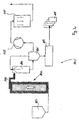
- Fig. 1 shows a schematic representation of an apparatus for the production of mercury sulfide for subsequent disposal.
- the method according to the invention will now be described with reference to the drawing. However, it should be understood that the invention is not limited to the illustrated embodiment.
- the device 1 has a mixing device 2 with a mixer housing 3.
- the mixing device 1 is in the present case, a vacuum mixer in horizontal construction, it being understood that other designs and arrangements are also possible and no less efficient.
- the mixing device 2 is preceded by a charging device 4.
- the charging device 4 three storage containers 5, 6, 7 on. It is located in the reservoir 5 liquid elemental mercury, while in the reservoir 6 is powdery elemental sulfur.
- the feed of the starting materials can optionally also be made of movable containers, which are then placed and emptied depending on the feed above the mixing device 2.
- the starting materials are conveyed in the desired ratio in the mixer housing 3 by means of automatic metering technique known per se.
- a conveying device not shown in detail, the charging device 4, which is closed to the outside, so that neither leakage of mercury nor sulfur particles or particles of the optionally supplied additive can escape to the outside.
- the process can be carried out in principle but also in any other superstoichiometric ratio with excess sulfur.
- the above slightly stoichiometric dosage provides efficient and complete binding of the mercury.
- the dosage as such is carried out by a separate weighing of the starting materials Mercury and sulfur and optionally supplied aggregate from the reservoir 7. The corresponding weighing devices following the individual storage containers are not shown.
- the mixer housing 3 After filling the mixer housing 3 with the starting materials in the predetermined dosage, the mixer housing 3 is closed in a gas-tight manner and flooded via an inert gas feed 8 with inert gas, for example nitrogen. At the same time takes place via a vacuum pump 9, a suction of the interior. The extracted gas is then fed to a filter device 10, which in the present case is an activated carbon filter. Subsequently, the cleaned exhaust air is removed from the filter device 10.
- the inerting of the mixing chamber within the mixer housing 3 in the present case represents a safety routine in order to exclude undesired reactions of the starting materials with oxygen.
- the inertization is not absolutely necessary, in principle, the intertization can also be dispensed with.
- a vacuum is generated in the mixing chamber of the mixer housing 3 via the vacuum pump device 9.
- a negative pressure of 0.1 bar at an absolute pressure of 0.9 bar in the mixer housing 3 via the vacuum pump 9 is set.
- the mixer drive and thus the mixing process is started.
- the mixer shaft 3 a with the mixer blades 3 b fastened thereto begins to rotate at low speed. This results in a short time mixing and a fine distribution of the liquid mercury with the sulfur powder. Due to the applied negative pressure and the resulting vapor pressure increase of the mercury, a spontaneous reaction of the mercury with the sulfur begins.
- the mixer housing is heated above room temperature.
- the heater 1 acts directly on the outer wall of the mixer housing 3.
- the external heating of the mixer housing 3 results in an indirect heating of the mixing chamber through the walls of the mixer housing 3 through and a heat transfer to the in Mixer housing 3 located feedstocks.
- the heating of the mixer housing 3 takes place until the boiling temperature of the mercury is reached in the mixing chamber.
- There the process is carried out in a vacuum, the boiling point of mercury is reduced compared to the boiling temperature at room conditions.
- the boiling point in the mixing chamber at 320 ° C was reached.
- the control of the heating takes place in dependence on corresponding sensors, which are coupled to the heating device 1.
- the mercury sulfide is removed via an unloading flap of the mixer housing 3, not shown.
- the emptying takes place via a not shown closed discharge device, which may be a preferably cooled screw conveyor. This not only makes it possible to cool the mercury sulfide, but also to fill it without dust emission from the mixer directly into dust-tight, suitable for the final storage container 12.
- Fig. 2 shows a schematic representation of an apparatus for the continuous production of mercury sulfide for subsequent disposal.
- a device 101 for the production of mercury sulfide (HgS) from elemental mercury (Hg) and elemental sulfur (S) for the final environmentally friendly disposal is shown.
- the mercury is preferably secondary mercury.
- the apparatus 101 has a reactor 102, which is designed as an upright tubular reactor and can be heated indirectly and which is designed to transfer elemental mercury and an elemental sulfur and / or a sulfur compound containing addition material in the gaseous state.
- the reactor 102 has a feed device which allows a continuous feed of the reactor 102 with the mercury and the feed material from a feed tank 103.
- the storage tank 103 contains a previously mixed and largely homogenized mixture of sulfur and mercury.
- the starting mixture of mercury and elemental sulfur supplied continuously to the reactor 102 is converted into the gaseous state at an operating temperature which is above the boiling or vaporization temperature of mercury sulfide.
- This is followed by a continuous gas phase reaction between the present in the gaseous state feedstocks, wherein the thus obtained vaporous mercury sulfide continuously discharged at a computational residence time of the feedstocks in the reactor 102 of more than one second to preferably less than four seconds from the reactor 102 and a Quench 104 is supplied.
- An exemplary illustrated line 105 between the reactor 102 and the quench 104 is heatable to prevent the condensation or resublimation of mercury sulfide in the line 105.
- red crystalline mercury sulfide is obtained.
- Red mercury sulphide is insoluble in water, acids (except aqua regia) and alkalis, stable and non-toxic. Therefore, red mercury sulfide is suitable for permanent disposal.
- the quench 104 is fed with circulated cooling water, so that it comes in the quench 104 to a sudden cooling of the mercury sulfide to the range of the solid phase of mercury sulfide.
- the mercury sulfide is cooled to a temperature between 25 ° C and 50 ° C.
- the solid mercury sulfide thus obtained is fed together with the cooling water of a solid-liquid separation stage, wherein in a centrifuge 6, the solid mercury sulfide is separated from the liquid cooling water.
- the cooling water is then returned to the quench 104, wherein an intermediate cooling of the cooling water can be provided.
- the mercury sulfide is fed to a filter press 107.
- the filter cake thus produced can be followed in a Drying device not shown in detail are dried and is then filled into provided for disposal storage container 108.
- a vacuum pump 109 is provided to detect vaporous mercury sulfide portions and supply them to an activated carbon filter 110.
- the gas stream passing through the activated carbon filter 110 can then be discharged into the environment.
- the present invention provides a method and apparatus for producing mercury sulfide for final environmentally sound disposal, which is characterized by a high efficiency in complete reaction of mercury with high labor and emission safety at the same time relatively low technical complexity.
Landscapes
- Chemical & Material Sciences (AREA)
- Organic Chemistry (AREA)
- Engineering & Computer Science (AREA)
- Chemical Kinetics & Catalysis (AREA)
- Manufacturing & Machinery (AREA)
- Materials Engineering (AREA)
- Mechanical Engineering (AREA)
- Metallurgy (AREA)
- Environmental & Geological Engineering (AREA)
- General Life Sciences & Earth Sciences (AREA)
- Geology (AREA)
- Life Sciences & Earth Sciences (AREA)
- Inorganic Chemistry (AREA)
- Treating Waste Gases (AREA)
- Processing Of Solid Wastes (AREA)
Priority Applications (1)
| Application Number | Priority Date | Filing Date | Title |
|---|---|---|---|
| EP11000566.7A EP2308802B1 (de) | 2007-12-19 | 2008-12-18 | VERFAHREN ZUR HERSTELLUNG VON QUECKSILBERSULFID ZUR ANSCHLIEßENDEN FINALEN ENTSORGUNG |
Applications Claiming Priority (2)
| Application Number | Priority Date | Filing Date | Title |
|---|---|---|---|
| DE200710061791 DE102007061791B4 (de) | 2007-12-19 | 2007-12-19 | Verfahren und Vorrichtung zur Herstellung von Quecksilbersulfid zur anschließenden Entsorgung |
| DE200810006246 DE102008006246B4 (de) | 2008-01-25 | 2008-01-25 | Verfahren und Vorrichtung zur kontinuierlichen Herstellung von Quecksilbersulfid zur anschließenden Entsorgung |
Related Child Applications (2)
| Application Number | Title | Priority Date | Filing Date |
|---|---|---|---|
| EP11000566.7A Division EP2308802B1 (de) | 2007-12-19 | 2008-12-18 | VERFAHREN ZUR HERSTELLUNG VON QUECKSILBERSULFID ZUR ANSCHLIEßENDEN FINALEN ENTSORGUNG |
| EP11000566.7 Division-Into | 2011-01-25 |
Publications (3)
| Publication Number | Publication Date |
|---|---|
| EP2072467A2 EP2072467A2 (de) | 2009-06-24 |
| EP2072467A3 EP2072467A3 (de) | 2009-11-25 |
| EP2072467B1 true EP2072467B1 (de) | 2011-11-30 |
Family
ID=40626668
Family Applications (3)
| Application Number | Title | Priority Date | Filing Date |
|---|---|---|---|
| EP20080021961 Not-in-force EP2072467B1 (de) | 2007-12-19 | 2008-12-18 | Verfahren und Vorrichtung zur Herstellung von Quecksilbersulfid zur anschließenden Entsorgung |
| EP11000566.7A Not-in-force EP2308802B1 (de) | 2007-12-19 | 2008-12-18 | VERFAHREN ZUR HERSTELLUNG VON QUECKSILBERSULFID ZUR ANSCHLIEßENDEN FINALEN ENTSORGUNG |
| EP20080021997 Not-in-force EP2072468B1 (de) | 2007-12-19 | 2008-12-18 | Verfahren und Vorrichtung zur Herstellung von Quecksilbersulfid zur anschließenden Entsorgung |
Family Applications After (2)
| Application Number | Title | Priority Date | Filing Date |
|---|---|---|---|
| EP11000566.7A Not-in-force EP2308802B1 (de) | 2007-12-19 | 2008-12-18 | VERFAHREN ZUR HERSTELLUNG VON QUECKSILBERSULFID ZUR ANSCHLIEßENDEN FINALEN ENTSORGUNG |
| EP20080021997 Not-in-force EP2072468B1 (de) | 2007-12-19 | 2008-12-18 | Verfahren und Vorrichtung zur Herstellung von Quecksilbersulfid zur anschließenden Entsorgung |
Country Status (3)
| Country | Link |
|---|---|
| EP (3) | EP2072467B1 (es) |
| AT (2) | ATE550300T1 (es) |
| ES (2) | ES2383166T3 (es) |
Cited By (1)
| Publication number | Priority date | Publication date | Assignee | Title |
|---|---|---|---|---|
| DE102015119735A1 (de) | 2015-11-16 | 2017-05-18 | GMR Gesellschaft für Metallrecycling mbH Leipzig | Verfahren und Anlage zur Immobilisierung von Quecksilber |
Families Citing this family (5)
| Publication number | Priority date | Publication date | Assignee | Title |
|---|---|---|---|---|
| EP2358639A4 (en) * | 2008-10-21 | 2013-09-11 | Bethlehem Apparatus Company Inc | METHOD AND DEVICE FOR PREPARING MERCURY (II) SULFIDE FROM ELEMENTARY MERCURY |
| DE102010047114A1 (de) | 2010-10-02 | 2012-04-05 | GMR Gesellschaft für Metallrecycling mbH | Verfahren zum Entsorgen von Quecksilber |
| JP6628486B2 (ja) * | 2015-03-24 | 2020-01-08 | 特定非営利活動法人広島循環型社会推進機構 | 金属水銀処理方法 |
| FR3037580B1 (fr) | 2015-06-17 | 2019-08-16 | Sarp Industries | Procede de stabilisation de mercure metallique |
| FR3053257B1 (fr) | 2016-06-29 | 2018-08-10 | Institut Francais Des Sciences Et Technologies Des Transports, De L'amenagement Et Des Reseaux | Procede d'immobilisation d'un dechet comprenant du mercure |
Family Cites Families (4)
| Publication number | Priority date | Publication date | Assignee | Title |
|---|---|---|---|---|
| GB404886A (en) * | 1932-08-10 | 1934-01-25 | American Zinc Lead & Smelting | Processes for making pigments |
| DE2305522C2 (de) * | 1973-02-05 | 1979-06-28 | Preussag Ag Metall, 3380 Goslar | Verfahren zur Gewinnung von Quecksilber aus SO2 -haltigen Röstgasen |
| US5034054A (en) * | 1989-07-03 | 1991-07-23 | Ecoflo, Inc. | Process for treating mercury in preparation for disposal |
| FR2871283B1 (fr) * | 2004-06-03 | 2006-09-22 | Tech En Milieu Ionisant Stmi S | Procede de stabilisation du mercure metallique par le soufre |
-
2008
- 2008-12-18 ES ES08021997T patent/ES2383166T3/es active Active
- 2008-12-18 EP EP20080021961 patent/EP2072467B1/de not_active Not-in-force
- 2008-12-18 AT AT08021997T patent/ATE550300T1/de active
- 2008-12-18 AT AT08021961T patent/ATE535496T1/de active
- 2008-12-18 EP EP11000566.7A patent/EP2308802B1/de not_active Not-in-force
- 2008-12-18 EP EP20080021997 patent/EP2072468B1/de not_active Not-in-force
- 2008-12-18 ES ES08021961T patent/ES2375878T3/es active Active
Cited By (1)
| Publication number | Priority date | Publication date | Assignee | Title |
|---|---|---|---|---|
| DE102015119735A1 (de) | 2015-11-16 | 2017-05-18 | GMR Gesellschaft für Metallrecycling mbH Leipzig | Verfahren und Anlage zur Immobilisierung von Quecksilber |
Also Published As
| Publication number | Publication date |
|---|---|
| ES2383166T3 (es) | 2012-06-18 |
| EP2072468A2 (de) | 2009-06-24 |
| EP2072467A2 (de) | 2009-06-24 |
| ATE550300T1 (de) | 2012-04-15 |
| ES2375878T3 (es) | 2012-03-07 |
| EP2308802A3 (de) | 2011-09-21 |
| EP2072468A3 (de) | 2009-12-16 |
| ATE535496T1 (de) | 2011-12-15 |
| EP2072468B1 (de) | 2012-03-21 |
| EP2072467A3 (de) | 2009-11-25 |
| EP2308802B1 (de) | 2016-03-02 |
| EP2308802A2 (de) | 2011-04-13 |
Similar Documents
| Publication | Publication Date | Title |
|---|---|---|
| EP2072467B1 (de) | Verfahren und Vorrichtung zur Herstellung von Quecksilbersulfid zur anschließenden Entsorgung | |
| EP2016203B1 (de) | Thermisches verfahren zur abtrennung von schwermetallen aus asche in agglomerierter form | |
| EP4126762B1 (de) | Verfahren und vorrichtung zur gewinnung von phosphor aus klärschlamm | |
| DE2147708C2 (de) | Verfahren zur Herstellung keramischer Strukturen von Urandioxid aus gasförmigen Uranhexefluorid | |
| DE102007061791B4 (de) | Verfahren und Vorrichtung zur Herstellung von Quecksilbersulfid zur anschließenden Entsorgung | |
| WO2023118585A1 (de) | Vorrichtung für prozesse zur behandlung von probenmaterial | |
| DE69419028T2 (de) | Verfahren zum neutralisieren von abfällen | |
| DE2619302A1 (de) | Verfahren zum umwandeln von festen abfallstoffen in brenngas | |
| DE3826520C2 (es) | ||
| DE102008021562B4 (de) | Verfahren zur Herstellung von Wasserstoffgas mit Hilfe von Hüttenreststoffen und Verwendung von Hüttenreststoffen | |
| DE2539309C3 (de) | Verfahren zum Herstellen von hochreinem metallischen Molybdän | |
| DE2800541C2 (de) | Anlage zur Erzeugung von Koks in einem Koksofen | |
| US7914757B1 (en) | Process and device for immobilizing mercury by producing crystalline mercury sulfide for subsequent disposal of mercury sulfide | |
| DE3114060A1 (de) | Verfahren und vorrichtung zum verfestigen einer feststoffe enthaltenden radioaktiven abfallfluessigkeit | |
| DE102014007354B4 (de) | Verfahren zum Aufbereiten von Rückständen aus der mechanischen Bearbeitung von Siliziumprodukten | |
| AT513164B1 (de) | Verfahren und Vorrichtung zur Herstellung von Metallchalkogeniden | |
| AT523321B1 (de) | Verfahren und vorrichtung zur herstellung von antimontrisulfid | |
| DE19937188C1 (de) | Verfahren zur Verwertung von Gasen aus dem Absetzbecken | |
| DE102019114060A1 (de) | Reaktor zur erzeugung von wasserdampf und trockensubstanz, gaserzeugungsvorrichtung und verfahren zur dampf und gaserzeugung | |
| DE102008006246B4 (de) | Verfahren und Vorrichtung zur kontinuierlichen Herstellung von Quecksilbersulfid zur anschließenden Entsorgung | |
| EP2087030B1 (de) | Verfahren und vorrichtung zur verwertung von sauerstoffhaltigen polymeren | |
| DE102012102981B3 (de) | Verfahren und Anlage zur Umsetzung von Quecksilber mit Schwefel zu Quecksilbersulfid | |
| EP3947278B1 (de) | Verfahren zur herstellung von siliciummetall-haltigen agglomeraten | |
| DE2044402B2 (de) | Verfahren zur herstellung eines metalls mittels reduktion aus zumindest einem seiner halogenide durch calciumkarbid sowie einrichtung zur durchfuehrung des verfahrens zwecks herstellung eines fluechtigen metalls | |
| WO2021229048A1 (de) | Verfahren zur herstellung von briketts aus einem abfallmaterial und brikett aus einem abfallmaterial |
Legal Events
| Date | Code | Title | Description |
|---|---|---|---|
| PUAI | Public reference made under article 153(3) epc to a published international application that has entered the european phase |
Free format text: ORIGINAL CODE: 0009012 |
|
| AK | Designated contracting states |
Kind code of ref document: A2 Designated state(s): AT BE BG CH CY CZ DE DK EE ES FI FR GB GR HR HU IE IS IT LI LT LU LV MC MT NL NO PL PT RO SE SI SK TR |
|
| AX | Request for extension of the european patent |
Extension state: AL BA MK RS |
|
| RTI1 | Title (correction) |
Free format text: METHOD AND DEVICE FOR MANUFACTURING MERCURY SULPHIDE FOR SUBSEQUENT DISPOSAL |
|
| RIC1 | Information provided on ipc code assigned before grant |
Ipc: C22B 7/00 20060101ALI20090724BHEP Ipc: C01G 13/00 20060101AFI20090518BHEP Ipc: C22B 43/00 20060101ALI20090724BHEP Ipc: B01F 15/06 20060101ALI20090724BHEP Ipc: B01F 13/06 20060101ALI20090724BHEP |
|
| PUAL | Search report despatched |
Free format text: ORIGINAL CODE: 0009013 |
|
| AK | Designated contracting states |
Kind code of ref document: A3 Designated state(s): AT BE BG CH CY CZ DE DK EE ES FI FR GB GR HR HU IE IS IT LI LT LU LV MC MT NL NO PL PT RO SE SI SK TR |
|
| AX | Request for extension of the european patent |
Extension state: AL BA MK RS |
|
| 17P | Request for examination filed |
Effective date: 20091104 |
|
| AKX | Designation fees paid |
Designated state(s): AT BE BG CH CY CZ DE DK EE ES FI FR GB GR HR HU IE IS IT LI LT LU LV MC MT NL NO PL PT RO SE SI SK TR |
|
| 17Q | First examination report despatched |
Effective date: 20100818 |
|
| GRAP | Despatch of communication of intention to grant a patent |
Free format text: ORIGINAL CODE: EPIDOSNIGR1 |
|
| GRAS | Grant fee paid |
Free format text: ORIGINAL CODE: EPIDOSNIGR3 |
|
| GRAA | (expected) grant |
Free format text: ORIGINAL CODE: 0009210 |
|
| AK | Designated contracting states |
Kind code of ref document: B1 Designated state(s): AT BE BG CH CY CZ DE DK EE ES FI FR GB GR HR HU IE IS IT LI LT LU LV MC MT NL NO PL PT RO SE SI SK TR |
|
| REG | Reference to a national code |
Ref country code: GB Ref legal event code: FG4D Free format text: NOT ENGLISH Ref country code: CH Ref legal event code: EP |
|
| REG | Reference to a national code |
Ref country code: IE Ref legal event code: FG4D Free format text: LANGUAGE OF EP DOCUMENT: GERMAN |
|
| REG | Reference to a national code |
Ref country code: DE Ref legal event code: R096 Ref document number: 502008005724 Country of ref document: DE Effective date: 20120216 |
|
| REG | Reference to a national code |
Ref country code: ES Ref legal event code: FG2A Ref document number: 2375878 Country of ref document: ES Kind code of ref document: T3 Effective date: 20120307 |
|
| REG | Reference to a national code |
Ref country code: NL Ref legal event code: VDEP Effective date: 20111130 |
|
| LTIE | Lt: invalidation of european patent or patent extension |
Effective date: 20111130 |
|
| PG25 | Lapsed in a contracting state [announced via postgrant information from national office to epo] |
Ref country code: IS Free format text: LAPSE BECAUSE OF FAILURE TO SUBMIT A TRANSLATION OF THE DESCRIPTION OR TO PAY THE FEE WITHIN THE PRESCRIBED TIME-LIMIT Effective date: 20120330 Ref country code: LT Free format text: LAPSE BECAUSE OF FAILURE TO SUBMIT A TRANSLATION OF THE DESCRIPTION OR TO PAY THE FEE WITHIN THE PRESCRIBED TIME-LIMIT Effective date: 20111130 Ref country code: NO Free format text: LAPSE BECAUSE OF FAILURE TO SUBMIT A TRANSLATION OF THE DESCRIPTION OR TO PAY THE FEE WITHIN THE PRESCRIBED TIME-LIMIT Effective date: 20120229 |
|
| PG25 | Lapsed in a contracting state [announced via postgrant information from national office to epo] |
Ref country code: PT Free format text: LAPSE BECAUSE OF FAILURE TO SUBMIT A TRANSLATION OF THE DESCRIPTION OR TO PAY THE FEE WITHIN THE PRESCRIBED TIME-LIMIT Effective date: 20120330 Ref country code: SE Free format text: LAPSE BECAUSE OF FAILURE TO SUBMIT A TRANSLATION OF THE DESCRIPTION OR TO PAY THE FEE WITHIN THE PRESCRIBED TIME-LIMIT Effective date: 20111130 Ref country code: SI Free format text: LAPSE BECAUSE OF FAILURE TO SUBMIT A TRANSLATION OF THE DESCRIPTION OR TO PAY THE FEE WITHIN THE PRESCRIBED TIME-LIMIT Effective date: 20111130 Ref country code: NL Free format text: LAPSE BECAUSE OF FAILURE TO SUBMIT A TRANSLATION OF THE DESCRIPTION OR TO PAY THE FEE WITHIN THE PRESCRIBED TIME-LIMIT Effective date: 20111130 Ref country code: HR Free format text: LAPSE BECAUSE OF FAILURE TO SUBMIT A TRANSLATION OF THE DESCRIPTION OR TO PAY THE FEE WITHIN THE PRESCRIBED TIME-LIMIT Effective date: 20111130 Ref country code: GR Free format text: LAPSE BECAUSE OF FAILURE TO SUBMIT A TRANSLATION OF THE DESCRIPTION OR TO PAY THE FEE WITHIN THE PRESCRIBED TIME-LIMIT Effective date: 20120301 Ref country code: LV Free format text: LAPSE BECAUSE OF FAILURE TO SUBMIT A TRANSLATION OF THE DESCRIPTION OR TO PAY THE FEE WITHIN THE PRESCRIBED TIME-LIMIT Effective date: 20111130 |
|
| REG | Reference to a national code |
Ref country code: IE Ref legal event code: FD4D |
|
| PG25 | Lapsed in a contracting state [announced via postgrant information from national office to epo] |
Ref country code: CY Free format text: LAPSE BECAUSE OF FAILURE TO SUBMIT A TRANSLATION OF THE DESCRIPTION OR TO PAY THE FEE WITHIN THE PRESCRIBED TIME-LIMIT Effective date: 20111130 |
|
| BERE | Be: lapsed |
Owner name: DELA G.M.B.H. RECYCLING UND UMWELTTECHNIK Effective date: 20111231 |
|
| PG25 | Lapsed in a contracting state [announced via postgrant information from national office to epo] |
Ref country code: CZ Free format text: LAPSE BECAUSE OF FAILURE TO SUBMIT A TRANSLATION OF THE DESCRIPTION OR TO PAY THE FEE WITHIN THE PRESCRIBED TIME-LIMIT Effective date: 20111130 Ref country code: DK Free format text: LAPSE BECAUSE OF FAILURE TO SUBMIT A TRANSLATION OF THE DESCRIPTION OR TO PAY THE FEE WITHIN THE PRESCRIBED TIME-LIMIT Effective date: 20111130 Ref country code: SK Free format text: LAPSE BECAUSE OF FAILURE TO SUBMIT A TRANSLATION OF THE DESCRIPTION OR TO PAY THE FEE WITHIN THE PRESCRIBED TIME-LIMIT Effective date: 20111130 Ref country code: IE Free format text: LAPSE BECAUSE OF FAILURE TO SUBMIT A TRANSLATION OF THE DESCRIPTION OR TO PAY THE FEE WITHIN THE PRESCRIBED TIME-LIMIT Effective date: 20111130 Ref country code: BG Free format text: LAPSE BECAUSE OF FAILURE TO SUBMIT A TRANSLATION OF THE DESCRIPTION OR TO PAY THE FEE WITHIN THE PRESCRIBED TIME-LIMIT Effective date: 20120229 Ref country code: MC Free format text: LAPSE BECAUSE OF NON-PAYMENT OF DUE FEES Effective date: 20111231 Ref country code: EE Free format text: LAPSE BECAUSE OF FAILURE TO SUBMIT A TRANSLATION OF THE DESCRIPTION OR TO PAY THE FEE WITHIN THE PRESCRIBED TIME-LIMIT Effective date: 20111130 |
|
| PG25 | Lapsed in a contracting state [announced via postgrant information from national office to epo] |
Ref country code: RO Free format text: LAPSE BECAUSE OF FAILURE TO SUBMIT A TRANSLATION OF THE DESCRIPTION OR TO PAY THE FEE WITHIN THE PRESCRIBED TIME-LIMIT Effective date: 20111130 Ref country code: PL Free format text: LAPSE BECAUSE OF FAILURE TO SUBMIT A TRANSLATION OF THE DESCRIPTION OR TO PAY THE FEE WITHIN THE PRESCRIBED TIME-LIMIT Effective date: 20111130 Ref country code: IT Free format text: LAPSE BECAUSE OF FAILURE TO SUBMIT A TRANSLATION OF THE DESCRIPTION OR TO PAY THE FEE WITHIN THE PRESCRIBED TIME-LIMIT Effective date: 20111130 |
|
| PLBE | No opposition filed within time limit |
Free format text: ORIGINAL CODE: 0009261 |
|
| STAA | Information on the status of an ep patent application or granted ep patent |
Free format text: STATUS: NO OPPOSITION FILED WITHIN TIME LIMIT |
|
| PG25 | Lapsed in a contracting state [announced via postgrant information from national office to epo] |
Ref country code: BE Free format text: LAPSE BECAUSE OF NON-PAYMENT OF DUE FEES Effective date: 20111231 |
|
| 26N | No opposition filed |
Effective date: 20120831 |
|
| REG | Reference to a national code |
Ref country code: FR Ref legal event code: ST Effective date: 20121019 |
|
| REG | Reference to a national code |
Ref country code: DE Ref legal event code: R082 Ref document number: 502008005724 Country of ref document: DE Representative=s name: VON ROHR PATENTANWAELTE PARTNERSCHAFT, DE Ref country code: DE Ref legal event code: R082 Ref document number: 502008005724 Country of ref document: DE Representative=s name: VON ROHR PATENTANWAELTE PARTNERSCHAFT MBB, DE |
|
| REG | Reference to a national code |
Ref country code: DE Ref legal event code: R097 Ref document number: 502008005724 Country of ref document: DE Effective date: 20120831 |
|
| PG25 | Lapsed in a contracting state [announced via postgrant information from national office to epo] |
Ref country code: FR Free format text: LAPSE BECAUSE OF NON-PAYMENT OF DUE FEES Effective date: 20120130 |
|
| PG25 | Lapsed in a contracting state [announced via postgrant information from national office to epo] |
Ref country code: MT Free format text: LAPSE BECAUSE OF FAILURE TO SUBMIT A TRANSLATION OF THE DESCRIPTION OR TO PAY THE FEE WITHIN THE PRESCRIBED TIME-LIMIT Effective date: 20111130 |
|
| PG25 | Lapsed in a contracting state [announced via postgrant information from national office to epo] |
Ref country code: LU Free format text: LAPSE BECAUSE OF NON-PAYMENT OF DUE FEES Effective date: 20111218 |
|
| PG25 | Lapsed in a contracting state [announced via postgrant information from national office to epo] |
Ref country code: FI Free format text: LAPSE BECAUSE OF FAILURE TO SUBMIT A TRANSLATION OF THE DESCRIPTION OR TO PAY THE FEE WITHIN THE PRESCRIBED TIME-LIMIT Effective date: 20111130 |
|
| REG | Reference to a national code |
Ref country code: CH Ref legal event code: PL |
|
| GBPC | Gb: european patent ceased through non-payment of renewal fee |
Effective date: 20121218 |
|
| PG25 | Lapsed in a contracting state [announced via postgrant information from national office to epo] |
Ref country code: TR Free format text: LAPSE BECAUSE OF FAILURE TO SUBMIT A TRANSLATION OF THE DESCRIPTION OR TO PAY THE FEE WITHIN THE PRESCRIBED TIME-LIMIT Effective date: 20111130 |
|
| PG25 | Lapsed in a contracting state [announced via postgrant information from national office to epo] |
Ref country code: HU Free format text: LAPSE BECAUSE OF FAILURE TO SUBMIT A TRANSLATION OF THE DESCRIPTION OR TO PAY THE FEE WITHIN THE PRESCRIBED TIME-LIMIT Effective date: 20111130 Ref country code: CH Free format text: LAPSE BECAUSE OF NON-PAYMENT OF DUE FEES Effective date: 20121231 Ref country code: LI Free format text: LAPSE BECAUSE OF NON-PAYMENT OF DUE FEES Effective date: 20121231 |
|
| PG25 | Lapsed in a contracting state [announced via postgrant information from national office to epo] |
Ref country code: GB Free format text: LAPSE BECAUSE OF NON-PAYMENT OF DUE FEES Effective date: 20121218 |
|
| REG | Reference to a national code |
Ref country code: DE Ref legal event code: R082 Ref document number: 502008005724 Country of ref document: DE Representative=s name: VON ROHR PATENTANWAELTE PARTNERSCHAFT MBB, DE |
|
| REG | Reference to a national code |
Ref country code: DE Ref legal event code: R082 Ref document number: 502008005724 Country of ref document: DE Representative=s name: VON ROHR PATENTANWAELTE PARTNERSCHAFT MBB, DE Effective date: 20141120 Ref country code: DE Ref legal event code: R082 Ref document number: 502008005724 Country of ref document: DE Representative=s name: VON ROHR PATENTANWAELTE PARTNERSCHAFT MBB, DE Effective date: 20121220 Ref country code: DE Ref legal event code: R081 Ref document number: 502008005724 Country of ref document: DE Owner name: NQR NORDISCHE QUECKSILBER RUECKGEWINNUNG GMBH, DE Free format text: FORMER OWNER: DELA GMBH RECYCLING UND UMWELTTECHNIK, 32549 BAD OEYNHAUSEN, DE Effective date: 20141120 |
|
| REG | Reference to a national code |
Ref country code: ES Ref legal event code: PC2A Owner name: NQR NORDISCHE QUECKSILBER RUCKGEWINNUNG GMBH Effective date: 20150128 |
|
| REG | Reference to a national code |
Ref country code: AT Ref legal event code: MM01 Ref document number: 535496 Country of ref document: AT Kind code of ref document: T Effective date: 20131218 |
|
| PG25 | Lapsed in a contracting state [announced via postgrant information from national office to epo] |
Ref country code: AT Free format text: LAPSE BECAUSE OF NON-PAYMENT OF DUE FEES Effective date: 20131218 |
|
| PGFP | Annual fee paid to national office [announced via postgrant information from national office to epo] |
Ref country code: ES Payment date: 20151214 Year of fee payment: 8 |
|
| PGFP | Annual fee paid to national office [announced via postgrant information from national office to epo] |
Ref country code: DE Payment date: 20151216 Year of fee payment: 8 |
|
| REG | Reference to a national code |
Ref country code: DE Ref legal event code: R119 Ref document number: 502008005724 Country of ref document: DE |
|
| PG25 | Lapsed in a contracting state [announced via postgrant information from national office to epo] |
Ref country code: DE Free format text: LAPSE BECAUSE OF NON-PAYMENT OF DUE FEES Effective date: 20170701 |
|
| PG25 | Lapsed in a contracting state [announced via postgrant information from national office to epo] |
Ref country code: ES Free format text: LAPSE BECAUSE OF NON-PAYMENT OF DUE FEES Effective date: 20161219 |
|
| REG | Reference to a national code |
Ref country code: ES Ref legal event code: FD2A Effective date: 20181116 |