EP2070942A1 - Verfahren zur Aromatisierung von 19-Nor-androst-4-en-3-onen zu Estra-1,3,5(10)-trienen - Google Patents
Verfahren zur Aromatisierung von 19-Nor-androst-4-en-3-onen zu Estra-1,3,5(10)-trienen Download PDFInfo
- Publication number
- EP2070942A1 EP2070942A1 EP20070076136 EP07076136A EP2070942A1 EP 2070942 A1 EP2070942 A1 EP 2070942A1 EP 20070076136 EP20070076136 EP 20070076136 EP 07076136 A EP07076136 A EP 07076136A EP 2070942 A1 EP2070942 A1 EP 2070942A1
- Authority
- EP
- European Patent Office
- Prior art keywords
- formula
- compounds
- general formula
- alkyl
- keto
- Prior art date
- Legal status (The legal status is an assumption and is not a legal conclusion. Google has not performed a legal analysis and makes no representation as to the accuracy of the status listed.)
- Withdrawn
Links
- 150000002154 estra-1,3,5(10)-trienes Chemical class 0.000 title claims abstract description 7
- 238000000034 method Methods 0.000 title claims description 27
- 238000006243 chemical reaction Methods 0.000 claims abstract description 33
- -1 estra-1,3,5(10)-triene compound Chemical class 0.000 claims abstract description 24
- 238000005899 aromatization reaction Methods 0.000 claims abstract description 15
- 238000002360 preparation method Methods 0.000 claims abstract description 15
- 229910052801 chlorine Inorganic materials 0.000 claims abstract description 14
- 125000000623 heterocyclic group Chemical group 0.000 claims abstract description 14
- 229910052794 bromium Inorganic materials 0.000 claims abstract description 12
- 125000000468 ketone group Chemical group 0.000 claims abstract description 12
- 229910052740 iodine Inorganic materials 0.000 claims abstract description 11
- 125000006239 protecting group Chemical group 0.000 claims abstract description 11
- 150000001412 amines Chemical group 0.000 claims abstract description 10
- 230000000269 nucleophilic effect Effects 0.000 claims abstract description 10
- HBAQYPYDRFILMT-UHFFFAOYSA-N 8-[3-(1-cyclopropylpyrazol-4-yl)-1H-pyrazolo[4,3-d]pyrimidin-5-yl]-3-methyl-3,8-diazabicyclo[3.2.1]octan-2-one Chemical class C1(CC1)N1N=CC(=C1)C1=NNC2=C1N=C(N=C2)N1C2C(N(CC1CC2)C)=O HBAQYPYDRFILMT-UHFFFAOYSA-N 0.000 claims abstract description 9
- 125000000217 alkyl group Chemical group 0.000 claims abstract description 8
- 238000005804 alkylation reaction Methods 0.000 claims abstract description 7
- BUIVJNVIIAIIFZ-MUSFGAPCSA-N estratriene group Chemical group C[C@@]12C=CC=C1C1=CCC3CCCC[C@@H]3[C@H]1CC2 BUIVJNVIIAIIFZ-MUSFGAPCSA-N 0.000 claims abstract description 6
- 239000006259 organic additive Substances 0.000 claims abstract description 6
- 230000001404 mediated effect Effects 0.000 claims abstract description 5
- 229910052731 fluorine Inorganic materials 0.000 claims abstract description 4
- 125000000538 pentafluorophenyl group Chemical group FC1=C(F)C(F)=C(*)C(F)=C1F 0.000 claims abstract description 4
- 230000029936 alkylation Effects 0.000 claims abstract 3
- 230000011987 methylation Effects 0.000 claims abstract 3
- 238000007069 methylation reaction Methods 0.000 claims abstract 3
- 150000001875 compounds Chemical class 0.000 claims description 80
- DPZNOMCNRMUKPS-UHFFFAOYSA-N 1,3-Dimethoxybenzene Chemical compound COC1=CC=CC(OC)=C1 DPZNOMCNRMUKPS-UHFFFAOYSA-N 0.000 claims description 22
- 229910052739 hydrogen Inorganic materials 0.000 claims description 21
- 239000001257 hydrogen Substances 0.000 claims description 21
- 229910021589 Copper(I) bromide Inorganic materials 0.000 claims description 18
- UFHFLCQGNIYNRP-UHFFFAOYSA-N Hydrogen Chemical compound [H][H] UFHFLCQGNIYNRP-UHFFFAOYSA-N 0.000 claims description 18
- GDTBXPJZTBHREO-UHFFFAOYSA-N bromine Chemical compound BrBr GDTBXPJZTBHREO-UHFFFAOYSA-N 0.000 claims description 16
- 239000000460 chlorine Substances 0.000 claims description 11
- 125000002496 methyl group Chemical group [H]C([H])([H])* 0.000 claims description 11
- 150000002431 hydrogen Chemical class 0.000 claims description 10
- 150000003254 radicals Chemical class 0.000 claims description 10
- 125000004432 carbon atom Chemical group C* 0.000 claims description 9
- ZCYVEMRRCGMTRW-UHFFFAOYSA-N 7553-56-2 Chemical group [I] ZCYVEMRRCGMTRW-UHFFFAOYSA-N 0.000 claims description 8
- 125000000882 C2-C6 alkenyl group Chemical group 0.000 claims description 8
- 239000000654 additive Substances 0.000 claims description 8
- 229910052736 halogen Inorganic materials 0.000 claims description 8
- 150000002367 halogens Chemical class 0.000 claims description 8
- 125000002887 hydroxy group Chemical group [H]O* 0.000 claims description 8
- KZBUYRJDOAKODT-UHFFFAOYSA-N Chlorine Chemical compound ClCl KZBUYRJDOAKODT-UHFFFAOYSA-N 0.000 claims description 7
- UUEVFMOUBSLVJW-UHFFFAOYSA-N oxo-[[1-[2-[2-[2-[4-(oxoazaniumylmethylidene)pyridin-1-yl]ethoxy]ethoxy]ethyl]pyridin-4-ylidene]methyl]azanium;dibromide Chemical compound [Br-].[Br-].C1=CC(=C[NH+]=O)C=CN1CCOCCOCCN1C=CC(=C[NH+]=O)C=C1 UUEVFMOUBSLVJW-UHFFFAOYSA-N 0.000 claims description 6
- LKUDPHPHKOZXCD-UHFFFAOYSA-N 1,3,5-trimethoxybenzene Chemical compound COC1=CC(OC)=CC(OC)=C1 LKUDPHPHKOZXCD-UHFFFAOYSA-N 0.000 claims description 4
- 150000001335 aliphatic alkanes Chemical class 0.000 claims description 4
- HGCIXCUEYOPUTN-UHFFFAOYSA-N cyclohexene Chemical compound C1CCC=CC1 HGCIXCUEYOPUTN-UHFFFAOYSA-N 0.000 claims description 4
- 125000004180 3-fluorophenyl group Chemical group [H]C1=C([H])C(*)=C([H])C(F)=C1[H] 0.000 claims description 3
- 230000000996 additive effect Effects 0.000 claims description 3
- JKTCBAGSMQIFNL-UHFFFAOYSA-N 2,3-dihydrofuran Chemical compound C1CC=CO1 JKTCBAGSMQIFNL-UHFFFAOYSA-N 0.000 claims description 2
- QUPDWYMUPZLYJZ-UHFFFAOYSA-N ethyl Chemical compound C[CH2] QUPDWYMUPZLYJZ-UHFFFAOYSA-N 0.000 claims description 2
- 125000004435 hydrogen atom Chemical group [H]* 0.000 claims description 2
- ODWXUNBKCRECNW-UHFFFAOYSA-M bromocopper(1+) Chemical compound Br[Cu+] ODWXUNBKCRECNW-UHFFFAOYSA-M 0.000 abstract 2
- 125000001475 halogen functional group Chemical group 0.000 abstract 2
- 125000003277 amino group Chemical group 0.000 abstract 1
- 125000002950 monocyclic group Chemical group 0.000 abstract 1
- AMXOYNBUYSYVKV-UHFFFAOYSA-M lithium bromide Chemical compound [Li+].[Br-] AMXOYNBUYSYVKV-UHFFFAOYSA-M 0.000 description 20
- 238000004128 high performance liquid chromatography Methods 0.000 description 15
- AFVFQIVMOAPDHO-UHFFFAOYSA-N Methanesulfonic acid Chemical compound CS(O)(=O)=O AFVFQIVMOAPDHO-UHFFFAOYSA-N 0.000 description 14
- 239000011541 reaction mixture Substances 0.000 description 14
- FVSKHRXBFJPNKK-UHFFFAOYSA-N propionitrile Chemical compound CCC#N FVSKHRXBFJPNKK-UHFFFAOYSA-N 0.000 description 13
- 230000015572 biosynthetic process Effects 0.000 description 8
- 239000006227 byproduct Substances 0.000 description 8
- OSVMTWJCGUFAOD-KZQROQTASA-N formestane Chemical compound O=C1CC[C@]2(C)[C@H]3CC[C@](C)(C(CC4)=O)[C@@H]4[C@@H]3CCC2=C1O OSVMTWJCGUFAOD-KZQROQTASA-N 0.000 description 8
- 230000003647 oxidation Effects 0.000 description 8
- 238000007254 oxidation reaction Methods 0.000 description 8
- 229940098779 methanesulfonic acid Drugs 0.000 description 7
- 239000000203 mixture Substances 0.000 description 7
- XLYOFNOQVPJJNP-UHFFFAOYSA-N water Substances O XLYOFNOQVPJJNP-UHFFFAOYSA-N 0.000 description 7
- IJGRMHOSHXDMSA-UHFFFAOYSA-N Atomic nitrogen Chemical compound N#N IJGRMHOSHXDMSA-UHFFFAOYSA-N 0.000 description 6
- 125000003118 aryl group Chemical group 0.000 description 6
- QVGXLLKOCUKJST-UHFFFAOYSA-N atomic oxygen Chemical compound [O] QVGXLLKOCUKJST-UHFFFAOYSA-N 0.000 description 6
- 125000005842 heteroatom Chemical group 0.000 description 6
- 230000003637 steroidlike Effects 0.000 description 6
- 238000003786 synthesis reaction Methods 0.000 description 6
- BDAGIHXWWSANSR-UHFFFAOYSA-N Formic acid Chemical compound OC=O BDAGIHXWWSANSR-UHFFFAOYSA-N 0.000 description 5
- 239000002253 acid Substances 0.000 description 5
- 239000003570 air Substances 0.000 description 5
- 230000031709 bromination Effects 0.000 description 5
- 238000005893 bromination reaction Methods 0.000 description 5
- 235000019253 formic acid Nutrition 0.000 description 5
- 229910052760 oxygen Inorganic materials 0.000 description 5
- 239000001301 oxygen Substances 0.000 description 5
- 239000000047 product Substances 0.000 description 5
- 125000006413 ring segment Chemical group 0.000 description 5
- 150000003431 steroids Chemical class 0.000 description 5
- 0 *C(CC(C1)C2CCC1=O)C1C2C(*)(*)C[C@]2(*)C(*)(*)CCC12 Chemical compound *C(CC(C1)C2CCC1=O)C1C2C(*)(*)C[C@]2(*)C(*)(*)CCC12 0.000 description 4
- 239000012080 ambient air Substances 0.000 description 4
- 230000001833 anti-estrogenic effect Effects 0.000 description 4
- 102000015694 estrogen receptors Human genes 0.000 description 4
- 108010038795 estrogen receptors Proteins 0.000 description 4
- 125000001072 heteroaryl group Chemical group 0.000 description 4
- 125000004169 (C1-C6) alkyl group Chemical group 0.000 description 3
- WFDIJRYMOXRFFG-UHFFFAOYSA-N Acetic anhydride Chemical compound CC(=O)OC(C)=O WFDIJRYMOXRFFG-UHFFFAOYSA-N 0.000 description 3
- WEVYAHXRMPXWCK-UHFFFAOYSA-N Acetonitrile Chemical compound CC#N WEVYAHXRMPXWCK-UHFFFAOYSA-N 0.000 description 3
- UHOVQNZJYSORNB-UHFFFAOYSA-N Benzene Chemical compound C1=CC=CC=C1 UHOVQNZJYSORNB-UHFFFAOYSA-N 0.000 description 3
- YMWUJEATGCHHMB-UHFFFAOYSA-N Dichloromethane Chemical compound ClCCl YMWUJEATGCHHMB-UHFFFAOYSA-N 0.000 description 3
- YLQBMQCUIZJEEH-UHFFFAOYSA-N Furan Chemical compound C=1C=COC=1 YLQBMQCUIZJEEH-UHFFFAOYSA-N 0.000 description 3
- ISWSIDIOOBJBQZ-UHFFFAOYSA-N Phenol Chemical compound OC1=CC=CC=C1 ISWSIDIOOBJBQZ-UHFFFAOYSA-N 0.000 description 3
- RWRDLPDLKQPQOW-UHFFFAOYSA-N Pyrrolidine Chemical compound C1CCNC1 RWRDLPDLKQPQOW-UHFFFAOYSA-N 0.000 description 3
- HEMHJVSKTPXQMS-UHFFFAOYSA-M Sodium hydroxide Chemical compound [OH-].[Na+] HEMHJVSKTPXQMS-UHFFFAOYSA-M 0.000 description 3
- YXFVVABEGXRONW-UHFFFAOYSA-N Toluene Chemical compound CC1=CC=CC=C1 YXFVVABEGXRONW-UHFFFAOYSA-N 0.000 description 3
- 239000010949 copper Substances 0.000 description 3
- 150000001925 cycloalkenes Chemical class 0.000 description 3
- 238000002474 experimental method Methods 0.000 description 3
- RAXXELZNTBOGNW-UHFFFAOYSA-N imidazole Natural products C1=CNC=N1 RAXXELZNTBOGNW-UHFFFAOYSA-N 0.000 description 3
- 229910052757 nitrogen Inorganic materials 0.000 description 3
- 230000035484 reaction time Effects 0.000 description 3
- 238000012216 screening Methods 0.000 description 3
- 125000004434 sulfur atom Chemical group 0.000 description 3
- DNXHEGUUPJUMQT-CVYDXHPNSA-N (8s,9s,13s,14s)-3-hydroxy-13-methyl-7,8,9,11,12,14,15,16-octahydro-6h-cyclopenta[a]phenanthren-17-one Chemical compound OC1=CC=C2[C@H]3CC[C@](C)(C(CC4)=O)[C@@H]4[C@H]3CCC2=C1 DNXHEGUUPJUMQT-CVYDXHPNSA-N 0.000 description 2
- JRIZOGLBRPZBLQ-QXUSFIETSA-N 19-Norandrostenedione Chemical compound O=C1CC[C@@H]2[C@H]3CC[C@](C)(C(CC4)=O)[C@@H]4[C@@H]3CCC2=C1 JRIZOGLBRPZBLQ-QXUSFIETSA-N 0.000 description 2
- WKBOTKDWSSQWDR-UHFFFAOYSA-N Bromine atom Chemical compound [Br] WKBOTKDWSSQWDR-UHFFFAOYSA-N 0.000 description 2
- ZSEQECHHSCTHQA-UTGYZPKMSA-N C[C@](C[C@@H]1F)(C(CC2)C(C(CCCCCCl)Cc3c4)C1c3ccc4O)C2=O Chemical compound C[C@](C[C@@H]1F)(C(CC2)C(C(CCCCCCl)Cc3c4)C1c3ccc4O)C2=O ZSEQECHHSCTHQA-UTGYZPKMSA-N 0.000 description 2
- 239000004215 Carbon black (E152) Substances 0.000 description 2
- RYGMFSIKBFXOCR-UHFFFAOYSA-N Copper Chemical compound [Cu] RYGMFSIKBFXOCR-UHFFFAOYSA-N 0.000 description 2
- YNAVUWVOSKDBBP-UHFFFAOYSA-N Morpholine Chemical compound C1COCCN1 YNAVUWVOSKDBBP-UHFFFAOYSA-N 0.000 description 2
- UFWIBTONFRDIAS-UHFFFAOYSA-N Naphthalene Chemical compound C1=CC=CC2=CC=CC=C21 UFWIBTONFRDIAS-UHFFFAOYSA-N 0.000 description 2
- GLUUGHFHXGJENI-UHFFFAOYSA-N Piperazine Chemical compound C1CNCCN1 GLUUGHFHXGJENI-UHFFFAOYSA-N 0.000 description 2
- NQRYJNQNLNOLGT-UHFFFAOYSA-N Piperidine Chemical compound C1CCNCC1 NQRYJNQNLNOLGT-UHFFFAOYSA-N 0.000 description 2
- KYQCOXFCLRTKLS-UHFFFAOYSA-N Pyrazine Chemical compound C1=CN=CC=N1 KYQCOXFCLRTKLS-UHFFFAOYSA-N 0.000 description 2
- JUJWROOIHBZHMG-UHFFFAOYSA-N Pyridine Chemical compound C1=CC=NC=C1 JUJWROOIHBZHMG-UHFFFAOYSA-N 0.000 description 2
- KAESVJOAVNADME-UHFFFAOYSA-N Pyrrole Chemical compound C=1C=CNC=1 KAESVJOAVNADME-UHFFFAOYSA-N 0.000 description 2
- WYURNTSHIVDZCO-UHFFFAOYSA-N Tetrahydrofuran Chemical compound C1CCOC1 WYURNTSHIVDZCO-UHFFFAOYSA-N 0.000 description 2
- YTPLMLYBLZKORZ-UHFFFAOYSA-N Thiophene Chemical compound C=1C=CSC=1 YTPLMLYBLZKORZ-UHFFFAOYSA-N 0.000 description 2
- 150000007513 acids Chemical class 0.000 description 2
- 230000002152 alkylating effect Effects 0.000 description 2
- 238000005576 amination reaction Methods 0.000 description 2
- 229910052799 carbon Inorganic materials 0.000 description 2
- 230000015556 catabolic process Effects 0.000 description 2
- 239000007795 chemical reaction product Substances 0.000 description 2
- 239000003153 chemical reaction reagent Substances 0.000 description 2
- 229910052802 copper Inorganic materials 0.000 description 2
- QTMDXZNDVAMKGV-UHFFFAOYSA-L copper(ii) bromide Chemical compound [Cu+2].[Br-].[Br-] QTMDXZNDVAMKGV-UHFFFAOYSA-L 0.000 description 2
- 239000012043 crude product Substances 0.000 description 2
- 125000004122 cyclic group Chemical group 0.000 description 2
- 238000000354 decomposition reaction Methods 0.000 description 2
- 238000006731 degradation reaction Methods 0.000 description 2
- 239000000328 estrogen antagonist Substances 0.000 description 2
- 230000001076 estrogenic effect Effects 0.000 description 2
- 150000004795 grignard reagents Chemical class 0.000 description 2
- 150000002390 heteroarenes Chemical class 0.000 description 2
- 229930195733 hydrocarbon Natural products 0.000 description 2
- 125000004430 oxygen atom Chemical group O* 0.000 description 2
- 229930195734 saturated hydrocarbon Natural products 0.000 description 2
- 238000000926 separation method Methods 0.000 description 2
- 238000003756 stirring Methods 0.000 description 2
- 125000004665 trialkylsilyl group Chemical group 0.000 description 2
- JYEUMXHLPRZUAT-UHFFFAOYSA-N 1,2,3-triazine Chemical compound C1=CN=NN=C1 JYEUMXHLPRZUAT-UHFFFAOYSA-N 0.000 description 1
- IJAPWNRCJPOIEL-GHIUZWLUSA-N C[C@](C1)(C(CC2)C(C(CC(C3CC4)=CC4=O)NCNC)C3[C@H]1N)C2=O Chemical compound C[C@](C1)(C(CC2)C(C(CC(C3CC4)=CC4=O)NCNC)C3[C@H]1N)C2=O IJAPWNRCJPOIEL-GHIUZWLUSA-N 0.000 description 1
- XOZAWUMNBLZHLL-CYTYDBAYSA-N C[C@](C1)(C(CC2)C(C(CCl)CC(C3CC4)=CC4=O)C3[C@H]1F)C2=O Chemical compound C[C@](C1)(C(CC2)C(C(CCl)CC(C3CC4)=CC4=O)C3[C@H]1F)C2=O XOZAWUMNBLZHLL-CYTYDBAYSA-N 0.000 description 1
- RXJICSYTGVNAOM-UCZRDHJCSA-N C[C@](CC1)([C@@](C)(C[C@@H]2F)C1C(C(CCl)Cc1c3)C2c1ccc3O)O Chemical compound C[C@](CC1)([C@@](C)(C[C@@H]2F)C1C(C(CCl)Cc1c3)C2c1ccc3O)O RXJICSYTGVNAOM-UCZRDHJCSA-N 0.000 description 1
- ZAAQJXWJIXWNHV-NBWCPHBASA-N C[C@](C[C@@H](C1C2CC3)F)(C(CC4)C1C=CC2=CC3=O)C4=O Chemical compound C[C@](C[C@@H](C1C2CC3)F)(C(CC4)C1C=CC2=CC3=O)C4=O ZAAQJXWJIXWNHV-NBWCPHBASA-N 0.000 description 1
- 101100283604 Caenorhabditis elegans pigk-1 gene Proteins 0.000 description 1
- OKTJSMMVPCPJKN-UHFFFAOYSA-N Carbon Chemical compound [C] OKTJSMMVPCPJKN-UHFFFAOYSA-N 0.000 description 1
- ZAMOUSCENKQFHK-UHFFFAOYSA-N Chlorine atom Chemical compound [Cl] ZAMOUSCENKQFHK-UHFFFAOYSA-N 0.000 description 1
- 229910021590 Copper(II) bromide Inorganic materials 0.000 description 1
- ZGTMUACCHSMWAC-UHFFFAOYSA-L EDTA disodium salt (anhydrous) Chemical compound [Na+].[Na+].OC(=O)CN(CC([O-])=O)CCN(CC(O)=O)CC([O-])=O ZGTMUACCHSMWAC-UHFFFAOYSA-L 0.000 description 1
- PXGOKWXKJXAPGV-UHFFFAOYSA-N Fluorine Chemical compound FF PXGOKWXKJXAPGV-UHFFFAOYSA-N 0.000 description 1
- WRYCSMQKUKOKBP-UHFFFAOYSA-N Imidazolidine Chemical compound C1CNCN1 WRYCSMQKUKOKBP-UHFFFAOYSA-N 0.000 description 1
- ZCQWOFVYLHDMMC-UHFFFAOYSA-N Oxazole Chemical compound C1=COC=N1 ZCQWOFVYLHDMMC-UHFFFAOYSA-N 0.000 description 1
- PCNDJXKNXGMECE-UHFFFAOYSA-N Phenazine Natural products C1=CC=CC2=NC3=CC=CC=C3N=C21 PCNDJXKNXGMECE-UHFFFAOYSA-N 0.000 description 1
- WTKZEGDFNFYCGP-UHFFFAOYSA-N Pyrazole Chemical compound C=1C=NNC=1 WTKZEGDFNFYCGP-UHFFFAOYSA-N 0.000 description 1
- CZPWVGJYEJSRLH-UHFFFAOYSA-N Pyrimidine Chemical compound C1=CN=CN=C1 CZPWVGJYEJSRLH-UHFFFAOYSA-N 0.000 description 1
- DHXVGJBLRPWPCS-UHFFFAOYSA-N Tetrahydropyran Chemical compound C1CCOCC1 DHXVGJBLRPWPCS-UHFFFAOYSA-N 0.000 description 1
- FZWLAAWBMGSTSO-UHFFFAOYSA-N Thiazole Chemical compound C1=CSC=N1 FZWLAAWBMGSTSO-UHFFFAOYSA-N 0.000 description 1
- 125000003668 acetyloxy group Chemical group [H]C([H])([H])C(=O)O[*] 0.000 description 1
- 239000004480 active ingredient Substances 0.000 description 1
- 125000004423 acyloxy group Chemical group 0.000 description 1
- 125000003342 alkenyl group Chemical group 0.000 description 1
- 125000004453 alkoxycarbonyl group Chemical group 0.000 description 1
- 125000000304 alkynyl group Chemical group 0.000 description 1
- 125000004104 aryloxy group Chemical group 0.000 description 1
- 230000005540 biological transmission Effects 0.000 description 1
- IYYIVELXUANFED-UHFFFAOYSA-N bromo(trimethyl)silane Chemical compound C[Si](C)(C)Br IYYIVELXUANFED-UHFFFAOYSA-N 0.000 description 1
- 150000001721 carbon Chemical group 0.000 description 1
- IJOOHPMOJXWVHK-UHFFFAOYSA-N chlorotrimethylsilane Chemical compound C[Si](C)(C)Cl IJOOHPMOJXWVHK-UHFFFAOYSA-N 0.000 description 1
- 238000004587 chromatography analysis Methods 0.000 description 1
- 230000002860 competitive effect Effects 0.000 description 1
- 238000002425 crystallisation Methods 0.000 description 1
- 230000008025 crystallization Effects 0.000 description 1
- 230000000368 destabilizing effect Effects 0.000 description 1
- 238000006073 displacement reaction Methods 0.000 description 1
- 230000000694 effects Effects 0.000 description 1
- 229940011871 estrogen Drugs 0.000 description 1
- 239000000262 estrogen Substances 0.000 description 1
- RTZKZFJDLAIYFH-UHFFFAOYSA-N ether Substances CCOCC RTZKZFJDLAIYFH-UHFFFAOYSA-N 0.000 description 1
- 239000011737 fluorine Substances 0.000 description 1
- 125000000524 functional group Chemical group 0.000 description 1
- 239000011521 glass Substances 0.000 description 1
- 150000002430 hydrocarbons Chemical group 0.000 description 1
- 239000012535 impurity Substances 0.000 description 1
- 239000011630 iodine Substances 0.000 description 1
- ZLTPDFXIESTBQG-UHFFFAOYSA-N isothiazole Chemical compound C=1C=NSC=1 ZLTPDFXIESTBQG-UHFFFAOYSA-N 0.000 description 1
- CTAPFRYPJLPFDF-UHFFFAOYSA-N isoxazole Chemical compound C=1C=NOC=1 CTAPFRYPJLPFDF-UHFFFAOYSA-N 0.000 description 1
- DVSDBMFJEQPWNO-UHFFFAOYSA-N methyllithium Chemical compound C[Li] DVSDBMFJEQPWNO-UHFFFAOYSA-N 0.000 description 1
- 125000001624 naphthyl group Chemical group 0.000 description 1
- 125000006574 non-aromatic ring group Chemical group 0.000 description 1
- WCPAKWJPBJAGKN-UHFFFAOYSA-N oxadiazole Chemical compound C1=CON=N1 WCPAKWJPBJAGKN-UHFFFAOYSA-N 0.000 description 1
- 125000001997 phenyl group Chemical group [H]C1=C([H])C([H])=C(*)C([H])=C1[H] 0.000 description 1
- 239000003880 polar aprotic solvent Substances 0.000 description 1
- ABBQGOCHXSPKHJ-WUKNDPDISA-N prontosil Chemical compound NC1=CC(N)=CC=C1\N=N\C1=CC=C(S(N)(=O)=O)C=C1 ABBQGOCHXSPKHJ-WUKNDPDISA-N 0.000 description 1
- 238000000746 purification Methods 0.000 description 1
- USPWKWBDZOARPV-UHFFFAOYSA-N pyrazolidine Chemical compound C1CNNC1 USPWKWBDZOARPV-UHFFFAOYSA-N 0.000 description 1
- PBMFSQRYOILNGV-UHFFFAOYSA-N pyridazine Chemical compound C1=CC=NN=C1 PBMFSQRYOILNGV-UHFFFAOYSA-N 0.000 description 1
- UMJSCPRVCHMLSP-UHFFFAOYSA-N pyridine Natural products COC1=CC=CN=C1 UMJSCPRVCHMLSP-UHFFFAOYSA-N 0.000 description 1
- 230000009257 reactivity Effects 0.000 description 1
- 102000005962 receptors Human genes 0.000 description 1
- 108020003175 receptors Proteins 0.000 description 1
- 150000003839 salts Chemical class 0.000 description 1
- 238000007086 side reaction Methods 0.000 description 1
- 238000010512 small scale reaction Methods 0.000 description 1
- 229940037001 sodium edetate Drugs 0.000 description 1
- 239000000126 substance Substances 0.000 description 1
- 230000001629 suppression Effects 0.000 description 1
- 239000000725 suspension Substances 0.000 description 1
- 125000001981 tert-butyldimethylsilyl group Chemical group [H]C([H])([H])[Si]([H])(C([H])([H])[H])[*]C(C([H])([H])[H])(C([H])([H])[H])C([H])([H])[H] 0.000 description 1
- 150000003536 tetrazoles Chemical class 0.000 description 1
- VLLMWSRANPNYQX-UHFFFAOYSA-N thiadiazole Chemical compound C1=CSN=N1.C1=CSN=N1 VLLMWSRANPNYQX-UHFFFAOYSA-N 0.000 description 1
- BRNULMACUQOKMR-UHFFFAOYSA-N thiomorpholine Chemical compound C1CSCCN1 BRNULMACUQOKMR-UHFFFAOYSA-N 0.000 description 1
- 229930192474 thiophene Natural products 0.000 description 1
- 150000003852 triazoles Chemical class 0.000 description 1
- 125000000026 trimethylsilyl group Chemical group [H]C([H])([H])[Si]([*])(C([H])([H])[H])C([H])([H])[H] 0.000 description 1
- 239000002351 wastewater Substances 0.000 description 1
Images


Classifications
-
- C—CHEMISTRY; METALLURGY
- C07—ORGANIC CHEMISTRY
- C07J—STEROIDS
- C07J1/00—Normal steroids containing carbon, hydrogen, halogen or oxygen, not substituted in position 17 beta by a carbon atom, e.g. estrane, androstane
- C07J1/0051—Estrane derivatives
- C07J1/0059—Estrane derivatives substituted in position 17 by a keto group
-
- C—CHEMISTRY; METALLURGY
- C07—ORGANIC CHEMISTRY
- C07J—STEROIDS
- C07J41/00—Normal steroids containing one or more nitrogen atoms not belonging to a hetero ring
- C07J41/0033—Normal steroids containing one or more nitrogen atoms not belonging to a hetero ring not covered by C07J41/0005
- C07J41/0044—Normal steroids containing one or more nitrogen atoms not belonging to a hetero ring not covered by C07J41/0005 with an estrane or gonane skeleton, including 18-substituted derivatives and derivatives where position 17-beta is substituted by a carbon atom not directly bonded to another carbon atom and not being part of an amide group
-
- C—CHEMISTRY; METALLURGY
- C21—METALLURGY OF IRON
- C21D—MODIFYING THE PHYSICAL STRUCTURE OF FERROUS METALS; GENERAL DEVICES FOR HEAT TREATMENT OF FERROUS OR NON-FERROUS METALS OR ALLOYS; MAKING METAL MALLEABLE, e.g. BY DECARBURISATION OR TEMPERING
- C21D7/00—Modifying the physical properties of iron or steel by deformation
- C21D7/02—Modifying the physical properties of iron or steel by deformation by cold working
- C21D7/04—Modifying the physical properties of iron or steel by deformation by cold working of the surface
- C21D7/06—Modifying the physical properties of iron or steel by deformation by cold working of the surface by shot-peening or the like
-
- C—CHEMISTRY; METALLURGY
- C22—METALLURGY; FERROUS OR NON-FERROUS ALLOYS; TREATMENT OF ALLOYS OR NON-FERROUS METALS
- C22F—CHANGING THE PHYSICAL STRUCTURE OF NON-FERROUS METALS AND NON-FERROUS ALLOYS
- C22F1/00—Changing the physical structure of non-ferrous metals or alloys by heat treatment or by hot or cold working
- C22F1/10—Changing the physical structure of non-ferrous metals or alloys by heat treatment or by hot or cold working of nickel or cobalt or alloys based thereon
-
- Y—GENERAL TAGGING OF NEW TECHNOLOGICAL DEVELOPMENTS; GENERAL TAGGING OF CROSS-SECTIONAL TECHNOLOGIES SPANNING OVER SEVERAL SECTIONS OF THE IPC; TECHNICAL SUBJECTS COVERED BY FORMER USPC CROSS-REFERENCE ART COLLECTIONS [XRACs] AND DIGESTS
- Y02—TECHNOLOGIES OR APPLICATIONS FOR MITIGATION OR ADAPTATION AGAINST CLIMATE CHANGE
- Y02P—CLIMATE CHANGE MITIGATION TECHNOLOGIES IN THE PRODUCTION OR PROCESSING OF GOODS
- Y02P10/00—Technologies related to metal processing
- Y02P10/20—Recycling
-
- Y—GENERAL TAGGING OF NEW TECHNOLOGICAL DEVELOPMENTS; GENERAL TAGGING OF CROSS-SECTIONAL TECHNOLOGIES SPANNING OVER SEVERAL SECTIONS OF THE IPC; TECHNICAL SUBJECTS COVERED BY FORMER USPC CROSS-REFERENCE ART COLLECTIONS [XRACs] AND DIGESTS
- Y02—TECHNOLOGIES OR APPLICATIONS FOR MITIGATION OR ADAPTATION AGAINST CLIMATE CHANGE
- Y02P—CLIMATE CHANGE MITIGATION TECHNOLOGIES IN THE PRODUCTION OR PROCESSING OF GOODS
- Y02P20/00—Technologies relating to chemical industry
- Y02P20/50—Improvements relating to the production of bulk chemicals
- Y02P20/55—Design of synthesis routes, e.g. reducing the use of auxiliary or protecting groups
Definitions
- the present invention relates to a process for the aromatization of 19-norandrost-4-en-3-ones (formula (II)) to Estra-1,3,5 (10) -trienes ((formula I)) according to Scheme 1 in formula (II) and (I) all R independently of one another represent chemically stable any radicals.
- Monovalent, straight-chain or branched hydrocarbon radical with n carbon atoms and at least one triple bond Monovalent, straight-chain or branched hydrocarbon radical with n carbon atoms and at least one triple bond.
- C n -Acyloxy is a linear or branched C n -Alkylesterrest the formula -OC (O) -C n -alkyl.
- n is 1 to 6, preferably 1 to 4, and particularly preferably 1 to 3.
- Acetyloxy and propanoyloxy are preferred.
- C n -Alkyloxycarbonyl represents the group -C (O) -OC n -alkyl
- n is 1 to 6, preferably 1 to 5, and particularly preferably 1 to 4.
- C n -Aromat is an aromatic ring system without heteroatom with n carbon atoms.
- C 6 -aromatic is benzene
- C 10 -aryl is naphthalene.
- C n -Aryl is a monovalent, aromatic ring system without heteroatom with n carbon atoms.
- C 6 -aryl is phenyl.
- C 10 -aryl is naphthyl.
- C n -Aryloxy is a C n -aryl ether of the formula -OC n -aryl. Preferred is phenyloxy.
- Heteroatoms are oxygen, nitrogen or sulfur atoms.
- Heteroaromatic is an aromatic ring system having at least one heteroatom other than a carbon atom. As heteroatoms nitrogen atoms, oxygen atoms and / or sulfur atoms may occur.
- a monocyclic heteroaromatic compound according to the present invention has 5 or 6 ring atoms.
- Heteroaromatics with 5 ring atoms include, for example, the rings:
- heteroaromatics having 6 ring atoms include the rings:
- Heterocycles with 5 ring atoms include, for example, the rings:
- heterocycles having 6 ring atoms include the rings: Piperidine, piperazine, morpholine, tetrahydropyran and thiomorpholine
- halogen includes fluorine, chlorine, bromine and iodine. Preference is given to bromine.
- C n -alkyl, C n -alkenyl or C n -alkynyl, C n -alkylcarbonyl, C n -alkyloxycarbonyl or trialkylsilyl or heterocyclyl are capable of protecting an oxygen function.
- a trialkylsilyl radical is the group -SiR 1 R 2 R 3 , where R 1 , R 2 , R 3 are 3 identical or different C n -alkyl radicals.
- n is 1 to 6, preferably 1 to 4, particularly preferably and may be mentioned by way of example: Trimethylsilyl and tert- butyldimethylsilyl
- the invention relates in particular to a process for the preparation of Estra-1,3,5 (10) -trienes of the formula (Ia) from compounds of the formula (IIa) according to
- R 6 -Hal 1 and Hal 2 have the meanings according to scheme 3.
- Compounds of general formula I can be prepared compounds with strong antiestrogenic activity. So describes WO 03/045972 Estrogen antagonists that develop their antiestrogenic activity due to the competitive displacement of natural estrogens from their receptor and / or by destabilizing the estrogen receptor. In the latter case, one also speaks of so-called Selective Estrogen Receptor Destabilizers (SERDs). In both cases, the transmission of the estrogenic stimulus is suppressed. The degradation of the estrogen receptor can also contribute to the antiestrogenic effect (selective estrogen receptor degradation).
- SESDs Selective Estrogen Receptor Destabilizers
- the antiestrogenic compounds have no or only a small estrogenic residual effect.
- the aromatization according to the invention is, inter alia, for the preparation of compounds WO 03/045972 suitable.
- compounds of the formula (Ib-17-keto) can first be aminated with amines of the formula H-W-X-Y-Z-E to give compounds of the formula (Vb-keto). Subsequently, the reaction of the compounds of formula (Vb-keto) in a nucleophilic alkylation reaction in position 17 to give compounds of formula (Vb).
- compounds of the formula (Ib-17-keto) are first reacted by a nucleophilic alkylation reaction in position 17 to give compounds of the formula (Ib-17 ⁇ -OH). Subsequently, an amination of the compounds of Formula (Ib-17 ⁇ -OH) with amines of the formula HWXYZE to obtain compounds of the formula (Vb).
- the alkyl group in the 17 ⁇ -position can be introduced in each case by customary alkylating reagents, for example Grignard reagents (C n alkyl Mg-Hal) or alkyl lithium compounds (C n alkyl Li).
- customary alkylating reagents for example Grignard reagents (C n alkyl Mg-Hal) or alkyl lithium compounds (C n alkyl Li).
- compounds of the formula (Ic-17-keto) can first be aminated with ⁇ -alkyl (amine) - ⁇ -perfluoro (alkyl) alkanes of the general formula (IV) to give compounds of the formula (Vc-keto). Subsequently, the reaction of the compounds of formula (Vc-keto) in a nucleophilic alkylation reaction in position 17 to give compounds of formula (Vc).
- compounds of the formula (Ic-17-keto) are first reacted by a nucleophilic alkylation reaction in position 17 to give compounds of the formula (Ic-17 ⁇ -OH). Subsequently, an amination of the compounds of formula (Ic-17 ⁇ -OH) with ⁇ -alkyl (amine) - ⁇ -perfluoro (alkyl) alkanes of the general formula (IV) to give compounds of formula (Vc).
- the methyl group in 17 ⁇ -position can be introduced in each case by customary alkylating reagents, for example Grignard reagents (methyl-MgHal) or methyllithium.
- customary alkylating reagents for example Grignard reagents (methyl-MgHal) or methyllithium.
- step b) The aromatization of the A-ring in step b) takes place according to this prior art by a CuBr 2 -mediated oxidation.
- a disadvantage of the implementation of the sub-step b) according to WO99 / 33855 is that brominated by-products formed under the previously known conditions of the reaction in a subsequent reaction, which reduce the yield of compounds of formula (I) and are difficult to separate from the product.
- the bromination product is an undesirable impurity, and this must be separated in the further course of the synthesis - either by elaborate chromatography or by repeated crystallization of an intermediate or the active ingredient.
- the object of the present invention is to provide a process for the preparation of compounds of general formula (I), which suppresses the formation of brominated by-products, in particular to increase the yield to additional To avoid purification steps and to reduce accumulating amounts of copper-containing wastewater.
- the process should be accelerated by the addition of acids so that almost complete to complete conversions are achieved even with substoichiometric amounts of CuBr 2 .
- the oxidation should also preferably be carried out in combination with an air oxidation.
- the object of the present invention is achieved in that the CuBr 2 mediated aromatization of the ring A takes place in the presence of at least one electron-rich, unsaturated organic additive.
- C 6 aromatics which are monosubstituted by C 1 -C 6 -alkoxy radicals of R 1 and R 2 .
- Particularly preferred 1,3,5-trimethoxybenzene and 1,3-dimethoxybenzene belong to this preferred subset of additives.
- R 1 and R 2 also form unsaturated cycloalkenes.
- Particularly preferred cyclohexene belongs to this preferred subgroup of additives.
- oxygen-containing, unsaturated heterocycles are also formed by R 1 and R 2 .
- Particularly preferred dihydrofuran belongs to this preferred subgroup of additives.
- the steroid is reacted together with a suitable amount of CuBr 2 and LiBr. This is done in a polar aprotic solvent, preferably acetonitrile or propionitrile.
- 1 equivalent of the steroid is reacted with 0.1 to 2.0 equivalents of CuBr 2 and 0.1 to 5.0 equivalents of LiBr.
- 0.5 to 1.3 equivalents of CuBr 2 and 0.5 to 3.0 equivalents of LiBr are used.
- Particularly preferred are 0.5 equivalents of CuBr 2 and 1.0 equivalents of LiBr.
- additives that release acids such as trimethylsilyl bromide or trimethylsilyl chloride, from which HBr or HCl is released.
- the acid is added in an amount of 0.1 to 2.0 equivalents, preferably 0.2-0.6 equivalents.
- the process can be run at different temperatures, preferably in the range between + 10 ° C to + 50 ° C.
- An electron-rich unsaturated organic additive prevents bromination of the steroid.
- Example 1 In the reaction mixture of Example 1 can be followed, for example by HPLC analysis, the formation of 4-bromo-1-3-dimethoxybenzene and the decrease of 1,3-dimethoxybenzene.
- the two electron-rich aromatics steroidal phenol vs. 1-3-dimethoxybenzene
- the more reactive 1,3-dimethoxybenzene is brominated (see Scheme 9) and the unwanted bromination of the steroidal aromatic Systems is pushed back.
- the desired steroidal product is stable in the reaction mixture.
- reaction 1 Tab. 1, Fig. 1
- reaction 2 Tab.2, Fig.2
- Reaction 1 and Reaction 2 100 mg (0.25 mmol) of 7- ⁇ - (5-chloropentyl) -11- ⁇ -fluoro-3-hydroxyestr-4-ene-3,17-dione, 28 mg (0.13 mmol) of CuBr 2 , 22 mg (0.25 mmol) of LiBr presented in 1.5mL propionitrile, mixed with 16 .mu.L (0.25 mmol) of methanesulfonic acid and stirred in an open vessel. Reaction 1 was additionally treated with 99 ⁇ L (0.75 mmol) of 1,3-dimethoxybenzene. HPLC samples were taken at the indicated times.
- a solution of 69mg (0.25mmol) 4-estrene-3,17-dione (II-2) in 1.5mL propionitrile is added at room temperature to 33mg (0.14mmol) CuBr 2 and 28mg (0.32mmol) LiBr in open 8mL vials and Shaken for 2min. Then, 0.5 ml of a solution of 4.9 mg (0.05 mmol) of methanesulfonic acid in propioniril and 0.2 ml of a solution of 70 mg (0.51 mmol) of 1,3-dimethoxybenzene in propionitrile are added. The reaction vessel is shaken open, ie while the reaction mixture is in contact with the ambient air, and samples taken for HPLC.
- a solution of 84mg (0.25mmoi) of 11- ⁇ -acetyloxyestr-4-ene-3,17-dione (II-3) in 1.5mL propionitrile and 1.5mL dichloromethane is added at room temperature to 33mg (0.14mmol) CuBr 2 and 28mg ( 0.32mmol) LiBr in open 8mL vials and shaken for 2min. Then, 0.5 ml of a solution of 4.9 mg (0.05 mmol) of methanesulfonic acid in propioniril and 0.2 ml of a solution of 70 mg (0.51 mmol) of 1,3-dimethoxybenzene in propionitrile are added.
- the reaction vessel is shaken open, ie while the reaction mixture is in contact with the ambient air, and samples taken for HPLC. Composition of the reaction mixture after 6 h according to HPLC (Phenomenex Synergi Polar-RP 4 ⁇ , 1 mL / min water / ACN + 0.1% HCOOH, 220 nm): 93.1% I-3, 0.0% II-3, 6.9% Other.
- a solution of 74mg (0.25mmol) 11- ⁇ -fluorestr-4-ene-3,17-dione (II-4) in 1.5mL propionitrile is added at room temperature to 33mg (0.14mmol) CuBr 2 and 28mg (0.32mmol) LiBr placed in open 8mL vials and shaken for 2min. Then, 0.5mL of a solution of 4.9mg (0.05mmol) methanesulfonic acid in propioniril and 0.2mL is added to a solution of 70mg (0.51mmol) of 1,3-dimethoxybenzene in propionitrile.
- reaction vessel is shaken open, ie while the reaction mixture is in contact with the ambient air, and samples taken for HPLC.
- Composition of the reaction mixture after 18 h according to HPLC (Phenomenex Synergi Polar-RP 4 ⁇ , 1 mL / min water / ACN + 0.1% HCOOH, 220nm): 78.0 I-4, 6.81-4, 15.2% Other.
- a solution of 80mg (0.25mmol) of 17-b-acetoxy-4-estrene-3-one (II-5) in 1.5mL propionitrile is added at room temperature to 33mg (0.14mmol) CuBr 2 and 28mg (0.32mmol) LiBr in open Added 8mL vials and shaken for 2min. Then, 0.5 ml of a solution of 4.9 mg (0.05 mmol) of methanesulfonic acid in propioniril and 0.2 ml of a solution of 70 mg (0.51 mmol) of 1,3-dimethoxybenzene in propionitrile are added.
- the reaction vessel is shaken open, ie while the reaction mixture is in contact with the ambient air, and samples taken for HPLC. Composition of the reaction mixture after 18 h according to HPLC (Phenomenex Synergi Polar-RP 4 ⁇ , 1 mL / min water / ACN + 0.1% HCOOH, 220 nm): 85.4% I-5, 2.1% II-5, 87.5% Other.
Landscapes
- Chemical & Material Sciences (AREA)
- Organic Chemistry (AREA)
- Engineering & Computer Science (AREA)
- Crystallography & Structural Chemistry (AREA)
- Health & Medical Sciences (AREA)
- General Health & Medical Sciences (AREA)
- Materials Engineering (AREA)
- Mechanical Engineering (AREA)
- Metallurgy (AREA)
- Physics & Mathematics (AREA)
- Thermal Sciences (AREA)
- Steroid Compounds (AREA)
- Organic Low-Molecular-Weight Compounds And Preparation Thereof (AREA)
- Low-Molecular Organic Synthesis Reactions Using Catalysts (AREA)
Abstract
Die vorliegende Erfindung betrifft ein Verfahren zur Aromatisierung von 19-Norandrost-4-en-3-onen (Formel (II)) zu Estra-1,3,5(10)-trienen ((Formel I))
Description
- Die vorliegende Erfindung betrifft ein Verfahren zur Aromatisierung von 19-Norandrost-4-en-3-onen (Formel (II)) zu Estra-1,3,5(10)-trienen ((Formel I)) gemäß Schema 1

- Der Erfindung liegen folgende Definitionen zu Grunde:
- Monovalenter, geradkettiger oder verzweigter, gesättigter Kohlenwasserstoffrest mit n Kohlenstoffatomen.
- divalenter, geradkettiger oder verzweigter, gesättigter Kohlenwasserstoffrest mit n Kohlenstoffatomen.
- monovalenter, geradkettiger oder verzweigter Kohlenwasserstoffrest mit n Kohlenstoffatomen und mindestens einer Doppelbindung.
- Monovalenter, geradkettiger oder verzweigter Kohlenwasserstoffrest mit n Kohlenstoffatomen und mindestens einer Dreifachbindung.
- cyclischer einfach ungesättigter Kohlenwasserstoffring mit n Kohlenstoffatomen
- Geradkettiger oder verzweigter Cn-Alkyletherrest der Formel -OR mit R=Cn-Alkyl.
- Geradkettiger oder verzweigter Cn-Alkenyletherrest der Formel -OR mit R=Cn-Alkenyl.
- Cn-Acyloxy steht für einen linearen oder verzweigten Cn-Alkylesterrest der Formel -O-C(O)-Cn-Alkyl.
In der Regel ist n gleich 1 bis 6, bevorzugt 1 bis 4, und besonders bevorzugt 1 bis 3. Beispielhaft und vorzugsweise seien genannt:
Acetyloxy- und Propanoyloxy. - Cn-Alkyloxycarbonyl steht für die Gruppe -C(O)-O-Cn-Alkyl
In der Regel ist n gleich 1 bis 6, bevorzugt 1 bis 5, und besonders bevorzugt 1 bis 4. - Cn-Aromat ist ein aromatisches Ringsystem ohne Heteroatom mit n Kohlenstoffatomen.
C6-Aromat ist gleich Benzol, C10-Aryl ist gleich Naphthalen. - Cn-Aryl ist ein monovalentes, aromatisches Ringsystem ohne Heteroatom mit n Kohlenstoffatomen.
C6-Aryl ist gleich Phenyl. C10-Aryl ist gleich Naphthyl. - Cn-Aryloxy ist ein Cn-Arylether der Formel -O-Cn-Aryl.
Bevorzugt ist Phenyloxy. - Unter Heteroatomen sind Sauerstoff-, Stickstoff- oder Schwefel-Atome zu verstehen.
- Heteroaromat ist ein aromatisches Ringsystem mit mindestens einem von einem Kohlenstoff verschiedenen Heteroatom. Als Heteroatome können Stickstoffatome, Sauerstoffatome und/oder Schwefelatome vorkommen.
- Ein monocyclischer Heteroaromat gemäß der vorliegenden Erfindung hat 5 oder 6 Ringatome.
- Thiophen, Thiazol, Furan, Pyrrol, Oxazol, Imidazol, Pyrazol, Isoxazol, Isothiazol, Oxadiazol, Triazol, Tetrazol und Thiadiazol.
- Pyridin, Pyridazin, Pyrimidin, Pyrazin und Triazin.
- Heterozyklus im Sinne der Erfindung ist ein vollständig hydrierter Heteroaromat (vollständig hydriertes Heteroaromat = gesättigter Heterozyklus) d.h. ein nicht aromatisches Ringsystem mit mindestens einem von einem Kohlenstoff verschiedenen Heteroatom. Als Heteroatome können Stickstoffatome, Sauerstoffatome und/oder Schwefelatome vorkommen.
- Pyrrolidin, Imidazolidin, Pyrazolidin und Tetrahydrofuran.
Heterozyklen mit 6 Ringatomen umfassen beispielsweise die Ringe:
Piperidin, Piperazin, Morpholin, Tetrahydropyran und Thiomorpholin - Heterozyklus mit mindestens einer Doppelbindung, wobei das Ringsystem nicht aromatisch ist.
- Heterozyklus mit einer freien Bindungsvalenz.
- Die Bezeichnung Halogen umfasst Fluor, Chlor, Brom und Iod.
Bevorzugt ist Brom. - Eine dem Fachmann, insbesondere durch Protective Groups in Organic Chemistry, Third Edition, Theodora W.Greene and Peter G.M. Wuts bekannte Gruppe, die eine funktionelle Gruppe in nachfolgenden Reaktionsschritten schützt.
Beispielsweise sind Cn-Alkyl-, Cn-Alkenyl oder Cn-Alkinylrest, Cn-Alkylcarbonyl-, Cn-Alkyloxycarbonyl- oder Trialkylsilylreste oder Heterocyclylringe in der Lage, eine Sauerstofffunktion zu schützen. - Ein Trialkylsilylrest steht für die Gruppe -SiR1R2R3, wobei R1, R2, R3 für 3 gleiche oder auch unterschiedliche Cn-Alkylreste steht. In der Regel ist n gleich 1 bis 6, bevorzugt 1 bis 4, besonders bevorzugt und beispielhaft seien genannt:
Trimethylsilyl- und tert-Butyldimethylsilyl- - Die Erfindung betrifft insbesondere ein Verfahren zur Herstellung von Estra-1,3,5(10)-trienen der Formel (la) aus Verbindungen der Formel (IIa) gemäß
-

- R1 und R2
- zusammen eine Ketogruppe bilden,
- R1
- für Wasserstoff, einen C1-C6-Alkyl-, C2-C6-Alkenyl- oder C2-C6-Alkinylrest steht oder für einen zumindest teilweise fluorierten C1-C6-Alkylrest, und
- R2
- für Wasserstoff, Hydroxy, C1-C6-Alkoxyrest oder einen C1-C6-Acyloxyrest steht;
- R3 und R4
- unabhängig voneinander stehen für Wasserstoff, Halogen und/oder -ORB,
wobei RB für Wasserstoff oder eine Schutzgruppe steht, - R5
- für einen Methyl- oder Ethylrest steht, und
- R6-Hal
- für einen C3-C13-Alkyl-, C3-C13-Alkenyl- oder C3-C13-Alkinylrest steht, jeweils mindestes einfach substituiert mit Halogen,
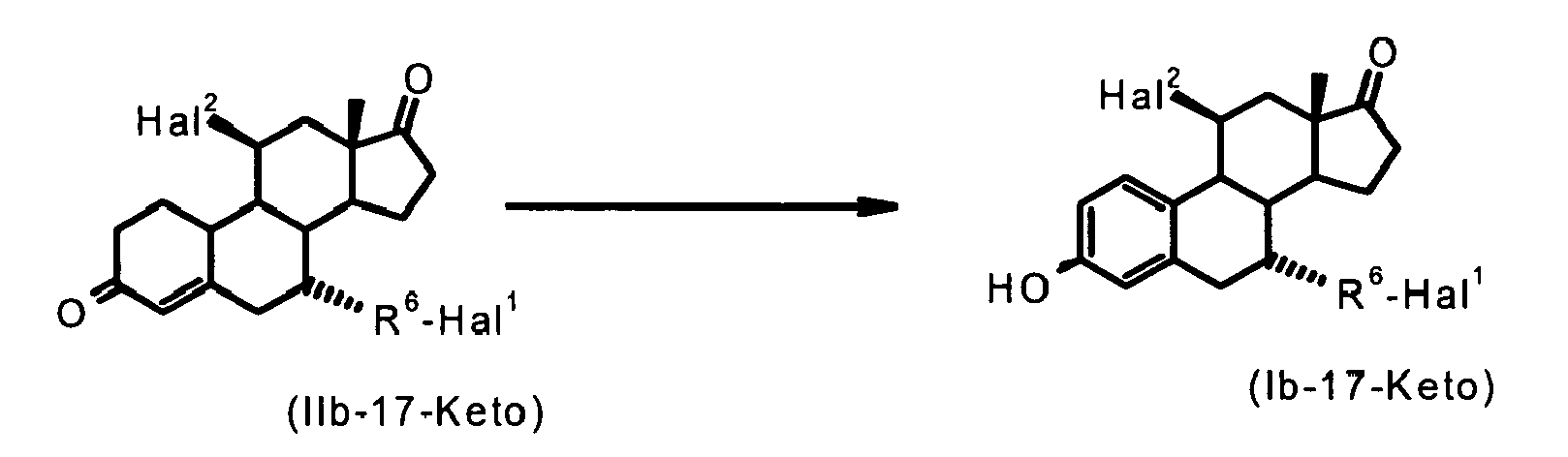
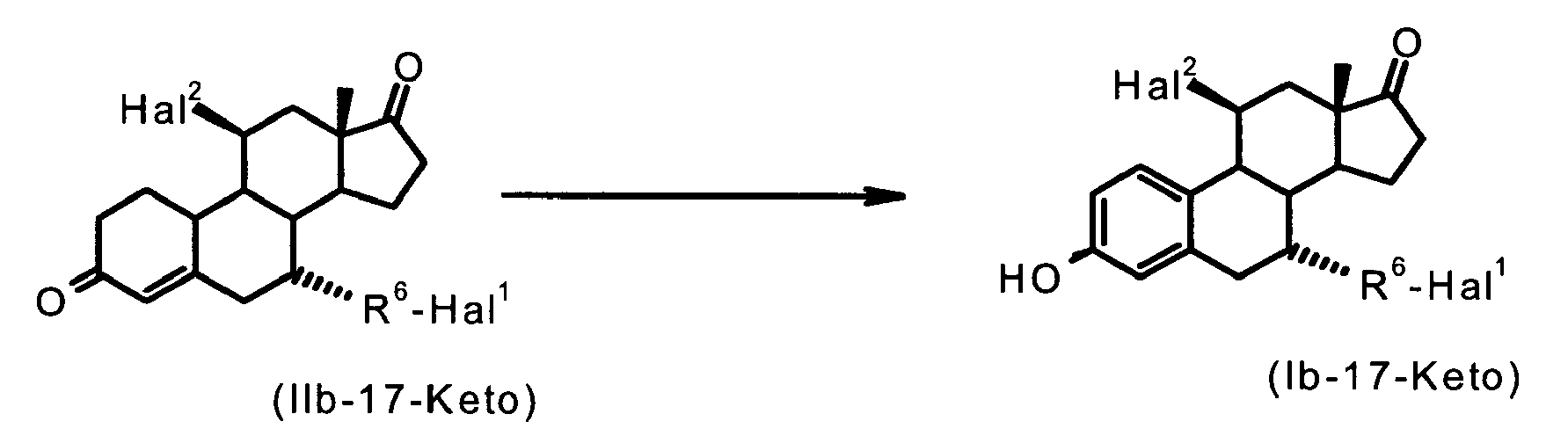
- Besonders geeignet ist das erfindungsgemäße Verfahren zur Herstellung von Verbindungen der allgemeinen Formel (Ib) aus Verbindungen der allgemeinen Formel (IIb) gemäß Schema 3,

- Hal2
- für F oder Cl steht und in 11β-Position an das Estratriengrundgerüst gebunden ist,
- oder
- R7' und R7"
- zusammen eine Ketogruppe bilden,
- R7'
- für die Gruppe -ORC steht, wobei RC für Wasserstoff oder eine Schutzgruppe steht,
- R7"
- für einen C1-C4-Alkylrest oder für einen zumindest teilweise fluorierten C1-C4-Alkylrest steht,
wobei R7' in 17β-Position und R7" in 17α-Position an das Estratriengrundgerüst gebunden ist, und - R6-Hal1
- in 7α-Position an das Estratriengerüst gebunden ist und für einen C3-C11-Alkylrest steht, der mindestens einfach substituiert mit Hal1, wobei Hal1 für ein Chlor-, Brom- oder lodatom steht.
- Verbindungen der Formel (IIb) bzw. (Ib), in denen R7' und R7"zusammen eine Ketogruppe bilden, werden im Folgenden als (IIb)-17-Keto-Verbindungen bzw. (Ib)-17-Keto-Verbindungen bezeichnet und in der Formel (IIb-17-Keto) bzw. (Ib-17-Keto) zusammengefasst.

- Verbindungen der Formel (IIb) bzw. (Ib), in denen R7' für die Gruppe -ORC steht, wobei RC für Wasserstoff oder eine Schutzgruppe steht, und R7" für einen C1-C4-Alkylrest oder für einen zumindest teilweise fluorierten C1-C4-Alkylrest steht, werden im Folgenden als (IIb-17β-ORC)-Verbindungen bzw. (Ib-17β-ORC)-Verbindungen bezeichnet und in der Formel (IIb-17-β- ORC) bzw. (Ib-17β-ORC) zusammengefasst. In IIb-17β-OH-Verbindungen bzw. Ib-17β-OH-Verbindungen liegt die Hydroxygruppe in Position 17 frei vor.

- In den Formeln (IIb-17-Keto), (Ib-17-Keto), (IIb-17-β-ORC) bzw. (Ib-17β-ORC) besitzen R6-Hal1 und Hal2 die Bedeutungen gemäß Schema 3.
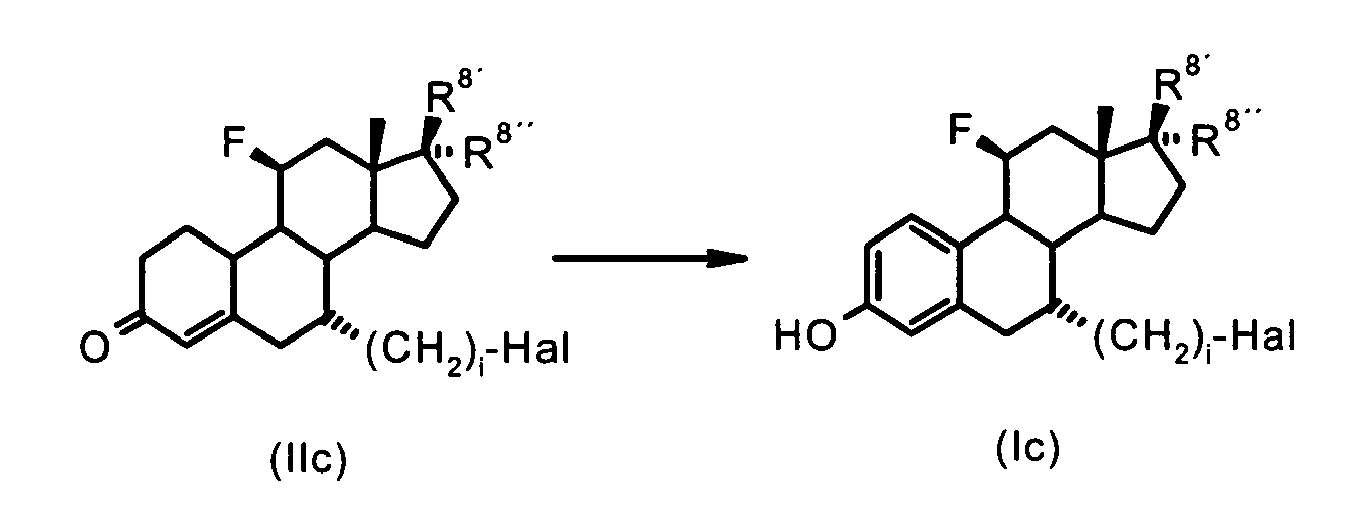
- Ganz besonders geeignet ist das erfindungsgemäße Verfahren zur Herstellung von Verbindungen der allgemeinen Formel (Ic) aus Verbindungen der allgemeinen Formel (IIc) gemäß Schema 4,

- R8' und R8"
- zusammen eine Ketogruppe bilden
- R8'
- für die Gruppe -ORD steht, wobei RD für Wasserstoff oder eine Schutzgruppe steht
- R8"
- für eine Methylgruppe steht,
- i
- für eine ganze Zahl von 3 bis 13 steht und
- Hal
- für ein Chlor-, Brom- oder Iodatom steht.
- Verbindungen der Formel (IIc) bzw. (Ic), in denen R8' und R8" zusammen eine Ketogruppe bilden, werden im Folgenden als (IIc)-17-Keto-Verbindungen bzw. (Ic)-17-Keto-Verbindungen bezeichnet und in der Formel (IIc-17-Keto) bzw. (Ic-17-Keto) zusammengefasst.

- Verbindungen der Formel (IIc) bzw. (Ic), in denen R8' für die Gruppe -ORD steht,
wobei RD für Wasserstoff oder eine Schutzgruppe steht, und R8" für eine Methylgruppe steht, werden im Folgenden als (IIc-17β-ORD)-Verbindungen bzw. (Ic-17β-ORD)-Verbindungen bezeichnet und in der Formel (IIc-17-β-ORD) bzw. (Ic-17β-ORD) zusammengefasst.
In IIc-17β-OH-Verbindungen bzw. Ic-17β-OH-Verbindungen liegt die Hydroxygruppe in Position 17 frei vor.
- In den Formeln (IIb-17-Keto), (Ib-17-Keto), (IIb-17-β-ORD) bzw. (Ib-17β-ORD) besitzen R8", Hal, RD und i die Bedeutungen gemäß Schema 4.
- Aus Verbindungen der allgemeinen Formel I können Verbindungen mit starker antiestrogener Wirksamkeit hergestellt werden.
So beschreibtWO 03/045972 - Vorzugsweise besitzen die antiestrogenen Verbindungen keine oder nur eine geringe estrogene Restwirkung.
- Die erfindungsgemäße Aromatisierung ist unter anderem für die Herstellung von Verbindungen aus
WO 03/045972 -
WO 03/045972 
- W
- für -N(R7)- steht, wobei R7 Wasserstoff oder ein C1-C4-Alkylrest ist,
- X
- für -(CH2)q- steht, wobei q = 0 oder eine ganze Zahl von 1 - 12 ist,
- Y
- eine direkte Bindung zwischen X und Z oder eine -SOn-Gruppe ist, wobei n = 0,1 oder 2 ist,
- Z
- ein gerad- oder verzweigtkettiger C1-C7-Alkylenrest ist, der zumindest teilweise fluoriert ist,
- E
- für -CF3 oder für Pentafluorphenyl steht.
- Demnach können Verbindungen der Formel (Ib-17-Keto) zunächst mit Aminen der Formel H-W-X-Y-Z-E unter Erhalt von Verbindungen der Formel (Vb-Keto) aminiert werden. Nachfolgend erfolgt die Umsetzung der Verbindungen der Formel (Vb-Keto) in einer nucleophilen Alkylierungsreaktion in Position 17 unter Erhalt von Verbindungen der Formel (Vb).
- Alternativ und bevorzugt werden Verbindungen der Formel (Ib-17-Keto) durch eine nucleophile Alkylierungsreaktion in Position 17 zunächst zu Verbindungen der Formel (Ib-17β-OH) umgesetzt. Nachfolgend erfolgt eine Aminierung der Verbindungen der Formel (Ib-17β-OH) mit Aminen der Formel H-W-X-Y-Z-E unter Erhalt von Verbindungen der Formel (Vb).
- Die Alkylgruppe in 17α-Position kann jeweils durch übliche Alkylierungsreagenzien, beispielsweise Grignard-Reagentien (CnAlkyl-Mg-Hal) oder Alkyllithium-Verbindungen (Cn-Alkyl-Li) eingeführt werden.
- Besonders vorteilhaft ist das erfindungsgemäße Verfahren für die Herstellung der Verbindung AE1:
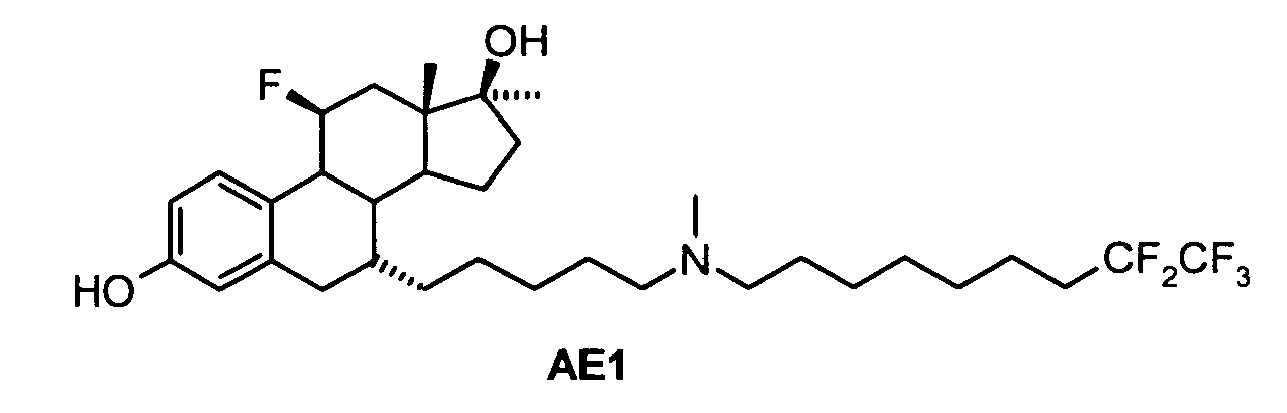
WO 03/045972 - Die bevorzugten Verbindungen des Typs AE1 (Verbindungen der Formel (Vc)) können gemäß Schema 6 hergestellt werden,

- i
- für eine ganze Zahl von 3 bis 13 steht,
- Hal
- für ein Chlor-, Brom- oder lodatom steht,
- R8"
- für eine Methylgruppe steht,
- R7
- für einen C1-C4-Alkylrest steht,
- j
- für eine ganze Zahl von 1 bis 10 steht und
- m
- für eine ganze Zahl von 1 bis 5 steht.
- Demnach können Verbindungen der Formel (Ic-17-Keto) zunächst mit α-Alkyl(amin)-ω-perfluor(alkyl)-alkanen der allgemeinen Formel (IV) unter Erhalt von Verbindungen der Formel (Vc-Keto) aminiert werden. Nachfolgend erfolgt die Umsetzung der Verbindungen der Formel (Vc-Keto) in einer nucleophilen Alkylierungsreaktion in Position 17 unter Erhalt von Verbindungen der Formel (Vc).
- Alternativ und bevorzugt werden Verbindungen der Formel (Ic-17-Keto) durch eine nucleophile Alkylierungsreaktion in Position 17 zunächst zu Verbindungen der Formel (Ic-17β-OH) umgesetzt. Nachfolgend erfolgt eine Aminierung der Verbindungen der Formel (Ic-17β-OH) mit α-Alkyl(amin)-ω-perfluor(alkyl)-alkanen der allgemeinen Formel (IV) unter Erhalt von Verbindungen der Formel (Vc).
- Die Methylgruppe in 17α-Position kann jeweils durch übliche Alkylierungsreagenzien, beispielsweise Grignard-Reagentien (Methyl-MgHal) oder Methyllithium eingeführt werden.
- Ein möglichen Weg zur Aromatisierung des A-Ringes ist in
WO 99/33855 
- Die Aromatisierung des A-Ringes in Teilschritt b) erfolgt nach diesem Stand der Technik durch eine CuBr2-vermittelte Oxidation.
- Nachteilig an der Durchführung des Teilschrittes b) gemäß
WO99/33855 -

- Das Bromierungs-Produkt ist eine unerwünschte Verunreinigung, und diese muss im weiteren Verlauf der Synthese abgetrennt werden - entweder durch aufwändige Chromatographie oder durch wiederholte Kristallisation einer Zwischenstufe bzw. des Wirkstoffs.
- Aus der Literatur (
WO2007/049672 und Steroids 1994, vol.59, S.621ff .) ist bekannt, dass vergleichbare Oxidationen steroidaler Systeme des allgemeinen Typs (II) zu steroidalen Systemen des allgemeinen Typs (I) unter Verwendung von unterschiedlichen Mengen an CuBr2 durchgeführt werden können. - Die Folge bzw. Nebenreaktion ist auch in
WO 02/32922
Das Verfahren gemäßWO 02/32922 - es muss mit mehr als 2 Equivalenten CuBr2 (2Equivalenten.=stöchiometrisch) gearbeitet werden d.h. eine Luftoxidation wird nicht genutzt, wodurch das Verfahren kostenintensiv wird,
- es entsteht nicht das gewünschte "freie Phenol", sondern das 3-Acetat. Dieses 3-Acetat muss anschließend in einem weiteren Reaktionsschritt zum gewünschten Produkt verseift werden,
- die Abtrennung der großen Mengen an Cu-Salzen macht einen weiteren Verfahrensschritt erforderlich.
- Ausgehend von diesem Stand der Technik besteht die Aufgabe der vorliegenden Erfindung darin, ein Verfahren zur Herstellung von Verbindungen der allgemeinen Formel (I) bereitzustellen, das die Bildung von bromierten Neben- bzw. Folgeprodukten unterdrückt, um vor allem die Ausbeute zu erhöhen, um zusätzliche Aufreinigungsschritte zu vermeiden und anfallende Mengen an Kupfer-haltigen Abwässern zu verringern.
- Vor allem sollen bromierte Nebenprodukte des Formel (I-n) vermieden werden.

- So sollen bei der Herstellung von Verbindungen der Formel (la) möglichst wenige Nebenprodukte der Formel (Ia-n), bei Verbindungen der Formel (Ib) möglichst wenige Nebenprodukte der Formel (Ib-n) und bei Verbindungen der Formel (Ic) möglichst wenige Nebenprodukte der Formel (Ic-n) entstehen.


- Bevorzugt soll das Verfahren durch den Zusatz von Säuren so beschleunigt werden, dass nahezu vollständige bis vollständige Umsätze auch mit substöchiometrischen Mengen CuBr2 erreicht werden.
- Die Oxidation soll ebenso bevorzugt in Kombination mit einer Luftoxidation durchgeführt werden.
- Die Aufgabe der vorliegenden Erfindung wird dadurch gelöst, dass die CuBr2 vermittelte Aromatisierung des Ringes A in Gegenwart von mindestens einem elektronenreichen, ungesättigten organischen Zusatz erfolgt.
- Als elektronenreiche, ungesättigte organische Zusätze sind Substanzen der allgemeinen Formel (Z) geeignet

- R1, R2, R3, R4
- unabhängig voneinander für Wasserstoff, einen C1-C6-Alkyl-, C2-C6-Alkenyl-, C1-C6-Alkoxy- oder C2-C6-Alkenoxyrest oder einen C6-Arylring oder C6-Aryloxyring stehen, mit der Maßgabe, dass mindestens ein Rest von R1, R2, R3, R4 ungleich Wasserstoff ist,
- oder
- R1 und R2
- bilden zusammen mit den C-Atomen der Doppelbindung einen gegebenenfalls ein- oder mehrfach, gleich oder verschieden mit Hydroxy, einem C1-C6-Alkoxy- und/oder C1-C6-Alkylrest substituierten C6-Aromaten, ein C3-C7-Cycloalken, einen monocyclischen Heteroaromaten oder einen ungesättigten Heterozyklus, der gegebenenfalls zusätzlich mit R3 und R4 substituiert ist, wobei R3 und R4 unabhängig voneinander stehen für einen C1-C6-Alkyl-, C2-C6-Alkenyl-, C1-C6-Alkoxy- oder C2-C6-Alkenoxyrest oder einen C6-Arylring oder C6-Aryloxyring.
- Bevorzugt werden von R1 und R2 mehrfach mit C1-C6-Alkoxyresten substituierte C6-Aromaten gebildet.
Zu dieser bevorzugten Untergruppe an Zusätzen gehören als besonders bevorzugt 1,3,5-Trimethoxybenzol und 1,3-Dimethoxybenzol. - Bevorzugt werden von R1 und R2 auch ungesättigte Cycloalkene gebildet.
Zu dieser bevorzugten Untergruppe an Zusätzen gehört als besonders bevorzugt Cyclohexen. - Bevorzugt werden von R1 und R2 auch sauerstoffhaltige, ungesättigte Heterozyklen gebildet.
Zu dieser bevorzugten Untergruppe an Zusätzen gehört als besonders bevorzugt Dihydrofuran. - Vom elektronenreichen ungesättigten Zusatz werden 0.1 bis 3 Equivalente in Bezug auf das eingesetzte Steroid eingesetzt, bevorzugt 0.5 bis 2.0 Equivalente und besonders bevorzugt 1 Equivalent.
- Im allgemeinen wird das Steroid zusammen mit einer geeigneten Menge an CuBr2 und LiBr umgesetzt. Dies geschieht in einem polar-aprotischen Lösungsmittel, vorzugsweise Acetonitril oder Propionitril.
1 Equivalent des Steroids wird mit 0.1 bis 2.0 Equivalenten CuBr2 und 0.1 bis 5.0 Equivalenten LiBr umgesetzt. Bevorzugt werden 0.5 bis 1.3 Equivalente CuBr2 und 0.5 bis 3.0 Equivalenten LiBr eingesetzt. Besonders bevorzugt sind 0.5 Equivalente CuBr2 und 1.0 Equivalent LiBr. - Zusätzlich wird eine geeignete Menge einer Säure der allgemeinen Formel H+R- zugegeben - wobei R- = Hal-, -SO2-Alkyl, -SO2-Aryl sein kann.
Bevorzugt ist Methansulfonsäure. - Geeignet sind auch Zusätze, die Säuren freisetzen wie z.B. Trimethylsilylbromid oder Trimethylsilylchlorid, aus denen HBr bzw. HCl freigesetzt wird.
- Die Säure wird in einer Menge von 0.1 bis 2.0 Equivalenten, bevorzugt 0.2-0.6 Equivalenten zugesetzt.
- Zur vollständigen Oxidation des Edukts wird anschließend Luft - vorzugsweise ein Gemisch aus Stickstoff und Sauerstoff - bis zur vollständigen Umsetzung durch das Reaktionsgemisch geleitet.
- Das Verfahren kann bei unterschiedlichen Temperaturen gefahren werden, vorzugsweise im Bereich zwischen +10°C bis +50°C.
- Durch einen elektronenreichen ungesättigten organischen Zusatz wird die Bromierung des Steroids verhindert.
- In der Reaktionsmischung des Beispiels 1 lässt sich beispielsweise durch HPLC-Analytik die Bildung von 4-Brom-1-3-dimethoxybenzol und die Abnahme von 1,3-Dimethoxybenzol verfolgen. Damit wird klar, dass bedingt durch die unterschiedlichen Reaktivitäten der beiden elektronenreichen Aromaten (steroidales Phenol vs 1-3-Dimethoxybenzol) bzgl. einer Bromierung zunächst das reaktivere 1,3-Dimethoxybenzol bromiert wird (siehe Schema 9) und die ungewünschte Bromierung des steroidalen aromatischen Systems zurückgedrängt wird. Das gewünschte steroidale Produkt ist stabil in der Reaktionsmischung.

- Synthese von 7-α-(5-Chlorpentyl)-11-β-fluor-3-hydroxyestra-1,3,5(10)-trien-17-on (I-1) aus 7-α-(5-Chlorpentyl)-11-β-fluor-3-hydroxyestr-4-en-3,17-dion (II-1)

Anschließend wird das Reaktionsgemisch durch Zugabe von 40 ml 20%iger wäßriger K2HPO4-Lösung gequenscht. Während des Nachrührens wird der pH-Wert kontrolliert und ggf. auf pH = 7 angepasst. Die Suspension wird über einen mit Celite bedeckten Druckfilter filtriert und dieser wird mit ca. 120 ml Toluol substanzfrei gewaschen. Nach Abtrennung der Wasserphase wird die org. Phase 2 x mit einer Lösung bestehend aus 10 g Natriumedetat und 1 g Natriumhydroxid in 100 ml Wasser zur Entfernung des Kupfers extrahiert. Die Produktlösung wird vollständig eingeengt. Es werden 15.51 g Rohprodukt isoliert. Zusammensetzung des Rohprodukts laut HPLC (Prontosil C18-ace-EPS; 1mL/min Wasser/ACN + 0.1% HCOOH; 215 nm): 82.5% 1-1, 0.0% I-2, 17.5% Sonstige. - Bei der Entwicklung des beschriebenen Verfahrens wurden zunächst eine Vielzahl von Reaktionsbedingungen und möglichen Scavengern in einem kleinen Maßstab von nur 100mg 7-α-(5-Chlorpentyl)-11-β-fluor-3-hydroxyestr-4-en-3,17-dion untersucht. In diesem Reaktionsmaßstab reicht bereits das einfache Rühren im offenen Schraubdeckelgläschen im Kontakt mit der Raumluft, um eine Oxidation zu bewirken ohne dass speziell Sauerstoff eingeleitet werden muß. Dies führte in nachfolgend beschriebenen Screeningexperimenten zu längeren Reaktionszeiten als im ausgearbeiteten Verfahren, was aber eine bessere Beobachtung des Reaktionsverlaufs erlaubt. Die Unterdrückung von Nebenverbindungen durch Zusatz von 1,3-Dimethoxybenzol kann bereits durch diese Screeningexperimente im kleinen Maßstab deutlich gezeigt werden. Exemplarisch werden deshalb Ergebnisse aus zwei Experimenten wiedergegeben. Nach den oben aufgeführten Bedingungen wurde - durch fortlaufende Entnahme von HPLC-Proben (100%-Methode) - ein Vergleich der Reaktionsverläufe mit (Reaktion 1: Tab. 1,
Fig 1 ), bzw. ohne Zugabe von 1,3-Dimethoxybenzol (Reaktion 2: Tab.2,Fig.2 ) durchgeführt.
Für Reaktion 1 und Reaktion 2 wurden 100 mg (0.25 mmol) 7-α-(5-Chlorpentyl)-11-β-fluor-3-hydroxyestr-4-en-3,17-dion, 28mg (0.13 mmol) CuBr2, 22 mg (0.25 mmol) LiBr in 1.5mL Propionitril vorgelegt, mit 16 µL (0.25 mmol) Methansulfonsäure versetzt und im offenen Gefäß gerührt. Reaktion 1 wurde zusätzlich mit 99 µL (0.75 mmol) 1,3-Dimethoxybenzol versetzt. Es wurden zu den angegebenen Zeiten HPLC-Proben entnommen. Die analytischen Ergebnisse sind in den folgenden Tabellen wiedergegeben:Tab.1: HPLC- Daten zu Reaktion 1 Reaktionszeit in Stunden [h] I-1 [%] II-1 [%] I-1-n [%] Sonstige [%] 0h 36,5 59,7 0,0 3,8 1h 62,0 34,1 0,0 3,9 2h 76,3 19,1 0,0 4,6 4h 92,7 3,2 0,0 4,1 8h 95,8 0,2 0,6 3,4 12h 95,5 0,0 1,0 3,5 16h 95,2 0,0 1,6 3,2 20h 94,4 0,0 1,8 3,8 36h 93,3 0,0 2,8 3,8 Tab.2: HPLC-Daten zu Reaktion 2 Reaktionszeit in Stunden [h] I-1 [%] II-1 [%] I-1-n [%] Sonstige [%] 0h 32,9 64,0 0,0 3,2 1 h 58,3 40,0 0,0 1,7 2h 73,4 23,4 0,0 3,2 4h 90,0 5,7 0,2 4,1 8h 91,5 0,0 3,4 5,1 12h 82,0 0,0 14,1 3,9 16h 67,4 1,2 29,2 2,2 36h 44,2 0,0 52,9 2,9 -

- Eine Lösung von 69mg (0.25mmol) 4-Estren-3,17-dion (II-2) in 1.5mL Propionitril wird bei Raumtemperatur zu 33mg (0.14mmol) CuBr2 und 28mg (0.32mmol) LiBr in offenen 8mL Vials gegeben und 2min geschüttelt. Dann werden 0.5mL einer Lösung von 4.9mg (0.05 mmol) Methansulfonsäure in Propioniril und 0.2mL einer Lösung von 70mg (0.51 mmol) 1,3-Dimethoxybenzol in Propionitril zugegeben. Das Reaktionsgefäss wird offen - d.h. unter Kontakt der Reaktionsmischung mit der Raumluft - geschüttelt und Proben für die HPLC entnommen. Zusammensetzung der Reaktionsmischung nach 8h laut HPLC (Phenomenex Synergi Polar-RP 4µ; 1mL/min Wasser/ACN + 0.1 % HCOOH; 220nm): 91.7% I-2, 1.8% II-2, 6.5% Sonstige.
-

- Eine Lösung von 84mg (0.25mmoi) 11-α-Acetyloxyestr-4-en-3,17-dion (II-3) in 1.5mL Propionitril und 1.5mL Dichlormethan wird bei Raumtemperatur zu 33mg (0.14mmol) CuBr2 und 28mg (0.32mmol) LiBr in offenen 8mL Vials gegeben und 2min geschüttelt. Dann werden 0.5mL einer Lösung von 4.9mg (0.05 mmol) Methansulfonsäure in Propioniril und 0.2mL einer Lösung von 70mg (0.51 mmol) 1,3-Dimethoxybenzol in Propionitril zugegeben. Das Reaktionsgefäss wird offen - d.h. unter Kontakt der Reaktionsmischung mit der Raumluft - geschüttelt und Proben für die HPLC entnommen. Zusammensetzung der Reaktionsmischung nach 6h laut HPLC (Phenomenex Synergi Polar-RP 4µ; 1 mL/min Wasser/ACN + 0.1 % HCOOH; 220nm): 93.1% I-3, 0.0% II-3, 6.9% Sonstige.
-

- Eine Lösung von 74mg (0.25mmol) 11-β-Fluorestr-4-en-3,17-dion (II-4) in 1.5mL Propionitril wird bei Raumtemperatur zu 33mg (0.14mmol) CuBr2 und 28mg (0.32mmol) LiBr in offenen 8mL Vials gegeben und 2min geschüttelt. Dann werden 0.5mL einer Lösung von 4.9mg (0.05mmol) Methansulfonsäure in Propioniril und 0.2mL einer Lösung von 70mg (0.51 mmol) 1,3-Dimethoxybenzol in Propionitril zugegeben. Das Reaktionsgefäss wird offen - d.h. unter Kontakt der Reaktionsmischung mit der Raumluft - geschüttelt und Proben für die HPLC entnommen. Zusammensetzung der Reaktionsmischung nach 18h laut HPLC (Phenomenex Synergi Polar-RP 4µ; 1 mL/min Wasser/ACN + 0.1 % HCOOH; 220nm): 78.0 I-4, 6.81-4, 15.2% Sonstige.
-

- Eine Lösung von 80mg (0.25mmol) 17-b-Acetoxy-4-estren-3-on (II-5) in 1.5mL Propionitril wird bei Raumtemperatur zu 33mg (0.14mmol) CuBr2 und 28mg (0.32mmol) LiBr in offenen 8mL Vials gegeben und 2min geschüttelt. Dann werden 0.5mL einer Lösung von 4.9mg (0.05 mmol) Methansulfonsäure in Propioniril und 0.2mL einer Lösung von 70mg (0.51 mmol) 1,3-Dimethoxybenzol in Propionitril zugegeben. Das Reaktionsgefäss wird offen - d.h. unter Kontakt der Reaktionsmischung mit der Raumluft - geschüttelt und Proben für die HPLC entnommen. Zusammensetzung der Reaktionsmischung nach 18h laut HPLC (Phenomenex Synergi Polar-RP 4µ; 1 mL/min Wasser/ACN + 0.1 % HCOOH; 220nm): 85.4% I-5, 2.1% II-5, 87.5% Sonstige.
- Graphische Darstellung der HPLC-Daten von Reaktion 1 aus Tab. 1. Im Beobachtungszeitraum von 36h ist keine wesentliche Zersetzung des Reaktionsprodukts I-1 zum bromiertenNebenprodukt I-1-n zu beobachten.
-◆- = I-1; -■- = II-2; -▲- = I-1-n, -x- = Sonstige - Graphische Darstellung der HPLC-Daten von Reaktion 2 aus Tab. 2. Im Beobachtungszeitraum von 36h ist eine deutliche Zersetzung des Reaktionsprodukts I-1 zum bromiertenNebenprodukt I-1-n zu beobachten.
-◆- = I-1; -■- = II-2; -▲- = I-1-n, -x- = Sonstige
Claims (11)
- Verfahren zur CuBr2 vermittelten Aromatisierung von 19-Nor-androst-4-en-3-onen der allgemeinen Formel (II) zu Estra-1,3,5(10)-trienen der allgemeinen Formel I

 R1, R2, R3, R4 unabhängig voneinander für Wasserstoff, einen C1-C6-Alkyl-, C2-C6-Alkenyl-, C1-C6-Alkoxy- oder C2-C6-Alkenoxyrest oder einen C6-Arylring oder C6-Aryloxyring stehen, mit der Maßgabe, dass mindestens ein Rest von R1, R2, R3, R4 ungleich Wasserstoff ist,oderR1 und R2 bilden zusammen mit den C-Atomen der Doppelbindung einen gegebenenfalls ein- oder mehrfach, gleich oder verschieden mit Hydroxy, einem C1-C6-Alkoxy- und/oder C1-C6-Alkylrest substituierten C6-Aromaten, ein C3-C7-Cycloalken, einen monocyclischen Heteroaromaten oder einen ungesättigten Heterozyklus, der gegebenenfalls zusätzlich mit R3 und R4 substituiert ist, wobei R3 und R4 unabhängig voneinander stehen für einen C1-C6-Alkyl-, C2-C6-Alkenyl-, C1-C6-Alkoxy- oder C2-C6-Alkenoxyrest oder einen C6-Arylring oder C6-Aryloxyring.sowie deren Enantiomeren und Diastereomeren.
 - Verfahren gemäß Anspruch 1 zur Herstellung von Estra-1,3,5(10)-trienen der Formel (la) aus Verbindungen der Formel (IIa),
 R1 und R2 zusammen eine Ketogruppe bilden,oderR1 für Wasserstoff, einen C1-C6-Alkyl-, C2-C6-Alkenyl- oder C2-C6-Alkinylrest steht oder für einen zumindest teilweise fluorierten C1-C6-Alkylrest, undR2 für Wasserstoff, Hydroxy, C1-C6-Alkoxyrest oder einen C1-C6-Acyloxyrest steht;R3 und R4 unabhängig stehen für Wasserstoff, Halogen und/oder -ORB, wobei RB für Wasserstoff oder eine Schutzgruppe steht,R5 für einen Methyl- oder Ethylrest steht, undR6-Hal für einen C3-C13-Alkyl-, C3-C13-Alkenyl- oder C3-C13-Alkinylrest steht, jeweils mindestes einfach substituiert mit Halogen,sowie deren Enantiomeren und Diastereomeren.
 - Verfahren gemäß Anspruch 1 zur Herstellung von Verbindungen der allgemeinen Formel (Ib) aus Verbindungen der allgemeinen Formel (IIb),
 Hal2 für F oder Cl steht und in 11 β-Position an das Estratriengrundgerüst gebunden ist,R7' und R7" zusammen eine Ketogruppe bilden,oderR7' für die Gruppe -ORC steht, wobei RC für Wasserstoff oder eine Schutzgruppe steht,R7" für einen C1-C4-Alkylrest oder für einen zumindest teilweise fluorierten C1-C4-Alkylrest steht,
wobei R7' in 17β-Position und R7" in 17α-Position an das Estratriengrundgerüst gebunden ist, undR6-Hal1 in 7α-Position an das Estratriengerüst gebunden ist und für einen C3-C11-Alkylrest steht, der mindestens einfach substituiert mit Hal1, wobei Hal1 für ein Chlor-, Brom- oder lodatom steht.sowie deren Enantiomeren und Diastereomeren. - Verfahren gemäß Anspruch 1 zur Herstellung von Verbindungen der allgemeinen Formel (Ic) aus Verbindungen der allgemeinen Formel (IIc),
 R8' und R8" zusammen eine Ketogruppe bildenoderR8' für die Gruppe -ORD steht, wobei RD für Wasserstoff oder eine
Schutzgruppe stehtR8" für eine Methylgruppe steht,i für eine ganze Zahl von 3 bis 13 steht undHal für ein Chlor-, Brom- oder lodatom steht.sowie deren Enantiomeren und Diastereomeren. - Verfahren nach einem der Ansprüche 1 bis 4,
wobei als Zusatz 1,3,5-Trimethoxybenzol und/oder 1,3-Dimethoxybenzol eingesetzt wird. - Verfahren nach einem der Ansprüche 1 bis 4,
wobei als Zusatz Cyclohexen eingesetzt wird. - Verfahren nach einem der Ansprüche 1 bis 4,
wobei als Zusatz Dihydrofuran eingesetzt wird. - Verfahren zur Herstellung von Verbindungen der allgemeinen Formel (Vb), mit den Teilschrittena) Aromatisierung einer Verbindung der allgemeinen Formel (IIb-17-Keto) zu einer Verbindung der allgemeinen Formel (Ib-17-Keto) gemäß Anspruch 3 oder einem der Ansprüche 4 bis 7 in Abhängigkeit von Anspruch 3,
 b) Umsetzung der Verbindungen der allgemeinen Formel (Ib-17-Keto) mit einem Amin der Formel H-W-X-Y-Z-E ,
 c) nukleophile Alkylierung der Position 17 der Verbindungen der Formel (Vb-17-Keto) unter Erhalt von Verbindungen der Formel (Vb)wobei Hal2, R6-Hal1 und R7" die Bedeutungen gemäß Anspruch 3 besitzen und
 W für -N(R7)- steht, wobei R7 Wasserstoff oder ein C1-C4-Alkylrest ist,X für -(CH2)q- steht, wobei q = 0 oder eine ganze Zahl von 1 - 12 ist,Y eine direkte Bindung zwischen X und Z oder eine -SOn-Gruppe ist, wobei n = 0,1 oder 2 ist,Z ein gerad- oder verzweigtkettiger C1-C7Alkylenrest ist, der zumindest teilweise fluoriert ist,E für -CF3 oder für Pentafluorphenyl- steht.
 - Verfahren zur Herstellung von Verbindungen der allgemeinen Formel (Vb) mit den Teilschrittena) Aromatisierung einer Verbindung der allgemeinen Formel (IIb-17-Keto) zu einer Verbindung der allgemeinen Formel (Ib-17-Keto) gemäß Anspruch 3 oder einem der Ansprüche 4 bis 7 in Abhängigkeit von Anspruch 3,
 b) nukleophile Alkylierung der Position 17 der Verbindungen der Formel (Ib-17-Keto) unter Erhalt von Verbindungen der Formel (Ib-17β-OH)
 c) Umsetzung der Verbindungen der allgemeinen Formel (Ib-17-β-OH) mit einem Amin der Formel H-W-X-Y-Z-E unter Erhalt von Verbindungen der Formel (Vb),wobei Hal2, R6-Hal1 und R7" die Bedeutungen gemäß Anspruch 3 besitzen und
 W für -N(R7)- steht, wobei R7 Wasserstoff oder ein C1-C4-Alkylrest ist,X für -(CH2)q- steht, wobei q = 0 oder eine ganze Zahl von 1 - 12 ist,Y eine direkte Bindung zwischen X und Z oder eine -SOn-Gruppe ist, wobei n = 0,1 oder 2 ist,Z ein gerad- oder verzweigtkettiger C1-C7Alkylenrest ist, der zumindest teilweise fluoriert ist,E für -CF3 oder für Pentafluorphenyl- steht.
 - Verfahren zur Herstellung von Verbindungen der allgemeinen Formel (Vc) mit den Teilschrittena) Aromatisierung einer Verbindung der allgemeinen Formel (IIc-17-Keto) zu einer Verbindung der allgemeinen Formel (Ic-17-Keto) gemäß Anspruch 4 oder einem der Ansprüche 5 bis 7 in Abhängigkeit von Anspruch 4
 b) nachfolgende Umsetzung der Verbindungen der allgemeinen Formel (Ic-17-Keto) mit einem α-Alkyl(amin)-ω-perfluor(alkyl)-alkan der allgemeinen Formel (IV) zu einer Verbindung der allgemeinen Formel (Vc-Keto)
 c) nucleophile Methylierung der Position 17 der Verbindungen der Formel (Vc-17-Keto) unter Erhalt von Verbindungen der Formel (Vc)wobei
 R8" für eine Methylgruppe steht,i für eine ganze Zahl von 3 bis 13 steht undHal für ein Chlor-, Brom- oder Iodatom steht.R7 für einen C1-C4-Alkylrest steht,j für eine ganze Zahl von 1 bis 10 steht undm für eine ganze Zahl von 1 bis 5 steht.
 - Verfahren zur Herstellung von Verbindungen der allgemeinen Formel (Vc) mit den Teilschrittena) Aromatisierung einer Verbindung der allgemeinen Formel (IIc-17-Keto) zu einer Verbindung der allgemeinen Formel (Ic-17-Keto) gemäß Anspruch 4 oder einem der Ansprüche 5 bis 7 in Abhängigkeit von Anspruch 4
 b) nachfolgende nucleophile Methylierung der Position 17 der Verbindungen der Formel (Ic-17-Keto) unter Erhalt von Verbindungen der Formel (Ic-17β-OH)
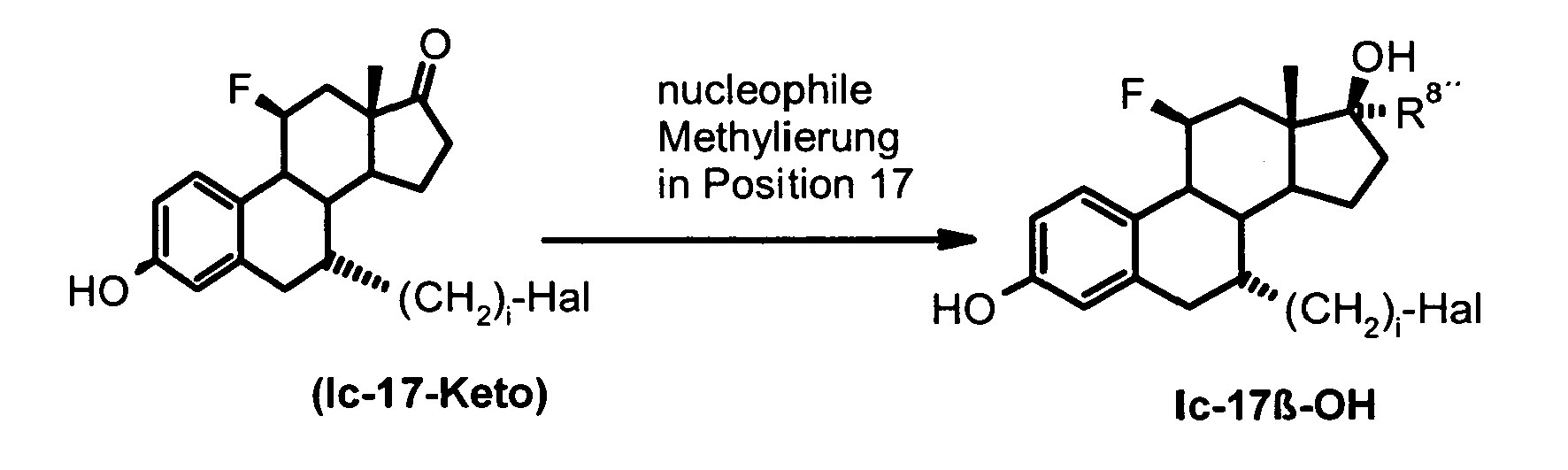 c) nachfolgende Umsetzung der Verbindungen der allgemeinen Formel (Ic-17-β-OH) mit einem α-Alkyl(amin)-ω-perfluor(alkyl)-alkan der allgemeinen Formel (IV) zu einer Verbindung der allgemeinen Formel (Vc)wobei
 R8" für eine Methylgruppe steht,i für eine ganze Zahl von 3 bis 13 steht undHal für ein Chlor-, Brom- oder lodatom steht.R7 für einen C1-C4-Alkylrest steht,j für eine ganze Zahl von 1 bis 10 steht undm für eine ganze Zahl von 1 bis 5 steht.
Priority Applications (8)
| Application Number | Priority Date | Filing Date | Title |
|---|---|---|---|
| EP20070076136 EP2070942A1 (de) | 2007-12-13 | 2007-12-13 | Verfahren zur Aromatisierung von 19-Nor-androst-4-en-3-onen zu Estra-1,3,5(10)-trienen |
| PCT/EP2008/010510 WO2009074313A1 (de) | 2007-12-13 | 2008-12-11 | Verfahren zur aromatisierung von 19-nor-androst-4-en-3-onen zu estra-1,3,5(10) -trienen |
| KR20107012905A KR20100096165A (ko) | 2007-12-13 | 2008-12-11 | 19―노르―안드로스트―4―엔―3―온의 에스트라―1,3,5〔10〕―트리엔으로의 방향족화 방법 |
| JP2010537311A JP2011506368A (ja) | 2007-12-13 | 2008-12-11 | 19‐ノルアンドロスタ‐4‐エン‐3‐オンをエストラ‐1,3,5(10)‐トリエンに芳香族化する方法 |
| EP08859985A EP2231692A1 (de) | 2007-12-13 | 2008-12-11 | Verfahren zur aromatisierung von 19-nor-androst-4-en-3-onen zu estra-1,3,5(10) -trienen |
| CA 2707597 CA2707597A1 (en) | 2007-12-13 | 2008-12-11 | Process for aromatizing 19-norandrost-4-en-3-ones to estra-1,3,5(10)-trienes |
| CN2008801202709A CN101896498A (zh) | 2007-12-13 | 2008-12-11 | 将19-去甲雄-4-烯-3-酮芳构化为雌-1,3,5(10)-三烯的方法 |
| US12/334,048 US20090156843A1 (en) | 2007-12-13 | 2008-12-12 | Process for aromatizing 19-norandrost-4-en-3-ones to estra-1,3,5(10)-trienes |
Applications Claiming Priority (1)
| Application Number | Priority Date | Filing Date | Title |
|---|---|---|---|
| EP20070076136 EP2070942A1 (de) | 2007-12-13 | 2007-12-13 | Verfahren zur Aromatisierung von 19-Nor-androst-4-en-3-onen zu Estra-1,3,5(10)-trienen |
Publications (1)
| Publication Number | Publication Date |
|---|---|
| EP2070942A1 true EP2070942A1 (de) | 2009-06-17 |
Family
ID=39684645
Family Applications (2)
| Application Number | Title | Priority Date | Filing Date |
|---|---|---|---|
| EP20070076136 Withdrawn EP2070942A1 (de) | 2007-12-13 | 2007-12-13 | Verfahren zur Aromatisierung von 19-Nor-androst-4-en-3-onen zu Estra-1,3,5(10)-trienen |
| EP08859985A Withdrawn EP2231692A1 (de) | 2007-12-13 | 2008-12-11 | Verfahren zur aromatisierung von 19-nor-androst-4-en-3-onen zu estra-1,3,5(10) -trienen |
Family Applications After (1)
| Application Number | Title | Priority Date | Filing Date |
|---|---|---|---|
| EP08859985A Withdrawn EP2231692A1 (de) | 2007-12-13 | 2008-12-11 | Verfahren zur aromatisierung von 19-nor-androst-4-en-3-onen zu estra-1,3,5(10) -trienen |
Country Status (7)
| Country | Link |
|---|---|
| US (1) | US20090156843A1 (de) |
| EP (2) | EP2070942A1 (de) |
| JP (1) | JP2011506368A (de) |
| KR (1) | KR20100096165A (de) |
| CN (1) | CN101896498A (de) |
| CA (1) | CA2707597A1 (de) |
| WO (1) | WO2009074313A1 (de) |
Cited By (1)
| Publication number | Priority date | Publication date | Assignee | Title |
|---|---|---|---|---|
| CN112079894A (zh) * | 2020-09-28 | 2020-12-15 | 湖南新合新生物医药有限公司 | 一种左炔诺孕酮药典杂质v的制备方法 |
Citations (6)
| Publication number | Priority date | Publication date | Assignee | Title |
|---|---|---|---|---|
| EP0819682A1 (de) * | 1996-07-17 | 1998-01-21 | Oxis International S.A. | Verwendung von organoselen Derivaten als Prooxidante, ihre Herstellung und pharmazeutische Zusammensetzungen die sie enthalten |
| WO1999033855A1 (de) | 1997-12-23 | 1999-07-08 | Schering Aktiengesellschaft | 11β-HALOGEN-7α-SUBSTITUIERTE-ESTRATRIENE, VERFAHREN ZUR HERSTELLUNG PHARMAZEUTISCHER PRÄPARATE, DIE DIESE 11β-HALOGEN-7α-SUBSTITUIERTE-ESTRATRIENE ENTHALTEN, SOWIE DEREN VERWENDUNG ZUR HERSTELLUNG VON ARZNEIMITTELN |
| WO2002032922A1 (en) | 2000-10-14 | 2002-04-25 | Astrazeneca Ab | Process and intermediates for the production of 7-substituted antiestrogens |
| WO2003045972A1 (de) | 2001-11-27 | 2003-06-05 | Schering Aktiengesellschaft | 17α-ALKYL-17β-OXY-ESTRATRIENE UND ZWISCHENPRODUKTE ZU DEREN HERSTELLUNG, VERWENDUNG DER 17α-ALKYL-17β-OXY-ESTRATRIENE ZUR HERSTELLUNG VON ARZNEIMITTELN SOWIE PHARMAZEUTISCHE PRÄPARATE |
| WO2004078774A1 (en) * | 2003-03-04 | 2004-09-16 | Resolution Chemicals Limited | Process for the production of tibolone |
| WO2007049672A1 (ja) | 2005-10-27 | 2007-05-03 | Taiho Pharmaceutical Co., Ltd. | ステロイド化合物の製造法 |
-
2007
- 2007-12-13 EP EP20070076136 patent/EP2070942A1/de not_active Withdrawn
-
2008
- 2008-12-11 CN CN2008801202709A patent/CN101896498A/zh active Pending
- 2008-12-11 WO PCT/EP2008/010510 patent/WO2009074313A1/de not_active Ceased
- 2008-12-11 EP EP08859985A patent/EP2231692A1/de not_active Withdrawn
- 2008-12-11 JP JP2010537311A patent/JP2011506368A/ja active Pending
- 2008-12-11 KR KR20107012905A patent/KR20100096165A/ko not_active Withdrawn
- 2008-12-11 CA CA 2707597 patent/CA2707597A1/en not_active Abandoned
- 2008-12-12 US US12/334,048 patent/US20090156843A1/en not_active Abandoned
Patent Citations (6)
| Publication number | Priority date | Publication date | Assignee | Title |
|---|---|---|---|---|
| EP0819682A1 (de) * | 1996-07-17 | 1998-01-21 | Oxis International S.A. | Verwendung von organoselen Derivaten als Prooxidante, ihre Herstellung und pharmazeutische Zusammensetzungen die sie enthalten |
| WO1999033855A1 (de) | 1997-12-23 | 1999-07-08 | Schering Aktiengesellschaft | 11β-HALOGEN-7α-SUBSTITUIERTE-ESTRATRIENE, VERFAHREN ZUR HERSTELLUNG PHARMAZEUTISCHER PRÄPARATE, DIE DIESE 11β-HALOGEN-7α-SUBSTITUIERTE-ESTRATRIENE ENTHALTEN, SOWIE DEREN VERWENDUNG ZUR HERSTELLUNG VON ARZNEIMITTELN |
| WO2002032922A1 (en) | 2000-10-14 | 2002-04-25 | Astrazeneca Ab | Process and intermediates for the production of 7-substituted antiestrogens |
| WO2003045972A1 (de) | 2001-11-27 | 2003-06-05 | Schering Aktiengesellschaft | 17α-ALKYL-17β-OXY-ESTRATRIENE UND ZWISCHENPRODUKTE ZU DEREN HERSTELLUNG, VERWENDUNG DER 17α-ALKYL-17β-OXY-ESTRATRIENE ZUR HERSTELLUNG VON ARZNEIMITTELN SOWIE PHARMAZEUTISCHE PRÄPARATE |
| WO2004078774A1 (en) * | 2003-03-04 | 2004-09-16 | Resolution Chemicals Limited | Process for the production of tibolone |
| WO2007049672A1 (ja) | 2005-10-27 | 2007-05-03 | Taiho Pharmaceutical Co., Ltd. | ステロイド化合物の製造法 |
Non-Patent Citations (1)
| Title |
|---|
| STEROIDS, vol. 1.59, 1994, pages 621FF |
Cited By (2)
| Publication number | Priority date | Publication date | Assignee | Title |
|---|---|---|---|---|
| CN112079894A (zh) * | 2020-09-28 | 2020-12-15 | 湖南新合新生物医药有限公司 | 一种左炔诺孕酮药典杂质v的制备方法 |
| CN112079894B (zh) * | 2020-09-28 | 2023-04-28 | 湖南新合新生物医药有限公司 | 一种左炔诺孕酮药典杂质v的制备方法 |
Also Published As
| Publication number | Publication date |
|---|---|
| EP2231692A1 (de) | 2010-09-29 |
| US20090156843A1 (en) | 2009-06-18 |
| CA2707597A1 (en) | 2009-06-18 |
| KR20100096165A (ko) | 2010-09-01 |
| JP2011506368A (ja) | 2011-03-03 |
| CN101896498A (zh) | 2010-11-24 |
| WO2009074313A1 (de) | 2009-06-18 |
Similar Documents
| Publication | Publication Date | Title |
|---|---|---|
| DE2463203C2 (de) | ||
| DE102008061497B4 (de) | Zwischenprodukte von Paricalcitol | |
| DE10221034A1 (de) | 17alpha-Fluoralkyl-11ß-benzaldoxim-Steroide, Verfahren zu deren Herstellung, diese Steroide enthaltende pharmazeutische Präparate sowie deren Verwendung zur Herstellung von Arzneimitteln | |
| EP0045910A1 (de) | Indolderivate und Verfahren zu ihrer Herstellung | |
| DE69005709T2 (de) | Adduktaldehyd und seine Anwendung in der Herstellung von Vitamin-D-Derivaten. | |
| DE1152101B (de) | Verfahren zur Herstellung von mit einem Pyrazolring kondensierten Steroidverbindungen | |
| DE102006053594C5 (de) | Verfahren zur Reinigung von Letrozol | |
| DE2617295C2 (de) | Verfahren zur Herstellung von Spiroverbindungen der Steroidreihe | |
| EP2231692A1 (de) | Verfahren zur aromatisierung von 19-nor-androst-4-en-3-onen zu estra-1,3,5(10) -trienen | |
| CH494216A (de) | Verfahren zur Herstellung von in 3-Stellung einer verätherte Hydroxygruppe tragenden 6-Aminomethyl- 3,5-steroiden | |
| DD201792A5 (de) | Verfahren zur herstellung der 2,3,4,5-tetrahydro-1-benzoxepin-3,5-dion-derivate | |
| DE69808457T2 (de) | Verfahren zur herstellung von deoxyuridinderivate | |
| DE602004009917T2 (de) | Zwischenprodukt für die herstellung von pioglitazon | |
| CH635826A5 (de) | Vitamin d(3)-derivate. | |
| EP1671970A1 (de) | Substituierte 1H-Pyrrolo(2,3-b)pyridine und deren Herstellung | |
| EP0602549B1 (de) | 4-Hydroxy-2,3,5-trifluorbenzoesäure und Verfahren zu ihrer Herstellung | |
| EP2215104B1 (de) | 11.beta.-fluoro-3-acetoxyestra-3,5-dien-17-on und verfahren zu seiner herstellung | |
| EP0175264B1 (de) | Verfahren zur Herstellung von 2-Amino-3-cyano-5-dialkoxymethyl-pyrazinen und Zwischenprodukte für dieses Verfahren | |
| DE60308170T2 (de) | Verfahren zur herstellung von chinolinderivaten | |
| DE1230795B (de) | Verfahren zur Herstellung von Androstano [2, 3-c]furazan-derivaten | |
| DE2256866C3 (de) | Verfahren zur Herstellung von 17 alpha- oder 17beta-Hydroxy-Verbindungen der 20-Ketopregnan- oder -17alpha-pregnanreihe | |
| EP2167506B1 (de) | Verfahren zur herstellung von n-methylnaltrexonbromid | |
| DE2539300A1 (de) | Verfahren zur herstellung von 11-methyl-steroiden | |
| DE3146039A1 (de) | "neues verfahren zur herstellung von 3-aminosteroiden und ihren salzen und erhaltene neue zwischenprodukte" | |
| DE1961906A1 (de) | 7 alpha-Methyl-androstenolone |
Legal Events
| Date | Code | Title | Description |
|---|---|---|---|
| PUAI | Public reference made under article 153(3) epc to a published international application that has entered the european phase |
Free format text: ORIGINAL CODE: 0009012 |
|
| AK | Designated contracting states |
Kind code of ref document: A1 Designated state(s): AT BE BG CH CY CZ DE DK EE ES FI FR GB GR HU IE IS IT LI LT LU LV MC MT NL PL PT RO SE SI SK TR |
|
| AX | Request for extension of the european patent |
Extension state: AL BA HR MK RS |
|
| AKX | Designation fees paid | ||
| STAA | Information on the status of an ep patent application or granted ep patent |
Free format text: STATUS: THE APPLICATION IS DEEMED TO BE WITHDRAWN |
|
| 18D | Application deemed to be withdrawn |
Effective date: 20091218 |
|
| REG | Reference to a national code |
Ref country code: DE Ref legal event code: 8566 |