EP2056780B1 - Reduktiver farbabzug - Google Patents
Reduktiver farbabzug Download PDFInfo
- Publication number
- EP2056780B1 EP2056780B1 EP07821176.0A EP07821176A EP2056780B1 EP 2056780 B1 EP2056780 B1 EP 2056780B1 EP 07821176 A EP07821176 A EP 07821176A EP 2056780 B1 EP2056780 B1 EP 2056780B1
- Authority
- EP
- European Patent Office
- Prior art keywords
- group
- bis
- formula
- eine
- alkyl
- Prior art date
- Legal status (The legal status is an assumption and is not a legal conclusion. Google has not performed a legal analysis and makes no representation as to the accuracy of the status listed.)
- Not-in-force
Links
- 230000002829 reductive effect Effects 0.000 title claims description 20
- 125000000217 alkyl group Chemical group 0.000 claims description 72
- 150000001875 compounds Chemical class 0.000 claims description 64
- 239000003795 chemical substances by application Substances 0.000 claims description 55
- 150000003839 salts Chemical class 0.000 claims description 40
- 125000004435 hydrogen atom Chemical group [H]* 0.000 claims description 36
- 229910052757 nitrogen Inorganic materials 0.000 claims description 33
- 125000003118 aryl group Chemical group 0.000 claims description 28
- 210000004209 hair Anatomy 0.000 claims description 28
- 125000002887 hydroxy group Chemical group [H]O* 0.000 claims description 28
- 150000001450 anions Chemical class 0.000 claims description 26
- 239000000758 substrate Substances 0.000 claims description 26
- 125000005843 halogen group Chemical group 0.000 claims description 25
- 239000000975 dye Substances 0.000 claims description 24
- 229920001577 copolymer Polymers 0.000 claims description 23
- 125000003178 carboxy group Chemical group [H]OC(*)=O 0.000 claims description 22
- 125000004433 nitrogen atom Chemical group N* 0.000 claims description 21
- 239000003463 adsorbent Substances 0.000 claims description 20
- 125000002091 cationic group Chemical group 0.000 claims description 20
- 239000003638 chemical reducing agent Substances 0.000 claims description 19
- 125000003342 alkenyl group Chemical group 0.000 claims description 16
- 150000003452 sulfinic acid derivatives Chemical class 0.000 claims description 16
- 150000001768 cations Chemical class 0.000 claims description 15
- 125000002768 hydroxyalkyl group Chemical group 0.000 claims description 15
- WHNWPMSKXPGLAX-UHFFFAOYSA-N N-Vinyl-2-pyrrolidone Chemical compound C=CN1CCCC1=O WHNWPMSKXPGLAX-UHFFFAOYSA-N 0.000 claims description 14
- 238000004042 decolorization Methods 0.000 claims description 14
- 239000000982 direct dye Substances 0.000 claims description 13
- 125000001931 aliphatic group Chemical group 0.000 claims description 11
- 125000004453 alkoxycarbonyl group Chemical group 0.000 claims description 11
- 125000004093 cyano group Chemical group *C#N 0.000 claims description 10
- 125000000449 nitro group Chemical group [O-][N+](*)=O 0.000 claims description 10
- 125000003917 carbamoyl group Chemical group [H]N([H])C(*)=O 0.000 claims description 9
- 125000003545 alkoxy group Chemical group 0.000 claims description 8
- 125000003277 amino group Chemical group 0.000 claims description 8
- 239000003581 cosmetic carrier Substances 0.000 claims description 7
- 125000001072 heteroaryl group Chemical group 0.000 claims description 7
- 125000000542 sulfonic acid group Chemical group 0.000 claims description 7
- 230000003647 oxidation Effects 0.000 claims description 6
- 238000007254 oxidation reaction Methods 0.000 claims description 6
- 150000003455 sulfinic acids Chemical class 0.000 claims description 6
- 125000005842 heteroatom Chemical group 0.000 claims description 5
- 238000000034 method Methods 0.000 claims description 5
- 125000003107 substituted aryl group Chemical group 0.000 claims description 5
- 125000004181 carboxyalkyl group Chemical group 0.000 claims description 4
- GRWZHXKQBITJKP-UHFFFAOYSA-L dithionite(2-) Chemical compound [O-]S(=O)S([O-])=O GRWZHXKQBITJKP-UHFFFAOYSA-L 0.000 claims description 4
- BUUPQKDIAURBJP-UHFFFAOYSA-N sulfinic acid Chemical compound OS=O BUUPQKDIAURBJP-UHFFFAOYSA-N 0.000 claims description 4
- MYLBTCQBKAKUTJ-UHFFFAOYSA-N 7-methyl-6,8-bis(methylsulfanyl)pyrrolo[1,2-a]pyrazine Chemical compound C1=CN=CC2=C(SC)C(C)=C(SC)N21 MYLBTCQBKAKUTJ-UHFFFAOYSA-N 0.000 claims description 2
- 108090000765 processed proteins & peptides Proteins 0.000 claims description 2
- 125000000565 sulfonamide group Chemical group 0.000 claims description 2
- -1 heterocyclic hydrazones Chemical class 0.000 description 164
- 150000003254 radicals Chemical class 0.000 description 95
- 229920000642 polymer Polymers 0.000 description 36
- 239000000203 mixture Substances 0.000 description 29
- 125000004432 carbon atom Chemical group C* 0.000 description 26
- LFQSCWFLJHTTHZ-UHFFFAOYSA-N Ethanol Chemical compound CCO LFQSCWFLJHTTHZ-UHFFFAOYSA-N 0.000 description 24
- 239000002253 acid Substances 0.000 description 24
- 239000000178 monomer Substances 0.000 description 21
- 150000007513 acids Chemical class 0.000 description 18
- 125000002496 methyl group Chemical group [H]C([H])([H])* 0.000 description 18
- GHMLBKRAJCXXBS-UHFFFAOYSA-N resorcinol Chemical compound OC1=CC=CC(O)=C1 GHMLBKRAJCXXBS-UHFFFAOYSA-N 0.000 description 18
- OSCJHTSDLYVCQC-UHFFFAOYSA-N 2-ethylhexyl 4-[[4-[4-(tert-butylcarbamoyl)anilino]-6-[4-(2-ethylhexoxycarbonyl)anilino]-1,3,5-triazin-2-yl]amino]benzoate Chemical compound C1=CC(C(=O)OCC(CC)CCCC)=CC=C1NC1=NC(NC=2C=CC(=CC=2)C(=O)NC(C)(C)C)=NC(NC=2C=CC(=CC=2)C(=O)OCC(CC)CCCC)=N1 OSCJHTSDLYVCQC-UHFFFAOYSA-N 0.000 description 16
- 150000001299 aldehydes Chemical class 0.000 description 16
- 150000002576 ketones Chemical class 0.000 description 13
- OBCSAIDCZQSFQH-UHFFFAOYSA-N 2-methyl-1,4-phenylenediamine Chemical compound CC1=CC(N)=CC=C1N OBCSAIDCZQSFQH-UHFFFAOYSA-N 0.000 description 12
- IAYPIBMASNFSPL-UHFFFAOYSA-N Ethylene oxide Chemical compound C1CO1 IAYPIBMASNFSPL-UHFFFAOYSA-N 0.000 description 12
- UFHFLCQGNIYNRP-UHFFFAOYSA-N Hydrogen Chemical compound [H][H] UFHFLCQGNIYNRP-UHFFFAOYSA-N 0.000 description 12
- 102000011782 Keratins Human genes 0.000 description 12
- 108010076876 Keratins Proteins 0.000 description 12
- 239000000835 fiber Substances 0.000 description 12
- 239000000047 product Substances 0.000 description 12
- CWLKGDAVCFYWJK-UHFFFAOYSA-N 3-aminophenol Chemical class NC1=CC=CC(O)=C1 CWLKGDAVCFYWJK-UHFFFAOYSA-N 0.000 description 11
- 125000004122 cyclic group Chemical group 0.000 description 11
- 235000014113 dietary fatty acids Nutrition 0.000 description 11
- 238000004043 dyeing Methods 0.000 description 11
- 229930195729 fatty acid Natural products 0.000 description 11
- 239000000194 fatty acid Substances 0.000 description 11
- 125000004430 oxygen atom Chemical group O* 0.000 description 11
- KJCVRFUGPWSIIH-UHFFFAOYSA-N 1-naphthol Chemical compound C1=CC=C2C(O)=CC=CC2=C1 KJCVRFUGPWSIIH-UHFFFAOYSA-N 0.000 description 10
- VEXZGXHMUGYJMC-UHFFFAOYSA-M Chloride anion Chemical compound [Cl-] VEXZGXHMUGYJMC-UHFFFAOYSA-M 0.000 description 10
- 150000004665 fatty acids Chemical class 0.000 description 10
- 229910052739 hydrogen Inorganic materials 0.000 description 10
- OIPPWFOQEKKFEE-UHFFFAOYSA-N orcinol Chemical compound CC1=CC(O)=CC(O)=C1 OIPPWFOQEKKFEE-UHFFFAOYSA-N 0.000 description 10
- 229960001755 resorcinol Drugs 0.000 description 10
- PLIKAWJENQZMHA-UHFFFAOYSA-N 4-aminophenol Chemical compound NC1=CC=C(O)C=C1 PLIKAWJENQZMHA-UHFFFAOYSA-N 0.000 description 9
- 125000002915 carbonyl group Chemical group [*:2]C([*:1])=O 0.000 description 9
- 239000001257 hydrogen Substances 0.000 description 9
- 125000002924 primary amino group Chemical group [H]N([H])* 0.000 description 9
- 239000004094 surface-active agent Substances 0.000 description 9
- XLYOFNOQVPJJNP-UHFFFAOYSA-N water Substances O XLYOFNOQVPJJNP-UHFFFAOYSA-N 0.000 description 9
- DBFYESDCPWWCHN-UHFFFAOYSA-N 5-amino-2-methylphenol Chemical compound CC1=CC=C(N)C=C1O DBFYESDCPWWCHN-UHFFFAOYSA-N 0.000 description 8
- MHAJPDPJQMAIIY-UHFFFAOYSA-N Hydrogen peroxide Chemical compound OO MHAJPDPJQMAIIY-UHFFFAOYSA-N 0.000 description 8
- 238000002845 discoloration Methods 0.000 description 8
- 150000002148 esters Chemical class 0.000 description 8
- 150000004820 halides Chemical class 0.000 description 8
- 125000000623 heterocyclic group Chemical group 0.000 description 8
- 229920000191 poly(N-vinyl pyrrolidone) Polymers 0.000 description 8
- 150000003856 quaternary ammonium compounds Chemical class 0.000 description 8
- 239000000126 substance Substances 0.000 description 8
- 125000000954 2-hydroxyethyl group Chemical group [H]C([*])([H])C([H])([H])O[H] 0.000 description 7
- QGZKDVFQNNGYKY-UHFFFAOYSA-O Ammonium Chemical compound [NH4+] QGZKDVFQNNGYKY-UHFFFAOYSA-O 0.000 description 7
- CPELXLSAUQHCOX-UHFFFAOYSA-M Bromide Chemical compound [Br-] CPELXLSAUQHCOX-UHFFFAOYSA-M 0.000 description 7
- DNIAPMSPPWPWGF-UHFFFAOYSA-N Propylene glycol Chemical compound CC(O)CO DNIAPMSPPWPWGF-UHFFFAOYSA-N 0.000 description 7
- 125000003282 alkyl amino group Chemical group 0.000 description 7
- 239000002537 cosmetic Substances 0.000 description 7
- QJGQUHMNIGDVPM-UHFFFAOYSA-N nitrogen group Chemical group [N] QJGQUHMNIGDVPM-UHFFFAOYSA-N 0.000 description 7
- 230000001590 oxidative effect Effects 0.000 description 7
- 239000000979 synthetic dye Substances 0.000 description 7
- OQWWMUWGSBRNMA-UHFFFAOYSA-N 1-(2,4-diaminophenoxy)ethanol Chemical compound CC(O)OC1=CC=C(N)C=C1N OQWWMUWGSBRNMA-UHFFFAOYSA-N 0.000 description 6
- 229940113489 2,4-diaminophenoxyethanol Drugs 0.000 description 6
- SMZOUWXMTYCWNB-UHFFFAOYSA-N 2-(2-methoxy-5-methylphenyl)ethanamine Chemical compound COC1=CC=C(C)C=C1CCN SMZOUWXMTYCWNB-UHFFFAOYSA-N 0.000 description 6
- NIXOWILDQLNWCW-UHFFFAOYSA-N 2-Propenoic acid Natural products OC(=O)C=C NIXOWILDQLNWCW-UHFFFAOYSA-N 0.000 description 6
- CDAWCLOXVUBKRW-UHFFFAOYSA-N 2-aminophenol Chemical compound NC1=CC=CC=C1O CDAWCLOXVUBKRW-UHFFFAOYSA-N 0.000 description 6
- GHVHDYYKJYXFGU-UHFFFAOYSA-N Beta-Orcinol Chemical compound CC1=CC(O)=C(C)C(O)=C1 GHVHDYYKJYXFGU-UHFFFAOYSA-N 0.000 description 6
- XEEYBQQBJWHFJM-UHFFFAOYSA-N Iron Chemical compound [Fe] XEEYBQQBJWHFJM-UHFFFAOYSA-N 0.000 description 6
- KFZMGEQAYNKOFK-UHFFFAOYSA-N Isopropanol Chemical compound CC(C)O KFZMGEQAYNKOFK-UHFFFAOYSA-N 0.000 description 6
- CERQOIWHTDAKMF-UHFFFAOYSA-N Methacrylic acid Chemical compound CC(=C)C(O)=O CERQOIWHTDAKMF-UHFFFAOYSA-N 0.000 description 6
- 229920000289 Polyquaternium Polymers 0.000 description 6
- 125000002252 acyl group Chemical group 0.000 description 6
- 125000002723 alicyclic group Chemical group 0.000 description 6
- 150000001449 anionic compounds Chemical class 0.000 description 6
- SRBFZHDQGSBBOR-UHFFFAOYSA-N beta-D-Pyranose-Lyxose Natural products OC1COC(O)C(O)C1O SRBFZHDQGSBBOR-UHFFFAOYSA-N 0.000 description 6
- KRKNYBCHXYNGOX-UHFFFAOYSA-N citric acid Chemical compound OC(=O)CC(O)(C(O)=O)CC(O)=O KRKNYBCHXYNGOX-UHFFFAOYSA-N 0.000 description 6
- 125000001495 ethyl group Chemical group [H]C([H])([H])C([H])([H])* 0.000 description 6
- SBGKURINHGJRFN-UHFFFAOYSA-N hydroxymethanesulfinic acid Chemical class OCS(O)=O SBGKURINHGJRFN-UHFFFAOYSA-N 0.000 description 6
- 229910001412 inorganic anion Inorganic materials 0.000 description 6
- 239000000978 natural dye Substances 0.000 description 6
- 150000002891 organic anions Chemical class 0.000 description 6
- 238000006116 polymerization reaction Methods 0.000 description 6
- 125000001424 substituent group Chemical group 0.000 description 6
- QLAJNZSPVITUCQ-UHFFFAOYSA-N 1,3,2-dioxathietane 2,2-dioxide Chemical compound O=S1(=O)OCO1 QLAJNZSPVITUCQ-UHFFFAOYSA-N 0.000 description 5
- ZTMADXFOCUXMJE-UHFFFAOYSA-N 2-methylbenzene-1,3-diol Chemical compound CC1=C(O)C=CC=C1O ZTMADXFOCUXMJE-UHFFFAOYSA-N 0.000 description 5
- XYRDGCCCBJITBH-UHFFFAOYSA-N 3-amino-2-chloro-6-methylphenol Chemical compound CC1=CC=C(N)C(Cl)=C1O XYRDGCCCBJITBH-UHFFFAOYSA-N 0.000 description 5
- 229940018563 3-aminophenol Drugs 0.000 description 5
- JQVAPEJNIZULEK-UHFFFAOYSA-N 4-chlorobenzene-1,3-diol Chemical compound OC1=CC=C(Cl)C(O)=C1 JQVAPEJNIZULEK-UHFFFAOYSA-N 0.000 description 5
- RTZKZFJDLAIYFH-UHFFFAOYSA-N Diethyl ether Chemical compound CCOCC RTZKZFJDLAIYFH-UHFFFAOYSA-N 0.000 description 5
- PEDCQBHIVMGVHV-UHFFFAOYSA-N Glycerine Chemical compound OCC(O)CO PEDCQBHIVMGVHV-UHFFFAOYSA-N 0.000 description 5
- VYPSYNLAJGMNEJ-UHFFFAOYSA-N Silicium dioxide Chemical compound O=[Si]=O VYPSYNLAJGMNEJ-UHFFFAOYSA-N 0.000 description 5
- 150000008051 alkyl sulfates Chemical class 0.000 description 5
- 125000002947 alkylene group Chemical group 0.000 description 5
- PYMYPHUHKUWMLA-UHFFFAOYSA-N arabinose Natural products OCC(O)C(O)C(O)C=O PYMYPHUHKUWMLA-UHFFFAOYSA-N 0.000 description 5
- HUMNYLRZRPPJDN-UHFFFAOYSA-N benzaldehyde Chemical compound O=CC1=CC=CC=C1 HUMNYLRZRPPJDN-UHFFFAOYSA-N 0.000 description 5
- 239000000872 buffer Substances 0.000 description 5
- 229920006317 cationic polymer Polymers 0.000 description 5
- 238000004040 coloring Methods 0.000 description 5
- 239000013065 commercial product Substances 0.000 description 5
- ZUVBIBLYOCVYJU-UHFFFAOYSA-N naphthalene-1,7-diol Chemical compound C1=CC=C(O)C2=CC(O)=CC=C21 ZUVBIBLYOCVYJU-UHFFFAOYSA-N 0.000 description 5
- WQGWDDDVZFFDIG-UHFFFAOYSA-N pyrogallol Chemical compound OC1=CC=CC(O)=C1O WQGWDDDVZFFDIG-UHFFFAOYSA-N 0.000 description 5
- 125000001453 quaternary ammonium group Chemical group 0.000 description 5
- 0 **C(*)(*C(*)(*)N)S(*)=O Chemical compound **C(*)(*C(*)(*)N)S(*)=O 0.000 description 4
- WZCQRUWWHSTZEM-UHFFFAOYSA-N 1,3-phenylenediamine Chemical compound NC1=CC=CC(N)=C1 WZCQRUWWHSTZEM-UHFFFAOYSA-N 0.000 description 4
- BMTSZVZQNMNPCT-UHFFFAOYSA-N 2-aminopyridin-3-ol Chemical compound NC1=NC=CC=C1O BMTSZVZQNMNPCT-UHFFFAOYSA-N 0.000 description 4
- SWZVJOLLQTWFCW-UHFFFAOYSA-N 2-chlorobenzene-1,3-diol Chemical compound OC1=CC=CC(O)=C1Cl SWZVJOLLQTWFCW-UHFFFAOYSA-N 0.000 description 4
- YCRGIOIOENCYMG-UHFFFAOYSA-N 3-(cyclopentylamino)phenol Chemical compound OC1=CC=CC(NC2CCCC2)=C1 YCRGIOIOENCYMG-UHFFFAOYSA-N 0.000 description 4
- SYRZWFBWUASJJI-UHFFFAOYSA-N 3-amino-2,4-dichlorophenol Chemical compound NC1=C(Cl)C=CC(O)=C1Cl SYRZWFBWUASJJI-UHFFFAOYSA-N 0.000 description 4
- MWKPYVXITDAZLL-UHFFFAOYSA-N 4-[3-(2,4-diaminophenoxy)propoxy]benzene-1,3-diamine Chemical compound NC1=CC(N)=CC=C1OCCCOC1=CC=C(N)C=C1N MWKPYVXITDAZLL-UHFFFAOYSA-N 0.000 description 4
- CIWBSHSKHKDKBQ-JLAZNSOCSA-N Ascorbic acid Chemical compound OC[C@H](O)[C@H]1OC(=O)C(O)=C1O CIWBSHSKHKDKBQ-JLAZNSOCSA-N 0.000 description 4
- UHOVQNZJYSORNB-UHFFFAOYSA-N Benzene Chemical compound C1=CC=CC=C1 UHOVQNZJYSORNB-UHFFFAOYSA-N 0.000 description 4
- 150000001204 N-oxides Chemical class 0.000 description 4
- GOOHAUXETOMSMM-UHFFFAOYSA-N Propylene oxide Chemical compound CC1CO1 GOOHAUXETOMSMM-UHFFFAOYSA-N 0.000 description 4
- QAOWNCQODCNURD-UHFFFAOYSA-L Sulfate Chemical compound [O-]S([O-])(=O)=O QAOWNCQODCNURD-UHFFFAOYSA-L 0.000 description 4
- POJWUDADGALRAB-UHFFFAOYSA-N allantoin Chemical compound NC(=O)NC1NC(=O)NC1=O POJWUDADGALRAB-UHFFFAOYSA-N 0.000 description 4
- 125000000129 anionic group Chemical group 0.000 description 4
- 239000003945 anionic surfactant Substances 0.000 description 4
- 125000002511 behenyl group Chemical group [H]C([*])([H])C([H])([H])C([H])([H])C([H])([H])C([H])([H])C([H])([H])C([H])([H])C([H])([H])C([H])([H])C([H])([H])C([H])([H])C([H])([H])C([H])([H])C([H])([H])C([H])([H])C([H])([H])C([H])([H])C([H])([H])C([H])([H])C([H])([H])C([H])([H])C([H])([H])[H] 0.000 description 4
- 125000001797 benzyl group Chemical group [H]C1=C([H])C([H])=C(C([H])=C1[H])C([H])([H])* 0.000 description 4
- 230000015572 biosynthetic process Effects 0.000 description 4
- 125000005518 carboxamido group Chemical group 0.000 description 4
- 239000003093 cationic surfactant Substances 0.000 description 4
- 238000006243 chemical reaction Methods 0.000 description 4
- 150000001805 chlorine compounds Chemical class 0.000 description 4
- 239000006071 cream Substances 0.000 description 4
- 229910052736 halogen Inorganic materials 0.000 description 4
- 150000002367 halogens Chemical class 0.000 description 4
- 229920001519 homopolymer Polymers 0.000 description 4
- QAOWNCQODCNURD-UHFFFAOYSA-M hydrogensulfate Chemical compound OS([O-])(=O)=O QAOWNCQODCNURD-UHFFFAOYSA-M 0.000 description 4
- GGNQRNBDZQJCCN-UHFFFAOYSA-N hydroxyhydroquinone Natural products OC1=CC=C(O)C(O)=C1 GGNQRNBDZQJCCN-UHFFFAOYSA-N 0.000 description 4
- 239000002563 ionic surfactant Substances 0.000 description 4
- 125000000468 ketone group Chemical group 0.000 description 4
- 239000007800 oxidant agent Substances 0.000 description 4
- NBIIXXVUZAFLBC-UHFFFAOYSA-K phosphate Chemical compound [O-]P([O-])([O-])=O NBIIXXVUZAFLBC-UHFFFAOYSA-K 0.000 description 4
- 229920000151 polyglycol Polymers 0.000 description 4
- 239000010695 polyglycol Substances 0.000 description 4
- 239000011148 porous material Substances 0.000 description 4
- LDIJKUBTLZTFRG-UHFFFAOYSA-N pyrazolo[1,5-a]pyrimidine Chemical compound N1=CC=CN2N=CC=C21 LDIJKUBTLZTFRG-UHFFFAOYSA-N 0.000 description 4
- 239000002994 raw material Substances 0.000 description 4
- 125000005420 sulfonamido group Chemical group S(=O)(=O)(N*)* 0.000 description 4
- 229910052717 sulfur Inorganic materials 0.000 description 4
- 239000004753 textile Substances 0.000 description 4
- JOXIMZWYDAKGHI-UHFFFAOYSA-N toluene-4-sulfonic acid Chemical compound CC1=CC=C(S(O)(=O)=O)C=C1 JOXIMZWYDAKGHI-UHFFFAOYSA-N 0.000 description 4
- 239000002888 zwitterionic surfactant Substances 0.000 description 4
- CBCKQZAAMUWICA-UHFFFAOYSA-N 1,4-phenylenediamine Chemical compound NC1=CC=C(N)C=C1 CBCKQZAAMUWICA-UHFFFAOYSA-N 0.000 description 3
- BOKGTLAJQHTOKE-UHFFFAOYSA-N 1,5-dihydroxynaphthalene Chemical compound C1=CC=C2C(O)=CC=CC2=C1O BOKGTLAJQHTOKE-UHFFFAOYSA-N 0.000 description 3
- PYVBGEUEQLAGGN-UHFFFAOYSA-N 2,3,6-trihydroxybenzaldehyde Chemical compound OC1=CC=C(O)C(C=O)=C1O PYVBGEUEQLAGGN-UHFFFAOYSA-N 0.000 description 3
- BXBOXUNPNIJELB-UHFFFAOYSA-N 2,6-dimethoxypyridine-3,5-diamine Chemical compound COC1=NC(OC)=C(N)C=C1N BXBOXUNPNIJELB-UHFFFAOYSA-N 0.000 description 3
- KWSVXCAQFTWTEF-UHFFFAOYSA-N 2-(2,5-diaminophenyl)ethanol Chemical compound NC1=CC=C(N)C(CCO)=C1 KWSVXCAQFTWTEF-UHFFFAOYSA-N 0.000 description 3
- 239000001431 2-methylbenzaldehyde Substances 0.000 description 3
- 125000003903 2-propenyl group Chemical group [H]C([*])([H])C([H])=C([H])[H] 0.000 description 3
- ASHGTJPOSUFTGB-UHFFFAOYSA-N 3-methoxyphenol Chemical compound COC1=CC=CC(O)=C1 ASHGTJPOSUFTGB-UHFFFAOYSA-N 0.000 description 3
- BGNGWHSBYQYVRX-UHFFFAOYSA-N 4-(dimethylamino)benzaldehyde Chemical compound CN(C)C1=CC=C(C=O)C=C1 BGNGWHSBYQYVRX-UHFFFAOYSA-N 0.000 description 3
- PZKNKZNLQYKXFV-UHFFFAOYSA-N 4-amino-2-(aminomethyl)phenol Chemical compound NCC1=CC(N)=CC=C1O PZKNKZNLQYKXFV-UHFFFAOYSA-N 0.000 description 3
- QGNGOGOOPUYKMC-UHFFFAOYSA-N 4-hydroxy-6-methylaniline Chemical compound CC1=CC(O)=CC=C1N QGNGOGOOPUYKMC-UHFFFAOYSA-N 0.000 description 3
- WDQMXRWYXILWPT-UHFFFAOYSA-N 5-amino-4-chloro-2-methylphenol Chemical compound CC1=CC(Cl)=C(N)C=C1O WDQMXRWYXILWPT-UHFFFAOYSA-N 0.000 description 3
- ATCBPVDYYNJHSG-UHFFFAOYSA-N 6-methoxy-2-n-methylpyridine-2,3-diamine Chemical compound CNC1=NC(OC)=CC=C1N ATCBPVDYYNJHSG-UHFFFAOYSA-N 0.000 description 3
- WEPOCTWSRWLQLL-UHFFFAOYSA-N 6-methoxypyridine-2,3-diamine Chemical compound COC1=CC=C(N)C(N)=N1 WEPOCTWSRWLQLL-UHFFFAOYSA-N 0.000 description 3
- QTBSBXVTEAMEQO-UHFFFAOYSA-N Acetic acid Chemical compound CC(O)=O QTBSBXVTEAMEQO-UHFFFAOYSA-N 0.000 description 3
- CSCPPACGZOOCGX-UHFFFAOYSA-N Acetone Chemical compound CC(C)=O CSCPPACGZOOCGX-UHFFFAOYSA-N 0.000 description 3
- KRKNYBCHXYNGOX-UHFFFAOYSA-K Citrate Chemical compound [O-]C(=O)CC(O)(CC([O-])=O)C([O-])=O KRKNYBCHXYNGOX-UHFFFAOYSA-K 0.000 description 3
- 244000303965 Cyamopsis psoralioides Species 0.000 description 3
- KZQYIMCESJLPQH-UHFFFAOYSA-N Demethylated antipyrine Chemical compound N1C(C)=CC(=O)N1C1=CC=CC=C1 KZQYIMCESJLPQH-UHFFFAOYSA-N 0.000 description 3
- FEWJPZIEWOKRBE-JCYAYHJZSA-N Dextrotartaric acid Chemical compound OC(=O)[C@H](O)[C@@H](O)C(O)=O FEWJPZIEWOKRBE-JCYAYHJZSA-N 0.000 description 3
- JVTAAEKCZFNVCJ-UHFFFAOYSA-M Lactate Chemical compound CC(O)C([O-])=O JVTAAEKCZFNVCJ-UHFFFAOYSA-M 0.000 description 3
- 244000208060 Lawsonia inermis Species 0.000 description 3
- HEMHJVSKTPXQMS-UHFFFAOYSA-M Sodium hydroxide Chemical compound [OH-].[Na+] HEMHJVSKTPXQMS-UHFFFAOYSA-M 0.000 description 3
- GSEJCLTVZPLZKY-UHFFFAOYSA-N Triethanolamine Chemical compound OCCN(CCO)CCO GSEJCLTVZPLZKY-UHFFFAOYSA-N 0.000 description 3
- 239000004480 active ingredient Substances 0.000 description 3
- 150000001298 alcohols Chemical class 0.000 description 3
- 150000001412 amines Chemical class 0.000 description 3
- 150000001735 carboxylic acids Chemical class 0.000 description 3
- WOWHHFRSBJGXCM-UHFFFAOYSA-M cetyltrimethylammonium chloride Chemical compound [Cl-].CCCCCCCCCCCCCCCC[N+](C)(C)C WOWHHFRSBJGXCM-UHFFFAOYSA-M 0.000 description 3
- 239000000460 chlorine Substances 0.000 description 3
- 229910052801 chlorine Inorganic materials 0.000 description 3
- DENRZWYUOJLTMF-UHFFFAOYSA-N diethyl sulfate Chemical compound CCOS(=O)(=O)OCC DENRZWYUOJLTMF-UHFFFAOYSA-N 0.000 description 3
- REZZEXDLIUJMMS-UHFFFAOYSA-M dimethyldioctadecylammonium chloride Chemical compound [Cl-].CCCCCCCCCCCCCCCCCC[N+](C)(C)CCCCCCCCCCCCCCCCCC REZZEXDLIUJMMS-UHFFFAOYSA-M 0.000 description 3
- 150000002191 fatty alcohols Chemical class 0.000 description 3
- 239000012634 fragment Substances 0.000 description 3
- DOUHZFSGSXMPIE-UHFFFAOYSA-N hydroxidooxidosulfur(.) Chemical group [O]SO DOUHZFSGSXMPIE-UHFFFAOYSA-N 0.000 description 3
- 125000001449 isopropyl group Chemical group [H]C([H])([H])C([H])(*)C([H])([H])[H] 0.000 description 3
- 238000005259 measurement Methods 0.000 description 3
- 229910052751 metal Inorganic materials 0.000 description 3
- 239000002184 metal Substances 0.000 description 3
- 125000001570 methylene group Chemical group [H]C([H])([*:1])[*:2] 0.000 description 3
- 125000004108 n-butyl group Chemical group [H]C([H])([H])C([H])([H])C([H])([H])C([H])([H])* 0.000 description 3
- OENHRRVNRZBNNS-UHFFFAOYSA-N naphthalene-1,8-diol Chemical compound C1=CC(O)=C2C(O)=CC=CC2=C1 OENHRRVNRZBNNS-UHFFFAOYSA-N 0.000 description 3
- DFQICHCWIIJABH-UHFFFAOYSA-N naphthalene-2,7-diol Chemical compound C1=CC(O)=CC2=CC(O)=CC=C21 DFQICHCWIIJABH-UHFFFAOYSA-N 0.000 description 3
- 239000002736 nonionic surfactant Substances 0.000 description 3
- 150000004989 p-phenylenediamines Chemical class 0.000 description 3
- 125000001997 phenyl group Chemical group [H]C1=C([H])C([H])=C(*)C([H])=C1[H] 0.000 description 3
- 238000002360 preparation method Methods 0.000 description 3
- 230000008569 process Effects 0.000 description 3
- 150000003222 pyridines Chemical class 0.000 description 3
- PZRKPUQWIFJRKZ-UHFFFAOYSA-N pyrimidine-2,4,5,6-tetramine Chemical compound NC1=NC(N)=C(N)C(N)=N1 PZRKPUQWIFJRKZ-UHFFFAOYSA-N 0.000 description 3
- 125000001567 quinoxalinyl group Chemical group N1=C(C=NC2=CC=CC=C12)* 0.000 description 3
- 229920006395 saturated elastomer Polymers 0.000 description 3
- 125000002914 sec-butyl group Chemical group [H]C([H])([H])C([H])([H])C([H])(*)C([H])([H])[H] 0.000 description 3
- 239000000243 solution Substances 0.000 description 3
- 239000002904 solvent Substances 0.000 description 3
- 235000000346 sugar Nutrition 0.000 description 3
- 125000004434 sulfur atom Chemical group 0.000 description 3
- 239000003760 tallow Substances 0.000 description 3
- 125000000999 tert-butyl group Chemical group [H]C([H])([H])C(*)(C([H])([H])[H])C([H])([H])[H] 0.000 description 3
- 125000000391 vinyl group Chemical group [H]C([*])=C([H])[H] 0.000 description 3
- 229920002554 vinyl polymer Polymers 0.000 description 3
- WQZGKKKJIJFFOK-SVZMEOIVSA-N (+)-Galactose Chemical compound OC[C@H]1OC(O)[C@H](O)[C@@H](O)[C@H]1O WQZGKKKJIJFFOK-SVZMEOIVSA-N 0.000 description 2
- MYRTYDVEIRVNKP-UHFFFAOYSA-N 1,2-Divinylbenzene Chemical compound C=CC1=CC=CC=C1C=C MYRTYDVEIRVNKP-UHFFFAOYSA-N 0.000 description 2
- GEYOCULIXLDCMW-UHFFFAOYSA-N 1,2-phenylenediamine Chemical compound NC1=CC=CC=C1N GEYOCULIXLDCMW-UHFFFAOYSA-N 0.000 description 2
- XGNXYCFREOZBOL-UHFFFAOYSA-N 1,3-benzodioxol-5-amine Chemical compound NC1=CC=C2OCOC2=C1 XGNXYCFREOZBOL-UHFFFAOYSA-N 0.000 description 2
- VIXBPSTZNCRCJE-UHFFFAOYSA-N 1,3-bis[4-amino-n-(2-hydroxyethyl)anilino]propan-2-ol Chemical compound C1=CC(N)=CC=C1N(CCO)CC(O)CN(CCO)C1=CC=C(N)C=C1 VIXBPSTZNCRCJE-UHFFFAOYSA-N 0.000 description 2
- 150000005207 1,3-dihydroxybenzenes Chemical class 0.000 description 2
- FRASJONUBLZVQX-UHFFFAOYSA-N 1,4-dioxonaphthalene Natural products C1=CC=C2C(=O)C=CC(=O)C2=C1 FRASJONUBLZVQX-UHFFFAOYSA-N 0.000 description 2
- GFAZHVHNLUBROE-UHFFFAOYSA-N 1-hydroxybutan-2-one Chemical compound CCC(=O)CO GFAZHVHNLUBROE-UHFFFAOYSA-N 0.000 description 2
- XDOFQFKRPWOURC-UHFFFAOYSA-N 16-methylheptadecanoic acid Chemical compound CC(C)CCCCCCCCCCCCCCC(O)=O XDOFQFKRPWOURC-UHFFFAOYSA-N 0.000 description 2
- XAWPKHNOFIWWNZ-UHFFFAOYSA-N 1h-indol-6-ol Chemical compound OC1=CC=C2C=CNC2=C1 XAWPKHNOFIWWNZ-UHFFFAOYSA-N 0.000 description 2
- ORVPXPKEZLTMNW-UHFFFAOYSA-N 1h-indol-7-ol Chemical compound OC1=CC=CC2=C1NC=C2 ORVPXPKEZLTMNW-UHFFFAOYSA-N 0.000 description 2
- APHLYZNGFCQHCT-UHFFFAOYSA-N 2,3,6-trimethoxybenzaldehyde Chemical compound COC1=CC=C(OC)C(C=O)=C1OC APHLYZNGFCQHCT-UHFFFAOYSA-N 0.000 description 2
- IXWOUPGDGMCKGT-UHFFFAOYSA-N 2,3-dihydroxybenzaldehyde Chemical compound OC1=CC=CC(C=O)=C1O IXWOUPGDGMCKGT-UHFFFAOYSA-N 0.000 description 2
- JIVGSHFYXPRRSZ-UHFFFAOYSA-N 2,3-dimethoxybenzaldehyde Chemical compound COC1=CC=CC(C=O)=C1OC JIVGSHFYXPRRSZ-UHFFFAOYSA-N 0.000 description 2
- WNCNWLVQSHZVKV-UHFFFAOYSA-N 2,4,5-trihydroxybenzaldehyde Chemical compound OC1=CC(O)=C(C=O)C=C1O WNCNWLVQSHZVKV-UHFFFAOYSA-N 0.000 description 2
- BTQAJGSMXCDDAJ-UHFFFAOYSA-N 2,4,6-trihydroxybenzaldehyde Chemical compound OC1=CC(O)=C(C=O)C(O)=C1 BTQAJGSMXCDDAJ-UHFFFAOYSA-N 0.000 description 2
- CRBZVDLXAIFERF-UHFFFAOYSA-N 2,4,6-trimethoxybenzaldehyde Chemical compound COC1=CC(OC)=C(C=O)C(OC)=C1 CRBZVDLXAIFERF-UHFFFAOYSA-N 0.000 description 2
- SWELIMKTDYHAOY-UHFFFAOYSA-N 2,4-diamino-6-hydroxypyrimidine Chemical compound NC1=CC(=O)N=C(N)N1 SWELIMKTDYHAOY-UHFFFAOYSA-N 0.000 description 2
- LJFQTUKKYWDRAT-UHFFFAOYSA-N 2,4-dihydroxy-6-methylbenzaldehyde Chemical compound CC1=CC(O)=CC(O)=C1C=O LJFQTUKKYWDRAT-UHFFFAOYSA-N 0.000 description 2
- IUNJCFABHJZSKB-UHFFFAOYSA-N 2,4-dihydroxybenzaldehyde Chemical compound OC1=CC=C(C=O)C(O)=C1 IUNJCFABHJZSKB-UHFFFAOYSA-N 0.000 description 2
- LWRSYTXEQUUTKW-UHFFFAOYSA-N 2,4-dimethoxybenzaldehyde Chemical compound COC1=CC=C(C=O)C(OC)=C1 LWRSYTXEQUUTKW-UHFFFAOYSA-N 0.000 description 2
- SYEYEGBZVSWYPK-UHFFFAOYSA-N 2,5,6-triamino-4-hydroxypyrimidine Chemical compound NC1=NC(N)=C(N)C(O)=N1 SYEYEGBZVSWYPK-UHFFFAOYSA-N 0.000 description 2
- CLFRCXCBWIQVRN-UHFFFAOYSA-N 2,5-dihydroxybenzaldehyde Chemical compound OC1=CC=C(O)C(C=O)=C1 CLFRCXCBWIQVRN-UHFFFAOYSA-N 0.000 description 2
- MRQOOXQWSNRMAM-UHFFFAOYSA-N 2,5-dimethylpyrazolo[1,5-a]pyrimidine-3,7-diamine Chemical compound NC1=CC(C)=NC2=C(N)C(C)=NN21 MRQOOXQWSNRMAM-UHFFFAOYSA-N 0.000 description 2
- OJVAMHKKJGICOG-UHFFFAOYSA-N 2,5-hexanedione Chemical compound CC(=O)CCC(C)=O OJVAMHKKJGICOG-UHFFFAOYSA-N 0.000 description 2
- LGZOJZFHAJJLCF-UHFFFAOYSA-N 2,7-dimethylpyrazolo[1,5-a]pyrimidine-3,5-diamine Chemical compound CC1=CC(N)=NC2=C(N)C(C)=NN21 LGZOJZFHAJJLCF-UHFFFAOYSA-N 0.000 description 2
- PVLQNEPQDXRGDX-UHFFFAOYSA-N 2-(2-hydroxyethyl)naphthalen-1-ol Chemical compound C1=CC=CC2=C(O)C(CCO)=CC=C21 PVLQNEPQDXRGDX-UHFFFAOYSA-N 0.000 description 2
- GHKOYBVXCWBGCT-UHFFFAOYSA-N 2-(4-amino-1,3-benzodioxol-5-yl)ethanol Chemical compound C1=C(CCO)C(N)=C2OCOC2=C1 GHKOYBVXCWBGCT-UHFFFAOYSA-N 0.000 description 2
- RYVFEFXJFWSQHB-UHFFFAOYSA-N 2-(hydroxymethyl)naphthalen-1-ol Chemical compound C1=CC=CC2=C(O)C(CO)=CC=C21 RYVFEFXJFWSQHB-UHFFFAOYSA-N 0.000 description 2
- GHCFWKFREBNSPC-UHFFFAOYSA-N 2-Amino-4-methylpyrimidine Chemical compound CC1=CC=NC(N)=N1 GHCFWKFREBNSPC-UHFFFAOYSA-N 0.000 description 2
- WZUODJNEIXSNEU-UHFFFAOYSA-N 2-Hydroxy-4-methoxybenzaldehyde Chemical compound COC1=CC=C(C=O)C(O)=C1 WZUODJNEIXSNEU-UHFFFAOYSA-N 0.000 description 2
- PKZJLOCLABXVMC-UHFFFAOYSA-N 2-Methoxybenzaldehyde Chemical compound COC1=CC=CC=C1C=O PKZJLOCLABXVMC-UHFFFAOYSA-N 0.000 description 2
- FTZILAQGHINQQR-UHFFFAOYSA-N 2-Methylpentanal Chemical compound CCCC(C)C=O FTZILAQGHINQQR-UHFFFAOYSA-N 0.000 description 2
- QQZOPKMRPOGIEB-UHFFFAOYSA-N 2-Oxohexane Chemical compound CCCCC(C)=O QQZOPKMRPOGIEB-UHFFFAOYSA-N 0.000 description 2
- ATBJHESGXAEWOU-UHFFFAOYSA-N 2-[(3-aminopyrazolo[1,5-a]pyrimidin-7-yl)-(2-hydroxyethyl)amino]ethanol Chemical compound OCCN(CCO)C1=CC=NC2=C(N)C=NN21 ATBJHESGXAEWOU-UHFFFAOYSA-N 0.000 description 2
- RHIPXPBQVGXJNL-UHFFFAOYSA-N 2-[(3-aminopyrazolo[1,5-a]pyrimidin-7-yl)amino]ethanol Chemical compound OCCNC1=CC=NC2=C(N)C=NN21 RHIPXPBQVGXJNL-UHFFFAOYSA-N 0.000 description 2
- ZQLZWNDBBQUIEY-UHFFFAOYSA-N 2-[(7-aminopyrazolo[1,5-a]pyrimidin-3-yl)-(2-hydroxyethyl)amino]ethanol Chemical compound NC1=CC=NC2=C(N(CCO)CCO)C=NN12 ZQLZWNDBBQUIEY-UHFFFAOYSA-N 0.000 description 2
- HARBPHQCTIDSBX-UHFFFAOYSA-N 2-[(7-aminopyrazolo[1,5-a]pyrimidin-3-yl)amino]ethanol Chemical compound NC1=CC=NC2=C(NCCO)C=NN12 HARBPHQCTIDSBX-UHFFFAOYSA-N 0.000 description 2
- DMUXRIHPNREBPF-UHFFFAOYSA-N 2-[2-[2-[2-(2,5-diaminophenoxy)ethoxy]ethoxy]ethoxy]benzene-1,4-diamine Chemical compound NC1=CC=C(N)C(OCCOCCOCCOC=2C(=CC=C(N)C=2)N)=C1 DMUXRIHPNREBPF-UHFFFAOYSA-N 0.000 description 2
- ATFRMTHGHKCYGI-UHFFFAOYSA-N 2-[4-[amino(sulfino)methyl]phenoxy]acetic acid Chemical compound OS(=O)C(N)C1=CC=C(OCC(O)=O)C=C1 ATFRMTHGHKCYGI-UHFFFAOYSA-N 0.000 description 2
- ISCYHXYLVTWDJT-UHFFFAOYSA-N 2-[4-amino-n-(2-hydroxyethyl)anilino]ethanol Chemical compound NC1=CC=C(N(CCO)CCO)C=C1 ISCYHXYLVTWDJT-UHFFFAOYSA-N 0.000 description 2
- BMRXXBXPVJOAMM-UHFFFAOYSA-N 2-amino-5-chloropyridin-3-ol Chemical compound NC1=NC=C(Cl)C=C1O BMRXXBXPVJOAMM-UHFFFAOYSA-N 0.000 description 2
- BYGQBDHUGHBGMD-UHFFFAOYSA-N 2-methylbutanal Chemical compound CCC(C)C=O BYGQBDHUGHBGMD-UHFFFAOYSA-N 0.000 description 2
- SRJCJJKWVSSELL-UHFFFAOYSA-N 2-methylnaphthalen-1-ol Chemical compound C1=CC=CC2=C(O)C(C)=CC=C21 SRJCJJKWVSSELL-UHFFFAOYSA-N 0.000 description 2
- 125000000094 2-phenylethyl group Chemical group [H]C1=C([H])C([H])=C(C([H])=C1[H])C([H])([H])C([H])([H])* 0.000 description 2
- HEMGYNNCNNODNX-UHFFFAOYSA-N 3,4-diaminobenzoic acid Chemical compound NC1=CC=C(C(O)=O)C=C1N HEMGYNNCNNODNX-UHFFFAOYSA-N 0.000 description 2
- UVUGDGRIYQQKIT-UHFFFAOYSA-N 3,4-dihydro-2h-1,4-benzoxazin-6-amine Chemical compound O1CCNC2=CC(N)=CC=C21 UVUGDGRIYQQKIT-UHFFFAOYSA-N 0.000 description 2
- HWWIVWKTKZAORO-UHFFFAOYSA-N 3,4-dihydro-2h-1,4-benzoxazin-6-ol Chemical compound O1CCNC2=CC(O)=CC=C21 HWWIVWKTKZAORO-UHFFFAOYSA-N 0.000 description 2
- OSYMDNUEVGSSKZ-UHFFFAOYSA-N 3,4-dihydroxy-2-methylbenzaldehyde Chemical compound CC1=C(O)C(O)=CC=C1C=O OSYMDNUEVGSSKZ-UHFFFAOYSA-N 0.000 description 2
- IBGBGRVKPALMCQ-UHFFFAOYSA-N 3,4-dihydroxybenzaldehyde Chemical compound OC1=CC=C(C=O)C=C1O IBGBGRVKPALMCQ-UHFFFAOYSA-N 0.000 description 2
- VFZRZRDOXPRTSC-UHFFFAOYSA-N 3,5-Dimethoxybenzaldehyde Chemical compound COC1=CC(OC)=CC(C=O)=C1 VFZRZRDOXPRTSC-UHFFFAOYSA-N 0.000 description 2
- WAVOOWVINKGEHS-UHFFFAOYSA-N 3-(diethylamino)phenol Chemical compound CCN(CC)C1=CC=CC(O)=C1 WAVOOWVINKGEHS-UHFFFAOYSA-N 0.000 description 2
- KOCBGAVFNMQNFV-UHFFFAOYSA-N 3-(docosanoylamino)propyl-(2-hydroxyethyl)-dimethylazanium;chloride Chemical compound [Cl-].CCCCCCCCCCCCCCCCCCCCCC(=O)NCCC[N+](C)(C)CCO KOCBGAVFNMQNFV-UHFFFAOYSA-N 0.000 description 2
- CTGSQPRDMHCIMM-UHFFFAOYSA-N 3-(ethylamino)-4-methylphenol Chemical compound CCNC1=CC(O)=CC=C1C CTGSQPRDMHCIMM-UHFFFAOYSA-N 0.000 description 2
- NSHFMBILLDRYPF-AFEZEDKISA-N 3-[[(Z)-docos-13-enoyl]amino]propyl-(2-hydroxyethyl)-dimethylazanium chloride Chemical compound [Cl-].CCCCCCCC\C=C/CCCCCCCCCCCC(=O)NCCC[N+](C)(C)CCO NSHFMBILLDRYPF-AFEZEDKISA-N 0.000 description 2
- XSBKXUJEVYHSNO-UHFFFAOYSA-N 3-amino-2,6-dimethylphenol Chemical compound CC1=CC=C(N)C(C)=C1O XSBKXUJEVYHSNO-UHFFFAOYSA-N 0.000 description 2
- BGMAIXRJQFTHIH-UHFFFAOYSA-N 3-amino-4H-pyrazolo[1,5-a]pyrimidin-5-one Chemical compound C1=CC(O)=NC2=C(N)C=NN21 BGMAIXRJQFTHIH-UHFFFAOYSA-N 0.000 description 2
- GVSGSHGXUXLQNS-UHFFFAOYSA-N 3-bromo-4,5-dihydroxybenzaldehyde Chemical compound OC1=CC(C=O)=CC(Br)=C1O GVSGSHGXUXLQNS-UHFFFAOYSA-N 0.000 description 2
- BYWFTIQHCUTRMV-UHFFFAOYSA-N 3-hydroxy-4-[hydroxy(sulfino)methyl]benzoic acid Chemical compound OS(=O)C(O)C1=CC=C(C(O)=O)C=C1O BYWFTIQHCUTRMV-UHFFFAOYSA-N 0.000 description 2
- IAVREABSGIHHMO-UHFFFAOYSA-N 3-hydroxybenzaldehyde Chemical compound OC1=CC=CC(C=O)=C1 IAVREABSGIHHMO-UHFFFAOYSA-N 0.000 description 2
- QOXOZONBQWIKDA-UHFFFAOYSA-N 3-hydroxypropyl Chemical group [CH2]CCO QOXOZONBQWIKDA-UHFFFAOYSA-N 0.000 description 2
- WMPDAIZRQDCGFH-UHFFFAOYSA-N 3-methoxybenzaldehyde Chemical compound COC1=CC=CC(C=O)=C1 WMPDAIZRQDCGFH-UHFFFAOYSA-N 0.000 description 2
- AXNUJYHFQHQZBE-UHFFFAOYSA-N 3-methylbenzene-1,2-diamine Chemical compound CC1=CC=CC(N)=C1N AXNUJYHFQHQZBE-UHFFFAOYSA-N 0.000 description 2
- SEPQTYODOKLVSB-UHFFFAOYSA-N 3-methylbut-2-enal Chemical compound CC(C)=CC=O SEPQTYODOKLVSB-UHFFFAOYSA-N 0.000 description 2
- YGCZTXZTJXYWCO-UHFFFAOYSA-N 3-phenylpropanal Chemical compound O=CCCC1=CC=CC=C1 YGCZTXZTJXYWCO-UHFFFAOYSA-N 0.000 description 2
- ZQBHGSSAKLGUBH-UHFFFAOYSA-N 4,5,6-triamino-1h-pyrimidin-2-one Chemical compound NC1=NC(=O)NC(N)=C1N ZQBHGSSAKLGUBH-UHFFFAOYSA-N 0.000 description 2
- FZQCIWKUHYZRGY-UHFFFAOYSA-N 4-(2-methoxyethoxy)-5-methylbenzene-1,3-diamine Chemical compound COCCOC1=C(C)C=C(N)C=C1N FZQCIWKUHYZRGY-UHFFFAOYSA-N 0.000 description 2
- AXDJCCTWPBKUKL-UHFFFAOYSA-N 4-[(4-aminophenyl)-(4-imino-3-methylcyclohexa-2,5-dien-1-ylidene)methyl]aniline;hydron;chloride Chemical compound Cl.C1=CC(=N)C(C)=CC1=C(C=1C=CC(N)=CC=1)C1=CC=C(N)C=C1 AXDJCCTWPBKUKL-UHFFFAOYSA-N 0.000 description 2
- YVHADNHJPSBNRQ-UHFFFAOYSA-N 4-[4-(4-aminophenyl)-1,4-diazepan-1-yl]aniline Chemical compound C1=CC(N)=CC=C1N1CCN(C=2C=CC(N)=CC=2)CCC1 YVHADNHJPSBNRQ-UHFFFAOYSA-N 0.000 description 2
- KRQUHMFZMVSALZ-UHFFFAOYSA-N 4-amino-2-(diethylaminomethyl)phenol Chemical compound CCN(CC)CC1=CC(N)=CC=C1O KRQUHMFZMVSALZ-UHFFFAOYSA-N 0.000 description 2
- WSEFOZIMAJPJHW-UHFFFAOYSA-N 4-amino-2-(hydroxymethyl)phenol Chemical compound NC1=CC=C(O)C(CO)=C1 WSEFOZIMAJPJHW-UHFFFAOYSA-N 0.000 description 2
- HLIGKHFHQXRAOX-UHFFFAOYSA-N 4-amino-2-[(5-amino-2-hydroxyphenyl)methyl]phenol Chemical compound NC1=CC=C(O)C(CC=2C(=CC=C(N)C=2)O)=C1 HLIGKHFHQXRAOX-UHFFFAOYSA-N 0.000 description 2
- KOGPWNIHEGAYFC-UHFFFAOYSA-O 4-hydroxy-1,1-dimethylpiperidin-1-ium-4-sulfinic acid Chemical compound C[N+]1(C)CCC(O)(S(O)=O)CC1 KOGPWNIHEGAYFC-UHFFFAOYSA-O 0.000 description 2
- YMWYSWXWDNMUIX-UHFFFAOYSA-N 4-hydroxy-2,3-dimethoxybenzaldehyde Chemical compound COC1=C(O)C=CC(C=O)=C1OC YMWYSWXWDNMUIX-UHFFFAOYSA-N 0.000 description 2
- BPSGVKFIQZZFNH-UHFFFAOYSA-N 4-hydroxy-2-methyl-1h-pyrimidin-6-one Chemical compound CC1=NC(O)=CC(=O)N1 BPSGVKFIQZZFNH-UHFFFAOYSA-N 0.000 description 2
- RGHHSNMVTDWUBI-UHFFFAOYSA-N 4-hydroxybenzaldehyde Chemical compound OC1=CC=C(C=O)C=C1 RGHHSNMVTDWUBI-UHFFFAOYSA-N 0.000 description 2
- NLMQHXUGJIAKTH-UHFFFAOYSA-N 4-hydroxyindole Chemical compound OC1=CC=CC2=C1C=CN2 NLMQHXUGJIAKTH-UHFFFAOYSA-N 0.000 description 2
- QZHXKQKKEBXYRG-UHFFFAOYSA-N 4-n-(4-aminophenyl)benzene-1,4-diamine Chemical compound C1=CC(N)=CC=C1NC1=CC=C(N)C=C1 QZHXKQKKEBXYRG-UHFFFAOYSA-N 0.000 description 2
- JOOXCMJARBKPKM-UHFFFAOYSA-N 4-oxopentanoic acid Chemical compound CC(=O)CCC(O)=O JOOXCMJARBKPKM-UHFFFAOYSA-N 0.000 description 2
- YIROYDNZEPTFOL-UHFFFAOYSA-N 5,5-Dimethylhydantoin Chemical compound CC1(C)NC(=O)NC1=O YIROYDNZEPTFOL-UHFFFAOYSA-N 0.000 description 2
- BBTNLADSUVOPPN-UHFFFAOYSA-N 5,6-diaminouracil Chemical compound NC=1NC(=O)NC(=O)C=1N BBTNLADSUVOPPN-UHFFFAOYSA-N 0.000 description 2
- DMBUAGDHNUPLRA-UHFFFAOYSA-N 5,6-dimethylpyrazolo[1,5-a]pyrimidine-3,7-diamine Chemical compound NC1=C(C)C(C)=NC2=C(N)C=NN21 DMBUAGDHNUPLRA-UHFFFAOYSA-N 0.000 description 2
- DDQAFFLMUSVRSQ-UHFFFAOYSA-N 5-(methylamino)benzene-1,3-diol Chemical compound CNC1=CC(O)=CC(O)=C1 DDQAFFLMUSVRSQ-UHFFFAOYSA-N 0.000 description 2
- SPNBXQUPIHKTMI-UHFFFAOYSA-N 5-amino-2-(1-hydroxyethoxy)phenol Chemical compound CC(O)OC1=CC=C(N)C=C1O SPNBXQUPIHKTMI-UHFFFAOYSA-N 0.000 description 2
- MUHQJMUYRYHUIW-UHFFFAOYSA-N 5-amino-4-methoxy-2-methylphenol Chemical compound COC1=CC(C)=C(O)C=C1N MUHQJMUYRYHUIW-UHFFFAOYSA-N 0.000 description 2
- LNDZXOWGUAIUBG-UHFFFAOYSA-N 6-aminouracil Chemical compound NC1=CC(=O)NC(=O)N1 LNDZXOWGUAIUBG-UHFFFAOYSA-N 0.000 description 2
- KIEGFAYDOKCBOK-UHFFFAOYSA-N 6-hydroxy-4,5-dimethyl-1h-pyridin-2-one Chemical compound CC1=CC(=O)NC(O)=C1C KIEGFAYDOKCBOK-UHFFFAOYSA-N 0.000 description 2
- JJHVYGVVMBYCMQ-UHFFFAOYSA-N 6-hydroxy-4-methyl-1h-pyridin-2-one Chemical compound CC=1C=C(O)NC(=O)C=1 JJHVYGVVMBYCMQ-UHFFFAOYSA-N 0.000 description 2
- NNGSFBDCUNKGIM-UHFFFAOYSA-N 6-methyl-1,2,3,4-tetrahydroquinoxaline Chemical compound N1CCNC2=CC(C)=CC=C21 NNGSFBDCUNKGIM-UHFFFAOYSA-N 0.000 description 2
- XGRCGWLFRPCJOC-UHFFFAOYSA-N 7-n,7-n,2,5-tetramethylpyrazolo[1,5-a]pyrimidine-3,7-diamine Chemical compound CN(C)C1=CC(C)=NC2=C(N)C(C)=NN12 XGRCGWLFRPCJOC-UHFFFAOYSA-N 0.000 description 2
- QTBSBXVTEAMEQO-UHFFFAOYSA-M Acetate Chemical compound CC([O-])=O QTBSBXVTEAMEQO-UHFFFAOYSA-M 0.000 description 2
- ROWKJAVDOGWPAT-UHFFFAOYSA-N Acetoin Chemical compound CC(O)C(C)=O ROWKJAVDOGWPAT-UHFFFAOYSA-N 0.000 description 2
- HGINCPLSRVDWNT-UHFFFAOYSA-N Acrolein Chemical compound C=CC=O HGINCPLSRVDWNT-UHFFFAOYSA-N 0.000 description 2
- HRPVXLWXLXDGHG-UHFFFAOYSA-N Acrylamide Chemical compound NC(=O)C=C HRPVXLWXLXDGHG-UHFFFAOYSA-N 0.000 description 2
- 229910002016 Aerosil® 200 Inorganic materials 0.000 description 2
- POJWUDADGALRAB-PVQJCKRUSA-N Allantoin Natural products NC(=O)N[C@@H]1NC(=O)NC1=O POJWUDADGALRAB-PVQJCKRUSA-N 0.000 description 2
- DHMQDGOQFOQNFH-UHFFFAOYSA-M Aminoacetate Chemical compound NCC([O-])=O DHMQDGOQFOQNFH-UHFFFAOYSA-M 0.000 description 2
- BVKZGUZCCUSVTD-UHFFFAOYSA-M Bicarbonate Chemical compound OC([O-])=O BVKZGUZCCUSVTD-UHFFFAOYSA-M 0.000 description 2
- 125000000882 C2-C6 alkenyl group Chemical group 0.000 description 2
- WWZKQHOCKIZLMA-UHFFFAOYSA-N Caprylic acid Natural products CCCCCCCC(O)=O WWZKQHOCKIZLMA-UHFFFAOYSA-N 0.000 description 2
- BVKZGUZCCUSVTD-UHFFFAOYSA-L Carbonate Chemical compound [O-]C([O-])=O BVKZGUZCCUSVTD-UHFFFAOYSA-L 0.000 description 2
- SHZGCJCMOBCMKK-UHFFFAOYSA-N D-mannomethylose Natural products CC1OC(O)C(O)C(O)C1O SHZGCJCMOBCMKK-UHFFFAOYSA-N 0.000 description 2
- ZAQJHHRNXZUBTE-UHFFFAOYSA-N D-threo-2-Pentulose Natural products OCC(O)C(O)C(=O)CO ZAQJHHRNXZUBTE-UHFFFAOYSA-N 0.000 description 2
- ROSDSFDQCJNGOL-UHFFFAOYSA-N Dimethylamine Chemical compound CNC ROSDSFDQCJNGOL-UHFFFAOYSA-N 0.000 description 2
- LYCAIKOWRPUZTN-UHFFFAOYSA-N Ethylene glycol Chemical compound OCCO LYCAIKOWRPUZTN-UHFFFAOYSA-N 0.000 description 2
- WQZGKKKJIJFFOK-GASJEMHNSA-N Glucose Natural products OC[C@H]1OC(O)[C@H](O)[C@@H](O)[C@@H]1O WQZGKKKJIJFFOK-GASJEMHNSA-N 0.000 description 2
- NVXLIZQNSVLKPO-UHFFFAOYSA-N Glucosereductone Chemical compound O=CC(O)C=O NVXLIZQNSVLKPO-UHFFFAOYSA-N 0.000 description 2
- OAKJQQAXSVQMHS-UHFFFAOYSA-N Hydrazine Chemical compound NN OAKJQQAXSVQMHS-UHFFFAOYSA-N 0.000 description 2
- VEXZGXHMUGYJMC-UHFFFAOYSA-N Hydrochloric acid Chemical compound Cl VEXZGXHMUGYJMC-UHFFFAOYSA-N 0.000 description 2
- WTDHULULXKLSOZ-UHFFFAOYSA-N Hydroxylamine hydrochloride Chemical compound Cl.ON WTDHULULXKLSOZ-UHFFFAOYSA-N 0.000 description 2
- AMIMRNSIRUDHCM-UHFFFAOYSA-N Isopropylaldehyde Chemical compound CC(C)C=O AMIMRNSIRUDHCM-UHFFFAOYSA-N 0.000 description 2
- PNNNRSAQSRJVSB-UHFFFAOYSA-N L-rhamnose Natural products CC(O)C(O)C(O)C(O)C=O PNNNRSAQSRJVSB-UHFFFAOYSA-N 0.000 description 2
- ZAQJHHRNXZUBTE-UCORVYFPSA-N L-ribulose Chemical compound OC[C@H](O)[C@H](O)C(=O)CO ZAQJHHRNXZUBTE-UCORVYFPSA-N 0.000 description 2
- 241001465754 Metazoa Species 0.000 description 2
- 229930182559 Natural dye Natural products 0.000 description 2
- PKACFTKQQUDJDA-UHFFFAOYSA-N OC1=CC=NC2=C(N)C=NN21 Chemical compound OC1=CC=NC2=C(N)C=NN21 PKACFTKQQUDJDA-UHFFFAOYSA-N 0.000 description 2
- 229910019142 PO4 Inorganic materials 0.000 description 2
- 241000282372 Panthera onca Species 0.000 description 2
- ISWSIDIOOBJBQZ-UHFFFAOYSA-N Phenol Chemical compound OC1=CC=CC=C1 ISWSIDIOOBJBQZ-UHFFFAOYSA-N 0.000 description 2
- NBIIXXVUZAFLBC-UHFFFAOYSA-L Phosphate ion(2-) Chemical compound OP([O-])([O-])=O NBIIXXVUZAFLBC-UHFFFAOYSA-L 0.000 description 2
- NBIIXXVUZAFLBC-UHFFFAOYSA-N Phosphoric acid Chemical compound OP(O)(O)=O NBIIXXVUZAFLBC-UHFFFAOYSA-N 0.000 description 2
- 229920000691 Poly[bis(2-chloroethyl) ether-alt-1,3-bis[3-(dimethylamino)propyl]urea] Polymers 0.000 description 2
- ZLMJMSJWJFRBEC-UHFFFAOYSA-N Potassium Chemical compound [K] ZLMJMSJWJFRBEC-UHFFFAOYSA-N 0.000 description 2
- NBBJYMSMWIIQGU-UHFFFAOYSA-N Propionic aldehyde Chemical compound CCC=O NBBJYMSMWIIQGU-UHFFFAOYSA-N 0.000 description 2
- JUJWROOIHBZHMG-UHFFFAOYSA-N Pyridine Chemical compound C1=CC=NC=C1 JUJWROOIHBZHMG-UHFFFAOYSA-N 0.000 description 2
- LCTONWCANYUPML-UHFFFAOYSA-N Pyruvic acid Chemical compound CC(=O)C(O)=O LCTONWCANYUPML-UHFFFAOYSA-N 0.000 description 2
- LUSZGTFNYDARNI-UHFFFAOYSA-N Sesamol Chemical compound OC1=CC=C2OCOC2=C1 LUSZGTFNYDARNI-UHFFFAOYSA-N 0.000 description 2
- ULUAUXLGCMPNKK-UHFFFAOYSA-N Sulfobutanedioic acid Chemical compound OC(=O)CC(C(O)=O)S(O)(=O)=O ULUAUXLGCMPNKK-UHFFFAOYSA-N 0.000 description 2
- QAOWNCQODCNURD-UHFFFAOYSA-N Sulfuric acid Chemical compound OS(O)(=O)=O QAOWNCQODCNURD-UHFFFAOYSA-N 0.000 description 2
- PTFCDOFLOPIGGS-UHFFFAOYSA-N Zinc dication Chemical compound [Zn+2] PTFCDOFLOPIGGS-UHFFFAOYSA-N 0.000 description 2
- RFQSMLBZXQOMKK-UHFFFAOYSA-N [3-[(4,8-diamino-6-bromo-1,5-dioxonaphthalen-2-yl)amino]phenyl]-trimethylazanium;chloride Chemical compound [Cl-].C[N+](C)(C)C1=CC=CC(NC=2C(C3=C(N)C=C(Br)C(=O)C3=C(N)C=2)=O)=C1 RFQSMLBZXQOMKK-UHFFFAOYSA-N 0.000 description 2
- HSWXSHNPRUMJKI-UHFFFAOYSA-N [8-[(2-methoxyphenyl)hydrazinylidene]-7-oxonaphthalen-2-yl]-trimethylazanium;chloride Chemical compound [Cl-].COC1=CC=CC=C1N\N=C/1C2=CC([N+](C)(C)C)=CC=C2C=CC\1=O HSWXSHNPRUMJKI-UHFFFAOYSA-N 0.000 description 2
- CMPPYVDBIJWGCB-UHFFFAOYSA-N [8-[(4-amino-3-nitrophenyl)hydrazinylidene]-7-oxonaphthalen-2-yl]-trimethylazanium;chloride Chemical compound [Cl-].C12=CC([N+](C)(C)C)=CC=C2C=CC(=O)\C1=N\NC1=CC=C(N)C([N+]([O-])=O)=C1 CMPPYVDBIJWGCB-UHFFFAOYSA-N 0.000 description 2
- UXEAWNJALIUYRH-UHFFFAOYSA-N [8-[(4-aminophenyl)hydrazinylidene]-7-oxonaphthalen-2-yl]-trimethylazanium;chloride Chemical compound [Cl-].C12=CC([N+](C)(C)C)=CC=C2C=CC(=O)\C1=N/NC1=CC=C(N)C=C1 UXEAWNJALIUYRH-UHFFFAOYSA-N 0.000 description 2
- YRKCREAYFQTBPV-UHFFFAOYSA-N acetylacetone Chemical compound CC(=O)CC(C)=O YRKCREAYFQTBPV-UHFFFAOYSA-N 0.000 description 2
- 230000009471 action Effects 0.000 description 2
- 125000004423 acyloxy group Chemical group 0.000 description 2
- PYMYPHUHKUWMLA-LMVFSUKVSA-N aldehydo-D-ribose Chemical compound OC[C@@H](O)[C@@H](O)[C@@H](O)C=O PYMYPHUHKUWMLA-LMVFSUKVSA-N 0.000 description 2
- 229910052783 alkali metal Inorganic materials 0.000 description 2
- 125000005907 alkyl ester group Chemical group 0.000 description 2
- 229960000458 allantoin Drugs 0.000 description 2
- HMFHBZSHGGEWLO-UHFFFAOYSA-N alpha-D-Furanose-Ribose Natural products OCC1OC(O)C(O)C1O HMFHBZSHGGEWLO-UHFFFAOYSA-N 0.000 description 2
- ISLGHAYMGURDSU-UHFFFAOYSA-N aminomethanesulfinic acid Chemical compound NCS(O)=O ISLGHAYMGURDSU-UHFFFAOYSA-N 0.000 description 2
- 229940051880 analgesics and antipyretics pyrazolones Drugs 0.000 description 2
- 239000007864 aqueous solution Substances 0.000 description 2
- 150000005840 aryl radicals Chemical class 0.000 description 2
- 235000010323 ascorbic acid Nutrition 0.000 description 2
- 229960005070 ascorbic acid Drugs 0.000 description 2
- 239000011668 ascorbic acid Substances 0.000 description 2
- 239000000987 azo dye Substances 0.000 description 2
- 125000003785 benzimidazolyl group Chemical group N1=C(NC2=C1C=CC=C2)* 0.000 description 2
- ISAOCJYIOMOJEB-UHFFFAOYSA-N benzoin Chemical compound C=1C=CC=CC=1C(O)C(=O)C1=CC=CC=C1 ISAOCJYIOMOJEB-UHFFFAOYSA-N 0.000 description 2
- 125000001164 benzothiazolyl group Chemical group S1C(=NC2=C1C=CC=C2)* 0.000 description 2
- 125000004541 benzoxazolyl group Chemical group O1C(=NC2=C1C=CC=C2)* 0.000 description 2
- WQZGKKKJIJFFOK-VFUOTHLCSA-N beta-D-glucose Chemical compound OC[C@H]1O[C@@H](O)[C@H](O)[C@@H](O)[C@@H]1O WQZGKKKJIJFFOK-VFUOTHLCSA-N 0.000 description 2
- VHIZYFAEPDWBFM-UHFFFAOYSA-M bis(2-hexadecanoyloxyethyl)-dimethylazanium;chloride Chemical compound [Cl-].CCCCCCCCCCCCCCCC(=O)OCC[N+](C)(C)CCOC(=O)CCCCCCCCCCCCCCC VHIZYFAEPDWBFM-UHFFFAOYSA-M 0.000 description 2
- GDTBXPJZTBHREO-UHFFFAOYSA-N bromine Chemical compound BrBr GDTBXPJZTBHREO-UHFFFAOYSA-N 0.000 description 2
- 229910052794 bromium Inorganic materials 0.000 description 2
- 125000001246 bromo group Chemical group Br* 0.000 description 2
- 125000004369 butenyl group Chemical group C(=CCC)* 0.000 description 2
- ZTQSAGDEMFDKMZ-UHFFFAOYSA-N butyric aldehyde Natural products CCCC=O ZTQSAGDEMFDKMZ-UHFFFAOYSA-N 0.000 description 2
- 238000004177 carbon cycle Methods 0.000 description 2
- 150000007942 carboxylates Chemical group 0.000 description 2
- 239000004359 castor oil Substances 0.000 description 2
- 235000019438 castor oil Nutrition 0.000 description 2
- 239000001913 cellulose Substances 0.000 description 2
- 229920002678 cellulose Polymers 0.000 description 2
- 125000001309 chloro group Chemical group Cl* 0.000 description 2
- KJPRLNWUNMBNBZ-UHFFFAOYSA-N cinnamic aldehyde Natural products O=CC=CC1=CC=CC=C1 KJPRLNWUNMBNBZ-UHFFFAOYSA-N 0.000 description 2
- MRUAUOIMASANKQ-UHFFFAOYSA-N cocamidopropyl betaine Chemical compound CCCCCCCCCCCC(=O)NCCC[N+](C)(C)CC([O-])=O MRUAUOIMASANKQ-UHFFFAOYSA-N 0.000 description 2
- 229940073507 cocamidopropyl betaine Drugs 0.000 description 2
- 230000021615 conjugation Effects 0.000 description 2
- JHIVVAPYMSGYDF-UHFFFAOYSA-N cyclohexanone Chemical compound O=C1CCCCC1 JHIVVAPYMSGYDF-UHFFFAOYSA-N 0.000 description 2
- BGTOWKSIORTVQH-UHFFFAOYSA-N cyclopentanone Chemical compound O=C1CCCC1 BGTOWKSIORTVQH-UHFFFAOYSA-N 0.000 description 2
- GHVNFZFCNZKVNT-UHFFFAOYSA-N decanoic acid Chemical compound CCCCCCCCCC(O)=O GHVNFZFCNZKVNT-UHFFFAOYSA-N 0.000 description 2
- 150000005690 diesters Chemical class 0.000 description 2
- 229940008406 diethyl sulfate Drugs 0.000 description 2
- MTHSVFCYNBDYFN-UHFFFAOYSA-N diethylene glycol Chemical group OCCOCCO MTHSVFCYNBDYFN-UHFFFAOYSA-N 0.000 description 2
- NBIIXXVUZAFLBC-UHFFFAOYSA-M dihydrogenphosphate Chemical compound OP(O)([O-])=O NBIIXXVUZAFLBC-UHFFFAOYSA-M 0.000 description 2
- YIOJGTBNHQAVBO-UHFFFAOYSA-N dimethyl-bis(prop-2-enyl)azanium Chemical class C=CC[N+](C)(C)CC=C YIOJGTBNHQAVBO-UHFFFAOYSA-N 0.000 description 2
- ZUOUZKKEUPVFJK-UHFFFAOYSA-N diphenyl Chemical compound C1=CC=CC=C1C1=CC=CC=C1 ZUOUZKKEUPVFJK-UHFFFAOYSA-N 0.000 description 2
- 239000004815 dispersion polymer Substances 0.000 description 2
- 239000000839 emulsion Substances 0.000 description 2
- 125000001033 ether group Chemical group 0.000 description 2
- 125000003754 ethoxycarbonyl group Chemical group C(=O)(OCC)* 0.000 description 2
- CBOQJANXLMLOSS-UHFFFAOYSA-N ethyl vanillin Chemical compound CCOC1=CC(C=O)=CC=C1O CBOQJANXLMLOSS-UHFFFAOYSA-N 0.000 description 2
- 229910052731 fluorine Inorganic materials 0.000 description 2
- 125000001153 fluoro group Chemical group F* 0.000 description 2
- 125000002485 formyl group Chemical group [H]C(*)=O 0.000 description 2
- 125000002541 furyl group Chemical group 0.000 description 2
- 235000011187 glycerol Nutrition 0.000 description 2
- ZEMPKEQAKRGZGQ-XOQCFJPHSA-N glycerol triricinoleate Natural products CCCCCC[C@@H](O)CC=CCCCCCCCC(=O)OC[C@@H](COC(=O)CCCCCCCC=CC[C@@H](O)CCCCCC)OC(=O)CCCCCCCC=CC[C@H](O)CCCCCC ZEMPKEQAKRGZGQ-XOQCFJPHSA-N 0.000 description 2
- LEQAOMBKQFMDFZ-UHFFFAOYSA-N glyoxal Chemical compound O=CC=O LEQAOMBKQFMDFZ-UHFFFAOYSA-N 0.000 description 2
- HHLFWLYXYJOTON-UHFFFAOYSA-N glyoxylic acid Chemical compound OC(=O)C=O HHLFWLYXYJOTON-UHFFFAOYSA-N 0.000 description 2
- FXHGMKSSBGDXIY-UHFFFAOYSA-N heptanal Chemical compound CCCCCCC=O FXHGMKSSBGDXIY-UHFFFAOYSA-N 0.000 description 2
- IPCSVZSSVZVIGE-UHFFFAOYSA-N hexadecanoic acid Chemical compound CCCCCCCCCCCCCCCC(O)=O IPCSVZSSVZVIGE-UHFFFAOYSA-N 0.000 description 2
- JARKCYVAAOWBJS-UHFFFAOYSA-N hexanal Chemical compound CCCCCC=O JARKCYVAAOWBJS-UHFFFAOYSA-N 0.000 description 2
- WJRBRSLFGCUECM-UHFFFAOYSA-N hydantoin Chemical compound O=C1CNC(=O)N1 WJRBRSLFGCUECM-UHFFFAOYSA-N 0.000 description 2
- 125000004356 hydroxy functional group Chemical group O* 0.000 description 2
- LJEVHDIKRZDRON-UHFFFAOYSA-N hydroxy-[4-[hydroxy(sulfino)methyl]phenyl]methanesulfinic acid Chemical compound OS(=O)C(O)C1=CC=C(C(O)S(O)=O)C=C1 LJEVHDIKRZDRON-UHFFFAOYSA-N 0.000 description 2
- XLSMFKSTNGKWQX-UHFFFAOYSA-N hydroxyacetone Chemical compound CC(=O)CO XLSMFKSTNGKWQX-UHFFFAOYSA-N 0.000 description 2
- 229940091556 hydroxyethyl behenamidopropyl dimonium chloride Drugs 0.000 description 2
- 125000002883 imidazolyl group Chemical group 0.000 description 2
- 125000001041 indolyl group Chemical group 0.000 description 2
- 150000002500 ions Chemical class 0.000 description 2
- JVTZFYYHCGSXJV-UHFFFAOYSA-N isovanillin Chemical compound COC1=CC=C(C=O)C=C1O JVTZFYYHCGSXJV-UHFFFAOYSA-N 0.000 description 2
- CSFWPUWCSPOLJW-UHFFFAOYSA-N lawsone Chemical compound C1=CC=C2C(=O)C(O)=CC(=O)C2=C1 CSFWPUWCSPOLJW-UHFFFAOYSA-N 0.000 description 2
- 229940018564 m-phenylenediamine Drugs 0.000 description 2
- 150000004988 m-phenylenediamines Chemical class 0.000 description 2
- 239000000463 material Substances 0.000 description 2
- FQPSGWSUVKBHSU-UHFFFAOYSA-N methacrylamide Chemical compound CC(=C)C(N)=O FQPSGWSUVKBHSU-UHFFFAOYSA-N 0.000 description 2
- XNEFVTBPCXGIRX-UHFFFAOYSA-N methanesulfinic acid Chemical compound CS(O)=O XNEFVTBPCXGIRX-UHFFFAOYSA-N 0.000 description 2
- BDAGIHXWWSANSR-UHFFFAOYSA-N methanoic acid Natural products OC=O BDAGIHXWWSANSR-UHFFFAOYSA-N 0.000 description 2
- 125000001160 methoxycarbonyl group Chemical group [H]C([H])([H])OC(*)=O 0.000 description 2
- JZMJDSHXVKJFKW-UHFFFAOYSA-M methyl sulfate(1-) Chemical compound COS([O-])(=O)=O JZMJDSHXVKJFKW-UHFFFAOYSA-M 0.000 description 2
- 239000002480 mineral oil Substances 0.000 description 2
- 235000010446 mineral oil Nutrition 0.000 description 2
- ZIUHHBKFKCYYJD-UHFFFAOYSA-N n,n'-methylenebisacrylamide Chemical compound C=CC(=O)NCNC(=O)C=C ZIUHHBKFKCYYJD-UHFFFAOYSA-N 0.000 description 2
- HYDJHCUXQSESEO-UHFFFAOYSA-N n-(2-chloro-3-hydroxy-4-methylphenyl)-2,2,2-trifluoroacetamide Chemical compound CC1=CC=C(NC(=O)C(F)(F)F)C(Cl)=C1O HYDJHCUXQSESEO-UHFFFAOYSA-N 0.000 description 2
- 125000001280 n-hexyl group Chemical group C(CCCCC)* 0.000 description 2
- 125000000740 n-pentyl group Chemical group [H]C([H])([H])C([H])([H])C([H])([H])C([H])([H])C([H])([H])* 0.000 description 2
- 150000004002 naphthaldehydes Chemical class 0.000 description 2
- FZZQNEVOYIYFPF-UHFFFAOYSA-N naphthalene-1,6-diol Chemical compound OC1=CC=CC2=CC(O)=CC=C21 FZZQNEVOYIYFPF-UHFFFAOYSA-N 0.000 description 2
- JRNGUTKWMSBIBF-UHFFFAOYSA-N naphthalene-2,3-diol Chemical compound C1=CC=C2C=C(O)C(O)=CC2=C1 JRNGUTKWMSBIBF-UHFFFAOYSA-N 0.000 description 2
- 150000004780 naphthols Chemical class 0.000 description 2
- IPSIPYMEZZPCPY-UHFFFAOYSA-N new fuchsin Chemical compound [Cl-].C1=CC(=[NH2+])C(C)=CC1=C(C=1C=C(C)C(N)=CC=1)C1=CC=C(N)C(C)=C1 IPSIPYMEZZPCPY-UHFFFAOYSA-N 0.000 description 2
- LQNUZADURLCDLV-UHFFFAOYSA-N nitrobenzene Chemical compound [O-][N+](=O)C1=CC=CC=C1 LQNUZADURLCDLV-UHFFFAOYSA-N 0.000 description 2
- BTFQKIATRPGRBS-UHFFFAOYSA-N o-tolualdehyde Chemical compound CC1=CC=CC=C1C=O BTFQKIATRPGRBS-UHFFFAOYSA-N 0.000 description 2
- NUJGJRNETVAIRJ-UHFFFAOYSA-N octanal Chemical compound CCCCCCCC=O NUJGJRNETVAIRJ-UHFFFAOYSA-N 0.000 description 2
- 125000002971 oxazolyl group Chemical group 0.000 description 2
- 238000005691 oxidative coupling reaction Methods 0.000 description 2
- ZRSNZINYAWTAHE-UHFFFAOYSA-N p-methoxybenzaldehyde Chemical compound COC1=CC=C(C=O)C=C1 ZRSNZINYAWTAHE-UHFFFAOYSA-N 0.000 description 2
- FXLOVSHXALFLKQ-UHFFFAOYSA-N p-tolualdehyde Chemical compound CC1=CC=C(C=O)C=C1 FXLOVSHXALFLKQ-UHFFFAOYSA-N 0.000 description 2
- QNGNSVIICDLXHT-UHFFFAOYSA-N para-ethylbenzaldehyde Natural products CCC1=CC=C(C=O)C=C1 QNGNSVIICDLXHT-UHFFFAOYSA-N 0.000 description 2
- XNLICIUVMPYHGG-UHFFFAOYSA-N pentan-2-one Chemical compound CCCC(C)=O XNLICIUVMPYHGG-UHFFFAOYSA-N 0.000 description 2
- FDPIMTJIUBPUKL-UHFFFAOYSA-N pentan-3-one Chemical compound CCC(=O)CC FDPIMTJIUBPUKL-UHFFFAOYSA-N 0.000 description 2
- HGBOYTHUEUWSSQ-UHFFFAOYSA-N pentanal Chemical compound CCCCC=O HGBOYTHUEUWSSQ-UHFFFAOYSA-N 0.000 description 2
- 239000010452 phosphate Substances 0.000 description 2
- SATCULPHIDQDRE-UHFFFAOYSA-N piperonal Chemical compound O=CC1=CC=C2OCOC2=C1 SATCULPHIDQDRE-UHFFFAOYSA-N 0.000 description 2
- 229920000435 poly(dimethylsiloxane) Polymers 0.000 description 2
- 150000003077 polyols Chemical group 0.000 description 2
- 229940051841 polyoxyethylene ether Drugs 0.000 description 2
- 229920000056 polyoxyethylene ether Polymers 0.000 description 2
- 229920002451 polyvinyl alcohol Polymers 0.000 description 2
- 239000011591 potassium Substances 0.000 description 2
- 229910052700 potassium Inorganic materials 0.000 description 2
- 229940115476 ppg-1 trideceth-6 Drugs 0.000 description 2
- 239000002243 precursor Substances 0.000 description 2
- 125000001436 propyl group Chemical group [H]C([*])([H])C([H])([H])C([H])([H])[H] 0.000 description 2
- JEXVQSWXXUJEMA-UHFFFAOYSA-N pyrazol-3-one Chemical class O=C1C=CN=N1 JEXVQSWXXUJEMA-UHFFFAOYSA-N 0.000 description 2
- 150000003217 pyrazoles Chemical class 0.000 description 2
- FFNJDUZBKSGSIV-UHFFFAOYSA-N pyrazolo[1,5-a]pyrimidine-3,5-diamine Chemical compound C1=CC(N)=NC2=C(N)C=NN21 FFNJDUZBKSGSIV-UHFFFAOYSA-N 0.000 description 2
- PNFZIEOWPDFJBH-UHFFFAOYSA-N pyrazolo[1,5-a]pyrimidine-3,7-diamine Chemical compound NC1=CC=NC2=C(N)C=NN21 PNFZIEOWPDFJBH-UHFFFAOYSA-N 0.000 description 2
- 125000003226 pyrazolyl group Chemical group 0.000 description 2
- 125000005412 pyrazyl group Chemical group 0.000 description 2
- 125000005495 pyridazyl group Chemical group 0.000 description 2
- VHNQIURBCCNWDN-UHFFFAOYSA-N pyridine-2,6-diamine Chemical compound NC1=CC=CC(N)=N1 VHNQIURBCCNWDN-UHFFFAOYSA-N 0.000 description 2
- WLFXSECCHULRRO-UHFFFAOYSA-N pyridine-2,6-diol Chemical compound OC1=CC=CC(O)=N1 WLFXSECCHULRRO-UHFFFAOYSA-N 0.000 description 2
- 125000004076 pyridyl group Chemical group 0.000 description 2
- 229940083082 pyrimidine derivative acting on arteriolar smooth muscle Drugs 0.000 description 2
- MISVBCMQSJUHMH-UHFFFAOYSA-N pyrimidine-4,6-diamine Chemical compound NC1=CC(N)=NC=N1 MISVBCMQSJUHMH-UHFFFAOYSA-N 0.000 description 2
- 150000003230 pyrimidines Chemical class 0.000 description 2
- 125000000714 pyrimidinyl group Chemical group 0.000 description 2
- 229940079877 pyrogallol Drugs 0.000 description 2
- 125000000168 pyrrolyl group Chemical group 0.000 description 2
- 238000005956 quaternization reaction Methods 0.000 description 2
- 125000002294 quinazolinyl group Chemical group N1=C(N=CC2=CC=CC=C12)* 0.000 description 2
- 125000002943 quinolinyl group Chemical group N1=C(C=CC2=CC=CC=C12)* 0.000 description 2
- 230000035484 reaction time Effects 0.000 description 2
- SGAWOGXMMPSZPB-UHFFFAOYSA-N safranal Chemical compound CC1=C(C=O)C(C)(C)CC=C1 SGAWOGXMMPSZPB-UHFFFAOYSA-N 0.000 description 2
- SMQUZDBALVYZAC-UHFFFAOYSA-N salicylaldehyde Chemical compound OC1=CC=CC=C1C=O SMQUZDBALVYZAC-UHFFFAOYSA-N 0.000 description 2
- 239000002453 shampoo Substances 0.000 description 2
- 239000000377 silicon dioxide Substances 0.000 description 2
- 239000011734 sodium Substances 0.000 description 2
- GEHJYWRUCIMESM-UHFFFAOYSA-L sodium sulfite Chemical compound [Na+].[Na+].[O-]S([O-])=O GEHJYWRUCIMESM-UHFFFAOYSA-L 0.000 description 2
- 238000010186 staining Methods 0.000 description 2
- 125000004079 stearyl group Chemical group [H]C([*])([H])C([H])([H])C([H])([H])C([H])([H])C([H])([H])C([H])([H])C([H])([H])C([H])([H])C([H])([H])C([H])([H])C([H])([H])C([H])([H])C([H])([H])C([H])([H])C([H])([H])C([H])([H])C([H])([H])C([H])([H])[H] 0.000 description 2
- BDHFUVZGWQCTTF-UHFFFAOYSA-M sulfonate Chemical compound [O-]S(=O)=O BDHFUVZGWQCTTF-UHFFFAOYSA-M 0.000 description 2
- 150000003871 sulfonates Chemical class 0.000 description 2
- 229940095064 tartrate Drugs 0.000 description 2
- 125000000383 tetramethylene group Chemical group [H]C([H])([*:1])C([H])([H])C([H])([H])C([H])([H])[*:2] 0.000 description 2
- 125000000335 thiazolyl group Chemical group 0.000 description 2
- 125000001544 thienyl group Chemical group 0.000 description 2
- CWERGRDVMFNCDR-UHFFFAOYSA-N thioglycolic acid Chemical compound OC(=O)CS CWERGRDVMFNCDR-UHFFFAOYSA-N 0.000 description 2
- ITMCEJHCFYSIIV-UHFFFAOYSA-M triflate Chemical compound [O-]S(=O)(=O)C(F)(F)F ITMCEJHCFYSIIV-UHFFFAOYSA-M 0.000 description 2
- NWKBFCIAPOSTKG-UHFFFAOYSA-M trimethyl-[3-[(3-methyl-5-oxo-1-phenyl-4h-pyrazol-4-yl)diazenyl]phenyl]azanium;chloride Chemical compound [Cl-].CC1=NN(C=2C=CC=CC=2)C(=O)C1N=NC1=CC=CC([N+](C)(C)C)=C1 NWKBFCIAPOSTKG-UHFFFAOYSA-M 0.000 description 2
- 125000003258 trimethylene group Chemical group [H]C([H])([*:2])C([H])([H])C([H])([H])[*:1] 0.000 description 2
- AAAQKTZKLRYKHR-UHFFFAOYSA-N triphenylmethane Chemical compound C1=CC=CC=C1C(C=1C=CC=CC=1)C1=CC=CC=C1 AAAQKTZKLRYKHR-UHFFFAOYSA-N 0.000 description 2
- WJUFSDZVCOTFON-UHFFFAOYSA-N veratraldehyde Chemical compound COC1=CC=C(C=O)C=C1OC WJUFSDZVCOTFON-UHFFFAOYSA-N 0.000 description 2
- LLWJPGAKXJBKKA-UHFFFAOYSA-N victoria blue B Chemical compound [Cl-].C1=CC(N(C)C)=CC=C1C(C=1C=CC(=CC=1)N(C)C)=C(C=C1)C2=CC=CC=C2C1=[NH+]C1=CC=CC=C1 LLWJPGAKXJBKKA-UHFFFAOYSA-N 0.000 description 2
- ROVRRJSRRSGUOL-UHFFFAOYSA-N victoria blue bo Chemical compound [Cl-].C12=CC=CC=C2C(NCC)=CC=C1C(C=1C=CC(=CC=1)N(CC)CC)=C1C=CC(=[N+](CC)CC)C=C1 ROVRRJSRRSGUOL-UHFFFAOYSA-N 0.000 description 2
- 210000002268 wool Anatomy 0.000 description 2
- PFTAWBLQPZVEMU-DZGCQCFKSA-N (+)-catechin Chemical compound C1([C@H]2OC3=CC(O)=CC(O)=C3C[C@@H]2O)=CC=C(O)C(O)=C1 PFTAWBLQPZVEMU-DZGCQCFKSA-N 0.000 description 1
- NKNCGBHPGCHYCQ-UHFFFAOYSA-N (2,5-diaminophenyl)methanol Chemical compound NC1=CC=C(N)C(CO)=C1 NKNCGBHPGCHYCQ-UHFFFAOYSA-N 0.000 description 1
- GHGPIPTUDQZJJS-UHFFFAOYSA-N (2-chlorophenyl)hydrazine Chemical compound NNC1=CC=CC=C1Cl GHGPIPTUDQZJJS-UHFFFAOYSA-N 0.000 description 1
- HZYHMHHBBBSGHB-UHFFFAOYSA-N (2E,6E)-2,6-Nonadienal Natural products CCC=CCCC=CC=O HZYHMHHBBBSGHB-UHFFFAOYSA-N 0.000 description 1
- 239000001893 (2R)-2-methylbutanal Substances 0.000 description 1
- PPXGQLMPUIVFRE-ONEGZZNKSA-N (2e)-penta-2,4-dienal Chemical compound C=C\C=C\C=O PPXGQLMPUIVFRE-ONEGZZNKSA-N 0.000 description 1
- HZYHMHHBBBSGHB-DYWGDJMRSA-N (2e,6e)-nona-2,6-dienal Chemical compound CC\C=C\CC\C=C\C=O HZYHMHHBBBSGHB-DYWGDJMRSA-N 0.000 description 1
- TURALGJAAGFBON-UHFFFAOYSA-N (3-bromothiophen-2-yl)-hydroxymethanesulfinic acid Chemical compound OS(=O)C(O)C=1SC=CC=1Br TURALGJAAGFBON-UHFFFAOYSA-N 0.000 description 1
- RQKQKYICHBSFNX-UHFFFAOYSA-N (4,5-diamino-1-ethylpyrazol-3-yl)methanol Chemical compound CCN1N=C(CO)C(N)=C1N RQKQKYICHBSFNX-UHFFFAOYSA-N 0.000 description 1
- LHGUPKWTLOUVPW-UHFFFAOYSA-N (4,5-diamino-1-methylpyrazol-3-yl)methanol Chemical compound CN1N=C(CO)C(N)=C1N LHGUPKWTLOUVPW-UHFFFAOYSA-N 0.000 description 1
- DPTWQNJCRFZYPL-UHFFFAOYSA-N (4,5-diamino-1-propan-2-ylpyrazol-3-yl)methanol Chemical compound CC(C)N1N=C(CO)C(N)=C1N DPTWQNJCRFZYPL-UHFFFAOYSA-N 0.000 description 1
- LVAGFKGTBGABFR-UHFFFAOYSA-N (4-cyanophenyl)-hydroxymethanesulfinic acid Chemical compound OS(=O)C(O)C1=CC=C(C#N)C=C1 LVAGFKGTBGABFR-UHFFFAOYSA-N 0.000 description 1
- 125000000008 (C1-C10) alkyl group Chemical group 0.000 description 1
- WRIDQFICGBMAFQ-UHFFFAOYSA-N (E)-8-Octadecenoic acid Natural products CCCCCCCCCC=CCCCCCCC(O)=O WRIDQFICGBMAFQ-UHFFFAOYSA-N 0.000 description 1
- KJPRLNWUNMBNBZ-QPJJXVBHSA-N (E)-cinnamaldehyde Chemical compound O=C\C=C\C1=CC=CC=C1 KJPRLNWUNMBNBZ-QPJJXVBHSA-N 0.000 description 1
- IYMKNYVCXUEFJE-UHFFFAOYSA-N (E)-form-5-Methyl-3-hexen-2-one, Natural products CC(C)C=CC(C)=O IYMKNYVCXUEFJE-UHFFFAOYSA-N 0.000 description 1
- ULPMRIXXHGUZFA-UHFFFAOYSA-N (R)-4-Methyl-3-hexanone Natural products CCC(C)C(=O)CC ULPMRIXXHGUZFA-UHFFFAOYSA-N 0.000 description 1
- JKTVNBZTQKQRSH-DUXPYHPUSA-N (e)-3-(3-nitrophenyl)prop-2-enal Chemical compound [O-][N+](=O)C1=CC=CC(\C=C\C=O)=C1 JKTVNBZTQKQRSH-DUXPYHPUSA-N 0.000 description 1
- ALGQVMMYDWQDEC-OWOJBTEDSA-N (e)-3-(4-nitrophenyl)prop-2-enal Chemical compound [O-][N+](=O)C1=CC=C(\C=C\C=O)C=C1 ALGQVMMYDWQDEC-OWOJBTEDSA-N 0.000 description 1
- CIBDMXDQJXVTQJ-UHFFFAOYSA-N 1,2-dihydroxyethane-1,2-disulfinic acid Chemical compound OS(=O)C(O)C(O)S(O)=O CIBDMXDQJXVTQJ-UHFFFAOYSA-N 0.000 description 1
- FTNJQNQLEGKTGD-UHFFFAOYSA-N 1,3-benzodioxole Chemical class C1=CC=C2OCOC2=C1 FTNJQNQLEGKTGD-UHFFFAOYSA-N 0.000 description 1
- ZKHFMJBZRHUXGD-UHFFFAOYSA-N 1,3-benzothiazol-2-yl(hydroxy)methanesulfinic acid Chemical compound C1=CC=C2SC(C(O)S(O)=O)=NC2=C1 ZKHFMJBZRHUXGD-UHFFFAOYSA-N 0.000 description 1
- NCMMBTBKTFRGKU-UHFFFAOYSA-N 1,3-benzoxazol-2-yl(hydroxy)methanesulfinic acid Chemical compound C1=CC=C2OC(C(O)S(O)=O)=NC2=C1 NCMMBTBKTFRGKU-UHFFFAOYSA-N 0.000 description 1
- MHANKXPPKNGTID-UHFFFAOYSA-N 1,3-bis(2,5-diaminophenoxy)propan-2-ol Chemical compound NC1=CC=C(N)C(OCC(O)COC=2C(=CC=C(N)C=2)N)=C1 MHANKXPPKNGTID-UHFFFAOYSA-N 0.000 description 1
- BRCWZUFHRQHLGO-UHFFFAOYSA-N 1,3-dihydroxypropane-1,3-disulfinic acid Chemical compound OS(=O)C(O)CC(O)S(O)=O BRCWZUFHRQHLGO-UHFFFAOYSA-N 0.000 description 1
- AXLKRXWNAFFPDB-UHFFFAOYSA-N 1,3-dimethylpyrazol-4-amine Chemical compound CC1=NN(C)C=C1N AXLKRXWNAFFPDB-UHFFFAOYSA-N 0.000 description 1
- FBMQNRKSAWNXBT-UHFFFAOYSA-N 1,4-diaminoanthracene-9,10-dione Chemical compound O=C1C2=CC=CC=C2C(=O)C2=C1C(N)=CC=C2N FBMQNRKSAWNXBT-UHFFFAOYSA-N 0.000 description 1
- MKHCJIRXMPFXLS-UHFFFAOYSA-N 1,5-dihydroxypentane-1,5-disulfinic acid Chemical compound OS(=O)C(O)CCCC(O)S(O)=O MKHCJIRXMPFXLS-UHFFFAOYSA-N 0.000 description 1
- NLXFWUZKOOWWFD-UHFFFAOYSA-N 1-(2-hydroxyethylamino)-4-(methylamino)anthracene-9,10-dione Chemical compound O=C1C2=CC=CC=C2C(=O)C2=C1C(NCCO)=CC=C2NC NLXFWUZKOOWWFD-UHFFFAOYSA-N 0.000 description 1
- XYAQUYKPDDPZHG-UHFFFAOYSA-N 1-(4-aminoanilino)propan-2-ol Chemical compound CC(O)CNC1=CC=C(N)C=C1 XYAQUYKPDDPZHG-UHFFFAOYSA-N 0.000 description 1
- ICVRBKCRXNVOJC-UHFFFAOYSA-N 1-amino-4-(methylamino)anthracene-9,10-dione Chemical compound O=C1C2=CC=CC=C2C(=O)C2=C1C(N)=CC=C2NC ICVRBKCRXNVOJC-UHFFFAOYSA-N 0.000 description 1
- FKKAGFLIPSSCHT-UHFFFAOYSA-N 1-dodecoxydodecane;sulfuric acid Chemical compound OS(O)(=O)=O.CCCCCCCCCCCCOCCCCCCCCCCCC FKKAGFLIPSSCHT-UHFFFAOYSA-N 0.000 description 1
- PCFWQUQBLODBQN-UHFFFAOYSA-N 1-hydroxy-4-methoxy-4-oxobut-2-ene-1-sulfinic acid Chemical compound COC(=O)C=CC(O)S(O)=O PCFWQUQBLODBQN-UHFFFAOYSA-N 0.000 description 1
- LHLSKIYNNNECMG-UHFFFAOYSA-N 1-hydroxy-4-methoxy-4-oxobutane-1-sulfinic acid Chemical compound COC(=O)CCC(O)S(O)=O LHLSKIYNNNECMG-UHFFFAOYSA-N 0.000 description 1
- MWZCOUOHNIBLGB-UHFFFAOYSA-N 1-hydroxy-5-methoxy-5-oxopentane-1-sulfinic acid Chemical compound COC(=O)CCCC(O)S(O)=O MWZCOUOHNIBLGB-UHFFFAOYSA-N 0.000 description 1
- YMRBWWVXSSYSGH-UHFFFAOYSA-N 1-methylpyrazole-3,4,5-triamine Chemical compound CN1N=C(N)C(N)=C1N YMRBWWVXSSYSGH-UHFFFAOYSA-N 0.000 description 1
- KQGOJGSMIRVVJL-UHFFFAOYSA-N 1-n-methyl-4-n-[4-[4-(methylamino)anilino]butyl]benzene-1,4-diamine Chemical compound C1=CC(NC)=CC=C1NCCCCNC1=CC=C(NC)C=C1 KQGOJGSMIRVVJL-UHFFFAOYSA-N 0.000 description 1
- SQAINHDHICKHLX-UHFFFAOYSA-N 1-naphthaldehyde Chemical compound C1=CC=C2C(C=O)=CC=CC2=C1 SQAINHDHICKHLX-UHFFFAOYSA-N 0.000 description 1
- OVYMWJFNQQOJBU-UHFFFAOYSA-N 1-octanoyloxypropan-2-yl octanoate Chemical compound CCCCCCCC(=O)OCC(C)OC(=O)CCCCCCC OVYMWJFNQQOJBU-UHFFFAOYSA-N 0.000 description 1
- OQZGLXOADHKTDN-UHFFFAOYSA-N 1-oxidopyrimidin-1-ium Chemical compound [O-][N+]1=CC=CN=C1 OQZGLXOADHKTDN-UHFFFAOYSA-N 0.000 description 1
- JVVRJMXHNUAPHW-UHFFFAOYSA-N 1h-pyrazol-5-amine Chemical compound NC=1C=CNN=1 JVVRJMXHNUAPHW-UHFFFAOYSA-N 0.000 description 1
- WXFKWEVAPSWLOI-UHFFFAOYSA-N 1h-pyrazole-3,4,5-triamine Chemical compound NC1=NNC(N)=C1N WXFKWEVAPSWLOI-UHFFFAOYSA-N 0.000 description 1
- LHGQFZQWSOXLEW-UHFFFAOYSA-N 1h-pyrazole-4,5-diamine Chemical compound NC=1C=NNC=1N LHGQFZQWSOXLEW-UHFFFAOYSA-N 0.000 description 1
- KEUDMLLLHGLIGH-UHFFFAOYSA-N 1h-pyrazole;pyrimidine Chemical class C=1C=NNC=1.C1=CN=CN=C1 KEUDMLLLHGLIGH-UHFFFAOYSA-N 0.000 description 1
- CRPNQSVBEWWHIJ-UHFFFAOYSA-N 2,3,4-trihydroxybenzaldehyde Chemical compound OC1=CC=C(C=O)C(O)=C1O CRPNQSVBEWWHIJ-UHFFFAOYSA-N 0.000 description 1
- UCTUXUGXIFRVGX-UHFFFAOYSA-N 2,3,4-trimethoxybenzaldehyde Chemical compound COC1=CC=C(C=O)C(OC)=C1OC UCTUXUGXIFRVGX-UHFFFAOYSA-N 0.000 description 1
- HUTITODAYBWJRG-UHFFFAOYSA-N 2,3,5-trihydroxybenzaldehyde Chemical compound OC1=CC(O)=C(O)C(C=O)=C1 HUTITODAYBWJRG-UHFFFAOYSA-N 0.000 description 1
- NSEBBFDHPSOJLT-UHFFFAOYSA-N 2,3,5-trimethoxybenzaldehyde Chemical compound COC1=CC(OC)=C(OC)C(C=O)=C1 NSEBBFDHPSOJLT-UHFFFAOYSA-N 0.000 description 1
- CRTGSPPMTACQBL-UHFFFAOYSA-N 2,3-dihydroxycyclopent-2-en-1-one Chemical compound OC1=C(O)C(=O)CC1 CRTGSPPMTACQBL-UHFFFAOYSA-N 0.000 description 1
- GZVVXXLYQIFVCA-UHFFFAOYSA-N 2,3-dimethylbenzene-1,4-diamine Chemical compound CC1=C(C)C(N)=CC=C1N GZVVXXLYQIFVCA-UHFFFAOYSA-N 0.000 description 1
- IAJBQAYHSQIQRE-UHFFFAOYSA-N 2,4,5-trimethoxybenzaldehyde Chemical compound COC1=CC(OC)=C(C=O)C=C1OC IAJBQAYHSQIQRE-UHFFFAOYSA-N 0.000 description 1
- HOFPWODHZJNTBF-UHFFFAOYSA-N 2,4-dihydroxy-3-methoxybenzaldehyde Chemical compound COC1=C(O)C=CC(C=O)=C1O HOFPWODHZJNTBF-UHFFFAOYSA-N 0.000 description 1
- AOPMHYFEQDBXPZ-UHFFFAOYSA-N 2,4-dihydroxy-3-methylbenzaldehyde Chemical compound CC1=C(O)C=CC(C=O)=C1O AOPMHYFEQDBXPZ-UHFFFAOYSA-N 0.000 description 1
- ZFZAFNQYRZGWNK-UHFFFAOYSA-N 2,4-dihydroxy-5-methoxybenzaldehyde Chemical compound COC1=CC(C=O)=C(O)C=C1O ZFZAFNQYRZGWNK-UHFFFAOYSA-N 0.000 description 1
- JATWPRIBCRVOHC-UHFFFAOYSA-N 2,4-dihydroxy-5-methylbenzaldehyde Chemical compound CC1=CC(C=O)=C(O)C=C1O JATWPRIBCRVOHC-UHFFFAOYSA-N 0.000 description 1
- ABNNGIOYMQTQQO-UHFFFAOYSA-N 2,4-dihydroxy-6-methoxybenzaldehyde Chemical compound COC1=CC(O)=CC(O)=C1C=O ABNNGIOYMQTQQO-UHFFFAOYSA-N 0.000 description 1
- MFYFZAYWFVCZES-UHFFFAOYSA-N 2,4-dihydroxynaphthalene-1-carbaldehyde Chemical compound C1=CC=CC2=C(C=O)C(O)=CC(O)=C21 MFYFZAYWFVCZES-UHFFFAOYSA-N 0.000 description 1
- NNQTVZVNHYJOKQ-UHFFFAOYSA-N 2,4-dimethoxynaphthalene-1-carbaldehyde Chemical compound C1=CC=CC2=C(C=O)C(OC)=CC(OC)=C21 NNQTVZVNHYJOKQ-UHFFFAOYSA-N 0.000 description 1
- MZZRKEIUNOYYDF-UHFFFAOYSA-N 2,4-dimethylcyclohex-3-ene-1-carbaldehyde Chemical compound CC1C=C(C)CCC1C=O MZZRKEIUNOYYDF-UHFFFAOYSA-N 0.000 description 1
- ZILXIZUBLXVYPI-UHFFFAOYSA-N 2,4-dinitrobenzaldehyde Chemical compound [O-][N+](=O)C1=CC=C(C=O)C([N+]([O-])=O)=C1 ZILXIZUBLXVYPI-UHFFFAOYSA-N 0.000 description 1
- BWAPJIHJXDYDPW-UHFFFAOYSA-N 2,5-dimethyl-p-phenylenediamine Chemical compound CC1=CC(N)=C(C)C=C1N BWAPJIHJXDYDPW-UHFFFAOYSA-N 0.000 description 1
- BRMHZFZMBVIHMO-UHFFFAOYSA-N 2,5-dimethylpyrazole-3,4-diamine Chemical compound CC1=NN(C)C(N)=C1N BRMHZFZMBVIHMO-UHFFFAOYSA-N 0.000 description 1
- SBZPGAMKPAUSJL-UHFFFAOYSA-N 2,6-diethoxy-4-hydroxybenzaldehyde Chemical compound CCOC1=CC(O)=CC(OCC)=C1C=O SBZPGAMKPAUSJL-UHFFFAOYSA-N 0.000 description 1
- KEEQZNSCYCPKOJ-UHFFFAOYSA-N 2,6-diethylbenzene-1,4-diamine Chemical compound CCC1=CC(N)=CC(CC)=C1N KEEQZNSCYCPKOJ-UHFFFAOYSA-N 0.000 description 1
- DGXAGETVRDOQFP-UHFFFAOYSA-N 2,6-dihydroxybenzaldehyde Chemical compound OC1=CC=CC(O)=C1C=O DGXAGETVRDOQFP-UHFFFAOYSA-N 0.000 description 1
- WXSGQHKHUYTJNB-UHFFFAOYSA-N 2,6-dimethoxybenzaldehyde Chemical compound COC1=CC=CC(OC)=C1C=O WXSGQHKHUYTJNB-UHFFFAOYSA-N 0.000 description 1
- MJAVQHPPPBDYAN-UHFFFAOYSA-N 2,6-dimethylbenzene-1,4-diamine Chemical compound CC1=CC(N)=CC(C)=C1N MJAVQHPPPBDYAN-UHFFFAOYSA-N 0.000 description 1
- VFFKUMJVZWLOQM-UHFFFAOYSA-N 2,6-dimethylpyrazolo[1,5-a]pyrimidine-3,7-diamine Chemical compound NC1=C(C)C=NC2=C(N)C(C)=NN21 VFFKUMJVZWLOQM-UHFFFAOYSA-N 0.000 description 1
- WHFZQNNDIJKLIO-UHFFFAOYSA-N 2,6-dinitrobenzaldehyde Chemical compound [O-][N+](=O)C1=CC=CC([N+]([O-])=O)=C1C=O WHFZQNNDIJKLIO-UHFFFAOYSA-N 0.000 description 1
- BWDXTPHVKBEOKV-UHFFFAOYSA-N 2-(1h-pyrazol-5-yl)ethanol Chemical compound OCCC=1C=CNN=1 BWDXTPHVKBEOKV-UHFFFAOYSA-N 0.000 description 1
- ZEXQZDBPFALETL-UHFFFAOYSA-N 2-(2,4-diamino-6-chloro-3-nitrophenyl)ethanol Chemical compound NC1=CC(Cl)=C(CCO)C(N)=C1[N+]([O-])=O ZEXQZDBPFALETL-UHFFFAOYSA-N 0.000 description 1
- KULOFVMDAJSPOK-UHFFFAOYSA-N 2-(2,5-diaminophenoxy)ethanol Chemical compound NC1=CC=C(N)C(OCCO)=C1 KULOFVMDAJSPOK-UHFFFAOYSA-N 0.000 description 1
- STNOBKHYSBEHCH-UHFFFAOYSA-N 2-(2-amino-4-nitrophenyl)ethylurea Chemical compound NC(=O)NCCC1=CC=C([N+]([O-])=O)C=C1N STNOBKHYSBEHCH-UHFFFAOYSA-N 0.000 description 1
- ILDXSRFKXABMHH-UHFFFAOYSA-N 2-(2-aminophenyl)ethanol Chemical compound NC1=CC=CC=C1CCO ILDXSRFKXABMHH-UHFFFAOYSA-N 0.000 description 1
- SBUMIGFDXJIPLE-UHFFFAOYSA-N 2-(3-amino-4-methoxyanilino)ethanol Chemical compound COC1=CC=C(NCCO)C=C1N SBUMIGFDXJIPLE-UHFFFAOYSA-N 0.000 description 1
- JILWUYWXYQTKLL-UHFFFAOYSA-N 2-(3-amino-4-methyl-2-nitrophenyl)ethanol Chemical compound CC1=CC=C(CCO)C([N+]([O-])=O)=C1N JILWUYWXYQTKLL-UHFFFAOYSA-N 0.000 description 1
- QBOQGVXXIUOJRM-UHFFFAOYSA-N 2-(4,5-diamino-3-methylpyrazol-1-yl)ethanol Chemical compound CC1=NN(CCO)C(N)=C1N QBOQGVXXIUOJRM-UHFFFAOYSA-N 0.000 description 1
- KDBUTNSQYYLYOY-UHFFFAOYSA-N 2-(4,5-diaminopyrazol-1-yl)ethanol Chemical compound NC=1C=NN(CCO)C=1N KDBUTNSQYYLYOY-UHFFFAOYSA-N 0.000 description 1
- LGZSBRSLVPLNTM-UHFFFAOYSA-N 2-(4-amino-2-methyl-5-nitroanilino)ethanol Chemical compound CC1=CC(N)=C([N+]([O-])=O)C=C1NCCO LGZSBRSLVPLNTM-UHFFFAOYSA-N 0.000 description 1
- YESOPQNVGIQNEV-UHFFFAOYSA-N 2-(4-amino-2-nitroanilino)benzoic acid Chemical compound [O-][N+](=O)C1=CC(N)=CC=C1NC1=CC=CC=C1C(O)=O YESOPQNVGIQNEV-UHFFFAOYSA-N 0.000 description 1
- LGGKGPQFSCBUOR-UHFFFAOYSA-N 2-(4-chloro-2-nitroanilino)ethanol Chemical compound OCCNC1=CC=C(Cl)C=C1[N+]([O-])=O LGGKGPQFSCBUOR-UHFFFAOYSA-N 0.000 description 1
- GEDBTTQRNHWAQC-UHFFFAOYSA-N 2-(4-methoxyphenyl)pyridine-3,4-diamine Chemical compound C1=CC(OC)=CC=C1C1=NC=CC(N)=C1N GEDBTTQRNHWAQC-UHFFFAOYSA-N 0.000 description 1
- QHVBLSNVXDSMEB-UHFFFAOYSA-N 2-(diethylamino)ethyl prop-2-enoate Chemical compound CCN(CC)CCOC(=O)C=C QHVBLSNVXDSMEB-UHFFFAOYSA-N 0.000 description 1
- DGPBVJWCIDNDPN-UHFFFAOYSA-N 2-(dimethylamino)benzaldehyde Chemical compound CN(C)C1=CC=CC=C1C=O DGPBVJWCIDNDPN-UHFFFAOYSA-N 0.000 description 1
- JKNCOURZONDCGV-UHFFFAOYSA-N 2-(dimethylamino)ethyl 2-methylprop-2-enoate Chemical compound CN(C)CCOC(=O)C(C)=C JKNCOURZONDCGV-UHFFFAOYSA-N 0.000 description 1
- DPBJAVGHACCNRL-UHFFFAOYSA-N 2-(dimethylamino)ethyl prop-2-enoate Chemical compound CN(C)CCOC(=O)C=C DPBJAVGHACCNRL-UHFFFAOYSA-N 0.000 description 1
- VLZVIIYRNMWPSN-UHFFFAOYSA-N 2-Amino-4-nitrophenol Chemical compound NC1=CC([N+]([O-])=O)=CC=C1O VLZVIIYRNMWPSN-UHFFFAOYSA-N 0.000 description 1
- ZWEHNKRNPOVVGH-UHFFFAOYSA-N 2-Butanone Chemical compound CCC(C)=O ZWEHNKRNPOVVGH-UHFFFAOYSA-N 0.000 description 1
- UNNGUFMVYQJGTD-UHFFFAOYSA-N 2-Ethylbutanal Chemical compound CCC(CC)C=O UNNGUFMVYQJGTD-UHFFFAOYSA-N 0.000 description 1
- DEZOGYCXWGTILF-UHFFFAOYSA-N 2-[(4-chlorophenyl)methyl]pyrazole-3,4-diamine Chemical compound NC1=C(N)C=NN1CC1=CC=C(Cl)C=C1 DEZOGYCXWGTILF-UHFFFAOYSA-N 0.000 description 1
- FHHDPRNJLKDPEV-UHFFFAOYSA-N 2-[2-amino-4-(2-hydroxyethyl)-3-nitrophenyl]ethanol Chemical compound NC1=C(CCO)C=CC(CCO)=C1[N+]([O-])=O FHHDPRNJLKDPEV-UHFFFAOYSA-N 0.000 description 1
- FCDKGTXZKZEBPA-UHFFFAOYSA-N 2-[4-(2-hydroxyethylamino)anilino]ethanol Chemical compound OCCNC1=CC=C(NCCO)C=C1 FCDKGTXZKZEBPA-UHFFFAOYSA-N 0.000 description 1
- NZKTVPCPQIEVQT-UHFFFAOYSA-N 2-[4-[(4-aminophenyl)diazenyl]-n-(2-hydroxyethyl)anilino]ethanol Chemical compound C1=CC(N)=CC=C1N=NC1=CC=C(N(CCO)CCO)C=C1 NZKTVPCPQIEVQT-UHFFFAOYSA-N 0.000 description 1
- QNUOPBKKOHGXDX-UHFFFAOYSA-N 2-[4-[hydroxy(sulfino)methyl]phenoxy]acetic acid Chemical compound OS(=O)C(O)C1=CC=C(OCC(O)=O)C=C1 QNUOPBKKOHGXDX-UHFFFAOYSA-N 0.000 description 1
- FLCAOAGLACNSPB-UHFFFAOYSA-N 2-[4-amino-n-[2-[4-amino-n-(2-hydroxyethyl)anilino]ethyl]anilino]ethanol Chemical compound C1=CC(N)=CC=C1N(CCO)CCN(CCO)C1=CC=C(N)C=C1 FLCAOAGLACNSPB-UHFFFAOYSA-N 0.000 description 1
- BCQDCROHHKDXAT-UHFFFAOYSA-N 2-[4-amino-n-[4-[4-amino-n-(2-hydroxyethyl)anilino]butyl]anilino]ethanol Chemical compound C1=CC(N)=CC=C1N(CCO)CCCCN(CCO)C1=CC=C(N)C=C1 BCQDCROHHKDXAT-UHFFFAOYSA-N 0.000 description 1
- MPGFDYDCTBHZQG-UHFFFAOYSA-N 2-amino-4-(2-hydroxyethyl)-3-nitrophenol Chemical compound NC1=C(O)C=CC(CCO)=C1[N+]([O-])=O MPGFDYDCTBHZQG-UHFFFAOYSA-N 0.000 description 1
- SWFNPENEBHAHEB-UHFFFAOYSA-N 2-amino-4-chlorophenol Chemical compound NC1=CC(Cl)=CC=C1O SWFNPENEBHAHEB-UHFFFAOYSA-N 0.000 description 1
- KWXIPEYKZKIAKR-UHFFFAOYSA-N 2-amino-4-hydroxy-6-methylpyrimidine Chemical compound CC1=CC(O)=NC(N)=N1 KWXIPEYKZKIAKR-UHFFFAOYSA-N 0.000 description 1
- HCPJEHJGFKWRFM-UHFFFAOYSA-N 2-amino-5-methylphenol Chemical compound CC1=CC=C(N)C(O)=C1 HCPJEHJGFKWRFM-UHFFFAOYSA-N 0.000 description 1
- ZMXYNJXDULEQCK-UHFFFAOYSA-N 2-amino-p-cresol Chemical compound CC1=CC=C(O)C(N)=C1 ZMXYNJXDULEQCK-UHFFFAOYSA-N 0.000 description 1
- PUAQLLVFLMYYJJ-UHFFFAOYSA-N 2-aminopropiophenone Chemical compound CC(N)C(=O)C1=CC=CC=C1 PUAQLLVFLMYYJJ-UHFFFAOYSA-N 0.000 description 1
- AJZRIOLJTXDFDY-UHFFFAOYSA-N 2-benzyl-5-methylpyrazole-3,4-diamine Chemical compound NC1=C(N)C(C)=NN1CC1=CC=CC=C1 AJZRIOLJTXDFDY-UHFFFAOYSA-N 0.000 description 1
- MGLZGLAFFOMWPB-UHFFFAOYSA-N 2-chloro-1,4-phenylenediamine Chemical compound NC1=CC=C(N)C(Cl)=C1 MGLZGLAFFOMWPB-UHFFFAOYSA-N 0.000 description 1
- XSQFAWMDRFSIMY-UHFFFAOYSA-N 2-chloro-4-(dimethylamino)benzaldehyde Chemical compound CN(C)C1=CC=C(C=O)C(Cl)=C1 XSQFAWMDRFSIMY-UHFFFAOYSA-N 0.000 description 1
- CDFNUSAXZDSXKF-UHFFFAOYSA-N 2-chloro-6-(ethylamino)-4-nitrophenol Chemical compound CCNC1=CC([N+]([O-])=O)=CC(Cl)=C1O CDFNUSAXZDSXKF-UHFFFAOYSA-N 0.000 description 1
- RZDOUWDCYULHJX-UHFFFAOYSA-N 2-chloro-6-nitrobenzaldehyde Chemical compound [O-][N+](=O)C1=CC=CC(Cl)=C1C=O RZDOUWDCYULHJX-UHFFFAOYSA-N 0.000 description 1
- 125000001731 2-cyanoethyl group Chemical group [H]C([H])(*)C([H])([H])C#N 0.000 description 1
- NICLKHGIKDZZGV-UHFFFAOYSA-N 2-cyanopentanoic acid Chemical compound CCCC(C#N)C(O)=O NICLKHGIKDZZGV-UHFFFAOYSA-N 0.000 description 1
- NFIHXTUNNGIYRF-UHFFFAOYSA-N 2-decanoyloxypropyl decanoate Chemical compound CCCCCCCCCC(=O)OCC(C)OC(=O)CCCCCCCCC NFIHXTUNNGIYRF-UHFFFAOYSA-N 0.000 description 1
- GQENNFHUCSKOPN-UHFFFAOYSA-N 2-ethoxy-4-hydroxybenzaldehyde Chemical compound CCOC1=CC(O)=CC=C1C=O GQENNFHUCSKOPN-UHFFFAOYSA-N 0.000 description 1
- DUVJMSPTZMCSTQ-UHFFFAOYSA-N 2-ethoxybenzaldehyde Chemical compound CCOC1=CC=CC=C1C=O DUVJMSPTZMCSTQ-UHFFFAOYSA-N 0.000 description 1
- LRFYRWUMJLXTJH-UHFFFAOYSA-N 2-ethyl-5-(4-methoxyphenyl)pyrazole-3,4-diamine Chemical compound NC1=C(N)N(CC)N=C1C1=CC=C(OC)C=C1 LRFYRWUMJLXTJH-UHFFFAOYSA-N 0.000 description 1
- MEKRUGGNBTYVRV-UHFFFAOYSA-N 2-ethyl-5-methylpyrazole-3,4-diamine Chemical compound CCN1N=C(C)C(N)=C1N MEKRUGGNBTYVRV-UHFFFAOYSA-N 0.000 description 1
- LGYNIFWIKSEESD-UHFFFAOYSA-N 2-ethylhexanal Chemical compound CCCCC(CC)C=O LGYNIFWIKSEESD-UHFFFAOYSA-N 0.000 description 1
- WLDHPJSICUOHTH-UHFFFAOYSA-N 2-fluoro-3-nitrobenzaldehyde Chemical compound [O-][N+](=O)C1=CC=CC(C=O)=C1F WLDHPJSICUOHTH-UHFFFAOYSA-N 0.000 description 1
- FXFTWEVIIHVHDS-UHFFFAOYSA-N 2-fluorobenzene-1,4-diamine Chemical compound NC1=CC=C(N)C(F)=C1 FXFTWEVIIHVHDS-UHFFFAOYSA-N 0.000 description 1
- ASWXQKTUJIFQPQ-UHFFFAOYSA-N 2-hydroxy-1-(4-methylpentyl)cyclohex-3-ene-1-carbaldehyde Chemical compound CC(C)CCCC1(C=O)CCC=CC1O ASWXQKTUJIFQPQ-UHFFFAOYSA-N 0.000 description 1
- NTCCNERMXRIPTR-UHFFFAOYSA-N 2-hydroxy-1-naphthaldehyde Chemical compound C1=CC=CC2=C(C=O)C(O)=CC=C21 NTCCNERMXRIPTR-UHFFFAOYSA-N 0.000 description 1
- HGKHVFKBOHFYSS-UHFFFAOYSA-N 2-hydroxy-3-methoxy-5-nitrobenzaldehyde Chemical compound COC1=CC([N+]([O-])=O)=CC(C=O)=C1O HGKHVFKBOHFYSS-UHFFFAOYSA-N 0.000 description 1
- NUGOTBXFVWXVTE-UHFFFAOYSA-N 2-hydroxy-3-nitrobenzaldehyde Chemical compound OC1=C(C=O)C=CC=C1[N+]([O-])=O NUGOTBXFVWXVTE-UHFFFAOYSA-N 0.000 description 1
- JLBMPYAZDDFPSV-UHFFFAOYSA-N 2-hydroxy-4-methoxynaphthalene-1-carbaldehyde Chemical compound C1=CC=C2C(OC)=CC(O)=C(C=O)C2=C1 JLBMPYAZDDFPSV-UHFFFAOYSA-N 0.000 description 1
- MXCDRFGKHNFKIP-UHFFFAOYSA-N 2-hydroxy-5-[(4-sulfophenyl)diazenyl]benzoic acid Chemical compound C1=C(O)C(C(=O)O)=CC(N=NC=2C=CC(=CC=2)S(O)(=O)=O)=C1 MXCDRFGKHNFKIP-UHFFFAOYSA-N 0.000 description 1
- PZLNQODMHDQNPZ-UHFFFAOYSA-N 2-hydroxy-5-methoxy-5-oxopent-3-ene-2-sulfinic acid Chemical compound COC(=O)C=CC(C)(O)S(O)=O PZLNQODMHDQNPZ-UHFFFAOYSA-N 0.000 description 1
- QBODMPJGRMWDBE-UHFFFAOYSA-N 2-hydroxy-5-methoxy-5-oxopentane-2-sulfinic acid Chemical compound COC(=O)CCC(C)(O)S(O)=O QBODMPJGRMWDBE-UHFFFAOYSA-N 0.000 description 1
- IHFRMUGEILMHNU-UHFFFAOYSA-N 2-hydroxy-5-nitrobenzaldehyde Chemical compound OC1=CC=C([N+]([O-])=O)C=C1C=O IHFRMUGEILMHNU-UHFFFAOYSA-N 0.000 description 1
- ZGJMXGQGKXMKGB-UHFFFAOYSA-N 2-hydroxy-6-methoxy-6-oxohexane-2-sulfinic acid Chemical compound COC(=O)CCCC(C)(O)S(O)=O ZGJMXGQGKXMKGB-UHFFFAOYSA-N 0.000 description 1
- SKHXKLYFBLSNDZ-UHFFFAOYSA-N 2-hydroxyethyl-(2-hydroxyhexadecyl)-dimethylazanium Chemical class CCCCCCCCCCCCCCC(O)C[N+](C)(C)CCO SKHXKLYFBLSNDZ-UHFFFAOYSA-N 0.000 description 1
- RQWRCBGTSNWJKX-UHFFFAOYSA-M 2-hydroxyethyl-(2-hydroxyhexadecyl)-dimethylazanium;chloride Chemical compound [Cl-].CCCCCCCCCCCCCCC(O)C[N+](C)(C)CCO RQWRCBGTSNWJKX-UHFFFAOYSA-M 0.000 description 1
- YIQGLTKAOHRZOL-UHFFFAOYSA-N 2-methoxynaphthalene-1-carbaldehyde Chemical compound C1=CC=CC2=C(C=O)C(OC)=CC=C21 YIQGLTKAOHRZOL-UHFFFAOYSA-N 0.000 description 1
- LYEBIHUMFJCIMG-UHFFFAOYSA-N 2-methyl-5-phenylpyrazole-3,4-diamine Chemical compound NC1=C(N)N(C)N=C1C1=CC=CC=C1 LYEBIHUMFJCIMG-UHFFFAOYSA-N 0.000 description 1
- XOAXOKSJNVLLHZ-UHFFFAOYSA-N 2-methylpyrazole-3,4-diamine Chemical compound CN1N=CC(N)=C1N XOAXOKSJNVLLHZ-UHFFFAOYSA-N 0.000 description 1
- GTTAEWVBVHSDLX-UHFFFAOYSA-N 2-morpholin-4-ylbenzaldehyde Chemical compound O=CC1=CC=CC=C1N1CCOCC1 GTTAEWVBVHSDLX-UHFFFAOYSA-N 0.000 description 1
- GFKHZYMALAAJBX-UHFFFAOYSA-N 2-n,2-n-dimethylpyrimidine-2,4,5,6-tetramine Chemical compound CN(C)C1=NC(N)=C(N)C(N)=N1 GFKHZYMALAAJBX-UHFFFAOYSA-N 0.000 description 1
- HVHNMNGARPCGGD-UHFFFAOYSA-N 2-nitro-p-phenylenediamine Chemical compound NC1=CC=C(N)C([N+]([O-])=O)=C1 HVHNMNGARPCGGD-UHFFFAOYSA-N 0.000 description 1
- CMWKITSNTDAEDT-UHFFFAOYSA-N 2-nitrobenzaldehyde Chemical compound [O-][N+](=O)C1=CC=CC=C1C=O CMWKITSNTDAEDT-UHFFFAOYSA-N 0.000 description 1
- VMSMELHEXDVEDE-HWKANZROSA-N 2-nitrocinnamaldehyde Chemical compound [O-][N+](=O)C1=CC=CC=C1\C=C\C=O VMSMELHEXDVEDE-HWKANZROSA-N 0.000 description 1
- QCDWFXQBSFUVSP-UHFFFAOYSA-N 2-phenoxyethanol Chemical compound OCCOC1=CC=CC=C1 QCDWFXQBSFUVSP-UHFFFAOYSA-N 0.000 description 1
- WNYJRJRHKRZXEO-UHFFFAOYSA-N 2-propan-2-ylbenzene-1,4-diamine Chemical compound CC(C)C1=CC(N)=CC=C1N WNYJRJRHKRZXEO-UHFFFAOYSA-N 0.000 description 1
- CTGVWWNOCSCKKI-UHFFFAOYSA-N 2-tert-butyl-5-methylpyrazole-3,4-diamine Chemical compound CC1=NN(C(C)(C)C)C(N)=C1N CTGVWWNOCSCKKI-UHFFFAOYSA-N 0.000 description 1
- 125000000175 2-thienyl group Chemical group S1C([*])=C([H])C([H])=C1[H] 0.000 description 1
- LQJBNNIYVWPHFW-UHFFFAOYSA-N 20:1omega9c fatty acid Natural products CCCCCCCCCCC=CCCCCCCCC(O)=O LQJBNNIYVWPHFW-UHFFFAOYSA-N 0.000 description 1
- PCYGLFXKCBFGPC-UHFFFAOYSA-N 3,4-Dihydroxy hydroxymethyl benzene Natural products OCC1=CC=C(O)C(O)=C1 PCYGLFXKCBFGPC-UHFFFAOYSA-N 0.000 description 1
- GGHQMCJKHUKPOJ-UHFFFAOYSA-N 3,4-dihydroxy-2-methoxybenzaldehyde Chemical compound COC1=C(O)C(O)=CC=C1C=O GGHQMCJKHUKPOJ-UHFFFAOYSA-N 0.000 description 1
- UQGXJTFCHIBNLQ-UHFFFAOYSA-N 3,4-dihydroxy-5-methylbenzaldehyde Chemical compound CC1=CC(C=O)=CC(O)=C1O UQGXJTFCHIBNLQ-UHFFFAOYSA-N 0.000 description 1
- SSAGXZBZROBVPE-UHFFFAOYSA-N 3,4-dimethoxynaphthalene-1-carbaldehyde Chemical compound C1=CC=CC2=C(OC)C(OC)=CC(C=O)=C21 SSAGXZBZROBVPE-UHFFFAOYSA-N 0.000 description 1
- WTPYRCJDOZVZON-UHFFFAOYSA-N 3,5,5-Trimethylhexanal Chemical compound O=CCC(C)CC(C)(C)C WTPYRCJDOZVZON-UHFFFAOYSA-N 0.000 description 1
- LIYGCLJYTHRBQV-UHFFFAOYSA-N 3,5-dichloro-4-hydroxybenzaldehyde Chemical compound OC1=C(Cl)C=C(C=O)C=C1Cl LIYGCLJYTHRBQV-UHFFFAOYSA-N 0.000 description 1
- FVCJFTILMZRUER-UHFFFAOYSA-N 3,5-diethoxy-4-hydroxybenzaldehyde Chemical compound CCOC1=CC(C=O)=CC(OCC)=C1O FVCJFTILMZRUER-UHFFFAOYSA-N 0.000 description 1
- HAQLHRYUDBKTJG-UHFFFAOYSA-N 3,5-dihydroxybenzaldehyde Chemical compound OC1=CC(O)=CC(C=O)=C1 HAQLHRYUDBKTJG-UHFFFAOYSA-N 0.000 description 1
- FIMNMFRUQUMXEV-UHFFFAOYSA-N 3-(2-methoxyphenyl)propanal Chemical compound COC1=CC=CC=C1CCC=O FIMNMFRUQUMXEV-UHFFFAOYSA-N 0.000 description 1
- ZOXCMZXXNOSBHU-UHFFFAOYSA-N 3-(4-methoxyphenyl)propanal Chemical compound COC1=CC=C(CCC=O)C=C1 ZOXCMZXXNOSBHU-UHFFFAOYSA-N 0.000 description 1
- ABGZWIFTZXUDGF-UHFFFAOYSA-N 3-(4-methylphenyl)propanal Chemical compound CC1=CC=C(CCC=O)C=C1 ABGZWIFTZXUDGF-UHFFFAOYSA-N 0.000 description 1
- OXTNCQMOKLOUAM-UHFFFAOYSA-N 3-Oxoglutaric acid Chemical compound OC(=O)CC(=O)CC(O)=O OXTNCQMOKLOUAM-UHFFFAOYSA-N 0.000 description 1
- BXAAQNFGSQKPDZ-UHFFFAOYSA-N 3-[1,2,2-tris(prop-2-enoxy)ethoxy]prop-1-ene Chemical compound C=CCOC(OCC=C)C(OCC=C)OCC=C BXAAQNFGSQKPDZ-UHFFFAOYSA-N 0.000 description 1
- XDHQHBSDKYPJRG-UHFFFAOYSA-N 3-[2-nitro-4-(trifluoromethyl)anilino]propane-1,2-diol Chemical compound OCC(O)CNC1=CC=C(C(F)(F)F)C=C1[N+]([O-])=O XDHQHBSDKYPJRG-UHFFFAOYSA-N 0.000 description 1
- JXXOTBSUZDDHLT-UHFFFAOYSA-N 3-[4-(diethylamino)phenyl]prop-2-enal Chemical compound CCN(CC)C1=CC=C(C=CC=O)C=C1 JXXOTBSUZDDHLT-UHFFFAOYSA-N 0.000 description 1
- SIYKOUNMJAUPEV-UHFFFAOYSA-N 3-amino-2-(2-hydroxyethyl)-4,6-dinitrophenol Chemical compound NC1=C(CCO)C(O)=C([N+]([O-])=O)C=C1[N+]([O-])=O SIYKOUNMJAUPEV-UHFFFAOYSA-N 0.000 description 1
- RNNPYEYJHJEDLU-UHFFFAOYSA-N 3-chloro-4,5-dihydroxybenzaldehyde Chemical compound OC1=CC(C=O)=CC(Cl)=C1O RNNPYEYJHJEDLU-UHFFFAOYSA-N 0.000 description 1
- ONIVKFDMLVBDRK-UHFFFAOYSA-N 3-chloro-4-hydroxy-5-methoxybenzaldehyde Chemical compound COC1=CC(C=O)=CC(Cl)=C1O ONIVKFDMLVBDRK-UHFFFAOYSA-N 0.000 description 1
- VGSOCYWCRMXQAB-UHFFFAOYSA-N 3-chloro-4-hydroxybenzaldehyde Chemical compound OC1=CC=C(C=O)C=C1Cl VGSOCYWCRMXQAB-UHFFFAOYSA-N 0.000 description 1
- QZMGMXBYJZVAJN-UHFFFAOYSA-N 3-ethoxybenzaldehyde Chemical compound CCOC1=CC=CC(C=O)=C1 QZMGMXBYJZVAJN-UHFFFAOYSA-N 0.000 description 1
- PFCHFHIRKBAQGU-UHFFFAOYSA-N 3-hexanone Chemical compound CCCC(=O)CC PFCHFHIRKBAQGU-UHFFFAOYSA-N 0.000 description 1
- GRIWJVSWLJHHEM-UHFFFAOYSA-N 3-hydroxy-2-methoxybenzaldehyde Chemical compound COC1=C(O)C=CC=C1C=O GRIWJVSWLJHHEM-UHFFFAOYSA-N 0.000 description 1
- VNMPXMTXKUOAJA-UHFFFAOYSA-N 3-hydroxy-4-methoxynaphthalene-1-carbaldehyde Chemical compound C1=CC=C2C(OC)=C(O)C=C(C=O)C2=C1 VNMPXMTXKUOAJA-UHFFFAOYSA-N 0.000 description 1
- AUBBVPIQUDFRQI-UHFFFAOYSA-N 3-hydroxy-4-nitrobenzaldehyde Chemical compound OC1=CC(C=O)=CC=C1[N+]([O-])=O AUBBVPIQUDFRQI-UHFFFAOYSA-N 0.000 description 1
- JSGVZVOGOQILFM-UHFFFAOYSA-N 3-methoxy-1-butanol Chemical compound COC(C)CCO JSGVZVOGOQILFM-UHFFFAOYSA-N 0.000 description 1
- GDTUACILWWLIJF-UHFFFAOYSA-N 3-methoxy-2-nitrobenzaldehyde Chemical compound COC1=CC=CC(C=O)=C1[N+]([O-])=O GDTUACILWWLIJF-UHFFFAOYSA-N 0.000 description 1
- YGHRJJRRZDOVPD-UHFFFAOYSA-N 3-methylbutanal Chemical compound CC(C)CC=O YGHRJJRRZDOVPD-UHFFFAOYSA-N 0.000 description 1
- ZETIVVHRRQLWFW-UHFFFAOYSA-N 3-nitrobenzaldehyde Chemical compound [O-][N+](=O)C1=CC=CC(C=O)=C1 ZETIVVHRRQLWFW-UHFFFAOYSA-N 0.000 description 1
- PKQIDSVLSKFZQC-UHFFFAOYSA-N 3-oxobutanal Chemical compound CC(=O)CC=O PKQIDSVLSKFZQC-UHFFFAOYSA-N 0.000 description 1
- ATVJXMYDOSMEPO-UHFFFAOYSA-N 3-prop-2-enoxyprop-1-ene Chemical compound C=CCOCC=C ATVJXMYDOSMEPO-UHFFFAOYSA-N 0.000 description 1
- AHBHFPYDYZZCGE-UHFFFAOYSA-N 4,5-dihydroxy-2-methylbenzaldehyde Chemical compound CC1=CC(O)=C(O)C=C1C=O AHBHFPYDYZZCGE-UHFFFAOYSA-N 0.000 description 1
- YWSPWKXREVSQCA-UHFFFAOYSA-N 4,5-dimethoxy-2-nitrobenzaldehyde Chemical compound COC1=CC(C=O)=C([N+]([O-])=O)C=C1OC YWSPWKXREVSQCA-UHFFFAOYSA-N 0.000 description 1
- VTXBLQLZQLHDIL-UHFFFAOYSA-N 4-(3-hydroxypropylamino)-3-nitrophenol Chemical compound OCCCNC1=CC=C(O)C=C1[N+]([O-])=O VTXBLQLZQLHDIL-UHFFFAOYSA-N 0.000 description 1
- OSWFIVFLDKOXQC-UHFFFAOYSA-N 4-(3-methoxyphenyl)aniline Chemical compound COC1=CC=CC(C=2C=CC(N)=CC=2)=C1 OSWFIVFLDKOXQC-UHFFFAOYSA-N 0.000 description 1
- UNBOSJFEZZJZLR-UHFFFAOYSA-N 4-(4-nitrophenylazo)aniline Chemical compound C1=CC(N)=CC=C1N=NC1=CC=C([N+]([O-])=O)C=C1 UNBOSJFEZZJZLR-UHFFFAOYSA-N 0.000 description 1
- VNWPLOWYHIDMEB-UHFFFAOYSA-N 4-(dibutylamino)benzaldehyde Chemical compound CCCCN(CCCC)C1=CC=C(C=O)C=C1 VNWPLOWYHIDMEB-UHFFFAOYSA-N 0.000 description 1
- WZISPVCKWGNITO-UHFFFAOYSA-N 4-(diethylamino)-2-methylidenebutanamide Chemical compound CCN(CC)CCC(=C)C(N)=O WZISPVCKWGNITO-UHFFFAOYSA-N 0.000 description 1
- MNFZZNNFORDXSV-UHFFFAOYSA-N 4-(diethylamino)benzaldehyde Chemical compound CCN(CC)C1=CC=C(C=O)C=C1 MNFZZNNFORDXSV-UHFFFAOYSA-N 0.000 description 1
- KURCTZNCAHYQOV-UHFFFAOYSA-N 4-(dimethylamino)-2-hydroxybenzaldehyde Chemical compound CN(C)C1=CC=C(C=O)C(O)=C1 KURCTZNCAHYQOV-UHFFFAOYSA-N 0.000 description 1
- XZWMCPUAUNHGPF-UHFFFAOYSA-N 4-(dimethylamino)-2-methylbenzaldehyde Chemical compound CN(C)C1=CC=C(C=O)C(C)=C1 XZWMCPUAUNHGPF-UHFFFAOYSA-N 0.000 description 1
- XCQFZIFIUMBSAO-UHFFFAOYSA-N 4-(dimethylamino)naphthalene-1-carbaldehyde Chemical compound C1=CC=C2C(N(C)C)=CC=C(C=O)C2=C1 XCQFZIFIUMBSAO-UHFFFAOYSA-N 0.000 description 1
- XPLTXYDVYDWSSO-UHFFFAOYSA-N 4-(ethylamino)-3-nitrobenzoic acid Chemical compound CCNC1=CC=C(C(O)=O)C=C1[N+]([O-])=O XPLTXYDVYDWSSO-UHFFFAOYSA-N 0.000 description 1
- UESSERYYFWCTBU-UHFFFAOYSA-N 4-(n-phenylanilino)benzaldehyde Chemical compound C1=CC(C=O)=CC=C1N(C=1C=CC=CC=1)C1=CC=CC=C1 UESSERYYFWCTBU-UHFFFAOYSA-N 0.000 description 1
- VNAVWYKPNMTOMX-UHFFFAOYSA-N 4-[amino(sulfino)methyl]-3-hydroxybenzoic acid Chemical compound OS(=O)C(N)C1=CC=C(C(O)=O)C=C1O VNAVWYKPNMTOMX-UHFFFAOYSA-N 0.000 description 1
- BAHOIPBNOBAZOO-UHFFFAOYSA-N 4-[amino(sulfino)methyl]benzoic acid Chemical compound OS(=O)C(N)C1=CC=C(C(O)=O)C=C1 BAHOIPBNOBAZOO-UHFFFAOYSA-N 0.000 description 1
- NEUXCBIGJRAOBL-UHFFFAOYSA-N 4-[hydroxy(sulfino)methyl]benzenesulfonic acid Chemical compound OS(=O)C(O)C1=CC=C(S(O)(=O)=O)C=C1 NEUXCBIGJRAOBL-UHFFFAOYSA-N 0.000 description 1
- PSUJCDUQFWVGKX-UHFFFAOYSA-N 4-[hydroxy(sulfino)methyl]benzoic acid Chemical compound OS(=O)C(O)C1=CC=C(C(O)=O)C=C1 PSUJCDUQFWVGKX-UHFFFAOYSA-N 0.000 description 1
- LINZUAHGDQMPTJ-UHFFFAOYSA-N 4-amino-2-(1-amino-3-hydroxypropyl)phenol Chemical compound OCCC(N)C1=CC(N)=CC=C1O LINZUAHGDQMPTJ-UHFFFAOYSA-N 0.000 description 1
- DSVRZWSDAPTPDQ-UHFFFAOYSA-N 4-amino-2-(2-hydroxyethoxy)phenol Chemical compound NC1=CC=C(O)C(OCCO)=C1 DSVRZWSDAPTPDQ-UHFFFAOYSA-N 0.000 description 1
- UGQGQNKOSVSKEG-UHFFFAOYSA-N 4-amino-2-(hydroxymethylamino)phenol Chemical compound NC1=CC=C(O)C(NCO)=C1 UGQGQNKOSVSKEG-UHFFFAOYSA-N 0.000 description 1
- RGKJLNMYCNSVKZ-UHFFFAOYSA-N 4-amino-2-(methoxymethyl)phenol Chemical compound COCC1=CC(N)=CC=C1O RGKJLNMYCNSVKZ-UHFFFAOYSA-N 0.000 description 1
- GMNKPLHGHUSMSQ-UHFFFAOYSA-N 4-amino-2-[[4-[(5-amino-2-hydroxyphenyl)methyl]piperazin-1-yl]methyl]phenol Chemical compound NC1=CC=C(O)C(CN2CCN(CC=3C(=CC=C(N)C=3)O)CC2)=C1 GMNKPLHGHUSMSQ-UHFFFAOYSA-N 0.000 description 1
- ZYZQSCWSPFLAFM-UHFFFAOYSA-N 4-amino-2-chlorophenol Chemical compound NC1=CC=C(O)C(Cl)=C1 ZYZQSCWSPFLAFM-UHFFFAOYSA-N 0.000 description 1
- MXJQJURZHQZLNN-UHFFFAOYSA-N 4-amino-2-fluorophenol Chemical compound NC1=CC=C(O)C(F)=C1 MXJQJURZHQZLNN-UHFFFAOYSA-N 0.000 description 1
- HDGMAACKJSBLMW-UHFFFAOYSA-N 4-amino-2-methylphenol Chemical compound CC1=CC(N)=CC=C1O HDGMAACKJSBLMW-UHFFFAOYSA-N 0.000 description 1
- DHKIYDNMIXSKQP-UHFFFAOYSA-N 4-amino-3-(hydroxymethyl)phenol Chemical compound NC1=CC=C(O)C=C1CO DHKIYDNMIXSKQP-UHFFFAOYSA-N 0.000 description 1
- MNPLTKHJEAFOCA-UHFFFAOYSA-N 4-amino-3-fluorophenol Chemical compound NC1=CC=C(O)C=C1F MNPLTKHJEAFOCA-UHFFFAOYSA-N 0.000 description 1
- IQXUIDYRTHQTET-UHFFFAOYSA-N 4-amino-3-nitrophenol Chemical compound NC1=CC=C(O)C=C1[N+]([O-])=O IQXUIDYRTHQTET-UHFFFAOYSA-N 0.000 description 1
- XSFKCGABINPZRK-UHFFFAOYSA-N 4-aminopyrazol-3-one Chemical class NC1=CN=NC1=O XSFKCGABINPZRK-UHFFFAOYSA-N 0.000 description 1
- KGEXISHTCZHGFT-UHFFFAOYSA-N 4-azaniumyl-2,6-dichlorophenolate Chemical compound NC1=CC(Cl)=C(O)C(Cl)=C1 KGEXISHTCZHGFT-UHFFFAOYSA-N 0.000 description 1
- MZPNQUMLOFWSEK-UHFFFAOYSA-N 4-chloro-2-nitrobenzaldehyde Chemical compound [O-][N+](=O)C1=CC(Cl)=CC=C1C=O MZPNQUMLOFWSEK-UHFFFAOYSA-N 0.000 description 1
- HETBKLHJEWXWBM-UHFFFAOYSA-N 4-chloro-3-nitrobenzaldehyde Chemical compound [O-][N+](=O)C1=CC(C=O)=CC=C1Cl HETBKLHJEWXWBM-UHFFFAOYSA-N 0.000 description 1
- 125000004801 4-cyanophenyl group Chemical group [H]C1=C([H])C(C#N)=C([H])C([H])=C1* 0.000 description 1
- RUKJCCIJLIMGEP-ONEGZZNKSA-N 4-dimethylaminocinnamaldehyde Chemical compound CN(C)C1=CC=C(\C=C\C=O)C=C1 RUKJCCIJLIMGEP-ONEGZZNKSA-N 0.000 description 1
- IMYAOTTUXGXKAN-UHFFFAOYSA-N 4-ethoxy-1-hydroxy-4-oxobut-2-ene-1-sulfinic acid Chemical compound CCOC(=O)C=CC(O)S(O)=O IMYAOTTUXGXKAN-UHFFFAOYSA-N 0.000 description 1
- WWJDKXQRCALLBZ-UHFFFAOYSA-N 4-ethoxy-1-hydroxy-4-oxobutane-1-sulfinic acid Chemical compound CCOC(=O)CCC(O)S(O)=O WWJDKXQRCALLBZ-UHFFFAOYSA-N 0.000 description 1
- YQHAGJMEOJLAJT-UHFFFAOYSA-N 4-ethoxy-2-hydroxybenzaldehyde Chemical compound CCOC1=CC=C(C=O)C(O)=C1 YQHAGJMEOJLAJT-UHFFFAOYSA-N 0.000 description 1
- BCLVKHGKEGFPJV-UHFFFAOYSA-N 4-ethoxy-3-hydroxybenzaldehyde Chemical compound CCOC1=CC=C(C=O)C=C1O BCLVKHGKEGFPJV-UHFFFAOYSA-N 0.000 description 1
- JRHHJNMASOIRDS-UHFFFAOYSA-N 4-ethoxybenzaldehyde Chemical compound CCOC1=CC=C(C=O)C=C1 JRHHJNMASOIRDS-UHFFFAOYSA-N 0.000 description 1
- GEVILTWPAPSGDK-UHFFFAOYSA-N 4-hydroxy-2,3-dimethylbenzaldehyde Chemical compound CC1=C(C)C(C=O)=CC=C1O GEVILTWPAPSGDK-UHFFFAOYSA-N 0.000 description 1
- BAMYKVUGRCKVHP-UHFFFAOYSA-N 4-hydroxy-2,5-dimethoxybenzaldehyde Chemical compound COC1=CC(C=O)=C(OC)C=C1O BAMYKVUGRCKVHP-UHFFFAOYSA-N 0.000 description 1
- XLIMLVMYIYSMIQ-UHFFFAOYSA-N 4-hydroxy-2,5-dimethylbenzaldehyde Chemical compound CC1=CC(C=O)=C(C)C=C1O XLIMLVMYIYSMIQ-UHFFFAOYSA-N 0.000 description 1
- HZWPJAZIRZFCGX-UHFFFAOYSA-N 4-hydroxy-2,6-dimethoxybenzaldehyde Chemical compound COC1=CC(O)=CC(OC)=C1C=O HZWPJAZIRZFCGX-UHFFFAOYSA-N 0.000 description 1
- XXTRGLCPRZQPHJ-UHFFFAOYSA-N 4-hydroxy-2,6-dimethylbenzaldehyde Chemical compound CC1=CC(O)=CC(C)=C1C=O XXTRGLCPRZQPHJ-UHFFFAOYSA-N 0.000 description 1
- JDWWIEFMFPWBST-UHFFFAOYSA-N 4-hydroxy-2-methylbenzaldehyde Chemical compound CC1=CC(O)=CC=C1C=O JDWWIEFMFPWBST-UHFFFAOYSA-N 0.000 description 1
- FBBCSYADXYILEH-UHFFFAOYSA-N 4-hydroxy-3-iodo-5-methoxybenzaldehyde Chemical compound COC1=CC(C=O)=CC(I)=C1O FBBCSYADXYILEH-UHFFFAOYSA-N 0.000 description 1
- UBTZYOKUFMMRGZ-UHFFFAOYSA-N 4-hydroxy-3-methoxynaphthalene-1-carbaldehyde Chemical compound C1=CC=CC2=C(O)C(OC)=CC(C=O)=C21 UBTZYOKUFMMRGZ-UHFFFAOYSA-N 0.000 description 1
- RQZTZGJMPLYBQG-UHFFFAOYSA-N 4-hydroxy-4-sulfinobut-2-enoic acid Chemical compound OS(=O)C(O)C=CC(O)=O RQZTZGJMPLYBQG-UHFFFAOYSA-N 0.000 description 1
- XQTPJAKQRLJHPZ-UHFFFAOYSA-N 4-hydroxy-4-sulfinobutanoic acid Chemical compound OS(=O)C(O)CCC(O)=O XQTPJAKQRLJHPZ-UHFFFAOYSA-N 0.000 description 1
- NSIUEBWJOKYPFJ-UHFFFAOYSA-N 4-hydroxy-4-sulfinopent-2-enoic acid Chemical compound OS(=O)C(O)(C)C=CC(O)=O NSIUEBWJOKYPFJ-UHFFFAOYSA-N 0.000 description 1
- PPQPXPXYXOQPBO-UHFFFAOYSA-N 4-hydroxy-4-sulfinopentanoic acid Chemical compound OS(=O)C(O)(C)CCC(O)=O PPQPXPXYXOQPBO-UHFFFAOYSA-N 0.000 description 1
- SXIFAEWFOJETOA-UHFFFAOYSA-N 4-hydroxy-butyl Chemical group [CH2]CCCO SXIFAEWFOJETOA-UHFFFAOYSA-N 0.000 description 1
- DCICUQFMCRPKHZ-UHFFFAOYSA-N 4-imidazol-1-ylbenzaldehyde Chemical compound C1=CC(C=O)=CC=C1N1C=NC=C1 DCICUQFMCRPKHZ-UHFFFAOYSA-N 0.000 description 1
- MVXMNHYVCLMLDD-UHFFFAOYSA-N 4-methoxynaphthalene-1-carbaldehyde Chemical compound C1=CC=C2C(OC)=CC=C(C=O)C2=C1 MVXMNHYVCLMLDD-UHFFFAOYSA-N 0.000 description 1
- KHWGAWBXQOKXIJ-UHFFFAOYSA-N 4-methyl-3-nitrobenzaldehyde Chemical compound CC1=CC=C(C=O)C=C1[N+]([O-])=O KHWGAWBXQOKXIJ-UHFFFAOYSA-N 0.000 description 1
- ZFIQGRISGKSVAG-UHFFFAOYSA-N 4-methylaminophenol Chemical compound CNC1=CC=C(O)C=C1 ZFIQGRISGKSVAG-UHFFFAOYSA-N 0.000 description 1
- FOAQOAXQMISINY-UHFFFAOYSA-N 4-morpholin-4-ylbenzaldehyde Chemical compound C1=CC(C=O)=CC=C1N1CCOCC1 FOAQOAXQMISINY-UHFFFAOYSA-N 0.000 description 1
- VGNTUDBFWCGMGV-UHFFFAOYSA-N 4-n,1-dimethylpyrazole-3,4,5-triamine Chemical compound CNC=1C(N)=NN(C)C=1N VGNTUDBFWCGMGV-UHFFFAOYSA-N 0.000 description 1
- POKISONDDBRXBK-UHFFFAOYSA-N 4-n,4-n,2-trimethylbenzene-1,4-diamine Chemical compound CN(C)C1=CC=C(N)C(C)=C1 POKISONDDBRXBK-UHFFFAOYSA-N 0.000 description 1
- XBTWVJKPQPQTDW-UHFFFAOYSA-N 4-n,4-n-diethyl-2-methylbenzene-1,4-diamine Chemical compound CCN(CC)C1=CC=C(N)C(C)=C1 XBTWVJKPQPQTDW-UHFFFAOYSA-N 0.000 description 1
- QNGVNLMMEQUVQK-UHFFFAOYSA-N 4-n,4-n-diethylbenzene-1,4-diamine Chemical compound CCN(CC)C1=CC=C(N)C=C1 QNGVNLMMEQUVQK-UHFFFAOYSA-N 0.000 description 1
- UOWYGPTYSRURDP-UHFFFAOYSA-N 4-n,4-n-dipropylbenzene-1,4-diamine Chemical compound CCCN(CCC)C1=CC=C(N)C=C1 UOWYGPTYSRURDP-UHFFFAOYSA-N 0.000 description 1
- XCJRRZLPXALCIP-UHFFFAOYSA-N 4-n-(2-methoxyethyl)benzene-1,4-diamine Chemical compound COCCNC1=CC=C(N)C=C1 XCJRRZLPXALCIP-UHFFFAOYSA-N 0.000 description 1
- OAQDBKQAJRFJIY-UHFFFAOYSA-N 4-n-[2-(4-amino-n-ethyl-3-methylanilino)ethyl]-4-n-ethyl-2-methylbenzene-1,4-diamine Chemical compound C=1C=C(N)C(C)=CC=1N(CC)CCN(CC)C1=CC=C(N)C(C)=C1 OAQDBKQAJRFJIY-UHFFFAOYSA-N 0.000 description 1
- OOPWJBCZQDTTNE-UHFFFAOYSA-N 4-n-[4-(4-aminoanilino)butyl]benzene-1,4-diamine Chemical compound C1=CC(N)=CC=C1NCCCCNC1=CC=C(N)C=C1 OOPWJBCZQDTTNE-UHFFFAOYSA-N 0.000 description 1
- KCWXFIYBVUTOGD-UHFFFAOYSA-N 4-nitro-1,3-benzodioxole-5-carbaldehyde Chemical compound C1=C(C=O)C([N+](=O)[O-])=C2OCOC2=C1 KCWXFIYBVUTOGD-UHFFFAOYSA-N 0.000 description 1
- BXRFQSNOROATLV-UHFFFAOYSA-N 4-nitrobenzaldehyde Chemical compound [O-][N+](=O)C1=CC=C(C=O)C=C1 BXRFQSNOROATLV-UHFFFAOYSA-N 0.000 description 1
- FQEPRUKGWGZQFA-UHFFFAOYSA-N 4-nitronaphthalene-1-carbaldehyde Chemical compound C1=CC=C2C([N+](=O)[O-])=CC=C(C=O)C2=C1 FQEPRUKGWGZQFA-UHFFFAOYSA-N 0.000 description 1
- ILJVPSVCFVQUAD-UHFFFAOYSA-N 4-piperidin-1-ylbenzaldehyde Chemical compound C1=CC(C=O)=CC=C1N1CCCCC1 ILJVPSVCFVQUAD-UHFFFAOYSA-N 0.000 description 1
- DATXHLPRESKQJK-UHFFFAOYSA-N 4-pyrrolidin-1-ylbenzaldehyde Chemical compound C1=CC(C=O)=CC=C1N1CCCC1 DATXHLPRESKQJK-UHFFFAOYSA-N 0.000 description 1
- ZWAPMFBHEQZLGK-UHFFFAOYSA-N 5-(dimethylamino)-2-methylidenepentanamide Chemical compound CN(C)CCCC(=C)C(N)=O ZWAPMFBHEQZLGK-UHFFFAOYSA-N 0.000 description 1
- LVGSUQNJVOIUIW-UHFFFAOYSA-N 5-(dimethylamino)-2-methylpent-2-enamide Chemical compound CN(C)CCC=C(C)C(N)=O LVGSUQNJVOIUIW-UHFFFAOYSA-N 0.000 description 1
- YEYPSUQQZNDKDE-UHFFFAOYSA-N 5-bromo-2-hydroxy-3-nitrobenzaldehyde Chemical compound OC1=C(C=O)C=C(Br)C=C1[N+]([O-])=O YEYPSUQQZNDKDE-UHFFFAOYSA-N 0.000 description 1
- SWGPIDCNYAYXMJ-UHFFFAOYSA-N 5-chloro-2-nitrobenzaldehyde Chemical compound [O-][N+](=O)C1=CC=C(Cl)C=C1C=O SWGPIDCNYAYXMJ-UHFFFAOYSA-N 0.000 description 1
- BKVPNCUBXDBPKE-UHFFFAOYSA-N 5-ethoxy-1-hydroxy-5-oxopentane-1-sulfinic acid Chemical compound CCOC(=O)CCCC(O)S(O)=O BKVPNCUBXDBPKE-UHFFFAOYSA-N 0.000 description 1
- ZQRBLFSMNPCSDJ-UHFFFAOYSA-N 5-ethoxy-2-hydroxy-5-oxopent-3-ene-2-sulfinic acid Chemical compound CCOC(=O)C=CC(C)(O)S(O)=O ZQRBLFSMNPCSDJ-UHFFFAOYSA-N 0.000 description 1
- HMKDKKAWJVKMDQ-UHFFFAOYSA-N 5-ethoxy-2-hydroxy-5-oxopentane-2-sulfinic acid Chemical compound CCOC(=O)CCC(C)(O)S(O)=O HMKDKKAWJVKMDQ-UHFFFAOYSA-N 0.000 description 1
- CMYXTZPTHYRATM-UHFFFAOYSA-N 5-hydrazinyl-1,3-dimethylpyrazol-4-amine Chemical compound CC1=NN(C)C(NN)=C1N CMYXTZPTHYRATM-UHFFFAOYSA-N 0.000 description 1
- XLYPHUGUKGMURE-UHFFFAOYSA-N 5-hydroxy-2-nitrobenzaldehyde Chemical compound OC1=CC=C([N+]([O-])=O)C(C=O)=C1 XLYPHUGUKGMURE-UHFFFAOYSA-N 0.000 description 1
- DFJAPHUSRSMYQL-UHFFFAOYSA-N 5-hydroxy-5-sulfinohexanoic acid Chemical compound OS(=O)C(O)(C)CCCC(O)=O DFJAPHUSRSMYQL-UHFFFAOYSA-N 0.000 description 1
- XMJPBMLPELQJEJ-UHFFFAOYSA-N 5-hydroxy-5-sulfinopentanoic acid Chemical compound OS(=O)C(O)CCCC(O)=O XMJPBMLPELQJEJ-UHFFFAOYSA-N 0.000 description 1
- CNRGMQRNYAIBTN-UHFFFAOYSA-N 5-hydroxypentanal Chemical compound OCCCCC=O CNRGMQRNYAIBTN-UHFFFAOYSA-N 0.000 description 1
- JSVCLRZBHIRDNZ-UHFFFAOYSA-N 5-methyl-2-phenylpyrazole-3,4-diamine Chemical compound NC1=C(N)C(C)=NN1C1=CC=CC=C1 JSVCLRZBHIRDNZ-UHFFFAOYSA-N 0.000 description 1
- CGTQMHXEGLHVFE-UHFFFAOYSA-N 5-methyl-2-propan-2-ylpyrazole-3,4-diamine Chemical compound CC(C)N1N=C(C)C(N)=C1N CGTQMHXEGLHVFE-UHFFFAOYSA-N 0.000 description 1
- ZEHYRTJBFMZHCY-UHFFFAOYSA-N 5-nitrovanillin Chemical compound COC1=CC(C=O)=CC([N+]([O-])=O)=C1O ZEHYRTJBFMZHCY-UHFFFAOYSA-N 0.000 description 1
- NYEINRQDXMWWDE-UHFFFAOYSA-N 5-tert-butyl-2-methylpyrazole-3,4-diamine Chemical compound CN1N=C(C(C)(C)C)C(N)=C1N NYEINRQDXMWWDE-UHFFFAOYSA-N 0.000 description 1
- FLCAEMBIQVZWIF-UHFFFAOYSA-N 6-(dimethylamino)-2-methylhex-2-enamide Chemical compound CN(C)CCCC=C(C)C(N)=O FLCAEMBIQVZWIF-UHFFFAOYSA-N 0.000 description 1
- OQBUKAAIRYMKJH-UHFFFAOYSA-N 6-ethoxy-2-hydroxy-6-oxohexane-2-sulfinic acid Chemical compound CCOC(=O)CCCC(C)(O)S(O)=O OQBUKAAIRYMKJH-UHFFFAOYSA-N 0.000 description 1
- GWEJPUMJAQFCBN-UHFFFAOYSA-N 6-hydroxy-1h-pyrimidine-2,4-dione Chemical compound OC1=CC(=O)NC(=O)N1 GWEJPUMJAQFCBN-UHFFFAOYSA-N 0.000 description 1
- ATNZJTUJPNJYQS-UHFFFAOYSA-N 6-methoxy-2-(2-methoxyethyl)pyridine-3,4-diamine Chemical compound COCCC1=NC(OC)=CC(N)=C1N ATNZJTUJPNJYQS-UHFFFAOYSA-N 0.000 description 1
- ZVDCYZVYRXZJQF-UHFFFAOYSA-N 6-nitro-1,2,3,4-tetrahydroquinoxaline Chemical compound N1CCNC2=CC([N+](=O)[O-])=CC=C21 ZVDCYZVYRXZJQF-UHFFFAOYSA-N 0.000 description 1
- NRZWECORTTWSEF-UHFFFAOYSA-N 6-nitro-1,3-benzodioxole-5-carbaldehyde Chemical compound C1=C(C=O)C([N+](=O)[O-])=CC2=C1OCO2 NRZWECORTTWSEF-UHFFFAOYSA-N 0.000 description 1
- TWLMSPNQBKSXOP-UHFFFAOYSA-N 6358-09-4 Chemical compound NC1=CC([N+]([O-])=O)=CC(Cl)=C1O TWLMSPNQBKSXOP-UHFFFAOYSA-N 0.000 description 1
- QSBYPNXLFMSGKH-UHFFFAOYSA-N 9-Heptadecensaeure Natural products CCCCCCCC=CCCCCCCCC(O)=O QSBYPNXLFMSGKH-UHFFFAOYSA-N 0.000 description 1
- 244000235603 Acacia catechu Species 0.000 description 1
- WDJHALXBUFZDSR-UHFFFAOYSA-N Acetoacetic acid Natural products CC(=O)CC(O)=O WDJHALXBUFZDSR-UHFFFAOYSA-N 0.000 description 1
- CQPFMGBJSMSXLP-ZAGWXBKKSA-M Acid orange 7 Chemical compound OC1=C(C2=CC=CC=C2C=C1)/N=N/C1=CC=C(C=C1)S(=O)(=O)[O-].[Na+] CQPFMGBJSMSXLP-ZAGWXBKKSA-M 0.000 description 1
- AOMZHDJXSYHPKS-DROYEMJCSA-L Amido Black 10B Chemical compound [Na+].[Na+].[O-]S(=O)(=O)C1=CC2=CC(S([O-])(=O)=O)=C(\N=N\C=3C=CC=CC=3)C(O)=C2C(N)=C1\N=N\C1=CC=C(N(=O)=O)C=C1 AOMZHDJXSYHPKS-DROYEMJCSA-L 0.000 description 1
- NLXLAEXVIDQMFP-UHFFFAOYSA-N Ammonium chloride Substances [NH4+].[Cl-] NLXLAEXVIDQMFP-UHFFFAOYSA-N 0.000 description 1
- VHUUQVKOLVNVRT-UHFFFAOYSA-N Ammonium hydroxide Chemical compound [NH4+].[OH-] VHUUQVKOLVNVRT-UHFFFAOYSA-N 0.000 description 1
- 235000006226 Areca catechu Nutrition 0.000 description 1
- LSNNMFCWUKXFEE-UHFFFAOYSA-M Bisulfite Chemical compound OS([O-])=O LSNNMFCWUKXFEE-UHFFFAOYSA-M 0.000 description 1
- JGLMVXWAHNTPRF-CMDGGOBGSA-N CCN1N=C(C)C=C1C(=O)NC1=NC2=CC(=CC(OC)=C2N1C\C=C\CN1C(NC(=O)C2=CC(C)=NN2CC)=NC2=CC(=CC(OCCCN3CCOCC3)=C12)C(N)=O)C(N)=O Chemical compound CCN1N=C(C)C=C1C(=O)NC1=NC2=CC(=CC(OC)=C2N1C\C=C\CN1C(NC(=O)C2=CC(C)=NN2CC)=NC2=CC(=CC(OCCCN3CCOCC3)=C12)C(N)=O)C(N)=O JGLMVXWAHNTPRF-CMDGGOBGSA-N 0.000 description 1
- NVQNSAOSZAEIHR-UHFFFAOYSA-N CCOC(CCCC([NH+](COC)[O-])OC)=O Chemical compound CCOC(CCCC([NH+](COC)[O-])OC)=O NVQNSAOSZAEIHR-UHFFFAOYSA-N 0.000 description 1
- GAWIXWVDTYZWAW-UHFFFAOYSA-N C[CH]O Chemical group C[CH]O GAWIXWVDTYZWAW-UHFFFAOYSA-N 0.000 description 1
- BHPQYMZQTOCNFJ-UHFFFAOYSA-N Calcium cation Chemical compound [Ca+2] BHPQYMZQTOCNFJ-UHFFFAOYSA-N 0.000 description 1
- 239000005632 Capric acid (CAS 334-48-5) Substances 0.000 description 1
- 239000005635 Caprylic acid (CAS 124-07-2) Substances 0.000 description 1
- OKTJSMMVPCPJKN-UHFFFAOYSA-N Carbon Chemical compound [C] OKTJSMMVPCPJKN-UHFFFAOYSA-N 0.000 description 1
- 235000007866 Chamaemelum nobile Nutrition 0.000 description 1
- KZBUYRJDOAKODT-UHFFFAOYSA-N Chlorine Chemical compound ClCl KZBUYRJDOAKODT-UHFFFAOYSA-N 0.000 description 1
- WTEVQBCEXWBHNA-UHFFFAOYSA-N Citral Natural products CC(C)=CCCC(C)=CC=O WTEVQBCEXWBHNA-UHFFFAOYSA-N 0.000 description 1
- 244000147935 Condalia obovata Species 0.000 description 1
- 235000008317 Condalia obovata Nutrition 0.000 description 1
- YTBSYETUWUMLBZ-UHFFFAOYSA-N D-Erythrose Natural products OCC(O)C(O)C=O YTBSYETUWUMLBZ-UHFFFAOYSA-N 0.000 description 1
- RFSUNEUAIZKAJO-VRPWFDPXSA-N D-Fructose Natural products OC[C@H]1OC(O)(CO)[C@@H](O)[C@@H]1O RFSUNEUAIZKAJO-VRPWFDPXSA-N 0.000 description 1
- FBPFZTCFMRRESA-FSIIMWSLSA-N D-Glucitol Natural products OC[C@H](O)[C@H](O)[C@@H](O)[C@H](O)CO FBPFZTCFMRRESA-FSIIMWSLSA-N 0.000 description 1
- FBPFZTCFMRRESA-KVTDHHQDSA-N D-Mannitol Chemical compound OC[C@@H](O)[C@@H](O)[C@H](O)[C@H](O)CO FBPFZTCFMRRESA-KVTDHHQDSA-N 0.000 description 1
- WQZGKKKJIJFFOK-IVMDWMLBSA-N D-allopyranose Chemical compound OC[C@H]1OC(O)[C@H](O)[C@H](O)[C@@H]1O WQZGKKKJIJFFOK-IVMDWMLBSA-N 0.000 description 1
- WQZGKKKJIJFFOK-RSVSWTKNSA-N D-altro-hexose Chemical compound OC[C@H]1OC(O)[C@@H](O)[C@H](O)[C@@H]1O WQZGKKKJIJFFOK-RSVSWTKNSA-N 0.000 description 1
- HEBKCHPVOIAQTA-QWWZWVQMSA-N D-arabinitol Chemical compound OC[C@@H](O)C(O)[C@H](O)CO HEBKCHPVOIAQTA-QWWZWVQMSA-N 0.000 description 1
- YTBSYETUWUMLBZ-IUYQGCFVSA-N D-erythrose Chemical compound OC[C@@H](O)[C@@H](O)C=O YTBSYETUWUMLBZ-IUYQGCFVSA-N 0.000 description 1
- UQPHVQVXLPRNCX-GSVOUGTGSA-N D-erythrulose Chemical compound OC[C@@H](O)C(=O)CO UQPHVQVXLPRNCX-GSVOUGTGSA-N 0.000 description 1
- FBPFZTCFMRRESA-JGWLITMVSA-N D-glucitol Chemical compound OC[C@H](O)[C@@H](O)[C@H](O)[C@H](O)CO FBPFZTCFMRRESA-JGWLITMVSA-N 0.000 description 1
- CIWBSHSKHKDKBQ-DUZGATOHSA-N D-isoascorbic acid Chemical compound OC[C@@H](O)[C@H]1OC(=O)C(O)=C1O CIWBSHSKHKDKBQ-DUZGATOHSA-N 0.000 description 1
- WQZGKKKJIJFFOK-QTVWNMPRSA-N D-mannopyranose Chemical compound OC[C@H]1OC(O)[C@@H](O)[C@@H](O)[C@@H]1O WQZGKKKJIJFFOK-QTVWNMPRSA-N 0.000 description 1
- BJHIKXHVCXFQLS-PUFIMZNGSA-N D-psicose Chemical compound OC[C@@H](O)[C@@H](O)[C@@H](O)C(=O)CO BJHIKXHVCXFQLS-PUFIMZNGSA-N 0.000 description 1
- LKDRXBCSQODPBY-IANNHFEVSA-N D-sorbose Chemical compound OCC1(O)OC[C@@H](O)[C@H](O)[C@H]1O LKDRXBCSQODPBY-IANNHFEVSA-N 0.000 description 1
- LKDRXBCSQODPBY-OEXCPVAWSA-N D-tagatose Chemical compound OCC1(O)OC[C@@H](O)[C@H](O)[C@@H]1O LKDRXBCSQODPBY-OEXCPVAWSA-N 0.000 description 1
- YTBSYETUWUMLBZ-QWWZWVQMSA-N D-threose Chemical compound OC[C@@H](O)[C@H](O)C=O YTBSYETUWUMLBZ-QWWZWVQMSA-N 0.000 description 1
- SRBFZHDQGSBBOR-IOVATXLUSA-N D-xylopyranose Chemical compound O[C@@H]1COC(O)[C@H](O)[C@H]1O SRBFZHDQGSBBOR-IOVATXLUSA-N 0.000 description 1
- ZAQJHHRNXZUBTE-WUJLRWPWSA-N D-xylulose Chemical compound OC[C@@H](O)[C@H](O)C(=O)CO ZAQJHHRNXZUBTE-WUJLRWPWSA-N 0.000 description 1
- RWSOTUBLDIXVET-UHFFFAOYSA-N Dihydrogen sulfide Chemical class S RWSOTUBLDIXVET-UHFFFAOYSA-N 0.000 description 1
- 241000196324 Embryophyta Species 0.000 description 1
- 208000027534 Emotional disease Diseases 0.000 description 1
- 239000004386 Erythritol Substances 0.000 description 1
- UNXHWFMMPAWVPI-UHFFFAOYSA-N Erythritol Natural products OCC(O)C(O)CO UNXHWFMMPAWVPI-UHFFFAOYSA-N 0.000 description 1
- KIWBPDUYBMNFTB-UHFFFAOYSA-N Ethyl hydrogen sulfate Chemical compound CCOS(O)(=O)=O KIWBPDUYBMNFTB-UHFFFAOYSA-N 0.000 description 1
- YCKRFDGAMUMZLT-UHFFFAOYSA-N Fluorine atom Chemical group [F] YCKRFDGAMUMZLT-UHFFFAOYSA-N 0.000 description 1
- RFSUNEUAIZKAJO-ARQDHWQXSA-N Fructose Chemical compound OC[C@H]1O[C@](O)(CO)[C@@H](O)[C@@H]1O RFSUNEUAIZKAJO-ARQDHWQXSA-N 0.000 description 1
- SXRSQZLOMIGNAQ-UHFFFAOYSA-N Glutaraldehyde Chemical compound O=CCCCC=O SXRSQZLOMIGNAQ-UHFFFAOYSA-N 0.000 description 1
- MIWUTEVJIISHCP-UHFFFAOYSA-N HC Blue No. 2 Chemical compound OCCNC1=CC=C(N(CCO)CCO)C=C1[N+]([O-])=O MIWUTEVJIISHCP-UHFFFAOYSA-N 0.000 description 1
- GZGZVOLBULPDFD-UHFFFAOYSA-N HC Red No. 3 Chemical compound NC1=CC=C(NCCO)C([N+]([O-])=O)=C1 GZGZVOLBULPDFD-UHFFFAOYSA-N 0.000 description 1
- PNENOUKIPPERMY-UHFFFAOYSA-N HC Yellow No. 4 Chemical compound OCCNC1=CC=C([N+]([O-])=O)C=C1OCCO PNENOUKIPPERMY-UHFFFAOYSA-N 0.000 description 1
- 241000282412 Homo Species 0.000 description 1
- 101000952234 Homo sapiens Sphingolipid delta(4)-desaturase DES1 Proteins 0.000 description 1
- XKASUPADWQNCIK-UHFFFAOYSA-N IC1=C[I]=CC=C1 Chemical compound IC1=C[I]=CC=C1 XKASUPADWQNCIK-UHFFFAOYSA-N 0.000 description 1
- DGAQECJNVWCQMB-PUAWFVPOSA-M Ilexoside XXIX Chemical compound C[C@@H]1CC[C@@]2(CC[C@@]3(C(=CC[C@H]4[C@]3(CC[C@@H]5[C@@]4(CC[C@@H](C5(C)C)OS(=O)(=O)[O-])C)C)[C@@H]2[C@]1(C)O)C)C(=O)O[C@H]6[C@@H]([C@H]([C@@H]([C@H](O6)CO)O)O)O.[Na+] DGAQECJNVWCQMB-PUAWFVPOSA-M 0.000 description 1
- 208000007976 Ketosis Diseases 0.000 description 1
- LKDRXBCSQODPBY-AMVSKUEXSA-N L-(-)-Sorbose Chemical compound OCC1(O)OC[C@H](O)[C@@H](O)[C@@H]1O LKDRXBCSQODPBY-AMVSKUEXSA-N 0.000 description 1
- YTBSYETUWUMLBZ-DMTCNVIQSA-N L-erythrose Chemical compound OC[C@H](O)[C@H](O)C=O YTBSYETUWUMLBZ-DMTCNVIQSA-N 0.000 description 1
- UQPHVQVXLPRNCX-VKHMYHEASA-N L-erythrulose Chemical compound OC[C@H](O)C(=O)CO UQPHVQVXLPRNCX-VKHMYHEASA-N 0.000 description 1
- LKDRXBCSQODPBY-NSHGFSBMSA-N L-fructose Chemical compound OCC1(O)OC[C@H](O)[C@H](O)[C@H]1O LKDRXBCSQODPBY-NSHGFSBMSA-N 0.000 description 1
- WQZGKKKJIJFFOK-DHVFOXMCSA-N L-galactose Chemical compound OC[C@@H]1OC(O)[C@@H](O)[C@H](O)[C@@H]1O WQZGKKKJIJFFOK-DHVFOXMCSA-N 0.000 description 1
- WQZGKKKJIJFFOK-ZZWDRFIYSA-N L-glucose Chemical compound OC[C@@H]1OC(O)[C@@H](O)[C@H](O)[C@H]1O WQZGKKKJIJFFOK-ZZWDRFIYSA-N 0.000 description 1
- WQZGKKKJIJFFOK-ZNVMLXAYSA-N L-idopyranose Chemical compound OC[C@@H]1OC(O)[C@H](O)[C@@H](O)[C@@H]1O WQZGKKKJIJFFOK-ZNVMLXAYSA-N 0.000 description 1
- WQZGKKKJIJFFOK-JFNONXLTSA-N L-mannopyranose Chemical compound OC[C@@H]1OC(O)[C@H](O)[C@H](O)[C@H]1O WQZGKKKJIJFFOK-JFNONXLTSA-N 0.000 description 1
- BJHIKXHVCXFQLS-ZXEDONINSA-N L-psicose Chemical compound OC[C@H](O)[C@H](O)[C@H](O)C(=O)CO BJHIKXHVCXFQLS-ZXEDONINSA-N 0.000 description 1
- SRBFZHDQGSBBOR-OWMBCFKOSA-N L-ribopyranose Chemical compound O[C@H]1COC(O)[C@@H](O)[C@H]1O SRBFZHDQGSBBOR-OWMBCFKOSA-N 0.000 description 1
- YTBSYETUWUMLBZ-IMJSIDKUSA-N L-threose Chemical compound OC[C@H](O)[C@@H](O)C=O YTBSYETUWUMLBZ-IMJSIDKUSA-N 0.000 description 1
- ZAQJHHRNXZUBTE-WVZVXSGGSA-N L-xylulose Chemical compound OC[C@H](O)[C@@H](O)C(=O)CO ZAQJHHRNXZUBTE-WVZVXSGGSA-N 0.000 description 1
- 229920002011 Lauryl methyl gluceth-10 hydroxypropyl dimonium chloride Polymers 0.000 description 1
- JLVVSXFLKOJNIY-UHFFFAOYSA-N Magnesium ion Chemical compound [Mg+2] JLVVSXFLKOJNIY-UHFFFAOYSA-N 0.000 description 1
- WSMYVTOQOOLQHP-UHFFFAOYSA-N Malondialdehyde Chemical compound O=CCC=O WSMYVTOQOOLQHP-UHFFFAOYSA-N 0.000 description 1
- 229930195725 Mannitol Natural products 0.000 description 1
- 244000042664 Matricaria chamomilla Species 0.000 description 1
- 235000007232 Matricaria chamomilla Nutrition 0.000 description 1
- CERQOIWHTDAKMF-UHFFFAOYSA-M Methacrylate Chemical compound CC(=C)C([O-])=O CERQOIWHTDAKMF-UHFFFAOYSA-M 0.000 description 1
- 239000004165 Methyl ester of fatty acids Substances 0.000 description 1
- NTIZESTWPVYFNL-UHFFFAOYSA-N Methyl isobutyl ketone Chemical compound CC(C)CC(C)=O NTIZESTWPVYFNL-UHFFFAOYSA-N 0.000 description 1
- UIHCLUNTQKBZGK-UHFFFAOYSA-N Methyl isobutyl ketone Natural products CCC(C)C(C)=O UIHCLUNTQKBZGK-UHFFFAOYSA-N 0.000 description 1
- BZORFPDSXLZWJF-UHFFFAOYSA-N N,N-dimethyl-1,4-phenylenediamine Chemical compound CN(C)C1=CC=C(N)C=C1 BZORFPDSXLZWJF-UHFFFAOYSA-N 0.000 description 1
- GEDLZJOKTPJMDF-UHFFFAOYSA-N N-(14-methylpentadecyl)hydroxylamine Chemical compound CC(C)CCCCCCCCCCCCCNO GEDLZJOKTPJMDF-UHFFFAOYSA-N 0.000 description 1
- BACSFNBRIPFVDW-UHFFFAOYSA-N N-(2-methylheptadecan-2-yl)hydroxylamine Chemical compound CCCCCCCCCCCCCCCC(C)(C)NO BACSFNBRIPFVDW-UHFFFAOYSA-N 0.000 description 1
- UOMIHPCOQKNMDG-UHFFFAOYSA-N NC(c1ccncc1)S(O)=O Chemical compound NC(c1ccncc1)S(O)=O UOMIHPCOQKNMDG-UHFFFAOYSA-N 0.000 description 1
- WMCOADPNRHJUED-UHFFFAOYSA-N NN(C1=NN(C=C1CCO)C)N Chemical compound NN(C1=NN(C=C1CCO)C)N WMCOADPNRHJUED-UHFFFAOYSA-N 0.000 description 1
- DGHRBBAMXYDSHU-UHFFFAOYSA-N OC1=NC=NC(=C1)C.NC1=NC=CC=N1 Chemical compound OC1=NC=NC(=C1)C.NC1=NC=CC=N1 DGHRBBAMXYDSHU-UHFFFAOYSA-N 0.000 description 1
- 241000123069 Ocyurus chrysurus Species 0.000 description 1
- 239000005642 Oleic acid Substances 0.000 description 1
- ZQPPMHVWECSIRJ-UHFFFAOYSA-N Oleic acid Natural products CCCCCCCCC=CCCCCCCCC(O)=O ZQPPMHVWECSIRJ-UHFFFAOYSA-N 0.000 description 1
- 235000021314 Palmitic acid Nutrition 0.000 description 1
- 239000004372 Polyvinyl alcohol Substances 0.000 description 1
- NPYPAHLBTDXSSS-UHFFFAOYSA-N Potassium ion Chemical compound [K+] NPYPAHLBTDXSSS-UHFFFAOYSA-N 0.000 description 1
- XBDQKXXYIPTUBI-UHFFFAOYSA-N Propionic acid Chemical compound CCC(O)=O XBDQKXXYIPTUBI-UHFFFAOYSA-N 0.000 description 1
- 108010009736 Protein Hydrolysates Proteins 0.000 description 1
- WTKZEGDFNFYCGP-UHFFFAOYSA-N Pyrazole Chemical compound C=1C=NNC=1 WTKZEGDFNFYCGP-UHFFFAOYSA-N 0.000 description 1
- CZPWVGJYEJSRLH-UHFFFAOYSA-N Pyrimidine Chemical compound C1=CN=CN=C1 CZPWVGJYEJSRLH-UHFFFAOYSA-N 0.000 description 1
- 241000219100 Rhamnaceae Species 0.000 description 1
- 229910006069 SO3H Inorganic materials 0.000 description 1
- 240000000513 Santalum album Species 0.000 description 1
- 235000008632 Santalum album Nutrition 0.000 description 1
- FKNQFGJONOIPTF-UHFFFAOYSA-N Sodium cation Chemical compound [Na+] FKNQFGJONOIPTF-UHFFFAOYSA-N 0.000 description 1
- 102100037416 Sphingolipid delta(4)-desaturase DES1 Human genes 0.000 description 1
- 235000021355 Stearic acid Nutrition 0.000 description 1
- VBIIFPGSPJYLRR-UHFFFAOYSA-M Stearyltrimethylammonium chloride Chemical compound [Cl-].CCCCCCCCCCCCCCCCCC[N+](C)(C)C VBIIFPGSPJYLRR-UHFFFAOYSA-M 0.000 description 1
- 244000028419 Styrax benzoin Species 0.000 description 1
- 235000000126 Styrax benzoin Nutrition 0.000 description 1
- CZMRCDWAGMRECN-UGDNZRGBSA-N Sucrose Chemical compound O[C@H]1[C@H](O)[C@@H](CO)O[C@@]1(CO)O[C@@H]1[C@H](O)[C@@H](O)[C@H](O)[C@@H](CO)O1 CZMRCDWAGMRECN-UGDNZRGBSA-N 0.000 description 1
- 229930006000 Sucrose Natural products 0.000 description 1
- NINIDFKCEFEMDL-UHFFFAOYSA-N Sulfur Chemical group [S] NINIDFKCEFEMDL-UHFFFAOYSA-N 0.000 description 1
- 235000008411 Sumatra benzointree Nutrition 0.000 description 1
- FEWJPZIEWOKRBE-UHFFFAOYSA-N Tartaric acid Natural products [H+].[H+].[O-]C(=O)C(O)C(O)C([O-])=O FEWJPZIEWOKRBE-UHFFFAOYSA-N 0.000 description 1
- 244000269722 Thea sinensis Species 0.000 description 1
- 235000006468 Thea sinensis Nutrition 0.000 description 1
- ACWQBUSCFPJUPN-UHFFFAOYSA-N Tiglaldehyde Natural products CC=C(C)C=O ACWQBUSCFPJUPN-UHFFFAOYSA-N 0.000 description 1
- XTXRWKRVRITETP-UHFFFAOYSA-N Vinyl acetate Chemical compound CC(=O)OC=C XTXRWKRVRITETP-UHFFFAOYSA-N 0.000 description 1
- 229920004482 WACKER® Polymers 0.000 description 1
- AKUIOFZJJIIJAR-UHFFFAOYSA-N [(2-methoxy-2-oxoethyl)amino]-oxomethanesulfinic acid Chemical compound COC(=O)CNC(=O)S(O)=O AKUIOFZJJIIJAR-UHFFFAOYSA-N 0.000 description 1
- ZCTXROSURGKVHC-UHFFFAOYSA-N [2-chloro-3-[hydroxy(sulfino)methyl]cyclohexyl]-hydroxymethanesulfinic acid Chemical compound OS(=O)C(O)C1CCCC(C(O)S(O)=O)C1Cl ZCTXROSURGKVHC-UHFFFAOYSA-N 0.000 description 1
- IIHVONHZGVHNIN-UHFFFAOYSA-N [2-chloro-3-[hydroxy(sulfino)methyl]cyclopentyl]-hydroxymethanesulfinic acid Chemical compound OS(=O)C(O)C1CCC(C(O)S(O)=O)C1Cl IIHVONHZGVHNIN-UHFFFAOYSA-N 0.000 description 1
- IKHGUXGNUITLKF-XPULMUKRSA-N acetaldehyde Chemical compound [14CH]([14CH3])=O IKHGUXGNUITLKF-XPULMUKRSA-N 0.000 description 1
- 239000008351 acetate buffer Substances 0.000 description 1
- 229940019789 acid black 52 Drugs 0.000 description 1
- 229940099540 acid violet 43 Drugs 0.000 description 1
- 230000002378 acidificating effect Effects 0.000 description 1
- 229920006322 acrylamide copolymer Polymers 0.000 description 1
- 150000003926 acrylamides Chemical class 0.000 description 1
- 239000013543 active substance Substances 0.000 description 1
- 239000000443 aerosol Substances 0.000 description 1
- 230000001476 alcoholic effect Effects 0.000 description 1
- GZCGUPFRVQAUEE-ZXXMMSQZSA-N aldehydo-D-idose Chemical compound OC[C@@H](O)[C@H](O)[C@@H](O)[C@H](O)C=O GZCGUPFRVQAUEE-ZXXMMSQZSA-N 0.000 description 1
- GZCGUPFRVQAUEE-KAZBKCHUSA-N aldehydo-D-talose Chemical compound OC[C@@H](O)[C@H](O)[C@H](O)[C@H](O)C=O GZCGUPFRVQAUEE-KAZBKCHUSA-N 0.000 description 1
- GZCGUPFRVQAUEE-MOJAZDJTSA-N aldehydo-L-allose Chemical compound OC[C@H](O)[C@H](O)[C@H](O)[C@H](O)C=O GZCGUPFRVQAUEE-MOJAZDJTSA-N 0.000 description 1
- GZCGUPFRVQAUEE-AZGQCCRYSA-N aldehydo-L-altrose Chemical compound OC[C@H](O)[C@H](O)[C@H](O)[C@@H](O)C=O GZCGUPFRVQAUEE-AZGQCCRYSA-N 0.000 description 1
- PYMYPHUHKUWMLA-YUPRTTJUSA-N aldehydo-L-lyxose Chemical compound OC[C@H](O)[C@@H](O)[C@@H](O)C=O PYMYPHUHKUWMLA-YUPRTTJUSA-N 0.000 description 1
- PNNNRSAQSRJVSB-BXKVDMCESA-N aldehydo-L-rhamnose Chemical compound C[C@H](O)[C@H](O)[C@@H](O)[C@@H](O)C=O PNNNRSAQSRJVSB-BXKVDMCESA-N 0.000 description 1
- PYMYPHUHKUWMLA-MROZADKFSA-N aldehydo-L-ribose Chemical compound OC[C@H](O)[C@H](O)[C@H](O)C=O PYMYPHUHKUWMLA-MROZADKFSA-N 0.000 description 1
- GZCGUPFRVQAUEE-OMMKOOBNSA-N aldehydo-L-talose Chemical compound OC[C@H](O)[C@@H](O)[C@@H](O)[C@@H](O)C=O GZCGUPFRVQAUEE-OMMKOOBNSA-N 0.000 description 1
- PYMYPHUHKUWMLA-WISUUJSJSA-N aldehydo-L-xylose Chemical compound OC[C@H](O)[C@@H](O)[C@H](O)C=O PYMYPHUHKUWMLA-WISUUJSJSA-N 0.000 description 1
- 229930195726 aldehydo-L-xylose Natural products 0.000 description 1
- 150000001323 aldoses Chemical class 0.000 description 1
- 229910001413 alkali metal ion Inorganic materials 0.000 description 1
- 229910052784 alkaline earth metal Inorganic materials 0.000 description 1
- 229910001420 alkaline earth metal ion Inorganic materials 0.000 description 1
- 150000003973 alkyl amines Chemical class 0.000 description 1
- 230000002152 alkylating effect Effects 0.000 description 1
- SRBFZHDQGSBBOR-STGXQOJASA-N alpha-D-lyxopyranose Chemical compound O[C@@H]1CO[C@H](O)[C@@H](O)[C@H]1O SRBFZHDQGSBBOR-STGXQOJASA-N 0.000 description 1
- SHZGCJCMOBCMKK-PQMKYFCFSA-N alpha-D-rhamnose Chemical compound C[C@H]1O[C@H](O)[C@@H](O)[C@@H](O)[C@@H]1O SHZGCJCMOBCMKK-PQMKYFCFSA-N 0.000 description 1
- 229910000147 aluminium phosphate Inorganic materials 0.000 description 1
- 125000003368 amide group Chemical group 0.000 description 1
- 150000001408 amides Chemical class 0.000 description 1
- OYTKINVCDFNREN-UHFFFAOYSA-N amifampridine Chemical compound NC1=CC=NC=C1N OYTKINVCDFNREN-UHFFFAOYSA-N 0.000 description 1
- 229960004012 amifampridine Drugs 0.000 description 1
- QKAIBGTUCOJEQW-UHFFFAOYSA-N amino(1,3-benzothiazol-2-yl)methanesulfinic acid Chemical compound C1=CC=C2SC(C(N)S(O)=O)=NC2=C1 QKAIBGTUCOJEQW-UHFFFAOYSA-N 0.000 description 1
- FAZHSRJKLBZSIM-UHFFFAOYSA-N amino(1,3-benzoxazol-2-yl)methanesulfinic acid Chemical compound C1=CC=C2OC(C(N)S(O)=O)=NC2=C1 FAZHSRJKLBZSIM-UHFFFAOYSA-N 0.000 description 1
- HOLGXUDEBWSQLS-UHFFFAOYSA-N amino(furan-2-yl)methanesulfinic acid Chemical compound OS(=O)C(N)C1=CC=CO1 HOLGXUDEBWSQLS-UHFFFAOYSA-N 0.000 description 1
- DEQRKFOECGEEKD-UHFFFAOYSA-N amino-(4-cyanophenyl)methanesulfinic acid Chemical compound OS(=O)C(N)C1=CC=C(C#N)C=C1 DEQRKFOECGEEKD-UHFFFAOYSA-N 0.000 description 1
- ONNLTEZALGFKJH-UHFFFAOYSA-N amino-(4-nitrophenyl)methanesulfinic acid Chemical compound OS(=O)C(N)C1=CC=C([N+]([O-])=O)C=C1 ONNLTEZALGFKJH-UHFFFAOYSA-N 0.000 description 1
- ZOGANCVMICUHHV-UHFFFAOYSA-N amino-[3-hydroxy-5-(hydroxymethyl)-2-methylpyridin-4-yl]methanesulfinic acid Chemical compound CC1=NC=C(CO)C(C(N)S(O)=O)=C1O ZOGANCVMICUHHV-UHFFFAOYSA-N 0.000 description 1
- 150000003868 ammonium compounds Chemical class 0.000 description 1
- 235000011114 ammonium hydroxide Nutrition 0.000 description 1
- ROOXNKNUYICQNP-UHFFFAOYSA-N ammonium persulfate Chemical compound [NH4+].[NH4+].[O-]S(=O)(=O)OOS([O-])(=O)=O ROOXNKNUYICQNP-UHFFFAOYSA-N 0.000 description 1
- BFNBIHQBYMNNAN-UHFFFAOYSA-N ammonium sulfate Chemical compound N.N.OS(O)(=O)=O BFNBIHQBYMNNAN-UHFFFAOYSA-N 0.000 description 1
- 229910052921 ammonium sulfate Inorganic materials 0.000 description 1
- 235000011130 ammonium sulphate Nutrition 0.000 description 1
- 239000012935 ammoniumperoxodisulfate Substances 0.000 description 1
- 239000001000 anthraquinone dye Substances 0.000 description 1
- 150000004056 anthraquinones Chemical class 0.000 description 1
- 229940054051 antipsychotic indole derivative Drugs 0.000 description 1
- PYMYPHUHKUWMLA-WDCZJNDASA-N arabinose Chemical compound OC[C@@H](O)[C@@H](O)[C@H](O)C=O PYMYPHUHKUWMLA-WDCZJNDASA-N 0.000 description 1
- 125000001124 arachidoyl group Chemical group O=C([*])C([H])([H])C([H])([H])C([H])([H])C([H])([H])C([H])([H])C([H])([H])C([H])([H])C([H])([H])C([H])([H])C([H])([H])C([H])([H])C([H])([H])C([H])([H])C([H])([H])C([H])([H])C([H])([H])C([H])([H])C([H])([H])C([H])([H])[H] 0.000 description 1
- 125000001204 arachidyl group Chemical group [H]C([*])([H])C([H])([H])C([H])([H])C([H])([H])C([H])([H])C([H])([H])C([H])([H])C([H])([H])C([H])([H])C([H])([H])C([H])([H])C([H])([H])C([H])([H])C([H])([H])C([H])([H])C([H])([H])C([H])([H])C([H])([H])C([H])([H])C([H])([H])[H] 0.000 description 1
- DNAVOCNYHNNEQI-UHFFFAOYSA-N asaronaldehyde Natural products COC1=CC(OC)=C(C=CC=O)C=C1OC DNAVOCNYHNNEQI-UHFFFAOYSA-N 0.000 description 1
- 125000005615 azonium group Chemical group 0.000 description 1
- HNYOPLTXPVRDBG-UHFFFAOYSA-N barbituric acid Chemical compound O=C1CC(=O)NC(=O)N1 HNYOPLTXPVRDBG-UHFFFAOYSA-N 0.000 description 1
- 235000015278 beef Nutrition 0.000 description 1
- 150000003935 benzaldehydes Chemical class 0.000 description 1
- SRSXLGNVWSONIS-UHFFFAOYSA-M benzenesulfonate Chemical compound [O-]S(=O)(=O)C1=CC=CC=C1 SRSXLGNVWSONIS-UHFFFAOYSA-M 0.000 description 1
- 229940077388 benzenesulfonate Drugs 0.000 description 1
- JBIROUFYLSSYDX-UHFFFAOYSA-M benzododecinium chloride Chemical compound [Cl-].CCCCCCCCCCCC[N+](C)(C)CC1=CC=CC=C1 JBIROUFYLSSYDX-UHFFFAOYSA-M 0.000 description 1
- 229960002130 benzoin Drugs 0.000 description 1
- 229960003237 betaine Drugs 0.000 description 1
- 230000005540 biological transmission Effects 0.000 description 1
- 235000010290 biphenyl Nutrition 0.000 description 1
- 239000004305 biphenyl Substances 0.000 description 1
- ZUHDHKJZXQIBSJ-UHFFFAOYSA-N bis(2-dodecanoyloxyethyl)-dimethylazanium Chemical class CCCCCCCCCCCC(=O)OCC[N+](C)(C)CCOC(=O)CCCCCCCCCCC ZUHDHKJZXQIBSJ-UHFFFAOYSA-N 0.000 description 1
- RBHTWQXKDSIXSJ-UHFFFAOYSA-N bis(2-hexadecanoyloxyethyl)-dimethylazanium Chemical class CCCCCCCCCCCCCCCC(=O)OCC[N+](C)(C)CCOC(=O)CCCCCCCCCCCCCCC RBHTWQXKDSIXSJ-UHFFFAOYSA-N 0.000 description 1
- UCJHSHBDXIJWFU-UHFFFAOYSA-N bis(2-hexadecanoyloxypropyl)-dimethylazanium Chemical class CCCCCCCCCCCCCCCC(=O)OC(C)C[N+](C)(C)CC(C)OC(=O)CCCCCCCCCCCCCCC UCJHSHBDXIJWFU-UHFFFAOYSA-N 0.000 description 1
- 235000020279 black tea Nutrition 0.000 description 1
- 238000004061 bleaching Methods 0.000 description 1
- 150000001649 bromium compounds Chemical class 0.000 description 1
- IQIXQINTSRHNDE-UHFFFAOYSA-N butanimidamide;dihydrochloride Chemical compound Cl.Cl.CCCC(N)=N IQIXQINTSRHNDE-UHFFFAOYSA-N 0.000 description 1
- 229910001424 calcium ion Inorganic materials 0.000 description 1
- 125000002837 carbocyclic group Chemical class 0.000 description 1
- 229910052799 carbon Inorganic materials 0.000 description 1
- 125000002843 carboxylic acid group Chemical group 0.000 description 1
- 235000012730 carminic acid Nutrition 0.000 description 1
- 229940073669 ceteareth 20 Drugs 0.000 description 1
- RLGQACBPNDBWTB-UHFFFAOYSA-N cetyltrimethylammonium ion Chemical compound CCCCCCCCCCCCCCCC[N+](C)(C)C RLGQACBPNDBWTB-UHFFFAOYSA-N 0.000 description 1
- 230000008859 change Effects 0.000 description 1
- OGEBRHQLRGFBNV-RZDIXWSQSA-N chembl2036808 Chemical class C12=NC(NCCCC)=NC=C2C(C=2C=CC(F)=CC=2)=NN1C[C@H]1CC[C@H](N)CC1 OGEBRHQLRGFBNV-RZDIXWSQSA-N 0.000 description 1
- 238000007385 chemical modification Methods 0.000 description 1
- 239000003153 chemical reaction reagent Substances 0.000 description 1
- NEHMKBQYUWJMIP-NJFSPNSNSA-N chloro(114C)methane Chemical compound [14CH3]Cl NEHMKBQYUWJMIP-NJFSPNSNSA-N 0.000 description 1
- OEYIOHPDSNJKLS-UHFFFAOYSA-N choline Chemical compound C[N+](C)(C)CCO OEYIOHPDSNJKLS-UHFFFAOYSA-N 0.000 description 1
- 229940117916 cinnamic aldehyde Drugs 0.000 description 1
- 239000007979 citrate buffer Substances 0.000 description 1
- NEHNMFOYXAPHSD-UHFFFAOYSA-N citronellal Chemical compound O=CCC(C)CCC=C(C)C NEHNMFOYXAPHSD-UHFFFAOYSA-N 0.000 description 1
- 229930003633 citronellal Natural products 0.000 description 1
- 235000000983 citronellal Nutrition 0.000 description 1
- 239000012459 cleaning agent Substances 0.000 description 1
- 229940031728 cocamidopropylamine oxide Drugs 0.000 description 1
- 230000003750 conditioning effect Effects 0.000 description 1
- DKZBBWMURDFHNE-NSCUHMNNSA-N coniferyl aldehyde Chemical compound COC1=CC(\C=C\C=O)=CC=C1O DKZBBWMURDFHNE-NSCUHMNNSA-N 0.000 description 1
- 238000004132 cross linking Methods 0.000 description 1
- 239000003431 cross linking reagent Substances 0.000 description 1
- MLUCVPSAIODCQM-NSCUHMNNSA-N crotonaldehyde Chemical compound C\C=C\C=O MLUCVPSAIODCQM-NSCUHMNNSA-N 0.000 description 1
- MLUCVPSAIODCQM-UHFFFAOYSA-N crotonaldehyde Natural products CC=CC=O MLUCVPSAIODCQM-UHFFFAOYSA-N 0.000 description 1
- LDHQCZJRKDOVOX-NSCUHMNNSA-N crotonic acid Chemical compound C\C=C\C(O)=O LDHQCZJRKDOVOX-NSCUHMNNSA-N 0.000 description 1
- 125000006165 cyclic alkyl group Chemical group 0.000 description 1
- 125000000753 cycloalkyl group Chemical group 0.000 description 1
- KVFDZFBHBWTVID-UHFFFAOYSA-N cyclohexanecarbaldehyde Chemical compound O=CC1CCCCC1 KVFDZFBHBWTVID-UHFFFAOYSA-N 0.000 description 1
- 125000000113 cyclohexyl group Chemical group [H]C1([H])C([H])([H])C([H])([H])C([H])(*)C([H])([H])C1([H])[H] 0.000 description 1
- 125000001511 cyclopentyl group Chemical group [H]C1([H])C([H])([H])C([H])([H])C([H])(*)C1([H])[H] 0.000 description 1
- 230000006378 damage Effects 0.000 description 1
- 125000003074 decanoyl group Chemical group [H]C([H])([H])C([H])([H])C([H])([H])C([H])([H])C([H])([H])C([H])([H])C([H])([H])C([H])([H])C([H])([H])C(*)=O 0.000 description 1
- 239000003712 decolorant Substances 0.000 description 1
- ZRKZFNZPJKEWPC-UHFFFAOYSA-N decylamine-N,N-dimethyl-N-oxide Chemical compound CCCCCCCCCC[N+](C)(C)[O-] ZRKZFNZPJKEWPC-UHFFFAOYSA-N 0.000 description 1
- WOWBFOBYOAGEEA-UHFFFAOYSA-N diafenthiuron Chemical compound CC(C)C1=C(NC(=S)NC(C)(C)C)C(C(C)C)=CC(OC=2C=CC=CC=2)=C1 WOWBFOBYOAGEEA-UHFFFAOYSA-N 0.000 description 1
- 150000004985 diamines Chemical class 0.000 description 1
- 238000009792 diffusion process Methods 0.000 description 1
- RXKJFZQQPQGTFL-UHFFFAOYSA-N dihydroxyacetone Chemical compound OCC(=O)CO RXKJFZQQPQGTFL-UHFFFAOYSA-N 0.000 description 1
- 125000000118 dimethyl group Chemical group [H]C([H])([H])* 0.000 description 1
- 235000013870 dimethyl polysiloxane Nutrition 0.000 description 1
- VAYGXNSJCAHWJZ-UHFFFAOYSA-N dimethyl sulfate Chemical compound COS(=O)(=O)OC VAYGXNSJCAHWJZ-UHFFFAOYSA-N 0.000 description 1
- UUBKGJHHVMRJDS-UHFFFAOYSA-N dimethyl-bis(2-octadecanoyloxyethyl)azanium Chemical class CCCCCCCCCCCCCCCCCC(=O)OCC[N+](C)(C)CCOC(=O)CCCCCCCCCCCCCCCCC UUBKGJHHVMRJDS-UHFFFAOYSA-N 0.000 description 1
- MJBBASKVYMMZBD-UHFFFAOYSA-N dimethyl-bis(2-tetradecanoyloxyethyl)azanium Chemical class CCCCCCCCCCCCCC(=O)OCC[N+](C)(C)CCOC(=O)CCCCCCCCCCCCC MJBBASKVYMMZBD-UHFFFAOYSA-N 0.000 description 1
- GQOKIYDTHHZSCJ-UHFFFAOYSA-M dimethyl-bis(prop-2-enyl)azanium;chloride Chemical compound [Cl-].C=CC[N+](C)(C)CC=C GQOKIYDTHHZSCJ-UHFFFAOYSA-M 0.000 description 1
- ROSDSFDQCJNGOL-UHFFFAOYSA-O dimethylaminium Chemical compound C[NH2+]C ROSDSFDQCJNGOL-UHFFFAOYSA-O 0.000 description 1
- LQJVOKWHGUAUHK-UHFFFAOYSA-L disodium 5-amino-4-hydroxy-3-phenyldiazenylnaphthalene-2,7-disulfonate Chemical compound [Na+].[Na+].OC1=C2C(N)=CC(S([O-])(=O)=O)=CC2=CC(S([O-])(=O)=O)=C1N=NC1=CC=CC=C1 LQJVOKWHGUAUHK-UHFFFAOYSA-L 0.000 description 1
- 239000006185 dispersion Substances 0.000 description 1
- 239000004664 distearyldimethylammonium chloride (DHTDMAC) Substances 0.000 description 1
- PGQAXGHQYGXVDC-UHFFFAOYSA-N dodecyl(dimethyl)azanium;chloride Chemical compound Cl.CCCCCCCCCCCCN(C)C PGQAXGHQYGXVDC-UHFFFAOYSA-N 0.000 description 1
- QELUYTUMUWHWMC-UHFFFAOYSA-N edaravone Chemical compound O=C1CC(C)=NN1C1=CC=CC=C1 QELUYTUMUWHWMC-UHFFFAOYSA-N 0.000 description 1
- 235000010350 erythorbic acid Nutrition 0.000 description 1
- UNXHWFMMPAWVPI-ZXZARUISSA-N erythritol Chemical compound OC[C@H](O)[C@H](O)CO UNXHWFMMPAWVPI-ZXZARUISSA-N 0.000 description 1
- 235000019414 erythritol Nutrition 0.000 description 1
- 229940009714 erythritol Drugs 0.000 description 1
- DNJIEGIFACGWOD-UHFFFAOYSA-N ethanethiol Chemical compound CCS DNJIEGIFACGWOD-UHFFFAOYSA-N 0.000 description 1
- HZAXFHJVJLSVMW-UHFFFAOYSA-O ethanolaminium(1+) Chemical compound NCC[OH2+] HZAXFHJVJLSVMW-UHFFFAOYSA-O 0.000 description 1
- 150000002170 ethers Chemical class 0.000 description 1
- 125000001301 ethoxy group Chemical group [H]C([H])([H])C([H])([H])O* 0.000 description 1
- 125000005448 ethoxyethyl group Chemical group [H]C([H])([H])C([H])([H])OC([H])([H])C([H])([H])* 0.000 description 1
- 235000019387 fatty acid methyl ester Nutrition 0.000 description 1
- 210000003746 feather Anatomy 0.000 description 1
- 239000006260 foam Substances 0.000 description 1
- 238000005187 foaming Methods 0.000 description 1
- 235000019253 formic acid Nutrition 0.000 description 1
- 238000009472 formulation Methods 0.000 description 1
- 239000000499 gel Substances 0.000 description 1
- WTEVQBCEXWBHNA-JXMROGBWSA-N geranial Chemical compound CC(C)=CCC\C(C)=C\C=O WTEVQBCEXWBHNA-JXMROGBWSA-N 0.000 description 1
- 239000008103 glucose Substances 0.000 description 1
- MNQZXJOMYWMBOU-UHFFFAOYSA-N glyceraldehyde Chemical compound OCC(O)C=O MNQZXJOMYWMBOU-UHFFFAOYSA-N 0.000 description 1
- 229940015043 glyoxal Drugs 0.000 description 1
- 235000012701 green S Nutrition 0.000 description 1
- WDPIZEKLJKBSOZ-UHFFFAOYSA-M green s Chemical compound [Na+].C1=CC(N(C)C)=CC=C1C(C=1C2=CC=C(C=C2C=C(C=1O)S([O-])(=O)=O)S([O-])(=O)=O)=C1C=CC(=[N+](C)C)C=C1 WDPIZEKLJKBSOZ-UHFFFAOYSA-M 0.000 description 1
- 235000019382 gum benzoic Nutrition 0.000 description 1
- 230000037308 hair color Effects 0.000 description 1
- 235000012907 honey Nutrition 0.000 description 1
- 150000002430 hydrocarbons Chemical group 0.000 description 1
- 150000002431 hydrogen Chemical class 0.000 description 1
- XMBWDFGMSWQBCA-UHFFFAOYSA-N hydrogen iodide Chemical compound I XMBWDFGMSWQBCA-UHFFFAOYSA-N 0.000 description 1
- 230000002209 hydrophobic effect Effects 0.000 description 1
- AQFGMLHDNTWNQF-UHFFFAOYSA-N hydroxy(1h-imidazol-2-yl)methanesulfinic acid Chemical compound OS(=O)C(O)C1=NC=CN1 AQFGMLHDNTWNQF-UHFFFAOYSA-N 0.000 description 1
- DYGPBCPDMQUGQQ-UHFFFAOYSA-N hydroxy(1h-imidazol-5-yl)methanesulfinic acid Chemical compound OS(=O)C(O)C1=CN=CN1 DYGPBCPDMQUGQQ-UHFFFAOYSA-N 0.000 description 1
- HVVGFWVEPBWBSD-UHFFFAOYSA-N hydroxy(1h-pyrrol-2-yl)methanesulfinic acid Chemical compound OS(=O)C(O)C1=CC=CN1 HVVGFWVEPBWBSD-UHFFFAOYSA-N 0.000 description 1
- IECFQICBHHIGKH-UHFFFAOYSA-N hydroxy(quinolin-2-yl)methanesulfinic acid Chemical compound C1=CC=CC2=NC(C(O)S(O)=O)=CC=C21 IECFQICBHHIGKH-UHFFFAOYSA-N 0.000 description 1
- KHJFRAAJUKXJGQ-UHFFFAOYSA-N hydroxy(quinolin-4-yl)methanesulfinic acid Chemical compound C1=CC=C2C(C(O)S(O)=O)=CC=NC2=C1 KHJFRAAJUKXJGQ-UHFFFAOYSA-N 0.000 description 1
- KUBZVEGIHIAREM-UHFFFAOYSA-N hydroxy(thiophen-2-yl)methanesulfinic acid Chemical compound OS(=O)C(O)C1=CC=CS1 KUBZVEGIHIAREM-UHFFFAOYSA-N 0.000 description 1
- PRKFRWYQNWKUQO-UHFFFAOYSA-N hydroxy-(1-methyl-5-nitroimidazol-2-yl)methanesulfinic acid Chemical compound CN1C(C(O)S(O)=O)=NC=C1[N+]([O-])=O PRKFRWYQNWKUQO-UHFFFAOYSA-N 0.000 description 1
- UCKCMFVFTKAWQE-UHFFFAOYSA-N hydroxy-(4-nitrophenyl)methanesulfinic acid Chemical compound OS(=O)C(O)C1=CC=C([N+]([O-])=O)C=C1 UCKCMFVFTKAWQE-UHFFFAOYSA-N 0.000 description 1
- LUWACXFMSLENFC-UHFFFAOYSA-N hydroxy-[2-[hydroxy(sulfino)methyl]phenyl]methanesulfinic acid Chemical compound OS(=O)C(O)C1=CC=CC=C1C(O)S(O)=O LUWACXFMSLENFC-UHFFFAOYSA-N 0.000 description 1
- JCGQIJHJUIQRKM-UHFFFAOYSA-N hydroxy-[3-[hydroxy(sulfino)methyl]phenyl]methanesulfinic acid Chemical compound OS(=O)C(O)C1=CC=CC(C(O)S(O)=O)=C1 JCGQIJHJUIQRKM-UHFFFAOYSA-N 0.000 description 1
- WVRRXXJZZIYECC-UHFFFAOYSA-N hydroxy-[3-hydroxy-5-(hydroxymethyl)-2-methylpyridin-4-yl]methanesulfinic acid Chemical compound CC1=NC=C(CO)C(C(O)S(O)=O)=C1O WVRRXXJZZIYECC-UHFFFAOYSA-N 0.000 description 1
- WGCNASOHLSPBMP-UHFFFAOYSA-N hydroxyacetaldehyde Natural products OCC=O WGCNASOHLSPBMP-UHFFFAOYSA-N 0.000 description 1
- WPFVBOQKRVRMJB-UHFFFAOYSA-N hydroxycitronellal Chemical compound O=CCC(C)CCCC(C)(C)O WPFVBOQKRVRMJB-UHFFFAOYSA-N 0.000 description 1
- 125000004029 hydroxymethyl group Chemical group [H]OC([H])([H])* 0.000 description 1
- 230000006872 improvement Effects 0.000 description 1
- 150000002475 indoles Chemical class 0.000 description 1
- 239000004615 ingredient Substances 0.000 description 1
- 230000000977 initiatory effect Effects 0.000 description 1
- 229910052740 iodine Inorganic materials 0.000 description 1
- 239000011630 iodine Substances 0.000 description 1
- PNDPGZBMCMUPRI-UHFFFAOYSA-N iodine Chemical compound II PNDPGZBMCMUPRI-UHFFFAOYSA-N 0.000 description 1
- 125000002346 iodo group Chemical group I* 0.000 description 1
- 229940026239 isoascorbic acid Drugs 0.000 description 1
- 125000000959 isobutyl group Chemical group [H]C([H])([H])C([H])(C([H])([H])[H])C([H])([H])* 0.000 description 1
- QXJSBBXBKPUZAA-UHFFFAOYSA-N isooleic acid Natural products CCCCCCCC=CCCCCCCCCC(O)=O QXJSBBXBKPUZAA-UHFFFAOYSA-N 0.000 description 1
- 125000001972 isopentyl group Chemical group [H]C([H])([H])C([H])(C([H])([H])[H])C([H])([H])C([H])([H])* 0.000 description 1
- 125000005928 isopropyloxycarbonyl group Chemical group [H]C([H])([H])C([H])(OC(*)=O)C([H])([H])[H] 0.000 description 1
- BJHIKXHVCXFQLS-LFRDXLMFSA-N keto-L-tagatose Chemical compound OC[C@H](O)[C@@H](O)[C@@H](O)C(=O)CO BJHIKXHVCXFQLS-LFRDXLMFSA-N 0.000 description 1
- 150000002584 ketoses Chemical class 0.000 description 1
- 125000000400 lauroyl group Chemical group O=C([*])C([H])([H])C([H])([H])C([H])([H])C([H])([H])C([H])([H])C([H])([H])C([H])([H])C([H])([H])C([H])([H])C([H])([H])C([H])([H])[H] 0.000 description 1
- 239000007788 liquid Substances 0.000 description 1
- SXQCTESRRZBPHJ-UHFFFAOYSA-M lissamine rhodamine Chemical compound [Na+].C=12C=CC(=[N+](CC)CC)C=C2OC2=CC(N(CC)CC)=CC=C2C=1C1=CC=C(S([O-])(=O)=O)C=C1S([O-])(=O)=O SXQCTESRRZBPHJ-UHFFFAOYSA-M 0.000 description 1
- OVWYEQOVUDKZNU-UHFFFAOYSA-N m-tolualdehyde Chemical compound CC1=CC=CC(C=O)=C1 OVWYEQOVUDKZNU-UHFFFAOYSA-N 0.000 description 1
- 229910001425 magnesium ion Inorganic materials 0.000 description 1
- 229940118019 malondialdehyde Drugs 0.000 description 1
- 239000000594 mannitol Substances 0.000 description 1
- 235000010355 mannitol Nutrition 0.000 description 1
- 238000004519 manufacturing process Methods 0.000 description 1
- HEBKCHPVOIAQTA-UHFFFAOYSA-N meso ribitol Natural products OCC(O)C(O)C(O)CO HEBKCHPVOIAQTA-UHFFFAOYSA-N 0.000 description 1
- 150000002739 metals Chemical class 0.000 description 1
- NYGZLYXAPMMJTE-UHFFFAOYSA-M metanil yellow Chemical compound [Na+].[O-]S(=O)(=O)C1=CC=CC(N=NC=2C=CC(NC=3C=CC=CC=3)=CC=2)=C1 NYGZLYXAPMMJTE-UHFFFAOYSA-M 0.000 description 1
- WSFSSNUMVMOOMR-NJFSPNSNSA-N methanone Chemical compound O=[14CH2] WSFSSNUMVMOOMR-NJFSPNSNSA-N 0.000 description 1
- 125000001434 methanylylidene group Chemical group [H]C#[*] 0.000 description 1
- 125000000956 methoxy group Chemical group [H]C([H])([H])O* 0.000 description 1
- KQGQYJKAKSNBNF-UHFFFAOYSA-N methyl 2-(3-oxopropyl)benzoate Chemical compound COC(=O)C1=CC=CC=C1CCC=O KQGQYJKAKSNBNF-UHFFFAOYSA-N 0.000 description 1
- RDOLXRZUEFVVQS-UHFFFAOYSA-N methyl 4-(3-oxopropyl)benzoate Chemical compound COC(=O)C1=CC=C(CCC=O)C=C1 RDOLXRZUEFVVQS-UHFFFAOYSA-N 0.000 description 1
- JZMJDSHXVKJFKW-UHFFFAOYSA-N methyl sulfate Chemical compound COS(O)(=O)=O JZMJDSHXVKJFKW-UHFFFAOYSA-N 0.000 description 1
- 230000011987 methylation Effects 0.000 description 1
- 238000007069 methylation reaction Methods 0.000 description 1
- 150000007522 mineralic acids Chemical class 0.000 description 1
- 150000002780 morpholines Chemical class 0.000 description 1
- 125000001419 myristoyl group Chemical group O=C([*])C([H])([H])C([H])([H])C([H])([H])C([H])([H])C([H])([H])C([H])([H])C([H])([H])C([H])([H])C([H])([H])C([H])([H])C([H])([H])C([H])([H])C([H])([H])[H] 0.000 description 1
- YWFWDNVOPHGWMX-UHFFFAOYSA-N n,n-dimethyldodecan-1-amine Chemical compound CCCCCCCCCCCCN(C)C YWFWDNVOPHGWMX-UHFFFAOYSA-N 0.000 description 1
- FYTRVVJHEWUARG-UHFFFAOYSA-N n-(2-aminophenyl)nitramide Chemical class NC1=CC=CC=C1N[N+]([O-])=O FYTRVVJHEWUARG-UHFFFAOYSA-N 0.000 description 1
- DZQXQAXLDXJEAG-UHFFFAOYSA-N n-(2-hydroxyphenyl)nitramide Chemical class OC1=CC=CC=C1N[N+]([O-])=O DZQXQAXLDXJEAG-UHFFFAOYSA-N 0.000 description 1
- WQEPLUUGTLDZJY-UHFFFAOYSA-N n-Pentadecanoic acid Natural products CCCCCCCCCCCCCCC(O)=O WQEPLUUGTLDZJY-UHFFFAOYSA-N 0.000 description 1
- RCLLINSDAJVOHP-UHFFFAOYSA-N n-ethyl-n',n'-dimethylprop-2-enehydrazide Chemical compound CCN(N(C)C)C(=O)C=C RCLLINSDAJVOHP-UHFFFAOYSA-N 0.000 description 1
- GNVRJGIVDSQCOP-UHFFFAOYSA-N n-ethyl-n-methylethanamine Chemical compound CCN(C)CC GNVRJGIVDSQCOP-UHFFFAOYSA-N 0.000 description 1
- 125000003136 n-heptyl group Chemical group [H]C([H])([H])C([H])([H])C([H])([H])C([H])([H])C([H])([H])C([H])([H])C([H])([H])* 0.000 description 1
- 125000004123 n-propyl group Chemical group [H]C([H])([H])C([H])([H])C([H])([H])* 0.000 description 1
- 150000002790 naphthalenes Chemical class 0.000 description 1
- CTIQLGJVGNGFEW-UHFFFAOYSA-L naphthol yellow S Chemical compound [Na+].[Na+].C1=C(S([O-])(=O)=O)C=C2C([O-])=C([N+]([O-])=O)C=C([N+]([O-])=O)C2=C1 CTIQLGJVGNGFEW-UHFFFAOYSA-L 0.000 description 1
- 125000001624 naphthyl group Chemical group 0.000 description 1
- 230000007935 neutral effect Effects 0.000 description 1
- IJGRMHOSHXDMSA-UHFFFAOYSA-N nitrogen Substances N#N IJGRMHOSHXDMSA-UHFFFAOYSA-N 0.000 description 1
- 229910017464 nitrogen compound Inorganic materials 0.000 description 1
- 150000002830 nitrogen compounds Chemical group 0.000 description 1
- 231100000252 nontoxic Toxicity 0.000 description 1
- 230000003000 nontoxic effect Effects 0.000 description 1
- QIQXTHQIDYTFRH-UHFFFAOYSA-N octadecanoic acid Chemical compound CCCCCCCCCCCCCCCCCC(O)=O QIQXTHQIDYTFRH-UHFFFAOYSA-N 0.000 description 1
- OQCDKBAXFALNLD-UHFFFAOYSA-N octadecanoic acid Natural products CCCCCCCC(C)CCCCCCCCC(O)=O OQCDKBAXFALNLD-UHFFFAOYSA-N 0.000 description 1
- 125000002801 octanoyl group Chemical group C(CCCCCCC)(=O)* 0.000 description 1
- ZQPPMHVWECSIRJ-KTKRTIGZSA-N oleic acid Chemical compound CCCCCCCC\C=C/CCCCCCCC(O)=O ZQPPMHVWECSIRJ-KTKRTIGZSA-N 0.000 description 1
- 150000007524 organic acids Chemical class 0.000 description 1
- 150000002894 organic compounds Chemical class 0.000 description 1
- 239000003960 organic solvent Substances 0.000 description 1
- 229910052760 oxygen Inorganic materials 0.000 description 1
- 239000001301 oxygen Substances 0.000 description 1
- ATGUVEKSASEFFO-UHFFFAOYSA-N p-aminodiphenylamine Chemical compound C1=CC(N)=CC=C1NC1=CC=CC=C1 ATGUVEKSASEFFO-UHFFFAOYSA-N 0.000 description 1
- 125000001312 palmitoyl group Chemical group O=C([*])C([H])([H])C([H])([H])C([H])([H])C([H])([H])C([H])([H])C([H])([H])C([H])([H])C([H])([H])C([H])([H])C([H])([H])C([H])([H])C([H])([H])C([H])([H])C([H])([H])C([H])([H])[H] 0.000 description 1
- AXCXHFKZHDEKTP-UHFFFAOYSA-N para-methoxycinnamaldehyde Natural products COC1=CC=C(C=CC=O)C=C1 AXCXHFKZHDEKTP-UHFFFAOYSA-N 0.000 description 1
- WXZMFSXDPGVJKK-UHFFFAOYSA-N pentaerythritol Chemical compound OCC(CO)(CO)CO WXZMFSXDPGVJKK-UHFFFAOYSA-N 0.000 description 1
- 125000006340 pentafluoro ethyl group Chemical group FC(F)(F)C(F)(F)* 0.000 description 1
- VLTRZXGMWDSKGL-UHFFFAOYSA-M perchlorate Inorganic materials [O-]Cl(=O)(=O)=O VLTRZXGMWDSKGL-UHFFFAOYSA-M 0.000 description 1
- VLTRZXGMWDSKGL-UHFFFAOYSA-N perchloric acid Chemical compound OCl(=O)(=O)=O VLTRZXGMWDSKGL-UHFFFAOYSA-N 0.000 description 1
- 230000000737 periodic effect Effects 0.000 description 1
- JRKICGRDRMAZLK-UHFFFAOYSA-L persulfate group Chemical group S(=O)(=O)([O-])OOS(=O)(=O)[O-] JRKICGRDRMAZLK-UHFFFAOYSA-L 0.000 description 1
- 229960005323 phenoxyethanol Drugs 0.000 description 1
- WVDDGKGOMKODPV-ZQBYOMGUSA-N phenyl(114C)methanol Chemical compound O[14CH2]C1=CC=CC=C1 WVDDGKGOMKODPV-ZQBYOMGUSA-N 0.000 description 1
- 125000003170 phenylsulfonyl group Chemical group C1(=CC=CC=C1)S(=O)(=O)* 0.000 description 1
- 239000008363 phosphate buffer Substances 0.000 description 1
- 125000002467 phosphate group Chemical group [H]OP(=O)(O[H])O[*] 0.000 description 1
- QXYMVUZOGFVPGH-UHFFFAOYSA-N picramic acid Chemical compound NC1=CC([N+]([O-])=O)=CC([N+]([O-])=O)=C1O QXYMVUZOGFVPGH-UHFFFAOYSA-N 0.000 description 1
- 239000000049 pigment Substances 0.000 description 1
- 229940081310 piperonal Drugs 0.000 description 1
- 229920002553 poly(2-methacrylolyloxyethyltrimethylammonium chloride) polymer Polymers 0.000 description 1
- 229920001521 polyalkylene glycol ether Polymers 0.000 description 1
- 229920005862 polyol Polymers 0.000 description 1
- 229920001296 polysiloxane Polymers 0.000 description 1
- 229910001414 potassium ion Inorganic materials 0.000 description 1
- 150000003142 primary aromatic amines Chemical class 0.000 description 1
- FJWSMXKFXFFEPV-UHFFFAOYSA-N prop-2-enamide;hydrochloride Chemical compound Cl.NC(=O)C=C FJWSMXKFXFFEPV-UHFFFAOYSA-N 0.000 description 1
- 239000003531 protein hydrolysate Substances 0.000 description 1
- 230000005588 protonation Effects 0.000 description 1
- UMJSCPRVCHMLSP-UHFFFAOYSA-N pyridine Natural products COC1=CC=CN=C1 UMJSCPRVCHMLSP-UHFFFAOYSA-N 0.000 description 1
- ILVXOBCQQYKLDS-UHFFFAOYSA-N pyridine N-oxide Chemical compound [O-][N+]1=CC=CC=C1 ILVXOBCQQYKLDS-UHFFFAOYSA-N 0.000 description 1
- ZZYXNRREDYWPLN-UHFFFAOYSA-N pyridine-2,3-diamine Chemical class NC1=CC=CN=C1N ZZYXNRREDYWPLN-UHFFFAOYSA-N 0.000 description 1
- MIROPXUFDXCYLG-UHFFFAOYSA-N pyridine-2,5-diamine Chemical compound NC1=CC=C(N)N=C1 MIROPXUFDXCYLG-UHFFFAOYSA-N 0.000 description 1
- CSNFMBGHUOSBFU-UHFFFAOYSA-N pyrimidine-2,4,5-triamine Chemical compound NC1=NC=C(N)C(N)=N1 CSNFMBGHUOSBFU-UHFFFAOYSA-N 0.000 description 1
- 229940107700 pyruvic acid Drugs 0.000 description 1
- 150000005838 radical anions Chemical class 0.000 description 1
- 238000006479 redox reaction Methods 0.000 description 1
- 230000009467 reduction Effects 0.000 description 1
- 238000000518 rheometry Methods 0.000 description 1
- 238000007363 ring formation reaction Methods 0.000 description 1
- 235000017509 safranal Nutrition 0.000 description 1
- 235000002020 sage Nutrition 0.000 description 1
- 125000005930 sec-butyloxycarbonyl group Chemical group [H]C([H])([H])C([H])([H])C([H])(OC(*)=O)C([H])([H])[H] 0.000 description 1
- 229920002545 silicone oil Polymers 0.000 description 1
- 239000000344 soap Substances 0.000 description 1
- 229910052708 sodium Inorganic materials 0.000 description 1
- HRZFUMHJMZEROT-UHFFFAOYSA-L sodium disulfite Chemical compound [Na+].[Na+].[O-]S(=O)S([O-])(=O)=O HRZFUMHJMZEROT-UHFFFAOYSA-L 0.000 description 1
- JVBXVOWTABLYPX-UHFFFAOYSA-L sodium dithionite Chemical compound [Na+].[Na+].[O-]S(=O)S([O-])=O JVBXVOWTABLYPX-UHFFFAOYSA-L 0.000 description 1
- 229910001415 sodium ion Inorganic materials 0.000 description 1
- 229940057950 sodium laureth sulfate Drugs 0.000 description 1
- 229940001584 sodium metabisulfite Drugs 0.000 description 1
- 235000010262 sodium metabisulphite Nutrition 0.000 description 1
- 159000000000 sodium salts Chemical class 0.000 description 1
- 235000010265 sodium sulphite Nutrition 0.000 description 1
- GTKIEPUIFBBXJQ-UHFFFAOYSA-M sodium;2-[(4-hydroxy-9,10-dioxoanthracen-1-yl)amino]-5-methylbenzenesulfonate Chemical compound [Na+].[O-]S(=O)(=O)C1=CC(C)=CC=C1NC1=CC=C(O)C2=C1C(=O)C1=CC=CC=C1C2=O GTKIEPUIFBBXJQ-UHFFFAOYSA-M 0.000 description 1
- SXHLENDCVBIJFO-UHFFFAOYSA-M sodium;2-[2-(2-dodecoxyethoxy)ethoxy]ethyl sulfate Chemical compound [Na+].CCCCCCCCCCCCOCCOCCOCCOS([O-])(=O)=O SXHLENDCVBIJFO-UHFFFAOYSA-M 0.000 description 1
- FTUYQIPAPWPHNC-UHFFFAOYSA-M sodium;4-[[4-[benzyl(ethyl)amino]phenyl]-[4-[benzyl(ethyl)azaniumylidene]cyclohexa-2,5-dien-1-ylidene]methyl]benzene-1,3-disulfonate Chemical compound [Na+].C=1C=C(C(=C2C=CC(C=C2)=[N+](CC)CC=2C=CC=CC=2)C=2C(=CC(=CC=2)S([O-])(=O)=O)S([O-])(=O)=O)C=CC=1N(CC)CC1=CC=CC=C1 FTUYQIPAPWPHNC-UHFFFAOYSA-M 0.000 description 1
- 239000000600 sorbitol Substances 0.000 description 1
- 238000001179 sorption measurement Methods 0.000 description 1
- 239000008117 stearic acid Substances 0.000 description 1
- 125000003696 stearoyl group Chemical group O=C([*])C([H])([H])C([H])([H])C([H])([H])C([H])([H])C([H])([H])C([H])([H])C([H])([H])C([H])([H])C([H])([H])C([H])([H])C([H])([H])C([H])([H])C([H])([H])C([H])([H])C([H])([H])C([H])([H])C([H])([H])[H] 0.000 description 1
- 238000003860 storage Methods 0.000 description 1
- 238000006467 substitution reaction Methods 0.000 description 1
- 239000005720 sucrose Substances 0.000 description 1
- 150000008163 sugars Chemical class 0.000 description 1
- 125000000213 sulfino group Chemical group [H]OS(*)=O 0.000 description 1
- 239000011593 sulfur Chemical group 0.000 description 1
- 150000003464 sulfur compounds Chemical class 0.000 description 1
- 239000000988 sulfur dye Substances 0.000 description 1
- COBXDAOIDYGHGK-UHFFFAOYSA-N syringaldehyde Natural products COC1=CC=C(C=O)C(OC)=C1O COBXDAOIDYGHGK-UHFFFAOYSA-N 0.000 description 1
- 239000011975 tartaric acid Substances 0.000 description 1
- 235000002906 tartaric acid Nutrition 0.000 description 1
- UJMBCXLDXJUMFB-GLCFPVLVSA-K tartrazine Chemical compound [Na+].[Na+].[Na+].[O-]C(=O)C1=NN(C=2C=CC(=CC=2)S([O-])(=O)=O)C(=O)C1\N=N\C1=CC=C(S([O-])(=O)=O)C=C1 UJMBCXLDXJUMFB-GLCFPVLVSA-K 0.000 description 1
- 235000012756 tartrazine Nutrition 0.000 description 1
- 239000004149 tartrazine Substances 0.000 description 1
- 238000003419 tautomerization reaction Methods 0.000 description 1
- 229920001897 terpolymer Polymers 0.000 description 1
- RJSZFSOFYVMDIC-UHFFFAOYSA-N tert-butyl n,n-dimethylcarbamate Chemical compound CN(C)C(=O)OC(C)(C)C RJSZFSOFYVMDIC-UHFFFAOYSA-N 0.000 description 1
- 125000005931 tert-butyloxycarbonyl group Chemical group [H]C([H])([H])C(OC(*)=O)(C([H])([H])[H])C([H])([H])[H] 0.000 description 1
- 125000001302 tertiary amino group Chemical group 0.000 description 1
- CIHOLLKRGTVIJN-UHFFFAOYSA-N tert‐butyl hydroperoxide Chemical compound CC(C)(C)OO CIHOLLKRGTVIJN-UHFFFAOYSA-N 0.000 description 1
- OULAJFUGPPVRBK-UHFFFAOYSA-N tetratriacontan-1-ol Chemical compound CCCCCCCCCCCCCCCCCCCCCCCCCCCCCCCCCCO OULAJFUGPPVRBK-UHFFFAOYSA-N 0.000 description 1
- UIERETOOQGIECD-ONEGZZNKSA-N tiglic acid Chemical compound C\C=C(/C)C(O)=O UIERETOOQGIECD-ONEGZZNKSA-N 0.000 description 1
- DKZBBWMURDFHNE-UHFFFAOYSA-N trans-coniferylaldehyde Natural products COC1=CC(C=CC=O)=CC=C1O DKZBBWMURDFHNE-UHFFFAOYSA-N 0.000 description 1
- LDHQCZJRKDOVOX-UHFFFAOYSA-N trans-crotonic acid Natural products CC=CC(O)=O LDHQCZJRKDOVOX-UHFFFAOYSA-N 0.000 description 1
- 125000002023 trifluoromethyl group Chemical group FC(F)(F)* 0.000 description 1
- FAGMGMRSURYROS-UHFFFAOYSA-M trihexadecyl(methyl)azanium;chloride Chemical compound [Cl-].CCCCCCCCCCCCCCCC[N+](C)(CCCCCCCCCCCCCCCC)CCCCCCCCCCCCCCCC FAGMGMRSURYROS-UHFFFAOYSA-M 0.000 description 1
- RRHXZLALVWBDKH-UHFFFAOYSA-M trimethyl-[2-(2-methylprop-2-enoyloxy)ethyl]azanium;chloride Chemical compound [Cl-].CC(=C)C(=O)OCC[N+](C)(C)C RRHXZLALVWBDKH-UHFFFAOYSA-M 0.000 description 1
- OEIXGLMQZVLOQX-UHFFFAOYSA-N trimethyl-[3-(prop-2-enoylamino)propyl]azanium;chloride Chemical compound [Cl-].C[N+](C)(C)CCCNC(=O)C=C OEIXGLMQZVLOQX-UHFFFAOYSA-N 0.000 description 1
- GETQZCLCWQTVFV-UHFFFAOYSA-N trimethylamine Chemical compound CN(C)C GETQZCLCWQTVFV-UHFFFAOYSA-N 0.000 description 1
- UJMBCXLDXJUMFB-UHFFFAOYSA-K trisodium;5-oxo-1-(4-sulfonatophenyl)-4-[(4-sulfonatophenyl)diazenyl]-4h-pyrazole-3-carboxylate Chemical compound [Na+].[Na+].[Na+].[O-]C(=O)C1=NN(C=2C=CC(=CC=2)S([O-])(=O)=O)C(=O)C1N=NC1=CC=C(S([O-])(=O)=O)C=C1 UJMBCXLDXJUMFB-UHFFFAOYSA-K 0.000 description 1
- 229940119423 ultracare Drugs 0.000 description 1
- 150000004670 unsaturated fatty acids Chemical class 0.000 description 1
- 235000021122 unsaturated fatty acids Nutrition 0.000 description 1
- 239000000984 vat dye Substances 0.000 description 1
- 239000003981 vehicle Substances 0.000 description 1
- 230000000007 visual effect Effects 0.000 description 1
- 238000005406 washing Methods 0.000 description 1
- 230000002087 whitening effect Effects 0.000 description 1
- 239000004711 α-olefin Substances 0.000 description 1
Classifications
-
- A—HUMAN NECESSITIES
- A61—MEDICAL OR VETERINARY SCIENCE; HYGIENE
- A61Q—SPECIFIC USE OF COSMETICS OR SIMILAR TOILETRY PREPARATIONS
- A61Q5/00—Preparations for care of the hair
- A61Q5/08—Preparations for bleaching the hair
-
- A—HUMAN NECESSITIES
- A61—MEDICAL OR VETERINARY SCIENCE; HYGIENE
- A61K—PREPARATIONS FOR MEDICAL, DENTAL OR TOILETRY PURPOSES
- A61K8/00—Cosmetics or similar toiletry preparations
- A61K8/18—Cosmetics or similar toiletry preparations characterised by the composition
- A61K8/19—Cosmetics or similar toiletry preparations characterised by the composition containing inorganic ingredients
- A61K8/25—Silicon; Compounds thereof
-
- A—HUMAN NECESSITIES
- A61—MEDICAL OR VETERINARY SCIENCE; HYGIENE
- A61K—PREPARATIONS FOR MEDICAL, DENTAL OR TOILETRY PURPOSES
- A61K8/00—Cosmetics or similar toiletry preparations
- A61K8/18—Cosmetics or similar toiletry preparations characterised by the composition
- A61K8/19—Cosmetics or similar toiletry preparations characterised by the composition containing inorganic ingredients
- A61K8/26—Aluminium; Compounds thereof
-
- A—HUMAN NECESSITIES
- A61—MEDICAL OR VETERINARY SCIENCE; HYGIENE
- A61K—PREPARATIONS FOR MEDICAL, DENTAL OR TOILETRY PURPOSES
- A61K8/00—Cosmetics or similar toiletry preparations
- A61K8/18—Cosmetics or similar toiletry preparations characterised by the composition
- A61K8/30—Cosmetics or similar toiletry preparations characterised by the composition containing organic compounds
- A61K8/46—Cosmetics or similar toiletry preparations characterised by the composition containing organic compounds containing sulfur
-
- A—HUMAN NECESSITIES
- A61—MEDICAL OR VETERINARY SCIENCE; HYGIENE
- A61K—PREPARATIONS FOR MEDICAL, DENTAL OR TOILETRY PURPOSES
- A61K8/00—Cosmetics or similar toiletry preparations
- A61K8/18—Cosmetics or similar toiletry preparations characterised by the composition
- A61K8/30—Cosmetics or similar toiletry preparations characterised by the composition containing organic compounds
- A61K8/49—Cosmetics or similar toiletry preparations characterised by the composition containing organic compounds containing heterocyclic compounds
- A61K8/494—Cosmetics or similar toiletry preparations characterised by the composition containing organic compounds containing heterocyclic compounds with more than one nitrogen as the only hetero atom
-
- A—HUMAN NECESSITIES
- A61—MEDICAL OR VETERINARY SCIENCE; HYGIENE
- A61K—PREPARATIONS FOR MEDICAL, DENTAL OR TOILETRY PURPOSES
- A61K8/00—Cosmetics or similar toiletry preparations
- A61K8/18—Cosmetics or similar toiletry preparations characterised by the composition
- A61K8/30—Cosmetics or similar toiletry preparations characterised by the composition containing organic compounds
- A61K8/64—Proteins; Peptides; Derivatives or degradation products thereof
-
- A—HUMAN NECESSITIES
- A61—MEDICAL OR VETERINARY SCIENCE; HYGIENE
- A61K—PREPARATIONS FOR MEDICAL, DENTAL OR TOILETRY PURPOSES
- A61K8/00—Cosmetics or similar toiletry preparations
- A61K8/18—Cosmetics or similar toiletry preparations characterised by the composition
- A61K8/72—Cosmetics or similar toiletry preparations characterised by the composition containing organic macromolecular compounds
- A61K8/81—Cosmetics or similar toiletry preparations characterised by the composition containing organic macromolecular compounds obtained by reactions involving only carbon-to-carbon unsaturated bonds
- A61K8/817—Compositions of homopolymers or copolymers of compounds having one or more unsaturated aliphatic radicals, each having only one carbon-to-carbon double bond, and at least one being terminated by a single or double bond to nitrogen or by a heterocyclic ring containing nitrogen; Compositions or derivatives of such polymers, e.g. vinylimidazol, vinylcaprolactame, allylamines (Polyquaternium 6)
- A61K8/8182—Copolymers of vinyl-pyrrolidones. Compositions of derivatives of such polymers
Definitions
- the invention relates to compositions for reductive color printing, which contain at least one adsorbent in a cosmetic carrier in addition to at least one reducing agent.
- These color proofing agents are suitable for the cosmetic discoloration of colored substrates such as skin or keratin-containing fibers, for example human hair.
- a cosmetic process for decolorization of colored substrates, as well as the use of said color proofing agent is the subject of the invention.
- the dye In dyeing, the dye is transferred to the substrate by adsorption to the surface, by diffusion, by formation on and / or in the substrate, or by chemical bonding.
- natural dyes such as purple or carmine were used.
- oxidation dyes are generally suitable for dyeing, for example, paper, textiles or keratin fibers.
- Oxidative dyes are formed by oxidative coupling of one or more developer components with each other or with one or more coupler components. Coupler and developer components are also referred to as oxidation dye precursors. The oxidative coupling preferably takes place during the dyeing process so that the dye precursors can diffuse into the substrate and the dye forms in the substrate. The size of the resulting dye molecule makes it difficult to wash out of the substrate.
- developer components are usually primary aromatic amines with another, located in the para or ortho position free or substituted hydroxy or amino group, diaminopyridine derivatives, heterocyclic hydrazones, 4-aminopyrazolone derivatives and 2,4,5,6-tetraaminopyrimidine and its derivatives used.
- m-phenylenediamine derivatives naphthols, resorcinol and resorcinol derivatives, pyrazolones, m-aminophenols and substituted pyridine derivatives are generally used.
- Suitable coupler substances are in particular ⁇ -naphthol, 1,5-, 2,7- and 1,7-dihydroxynaphthalene, 5-amino-2-methylphenol, m-aminophenol, resorcinol, resorcinol monomethyl ether, m-phenylenediamine, 2,4-diaminophenoxyethanol , 2-amino-4- (2-hydroxyethylamino) -anisole (Lehmann's Blue), 1-phenyl-3-methyl-pyrazol-5-one, 2,4-dichloro-3-aminophenol, 1,3-bis ( 2,4-diaminophenoxy) -propane, 2-chlororesorcinol, 4-chlororesorcinol, 2-chloro-6-methyl-3-aminophenol, 2-methylresorcinol, 5-methylresorcinol, 3-amino-6-methoxy-2-methylamino-pyridine and 3,5-diamino-2,6-dimethoxy
- Direct-acting dyes are generally understood to be dyes which are already preformed before the beginning of dyeing and are applied to the substrate.
- Important representatives of this class of dyes are, for example, triphenylmethane dyes, azo dyes, anthraquinone dyes or nitrobenzene dyes, which may each carry cationic or anionic groups.
- Oxidative discoloration usually leads to good results.
- the structure of the substrate can be reduced be chemically altered. This is accompanied by an undesirable physical change of the substrate. For example, hair can become brittle or break even if it is discolored several times. The visual impression, the feel as well as the durability of the substrate are negatively influenced.
- reductive decolorizing agents scarcely discolour the natural hair color but have a reductive effect only on the dyes applied by dyeing. There is thus hardly any whitening of the hair.
- the reductive decolorants require an improvement in decolorization performance.
- reductive sulfur compounds for decolorization.
- dithionites or derivatives of 1-hydroxymethylsulfinic acid or of 1-aminomethylsulfinic acid are suitable as reducing agents.
- 1-hydroxyalkylsulfinic acids or 1-aminoalkylsulfinic acids which carry a carboxy group, a sulfonic acid group, an acyl group, an aminocarbonyl group or an alkoxycarbonyl group are suitable for decolorizing colored substrates.
- Said derivatives have a comparable or better decolorizing power as 1-hydroxymethylsulfinic acid ( vide supra ).
- the WO-A1-02 / 30369 the discovery is described that with the sulfinic acid derivatives of the WO-A1-99 / 18067 also discolour keratin-containing fibers, such as hair.
- Further sulfinic acid derivatives which are suitable for decolorizing keratin-containing fibers can be found in the documents WO-A1-03 / 026597 and WO-A1-03 / 41668 ,
- the substrate structure should be spared.
- the reducing agents used in the decolorizing agents for a cosmetic use should be physiologically acceptable and toxicologically harmless.
- the object is achieved by means which comprise a combination of at least one reducing agent and at least one adsorbent.
- the cosmetic decolorization of skin or keratin-containing fibers, in particular human hair succeeds very well without a dimming after the Entfärbevanggang sets in the high degree, as it is caused by the use of the reducing agent alone.
- the compositions according to the invention are particularly suitable for the improved, fiber-sparing discoloration of keratin-containing fibers.
- keratin fibers are, for example, wool, furs, feathers and especially human hair to understand.
- a first subject of the invention are therefore agents comprising in a cosmetic carrier at least one reducing agent and at least one adsorbent, characterized in that the adsorbent is selected from homo- and copolymers of vinylpyrrolidone.
- An inventively employable reducing agent has such an electrochemical potential that it can reduce a synthetic dye molecule, in particular a synthetic oxidation dye and thereby decolorize.
- the reducing agents are contained in the agents according to the invention preferably from 2 to 20 wt .-%, particularly preferably from 5 to 10 wt .-%, each based on the weight of the composition.
- Reducing agents preferred according to the invention contain at least one sulfur atom.
- Particularly preferred reducing agents in the context of the invention are thionite radical eliminators. These are inorganic or organic substances that can split off the radical anion SO 2 - .
- Thionite radical eliminators preferred according to the invention are selected from at least one member from the group formed from dithionite dianion S 2 O 4 2- and organic sulfinic acids or their physiologically tolerated salts.
- the dithionite dianion S 2 O 4 2- is preferably suitable according to the invention.
- the latter can be present in the form of a salt, in particular a metal salt such as an alkali metal salt and / or an alkaline earth metal salt, in particular an alkali metal salt, as a reducing agent in the compositions according to the invention.
- At least one organic sulfinic acid or its physiologically acceptable salt (in particular at least one alpha-hydroxy-sulfinic acid or its physiologically tolerable salts and / or at least one alpha-amino-sulfinic acid or its physiologically tolerable salt) can be used as the preferred organic thionite radical eliminator Salt) in the agents according to the invention.
- the compounds of the formula (I) can be present in the form of the free acid or salt thereof as the inner salt, especially if, in addition to the sulfinate group of the formula (I), a cationic substituent (see definition R 2 and R 7 ) is contained in the molecule.
- the radicals M, M ', M "and / or M III represent a hydrogen atom
- the fragments MO of the formula (I), M'O- of the formula (III) and M II O- or M III O- in accordance with R 1 or R 2 from formula (II) form a hydroxy group in this case
- the sulfinic acid of the formula (I) is present as a salt
- at least one of the radicals M, M ' , M II or M III for one equivalent of a mono- or polyvalent cation
- the monovalent or polyvalent cation M z + with a charge number z of one or higher serves, for reasons of electroneutrality, to compensate for the singly negative charge of the salt formation sulfinate fragment from formula (I) or mutatis mutandis from formula (III), or the carboxylate fragments of the radicals of R 1 or R 2 of the formula (II).
- the equivalent of the corresponding cation to be used is 1 / z.
- the fragment MO of the formula (I) or the fragment M'O- of the formula (III) stand in the case of salt formation for the group: 1 / z (M z + ) -O- or the group: 1 / z (M , z + ) -O - The same applies mutatis mutandis for M "and M III .
- all cations which do not undergo a redox reaction with the remaining sulfinate fragment of the formula (I) are suitable as corresponding mono- or polyvalent cations.
- these are metal cations of the physiologically acceptable metals from the groups Ia, Ib, IIa, IIb, IIIb, VIa or VIII of the Periodic Table of the Elements, ammonium ions, as well as cationic organic compounds with quaternized nitrogen atom.
- the latter are formed for example by protonation of primary, secondary or tertiary organic amines with an acid, such as with compounds of formula (I) in their acidic form, or by permanent quaternization of said organic amines.
- Examples of these cationic organic ammonium compounds are 2-ammonioethanol and 2-trimethylammonioethanol.
- M, M ', M "and M III are preferably each independently a hydrogen atom, an ammonium ion, an alkali metal ion, half an equivalent of an alkaline earth metal ion or half an equivalent of a zinc ion, more preferably a hydrogen atom, an ammonium ion, a sodium ion Potassium ion, 1 ⁇ 2 calcium ion, 1 ⁇ 2 magnesium ion or 1 ⁇ 2 zinc ion.
- the equivalent of the optionally present mono- or polyvalent anions according to formula (I) is described analogously to the definition of the cation equivalents to maintain the electroneutrality by formulating a stoichiometric coefficient of less than 1 before the name of the anion.
- Said anions are hereinafter defined as having at - symbolized. They are preferably selected from halide, 1 ⁇ 2 sulfate, hydrogen sulfate, 1 ⁇ 2 carbonate, bicarbonate, 1/3 phosphate, 1 ⁇ 2 hydrogen phosphate, dihydrogen phosphate or p-toluenesulfonate.
- the anion is particularly preferably chloride, bromide, p-toluenesulfonate or hydrogen sulfate.
- those sulfinic acid derivatives according to formula (I) are furthermore preferred in which the radicals Y of the formula (II) or formula (III) and Y 'of the formula (III) independently of one another represent a hydroxy group or a group -NH 2 .
- R is a radical of the above formulas (II) to (VI).
- radical R of the formula (I) is a radical of the abovementioned formula (II)
- the preferred sulfinic acid derivative of the formula (Ia) according to the invention results from the formula (I) as a preferred first embodiment, wherein M, Y, R 1 and R 2 have the meaning defined under the formulas (I) and (II).
- M, Y, R 1 and R 2 have the meaning defined under the formulas (I) and (II).
- the aforementioned preferred definitions of the radicals M, Y and R 1 also apply here, applied alone or together to formula (Ia), as being preferred.
- the radical R 2 according to formula (II) or formula (Ia) is an aliphatic or aromatic heterocycle which may optionally be substituted. If the abovementioned selected aliphatic or aromatic heterocycles of this embodiment are substituted, these are preferably with at least one radical of (C 1 to C 6 ) -alkyl, (C 2 to C 6 ) -alkenyl, (C 1 to C 6 ) -Hydroxyalkyl, aryl- (C 1 to C 6 ) -alkyl, hydroxy, (C 1 to C 6 ) -alkoxy, amino, di (C 1 to C 6 ) alkylamino, nitro, halogen, carbamoyl, sulfonamido, cyano or carboxamido , substituted.
- the radical R 2 it is again preferable to select the aliphatic or aromatic heterocycles of the radical R 2 from thienyl, furyl, pyrrolyl, imidazolyl, thiazolyl, oxazolyl, pyrazolyl, pyridyl, pyrimidinyl, pyrazyl, pyridazyl, benzimidazolyl, benzothiazolyl, benzoxazolyl, indolyl, Quinolinyl, quinoxalinyl or quinazolinyl, which may optionally be substituted, preferably with the abovementioned substituents, particularly preferably with at least one radical of (C 1 to C 6 ) -alkyl, (C 1 to C 6 ) -hydroxyalkyl, hydroxy, amino, (C 1 to C 6 ) alkoxy, carboxy, halogen, nitro or sulfonic acid.
- the group NR IV from residue Z 1 forms an azandiyl group -NR IV - in the ring of the heterocycle.
- Z 1 is an oxygen atom
- Z 2 is a group CH
- Y is a hydroxyl group
- the benzanellation from the radicals R 5 and R 6 of the formula (Ia-1) to (Ia-4), when substituted, is preferably at least one radical of (C 1 to C 6 ) alkyl, (C 2 to C 6 ) alkenyl, (C 1 to C 6 ) hydroxyalkyl aryl (C 1 to C 6 ) alkyl, hydroxy, (C 1 to C 6 ) alkoxy, amino, di (C 1 to C 6 ) alkylamino , Nitro, halogen, carbamoyl, sulfonamido, cyano or carboxamido substituted.
- R 5 and R 6 according to formulas (Ia-1) to (Ia-4) particularly preferably represent a hydrogen atom, a hydroxy group, a (C 1 to C 6 ) -alkyl group, a (C 1 to C 6 ) -alkoxy group, a (C 1 to C 6 ) hydroxyalkyl group, halogen atom or nitro group.
- the CH 2 group forms a methanediyl fragment -CH 2 - in the ring of the heterocycle, which of course may also be substituted by one of the radicals R 17 or R 18 .
- radical R 2 of the formula (II) is a radical of the abovementioned formula (IV)
- the formula (I) results in the sulfinic acid derivative of the formula (Ia-7) according to the invention, wherein, M, Y, R 1 , R 7 , R 8 and R 9 have the meanings given under formula (I).
- radical R 7 is a carboxy group, a sulfonic acid group or a group -N + R 1 R II R III , R 1 , R II and R III independently represent a (C 1 to C 6 ) alkyl group, a (C 2 to C 6 ) alkenyl group, an aryl (C 1 to C 6 ) alkyl group or a (C 1 to C 6 ) -hydroxyalkyl group, and the radicals R 8 and R 9 represent a hydrogen atom.
- n in formula (Ia-8) is a number 0, 1 or 2.
- radical R of the formula (I) is a radical of the abovementioned formula (III)
- the sulfinic acid derivative of the formula (Ib) according to the invention results from the formula (I) as preferred second embodiment of the invention, wherein M, M ', Y, Y', X, R 1 and R 14 have the meaning defined under the formulas (I) and (III).
- the aforementioned preferred definitions of the radicals M, M ', Y, Y', X, R 1 and R 14 also apply here, applied alone or together to formula (Ib), as being preferred.
- the radical X is preferably an organic radical having two free valencies.
- Suitable radicals according to the invention are in principle all organodiyl radicals, such as, for example, aliphatic or alicyclic, aromatic or heteroaromatic diyl radicals.
- the said organic radical having two free valencies X according to formula (III) or formula (Ib) is preferably selected from the group consisting of optionally substituted radicals of arendiyl, heteroarylenediyl, alkanediyl, alkenediyl, cycloalkanediyl, cycloalkendiyl and di (( C 1 to C 6 ) alkylene) -substituted carbocyclic or heterocyclic groups which are aliphatic or aromatic.
- radicals of this embodiment are substituted, these are preferably with at least one radical of (C 1 to C 6 ) -alkyl, (C 2 to C 6 ) -alkenyl, (C 1 to C 6 ) -hydroxyalkyl aryl - (C 1 to C 6 ) alkyl, hydroxy, (C 1 to C 6 ) alkoxy, amino, di (C 1 to C 6 ) alkylamino, nitro, halogen, carbamoyl, sulfonamido, cyano or carboxamido substituted.
- the organic radical having two free valencies X is selected from the formulas (VII) and (VIII), the radicals are 2-chloro-cyclopentane-1,3-diyl, 2-bromo-cyclopentane-1,3-diyl, 2 Chloro-cyclohexane-1,3-diyl and 2-bromo-cyclohexane-1,3-diyl preferred representatives.
- radical R of the formula (I) is a radical of the abovementioned formula (IV)
- the formula (I) results in the sulfinic acid derivative of the third embodiment of the formula (Ic) according to the invention, wherein M, R 7 , R 8 and R 9 have the meaning defined under the formulas (I) and (IV).
- M, R 7 , R 8 and R 9 have the meaning defined under the formulas (I) and (IV).
- the aforementioned preferred definitions of the radicals M, R 7 , R 8 and R 9 also apply here, applied alone or together to formula (Ic), as being preferred.
- radicals R which are selected from 4-cyanophenyl, 4-carboxyphenyl, 4-carboxymethyloxy and 4-trimethylammoniophenyl.
- radical R of the formula (I) is a radical of the abovementioned formula (V)
- the formula (I) results in the sulfinic acid derivative of the fourth embodiment according to the formula (Id) according to the invention, wherein, M and R 10 have the meanings given under formula (I).
- M and R 10 have the meanings given under formula (I).
- the aforementioned preferred definitions of the radicals M and R 10 also apply here, applied alone or together to formula (Id), as being preferred.
- radical R of the formula (I) is a radical of the abovementioned formula (VI)
- the formula (I) results in the sulfinic acid derivative of the fifth embodiment of the formula (Ie) according to the invention, wherein, M, R 11 , R 12 and R 13 have the meanings given under formula (I).
- M, R 11 , R 12 and R 13 have the meanings given under formula (I).
- the aforementioned preferred definitions of the radicals M, R 11 , R 12 and R 13 also apply here, applied alone or together to formula (Ie), as being preferred.
- (C 1 to C 6 ) -alkyl radicals are linear, branched or cyclic (C 1 to C 6 ) -alkyl groups, preference being given to linear or branched (C 1 to C 6 ) -alkyl groups.
- the groups methyl, ethyl, propyl, isopropyl, n-butyl, sec-butyl, tert-butyl, n-pentyl and n-hexyl are suitable.
- Examples of correspondingly suitable cyclic alkyl groups are cyclopentyl and cyclohexyl.
- Examples of preferred (C 2 to C 6 ) alkenyl radicals are vinyl, allyl and butenyl.
- Preferred (C 1 to C 6 ) -alkoxy radicals according to the invention are, for example, a methoxy or an ethoxy group.
- the methoxycarbonyl, ethoxycarbonyl, n-propoxycarbonyl, isopropoxycarbonyl, n-butoxycarbonyl, sec-butoxycarbonyl and tert-butoxycarbonyl groups are examples of (C 1 to C 6 ) alkoxycarbonyl groups; the methoxycarbonyl and ethoxycarbonyl groups are particularly preferred.
- the 2-methoxycarbonylethyl, 2-ethoxycarbonylethyl, 2-propoxycarbonylethyl, 2-isopropoxycarbonylethyl, 2-butoxycarbonylethyl, 2-sec-butoxycarbonylethyl, 2-tert-butoxycarbonylethyl, 3-methoxycarbonylpropyl, 3-ethoxycarbonylpropyl, 3-Propoxycarbonylpropyl, 3-isopropoxycarbonylpropyl, 3-butoxycarbonylpropyl, 3-sec-butoxycarbonylpropyl and 3-tert-butoxycarbonylpropyl groups are examples of (C 1 to C 6 ) alkoxycarbonyl (C 1 to C 6 ) alkyl groups.
- Examples of cyano (C 1 to C 6 ) alkyl groups according to the invention are cyanomethyl, 2-cyanoethyl, 3-cyanopropyl, 4-cyanobutyl and 5-cyanopentyl.
- a (C 1 to C 6 ) monohydroxyalkyl group there may be mentioned hydroxymethyl, 2-hydroxyethyl, 2-hydroxypropyl, 3-hydroxypropyl, 4-hydroxybutyl, 5-hydroxypentyl and 6 -Hydroxyhexyl group.
- a 2-hydroxyethyl group is particularly preferred.
- Examples of a (C 2 to C 6 ) polyhydroxyalkyl group are the 2,3-dihydroxypropyl group, 3,4-dihydroxybutyl group and the 2,4-dihydroxybutyl group.
- the methoxyethyl, ethoxyethyl, methoxypropyl, methoxybutyl, ethoxybutyl and methoxyhexyl groups are examples of (C 1 to C 6 ) alkoxy (C 1 to C 6 ) alkyl groups according to the invention.
- a preferred hydroxy (C 1 to C 6 ) alkoxy group is the 2-hydroxyethoxy group.
- Preferred aryl groups are phenyl, naphthyl and biphenyl.
- Preferred heteroaryl groups are thienyl, furyl, pyrrolyl, imidazolyl, thiazolyl, oxazolyl, pyrazolyl, pyridyl, pyrimidinyl, pyrazyl, pyridazyl, benzimidazolyl, benzothiazolyl, benzoxazolyl, indolyl, quinolinyl, quinoxalinyl and quinazolinyl.
- the trifluoromethyl and pentafluoroethyl groups are preferred perfluoro (C 1 to C 6 ) alkyl groups.
- halogen atoms are F, Cl, Br or I atoms, with Cl and Br atoms being very particularly preferred.
- Preferred aryl (C 1 to C 6 ) alkyl groups are benzyl and 2-phenylethyl.
- the 2-trimethylammoniumethyl is an example of an N, N, N-tri [(C 1 to C 6 ) -alkyl] ammonium (C 1 to C 6 ) alkyl group.
- a preferred (C 1 to C 6 ) carboxyalkyl group is the 3-carboxypropyl group.
- the other terms used are derived according to the invention from the definitions given here.
- Very particularly preferred representatives of the sulfinic acid derivatives of the formula (I) are the sulfinic acids according to the list below or salts thereof with one equivalent of at least one mono- or polyvalent cation:
- the sulfinic acids of the formula (I) used according to the invention are prepared, for example, from the reaction of dithionite with corresponding aldehydes or ketones analogously to the preparation procedure according to WO-A1-99 / 18067 ,
- adsorbents which can be used according to the invention can be hydrophilic or hydrophobic, with hydrophilic adsorbents being preferred.
- the adsorbents according to the invention are preferably present in an amount of from 2 to 20% by weight, more preferably from 5 to 10% by weight, based in each case on the weight of the composition.
- adsorbents according to the invention and the reducing agents according to the invention are preferably present in the agent according to the invention in a weight ratio (adsorbent to reducing agent) of from 1: 2 to 2: 1, more preferably from 1.2: 1 to 1: 1.2.
- Inventive adsorbents preferably have a BET specific surface area of from 40 to 4000 m 2 / g, in particular from 100 to 1000 m 2 / g (determined in each case according to DIN ISO 9277: 2003-05).
- Preferred adsorbents according to the invention have pores, in particular mesopores and / or micropores and / or macropores.
- a pore size of at least 0.4 nm is a preferably suitable pore size.
- the adsorbents preferably have an average pore volume of from 0.01 to 5.0 cm 3 / g, in particular from 0.1 to 4 cm 3 / g.
- Adsorbents which can be used according to the invention are selected from Polymers and / or copolymers of vinylpyrrolidone.
- suitable polymers of vinylpyrrolidone are its homo- and / or copolymers.
- copolymers according to the invention copolymers with vinyl acetate are preferably usable. It is further preferred that the polymers of vinylpyrrolidone do not carry a permanently quaternized nitrogen atom.
- Preferred commercial products are Luviskol ® K 17, Luviskol ® K 30, Luviskol ® K 80, Luviskol ® K 90 (all Fa. BASF).
- the agents according to the invention additionally comprise at least one compound which has at least one quaternary nitrogen atom.
- Said compounds possessing at least one quaternary nitrogen atom are of the above mentioned. organic sulfinic acids and the adsorbents different.
- Compounds possessing at least one quaternary nitrogen atom are, for the purposes of the invention, all chemical compounds which carry at least one quaternary, cationic nitrogen atom.
- the quaternary nitrogen atom is elaboratebindig.
- quaternary ammonium radicals and quaternary iminium radicals are included.
- the groups which bind to the quaternary nitrogen are all different from hydrogen and form at least three bonds to carbon atoms of organic radicals. These compounds are also referred to as quaternary ammonium compounds.
- compositions of the invention preferably contain at least one compound having at least one quaternary nitrogen atom selected from the group consisting of compounds having a quaternary nitrogen atom, compounds having two quaternary nitrogens, compounds having three quaternary nitrogens, organic N-oxides and polymers derived from a monomer containing at least one quaternary nitrogen atom.
- the quaternary nitrogen compounds be net cationically charged. The said compounds are consequently not present in the last-mentioned embodiment as an uncharged zwitterion or even anionically.
- the compounds possessing at least one quaternary nitrogen atom are in the agent according to the invention preferably in an amount of 0.01 wt .-% to 20 wt .-%, especially preferably from 0.1% by weight to 5% by weight, based in each case on the weight of the ready-to-use agent.
- R 4 is preferably a methyl, an ethyl, a benzyl or a 2-hydroxyethyl group according to formula (Q1).
- Examples of a (C 1 - to C 4 ) -alkyl group are methyl, ethyl, propyl, isopropyl, n-butyl, sec-butyl and tert-butyl.
- Examples of a (C 8 - to C 30 ) -alkyl group are n-octyl, n-decyl, n-dodecyl, n-tetradecyl, n-hexadecyl, stearyl, behenyl, isostearyl and eicosyl.
- Examples of a (C 1 to C 30 ) alkyl group are the aforementioned examples of the respective alkyl groups and n-pentyl, an isopentyl, n-hexyl and an n-heptyl group.
- Examples of a (C 2 to C 4 ) alkenyl group are vinyl, allyl and butenyl.
- Examples of a (C 2 to C 4 ) hydroxyalkyl group are a 2-hydroxyethyl, a 2-hydroxypropyl, a 3-hydroxypropyl and a 4-hydroxybutyl group.
- Examples of a (C 2 - to C 4 ) -alkylene group are ethylene, propane-1,2-diyl, propane-1,3-diyl, and butane-1,4-diyl.
- Examples of an (orbis C 4 ) -hydroxyalkylene group are 2-hydroxyethylene, 1-hydroxy-propane-1,2-diyl, 1-hydroxy-propane-1,3-diyl and 2-hydroxy-propane-1,3-diyl
- Examples of a (C 1 to C 4 ) alkylene group are methylene, ethylene, propane-1,2-diyl, propane-1,3-diyl, and butane-1,4-diyl.
- Examples of (C 2 to C 30 ) acyl groups are octanoyl, decanoyl, dodecanoyl, tetradecanoyl, hexadecanoyl, octadecanoyl and eicosanoyl.
- Examples of linear or branched (C 8 -C 30 ) -alkenyl groups are 9-octadecen-1-yl, 9,12-octadecadien-1-yl, 9,12,15-octadecatrien-1-yl and 13-docosen-1 yl.
- Hydroxy (C 8 -C 30 ) -alkyl groups are, for example, 2-hydroxydecyl, 2-hydroxydodecyl, 2-hydroxytetradecyl, 2-hydroxyhexadecyl and 2-hydroxyoctadecyl.
- Suitable physiologically tolerated organic or inorganic counterions X according to formula (Q1) are, for example, halide ions, sulfate ions, phosphate ions, methosulfate ions and organic ions such as lactate, citrate, tartrate and acetate ions.
- Preferred are methosulfate and halide ions, especially bromide and chloride.
- Preferred representatives of the radical -A 1 -A 2 -A 3 -R 5 are according to the invention the groups in which the groups A 3 and R 5 are defined according to formula (Q1).
- Examples of ⁇ - [(C 8 to C 30 ) alkanoyloxy] (C 2 to C 4 ) alkyl groups are the preferred 2 - [(C 8 to C 30 ) acyloxy] ethyl groups, in particular 2- ( Dodecanoyloxy) ethyl, 2- (tetradecanoyloxy) ethyl, 2- (hexadecanoyloxy) ethyl and 2- (octadecanoyloxy) ethyl.
- the compounds of the formula (Q1) are preferably selected from at least one compound from the group formed from compounds of the following formulas (Q1-a), (Q1-b) and (Q1-c).
- the radical R 10 is preferably an alkyl group having 10 to 22 carbon atoms, particularly preferably having 10 to 18 carbon atoms.
- the quaternary ammonium compounds present as compounds of the formula (Q1-c) in the inventive compositions of this embodiment are preferably halides, in particular chlorides and bromides.
- radicals of the formula (Q1) are examples of the respective radicals or groups of the formulas (Q1-a), (Q1-b) and (Q1-c).
- quaternary ammonium compounds from the group of polymers derived from at least one monomer having a quaternary ammonium group are preferred cationic and / or amphoteric polymers can be used.
- Cationic or amphoteric polymers are to be understood as meaning polymers which have a group in the main and / or side chain which is "permanently” cationic.
- "permanently cationic” refers to those polymers which have a cationic group, irrespective of the pH of the agent. These are usually polymers containing a quaternary nitrogen atom, for example in the form of an ammonium group.
- Preferred cationic groups are quaternary ammonium groups.
- those polymers in which the quaternary ammonium group is bonded via a (C 1 to C 4 ) hydrocarbon group to a polymer main chain composed of acrylic acid, methacrylic acid or derivatives thereof have proven to be particularly suitable.
- Suitable physiologically tolerated counterions X - include, for example, halide ions, sulfate ions, phosphate ions, methylations and organic ions such as lactate, citrate, tartrate and acetate ions. Preference is given to halide ions, in particular chloride.
- a particularly suitable homopolymer (Q2) is the, if desired crosslinked, poly (methacryloyloxyethyltrimethylammonium chloride) with the INCI name Polyquaternium-37.
- Such products are available, for example under the names Rheocare ® CTH (Cosmetic Rheologies) and Synthalen® ® CR (Ethnichem) in trade.
- crosslinking can be carried out with the aid of poly olefinically unsaturated compounds, for example divinylbenzene, tetraallyloxyethane, methylenebisacrylamide, diallyl ether, polyallyl polyglyceryl ethers, or allyl ethers of sugars or sugar derivatives such as erythritol, pentaerythritol, arabitol, mannitol, sorbitol, sucrose or glucose.
- Methylenebisacrylamide is a preferred crosslinking agent.
- the homopolymer is preferably used in the form of a nonaqueous polymer dispersion which should not have a polymer content of less than 30% by weight.
- Such polymer dispersions are (under the names Salcare ® SC 95 about 50% polymer content, additional components: mineral oil (INCI name: Mineral Oil) and tridecyl-polyoxypropylene-polyoxyethylene-ether (INCI name: PPG-1 trideceth-6) ) and Salcare ® SC 96 (about 50% polymer content, additional components: mixture of diesters of propylene glycol with a mixture of caprylic and capric acid (INCI name: propylene glycol Dicaprylate / Dicaprate) and tridecyl-polyoxypropylene-polyoxyethylene-ether (INCI Designation: PPG-1-trideceth-6)) are commercially available.
- Copolymers having monomer units of the formula (Q2) contain as nonionic monomer units preferably acrylamide, methacrylamide, acrylic acid C 1-4 alkyl esters and methacrylic acid C 1-4 alkyl esters. Among these nonionic monomers, the acrylamide is particularly preferred. These copolymers can also be crosslinked, as described above in the case of the homopolymers. A copolymer preferred according to the invention is the crosslinked acrylamide-methacryloyloxyethyltrimethylammonium chloride copolymer. Such copolymers in which the monomers are present in a weight ratio of about 20:80, are commercially available as approximately 50% non-aqueous polymer dispersion 92 under the name Salcare ® SC.
- Preferred polymers of the formula (Q3) which are suitable according to the invention are those in which R is a C 1 - to C 10 -alkyl group, in particular a methyl group.
- C 1 - to C 30 -alkyl groups which can be used according to the invention in compounds of the formula (Q3) are methyl, ethyl, n-propyl, isopropyl, n-butyl, sec-butyl, isobutyl, tert-butyl, n-decyl, n- Dodecyl, stearyl or behenyl.
- Examples of C 2 -C 6 -alkenyl groups which can be used according to the invention in compounds of the formula (Q3) are vinyl, 2-propen-1-yl (allyl) or 3-buten-1-yl.
- Examples of a C 1 to C 4 aralkyl group are the benzyl group and the 2-phenylethyl group.
- Examples of a C 2 to C 6 hydroxyalkyl group are the 2-hydroxyethyl group and the 3-hydroxypropyl group.
- the physiologically acceptable anions X- according to formula (Q3) may not only carry a negative charge but may also have a charge number greater than one.
- the anions X - the salt form according to formula (Q3) for maintaining the electroneutrality are described by formulating a stoichiometric coefficient less than 1 before the anion.
- the physiologically acceptable anions are preferably selected from halide, benzenesulfonate, p-toluenesulfonate, C 1 -C 4 -alkanesulfonate, trifluoromethanesulfonate, C 1 -C 4 -alkyl sulfate, perchlorate, 0.5 sulfate, hydrogen sulfate, 0.5 carbonate, bicarbonate, 1/3 phosphate , 0.5 hydrogen phosphate, dihydrogen phosphate, lactate, citrate, tetrafluoroborate, hexafluorophosphate or Tetrachlorozinkat.
- X - is a halide, particularly chloride, bromide or iodide, C 1 -C 4 alkyl sulfate, p-toluenesulfonate, tetrafluoroborate, trifluoromethanesulfonate, hexafluorophosphate, 0.5 sulfate, or bisulfate.
- the anions chloride, methyl sulfate or ethyl sulfate are used as X-.
- the polymers of the formula (Q3) which can be used according to the invention have a preferred molecular weight of more than 100,000 g / mol, more preferably of more than 400,000 g / mol.
- a copolymer which, in addition to at least one structural unit according to the above formula (Q3), comprises at least one structural unit of the formula (N1), wherein n is 1, 2 or 3 as the number of methylene units.
- Preferred polymers are sold under the trade names Luviquat ® FC 370, Luviquat ® FC 550, Luviquat ® FC 905 and Luviquat ® HM 552, as well as Luviquat ® Hold (INCI name: Polyquaternium-46), Luviquat ® Supreme (Polyquaternium-68) and / or Luviquat ® Ultra Care to refer respectively by the company BASF.
- Such polymers are sold, for example, by BASF under the trade name Luviquat ® Hold (INCI name: Polyquaternium-46).
- Luviquat ® Hold INCCI name: Polyquaternium-46.
- Can be used as cationic polymers are sold under the names Polyquaternium-24 (commercial product z. B. Quatrisoft ® LM 200), known polymers.
- Gaffix ® VC 713 manufactured by ISP:
- the copolymers of vinylpyrrolidone such as the commercial products Copolymer 845 (ISP manufacturer) are Gafquat ® ASCP 1011, Gafquat ® HS 110, Luviquat ® 8155 and Luviquat ® MS 370 available are.
- Suitable starting monomers are, for. Dimethylaminoethylacrylamide, dimethylaminoethylmethacrylamide, dimethylaminopropylacrylamide, dimethylaminopropylmethacrylamide and diethylaminoethylacrylamide when Z of the formula (Z1-a) represents an NH group or dimethylaminoethyl acrylate, dimethylaminoethyl methacrylate and diethylaminoethyl acrylate when Z is an oxygen atom.
- the monomers containing a tertiary amino group are then quaternized in a known manner, methyl chloride, dimethyl sulfate or diethyl sulfate being particularly suitable as alkylating reagents.
- the quaternization reaction can be carried out in aqueous solution or in the solvent.
- such monomers of the formula (Z1-a), the derivatives of acrylamide or methacrylamide represent. Preference is furthermore given to those monomers which contain halide, methoxysulfate or ethoxysulfate ions as counterions. Also preferred are those monomers of the formula (Z1-a) in which R 3 , R 4 and R 5 are methyl groups.
- the acrylamidopropyltrimethylammonium chloride is a most preferred monomer of the formula (Z1-a).
- Suitable monomeric carboxylic acids of the formula (Z1-b) are acrylic acid, methacrylic acid, crotonic acid and 2-methylcrotonic acid. Preference is given to using acrylic or methacrylic acid, in particular acrylic acid.
- the zwitterionic polymers which can be used according to the invention are prepared from monomers of the formulas (Z1-a) and (Z1-b) by polymerization processes known per se.
- the polymerization can be carried out either in aqueous or aqueous-alcoholic solution.
- the alcohols used are alcohols having 1 to 4 carbon atoms, preferably isopropanol, which simultaneously serve as polymerization regulators.
- other components than regulators may also be added to the monomer solution, eg.
- formic acid or mercaptans such as thioethanol and thioglycolic acid.
- the initiation of the polymerization takes place with the aid of free-radical-forming substances.
- redox systems and / or thermally decomposing radical formers of the azo compound type such.
- azoisobutyronitrile azo-bis (cyanopentanoic acid) or azo-bis (amidinopropane) dihydrochloride can be used.
- redox systems are z. B. combinations of hydrogen peroxide, potassium or ammonium peroxodisulfate and tertiary butyl hydroperoxide with sodium sulfite, sodium dithionite or hydroxylamine hydrochloride as a reduction component.
- the polymerization can be carried out isothermally or under adiabatic conditions, depending on the concentration ratios by the heat of polymerization released, the temperature range for the course of the reaction between 20 and 200 ° C may vary, and the reaction may be carried out under the autogenous pressure.
- the reaction temperature is between 20 and 100 ° C.
- polymers of this type have proved particularly effective in which the monomers of the formula (Z1-a) were present in excess over the monomers of the formula (Z1-b). It is therefore preferred according to the invention to use those polymers which consist of monomers of the formula (Z1-a) and the monomers of the formula (Z1-b) in a molar ratio of 60:40 to 95: 5, in particular 75:25 to 95 : 5, persist.
- Preferably usable amine oxides are dimethyl (C 8 to C 22 ) alkylamine oxides.
- cocamidopropylamine oxide, N-cocomorpholine oxide, decyldimethylamine oxide, Dimethylcetylaminoxid, dimethyl cocoamine oxide (Aromox ® MCDW, Fa. Akzo Nobel), Dimethylhydrators-tallowamine oxide, dimethyl laurylamine, Dimethylmyristylaminoxid, (2-hydroxyethyl) cocoamine oxide or Oleaminoxid are preferred in the inventive compositions as a non-ionic N-oxide -Tenside used.
- At least one pyridine-N-oxide or derivatives thereof, a pyrimidine-N-oxide or derivatives thereof, in particular 2,4-diaminopyrimidines-3-oxide (Chimex ) may be contained in the agent according to the invention.
- the agents according to the invention may contain as further component at least one compound of the aldehydes and / or the ketones.
- the keto group (s) may be (endocyclically (and / or) or exocyclically bonded).
- the oxocarboxylic acids are particularly preferably selected from at least one member from the group consisting of glyoxylic acid, acetoacetic acid, 3-oxoglutaric acid, 4-oxovaleric acid and pyruvic acid or the salts of the abovementioned acids.
- the oxocarboxylic acid esters are preferably selected from (C 1 to C 6 ) -alkyl esters of the preferred oxocarboxylic acids according to the invention.
- cyclic, linear or branched aliphatic aldehydes are aliphatic aldehydes whose formyl group (s) are not in conjugation with an aromatic ⁇ -electron system.
- the corresponding aldehydes may carry aromatic radicals as long as the ⁇ -electrons of the formyl group (s) can not be delocalized via such an aromatic system.
- Preferred cyclic, linear or branched aliphatic Aldehydes are saturated or unsaturated and are more preferably selected from at least one of formaldehyde, acetaldehyde, glyoxal, propionaldehyde, butanal, pentanal, isopentanal, hexanal, cyclohexanal, heptanal, octanal, malondialdehyde, glutaraldehyde, 2-methylpentanal, 2-ethylhexanal , 3,5,5-trimethylhexanal, 2-ethylbutyraldehyde, 2-methylbutyraldehyde, isobutyraldehyde, 3-phenylpropanal, 3- (4-methylphenyl) propanal, 3- (4-methoxyphenyl) propanal, 3- (2-methoxyphenyl) propanal, 2-butenal, acrolein, 3-methyl-2-butenal, 3,7
- cyclic, linear or branched aliphatic ketones are aliphatic ketones whose keto group (s) are not in conjugation with an aromatic ⁇ -electron system.
- the corresponding ketones may carry aromatic radicals as long as the ⁇ electrons of the keto group (s) can not be delocalized via such an aromatic system.
- Preferred cyclic, linear or branched aliphatic ketones are saturated or unsaturated and selected from at least one member selected from the group acetone, 2-butanone, 2-pentanone, 3-pentanone, 2-hexanone, 3-hexanone, butane-2,4-dione , Pentane-2,4-dione, hexane-2,5-dione, cyclohexanone, cyclopentanone, 4-methylpentan-2-one, 5-methyl-3-hexen-2-one, 2- (3-oxopropyl) benzoic acid methyl ester and 4- (3-oxopropyl) benzoate.
- Preferred monohydroxy-functionalized aldehydes are selected from at least one member selected from the group consisting of 1-hydroxypropanal, 5-hydroxypentanal, 3,7-dimethyl-7-hydroxyoctanal, hydroxyisohexyl-3-cyclohexene-1-carboxaldehyde and 2,6,6-trimethyl-1 , 3-cyclohexadiene-1-carboxaldehyde.
- polyhydroxy-functionalized aldehydes are preferably the so-called aldoses and are more preferably selected from at least one of 2,3-dihydroxypropionaldehyde, D-erythrose, D-threose, D-ribose, D-arabinose, D-lyxose, D-xylose, D-allose, D-altrose, D-galactose, D-glucose, D-idose, D-mannose, D-rhamnose and D-talose, as well as the L-configurations L-erythrose, L-threose, L-ribose, L Arabinose, L-lyxose, L-xylose, L-allose, L-altrose, L-galactose, L-glucose, L-idose, L-mannose, L-rhamnose and L-talose.
- Monohydroxy-functionalized ketones which are particularly suitable according to the invention are preferably selected from at least one member selected from the group 1-hydroxy-2-propanone, 1-hydroxy-2-butanone, 3-hydroxy-2-butanone and benzoin.
- polyhydroxy-functionalized ketones are preferably the so-called ketoses and are more preferably selected from at least one of 1,3-dihydroxyacetone, D-psicose, D-fructose, D-sorbose, D-tagatose, D-ribulose, D-xylulose, D-erythrulose and the L-configurations L-Psicose, L-Fructose, L-Sorbose, L-Tagatose, L-Ribulose, L-Xylulose, L-Erythrulose.
- ketoses are more preferably selected from at least one of 1,3-dihydroxyacetone, D-psicose, D-fructose, D-sorbose, D-tagatose, D-ribulose, D-xylulose, D-erythrulose and the L-configurations L-Psicose, L-Fructose, L-Sor
- the derivatives of benzaldehydes, naphthaldehydes or cinnamaldehydes are preferably selected from at least one member selected from benzaldehyde, 1-naphthaldehyde, coniferylaldehyde, 2-methylbenzaldehyde, 3-methylbenzaldehyde, 4-methylbenzaldehyde, 2-methoxybenzaldehyde, 3-methoxybenzaldehyde, 4-methoxybenzaldehyde , 2-ethoxybenzaldehyde, 3-ethoxybenzaldehyde, 4-ethoxybenzaldehyde, 4-hydroxy-2,3-dimethoxy-benzaldehyde, 4-hydroxy-2,5-dimethoxybenzaldehyde, 4-hydroxy-2,6-dimethoxybenzaldehyde, 4 Hydroxy-2-methylbenzaldehyde, 4-hydroxy-2,3-dimethylbenzaldehyde, 4-hydroxy-2,5-dimethylbenzal
- All aldehyde or keto compounds should be selected from physiologically acceptable or non-toxic compounds if the agent according to the invention is to be used as a cosmetic agent.
- the compounds selected from aldehydes and / or ketones are according to the invention preferably in an amount of 0.1 wt .-% to 20 wt .-%, in particular from 0.5 wt .-% to 10 wt .-%, each based on the weight of the ready-to-use agent, contained in the composition according to the invention.
- the agent according to the invention may be preferred according to the invention to provide the agent according to the invention with the proviso that the compounds used in the agent according to the invention, selected from the aldehydes and / or the ketones, must be different from those aldehydes or ketones, from which those sulfinic acids are derived, which are actually contained in the agent according to the invention.
- the agent according to the invention additionally contains at least one reductone.
- a reductone is understood by those skilled in the art to be reductive endiol compounds which are stabilized by substitution in the ⁇ position and undergo tautomerism.
- the most important reductones which can be used according to the invention are ascorbic acid, isoascorbic acid, 2,3-dihydroxy-2-propen-dial and 2,3-dihydroxy-2-cyclopentenone.
- the reductones are inventively preferably in an amount of 0.1 wt .-% to 20 wt .-%, in particular from 0.5 wt .-% to 10 wt .-%, each based on the weight of the ready-to-use agent, in the contain agents according to the invention.
- Suitable cosmetic vehicles for the composition according to the invention are preferably liquid media in which the sulfinic acid derivative according to the invention is preferably soluble, such as, for example, water or organic solvents.
- cosmetic carriers are particularly suitable creams, emulsions, gels or surfactant-containing foaming solutions, such as shampoos, foam aerosols or other preparations which are particularly suitable for use on the hair. But it is also conceivable to integrate the ingredients in a powdered or tablet-like formulation, which is dissolved in water before use.
- the cosmetic carriers may in particular be aqueous or aqueous-alcoholic.
- An aqueous cosmetic carrier contains at least 50% by weight of water.
- aqueous-alcoholic cosmetic carriers are to be understood as meaning aqueous solutions containing from 3 to 70% by weight of a C 1 -C 4 -alcohol, in particular ethanol or isopropanol.
- Other alcoholic solvents are, for example, methoxybutanol, benzyl alcohol, 2-phenoxyethanol, ethyldiglycol or 1,2-propylene glycol.
- the inventive composition additionally contains, as solvent, at least one (C 2 to C 6 ) -alkyl monoalcohol and / or a (C 2 to C 6 ) -alkanediol, in particular ethanol, isopropanol and / or 1,2-propylene glycol.
- the agent according to the invention preferably has a pH of from pH 1 to pH 9, in particular from pH 1.5 to pH 6.
- a second object of the invention is the use of the agent according to the first subject of the invention for decolorizing skin and / or keratin-containing fibers, in particular human hair, which are each dyed with natural and / or synthetic dyes.
- keratin-containing fibers are in particular wool or animal or human hair, very particularly preferably human hair.
- the substrates to be decolorized are preferably dyed with oxidation dyes and / or substantive dyes as representatives of the synthetic dyes.
- developer components used to color the substrate can serve as downstream developer components.
- Particularly preferred p-phenylenediamines of the formula (E1) are selected from p-phenylenediamine, p-toluenediamine, 2-chloro-p-phenylenediamine, 2,3-dimethyl-p-phenylenediamine, 2,6-dimethyl-p-phenylenediamine, 2 , 6-diethyl-p-phenylenediamine, 2,5-dimethyl-p-phenylenediamine, N, N-dimethyl-p-phenylenediamine, N, N-diethyl-p-phenylenediamine, N, N-dipropyl-p-phenylenediamine, 4 -Amino-3-methyl- (N, N-diethyl) -aniline, N, N-bis- ( ⁇ -hydroxyethyl) -p-phenylenediamine, 4-N, N-bis ( ⁇ -hydroxyethylramino-2-methylaniline, 4-N, N
- Very particular preferred p-phenylenediamine derivatives of the formula (E1) according to the invention are p-phenylenediamine, p-toluenediamine, 2- ( ⁇ -hydroxyethyl) -p-phenylenediamine, 2- ( ⁇ , ⁇ -dihydroxyethyl) -p-phenylenediamine and N, N bis ( ⁇ -hydroxyethyl) -p-phenylenediamine.
- the dyeing of the substrate may further be preferred for the dyeing of the substrate to use as developer component compounds which contain at least two aromatic nuclei which are substituted by amino and / or hydroxyl groups.
- Preferred binuclear developer components of the formula (E2) are in particular: N, N'-bis ( ⁇ -hydroxyethyl) -N, N'-bis (4'-aminophenyl) -1,3-diamino-propan-2-ol, N, N'-bis ( ⁇ -hydroxyethyl) N, N'-bis (4'-aminophenyl) ethylenediamine, N, N'-bis (4-aminophenyl) tetramethylenediamine, N, N'-bis- ( ⁇ -hydroxyethyl) -N, N'-bis (4-aminophenyl) tetramethylenediamine, N, N'-bis (4-methylaminophenyl) tetramethylenediamine, N, N'-diethyl-N, N'- bis (4'-amino-3'-methylphenyl) ethylenediamine, bis (2-hydroxy-5-aminophenyl) methane, N, N'
- Very particularly preferred binuclear developer components of the formula (E2) are N, N'-bis ( ⁇ -hydroxyethyl) -N, N'-bis (4-aminophenyl) -1,3-diamino-propan-2-ol, bis (2-hydroxy-5-aminophenyl) -methane, 1,3-bis (2,5-diaminophenoxy) -propan-2-ol, N, N'-bis (4-aminophenyl) -1,4- diazacycloheptane and 1,10-bis- (2,5-diaminophenyl) -1,4,7,10-tetraoxadecane or one of its physiologically acceptable salts.
- Preferred p-aminophenols of the formula (E3) are in particular p-aminophenol, N-methyl-p-aminophenol, 4-amino-3-methyl-phenol, 4-amino-3-fluorophenol, 2-hydroxymethylamino-4-aminophenol, 4-amino-3-hydroxymethylphenol, 4-amino-2- ( ⁇ -hydroxyethoxy) -phenol, 4- Amino-2-methylphenol, 4-amino-2-hydroxymethylphenol, 4-amino-2-methoxymethyl-phenol, 4-amino-2-aminomethylphenol, 4-amino-2- ( ⁇ -hydroxyethyl-aminomethyl) -phenol, 4- Amino-2- ( ⁇ , ⁇ -dihydroxyethyl) phenol, 4-amino-2-fluorophenol, 4-amino-2-chlorophenol, 4-amino-2,6-dichlorophenol, 4-amino-2- (diethylaminomethyl ) -phenol and their physiologically acceptable salts.
- Very particularly preferred compounds of the formula (E3) are p-aminophenol, 4-amino-3-methylphenol, 4-amino-2-aminomethylphenol, 4-amino-2- ( ⁇ , ⁇ -dihydroxyethyl) -phenol and 4-amino 2- (diethylaminomethyl) -phenol.
- the developer component may be selected from o-aminophenol and its derivatives such as 2-amino-4-methylphenol, 2-amino-5-methylphenol or 2-amino-4-chlorophenol.
- the developer component may be selected from heterocyclic developer components such as the pyridine, pyrimidine, pyrazole, pyrazole pyrimidine derivatives and their physiologically acceptable salts.
- Preferred pyridine derivatives are in particular the compounds described in the patents GB 1 026 978 and GB 1 153 196 such as 2,5-diamino-pyridine, 2- (4-methoxyphenyl) amino-3-amino-pyridine, 2,3-diamino-6-methoxy-pyridine, 2- ( ⁇ -methoxyethyl) -amino 3-amino-6-methoxy-pyridine and 3,4-diamino-pyridine.
- Preferred pyrimidine derivatives are in particular the compounds described in the German patent DE 2 359 399 , the Japanese Patent Application JP 02019576 A2 or in the published patent application WO 96/15765 such as 2,4,5,6-tetraaminopyrimidine, 4-hydroxy-2,5,6-triaminopyrimidine, 2-hydroxy-4,5,6-triaminopyrimidine, 2-dimethylamino-4,5,6-triaminopyrimidine, 2,4-dihydroxy-5,6-diaminopyrimidine and 2,5,6-triaminopyrimidine.
- Preferred pyrazole derivatives are in particular the compounds described in the patents DE 3 843 892 . DE 4 133 957 and patent applications WO 94/08969 . WO 94/08970 .
- EP-740 931 and DE 195 43 988 such as 4,5-diamino-1-methylpyrazole, 4,5-diamino-1- ( ⁇ -hydroxyethyl-pyrazole, 3,4-diaminopyrazole, 4,5-diamino-1- (4'-chlorobenzyl) -pyrazole, 4,5-diamino-1,3-dimethylpyrazole, 4,5-diamino-3-methyl-1-phenylpyrazole, 4,5-diamino-1-methyl-3-phenylpyrazole, 4-amino-1,3-dimethyl 5-hydrazino-pyrazole, 1-benzyl-4,5-diamino-3-methylpyrazole, 4,5-diamino
- pyrazolo [1,5-a] pyrimidines of the above formula (E4) can be prepared as described in the literature by cyclization starting from an aminopyrazole or from hydrazine.
- the substrates to be decolored were dyed with an oxidative dye which additionally contains at least one coupler component in addition to at least one developer component.
- coupler components m-phenylenediamine derivatives, naphthols, resorcinol and resorcinol derivatives, pyrazolones and m-aminophenol derivatives are generally used.
- Suitable coupler substances are in particular 1-naphthol, 1,5-, 2,7- and 1,7-dihydroxynaphthalene, 5-amino-2-methylphenol, m-aminophenol, resorcinol, resorcinol monomethyl ether, m-phenylenediamine, 1-phenyl-3 -methyl-pyrazolone-5, 2,4-dichloro-3-aminophenol, 1,3-bis (2 ', 4'-diaminophenoxy) -propane, 2-chloro-resorcinol, 4-chloro-resorcinol, 2-chloro 6-methyl-3-aminophenol, 2-amino-3-hydroxypyridine, 2-methylresorcinol, 5-methylresorcinol and
- Particularly preferred coupler components according to the invention are selected from at least one member of the group formed from 1-naphthol, 1,5-dihydroxynaphthalene, 2,7-dihydroxynaphthalene, 1,7-dihydroxynaphthalene, 3-aminophenol, 5-amino-2-methylphenol , 2-amino-3-hydroxypyridine, resorcinol, 4-chlororesorcinol, 2-chloro-6-methyl-3-aminophenol, 2-methylresorcinol, 5-methylresorcinol, 2,5-dimethylresorcinol and 2,6-dihydroxy-3,4 -dimethyl.
- the substrate to be decolorized may also have been dyed with substantive dyes.
- Suitable direct dyes include, in particular, nitrophenylenediamines, nitroaminophenols, azo dyes, anthraquinones or indophenols.
- Preferred substantive dyes are those having the international designations or trade names HC Yellow 2, HC Yellow 4, HC Yellow 5, HC Yellow 6, HC Yellow 12, Acid Yellow 1, Acid Yellow 10, Acid Yellow 23, Acid Yellow 36, HC Orange Disperse Orange 3, Acid Orange 7, HC Red 1, HC Red 3, HC Red 10, HC Red 11, HC Red 13, Acid Red 33, Acid Red 52, HC Red BN, Pigment Red 57: 1, HC Blue 2, HC Blue 12, Disperse Blue 3, Acid Blue 7, Acid Green 50, HC Violet 1, Disperse Violet 1, Disperse Violet 4, Acid Violet 43, Disperse Black 9, Acid Black 1, and Acid Black 52 known compounds as well as 1,4-diamino-2-nitrobenzene, 2-amino-4-nitrophenol, 1,4-bis ( ⁇ -hydroxyethyl) amino-2-nitrobenzene, 3-nitro-4- ( ⁇ -hydroxyethyl) aminophenol, 2- (2'-hydroxyethyl) amino-4,6-dinitrophenol, 1- (2'-hydroxyethyl) amino-4-methyl-2-nitro
- Preferred cationic substantive dyes of group (c) are in particular the following compounds:
- the compounds of the formulas (DZ1), (DZ3) and (DZ5) are very particularly preferred cationic substantive dyes of group (c).
- the cationic direct dyes, which are sold under the trademark Arianor ®, according to the invention are particularly preferred substantive dyes.
- the substrates to be decolorized with naturally occurring, natural dyes such as henna red, henna neutral, henna black, chamomile flower, sandalwood, black tea, buckthorn bark, sage, bluewood, madder root, Catechu, Sedre and alkano root are, be colored.
- a second subject of the invention is a process for the reductive decolorization of skin dyed in each case with natural and / or synthetic dyes and / or dyed hair, in which an agent of the first subject of the invention is applied to the dyed substrate and rinsed off again after a contact time.
- a colored substrate is in each case with defined natural and / or synthetic dyes dyed skin and / or dyed hair.
- the reaction time is preferably 1 to 60 minutes, preferably 5 to 30 minutes.
- the action of the agent according to the invention can be carried out not only at room temperature, but preferably in a temperature range from 15 to 60 ° C, in particular from 25 to 60 ° C.
- the skin or the hair are rinsed out, wherein preferably a surfactant-containing agent, such as a cleaning agent or a shampoo, applies.
- a surfactant-containing agent such as a cleaning agent or a shampoo
- the skin or the hair can be rinsed several times, or treated several times with the surfactant-containing agent.
- the surface-active agent for rinsing or aftertreatment preferably contains in a carrier at least one surfactant selected from anionic, zwitterionic, ampholytic, nonionic or cationic surfactants, in particular from nonionic surfactants.
- Preferred anionic surfactants are alkyl sulfates, alkyl polyglycol ether sulfates and ether carboxylic acids having 10 to 18 carbon atoms in the alkyl group and up to 12 glycol ether groups in the molecule and in particular salts of saturated and in particular unsaturated C 8 -C 22 carboxylic acids, such as oleic acid, stearic acid, isostearic acid and palmitic acid ,
- Zwitterionic surfactants are those surface-active compounds which carry in the molecule at least one quaternary ammonium group and at least one -COO (-) or -SO 3 (-) group.
- Particularly suitable zwitterionic surfactants are the so-called betaines such as N-alkyl-N, N-dimethylammonium glycinates, for example cocoalkyl dimethylammonium glycinate, N-acylaminopropyl N, N-dimethylammonium glycinates, for example cocoacylaminopropyl-dimethylammonium glycinate, and 2-alkyl 3-carboxymethyl-3-hydroxyethyl-imidazolines having in each case 8 to 18 carbon atoms in the alkyl or acyl group and the Kokosacylaminoethylhydroxyethylcarboxymethylglycinat.
- a preferred zwitterionic surfactant is the fatty acid amide derivative known by the CT
- Ampholytic surfactants are understood as meaning those surface-active compounds which, apart from a C 8-18 -alkyl or -acyl group in the molecule, contain at least one free amino group and at least one -COOH or -SO 3 H group and are capable of forming internal salts.
- ampholytic surfactants are N-alkylglycines, N-alkylpropionic acids, N-alkylaminobutyric acids, N-alkyliminodipropionic acids, N-hydroxyethyl-N-alkylamidopropylglycines, N-alkyltaurines, N-alkylsarcosines, 2-alkylaminopropionic acids and alkylaminoacetic acids each having about 8 to 18 C Atoms in the alkyl group.
- Particularly preferred ampholytic surfactants are N-cocoalkylaminopropionate, cocoacylaminoethylaminopropionate and C 12-18 acylsarcosine.
- ammonium halides such as alkyltrimethylammonium chlorides, dialkyldimethylammonium chlorides and trialkylmethylammonium chlorides, eg. Cetyl trimethyl ammonium chloride, stearyl trimethyl ammonium chloride, distearyl dimethyl ammonium chloride, lauryl dimethyl ammonium chloride, lauryl dimethyl benzyl ammonium chloride and tricetylmethyl ammonium chloride.
- Further cationic surfactants which can be used according to the invention are the quaternized protein hydrolysates.
- cationic silicone oils such as the commercially available products Q2-7224 (manufactured by Dow Corning, a stabilized trimethylsilylamodimethicone), Dow Corning 929 emulsion (containing a hydroxylamino-modified silicone, also referred to as amodimethicones), SM -2059 (manufacturer: General Electric), SLM-55067 (manufacturer: Wacker) and Abil ® quat 3270 and 3272 (manufacturer: Th Goldschmidt; diquaternary polydimethylsiloxanes, quaternium-80.).
- Alkylamidoamines in particular fatty acid amidoamines, such as the stearylamidopropyldimethylamine obtainable under the name Tego Amid® S 18, are distinguished not only by a good conditioning action but also by their good biodegradability.
- esterquats such as those sold under the trademark Stepantex ® methyl-hydroxyalkyldialkoyloxyalkylammoniummethosulfate.
- Glucquat ® 100 is, according to CTFA nomenclature a "lauryl methyl Gluceth-10 Hydroxypropyl Dimonium Chloride”.
- the compounds containing alkyl groups used as surfactants may each be uniform substances. However, it is usually preferred to start from the production of these substances from native plant or animal raw materials, so as to obtain substance mixtures with different, depending on the particular raw material alkyl chain lengths.
- the surfactants are preferably used in concentrations of 0.5 to 30 wt .-%, based on the weight of the composition, in the surfactant-containing agent for rinsing or aftertreatment.
- the surfactant-containing rinse or aftertreatment agent has a pH of less than pH 7. This pH is preferably kept constant by the addition of a buffer during the rinsing or aftertreatment step.
- Buffer systems which are preferably suitable according to the invention are the phosphate buffer (PO 4 3- / HPO 4 2- / H 2 PO 4 - / H 3 PO 4 ), acetic acid / acetate buffer, citric acid / citrate buffer, KCl / HCl buffer, monophthalate / HCl Buffer or monophthalate / NaOH buffer.
- Hydrogen peroxide is preferably used as the oxidizing agent, preferably in concentrations of from 0.5 to 6% by weight.
- the reaction time is preferably 1 to 30 minutes, more preferably 1 to 10 minutes. After expiry of the contact time, the oxidant-containing composition is rinsed out.
- Preferred natural or synthetic dyes for dyeing the skin to be decolored and / or the hair to be decolored were preferably those dyes, as defined in the second subject of the invention.
- the staining cream was adjusted to a pH of 10 with ammonia solution (25%).
- the colorations were carried out after mixing in a weight ratio of 1: 1 with a commercial 6% hydrogen peroxide developer composition of the commercial product Poly Color Brillance from Schwarzkopf-Henkel on strands of the above code.
- the weight ratio of dye mixture: hair was 4: 1, the exposure time was 30 minutes at a temperature of 32 degrees Celsius.
- the tresses were then rinsed, dried and allowed to rest for at least 24 hours under room conditions. Then the strands were measured colorimetrically ( vide infra ).
- reductive decolorizing agents As reductive decolorizing agents, the following compositions according to Table 1 were prepared by mixing. The quantities are, unless otherwise indicated, wt .-%. Table 1: reductive decolorizing agents raw materials V E1 * E2 * E3 E4 E5 E6 E7 E8 * E9 * Na 2 S 2 O 4 10.0 10.0 10.0 10.0 10.0 10.0 10.0 10.0 10.0 10.0 Aerosil 200 4 - 5.0 - - - - - - - - - ⁇ -alumina - - 10.0 - - - - - - 10.0 Luviskol K 17 - - - 10.0 10.0 - - - - Luviskol K 30 - - - - - 10.0 - - - - Luviskol K 80 - - - - - - - 5.0 - - - Luviskol K 90 - - - - - - -
- the color proofing tests were carried out in petri dishes of 9 cm diameter at room temperature.
- Four hair strands of the hair dyed according to point 1.1 in a weight ratio of decolorizing agent: hair of 20: 1 were treated with the reductive decolorizing agent in a petri dish over a period of 30 minutes in total per decolorizing agent to be tested.
- the hair was rinsed for 1 minute with warm, flowing city water, then the hair was fifteen minutes and immediately measured colorimetrically.
- the strands were measured colorimetrically with a colorimeter from Datacolor, type Spectraflash 450.
- the measured variables are the Lab values.
- the L value stands for the brightness (the lower the L value, the larger the color intensity), while the a value is a measure of the red component of a color (ie, the larger the a value is, the larger is the red part).
- the b value is a measure of the blue component of the color, the blue component being greater, the more negative the b value is.
- the arithmetic mean of the measured Lab values (L *, a *, b *) was calculated.
- the strands were measured as described after staining, immediately after reductive discoloration, and 7 days after reductive discoloration.
Landscapes
- Life Sciences & Earth Sciences (AREA)
- Health & Medical Sciences (AREA)
- Animal Behavior & Ethology (AREA)
- General Health & Medical Sciences (AREA)
- Public Health (AREA)
- Veterinary Medicine (AREA)
- Birds (AREA)
- Epidemiology (AREA)
- Chemical & Material Sciences (AREA)
- Inorganic Chemistry (AREA)
- Cosmetics (AREA)
Description
- Die Erfindung betrifft Zusammensetzungen zum reduktiven Farbabzug, welche in einem kosmetischen Träger neben mindestens einem Reduktionsmittel mindestens ein Adsorptionsmittel enthalten. Diese Farbabzugsmittel eignen sich für die kosmetische Entfärbung gefärbter Substrate wie Haut oder keratinhaltige Fasern, beispielsweise menschliche Haare. Gleichfalls ist ein kosmetisches Verfahren zur Entfärbung gefärbter Substrate, sowie die Verwendung besagter Mittel zum Farbabzug Gegenstand der Erfindung.
- Schon immer übten gefärbte oder bedruckte Materialien auf den Menschen einen besonderen Reiz aus. Diese Faszination besteht noch heute. Entweder bietet eine Färbung eine modische Komponente, beispielsweise in Form gefärbter Textilien oder gefärbter Haare. Oder die Färbung, beispielsweise in Form eines Drucks, dient der Informationsübermittlung oder der Kunst. Die Färberei fördert kulturelle und soziale Identität und ist darüber hinaus ein Handwerk, welches sich über die Jahre zu einem lukrativen und innovativen Industriezweig gewandelt hat.
- Beim Färben wird der Farbstoff auf das Substrat durch Adsorption an die Oberfläche, durch Eindiffundieren, durch Bildung auf und/oder in dem Substrat bzw. durch chemische Bindung übertragen. Zuerst wurden natürliche Farbstoffe, wie z.B. Purpur oder Carmin, verwendet. Durch den rasanten Fortschritt der Wissenschaften wurden über die Jahre für jede Anwendung maßgeschneiderte, synthetische Farbstoffe zugänglich. Für das Färben, beispielsweise von Papier, Textilien oder keratinhaltigen Fasern, kommen im allgemeinen entweder direktziehende Farbstoffe oder Oxidationsfarbstoffe in Frage. Oxidationsfarbstoffe entstehen durch oxidative Kupplung einer oder mehrerer Entwicklerkomponenten untereinander oder mit einer oder mehreren Kupplerkomponenten. Kuppler- und Entwicklerkomponenten werden auch als Oxidationsfarbstoffvorprodukte bezeichnet. Die oxidative Kupplung findet bevorzugt während der Färbevorgangs statt, damit die Farbstoffvorprodukte in das Substrat hinein diffundieren können und der Farbstoff sich in dem Substrat bildet. Durch die Größe des entstandenen Farbstoffmoleküls wird ein Auswaschen aus dem Substrat erschwert.
- Als Entwicklerkomponenten werden üblicherweise primäre aromatische Amine mit einer weiteren, in para- oder ortho-Position befindlichen freien oder substituierten Hydroxy- oder Aminogruppe, Diaminopyridinderivate, heterocyclische Hydrazone, 4-Aminopyrazolonderivate sowie 2,4,5,6-Tetraaminopyrimidin und dessen Derivate eingesetzt.
- Spezielle Vertreter sind beispielsweise p-Phenylendiamin, p-Toluylendiamin, 2,4,5,6-Tetraaminopyrimidin, p-Aminophenol, N,N-Bis-(2-hydroxyethyl)-p-phenylendiamin, 2-(2,5-Diaminophenyl)-ethanol, 2-(2,5-Diaminophenoxy)-ethanol, 1-Phenyl-3-carboxyamido-4-amino-pyrazol-5-on, 4-Amino-3-methylphenol, 2-Aminomethyl-4-aminophenol, 2-Hydroxymethyl-4-aminophenol, 2-Hydroxy-4,5,6-triaminopyrimidin, 2,4-Dihydroxy-5,6-diaminopyrimidin, 2,5,6-Triamino-4-hydroxypyrimidin und 4,5-Diamino-1-(2-hydroxyethyl)pyrazol.
- Als Kupplerkomponenten werden in der Regel m-Phenylendiaminderivate, Naphthole, Resorcin und Resorcinderivate, Pyrazolone, m-Aminophenole und substituierte Pyridinderivate verwendet. Als Kupplersubstanzen eignen sich insbesondere α-Naphthol, 1,5-, 2,7- und 1,7-Dihydroxynaphthalin, 5-Amino-2-methylphenol, m-Aminophenol, Resorcin, Resorcinmonomethylether, m-Phenylendiamin, 2,4-Diaminophenoxyethanol, 2-Amino-4-(2-hydroxyethylamino)-anisol (Lehmanns Blau), 1-Phenyl-3-methyl-pyrazol-5-on, 2,4-Dichlor-3-aminophenol, 1,3-Bis-(2,4-diaminophenoxy)-propan, 2-Chlorresorcin, 4-Chlorresorcin, 2-Chlor-6-methyl-3-aminophenol, 2-Methylresorcin, 5-Methylresorcin, 3-Amino-6-methoxy-2-methylamino-pyridin und 3,5-Diamino-2,6-dimethoxypyridin.
- Unter direktziehenden Farbstoffen werden im allgemeinen Farbstoffe verstanden, die bereits vor Beginn des Färbens vorgebildet sind und auf das Substrat aufziehen. Wichtige Vertreter dieser Farbstoffklasse sind beispielsweise Triphenylmethanfarbstoffe, Azofarbstoffe, Anthrachinonfarbstoffe oder Nitrobenzolfarbstoffe, welche jeweils kationische oder anionische Gruppen tragen können.
- Ein wichtiges technisches Gebiet stellt neben dem Färben das Abziehen von Farbstoffen dar. Darunter versteht man im Allgemeinen das Entfernen von Färbungen oder Bedruckungen durch Auswaschen, chemische Veränderung oder Zerstörung des Farbstoffes. Die oxidative oder die reduktive Entfärbung gefärbter Materialien findet insbesondere bei der Entfärbung von Textilien oder Haaren Anwendung.
- Eine oxidative Entfärbung führt meist zu guten Ergebnissen. Jedoch kann durch die starke Oxidationswirkung des zur Entfärbung benutzten Oxidationsmittels die Struktur des Substrats chemisch verändert werden. Dies geht mit einer unerwünschten physikalischen Änderung des Substrats einher. Haare können beispielsweise spröde werden oder insbesondere bei mehrmaliger Entfärbung gar brechen. Der visuelle Eindruck, die Haptik aber auch die Haltbarkeit des Substrats werden dadurch negativ beeinflusst.
- Weniger Einfluss auf die Substratstruktur, insbesondere auf die Struktur keratinhaltiger Fasern, nehmen reduktive Entfärbemittel. Die reduktiven Entfärbemittel entfärben kaum die Naturhaarfarbe, sondern wirken lediglich auf die durch Färbung aufgetragenen Farbstoffe reduktiv ein. Es tritt somit kaum eine Aufhellung des Haars auf. Allerdings bedürfen die reduktiven Entfärbemittel einer Verbesserung der Entfärbeleistung.
- Überwiegend nutzt man reduktiv wirkende Schwefelverbindungen zur Entfärbung. Bekanntermaßen eignen sich Dithionite oder Derivate der 1-Hydroxymethylsulfinsäure bzw. der 1-Aminomethylsulfinsäure als Reduktionsmittel.
- Aus der Druckschrift
US-A-3 892 845 sind dem Fachmann reduktive Farbabzugsmittel bekannt, mit deren Hilfe sich gefärbte keratinhaltige Fasern entfärben lassen. Als Reduktionsmittel ist 1-Hydroxymethylsulfinsäure oder ein Salz davon in den Entfärbemitteln enthalten. GemäßDE-OS-1 617 829 - Laut Offenbarung der
EP-A-1 079 018 eignen sich Aminoalkansulfinate der Formel R13-zN (CR2R3-SO2-M)z (R2, R3 = Wasserstoff oder (C1 bis C4)-Alkyl) zur teilweisen Entfärbung von mit Küpenfarbstoffen oder Schwefelfarbstoffen gefärbten oder bedruckten Textilien. - Gemäß
WO-A1-99/18067 WO-A1-02/30369 WO-A1-99/18067 WO-A1-03/026597 WO-A1-03/41668 - Substrate, die mit den Sulfinsäurederivaten des Standes der Technik reduktiv entfärbt wurden, erfahren einige Zeit nach dem Farbabzug eine unerwünschte Nachdunkelung.
- Aufgabe der vorliegenden Erfindung ist es, in der Entfärbekraft verbesserte reduktive Entfärbemittel bereitzustellen, die Haut und/oder keratinhaltige Fasern, insbesondere menschliches Haar, dauerhaft ohne Nachdunkelung entfärben. Die Substratstruktur soll dabei geschont werden. Ferner sollten die in den Entfärbemitteln eingesetzten Reduktionsmittel für eine kosmetische Verwendung physiologisch verträglich und toxikologisch unbedenklich sein.
- Überraschenderweise wird die Aufgabe durch Mittel gelöst, die eine Kombination aus mindestens einem Reduktionsmittel und mindestens einem Adsorptionsmittel enthalten. Die kosmetische Entfärbung von Haut oder keratinhaltigen Fasern, insbesondere menschlichem Haar, gelingt sehr gut ohne dass sich nach dem Entfärbevorgang eine Nachdunkelung in dem hohen Maße einstellt, wie sie durch die Verwendung der Reduktionsmittel allein hervorgerufen wird. Die erfindungsgemäßen Mittel eignen sich besonders zur verbesserten, faserschonenden Entfärbung keratinhaltiger Fasern.
- Unter keratinhaltigen Fasern sind beispielsweise Wolle, Pelze, Federn und insbesondere menschliche Haare zu verstehen.
- Ein erster Gegenstand der Erfindung sind daher Mittel, enthaltend in einem kosmetischen Träger mindestens ein Reduktionsmittel und mindestens ein Adsorptionsmittel, dadurch gekennzeichnet, dass das Adsorptionsmittel aus Homo - und Copolymeren des Vinylpyrrolidons ausgewahlt wird.
- Ein erfindungsgemäß einsetzbares Reduktionsmittel besitzt ein derartiges elektrochemisches Potenzial, dass es ein synthetisches Farbstoffmolekül, insbesondere einen synthetischen Oxidationsfarbstoff, reduzieren und dadurch entfärben kann.
- Die Reduktionsmittel sind in den erfindungsgemäßen Mitteln bevorzugt von 2 bis 20 Gew.-%, besonders bevorzugt von 5 bis 10 Gew.-%, jeweils bezogen auf das Gewicht des Mittels, enthalten.
- Erfindungsgemäß bevorzugte Reduktionsmittel enthalten mindestens ein Schwefelatom. Besonders bevorzugte Reduktionsmittel im Sinne der Erfindung sind Thionit-Radikal-Abspalter. Diese sind anorganische oder organische Substanzen, die das Radikal-Anion SO2 - abspalten können.
- Erfindungsgemäß bevorzugte Thionit-Radikal-Abspalter werden ausgewählt aus mindestens einem Vertreter aus der Gruppe, die gebildet wird aus Dithionit-Dianion S2O4 2- und organischen Sulfinsäuren bzw. deren physiologisch verträglichen Salzen.
- Als ein bevorzugter anorganischer Thionit-Radikal-Abspalter eignet sich erfindungsgemäß bevorzugt das Dithionit-Dianion S2O4 2-. Letzteres kann in Form eines Salzes, insbesondere eines Metallsalzes wie eines Alkalimetallsalzes und/oder eines Erdalkalimetallsalzes, insbesondere eines Alkalimetallsalzes, als Reduktionsmittel in den erfindungsgemäßen Mitteln enthalten sein.
- Als bevorzugte organische Thionit-Radikal-Abspalter lässt sich mindestens eine organische Sulfinsäure bzw. deren physiologisch verträgliches Salz (insbesondere mindestens eine alpha-Hydroxy-sulfinsäure bzw. deren physiologisch verträgliches Salze und/oder mindestens eine alpha-Amino-sulfinsäure bzw. deren physiologisch verträgliches Salz) in den erfindungsgemäßen Mitteln einsetzen.
- Besonders bevorzugte erfindungsgemäße Mittel enthalten als organische Sulfinsäure mindestens ein Sulfinsäure-Derivat der Formel (I)

- M
- steht für ein Wasserstoffatom oder ein Äquivalent eines ein- oder mehrwertigen Kations,
- R
- sich ableitet von einem Peptid oder für einen Rest gemäß einer der Formeln (II) bis (VI) steht,


Y und Y' unabhängig voneinander eine Hydroxygruppe, eine -NH2 Gruppe oder eine Gruppe -NR3R4, wobei R3 und R4 unabhängig voneinander für eine (C1 bis C6)-Alkylgruppe, eine (C2 bis C6)-Alkenylgruppe, eine (C1 bis C6)-Hydroxyalkylgruppe, eine (C2 bis C6)-Polyhydroxyalkylgruppe, eine Arylgruppe oder eine Aryl-(C1 bis C6)-alkylgruppe stehen,
M' unabhängig von M die unter M aufgeführten Merkmale,
X eine direkte Bindung oder einen organischen Rest mit zwei freien Valenzen,
R1 und R14 unabhängig voneinander ein Wasserstoffatom, eine (C1 bis C6)-Alkylgruppe oder eine Carboxyalkylgruppe -(CH2)m-COOMII, in der M" für ein Wasserstoffatom oder für ein Äquivalent eines ein- oder mehrwertigen Kations steht und m die Zahl 0, 1 oder 2 bedeutet,
R2 ein Wasserstoffatom, eine (C1 bis C6)-Alkylgruppe, einen Carboxyalkylrest -(CH2)n-COOMIII mit
MIII = Wasserstoffatom oder ein Äquivalent eines ein- oder
mehrwertigen Kations und n eine ganze Zahl 0, 1, 2, 3, 4, 5 oder 6, einen (C1 bis C6)-Alkyloxycarbonylrest, eine Sulfonsäuregruppe, eine Carbamoylgruppe, eine N,N-Di[(C1 bis C6)-alkyl]carbamoylgruppe, eine N,N,N-Tri[(C1 bis C6)-alkyl]ammonium-(C1 bis C6)-alkylgruppe eine Carboxy-(C2 bis C6)-alkenylgruppe, eine Cyano-(C1 bis C6)-alkylgruppe oder eine (C1 bis C6)-Alkoxycarbonyl-(C1 bis C6)-alkylgruppe, einen aliphatischen oder aromatischen Heterozyklus, der substituiert sein kann, oder
einen Rest gemäß Formel (IV) oder
R2 zusammen mit R1 und dem Restmolekül einen aliphatischen 5-, 6-, oder 7-gliedrigen Ring bildet, welcher mindestens ein kationisches, quaterniertes Stickstoffatom als Heteroatom enthält, wobei die kationische Ladung gegebenenfalls durch ein Äquivalent eines ein- oder mehrwertigen Anions kompensiert wird,
R7 eine Carboxygruppe, eine Sulfonsäuregruppe, eine (C1 bis C6)-Alkoxycarbonylgruppe, eine Sulfonamidgruppe, eine Cyanogruppe, eine Nitrogruppe, eine Carboxy-(C1 bis C6)-alkylgruppe, eine Carboxy-(C1 bis C6)-alkoxygruppe oder eine Gruppe -N+RIRIIRIII,
mit RI, RII und RIII stehen unabhängig voneinander für eine (C1 bis C6)-Alkylgruppe, eine (C2 bis C6)-Alkenylgruppe, eine Aryl(C1 bis C6)-alkylgruppe oder eine (C1 bis C6)-Hydroxyalkylgruppe,
R8 und R9 unabhängig voneinander ein Wasserstoffatom, eine (C1 bis C6)-Alkylgruppe, eine (C2 bis C6)-Alkenylgruppe, eine (C1 bis C6)-Hydroxyalkylgruppe, eine (C2 bis C6)-Polyhydroxyalkylgruppe, eine (C1 bis C6)-Alkoxygruppe, eine Hydroxygruppe, eine Aminogruppe, eine Carboxygruppe, eine Nitrogruppe, eine Cyanogruppe oder ein Halogenatom,
R10 eine (C1 bis C6)-Alkylgruppe, eine gegebenenfalls substituierte Arylgruppe, eine gegebenenfalls substituierte Heteroarylgruppe, eine Carboxy-(C1 bis C6)-alkylgruppe, eine Carboxy-(C2 bis C6)-alkenylgruppe, eine (C1 bis C6)-Alkoxycarbonylgruppe oder eine (C1 bis C6)-Alkoxycarbonyl-(C1 bis C6)-alkylgruppe,
R11, R12 und R13 unabhängig voneinander ein Wasserstoffatom, eine (C1 bis C6)-Alkylgruppe, eine (C2 bis C6)-Alkenylgruppe, eine Perfluor-(C1 bis C6)-alkylgruppe, eine (C3 bis C6)-Cycloalkylgruppe, eine gegebenenfalls substituierte Arylgruppe, eine gegebenenfalls substituierte Heteroarylgruppe, eine (C1 bis C6)-Hydroxyalkylgruppe, eine (C2 bis C6)-Polyhydroxyalkylgruppe, eine Aryl-(C1 bis C6)-alkylgruppe, eine Carboxy-(C1 bis C6)-alkylgruppe, eine Carboxy-(C2 bis C6)-alkenylgruppe oder eine (C1 bis C6)-Alkoxycarbonyl-(C1 bis C6)-alkylgruppe, - Falls die Verbindungen gemäß Formel (I) mindestens ein Chiralitätszentum enthalten, sind selbstverständlich alle Stereoisomere allein sowie deren Mischungen, insbesondere deren Racemate, erfindungsgemäß.
- Die Verbindungen gemäß Formel (I) können neben der Form als freie Säure oder als dessen Salz auch als inneres Salz vorliegen, insbesondere dann, wenn neben der Sulfinat-Gruppe der Formel (I) zusätzlich ein kationischer Substituent (siehe Definition R2 und R7) im Molekül enthalten ist.
- Wenn die Verbindung der Formel (I) als Säure vorliegt, bedeuten die Reste M, M', M" und/oder MIII ein Wasserstoffatom. Die Fragmente MO- der Formel (I), M'O- der Formel (III) und MIIO-bzw. MIIIO- gemäß R1 bzw. R2 aus Formel (II) bilden in diesem Fall eine Hydroxygruppe. Wenn die Sulfinsäure der Formel (I) als Salz vorliegt, steht mindestens einer der Reste M, M', MII oder MIII für ein Äquivalent eines ein- oder mehrwertigen Kations. Das ein oder mehrwertige Kation Mz+ mit einer Ladungszahl z von eins oder höher dient lediglich aus Gründen der Elektroneutralität zur Kompensation der einfach negativen Ladung des bei Salzbildung vorliegenden Sulfinat-Fragments

- Als entsprechende ein- oder mehrwertige Kationen kommen prinzipiell alle Kationen in Frage, die keine Redox-Reaktion mit dem übrigen Sulfinat-Fragment der Formel (I) eingehen. Insbesondere sind dies Metallkationen der physiologisch verträglichen Metalle aus den Gruppen la, Ib, IIa, IIb, IIIb, VIa oder VIII des Periodensystems der Elemente, Ammoniumionen, sowie kationische organische Verbindungen mit quaterniertem Stickstoffatom. Letztere werden beispielsweise durch Protonierung primärer, sekundärer oder tertiärer organischer Amine mit einer Säure, wie z.B. mit Verbindungen der Formel (I) in ihrer sauren Form, oder durch permanente Quaternisierung besagter organischer Amine gebildet. Beispiele dieser kationischen organischen Ammoniumverbindungen sind 2-Ammonioethanol und 2-Trimethylammonioethanol. M, M', M" und MIII stehen bevorzugt unabhängig voneinander für ein Wasserstoffatom, ein Ammoniumion, ein Alkalimetallion, für ein halbes Äquivalent eines Erdalkalimetallions oder ein halbes Äquivalent eines Zinkions, besonders bevorzugt für ein Wasserstoffatom, ein Ammoniumion, ein Natriumion, ein Kaliumion, ½ Kalziumion, ½ Magnesiumion oder ½ Zinkion.
- Das Äquivalent des gegebenenfalls vorhandenen ein- oder mehrwertigen Anions gemäß Formel (I) wird, analog zur Definition der Kationäquivalente, zur Wahrung der Elektroneutralität durch Formulierung eines stöchiometrischen Koeffizienten kleiner 1 vor der Bezeichnung des Anions beschrieben. Die besagten Anionen werden im Weiteren definitionsgemäß mit An- symbolisiert. Sie werden bevorzugt ausgewählt aus Halogenid, ½ Sulfat, Hydrogensulfat, ½ Carbonat, Hydrogencarbonat, 1/3 Phosphat, ½ Hydrogenphosphat, Dihydrogenphosphat oder p-Toluolsulfonat. Besonders bevorzugt steht das Anion für Chlorid, Bromid, p-Toluolsulfonat oder Hydrogensulfat.
- Erfindungsgemäß sind weiterhin solche Sulfinsäurederivate gemäß Formel (I) bevorzugt, in denen die Reste Y der Formel (II) bzw. Formel (III) und Y' der Formel (III) unabhängig voneinander eine Hydroxygruppe oder eine Gruppe -NH2 bedeuten.
- Sulfinsäurederivate, in denen R1 für ein Wasserstoffatom oder eine Methylgruppe steht, sind erfindungsgemäß bevorzugt.
- Der Rest R gemäß Formel (I) muß zur Lösung der technischen Aufgabe für einen der oben beschriebenen Reste stehen, wobei es bevorzugt ist, dass R für einen Rest der oben genannten Formeln (II) bis (VI) steht.
- Steht der Rest R der Formel (I) für einen Rest der oben genannten Formel (II), dann ergibt sich als bevorzugte erste Ausführungsform aus der Formel (I) das erfindungsgemäße Sulfinsäurederivat der Formel (la),

- Es ist erfindungsgemäß, wenn gemäß einer bevorzugten Ausführungsform der Erfindung der Rest R2 gemäß Formel (II) bzw. Formel (la) für einen aliphatischen oder aromatischen Heterozyklus steht, welcher gegebenenfalls substituiert sein kann. Falls die oben genannten ausgewählten aliphatischen oder aromatischen Heterozyklen dieser Ausführungsform substituiert sind, dann sind diese bevorzugt mit mindestens einem Rest aus (C1 bis C6)-Alkyl, (C2 bis C6)-Alkenyl, (C1 bis C6)-Hydroxyalkyl, Aryl-(C1 bis C6)-alkyl, Hydroxy, (C1 bis C6)-Alkoxy, Amino, Di(C1 bis C6)alkylamino, Nitro, Halogen, Carbamoyl, Sulfonamido, Cyano oder Carboxamido, substituiert.
- Im Rahmen dieser Ausführungsform ist es wiederum bevorzugt, die aliphatischen oder aromatischen Heterozyklen des Rests R2 auszuwählen aus Thienyl, Furyl, Pyrrolyl, Imidazolyl, Thiazolyl, Oxazolyl, Pyrazolyl, Pyridyl, Pyrimidinyl, Pyrazyl, Pyridazyl, Benzimidazolyl, Benzothiazolyl, Benzoxazolyl, Indolyl, Chinolinyl, Chinoxalinyl oder Chinazolinyl, welche gegebenenfalls substituiert sein können, bevorzugt mit den oben genannten Substituenten, besonders bevorzugt mit mindestens einem Rest aus (C1 bis C6)-Alkyl, (C1 bis C6)-Hydroxyalkyl, Hydroxy, Amino, (C1 bis C6)-Alkoxy, Carboxy, Halogenatom, Nitrogruppe oder Sulfonsäurerest.
- Dabei sind besonders bevorzugte Sulfinsäurederivate dieser Ausführungsform Verbindungen der nachfolgenden Formeln (Ia-1) bis (la-4)


- M, Y und R1
- die unter Formel (I) definierten Bedeutungen haben,
- Z1
- für ein Sauerstoffatom, ein Schwefelatom oder eine Gruppe N-RIV steht, worin RIV ein Wasserstoffatom, eine (C1 bis C6)-Alkylgruppe, eine (C2 bis C6)-Alkenylgruppe, eine (C1 bis C6)-Hydroxyalkylgruppe oder eine Aryl-(C1 bis C6)-alkylgruppe bedeutet,
- Z2 und Z3 R5 und R6
- unabhängig voneinander für eine Gruppe CH oder für ein Stickstoffatom stehen, unabhängig voneinander stehen für ein Wasserstoffatom, eine (C1 bis C6)-Alkylgruppe, eine (C2 bis C6)-Alkenylgruppe, eine (C1 bis C6)-Hydroxyalkylgruppe, eine Hydroxygruppe, eine (C1 bis C6)-Alkoxygruppe, eine Aminogruppe, eine Di(C1 bis C6)alkylaminogruppe, eine Nitrogruppe, eine Halogenatom, eine Carbamoylgruppe, eine Sulfonamidogruppe, eine Cyanogruppe oder eine Carboxamidogruppe oder gemeinsam eine Benzanellierung bilden, welche wiederum substituiert sein kann.
- Die Gruppe N-RIV aus Rest Z1 bildet im Ring des Heterozyklus eine Azandiylgruppe -NRIV-. Die Gruppe CH der Reste Z2 bzw. Z3 bildet im Ring des Heterozyklus eine Methanylylidengruppe =CH-, die selbstverständlich auch mit einem der Reste R5 bzw. R6 substituiert sein kann.
- Wenn in den Formeln (la-1) bzw. (la-2) Z1 für ein Sauerstoffatom, Z2 für eine Gruppe CH und Y für eine Hydroxygruppe steht, so ist es erfindungsgemäß bevorzugt, wenn in den Formeln (la-1) bzw. (la-2) R5 und R6 nicht gleichzeitig für ein Wasserstoffatom stehen.
- Die zuvor erwähnten bevorzugten Definitionen der Reste M, Y und R1 gelten auch hier, allein oder gemeinsam, auf Formeln (Ia-1) bis (la-4) angewendet, als bevorzugt.
- Die Benzanellierung aus den Resten R5 und R6 der Formel (Ia-1) bis (la-4) ist, wenn sie substituiert ist, bevorzugt mit mindestens einem Rest aus (C1 bis C6)-Alkyl, (C2 bis C6)-Alkenyl, (C1 bis C6)-Hydroxyalkyl Aryl-(C1 bis C6)-alkyl, Hydroxy, (C1 bis C6)-Alkoxy, Amino, Di(C1 bis C6)alkylamino, Nitro, Halogen, Carbamoyl, Sulfonamido, Cyano oder Carboxamido substituiert.
- R5 und R6 gemäß Formeln (Ia-1) bis (la-4) stehen besonders bevorzugt für ein Wasserstoffatom, eine Hydroxygruppe, eine (C1 bis C6)-Alkylgruppe, eine (C1 bis C6)-Alkoxygruppe, eine (C1 bis C6)-Hydroxyalkylgruppe, Halogenatom oder Nitrogruppe.
- Wenn die Reste R1 und R2 gemäß Formel (II) im Rahmen der ersten Ausführungsform gemeinsam mit dem Restmolekül einen aliphatischen 5-, 6-, oder 7-gliederigen Ring bilden, welcher mindestens ein kationisches, quaterniertes Stickstoffatom als Heteroatom enthält wobei die kationische Ladung gegebenenfalls durch die ein Äquivalent eines ein oder mehrwertigen Anions kompensiert wird, sind folgende Verbindungen gemäß Formeln (la-5) und (la-6) bevorzugt,

- Y
- die unter Formel (I) beschriebenen Definitionen bedeutet,
- M
- die unter Formel (I) beschriebenen Definitionen oder eine negative Ladung bedeutet,
- Z8, Z9 und Z10
- einer dieser Reste eine Azoniumdiyl-Gruppe N+RVRVI bedeutet
mit RV und RVI stehen unabhängig voneinander für eine (C1 bis C6)-Alkylgruppe, eine (C2 bis C6)-Alkenylgruppe, eine (C1 bis C6)-Hydroxyalkylgruppe oder eine Aryl-(C1 bis C6)-alkylgruppe,
und die übrigen dieser Reste für eine CH2-Gruppe stehen, - R17 und R18
- unabhängig voneinander ein Wasserstoffatom, eine (C1 bis C6)-Alkylgruppe, eine Hydroxygruppe, ein Halogenatom oder eine Carboxygruppe bedeuten,
- Die CH2-Gruppe bildet im Ring des Heterozyklus ein Methandiylfragment -CH2-, das selbstverständlich auch mit einem der Reste R17 bzw. R18 substituiert sein kann.
- Die zuvor erwähnten bevorzugten Definitionen der Reste M und Y gelten auch hier, allein oder gemeinsam, auf Formeln (la-5) und (la-6) angewendet, als bevorzugt. Die unter der Maßgabe beschriebene Bedingung beschreibt die Ausbildung eines inneren Salzes, das ebenso eine bevorzugte Ausführungsform darstellt.
- Wenn der Rest R2 der Formel (II) für einen Rest der oben genannten Formel (IV) steht, dann ergibt sich aus der Formel (I) das erfindungsgemäße Sulfinsäurederivat gemäß Formel (la-7),

M, Y, R1, R7, R8 und R9 die unter Formel (I) genannten Bedeutungen haben. - Es sind solche Verbindungen der Formel (la-7) erfindungsgemäß bevorzugt, bei welchen der Rest R7 eine Carboxygruppe, eine Sulfonsäuregruppe oder eine Gruppe -N+RIRIIRIII,
mit RI, RII und RIII stehen unabhängig voneinander für eine (C1 bis C6)-Alkylgruppe, eine (C2 bis C6)-Alkenylgruppe, eine Aryl(C1 bis C6)-alkylgruppe oder eine (C1 bis C6)-Hydroxyalkylgruppe, bedeutet und die Reste R8 und R9 für ein Wasserstoffatom stehen. - Weiterhin erfindungsgemäß bevorzugt eingesetzte Verbindungen der Formel (I) sind Verbindungen der Formel (la-8)

- Es sind darüber hinaus solche Verbindungen der Formel (la-8) erfindungsgemäß bevorzugt, bei welchen Y eine Hydroxy- oder Aminogruppe bedeutet.
- Bevorzugt steht n in Formel (la-8) für eine Zahl 0, 1 oder 2.
- Steht der Rest R der Formel (I) für einen Rest der oben genannten Formel (III), dann ergibt sich aus der Formel (I) als bevorzugte zweite Ausführungsform der Erfindung das erfindungsgemäße Sulfinsäurederivat der Formel (Ib),
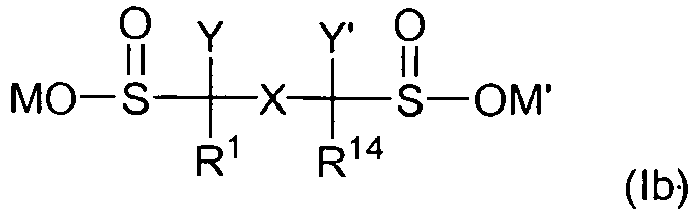
- Der Rest X steht bevorzugt für einen organischen Rest mit zwei freien Valenzen. Als erfindungsgemäße Reste eignen sich prinzipiell alle Organodiyl-Reste, wie z.B. aliphatische oder alizyklische, aromatische oder heteroaromatische Diyl-Reste. Der besagte organische Rest mit zwei freien Valenzen X gemäß Formel (III) bzw. Formel (Ib) wird bevorzugt aus der Gruppe ausgewählt, die gebildet wird aus gegebenenfalls substituierten Resten aus Arendiyl, Heteroarendiyl, Alkandiyl, Alkendiyl, Cycloalkandiyl, Cycloalkendiyl und Di((C1 bis C6)alkylen)-substituierten carbozyklischen oder heterozyklischen Gruppen, die aliphatisch oder aromatisch sind. Falls die oben genannten ausgewählten Reste dieser Ausführungsform substituiert sind, dann sind diese bevorzugt mit mindestens einem Rest aus (C1 bis C6)-Alkyl, (C2 bis C6)-Alkenyl, (C1 bis C6)-Hydroxyalkyl Aryl-(C1 bis C6)-alkyl, Hydroxy, (C1 bis C6)-Alkoxy, Amino, Di(C1 bis C6)alkylamino, Nitro, Halogen, Carbamoyl, Sulfonamido, Cyano oder Carboxamido substituiert.
- Es ist erfindungsgemäß besonders bevorzugt, wenn der Rest X der Formel (III) bzw. der Formel (Ib) für einen organischen Rest mit zwei freien Valenzen steht, der aus einer (C1 bis C6)-Alkandiylgruppe oder aus Resten der Formeln (VII) bis (XI) ausgewählt wird,


- R15 und R16
- unabhängig voneinander für ein Wasserstoffatom, ein Halogenatom, eine (C1 bis C6)-Alkylgruppe oder eine Carboxygruppe,
- n
- eine ganze Zahl von 0 bis 6,
- Z4
- eine Gruppe CH2, ein Sauerstoffatom, ein Schwefelatom oder eine Gruppe NR', mit R' = Wasserstoffatom, eine (C1 bis C6)-Alkylgruppe, eine (C1 bis C6)-Hydroxyalkylgruppe oder eine (C2 bis C6)-Polyhydroxyalkylgruppe,
- Z5, Z6 und Z7
- unabhängig voneinander eine Gruppe CH oder ein Stickstoffatom.
- Die jeweiligen Gruppen CH bzw. CH2 der Reste Z4, Z5, Z6 oder Z7 können selbstverständlich erfindungsgemäß ebenso mit allen erfindungsgemäß im Rahmen der Definition der betroffenen Formel aus den Formeln (VII) bis (XI) möglichen Substituenten substituiert sein.
- Falls der organische Rest mit zwei freien Valenzen X aus den Formeln (VII) und (VIII) ausgewählt wird, sind die Reste 2-Chlor-cyclopentan-1,3-diyl, 2-Brom-cyclopentan-1,3-diyl, 2-Chlor-cyclohexan-1,3-diyl und 2-Brom-cyclohexan-1,3-diyl bevorzugte Vertreter.
- Steht der Rest R der Formel (I) für einen Rest der oben genannten Formel (IV), dann ergibt sich aus der Formel (I) das erfindungsgemäße Sulfinsäurederivat der dritten Ausführungsform gemäß Formel (Ic),

- Besonders bevorzugt sind Reste R gemäß Formel (IV), die ausgewählt werden, aus 4-Cyanophenyl, 4-Carboxyphenyl, 4-Carboxymethyloxy und 4-Trimethylammoniophenyl.
- Steht der Rest R der Formel (I) für einen Rest der oben genannten Formel (V), dann ergibt sich aus der Formel (I) das erfindungsgemäße Sulfinsäurederivat der vierten Ausführungsform gemäß Formel (Id),

M und R10 die unter Formel (I) genannten Bedeutungen haben. Die zuvor erwähnten bevorzugten Definitionen der Reste M und R10 gelten auch hier, allein oder gemeinsam auf Formel (Id) angewendet, als bevorzugt. - Steht der Rest R der Formel (I) für einen Rest der oben genannten Formel (VI), dann ergibt sich aus der Formel (I) das erfindungsgemäße Sulfinsäurederivat der fünften Ausführungsform gemäß Formel (Ie),

M, R11, R12 und R13 die unter Formel (I) genannten Bedeutungen haben. Die zuvor erwähnten bevorzugten Definitionen der Reste M, R11, R12 und R13 gelten auch hier, allein oder gemeinsam auf Formel (Ie) angewendet, als bevorzugt. - Im Folgenden sollen Beispiele für die als Substituenten im Rahmen dieser Anmeldung genannten Gruppen bzw. Reste erwähnt werden. Beispiele für (C1 bis C6)-Alkylreste sind lineare, verzweigte oder zyklische (C1 bis C6)-Alkylgruppen, wobei lieneare oder verzweigte (C1 bis C6)-Alkylgruppen bevorzugt sind. Insbesondere sind die Gruppen Methyl, Ethyl, Propyl, Isopropyl, n-Butyl, sec-Butyl, tert.-Butyl, n-Pentyl und n-Hexyl geeignet. Beispiele für entsprechend geeignete zyklische Alkylgruppen sind Cyclopentyl und Cyclohexyl. Beispiele für bevorzugte (C2 bis C6)-Alkenylreste sind Vinyl, Allyl und Butenyl. Erfindungsgemäß bevorzugte (C1 bis C6)-Alkoxyreste sind beispielsweise eine Methoxy- oder eine Ethoxygruppe. Die Methoxycarbonyl-, Ethoxycarbonyl-, n-Propoxycarbonyl-, Isopropoxycarbonyl-, n-Butoxycarbonyl-, sec-Butoxycarbonyl- und tert-Butoxycarbonylgruppe sind Beispiele für (C1 bis C6)-Alkoxycarbonylgruppen; die Methoxycarbonyl- und die Ethoxycarbonylgruppe sind dabei besonders bevorzugt.
Die 2-Methoxycarbonylethyl-, 2-Ethoxycarbonylethyl-, 2-Propoxycarbonylethyl-, 2-Isopropoxycarbonylethyl-, 2-Butoxycarbonylethyl-, 2-sec-Butoxycarbonylethyl-, 2-tert-Butoxycarbonylethyl-, 3-Methoxycarbonylpropyl-, 3-Ethoxycarbonylpropyl-, 3-Propoxycarbonylpropyl-, 3-Isopropoxycarbonylpropyl-, 3-Butoxycarbonylpropyl-, 3-sec-Butoxycarbonylpropyl- und 3-tert-Butoxycarbonylpropylgruppe sind Beispiele für (C1 bis C6)-Alkoxycarbonyl-(C1 bis C6)-alkylgruppen.
Beispiele für erfindungsgemäße Cyano-(C1 bis C6)-alkylgruppen sind Cyanomethyl, 2-Cyanoethyl, 3-Cyanopropyl, 4-Cyanobutyl und 5-Cyanopentyl.
Weiterhin können als bevorzugte Beispiele für eine (C1 bis C6)-Monohydroxyalkylgruppe eine Hydroxymethyl-, eine 2-Hydroxyethyl-, eine 2-Hydroxypropyl, eine 3-Hydroxypropyl-, eine 4-Hydroxybutylgruppe, eine 5-Hydroxypentyl- und eine 6-Hydroxyhexylgruppe genannt werden. Eine 2-Hydroxyethylgruppe ist besonders bevorzugt. Beispiele für eine (C2 bis C6)-Polyhydroxyalkylgruppe sind die 2,3-Dihydroxypropylgruppe, 3,4-Dihydroxybutylgruppe und die 2,4-Dihydroxybutylgruppe. Die Methoxyethyl-, Ethoxyethyl-, Methoxypropyl-, Methoxybutyl-, Ethoxybutyl- und die Methoxyhexylgruppe sind Beispiele für erfindungsgemäße (C1 bis C6)-Alkoxy-(C1 bis C6)-alkylgruppen.
Eine bevorzugte Hydroxy-(C1 bis C6)-alkoxygruppe ist die 2-Hydroxyethoxygruppe. Bevorzugte Arylgruppen sind Phenyl, Naphthyl und Biphenyl.
Bevorzugte Heteroarylgruppen sind Thienyl, Furyl, Pyrrolyl, Imidazolyl, Thiazolyl, Oxazolyl, Pyrazolyl, Pyridyl, Pyrimidinyl, Pyrazyl, Pyridazyl, Benzimidazolyl, Benzothiazolyl, Benzoxazolyl, Indolyl, Chinolinyl, Chinoxalinyl und Chinazolinyl.
Die Trifluomethyl- und die Pentafluorethylgruppe sind bevorzugte Perfluor-(C1 bis C6)-alkylgruppen.
Beispiele für Halogenatome sind F-, Cl-, Br- oder I-Atome, wobei Cl- und Br-Atome ganz besonders bevorzugt sind. Bevorzugte Aryl-(C1 bis C6)-alkylgruppen sind Benzyl und 2-Phenylethyl. Die Trimethylammonium- und Diethylmethylammonium- sind Beispiele für eine Gruppe - N+RIRIIRIII.
Die 2-Trimethylammoniumethyl- ist ein Beispiel für eine N,N,N-Tri[(C1 bis C6)-akyl]ammonium-(C1 bis C6)-alkylgruppe.
Eine bevorzugte (C1 bis C6)-Carboxyalkylgruppe ist die 3-Carboxypropylgruppe. Die weiteren verwendeten Begriffe leiten sich erfindungsgemäß von den hier gegebenen Definitionen ab. - Ganz besonders bevorzugte Vertreter der Sulfinsäurederivate gemäß Formel (I) sind die Sulfinsäuren gemäß folgender Liste oder deren Salze mit einem Äquivalent mindestens eines ein- oder mehrwertigen Kations:
Name: korrespondierende Struktur: 2-Furyl(amino)methansulfinsäure, 
Amino(thien-2-yl)methansulfinsäure, 
Amino(1H-imidazol-2-yl)methansulfinsäure, 
Amino(1,3-thiazol-2-yl)methansulfinsäure, 
Amino(1,3-oxazol-2-yl)methansulfinsäure, 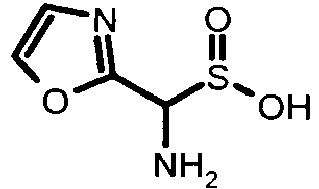
Amino(1H-pyrrol-2-yl)methansulfinsäure, 
Amino(hydroxyl-2-yl)methansulfinsäure, 
Amino(hydroxyl-4-yl)methansulfinsäure, 
Amino[3-hydroxy-5-(hydroxymethyl)-2-methylpyridin-4-yl]methansulfinsäure, 
Amino(chinolin-2-yl)methansulfinsäure, 
Amino(chinolin-4-yl)methansulfinsäure, 
1H-Benzimidazol-2-yl(amino)methansulfinsäure, 
1,3-Benzothiazol-2-yl(amino)methansulfinsäure, 
1,3-Benzoxazol-2-yl(amino)methansulfinsäure, 
Hydroxy(thien-2-yl)methansulfinsäure, 
Hydroxy(thien-3-yl)methansulfinsäure 
(3-Bromthien-2-yl)(hydroxyl)methansulfinsäure, 
Hydroxy(1H-imidazol-2-yl)methansulfinsäure, 
Hydroxy(1H-imidazol-5-yl)methansulfinsäure, 
Hydroxy(1-methyl-5-nitro-1H-imidazol-2-yl)methansulfinsäure, 
Hydroxy(1,3-thiazol-2-yl)methansulfinsäure, 
Hydroxy(1,3-oxazol-2-yl)methansulfinsäure, 
Hydroxy(1H-pyrrol-2-yl)methansulfinsäure, 
Hydroxy(hydroxyl-2-yl)methansulfinsäure, 
Hydroxy(hydroxyl-4-yl)methansulfinsäure, 
Hydroxy[3-hydroxy-5-(hydroxymethyl)-2-methylpyridin-4-yl]-methansulfinsäure, 
Hydroxy(chinolin-2-yl)methansulfinsäure, 
Hydroxy(chinolin-4-yl)methansulfinsäure, 
1H-Benzimidazol-2-yl(hydroxyl)methansulfinsäure, 
1,3-Benzothiazol-2-yl(hydroxyl)methansulfinsäure, 
1,3-Benzoxazol-2-yl(hydroxy)methansulfinsäure, 
1,2-Dihydroxyethan-1,2-disulfinsäure, 
1,3-Dihydroxypropan-1,3-disulfinsäure, 
Hydroxy{4-[hydroxy(sulfino)methyl]phenyl}methan-sulfinsäure, 
{2-Chlor-3-[hydroxy(sulfino)methyl]cyclohexyl}-(hydroxy)methansulfinsäure, 
{2-Chlor-3-[hydroxyl(sulfino)methyl]cyclopentyl}-(hydroxyl)methansulfinsäure, 
Hydroxy{5-[hydroxy(sulfino)methyl]thien-2-yl}methansulfinsäure, 
Hydroxy{2-[hydroxy(sulfino)methyl]phenyl}methan-sulfinsäure, 
Hydroxy{3-[hydroxy(sulfino)methyl]phenyl}methan-sulfinsäure, 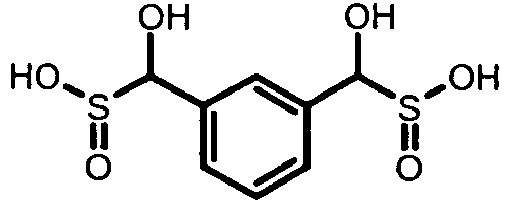
1,5-Dihydroxypentan-1,5-disulfinsäure, 
4-Hydroxy-4-sulfinobutansäure, 
1-Hydroxy-4-methoxy-4-oxobutan-1-sulfinsäure, 
1-Hydroxy-4-ethoxy-4-oxobutan-1-sulfinsäure, 
4-Hydroxy-4-sulfinopentansäure, 
2-Hydroxy-5-methoxy-5-oxopentan-2-sulfinsäure, 
2-Hydroxy-5-ethoxy-5-oxopentan-2-sulfinsäure, 
4-Hydroxy-4-sulfinobut-2-ensäure, 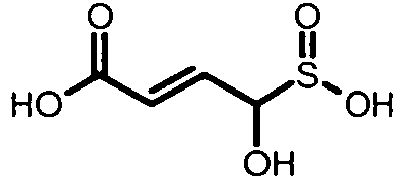
1-Hydroxy-4-methoxy-4-oxobut-2-en-1-sulfinsäure, 
1-Hydroxy-4-ethoxy-4-oxobut-2-en-1-sulfinsäure, 
4-Hydroxy-4-sulfinopent-2-ensäure, 
2-Hydroxy-5-methoxy-5-oxopent-3-en-2-sulfinsäure, 
2-Hydroxy-5-ethoxy-5-oxopent-3-en-2-sulfinsäure, 
5-Hydroxy-5-sulfinopentansäure, 
1-Hydroxy-5-methoxy-5-oxopentan-1-sulfinsäure, 
1-Hydroxy-5-ethoxy-5-oxopentan-1-sulfinsäure, 
5-Hydroxy-5-sulfinohexansäure, 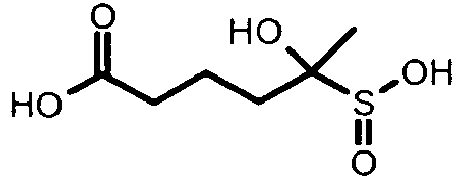
2-Hydroxy-6-methoxy-6-oxohexan-2-sulfinsäure, 
2-Hydroxy-6-ethoxy-6-oxohexan-2-sulfinsäure, 
4-[Hydroxy(sulfino)methyl]benzoesäure, 
4-[Amino(sulfino)methyl]benzoesäure, 
{4-[Hydroxy(sulfino)methyl]phenoxy}-essigsäure, 
{4-[Amino(sulfino)methyl]phenoxy}-essigsäure, 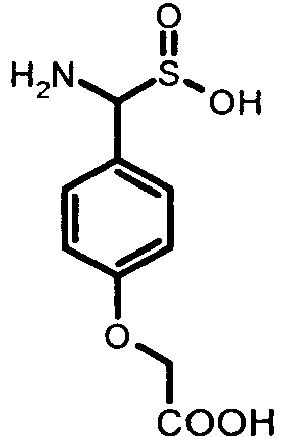
3-Hydroxy-4-[hydroxy(sulfino)methyl]benzoesäure, 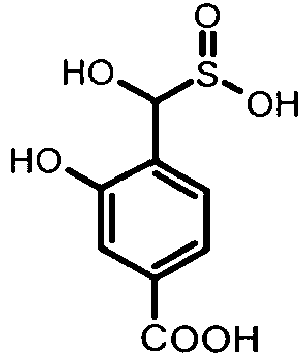
3-Hydroxy-4-[amino(sulfino)methyl]benzoesäure, 
(4-Cyanophenyl)(hydroxy)-methansulfinsäure, 
(4-Cyanophenyl)(amino)-methansulfinsäure, 
(4-Nitrophenyl)(hydroxy)-methansulfinsäure, 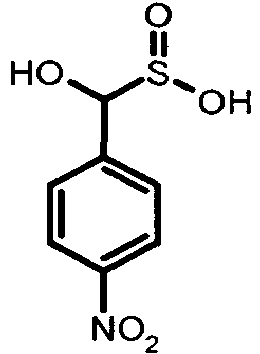
(4-Nitrophenyl)(amino)-methansulfinsäure, 
Salz des 4-Hydroxy-1,1-dimethyl-4-sulfinopiperidiniums mit An- als Äquivalent eines ein- oder mehrwertigen Anions, 
Salz des 1-Allyl-4-hydroxy-1-methyl-4-sulfinopiperidiniums mit An- als Äquivalent eines ein- oder mehrwertigen Anions, 
4-Hydroxy-1,1-dimethylpiperidinium-4-sulfinat, 
1-Allyl-4-hydroxy-1-methylpiperidinium-4-sulfinat, 
[(2-Methoxy-2-oxoethyl)amino](oxo)methansulfinsäure, 
[(Methylsulfonyl)amino]methansulfinsäure, 
[(Trifluorethylsulfonyl)amino]methansulfinsäure, 
[(Phenylsulfonyl)amino]methansulfinsäure 
1-Hydroxy-2-(trimethylammonio)ethansulfinat, 
Hydroxy[4-(trimethylammonio)phenyl]methansulfinat, 
4-[Hydroxy(sulfino)methyl]benzolsulfonsäure und 
2-[Hydroxy(sulfino)methyl]benzolsulfonsäure 
2-Hydroxy-2-sulfino-essigsäure 
2-Amino-2-sulfino-essigsäure 
2-Hydroxy-2-sulfino-propionsäure 
2-Amino-2-sulfino-propionsäure 
3-Hydroxy-3-sulfinato-propionsäure 
3-Amino-3-sulfinato-propionsäure 
2-Hydroxy-2-sulfinato-essigsäureethylester 
2-Amino-2-sulfinato-essigsäureethylester 
1-Hydroxy-2-methoxy-2-oxoethansulfinsäure 
2-Amino-1-hydroxy-2-oxoethansulfinsäure 
2-(Dimethylamino)-1-hydroxy-2-oxoethansulfinsäure 
Hydroxy(sulfino)methansulfonsäure 
Hydroxy(phenyl)methansulfinsäure 
Hydroxy(4-hydroxyphenyl)methansulfinsäure 
Hydroxy(4-methoxyphenyl)methansulfinsäure 
- Für die bevorzugten ein- oder mehrwertigen Kationen aller Salze der zuvor genannten Verbindungen gilt das zuvor Gesagte.
- Die Herstellung der erfindungsgemäß eingesetzten Sulfinsäuren der Formel (I) erfolgt beispielsweise aus der Umsetzung von Dithionit mit entsprechenden Aldehyden bzw. Ketonen analog zu der Herstellvorschrift gemäß
WO-A1-99/18067 - Die erfindungsgemäß einsetzbaren Adsorptionsmittel können hydrophil oder hydrophob sein, wobei hydrophile Adsorptionsmittel bevorzugt sind.
- Die erfindungsgemäßen Adsorptionsmittel sind bevorzugt in einer Menge von 2 bis 20 Gew.-%, besonders bevorzugt von 5 bis 10 Gew.-%, jeweils bezogen auf das Gewicht des Mittels, enthalten.
- Die erfindungsgemäßen Adsorptionsmittel und die erfindungsgemäßen Reduktionsmittel sind in dem erfindungsgemäßen Mittel bevorzugt in einem Gewichtsverhältnis (Adsorptionsmittel zu Reduktionsmittel) von 1 zu 2 bis 2 zu 1, besonders bevorzugt von 1.2 zu 1 bis 1 zu 1.2 enthalten.
- Erfindungsgemäße Adsorptionsmittel besitzen bevorzugt eine spezifische BET-Oberfläche von 40 bis 4000 m2/g, insbesondere von 100 bis 1000 m2/g (jeweils bestimmt nach DIN ISO 9277: 2003-05).
- Bevorzugte erfindungsgemäße Adsorptionsmittel besitzen Poren, insbesondere Mesoporen und/oder Mikroporen und/oder Macroporen. Eine Porengröße von wenigstens 0,4 nm ist eine bevorzugt geeignete Porengröße.
Die Adsorptionsmittel weisen bevorzugt ein mittleres Porenvolumen von 0,01 bis 5,0 cm3/g, isnbesondere von 0,1 bis 4 cm3/g, auf. - Erfindungsgemäß verwendbare Adsorptionsmittel werden ausgewählt aus Polymeren und/oder Copolymeren des Vinylpyrrolidons.
- Bevorzugt geeignete Polymere des Vinylpyrrolidons sind dessen Homo- und/oder Copolymere. Als erfindungsgemäße Copolymere sind Copolymere mit Vinylacetat bevorzugt verwendbar. Es weiterhin bevorzugt, dass die Polymere des Vinylpyrrolidons kein permanent quarternisiertes Stickstoffatom tragen. Bevorzugte Handelsprodukte sind Luviskol® K 17, Luviskol® K 30, Luviskol® K 80, Luviskol® K 90 (alle Fa. BASF).
- In einer erfindungsgemäß bevorzugten Ausführungsform enthalten die erfindungsgemäßen Mittel zusätzlich mindestens eine Verbindung, die mindestens ein quartäres Stickstoffatom besitzt. Besagte Verbindungen, besitzend mindestens ein quartäres Stickstoffatom, sind von den o.g. organischen Sulfinsäuren und den Adsorptionsmitteln verschieden.
- Unter Verbindungen, besitzend mindestens ein quartäres Stickstoffatom, verstehen sich im Sinne der Erfindung alle chemischen Verbindungen, die mindestens ein quartäres, kationisches Stickstoffatom tragen. Das quartäre Stickstoffatom ist vierbindig. Somit sind quartäre Ammoniumreste und quartäre Iminiumreste umfasst. Die an das quartäre Stickstoffatom bindenden Gruppen sind allesamt von Wasserstoff verschieden und bilden mindestens drei Bindungen zu Kohlenstoffatomen organischer Reste aus. Diese Verbindungen werden auch als quartäre Ammoniumverbindungen bezeichnet.
- Die erfindungsgemäßen Mittel enthalten bevorzugt mindestens eine Verbindung, besitzend mindestens ein quartäres Stickstoffatom, ausgewählt aus der Gruppe, die gebildet wird aus Verbindungen mit einem quartären Stickstoffatom, Verbindungen mit zwei quartären Stickstoffatomen, Verbindungen mit drei quartären Stickstoffatomen, organischen N-Oxiden und Polymeren abgeleitet von einem Monomer, enthaltend mindestens ein quartäres Stickstoffatom. Sowohl im Allgemeinen als auch für alle Vertreter der vorangegangenen Liste ist es bevorzugt, wenn die Verbindungen mit quartärem Stickstoffatom netto kationisch geladen sind. Die besagten Verbindungen liegen in letztgenannter Ausführungsform folglich nicht als ungeladenes Zwitterion oder gar anionisch vor.
- Die Verbindungen, besitzend mindestens ein quartäres Stickstoffatom sind in dem erfindungsgemäßen Mittel bevorzugt in einer Menge von 0,01 Gew.-% bis 20 Gew.-%, besonders bevorzugt von 0,1 Gew.-% bis 5 Gew.-%, jeweils bezogen auf das Gewicht des anwendungsbereiten Mittels, enthalten.
- Für diese Ausführungsform erfindungsgemäß besonders geeignete Verbindung, besitzend mindestens ein quartäres Stickstoffatom, sind Verbindungen mit der Formel (Q1),

- R1 und R2
- unabhängig voneinander eine lineare oder verzweigte (C1 bis C30)-Alkylgrupppe, eine (C2 bis C30)-Acylgruppe oder eine Gruppe -A1-A2-A3-R5
worin
R5 eine lineare oder verzweigte (C8 bis C30)-Alkylgruppe, eine lineare oder verzweigte (C8 bis C30)-Alkenylgruppe, eine Hydroxy-(C8- bis C30)-alkylgruppe oder eine Oligohydroxy-(C8- bis C30)-alkylgruppe bedeutet,
A1 eine direkte Bindung oder eine Carbonylgruppe bedeutet,
A2 eine direkte Bindung, eine Gruppe NH oder ein Sauerstoffatom bedeutet,
A3 eine (C2 bis C4)-Alkylengruppe oder eine (C2 bis C4)-Hydroxyalkylengruppe bedeutet - R3
- eine lineare oder verzweigte (C8 bis C30)-Alkylgruppe, eine (C8 bis C30)-Hydroxyalkylgruppe, eine (C2 bis C30)-Acylgruppe, eine (C2 bis C4)-Hydroxyalkylgruppe oder eine Aryl-(C1 bis C6)-alkylgruppe,
- R4
- eine (C1 bis C4)-Alkylgruppe oder eine (C2 bis C4)-Hydroxyalkylgruppe,
- X-
- ein physiologisch verträgliches organisches oder anorganisches Anion.
- R4 steht gemäß Formel (Q1) bevorzugt für eine Methyl-, eine Ethyl-, eine Benzyl- oder eine 2-Hydroxyethylgruppe.
- Beispiele für eine (C1- bis C4)-Alkylgruppe sind Methyl, Ethyl, Propyl, Isopropyl, n-Butyl, sec-Butyl und tert.-Butyl.
Beispiele für eine (C8- bis C30)-Alkylgruppe sind n-Octyl, n-Decyl, n-Dodecyl, n-Tetradecyl, n-Hexadecyl, Stearyl, Behenyl, Isostearyl und Eicosyl.
Beispiele für eine (C1- bis C30)-Alkylgruppe sind die vorgenannten Beispiele für die jeweiligen Alkylgruppen sowie n-Pentyl, eine Isopentyl, n-Hexyl und eine n-Heptylgruppe.
Beispiele für eine (C2- bis C4)-Alkenylgruppe sind Vinyl, Allyl und Butenyl.
Beispiele für eine (C2- bis C4)-Hydroxyalkylgruppe sind eine 2-Hydroxyethyl-, eine 2-Hydroxypropyl, eine 3-Hydroxypropyl- und eine 4-Hydroxybutylgruppe.
Beispiele für eine (C2- bis C4)-Alkylengruppe ist Ethylen, Propan-1,2-diyl, Propan-1,3-diyl, und Butan-1,4-diyl.
Beispiele für eine (orbis C4)-Hydroxyalkylengruppe ist 2-Hydroxyethylen, 1-Hydroxy-propan-1,2-diyl, 1-Hydroxy-propan-1,3-diyl und 2-Hydroxy-propan-1,3-diyl.
Beispiele für eine (C1-bis C4)-Alkylengruppe sind Methylen, Ethylen, Propan-1,2-diyl, Propan-1,3-diyl, und Butan-1,4-diyl.
Beispiele für (C2- bis C30)-Acylgruppen sind Octanoyl, Decanoyl, Dodecanoyl, Tetradecanoyl, Hexadecanoyl, Octadecanoyl und Eicosanoyl.
Beispiele für lineare oder verzweigte (C8-C30)-Alkenylgruppen sind 9-Octadecen-1-yl, 9,12-Octadecadien-1-yl, 9,12,15-Octadecatrien-1-yl und 13-Docosen-1-yl.
Hydroxy-(C8-C30)-alkylgruppen sind beispielsweise 2-Hydroxydecyl, 2-Hydroxydodecyl, 2-Hydroxytetradecyl, 2-Hydroxyhexadecyl und 2-Hydroxyoctadecyl.
Als physiologisch verträgliches organisches oder anorganisches Gegenionen X gemäß Formel (Q1) kommen beispielsweise Halogenidionen, Sulfationen, Phosphationen, Methosulfationen sowie organische Ionen wie Lactat-, Citrat-, Tartrat- und Acetationen in Betracht. Bevorzugt sind Methosulfat und Halogenidionen, insbesondere Bromid und Chlorid. - Bevorzugte Vertreter des Rests -A1-A2-A3-R5 sind erfindungsgemäß die Gruppen

- Besonders bevorzugte Reste -A1-A2-A3-R5 sind erfindungsgemäß
- eine ω-[(C8- bis C30)-Alkanoyloxy]-(C2- bis C4)-alkylgruppe (R5 = (C8- bis C30)-Alkyl, A1 = Carbonyl, A2 = Sauerstoffatom, A3 = (C2- bis C4)-Alkylengruppe),
- eine ω-[(C8- bis C30)-Alkylamido]-(C2- bis C4)-alkylgruppe (R5 = (C8- bis C30)-Alkyl, A1 = Carbonyl, A2 = Gruppe NH, A3 = (C2- bis C4)-Alkylengruppe),
- eine (C10- bis C34)-Hydroxyalkylgruppe (entweder: R5 = (C8- bis C30)-Alkyl, A1 = direkte Bindung, A2 = direkte Bindung, A3 = (C2- bis C4)-Hydroxyalkylengruppe oder: R5 = (C8-bis C30)-Hydroxyalkyl oder Oligohydroxy-(C8- bis C30)-alkylgruppe, A1 = direkte Bindung, A2 = direkte Bindung, A3 = (C2- bis C4)-Alkylengruppe.
- Beispiele für ω-[(C8- bis C30)-Alkanoyloxy]-(C2- bis C4)-alkylgruppen sind die bevorzugten 2-[(C8-bis C30)-Acyloxy]ethylgruppen, insbesondere 2-(Dodecanoyloxy)ethyl, 2-(Tetradecanoyloxy)ethyl, 2-(Hexadecanoyloxy)ethyl und 2-(Octadecanoyloxy)ethyl.
- Die Verbindungen mit der Formel (Q1) werden bevorzugt ausgewählt aus mindestens einer Verbindung aus der Gruppe, die gebildet wird aus Verbindungen der nachfolgenden Formeln (Q1-a), (Q1-b) und (Q1-c).
- Eine der o.g. bevorzugten Gruppen von quartären Ammoniumverbindungen der vorgenannten Formel (Q1) wird definiert aus Verbindungen der Formel (Q1-a)

- R6 und R7 unabhängig voneinander eine (C2 bis C30)-Acylgruppe oder eine lineare oder verzweigte (C1 bis C30)-Alkylgruppe bedeutet,
- R5* eine lineare oder verzweigte (C8 bis C30)-Alkylgruppe oder eine lineare oder verzweigte (C8 bis C30)-Alkenylgruppe bedeutet,
- A1 eine direkte Bindung oder eine Carbonylgruppe bedeutet,
- A2 eine direkte Bindung, eine Gruppe NH oder ein Sauerstoffatom bedeutet,
- A3 eine (C2 bis C4)-Alkylengruppe oder eine (C2 bis C4)-Hydroxyalkylengruppe bedeutet und
- X- ein physiologisch verträgliches organisches oder anorganisches Anion ist,
- Die andere Gruppe der bevorzugten quartären Ammoniumverbindungen wird ausgewählt aus Verbindungen mit der Formel (Q1-b)

- R8 und R9 unabhängig voneinander für eine (C1- bis C4)-Alkylgruppe oder (C2- bis C4)-Hydroxyalkylgruppe stehen,
- R5 eine lineare oder verzweigte (C8- bis C30)-Alkylgruppe, lineare oder verzweigte (C8-bis C30)-Alkenylgruppe, eine Hydroxy-(C8- bis C30)-alkylgruppe oder eine Oligohydroxy-(C8- bis C30)-alkylgruppe bedeutet,
- A1* eine Carbonylgruppe bedeutet
- A2* eine Gruppe NH oder ein Sauerstoffatom bedeutet,
- A3 eine (C2- bis C4)-Alkylengruppe, eine (C2- bis C4)-Hydroxyalkylengruppe bedeutet und
- X- ein physiologisch verträgliches organisches oder anorganisches Anion ist.
- Es sind solche Verbindungen gemäß Formel (Q1-b) erfindungsgemäß bevorzugt, für die mindestens eine der folgenden Bedingungen gilt:
- R8 und R9 stehen bevorzugt unabhängig voneinander für eine Methylgruppe oder eine 2-Hydroxyethylgruppe.
- wenn R8 und R9 gleich sind, stehen sie bevorzugt für eine (C1- bis C4)-Alkylgruppe, besonders bevorzugt für eine Methylgruppe.
- Es ist bevorzugt, daß A3 ausgewählt wird aus Ethylen, Propan-1,3-diyl, Propan-1,2-diyl, 2-Hydroxypropan-1,3-diyl.
- Weitere erfindungsgemäß bevorzugte quaternierte Ammoniumverbindungen der Formel (Q1) werden ausgewählt aus Verbindungen mit der Formel (Q1-c),
(R10)y(Me)(4-y)N+ X- (Q1-c)
wobei - R10 unabhängig voneinander eine (C8- bis C30)-Alkylgruppe,
- y gleich 1 oder 2 ist und
- X- ein physiologisch verträgliches organisches oder anorganisches Anion ist,
- In den Verbindungen der Formel (Q1-c) steht der Rest R10 bevorzugt für eine Alkylgruppe mit 10 bis 22 Kohlenstoffatomen, besonders bevorzugt mit 10 bis 18 Kohlenstoffatomen.
- Die in den erfindungsgemäßen Mitteln dieser Ausführungsform als Verbindungen der Formel (Q1-c) enthaltenen quartären Ammoniumverbindungen sind bevorzugt Halogenide, insbesondere Chloride und Bromide.
- Es gelten diejenigen für die Reste gemäß Formel (Q1) genannten Beispiele, als Beispiele für die jeweiligen Reste bzw. Gruppen der Formeln (Q1-a), (Q1-b) und (Q1-c).
- Die Verbindungen der Formel (Q1) werden bevorzugt ausgewählt aus der Gruppe, die gebildet wird aus
- Salze, insbesondere Halogenide, des Dicetyldimethylammoniums, Distearyldimethylammoniums (z.B. Dioctadecyldimethylammonium Chlorid als Genamin® DSAc der Firma Clariant), Cetyltrimethylammoniums (z.B. Hexadecyltrimethylammonium Chlorid als Dehyquart® A der Firma Cognis), oder des Stearyltrimethylammoniums,
- quaternierten Estersalzen von Fettsäuren mit Triethanolamin, sogenannte Esterquats, insbesondere den Salzen des N,N-Di(2-(dodecanoyloxy)ethyl)dimethylammoniums, N,N-Di(2-(tetradecanoyloxy)ethyl)dimethylammoniums, N,N-Di(2-(hexadecanoyloxy)ethyl)dimethylammoniums, N,N-Di(2-(hexadecanoyloxy)-propyl)dimethylammoniums, N,N-Di(2-(octadecanoyloxy)ethyl)dimethylammoniums mit einem physiologisch verträglichen, organisch oder anorganischen Anion. Bevorzugte Anionen sind Alkylsulfate, wie z.B. Methylsulfat, und Halogenide, wie Chlorid und Bromid. Solche Produkte werden beispielsweise unter den Warenzeichen Stepantex®, Dehyquart® und Armocare® vertrieben. Die Produkte Armocare® VGH-70, ein N,N-Di(2-Hexadecanoyloxyethyl)dimethylammoniumchlorid, sowie Dehyquart® L80 (INCI-Bezeichnung: Dicocoylethyl Hydroxyethylmonium Methosulfate), Dehyquart® F-75, Dehyquart® C-4046, und Dehyquart® AU-35 sind Beispiele für solche Esterquats. Zur Herstellung können auch Fettsäureschnitte, z.B. aus Talg wie beispielsweise Rindertalg gewonnene Talgfettsäuren, verwendet werden (INCI-Bezeichnungen: Ditallowoylethyl Dimonium Methosulfate, Ditallowoyl PG-dimonium Chloride).
- Salzen des N,N-Dimethyl-N-(2-hydroxyethyl)-N-(2-hydroxyhexadecyl)-ammoniums. Bevorzugte Halogenide sind Chlorid und Bromid. Diese werden beispielsweise unter der Handelsmarke Dehyquart® E (INCI-Bezeichnung: Aqua (Water), Hydroxycetyl Hydroxyethyl Dimonium Chloride) von der Firma Cognis vertrieben.
- quaternierte Amidsalze von Fettsäuren mit Diaminen, wie z.B. Salzen des N-(13-Docosen)amidopropyl-N-2-hydroxyethyl-N,N-dimethylammoniums (INCI-Bezeichnung: Hydroxyethyl Erucamidopropyl Dimonium Chloride) oder des N-Docosylamidopropyl-N-2-hydroxyethyl-N,N-dimethylammoniums welches unter dem Handelsnamen Incroquat® Behenyl HE (INCI-Bezeichnung: Hydroxyethyl Behenamidopropyl Dimonium Chloride) von der Firma Croda Inc. vertrieben wird.
- Als quartäre Ammoniumverbindungen aus der Gruppe der Polymere, die sich ableiten von mindestens einem Monomer mit einer quartären Ammoniumgruppe, sind vorzugsweise kationische und/oder amphotere Polymere einsetzbar. Unter kationischen bzw. amphoteren Polymeren sind Polymere zu verstehen, welche in der Haupt- und/oder Seitenkette eine Gruppe aufweisen, die "permanent" kationisch ist. Als "permanent kationisch" werden erfindungsgemäß solche Polymere bezeichnet, die unabhängig vom pH-Wert des Mittels eine kationische Gruppe aufweisen. Dies sind in der Regel Polymere, die ein quartäres Stickstoffatom, beispielsweise in Form einer Ammoniumgruppe, enthalten. Bevorzugte kationische Gruppen sind quartäre Ammoniumgruppen. Insbesondere solche Polymere, bei denen die quartäre Ammoniumgruppe über eine (C1 bis C4)-Kohlenwasserstoffgruppe an eine aus Acrylsäure, Methacrylsäure oder deren Derivaten aufgebaute Polymerhauptkette gebunden sind, haben sich als besonders geeignet erwiesen.
-

- R1 steht für eine Methylgruppe
- R2, R3 und R4 stehen für Methylgruppen
- m hat den Wert 2.
- Als physiologisch verträgliches Gegenionen X- kommen beispielsweise Halogenidionen, Sulfationen, Phosphationen, Methosutfationen sowie organische Ionen wie Lactat-, Citrat-, Tartrat- und Acetationen in Betracht. Bevorzugt sind Halogenidionen, insbesondere Chlorid.
- Ein besonders geeignetes Homopolymer (Q2) ist das, gewünschtenfalls vernetzte, Poly(methacryloyloxyethyltrimethylammoniumchlorid) mit der INCI-Bezeichnung Polyquaternium-37. Solche Produkte sind beispielsweise unter den Bezeichnungen Rheocare® CTH (Cosmetic Rheologies) und Synthalen® CR (Ethnichem) im Handel erhältlich. Die Vernetzung kann gewünschtenfalls mit Hilfe mehrfach olefinisch ungesättigter Verbindungen, beispielsweise Divinylbenzol, Tetraallyloxyethan, Methylenbisacrylamid, Diallylether, Polyallylpolyglycerylether, oder Allylethern von Zuckern oder Zuckerderivaten wie Erythritol, Pentaerythritol, Arabitol, Mannitol, Sorbitol, Sucrose oder Glucose erfolgen. Methylenbisacrylamid ist ein bevorzugtes Vernetzungsagens.
- Das Homopolymer wird bevorzugt in Form einer nichtwäßrigen Polymerdispersion, die einen Polymeranteil nicht unter 30 Gew.-% aufweisen sollte, eingesetzt. Solche Polymerdispersionen sind unter den Bezeichnungen Salcare® SC 95 (ca. 50 % Polymeranteil, weitere Komponenten: Mineralöl (INCI-Bezeichnung: Mineral Oil) und Tridecyl-polyoxypropylen-polyoxyethylen-ether (INCI-Bezeichnung: PPG-1-Trideceth-6)) und Salcare® SC 96 (ca. 50 % Polymeranteil, weitere Komponenten: Mischung von Diestern des Propylenglykols mit einer Mischung aus Capryl- und Caprinsäure (INCI-Bezeichnung: Propylene Glycol Dicaprylate/Dicaprate) und Tridecyl-polyoxypropylen-polyoxyethylen-ether (INCI-Bezeichnung: PPG-1-Trideceth-6)) im Handel erhältlich.
- Copolymere mit Monomereinheiten gemäß Formel (Q2) enthalten als nichtionogene Monomereinheiten bevorzugt Acrylamid, Methacrylamid, Acrylsäure-C1-4-alkylester und Methacrylsäure-C1-4-alkylester. Unter diesen nichtionogenen Monomeren ist das Acrylamid besonders bevorzugt. Auch diese Copolymere können, wie im Falle der Homopolymere oben beschrieben, vernetzt sein. Ein erfindungsgemäß bevorzugtes Copolymer ist das vernetzte Acrylamid-Methacryloyloxyethyltrimethylammoniumchlorid-Copolymer. Solche Copolymere, bei denen die Monomere in einem Gewichtsverhältnis von etwa 20:80 vorliegen, sind im Handel als ca. 50 %ige nichtwäßrige Polymerdispersion unter der Bezeichnung Salcare® SC 92 erhältlich.
- Als erfindungsgemäße quartäre Ammoniumverbindung können die erfindungsgemäßen Mittel mindestens ein Polymerisat enthalten, das mindestens eine Struktureinheit gemäß Formel (Q3) umfasst,

- R eine C1- bis C30-Alkylgruppe, eine C1- bis C4-Aralkylgruppe, eine C2- bis C6-Alkenylgruppe oder eine C2 bis C6-Hydroxyalkylgruppe bedeutet und
- X- für ein physiologisch verträgliches Anion steht.
- Als erfindungsgemäß bevorzugt geeignete Polymerisate der Formel (Q3) dienen solche, in der R für eine C1- bis C10-Alkylgruppe, insbesondere für eine Methylgruppe, steht.
- Beispiele für erfindungsgemäß in Verbindungen der Formel (Q3) verwendbare C1- bis C30-Alkylgruppen sind Methyl, Ethyl, n-Propyl, Isopropyl, n-Butyl, sec-Butyl, Isobutyl, tert-Butyl, n-Decyl, n-Dodecyl, Stearyl oder Behenyl.
Beispiele für erfindungsgemäß in Verbindungen der Formel (Q3) verwendbare C2- bis C6-Alkenylgruppen sind Vinyl, 2-Propen-1-yl (Allyl) oder 3-Buten-1-yl.
Beispiele für eine C1- bis C4-Aralkylgruppe sind die Benzylgruppe und die 2-Phenylethylgruppe. Beispiele für eine C2 bis C6-Hydroxyalkylgruppe sind die 2-Hydroxyethylgruppe und die 3-Hydroxypropylgruppe. - Die physiologisch verträglichen Anionen X- gemäß Formel (Q3) dürfen definitionsgemäß nicht nur eine negative Ladung tragen, sondern können auch eine Ladungszahl größer 1 besitzen. In letzterem Falle werden die Anionen X- der Salzform gemäß Formel (Q3) zur Wahrung der Elektroneutralität durch Formulierung eines stöchiometrischen Koeffizienten kleiner 1 vor dem Anion beschrieben. Die physiologisch verträglichen Anionen werden bevorzugt ausgewählt aus Halogenid, Benzolsulfonat, p-Toluolsulfonat, C1-C4-Alkansulfonat, Trifluormethansulfonat, C1-C4-Alkylsulfat, Perchlorat, 0.5 Sulfat, Hydrogensulfat, 0.5 Carbonat, Hydrogencarbonat, 1/3 Phosphat, 0.5 Hydrogenphosphat, Dihydrogenphosphat, Lactat, Citrat, Tetrafluoroborat, Hexafluorophosphat oder Tetrachlorozinkat. Besonders bevorzugt steht X- für ein Halogenid, insbesondere Chlorid, Bromid oder Iodid, C1-C4-Alkylsulfat, p-Toluolsulfonat, Tetrafluoroborat, Trifluormethansulfonat, Hexafluorophosphat, 0.5 Sulfat, oder Hydrogensulfat. Besonders bevorzugt werden die Anionen Chlorid, Methylsulfat oder Ethylsulfat als X- eingesetzt.
- Die erfindungsgemäß verwendbaren Polymere der Formel (Q3) besitzen ein bevorzugtes Molekulargewicht von mehr als 100000 g/mol, besonders bevorzugt von mehr als 400000 g/mol.
- Es ist erfindungsgemäß bevorzugt, ein Copolymerisat zu verwenden, das zusätzlich zu mindestens einer Struktureinheit gemäß obiger Formel (Q3) mindestens eine Struktureinheit der Formel (N1) umfasst,

- Bevorzugte Polymerisate sind unter den Handelsnamen Luviquat® FC 370, Luviquat® FC 550, Luviquat® FC 905 und Luviquat® HM 552, sowie Luviquat® Hold (INCI-Bezeichung: Polyquaternium-46), Luviquat® Supreme (Polyquaternium-68) und/oder Luviquat® Ultracare jeweils von der Firma BASF zu beziehen.
- Weiterhin bevorzugt verwendbar ist ein Copolymer, in welchem neben mindestens einer Struktureinheit der Formel (Q3), mindestens eine Struktureinheit der Formel (N1) mit n = 1 und mindestens eine weitere Struktureinheit der Formel (N1) mit n = 3 enthalten ist.
- Bevorzugt eignet sich ebenfalls ein Terpolymer mit den Struktureinheiten der Formeln,

Solche Polymere werden beispielsweise von der Firma BASF unter dem Handelsnamen Luviquat® Hold (INCI-Bezeichnung: Polyquaternium-46) vertrieben. Die Gewichtsverhältnisse (in Gewichtsprozent) der Struktureinheiten der Formel (I) zu den Struktureinheiten der Formel (II) mit n = 1 zu den Struktureinheiten der Formel (II) mit n = 3 beträgt in dem Handelsprodukt 10 zu 40 zu 50 und die Ladungsdichte beträgt 0.5 meq/g. - In allen erfindungsgemäß verwendbaren Polymeren können bei Vorhandensein verschiedener Struktureinheiten diese jeweils statistisch verteilt oder als Block vorliegen.
- Weitere in den erfindungsgemäß Mitteln einsetzbare kationische Polymere sind beispielsweise
- quaternisierte Cellulose-Derivate, wie sie unter den Bezeichnungen Celquat® und Polymer JR im Handel erhältlich sind. Die Verbindungen Celquat H 100, Celquat L 200 und Polymer JR 400 sind bevorzugte quaternierte Cellulose-Derivate,
- kationische Alkylpolyglycoside gemäß der
DE-PS 44 13 686 - kationisierter Honig, beispielsweise das Handelsprodukt Honeyquat® 50,
- kationische Guar-Derivate, wie insbesondere die unter den Handelsnamen Cosmedia®Guar und Jaguar® vertriebenen Produkte,
- polymere Dimethyldiallylammoniumsalze und deren Copolymere mit Estern und Amiden von Acrylsäure und Methacrylsäure. Die unter den Bezeichnungen Merquat®100 (Poly(dimethyldiallylammoniumchlorid)) und Merquat®550 (Dimethyldiallylammoniumchlorid-Acrylamid-Copolymer) im Handel erhältlichen Produkte sind Beispiele für solche kationischen Polymere,
- Copolymere des Vinylpyrrolidons mit quaternierten Derivaten des Dialkylaminoalkylacrylats und -methacrylats, wie beispielsweise mit Diethylsulfat quaternierte Vinylpyrrolidon-Dimethylaminoethylmethacrylat-Copolymere. Solche Verbindungen sind unter den Bezeichnungen Gafquat®734 und Gafquat®755 im Handel erhältlich,
- quaternierter Polyvinylalkohol,
- sowie die unter den Bezeichnungen Polyquaternium 2, Polyquaternium 17, Polyquaternium 18 und Polyquaternium 27 bekannten Polymeren mit quartären Stickstoffatomen in der Polymerhauptkette.
- Gleichfalls als kationische Polymere eingesetzt werden können die unter den Bezeichnungen Polyquaternium-24 (Handelsprodukt z. B. Quatrisoft® LM 200), bekannten Polymere. Ebenfalls erfindungsgemäß verwendbar sind die Copolymere des Vinylpyrrolidons, wie sie als Handelsprodukte Copolymer 845 (Hersteller: ISP), Gaffix® VC 713 (Hersteller: ISP), Gafquat®ASCP 1011, Gafquat®HS 110, Luviquat®8155 und Luviquat® MS 370 erhältlich sind.
- Zusätzlich zu kationischen Polymerisaten oder an ihrer Stelle können die erfindungsgemäßen Mittel auch amphotere Polymere enthalten. Diese weisen zusätzlich mindestens eine negativ geladene Gruppe im Molekül auf und werden auch als zwitterionische Polymere bezeichnet. Im Rahmen der vorliegenden Erfindung bevorzugt einsetzbare zwitterionische Polymerisate (Q4) setzen sich im wesentlichen zusammen aus
- A) Monomeren mit quartären Ammoniumgruppen der allgemeinen Formel (Z1-a),
R1-CH=CR2-CO-Z-(CnH2n)-N(+)R3R4R5 A(-) (Z1-a)
In der R1 und R2 unabhängig voneinander stehen für Wasserstoff oder eine Methylgruppe und R3, R4 und R5 unabhängig voneinander für Alkylgruppen mit 1 bis 4 Köhlenstoff-Atomen, Z eine NH-Gruppe oder ein Sauerstoffatom, n eine ganze Zahl von 2 bis 5 und A(-) das Anion einer organischen oder anorganischen Säure ist
und - B) monomeren Carbonsäuren der allgemeinen Formel (Z1-b),
R6-CH=CR7-COOH (Z1-b)
in denen R6 und R7 unabhängig voneinander Wasserstoff oder
Methylgruppen sind. - Geeignete Ausgangsmonomere sind z. B. Dimethylaminoethylacrylamid, Dimethylaminoethylmethacrylamid, Dimethylaminopropylacrylamid, Dimethylaminopropylmethacrylamid und Diethylaminoethylacrylamid, wenn Z gemäß Formel (Z1-a) eine NH-Gruppe bedeutet oder Dimethylaminoethylacrylat, Dimethylaminoethylmethacrylat und Diethylaminoethylacrylat, wenn Z ein Sauerstoffatom ist.
- Die eine tertiäre Aminogruppe enthaltenden Monomeren werden dann in bekannter Weise quarterniert, wobei als Alkylierungsreagenzien Methylchlorid, Dimethylsulfat oder Diethylsulfat besonders geeignet sind. Die Quaternisierungsreaktion kann in wäßriger Lösung oder im Lösungsmittel erfolgen.
- Vorteilhafterweise werden solche Monomere der Formel (Z1-a), die Derivate des Acrylamids oder Methacrylamids darstellen. Weiterhin bevorzugt sind solche Monomeren, die als Gegenionen Halogenid-, Methoxysulfat- oder Ethoxysulfat-Ionen enthalten. Ebenfalls bevorzugt sind solche Monomeren der Formel (Z1-a), bei denen R3, R4 und R5 Methylgruppen sind.
- Das Acrylamidopropyl-trimethylammoniumchlorid ist ein ganz besonders bevorzugtes Monomer der Formel (Z1-a).
- Als monomere Carbonsäuren der Formel (Z1-b) eignen sich Acrylsäure, Methacrylsäure, Crotonsäure und 2-Methyl-crotonsäure. Bevorzugt werden Acryl- oder Methacrylsäure, insbesondere Acrylsäure, eingesetzt.
- Die erfindungsgemäß einsetzbaren zwitterionischen Polymerisate werden aus Monomeren der Formeln (Z1-a) und (Z1-b) nach an sich bekannten Polymerisationsverfahren hergestellt. Die Polymerisation kann entweder in wäßriger oder wäßrig-alkoholischer Lösung erfolgen. Als Alkohole werden Alkohole mit 1 bis 4 Kohlenstoffatomen, vorzugsweise Isopropanol, verwendet, die gleichzeitig als Polymerisationsregler dienen. Der Monomerlösung können aber auch andere Komponenten als Regler zugesetzt werden, z. B. Ameisensäure oder Mercaptane, wie Thioethanol und Thioglykolsäure. Die Initiierung der Polymerisation erfolgt mit Hilfe von radikalbildenden Substanzen. Hierzu können Redoxsysteme und/oder thermisch zerfallende Radikalbildner vom Typ der Azoverbindungen, wie z. B. Azoisobuttersäurenitril, Azo-bis-(cyanopentansäure) oder Azo-bis-(amidinopropan)dihydrochlorid verwendet werden. Als Redoxsysteme eignen sich z. B. Kombinationen aus Wasserstoffperoxid, Kalium- oder Ammoniumperoxodisulfat sowie tertiäres Butylhydroperoxid mit Natriumsulfit, Natriumdithionit oder Hydroxylaminhydrochlorid als Reduktionskomponente.
- Die Polymerisation kann isotherm oder unter adiabatischen Bedingungen durchgeführt werden, wobei in Abhängigkeit von den Konzentrationsverhältnissen durch die freiwerdende Polymerisationswärme der Temperaturbereich für den Ablauf der Reaktion zwischen 20 und 200 °C schwanken kann, und die Reaktion gegebenenfalls unter dem sich einstellenden Überdruck durchgeführt werden muß. Bevorzugterweise liegt die Reaktionstemperatur zwischen 20 und 100 °C.
- Als besonders wirksam haben sich erfindungsgemäß solche Polymerisate erwiesen, bei denen die Monomeren der Formel (Z1-a) gegenüber den Monomeren der Formel (Z1-b) im Überschuß vorlagen. Es ist daher erfindungsgemäß bevorzugt, solche Polymerisate zu verwenden, die aus Monomeren der Formel (Z1-a) und die Monomeren der Formel (Z1-b) in einem Molverhältnis von 60:40 bis 95:5, insbesondere von 75:25 bis 95:5, bestehen.
- Aus der Gruppe der organischen N-Oxide erfindungsgemäß besonders geeignete Verbindung sind Verbindungen mit der Formel (Q5),

- R1 und R2
- unabhängig voneinander eine lineare oder verzweigte (C1 bis C30)-Alkylgrupppe, eine Aryl-(C1 bis C6)-alkylgruppe, eine (C2 bis C30)-Acylgruppe, oder eine Gruppe - A1-A2-A3-R5
worin
R5 eine lineare oder verzweigte (C8 bis C30)-Alkylgruppe oder eine lineare oder verzweigte (C8 bis C30)-Alkenylgruppe bedeutet,
A1 eine direkte Bindung oder eine Carbonylgruppe bedeutet,
A2 eine direkte Bindung, eine Gruppe NH oder ein Sauerstoffatom bedeutet,
A3 eine (C2 bis C4)-Alkylengruppe oder eine (C2 bis C4)-Hydroxyalkylengruppe bedeutet und - R3
- eine lineare oder verzweigte (C8 bis C30)-Alkylgruppe, eine (C8 bis C30)-Hydroxyalkylgruppe, eine (C2 bis C30)-Acylgruppe,
- Bevorzugt einsetzbare Aminoxide sind Dimethyl(C8-bis C22)alkylaminoxide. Insbesondere werden Cocamidopropylaminoxid, N-Cocomorpholinoxid, Decyldimethylaminoxid, Dimethylcetylaminoxid, Dimethylcocoaminoxid (Aromox® MCDW, Fa. Akzo Nobel), Dimethylhydriertes-Talgaminoxid, Dimethyllaurylaminoxid, Dimethylmyristylaminoxid, (2-Hydroxyethyl)cocoaminoxid oder Oleaminoxid bevorzugt in den erfindungsgemäßen Mitteln als nichtionische N-Oxid-Tenside eingesetzt.
- Weiterhin können erfindungsgemäß als quartäre Ammoniumverbindungen aus der Gruppe der organischen N-Oxide mindestens ein Pyridin-N-oxid oder Derivate davon, ein Pyrimidin-N-Oxid oder Derivate davon, wie insbesondere 2,4-Diaminopyrimidine-3-oxid (Fa. Chimex), in dem erfindungsgemäßen Mittel enthalten sein.
- Zusätzlich zu der erfindungsgemäßen Wirkstoffkombination können die erfindungsgemäßen Mittel als weitere Komponente mindestens eine Verbindung aus den Aldehyden und/oder den Ketonen enthalten.
- Der Auswahl der Verbindungen aus den Aldehyden bzw. den Ketonen ist zunächst keine Grenze gesetzt. Als besonders geeignet erweist sich mindestens ein Vertreter aus der Gruppe:
- Oxocarbonsäuren oder deren Salze,
- Oxocarbonsäureester,
- cyclische, lineare oder verzweigte aliphatische Aldehyde,
- cyclische, lineare oder verzweigte aliphatische Ketone,
- mono- bis polyhydroxyfunktionalisierte Aldehyde,
- mono- bis polyhydroxyfunktionalisierte Ketone,
- alicyclische, aromatische oder heterocyclische Aldehyde sowie
- alicyclische, aromatische oder heterocyclische Ketone.
- Generell gilt, dass in den oben genannten Verbindungen der cyclischen, alicyclischen bzw. heterocyclischen Ketone die Ketogruppe(n) endocyclisch (und/oder) oder exocyclisch gebunden sein kann (können).
- Oxocarbonsäuren sind organische Verbindungen, die neben mindestens einer Carboxylgruppe eine Carbonylgruppe tragen und sind somit Aldehyd- bzw. Ketocarbonsäuren. Bevorzugte Oxocarbonsäuren sind α-Oxocarbonsäuren, β-Oxocarbonsäuren, γ-Oxocarbonsäuren sowie w-Oxocarbonsäuren der Formel (XII) bzw. deren Salze,

- R
- ein Wasserstoffatom, eine (C1 bis C6)-Alkylgruppe, eine (C1 bis C6)-Hydroxyalkylgruppe, eine gegebenenfalls substituierte Arylgruppe, eine gegebenenfalls substituierte Heteroarylgruppe, eine (C2 bis C6)-Alkenylgruppe oder eine Carboxy-(C1 bis C6)-alkylgruppe,
- n
- eine Zahl 0, 1, 2 oder 3.
- Besonders bevorzugt werden die Oxocarbonsäuren ausgewählt aus mindestens einem Vertreter aus der Gruppe Glyoxalsäure, Acetessigsäure, 3-Oxoglutarsäure, 4-Oxovaleriansäure und Brenztraubensäure bzw. den Salzen der vorgenannten Säuren.
- Die Oxocarbonsäureester werden bevorzugt ausgewählt aus (C1 bis C6)-Alkylestern der erfindungsgemäß bevorzugten Oxocarbonsäuren.
- Unter cyclischen, linearen oder verzweigten aliphatischen Aldehyden sind erfindungsgemäß aliphatische Aldehyde zu verstehen, deren Formylgruppe(n) nicht in Konjugation mit einem aromatischen π-Elektronen-System stehen. Die entsprechenden Aldehyde dürfen aromatische Reste tragen, solange die π-Elektronen der Formylgruppe(n) nicht über ein solches aromatisches System delokalisiert sein können. Bevorzugte cyclische, lineare oder verzweigte aliphatische Aldehyde sind gesättigt oder ungesättigt und werden besonders bevorzugt ausgewählt aus mindestens einem Vertreter aus der Gruppe Formaldehyd, Acetaldehyd, Glyoxal, Propionaldehyd, Butanal, Pentanal, Isopentanal, Hexanal, Cyclohexanal, Heptanal, Octanal, Malondialdehyd, Glutaraldehyd, 2-Methylpentanal, 2-Ethylhexanal, 3,5,5-Trimethylhexanal, 2-Ethylbutyraldehyd, 2-Methylbutyraldehyd, Isobutyraldehyd, 3-Phenylpropanal, 3-(4-Methylphenyl)propanal, 3-(4-Methoxyphenyl)propanal, 3-(2-Methoxyphenyl)propanal, 2-Butenal, Acrolein, 3-Methyl-2-butenal, 3,7-Dimethyl-2,6-octadienal, 2,4-Pentadienal, 3,7-Dimethyl-6-octenal, 2,4-Dimethyl-3-cyclohexencarboxaldehyd und 2,6-Nonadienal.
- Unter cyclischen, linearen oder verzweigten aliphatischen Ketonen sind erfindungsgemäß aliphatische Ketone zu verstehen, deren Ketogruppe(n) nicht in Konjugation mit einem aromatischen π-Elektronen-System stehen. Die entsprechenden Ketone dürfen jedoch aromatische Reste tragen, solange die π-Elektronen der Ketogruppe(n) nicht über ein solches aromatisches System delokalisiert sein können. Bevorzugte cyclische, lineare oder verzweigte aliphatische Ketone sind gesättigt oder ungesättigt und ausgewählt aus mindestens einem Vertreter aus der Gruppe Aceton, 2-Butanon, 2-Pentanon, 3-Pentanon, 2-Hexanon, 3-Hexanon, Butan-2,4-dion, Pentan-2,4-dion, Hexan-2,5-dion, Cyclohexanon, Cyclopentanon, 4-Methylpentan-2-on, 5-Methyl-3-hexen-2-on, 2-(3-Oxopropyl)benzoesäuremethylester und 4-(3-Oxopropyl)benzoesäuremethylester.
- Bevorzugt verwendbare monohydroxyfunktionalisierte Aldehyde werden ausgewählt aus mindestens einem Vertreter aus der Gruppe 1-Hydroxypropanal, 5-Hydroxypentanal, 3,7-Dimethyl-7-hydroxyoctanal, Hydroxyisohexyl-3-cyclohexen-1-carboxaldehyd und 2,6,6-Trimethyl-1,3-cyclohexadien-1-carboxaldehyd.
- Polyhydroxyfunktionalisierte Aldehyde sind erfindungsgemäß bevorzugt die sogenannten Aldosen und werden besonders bevorzugt ausgewählt aus mindestens einem Vertreter aus der Gruppe 2,3-Dihydroxypropionaldehyd, D-Erythrose, D-Threose, D-Ribose, D-Arabinose, D-Lyxose, D-Xylose, D-Allose, D-Altrose, D-Galactose, D-Glucose, D-Idose, D-Mannose, D-Rhamnose und D-Talose, sowie den L-Konfigurationen L-Erythrose, L-Threose, L-Ribose, L-Arabinose, L-Lyxose, L-Xylose, L-Allose, L-Altrose, L-Galactose, L-Glucose, L-Idose, L-Mannose, L-Rhamnose und L-Talose.
- Monohydroxyfunktionalisierte Ketone, die sich erfindungsgemäß besonders eignen, werden bevorzugt ausgewählt aus mindestens einem Vertreter aus der Gruppe 1-Hydroxy-2-propanon, 1-Hydroxy-2-butanon, 3-Hydroxy-2-butanon und Benzoin.
- Polyhydroxyfunktionalisierte Ketone sind erfindungsgemäß bevorzugt die sogenannten Ketosen und werden besonders bevorzugt ausgewählt aus mindestens einem Vertreter aus der Gruppe 1,3-Dihydroxyaceton, D-Psicose, D-Fructose, D-Sorbose, D-Tagatose, D-Ribulose, D-Xylulose, D-Erythrulose sowie den L-Konfigurationen L-Psicose, L-Fructose, L-Sorbose, L-Tagatose, L-Ribulose, L-Xylulose, L-Erythrulose.
- Bevorzugte alicyclische, aromatische oder heterocyclische Ketone werden bevorzugt ausgewählt aus mindestens einem Vertreter aus der Gruppe
- Benzylidenketone, insbesondere den Benzylidenketonen aus der Patentanmeldung
DE-A1-19717281 (sieheDE-A1-19717281 : Formel (I) des 1. Anspruchs und die Vertreter gemäß 4. Anspruch), auf die ausdrücklich Bezug genommen wird, - Imidazolin-2,4-dion und dessen Derivaten, insbesondere Allantoin und/oder 5,5-Dimethylhydantoin.
- Bevorzugte alicyclische, aromatische oder heterocyclische Aldehyde werden bevorzugt ausgewählt aus mindestens einem Vertreter aus der Gruppe
- Benzaldehyd und seinen Derivaten,
- Zimtaldehyd und seinen Derivaten sowie
- Naphthaldehyd und seinen Derivaten.
- Die Derivate der Benzaldehyde, Naphthaldehyde bzw. Zimtaldehyde werden bevorzugt ausgewählt aus mindestens einem Vertreter aus der Gruppe Benzaldehyd, 1-Naphthaldehyd, Coniferylaldehyd, 2-Methylbenzaldehyd, 3-Methylbenzaldehyd, 4-Methylbenzaldehyd, 2-Methoxybenzaldehyd, 3-Methoxybenzaldehyd, 4-Methoxybenzaldehyd, 2-Ethoxybenzaldehyd, 3-Ethoxybenzaldehyd, 4-Ethoxybenzaldehyd, 4-Hydroxy-2,3-dimethoxy-benzaldehyd, 4-Hydroxy-2,5-dimethoxy-benzaldehyd, 4-Hydroxy-2,6-dimethoxy-benzaldehyd, 4-Hydroxy-2-methylbenzaldehyd, 4-Hydroxy-2,3-dimethyl-benzaldehyd, 4-Hydroxy-2,5-dimethyl-benzaldehyd, 4-Hydroxy-2,6-dimethyl-benzaldehyd, 3,5-Diethoxy-4-hydroxy-benzaldehyd, 2,6-Diethoxy-4-hydroxy-benzaldehyd, 3-Hydroxy-4-methoxy-benzaldehyd, 3-Hydroxy-2-methoxy-benzaldehyd, 2-Hydroxy-4-methoxy-benzaldehyd, 2-Ethoxy-4-hydroxy-benzaldehyd, 3-Ethoxy-4-hydroxybenzaldehyd, 4-Ethoxy-2-hydroxy-benzaldehyd, 4-Ethoxy-3-hydroxy-benzaldehyd, 2,3-Dimethoxybenzaldehyd, 2,4-Dimethoxybenzaldehyd, 2,5-Dimethoxybenzaldehyd, 2,6-Dimethoxybenzaldehyd, 3,4-Dimethoxybenzaldehyd, 3,5-Dimethoxybenzaldehyd, 2,3,4-Trimethoxybenzaldehyd, 2,3,5-Trimethoxybenzaldehyd, 2,3,6-Trimethoxybenzaldehyd, 2,4,6-Trimethoxybenzaldehyd, 2,4,5-Trimethoxybenzaldehyd, 2,5,6-Trimethoxybenzaldehyd, 2-Hydroxybenzaldehyd, 3-Hydroxybenzaldehyd, 4-Hydroxybenzaldehyd, 2,3-Dihydroxybenzaldehyd, 2,4-Dihydroxybenzaldehyd, 2,4-Dihydroxy-3-methyl-benzaldehyd, 2,4-Dihydroxy-5-methyl-benzaldehyd, 2,4-Dihydroxy-6-methyl-benzaldehyd, 2,4-Dihydroxy-3-methoxy-benzaldehyd, 2,4-Dihydroxy-5-methoxy-benzaldehyd, 2,4-Dihydroxy-6-methoxybenzaldehyd, 2,5-Dihydroxybenzaldehyd, 2,6-Dihydroxybenzaldehyd, 3,4-Dihydroxybenzaldehyd, 3,4-Dihydroxy-2-methyl-benzaldehyd, 3,4-Dihydroxy-5-methyl-benzaldehyd, 3,4-Dihydroxy-6-methyl-benzaldehyd, 3,4-Dihydroxy-2-methoxy-benzaldehyd, 3,5-Dihydroxybenzaldehyd, 2,3,4-Trihydroxybenzaldehyd, 2,3,5-Trihydroxybenzaldehyd, 2,3,6-Trihydroxybenzaldehyd, 2,4,6-Trihydroxybenzaldehyd, 2,4,5-Trihydroxybenzaldehyd, 2,5,6-Trihydroxybenzaldehyd, 4-Dimethylaminobenzaldehyd, 4-Diethylaminobenzaldehyd, 4-Dimethylamino-2-hydroxybenzaldehyd, 4-Pyrrolidinobenzaldehyd, 4-Morpholinobenzaldehyd, 2-Morpholinobenzaldehyd, 4-Piperidinobenzaldehyd, 3,5-Dichlor-4-hydroxybenzaldehyd, 4-Hydroxy-3,5-düod-benzaldehyd, 3-Chlor-4-hydroxybenzaldehyd, 5-Chlor-3,4-dihydroxybenzaldehyd, 5-Brom-3,4-dihydroxybenzaldehyd, 3-Chlor-4-hydroxy-5-methoxybenzaldehyd, 4-Hydroxy-3-iod-5-methoxybenzaldehyd, 2-Methoxy-1-naphthaldehyd, 4-Methoxy-1-naphthaldehyd, 2-Hydroxy-1-naphthaldehyd, 2,4-Dihydroxy-1-napthaldehyd, 4-Hydroxy-3-methoxy-1-naphthaldehyd, 2-Hydroxy-4-methoxy-1-naphthaldehyd, 3-Hydroxy-4-methoxy-1-naphthaldehyd, 2,4-Dimethoxy-1-naphthaldehyd, 3,4-Dimethoxy-1-naphthaldehyd, 4-Dimethylamino-1-naphthaldehyd, 2-Nitrobenzaldehyd, 3-Nitrobenzaldehyd, 4-Nitrobenzaldehyd, 4-Methyl-3-nitrobenzaldehyd, 3-Hydroxy-4-nitrobenzaldehyd, 5-Hydroxy-2-nitrobenzaldehyd, 2-Hydroxy-5-nitrobenzaldehyd, 2-Hydroxy-3-nitrobenzaldehyd, 2-Fluor-3-nitrobenzaldehyd, 3-Methoxy-2-nitrobenzaldehyd, 4-Chlor-3-nitrobenzaldehyd, 2-Chlor-6-nitrobenzaldehyd, 5-Chlor-2-nitrobenzaldehyd, 4-Chlor-2-nitrobenzaldehyd, 2,4-Dinitrobenzaldehyd, 2,6-Dinitrobenzaldehyd, 2-Hydroxy-3-methoxy-5-nitrobenzaldehyd, 4,5-Dimethoxy-2-nitrobenzaldehyd, 6-Nitropiperonal, 2-Nitropiperonal, 5-Nitrovanillin, 2,5-Dinitrosalicylaldehyd, 5-Brom-3-nitrosalicylaldehyd, 4-Nitro-1-naphthaldehyd, 2-Nitrozimtaldehyd, 3-Nitrozimtaldehyd, 4-Nitrozimtaldehyd, 4-Dimethylaminozimtaldehyd, 2-Dimethylaminobenzaldehyd, 2-Chlor-4-dimethylaminobenzaldehyd, 4-Dimethylamino-2-methylbenzaldehyd, 4-Diethylamino-zimtaldehyd, 4-Dibutylamino-benzaldehyd, 4-Diphenylamino-benzaldehyd, 4-(1-Imidazolyl)-benzaldehyd und Piperonal.
- Alle Aldehyd bzw. Ketoverbindungen sollen aus physiologisch verträglichen bzw. nicht toxischen Verbindungen ausgewählt werden, wenn das erfindungsgemäße Mittel als kosmetisches Mittel Verwendung finden soll.
- Die Verbindungen, ausgewählt aus Aldehyden und/oder Ketonen, sind erfindungsgemäß bevorzugt in einer Menge von 0,1 Gew.-% bis 20 Gew.-%, insbesondere von 0,5 Gew.-% bis 10 Gew.-%, jeweils bezogen auf das Gewicht des anwendungsbereiten Mittels, in dem erfindungsgemäßen Mittel enthalten.
- Es kann erfindungsgemäß bevorzugt sein, das erfindungsgemäße Mittel mit der Maßgabe bereitzustellen, dass die in dem erfindungsgemäßen Mittel eingesetzten Verbindungen, ausgewählt aus den Aldehyden und/oder den Ketonen, sich von denjenigen Aldehyden bzw. Ketonen unterscheiden müssen, von denen sich diejenigen Sulfinsäuren ableiten, die in dem erfindungsgemäßen Mittel tatsächlich enthalten sind.
- Es ist ebenso erfindungsgemäß bevorzugt, wenn das erfindungsgemäße Mittel zusätzlich mindestens ein Redukton enthält. Unter einem Redukton versteht der Fachmann reduktiv wirkende Endiol-Verbindungen, die durch Substitution in α-Stellung stabilisiert sind und die der Tautomerie unterliegen. Die wichtigsten erfindungsgemäß einsetzbaren Reduktone sind Ascorbinsäure, Isoascorbinsäure, 2,3-Dihydroxy-2-propendial und 2,3-Dihydroxy-2-cyclopentenon.
- Die Reduktone sind erfindungsgemäß bevorzugt in einer Menge von 0,1 Gew.-% bis 20 Gew.-%, insbesondere von 0,5 Gew.-% bis 10 Gew.-%, jeweils bezogen auf das Gewicht des anwendungsbereiten Mittels, in dem erfindungsgemäßen Mittel enthalten.
- Als kosmetische Träger für das erfindungsgemäße Mittel eignen sich bevorzugt flüssige Medien, in denen das erfindungsgemäße Sulfinsäurederivat bevorzugt löslich ist, wie beispielsweise Wasser oder organische Lösemittel.
- Als kosmetische Träger eignen sich besonders Cremes, Emulsionen, Gele oder auch tensidhaltige schäumende Lösungen, wie beispielsweise Shampoos, Schaumaerosole oder andere Zubereitungen, die insbesondere für die Anwendung auf dem Haar geeignet sind. Es ist aber auch denkbar, die Inhaltsstoffe in eine pulverförmige oder auch tablettenförmige Formulierung zu integrieren, welche vor der Anwendung in Wasser gelöst wird. Die kosmetischen Träger können insbesondere wässrig oder wässrig-alkoholisch sein.
- Ein wässriger kosmetischer Träger enthält mindestens 50 Gew.-% Wasser.
- Unter wässrig-alkoholischen kosmetischen Trägem sind im Sinne der vorliegenden Erfindung wässrige Lösungen enthaltend 3 bis 70 Gew.-% eines C1-C4-Alkohols, insbesondere Ethanol bzw. Isopropanol, zu verstehen. Weitere alkoholische Lösemittel, sind beispielsweise Methoxybutanol, Benzylalkohol, 2-Phenoxyethanol, Ethyldiglykol oder 1,2-Propylenglykol. In einer bevorzugten Ausführungsform enthält das erfindungsgemäße Mittel zusätzlich als Lösemittel mindestens einen (C2 bis C6)-Alkylmonoalkohol und/oder ein (C2 bis C6)-Alkandiol, insbesondere Ethanol, Isopropanol und/oder 1,2-Propylenglykol.
- Das erfindungsgemäße Mittel besitzt bevorzugt einen pH-Wert von pH 1 bis pH 9, insbesondere von pH 1,5 bis pH 6.
- Ein zweiter Gegenstand der Erfindung ist die Verwendung des Mittels gemäß erstem Erfindungsgegenstand zur Entfärbung von Haut und/oder keratinhaltigen Fasern, insbesondere menschlichem Haar, die jeweils mit natürlichen und/oder synthetischen Farbstoffen eingefärbt sind.
- Unter keratinhaltigen Fasern werden erfindungsgemäß insbesondere Wolle oder tierische oder menschliche Haare, ganz besonders bevorzugt menschliche Haare, verstanden.
- Die zu entfärbenden Substrate sind bevorzugt mit Oxidationsfarbstoffen und/oder direktziehenden Farbstoffen, als Vertreter der synthetischen Farbstoffe, gefärbt.
- Als zur Färbung des Substrats verwendete Entwicklerkomponenten können prinzipiell nachfolgende Entwicklerkomponenten dienen.
- Besonders bevorzugt sind p-Phenylendiaminderivate der Formel (E1)

- G1 steht für ein Wasserstoffatom, einen C1- bis C4-Alkylrest, einen C1- bis C4-Monohydroxyalkylrest, einen C2- bis C4-Polyhydroxyalkylrest, einen (C1- bis C4)-Alkoxy-(C1- bis C4)-alkylrest, einen 4'-Aminophenylrest oder einen C1- bis C4-Alkylrest, der mit einer stickstoffhaltigen Gruppe, einem Phenyl- oder einem 4'-Aminophenylrest substituiert ist;
- G2 steht für ein Wasserstoffatom, einen C1- bis C4-Alkylrest, einen C1- bis C4-Monohydroxyalkylrest, einen C2- bis C4-Polyhydroxyalkylrest, einen (C1- bis C4)-Alkoxy-(C1- bis C4)-alkylrest oder einen C1- bis C4-Alkylrest, der mit einer stickstoffhaltigen Gruppe substituiert ist;
- G3 steht für ein Wasserstoffatom, ein Halogenatom, wie ein Chlor-, Brom-, lod- oder Fluoratom, einen C1- bis C4-Alkylrest, einen C1- bis C4-Monohydroxyalkylrest, einen C2- bis C4-Polyhydroxyalkylrest, einen C1- bis C4-Hydroxyalkoxyrest, einen C1- bis C4-Acetylaminoalkoxyrest, einen C1- bis C4- Mesylaminoalkoxyrest oder einen C1- bis C4-Carbamoylaminoalkoxyrest;
- G4 steht für ein Wasserstoffatom, ein Halogenatom oder einen C1- bis C4-Alkylrest oder
- wenn G3 und G4 in ortho-Stellung zueinander stehen, können sie gemeinsam eine verbrückende α,ω-Alkylendioxogruppe, wie beispielsweise eine Ethylendioxygruppe bilden.
- Besonders bevorzugte p-Phenylendiamine der Formel (E1) sind ausgewählt aus p-Phenylendiamin, p-Toluylendiamin, 2-Chlor-p-phenylendiamin, 2,3-Dimethyl-p-phenylendiamin, 2,6-Dimethyl-p-phenylendiamin, 2,6-Diethyl-p-phenylendiamin, 2,5-Dimethyl-p-phenylendiamin, N,N-Dimethyl-p-phenylendiamin, N,N-Diethyl-p-phenylendiamin, N,N-Dipropyl-p-phenylendiamin, 4-Amino-3-methyl-(N,N-diethyl)-anilin, N,N-Bis-(β-hydroxyethyl)-p-phenylendiamin, 4-N,N-Bis-(β-hydroxyethylramino-2-methylanilin, 4-N,N-Bis-(β-hydroxyethyl)-amino-2-chloranilin, 2-(β-Hydroxyethyl)-p-phenylendiamin, 2-(α,β-Dihydroxyethyl)-p-phenylendiamin, 2-Fluor-p-phenylendiamin, 2-Isopropyl-p-phenylendiamin, N-(β-Hydroxypropyl)-p-phenylendiamin, 2-Hydroxymethyl-p-phenylendiamin, N,N-Dimethyl-3-methyl-p-phenylendiamin, N,N-(Ethyl,β-hydroxyethyl)-p-phenylendiamin, N-(β,γ-Dihydroxypropyl)-p-phenylendiamin, N-(4'-Aminophenyl)-p-phenylendiamin, N-Phenyl-p-phenylendiamin, 2-(β-Hydroxyethytoxy)-p-phenylendiamin, 2-(β-Acetylaminoethyloxy)-p-phenylendiamin, N-(β-Methoxyethyl)-p-phenylendiamin, N-(4-Amino-3-methylphenylrN-[3-(1H-imidazol-1-yl)propyl]amin und 5,8-Diaminobenzo-1,4-dioxan sowie ihren physiologisch verträglichen Salzen.
- Erfindungsgemäß ganz besonders bevorzugte p-Phenylendiaminderivate der Formel (E1) sind p-Phenylendiamin, p-Toluylendiamin, 2-(β-Hydroxyethyl)-p-phenylendiamin, 2-(α,β-Dihydroxyethyl)-p-phenylendiamin und N,N-Bis-(β-hydroxyethyl)-p-phenylendiamin.
- Es kann erfindungsgemäß weiterhin zur Färbung des Substrats bevorzugt sein, als Entwicklerkomponente Verbindungen einzusetzen, die mindestens zwei aromatische Kerne enthalten, die mit Amino- und/oder Hydroxylgruppen substituiert sind.
- Unter den zweikernigen Entwicklerkomponenten, die in den Färbezusammensetzungen gemäß der Erfindung verwendet werden können, kann man insbesondere die Verbindungen nennen, die der folgenden Formel (E2) entsprechen, sowie ihre physiologisch verträglichen Salze:

- Z1 und Z2 stehen unabhängig voneinander für einen Hydroxyl- oder NH2-Rest, der gegebenenfalls durch einen C1- bis C4-Alkylrest, durch einen C1- bis C4-Hydroxyalkylrest und/oder durch eine Verbrückung Y substituiert ist oder der gegebenenfalls Teil eines verbrückenden Ringsystems ist,
- die Verbrückung Y steht für eine Alkylengruppe mit 1 bis 14 Kohlenstoffatomen, wie beispielsweise eine lineare oder verzweigte Alkylenkette oder einen Alkylenring, die von einer oder mehreren stickstoffhaltigen Gruppen und/oder einem oder mehreren Heteroatomen wie Sauerstoff-, Schwefel- oder Stickstoffatomen unterbrochen oder beendet sein kann und eventuell durch einen oder mehrere Hydroxyl- oder C1- bis C8-Alkoxyreste substituiert sein kann, oder eine direkte Bindung,
- G5 und G6 stehen unabhängig voneinander für ein Wasserstoff- oder Halogenatom, einen C1- bis C4-Alkylrest, einen C1- bis C4-Monohydroxyalkylrest, einen C2- bis C4-Polyhydroxyalkylrest, einen C1- bis C4-Aminoalkylrest oder eine direkte Verbindung zur Verbrückung Y,
- G7, G8, G9, G10, G11 und G12 stehen unabhängig voneinander für ein Wasserstoffatom, eine direkte Bindung zur Verbrückung Y oder einen C1- bis C4-Alkylrest,
- Die in Formel (E2) verwendeten Substituenten sind erfindungsgemäß analog zu den obigen Ausführungen definiert.
- Bevorzugte zweikernige Entwicklerkomponenten der Formel (E2) sind insbesondere: N,N'-Bis-(β-hydroxyethyl)-N,N'-bis-(4'-aminophenyl)-1,3-diamino-propan-2-ol, N,N'-Bis-(β-hydroxyethyl)N,N'-bis-(4'-aminophenyl)-ethylendiamin, N,N'-Bis-(4-aminophenyl)-tetramethylendiamin, N,N'-Bis-(β-hydroxyethyl)-N,N'-bis-(4-aminophenyl)-tetramethylendiamin, N,N'-Bis-(4-methyl-aminophenyl)-tetramethylendiamin, N,N'-Diethyl-N,N'-bis-(4'-amino-3'-methylphenyl)-ethylendiamin, Bis-(2-hydroxy-5-aminophenyl)-methan, N,N'-Bis-(4'-aminophenyl)-1,4-diazacycloheptan, N,N'-Bis-(2-hydroxy-5-aminobenzyl)-piperazin, N-(4'-Aminophenyl)-p-phenylendiamin und 1,10-Bis-(2',5'-diaminophenyl)-1,4,7,10-tetraoxadecan und ihre physiologisch verträglichen Salze.
- Ganz besonders bevorzugte zweikernige Entwicklerkomponenten der Formel (E2) sind N,N'-Bis-(β-hydroxyethyl)-N,N'-bis-(4-aminophenyl)-1,3-diamino-propan-2-ol, Bis-(2-hydroxy-5-aminophenyl)-methan, 1,3-Bis-(2,5-diaminophenoxy)-propan-2-ol, N,N'-Bis-(4-aminophenyl)-1,4-diazacycloheptan und 1,10-Bis-(2,5-diaminophenyl)-1,4,7,10-tetraoxadecan oder eines ihrer physiologisch verträglichen Salze.
- Weiterhin kann es erfindungsgemäß bevorzugt sein, als Entwicklerkomponente ein p-Aminophenolderivat oder eines seiner physiologisch verträglichen Salze zur Färbung des zu entfärbenden Substarts einzusetzen. Besonders bevorzugt sind p-Aminophenolderivate der Formel (E3)

- G13 steht für ein Wasserstoffatom, ein Halogenatom, einen C1- bis C4-Alkylrest, einen C1-bis C4-Monohydroxyalkylrest, einen C2- bis C4-Polyhydroxyalkylrest, einen (C1- bis C4)-Alkoxy-(C1- bis C4)-alkylrest, einen C1- bis C4-Aminoalkylrest, einen Hydroxy-(C1- bis C4)-alkylaminorest, einen C1- bis C4-Hydroxyalkoxyrest, einen C1- bis C4-Hydroxyalkyl-(C1-bis C4)-aminoalkylrest oder einen (Di-C1- bis C4-Alkylamino)-(C1- bis C4)-alkylrest, und
- G14 steht für ein Wasserstoff- oder Halogenatom, einen C1- bis C4-Alkylrest, einen C1- bis C4-Monohydroxyalkylrest, einen C2- bis C4-Polyhydroxyalkylrest, einen (C1- bis C4)-Alkoxy-(C1-bis C4)-alkylrest, einen C1- bis C4-Aminoalkylrest oder einen C1- bis C4-Cyanoalkylrest,
- G15 steht für Wasserstoff, einen C1- bis C4-Alkylrest, einen C1- bis C4-Monohydroxyalkylrest, einen C2- bis C4-Polyhydroxyalkylrest, einen Phenylrest oder einen Benzylrest, und
- G16 steht für Wasserstoff oder ein Halogenatom.
- Die in Formel (E3) verwendeten Substituenten sind erfindungsgemäß analog zu den obigen Ausführungen definiert.
- Bevorzugte p-Aminophenole der Formel (E3) sind insbesondere p-Aminophenol, N-Methyl-p-aminophenol, 4-Amino-3-methyl-phenol, 4-Amino-3-fluorphenol, 2-Hydroxymethylamino-4-aminophenol, 4-Amino-3-hydroxymethylphenol, 4-Amino-2-(β-hydroxyethoxy)-phenol, 4-Amino-2-methylphenol, 4-Amino-2-hydroxymethylphenol, 4-Amino-2-methoxymethyl-phenol, 4-Amino-2-aminomethylphenol, 4-Amino-2-(β-hydroxyethyl-aminomethyl)-phenol, 4-Amino-2-(α,β-dihydroxyethyl)-phenol, 4-Amino-2-fluorphenol, 4-Amino-2-chlorphenol, 4-Amino-2,6-dichlorphenol, 4-Amino-2-(diethyl-aminomethyl)-phenol sowie ihre physiologisch verträglichen Salze.
- Ganz besonders bevorzugte Verbindungen der Formel (E3) sind p-Aminophenol, 4-Amino-3-methylphenol, 4-Amino-2-aminomethylphenol, 4-Amino-2-(α,β-dihydroxyethyl)-phenol und 4-Amino-2-(diethyl-aminomethyl)-phenol.
- Ferner kann die Entwicklerkomponente ausgewählt sein aus o-Aminophenol und seinen Derivaten, wie beispielsweise 2-Amino-4-methylphenol, 2-Amino-5-methylphenol oder 2-Amino-4-chlorphenol.
- Weiterhin kann die Entwicklerkomponente ausgewählt sein aus heterocyclischen Entwicklerkomponenten, wie beispielsweise den Pyridin-, Pyrimidin-, Pyrazol-, Pyrazol-PyrimidinDerivaten und ihren physiologisch verträglichen Salzen.
- Bevorzugte Pyridin-Derivate sind insbesondere die Verbindungen, die in den Patenten
GB 1 026 978 GB 1 153 196 - Bevorzugte Pyrimidin-Derivate sind insbesondere die Verbindungen, die im deutschen Patent
DE 2 359 399 , der japanischen OffenlegungsschriftJP 02019576 A2 WO 96/15765 - Bevorzugte Pyrazol-Derivate sind insbesondere die Verbindungen, die in den Patenten
DE 3 843 892 ,DE 4 133 957 und PatentanmeldungenWO 94/08969 WO 94/08970 EP-740 931 DE 195 43 988 beschrieben werden, wie 4,5-Diamino-1-methylpyrazol, 4,5-Diamino-1-(β-hydroxyethylrpyrazol, 3,4-Diaminopyrazol, 4,5-Diamino-1-(4'-chlorbenzyl)-pyrazol, 4,5-Diamino-1,3-dimethylpyrazol, 4,5-Diamino-3-methyl-1-phenylpyrazol, 4,5-Diamino-1-methyl-3-phenylpyrazol, 4-Amino-1,3-dimethyl-5-hydrazinopyrazol, 1-Benzyl-4,5-diamino-3-methylpyrazol, 4,5-Diamino-3-tert.-butyl-1-methylpyrazol, 4,5-Diamino-1-tert.-butyl-3-methylpyrazol, 4,5-Diamino-1-(β-hydroxyethyl)-3-methylpyrazol, 4,5-Diamino-1-ethyl-3-methylpyrazol, 4,5-Diamino-1-ethyl-3-(4'-methoxyphenyl)-pyrazol, 4,5-Diamino-1-ethyl-3-hydroxymethylpyrazol, 4,5-Diamino-3-hydroxymethyl-1-methylpyrazol, 4,5-Diamino-3-hydroxymethyl-1-isopropylpyrazol, 4,5-Diamino-3-methyl-1-isopropylpyrazol, 4-Amino-5-(β-aminoethyl)-amino-1,3-dimethylpyrazol, 3,4,5-Triaminopyrazol, 1-Methyl-3,4,5-triaminopyrazol, 3,5-Diamino-1-methyl-4-methylaminopyrazol und 3,5-Diamino-4-(β-hydroxyethyl)-amino-1-methylpyrazol. - Bevorzugte Pyrazolopyrimidin-Derivate sind insbesondere die Derivate des Pyrazolo[1,5-a]pyrimidin der folgenden Formel (E4) und dessen tautomeren Formen, sofern ein tautomeres Gleichgewicht besteht:

- G17, G18, G19 und G20 unabhängig voneinander stehen für ein Wasserstoffatom, einen C1-bis C4-Alkylrest, einen Aryl-Rest, einen C1- bis C4-Hydroxyalkylrest, einen C2- bis C4-Polyhydroxyalkylrest einen (C1- bis C4)-Alkoxy-(C1- bis C4)-alkylrest, einen C1- bis C4-Aminoalkylrest, der gegebenenfalls durch ein Acetyl-Ureid- oder einen Sulfonyl-Rest geschützt sein kann, einen (C1- bis C4)-Alkylamino-(C1- bis C4)-alkylrest, einen Di-[(C1- bis C4)-alkyl]-(C1-bis C4)-aminoalkylrest, wobei die Dialkyl-Reste gegebenenfalls einen Kohlenstoffzyklus oder einen Heterozyklus mit 5 oder 6 Kettengliedern bilden, einen C1- bis C4-Hydroxyalkyl- oder einen Di-(C1- bis C4)-[Hydroxyalkyl]-(C1- bis C4)aminoalkylrest,
- die X-Reste stehen unabhängig voneinander für ein Wasserstoffatom, einen C1- bis C4-Alkylrest, einen Aryl-Rest, einen C1- bis C4-Hydroxyalkylrest, einen C2- bis C4-Polyhydroxyalkylrest, einen C1- bis C4-Aminoalkylrest, einen (C1- bis C4)-Alkylamino-(C1- bis C4)-alkylrest, einen Di-[(C1- bis C4)alkyl]- (C1- bis C4)-aminoalkylrest, wobei die Dialkyl-Reste gegebenenfalls einen Kohlenstoffzyklus oder einen Heterozyklus mit 5 oder 6 Kettengliedern bilden, einen C1- bis C4-Hydroxyalkyl- oder einen Di-(C1- bis C4-hydroxyalkyl)-aminoalkylrest, einen Aminorest, einen C1- bis C4-Alkyl- oder Di-(C1- bis C4-hydroxyalkyl)-aminorest, ein Halogenatom, eine Carboxylsäuregruppe oder eine Sulfonsäuregruppe,
- i hat den Wert 0, 1, 2 oder 3,
- p hat den Wert 0 oder 1,
- q hat den Wert 0 oder 1 und
- n hat den Wert 0 oder 1,
- die Summe aus p + q ungleich 0 ist,
- wenn p + q gleich 2 ist, n den Wert 0 hat, und die Gruppen NG17G18 und NG19G20 belegen die Positionen (2,3); (5,6); (6,7); (3,5) oder (3,7);
- wenn p + q gleich 1 ist, n den Wert 1 hat, und die Gruppen NG17G18 (oder NG19G20) und die Gruppe OH belegen die Positionen (2,3); (5,6); (6,7); (3,5) oder (3,7);
- Die in Formel (E4) verwendeten Substituenten sind erfindungsgemäß analog zu den obigen Ausführungen definiert.
- Wenn das Pyrazolo[1,5-a]pyrimidin der obenstehenden Formel (E4) eine Hydroxygruppe an einer der Positionen 2, 5 oder 7 des Ringsystems enthält, besteht ein tautomeres Gleichgewicht, das zum Beispiel im folgenden Schema dargestellt wird:
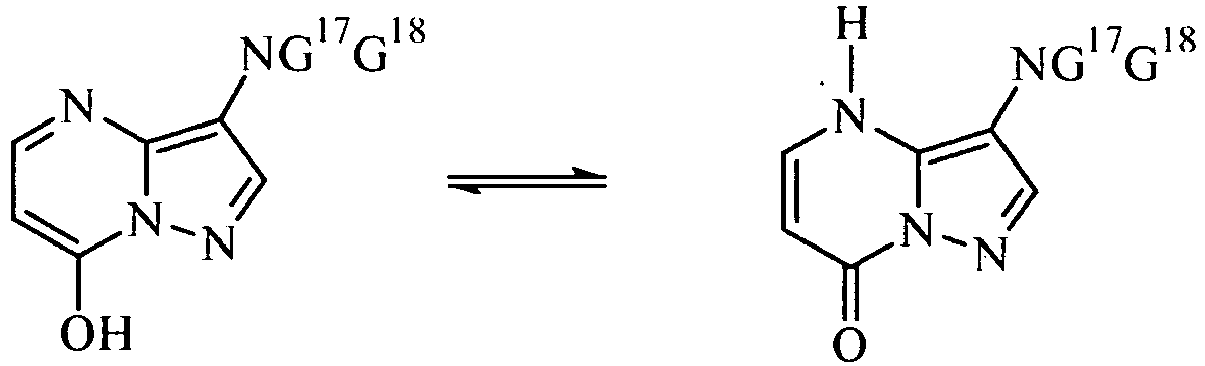
- Unter den Pyrazolo[1,5-a]pyrimidinen der obenstehenden Formel (E4) kann man insbesondere nennen:
- Pyrazolo[1,5-a]pyrimidin-3,7-diamin;
- 2,5-Dimethylpyrazolo[1,5-a]-pyrimidin-3,7-diamin;
- Pyrazolo[1,5-a]pyrimidin-3,5-diamin;
- 2,7-Dimethyl-pyrazolo[1,5-a]pyrimidin-3,5-diamin;
- 3-Aminopyrazolo[1,5-a]pyrimidin-7-ol;
- 3-Aminopyrazolo[1,5-a]pyrimidin-5-ol;
- 2-(3-Aminopyrazolo[1,5-a]pyrimidin-7-ylamino)-ethanol;
- 2-(7-Aminopyrazolo[1,5-a]pyrimidin-3-ylamino)-ethanol;
- 2-[(3-Aminopyrazolo[1,5-a]pyrimidin-7-yl)-(2-hydroxy-ethyl)-amino]-ethanol;
- 2-[(7-Aminopyrazolo[1,5-a]pyrimidin-3-yl)-(2-hydroxy-ethyl)-amino]-ethanol;
- 5,6-Dimethylpyrazolo[1,5-a]pyrimidin-3,7-diamin;
- 2,6-Dimethylpyrazolo[1,5-a]pyrimidin-3,7-diamin;
- 3-Amino-7-dimethylamino-2,5-dimethylpyrazolo[1,5-a]pyrimidin;
- Die Pyrazolo[1,5-a]pyrimidine der obenstehenden Formel (E4) können wie in der Literatur beschrieben durch Zyklisierung ausgehend von einem Aminopyrazol oder von Hydrazin hergestellt werden.
- In einer weiteren bevorzugten Ausführungsform wurden die zu entfärbenden Substrate mit einem oxidativen Färbemittel gefärbt, welches neben mindestens einer Entwicklerkomponente zusätzlich mindestens eine Kupplerkomponente enthält.
- Als Kupplerkomponenten werden in der Regel m-Phenylendiaminderivate, Naphthole, Resorcin und Resorcinderivate, Pyrazolone und m-Aminophenolderivate verwendet. Als Kupplersubstanzen eignen sich insbesondere 1-Naphthol, 1,5-, 2,7- und 1,7-Dihydroxynaphthalin, 5-Amino-2-methylphenol, m-Aminophenol, Resorcin, Resorcinmonomethylether, m-Phenylendiamin, 1-Phenyl-3-methyl-pyrazolon-5, 2,4-Dichlor-3-aminophenol, 1,3-Bis-(2',4'-diaminophenoxy)-propan, 2-Chlor-resorcin, 4-Chlor-resorcin, 2-Chlor-6-methyl-3-aminophenol, 2-Amino-3-hydroxypyridin, 2-Methylresorcin, 5-Methylresorcin und 2-Methyl-4-chlor-5-aminophenol.
- Erfindungsgemäß bevorzugte Kupplerkomponenten sind
- m-Aminophenol und dessen Derivate wie beispielsweise 5-Amino-2-methylphenol, N-Cyclopentyl-3-aminophenol, 3-Amino-2-chlor-6-methylphenol, 2-Hydroxy-4-aminophenoxyethanol, 2,6-Dimethyl-3-aminophenol, 3-Trifluoroacetylamino-2-chlor-6-methylphenol, 5-Amino-4-chlor-2-methylphenol, 5-Amino-4-methoxy-2-methylphenol, 5-(2'-Hydroxyethylramino-2-methylphenol, 3-(Diethylamino)-phenol, N-Cyclopentyl-3-aminophenol, 1,3-Dihydroxy-5-(methylamino)-benzol, 3-Ethylamino-4-methylphenol und 2,4-Dichlor-3-aminophenol,
- o-Aminophenol und dessen Derivate,
- m-Diaminobenzol und dessen Derivate wie beispielsweise 2,4-Diaminophenoxy-ethanol, 1,3-Bis-(2',4'-diaminophenoxy)-propan, 1-Methoxy-2-amino-4-(2'-hydroxyethylamino)benzol, 1,3-Bis-(2',4'-diaminophenylrpropan, 2,6-Bis-(2'-hydroxyethylamino)-1-methylbenzol, 2-({3-[(2-Hydroxyethyl)amino]-4-methoxy-5-methylphenyl}amino)ethanol, 2-({3-[(2-Hydroxyethyl)amino]-2-methoxy-5-methylphenyl}amino)ethanol, 2-[3-Morpholin-4-ylphenyl)amino]ethanol, 3-Amino-4-(2-methoxyethoxy)-5-methylphenylamin und 1-Amino-3-bis-(2'-hydroxyethyl)-aminobenzol,
- o-Diaminobenzol und dessen Derivate wie beispielsweise 3,4-Diaminobenzoesäure und 2,3-Diamino-1-methylbenzol,
- Di- beziehungsweise Trihydroxybenzolderivate wie beispielsweise Resorcin, Resorcinmonomethylether, 2-Methylresorcin, 5-Methylresorcin, 2,5-Dimethylresorcin, 2-Chlorresorcin, 4-Chlorresorcin, Pyrogallol und 1,2,4-Trihydroxybenzol,
- Pyridinderivate wie beispielsweise 2,6-Dihydroxypyridin, 2-Amino-3-hydroxypyridin, 2-Amino-5-chlor-3-hydroxypyridin, 3-Amino-2-methylamino-6-methoxypyridin, 2,6-Dihydroxy-3,4-dimethylpyridin, 2,6-Dihydroxy-4-methylpyridin, 2,6-Diaminopyridin, 2,3-Diamino-6-methoxypyridin und 3,5-Diamino-2,6-dimethoxypyridin,
- Naphthalinderivate wie beispielsweise 1-Naphthol, 2-Methyl-1-naphthol, 2-Hydroxymethyl-1-naphthol, 2-Hydroxyethyl-1-naphthol, 1,5-Dihydroxynaphthalin, 1,6-Dihydroxynaphthalin, 1,7-Dihydroxynaphthalin, 1,8-Dihydroxynaphthalin, 2,7-Dihydroxynaphthalin und 2,3-Dihydroxynaphthalin,
- Morpholinderivate wie beispielsweise 6-Hydroxybenzomorpholin und 6-Aminobenzomorpholin,
- Chinoxalinderivate wie beispielsweise 6-Methyl-1,2,3,4-tetrahydrochinoxalin,
- Pyrazolderivate wie beispielsweise 1-Phenyl-3-methylpyrazol-5-on,
- Indolderivate wie beispielsweise 4-Hydroxyindol, 6-Hydroxyindol und 7-Hydroxyindol,
- Pyrimidinderivate, wie beispielsweise 4,6-Diaminopyrimidin, 4-Amino-2,6-dihydroxypyrimidin, 2,4-Diamino-6-hydroxypyrimidin, 2,4,6-Trihydroxypyrimidin, 2-Amino-4-methylpyrimidin, 2-Amino-4-hydroxy-6-methylpyrimidin und 4,6-Dihydroxy-2-methylpyrimidin, oder
- Methylendioxybenzolderivate wie beispielsweise 1-Hydroxy-3,4-methylendioxybenzol, 1-Amino-3,4-methylendioxybenzol und 1-(2'-Hydroxyethyl)-amino-3,4-methylendioxybenzol
- Erfindungsgemäß besonders bevorzugte Kupplerkomponenten sind ausgewählt aus mindestens einem Vertreter der Gruppe, die gebildet wird aus 1-Naphthol, 1,5-Dihydroxynaphthalin, 2,7-Dihydroxynaphthalin, 1,7-Dihydroxynaphthalin, 3-Aminophenol, 5-Amino-2-methylphenol, 2-Amino-3-hydroxypyridin, Resorcin, 4-Chlorresorcin, 2-Chlor-6-methyl-3-aminophenol, 2-Methylresorcin, 5-Methylresorcin, 2,5-Dimethylresorcin und 2,6-Dihydroxy-3,4-dimethylpyridin.
- Das zu entfärbende Substrat kann ebenso mit direktziehenden Farbstoffen eingefärbt worden sein. Als direktziehende Farbstoffe kommen dabei insbesondere Nitrophenylendiamine, Nitroaminophenole, Azofarbstoffe, Anthrachinone oder Indophenole in Frage. Bevorzugte direktziehende Farbstoffe sind die unter den internationalen Bezeichnungen bzw. Handelsnamen HC Yellow 2, HC Yellow 4, HC Yellow 5, HC Yellow 6, HC Yellow 12, Acid Yellow 1, Acid Yellow 10, Acid Yellow 23, Acid Yellow 36, HC Orange 1, Disperse Orange 3, Acid Orange 7, HC Red 1, HC Red 3, HC Red 10, HC Red 11, HC Red 13, Acid Red 33, Acid Red 52, HC Red BN, Pigment Red 57:1, HC Blue 2, HC Blue 12, Disperse Blue 3, Acid Blue 7, Acid Green 50, HC Violet 1, Disperse Violet 1, Disperse Violet 4, Acid Violet 43, Disperse Black 9, Acid Black 1, und Acid Black 52 bekannten Verbindungen sowie 1,4-Diamino-2-nitrobenzol, 2-Amino-4-nitrophenol, 1,4-Bis-(β-hydroxyethyl)-amino-2-nitrobenzol, 3-Nitro-4-(β-hydroxyethyl)-aminophenol, 2-(2'-Hydroxyethyl)amino-4,6-dinitrophenol, 1-(2'-Hydroxyethyl)amino-4-methyl-2-nitrobenzol, 1-Amino-4-(2'-hydroxyethyl)-amino-5-chlor-2-nitrobenzol, 4-Amino-3-nitrophenol, 1-(2'-Ureidoethyl)amino-4-nitrobenzol, 4-Amino-2-nitrodiphenylamin-2'-carbonsäure, 6-Nitro-1,2,3,4-tetrahydrochinoxalin, 2-Hydroxy-1,4-naphthochinon, Pikraminsäure und deren Salze, 2-Amino-6-chloro-4-nitrophenol, 4-Ethylamino-3-nitrobenzoesäure und 2-Chloro-6-ethylamino-1-hydroxy-4-nitrobenzol.
- Ferner können die zu entfärbenden Substrate bevorzugt mit einem kationischen direktziehenden Farbstoff gefärbt sein. Besonders bevorzugt sind dabei
- (a) kationische Triphenylmethanfarbstoffe, wie beispielsweise Basic Blue 7, Basic Blue 26, Basic Violet 2 und Basic Violet 14,
- (b) aromatischen Systeme, die mit einer quaternären Stickstoffgruppe substituiert sind, wie beispielsweise Basic Yellow 57, Basic Red 76, Basic Blue 99, Basic Brown 16 und Basic Brown 17, sowie
- (c) direktziehende Farbstoffe, die einen Heterocyclus enthalten, der mindestens ein quaternäres Stickstoffatom aufweist, wie sie beispielsweise in der
EP-A2-998 908 - Bevorzugte kationische direktziehende Farbstoffe der Gruppe (c) sind insbesondere die folgenden Verbindungen:
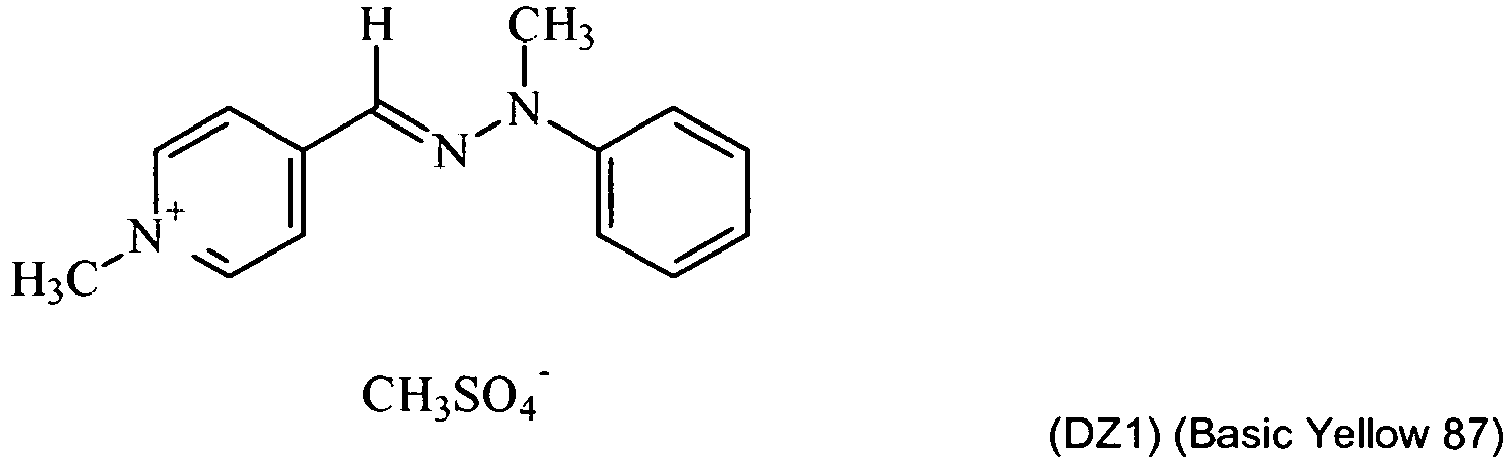
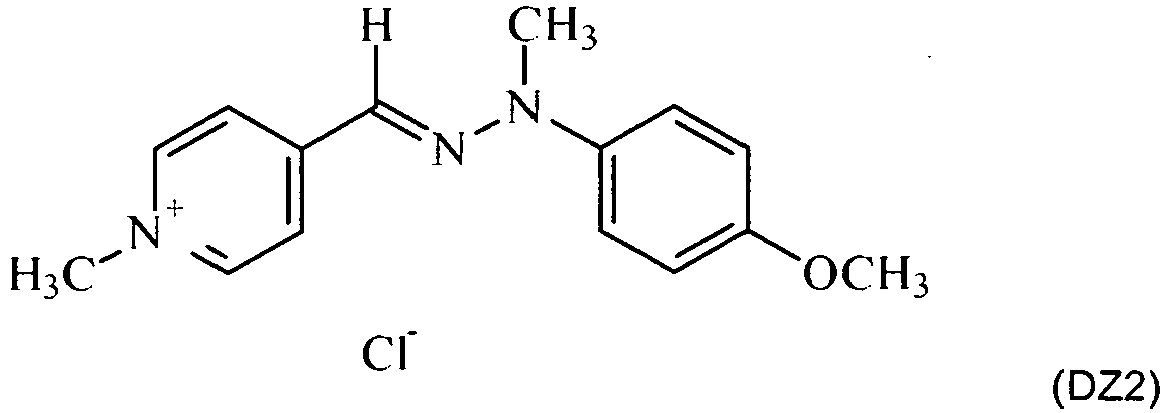


- Die Verbindungen der Formeln (DZ1), (DZ3) und (DZ5) sind ganz besonders bevorzugte kationische direktziehende Farbstoffe der Gruppe (c). Die kationischen direktziehenden Farbstoffe, die unter dem Warenzeichen Arianor® vertrieben werden, sind erfindungsgemäß besonders bevorzugte direktziehende Farbstoffe.
- Weiterhin können die zu entfärbenden Substrate auch mit in der Natur vorkommenden, natürlichen Farbstoffen, wie sie beispielsweise in Henna rot, Henna neutral, Henna schwarz, Kamillenblüte, Sandelholz, schwarzen Tee, Faulbaumrinde, Salbei, Blauholz, Krappwurzel, Catechu, Sedre und Alkannawurzel enthalten sind, gefärbt sein.
- Ein zweiter Gegenstand der Erfindung ist ein Verfahren zur reduktiven Entfärbung von jeweils mit natürlichen und/oder synthetischen Farbstoffen eingefärbter Haut und/oder eingefärbtem Haar, in dem ein Mittel des ersten Erfindungsgegenstandes auf das eingefärbte Substrat aufgetragen wird und nach einer Einwirkzeit wieder abgespült wird. Als eingefärbtes Substrat wird jeweils mit natürlichen und/oder synthetischen Farbstoffen eingefärbte Haut und/oder eingefärbtes Haar definiert.
- Die Einwirkzeit beträgt bevorzugt 1 bis 60 Minuten, bevorzugt 5 bis 30 Minuten. Die Einwirkung des erfindungsgemäßen Mittels kann nicht nur bei Raumtemperatur, sondern bevorzugt in einem Temperaturbereich von 15 bis 60 °C, insbesondere von 25 bis 60 °C erfolgen.
- Nach Ablauf der Einwirkzeit werden die Haut bzw. die Haare ausgespült, wobei bevorzugt ein tensidhaltiges Mittel, wie beispielsweise ein Reinigungsmittel oder ein Shampoo, Anwendung findet. Gegebenenfalls kann die Haut bzw. das Haar mehrfach ausgespült, bzw. mehrfach mit dem tensidhaltigen Mittel behandelt werden.
- Das tensidhaltige Mittel zur Spülung bzw. Nachbehandlung enthält bevorzugt in einem Träger mindestens ein Tensid, ausgewählt aus anionischen, zwitterionischen, ampholytischen, nichtionischen oder kationischen Tensiden, insbesondere aus nichtionischen Tensiden.
- Als anionische Tenside eignen sich in den erfindungsgemäßen tensidhaltigen Mitteln zur Spülung bzw. Nachbehandlung alle für die Verwendung am menschlichen Körper geeigneten anionischen oberflächenaktiven Stoffe. Diese sind gekennzeichnet durch eine wasserlöslich machende, anionische Gruppe wie z. B. eine Carboxylat-, Sulfat-, Sulfonat- oder Phosphat-Gruppe und eine lipophile Alkylgruppe mit etwa 10 bis 22 C-Atomen. Zusätzlich können im Molekül Glykol- oder Polyglykolether-Gruppen, Ester-, Ether- und Amidgruppen sowie Hydroxylgruppen enthalten sein. Beispiele für geeignete anionische Tenside sind, jeweils in Form der Natrium-, Kalium- und Ammonium- sowie der Mono-, Di- und Trialkanolammoniumsalze mit 2 oder 3 C-Atomen in der Alkanolgruppe,
- lineare Fettsäuren mit 10 bis 22 C-Atomen (Seifen),
- Ethercarbonsäuren der Formel R-O-(CH2-CH2O)x -CH2-COOH, in der R eine lineare Alkylgruppe mit 10 bis 22 C-Atomen und x = 0 oder 1 bis 16 ist,
- Acylsarcoside mit 10 bis 18 C-Atomen in der Acylgruppe,
- Acyltauride mit 10 bis 18 C-Atomen in der Acylgruppe,
- Acylisethionate mit 10 bis 18 C-Atomen in der Acylgruppe,
- Sulfobernsteinsäuremono- und -dialkylester mit 8 bis 18 C-Atomen in der Alkylgruppe und Sulfobernsteinsäuremono-alkylpolyoxyethylester mit 8 bis 18 C-Atomen in der Alkylgruppe und 1 bis 6 Oxyethylgruppen,
- lineare Alkansulfonate mit 12 bis 18 C-Atomen,
- lineare Alpha-Olefinsulfonate mit 12 bis 18 C-Atomen,
- Alpha-Sulfofettsäuremethylester von Fettsäuren mit 12 bis 18 C-Atomen,
- Alkylsulfate und Alkylpolyglykolethersulfate der Formel R-O(CH2-CH2O)x-SO3H, in der R eine bevorzugt lineare Alkylgruppe mit 10 bis 18 C-Atomen und x = 0 oder 1 bis 12 ist,
- Gemische oberflächenaktiver Hydroxysulfonate gemäß
DE-A-37 25 030 , - sulfatierte Hydroxyalkylpolyethylen- und/oder Hydroxyalkylenpropylenglykolether gemäß
DE-A-37 23 354 , - Sulfonate ungesättigter Fettsäuren mit 12 bis 24 C-Atomen und 1 bis 6 Doppelbindungen gemäß
DE-A-39 26 344 , - Ester der Weinsäure und Zitronensäure mit Alkoholen, die Anlagerungsprodukte von etwa 2-15 Molekülen Ethylenoxid und/oder Propylenoxid an Fettalkohole mit 8 bis 22 C-Atomen darstellen.
- Bevorzugte anionische Tenside sind Alkylsulfate, Alkylpolyglykolethersulfate und Ethercarbonsäuren mit 10 bis 18 C-Atomen in der Alkylgruppe und bis zu 12 Glykolethergruppen im Molekül sowie insbesondere Salze von gesättigten und insbesondere ungesättigten C8-C22-Carbonsäuren, wie Ölsäure, Stearinsäure, Isostearinsäure und Palmitinsäure.
- Als zwitterionische Tenside werden solche oberflächenaktiven Verbindungen bezeichnet, die im Molekül mindestens eine quartäre Ammoniumgruppe und mindestens eine -COO(-)- oder -SO3 (-)-Gruppe tragen. Besonders geeignete zwitterionische Tenside sind die sogenannten Betaine wie die N-Alkyl-N,N-dimethylammonium-glycinate, beispielsweise das Kokosalkyl-dimethylammoniumglycinat, N-Acyl-aminopropyl-N,N-dimethylammoniumglycinate, beispielsweise das Kokosacylaminopropyl-dimethylammoniumglycinat, und 2-Alkyl-3-carboxymethyl-3-hydroxyethyl-imidazoline mit jeweils 8 bis 18 C-Atomen in der Alkyl- oder Acylgruppe sowie das Kokosacylaminoethylhydroxyethylcarboxymethylglycinat. Ein bevorzugtes zwitterionisches Tensid ist das unter der CTFA-Bezeichnung Cocamidopropyl Betaine bekannte Fettsäureamid-Derivat.
- Unter ampholytischen Tensiden werden solche oberflächenaktiven Verbindungen verstanden, die außer einer C8-18-Alkyl- oder -Acylgruppe im Molekül mindestens eine freie Aminogruppe und mindestens eine -COOH- oder -SO3H-Gruppe enthalten und zur Ausbildung innerer Salze befähigt sind. Beispiele für geeignete ampholytische Tenside sind N-Alkylglycine, N-Alkylpropionsäuren, N-Alkylaminobuttersäuren, N-Alkyliminodipropionsäuren, N-Hydroxyethyl-N-alkylamidopropylglycine, N-Alkyltaurine, N-Alkylsarcosine, 2-Alkylaminopropionsäuren und Alkylaminoessigsäuren mit jeweils etwa 8 bis 18 C-Atomen in der Alkylgruppe. Besonders bevorzugte ampholytische Tenside sind das N-Kokosalkylaminopropionat, das Kokosacylaminoethylaminopropionat und das C12-18-Acylsarcosin.
- Nichtionische Tenside enthalten als hydrophile Gruppe z. B. eine Polyolgruppe, eine Polyalkylenglykolethergruppe oder eine Kombination aus Polyol- und Polyglykolethergruppe. Solche Verbindungen sind beispielsweise
- Anlagerungsprodukte von 2 bis 30 Mol Ethylenoxid und/oder 0 bis 5 Mol Propylenoxid an lineare Fettalkohole mit 8 bis 22 C-Atomen, an Fettsäuren mit 12 bis 22 C-Atomen und an Alkylphenole mit 8 bis 15 C-Atomen in der Alkylgruppe,
- C12-22-Fettsäuremono- und -diester von Anlagerungsprodukten von 1 bis 30 Mol Ethylenoxid an Glycerin,
- C8-22-Alkylmono- und -oligoglycoside und deren ethoxylierte Analoga,
- Anlagerungsprodukte von 5 bis 60 Mol Ethylenoxid an Rizinusöl und gehärtetes Rizinusöl,
- Anlagerungeprodukte von Ethylenoxid an Sorbitanfettsäureester
- Anlagerungsprodukte von Ethylenoxid an Fettsäurealkanolamide.
- Beispiele für die in den erfindungsgemäßen tensidhaltigen Mitteln zur Spülung bzw. Nachbehandlung verwendbaren kationischen Tenside sind insbesondere quartäre Ammoniumverbindungen. Bevorzugt sind Ammoniumhalogenide wie Alkyltrimethylammoniumchloride, Dialkyldimethylammoniumchloride und Trialkylmethylammoniumchloride, z. B. Cetyltrimethylammoniumchlorid, Stearyltrimethylammoniumchlorid, Distearyldimethylammoniumchlorid, Lauryldimethylammoniumchlorid, Lauryldimethylbenzylammoniumchlorid und Tricetylmethylammoniumchlorid. Weitere erfindungsgemäß verwendbare kationische Tenside stellen die quaternisierten Proteinhydrolysate dar.
- Erfindungsgemäß ebenfalls geeignet sind kationische Silikonöle wie beispielsweise die im Handel erhältlichen Produkte Q2-7224 (Hersteller: Dow Corning; ein stabilisiertes Trimethylsilylamodimethicon), Dow Corning 929 Emulsion (enthaltend ein hydroxyl-amino-modifiziertes Silicon, das auch als Amodimethicone bezeichnet wird), SM-2059 (Hersteller: General Electric), SLM-55067 (Hersteller: Wacker) sowie Abil®-Quat 3270 und 3272 (Hersteller: Th. Goldschmidt; diquaternäre Polydimethylsiloxane, Quaternium-80).
- Alkylamidoamine, insbesondere Fettsäureamidoamine wie das unter der Bezeichnung Tego Amid®S 18 erhältliche Stearylamidopropyldimethylamin, zeichnen sich neben einer guten konditionierenden Wirkung speziell durch ihre gute biologische Abbaubarkeit aus.
- Ebenfalls sehr gut biologisch abbaubar sind quaternäre Esterverbindungen, sogenannte "Esterquats", wie die unter dem Warenzeichen Stepantex® vertriebenen Methyl-hydroxyalkyldialkoyloxyalkylammoniummethosulfate.
- Ein Beispiel für ein als kationisches Tensid einsetzbares quaternäres Zuckerderivat stellt das Handelsprodukt Glucquat®100 dar, gemäß CTFA-Nomenklatur ein "Lauryl Methyl Gluceth-10 Hydroxypropyl Dimonium Chloride".
- Bei den als Tenside eingesetzten Verbindungen mit Alkylgruppen kann es sich jeweils um einheitliche Substanzen handeln. Es ist jedoch in der Regel bevorzugt, bei der Herstellung dieser Stoffe von nativen pflanzlichen oder tierischen Rohstoffen auszugehen, so daß man Substanzgemische mit unterschiedlichen, vom jeweiligen Rohstoff abhängigen Alkylkettenlängen erhält.
- Die Tenside werden bevorzugt in Konzentrationen von 0,5 bis 30 Gew.-%, bezogen auf das Gewicht der Zusammensetzung, in dem tensidhaltigen Mittel zur Spülung bzw. Nachbehandlung eingesetzt.
- Zusätzlich besitzt das tensidhaltige Mittel zur Spülung bzw. Nachbehandlung einen pH-Wert von kleiner pH 7. Dieser pH-Wert wird bevorzugt durch den Zusatz eines Puffers während des Spül- bzw. Nachbehandlungsschritts konstant gehalten. Erfindungsgemäß bevorzugt geeignete Puffersysteme sind der Phosphatpuffer (PO4 3- / HPO4 2- / H2PO4 - / H3PO4), Essigsäure/AcetatPuffer, Citronensäure/Citrat-Puffer, KCI / HCI-Puffer, Monophthalat/HCI-Puffer oder Monophthalat/NaOH-Puffer.
- Nach dem Ausspülen kann es vorteilhaft sein, mit einer Oxidationsmittelhaltigen Zusammensetzung nach zu behandeln. Bevorzugt wird Wasserstoffperoxid als Oxidationsmittel, bevorzugt in Konzentrationen von 0,5 bis 6 Gew.-%, eingesetzt. Die Einwirkzeit beträgt bevorzugt 1 bis 30 Minuten, besonders bevorzugt 1 bis 10 Minuten. Nach Ablauf der Einwirkzeit wird die Oxidationsmittelhaltige Zusammensetzug ausgespült.
- Als bevorzugte natürliche oder synthetische Farbstoffe wurden zur Färbung der zu entfärbenden Haut und/oder des zu entfärbenden Haars bevorzugt diejenigen Farbstoffe verwendet, wir sie im zweiten Erfindungsgegenstand definiert wurden.
- Die Erfindung soll exemplarisch anhand der folgenden Ausführungen erläutert werden.
- Für die Beurteilung der Entfärbung wurden Haarsträhnen von ca. 6 cm Länge und 0,5 g Gewicht des Codes Kerling Euronaturhaar weiß mit Farbstoffkombinationen aus
- F1 p-Toluylendiamin / 5-Amino-2-methylphenol
- F2 p-Toluylendiamin / 2,4-Diaminophenoxyethanol
- F3 p-Toluylendiamin / Resorcin
-
Rohstoff Gew.% Fettalkoholgemisch C12-C18 10,5 Texapon NSO 1 20,0 Dehyton K 2 12,5 Eumulgin B2 3 0,75 Natriummetabisulfit 1,0 Ammoniumsulfat 1,0 Entwickler 2,5 mMol Kuppler 2,5 mMol Wasser ad 100 1 Laurylethersulfat, Natriumsalz (ca. 27,5% Aktivsubstanz; INCI-Bezeichnung: Sodium Laureth Sulfate) (Cognis)
2 N,N-Dimethyl-N-(C8-18-kokosamidopropyl)ammoniumaceto-betain (ca. 30% Aktivsubstanz; INCI-Bezeichnung: Aqua (Water), Cocamidopropyl Betaine) (Cognis)
3 Cetylstearylalkohol mit ca. 20 EO-Einheiten (INCI-Bezeichnung: Ceteareth-20) (Cognis) - Die Färbecreme wurde mit Ammoniaklösung (25%ig) auf einen pH-Wert von pH 10 eingestellt.
- Die Ausfärbungen erfolgten nach Abmischung im Gewichtsverhältnis 1:1 mit einer kommerziellen 6%igen Wasserstoffperoxid Entwickler-Zubereitung des Handelsprodukts Poly Color Brillance der Firma Schwarzkopf-Henkel auf Haarsträhnen des oben angegebenen Codes. Das Gewichtsverhältnis Farbstoffmischung : Haar betrug 4:1, die Einwirkzeit betrug 30 Minuten bei einer Temperatur von 32 Grad Celsius. Anschließend wurden die Strähnen gespült, getrocknet und mindestens 24 Stunden unter Raumbedingungen ruhen gelassen. Dann wurden die Strähnen farbmetrisch vermessen (vide infra).
- Als reduktive Entfärbemittel wurden folgende Zusammensetzungen gemäß Tabelle 1 durch Mischen hergestellt. Die Mengen sind, soweit nicht anders gekennzeichnet, Gew.-%.
Tabelle 1: reduktive Entfärbemittel Rohstoffe V E1* E2* E3 E4 E5 E6 E7 E8* E9* Na2S2O4 10,0 10,0 10,0 10,0 10,0 10,0 10,0 10,0 10,0 10,0 Aerosil 2004 - 5,0 - - - - - - - - γ-Aluminiumoxid - - 10,0 - - - - - - 10,0 Luviskol K 17 - - - 10,0 10,0 - - - - - Luviskol K 30 - - - - - 10,0 - - - - Luviskol K 80 - - - - - - 5,0 - - - Luviskol K 90 - - - - - - - 5,0 - - Cucurbit[8]uril - - - - - - - - 10,0 - Ascorbinsäure - - - - 10,0 - - - - 10,0 Phosphorsäure <------ ad pH 1,5 -----> Wasser <----- ad 100 -----> Aerosil® 200 Kieselsäure (INCI-Bezeichnung: Silica) (Degussa)
* nicht erfindungsgemäss - Die Untersuchungen zum Farbabzug wurden in Petrischalen von 9 cm Durchmesser bei Raumtemperatur durchgeführt. Dabei wurden pro zu testendem Entfärbemittel vier Haarsträhnen des gemäß Punkt 1.1 gefärbten Haars im Gewichtsverhältnis Entfärbemittel : Haar von 20:1 über eine Einwirkdauer von insgesamt 30 Minuten mit dem reduktiven Entfärbemittel in je einer Petrischale behandelt.
- Nach Beendigung der Einwirkzeit wurde 1 Minute mit warmem fließendem Stadtwasser gespült, das Haar anschließend 15 Minuten gefönt und unmittelbar danach farbmetrisch vermessen.
- Weitere farbmetrische Messungen erfolgten nach 7 Tagen Lagerung des Haars bei Raumbedingungen.
- Die Strähnen wurden farbmetrisch mit einem Farbmessgerät der Firma Datacolor, Typ Spectraflash 450 vermessen. Die Messgrößen sind die Lab-Werte. Hierbei steht der L-Wert für die Helligkeit (je geringer der L-Wert ist, desto größer ist die Farbintensität), während der a-Wert ein Maß für den Rotanteil einer Farbe ist (d.h. je größer der a-Wert ist, umso größer ist der Rotanteil). Der b-Wert ist ein Maß für den Blauanteil der Farbe, wobei der Blauanteil umso größer ist, je negativer der b-Wert ist. Je Strähne wurden vier Messpunkte vermessen. Abschließend wurden die arithmetischen Mittel der gemessenen Lab-Werte (L*, a*, b*) gebildet. Die Strähnen wurden wie beschrieben nach der Färbung, direkt nach der reduktiven Entfärbung und 7 Tage nach der reduktiven Entfärbung vermessen.
- Als wesentliches Kriterium wurde der Farbabstand dE zwischen den gefärbten und reduktiv entfärbten Strähnen herangezogen. Dieser berechnet sich aus den jeweiligen L*a*b*-Mittelwerten mittels folgender Farbabstandsformel:

- Alle nachfolgend angegebenen Experimentalergebnisse belegen, dass durch Zusatz mindestens eines Adsorptionsmittels die Entfärbung verstärkt wird.
-
V E2 * E3 E4 E8 * dE nach 0 Tagen 64,03 65,77 64,96 65,19 65,70 dE nach 7 Tagen 59,00 63,33 61,50 61,96 61,37 -
V E1 * E2 * E5 E6 E7 E8 * E9 * dE nach 0 Tagen 50,41 54,38 51,01 52,21 51,41 52,72 50,61 52,36 dE nach 7 Tagen 45,87 50,87 48,76 49,01 49,57 48,60 49,62 48,97 * nicht erfindungsgemäss -
V E3 E8 * E9 * dE nach 0 Tagen 7,58 8,81 11,71 10,64 dE nach 7 Tagen 7,90 11,28 8,99 11,21
Claims (11)
- Mittel zum reduktiven Farbabzug, enthaltend in einem kosmetischen Träger mindestens ein Reduktionsmittel und mindestens ein Adsorptionsmittel, dadurch gekennzeichnet, dass das Adsorptionsmittel ausgewählt wird aus Homo- und/oder Copolymeren des Vinylpyrrolidons.
- Mittel nach Anspruch 1, dadurch gekennzeichnet, daß das Reduktionsmittel ein Thionit-Radikal-Abspalter ist.
- Mittel nach einem der Ansprüche 1 oder 2, dadurch gekennzeichnet, daß der Thionit-Radikal-Abspalter ausgewählt wird aus mindestens einem Vertreter aus der Gruppe, die gebildet wird aus Dithionit-Dianion S2O4 2- und organischen Sulfinsäuren bzw. deren physiologisch verträglichen Salzen.
- Mittel nach Anspruch 3, dadurch gekennzeichnet, daß als organische Sulfinsäure mindestens ein Sulfinsäure-Derivat der Formel (I) enthalten ist,
 M steht für ein Wasserstoffatom oder ein Äquivalent eines ein- oder mehrwertigen Kations,R sich ableitet von einem Peptid oder für einen Rest gemäß einer der Formeln (II) bis (VI) steht,in Kombination mit mindestens einer Verbindung, besitzend mindestens ein quartäres Stickstoffatom.
 Y und Y' unabhängig voneinander eine Hydroxygruppe, eine -NH2 Gruppe oder eine Gruppe -NR3R , wobei R3 und R4 unabhängig voneinander für eine (C1 bis C6)-Alkylgruppe, eine (C2 bis C6)-Alkenylgruppe, eine (C1 bis C6)-Hydroxyalkylgruppe, eine (C2 bis C6)-Polyhydroxyalkylgruppe, eine Arylgruppe oder eine Aryl-(C1 bis C6)-alkylgruppe stehen,M' unabhängig von M die unter M aufgeführten Merkmale,X eine direkte Bindung oder einen organischen Rest mit zwei freien Valenzen,R1 und R14 unabhängig voneinander ein Wasserstoffatom, eine (C1 bis C6)-Alkylgruppe oder eine Carboxyalkylgruppe -(CH2)m-COOMII, in der MII für ein Wasserstoffatom oder für ein Äquivalent eines ein- oder mehrwertigen Kations steht und m die Zahl 0, 1 oder 2 bedeutet,R2 ein Wasserstoffatom, eine (C1 bis C6)-Alkylgruppe, einen Carboxyalkylrest -(CH2)n-COOMIII mit
MIII = Wasserstoffatom oder ein Äquivalent eines ein- oder mehrwertigen Kations und n eine ganze Zahl 0, 1, 2, 3, 4, 5 oder 6,
einen (C1 bis C6)-Alkyloxycarbonylrest, eine Sulfonsäuregruppe, eine Carbamoylgruppe, eine N,N-Di[(C1 bis C6)-alkyl]carbamoylgruppe, eine N,N,N-Tri[(C1 bis C6)-alkyl]ammonium-(C1 bis C6)-alkylgruppe eine Carboxy-(C2 bis C6)-alkenylgruppe, eine Cyano-(C1 bis C6)-alkylgruppe oder eine (C1 bis C6)-Alkoxycarbonyl-(C1 bis C6)-alkylgruppe, einen aliphatischen oder aromatischen Heterozyklus, der substituiert sein kann, oder
einen Rest gemäß Formel (IV) oder
R2 zusammen mit R1 und dem Restmolekül einen aliphatischen 5-, 6-, oder 7-gliedrigen Ring bildet, welcher mindestens ein kationisches, quaterniertes Stickstoffatom als Heteroatom enthält, wobei die kationische Ladung gegebenenfalls durch ein Äquivalent eines ein- oder mehrwertigen Anions kompensiert wird,R7 eine Carboxygruppe, eine Sulfonsäuregruppe, eine (C1 bis C6)-Alkoxycarbonylgruppe, eine Sulfonamidgruppe, eine Cyanogruppe, eine Nitrogruppe, eine Carboxy-(C1 bis C6)-alkylgruppe, eine Carboxy-(C1 bis C6)-alkoxygruppe oder eine Gruppe -N+RIRIIRIII,
mit RI, RII und RIII stehen unabhängig voneinander für eine (C1 bis C6)-Alkylgruppe, eine (C2 bis C6)-Alkenylgruppe, eine Aryl(C1 bis C6)-alkylgruppe oder eine (C1 bis C6)-Hydroxyalkylgruppe,R8 und R9 unabhängig voneinander ein Wasserstoffatom, eine (C1 bis C6)-Alkylgruppe, eine (C2 bis C6)-Alkenylgruppe, eine (C1 bis C6)-Hydroxyalkylgruppe, eine (C2 bis C6)-Polyhydroxyalkylgruppe, eine (C1 bis C6)-Alkoxygruppe, eine Hydroxygruppe, eine Aminogruppe, eine Carboxygruppe, eine Nitrogruppe, eine Cyanogruppe oder ein Halogenatom,R10 eine (C1 bis C6)-Alkylgruppe, eine gegebenenfalls substituierte Arylgruppe, eine gegebenenfalls substituierte Heteroarylgruppe, eine Carboxy-(C1 bis C6)-alkylgruppe, eine Carboxy-(C2 bis C6)-alkenylgruppe, eine (C1 bis C6)-Alkoxycarbonylgruppe oder eine (C1 bis C6)-Alkoxycarbonyl-(C1 bis C6)-alkylgruppe,R11, R12 und R13 unabhängig voneinander ein Wasserstoffatom, eine (C1 bis C6)-Alkylgruppe, eine (C2 bis C6)-Alkenylgruppe, eine Perfluor-(C1 bis C6)-alkylgruppe, eine (C3 bis C6)-Cycloalkylgruppe, eine gegebenenfalls substituierte Arylgruppe, eine gegebenenfalls substituierte Heteroarylgruppe, eine (C1 bis C6)-Hydroxyalkylgruppe, eine (C2 bis C6)-Polyhydroxyalkylgruppe, eine Aryl-(C1 bis C6)-alkylgruppe, eine Carboxy-(C1 bis C6)-alkylgruppe, eine Carboxy-(C2 bis C6)-alkenylgruppe oder eine (C1 bis C6)-Alkoxycarbonyl-(C1 bis C6)-alkylgruppe,mit der Maßgabe, dass in Formel (II) R1 und R2 nicht gleichzeitig für ein Wasserstoffatom stehen. - Mittel nach Anspruch 4, dadurch gekennzeichnet, daß gemäß Formel (I) die Reste Y der Formel (II) bzw. der Formel (III) und Y' der Formel (III) unabhängig voneinander eine Hydroxygruppe oder eine Gruppe -NH2 bedeuten.
- Mittel nach einem der Ansprüche 4 oder 5, dadurch gekennzeichnet, daß der Rest R für eine Gruppe der Formel (II) steht.
- Mittel nach einem der Ansprüche 1 bis 6, dadurch gekennzeichnet, daß die Reduktionsmittel in einder Menge von 2 bis 20 Gew.-%, besonders bevorzugt von 5 bis 10 Gew.%, jeweils bezogen auf das Gewicht des Mittels, enthalten sind.
- Mittel nach einem der Ansprüche 1 bis 7, dadurch gekennzeichnet, daß die Adsorptionsmittel in einder Menge von 2 bis 20 Gew.-%, besonders bevorzugt von 5 bis 10 Gew.-%, jeweils bezogen auf das Gewicht des Mittels, enthalten sind.
- Mittel nach einem der Ansprüche 1 bis 8, dadurch gekennzeichnet, daß die Adsorptionsmittel und die Reduktionsmittel in einem Gewichtsverhältnis (Adsorptionsmittel zu Reduktionsmittel) von 1 zu 2 bis 2 zu 1, insbesondere von 1.2 zu 1 bis 1 zu 1.2 enthalten sind.
- Verwendung eines Mittels gemäß einem der Ansprüche 1 bis 9 zur Entfärbung von Haut und/oder Haaren, die mit Oxidationsfarbstoffen und/oder direktziehenden Farbstoffen gefärbt sind.
- Verfahren zur reduktiven Entfärbung von jeweils mit Oxidationsfarbstoffen und/oder direktziehenden Farbstoffen eingefärbter Haut und/oder eingefärbten Haaren, dadurch gekennzeichnet, daß ein Mittel gemäß einem der Ansprüche 1 bis 9 auf das entsprechende eingefärbte Substrat aufgetragen wird und nach einer Einwirkzeit wieder abgespült wird.
Applications Claiming Priority (2)
| Application Number | Priority Date | Filing Date | Title |
|---|---|---|---|
| DE200610053402 DE102006053402A1 (de) | 2006-11-10 | 2006-11-10 | Reduktiver Farbabzug |
| PCT/EP2007/060809 WO2008055756A1 (de) | 2006-11-10 | 2007-10-11 | Reduktiver farbabzug |
Publications (2)
| Publication Number | Publication Date |
|---|---|
| EP2056780A1 EP2056780A1 (de) | 2009-05-13 |
| EP2056780B1 true EP2056780B1 (de) | 2013-08-14 |
Family
ID=39103028
Family Applications (1)
| Application Number | Title | Priority Date | Filing Date |
|---|---|---|---|
| EP07821176.0A Not-in-force EP2056780B1 (de) | 2006-11-10 | 2007-10-11 | Reduktiver farbabzug |
Country Status (3)
| Country | Link |
|---|---|
| EP (1) | EP2056780B1 (de) |
| DE (1) | DE102006053402A1 (de) |
| WO (1) | WO2008055756A1 (de) |
Families Citing this family (22)
| Publication number | Priority date | Publication date | Assignee | Title |
|---|---|---|---|---|
| DE102012201265A1 (de) * | 2012-01-30 | 2013-08-01 | Henkel Ag & Co. Kgaa | Reduktiver Farbabzug |
| DE102014213317A1 (de) | 2014-07-09 | 2016-01-14 | Henkel Ag & Co. Kgaa | Verbesserte Entfärbung von gefärbten keratinischen Fasern |
| DE102014213318A1 (de) | 2014-07-09 | 2016-01-14 | Henkel Ag & Co. Kgaa | Verbesserte Entfärbung von gefärbten keratinischen Fasern |
| DE102014213325A1 (de) | 2014-07-09 | 2016-01-14 | Henkel Ag & Co. Kgaa | Verbesserte Entfärbung von gefärbten keratinischen Fasern |
| DE102014225545A1 (de) * | 2014-12-11 | 2016-06-16 | Henkel Ag & Co. Kgaa | "Verbesserte Entfärbung von gefärbten keratinischen Fasern" |
| DE102015210751A1 (de) * | 2015-06-12 | 2016-12-15 | Henkel Ag & Co. Kgaa | Emulsionen zur verbesserten reduktiven Entfärbung keratinischer Fasern |
| DE102015222216A1 (de) | 2015-11-11 | 2017-05-11 | Henkel Ag & Co. Kgaa | Reduktiver Farbabzug mit Sulfinsäure-Derviaten in Pastenform |
| DE102015222215A1 (de) | 2015-11-11 | 2017-05-11 | Henkel Ag & Co. Kgaa | Verbesserte Entfärbung von gefärbten keratinischen Fasern |
| DE102015222214A1 (de) | 2015-11-11 | 2017-05-11 | Henkel Ag & Co. Kgaa | Verbesserte Entfärbung von gefärbten keratinischen Fasern |
| DE102016209981A1 (de) | 2016-06-07 | 2017-12-07 | Henkel Ag & Co. Kgaa | "Mehrkomponenten-Verpackungseinheit und Verfahren für die reduktive Entfärbung von gefärbten keratinischen Fasern" |
| DE102016209980A1 (de) | 2016-06-07 | 2017-12-07 | Henkel Ag & Co. Kgaa | "Nachbehandlungsmittel für die reduktive Entfärbung von gefärbten keratinischen Fasern" |
| CN106279187B (zh) * | 2016-07-24 | 2018-08-21 | 贵州大学 | 一种大环化合物及其合成方法和应用 |
| DE102016225047A1 (de) | 2016-12-14 | 2018-06-14 | Henkel Ag & Co. Kgaa | "Verfahren zur Entfärbung von gefärbten keratinischen Fasern" |
| DE102016225466A1 (de) | 2016-12-19 | 2018-06-21 | Henkel Ag & Co. Kgaa | Mittel und Verfahren zur temporären Verformung keratinhaltiger Fasern |
| DE102017204289A1 (de) | 2017-03-15 | 2018-09-20 | Henkel Ag & Co. Kgaa | Selbsterhitzende Mittel zum reduktiven Farbabzug von gefärbten keratinischen Fasern |
| DE102017204290A1 (de) | 2017-03-15 | 2018-09-20 | Henkel Ag & Co. Kgaa | Mittel zur Entfärbung von gefärbten keratinischen Fasern |
| DE102017204283A1 (de) | 2017-03-15 | 2018-09-20 | Henkel Ag & Co. Kgaa | "Mittel zum reduktiven Farbabzug von gefärbten keratinischen Fasern" |
| DE102017204282A1 (de) | 2017-03-15 | 2018-09-20 | Henkel Ag & Co. Kgaa | "Selbsterhitzende Mittel zum reduktiven Farbabzug von gefärbten keratinischen Fasern" |
| DE102018221598A1 (de) | 2018-12-13 | 2020-06-18 | Henkel Ag & Co. Kgaa | Mittel zum reduktiven Farbabzug von gefärbten keratinischen Fasern |
| US12458576B2 (en) | 2022-09-29 | 2025-11-04 | L'oreal | Method for removing color from artificially colored hair |
| FR3142353B1 (fr) * | 2022-11-28 | 2026-01-30 | Oreal | Procédé d’élimination de la couleur des cheveux colorés artificiellement |
| DE102023203269A1 (de) | 2023-04-11 | 2024-10-17 | Henkel Ag & Co. Kgaa | Verfahren zur Entfärbung von keratinischem Material, das mit einer siliciumorganischen Verbindung und einem Pigment gefärbt wurde |
Family Cites Families (5)
| Publication number | Priority date | Publication date | Assignee | Title |
|---|---|---|---|---|
| DE1617829B2 (de) * | 1966-06-03 | 1974-06-27 | Hans Schwarzkopf Gmbh, 2000 Hamburg | Verstärkungsmittel für das Blondieren von lebenden Haaren mit Wasserstoffsuperoxyd |
| US3892845A (en) * | 1972-09-29 | 1975-07-01 | Avon Prod Inc | Hair shade adjuster |
| DE19743759A1 (de) * | 1997-10-02 | 1999-04-08 | Brueggemann L Kg | Sulfinsäurederivate und deren Herstellung und Verwendung |
| FR2814948B1 (fr) * | 2000-10-11 | 2003-01-10 | Oreal | Composition cosmetique contenant des derives d'acide sulfinique |
| US20050169862A1 (en) * | 2004-01-29 | 2005-08-04 | De La Mettrie Roland | Composition and method for the treatment of keratin fibers |
-
2006
- 2006-11-10 DE DE200610053402 patent/DE102006053402A1/de not_active Withdrawn
-
2007
- 2007-10-11 EP EP07821176.0A patent/EP2056780B1/de not_active Not-in-force
- 2007-10-11 WO PCT/EP2007/060809 patent/WO2008055756A1/de not_active Ceased
Also Published As
| Publication number | Publication date |
|---|---|
| DE102006053402A1 (de) | 2008-05-15 |
| WO2008055756A1 (de) | 2008-05-15 |
| EP2056780A1 (de) | 2009-05-13 |
Similar Documents
| Publication | Publication Date | Title |
|---|---|---|
| EP2056780A1 (de) | Reduktiver farbabzug | |
| EP2152226A2 (de) | Oxidationsfärbemittel zur färbung keratinhaltiger fasern mit luftsauerstoff als einzigem oxidationsmittel | |
| EP2143414A2 (de) | Oxidationsfärbemittel mit basischer Aminosäure, Ammoniumsulfat und Alkanolaminen | |
| WO2001047475A2 (de) | Mittel zum färben von keratinhaltigen fasern | |
| EP1244421A1 (de) | Farbstoffkombination auf basis von einem 5,5-diaminopyrazolderivat und einem halogeniertem m-aminophenol | |
| DE10051034A1 (de) | Oxidationsmittel enthaltend 2-Chlor-4-aminophenol | |
| EP1996145A2 (de) | Reduktiver farbabzug | |
| EP2283899B1 (de) | Reduktiver farbabzug | |
| DE20017642U1 (de) | Oxidationsfärbemittel mit 2-Chlor-4-aminophenol | |
| EP2037871B1 (de) | Oxidationsfärbemittel zur färbung keratinhaltiger fasern mit luftsauerstoff als einzigem oxidationsmittel | |
| WO2006087019A1 (de) | Mittel zum färben von keratinhaltigen fasern | |
| DE102006022274A1 (de) | Reduktiver Farbabzug | |
| DE102006053343A1 (de) | Verfahren für den reduktiven Farbabzug | |
| EP2001558A2 (de) | Reduktiver farbabzug | |
| DE102007056934A1 (de) | Oxidationsfärbemittel zur Färbung keratinhaltiger Fasern mit Luftsauerstoff als einzigem Oxidationsmittel | |
| EP2001559A2 (de) | Reduktiver farbabzug | |
| EP1762220A2 (de) | Mittel zur Färbung keratinischer Fasern enthaltend Polymere mit kleiner Molmasse | |
| EP2277598B1 (de) | Reduktiver Farbabzug | |
| DE102006023116A1 (de) | Organische Sulfinsäurederivate | |
| DE102006022228A1 (de) | Reduktiver Farbabzug | |
| DE102006022214A1 (de) | Reduktiver Farbabzug | |
| EP1962789B1 (de) | Volumengebendes haarbehandlungsmittel | |
| DE10048733A1 (de) | Oxidationsfärbemittel mit 2-Amino-5-methylphenol | |
| DE102006022225A1 (de) | Reduktiver Farbabzug | |
| DE20016994U1 (de) | Oxidationsfärbemittel mit 2-Amino-5-methylphenol |
Legal Events
| Date | Code | Title | Description |
|---|---|---|---|
| PUAI | Public reference made under article 153(3) epc to a published international application that has entered the european phase |
Free format text: ORIGINAL CODE: 0009012 |
|
| 17P | Request for examination filed |
Effective date: 20090327 |
|
| AK | Designated contracting states |
Kind code of ref document: A1 Designated state(s): AT BE BG CH CY CZ DE DK EE ES FI FR GB GR HU IE IS IT LI LT LU LV MC MT NL PL PT RO SE SI SK TR |
|
| AX | Request for extension of the european patent |
Extension state: AL BA HR MK RS |
|
| 17Q | First examination report despatched |
Effective date: 20090724 |
|
| RIN1 | Information on inventor provided before grant (corrected) |
Inventor name: GROSS, WIBKE Inventor name: HOEFFKES, HORST Inventor name: MUELLER, BURKHARD Inventor name: MUCHA, THOMAS Inventor name: KNUEBEL, GEORG |
|
| DAX | Request for extension of the european patent (deleted) | ||
| GRAP | Despatch of communication of intention to grant a patent |
Free format text: ORIGINAL CODE: EPIDOSNIGR1 |
|
| GRAS | Grant fee paid |
Free format text: ORIGINAL CODE: EPIDOSNIGR3 |
|
| GRAA | (expected) grant |
Free format text: ORIGINAL CODE: 0009210 |
|
| AK | Designated contracting states |
Kind code of ref document: B1 Designated state(s): AT BE BG CH CY CZ DE DK EE ES FI FR GB GR HU IE IS IT LI LT LU LV MC MT NL PL PT RO SE SI SK TR |
|
| REG | Reference to a national code |
Ref country code: GB Ref legal event code: FG4D Free format text: NOT ENGLISH |
|
| REG | Reference to a national code |
Ref country code: AT Ref legal event code: REF Ref document number: 626351 Country of ref document: AT Kind code of ref document: T Effective date: 20130815 Ref country code: CH Ref legal event code: EP |
|
| REG | Reference to a national code |
Ref country code: IE Ref legal event code: FG4D Free format text: LANGUAGE OF EP DOCUMENT: GERMAN |
|
| REG | Reference to a national code |
Ref country code: DE Ref legal event code: R096 Ref document number: 502007012166 Country of ref document: DE Effective date: 20131010 |
|
| REG | Reference to a national code |
Ref country code: NL Ref legal event code: VDEP Effective date: 20130814 |
|
| REG | Reference to a national code |
Ref country code: LT Ref legal event code: MG4D |
|
| PG25 | Lapsed in a contracting state [announced via postgrant information from national office to epo] |
Ref country code: LT Free format text: LAPSE BECAUSE OF FAILURE TO SUBMIT A TRANSLATION OF THE DESCRIPTION OR TO PAY THE FEE WITHIN THE PRESCRIBED TIME-LIMIT Effective date: 20130814 Ref country code: PT Free format text: LAPSE BECAUSE OF FAILURE TO SUBMIT A TRANSLATION OF THE DESCRIPTION OR TO PAY THE FEE WITHIN THE PRESCRIBED TIME-LIMIT Effective date: 20131216 Ref country code: CY Free format text: LAPSE BECAUSE OF FAILURE TO SUBMIT A TRANSLATION OF THE DESCRIPTION OR TO PAY THE FEE WITHIN THE PRESCRIBED TIME-LIMIT Effective date: 20130731 Ref country code: IS Free format text: LAPSE BECAUSE OF FAILURE TO SUBMIT A TRANSLATION OF THE DESCRIPTION OR TO PAY THE FEE WITHIN THE PRESCRIBED TIME-LIMIT Effective date: 20131214 Ref country code: SE Free format text: LAPSE BECAUSE OF FAILURE TO SUBMIT A TRANSLATION OF THE DESCRIPTION OR TO PAY THE FEE WITHIN THE PRESCRIBED TIME-LIMIT Effective date: 20130814 |
|
| PG25 | Lapsed in a contracting state [announced via postgrant information from national office to epo] |
Ref country code: PL Free format text: LAPSE BECAUSE OF FAILURE TO SUBMIT A TRANSLATION OF THE DESCRIPTION OR TO PAY THE FEE WITHIN THE PRESCRIBED TIME-LIMIT Effective date: 20130814 Ref country code: FI Free format text: LAPSE BECAUSE OF FAILURE TO SUBMIT A TRANSLATION OF THE DESCRIPTION OR TO PAY THE FEE WITHIN THE PRESCRIBED TIME-LIMIT Effective date: 20130814 Ref country code: GR Free format text: LAPSE BECAUSE OF FAILURE TO SUBMIT A TRANSLATION OF THE DESCRIPTION OR TO PAY THE FEE WITHIN THE PRESCRIBED TIME-LIMIT Effective date: 20131115 Ref country code: LV Free format text: LAPSE BECAUSE OF FAILURE TO SUBMIT A TRANSLATION OF THE DESCRIPTION OR TO PAY THE FEE WITHIN THE PRESCRIBED TIME-LIMIT Effective date: 20130814 Ref country code: SI Free format text: LAPSE BECAUSE OF FAILURE TO SUBMIT A TRANSLATION OF THE DESCRIPTION OR TO PAY THE FEE WITHIN THE PRESCRIBED TIME-LIMIT Effective date: 20130814 |
|
| PG25 | Lapsed in a contracting state [announced via postgrant information from national office to epo] |
Ref country code: CY Free format text: LAPSE BECAUSE OF FAILURE TO SUBMIT A TRANSLATION OF THE DESCRIPTION OR TO PAY THE FEE WITHIN THE PRESCRIBED TIME-LIMIT Effective date: 20130814 |
|
| BERE | Be: lapsed |
Owner name: HENKEL A.G. & CO. KGAA Effective date: 20131031 |
|
| PG25 | Lapsed in a contracting state [announced via postgrant information from national office to epo] |
Ref country code: NL Free format text: LAPSE BECAUSE OF FAILURE TO SUBMIT A TRANSLATION OF THE DESCRIPTION OR TO PAY THE FEE WITHIN THE PRESCRIBED TIME-LIMIT Effective date: 20130814 Ref country code: SK Free format text: LAPSE BECAUSE OF FAILURE TO SUBMIT A TRANSLATION OF THE DESCRIPTION OR TO PAY THE FEE WITHIN THE PRESCRIBED TIME-LIMIT Effective date: 20130814 Ref country code: CZ Free format text: LAPSE BECAUSE OF FAILURE TO SUBMIT A TRANSLATION OF THE DESCRIPTION OR TO PAY THE FEE WITHIN THE PRESCRIBED TIME-LIMIT Effective date: 20130814 Ref country code: EE Free format text: LAPSE BECAUSE OF FAILURE TO SUBMIT A TRANSLATION OF THE DESCRIPTION OR TO PAY THE FEE WITHIN THE PRESCRIBED TIME-LIMIT Effective date: 20130814 Ref country code: DK Free format text: LAPSE BECAUSE OF FAILURE TO SUBMIT A TRANSLATION OF THE DESCRIPTION OR TO PAY THE FEE WITHIN THE PRESCRIBED TIME-LIMIT Effective date: 20130814 Ref country code: RO Free format text: LAPSE BECAUSE OF FAILURE TO SUBMIT A TRANSLATION OF THE DESCRIPTION OR TO PAY THE FEE WITHIN THE PRESCRIBED TIME-LIMIT Effective date: 20130814 |
|
| PG25 | Lapsed in a contracting state [announced via postgrant information from national office to epo] |
Ref country code: MC Free format text: LAPSE BECAUSE OF FAILURE TO SUBMIT A TRANSLATION OF THE DESCRIPTION OR TO PAY THE FEE WITHIN THE PRESCRIBED TIME-LIMIT Effective date: 20130814 Ref country code: IT Free format text: LAPSE BECAUSE OF FAILURE TO SUBMIT A TRANSLATION OF THE DESCRIPTION OR TO PAY THE FEE WITHIN THE PRESCRIBED TIME-LIMIT Effective date: 20130814 Ref country code: ES Free format text: LAPSE BECAUSE OF FAILURE TO SUBMIT A TRANSLATION OF THE DESCRIPTION OR TO PAY THE FEE WITHIN THE PRESCRIBED TIME-LIMIT Effective date: 20130814 |
|
| PLBE | No opposition filed within time limit |
Free format text: ORIGINAL CODE: 0009261 |
|
| STAA | Information on the status of an ep patent application or granted ep patent |
Free format text: STATUS: NO OPPOSITION FILED WITHIN TIME LIMIT |
|
| 26N | No opposition filed |
Effective date: 20140515 |
|
| REG | Reference to a national code |
Ref country code: IE Ref legal event code: MM4A |
|
| REG | Reference to a national code |
Ref country code: DE Ref legal event code: R084 Ref document number: 502007012166 Country of ref document: DE Effective date: 20140705 |
|
| REG | Reference to a national code |
Ref country code: DE Ref legal event code: R097 Ref document number: 502007012166 Country of ref document: DE Effective date: 20140515 |
|
| PG25 | Lapsed in a contracting state [announced via postgrant information from national office to epo] |
Ref country code: BE Free format text: LAPSE BECAUSE OF NON-PAYMENT OF DUE FEES Effective date: 20131031 |
|
| PG25 | Lapsed in a contracting state [announced via postgrant information from national office to epo] |
Ref country code: IE Free format text: LAPSE BECAUSE OF NON-PAYMENT OF DUE FEES Effective date: 20131011 |
|
| PG25 | Lapsed in a contracting state [announced via postgrant information from national office to epo] |
Ref country code: TR Free format text: LAPSE BECAUSE OF FAILURE TO SUBMIT A TRANSLATION OF THE DESCRIPTION OR TO PAY THE FEE WITHIN THE PRESCRIBED TIME-LIMIT Effective date: 20130814 |
|
| PG25 | Lapsed in a contracting state [announced via postgrant information from national office to epo] |
Ref country code: LU Free format text: LAPSE BECAUSE OF NON-PAYMENT OF DUE FEES Effective date: 20131011 Ref country code: BG Free format text: LAPSE BECAUSE OF FAILURE TO SUBMIT A TRANSLATION OF THE DESCRIPTION OR TO PAY THE FEE WITHIN THE PRESCRIBED TIME-LIMIT Effective date: 20130814 Ref country code: HU Free format text: LAPSE BECAUSE OF FAILURE TO SUBMIT A TRANSLATION OF THE DESCRIPTION OR TO PAY THE FEE WITHIN THE PRESCRIBED TIME-LIMIT; INVALID AB INITIO Effective date: 20071011 |
|
| PG25 | Lapsed in a contracting state [announced via postgrant information from national office to epo] |
Ref country code: MT Free format text: LAPSE BECAUSE OF FAILURE TO SUBMIT A TRANSLATION OF THE DESCRIPTION OR TO PAY THE FEE WITHIN THE PRESCRIBED TIME-LIMIT Effective date: 20130814 |
|
| REG | Reference to a national code |
Ref country code: FR Ref legal event code: PLFP Year of fee payment: 9 |
|
| PGFP | Annual fee paid to national office [announced via postgrant information from national office to epo] |
Ref country code: DE Payment date: 20151022 Year of fee payment: 9 Ref country code: GB Payment date: 20151021 Year of fee payment: 9 Ref country code: CH Payment date: 20151021 Year of fee payment: 9 |
|
| PGFP | Annual fee paid to national office [announced via postgrant information from national office to epo] |
Ref country code: FR Payment date: 20151023 Year of fee payment: 9 Ref country code: AT Payment date: 20151022 Year of fee payment: 9 |
|
| REG | Reference to a national code |
Ref country code: DE Ref legal event code: R119 Ref document number: 502007012166 Country of ref document: DE |
|
| REG | Reference to a national code |
Ref country code: CH Ref legal event code: PL |
|
| REG | Reference to a national code |
Ref country code: AT Ref legal event code: MM01 Ref document number: 626351 Country of ref document: AT Kind code of ref document: T Effective date: 20161011 |
|
| GBPC | Gb: european patent ceased through non-payment of renewal fee |
Effective date: 20161011 |
|
| REG | Reference to a national code |
Ref country code: FR Ref legal event code: ST Effective date: 20170630 |
|
| PG25 | Lapsed in a contracting state [announced via postgrant information from national office to epo] |
Ref country code: GB Free format text: LAPSE BECAUSE OF NON-PAYMENT OF DUE FEES Effective date: 20161011 Ref country code: DE Free format text: LAPSE BECAUSE OF NON-PAYMENT OF DUE FEES Effective date: 20170503 Ref country code: LI Free format text: LAPSE BECAUSE OF NON-PAYMENT OF DUE FEES Effective date: 20161031 Ref country code: CH Free format text: LAPSE BECAUSE OF NON-PAYMENT OF DUE FEES Effective date: 20161031 Ref country code: FR Free format text: LAPSE BECAUSE OF NON-PAYMENT OF DUE FEES Effective date: 20161102 |
|
| PG25 | Lapsed in a contracting state [announced via postgrant information from national office to epo] |
Ref country code: AT Free format text: LAPSE BECAUSE OF NON-PAYMENT OF DUE FEES Effective date: 20161011 |