EP2045640B1 - Laser scanning apparatus and laser scanning microscope - Google Patents
Laser scanning apparatus and laser scanning microscope Download PDFInfo
- Publication number
- EP2045640B1 EP2045640B1 EP07790182A EP07790182A EP2045640B1 EP 2045640 B1 EP2045640 B1 EP 2045640B1 EP 07790182 A EP07790182 A EP 07790182A EP 07790182 A EP07790182 A EP 07790182A EP 2045640 B1 EP2045640 B1 EP 2045640B1
- Authority
- EP
- European Patent Office
- Prior art keywords
- scanning
- laser
- light
- line
- laser scanning
- Prior art date
- Legal status (The legal status is an assumption and is not a legal conclusion. Google has not performed a legal analysis and makes no representation as to the accuracy of the status listed.)
- Revoked
Links
Images



Classifications
-
- G—PHYSICS
- G02—OPTICS
- G02B—OPTICAL ELEMENTS, SYSTEMS OR APPARATUS
- G02B21/00—Microscopes
- G02B21/0004—Microscopes specially adapted for specific applications
- G02B21/002—Scanning microscopes
-
- G—PHYSICS
- G02—OPTICS
- G02B—OPTICAL ELEMENTS, SYSTEMS OR APPARATUS
- G02B21/00—Microscopes
- G02B21/0004—Microscopes specially adapted for specific applications
- G02B21/002—Scanning microscopes
- G02B21/0024—Confocal scanning microscopes (CSOMs) or confocal "macroscopes"; Accessories which are not restricted to use with CSOMs, e.g. sample holders
- G02B21/0036—Scanning details, e.g. scanning stages
-
- G—PHYSICS
- G02—OPTICS
- G02B—OPTICAL ELEMENTS, SYSTEMS OR APPARATUS
- G02B26/00—Optical devices or arrangements for the control of light using movable or deformable optical elements
- G02B26/08—Optical devices or arrangements for the control of light using movable or deformable optical elements for controlling the direction of light
- G02B26/10—Scanning systems
- G02B26/101—Scanning systems with both horizontal and vertical deflecting means, e.g. raster or XY scanners
-
- G—PHYSICS
- G02—OPTICS
- G02B—OPTICAL ELEMENTS, SYSTEMS OR APPARATUS
- G02B26/00—Optical devices or arrangements for the control of light using movable or deformable optical elements
- G02B26/08—Optical devices or arrangements for the control of light using movable or deformable optical elements for controlling the direction of light
- G02B26/10—Scanning systems
- G02B26/105—Scanning systems with one or more pivoting mirrors or galvano-mirrors
-
- G—PHYSICS
- G02—OPTICS
- G02B—OPTICAL ELEMENTS, SYSTEMS OR APPARATUS
- G02B27/00—Optical systems or apparatus not provided for by any of the groups G02B1/00 - G02B26/00, G02B30/00
- G02B27/0025—Optical systems or apparatus not provided for by any of the groups G02B1/00 - G02B26/00, G02B30/00 for optical correction, e.g. distorsion, aberration
- G02B27/0031—Optical systems or apparatus not provided for by any of the groups G02B1/00 - G02B26/00, G02B30/00 for optical correction, e.g. distorsion, aberration for scanning purposes
Definitions
- the present invention relates to a laser scanning apparatus and a laser scanning microscope.
- a general laser scanning microscope is provided with a galvanometer mirror which scans in an X direction with laser light over a sample plane and a galvanometer mirror which scans in a Y direction with laser light over the sample plane. If these two galvanometer mirrors are cooperatively controlled, it is also possible to conduct an observation (hereinafter, refer to as “free line observation”) in which a scanning trajectory of laser light (hereinafter, refer to as “scanning line”) is expressed by a free-form curve. For instance, if the free line observation is conducted with the scanning line so as to trace a cord-shaped axial filament of a nerve cell, it is also possible to capture a high-speed change generated in the axial filament.
- Patent application US 2006/22804 relates to a process for the observation of sample region with a light raster microscope by a relative movement between the illumination light and the sample via first scanning means along a scanning axis essentially perpendicular to the illumination axis. Several illuminated sample points lie on a line and are detected simultaneously with a spatially resolving detector. Second scanning means are moved and an image acquisition takes place by the movement of the first and second scanning means being coupled.
- a three-dimensional sampling movement is done by the illumination of the sample wherein the second scanning means are coupled to the movement of the first scanning means in such a manner that straight and/or curved lines and/or plane and/or curved surfaces are scanned, which are extended along at least one scanning direction of the first scanning means as well as along the scanning direction of the second scanning means.
- a proposition of the present invention is to provide a laser scanning apparatus and a laser scanning microscope capable of securely conducting a condition setting at the time of laser scanning while suppressing a damage on a plane to be irradiated.
- a laser scanning apparatus and a laser scanning microscope capable of securely conducting a condition setting at the time of laser scanning while suppressing a damage on a plane to be irradiated are realized.
- the present embodiment is an embodiment of a confocal fluorescence laser scanning microscope system.
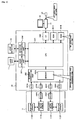
- Fig. 1 is an entire structural view of the present system. As shown in Fig. 1 , the present system includes a microscope body 100, a controller 20, a computer 21, a monitor 22 and an input device 23 such as a mouse and a keyboard.
- a microscope body 100 As shown in Fig. 1 , the present system includes a microscope body 100, a controller 20, a computer 21, a monitor 22 and an input device 23 such as a mouse and a keyboard.
- a laser unit 1 an optical fiber 7, a collimating lens 8, a dichroic mirror 9, a galvanometer scanner 11, a relay lens 14, an objective lens 15, a sample 16, a collecting lens 17, a pinhole diaphragm for confocal detection 18, a light detector 19 and the like are disposed.
- the sample 16 is, for example, a fluorescent sample supported on a not-shown stage, and the galvanometer scanner 11 is provided with two galvanometer mirrors (later-described galvanometer mirrors 111X and 111Y) disposed in serial relationship.
- Laser light emitted from the laser unit 1 is incident on one end of the optical fiber 7, then propagates inside the optical fiber 7, emitted from the other end of the optical fiber 7, and after being turned into parallel pencil of light by the collimating lens 8, it is incident on the dichroic mirror 9.
- the laser light passes through the dichroic mirror 9, and after being sequentially reflected by the two galvanometer mirrors of the galvanometer scanner 11, it passes through the relay lens 14 and the objective lens 15 and is condensed to one point on the sample 16. If the galvanometer scanner 11 is driven under this state, the laser light scans over the sample 16.
- a fluorescence generated at the light condensed position of the laser light on the sample 16 advances in the opposite direction along the same light path as that of the laser light, toward the dichroic mirror 9.
- the fluorescence is reflected by the dichroic mirror 9, condensed by the collecting lens 17 and passed through the pinhole diaphragm 18 to thereby remove extra light rays therefrom, and thereafter, it is incident on the light detector 19 and converted into a fluorescence signal.
- the controller 20 of the present system synchronously controls the laser unit 1, the galvanometer scanner 11 and the light detector 19, to thereby repeatedly take the fluorescence signals while scanning over the sample 16 with the laser light.
- the fluorescence signals taken at this time are transmitted to the computer 21 as observation information, and are output to the monitor 22 or stored by the computer 21 if necessary.
- a user conducts an observation of the sample 16 using the observation information.
- Fig. 2 is a structural view of the galvanometer scanner 11 and the controller 20.
- the galvanometer scanner 11 is provided with two galvanometer mirrors 111X and 111Y.
- the galvanometer mirror 111X is driven during when the laser light is projected onto the galvanometer scanner 11, the laser light scans over the sample 16 in a predetermined direction (X direction), and when the galvanometer mirror 111Y is driven during when the laser light is projected onto the galvanometer scanner 11, the laser light scans over the sample 16 in a perpendicular direction to the X direction (Y direction).
- the galvanometer mirror 111X has a driver 204X as its driving circuit coupled thereto, and the galvanometer mirror 111Y has a driver 204Y as its driving circuit coupled thereto. Further, the galvanometer mirror 111X is provided with a position sensor 112X detecting a mirror position thereof, and the galvanometer mirror 111Y is provided with a position sensor 112Y detecting a mirror position thereof.
- the controller 20 includes a scanner controlling part 202 being a control circuit dedicated to the galvanometer scanner 11, a laser controlling part 207 being a control circuit dedicated to the laser unit 1, a detector controlling part 208 being a control circuit dedicated to the light detector 19, a CPU 201 controlling an entire controller 20, an interface circuit 209 performing an interface operation with the computer 21, a ROM 201A storing a program of the CPU 201, and a RAM 201B used for a temporary storage of the CPU 201.
- a scanner controlling part 202 being a control circuit dedicated to the galvanometer scanner 11
- a laser controlling part 207 being a control circuit dedicated to the laser unit 1
- a detector controlling part 208 being a control circuit dedicated to the light detector 19
- a CPU 201 controlling an entire controller 20
- an interface circuit 209 performing an interface operation with the computer 21
- a ROM 201A storing a program of the CPU 201
- a RAM 201B used for a temporary storage of the CPU 201.
- the computer 21 prompts the user to operate the input device 23 to get the user to input scanning conditions.
- the scanning conditions include at least a scanning line and a scanning speed desired by the user, and a laser intensity or the like desired by the user is normally included therein.
- the input scanning conditions are transmitted from the computer 21 to the controller 20.
- the CPU 201 of the controller 20 recognizes the scanning conditions via the interface circuit 209.
- the CPU 201 records, in accordance with the recognized scanning conditions, necessary information in the laser controlling part 207, the detector controlling part 208 and the scanner controlling part 202, thereby setting the laser unit 1, the light detector 19 and the galvanometer scanner 11.
- the CPU 201 in the setting of the galvanometer scanner 11, the CPU 201 generates a waveform of a driving signal to be given to the driver 204X of the galvanometer scanner 11 (hereinafter, refer to as "X-driving waveform”) and a waveform of a driving signal to be given to the driver 204Y of the galvanometer scanner 11 (hereinafter, refer to as "Y-driving waveform”) based on a set line and a set speed included in the scanning conditions, and stores information on those waveforms in a memory 202A of the scanner controlling part 202A.
- X-driving waveform a waveform of a driving signal to be given to the driver 204X of the galvanometer scanner 11
- Y-driving waveform a waveform of a driving signal to be given to the driver 204Y of the galvanometer scanner 11
- the CPU 201 gives indications to the laser controlling part 207, the detector controlling part 208 and the scanner controlling part 202 under the aforementioned set conditions, to thereby synchronously drive the laser unit 1, the light detector 19 and the galvanometer scanner 11.
- the scanner controlling part 202 generates the driving signals in accordance with the information on the X-driving waveforms stored in the memory 202A and sequentially transmits them to the driver 204X via the D/A converter 203X. Further, the scanner controlling part 202 generates the driving signals in accordance with the information on the Y-driving waveforms stored in the memory 202A and sequentially transmits them to the driver 204Y via the D/A converter 203Y. As a result of this, the galvanometer scanner 11 is driven.
- the scanner controlling part 202 samples signals output from the position sensor 112X (hereinafter, refer to as "X-position signals”) and signals output from the position sensor 112Y (hereinafter, refer to as "Y-position signals”) via the A/D converters 205X and 205Y during the driving of the galvanometer scanner 11, and stores them in the memory 202A.
- a sampling rate is sufficiently high, and is equal to or higher than a data sampling signal frequency in the controller 20.
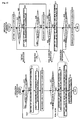
- Fig. 3 illustrates operation flow charts of the controller 20 and the computer 21 at the time of free line observation.
- An operation program (control program) of the controller 20 is previously stored in the ROM 201 A of the controller 20 or the like, and an operation program (management program) of the computer 21 is previously stored in a hard disk of the computer 21 or the like.
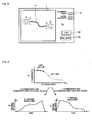
- the computer 21 displays a setting screen as shown in Fig. 4 , for instance, on the monitor 22.
- an image I of an observation area of the sample 16 (within a field of view of the objective lens 15) is displayed.
- This image I is obtained by, for example, a normal observation conducted by the present system.
- the normal observation is for obtaining observation information by setting the laser intensity to low intensity and setting the scanning line to a stripe-shaped one.
- the user draws a scanning line L1 and inputs characters indicating a scanning speed B1, a laser intensity B0 and the like on the setting screen.
- a testing button B2 a real scanning button B3 and the like are arranged, and by selecting these buttons at a desired timing, the user can also input a testing indication and a real scanning indication into the computer 21.
- the computer 21 transmits information on the scanning line L1 and that on the scanning speed B1 which were displayed at that moment to the controller 20 respectively as information on the set line and that on the set speed set by the user, together with the testing indication.
- the CPU 201 of the controller 20 Upon receiving the information on the set line and the set speed and the testing indication, the CPU 201 of the controller 20 performs a setting of the galvanometer scanner 11 in accordance with the information.
- the CPU 201 resolves the set line into a plurality of unit vectors as shown in Fig. 5(a) .
- a size of the unit vector corresponds to an increasing function of the set speed.
- the CPU 201 generates the X-driving waveform ( Fig. 5(b) ) by converting X-components of the resolved set line into voltage values with a predetermined transfer characteristic, and generates the Y-driving waveform ( Fig. 5(c) ) by converting Y-components of the resolved set line into voltage values with a predetermined transfer characteristic.
- the predetermined transfer characteristics are characteristics previously determined by taking response characteristics of the galvanometer mirrors 111X and 111Y into consideration.
- the CPU 201 stores the generated information on the X-driving waveforms and the Y-driving waveforms in the memory 202A of the scanner controlling part 202.
- the CPU 201 of the controller 20 gives indications to the scanner controlling part 202 under the aforementioned setting conditions to thereby drive the galvanometer scanner 11. However, since the CPU 201 does not drive any of the laser unit 1 and the light detector 19 at this time, there is no chance for the laser light to be incident on the sample 16.
- the X-position signals and the Y-position signals output from the galvanometer scanner 11 are sampled by the scanner controlling part 202 and sequentially stored in the memory 202A.
- the stored signals indicate the actual scanning line formed by the galvanometer scanner 11 (a scanning line of laser light when the galvanometer scanner 11 is driven while irradiating the laser light under the same setting condition).
- the actual scanning line measured as above is referred to as "measured line” to distinguish it from the set line.
- Steps S12 and 13 described above correspond to the test.
- the CPU 201 of the controller 20 calculates the measured line by reading the X-position signals and the Y-position signals stored in the memory 202A and converting them into coordinates on the image I, and transmits information on the measured line to the computer 21.
- the computer 21 Upon receiving the information on the measured line, the computer 21 displays a measured line L2 together with the scanning line L1 on the setting screen as shown in Fig. 6 . Through the display, the user can intuitively recognize a deviation between the scanning line L1 input by himself/herself and the measured line L2.
- the measured line L2 is curved more gently than the scanning line L1.
- the user When the user is not satisfied with the measured line L2, the user is allowed to redraw the scanning line L1 to have a gentle curve or change the scanning speed B1 to a low speed side, and then, select the test button B2 again.
- the test button B2 When the test button B2 is selected, the aforementioned test is repeated.
- the computer 21 transmits the information on the scanning line L1, the scanning speed B1 and the laser intensity B0 which were displayed at that moment to the controller 20 as the information on the set line, the set speed and set intensity set by the user, together with the real scanning indication.
- the CPU 201 of the controller 20 Upon receiving the information on the set line, the set speed and the set intensity and the real scanning indication, the CPU 201 of the controller 20 performs settings of the laser unit 1, the galvanometer scanner 11 and the light detector 19 in accordance with these pieces of information. Incidentally, if values of the set line and the set speed are the same as those of the last time, the setting of the galvanometer scanner 11 is omitted.
- the CPU 201 of the controller 20 gives indications to the laser controlling part 207, the detector controlling part 208 and the scanner controlling part 202, to thereby synchronously drive the laser unit 1, the light detector 19 and the galvanometer scanner 11 to obtain observation information.
- the obtainment of the observation information is continuously and repeatedly performed at a plurality of times, for instance.
- the above-described steps S16 and 17 correspond to the real scanning.
- the CPU 201 of the controller 20 transmits the observation information obtained in the real scanning to the computer 21 together with information on scanning conditions at the time of real scanning and the like.
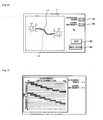
- Fig. 7 is a view in which respective pieces of scanning line information obtained by performing a laser scanning from a start point P1 to an end point P2 of the measured line L2 from time t0 to tn at a plurality of times are arranged lengthwise in time series. According to such a display, it is apparent that a part in which a reaction is detected (black-out part) gradually shifts from P1 to P2 (the above description corresponds to step S29).
- step S12 and 13 only the galvanometer scanner 11 is driven under the scanning conditions designated by the user without irradiating laser light and the actual scanning line (measured line) at that time is measured. Accordingly, in this test, it is possible to obtain information on the measured line while preventing color fading and damage of the sample 16.
- the measured line L2 is displayed on the monitor 22 after the test (refer to Fig. 6 ), so that the user can determine whether the scanning conditions set by himself/herself are good or bad, and can give desired indications such as a change in the scanning conditions and executions of a real scanning and a retest, to the present system.
- the scanning line L1 set by the user is displayed together with the measured line L2 (refer to Fig. 6 ), so that the user can intuitively recognize a deviation between the both lines.
- the present embodiment is an embodiment of a confocal fluorescence laser scanning microscope system.
- the point of difference is that an optimizing function which automatically corrects details of the scanning conditions is mounted.
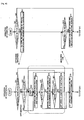
- Fig. 8 and Fig. 9 are added to the operations of the controller 20 and the computer 21 of the present system, and an optimizing button B4 is arranged on the setting screen as shown in Fig. 10 . Further, on the setting screen, a region into which the user inputs a desired optimization margin B5 is also provided.
- the optimization margin refers to a tolerance of deviation between the measured line after the optimization and the set line, and is expressed by, for instance, the number of pixels on the image I, or the like.
- the computer 21 transmits information on the scanning line L1, the scanning speed B1 and the optimization margin B5 which were displayed at that moment to the controller 20 as the information on the set line, the set speed and set margin set by the user, together with an optimizing indication.
- the CPU 201 of the controller 20 determines whether the test (steps S12 and S13 in Fig. 3 ) with the set line and the set speed is already executed or not.
- the CPU 201 of the controller 20 executes a test with the set line and the set speed. This test is conducted in the same manner as in steps S12 and S13.
- step S33 the CPU 201 of the controller 20 skips step S33 and proceeds to step 534.
- the CPU 201 of the controller 20 calculates the measured line by reading the X-position signals and the Y-position signals stored in the memory 202A at that moment and converting them into coordinates on the image I.
- the CPU 201 of the controller 20 subtracts the measured line from the set line set by the user, thereby calculating a difference between the both lines.
- the CPU 201 resolves each of the measured line and the set line into a plurality of unit vectors and then calculates a difference in X-direction and a difference in Y-direction, respectively, by each unit vector.
- a size of the unit vector corresponds to an increasing function of the set speed, and is the same as the one used when generating the driving waveform of the galvanometer scanner 11.
- the CPU 201 of the controller 20 determines whether or not a magnitude of the calculated difference falls within the set margin set by the user.
- the CPU 201 of the controller 20 obtains a correction amount ⁇ V X (t) of the X-driving waveform by converting the difference in X-direction into a voltage value using a predetermined transfer characteristic. Further, the CPU 201 obtains a correction amount ⁇ V Y (t) of the Y-driving waveform by converting the difference in Y-direction into a voltage value using a predetermined transfer characteristic. Note that the predetermined transfer characteristics are the same as those used when generating the driving waveforms of the galvanometer scanner 11.
- the CPU 201 adds the correction amount ⁇ V X (t) to the X-driving waveform stored in the memory 202A at that moment, thereby correcting the X-driving waveform. Further, the CPU 201 adds the correction amount ⁇ V Y (t) to the Y-driving waveform stored in the memory 202A at that moment, thereby correcting the Y-driving waveform.
- the CPU 201 of the controller 20 determines whether or not changed frequencies of the X-driving waveform and the Y-driving waveform after the correction fall within a limiting frequency of the galvanometer scanner 11.
- the limiting frequency is determined based on the set speed set by the user and response characteristics of the galvanometer mirrors 111 X and 111Y, and it becomes small as the set speed becomes faster.
- the set speed is lowered by one stage, and thereafter, the procedure goes back to step S34 and a calculation of difference is performed again.
- step S33 If the changed frequencies of the X-driving waveform and the Y-driving waveform after the correction fall within the limiting frequency, the procedure goes back to step S33, and a retest is conducted using the corrected X-driving waveform and Y-driving waveform.
- the above-described steps S33 through S38 correspond to the optimization.
- step S34 if the magnitude of difference calculated in step S34 falls within the set margin, the CPU 201 of the controller 20 terminates the optimization, and transmits information on the set speed and the measured line after optimization to the computer 21. Note that the calculation method of the measured line is the same as described above.
- the computer 21 Upon receiving the information on the set speed and the measured line after optimization, the computer 21 reflects these pieces of information upon the setting screen as shown in Fig. 11 , for instance.
- Fig. 11 what is indicated by the reference numeral B1' is the set speed after optimization and what is indicated by the reference numeral L2' is the measured line after optimization. Accordingly, the user can recognize a result of the optimization.
- the computer 21 transmits information on the scanning line L1, the scanning speed B1', the laser intensity B0 and the optimization margin B5 which were displayed at that moment to the controller 20 as the information on the set line, the set speed, the set intensity and the set margin set by the user, together with the real scanning indication.
- the CPU 201 of the controller 20 determines whether the optimization with the set line, the set speed and the set margin is already executed or not.
- the CPU 201 of the controller 20 performs settings of the laser unit 1, the light detector 19 and the galvanometer scanner 11 in accordance with the set line, the set speed and the set intensity.
- the CPU 201 of the controller 20 performs settings of only the laser unit 1 and the light detector 19 in accordance with the set line, the set speed and the set intensity, and stores the set contents (driving waveforms) of the galvanometer scanner 11 while keeping them as they were optimized.
- the CPU 201 of the controller 20 gives indications to the laser controlling part 207, the detector controlling part 208 and the scanner controlling part 202, to thereby synchronously drive the laser unit 1, the light detector 19 and the galvanometer scanner 11 to obtain observation information.
- the obtainment of the observation information is continuously and repeatedly performed at a plurality of times, for instance.
- the above-described steps S303, 304 and 305 correspond to the real scanning.
- the CPU 201 of the controller 20 transmits the observation information obtained in the real scanning to the computer 21 together with the scanning conditions at the time of real scanning and the like.
- the computer 21 Upon receiving the observation information, the computer 21 displays the observation information on the monitor 22.
- a display method at this time is the same as that shown in Fig. 7 , for instance (the above description corresponds to step S50).
- step S36 the test and the correction of the driving waveforms are repeatedly conducted until the difference between the measured line and the set line falls within the set margin (until the determination of step S35 becomes YES) (step S36).
- the repetition values of the driving waveforms gradually become close to optimal values.
- the set speed is changed to the low-speed side according to demand, to thereby obtain the optimal values. Therefore, according to the optimization of the present system, details of the scanning conditions are automatically optimized.
- step S34 of the present system the difference between the measured line and the set line is calculated and then the difference is converted into the voltage value, but, it is possible that the measured line and the set line are converted into the voltage values and then the difference between the both is calculated. However, in such a case, it becomes necessary to convert a judgment standard (set margin) in step S35 into the voltage value, and the conversion in step 536 becomes unnecessary.
- step S33 through S38 the test and the correction of the driving waveforms are repeatedly conducted until the difference between the measured line and the set line falls within the set margin (until the determination of step S35 becomes YES), but, they may be repeatedly conducted at previously determined number of times. Further, the number of repetition may be designated by the user.
- the driving waveforms after optimization are automatically adopted when the optimization is already executed, but, it is also possible to get the user to select whether the driving waveforms after optimization are adopted or driving waveforms which are regenerated are adopted, and then to follow a result of the selection.
- controller 20 and the computer 21 of the present system may be operated as follows after the optimization.
- the CPU 201 of the controller 20 transmits information on the driving waveforms after optimization to the computer 21.
- the computer 21 stores the received information on the driving waveforms in accordance with an indication from the user. At this time, the information on the driving waveforms is corresponded to information on the image I of the sample 16. Thereafter, when an indication to recall the driving waveforms is made from the user, the stored information on the driving waveforms is read and transmitted to the controller 20.
- the controller 20 writes the received driving waveforms into the memory 202A to thereby perform a setting of the galvanometer scanner 11. According to such operations, the number of executions of the processing regarding the optimization can be kept to the minimum. Further, the user can use the driving waveforms after optimization by recalling them at a desired timing.
- the present invention is not limited to this and it is possible that the galvanometer scanner 11 is driven under the state where laser having an intensity lower than that of laser light irradiated in the real scanning is irradiated from the laser unit 1. It is possible to suppress the color fading and damage of the sample 16 only by setting an intensity of laser light to one being lower than that of the laser light used when performing a real scanning as described above.
- the aforementioned microscope body 100 is a laser scanning microscope having both the function of fluorescence detection and the function of confocal detection, but, the present invention is also applicable to a laser scanning microscope which does not have either or both of the function of fluorescence detection and the function of confocal detection. Further, the present invention can be also applied to a laser scanning apparatus which does not have the detection function.
Landscapes
- Physics & Mathematics (AREA)
- General Physics & Mathematics (AREA)
- Optics & Photonics (AREA)
- Chemical & Material Sciences (AREA)
- Analytical Chemistry (AREA)
- Microscoopes, Condenser (AREA)
- Laser Beam Processing (AREA)
Applications Claiming Priority (2)
| Application Number | Priority Date | Filing Date | Title |
|---|---|---|---|
| JP2006195241 | 2006-07-18 | ||
| PCT/JP2007/000656 WO2008010311A1 (en) | 2006-07-18 | 2007-06-20 | Laser scanning apparatus and laser scanning microscope |
Publications (3)
| Publication Number | Publication Date |
|---|---|
| EP2045640A1 EP2045640A1 (en) | 2009-04-08 |
| EP2045640A4 EP2045640A4 (en) | 2009-11-11 |
| EP2045640B1 true EP2045640B1 (en) | 2011-01-12 |
Family
ID=38956646
Family Applications (1)
| Application Number | Title | Priority Date | Filing Date |
|---|---|---|---|
| EP07790182A Revoked EP2045640B1 (en) | 2006-07-18 | 2007-06-20 | Laser scanning apparatus and laser scanning microscope |
Country Status (6)
| Country | Link |
|---|---|
| US (1) | US8159744B2 (enExample) |
| EP (1) | EP2045640B1 (enExample) |
| JP (1) | JPWO2008010311A1 (enExample) |
| AT (1) | ATE495476T1 (enExample) |
| DE (1) | DE602007011940D1 (enExample) |
| WO (1) | WO2008010311A1 (enExample) |
Families Citing this family (9)
| Publication number | Priority date | Publication date | Assignee | Title |
|---|---|---|---|---|
| HU0800688D0 (en) * | 2008-11-17 | 2009-01-28 | Femtonics Kft | Multiple free line-scan mode of scanning |
| JP5581707B2 (ja) * | 2010-01-28 | 2014-09-03 | 株式会社ニコン | 制御方法 |
| JP5806450B2 (ja) * | 2010-07-02 | 2015-11-10 | オリンパス株式会社 | 細胞観察方法 |
| JP6157155B2 (ja) * | 2012-03-15 | 2017-07-05 | オリンパス株式会社 | 顕微鏡システム、駆動方法およびプログラム |
| JP2015125177A (ja) * | 2013-12-25 | 2015-07-06 | ソニー株式会社 | 顕微鏡システムおよびその画像データ転送方法 |
| JP6171970B2 (ja) | 2014-02-10 | 2017-08-02 | ソニー株式会社 | レーザ走査型顕微鏡装置および制御方法 |
| JP6161678B2 (ja) * | 2015-11-20 | 2017-07-12 | 株式会社キーエンス | 共焦点顕微鏡システム |
| US10514394B2 (en) * | 2016-02-26 | 2019-12-24 | Tektronix, Inc. | Dynamic output clamping for a probe or accessory |
| US11506877B2 (en) | 2016-11-10 | 2022-11-22 | The Trustees Of Columbia University In The City Of New York | Imaging instrument having objective axis and light sheet or light beam projector axis intersecting at less than 90 degrees |
Family Cites Families (11)
| Publication number | Priority date | Publication date | Assignee | Title |
|---|---|---|---|---|
| JPS6161123A (ja) * | 1984-08-31 | 1986-03-28 | Fuji Photo Film Co Ltd | ガルバノメ−タミラ−駆動装置 |
| US5187364A (en) * | 1989-03-22 | 1993-02-16 | National Research Council Of Canada/Conseil National De Recherches Du Canada | Scanning device with waveform generator optimizer |
| US5084612A (en) * | 1989-10-20 | 1992-01-28 | Fuji Photo Film Co., Ltd. | Imaging method for scanning microscopes, and confocal scanning microscope |
| DE19702752C2 (de) * | 1997-01-27 | 2001-12-13 | Zeiss Carl Jena Gmbh | Ansteuersystem für einen Scannerantrieb |
| JP4555905B2 (ja) * | 1998-01-27 | 2010-10-06 | カール ツアイス マイクロイメージング ゲゼルシャフト ミット ベシュレンクテル ハフツング | スキャナ駆動部のための方向制御システム |
| US6639180B1 (en) * | 1999-07-05 | 2003-10-28 | Siemens Aktiengesellschaft | Method for describing a predetermined desired course with a beam consisting of particles or waves and use of this method |
| US6687035B2 (en) * | 2001-06-07 | 2004-02-03 | Leica Microsystems Heildelberg Gmbh | Method and apparatus for ROI-scan with high temporal resolution |
| US7355702B2 (en) | 2004-06-21 | 2008-04-08 | Olympus Corporation | Confocal observation system |
| JP4700299B2 (ja) * | 2004-07-07 | 2011-06-15 | オリンパス株式会社 | 共焦点走査型顕微鏡 |
| DE102004034956A1 (de) * | 2004-07-16 | 2006-02-02 | Carl Zeiss Jena Gmbh | Verfahren zur Erfassung mindestens eines Probenbereiches mit einem Lichtrastermikroskop mit linienförmiger Abtastung |
| EP1669789B1 (en) * | 2004-12-13 | 2011-07-06 | Olympus Corporation | Laser scanning microscope apparatus |
-
2007
- 2007-06-20 DE DE602007011940T patent/DE602007011940D1/de active Active
- 2007-06-20 EP EP07790182A patent/EP2045640B1/en not_active Revoked
- 2007-06-20 AT AT07790182T patent/ATE495476T1/de not_active IP Right Cessation
- 2007-06-20 JP JP2008525783A patent/JPWO2008010311A1/ja not_active Withdrawn
- 2007-06-20 WO PCT/JP2007/000656 patent/WO2008010311A1/ja not_active Ceased
-
2008
- 2008-12-22 US US12/318,132 patent/US8159744B2/en not_active Expired - Fee Related
Also Published As
| Publication number | Publication date |
|---|---|
| US20090168157A1 (en) | 2009-07-02 |
| JPWO2008010311A1 (ja) | 2009-12-17 |
| ATE495476T1 (de) | 2011-01-15 |
| EP2045640A4 (en) | 2009-11-11 |
| EP2045640A1 (en) | 2009-04-08 |
| WO2008010311A1 (en) | 2008-01-24 |
| DE602007011940D1 (enExample) | 2011-02-24 |
| US8159744B2 (en) | 2012-04-17 |
Similar Documents
| Publication | Publication Date | Title |
|---|---|---|
| EP2045640B1 (en) | Laser scanning apparatus and laser scanning microscope | |
| US9007452B2 (en) | Magnification observation device, magnification observation method, and magnification observation program | |
| JP4078409B2 (ja) | 多数源データ処理方法および多数源データ処理装置 | |
| EP3118665B1 (en) | Microscopy system, refractive-index calculating method, and program | |
| US8013288B2 (en) | Method for correcting a control of an optical scanner and the optical scanner | |
| EP2960758B1 (en) | Input apparatus | |
| JP4896621B2 (ja) | 視野計 | |
| EP2804145A1 (en) | Microscope system and stitched area decision method | |
| JP2000346638A (ja) | 測定手順ファイル生成方法、測定装置および記憶媒体 | |
| EP1681589B1 (en) | Scanning microscope and specimen image obtaining method | |
| US20070122143A1 (en) | Intermittent photo-taking device | |
| US7679045B2 (en) | Method for correcting a control of an optical scanner in a device for imaging a sample by scanning and the device for performing the method | |
| JP5162783B2 (ja) | 走査型顕微鏡法における位置信号および検出信号の位相補正のための方法ならびに装置および走査型顕微鏡 | |
| JP2002098901A (ja) | 走査型レーザ顕微鏡 | |
| US20230368363A1 (en) | Image measurement apparatus | |
| US20030052280A1 (en) | Method for operating a laser scanning confocal microscope system and a system thereof | |
| JPH09197280A (ja) | 走査型光学顕微鏡の走査直線性補正方法 | |
| CN119987004A (zh) | 对焦方法、显微系统和计算机可读存储介质 | |
| EP1972982B1 (en) | Microscope equipped with automatic focusing mechanism and method of adjusting the same | |
| JP4337346B2 (ja) | レーザ走査顕微鏡 | |
| JP2002328305A (ja) | 共焦点走査型レーザ顕微鏡の調整診断方法及びその装置 | |
| JPH11271209A (ja) | 走査型サイトメータ | |
| JP6552039B2 (ja) | 走査型顕微鏡、及び、画素データ生成方法 | |
| JP2004170573A (ja) | カラー共焦点顕微鏡システムとその調整に使用される二次元テストパターン | |
| US5387794A (en) | Detector for diffracted electrons |
Legal Events
| Date | Code | Title | Description |
|---|---|---|---|
| PUAI | Public reference made under article 153(3) epc to a published international application that has entered the european phase |
Free format text: ORIGINAL CODE: 0009012 |
|
| 17P | Request for examination filed |
Effective date: 20090212 |
|
| AK | Designated contracting states |
Kind code of ref document: A1 Designated state(s): AT BE BG CH CY CZ DE DK EE ES FI FR GB GR HU IE IS IT LI LT LU LV MC MT NL PL PT RO SE SI SK TR |
|
| AX | Request for extension of the european patent |
Extension state: AL BA HR MK RS |
|
| RIC1 | Information provided on ipc code assigned before grant |
Ipc: G02B 21/00 20060101AFI20080331BHEP Ipc: G02B 26/10 20060101ALI20090831BHEP |
|
| RA4 | Supplementary search report drawn up and despatched (corrected) |
Effective date: 20090914 |
|
| A4 | Supplementary search report drawn up and despatched |
Effective date: 20090914 |
|
| 17Q | First examination report despatched |
Effective date: 20091208 |
|
| GRAP | Despatch of communication of intention to grant a patent |
Free format text: ORIGINAL CODE: EPIDOSNIGR1 |
|
| RAP1 | Party data changed (applicant data changed or rights of an application transferred) |
Owner name: NIKON CORPORATION |
|
| GRAS | Grant fee paid |
Free format text: ORIGINAL CODE: EPIDOSNIGR3 |
|
| GRAA | (expected) grant |
Free format text: ORIGINAL CODE: 0009210 |
|
| DAX | Request for extension of the european patent (deleted) | ||
| AK | Designated contracting states |
Kind code of ref document: B1 Designated state(s): AT BE BG CH CY CZ DE DK EE ES FI FR GB GR HU IE IS IT LI LT LU LV MC MT NL PL PT RO SE SI SK TR |
|
| REG | Reference to a national code |
Ref country code: GB Ref legal event code: FG4D |
|
| REG | Reference to a national code |
Ref country code: CH Ref legal event code: EP |
|
| REG | Reference to a national code |
Ref country code: IE Ref legal event code: FG4D |
|
| REF | Corresponds to: |
Ref document number: 602007011940 Country of ref document: DE Date of ref document: 20110224 Kind code of ref document: P |
|
| REG | Reference to a national code |
Ref country code: DE Ref legal event code: R096 Ref document number: 602007011940 Country of ref document: DE Effective date: 20110224 |
|
| REG | Reference to a national code |
Ref country code: NL Ref legal event code: VDEP Effective date: 20110112 |
|
| LTIE | Lt: invalidation of european patent or patent extension |
Effective date: 20110112 |
|
| PG25 | Lapsed in a contracting state [announced via postgrant information from national office to epo] |
Ref country code: ES Free format text: LAPSE BECAUSE OF FAILURE TO SUBMIT A TRANSLATION OF THE DESCRIPTION OR TO PAY THE FEE WITHIN THE PRESCRIBED TIME-LIMIT Effective date: 20110423 Ref country code: LT Free format text: LAPSE BECAUSE OF FAILURE TO SUBMIT A TRANSLATION OF THE DESCRIPTION OR TO PAY THE FEE WITHIN THE PRESCRIBED TIME-LIMIT Effective date: 20110112 Ref country code: SE Free format text: LAPSE BECAUSE OF FAILURE TO SUBMIT A TRANSLATION OF THE DESCRIPTION OR TO PAY THE FEE WITHIN THE PRESCRIBED TIME-LIMIT Effective date: 20110112 Ref country code: IS Free format text: LAPSE BECAUSE OF FAILURE TO SUBMIT A TRANSLATION OF THE DESCRIPTION OR TO PAY THE FEE WITHIN THE PRESCRIBED TIME-LIMIT Effective date: 20110512 Ref country code: GR Free format text: LAPSE BECAUSE OF FAILURE TO SUBMIT A TRANSLATION OF THE DESCRIPTION OR TO PAY THE FEE WITHIN THE PRESCRIBED TIME-LIMIT Effective date: 20110413 Ref country code: LV Free format text: LAPSE BECAUSE OF FAILURE TO SUBMIT A TRANSLATION OF THE DESCRIPTION OR TO PAY THE FEE WITHIN THE PRESCRIBED TIME-LIMIT Effective date: 20110112 Ref country code: PT Free format text: LAPSE BECAUSE OF FAILURE TO SUBMIT A TRANSLATION OF THE DESCRIPTION OR TO PAY THE FEE WITHIN THE PRESCRIBED TIME-LIMIT Effective date: 20110512 |
|
| PG25 | Lapsed in a contracting state [announced via postgrant information from national office to epo] |
Ref country code: FI Free format text: LAPSE BECAUSE OF FAILURE TO SUBMIT A TRANSLATION OF THE DESCRIPTION OR TO PAY THE FEE WITHIN THE PRESCRIBED TIME-LIMIT Effective date: 20110112 Ref country code: NL Free format text: LAPSE BECAUSE OF FAILURE TO SUBMIT A TRANSLATION OF THE DESCRIPTION OR TO PAY THE FEE WITHIN THE PRESCRIBED TIME-LIMIT Effective date: 20110112 Ref country code: CY Free format text: LAPSE BECAUSE OF FAILURE TO SUBMIT A TRANSLATION OF THE DESCRIPTION OR TO PAY THE FEE WITHIN THE PRESCRIBED TIME-LIMIT Effective date: 20110112 Ref country code: SI Free format text: LAPSE BECAUSE OF FAILURE TO SUBMIT A TRANSLATION OF THE DESCRIPTION OR TO PAY THE FEE WITHIN THE PRESCRIBED TIME-LIMIT Effective date: 20110112 Ref country code: BE Free format text: LAPSE BECAUSE OF FAILURE TO SUBMIT A TRANSLATION OF THE DESCRIPTION OR TO PAY THE FEE WITHIN THE PRESCRIBED TIME-LIMIT Effective date: 20110112 Ref country code: BG Free format text: LAPSE BECAUSE OF FAILURE TO SUBMIT A TRANSLATION OF THE DESCRIPTION OR TO PAY THE FEE WITHIN THE PRESCRIBED TIME-LIMIT Effective date: 20110412 Ref country code: AT Free format text: LAPSE BECAUSE OF FAILURE TO SUBMIT A TRANSLATION OF THE DESCRIPTION OR TO PAY THE FEE WITHIN THE PRESCRIBED TIME-LIMIT Effective date: 20110112 Ref country code: PL Free format text: LAPSE BECAUSE OF FAILURE TO SUBMIT A TRANSLATION OF THE DESCRIPTION OR TO PAY THE FEE WITHIN THE PRESCRIBED TIME-LIMIT Effective date: 20110112 |
|
| PLBI | Opposition filed |
Free format text: ORIGINAL CODE: 0009260 |
|
| PG25 | Lapsed in a contracting state [announced via postgrant information from national office to epo] |
Ref country code: EE Free format text: LAPSE BECAUSE OF FAILURE TO SUBMIT A TRANSLATION OF THE DESCRIPTION OR TO PAY THE FEE WITHIN THE PRESCRIBED TIME-LIMIT Effective date: 20110112 Ref country code: DK Free format text: LAPSE BECAUSE OF FAILURE TO SUBMIT A TRANSLATION OF THE DESCRIPTION OR TO PAY THE FEE WITHIN THE PRESCRIBED TIME-LIMIT Effective date: 20110112 |
|
| PLAX | Notice of opposition and request to file observation + time limit sent |
Free format text: ORIGINAL CODE: EPIDOSNOBS2 |
|
| 26 | Opposition filed |
Opponent name: CARL ZEISS MICROIMAGING GMBH Effective date: 20111012 |
|
| PG25 | Lapsed in a contracting state [announced via postgrant information from national office to epo] |
Ref country code: SK Free format text: LAPSE BECAUSE OF FAILURE TO SUBMIT A TRANSLATION OF THE DESCRIPTION OR TO PAY THE FEE WITHIN THE PRESCRIBED TIME-LIMIT Effective date: 20110112 Ref country code: RO Free format text: LAPSE BECAUSE OF FAILURE TO SUBMIT A TRANSLATION OF THE DESCRIPTION OR TO PAY THE FEE WITHIN THE PRESCRIBED TIME-LIMIT Effective date: 20110112 Ref country code: CZ Free format text: LAPSE BECAUSE OF FAILURE TO SUBMIT A TRANSLATION OF THE DESCRIPTION OR TO PAY THE FEE WITHIN THE PRESCRIBED TIME-LIMIT Effective date: 20110112 |
|
| PG25 | Lapsed in a contracting state [announced via postgrant information from national office to epo] |
Ref country code: MT Free format text: LAPSE BECAUSE OF FAILURE TO SUBMIT A TRANSLATION OF THE DESCRIPTION OR TO PAY THE FEE WITHIN THE PRESCRIBED TIME-LIMIT Effective date: 20110112 Ref country code: IT Free format text: LAPSE BECAUSE OF FAILURE TO SUBMIT A TRANSLATION OF THE DESCRIPTION OR TO PAY THE FEE WITHIN THE PRESCRIBED TIME-LIMIT Effective date: 20110112 |
|
| REG | Reference to a national code |
Ref country code: DE Ref legal event code: R026 Ref document number: 602007011940 Country of ref document: DE Effective date: 20111012 |
|
| REG | Reference to a national code |
Ref country code: CH Ref legal event code: PL |
|
| GBPC | Gb: european patent ceased through non-payment of renewal fee |
Effective date: 20110620 |
|
| REG | Reference to a national code |
Ref country code: FR Ref legal event code: ST Effective date: 20120229 |
|
| REG | Reference to a national code |
Ref country code: IE Ref legal event code: MM4A |
|
| PG25 | Lapsed in a contracting state [announced via postgrant information from national office to epo] |
Ref country code: FR Free format text: LAPSE BECAUSE OF NON-PAYMENT OF DUE FEES Effective date: 20110630 Ref country code: LI Free format text: LAPSE BECAUSE OF NON-PAYMENT OF DUE FEES Effective date: 20110630 Ref country code: IE Free format text: LAPSE BECAUSE OF NON-PAYMENT OF DUE FEES Effective date: 20110620 Ref country code: CH Free format text: LAPSE BECAUSE OF NON-PAYMENT OF DUE FEES Effective date: 20110630 |
|
| PG25 | Lapsed in a contracting state [announced via postgrant information from national office to epo] |
Ref country code: GB Free format text: LAPSE BECAUSE OF NON-PAYMENT OF DUE FEES Effective date: 20110620 |
|
| PGFP | Annual fee paid to national office [announced via postgrant information from national office to epo] |
Ref country code: DE Payment date: 20120613 Year of fee payment: 6 |
|
| PG25 | Lapsed in a contracting state [announced via postgrant information from national office to epo] |
Ref country code: MC Free format text: LAPSE BECAUSE OF NON-PAYMENT OF DUE FEES Effective date: 20110630 |
|
| PG25 | Lapsed in a contracting state [announced via postgrant information from national office to epo] |
Ref country code: LU Free format text: LAPSE BECAUSE OF NON-PAYMENT OF DUE FEES Effective date: 20110620 |
|
| PG25 | Lapsed in a contracting state [announced via postgrant information from national office to epo] |
Ref country code: TR Free format text: LAPSE BECAUSE OF FAILURE TO SUBMIT A TRANSLATION OF THE DESCRIPTION OR TO PAY THE FEE WITHIN THE PRESCRIBED TIME-LIMIT Effective date: 20110112 |
|
| PG25 | Lapsed in a contracting state [announced via postgrant information from national office to epo] |
Ref country code: HU Free format text: LAPSE BECAUSE OF FAILURE TO SUBMIT A TRANSLATION OF THE DESCRIPTION OR TO PAY THE FEE WITHIN THE PRESCRIBED TIME-LIMIT Effective date: 20110112 |
|
| RDAF | Communication despatched that patent is revoked |
Free format text: ORIGINAL CODE: EPIDOSNREV1 |
|
| REG | Reference to a national code |
Ref country code: DE Ref legal event code: R119 Ref document number: 602007011940 Country of ref document: DE Effective date: 20140101 |
|
| PG25 | Lapsed in a contracting state [announced via postgrant information from national office to epo] |
Ref country code: DE Free format text: LAPSE BECAUSE OF NON-PAYMENT OF DUE FEES Effective date: 20140101 |
|
| RDAG | Patent revoked |
Free format text: ORIGINAL CODE: 0009271 |
|
| STAA | Information on the status of an ep patent application or granted ep patent |
Free format text: STATUS: PATENT REVOKED |
|
| 27W | Patent revoked |
Effective date: 20140224 |