EP2042865B1 - Ein Verfahren zur Unterscheidung zwischen einer Kontrolllösung und einer physiologischen Probe - Google Patents
Ein Verfahren zur Unterscheidung zwischen einer Kontrolllösung und einer physiologischen Probe Download PDFInfo
- Publication number
- EP2042865B1 EP2042865B1 EP08253148.4A EP08253148A EP2042865B1 EP 2042865 B1 EP2042865 B1 EP 2042865B1 EP 08253148 A EP08253148 A EP 08253148A EP 2042865 B1 EP2042865 B1 EP 2042865B1
- Authority
- EP
- European Patent Office
- Prior art keywords
- test
- sample
- electrode
- blood
- current
- Prior art date
- Legal status (The legal status is an assumption and is not a legal conclusion. Google has not performed a legal analysis and makes no representation as to the accuracy of the status listed.)
- Not-in-force
Links
- 238000000034 method Methods 0.000 title claims description 47
- 238000012360 testing method Methods 0.000 claims description 240
- 210000004369 blood Anatomy 0.000 claims description 106
- 239000008280 blood Substances 0.000 claims description 106
- 238000006243 chemical reaction Methods 0.000 claims description 83
- 230000001052 transient effect Effects 0.000 claims description 38
- 239000003153 chemical reaction reagent Substances 0.000 claims description 21
- 230000002829 reductive effect Effects 0.000 claims description 21
- 239000012491 analyte Substances 0.000 claims description 20
- 239000000523 sample Substances 0.000 description 95
- 239000000243 solution Substances 0.000 description 89
- WQZGKKKJIJFFOK-GASJEMHNSA-N Glucose Natural products OC[C@H]1OC(O)[C@H](O)[C@@H](O)[C@@H]1O WQZGKKKJIJFFOK-GASJEMHNSA-N 0.000 description 51
- WQZGKKKJIJFFOK-VFUOTHLCSA-N beta-D-glucose Chemical compound OC[C@H]1O[C@@H](O)[C@H](O)[C@@H](O)[C@@H]1O WQZGKKKJIJFFOK-VFUOTHLCSA-N 0.000 description 51
- 239000008103 glucose Substances 0.000 description 50
- 239000012530 fluid Substances 0.000 description 29
- 108010050375 Glucose 1-Dehydrogenase Proteins 0.000 description 21
- 238000005534 hematocrit Methods 0.000 description 21
- 230000000670 limiting effect Effects 0.000 description 16
- 230000003647 oxidation Effects 0.000 description 12
- 238000007254 oxidation reaction Methods 0.000 description 12
- 238000004422 calculation algorithm Methods 0.000 description 10
- 230000006870 function Effects 0.000 description 10
- 239000000758 substrate Substances 0.000 description 10
- YAGKRVSRTSUGEY-UHFFFAOYSA-N ferricyanide Chemical compound [Fe+3].N#[C-].N#[C-].N#[C-].N#[C-].N#[C-].N#[C-] YAGKRVSRTSUGEY-UHFFFAOYSA-N 0.000 description 9
- 238000005259 measurement Methods 0.000 description 7
- KDLHZDBZIXYQEI-UHFFFAOYSA-N Palladium Chemical compound [Pd] KDLHZDBZIXYQEI-UHFFFAOYSA-N 0.000 description 6
- 230000008569 process Effects 0.000 description 6
- 238000003556 assay Methods 0.000 description 5
- 210000004027 cell Anatomy 0.000 description 5
- -1 for example Substances 0.000 description 5
- MMXZSJMASHPLLR-UHFFFAOYSA-N pyrroloquinoline quinone Chemical compound C12=C(C(O)=O)C=C(C(O)=O)N=C2C(=O)C(=O)C2=C1NC(C(=O)O)=C2 MMXZSJMASHPLLR-UHFFFAOYSA-N 0.000 description 5
- WXTMDXOMEHJXQO-UHFFFAOYSA-N 2,5-dihydroxybenzoic acid Chemical compound OC(=O)C1=CC(O)=CC=C1O WXTMDXOMEHJXQO-UHFFFAOYSA-N 0.000 description 4
- 238000004364 calculation method Methods 0.000 description 4
- HNEGQIOMVPPMNR-IHWYPQMZSA-N citraconic acid Chemical compound OC(=O)C(/C)=C\C(O)=O HNEGQIOMVPPMNR-IHWYPQMZSA-N 0.000 description 4
- 238000001514 detection method Methods 0.000 description 4
- 238000009792 diffusion process Methods 0.000 description 4
- LXCFILQKKLGQFO-UHFFFAOYSA-N methylparaben Chemical compound COC(=O)C1=CC=C(O)C=C1 LXCFILQKKLGQFO-UHFFFAOYSA-N 0.000 description 4
- 239000012476 oxidizable substance Substances 0.000 description 4
- 125000006850 spacer group Chemical group 0.000 description 4
- 108090000790 Enzymes Proteins 0.000 description 3
- 102000004190 Enzymes Human genes 0.000 description 3
- 238000011161 development Methods 0.000 description 3
- 239000010432 diamond Substances 0.000 description 3
- 238000000840 electrochemical analysis Methods 0.000 description 3
- 229940088598 enzyme Drugs 0.000 description 3
- PCHJSUWPFVWCPO-UHFFFAOYSA-N gold Chemical compound [Au] PCHJSUWPFVWCPO-UHFFFAOYSA-N 0.000 description 3
- 229910052737 gold Inorganic materials 0.000 description 3
- 239000010931 gold Substances 0.000 description 3
- 239000000203 mixture Substances 0.000 description 3
- 229910052763 palladium Inorganic materials 0.000 description 3
- 238000002360 preparation method Methods 0.000 description 3
- 239000003755 preservative agent Substances 0.000 description 3
- 230000002335 preservative effect Effects 0.000 description 3
- 238000012552 review Methods 0.000 description 3
- 239000000126 substance Substances 0.000 description 3
- CIWBSHSKHKDKBQ-JLAZNSOCSA-N Ascorbic acid Chemical compound OC[C@H](O)[C@H]1OC(=O)C(O)=C1O CIWBSHSKHKDKBQ-JLAZNSOCSA-N 0.000 description 2
- 229920002307 Dextran Polymers 0.000 description 2
- 239000003963 antioxidant agent Substances 0.000 description 2
- 235000006708 antioxidants Nutrition 0.000 description 2
- 230000008901 benefit Effects 0.000 description 2
- 239000000872 buffer Substances 0.000 description 2
- 239000008364 bulk solution Substances 0.000 description 2
- 239000013626 chemical specie Substances 0.000 description 2
- HVYWMOMLDIMFJA-DPAQBDIFSA-N cholesterol Chemical compound C1C=C2C[C@@H](O)CC[C@]2(C)[C@@H]2[C@@H]1[C@@H]1CC[C@H]([C@H](C)CCCC(C)C)[C@@]1(C)CC2 HVYWMOMLDIMFJA-DPAQBDIFSA-N 0.000 description 2
- 229940018560 citraconate Drugs 0.000 description 2
- 229940018557 citraconic acid Drugs 0.000 description 2
- 150000001875 compounds Chemical class 0.000 description 2
- 239000004020 conductor Substances 0.000 description 2
- 239000013068 control sample Substances 0.000 description 2
- 239000008367 deionised water Substances 0.000 description 2
- 229910021641 deionized water Inorganic materials 0.000 description 2
- KCIDZIIHRGYJAE-YGFYJFDDSA-L dipotassium;[(2r,3r,4s,5r,6r)-3,4,5-trihydroxy-6-(hydroxymethyl)oxan-2-yl] phosphate Chemical compound [K+].[K+].OC[C@H]1O[C@H](OP([O-])([O-])=O)[C@H](O)[C@@H](O)[C@H]1O KCIDZIIHRGYJAE-YGFYJFDDSA-L 0.000 description 2
- 210000003743 erythrocyte Anatomy 0.000 description 2
- KTWOOEGAPBSYNW-UHFFFAOYSA-N ferrocene Chemical compound [Fe+2].C=1C=C[CH-]C=1.C=1C=C[CH-]C=1 KTWOOEGAPBSYNW-UHFFFAOYSA-N 0.000 description 2
- 239000000796 flavoring agent Substances 0.000 description 2
- 235000019634 flavors Nutrition 0.000 description 2
- 229960005219 gentisic acid Drugs 0.000 description 2
- 229910052738 indium Inorganic materials 0.000 description 2
- APFVFJFRJDLVQX-UHFFFAOYSA-N indium atom Chemical compound [In] APFVFJFRJDLVQX-UHFFFAOYSA-N 0.000 description 2
- 238000004519 manufacturing process Methods 0.000 description 2
- 239000000463 material Substances 0.000 description 2
- 235000010270 methyl p-hydroxybenzoate Nutrition 0.000 description 2
- 239000004292 methyl p-hydroxybenzoate Substances 0.000 description 2
- 229960002216 methylparaben Drugs 0.000 description 2
- BASFCYQUMIYNBI-UHFFFAOYSA-N platinum Chemical compound [Pt] BASFCYQUMIYNBI-UHFFFAOYSA-N 0.000 description 2
- 229920001983 poloxamer Polymers 0.000 description 2
- 238000007650 screen-printing Methods 0.000 description 2
- 238000005204 segregation Methods 0.000 description 2
- XOLBLPGZBRYERU-UHFFFAOYSA-N tin dioxide Chemical compound O=[Sn]=O XOLBLPGZBRYERU-UHFFFAOYSA-N 0.000 description 2
- 229910001887 tin oxide Inorganic materials 0.000 description 2
- XLYOFNOQVPJJNP-UHFFFAOYSA-N water Chemical compound O XLYOFNOQVPJJNP-UHFFFAOYSA-N 0.000 description 2
- WKMPTBDYDNUJLF-UHFFFAOYSA-N 2-fluoroadenine Chemical compound NC1=NC(F)=NC2=C1N=CN2 WKMPTBDYDNUJLF-UHFFFAOYSA-N 0.000 description 1
- BSYNRYMUTXBXSQ-UHFFFAOYSA-N Aspirin Chemical class CC(=O)OC1=CC=CC=C1C(O)=O BSYNRYMUTXBXSQ-UHFFFAOYSA-N 0.000 description 1
- 238000012935 Averaging Methods 0.000 description 1
- SGHZXLIDFTYFHQ-UHFFFAOYSA-L Brilliant Blue Chemical compound [Na+].[Na+].C=1C=C(C(=C2C=CC(C=C2)=[N+](CC)CC=2C=C(C=CC=2)S([O-])(=O)=O)C=2C(=CC=CC=2)S([O-])(=O)=O)C=CC=1N(CC)CC1=CC=CC(S([O-])(=O)=O)=C1 SGHZXLIDFTYFHQ-UHFFFAOYSA-L 0.000 description 1
- OKTJSMMVPCPJKN-UHFFFAOYSA-N Carbon Chemical compound [C] OKTJSMMVPCPJKN-UHFFFAOYSA-N 0.000 description 1
- RGHNJXZEOKUKBD-UHFFFAOYSA-N D-gluconic acid Natural products OCC(O)C(O)C(O)C(O)C(O)=O RGHNJXZEOKUKBD-UHFFFAOYSA-N 0.000 description 1
- RGHNJXZEOKUKBD-SQOUGZDYSA-N Gluconic acid Natural products OC[C@@H](O)[C@@H](O)[C@H](O)[C@@H](O)C(O)=O RGHNJXZEOKUKBD-SQOUGZDYSA-N 0.000 description 1
- 108010015776 Glucose oxidase Proteins 0.000 description 1
- 239000004366 Glucose oxidase Substances 0.000 description 1
- BAWFJGJZGIEFAR-NNYOXOHSSA-N NAD zwitterion Chemical compound NC(=O)C1=CC=C[N+]([C@H]2[C@@H]([C@H](O)[C@@H](COP([O-])(=O)OP(O)(=O)OC[C@@H]3[C@H]([C@@H](O)[C@@H](O3)N3C4=NC=NC(N)=C4N=C3)O)O2)O)=C1 BAWFJGJZGIEFAR-NNYOXOHSSA-N 0.000 description 1
- 239000004642 Polyimide Substances 0.000 description 1
- 239000004793 Polystyrene Substances 0.000 description 1
- BQCADISMDOOEFD-UHFFFAOYSA-N Silver Chemical compound [Ag] BQCADISMDOOEFD-UHFFFAOYSA-N 0.000 description 1
- LEHOTFFKMJEONL-UHFFFAOYSA-N Uric Acid Chemical compound N1C(=O)NC(=O)C2=C1NC(=O)N2 LEHOTFFKMJEONL-UHFFFAOYSA-N 0.000 description 1
- TVWHNULVHGKJHS-UHFFFAOYSA-N Uric acid Natural products N1C(=O)NC(=O)C2NC(=O)NC21 TVWHNULVHGKJHS-UHFFFAOYSA-N 0.000 description 1
- 238000010521 absorption reaction Methods 0.000 description 1
- 230000009471 action Effects 0.000 description 1
- 239000000853 adhesive Substances 0.000 description 1
- 230000001070 adhesive effect Effects 0.000 description 1
- GZCGUPFRVQAUEE-SLPGGIOYSA-N aldehydo-D-glucose Chemical compound OC[C@@H](O)[C@@H](O)[C@H](O)[C@@H](O)C=O GZCGUPFRVQAUEE-SLPGGIOYSA-N 0.000 description 1
- 238000013459 approach Methods 0.000 description 1
- 239000007864 aqueous solution Substances 0.000 description 1
- 235000010323 ascorbic acid Nutrition 0.000 description 1
- 229960005070 ascorbic acid Drugs 0.000 description 1
- 239000011668 ascorbic acid Substances 0.000 description 1
- 230000002238 attenuated effect Effects 0.000 description 1
- 235000013361 beverage Nutrition 0.000 description 1
- 239000004161 brilliant blue FCF Substances 0.000 description 1
- 235000012745 brilliant blue FCF Nutrition 0.000 description 1
- 239000007853 buffer solution Substances 0.000 description 1
- 229910052799 carbon Inorganic materials 0.000 description 1
- 239000000919 ceramic Substances 0.000 description 1
- 239000003795 chemical substances by application Substances 0.000 description 1
- 235000012000 cholesterol Nutrition 0.000 description 1
- 239000011248 coating agent Substances 0.000 description 1
- 238000000576 coating method Methods 0.000 description 1
- 238000004891 communication Methods 0.000 description 1
- 238000012937 correction Methods 0.000 description 1
- 238000003869 coulometry Methods 0.000 description 1
- 230000001351 cycling effect Effects 0.000 description 1
- 238000009795 derivation Methods 0.000 description 1
- 206010012601 diabetes mellitus Diseases 0.000 description 1
- 238000003745 diagnosis Methods 0.000 description 1
- 201000010099 disease Diseases 0.000 description 1
- 208000037265 diseases, disorders, signs and symptoms Diseases 0.000 description 1
- 238000004090 dissolution Methods 0.000 description 1
- 230000002526 effect on cardiovascular system Effects 0.000 description 1
- 230000005518 electrochemistry Effects 0.000 description 1
- 238000007772 electroless plating Methods 0.000 description 1
- 238000002474 experimental method Methods 0.000 description 1
- 230000004907 flux Effects 0.000 description 1
- 238000009472 formulation Methods 0.000 description 1
- 239000011521 glass Substances 0.000 description 1
- 235000012208 gluconic acid Nutrition 0.000 description 1
- 239000000174 gluconic acid Substances 0.000 description 1
- 229940116332 glucose oxidase Drugs 0.000 description 1
- 235000019420 glucose oxidase Nutrition 0.000 description 1
- 125000002791 glucosyl group Chemical group C1([C@H](O)[C@@H](O)[C@H](O)[C@H](O1)CO)* 0.000 description 1
- 238000002347 injection Methods 0.000 description 1
- 239000007924 injection Substances 0.000 description 1
- 238000007641 inkjet printing Methods 0.000 description 1
- 239000011810 insulating material Substances 0.000 description 1
- 230000003993 interaction Effects 0.000 description 1
- 229910052741 iridium Inorganic materials 0.000 description 1
- GKOZUEZYRPOHIO-UHFFFAOYSA-N iridium atom Chemical compound [Ir] GKOZUEZYRPOHIO-UHFFFAOYSA-N 0.000 description 1
- 238000012417 linear regression Methods 0.000 description 1
- 239000007788 liquid Substances 0.000 description 1
- 238000010339 medical test Methods 0.000 description 1
- 238000012986 modification Methods 0.000 description 1
- 230000004048 modification Effects 0.000 description 1
- 238000012544 monitoring process Methods 0.000 description 1
- 229950006238 nadide Drugs 0.000 description 1
- 229930027945 nicotinamide-adenine dinucleotide Natural products 0.000 description 1
- 229910052762 osmium Inorganic materials 0.000 description 1
- 230000001590 oxidative effect Effects 0.000 description 1
- 230000036961 partial effect Effects 0.000 description 1
- 239000004033 plastic Substances 0.000 description 1
- 229920003023 plastic Polymers 0.000 description 1
- 229910052697 platinum Inorganic materials 0.000 description 1
- 239000004417 polycarbonate Substances 0.000 description 1
- 229920000515 polycarbonate Polymers 0.000 description 1
- 229920000139 polyethylene terephthalate Polymers 0.000 description 1
- 229920005644 polyethylene terephthalate glycol copolymer Polymers 0.000 description 1
- 229920001721 polyimide Polymers 0.000 description 1
- 229920002223 polystyrene Polymers 0.000 description 1
- 150000004059 quinone derivatives Chemical class 0.000 description 1
- 230000009467 reduction Effects 0.000 description 1
- 230000001172 regenerating effect Effects 0.000 description 1
- 238000000926 separation method Methods 0.000 description 1
- 239000010703 silicon Substances 0.000 description 1
- 229910052710 silicon Inorganic materials 0.000 description 1
- 229910052709 silver Inorganic materials 0.000 description 1
- 239000004332 silver Substances 0.000 description 1
- 239000012453 solvate Substances 0.000 description 1
- 239000002904 solvent Substances 0.000 description 1
- 235000011496 sports drink Nutrition 0.000 description 1
- 238000004544 sputter deposition Methods 0.000 description 1
- 238000007619 statistical method Methods 0.000 description 1
- 238000003860 storage Methods 0.000 description 1
- 239000012085 test solution Substances 0.000 description 1
- 229940116269 uric acid Drugs 0.000 description 1
- 239000004034 viscosity adjusting agent Substances 0.000 description 1
Images






Classifications
-
- C—CHEMISTRY; METALLURGY
- C12—BIOCHEMISTRY; BEER; SPIRITS; WINE; VINEGAR; MICROBIOLOGY; ENZYMOLOGY; MUTATION OR GENETIC ENGINEERING
- C12Q—MEASURING OR TESTING PROCESSES INVOLVING ENZYMES, NUCLEIC ACIDS OR MICROORGANISMS; COMPOSITIONS OR TEST PAPERS THEREFOR; PROCESSES OF PREPARING SUCH COMPOSITIONS; CONDITION-RESPONSIVE CONTROL IN MICROBIOLOGICAL OR ENZYMOLOGICAL PROCESSES
- C12Q1/00—Measuring or testing processes involving enzymes, nucleic acids or microorganisms; Compositions therefor; Processes of preparing such compositions
- C12Q1/001—Enzyme electrodes
-
- G—PHYSICS
- G01—MEASURING; TESTING
- G01N—INVESTIGATING OR ANALYSING MATERIALS BY DETERMINING THEIR CHEMICAL OR PHYSICAL PROPERTIES
- G01N27/00—Investigating or analysing materials by the use of electric, electrochemical, or magnetic means
- G01N27/26—Investigating or analysing materials by the use of electric, electrochemical, or magnetic means by investigating electrochemical variables; by using electrolysis or electrophoresis
- G01N27/28—Electrolytic cell components
- G01N27/30—Electrodes, e.g. test electrodes; Half-cells
- G01N27/327—Biochemical electrodes, e.g. electrical or mechanical details for in vitro measurements
- G01N27/3271—Amperometric enzyme electrodes for analytes in body fluids, e.g. glucose in blood
- G01N27/3274—Corrective measures, e.g. error detection, compensation for temperature or hematocrit, calibration
-
- G—PHYSICS
- G01—MEASURING; TESTING
- G01N—INVESTIGATING OR ANALYSING MATERIALS BY DETERMINING THEIR CHEMICAL OR PHYSICAL PROPERTIES
- G01N33/00—Investigating or analysing materials by specific methods not covered by groups G01N1/00 - G01N31/00
- G01N33/48—Biological material, e.g. blood, urine; Haemocytometers
- G01N33/50—Chemical analysis of biological material, e.g. blood, urine; Testing involving biospecific ligand binding methods; Immunological testing
- G01N33/53—Immunoassay; Biospecific binding assay; Materials therefor
- G01N33/543—Immunoassay; Biospecific binding assay; Materials therefor with an insoluble carrier for immobilising immunochemicals
- G01N33/54366—Apparatus specially adapted for solid-phase testing
- G01N33/54373—Apparatus specially adapted for solid-phase testing involving physiochemical end-point determination, e.g. wave-guides, FETS, gratings
- G01N33/5438—Electrodes
-
- G—PHYSICS
- G01—MEASURING; TESTING
- G01N—INVESTIGATING OR ANALYSING MATERIALS BY DETERMINING THEIR CHEMICAL OR PHYSICAL PROPERTIES
- G01N33/00—Investigating or analysing materials by specific methods not covered by groups G01N1/00 - G01N31/00
- G01N33/48—Biological material, e.g. blood, urine; Haemocytometers
- G01N33/50—Chemical analysis of biological material, e.g. blood, urine; Testing involving biospecific ligand binding methods; Immunological testing
- G01N33/96—Chemical analysis of biological material, e.g. blood, urine; Testing involving biospecific ligand binding methods; Immunological testing involving blood or serum control standard
Definitions
- the system and method provided herein relates to the field of medical testing, in particular the detection of the presence and/or concentration of an analyte(s) within a sample (e.g., blood).
- a sample e.g., blood
- Analyte concentration determination in physiological fluids is of ever increasing importance in today's society.
- Such assays find use in a variety of applications and settings, including clinical laboratory testing, home testing, etc., where the results of such testing play a prominent role in the diagnosis and management of a variety of disease conditions.
- Analytes of interest include glucose for diabetes management, cholesterol for monitoring cardiovascular conditions, and the like.
- a common method for analyte concentration determination assays is based on electrochemistry.
- an aqueous liquid sample is placed into a sample reaction chamber in an electrochemical cell made up of at least two electrodes, i.e., a reference and working electrode, where the electrodes have an impedance that renders them suitable for amperometric or coulometric measurement.
- the component to be analyzed is allowed to react with a reagent to form an oxidizable (or reducible) substance in an amount proportional to the analyte concentration.
- the quantity of the oxidizable (or reducible) substance present is then estimated electrochemically and related to the analyte concentration in the sample.
- An automated device e.g., an electrochemical test meter is typically employed for determining the concentration of the analyte in the sample.
- Many test meters advantageously allow for an analyte concentration, and usually a plurality of analyte concentrations, to be stored in the memory of the meter. This feature provides the user with the ability to review analyte concentration levels over a period of time, often times as an average of previously collected analyte levels, where such averaging is performed according to an algorithm associated with the meter.
- control fluids also referred to as control solutions
- control solutions are generally aqueous solutions having a known concentration of glucose.
- the user can perform a test with the control solution and compare the displayed results with the known concentration to determine if the system is functioning properly.
- the glucose concentration of the control fluid is stored in the memory of the meter.
- the results may be skewed to the concentration of the control fluid analyte level.
- the present invention provides a method for distinguishing between an aqueous non-blood sample (e.g., a control solution) and a blood sample in accordance with the appended claims.
- aqueous non-blood sample e.g., a control solution
- the present disclosure provides various embodiments of a method for determining whether a sample applied to a test strip is an aqueous non-blood sample (e.g., a control solution) or a blood sample. At least two characteristics are used to distinguish between a blood sample and a non-blood sample. This description will focus on distinguishing between blood samples and control solutions. However, as shown in Example 2 below, the systems and methods provided herein are equally applicable to distinguishing blood samples from any of a variety of non-blood samples (e.g., beverages including sports drinks such as Gatorade ® ).
- non-blood samples e.g., beverages including sports drinks such as Gatorade ®
- an electrochemical cell can be in the form of a test strip.
- the test strip includes two opposing electrodes separated by a thin spacer layer, where these components define a sample reaction chamber or zone in which is located a reagent layer.
- test strips including, for example, test strips with co-planar electrodes could also be used with the methods described herein.
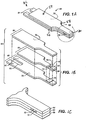
- FIGS. 1A-4B show various views of an exemplary test strip 62 suitable for use with the methods described herein.
- the test strip 62 can include an elongate body extending from a proximal end 80 to a distal end 82, and having lateral edges 56, 58.
- the proximal portion of the body 59 can include a sample reaction chamber 61 having multiple electrodes 164, 166 and a reagent 72, while the distal portion of the test strip body 59 can include features configured for electrically communicating with a test meter.
- physiological fluid or a control solution can be delivered to the sample reaction chamber 61 for electrochemical analysis.
- the test strip 62 can include a first electrode layer 66 and a second electrode layer 64, with a spacer layer 60 positioned therebetween.
- the first electrode layer 66 can provide a first electrode 166 and a first connection track 76 for electrically connecting the first electrode 166 to a first electrical contact 67.
- the second electrode layer 64 can provide a second electrode 164 and a second connection track 78 for electrically connecting the second electrode 164 with a second electrical contact 63.
- the sample reaction chamber 61 is defined by the first electrode 166, the second electrode 164, and a spacer 60 as shown in FIGS. 1A-4B .
- the first electrode 166 and the second electrode 164 define, respectively, the bottom and top of the sample reaction chamber 61.
- a cutout area 68 of the spacer 60 can define the side walls of the sample reaction chamber 61.
- the sample reaction chamber 61 can further include an number of ports 70 that provide a sample inlet and/or a vent.
- one of the ports can provide a fluid sample ingress and the other port can act as a vent.
- the sample reaction chamber 61 can have a small volume.
- the volume can range from about 0.1 microliters to about 5 microliters, preferably about 0.2 microliters to about 3 microliters, and more preferably about 0.3 microliters to about 1 microliter.
- the sample reaction chamber 61 can have various other such volumes.
- the cutout 68 can have an area ranging from about 0.01 cm 2 to about 0.2 cm 2 , preferably about 0.02 cm 2 to about 0.15 cm 2 , and more preferably about 0.03 cm 2 to about 0.08 cm 2 .
- the volume cutout 68 can be of various other such areas.
- first and second electrode 166, 164 can be spaced in the range of about 1 micron to about 500 microns, preferably between about 10 microns and about 400 microns, and more preferably between about 40 microns and about 200 microns. In other embodiments, such a range can vary between various other values.
- the close spacing of the electrodes can also allow redox cycling to occur, where oxidized mediator generated at the first electrode 166, can diffuse to the second electrode 164 to become reduced, and subsequently diffuse back to the first electrode 166 to become oxidized again.
- a first electrical contact 67 can be used to establish an electrical connection to a test meter.
- a second electrical contact 63 can be accessed by the test meter through a U-shaped notch 65 as illustrated in FIG. 2 .
- the test strip 62 can include a variety of alternative electrical contact configured for electrically connecting to a test meter.
- U.S. Patent No. 6,379,513 discloses an electrochemical cell connection means.
- the first electrode layer 66 and/or the second electrode layer 64 can be a conductive material formed from materials such as gold, palladium, carbon, silver, platinum, tin oxide, iridium, indium, and combinations thereof (e.g., indium doped tin oxide).
- the electrodes can be formed by disposing a conductive material onto an insulating sheet (not shown) by various process such as, for example, a sputtering, electroless plating, or a screen printing process.
- the second electrode layer 64 can be a sputtered gold electrode and the first electrode layer 66 can be a sputtered palladium electrode.
- Suitable materials that can be employed as the spacing layer 60 include various insulating materials, such as, for example, plastics (e.g., PET, PETG, polyimide, polycarbonate, polystyrene), silicon, ceramic, glass, adhesives, and combinations thereof.
- plastics e.g., PET, PETG, polyimide, polycarbonate, polystyrene
- silicon e.g., silicon, ceramic, glass, adhesives, and combinations thereof.
- a reagent layer 72 can be disposed within the sample reaction chamber 61 using a process such as slot coating, dispensing from the end of a tube, ink jetting, and screen printing. Such processes are described, for example, in the following U.S. Patent Nos. 6,749,887 ; 6,869,411 ; 6,676,995 ; and 6,830,934 .
- the reagent layer 72 can include at least a mediator and an enzyme, and can be deposited onto the first electrode 166.
- mediators and/or enzymes are within the spirit and scope of the present disclosure.
- suitable mediators include ferricyanide, ferrocene, ferrocene derivatives, osmium bipyridyl complexes, and quinone derivatives.
- suitable enzymes include glucose oxidase, glucose dehydrogenase (GDH) based on pyrroloquinoline quinone (PQQ) co-factor, GDH based on nicotinamide adenine dinucleotide co-factor, and FAD-based GDH [E.C.1.1.99.10].
- GDH glucose dehydrogenase
- PQQ pyrroloquinoline quinone
- GDH based on nicotinamide adenine dinucleotide co-factor
- FAD-based GDH FAD-based GDH
- Either the first electrode 166 or the second electrode 164 can function as working electrode which oxidizes or reduces a limiting amount of mediator depending on the polarity of the applied test potential of the test meter.
- the current limiting species is a reduced mediator, it can be oxidized at the first electrode 166 as long as a sufficiently positive potential was applied with respect to the second electrode 164.
- the first electrode 166 performs the function of the working electrode and second electrode 164 performs the function of a counter/reference electrode. It should be noted that unless otherwise stated for test strip 62, all potentials applied by test meter 100 will hereinafter be stated with respect to second electrode 164.
- the reduced mediator can be oxidized at the second electrode 164.
- the second electrode 164 can perform the function of the working electrode and the first electrode 166 can perform the function of the counter/reference electrode.
- a first step in an embodiment of the presently disclosed method can include introducing a quantity of the fluid sample of interest into the test strip 62, which includes the first electrode 166, the second electrode 164 and a reagent layer 72.
- the fluid sample can be whole blood or a derivative or fraction thereof, or a control solution.
- the fluid sample, e.g., blood can be dosed into the sample reaction chamber 61 via the port 70.
- the port 70 and /or the sample reaction chamber 61 can be configured such that capillary action causes the fluid sample to fill the sample reaction chamber 61.
- FIG. 5 provides a simplified schematic of a test meter 100 interfacing with a first electrical contact 67 and a second electrical contact 63, which are in electrical communication with the first electrode 166 and the second electrode 164, respectively, of the test strip 62.
- the test meter 100 can be configured to electrically connect to the first electrode 166 and the second electrode 164 via a first electrical contact 67 and a second electrical contact 63, respectively (as shown in FIGS. 2 and 5 ).
- the test meter includes at least a processor configured for performing calculations capable of discriminating between blood and a control sample, as well as configured for data sorting and/or storage.
- an electrical contact 67 can include two prongs 67a, 67b.
- the test meter 100 separately connects to the prongs 67a, 67b, such that when the test meter 100 interfaces with a test strip 62 a circuit is completed.
- the test meter 100 can measure the resistance or electrical continuity between the prongs 67a, 67b to determine whether the test strip 62 is electrically connected to the test meter 100.
- the test meter 100 can use a variety of sensors and circuits to determine when the test strip 62 is properly positioned with respect to the test meter 100.
- test meter 100 can apply a test potential and/or a current between first electrical contact 67 and second electrical contact 63. Once test meter 100 recognizes that strip 62 has been inserted, test meter 100 turns on and initiates a fluid detection mode. In one embodiment, the fluid detection mode causes test meter 100 to apply a constant current of 1 microampere between first electrode 166 and second electrode 164. Because test strip 62 is initially dry, test meter 100 measures a maximum voltage, which is limited by the hardware within test meter 100. However, once a user doses a fluid sample onto inlet 70, this causes sample reaction chamber 61 to become filled.
- test meter 100 When the fluid sample bridges the gap between first electrode 166 and second electrode 164, test meter 100 will measure a decrease in measured voltage (e.g., as described in U.S. Patent No. 6,193,873 , which is below a predetermined threshold causing test meter 100 to automatically initiate the glucose test.
- the measured voltage may decrease below a pre-determined threshold when only a fraction of the sample reaction chamber 61 has been filled.
- a method of automatically recognizing that a fluid was applied does not necessarily indicate that the sample reaction chamber 61 has been completely filled, but can only confirm a presence of some amount of fluid in the sample reaction chamber 61. Once the test meter 100 determines that a fluid has been applied to test strip 62, a short, but non-zero amount of time may still be required to allow the fluid to completely fill the sample reaction chamber 61.
- a test meter 100 can perform a glucose test by applying a plurality of open-circuit potentials and a plurality of test potentials to the test strip 62 for prescribed intervals as shown in FIG. 6 .
- a glucose test time interval T G represents an amount of time to perform the glucose test (but not necessarily all the calculations associated with the glucose test) where the glucose test time interval T G can include a first open-circuit time interval T OC1 , a first test potential time interval T 1 , a second open-circuit time interval T OC2 , a second test potential time interval T 2 , and a third test potential time interval T 3 .
- the glucose test time interval T G can range, for example, from about 1 second to about 5 seconds. While the two open-circuit time intervals and the three test potential time intervals are described, one skilled in the art will appreciate that the glucose test time interval can include different numbers of open-circuit and test potential time intervals. For example, the glucose test time interval could include a single open-circuit time interval and/or only two test potential time intervals.
- the test meter 100 switches to a first open-circuit for a first open-circuit potential time interval T OC1 , which in the illustrated example is about 0.2 seconds.
- the first open-circuit time interval T OC1 can be in the range of about 0.05 seconds to about 2 seconds and preferably between about 0.1 seconds to about 1.0 seconds, and most preferably between about 0.15 seconds to about 0.6 seconds.
- the sample reaction chamber 61 takes about 0.1 seconds to about 0.5 seconds to completely fill with blood. Conversely, at ambient temperature, the sample reaction chamber 61 takes about 0.2 seconds or less to completely fill with control solution, where the control solution is formulated to have a viscosity of about 1 to about 3 centipoise.
- blood samples can vary in their make-up and/or composition.
- high hematocrit blood samples are more viscous than low hematocrit blood samples, therefore higher hematocrit blood samples require additional time to fill compared with lower hematocrit blood samples.
- blood sample filling time can vary depending on a variety of factors.
- the test meter 100 After applying the first open-circuit potential, the test meter 100 applies a first test potential E 1 between the first electrode 166 and the second electrode 164 (e.g., -0.3 Volts in FIG. 6 ), for a first test potential time interval T 1 (e.g., 0.15 seconds in FIG. 6 ).
- the test meter 100 measures the resulting first current transient, which can be referred to as i a (t) as shown in FIG. 7 .
- a current transient represents a plurality of current values measured by a test meter during a particular test potential time interval.
- the first test potential time interval T 1 can be in the range of about 0.05 seconds to about 1.0 second and preferably between about 0.1 seconds to about 0.5 seconds, and most preferably between about 0.1 seconds to about 0.2 seconds. In other examples, the first test potential time interval T 1 can include any other desired time ranges.
- the first current transient can be used in the methods described herein to determine whether a control solution or a blood sample was applied to the test strip 62.
- the magnitude of the first transient current is effected by the presence of easily oxidizable substances in the sample. Blood usually contains endogenous and exogenous compounds that are easily oxidized at second electrode 164.
- the control solution can be formulated such that it does not contain oxidizable compounds.
- blood sample composition can vary and the magnitude of the first current transient for high viscosity blood samples will typically be smaller than low viscosity samples (in some cases even less than the control solution samples) because the sample reaction chamber 61 may be not be completely filled after about 0.2 seconds.
- a second open-circuit time interval T OC2 can be in the range of about 0.1 seconds to about 2.0 seconds and preferably between about 0.3 seconds to about 1.5 seconds, and most preferably between about 0.5 seconds to about 1.0 seconds.
- the second open-circuit time interval T OC2 can be any other time interval as desired.
- the second open-circuit time interval T OC2 can be sufficiently long to account for conditions which can cause the fill times to increase such as low ambient temperature (e.g., about 5°C) and high hematocrit levels (e.g., >60% hematocrit).
- a reduced mediator can be depleted at the second electrode 164 and can be generated at the first electrode 166 to form a concentration gradient.
- the second open-circuit potential provides time for the reduced mediator concentration profile to become closer to the state immediately before first test potential E 1 was applied. As will be described below, a sufficiently long second open-circuit potential is useful because it can allow for glucose concentration to be calculated in the presence of interferents.
- test potential E 1 ' can be applied between the electrodes for a duration between when the meter can detect that the strip is filling with sample and before a second test potential E 2 is applied.
- the test potential E 1 ' is small.
- the potential can be between about -1 to about -100 mV, preferably between about -5 mV and about -50 mV and most preferably between about -10 mV and about -30 mV.
- the smaller potential perturbs the reduced mediator concentration gradient to a lesser extent compared to applying a larger potential difference, but is still sufficient to obtain a measure of the oxidizable substances in the sample.
- the test potential E 1 ' can be applied for a portion of the time between detection of fill and when the second test potential E 2 is applied or can be applied for the whole of that time period. If the test potential E 1 ' is to be used for a portion of the time then an open-circuit could be applied for the remaining portion of the time.
- the combination of any number of open-circuit and small voltage potential applications, their order and times applied is not critical in this example, can be applied as long as the total period for which the small potential E 1 ' is applied is sufficient to obtain a current measurement indicative of the presence and/or quantity of oxidizable substances present in the sample.
- the small potential E 1 ' is applied for substantially the entire period between when a fill is detected and when the second test potential E 2 is applied.
- the test meter 100 can apply a second test potential E 2 between the first electrode 166 and the second electrode 164 for a second test potential time interval T 2 .
- the test meter 100 can measure a second current transient i b (t).
- the test meter 100 can apply a third test potential E 3 between the first electrode 166 and the second electrode 164 for a third test potential time interval T 3 , which may be referred to as i c ( t ).
- the second test potential time interval T 2 and the third test potential time interval T 3 can each range from about 0.1 seconds to about 4 seconds.
- the second test potential time interval T 2 was about 3 seconds and the third test potential time interval T 3 was about 1 second.
- an open circuit potential time period can be allowed to elapse between the second test potential E 2 and the third test potential E 3 .
- the third test potential E 3 can be applied following the application of the second test potential E 2 .
- a portion of the first, second, or third current transient may be generally referred to as a cell current or a current value.
- the first test potential E 1 and the second test potential E 2 both have a first polarity
- the third test potential E 3 has a second polarity, which is opposite to the first polarity.
- the polarity of the first, second, and third test potentials can be chosen depending on the manner in which analyte concentration is determined and/or depending on the manner in which the test samples and control solutions are distinguished.
- the first test potential E 1 and the second test potential E 2 can be sufficiently negative in magnitude with respect to the second electrode 164 such that the second electrode 164 functions as a working electrode in which a limiting oxidation current is measured.
- the third test potential E 3 can be sufficiently positive in magnitude with respect to the second electrode 164 such that the first electrode 166 functions as a working electrode in which a limiting oxidation current is measured.
- a limiting oxidation occurs when all the oxidizable species have been locally depleted at the working electrode surface such that the measured oxidation current is proportional to the flux of oxidizable species diffusing from the bulk solution towards the working electrode surface.
- the term bulk solution refers to a portion of the solution sufficiently far away from the working electrode where the oxidizable species was not located within the depletion zone.
- the first test potential E 1 , the second test potential E 2 , and the third test potential E 3 can range from about -0.6 Volts to about +0.6 Volts (with respect to the second electrode 164) when using either a sputtered gold or palladium working electrode and a ferricyanide mediator.
- FIG. 7 shows first, second, and third current transients generated by a test meter 100 and a test strip 62 using either a control solution sample (dotted line) or a blood sample (solid line).
- the control solution sample contained a 525 mg/dL glucose concentration and the blood sample contained a 530 mg/dL glucose concentration with about 25% hematocrit.
- FIG. 8 shows an expanded view of first and second current transients in FIG. 7.
- FIGS. 7 and 8 show the resulting current transients when applying the potential waveform shown in FIG. 6 . The description below details how the current transients can be converted into an accurate glucose measurement for the test solution or control solution.
- the test meter 100 can perform a glucose test by applying a plurality of test potentials for prescribed intervals.
- the plurality of test potentials may include a first test potential E 1 ' for a first test potential time interval T 1 , a second test potential E 2 for a second test potential time interval T 2 , and a third test potential E 3 for a third test potential time interval T 3 .
- the plurality of test current values measured during the first, second, and third test potential time intervals may be performed at a frequency ranging from about 1 measurement per nanosecond to about one measurement per 100 milliseconds.
- names "first,” "second,” and “third” are chosen for convenience and do not necessarily reflect the order in which the test potentials are applied.
- the test meter 100 applies a first test potential E 1 ' (e.g., -20 mV) for a first test potential time interval T 1 (e.g., between about 0 and about 1 second).
- the first test potential time interval T 1 can range from about 0.1 seconds to about 3 seconds and preferably range from about 0.2 seconds to about 2 seconds, and most preferably range from about 0.3 seconds to about 1 seconds.
- the first test potential time interval T 1 may be sufficiently long so that the sample reaction chamber 61 can fully fill with sample and also so that the reagent layer 72 can at least partially dissolve or solvate.
- the first test potential E 1 ' may be a value relatively close to the redox potential of the mediator so that a relatively small amount of a reduction or oxidation current is measured.
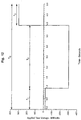
- FIG. 13 shows that a relatively small amount of current may be observed during the first test potential time interval compared to during the second and third test potential time intervals.
- the first test potential E 1 ' can range from about -100 mV to about -1 mV, preferably range from about -50 mV to about -5 mV, and most preferably range from about -30 mV to about -10 mV.
- the test meter 100 After applying the first test potential E 1 ', the test meter 100 applies a second test potential E 2 between the first electrode 166 and the second electrode 164 (e.g., about - 0.3 Volts as illustrated in FIG. 12 ), for a second test potential time interval T 2 (e.g., about 3 seconds as illustrated in FIG. 12 ).
- the second test potential E 2 may be a value sufficiently negative of the mediator redox potential so that a limiting oxidation current occurs at the second electrode 164.
- the second test potential E 2 can range from about -600 mV to about zero mV, preferably range from about -600 mV to about -100 mV, and more preferably be about -300 mV.
- the second test potential time interval T 2 may be sufficiently long to monitor the rate of generation of reduced mediator (e.g., ferrocyanide) in the sample reaction chamber 61 based on the magnitude of a limiting oxidation current.
- the reduced mediator may be generated by a series of chemical reactions in the reagent layer 72.
- a limiting amount of reduced mediator is oxidized at the second electrode 164 and a non-limiting amount of oxidized mediator is reduced at the first electrode 166 to form a concentration gradient between the first electrode 166 and the second electrode 164.
- the second test potential time interval T 2 should be sufficiently long so that a sufficient amount of ferricyanide can be generated at the second electrode 164.
- the second test potential time interval T 2 can range from about 0 seconds to about 60 seconds and preferably range from about 1 second to about 10 seconds, and most preferably range from about 2 seconds to about 5 seconds. According to the embodiment of the present invention shown in Figure 12 , the second test potential time T 2 is 3 seconds.
- FIG. 13 shows a relatively small peak at the beginning of the second test potential time interval T 2 followed by a gradual increase of an absolute value of an oxidation current during the second test potential time interval (e.g., between about 1 second to about 4 seconds).
- the small peak occurs due to an initial depletion of reduced mediator at about 1 second.
- the gradual increase in oxidation current is ascribed to the generation of ferrocyanide by reagent layer 72 followed by its diffusion to the second electrode 164.
- the test meter 100 After applying the second test potential E 2 , the test meter 100 applies a third test potential E 3 between the first electrode 166 and the second electrode 164 (e.g., +0.3 Volts in FIG. 12 ), for a third test potential time interval T 3 (e.g., between about 4 to about 5 seconds as illustrated in FIG. 12 ).
- the third test potential E 3 may be a value sufficiently positive of the mediator redox potential so that a limiting oxidation current is measured at the first electrode 166.
- the third test potential E 3 can range from about zero mV to about 600 mV, preferably range from about 100 mV to about 600 mV, and more preferably be about 300 mV.
- the third test potential time interval T 3 may be sufficiently long to monitor the diffusion of a reduced mediator (e.g., ferrocyanide) near the first electrode 166 based on the magnitude of the oxidation current.
- a reduced mediator e.g., ferrocyanide
- a limiting amount of reduced mediator is oxidized at the first electrode 166 and a non-limiting amount of oxidized mediator is reduced at the second electrode 164.
- the third test potential time interval T 3 can range from about 0.1 seconds to about 5 seconds and preferably range from about 0.3 seconds to about 3 seconds, and most preferably range from about 0.5 seconds to about 2 seconds. In accordance with the present invention, the third test potential time interval is 1 second.
- FIG. 13 shows a relatively large peak at the beginning of the third test potential time interval T 3 followed by a decrease to a steady-state current.
- the second test potential E 2 has a first polarity and third test potential E 3 has a second polarity that is opposite to the first polarity.
- the polarity of the second and third test potentials can be chosen depending on the manner in which analyte concentration is determined.
- [G] is the glucose concentration
- i 1 is a first current value
- i 2 is a second current value
- i 3 is a third current value
- the terms p, Z, and a are empirically derived calibration constants.
- a derivation of Eq. 1 can be found in a pending U.S. Published Patent Application No. 2007/0074977 ( U.S. Application Ser. No. 11/240,797), filed on September 30, 2005 and entitled "Method and Apparatus for Rapid Electrochemical Analysis,".
- the first current value i 1 and the second current value i 2 are calculated from the third current transient and the third current value i 3 is calculated from the second current transient.
- the term i pb represents a peak current value for the second test potential time interval T 2 and the term i pc represents a peak current value for the third test potential time interval T 3 .
- the term i ss is an estimate of the steady-state current, which is the current predicted to occur at long times after the application of the third test potential E 3 in the absence of on-going chemical reactions.
- the second open-circuit potential time interval T OC2 is preferably sufficiently long so as to allow Eq. 2 to compensate for the presence of interferents. When the second open-circuit potential time interval T OC2 is too short, the second peak current value i pb can become distorted and can reduce the effectiveness of the interferent correction calculations.
- Eq. 1 and Eq. 2 can be used together to calculate a glucose concentration for either blood or a control solution.
- the algorithm of Eq. 1 and Eq. 2 can be used for blood with a first set of calibration factors (i.e. a, p, and Z ) and a second set of calibration factors can be used for the control solution.
- a first set of calibration factors i.e. a, p, and Z
- a second set of calibration factors can be used for the control solution.
- the test meter can store the resulting glucose concentration of the control sample such that a user can review test sample concentration data separately from control solution data.
- the glucose concentrations for control solutions can be stored in a separate database, can be flagged, and/or discarded (i.e., not stored or stored for a short period of time).
- a test meter can be programmed to automatically compare the results (e.g., glucose concentration) of the test of the control solution with the expected glucose concentration of the control solution.
- the test meter can be pre-programmed with the expected glucose level(s) for the control solution(s).
- a user could input the expected glucose concentration for the control solution.
- the test meter can compare the measured control solution glucose concentration with the expected glucose concentration to determine if the meter is functioning properly. If the measured glucose concentration is out of the expected range, the test meter can output a warning message to alert the user.
- the method described herein uses the presence of redox species to distinguish a control solution from a blood sample.
- the method can include the step of applying a first test potential E 1 ' and using one or more current values measured during the test potential as a discriminator. In one example, two current values from the first test potential E 1 ' are summed and used as the discriminator.
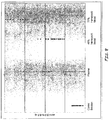
- FIG. 8 shows data for a control solution, plasma, a blood sample with 48% hematocrit, and a blood sample with 77% hematocrit. A potential of about 20 mV was applied for the first 1 second and current values at about 0.2 to about 0.5 seconds were summed. As shown in FIG. 8 , the summed current values were sufficient to distinguish between a control solution (that was substantially devoid of interferents) and blood samples.
- two characteristics of control solution are used to distinguish control solutions from blood - the presence and/or concentration of redox species in the sample and reaction kinetics.
- the method disclosed herein includes the step of calculating a first reference value that is representative of the redox concentration in the sample and a second reference value that is representative of the rate of reaction of the sample with the reagent.
- the first reference value is an interferent oxidation current and the second reference value is a reaction completion percentage.
- blood usually contains various endogenous redox species or "interferents” such as ascorbic acid and uric acid, as well as exogenously derived interferents such as gentisic acid (gentisic acid is a metabolite of aspirin).
- endogenous interferents are chemical species that can be easily oxidized at an electrode and are usually present in blood within a physiological range for healthy individuals.
- Exogenously derived interferents are also a chemical species that can be easily oxidized at an electrode, but are not usually present in blood unless they are inputted into the body via consumption, injection, absorption, and the like.
- a control solution can be formulated to be either essentially free of antioxidants or to have a relatively high interferent concentration compared to the interferent concentration in a blood sample.
- the magnitude of the first current transient should be smaller for the control solution than for a blood sample as shown in FIG. 9 .
- the magnitude of the first current transient should be larger for the control solution than for a blood sample (data not shown).
- a first reference value is calculated based on the current values within the first current transient.
- the first reference value can include a summation of current values at two points in time during the first current transient.
- the current values at about 0.3 and about 0.35 seconds can be used when employing the test potential waveform of FIG. 6 .
- the first reference value is preferably obtained by summing two values over a longer period, for example about 0.2 seconds to about 0.5 seconds.
- the first reference value is obtained by a summation of the current values obtained during the first time current transient when using the test potential waveform of FIG. 12 .
- i sum is the summation of current values and t is a time.
- the first reference value can be referred to as an interferent index because it is proportional to the interferent concentration and should not substantially depend on the glucose concentration. Therefore, in theory, the test meter should be able to distinguish whether the sample is blood or control solution based on the interferent index. However, in practice, using only the interferent index did not always sufficiently discriminate between blood and the control solution. Although blood typically has a much higher interferent concentration, there are certain conditions in which the first current transient for blood may be attenuated such that it is comparable to control solution. These conditions include high glucose concentration, high hematocrit, low temperature, and incomplete filling of the sample reaction chamber 61. Thus, in embodiments of the present invention, an additional factor was implemented to enable the test meter to sufficiently discriminate between blood and control solution.
- the additional factor used for helping discriminate between blood and control solution can be a second reference value.
- the second reference value is referred to as a residual reaction index, which can be a value which is a function of the percent of remaining substrate which would have reacted if given enough time.
- the residual reaction index relates to the reaction rate in that a high reaction rate can cause the substrate to be depleted by the reaction.
- the residual reaction index will also depend on the initial magnitude of the substrate concentration.
- the reagent layer 72 can include glucose dehydrogenase (GDH) based on the PQQ co-factor and ferricyanide.
- GDH glucose dehydrogenase
- the enzyme GDH based on the PQQ co-factor may be replaced with the enzyme GDH based on the FAD co-factor.
- GDH (red) is regenerated back to its active oxidized state by ferricyanide (i.e. oxidized mediator or Fe(CN) 6 3- ) as shown in Eq. 5 below.
- ferrocyanide i.e. reduced mediator or Fe(CN) 6 4-
- the rate of glucose consumption based on Eq. 4 and Eq. 5 is faster for control solution than for blood.
- the control solution is less viscous than blood causing the reaction rate of Eq. 4 and Eq. 5 to be faster for the control solution.
- the reaction rate is faster for the control solution because a portion of the glucose present in the blood sample must diffuse out of the red blood cells to participate in Eq. 4. This extra step of glucose diffusion out of the red blood cells slows down the reaction rate to some measurable degree.
- FIG. 9 shows that the reaction rate for blood is slower than for control solution as evidenced by the fact that the general absolute slope value (e.g., between about 1.2 and about 4 seconds) for the second current transient is less for the blood sample. Because of the faster reaction rates in the control solution as compared to blood, the residual reaction index for control solution will generally be lower than for blood.
- the residual reaction index is a number that is related to the percent of glucose that has not been consumed.
- a relatively low residual reaction index can indicate that the reactions of Eq. 4 and Eq. 5 are close to completion.
- a relatively high residual reaction index will indicate that the reaction is not close to completion.
- the residual reaction index can be an absolute ratio of a current value of a third current transient divided by a current value of the second current transient, as shown in Eq. 6: abs i 4.15 i 3.8
- the current value at 3.8 seconds for the second current transient was used.
- the time of 3.8 seconds was chosen empirically, however, one skilled in the art will appreciate that other current values can be used.
- a current value at about the end of the second current transient is chosen.
- the magnitude of the current values measured during second test potential time interval T 2 can be ascribed to the amount of ferrocyanide generated by reagent layer 72 at the first electrode 166 and then diffused to the second electrode 164. It is assumed that the reagent layer 72 remains close to the first electrode 166 after it dissolves in blood. As a result, most of the ferrocyanide that is oxidized by the second electrode 164 necessarily had to diffuse from first electrode 166.
- the current value at about 4.15 seconds was used.
- Other current values from the third current transient can be chosen, however current value at about the beginning of the third current transient are preferred.
- the reduced mediator is oxidized at first electrode 166.
- the magnitude of the current values measured during the second test potential time interval T 2 can be ascribed to the amount of ferrocyanide generated by the reagent layer 72 at the first electrode 166 and did not diffuse sufficiently far away from the first electrode 166.
- the magnitude of the current values for the third current transient will be generally larger than the second current transient.
- the third current transient will also be larger in magnitude than second current transient because the reagent layer 72 will have had more time to generate ferrocyanide.
- the absolute ratio as shown in Eq. 6 will be larger if the glucose reaction is still far from completion at the time of the measurement.
- a residual reaction index can be used, as shown in Eq. 7 below.
- the residual reaction index can increase to indicate that the reactions of Eq. 4 and Eq. 5 are closer to completion and decrease to indicate that the reactions are further from completion.
- Eq. 6 has a residual reaction index that ranges from about 1 to infinity
- Eq. 7 has a residual reaction index that ranges from about zero to about 1.
- Eq. 7 may be a better discriminator for control solution than Eq. 6.
- the residual reaction index can be an absolute ratio of a current value of second current transient divided by a current value of the third current transient, as shown in Eq. 7: abs i 3.8 i 4.15
- FIG. 10 illustrates that the residual reaction index is relatively high when the % of substrate consumed is low and that the residual reaction index is relatively low when the % of substrate consumed is high for a given sample type/hematocrit value.
- the % of substrate consumed is estimated from a ratio C o YSI , where C o is an estimated substrate concentration at the electrode surface and YSI is the substrate concentration using a standard reference technique.
- L is the distance between the first electrode 166 and the second electrode 164
- F is Faraday's constant
- A is the area of first electrode 166
- D is the diffusion coefficient.
- FIG. 11 is a chart showing a relationship between the interferent index and a residual reaction index for a plurality of blood samples and control solution samples.
- a discrimination line was derived to allow the test meter to determine whether the sample was a control solution or blood. For all of the control solution samples tested, the interferent index was plotted versus the residual reaction index. Next, a line was calculated using linear regression for control solution samples. After calculating an equation for the line, the perpendicular bias between each data point and the line was calculated. The perpendicular bias represents the shortest distance between the data point and the line as opposed to a vertical bias that is commonly calculated. A standard deviation was determined for all of the perpendicular biases (SD perp ). Lastly, the line was shifted 3* SD perp units towards the data points for the blood group. The reason for this approach is that the data for the control solution group show very little scatter and therefore the "99% confidence limit" of the control solution group is well-defined.
- the information obtained from this statistical analysis of the residual reaction index and the interferent index can be used by the test meter to distinguish a control solutions from blood samples.
- the test meter can calculate the interferent index and residual reaction index and use these values in association with the derived discrimination line (or an equation representing the discrimination line) to distinguish control solutions from blood samples.
- FIG. 14 illustrates a chart showing the relationship between the interferent index and a residual reaction index for a plurality of blood samples and control solution samples using the alternative algorithm.
- blood samples and control solution samples were tested over a temperature range of about 5 degrees Celsius to about 45 degrees Celsius. Additionally, the blood samples had a glucose concentration range of about 20 mg/dL to about 560 mg/dL and a hematocrit level range of 0% to about 60%.
- FIG 15 illustrates another chart where more test strips (about 27,400) were tested using the alternative algorithm at room temperature only.
- a discrimination criterion can be used to determine if the sample is either control solution or blood based on the interferent index of Eq. 3 and the residual reaction index of Eq. 7.
- the interferent index of Eq. 3 is compared to a pre-determined threshold and the residual reaction index of Eq. 7 is compared to a pre-determined threshold equation.
- the pre-determined threshold is about 10 microamperes.
- First citraconic buffer pH 6.5 ⁇ 0.1 was prepared by dissolving required quantities of citraconic acid and dipotassium citraconate in deionized water. Next, methyl paraben was added and the solution was stirred until the preservative was fully dissolved. Subsequently Dextran T-500, Germal II, Pluronic 25R2 and 1-[(6- methoxy-4-sulfo-m-tolyl)azo]-2-naphthol-6-sulfonic acid disodium salt were added sequentially, following complete dissolution of the previously added chemical. At this point, the pH of the control fluid was verified, followed by addition of the requisite quantity of glucose to obtain a low, normal or high glucose level of the control fluid.
- control fluid was left at room temperature overnight.
- glucose concentration was verified using a Model 2700 Select Biochemistry Analyzer manufactured by Yellow Springs Instrument Co., Inc.
- the dye used in this control solution has a blue color, which reduces the possibility of a user confusing the control solution with blood.
- Some people e.g., young people attempting to deceive parents or doctors will load a sensor with Gatorade ® as opposed to blood to give the impression that their glucose is under control.
- the following experiment was performed to determine if the currently disclosed method and sensor could be utilized to distinguish Gatorade ® from blood.
Landscapes
- Health & Medical Sciences (AREA)
- Life Sciences & Earth Sciences (AREA)
- Chemical & Material Sciences (AREA)
- Engineering & Computer Science (AREA)
- Immunology (AREA)
- Hematology (AREA)
- Molecular Biology (AREA)
- Physics & Mathematics (AREA)
- Analytical Chemistry (AREA)
- Biochemistry (AREA)
- General Health & Medical Sciences (AREA)
- Biomedical Technology (AREA)
- Urology & Nephrology (AREA)
- Biotechnology (AREA)
- Microbiology (AREA)
- General Physics & Mathematics (AREA)
- Pathology (AREA)
- Organic Chemistry (AREA)
- Zoology (AREA)
- Cell Biology (AREA)
- Food Science & Technology (AREA)
- Medicinal Chemistry (AREA)
- Wood Science & Technology (AREA)
- Proteomics, Peptides & Aminoacids (AREA)
- Biophysics (AREA)
- Chemical Kinetics & Catalysis (AREA)
- Electrochemistry (AREA)
- Bioinformatics & Cheminformatics (AREA)
- General Engineering & Computer Science (AREA)
- Genetics & Genomics (AREA)
- Investigating Or Analysing Biological Materials (AREA)
- Investigating Or Analyzing Materials By The Use Of Electric Means (AREA)
Claims (8)
- Verfahren zum Unterscheiden zwischen einer Blutprobe und einer wässrigen Nichtblut-Probe, wobei das Verfahren umfasst:(a) Anlegen eines ersten Prüfpotentials E1 zwischen einer ersten Elektrode und einer zweiten Elektrode während eines ersten Zeitintervalls T1, wobei E1 = -20 mV und T1 zwischen t = 0 s und t = 1 s ist, wenn eine Probe in eine elektrochemische Zelle eingeführt ist, und Messen einer ersten Stromtransiente;(b) Anlegen eines zweiten Prüfpotentials E2 zwischen der ersten Elektrode und der zweiten Elektrode während eines zweiten Zeitintervalls T2, wobei E2 = -0,3 V und T1 zwischen t = 1 s und t = 4 s ist, wobei das zweite Prüfpotential ausreicht, um einen reduzierten Mediator an der zweiten Elektrode zu oxidieren, und Messen einer zweiten Stromtransiente;(c) Anlegen eines dritten Prüfpotentials E3 zwischen der ersten Elektrode und der zweiten Elektrode während eines dritten Zeitintervalls T3, wobei E3 = +0,3 V und wobei T3 zwischen t = 4 s und t = 5 s ist, wobei das dritte Prüfpotential ausreicht, um einen reduzierten Mediator an der ersten Elektrode zu oxidieren, und Messen einer dritten Stromtransiente;(d) auf der Grundlage der ersten Stromtransiente Berechnen eines ersten Referenzwerts;(e) auf der Grundlage der zweiten und der dritten Stromtransiente Berechnen eines zweiten Referenzwerts; und(f) auf der Grundlage des ersten und des zweiten Referenzwerts Bestimmen, on die Probe eine Blutprobe oder eine wässrige Nichtblut-Probe ist,wobei der erste Referenzwert ein Interferent-Index ist und der zweite Referenzwert ein verbleibende-Reaktion-Index ist;wobei der Interferent-Index ist:
 wobei isum eine Summation von während der ersten Stromtransiente gemessenen Stromwerten ist,wobei i der Strom ist und t die in Sekunden (s) gemessene Zeit ist,wobei der verbleibende-Reaktion-Index ist:
 wobei i (3, 8) der bei der Zeit t = 3,8 s gemessene Stromwert ist,wobei i(4,15) der bei der Zeit t = 4,15 s gemessene Stromwert ist undwobei Schritt (f) ferner umfasst:Vergleichen des ersten Referenzwerts mit einem vorbestimmten Schwellenwert, wobei der vorbestimmte Schwellenwert 10 µA ist;Bestimmen, ob der zweite Referenzwert eine vorbestimmte Schwellenwertgleichung erfüllt, wobei die vorbestimmte Schwellenwertgleichung ist:
 und Identifizieren der Probe als Blut, wenn:
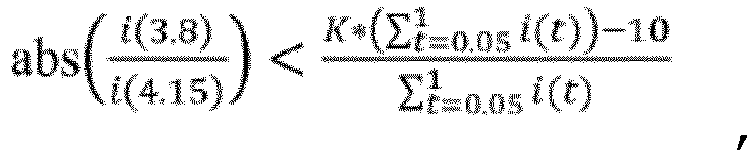 andernfalls Identifizieren der Probe als eine wässrige Nichtblut-Probe.
 - Verfahren gemäß Anspruch 1, wobei der erste Referenzwert proportional zu einer Konzentration eines Interferenten in der Probe ist.
- Verfahren gemäß einem der vorstehenden Ansprüche, wobei der zweite Referenzwert auf der Grundlage einer prozentuellen Vollständigkeit einer chemischen Reaktion steht.
- Verfahren gemäß einem der vorstehenden Ansprüche, ferner umfassend den Schritt des Messens einer Konzentration eines Analyten.
- Verfahren gemäß Anspruch 4, wobei, wenn gefunden wird, dass die Probe eine wässrige Nichtblut-Probe ist, die mit der wässrigen Nichtblut-Probe verbundene Analytkonzentration markiert wird.
- Verfahren gemäß einem der vorstehenden Ansprüche, wobei Schritt (f) ferner die Verwendung einer statistischen Einstufung umfasst, um zu bestimmen, ob die Probe eine wässrige Nichtblut-Probe oder eine Blutprobe ist.
- Verfahren gemäß Anspruch 1, ferner umfassend:(a) Einführen der Probe in die elektrochemische Zelle, wobei die elektrochemische Zelle umfasst:(i) die erste und die zweite Elektrode in einer beabstandeten Beziehung; und(ii) ein Reagens;wobei das erste Prüfpotential eine erste Polarität aufweist.
- Verfahren gemäß einem der Ansprüche 1 bis 7, wobei die wässrige Nichtblut-Probe eine Kontrolllösung ist.
Applications Claiming Priority (2)
| Application Number | Priority Date | Filing Date | Title |
|---|---|---|---|
| US97608307P | 2007-09-28 | 2007-09-28 | |
| US12/211,484 US8778168B2 (en) | 2007-09-28 | 2008-09-16 | Systems and methods of discriminating control solution from a physiological sample |
Publications (3)
| Publication Number | Publication Date |
|---|---|
| EP2042865A2 EP2042865A2 (de) | 2009-04-01 |
| EP2042865A3 EP2042865A3 (de) | 2010-12-22 |
| EP2042865B1 true EP2042865B1 (de) | 2017-04-26 |
Family
ID=40262307
Family Applications (1)
| Application Number | Title | Priority Date | Filing Date |
|---|---|---|---|
| EP08253148.4A Not-in-force EP2042865B1 (de) | 2007-09-28 | 2008-09-26 | Ein Verfahren zur Unterscheidung zwischen einer Kontrolllösung und einer physiologischen Probe |
Country Status (7)
| Country | Link |
|---|---|
| US (2) | US8778168B2 (de) |
| EP (1) | EP2042865B1 (de) |
| JP (1) | JP5185044B2 (de) |
| CN (1) | CN101504408B (de) |
| AU (1) | AU2008221593B2 (de) |
| CA (1) | CA2639776C (de) |
| ES (1) | ES2627267T3 (de) |
Families Citing this family (81)
| Publication number | Priority date | Publication date | Assignee | Title |
|---|---|---|---|---|
| US8071384B2 (en) * | 1997-12-22 | 2011-12-06 | Roche Diagnostics Operations, Inc. | Control and calibration solutions and methods for their use |
| US6391005B1 (en) | 1998-03-30 | 2002-05-21 | Agilent Technologies, Inc. | Apparatus and method for penetration with shaft having a sensor for sensing penetration depth |
| US8641644B2 (en) | 2000-11-21 | 2014-02-04 | Sanofi-Aventis Deutschland Gmbh | Blood testing apparatus having a rotatable cartridge with multiple lancing elements and testing means |
| AU2002348683A1 (en) | 2001-06-12 | 2002-12-23 | Pelikan Technologies, Inc. | Method and apparatus for lancet launching device integrated onto a blood-sampling cartridge |
| US8337419B2 (en) | 2002-04-19 | 2012-12-25 | Sanofi-Aventis Deutschland Gmbh | Tissue penetration device |
| ATE485766T1 (de) | 2001-06-12 | 2010-11-15 | Pelikan Technologies Inc | Elektrisches betätigungselement für eine lanzette |
| US7041068B2 (en) | 2001-06-12 | 2006-05-09 | Pelikan Technologies, Inc. | Sampling module device and method |
| US9226699B2 (en) | 2002-04-19 | 2016-01-05 | Sanofi-Aventis Deutschland Gmbh | Body fluid sampling module with a continuous compression tissue interface surface |
| ES2336081T3 (es) | 2001-06-12 | 2010-04-08 | Pelikan Technologies Inc. | Dispositivo de puncion de auto-optimizacion con medios de adaptacion a variaciones temporales en las propiedades cutaneas. |
| US9427532B2 (en) | 2001-06-12 | 2016-08-30 | Sanofi-Aventis Deutschland Gmbh | Tissue penetration device |
| US7981056B2 (en) | 2002-04-19 | 2011-07-19 | Pelikan Technologies, Inc. | Methods and apparatus for lancet actuation |
| US9795747B2 (en) | 2010-06-02 | 2017-10-24 | Sanofi-Aventis Deutschland Gmbh | Methods and apparatus for lancet actuation |
| US7331931B2 (en) | 2002-04-19 | 2008-02-19 | Pelikan Technologies, Inc. | Method and apparatus for penetrating tissue |
| US8784335B2 (en) | 2002-04-19 | 2014-07-22 | Sanofi-Aventis Deutschland Gmbh | Body fluid sampling device with a capacitive sensor |
| US7297122B2 (en) | 2002-04-19 | 2007-11-20 | Pelikan Technologies, Inc. | Method and apparatus for penetrating tissue |
| US7229458B2 (en) | 2002-04-19 | 2007-06-12 | Pelikan Technologies, Inc. | Method and apparatus for penetrating tissue |
| US8702624B2 (en) | 2006-09-29 | 2014-04-22 | Sanofi-Aventis Deutschland Gmbh | Analyte measurement device with a single shot actuator |
| US8372016B2 (en) | 2002-04-19 | 2013-02-12 | Sanofi-Aventis Deutschland Gmbh | Method and apparatus for body fluid sampling and analyte sensing |
| US8267870B2 (en) | 2002-04-19 | 2012-09-18 | Sanofi-Aventis Deutschland Gmbh | Method and apparatus for body fluid sampling with hybrid actuation |
| US7491178B2 (en) | 2002-04-19 | 2009-02-17 | Pelikan Technologies, Inc. | Method and apparatus for penetrating tissue |
| US8360992B2 (en) | 2002-04-19 | 2013-01-29 | Sanofi-Aventis Deutschland Gmbh | Method and apparatus for penetrating tissue |
| US7976476B2 (en) | 2002-04-19 | 2011-07-12 | Pelikan Technologies, Inc. | Device and method for variable speed lancet |
| US9248267B2 (en) | 2002-04-19 | 2016-02-02 | Sanofi-Aventis Deustchland Gmbh | Tissue penetration device |
| US7232451B2 (en) | 2002-04-19 | 2007-06-19 | Pelikan Technologies, Inc. | Method and apparatus for penetrating tissue |
| US8579831B2 (en) | 2002-04-19 | 2013-11-12 | Sanofi-Aventis Deutschland Gmbh | Method and apparatus for penetrating tissue |
| US8221334B2 (en) | 2002-04-19 | 2012-07-17 | Sanofi-Aventis Deutschland Gmbh | Method and apparatus for penetrating tissue |
| US7909778B2 (en) | 2002-04-19 | 2011-03-22 | Pelikan Technologies, Inc. | Method and apparatus for penetrating tissue |
| US7226461B2 (en) | 2002-04-19 | 2007-06-05 | Pelikan Technologies, Inc. | Method and apparatus for a multi-use body fluid sampling device with sterility barrier release |
| US7901362B2 (en) | 2002-04-19 | 2011-03-08 | Pelikan Technologies, Inc. | Method and apparatus for penetrating tissue |
| US9795334B2 (en) | 2002-04-19 | 2017-10-24 | Sanofi-Aventis Deutschland Gmbh | Method and apparatus for penetrating tissue |
| US9314194B2 (en) | 2002-04-19 | 2016-04-19 | Sanofi-Aventis Deutschland Gmbh | Tissue penetration device |
| US7892183B2 (en) | 2002-04-19 | 2011-02-22 | Pelikan Technologies, Inc. | Method and apparatus for body fluid sampling and analyte sensing |
| US7674232B2 (en) | 2002-04-19 | 2010-03-09 | Pelikan Technologies, Inc. | Method and apparatus for penetrating tissue |
| US7547287B2 (en) | 2002-04-19 | 2009-06-16 | Pelikan Technologies, Inc. | Method and apparatus for penetrating tissue |
| US7175642B2 (en) | 2002-04-19 | 2007-02-13 | Pelikan Technologies, Inc. | Methods and apparatus for lancet actuation |
| US8574895B2 (en) | 2002-12-30 | 2013-11-05 | Sanofi-Aventis Deutschland Gmbh | Method and apparatus using optical techniques to measure analyte levels |
| EP1628567B1 (de) | 2003-05-30 | 2010-08-04 | Pelikan Technologies Inc. | Verfahren und vorrichtung zur injektion von flüssigkeit |
| EP1633235B1 (de) | 2003-06-06 | 2014-05-21 | Sanofi-Aventis Deutschland GmbH | Gerät für die entnahme von körperflüssigkeiten und analyten-nachweis |
| WO2006001797A1 (en) | 2004-06-14 | 2006-01-05 | Pelikan Technologies, Inc. | Low pain penetrating |
| EP1671096A4 (de) | 2003-09-29 | 2009-09-16 | Pelikan Technologies Inc | Verfahren und apparatur für eine verbesserte probeneinfangvorrichtung |
| US9351680B2 (en) | 2003-10-14 | 2016-05-31 | Sanofi-Aventis Deutschland Gmbh | Method and apparatus for a variable user interface |
| US7822454B1 (en) | 2005-01-03 | 2010-10-26 | Pelikan Technologies, Inc. | Fluid sampling device with improved analyte detecting member configuration |
| EP1706026B1 (de) | 2003-12-31 | 2017-03-01 | Sanofi-Aventis Deutschland GmbH | Verfahren und vorrichtung zur verbesserung der fluidströmung und der probennahme |
| WO2006011062A2 (en) | 2004-05-20 | 2006-02-02 | Albatros Technologies Gmbh & Co. Kg | Printable hydrogel for biosensors |
| WO2005120365A1 (en) | 2004-06-03 | 2005-12-22 | Pelikan Technologies, Inc. | Method and apparatus for a fluid sampling device |
| US9775553B2 (en) | 2004-06-03 | 2017-10-03 | Sanofi-Aventis Deutschland Gmbh | Method and apparatus for a fluid sampling device |
| US8652831B2 (en) | 2004-12-30 | 2014-02-18 | Sanofi-Aventis Deutschland Gmbh | Method and apparatus for analyte measurement test time |
| US8529751B2 (en) | 2006-03-31 | 2013-09-10 | Lifescan, Inc. | Systems and methods for discriminating control solution from a physiological sample |
| US8778168B2 (en) | 2007-09-28 | 2014-07-15 | Lifescan, Inc. | Systems and methods of discriminating control solution from a physiological sample |
| WO2009076302A1 (en) | 2007-12-10 | 2009-06-18 | Bayer Healthcare Llc | Control markers for auto-detection of control solution and methods of use |
| US8097674B2 (en) * | 2007-12-31 | 2012-01-17 | Bridgestone Corporation | Amino alkoxy-modified silsesquioxanes in silica-filled rubber with low volatile organic chemical evolution |
| US8603768B2 (en) | 2008-01-17 | 2013-12-10 | Lifescan, Inc. | System and method for measuring an analyte in a sample |
| WO2009126900A1 (en) | 2008-04-11 | 2009-10-15 | Pelikan Technologies, Inc. | Method and apparatus for analyte detecting device |
| US8551320B2 (en) | 2008-06-09 | 2013-10-08 | Lifescan, Inc. | System and method for measuring an analyte in a sample |
| US9375169B2 (en) | 2009-01-30 | 2016-06-28 | Sanofi-Aventis Deutschland Gmbh | Cam drive for managing disposable penetrating member actions with a single motor and motor and control system |
| US8323467B2 (en) * | 2009-10-27 | 2012-12-04 | Lifescan Scotland Limited | Dual chamber, multi-analyte test strip with opposing electrodes |
| US8877034B2 (en) * | 2009-12-30 | 2014-11-04 | Lifescan, Inc. | Systems, devices, and methods for measuring whole blood hematocrit based on initial fill velocity |
| US8101065B2 (en) | 2009-12-30 | 2012-01-24 | Lifescan, Inc. | Systems, devices, and methods for improving accuracy of biosensors using fill time |
| KR20130014053A (ko) * | 2010-03-31 | 2013-02-06 | 라이프스캔 스코트랜드 리미티드 | 전기화학 분석물 측정 방법 및 시스템 |
| US8965476B2 (en) | 2010-04-16 | 2015-02-24 | Sanofi-Aventis Deutschland Gmbh | Tissue penetration device |
| RU2596501C2 (ru) * | 2010-07-19 | 2016-09-10 | Цилаг Гмбх Интернэшнл | Система и способ измерения аналита в образце |
| KR20130092571A (ko) * | 2010-08-02 | 2013-08-20 | 시락 게엠베하 인터내셔날 | 대조 용액에 대한 글루코스 결과의 온도 보정의 정확도 개선을 위한 시스템 및 방법 |
| US8603323B2 (en) | 2010-09-20 | 2013-12-10 | Lifescan, Inc. | Apparatus and process for improved measurements of a monitoring device |
| CN103124902B (zh) * | 2010-09-30 | 2016-07-06 | 松下健康医疗控股株式会社 | 测定装置 |
| US8932445B2 (en) | 2010-09-30 | 2015-01-13 | Cilag Gmbh International | Systems and methods for improved stability of electrochemical sensors |
| US8617370B2 (en) * | 2010-09-30 | 2013-12-31 | Cilag Gmbh International | Systems and methods of discriminating between a control sample and a test fluid using capacitance |
| US8956518B2 (en) | 2011-04-20 | 2015-02-17 | Lifescan, Inc. | Electrochemical sensors with carrier field |
| JPWO2013073074A1 (ja) * | 2011-11-18 | 2015-04-02 | 株式会社村田製作所 | 物質の測定方法 |
| JP5931184B2 (ja) | 2012-04-19 | 2016-06-08 | パナソニックヘルスケアホールディングス株式会社 | センサ収納容器 |
| WO2014140173A1 (en) * | 2013-03-15 | 2014-09-18 | Roche Diagnostics Gmbh | Descriptor-based methods of electrochemically measuring an analyte as well as devices, apparatuses and systems incoporating the same |
| EP2972269B1 (de) | 2013-03-15 | 2018-07-11 | Roche Diabetes Care GmbH | Verfahren zur erkennung eines hohen antioxidanziengehalts bei elektrochemischen messungen und zur ausfallsicherung einer analytkonzentration |
| EP3388823B1 (de) | 2013-03-15 | 2024-07-10 | Roche Diabetes Care GmbH | Verfahren zur skalierung von daten zur konstruktion von biosensoralgorithmen |
| WO2014140172A1 (en) * | 2013-03-15 | 2014-09-18 | Roche Diagnostics Gmbh | Methods of failsafing electrochemical measurements of an analyte as well as devices, apparatuses and systems incorporating the same |
| KR101736651B1 (ko) | 2013-03-15 | 2017-05-16 | 에프. 호프만-라 로슈 아게 | 전기화학적 분석물질 측정에서 회복 펄스로부터 정보를 이용하는 방법들 뿐만 아니라 이를 통합한 기기들, 장치들 및 시스템들 |
| JP6356708B2 (ja) | 2013-03-15 | 2018-07-11 | エフ.ホフマン−ラ ロシュ アーゲーF. Hoffmann−La Roche Aktiengesellschaft | パルスdcブロックを有するテスト・シーケンスで分析物を電気化学的に測定する方法およびデバイス、装置とそれらを組み込むシステム |
| GB2515299B (en) * | 2013-06-18 | 2015-12-30 | Suresensors Ltd | Methods and apparatus for determining analyte in a sample |
| US9354194B2 (en) | 2013-06-19 | 2016-05-31 | Cilag Gmbh International | Orientation independent meter |
| GB201420982D0 (en) | 2014-11-26 | 2015-01-07 | Inside Biometrics Ltd | Verifying operation of a meter |
| CN105891297B (zh) * | 2016-05-09 | 2018-07-06 | 三诺生物传感股份有限公司 | 一种电化学测量方法 |
| CN106596688A (zh) * | 2016-12-21 | 2017-04-26 | 三诺生物传感股份有限公司 | 一种在电化学测试系统中区分质控液和实际样品的方法及识别装置控制器和识别系统 |
| CN120232969A (zh) * | 2023-12-28 | 2025-07-01 | 江苏鱼跃凯立特生物科技有限公司 | 一种区分质控液与生物样品的方法 |
Family Cites Families (204)
| Publication number | Priority date | Publication date | Assignee | Title |
|---|---|---|---|---|
| BE758318A (fr) * | 1969-12-01 | 1971-04-30 | Technicon Instr | Procede et appareil pour la determination automatique de haute precision de l'hematocrite d'echantillons de sang total |
| SE399768B (sv) * | 1975-09-29 | 1978-02-27 | Lilja Jan E | Kyvett for provtagning, blandning av, provet med ett reagensmedel och direkt utforande av, serskilt optisk, analys av det med reagensmedlet blandade provet |
| JPS5912135B2 (ja) | 1977-09-28 | 1984-03-21 | 松下電器産業株式会社 | 酵素電極 |
| NL7903113A (nl) | 1978-05-05 | 1979-11-07 | Baker Chem Co J T | Kinetische meting van glucoseconcentraties in lichaamsvloeistoffen en daartoe te gebruiken preparaten. |
| US4250257A (en) | 1978-08-24 | 1981-02-10 | Technicon Instruments Corporation | Whole blood analyses in porous media |
| US4233029A (en) | 1978-10-25 | 1980-11-11 | Eastman Kodak Company | Liquid transport device and method |
| US4254083A (en) * | 1979-07-23 | 1981-03-03 | Eastman Kodak Company | Structural configuration for transport of a liquid drop through an ingress aperture |
| JPS5594560U (de) * | 1978-12-20 | 1980-06-30 | ||
| DE2913553C2 (de) * | 1979-04-04 | 1981-09-17 | Boehringer Mannheim Gmbh, 6800 Mannheim | Verfahren und Reagenz zur enzymatischen Bestimmung von Enzymsubstraten |
| US4307188A (en) | 1979-09-06 | 1981-12-22 | Miles Laboratories, Inc. | Precursor indicator compositions |
| US4303887A (en) | 1979-10-29 | 1981-12-01 | United States Surgical Corporation | Electrical liquid conductivity measuring system |
| US4301414A (en) | 1979-10-29 | 1981-11-17 | United States Surgical Corporation | Disposable sample card and method of making same |
| US4301412A (en) | 1979-10-29 | 1981-11-17 | United States Surgical Corporation | Liquid conductivity measuring system and sample cards therefor |
| SE419903B (sv) * | 1980-03-05 | 1981-08-31 | Enfors Sven Olof | Enzymelektrod |
| US4774039A (en) | 1980-03-14 | 1988-09-27 | Brunswick Corporation | Dispersing casting of integral skinned highly asymmetric polymer membranes |
| US4629563B1 (en) | 1980-03-14 | 1997-06-03 | Memtec North America | Asymmetric membranes |
| US4404066A (en) | 1980-08-25 | 1983-09-13 | The Yellow Springs Instrument Company | Method for quantitatively determining a particular substrate catalyzed by a multisubstrate enzyme |
| US4436812A (en) | 1980-10-29 | 1984-03-13 | Fuji Electric Co., Ltd. | Process of calibrating a blood sugar analyzing apparatus |
| DE3103464C2 (de) | 1981-02-02 | 1984-10-11 | Gkss - Forschungszentrum Geesthacht Gmbh, 2054 Geesthacht | Dichtungsrahmen für Elektrodialyse-Membranstapel |
| EP0078636B2 (de) | 1981-10-23 | 1997-04-02 | MediSense, Inc. | Sensor für Bestandteile einer Flüssigkeitsmischung |
| US4431004A (en) * | 1981-10-27 | 1984-02-14 | Bessman Samuel P | Implantable glucose sensor |
| DE3202067C2 (de) | 1982-01-23 | 1984-06-20 | Holger Dr. 5100 Aachen Kiesewetter | Vorrichtung zur Bestimmung des Hämatokritwertes |
| DE3228542A1 (de) * | 1982-07-30 | 1984-02-02 | Siemens AG, 1000 Berlin und 8000 München | Verfahren zur bestimmung der konzentration elektrochemisch umsetzbarer stoffe |
| US4552840A (en) | 1982-12-02 | 1985-11-12 | California And Hawaiian Sugar Company | Enzyme electrode and method for dextran analysis |
| US5509410A (en) * | 1983-06-06 | 1996-04-23 | Medisense, Inc. | Strip electrode including screen printing of a single layer |
| CA1219040A (en) | 1983-05-05 | 1987-03-10 | Elliot V. Plotkin | Measurement of enzyme-catalysed reactions |
| CA1226036A (en) | 1983-05-05 | 1987-08-25 | Irving J. Higgins | Analytical equipment and sensor electrodes therefor |
| US4533440A (en) * | 1983-08-04 | 1985-08-06 | General Electric Company | Method for continuous measurement of the sulfite/sulfate ratio |
| US4517291A (en) * | 1983-08-15 | 1985-05-14 | E. I. Du Pont De Nemours And Company | Biological detection process using polymer-coated electrodes |
| SE8305704D0 (sv) * | 1983-10-18 | 1983-10-18 | Leo Ab | Cuvette |
| GB8330268D0 (en) | 1983-11-12 | 1983-12-21 | Lion Lab Ltd | Discriminant analysis of gas constituents |
| US4508613A (en) * | 1983-12-19 | 1985-04-02 | Gould Inc. | Miniaturized potassium ion sensor |
| GB2154735B (en) | 1984-01-27 | 1987-07-15 | Menarini Sas | Reagent for determining blood glucose content |
| US5141868A (en) * | 1984-06-13 | 1992-08-25 | Internationale Octrooi Maatschappij "Octropa" Bv | Device for use in chemical test procedures |
| SE8403628D0 (sv) | 1984-07-09 | 1984-07-09 | Cerac Inst Sa | Vetskefordelningsanordning vid forskremningsmaskiner |
| US5171689A (en) | 1984-11-08 | 1992-12-15 | Matsushita Electric Industrial Co., Ltd. | Solid state bio-sensor |
| US4686479A (en) * | 1985-07-22 | 1987-08-11 | Young Chung C | Apparatus and control kit for analyzing blood sample values including hematocrit |
| US4664119A (en) * | 1985-12-04 | 1987-05-12 | University Of Southern California | Transcutaneous galvanic electrode oxygen sensor |
| SU1351627A2 (ru) | 1986-03-27 | 1987-11-15 | Томский инженерно-строительный институт | Фильтрующий элемент |
| JPS636451A (ja) | 1986-06-27 | 1988-01-12 | Terumo Corp | 酵素センサ |
| GB8618022D0 (en) | 1986-07-23 | 1986-08-28 | Unilever Plc | Electrochemical measurements |
| US4828705A (en) | 1986-10-31 | 1989-05-09 | Kingston Technologies, Inc. | Pressure-dependent anisotropic-transport membrane system |
| US4900424A (en) * | 1986-11-28 | 1990-02-13 | Unilever Patent Holdings B.V. | Electrochemical measurement cell |
| EP0278647A3 (de) | 1987-02-09 | 1989-09-20 | AT&T Corp. | Enzyme verwendende elektrochemische Prozesse |
| GB2201248B (en) | 1987-02-24 | 1991-04-17 | Ici Plc | Enzyme electrode sensors |
| US4955947A (en) | 1987-05-14 | 1990-09-11 | Ace Orthopedic Manufacturing | Pressure sensor |
| US4963815A (en) | 1987-07-10 | 1990-10-16 | Molecular Devices Corporation | Photoresponsive electrode for determination of redox potential |
| US4812221A (en) | 1987-07-15 | 1989-03-14 | Sri International | Fast response time microsensors for gaseous and vaporous species |
| US5064516A (en) | 1987-07-16 | 1991-11-12 | Gas Research Institute | Measuring gas levels |
| US4790925A (en) | 1987-09-18 | 1988-12-13 | Mine Safety Appliances Company | Electrochemical gas sensor |
| US5128015A (en) | 1988-03-15 | 1992-07-07 | Tall Oak Ventures | Method and apparatus for amperometric diagnostic analysis |
| US5108564A (en) * | 1988-03-15 | 1992-04-28 | Tall Oak Ventures | Method and apparatus for amperometric diagnostic analysis |
| EP0359831B2 (de) | 1988-03-31 | 2007-06-20 | Matsushita Electric Industrial Co., Ltd. | Biosensor und dessen herstellung |
| FR2630546B1 (fr) | 1988-04-20 | 1993-07-30 | Centre Nat Rech Scient | Electrode enzymatique et son procede de preparation |
| CA1316572C (en) | 1988-07-18 | 1993-04-20 | Martin J. Patko | Precalibrated, disposable, electrochemical sensors |
| GB8817421D0 (en) * | 1988-07-21 | 1988-08-24 | Medisense Inc | Bioelectrochemical electrodes |
| US5089320A (en) | 1989-01-09 | 1992-02-18 | James River Ii, Inc. | Resealable packaging material |
| US5312590A (en) * | 1989-04-24 | 1994-05-17 | National University Of Singapore | Amperometric sensor for single and multicomponent analysis |
| EP0400918A1 (de) | 1989-05-31 | 1990-12-05 | Nakano Vinegar Co., Ltd. | Enzymsensor |
| US5272060A (en) | 1989-07-13 | 1993-12-21 | Kyoto Daiichi Kagaku Co., Ltd. | Method for determination of glucose concentration in whole blood |
| GB2235050B (en) | 1989-08-14 | 1994-01-05 | Sieger Ltd | Electrochemical gas sensor |
| DE68925727T2 (de) | 1989-09-15 | 1996-07-04 | Hewlett Packard Gmbh | Methode zur Bestimmung der optimalen Arbeitsbedingungen in einem elektrochemischen Detektor und elektrochemischer Detektor, diese Methode benutzend |
| GB8922126D0 (en) | 1989-10-02 | 1989-11-15 | Normalair Garrett Ltd | Oxygen monitoring method and apparatus |
| DE69025134T2 (de) * | 1989-11-24 | 1996-08-14 | Matsushita Electric Ind Co Ltd | Verfahren zur Herstellung eines Biosensors |
| US5243516A (en) | 1989-12-15 | 1993-09-07 | Boehringer Mannheim Corporation | Biosensing instrument and method |
| US5508171A (en) * | 1989-12-15 | 1996-04-16 | Boehringer Mannheim Corporation | Assay method with enzyme electrode system |
| DE4003194A1 (de) * | 1990-02-03 | 1991-08-08 | Boehringer Mannheim Gmbh | Verfahren und sensorelektrodensystem zur elektrochemischen bestimmung eines analyts oder einer oxidoreduktase sowie verwendung hierfuer geeigneter verbindungen |
| CA2036435A1 (en) | 1990-03-26 | 1991-09-27 | Paul J. Anderson | Reagent unit |
| US5059908A (en) | 1990-05-31 | 1991-10-22 | Capital Controls Company, Inc. | Amperimetric measurement with cell electrode deplating |
| US5320732A (en) * | 1990-07-20 | 1994-06-14 | Matsushita Electric Industrial Co., Ltd. | Biosensor and measuring apparatus using the same |
| US5642734A (en) * | 1990-10-04 | 1997-07-01 | Microcor, Inc. | Method and apparatus for noninvasively determining hematocrit |
| ATE182369T1 (de) | 1991-02-27 | 1999-08-15 | Boehringer Mannheim Corp | Stabilisierung eines enzym enthaltenden reagenz zur bestimmung eines analyten |
| US5192415A (en) * | 1991-03-04 | 1993-03-09 | Matsushita Electric Industrial Co., Ltd. | Biosensor utilizing enzyme and a method for producing the same |
| JP3118015B2 (ja) * | 1991-05-17 | 2000-12-18 | アークレイ株式会社 | バイオセンサーおよびそれを用いた分離定量方法 |
| DE4123348A1 (de) * | 1991-07-15 | 1993-01-21 | Boehringer Mannheim Gmbh | Elektrochemisches analysesystem |
| US5388163A (en) * | 1991-12-23 | 1995-02-07 | At&T Corp. | Electret transducer array and fabrication technique |
| AU3104293A (en) | 1992-01-14 | 1993-07-15 | Commonwealth Scientific And Industrial Research Organisation | Viscometer |
| US6319471B1 (en) * | 1992-07-10 | 2001-11-20 | Gambro, Inc. | Apparatus for producing blood component products |
| DE69318332T2 (de) | 1992-03-12 | 1998-09-03 | Matsushita Electric Ind Co Ltd | Biosensor mit einem Katalysator aus Phosphat |
| GB9215972D0 (en) | 1992-07-28 | 1992-09-09 | Univ Manchester | Improved analytical method |
| JP2541081B2 (ja) * | 1992-08-28 | 1996-10-09 | 日本電気株式会社 | バイオセンサ及びバイオセンサの製造・使用方法 |
| FR2695481B1 (fr) * | 1992-09-07 | 1994-12-02 | Cylergie Gie | Dispositif de mesure ampérométrique comportant un capteur électrochimique. |
| EP0600607A3 (en) * | 1992-10-28 | 1996-07-03 | Nakano Vinegar Co Ltd | Coulometric analysis method and a device therefor. |
| US5469369A (en) | 1992-11-02 | 1995-11-21 | The United States Of America As Represented By The Secretary Of The Navy | Smart sensor system and method using a surface acoustic wave vapor sensor array and pattern recognition for selective trace organic vapor detection |
| FR2701117B1 (fr) | 1993-02-04 | 1995-03-10 | Asulab Sa | Système de mesures électrochimiques à capteur multizones, et son application au dosage du glucose. |
| US5385846A (en) * | 1993-06-03 | 1995-01-31 | Boehringer Mannheim Corporation | Biosensor and method for hematocrit determination |
| US5352351A (en) | 1993-06-08 | 1994-10-04 | Boehringer Mannheim Corporation | Biosensing meter with fail/safe procedures to prevent erroneous indications |
| US5405511A (en) * | 1993-06-08 | 1995-04-11 | Boehringer Mannheim Corporation | Biosensing meter with ambient temperature estimation method and system |
| US5413690A (en) * | 1993-07-23 | 1995-05-09 | Boehringer Mannheim Corporation | Potentiometric biosensor and the method of its use |
| US5508203A (en) * | 1993-08-06 | 1996-04-16 | Fuller; Milton E. | Apparatus and method for radio frequency spectroscopy using spectral analysis |
| GB9325189D0 (en) | 1993-12-08 | 1994-02-09 | Unilever Plc | Methods and apparatus for electrochemical measurements |
| EP0752099A1 (de) * | 1994-02-09 | 1997-01-08 | Abbott Laboratories | Vorrichtung mit durchflusszelle |
| US5762770A (en) | 1994-02-21 | 1998-06-09 | Boehringer Mannheim Corporation | Electrochemical biosensor test strip |
| US5437999A (en) * | 1994-02-22 | 1995-08-01 | Boehringer Mannheim Corporation | Electrochemical sensor |
| JP3099254B2 (ja) | 1994-02-28 | 2000-10-16 | 安藤電気株式会社 | 浮動機構つき吸着ハンドおよび搬送接触機構 |
| GB9415499D0 (en) | 1994-08-01 | 1994-09-21 | Bartlett Philip N | Electrodes and their use in analysis |
| DE4445948C2 (de) * | 1994-12-22 | 1998-04-02 | Draegerwerk Ag | Verfahren zum Betreiben einer amperometrischen Meßzelle |
| US6153069A (en) | 1995-02-09 | 2000-11-28 | Tall Oak Ventures | Apparatus for amperometric Diagnostic analysis |
| US5527446A (en) * | 1995-04-13 | 1996-06-18 | United States Of America As Represented By The Secretary Of The Air Force | Gas sensor |
| US5620579A (en) * | 1995-05-05 | 1997-04-15 | Bayer Corporation | Apparatus for reduction of bias in amperometric sensors |
| US5567302A (en) | 1995-06-07 | 1996-10-22 | Molecular Devices Corporation | Electrochemical system for rapid detection of biochemical agents that catalyze a redox potential change |
| US6413410B1 (en) * | 1996-06-19 | 2002-07-02 | Lifescan, Inc. | Electrochemical cell |
| AUPN363995A0 (en) | 1995-06-19 | 1995-07-13 | Memtec Limited | Electrochemical cell |
| US5628890A (en) * | 1995-09-27 | 1997-05-13 | Medisense, Inc. | Electrochemical sensor |
| US6058934A (en) * | 1995-11-02 | 2000-05-09 | Chiron Diagnostics Corporation | Planar hematocrit sensor incorporating a seven-electrode conductivity measurement cell |
| US6863801B2 (en) * | 1995-11-16 | 2005-03-08 | Lifescan, Inc. | Electrochemical cell |
| AUPN661995A0 (en) | 1995-11-16 | 1995-12-07 | Memtec America Corporation | Electrochemical cell 2 |
| US5723284A (en) | 1996-04-01 | 1998-03-03 | Bayer Corporation | Control solution and method for testing the performance of an electrochemical device for determining the concentration of an analyte in blood |
| US5962215A (en) | 1996-04-05 | 1999-10-05 | Mercury Diagnostics, Inc. | Methods for testing the concentration of an analyte in a body fluid |
| US5869971A (en) * | 1996-05-17 | 1999-02-09 | Sendx Medical, Inc. | Method and apparatus for ratiometric measurement of hematocrit |
| US5660791A (en) | 1996-06-06 | 1997-08-26 | Bayer Corporation | Fluid testing sensor for use in dispensing instrument |
| AUPO581397A0 (en) * | 1997-03-21 | 1997-04-17 | Memtec America Corporation | Sensor connection means |
| US6391645B1 (en) * | 1997-05-12 | 2002-05-21 | Bayer Corporation | Method and apparatus for correcting ambient temperature effect in biosensors |
| US6071391A (en) * | 1997-09-12 | 2000-06-06 | Nok Corporation | Enzyme electrode structure |
| US5997817A (en) | 1997-12-05 | 1999-12-07 | Roche Diagnostics Corporation | Electrochemical biosensor test strip |
| US7494816B2 (en) | 1997-12-22 | 2009-02-24 | Roche Diagnostic Operations, Inc. | System and method for determining a temperature during analyte measurement |
| EP1042667B1 (de) | 1997-12-22 | 2009-06-17 | Roche Diagnostics Operations, Inc. | Messgerät |
| US7390667B2 (en) * | 1997-12-22 | 2008-06-24 | Roche Diagnostics Operations, Inc. | System and method for analyte measurement using AC phase angle measurements |
| US7407811B2 (en) | 1997-12-22 | 2008-08-05 | Roche Diagnostics Operations, Inc. | System and method for analyte measurement using AC excitation |
| JP3991173B2 (ja) * | 1998-02-17 | 2007-10-17 | アークレイ株式会社 | 液体サンプルとコントロール液の弁別の方法 |
| DE69914319T2 (de) * | 1998-05-13 | 2004-11-18 | Cygnus, Inc., Redwood City | Signalverarbeitung zur messung von physiologischen analyten |
| WO1999060391A1 (fr) * | 1998-05-20 | 1999-11-25 | Arkray, Inc. | Procede et appareil de mesures electrochimiques recourant a des methodes statistiques |
| US6830934B1 (en) | 1999-06-15 | 2004-12-14 | Lifescan, Inc. | Microdroplet dispensing for a medical diagnostic device |
| US6251260B1 (en) * | 1998-08-24 | 2001-06-26 | Therasense, Inc. | Potentiometric sensors for analytic determination |
| US6338790B1 (en) | 1998-10-08 | 2002-01-15 | Therasense, Inc. | Small volume in vitro analyte sensor with diffusible or non-leachable redox mediator |
| JP4066112B2 (ja) | 1999-01-28 | 2008-03-26 | 株式会社スーパーシリコン研究所 | ワイヤソーの制御方法及びワイヤソー |
| US6475372B1 (en) | 2000-02-02 | 2002-11-05 | Lifescan, Inc. | Electrochemical methods and devices for use in the determination of hematocrit corrected analyte concentrations |
| US6287451B1 (en) | 1999-06-02 | 2001-09-11 | Handani Winarta | Disposable sensor and method of making |
| US6193873B1 (en) * | 1999-06-15 | 2001-02-27 | Lifescan, Inc. | Sample detection to initiate timing of an electrochemical assay |
| GB2351153B (en) * | 1999-06-18 | 2003-03-26 | Abbott Lab | Electrochemical sensor for analysis of liquid samples |
| JP2001066274A (ja) | 1999-08-27 | 2001-03-16 | Omron Corp | バイオセンサの評価方法 |
| JP4050434B2 (ja) | 1999-11-29 | 2008-02-20 | 松下電器産業株式会社 | サンプルの弁別方法 |
| JP3982133B2 (ja) | 2000-01-25 | 2007-09-26 | 松下電器産業株式会社 | バイオセンサを用いた測定装置並びにそれに使用されるバイオセンサおよび専用標準液 |
| KR100340173B1 (ko) | 2000-03-22 | 2002-06-12 | 이동준 | 전기화학적 바이오센서 측정기 |
| EP2388587B1 (de) * | 2000-11-30 | 2018-01-10 | Panasonic Healthcare Holdings Co., Ltd. | Verfahren zur Quantifizierung eines Substrats |
| US20030036202A1 (en) | 2001-08-01 | 2003-02-20 | Maria Teodorcyzk | Methods and devices for use in analyte concentration determination assays |
| EP1438648A2 (de) | 2001-10-09 | 2004-07-21 | Koninklijke Philips Electronics N.V. | Vorrichtung mit anschlagempfindlichkeitfunktionalität |
| US6797150B2 (en) | 2001-10-10 | 2004-09-28 | Lifescan, Inc. | Determination of sample volume adequacy in biosensor devices |
| US7018843B2 (en) * | 2001-11-07 | 2006-03-28 | Roche Diagnostics Operations, Inc. | Instrument |
| US7083712B2 (en) | 2001-11-20 | 2006-08-01 | Arkray, Inc. | Fail judging method for analysis and analyzer |
| EP1455182B1 (de) * | 2001-11-20 | 2015-08-26 | ARKRAY, Inc. | Ausfallbeurteilungsverfahren und analysierer |
| US6689411B2 (en) * | 2001-11-28 | 2004-02-10 | Lifescan, Inc. | Solution striping system |
| US6749887B1 (en) * | 2001-11-28 | 2004-06-15 | Lifescan, Inc. | Solution drying system |
| US6872299B2 (en) | 2001-12-10 | 2005-03-29 | Lifescan, Inc. | Passive sample detection to initiate timing of an assay |
| US6856125B2 (en) | 2001-12-12 | 2005-02-15 | Lifescan, Inc. | Biosensor apparatus and method with sample type and volume detection |
| US6682933B2 (en) * | 2002-03-14 | 2004-01-27 | Lifescan, Inc. | Test strip qualification system |
| US6942770B2 (en) | 2002-04-19 | 2005-09-13 | Nova Biomedical Corporation | Disposable sub-microliter volume biosensor with enhanced sample inlet |
| US6964871B2 (en) | 2002-04-25 | 2005-11-15 | Home Diagnostics, Inc. | Systems and methods for blood glucose sensing |
| US6946299B2 (en) * | 2002-04-25 | 2005-09-20 | Home Diagnostics, Inc. | Systems and methods for blood glucose sensing |
| US6743635B2 (en) * | 2002-04-25 | 2004-06-01 | Home Diagnostics, Inc. | System and methods for blood glucose sensing |
| DE10229314A1 (de) * | 2002-06-29 | 2004-01-29 | Roche Diagnostics Gmbh | Automatische Unterscheidung von Proben- und Kontrollflüssigkeit |
| AU2003234944A1 (en) | 2002-08-27 | 2004-03-18 | Bayer Healthcare, Llc | Methods of Determining Glucose Concentration in Whole Blood Samples |
| US7291256B2 (en) | 2002-09-12 | 2007-11-06 | Lifescan, Inc. | Mediator stabilized reagent compositions and methods for their use in electrochemical analyte detection assays |
| JP4313310B2 (ja) | 2002-10-31 | 2009-08-12 | パナソニック株式会社 | 検体液種を自動的に判別する定量方法 |
| AU2003280660A1 (en) * | 2002-11-01 | 2004-05-25 | Arkray, Inc. | Measuring instrument provided with sold component concentrating means |
| US20040120848A1 (en) * | 2002-12-20 | 2004-06-24 | Maria Teodorczyk | Method for manufacturing a sterilized and calibrated biosensor-based medical device |
| US7132041B2 (en) | 2003-02-11 | 2006-11-07 | Bayer Healthcare Llc | Methods of determining the concentration of an analyte in a fluid test sample |
| EP1467206A1 (de) * | 2003-04-08 | 2004-10-13 | Roche Diagnostics GmbH | Biosensor Vorrichtung |
| US7488601B2 (en) * | 2003-06-20 | 2009-02-10 | Roche Diagnostic Operations, Inc. | System and method for determining an abused sensor during analyte measurement |
| US7604721B2 (en) | 2003-06-20 | 2009-10-20 | Roche Diagnostics Operations, Inc. | System and method for coding information on a biosensor test strip |
| US8148164B2 (en) * | 2003-06-20 | 2012-04-03 | Roche Diagnostics Operations, Inc. | System and method for determining the concentration of an analyte in a sample fluid |
| TR201810169T4 (tr) | 2003-06-20 | 2018-08-27 | Hoffmann La Roche | Dar, homojen belirteç şeritlerinin üretilmesi için yöntem ve belirteç. |
| US7597793B2 (en) | 2003-06-20 | 2009-10-06 | Roche Operations Ltd. | System and method for analyte measurement employing maximum dosing time delay |
| US7645373B2 (en) | 2003-06-20 | 2010-01-12 | Roche Diagnostic Operations, Inc. | System and method for coding information on a biosensor test strip |
| US7718439B2 (en) * | 2003-06-20 | 2010-05-18 | Roche Diagnostics Operations, Inc. | System and method for coding information on a biosensor test strip |
| US7645421B2 (en) | 2003-06-20 | 2010-01-12 | Roche Diagnostics Operations, Inc. | System and method for coding information on a biosensor test strip |
| US7452457B2 (en) | 2003-06-20 | 2008-11-18 | Roche Diagnostics Operations, Inc. | System and method for analyte measurement using dose sufficiency electrodes |
| US20050036906A1 (en) * | 2003-08-11 | 2005-02-17 | Toray Industries, Inc. | Biosensor |
| JP4449431B2 (ja) | 2003-11-19 | 2010-04-14 | パナソニック株式会社 | 基質濃度の測定方法 |
| GB0400394D0 (en) | 2004-01-09 | 2004-02-11 | Hypoguard Ltd | Biosensor and method of manufacture |
| BRPI0509296A (pt) | 2004-03-31 | 2007-09-18 | Bayer Healthcare Llc | método e aparelho para implementar funções corretivas baseadas em limiares para biossensores |
| EP3115777B1 (de) * | 2004-04-19 | 2020-01-08 | PHC Holdings Corporation | Verfahren zur messung von blutbestandteilen |
| WO2005114163A1 (en) * | 2004-05-14 | 2005-12-01 | Bayer Healthcare Llc | Methods for performing hematocrit adjustment in glucose assays and devices for same |
| US7556723B2 (en) | 2004-06-18 | 2009-07-07 | Roche Diagnostics Operations, Inc. | Electrode design for biosensor |
| CA2603542C (en) * | 2005-04-08 | 2014-01-14 | Bayer Healthcare Llc | Oxidizable species as an internal reference in control solutions for biosensors |
| US7547382B2 (en) | 2005-04-15 | 2009-06-16 | Agamatrix, Inc. | Determination of partial fill in electrochemical strips |
| US7964089B2 (en) | 2005-04-15 | 2011-06-21 | Agamatrix, Inc. | Analyte determination method and analyte meter |
| US7645374B2 (en) | 2005-04-15 | 2010-01-12 | Agamatrix, Inc. | Method for determination of analyte concentrations and related apparatus |
| US7344626B2 (en) | 2005-04-15 | 2008-03-18 | Agamatrix, Inc. | Method and apparatus for detection of abnormal traces during electrochemical analyte detection |
| US7695600B2 (en) * | 2005-06-03 | 2010-04-13 | Hypoguard Limited | Test system |
| US20070017824A1 (en) * | 2005-07-19 | 2007-01-25 | Rippeth John J | Biosensor and method of manufacture |
| JP4481909B2 (ja) | 2005-09-21 | 2010-06-16 | 日立オートモティブシステムズ株式会社 | コネクタに用いる接続端子の製造方法 |
| US7749371B2 (en) | 2005-09-30 | 2010-07-06 | Lifescan, Inc. | Method and apparatus for rapid electrochemical analysis |
| US7429865B2 (en) * | 2005-10-05 | 2008-09-30 | Roche Diagnostics Operations, Inc. | Method and system for error checking an electrochemical sensor |
| US7468125B2 (en) | 2005-10-17 | 2008-12-23 | Lifescan, Inc. | System and method of processing a current sample for calculating a glucose concentration |
| JP2007133985A (ja) | 2005-11-11 | 2007-05-31 | Hitachi Ltd | 磁気記録・光記録ディスク検査装置 |
| CA2643163C (en) | 2006-02-27 | 2020-01-28 | Bayer Healthcare Llc | Temperature-adjusted analyte determination for biosensor systems |
| JP2007248281A (ja) | 2006-03-16 | 2007-09-27 | Matsushita Electric Ind Co Ltd | 電極チップ及びその製造方法 |
| US8163162B2 (en) | 2006-03-31 | 2012-04-24 | Lifescan, Inc. | Methods and apparatus for analyzing a sample in the presence of interferents |
| US8529751B2 (en) | 2006-03-31 | 2013-09-10 | Lifescan, Inc. | Systems and methods for discriminating control solution from a physiological sample |
| US20070235346A1 (en) | 2006-04-11 | 2007-10-11 | Popovich Natasha D | System and methods for providing corrected analyte concentration measurements |
| US7909983B2 (en) | 2006-05-04 | 2011-03-22 | Nipro Diagnostics, Inc. | System and methods for automatically recognizing a control solution |
| CN101437443B (zh) | 2006-05-08 | 2011-11-30 | 拜尔健康护理有限责任公司 | 生物传感器用的异常输出检测系统 |
| JP5018777B2 (ja) | 2006-07-05 | 2012-09-05 | パナソニック株式会社 | 液体試料測定方法および装置 |
| US20080083618A1 (en) | 2006-09-05 | 2008-04-10 | Neel Gary T | System and Methods for Determining an Analyte Concentration Incorporating a Hematocrit Correction |
| WO2008047842A1 (en) | 2006-10-19 | 2008-04-24 | Panasonic Corporation | Method for measuring hematocrit value of blood sample, method for measuring concentration of analyte in blood sample, sensor chip and sensor unit |
| US8409424B2 (en) * | 2006-12-19 | 2013-04-02 | Apex Biotechnology Corp. | Electrochemical test strip, electrochemical test system, and measurement method using the same |
| KR101001902B1 (ko) | 2007-09-27 | 2010-12-17 | 주식회사 필로시스 | 바이오센서 측정결과 오류의 보정방법 및 이를 이용한 장치 |
| US8778168B2 (en) | 2007-09-28 | 2014-07-15 | Lifescan, Inc. | Systems and methods of discriminating control solution from a physiological sample |
| US8603768B2 (en) | 2008-01-17 | 2013-12-10 | Lifescan, Inc. | System and method for measuring an analyte in a sample |
| US8551320B2 (en) | 2008-06-09 | 2013-10-08 | Lifescan, Inc. | System and method for measuring an analyte in a sample |
| EP2373984B1 (de) | 2008-12-08 | 2022-11-30 | Ascensia Diabetes Care Holdings AG | Biosensor-signalanpassung |
| BR112012031166A2 (pt) | 2010-06-07 | 2018-02-27 | Bayer Healthcare Llc | compensação baseada eminclinação incluindo sinais de saída secundários |
| JP3167464U (ja) | 2010-10-20 | 2011-04-28 | 由英 高藤 | 生理ナプキンのパッケージとケース |
-
2008
- 2008-09-16 US US12/211,484 patent/US8778168B2/en active Active
- 2008-09-19 AU AU2008221593A patent/AU2008221593B2/en not_active Ceased
- 2008-09-25 CA CA2639776A patent/CA2639776C/en not_active Expired - Fee Related
- 2008-09-26 EP EP08253148.4A patent/EP2042865B1/de not_active Not-in-force
- 2008-09-26 JP JP2008248444A patent/JP5185044B2/ja not_active Expired - Fee Related
- 2008-09-26 ES ES08253148.4T patent/ES2627267T3/es active Active
- 2008-09-28 CN CN200810175601.0A patent/CN101504408B/zh not_active Expired - Fee Related
-
2012
- 2012-09-12 US US13/611,703 patent/US9157110B2/en active Active
Non-Patent Citations (1)
| Title |
|---|
| None * |
Also Published As
| Publication number | Publication date |
|---|---|
| US20090084687A1 (en) | 2009-04-02 |
| CN101504408A (zh) | 2009-08-12 |
| US20130001103A1 (en) | 2013-01-03 |
| EP2042865A3 (de) | 2010-12-22 |
| JP5185044B2 (ja) | 2013-04-17 |
| JP2009085950A (ja) | 2009-04-23 |
| CN101504408B (zh) | 2014-07-23 |
| US9157110B2 (en) | 2015-10-13 |
| ES2627267T3 (es) | 2017-07-27 |
| CA2639776A1 (en) | 2009-03-28 |
| US8778168B2 (en) | 2014-07-15 |
| EP2042865A2 (de) | 2009-04-01 |
| CA2639776C (en) | 2017-10-03 |
| AU2008221593B2 (en) | 2011-06-16 |
| AU2008221593A1 (en) | 2009-04-23 |
Similar Documents
| Publication | Publication Date | Title |
|---|---|---|
| EP2042865B1 (de) | Ein Verfahren zur Unterscheidung zwischen einer Kontrolllösung und einer physiologischen Probe | |
| EP1840219B1 (de) | System und Verfahren zur Unterscheidung einer Kontrolllösung von einer physiologischen Blutprobe | |
| US9575026B2 (en) | Systems and methods of discriminating between a control sample and a test fluid using capacitance | |
| AU2011224097B2 (en) | Systems and methods for discriminating control solution from a physiological sample | |
| AU2013263743B2 (en) | Systems and methods of discriminating control solution from a physiological sample | |
| HK1129459B (en) | A method for distinguishing between a control solution and a physiological sample | |
| HK1129459A (en) | A method for distinguishing between a control solution and a physiological sample | |
| HK1152550A (en) | A method of discriminating control solution from a physiological sample | |
| HK1108922A (en) | Systems and methods of discriminating control solution from a physiological sample | |
| HK1153542A (en) | A method of discriminating control solution from a physiological sample | |
| HK1152550B (en) | A method of discriminating control solution from a physiological sample | |
| HK1153542B (en) | A method of discriminating control solution from a physiological sample | |
| HK1188287A (en) | Systems and methods of discriminating between a control sample and a test fluid using capacitance | |
| HK1188287B (en) | Systems and methods of discriminating between a control sample and a test fluid using capacitance | |
| HK40012175A (en) | Systems and methods of discriminating between a control sample and a test fluid using capacitance |
Legal Events
| Date | Code | Title | Description |
|---|---|---|---|
| PUAI | Public reference made under article 153(3) epc to a published international application that has entered the european phase |
Free format text: ORIGINAL CODE: 0009012 |
|
| AK | Designated contracting states |
Kind code of ref document: A2 Designated state(s): AT BE BG CH CY CZ DE DK EE ES FI FR GB GR HR HU IE IS IT LI LT LU LV MC MT NL NO PL PT RO SE SI SK TR |
|
| AX | Request for extension of the european patent |
Extension state: AL BA MK RS |
|
| REG | Reference to a national code |
Ref country code: HK Ref legal event code: DE Ref document number: 1129459 Country of ref document: HK |
|
| PUAL | Search report despatched |
Free format text: ORIGINAL CODE: 0009013 |
|
| AK | Designated contracting states |
Kind code of ref document: A3 Designated state(s): AT BE BG CH CY CZ DE DK EE ES FI FR GB GR HR HU IE IS IT LI LT LU LV MC MT NL NO PL PT RO SE SI SK TR |
|
| AX | Request for extension of the european patent |
Extension state: AL BA MK RS |
|
| 17P | Request for examination filed |
Effective date: 20110614 |
|
| AKX | Designation fees paid |
Designated state(s): DE ES FR GB IT NL |
|
| 17Q | First examination report despatched |
Effective date: 20120604 |
|
| REG | Reference to a national code |
Ref country code: DE Ref legal event code: R079 Ref document number: 602008049935 Country of ref document: DE Free format text: PREVIOUS MAIN CLASS: G01N0033487000 Ipc: G01N0027490000 |
|
| GRAP | Despatch of communication of intention to grant a patent |
Free format text: ORIGINAL CODE: EPIDOSNIGR1 |
|
| RIC1 | Information provided on ipc code assigned before grant |
Ipc: G01N 33/487 20060101ALI20161122BHEP Ipc: C12Q 1/00 20060101ALI20161122BHEP Ipc: G01N 27/49 20060101AFI20161122BHEP |
|
| INTG | Intention to grant announced |
Effective date: 20161223 |
|
| RIN1 | Information on inventor provided before grant (corrected) |
Inventor name: CHATELIER, RONALD C. Inventor name: HODGES, ALASTAIR MCINDOE |
|
| GRAS | Grant fee paid |
Free format text: ORIGINAL CODE: EPIDOSNIGR3 |
|
| GRAA | (expected) grant |
Free format text: ORIGINAL CODE: 0009210 |
|
| RAP1 | Party data changed (applicant data changed or rights of an application transferred) |
Owner name: LIFESCAN, INC. |
|
| AK | Designated contracting states |
Kind code of ref document: B1 Designated state(s): DE ES FR GB IT NL |
|
| REG | Reference to a national code |
Ref country code: GB Ref legal event code: FG4D |
|
| REG | Reference to a national code |
Ref country code: DE Ref legal event code: R096 Ref document number: 602008049935 Country of ref document: DE |
|
| REG | Reference to a national code |
Ref country code: ES Ref legal event code: FG2A Ref document number: 2627267 Country of ref document: ES Kind code of ref document: T3 Effective date: 20170727 |
|
| REG | Reference to a national code |
Ref country code: NL Ref legal event code: FP |
|
| REG | Reference to a national code |
Ref country code: FR Ref legal event code: PLFP Year of fee payment: 10 |
|
| REG | Reference to a national code |
Ref country code: DE Ref legal event code: R097 Ref document number: 602008049935 Country of ref document: DE |
|
| PLBE | No opposition filed within time limit |
Free format text: ORIGINAL CODE: 0009261 |
|
| STAA | Information on the status of an ep patent application or granted ep patent |
Free format text: STATUS: NO OPPOSITION FILED WITHIN TIME LIMIT |
|
| 26N | No opposition filed |
Effective date: 20180129 |
|
| REG | Reference to a national code |
Ref country code: HK Ref legal event code: GR Ref document number: 1129459 Country of ref document: HK |
|
| REG | Reference to a national code |
Ref country code: FR Ref legal event code: PLFP Year of fee payment: 11 |
|
| PGFP | Annual fee paid to national office [announced via postgrant information from national office to epo] |
Ref country code: IT Payment date: 20190917 Year of fee payment: 12 Ref country code: DE Payment date: 20190910 Year of fee payment: 12 Ref country code: FR Payment date: 20190815 Year of fee payment: 12 Ref country code: NL Payment date: 20190912 Year of fee payment: 12 |
|
| PGFP | Annual fee paid to national office [announced via postgrant information from national office to epo] |
Ref country code: GB Payment date: 20190926 Year of fee payment: 12 |
|
| PGFP | Annual fee paid to national office [announced via postgrant information from national office to epo] |
Ref country code: ES Payment date: 20191001 Year of fee payment: 12 |
|
| REG | Reference to a national code |
Ref country code: DE Ref legal event code: R119 Ref document number: 602008049935 Country of ref document: DE |
|
| REG | Reference to a national code |
Ref country code: NL Ref legal event code: MM Effective date: 20201001 |
|
| GBPC | Gb: european patent ceased through non-payment of renewal fee |
Effective date: 20200926 |
|
| PG25 | Lapsed in a contracting state [announced via postgrant information from national office to epo] |
Ref country code: NL Free format text: LAPSE BECAUSE OF NON-PAYMENT OF DUE FEES Effective date: 20201001 |
|
| PG25 | Lapsed in a contracting state [announced via postgrant information from national office to epo] |
Ref country code: DE Free format text: LAPSE BECAUSE OF NON-PAYMENT OF DUE FEES Effective date: 20210401 Ref country code: FR Free format text: LAPSE BECAUSE OF NON-PAYMENT OF DUE FEES Effective date: 20200930 |
|
| PG25 | Lapsed in a contracting state [announced via postgrant information from national office to epo] |
Ref country code: GB Free format text: LAPSE BECAUSE OF NON-PAYMENT OF DUE FEES Effective date: 20200926 |
|
| PG25 | Lapsed in a contracting state [announced via postgrant information from national office to epo] |
Ref country code: IT Free format text: LAPSE BECAUSE OF NON-PAYMENT OF DUE FEES Effective date: 20200926 |
|
| REG | Reference to a national code |
Ref country code: ES Ref legal event code: FD2A Effective date: 20220119 |
|
| PG25 | Lapsed in a contracting state [announced via postgrant information from national office to epo] |
Ref country code: ES Free format text: LAPSE BECAUSE OF NON-PAYMENT OF DUE FEES Effective date: 20200927 |