EP2025048B1 - Composite spark plug - Google Patents
Composite spark plug Download PDFInfo
- Publication number
- EP2025048B1 EP2025048B1 EP20070783743 EP07783743A EP2025048B1 EP 2025048 B1 EP2025048 B1 EP 2025048B1 EP 20070783743 EP20070783743 EP 20070783743 EP 07783743 A EP07783743 A EP 07783743A EP 2025048 B1 EP2025048 B1 EP 2025048B1
- Authority
- EP
- European Patent Office
- Prior art keywords
- insulator
- electrode
- resistor
- capacitor
- positive
- Prior art date
- Legal status (The legal status is an assumption and is not a legal conclusion. Google has not performed a legal analysis and makes no representation as to the accuracy of the status listed.)
- Not-in-force
Links
- 239000002131 composite material Substances 0.000 title claims description 19
- 239000012212 insulator Substances 0.000 claims description 79
- 239000003990 capacitor Substances 0.000 claims description 70
- WFKWXMTUELFFGS-UHFFFAOYSA-N tungsten Chemical compound [W] WFKWXMTUELFFGS-UHFFFAOYSA-N 0.000 claims description 40
- 229910052721 tungsten Inorganic materials 0.000 claims description 40
- 239000010937 tungsten Substances 0.000 claims description 40
- 239000000919 ceramic Substances 0.000 claims description 37
- 238000002485 combustion reaction Methods 0.000 claims description 36
- WUAPFZMCVAUBPE-UHFFFAOYSA-N rhenium atom Chemical compound [Re] WUAPFZMCVAUBPE-UHFFFAOYSA-N 0.000 claims description 32
- 229910052702 rhenium Inorganic materials 0.000 claims description 30
- 239000000463 material Substances 0.000 claims description 26
- 239000004020 conductor Substances 0.000 claims description 22
- 229920000642 polymer Polymers 0.000 claims description 21
- 238000000465 moulding Methods 0.000 claims description 13
- PNEYBMLMFCGWSK-UHFFFAOYSA-N aluminium oxide Inorganic materials [O-2].[O-2].[O-2].[Al+3].[Al+3] PNEYBMLMFCGWSK-UHFFFAOYSA-N 0.000 claims description 10
- 239000007772 electrode material Substances 0.000 claims description 10
- 229910052751 metal Inorganic materials 0.000 claims description 8
- 239000002184 metal Substances 0.000 claims description 8
- 239000011248 coating agent Substances 0.000 claims description 5
- 238000000576 coating method Methods 0.000 claims description 5
- 239000011521 glass Substances 0.000 claims description 4
- 238000001746 injection moulding Methods 0.000 claims description 4
- 229920000106 Liquid crystal polymer Polymers 0.000 claims description 3
- 239000004977 Liquid-crystal polymers (LCPs) Substances 0.000 claims description 3
- 239000004696 Poly ether ether ketone Substances 0.000 claims description 3
- 229920002530 polyetherether ketone Polymers 0.000 claims description 3
- 239000010970 precious metal Substances 0.000 claims description 3
- 229910000923 precious metal alloy Inorganic materials 0.000 claims description 3
- 239000003566 sealing material Substances 0.000 claims description 3
- 230000003628 erosive effect Effects 0.000 description 26
- 238000000034 method Methods 0.000 description 23
- 230000008569 process Effects 0.000 description 15
- 239000000446 fuel Substances 0.000 description 11
- 238000010304 firing Methods 0.000 description 10
- 238000012546 transfer Methods 0.000 description 10
- 230000008878 coupling Effects 0.000 description 8
- 238000010168 coupling process Methods 0.000 description 8
- 238000005859 coupling reaction Methods 0.000 description 8
- 230000015556 catabolic process Effects 0.000 description 7
- 230000001965 increasing effect Effects 0.000 description 7
- 230000003647 oxidation Effects 0.000 description 7
- 238000007254 oxidation reaction Methods 0.000 description 7
- 238000013461 design Methods 0.000 description 6
- 239000007789 gas Substances 0.000 description 6
- 229910000510 noble metal Inorganic materials 0.000 description 6
- BASFCYQUMIYNBI-UHFFFAOYSA-N platinum Chemical compound [Pt] BASFCYQUMIYNBI-UHFFFAOYSA-N 0.000 description 6
- RYGMFSIKBFXOCR-UHFFFAOYSA-N Copper Chemical compound [Cu] RYGMFSIKBFXOCR-UHFFFAOYSA-N 0.000 description 5
- 229910052802 copper Inorganic materials 0.000 description 5
- 239000010949 copper Substances 0.000 description 5
- 239000004593 Epoxy Substances 0.000 description 4
- QVGXLLKOCUKJST-UHFFFAOYSA-N atomic oxygen Chemical compound [O] QVGXLLKOCUKJST-UHFFFAOYSA-N 0.000 description 4
- 239000011230 binding agent Substances 0.000 description 4
- 150000001875 compounds Chemical class 0.000 description 4
- 230000006378 damage Effects 0.000 description 4
- 239000001301 oxygen Substances 0.000 description 4
- 229910052760 oxygen Inorganic materials 0.000 description 4
- 238000005245 sintering Methods 0.000 description 4
- 230000008901 benefit Effects 0.000 description 3
- 230000008859 change Effects 0.000 description 3
- 238000002788 crimping Methods 0.000 description 3
- 238000003780 insertion Methods 0.000 description 3
- 230000037431 insertion Effects 0.000 description 3
- 229910052741 iridium Inorganic materials 0.000 description 3
- GKOZUEZYRPOHIO-UHFFFAOYSA-N iridium atom Chemical compound [Ir] GKOZUEZYRPOHIO-UHFFFAOYSA-N 0.000 description 3
- 229910052697 platinum Inorganic materials 0.000 description 3
- 238000012545 processing Methods 0.000 description 3
- 238000003466 welding Methods 0.000 description 3
- 229910000990 Ni alloy Inorganic materials 0.000 description 2
- 229910000691 Re alloy Inorganic materials 0.000 description 2
- 229910001080 W alloy Inorganic materials 0.000 description 2
- 239000007767 bonding agent Substances 0.000 description 2
- 230000003197 catalytic effect Effects 0.000 description 2
- 229910010293 ceramic material Inorganic materials 0.000 description 2
- 230000008021 deposition Effects 0.000 description 2
- 239000000155 melt Substances 0.000 description 2
- 238000012986 modification Methods 0.000 description 2
- 230000004048 modification Effects 0.000 description 2
- 230000002829 reductive effect Effects 0.000 description 2
- 239000000565 sealant Substances 0.000 description 2
- 238000007789 sealing Methods 0.000 description 2
- 238000000926 separation method Methods 0.000 description 2
- 229910000881 Cu alloy Inorganic materials 0.000 description 1
- 241000237509 Patinopecten sp. Species 0.000 description 1
- BQCADISMDOOEFD-UHFFFAOYSA-N Silver Chemical compound [Ag] BQCADISMDOOEFD-UHFFFAOYSA-N 0.000 description 1
- 229910000831 Steel Inorganic materials 0.000 description 1
- 230000002159 abnormal effect Effects 0.000 description 1
- 239000000853 adhesive Substances 0.000 description 1
- 230000001070 adhesive effect Effects 0.000 description 1
- 229910052782 aluminium Inorganic materials 0.000 description 1
- XAGFODPZIPBFFR-UHFFFAOYSA-N aluminium Chemical compound [Al] XAGFODPZIPBFFR-UHFFFAOYSA-N 0.000 description 1
- 239000010953 base metal Substances 0.000 description 1
- 230000005540 biological transmission Effects 0.000 description 1
- 239000011195 cermet Substances 0.000 description 1
- 238000005253 cladding Methods 0.000 description 1
- 230000006835 compression Effects 0.000 description 1
- 238000007906 compression Methods 0.000 description 1
- 230000007423 decrease Effects 0.000 description 1
- 230000003247 decreasing effect Effects 0.000 description 1
- 238000006731 degradation reaction Methods 0.000 description 1
- 230000001419 dependent effect Effects 0.000 description 1
- 238000010586 diagram Methods 0.000 description 1
- 230000000694 effects Effects 0.000 description 1
- 230000005684 electric field Effects 0.000 description 1
- 230000008030 elimination Effects 0.000 description 1
- 238000003379 elimination reaction Methods 0.000 description 1
- 238000005516 engineering process Methods 0.000 description 1
- 230000002708 enhancing effect Effects 0.000 description 1
- 230000005669 field effect Effects 0.000 description 1
- 238000011049 filling Methods 0.000 description 1
- 239000002803 fossil fuel Substances 0.000 description 1
- PCHJSUWPFVWCPO-UHFFFAOYSA-N gold Chemical compound [Au] PCHJSUWPFVWCPO-UHFFFAOYSA-N 0.000 description 1
- 229910052737 gold Inorganic materials 0.000 description 1
- 239000010931 gold Substances 0.000 description 1
- 238000010438 heat treatment Methods 0.000 description 1
- 238000009434 installation Methods 0.000 description 1
- 238000002955 isolation Methods 0.000 description 1
- 230000009191 jumping Effects 0.000 description 1
- 230000007257 malfunction Effects 0.000 description 1
- 238000007726 management method Methods 0.000 description 1
- 238000004519 manufacturing process Methods 0.000 description 1
- 230000007246 mechanism Effects 0.000 description 1
- 150000002739 metals Chemical class 0.000 description 1
- 230000005012 migration Effects 0.000 description 1
- 238000013508 migration Methods 0.000 description 1
- 239000000203 mixture Substances 0.000 description 1
- PXHVJJICTQNCMI-UHFFFAOYSA-N nickel Substances [Ni] PXHVJJICTQNCMI-UHFFFAOYSA-N 0.000 description 1
- 230000001590 oxidative effect Effects 0.000 description 1
- 230000000149 penetrating effect Effects 0.000 description 1
- 238000007747 plating Methods 0.000 description 1
- 230000000284 resting effect Effects 0.000 description 1
- 230000000717 retained effect Effects 0.000 description 1
- 235000020637 scallop Nutrition 0.000 description 1
- 229910052709 silver Inorganic materials 0.000 description 1
- 239000004332 silver Substances 0.000 description 1
- 239000010959 steel Substances 0.000 description 1
- 230000001629 suppression Effects 0.000 description 1
- 230000002459 sustained effect Effects 0.000 description 1
- 230000007704 transition Effects 0.000 description 1
Images


Classifications
-
- F—MECHANICAL ENGINEERING; LIGHTING; HEATING; WEAPONS; BLASTING
- F02—COMBUSTION ENGINES; HOT-GAS OR COMBUSTION-PRODUCT ENGINE PLANTS
- F02P—IGNITION, OTHER THAN COMPRESSION IGNITION, FOR INTERNAL-COMBUSTION ENGINES; TESTING OF IGNITION TIMING IN COMPRESSION-IGNITION ENGINES
- F02P13/00—Sparking plugs structurally combined with other parts of internal-combustion engines
-
- H—ELECTRICITY
- H01—ELECTRIC ELEMENTS
- H01T—SPARK GAPS; OVERVOLTAGE ARRESTERS USING SPARK GAPS; SPARKING PLUGS; CORONA DEVICES; GENERATING IONS TO BE INTRODUCED INTO NON-ENCLOSED GASES
- H01T13/00—Sparking plugs
- H01T13/20—Sparking plugs characterised by features of the electrodes or insulation
- H01T13/34—Sparking plugs characterised by features of the electrodes or insulation characterised by the mounting of electrodes in insulation, e.g. by embedding
-
- H—ELECTRICITY
- H01—ELECTRIC ELEMENTS
- H01T—SPARK GAPS; OVERVOLTAGE ARRESTERS USING SPARK GAPS; SPARKING PLUGS; CORONA DEVICES; GENERATING IONS TO BE INTRODUCED INTO NON-ENCLOSED GASES
- H01T13/00—Sparking plugs
-
- H—ELECTRICITY
- H01—ELECTRIC ELEMENTS
- H01T—SPARK GAPS; OVERVOLTAGE ARRESTERS USING SPARK GAPS; SPARKING PLUGS; CORONA DEVICES; GENERATING IONS TO BE INTRODUCED INTO NON-ENCLOSED GASES
- H01T13/00—Sparking plugs
- H01T13/40—Sparking plugs structurally combined with other devices
-
- H—ELECTRICITY
- H01—ELECTRIC ELEMENTS
- H01T—SPARK GAPS; OVERVOLTAGE ARRESTERS USING SPARK GAPS; SPARKING PLUGS; CORONA DEVICES; GENERATING IONS TO BE INTRODUCED INTO NON-ENCLOSED GASES
- H01T13/00—Sparking plugs
- H01T13/40—Sparking plugs structurally combined with other devices
- H01T13/41—Sparking plugs structurally combined with other devices with interference suppressing or shielding means
-
- H—ELECTRICITY
- H01—ELECTRIC ELEMENTS
- H01T—SPARK GAPS; OVERVOLTAGE ARRESTERS USING SPARK GAPS; SPARKING PLUGS; CORONA DEVICES; GENERATING IONS TO BE INTRODUCED INTO NON-ENCLOSED GASES
- H01T21/00—Apparatus or processes specially adapted for the manufacture or maintenance of spark gaps or sparking plugs
- H01T21/02—Apparatus or processes specially adapted for the manufacture or maintenance of spark gaps or sparking plugs of sparking plugs
Definitions
- the present invention relates to spark plugs used to ignite fuel in internal combustion spark -ignited engines.
- spark plug technology dates back to the early 1950's with no dramatic changes in design except for materials and configuration of the spark gap electrodes.
- These relatively new electrode materials such as platinum and iridium have been incorporated into the design to mitigate the erosion common to all spark plugs electrodes in an attempt to extend the useful life. While these materials will reduce electrode erosion for typical low power discharge (less than 1 ampere peak discharge current) spark plugs and perform to requirements for 10 9 cycles, they will not withstand the high coulomb transfer of high power discharge (greater than 1 ampere peak discharge current).
- U.S. Patent No. 3,683,232 , U.S. Patent No. 1,148,106 and U.S. Patent No. 4,751,430 discuss employing a capacitor or condenser to increase spark power. There is no disclosure as to the electrical size of the capacitor, which would determine the power of the discharge. Additionally, if the capacitor is of large enough capacitance, the voltage drop between the ignition transformer output and the spark gap could prevent gap ionization and spark creation.
- U.S. Patent No. 5,514,314 discloses an increase in size of the spark by implementing a magnetic field in the area of the positive and negative electrodes of the spark plug.
- the invention also claims to create monolithic electrodes, integrated coils and capacitors but does not disclose the resistivity values of the monolithic conductive paths creating the various electrical componentry. Electrical components conductive paths are designed for resistivity values of 1.5-1.9 ohms/meter ensuring proper function. Any degradation of the paths by migration of the ceramic material inherent in the cermet ink reduces the efficacy and operation of the electrical device.
- the dielectric strength, or voltage hold off is 200volts/mil.
- the standard operating voltage spread for spark plugs in internal combustion spark ignited engines is from 5Kv to 20Kv with peaks of 40Kv seen in late model automotive ignitions, which might not insulate the monolithic electrodes, integrated coils and capacitors against this level of voltage.
- U.S. Patent No. 5,866,972 and U.S. Patent No. 6,533,629 speak to the application, by various methods and means, electrodes and or electrode tips consisting of platinum, iridium or other noble metals to resist the wear associated with spark plug operation. These applications are likely not sufficient to resist the electrode wear associated with high power discharge. As the electrode wears, the voltage required to ionize the spark gap and create a spark increases. The ignition transformer or coil is limited in the amount of voltage delivered to the spark plug. The increase in spark gap due to accelerated erosion and wear could be more than the voltage available from the transformer, which could result in misfire and catalytic converter damage.
- U.S. Patent No. 6,771,009 discloses a method of preventing flashover of the spark and does not resolve issues related to electrode wear or increasing spark discharge power.
- U.S. Patent No. 6,798,125 speaks to the use of a higher heat resistance Ni-alloy as the base electrode material to which a noble metal is attached by welding.
- the primary claim is the Ni-based base electrode material, which ensures the integrity of the weld.
- the combination is said to reduce electrode erosion but does not claim to either reduce erosion in a high-power discharge condition or improve spark power.
- US Patent N° 6,329,743 discloses a composite ignition device, according to the preamble of claim 1.
- a composite ignition device for an internal combustion engine of the present invention includes a positive electrode having a tip formed on an end thereof that is bonded to a first insulator to form a firing cone assembly.
- the ignition device includes a second insulator including a negative capacitive element embedded therein attached to the firing cone assembly.
- a positive capacitive element is disposed in the second insulator and is separated from the negative capacitive element by the second insulator.
- the positive capacitive element and the negative capacitive element form a capacitor.
- the positive capacitance element and the negative capacitive element form a capacitor.
- a resistor disposed in a resistor insulator is coupled to the positive capacitive element by a resistor connector.
- An electrical connector is coupled to the resistor and attached to the second insulator and a shell is attached to the second insulator and the firing core assembly and coupled to the negative capacitive element.
- the shell includes a negative electrode having a tip formed thereon and spaced apart from the positive electrode tip.
- the second insulator is attached to the firing cone assembly and the negative capacitive element is embedded in the second insulator by injection molding or by insert molding.
- the second insulator comprises an engineered polymer.
- the engineered polymer may comprise liquid crystal polymer or polyetheretherketone and may have a dielectric constant from between about 5 to about 10.
- the first insulator comprises an alumina material.
- the alumina material may comprise from about 88 percent to about 99 percent pure alumina.
- the resistor connector comprises a spring member.
- the positive and negative electrode tips comprise a sintered rhenium and tungsten material.
- the material may be formed from about 50 percent rhenium and about 50 percent tungsten or from about 75 percent rhenium and about 25 percent tungsten.
- the positive electrode further comprises a coating of conductive ink on an exterior surface thereof, the coating having a predetermined thickness.
- the conductive ink may comprise a precious metal or precious metal alloy.
- the capacitor has a predetermined capacitance in the range from about 30 to about 100 pf.
- the positive capacitive element is coupled to the positive electrode by an interference fit.
- the present invention provides a circuit with an ignition device according to claim 1, for an internal combustion engine according to claim 17, that includes a power source operable to intermittently activate the circuit, a positive electrode having a tip on an end thereof, and a ground electrode connected to ground and having a tip on an end thereof.
- the ground electrode tip is spaced apart from the positive electrode tip by a predetermined spark gap.
- the circuit also includes at least one resistor connected in series with the power source and the positive electrode and at least one capacitor directly connected to the resistor and connected in parallel with the positive electrode and ground.
- the at least one resistor reduces radio frequency interference (RFI) when the circuit is active.
- the at least one capacitor increases peak current to the spark gap when the circuit is active.
- the positive and negative electrode tips comprise a sintered rhenium and tungsten material. The material may be formed from about 50 percent rhenium and about 50 percent tungsten or from about 75 percent rhenium and about 25 percent tungsten.
- the resistor has a predetermined resistance in the range from about 2 kohms to about 20 kohms.
- the capacitor has a predetermined capacitance in the range from about 30 to about 100 pf.
- a method for forming a composite ignition device for an internal combustion engine that includes bonding a positive electrode including a tip formed thereon with a first insulator to form a firing cone assembly, embedding a negative capacitive element in a second insulator and attaching the second insulator to the firing cone assembly, and coupling a positive capacitive element to the positive electrode in the second insulator.
- the positive capacitive element is separated from the negative capacitive element by the second insulator and the positive capacitance element and the negative capacitive element form a capacitor.
- the method also includes disposing a resistor in a resistor insulator, coupling the resistor to the positive capacitive element by a resistor connector, coupling an electrical connector to the resistor, attaching the electrical connector to the second insulator, attaching a shell to the second insulator and the firing cone assembly and coupling the shell to the negative capacitive element.
- the shell includes a negative electrode having a tip formed thereon, the negative electrode tip being spaced apart from the positive electrode tip.
- the method further comprises sealing a top of the electrode in the insulator.
- the method further comprises coating the positive electrode with a conductive ink prior to bonding the positive electrode with the first insulator.
- the conductive ink may comprise a precious metal or precious metal alloy.
- the step of attaching the shell to the second insulator and the firing cone assembly comprises crimping the shell to the second insulator and the firing cone assembly.
- the step of coupling the shell to the negative capacitive element comprises crimping the shell to the negative capacitive element.
- the step of bonding the positive electrode with the first insulator comprises heating the positive electrode and the first insulator at a predetermined temperature for a predetermined time.
- the predetermined temperature may be about 750 degrees Celsius to about 900 degrees Celsius and the predetermined time may be about 10 minutes to about 60 minutes.
- the step of embedding a negative capacitive element in a second insulator and attaching the second insulator to the firing cone assembly comprises injection molding or insert molding.
- the second insulator comprises an engineered polymer.
- the engineered polymer may comprise liquid crystal polymer or polyetheretherketone and may have a dielectric constant from between about 5 to about 10.
- the first insulator comprises an alumina material.
- the alumina material may comprise from about 88 percent to about 99 percent pure alumina.
- resistor connector comprises a spring member.
- the method further comprises forming the positive and negative electrode tips by sintering rhenium and tungsten to form a sintered material.
- the material may be formed from about 50 percent rhenium and about 50 percent tungsten or from about 75 percent rhenium and about 25 percent tungsten.
- the capacitor has a predetermined capacitance in the range from about 30 to about 100 pf.
- the step of coupling the positive capacitive element to the positive electrode is performed by an interference fit.
- the present invention provides an ignition device or spark plug for spark ignited internal combustion engines which, comprises a capacitive element or capacitor formed with or integral to the insulator for the purpose of peaking the electrical current and thereby electrical power of the spark during the streamer phase of the spark event.
- the additional increase in spark power creates a larger flame kernel and ensures consistent ignition relative to crank angle, cycle-to-cycle.
- the ignition pulse is exposed to the spark gap and the capacitor of the spark plug simultaneously as the capacitor is connected in parallel to the circuit.
- the coil rises inductively in voltage to overcome the resistance in the spark gap, energy is stored in the capacitor as the resistance in the capacitor is less than the resistance in the spark gap.
- resistance is overcome in the spark gap through ionization, there is a reversal in resistance between the spark gap and the capacitor triggering the capacitor to discharge the stored energy very quickly, between one to ten nanoseconds, across the spark gap peaking the current and thereby the power of the spark.
- the capacitor charges to the voltage level required to breakdown the spark gap. As engine load increases, vacuum decreases, increasing the air pressure at the spark gap. As pressure increases the voltage required to break down the spark gap increases causing the capacitor to charge to a higher voltage. The resulting discharge is peaked to a higher power value. There is no delay in the timing event as the capacitor is charging simultaneously with the rise in voltage of the coil.
- the capacitive elements preferably comprise two oppositely charged, electrically conductive cylindrical plates, of which the ground plate is completely encased in an engineered polymer during an insert or over molding process.
- the negative plate is exposed in a small circumferential area at the major diameter of the composite insulator making contact with the conductive steel shell of the spark plug. This exposure allows physical, mechanical and electrical contact thereby effectively placing the plate in the ground circuit of the electrical system.
- the positive plate of the capacitive element is also the center conductor of the spark plug connected, through a resistor or inductor, to the high-tension lead from the ignition coil or the coil directly.
- the conductor is inserted, with an interference fit, into the central cavity of the composite insulator formed during the molding process.
- An interference fit of .0127mm to .0254mm (.0005"-.001") is preferably required to fix the relationship of the conductive plates, thereby establishing a consistent capacitance value.
- the insertion of the center conductor also establishes electrical and mechanical contact with the center electrode of the spark gap.
- the molding process using the engineered polymer, aligns and secures the ceramic combustion cone, which contains the center electrode of the spark gap to the negative plate of the capacitive element of the spark plug.
- the molding process is an injection molding process or an insert molding process, as will be appreciated by those skilled in the art. Inserting the center conductor completes the capacitor and provides a connection between the spark plug and the ignition coil. Capacitance can vary from 10 picofarads to as much as 100 picofarads dependent on the geometry of the plates, their separation and the dielectric constant of the insulating engineered polymer.
- the ends of capacitor plates are preferably offset to prevent enhancing the electrical field at the termination of the plates, which could compromise the dielectric strength of the engineered polymer insulator and could result in catastrophic failure of the spark plug.
- the electrical charge of the ignition could break down the insulator at this point with the pulse going directly to ground, bypassing the spark gap and causing permanent spark plug failure.
- the present invention also provides a spark plug for spark ignited internal combustion engines, which provides an electrode material comprised primarily of Rhenium sintered with Tungsten.
- Sintered compound percentages can range from 50% Rhenium and 50% Tungsten to 75% Rhenium and 25% Tungsten.
- Pure Tungsten would be a very desirable electrode material due to its conductivity and density but is not a good choice for internal combustion engine applications as it oxidizes at temperatures lower than the combustion temperatures of fossil fuels.
- newer engine design is employing lean bum, which has a higher combustion temperature making Tungsten an even less acceptable electrode material.
- the Tungsten electrode will erode at an accelerated rate due to its volatility at oxidation temperature, thereby reducing useful life.
- By sintering tungsten with rhenium protects tungsten against the oxidation process and allows for the desired effect of reducing erosion in a high-power discharge application.
- Electrode placement in the insulator fully embedded in the insulator with just the extreme end and only the face of the electrode exposed, takes advantage of a spark phenomena described as electron creep.
- spark occurs directly between the embedded electrode and the rhenium/tungsten tip or button attached to the ground strap of the negative electrode.
- the electrode will begin to draw or erode away from the surface of the insulator. In this condition, electrons from the ignition pulse will emanate from the positive electrode and creep up the side of the exposed electrode cavity, jumping to the negative electrode once ionization occurs and creating a spark.
- the voltage required for electrons to creep along, or ionize, the inside surface of the electrode cavity is very small. This design allows the electrode to erode beyond operational limits of the ignition system but maintain the breakdown voltage of a much smaller gap between the electrodes. In this fashion, the larger gap, eroded from sustained operation under high power discharge, performs like the original gap in the sense that voltage levels are not increased beyond the output voltage of the ignition system thereby preventing misfire for the required mileage.
- the invention also provides a mechanism by which high power discharge is effected and radio frequency interference, generally associated with high power discharge, is suppressed. Utilizing a capacitor that is connected in parallel across the spark gap to charge to the breakdown voltage of the spark gap and then discharge very quickly during the streamer phase of the spark, will increase the power of the ignition spark exponentially as compared to the spark power of conventional ignition. The primary reason for this is the total resistance in the secondary circuit of the ignition.
- the present invention also provides a circuit that includes a preferably 5K ⁇ resistor that will suppress any high frequency electrical noise while not affecting the high power discharge.
- Critical to the suppression of RFI is the placement of the resistor in proximity to the capacitor within the secondary circuit of the ignition system.
- One end of the resistor is connected directly to the capacitor with the other end connected directly to the terminal, which connects to the coil in a coil-on-plug application or to the high voltage cable from the coil.
- the driver-load circuit has been isolated from any resistance, the driver now being the capacitor and the load being the spark gap.
- the coil pulse bypasses the capacitor and goes directly to the spark gap, as the resistance in the capacitor is greater than the resistance of the spark gap. This placement allows for the entirety of the high voltage pulse to pass through the spark gap unaffecting spark duration.
- the present invention also provides a connection of the negative capacitor plate to the ground circuit. Any inductance or resistance in the capacitor connections will reduce the efficacy of the discharge resulting in reduced energy being coupled to the fuel charge.
- a circumferential ring of the cylindrical plate at the major diameter of the insulator is left exposed.
- the ring makes positive mechanical and electrical contact with the shell of the spark plug.
- the metal conductive shell is provided with appropriate threads to allow installation into the head of the internal combustion engine. As the head is mechanically attached to the engine block, and the engine block is connected to the negative terminal of the battery by means of a grounding strap, grounding of the negative plate of the capacitor is advantageously accomplished by the positive mechanical contact to the spark plug shell.
- the present invention also provides a connection to the positive plate of the capacitor providing a resistance free path from the ignition pulse to the center, positive electrode of the spark gap. This is accomplished by utilizing the center conductor of the spark plug as the positive plate.
- the center conductor preferably constructed of a tubular highly conductive material such as aluminum or copper, is inserted into the central cavity of the insulator using an interference fit and engages the extension of the positive electrode upon full insertion.
- the present invention also provides a positive gas seal for the internal components of the spark plug against gasses and pressures resulting from the combustion process.
- the ceramic cone of the insulator exposed to the combustion chamber is provided with a center cone into which the center electrode is positioned.
- the electrode is provided with an extension opposite the end exposed to the combustion chamber for engagement with the center conductor and positive plate of the capacitor.
- At the base of this extension is a circular boss or flange fitting into the ceramic cone that allows the electrode to be sealed against combustion gasses using a ceramic epoxy, copper glass frit or other suitable high temperature sealant.
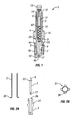
- the spark plug or ignition device 1 consists of a preferably metal casing or shell 15 having a substantially cylindrical base 44, which may have external threads 18, formed thereon for engagement with the cylinder head (not shown) of the spark ignited internal combustion engine (not shown).
- the cylindrical base 44 of the spark plug shell has a generally flattened surface perpendicular to the longitudinal axis of the spark plug 1 to which a ground electrode 16 is affixed, preferably by conventional welding.
- the ground electrode 16 has a preferably rounded tip 45 of Rhenium/Tungsten sintered compound, which resists the erosion of the electrode 16 due to high power discharge, as further disclosed herein.
- the spark plug or ignition device 1 includes a preferably hollow, composite insulator 4 disposed concentrically within the shell 15, incorporating a combustion cone 5, preferably formed from ceramic or the like.
- the center or positive electrode 7 is disposed concentrically within the ceramic cone 5 that is disposed in the combustion chamber when installed in the engine (not shown).
- the center electrode 7 is preferably constructed of a thermally and electrically conductive material with very low resistivity values such as, but not limited to, a copper or copper alloy, with or without an outer coating, cladding or plating preferred in a nickel alloy.
- the center electrode 7 preferably includes formed thereon, by weldment or by other suitable attachment, an electrode tip 17 preferably constructed of a Rhenium/Tungsten alloy (50%-75% Rhenium), which is highly resistant to erosion under high power discharge, as further disclosed herein.
- the spark plug 1 includes a highly conductive spring 10 that is a component of the center conductor assembly and positive plate 43 of the capacitive element.
- the spring 10 is connected to one end of a preferably 5Kn (or suitable resitance) resistor or inductor 11 and electrically and mechanically contacts the positive plate 43 of the capacitor, which is connected to the center electrode 7 by means of an interference fit of the stud 9 of the electrode 7 into the positive plate 43.
- the resistor or inductor 11 is connected to a high voltage terminal 13 for further connection to an ignition coil (not shown) by a penetrating rod 14 of the terminal 13, as further disclosed herein.
- the composite insulator 4 of the spark plug is inserted into the shell 15 and preferably crimped for positive alignment and seal against combustion gasses, as is customary practice in the industry.
- a flange 20 of a negative plate 2 is left exposed.
- the exposed flange 20 of the negative plate of the capacitor 2 makes physical and electrical contact with the conductive shell 15 of the spark plug when the shell 15 is crimped with sideward and downward pressure onto the insulator 4 using conventional industry practice.
- the mechanical contact between the shell 15, which is electrically connected to the ground circuit of the engine ignition circuit and the negative plate 2 of the capacitor advantageously ensures that the negative plate 2 is electrically connected to the ground circuit of the ignition system.
- the negative plate is shown generally at 2 and includes at least one flange 20 extending therefrom.
- the negative plate 2 is encased in the engineered polymer of the insulator 4 and the tips of flange 20 are left exposed in order that they make mechanical and electrical contact with the shell of the spark plug (not shown) thereby ensuring the.plate 2 is electrically connected to the ground of the ignition system.
- a scallop 21 of the flange 20, ensures a complete flow of the engineered polymer of the insulator 4 around the plate 19 during the molding process to encase and locate the plate 2 concentric to the ceramic cone 5.
- the preferably ceramic cone 5 has an integral and concentric locking detent 27 wherein during the molding process, the engineered polymer of the insulator 4 flows into, which locks and locates the cone 5 in relation to and separated from the negative plate 2.
- a concentric cavity 26 in the ceramic cone 5 is formed to nestle the center or positive electrode 7.
- the center electrode 7 is provided with a boss 23, stud 9 and an electrode tip 17 that is resistant to high power discharge.
- the boss 23 of the center electrode 7 nestles in the cavity 26 provided in the ceramic cone 5.
- the cavity 26 is preferably filled with copper glass, ceramic epoxy or other suitable permanently sealing material on top of the installed center electrode 7 and boss 23 thereof, which provides a gas seal to protect the interior of the spark plug 1 from combustion pressures.
- the stud 9 of the electrode 7 is provided to engage the assembled positive plate of the capacitor (shown as 43 in Fig. 4 ) with an interference fit ensuring completion of the positive side of the ignition circuit.
- the center electrode 7 is provided with an erosion resistant electrode tip 17 that is preferably formed from a Rhenium/Tungsten alloy of between about 50%-75% Rhenium.
- An end of the highly erosion resistive electrode tip 17 is flush with the end 30 of the ceramic cone 5.
- the electrode tip 17 of a sintered compound of rhenium by about 50% to 75% by mass sintered with tungsten in a preferably cylindrical configuration of .635mm to 1.524mm (.025"- .060”) in diameter and 2.54mm (.100”) in length is preferably affixed to the center electrode 7 by means of plasma, friction or electron welding or other suitable method by which permanency is achieved while delivering a low resistance juncture.
- Tungsten may be utilized as an electrode material in an automotive application by the isolation of the tungsten to the oxygen present in the combustion chamber. This is partially accomplished by the sintering of tungsten with rhenium and an appropriate binding agent such as, but not limited to, a non-oxidizing metal that melts at a temperature below that of rhenium and tungsten.
- the sintering process blends the two preferably powdered base metals with the binding agent and during the refractory process melts the binder and sinters the base materials into a form held together by the binder.
- the form preferably rectangular in shape, is then extruded into wire of .635mm to 1.524mm (.025"- .060") in diameter to form the electrode tips 17 and 45.
- the bonding agent provides protection against the oxidation of the tungsten component by covering that portion of the tungsten not in contact with the rhenium.
- the bonding metal erodes during the high-power discharge process, exposing the raw tungsten of the electrode tips 17 and 45 to ambient oxygen in the combustion chamber and thereby accelerating tungsten erosion.
- the erosion rate due to oxygen exposure is significantly reduced by the use of the bonding agent.
- the rhenium is now closer to the opposing or negative electrode, and as proximity and field effect dictate where the spark emanates from, the rhenium, also highly resistant to high-power erosion, becomes the source of the spark streamer.
- tungsten may be utilized as an electrode material in an automotive application by the placement of the electrode tip 17 with respect to the ceramic cone 5. In this placement, only the extreme end of the electrode tip 17 is exposed to the elements in the combustion chamber. The remainder of the cylindrical electrode tip 17 has been bonded to the ceramic cone 5, sealing off the electrode tip 17 against any combustion gasses including oxygen. In this fashion, only the extreme end of the electrode tip 17 will erode, as it will under the high power discharge of the current invention.
- the electrode tip 17 can erode to the point where the distance from the ground electrode 16 to the center or positive electrode tip 17 has doubled, while the voltage required to break down the doubled gap is slightly more than the breakdown voltage of the original spark gap and well under the available voltage from the original equipment manufacturer ignition system. This advantageously assures proper operation of the engine for a minimum of 10 9 cycles of the spark plug or 160,934 equivalent Kilometers (100,000 equivalent miles).
- FIG.3 there is shown a molded composite insulator assembly indicated generally at 19, center electrode 7 with erosion resistant tip 17, ceramic cone 5 and binding and insulating engineered polymer 4, forming the assembly 19.
- center electrode 7 with erosion resistant tip 17, ceramic cone 5 and binding and insulating engineered polymer 4, forming the assembly 19.
- the composite insulator 19 and center electrode 7 of FIG. 3 and the positive plate 43 of FIG.4 , when the positive plate 43 is inserted into the cavity 32 of the composite insulator 19, the stud 9 of the center electrode 7 engages the undersize hole 46 of the center conductor providing a highly conductive path from the ignition coil output (not shown) to the spark plug gap (not shown).
- a capacitor or capacitive element is formed by definition, i.e.: a capacitor being two conductive plates (plates 43 and 2 ) of opposite electrical charge separated by a dielectric, the dielectric being the engineered polymer 4.
- Capacitance can be increased by decreasing the separation of the oppositely charged plates 43 and 2 or by increasing the surface areas of the plates 43 and 2 . Capacitance can also be affected by the dielectric constant of the engineered polymer. Dielectric constants can vary from four to over twelve depending on the material selected.
- FIG. 3 Attention is now directed in FIG. 3 to the center or positive electrode 7 and the cavity 26 of ceramic cone 5 into which the electrode 7 is embedded concentrically.
- a pressure or gas seal is accomplished by completely filling the cavity 26 with ceramic epoxy, copper glass or other suitable high temperature sealant.
- a center conductor assembly is indicated generally at 33 consisting of the tubular positive plate or conductor 43, resistor 11, conductive spring connector 10, terminal insert 12, and high tension cable or coil terminal 13.
- the resistor 11 is inserted into the cavity 41 of the terminal insert 12 and preferably retained by means of a high temperature ceramic epoxy or other high temperature adhesive suitable to retain the resistor 11 in place under operation of the engine.
- the high tension cable or coil terminal 13 is attached to the terminal insert 12 by means of a threaded portion 48 of the terminal 13 into the threaded cavity 40 of the terminal insert 12.
- the pointed shaft 47 of the terminal 13 makes physical and electrical contact with the resistor 11 once the terminal 13 is installed by screwing into the terminal insert 12.
- the end of the resistor 11 opposite the terminal 13 makes physical and electrical contact with the conductive spring 10, which is under compression when the center conductor assembly is inserted into the composite insulator 19 of FIG. 3 .
- the spring 10 end opposite the resistor 11 makes mechanical and electrical contact with the tubular positive plate or conductor 43 completing the positive circuit for the ignition pulse.
- the placement of the resistor 11 in the positive circuit before the positive plate 43 of the capacitive element of the spark plug 1 allows the capacitor 28 to discharge at a very high transfer efficiency rate and deposit a very high percentage, greater than 95%, of the stored energy into the fuel charge. Normally this hard deposition of energy would create an abnormal amount of radio frequency or electromagnetic interference, which is incompatible with the operation of automobile engine management computers. Placement of the resistor 11 before the capacitor 28 in the circuit allows for the deposition while elimination the interference.
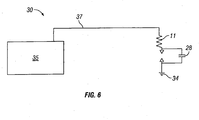
- FIG. 6 illustrates an exemplary circuit 30 for the ignition device 1 of the present invention and shows a coil 35, such as an ignition coil or the like, connected to the resistor 11 through a secondary circuit 37.
- the capacitor 28 is connected to the resistor 11 and connected in parallel with the secondary circuit 37 and ground 34.
- the resistor 11 advantageously suppresses high frequency electrical noise generated by the circuit 30 while not affecting the high power discharge of the capacitor 28.
- peaking capacitor 28 One of the benefits of utilizing a peaking capacitor 28 to improve engine performance is the ability to ignite fuel in extreme lean conditions.
- the use of the peaking capacitor 28 will allow automobile manufacturers to lean air:fuel ratios with additional levels of exhaust gas beyond levels of current automotive ignition capability.
- FIG. 5 there is shown the completely assembled composite insulator assembly indicated generally as 6, consisting of the over-molded insulator 19 with ceramic cone 5 and center electrode 7 with erosion resistant electrode tip 17, negative plate 2 of the capacitive element 28, and insulating engineered polymer 4. Also shown is a cross sectional view of the completely assembled component string of the center conductor assembly 33 shown in Fig. 4 consisting of the tubular positive plate or conductor 43 of the capacitor or capacitive element 28, resistor 11, conductive spring connector 10, terminal insert 12, and high tension cable or coil terminal 13. This view illustrates the completed assembly of the composite insulator assembly 6 prior to insertion and crimping into the spark plug shell 44 of FIG. 1 .
- Gas seal and ground contact washer 22 of FIG. 5 is placed into the shell 15 of FIG. 1 , resting in the transition of diameters, ensuring the negative plate 2 makes contact with the shell 15 and completing the ground circuit of the capacitive element of the current invention.
- An embodiment of the spark plug or ignition device 1 of the present invention provides a spark plug that has an insulator 4 and 5 that is a composite of dissimilar materials.
- An embodiment of the spark plug or ignition device 1 includes a very fine cross sectional electrode tips 17 and 45 of a material and design to effectively reduce the erosion of the electrode tips 17 and 45 prevalent in high power discharge, spark-gap devices.
- An embodiment of the spark plug or ignition device 1 comprises an insulator 4 constructed in such a manner as to create a capacitor 28 in parallel with the high voltage circuit 30 of the ignition system, and placement of an inductor or resistor 11 in the electrical circuit 30 of the spark plug whereby the resistor or inductor 11 suitably shields any electromagnetic or radio frequency emissions from the spark plug 1 without compromising the high power discharge of the spark.
- An embodiment of the spark plug or ignition device 1 also completes the capacitor 28 and high voltage circuit 30 of the ignition system to provide a path for the high power discharge to the electrode 17 of the spark plug 1.
Landscapes
- Engineering & Computer Science (AREA)
- Chemical & Material Sciences (AREA)
- Combustion & Propulsion (AREA)
- Manufacturing & Machinery (AREA)
- Mechanical Engineering (AREA)
- General Engineering & Computer Science (AREA)
- Spark Plugs (AREA)
- Ignition Installations For Internal Combustion Engines (AREA)
Applications Claiming Priority (3)
| Application Number | Priority Date | Filing Date | Title |
|---|---|---|---|
| US79992606P | 2006-05-12 | 2006-05-12 | |
| US11/747,714 US8922102B2 (en) | 2006-05-12 | 2007-05-11 | Composite spark plug |
| PCT/US2007/068897 WO2007134296A2 (en) | 2006-05-12 | 2007-05-14 | Composite spark plug |
Publications (3)
| Publication Number | Publication Date |
|---|---|
| EP2025048A2 EP2025048A2 (en) | 2009-02-18 |
| EP2025048A4 EP2025048A4 (en) | 2013-04-24 |
| EP2025048B1 true EP2025048B1 (en) | 2015-04-01 |
Family
ID=38684505
Family Applications (1)
| Application Number | Title | Priority Date | Filing Date |
|---|---|---|---|
| EP20070783743 Not-in-force EP2025048B1 (en) | 2006-05-12 | 2007-05-14 | Composite spark plug |
Country Status (8)
| Country | Link |
|---|---|
| US (2) | US8922102B2 (https=) |
| EP (1) | EP2025048B1 (https=) |
| JP (1) | JP5033872B2 (https=) |
| KR (1) | KR101446725B1 (https=) |
| AU (1) | AU2007249192C1 (https=) |
| CA (1) | CA2652260C (https=) |
| MX (1) | MX2008014433A (https=) |
| WO (1) | WO2007134296A2 (https=) |
Families Citing this family (25)
| Publication number | Priority date | Publication date | Assignee | Title |
|---|---|---|---|---|
| US8278808B2 (en) * | 2006-02-13 | 2012-10-02 | Federal-Mogul Worldwide, Inc. | Metallic insulator coating for high capacity spark plug |
| US8049399B2 (en) | 2006-07-21 | 2011-11-01 | Enerpulse, Inc. | High power discharge fuel ignitor |
| US7735460B2 (en) * | 2008-02-01 | 2010-06-15 | Leonard Bloom | Method and apparatus for operating standard gasoline-driven engines with a readily-available non-volatile fuel, thereby obviating the use of gasoline |
| US20110168144A1 (en) * | 2008-08-22 | 2011-07-14 | Leonard Bloom | Method and apparatus for operating standard gasoline-driven engines with a readily-available non-volatile fuel, thereby obviating the use of gasoline |
| US8839752B2 (en) * | 2011-01-14 | 2014-09-23 | John A. Burrows | Corona igniter with magnetic screening |
| US9640952B2 (en) * | 2012-01-27 | 2017-05-02 | Enerpulse, Inc. | High power semi-surface gap plug |
| US20140109886A1 (en) * | 2012-10-22 | 2014-04-24 | Transient Plasma Systems, Inc. | Pulsed power systems and methods |
| DE102013211493A1 (de) * | 2013-06-19 | 2014-12-24 | Bayerische Motoren Werke Aktiengesellschaft | Zündkerze |
| US10260958B2 (en) * | 2015-04-22 | 2019-04-16 | GM Global Technology Operations LLC | Resettable sensor assembly and system |
| JP6467370B2 (ja) * | 2016-03-11 | 2019-02-13 | 日本特殊陶業株式会社 | スパークプラグ |
| JP6293810B2 (ja) * | 2016-03-22 | 2018-03-14 | 日本特殊陶業株式会社 | 点火システム |
| CN110226033A (zh) * | 2016-11-22 | 2019-09-10 | Ic有限责任公司 | 火花塞燃烧电离传感器 |
| US10511152B2 (en) * | 2017-04-26 | 2019-12-17 | Woodward, Inc. | Method and system for a unique material and geometry in a high temperature spark plug extender |
| EP3732703B1 (en) | 2018-01-22 | 2022-08-31 | Transient Plasma Systems, Inc. | Inductively coupled pulsed rf voltage multiplier |
| WO2019144037A1 (en) | 2018-01-22 | 2019-07-25 | Transient Plasma Systems, Inc. | Resonant pulsed voltage multiplier and capacitor charger |
| DE102018105928B4 (de) | 2018-03-14 | 2020-06-18 | Federal-Mogul Ignition Gmbh | Verfahren zum Herstellen einer Elektrodenanordnung für eine Zündkerze |
| US10283940B1 (en) | 2018-03-27 | 2019-05-07 | Denso International America, Inc. | Dielectric ground strap for spark improvement |
| US11629860B2 (en) | 2018-07-17 | 2023-04-18 | Transient Plasma Systems, Inc. | Method and system for treating emissions using a transient pulsed plasma |
| EP3824223B1 (en) | 2018-07-17 | 2024-03-06 | Transient Plasma Systems, Inc. | Method and system for treating cooking smoke emissions using a transient pulsed plasma |
| US10865759B2 (en) | 2018-08-24 | 2020-12-15 | A Tech Aerospace, Inc. | Battery enhancer for a vehicle |
| CN109269967B (zh) * | 2018-09-21 | 2021-02-26 | 合肥国轩高科动力能源有限公司 | 一种锂离子电池壳体腐蚀的测试方法 |
| WO2020226977A1 (en) | 2019-05-07 | 2020-11-12 | Transient Plasma Systems, Inc. | Pulsed non-thermal atmospheric pressure plasma processing system |
| WO2022187226A1 (en) | 2021-03-03 | 2022-09-09 | Transient Plasma Systems, Inc. | Apparatus and methods of detecting transient discharge modes and/or closed loop control of pulsed systems employing same |
| US11988149B1 (en) | 2021-09-14 | 2024-05-21 | United States Of America As Represented By The Administrator Of Nasa | Coil-on plug exciter |
| US20240194400A1 (en) * | 2022-12-07 | 2024-06-13 | Platinum RP Pty Ltd | Ignition coil device |
Family Cites Families (93)
| Publication number | Priority date | Publication date | Assignee | Title |
|---|---|---|---|---|
| US1148106A (en) * | 1911-01-13 | 1915-07-27 | Fritz Lux | Sparking plug. |
| US2360287A (en) * | 1942-02-09 | 1944-10-10 | Gen Motors Corp | Method of making spark plugs |
| US2391458A (en) | 1944-03-14 | 1945-12-25 | Mallory & Co Inc P R | Spark gap electrode |
| US2449403A (en) * | 1945-04-02 | 1948-09-14 | Gen Motors Corp | Spark plug electrode |
| US2908569A (en) * | 1954-02-05 | 1959-10-13 | Renault | Process of producing sintered tungsten electrodes |
| GB937646A (en) | 1961-05-24 | 1963-09-25 | Comp Generale Electricite | Inter ference suppressor device for internal combustion engines |
| GB994525A (en) | 1962-12-06 | 1965-06-10 | Gen Motors Ltd | Spark plugs |
| US3581141A (en) | 1969-04-07 | 1971-05-25 | Ethyl Corp | Surface gap spark plug |
| US3599030A (en) | 1969-07-15 | 1971-08-10 | Brunswick Corp | Annular surface gap spark plug |
| US3603835A (en) * | 1970-01-14 | 1971-09-07 | Champion Spark Plug Co | Spark plug with an internal resistor |
| US3683232A (en) * | 1970-02-03 | 1972-08-08 | Baur Elektronik Gmbh Fa | Sparkplug cap |
| US3668749A (en) * | 1970-05-06 | 1972-06-13 | Champion Spark Plug Co | Spark plug seat |
| US3790842A (en) * | 1973-03-05 | 1974-02-05 | Champion Spark Plug Co | Spark plug |
| US3831562A (en) | 1973-07-02 | 1974-08-27 | Gen Motors Corp | Surface gap spark plug and rotary engine combination |
| US3868530A (en) | 1973-07-05 | 1975-02-25 | Champion Spark Plug Co | Spark plug |
| FR2312126A1 (fr) | 1975-05-21 | 1976-12-17 | Mayer Ferdy | Dispositif antiparasites pour moteur a explosions |
| DE2549931A1 (de) * | 1975-11-07 | 1977-05-18 | Bosch Gmbh Robert | Zuendkerzen-elektrode |
| US4082976A (en) * | 1976-06-21 | 1978-04-04 | Champion Spark Plug Company | Spark plug design having two electrically isolated center electrodes |
| JPS5688280A (en) | 1979-12-19 | 1981-07-17 | Hitachi Ltd | Ignition plug with twoostage resistor |
| US4419539A (en) * | 1980-10-24 | 1983-12-06 | Arrigoni Computer Graphics | Apparatus for preventing noise generation in an electrical digitizer due to generation of optical signals |
| JPS5812302A (ja) * | 1981-07-16 | 1983-01-24 | 日本特殊陶業株式会社 | 抵抗入り点火栓用抵抗体組成物 |
| US4460847A (en) | 1981-07-27 | 1984-07-17 | Champion Spark Plug Company | Spark plug |
| DE3308522A1 (de) * | 1983-03-10 | 1984-09-13 | Robert Bosch Gmbh, 7000 Stuttgart | Zuendkerze fuer brennkraftmaschinen |
| US4568855A (en) | 1983-03-14 | 1986-02-04 | Champion Spark Plug Company | Spark plug |
| DE3347027A1 (de) | 1983-12-24 | 1985-07-04 | Robert Bosch Gmbh, 7000 Stuttgart | Zuendkerze fuer eine brennkraftmaschine |
| DE3505988A1 (de) | 1985-02-21 | 1986-08-21 | Robert Bosch Gmbh, 7000 Stuttgart | Fuer eine brennkraftmaschine bestimmte zuendeinrichtung |
| JPS62503134A (ja) | 1985-05-31 | 1987-12-10 | ロ−ベルト ボツシユ ゲゼルシヤフト ミツト ベシユレンクテル ハフツング | 内燃機関用の点火プラグ |
| DE3600511A1 (de) | 1985-05-31 | 1986-12-04 | Robert Bosch Gmbh, 7000 Stuttgart | Zuendkerze fuer brennkraftmaschinen |
| DE3544870A1 (de) * | 1985-12-18 | 1987-06-19 | Beru Werk Ruprecht Gmbh Co A | Zuendkerzenstecker |
| US4841925A (en) * | 1986-12-22 | 1989-06-27 | Combustion Electromagnetics, Inc. | Enhanced flame ignition for hydrocarbon fuels |
| DE3872027T2 (de) | 1987-04-16 | 1993-01-21 | Nippon Denso Co | Zuendkerze fuer verbrennungsmotor. |
| JPH0831352B2 (ja) | 1987-08-04 | 1996-03-27 | 株式会社日本自動車部品総合研究所 | スパークプラグ |
| JPH077694B2 (ja) | 1988-05-09 | 1995-01-30 | 日本特殊陶業株式会社 | 沿面ギャップ型イグナイタプラグの製造方法 |
| US5210458A (en) * | 1989-03-06 | 1993-05-11 | Mcdougal John A | Spark plug |
| US5371436A (en) * | 1989-09-28 | 1994-12-06 | Hensley Plasma Plug Partnership | Combustion ignitor |
| US5272415A (en) * | 1989-09-28 | 1993-12-21 | Hensley Plasma Plug Partnership | Combustion ignitor |
| US5095242A (en) | 1990-07-24 | 1992-03-10 | North American Philips Corporation | Low radio interference spark plug |
| US5049786A (en) | 1990-08-09 | 1991-09-17 | Coen Company, Inc. | High energy ignitor power circuit |
| JPH04133281A (ja) | 1990-09-25 | 1992-05-07 | Ngk Spark Plug Co Ltd | スパークプラグ |
| US5028747A (en) | 1990-09-26 | 1991-07-02 | General Motors Corporation | Distributor cap |
| US5187404A (en) | 1991-08-05 | 1993-02-16 | Cooper Industries, Inc. | Surface gap igniter |
| US5304894A (en) | 1992-09-02 | 1994-04-19 | General Motors Corporation | Metallized glass seal resistor composition |
| US5391100A (en) * | 1992-11-10 | 1995-02-21 | Honda Giken Kogyo Kabushiki Kaisha | Method of manufacturing of spark plug cap with ignition voltage detective capacitor |
| JP3345761B2 (ja) | 1993-06-16 | 2002-11-18 | 日本特殊陶業株式会社 | ヒーター付スパークプラグ及びその製造方法 |
| JPH0737673A (ja) | 1993-07-23 | 1995-02-07 | Ngk Spark Plug Co Ltd | スパークプラグ用電極 |
| JPH0750192A (ja) * | 1993-08-04 | 1995-02-21 | Ngk Spark Plug Co Ltd | ガスエンジン用スパークプラグ |
| US5751096A (en) * | 1995-10-27 | 1998-05-12 | Lahens; Albert | Spark plug having a plurality of vertical ground electrodes and a vertical cylindrical shaped center electrode in parallel formation for use in a internal combustion engine |
| CN1150348A (zh) | 1995-11-15 | 1997-05-21 | 路易斯·S·凯米利 | 电流峰化与射频干扰抑制装置 |
| JP3265210B2 (ja) * | 1996-01-19 | 2002-03-11 | 日本特殊陶業株式会社 | スパークプラグ |
| JPH1022050A (ja) | 1996-06-28 | 1998-01-23 | Ngk Spark Plug Co Ltd | スパークプラグ |
| JP3813708B2 (ja) | 1996-09-12 | 2006-08-23 | 日本特殊陶業株式会社 | スパークプラグの製造方法 |
| JP3297636B2 (ja) * | 1997-03-07 | 2002-07-02 | 日本特殊陶業株式会社 | セミ沿面放電形のスパークプラグ |
| JP3535367B2 (ja) | 1997-12-18 | 2004-06-07 | 日本特殊陶業株式会社 | 抵抗体入りスパークプラグ |
| JP3269032B2 (ja) * | 1997-09-01 | 2002-03-25 | 日本特殊陶業株式会社 | スパークプラグ及びそれを用いた内燃機関用点火システム |
| US6130498A (en) | 1997-12-26 | 2000-10-10 | Denso Corporation | Spark plug with specific measured parameters |
| DE19833316A1 (de) * | 1998-07-24 | 2000-01-27 | Bosch Gmbh Robert | Zündkerze für eine Brennkraftmaschine |
| JP3717672B2 (ja) | 1998-07-28 | 2005-11-16 | オムロン株式会社 | 電極保持器 |
| US6132277A (en) * | 1998-10-20 | 2000-10-17 | Federal-Mogul World Wide, Inc. | Application of precious metal to spark plug electrode |
| JP2000154773A (ja) | 1998-11-16 | 2000-06-06 | Sumitomo Wiring Syst Ltd | 点火ケーブル用高圧端子 |
| JP2000252039A (ja) | 1999-02-26 | 2000-09-14 | Ngk Spark Plug Co Ltd | 内燃機関用スパークプラグ |
| JP4975133B2 (ja) | 1999-06-25 | 2012-07-11 | 日本特殊陶業株式会社 | スパークプラグ |
| US6533629B1 (en) * | 1999-07-13 | 2003-03-18 | Alliedsignal Inc. | Spark plug including a wear-resistant electrode tip made from a co-extruded composite material, and method of making same |
| US6329743B1 (en) * | 1999-08-17 | 2001-12-11 | Louis S. Camilli | Current peaking sparkplug |
| CN2398751Y (zh) | 1999-11-03 | 2000-09-27 | 张华正 | 自容式火花塞 |
| US6423190B2 (en) | 2000-01-07 | 2002-07-23 | Delphi Technologies, Inc. | Pulse density modulation for uniform barrier discharge in a nonthermal plasma reactor |
| DE10016416A1 (de) * | 2000-04-01 | 2001-10-18 | Bosch Gmbh Robert | Glaskeramik, Verfahren zu deren Herstellung und Zündkerze mit einer derartigen Glaskeramik |
| GB2361264A (en) | 2000-04-10 | 2001-10-17 | Fed Mogul Ignition | Surface discharge spark plug for i.c. engines |
| JP4620217B2 (ja) | 2000-05-24 | 2011-01-26 | 日本特殊陶業株式会社 | スパークプラグ用絶縁体及びスパークプラグ |
| US6632353B2 (en) * | 2000-06-26 | 2003-10-14 | Berger Instruments, Inc. | Rapid sample collection in supercritical fluid chromatography |
| JP2002175863A (ja) * | 2000-09-29 | 2002-06-21 | Ngk Spark Plug Co Ltd | スパークプラグ |
| US6557508B2 (en) * | 2000-12-18 | 2003-05-06 | Savage Enterprises, Inc. | Robust torch jet spark plug electrode |
| JP4271379B2 (ja) | 2001-02-08 | 2009-06-03 | 株式会社デンソー | スパークプラグ |
| JP2002280145A (ja) * | 2001-03-19 | 2002-09-27 | Ngk Spark Plug Co Ltd | スパークプラグ及びその製造方法 |
| US6517931B1 (en) | 2001-10-15 | 2003-02-11 | Ferro Corporation | Silver ink for forming electrodes |
| JP2003142226A (ja) * | 2001-10-31 | 2003-05-16 | Ngk Spark Plug Co Ltd | スパークプラグ |
| DE10257995B4 (de) * | 2002-04-09 | 2011-03-24 | Robert Bosch Gmbh | Zündkerze |
| US6647794B1 (en) | 2002-05-06 | 2003-11-18 | Rosemount Inc. | Absolute pressure sensor |
| JP4125060B2 (ja) | 2002-07-16 | 2008-07-23 | 日本特殊陶業株式会社 | スパークプラグ |
| JP4133537B2 (ja) | 2003-04-17 | 2008-08-13 | 日本特殊陶業株式会社 | スパークプラグの製造方法及び製造装置 |
| US7626320B2 (en) | 2003-05-20 | 2009-12-01 | Ngk Spark Plug Co., Ltd. | Spark plug with excellent impact resistance conductive seal, and method for producing the same |
| JP4220308B2 (ja) | 2003-05-29 | 2009-02-04 | 株式会社デンソー | スパークプラグ |
| KR20060090815A (ko) * | 2003-09-26 | 2006-08-16 | 코닌클리즈케 필립스 일렉트로닉스 엔.브이. | 조명 장치 및 그것을 포함하는 시스템 |
| US7019448B2 (en) | 2003-11-05 | 2006-03-28 | Federal-Mogul World Wide, Inc. | Spark plug having a multi-tiered center wire assembly |
| US7011560B2 (en) | 2003-11-05 | 2006-03-14 | Federal-Mogul World Wide, Inc. | Spark plug with ground electrode having mechanically locked precious metal feature |
| US7169723B2 (en) * | 2003-11-12 | 2007-01-30 | Federal-Mogul World Wide, Inc. | Ceramic with improved high temperature electrical properties for use as a spark plug insulator |
| US20050168121A1 (en) | 2004-02-03 | 2005-08-04 | Federal-Mogul Ignition (U.K.) Limited | Spark plug configuration having a metal noble tip |
| MX2007001454A (es) | 2004-08-03 | 2008-03-13 | Federal Mogul Corp | Dispositivo de ignicion que tiene una punta de encendido refluidificada y metodo para fabricarla. |
| EP1701419A1 (en) | 2005-03-08 | 2006-09-13 | Veenstra- Glazenborg B.V. | A pre-chamber sparkplug, and combustion engine including a pre-chamber sparkplug |
| US20070116976A1 (en) * | 2005-11-23 | 2007-05-24 | Qi Tan | Nanoparticle enhanced thermoplastic dielectrics, methods of manufacture thereof, and articles comprising the same |
| JP2007184194A (ja) | 2006-01-10 | 2007-07-19 | Denso Corp | 内燃機関用のスパークプラグ |
| US8278808B2 (en) | 2006-02-13 | 2012-10-02 | Federal-Mogul Worldwide, Inc. | Metallic insulator coating for high capacity spark plug |
| US20070188064A1 (en) * | 2006-02-13 | 2007-08-16 | Federal-Mogul World Wide, Inc. | Metallic insulator coating for high capacity spark plug |
| US8049399B2 (en) | 2006-07-21 | 2011-11-01 | Enerpulse, Inc. | High power discharge fuel ignitor |
-
2007
- 2007-05-11 US US11/747,714 patent/US8922102B2/en not_active Expired - Fee Related
- 2007-05-14 CA CA2652260A patent/CA2652260C/en not_active Expired - Fee Related
- 2007-05-14 AU AU2007249192A patent/AU2007249192C1/en not_active Ceased
- 2007-05-14 WO PCT/US2007/068897 patent/WO2007134296A2/en not_active Ceased
- 2007-05-14 KR KR1020087030432A patent/KR101446725B1/ko not_active Expired - Fee Related
- 2007-05-14 JP JP2009510196A patent/JP5033872B2/ja not_active Expired - Fee Related
- 2007-05-14 EP EP20070783743 patent/EP2025048B1/en not_active Not-in-force
- 2007-05-14 MX MX2008014433A patent/MX2008014433A/es active IP Right Grant
-
2014
- 2014-12-29 US US14/584,721 patent/US9287686B2/en not_active Expired - Fee Related
Also Published As
| Publication number | Publication date |
|---|---|
| MX2008014433A (es) | 2009-02-23 |
| EP2025048A2 (en) | 2009-02-18 |
| KR101446725B1 (ko) | 2014-10-06 |
| US20150111458A1 (en) | 2015-04-23 |
| WO2007134296A3 (en) | 2008-01-10 |
| US9287686B2 (en) | 2016-03-15 |
| JP5033872B2 (ja) | 2012-09-26 |
| CA2652260C (en) | 2016-08-16 |
| AU2007249192A1 (en) | 2007-11-22 |
| EP2025048A4 (en) | 2013-04-24 |
| CA2652260A1 (en) | 2007-11-22 |
| AU2007249192B2 (en) | 2010-12-02 |
| WO2007134296A2 (en) | 2007-11-22 |
| AU2007249192C1 (en) | 2014-05-22 |
| KR20090034313A (ko) | 2009-04-07 |
| US20070262721A1 (en) | 2007-11-15 |
| JP2009537067A (ja) | 2009-10-22 |
| US8922102B2 (en) | 2014-12-30 |
Similar Documents
| Publication | Publication Date | Title |
|---|---|---|
| EP2025048B1 (en) | Composite spark plug | |
| EP2054617B1 (en) | High power discharge fuel ignitor | |
| US9088136B2 (en) | Corona ignition device with improved electrical performance | |
| US6329743B1 (en) | Current peaking sparkplug | |
| JP2013539903A (ja) | Rfスパークプラグの短絡防止 | |
| CN101479900A (zh) | 复合火花塞 | |
| EP2647834B1 (en) | Ignition device and structure for mounting same | |
| US20070188064A1 (en) | Metallic insulator coating for high capacity spark plug | |
| CN104221234A (zh) | 高功率半表面间隙火花塞 | |
| AU2013257509B2 (en) | High power discharge fuel ignitor | |
| JP2020087629A (ja) | 点火プラグ | |
| JPH04155792A (ja) | 高電圧スイッチ素子用ガス入り放電管及びこれを用いた点火プラグ |
Legal Events
| Date | Code | Title | Description |
|---|---|---|---|
| PUAI | Public reference made under article 153(3) epc to a published international application that has entered the european phase |
Free format text: ORIGINAL CODE: 0009012 |
|
| 17P | Request for examination filed |
Effective date: 20081212 |
|
| AK | Designated contracting states |
Kind code of ref document: A2 Designated state(s): AT BE BG CH CY CZ DE DK EE ES FI FR GB GR HU IE IS IT LI LT LU LV MC MT NL PL PT RO SE SI SK TR |
|
| DAX | Request for extension of the european patent (deleted) | ||
| A4 | Supplementary search report drawn up and despatched |
Effective date: 20130322 |
|
| RIC1 | Information provided on ipc code assigned before grant |
Ipc: H01T 13/00 20060101AFI20130318BHEP Ipc: H01T 21/02 20060101ALI20130318BHEP Ipc: H01T 13/40 20060101ALI20130318BHEP |
|
| 17Q | First examination report despatched |
Effective date: 20140417 |
|
| GRAP | Despatch of communication of intention to grant a patent |
Free format text: ORIGINAL CODE: EPIDOSNIGR1 |
|
| INTG | Intention to grant announced |
Effective date: 20141022 |
|
| GRAS | Grant fee paid |
Free format text: ORIGINAL CODE: EPIDOSNIGR3 |
|
| GRAA | (expected) grant |
Free format text: ORIGINAL CODE: 0009210 |
|
| AK | Designated contracting states |
Kind code of ref document: B1 Designated state(s): AT BE BG CH CY CZ DE DK EE ES FI FR GB GR HU IE IS IT LI LT LU LV MC MT NL PL PT RO SE SI SK TR |
|
| REG | Reference to a national code |
Ref country code: GB Ref legal event code: FG4D |
|
| REG | Reference to a national code |
Ref country code: CH Ref legal event code: EP |
|
| REG | Reference to a national code |
Ref country code: IE Ref legal event code: FG4D |
|
| REG | Reference to a national code |
Ref country code: DE Ref legal event code: R096 Ref document number: 602007040883 Country of ref document: DE Effective date: 20150513 |
|
| REG | Reference to a national code |
Ref country code: AT Ref legal event code: REF Ref document number: 719581 Country of ref document: AT Kind code of ref document: T Effective date: 20150515 |
|
| REG | Reference to a national code |
Ref country code: NL Ref legal event code: VDEP Effective date: 20150401 |
|
| REG | Reference to a national code |
Ref country code: AT Ref legal event code: MK05 Ref document number: 719581 Country of ref document: AT Kind code of ref document: T Effective date: 20150401 |
|
| REG | Reference to a national code |
Ref country code: LT Ref legal event code: MG4D |
|
| PG25 | Lapsed in a contracting state [announced via postgrant information from national office to epo] |
Ref country code: NL Free format text: LAPSE BECAUSE OF FAILURE TO SUBMIT A TRANSLATION OF THE DESCRIPTION OR TO PAY THE FEE WITHIN THE PRESCRIBED TIME-LIMIT Effective date: 20150401 |
|
| PG25 | Lapsed in a contracting state [announced via postgrant information from national office to epo] |
Ref country code: PT Free format text: LAPSE BECAUSE OF FAILURE TO SUBMIT A TRANSLATION OF THE DESCRIPTION OR TO PAY THE FEE WITHIN THE PRESCRIBED TIME-LIMIT Effective date: 20150803 Ref country code: ES Free format text: LAPSE BECAUSE OF FAILURE TO SUBMIT A TRANSLATION OF THE DESCRIPTION OR TO PAY THE FEE WITHIN THE PRESCRIBED TIME-LIMIT Effective date: 20150401 Ref country code: LT Free format text: LAPSE BECAUSE OF FAILURE TO SUBMIT A TRANSLATION OF THE DESCRIPTION OR TO PAY THE FEE WITHIN THE PRESCRIBED TIME-LIMIT Effective date: 20150401 Ref country code: FI Free format text: LAPSE BECAUSE OF FAILURE TO SUBMIT A TRANSLATION OF THE DESCRIPTION OR TO PAY THE FEE WITHIN THE PRESCRIBED TIME-LIMIT Effective date: 20150401 Ref country code: CZ Free format text: LAPSE BECAUSE OF FAILURE TO SUBMIT A TRANSLATION OF THE DESCRIPTION OR TO PAY THE FEE WITHIN THE PRESCRIBED TIME-LIMIT Effective date: 20150401 |
|
| REG | Reference to a national code |
Ref country code: FR Ref legal event code: PLFP Year of fee payment: 9 |
|
| PG25 | Lapsed in a contracting state [announced via postgrant information from national office to epo] |
Ref country code: GR Free format text: LAPSE BECAUSE OF FAILURE TO SUBMIT A TRANSLATION OF THE DESCRIPTION OR TO PAY THE FEE WITHIN THE PRESCRIBED TIME-LIMIT Effective date: 20150702 Ref country code: IS Free format text: LAPSE BECAUSE OF FAILURE TO SUBMIT A TRANSLATION OF THE DESCRIPTION OR TO PAY THE FEE WITHIN THE PRESCRIBED TIME-LIMIT Effective date: 20150801 Ref country code: AT Free format text: LAPSE BECAUSE OF FAILURE TO SUBMIT A TRANSLATION OF THE DESCRIPTION OR TO PAY THE FEE WITHIN THE PRESCRIBED TIME-LIMIT Effective date: 20150401 Ref country code: LV Free format text: LAPSE BECAUSE OF FAILURE TO SUBMIT A TRANSLATION OF THE DESCRIPTION OR TO PAY THE FEE WITHIN THE PRESCRIBED TIME-LIMIT Effective date: 20150401 |
|
| REG | Reference to a national code |
Ref country code: CH Ref legal event code: PL |
|
| REG | Reference to a national code |
Ref country code: DE Ref legal event code: R097 Ref document number: 602007040883 Country of ref document: DE |
|
| PG25 | Lapsed in a contracting state [announced via postgrant information from national office to epo] |
Ref country code: CH Free format text: LAPSE BECAUSE OF NON-PAYMENT OF DUE FEES Effective date: 20150531 Ref country code: MC Free format text: LAPSE BECAUSE OF FAILURE TO SUBMIT A TRANSLATION OF THE DESCRIPTION OR TO PAY THE FEE WITHIN THE PRESCRIBED TIME-LIMIT Effective date: 20150401 Ref country code: EE Free format text: LAPSE BECAUSE OF FAILURE TO SUBMIT A TRANSLATION OF THE DESCRIPTION OR TO PAY THE FEE WITHIN THE PRESCRIBED TIME-LIMIT Effective date: 20150401 Ref country code: DK Free format text: LAPSE BECAUSE OF FAILURE TO SUBMIT A TRANSLATION OF THE DESCRIPTION OR TO PAY THE FEE WITHIN THE PRESCRIBED TIME-LIMIT Effective date: 20150401 Ref country code: LI Free format text: LAPSE BECAUSE OF NON-PAYMENT OF DUE FEES Effective date: 20150531 |
|
| PLBE | No opposition filed within time limit |
Free format text: ORIGINAL CODE: 0009261 |
|
| STAA | Information on the status of an ep patent application or granted ep patent |
Free format text: STATUS: NO OPPOSITION FILED WITHIN TIME LIMIT |
|
| REG | Reference to a national code |
Ref country code: IE Ref legal event code: MM4A |
|
| PG25 | Lapsed in a contracting state [announced via postgrant information from national office to epo] |
Ref country code: RO Free format text: LAPSE BECAUSE OF NON-PAYMENT OF DUE FEES Effective date: 20150401 Ref country code: SK Free format text: LAPSE BECAUSE OF FAILURE TO SUBMIT A TRANSLATION OF THE DESCRIPTION OR TO PAY THE FEE WITHIN THE PRESCRIBED TIME-LIMIT Effective date: 20150401 Ref country code: PL Free format text: LAPSE BECAUSE OF FAILURE TO SUBMIT A TRANSLATION OF THE DESCRIPTION OR TO PAY THE FEE WITHIN THE PRESCRIBED TIME-LIMIT Effective date: 20150401 |
|
| 26N | No opposition filed |
Effective date: 20160105 |
|
| PG25 | Lapsed in a contracting state [announced via postgrant information from national office to epo] |
Ref country code: IE Free format text: LAPSE BECAUSE OF NON-PAYMENT OF DUE FEES Effective date: 20150514 |
|
| PG25 | Lapsed in a contracting state [announced via postgrant information from national office to epo] |
Ref country code: SI Free format text: LAPSE BECAUSE OF FAILURE TO SUBMIT A TRANSLATION OF THE DESCRIPTION OR TO PAY THE FEE WITHIN THE PRESCRIBED TIME-LIMIT Effective date: 20150401 |
|
| PG25 | Lapsed in a contracting state [announced via postgrant information from national office to epo] |
Ref country code: BE Free format text: LAPSE BECAUSE OF FAILURE TO SUBMIT A TRANSLATION OF THE DESCRIPTION OR TO PAY THE FEE WITHIN THE PRESCRIBED TIME-LIMIT Effective date: 20150401 |
|
| REG | Reference to a national code |
Ref country code: FR Ref legal event code: PLFP Year of fee payment: 10 |
|
| PG25 | Lapsed in a contracting state [announced via postgrant information from national office to epo] |
Ref country code: MT Free format text: LAPSE BECAUSE OF FAILURE TO SUBMIT A TRANSLATION OF THE DESCRIPTION OR TO PAY THE FEE WITHIN THE PRESCRIBED TIME-LIMIT Effective date: 20150401 |
|
| PGFP | Annual fee paid to national office [announced via postgrant information from national office to epo] |
Ref country code: GB Payment date: 20161129 Year of fee payment: 10 Ref country code: DE Payment date: 20161130 Year of fee payment: 10 |
|
| PGFP | Annual fee paid to national office [announced via postgrant information from national office to epo] |
Ref country code: IT Payment date: 20161129 Year of fee payment: 10 Ref country code: FR Payment date: 20161129 Year of fee payment: 10 |
|
| PG25 | Lapsed in a contracting state [announced via postgrant information from national office to epo] |
Ref country code: HU Free format text: LAPSE BECAUSE OF FAILURE TO SUBMIT A TRANSLATION OF THE DESCRIPTION OR TO PAY THE FEE WITHIN THE PRESCRIBED TIME-LIMIT; INVALID AB INITIO Effective date: 20070514 Ref country code: BG Free format text: LAPSE BECAUSE OF FAILURE TO SUBMIT A TRANSLATION OF THE DESCRIPTION OR TO PAY THE FEE WITHIN THE PRESCRIBED TIME-LIMIT Effective date: 20150401 |
|
| PG25 | Lapsed in a contracting state [announced via postgrant information from national office to epo] |
Ref country code: SE Free format text: LAPSE BECAUSE OF FAILURE TO SUBMIT A TRANSLATION OF THE DESCRIPTION OR TO PAY THE FEE WITHIN THE PRESCRIBED TIME-LIMIT Effective date: 20150401 Ref country code: CY Free format text: LAPSE BECAUSE OF FAILURE TO SUBMIT A TRANSLATION OF THE DESCRIPTION OR TO PAY THE FEE WITHIN THE PRESCRIBED TIME-LIMIT Effective date: 20150401 |
|
| PG25 | Lapsed in a contracting state [announced via postgrant information from national office to epo] |
Ref country code: TR Free format text: LAPSE BECAUSE OF FAILURE TO SUBMIT A TRANSLATION OF THE DESCRIPTION OR TO PAY THE FEE WITHIN THE PRESCRIBED TIME-LIMIT Effective date: 20150401 |
|
| PG25 | Lapsed in a contracting state [announced via postgrant information from national office to epo] |
Ref country code: LU Free format text: LAPSE BECAUSE OF NON-PAYMENT OF DUE FEES Effective date: 20150514 |
|
| REG | Reference to a national code |
Ref country code: DE Ref legal event code: R119 Ref document number: 602007040883 Country of ref document: DE |
|
| GBPC | Gb: european patent ceased through non-payment of renewal fee |
Effective date: 20170514 |
|
| REG | Reference to a national code |
Ref country code: FR Ref legal event code: ST Effective date: 20180131 |
|
| PG25 | Lapsed in a contracting state [announced via postgrant information from national office to epo] |
Ref country code: DE Free format text: LAPSE BECAUSE OF NON-PAYMENT OF DUE FEES Effective date: 20171201 Ref country code: GB Free format text: LAPSE BECAUSE OF NON-PAYMENT OF DUE FEES Effective date: 20170514 |
|
| PG25 | Lapsed in a contracting state [announced via postgrant information from national office to epo] |
Ref country code: FR Free format text: LAPSE BECAUSE OF NON-PAYMENT OF DUE FEES Effective date: 20170531 Ref country code: IT Free format text: LAPSE BECAUSE OF NON-PAYMENT OF DUE FEES Effective date: 20170514 |