EP2024279B1 - Verfahren zur abtrennung von chlor aus dem produktgas eines hci-oxidationsprozesses - Google Patents
Verfahren zur abtrennung von chlor aus dem produktgas eines hci-oxidationsprozesses Download PDFInfo
- Publication number
- EP2024279B1 EP2024279B1 EP07725010A EP07725010A EP2024279B1 EP 2024279 B1 EP2024279 B1 EP 2024279B1 EP 07725010 A EP07725010 A EP 07725010A EP 07725010 A EP07725010 A EP 07725010A EP 2024279 B1 EP2024279 B1 EP 2024279B1
- Authority
- EP
- European Patent Office
- Prior art keywords
- distillation
- hcl
- chlorine
- gas
- column
- Prior art date
- Legal status (The legal status is an assumption and is not a legal conclusion. Google has not performed a legal analysis and makes no representation as to the accuracy of the status listed.)
- Not-in-force
Links
Images
Classifications
-
- C—CHEMISTRY; METALLURGY
- C01—INORGANIC CHEMISTRY
- C01B—NON-METALLIC ELEMENTS; COMPOUNDS THEREOF; METALLOIDS OR COMPOUNDS THEREOF NOT COVERED BY SUBCLASS C01C
- C01B7/00—Halogens; Halogen acids
- C01B7/01—Chlorine; Hydrogen chloride
- C01B7/07—Purification ; Separation
-
- C—CHEMISTRY; METALLURGY
- C01—INORGANIC CHEMISTRY
- C01B—NON-METALLIC ELEMENTS; COMPOUNDS THEREOF; METALLOIDS OR COMPOUNDS THEREOF NOT COVERED BY SUBCLASS C01C
- C01B7/00—Halogens; Halogen acids
- C01B7/01—Chlorine; Hydrogen chloride
- C01B7/03—Preparation from chlorides
- C01B7/04—Preparation of chlorine from hydrogen chloride
-
- B—PERFORMING OPERATIONS; TRANSPORTING
- B01—PHYSICAL OR CHEMICAL PROCESSES OR APPARATUS IN GENERAL
- B01D—SEPARATION
- B01D3/00—Distillation or related exchange processes in which liquids are contacted with gaseous media, e.g. stripping
- B01D3/14—Fractional distillation or use of a fractionation or rectification column
-
- C—CHEMISTRY; METALLURGY
- C01—INORGANIC CHEMISTRY
- C01B—NON-METALLIC ELEMENTS; COMPOUNDS THEREOF; METALLOIDS OR COMPOUNDS THEREOF NOT COVERED BY SUBCLASS C01C
- C01B7/00—Halogens; Halogen acids
- C01B7/01—Chlorine; Hydrogen chloride
- C01B7/07—Purification ; Separation
- C01B7/0743—Purification ; Separation of gaseous or dissolved chlorine
Definitions
- the invention relates to a process for the selective removal of chlorine from the product gas of an optionally catalyst-supported HCl oxidation process by means of oxygen which, in addition to chlorine, still contains at least excess oxygen, chemically inert constituents, in particular carbon dioxide and noble gases, and optionally HCl, by means of distillation and recycling of the chlorine-removed oxygen stream to the HCl oxidation process.
- the processing of this process gas is a central problem of Deacon processes.
- the object is to selectively remove the target product chlorine from the process gas, which contains only about 30-50% by volume of chlorine, and for reuse e.g. to provide in an isocyanate production and to recycle the chlorine-free residual gas as possible back to the Deacon reactor.
- Chlorine is obtained from reaction gases of Deacon processes by absorption / desorption steps using carbon tetrachloride (CCl 4 ) in pure form.
- CCl 4 is subject to restrictive worldwide use restrictions for atmospheric protection because of its high ozone decomposition potential.
- a further problem with this method is that the recycle gas is sufficiently free from CCl 4 in order to avoid negative effects on the Deacon reactor and the Deacon catalyst and to dispense with additional purification steps in the Purgegas5.
- EP 0 233 773 A discloses a process for the selective removal of chlorine from the product gas of a catalyst-supported HCl oxidation process by means of oxygen which, in addition to chlorine, still contains excess oxygen, nitrogen, carbon dioxide and HCl, by distillation and recycling of the chlorine-liberated oxygen stream to the HCl oxidation process.
- the mixture to be separated is at a compression pressure of 10 to 25 kg / cm 2
- the invention described below relates to an improved process gas processing, for example, as part of a total Deacon process, which can be operated particularly advantageous in combination with a Isocyanatherstllung, since the new process gas processing uses impurities in the HCl gas stream from an isocyanate plant.
- the new process solves in particular the task of selectively removing chlorine from the product of HCl oxidation processes by means of oxygen and avoids the abovementioned disadvantages of the processes known from the prior art.
- the invention relates to a process for the selective separation of chlorine from the product gas of an optionally catalyst-supported HCl oxidation process by means of oxygen, which contains at least excess oxygen, chemically inert constituents, especially carbon dioxide and noble gases, and optionally HCl, by distillation and Recycling the chlorine-liberated oxygen stream to the HCl oxidation process, characterized in that the distillation is carried out by means of one or more distillation columns which form a buoyancy and stripping section and wherein the mixture to be separated is fed between the buoyancy and stripping section of the distillation column, that the distillation is carried out at a pressure of 8 to 30 bar (8,000 to 30,000 HPa) and a temperature in the top of the column of -10 ° C to -60 ° C, that liquid chlorine is taken from the distillation column, in particular at the bottom of the column, and that a mixture consisting essentially of carbon dioxide and oxygen is obtained at the top of the distillation column, which is partly passed as reflux to the distillation column and taken to the other part and introduced into the
- the product gas supplied to the distillation is dried before the distillation.
- a preferred method is characterized in that the HCl oxidation process is a Deacon process, i. a catalyzed gas phase oxidation of HCl by means of oxygen.
- the HCl gas from isocyanate plants typically contains impurities such as an excess of CO from phosgene production, traces of organic solvents such as monochlorobenzene or dichlorobenzene, and traces of CO 2 . These components are partially separable in a HCl gas cleaning, the remaining traces of carbon-containing compounds are oxidized under the reaction conditions of a Deacon process (excess oxygen, temperatures 300-400 ° C) with oxygen to CO 2 .
- the CO 2 accumulates in known processes as an inert gas in the oxygen recycle gas stream of the Deacon process and must be discharged from the oxygen cycle (purge).
- the CO 2 content in the recycle allows the process of the invention in a distillation column, which is operated for example with the quenched and dried product gas from a Deacon reactor, the CO 2 contained therein at a pressure of 10 - 30 bar and a temperature of about Condense -30 ° C to - 55 ° C and to give as reflux to this column.
- the additional energy required to generate deep freezing can be greatly mitigated by suitable basically known cold recovery measures.
- the distillation is preferably operated at a pressure of 10 to 25 bar (10,000 to 25,000 HPa) and at a temperature in the top of the column of -25 ° C to -45 ° C.
- the distillation column selectively removes the desired product chlorine as the bottom product from the dry reaction gas. Due to the return of liquid CO 2 is the head of the column and thus the oxygen recycle stream chlorine-free, he contains in addition to excess oxygen only CO 2 and inert components and therefore can be discharged in principle without waste gas scrubbing in the atmosphere.
- the bottom of the distillation column consists of liquid chlorine in the distillation and is essentially free of low-boiling compounds from the series oxygen, carbon dioxide, nitrogen, optionally noble gases and optionally hydrogen chloride.
- the mixture obtained at the top of the distillation column consists essentially of carbon dioxide, oxygen and hydrogen chloride, which is added as reflux to the distillation column.
- the mixture obtained at the top of the distillation column contains all low-boiling compounds from the series oxygen, carbon dioxide, nitrogen, optionally noble gases and optionally hydrogen chloride and is essentially chlorine-free.
- Substantially chlorine-free within the meaning of the invention means a residual chlorine content of at most 0.001% by volume, preferably 0.0002% by volume.
- the novel process requires a sufficiently high CO 2 partial pressure so that a condensate of liquid CO 2 can be produced at the top of the column.
- an external feed of CO 2 may therefore be required.
- a balance with respect to the CO 2 concentration which is regulated by the discharged purge gas.
- a particularly preferred method is therefore characterized in that the content of carbon dioxide in the region of the outlet of the condenser after the top of the column of the distillation column, in particular also when starting up the distillation upstream HCl oxidation in the range of 20 to 70 vol .-%, particularly preferred 30 to 50 vol.%.
- additionally HCl can also be fed into the column. The amount of HCl fed increases the partial pressure of the easily condensable components CO 2 and HCl in the overhead condenser of the column and thus allows a more economical operation by setting a lower column pressure or a higher condensation temperature or both.
- hydrogen chloride gas can be added to the input stream of the distillation column and / or together with the vapors of the column to the overhead condenser of the distillation column.
- up to 30% by volume of the pre-purified HCl gas of the upstream HCl oxidation process is branched off prior to the HCl oxidation and added to the distillation of the product mixture of the HCl oxidation.
- a bypass of purified HCl gas is established around the reactor directly on the distillation column, both for starting the process and for continuous operation.
- an external CO 2 feed is not required for starting at low CO 2 content.
- the proportion of this Bypasstroms is up to 30 vol.% Of total HCl.
- the HCl Bypasstrom is advantageously added directly to the top condenser of the distillation column, optionally also a feed of the HCl Bypasstromes in the inlet of the distillation column is possible.
- the recycle gas is HCl-containing, but still chlorine-free.
- the exhaust gas scrubbing of the purge stream is then very easily carried out with water.
- the recovered aqueous HCl is reused especially in the composite isocyanate production / Deacon process.
- the feed stream of the dry process gas into the column may well contain HCl. This measure also reduces the cleaning effort of the process gas in the quench.
- the pressure required for economic condensation in the column of typically about 20 bar can be advantageously used in the entire gas path of the process including the upstream Deacon reactor.
- a pressure of about 20 bar is advantageous for a Deacon reaction, since by a high pressure and the HCl conversion in the reactor by shifting the chemical equilibrium increases.
- the e.g. recycled to the Deacon reactor recycle gas of the preferred method is chlorine and anhydrous, so that because of the chemical equilibrium in the Deacon reactor so that the HCl conversion can be maximized.
- phosgene is prepared by reacting chlorine with carbon monoxide.
- the synthesis of phosgene is well known and is eg in Ullmann's Encyclopedia of Industrial Chemistry, 3rd Edition, Volume 13, pages 494-500 shown.
- phosgene is produced predominantly by reaction of carbon monoxide with chlorine, preferably on activated carbon as catalyst.
- the highly exothermic gas phase reaction is typically carried out at a temperature of at least 250 ° C to a maximum of 600 ° C usually in tube bundle reactors.
- the removal of the heat of reaction can take place in different ways, for example by a liquid heat exchange medium, such as in the Scriptures WO 03/072237 A1 described by boiling or cooling via a secondary cooling circuit with simultaneous use of the heat of reaction for steam generation, such as in the US-A 4,764,308 disclosed.
- At least one isocyanate is formed by reaction with at least one organic amine or a mixture of two or more amines in a next process step.
- This second process step is also referred to below as phosgenation.
- the reaction takes place with the formation of hydrogen chloride as a by-product, which is obtained as a mixture with the isocyanate.
- isocyanates are also known in principle from the prior art, wherein phosgene is usually used in a stoichiometric excess, based on the amine. Usually, the phosgenation takes place according to the liquid phase, wherein the phosgene and the amine may be dissolved in a solvent.
- Preferred solvents for the phosgenation are chlorinated aromatic hydrocarbons, such as chlorobenzene, o-dichlorobenzene, p-dichlorobenzene, trichlorobenzenes, the corresponding chlorotoluenes or chloroxylenes, chloroethylbenzene, monochlorodiphenyl, ⁇ - or ⁇ -naphthyl chloride, ethyl benzoate, dialkyl phthalate, diisodiethyl phthalate, toluene and xylenes , Further examples of suitable solvents are known in principle from the prior art.
- the solvent formed for phosgene may also be the isocyanate itself.
- the phosgenation especially of suitable aromatic and aliphatic diamines, takes place in the gas phase, ie above the boiling point of the amine.
- the gas phase phosgenation is eg in the EP 570 799 A1 described.
- Suitable organic amines are in principle all primary amines having one or more primary amino groups which can react with phosgene to form one or more isocyanates having one or more isocyanate groups.
- the amines have at least one, preferably two, or optionally three or more primary amino groups.
- suitable organic primary amines are aliphatic, cycloaliphatic, aliphatic-aromatic, aromatic amines, di- and / or polyamines, such as aniline, halogen-substituted phenylamines, e.g.
- 4-chlorophenylamine 1,6-diaminohexane, 1-amino-3,3,5-trimethyl-5-amino-cyclohexane, 2,4-, 2,6-diaminotoluene or mixtures thereof, 4,4'-, 2, 4'- or 2,2'-diphenylmethanediamine or mixtures thereof, as well as higher molecular weight isomeric, oligomeric or polymeric derivatives of said amines and polyamines.
- Other possible amines are known in principle from the prior art.
- Preferred amines for the present invention are the amines of the diphenylmethanediamine series (monomeric, oligomeric and polymeric amines), 2,4-, 2,6-diaminotoluene, isophoronediamine and hexamethylenediamine.
- MDI diisocyanatodiphenylmethane
- TDI toluene diisocyanate
- HDI hexamethylene diisocyanate
- IPDI isophorone diisocyanate
- the amines can be reacted with phosgene in a one-step or two-step or possibly multi-step reaction. In this case, a continuous as well as discontinuous operation is possible.
- the reaction is carried out above the boiling point of the amine preferably within a mean contact time of 0.5 to 5 s and at a temperature of 200 to 600 ° C.
- the phosgenation in the liquid phase is usually carried out at a temperature of 20 to 240 ° C and a pressure of 1 to about 50 bar.
- the phosgenation in the liquid phase can be carried out in one or more stages, wherein phosgene can be used in stoichiometric excess.
- the amine solution and the phosgene solution are combined via a static mixing element and then passed, for example, from bottom to top through one or more reaction towers, where the mixture reacts to the desired isocyanate.
- reaction towers which are provided with suitable mixing elements, reaction vessels with stirring device can also be used.
- reaction vessels with stirring device can also be used.
- special dynamic mixing elements can also be used. Suitable static and dynamic mixing elements are basically known from the prior art.
- continuous liquid phase isocyanate production is carried out in two stages on an industrial scale.
- the carbamoyl chloride in the first stage generally at a temperature of not more than 220 ° C., preferably not more than 160 ° C.
- the carbamoyl chloride is formed from amine and phosgene, and amine hydrochloride from amine and split off hydrogen chloride.
- This first stage is highly exothermic.
- both the carbamoyl chloride is cleaved to isocyanate and hydrogen chloride, and the amine hydrochloride is converted to the carbamoyl chloride.
- the second stage is usually carried out at a temperature of at least 90 ° C, preferably from 100 to 240 ° C.
- the separation of the isocyanates formed during the phosgenation takes place in a third step. This is achieved by first separating the reaction mixture of the phosgenation into a liquid and a gaseous product stream in a manner which is generally known to the person skilled in the art.
- the liquid product stream contains essentially the isocyanate or isocyanate mixture, the solvent and a small amount of unreacted phosgene.
- the gaseous product stream consists essentially of hydrogen chloride gas, stoichiometrically excess phosgene, and minor amounts of solvents and inert gases, such as nitrogen and carbon monoxide.
- liquid stream is then subjected to a work-up, preferably a work-up by distillation, successively phosgene and the solvent for the phosgenation are separated.
- a work-up preferably a work-up by distillation
- successively phosgene and the solvent for the phosgenation are separated.
- the hydrogen chloride obtained in the reaction of phosgene with an organic amine generally contains organic minor components which can interfere with both the thermal catalyzed or non-thermal activated HCl oxidation and the electrochemical oxidation of an aqueous hydrogen chloride solution according to step (c).
- organic constituents include, for example, the solvents used in the preparation of isocyanates, such as chlorobenzene, o-dichlorobenzene or p-dichlorobenzene. If a gas diffusion electrode is used as the cathode during the electrolysis, the catalyst of the gas diffusion electrode can also be deactivated by the organic impurities.
- these contaminants can deposit on the current collector and thereby degrade the contact between the gas diffusion electrode and the current collector, resulting in an undesirable increase in voltage. If the diaphragm method is used for the electrolysis of the hydrochloric acid, then the said organic constituents can deposit on the graphite electrodes and / or the diaphragm and thereby likewise increase the electrolysis voltage.
- the separation of the hydrogen chloride produced during the phosgenation from the gaseous product stream is preferably carried out in a further process step.
- the gaseous product stream obtained in the separation of the isocyanate is treated in such a way that the phosgene can again be supplied to the phosgenation and the hydrogen chloride to an electrochemical oxidation.
- the separation of the hydrogen chloride is preferably carried out initially by phosgene is separated from the gaseous product stream.
- the separation of the phosgene is achieved by liquefaction of phosgene, for example on one or more capacitors connected in series.
- the liquefaction is preferably carried out at a temperature in the range of -15 to -40 ° C, depending on the solvent used. By this freezing also parts of the solvent residues can be removed from the gaseous product stream.
- the phosgene may be washed out of the gas stream in one or more stages with a cold solvent or solvent-phosgene mixture.
- Suitable solvents for this purpose for example, the solvents used in the phosgenation chlorobenzene and o-dichlorobenzene are.
- the temperature of the solvent or the solvent-phosgene mixture for this purpose is in the range of -15 to -46 ° C.
- the separated from the gaseous product stream phosgene can be fed back to the phosgenation.
- the hydrogen chloride obtained after separation of the phosgene and a portion of the solvent residue may contain, in addition to the inert gases such as nitrogen and carbon monoxide, 0.1 to 1% by weight of solvent and 0.1 to 2% by weight of phosgene.
- a purification of the hydrogen chloride to reduce the proportion of traces of solvent can be done, for example by freezing, by depending on the physical properties of the solvent, the hydrogen chloride is passed, for example, by one or more cold traps.
- two series-connected heat exchangers are flowed through by the hydrogen chloride stream, wherein the solvent to be separated off is frozen off, for example at -40 ° C., depending on the fixed point.
- the heat exchangers are preferably operated alternately, with the gas stream thawing out the previously frozen-out solvent in the first throughflowed heat exchanger.
- the solvent can be used again for the preparation of a phosgene solution.
- the gas is preferably cooled below the fixed point of the solvent, so that this crystallized.
- the hydrogen chloride-containing gas stream can be depleted in this way to preferably not more than 500 ppm, particularly preferably not more than 50 ppm, very particularly preferably not more than 20 ppm of solvent content.
- the purification of the hydrogen chloride preferably in two series-connected heat exchangers, for example according to US-A-6 719 957 respectively.
- the hydrogen chloride is preferably compressed to a pressure of 5 to 20 bar, preferably 10 to 15 bar, compressed and the compressed gaseous hydrogen chloride at a temperature of 20 to 60 ° C, preferably 30 to 50 ° C, fed to a first heat exchanger.
- the hydrogen chloride with a cold hydrogen chloride at a temperature of -10 to -30 ° C which comes from a second heat exchanger, cooled. This condense organic components that can be supplied to a disposal or recycling.
- the hydrogen chloride passed into the first heat exchanger leaves it at a temperature of -20 to 0 ° C and is cooled in the second heat exchanger to a temperature of -10 to -30 ° C.
- the resulting in the second heat exchanger condensate consists of other organic components and small amounts of hydrogen chloride.
- the condensate draining from the second heat exchanger is fed to a separation and evaporator unit. This may be, for example, a distillation column in which the hydrogen chloride is expelled from the condensate and returned to the second heat exchanger. It is also possible to return the expelled hydrogen chloride in the first heat exchanger.
- the cooled in the second heat exchanger and freed of organic hydrogen chloride is passed at a temperature of -10 to -30 ° C in the first heat exchanger. After heating to 10 to 30 ° C freed of organic components hydrogen chloride leaves the first heat exchanger.
- the optionally intended purification of the hydrogen chloride from organic impurities, such as solvent residues takes place on activated carbon by means of adsorption.
- the hydrogen chloride is passed after removal of excess phosgene at a pressure difference of 0 to 5 bar, preferably from 0.2 to 2 bar, over or through an activated carbon bed.
- the flow rate and residence time is adjusted in a manner known to those skilled in the content of impurities.
- the adsorption of organic contaminants is also possible on other suitable adsorbents, for example on zeolites.
- a distillation of the hydrogen chloride may be provided for the optionally intended purification of the hydrogen chloride from the phosgenation. This takes place after condensation of the gaseous hydrogen chloride from the phosgenation.
- the purified hydrogen chloride is taken off as the top product of the distillation, the distillation being carried out under the conditions of pressure, temperature and the like which are known to the person skilled in the art and are customary for such a distillation. he follows.
- the hydrogen chloride separated off and optionally purified according to the above-described process can then be supplied to the HCl oxidation with oxygen.
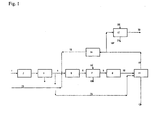
- HCl gas 1 from an isocyanate plant for the production of methylene diisocyanate typically consisting of> 99% by volume of HCl, ⁇ 0.2% by volume of CO, ⁇ 500 ppm by volume of organic compounds (monochlorobenzene, dichlorobenzene, etc.) and inert trace gases compressed compression system 2 to 22 bar.
- the bulk (85%) of the purified HCl gas 4 is fed into a Deacon reactor 5 together with an excess of oxygen 23 and the recycle gas from the chlorine separation 15.
- the HCl gas is catalytically oxidized at 370 ° C to chlorine.
- the process gas 6 from the reaction contains chlorine, oxygen, water of reaction and unconverted HCl gas, carbon dioxide and inert gases as main components.
- the hot process gas is moved into a suitable Quenche 7, in which, while lowering the temperature to about 40 - 90 ° C, the reaction water condenses out together with most of the unreacted HCl as aqueous concentrated HCl solution.
- the moist, still containing HCl process gas 8 is dried in a gas drying 9 with concentrated sulfuric acid as a drying medium.
- the dried process gas 10 is moved after cooling in a distillation column 11 with buoyancy and driven part.
- a distillation column 11 with buoyancy and driven part.
- head pressure column condenses at the head at about -32 ° C, a liquid mixture of CO 2 , HCl and small amounts of other components such as oxygen and inert gases, which is added as reflux to the column.
- the head of the column and also the oxygen-containing recycle gas 13 produced there is absolutely chlorine-free.
- the remaining amount (15%) of the purified HCl gas from the gas purification 3 is moved as a bypass 23 to the Deacon reaction together with the vapors from the distillation column 10 directly to the top condenser of the column.
- the recycle gas 13 consisting of 40% by volume of oxygen, 36% by volume of CO 2 , 20% by volume of HCl and 4% by volume of inert constituents, is returned to the Deacon reactor 5 via a compressor 14.
- the by-products which accumulate in the recycle gas over time such as CO 2 and other inerts, are discharged from the recycle gas 16 and purified in a water wash 17 of HCl.
- the running dilute aqueous hydrochloric acid 21 is reused elsewhere in the process of Isocyanatstrom and Deacon process.
- the chlorine and HCl-free, consisting of 50 vol .-% oxygen, 45 vol .-% CO2 and 5 vol .-% inert exhaust 22 is released into the atmosphere.
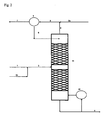
- the column is operated at a top pressure of 20 bar and a head temperature of -32 C, the bottom temperature is +64 C.
- the pure, liquid chlorine 8 is discharged and partially passed through an evaporator 10 back into the column 11.
- the low-boiling oxygen, HCl, CO 2 and Inerte beat at the top of the column 4 and are mixed there with the HCl bypass stream from the HCl purification 2 a and fed to a condenser 9.
- the HCl bypass amount is 15% of the total amount of HCl to be oxidized.
- the condensable under these pressure and temperature conditions gases are condensed out.
- the non-condensable in the condenser components are as oxygen recycle stream 7, consisting of 40 vol .-% O 2 , 36 vol .-% CO 2 , 20 vol .-% HCl and 4 vol .-% of inert, back to the Deacon reactor hazards.
Landscapes
- Chemical & Material Sciences (AREA)
- Organic Chemistry (AREA)
- Inorganic Chemistry (AREA)
- Chemical Kinetics & Catalysis (AREA)
- Organic Low-Molecular-Weight Compounds And Preparation Thereof (AREA)
- Separation By Low-Temperature Treatments (AREA)
- Treating Waste Gases (AREA)
Priority Applications (1)
| Application Number | Priority Date | Filing Date | Title |
|---|---|---|---|
| PL07725010T PL2024279T3 (pl) | 2006-05-19 | 2007-05-09 | Sposób oddzielania chloru z gazu produktowego procesu utleniania HCl |
Applications Claiming Priority (2)
| Application Number | Priority Date | Filing Date | Title |
|---|---|---|---|
| DE102006023581A DE102006023581A1 (de) | 2006-05-19 | 2006-05-19 | Verfahren zur Abtrennung von Chlor aus dem Produktgas eines HCI-Oxidationsprozesses |
| PCT/EP2007/004087 WO2007134716A2 (de) | 2006-05-19 | 2007-05-09 | VERFAHREN ZUR ABTRENNUNG VON CHLOR AUS DEM PRODUKTGAS EINES HCl-OXIDATIONSPROZESSES |
Publications (2)
| Publication Number | Publication Date |
|---|---|
| EP2024279A2 EP2024279A2 (de) | 2009-02-18 |
| EP2024279B1 true EP2024279B1 (de) | 2011-03-23 |
Family
ID=38608014
Family Applications (1)
| Application Number | Title | Priority Date | Filing Date |
|---|---|---|---|
| EP07725010A Not-in-force EP2024279B1 (de) | 2006-05-19 | 2007-05-09 | Verfahren zur abtrennung von chlor aus dem produktgas eines hci-oxidationsprozesses |
Country Status (13)
| Country | Link |
|---|---|
| US (1) | US20070277551A1 (enExample) |
| EP (1) | EP2024279B1 (enExample) |
| JP (1) | JP5129808B2 (enExample) |
| KR (1) | KR101374974B1 (enExample) |
| CN (1) | CN101448733B (enExample) |
| AT (1) | ATE502897T1 (enExample) |
| DE (2) | DE102006023581A1 (enExample) |
| ES (1) | ES2362682T3 (enExample) |
| PL (1) | PL2024279T3 (enExample) |
| PT (1) | PT2024279E (enExample) |
| RU (1) | RU2008150044A (enExample) |
| TW (1) | TW200815286A (enExample) |
| WO (1) | WO2007134716A2 (enExample) |
Families Citing this family (16)
| Publication number | Priority date | Publication date | Assignee | Title |
|---|---|---|---|---|
| DE102007016973A1 (de) * | 2007-04-10 | 2008-10-16 | Bayer Materialscience Ag | Regenerativer Adsorptionsprozess zur Entfernung organischer Komponenten aus einem Gasstrom |
| DE102007020144A1 (de) * | 2007-04-26 | 2008-10-30 | Bayer Materialscience Ag | Kondensations-Adsorptionsprozess zur Entfernung organischer Komponenten aus einem Chlorwasserstoff enthaltenden Gasstrom |
| DE102008051694A1 (de) * | 2008-10-15 | 2010-04-22 | Bayer Materialscience Ag | Verfahren zur Abtrennung von Kohlenmonoxid aus einem HCI-Rohgas |
| EP2361682A1 (en) | 2010-02-23 | 2011-08-31 | Bayer MaterialScience AG | Catalyst for chlorine production |
| KR20140010404A (ko) * | 2011-02-18 | 2014-01-24 | 바스프 에스이 | 산소 및 염소를 포함하는 기체 스트림으로부터 염소를 분리하는 증류 방법 |
| KR20140007899A (ko) | 2011-02-18 | 2014-01-20 | 바스프 에스이 | 염소 제조 방법에서 냉매로서의 액체 염화수소의 용도 |
| DE102011087654A1 (de) | 2011-12-02 | 2013-06-06 | Bayer Materialscience Aktiengesellschaft | Verfahren zur Herstellung von Isocyanaten |
| CN103693620A (zh) * | 2013-12-18 | 2014-04-02 | 常熟振氟新材料有限公司 | 从氯气与氯化氢混合气体中分离回收氯气的装置 |
| EP3309126A1 (de) | 2016-10-11 | 2018-04-18 | Evonik Degussa GmbH | Verfahren zur herstellung von siliciumtetrachlorid durch carbochlorierung |
| EP3351505A1 (de) * | 2017-01-20 | 2018-07-25 | Covestro Deutschland AG | Verfahren zur flexiblen steuerung der verwendung von salzsäure aus chemischer produktion |
| EP3351513A1 (de) * | 2017-01-20 | 2018-07-25 | Covestro Deutschland AG | Verfahren und vorrichtung zur kontinuierlichen salzsäureneutralisation |
| EP3488914A1 (en) | 2017-11-28 | 2019-05-29 | Max-Planck-Gesellschaft zur Förderung der Wissenschaften e.V. | A method and an apparatus for separating chlorine gas from a gaseous anode outlet stream of an electrochemical reactor |
| CN108525337B (zh) * | 2018-05-29 | 2023-07-18 | 杭州东日节能技术有限公司 | 一种稀盐酸真空浓缩塔及其使用方法 |
| CN110508105B (zh) * | 2019-08-28 | 2021-08-10 | 山东康宝生化科技有限公司 | 一种分离三氯蔗糖尾气中二氧化碳和氯化氢的装置与方法 |
| EP4712102A1 (fr) | 2024-09-12 | 2026-03-18 | Naarea | Procédé et installation de synthèse d'un sel combustible nucléaire avec récupération de composés chlorés à haute valeur ajoutée |
| GB202417058D0 (en) | 2024-11-20 | 2025-01-01 | Cavalier Marcus Alexander Mawson | Method and apparatus for producing hydrochloric acid |
Family Cites Families (22)
| Publication number | Priority date | Publication date | Assignee | Title |
|---|---|---|---|---|
| US1472294A (en) * | 1921-09-26 | 1923-10-30 | Carbide & Carbon Chem Corp | Process of purifying chlorine and other corrosive gases |
| US2547928A (en) * | 1947-02-13 | 1951-04-10 | Dow Chemical Co | Process for manufacture of chlorine by oxidation of hydrogen chloride |
| NL276976A (enExample) * | 1962-04-09 | |||
| NL286350A (enExample) * | 1962-12-05 | |||
| US3374637A (en) * | 1965-12-13 | 1968-03-26 | Fmc Corp | Recovery of chlorine |
| JPS5425519B2 (enExample) * | 1973-05-31 | 1979-08-28 | ||
| US4394367A (en) * | 1982-03-11 | 1983-07-19 | Shell Oil Co. | Process for recovery of chlorine from hydrogen chloride |
| DE3327274A1 (de) * | 1983-07-28 | 1985-02-07 | Bayer Ag, 5090 Leverkusen | Verfahren zur herstellung von phosgen unter gleichzeitiger erzeugung von dampf |
| IL81532A (en) * | 1986-02-19 | 1990-06-10 | Mitsui Toatsu Chemicals | Process for production of chlorine |
| JPS62275001A (ja) * | 1986-02-21 | 1987-11-30 | Mitsui Toatsu Chem Inc | 塩素の工業的製造方法 |
| US5254323A (en) * | 1988-02-16 | 1993-10-19 | Mitsui Toatsu Chemicals, Incorporated | Industrial process for the separation and recovery of chlorine |
| DE3921714A1 (de) * | 1989-07-01 | 1991-01-10 | Hoechst Ag | Verfahren zur selektiven absorption von chlor aus co(pfeil abwaerts)2(pfeil abwaerts)-haltigen abgasen |
| EP0518553B1 (en) * | 1991-06-06 | 1996-09-04 | MITSUI TOATSU CHEMICALS, Inc. | Method and apparatus for industrially preparing chlorine |
| DE4217019A1 (de) * | 1992-05-22 | 1993-11-25 | Bayer Ag | Verfahren zur Herstellung von aromatischen Diisocyanaten |
| US5437711A (en) * | 1993-12-16 | 1995-08-01 | Occidental Chemical Corporation | Method of purifying chlorine-containing gases |
| ATE183497T1 (de) * | 1994-11-17 | 1999-09-15 | Bayer Ag | Verfahren zur herstellung von isocyanaten |
| DE19535716A1 (de) * | 1995-09-26 | 1997-03-27 | Bayer Ag | Verfahren zur Aufarbeitung der Reaktionsgase bei der Oxidation von HCI zu Chlor |
| DE19536976A1 (de) * | 1995-10-04 | 1997-04-10 | Basf Ag | Verfahren zur selektiven Abtrennung und Wiedergewinnung von Chlor aus Gasgemischen |
| AU2003208834A1 (en) * | 2002-02-27 | 2003-09-09 | Basf Aktiengesellschaft | Reactor and method for producing phosgene |
| US6719957B2 (en) * | 2002-04-17 | 2004-04-13 | Bayer Corporation | Process for purification of anhydrous hydrogen chloride gas |
| DE10250131A1 (de) * | 2002-10-28 | 2004-05-06 | Basf Ag | Verfahren zur Herstellung von Chlor aus Salzsäure |
| EP1981806B1 (de) * | 2006-01-27 | 2009-11-04 | Basf Se | Verfahren zur herstellung von chlor |
-
2006
- 2006-05-19 DE DE102006023581A patent/DE102006023581A1/de not_active Withdrawn
-
2007
- 2007-05-09 WO PCT/EP2007/004087 patent/WO2007134716A2/de not_active Ceased
- 2007-05-09 EP EP07725010A patent/EP2024279B1/de not_active Not-in-force
- 2007-05-09 AT AT07725010T patent/ATE502897T1/de active
- 2007-05-09 ES ES07725010T patent/ES2362682T3/es active Active
- 2007-05-09 JP JP2009510320A patent/JP5129808B2/ja not_active Expired - Fee Related
- 2007-05-09 PL PL07725010T patent/PL2024279T3/pl unknown
- 2007-05-09 RU RU2008150044/15A patent/RU2008150044A/ru not_active Application Discontinuation
- 2007-05-09 PT PT07725010T patent/PT2024279E/pt unknown
- 2007-05-09 CN CN2007800183246A patent/CN101448733B/zh not_active Expired - Fee Related
- 2007-05-09 DE DE502007006782T patent/DE502007006782D1/de active Active
- 2007-05-09 KR KR1020087030821A patent/KR101374974B1/ko not_active Expired - Fee Related
- 2007-05-17 US US11/749,817 patent/US20070277551A1/en not_active Abandoned
- 2007-05-18 TW TW096117683A patent/TW200815286A/zh unknown
Also Published As
| Publication number | Publication date |
|---|---|
| WO2007134716A2 (de) | 2007-11-29 |
| TW200815286A (en) | 2008-04-01 |
| CN101448733B (zh) | 2013-11-06 |
| DE502007006782D1 (de) | 2011-05-05 |
| ATE502897T1 (de) | 2011-04-15 |
| JP5129808B2 (ja) | 2013-01-30 |
| DE102006023581A1 (de) | 2007-11-22 |
| EP2024279A2 (de) | 2009-02-18 |
| ES2362682T3 (es) | 2011-07-11 |
| PT2024279E (pt) | 2011-06-16 |
| KR101374974B1 (ko) | 2014-03-14 |
| PL2024279T3 (pl) | 2011-09-30 |
| KR20090016716A (ko) | 2009-02-17 |
| JP2009537429A (ja) | 2009-10-29 |
| RU2008150044A (ru) | 2010-06-27 |
| WO2007134716A3 (de) | 2008-09-12 |
| CN101448733A (zh) | 2009-06-03 |
| US20070277551A1 (en) | 2007-12-06 |
Similar Documents
| Publication | Publication Date | Title |
|---|---|---|
| EP2024279A2 (de) | Verfahren zur abtrennung von chlor aus dem produktgas eines hci-oxidationsprozesses | |
| EP2093215B1 (de) | Verfahren zur Herstellung von Isocyanaten | |
| EP1743882B1 (de) | Verfahren zur Herstellung von Isocyanaten | |
| EP1854783B1 (de) | Verfahren zur Herstellung von Isocyanaten | |
| EP1935877B1 (de) | Verfahren zur Herstellung von Toluylendiisocyanat | |
| EP1992592B1 (de) | Verfahren zur Oxidation eines Chlorwasserstoff enthaltenden Gasgemisches | |
| EP1558521A2 (de) | Verfahren zur herstellung von chlor aus salzsäure und ein damit integriertes verfahren zur herstellung von isocyanaten | |
| EP1575906A1 (de) | Auftrennung eines stoffgemisches aus chlorwasserstoff und phosgen | |
| EP0765838A1 (de) | Verfahren zur Aufarbeitung der Reaktionsgase bei der Oxidation von HCl zu Chlor | |
| EP2599770B1 (de) | Verfahren zur Herstellung von Isocyanaten | |
| EP2953928B1 (de) | Verfahren zur abtrennung eines durch phosgenierung eines primären amins in der gasphase hergestellten isocyanats aus dem gasförmigen rohprodukt der phosgenierung | |
| WO2007134860A2 (de) | Verfahren zur herstellung von chlor aus chlorwasserstoff und sauerstoff | |
| WO2007134861A1 (de) | Verfahren zur herstellung von chlor aus chlorwasserstoff und sauerstoff | |
| WO2007137685A1 (de) | Verfahren zur chlorwasserstoff-oxidation mit sauerstoff | |
| EP2691364B1 (de) | Verfahren zur herstellung von isocyanaten | |
| EP3653604A1 (de) | Verfahren zur herstellung eines isocyanats durch teilweise adiabatisch betriebene phosgenierung des korrespondierenden amins | |
| WO2007134720A1 (de) | Verfahren zur herstellung von chlor aus chlorwasserstoff und sauerstoff | |
| EP2566844B1 (de) | Verfahren zur herstellung von isocyanaten in der gasphase | |
| DE19542245A1 (de) | Phosgenierungsverfahren | |
| HK1133245A (en) | Method for separating chlorine from the product gas from an hci oxidation process |
Legal Events
| Date | Code | Title | Description |
|---|---|---|---|
| PUAI | Public reference made under article 153(3) epc to a published international application that has entered the european phase |
Free format text: ORIGINAL CODE: 0009012 |
|
| AK | Designated contracting states |
Kind code of ref document: A2 Designated state(s): AT BE BG CH CY CZ DE DK EE ES FI FR GB GR HU IE IS IT LI LT LU LV MC MT NL PL PT RO SE SI SK TR |
|
| AX | Request for extension of the european patent |
Extension state: AL BA HR MK RS |
|
| 17P | Request for examination filed |
Effective date: 20090312 |
|
| RBV | Designated contracting states (corrected) |
Designated state(s): AT BE BG CH CY CZ DE DK EE ES FI FR GB GR HU IE IS IT LI LT LU LV MC MT NL PL PT RO SE SI SK TR |
|
| DAX | Request for extension of the european patent (deleted) | ||
| GRAP | Despatch of communication of intention to grant a patent |
Free format text: ORIGINAL CODE: EPIDOSNIGR1 |
|
| GRAS | Grant fee paid |
Free format text: ORIGINAL CODE: EPIDOSNIGR3 |
|
| GRAA | (expected) grant |
Free format text: ORIGINAL CODE: 0009210 |
|
| AK | Designated contracting states |
Kind code of ref document: B1 Designated state(s): AT BE BG CH CY CZ DE DK EE ES FI FR GB GR HU IE IS IT LI LT LU LV MC MT NL PL PT RO SE SI SK TR |
|
| REG | Reference to a national code |
Ref country code: GB Ref legal event code: FG4D Free format text: NOT ENGLISH |
|
| REG | Reference to a national code |
Ref country code: CH Ref legal event code: EP |
|
| REG | Reference to a national code |
Ref country code: IE Ref legal event code: FG4D |
|
| REF | Corresponds to: |
Ref document number: 502007006782 Country of ref document: DE Date of ref document: 20110505 Kind code of ref document: P |
|
| REG | Reference to a national code |
Ref country code: DE Ref legal event code: R096 Ref document number: 502007006782 Country of ref document: DE Effective date: 20110505 |
|
| REG | Reference to a national code |
Ref country code: PT Ref legal event code: SC4A Free format text: AVAILABILITY OF NATIONAL TRANSLATION Effective date: 20110607 |
|
| REG | Reference to a national code |
Ref country code: NL Ref legal event code: T3 |
|
| REG | Reference to a national code |
Ref country code: ES Ref legal event code: FG2A Ref document number: 2362682 Country of ref document: ES Kind code of ref document: T3 Effective date: 20110711 |
|
| PG25 | Lapsed in a contracting state [announced via postgrant information from national office to epo] |
Ref country code: LT Free format text: LAPSE BECAUSE OF FAILURE TO SUBMIT A TRANSLATION OF THE DESCRIPTION OR TO PAY THE FEE WITHIN THE PRESCRIBED TIME-LIMIT Effective date: 20110323 Ref country code: GR Free format text: LAPSE BECAUSE OF FAILURE TO SUBMIT A TRANSLATION OF THE DESCRIPTION OR TO PAY THE FEE WITHIN THE PRESCRIBED TIME-LIMIT Effective date: 20110624 Ref country code: LV Free format text: LAPSE BECAUSE OF FAILURE TO SUBMIT A TRANSLATION OF THE DESCRIPTION OR TO PAY THE FEE WITHIN THE PRESCRIBED TIME-LIMIT Effective date: 20110323 Ref country code: SE Free format text: LAPSE BECAUSE OF FAILURE TO SUBMIT A TRANSLATION OF THE DESCRIPTION OR TO PAY THE FEE WITHIN THE PRESCRIBED TIME-LIMIT Effective date: 20110323 |
|
| LTIE | Lt: invalidation of european patent or patent extension |
Effective date: 20110323 |
|
| PG25 | Lapsed in a contracting state [announced via postgrant information from national office to epo] |
Ref country code: SI Free format text: LAPSE BECAUSE OF FAILURE TO SUBMIT A TRANSLATION OF THE DESCRIPTION OR TO PAY THE FEE WITHIN THE PRESCRIBED TIME-LIMIT Effective date: 20110323 Ref country code: CY Free format text: LAPSE BECAUSE OF FAILURE TO SUBMIT A TRANSLATION OF THE DESCRIPTION OR TO PAY THE FEE WITHIN THE PRESCRIBED TIME-LIMIT Effective date: 20110323 Ref country code: BG Free format text: LAPSE BECAUSE OF FAILURE TO SUBMIT A TRANSLATION OF THE DESCRIPTION OR TO PAY THE FEE WITHIN THE PRESCRIBED TIME-LIMIT Effective date: 20110623 Ref country code: FI Free format text: LAPSE BECAUSE OF FAILURE TO SUBMIT A TRANSLATION OF THE DESCRIPTION OR TO PAY THE FEE WITHIN THE PRESCRIBED TIME-LIMIT Effective date: 20110323 |
|
| REG | Reference to a national code |
Ref country code: PL Ref legal event code: T3 |
|
| REG | Reference to a national code |
Ref country code: IE Ref legal event code: FD4D |
|
| PG25 | Lapsed in a contracting state [announced via postgrant information from national office to epo] |
Ref country code: EE Free format text: LAPSE BECAUSE OF FAILURE TO SUBMIT A TRANSLATION OF THE DESCRIPTION OR TO PAY THE FEE WITHIN THE PRESCRIBED TIME-LIMIT Effective date: 20110323 |
|
| REG | Reference to a national code |
Ref country code: HU Ref legal event code: AG4A Ref document number: E011457 Country of ref document: HU |
|
| PG25 | Lapsed in a contracting state [announced via postgrant information from national office to epo] |
Ref country code: CZ Free format text: LAPSE BECAUSE OF FAILURE TO SUBMIT A TRANSLATION OF THE DESCRIPTION OR TO PAY THE FEE WITHIN THE PRESCRIBED TIME-LIMIT Effective date: 20110323 Ref country code: SK Free format text: LAPSE BECAUSE OF FAILURE TO SUBMIT A TRANSLATION OF THE DESCRIPTION OR TO PAY THE FEE WITHIN THE PRESCRIBED TIME-LIMIT Effective date: 20110323 Ref country code: IS Free format text: LAPSE BECAUSE OF FAILURE TO SUBMIT A TRANSLATION OF THE DESCRIPTION OR TO PAY THE FEE WITHIN THE PRESCRIBED TIME-LIMIT Effective date: 20110723 Ref country code: RO Free format text: LAPSE BECAUSE OF FAILURE TO SUBMIT A TRANSLATION OF THE DESCRIPTION OR TO PAY THE FEE WITHIN THE PRESCRIBED TIME-LIMIT Effective date: 20110323 |
|
| PG25 | Lapsed in a contracting state [announced via postgrant information from national office to epo] |
Ref country code: MT Free format text: LAPSE BECAUSE OF FAILURE TO SUBMIT A TRANSLATION OF THE DESCRIPTION OR TO PAY THE FEE WITHIN THE PRESCRIBED TIME-LIMIT Effective date: 20110323 Ref country code: MC Free format text: LAPSE BECAUSE OF NON-PAYMENT OF DUE FEES Effective date: 20110531 |
|
| REG | Reference to a national code |
Ref country code: CH Ref legal event code: PL |
|
| PLBE | No opposition filed within time limit |
Free format text: ORIGINAL CODE: 0009261 |
|
| STAA | Information on the status of an ep patent application or granted ep patent |
Free format text: STATUS: NO OPPOSITION FILED WITHIN TIME LIMIT |
|
| PG25 | Lapsed in a contracting state [announced via postgrant information from national office to epo] |
Ref country code: CH Free format text: LAPSE BECAUSE OF NON-PAYMENT OF DUE FEES Effective date: 20110531 Ref country code: LI Free format text: LAPSE BECAUSE OF NON-PAYMENT OF DUE FEES Effective date: 20110531 Ref country code: IE Free format text: LAPSE BECAUSE OF FAILURE TO SUBMIT A TRANSLATION OF THE DESCRIPTION OR TO PAY THE FEE WITHIN THE PRESCRIBED TIME-LIMIT Effective date: 20110323 |
|
| 26N | No opposition filed |
Effective date: 20111227 |
|
| GBPC | Gb: european patent ceased through non-payment of renewal fee |
Effective date: 20110623 |
|
| PG25 | Lapsed in a contracting state [announced via postgrant information from national office to epo] |
Ref country code: DK Free format text: LAPSE BECAUSE OF FAILURE TO SUBMIT A TRANSLATION OF THE DESCRIPTION OR TO PAY THE FEE WITHIN THE PRESCRIBED TIME-LIMIT Effective date: 20110323 |
|
| REG | Reference to a national code |
Ref country code: DE Ref legal event code: R097 Ref document number: 502007006782 Country of ref document: DE Effective date: 20111227 |
|
| PG25 | Lapsed in a contracting state [announced via postgrant information from national office to epo] |
Ref country code: IT Free format text: LAPSE BECAUSE OF FAILURE TO SUBMIT A TRANSLATION OF THE DESCRIPTION OR TO PAY THE FEE WITHIN THE PRESCRIBED TIME-LIMIT Effective date: 20110323 |
|
| PG25 | Lapsed in a contracting state [announced via postgrant information from national office to epo] |
Ref country code: GB Free format text: LAPSE BECAUSE OF NON-PAYMENT OF DUE FEES Effective date: 20110623 |
|
| PG25 | Lapsed in a contracting state [announced via postgrant information from national office to epo] |
Ref country code: LU Free format text: LAPSE BECAUSE OF NON-PAYMENT OF DUE FEES Effective date: 20110509 |
|
| REG | Reference to a national code |
Ref country code: AT Ref legal event code: MM01 Ref document number: 502897 Country of ref document: AT Kind code of ref document: T Effective date: 20120509 |
|
| PG25 | Lapsed in a contracting state [announced via postgrant information from national office to epo] |
Ref country code: AT Free format text: LAPSE BECAUSE OF NON-PAYMENT OF DUE FEES Effective date: 20120509 |
|
| PG25 | Lapsed in a contracting state [announced via postgrant information from national office to epo] |
Ref country code: TR Free format text: LAPSE BECAUSE OF FAILURE TO SUBMIT A TRANSLATION OF THE DESCRIPTION OR TO PAY THE FEE WITHIN THE PRESCRIBED TIME-LIMIT Effective date: 20110323 |
|
| REG | Reference to a national code |
Ref country code: DE Ref legal event code: R081 Ref document number: 502007006782 Country of ref document: DE Owner name: COVESTRO DEUTSCHLAND AG, DE Free format text: FORMER OWNER: BAYER MATERIALSCIENCE AKTIENGESELLSCHAFT, 51373 LEVERKUSEN, DE Effective date: 20140526 Ref country code: DE Ref legal event code: R081 Ref document number: 502007006782 Country of ref document: DE Owner name: BAYER INTELLECTUAL PROPERTY GMBH, DE Free format text: FORMER OWNER: BAYER MATERIALSCIENCE AKTIENGESELLSCHAFT, 51373 LEVERKUSEN, DE Effective date: 20140526 |
|
| PGFP | Annual fee paid to national office [announced via postgrant information from national office to epo] |
Ref country code: PT Payment date: 20150506 Year of fee payment: 9 |
|
| PGFP | Annual fee paid to national office [announced via postgrant information from national office to epo] |
Ref country code: PL Payment date: 20150507 Year of fee payment: 9 |
|
| REG | Reference to a national code |
Ref country code: DE Ref legal event code: R081 Ref document number: 502007006782 Country of ref document: DE Owner name: COVESTRO DEUTSCHLAND AG, DE Free format text: FORMER OWNER: BAYER INTELLECTUAL PROPERTY GMBH, 40789 MONHEIM, DE |
|
| REG | Reference to a national code |
Ref country code: FR Ref legal event code: PLFP Year of fee payment: 10 |
|
| REG | Reference to a national code |
Ref country code: NL Ref legal event code: HC Owner name: COVESTRO DEUTSCHLAND AG; DE Free format text: DETAILS ASSIGNMENT: VERANDERING VAN EIGENAAR(S), VERANDERING VAN NAAM VAN DE EIGENAAR(S); FORMER OWNER NAME: BAYER MATERIALSCIENCE AG Effective date: 20160810 |
|
| REG | Reference to a national code |
Ref country code: FR Ref legal event code: CA Effective date: 20161213 Ref country code: FR Ref legal event code: CD Owner name: COVESTRO DEUTSCHLAND AG, DE Effective date: 20161213 |
|
| REG | Reference to a national code |
Ref country code: ES Ref legal event code: PC2A Owner name: COVESTRO DEUTSCHLAND AG Effective date: 20170206 |
|
| PG25 | Lapsed in a contracting state [announced via postgrant information from national office to epo] |
Ref country code: PT Free format text: LAPSE BECAUSE OF NON-PAYMENT OF DUE FEES Effective date: 20161109 |
|
| REG | Reference to a national code |
Ref country code: FR Ref legal event code: PLFP Year of fee payment: 11 |
|
| PG25 | Lapsed in a contracting state [announced via postgrant information from national office to epo] |
Ref country code: PL Free format text: LAPSE BECAUSE OF NON-PAYMENT OF DUE FEES Effective date: 20160509 |
|
| REG | Reference to a national code |
Ref country code: FR Ref legal event code: PLFP Year of fee payment: 12 |
|
| PGFP | Annual fee paid to national office [announced via postgrant information from national office to epo] |
Ref country code: FR Payment date: 20200505 Year of fee payment: 14 Ref country code: ES Payment date: 20200601 Year of fee payment: 14 |
|
| PG25 | Lapsed in a contracting state [announced via postgrant information from national office to epo] |
Ref country code: FR Free format text: LAPSE BECAUSE OF NON-PAYMENT OF DUE FEES Effective date: 20210531 |
|
| PGFP | Annual fee paid to national office [announced via postgrant information from national office to epo] |
Ref country code: NL Payment date: 20220502 Year of fee payment: 16 |
|
| PGFP | Annual fee paid to national office [announced via postgrant information from national office to epo] |
Ref country code: HU Payment date: 20220430 Year of fee payment: 16 Ref country code: DE Payment date: 20220420 Year of fee payment: 16 |
|
| REG | Reference to a national code |
Ref country code: ES Ref legal event code: FD2A Effective date: 20220801 |
|
| PGFP | Annual fee paid to national office [announced via postgrant information from national office to epo] |
Ref country code: BE Payment date: 20220502 Year of fee payment: 16 |
|
| PG25 | Lapsed in a contracting state [announced via postgrant information from national office to epo] |
Ref country code: ES Free format text: LAPSE BECAUSE OF NON-PAYMENT OF DUE FEES Effective date: 20210510 |
|
| REG | Reference to a national code |
Ref country code: DE Ref legal event code: R119 Ref document number: 502007006782 Country of ref document: DE |
|
| REG | Reference to a national code |
Ref country code: NL Ref legal event code: MM Effective date: 20230601 |
|
| REG | Reference to a national code |
Ref country code: BE Ref legal event code: MM Effective date: 20230531 |
|
| PG25 | Lapsed in a contracting state [announced via postgrant information from national office to epo] |
Ref country code: HU Free format text: LAPSE BECAUSE OF NON-PAYMENT OF DUE FEES Effective date: 20230510 |
|
| PG25 | Lapsed in a contracting state [announced via postgrant information from national office to epo] |
Ref country code: NL Free format text: LAPSE BECAUSE OF NON-PAYMENT OF DUE FEES Effective date: 20230601 |
|
| PG25 | Lapsed in a contracting state [announced via postgrant information from national office to epo] |
Ref country code: DE Free format text: LAPSE BECAUSE OF NON-PAYMENT OF DUE FEES Effective date: 20231201 |
|
| PG25 | Lapsed in a contracting state [announced via postgrant information from national office to epo] |
Ref country code: BE Free format text: LAPSE BECAUSE OF NON-PAYMENT OF DUE FEES Effective date: 20230531 |