EP2024134B1 - Bearbeitungssystem für ein bewegtes werkstück und verfahren zum positionieren des bearbeitungssystems - Google Patents
Bearbeitungssystem für ein bewegtes werkstück und verfahren zum positionieren des bearbeitungssystems Download PDFInfo
- Publication number
- EP2024134B1 EP2024134B1 EP07711531A EP07711531A EP2024134B1 EP 2024134 B1 EP2024134 B1 EP 2024134B1 EP 07711531 A EP07711531 A EP 07711531A EP 07711531 A EP07711531 A EP 07711531A EP 2024134 B1 EP2024134 B1 EP 2024134B1
- Authority
- EP
- European Patent Office
- Prior art keywords
- industrial robot
- unit
- processing system
- workpiece
- carrier
- Prior art date
- Legal status (The legal status is an assumption and is not a legal conclusion. Google has not performed a legal analysis and makes no representation as to the accuracy of the status listed.)
- Active
Links
Images



Classifications
-
- B—PERFORMING OPERATIONS; TRANSPORTING
- B23—MACHINE TOOLS; METAL-WORKING NOT OTHERWISE PROVIDED FOR
- B23P—METAL-WORKING NOT OTHERWISE PROVIDED FOR; COMBINED OPERATIONS; UNIVERSAL MACHINE TOOLS
- B23P21/00—Machines for assembling a multiplicity of different parts to compose units, with or without preceding or subsequent working of such parts, e.g. with program control
-
- B—PERFORMING OPERATIONS; TRANSPORTING
- B23—MACHINE TOOLS; METAL-WORKING NOT OTHERWISE PROVIDED FOR
- B23P—METAL-WORKING NOT OTHERWISE PROVIDED FOR; COMBINED OPERATIONS; UNIVERSAL MACHINE TOOLS
- B23P21/00—Machines for assembling a multiplicity of different parts to compose units, with or without preceding or subsequent working of such parts, e.g. with program control
- B23P21/008—Machines for assembling a multiplicity of different parts to compose units, with or without preceding or subsequent working of such parts, e.g. with program control the assembling machines or tools moving synchronously with the units while these are being assembled
-
- B—PERFORMING OPERATIONS; TRANSPORTING
- B25—HAND TOOLS; PORTABLE POWER-DRIVEN TOOLS; MANIPULATORS
- B25J—MANIPULATORS; CHAMBERS PROVIDED WITH MANIPULATION DEVICES
- B25J5/00—Manipulators mounted on wheels or on carriages
- B25J5/02—Manipulators mounted on wheels or on carriages travelling along a guideway
-
- B—PERFORMING OPERATIONS; TRANSPORTING
- B25—HAND TOOLS; PORTABLE POWER-DRIVEN TOOLS; MANIPULATORS
- B25J—MANIPULATORS; CHAMBERS PROVIDED WITH MANIPULATION DEVICES
- B25J9/00—Program-controlled manipulators
- B25J9/0093—Program-controlled manipulators co-operating with conveyor means
-
- B—PERFORMING OPERATIONS; TRANSPORTING
- B23—MACHINE TOOLS; METAL-WORKING NOT OTHERWISE PROVIDED FOR
- B23P—METAL-WORKING NOT OTHERWISE PROVIDED FOR; COMBINED OPERATIONS; UNIVERSAL MACHINE TOOLS
- B23P2700/00—Indexing scheme relating to the articles being treated, e.g. manufactured, repaired, assembled, connected or other operations covered in the subgroups
- B23P2700/50—Other automobile vehicle parts, i.e. manufactured in assembly lines
-
- Y—GENERAL TAGGING OF NEW TECHNOLOGICAL DEVELOPMENTS; GENERAL TAGGING OF CROSS-SECTIONAL TECHNOLOGIES SPANNING OVER SEVERAL SECTIONS OF THE IPC; TECHNICAL SUBJECTS COVERED BY FORMER USPC CROSS-REFERENCE ART COLLECTIONS [XRACs] AND DIGESTS
- Y10—TECHNICAL SUBJECTS COVERED BY FORMER USPC
- Y10T—TECHNICAL SUBJECTS COVERED BY FORMER US CLASSIFICATION
- Y10T29/00—Metal working
- Y10T29/49—Method of mechanical manufacture
- Y10T29/49998—Work holding
-
- Y—GENERAL TAGGING OF NEW TECHNOLOGICAL DEVELOPMENTS; GENERAL TAGGING OF CROSS-SECTIONAL TECHNOLOGIES SPANNING OVER SEVERAL SECTIONS OF THE IPC; TECHNICAL SUBJECTS COVERED BY FORMER USPC CROSS-REFERENCE ART COLLECTIONS [XRACs] AND DIGESTS
- Y10—TECHNICAL SUBJECTS COVERED BY FORMER USPC
- Y10T—TECHNICAL SUBJECTS COVERED BY FORMER US CLASSIFICATION
- Y10T29/00—Metal working
- Y10T29/53—Means to assemble or disassemble
- Y10T29/53539—Means to assemble or disassemble including work conveyor
-
- Y—GENERAL TAGGING OF NEW TECHNOLOGICAL DEVELOPMENTS; GENERAL TAGGING OF CROSS-SECTIONAL TECHNOLOGIES SPANNING OVER SEVERAL SECTIONS OF THE IPC; TECHNICAL SUBJECTS COVERED BY FORMER USPC CROSS-REFERENCE ART COLLECTIONS [XRACs] AND DIGESTS
- Y10—TECHNICAL SUBJECTS COVERED BY FORMER USPC
- Y10T—TECHNICAL SUBJECTS COVERED BY FORMER US CLASSIFICATION
- Y10T29/00—Metal working
- Y10T29/53—Means to assemble or disassemble
- Y10T29/53539—Means to assemble or disassemble including work conveyor
- Y10T29/53543—Means to assemble or disassemble including work conveyor including transporting track
-
- Y—GENERAL TAGGING OF NEW TECHNOLOGICAL DEVELOPMENTS; GENERAL TAGGING OF CROSS-SECTIONAL TECHNOLOGIES SPANNING OVER SEVERAL SECTIONS OF THE IPC; TECHNICAL SUBJECTS COVERED BY FORMER USPC CROSS-REFERENCE ART COLLECTIONS [XRACs] AND DIGESTS
- Y10—TECHNICAL SUBJECTS COVERED BY FORMER USPC
- Y10T—TECHNICAL SUBJECTS COVERED BY FORMER US CLASSIFICATION
- Y10T29/00—Metal working
- Y10T29/53—Means to assemble or disassemble
- Y10T29/53539—Means to assemble or disassemble including work conveyor
- Y10T29/53543—Means to assemble or disassemble including work conveyor including transporting track
- Y10T29/53548—Means to assemble or disassemble including work conveyor including transporting track and work carrying vehicle
-
- Y—GENERAL TAGGING OF NEW TECHNOLOGICAL DEVELOPMENTS; GENERAL TAGGING OF CROSS-SECTIONAL TECHNOLOGIES SPANNING OVER SEVERAL SECTIONS OF THE IPC; TECHNICAL SUBJECTS COVERED BY FORMER USPC CROSS-REFERENCE ART COLLECTIONS [XRACs] AND DIGESTS
- Y10—TECHNICAL SUBJECTS COVERED BY FORMER USPC
- Y10T—TECHNICAL SUBJECTS COVERED BY FORMER US CLASSIFICATION
- Y10T29/00—Metal working
- Y10T29/53—Means to assemble or disassemble
- Y10T29/53961—Means to assemble or disassemble with work-holder for assembly
Definitions
- the invention relates to a processing system for processing a moving workpiece by means of a temporarily rigidly coupled to the workpiece and / or to a moving workpiece carrier unit industrial robot, wherein the industrial robot is supported in decoupled operating position of a support means which is independently of the workpiece movable by means of a drive active acting drive unit, and is mounted floating in coupled operating position by means of a floating storage system relative to the support means, according to the preamble of claim 1.
- the invention relates to a method for positioning a temporarily rigidly to a movable workpiece and / or to a movable workpiece carrier unit coupled industrial robot of a processing system of the type mentioned, wherein the processing system has a workpiece independently movable means of a drive unit support means which decoupled the industrial robot in Operating state, according to the preamble of claim 16.
- the DE 103 13 463 B3 a method and apparatus for performing a working operation on a moving workpiece by a synchronously moving industrial robot.
- the mitbewegte industrial robot is moved during the entire working phase, that is, in a state coupled to the workpiece, on average at the speed of the workpiece moving conveyor.
- the conveyor speed measured at the conveyor is specified as a set speed to a speed controller and imposed on the drive of a subframe of the industrial robot.
- the object is achieved by a machining system having the features of claim 1.
- the machining system according to the invention is characterized in that in the coupled operating position of the industrial robot, the working unit does not act drive-active on the carrier device and the carrier device by the moving workpiece and / or by the moving workpiece carrier unit is at least temporarily moved by means of the floating storage system. Furthermore, the carrier device has a levitation unit for reduced friction movement of the industrial robot.
- a “coupled industrial robot” means an industrial robot that can be coupled with respect to its base or its carrier unit with a workpiece, wherein the working movements of the Industrial robot can be made regardless of the coupling system used.
- the processing system according to the invention thus contains a workpiece-independent drive unit for workpiece-autonomous movement of the decoupled industrial robot.
- the carrier device is entrained by the industrial robot, which is now moving with the moving workpiece, by means of the intermediate floating storage system.
- the drive unit has no drive-active effect on the carrier device and thus on the industrial robot.
- This processing system is advantageous because complex control systems for movement adaptation of the industrial robot relative to the moving workpiece are no longer required.
- the workpiece may be, for example, a vehicle body shell or else other workpieces to be manufactured or assembled, in particular, in the context of series production.
- the Schwebeantitician may be formed as an air cushion unit. Due to the friction-reduced movement of the carrier device an undisturbed and reproducible accurate towing operation of the carrier device mitbe Anlagenden industrial robot in coupled operating position is possible.
- the drive unit is designed as a friction wheel system which can be activated in particular and which contains at least one friction wheel which is connected or can be brought into connection with a guide system provided for the carrier device.
- the guidance system may be, for example to act one or more guide rails that are relatively easy to attach in a workshop operation.
- a friction wheel system is particularly suitable for the defined movement or method of the support device, which can be moved on the ground by means of the levitation unit or the air cushion unit with reduced friction. This is a direction-defined movement by the guidance system.
- the carrier device may have a platform with which the industrial robot is rigidly connected in a decoupled operating position and floating in a coupled operating position.
- the industrial robot in decoupled operating position can be connected to the platform with defined position, while it is arranged floating in coupled operating position relative to the platform, so that no disturbing forces (possibly reaction forces) can be transferred from the platform to the workpiece coupled to the industrial robot.
- a positioning or machining-favorable connection (rigid or floating) between the industrial robot and the carrier device is ensured.
- the industrial robot is connected to the platform preferably with the interposition of a particular switchable height compensation system.
- the height compensation system is used to compensate possibly occurring tolerances in the Z direction (height direction) of the coupled industrial robot relative to the platform as possible automatically. Such height tolerances can occur, for example, due to the floating movement of the carrier device or due to positional inaccuracies in the moving workpiece.
- the platform may be carried by the suspended carrier unit with reduced movement force.
- a platform is particularly well suited for realizing a friction-reduced movement, in particular by means of an air cushion unit on the ground and also allows a flexible arrangement of a floating industrial robot with switchable height compensation system and possibly other functional equipment for workpiece machining.
- the industrial robot may be connected in a coupled operating position by means of an air cushion system floating to the platform. In decoupled operating position, however, the industrial robot can be rigidly connected to the platform and thus defined with deactivated floating storage.
- the industrial robot has a weight compensation unit, which can be brought into a suitable compensation position as a function of a movement of the industrial robot by means of a control unit of the industrial robot, in particular by a displacement movement.
- the weight compensation unit can for example contain suitably displaceable or movable weight elements, through the movement-controlled arrangement of which a weight compensation can be obtained as a function of the movements of the industrial robot. This is particularly advantageous since, in the coupled operating state, the industrial robot is mounted in a floating manner relative to the platform and is always kept in balance even during movements by means of the weight compensation unit.
- weight compensation can also be achieved by means of a piston / cylinder system which is supported on the platform and is connected to the industrial robot.
- shock absorbers may optionally be provided which connect a cantilever of the industrial robot with the platform, so that undesired twists of the industrial robot system due to acceleration effects can be avoided.
- a control unit of the industrial robot and / or at least one production unit may be arranged on the carrier device and in particular on the platform.
- the production unit may be a further industrial robot and / or a load carrier and / or a processing unit or another functional unit.
- the production unit can be designed as an exchangeable and / or as an expandable module.
- the carrier device and in particular the platform can be designed as an exchangeable and / or expandable module.
- Such a processing system is particularly suitable for performing complex and / or different types of machining tasks in the context of a series production or a series assembly.
- the processing system preferably includes a coupling device, which is connected by means of an activatable floating storage unit with the industrial robot. Furthermore, in the coupled operating position, the coupling device can be connected to the industrial robot in a floating manner and floating in the decoupled operating position. In this case, the connection of the coupling device with the industrial robot directly on the industrial robot or indirectly via an industrial robot side plate of the carrier device be realized. Due to the switchable floating mounting of the coupling device relative to the industrial robot, a gentle connection of the coupling device to the workpiece or to the workpiece carrier unit is possible because the coupling force the weight of the industrial robot due to the activated floating mounting of the coupling device relative to the industrial robot no disturbing or damaging influence on the workpiece.
- the coupling device has a connection system for establishing a connection with the moving workpiece carrier unit and a gripping system for establishing a connection with the moved workpiece.
- the object is achieved by a method having the features of claim 16.
- the method according to the invention is characterized in that, in the coupled operating state of the industrial robot moving with the moving workpiece, the carrier device is moved at least temporarily by means of a floating bearing system, wherein the carrier device is by means of a levitation unit reduced motion friction on the ground is movable.
- the floating storage system may be referred to as an air bag system and the levitation unit as an air cushion unit be educated.
- the carrier device can be movable on the ground by means of a guide system in a direction-defined manner. Such a processing system is particularly easy to operate operable.
- the industrial robot is rigidly connected to the carrier device, then moves the carrier device in a Ankoppelwolf relative to the workpiece, then coupled a floating connected to the industrial robot coupling device to the workpiece and / or to the workpiece carrier unit, then the industrial robot floating with the carrier unit connected, then the coupled coupling device rigidly connected to the industrial robot and then moves the carrier device at a workpiece movement by means of the floating storage system of the industrial robot.
- the workpiece can be moved at the time of coupling the coupling device.
- the workpiece can also be set in motion only after production of the coupled operating position.
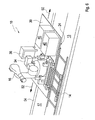
- the processing system 10 includes according to FIG. 1 a workpiece conveyor 13, on which workpieces 12, according to the illustrated embodiment to be processed vehicle bodies, are conveyed in the direction of the arrow 48 along a processing line. Furthermore, the processing system 10 includes an industrial robot conveyor track 17 on which an industrial robot 16 can be moved according to the arrows 50, 52.
- the vehicle body 12, which may be, for example, a bodyshell, is supported in a position-defined manner by a workpiece carrier unit 14, which is also referred to as an adapter device, and moved on the workpiece conveyor track 13 in accordance with arrow 48.
- the industrial robot 16 is arranged on a carrier device 18 which can be moved by means of a drive unit 20 independently of the vehicle body 12 or of the workpiece carrier unit 14 on the industrial robot conveyor track 17 according to the arrows 50, 52.
- the processing system 10 is used to edit the moving vehicle body 12 by means of the industrial robot 16.
- the industrial robot 16 is temporarily rigidly coupled to the moving vehicle body 12 and / or to the moving workpiece carrier unit 14.
- FIG. 1 the processing system 10 is shown in a correspondingly coupled operating position 44.
- FIG. 2 shows a schematic rear view of the industrial robot 16 on the substrate 11 of the industrial robot conveyor track 17 carrying support means 18.
- the industrial robot 16 is supported by the support means 18 with the interposition of a floating storage system 22.
- the floating storage system 22 includes a first carrier plate 62 to which the industrial robot 16 is rigidly connected.
- the first carrier plate 62 is in turn connected to a second carrier plate 64 of the floating storage system 22 with the interposition of height compensation systems 46 and a plurality of guide units 60.
- the height compensation systems 46 may be designed as adjustable cylinder systems, by means of which a desired height adjustment of the first support plate 62 relative to the second support plate 64 and thus a particular automatic height compensation of the industrial robot 16 relative to the second support plate 64 according to double arrow 56 during the coupling phase is possible.
- the second support plate 64 is connected with the interposition of an air cushion system 32 with a platform 30 of the support means 18 that a rotational tolerance compensation in the form of a wobbling movement of the second support plate 64 and thus also the industrial robot 16 according to double arrow 58, in particular in the coupled operating position 44 is possible.
- the platform 30 of the carrier device 18 is supported by means of a Schwebembotician 24 in the form of an air cushion unit 26 against the substrate 11 of the industrial robot conveyor track 17 such that a reduced friction movement of the platform 30 with the floating storage system 22 and the industrial robot 16 on the industrial robot conveyor track 17 according to the arrows 50 , 52 is possible.
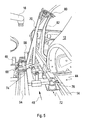
- a coupling device 66 is connected to the first carrier plate 62, which in the FIGS. 3 to 5 is shown in more detail and will be explained in more detail below.
- the coupling device 66 includes a coupling frame 68 and a coupling arm 70.
- the coupling device 66 is connected to the first carrier plate 62 by means of a floating bearing unit 72, in particular in the form of a plurality of bellows cylinders.
- the floating storage unit 72 is in response to a respective operating position, namely a decoupled operating position 42 (see FIG. 4 ) and a coupled operating position 44 (see FIG. 5 ) enableable.
- the coupling device 66 has a connection system 84 which is provided with a plurality of centering elements 78 on the coupling frame 68.
- a connection of the coupling device 66 with the moving vehicle body 12 can be made by means of a gripping system 80, which is arranged on the coupling arm 70.
- the gripping system 80 is used in the illustrated embodiment according to FIG. 5
- the coupling device 66 has a light barrier system 74 and a coupling frame 68 at its Stop system 76 in the form of a stop cylinder with damper on.
- FIGS. 6 and 7 which, in addition to the processing system 10 described above, show two alternative embodiments of the processing system 10, is the industrial robot 16 and / or the first carrier plate 62 and / or the second carrier plate 64 is provided with a weight compensation unit 34.
- the weight compensation unit 34 may be designed such that it contains suitably movable and in particular suitably displaceable balance weights. If appropriate, compensating cylinder systems and / or compensating shock absorbers can also be provided for the purpose of suitable counterbalance of the industrial robot 16 moving during the processing of the vehicle body 12.
- one or more control units 36 and / or one or more production units 40 may be arranged on the platform 30, one or more control units 36 and / or one or more production units 40 may be arranged.
- the production unit 40 may be one or more industrial robots (see FIG.
- the production unit 40 may be formed as an exchangeable and / or as an expandable module.
- the processing system 10 includes a guide system 54, in particular in the form of a guide rail, wherein the guide system 54 ensures a direction-defined movement of the support means 18 and the platform 30 according to the arrows 50, 52.
- the movement of the platform 30 is realized by the drive unit 20, which may be formed, for example, as a friction wheel system, which is in operative switchable operational contact with the guide system 54 and a workpiece-independent movement of the platform 30 according to the arrows 50, 52 along the guide system 54 the industrial robot conveyor 17 guaranteed.
- the first support plate 62 and thus also the coupling device 66 is raised to a predetermined stop height for the stop system 76 by means of the height compensation system 46. Subsequently, the stop system 76 from a passive position (see FIG. 3 ) into a defined active position (see FIG. 4 ) panned.
- the platform 30 can now be accelerated by the drive unit 20 and the Schwebetician 24 after loosening any existing brakes on the industrial robot track 17 according to arrow 50 in the direction of the moving vehicle body 12 friction and moved until the coupling device 66, the position according to FIG. 4 reached.
- the approach speed of the platform 30 is automatically reduced in order to ensure a smooth positioning of the coupling device 66 relative to the workpiece carrier unit 14.
- the light barrier system 74 of the coupling device 66 cooperates with the workpiece carrier unit 14.
- the platform 30 is moved relative to the moving vehicle body 12 in the conveying direction (arrow 50). moved further until the stop system 76, which also interacts with the workpiece carrier unit 14, has reached a defined stop position. Until this time, movement of the platform 30 along the guide system 54 by means of the drive unit 20 has been carried out independently of the workpiece.
- the now occupied stop position ensures an exactly coincident movement of the platform 30 and the workpiece carrier unit 14 in the conveying direction (arrows 50, 48).
- the floating storage unit 72 (see FIG. 3 ) are activated such that the coupling frame 68 can retract with the centering elements 78 in the correspondingly provided with suitable receptacles workpiece carrier unit 14 to form a position-defined positive connection.
- a positive locking between the coupling frame 68 and the workpiece carrier unit 14 can be produced.
- a rigid connection between the coupling arm 70 and the B-pillar 82 of the vehicle body 12 is now created by activating the gripping system 80.
- the coupling device 66 by means of the floating bearing unit 72 is floating relative to the first support plate 62 and thus mounted relative to the industrial robot 16.
- the height compensation system 46 from a in the direction of the double arrow 56 (see Figur.2 ) Rigid operating position switched to a floating operating position, so that a Z compensation to compensate for tolerance variations between the first support plate 62 and thus also of the industrial robot 16 and the coupling device 66 is possible.
- the air cushion system 32 is activated such that a floating Lager.der second support plate 64 is realized relative to the platform 30.
- the floating Support unit 72 is activated such that a rigid coupling between the coupling device 66 and the first support plate 62 and thus also of the industrial robot 16 takes place while ensuring the aforementioned Z-compensation and an angular position compensation of the first support plate 62 (see FIG. 2 , Double arrow 58). Due to the effective air cushion system 32 and the height compensation system 46 and minimal movements of the vehicle body 12 can be transferred directly and under relatively little force to the first support plate 62 and thus to the industrial robot 16. By means of the active weight balancing unit 34 of the industrial robot 16, a weight compensation of the moving industrial robot 16 that is favorable for the machining of the vehicle body 12 is ensured.
- the carrier device 18 After establishing the coupled operating position 44 (see FIG. 5 ), the carrier device 18 is moved by the movement of the vehicle body 12 and by the corresponding movement of the workpiece carrier unit 14 by means of the floating bearing system 22, overcoming relatively low frictional forces on the substrate 11. The carrier device 18 is thus entrained with the moving vehicle body 12 and the moving workpiece carrier unit 14, wherein the possibly switched-on or even meanwhile switched-off drive unit 20 no longer acts on the carrier device 18 in an actively driving manner.
- the vehicle body 12 can now be reproducibly accurately and flexibly processed by the processing system 10 during its conveyance along the workpiece conveyor track 13. It can clocked conveyor sections and Buffering along the processing line can be avoided. Automated and especially fully automated machining processes can be integrated with the conveying process. Possible applications for the processing system 10 are, for example, the installation of insulating mats by means of adhesive technology, the suspension strut assembly, the disc assembly, the installation of a spare or spare wheel and / or the battery assembly. Optionally, by the processing system 10 during the direct processing of the vehicle body 12 at the same time further, preparatory work on the vehicle body 12 and / or attachments can be performed.
- the processing system 10 may be configured such that a approach to the vehicle body 12 or to the workpiece carrier unit 14 from the rear in the conveying direction (see FIG. 1 , Arrow 48) of the vehicle body 12 and also from the front against the conveying direction of the vehicle body 12 is possible.
- the processing system 10 with the stop system 76 in passive position (see FIG. 3 ) on the workpiece carrier unit 14 can pass without stop contact.
Landscapes
- Engineering & Computer Science (AREA)
- Mechanical Engineering (AREA)
- Robotics (AREA)
- Automatic Assembly (AREA)
- Manipulator (AREA)
Applications Claiming Priority (2)
| Application Number | Priority Date | Filing Date | Title |
|---|---|---|---|
| DE102006026132A DE102006026132A1 (de) | 2006-06-03 | 2006-06-03 | Bearbeitungssystem für ein bewegtes Werkstück und Verfahren zum Positionieren des Bearbeitungssystems |
| PCT/EP2007/001263 WO2007140828A1 (de) | 2006-06-03 | 2007-02-14 | Bearbeitungssystem für ein bewegtes werkstück und verfahren zum positionieren des bearbeitungssystems |
Publications (2)
| Publication Number | Publication Date |
|---|---|
| EP2024134A1 EP2024134A1 (de) | 2009-02-18 |
| EP2024134B1 true EP2024134B1 (de) | 2010-04-07 |
Family
ID=38007215
Family Applications (1)
| Application Number | Title | Priority Date | Filing Date |
|---|---|---|---|
| EP07711531A Active EP2024134B1 (de) | 2006-06-03 | 2007-02-14 | Bearbeitungssystem für ein bewegtes werkstück und verfahren zum positionieren des bearbeitungssystems |
Country Status (6)
| Country | Link |
|---|---|
| US (1) | US8250743B2 (https=) |
| EP (1) | EP2024134B1 (https=) |
| JP (1) | JP5107348B2 (https=) |
| DE (2) | DE102006026132A1 (https=) |
| ES (1) | ES2339817T3 (https=) |
| WO (1) | WO2007140828A1 (https=) |
Cited By (2)
| Publication number | Priority date | Publication date | Assignee | Title |
|---|---|---|---|---|
| DE102012020971A1 (de) | 2012-10-25 | 2013-04-25 | Daimler Ag | Bearbeitungsvorrichtung und Verfahren zum Bearbeiten eines bewegten Werkstücks |
| DE102014018880A1 (de) | 2014-12-17 | 2015-06-18 | Daimler Ag | Verfahren und System zum Steuern einer Mitfahrplattform |
Families Citing this family (35)
| Publication number | Priority date | Publication date | Assignee | Title |
|---|---|---|---|---|
| US7896113B1 (en) * | 2007-05-12 | 2011-03-01 | Fernando Ramirez | Police robotic system |
| JP4367666B2 (ja) * | 2007-11-09 | 2009-11-18 | トヨタ自動車株式会社 | ねじ締付装置 |
| DE202008009838U1 (de) * | 2008-07-22 | 2008-10-23 | Robotics Technology Leaders Gmbh | Luftkissenplattform zum Tragen eines Manipulatorarms und verfahrbarer Roboter |
| DE102008037239A1 (de) * | 2008-08-09 | 2010-02-11 | Daimler Ag | Verfahren und Vorrichtung zum Durchführen einer Arbeitsoperation an einem bewegten Werkstück |
| DE102009024621A1 (de) | 2009-06-12 | 2010-12-23 | Daimler Ag | Montagesystem |
| FR2948336B1 (fr) * | 2009-07-24 | 2012-03-16 | Peugeot Citroen Automobiles Sa | Poste et procede de travail, chaine de montage incorporant ce poste de travail |
| FR2948623B1 (fr) * | 2009-08-03 | 2011-07-15 | Peugeot Citroen Automobiles Sa | Procede de convoyage |
| JP2011140077A (ja) * | 2010-01-06 | 2011-07-21 | Honda Motor Co Ltd | 加工システム及び加工方法 |
| DE102010005314A1 (de) * | 2010-01-21 | 2010-08-19 | Daimler Ag | Montageeinrichtung |
| DE102010051931B4 (de) * | 2010-11-19 | 2020-04-16 | Daimler Ag | Anordnung eines Roboters |
| DE102010055957A1 (de) * | 2010-12-23 | 2012-06-28 | Daimler Ag | Verfahren zum Herstellen von Kraftwagen und Kraftwagen |
| JP5832388B2 (ja) * | 2012-07-09 | 2015-12-16 | 本田技研工業株式会社 | 作業方法及び作業装置 |
| DE102012016206A1 (de) | 2012-08-16 | 2014-02-20 | Jochen und Thomas Geschwentner GbR (vertr.Gesellschafter: Thomas Geschwentner, 88214 Ravensburg) | Manipulator |
| KR101526687B1 (ko) * | 2013-09-24 | 2015-06-05 | 현대자동차주식회사 | 자동차용 패널 헤밍 시스템 |
| DE102014004045B4 (de) | 2014-03-21 | 2021-10-07 | Kuka Deutschland Gmbh | Roboterwerkzeug und Verfahren zum Montieren von Stopfen, insbesondere für Kraftwagen |
| DE102014205654A1 (de) * | 2014-03-26 | 2015-10-01 | Bayerische Motoren Werke Aktiengesellschaft | Mobile Robotereinheit und Verfahren zum Integrieren einer mobilen Robotereinheit in ein Montagesystem |
| JP2016107363A (ja) * | 2014-12-04 | 2016-06-20 | 株式会社安川電機 | 作業システムおよび作業方法 |
| DE202015002821U1 (de) * | 2015-04-17 | 2016-07-19 | Kuka Systems Gmbh | Vorrichtung zur Bearbeitung von Werkstücken in einer Fließfertigung |
| DE102015014221B4 (de) | 2015-11-04 | 2017-06-14 | Daimler Ag | Roboterwerkzeug und Verfahren zum Montieren von Stopfen, insbesondere für Kraftwagen |
| DE102016201687B4 (de) * | 2016-02-04 | 2025-11-13 | Robomotion Gmbh | System sowie Verfahren zum Positionieren einer Roboterzelle relativ zu einem Arbeitsplatz |
| EP3707096B1 (en) | 2017-11-07 | 2024-06-12 | Comau LLC | Transport system and methods |
| DE102018203046A1 (de) * | 2018-03-01 | 2019-09-05 | Bayerische Motoren Werke Aktiengesellschaft | Robotervorrichtung zum automatischen Durchführen wenigstens eines Arbeitsschritts an einem Werkstück und Verfahren zum Betreiben einer solchen Robotervorrichtung |
| DE102018203045A1 (de) * | 2018-03-01 | 2019-09-05 | Bayerische Motoren Werke Aktiengesellschaft | Robotervorrichtung zum automatischen Durchführen wenigstens einer Manipulation an einem mittels einer Stetigfördereinheit transportierbaren Werkstück und Verfahren zum Betreiben einer solchen Robotervorrichtung |
| US10780515B2 (en) | 2018-04-26 | 2020-09-22 | Raytheon Technologies Corporation | Auto-adaptive braze dispensing systems and methods |
| DE102018219150A1 (de) * | 2018-11-09 | 2020-05-14 | Volkswagen Aktiengesellschaft | Automatisierungsvorrichtung |
| DE102019207270A1 (de) * | 2019-05-17 | 2020-11-19 | Volkswagen Aktiengesellschaft | Anlage sowie Verfahren zur Betätigung einer Verfahreinheit der Anlage |
| US11420853B2 (en) | 2019-10-03 | 2022-08-23 | Comau Llc | Assembly material logistics system and methods |
| WO2021252329A1 (en) | 2020-06-08 | 2021-12-16 | Comau Llc | Assembly material logistics system and methods |
| DE102020127501B3 (de) | 2020-10-19 | 2022-03-24 | Deutsches Zentrum für Luft- und Raumfahrt e.V. | Verfahren zum Erweitern des erreichbaren Arbeitsraums eines Roboterarms sowie Robotersystem |
| EP4001549A1 (en) | 2020-11-19 | 2022-05-25 | The Boeing Company | Continuous-line manufacturing system and method for composite parts |
| CN113977217A (zh) * | 2021-09-08 | 2022-01-28 | 陈佳妮 | 一种台式电脑组装机器人 |
| JP2023072590A (ja) * | 2021-11-12 | 2023-05-24 | 株式会社東芝 | 対象物への作業用マニピュレータ固定装置及び方法 |
| DE102022125195A1 (de) * | 2022-09-29 | 2024-04-04 | Hänel GmbH & Co. KG | Tablar, lagerregal und verfahren zur automatischen beschickung und entnahme von lagergut |
| JP7768202B2 (ja) * | 2023-09-08 | 2025-11-12 | トヨタ自動車株式会社 | 搬送方法切替装置、搬送切替方法、および車両 |
| JP2025064034A (ja) * | 2023-10-05 | 2025-04-17 | 株式会社安川電機 | ロボットシステム、コントローラ及び制御方法 |
Family Cites Families (11)
| Publication number | Priority date | Publication date | Assignee | Title |
|---|---|---|---|---|
| US3283918A (en) * | 1963-12-02 | 1966-11-08 | George C Devol | Coordinated conveyor and programmed apparatus |
| SE7900697L (sv) | 1979-01-26 | 1980-07-27 | Skf Nova Ab | Anordning for omvandling av rotationsrorelse till linjerrorelse eller tvertom |
| GB2168934B (en) | 1984-12-19 | 1988-07-27 | Honda Motor Co Ltd | Method and apparatus for mounting parts to both sides of a main body |
| JPH0135792Y2 (https=) * | 1985-02-19 | 1989-11-01 | ||
| JPS63112290A (ja) * | 1986-10-29 | 1988-05-17 | Honda Motor Co Ltd | 同期作業装置 |
| DE3822205A1 (de) | 1988-07-01 | 1990-01-04 | Schulte Hubert Sondermasch | Vorrichtung zur montage von werkstuecken |
| ZA948103B (en) * | 1993-11-17 | 1995-06-05 | Honda Motor Co Ltd | Method and apparatus for assembling motor vehicle body |
| JP3433524B2 (ja) * | 1994-08-26 | 2003-08-04 | マツダ株式会社 | 部品着脱型ロボット及びロボットによる部品着脱方法 |
| JPH08141945A (ja) | 1994-11-22 | 1996-06-04 | Himu Kenkyusho:Kk | 作業ロボット導入生産システム |
| JP3632490B2 (ja) * | 1999-03-24 | 2005-03-23 | トヨタ自動車株式会社 | ウインドガラス自動貼付装置 |
| DE10313463B3 (de) | 2003-03-26 | 2004-04-29 | Daimlerchrysler Ag | Verfahren und Vorrichtung zum Durchführen einer Arbeitsoperation an einem bewegten Werkstück durch einen synchron mitbewegten Industrieroboter |
-
2006
- 2006-06-03 DE DE102006026132A patent/DE102006026132A1/de not_active Withdrawn
-
2007
- 2007-02-14 ES ES07711531T patent/ES2339817T3/es active Active
- 2007-02-14 EP EP07711531A patent/EP2024134B1/de active Active
- 2007-02-14 JP JP2009512430A patent/JP5107348B2/ja active Active
- 2007-02-14 WO PCT/EP2007/001263 patent/WO2007140828A1/de not_active Ceased
- 2007-02-14 US US12/303,279 patent/US8250743B2/en active Active
- 2007-02-14 DE DE502007003412T patent/DE502007003412D1/de active Active
Cited By (2)
| Publication number | Priority date | Publication date | Assignee | Title |
|---|---|---|---|---|
| DE102012020971A1 (de) | 2012-10-25 | 2013-04-25 | Daimler Ag | Bearbeitungsvorrichtung und Verfahren zum Bearbeiten eines bewegten Werkstücks |
| DE102014018880A1 (de) | 2014-12-17 | 2015-06-18 | Daimler Ag | Verfahren und System zum Steuern einer Mitfahrplattform |
Also Published As
| Publication number | Publication date |
|---|---|
| EP2024134A1 (de) | 2009-02-18 |
| JP5107348B2 (ja) | 2012-12-26 |
| JP2009539624A (ja) | 2009-11-19 |
| WO2007140828A1 (de) | 2007-12-13 |
| ES2339817T3 (es) | 2010-05-25 |
| US8250743B2 (en) | 2012-08-28 |
| DE102006026132A1 (de) | 2007-06-21 |
| US20090226292A1 (en) | 2009-09-10 |
| DE502007003412D1 (de) | 2010-05-20 |
Similar Documents
| Publication | Publication Date | Title |
|---|---|---|
| EP2024134B1 (de) | Bearbeitungssystem für ein bewegtes werkstück und verfahren zum positionieren des bearbeitungssystems | |
| EP2035182B1 (de) | Bearbeitungssystem zum bearbeiten eines bewegten werkstücks | |
| DE60127092T2 (de) | Einstellbare Orientierungseinheit, Montagestrasse für Karosserien von Kraftfahrzeugen mit so einer Einheit und Verfahren dazu | |
| DE102011018237B4 (de) | Fördereinrichtung für Automatisierungsstraßen | |
| DE60223864T2 (de) | Tranportvorrichtung für Kraftfahrzeugkarosserien und ein Verfahren dazu | |
| DE69402086T2 (de) | Verfahren und vorrichtung zum verbinden von karosserieteilen | |
| EP2792431A1 (de) | Bearbeitungsanlage für Flugzeugstrukturbauteile | |
| DE102007044411A1 (de) | Elektromotorhalterungsstruktur für Fahrzeuge | |
| EP1430989A1 (de) | Verfahren und Vorrichtung zum Positionieren von zusammenzufügenden Bauteilen | |
| EP0210974A1 (de) | Industrieroboter | |
| EP1934085B1 (de) | Automatische schraubeinrichtung für ein chassis eines kraftfahrzeugs | |
| WO2021047893A1 (de) | Lagerungsanordnung einer komponente an einem achsträger für einen kraftwagen sowie kraftwagen, insbesondere personenkraftwagen | |
| DE102007058783B4 (de) | Fahrzeugkarosserie mit einem Karosserieelement und Verfahren zum Herstellen der Fahrzeugkarosserie | |
| DE102013225818A1 (de) | Dezentraler, manueller höheneinstellmechanismus für antriebswellen-mittenlager | |
| DE102017210308A1 (de) | Kabinenanordnung | |
| WO2005108019A2 (de) | Positionier-und bearbeitungssystem und geeignetes verfahren zum positionieren und bearbeiten mindestens eines bauteils | |
| EP3213885A1 (de) | Handhabungseinrichtung für eine robotervorrichtung, montagestation mit der handhabungseinrichtung und verfahren zur montage einer fahrzeugscheibe an einem karosserieabschnitt mit der handhabungseinrichtung | |
| DE69323052T2 (de) | Positionieren eines werkzeug relativ zu einem werkstück zum anbringen eines befestigunsmittels | |
| EP3717187B1 (de) | Stanzbearbeitungsstation und verfahren zur fixierung eines mit einer lackierung versehenen polymeren kfz-stossfängers während eines stanzvorganges | |
| DE102008010394A1 (de) | Anlage zum Fügen von Chassisaggregaten mit der Karosserie eines Kraftfahrzeugs und Verfahren zum Fügen von Chassisaggregaten | |
| DE102016212551A1 (de) | Achsanordnung für ein Kraftfahrzeug | |
| DE102006057843B4 (de) | Industrieroboter | |
| DE102014002722A1 (de) | Verfahren zur Montage eines Fahrzeugteils an einer Fahrzeugkarosserie in einer Montagestation und Handhabungsvorrichtung zur Durchführung des Verfahrens | |
| EP3106269A1 (de) | Vorrichtung und verfahren zum ein- oder doppelseitigen greifen von bauteilen zur kombination von bauteilbehandlungen | |
| DE102015013595A1 (de) | Greifvorrichtung zum Bewegen wenigstens eines Bauelements für einen Kraftwagen bei dessen Herstellung |
Legal Events
| Date | Code | Title | Description |
|---|---|---|---|
| PUAI | Public reference made under article 153(3) epc to a published international application that has entered the european phase |
Free format text: ORIGINAL CODE: 0009012 |
|
| 17P | Request for examination filed |
Effective date: 20081203 |
|
| AK | Designated contracting states |
Kind code of ref document: A1 Designated state(s): AT BE BG CH CY CZ DE DK EE ES FI FR GB GR HU IE IS IT LI LT LU LV MC NL PL PT RO SE SI SK TR |
|
| AX | Request for extension of the european patent |
Extension state: AL BA HR MK RS |
|
| 17Q | First examination report despatched |
Effective date: 20090414 |
|
| DAX | Request for extension of the european patent (deleted) | ||
| RBV | Designated contracting states (corrected) |
Designated state(s): DE ES FR GB IT |
|
| GRAP | Despatch of communication of intention to grant a patent |
Free format text: ORIGINAL CODE: EPIDOSNIGR1 |
|
| GRAS | Grant fee paid |
Free format text: ORIGINAL CODE: EPIDOSNIGR3 |
|
| GRAA | (expected) grant |
Free format text: ORIGINAL CODE: 0009210 |
|
| AK | Designated contracting states |
Kind code of ref document: B1 Designated state(s): DE ES FR GB IT |
|
| REG | Reference to a national code |
Ref country code: GB Ref legal event code: FG4D Free format text: NOT ENGLISH |
|
| REF | Corresponds to: |
Ref document number: 502007003412 Country of ref document: DE Date of ref document: 20100520 Kind code of ref document: P |
|
| REG | Reference to a national code |
Ref country code: ES Ref legal event code: FG2A Ref document number: 2339817 Country of ref document: ES Kind code of ref document: T3 |
|
| PLBE | No opposition filed within time limit |
Free format text: ORIGINAL CODE: 0009261 |
|
| STAA | Information on the status of an ep patent application or granted ep patent |
Free format text: STATUS: NO OPPOSITION FILED WITHIN TIME LIMIT |
|
| 26N | No opposition filed |
Effective date: 20110110 |
|
| PG25 | Lapsed in a contracting state [announced via postgrant information from national office to epo] |
Ref country code: IT Free format text: LAPSE BECAUSE OF FAILURE TO SUBMIT A TRANSLATION OF THE DESCRIPTION OR TO PAY THE FEE WITHIN THE PRESCRIBED TIME-LIMIT Effective date: 20100407 |
|
| GBPC | Gb: european patent ceased through non-payment of renewal fee |
Effective date: 20110214 |
|
| PG25 | Lapsed in a contracting state [announced via postgrant information from national office to epo] |
Ref country code: GB Free format text: LAPSE BECAUSE OF NON-PAYMENT OF DUE FEES Effective date: 20110214 |
|
| REG | Reference to a national code |
Ref country code: FR Ref legal event code: PLFP Year of fee payment: 10 |
|
| REG | Reference to a national code |
Ref country code: FR Ref legal event code: PLFP Year of fee payment: 11 |
|
| REG | Reference to a national code |
Ref country code: FR Ref legal event code: PLFP Year of fee payment: 12 |
|
| REG | Reference to a national code |
Ref country code: DE Ref legal event code: R081 Ref document number: 502007003412 Country of ref document: DE Owner name: MERCEDES-BENZ GROUP AG, DE Free format text: FORMER OWNER: DAIMLER AG, 70327 STUTTGART, DE Ref country code: DE Ref legal event code: R082 Ref document number: 502007003412 Country of ref document: DE Representative=s name: JENSEN & SON, GB Ref country code: DE Ref legal event code: R081 Ref document number: 502007003412 Country of ref document: DE Owner name: DAIMLER AG, DE Free format text: FORMER OWNER: DAIMLER AG, 70327 STUTTGART, DE Ref country code: DE Ref legal event code: R082 Ref document number: 502007003412 Country of ref document: DE Representative=s name: JENSENS IP LIMITED, IE |
|
| REG | Reference to a national code |
Ref country code: DE Ref legal event code: R082 Ref document number: 502007003412 Country of ref document: DE Representative=s name: JENSENS IP LIMITED, IE |
|
| REG | Reference to a national code |
Ref country code: DE Ref legal event code: R081 Ref document number: 502007003412 Country of ref document: DE Owner name: MERCEDES-BENZ GROUP AG, DE Free format text: FORMER OWNER: DAIMLER AG, STUTTGART, DE Ref country code: DE Ref legal event code: R082 Ref document number: 502007003412 Country of ref document: DE |
|
| REG | Reference to a national code |
Ref country code: ES Ref legal event code: PC2A Owner name: MERCEDES-BENZ GROUP AG Effective date: 20220819 |
|
| PGFP | Annual fee paid to national office [announced via postgrant information from national office to epo] |
Ref country code: ES Payment date: 20250314 Year of fee payment: 19 |
|
| PGFP | Annual fee paid to national office [announced via postgrant information from national office to epo] |
Ref country code: DE Payment date: 20260220 Year of fee payment: 20 |
|
| PGFP | Annual fee paid to national office [announced via postgrant information from national office to epo] |
Ref country code: FR Payment date: 20260227 Year of fee payment: 20 |