EP2020420A1 - Hochkristalline Polypropylenwachse - Google Patents
Hochkristalline Polypropylenwachse Download PDFInfo
- Publication number
- EP2020420A1 EP2020420A1 EP08013514A EP08013514A EP2020420A1 EP 2020420 A1 EP2020420 A1 EP 2020420A1 EP 08013514 A EP08013514 A EP 08013514A EP 08013514 A EP08013514 A EP 08013514A EP 2020420 A1 EP2020420 A1 EP 2020420A1
- Authority
- EP
- European Patent Office
- Prior art keywords
- group
- polypropylene
- polypropylene waxes
- aryl
- different
- Prior art date
- Legal status (The legal status is an assumption and is not a legal conclusion. Google has not performed a legal analysis and makes no representation as to the accuracy of the status listed.)
- Granted
Links
Classifications
-
- C—CHEMISTRY; METALLURGY
- C08—ORGANIC MACROMOLECULAR COMPOUNDS; THEIR PREPARATION OR CHEMICAL WORKING-UP; COMPOSITIONS BASED THEREON
- C08F—MACROMOLECULAR COMPOUNDS OBTAINED BY REACTIONS ONLY INVOLVING CARBON-TO-CARBON UNSATURATED BONDS
- C08F110/00—Homopolymers of unsaturated aliphatic hydrocarbons having only one carbon-to-carbon double bond
- C08F110/04—Monomers containing three or four carbon atoms
- C08F110/06—Propene
-
- C—CHEMISTRY; METALLURGY
- C08—ORGANIC MACROMOLECULAR COMPOUNDS; THEIR PREPARATION OR CHEMICAL WORKING-UP; COMPOSITIONS BASED THEREON
- C08F—MACROMOLECULAR COMPOUNDS OBTAINED BY REACTIONS ONLY INVOLVING CARBON-TO-CARBON UNSATURATED BONDS
- C08F10/00—Homopolymers and copolymers of unsaturated aliphatic hydrocarbons having only one carbon-to-carbon double bond
- C08F10/04—Monomers containing three or four carbon atoms
- C08F10/06—Propene
-
- C—CHEMISTRY; METALLURGY
- C08—ORGANIC MACROMOLECULAR COMPOUNDS; THEIR PREPARATION OR CHEMICAL WORKING-UP; COMPOSITIONS BASED THEREON
- C08F—MACROMOLECULAR COMPOUNDS OBTAINED BY REACTIONS ONLY INVOLVING CARBON-TO-CARBON UNSATURATED BONDS
- C08F4/00—Polymerisation catalysts
- C08F4/42—Metals; Metal hydrides; Metallo-organic compounds; Use thereof as catalyst precursors
- C08F4/44—Metals; Metal hydrides; Metallo-organic compounds; Use thereof as catalyst precursors selected from light metals, zinc, cadmium, mercury, copper, silver, gold, boron, gallium, indium, thallium, rare earths or actinides
- C08F4/60—Metals; Metal hydrides; Metallo-organic compounds; Use thereof as catalyst precursors selected from light metals, zinc, cadmium, mercury, copper, silver, gold, boron, gallium, indium, thallium, rare earths or actinides together with refractory metals, iron group metals, platinum group metals, manganese, rhenium technetium or compounds thereof
- C08F4/62—Refractory metals or compounds thereof
- C08F4/64—Titanium, zirconium, hafnium or compounds thereof
- C08F4/659—Component covered by group C08F4/64 containing a transition metal-carbon bond
- C08F4/65912—Component covered by group C08F4/64 containing a transition metal-carbon bond in combination with an organoaluminium compound
Definitions
- the present invention relates to high melting point, high crystallinity polypropylene waxes and the use of such waxes.
- Polypropylene waxes here in contrast to plastic-like polypropylene, are understood to mean materials with low average degrees of polymerization or chain lengths. These in turn require lower melt viscosities, which are in the case of waxes, measured at 170 ° C, typically in the range of about 20 to 30,000 mPa ⁇ s, in the case of polypropylene plastics usually above 100,000 mPa ⁇ s.
- the physical properties of polypropylene waxes (PP waxes) differ significantly from those of polypropylene plastics. The fields of application are correspondingly different.
- Polypropylene waxes are industrially used in a variety of ways, eg. As a dispersant for pigments for coloring thermoplastic materials, as auxiliaries in plastics processing, as a matting and scuff protection additive in printing inks and paints, as a component of Fototoner compositions and in formulations for hot melt compositions. For many of these applications, high crystallinity levels and high melting points are required. For example, by using PP waxes with a high melting point in hot melt compositions whose heat resistance can be increased. As matting and chafing agents in printing inks and paints, the waxes are used in ground, often micronized form.
- High degrees of crystallinity are advantageous here, since these are associated with high product hardness, which facilitates the grinding process or often makes the desired low particle size possible in the first place. High hardnesses also cause an improved scuff protection effect.
- the degree of crystallinity the heat of fusion measured by the DSC method (Differential Scanning Calorimetry) or the degree of isotacticity determined by means of infrared spectroscopy can be used.
- polypropylene waxes may u. a. in principle similar processes as those of high molecular weight polypropylene plastics, namely by direct polymerization of propylene, optionally with the addition of other olefins as comonomers, using appropriate catalysts.
- catalysts come z. For example, those of the Ziegler-Natta or, more recently, the metallocene-type in question.
- EP 321852 describes the preparation of poly-alpha-olefin waxes with metallocene catalysts. Claimed waxes with drop points between 120 and 160 ° C, the waxes disclosed in the embodiments have drop points between 139 and 144 ° C.
- EP 890584 describes polypropylene waxes produced with the aid of metallocene catalysts with isotacticities of more than 70% and heat of fusion of more than 80 J / g.
- the melting points determined by the DSC method are between 122 and 155 ° C. according to the information given in the exemplary embodiments. Drip or softening points are not indicated.
- WO 2006/053757 describes a process for the production of, inter alia, polypropylene having a molecular weight Mw between 500 and 50,000 g / mol with the aid of special metallocene catalysts.
- the polypropylenes mentioned in the exemplary embodiments have average molecular weights Mw between 51,000 and 496,000 g / mol and melting points between 151 and 153 ° C.
- thermostable PP waxes are accessible in high catalyst yields by direct polymerization of propylene, in particular when using metallocene catalysts.
- the content of unsaturated chain ends is less than 10%.
- the molecular weight distribution Mw / Mn of the waxes according to the invention is preferably in the range between 1.5 and 3.0. Furthermore, they have a viscosity, measured in the melt at 170 ° C, between 20 and 30,000 mPa ⁇ s.
- the DSC melting points are preferably greater than 157 ° C., more preferably greater than 158 ° C.
- Preferred heat of fusion are those above 90 J / g, more preferably those above 100 J / g. Preference is given to polypropylene waxes having a content of unsaturated chain ends of less than 5%, a molecular weight distribution Mw / Mn between 1.8 and 2.5 and a viscosity, measured in the melt at 170 ° C, between 50 and 20,000 mPa ⁇ s.
- metallocene compounds of the formula are used.
- This formula also includes compounds of the formula Ia, the formula Ib and the formula Ic
- M 1 is a metal of group 4, 5 or 6 of the periodic table, for example titanium, zirconium, hafnium, vanadium, niobium, tantalum, chromium, molybdenum, tungsten, preferably titanium, zirconium, hafnium.
- R 1 and R 2 are identical or different and denote a hydrogen atom, a C 1 -C 10 , preferably C 1 -C 3 -alkyl group, in particular methyl, a C 1 -C 10 -, preferably C 1 -C 3 -alkoxy group, a C 6 -C 10 , preferably C 6 -C 8, aryl group, a C 6 -C 10 , preferably C 6 -C 8, aryloxy group, a C 2 -C 10 , preferably C 2 -C 4 -alkenyl group, a C 7 -C 40 -, preferably C 7 -C 10 -arylalkyl group, a C 7 -C 40 -, preferably C 7 -C 12 -alkylaryl group, a C 8 -C 40 -, preferably C 8 -C 12 arylalkenyl group or a halogen, preferably chlorine atom.
- a C 1 -C 10 preferably
- R 3 and R 4 are identical or different and denote a mononuclear or polynuclear hydrocarbon radical, optionally containing heteroatoms from groups 13, 15 or 16 of the Periodic Table, which can form a sandwich structure with the central atom M 1 .
- R 3 and R 4 are preferably cyclopentadienyl, indenyl, tetrahydroindenyl, benzoindenyl, fluorenyl, thiaphenyl, thiapentalenyl, cyclopentadithiaphenyl or azapentalenyl, it being possible for the main bodies to carry additional substituents or to bridge them with one another.
- one of the radicals R 3 and R 4 may be a substituted nitrogen atom, wherein R 24 has the meaning of R 17 and is preferably methyl, tert-butyl or cyclohexyl.
- R 5 , R 6 , R 7 , R 8 , R 9 and R 10 are identical or different and denote a hydrogen atom, a halogen atom, preferably a fluorine, chlorine or bromine atom, a C 1 -C 10 -, preferably C 1 C 4 alkyl group, a C 6 -C 10 , preferably C 6 -C 8 aryl group, a C 1 -C 10 , preferably C 1 -C 3 alkoxy group, an -NR 16 2 -, -SR 16 -, -OSiR 16 3 -, -SiR 16 3 - or -PR 16 2 radical, wherein R 16 is a C 1 -C 10 -, preferably C 1 -C 3 alkyl group or C 6 -C 10 -, preferably C 6- C 8 -aryl group or in the case of Si or P-containing radicals is also a halogen atom, preferably chlorine atom or two adjacent radicals R 5 , R
- M 2 is silicon, germanium or tin, preferably silicon and germanium.
- R 11 and R 12 are the same or different and have the meaning given for R 17 .
- m and n are the same or different and are zero, 1 or 2, preferably zero or 1, where m plus n is zero, 1 or 2, preferably zero or 1.
- R 14 and R 15 have the meaning of R 17 and R 18 .
- M 1 is a metal of group 4, 5 or 6 of the periodic table, for example titanium, zirconium, hafnium, vanadium, niobium, tantalum, chromium, molybdenum, tungsten, preferably titanium, zirconium, hafnium.
- R 1 and R 2 have the same meaning as in formula 1.
- the radicals R 3 to R 12 are identical or different and denote a hydrogen atom, a halogen atom, preferably fluorine, chlorine or bromine, a C 1 -C 10 -, preferably C 1 -C 4 -alkyl group which may be halogenated, a C 6 -C 10 -, preferably C 6 -C 8 -aryl, -NR 16 2 , -SR 16 -, -SiR 16 3 - or PR 16 2 radical, wherein R 16 is a halogen atom, preferably chlorine, a C 1 -C 10 -, preferably C 1 -C 4 -alkyl group or a C 6 -C 10 -, preferably C 6 -C 8 -aryl group.
- the adjacent radicals R 4 to R 12 may form an aromatic, preferably 6-membered or aliphatic, preferably 4-8-membered ring with the atoms connecting them
- M 1 is a metal of group 4, 5 or 6 of the periodic table, for example titanium, zirconium, hafnium, vanadium, niobium, tantalum, chromium, molybdenum, tungsten, preferably titanium, zirconium, hafnium.
- A is an element of group 14, 15 or 16 of the periodic table, preferably sulfur or nitrogen n is 0, 1 or 2, with the condition that n is 0 if A is an element of group 16 of the periodic table, n is 1, if A is an element of group 15 of the periodic table and n is 1 or 2 when A is an element of Group 14 of the Periodic Table.
- R 1 and R 2 have the same meaning as in the formulas 1 and 2.
- the radicals R 3 to R 7 are identical or different and denote a hydrogen atom, a halogen atom, preferably fluorine, chlorine or bromine, a C 1 -C 10 -, preferably C 1 -C 4 -alkyl group which may be halogenated, a C 6 -C 10 -, preferably C 6 -C 8 -aryl group, a C 7 -C 10 alkylaryl group or a C 7 -C 10 arylalkyl group.
- the radical R 8 has the same meaning as the radical R 13 in the formulas 1 b and 2.
- Suitable cocatalysts for metallocenes of the formula I are organoaluminum compounds, in particular alumoxanes or else aluminum-free systems such as R 20 x NH 4 -x BR 21 4 , R 20 x PH 4-x BR 21 4 , R 20 3 CBR 21 4 or BR 21 3 ,
- x is a number from 1 to 4
- the radicals R 20 are identical or different, preferably identical, and are C 1 -C 10 -alkyl or C 6 -C 18 -aryl or two radicals R 20 form together with the they join a ring
- the radicals R 21 are the same or different, preferably the same, and are C 6 -C 18 -aryl which may be substituted by alkyl, haloalkyl or fluorine.
- R 20 is ethyl, propyl, butyl or phenyl and R 21 is phenyl, pentafluorophenyl, 3,5-bistrifluoromethylphenyl, mesityl, xylyl or tolyl.
- organoaluminum compound such as triethylaluminum, tributylaluminum and others and mixtures suitable.
- supported single-center catalysts can also be used. Preference is given to catalyst systems in which the residual contents of support material and cocatalyst do not exceed a concentration of 100 ppm in the product.
- the catalyst can be metered dry as a solution, suspension or in supported form.
- Suitable solvents or suspending agents for the catalyst or cocatalyst are generally hydrocarbons such as hexane, cyclohexane, heptane, octane, technical diesels, toluene, xylene suitable.
- the polymerization can be carried out in solution, suspension or in the gas phase at temperatures between 40 and 140 ° C, at an olefin partial pressure between 1 and 50 bar, at a hydrogen partial pressure between 0 and 10 bar, with the addition of (based on aluminum) from 0.01 to 10 mmol cocatalyst / liter of suspension or solvent and a catalyst / cocatalyst ratio of 1: 1 to 1: 1000 are performed.
- the polymerization can be carried out for inerting with addition of a further organoaluminum compound such.
- B Trimethylaluminum, triethylaluminum, triisobutylaluminum or isoprenylaluminum in a concentration of 1 to 0.001 mmol aluminum / l reactor volume.
- It can be polymerized batchwise or continuously and in one or more stages.
- the molecular weight and thus the melt viscosity of the waxes according to the invention can be controlled as known with hydrogen and / or also via the polymerization temperature. Increased hydrogen concentrations or increased polymerization temperatures usually lead to lower molecular weights.
- the waxes according to the invention can be chemically modified by introduction of polar, for example oxygen-containing, functions.
- the modification is carried out in a known manner z. B. by radical graft reaction with polar monomers, such as ⁇ , ⁇ -unsaturated carboxylic acids or their derivatives such as acrylic acid, maleic acid or maleic anhydride or unsaturated organosilane compounds such as alkoxyvinylsilanes.
- polar monomers such as ⁇ , ⁇ -unsaturated carboxylic acids or their derivatives such as acrylic acid, maleic acid or maleic anhydride or unsaturated organosilane compounds such as alkoxyvinylsilanes.
- Methods for grafting polypropylene waxes are, for example, in EP 0 941 257 or EP 1 508 579 described.
- the waxes of the invention may, optionally after polar modification, for. B. as a dispersant for pigments for coloring thermoplastic materials, as lubricants or release agents in plastics processing, as a matting and rubbing protection additive in printing inks and paints and used as part of Fototoner compositions, furthermore, preferably in polar modified form, also for the preparation of stable aqueous dispersions.
- the polarly modified waxes according to the invention are particularly suitable for use as adhesion and compatibilizers in blends or compounds of thermoplastics, for example polyolefins such as polypropylene, with inorganic or organic fillers or reinforcing materials such as glass fibers, calcium carbonate, aluminum silicates, Sicliciumdioxid, magnesium silicates (Talcum ), Barium sulfate, aluminum-potassium-sodium silicates, metals or metal oxides such as aluminum or aluminum oxides or -hydroxides, carbon blacks, graphite, wood and cork flour and natural fibers such as flax or hemp suitable.
- thermoplastics for example polyolefins such as polypropylene, with inorganic or organic fillers or reinforcing materials such as glass fibers, calcium carbonate, aluminum silicates, Sicliciumdioxid, magnesium silicates (Talcum ), Barium sulfate, aluminum-potassium-sodium silicates, metals
- the waxes of the invention are particularly suitable as formulation ingredients for hot melt compositions with the advantage of high heat resistance, for example, for use as a hot melt adhesive or for road markings.
- the waxes can be processed by spraying or grinding into powders and also used in this form, if this is application-wise necessary or advantageous. Due to their high hardness and brittleness, they are particularly suitable for grinding, for example, on jet or mechanical mills. The degrees of fineness can be adjusted in a wide range; d50 values up to ⁇ 8 ⁇ m are available.
- the waxes may be ground and used both in pure form and in admixture with other types of waxes such as amide waxes, nonpolar or polar non-metallocene based polyolefin waxes, montan or carnauba waxes, paraffins such as Fischer-Tropsch paraffins or other components such as PTFE (polytetrafluoroethylene) become.
- amide waxes nonpolar or polar non-metallocene based polyolefin waxes, montan or carnauba waxes
- paraffins such as Fischer-Tropsch paraffins
- PTFE polytetrafluoroethylene
- the melt viscosities were determined according to DIN 53019 using a rotational viscometer, the dropping points according to DIN 51801/2, the softening points ring / ball according to DIN EN 1427. DSC melting points and heat of fusion were determined according to DIN 51700. The second heating curve was evaluated in each case, the heating and cooling rate was in each case 10 ° C / min.
- a dry 120 L kettle was purged with nitrogen, pressurized with 2.4 bar of hydrogen, charged with 40 L of propylene and brought to a temperature of 70 ° C.
- 10 mg of rac-dimethylsilanediylbis (2-methyl-4-phenylindenyl) zirconium dichloride were dissolved in 30 ml of toluene solution of methylaluminoxane (5% by weight of Al) and preactivated by standing for 15 minutes.
- the catalyst solution was diluted with 170 ml of toluene and then added to the kettle over 30 minutes. After completion of the addition, stirring was continued for 30 minutes.
- the temperature was maintained at 70 ° C. by cooling.
- the pressure was kept constant by metering in propylene, the hydrogen concentration was also kept constant by trailing hydrogen. After expiration of the stirring time, the reaction was stopped by addition of carbon dioxide.
- Example 2 The procedure was as in Example 1, but the kettle was filled after the addition of 0.2 bar of hydrogen with 40 L of Exxsol and 27 L of propylene and the polymerization was carried out at a temperature of 105 ° C.
- Example 4 The procedure was as in Example 4, but only 0.5 bar hydrogen were injected.
- Example 3 The procedure was as in Example 3 except that rac-dimethylsilanediylbis-6- [2,5-dimethyl-3- (2'-methylphenyl) cyclopentadienyl- [1,2-b] thiophene] zirconium dichloride was used as catalyst and 0.4 bar hydrogen is pressed. There were obtained 3.9 kg of polypropylene wax, corresponding to a catalyst activity of 379 kg of PP wax / mmol zirconium / hour. Softening point (ring / ball): 165 ° C Melting point (DSC) 161 ° C Heat of fusion (DSC) ⁇ H 103 y / g Melt viscosity (170 ° C): 2,440 mPas. No unsaturated chain ends.
- the wax from Example 1 was ground on a fluidized bed counter-jet mill AFG 100, Hosokawa Alpine.
- a polypropylene wax of the LC ® 502N type manufactured by thermal degradation was obtained under similar conditions from Lion Chemical Co., Ltd. with a softening point of 151 ° C and a melt viscosity of 210 mPa ⁇ s / 170 ° C milled.
- the results are compared in Tab. They show that with the wax from Example 1 it was possible to obtain a micronisate with a comparable fine particle size d50 but a significantly higher throughput.
- Example 9 and Comparative Example 2 (use in an ink formulation):
- micronized waxes from Example 8 and Comparative Example 1 were incorporated in an amount of 1.5 wt .-% with vigorous stirring with a dissolver in an offset color (Novaboard cyan 4 C 86, K + E printing inks).
- a test print (Prüfbau multipurpose test printing machine Dr. Dürner) was prepared on paper of the type Phoenomatt 115 g / m 2 (Scheufelen GmbH + Co KG) and examined the scrubbing behavior on a scrub tester (scrub tester fürbau Quartant) with a scrubbing load of 48 g / cm 2 and a scrubbing speed of 15 cm / sec.
- a pigment master batch was a mixture of 30 wt .-% of the wax described in Example 4, 40 wt .-% of the pigment CI Pigment Blue 15: 1 (CI No. 74160 Heucoblau ® 515,303th) and 30 wt .-% Polypropylene of the type PP HG 235 J (Borealis) in a Henschel mixer FM 10 for 5 min mixed with 1000 rpm stirring speed at room temperature. Subsequently, the mixture was processed in a co-rotating twin-screw extruder to the masterbatch.
- the pressure filter value was measured according to the standard DIN EN 13009-5. This value is the lower the better the distribution of the pigment in the polyolefin matrix. In the present case, a reading of 12.8 bar / g was obtained.
- Example 9 As a comparison served by thermal degradation polypropylene wax type LC ® 502N Fa. Lion Chemical Co., Ltd. served. with a softening point of 151 ° C and a melt viscosity of 210 mPa ⁇ s / 170 ° C, which was used according to Example 9 instead of the polypropylene wax of Example 4 according to the invention.
- the measured pressure filter value was 17.9 bar / g.
- Hotmelt adhesives were prepared according to the following table. The components were melted together and mixed by stirring at 180 ° C. To test the cohesion moldings were cast from the mixtures according to DIN 53455 and their mechanical stability was tested in the tensile test. For comparison, the polypropylene wax type Licowax ® PP 220 from produced by Ziegler-Natta polymerization. Clariant Corporation having a melt viscosity of 800 mPa.s / 170 ° C, a DSC-melting point of 154 ° C and a heat of fusion of 72 J / g used.
- Licocene PP 1602 TP is the trade name for a low-crystalline metallocene propylene polymer from Clariant Corporation with a softening point ring / ball of about 90 ° C, Regalite ® 1140 the trade name for a hydrocarbon resin from. Eastman Chem. Co.
- Example 11 Comparative Example 3 Licocenes ® PP 1602 TP 70 70 Parts by weight. Wax from Example 7 5 Parts by weight. Licowax PP 220 ® 5 Parts by weight. Rega Lite ® 1140 25 25 Parts by weight. softening 160 153 ° C cohesion 5.5 3.0 N / mm 2
Landscapes
- Chemical & Material Sciences (AREA)
- Health & Medical Sciences (AREA)
- Chemical Kinetics & Catalysis (AREA)
- Medicinal Chemistry (AREA)
- Polymers & Plastics (AREA)
- Organic Chemistry (AREA)
- Addition Polymer Or Copolymer, Post-Treatments, Or Chemical Modifications (AREA)
- Transition And Organic Metals Composition Catalysts For Addition Polymerization (AREA)
- Compositions Of Macromolecular Compounds (AREA)
- Paints Or Removers (AREA)
- Adhesives Or Adhesive Processes (AREA)
Abstract
Description
- Die vorliegende Erfindung betrifft Polypropylenwachse mit hohem Schmelzpunkt und hoher Kristallinität sowie die Verwendung solcher Wachse.
- Unter Polypropylenwachsen werden hier in Abgrenzung zu kunststoffartigem Polypropylen Materialien mit niedrigen mittleren Polymerisationsgraden oder Kettenlängen verstanden. Diese bedingen wiederum niedrigere Schmelzviskositäten, die im Fall der Wachse, gemessen bei 170 °C, typischerweise im Bereich von etwa 20 bis 30.000 mPa·s, im Fall der Polypropylenkunststoffe in der Regel oberhalb 100.000 mPa·s liegen. Die physikalischen Eigenschaften von Polypropylenwachsen (PP-Wachse) unterscheiden sich deutlich von denen der Polypropylen-Kunststoffe. Entsprechend unterschiedlich sind auch die Anwendungsgebiete.
- Polypropylenwachse werden industriell in vielfältiger Weise eingesetzt, z. B. als Dispergiermittel für Pigmente zur Einfärbung von thermoplastischen Kunststoffen, als Hilfsmittel bei der Kunststoffverarbeitung, als Mattierungs- und Scheuerschutzadditiv in Druckfarben und Lacken, als Bestandteil von Fototoner-Zusammensetzungen und in Formulierungen für Heißschmelzmassen. Für etliche dieser Anwendungen werden hohe Kristallinitätsgrade und hohe Schmelzpunkte gefordert. Beispielsweise kann durch Einsatz von PP-Wachsen mit hohem Schmelzpunkt in Heißschmelzmassen deren Wärmestandfestigkeit erhöht werden. Als Mattierungs- und Scheuerschutzmittel in Druckfarben und Lacken werden die Wachse in gemahlener, häufig auch mikronisierter Form verwendet. Hier sind hohe Kristallinitätsgrade von Vorteil, da diese mit hohen Produkthärten verbunden sind, was den Mahlprozess erleichtert bzw. die gewünschte niedrige Partikelgröße oft überhaupt erst ermöglicht. Hohe Härten bewirken darüber hinaus eine verbesserte Scheuerschutzwirkung. Als Maß für den Kristallinitätsgrad kann die über die DSC-Methode (Differential Scanning Calorimetry) gemessene Schmelzwärme oder der mittels Infrarot-Spektroskopie ermittelbare lsotaktizitätsgrad herangezogen werden.
- Die Herstellung von Polypropylenwachsen kann u. a. nach prinzipiell ähnlichen Verfahren wie die von hochmolekularen Polypropylenkunststoffen, nämlich durch direkte Polymerisation von Propylen, gegebenenfalls unter Zusatz von anderen Olefinen als Comonomeren, unter Verwendung entsprechender Katalysatoren erfolgen. Allerdings sind dabei die Polymerisationsbedingungen und damit die Ansprüche an Katalysatoren und Verfahren naturgemäß jeweils deutlich andere, da der angestrebte Polymerisationsgrad jeweils unterschiedlich ist. Als Katalysatoren kommen z. B. solche des Ziegler-Natta- oder neuerdings auch des Metallocentyps in Frage.
- Beispielsweise wird in der
DE 3 148 229 die Herstellung von PP-Wachsen mit Hilfe von modifizierten Ziegler-Natta-Katalysatoren beschrieben. Es werden zwar Tropfpunkte bis maximal 158-160 °C angegeben, jedoch liegen die Schmelzwärmen nicht über 63 J/g. Die maximal erreichte Katalysatorausbeute ist 429 g Wachs/mmol Titan, d. h., die Menge an einzusetzendem Katalysator ist vergleichsweise hoch, was eine aufwendige Zersetzung und Abtrennung des Katalysators erforderlich macht. - In
EP 321852 -
EP 890584 - In
WO 2006/053757 wird ein Verfahren zur Herstellung von u. a. Polypropylen mit einer Molmasse Mw zwischen 500 und 50.000 g/mol mit Hilfe spezieller Metallocenkatalysatoren beschrieben. Die in den Ausführungsbeispielen genannten Polypropylene weisen mittlere Molmassen Mw zwischen 51.000 und 496.000 g/mol sowie Schmelzpunkte zwischen 151 und 153 °C auf. - Es sind bisher keine durch direkte Polymerisation gewonnenen PP-Wachse mit Tropf- oder Erweichungspunkten oberhalb 160 °C und DSC-Schmelzpunkten oberhalb 155 °C bekannt.
- Weiterhin ist z. B. aus
US 2,835,659 bekannt, dass Polypropylenwachse durch thermischen Abbau von Polypropylenkunststoff bei Temperaturen oberhalb 300 °C zugänglich sind. Bei Einsatz entsprechender Rohstoffe können hochkristalline Wachse mit hohem Schmelzpunkt erhalten werden, doch weisen diese aufgrund der für den Abbauprozess erforderlichen hohen Temperaturen und langen Verweilzeiten thermische und oxidative Schädigungen auf, die sich etwa in unerwünschten Gelbverfärbungen und nachteiligen Geruchseigenschaften äußern. Die abgebauten Kettenmoleküle enthalten aufgrund des Reaktionsmechanismus zu ca. 50 % olefinische Doppelbindungen, die aufgrund ihrer Reaktivität die chemische und thermische Stabilität der Wachse beeinträchtigen. - Es bestand daher die Aufgabe, Polypropylenwachse mit gleichzeitig hohem Tropf-oder Erweichungspunkt, hoher Kristallinität, hoher Härte, geringem Gehalt an olefinischen Doppelbindungen, heller Farbe und guter Thermostabilität zur Verfügung zu stellen.
- Überraschenderweise wurde nun gefunden, dass hochschmelzende, hochkristalline und gleichzeitig thermostabile PP-Wachse in hohen Katalysatorausbeuten durch direkte Polymerisation von Propylen, insbesondere bei Verwendung von Metallocenkatalysatoren zugänglich sind.
- Die Erfindung betrifft Polypropylenwachse, gekennzeichnet durch
- a) einen Tropf- bzw. Erweichungspunkt Ring/Kugel größer als 155 °C, insbesondere > 160 °C;
- b) Schmelzwärmen größer als 80 J/g und
- c) einen DSC-Schmelzpunkt > 155°C.
- Der Gehalt an ungesättigten Kettenenden liegt unter 10 %.
- Die Molmassenverteilung Mw/Mn der erfindungsgemäßen Wachse ist vorzugsweise im Bereich zwischen 1,5 und 3,0. Ferner besitzen sie eine Viskosität, gemessen in der Schmelze bei 170 °C, zwischen 20 und 30.000 mPa·s.
- Bevorzugt sind Polypropylenwachse mit Tropf- bzw. Erweichungspunkten größer als 160 °C, besonders bevorzugt größer als 162 °C. Die DSC-Schmelzpunkte sind bevorzugt größer 157 °C, besonders bevorzugt größer 158 °C. Bevorzugte Schmelzwärmen sind solche oberhalb 90 J/g, besonders bevorzugt solche oberhalb 100 J/g. Bevorzugt sind Polypropylenwachse mit einem Gehalt an ungesättigten Kettenenden kleiner als 5 %, einer Molmassenverteilung Mw/Mn zwischen 1,8 und 2,5 sowie einer Viskosität, gemessen in der Schmelze bei 170 °C, zwischen 50 und 20.000 mPa·s.
- Für die Herstellung der erfindungsgemäß verwendeten Polyolefinwachse werden Metallocenverbindungen der Formel eingesetzt.

- Diese Formel umfasst auch Verbindungen der Formel Ia,


- In den Formeln I, Ia und Ib ist M1 ein Metall der Gruppe 4, 5 oder 6 des Periodensystems, beispielsweise Titan, Zirkonium, Hafnium, Vanadium, Niob, Tantal, Chrom, Molybdän, Wolfram, vorzugsweise Titan, Zirkonium, Hafnium.
- R1 und R2 sind gleich oder verschieden und bedeuten ein Wasserstoffatom, eine C1-C10, vorzugsweise C1-C3-Alkylgruppe, insbesondere Methyl, eine C1-C10-, vorzugsweise C1-C3-Alkoxygruppe, eine C6-C10, vorzugsweise C6-C8-Arylgruppe, eine C6-C10-, vorzugsweise C6-C8-Aryloxygruppe, eine C2-C10, vorzugsweise C2-C4-Alkenylgruppe, eine C7-C40-, vorzugsweise C7-C10-Arylalkylgruppe, eine C7-C40-, vorzugsweise C7-C12-Alkylarylgruppe, eine C8-C40-, vorzugsweise C8-C12-Arylalkenylgruppe oder ein Halogen-, vorzugsweise Chloratom.
- R3 und R4 sind gleich oder verschieden und bedeuten einen ein- oder mehrkernigen Kohlenwasserstoffrest, ggf. Heteroatome aus den Gruppen 13, 15 oder 16 des Periodensystems enthaltend, welcher mit dem Zentralatom M1 eine Sandwichstruktur bilden kann. Bevorzugt sind R3 und R4 Cyclopentadienyl, Indenyl, Tetrahydroindenyl, Benzoindenyl, Fluorenyl, Thiaphenyl, Thiapentalenyl, Cyclopentadithiaphenyl oder Azapentalenyl, wobei die Grundkörper noch zusätzliche Substituenten tragen oder miteinander verbrückt sein können. Außerdem kann einer der Reste R3 und R4 ein substituiertes Stickstoffatom sein, wobei R24 die Bedeutung von R17 hat und vorzugsweise Methyl, tert.-Butyl oder Cyclohexyl ist.
- R5, R6, R7, R8, R9 und R10 sind gleich oder verschieden und bedeuten ein Wasserstoffatom, ein Halogenatom, vorzugsweise ein Fluor-, Chlor- oder Bromatom, eine C1-C10-, vorzugsweise C1-C4-Alkylgruppe, eine C6-C10-, vorzugsweise C6-C8-Arylgruppe, eine C1-C10-, vorzugsweise C1-C3-Alkoxygruppe, einen -NR16 2-, -SR16-, -OSiR16 3-, -SiR16 3- oder -PR16 2-Rest, worin R16 eine C1-C10-, vorzugsweise C1-C3-Alkylgruppe oder C6-C10-, vorzugsweise C6-C8-Arylgruppe oder im Falle Si oder P enthaltender Reste auch ein Halogenatom, vorzugsweise Chloratom ist oder je zwei benachbarte Reste R5, R6, R7, R8, R9 oder R10 bilden mit den sie verbindenden C-Atomen einen Ring. Besonders bevorzugte Liganden sind die substituierten Verbindungen der Grundkörper Cyclopentadienyl, Indenyl, Tetrahydroindenyl, Benzoindenyl oder Fluorenyl.
- R13 ist


- M2 ist Silizium, Germanium oder Zinn, bevorzugt Silizium und Germanium. R13 ist vorzugsweise =CR17R18, =SiR17R18, =GeR17R18, -O-, -S-, =SO, =PR17 oder =P(O)R17.
- R11 und R12 sind gleich oder verschieden und haben die für R17 genannte Bedeutung. m und n sind gleich oder verschieden und bedeuten null, 1 oder 2, bevorzugt null oder 1, wobei m plus n null, 1 oder 2, bevorzugt null oder 1 ist.
- R14 und R15 haben die Bedeutung von R17 und R18.
- Bevorzugt werden Metallocenverbindungen der Formel 2 eingesetzt,

- In der Formel 2 ist M1 ein Metall der Gruppe 4, 5 oder 6 des Periodensystems, beispielsweise Titan, Zirkonium, Hafnium, Vanadium, Niob, Tantal, Chrom, Molybdän, Wolfram, vorzugsweise Titan, Zirkonium, Hafnium.
- R1 und R2 haben die gleiche Bedeutung wie in Formel 1.
Die Reste R3 bis R12 sind gleich oder verschieden und bedeuten ein Wasserstoffatom, ein Halogenatom, bevorzugt Fluor, Chlor oder Brom, eine C1-C10-, vorzugsweise C1-C4-Alkylgruppe, die halogeniert sein kann, eine C6-C10-, vorzugsweise C6-C8-Arylgruppe, einen -NR16 2-, -SR16-, -SiR16 3- oder PR16 2-Rest, worin R16 ein Halogenatom, vorzugsweise Chlor, eine C1-C10-, vorzugsweise C1-C4-Alkylgruppe oder eine C6-C10-, vorzugsweise C6-C8-Arylgruppe ist.
Die benachbarten Reste R4 bis R12 können mit den sie verbindenden Atomen einen aromatischen, vorzugsweise 6-gliedrigen oder aliphatischen, vorzugsweise 4-8-gliedrigen Ring bilden.
R13 hat die gleiche Bedeutung wie in Formel 1 b. - Bevorzugt werden weiterhin Metallocene der Formel 3 eingesetzt:

- In der Formel 3 ist M1 ein Metall der Gruppe 4, 5 oder 6 des Periodensystems, beispielsweise Titan, Zirkonium, Hafnium, Vanadium, Niob, Tantal, Chrom, Molybdän, Wolfram, vorzugsweise Titan, Zirkonium, Hafnium.
A ist ein Element der Gruppe 14, 15 oder 16 des Periodensystems, bevorzugt Schwefel oder Stickstoff
n ist 0, 1 oder 2, mit der Bedingung, dass n gleich 0 ist, wenn A ein Element aus der Gruppe 16 des Periodensystems ist, dass n gleich 1 ist, wenn A ein Element aus der Gruppe 15 des Periodensystems ist und dass n gleich 1 oder 2 ist, wenn A ein Element aus der Gruppe 14 des Periodensystems ist.
R1 und R2 haben die gleiche Bedeutung wie in den Formeln 1 und 2.
Die Reste R3 bis R7 sind gleich oder verschieden und bedeuten ein Wasserstoffatom, ein Halogenatom, bevorzugt Fluor, Chlor oder Brom, eine C1-C10-, vorzugsweise C1-C4-Alkylgruppe, die halogeniert sein kann, eine C6-C10-, vorzugsweise C6-C8-Arylgruppe, eine C7-C10 Alkylarylgruppe oder eine C7-C10 Arylalkylgruppe. Der Rest R8 hat die gleiche Bedeutung wie der Rest R13 in den Formeln 1 b und 2. - Ganz besonders bevorzugte werden folgende Metallocene eingesetzt:
- Dimethylsilandiylbis(2-Methyl-4-phenyl-indenyl)zirkoniumdichlorid
- Ethandiylbis(2-Methyl-4-phenyl-indenyl)zirkoniumdichlorid
- Dimethylsilandiylbis-(2-Methyl-4-naphthyl-indenyl)zirkoniumdichlorid
- Dimethylsilandiylbis-6-[2,5-dimethyl-3-(2'-methly-phenyl)cyclopentadienyl-[1,2-b]-thiophene]zirkoniumdichlorid sowie jeweils die Alkyl- oder Aryl-Derivate dieser Metallocendichloride.
- Zur Aktivierung der Einzentren-Katalysatorsysteme werden geeignete Cokatalysatoren eingesetzt. Geeignete Cokatalysatoren für Metallocene der Formel I sind aluminiumorganische Verbindungen, insbesondere Alumoxane oder auch aluminiumfreie Systeme wie R20 xNH4-xBR21 4, R20 xPH4-xBR21 4, R20 3CBR21 4 oder BR21 3. In diesen Formeln bedeutet x eine Zahl von 1 bis 4, die Reste R20 sind gleich oder verschieden, bevorzugt gleich, und bedeuten C1-C10-Alkyl oder C6-C18-Aryl oder zwei Reste R20 bilden zusammen mit dem sie verbindenden Atom einen Ring, und die Reste R21 sind gleich oder verschieden, bevorzugt gleich, und stehen für C6-C18-Aryl, das durch Alkyl, Haloalkyl oder Fluor substituiert sein kann. Insbesondere steht R20 für Ethyl, Propyl, Butyl oder Phenyl und R21 für Phenyl, Pentafluorphenyl, 3,5-Bistrifluormethylphenyl, Mesityl, Xylyl oder Tolyl.
- Zusätzlich ist häufig eine dritte Komponente erforderlich, um einen Schutz vor polaren Katalysator-Giften aufrecht zu erhalten. Hierzu sind aluminiumorganische Verbindung wie z. B. Triethylaluminium, Tributylaluminium und andere sowie Mischungen geeignet.
- Je nach Verfahren können auch geträgerte Einzentren-Katalysatoren zur Verwendung kommen. Bevorzugt sind Katalysatorsysteme, bei welchen die Restgehalte von Trägermaterial und Cokatalysator eine Konzentration von 100 ppm im Produkt nicht überschreiten.
- Der Katalysator kann als Lösung, Suspension oder in geträgerter Form trocken dosiert werden. Als Lösungs- bzw. Suspendiermittel sind für Katalysator oder Cokatalysator sind allgemein Kohlenwasserstoffe wie Hexan, Cyclohexan, Heptan, Octan, technische Dieselöle, Toluol, Xylol geeignet.
- Die Polymerisation kann in Lösung, Suspension oder in der Gasphase bei Temperaturen zwischen 40 und 140 °C, bei einem Olefin-Partialdruck zwischen 1 und 50 bar, bei einem Wasserstoff-Partialdruck zwischen 0 und 10 bar, unter Zugabe von (bezogen auf Aluminium) von 0,01 bis 10 mmol Cokatalysator/Liter Suspensions- oder Lösungsmittel und einem Katalysator/Cokatalysator-Verhältnis von 1:1 bis 1:1.000 durchgeführt werden. Die Polymerisation kann zur Inertisierung unter Zusatz einer weiteren aluminiumorganischen Verbindung wie z. B. Trimethylaluminium, Triethylaluminium, Triisobutylaluminium oder Isoprenylaluminium in einer Konzentration von 1 bis 0,001 mmol Aluminium/l Reaktorvolumen durchgeführt werden.
- Es kann diskontinuierlich oder kontinuierlich sowie ein- oder mehrstufig polymerisiert werden.
- Die Molmasse und damit die Schmelzviskosität der erfindungsgemäßen Wachse kann wie bekannt mit Wasserstoff und/oder auch über die Polymerisationstemperatur geregelt werden. Erhöhte Wasserstoffkonzentrationen oder erhöhte Polymerisationstemperaturen führen in der Regel zu niedrigeren Molmassen.
- Die erfindungsgemäßen Wachse können durch Einführung polarer, beispielsweise sauerstoffhaltiger Funktionen chemisch modifiziert werden. Die Modifizierung erfolgt in bekannter Weise z. B. durch radikalische Pfropfreaktion mit polaren Monomeren, beispielsweise α,β-ungesättigten Carbonsäuren oder deren Derivaten wie Acrylsäure, Maleinsäure oder Maleinsäureanhydrid oder ungesättigten Organosilanverbindungen wie Alkoxyvinylsilanen. Verfahren zur Pfropfung von Polypropylenwachsen sind beispielsweise in
EP 0 941 257 oderEP 1 508 579 beschrieben. - Die erfindungsgemäßen Wachse können, gegebenenfalls nach polarer Modifizierung, z. B. als Dispergiermittel für Pigmente zur Einfärbung von thermoplastischen Kunststoffen, als Gleit- oder Trennmittel bei der Kunststoffverarbeitung, als Mattierungs- und Scheuerschutzadditiv in Druckfarben und Lacken und als Bestandteil von Fototoner-Zusammensetzungen eingesetzt werden, weiterhin, bevorzugt in polar modifizierter Form, auch für die Herstellung stabiler wässriger Dispersionen. In besonderer Weise sind die polar modifizierten erfindungsgemäßen Wachse für den Einsatz als Haft- und Verträglichkeitsvermittler in Blends oder Compounds von thermoplastischen Kunststoffen, beispielsweise Polyolefinen wie Polypropylen, mit anorganischen oder organischen Füllstoffen oder verstärkenden Materialien wie Glasfasern, Calciumcarbonat, Aluminiumsilikaten, Sicliciumdioxid, Magnesiumsilikaten (Talcum), Bariumsulfat, Aluminium-Kalium-Natrium-Silikaten, Metallen oder Metalloxiden wie Aluminium oder Aluiniumoxiden bzw. -hydroxiden, Rußen, Graphit, Holz- und Korkmehl sowie Naturfasern wie Flachs oder Hanf geeignet.
- Unter anderem wegen ihrer hohen Schmelzpunkte eignen sich die erfindungsgemäßen Wachse insbesondere als Rezepturbestandteile für Heißschmelzmassen mit dem Vorteil hoher Wärmestandfestigkeiten, beispielsweise für die Verwendung als hot melt-Klebstoff oder für Straßenmarkierungen.
- Die Wachse können durch Versprühung oder Vermahlung zu Pulvern verarbeitet und auch in dieser Form eingesetzt werden, wenn dies anwendungstechnisch erforderlich oder vorteilhaft ist. Sie sind aufgrund ihrer hohen Härte und Sprödigkeit in besonderer Weise für die Vermahlung beispielsweise auf Strahl- oder mechanischen Mühlen geeignet. Die Feinheitsgrade können in weiten Bereichen eingestellt werden können; es sind d50-Werten bis < 8 µm zugänglich. Die Wachse können sowohl in reiner Form als auch in Mischung mit Wachsen anderer Art wie Amidwachsen, unpolaren oder polaren Polyolefinwachsen auf Nicht-Metallocenbasis, Montan- oder Carnaubawachsen, Paraffinen wie Fischer-Tropsch-Paraffinen oder weiteren Komponenten wie PTFE (Polytetrafluorethylen) zerkleinert und angewendet werden.
- Die Schmelzviskositäten wurden nach DIN 53019 mit einem Rotationsviskosimeter, die Tropfpunkte nach DIN 51801/2, die Erweichungspunkte Ring/Kugel nach DIN EN 1427 bestimmt. DSC-Schmelzpunkte und Schmelzwärmen wurden mit gemäß DIN 51700 bestimmt. Ausgewertet wurde jeweils die zweite Aufheizkurve, die Heiz- und Kühlrate betrug jeweils 10 °C/min.
- Die Untersuchung der Kettenenden der Polymere erfolgte über 13C-NMR-Spektroskopie wie in Polymer, 1989, Vol. 30, S. 428 beschrieben. Sofern weniger als 10 % aller Endgruppen ungesättigt vorliegen, erscheint in den Beispielen die Angabe "gesättigt".
- Ein trockener 120 L-Kessel wurde mit Stickstoff gespült, 2,4 bar Wasserstoff aufgedrückt, mit 40 L Propylen befüllt und auf eine Temperatur von 70 °C gebracht. Parallel dazu wurden 10 mg rac-Dimethylsilandiylbis(2-methyl-4-phenylindenyl)zirkoniumdichlorid in 30 ml toluolischer Methylaluminoxanlösung (5 Gew.-% Al) gelöst und durch 15-minütiges Stehenlassen voraktiviert. Die Katalysatorlösung wurde mit 170 ml Toluol verdünnt und dann innerhalb von 30 Minuten in den Kessel gegeben. Nach beendeter Zugabe wurde 30 Minuten lang weiter gerührt. Während der gesamten Reaktionsdauer wurde die Temperatur durch Kühlung bei 70 °C gehalten. Der Druck wurde durch Nachdosieren von Propylen konstant gehalten, die Wasserstoffkonzentration wurde durch Nachfahren von Wasserstoff ebenfalls konstant gehalten. Nach Ablauf der Nachrührzeit wurde durch Zugabe von Kohlendioxid die Reaktion gestoppt.
- Es wurden 9,3 kg Polypropylenwachs erhalten, entsprechend einer Katalysatoraktivität von 590 kg PP-Wachs / mmol Zirkonium / Stunde.
Tropfpunkt/Erweichungspunkt (Ring/Kugel): 162 °C Schmelzpunkt (DSC) 158 °C Schmelzwärme (DSC) ΔH 125 J/g Schmelzviskosität (170 °C) 543 9.560 mPas. Keine ungesättigten Kettenenden. - Es wurde wie in Beispiel 1 verfahren, jedoch wurden nur 1,0 bar Wasserstoff aufgedrückt.
- Es wurden 2,1 kg Polypropylenwachs erhalten, entsprechend einer Katalysatoraktivität von 130 kg PP-Wachs / mmol Zirkonium / Stunde.
Tropfpunkt/Erweichungspunkt (Ring/Kugel): 167 °C Schmelzpunkt (DSC) 158 °C Schmelzwärme (DSC) ΔH 127 J/g Schmelzviskosität (170 °C) 9.560 mPas. Keine ungesättigten Kettenenden. - Es wurde wie in Beispiel 1 verfahren, jedoch wurde der Kessel nach dem Aufdrücken von 0,2 bar Wasserstoff mit 40 L Exxsol und 27 L Propylen gefüllt und die Polymerisation bei einer Temperatur von 105 °C durchgeführt.
- Es wurden 4,3 kg Polypropylenwachs erhalten, entsprechend einer Katalysatoraktivität von 270 kg PP-Wachs / mmol Zirkonium / Stunde.
Tropfpunkt/Erweichungspunkt (Ring/Kugel): 163 °C Schmelzpunkt (DSC) 160 °C Schmelzwärme (DSC) ΔH 101 J/g Schmelzviskosität (170 °C) 8.300 mPas. Keine ungesättigten Kettenenden. - Es wurde wie in Beispiel 1 verfahren, jedoch wurde rac-Ethandiylbis(2-methyl-4-phenyl-indenyl)zirkoniumdichlorid als Katalysator verwendet
- Es wurden 6,0 kg Polypropylenwachs erhalten, entsprechend einer Katalysatoraktivität von 354 kg PP-Wachs / mmol Zirkonium / Stunde.
Tropfpunkt/Erweichungspunkt (Ring/Kugel) 161 °C Schmelzpunkt (DSC) 158 °C Schmelzwärme (DSC) ΔH 121 J/g Schmelzviskosität (170 °C) 189 mPas. Keine ungesättigten Kettenenden. - Es wurde wie in Beispiel 4 verfahren, jedoch wurden nur 0,5 bar Wasserstoff aufgedrückt.
- Es wurden 5,2 kg Polypropylenwachs erhalten, entsprechend einer Katalysatoraktivität von 311 kg PP-Wachs / mmol Zirkonium / Stunde.
Tropfpunkt/Erweichungspunkt (Ring/Kugel) 162 °C Schmelzpunkt (DSC) 158 °C Schmelzwärme (DSC) ΔH 98 J/g Schmelzviskosität (170 °C) 5.530 mPas. Keine ungesättigten Kettenenden. - Es wurde wie in Beispiel 3 verfahren, jedoch wurde rac-Dimethylsilandiylbis-6-[2,5-dimethyl-3-(2'-methyl-phenyl)cyclopentadienyl-[1,2-b]-thiophene] zirkoniumdichlorid als Katalysator verwendet und 0,4 bar Wasserstoff aufgedrückt.
Es wurden 3,9 kg Polypropylenwachs erhalten, entsprechend einer Katalysatoraktivität von 379 kg PP-Wachs / mmol Zirkonium / Stunde.Erweichungspunkt (Ring/Kugel): 165 °C Schmelzpunkt (DSC) 161 °C Schmelzwärme (DSC) ΔH 103 J/g Schmelzviskosität (170 °C): 2.440 mPas. Keine ungesättigten Kettenenden. - Es wurde wie in Beispiel 1 verfahren, jedoch wurde rac- Dimethylsilandiylbis-(2-Methyl-4-indenyl-indenyl)zirkoniumdichlorid als Katalysator verwendet.
- Es wurden 8,3 kg Polypropylenwachs erhalten, entsprechend einer Katalysatoraktivität von 560 kg PP-Wachs / mmol Zirkonium / Stunde.
Tropfpunkt/Erweichungspunkt (Ring/Kugel): 163 °C Schmelzpunkt (DSC) 159 °C Schmelzwärme (DSC) ΔH 109 J/g Schmelzviskosität (170 °C) 750 mPas. Keine ungesättigten Kettenenden. - Das Wachs aus Beispiel 1 wurde auf einer Fließbettgegenstrahlmühle AFG 100, Fa. Hosokawa Alpine gemahlen. Als nicht erfindungsgemäßer Vergleich wurde unter analogen Bedingungen ein durch thermischen Abbau hergestelltes Polypropylenwachs vom Typ L-C® 502N der Fa. Lion Chemical Co., Ltd. mit einem Erweichungspunkt von 151 °C und einer Schmelzviskosität von 210 mPa·s/170 °C gemahlen. Die Ergebnisse sind in Tab. 1 gegenübergestellt. Sie zeigen, dass mit dem Wachs aus Beispiel 1 ein Micronisat mit vergleichbar feiner Partikelgröße d50, aber deutlich höherer Durchsatzmenge erhalten werden konnte.
Mahldruck
barSichterdrehzahl
UpmDurchsatz
g/hd50-Wert*)
µmBeispiel 8 6,5 10.500 950 7,8 Vergleichsbeispiel 1 7,0 11.000 390 7,7 *) gemessen nach der Laserbeugungsmethode mit einem Gerät der Fa. Malvern. - Die mikronisierten Wachse aus Beispiel 8 und Vergleichsbeispiel 1 wurden in einer Einsatzmenge von 1,5 Gew.-% unter intensivem Rühren mit einem Dissolver in eine Offsetfarbe (Novaboard cyan 4 C 86, K+E Druckfarben) eingearbeitet. Man fertigte einen Probedruck (Prüfbau-Mehrzweck-Probedruckmaschine System Dr. Dürner) auf Papier des Typs Phoenomatt 115 g/m2 (Scheufelen GmbH+Co KG) an und untersuchte das Scheuerverhalten auf einem Scheuerprüf-Gerät (Scheuerprüfer Prüfbau Quartant) bei einer Scheuerbelastung von 48 g/cm2 und einer Scheuergeschwindigkeit von 15 cm/sec. Beurteilt wurde die Intensität der auf das Prüfblatt übertragenen Farbe (Farbdifferenz nach DIN 6174, Messung mit Hunterlab D 25-2, Hunter). Die in nachfolgender Tabelle dargestellten Resultate zeigen, dass das erfindungsgemäße Wachs bezüglich Farbdifferenz und damit Abriebfestigkeit dem Vergleich überlegen ist.
Farbdifferenz 100 Hub 200 Hub Vergleich ohne Wachs 14,4 15,9 Beispiel 9 1,5 1,8 Vergleichsbeispiel 2 2,5 3,1 - Zur Herstellung eines Pigment-Masterbatches wurde eine Mischung aus 30 Gew.-% des in Beispiel 4 beschriebenen Wachses, 40 Gew.-% des Pigments C.I. Pigment Blue 15:1 (C.I. Nr. 74160 Heucoblau® 515303) und 30 Gew.-% Polypropylen des Typs PP HG 235 J (Borealis) in einem Henschel-Mischer FM 10 während 5 min mit 1.000 Upm Rührgeschwindigkeit bei Raumtemperatur vermischt. Anschließend wurde die Mischung in einem gleichlaufenden Doppelschneckenextruder zum Masterbatch verarbeitet.
- Zur Beurteilung der Dispergierqualität wurde der Druckfilterwert nach der Norm DIN EN 13009-5 gemessen. Dieser Wert ist umso niedriger, je besser die Verteilung des Pigments in der Polyolefinmatrix ist. Im vorliegenden Fall ergab sich ein Messwert von 12,8 bar/g.
- Als Vergleich diente die durch thermischen Abbau hergestellte Polypropylenwachstype L-C® 502N der Fa. Lion Chemical Co., Ltd. mit einem Erweichungspunkt von 151 °C und einer Schmelzviskosität von 210 mPa·s/170 °C, die entsprechend Beispiel 9 anstelle des erfindungsgemäßen Polypropylenwachses aus Beispiel 4 eingesetzt wurde. Der gemessene Druckfilterwert betrug 17,9 bar/g.
- Es wurden Schmelzklebemassen entsprechend nachfolgender Tabelle hergestellt. Die Komponenten wurden gemeinsam aufgeschmolzen und durch Rühren bei 180 °C gemischt. Zur Prüfung der Kohäsion wurden aus den Mischungen gemäß DIN 53455 Formkörper vergossen und deren mechanischen Stabilität im Zugversuch geprüft. Als Vergleich wurde die durch Ziegler-Natta-Polymerisation hergestellte Polypropylenwachstype Licowax® PP 220 der Fa. Clariant Corporation mit einer Schmelzviskosität von 800 mPa.s/170 °C, einem DSC-Schmelzpunkt von 154 °C und einer Schmelzwärme von 72 J/g eingesetzt. Licocene PP 1602 TP ist der Handelsname für ein niedrigkristallines Metallocen-Propylenpolymer der Fa. Clariant Corporation mit einem Erweichungspunkt Ring/Kugel von ca. 90 °C, Regalite® 1140 der Handelsname für ein Kohlenwasserstoffharz der Fa. Eastman Chem. Co.
- Die Gegenüberstellung zeigt, dass die Mischung mit Wachs nach Beispiel 11 bei gleichzeitig verbesserter Kohäsion einen höheren Erweichungspunkt und damit eine höhere Wärmestandfestigkeit aufweist als die Vergleichsmischung mit einem nicht erfindungsgemäßen Polypropylenwachs.
Beispiel 11 Vergleichsbeispiel 3 Licocene® PP 1602 TP 70 70 Gew.-Tle. Wachs aus Beispiel 7 5 Gew.-Tle. Licowax® PP 220 5 Gew.-Tle. Regalite® 1140 25 25 Gew.-Tle. Erweichungspunkt 160 153 °C Kohäsion 5,5 3,0 N/mm2
Claims (24)
- Polypropylenwachs, gekennzeichnet durcha) einen Tropf- bzw. Erweichungspunkt Ring/Kugel größer als 155 °C,b) Schmelzwärmen größer als 80 J/g undc) einen DSC-Schmelzpunkt > 155 °C.
- Polypropylenwachs nach Anspruch 1, dadurch gekennzeichnet, dass es eine Molmassenverteilung Mw/Mn im Bereich von 1,5 bis 3,0 besitzt.
- Polypropylenwachs nach Anspruch 1 und/oder 2, dadurch gekennzeichnet, dass die Viskosität, gemessen in der Schmelze bei 170 °C, zwischen 20 und 30.000 mPa·s liegt.
- Polypropylenwachse nach Anspruch 3, dadurch, gekennzeichnet dass die Viskosität, gemessen in der Schmelze bei 170 °C zwischen 100 und 20.000 mPa·s. liegen.
- Polypropylenwachs nach mindestens einem der vorhergehenden Ansprüche, dadurch gekennzeichnet, dass der Gehalt an ungesättigten Kettenenden kleiner 10 % ist.
- Polypropylenwachse nach mindestens einem der vorhergehenden Ansprüche, dadurch gekennzeichnet, dass das Wachs durch Einführung polarer, gegebenenfalls sauerstoffhaltiger Gruppen chemisch modifiziert ist.
- Polypropylenwachse nach mindestens einem der vorhergehenden Ansprüche, dadurch gekennzeichnet, dass dieses durch direkte Polymerisation von Propylen mit Hilfe von Metallocenkatalysatoren hergestellt wurde.
- Verfahren zur Herstellung von Polypropylenwachsen mita) einen Tropf- bzw. Erweichungspunkt Ring/Kugel größer als 155 °C,b) einen DSC-Schmelzpunkt größer als 155 °C,c) Schmelzwärmen größer als 80 J/g undd) einem Gehalt an ungesättigten Kettenenden kleiner 10 % durch Umsetzung von Propylen mit Metallocenverbindungen bei Temperaturen im Bereich von 40 bis 140 °C, einem Olefin-Partialdruck im Bereich von 1 bis 50 bar in Gegenwart eines Cokatalysators.
- Verfahren nach Anspruch 8, dadurch gekennzeichnet, dass eine Metallocenverbindung der Formeln (la), (Ib) oder (Ic) in der M1 für Zirkonium, Titan, Hafnium, Vanadium Niob, Tantal, Chrom, Molybdän oder Wolfram steht, verwendet wird

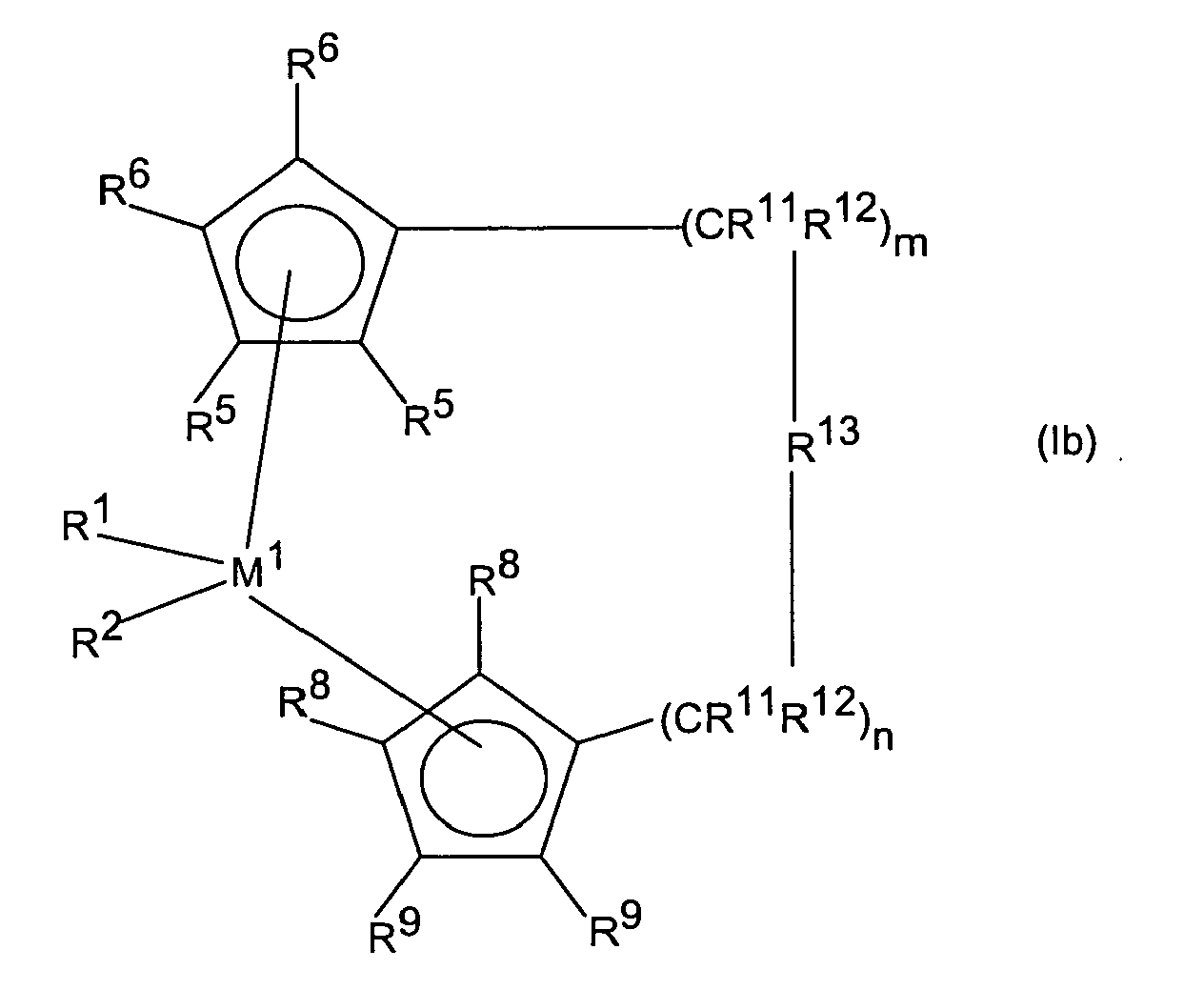

R5, R6, R7, R8, R9 und R10 gleich oder verschieden sind und bedeuten ein Wasserstoffatom, ein Halogenatom, eine C1-C10-Alkylgruppe, eine C6-C10-Arylgruppe, eine C1-C10- Alkoxygruppe, einen -NR16 2-, -SR16-, -OSiR16 3-, -SiR16 3- oder -PR16 2-Rest, worin R16 eine C1-C10-Alkylgruppe oder C6-C10-, Arylgruppe oder im Falle Si oder P enthaltender Reste auch ein Halogenatom ist oder je zwei benachbarte Reste R5, R6, R7, R8, R9 oder R10 bilden mit den sie verbindenden C-Atomen einen Ring,
R13 ist

M2 ist Silizium, Germanium oder Zinn und
R13 ist =CR17R18, =SiR17R18, =GeR17R18, -O-, -S-, =SO, =PR17 oder =P(O)R17
R11 und R12 sind gleich oder verschieden und haben die für R17 genannte Bedeutung, m und n sind gleich oder verschieden und bedeuten null, 1 oder 2, wobei m plus n null, 1 oder 2 ist,
und
R14 und R15 die Bedeutung von R17 und R18 haben. - Verfahren nach Anspruch 8, dadurch gekennzeichnet, dass als Metallocenverbindung eine Verbindung der Formel (2) eingesetzt wird

R3 bis R12 sind gleich oder verschieden und bedeuten ein Wasserstoffatom, ein Halogenatom, eine C1-C10- Alkylgruppe, die gegebenenfalls halogeniert ist, eine C6-C10- Arylgruppe, einen -NR16 2-, -SR16-, -SiR16 3- oder PR16 2-Rest, worin R16 ein Halogenatom ist, eine C1-C10- Alkylgruppe oder eine C6-C10-Arylgruppe ist.
Wobei die benachbarten Reste R4 bis R12 gegebenenfalls mit den sie verbindenden Atomen einen aromatischen oder aliphatischen Ring bilden. - Verfahren nach Anspruch 8, dadurch gekennzeichnet, dass als Metallocenverbindung eine Verbindung der Formel (3) eingesetzt wird

M1 ein Metall der Gruppe 4, 5 oder 6 des Periodensystems ist und A ist ein Element der Gruppe 14, 15 oder 16 des Periodensystems,
n ist 0, 1 oder 2, mit der Bedingung, dass n gleich 0 ist, wenn A ein Element aus der Gruppe 16 des Periodensystems ist, dass n gleich 1 ist, wenn A ein Element aus der Gruppe 15 des Periodensystems ist und dass n gleich 1 oder 2 ist, wenn A ein Element aus der Gruppe 14 des Periodensystems ist,
R1 und R2 haben die gleiche Bedeutung wie in der Formeln (I),
R3 bis R7 sind gleich oder verschieden und bedeuten ein Wasserstoffatom, ein Halogenatom eine C1-C10- Alkylgruppe, die gegebenenfalls halogeniert ist, eine C6-C10- Arylgruppe, eine C7-C10 Alkylarylgruppe oder eine C7-C10 Arylalkylgruppe und
R8 hat die gleiche Bedeutung wie der Rest R13 in der Formeln (Ib). - Verfahren nach mindestens einem der Ansprüche 9, 10 oder 11, dadurch gekennzeichnet, dass M1 für Zirkonium steht.
- Verfahren nach mindestens einem der vorhergehenden Ansprüche 8 bis 12, dadurch gekennzeichnet, dass als Cokatalysator aluminiumorganische Verbindungen, insbesondere Alumoxane oder aluminiumfreie Systeme aus der
Gruppe:R20 xNH4-xBR21 4, R20 xPH4-xBR21 4, R20 3CBR21 4 oder BR21 3 eingesetzt werden, wobei x eine Zahl von 1 bis 4 ist, die Reste R20 sind gleich oder verschieden sind und C1-C10-Alkyl oder C6-C18-Aryl bedeuten oder zwei Reste R20 zusammen mit dem sie verbindenden Atom einen Ring bilden, und die Reste R21 sind gleich oder verschieden sind und für einen gegebenenfalls substituierten C6-C18-Arylrest stehen. - Verfahren nach mindestens einem der vorhergehenden Ansprüche 8 bis 13, dadurch gekennzeichnet, dass dem Reaktionsgemisch zusätzlich aluminiumorganische Verbindungen oder Mischungen derselben zugegeben werden.
- Verfahren nach mindestens einem der vorhergehenden Ansprüche 8 bis 14, dadurch gekennzeichnet, dass der Katalysator und der Cokatalysator in Lösung oder suspendiert dem Reaktionsgemisch zugegeben werden.
- Verfahren nach mindestens einem der vorhergehenden Ansprüche 8 bis 15, dadurch gekennzeichnet, dass die erhaltenen Polypropylenwachse anschließend durch Einführung polarer, gegebenenfalls sauerstoffhaltiger Funktionen chemisch modifiziert werden.
- Verfahren nach Anspruch 16, dadurch gekennzeichnet, dass die Modifizierung durch radikalische Pfropfreaktion mit polaren Monomeren erfolgt.
- Verwendung von Polypropylen-Wachsen nach mindestens einem der Ansprüche 1 bis 7 als Dispergiermittel für Pigmente.
- Verwendung von Polypropylen-Wachsen nach mindestens einem der Ansprüche 1 bis 7 als Additiv in Druckfarben und Lacken.
- Verwendung von Polypropylen-Wachsen nach mindestens einem der Ansprüche 1 bis 7 in Fototonern.
- Verwendung von Polypropylen-Wachsen nach mindestens einem der Ansprüche 1 bis 7 als Gleit- oder Trennmittel für die Kunststoffverarbeitung.
- Verwendung von Polypropylen-Wachsen nach Anspruch 6 zur Herstellung wässriger Dispersionen.
- Verwendung von Polypropylen-Wachsen nach Anspruch 6 als Haft- und Verträglichkeitsvermittler in Kunststoffcompounds.
- Verwendung von Polypropylen-Wachsen nach mindestens einem der Ansprüche 1-7 als Rezepturkomponente in Heißschmelzmassen.
Applications Claiming Priority (1)
| Application Number | Priority Date | Filing Date | Title |
|---|---|---|---|
| DE102007036792A DE102007036792A1 (de) | 2007-08-03 | 2007-08-03 | Hochkristalline Polypropylenwachse |
Publications (2)
| Publication Number | Publication Date |
|---|---|
| EP2020420A1 true EP2020420A1 (de) | 2009-02-04 |
| EP2020420B1 EP2020420B1 (de) | 2012-10-10 |
Family
ID=39769217
Family Applications (1)
| Application Number | Title | Priority Date | Filing Date |
|---|---|---|---|
| EP08013514A Not-in-force EP2020420B1 (de) | 2007-08-03 | 2008-07-26 | Hochkristalline Polypropylenwachse |
Country Status (5)
| Country | Link |
|---|---|
| US (1) | US20090036619A1 (de) |
| EP (1) | EP2020420B1 (de) |
| JP (1) | JP5545919B2 (de) |
| DE (1) | DE102007036792A1 (de) |
| ES (1) | ES2392559T3 (de) |
Cited By (1)
| Publication number | Priority date | Publication date | Assignee | Title |
|---|---|---|---|---|
| WO2010105797A1 (de) * | 2009-03-19 | 2010-09-23 | Clariant International Ltd | Verwendung von copolymerisaten als additive für lacke |
Families Citing this family (13)
| Publication number | Priority date | Publication date | Assignee | Title |
|---|---|---|---|---|
| DE102007056440A1 (de) * | 2007-11-23 | 2009-05-28 | Clariant International Limited | Ionomere aus Poly-1-Olefinwachsen |
| CN102232099B (zh) * | 2010-05-12 | 2013-02-06 | 昆山博富新材料科技股份有限公司 | 一种塑料增强用麻纤维及其制备方法 |
| KR20160013959A (ko) * | 2013-05-24 | 2016-02-05 | 비와이케이-케미 게엠베하 | 방오성 표면 코팅용 초분지형 폴리알콕시실록산 첨가제 |
| MX393979B (es) * | 2015-01-21 | 2025-03-24 | Taghleef Ind Inc | Auxiliar de procesamiento y mezcla que emplea el auxiliar de procesamiento para lograr una orientación efectiva de una capa de película extruida y una película orientada biaxialmente que incluye dicha capa de película. |
| US10472487B2 (en) | 2015-12-30 | 2019-11-12 | Greenmantra Recycling Technologies Ltd. | Reactor for continuously treating polymeric material |
| ES2925008T3 (es) | 2016-02-13 | 2022-10-13 | Greenmantra Recycling Tech Ltd | Asfalto modificado con polímero con aditivo de cera |
| MX2018011492A (es) | 2016-03-24 | 2019-02-20 | Greenmantra Recycling Tech Ltd | Cera como modificador de flujo de fusion y adyuvante de procesamiento para polimeros. |
| US10844236B2 (en) | 2016-07-20 | 2020-11-24 | Hewlett-Packard Development Company, L.P. | Liquid bonding agent for liquid ink |
| CA3036136A1 (en) | 2016-09-29 | 2018-04-05 | Greenmantra Recycling Technologies Ltd. | Reactor for treating polystyrene material |
| CA3061335C (en) * | 2017-05-22 | 2021-11-30 | H.B. Fuller Company | Hot melt adhesive composition |
| EP3717559A4 (de) | 2017-11-28 | 2021-11-17 | GreenMantra Recycling Technologies Ltd | Verkapselung von modifikatoren in depolymerisierten produkten |
| BR112020024507A2 (pt) | 2018-05-31 | 2021-03-02 | Greenmantra Recycling Technologies Ltd. | látex, tinta, adesivo, revestimento, teste de imunoensaio e solução |
| CN121203294A (zh) * | 2025-11-28 | 2025-12-26 | 岳阳兴长石化股份有限公司 | 超透改性pp材料及其制备方法 |
Citations (8)
| Publication number | Priority date | Publication date | Assignee | Title |
|---|---|---|---|---|
| US2835659A (en) | 1957-02-11 | 1958-05-20 | Eastman Kodak Co | Polypropylene waxes and method of making |
| DE3148229A1 (de) | 1981-12-05 | 1983-06-09 | Hoechst Ag, 6230 Frankfurt | Verfahren zur herstellung von polyolefinwachsen |
| EP0321852A1 (de) | 1987-12-21 | 1989-06-28 | Hoechst Aktiengesellschaft | 1-Olefinpolymerwachs und Verfahren zu seiner Herstellung |
| DE4030399A1 (de) * | 1990-09-26 | 1992-04-02 | Basf Ag | Makromolekuele des propylens mit einem funktionellen kettenende |
| DE19648895A1 (de) * | 1996-11-26 | 1998-05-28 | Clariant Gmbh | Polar modifizierte Polypropylen-Wachse |
| EP0890584A1 (de) | 1997-07-11 | 1999-01-13 | Clariant GmbH | Polypropylenwachs |
| EP1508579A1 (de) | 2003-08-21 | 2005-02-23 | Clariant GmbH | Modifizierte Polyolefinwachse |
| WO2006053757A1 (en) | 2004-11-19 | 2006-05-26 | Basell Polyolefine Gmbh | Process for preparing low molecular weight olefin polymers, organometallic transition metal compounds biscyclopentadienyl ligand systems and catalyst systems |
Family Cites Families (8)
| Publication number | Priority date | Publication date | Assignee | Title |
|---|---|---|---|---|
| DE2329641C3 (de) * | 1973-06-09 | 1978-09-28 | Hoechst Ag, 6000 Frankfurt | Verfahren zur Polymerisation von ct-Olefinen |
| DE3904468A1 (de) * | 1989-02-15 | 1990-08-16 | Hoechst Ag | Polypropylenwachs und verfahren zu seiner herstellung |
| TW285680B (de) * | 1992-03-31 | 1996-09-11 | Hoechst Ag | |
| DE4446923A1 (de) * | 1994-12-28 | 1996-07-04 | Hoechst Ag | Polyolefinwachs |
| US6444833B1 (en) * | 1999-12-15 | 2002-09-03 | Basell Technology Company Bv | Metallocene compounds, process for their preparation and their use in catalytic systems for the polymerization of olefins |
| JP2003066652A (ja) * | 2001-08-28 | 2003-03-05 | Dainippon Ink & Chem Inc | 静電荷像現像用トナー |
| JP2004300378A (ja) * | 2003-04-01 | 2004-10-28 | San Nopco Ltd | ワックス乳化分散体 |
| DE102004048536B4 (de) * | 2004-10-06 | 2008-09-18 | Clariant Produkte (Deutschland) Gmbh | Verwendung von Heißschmelzmassen in Straßenmarkierungen |
-
2007
- 2007-08-03 DE DE102007036792A patent/DE102007036792A1/de not_active Withdrawn
-
2008
- 2008-07-26 ES ES08013514T patent/ES2392559T3/es active Active
- 2008-07-26 EP EP08013514A patent/EP2020420B1/de not_active Not-in-force
- 2008-07-31 US US12/221,234 patent/US20090036619A1/en not_active Abandoned
- 2008-08-01 JP JP2008199214A patent/JP5545919B2/ja not_active Expired - Fee Related
Patent Citations (9)
| Publication number | Priority date | Publication date | Assignee | Title |
|---|---|---|---|---|
| US2835659A (en) | 1957-02-11 | 1958-05-20 | Eastman Kodak Co | Polypropylene waxes and method of making |
| DE3148229A1 (de) | 1981-12-05 | 1983-06-09 | Hoechst Ag, 6230 Frankfurt | Verfahren zur herstellung von polyolefinwachsen |
| EP0321852A1 (de) | 1987-12-21 | 1989-06-28 | Hoechst Aktiengesellschaft | 1-Olefinpolymerwachs und Verfahren zu seiner Herstellung |
| DE4030399A1 (de) * | 1990-09-26 | 1992-04-02 | Basf Ag | Makromolekuele des propylens mit einem funktionellen kettenende |
| DE19648895A1 (de) * | 1996-11-26 | 1998-05-28 | Clariant Gmbh | Polar modifizierte Polypropylen-Wachse |
| EP0941257A1 (de) | 1996-11-26 | 1999-09-15 | Clariant GmbH | Polar modifizierte polypropylen-wachse |
| EP0890584A1 (de) | 1997-07-11 | 1999-01-13 | Clariant GmbH | Polypropylenwachs |
| EP1508579A1 (de) | 2003-08-21 | 2005-02-23 | Clariant GmbH | Modifizierte Polyolefinwachse |
| WO2006053757A1 (en) | 2004-11-19 | 2006-05-26 | Basell Polyolefine Gmbh | Process for preparing low molecular weight olefin polymers, organometallic transition metal compounds biscyclopentadienyl ligand systems and catalyst systems |
Non-Patent Citations (1)
| Title |
|---|
| POLYMER, vol. 30, 1989, pages 428 |
Cited By (3)
| Publication number | Priority date | Publication date | Assignee | Title |
|---|---|---|---|---|
| WO2010105797A1 (de) * | 2009-03-19 | 2010-09-23 | Clariant International Ltd | Verwendung von copolymerisaten als additive für lacke |
| US20120009423A1 (en) * | 2009-03-19 | 2012-01-12 | Clariant Finance (Bvi) Limited | Usage Of Copolymerisates As Additives For Lacquers |
| US8563134B2 (en) * | 2009-03-19 | 2013-10-22 | Clariant Finance (Bvi) Limited | Usage of copolymerisates as additives for lacquers |
Also Published As
| Publication number | Publication date |
|---|---|
| JP5545919B2 (ja) | 2014-07-09 |
| JP2009035735A (ja) | 2009-02-19 |
| EP2020420B1 (de) | 2012-10-10 |
| ES2392559T3 (es) | 2012-12-11 |
| DE102007036792A1 (de) | 2009-02-05 |
| US20090036619A1 (en) | 2009-02-05 |
Similar Documents
| Publication | Publication Date | Title |
|---|---|---|
| EP2020420B1 (de) | Hochkristalline Polypropylenwachse | |
| EP3289027B1 (de) | Kurzkettige polyethylen-homopolymere mit verbesserter mahlbarkeit | |
| DE69633436T3 (de) | Ethylen-Copolymer-Zusammensetzung | |
| DE69813958T2 (de) | Ungesättigte Copolymere, Verfahren zu deren Herstellung und Mischungen, die diese enthalten | |
| EP0941257B1 (de) | Polar modifizierte polypropylen-wachse | |
| EP0890584A1 (de) | Polypropylenwachs | |
| EP1645608A1 (de) | Verwendung von Polyolefinwachsen in Heissschmelzmassen | |
| EP0890619A1 (de) | Verwendung von Polyolefinwachsen | |
| EP0943631A1 (de) | Polymere des Propens | |
| US6566432B2 (en) | Coloring resin composition and molded articles | |
| EP2079779B1 (de) | Wirkstoffzusammensetzung auf basis von metallocen-polyolefinwachsen zur herstellung von stabilisierten, lichtbeständigen kunststoffen | |
| EP2052024A1 (de) | Hochgefüllte farbmittelzusammensetzung zum einfärben olefinischer wie nicht-olefinischer kunststoffe | |
| EP1497384A1 (de) | Verwendung von metallocenwachsen in pulverlacken | |
| EP1619010A1 (de) | Verwendung von Polyolefinwachsen in Polykondensaten | |
| DE102007007793A1 (de) | Verfahren zur Herstellung einer thermoplastischen Harzzusammensetzung | |
| WO2008046535A1 (de) | Haftstoffzusammensetzung auf basis von metallocenwachsen | |
| DE102005022652A1 (de) | Hochgefüllte Farbmittelzusammensetzung zum Einfärben olefinischer wie nichtolefinischer Kunststoffe | |
| EP1013672B1 (de) | Polymeroxidate und ihre Verwendung | |
| WO2001098415A2 (de) | Pigmentkonzentrate und verfahren zu ihrer herstellung | |
| WO2008037398A1 (de) | Peroxidhaltige wirkstoffzusammensetzung für gezielten abbau oder vernetzungsreaktionen in kunststoffen | |
| EP0986610B2 (de) | Polymermischung | |
| WO2008037443A1 (de) | Hochgeladene antistatikmasterbatche zur herstellung von kunststoffen mit reduzierter elektrostatischer aufladung | |
| DE102006046564A1 (de) | Hochgeladene Antikondensationsmasterbatche durch den Einsatz von Metallocen-Wachsen | |
| EP4397688A1 (de) | Verfahren zur herstellung von polyethylen- oder polypropylen-wachsen aus nachwachsenden oder recycelten rohstoffen | |
| WO2008055643A1 (de) | Hochgeladene wirkstoffzusammensetzungen enthaltend trenn-, schmier- und gleitmittel in einem metallocen wachsträger |
Legal Events
| Date | Code | Title | Description |
|---|---|---|---|
| PUAI | Public reference made under article 153(3) epc to a published international application that has entered the european phase |
Free format text: ORIGINAL CODE: 0009012 |
|
| AK | Designated contracting states |
Kind code of ref document: A1 Designated state(s): AT BE BG CH CY CZ DE DK EE ES FI FR GB GR HR HU IE IS IT LI LT LU LV MC MT NL NO PL PT RO SE SI SK TR |
|
| AX | Request for extension of the european patent |
Extension state: AL BA MK RS |
|
| 17P | Request for examination filed |
Effective date: 20090804 |
|
| 17Q | First examination report despatched |
Effective date: 20090907 |
|
| AKX | Designation fees paid |
Designated state(s): DE ES FR GB IT NL |
|
| RAP1 | Party data changed (applicant data changed or rights of an application transferred) |
Owner name: CLARIANT FINANCE (BVI) LIMITED |
|
| GRAP | Despatch of communication of intention to grant a patent |
Free format text: ORIGINAL CODE: EPIDOSNIGR1 |
|
| GRAS | Grant fee paid |
Free format text: ORIGINAL CODE: EPIDOSNIGR3 |
|
| GRAA | (expected) grant |
Free format text: ORIGINAL CODE: 0009210 |
|
| AK | Designated contracting states |
Kind code of ref document: B1 Designated state(s): DE ES FR GB IT NL |
|
| REG | Reference to a national code |
Ref country code: GB Ref legal event code: FG4D Free format text: NOT ENGLISH |
|
| REG | Reference to a national code |
Ref country code: DE Ref legal event code: R096 Ref document number: 502008008341 Country of ref document: DE Effective date: 20121206 |
|
| REG | Reference to a national code |
Ref country code: ES Ref legal event code: FG2A Ref document number: 2392559 Country of ref document: ES Kind code of ref document: T3 Effective date: 20121211 |
|
| REG | Reference to a national code |
Ref country code: NL Ref legal event code: T3 |
|
| PLBE | No opposition filed within time limit |
Free format text: ORIGINAL CODE: 0009261 |
|
| STAA | Information on the status of an ep patent application or granted ep patent |
Free format text: STATUS: NO OPPOSITION FILED WITHIN TIME LIMIT |
|
| 26N | No opposition filed |
Effective date: 20130711 |
|
| REG | Reference to a national code |
Ref country code: DE Ref legal event code: R097 Ref document number: 502008008341 Country of ref document: DE Effective date: 20130711 |
|
| REG | Reference to a national code |
Ref country code: DE Ref legal event code: R081 Ref document number: 502008008341 Country of ref document: DE Owner name: CLARIANT INTERNATIONAL LTD, CH Free format text: FORMER OWNER: CLARIANT FINANCE (BVI) LTD., ROAD TOWN, TORTOLA, VG |
|
| REG | Reference to a national code |
Ref country code: FR Ref legal event code: PLFP Year of fee payment: 9 |
|
| REG | Reference to a national code |
Ref country code: FR Ref legal event code: PLFP Year of fee payment: 10 |
|
| REG | Reference to a national code |
Ref country code: DE Ref legal event code: R082 Ref document number: 502008008341 Country of ref document: DE |
|
| REG | Reference to a national code |
Ref country code: FR Ref legal event code: PLFP Year of fee payment: 11 |
|
| REG | Reference to a national code |
Ref country code: ES Ref legal event code: PC2A Owner name: CLARIANT INTERNATIONAL LTD. Effective date: 20201027 |
|
| REG | Reference to a national code |
Ref country code: NL Ref legal event code: PD Owner name: CLARIANT INTERNATIONAL LTD; CH Free format text: DETAILS ASSIGNMENT: CHANGE OF OWNER(S), ASSIGNMENT; FORMER OWNER NAME: CLARIANT FINANCE (BVI) LIMITED Effective date: 20201214 |
|
| REG | Reference to a national code |
Ref country code: GB Ref legal event code: 732E Free format text: REGISTERED BETWEEN 20210805 AND 20210811 |
|
| P01 | Opt-out of the competence of the unified patent court (upc) registered |
Effective date: 20230510 |
|
| PGFP | Annual fee paid to national office [announced via postgrant information from national office to epo] |
Ref country code: NL Payment date: 20230726 Year of fee payment: 16 |
|
| PGFP | Annual fee paid to national office [announced via postgrant information from national office to epo] |
Ref country code: IT Payment date: 20230721 Year of fee payment: 16 Ref country code: GB Payment date: 20230725 Year of fee payment: 16 Ref country code: ES Payment date: 20230816 Year of fee payment: 16 |
|
| PGFP | Annual fee paid to national office [announced via postgrant information from national office to epo] |
Ref country code: FR Payment date: 20230725 Year of fee payment: 16 Ref country code: DE Payment date: 20230726 Year of fee payment: 16 |
|
| REG | Reference to a national code |
Ref country code: DE Ref legal event code: R119 Ref document number: 502008008341 Country of ref document: DE |
|
| REG | Reference to a national code |
Ref country code: NL Ref legal event code: MM Effective date: 20240801 |
|
| GBPC | Gb: european patent ceased through non-payment of renewal fee |
Effective date: 20240726 |
|
| PG25 | Lapsed in a contracting state [announced via postgrant information from national office to epo] |
Ref country code: DE Free format text: LAPSE BECAUSE OF NON-PAYMENT OF DUE FEES Effective date: 20250201 |
|
| PG25 | Lapsed in a contracting state [announced via postgrant information from national office to epo] |
Ref country code: NL Free format text: LAPSE BECAUSE OF NON-PAYMENT OF DUE FEES Effective date: 20240801 |
|
| PG25 | Lapsed in a contracting state [announced via postgrant information from national office to epo] |
Ref country code: FR Free format text: LAPSE BECAUSE OF NON-PAYMENT OF DUE FEES Effective date: 20240731 |
|
| PG25 | Lapsed in a contracting state [announced via postgrant information from national office to epo] |
Ref country code: GB Free format text: LAPSE BECAUSE OF NON-PAYMENT OF DUE FEES Effective date: 20240726 |
|
| PG25 | Lapsed in a contracting state [announced via postgrant information from national office to epo] |
Ref country code: IT Free format text: LAPSE BECAUSE OF NON-PAYMENT OF DUE FEES Effective date: 20240726 |
|
| REG | Reference to a national code |
Ref country code: ES Ref legal event code: FD2A Effective date: 20250902 |
|
| PG25 | Lapsed in a contracting state [announced via postgrant information from national office to epo] |
Ref country code: ES Free format text: LAPSE BECAUSE OF NON-PAYMENT OF DUE FEES Effective date: 20240727 |