EP0986610B2 - Polymermischung - Google Patents
Polymermischung Download PDFInfo
- Publication number
- EP0986610B2 EP0986610B2 EP98925619A EP98925619A EP0986610B2 EP 0986610 B2 EP0986610 B2 EP 0986610B2 EP 98925619 A EP98925619 A EP 98925619A EP 98925619 A EP98925619 A EP 98925619A EP 0986610 B2 EP0986610 B2 EP 0986610B2
- Authority
- EP
- European Patent Office
- Prior art keywords
- bis
- copolymers
- alkyl
- oder
- ethylene
- Prior art date
- Legal status (The legal status is an assumption and is not a legal conclusion. Google has not performed a legal analysis and makes no representation as to the accuracy of the status listed.)
- Expired - Lifetime
Links
Classifications
-
- C—CHEMISTRY; METALLURGY
- C08—ORGANIC MACROMOLECULAR COMPOUNDS; THEIR PREPARATION OR CHEMICAL WORKING-UP; COMPOSITIONS BASED THEREON
- C08L—COMPOSITIONS OF MACROMOLECULAR COMPOUNDS
- C08L23/00—Compositions of homopolymers or copolymers of unsaturated aliphatic hydrocarbons having only one carbon-to-carbon double bond; Compositions of derivatives of such polymers
- C08L23/02—Compositions of homopolymers or copolymers of unsaturated aliphatic hydrocarbons having only one carbon-to-carbon double bond; Compositions of derivatives of such polymers not modified by chemical after-treatment
- C08L23/04—Homopolymers or copolymers of ethene
- C08L23/08—Copolymers of ethene
- C08L23/0807—Copolymers of ethene with unsaturated hydrocarbons only containing four or more carbon atoms
- C08L23/0815—Copolymers of ethene with unsaturated hydrocarbons only containing four or more carbon atoms with aliphatic 1-olefins containing one carbon-to-carbon double bond
-
- C—CHEMISTRY; METALLURGY
- C08—ORGANIC MACROMOLECULAR COMPOUNDS; THEIR PREPARATION OR CHEMICAL WORKING-UP; COMPOSITIONS BASED THEREON
- C08F—MACROMOLECULAR COMPOUNDS OBTAINED BY REACTIONS ONLY INVOLVING CARBON-TO-CARBON UNSATURATED BONDS
- C08F210/00—Copolymers of unsaturated aliphatic hydrocarbons having only one carbon-to-carbon double bond
- C08F210/02—Ethene
-
- C—CHEMISTRY; METALLURGY
- C08—ORGANIC MACROMOLECULAR COMPOUNDS; THEIR PREPARATION OR CHEMICAL WORKING-UP; COMPOSITIONS BASED THEREON
- C08J—WORKING-UP; GENERAL PROCESSES OF COMPOUNDING; AFTER-TREATMENT NOT COVERED BY SUBCLASSES C08B, C08C, C08F, C08G or C08H
- C08J5/00—Manufacture of articles or shaped materials containing macromolecular substances
- C08J5/18—Manufacture of films or sheets
-
- C—CHEMISTRY; METALLURGY
- C08—ORGANIC MACROMOLECULAR COMPOUNDS; THEIR PREPARATION OR CHEMICAL WORKING-UP; COMPOSITIONS BASED THEREON
- C08L—COMPOSITIONS OF MACROMOLECULAR COMPOUNDS
- C08L23/00—Compositions of homopolymers or copolymers of unsaturated aliphatic hydrocarbons having only one carbon-to-carbon double bond; Compositions of derivatives of such polymers
- C08L23/02—Compositions of homopolymers or copolymers of unsaturated aliphatic hydrocarbons having only one carbon-to-carbon double bond; Compositions of derivatives of such polymers not modified by chemical after-treatment
- C08L23/16—Ethylene-propylene or ethylene-propylene-diene copolymers
-
- C—CHEMISTRY; METALLURGY
- C08—ORGANIC MACROMOLECULAR COMPOUNDS; THEIR PREPARATION OR CHEMICAL WORKING-UP; COMPOSITIONS BASED THEREON
- C08F—MACROMOLECULAR COMPOUNDS OBTAINED BY REACTIONS ONLY INVOLVING CARBON-TO-CARBON UNSATURATED BONDS
- C08F2500/00—Characteristics or properties of obtained polyolefins; Use thereof
- C08F2500/18—Bulk density
-
- C—CHEMISTRY; METALLURGY
- C08—ORGANIC MACROMOLECULAR COMPOUNDS; THEIR PREPARATION OR CHEMICAL WORKING-UP; COMPOSITIONS BASED THEREON
- C08L—COMPOSITIONS OF MACROMOLECULAR COMPOUNDS
- C08L2205/00—Polymer mixtures characterised by other features
- C08L2205/02—Polymer mixtures characterised by other features containing two or more polymers of the same C08L -group
-
- C—CHEMISTRY; METALLURGY
- C08—ORGANIC MACROMOLECULAR COMPOUNDS; THEIR PREPARATION OR CHEMICAL WORKING-UP; COMPOSITIONS BASED THEREON
- C08L—COMPOSITIONS OF MACROMOLECULAR COMPOUNDS
- C08L23/00—Compositions of homopolymers or copolymers of unsaturated aliphatic hydrocarbons having only one carbon-to-carbon double bond; Compositions of derivatives of such polymers
- C08L23/02—Compositions of homopolymers or copolymers of unsaturated aliphatic hydrocarbons having only one carbon-to-carbon double bond; Compositions of derivatives of such polymers not modified by chemical after-treatment
- C08L23/04—Homopolymers or copolymers of ethene
- C08L23/06—Polyethylene
-
- C—CHEMISTRY; METALLURGY
- C08—ORGANIC MACROMOLECULAR COMPOUNDS; THEIR PREPARATION OR CHEMICAL WORKING-UP; COMPOSITIONS BASED THEREON
- C08L—COMPOSITIONS OF MACROMOLECULAR COMPOUNDS
- C08L2314/00—Polymer mixtures characterised by way of preparation
- C08L2314/02—Ziegler natta catalyst
Definitions
- the present invention relates to polymer blends containing at least 85% by weight ethylene / C 3 -C 20 - ⁇ -olefin copolymers (A) prepared by metallocene catalysis with a density of 0.91 to 0.925 g / cm 3 and an HLMI of 10 to 40 g / 10 min.
- the present invention is the use of these polymer blends for the production of films and films containing these polymer blends.
- Ethylene / ⁇ -olefin copolyners prepared by metallocene catalysis have some advantageous properties over copolymers prepared by conventional catalyst systems.
- the metallocene copolymers are often superior in their mechanical properties, such as toughness, to differently prepared copolymers of similar composition.
- the excellent mechanical properties make metallocane copolymers particularly suitable for the production of films. Particularly in the production of films, high demands are placed on the optical properties of the polymers used. In the case of pure metallocene copolymers as well as conventionally produced LLDPE, slight turbidity and inadequate gloss are often noticeable.
- the WO 95/10556 discloses films of blends containing ethylene / C 4 -C 10 copolymers prepared by a single site catalyst, blends of these polymers and ethylene copolymers prepared by a chromium or Ziegler catalyst are not described.
- Suitable copolymers (A) are ethylene / ⁇ -olefin copolymers prepared by metallocene catalysis.
- the carrier materials a) used are preferably finely divided carriers which preferably have a particle diameter in the range from 1 to 300 ⁇ m, in particular from 30 to 70 ⁇ m.
- Suitable inorganic carriers are, for example, magnesium chloride or silica gels, preferably those of. SiO 2 ⁇ a Al 2 O 3 wherein a is a number in the range of 0 to 2, preferably 0 to 0.5; these are aluminosilicates or silicon dioxide.
- Such products are commercially available, eg Silica Gel 332 from Grace.
- Suitable organic carriers are, for example, finely divided polyolefins, for example finely divided polypropylene.
- the amount of carrier is preferably 50 to 99.9 wt .-%, based on the total mass of carrier and metallocene complex (component b).
- metallocene complexes of general formula I are and prefers.
- transition metal complexes which contain two bridged aromatic ring systems as ligands, ie in particular the transition metal complexes of the general formula Ic.
- the radicals X may be the same or different, preferably they are the same.
- the compounds of formula Ib are suitable in which the Cyclopentadienylreste are the same.
- Examples of particularly suitable complex compounds include dimethylsilanediylbis (cyclopentadienyl) zirconium dichloride, 5 dimethylsilanediylbis (indenyl) zirconium dichloride, Dimethylsilanediylbis (tetrahydroindenyl) zirconium dichloride, Ethylenebis (cyclopentadienyl) zirconium dichloride, Ethylenebis (indenyl) zirconium dichloride, Ethylenebis (tetrahydroindenyl) zirconium dichloride, 3 tetramethylethylene-9-fluorenylcyclopentadienylzirconium dichloride, Dimethylsilanediylbis (3-tert-butyl-5-methylcyclopentadienyl) zirconium dichloride, Dimethylsilanediylbis (3-tert-butyl-5-ethylcyclopentadieny
- Suitable metallocene ion-forming compounds c) are strong, neutral Lewis acids, ionic compounds with Lewis-acid cations and ionic compounds with Bronsted acids as cation.
- the Triphenylmethylkation, the silver cation and the 1,1'-Dimethylferrocenylkation be mentioned. They preferably have non-coordinating counterions, in particular boron compounds, as they are also known in the WO 91/09882 tetrakis (pentafluorophenyl) borate is preferred.
- Ionic compounds with Bronsted acids as cations and preferably also non-coordinating counterions are in the WO 91/09882 called, preferred cation is the NN-dimethylanilinium.
- oligomeric alumoxane compounds The preparation of these oligomeric alumoxane compounds is usually carried out by reacting a solution of trialkylaluminum with water and is inter alia in the EP-A 284 708 and the US Pat. No. 4,794,096 described.
- the resulting oligomeric alumoxane compounds are present as mixtures of different lengths, both linear and cyclic chain molecules, so that m is to be regarded as an average.
- the alumoxane compounds may also be present in a mixture with other metal alkyls, preferably with aluminum alkyls.
- metallocenium ion-forming compounds aryloxyalumoxanes, as described in the US-A 5,391,793 described, aminoaluminoxanes, as in US-A 5,371,260 described, Aminoaluminoxanhydrochloride, as in EP-A 633 264 described siloxyaluminoxanes as described in Ep-A 621 279 described, or mixtures thereof are used.
- the preferably prepared by means of said catalyst systems copolymers A) contain preferably 97 to 75 wt .-% ethylene and 3 to 25 wt .-% C 3 -C 20 ⁇ -olefin units, each based on the total mass of component A). Particularly preferably, these copolymers contain from 97 to 85% by weight of ethylene and from 3 to 15% by weight of C 3 -C 20 - ⁇ -olefin unit.
- C 3 -C 20 - ⁇ -olefins which serve as comonomers of these copolymers, all linear or branched a-isomers of propene, butene, pentene, hexene, heptene, octene, nonene, decene, undecene, dodecene, tridecene, tetradecene , Pentadecene, bexadecene, heptadecene, octadecene, nonadecene and eicosene.
- Preferred C 3 -C 20 - ⁇ -olefin comonomers are those from the group of butene, pentene, hexene, 4-methylpentene and octene, particularly preferred are butene, pentene and hexene.
- Particularly preferred copolymers (A) are ethylene / butene copolymers having a butene content of 4-8% by weight and ethylene / hexene copolymers having a hexene content of 4-8% by weight, based in each case on the total mass of these copolymers.
- copolymers (A) are preferred which have a Molekulargewihtsverotti M w / M n ⁇ 3.5.
- Copolymers (A) with a density of 0.91-0.925 and an HLMI (High Load Melt Flow Index) of 10 -40 g / 10 min are also particularly advantageous for use in films.
- Suitable copolymers (B) are substantially linear ethylene / ⁇ -olefin copolymers, such as Ethylene copolymers of average density ⁇ PE-MD) in the range of 0.930 to 0.940, in particular those PE-MD copolymers which are prepared by means of chromium catalysts.
- chromium catalysts also called Phillipskatalysatoren
- these copolymers may contain the abovementioned C 3 -C 20 - ⁇ -olefins, witches and butene, in particular hexene, being preferred here as well.
- the PE-MD copolymers preferably have an HLMI of 2-100, more preferably 10-30 g / 10 min.
- copolymers (B) are LLDPE copolymers having a density of 0.915 to 0.929, in particular those which are prepared with a Ziegler catalyst.
- Conventional catalysts of this type are described, for example, in Ullmann's Encyclopedia of Industrial Chemistry, Vol. A 21, 4th edition 1992, p. 502 et seq. In particular, such catalysts should be mentioned here as they are, for. In US-A-4857613 as in DE-A-19 529 240 to be discribed.
- LLDPE copolyesters obtainable by Ziegierkatalyse can be prepared by all conventional Polymeriatsonstertahren, with solution method and gas phase method, in particular gas phase fluidized bed method are particularly preferred.
- these copolymers may in turn contain the abovementioned ⁇ -olefins, preferably butene, hexene or octene
- the polymer mixtures according to the invention may contain other additives such as stabilizers against light and weathering, processing aids and, if desired, dyes. Type and amount of these additives are familiar to the expert.
- the polymer mixtures according to the invention contain the copolymer component (B) in a concentration of 1-15% by weight, preferably 2-10% by weight, based on the total mass of the polymer mixture.
- the mixture of the copolymer components (A) and (B) can be carried out by any known mixing method.
- the semisolid polymer components, if desired together with further additives, are usually mixed in the desired proportions in a twin-screw extruder (2SK) and processed into granules. These granules can then z. B. be processed in blown film to film.
- 2SK twin-screw extruder
- the polymer mixtures according to the invention are outstandingly suitable for the production of films, in particular for the packaging sector and in particular for the packaging of foods.
- the resulting films are characterized by clarity, gloss and good mechanical properties, in particular by high tensile strength. They show little tendency to block and are therefore easy to handle.
- the following examples illustrate the invention.
- PE-MD prepared by Phillips catalysis with hexene as comonomer (Lupolen® 3821 D, manufacturer: Rheinische Olefinwerke, Wesseling, Germany)
- the mixtures indicated in the table were prepared on a ZSK. 50 ⁇ m thick films were produced from the granules obtained on a 30 mm Troester blown film line (die 50 mm, die gap 2 mm, temperature profile 180, 190, 200, 3 ⁇ 210 ° C., output 5 kg / h, blow-up ratio 2 :1).
- Table provides information about the tests carried out and the properties of the films produced. (All% values are wt% based on the total amount of the polymer blend.) Table: Film test of the blown films produced example mixture turbidity ISO 6427 shine ISO 2813 > 20% friction value DIN 67530 blocking force DIN 53366 N Dart Drop ASTM D 1709 G Tear strength longitudinal / transverse ISO 527 N / mm 2 Elongation at break longitudinally / transversely ISO 527 % 1 98% A1 + 2% B1 9 72 258 50 609 56/53 787/808 95% A1 + 5% B1 7 83 236 49 664 58/55 784/833 3 90% A1 + 10% B1 7 77 161 17 611 58/54 798/838 4 90% A2 + 10% B1 8th 68 133 0 163 43/37 913/951 comparison bsp.
Landscapes
- Chemical & Material Sciences (AREA)
- Health & Medical Sciences (AREA)
- Chemical Kinetics & Catalysis (AREA)
- Medicinal Chemistry (AREA)
- Polymers & Plastics (AREA)
- Organic Chemistry (AREA)
- Engineering & Computer Science (AREA)
- Manufacturing & Machinery (AREA)
- Materials Engineering (AREA)
- Compositions Of Macromolecular Compounds (AREA)
- Transition And Organic Metals Composition Catalysts For Addition Polymerization (AREA)
- Manufacture Of Macromolecular Shaped Articles (AREA)
Description
- Gegenstand der vorliegenden Erfindung sind Polymermischungen enthaltend
mindesten 85 Gew.-% durch Metallocenkatalyse hergestellte Ethylen/C3-C20-α-Olefine-Copolymere (A) mit einer Dichte von 0.91 bis 0.925 g/cm3 und einem HLMI von 10 bis 40 g/10 min. enthaltend 97 bis 75 Gew.-% Ethylen- und 3 bis 25 Gew.-% C3-C20-α-Olefineinheiten, jeweils bezogen auf die Gesamtmasse der Komponente A) und
1 bis 15 Gew.-% im wesentlichen lineare Ethylen/C3-C20-α-Olefin-copolymere (B) mit einer Dichte von 0,930 bis 0,940 g/cm3, welche mit einem Chromkatalysator hergestellt werden, jeweils bezogen auf die Gesamtmasse der Polymermischung. - Weiterhin ist Gegenstand der vorliegenden Erfindung die Verwendung dieser Polymermischungen zur Herstellung von Folien sowie Folien, welche diese Polymermischungen enthalten.
- Ethylen/α -Olefin-Copolynere, die durch Metallocenkatalyse hergestellt werden, weisen gegenüber mittels konventioneller Katalysatorsysteme hergestellten Copolymeren einige vorteilhafte Eigenschaften auf. So sind die Metallocen-Copolymere-hinsichtlich ihrer mechanischen Eigenschaften wie Zähigkeit anders hergestellten Copolymeren ähnlicher Zusammensetzung oft überlegen. Die hervorragenden mechanischen Eigenschaften lassen Metallocan-Copolymere besonders für die Herstellung von Folien geeignet erscheinen. Besonders bei der Herstellung von Folien werden auch an die optischen Eigenschaften der verwendeten Polymere hohe Anforderungen gestellt. Dabei machen sich bei reinen Metallocen-Copolymeren wie auch bei konventionell hergestelltem LLDPE oft eine leichte Trübheit sowie ungenügender Glanz bemerkbar.
- um die optischen Eigenschaften von LLDPE-Copolymeren zu verbessern, wurden diesen Copolymeren andere Polyniere zugemischt. In
US-A-4 587 303 wird eine Polymermischung aus LLDPE und radikalisch polymerisiertem LDPE oder Ethylencopolymeren aus Hochdruckprozessen beschrieben. Diese Hochdruokpolymeren zeichnen sich durch langkettige Verzweigungen aus, woraus u. a. ihre niedrige Dichte resultiert. InWO 95/27005 - Die
WO 95/10556 - In der
EP-A-575123 - Der vorliegenden Erfindung lag daher die Aufgabe zugrunde, Polymennischungen auf der Grundlage von durch Metallocen-Katalyse hergestellten Ethylen/α-Olefin Copolymeren bereitzustellen, welche einerseits bessere optische Eigenschaften als reine Metallocen-Copolymere aufweisen und dabei andereseits gute mechanische Eigenschaften zeigen.
- Demgemäß wurden die eingangs genannten Polymermischungen, ihre Vervendung zur Herstellung von Folien sowie Folien, welche diese Polymermischungen enthalten, gefunden.
- Als Copolymere (A) kommen durch Metallocen-Katalyse hergestellte Ethylen/α-Olefin-Copolymere in Betracht.
- Die Polymerisation Kann dabei z,B. in der Gasphase, in Suspension, in Lösung oder im BochdruckprozeB erfolgen, wobei als Katalysatorsystem in Suspensions- oder Gasphaaenverfahren vorzugsweise ein solches verwendet wird, das
- a) einen anorganischen oder organischen Träger,
- b) einen Metallocenkomplex und
- c) eine metalloceniumionanbildende Verbindung enthält
- Als Trägennaterialien a) werden vorzugsweise feinteilige Träger eingesetzt, die bevorzugt einen Teilchendurchmesser im Bereich von 1 bis 300 µm aufweisen, insbesondere von 30 bis ·70 µm. Geeignete anorganische Träger sind beispielsweise Magnesiunchlorid oder Kieselgele, bevorzugt solche der. Formel SiO2 · a Al2O3, worin a für eine Zahl im Bereich von 0 bis 2 steht, vorzugsweise 0 bis 0,5; dies sind also Alumosilikate oder Siliciumdioxid. Derartige Produkte sind im Handel erhältlich, z.B. Silica Gel 332 der Fa. Grace. Als organische Träger sind beispielsweise feinteilige Polyolefine geeignet, z.B. feinteiliges Polypropylen.
- Die Menge an Träger beträgt vorzugsweise 50 bis 99,9 Gew.-%, bezogen auf die Gesamtmasse von Träger und Metallocenkomplex (Komponente b).
- Als Metallocenkomplexe b) eignen sich besonders solche der allgemeinen Formel I

- M
- Titan, Zirkonium, Hafnium, Vanadium, Niob oder Tantal
- X
- Fluor, Chlor, Brom, Iod, Wasserstoff, C1- bis C10-Alkyl, C6- bis C15-Aryl, Alkylaryl mit 1 bis 10 C-Atomen im Alkylrest und 6 bis 20 C-Atomen im Arylrest, -OR7 oder -NR7R8,
- R7 und R8
- C1- bis C10-Alkyl, C6- bis C15-Aryl, Alkylaryl, Arylalkyl, Fluoralkyl oder Fluoraryl mit jeweils 1 bis 10 C-Atomen im Alkylrest und 6 bis 20 C-Atomen im Arylrest bedeuten,
- R2 bis R6
- Wasserstoff, C1- bis C10-Alkyl, 5- bis 7-gliedriges Cycloalkyl, das seinerseits ein C1- bis C10-Alkyl als Substituent tragen kann, C6- bis C15-Aryl oder Arylalkyl, wobei gegebenenfalls auch zwei benachbarte Reste gemeinsam für 4 bis 15 C-Atome aufweisende gesättigte oder ungesättigte cyclische Gruppen stehen können oder Si(R9)3 mit
- R9
- C1- bis C10-Alkyl, C3- bis C10-Cycloalkyl oder C6- bis C15-Aryl,
- Z
- für X oder

- R10 bis R14
- Wasserstoff, C1- bis C10-Alkyl,
5- bis 7-gliedriges Cycloalkyl, das seinerseits ein C1- bis C10-Alkyl als Substituent tragen kann, C6- bis C15-Aryl oder Arylalkyl bedeuten und wobei gegebenenfalls auch zwei benachbarte Reste gemeinsam für 4 bis 15 C-Atome aufweisende gesättigte oder ungesättigte cyclische Gruppen stehen können, oder Si(R15)3 mit - R15
- C1- bis C10-Alkyl, C6- bis C15-Aryl oder C3- bis C10-Cycloalkyl,
- R17, R18 und R19
- gleich oder verschieden sind und ein Wasserstoffatom, ein Halogenatom, eine C1-C10-Alkylgruppe, eine C1-C10-Fluoralkylgruppe, eine C6-C10-Fluorarylgruppe, eine C6-C10-Arylgruppe, eine C1-C10-Alkoxygruppe, eine C2-C10 -Alkenylgruppe, eine C7-C40-Arylalkylgruppe, eine C8-C40-Aryl-alkenylgruppe oder eine C7-C40-Alkylarylgruppe bedeuten oder wobei zwei benachbarte Reste jeweils mit den sie verbindenden Atomen einen Ring bilden, und
- M2
- Silicium, Germanium oder Zinn ist,
- A1
- ―O―, ―S―,


- R20
- C1- bis C10-Alkyl, C6- bis C15-Aryl, C3- bis C10-Cycloalkyl, Alkylaryl oder Si(R21)3,
- R21
- Wasserstoff, C1- bis C10-Alkyl, C6- bis C15-Aryl, das seinerseits mit C1- bis C4-Alkylgruppen substituiert sein kann oder C3- bis C10-Cycloalkyl
- Von den Metallocenkomplexen der allgemeinen Formel I sind
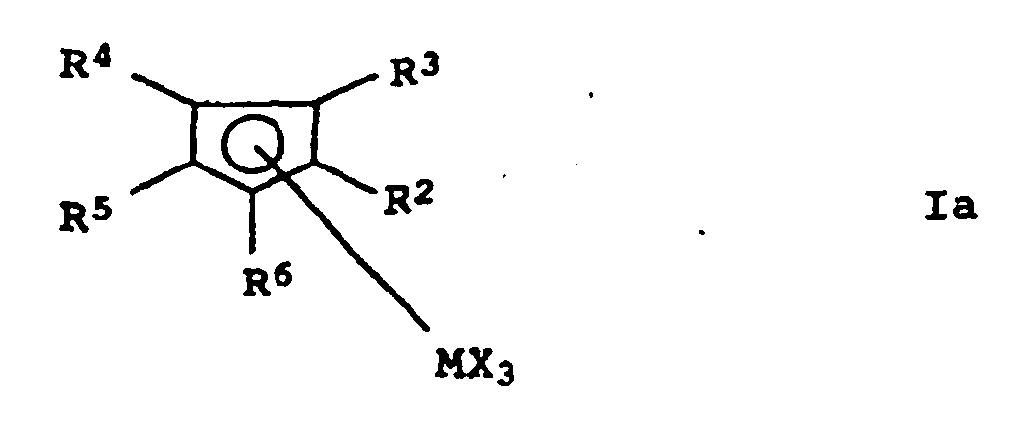


- Besonders bevorzugt sind solche Übergangsmetallkomplexe, welche zwei miteinander verbrückte aromatische Ringsysteme als Liganden enthalten, also besonders die Übergangsmetallkomplexe der allgemeinen Formel Ic.
- Die Reste X können gleich oder verschieden sein, bevorzugt sind sie gleich.
- Von den Verbindungen der Formel Ia sind insbesondere diejenigen bevorzugt, in denen
- M
- Titan, Zirkonium oder Hafnium,
- X
- Chlor, C1-bis C4-Alkyl oder Phenyl und
- R2 bis R6
- Wasserstoff oder C1- bis C4-Alkyl bedeuten.
- Von den Verbindungen der Formel Ib sind als bevorzugt diejenigen zu nennen, bei denen
- M
- für Titan, Zirkonium oder Hafnium steht,
- X
- für Chlor, C1-bis C4-Alkyl oder Phenyl,
- R2 bis R6
- Wasserstoff, C1- bis C4-Alkyl oder Si(R9)3,
- R10 bis R14
- Wasserstoff, C1- bis C4-Alkyl oder Si(R15)3 bedeuten.
- Insbesondere sind die Verbindungen der Formel Ib geeignet, in denen die Cyclopentadienylreste gleich sind.
- Beispiele für besonders geeignete Verbindungen sind u.a.:
- Bis(cyclopentadienyl)zirkoniumdichlorid,
- Bis(pentamethylcyclopentädienyl)-zirkoniumdichlorid,
- Bis (methylcyclopentadienyl)-zirkoniumdichlorid,
- Bis(ethylcyclopentadienyl)-zirkoniumdichlorid,
- Bis(n-butylcyclopentadienyl)-zirkoniumdichlorid und
- Bis (trimethylsilylcyclopentadienyl)-zirkoniumdichlorid
- sowie die entsprechenden Dimethylzirkoniumverbindungen.
- Von den Verbindungen der Formel Ic sind diejenigen besonders geeignet, in denen
- R2 und R10
- gleich sind und für Wasserstoff oder C1- bis C10-Alkylgruppen stehen,
- R6 und R14
- gleich sind und für Wasserstoff, eine Methyl-, Ethyl-, iso-Propyl- oder tert.-Butylgruppe stehen
- R3, R4, R11 und R12
- die Bedeutung
R4 und R12 C1- bis C4-Alkyl
R3 und R11 Wasserstoff
haben oder zwei benachbarte Reste R3 und R4 sowie R11 und R12 gemeinsam für 4 bis 12 C-Atome aufweisende cyclische Gruppen stehen, - R16
- für


- M
- für Titan, Zirkonium oder Hafnium und
- X
- für Chlor, C1-bis C4-Alkyl oder Phenyl stehen.
- Beispiele für besonders geeignete Komplexverbindungen sind u.a. Dimethylsilandiylbis(cyclopentadienyl)-zirkoniumdichlorid,
5 Dimethylsilandiylbis(indenyl)-zirkoniumdichlorid,
Dimethylsilandiylbis(tetrahydromdenyl)-zirkoniumdichlorid,
Ethylenbis(cyclopentadienyl)-zirkoniumdichlorid,
Ethylenbis (indenyl) -zirkoniumdichlorid,
Ethylenbis(tetrahydroindenyl)-zirkoniumdichlorid,
3 Tetramethylethylen-9-fluorenylcyclopentadienylzirkoniumdichlorid,
Dimethylsilandiylbis (-3-tert. butyl-5-methylcyclopentadienyl)-zirkoniumdichlorid,
Dimethylsilandiylbis(-3-tert.butyl-5-ethylcyclopentadienyl)-zirkoniumdichlorid,
Dimethylsilandiylbis (-2-methylindenyl)-zirkoniumdichlorid,
Dimethylsilandiylbis(-2-isopropylindenyl)-zirkoniumdichlorid,
Dimethylsilandiylbis(-2-tert.butylindenyl)-zirkoniumdichlorid,
Diethylsilandiylbis(-2-methylindenyl)-zirkoniumdibromid,
Dimethylsilandiylbis (-3-methyl-5-methylcyclopentadienyl)-zirkoniumdichlorid,
Dimethylsilandiylbis(-3-ethyl-5-isopropylcyclopentadienyl)-zirkoniumdichlorid,
Dimethylsilandiylbis(-2-methylindenyl)-zirkoniumdichlorid,
Dimethylsilandiylbis(-2-methylbenzindenyl)-zirkoniumdichlorid
Dimethylsilandiylbis(2-ethylbenzindenyl)zirkoniumdichlorid,
Methylphenylsilandiylbis(2-ethylbenzindenyl)zirkoniumdichlorid,
Methylphenylsilandiylbis ( 2-methylbenzindenyl)zirkoniumdichlorid,
Diphenylsilandiylbis(2-methylbenzindenyl)zirkoniumdichlorid,
Diphenylsilandiylbis(2-ethylbenzindenyl)zirkoniumdichlorid, und
Dimethylsilandiylbis (-2-methylindenyl)-hafniumdichlorid
sowie die entsprechenden Dimethylzirkoniumverbindungen. - Bei den Verbindungen der allgemeinen Formel Id sind als besonders geeignet diejenigen zu nennen, in denen
- M
- für Titan oder Zirkonium,
- X
- für Chlor, C1-bis C4-Alkyl oder Phenyl stehen,
- R16
- für


- A1
- für ―O― , ―S― ,

- R2 bis R4 und R6
- für Wasserstoff, C1- bis C10-Alkyl, C3- bis C10-Cycloalkyl, C6- bis C15-Aryl oder Si(R9)3 stehen, oder wobei zwei benachbarte Reste für 4 bis 12 C-Atome aufweisende cyclische Gruppen stehen.
- Die Synthese derartiger Komplexverbindungen kann nach an sich bekannten Methoden erfolgen, wobei die Umsetzung der entsprechend substituierten, cyclischen Kohlenwasserstoffanionen mit Halogeniden von Titan, Zirkonium, Hafnium, Vanadium, Niob oder Tantal, bevorzugt ist.
- Beispiele für entsprechende Herstellungsverfahren sind u.a. im Journal of Organometallic Chemistry, 369 (1989), 359-370 beschrieben.
- Es können auch Mischungen verschiedener Metallocenkomplexe eingesetzt werden.
- Geeignete metalloceniumionen-bildende Verbindungen c) sind starke, neutrale Lewissäuren, ionische Verbindungen mit lewissauren Kationen und ionische Verbindungen mit Brönsted-Säuren als Kation.
- Als starke, neutrale Lewissäuren sind Verbindungen der allgemeinen Formel II
M3X1X2X3 II
bevorzugt, in der - M3
- ein Element der III. Hauptgruppe des Periodensystems bedeutet, insbesondere B, A1 oder Ga, vorzugsweise B,
- X1, X2 und X3
- für Wasserstoff, C1- bis C10-Alkyl, C6- bis C15-Aryl, Alkylaryl, Arylalkyl, Halogenalkyl oder Halogenaryl mit jeweils 1 bis 10 C-Atomen im Alkylrest und 6 bis 20 C-Atome im Arylrest oder Fluor, Chlor, Brom oder Jod stehen, insbesondere für Halogenaryle, vorzugsweise für Pentafluorphenyl.
- Besonders bevorzugt sind Verbindungen der allgemeinen Formel II, in der X1, X2 und X3 gleich sind, vorzugsweise Tris(pentafluorphenyl)boran.
- Als ionische Verbindungen mit lewissauren Kationen sind Verbindungen der allgemeinen Formel III
[(Ya+)Q1Q2...Qz]d+ III
geeignet, in denen - Y
- ein Element der I. bis VI. Hauptgruppe oder der I. bis VIII. Nebengruppe des Periodensystems bedeutet,
- Q1 bis Qz
- für einfach negativ geladene Reste wie C1- bis C28-Alkyl, C6- bis C15-Aryl, Alkylaryl, Arylalkyl, Halogenalkyl, Halogenaryl mit jeweils
6 bis 20 C-Atomen im Aryl- und 1 bis 28 C-Atome im Alkylrest, C1- bis C10-Cycloalkyl, welches gegebenenfalls mit C1- bis C10-Alkylgruppen substituiert sein kann, Halogen, C1- bis C28-Alkoxy, C6- bis C15-Aryloxy, Silyl- oder Mercaptylgruppen - a
- für ganze Zahlen von 1 bis 6 steht
- z
- für ganze Zahlen von 0 bis 5
- d
- der Differenz α-z entspricht, wobei d jedoch größer oder gleich 1 ist.
- Besonders geeignet sind Carboniumkationen, Oxoniumkationen und Sulfoniumkationen sowie kationische Übergangsmetallkomplexe. Insbesondere sind das Triphenylmethylkation, das Silberkation und das 1,1'-Dimethylferrocenylkation zu nennen. Bevorzugt besitzen sie nicht koordinierende Gegenionen, insbesondere Borverbindungen, wie sie auch in der
WO 91/09882 - Ionische Verbindungen mit Brönsted-Säuren als Kationen und vorzugsweise ebenfalls nicht koordinierende Gegenionen sind in der
WO 91/09882 - Besonders geeignet als metalloceniumionen-bildende Verbindung sind offenkettige oder cyclische Alumoxanverbindungen der allgemeinen Formel IV oder V


- R1
- eine C1- bis C4-Alkylgruppe bedeutet, bevorzugt eine Methyl- oder Ethylgruppe und m für eine ganze zahl von 5 bis 30, bevorzugt 10 bis 25 steht.
- Die Herstellung dieser oligomeren Alumoxanverbindungen erfolgt üblicherweise durch Umsetzung einer Lösung von Trialkylaluminium mit Wasser und ist u.a. in der
EP-A 284 708 US A 4,794,096 beschrieben. - In der Regel liegen die dabei erhaltenen oligomeren Alumoxanverbindungen als Gemische unterschiedlich langer, sowohl linearer als auch cyclischer Kettenmoleküle vor, so daß m als Mittelwert anzusehen ist. Die Alumoxanverbindungen können auch im Gemisch mit anderen Metallalkylen, bevorzugt mit Aluminiumalkylen vorliegen.
- weiterhin können als metalloceniumionen-bildende Verbindungen Aryloxyalumoxane, wie in der
US-A 5,391,793 beschrieben, Aminoaluminoxane, wie in derUS-A 5,371,260 beschrieben, Aminoaluminoxanhydrochloride, wie in derEP-A 633 264 Ep-A 621 279 - Die vorzugsweise mittels der genannten Katalysator Systeme herstellbaren Copolymerisate A) enthalten bevorzugt 97 bis 75 Gew.-% Ethylen- und 3 bis 25 Gew.-% C3-C20-α-Olefineinheiten, jeweils bezogen auf die Gesamtmasse der Komponente A). Besonders bevorzugt enthalten diese Copolymerisate 97 bis 85 Gew.-% Ethyien- und 3 bis 15 Gew.-% C3-C20-α-Olefineinheit.
- Als C3-C20-α-Olefine, die als Comonomere dieser Copolymere dienen, können alle linearen oder verzweigten a-Isomere von Propen, Buten, Penten, Hexen, Hepten, Octen, Nonen, Decen, Undecen, Dodecen, Tridecen, Tetradecen, Pentadecen, Bexadecen, Heptadecen, Octadecen, Nonadecen und Eicosen eingesetzt werden. Bevorzugte C3-C20-α-olefincomonomere sind solche aus der Gruppe Buten, Penten, Hexen, 4-Methylpenten und Octen, besonders bevorzugt sind Buten, Penten und Hexen.
- Besonders bevorzugte Copolymere (A) sind Ethylen/Buten-Copolymere mit einein Butengehalt von 4 - 8 Gew.-% und Ethylen/Hexen-Copolymere mit einem Hexengehalt von 4-8 Gew.-% jeweils bezogen auf die Gesamtmasse dieser Copolymeren.
- Weiterhin sind solche Copolymere (A) bevorzugt, die eine Molekulargewihtsverteilung Mw/Mn < 3,5 aufweisen.
- Besonders vorteilhaft für die Verwendung in Folien sind ferner Copolymere (A) mit einer Dichte von 0,91 - 0,925 und einem HLMI (High Load Meltflow Index) von 10 - 40 g/10 min.
- Als Copolymere (B) kommen im wesentlichen lineare Ethylen/α-Olefin-Copolymere in Betracht, wie
Ethylencopolymere mittlerer Dichte <PE-MD) im Bereich von 0,930 bis 0,940, insbesondere solche PE-MD-Copolymere, die mittels Chromkatalysatoren hergestellt werden. Derartige Chromkatalysatoren, auch Phillipskatalysatoren genannt, sind allgemein bekannt, (s. z.B. M. P. Mc Daniel, Adv. Cat 33, 47- 98 (19B5) undUS-A- 5 363 915 ). Als Comonomere können diese Copolymeren die oben genannten C3-C20-α-Olefine enthalten, wobei auch hier Hexen und Buten, insbesondere Hexen bevorzugt ist. - Die PE-MD-Copolymere haben vorzugsweise einen HLMI von 2 - 100, besonders bevorzugt von 10 - 30 g/10 min.
- Weiterhin zu nennen als Copolymere (B) sind LLDPE-Copolymere mit einer Dichte von 0,915 bis 0,929, insbesondere solche, die mit einem Zieglerkatalysator hergestellt werden. Übliche Katalysatoren dieser Art werden beispielsweise in Ullmann's Encyclopedia of Industrial Chemistry, Vol. A 21, 4. Aufl. 1992, S. 502 ff, beschrieben. Besonders sollen hier solche Katalysatoren genannt werden, wie sie z. B. in
US-A-4857613 sowie inDE-A-19 529 240 beschrieben werden. - Die durch Ziegierkatalyse erhältlichen LLDPE-Copolyroere können nach allen üblichen Polymerisatsonstertahren hergestellt werden, wobei Lösungsverfahren und Gasphasenverfahren, insbesondere Gasphasenwirbelschichtverfahren besonders bevorzugt sind. Als Comonomere können diese Copolymere wiederum die obengenannten α-Olefine enthalten, vorzugsweise Buten, Hexen oder Octen
- Neben den Copolymeren (A) und (B) können die erfindungsgemäßen Polymermischungen noch weitere Zusatzstoffe enthalten wie Stabilisatoren gegen Licht- und Witterungseinflüsse, Verarbeitungshilfsmittel und gewünschtenfalls Farbstoffe. Art und Menge dieser Zusatzstoffe sind dem Fachmann geläufig.
- Die erfindungsgemäßen Polymermischungen enthalten die Copolymerkomponente (B) in einer Konzentration von 1-15 Gew.-%, vorzugsweise 2 - 10 Gew.-%, bezogen auf die Gesamtmasse der Polymermischung.
- Die Mischung der Copolymerkomponenten (A) und (B) kann nach allen bekannten Mischverfahren erfolgen. Üblicherweise werden die grießförmigen Polymerkomponenten, gewünschtenfalls zusammen mit weiteren Zusatzstoffe, in einem Zweischneckenextruder (2SK) in den gewünschten Mengenverhältnissen vermengt und zu Granulaten verarbeitet. Diese Granulate können dann z. B. in Blasfolienanlagen zu Folien verarbeitet werden.
- Die erfindungsgemäßen Polymermischungen eignen sich hervorragend zur Herstellung von Folien, insbesondere für den Verpackungsbereich und dabei besonders für die Verpackung von Lebensmitteln. Die erhaltenen Folien zeichnen sich durch Klarheit, Glanz und gute mechanische Eigenschaften, insbesondere durch hohe Reißfestigkeit aus. Dabei zeigen sie nur geringe Blockneigung und sind daher bequem zu verarbeiten. Die folgenden Beispiele erläutern die Erfindung.
- In einem Schleifenreaktor wurden durch Suspensionspolymerisation mit einem geträgerten Metallocenkatalysator die folgenden Ethylen-Copolyniere hergestellt:
-
HLMI 27,4 g/10' Mw. 126 000 g/mol Dichte 0,916 g/cm3 Mn 51 000 g/mol Hexengehalt 5,5 Gew.-% Mw/Mn 2,47 -
HLMI 26,0 g/10' Mw 111 000 g/mol 5 Dichte 0,919 g/cm3 Mn 43 000 g/mol Butengehalt 6,3 Gew.-% Mw/Mn 2,58 - Als Mischkomponenten (B) wurden die folgenden mit konventionellen Katalysatoren hergestellten linearen Ethylen-Copolymere bereitge-stellt :
- PE-MD, hergestellt durch Phillipskatalyse mit Hexen als Comonomer (Lupolen® 3821 D, Hersteller: Rheinische Olefinwerke, Wesseling, Germany)
HLMI 20 g/10' Dichte 0,938 g/cm3 - Aus den grießförmigen Polymerkomponenten wurden auf einem ZSK die in der Tabelle angegebenen Mischungen hergestellt. Aus den erhaltenen Granulaten wurden auf einer 30 mm-Troester-Blasfolien-anlage 50 µm dicke Folien hergestellt (Düse 50 mm, Düsenspalt 2 mm, Temperaturprofil 180, 190, 200, 3 x 210°C, Ausstoß 5 kg/h, Aufblasverhältnis 2:1).
- Die Tabelle gibt Auskunft über die durchgeführten Versuche und die Eigenschaften der hergestellten Folien. (Alle %-Werte sind Gew.-% bezogen auf die Gesamtmenge der Polymermischung.)
Tabelle: Folienprüfung der hergestellten Blasfolien Beispiel Mischung Trübheit
ISO 6427Glanz
ISO 2813
>20° %Reibungswert
DIN 67530Blockkraft
DIN 53366 NDart Drop
ASTM D 1709
gReißfestigkeit längs/quer
ISO 527
N/mm2Reißdehnung längs/quer
ISO 527
%1 98 % A1 + 2 % B1 9 72 258 50 609 56/53 787/808 95 % A1 + 5 % B1 7 83 236 49 664 58/55 784/833 3 90 % A1 + 10 % B1 7 77 161 17 611 58/54 798/838 4 90 % A2 + 10 % B1 8 68 133 0 163 43/37 913/951 Vergleichs
bsp. 1100 % A1
(40 µm)14 33 -)* -)** >1430 68/60 766/793 Vergleichs
bsp. 2100 % A2
(40 µm)29 16 -)* -)** 172 43/41 894/987 )* unmeßbar hoch
)** unmeßbar hoch (>200 N)

wobei
Claims (5)
- Polymermischung enthaltend mindestens 85 Gew.-% durch Metallocenkatalyse hergestellte Ethylen/C3-C20-α-Olefin-Copolymere (A) mit einer Dichte von 0,91 bis 0,925 g/cm3 und einem HLMI von 10 bis 40 g/10 min., enthaltend 97 bis 75 Gew.-% Ethylen- und 3 bis 25 Gew.-% C3-C20-α-Olefineinheiten, jeweils bezogen auf die Gesamtmasse der Komponente A),
und
1 bis 15 Gew.-% im wesentlichen lineare Ethylen/ C3-C20-α-Olefin-Copolymere (B) mit einer Dichte von 0,930 bis 0,940 g/cm3, welche mit einem Chromkatalysator hergestellt werden, jeweils bezogen auf die Gesamtmasse der Polymermischung. - Polymermischungen nach Anspruch 1, dadurch gekennzeichnet, daß als Copolymere (A) Ethylen/Hexen-Copolymere mit einem Hexengehalt von 4-8 Gew.-%, bezogen auf die Gesamtmasse dieser Copolymeren, enthalten sind.
- Polymermischungen nach Anspruch 1, dadurch gekennzeichnet, daß als Copolymere (A) Ethylen/Buten-Copolymere mit einem Butengehalt von 4-8% Gew.-%, bezogen auf die Gesamtmasse dieser Copolymeren, enthalten sind.
- Verwendung einer Polymermischung gemäß den Ansprüchen 1 bis 3 zur Herstellung von Folien.
- Folien enthaltend eine Polymermischung gemäß den Ansprüchen 1 bis 3.
Applications Claiming Priority (3)
| Application Number | Priority Date | Filing Date | Title |
|---|---|---|---|
| DE19723003 | 1997-06-02 | ||
| DE19723003A DE19723003A1 (de) | 1997-06-02 | 1997-06-02 | Polymermischung |
| PCT/EP1998/002948 WO1998055546A1 (de) | 1997-06-02 | 1998-05-20 | Polymermischung |
Publications (3)
| Publication Number | Publication Date |
|---|---|
| EP0986610A1 EP0986610A1 (de) | 2000-03-22 |
| EP0986610B1 EP0986610B1 (de) | 2003-09-17 |
| EP0986610B2 true EP0986610B2 (de) | 2010-04-21 |
Family
ID=7831141
Family Applications (1)
| Application Number | Title | Priority Date | Filing Date |
|---|---|---|---|
| EP98925619A Expired - Lifetime EP0986610B2 (de) | 1997-06-02 | 1998-05-20 | Polymermischung |
Country Status (9)
| Country | Link |
|---|---|
| US (1) | US6297323B1 (de) |
| EP (1) | EP0986610B2 (de) |
| JP (1) | JP2002501571A (de) |
| KR (1) | KR20010013228A (de) |
| AT (1) | ATE250104T1 (de) |
| DE (2) | DE19723003A1 (de) |
| ES (1) | ES2207835T3 (de) |
| TW (1) | TW482802B (de) |
| WO (1) | WO1998055546A1 (de) |
Families Citing this family (5)
| Publication number | Priority date | Publication date | Assignee | Title |
|---|---|---|---|---|
| EP1041096A1 (de) * | 1999-03-29 | 2000-10-04 | Fina Research S.A. | Ethylenpolymerisation |
| US6423421B1 (en) | 1999-08-11 | 2002-07-23 | Sealed Air Corporation | Heat shrinkable film with multicomponent interpenetrating network resin |
| FR2806385B1 (fr) * | 2000-03-17 | 2002-12-06 | Cep Ind | Tube souple, resistant a la fissuration sous contrainte et impermeable a la vapeur d'eau |
| US6388017B1 (en) † | 2000-05-24 | 2002-05-14 | Phillips Petroleum Company | Process for producing a polymer composition |
| KR101424857B1 (ko) * | 2011-11-30 | 2014-08-01 | 롯데케미칼 주식회사 | 중포장백용 폴리에틸렌 수지 조성물 및 이를 이용하여 제조된 필름 |
Citations (1)
| Publication number | Priority date | Publication date | Assignee | Title |
|---|---|---|---|---|
| US5530065A (en) † | 1992-01-07 | 1996-06-25 | Exxon Chemical Patents Inc. | Heat sealable films and articles made therefrom |
Family Cites Families (15)
| Publication number | Priority date | Publication date | Assignee | Title |
|---|---|---|---|---|
| ZA832777B (en) | 1982-04-27 | 1984-11-28 | Bp Chem Int Ltd | Polyethylene blend and film |
| DE3751694T2 (de) | 1987-04-03 | 1996-08-01 | Fina Technology | Metallocen-katalysatorsysteme für die Polymersation von Olefinen, mit einer Silizium-Hydrocarbyl-Brücke. |
| US4794096A (en) | 1987-04-03 | 1988-12-27 | Fina Technology, Inc. | Hafnium metallocene catalyst for the polymerization of olefins |
| DE3730022A1 (de) | 1987-09-08 | 1989-03-16 | Basf Ag | Verfahren zum herstellen von homo- und copolymerisaten des propens mittels eines ziegler-natta-katalysatorsystems |
| DE69033368T3 (de) | 1990-01-02 | 2008-07-03 | Exxon Chemical Patents, Inc. | Ionische Metallocenkatalysatoren auf Träger für Olefinpolymerisation |
| US5363915A (en) | 1990-07-02 | 1994-11-15 | Chevron Research And Technology Company | Enhanced oil recovery technique employing nonionic surfactants |
| EP0575123B2 (de) | 1992-06-17 | 2008-02-13 | Mitsui Chemicals, Inc. | Ethylencopolymerzusammensetzung |
| US5391793A (en) | 1992-11-02 | 1995-02-21 | Akzo Nobel N.V. | Aryloxyaluminoxanes |
| US5391529A (en) | 1993-02-01 | 1995-02-21 | Albemarle Corporation | Siloxy-aluminoxane compositions, and catalysts which include such compositions with a metallocene |
| US5412131A (en) | 1993-07-09 | 1995-05-02 | Albemarle Corporation | Teritary amino-aluminoxane halides |
| GB9321254D0 (en) | 1993-10-14 | 1993-12-01 | Du Pont Canada | Pouches of ethylene copolymer film containing a flowable material |
| US5371260A (en) | 1994-01-10 | 1994-12-06 | Albemarle Corporation | Amino-aluminoxane compositions |
| JPH09511273A (ja) | 1994-03-31 | 1997-11-11 | モービル・オイル・コーポレーション | Lldpe樹脂ブレンド |
| EP0737713A1 (de) * | 1995-04-10 | 1996-10-16 | Sika AG, vorm. Kaspar Winkler & Co. | Kunststoffdichtungsbahn auf des Basis von single-site Katalysates-Polyolefin |
| DE19529240A1 (de) | 1995-08-09 | 1997-02-13 | Basf Ag | Katalysatorsysteme vom Typ der Ziegler-Natta-Katalysatoren |
-
1997
- 1997-06-02 DE DE19723003A patent/DE19723003A1/de not_active Withdrawn
-
1998
- 1998-05-20 AT AT98925619T patent/ATE250104T1/de not_active IP Right Cessation
- 1998-05-20 EP EP98925619A patent/EP0986610B2/de not_active Expired - Lifetime
- 1998-05-20 DE DE59809653T patent/DE59809653D1/de not_active Expired - Lifetime
- 1998-05-20 WO PCT/EP1998/002948 patent/WO1998055546A1/de not_active Ceased
- 1998-05-20 KR KR19997011218A patent/KR20010013228A/de not_active Abandoned
- 1998-05-20 ES ES98925619T patent/ES2207835T3/es not_active Expired - Lifetime
- 1998-05-20 JP JP50139499A patent/JP2002501571A/ja active Pending
- 1998-05-20 US US09/424,909 patent/US6297323B1/en not_active Expired - Fee Related
- 1998-05-28 TW TW087108343A patent/TW482802B/zh active
Patent Citations (1)
| Publication number | Priority date | Publication date | Assignee | Title |
|---|---|---|---|---|
| US5530065A (en) † | 1992-01-07 | 1996-06-25 | Exxon Chemical Patents Inc. | Heat sealable films and articles made therefrom |
Also Published As
| Publication number | Publication date |
|---|---|
| TW482802B (en) | 2002-04-11 |
| DE59809653D1 (de) | 2003-10-23 |
| EP0986610A1 (de) | 2000-03-22 |
| EP0986610B1 (de) | 2003-09-17 |
| DE19723003A1 (de) | 1998-12-03 |
| KR20010013228A (de) | 2001-02-26 |
| JP2002501571A (ja) | 2002-01-15 |
| US6297323B1 (en) | 2001-10-02 |
| ATE250104T1 (de) | 2003-10-15 |
| WO1998055546A1 (de) | 1998-12-10 |
| ES2207835T3 (es) | 2004-06-01 |
Similar Documents
| Publication | Publication Date | Title |
|---|---|---|
| DE60028537T2 (de) | HDPE Polymerzusammensetzung | |
| DE60119149T2 (de) | Polyethylenharze für Schläuche und deren Herstellung | |
| DE69633436T3 (de) | Ethylen-Copolymer-Zusammensetzung | |
| DE60218224T2 (de) | Physikalische polyethylenmischungen | |
| DE60315450T2 (de) | Polymerzusammensetzungen und verfahren zum herstellen von rohren daraus | |
| DE69425556T2 (de) | Äthylen copolymerisation | |
| DE69922035T2 (de) | Herstellung von multimodalem polyethylen | |
| DE69426936T2 (de) | Polyolefinmischungen aus bimodaler molekulargewichstverteilung | |
| EP0943631B1 (de) | Polymere des Propens | |
| DE69936341T2 (de) | Polyethylen und Verfahren zu dessen Herstellung | |
| EP1642913A1 (de) | Ethylenpolymere mit ultra-niedrigem Molekulargewicht | |
| EP0896591B1 (de) | Oxidierte metallocen-polyolefin-wachse | |
| US6114456A (en) | Medium density polyethylene compositions for film applications | |
| DE60018477T2 (de) | Mittlere-dichte-polyethylenzusammensetzungen für folien | |
| EP0826728B2 (de) | Weissbrucharme, zähmodifizierte Propylenpolymerisate | |
| EP1023389B1 (de) | Polymermischung mit guter verarbeitbarkeit | |
| EP0302242A1 (de) | Verfahren zur Herstellung eines Polyolefins mit einer breiten Molmassenverteilung | |
| DE69330437T2 (de) | Pfropfmodifizierte Ethylen/Alpha-Olefin-Copolymere und Ethylencopolymerzusammensetzung | |
| DE602004001210T2 (de) | Beschichtungszusammensetzung, herstellungsverfahren dafür und damit beschichtetes substrat | |
| DE69603346T2 (de) | Zusammensetzung von Propylen-Block-Copolymeren | |
| DE60120774T2 (de) | Ethylenpolymere | |
| EP0545140A1 (de) | Ethylen-Copolymerisate niederer Dichte | |
| EP0864593A1 (de) | Kammpolymere via Metallocenkatalyse | |
| EP1605013B1 (de) | Expandierbares Polystyrol | |
| DE102004035837A1 (de) | Verwendung von Polyolefinwachsen in Polykondensaten |
Legal Events
| Date | Code | Title | Description |
|---|---|---|---|
| PUAI | Public reference made under article 153(3) epc to a published international application that has entered the european phase |
Free format text: ORIGINAL CODE: 0009012 |
|
| 17P | Request for examination filed |
Effective date: 19990904 |
|
| AK | Designated contracting states |
Kind code of ref document: A1 Designated state(s): AT BE DE ES FI FR GB IT NL |
|
| 17Q | First examination report despatched |
Effective date: 20010613 |
|
| APAB | Appeal dossier modified |
Free format text: ORIGINAL CODE: EPIDOS NOAPE |
|
| GRAH | Despatch of communication of intention to grant a patent |
Free format text: ORIGINAL CODE: EPIDOS IGRA |
|
| GRAH | Despatch of communication of intention to grant a patent |
Free format text: ORIGINAL CODE: EPIDOS IGRA |
|
| RAP1 | Party data changed (applicant data changed or rights of an application transferred) |
Owner name: BASELL POLYOLEFINE GMBH |
|
| GRAA | (expected) grant |
Free format text: ORIGINAL CODE: 0009210 |
|
| AK | Designated contracting states |
Kind code of ref document: B1 Designated state(s): AT BE DE ES FI FR GB IT NL |
|
| PG25 | Lapsed in a contracting state [announced via postgrant information from national office to epo] |
Ref country code: NL Free format text: LAPSE BECAUSE OF FAILURE TO SUBMIT A TRANSLATION OF THE DESCRIPTION OR TO PAY THE FEE WITHIN THE PRESCRIBED TIME-LIMIT Effective date: 20030917 Ref country code: FI Free format text: LAPSE BECAUSE OF FAILURE TO SUBMIT A TRANSLATION OF THE DESCRIPTION OR TO PAY THE FEE WITHIN THE PRESCRIBED TIME-LIMIT Effective date: 20030917 |
|
| REG | Reference to a national code |
Ref country code: GB Ref legal event code: FG4D Free format text: NOT ENGLISH |
|
| REF | Corresponds to: |
Ref document number: 59809653 Country of ref document: DE Date of ref document: 20031023 Kind code of ref document: P |
|
| GBT | Gb: translation of ep patent filed (gb section 77(6)(a)/1977) |
Effective date: 20031212 |
|
| NLV1 | Nl: lapsed or annulled due to failure to fulfill the requirements of art. 29p and 29m of the patents act | ||
| PG25 | Lapsed in a contracting state [announced via postgrant information from national office to epo] |
Ref country code: AT Free format text: LAPSE BECAUSE OF NON-PAYMENT OF DUE FEES Effective date: 20040520 |
|
| PG25 | Lapsed in a contracting state [announced via postgrant information from national office to epo] |
Ref country code: BE Free format text: LAPSE BECAUSE OF NON-PAYMENT OF DUE FEES Effective date: 20040531 |
|
| REG | Reference to a national code |
Ref country code: ES Ref legal event code: FG2A Ref document number: 2207835 Country of ref document: ES Kind code of ref document: T3 |
|
| PLBQ | Unpublished change to opponent data |
Free format text: ORIGINAL CODE: EPIDOS OPPO |
|
| PLBI | Opposition filed |
Free format text: ORIGINAL CODE: 0009260 |
|
| PLBQ | Unpublished change to opponent data |
Free format text: ORIGINAL CODE: EPIDOS OPPO |
|
| PLBI | Opposition filed |
Free format text: ORIGINAL CODE: 0009260 |
|
| ET | Fr: translation filed | ||
| PLAX | Notice of opposition and request to file observation + time limit sent |
Free format text: ORIGINAL CODE: EPIDOSNOBS2 |
|
| 26 | Opposition filed |
Opponent name: CRYOVAC, INC. Effective date: 20040614 |
|
| 26 | Opposition filed |
Opponent name: BOREALIS TECHNOLOGY OY Effective date: 20040617 Opponent name: CRYOVAC, INC. Effective date: 20040614 |
|
| PLAX | Notice of opposition and request to file observation + time limit sent |
Free format text: ORIGINAL CODE: EPIDOSNOBS2 |
|
| BERE | Be: lapsed |
Owner name: *BASELL POLYOLEFINE G.M.B.H. Effective date: 20040531 |
|
| PLAX | Notice of opposition and request to file observation + time limit sent |
Free format text: ORIGINAL CODE: EPIDOSNOBS2 |
|
| PLBB | Reply of patent proprietor to notice(s) of opposition received |
Free format text: ORIGINAL CODE: EPIDOSNOBS3 |
|
| PGFP | Annual fee paid to national office [announced via postgrant information from national office to epo] |
Ref country code: GB Payment date: 20050511 Year of fee payment: 8 |
|
| RAP2 | Party data changed (patent owner data changed or rights of a patent transferred) |
Owner name: BASELL POLYOLEFINE GMBH |
|
| PGFP | Annual fee paid to national office [announced via postgrant information from national office to epo] |
Ref country code: ES Payment date: 20050609 Year of fee payment: 8 |
|
| RAP2 | Party data changed (patent owner data changed or rights of a patent transferred) |
Owner name: BASELL POLYOLEFINE GMBH |
|
| APAH | Appeal reference modified |
Free format text: ORIGINAL CODE: EPIDOSCREFNO |
|
| APBP | Date of receipt of notice of appeal recorded |
Free format text: ORIGINAL CODE: EPIDOSNNOA2O |
|
| APBQ | Date of receipt of statement of grounds of appeal recorded |
Free format text: ORIGINAL CODE: EPIDOSNNOA3O |
|
| PG25 | Lapsed in a contracting state [announced via postgrant information from national office to epo] |
Ref country code: GB Free format text: LAPSE BECAUSE OF NON-PAYMENT OF DUE FEES Effective date: 20060520 |
|
| PG25 | Lapsed in a contracting state [announced via postgrant information from national office to epo] |
Ref country code: ES Free format text: LAPSE BECAUSE OF NON-PAYMENT OF DUE FEES Effective date: 20060522 |
|
| GBPC | Gb: european patent ceased through non-payment of renewal fee |
Effective date: 20060520 |
|
| REG | Reference to a national code |
Ref country code: ES Ref legal event code: FD2A Effective date: 20060522 |
|
| APBU | Appeal procedure closed |
Free format text: ORIGINAL CODE: EPIDOSNNOA9O |
|
| PLAY | Examination report in opposition despatched + time limit |
Free format text: ORIGINAL CODE: EPIDOSNORE2 |
|
| PLAH | Information related to despatch of examination report in opposition + time limit modified |
Free format text: ORIGINAL CODE: EPIDOSCORE2 |
|
| PLBC | Reply to examination report in opposition received |
Free format text: ORIGINAL CODE: EPIDOSNORE3 |
|
| PLAH | Information related to despatch of examination report in opposition + time limit modified |
Free format text: ORIGINAL CODE: EPIDOSCORE2 |
|
| PLAY | Examination report in opposition despatched + time limit |
Free format text: ORIGINAL CODE: EPIDOSNORE2 |
|
| PLBC | Reply to examination report in opposition received |
Free format text: ORIGINAL CODE: EPIDOSNORE3 |
|
| PGFP | Annual fee paid to national office [announced via postgrant information from national office to epo] |
Ref country code: IT Payment date: 20080528 Year of fee payment: 11 |
|
| PUAH | Patent maintained in amended form |
Free format text: ORIGINAL CODE: 0009272 |
|
| STAA | Information on the status of an ep patent application or granted ep patent |
Free format text: STATUS: PATENT MAINTAINED AS AMENDED |
|
| 27A | Patent maintained in amended form |
Effective date: 20100421 |
|
| AK | Designated contracting states |
Kind code of ref document: B2 Designated state(s): AT BE DE ES FI FR GB IT NL |
|
| REG | Reference to a national code |
Ref country code: ES Ref legal event code: FD2A Effective date: 20060522 |
|
| PG25 | Lapsed in a contracting state [announced via postgrant information from national office to epo] |
Ref country code: IT Free format text: LAPSE BECAUSE OF NON-PAYMENT OF DUE FEES Effective date: 20090520 |
|
| PGFP | Annual fee paid to national office [announced via postgrant information from national office to epo] |
Ref country code: DE Payment date: 20120531 Year of fee payment: 15 |
|
| PGFP | Annual fee paid to national office [announced via postgrant information from national office to epo] |
Ref country code: FR Payment date: 20120510 Year of fee payment: 15 |
|
| PG25 | Lapsed in a contracting state [announced via postgrant information from national office to epo] |
Ref country code: DE Free format text: LAPSE BECAUSE OF NON-PAYMENT OF DUE FEES Effective date: 20131203 |
|
| REG | Reference to a national code |
Ref country code: DE Ref legal event code: R119 Ref document number: 59809653 Country of ref document: DE Effective date: 20131203 |
|
| REG | Reference to a national code |
Ref country code: FR Ref legal event code: ST Effective date: 20140131 |
|
| PG25 | Lapsed in a contracting state [announced via postgrant information from national office to epo] |
Ref country code: FR Free format text: LAPSE BECAUSE OF NON-PAYMENT OF DUE FEES Effective date: 20130531 |