EP1997674B1 - Klapp-fahrzeugsitz - Google Patents
Klapp-fahrzeugsitz Download PDFInfo
- Publication number
- EP1997674B1 EP1997674B1 EP06843784A EP06843784A EP1997674B1 EP 1997674 B1 EP1997674 B1 EP 1997674B1 EP 06843784 A EP06843784 A EP 06843784A EP 06843784 A EP06843784 A EP 06843784A EP 1997674 B1 EP1997674 B1 EP 1997674B1
- Authority
- EP
- European Patent Office
- Prior art keywords
- latch
- cam
- seat cushion
- seat
- cutout
- Prior art date
- Legal status (The legal status is an assumption and is not a legal conclusion. Google has not performed a legal analysis and makes no representation as to the accuracy of the status listed.)
- Not-in-force
Links
- 230000001154 acute effect Effects 0.000 claims abstract description 5
- 230000005484 gravity Effects 0.000 claims description 6
- 230000001105 regulatory effect Effects 0.000 abstract 1
- 230000000717 retained effect Effects 0.000 description 2
Images





Classifications
-
- B—PERFORMING OPERATIONS; TRANSPORTING
- B60—VEHICLES IN GENERAL
- B60N—SEATS SPECIALLY ADAPTED FOR VEHICLES; VEHICLE PASSENGER ACCOMMODATION NOT OTHERWISE PROVIDED FOR
- B60N2/00—Seats specially adapted for vehicles; Arrangement or mounting of seats in vehicles
- B60N2/24—Seats specially adapted for vehicles; Arrangement or mounting of seats in vehicles for particular purposes or particular vehicles
- B60N2/30—Non-dismountable or dismountable seats storable in a non-use position, e.g. foldable spare seats
- B60N2/3002—Non-dismountable or dismountable seats storable in a non-use position, e.g. foldable spare seats back-rest movements
- B60N2/3004—Non-dismountable or dismountable seats storable in a non-use position, e.g. foldable spare seats back-rest movements by rotation only
- B60N2/3009—Non-dismountable or dismountable seats storable in a non-use position, e.g. foldable spare seats back-rest movements by rotation only about transversal axis
- B60N2/3013—Non-dismountable or dismountable seats storable in a non-use position, e.g. foldable spare seats back-rest movements by rotation only about transversal axis the back-rest being hinged on the vehicle frame
-
- B—PERFORMING OPERATIONS; TRANSPORTING
- B60—VEHICLES IN GENERAL
- B60N—SEATS SPECIALLY ADAPTED FOR VEHICLES; VEHICLE PASSENGER ACCOMMODATION NOT OTHERWISE PROVIDED FOR
- B60N2/00—Seats specially adapted for vehicles; Arrangement or mounting of seats in vehicles
- B60N2/24—Seats specially adapted for vehicles; Arrangement or mounting of seats in vehicles for particular purposes or particular vehicles
- B60N2/30—Non-dismountable or dismountable seats storable in a non-use position, e.g. foldable spare seats
- B60N2/3038—Cushion movements
- B60N2/304—Cushion movements by rotation only
- B60N2/3045—Cushion movements by rotation only about transversal axis
- B60N2/3047—Cushion movements by rotation only about transversal axis the cushion being hinged at the back-rest
Definitions
- the present invention relates to a tip-up type automotive seat which includes a seat back and a seat cushion adapted to be capable of being tipped up from a used position, at which the seat cushion becomes a substantially horizontal posture, to a tipped-up position at which the seat back becomes opposed to the seat back in a substantially vertical posture.
- a tip-up type automotive seat in which a seat cushion of the automotive seat is allowed to be tipped up from a used position, at which the seat cushion becomes a substantially horizontal posture, to a tipped-up position at which the seat cushion becomes opposed to a seat back of the automotive seat in a substantially vertical posture, in order that a space on a portion of an automotive body floor which is located under the seat cushion when located in the used position can be used as a storage space for any baggage or luggage at the time of non-use of the automotive seat.
- This tip-up type automotive seat is provided with a tipping-up lock mechanism for releasably locking the seat cushion in the tipped-up position at which the seat cushion becomes opposed to the seat back, when the seat cushion is pivoted to the tipped-up position in one motion (Japanese Patent Application Laid-Open No. 2005-212554 ).
- the tipping-up lock mechanism is adapted to lock the seat cushion in the tipped-up position only, and is not configured so as to also lock the seat cushion in a middle position between the used position and the tipped-up position.
- any various baggage or luggage can be advantageously stored in the following manner. That is, for example, any longitudinal baggage or luggage is carried on the portion of the automotive body floor, whereas any small baggage or luggage can be stored in a space between the seat cushion locked in the middle position and the seat back in the substantially vertical posture.
- a tip-up type automotive seat having the features set forth in claim 1.
- the automotive seat comprises a seat back including a pair of first spaced apart side brackets, a seat cushion including a pair of second spaced apart side brackets, the second side brackets having upwardly curved rear portions, the second side brackets of the seat cushion being pivotally supported at the upward curved rear portions thereof to portions of the first side brackets of the seat back, which are adjacent lower end portions of the first side brackets of the seat back, by first support pins, whereby the seat cushion is allowed to be pivoted about the first support pins from a used position, at which the seat cushion becomes a substantially horizontal posture, to a tipped-up position at which the seat cushion becomes opposed to the seat back in a substantially vertical posture, the upwardly curved rear portions of the second side brackets being formed so as to have substantially semicircle-shaped edges extending around the first support pins, a tipping-up lock mechanism for selectively and releasably locking the seat cushion with
- the lower portion of the cam is disengaged from the engaging step portion of the latch and slips into the recess portion of the latch which has the depth that is not less than the height of the engaged portion between the protruding tooth of the latch and each of the first, second, and third cutout teeth.
- the latch is swung up, whereby the protruding tooth of the latch is disengaged from any one of the first, second, and third cutout teeth.
- the angle of the cam relative to the latch is set in such a manner that the angle between the reference line connecting the axial center of the second support pin of the latch and the abutment point of the lower portion of the cam against the engaging step portion of the latch, and the line connecting the axial center of the third support pin of the cam and the abutment point is kept to be an acute angle, so that the cam functions as a prop with respect to the engaging step portion of the latch and the latch is held so as to be unable to be swung, so that even if a person unintentionally tries to lift the seat cushion up toward the middle position or the tipped-up position, the engagement between the protruding tooth and the first cutout tooth of the side bracket of the seat cushion is positively maintained.
- the lower portion of the cam may be formed into a substantially semiellipse-shape
- a bottom surface of the engaging step portion of the latch may be formed into a substantially J-shape
- the recess portion of the latch may be formed into a substantially U-shape having a depth larger than the height of the engaged portion between the protruding tooth of the latch and each of the first, second, and third cutout teeth.
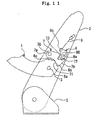
- a tip-up type automotive seat which includes a seat cushion A and a seat back B.
- the seat cushion includes a pair of spaced apart side brackets 1 serving as side frame sections of a seat cushion frame for the seat cushion
- the seat back includes a pair of spaced apart side brackets 2 serving as side frame sections of a seat back frame for the seat back (only one side bracket 1 of the seat cushion and only one side bracket 2 of the seat back are shown in Fig. 2 ).
- the side brackets 1 of the seat cushion are pivotally supported at upwardly curved rear portions thereof to portions of the side brackets 2 of the seat back, which are adjacent lower end portions of the side brackets 2 of the seat back, by support pins 3, so that the seat cushion is allowed to be pivoted or tipped up around the support pins 3 from a used position, at which the seat cushion becomes a substantially horizontal posture, to a tipped-up position at which the seat cushion becomes opposed to the seat back in a substantially vertical posture.
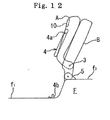
- the tip-up type automotive seat is provided with a stand leg portion 4.
- the stand leg portion 4 is formed into a substantially U-shape in outline and pivotally supported at upper end regions of spaced apart vertical portions thereof to lower regions of forward portions of the side brackets of the seat cushion A by support pins 4a.
- a receiving base 4b for receiving and releasably engaging a lower horizontal portion of the stand leg portion 4 is mounted on a lower step portion f 1 of an automotive body floor F.
- the stand leg portion 4 is adapted to be releasably engaged at the lower horizontal portion thereof with the receiving base 4b so as to be obliquely stand up from the lower step portion f 1 of the automotive body floor F, whereby when the seat cushion is locked in the used position by a tipping-up lock mechanism for releasably locking the seat cushion with respect to the seat back and preventing the pivotal movement of the seat cushion, which will be discussed in detail hereinafter, the seat cushion is maintained in the substantially horizontal posture by the stand leg portion 4. Moreover, the seat back is supported at the lower end portions of the side brackets thereof to a pair of spaced apart base brackets 5 mounted on an upper step portion f 2 of the automotive body floor F so as to stand up from the upper step portion f 2 .
- the tip-up type automotive seat according to the embodiment of the present invention is provided with the tipping-up lock mechanism.
- the tipping-up lock mechanism is provided on one of both sides of the automotive seat.
- the upwardly curved rear portions of the side brackets 1 of the seat cushion have substantially semicircle-shaped edges extending about the support pins 3 of the side brackets 1.
- the tipping-up lock mechanism includes first, second, and third spaced apart cutout teeth 6a, 6b, 6c which are provided at a substantially semicircle-shaped edge of one of the side brackets 1 of the seat cushion so as to be in turn arranged from a rearward direction of the substantially semicircle-shaped edge to a forward direction of the substantially semicircle-shaped edge. More particularly, the first cutout tooth 6a, the second cutout tooth 6b, and the third cutout tooth 6c are provided at a rearward region of the substantially semicircle-shaped edge, at a middle region of the substantially semicircle-shaped edge, and at a forward region of the substantially semicircle-shaped edge, respectively.
- the first cutout tooth 6a serves as means to facilitate causing of the seat cushion to be kept in the used position.
- the third cutout tooth 6c serves as means to facilitate causing of the seat cushion to be kept in the tipped-up position.
- the second cutout tooth 6b serves as means to facilitate causing of the seat cushion to be kept in a middle position between the used position and the tipped-up position.
- the tipping-up lock mechanism further includes a latch 7 and a cam 8.
- the latch 7 is pivotally supported at a forward portion 7a thereof to a corresponding side bracket 2 of the seat back by a support pin 70 so as to be swingable upward.
- the cam 8 includes a body and a lower portion 8a extending downward from the cam body.
- the cam 8 is swingably supported at a substantially middle portion thereof to the side bracket 2 of the seat back by a support pin 80 with the lower portion 8a being directed toward an upper region of a rearward portion 7b of the latch 7.
- the latch 7 is provided at a lower edge of the rearward portion 7b thereof with a protruding tooth 71 which is adapted to be selectively and releasably engaged with the first, second, and third cutout teeth 6a, 6b, 6c, whereby the seat cushion is selectively and releasably locked in the used position, in the middle position, and the tipped-up position.
- the protruding tooth 71 of the latch 7 can be securely engaged with the second and third cutout teeth 6b, 6c
- the protruding tooth 71 is configured to include two protruding tooth-portions which are spaced apart from each other in the forward/rearward direction.
- the first cutout tooth 6a is configured to have a recess portion which extends along a region of the substantially semicircle-shaped edge of the side bracket 1 and is adapted to receive the protruding tooth 71 of the latch 7 during the pivotal movement of the seat cushion to the used position from the middle position or the tipped-up position.
- the latch 7 includes an engaging step portion 72 against which the lower portion 8a of the cam 8 is abutted, and a recess portion 73 for allowing the cam 8 to be swung.
- the engaging step portion 72 and the recess portion 73 are formed in the upper region of the rearward portion 7b of the latch 7.
- the recess portion 73 of the latch 7 extends continuously from an edge of the engaging step portion 72 and is formed so as to have a depth which is not less than a height of an engaged portion between the protruding tooth 71 of the latch 7 and each of the first, second, and third cutout teeth 6a, 6b, 6c, in order that the protruding tooth 71 of the latch 7 can be escapingly disengaged from the cutout teeth 6a, 6b, 6c.
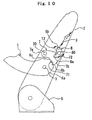
- an angle of the cam 8 relative to the latch 7 is set in such a manner that an angle ⁇ between a reference line L 1 connecting an axial center O 1 of the support pin 70 of the latch 7 and an abutment point P of the lower portion 8a of the cam 8 against the engaging step portion 72 ( Fig. 2 ), and a line L 2 connecting an axial center O 2 of the support pin 80 of the cam 8 and the abutment point P is kept to be an acute angle.
- the cam 8 functions as a prop with respect to the engaging step portion 72 of the latch 7, so that when the lower portion 8a of the cam 8 is abutted against the engaging step portion 72 of the latch 7, the engagement between the protruding tooth 71 of the latch 7 and the cutout tooth 6a, 6b or 6c of the side bracket 1 of the seat cushion can be positively maintained.
- a bottom surface of the engaging step portion 72 of the latch 7 is formed so as to be adjacent the protruding tooth 71 of the latch 7, so that the reference line L 1 is set so as to be descent rearward from the axial center O 1 of the support pin 70 of the latch 7.
- the lower portion 8a of the cam 8 is formed into a substantially semiellipse-shape.
- the bottom surface of the engaging step portion 72 of the latch 7 is formed into a substantially J-shape.
- the substantially J-shaped bottom surface of the engaging step portion 72 is formed so as to have a curve surface which allows at least half or more region of the lower portion 8a of the cam 8 to be received by the engaging step portion 72, so that the lower portion 8a of the cam 8 can be positively abutted against the engaging step portion 72 of the latch 7 and stably received by the engaging step portion 72.
- the recess portion 73 of the latch 7 may be formed into a substantially U-shape which has a depth larger than the height of the engaged portion between the protruding tooth 71 of the latch 7 and each of the first, second, and third cutout teeth 6a, 6b, 6c of the side bracket 1 of the seat cushion and which fits the lower portion 8a of the cam 8.
- the recess portion 73 of the latch 7 serves to allow the cam 8 to be swung up in such a manner that the lower portion 8a of the cam 8 slips into the recess portion 73 of the latch 7 while being disengaged from the engaging step portion 72.
- the latch 7 As the lower portion 8a of the cam 8 slips into the recess portion 73 of the latch 7, the latch 7 is swung up.
- the protruding tooth 71 of the latch 7 is positively disengaged from any one of the cutout teeth 6a, 6b, 6c of the side bracket 1 of the seat cushion.
- the cam 8 is formed into a substantially L-shape in outline.
- a wire 9 of a first wire cable which is inserted through a tube of the first wire cable is coupled at one end portion thereof to an upper end portion 8b of the cam body.
- the other end portion of the wire 9 is connected to an operating lever 10 (see Fig. 1 ).
- the operating lever 10 is swingably provided in a recess portion formed in a lower region of a forward-section of the seat cushion A and is adapted to be pulled by a person.
- the tipping-up lock mechanism becomes unlocked as will be discussed in detail hereinafter. In the condition where the tipping-up lock mechanism is unlocked, the person can manually cause the seat cushion to be tipped up in one motion.
- the stand leg portion 4 is typically urged toward a stored position under the seat cushion by a tension spring 11 which is retained at one end thereof to an upper end region of one of the spaced apart vertical portions of the substantially U-shaped stand leg portion 4 which is located upward of a support pin 4a of the vertical portion, and retained at the other end thereof to a forward portion of the side bracket of the seat cushion.
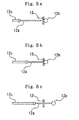
- a wire of a second wire cable 12 which is inserted through a tube 12c of the second wire cable 12 is coupled at one end portion 12a thereof to the upper end region of the vertical portion of the substantially U-shaped stand leg portion 4 and coupled at the other end portion thereof (not shown) to the seat back.
- the other end portion 12b of the wire of the second wire cable 12 is supported to a retaining piece 13 which is provided at a suitable portion of the seat back frame.
- the other end portion 12b of the wire of the second wire cable 12 is provided with a spherical end stop 12d and penetrated through a slit of the retaining piece 13 so as to be movable relative to the retaining piece 13.
- the wire of the second wire cable 12 is in a condition shown in Fig. 5a .
- the wire of the second cable 12 is pulled against an action of the tension spring (as shown in Fig. 5b ) so as to allow the stand leg portion 4 to be pivoted toward a developed position until the seat cushion reaches the position just before the middle position.
- the action of the tension spring 11 ( Fig. 4 ) is exerted on the wire of the second wire cable 12, whereby the wire of the second wire cable 12 is moved in such a manner that the wire end portion 12b thereof is moved relative to the retaining piece 13 so as to project from the retaining piece 13 as shown in Fig. 5c .
- the stand leg portion 4 is moved to the stored position by the action of the tension spring 11. More particularly, the stand leg portion 4 can be pivoted toward the stored position synchronously with the tipping-up movement of the seat cushion and can be pivoted toward the developed position synchronously with returning of the seat cushion to the used position.
- any suitable conventional compensator (not shown) for compensating a pulling force exerted on the wire of the second cable wire 12 and adjusting a total length of the wire of the second wire cable 12 is provided at a suitable portion of the wire of the second wire cable 12.
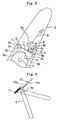
- the latch 7 is swung upward in a counterclockwise direction about the support pin 70, whereby the protruding tooth 71 of the latch 7 is disengaged from the cutout tooth 6a (6b or 6c) as shown in Fig. 7 .
- the seat cushion is brought to an unlocked condition where it is released from the seat back.
- the recess portion 73 of the latch 7 is formed so as to have the depth which is not less than the height of the engaged portion between the protruding tooth 71 of the latch 7 and each of the cutout teeth 6a, 6b, 6c, so that when the lower portion 8a of the cam 8 slips into the recess portion 73 and the latch 7 is swung up, the protruding tooth 71 of the latch 7 can be positively disengaged from the cutout tooth 6a, 6b, or 6c.
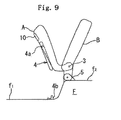
- the protruding tooth 71 of the latch 7 is disengaged from the first cutout tooth 6a of the side bracket 1 of the seat cushion by operating the operating lever 10, and the seat cushion is to be locked in the middle position, the person lifts up the seat cushion with his/her hand while leaving the operating lever 10 pulled and can cause the seat cushion to be locked in the middle position as shown in Figs. 8 and 9 , by releasing his/her hand from the operating lever.
- the stand leg portion 4 is stored in the stored position.
- the seat cushion can withstand a load applied to the seat cushion by the baggage of luggage, since the seat cushion is locked with respect to the seat back by the tipping-up lock mechanism.
- the person causes the protruding tooth 71 of the latch 7 to be disengaged from the second cutout tooth 6b of the side bracket 1 by pull-operating the operating lever in the same manner as discussed above and can cause the seat cushion to be pivoted to the tipped-up position.
- the protruding tooth 71 of the latch 7 becomes operatively engaged with the third cutout tooth 6c of the side bracket 1 of the seat cushion as shown in Fig. 13 .
- the seat cushion is locked in the tipped-up position by the tipping-up lock mechanism.
- the person causes the protruding tooth 71 of the latch 7 to be disengaged from the third cutout tooth 6c of the side bracket 1 of the seat cushion by pull-operating the operating lever in the same manner as discussed above and can cause the seat cushion to be returned to the used position.
- the cam 8 and the latch 7 are returned to their original positions by gravity and the protruding tooth 71 of the latch 7 becomes operatively engaged with the first cutout tooth 6a of the side bracket 1 of the seat cushion.
- the seat cushion is locked in the used position by the tipping-up lock mechanism.
- the stand leg portion is pivoted and reaches the developed position at which the stand leg portion 4 is then operatively engaged with the receiving base 4b.
- a second tipping-up lock mechanism constructed in the same manner as the first tipping-up lock mechanism is done may be provided on the other side of the automotive seat.
- a cam of the second tipping-up lock mechanism is coupled to the operating lever 10 via a wire cable.
Landscapes
- Engineering & Computer Science (AREA)
- Aviation & Aerospace Engineering (AREA)
- Transportation (AREA)
- Mechanical Engineering (AREA)
- Seats For Vehicles (AREA)
Claims (2)
- Ein Klappfahrzeugsitz umfassend
eine Rückenlehne (B) einschließlich eines ersten Paares zueinander beabstandeter Seitenbeschläge (2);
ein Sitzkissen (A) einschließlich eines zweiten Paares zueinander beabstandeter Seitenbeschläge (1);
wobei die zweiten Seitenbeschläge (1) nach oben gebogene hintere Abschnitte aufweisen;
wobei die zweiten Seitenbeschläge (1) über erste Haltestifte (3) an den nach oben gebogenen hinteren Abschnitten relativ zu Abschnitten der ersten Seitenschläge (2) der Rückenlehne (B) drehbar angeordnet sind, die benachbart sind zu einem unteren Endabschnitt der ersten Seitenbeschläge (2) der Rückenlehne (B), wobei das Sitzkissen (A) um die ersten Haltestifte (3) drehbar ist, von einer Sitzposition, in der das Sitzkissen (A) eine im Wesentlichen horizontale Position einnimmt, in eine hochgeklappte Position, in der das Sitzkissen (A) in eine im Wesentlichen vertikale Position gegenüber der Rückenlehne (B) gelangt;
die nach oben gebogenen hinteren Abschnitte der zweiten Seitenbeschläge (1) formen im Wesentlichen halbkreisförmige Kanten aus, die sich um die ersten Haltestifte (3) ausdehnen;
einen Klappmechanismus, um das Sitzkissen (A) gegenüber der Rückenlehne (B) zu verriegeln; und
einen Bedienhebel (10), um den Klappmechanismus zu entriegeln und um das Sitzkissen (A) in einen Zustand des Sitzkissens (A) zu bringen, in dem dieses drehbar ist; wobei der Bedienhebel (10) drehbar an dem Sitzkissen (A) befestigt ist;
dadurch gekennzeichnet,
dass der Klappmechanismus ausgebildet ist, um das Sitzkissen (A) wahlweise und lösbar gegenüber der Rückenlehne (B) in der Sitzposition, in der hochgeklappten Position und in einer mittleren Position zwischen der Sitzposition und der hochgeklappten Position zu verriegeln;
der Klappmechanismus umfasst eine Klinke (7), einen Nocken (8), eine erste, eine zweite und eine dritte Verzahnungsausnehmung (6a, 6b, 6c);
die erste, zweite und dritte Verzahnungsausnehmung (6a, 6b, 6c) ist an einer im Wesentlichen halbkreisförmigen Kante eines nach oben gerundeten Abschnitts eines der zweiten Seitenbeschläge (1) angeordnet und zwar der Reihe nach von einer rückwärtigen Richtung der im Wesentlichen halbkreisförmigen Kante zu einer vorderen Richtung der im Wesentlichen halbkreisförmigen Kante;
die erste Verzahnungsausnehmung (6a) dient als Mittel, um das Sitzkissen (A) lösbar in der Sitzposition zu verriegeln;
die zweite Verzahnungsausnehmung (6b) dient als Mittel, um das Sitzkissen (A) lösbar in der mittleren Position zu verriegeln;
die dritte Verzahnungsausnehmung (6c) dient als Mittel, um das Sitzkissen (A) lösbar in der hochgeklappten Position zu verriegeln;
die Klinke (7) ist drehbar über einen zweiten Haltestift (70) an dem entsprechenden ersten Seitenbeschlag (2) der Rückenlehne (B) befestigt;
die Klinke umfasst einen vorspringenden Zahn (71), der an einer unteren Kante eines rückwärtigen Abschnitts (7b) der Klinke (7) angeordnet ist, zum wahlweisen und lösbaren Eingriff in die erste, die zweite und die dritte Verzahnungsausnehmung (6a, 6b, 6c), einen Halteabschnitt (72), der in einem oberen Bereich des rückwärtigen Abschnitts (7b) der Klinke (7) ausgeformt ist und eine Aussparung (73), die in dem oberen Bereich des rückwärtigen Abschnitts (7b) der Klinke (7), ausgehend von einer Kante des Halteabschnitts (72), ausgeformt ist; die Nocke (8) umfasst einen Körper und einen unteren Abschnitt (8a), der sich nach unten, ausgehend von dem Nockenkörper, ausdehnt;
der Nocken (8) ist mit dem unteren Abschnitt (8a) über einen dritten Haltestift (80) an dem entsprechenden ersten Seitenbeschlag (2) der Rückenlehne (B) drehbar befestigt und hierbei an den Halteabschnitt (72) der Klinke (7) lösbar angrenzend angeordnet;
der Nocken (8) beschreibt einen Winkel bezüglich der Klinke (7), wobei der Winkel derart gewählt ist, dass ein Winkel (θ) zwischen einer Referenzlinie (L1), die ein axiales Zentrum (O1) des zweiten Haltestifts (70) der Klinke (7) und einen Begrenzungspunkt (P) des unteren Abschnitts (8a) des Nockens (8) gegen den Halteabschnitt (72) der Klinke (7) verbindet, und eine Linie (L2), die ein axiales Zentrum (O2) des dritten Haltestifts (80) des Nockens (8) und den Begrenzungspunkt (P) verbindet, ein spitzer Winkel ist;
der Bedienhebel (10) ist gekoppelt mit dem Nocken (8); und
die Aussparung (73) der Klinke (7) hat eine Tiefe, die nicht geringer ist als eine Höhe eines Halteabschnitts zwischen dem vorspringenden Zahn (71) und der Klinke (7) und jedem der ersten, zweiten und dritten Verzahnungsausnehmung (6a, 6b, 6c), so dass, bei durch den Bedienhebel (10) gezogenen Nocken (8), der Nocken (8) in einer Art und Weise hochgedreht wird, dass der untere Abschnitt (8a) des Nockens (8) außer Eingriff gebracht wird zu dem Halteabschnitt (72) der Klinke (7) und in die Aussparung (73) der Klinke (7) rutscht und die Klinke (7) hoch gedreht wird, während der untere Abschnitt (8a) des Nockens (8) in die Aussparung (73) der Klinke (7) rutscht, wobei der vorspringende Zahn (71) der Klinke (7) außer Eingriff gebracht zu einem der ersten, zweiten und dritten Haltezähne (6a, 6b, 6c) und das Sitzkissen (A) in einen Zustand gebracht wird, in dem es drehbar ist, wenn der Bedienhebel (10) aus der gezogenen Stellung gelöst wird, die Klinke (7) und der Nocken (8) durch die Schwerkraft in ihre Ausgangsposition zurückkehren, wobei der vorspringende Zahn (71) der Klinke (7) in Eingriff gebracht wird mit einem der ersten, zweiten und dritten Verzahnungsausnehmung (6a, 6b, 6c). - Ein Klappfahrzeugsitz gemäß Anspruch 1,
wobei der untere Abschnitt (8a) des Nockens (8) im Wesentlichen halbkreisförmige Form ausgebildet ist, eine untere Fläche des Halteabschnitts (72) der Klinke (7) im Wesentlichen J-förmig ausgebildet ist und die Ausnehmung (73) der Klinke (7) im Wesentlichen U-förmig ausgebildet ist, wobei sie eine Tiefe aufweist, die größer ist als die Höhe des Halteabschnitts zwischen dem vorspringenden Zahn (71) der Klinke (7) und jedem der ersten, zweiten und dritten Verzahnungsausnehmung (6a, 6b, 6c).
Applications Claiming Priority (2)
| Application Number | Priority Date | Filing Date | Title |
|---|---|---|---|
| JP2005378862A JP4858816B2 (ja) | 2005-12-28 | 2005-12-28 | チップアップ式自動車用シート |
| PCT/JP2006/326415 WO2007077980A1 (ja) | 2005-12-28 | 2006-12-28 | チップアップ式自動車用シート |
Publications (3)
| Publication Number | Publication Date |
|---|---|
| EP1997674A1 EP1997674A1 (de) | 2008-12-03 |
| EP1997674A4 EP1997674A4 (de) | 2009-11-11 |
| EP1997674B1 true EP1997674B1 (de) | 2011-02-02 |
Family
ID=38228319
Family Applications (1)
| Application Number | Title | Priority Date | Filing Date |
|---|---|---|---|
| EP06843784A Not-in-force EP1997674B1 (de) | 2005-12-28 | 2006-12-28 | Klapp-fahrzeugsitz |
Country Status (4)
| Country | Link |
|---|---|
| EP (1) | EP1997674B1 (de) |
| JP (1) | JP4858816B2 (de) |
| DE (1) | DE602006019986D1 (de) |
| WO (1) | WO2007077980A1 (de) |
Families Citing this family (4)
| Publication number | Priority date | Publication date | Assignee | Title |
|---|---|---|---|---|
| FR2933345B1 (fr) * | 2008-07-02 | 2010-08-20 | Faurecia Sieges Automobile | Siege de vehicule automobile et vehicule muni d'un tel siege |
| KR101543033B1 (ko) | 2009-06-05 | 2015-08-13 | 주식회사다스 | 원터치 패들 타입 리클라이너 장치 |
| JP2016222139A (ja) * | 2015-06-01 | 2016-12-28 | トヨタ紡織株式会社 | 乗物用シート |
| JP7366768B2 (ja) * | 2020-01-22 | 2023-10-23 | アディエント・エンジニアリング・アンド・アイピー・ゲゼルシャフト・ミット・ベシュレンクテル・ハフツング | 乗り物用シート |
Family Cites Families (4)
| Publication number | Priority date | Publication date | Assignee | Title |
|---|---|---|---|---|
| US4919482A (en) * | 1987-01-20 | 1990-04-24 | Lear Siegler Seating Corp. | Inertia latch for vehicle seats |
| JP3663509B2 (ja) * | 2001-06-11 | 2005-06-22 | テイ・エス テック株式会社 | イナーシャロック装置並びに折畳み式シート |
| JP2003011707A (ja) * | 2001-07-03 | 2003-01-15 | Tachi S Co Ltd | チップアップ機構付の車両用シート |
| JP4263628B2 (ja) * | 2004-01-28 | 2009-05-13 | 本田技研工業株式会社 | シート収納装置 |
-
2005
- 2005-12-28 JP JP2005378862A patent/JP4858816B2/ja not_active Expired - Fee Related
-
2006
- 2006-12-28 EP EP06843784A patent/EP1997674B1/de not_active Not-in-force
- 2006-12-28 DE DE602006019986T patent/DE602006019986D1/de active Active
- 2006-12-28 WO PCT/JP2006/326415 patent/WO2007077980A1/ja not_active Ceased
Also Published As
| Publication number | Publication date |
|---|---|
| JP2007176394A (ja) | 2007-07-12 |
| WO2007077980A1 (ja) | 2007-07-12 |
| EP1997674A4 (de) | 2009-11-11 |
| EP1997674A1 (de) | 2008-12-03 |
| JP4858816B2 (ja) | 2012-01-18 |
| DE602006019986D1 (de) | 2011-03-17 |
Similar Documents
| Publication | Publication Date | Title |
|---|---|---|
| US9821684B2 (en) | Tip-up/dive-down type reclining seat for vehicle | |
| EP2049359B1 (de) | Fahrzeugsitzvorrichtung | |
| JP5098279B2 (ja) | 車両用シート装置 | |
| EP2261078B1 (de) | Vorrichtung zur verhinderung von fehlerhafter bedienung und umklappbarer sitz für ein fahrzeug | |
| JP4853521B2 (ja) | 車両用シート | |
| US8608245B2 (en) | Seat latch | |
| US20050269830A1 (en) | Vehicle seat and a vehicle provided with such a seat | |
| JP4858817B2 (ja) | チップアップ・ダイブダウン式自動車用リクライニングシート | |
| EP1554157B1 (de) | Im boden verstaubare kraftfahrzeugsitzanordnung | |
| US20090295185A1 (en) | Tip-Up/Dive-Down Type Reclining Seat for Vehicle | |
| JP2008254663A (ja) | シートロック装置 | |
| EP1500551A2 (de) | Sitzvorrichtung | |
| JP4317707B2 (ja) | 車両用シート装置 | |
| EP1997674A1 (de) | Klapp-fahrzeugsitz | |
| EP2028037A2 (de) | Fahrzeugsitz | |
| JP4858819B2 (ja) | チップアップ・ダイブダウン式自動車用リクライニングシート | |
| JP5082490B2 (ja) | 車両用シート | |
| JP4032871B2 (ja) | シート装置 | |
| JP2014094672A (ja) | 車両用シートのスライド装置 | |
| JP4260570B2 (ja) | 車両用シート装置 | |
| JP3639537B2 (ja) | 車両のスライドシート | |
| JP4403947B2 (ja) | 車両用シートの保持装置 | |
| JP3489671B2 (ja) | シートスライド装置のロック機構 | |
| JP2005297629A (ja) | 車両の可倒式フットレスト構造 | |
| JP5780138B2 (ja) | 車両用シートのスライド装置 |
Legal Events
| Date | Code | Title | Description |
|---|---|---|---|
| PUAI | Public reference made under article 153(3) epc to a published international application that has entered the european phase |
Free format text: ORIGINAL CODE: 0009012 |
|
| 17P | Request for examination filed |
Effective date: 20080728 |
|
| AK | Designated contracting states |
Kind code of ref document: A1 Designated state(s): DE FR GB |
|
| DAX | Request for extension of the european patent (deleted) | ||
| RBV | Designated contracting states (corrected) |
Designated state(s): DE FR GB |
|
| A4 | Supplementary search report drawn up and despatched |
Effective date: 20090910 |
|
| 17Q | First examination report despatched |
Effective date: 20091203 |
|
| R17C | First examination report despatched (corrected) |
Effective date: 20100617 |
|
| GRAP | Despatch of communication of intention to grant a patent |
Free format text: ORIGINAL CODE: EPIDOSNIGR1 |
|
| GRAS | Grant fee paid |
Free format text: ORIGINAL CODE: EPIDOSNIGR3 |
|
| GRAA | (expected) grant |
Free format text: ORIGINAL CODE: 0009210 |
|
| AK | Designated contracting states |
Kind code of ref document: B1 Designated state(s): DE FR GB |
|
| REG | Reference to a national code |
Ref country code: GB Ref legal event code: FG4D |
|
| REF | Corresponds to: |
Ref document number: 602006019986 Country of ref document: DE Date of ref document: 20110317 Kind code of ref document: P |
|
| REG | Reference to a national code |
Ref country code: DE Ref legal event code: R096 Ref document number: 602006019986 Country of ref document: DE Effective date: 20110317 |
|
| PLBE | No opposition filed within time limit |
Free format text: ORIGINAL CODE: 0009261 |
|
| STAA | Information on the status of an ep patent application or granted ep patent |
Free format text: STATUS: NO OPPOSITION FILED WITHIN TIME LIMIT |
|
| 26N | No opposition filed |
Effective date: 20111103 |
|
| REG | Reference to a national code |
Ref country code: DE Ref legal event code: R097 Ref document number: 602006019986 Country of ref document: DE Effective date: 20111103 |
|
| PGFP | Annual fee paid to national office [announced via postgrant information from national office to epo] |
Ref country code: GB Payment date: 20141224 Year of fee payment: 9 |
|
| PGFP | Annual fee paid to national office [announced via postgrant information from national office to epo] |
Ref country code: FR Payment date: 20141208 Year of fee payment: 9 |
|
| PGFP | Annual fee paid to national office [announced via postgrant information from national office to epo] |
Ref country code: DE Payment date: 20141223 Year of fee payment: 9 |
|
| REG | Reference to a national code |
Ref country code: DE Ref legal event code: R119 Ref document number: 602006019986 Country of ref document: DE |
|
| GBPC | Gb: european patent ceased through non-payment of renewal fee |
Effective date: 20151228 |
|
| REG | Reference to a national code |
Ref country code: FR Ref legal event code: ST Effective date: 20160831 |
|
| PG25 | Lapsed in a contracting state [announced via postgrant information from national office to epo] |
Ref country code: GB Free format text: LAPSE BECAUSE OF NON-PAYMENT OF DUE FEES Effective date: 20151228 Ref country code: DE Free format text: LAPSE BECAUSE OF NON-PAYMENT OF DUE FEES Effective date: 20160701 |
|
| PG25 | Lapsed in a contracting state [announced via postgrant information from national office to epo] |
Ref country code: FR Free format text: LAPSE BECAUSE OF NON-PAYMENT OF DUE FEES Effective date: 20151231 |