EP1925652A1 - Fluoreszenzsubstanz mit Glasblatt, Herstellungsverfahren für das Glasblatt und lichtemittierende Vorrichtung - Google Patents
Fluoreszenzsubstanz mit Glasblatt, Herstellungsverfahren für das Glasblatt und lichtemittierende Vorrichtung Download PDFInfo
- Publication number
- EP1925652A1 EP1925652A1 EP07075961A EP07075961A EP1925652A1 EP 1925652 A1 EP1925652 A1 EP 1925652A1 EP 07075961 A EP07075961 A EP 07075961A EP 07075961 A EP07075961 A EP 07075961A EP 1925652 A1 EP1925652 A1 EP 1925652A1
- Authority
- EP
- European Patent Office
- Prior art keywords
- fluorescent substance
- light
- oxide
- glass sheet
- sulfide
- Prior art date
- Legal status (The legal status is an assumption and is not a legal conclusion. Google has not performed a legal analysis and makes no representation as to the accuracy of the status listed.)
- Ceased
Links
Images


Classifications
-
- C—CHEMISTRY; METALLURGY
- C09—DYES; PAINTS; POLISHES; NATURAL RESINS; ADHESIVES; COMPOSITIONS NOT OTHERWISE PROVIDED FOR; APPLICATIONS OF MATERIALS NOT OTHERWISE PROVIDED FOR
- C09K—MATERIALS FOR MISCELLANEOUS APPLICATIONS, NOT PROVIDED FOR ELSEWHERE
- C09K11/00—Luminescent materials, e.g. electroluminescent or chemiluminescent
- C09K11/08—Luminescent materials, e.g. electroluminescent or chemiluminescent containing inorganic luminescent materials
- C09K11/77—Luminescent materials, e.g. electroluminescent or chemiluminescent containing inorganic luminescent materials containing rare earth metals
- C09K11/7728—Luminescent materials, e.g. electroluminescent or chemiluminescent containing inorganic luminescent materials containing rare earth metals containing europium
- C09K11/7729—Chalcogenides
- C09K11/7731—Chalcogenides with alkaline earth metals
-
- C—CHEMISTRY; METALLURGY
- C03—GLASS; MINERAL OR SLAG WOOL
- C03C—CHEMICAL COMPOSITION OF GLASSES, GLAZES OR VITREOUS ENAMELS; SURFACE TREATMENT OF GLASS; SURFACE TREATMENT OF FIBRES OR FILAMENTS MADE FROM GLASS, MINERALS OR SLAGS; JOINING GLASS TO GLASS OR OTHER MATERIALS
- C03C14/00—Glass compositions containing a non-glass component, e.g. compositions containing fibres, filaments, whiskers, platelets, or the like, dispersed in a glass matrix
- C03C14/006—Glass compositions containing a non-glass component, e.g. compositions containing fibres, filaments, whiskers, platelets, or the like, dispersed in a glass matrix the non-glass component being in the form of microcrystallites, e.g. of optically or electrically active material
-
- C—CHEMISTRY; METALLURGY
- C09—DYES; PAINTS; POLISHES; NATURAL RESINS; ADHESIVES; COMPOSITIONS NOT OTHERWISE PROVIDED FOR; APPLICATIONS OF MATERIALS NOT OTHERWISE PROVIDED FOR
- C09K—MATERIALS FOR MISCELLANEOUS APPLICATIONS, NOT PROVIDED FOR ELSEWHERE
- C09K11/00—Luminescent materials, e.g. electroluminescent or chemiluminescent
- C09K11/02—Use of particular materials as binders, particle coatings or suspension media therefor
-
- C—CHEMISTRY; METALLURGY
- C03—GLASS; MINERAL OR SLAG WOOL
- C03C—CHEMICAL COMPOSITION OF GLASSES, GLAZES OR VITREOUS ENAMELS; SURFACE TREATMENT OF GLASS; SURFACE TREATMENT OF FIBRES OR FILAMENTS MADE FROM GLASS, MINERALS OR SLAGS; JOINING GLASS TO GLASS OR OTHER MATERIALS
- C03C2214/00—Nature of the non-vitreous component
- C03C2214/04—Particles; Flakes
- C03C2214/05—Particles; Flakes surface treated, e.g. coated
-
- C—CHEMISTRY; METALLURGY
- C03—GLASS; MINERAL OR SLAG WOOL
- C03C—CHEMICAL COMPOSITION OF GLASSES, GLAZES OR VITREOUS ENAMELS; SURFACE TREATMENT OF GLASS; SURFACE TREATMENT OF FIBRES OR FILAMENTS MADE FROM GLASS, MINERALS OR SLAGS; JOINING GLASS TO GLASS OR OTHER MATERIALS
- C03C2214/00—Nature of the non-vitreous component
- C03C2214/16—Microcrystallites, e.g. of optically or electrically active material
-
- H—ELECTRICITY
- H10—SEMICONDUCTOR DEVICES; ELECTRIC SOLID-STATE DEVICES NOT OTHERWISE PROVIDED FOR
- H10W—GENERIC PACKAGES, INTERCONNECTIONS, CONNECTORS OR OTHER CONSTRUCTIONAL DETAILS OF DEVICES COVERED BY CLASS H10
- H10W74/00—Encapsulations, e.g. protective coatings
Definitions
- the present invention relates to a fluorescent substance containing glass sheet, a method for manufacturing the glass sheet, and a light emitting device using the glass sheet.
- LEDs Light-emitting diodes emitting blue/ultraviolet light of a wavelength of something close to 400 nm have long lives. LED elements using them are used for illumination light sources and various displays.
- a white light- emitting LED element includes fluorescent substances which are excited by the light emitted by the LED and emits wavelength converted light of, for example, greenish yellow color, orange color and the like with different wavelengths, and thereby mixes color with blue/ultraviolet light emitted from the LED to emit white light.
- a fluorescent substance used in such an LED element a sulfide fluorescent substance is excellent as an excited fluorescent substance since it emits fluorescence of green to red with high intensity with near ultraviolet/blue light as an exciting source.
- a sulfide fluorescent substance emits fluorescence with equivalent intensity or more as compared with a YAG fluorescent substance frequently used as a fluorescent substance which emits fluorescence of greenish yellow color with light emitted from a blue/ultraviolet LED as an exciting source.
- a sulfide fluorescent substance easily receives environmental damage of moisture, oxygen and the like, reduces in light emitting characteristics, has a short life and shortens the long life of an LED element.
- a sulfur content in the sulfide fluorescent substance corrodes the metal of the current-carrying part of the LED element, and causes reduction in light extraction efficiency in the LED element and breakage of the current-carrying part, so the life of the LED element is shortened.
- methods for suppressing deterioration of sulfide fluorescent substance are offered.
- Patent Document 1 a method in which the surface of the above described sulfide fluorescent substance is coated with a silica film (Patent Document 1), a method in which it is micro-encapsulated by an organic coating film (Patent Document 2), and the like are reported.
- Patent Document 2 a method in which it is micro-encapsulated by an organic coating film
- Fluorescent substances are also molded in glass instead of a resin. Further, in order to suppress deterioration of fluorescent substances by being exposed to a high temperature when they are molded in glass, a lead oxide and a bismuth oxide are contained in the glass to lower the softening point. However, fluorescent substances themselves react to lead or the like and glass, and darkening occurs to reduce light emitting efficiency.
- a luminescent color converting member which is designed to increase the life by adopting oxide fluorescent substances as the fluorescent substances molded in glass including a softening point at 500° or higher is reported (Patent Document 3). Further, a luminescent color converting member in which fluorescent substance particles coated by glass which does not include lead or bismuth are molded in glass including lead or bismuth is reported (Patent Document 4).
- Patent Document 1 Japanese Patent Laid-Open No. 2002-69442
- Patent Document 2 Japanese Patent Laid-Open No. 2003-46141
- Patent Document 3 Japanese Patent Laid-Open No. 2003-258308
- Patent Document 4 Japanese Patent Laid-Open No. 2006-52345
- An object of the present invention is to provide a fluorescent substance containing glass sheet which suppresses deterioration of a sulfide fluorescent substance in an environment by moisture, oxygen and the like and in a forming process, and by being used in a light emitting device such as an LED element using a blue/ultraviolet light-emitting diode, enables emission of white light with high intensity from a light emitting device, and a method for manufacturing the same.
- an object of the present invention is to provide a fluorescent substance containing glass sheet which suppresses corrosion of electrodes or the like of a light emitting device by a sulfide fluorescent substance, makes the light-emitting device have a long life and does not bring about environmental pollution by lead and a method for manufacturing the same, and a light emitting device using the same.
- the present inventors paid attention to suppression of deterioration which a sulfide fluorescent substance suffers in a manufacturing process of a glass sheet, and conducted research.
- Deterioration which a sulfide fluorescent substance particle suffers when being contained in the glass sheet includes deterioration due to the environment such as water and oxygen as a result of being exposed to a high temperature and deterioration by reaction with lead, bismuth and the like contained in glass to lower a melting point of the glass.
- a glass sheet is produced by using the oxide-coated fluorescent substance particle and glass powder which does not substantially contain lead and bismuth, whereby the sulfide fluorescent substance can be contained in the glass sheet without suffering deterioration due to reaction with substances contained in the glass powder and with deterioration by water, oxygen and the like being suppressed.
- the present inventor obtained the knowledge that by the above, attenuation of the wavelength conversion intensity of the sulfide fluorescent substance in the forming process was able to be suppressed, and completed the present invention.
- the present invention relates to a fluorescent substance containing glass sheet formed by mixing an oxide-coated fluorescent substance particle with glass powder that does not substantially include lead, and sintering them, the oxide-coated fluorescent substance particle having been produced by coating a surface of a sulfide fluorescent substance particle, which is excited by light emission from a light-emitting element and which emits wavelength converted light, with an oxide, wherein attenuation of intensity of said wavelength converted light emitted by said sulfide fluorescent substance particle is suppressed by a forming process.
- the present invention relates to a method for manufacturing a fluorescent substance containing glass sheet, comprising a forming process in which an oxide-coated fluorescent substance particle produced by coating a surface of a sulfide fluorescent substance particle which is excited by luminescence from a light-emitting element and which emits wavelength converted light, with an oxide, and glass powder that does not substantially include lead are mixed and sintered, wherein attenuation of intensity of said wavelength converted light emitted by said sulfide fluorescent substance particle is suppressed by said forming process.
- the present invention relates to a light-emitting device, wherein said fluorescent substance containing glass sheet is used.
- the fluorescent substance containing glass sheet of the present invention suppresses deterioration of a sulfide fluorescent substance in the environment by moisture, oxygen and the like, and a forming process, and by being used in a light-emitting device and the like using a blue/ultraviolet light-emitting diode, white light with high intensity can be emitted from the light-emitting device. Further, the fluorescent substance containing glass sheet of the present invention suppresses corrosion of electrodes and the like of the light-emitting device by the sulfide fluorescent substance, can increase the life of the light-emitting device, and does not bring about environmental pollution by lead.
- the manufacturing method of the fluorescent substance containing glass sheet of the present invention can manufacture a glass sheet which suppresses deterioration of a sulfide fluorescent substancein the environment by moisture, oxygen and the like, and a forming process, and by being used in a light-emitting device such as an LED element and the like using a blue/ultraviolet light-emitting diode, can emit white light with high intensity from the light-emitting device, further suppresses corrosion of electrodes and the like of the light-emitting device by the sulfide fluorescent substance, can increase the life of the light-emitting device, and does not bring about environmental pollution by lead.
- a light-emitting device such as an LED element and the like using a blue/ultraviolet light-emitting diode
- the light-emitting device of the present invention can emit white light with high intensity, suppresses deterioration of the sulfide fluorescent substance by the environment, corrosion of electrodes and the like of the light-emitting device by the sulfide fluorescent substance, can increase life, and does not bring about environmental pollution by lead.
- the sulfide fluorescent substance particles used in the fluorescent substance-containing glass sheet of the present invention are excited by light emission from a light emitting element and emit wavelength converted light.
- the sulfide fluorescent substance particles particles of SrGa 2 S 4 , CaGa 2 S 4 , SrS, CaS, (Sr, Ca, Ba, Mg)Ga 2 S 4 , and (Sr, Ca, Ba)S activated with Eu, and the like can be cited in concrete.
- the particle sizes of these particles may be any size, and the average particle size may be 1 to 30 ⁇ m, for example.
- the measurement value by a measurement method such as dry particle size distribution, wet particle size distribution, and a direct observation method by an electron microscope can be adopted.
- a light-emitting element which can be an excitation source of these sulfide fluorescent substance particles a light-emitting diode, a laser diode, other solid light-emitting elements such as an inorganic electroluminescence can be cited, and for example, a light-emitting diode which emits blue/ultraviolet light can be cited. More specifically, a blue light-emitting diode of a gallium nitride such as InGaN, a zinc oxide and the like, which emits light of a wavelength of 440 to 480 nm is preferable.
- the wavelength converted light which the above-described sulfide fluorescent substance particles emit by excitation light emitted from such a blue light-emitting diode is visible light of green to red of 505 to 700 nm in concrete.
- oxides such as a silicon oxide, an yttrium oxide, an aluminum oxide, or a lanthanum oxide can be cited.
- a silicon oxide has high affinity in mixing with glass powder for forming into a glass sheet, and is especially preferable.
- the thickness of the oxide coat of the sulfide fluorescent substance is preferably such a thickness as can suppress deterioration by environment such as water and oxygen and characteristic degradation in a heating and pressurizing process at a time of forming glass sheet, and does not suppress excitation of a sulfide fluorescent substance by the excitation light. More specifically, 20 to 800 nm can be cited, and the thickness is preferably 20 to 500 nm. When the thickness of the coating is 20 nm or more, deterioration of the sulfide fluorescent substances at the time of forming the glass sheet in the post process can be suppressed, and when it is 800 nm or less, hindrance to incidence of the excitation light into the sulfide fluorescent substance particles can be suppressed. When the thickness of the coat is 20 to 500 nm, the above-described effect can remarkably be obtained.
- the coating ratio with respect to the surface of the sulfide fluorescent substance particle with an oxide is preferably 75% to 100%, more preferably 85% to 100%, and further more preferably 90% to 100%.
- the above-described thickness of the coat is the theoretical value which is obtained when the fluorescent substance particle is assumed to be completely spherical under the precondition that the coating ratio is 100%.
- the particle shape differs depending on the kind of sulfide fluorescent substance materials, and the actual sulfide fluorescent substance particles are not in complete particle shapes, but distortion occurs. Therefore, in order to bring the coating ratio as close to 100% as possible, the coating thickness is actually increased or decreased. As a result that the oxide coat is formed on the surface of the sulfide fluorescent substance particle by 75% or more, deterioration at the time of forming can be suppressed.
- a CVD method a plasma CVD method in which source gas is changed into plasma and an oxide coat is formed on the surface of a sulfide fluorescent substance particle can be cited.
- Reactive gas such as oxygen gas is supplied into a reaction tube which has a vacuum degree of about 0.05 to 5 Torr, for example, and this is placed in a plasma region where a radio frequency coil and the like are disposed, and is changed into plasma.
- reactive gas such as tetramethyl silane gas is supplied into a reaction tube, and is caused to react with oxygen in a plasma state to form silica.
- the silica is deposited on the surfaces of the sulfide fluorescent substance particles disposed in the reaction tube outside the plasma region, and oxide-coated fluorescent substance particles are formed.
- a method in which a metal alkoxide solution prepared from lower fatty acid salt of yttrium, aluminum, or the like, for example, propionate and ethanol is used can be cited.
- Sulfide fluorescent substance particles are dispersed in the metal alkoxide solution, heated in accordance with necessity, then the coat of a desired thickness is formed and oxide-coated fluorescent substance particles can be formed.
- a medium is removed from the dispersion liquid by a spray dryer, and the oxide-coated fluorescent substance particles can be obtained.
- the oxide-coated fluorescent substance particles can also be formed by using a solution obtained by mixing ethanol, water and ammonia into tetraethoxysilane, as in the case of using the above-described metal alkoxide solution.
- Glass powder which is mixed with the above-described oxide-coated fluorescent substance particles does not substantially contain lead, bismuth and the like. Therefore, environmental pollution by these heavy metals can be suppressed, and deterioration of the sulfide fluorescent substance by a heavy metal such as lead can be suppressed even when the forming temperature is high.
- the case of substantially containing no lead includes the case of containing lead to such an extent that does not reach a content which can substantially lower the softening point of glass powder, and is, for example, 1000 ppm or lower in concrete.
- bismuth the quantity which substantially contain no bismuth is the same as described above.
- glass powder powder of silica glass, borosilicate glass, zinc borosilicate glass and the like can be cited.
- Glass powder with high density having a high enclosing effect of oxide-coated fluorescent substance particles is preferable since it can suppress deterioration of sulfide fluorescent substances.
- the glass powder of which melting temperature is low is preferable since it can suppress deterioration of the sulfide fluorescent substances at the time of forming.
- glass powder those containing silicic acid, boric anhydride, boric acid, and/or borax anhydride as main components are preferable.
- the size of glass powder is not especially limited, and the size of glass powder is preferably in a range in which oxide-coated fluorescent substance particles can be uniformly dispersed. For example, 150 ⁇ m or less can be cited as the maximum particle size, and 10 to 20 ⁇ m or the like can be cited as the average particle size.
- the ratio of the oxide-coated fluorescent substance particle is preferably 1 to 10 mass% with respect to glass powder.
- white light can be made by mixing the color with blue color from the LED or so, and when the ratio is 10 mass% or less, white light can be made by suppressing intensity of luminescent color from the fluorescent substance. It is preferable to adjust scattering of light in the glass sheet and promote emission of white light by adjusting the mixing ratio by reducing the mixture ratio of oxide-coated fluorescent substance particles when the glass sheet is thick, and by increasing the mixture ratio of the oxide-coated fluorescent substance particles when it is thin.
- a required binder and the like can be mixed in accordance with the forming method of the glass sheet.
- the binder any binder may be used if only it is dispersed throughout glass powder and oxide-coated fluorescent substance particles and is decomposed and removed at the time of sintering, and for example, a resin including proper viscosity can be used.
- a substance or the like which lowers the melting temperature of the glass can be contained in the mixture, in the range without inhibiting the functions of the oxide-coated fluorescent substance particles and glass powder.
- Forming of the above described mixture may be any method of a molding method, a coating method and the like.
- a method in which a preliminary molded body is produced by using a mold and is sintered thereafter, a method in which a coating film is formed on a board or directly on a member of an LED element as a coating liquid, and is sintered thereafter, or the like can be cited.
- the sintering temperature can be properly selected depending on the materials, and the temperature needs to be such a temperature as can melt particles of glass powder sufficiently to allow the oxide-coated fluorescent substance particles to be dispersed. For example, 370 to 650°C or the like can be cited, and 400 to 500°C is preferable. Even when the sintering temperature is high, deterioration by water, oxygen and the like can be suppressed by the oxide coat on the surface of the sulfide fluorescent substance particles.
- the shape of the glass sheet desired shapes such as a film shape, a plate shape, and a curved shape can be cited.
- the thickness of the glass sheet a range of the thickness in which required dispersion is achieved and white light can be emitted can be properly selected in accordance with light emission intensity of the light- emitting element in use and the wavelength converted light intensity of the sulfide fluorescent substance and the like.
- the thickness can be made 0.2 mm or more.
- a support member When the glass sheet is placed in an LED element via a support member such as a reflector, a support member is placed in a mold to be in a similar state as the state placed in the LED, for example, and the mixture can be injected into a molding cavity and integrated with the support member to be molded.
- a support member any of ceramics, a metal, a resin and the like may be adopted, for example.
- the oxide-coated fluorescent substance particle containing glass sheet thus obtained, attenuation of the intensity of the wavelength converted light of the sulfide fluorescent substance is suppressed in the forming process.
- the attenuation quantity of the intensity of the wavelength converted light of the sulfide fluorescent substance is specifically 20 to 5%, preferably 17 to 5%, more preferably 15 to 5%, and further more preferably 12 to 5%. Attenuation of the intensity of the wavelength converted light emitted from the sulfide fluorescent substance changes depending on the oxide coating ratio of the sulfide fluorescent substance particle, the heating temperature at the time of molding and the like.
- Attenuation of the intensity of the wavelength converted light emitted from the oxide coated fluorescent substance particles when at least 500 hours elapse after the glass sheet is placed under the environment at a high temperature with high humidity after forming is within 5% as compared with that shortly after forming.
- the value which can be obtained by the following measuring method can be adopted in the comparison with YAG fluorescent substances which are recognized to suffer no deterioration by an environment or heat.
- YAG fluorescent substance used in a white light emitting LED element a Ce-activated (Y, Gd) 3 (Al, Ga) 5012 fluorescent substance of yellow light emission (hereinafter, called YAG fluorescent substance) can be used by comparison.
- the YAG fluorescent substance suffers less deteriorate at the time of producing a device by heating at 500°C or higher, and suffers extremely less deterioration from the environment.
- Fluorescent substance powder is put into a box-shaped container, blue light from a blue LED is irradiated from the direction of 45°, for example, to a fluorescent substance surface formed by pressing the surface with a predetermined jig so as to be flat, and the fluorescence from the fluorescent substance powder enters on a spectrometer (made by Hamamatsu Photonics K.K.: Multichannel Spectrometer PMA-11) disposed in the vertical direction to measure the emission spectrum characteristic. At this time, the highest light emission intensity (hereinafter, called the light emission peak) of the light emission spectrum are compared.
- a spectrometer made by Hamamatsu Photonics K.K.: Multichannel Spectrometer PMA-11
- the light emission peak measurement value of the YAG fluorescent substance is set as 100, the measurement value of the light emission peak of the sulfide fluorescent substance particle before coated with an oxide is converted, and the converted value (100S) is obtained.
- the converted value is 246.
- the light emission peak is similarly measured, and the light emission peak of the oxide-coated fluorescent substance particle is obtained (100S ⁇ (1-S1):S1 expresses the attenuation ratio by formation of oxide coating).
- the attenuation ratio S1 is 0.065, and attenuation of the sulfide fluorescent substance particle by formation of the oxide coating is about 6.5%.
- the glass sheets of the same thickness are formed respectively.
- the glass sheets are placed on the light emission surface of a blue LED, and light emission from the glass sheets is measured with a spectrometer (made by StellarNet Inc.: Multichannel spectrometer EPP2000C) disposed above the glass sheets.
- the measurement value of the light emission peak intensity from the glass sheet containing the YAG fluorescent substance is set as 100a, the conversion value is obtained from the measurement value of the emission light peak from the glass sheet containing the oxide-coated fluorescent substance (100aS ⁇ (1-S1) ⁇ (1-S2):S2 expresses the attenuation ratio by the glass sheet forming).
- an attenuation ratio S2 is 0.057, and the attenuation of the sulfide fluorescent substance particle by forming glass sheet is about 5.7%.
- a fluorescent substance containing glass sheet 1 shown in FIG. 1 is the one which oxide-coated sulfide fluorescent substance particles 2 are dispersed in a glass 3.
- a method for manufacturing a fluorescent substance containing glass sheet of the present invention is characterized by comprising a forming process in which an oxide-coated fluorescent substance particle produced by coating a surface of a sulfide fluorescent substance particle which is excited by luminescence from a light-emitting diode and which emits wavelength converted light, with an oxide, and glass powder that does not substantially include lead are mixed and sintered, wherein attenuation of intensity of said wavelength converted light emitted by said sulfide fluorescent substance particle is suppressed by said forming process.
- a light-emitting device of the present invention is characterized in that the above described fluorescent substance containing glass sheet is used.
- the light-emitting device shown in FIG. 2 is mainly provided with a casing 12 having the function of a reflector, a light- emitting diode(LED) 13 which is fixed on a submount (not shown) fixed to the casing, a transparent resin 14 encircling the LED 13 and the above-described fluorescent substance containing glass sheet 11 to cover the transparent resin.
- the LED 13 preferably has the above-described LED such as a gallium nitride compound semiconductor and the like which is made by stacking an InGaN light-emitting layer on the substrate of Al 2 O 3 or SIO and emits blue light.
- the LED has its electrodes wire-bonded by wiring 15 and is electrically connected to a power source not shown, and emits blue/ultraviolet light.
- the above-described transparent resin is provided for protection of the LED, is excellent in transmitting property of emitted light from the LED, and has resistance against the energy.
- an epoxy resin, a urea resin, a silicone resin and the like are favorably used.
- the oxide-coated fluorescent substance particles contained in the fluorescent substance containing glass sheet 11 provided on the top surface of the transparent resin are excited by the light from the LED, and emit wavelength converted light.
- the wavelength converted light and emitted light from the LED are diffused in the glass sheet and are mixed in color, and white light is emitted from the LED element surface.
- the light-emitting device shown in FIG. 3 is mainly provided with an LED 23 fixed to a recessed portion on a metal stem 22, a transparent resin 24 provided in the recessed portion to encircle the LED 23, and the above-described fluorescent substance-containing glass sheet 21 to cover the transparent resin.
- the LED 23 such as a gallium nitride compound semiconductor is electrically connected to a power supply not shown via a metal post 25 connected by wiring, and emits blue/ultraviolet light.
- a mold resin 26 which molds the metal post and the metal stem on which the LED is mounted is provided.
- the transparent resin is provided to protect the LED, and the mold resin has the function of a lens which diffuses the light emitted from the LED element, and as these resins, for example, an epoxy resin, a urea resin, a silicone resin and the like which are excellent in transmitting property of emitted light from the LED and have resistance against the energy are favorably used.
- the oxide-coated fluorescent substance particles contained in the glass sheet 21 provided on the top surface of the transparent resin are excited by the light from the LED, and emit wavelength converted light.
- the wavelength converted light and emitted light from the LED are diffused in the glass sheet and are mixed in color, and white light is emitted from the LED element surface.
- a light-emitting device shown in FIG. 4 is mainly provided with a substrate 32 including a recessed portion having a function of a reflector, a LED 33 fixed on a submount (not shown) fixed to a bottom surface of the recessed portion of the substrate, an optical member 34 having a function of a lens on the recessed portion of the substrate provided with the LED 33, and the above-described fluorescent substance- containing glass sheet 31 on an undersurface of the optical member 34 to be opposed to the LED.
- the LED 33 emitting the above-described blue light can be used.
- the LED has its electrodes wire-bonded by wiring not shown, and is electrically connected to a power supply not shown, and emits blue/ultraviolet light.
- a transparent resin such as an epoxy resin, a urea resin, and a silicone resin, for example, which are excellent in transmitting property of emitted light from the LED and have resistance against the energy may be provided in the recessed portion of the substrate 32.
- the oxide-coated fluorescent substance particles contained glass sheet 31 are excited by the light from the LED, and emits wavelength converted light.
- the wavelength converted light and the emitted light from the LED are diffused in the glass sheet and mixed in color, the emitting direction is further diffused by the optical member 34, and white light is emitted from its surface.
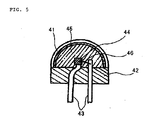
- the light-emitting device shown in FIG. 5 is mainly provided with a substrate 42, a pair of leads 43 fixed to the substrate, an LED 44 fixed on one of the leads, a transparent resin 45 which encircles the LED 44, and the above-described fluorescent substance-containing glass sheet 41 to cover the transparent resin.
- the LED 44 such as a gallium nitride compound semiconductor which is formed by stacking an InGaN light-emitting layer on a substrate of Al 2 O 3 or SIO and emits blue light can be used.
- the LED is connected to the other lead by wiring 46 and is electrically connected to a power supply not shown and emits blue/ultraviolet light.
- the above-described transparent resin is provided for protection of the LED, and for example, an epoxy resin, a urea resin, a silicone resin and the like which are excellent in transmitting property of emitted light from the LED and have resistance against the energy are favorably used.
- the oxide-coated fluorescent substance particles contained in the fluorescent substance-containing glass sheet 41 provided on the top surface of the transparent resin are excited by the light from the LED, emit wavelength converted light.
- the wavelength converted light and emitted light from the LED are diffused in the glass sheet and mixed in color, and white light is emitted from the LED element surface.
- the fluorescent substance containing glass sheet and the light-emitting device of the present invention will be more specifically described in detail hereinafter, but the technical range of the present invention is not limited to them.
- Silicon dioxide coating of a thickness of about 500 nm was formed on particles of Eu-activated sulfide the fluorescent substance SrGa 2 S 4 each of a particle size of 1 to 30 ⁇ m by a solution method.
- the obtained silicon dioxide-coated SrGa 2 S 4 particles were mixed into glass powder with borosilicate glass as a main component so that SrGa 2 S 4 was 1.0 mass%, and the mixture was obtained.
- the obtained mixture was poured into the mold, was heated at 400°C for 0.5 hours, was taken out of the mold, was heated at 500°C for two hours and the glass sheet of a thickness of 0.5 mm was obtained.
- the value of the attenuation of the sulfide fluorescent substance containing glass sheet, which was obtained by comparison with the YAG fluorescent substance as described above was about 11.8%.
- the attenuation of the intensity of the wavelength converted light emitted from the oxide-coated fluorescent substance was within 5% as compared with that shortly after forming.
- the glass sheet was produced as in the exemplary embodiment except that silicon dioxide coating was not performed.
- the value of the attenuation of the sulfide fluorescent substance in the forming process of the glass sheet which was obtained as in the exemplary embodiment was about 40%.
- the fluorescent substance containing glass sheet of the present invention can suppress deterioration suffered by the sulfide fluorescent substance from the environment, and deterioration suffered in the forming process, and can be used for a light-emitting device such as an LED element using a blue/ultraviolet light-emitting diode, and the light-emitting device which emits white light with high intensity can be obtained. Further, the light-emitting device which suppresses corrosion of the electrodes and the like of the light-emitting device by the sulfide fluorescent substance, can increase the life of the light-emitting device, and does not bring about environmental pollution by lead can be obtained, and industrial availability is extremely high.
Landscapes
- Chemical & Material Sciences (AREA)
- Engineering & Computer Science (AREA)
- Materials Engineering (AREA)
- Organic Chemistry (AREA)
- Inorganic Chemistry (AREA)
- Crystallography & Structural Chemistry (AREA)
- Ceramic Engineering (AREA)
- Dispersion Chemistry (AREA)
- Life Sciences & Earth Sciences (AREA)
- Chemical Kinetics & Catalysis (AREA)
- General Chemical & Material Sciences (AREA)
- Geochemistry & Mineralogy (AREA)
- Luminescent Compositions (AREA)
- Led Device Packages (AREA)
- Led Devices (AREA)
Applications Claiming Priority (1)
| Application Number | Priority Date | Filing Date | Title |
|---|---|---|---|
| JP2006297846A JP2008115223A (ja) | 2006-11-01 | 2006-11-01 | 蛍光体含有ガラスシート、その製造方法及び発光装置 |
Publications (1)
| Publication Number | Publication Date |
|---|---|
| EP1925652A1 true EP1925652A1 (de) | 2008-05-28 |
Family
ID=39015697
Family Applications (1)
| Application Number | Title | Priority Date | Filing Date |
|---|---|---|---|
| EP07075961A Ceased EP1925652A1 (de) | 2006-11-01 | 2007-11-01 | Fluoreszenzsubstanz mit Glasblatt, Herstellungsverfahren für das Glasblatt und lichtemittierende Vorrichtung |
Country Status (4)
| Country | Link |
|---|---|
| US (1) | US20080180018A1 (de) |
| EP (1) | EP1925652A1 (de) |
| JP (1) | JP2008115223A (de) |
| KR (1) | KR100887786B1 (de) |
Cited By (1)
| Publication number | Priority date | Publication date | Assignee | Title |
|---|---|---|---|---|
| US20140049153A1 (en) * | 2011-04-27 | 2014-02-20 | Samsung Electronics Co., Ltd. | Light-emitting-device package and a production method therefor |
Families Citing this family (31)
| Publication number | Priority date | Publication date | Assignee | Title |
|---|---|---|---|---|
| JPWO2007017928A1 (ja) * | 2005-08-08 | 2009-02-19 | 独立行政法人産業技術総合研究所 | 透明白色蛍光ガラス |
| JP5152687B2 (ja) * | 2006-12-07 | 2013-02-27 | 日本電気硝子株式会社 | 発光色変換材料 |
| WO2008105527A1 (ja) * | 2007-03-01 | 2008-09-04 | Nec Lighting, Ltd. | Led装置及び照明装置 |
| JP5099820B2 (ja) * | 2007-06-22 | 2012-12-19 | 学校法人日本大学 | 赤色発光蛍光体、fed装置およびeld装置 |
| WO2009118672A1 (en) * | 2008-03-27 | 2009-10-01 | Koninklijke Philips Electronics N.V. | Method for reconstructing a fluorescent image of the interior of a turbid medium and device for imaging the interior of a turbid medium |
| KR20110028307A (ko) | 2008-05-29 | 2011-03-17 | 크리 인코포레이티드 | 근거리장 영역 혼합을 갖는 광원 |
| JP5405156B2 (ja) * | 2009-03-10 | 2014-02-05 | 株式会社東芝 | 赤色発光蛍光体およびそれを用いた発光装置 |
| JP2011032416A (ja) * | 2009-08-04 | 2011-02-17 | Sumitomo Metal Mining Co Ltd | 蛍光体とその製造方法 |
| CN102548756A (zh) * | 2009-09-25 | 2012-07-04 | 海洋王照明科技股份有限公司 | 发光玻璃、其制造方法及发光装置 |
| CN102574368A (zh) * | 2009-09-25 | 2012-07-11 | 海洋王照明科技股份有限公司 | 发光玻璃、其制造方法及发光装置 |
| WO2011035483A1 (zh) * | 2009-09-25 | 2011-03-31 | 海洋王照明科技股份有限公司 | 半导体发光器件及其封装方法 |
| EP2481575B1 (de) * | 2009-09-25 | 2017-05-24 | Ocean's King Lighting Science & Technology Co., Ltd. | Lumineszenzglas, herstellungsverfahren und lumineszenzvorrichtung |
| EP2481576B1 (de) * | 2009-09-25 | 2017-05-24 | Ocean's King Lighting Science & Technology Co., Ltd. | Lumineszenzglas, herstellungsverfahren und lumineszenzvorrichtung |
| EP2481572B1 (de) * | 2009-09-25 | 2017-05-24 | Ocean's King Lighting Science & Technology Co., Ltd. | Lumineszenzglas, herstellungsverfahren und lumineszenzvorrichtung |
| EP2481573B1 (de) * | 2009-09-25 | 2017-07-05 | Ocean's King Lighting Science & Technology Co., Ltd. | Lumineszenzglas, herstellungsverfahren und lumineszenzvorrichtung |
| JP2013506011A (ja) * | 2009-09-25 | 2013-02-21 | 海洋王照明科技股▲ふん▼有限公司 | 発光ガラス及びその製造方法、並びに発光装置 |
| US20130001444A1 (en) * | 2009-12-31 | 2013-01-03 | Mingjie Zhou | White light luminescent device based on purple light leds |
| JP2013119581A (ja) * | 2011-12-07 | 2013-06-17 | Dexerials Corp | 被覆蛍光体及び被覆蛍光体の製造方法 |
| JP6044073B2 (ja) | 2011-12-27 | 2016-12-14 | 日亜化学工業株式会社 | 波長変換装置及びそれを用いた発光装置 |
| DE102012102859A1 (de) | 2012-04-02 | 2013-11-14 | Osram Opto Semiconductors Gmbh | Optoelektronisches Bauelement umfassend eine Konverterträgerschicht, und Verfahren zur Herstellung eines optoelektronischen Bauelements umfassend eine Konverterträgerschicht |
| JP6056381B2 (ja) * | 2012-07-10 | 2017-01-11 | 日本電気硝子株式会社 | 波長変換部材の製造方法 |
| KR102075982B1 (ko) | 2013-03-15 | 2020-02-12 | 삼성전자주식회사 | 반도체 발광소자 패키지 |
| KR102098589B1 (ko) * | 2013-07-04 | 2020-04-09 | 삼성전자주식회사 | 파장변환부재 및 그 제조방법과, 이를 구비한 반도체 발광장치 |
| JP6274424B2 (ja) * | 2014-03-28 | 2018-02-07 | 豊田合成株式会社 | 発光色変換部材および発光装置 |
| JP6759639B2 (ja) * | 2016-03-15 | 2020-09-23 | 日亜化学工業株式会社 | 発光装置の製造方法 |
| JP6880528B2 (ja) * | 2016-06-27 | 2021-06-02 | 日本電気硝子株式会社 | 波長変換部材及びそれを用いてなる発光デバイス |
| JP2020500244A (ja) * | 2016-10-31 | 2020-01-09 | インテマティックス・コーポレーションIntematix Corporation | コーティング付き狭帯域緑色蛍光体 |
| JP6932679B2 (ja) * | 2017-11-30 | 2021-09-08 | デクセリアルズ株式会社 | 被覆蛍光体、その製造方法、並びに、蛍光体シート、及び発光装置 |
| WO2019107080A1 (ja) | 2017-11-30 | 2019-06-06 | デクセリアルズ株式会社 | 被覆蛍光体、その製造方法、並びに、蛍光体シート、及び発光装置 |
| CN111602256B (zh) * | 2018-01-22 | 2023-10-24 | 亮锐控股有限公司 | 用于发光装置的经涂布的波长转换材料 |
| CN113403064A (zh) * | 2021-06-25 | 2021-09-17 | 佛山安亿纳米材料有限公司 | 耐候性良好的硫化物荧光体及制备耐候性良好的荧光体的化学沉积法 |
Citations (6)
| Publication number | Priority date | Publication date | Assignee | Title |
|---|---|---|---|---|
| JP2002069442A (ja) | 2000-09-01 | 2002-03-08 | Showa Denko Kk | シリカ被膜発光体粒子 |
| EP1199757A2 (de) * | 2000-10-17 | 2002-04-24 | Philips Corporate Intellectual Property GmbH | Lichtemittierende Vorrichtung mit beschichtetem Leuchtstoff |
| JP2003046141A (ja) | 2001-07-31 | 2003-02-14 | Nichia Chem Ind Ltd | 発光装置とその製造方法 |
| JP2003258308A (ja) | 2002-03-06 | 2003-09-12 | Nippon Electric Glass Co Ltd | 発光色変換部材 |
| EP1441395A2 (de) * | 1996-06-26 | 2004-07-28 | Osram Opto Semiconductors GmbH | Lichtabstrahlendes halbleiterbauelement mit lumineszenzkonversionselement |
| JP2006052345A (ja) | 2004-08-13 | 2006-02-23 | Rohm Co Ltd | 発光色変換部材およびそれを用いた半導体発光装置 |
Family Cites Families (3)
| Publication number | Priority date | Publication date | Assignee | Title |
|---|---|---|---|---|
| US6762553B1 (en) * | 1999-11-10 | 2004-07-13 | Matsushita Electric Works, Ltd. | Substrate for light emitting device, light emitting device and process for production of light emitting device |
| KR101253381B1 (ko) * | 2005-05-11 | 2013-04-11 | 니폰 덴키 가라스 가부시키가이샤 | 형광체 복합 유리, 형광체 복합 유리 그린 시트 및 형광체 복합 유리의 제조 방법 |
| US20070125984A1 (en) * | 2005-12-01 | 2007-06-07 | Sarnoff Corporation | Phosphors protected against moisture and LED lighting devices |
-
2006
- 2006-11-01 JP JP2006297846A patent/JP2008115223A/ja active Pending
-
2007
- 2007-10-16 US US11/873,047 patent/US20080180018A1/en not_active Abandoned
- 2007-10-31 KR KR1020070109987A patent/KR100887786B1/ko active Active
- 2007-11-01 EP EP07075961A patent/EP1925652A1/de not_active Ceased
Patent Citations (6)
| Publication number | Priority date | Publication date | Assignee | Title |
|---|---|---|---|---|
| EP1441395A2 (de) * | 1996-06-26 | 2004-07-28 | Osram Opto Semiconductors GmbH | Lichtabstrahlendes halbleiterbauelement mit lumineszenzkonversionselement |
| JP2002069442A (ja) | 2000-09-01 | 2002-03-08 | Showa Denko Kk | シリカ被膜発光体粒子 |
| EP1199757A2 (de) * | 2000-10-17 | 2002-04-24 | Philips Corporate Intellectual Property GmbH | Lichtemittierende Vorrichtung mit beschichtetem Leuchtstoff |
| JP2003046141A (ja) | 2001-07-31 | 2003-02-14 | Nichia Chem Ind Ltd | 発光装置とその製造方法 |
| JP2003258308A (ja) | 2002-03-06 | 2003-09-12 | Nippon Electric Glass Co Ltd | 発光色変換部材 |
| JP2006052345A (ja) | 2004-08-13 | 2006-02-23 | Rohm Co Ltd | 発光色変換部材およびそれを用いた半導体発光装置 |
Non-Patent Citations (4)
| Title |
|---|
| "INORGANIC PHOSPHORS - COMPOSITIONS, PREPARATION AND OPTICAL PROPERTIES", 1 January 2004, CRC PRESS, article WILLIAM M. YEN ET AL: "INORGANIC PHOSPHORS - COMPOSITIONS, PREPARATION AND OPTICAL PROPERTIES", pages: 283 - 320, XP055226087 * |
| 23 February 2006 (2006-02-23), XP055226053 * |
| C. GUO ET. AL.: "Improving the stability of alkaline earth sulfide-based phosphors", APPLIED SURFACE SCIENCE, vol. 225, 2004, Elsevier, pages 198-203, XP002469137 * |
| C. GUO ET. AL.: "Oxide coating for alkaline earth sulfide based phosphor", JOURNAL OF LUMINESCENCE, vol. 105, 2003, Elsevier, pages 121-126, XP002469138 * |
Cited By (1)
| Publication number | Priority date | Publication date | Assignee | Title |
|---|---|---|---|---|
| US20140049153A1 (en) * | 2011-04-27 | 2014-02-20 | Samsung Electronics Co., Ltd. | Light-emitting-device package and a production method therefor |
Also Published As
| Publication number | Publication date |
|---|---|
| KR100887786B1 (ko) | 2009-03-09 |
| KR20080039799A (ko) | 2008-05-07 |
| JP2008115223A (ja) | 2008-05-22 |
| US20080180018A1 (en) | 2008-07-31 |
Similar Documents
| Publication | Publication Date | Title |
|---|---|---|
| US20080180018A1 (en) | Fluorescent substance containing glass sheet, method for manufacturing the glass sheet and light-emitting device | |
| CN100483756C (zh) | 发光元件和照明器具 | |
| US8207659B2 (en) | Light emitting device and light emitting apparatus | |
| JP5641384B2 (ja) | 表示装置用照明装置及び表示装置 | |
| CN1893136B (zh) | 发光半导体器件和含有该发光半导体器件的装置 | |
| JP7073102B2 (ja) | 発光装置 | |
| CN1534802B (zh) | 具有发光变换元件的发光半导体器件 | |
| EP2903040B1 (de) | Wellenlängenumsetzungselement | |
| US20070090381A1 (en) | Semiconductor light emitting device | |
| CN102062359A (zh) | 包含发光磷光体的发光二极管照明布置 | |
| US8974852B2 (en) | Method of manufacturing light-emitting device with fluorescent layer | |
| KR20070039569A (ko) | 발광 장치 그리고 그것을 사용한 조명, 디스플레이용백라이트 및 디스플레이 | |
| US7678293B2 (en) | Coated fluorescent substance, light emitting device comprising said substance and a method for producing said substance | |
| US20070138484A1 (en) | Light-emitting device and method of manufacturing the same | |
| EP2028697A1 (de) | Leuchtanordnungs-anbringsubstrat, leuchtanordnungs-kapselungskörper, display und beleuchtungsanordnung | |
| CN112166354A (zh) | 波长转换元件以及光源装置 | |
| CN102986297B (zh) | 碳二亚胺无机发光材料 | |
| JP5246774B2 (ja) | 蛍光体部材、発光素子及び照明装置 | |
| Phuong Loan et al. | The effectiveness of MgCeAl11O19: Tb3+ phosphor in enhancing the luminous efficacy and color quality of multi-chip white LEDs. | |
| HK1022564B (en) | A light-radiating semiconductor component, a full-color light emitting diode display device, and the usage thereof |
Legal Events
| Date | Code | Title | Description |
|---|---|---|---|
| PUAI | Public reference made under article 153(3) epc to a published international application that has entered the european phase |
Free format text: ORIGINAL CODE: 0009012 |
|
| AK | Designated contracting states |
Kind code of ref document: A1 Designated state(s): AT BE BG CH CY CZ DE DK EE ES FI FR GB GR HU IE IS IT LI LT LU LV MC MT NL PL PT RO SE SI SK TR |
|
| AX | Request for extension of the european patent |
Extension state: AL BA HR MK RS |
|
| 17P | Request for examination filed |
Effective date: 20081126 |
|
| AKX | Designation fees paid |
Designated state(s): DE FR NL |
|
| 17Q | First examination report despatched |
Effective date: 20100924 |
|
| RAP1 | Party data changed (applicant data changed or rights of an application transferred) |
Owner name: SAMSUNG ELECTRONICS CO., LTD. |
|
| STAA | Information on the status of an ep patent application or granted ep patent |
Free format text: STATUS: THE APPLICATION HAS BEEN REFUSED |
|
| 18R | Application refused |
Effective date: 20161031 |