EP1923398B1 - Processus de production d'un polypeptide - Google Patents
Processus de production d'un polypeptide Download PDFInfo
- Publication number
- EP1923398B1 EP1923398B1 EP08001783A EP08001783A EP1923398B1 EP 1923398 B1 EP1923398 B1 EP 1923398B1 EP 08001783 A EP08001783 A EP 08001783A EP 08001783 A EP08001783 A EP 08001783A EP 1923398 B1 EP1923398 B1 EP 1923398B1
- Authority
- EP
- European Patent Office
- Prior art keywords
- peptide
- mol
- polypeptide
- group
- denotes
- Prior art date
- Legal status (The legal status is an assumption and is not a legal conclusion. Google has not performed a legal analysis and makes no representation as to the accuracy of the status listed.)
- Expired - Lifetime
Links
- 108090000765 processed proteins & peptides Proteins 0.000 title claims abstract description 192
- 102000004196 processed proteins & peptides Human genes 0.000 title claims abstract description 96
- 229920001184 polypeptide Polymers 0.000 title claims abstract description 95
- 238000000034 method Methods 0.000 title claims abstract description 45
- 238000006243 chemical reaction Methods 0.000 claims abstract description 25
- 150000001875 compounds Chemical class 0.000 claims abstract description 19
- 125000000539 amino acid group Chemical group 0.000 claims abstract description 10
- 125000002947 alkylene group Chemical group 0.000 claims abstract description 8
- 239000003795 chemical substances by application Substances 0.000 claims description 40
- XLYOFNOQVPJJNP-UHFFFAOYSA-N water Substances O XLYOFNOQVPJJNP-UHFFFAOYSA-N 0.000 claims description 30
- 239000002904 solvent Substances 0.000 claims description 18
- 150000003949 imides Chemical class 0.000 claims description 6
- MKRTXPORKIRPDG-UHFFFAOYSA-N diphenylphosphoryl azide Chemical compound C=1C=CC=CC=1P(=O)(N=[N+]=[N-])C1=CC=CC=C1 MKRTXPORKIRPDG-UHFFFAOYSA-N 0.000 claims description 4
- JYEUMXHLPRZUAT-UHFFFAOYSA-N 1,2,3-triazine Chemical compound C1=CN=NN=C1 JYEUMXHLPRZUAT-UHFFFAOYSA-N 0.000 claims description 3
- FQKFPGMGQXQHLP-UHFFFAOYSA-N 1-hydroxytriazole Chemical compound ON1C=CN=N1 FQKFPGMGQXQHLP-UHFFFAOYSA-N 0.000 claims description 3
- 125000004494 ethyl ester group Chemical group 0.000 claims description 3
- CNEFRTDDIMNTHC-UHFFFAOYSA-N 2-cyano-2-hydroxyiminoacetic acid Chemical compound ON=C(C#N)C(O)=O CNEFRTDDIMNTHC-UHFFFAOYSA-N 0.000 claims description 2
- 230000000694 effects Effects 0.000 abstract description 27
- 208000015181 infectious disease Diseases 0.000 abstract description 11
- 244000052769 pathogen Species 0.000 abstract description 6
- 108010035532 Collagen Proteins 0.000 description 37
- 102000008186 Collagen Human genes 0.000 description 37
- 229920001436 collagen Polymers 0.000 description 37
- -1 p-nitrophenyl ester Chemical class 0.000 description 31
- 239000000243 solution Substances 0.000 description 27
- 210000001519 tissue Anatomy 0.000 description 22
- 229920000742 Cotton Polymers 0.000 description 21
- LMDZBCPBFSXMTL-UHFFFAOYSA-N 1-ethyl-3-(3-dimethylaminopropyl)carbodiimide Chemical compound CCN=C=NCCCN(C)C LMDZBCPBFSXMTL-UHFFFAOYSA-N 0.000 description 16
- OKKJLVBELUTLKV-UHFFFAOYSA-N Methanol Chemical compound OC OKKJLVBELUTLKV-UHFFFAOYSA-N 0.000 description 15
- 239000000463 material Substances 0.000 description 15
- 239000000126 substance Substances 0.000 description 15
- FAPWRFPIFSIZLT-UHFFFAOYSA-M Sodium chloride Chemical compound [Na+].[Cl-] FAPWRFPIFSIZLT-UHFFFAOYSA-M 0.000 description 14
- ASOKPJOREAFHNY-UHFFFAOYSA-N 1-Hydroxybenzotriazole Chemical compound C1=CC=C2N(O)N=NC2=C1 ASOKPJOREAFHNY-UHFFFAOYSA-N 0.000 description 13
- IAZDPXIOMUYVGZ-UHFFFAOYSA-N Dimethylsulphoxide Chemical compound CS(C)=O IAZDPXIOMUYVGZ-UHFFFAOYSA-N 0.000 description 12
- DHMQDGOQFOQNFH-UHFFFAOYSA-N Glycine Chemical compound NCC(O)=O DHMQDGOQFOQNFH-UHFFFAOYSA-N 0.000 description 12
- 238000001142 circular dichroism spectrum Methods 0.000 description 12
- 238000005227 gel permeation chromatography Methods 0.000 description 12
- LFQSCWFLJHTTHZ-UHFFFAOYSA-N Ethanol Chemical compound CCO LFQSCWFLJHTTHZ-UHFFFAOYSA-N 0.000 description 11
- 229940024606 amino acid Drugs 0.000 description 11
- 238000002523 gelfiltration Methods 0.000 description 11
- 150000001413 amino acids Chemical class 0.000 description 10
- ZMXDDKWLCZADIW-UHFFFAOYSA-N N,N-Dimethylformamide Chemical compound CN(C)C=O ZMXDDKWLCZADIW-UHFFFAOYSA-N 0.000 description 9
- 235000001014 amino acid Nutrition 0.000 description 9
- 239000008363 phosphate buffer Substances 0.000 description 9
- 125000006239 protecting group Chemical group 0.000 description 9
- 239000011541 reaction mixture Substances 0.000 description 9
- 238000009928 pasteurization Methods 0.000 description 8
- 235000018102 proteins Nutrition 0.000 description 8
- 102000004169 proteins and genes Human genes 0.000 description 8
- 108090000623 proteins and genes Proteins 0.000 description 8
- PMMYEEVYMWASQN-DMTCNVIQSA-N Hydroxyproline Chemical compound O[C@H]1CN[C@H](C(O)=O)C1 PMMYEEVYMWASQN-DMTCNVIQSA-N 0.000 description 7
- 239000003480 eluent Substances 0.000 description 7
- NPZTUJOABDZTLV-UHFFFAOYSA-N hydroxybenzotriazole Substances O=C1C=CC=C2NNN=C12 NPZTUJOABDZTLV-UHFFFAOYSA-N 0.000 description 7
- 239000011159 matrix material Substances 0.000 description 7
- 239000000203 mixture Substances 0.000 description 7
- 239000012925 reference material Substances 0.000 description 7
- 239000011347 resin Substances 0.000 description 7
- 229920005989 resin Polymers 0.000 description 7
- 239000011780 sodium chloride Substances 0.000 description 7
- FPQQSJJWHUJYPU-UHFFFAOYSA-N 3-(dimethylamino)propyliminomethylidene-ethylazanium;chloride Chemical compound Cl.CCN=C=NCCCN(C)C FPQQSJJWHUJYPU-UHFFFAOYSA-N 0.000 description 6
- 125000000174 L-prolyl group Chemical group [H]N1C([H])([H])C([H])([H])C([H])([H])[C@@]1([H])C(*)=O 0.000 description 6
- JGFZNNIVVJXRND-UHFFFAOYSA-N N,N-Diisopropylethylamine (DIPEA) Chemical compound CCN(C(C)C)C(C)C JGFZNNIVVJXRND-UHFFFAOYSA-N 0.000 description 6
- SJRJJKPEHAURKC-UHFFFAOYSA-N N-Methylmorpholine Chemical compound CN1CCOCC1 SJRJJKPEHAURKC-UHFFFAOYSA-N 0.000 description 6
- 102000029797 Prion Human genes 0.000 description 6
- 108091000054 Prion Proteins 0.000 description 6
- 239000012505 Superdex™ Substances 0.000 description 6
- ZMANZCXQSJIPKH-UHFFFAOYSA-N Triethylamine Chemical compound CCN(CC)CC ZMANZCXQSJIPKH-UHFFFAOYSA-N 0.000 description 6
- 239000002585 base Substances 0.000 description 6
- 229960001760 dimethyl sulfoxide Drugs 0.000 description 6
- 235000019441 ethanol Nutrition 0.000 description 6
- 238000004519 manufacturing process Methods 0.000 description 6
- 239000000178 monomer Substances 0.000 description 6
- 230000000704 physical effect Effects 0.000 description 6
- 238000002360 preparation method Methods 0.000 description 6
- WHUUTDBJXJRKMK-UHFFFAOYSA-N Glutamic acid Chemical group OC(=O)C(N)CCC(O)=O WHUUTDBJXJRKMK-UHFFFAOYSA-N 0.000 description 5
- KDXKERNSBIXSRK-UHFFFAOYSA-N Lysine Chemical group NCCCCC(N)C(O)=O KDXKERNSBIXSRK-UHFFFAOYSA-N 0.000 description 5
- 108010033276 Peptide Fragments Proteins 0.000 description 5
- 102000007079 Peptide Fragments Human genes 0.000 description 5
- 230000004071 biological effect Effects 0.000 description 5
- 239000012620 biological material Substances 0.000 description 5
- 230000015572 biosynthetic process Effects 0.000 description 5
- 239000003153 chemical reaction reagent Substances 0.000 description 5
- 238000001035 drying Methods 0.000 description 5
- 238000010647 peptide synthesis reaction Methods 0.000 description 5
- 239000011369 resultant mixture Substances 0.000 description 5
- 238000007363 ring formation reaction Methods 0.000 description 5
- 239000000725 suspension Substances 0.000 description 5
- 229920001059 synthetic polymer Polymers 0.000 description 5
- HJBLUNHMOKFZQX-UHFFFAOYSA-N 3-hydroxy-1,2,3-benzotriazin-4-one Chemical compound C1=CC=C2C(=O)N(O)N=NC2=C1 HJBLUNHMOKFZQX-UHFFFAOYSA-N 0.000 description 4
- 239000004471 Glycine Substances 0.000 description 4
- 125000003412 L-alanyl group Chemical group [H]N([H])[C@@](C([H])([H])[H])(C(=O)[*])[H] 0.000 description 4
- JUJWROOIHBZHMG-UHFFFAOYSA-N Pyridine Chemical compound C1=CC=NC=C1 JUJWROOIHBZHMG-UHFFFAOYSA-N 0.000 description 4
- WYURNTSHIVDZCO-UHFFFAOYSA-N Tetrahydrofuran Chemical compound C1CCOC1 WYURNTSHIVDZCO-UHFFFAOYSA-N 0.000 description 4
- DTQVDTLACAAQTR-UHFFFAOYSA-N Trifluoroacetic acid Chemical compound OC(=O)C(F)(F)F DTQVDTLACAAQTR-UHFFFAOYSA-N 0.000 description 4
- 230000005540 biological transmission Effects 0.000 description 4
- 125000003178 carboxy group Chemical group [H]OC(*)=O 0.000 description 4
- 238000009833 condensation Methods 0.000 description 4
- 230000005494 condensation Effects 0.000 description 4
- 238000006482 condensation reaction Methods 0.000 description 4
- 230000002401 inhibitory effect Effects 0.000 description 4
- 125000001570 methylene group Chemical group [H]C([H])([*:1])[*:2] 0.000 description 4
- 239000002994 raw material Substances 0.000 description 4
- 238000010532 solid phase synthesis reaction Methods 0.000 description 4
- 230000001954 sterilising effect Effects 0.000 description 4
- 238000004659 sterilization and disinfection Methods 0.000 description 4
- 239000000758 substrate Substances 0.000 description 4
- CSCPPACGZOOCGX-UHFFFAOYSA-N Acetone Chemical compound CC(C)=O CSCPPACGZOOCGX-UHFFFAOYSA-N 0.000 description 3
- WEVYAHXRMPXWCK-UHFFFAOYSA-N Acetonitrile Chemical compound CC#N WEVYAHXRMPXWCK-UHFFFAOYSA-N 0.000 description 3
- 241000282414 Homo sapiens Species 0.000 description 3
- 101000976075 Homo sapiens Insulin Proteins 0.000 description 3
- VEXZGXHMUGYJMC-UHFFFAOYSA-N Hydrochloric acid Chemical compound Cl VEXZGXHMUGYJMC-UHFFFAOYSA-N 0.000 description 3
- OFOBLEOULBTSOW-UHFFFAOYSA-N Malonic acid Chemical compound OC(=O)CC(O)=O OFOBLEOULBTSOW-UHFFFAOYSA-N 0.000 description 3
- 239000004952 Polyamide Substances 0.000 description 3
- KWYUFKZDYYNOTN-UHFFFAOYSA-M Potassium hydroxide Chemical compound [OH-].[K+] KWYUFKZDYYNOTN-UHFFFAOYSA-M 0.000 description 3
- HEMHJVSKTPXQMS-UHFFFAOYSA-M Sodium hydroxide Chemical compound [OH-].[Na+] HEMHJVSKTPXQMS-UHFFFAOYSA-M 0.000 description 3
- 125000003277 amino group Chemical group 0.000 description 3
- 239000007900 aqueous suspension Substances 0.000 description 3
- 210000003050 axon Anatomy 0.000 description 3
- 239000000560 biocompatible material Substances 0.000 description 3
- 210000004027 cell Anatomy 0.000 description 3
- 239000002537 cosmetic Substances 0.000 description 3
- 238000006471 dimerization reaction Methods 0.000 description 3
- PMMYEEVYMWASQN-UHFFFAOYSA-N dl-hydroxyproline Natural products OC1C[NH2+]C(C([O-])=O)C1 PMMYEEVYMWASQN-UHFFFAOYSA-N 0.000 description 3
- 210000002950 fibroblast Anatomy 0.000 description 3
- 125000000524 functional group Chemical group 0.000 description 3
- 230000002458 infectious effect Effects 0.000 description 3
- PBGKTOXHQIOBKM-FHFVDXKLSA-N insulin (human) Chemical compound C([C@@H](C(=O)N[C@@H](CC(C)C)C(=O)N[C@H]1CSSC[C@H]2C(=O)N[C@H](C(=O)N[C@@H](CO)C(=O)N[C@H](C(=O)N[C@H](C(N[C@@H](CO)C(=O)N[C@@H](CC(C)C)C(=O)N[C@@H](CC=3C=CC(O)=CC=3)C(=O)N[C@@H](CCC(N)=O)C(=O)N[C@@H](CC(C)C)C(=O)N[C@@H](CCC(O)=O)C(=O)N[C@@H](CC(N)=O)C(=O)N[C@@H](CC=3C=CC(O)=CC=3)C(=O)N[C@@H](CSSC[C@H](NC(=O)[C@H](C(C)C)NC(=O)[C@H](CC(C)C)NC(=O)[C@H](CC=3C=CC(O)=CC=3)NC(=O)[C@H](CC(C)C)NC(=O)[C@H](C)NC(=O)[C@H](CCC(O)=O)NC(=O)[C@H](C(C)C)NC(=O)[C@H](CC(C)C)NC(=O)[C@H](CC=3NC=NC=3)NC(=O)[C@H](CO)NC(=O)CNC1=O)C(=O)NCC(=O)N[C@@H](CCC(O)=O)C(=O)N[C@@H](CCCNC(N)=N)C(=O)NCC(=O)N[C@@H](CC=1C=CC=CC=1)C(=O)N[C@@H](CC=1C=CC=CC=1)C(=O)N[C@@H](CC=1C=CC(O)=CC=1)C(=O)N[C@@H]([C@@H](C)O)C(=O)N1[C@@H](CCC1)C(=O)N[C@@H](CCCCN)C(=O)N[C@@H]([C@@H](C)O)C(O)=O)C(=O)N[C@@H](CC(N)=O)C(O)=O)=O)CSSC[C@@H](C(N2)=O)NC(=O)[C@H](CCC(N)=O)NC(=O)[C@H](CCC(O)=O)NC(=O)[C@H](C(C)C)NC(=O)[C@@H](NC(=O)CN)[C@@H](C)CC)[C@@H](C)CC)[C@@H](C)O)NC(=O)[C@H](CCC(N)=O)NC(=O)[C@H](CC(N)=O)NC(=O)[C@@H](NC(=O)[C@@H](N)CC=1C=CC=CC=1)C(C)C)C1=CN=CN1 PBGKTOXHQIOBKM-FHFVDXKLSA-N 0.000 description 3
- 125000000956 methoxy group Chemical group [H]C([H])([H])O* 0.000 description 3
- 239000000825 pharmaceutical preparation Substances 0.000 description 3
- 229920002647 polyamide Polymers 0.000 description 3
- 229920000642 polymer Polymers 0.000 description 3
- 239000000047 product Substances 0.000 description 3
- BDERNNFJNOPAEC-UHFFFAOYSA-N propan-1-ol Chemical compound CCCO BDERNNFJNOPAEC-UHFFFAOYSA-N 0.000 description 3
- 241000894007 species Species 0.000 description 3
- 238000003786 synthesis reaction Methods 0.000 description 3
- BDNKZNFMNDZQMI-UHFFFAOYSA-N 1,3-diisopropylcarbodiimide Chemical compound CC(C)N=C=NC(C)C BDNKZNFMNDZQMI-UHFFFAOYSA-N 0.000 description 2
- RYHBNJHYFVUHQT-UHFFFAOYSA-N 1,4-Dioxane Chemical compound C1COCCO1 RYHBNJHYFVUHQT-UHFFFAOYSA-N 0.000 description 2
- LFTRJWKKLPVMNE-RCBQFDQVSA-N 2-[[(2s)-2-[[2-[[(2s)-1-[(2s)-2-amino-3-methylbutanoyl]pyrrolidine-2-carbonyl]amino]acetyl]amino]-3-methylbutanoyl]amino]acetic acid Chemical compound CC(C)[C@H](N)C(=O)N1CCC[C@H]1C(=O)NCC(=O)N[C@@H](C(C)C)C(=O)NCC(O)=O LFTRJWKKLPVMNE-RCBQFDQVSA-N 0.000 description 2
- 241000251468 Actinopterygii Species 0.000 description 2
- 241000283690 Bos taurus Species 0.000 description 2
- QOSSAOTZNIDXMA-UHFFFAOYSA-N Dicylcohexylcarbodiimide Chemical compound C1CCCCC1N=C=NC1CCCCC1 QOSSAOTZNIDXMA-UHFFFAOYSA-N 0.000 description 2
- RTZKZFJDLAIYFH-UHFFFAOYSA-N Diethyl ether Chemical compound CCOCC RTZKZFJDLAIYFH-UHFFFAOYSA-N 0.000 description 2
- 108090000790 Enzymes Proteins 0.000 description 2
- 102000004190 Enzymes Human genes 0.000 description 2
- IAYPIBMASNFSPL-UHFFFAOYSA-N Ethylene oxide Chemical compound C1CO1 IAYPIBMASNFSPL-UHFFFAOYSA-N 0.000 description 2
- YCKRFDGAMUMZLT-UHFFFAOYSA-N Fluorine atom Chemical compound [F] YCKRFDGAMUMZLT-UHFFFAOYSA-N 0.000 description 2
- 125000003338 L-glutaminyl group Chemical group O=C([*])[C@](N([H])[H])([H])C([H])([H])C([H])([H])C(=O)N([H])[H] 0.000 description 2
- 125000002707 L-tryptophyl group Chemical group [H]C1=C([H])C([H])=C2C(C([C@](N([H])[H])(C(=O)[*])[H])([H])[H])=C([H])N([H])C2=C1[H] 0.000 description 2
- 241001465754 Metazoa Species 0.000 description 2
- 241001494479 Pecora Species 0.000 description 2
- CDBYLPFSWZWCQE-UHFFFAOYSA-L Sodium Carbonate Chemical compound [Na+].[Na+].[O-]C([O-])=O CDBYLPFSWZWCQE-UHFFFAOYSA-L 0.000 description 2
- UIIMBOGNXHQVGW-UHFFFAOYSA-M Sodium bicarbonate Chemical compound [Na+].OC([O-])=O UIIMBOGNXHQVGW-UHFFFAOYSA-M 0.000 description 2
- 206010053615 Thermal burn Diseases 0.000 description 2
- 150000008065 acid anhydrides Chemical class 0.000 description 2
- WNLRTRBMVRJNCN-UHFFFAOYSA-N adipic acid Chemical compound OC(=O)CCCCC(O)=O WNLRTRBMVRJNCN-UHFFFAOYSA-N 0.000 description 2
- 230000002411 adverse Effects 0.000 description 2
- 230000000181 anti-adherent effect Effects 0.000 description 2
- 239000007864 aqueous solution Substances 0.000 description 2
- 239000011230 binding agent Substances 0.000 description 2
- 210000000988 bone and bone Anatomy 0.000 description 2
- 210000004899 c-terminal region Anatomy 0.000 description 2
- 238000005266 casting Methods 0.000 description 2
- 239000007795 chemical reaction product Substances 0.000 description 2
- 239000011248 coating agent Substances 0.000 description 2
- 239000013078 crystal Substances 0.000 description 2
- 230000003229 cytophilic effect Effects 0.000 description 2
- 239000012024 dehydrating agents Substances 0.000 description 2
- BGRWYRAHAFMIBJ-UHFFFAOYSA-N diisopropylcarbodiimide Natural products CC(C)NC(=O)NC(C)C BGRWYRAHAFMIBJ-UHFFFAOYSA-N 0.000 description 2
- 230000008030 elimination Effects 0.000 description 2
- 238000003379 elimination reaction Methods 0.000 description 2
- 229940088598 enzyme Drugs 0.000 description 2
- 229910052731 fluorine Inorganic materials 0.000 description 2
- 239000011737 fluorine Substances 0.000 description 2
- 230000005251 gamma ray Effects 0.000 description 2
- 239000007789 gas Substances 0.000 description 2
- 239000012213 gelatinous substance Substances 0.000 description 2
- 230000002439 hemostatic effect Effects 0.000 description 2
- VKYKSIONXSXAKP-UHFFFAOYSA-N hexamethylenetetramine Chemical compound C1N(C2)CN3CN1CN2C3 VKYKSIONXSXAKP-UHFFFAOYSA-N 0.000 description 2
- NAQMVNRVTILPCV-UHFFFAOYSA-N hexane-1,6-diamine Chemical compound NCCCCCCN NAQMVNRVTILPCV-UHFFFAOYSA-N 0.000 description 2
- 229920001477 hydrophilic polymer Polymers 0.000 description 2
- 239000012567 medical material Substances 0.000 description 2
- 238000013508 migration Methods 0.000 description 2
- 230000005012 migration Effects 0.000 description 2
- 239000012046 mixed solvent Substances 0.000 description 2
- ZUSSTQCWRDLYJA-UHFFFAOYSA-N n-hydroxy-5-norbornene-2,3-dicarboximide Chemical compound C1=CC2CC1C1C2C(=O)N(O)C1=O ZUSSTQCWRDLYJA-UHFFFAOYSA-N 0.000 description 2
- BDJRBEYXGGNYIS-UHFFFAOYSA-N nonanedioic acid Chemical compound OC(=O)CCCCCCCC(O)=O BDJRBEYXGGNYIS-UHFFFAOYSA-N 0.000 description 2
- 239000003960 organic solvent Substances 0.000 description 2
- WLJVNTCWHIRURA-UHFFFAOYSA-N pimelic acid Chemical compound OC(=O)CCCCCC(O)=O WLJVNTCWHIRURA-UHFFFAOYSA-N 0.000 description 2
- 229920001343 polytetrafluoroethylene Polymers 0.000 description 2
- KIDHWZJUCRJVML-UHFFFAOYSA-N putrescine Chemical compound NCCCCN KIDHWZJUCRJVML-UHFFFAOYSA-N 0.000 description 2
- UMJSCPRVCHMLSP-UHFFFAOYSA-N pyridine Natural products COC1=CC=CN=C1 UMJSCPRVCHMLSP-UHFFFAOYSA-N 0.000 description 2
- 230000001172 regenerating effect Effects 0.000 description 2
- 150000003839 salts Chemical class 0.000 description 2
- CXMXRPHRNRROMY-UHFFFAOYSA-N sebacic acid Chemical compound OC(=O)CCCCCCCCC(O)=O CXMXRPHRNRROMY-UHFFFAOYSA-N 0.000 description 2
- TYFQFVWCELRYAO-UHFFFAOYSA-N suberic acid Chemical compound OC(=O)CCCCCCC(O)=O TYFQFVWCELRYAO-UHFFFAOYSA-N 0.000 description 2
- 150000003462 sulfoxides Chemical class 0.000 description 2
- 229920003002 synthetic resin Polymers 0.000 description 2
- 150000003512 tertiary amines Chemical class 0.000 description 2
- YLQBMQCUIZJEEH-UHFFFAOYSA-N tetrahydrofuran Natural products C=1C=COC=1 YLQBMQCUIZJEEH-UHFFFAOYSA-N 0.000 description 2
- GETQZCLCWQTVFV-UHFFFAOYSA-N trimethylamine Chemical compound CN(C)C GETQZCLCWQTVFV-UHFFFAOYSA-N 0.000 description 2
- XFNJVJPLKCPIBV-UHFFFAOYSA-N trimethylenediamine Chemical compound NCCCN XFNJVJPLKCPIBV-UHFFFAOYSA-N 0.000 description 2
- 108010054022 valyl-prolyl-glycyl-valyl-glycine Proteins 0.000 description 2
- MTCFGRXMJLQNBG-REOHCLBHSA-N (2S)-2-Amino-3-hydroxypropansäure Chemical compound OC[C@H](N)C(O)=O MTCFGRXMJLQNBG-REOHCLBHSA-N 0.000 description 1
- XQQUSYWGKLRJRA-RABCQHRBSA-N (2s)-2-[[(2s)-2-[[(2s)-2-[[(2s)-6-amino-2-[[(2s,3s)-2-amino-3-methylpentanoyl]amino]hexanoyl]amino]-3-methylbutanoyl]amino]propanoyl]amino]-3-methylbutanoic acid Chemical compound CC[C@H](C)[C@H](N)C(=O)N[C@@H](CCCCN)C(=O)N[C@@H](C(C)C)C(=O)N[C@@H](C)C(=O)N[C@@H](C(C)C)C(O)=O XQQUSYWGKLRJRA-RABCQHRBSA-N 0.000 description 1
- MWOGMBZGFFZBMK-LJZWMIMPSA-N (2s)-2-[[(2s)-2-[[2-[[(2s,3s)-2-[[(2s)-2-amino-3-(4-hydroxyphenyl)propanoyl]amino]-3-methylpentanoyl]amino]acetyl]amino]-3-hydroxypropanoyl]amino]-5-(diaminomethylideneamino)pentanoic acid Chemical compound NC(N)=NCCC[C@@H](C(O)=O)NC(=O)[C@H](CO)NC(=O)CNC(=O)[C@H]([C@@H](C)CC)NC(=O)[C@@H](N)CC1=CC=C(O)C=C1 MWOGMBZGFFZBMK-LJZWMIMPSA-N 0.000 description 1
- WTKQMHWYSBWUBE-UHFFFAOYSA-N (3-nitropyridin-2-yl) thiohypochlorite Chemical compound [O-][N+](=O)C1=CC=CN=C1SCl WTKQMHWYSBWUBE-UHFFFAOYSA-N 0.000 description 1
- UHPQFNXOFFPHJW-UHFFFAOYSA-N (4-methylphenyl)-phenylmethanamine Chemical compound C1=CC(C)=CC=C1C(N)C1=CC=CC=C1 UHPQFNXOFFPHJW-UHFFFAOYSA-N 0.000 description 1
- 125000006681 (C2-C10) alkylene group Chemical group 0.000 description 1
- 125000003088 (fluoren-9-ylmethoxy)carbonyl group Chemical group 0.000 description 1
- FNQIGYRDLYROLW-UHFFFAOYSA-N 1-hydroxy-2h-1,2,3-benzotriazine Chemical compound C1=CC=C2N(O)NN=CC2=C1 FNQIGYRDLYROLW-UHFFFAOYSA-N 0.000 description 1
- RTBFRGCFXZNCOE-UHFFFAOYSA-N 1-methylsulfonylpiperidin-4-one Chemical compound CS(=O)(=O)N1CCC(=O)CC1 RTBFRGCFXZNCOE-UHFFFAOYSA-N 0.000 description 1
- HBAHZZVIEFRTEY-UHFFFAOYSA-N 2-heptylcyclohex-2-en-1-one Chemical compound CCCCCCCC1=CCCCC1=O HBAHZZVIEFRTEY-UHFFFAOYSA-N 0.000 description 1
- IYMAXBFPHPZYIK-BQBZGAKWSA-N Arg-Gly-Asp Chemical compound NC(N)=NCCC[C@H](N)C(=O)NCC(=O)N[C@@H](CC(O)=O)C(O)=O IYMAXBFPHPZYIK-BQBZGAKWSA-N 0.000 description 1
- 241000282472 Canis lupus familiaris Species 0.000 description 1
- 229920003043 Cellulose fiber Polymers 0.000 description 1
- 241000282693 Cercopithecidae Species 0.000 description 1
- 208000020406 Creutzfeldt Jacob disease Diseases 0.000 description 1
- 208000003407 Creutzfeldt-Jakob Syndrome Diseases 0.000 description 1
- 208000010859 Creutzfeldt-Jakob disease Diseases 0.000 description 1
- 239000004971 Cross linker Substances 0.000 description 1
- RPNUMPOLZDHAAY-UHFFFAOYSA-N Diethylenetriamine Chemical compound NCCNCCN RPNUMPOLZDHAAY-UHFFFAOYSA-N 0.000 description 1
- 239000006145 Eagle's minimal essential medium Substances 0.000 description 1
- 102000016942 Elastin Human genes 0.000 description 1
- 108010014258 Elastin Proteins 0.000 description 1
- 241000283086 Equidae Species 0.000 description 1
- PIICEJLVQHRZGT-UHFFFAOYSA-N Ethylenediamine Chemical compound NCCN PIICEJLVQHRZGT-UHFFFAOYSA-N 0.000 description 1
- 241000282326 Felis catus Species 0.000 description 1
- KRHYYFGTRYWZRS-UHFFFAOYSA-N Fluorane Chemical compound F KRHYYFGTRYWZRS-UHFFFAOYSA-N 0.000 description 1
- SXRSQZLOMIGNAQ-UHFFFAOYSA-N Glutaraldehyde Chemical compound O=CCCCC=O SXRSQZLOMIGNAQ-UHFFFAOYSA-N 0.000 description 1
- 229920002683 Glycosaminoglycan Polymers 0.000 description 1
- HXKZJLWGSWQKEA-LSJOCFKGSA-N His-Ala-Val Chemical compound CC(C)[C@@H](C(O)=O)NC(=O)[C@H](C)NC(=O)[C@@H](N)CC1=CN=CN1 HXKZJLWGSWQKEA-LSJOCFKGSA-N 0.000 description 1
- 239000007836 KH2PO4 Substances 0.000 description 1
- 125000000570 L-alpha-aspartyl group Chemical group [H]OC(=O)C([H])([H])[C@]([H])(N([H])[H])C(*)=O 0.000 description 1
- 125000002059 L-arginyl group Chemical group O=C([*])[C@](N([H])[H])([H])C([H])([H])C([H])([H])C([H])([H])N([H])C(=N[H])N([H])[H] 0.000 description 1
- 125000000010 L-asparaginyl group Chemical group O=C([*])[C@](N([H])[H])([H])C([H])([H])C(=O)N([H])[H] 0.000 description 1
- CKLJMWTZIZZHCS-REOHCLBHSA-N L-aspartic acid Chemical compound OC(=O)[C@@H](N)CC(O)=O CKLJMWTZIZZHCS-REOHCLBHSA-N 0.000 description 1
- 125000000415 L-cysteinyl group Chemical group O=C([*])[C@@](N([H])[H])([H])C([H])([H])S[H] 0.000 description 1
- WHUUTDBJXJRKMK-VKHMYHEASA-N L-glutamic acid Chemical compound OC(=O)[C@@H](N)CCC(O)=O WHUUTDBJXJRKMK-VKHMYHEASA-N 0.000 description 1
- 125000002066 L-histidyl group Chemical group [H]N1C([H])=NC(C([H])([H])[C@](C(=O)[*])([H])N([H])[H])=C1[H] 0.000 description 1
- 125000002061 L-isoleucyl group Chemical group [H]N([H])[C@]([H])(C(=O)[*])[C@](C([H])([H])[H])([H])C(C([H])([H])[H])([H])[H] 0.000 description 1
- 125000003440 L-leucyl group Chemical group O=C([*])[C@](N([H])[H])([H])C([H])([H])C(C([H])([H])[H])([H])C([H])([H])[H] 0.000 description 1
- KDXKERNSBIXSRK-YFKPBYRVSA-N L-lysine Chemical compound NCCCC[C@H](N)C(O)=O KDXKERNSBIXSRK-YFKPBYRVSA-N 0.000 description 1
- 125000001176 L-lysyl group Chemical group [H]N([H])[C@]([H])(C(=O)[*])C([H])([H])C([H])([H])C([H])([H])C(N([H])[H])([H])[H] 0.000 description 1
- 125000000393 L-methionino group Chemical group [H]OC(=O)[C@@]([H])(N([H])[*])C([H])([H])C(SC([H])([H])[H])([H])[H] 0.000 description 1
- 125000002435 L-phenylalanyl group Chemical group O=C([*])[C@](N([H])[H])([H])C([H])([H])C1=C([H])C([H])=C([H])C([H])=C1[H] 0.000 description 1
- 125000002842 L-seryl group Chemical group O=C([*])[C@](N([H])[H])([H])C([H])([H])O[H] 0.000 description 1
- 125000000769 L-threonyl group Chemical group [H]N([H])[C@]([H])(C(=O)[*])[C@](O[H])(C([H])([H])[H])[H] 0.000 description 1
- 125000003798 L-tyrosyl group Chemical group [H]N([H])[C@]([H])(C(=O)[*])C([H])([H])C1=C([H])C([H])=C(O[H])C([H])=C1[H] 0.000 description 1
- 125000003580 L-valyl group Chemical group [H]N([H])[C@]([H])(C(=O)[*])C(C([H])([H])[H])(C([H])([H])[H])[H] 0.000 description 1
- CLBGMWIYPYAZPR-AVGNSLFASA-N Lys-Arg-Arg Chemical compound NCCCC[C@H](N)C(=O)N[C@@H](CCCN=C(N)N)C(=O)N[C@@H](CCCN=C(N)N)C(O)=O CLBGMWIYPYAZPR-AVGNSLFASA-N 0.000 description 1
- 241000124008 Mammalia Species 0.000 description 1
- 229920001367 Merrifield resin Polymers 0.000 description 1
- 241000699666 Mus <mouse, genus> Species 0.000 description 1
- 241000699670 Mus sp. Species 0.000 description 1
- FXHOOIRPVKKKFG-UHFFFAOYSA-N N,N-Dimethylacetamide Chemical compound CN(C)C(C)=O FXHOOIRPVKKKFG-UHFFFAOYSA-N 0.000 description 1
- SECXISVLQFMRJM-UHFFFAOYSA-N N-Methylpyrrolidone Chemical compound CN1CCCC1=O SECXISVLQFMRJM-UHFFFAOYSA-N 0.000 description 1
- 241000283973 Oryctolagus cuniculus Species 0.000 description 1
- 102000057297 Pepsin A Human genes 0.000 description 1
- 108090000284 Pepsin A Proteins 0.000 description 1
- KIZQGKLMXKGDIV-BQBZGAKWSA-N Pro-Ala-Gly Chemical compound OC(=O)CNC(=O)[C@H](C)NC(=O)[C@@H]1CCCN1 KIZQGKLMXKGDIV-BQBZGAKWSA-N 0.000 description 1
- BGWKULMLUIUPKY-BQBZGAKWSA-N Pro-Ser-Gly Chemical compound OC(=O)CNC(=O)[C@H](CO)NC(=O)[C@@H]1CCCN1 BGWKULMLUIUPKY-BQBZGAKWSA-N 0.000 description 1
- ONIBWKKTOPOVIA-UHFFFAOYSA-N Proline Natural products OC(=O)C1CCCN1 ONIBWKKTOPOVIA-UHFFFAOYSA-N 0.000 description 1
- 241000700159 Rattus Species 0.000 description 1
- KDYFGRWQOYBRFD-UHFFFAOYSA-N Succinic acid Natural products OC(=O)CCC(O)=O KDYFGRWQOYBRFD-UHFFFAOYSA-N 0.000 description 1
- 206010044565 Tremor Diseases 0.000 description 1
- 239000007983 Tris buffer Substances 0.000 description 1
- 208000018756 Variant Creutzfeldt-Jakob disease Diseases 0.000 description 1
- 230000002159 abnormal effect Effects 0.000 description 1
- 230000005856 abnormality Effects 0.000 description 1
- 238000010521 absorption reaction Methods 0.000 description 1
- 238000010306 acid treatment Methods 0.000 description 1
- 239000003929 acidic solution Substances 0.000 description 1
- 239000001361 adipic acid Substances 0.000 description 1
- 235000011037 adipic acid Nutrition 0.000 description 1
- 125000001931 aliphatic group Chemical group 0.000 description 1
- 239000003513 alkali Substances 0.000 description 1
- 230000002862 amidating effect Effects 0.000 description 1
- 125000003368 amide group Chemical group 0.000 description 1
- 150000001408 amides Chemical class 0.000 description 1
- JFCQEDHGNNZCLN-UHFFFAOYSA-N anhydrous glutaric acid Natural products OC(=O)CCCC(O)=O JFCQEDHGNNZCLN-UHFFFAOYSA-N 0.000 description 1
- 230000000890 antigenic effect Effects 0.000 description 1
- 108010072041 arginyl-glycyl-aspartic acid Proteins 0.000 description 1
- 108010027234 aspartyl-glycyl-glutamyl-alanine Proteins 0.000 description 1
- 150000001540 azides Chemical class 0.000 description 1
- 125000000051 benzyloxy group Chemical group [H]C1=C([H])C([H])=C(C([H])=C1[H])C([H])([H])O* 0.000 description 1
- 125000001584 benzyloxycarbonyl group Chemical group C(=O)(OCC1=CC=CC=C1)* 0.000 description 1
- 230000001588 bifunctional effect Effects 0.000 description 1
- 229940088623 biologically active substance Drugs 0.000 description 1
- 208000005881 bovine spongiform encephalopathy Diseases 0.000 description 1
- KDYFGRWQOYBRFD-NUQCWPJISA-N butanedioic acid Chemical compound O[14C](=O)CC[14C](O)=O KDYFGRWQOYBRFD-NUQCWPJISA-N 0.000 description 1
- 239000003054 catalyst Substances 0.000 description 1
- 238000010531 catalytic reduction reaction Methods 0.000 description 1
- 230000021164 cell adhesion Effects 0.000 description 1
- 230000001413 cellular effect Effects 0.000 description 1
- 239000000919 ceramic Substances 0.000 description 1
- 238000010382 chemical cross-linking Methods 0.000 description 1
- 239000007810 chemical reaction solvent Substances 0.000 description 1
- 238000000576 coating method Methods 0.000 description 1
- 229920001577 copolymer Polymers 0.000 description 1
- 238000010168 coupling process Methods 0.000 description 1
- 238000004132 cross linking Methods 0.000 description 1
- 239000003431 cross linking reagent Substances 0.000 description 1
- 150000004292 cyclic ethers Chemical class 0.000 description 1
- 230000018044 dehydration Effects 0.000 description 1
- 238000006297 dehydration reaction Methods 0.000 description 1
- 230000036425 denaturation Effects 0.000 description 1
- 238000004925 denaturation Methods 0.000 description 1
- 230000001419 dependent effect Effects 0.000 description 1
- 238000000502 dialysis Methods 0.000 description 1
- 150000004985 diamines Chemical class 0.000 description 1
- BNIILDVGGAEEIG-UHFFFAOYSA-L disodium hydrogen phosphate Chemical compound [Na+].[Na+].OP([O-])([O-])=O BNIILDVGGAEEIG-UHFFFAOYSA-L 0.000 description 1
- 229910000397 disodium phosphate Inorganic materials 0.000 description 1
- 230000002500 effect on skin Effects 0.000 description 1
- 229920002549 elastin Polymers 0.000 description 1
- 125000001301 ethoxy group Chemical group [H]C([H])([H])C([H])([H])O* 0.000 description 1
- 238000002474 experimental method Methods 0.000 description 1
- 230000001605 fetal effect Effects 0.000 description 1
- 239000000835 fiber Substances 0.000 description 1
- 102000034240 fibrous proteins Human genes 0.000 description 1
- 108091005899 fibrous proteins Proteins 0.000 description 1
- 239000006260 foam Substances 0.000 description 1
- 235000013373 food additive Nutrition 0.000 description 1
- 239000002778 food additive Substances 0.000 description 1
- 239000012634 fragment Substances 0.000 description 1
- 102000034238 globular proteins Human genes 0.000 description 1
- 108091005896 globular proteins Proteins 0.000 description 1
- PCHJSUWPFVWCPO-UHFFFAOYSA-N gold Chemical compound [Au] PCHJSUWPFVWCPO-UHFFFAOYSA-N 0.000 description 1
- 239000010931 gold Substances 0.000 description 1
- 229910052737 gold Inorganic materials 0.000 description 1
- 238000000227 grinding Methods 0.000 description 1
- 125000002795 guanidino group Chemical group C(N)(=N)N* 0.000 description 1
- 235000010299 hexamethylene tetramine Nutrition 0.000 description 1
- 239000004312 hexamethylene tetramine Substances 0.000 description 1
- GNOIPBMMFNIUFM-UHFFFAOYSA-N hexamethylphosphoric triamide Chemical compound CN(C)P(=O)(N(C)C)N(C)C GNOIPBMMFNIUFM-UHFFFAOYSA-N 0.000 description 1
- 229910000040 hydrogen fluoride Inorganic materials 0.000 description 1
- 125000002887 hydroxy group Chemical group [H]O* 0.000 description 1
- 229910052588 hydroxylapatite Inorganic materials 0.000 description 1
- 125000004029 hydroxymethyl group Chemical group [H]OC([H])([H])* 0.000 description 1
- 125000002883 imidazolyl group Chemical group 0.000 description 1
- 230000005847 immunogenicity Effects 0.000 description 1
- 239000007943 implant Substances 0.000 description 1
- 238000002513 implantation Methods 0.000 description 1
- 230000001939 inductive effect Effects 0.000 description 1
- 230000005764 inhibitory process Effects 0.000 description 1
- 150000007529 inorganic bases Chemical class 0.000 description 1
- 108010088381 isoleucyl-lysyl-valyl-alanyl-valine Proteins 0.000 description 1
- 150000002576 ketones Chemical class 0.000 description 1
- 239000007788 liquid Substances 0.000 description 1
- 239000007791 liquid phase Substances 0.000 description 1
- 239000002609 medium Substances 0.000 description 1
- 239000012528 membrane Substances 0.000 description 1
- 229910052751 metal Inorganic materials 0.000 description 1
- 239000002184 metal Substances 0.000 description 1
- 125000001360 methionine group Chemical group N[C@@H](CCSC)C(=O)* 0.000 description 1
- 150000007522 mineralic acids Chemical class 0.000 description 1
- 229910000402 monopotassium phosphate Inorganic materials 0.000 description 1
- 229920005615 natural polymer Polymers 0.000 description 1
- 230000007935 neutral effect Effects 0.000 description 1
- 150000002825 nitriles Chemical class 0.000 description 1
- 239000004745 nonwoven fabric Substances 0.000 description 1
- 230000003287 optical effect Effects 0.000 description 1
- 150000007524 organic acids Chemical class 0.000 description 1
- 150000007530 organic bases Chemical class 0.000 description 1
- 230000001575 pathological effect Effects 0.000 description 1
- XYJRXVWERLGGKC-UHFFFAOYSA-D pentacalcium;hydroxide;triphosphate Chemical compound [OH-].[Ca+2].[Ca+2].[Ca+2].[Ca+2].[Ca+2].[O-]P([O-])([O-])=O.[O-]P([O-])([O-])=O.[O-]P([O-])([O-])=O XYJRXVWERLGGKC-UHFFFAOYSA-D 0.000 description 1
- 229940111202 pepsin Drugs 0.000 description 1
- NMHMNPHRMNGLLB-UHFFFAOYSA-N phloretic acid Chemical compound OC(=O)CCC1=CC=C(O)C=C1 NMHMNPHRMNGLLB-UHFFFAOYSA-N 0.000 description 1
- XYFCBTPGUUZFHI-UHFFFAOYSA-O phosphonium Chemical compound [PH4+] XYFCBTPGUUZFHI-UHFFFAOYSA-O 0.000 description 1
- 239000004033 plastic Substances 0.000 description 1
- 229920003023 plastic Polymers 0.000 description 1
- 239000004810 polytetrafluoroethylene Substances 0.000 description 1
- GNSKLFRGEWLPPA-UHFFFAOYSA-M potassium dihydrogen phosphate Chemical compound [K+].OP(O)([O-])=O GNSKLFRGEWLPPA-UHFFFAOYSA-M 0.000 description 1
- 239000002244 precipitate Substances 0.000 description 1
- 229960002429 proline Drugs 0.000 description 1
- AOHJOMMDDJHIJH-UHFFFAOYSA-N propylenediamine Chemical compound CC(N)CN AOHJOMMDDJHIJH-UHFFFAOYSA-N 0.000 description 1
- 238000000746 purification Methods 0.000 description 1
- 239000000376 reactant Substances 0.000 description 1
- 230000008929 regeneration Effects 0.000 description 1
- 238000011069 regeneration method Methods 0.000 description 1
- 238000004366 reverse phase liquid chromatography Methods 0.000 description 1
- 238000012552 review Methods 0.000 description 1
- FSYKKLYZXJSNPZ-UHFFFAOYSA-N sarcosine Chemical group C[NH2+]CC([O-])=O FSYKKLYZXJSNPZ-UHFFFAOYSA-N 0.000 description 1
- 238000001878 scanning electron micrograph Methods 0.000 description 1
- 230000037390 scarring Effects 0.000 description 1
- 238000000926 separation method Methods 0.000 description 1
- 210000002966 serum Anatomy 0.000 description 1
- 238000007086 side reaction Methods 0.000 description 1
- 229910000030 sodium bicarbonate Inorganic materials 0.000 description 1
- 235000017557 sodium bicarbonate Nutrition 0.000 description 1
- 229910000029 sodium carbonate Inorganic materials 0.000 description 1
- 239000007790 solid phase Substances 0.000 description 1
- 238000005507 spraying Methods 0.000 description 1
- 230000006641 stabilisation Effects 0.000 description 1
- 238000011105 stabilization Methods 0.000 description 1
- 238000003756 stirring Methods 0.000 description 1
- 230000000153 supplemental effect Effects 0.000 description 1
- 238000001308 synthesis method Methods 0.000 description 1
- 238000012360 testing method Methods 0.000 description 1
- 125000000383 tetramethylene group Chemical group [H]C([H])([*:1])C([H])([H])C([H])([H])C([H])([H])[*:2] 0.000 description 1
- 125000003396 thiol group Chemical group [H]S* 0.000 description 1
- 125000003508 trans-4-hydroxy-L-proline group Chemical group 0.000 description 1
- 125000005270 trialkylamine group Chemical group 0.000 description 1
- ITMCEJHCFYSIIV-UHFFFAOYSA-N triflic acid Chemical compound OS(=O)(=O)C(F)(F)F ITMCEJHCFYSIIV-UHFFFAOYSA-N 0.000 description 1
- 239000013638 trimer Substances 0.000 description 1
- 108010052768 tyrosyl-isoleucyl-glycyl-seryl-arginine Proteins 0.000 description 1
- 239000002759 woven fabric Substances 0.000 description 1
Images
Classifications
-
- C—CHEMISTRY; METALLURGY
- C07—ORGANIC CHEMISTRY
- C07K—PEPTIDES
- C07K7/00—Peptides having 5 to 20 amino acids in a fully defined sequence; Derivatives thereof
- C07K7/04—Linear peptides containing only normal peptide links
- C07K7/08—Linear peptides containing only normal peptide links having 12 to 20 amino acids
-
- C—CHEMISTRY; METALLURGY
- C07—ORGANIC CHEMISTRY
- C07K—PEPTIDES
- C07K14/00—Peptides having more than 20 amino acids; Gastrins; Somatostatins; Melanotropins; Derivatives thereof
- C07K14/001—Peptides having more than 20 amino acids; Gastrins; Somatostatins; Melanotropins; Derivatives thereof by chemical synthesis
-
- C—CHEMISTRY; METALLURGY
- C07—ORGANIC CHEMISTRY
- C07K—PEPTIDES
- C07K14/00—Peptides having more than 20 amino acids; Gastrins; Somatostatins; Melanotropins; Derivatives thereof
- C07K14/435—Peptides having more than 20 amino acids; Gastrins; Somatostatins; Melanotropins; Derivatives thereof from animals; from humans
- C07K14/78—Connective tissue peptides, e.g. collagen, elastin, laminin, fibronectin, vitronectin or cold insoluble globulin [CIG]
Definitions
- the present invention relates to a process for producing a polypeptide.
- the polypeptide is useful as biomaterial which is free from a risk of an infection by a pathogenic organism (or a causative factor) or an undesirable side effect, and which has a high safety, and a process for producing the same.
- a biomaterial or biocompatible material includes, for example, a medical material such as a carrier or support for a tissue engineering, a carrier or support for a regenerative medical treatment, a tissue binding agent or an antiadhesive material, a suture for a surgical operation, a hemostatic material and a contact lens; a raw material for a pharmaceutical preparation; a raw material for a cosmetic preparation; and others.
- a collagen is a fibrous protein found in all multicellular organisms.
- the collagen is a main component of skins or bones, and occupies 25% of total proteins in mammals.
- a typical collagen molecular has a rope-like superhelical structure, which is referred to as a triple helical structure, comprising three collagen polypeptide chains.
- the collagen is particularly rich in proline (Pro) and glycine (Gly). These two amino acid residues are important to form a stable triple helical structure of the collagen.
- a collagen as a biomaterial
- methods for using a collagen as a biomaterial there may be mentioned, for example, a method of grafting or transplanting an intact or lyophilized skin tissue derived from a pig on a skin area damaged by a burn or scald, a method of removing cellular components from a tissue with enzyme treatment, and a method of using a collagen which is solubilized by a treatment with an acidic solution or an enzyme to reconstitute a desirable form.
- a common preparation method and a common qualitative method are described in Methods Enzymol., Vol. 82, pp. 33 to 64, 1982 .
- JP-08-027192A discloses a production process of a collagen derivative for imparting moisture and smoothness to skin, which comprises esterifying and modifying an animal tissue containing a collagen with alcohol, and extracting the modified collagen, as well as a cosmetic base material using the collagen derivative.
- JP-07-097454A discloses a production process of a water-soluble crosslinked collagen which shows a high regeneration rate of a triple helical structure after thermal denaturation, and the process comprises subjecting a water-soluble collagen to a crosslinking treatment with a bifunctional alkylene diimidate cross-linker having imide ester groups at both ends of the methylene chain.
- JP-08-053548A discloses a matrix of a collagen and a synthetic polymer (a collagen-synthetic polymer matrix) which has a low immunogenicity and is useful for preparation of biocompatible implants utilized for various medical applications, and a production process of the matrix comprises reacting a collagen with a first synthetic hydrophilic polymer to form a collagen-synthetic polymer matrix, and further reacting the collagen-synthetic polymer matrix with a reactant such as a second synthetic hydrophilic polymer, a biologically active substance, a glycosaminoglycan and a derivative thereof, a chemical crosslinking agent, an esterifying agent, an amidating agent, an acylating agent, an amino acid, a polypeptide, or others.
- a reactant such as a second synthetic hydrophilic polymer, a biologically active substance, a glycosaminoglycan and a derivative thereof, a chemical crosslinking agent, an esterifying agent, an amidating agent, an acyl
- JP-07-278312A discloses a unit material containing a hydrophilic synthetic polymer covalently bonded to a chemically modified collagen which is substantially a nonfiberous form at pH 7.
- the literature discloses that the unit material is particularly useful for ophthalmologicaldevicesand opticallytransparent,andthat the unit material has a biocompatibility.
- JP-05-000158A discloses a production process of a collagenic membrane-like substance, which comprises crushing a collagen matrix, centrifuging the crushed matrix under a high centrifugal field, homogenizing the resultant precipitate to obtain a paste, casting the paste, and drying the cast paste at a temperature of not higher than 37°C.
- the literature also discloses that the collagen membrane-like substance has a biocompatibility and a noninflammatory property, and is useful for repairing a tissue as an artificial implantation matter.
- JP-05-125100A discloses a soluble fish scale collagen having high-purity and a production process thereof, and the process comprises pepsinating an intact or deashed fish scale to a pepsin treatment.
- JP-06-228506A discloses a production process of a dry particulate or powdery soluble collagen, which comprises injecting a collagen solution through a nozzle into 70 to 90% ethanol medium to forma strand-like or membranous product, drying the product, and chopping or grinding the dried product.
- JP-08-276003A discloses use of an unbaked single-crystal hydroxyapatite as a material for repairing a biological hard tissue (such as a bone), through attaching the single crystal to at least part of a low antigenic collagen fiber.
- JP-08-041425A discloses a method which comprises removing fragments of cells or tissues in a collagen solution and subjecting the residue to an alkali treatment, for removing prion in a collagen derived from an animal or human being, and discloses a collagen obtained by this method.
- a soluble polyamide having a molecular weight of 16,000 to 21, 000 is obtained by dissolving p-nitrophenyl ester of Pro-Ser-Gly or p-nitrophenyl ester of Pro-Ala-Gly in dimethylformamide, and adding triethylamine thereto, and allowing to stand the mixture for 24 hours ( J. Mol. Biol., Vol. 63, pp. 85 to 99, 1972 ).
- the soluble polyamide is estimated to form a triple helical structure based on the circular dichroism spectra. However there are not referred to properties of the obtained polymer.
- a method for obtaining a polyamide which comprises dissolving a 50-mer peptide containing the sequence Val-Pro-Gly-Val-Gly derived from elastin in dimethylsulfoxide, adding 2 equivalents of 1-ethyl-3-(3-dimethylaminopropyl)-carbodiimide, 1 equivalent of 1-hydroxybenzotriazole and 1.6 equivalents of N-methylmorpholine thereto, allowing to stand the mixture for 14 days, and dialyzing the resultant mixture with a dialysis membrane (molecular weight cut-off: 50,000) ( Int. J. Peptide Protein Res., Vol. 46, pp. 453 to 463, 1995 ).
- prion a causative substance of sheep tremor or bovine spongiform encephalopathy is an infectious protein called as prion, and the infectious protein is considered as one of causes of human Creutzfeldt-Jakob disease infection.
- Prion is a protein, and it is indicated that prion is hard to deactivate with a conventional pasteurization or sterilization method, further that prion is infectious over species ( Nature Review, Vol. 2, pp. 118 to 126, 2001 ).
- OKAMURA E.A. "Synthesis and properties of novel biodegradable polyamides containing alpha-amino acids" POLYMER, vol. 43, 15 February 2002 (2002-02-15), pages 3549-3554 discloses the Polycondensation in solution of peptide monomers wherein a peptide a peptide building block comprises a succinyl group which reacts with an available diamine.
- a collagen derived from bovine or pig is frequentlyusedas a rawmaterial for medical kits (devices) or pharmaceutical preparations, and cosmetic preparations. Accordingly, there have been always existed the risk of an infection (or a transmission) to pathogenic organisms or a causative factor such as prion which cannot be removed by conventional pasteurization or sterilization.
- the naturally occurring collagen cannot exert cell selectivity for any applications.
- migration or growth rate of surrounding fibroblast is more than elongation rate of the axon resulting in forming scarring tissue, and the axon cannot be elongated. It is therefore necessary to take a step to cover around the collagen with a material for protecting migration of fibroblast, or others.
- an object of the present invention to provide a process for producing a polypeptide which polypeptide is free from a risk of an infection (or a transmission) by a pathogenic organism (or a causative factor) or an undesirable side effect, and a process for producing the same.
- polypeptide obtainable according to the present invention is useful as a highly safe biomaterial or biocompatible material.
- the inventors of the present invention made intensive studies to achieve the above objects and finally found that a collagen-like polypeptide can be produced without cyclization by condensation of a specific peptide component.
- the present invention was accomplished based on the above findings.
- polypeptide comprising the units represented by the above formulae (1) to (3)
- "m” denotes an integer of 2 to 12
- "n” denotes an integer of 2 or 3
- "Z” is a peptide chain comprising at least an amino acid residue or a peptide residue selected from the group consisting of Gly, Sar, Ser, Glu, Asp, Lys, His, Ala, Val, Leu, Arg, Pro, Tyr, and Ile.
- "r” denotes an integer of 1 to 10
- R represents a C 2-12 alkylene group.
- polypeptide of the present invention may comprise the following repeating unit (i), (ii) or (iii):
- the polypeptide usually shows positive Cotton effect at a wavelength in range of 220 to 230 nm and negative Cotton effect at a wavelength in range of 195 to 205 nm in a circular dichroism spectrum. At least part (part or all) of the polypeptide, therefore, forms a triple helical structure. Moreover, the polypeptide is capable of forming a collagenous tissue (collagen tissue or collagen-like tissue). The polypeptide may show a peak corresponding to the molecular weight in a range from 5 x 10 3 to 100 x 10 4 .
- the present invention relates to a process for producing a polypeptide, which comprises condensing a peptide component (A) represented by the following formula (1a): X-(Pro-Y-Gly) n -OH (1a) wherein "X” represents H or the group HOOC-(CH 2 ) m -CO-, ("m” denotes an integer of 1 to 18), “Y” represents Hyp, and "n” denotes an integer of 1 to 3; or co-condensing the peptide component (A) with a peptide component (B) represented by the following formula (2a) and/or a compound (C) represented by the following formula (3a): X-(Z) r -OH (2a) wherein "X” represents H or the group HOOC-(CH 2 ) m -CO-, ("m” denotes an integer of 1 to 18), “Z” represents a peptide chain comprising 1 to 10 amino acid residue(s), and "r” denotes
- the reaction is carried out by condensing each component (1) to (3) in a solvent (water and/or an organic solvent) in the presence of at least a dehydrating and condensing agent (e.g., a carbodiimide-series condensing agent, a fluorophosphate-series condensing agent, and a diphenylphosphorylazide).
- a dehydrating and condensing agent e.g., a carbodiimide-series condensing agent, a fluorophosphate-series condensing agent, and a diphenylphosphorylazide.
- the reaction may be carried out in the presence of the dehydrating and condensing agent and a condensing auxiliary (or a dehydrating auxiliary) [for example, an N-hydroxypolycarboxylic imide, an N-hydroxytriazole (e.g., an N-hydroxybenzotriazole such as 1-hydroxybenzotriazole), a triazine, ethyl ester of 2-hydroxyimino-2-cyanoacetic acid].
- the proportion of the dehydrating and condensing agent may be 0.7 to 5 mol relative to 1 mol of the total molar amount of the reaction components (1a), (2a) and (3a).
- the proportion of the dehydrating and condensing agent may be 2 to 500 mol relative to 1 mol of the total molar amount of the reaction components (1a), (2a) and (3a).
- the amount of the condensing auxiliary may be 0.5 to 5 mol relative to the total molar amount of the above reaction components (1a), (2a) and (3a).
- polypeptide obtainable by the process of the invention can be used for applying to a tissue of a subject.
- amino acid residues are abbreviated to the following condensation codes.
- Ala L-alanine residue
- Arg L-arginine residue
- Asn L-asparagine residue
- Asp L-aspartic acid residue
- Cys L-cysteine residue
- Gln L-glutamine residue
- Glu L-glutamic acid residue
- Gly glycin residue
- His L-histidine residue
- Hyp L-hydroxyproline residue
- Ile L-isoleucine residue
- Leu L-leucine residue
- Lys L-lysine residue
- Met L-methionine residue
- Phe L-phenylalanine residue
- Pro L-proline residue
- Sar sarcosine residue
- Ser L-serine residue
- Thr L-threonine residue
- Trp L-tryptophan residue
- Tyr L-tyrosine residue
- Val L-valine residue
- amino acid sequences of peptide chains are represented in accordance with conventional expression that, in an amino acid residue, N-terminus and C-terminus are drawn at the left and the right, respectively.
- a unit (1) [-(OC-(CH 2 ) m -CO) p -(Pro-Y-Gly) n -] constituting the polypeptide obtainable according to the present invention contains a repeating sequence Pro-Y-Gly.
- the repeating number "n" is, therefore, 1 to 3, preferably 2 or 3.
- Hyp Hyp
- Hyp 4Hyp (e.g., trans-4-hydroxy-L-proline) residue.
- the number “m” representing the repeating number of a methylene chain (CH 2 ) needs only to be selected from a range that the polypeptide is adversely affected physical and biological properties.
- the number “m” is usually 1 to 18, preferably 2 to 12, and more preferably 2 to 10 (particularly 2 to 6).
- the number “p” is 0 or 1.
- Z represents a peptide chain which has an arbitrary sequence comprising 1 to 10 amino acid residue(s).
- Z may be any sequence as far as the resulting polypeptide is not deteriorated in physical and biological properties.
- the peptide chain "Z” usually comprises at least one amino acid or peptide residue selected from the group consisting of Gly, Sar, Ser, Glu, Asp, Lys, His, Ala, Val, Leu, Arg, Pro, Tyr and Ile.
- the peptide chain "Z" practically comprises at least one amino acid or peptide residue selected from the group consisting of Gly, Ser, Glu, Asp, Lys, Arg and Pro.
- the peptide chain "Z” preferably comprises the amino acid residue or the sequence such as Gly, Sar, Ser, Glu, Asp, Lys, Arg-Gly-Asp, Tyr-Ile-Gly-Ser-Arg, Ile-Lys-Val-Ala-Val, Val-Pro-Gly-Val-Gly, Asp-Gly-Glu-Ala, Gly-Ile-Ala-Gly, His-Ala-Val, Glu-Arg-Leu-Glu, Lys-Asp-Pro-Lys-Arg-Leu, or Arg-Ser-Arg-Lys.
- the number “r” representing the repeating number of the peptide chain “Z” needs only to be selected from a range that the resulting polypeptide demonstrates physical and biological properties. When the repeating number "r” is too large, it is difficult to synthesize the peptide, and the physical properties of the resulting polypeptide is apt to vary.
- the repeating number "r” is, therefore, usually 1 to 20, preferably 1 to 10, and more preferably 1 to 5.
- the number "m” representing the repeating number of the methylene chain (CH 2 ) is 1 to 18, preferably 2 to 12, and more preferably 2 to 10 (particularly 2 to 6) as the same manner as in the above formula (1).
- the number "q" is 0 or 1.
- the polypeptide contains the unit [-HN-R-NH-] represented by the formula (3).
- a linear or blanched alkylene group represented by “R” needs only be any group as far as the polypeptide is not deteriorated in physical and biological properties.
- the group “R” there may be mentioned a C 1-18 alkylene group such as methylene, ethylene, propylene, trimethylene, and tetramethylene groups.
- the alkylene group “R” may be a linear methylene chain (CH 2 ) s ("s" represents an integer of 1 to 18).
- the group “R” is preferably a C 2-12 alkylene group, more preferably a C 2-10 alkylene group, in particular a C 2-6 alkylene group.
- the ratio ["a/b"] of the unit represented by the formula (1) relative to the unit represented by the formula (2) is 100/0 to 30/70 (molar ratio), preferably 100/0 to 40/60 (molar ratio), and more preferably 100/0 to 50/50 (molar ratio).
- the ratio of the unit represented by the formula (3) may be selected depending on the value "p" of the formula (1) and the value "q” of the formula (2).
- polypeptide obtainable according to the present invention includes the following polypeptides:
- Such a polypeptide forms a linear polypeptide without forming a ring such as a six-membered ring by cyclization, and is soluble in a solvent (a hydrophilic solvent, e.g., water, an alcohol such as ethanol and propanol, a ketone such as acetone, a cyclic ether such as dioxane and tetrahydrofuran, a sulf oxide such as dimethyl sulf oxide, or a mixed solvent thereof).
- a hydrophilic solvent e.g., water, an alcohol such as ethanol and propanol, a ketone such as acetone, a cyclic ether such as dioxane and tetrahydrofuran, a sulf oxide such as dimethyl sulf oxide, or a mixed solvent thereof.
- the polypeptide shows a peak corresponding to the molecular weight in a range from 5 x 10 3 to 100 x 10 4 , and preferably from 1 x 10 4 to 10 x 10 4 in terms of a globular protein by means of an aqueous GPC (gel permeation chromatography).
- the polypeptide obtainable according to the present invention is capable of forming (formable) a collagenous tissue (collagen tissue or collagen-like tissue). That is, the polypeptide obtainable according to the present invention shows positive Cotton effect at a wavelength in range of 220 to 230 nm and negative Cotton effect at a wavelength in range of 195 to 205 nm in circular dichroism spectra. At least one part (that is, part or all) of the polypeptide is, accordingly, capable of forming a triple helical structure, and the polypeptide forms a collagenous (collagen-like) polypeptide.
- Cotton effect means a phenomenon caused by difference between an absorption coefficient relative to a right circularly polarized light and that relative to a left at a specific wavelength in an optical rotatory substance.
- the polypeptide is obtained by subjecting the above-mentioned components (1a) to (3a) to a condensation reaction.
- the peptide chain can be synthesized in accordance with a conventional peptide synthesis method.
- Peptides may, for example, be prepared based on a solid-phase synthesis method or a liquid-phase synthesis method, and the solid-phase synthesis method is operationally convenient [for example, see “ Zoku Seikagaku Jikken Kouza 2, Tanpakushitsu no Kagaku (Supplemental Handbook of Biochemical Experiments, Chemistry of Protein) (the second volume) " edited by The Japanese Biochemical Society (issued by Tokyo Kagaku Dozin Co., Ltd., May 20, 1987), pp. 641 to 694 ] .
- a conventional manner may be utilized, and the manner includes, for example, a coupling method using a condensing agent, an active esterificatidn method (e.g., a phenyl ester such as p-nitrophenyl ester (ONp) and pentafluorophenyl ester (Opfp), an N-hydroxydicarboxylic imide ester such as N-hydroxysuccinimide ester (ONSu), and 1-hydroxybenzotriazole ester (Obt)), a mixed acid anhydride method, an azide method, and others.
- a condensing agent preferably a condensing agent as mentioned below, in particular a combination of a condensing agent as mentioned below with a condensing auxiliary as mentioned below
- a condensing agent preferably a condensing agent as mentioned below, in particular a combination of a condensing agent as mentioned below with a condensing auxiliary as mentioned below
- an amino group, a carboxyl group, and other functional group e.g., a guanidino group, an imidazolyl group, a mercapto group, a hydroxyl group, an ⁇ -carboxyl group
- a protective group e.g., anhydrous hydrogen fluoride, trifluoromethanesulfonic acid, trifluoroacetic acid
- a catalytic reduction or a strong acid treatment e.g., anhydrous hydrogen fluoride, trifluoromethanesulfonic acid, trifluoroacetic acid
- benzyloxy group (OBzl) phenacyloxy group (OPac), t-butoxy group (OBu), methoxy group (OMe), ethoxy group (OEt), and the other groups.
- an automatic synthesis apparatus may be utilized for the peptide synthesis.
- the preparation of the peptide chain with the solid-phase synthesis method may be carried out in accordance with a conventional manner.
- a solid-phase resin or a carrier
- a polymer insoluble to a reaction solvent for example, a styrene-divinylbenzene copolymer (such as a chloromethylated resin, a hydroxymethyl resin, a hydroxymethylphenylacetamidemethyl resin, a 4-methylbenzhydrylamine resin).
- a peptide in the solid-phase synthesis method, can be usually produced by the following steps: a step forming a peptide chain corresponding to an objective peptide, and a step comprising (iv) detaching the peptide chain from the polymer (resin) and eliminating the protective group (s) from the protected functional group(s) to obtain the objective peptide, and purifying the resulting peptide.
- the peptide chain-forming step comprises (i) bonding an amino acid or peptide fragment to the above polymer (resin) from C-terminal to N-terminal of the objective peptide, in which the amino acid or peptide fragment has a free ⁇ -COOH group and a functional group (s) (e.g., at least an ⁇ -amino group of the N-terminal) protected with a protective group(s), (ii) eliminating the protective group of an ⁇ -amino group forming a peptide bond among the bonded amino acid or peptide fragment, and (iii) sequentially repeating the above bonding operation and the eliminating operation to elongate the peptide chain for the formation of the object peptide.
- a functional group e.g., at least an ⁇ -amino group of the N-terminal
- a protective group(s) e.g., at least an ⁇ -amino group of the N-terminal
- an amino acid which is corresponding to the C-terminal of the peptide chain and has a free ⁇ -COOH group, and in which at least the N-terminal is protected with a protective group for example, a Fmoc-amino acid, a Boc-amino acid
- a protective group for example, a Fmoc-amino acid, a Boc-amino acid
- detachment of the peptide chain from the polymer is preferably carried out concurrently with elimination of the protective group with the use of trifluoroacetic acid.
- the resulting peptide may be purified by utilizing a separation and purification means (e.g., a reversed phase liquid chromatography, and a gel-permeation chromatography).
- a polypeptide is prepared by condensing at least a peptide component (A) represented by the following formula (1a): X-(Pro-Y-Gly) n -OH (1a) wherein "X” represents H or HOOC-(CH 2 ) m -CO- ("m” has the same meaning as defined above), "Y” and “n” have the same meanings as defined above.
- A a peptide component represented by the following formula (1a): X-(Pro-Y-Gly) n -OH (1a) wherein "X” represents H or HOOC-(CH 2 ) m -CO- ("m” has the same meaning as defined above), "Y” and "n” have the same meanings as defined above.
- the polypeptide is prepared by co-condensing the component (A) represented by the above formula (1a) with a component (B) represented by the following formula (2a): X-(Z) r -OH (2a) wherein X represents H or HOOC-(CH 2 ) m -CO- ("m” has the same meaning as defined above), "Z” and “r” have the same meanings as defined above.
- the compound in which the above group "X" is HOOC-(CH 2 ) m -CO- there may be mentioned, for example, a C 3-20 aliphatic dicarboxylic acid such as malonic acid, succinic acid, glutaric acid, adipic acid, pimelic acid, suberic acid, azelaic acid and sebacic acid, or an acid anhydride thereof.
- a C 3-20 aliphatic dicarboxylic acid such as malonic acid, succinic acid, glutaric acid, adipic acid, pimelic acid, suberic acid, azelaic acid and sebacic acid, or an acid anhydride thereof.
- These compounds may be also subjected to a reaction according to a conventional amide bond-forming method (for example, a reaction using a tertiary amine described later as a catalyst) or the above-mentioned peptide synthesis method to obtain the compounds represented by the above formulae (1a) and (2a).
- a conventional amide bond-forming method for example, a reaction using a tertiary amine described later as a catalyst
- the above-mentioned peptide synthesis method to obtain the compounds represented by the above formulae (1a) and (2a).
- the ratio of the peptide component (A) relative to the peptide component (B) [the former (A)/the latter (B)] is, for example, 100/0 to 30/70 (mol%), preferably 100/0 to 40/60 (mol%), and more preferably 100/0 to 50/50 (mol%).
- a diamine corresponding to the above formula (3) e.g., a C 1-18 alkylenediamine such as ethylenediamine, trimethylenediamine, propylenediamine, tetramethylenediamine and hexamethylenediamine, a polyalkylenepolyamine such as diethylenetriamine and hexamethylenetetramine, and others.
- a diamine corresponding to the above formula (3) e.g., a C 1-18 alkylenediamine such as ethylenediamine, trimethylenediamine, propylenediamine, tetramethylenediamine and hexamethylenediamine, a polyalkylenepolyamine such as diethylenetriamine and hexamethylenetetramine, and others.
- the amount of the diamine compound (C), for example, may be substantially 1 mol (for example, 0.95 o 1.05 mol) relative to 1 mol of a total molar amount of the peptide component (A) and/or the peptide component (B).
- the amount of the diamine compound (C) may be substantially 1 mol (for example, about 0.95 o 1.05 mol) relative to 1 mol of the peptide component having such group.
- the reaction of these components (1a), (2a) and (3a) is carried out in a solvent.
- the solvent may be capable of dissolving or suspending (partly or wholly dissolving) the peptide components and the compound, and there may be usually employed water and/or an organic solvent.
- the solvent there may be mentioned, for example, water, an amide (e.g., dimethylformamide, dimethylacetamide, hexamethylphosphoramide), a sulfoxide (e.g., dimethylsulfoxide), a nitrogen-containing cyclic compound (e.g., N-methylpyrrolidone, pyridine), a nitrile (e.g., acetonitrile), an ether (e.g., dioxane, tetrahydrofuran), an alcohol (e.g., methyl alcohol, ethyl alcohol, propyl alcohol), and a mixed sol vent thereof.
- water, dimethylformamide, or dimethylsulfoxide is practically used.
- the reaction of these components (1a), (2a) and (3a) is carried out in the presence of at least a dehydrating agent (a dehydrating and condensing agent).
- a dehydrating and condensing agent a dehydrating and condensing agent
- the reaction with these components in the presence of a dehydrating and condensing agent and a condensing auxiliary (synergist) produces smoothly a polypeptide with inhibiting dimerization or cyclization.
- the dehydrating and condensing agent is not particularly limited as far as the agent can conduct dehydration and condensation efficiently in the above-mentioned solvent.
- the dehydrating and condensing agent (s) may be used singly, or used as a mixture in combination thereof .
- the dehydrating and condensing agent is preferably a carbodiimide-series condensing agent [e.g., 1-ethyl-3-(3-dimethylaminopropyl)-carbodiimide, 1-ethyl-3-(3-dimethylaminopropyl)-carbodiimide hydrochloride].
- the condensing auxiliary is not particularly limited as the condensing auxiliary can facilitate the reaction of the condensing agent.
- an N-hydroxypolycarboxylic imide e.g., an N-hydroxydicarboxylic imide such as N-hydroxysuccinic imide (HONSu) and N-hydroxy-5-norbornene-2,3-dicarboxylic imide (HONB)
- an N-hydroxytriazole e.g., an N-hydroxybenzotriazole such as 1-hydroxybenzotriazole (HOBt)]
- a triazine such as 3-hydroxy-4-oxo-3,4-dihydro-1,2,3-benzotriazine (HOObt); ethylester of 2-hydroxyimino-2-cyanoacetic acid; and others.
- the condensing auxiliary may be also used singly or in combination.
- the condensing auxiliary is preferably an N-hydroxydicarboxylic imide [e.g., HONSu], an N-hydroxybenzotriazole or an N-hydroxybenzotriazine [e.g., HOBt].
- the dehydrating and condensing agent may be suitably used in combination with the condensing auxiliary.
- the dehydrating and condensing agent there may be mentioned, for example, DCC-HONSu (HOBt or HOObt), WSCI-HONSu (HOBt or HOObt), and other combinations.
- the amount of the dehydrating and condensing agent is, in a water-free solvent system, usually 0.7 to 5 mol, preferably 0.8 to 2.5 mol, and more preferably 0.9 to 2.3 mol (e.g., 1 to 2 mol) relative to 1 mol of the total molar amount of the reaction components (1a), (2a) and (3a).
- the amount of the dehydrating and condensing agent is usually 2 to 500 mol (e.g., 2 to 50 mol), preferably 5 to 250 mol (e.g., 5 to 25 mol), and more preferably 10 to 125 mol (e.g., 10 to 20 mol) relative to 1 mol of a total molar amount of the reaction components (1a), (1b) and (1c).
- the amount of the condensing auxiliary is, for example, 0.5 to 5 mol, preferably 0.7 to 2 mol, and more preferably 0.8 to 1.5 mol relative to 1 mol of a total molar amount of the reaction components (1a), (1b) and (1c) irrespective of a kind or species of solvent.
- the pH of the reaction system may be adjusted, or a base being inert for the reaction may be added to the system.
- the pH may be usually adjusted with an inorganic base [e.g., sodium hydroxide, potassium hydroxide, sodium carbonate, sodium hydrogen carbonate], an organic base, an inorganic acid [e. g. , hydrochloric acid], or an organic acid.
- a tertiary amine e.g., a trialkylamine such as trimethylamine, triethylamine and diisopropylethylamine, a heterocyclic tertiary amine such as N-methylmorpholine and pyridine
- the amount of the base may be usually selected within a range from one to two times as much as the total molar amount of amino groups in the peptide components and the compound.
- both the formation of the peptide chain represented by the above formula X-(Pro-Y-Gly) n -OH, and the formation of a triple helical structure in the resulting polypeptide can be usually proved by measuring circular dichroism spectra or gel-permeation chromatography for a solution of the peptide chain or the polypeptide.
- circular dichroism spectra it has been reported that a naturally-occurring collagen and peptide chain forming a triple helical structure distinctively shows positive Cotton effect at a wavelength in range of 220 to 230 nm and negative Cotton effect at a wavelength in range of 195 to 205 nm ( J. Mol. Biol., Vol. 63 pp.
- the polypeptide obtainable according to the present invention is capable of forming a collagenous tissue, free from a risk of an infection of a pathogenic organism or a transmission of a causative factor (e.g., a protein converted into a pathological protein, such as abnormal prion) or an undesirable side effect, and has high safety. Moreover, the polypeptide is excellent in cytophilic property and biocompatibility. The polypeptide is, therefore, useful as a biomaterial or a biocompatible material, for example, an artificial collagen.
- the polypeptide obtainable according to the present invention may be applied to a tissue (e.g., an epidermal tissue and a dermal tissue) of a subject.
- the subject includes human beings, and nonhumans (such as monkeys, sheep, bovines, horses, dogs, cats, rabbits, rats, and mice).
- the polypeptide obtainable according to the present invention may be used for inhibiting or preventing an infection (or a transmission) originated from (caused by) a polypeptide (e. g. , an infection or a transmission of a pathogenic organism or a causative factor present in a polypeptide).
- the polypeptide obtainable according to the present invention may be effectively utilized in a damaged area [for example, a diseased area or an injured area (e.g., an area damaged by a scratch and a burn or scald)] or a dissected (or an incised) area [for example, a dissected area such as a surgical cut].
- a damaged area for example, a diseased area or an injured area (e.g., an area damaged by a scratch and a burn or scald)] or a dissected (or an incised) area [for example, a dissected area such as a surgical cut].
- the polypeptide is utilized as a medical material such as a carrier for a tissue engineering, a carrier for a regenerative medical treatment (e.g., an artificial skin), a tissue binding agent or an antiadhesive material, a suture for a surgical operation, a hemostatic material and a contact lens; a raw material (or base material) for a pharmaceutical preparation; a raw material (or base material) for a cosmetic preparation; a food additive; and others.
- a medical material such as a carrier for a tissue engineering, a carrier for a regenerative medical treatment (e.g., an artificial skin), a tissue binding agent or an antiadhesive material, a suture for a surgical operation, a hemostatic material and a contact lens; a raw material (or base material) for a pharmaceutical preparation; a raw material (or base material) for a cosmetic preparation; a food additive; and others.
- the polypeptide obtainable according to the present invention can be shaped or molded by a conventional manner depending on various applications.
- the form to be used of the polypeptide may be a liquid form (e.g., a solution, a suspension), a particulate form, a two-dimensional form (e.g., a film, a sheet), or a three-dimensional form.
- a sheet or film of the polypeptide may be obtained by casting a solution or suspension of the polypeptide on a releasable substrate (support) (e.g., a sheet made from a fluorine-containing resin (polytetrafluoroethylene)) and drying the cast substrate.
- a fibrous substance is obtained by extruding a solution or suspension of the polypeptide through a nozzle in a solution containing a salt of high concentration or in a solvent incapable of dissolving the polypeptide.
- a gelatinous substance may be obtained by allowing to stand an aqueous solution or suspension of the polypeptide, or if necessary, with adding a polyvalent crosslinkable reagent (e.g., glutaraldehyde) thereto.
- a sponge-like porous substance may be obtained by lyophilizing the resultant gelatinous substance.
- a porous substance can be also obtained by stirring the aqueous solution or suspension of the polypeptide to foam, and drying.
- the polypeptide obtainable according to the present invention may be used as a coating agent.
- a surface of a substrate may be coated with the polypeptide by coating or spraying with the solution or suspension of the polypeptide and drying the coated or sprayed layer.
- the substrate may be a shaped article made of various materials such as a metal, a ceramic, a plastic, a natural polymer, or the like.
- the form of the shaped article may be a two-dimensional structure or a three-dimensional structure, e.g., a particulate form, a linear or fibrous form, a film or sheet form.
- the polypeptide may be held or supported by impregnating, into the solution or suspension of the polypeptide, a porous substance (e.g., a particulate porous substance, a two-dimensional porous substance such as a paper made from a cellulose fiber (cellulosic paper), a nonwoven or woven fabric, a three-dimensional porous substance such as a cylindrical substance).
- a porous substance e.g., a particulate porous substance, a two-dimensional porous substance such as a paper made from a cellulose fiber (cellulosic paper), a nonwoven or woven fabric, a three-dimensional porous substance such as a cylindrical substance.
- the polypeptide is preferably sterilized or pasteurized.
- a sterilization or pasteurization method includes various methods, for example, pasteurization with steam such as a heated and damp steam, pasteurization with a gamma ray, pasteurization with ethylene oxide gas, sterilization with a pharmaceutical preparation, sterilization with an ultraviolet ray, and others.
- pasteurization with a gamma ray and pasteurization with ethylene oxide gas are preferred from the viewpoint of pasteurization efficiency and low (or light) adverse effects on a material to be used.
- the polypeptide obtainable according to the present invention has no fear of a risk of an infection by a pathogenic organism (or a causative factor) or an undesirable side effect, with a high safety, and a high cytophilic property. Further, the polypeptide can be produced by a simple operation such as a condensation reaction without inhibition of dimerization or cyclization.
- a peptide represented by the formula H-(Pro-Hyp-Gly) 10 -OH (Sequence ID No. 3) (manufactured by Peptide Institute, Inc.) was dissolved in water or water containing 50% of methyl alcohol to prepare a solution having a concentration of 0.25 mg/mL, and a circular dichroism spectrum thereof was measured with a spectrometer (J-725, manufactured by JASCO Corp., light path: 1 mm). In water, the result showed that positive Cotton effect was observed at a wavelength of 225 nm and negative Cotton effect at a wavelength of 195 nm, and confirmed that the peptide formed a triple helical structure.
- the molecular weight was calculated with a Gel Filtration LMW Calibration Kit (manufactured by Amarsham Bioscience K.K.), human insulin (manufactured by Sigma Corporation) and glycine (manufactured by Wako Pure Chemical Industries, Ltd.) as reference materials.
- the proportion of the peptide forming the triple helical structure was about 100% on the basis of the peak area. Also, in the case of water containing 50% of methyl alcohol, almost the same results were given, and the proportion of the peptide forming the triple helical structure was about 100%.
- the reaction mixture was diluted 20-fold with water, and the diluted solution was subjected to a gel-permeation chromatography (AKTA purifier system, manufactured by Amarsham Bioscience K.K., column: Superdex 200 HR 10/30, flow rate: 0.5 mL/min., eluent: 10 mM phosphate buffer (pH 7.4) containing 150 mM NaCl).
- AKTA purifier system manufactured by Amarsham Bioscience K.K.
- eluent 10 mM phosphate buffer (pH 7.4) containing 150 mM NaCl).
- the result confirmed a polypeptide peak was observed in a molecular weight range of 60000 to not less than 200000.
- the molecular weight was calculated with a Gel Filtration LMW Calibration Kit and a Gel Filtration HMW Calibration Kit (manufactured by Amarsham
- the resulting reaction mixture was diluted 5-fold with water, and the diluted solution was dialyzed against water for 3 days to remove the reagent(s) such as the condensing agent and the unreacted monomer(s).
- the circular dichroism spectrum was measured in the obtained polypeptide. The result showed that positive Cotton effect was observed at a wavelength of 225 nm and negative Cotton effect at a wavelength of 197 nm, and confirmed that the polypeptide formed a triple helical structure.
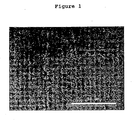
- the water suspension containing the resulting polypeptide was cast on a sheet made from a fluorine-containing resin (polytetrafluoroethylene), and the cast sheet was air-dried to obtain a cast film. Gold was deposited on the film, and the deposited film was observed with the use of a scanning electron microscope. As a result, a fibrous structure was observed as shown in Figure 1 .
- a fluorine-containing resin polytetrafluoroethylene
- a peptide represented by the formula H-(Pro-Hyp-Gly) 5 -OH (Sequence ID No. 5) (manufactured by Peptide Institute, Inc.) was dissolved in water or water containing 50% of methyl alcohol to prepare a solution having a concentration of 0.25 mg/mL, and a circular dichroism spectrum thereof was measured with a spectrometer (J-725, manufactured by JASCO Corp., light path: 1 mm) . In water, the result showed that positive Cotton effect was observed at a wavelength of 223 nm and negative Cotton effect at a wavelength of 201 nm, and confirmed that the peptide formed a triple helical structure.
- the molecular weight was calculated with a Gel Filtration LMW Calibration Kit (manufactured by Amarsham Bioscience K.K.), human insulin (manufactured by Sigma Corporation) and glycine (manufactured by Wako Pure Chemical Industries, Ltd.) as reference materials.
- the proportion of the peptide forming the triple helical structure was about 100% on the basis of the peak area. Also, in the case of water containing 50% of methyl alcohol, almost the same results were given, and the proportion of the peptide forming the triple helical structure was about 100%.
- the reaction mixture was diluted 20-fold with water, and the diluted solution was subjected to a gel-permeation chromatography (AKTA purifier system, manufactured by Amarsham Bioscience K.K., column: Superdex 200 HR 10/30, flow rate: 0.5 mL/min., eluent: 10 mM phosphate buffer (pH 7.4) containing 150 mM NaCl).
- AKTA purifier system manufactured by Amarsham Bioscience K.K.
- eluent 10 mM phosphate buffer (pH 7.4) containing 150 mM NaCl).
- a polypeptide peak was observed in a molecular weight range of 40000 to not less than 100000.
- the molecular weight was calculated with a Gel Filtration LMW Calibration Kit and a Gel Filtration HMW Calibration Kit (manufactured by Amarsham Bioscience K.
- the resulting reaction mixture was diluted 5-fold with water, and the diluted solution was dialyzed against water for 3 days to remove the reagent(s) such as the condensing agent and the unreacted monomer(s).
- the circular dichroism spectrum was measured in the obtained polypeptide. The result showed that positive Cotton effect was observed at a wavelength of 224 nm and negative Cotton effect at a wavelength of 199 nm, and confirmed that the polypeptide formed a triple helical structure.
- H-(Pro-Hyp-Gly) 10 -OH (Sequence ID No. 3) (manufactured by Peptide Institute, Inc.) was dissolved in 0.5 mL of 10 mM phosphate buffer (containing 8.1 mM Na 2 HPO 4 ⁇ 12H 2 O, 1.5 mM KH 2 PO 4 and 2.7 mM KCl, pH 7.4), and the solution was stirred at 20°C.
- 10 mM phosphate buffer containing 8.1 mM Na 2 HPO 4 ⁇ 12H 2 O, 1.5 mM KH 2 PO 4 and 2.7 mM KCl, pH 7.4
- the reaction mixture was diluted 60-fold with water, and the diluted solution was subjected to a gel-permeation chromatography (AKTA purifier system, manufactured by Amarsham Bioscience K. K. , column: Superose 6 HR 10/30, flow rate: 0.5 mL/min., eluent: 10 mM phosphate buffer (pH 7.4) containing 150 mM NaCl) to determine the molecular weight of the reaction product.
- the result confirmed a polypeptide peak corresponding to an average molecular weight of 400000.
- the molecular weight was calculated with a Gel Filtration LMW Calibration Kit and a Gel Filtration HMW Calibration Kit (manufactured by Amarsham Bioscience K.K.) as reference materials.
- the resulting reaction mixture was diluted 5-fold with water, and the diluted solution was dialyzed against water for 3 days to remove the reagent(s) such as the condensing agent and the unreacted monomer(s).
- the circular dichroism spectrum was measured in the obtained polypeptide, and the result showed that positive Cotton effect was observed at a wavelength of 225 nm and negative Cotton effect at a wavelength of 197 nm, and confirmed that the polypeptide formed a triple.helical structure.
- a peptide represented by the formula: H-(Pro-Hyp-Gly) 1 -OH (manufactured by Peptide Institute, Inc.) was dissolved in water to prepare a solution having a concentration of 0.25 mg/mL, and a circular dichroism spectrum thereof was measured with a spectrometer (J-820, manufactured by JASCO Corp., light path: 1 mm) .
- the results showed that positive Cotton effect was observed at a wavelength of 214 nm and negative Cotton effect at a wavelength of 196 nm, and confirmed that the peptide did not form a triple helical structure.
- the molecular weight was measured by gel-permeation chromatography (AKTA purifier system, manufactured by Amarsham Bioscience K. K., column: Superdex Peptide PE 7.5/300, flow rate: 0.25 mL/min., eluent: 10 mM phosphate buffer (pH 7.4) containing 150 mM NaCl).
- AKTA purifier system manufactured by Amarsham Bioscience K. K.
- eluent 10 mM phosphate buffer (pH 7.4) containing 150 mM NaCl).
- the result confirmed one peak showing a molecular weight of about 250 corresponding to a monomer.
- the molecular weight was calculated with a Gel Filtration LMW Calibration Kit (manufactured by Amarsham Bioscience K.K.), human insulin (manufactured by Sigma Corporation) and glycine (manufactured by Wako Pure Chemical Industries, Ltd.) as reference materials.
- the proportion of the peptide forming the triple helical structure was 0%.
- the reaction mixture was diluted 20-fold with water, and the diluted solution was subjected to a gel-permeation chromatography (AKTA purifier system, manufactured by Amarsham Bioscience K.K., column: Superdex 200 HR 10/30, flow rate: 0.5 mL/min., eluent: 10 mM phosphate buffer (pH 7.4) containing 150 mM NaCl) to determine the molecular weight of the reaction product.
- the result confirmed a polypeptide peak in a molecular weight range of 20000 to 30000.
- the molecular weight was calculated with a Gel Filtration LMW Calibration Kit and a Gel Filtration HMW Calibration Kit (manufactured by Amarsham Bioscience K.K.) as reference materials.
- the resulting reaction mixture was diluted 5-fold with water, and the diluted solution was dialyzed against water for 3 days to remove the reagent(s) such as the condensing agent and the unreacted monomer(s).
- the circular dichroism spectrum was measured in the obtained polypeptide, and the result showed that positive Cotton effect was observed at a wavelength of 225 nm and negative Cotton effect at a wavelength of 199 nm, and confirmed that the polypeptide formed a triple helical structure.
- a cast film was made from each polypeptide manufactured in Example: 1, and the film was pasteurized with 25 kGy gamma irradiation. About 10, 000 of mouse normal fibroblast strain NIH3T3 were dispersed on the film, and was incubated in an Eagle's Minimum Essential Medium containing 10% bovine fetal serum in the presence of 5% CO 2 at 37°C for 3 days. The NIH3T3 cell was well adhered to and proliferated on the film made from each polypeptide obtained in Example 1, and was no abnormality in configuration or others.
Landscapes
- Chemical & Material Sciences (AREA)
- Organic Chemistry (AREA)
- Health & Medical Sciences (AREA)
- Life Sciences & Earth Sciences (AREA)
- Medicinal Chemistry (AREA)
- Proteomics, Peptides & Aminoacids (AREA)
- Biochemistry (AREA)
- Biophysics (AREA)
- General Health & Medical Sciences (AREA)
- Genetics & Genomics (AREA)
- Molecular Biology (AREA)
- Gastroenterology & Hepatology (AREA)
- Chemical Kinetics & Catalysis (AREA)
- General Chemical & Material Sciences (AREA)
- Toxicology (AREA)
- Zoology (AREA)
- Peptides Or Proteins (AREA)
- Low-Molecular Organic Synthesis Reactions Using Catalysts (AREA)
- Polyamides (AREA)
- Materials For Medical Uses (AREA)
- Medicines That Contain Protein Lipid Enzymes And Other Medicines (AREA)
Claims (7)
- Procédé pour produire un polypeptide, comprenant l'étape consistant à
condenser un composant peptidique (A) représenté par la formule (1a) suivante :
X-(Pro-Y-Gly)n-OH (1a)
où "X" représente H ou le groupe HOOC-(CH2)m-CO- ("m" étant un nombre entier de 1 à 18), "Y" représente Hyp et "n" est un nombre entier de 1 à 3 ; ou
cocondenser le composant peptidique (A) avec un composant peptidique (B) représenté par la formule (2a) suivante et/ou un composé (C) représenté par la formule (3a) suivante :
X-(Z)r-OH (2a)
où "X" représente H ou le groupe HOOC-(CH2)m-CO- ("m" étant un nombre entier de 1 à 18), "Z" représente une chaîne peptidique comprenant 1 à 10 résidus d'acides aminés et "r" est un nombre entier de 1 à 20 ;
H2N-R-NH2 (3a)
où "R" représente un groupe alkylène linéaire ou ramifié ;
dans lequel le rapport du composant peptidique (A) au composant peptidique (B) [le premier (A)/au dernier (B)] est 100/0 à 30/70 (% molaire) ;
à condition que
dans le cas où "X" représente le groupe HOOC-(CH2)m-CO- ("m" avant la même signification qu'indiqué ci-dessus) dans la formule (1a) et/ou (2a), la quantité du composé (C) soit sensiblement 1 mole relatif à 1 mole de la quantité molaire totale du composant peptidique (A) et/ou du composant peptidique (B) ; et
dans le cas où "X" représente H dans la formule (1a) et/ou (2a), la réaction est effectuée sans le composé (C) ;
dans lequel les étapes de réaction sont effectuées dans un solvant en présence d'un agent déshydratant et de condensation et d'un agent auxiliaire de condensation, et au moins une partie du polypeptide forme une structure en triple hélice. - Procédé selon la revendication 1, dans lequel l'agent déshydratant et de condensation comprend au moins un élément choisi dans le groupe consistant en un agent de condensation de la série des carbodiimides, un agent de condensation de la série des fluorophosphates et un diphényl-phosphorylazide.
- Procédé selon la revendication 1, qui est effectué dans un système de solvant anhydre, dans lequel la proportion de l'agent déshydratant et de condensation est de 0,7 à 5 moles relatif à 1 mole de la quantité molaire totale des composants réactifs (1a), (2a) et (3a).
- Procédé selon la revendication 1, qui est effectué dans un système de solvant aqueux, dans lequel la proportion de l'agent déshydratant et de condensation est de 2 à 500 moles relatif à 1 mole de la quantité molaire totale des composants réactifs (1a), (2a) et (3a).
- Procédé selon la revendication 1, dans lequel l'agent auxiliaire de condensation comprend au moins un élément choisi dans le groupe consistant en un N-hydroxyimide d'acide polycarboxylique, un N-hydroxytriazole, une triazine et un ester éthylique d'acide 2-hydroxyimino-2-cyanoacétique.
- Procédé selon la revendication 1, dans lequel la quantité de l'agent auxiliaire de condensation est de 0,5 à 5 moles relatif à 1 mole de la quantité molaire totale des composants réactifs (1a), (2a) et (3a).
- Procédé selon la revendication 1, dans lequel n est 1.
Applications Claiming Priority (2)
| Application Number | Priority Date | Filing Date | Title |
|---|---|---|---|
| JP2002053299 | 2002-02-28 | ||
| EP03004059A EP1340767B9 (fr) | 2002-02-28 | 2003-02-25 | Polypeptide utile comme biomaterieau et procédé de préparation |
Related Parent Applications (2)
| Application Number | Title | Priority Date | Filing Date |
|---|---|---|---|
| EP03004059.6 Division | 2003-02-25 | ||
| EP03004059A Division EP1340767B9 (fr) | 2002-02-28 | 2003-02-25 | Polypeptide utile comme biomaterieau et procédé de préparation |
Publications (2)
| Publication Number | Publication Date |
|---|---|
| EP1923398A1 EP1923398A1 (fr) | 2008-05-21 |
| EP1923398B1 true EP1923398B1 (fr) | 2011-01-05 |
Family
ID=27678551
Family Applications (2)
| Application Number | Title | Priority Date | Filing Date |
|---|---|---|---|
| EP03004059A Expired - Lifetime EP1340767B9 (fr) | 2002-02-28 | 2003-02-25 | Polypeptide utile comme biomaterieau et procédé de préparation |
| EP08001783A Expired - Lifetime EP1923398B1 (fr) | 2002-02-28 | 2003-02-25 | Processus de production d'un polypeptide |
Family Applications Before (1)
| Application Number | Title | Priority Date | Filing Date |
|---|---|---|---|
| EP03004059A Expired - Lifetime EP1340767B9 (fr) | 2002-02-28 | 2003-02-25 | Polypeptide utile comme biomaterieau et procédé de préparation |
Country Status (6)
| Country | Link |
|---|---|
| US (2) | US7262275B2 (fr) |
| EP (2) | EP1340767B9 (fr) |
| JP (2) | JP5070442B2 (fr) |
| AT (2) | ATE494299T1 (fr) |
| CA (1) | CA2420355C (fr) |
| DE (2) | DE60326021D1 (fr) |
Families Citing this family (26)
| Publication number | Priority date | Publication date | Assignee | Title |
|---|---|---|---|---|
| JP5070442B2 (ja) * | 2002-02-28 | 2012-11-14 | 株式会社Phg | 新規なポリペプチドおよびその製造方法 |
| WO2007010623A1 (fr) | 2005-07-22 | 2007-01-25 | Phg Corporation | Nouveau polypeptide et procédé servant à produire celui-ci |
| US20070224251A1 (en) * | 2006-03-22 | 2007-09-27 | Masao Tanihara | Hemostatic material |
| JP5251516B2 (ja) * | 2006-12-21 | 2013-07-31 | Jnc株式会社 | 血小板凝集惹起物質 |
| WO2008114577A2 (fr) * | 2007-02-26 | 2008-09-25 | National University Corporation NARA Institute of Science and Technology | Peptide antibactérien |
| CN101072380B (zh) * | 2007-06-08 | 2010-12-08 | 华为技术有限公司 | 内容下发方法及系统、网络设备、移动数据业务管理平台 |
| US8075562B2 (en) * | 2007-06-25 | 2011-12-13 | Wisconsin Alumni Research Foundation | Controlled release of biopharmaceutical growth factors from hydroxyapatite coating on bioresorbable interference screws used in cruciate ligament reconstruction surgery |
| US20090299034A1 (en) * | 2007-08-01 | 2009-12-03 | Mabel Alamino Cejas | Collagen-related peptides |
| WO2009018126A2 (fr) | 2007-08-01 | 2009-02-05 | Ethicon, Inc. | Peptides associés à du collagène et leurs utilisations |
| US8357774B2 (en) | 2007-09-13 | 2013-01-22 | National University Corporation NARA Institute of Science and Technology | Polypeptide and process for producing the same |
| JP5201532B2 (ja) | 2008-03-19 | 2013-06-05 | Jnc株式会社 | 伸縮性積層シート |
| JP5311508B2 (ja) * | 2008-05-07 | 2013-10-09 | 国立大学法人大阪大学 | 非共有結合型コラーゲン架橋剤 |
| US20100021527A1 (en) * | 2008-07-25 | 2010-01-28 | Chunlin Yang | Collagen-related peptides and uses thereof and hemostatic foam substrates |
| US20120122791A1 (en) * | 2009-05-01 | 2012-05-17 | Jnc Corporation | Substrate for cartilage cultivation using artificial collagen, and method for cartilage regeneration treatment using the substrate |
| JP2013198559A (ja) | 2012-03-23 | 2013-10-03 | National Institute For Materials Science | 合成コラーゲンナノファイバーを含む止血材 |
| JP6051619B2 (ja) | 2012-06-29 | 2016-12-27 | Jnc株式会社 | コラーゲン様ポリペプチドの製造方法 |
| US20180128811A1 (en) * | 2012-07-06 | 2018-05-10 | Jnc Corporation | Aspirin response and reactivity test and aspirin compliance test using synthetic collagen |
| WO2014025685A2 (fr) * | 2012-08-06 | 2014-02-13 | Jnc Corporation | Test de réponse et de réactivité à un double traitement avec un médicament antiplaquettaire et de l'aspirine faisant appel à du collagène synthétique |
| JP2015534041A (ja) * | 2012-08-09 | 2015-11-26 | Jnc株式会社 | 合成コラーゲンを用いる抗血小板応答および反応性の試験 |
| KR101687866B1 (ko) * | 2013-11-18 | 2016-12-19 | 주식회사 엘지화학 | 카르본산 변성 니트릴계 공중합체 라텍스 조성물 및 이를 포함하는 딥 성형용 라텍스 조성물 |
| WO2018047785A1 (fr) * | 2016-09-07 | 2018-03-15 | ナガセケムテックス株式会社 | Polypeptide de type collagène |
| JP6252639B2 (ja) * | 2016-09-09 | 2017-12-27 | Jnc株式会社 | コラーゲン様ポリペプチド |
| CN107081271B (zh) * | 2017-06-07 | 2019-06-18 | 中国科学院生态环境研究中心 | 纳米材料多维分离纯化系统 |
| JP2021151953A (ja) * | 2018-03-30 | 2021-09-30 | 独立行政法人国立高等専門学校機構 | 組換え構造タンパク質の製造方法、組換え構造タンパク質、タンパク質成形体及びタンパク質成形体の製造方法 |
| CN117903293B (zh) * | 2024-03-19 | 2025-01-07 | 如凤凰再生科技发展(成都)有限公司 | 一种具有热稳定性和促进自身胶原生成的三螺旋胶原蛋白及其制备方法和用途 |
| CN119954940B (zh) * | 2025-04-09 | 2025-07-11 | 如凤凰再生科技发展(成都)有限公司 | 一种透明、高热稳定性的仿生胶原蛋白、化妆品、药物、组织工程材料或医疗器械及其制备方法和用途 |
Family Cites Families (18)
| Publication number | Priority date | Publication date | Assignee | Title |
|---|---|---|---|---|
| US5158A (en) * | 1847-06-19 | Aib-tight stove | ||
| US797554A (en) * | 1904-08-20 | 1905-08-22 | American Match Mfg Company | Jig-saw. |
| US827192A (en) * | 1905-12-21 | 1906-07-31 | Bessie M Suter | Toilet attachment for chairs. |
| US841425A (en) * | 1906-04-06 | 1907-01-15 | Frederick Nelson | Rotary engine. |
| US853548A (en) * | 1907-01-15 | 1907-05-14 | Gustave L Herz | Antivibration device. |
| US4600533A (en) | 1984-12-24 | 1986-07-15 | Collagen Corporation | Collagen membranes for medical use |
| US5475052A (en) | 1988-11-21 | 1995-12-12 | Collagen Corporation | Collagen-synthetic polymer matrices prepared using a multiple step reaction |
| US5565519A (en) | 1988-11-21 | 1996-10-15 | Collagen Corporation | Clear, chemically modified collagen-synthetic polymer conjugates for ophthalmic applications |
| US5125100A (en) * | 1990-07-02 | 1992-06-23 | Katznelson Ron D | Optimal signal synthesis for distortion cancelling multicarrier systems |
| JPH05125100A (ja) | 1991-09-30 | 1993-05-21 | Nippon Kasei Chem Co Ltd | 高純度のペプシン可溶性魚鱗コラーゲンおよびその製造法 |
| JPH06228506A (ja) | 1993-02-01 | 1994-08-16 | Hokuyoo Kk | 可溶性無菌コラーゲン乾燥物の製造方法 |
| JPH0797454A (ja) | 1993-09-28 | 1995-04-11 | Nippi:Kk | 可溶性架橋コラーゲンの製造法 |
| FR2715405B1 (fr) | 1994-01-24 | 1996-04-05 | Imedex | Procédé pour l'élimination des prions dans des collagènes et collagènes ainsi obtenus. |
| JPH0827192A (ja) | 1994-07-18 | 1996-01-30 | Kawaken Fine Chem Co Ltd | 修飾コラーゲンの製造方法および化粧品基剤 |
| JPH08276003A (ja) | 1995-04-07 | 1996-10-22 | Terumo Corp | 硬組織修復材料および埋入型医療用具 |
| US5973112A (en) * | 1997-08-25 | 1999-10-26 | Wisconsin Alumni Research Foundation | Collagen mimics |
| US6228506B1 (en) * | 1998-03-16 | 2001-05-08 | Natural Resources Canada | Cellulose/polymer composite enthalpy exchanger and method for its manufacture |
| JP5070442B2 (ja) * | 2002-02-28 | 2012-11-14 | 株式会社Phg | 新規なポリペプチドおよびその製造方法 |
-
2003
- 2003-02-20 JP JP2003042518A patent/JP5070442B2/ja not_active Expired - Lifetime
- 2003-02-25 AT AT08001783T patent/ATE494299T1/de not_active IP Right Cessation
- 2003-02-25 AT AT03004059T patent/ATE421972T1/de not_active IP Right Cessation
- 2003-02-25 DE DE60326021T patent/DE60326021D1/de not_active Expired - Lifetime
- 2003-02-25 DE DE60335675T patent/DE60335675D1/de not_active Expired - Lifetime
- 2003-02-25 EP EP03004059A patent/EP1340767B9/fr not_active Expired - Lifetime
- 2003-02-25 EP EP08001783A patent/EP1923398B1/fr not_active Expired - Lifetime
- 2003-02-26 US US10/372,994 patent/US7262275B2/en not_active Expired - Lifetime
- 2003-02-27 CA CA2420355A patent/CA2420355C/fr not_active Expired - Lifetime
-
2007
- 2007-07-26 US US11/878,724 patent/US7544781B2/en not_active Expired - Lifetime
-
2008
- 2008-08-01 JP JP2008199704A patent/JP5162363B2/ja not_active Expired - Lifetime
Also Published As
| Publication number | Publication date |
|---|---|
| ATE494299T1 (de) | 2011-01-15 |
| ATE421972T1 (de) | 2009-02-15 |
| EP1340767B9 (fr) | 2009-08-19 |
| JP2009040782A (ja) | 2009-02-26 |
| DE60335675D1 (de) | 2011-02-17 |
| CA2420355A1 (fr) | 2003-08-28 |
| DE60326021D1 (de) | 2009-03-19 |
| CA2420355C (fr) | 2013-12-03 |
| JP5162363B2 (ja) | 2013-03-13 |
| US20030162941A1 (en) | 2003-08-28 |
| JP2003321500A (ja) | 2003-11-11 |
| US7544781B2 (en) | 2009-06-09 |
| US7262275B2 (en) | 2007-08-28 |
| EP1923398A1 (fr) | 2008-05-21 |
| EP1340767A3 (fr) | 2003-12-10 |
| EP1340767B1 (fr) | 2009-01-28 |
| JP5070442B2 (ja) | 2012-11-14 |
| EP1340767A2 (fr) | 2003-09-03 |
| US20080009604A1 (en) | 2008-01-10 |
Similar Documents
| Publication | Publication Date | Title |
|---|---|---|
| US7544781B2 (en) | Polypeptide and process for producing the same | |
| US20070207955A1 (en) | Novel polypeptide and process for producing the same, and collagenase inhibitor | |
| US20130210147A1 (en) | Bioactive amino acid sequence and use therefrom | |
| US5064430A (en) | Polynonapeptide bioelastomers having an increased elastic modulus | |
| US5856308A (en) | Artificial collagen | |
| US20220371958A1 (en) | Biomaterial composite, peptide-based adhesives and methods of use thereof | |
| AU2007304427A1 (en) | Method for peptide synthesis | |
| JP4303137B2 (ja) | 新規なポリペプチド及びその製造方法 | |
| CN108495882B (zh) | 生物有机尼龙聚合物的制备方法和其作为抗菌材料的用途 | |
| JP7489319B2 (ja) | 細胞膜透過性ペプチド | |
| JP2005053878A (ja) | 新規なポリペプチドおよびその製造方法 | |
| CN101817873A (zh) | 一种促进细胞黏附的多肽及其制备方法 | |
| JP2005060550A (ja) | 被膜形成組成物 | |
| JPWO2013002311A1 (ja) | 幹細胞培養用基材及びそれを用いた培養方法 | |
| US8030448B2 (en) | Polypeptide having collagen-like structure | |
| Paradís Bas | Development of New Tools for the Synthesis of" difficult Peptides" | |
| WO2011145077A2 (fr) | Polypeptides ramifiés et leur utilisation pour promouvoir l'adhésion de cellules à des surfaces solides | |
| JP2005126360A (ja) | 新規なポリペプチドで構成されたコラゲナーゼ阻害剤 | |
| JP2005263784A (ja) | コラーゲン様構造を有するポリペプチド | |
| Paradís Bas | Development of New Tools for the Synthesis of | |
| KR20220011745A (ko) | 펩타이드 기반 일산화질소 공여체의 제조방법 | |
| Feng | Collagen-like biomaterials | |
| JPS6330499A (ja) | オピオイドペプチド・ポリペプチド複合体 | |
| Polypeptides et al. | Springer-Verlag Berlin Heidelberg 2011 Published online: 9 August 2011 | |
| Kwak | The design, synthesis and characterization of novel triple helical collagen mimetic structures |
Legal Events
| Date | Code | Title | Description |
|---|---|---|---|
| PUAI | Public reference made under article 153(3) epc to a published international application that has entered the european phase |
Free format text: ORIGINAL CODE: 0009012 |
|
| AC | Divisional application: reference to earlier application |
Ref document number: 1340767 Country of ref document: EP Kind code of ref document: P |
|
| AK | Designated contracting states |
Kind code of ref document: A1 Designated state(s): AT BE BG CH CY CZ DE DK EE ES FI FR GB GR HU IE IT LI LU MC NL PT SE SI SK TR |
|
| RIN1 | Information on inventor provided before grant (corrected) |
Inventor name: KINOSHITA, HISAO Inventor name: MIKAMI, HIROSHI Inventor name: OTSUKI, CHIKARA Inventor name: TANIHARA, MASAO |
|
| 17P | Request for examination filed |
Effective date: 20080912 |
|
| 17Q | First examination report despatched |
Effective date: 20081013 |
|
| AKX | Designation fees paid |
Designated state(s): AT BE BG CH CY CZ DE DK EE ES FI FR GB GR HU IE IT LI LU MC NL PT SE SI SK TR |
|
| RAP1 | Party data changed (applicant data changed or rights of an application transferred) |
Owner name: CHISSO CORPORATION |
|
| GRAP | Despatch of communication of intention to grant a patent |
Free format text: ORIGINAL CODE: EPIDOSNIGR1 |
|
| GRAS | Grant fee paid |
Free format text: ORIGINAL CODE: EPIDOSNIGR3 |
|
| GRAA | (expected) grant |
Free format text: ORIGINAL CODE: 0009210 |
|
| AC | Divisional application: reference to earlier application |
Ref document number: 1340767 Country of ref document: EP Kind code of ref document: P |
|
| AK | Designated contracting states |
Kind code of ref document: B1 Designated state(s): AT BE BG CH CY CZ DE DK EE ES FI FR GB GR HU IE IT LI LU MC NL PT SE SI SK TR |
|
| REG | Reference to a national code |
Ref country code: GB Ref legal event code: FG4D |
|
| REG | Reference to a national code |
Ref country code: CH Ref legal event code: EP |
|
| REG | Reference to a national code |
Ref country code: IE Ref legal event code: FG4D |
|
| REF | Corresponds to: |
Ref document number: 60335675 Country of ref document: DE Date of ref document: 20110217 Kind code of ref document: P |
|
| REG | Reference to a national code |
Ref country code: DE Ref legal event code: R096 Ref document number: 60335675 Country of ref document: DE Effective date: 20110217 |
|
| REG | Reference to a national code |
Ref country code: NL Ref legal event code: VDEP Effective date: 20110105 |
|
| PG25 | Lapsed in a contracting state [announced via postgrant information from national office to epo] |
Ref country code: SI Free format text: LAPSE BECAUSE OF FAILURE TO SUBMIT A TRANSLATION OF THE DESCRIPTION OR TO PAY THE FEE WITHIN THE PRESCRIBED TIME-LIMIT Effective date: 20110105 |
|
| REG | Reference to a national code |
Ref country code: GB Ref legal event code: 732E Free format text: REGISTERED BETWEEN 20110616 AND 20110622 |
|
| PG25 | Lapsed in a contracting state [announced via postgrant information from national office to epo] |
Ref country code: GR Free format text: LAPSE BECAUSE OF FAILURE TO SUBMIT A TRANSLATION OF THE DESCRIPTION OR TO PAY THE FEE WITHIN THE PRESCRIBED TIME-LIMIT Effective date: 20110406 Ref country code: ES Free format text: LAPSE BECAUSE OF FAILURE TO SUBMIT A TRANSLATION OF THE DESCRIPTION OR TO PAY THE FEE WITHIN THE PRESCRIBED TIME-LIMIT Effective date: 20110416 Ref country code: SE Free format text: LAPSE BECAUSE OF FAILURE TO SUBMIT A TRANSLATION OF THE DESCRIPTION OR TO PAY THE FEE WITHIN THE PRESCRIBED TIME-LIMIT Effective date: 20110105 Ref country code: PT Free format text: LAPSE BECAUSE OF FAILURE TO SUBMIT A TRANSLATION OF THE DESCRIPTION OR TO PAY THE FEE WITHIN THE PRESCRIBED TIME-LIMIT Effective date: 20110505 |
|
| PG25 | Lapsed in a contracting state [announced via postgrant information from national office to epo] |
Ref country code: BE Free format text: LAPSE BECAUSE OF FAILURE TO SUBMIT A TRANSLATION OF THE DESCRIPTION OR TO PAY THE FEE WITHIN THE PRESCRIBED TIME-LIMIT Effective date: 20110105 Ref country code: CY Free format text: LAPSE BECAUSE OF FAILURE TO SUBMIT A TRANSLATION OF THE DESCRIPTION OR TO PAY THE FEE WITHIN THE PRESCRIBED TIME-LIMIT Effective date: 20110105 Ref country code: AT Free format text: LAPSE BECAUSE OF FAILURE TO SUBMIT A TRANSLATION OF THE DESCRIPTION OR TO PAY THE FEE WITHIN THE PRESCRIBED TIME-LIMIT Effective date: 20110105 Ref country code: FI Free format text: LAPSE BECAUSE OF FAILURE TO SUBMIT A TRANSLATION OF THE DESCRIPTION OR TO PAY THE FEE WITHIN THE PRESCRIBED TIME-LIMIT Effective date: 20110105 Ref country code: NL Free format text: LAPSE BECAUSE OF FAILURE TO SUBMIT A TRANSLATION OF THE DESCRIPTION OR TO PAY THE FEE WITHIN THE PRESCRIBED TIME-LIMIT Effective date: 20110105 Ref country code: BG Free format text: LAPSE BECAUSE OF FAILURE TO SUBMIT A TRANSLATION OF THE DESCRIPTION OR TO PAY THE FEE WITHIN THE PRESCRIBED TIME-LIMIT Effective date: 20110405 |
|
| REG | Reference to a national code |
Ref country code: FR Ref legal event code: TP |
|
| PG25 | Lapsed in a contracting state [announced via postgrant information from national office to epo] |
Ref country code: MC Free format text: LAPSE BECAUSE OF NON-PAYMENT OF DUE FEES Effective date: 20110228 |
|
| REG | Reference to a national code |
Ref country code: CH Ref legal event code: PL |
|
| PG25 | Lapsed in a contracting state [announced via postgrant information from national office to epo] |
Ref country code: EE Free format text: LAPSE BECAUSE OF FAILURE TO SUBMIT A TRANSLATION OF THE DESCRIPTION OR TO PAY THE FEE WITHIN THE PRESCRIBED TIME-LIMIT Effective date: 20110105 Ref country code: LI Free format text: LAPSE BECAUSE OF NON-PAYMENT OF DUE FEES Effective date: 20110228 Ref country code: DK Free format text: LAPSE BECAUSE OF FAILURE TO SUBMIT A TRANSLATION OF THE DESCRIPTION OR TO PAY THE FEE WITHIN THE PRESCRIBED TIME-LIMIT Effective date: 20110105 Ref country code: CH Free format text: LAPSE BECAUSE OF NON-PAYMENT OF DUE FEES Effective date: 20110228 |
|
| PLBE | No opposition filed within time limit |
Free format text: ORIGINAL CODE: 0009261 |
|
| STAA | Information on the status of an ep patent application or granted ep patent |
Free format text: STATUS: NO OPPOSITION FILED WITHIN TIME LIMIT |
|
| REG | Reference to a national code |
Ref country code: IE Ref legal event code: MM4A |
|
| PG25 | Lapsed in a contracting state [announced via postgrant information from national office to epo] |
Ref country code: CZ Free format text: LAPSE BECAUSE OF FAILURE TO SUBMIT A TRANSLATION OF THE DESCRIPTION OR TO PAY THE FEE WITHIN THE PRESCRIBED TIME-LIMIT Effective date: 20110105 Ref country code: SK Free format text: LAPSE BECAUSE OF FAILURE TO SUBMIT A TRANSLATION OF THE DESCRIPTION OR TO PAY THE FEE WITHIN THE PRESCRIBED TIME-LIMIT Effective date: 20110105 |
|
| 26N | No opposition filed |
Effective date: 20111006 |
|
| PG25 | Lapsed in a contracting state [announced via postgrant information from national office to epo] |
Ref country code: IT Free format text: LAPSE BECAUSE OF FAILURE TO SUBMIT A TRANSLATION OF THE DESCRIPTION OR TO PAY THE FEE WITHIN THE PRESCRIBED TIME-LIMIT Effective date: 20110105 |
|
| REG | Reference to a national code |
Ref country code: DE Ref legal event code: R082 Ref document number: 60335675 Country of ref document: DE Representative=s name: PATENTANWAELTE VON KREISLER, SELTING, WERNER, DE |
|
| PG25 | Lapsed in a contracting state [announced via postgrant information from national office to epo] |
Ref country code: IE Free format text: LAPSE BECAUSE OF NON-PAYMENT OF DUE FEES Effective date: 20110225 |
|
| REG | Reference to a national code |
Ref country code: DE Ref legal event code: R097 Ref document number: 60335675 Country of ref document: DE Effective date: 20111006 |
|
| REG | Reference to a national code |
Ref country code: DE Ref legal event code: R081 Ref document number: 60335675 Country of ref document: DE Owner name: JNC CORPORATION, JP Free format text: FORMER OWNER: CHISSO CORP., OSAKA, JP Effective date: 20120117 Ref country code: DE Ref legal event code: R082 Ref document number: 60335675 Country of ref document: DE Representative=s name: VON KREISLER SELTING WERNER - PARTNERSCHAFT VO, DE Effective date: 20120117 Ref country code: DE Ref legal event code: R082 Ref document number: 60335675 Country of ref document: DE Representative=s name: DOMPATENT VON KREISLER SELTING WERNER - PARTNE, DE Effective date: 20120117 |
|
| PG25 | Lapsed in a contracting state [announced via postgrant information from national office to epo] |
Ref country code: LU Free format text: LAPSE BECAUSE OF NON-PAYMENT OF DUE FEES Effective date: 20110225 |
|
| PG25 | Lapsed in a contracting state [announced via postgrant information from national office to epo] |
Ref country code: TR Free format text: LAPSE BECAUSE OF FAILURE TO SUBMIT A TRANSLATION OF THE DESCRIPTION OR TO PAY THE FEE WITHIN THE PRESCRIBED TIME-LIMIT Effective date: 20110105 |
|
| PG25 | Lapsed in a contracting state [announced via postgrant information from national office to epo] |
Ref country code: HU Free format text: LAPSE BECAUSE OF FAILURE TO SUBMIT A TRANSLATION OF THE DESCRIPTION OR TO PAY THE FEE WITHIN THE PRESCRIBED TIME-LIMIT Effective date: 20110105 |
|
| REG | Reference to a national code |
Ref country code: FR Ref legal event code: PLFP Year of fee payment: 13 |
|
| REG | Reference to a national code |
Ref country code: FR Ref legal event code: PLFP Year of fee payment: 14 |
|
| REG | Reference to a national code |
Ref country code: FR Ref legal event code: PLFP Year of fee payment: 15 |
|
| REG | Reference to a national code |
Ref country code: FR Ref legal event code: PLFP Year of fee payment: 16 |
|
| REG | Reference to a national code |
Ref country code: DE Ref legal event code: R082 Ref document number: 60335675 Country of ref document: DE Representative=s name: DOMPATENT VON KREISLER SELTING WERNER - PARTNE, DE Ref country code: DE Ref legal event code: R081 Ref document number: 60335675 Country of ref document: DE Owner name: UNIQS CORPORATION, YOKOHAMA-SHI, JP Free format text: FORMER OWNER: JNC CORPORATION, TOKYO, JP |
|
| REG | Reference to a national code |
Ref country code: GB Ref legal event code: 732E Free format text: REGISTERED BETWEEN 20200312 AND 20200318 |
|
| PGFP | Annual fee paid to national office [announced via postgrant information from national office to epo] |
Ref country code: GB Payment date: 20220228 Year of fee payment: 20 Ref country code: DE Payment date: 20220225 Year of fee payment: 20 |
|
| PGFP | Annual fee paid to national office [announced via postgrant information from national office to epo] |
Ref country code: FR Payment date: 20220117 Year of fee payment: 20 |
|
| REG | Reference to a national code |
Ref country code: DE Ref legal event code: R071 Ref document number: 60335675 Country of ref document: DE |
|
| REG | Reference to a national code |
Ref country code: GB Ref legal event code: PE20 Expiry date: 20230224 |
|
| PG25 | Lapsed in a contracting state [announced via postgrant information from national office to epo] |
Ref country code: GB Free format text: LAPSE BECAUSE OF EXPIRATION OF PROTECTION Effective date: 20230224 |