EP1914714A1 - Verfahren zur Verbesserung des Klanges von Musikinstrumenten - Google Patents
Verfahren zur Verbesserung des Klanges von Musikinstrumenten Download PDFInfo
- Publication number
- EP1914714A1 EP1914714A1 EP06018419A EP06018419A EP1914714A1 EP 1914714 A1 EP1914714 A1 EP 1914714A1 EP 06018419 A EP06018419 A EP 06018419A EP 06018419 A EP06018419 A EP 06018419A EP 1914714 A1 EP1914714 A1 EP 1914714A1
- Authority
- EP
- European Patent Office
- Prior art keywords
- sound
- crystalline body
- crystalline
- component
- passive
- Prior art date
- Legal status (The legal status is an assumption and is not a legal conclusion. Google has not performed a legal analysis and makes no representation as to the accuracy of the status listed.)
- Ceased
Links
- 238000000034 method Methods 0.000 title claims abstract description 26
- 239000007787 solid Substances 0.000 claims abstract description 8
- 239000010432 diamond Substances 0.000 claims abstract description 7
- 229910052580 B4C Inorganic materials 0.000 claims abstract description 6
- INAHAJYZKVIDIZ-UHFFFAOYSA-N boron carbide Chemical compound B12B3B4C32B41 INAHAJYZKVIDIZ-UHFFFAOYSA-N 0.000 claims abstract description 6
- 229910003460 diamond Inorganic materials 0.000 claims abstract description 6
- MCMNRKCIXSYSNV-UHFFFAOYSA-N ZrO2 Inorganic materials O=[Zr]=O MCMNRKCIXSYSNV-UHFFFAOYSA-N 0.000 claims abstract description 4
- 229910052582 BN Inorganic materials 0.000 claims abstract description 3
- PZNSFCLAULLKQX-UHFFFAOYSA-N Boron nitride Chemical compound N#B PZNSFCLAULLKQX-UHFFFAOYSA-N 0.000 claims abstract description 3
- RVTZCBVAJQQJTK-UHFFFAOYSA-N oxygen(2-);zirconium(4+) Chemical compound [O-2].[O-2].[Zr+4] RVTZCBVAJQQJTK-UHFFFAOYSA-N 0.000 claims abstract 2
- 230000000694 effects Effects 0.000 claims description 18
- 239000000463 material Substances 0.000 claims description 12
- 238000004146 energy storage Methods 0.000 claims description 9
- 239000013078 crystal Substances 0.000 claims description 7
- 229910018072 Al 2 O 3 Inorganic materials 0.000 claims 1
- TWNQGVIAIRXVLR-UHFFFAOYSA-N oxo(oxoalumanyloxy)alumane Chemical compound O=[Al]O[Al]=O TWNQGVIAIRXVLR-UHFFFAOYSA-N 0.000 claims 1
- PNEYBMLMFCGWSK-UHFFFAOYSA-N Alumina Chemical compound [O-2].[O-2].[O-2].[Al+3].[Al+3] PNEYBMLMFCGWSK-UHFFFAOYSA-N 0.000 abstract description 5
- 229910001018 Cast iron Inorganic materials 0.000 abstract description 3
- 235000014676 Phragmites communis Nutrition 0.000 description 7
- 238000010276 construction Methods 0.000 description 4
- 229910001060 Gray iron Inorganic materials 0.000 description 3
- 239000012528 membrane Substances 0.000 description 3
- 238000009527 percussion Methods 0.000 description 3
- 230000001960 triggered effect Effects 0.000 description 3
- 208000023514 Barrett esophagus Diseases 0.000 description 2
- 229910001369 Brass Inorganic materials 0.000 description 2
- 241000218657 Picea Species 0.000 description 2
- 230000005540 biological transmission Effects 0.000 description 2
- 230000015572 biosynthetic process Effects 0.000 description 2
- 239000010951 brass Substances 0.000 description 2
- 230000010363 phase shift Effects 0.000 description 2
- 230000008569 process Effects 0.000 description 2
- 238000004088 simulation Methods 0.000 description 2
- 101100390736 Danio rerio fign gene Proteins 0.000 description 1
- 241000333074 Eucalyptus occidentalis Species 0.000 description 1
- 240000006829 Ficus sundaica Species 0.000 description 1
- 101100390738 Mus musculus Fign gene Proteins 0.000 description 1
- 240000000528 Ricinus communis Species 0.000 description 1
- 235000004443 Ricinus communis Nutrition 0.000 description 1
- 230000002411 adverse Effects 0.000 description 1
- 238000005266 casting Methods 0.000 description 1
- 229910010293 ceramic material Inorganic materials 0.000 description 1
- 230000008878 coupling Effects 0.000 description 1
- 238000010168 coupling process Methods 0.000 description 1
- 238000005859 coupling reaction Methods 0.000 description 1
- 230000001419 dependent effect Effects 0.000 description 1
- 238000009795 derivation Methods 0.000 description 1
- 238000011161 development Methods 0.000 description 1
- 230000018109 developmental process Effects 0.000 description 1
- 230000008030 elimination Effects 0.000 description 1
- 238000003379 elimination reaction Methods 0.000 description 1
- 230000007246 mechanism Effects 0.000 description 1
- 210000000056 organ Anatomy 0.000 description 1
- 230000005855 radiation Effects 0.000 description 1
- 239000012925 reference material Substances 0.000 description 1
- 230000004044 response Effects 0.000 description 1
- 230000002123 temporal effect Effects 0.000 description 1
- 230000009466 transformation Effects 0.000 description 1
- XLYOFNOQVPJJNP-UHFFFAOYSA-N water Substances O XLYOFNOQVPJJNP-UHFFFAOYSA-N 0.000 description 1
- 239000002023 wood Substances 0.000 description 1
Images
Classifications
-
- G—PHYSICS
- G10—MUSICAL INSTRUMENTS; ACOUSTICS
- G10C—PIANOS, HARPSICHORDS, SPINETS OR SIMILAR STRINGED MUSICAL INSTRUMENTS WITH ONE OR MORE KEYBOARDS
- G10C9/00—Methods, tools or materials specially adapted for the manufacture or maintenance of musical instruments covered by this subclass
-
- G—PHYSICS
- G10—MUSICAL INSTRUMENTS; ACOUSTICS
- G10D—STRINGED MUSICAL INSTRUMENTS; WIND MUSICAL INSTRUMENTS; ACCORDIONS OR CONCERTINAS; PERCUSSION MUSICAL INSTRUMENTS; AEOLIAN HARPS; SINGING-FLAME MUSICAL INSTRUMENTS; MUSICAL INSTRUMENTS NOT OTHERWISE PROVIDED FOR
- G10D3/00—Details of, or accessories for, stringed musical instruments, e.g. slide-bars
- G10D3/22—Material for manufacturing stringed musical instruments; Treatment of the material
-
- G—PHYSICS
- G10—MUSICAL INSTRUMENTS; ACOUSTICS
- G10D—STRINGED MUSICAL INSTRUMENTS; WIND MUSICAL INSTRUMENTS; ACCORDIONS OR CONCERTINAS; PERCUSSION MUSICAL INSTRUMENTS; AEOLIAN HARPS; SINGING-FLAME MUSICAL INSTRUMENTS; MUSICAL INSTRUMENTS NOT OTHERWISE PROVIDED FOR
- G10D9/00—Details of, or accessories for, wind musical instruments
- G10D9/08—Material for manufacturing wind musical instruments; Treatment of the material
Definitions
- the invention relates to a method for improving the sound of musical instruments. It relates in particular to a method for reducing the sound output and / or for reducing energy storage effects of the passive range of musical instruments. Finally, the invention also provides a novel musical instrument.
- the term "passive area" of a musical instrument is to be understood as meaning those components or areas of components which are not directly required for sound generation. Examples of such components are e.g. in the case of a grand piano or grand piano, the cast plate on which the strings are stretched, the neck of a violin, the timpani on which the membrane is mounted, etc.
- the "active region" of a musical instrument in the sense of this invention is to be understood as meaning those components or regions of components which are directly required for sound generation, such as, for example, the Strings of a piano / grand piano or a violin, the reed of a clarinet, etc.
- a primary sound event is one generated by the vibrations of the components of the active area of a component is triggered, in other words, that is actually in the foreground for the sound of the musical instrument wanted sound event.
- a secondary sound event the sound event generated by vibrations or vibrations of the components of the passive range of the musical instrument is here understood, which co-determines the overall sound by superposition with the primary sound event.
- the soundboard 13 is sound conducting with the rest of the body (casement 6 and wall 7), and in this way connected to all components of the instrument. This means that all parts of the instrument are affected by the primary sound event, i. be excited by the vibrations of the active region consisting of strings, bridge 14 and sound board 13, to resonate.
- the energy storage effect is understood as the following phenomenon: When a sound event is triggered, the sound energy propagates as a temporal process throughout the instrument. Since the components are "at rest” up to this moment, each component first sucks in full with the sound energy flowing into it before it comes to the emission of energy surplus in sound conductive components and the surrounding air. In the case of the active components (for example, a piano / grand piano strings, bridge 14 and sound board 13) this effect is desired and necessary. However, in the passive components, which are insignificant for the primary sound event, the sound energy that reaches them, which varies in their component-to-component proportions, leads to phase shifts and thus interference with the primary sound event.
- claim 9 discloses a use according to the invention of a crystalline body with a speed of sound in the solid of more than 8,000 m / s for influencing the sound of musical instruments, and claim 10 claims a musical instrument equipped with such a crystalline body according to the invention.
- the essential aspect of the invention is the recognition that it is possible to derive sound energy from a musical instrument by means of an effect referred to herein as "kinetic disposal".
- the kinetic disposal can take place on a component attributable overall to the passive area of the musical instrument, in order to avoid energy storage effects occurring in this component and their negative repercussion on the current or possibly subsequent primary sound event (see claim 2).
- the crystalline body can also be used in a passive region of a component which is also equipped with an active region. This prevents the acoustic energy stored elsewhere in the passive area of the component from flowing back into the active area and adversely affecting the sound of the subsequent primary sound event.
- the kinetic disposal is achieved according to the invention by a crystalline body made of a material with a high speed of sound in the solid state (sound velocity of more than 8,000 m / s) on the non-required for the generation of the primary sound event components of the passive area or on the passive area of Also, an active region having component of the instrument is arranged to reduce the sound output to the environment, as far as possible to eliminate and to reduce its ringing or avoid.
- the decisive factor for the effect of the crystalline body used according to the invention is that there must be a potential for the speed of sound between it and the material of the component to be kinetically disposed of.
- the material used for the kinetic disposal must always have a higher speed of sound than the material to be disposed of. The greater the potential, the clearer the effect (see Table 1).
- the degree of kinetic disposal is given by the ratio of the sound velocities of the two materials.
- transmission factor When using a diamond to dispose of the casting plate of a wing (consisting of gray cast iron), for example, results in a transmission factor of about 4: 1 (18000 m / s: 4500 m / s).
- kinetically disposable materials are wood, gray cast iron, brass, etc., whose sound velocities are all between about 3,000 and 5,000 m / s. Thus, materials with sound velocities of at least 8,000 m / s have sufficient potential to be kinetically disposable.
- Table 1 Degree of kinetic disposal, with air as a reference material speed of sound Passage factor diamond about 18000 m / s about 50: 1 boron carbide 14,400 m / s about 42: 1 alumina about 10000 m / s about 30: 1 spruce about 5000 m / s about 15: 1 cast iron about 4500 m / s about 13: 1 Brass 3400 m / s 10: 1 water 1481 m / s about 4: 1 air 340 m / s 1: 1
- the kinetic disposal makes it possible to unambiguously divert the body and airborne sound energy into the passive area of the instrument almost instantaneously and as inaudible energy into an area outside the entire instrument so that only the active area is sound and airborne affecting the sound-determining element of the instrument.
- the result is a more genuine, clearer and more dynamic primary sound event, free from the interference and distortion inevitably present in any non-kinetically discarded musical instrument.
- the kinetic disposal can also react directly on the active area.
- the reed of a clarinet for example, consists of an active (i.e., free oscillating) region and a passive (i.e., tightly clamped) region.
- the kinetic disposal by means of the method according to the invention by arranging a crystalline body according to the invention directly at the clamping reduces the repercussions of the ringing of the fixed clamping on the active region of the reed.
- the active area returns as quickly as possible in its energetically optimal
- the crystalline bodies are arranged in the passive region of the musical instrument, the best positions for the arrangement of the bodies being determined either in simulations or experimentally.
- the mounting locations may be at the box angle, at the plate wedge between the cast plate and box angle, at the cast plate, at the feet, at the castors, etc.
- the crystalline body is a crystal of high crystalline order, whereby the best results can be achieved with single crystals.
- the higher the speed of sound in the crystal of the selected body the greater the effect of the method according to the invention.
- Materials which have the properties required for kinetic disposal in the sense of the invention are e.g. Diamonds (true or synthetic, with a cubic surface-centered crystal structure and a sound velocity of about 18000 m / s) or ceramic materials such. Boron carbide, alumina, boron nitride, zirconia or the like (with a speed of sound greater than 8000 m / s).
- the size of the crystalline body (or its volume) has no influence on the effect of the kinetic disposal achieved.
- the aim is to have as small and inconspicuous sizes as possible, which are preferably in the range of edge lengths or diameters of the body between a few nanometers and a few centimeters, with reference to the location of the attachment of the crystalline body.
- the crystalline bodies are preferably connected by a firm, direct connection with the respective components of the musical instrument to be disposed of kinetically or with the passive regions of such components, in particular adhesively bonded thereto or embedded therein.
- the present invention describes for the first time by means of kinetic disposal means and ways in which the primary sound event can be radiated undistorted and unadulterated by interferences of secondary sound events by directly dissipating the introduced sound energy from the components in which it is not desired to avoid the described energy storage effects and resulting interference.
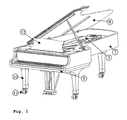
- FIGS. 1 and 2 a wing or its body is shown as a possible musical instrument for the application of the method according to the invention.
- the wing consists of a central main component, the rim, consisting of the wall 7 and the frame 6, which is placed on feet 10 with rollers 11 arranged thereon and closed with a lid 8 on the top.
- the underside of the chair bottom or game table 9 At the front of the rim is the underside of the chair bottom or game table 9, on which there is needed for striking the strings game, consisting of a keyboard (keyboard) and a mechanism.
- sound board 13 usually made of spruce, with overlying cast plate 5, usually made of gray cast iron, on which the strings are spanned, and underlying, the body stiffening struts.
- the connection between struts and cast plate 5 consists of a box angle 4, the connection of strings and sound board 13 is carried out by the firmly connected to the soundboard 13 web 14.
- the music stand 12th In the front upper part of the wing is the music stand 12th
- the wing In the wing are for the actual generation of the primary sound event, ie for the desired vibrations to generate the sound, only the following active components responsible: the strings, the bridge 14 and the soundboard 13. However, these parts with the other passive components, such as the cast plate 5, the box angle 4, the frame 6, the wall 7 and the feet 10, sound conductive connected.
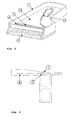
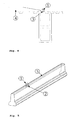
- Such a crystalline body 1 must be connected to the portion of the passive area to be disposed of kinetically (eg the box angle 4, the lid 8 or the cast plate 5, see FIGS. 3 to 5) such that a direct, full-area contact with the component is produced on one side and the other side is free.
- This can e.g. by a counterbore in the form of a fitting bore 2 (see Fig. 3) or by a bond 3 on a flat surface (s. Fig. 4) can be achieved.
- the size or the volume of the crystalline body 1 applied for the kinetic disposal depends, on the one hand, on the material used and the particular point of use and on the other requirements, and can range in diameter from several nanometers to several centimeters.
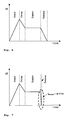
- Figures 6 and 7 show schematically the effect of the method according to the invention on the overall sound of a correspondingly treated instrument.
- the sound event of a wind instrument consists of a swinging column of air inside a pipe.
- the pipe should not affect the air column, as natural vibration of the pipe or mouthpiece to interference, and thus lead to distortions of the sound event. Therefore, within the meaning of this invention, the tube / housing of a wind instrument can be kinetically disposed of, in which the material (diamond, boron carbide or the like) is sound-conducting with the pipe is connected, for example, immediately behind the mouthpiece, in the vicinity of the funnel or similar.
- the primary sound event of a stringed and plucked instrument consists of a vibrating string, which is coupled to a soundboard via a bridge.
- This soundboard amplifies the sound of the strings.
- Undesirable here are vibrations of the passive components such as the neck with the fingerboard.
- This can also be disposed of kinetically in the manner described above in the sense of this invention. The same applies, for example, to the sting of cello and double bass.
- vibration exciters such as e.g. Hammerstielen (piano and grand piano), bows (bowed instruments), plectrums (plucked instruments), mallets and sticks (percussion instruments) and similar:
- the respective vibration exciter By triggering a sound event, the respective vibration exciter is also set in vibration. At the time of the triggering of the next sound event, energy from the previous event can still be stored in the vibration generator and have a distorting influence on the subsequent event. The kinetic disposal takes place in the manner already described.
- diaphragmophones such as timpani and drums, in which the influence of housing or body vibrations on the membrane is minimized by kinetic disposal, as well as other percussion instruments
- Orff's instruments vibraphones, marimbas and much more
Landscapes
- Engineering & Computer Science (AREA)
- Physics & Mathematics (AREA)
- Acoustics & Sound (AREA)
- Multimedia (AREA)
- Manufacturing & Machinery (AREA)
- Stringed Musical Instruments (AREA)
- Auxiliary Devices For Music (AREA)
Priority Applications (6)
| Application Number | Priority Date | Filing Date | Title |
|---|---|---|---|
| EP14185620.3A EP2830038B1 (de) | 2006-09-04 | 2006-09-04 | Musikinstrument |
| EP06018419A EP1914714A1 (de) | 2006-09-04 | 2006-09-04 | Verfahren zur Verbesserung des Klanges von Musikinstrumenten |
| JP2009527114A JP2010503037A (ja) | 2006-09-04 | 2007-08-29 | 楽器の音響を改善する方法 |
| CNA2007800326979A CN101512635A (zh) | 2006-09-04 | 2007-08-29 | 用于改善乐器乐音的方法 |
| PCT/EP2007/058980 WO2008028847A1 (de) | 2006-09-04 | 2007-08-29 | Verfahren zur verbesserung des klanges von musikinstrumenten |
| US12/439,817 US20100050850A1 (en) | 2006-09-04 | 2007-08-29 | Method for improving the sound of musical instruments |
Applications Claiming Priority (1)
| Application Number | Priority Date | Filing Date | Title |
|---|---|---|---|
| EP06018419A EP1914714A1 (de) | 2006-09-04 | 2006-09-04 | Verfahren zur Verbesserung des Klanges von Musikinstrumenten |
Related Child Applications (1)
| Application Number | Title | Priority Date | Filing Date |
|---|---|---|---|
| EP14185620.3A Division EP2830038B1 (de) | 2006-09-04 | 2006-09-04 | Musikinstrument |
Publications (1)
| Publication Number | Publication Date |
|---|---|
| EP1914714A1 true EP1914714A1 (de) | 2008-04-23 |
Family
ID=37744069
Family Applications (2)
| Application Number | Title | Priority Date | Filing Date |
|---|---|---|---|
| EP06018419A Ceased EP1914714A1 (de) | 2006-09-04 | 2006-09-04 | Verfahren zur Verbesserung des Klanges von Musikinstrumenten |
| EP14185620.3A Active EP2830038B1 (de) | 2006-09-04 | 2006-09-04 | Musikinstrument |
Family Applications After (1)
| Application Number | Title | Priority Date | Filing Date |
|---|---|---|---|
| EP14185620.3A Active EP2830038B1 (de) | 2006-09-04 | 2006-09-04 | Musikinstrument |
Country Status (5)
| Country | Link |
|---|---|
| US (1) | US20100050850A1 (enExample) |
| EP (2) | EP1914714A1 (enExample) |
| JP (1) | JP2010503037A (enExample) |
| CN (1) | CN101512635A (enExample) |
| WO (1) | WO2008028847A1 (enExample) |
Families Citing this family (5)
| Publication number | Priority date | Publication date | Assignee | Title |
|---|---|---|---|---|
| US8962966B2 (en) | 2011-09-14 | 2015-02-24 | Yamaha Corporation | Keyboard instrument |
| US8735702B1 (en) * | 2012-03-21 | 2014-05-27 | Deborah R. Miles | Portable dissipating medium used for removal of vibrational interference in a bowed string of a violin family instrument |
| USD783084S1 (en) * | 2013-04-05 | 2017-04-04 | Steinway & Sons | Piano |
| CN107248404A (zh) * | 2017-06-05 | 2017-10-13 | 陆俊豪 | 一种提琴调节阻尼消噪的方法 |
| CN109102783B (zh) * | 2017-06-20 | 2023-02-28 | 鲁润泽 | 多元素采样噪声屏蔽质感补偿声场重合古琴增音琴台 |
Citations (2)
| Publication number | Priority date | Publication date | Assignee | Title |
|---|---|---|---|---|
| AT176731B (de) * | 1952-08-06 | 1953-11-25 | Hermann Jun Marschik | Vorrichtung zur Beseitigung des "Wolfs" bei Streichinstrumenten, insbesondere bei Violoncellos |
| US6664456B2 (en) * | 2001-04-03 | 2003-12-16 | Philip Momchilovich | Harmonic vibration damping device for musical instruments and firearms |
Family Cites Families (20)
| Publication number | Priority date | Publication date | Assignee | Title |
|---|---|---|---|---|
| US59204A (en) * | 1866-10-30 | 1866-10-30 | Improvement in cornets and other wind-instrum ents | |
| US2229440A (en) * | 1937-01-02 | 1941-01-21 | Carlisle Richard Wallace | Piano soundboard |
| US3769871A (en) * | 1972-04-25 | 1973-11-06 | J Cawthorn | Stone guitar with tuned neck |
| US4607559A (en) * | 1984-01-23 | 1986-08-26 | Richard Armin | Stringed musical instrument |
| US4919029A (en) * | 1989-01-10 | 1990-04-24 | Richard Excellente | Asymmetric insert loaded stringed instrument |
| US5267499A (en) * | 1992-10-13 | 1993-12-07 | Othon Robert S | Method of enhancing and modifying the visual and aural characteristics of a stringed instrument |
| US5644095A (en) * | 1994-01-21 | 1997-07-01 | Davidson; John R. | Brass instrument improvement |
| US5965832A (en) * | 1995-04-03 | 1999-10-12 | Davidson; John R. | Brass instrument improvement |
| DE19527018C1 (de) * | 1995-07-24 | 1997-02-20 | Siemens Ag | Ultraschallwandler |
| US5986190A (en) * | 1997-10-18 | 1999-11-16 | Wolff; Steven B. | String bearing and tremolo device method and apparatus for stringed musical instrument |
| US6657113B2 (en) * | 2002-01-30 | 2003-12-02 | Alexander Béla Herman | Molded fretboard and guitar |
| US20040040432A1 (en) * | 2002-02-14 | 2004-03-04 | Erickson Gary D | Intonation method and apparatus for stringed musical instrument |
| US7645354B1 (en) * | 2003-07-30 | 2010-01-12 | Disanto Robert | Audio device having dense sound enhancing component |
| US20080028911A1 (en) * | 2003-07-30 | 2008-02-07 | Disanto Robert | Audio device having dense sound enhancing component |
| US7335831B2 (en) * | 2004-12-16 | 2008-02-26 | Cannonball Musical Instruments | Brass instrument |
| US7563970B2 (en) * | 2004-12-16 | 2009-07-21 | Cannonball Musical Instruments | Woodwind instrument |
| US20070094776A1 (en) * | 2005-10-31 | 2007-05-03 | Dee Stevens | Decorative strap system |
| WO2009021142A1 (en) * | 2007-08-08 | 2009-02-12 | Obbligato, Inc. | Pyrolytic carbon components for stringed instruments |
| US7714218B2 (en) * | 2008-05-05 | 2010-05-11 | Erich Papenfus | String instrument frets and associated fret optical apparatus |
| US20090308220A1 (en) * | 2008-06-11 | 2009-12-17 | Disanto Robert B | Piano having dense sound-enhancing component |
-
2006
- 2006-09-04 EP EP06018419A patent/EP1914714A1/de not_active Ceased
- 2006-09-04 EP EP14185620.3A patent/EP2830038B1/de active Active
-
2007
- 2007-08-29 CN CNA2007800326979A patent/CN101512635A/zh active Pending
- 2007-08-29 WO PCT/EP2007/058980 patent/WO2008028847A1/de not_active Ceased
- 2007-08-29 JP JP2009527114A patent/JP2010503037A/ja active Pending
- 2007-08-29 US US12/439,817 patent/US20100050850A1/en not_active Abandoned
Patent Citations (2)
| Publication number | Priority date | Publication date | Assignee | Title |
|---|---|---|---|---|
| AT176731B (de) * | 1952-08-06 | 1953-11-25 | Hermann Jun Marschik | Vorrichtung zur Beseitigung des "Wolfs" bei Streichinstrumenten, insbesondere bei Violoncellos |
| US6664456B2 (en) * | 2001-04-03 | 2003-12-16 | Philip Momchilovich | Harmonic vibration damping device for musical instruments and firearms |
Non-Patent Citations (2)
| Title |
|---|
| "Bavarian Lion 789RL Stone Series Big Bell Professional Trumpets", 5 February 2006 (2006-02-05), pages 1 - 2, XP002421347, Retrieved from the Internet <URL:http://web.archive.org/web/20060205164408/www.cannonballmusic.com/stonelion.php> [retrieved on 20070221] * |
| "Oboe Ludwig Frank", 12 January 2006 (2006-01-12), pages 1, XP002421346, Retrieved from the Internet <URL:http://web.archive.org/web/20060112103158/http://www.frankundmeyer.de> [retrieved on 20070221] * |
Also Published As
| Publication number | Publication date |
|---|---|
| EP2830038B1 (de) | 2021-02-24 |
| EP2830038A1 (de) | 2015-01-28 |
| CN101512635A (zh) | 2009-08-19 |
| JP2010503037A (ja) | 2010-01-28 |
| WO2008028847A1 (de) | 2008-03-13 |
| US20100050850A1 (en) | 2010-03-04 |
Similar Documents
| Publication | Publication Date | Title |
|---|---|---|
| DE3038939C2 (enExample) | ||
| EP1616147B1 (de) | Pianoforteinstrument mit zusätzlicher energieeinspeisung in den resonanzboden und verfahren zur beeinflussung des klanges eines pianoforteinstrumentes | |
| DE112006000876T5 (de) | Elektroakustisches Hybridperkussionsinstrument | |
| DE2738256A1 (de) | Saiteninstrument | |
| WO1990003025A1 (de) | Vorrichtung zur schallabstrahlung und musikinstrument | |
| WO2008028847A1 (de) | Verfahren zur verbesserung des klanges von musikinstrumenten | |
| DE7509710U (de) | Mitschwingender staender fuer musikinstrumente | |
| EP1913575B1 (de) | Verfahren zur verbesserung des klanges von musikinstrumenten | |
| DE102007003165A1 (de) | Flächenlautsprecher sowie Verfahren zur Einstellung des Schwingverhaltens eines Schwingsystems | |
| WO2014135152A1 (de) | Verfahren und vorrichtung zur dämpfung eines membranophons, sowie bevorzugte verwendung bei der kleinen akustischen trommel eines schlagzeugs | |
| EP2509066A1 (de) | Elektromechanisches Schlaginstrument | |
| DE19625570A1 (de) | Schlaginstrument mit schwingender, nicht klingender Schlagfläche | |
| DE102010004533B4 (de) | Saitenführungsvorrichtung und Musikinstrument | |
| DE2906987C2 (de) | Anordnung für die elektrische Wiedergabe des Klanges eines Saiteninstrumentes | |
| EP2509067A1 (de) | Membranophones Musikinstrument | |
| DE19506909A1 (de) | Vorrichtung zur Erzeugung von Tönen mit natürlichem Klangcharakter für elektronische Orgeln | |
| DE613493C (de) | Einrichtung zur Klangverbesserung an Musikinstrumenten mit Resonanzboden zur Tonwiedergabe | |
| DE1910671A1 (de) | Musikinstrument | |
| DE10024023C2 (de) | Resonanzsystem für elektrisch verstärkte Saiteninstrumente | |
| EP2169659A1 (de) | Klavier | |
| DE1708644U (de) | Elektro-akustisches saiteninstrument. | |
| AT131243B (de) | Anordnung zur Erzeugung von Tönen. | |
| AT130528B (de) | Lautsprecher mit ebenem, plattenförmigem Resonanzkörper. | |
| AT135110B (de) | Anordnung an elektrischen Musikinstrumenten. | |
| DE1547583A1 (de) | Elektromechanischer Schwingungsgenerator fuer elektronische Musikinstrumente |
Legal Events
| Date | Code | Title | Description |
|---|---|---|---|
| PUAI | Public reference made under article 153(3) epc to a published international application that has entered the european phase |
Free format text: ORIGINAL CODE: 0009012 |
|
| 17P | Request for examination filed |
Effective date: 20070328 |
|
| AK | Designated contracting states |
Kind code of ref document: A1 Designated state(s): AT BE BG CH CY CZ DE DK EE ES FI FR GB GR HU IE IS IT LI LT LU LV MC NL PL PT RO SE SI SK TR |
|
| AX | Request for extension of the european patent |
Extension state: AL BA HR MK RS |
|
| AKX | Designation fees paid |
Designated state(s): AT BE BG CH CY CZ DE DK EE ES FI FR GB GR HU IE IS IT LI LT LU LV MC NL PL PT RO SE SI SK TR |
|
| APBK | Appeal reference recorded |
Free format text: ORIGINAL CODE: EPIDOSNREFNE |
|
| APBN | Date of receipt of notice of appeal recorded |
Free format text: ORIGINAL CODE: EPIDOSNNOA2E |
|
| APAV | Appeal reference deleted |
Free format text: ORIGINAL CODE: EPIDOSDREFNE |
|
| APAX | Date of receipt of notice of appeal deleted |
Free format text: ORIGINAL CODE: EPIDOSDNOA2E |
|
| APAZ | Date of receipt of statement of grounds of appeal deleted |
Free format text: ORIGINAL CODE: EPIDOSDNOA3E |
|
| APBR | Date of receipt of statement of grounds of appeal recorded |
Free format text: ORIGINAL CODE: EPIDOSNNOA3E |
|
| APAF | Appeal reference modified |
Free format text: ORIGINAL CODE: EPIDOSCREFNE |
|
| APBK | Appeal reference recorded |
Free format text: ORIGINAL CODE: EPIDOSNREFNE |
|
| APBN | Date of receipt of notice of appeal recorded |
Free format text: ORIGINAL CODE: EPIDOSNNOA2E |
|
| APBR | Date of receipt of statement of grounds of appeal recorded |
Free format text: ORIGINAL CODE: EPIDOSNNOA3E |
|
| APBT | Appeal procedure closed |
Free format text: ORIGINAL CODE: EPIDOSNNOA9E |
|
| STAA | Information on the status of an ep patent application or granted ep patent |
Free format text: STATUS: THE APPLICATION HAS BEEN REFUSED |
|
| 18R | Application refused |
Effective date: 20140922 |