EP1883662B1 - Copolymere auf basis von phosphor-haltigen monomeren, verfahren zu ihrer herstellung sowie deren verwendung - Google Patents
Copolymere auf basis von phosphor-haltigen monomeren, verfahren zu ihrer herstellung sowie deren verwendung Download PDFInfo
- Publication number
- EP1883662B1 EP1883662B1 EP06753691A EP06753691A EP1883662B1 EP 1883662 B1 EP1883662 B1 EP 1883662B1 EP 06753691 A EP06753691 A EP 06753691A EP 06753691 A EP06753691 A EP 06753691A EP 1883662 B1 EP1883662 B1 EP 1883662B1
- Authority
- EP
- European Patent Office
- Prior art keywords
- monomers
- copolymers
- msa
- optionally
- residues
- Prior art date
- Legal status (The legal status is an assumption and is not a legal conclusion. Google has not performed a legal analysis and makes no representation as to the accuracy of the status listed.)
- Expired - Lifetime
Links
- 0 C*C(*)(CCNCCC(*)(*)N)N Chemical compound C*C(*)(CCNCCC(*)(*)N)N 0.000 description 2
Classifications
-
- C—CHEMISTRY; METALLURGY
- C04—CEMENTS; CONCRETE; ARTIFICIAL STONE; CERAMICS; REFRACTORIES
- C04B—LIME, MAGNESIA; SLAG; CEMENTS; COMPOSITIONS THEREOF, e.g. MORTARS, CONCRETE OR LIKE BUILDING MATERIALS; ARTIFICIAL STONE; CERAMICS; REFRACTORIES; TREATMENT OF NATURAL STONE
- C04B24/00—Use of organic materials as active ingredients for mortars, concrete or artificial stone, e.g. plasticisers
- C04B24/24—Macromolecular compounds
- C04B24/243—Phosphorus-containing polymers
- C04B24/246—Phosphorus-containing polymers containing polyether side chains
-
- C—CHEMISTRY; METALLURGY
- C08—ORGANIC MACROMOLECULAR COMPOUNDS; THEIR PREPARATION OR CHEMICAL WORKING-UP; COMPOSITIONS BASED THEREON
- C08F—MACROMOLECULAR COMPOUNDS OBTAINED BY REACTIONS ONLY INVOLVING CARBON-TO-CARBON UNSATURATED BONDS
- C08F216/00—Copolymers of compounds having one or more unsaturated aliphatic radicals, each having only one carbon-to-carbon double bond, and at least one being terminated by an alcohol, ether, aldehydo, ketonic, acetal or ketal radical
- C08F216/12—Copolymers of compounds having one or more unsaturated aliphatic radicals, each having only one carbon-to-carbon double bond, and at least one being terminated by an alcohol, ether, aldehydo, ketonic, acetal or ketal radical by an ether radical
- C08F216/14—Monomers containing only one unsaturated aliphatic radical
- C08F216/1416—Monomers containing oxygen in addition to the ether oxygen, e.g. allyl glycidyl ether
- C08F216/1425—Monomers containing side chains of polyether groups
- C08F216/1433—Monomers containing side chains of polyethylene oxide groups
-
- C—CHEMISTRY; METALLURGY
- C08—ORGANIC MACROMOLECULAR COMPOUNDS; THEIR PREPARATION OR CHEMICAL WORKING-UP; COMPOSITIONS BASED THEREON
- C08F—MACROMOLECULAR COMPOUNDS OBTAINED BY REACTIONS ONLY INVOLVING CARBON-TO-CARBON UNSATURATED BONDS
- C08F230/00—Copolymers of compounds having one or more unsaturated aliphatic radicals, each having only one carbon-to-carbon double bond, and containing phosphorus, selenium, tellurium or a metal
- C08F230/02—Copolymers of compounds having one or more unsaturated aliphatic radicals, each having only one carbon-to-carbon double bond, and containing phosphorus, selenium, tellurium or a metal containing phosphorus
-
- C—CHEMISTRY; METALLURGY
- C04—CEMENTS; CONCRETE; ARTIFICIAL STONE; CERAMICS; REFRACTORIES
- C04B—LIME, MAGNESIA; SLAG; CEMENTS; COMPOSITIONS THEREOF, e.g. MORTARS, CONCRETE OR LIKE BUILDING MATERIALS; ARTIFICIAL STONE; CERAMICS; REFRACTORIES; TREATMENT OF NATURAL STONE
- C04B2103/00—Function or property of ingredients for mortars, concrete or artificial stone
- C04B2103/30—Water reducers, plasticisers, air-entrainers, flow improvers
Definitions
- the present invention relates to copolymers based on phosphorus-containing monomers, processes for their preparation and their use as additives for inorganic binder suspensions based on cement, lime, gypsum and anhydrite.
- the effectiveness of superplasticizers for cementitious binder suspensions is essentially due to two effects.
- the negatively charged acid groups of the flow agents adsorb on the cement grain surface positively charged by calcium ions.
- the resulting electrostatic double layer (zeta potential) leads to an electrostatic repulsion between the particles.
- the repulsion forces caused by the zeta potentials have only short ranges [cf. H. Uchikawa, "Cem.Concr.Res.” 27 (1997) 37-50 ].
- the adsorption of the flow agent also prevents the surfaces of the cement particles from coming into direct contact with each other.
- the comb-like copolymers of poly (alkylene glycol) -containing acrylates / methacrylates are characterized in that there is a statistical distribution of the individual monomers along the polymer chain.
- a distribution along the polymer backbone does not exclude that (due to polymerization) more or less frequently domains can exist which are based on homopolymers of one or the other monomers (or further monomers).
- strictly alternating copolymers are not obtainable in this way, so that there is always a greater or lesser degree of non-uniformity of these copolymers.
- the present invention therefore an object of the invention to develop copolymers based on phosphorus-containing monomers and their use as additives for inorganic binder suspensions, wherein the corresponding copolymers do not have the disadvantages mentioned in the prior art, but both good as flow agents have water-reducing properties (without impairing the liquefaction of, for example, the concrete) as well as the flowability of the concrete over as long a period as possible (60-90 minutes) to remain virtually unchanged, without delaying (so-called "slump retainer").
- copolymers based on phosphorus-containing monomers (A) of the formulas (Ia) and / or (Ib) and macromonomer (B) of the general formula (II) according to claim 1 is used.
- the corresponding copolymers are very suitable as additives for mineral binder suspensions, these additives can be used both as an excellent superplasticizer and / or slump retainer.
- the corresponding polymeric additives improve the processing and hardening processes of the building materials made with these additives by allowing earlier and higher compressive strengths.
- the corresponding monomers (A) consist on the one hand of an electron-deficient vinylic bond based on maleic acid, itaconic acid or citraconic acid derivatives, on the other hand they have a phosphorus-containing anionic radical based on phosphonate, phosphite or phosphate. containing groups.
- the phosphorus-containing anionic radicals are bonded to the unsaturated dicarboxylic acid derivatives via suitable (hetero) alkylene or arylene spacers (for example R 2 ).
- R 2 are C 1 -C 20 -alkylene or heteroalkylene (with O or N heteroatoms), which may be linear or branched, or C 6 -C 10 arylene radicals (such as. As phenylene or naphthylene). In a preferred embodiment, it is C 1 -C 10 alkylene or heteroalkylene.
- unsaturated dicarboxylic acid anhydride of the formula (VI) maleic acid, itaconic acid and citraconic acid are used.
- amine-containing alcohols can also be phosphated with this procedure.
- the most technically important amino alcohols such as aminoethanol [CAS 141-43-5] , diethanolamine [CAS 111-42-2] , or tris (hydroxymethyl) -aminomethane (TRIS) [CAS 77-86-1] , which are 85 % phosphoric acid are dissolved or suspended in o-xylene, are phosphated by the separation of the water by azeotropic distillation on a water directly at the hydroxyl group.
- amino alcohols such as aminohexanol [CAS 4048-33-3] , 2-aminoethoxy-ethanol [CAS 929-06-6] , 4-amino-benzyl alcohol [CAS 623-04-1] , N- (2 -Aminoethyl) diethylenolamine [CAS 3197-06-6] , N- (3-aminopropyl) diethanolamine [CAS 4985-85-7] can be phosphated in this way with surprisingly high yields (Table 1). Due to the high oxygen affinity of the phosphorus, conversion at the amino group does not take place. The formation of phosphoric acid diesters is also negligible.
- the reaction of the dicarboxylic acid anhydrides of the formula (II) with the phosphorus-containing compounds of the formula (III) is preferably carried out in aqueous solution or a mixture of water and a C 1 -C 4 alcohol or water and acetone.
- the pH during the reaction is preferably kept ⁇ pH 7. Under these conditions, no side reactions such as Michael addition of the NH group to the vinylic double bond of the acid anhydride are observed.
- SH or OH function in these phosphorus-containing compounds can be worked equimolar or with a (small) excess of acid anhydride.
- any base or alkali can be used for pH control. However, preference is given to NaOH, KOH, ammonia or other amines.
- the products can also be distinguished between phosphorus-containing maleic acid amide and maleic acid amide from pure aminoalcohol (Table 2).
- the ratio between the two amides essentially reflects the degree of phosphation of the amino alcohols, i. h., The higher the phosphating of the amino alcohol, the greater the proportion of phosphorous-containing maleic acid amide.
- the preparation of phosphorus-containing maleic imides of the general formula (Ib) can be carried out by dehydration of the maleic acid amides with acetic anhydride / anhydrous sodium acetate or triethylamine to give the corresponding maleimides with N-substituted hydroxyalkylene compounds.
- Corresponding syntheses with primary amines and different steric requirements have already been described [ Wang "Synth. Commun.” 20 (1990), 1607 respectively. Braish & Fox "Synlett" (1992), 979 ].
- these maleimide derivatives can also be produced under quite mild conditions when maleic acid amide is previously reacted by a Diels-Alder reaction with furan to give the so-called maleic acid amide furan adducts.
- the N-hydroxyethyl-maleimide [CAS 1585-90-6] can be prepared in a very pure, crystalline form ( FR 2 031 538 . WO 98/07759 . WO 01/68601 ).
- other N-hydroxyalkyl / aryl maleimides can also be prepared with the aid of this furan protective group ( US 2004 014,933 ).
- N-hydroxyalkyl / aryl maleimides can be prepared analogously by known methods with phosphoric acid or its anhydrides to corresponding phosphates (Houben-Weyl, Volume E2 (1982), M. Regitz (ed.), P.491 ff.) Or with phosphorous acid or its anhydrides to the phosphites (Houben-Weyl, Volume E1 (1982), M. Regitz (eds.), P.313 ff.) And thus can be used as phosphorus-containing Monomers act.
- the phosphorus-containing monomers (A) have a predominantly electron-deficient functionality, these require, above all, electron-rich comonomers as polymerization partners.
- the macromonomers (B) are in particular vinyl or allyl ethers of polyalkylene oxides, the preferred alkylene oxide units being ethylene oxide, propylene oxide and butylene oxide.
- the corresponding polyalkylene oxide compounds may be random copolymers or block copolymers.
- the poly (alkylene oxide) type macromonomers (B) represent the corresponding side chains in the additives used in the present invention.
- the side chain length may vary by the molecular weight of the poly (alkylene oxide). Preference is given to molecular weights (M w ) of from 1,000 to 2,000 g / mol.
- M w molecular weights
- the chain lengths of the poly (alkylene oxides) can also be significantly increased (eg M w ⁇ 10,000 g / mol) or reduced accordingly (eg M w ⁇ 500 g / mol).
- the required properties can also be adjusted by targeted mixing of the poly (alkylene oxide) -like macromonomers (B) with different molecular weights.
- the molar ratio of phosphorus-containing monomer (A) and macromonomer (B) can vary within wide limits, but it has proved to be particularly advantageous, the molar ratio of monomer (A) to monomer (B) in Adjust copolymer to 2: 1 to 1: 2.
- N- (hetero) alkyl or N-aryl imides according to formula (IIIb) are used, wherein the alkyl radicals or heteroalkyl radicals (with O or N heteroatoms) may still have OH or NH 2 groups.
- water-soluble N-hydroxyalkyl maleinimides eg hydroxyethyl maleinimide
- hydroxyethyl maleinimide water-soluble N-hydroxyalkyl maleinimides
- monomer (A) is replaced by monomer (C) in the copolymer based on the monomers (A) and (B).
- alkenyl ethers, esters or alcohols are used here in particular, with alkenyl ethers being preferably methylvinylether and hydroxybutylvinylether, alkenylester being vinylacetate and alkenyl alcohols being allylalcohol.
- the monomer (D) is used in such an amount that in the copolymer based on the monomers (A) and (B) up to 90 mol% of the monomer (B) are replaced by the monomer (D).
- up to 90 mol% of the monomers (A) and (B) may be replaced by the monomers (C) and (D) in the copolymer based on the monomers (A) and (B).
- copolymers based on the monomers (A), (B) and, if appropriate, (C) and (D) are distinguished by the fact that they relate to the Monomer composition along their main chain are built very uniform, since it is almost alternating copolymers. However, it is a prerequisite that only one electron-deficient monomer (C) is reacted with an electron-rich monomer (D).
- acrylic acid or methacrylic acid and their water-soluble derivatives such as hydroxypropyl acrylate or hydroxyethyl methacrylate used.
- the copolymer based on the monomers (A), (B) and optionally (C) and (D) contains the monomer (E) in an amount of up to 10 mol equivalents, based on the sum of the monomers (A) and (B) and optionally (C) and (D).
- azo initiators such as 2,2'-azobis (2-methylpropionamidine) dihydrochloride [CAS 2997-92-4] , 2,2'-azobis [2- (2-imidazolin-2-yl) propane] dihydrochloride [CAS 27776-21- 2] or 4,4'-azobis [4-cyanopentanoic acid] [CAS 2638-94-0] is used without any claim to completeness.
- These azo initiators are also characterized by the fact that higher temperatures (T> 60 ° C) are necessary for the formation of radicals. Polymerizations at room temperature require a photochemical decomposition excitation in such azo initiators.
- a redox system consisting of hydrogen peroxide, iron (II) sulfate and a reducing agent Fig. 1
- a best reducing agent have - in function of the pH value - products from Brüggemann proven (eg Rongalite ®: sodium salt of hydroxymethylsulfonate .2H 2 O or Brüggolit ®: 50-60% disodium salt of 2-. Hydroxy-2-sulfinato-acetic acid, 30-35% sodium sulfite, 10-15% disodium salt of 2-hydroxy-2-sulfonato-acetic acid).
- the polymerization temperatures can be in the aqueous system between -10 ° C and 100 ° C. In the case of photochemical or redox radical production, the temperatures are preferably between 0 ° C and 30 ° C.
- the monomers can either be initially charged completely before the beginning of the polymerization or they can also be added in the course of the polymerization.
- the preferred solvent for the polymerization is water.
- other media protic or aprotic solvents, melts, supercritical fluids
- the polymeric additives proposed according to the invention are outstandingly suitable as flow agents (water reducing agents, superplasticisers) or "slump retainer" for inorganic binder suspensions based on cement, lime, gypsum and anhydrite, wherein it is in an amount of 0.01 to 10 wt .-%, in particular 0.05 to 5 wt .-%, based on the weight of inorganic binder is used.
- the polymeric additive has excellent water-reducing properties and gives the concrete a constant flowability over a longer period of time.
- the phosphonate formation from carboxylic acids or nitriles is achieved at high temperatures (140-150 ° C) with pure phosphorous acid or with the aid of phosphorus halides (POCl 3 , PCl 3 , PBr 3 ) or HCl gas.
- Corresponding production methods are known (eg US 4,239,695 . US 4,100,167 . US 3,799,758 . US 3,400,149 . DE 21 30 794 ).
- Table 4 lists examples of technically very particularly interesting phosphonate products which still have a free amino group.
- Aminobenzylalkohol- nd 6.26 (d), 5.92 (d), 2H, C H CH; 4.70 (d), 2H, C H 2 OP; phosphate (ABA-P) 7.3 - 6.9 (m), 4H, phenyl 2.0 eq.
- VOBPEG vinyloxybutyl-poly (ethylene glycol) ether
- the polymerization is carried out at pH> 5 by uniform addition of a 3-10% solution of the reducing agent Brüggolit ® (pH 5.0 - 6.3, Brüggemann). The peroxide content is monitored and the polymerization is complete when the hydrogen peroxide was completely consumed by the Brüggolit ® (Scheme 5).
- the composition and molecular weight of this copolymer 1 (AEP-5) are given in Table 6.
- the concrete mixes use a 30 L mixer. 4.8 kg of cement and the corresponding amount of aggregate are premixed dry for 10 sec. Then add 300 mL of specified water and after another 2 min. mixing the amount of residual water required according to the W / Z value used. After a further 60 seconds, the dissolved concrete (0.2% by weight of solid / cement) is added to the concrete mixture and the mixing process is terminated after 60 seconds with the determination of the slump.
Landscapes
- Chemical & Material Sciences (AREA)
- Organic Chemistry (AREA)
- Engineering & Computer Science (AREA)
- Medicinal Chemistry (AREA)
- Polymers & Plastics (AREA)
- Chemical Kinetics & Catalysis (AREA)
- Health & Medical Sciences (AREA)
- Ceramic Engineering (AREA)
- Materials Engineering (AREA)
- Structural Engineering (AREA)
- Addition Polymer Or Copolymer, Post-Treatments, Or Chemical Modifications (AREA)
- Curing Cements, Concrete, And Artificial Stone (AREA)
- Macromonomer-Based Addition Polymer (AREA)
Abstract
Description
- Die vorliegende Erfindung betrifft Copolymere auf Basis von Phosphor-haltigen Monomeren, Verfahren zu ihrer Herstellung sowie deren Verwendung als Zusatzmittel für anorganische Bindemittelsuspensionen auf Basis von Zement, Kalk, Gips und Anhydrit.
- Nach einer weithin akzeptierten Theorie beruht die Wirksamkeit von Fließmitteln für zementäre Bindemittelsuspensionen im Wesentlichen auf zwei Effekten. So adsorbieren die negativ geladenen Säuregruppen der Fließmittel auf der durch Calciumionen positiv geladenen Zementkornoberfläche. Die so entstandene elektrostatische Doppelschicht (Zeta-Potential) führt zu einer elektrostatischen Abstoßung zwischen den Partikeln. Die durch die Zeta-Potentiale verursachten Abstoßungskräfte haben jedoch nur geringe Reichweiten [vgl. H. Uchikawa, "Cem.Concr.Res." 27 (1997) 37-50]. Die Adsorption des Fließmittels verhindert jedoch auch, dass die Oberflächen der Zementpartikel in direkten Kontakt miteinander kommen können. Dieser sterische Abstoßungseffekt wird bei Verwendung entsprechender Kammpolymere durch die nicht-adsorbierten Seitenketten drastisch verstärkt [vgl. K.Yoshioka, "J.Am.Ceram.Soc." 80 (1997) 2667-71]. Es liegt auf der Hand, dass sich der sterisch bedingte Abstoßungseffekt sowohl durch die Länge der Seitenketten, als auch durch die Anzahl der Seitenketten pro Hauptkette beeinflussen lässt. Andererseits kann eine zu hohe Seitenkettendichte bzw. -länge die Adsorption auf der Zementkornoberfläche behindern.
- Auf Grundlage dieser Kenntnisse wurden in den letzten 10 Jahren eine Vielzahl von Fließmitteln auf der Basis von Polyethercarboxylaten entwickelt (
WO 99/47 468 A1 WO 97/00 898 A1 EP 1 437 330 A1 ,EP 0 924 174 A1 ,EP 0 850 894 A1 ,EP 0 838 444 A1 ,EP 0 870 784 A1 ,EP 0 753 488 A1 ,US 6,267,814 B1 ,US 5,707,445 B1 ,US 5,703,174 B1 ,DE 199 26 611 A1 ,DE 198 34 173 A1 ,DE 195 13 126 A1 ). - Die kammartigen Copolymere aus Poly(alkylenglycol)-haltigen Acrylaten/Methacrylaten zeichnen sich dadurch aus, dass eine statistische Verteilung der einzelnen Monomere entlang der Polymerkette vorliegt. Eine solche Verteilung entlang des Polymerrückgrates schließt allerdings nicht aus, dass (polymerisationsbedingt) mehr oder weniger häufig Domänen existieren können, die auf Homopolymerisaten des einen oder anderen Monomeren (oder weiterer Monomere) beruhen. Mit anderen Worten, streng alternierende Copolymere sind auf diesem Wege nicht erhältlich, so dass stets eine mehr oder minder große Uneinheitlichkeit dieser Copolymere vorliegt.
- Diese kammartigen Copolymere entsprechend dem Stand der Technik weisen zwar gute wasserreduzierende Eigenschaften in wässrigen mineralischen Bindemittelsuspensionen auf, doch kann mit diesen Copolymeren eine Fließfähigkeit des Betons nur über einen vergleichsweise geringen Zeitraum auf konstantem Niveau gehalten werden.
- Der vorliegenden Erfindung lag daher die Aufgabe zugrunde, Copolymere auf Basis von Phosphor-haltigen Monomeren und deren Verwendung als Zusatzmittel für anorganische Bindemittel-Suspensionen zu entwickeln, wobei die entsprechenden Copolymere nicht die genannten Nachteile entsprechend dem Stand der Technik aufweisen, sondern als Fließmittel sowohl gute wasserreduzierende Eigenschaften besitzen (ohne die Verflüssigung bspw. des Betons zu beeinträchtigen) als auch die Fließfähigkeit des Betons über einen möglichst langen Zeitraum (60 - 90 min) auf nahezu unverändertem Niveau halten, ohne verzögernd zu wirken (sog. "slump retainer").
- Diese Aufgabe wurde erfindungsgemäß dadurch gelöst, dass man Copolymere auf Basis von Phosphor-haltigen Monomeren (A) der Formeln (Ia) und/oder (Ib) und Makromonomeren (B) der allgemeinen Formel (II) gemäß Anspruch 1 einsetzt.
- Es hat sich nämlich überraschenderweise gezeigt, dass sich die entsprechenden Copolymere sehr gut als Zusatzmittel für mineralische Bindemittelsuspensionen eignen, wobei diese Zusatzmittel sowohl als ausgezeichnetes Fließmittel ("superplasticizer") und/oder "slump retainer" eingesetzt werden können. Außerdem verbessern die entsprechenden polymeren Zusatzmittel die Verarbeitungs- und Erhärtungsprozesse der mit diesen Zusatzmitteln hergestellten Baustoffe, indem sie frühere und höhere Druckfestigkeiten ermöglichen.
- Die erfindungsgemäßen Copolymere leiten sich ab von Phosphor-haltigen Monomeren (A) und Makromonomeren (B). Die Phosphor-haltigen Monomere
- (A) entsprechen den allgemeinen Formeln (Ia) oder (Ib)

- R1 =
-


- X =
- O, S, NH, N-R2-Y,
- R2 =
- C1-C20-(Hetero-)Alkylenreste ggf. mit O- oder N-Heteroatomen, die linear oder verzweigt sind und ggf. noch 1 bis 10 Substituenten ausgewählt aus der Gruppe OH, OPO3M2, OPHO2M, NH2, NH-CH2PO3M2, N(CH2-PO3M2)2, CZ(PO3M2)2 aufweisen, sowie C6-C10-Arylenreste,
- Y =
- -N(CH2-PO3M2)2, -CZ(PO3M2)2, -OPHO2M, -OPO3M2,
- Z =
- H, Hal, OH, NH2,
- Hal =
- F, Cl, Br, J,
- M =
- H, Na, K, NH4, N(R3)4
- R3 =
- C1-C12-Alkylreste, bevorzugt C1-C8-Alkylreste sowie C6-C10-Arylreste.
- Die entsprechenden Monomere (A) bestehen zum einen aus einer elektronenarmen vinylischen Bindung auf der Basis von Maleinsäure-, Itaconsäure- oder Citraconsäure-Derivaten, zum anderen besitzen sie einen Phosphor-haltigen anionischen Rest auf der Basis von Phosphonat-, Phosphit- oder Phosphat-haltigen Gruppierungen.
- Entsprechend der allgemeinen Formel (Ia) handelt es sich hierbei um die Halbester (X = O, S) bzw. Halbamide (X = HN, N-R2-Y) der entsprechenden Dicarbonsäure-Derivate oder gemäß Formel (Ib) um die entsprechenden cyclischen Imide.
- Die Phosphor-haltigen anionischen Reste sind über geeignete (Hetero-) Alkylen- oder Arylen-Spacer (bspw. R2) an die ungesättigten Dicarbonsäure-Derivate gebunden.
- Bei den diesbezüglichen Resten R2 handelt es sich um C1-C20-Alkylen- oder Heteroalkylenreste (mit O- oder N-Heteroatomen), die linear oder verzweigt sein können, oder um C6-C10-Arylenreste (wie z. B. Phenylen oder Naphthylen). In einer bevorzugten Ausführungsform handelt es sich um C1-C10-Alkylen- oder Heteroalkylenreste.
- Die C1-C20- bzw. C1-C10-(Hetero)Alkylen-Reste können ggf. noch 1 bis 10 Substituenten ausgewählt aus der Gruppe OH, OPO3M2, OPHO2M, NH2, NH-CH2PO3M2, N(CH2-PO3M2)2 sowie CZ(PO3M2)2 aufweisen, wobei Z = H, Hal, OH, NH2 sowie Hal = F, Cl, Br, J und M = H, Na, K, NH4, N(R3)4 (R3 = C1-C12-Alkylreste und C6-C10-Arylreste) bedeuten.
- Die Herstellung der Monomere (A) kann in technisch sehr einfacher Weise dadurch erfolgen, dass man ungesättigte Dicarbonsäure-Derivate der allgemeinen Formel (VI)

HX=R2-Y (VII)
(wobei R1, R2, X und Y oben genannte Bedeutung besitzen) bei Temperaturen von 0 bis 100 °C reagieren lässt, wobei diese Umsetzung sowohl kontinuierlich als auch diskontinuierlich durchgeführt werden kann. - Als ungesättigtes Dicarbonsäure-Anhydrid gemäß Formel (VI) werden Maleinsäure-, Itaconsäure- und Citraconsäure eingesetzt.
- Die in Formel (VII) dargestellten Phosphonat-, Phosphit- und Phosphat-Bausteine sind Stand der Technik und können nach vielen Varianten gewonnen werden:
- A) Methylphosphonierung von Aminen (
US 3,288,846 ,US 4,235,890 ). - B) Phosphonierung von Carbonsäuren und deren Abkömmlinge wie z. B. Säurechloride, -amide oder Nitrile (
US 4,239,695 ,US 4,100,167 ,US 3,799,758 ,US 3,400,149 ,DE 27 45 084 ,DE 25 34 391 ,DE 21 30 794 ,DE 197 37 923 ,DE 16 18 788 ,DE 11 48 551 ). - C) Phosphatierung von Alkoholen und Ethern (Houben-Weyl, Band E2 (1982), M.Regitz (Hrsg.), S.491 ff. und darin zitierte Literatur,
SU 178 819 SU 178 374 - D) Phosphite aus Alkoholen und Ethern (Houben-Weyl, Band E1 (1982), M.Regitz (Hrsg.), S.313 ff. und darin zitierte Literatur, insbesondere
GB 940 697 - Die verfahrenstechnisch interessanteste Lösung stellt jedoch die Phosphatierung von Alkoholen dar (
SU 196 817 DE 930 566 ,GB 684 977 Tabelle 1 Phosphatierung verschiedener Aminoalkohole in o-Xylol bei Raumtemperatur Edukt (Aminoalkohol) H3PO4 Phosphatierungsgrad(a)(b) Aminoethanol (AE) 1.1 eq. 93 ± 2% 2-Aminoethoxy-ethanol (AEE) 1.1 eq. 87 ± 6% Aminohexanol (AH) 1.1 eq. 80 ± 1 % 4-Aminobenzylalcohol (ABA) 1.1 eq. ∼90%(c) Diethanolamin (DEA) 2.2 eq. 93% N-(3-Aminopropyl)-diethanolamin (APDEA) 2.2 eq. 92% Tris(hydroxymethyl)-aminomethan (TRIS) 3.2 eq. 86 ± 1 % (a) Phosphatierungsgrad (PG) = Prozentuale Menge der phosphatierten Hydroxylgruppen
(b) Die Bestimmung des PG erfolgte mit Hilfe der 1 H-NMR (D2O).
(c) Der PG wurde mittels HPLC ermittelt. - Die Ankopplung dieser Phosphor-haltigen Verbindungen an vinylhaltige Anhydride - beispielsweise der Maleinsäure, Itaconsäure oder Citraconsäure - erfolgt im Besonderen über eine Veresterung oder Amidierung. Dazu erforderlich ist das Vorhandensein mindestens einer "freien" NH-, SH- oder OH-Funktion in diesen Phosphor-haltigen Verbindungen entsprechend Formel (VII) (X = O, S, N).
- Die Umsetzung der Dicarbonsäureanhydride gemäß Formel (II) mit den Phosphor-haltigen Verbindungen gemäß Formel (III) erfolgt vorzugsweise in wässriger Lösung oder einem Gemisch von Wasser und einem C1-C4- Alkohol oder Wasser und Aceton. Dabei wird der pH-Wert während der Reaktion vorzugsweise < pH 7 gehalten. Unter diesen Bedingungen werden keine Nebenreaktionen, wie z.B. Michael-Addition der NH-Gruppe an die vinylische Doppelbindung des Säureanhydrids, beobachtet.
- Je nach Reaktivität der NH-, SH- oder OH-Funktion in diesen Phosphor-haltigen Verbindungen kann equimolar oder mit einem (geringen) Überschuss an Säureanhydrid gearbeitet werden. Zur pH-Steuerung kann prinzipiell jede Base oder Lauge verwendet werden. Bevorzugt sind allerdings NaOH, KOH, Ammoniak oder andere Amine.
- Die hohen Umsetzungsgrade bei der Kopplung der Phosphor-haltigen Verbindungen an vinylische Anhydride sind am Beispiel der Amidierung von Maleinsäureanhydrid (MSA) mit phosphatierten Aminoalkoholen in Tabelle 2 zusammengefasst.
Tabelle 2 Amidierung von MSA mit verschiedenen, phosphatierten Aminoalkoholen in H2O Molare Zusammensetzung der Edukte Produktzusammensetzung (Ausbeute) Phosphatierter Aminoalkohol MSA- Amide(a) (b) Phosphorenthaltende Edukt(d) (1.0 eq.) Gehalt (Gesamt) Amide(c) (Amine) Aminoethanol-phosphat 1.0 eq. 85 ± 1 % 58-79% 15 ± 1% Aminoethanol-phosphat 1.1-1.2 eq. 98 ± 1% 90-92% -1 % (2-Aminoethoxy)ethanol-phosphat 1.2 eq. 91 ± 5% n.b.(e) 9 ± 5% Aminohexanol-phosphat 2.0 eq. 93% 74% 7% N-(3-Aminopropyl)diethanolaminphosphat 1.5 eq. 91% n.b.(e) 9% Diethanolamin-diphosphat 1.0 eq. 82 ± 8% 50-83% 18 ± 8% Diethanolamin-diphosphat 2.0-2.5 eq. 95 ± 4% 90-96% 5 ± 4% (a) Die Bestimmung des gesamten Gehalts an MS-amid erfolgte durch 1 H-NMR (D2O).
(b) Der Gehalt setzt sich aus Phosphor-enthaltenden MS-amid und Amid aus MS + Aminoalkohol zusammen.
(c) Anteil des Phosphor-enthaltenden MS-amid vom gesamten Gehalt an MS-amid
(d) Anteil der "freien" Amine: Unumgesetzte phosphatierte Aminoalkohole + Aminoalkohol-Reste
(e) n.b. = nicht bestimmbar, da eine Unterscheidung zwischen Phosphor-enthaltenden Amid und dem Amid aus rückständigen Aminoalkohol bei diesem Produkt mit Hilfe der 1 H-NMR nicht möglich ist - Prinzipiell kann man bei den Produkten auch zwischen Phosphor-haltigem Maleinsäureamid und Maleinsäureamid aus reinem Aminoalkohol unterscheiden (Tabelle 2). Das Verhältnis zwischen beiden Amiden spiegelt im Wesentlichen den Phosphatierungsgrad der Aminoalkohole wieder, d. h., je höher die Phosphatierung des Aminoalkohols ist, desto größer ist der Anteil an Phosphor-haltigem Maleinsäureamid.
- Die Herstellung von Phosphor-haltigen Maleinsäureimiden der allgemeinen Formel (Ib) kann durch Dehydratisierung der Maleinsäureamide mit Acetanhydrid/wasserfreiem Natriumacetat oder Triethylamin erfolgen, wobei die entsprechenden Maleinsäureimide mit N-substituierten Hydroxyalkylenverbindungen erhalten werden. Entsprechende Synthesen mit primären Aminen und unterschiedlichstem sterischen Anspruch sind bereits beschrieben [Wang "Synth. Commun." 20 (1990), 1607 bzw. Braish & Fox "Synlett" (1992), 979]. Aber auch andere effektive Methoden - beispielsweise unter Verwendung entsprechender Alkyl-/Aryl-ammoniumsulfate oder -phosphate der Alkyl-/Arylamine als Katalysatoren [
EP 0 257 831 , Kita & Kishino "Catalysis Surveys" 2 (1998), 187] oder unter Verwendung von Ionenaustauschern (US 4,812,579 ) - sind bekannt. - Des Weiteren lassen sich diese Maleinsäureimid-Derivate ebenfalls unter recht milden Bedingungen erzeugen, wenn Maleinsäureamid zuvor durch eine Diels-Alder-Reaktion mit Furan zu den so genannten Maleinsäureamid-Furan-Addukten umgesetzt wird. Auf diese Art und Weise lässt sich beispielsweise mit Aminoethanol das N-Hydroxyethyl-maleimid [CAS 1585-90-6] in sehr reiner, kristalliner Form herstellen (
FR 2 031 538 WO 98/07 759 WO 01/68 601 US 2004 014,933 ). - Im Anschluss daran lassen sich solche N-Hydroxyalkyl-/Aryl-maleimide analog nach bekannten Methoden mit Phosphorsäure oder seinen Anhydriden zu entsprechenden Phosphaten (Houben-Weyl, Band E2 (1982), M.Regitz (Hrsg.), S.491 ff.) bzw. mit Phosphoriger Säure oder seinen Anhydriden zu den Phosphiten umsetzen (Houben-Weyl, Band E1 (1982), M.Regitz (Hrsg.), S.313 ff.) und können somit als Phosphor-haltige Monomere fungieren.
- Da die Phosphor-haltigen Monomere (A) eine überwiegend elektronenarme Funktionalität besitzen, benötigen diese als Polymerisationspartner vor allem elektronenreiche Comonomere.
- Als Comonomere werden entsprechend der vorliegenden Erfindung Makromonomere (B) der allgemeinen Formel (II) eingesetzt, die Polyalkylenoxid-Strukturen aufweisen:

- R4 =
- H, C1-C20-Alkylreste, vorzugsweise C1-C10-Alkylreste,
- R5 =
- H, CH3,
- R6 =
- Alkylenreste mit 0 bis 20 C-Atomen, vorzugsweise mit 0 bis 10 C-Atomen,
- R7 =
- C1-C20-Alkylenreste, vorzugsweise C1-C10-Alkylenreste,
- R8 =
- H, C1-C20-Alkylreste, vorzugsweise C1-C10-Alkylenreste,
- R9 =
- H, C1-C20-Alkylreste, vorzugsweise C1-C10-Alkylenreste, C6-C10-Arylreste, COR3, NO2M, SO3M, PO3M2,
- m =
- 0 bis 10, vorzugsweise 0 bis 5,
- n =
- 1 bis 300, vorzugsweise 1 bis 150,
- p =
- 0 bis 300, vorzugsweise 0 bis 150,
- Bei den Makromonomeren (B) handelt es sich insbesondere um Vinyl- oder Allylether von Polyalkylenoxiden, wobei als Alkylenoxid-Einheiten bevorzugt Ethylenoxid, Propylenoxid und Butylenoxid anzusehen sind. Bei den entsprechenden Polyalkylenoxid-Verbindungen kann es sich hierbei um statistische Copolymere oder Blockcopolymere handeln.
- Im Wesentlichen stellen die Poly(alkylenoxid)-artigen Makromonomere (B) die entsprechenden Seitenketten im erfindungsgemäß verwendeten Zusatzmitteln dar. Die Seitenkettenlänge kann durch das Molekulargewicht des Poly (alkylenoxids) variieren. Bevorzugt sind Molekulargewichte (Mw) von 1.000 bis 2.000 g/mol. Je nach Anwendungsfall, ob das Zusatzmittel stärker als "water reducer" oder als "slump retainer" verwendet soll, können die Kettenlängen der Poly(alkylenoxide) auch deutlich erhöht (z. B. Mw ∼ 10.000 g/mol) oder entsprechend verringert werden (z. B. Mw ∼ 500 g/mol). Die erforderlichen Eigenschaften sind auch durch ein gezieltes Mischen der Poly(alkylenoxid)-artigen Makromonomere (B) mit unterschiedlichen Molmassen einstellbar.
- Bei den erfindungsgemäßen polymeren Zusatzmitteln kann man das Molverhältnis von Phosphor-haltigem Monomer (A) und Makromonomer (B) in weiten Grenzen variieren, doch hat es sich als besonders vorteilhaft erwiesen, das molare Verhältnis von Monomer (A) zu Monomer (B) im Copolymer auf 2 : 1 bis 1 : 2 einzustellen.
- Will man die Ladungsdichte am Polymerrückgrat verändern, so ist es von Vorteil, dass die polymeren Zusatzmittel auf Basis des Phosphor-haltigen Monomers (A) und Monomers (B) noch zusätzlich Bausteine auf Basis der Monomere (C) gemäß den allgemeinen Formeln (IIIa) und/oder (IIIb) enthalten:

- X' =
- O, S, NH, NR10,
- R10 =
- H, C1-C20-(Hetero-)Alkylreste ggf. mit O- oder N-Heteroatomen, die linear oder verzweigt sind und ggf. 1 bis 10 OH- und/oder NH2-Gruppen aufweisen, sowie C6-C10-Arylreste
- Hierbei werden insbesondere N-(Hetero-)Alkyl- oder N-Arylimide gemäß Formel (IIIb) verwendet, wobei die Alkylreste oder Heteroalkylreste (mit O- oder N-Heteroatomen) noch OH- oder NH2-Gruppen aufweisen können. Gemäß einer bevorzugten Ausführungsform werden hierbei wasserlösliche N-Hydroxyalkyl-maleinimide (z. B. Hydroxyethyl-maleinimid) eingesetzt.
- Es ist ebenfalls möglich, die von den Phosphor-haltigen Anionen herrührende Ladungsdichte dadurch zu beeinflussen, dass die polymeren Zusatzmittel noch Monomere (C) gemäß der allgemeinen Formel (IIIb) in Form von Maleinsäureanhydrid (X' = O) enthalten, wodurch das Dispergierverhalten der polymeren Zusatzmittel stark beeinflusst wird. Gemäß einer bevorzugten Ausführungsform sind im Copolymer auf Basis der Monomere (A) und (B) bis zu 90 % von Monomer (A) durch Monomer (C) ersetzt.
- Anstelle der elektronenarmen Monomere (C) können auch elektronenreiche Monomere (D) der allgemeinen Formel (IV) eingesetzt werden:

- R11 =
- H, R10, (CH2)rOR10, O(C=O)R10,
- R12, R13 =
- H, C1-C20-Alkylreste, vorzugsweise C1-C10-Alkylreste oder C6-C10-Arylreste und
- r =
- 0 bis 10 darstellen und
- Um die Seitenkettendichte im Copolymer zu variieren, ohne die Ladungsdichte am Polymerrückgrat zu verändern, werden hierbei insbesondere Alkenylether, -ester oder -alkohole verwendet, wobei als Alkenylether Methylvinylether und Hydroxybutylvinylether, als Alkenylester Vinylacetat und als Alkenylalkohole Allylalkohol bevorzugt eingesetzt werden.
- Gemäß einer bevorzugten Ausführungsform wird das Monomer (D) in einer solchen Menge verwendet, dass im Copolymer auf Basis der Monomere (A) und (B) bis zu 90 Mol-% des Monomers (B) durch das Monomer (D) ersetzt sind.
- Entsprechend einer weiteren Verfahrensvariante können im Copolymer auf Basis der Monomere (A) und (B) bis zu 90 Mol-% der Monomere (A) und (B) durch die Monomere (C) und (D) ersetzt sein.
- Die Copolymere auf Basis der Monomere (A), (B) sowie ggf. (C) und (D) zeichnen sich dadurch aus, dass sie bezüglich der Monomerzusammensetzung entlang ihrer Hauptkette sehr einheitlich aufgebaut sind, da es sich um nahezu alternierende Copolymerisate handelt. Voraussetzung jedoch ist, dass nur ein elektronenarmes Monomer (C) mit einem elektronenreichen Monomeren (D) umgesetzt werden.
- Werden aber entsprechende Gemische elektronenreicher Monomere und Gemische elektronenarmer Monomere eingesetzt, so können auch alternierende Domänen entlang der Hauptkette auftreten, welche die Eigenschaften des Copolymers als Fließmittel sehr stark beeinflussen können.
- Es ist im Rahmen der vorliegenden Erfindung noch möglich, weitere Comonomere (E) entsprechend der allgemeinen Formel (V) in das Copolymer auf Basis der Monomere (A) und (B) sowie ggf. (C) und (D) einzubauen, die weder als elektronenarme noch als elektronenreiche Monomere angesehen werden:

- W =
- CN, CO-R14,
- R14 =
- H, OM, OR10, NHR10, N(R10)2, SR10 darstellen und
- Als besonders bevorzugt werden hierbei die α,β-ungesättigten Carbonsäuren (W = CO-R14; R14 = OM) wie z. B. Acrylsäure oder Methacrylsäure und deren wasserlösliche Derivate wie z. B. Hydroxypropylacrylat oder Hydroxyethylmethacrylat verwendet. Vorzugsweise enthält das Copolymer auf Basis der Monomere (A), (B) sowie ggf. (C) und (D) das Monomer (E) in einer Menge von bis zu 10 Mol-Equivalenten, bezogen auf die Summe der Monomere (A) und (B) sowie ggf. (C) und (D).
- Bei Verwendung solcher Comonomere (E) kann der alternierende Aufbau der Copolymere aus den Monomeren (A) und (B) sowie ggf. (C) und (D) verloren gehen, was jedoch kein Nachteil sein muss.
- Es hat sich im Gegenteil gezeigt, dass der Einsatz der Monomere (E) die Monomerumsetzungen von (A) und (B) sowie ggf. (C) und (D) (und damit die Polymerausbeuten insgesamt) deutlich verbessern kann. Comonomere vom Typ (E) modifizieren die Seitenketten- und Ladungsdichte der Copolymere und können bei ihrer Verwendung als Fließmittel ganz besonders die Eigenschaften von einem "slump retainer" und "water reducer" in einem polymeren Zusatzmittel vereinen.
- Die Polymerisation der erfindungsgemäßen Phosphor-haltigen Monomere (A) mit den Comonomeren (B) sowie ggf. (C), (D) und (E) erfolgt prinzipiell nach Methoden der radikalischen Initiierung, die dem Fachmann auf dem Gebiete der Polymerisation bekannt sind. Die Generierung von Radikalen kann entweder durch
- (a) thermische Zersetzung von geeigneten Peroxo- oder Azoinitiatoren,
- (b) photochemisch oder
- (d) durch Verwendung eines Redox-Systems
- Bevorzugt werden dabei wasserlösliche Azoinitiatoren wie z. B. 2,2'-Azobis (2-methylpropionamidin)-dihydrochlorid [CAS 2997-92-4], 2,2'-Azobis[2-(2-imidazolin-2yl)propan]-dihydrochlorid [CAS 27776-21-2] oder 4,4'-Azobis[4-cyanopentansäure] [CAS 2638-94-0] verwendet, ohne einen Anspruch auf Vollständigkeit zu erheben. Diese Azoinitiatoren zeichnen sich auch dadurch aus, dass höhere Temperaturen (T > 60 °C) zur Radikalbildung notwendig sind. Polymerisationen bei Raumtemperatur bedürfen bei solchen Azoinitiatoren einer photochemischen Zerfallsanregung.
- Besonders bewährt hat sich bei der Initiierung radikalischer Polymerisationen im Bereich T = 0 - 30 °C jedoch die Verwendung eines Redoxsystems, bestehend aus Wasserstoffperoxid, Eisen(II)sulfat und einem Reduktionsmittel Abb. 1). Als bewährte Reduktionsmittel (RM) haben sich - in Abhängigkeit vom pH-Wert - Produkte der Firma Brüggemann erwiesen (z. B. Rongalite®: Natriumsalz des Hydroxymethylsulfonat·2H2O oder Brüggolit®: 50-60% Dinatrium-Salz der 2-Hydroxy-2-sulfinato-essigsäure, 30-35% Natriumsulfit, 10-15% Dinatrium-Salz der 2-Hydroxy-2-sulfonato-essigsäure).
- Initiator System: FeSO4 / H2O2 / Reducing Agent (RA)
Fe2+ → Fe3+ + e-
H2O2 + e- → OH- + ·OH
Fe3+ + RA → Fe2+
Reducing Agent (RA) = Brüggolit pH 5.0 - 6.3 - Die Polymerisationstemperaturen können im wässrigen System zwischen - 10 °C und 100 °C liegen. Im Falle der photochemischen oder Redox-Radikalerzeugung liegen die Temperaturen bevorzugt zwischen 0 °C und 30 ° C.
- Die Monomere können je nach Reaktivität entweder vor Beginn der Polymerisation komplett vorgelegt oder auch im Verlaufe der Polymerisation zudosiert werden.
- Das bevorzugte Lösemittel zur Polymerisation ist Wasser. Es können aber auch andere Medien (protische oder aprotische Lösemittel, Schmelzen, superkritische Flüssigkeiten) verwendet werden.
- Die erfindungsgemäß vorgeschlagenen polymeren Zusatzmittel eignen sich hervorragend als Fließmittel (Wasserreduktionsmittel, Superplasticiser) oder "slump retainer" für anorganische Bindemittelsuspensionen auf Basis von Zement, Kalk, Gips und Anhydrit, wobei es in einer Menge von 0,01 bis 10 Gew.-%, insbesondere 0,05 bis 5 Gew.-%, bezogen auf das Gewicht des anorganischen Bindemittels, verwendet wird. Das polymere Zusatzmittel besitzt hierbei ausgezeichnete wasserreduzierende Eigenschaften und verleiht dem Beton über einen längeren Zeitraum eine konstante Fließfähigkeit.
- Die nachfolgenden Beispiele sollen die Erfindung näher veranschaulichen.
- 1.0 mol des Aminoalkohols wird als ca. 20 %-ige Lösung in o-Xylol mit 1.1 mol 85 %-ige Phosphorsäure gerührt und unter Stickstoff bis zur azeotropen Destillation des Wassers erhitzt. Mit Fortlauf der Reaktion scheidet sich der in o-Xylol unlösliche Aminoalkyllaryl-phosphorsäureester als zäher, sirupöser Rückstand ab. Die Reaktion ist beendet, wenn die theoretische Menge H2O mittels Wasserabscheider aufgefangen wurde. Die Isolierung bzw. Reinigung des Produktes kann nach zwei Methoden erfolgen: A) Nach Abdekantieren des o-Xylols lässt sich das zähe sirupöse Produkt mit H2O/EtOH in eine kristalline Form überführen. B) Mit Zugabe von Wasser kann das sirupöse Produkt gelöst und durch Ausschütteln vom Xylol abgetrennt werden. Umsetzungsgrade (Phosphatierungsgrad) und analytische Daten sind in Tabelle 3 zusammengefasst.
Tabelle 3 Phosphatierung verschiedener Aminoalkohole in o-Xylol bei ΔT (- 140°C) (Reaktionzeit: bis die theoretische Menge an H2O aufgefangen wurde) Edukt (Aminoalkohol) Ausbeute(a) 1H-NMR (D2O) • Phosphatiertes Produkt Chemische Verschiebung(b) [δ, ppm] Aminoethanol (AE) 7 ± 2% 3.70 (t) CH 2OH, 3.02 (t) CH 2NH2 (AE); • AE-phosphat (AEP) 93 ± 2% 3.98 (q) CH 2O-P, 3.16 (t) CH 2NH2 (AEP) (2-Aminoethoxy)ethanol (AEE) 13 ± 6% 3.51 (t) CH 2OH, 3.60 (t), 3.56 (t) CH 2OCH 2 (AEE); • AEE-phosphat (AEEP) 87 ± 6% 3.87 (sx) CH 2O-P, 3.07 (t) CH 2NH2 (AEEP) Aminohexanol (AH) 19 ± 1% 3.51 (t) CH 2OH, 1.6 -1.3 (m) CH 2 (AH); • AH-phosphate (AHP) 80 ± 1% 3.78 (q) CH 2O-P, 2.91 (t) CH 2NH2 (AHP) Diethanolamin (DEA) 7 ± 2% 3.70 (t) CH 2OH, 3.10 (t) CH 2NH2 (DEA); • DEA-diphosphat (DEA-P2) 93 ± 2% 4.01 (q) CH 2O-P, 3.23 (t) CH 2NH2 (DEA-P2) TRIS(c) [CAS 77-86-1] • 14 ± 1% 3.69, 3.64, 3.58 (s) CH 2OH (TRIS); TRIS-triphosphat (TRIS-P3) 86 ± 1% 4.02 (t, 66%), 3.97 (dd, 28%), 3.91 (dd, 6%) CH 2O-P (a) Die Ausbeute entspricht dem Phosphatierungsgrad (PG) und wurde mit Hilfe der 1 H-NMR (D2O) bestimmt. Der rückständige Aminoalkohol wurde vom phosphatierten Produkt nicht abgetrennt.
(b) Die Phosphatierung der OH-Gruppen zeigt eine typische Tieffeldverschiebung des Protonensignals CH 2O-P verglichen mit dem Signal CH 2OH der freien Hydroxylgruppe von etwa 0.30 ± 0.03 ppm. Zurückzuführen auf "longe-range"-PH-Kopplungen ist das Signal CH 2O-P zusätzlich aufgespalten.
(c) TRIS = Tris(hydroxymethyl)aminomethan - Die Phosphonat-Bildung aus Carbonsäuren oder Nitrilen wird bei hohen Temperaturen (140 -150 °C) mit reiner Phosphoriger Säure oder unter Zuhilfenahme von Phosphorhalogeniden (POCl3, PCl3, PBr3) oder HCl-Gas erreicht. Entsprechende Herstellungsverfahren sind bekannt (z. B.
US 4,239,695 ,US 4,100,167 ,US 3,799,758 ,US 3,400,149 ,DE 21 30 794 ). In Tabelle 4 sind Beispiele von technisch sehr besonders interessanten Phosphonat-Produkten aufgelistet, die noch eine freie Aminogruppe besitzen.Tabelle 4 Phosphonatbildung bei Verwendung der technisch relevantesten Aminohaltigen Ausgangsverbindungen Edukt Produkt und Formul von Phosphonat-haltigen Aminen Glycin 1-Hydroxy-2-aminoethan-1.1-diphosphonat 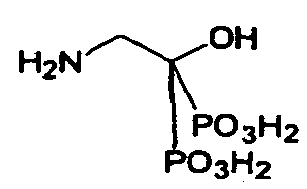
ß-Alanin 1-Hydroxy-3-aminopropan-1.1-diphosphonat 
Imino-diacetonitril 2.2'-Imino-bis-(1-aminoethan-1.1'-diphosphonat) 
Imino-dipropionitril 3.3'-Imino-bis-(1-aminopropan-1.1'-diphosphonat) 
- 1 mol eines in 300 mL Wasser gelösten Aminoalkyl-/Aryl-phosphorsäureesters wird mit NaOH auf pH 5.5 eingestellt und unter Rühren mit 1.0 - 2.5 mol Maleinsäureanhydrid (MSA), gelöst in 300 mL trockenem Aceton, versetzt. Die Geschwindigkeit der MSA-Zugabe wird dabei so gewählt, dass der pH-Wert der Reaktionslösung zwischen 5.5 - 6.5 und die Reaktionstemperatur bei 25 ° C verbleibt. Der pH-Wert wird mit einer NaOH-Lösung reguliert. Nach der MSA-Zugabe wird noch 2 h bei Raumtemperatur oder - je nach Reaktivität und sterischem Anspruch des Amins - bei höherer Temperatur gerührt. Nach Reaktionsende wird das Aceton unter vermindertem Druck beseitigt und die Lösung filtriert. Die nun vorliegende wässrige Monomer-Lösung kann direkt zur Copolymerisation verwendet werden.
- Beispiele dieser neuartigen Phosphor-haltigen MSA-Monomere, ihre Ausbeuten und 1 H-NMR-Daten sind in Tabelle 5 zusammengefasst.
Tabelle 5 Ausbeute und Strukturanalytik der Phosphor-haltigen MSA-Derivate nach der Amidierung von MSA mit verschiedenen phosphatierten Aminoalkyl-/Arylalkoholen MSA (Gehalt) MSA-Derivat aus Phosphor-enthaltendes Amin (1.0 eq.) Ausbeute an MSA-Amid(a) 1H-NMR (D2O) vorn MSA-Amid Chemische Verschiebungen(b) [δ, ppm] 1.2 eq. Aminoethanol- 98 ± 1% 6.24 (d), 5.88 (d), 2H, CH=CH; 3.82 (q), 2H, CH 2O-P; phosphat (AE-P) 3.37 (t), 2H, CH 2NH(C=O) 1.2 eq. (Aminoethoxy)ethanol- 91 ± 4% 6.20 (d), 5.81 (d), 2H, CH=CH; 3.83 (q), 2H, CH 2O-P; phosphat (AEE-P) 3.58 (t), 3.53 (t), 4H, CH 2OCH 2; 3.29 (t), 2H, CH 2N(CO) 2.0 eq. Aminohexanol- 93% 6.23 (d), 5.83 (d), 2H, CH=CH; 3.73 (q), 2H, CH 2O-P; phosphat (AHP) 3.11 (t), 2H, CH 2NH(C=O); 1.6 -1.2 (m), 8H, CH 2 1.2 eq. Aminobenzylalkohol- n.d. 6.26 (d), 5.92 (d), 2H, CH=CH; 4.70 (d), 2H, CH 2O-P; phosphat (ABA-P) 7.3 - 6.9 (m), 4H, Phenyl 2.0 eq. Diethanolamin- 95 ± 4% 6.36 (d), 6.05 (d), 2H, CH=CH; 3.85 (m), 4H, CH 2O-P; diphosphat (DEA-P2) 3.57 (t), 4H, CH 2N(C=O) (a) Die Ausbeute entspricht dem Gehalt an amidierten MSA im Vergleich zu nichtumgesetzten Amin und wurde mit Hilfe der 1 H-NMR (D2O) bestimmt.
(b) Die Amidierung des MSA ergibt eine typische Aufspaltung der vinylischen Protonen des MSA (5.96 (s), 2H, CH=CH). Außerdem erhält man eine typische Tieffeldverschiebung des Protonensignals CH 2N(C=O) verglichen mit dem Signal CH 2NH einer freien Aminogruppe von etwa 0.27 ± 0.07 ppm. - In einem temperierbaren Doppelwandreaktor wird 1.0 mol einer möglichst konzentrierten wässrigen Lösung eines Vinyloxybutyl-poly(ethylenglycol)-ether (VOBPEG, z.B. Mw = 500 g/mol) vorgelegt und unter Rühren mit 1.0 - 1.7 mol einer 25 %-igen Lösung an Phosphor-haltigem MSA-Derivat (z.B. MSA-AEP) bei pH > 5 vermischt. Unter Stickstoff werden bei 15 °C katalytische Mengen an FeSO4·7H2O (0.05 - 0.5 mmol) und eine 30 %-ige WasserstoffperoxidLösung (30 - 100 mmol) zugegeben. Die Polymerisation erfolgt bei pH > 5 durch gleichmäßige Zugabe einer 3 - 10 %-igen Lösung des Reduktionsmittels Brüggolit® (pH 5.0 - 6.3, Firma Brüggemann). Der Peroxid gehalt wird verfolgt und die Polymerisation ist beendet, wenn das Wasserstoffperoxid durch das Brüggolit® vollständig verbraucht wurde (Schema 5). Die Zusammensetzung und Molmasse von diesem Copolymer 1 (AEP-5) liegt in Tabelle 6 vor.
- Die Copolymerisation kann anhand nachfolgender Beispiele variiert und erweitert werden:
- (1) Die Poly(alkylenglycol)-haltigen Alkenylether können unterschiedliche Kettenlängen (z.B. VOBPEG: 500, 1.100, 2.000, oder 5.800 g/mol) aufweisen oder Gemische von unterschiedlicher Kettenlänge darstellen. Bsp.: Polymer 1, 2, 3, 4, 5, 10
- (2) Es können weitere Phosphor-haltige MSA-Monomere verwendet werden, wie sie beispielsweise in Tabelle 4 und 5 beschrieben werden. Bsp.: Polymer 1, 12, 14, 16, 17
- (3) Es sind vielfältige Kombinationen von Punkt (1) und (2) möglich. Bsp.: Polymer 13, 15, 18, 19, 20
- (4) Die Poly(alkylenglycol)-haltigen Alkenylether können zwischen 0 - 100 Mol-% mit niedermolekularen Alkenylethern (z. B. n-Hydroxybutylmonovinylether HBVE) und -estern (z. B. Vinylacetat) substituiert werden. Bsp.: Polymer 21, 22, 23, 24, 25, 26
- (5) Die Phosphor-haltigen MSA-Monomere können zwischen 0 - 100 Mol-% mit MSA und anderen MSA-Derivaten (z. B. N-Hydroxyethyl-maleimid MSI-HE) substituiert werden.
Bsp.: Polymer 27, 28, 29, 30 - (6) Die Punkte (4) und (5) können ebenfalls kombiniert werden.
Bsp.: Polymer 31, 32 - (7) Es sind weitere Comonomere zwischen 0 - 100 moleq. einsetzbar, die sowohl neutral geladen wie z. B. α,β-ungesättigte Hydroxyalkylester wie Hydroxypropylacrylat (HPA) oder Hydroxyethylmethacrylat (HEMA), aber auch ionischer Natur (anionisch: z. B. Acrylsäure, oder kationisch: z. B. vinylhaltige quartäre Ammoniumverbindungen) sein können.
Bsp.: Polymer 6, 7, 8, 9, 11 - (8) Die Punkte (3) und (6) sind natürlich auch mit dem Punkt (7) kombinierbar. Die Zusammensetzung und Molmassen der aufgeführten Phosphor-haltigen Copolymere sind in Tabelle 6 und 7 zusammengefasst. Um die essentielle Bedeutung der anionischen Phosphor-haltigen Gruppierungen in den Polymeren hinsichtlich ihrer Verwendung als zementäre Fließmittel hervorzuheben, wurden Copolymere aus N-Hydroxyethyl-maleinsäureamid (MSA-AE) und VOBPEG synthetisiert, die ausschließlich Carboxylat-Ladungen am Polymerrückgrat besitzen. Vergleiche Bsp.: Polymer 33, 34
- Die Durchführung der Tests erfolgte gemäß den Betonnormen DIN EN 206-1, DIN EN 12350-2 und DIN EN 12350-5. Als Zement wurde ein CEM I 42.5 R (Karlstadt) verwendet. Die Zuschlagsstoffe für die Mörtel- und Betonmischungen sind in der Tabelle 8 aufgeführt.
- Es werden 600 g Zementpulver trocken homogenisiert und in einen RILEM-Mischer gegeben. Dann wird die entsprechend einem W/Z-Wert benötigte Menge Wasser zugegeben und 30 sec. bei 140 U/min. (Stufe I) gemischt. Die Zugabe des Sandgemisches erfolgt anschließend bei laufendem Mischer mit Hilfe eines Trichters und es wird weitere 30 sec. bei 140 U/min. (Stufe I) gemischt. Nach einer Mischpause von 1.5 min. und gesäuberten Rändern vom Mischer wird eine entsprechende Menge Fließmittel zugegeben. Es wird weitere 60 sec. bei 285 U/min. (Stufe II) gemischt und anschließend das Fließmaß (Ausbreitmaß) durch 10-maliges Klopfen auf einem Klopftisch mit Hägermann-Konus bestimmt.
- Für die Betonmischungen wird ein 30-L-Mischer verwendet. Es werden 4.8 kg Zement und die entsprechende Menge an Zuschlägen 10 sec. lang trocken vorgemischt. Dann gibt man 300 mL Vorgabewasser dazu und nach weiteren 2 min. des Mischens die entsprechend dem verwendeten W/Z-Wert benötigte Menge an Restwasser. Nach weiteren 60 sec. wird der Betonmischung das gelöste Fließmittel (0.2 Gew.-% Feststoff/Zement) zugegeben und der Mischvorgang nach 60 sec. mit der Ermittlung des Ausbreitmaßes beendet.
Tabelle 8 Rezepturen der Mörtel- und Betonmischung für Mörtel- und Betontests Mörteltest Betontest Zusammensetzung S/Z-Wert(a) = 2.2 Gewicht [g] S/G-Wert(b) = 0.48 Gewicht [kg/m3] Zuschläge 3.3 Quarzsand % 0/0.5 5.2 60.9 Quarzsand 30 178.2 Quarzsand % 95.2 Normsand % 415.8 0/1.0 39.4 738.6 0/0.25 70% Normsand 0/4 % 366.6 Kies 4/8 19.8 602.8 Kies 8/16 % 32.4 % Kalksteinmehl 50.0 Zement CEM I 42.5R (c) 270.0 CEM I 42.5R (c) 320.0 Fließmittel(d) (20%-ige Lösung) 2.7 (20%-ige Lösung) 3.2 Wasser (e) (e) (a) S/Z-Wert = Sand/Zement-Wert = Σ Sand [g] + Zement [g]
(b) S/G-Wert = Sand/Sand-Kies-Wert = Σ Sand [g] + (Σ Sand [g] + Σ Kies [g])
(c) Zementherkunft: Karlstadt (Deutschland)
(d) 0.2 Masse-% Feststoff auf Zement
(e) Die benötigte Wassermenge ist abhängig vom eingestellten W/Z-Wert(f) entsprechend dem verwendeten Fließmittel (Tab. 9 und 10).
W/Z-Wert = Wasser/Zement-Wert = Σ Wasser [g] ÷ Zement [g]Tabelle 9 Mörteltestergebnisse und Druckfestigkeiten, geordnet nach
a) dem bestem Wasserreduktionsvermögen (W/Z-Wert), und
b) dem Erhalt der Fließfähigkeit über die Zeit (Spread 0 und 90 min.), d.h. dem möglichst unverändertem Ausbreitmaß nach 90 min.Polymer- Nr. Dos.(a) W/Z- Wert(b) Ausbreitmaß(c) [cm] Frischbetonrohdichte Luftporengehalt Druckfestigkeit [N/mm2] 0' 30' 60' 90' 1d 7d 28d Wasser - 0.57 24.7 23.4 23.0 22.5 2.162 1.5% 20.3 42.8 45.8 33 0.25 0.49 22.4 - - - 2.230 3.0% n.b. - - 34 0.25 0.49 21.6 - - - 2.221 3.2% n.b. - - Wasserreduktionsmittel (Fließmittel) Glenium 51 0.2 0.395 24.3 21.3 21.1 20.9 2.266 3.1% 39.7 62.3 65.6 3 0.2 0.34 25.3 21.9 18.1 - 2.280 4.5% 46.9 69.0 72.2 2 0.2 0.347 24.5 25.0 23.0 21.7 2.256 5.2% 34.6 71.3 72.7 13a 0.2 0.355 24.7 19.8 - - 2.254 4.6% 45.9 67.2 69.2 6 0.2 0.355 24.5 21.4 - - 2.240 4.9% 45.4 63.3 70.3 24 0.2 0.357 24.4 18.3 - - 2.218 5.6% 44.6 63.9 68.1 13b 0.2 0.362 24.3 19.5 - - 2.252 4.6% 44.7 65.3 68.2 27 0.2 0.375 24.9 21.0 - - 2.245 4.2% 41.7 62.4 69.3 12 0.2 0.375 24.5 20.5 - - 2.237 2.7% 35.5 59.9 65.1 1 0.2 0.384 24.3 19.1 - - 2.243 4.0% 33.5 58.3 63.0 5 0.2 0.385 24.8 20.2 - - 2.224 3.5% n.b. - - 22 0.2 0.385 24.1 21.6 - - 2.219 3.9% n.b. - - 9 0.2 0.385 23.9 19.8 - - 2.229 4.3% 40.5 61.5 64.5 17 0.2 0.39 24.7 21.7 - - 2.237 4.2% 12.4 51.4 55.6 10 0.2 0.39 23.9 19.2 - - 2.232 3.8% 40.1 59.5 64.0 4 0.2 0.392 24.1 19.2 - - 2.235 4.2% 31.2 54.9 59.4 28 0.2 0.41 25.1 22.7 - - 2.269 2.3% 33.2 61.5 67.6 18 0.2 0.416 24.2 21.1 - - 2.229 3.6% 34.3 57.8 62.3 29 0.2 0.42 24.5 22.1 - - 2.244 3.6% n.b. - - 23 0.2 0.42 24.6 20.7 - - 2.236 3.0% 34.7 56.4 59.3 26 0.2 0.422 24.6 21.2 - - 2.224 3.2% 32.1 61.9 69.7 21 0.2 0.425 24.5 23.5 22.7 - 2.215 4.0% n.b. - - 19 0.2 0.44 23.9 22.6 - - 2.237 2.7% 31.3 55.9 58.7 25 0.2 0.46 24.0 22.1 - - 2.224 2.4% 29.3 54.8 58.9 20 0.2 0.49 24.5 23.8 - - 2.208 5.3% 25.8 51.1 55.6 30 0.2 0.49 21.1 - - - 2.252 3.6% n.b. - - Slump retainer Glenium 27 0.24 0.50 24.1 23.2 23.1 23.2 2.201 2.3% 22.9 50.6 56.6 8 0.2 0.43 22.7 26.3 28.2 28.0 2.185 4.3% 31.1 54.3 56.0 32 0.2 0.432 24.1 25.7 25.1 24.7 2.208 3.9% 31.3 54.0 55.2 7 (d) 0.2 0.395 23.9 24.3 24.3 23.7 2.221 4.3% 36.9 58.3 59.9 31 0.2 0.431 24.1 25.4 24.1 23.5 2.231 2.6% 30.3 57.0 64.7 7 (e) 0.2 0.438 24.8 25.1 23.7 22.9 2.220 3.3% 31.2 55.3 62.7 0.25 0.415 24.7 25.5 24.8 23.6 2.226 3.1% 34.9 56.7 59.0 14 0.2 0.427 24.2 24.9 23.5 22.4 2.245 3.9% n.b. - - (a) Dos. = Dosierung [Masse-% Polymer bezogen auf Zement]
(b) W/Z-Wert = Wasser/Zement-Wert: Gibt die benötigte Wassermenge wieder, um bei konstanter Zementmenge einen fließfähigen Mörtel zu erzeugen.
(c) Ausbreitmaß, bestimmt nach 0, 30, 60, und 90 min.
(d) Gereinigte Probe: Ultrafiltration mit einer 10 kDa-Membran
(e) Unfiltrierte Probe: Bei einem Feststoffgehalt von 100% liegen nach der Polymerisation etwa 79% polymeres Produkt und 21% niedermolekulare Bestandteile < 5.000 g/mol, wie z.B. Restmonomere, Salze u.a., vor.Tabelle 10 Betontests (Wassereduktionsvermögen, Slump-Erhalt und Druckfestigkeiten):
a) geordnet nach dem bestem Wasserreduktionsvermögen (W/Z-Wert), und
b) dem Erhalt der Fließfähigkeit über die Zeit (Slump-Erhalt)Polymer Nr. Dos.(a) W/Z- Wert Ausbreitmaß(b) [cm] Frischbetonrohdichte Luftporengehalt Druckfestigkeit [N/mm2] 0' 10' 40' 60' 90' 1d 7d 28d Wasser - 0.63 59.0 60.5 57.5 57.5 55.0 2.389 2.4% 15.4 36.5 42.9 Water reducer Glenium
510.2 0.49 59.5 60.5 57.5 56.0 51.0 2.477 1.8% 33.0 55.5 65.3 3 0.2 0.42 55.0 47.5 36.5 - - 2.462 3.0% 42.4 63.8 70.0 2 0.2 0.44 50.0 42.5 36.5 - - 2.440 2.4% 36.4 60.3 69.4 24 0.2 0.44 56.5 46.0 36.5 - - 2.432 2.1% 35.2 57.5 64.0 13a 0.2 0.45 57.5 52.0 45.0 42.0 - 2.442 2.1% 38.2 58.1 66.5 13b 0.2 0.46 60.0 54.0 47.5 42.0 - 2.429 1.7% 36.0 59.8 66.8 6 0.2 0.46 60.5 58.0 57.0 55.5 52.5 2.429 1.5% 31.6 58.9 68.1 5 0.2 0.47 58.0 48.5 40.5 40.0 - 2.459 2.5% 31.9 56.3 62.9 27 0.2 0.47 58.0 56.0 50.5 47.0 41.5 2.421 1.8% 31.1 54.5 62.7 10 0.2 0.48 58.0 50.0 43.0 41.0 - 2.428 1.8% 31.4 53.0 60.5 22 0.2 0.48 61.0 52.0 41.0 - - 2.454 2.6% 28.8 54.0 62.7 1 0.2 0.49 63.0 56.5 49.5 47.5 43.0 2.425 1.6% 26.6 51.9 60.1 4 0.2 0.49 58.5 51.0 46.0 45.0 42.5 2.412 2.4% 25.1 52.0 60.9 17 0.2 0.49 57.0 54.5 49.0 47.5 46.0 2.408 1.9% 26.1 56.3 62.0 18 0.2 0.50 58.0 53.5 48.0 48.0 45.5 2.423 1.7% 25.6 51.0 58.5 9 0.2 0.50 62.5 60.0 55.0 51.5 49.0 2.428 1.3% 29.3 54.6 60.8 21 0.2 0.51 57.5 53.0 48.0 46.0 - 2.439 2.2% 23.0 48.9 54.2 23 0.2 0.51 62.0 53.5 48.0 46.0 41.5 2.425 1.7% 24.8 47.9 55.6 26 0.2 0.51 61.5 56.0 50.5 47.5 44.0 2.415 2.0% 21.7 50.0 55.3 31 0.2 0.51 56.5 57.0 53.0 49.0 45.0 2.421 1.8% 21.6 46.7 54.2 7 (d) 0.2 0.52 61.0 60.0 59.0 54.5 50.5 2.384 1.9% 21.0 45.2 52.0 14 0.2 0.52 59.5 58.0 54.5 52.0 49.0 2.455 2.0% 21.1 47.3 55.7 29 0.2 0.53 59.0 56.0 54.0 54.0 51.5 2.440 2.1% 21.3 47.2 57.4 11 0.2 0.54 60.5 59.0 56.0 48.0 45.5 2.387 1.6% 19.2 41.7 51.2 Slump retainer Glenium 27 0.24 0.56 58.5 62.0 61.5 62.0 59.5 2.434 0.9% 19.7 46.0 54.8 8 0.2 0.53 61.0 62.5 64.5 64.0 62.0 2.434 1.4% 22.4 50.9 60.1 32 0.2 0.53 60.0 63.0 62.0 60.5 58.0 2.394 1.5% 22.7 48.1 55.7 7 (c) 0.2 0.49 59.5 60.0 62.0 60.0 56.0 2.413 1.6% 28.2 53.3 63.7 28 0.2 0.52 58.0 57.5 60.0 59.0 54.0 2.416 1.7% 24.4 52.1 59.2 19 0.2 0.53 59.0 57.0 55.5 55.5 54.0 2.413 1.2% 23.8 50.4 59.1 30 0.2 0.59 58.5 57.0 56.0 55.0 53.5 2.410 2.3% 13.8 40.5 47.9 20 0.2 0.57 61.5 59.5 58.5 57.0 55.5 2.397 1.3% 19.1 44.3 49.3 (a) Dos. = Dosierung [Masse-% Polymer bezogen auf Zement]
(b) Ausbreitmaß, bestimmt nach 0, 10, 40, 60, und 90 min.
(c) Gereinigte Probe: Ultrafiltration mit einer 10 kDa-Membran
(d) Unfiltrierte Probe: Bei einem Feststoffgehalt von 100% liegen nach der Polymerisation etwa 79% polymeres Produkt und 21% niedermolekulare Bestandteile < 5.000 g/mol, wie z.B. Restmonomere, Salze u.a., vor.
R3 und M oben genannte Bedeutung besitzen.
R1 und M oben genannte Bedeutung besitzen.
| Aufbau von nahezu alternierenden Copolymeren durch die Polymerisation von fast equimolaren Mengen an Phosphor-haltigen MSA-Monomeren und PEG-haltigen Vinylethern sowie der Aufbau von Phosphor-haltigen Polymeren durch die Copolymerisation von Phosphor-haltigen MSA-Derivaten und PEG-haltigen Vinylethern mit wasserlöslichen Estern der α,β-ungesättigten Carbonsäuren | ||||||||
| Nr. | P-enthaltende MSA-Monomere (1.2 eq.) | VOBPEG(a) (1.0 eq.) | Co- monomer | (eq.) | GPC-Daten | |||
| Mw (g/mol) | Mw (g/mol) | Ratio | Mw (g/mol) | Mw/Mn | ||||
| 1 | MSA-AE-P(b) -''- | 500 | - | - | 11.690 | 1.25 | ||
| 2 | -''- | 1.100 | - | - | 22.900 | 1.13 | ||
| 3 | 2.000 | - | - | 27.000 | 1.45 | |||
| 4 | -''- | 2.000 | 500 | - | 15.800 | 1.12 | ||
| 5 | -''- | 2.000 | 500 | - | 24.400 | 1.61 | ||
| 6 | -''- | 2.000 | - | 1 : 2 | HPA(g) | 0.5 | 24.900 | 1.30 |
| 7 | -''- | 2.000 | - | HPA | 1.0 | 40.200 | 1.65 | |
| 8 | -''- | 2.000 | - | 2 : 1 | HPA | 2.0 | 24.900 | 1.88 |
| 9 | -''- | 2.000 | - | HEMA(h) | 1.0 | 28.700 | 1.93 | |
| 10 | -''- | 5.800 | - | - | 26.300 | 1.32 | ||
| 11 | -''- | 5.800 | - | HPA | 2.0 | 82.000 | 2.24 | |
| 12 | MSA-AEE-P(c) | 500 | - | - | 16.200 | 1.25 | ||
| 13a | -''- | 2.000 | - | - | 23.900 | 1.50 | ||
| 13b | -''- | 2.000 | - | - | 23.050 | 1.21 | ||
| 14 | MSA-AH-P(d) | 500 | - | - | 20.900 | 1.46 | ||
| 15 | -''- | 2.000 | - | - | 32.100 | 1.63 | ||
| 16 | MSA-ABA-P(e) | 500 | - | 26.200 | 1.64 | |||
| 17 | MSA-DEA-P2(f) | 500 | - | - | 13.400 | 1.32 | ||
| 18 | -''- | 1.100 | - | - | 8.050 | 1.19 | ||
| 19 | -''- | 2.000 | - | - | 13.400 | 1.32 | ||
| 20 | -''- | 5.800 | - | - | 25.900 | 1.27 | ||
| (a) VOBPEG = Vinyloxybutyl-poly(ethylenglycol) (b) MSA-AE-P = N-(Aminoethyl-phosphat)-maleinsäureamid (c) MSA-AEE-P = N-(2-Aminoethoxy-ethyl-phosphat)-maleinsäureamid (d) MSA-AH-P = N-(Aminohexyl-phosphat)-maleinsäureamid (e) MSA-ABA-P = N-(Aminobenzylalcohol-phosphat)-maleinsäureamid (f) MSA-DEA-P2 = N-(Diethanolamin-diphosphat)-maleinsäureamid (g) HPA = Hydroxypropyl-acrylat (h) HEMA = Hydroxyethyl-methacrylat |
| Aufbau von nahezu alternierenden Phosphor-haltigen Copolymeren durch die Polymerisation von Gemischen aus MSA-Derivaten und Vinylethern, die Phosphor-haltige MSA-Monomere und PEG-haltige Vinylether enthalten | ||||||||
| Nr. | P-enthaltende MSA-Monomere (1.2 eq.) | MSA-Co- monomere | Ratio | VOBPEG(a) Mw (g/mol) (1.0 eq.) | Vinyl ether | Ratio | GPC-Daten Mw Mw/Mn (g/mol) | |
| 21 | MSA-AE-P(b) | - | - | 2.000 | HBVE(c) | 1 : 2 | 20.700 | 1.64 |
| 22 | -''- | - | - | 2.000 | HBVE | 2 : 1 | 22.100 | 1.19 |
| 23 | -''- | - | - | 5.800 | HBVE | 1 : 2 | 24.200 | 1.58 |
| 24 | -''- | - | - | 5.800 | HBVE | 2 : 1 | 29.100 | 1.50 |
| 25 | MSA-DEA-P2(d) | - | - | 5.800 | HBVE | 1 : 2 | 25.056 | 1.37 |
| 26 | MSA-AE-P | - | - | 2.000 | TEGVE(e) | 1 : 1 | 21.300 | 1.21 |
| 27 | MSA-AE-P | MSA | 2 : 1 | 2.000 | - | - | 33.800 | 1.62 |
| 28 | -''- | -''- | 1 : 2 | 2.000 | - | - | 29.500 | 1.46 |
| 29 | MSA-AE-P | MSI-HE(f) | 2 : 1 | 2.000 | - | - | 50.000 | 2.06 |
| 30 | -''- | -''- | 1 : 2 | 2.000 | - | - | 60.600 | 2.28 |
| 31 | MSA-AE-P | MSI-HE | 1 : 1 | 2.000 | HBVE | 1 : 1 | 35.200 | 2.03 |
| 32 | -''- | -''- | 1 : 1 | 5.800 | HBVE | 1 : 1 | 46.000 | 1.61 |
| 33 | - | MSA-AE(g) | - | 500 | - | - | 11.500 | 1.98 |
| 34 | - | MSA-AE | - | 2.000 | - | - | 29.100 | 1.71 |
| (a) VOBPEG = Vinyloxybutyl-poly(ethylenglycol)ether (b) MSA-AE-P = N-(Aminoethyl-phosphat)-maleinsäureamid (c) HBVE = Hydroxybutyl-vinylether (d) MSA-DEA-P2 = N-(Diethanolamin-diphosphat)-maleinsäureamid (e) TEGVE = Triethylenglycol-methylvinylether (f) MSI-HE = N-Hydroxyethyl-maleinsäureimid (g) MSA-AE = N-Aminoethyl-maleinsäureamid |
Claims (18)
- Copolymere auf Basis von Phosphor-haltigen Monomeren (A) von ungesättigten Dicarbonsäure-Derivaten der allgemeinen Formeln (Ia) und/oder (Ib)
 R1 =
R1 =
 X = O, S, NH, N-R2-Y,R2 = C1-C20-(Hetero-)Alkylenreste ggf. mit O- oder N-Heteroatomen, die linear oder verzweigt sind und ggf. noch 1 bis 10 Substituenten ausgewählt aus der Gruppe OH, OPO3M2, OPHO2M, NH2, NH-CH2PO3M2, N(CH2-PO3M2)2, CZ(PO3M2)2 aufweisen, sowie C6-C10-Arylenreste,Y = -N(CH2-PO3M2)2, -CZ(PO3M2)2, -OPHO2M, -OPO3M2,Z = H, Hai, OH, NH2,Hal = F, Cl, Br, J,M = H, Na, K, NH4, N(R3)4R3 = C1-C12-Alkylreste sowie C6-C10-Arylrestesowie
Makromonomeren (B) der allgemeinen Formel (II) R4 = H, C1-C20-Alkylreste,R5 = H, CH3,R6 = Alkylenreste mit 0 bis 20 C-Atomen,R7 = C1-C20-Alkylenreste,R8 = H, C1-C20-Alkylreste,R9 = H, C1-C20-Alkylreste, C6-C10-Arylreste, COR3, NO2M, SO3M, PO3M2,m = 0 bis 10,n = 1 bis 300,p = 0 bis 300und wobei
R3 und M oben genannte Bedeutung besitzen. - Copolymere nach Anspruch 1, dadurch gekennzeichnet, dass die Copolymere auf Basis der Monomere (A) und (B) noch Bausteine auf Basis der Monomere (C) gemäß den allgemeinen Formeln (IIIa) und (IIIb) enthalten
 X' = O, S, NH, NR10,R10 = H, C1-C20-(Hetero-)Alkylreste ggf. mit O- oder N-Heteroatomen, die linear oder verzweigt sind und ggf. 1 bis 10 OH- und/oder NH2-Gruppen aufweisen, sowie C6-C10-Arylrestedarstellen und
R1 und M oben genannte Bedeutung besitzen. - Copolymere nach Anspruch 1 oder 2, dadurch gekennzeichnet, dass die Copolymere auf Basis der Monomere (A) und (B) und ggf. (C) noch Bausteine auf Basis der Monomere (D) gemäß der allgemeinen Formel (IV) enthalten
 R11 = H, R10, (CH2)rOR10, O(C=O)R10,R12, R13 = H, C1-C20-Alkylreste oder C6-C10-Arylreste undr = 0 bis 10 darstellen undR10 oben genannte Bedeutung besitzt.
 - Copolymere nach einem der Ansprüche 1 bis 3, dadurch gekennzeichnet, dass die Copolymere auf Basis der Monomere (A) und (B) sowie ggf. (C) und (D) noch Bausteine auf Basis der Monomere (E) gemäß der allgemeinen Formel (V) enthaltenwobei
 W = CN, CO-R14,R14 = H, OM, OR10, NHR10, N(R10)2, SR10 darstellen undR10, R12, R13 sowie M oben genannte Bedeutung besitzen.
 - Copolymere nach einem der Ansprüche 1 bis 4, dadurch gekennzeichnet, dass das molare Verhältnis von Monomer (A) zu Monomer (B) im Copolymer 2 : 1 bis 1 : 2 beträgt.
- Copolymere nach einem der Ansprüche 1 bis 5, dadurch gekennzeichnet, dass im Copolymer auf Basis der Monomere (A) und (B) bis zu 90 Mol-% von Monomer (A) durch Monomer (C) ersetzt sind.
- Copolymere nach einem der Ansprüche 1 bis 6, dadurch gekennzeichnet, dass im Copolymer auf Basis der Monomere (A) und (B) bis zu 90 Mol-% des Monomers (B) durch das Monomer (D) ersetzt sind.
- Copolymere nach einem der Ansprüche 1 bis 7, dadurch gekennzeichnet, dass im Copolymer auf Basis der Monomere (A) und (B) bis zu 90 Mol-% der Monomere (A) und (B) durch die Monomere (C) und (D) ersetzt sind.
- Copolymere nach einem der Ansprüche 1 bis 8, dadurch gekennzeichnet, dass das Copolymer auf Basis der Monomere (A) und (B) sowie ggf. (C) und (D) noch bis zu 10 Molequivalente eines oder mehrerer Monomere (E), bezogen auf die Summe der Monomere (A) und (B) sowie ggf. (C) und (D), enthält.
- Verfahren zur Herstellung der Copolymere nach einem der Ansprüche 1 bis 9, dadurch gekennzeichnet, dass die Monomere (A) und (B) sowie ggf. (C) und (D) einer radikalischen Polymerisation unterworfen werden.
- Verfahren nach Anspruch 10, dadurch gekennzeichnet, dass man die radikalische Polymerisation im wässrigen System im Temperaturbereich von - 10 bis 100 °C durchführt.
- Verfahren nach Anspruch 10 oder 11, dadurch gekennzeichnet, dass man die Radikale durch thermische Zersetzung von geeigneten Peroxo- oder Azoinitiatoren, photochemisch oder durch Verwendung eines Redoxsystems erzeugt.
- Verfahren nach Anspruch 12, dadurch gekennzeichnet, dass man wasserlösliche Azoinitiatoren einsetzt.
- Verfahren nach einem der Ansprüche 10 bis 13, dadurch gekennzeichnet, dass man die radikalische Polymerisation mit Hilfe eines Redoxsystems, bestehend aus Wasserstoffperoxid, Eisen(II)sulfat und einem Reduktionsmittel im Temperaturbereich von 0 bis 30 °C durchführt.
- Verfahren nach einem der Ansprüche 10 bis 14, dadurch gekennzeichnet, dass die photochemische oder Redoxradikal-Erzeugung bei Temperaturen zwischen 0 und 30 °C erfolgt.
- Verwendung der Copolymere nach einem der Ansprüche 1 bis 10 als Zusatzmittel für anorganische Bindemittelsuspensionen auf Basis von Zement, Kalk, Gips oder Anhydrit.
- Verwendung nach Anspruch 16, dadurch gekennzeichnet, dass das Copolymer in einer Menge von 0,01 bis 10 Gew.-%, insbesondere 0,05 bis 5 Gew.-%, bezogen auf das Gewicht des anorganischen Bindemittels, eingesetzt wird.
- Verwendung nach einem der Ansprüche 16 bis 17, dadurch gekennzeichnet, dass das Copolymer als Fließmittel bzw. Wasserreduktionsmittel eingesetzt wird.
Applications Claiming Priority (2)
| Application Number | Priority Date | Filing Date | Title |
|---|---|---|---|
| DE102005022843A DE102005022843A1 (de) | 2005-05-18 | 2005-05-18 | Phosphor-haltige Monomere, Verfahren zu ihrer Herstellung sowie deren Verwendung |
| PCT/EP2006/004691 WO2006122793A1 (de) | 2005-05-18 | 2006-05-17 | Copolymere auf basis von phosphor-haltigen monomeren, verfahren zu ihrer herstellung sowie deren verwendung |
Publications (2)
| Publication Number | Publication Date |
|---|---|
| EP1883662A1 EP1883662A1 (de) | 2008-02-06 |
| EP1883662B1 true EP1883662B1 (de) | 2008-11-05 |
Family
ID=36814505
Family Applications (1)
| Application Number | Title | Priority Date | Filing Date |
|---|---|---|---|
| EP06753691A Expired - Lifetime EP1883662B1 (de) | 2005-05-18 | 2006-05-17 | Copolymere auf basis von phosphor-haltigen monomeren, verfahren zu ihrer herstellung sowie deren verwendung |
Country Status (11)
| Country | Link |
|---|---|
| US (1) | US7902310B2 (de) |
| EP (1) | EP1883662B1 (de) |
| JP (1) | JP4977130B2 (de) |
| CN (1) | CN101248097B (de) |
| AU (1) | AU2006249151B2 (de) |
| BR (1) | BRPI0613166B8 (de) |
| CA (1) | CA2608374C (de) |
| DE (2) | DE102005022843A1 (de) |
| ES (1) | ES2313662T3 (de) |
| MX (1) | MX2007014246A (de) |
| WO (1) | WO2006122793A1 (de) |
Families Citing this family (16)
| Publication number | Priority date | Publication date | Assignee | Title |
|---|---|---|---|---|
| FR2902103B1 (fr) * | 2006-06-09 | 2011-11-18 | Coatex Sas | Procede pour epaissir des compositions aqueuses notamment a ph acide, au moyen de polymeres organophosphates, et compositions aqueuses obtenues |
| FR2943661A1 (fr) * | 2009-03-25 | 2010-10-01 | Lafarge Gypsum Int | Fluidifiant pour liant hydraulique |
| FR2949777B1 (fr) * | 2009-09-09 | 2012-10-26 | Lafarge Gypsum Int | Fluidifiant pour liant hydraulique. |
| PL2411346T3 (pl) * | 2009-03-25 | 2014-05-30 | Siniat Int | Środek upłynniający do spoiwa na bazie siarczanu wapnia |
| US8058377B1 (en) * | 2010-06-24 | 2011-11-15 | W. R. Grace & Co.-Conn. | Phosphate-containing polycarboxylate polymer dispersants |
| US20130180926A1 (en) * | 2011-07-22 | 2013-07-18 | Basf Se | Preparing maleic acid-isoprenol copolymers |
| EP2615073B1 (de) | 2012-01-13 | 2018-04-04 | Construction Research & Technology GmbH | Dispergiermittel für anorganische Partikel |
| FR3007757B1 (fr) * | 2013-06-28 | 2015-06-05 | Lafarge Sa | Fluidifiant pour liant hydraulique comprenant un clinker sulfoalumineux |
| CN105713151A (zh) * | 2015-12-31 | 2016-06-29 | 江苏苏博特新材料股份有限公司 | 具有亚磷酸基团的混凝土超塑化剂的制备方法和应用 |
| JP6747962B2 (ja) * | 2016-01-04 | 2020-08-26 | 株式会社日本触媒 | セメント用添加剤およびセメント組成物 |
| CN106496400B (zh) * | 2016-11-07 | 2018-05-08 | 上海三瑞高分子材料股份有限公司 | 一种含磷三元共聚物及其制备方法 |
| CN108047390B (zh) * | 2017-12-11 | 2020-07-07 | 广西壮族自治区水利科学研究院 | 一种抗泥-减缩型聚羧酸减水剂的制备方法 |
| CN109320714B (zh) * | 2018-08-29 | 2020-11-17 | 南京博特新材料有限公司 | 一种中低坍落度混凝土专用小分子超塑化剂及其制备方法 |
| CN109776742A (zh) * | 2019-02-14 | 2019-05-21 | 江西省建筑材料工业科学研究设计院 | 一种含磷酸酯抗泥型聚羧酸减水剂及其制备方法 |
| CN111592566B (zh) * | 2019-02-21 | 2023-04-25 | 中国科学院理化技术研究所 | 一种无卤阻燃剂的制备方法 |
| CN116478343B (zh) * | 2023-06-25 | 2023-09-26 | 北京鼎瀚中航建设有限公司 | 一种降粘型聚羧酸减水剂及其制备方法 |
Family Cites Families (18)
| Publication number | Priority date | Publication date | Assignee | Title |
|---|---|---|---|---|
| JPS4823808B1 (de) | 1968-03-15 | 1973-07-17 | ||
| US3562166A (en) * | 1968-12-24 | 1971-02-09 | Procter & Gamble | Built detergent compositions |
| EP0074708B1 (de) * | 1981-07-29 | 1986-02-19 | Kuraray Co., Ltd. | Klebstoffzusammensetzung |
| AU569719B2 (en) * | 1983-01-28 | 1988-02-18 | Schering Corporation | Phosphorous compounds as inhibitors of enkephalinases |
| JPS6078993A (ja) * | 1983-10-05 | 1985-05-04 | Toho Chem Ind Co Ltd | 有機リン化合物 |
| JP2636896B2 (ja) * | 1988-08-24 | 1997-07-30 | キユーピー株式会社 | リン脂質系乳化剤 |
| FR2637511B1 (fr) * | 1988-10-10 | 1994-02-11 | Coatex Sa | Agent de compatibilite pour suspensions aqueuses polypigmentaires dont l'un des pigments est du sulfate de calcium hydrate |
| US5352673A (en) * | 1989-08-29 | 1994-10-04 | Dennis Edward A | Prodrugs |
| JPH09309755A (ja) * | 1996-05-23 | 1997-12-02 | Kawasaki Steel Corp | ノロの低減が可能なコンクリート混和剤 |
| ES2299208T3 (es) * | 1997-05-15 | 2008-05-16 | CONSTRUCTION RESEARCH & TECHNOLOGY GMBH | Mezcla cementosa que contiene una alta proporcion de sustitucion de cementos puzolanicos y mezclas compatibilizantes para los mismos. |
| DE19834173A1 (de) * | 1997-08-01 | 1999-02-04 | Sueddeutsche Kalkstickstoff | Copolymere auf Basis von ungesättigten Dicarbonsäure-Derivaten und Oxyalkylenglykol-Alkenylethern |
| DE19926611A1 (de) | 1999-06-11 | 2000-12-14 | Sueddeutsche Kalkstickstoff | Copolymere auf Basis von ungesättigten Mono- oder Dicarbonsäure-Derivaten und Oxyalkylenglykol-Alkenylethern, Verfahren zu deren Herstellung und ihre Verwendung |
| US6861459B2 (en) * | 1999-07-09 | 2005-03-01 | Construction Research & Technology Gmbh | Oligomeric dispersant |
| JP3535425B2 (ja) | 1999-11-17 | 2004-06-07 | 花王株式会社 | セメント分散剤の製造方法 |
| JP3600100B2 (ja) | 1999-12-20 | 2004-12-08 | 花王株式会社 | コンクリート混和剤 |
| JP3643003B2 (ja) * | 2000-02-09 | 2005-04-27 | 日本エヌエスシー株式会社 | 分散剤組成物 |
| ES2388852T3 (es) * | 2003-02-26 | 2012-10-19 | Construction Research & Technology Gmbh | Mezcla para mejoramiento de la resistencia |
| DE10337975A1 (de) * | 2003-08-19 | 2005-04-07 | Construction Research & Technology Gmbh | Statistische Kammpolymere, Verfahren zu ihrer Herstellung und deren Verwendung |
-
2005
- 2005-05-18 DE DE102005022843A patent/DE102005022843A1/de not_active Withdrawn
-
2006
- 2006-05-17 WO PCT/EP2006/004691 patent/WO2006122793A1/de not_active Ceased
- 2006-05-17 JP JP2008511630A patent/JP4977130B2/ja not_active Expired - Fee Related
- 2006-05-17 US US11/920,194 patent/US7902310B2/en active Active
- 2006-05-17 EP EP06753691A patent/EP1883662B1/de not_active Expired - Lifetime
- 2006-05-17 DE DE502006002014T patent/DE502006002014D1/de not_active Expired - Lifetime
- 2006-05-17 CA CA2608374A patent/CA2608374C/en not_active Expired - Lifetime
- 2006-05-17 ES ES06753691T patent/ES2313662T3/es not_active Expired - Lifetime
- 2006-05-17 BR BRPI0613166A patent/BRPI0613166B8/pt active IP Right Grant
- 2006-05-17 CN CN2006800168538A patent/CN101248097B/zh not_active Expired - Lifetime
- 2006-05-17 AU AU2006249151A patent/AU2006249151B2/en not_active Expired
- 2006-05-17 MX MX2007014246A patent/MX2007014246A/es active IP Right Grant
Also Published As
| Publication number | Publication date |
|---|---|
| US20080125520A1 (en) | 2008-05-29 |
| CN101248097A (zh) | 2008-08-20 |
| BRPI0613166B1 (pt) | 2017-02-14 |
| WO2006122793A1 (de) | 2006-11-23 |
| BRPI0613166A2 (pt) | 2010-12-21 |
| BRPI0613166B8 (pt) | 2019-09-17 |
| HK1121175A1 (en) | 2009-04-17 |
| AU2006249151A1 (en) | 2006-11-23 |
| DE502006002014D1 (de) | 2008-12-18 |
| ES2313662T3 (es) | 2009-03-01 |
| JP2008545602A (ja) | 2008-12-18 |
| CA2608374A1 (en) | 2006-11-23 |
| CA2608374C (en) | 2013-12-31 |
| CN101248097B (zh) | 2010-11-17 |
| DE102005022843A1 (de) | 2006-11-23 |
| AU2006249151B2 (en) | 2011-05-12 |
| EP1883662A1 (de) | 2008-02-06 |
| JP4977130B2 (ja) | 2012-07-18 |
| US7902310B2 (en) | 2011-03-08 |
| MX2007014246A (es) | 2008-02-07 |
Similar Documents
| Publication | Publication Date | Title |
|---|---|---|
| EP1711544B1 (de) | Copolymere auf basis von ungesättigten mono- oder dicarbonsäure-derivaten und oxyalkylenglykol-alkenylethern, verfahren zu deren herstellung und ihre verwendung | |
| EP0610699B1 (de) | Copolymere auf Basis von Maleinsäurederivaten und Vinylmonomeren, deren Herstellung und Verwendung | |
| EP1799731B1 (de) | Polykondensationsprodukt auf basis von aromatischen oder heteroaromatischen verbindungen, verfahren zu seiner herstellung und dessen verwendung | |
| EP0736553B1 (de) | Copolymere auf Basis von Oxyalkylenglykol-Alkenyl-ethern und ungesättigten Dicarbonsäure-Derivaten | |
| EP1851256B1 (de) | Phosphor-haltige copolymere, verfahren zu ihrer herstellung und deren verwendung | |
| WO2006122793A1 (de) | Copolymere auf basis von phosphor-haltigen monomeren, verfahren zu ihrer herstellung sowie deren verwendung | |
| DE69306717T2 (de) | Dispersionsmittel für Zement | |
| EP1189955B1 (de) | Copolymere auf basis von ungesättigten mono- oder dicarbonsäure-derivaten und oxyalkylenglykol-alkenylethern, verfahren zu deren herstellung und ihre verwendung | |
| DE19834173A1 (de) | Copolymere auf Basis von ungesättigten Dicarbonsäure-Derivaten und Oxyalkylenglykol-Alkenylethern | |
| EP1966258B1 (de) | Copolymere auf basis von ungesättigten mono- oder dicarbonsäure-derivaten und oxyalkylenglykol-alkenylethern, verfahren zu deren herstellung und ihre verwendung | |
| EP1529070A1 (de) | Verwendung von blockcopolymeren als dispergiermittel fur wasserige feststoff-suspensionen | |
| EP1789462B1 (de) | Verfahren zur herstellung von (poly-c2-c4-alkylenglykol)-mono(meth)acrylsäureestern | |
| WO2008141844A1 (de) | Dispersion umfassend anorganische partikel, wasser und mindestens ein polymeres additiv | |
| WO2013034505A1 (de) | Kammpolymere mit verzögerter alkalischer hydrolyse | |
| EP1948573A2 (de) | Kammpolymere und deren verwendung als additive für zubereitungen mineralischer bindemittel | |
| EP2792653A1 (de) | Verwendung von Kammpolymeren zur Kontrolle der Rheologie von mineralischen Bindemittelzusammensetzungen | |
| EP2550240B1 (de) | Verwendung eines kammpolymers zur verbesserung der verarbeitbarkeit von hydraulisch abbindenden zusammensetzungen | |
| DE3728786A1 (de) | Polymere verbindungen, deren herstellung und verwendung | |
| EP2694570B1 (de) | Polyelektrolytisches fliessmittel | |
| DE10330747A1 (de) | Alkoxylierte Diallylaminderivate enthaltende wasserlösliche oder in Wasser dispergierbare Polymerisate | |
| EP3544937A1 (de) | Herstellung von dispergiermitteln durch nitroxid-vermittelte lösungspolymerisation | |
| HK1121175B (en) | Copolymers base on phosphorous-containing monomers, methods for the production thereof and their use |
Legal Events
| Date | Code | Title | Description |
|---|---|---|---|
| PUAI | Public reference made under article 153(3) epc to a published international application that has entered the european phase |
Free format text: ORIGINAL CODE: 0009012 |
|
| 17P | Request for examination filed |
Effective date: 20071025 |
|
| AK | Designated contracting states |
Kind code of ref document: A1 Designated state(s): CH DE ES FR GB IT LI |
|
| GRAP | Despatch of communication of intention to grant a patent |
Free format text: ORIGINAL CODE: EPIDOSNIGR1 |
|
| RBV | Designated contracting states (corrected) |
Designated state(s): CH DE ES FR GB IT LI |
|
| DAX | Request for extension of the european patent (deleted) | ||
| GRAS | Grant fee paid |
Free format text: ORIGINAL CODE: EPIDOSNIGR3 |
|
| GRAA | (expected) grant |
Free format text: ORIGINAL CODE: 0009210 |
|
| AK | Designated contracting states |
Kind code of ref document: B1 Designated state(s): CH DE ES FR GB IT LI |
|
| REG | Reference to a national code |
Ref country code: GB Ref legal event code: FG4D Free format text: NOT ENGLISH |
|
| REG | Reference to a national code |
Ref country code: CH Ref legal event code: NV Representative=s name: BOHEST AG Ref country code: CH Ref legal event code: EP |
|
| REF | Corresponds to: |
Ref document number: 502006002014 Country of ref document: DE Date of ref document: 20081218 Kind code of ref document: P |
|
| REG | Reference to a national code |
Ref country code: ES Ref legal event code: FG2A Ref document number: 2313662 Country of ref document: ES Kind code of ref document: T3 |
|
| PLBE | No opposition filed within time limit |
Free format text: ORIGINAL CODE: 0009261 |
|
| STAA | Information on the status of an ep patent application or granted ep patent |
Free format text: STATUS: NO OPPOSITION FILED WITHIN TIME LIMIT |
|
| 26N | No opposition filed |
Effective date: 20090806 |
|
| REG | Reference to a national code |
Ref country code: CH Ref legal event code: PCAR Free format text: NEW ADDRESS: HOLBEINSTRASSE 36-38, 4051 BASEL (CH) |
|
| REG | Reference to a national code |
Ref country code: FR Ref legal event code: PLFP Year of fee payment: 11 |
|
| PGFP | Annual fee paid to national office [announced via postgrant information from national office to epo] |
Ref country code: GB Payment date: 20160531 Year of fee payment: 11 Ref country code: ES Payment date: 20160627 Year of fee payment: 11 Ref country code: CH Payment date: 20160525 Year of fee payment: 11 |
|
| REG | Reference to a national code |
Ref country code: FR Ref legal event code: PLFP Year of fee payment: 12 |
|
| REG | Reference to a national code |
Ref country code: CH Ref legal event code: PL |
|
| GBPC | Gb: european patent ceased through non-payment of renewal fee |
Effective date: 20170517 |
|
| PG25 | Lapsed in a contracting state [announced via postgrant information from national office to epo] |
Ref country code: LI Free format text: LAPSE BECAUSE OF NON-PAYMENT OF DUE FEES Effective date: 20170531 Ref country code: CH Free format text: LAPSE BECAUSE OF NON-PAYMENT OF DUE FEES Effective date: 20170531 |
|
| PG25 | Lapsed in a contracting state [announced via postgrant information from national office to epo] |
Ref country code: GB Free format text: LAPSE BECAUSE OF NON-PAYMENT OF DUE FEES Effective date: 20170517 |
|
| REG | Reference to a national code |
Ref country code: FR Ref legal event code: PLFP Year of fee payment: 13 |
|
| REG | Reference to a national code |
Ref country code: ES Ref legal event code: FD2A Effective date: 20180705 |
|
| PG25 | Lapsed in a contracting state [announced via postgrant information from national office to epo] |
Ref country code: ES Free format text: LAPSE BECAUSE OF NON-PAYMENT OF DUE FEES Effective date: 20170518 |
|
| PGFP | Annual fee paid to national office [announced via postgrant information from national office to epo] |
Ref country code: FR Payment date: 20250321 Year of fee payment: 20 |
|
| PGFP | Annual fee paid to national office [announced via postgrant information from national office to epo] |
Ref country code: DE Payment date: 20250325 Year of fee payment: 20 |
|
| PGFP | Annual fee paid to national office [announced via postgrant information from national office to epo] |
Ref country code: IT Payment date: 20250422 Year of fee payment: 20 |