EP1850409A1 - Cathode material for manufacturing a rechargeable battery - Google Patents
Cathode material for manufacturing a rechargeable battery Download PDFInfo
- Publication number
- EP1850409A1 EP1850409A1 EP07251680A EP07251680A EP1850409A1 EP 1850409 A1 EP1850409 A1 EP 1850409A1 EP 07251680 A EP07251680 A EP 07251680A EP 07251680 A EP07251680 A EP 07251680A EP 1850409 A1 EP1850409 A1 EP 1850409A1
- Authority
- EP
- European Patent Office
- Prior art keywords
- cathode material
- cathode
- sized
- micrometer
- particles
- Prior art date
- Legal status (The legal status is an assumption and is not a legal conclusion. Google has not performed a legal analysis and makes no representation as to the accuracy of the status listed.)
- Ceased
Links
- 239000010406 cathode material Substances 0.000 title claims abstract description 89
- 238000004519 manufacturing process Methods 0.000 title description 7
- 239000011164 primary particle Substances 0.000 claims abstract description 51
- 239000011163 secondary particle Substances 0.000 claims abstract description 51
- 239000002245 particle Substances 0.000 claims abstract description 47
- 150000002736 metal compounds Chemical class 0.000 claims abstract description 28
- 239000010450 olivine Substances 0.000 claims abstract description 10
- 229910052609 olivine Inorganic materials 0.000 claims abstract description 10
- 239000002228 NASICON Substances 0.000 claims abstract description 9
- 239000000203 mixture Substances 0.000 claims description 28
- OKTJSMMVPCPJKN-UHFFFAOYSA-N Carbon Chemical compound [C] OKTJSMMVPCPJKN-UHFFFAOYSA-N 0.000 claims description 26
- 229910052799 carbon Inorganic materials 0.000 claims description 24
- 229910052751 metal Inorganic materials 0.000 claims description 16
- 239000002184 metal Substances 0.000 claims description 16
- 229910052782 aluminium Inorganic materials 0.000 claims description 13
- 239000011230 binding agent Substances 0.000 claims description 13
- 229910052744 lithium Inorganic materials 0.000 claims description 11
- 239000011248 coating agent Substances 0.000 claims description 8
- 238000000576 coating method Methods 0.000 claims description 8
- SECXISVLQFMRJM-UHFFFAOYSA-N N-Methylpyrrolidone Chemical compound CN1CCCC1=O SECXISVLQFMRJM-UHFFFAOYSA-N 0.000 claims description 6
- 239000002033 PVDF binder Substances 0.000 claims description 6
- 229910052790 beryllium Inorganic materials 0.000 claims description 6
- 229910052796 boron Inorganic materials 0.000 claims description 6
- 229910052742 iron Inorganic materials 0.000 claims description 6
- 229910052749 magnesium Inorganic materials 0.000 claims description 6
- 229920002981 polyvinylidene fluoride Polymers 0.000 claims description 6
- 230000007704 transition Effects 0.000 claims description 6
- 229910052748 manganese Inorganic materials 0.000 claims description 4
- 229910052759 nickel Inorganic materials 0.000 claims description 4
- 239000002562 thickening agent Substances 0.000 claims description 4
- 229920002134 Carboxymethyl cellulose Polymers 0.000 claims description 3
- 229910052791 calcium Inorganic materials 0.000 claims description 3
- 229910052804 chromium Inorganic materials 0.000 claims description 3
- 229910052802 copper Inorganic materials 0.000 claims description 3
- 229910052733 gallium Inorganic materials 0.000 claims description 3
- 229910052732 germanium Inorganic materials 0.000 claims description 3
- 229910052750 molybdenum Inorganic materials 0.000 claims description 3
- 229910052758 niobium Inorganic materials 0.000 claims description 3
- 229910052700 potassium Inorganic materials 0.000 claims description 3
- 229910052706 scandium Inorganic materials 0.000 claims description 3
- 229910052708 sodium Inorganic materials 0.000 claims description 3
- 229910052712 strontium Inorganic materials 0.000 claims description 3
- 229920003048 styrene butadiene rubber Polymers 0.000 claims description 3
- 229910052718 tin Inorganic materials 0.000 claims description 3
- 229910052719 titanium Inorganic materials 0.000 claims description 3
- 229910052720 vanadium Inorganic materials 0.000 claims description 3
- 229910052727 yttrium Inorganic materials 0.000 claims description 3
- 229910052725 zinc Inorganic materials 0.000 claims description 3
- 229910052726 zirconium Inorganic materials 0.000 claims description 3
- 239000002243 precursor Substances 0.000 description 18
- 239000000243 solution Substances 0.000 description 18
- 229910052493 LiFePO4 Inorganic materials 0.000 description 15
- 150000001875 compounds Chemical class 0.000 description 14
- 239000000376 reactant Substances 0.000 description 13
- KRKNYBCHXYNGOX-UHFFFAOYSA-N citric acid Chemical compound OC(=O)CC(O)(C(O)=O)CC(O)=O KRKNYBCHXYNGOX-UHFFFAOYSA-N 0.000 description 12
- 239000000843 powder Substances 0.000 description 12
- 238000000034 method Methods 0.000 description 10
- 238000005245 sintering Methods 0.000 description 10
- XEEYBQQBJWHFJM-UHFFFAOYSA-N Iron Chemical group [Fe] XEEYBQQBJWHFJM-UHFFFAOYSA-N 0.000 description 9
- MUBZPKHOEPUJKR-UHFFFAOYSA-N Oxalic acid Chemical compound OC(=O)C(O)=O MUBZPKHOEPUJKR-UHFFFAOYSA-N 0.000 description 9
- XAGFODPZIPBFFR-UHFFFAOYSA-N aluminium Chemical compound [Al] XAGFODPZIPBFFR-UHFFFAOYSA-N 0.000 description 7
- 238000010438 heat treatment Methods 0.000 description 7
- -1 lithium ferrous phosphate compounds Chemical class 0.000 description 7
- IJGRMHOSHXDMSA-UHFFFAOYSA-N Atomic nitrogen Chemical compound N#N IJGRMHOSHXDMSA-UHFFFAOYSA-N 0.000 description 6
- 229910019142 PO4 Inorganic materials 0.000 description 6
- WMFOQBRAJBCJND-UHFFFAOYSA-M Lithium hydroxide Chemical compound [Li+].[OH-] WMFOQBRAJBCJND-UHFFFAOYSA-M 0.000 description 5
- 239000003125 aqueous solvent Substances 0.000 description 5
- 239000008367 deionised water Substances 0.000 description 5
- 229910021641 deionized water Inorganic materials 0.000 description 5
- VCJMYUPGQJHHFU-UHFFFAOYSA-N iron(3+);trinitrate Chemical compound [Fe+3].[O-][N+]([O-])=O.[O-][N+]([O-])=O.[O-][N+]([O-])=O VCJMYUPGQJHHFU-UHFFFAOYSA-N 0.000 description 5
- XLYOFNOQVPJJNP-UHFFFAOYSA-N water Chemical group O XLYOFNOQVPJJNP-UHFFFAOYSA-N 0.000 description 5
- XKRFYHLGVUSROY-UHFFFAOYSA-N Argon Chemical compound [Ar] XKRFYHLGVUSROY-UHFFFAOYSA-N 0.000 description 4
- PXHVJJICTQNCMI-UHFFFAOYSA-N Nickel Chemical compound [Ni] PXHVJJICTQNCMI-UHFFFAOYSA-N 0.000 description 4
- 241000364021 Tulsa Species 0.000 description 4
- VSCWAEJMTAWNJL-UHFFFAOYSA-K aluminium trichloride Chemical compound Cl[Al](Cl)Cl VSCWAEJMTAWNJL-UHFFFAOYSA-K 0.000 description 4
- 239000012159 carrier gas Substances 0.000 description 4
- 239000003610 charcoal Substances 0.000 description 4
- 239000002002 slurry Substances 0.000 description 4
- QTBSBXVTEAMEQO-UHFFFAOYSA-N Acetic acid Chemical compound CC(O)=O QTBSBXVTEAMEQO-UHFFFAOYSA-N 0.000 description 3
- 239000006229 carbon black Substances 0.000 description 3
- 229910001416 lithium ion Inorganic materials 0.000 description 3
- 239000011777 magnesium Substances 0.000 description 3
- 239000011572 manganese Substances 0.000 description 3
- 229910052757 nitrogen Inorganic materials 0.000 description 3
- 235000006408 oxalic acid Nutrition 0.000 description 3
- 230000001590 oxidative effect Effects 0.000 description 3
- TWNQGVIAIRXVLR-UHFFFAOYSA-N oxo(oxoalumanyloxy)alumane Chemical compound O=[Al]O[Al]=O TWNQGVIAIRXVLR-UHFFFAOYSA-N 0.000 description 3
- OIFBSDVPJOWBCH-UHFFFAOYSA-N Diethyl carbonate Chemical compound CCOC(=O)OCC OIFBSDVPJOWBCH-UHFFFAOYSA-N 0.000 description 2
- KMTRUDSVKNLOMY-UHFFFAOYSA-N Ethylene carbonate Chemical compound O=C1OCCO1 KMTRUDSVKNLOMY-UHFFFAOYSA-N 0.000 description 2
- WQZGKKKJIJFFOK-GASJEMHNSA-N Glucose Natural products OC[C@H]1OC(O)[C@H](O)[C@@H](O)[C@@H]1O WQZGKKKJIJFFOK-GASJEMHNSA-N 0.000 description 2
- 229910021578 Iron(III) chloride Inorganic materials 0.000 description 2
- 229910001290 LiPF6 Inorganic materials 0.000 description 2
- WHXSMMKQMYFTQS-UHFFFAOYSA-N Lithium Chemical compound [Li] WHXSMMKQMYFTQS-UHFFFAOYSA-N 0.000 description 2
- NBIIXXVUZAFLBC-UHFFFAOYSA-N Phosphoric acid Chemical compound OP(O)(O)=O NBIIXXVUZAFLBC-UHFFFAOYSA-N 0.000 description 2
- 229930006000 Sucrose Natural products 0.000 description 2
- CZMRCDWAGMRECN-UGDNZRGBSA-N Sucrose Chemical compound O[C@H]1[C@H](O)[C@@H](CO)O[C@@]1(CO)O[C@@H]1[C@H](O)[C@@H](O)[C@H](O)[C@@H](CO)O1 CZMRCDWAGMRECN-UGDNZRGBSA-N 0.000 description 2
- KKEYFWRCBNTPAC-UHFFFAOYSA-N Terephthalic acid Chemical compound OC(=O)C1=CC=C(C(O)=O)C=C1 KKEYFWRCBNTPAC-UHFFFAOYSA-N 0.000 description 2
- 229910052786 argon Inorganic materials 0.000 description 2
- 238000002425 crystallisation Methods 0.000 description 2
- 230000008025 crystallization Effects 0.000 description 2
- 230000001186 cumulative effect Effects 0.000 description 2
- 238000001035 drying Methods 0.000 description 2
- 238000010981 drying operation Methods 0.000 description 2
- 239000008151 electrolyte solution Substances 0.000 description 2
- 229910001447 ferric ion Inorganic materials 0.000 description 2
- 239000008103 glucose Substances 0.000 description 2
- 150000002500 ions Chemical class 0.000 description 2
- RBTARNINKXHZNM-UHFFFAOYSA-K iron trichloride Chemical compound Cl[Fe](Cl)Cl RBTARNINKXHZNM-UHFFFAOYSA-K 0.000 description 2
- JVTAAEKCZFNVCJ-UHFFFAOYSA-N lactic acid Chemical compound CC(O)C(O)=O JVTAAEKCZFNVCJ-UHFFFAOYSA-N 0.000 description 2
- 239000002904 solvent Substances 0.000 description 2
- 238000001694 spray drying Methods 0.000 description 2
- 239000005720 sucrose Substances 0.000 description 2
- GUBGYTABKSRVRQ-XLOQQCSPSA-N Alpha-Lactose Chemical compound O[C@@H]1[C@@H](O)[C@@H](O)[C@@H](CO)O[C@H]1O[C@@H]1[C@@H](CO)O[C@H](O)[C@H](O)[C@H]1O GUBGYTABKSRVRQ-XLOQQCSPSA-N 0.000 description 1
- FEWJPZIEWOKRBE-JCYAYHJZSA-N Dextrotartaric acid Chemical compound OC(=O)[C@H](O)[C@@H](O)C(O)=O FEWJPZIEWOKRBE-JCYAYHJZSA-N 0.000 description 1
- KCXVZYZYPLLWCC-UHFFFAOYSA-N EDTA Chemical compound OC(=O)CN(CC(O)=O)CCN(CC(O)=O)CC(O)=O KCXVZYZYPLLWCC-UHFFFAOYSA-N 0.000 description 1
- LFQSCWFLJHTTHZ-UHFFFAOYSA-N Ethanol Chemical compound CCO LFQSCWFLJHTTHZ-UHFFFAOYSA-N 0.000 description 1
- GUBGYTABKSRVRQ-QKKXKWKRSA-N Lactose Natural products OC[C@H]1O[C@@H](O[C@H]2[C@H](O)[C@@H](O)C(O)O[C@@H]2CO)[C@H](O)[C@@H](O)[C@H]1O GUBGYTABKSRVRQ-QKKXKWKRSA-N 0.000 description 1
- 229910001305 LiMPO4 Inorganic materials 0.000 description 1
- HBBGRARXTFLTSG-UHFFFAOYSA-N Lithium ion Chemical compound [Li+] HBBGRARXTFLTSG-UHFFFAOYSA-N 0.000 description 1
- TWRXJAOTZQYOKJ-UHFFFAOYSA-L Magnesium chloride Chemical compound [Mg+2].[Cl-].[Cl-] TWRXJAOTZQYOKJ-UHFFFAOYSA-L 0.000 description 1
- PWHULOQIROXLJO-UHFFFAOYSA-N Manganese Chemical compound [Mn] PWHULOQIROXLJO-UHFFFAOYSA-N 0.000 description 1
- 229910002651 NO3 Inorganic materials 0.000 description 1
- FEWJPZIEWOKRBE-UHFFFAOYSA-N Tartaric acid Natural products [H+].[H+].[O-]C(=O)C(O)C(O)C([O-])=O FEWJPZIEWOKRBE-UHFFFAOYSA-N 0.000 description 1
- 238000010521 absorption reaction Methods 0.000 description 1
- 229910000147 aluminium phosphate Inorganic materials 0.000 description 1
- WQZGKKKJIJFFOK-VFUOTHLCSA-N beta-D-glucose Chemical compound OC[C@H]1O[C@@H](O)[C@H](O)[C@@H](O)[C@@H]1O WQZGKKKJIJFFOK-VFUOTHLCSA-N 0.000 description 1
- 230000015572 biosynthetic process Effects 0.000 description 1
- 150000001720 carbohydrates Chemical class 0.000 description 1
- 239000011651 chromium Substances 0.000 description 1
- 235000015165 citric acid Nutrition 0.000 description 1
- 229910017052 cobalt Inorganic materials 0.000 description 1
- 239000010941 cobalt Substances 0.000 description 1
- GUTLYIVDDKVIGB-UHFFFAOYSA-N cobalt atom Chemical compound [Co] GUTLYIVDDKVIGB-UHFFFAOYSA-N 0.000 description 1
- 230000001351 cycling effect Effects 0.000 description 1
- 230000018044 dehydration Effects 0.000 description 1
- 238000006297 dehydration reaction Methods 0.000 description 1
- 238000003795 desorption Methods 0.000 description 1
- 238000009792 diffusion process Methods 0.000 description 1
- 239000003792 electrolyte Substances 0.000 description 1
- 230000002708 enhancing effect Effects 0.000 description 1
- 238000011156 evaluation Methods 0.000 description 1
- 238000001914 filtration Methods 0.000 description 1
- 239000011888 foil Substances 0.000 description 1
- 238000004108 freeze drying Methods 0.000 description 1
- 238000005469 granulation Methods 0.000 description 1
- 230000003179 granulation Effects 0.000 description 1
- 239000010439 graphite Substances 0.000 description 1
- 229910002804 graphite Inorganic materials 0.000 description 1
- 239000004310 lactic acid Substances 0.000 description 1
- 235000014655 lactic acid Nutrition 0.000 description 1
- 239000008101 lactose Substances 0.000 description 1
- 239000007788 liquid Substances 0.000 description 1
- 239000000463 material Substances 0.000 description 1
- 230000003446 memory effect Effects 0.000 description 1
- 239000011325 microbead Substances 0.000 description 1
- 150000007524 organic acids Chemical class 0.000 description 1
- 229920001197 polyacetylene Polymers 0.000 description 1
- 238000002459 porosimetry Methods 0.000 description 1
- 238000005118 spray pyrolysis Methods 0.000 description 1
- 239000011975 tartaric acid Substances 0.000 description 1
- 235000002906 tartaric acid Nutrition 0.000 description 1
- 238000001291 vacuum drying Methods 0.000 description 1
Images




Classifications
-
- H—ELECTRICITY
- H01—ELECTRIC ELEMENTS
- H01M—PROCESSES OR MEANS, e.g. BATTERIES, FOR THE DIRECT CONVERSION OF CHEMICAL ENERGY INTO ELECTRICAL ENERGY
- H01M4/00—Electrodes
- H01M4/02—Electrodes composed of, or comprising, active material
- H01M4/13—Electrodes for accumulators with non-aqueous electrolyte, e.g. for lithium-accumulators; Processes of manufacture thereof
- H01M4/136—Electrodes based on inorganic compounds other than oxides or hydroxides, e.g. sulfides, selenides, tellurides, halogenides or LiCoFy
-
- H—ELECTRICITY
- H01—ELECTRIC ELEMENTS
- H01M—PROCESSES OR MEANS, e.g. BATTERIES, FOR THE DIRECT CONVERSION OF CHEMICAL ENERGY INTO ELECTRICAL ENERGY
- H01M4/00—Electrodes
- H01M4/02—Electrodes composed of, or comprising, active material
- H01M4/36—Selection of substances as active materials, active masses, active liquids
- H01M4/58—Selection of substances as active materials, active masses, active liquids of inorganic compounds other than oxides or hydroxides, e.g. sulfides, selenides, tellurides, halogenides or LiCoFy; of polyanionic structures, e.g. phosphates, silicates or borates
-
- H—ELECTRICITY
- H01—ELECTRIC ELEMENTS
- H01M—PROCESSES OR MEANS, e.g. BATTERIES, FOR THE DIRECT CONVERSION OF CHEMICAL ENERGY INTO ELECTRICAL ENERGY
- H01M10/00—Secondary cells; Manufacture thereof
- H01M10/05—Accumulators with non-aqueous electrolyte
- H01M10/052—Li-accumulators
-
- H—ELECTRICITY
- H01—ELECTRIC ELEMENTS
- H01M—PROCESSES OR MEANS, e.g. BATTERIES, FOR THE DIRECT CONVERSION OF CHEMICAL ENERGY INTO ELECTRICAL ENERGY
- H01M4/00—Electrodes
- H01M4/02—Electrodes composed of, or comprising, active material
- H01M4/13—Electrodes for accumulators with non-aqueous electrolyte, e.g. for lithium-accumulators; Processes of manufacture thereof
-
- H—ELECTRICITY
- H01—ELECTRIC ELEMENTS
- H01M—PROCESSES OR MEANS, e.g. BATTERIES, FOR THE DIRECT CONVERSION OF CHEMICAL ENERGY INTO ELECTRICAL ENERGY
- H01M4/00—Electrodes
- H01M4/02—Electrodes composed of, or comprising, active material
- H01M4/13—Electrodes for accumulators with non-aqueous electrolyte, e.g. for lithium-accumulators; Processes of manufacture thereof
- H01M4/139—Processes of manufacture
- H01M4/1397—Processes of manufacture of electrodes based on inorganic compounds other than oxides or hydroxides, e.g. sulfides, selenides, tellurides, halogenides or LiCoFy
-
- H—ELECTRICITY
- H01—ELECTRIC ELEMENTS
- H01M—PROCESSES OR MEANS, e.g. BATTERIES, FOR THE DIRECT CONVERSION OF CHEMICAL ENERGY INTO ELECTRICAL ENERGY
- H01M4/00—Electrodes
- H01M4/02—Electrodes composed of, or comprising, active material
- H01M4/36—Selection of substances as active materials, active masses, active liquids
- H01M4/38—Selection of substances as active materials, active masses, active liquids of elements or alloys
-
- H—ELECTRICITY
- H01—ELECTRIC ELEMENTS
- H01M—PROCESSES OR MEANS, e.g. BATTERIES, FOR THE DIRECT CONVERSION OF CHEMICAL ENERGY INTO ELECTRICAL ENERGY
- H01M4/00—Electrodes
- H01M4/02—Electrodes composed of, or comprising, active material
- H01M4/36—Selection of substances as active materials, active masses, active liquids
- H01M4/58—Selection of substances as active materials, active masses, active liquids of inorganic compounds other than oxides or hydroxides, e.g. sulfides, selenides, tellurides, halogenides or LiCoFy; of polyanionic structures, e.g. phosphates, silicates or borates
- H01M4/5825—Oxygenated metallic salts or polyanionic structures, e.g. borates, phosphates, silicates, olivines
-
- H—ELECTRICITY
- H01—ELECTRIC ELEMENTS
- H01M—PROCESSES OR MEANS, e.g. BATTERIES, FOR THE DIRECT CONVERSION OF CHEMICAL ENERGY INTO ELECTRICAL ENERGY
- H01M4/00—Electrodes
- H01M4/02—Electrodes composed of, or comprising, active material
- H01M4/62—Selection of inactive substances as ingredients for active masses, e.g. binders, fillers
- H01M4/621—Binders
-
- H—ELECTRICITY
- H01—ELECTRIC ELEMENTS
- H01M—PROCESSES OR MEANS, e.g. BATTERIES, FOR THE DIRECT CONVERSION OF CHEMICAL ENERGY INTO ELECTRICAL ENERGY
- H01M4/00—Electrodes
- H01M4/02—Electrodes composed of, or comprising, active material
- H01M4/62—Selection of inactive substances as ingredients for active masses, e.g. binders, fillers
- H01M4/624—Electric conductive fillers
- H01M4/625—Carbon or graphite
-
- B—PERFORMING OPERATIONS; TRANSPORTING
- B82—NANOTECHNOLOGY
- B82Y—SPECIFIC USES OR APPLICATIONS OF NANOSTRUCTURES; MEASUREMENT OR ANALYSIS OF NANOSTRUCTURES; MANUFACTURE OR TREATMENT OF NANOSTRUCTURES
- B82Y30/00—Nanotechnology for materials or surface science, e.g. nanocomposites
-
- Y—GENERAL TAGGING OF NEW TECHNOLOGICAL DEVELOPMENTS; GENERAL TAGGING OF CROSS-SECTIONAL TECHNOLOGIES SPANNING OVER SEVERAL SECTIONS OF THE IPC; TECHNICAL SUBJECTS COVERED BY FORMER USPC CROSS-REFERENCE ART COLLECTIONS [XRACs] AND DIGESTS
- Y02—TECHNOLOGIES OR APPLICATIONS FOR MITIGATION OR ADAPTATION AGAINST CLIMATE CHANGE
- Y02E—REDUCTION OF GREENHOUSE GAS [GHG] EMISSIONS, RELATED TO ENERGY GENERATION, TRANSMISSION OR DISTRIBUTION
- Y02E60/00—Enabling technologies; Technologies with a potential or indirect contribution to GHG emissions mitigation
- Y02E60/10—Energy storage using batteries
Definitions
- This invention relates to a cathode material for manufacturing a rechargeable battery, more particularly to a cathode material for manufacturing a rechargeable battery which includes crystalline nanometer-sized primary particles and micrometer-sized secondary particles, each of the micrometer-sized secondary particles being composed of the crystalline nanometer-sized primary particles.
- This invention also relates to a cathode for a rechargeable battery including the cathode material.
- a cathode material used for manufacture of the cathode plays an important role in the performance of the rechargeable battery.
- LiMPO 4 lithium ferrous phosphate compounds and the related compounds having similar properties to LiFePO 4 compounds, such as LiMPO 4 , in which M represents transition elements, e.g., manganese (Mn), cobalt (Co), and nickel (Ni), are environmentally benign, relatively stable and abundant, and have relatively good electrochemical properties, e.g., high specific capacity, good charge/discharge cycling performance, and good thermostability, they have been evaluated to be the cathode material with greatest development potential.
- transition elements e.g., manganese (Mn), cobalt (Co), and nickel (Ni
- the theoretical specific capacity of LiFePO 4 compounds and the related compounds is about 170 mAh/g
- the LiFePO 4 compounds disclosed in U.S. Patent No. 5, 910,382 have a specific capacity of about 95 mAh/g, which is far below the theoretical specific capacity.
- it has been proposed to add other elements to the LiFePO 4 compounds having one of olivine and NASICON structures so as to increase the capacity property of the LiFePO 4 compounds see U.S. Patent Nos. 6, 716, 372 and 6, 815, 122 .
- the elements used for substituting iron are not easily available, production cost is relatively high.
- U.S. Patent No. 6, 032,566 discloses increase in the specific surface of the LiFePO 4 compound powders in favor of diffusion of lithium ions in the powders, thereby enhancing capacity of a cathode material made from the LiFePO 4 compound powders.
- the cathode material described in the '566 patent is produced by sintering the LiFePO 4 compound powders at a suitable temperature in such a manner that the cathode material thus formed is composed of separate single-phase crystalline particles having a grain size not larger than 10 ⁇ m.
- the capacity of the cathode material illustrated in the Examples of the '566 patent can be about 163 mAh/g
- the LiFePO 4 compound powders included in the cathode material have a relatively large particle size and uneven distribution.
- the cathode material of the '566 patent cannot be used with aqueous binders and aqueous solvents when applied to manufacture of the cathode.
- the charge/discharge rate of the battery with the cathode material of the '566 patent is about C/37, which is calculated based on data shown in the Examples of the '566 patent, such charge/discharge rate is too low for practical application and needs to be improved.
- the applicant has proposed a method for making a lithium mixed metal compound, such as the lithium ferrous phosphate compounds having an olivine structure, in European patent application No. 05256174.3 (hereinafter referred to as the '174 application).
- the method disclosed in the '174 application includes preparing a reactant mixture that comprises ion sources of the lithium ferrous phosphate compounds, and exposing the reactant mixture to a non-oxidizing atmosphere in the presence of suspended carbon particles.
- the lithium ferrous phosphate compounds thus made are in powder form and have relatively small particle size and even distribution.
- the present invention was developed on the basis of the co-pending '174 application.
- the inventor of the present invention conceives a cathode material that includes crystalline nanometer-sized primary particles of a metal compound having one of olivine and NASICON structures, and micrometer-sized secondary particles, each of the micrometer-sized secondary particles being composed of the crystalline nanometer-sized primary particles.
- the inventor of the present invention found that the cathode material including micrometer-sized secondary particles, each of which is composed of crystalline nanometer-sized primary particles of a metal compound, may be produced by modifying the method called for in the '174 application.
- a cathode material includes crystalline nanometer-sized primary particles of a metal compound having one of olivine and NASICON structures and a particle size ranging from 10 to 500 nm, and micrometer-sized secondary particles having a particle size ranging from 1 to 50 ⁇ m.
- Each of the micrometer-sized secondary particles is composed of the crystalline nanometer-sized primary particles.
- a cathode for a rechargeable battery includes an electrode plate and a coating of a cathode material coated on the electrode plate.
- the cathode material includes crystalline nanometer-sizedprimary particlesofa metalcompound having one of olivine and NASICON structures and a particle size ranging from 10 to 500 nm, and micrometer-sized secondary particles having a particle size ranging from 1 to 50 ⁇ m.
- Each of the micrometer-sized secondary particles is composed of the crystalline nanometer-sized primary particles.
- the preferred embodiment of a cathode material according to this invention includes crystalline nanometer-sized primary particles of a metal compound having one of olivine and NASICON structures and a particle size ranging from 10 to 500 nm, and micrometer-sized secondary particles having a particle size ranging from 1 to 50 ⁇ m.
- Each of the micrometer-sized secondary particles is composed of the crystalline nanometer-sized primary particles.
- each of the micrometer-sized secondary particles is formed by sintering of contacted portions of surfaces of adjacent ones of the crystalline nanometex-sized primary particles.
- the cathode material of this invention further includes a carbonaceous component.
- the cathode material of this invention further includes carbon particles adhered to the surfaces of the crystalline nanometer-sized primary particles of each of the micrometer-sized secondary particles.
- the cathode material of this invention is preferred to have a BET specific surface area ranging from 5 to 100 m 2 /g.
- the metal compound has a formula of A 3x M 2y (PO 4 ) 3 , in which A represents at least one first metal element selected from the group consisting of Groups IR, IIA and IIIA, and mixtures thereof; M represents at least one second metal element selected from the group consisting of Groups IIA and IIIA, transition elements, and mixtures thereof; and 0 ⁇ x ⁇ 1.2, 0 ⁇ y ⁇ 1.6.
- the at least one first metal element is selected from the group consisting of Li, Na, K, Be, Mg, B, Al, and mixtures thereof
- the at least one second metal element is selected from the group consisting of Sc, Ti, V, Cr, Mn, Fe, Co, Ni, Cu, Zn, Y, Zr, Nb, Mo, Be, Mg, Ca, Sr, B, Al, Ge, Sn, Ga, and mixtures thereof.
- the abovementioned cathode material according to this invention may be manufactured by a method involving formation of particulate precursors of the metal compound followed by crystallization of the metal compound of the particulate precursors to form the crystalline nanometer-sized primary particles and sintering of the crystalline nanometer-sized primary particles.
- the method includes: preparing a reactant solution including the metal compound, the metal compound having a formula of A 3x M 2y (PO 4 ) 3 , in which A represents at least one first metal element selected from the group consisting of Groups IA, IIA and IIIA, and mixtures thereof; M represents at least one second metal element selected from the group consisting of Groups IIA and IIIA, transition elements, and mixtures thereof, and 0 ⁇ x ⁇ 1.2, 0 ⁇ y ⁇ 1.6; drying the reactant solution to form particulate precursors of the metal compound; and heating the particulate precursors under a non-oxidizing atmosphere in the presence of suspended carbon particles so as to crystallize the metal compound of each of the particulate precursors to form the crystalline nanometer-sized primary particles and so as to cause sintering of contacted portions of surfaces of adjacent ones of the crystalline nanometer-sized primary particles to form each of the micrometer-sized secondary particles.
- A represents at least one first metal element selected from the group consisting of Groups IA, IIA and IIIA,
- Drying operation of the reactant solution may be conducted through dehydration, ultrasonic spray-drying, spray-drying, freeze-drying, vacuum-drying, filtering, or spray pyrolysis techniques.
- Heating operation of the particulate precursors is preferably conducted at a temperature ranging from 400 to 900°C for 6 to 48 hours.
- the abovementioned cathode material according to this invention may be manufactured by a method involving heating of particulate precursors to form the crystalline nanometer-sized primary particles, subsequently granulating the crystalline nanometer-sized primary particles to form the micrometer-sized secondary particles, and followed by sintering of the crystalline nanometer-sized primary particles of each of the micrometer-sized secondary particles.
- the alternative method includes: preparing a reactant solution including the metal compound, the metal compound having a formula of A 3x M 2y (PO 4 ) 3 , in which A represents at least one first metal element selected from the group consisting of Groups IA, IIA and IIIA, and mixtures thereof; M represents at least one second metal element selected from the group consisting of Groups IIA and IIIA, transition elements, and mixtures thereof; and 0 ⁇ x ⁇ 1.2, 0 ⁇ y ⁇ 1.6; drying the reactant solution to form particulate precursors of the metal compound; heating the particulate precursors in the presence of suspended carbon particles so as to crystallize the metal compound of each of the particulate precursors to form the crystalline nanometer-sized primary particles; granulating the crystalline nanometer-sized primary particles into micrometer-sized secondary particles; and heating the granulated micrometer-sized secondary particles under a non-oxidizing atmosphere in the presence of suspended carbon particles so as to cause sintering of contacted portions of surfaces of adjacent ones of the crystalline nanometer-
- the heating operation of the particulate precursors is conducted at a temperature ranging from 550 °C to 600°C for 2 to 24 hours.
- heating operation of the granulated micrometer-sized secondary particles is conducted at a temperature ranging from 400 to 900°C for 6 to 48 hours.
- a carbonaceous component is optionally added into the reactant solution prior to the drying operation of the reactant solution.
- the carbonaceous component is one of an organic acid selected from the group consisting of citric acid, oxalic acid, tartaric acid, lactic acid, terephthalic acid, ethylenediaminetetraacetic acid, and acetic acid; a carbohydrate selected from the group consisting of sucrose, lactose, glucose, and oligose; and carbon powders made from a material selected from the group consisting of acetylene carbon black, carbon black, mesophase carbon micro beads (MCMB), supper P and graphite.
- organic acid selected from the group consisting of citric acid, oxalic acid, tartaric acid, lactic acid, terephthalic acid, ethylenediaminetetraacetic acid, and acetic acid
- a carbohydrate selected from the group consisting of sucrose, lactose, glucose, and oligose
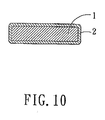
- the preferred embodiment of a cathode for a rechargeable battery according to this invention includes an electrode plate 1, and a coating 2 of the abovementioned cathode material of this invention coated on the electrode plate 1.
- the cathode material further includes an aqueous binder, in addition to an aqueous solvent.
- the aqueous binder is styrene-butadiene rubber (SBR).
- SBR styrene-butadiene rubber
- the aqueous solvent is deionized water.
- the cathode material may further include a non-aqueous binder.
- the non-aqueous binder is polyvinylidene fluoride (PVDF).
- the non-aqueous solvent is N-methyl-pyrrolidone (NMP).
- the cathode material may further include a thickener. More preferably, the thickener is carboxymethyl cellulose (CMC).
- CMC carboxymethyl cellulose
- the preferred embodiment of the cathode thus made may be combined with an anode and an electrolyte to form the rechargeable battery.
- the particulate precursors were placed in an aluminum oxide crucible.
- the crucible together with charcoal was placed in a tubular furnace which was heated at 700 °C for 12 hours in the presence of an argon carrier gas flowing into the furnace.
- Carbon particles formed from the charcoal were suspended in the argon carrier gas and were mixed with the micro-particulate precursors, thereby crystallizing the metal compound of each of the particulate precursors to form the crystalline nanometer-sized primary particles and causing sintering of contacted portions of surfaces of adjacent ones of the crystalline nanometer-sized primary particles to form each of the micrometer-sized secondary particles.
- a cathode material having one of olivine and NASICON structures and including micrometer-sized secondary particles having a particle size ranging from 1 to 50 ⁇ m was obtained.
- each of the micrometer-sized secondary particles is composed of crystalline nanometer-sized primary particles of the LiFePO 4 -based metal compound that have a particle size ranging from 10 to 500 nm and that have carbon particles adhered to surfaces thereof, and is formed by sintering of contacted portions of the surfaces of adjacent ones of the crystalline nanometer-sized primary particles.
- the powdered cathode material includes micrometer-sized secondary particles, each of which is composed of nanometer-sized primary particles, was prepared in a manner similar to that of Example A, except that 0. 2 mole of Fe (NO 3 ) 3 was replaced with 0.2 mole of ferric chloride (FeCl 3 ).
- the powdered cathode material includes micrometer-sized secondary particles, each of which is composed of nanometer-sized primary particles adhered with carbon particles, was prepared in a manner similar to that of Example A, except that 0.2 mole of Fe(NO 3 ) 3 was replaced with 0.2 mole of iron (Fe) powders.
- the powdered cathode material includes micrometer-sized secondary particles, each of which is composed of nanometer-sized primary particles adhered with carbon particles, was prepared in a manner similar to that of Example C, except that 100 ml of 0.252g oxalic acid solution was replaced with 100 ml of 0.42 g citric acid solution.
- the powdered cathode material includes micrometer-sized secondary particles, each of which is composed of nanometer-sized primary particles adhered with carbon particles, was prepared in a manner similar to that of Example D, except that 0.1 g of glucose was added to the reactant solution after the addition of the citric acid solution.
- the powdered cathode material includes micrometer-sized secondary particles, each of which is composed of nanometer-sized primary particles adhered with carbon particles, was prepared in a manner similar to that of Example D, except that 0.1 g of sucrose was added to the reactant solution after the addition of the citric acid solution.
- the powdered cathode material includes micrometer-sized secondary particles, each of which is composed of nanometer-sized primary particles adhered with carbon particles, was prepared in a manner similar to that of Example D, except that 0.2 mole of the iron powders were replaced with a mixture of 0.196 mole of iron powders, 0.002 mole of magnesium chloride (MgCl 2 ), and 0.002 mole of aluminum chloride (AlCl 3 ).
- the powdered cathode material includes micrometer-sized secondary particles, each of which is composed of nanometer-sized primary particles of LiFe 0.98 Mg 0.01 Al 0.01 PO 4 adhered with carbon particles.
- the powdered cathode material includes micrometer-sized secondary particles, each of which is composed of nanometer-sized primary particles adhered with carbon particles, was prepared in a manner similar to that of Example D, except that the reactant solution was dried to from particulate precursors.
- the particulate precursors were placed in the aluminum oxide crucible, and the crucible was then placed in the tubular furnace for conducting crystallization of the LiFePO 4 -based metal compound of the particulate precursors to form crystalline nanometer-sized primary particles.
- the tubular furnace was heated to 600 °C at a rate of 5°C /min and was maintained at this temperature for 4 hours. The tubular furnace was then cooled to room temperature.
- the crystalline nanometer-sized primary particles were mixed with and dispersed in 2 wt% of polyvinylene alcohol solution (in a solid-to-liquid ratio of 40:60) in a ball mill for three hours of granulation process to form a slurry.
- the slurry was spray-dried to form micrometer-sized secondary particles.
- the micrometer-sized secondary_particles were then placed in the aluminum oxide crucible in which charcoal was placed.
- the crucible was heated at 800°C for 8 hours in the presence of a nitrogen carrier gas flowing into the furnace.
- Carbon particles formed from the charcoal were suspended in the nitrogen carrier gas and were mixed with the micrometer-sized secondary particles so as to cause sintering of contacted portions of surfaces of adjacent ones of the crystalline nanometer-sized primary particles of each of the micrometer-sized secondary particles.
- the furnace was then cooled to room temperature.
- a powdered cathode material having one of olivine and NASICON structures and including micrometer-sized secondary particles having a particle size ranging from 1 to 50 ⁇ m was obtained.
- each of the micrometer-sized secondary particles is composed of crystalline nanometer-sized primary particles of the LiFePO 4 -based metal compound that have a particle size ranging from 10 to 500 nm and that have carbon particles adhered to surfaces thereof, and is formed by sintering of contacted portions of the surfaces of adjacent ones of the crystalline nanometer-sized primary particles.
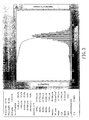
- Figs. 1 and 2 show SEM photographs of the powdered cathode material obtained from Example D under observation using a scanning electron microscope at magnification ratios of 5000 times and 10000 times, respectively. From the results shown in Figs. 1 and 2, the powdered cathode material obtained from Example D includes the micrometer-sized secondary particles having a particle size larger than 10 ⁇ m, each of which is composed of the crystalline nanometer-sized primary particles having a particle size ranging from 50 to 100 nm.
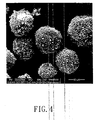
- Fig. 4 shows a SEM photograph of the powdered cathode material obtained from Example H under observation using a scanning electron microscope at a magnification ratio of 5000 times. From the result shown in Fig. 4, which is similar to that of Fig. 1, the powdered cathode material obtained from Example H includes the micrometer-sized secondary particles having a particle size larger than 10 ⁇ m, each of which is composed of the crystalline nanometer-sized primary particles having a particle size ranging from 50 to 100 nm.
- the BET (Brunauer-Emmett-Teller) specific surface area of the powdered cathode material of Example E at 77K was calculated from nitrogen isothermal absorption/desorption curve, and has a value of 38.42m 2 /g.
- the value of the BET specific surface area of the powdered cathode material of Example H is about 39 m 2 /g.
- the conventional cathode material described in the '566 patent in the background part has a BET specific surface area of about 2.5 m 2 /g.
- the cathode material of this invention has a much higher BET specific surface area.
- the powdered cathode material obtained from respective Examples F, G and H was evenly mixed with carbon black and polyvinylidene fluoride in a weight ratio of 83:10:7 to form a slurry mixture.
- the slurry mixture was then coated on an aluminum foil and was dried to produce a cathode specimen.
- the cathode specimen was combined with lithium metal to form a 2032 type button rechargeable battery.
- Charge/discharge tests were performed on the button rechargeable battery thus formed with a Maccor Series 4000 Automated Test System (Maccor Inc., Tulsa, Oklahoma, U.S.A.).
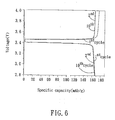
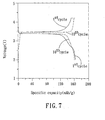
- the applied charge/discharge voltage ranged from 2.8 V to 4 . 0 V, and the charge/discharge rate was set to 0. 2C. Results of the charge/discharge test are shown in Figs. 5, 6 and 7.
- the initial specific capacity of the cathode made from the powdered cathode material of Example F can reach 152 mAh/g, and such specific capacity can be maintained at 100% after ten charge/discharge cycles.
- the initial specific capacity of the charge curve of the cathode made from the powdered cathode material of Example G can reach 167 mAh/g, which approximates the theoretical specific capacity of lithium ferrous phosphate compounds, i.e., 170 mAh/g.
- the specific capacity of the charge curve of the cathode made from the powdered cathode material of Example H can reach 162 mAh/g.
- the powdered cathode material obtained from Example F was mixed with different solvents and binders and then coated on electrode plates to form batteries. Each of the batteries was tested at different charge/discharge rates to evaluate the electrical property.
- the powdered cathode material obtained from Example F was mixed with polyvinylidene fluoride and carbon powders in a weight ratio of 85:12:3 in N-methyl-pyrrolidone (NMP) solvent to form a mixture having a viscosity of 4000 mPa.s. Then, the mixture was coated on an aluminum electrode plate and dried at 100°C .
- the dried aluminum electrode plate has a thickness of 132 ⁇ m, and the powdered cathode material coated on the aluminum electrode plate was not peeled therefrom.
- the electrode plate was then cut and assembled with a carbon anode and an electrolyte solution containing 1 mol/l of LiPF 6 in 5 g of ethylene carbonate/diethyl carbonate (EC/DEC) to form a prismatic battery.
- Charge/discharge tests were performed on the prismatic battery at various charge/discharge rates, i.e., 0.2C, 0.5C, 1C, 2C, 3C and 5C, using a Maccor Series 4000 Automated Test System (Maccor Inc., Tulsa, Oklahoma, U.S.A.).
- Maccor Inc. Tulsa, Oklahoma, U.S.A.
- curves 1, 2, 3, 4,5 and 6 respectively correspond to voltage to capacity relationship of the battery 1 at charge/discharge rates of 0.2C, 0.5C, 1C, 2C, 3C and 5C. From the results shown in Fig. 8, it is noted that the battery 1 can be efficiently charged and discharged at different charge/discharge rates. Particularly, the capacity of discharge at a charge/discharge rate of 5C is approximately 87% of that of discharge at a charge/discharge rate of 0.2C.
- the results shown in Fig. 8 demonstrate that the powdered cathode material of this invention can be easily coated on and adhered to the electrode plate so as to achieve high charge/discharge rates.
- the powdered cathode material obtained from Example F was mixed with styrene-butadiene rubber (SBR), carboxymethyl cellulose (CMC), and carbon powders in a weight ratio of 95:1.5:0.5:3 in deionized water to form a mixture having a viscosity of 4000 mPa. s. Then, the mixture was coated on an aluminum electrode plate and dried at 80 °C. The dried aluminum electrode plate has a thickness of 200 ⁇ m, and the powdered cathode material coated on the aluminum electrode plate was not peeled therefrom.
- SBR styrene-butadiene rubber
- CMC carboxymethyl cellulose
- the electrode plate was then cut and assembled with a carbon anode and an electrolyte solution containing 1 mol/l of LiPF 6 in 5 g of ethylene carbonate/diethyl carbonate (EC/DEC) to form a 18650 battery.
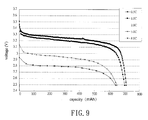
- Charge/discharge tests were performed on the 18650 battery at various charge/discharge rates, i.e., 0.5C, 1C, 2C, 5C and 8C, using a Maccor Series 3200 Automated Test System (Maccor Inc., Tulsa, Oklahoma, U.S.A.).
- curves 1, 2, 3, 4,and 5 respectively correspond to voltage to capacity relationship of the battery 2 at charge/discharge rates of 0.5C, 1C, 2C, 5C, and 8C.
- the battery 2 can be efficiently charged and discharged at different charge/discharge rates.
- the capacity of discharge at a charge/discharge rate of 8C is approximately 90% of that of discharge at a charge/discharge rate of 0.5C.
- the cathode material of this invention which includes micrometer-sized secondary particles having a particle size ranging from 1 to 50 ⁇ m, each of which is composed of crystalline nanometer-sized primary particles of a metal compound, has an improved specific surface area and capacity.
- the cathode material of this invention is compatible with various binders, particularly aqueous binders, and aqueous solvents, particularly deionized water, and can be easily coated on and firmly adhered to the electrode plate.
Landscapes
- Chemical & Material Sciences (AREA)
- Chemical Kinetics & Catalysis (AREA)
- Electrochemistry (AREA)
- General Chemical & Material Sciences (AREA)
- Engineering & Computer Science (AREA)
- Inorganic Chemistry (AREA)
- Materials Engineering (AREA)
- Manufacturing & Machinery (AREA)
- Crystallography & Structural Chemistry (AREA)
- Battery Electrode And Active Subsutance (AREA)
Applications Claiming Priority (1)
| Application Number | Priority Date | Filing Date | Title |
|---|---|---|---|
| CNB2006100749646A CN100563047C (zh) | 2006-04-25 | 2006-04-25 | 适用于制作二次电池的正极的复合材料及其所制得的电池 |
Publications (1)
| Publication Number | Publication Date |
|---|---|
| EP1850409A1 true EP1850409A1 (en) | 2007-10-31 |
Family
ID=38292683
Family Applications (1)
| Application Number | Title | Priority Date | Filing Date |
|---|---|---|---|
| EP07251680A Ceased EP1850409A1 (en) | 2006-04-25 | 2007-04-23 | Cathode material for manufacturing a rechargeable battery |
Country Status (5)
| Country | Link |
|---|---|
| EP (1) | EP1850409A1 (enExample) |
| JP (1) | JP5039423B2 (enExample) |
| KR (1) | KR100809570B1 (enExample) |
| CN (1) | CN100563047C (enExample) |
| CA (1) | CA2585594C (enExample) |
Cited By (28)
| Publication number | Priority date | Publication date | Assignee | Title |
|---|---|---|---|---|
| WO2009097680A1 (en) * | 2008-02-04 | 2009-08-13 | Vale Inco Limited | Method for improving environmental stability of cathode materials for lithium batteries |
| US7683359B2 (en) | 2002-11-05 | 2010-03-23 | Nexeon Ltd. | Structured silicon anode |
| WO2011062232A1 (ja) * | 2009-11-18 | 2011-05-26 | 三井化学株式会社 | 電気化学セル用水性ペースト、該水性ペーストを塗布してなる電気化学セル用極板、および該極板を含む電池 |
| US8101298B2 (en) | 2006-01-23 | 2012-01-24 | Nexeon Ltd. | Method of fabricating fibres composed of silicon or a silicon-based material and their use in lithium rechargeable batteries |
| US8585918B2 (en) | 2006-01-23 | 2013-11-19 | Nexeon Ltd. | Method of etching a silicon-based material |
| US8642211B2 (en) | 2007-07-17 | 2014-02-04 | Nexeon Limited | Electrode including silicon-comprising fibres and electrochemical cells including the same |
| US8772174B2 (en) | 2010-04-09 | 2014-07-08 | Nexeon Ltd. | Method of fabricating structured particles composed of silicon or silicon-based material and their use in lithium rechargeable batteries |
| US8821763B2 (en) | 2008-09-30 | 2014-09-02 | Tdk Corporation | Active material and method of manufacturing active material |
| US8870975B2 (en) | 2007-07-17 | 2014-10-28 | Nexeon Ltd. | Method of fabricating structured particles composed of silicon or a silicon-based material and their use in lithium rechargeable batteries |
| US8877379B2 (en) | 2010-12-03 | 2014-11-04 | Samsung Sdi Co., Ltd. | Positive active material for rechargeable lithium battery and rechargeable lithium battery |
| US8932759B2 (en) | 2008-10-10 | 2015-01-13 | Nexeon Ltd. | Method of fabricating structured particles composed of silicon or a silicon-based material |
| US8932762B2 (en) | 2008-09-30 | 2015-01-13 | Tdk Corporation | Active material and positive electrode and lithium-ion second battery using same |
| US8945774B2 (en) | 2010-06-07 | 2015-02-03 | Nexeon Ltd. | Additive for lithium ion rechageable battery cells |
| US8962183B2 (en) | 2009-05-07 | 2015-02-24 | Nexeon Limited | Method of making silicon anode material for rechargeable cells |
| US9012079B2 (en) | 2007-07-17 | 2015-04-21 | Nexeon Ltd | Electrode comprising structured silicon-based material |
| EP2919303A1 (en) | 2012-11-12 | 2015-09-16 | Mitsui Engineering & Shipbuilding Co., Ltd. | Electrode material and process for manufacturing electrode material |
| US9184438B2 (en) | 2008-10-10 | 2015-11-10 | Nexeon Ltd. | Method of fabricating structured particles composed of silicon or a silicon-based material and their use in lithium rechargeable batteries |
| US9252426B2 (en) | 2007-05-11 | 2016-02-02 | Nexeon Limited | Silicon anode for a rechargeable battery |
| US9362554B2 (en) | 2009-10-02 | 2016-06-07 | Toyota Jidosha Kabushiki Kaisha | Method of manufacturing a positive electrode with a condensation reaction initiated by heating and reduced pressure |
| US9458016B2 (en) | 2008-10-22 | 2016-10-04 | Lg Chem, Ltd. | Lithium iron phosphate having olivine structure and method for preparing the same |
| US9559359B2 (en) | 2009-10-02 | 2017-01-31 | Toyota Jidosha Kabushiki Kaisha | Lithium secondary battery and positive electrode for the battery |
| US9608272B2 (en) | 2009-05-11 | 2017-03-28 | Nexeon Limited | Composition for a secondary battery cell |
| US9647263B2 (en) | 2010-09-03 | 2017-05-09 | Nexeon Limited | Electroactive material |
| US9853292B2 (en) | 2009-05-11 | 2017-12-26 | Nexeon Limited | Electrode composition for a secondary battery cell |
| US9871248B2 (en) | 2010-09-03 | 2018-01-16 | Nexeon Limited | Porous electroactive material |
| US10329154B2 (en) | 2006-12-07 | 2019-06-25 | Johnson Matthey Public Limited Company | Method for preparing a particulate cathode material |
| US10707479B2 (en) | 2013-03-15 | 2020-07-07 | Johnson Matthey Public Limited Company | Lithium transition metal phosphate secondary agglomerates and process for its manufacture |
| EP4654299A1 (en) * | 2024-04-29 | 2025-11-26 | Samsung Sdi Co., Ltd. | Positive electrode active material for rechargeable lithium battery, positive electrode including the same, and rechargeable lithium battery including the same |
Families Citing this family (24)
| Publication number | Priority date | Publication date | Assignee | Title |
|---|---|---|---|---|
| JP5314264B2 (ja) * | 2007-09-26 | 2013-10-16 | 古河電池株式会社 | リチウム二次電池用正極活物質の製造法、正極活物質及びリチウム二次電池 |
| EP2065887A1 (en) * | 2007-11-30 | 2009-06-03 | Hitachi Global Storage Technologies Netherlands B.V. | Method for manufacturing magnetic disk unit |
| US20090212267A1 (en) * | 2007-12-22 | 2009-08-27 | Primet Precision Materials, Inc. | Small particle electrode material compositions and methods of forming the same |
| JP5165515B2 (ja) * | 2008-09-19 | 2013-03-21 | 株式会社日立製作所 | リチウムイオン二次電池 |
| JP5365125B2 (ja) * | 2008-09-30 | 2013-12-11 | Tdk株式会社 | リチウムイオン二次電池の正極用活物質 |
| JP5347605B2 (ja) * | 2009-03-16 | 2013-11-20 | Tdk株式会社 | 活物質、これを含む電極、当該電極を含むリチウムイオン二次電池、及び活物質の製造方法 |
| US8398883B2 (en) * | 2009-03-19 | 2013-03-19 | Advanced Lithium Electrochemistry Co., Ltd. | Electrochemical composition and associated technology |
| JP5645092B2 (ja) * | 2009-11-05 | 2014-12-24 | ユミコア | 二重シェルコアリチウムニッケルマンガンコバルト酸化物 |
| KR101505218B1 (ko) | 2010-03-12 | 2015-03-24 | 주식회사 엘지화학 | 수명 저하가 없는 급속 충전형 음극과 이를 포함하는 리튬 이차전지 |
| JP5736965B2 (ja) * | 2011-05-27 | 2015-06-17 | 日立金属株式会社 | リチウム二次電池用正極活物質とその製造方法、リチウム二次電池用正極、及びリチウム二次電池 |
| KR101227107B1 (ko) * | 2011-06-13 | 2013-01-28 | 한국과학기술원 | 2단계 결정화 공정을 통한 마이크로 크기의 다공성 LiFePO4/C복합체 제조방법 및 리튬이온전지 양극재로의 이용방법 |
| JP5273274B1 (ja) * | 2012-04-27 | 2013-08-28 | 東洋インキScホールディングス株式会社 | リチウム二次電池電極形成用組成物、二次電池用電極 |
| JP5665896B2 (ja) * | 2013-01-30 | 2015-02-04 | 国立大学法人群馬大学 | 活物質材料およびリチウムイオン電池 |
| EP2778127A1 (en) * | 2013-03-15 | 2014-09-17 | Clariant International Ltd. | Lithium transition metal phosphate secondary agglomerates and process for its manufacture |
| CN103413945A (zh) * | 2013-08-27 | 2013-11-27 | 昆明理工大学 | 一种锂离子电池正极材料的制造方法 |
| JP6078650B2 (ja) | 2013-08-28 | 2017-02-08 | エルジー・ケム・リミテッド | リチウム遷移金属リン酸化物粒子を含む正極活物質、この製造方法、及びこれを含むリチウム二次電池 |
| JP6352421B2 (ja) | 2013-09-02 | 2018-07-04 | エルジー・ケム・リミテッド | 二次電池用正極及びそれを含む二次電池 |
| KR101764470B1 (ko) * | 2014-10-02 | 2017-08-02 | 주식회사 엘지화학 | 이종의 바인더를 포함하는 양극 활물질 슬러리 및 이로부터 제조된 양극 |
| CN111009691B (zh) * | 2019-12-24 | 2021-01-26 | 天津巴莫科技有限责任公司 | 一种高性能nascion结构固态电解质及其制备方法 |
| KR102602749B1 (ko) | 2021-02-19 | 2023-11-15 | 전남대학교산학협력단 | 탄소 코팅된 nmtvp 나노복합체 양극재료, 그 제조방법 및 이를 포함하는 양극 및 나트륨이온배터리 |
| CN113921779B (zh) * | 2021-09-08 | 2022-12-13 | 西北大学 | 一种nasicon型钠快离子导体材料、制备方法及应用 |
| CN115417393A (zh) * | 2022-09-05 | 2022-12-02 | 广西大学 | 一种球形磷酸锰锆钠/碳复合材料及制备方法和应用 |
| CN116093268A (zh) * | 2023-02-21 | 2023-05-09 | 湖北亿纬动力有限公司 | 一种正极极片及其制备方法和应用 |
| CN119092698A (zh) * | 2023-10-31 | 2024-12-06 | 贝特瑞新材料集团股份有限公司 | 负极材料及电池 |
Citations (3)
| Publication number | Priority date | Publication date | Assignee | Title |
|---|---|---|---|---|
| EP1094533A1 (en) * | 1999-04-06 | 2001-04-25 | Sony Corporation | Active material of positive plate, nonaqueous electrolyte secondary cell, method for producing active material of positive material |
| EP1193783A2 (en) * | 2000-09-29 | 2002-04-03 | Sony Corporation | Method for the preparation of cathode active material and method for the preparation of a non-aqueous electrolyte cell |
| EP1790617A1 (en) * | 2005-10-03 | 2007-05-30 | Aquire Energy Co. Ltd. | Method for making a lithium mixed metal compound |
Family Cites Families (10)
| Publication number | Priority date | Publication date | Assignee | Title |
|---|---|---|---|---|
| US5910382A (en) * | 1996-04-23 | 1999-06-08 | Board Of Regents, University Of Texas Systems | Cathode materials for secondary (rechargeable) lithium batteries |
| US6528033B1 (en) * | 2000-01-18 | 2003-03-04 | Valence Technology, Inc. | Method of making lithium-containing materials |
| CA2320661A1 (fr) * | 2000-09-26 | 2002-03-26 | Hydro-Quebec | Nouveau procede de synthese de materiaux limpo4 a structure olivine |
| JP4187523B2 (ja) * | 2002-01-31 | 2008-11-26 | 日本化学工業株式会社 | リチウム鉄リン系複合酸化物炭素複合体、その製造方法、リチウム二次電池正極活物質及びリチウム二次電池 |
| JP4187524B2 (ja) * | 2002-01-31 | 2008-11-26 | 日本化学工業株式会社 | リチウム鉄リン系複合酸化物炭素複合体、その製造方法、リチウム二次電池正極活物質及びリチウム二次電池 |
| US6815122B2 (en) * | 2002-03-06 | 2004-11-09 | Valence Technology, Inc. | Alkali transition metal phosphates and related electrode active materials |
| KR20130038952A (ko) * | 2002-06-21 | 2013-04-18 | 상트르 나쇼날 드 라 르세르쒸 시앙티피끄 | 탄소-코팅된 리튬-함유 분말과 이의 제조 방법 |
| JP4260572B2 (ja) * | 2003-07-29 | 2009-04-30 | 日本化学工業株式会社 | Mn原子を含有するリチウム鉄リン系複合酸化物炭素複合体の製造方法 |
| JP4483253B2 (ja) * | 2003-09-30 | 2010-06-16 | 三菱化学株式会社 | リチウム二次電池用正極材料、リチウム二次電池用正極及びリチウム二次電池 |
| JP2007035358A (ja) * | 2005-07-25 | 2007-02-08 | Toyota Central Res & Dev Lab Inc | 正極活物質及びその製造方法、並びにリチウムイオン二次電池 |
-
2006
- 2006-04-25 CN CNB2006100749646A patent/CN100563047C/zh active Active
-
2007
- 2007-04-20 CA CA2585594A patent/CA2585594C/en active Active
- 2007-04-23 EP EP07251680A patent/EP1850409A1/en not_active Ceased
- 2007-04-24 JP JP2007114024A patent/JP5039423B2/ja active Active
- 2007-04-24 KR KR1020070039924A patent/KR100809570B1/ko active Active
Patent Citations (3)
| Publication number | Priority date | Publication date | Assignee | Title |
|---|---|---|---|---|
| EP1094533A1 (en) * | 1999-04-06 | 2001-04-25 | Sony Corporation | Active material of positive plate, nonaqueous electrolyte secondary cell, method for producing active material of positive material |
| EP1193783A2 (en) * | 2000-09-29 | 2002-04-03 | Sony Corporation | Method for the preparation of cathode active material and method for the preparation of a non-aqueous electrolyte cell |
| EP1790617A1 (en) * | 2005-10-03 | 2007-05-30 | Aquire Energy Co. Ltd. | Method for making a lithium mixed metal compound |
Cited By (42)
| Publication number | Priority date | Publication date | Assignee | Title |
|---|---|---|---|---|
| US7683359B2 (en) | 2002-11-05 | 2010-03-23 | Nexeon Ltd. | Structured silicon anode |
| US7842535B2 (en) | 2002-11-05 | 2010-11-30 | Nexeon Ltd. | Structured silicon anode |
| US8017430B2 (en) | 2002-11-05 | 2011-09-13 | Nexeon Ltd. | Structured silicon anode |
| US8384058B2 (en) | 2002-11-05 | 2013-02-26 | Nexeon Ltd. | Structured silicon anode |
| US8101298B2 (en) | 2006-01-23 | 2012-01-24 | Nexeon Ltd. | Method of fabricating fibres composed of silicon or a silicon-based material and their use in lithium rechargeable batteries |
| US8585918B2 (en) | 2006-01-23 | 2013-11-19 | Nexeon Ltd. | Method of etching a silicon-based material |
| US8597831B2 (en) | 2006-01-23 | 2013-12-03 | Nexeon Ltd. | Method of fabricating fibres composed of silicon or a silicon-based material and their use in lithium rechargeable batteries |
| US9583762B2 (en) | 2006-01-23 | 2017-02-28 | Nexeon Limited | Method of fabricating fibres composed of silicon or a silicon-based material and their use in lithium rechargeable batteries |
| US10329154B2 (en) | 2006-12-07 | 2019-06-25 | Johnson Matthey Public Limited Company | Method for preparing a particulate cathode material |
| US9252426B2 (en) | 2007-05-11 | 2016-02-02 | Nexeon Limited | Silicon anode for a rechargeable battery |
| US9871249B2 (en) | 2007-05-11 | 2018-01-16 | Nexeon Limited | Silicon anode for a rechargeable battery |
| US8642211B2 (en) | 2007-07-17 | 2014-02-04 | Nexeon Limited | Electrode including silicon-comprising fibres and electrochemical cells including the same |
| US8940437B2 (en) | 2007-07-17 | 2015-01-27 | Nexeon Limited | Method of fabricating structured particles composed of silicon or a silicon-based material and their use in lithium rechargeable batteries |
| US8870975B2 (en) | 2007-07-17 | 2014-10-28 | Nexeon Ltd. | Method of fabricating structured particles composed of silicon or a silicon-based material and their use in lithium rechargeable batteries |
| US9871244B2 (en) | 2007-07-17 | 2018-01-16 | Nexeon Limited | Method of fabricating structured particles composed of silicon or a silicon-based material and their use in lithium rechargeable batteries |
| US9012079B2 (en) | 2007-07-17 | 2015-04-21 | Nexeon Ltd | Electrode comprising structured silicon-based material |
| WO2009097680A1 (en) * | 2008-02-04 | 2009-08-13 | Vale Inco Limited | Method for improving environmental stability of cathode materials for lithium batteries |
| EP2250690A4 (en) * | 2008-02-04 | 2013-11-06 | Tiax Llc | METHOD FOR ENHANCING THE ENVIRONMENTAL STABILITY OF CATHODE MATERIALS FOR LITHIUM BATTERIES |
| US8936871B2 (en) | 2008-09-30 | 2015-01-20 | Tdk Corporation | Active material and positive electrode and lithium-ion second battery using same |
| US8932762B2 (en) | 2008-09-30 | 2015-01-13 | Tdk Corporation | Active material and positive electrode and lithium-ion second battery using same |
| US8821763B2 (en) | 2008-09-30 | 2014-09-02 | Tdk Corporation | Active material and method of manufacturing active material |
| US9184438B2 (en) | 2008-10-10 | 2015-11-10 | Nexeon Ltd. | Method of fabricating structured particles composed of silicon or a silicon-based material and their use in lithium rechargeable batteries |
| US8932759B2 (en) | 2008-10-10 | 2015-01-13 | Nexeon Ltd. | Method of fabricating structured particles composed of silicon or a silicon-based material |
| US9458016B2 (en) | 2008-10-22 | 2016-10-04 | Lg Chem, Ltd. | Lithium iron phosphate having olivine structure and method for preparing the same |
| US8962183B2 (en) | 2009-05-07 | 2015-02-24 | Nexeon Limited | Method of making silicon anode material for rechargeable cells |
| US10050275B2 (en) | 2009-05-11 | 2018-08-14 | Nexeon Limited | Binder for lithium ion rechargeable battery cells |
| US9853292B2 (en) | 2009-05-11 | 2017-12-26 | Nexeon Limited | Electrode composition for a secondary battery cell |
| US9608272B2 (en) | 2009-05-11 | 2017-03-28 | Nexeon Limited | Composition for a secondary battery cell |
| US9362554B2 (en) | 2009-10-02 | 2016-06-07 | Toyota Jidosha Kabushiki Kaisha | Method of manufacturing a positive electrode with a condensation reaction initiated by heating and reduced pressure |
| US9559359B2 (en) | 2009-10-02 | 2017-01-31 | Toyota Jidosha Kabushiki Kaisha | Lithium secondary battery and positive electrode for the battery |
| WO2011062232A1 (ja) * | 2009-11-18 | 2011-05-26 | 三井化学株式会社 | 電気化学セル用水性ペースト、該水性ペーストを塗布してなる電気化学セル用極板、および該極板を含む電池 |
| US8772174B2 (en) | 2010-04-09 | 2014-07-08 | Nexeon Ltd. | Method of fabricating structured particles composed of silicon or silicon-based material and their use in lithium rechargeable batteries |
| US8945774B2 (en) | 2010-06-07 | 2015-02-03 | Nexeon Ltd. | Additive for lithium ion rechageable battery cells |
| US9368836B2 (en) | 2010-06-07 | 2016-06-14 | Nexeon Ltd. | Additive for lithium ion rechargeable battery cells |
| US9647263B2 (en) | 2010-09-03 | 2017-05-09 | Nexeon Limited | Electroactive material |
| US9871248B2 (en) | 2010-09-03 | 2018-01-16 | Nexeon Limited | Porous electroactive material |
| US9947920B2 (en) | 2010-09-03 | 2018-04-17 | Nexeon Limited | Electroactive material |
| US8877379B2 (en) | 2010-12-03 | 2014-11-04 | Samsung Sdi Co., Ltd. | Positive active material for rechargeable lithium battery and rechargeable lithium battery |
| EP2919303A4 (en) * | 2012-11-12 | 2016-06-15 | Mitsui Shipbuilding Eng | ELECTRODE MATERIAL AND METHOD FOR PRODUCING AN ELECTRODE MATERIAL |
| EP2919303A1 (en) | 2012-11-12 | 2015-09-16 | Mitsui Engineering & Shipbuilding Co., Ltd. | Electrode material and process for manufacturing electrode material |
| US10707479B2 (en) | 2013-03-15 | 2020-07-07 | Johnson Matthey Public Limited Company | Lithium transition metal phosphate secondary agglomerates and process for its manufacture |
| EP4654299A1 (en) * | 2024-04-29 | 2025-11-26 | Samsung Sdi Co., Ltd. | Positive electrode active material for rechargeable lithium battery, positive electrode including the same, and rechargeable lithium battery including the same |
Also Published As
| Publication number | Publication date |
|---|---|
| CA2585594C (en) | 2012-03-13 |
| KR20070105266A (ko) | 2007-10-30 |
| HK1109679A1 (en) | 2008-06-13 |
| CN100563047C (zh) | 2009-11-25 |
| CN101064367A (zh) | 2007-10-31 |
| KR100809570B1 (ko) | 2008-03-04 |
| JP5039423B2 (ja) | 2012-10-03 |
| CA2585594A1 (en) | 2007-10-25 |
| JP2007294461A (ja) | 2007-11-08 |
Similar Documents
| Publication | Publication Date | Title |
|---|---|---|
| US7700236B2 (en) | Cathode material for manufacturing a rechargeable battery | |
| EP1850409A1 (en) | Cathode material for manufacturing a rechargeable battery | |
| JP2007294461A5 (enExample) | ||
| US7781100B2 (en) | Cathode material for manufacturing rechargeable battery | |
| JP4713051B2 (ja) | 電池用活物質及びその製造方法 | |
| CN101283465B (zh) | 正极活性材料和其生产方法以及具有含正极活性材料的正极的非水电解质电池 | |
| US8394291B2 (en) | Process for making fluorinated lithium vanadium polyanion powders for batteries | |
| US20070238021A1 (en) | Ion storage compound of cathode material and method for preparing the same | |
| CN116022771B (zh) | 硬碳材料、负极极片以及电化学装置 | |
| CN104428255B (zh) | 掺杂的镍酸盐化合物 | |
| EP3826087A1 (en) | Method of producing electrode material for lithium-ion secondary battery and lithium-ion battery using such electrode material | |
| CN104428254A (zh) | 掺杂的镍酸盐化合物 | |
| JP2003142097A (ja) | 電池用活物質およびその製造方法 | |
| JP2009505929A (ja) | スピネル構造を有する、リチウムセル電池のためのニッケルおよびマンガンをベースとする高電圧正電極材料 | |
| CN103515594A (zh) | 碳包覆的磷酸锰锂/磷酸铁锂核壳结构材料及其制备方法 | |
| WO2006068066A1 (ja) | 非水電解液二次電池用もしくは非水電解液電気化学キャパシタ用の複合電極活物質およびその製造法 | |
| US20100028676A1 (en) | Synthesis of a limp04 compound and use as electrode material in a lithium storage battery | |
| JP2013069653A (ja) | リチウム2次電池用正極材料及びその製造方法 | |
| JP5890885B1 (ja) | リチウム二次電池用正極活物質及びその製造方法 | |
| JP4536561B2 (ja) | 電極材料の製造方法 | |
| CN102386412A (zh) | 一种锂离子电池正极Li3V2(PO4)3/C复合材料及其制备方法 | |
| JP2011249293A (ja) | リチウム遷移金属化合物及びその製造方法、並びにリチウムイオン電池 | |
| JP2008052970A (ja) | 電極材料の製造方法及び正極材料並びに電池 | |
| JP2012033438A (ja) | リチウムイオン二次電池用正極及びこれを用いたリチウムイオン二次電池 | |
| KR101948549B1 (ko) | 이차전지용 양극 활물질 |
Legal Events
| Date | Code | Title | Description |
|---|---|---|---|
| PUAI | Public reference made under article 153(3) epc to a published international application that has entered the european phase |
Free format text: ORIGINAL CODE: 0009012 |
|
| AK | Designated contracting states |
Kind code of ref document: A1 Designated state(s): AT BE BG CH CY CZ DE DK EE ES FI FR GB GR HU IE IS IT LI LT LU LV MC MT NL PL PT RO SE SI SK TR |
|
| AX | Request for extension of the european patent |
Extension state: AL BA HR MK YU |
|
| 17P | Request for examination filed |
Effective date: 20080407 |
|
| 17Q | First examination report despatched |
Effective date: 20080513 |
|
| AKX | Designation fees paid |
Designated state(s): AT BE BG CH CY CZ DE DK EE ES FI FR GB GR HU IE IS IT LI LT LU LV MC MT NL PL PT RO SE SI SK TR |
|
| APBK | Appeal reference recorded |
Free format text: ORIGINAL CODE: EPIDOSNREFNE |
|
| APBN | Date of receipt of notice of appeal recorded |
Free format text: ORIGINAL CODE: EPIDOSNNOA2E |
|
| APAV | Appeal reference deleted |
Free format text: ORIGINAL CODE: EPIDOSDREFNE |
|
| APBT | Appeal procedure closed |
Free format text: ORIGINAL CODE: EPIDOSNNOA9E |
|
| STAA | Information on the status of an ep patent application or granted ep patent |
Free format text: STATUS: THE APPLICATION HAS BEEN REFUSED |
|
| 18R | Application refused |
Effective date: 20130429 |