EP1818353A1 - Polyalkylenglykol-Schmiermittelbasisöle mit enger Molmassenverteilung - Google Patents
Polyalkylenglykol-Schmiermittelbasisöle mit enger Molmassenverteilung Download PDFInfo
- Publication number
- EP1818353A1 EP1818353A1 EP07001849A EP07001849A EP1818353A1 EP 1818353 A1 EP1818353 A1 EP 1818353A1 EP 07001849 A EP07001849 A EP 07001849A EP 07001849 A EP07001849 A EP 07001849A EP 1818353 A1 EP1818353 A1 EP 1818353A1
- Authority
- EP
- European Patent Office
- Prior art keywords
- alkylene
- polyalkylene glycols
- mixture
- molecular weight
- polyalkylene
- Prior art date
- Legal status (The legal status is an assumption and is not a legal conclusion. Google has not performed a legal analysis and makes no representation as to the accuracy of the status listed.)
- Granted
Links
- 239000000314 lubricant Substances 0.000 title claims description 24
- 239000002199 base oil Substances 0.000 title description 18
- 238000009826 distribution Methods 0.000 title description 10
- 229920001515 polyalkylene glycol Polymers 0.000 claims abstract description 53
- 239000000203 mixture Substances 0.000 claims abstract description 31
- 125000002947 alkylene group Chemical group 0.000 claims abstract description 18
- 239000003054 catalyst Substances 0.000 claims abstract description 15
- LFQSCWFLJHTTHZ-UHFFFAOYSA-N Ethanol Chemical compound CCO LFQSCWFLJHTTHZ-UHFFFAOYSA-N 0.000 claims abstract description 10
- 125000002887 hydroxy group Chemical group [H]O* 0.000 claims abstract description 10
- GOOHAUXETOMSMM-UHFFFAOYSA-N Propylene oxide Chemical compound CC1CO1 GOOHAUXETOMSMM-UHFFFAOYSA-N 0.000 claims description 16
- 238000000034 method Methods 0.000 claims description 16
- 125000004432 carbon atom Chemical group C* 0.000 claims description 11
- 238000002360 preparation method Methods 0.000 claims description 11
- 150000005846 sugar alcohols Polymers 0.000 claims description 10
- IAYPIBMASNFSPL-UHFFFAOYSA-N Ethylene oxide Chemical compound C1CO1 IAYPIBMASNFSPL-UHFFFAOYSA-N 0.000 claims description 6
- PEDCQBHIVMGVHV-UHFFFAOYSA-N Glycerine Chemical compound OCC(O)CO PEDCQBHIVMGVHV-UHFFFAOYSA-N 0.000 claims description 6
- WYURNTSHIVDZCO-UHFFFAOYSA-N Tetrahydrofuran Chemical compound C1CCOC1 WYURNTSHIVDZCO-UHFFFAOYSA-N 0.000 claims description 5
- 238000004458 analytical method Methods 0.000 claims description 5
- 238000009472 formulation Methods 0.000 claims description 5
- 239000000178 monomer Substances 0.000 claims description 3
- 239000003039 volatile agent Substances 0.000 claims description 3
- ZJCCRDAZUWHFQH-UHFFFAOYSA-N Trimethylolpropane Chemical compound CCC(CO)(CO)CO ZJCCRDAZUWHFQH-UHFFFAOYSA-N 0.000 claims description 2
- 150000002009 diols Chemical class 0.000 claims description 2
- 239000012530 fluid Substances 0.000 claims description 2
- WXZMFSXDPGVJKK-UHFFFAOYSA-N pentaerythritol Chemical compound OCC(CO)(CO)CO WXZMFSXDPGVJKK-UHFFFAOYSA-N 0.000 claims description 2
- HOSGXJWQVBHGLT-UHFFFAOYSA-N 6-hydroxy-3,4-dihydro-1h-quinolin-2-one Chemical group N1C(=O)CCC2=CC(O)=CC=C21 HOSGXJWQVBHGLT-UHFFFAOYSA-N 0.000 claims 2
- 238000004519 manufacturing process Methods 0.000 abstract description 5
- 239000011701 zinc Substances 0.000 abstract description 4
- XFXPMWWXUTWYJX-UHFFFAOYSA-N Cyanide Chemical compound N#[C-] XFXPMWWXUTWYJX-UHFFFAOYSA-N 0.000 abstract description 3
- 150000001298 alcohols Chemical class 0.000 abstract description 3
- HSSJULAPNNGXFW-UHFFFAOYSA-N [Co].[Zn] Chemical compound [Co].[Zn] HSSJULAPNNGXFW-UHFFFAOYSA-N 0.000 abstract description 2
- IJGRMHOSHXDMSA-UHFFFAOYSA-N Atomic nitrogen Chemical compound N#N IJGRMHOSHXDMSA-UHFFFAOYSA-N 0.000 description 16
- KWYUFKZDYYNOTN-UHFFFAOYSA-M potassium hydroxide Inorganic materials [OH-].[K+] KWYUFKZDYYNOTN-UHFFFAOYSA-M 0.000 description 16
- 238000005227 gel permeation chromatography Methods 0.000 description 10
- 229920001577 copolymer Polymers 0.000 description 8
- 229910052757 nitrogen Inorganic materials 0.000 description 8
- 229920001451 polypropylene glycol Polymers 0.000 description 8
- 238000006243 chemical reaction Methods 0.000 description 7
- HEMHJVSKTPXQMS-UHFFFAOYSA-M Sodium hydroxide Chemical compound [OH-].[Na+] HEMHJVSKTPXQMS-UHFFFAOYSA-M 0.000 description 6
- XXROGKLTLUQVRX-UHFFFAOYSA-N allyl alcohol Chemical compound OCC=C XXROGKLTLUQVRX-UHFFFAOYSA-N 0.000 description 6
- 230000015572 biosynthetic process Effects 0.000 description 6
- MTHSVFCYNBDYFN-UHFFFAOYSA-N diethylene glycol Chemical compound OCCOCCO MTHSVFCYNBDYFN-UHFFFAOYSA-N 0.000 description 6
- 238000005160 1H NMR spectroscopy Methods 0.000 description 5
- 125000003903 2-propenyl group Chemical group [H]C([*])([H])C([H])=C([H])[H] 0.000 description 5
- 238000006555 catalytic reaction Methods 0.000 description 5
- 239000000047 product Substances 0.000 description 5
- UFHFLCQGNIYNRP-UHFFFAOYSA-N Hydrogen Chemical compound [H][H] UFHFLCQGNIYNRP-UHFFFAOYSA-N 0.000 description 4
- 150000008044 alkali metal hydroxides Chemical class 0.000 description 4
- 239000003999 initiator Substances 0.000 description 4
- 238000010539 anionic addition polymerization reaction Methods 0.000 description 3
- 239000003963 antioxidant agent Substances 0.000 description 3
- 125000000484 butyl group Chemical group [H]C([*])([H])C([H])([H])C([H])([H])C([H])([H])[H] 0.000 description 3
- SZXQTJUDPRGNJN-UHFFFAOYSA-N dipropylene glycol Chemical compound OCCCOCCCO SZXQTJUDPRGNJN-UHFFFAOYSA-N 0.000 description 3
- YXIWHUQXZSMYRE-UHFFFAOYSA-N 1,3-benzothiazole-2-thiol Chemical compound C1=CC=C2SC(S)=NC2=C1 YXIWHUQXZSMYRE-UHFFFAOYSA-N 0.000 description 2
- QIGBRXMKCJKVMJ-UHFFFAOYSA-N 1,4-Benzenediol Natural products OC1=CC=C(O)C=C1 QIGBRXMKCJKVMJ-UHFFFAOYSA-N 0.000 description 2
- LRHPLDYGYMQRHN-UHFFFAOYSA-N N-Butanol Chemical compound CCCCO LRHPLDYGYMQRHN-UHFFFAOYSA-N 0.000 description 2
- 239000004721 Polyphenylene oxide Substances 0.000 description 2
- 229920005830 Polyurethane Foam Polymers 0.000 description 2
- ZLMJMSJWJFRBEC-UHFFFAOYSA-N Potassium Chemical compound [K] ZLMJMSJWJFRBEC-UHFFFAOYSA-N 0.000 description 2
- 150000001412 amines Chemical class 0.000 description 2
- 229910052799 carbon Inorganic materials 0.000 description 2
- 238000005260 corrosion Methods 0.000 description 2
- 230000007797 corrosion Effects 0.000 description 2
- 238000001704 evaporation Methods 0.000 description 2
- 230000008020 evaporation Effects 0.000 description 2
- 239000012208 gear oil Substances 0.000 description 2
- 239000010720 hydraulic oil Substances 0.000 description 2
- 229910052739 hydrogen Inorganic materials 0.000 description 2
- 239000001257 hydrogen Substances 0.000 description 2
- 239000003112 inhibitor Substances 0.000 description 2
- NWVVVBRKAWDGAB-UHFFFAOYSA-N p-methoxyphenol Chemical compound COC1=CC=C(O)C=C1 NWVVVBRKAWDGAB-UHFFFAOYSA-N 0.000 description 2
- 239000002530 phenolic antioxidant Substances 0.000 description 2
- 229920000570 polyether Polymers 0.000 description 2
- 238000006116 polymerization reaction Methods 0.000 description 2
- 229920005862 polyol Polymers 0.000 description 2
- 150000003077 polyols Chemical class 0.000 description 2
- 239000011496 polyurethane foam Substances 0.000 description 2
- 230000035484 reaction time Effects 0.000 description 2
- 230000008707 rearrangement Effects 0.000 description 2
- 238000003786 synthesis reaction Methods 0.000 description 2
- 239000012855 volatile organic compound Substances 0.000 description 2
- 125000004169 (C1-C6) alkyl group Chemical group 0.000 description 1
- DOUJYGUATPVHIS-UHFFFAOYSA-N 1-butoxy-3-(1-hydroxypropan-2-yloxy)propan-2-ol Chemical compound CCCCOCC(O)COC(C)CO DOUJYGUATPVHIS-UHFFFAOYSA-N 0.000 description 1
- BZZRUHJGDOBTJL-UHFFFAOYSA-N 11-methyldodecan-1-ol;phosphoric acid Chemical compound OP(O)(O)=O.CC(C)CCCCCCCCCCO BZZRUHJGDOBTJL-UHFFFAOYSA-N 0.000 description 1
- ZNRLMGFXSPUZNR-UHFFFAOYSA-N 2,2,4-trimethyl-1h-quinoline Chemical compound C1=CC=C2C(C)=CC(C)(C)NC2=C1 ZNRLMGFXSPUZNR-UHFFFAOYSA-N 0.000 description 1
- OAYXUHPQHDHDDZ-UHFFFAOYSA-N 2-(2-butoxyethoxy)ethanol Chemical compound CCCCOCCOCCO OAYXUHPQHDHDDZ-UHFFFAOYSA-N 0.000 description 1
- SBASXUCJHJRPEV-UHFFFAOYSA-N 2-(2-methoxyethoxy)ethanol Chemical compound COCCOCCO SBASXUCJHJRPEV-UHFFFAOYSA-N 0.000 description 1
- XNWFRZJHXBZDAG-UHFFFAOYSA-N 2-METHOXYETHANOL Chemical compound COCCO XNWFRZJHXBZDAG-UHFFFAOYSA-N 0.000 description 1
- COBPKKZHLDDMTB-UHFFFAOYSA-N 2-[2-(2-butoxyethoxy)ethoxy]ethanol Chemical compound CCCCOCCOCCOCCO COBPKKZHLDDMTB-UHFFFAOYSA-N 0.000 description 1
- LCZVSXRMYJUNFX-UHFFFAOYSA-N 2-[2-(2-hydroxypropoxy)propoxy]propan-1-ol Chemical compound CC(O)COC(C)COC(C)CO LCZVSXRMYJUNFX-UHFFFAOYSA-N 0.000 description 1
- MFGOFGRYDNHJTA-UHFFFAOYSA-N 2-amino-1-(2-fluorophenyl)ethanol Chemical compound NCC(O)C1=CC=CC=C1F MFGOFGRYDNHJTA-UHFFFAOYSA-N 0.000 description 1
- POAOYUHQDCAZBD-UHFFFAOYSA-N 2-butoxyethanol Chemical compound CCCCOCCO POAOYUHQDCAZBD-UHFFFAOYSA-N 0.000 description 1
- MDWVSAYEQPLWMX-UHFFFAOYSA-N 4,4'-Methylenebis(2,6-di-tert-butylphenol) Chemical compound CC(C)(C)C1=C(O)C(C(C)(C)C)=CC(CC=2C=C(C(O)=C(C=2)C(C)(C)C)C(C)(C)C)=C1 MDWVSAYEQPLWMX-UHFFFAOYSA-N 0.000 description 1
- CMGDVUCDZOBDNL-UHFFFAOYSA-N 4-methyl-2h-benzotriazole Chemical compound CC1=CC=CC2=NNN=C12 CMGDVUCDZOBDNL-UHFFFAOYSA-N 0.000 description 1
- ZCYVEMRRCGMTRW-UHFFFAOYSA-N 7553-56-2 Chemical compound [I] ZCYVEMRRCGMTRW-UHFFFAOYSA-N 0.000 description 1
- NLZUEZXRPGMBCV-UHFFFAOYSA-N Butylhydroxytoluene Chemical compound CC1=CC(C(C)(C)C)=C(O)C(C(C)(C)C)=C1 NLZUEZXRPGMBCV-UHFFFAOYSA-N 0.000 description 1
- XTHFKEDIFFGKHM-UHFFFAOYSA-N Dimethoxyethane Chemical compound COCCOC XTHFKEDIFFGKHM-UHFFFAOYSA-N 0.000 description 1
- QVHMSMOUDQXMRS-UHFFFAOYSA-N PPG n4 Chemical compound CC(O)COC(C)COC(C)COC(C)CO QVHMSMOUDQXMRS-UHFFFAOYSA-N 0.000 description 1
- 239000002202 Polyethylene glycol Substances 0.000 description 1
- UWHCKJMYHZGTIT-UHFFFAOYSA-N Tetraethylene glycol, Natural products OCCOCCOCCOCCO UWHCKJMYHZGTIT-UHFFFAOYSA-N 0.000 description 1
- 239000000654 additive Substances 0.000 description 1
- 230000032683 aging Effects 0.000 description 1
- 125000003545 alkoxy group Chemical group 0.000 description 1
- 125000000129 anionic group Chemical group 0.000 description 1
- 150000003939 benzylamines Chemical class 0.000 description 1
- 239000006227 byproduct Substances 0.000 description 1
- HUCVOHYBFXVBRW-UHFFFAOYSA-M caesium hydroxide Inorganic materials [OH-].[Cs+] HUCVOHYBFXVBRW-UHFFFAOYSA-M 0.000 description 1
- 238000012512 characterization method Methods 0.000 description 1
- 230000000052 comparative effect Effects 0.000 description 1
- 238000004817 gas chromatography Methods 0.000 description 1
- 125000003827 glycol group Chemical group 0.000 description 1
- 125000001183 hydrocarbyl group Chemical group 0.000 description 1
- 239000011630 iodine Substances 0.000 description 1
- 229910052740 iodine Inorganic materials 0.000 description 1
- 239000003879 lubricant additive Substances 0.000 description 1
- 230000001050 lubricating effect Effects 0.000 description 1
- 238000005461 lubrication Methods 0.000 description 1
- 238000005555 metalworking Methods 0.000 description 1
- 150000003014 phosphoric acid esters Chemical class 0.000 description 1
- 229920001223 polyethylene glycol Polymers 0.000 description 1
- 229920000642 polymer Polymers 0.000 description 1
- 125000004368 propenyl group Chemical group C(=CC)* 0.000 description 1
- 239000002994 raw material Substances 0.000 description 1
- 239000011541 reaction mixture Substances 0.000 description 1
- 238000006462 rearrangement reaction Methods 0.000 description 1
- 238000007151 ring opening polymerisation reaction Methods 0.000 description 1
- 239000002904 solvent Substances 0.000 description 1
- 238000010561 standard procedure Methods 0.000 description 1
- 239000000126 substance Substances 0.000 description 1
- 150000003464 sulfur compounds Chemical class 0.000 description 1
- 238000004448 titration Methods 0.000 description 1
- 150000003852 triazoles Chemical class 0.000 description 1
- ZIBGPFATKBEMQZ-UHFFFAOYSA-N triethylene glycol Chemical compound OCCOCCOCCO ZIBGPFATKBEMQZ-UHFFFAOYSA-N 0.000 description 1
- JLGLQAWTXXGVEM-UHFFFAOYSA-N triethylene glycol monomethyl ether Chemical compound COCCOCCOCCO JLGLQAWTXXGVEM-UHFFFAOYSA-N 0.000 description 1
- 150000004072 triols Chemical class 0.000 description 1
- XLYOFNOQVPJJNP-UHFFFAOYSA-N water Substances O XLYOFNOQVPJJNP-UHFFFAOYSA-N 0.000 description 1
Classifications
-
- C—CHEMISTRY; METALLURGY
- C08—ORGANIC MACROMOLECULAR COMPOUNDS; THEIR PREPARATION OR CHEMICAL WORKING-UP; COMPOSITIONS BASED THEREON
- C08G—MACROMOLECULAR COMPOUNDS OBTAINED OTHERWISE THAN BY REACTIONS ONLY INVOLVING UNSATURATED CARBON-TO-CARBON BONDS
- C08G65/00—Macromolecular compounds obtained by reactions forming an ether link in the main chain of the macromolecule
- C08G65/02—Macromolecular compounds obtained by reactions forming an ether link in the main chain of the macromolecule from cyclic ethers by opening of the heterocyclic ring
- C08G65/26—Macromolecular compounds obtained by reactions forming an ether link in the main chain of the macromolecule from cyclic ethers by opening of the heterocyclic ring from cyclic ethers and other compounds
- C08G65/2603—Macromolecular compounds obtained by reactions forming an ether link in the main chain of the macromolecule from cyclic ethers by opening of the heterocyclic ring from cyclic ethers and other compounds the other compounds containing oxygen
- C08G65/2606—Macromolecular compounds obtained by reactions forming an ether link in the main chain of the macromolecule from cyclic ethers by opening of the heterocyclic ring from cyclic ethers and other compounds the other compounds containing oxygen containing hydroxyl groups
- C08G65/2609—Macromolecular compounds obtained by reactions forming an ether link in the main chain of the macromolecule from cyclic ethers by opening of the heterocyclic ring from cyclic ethers and other compounds the other compounds containing oxygen containing hydroxyl groups containing aliphatic hydroxyl groups
-
- C—CHEMISTRY; METALLURGY
- C08—ORGANIC MACROMOLECULAR COMPOUNDS; THEIR PREPARATION OR CHEMICAL WORKING-UP; COMPOSITIONS BASED THEREON
- C08G—MACROMOLECULAR COMPOUNDS OBTAINED OTHERWISE THAN BY REACTIONS ONLY INVOLVING UNSATURATED CARBON-TO-CARBON BONDS
- C08G65/00—Macromolecular compounds obtained by reactions forming an ether link in the main chain of the macromolecule
- C08G65/02—Macromolecular compounds obtained by reactions forming an ether link in the main chain of the macromolecule from cyclic ethers by opening of the heterocyclic ring
- C08G65/26—Macromolecular compounds obtained by reactions forming an ether link in the main chain of the macromolecule from cyclic ethers by opening of the heterocyclic ring from cyclic ethers and other compounds
- C08G65/2642—Macromolecular compounds obtained by reactions forming an ether link in the main chain of the macromolecule from cyclic ethers by opening of the heterocyclic ring from cyclic ethers and other compounds characterised by the catalyst used
- C08G65/2645—Metals or compounds thereof, e.g. salts
-
- C—CHEMISTRY; METALLURGY
- C08—ORGANIC MACROMOLECULAR COMPOUNDS; THEIR PREPARATION OR CHEMICAL WORKING-UP; COMPOSITIONS BASED THEREON
- C08G—MACROMOLECULAR COMPOUNDS OBTAINED OTHERWISE THAN BY REACTIONS ONLY INVOLVING UNSATURATED CARBON-TO-CARBON BONDS
- C08G65/00—Macromolecular compounds obtained by reactions forming an ether link in the main chain of the macromolecule
- C08G65/02—Macromolecular compounds obtained by reactions forming an ether link in the main chain of the macromolecule from cyclic ethers by opening of the heterocyclic ring
- C08G65/26—Macromolecular compounds obtained by reactions forming an ether link in the main chain of the macromolecule from cyclic ethers by opening of the heterocyclic ring from cyclic ethers and other compounds
- C08G65/2642—Macromolecular compounds obtained by reactions forming an ether link in the main chain of the macromolecule from cyclic ethers by opening of the heterocyclic ring from cyclic ethers and other compounds characterised by the catalyst used
- C08G65/2645—Metals or compounds thereof, e.g. salts
- C08G65/2663—Metal cyanide catalysts, i.e. DMC's
Definitions
- the present invention relates to a process for the preparation of polyalkylene glycols having a narrow molecular weight distribution and low content of low molecular weight, allylfunktionelle byproducts, starting from propylene oxide or mixtures of ethylene oxide and propylene oxide, which are useful as lubricant base oils.
- Polyalkylene glycols are generally prepared by anionic, ring-opening polymerization of alkylene oxides (ethylene oxide, propylene oxide, butylene oxide) with alcohols as initiators according to the following reaction equation (see Ullmann Encyclopedia of Industrial Chemistry 5th ed VCH, ISBN 3-527-20100-9 ).
- alkylene oxides ethylene oxide, propylene oxide, butylene oxide
- alcohols as initiators according to the following reaction equation (see Ullmann Encyclopedia of Industrial Chemistry 5th ed VCH, ISBN 3-527-20100-9 ).
- R'-OH butanol thus arise ⁇ -butoxy- ⁇ -hydroxy-polyalkylene glycols.
- R'-OH diethylene glycol or dipropylene glycol as an initiator so arise ⁇ - ⁇ -dihydroxy-polyalkylene glycols.
- polyalkylene glycols as base oils for the formulation of lubricants are described, for example, in FDA regulations 21 CFR 178.3910 (Surface lubricants used in manufacture of metallic articles) or 21 CFR 173.340, 21 CFR 178.3570 (lubricants with incidental food contact).
- 21 CFR 178.3910 Surface lubricants used in manufacture of metallic articles
- 21 CFR 173.340 21 CFR 173.340
- 21 CFR 178.3570 lubricants with incidental food contact
- alkali metal hydroxides such as potassium or sodium hydroxide are generally used.
- the resulting allyl alcohol acts as an initiator R "OH of the anionic polymerization according to equation 1 and competes with the original initiator alcohol and the growing polyalkylene glycol chains
- the molecular weight distribution widens and the average molecular weight and the viscosity of the resulting polyalkylene glycol base oils lowers Polyalkylene glycols which increase the volatile organic content (VOC) and thus the evaporation loss in high-temperature applications
- VOC volatile organic content
- These allyl-functional polyalkylene glycol base oils can easily be determined by 1 H-NMR or by iodine titration according to standard method DGF CV 11b.
- the average molecular weight can be determined analytically by determining the OH number according to DIN 53240. Only the number average (Mn) is obtained. The more meaningful molecular weight distribution is obtained, for example, by means of gel permeation chromatography (GPC) with polyethylene glycol standards and THF as solvent on a combination of 10 2 , 10 3 , 10 4 A DVB gel columns.
- VOCs volatile organic compounds
- VOCs volatile organic compounds
- the proportion of low molecular weight volatile substances can also be detected by gas chromatography, for example by the method according to DIN 55649 (determination of the content of volatile organic compounds) or more simply by determining the evaporation loss at different temperatures.
- polyalkylene glycols as base oils can be prepared by addition of suitable additives finished lubricants, e.g. Gear oils or hydraulic oils formulate, which then have increased demands on wear behavior, lubrication performance and aging stability.
- suitable additives finished lubricants e.g. Gear oils or hydraulic oils formulate, which then have increased demands on wear behavior, lubrication performance and aging stability.
- a typical test for characterizing the lubricating performance is the FZG test according to DIN 51354.
- VOCs low molecular weight volatile components
- polyalkylene glycols suitable for use as base oils for lubricants can be prepared by alkoxylating a polyalkylene glycol prepolymer with a single or a mixture of several alkylene oxides by zinc cobalt dimetal cyanide catalysis (DMC catalysis) in the presence of a monohydric or polyhydric alcohol ,
- DMC catalysis zinc cobalt dimetal cyanide catalysis
- the present invention thus provides a process for preparing polyalkylene glycols by reacting a mixture of a mono- or polyhydric alcohol and a polyalkylene glycol prepolymer with a C 2 -C 4 -alkylene oxide or a mixture of such alkylene oxides in the presence of a catalyst containing Zn 3.
- the monohydric or polyhydric alcohol has a molecular weight of up to 500 g / mol and contains 1 to 20 carbon atoms and 1 to 10 hydroxyl groups
- the Polyalkylehglykolprepolymer the addition product of a C 2 - to C 4 -alkylene oxide or a mixture of such alkylene oxides in an amount of at least 500 g / mol of a mono- or polyhydric alcohol having 1 to 20 carbon atoms and 1 to 10 hydroxyl groups.
- Another object of the present invention are polyalkylene glycols, obtainable by the method described above.
- Another object of the invention is the use of polyalkylene glycols, obtainable by the process described above, as a base oil for the preparation of lubricants.
- the mono- or polyhydric alcohol having 1 to 20 carbon atoms and 1 to 10 hydroxyl groups (hereinafter referred to as "starting alcohol”) has a molecular weight of up to 500 g / mol, that is monomeric and distillable, and contains in a preferred embodiment 2 to 12 carbon atoms. It furthermore preferably contains 1 to 6, in particular 1, 2, 3 or 4 hydroxyl groups. It may also comprise one, two, three or four (C 2 -C 4 ) alkoxy groups.
- Preferred starting alcohols are, for example
- Diols of the formula HO-R 2 -OH with R 2 C 2 -C 6 -alkylene, (C 2 -C 4 ) -alkylene-O- (C 2 -C 4 ) -alkylene or (C 2 -C 4 ) -Alkylene-O- (C 2 -C 4 ) -alkylene-O- (C 2 -C 4 ) -alkylene (for example diethylene glycol, dipropylene glycol, triethylene glycol, tripropylene glycol, tetraethylene glycol, tetrapropylene glycol),
- Triols such as glycerol and trimethylolpropane, as well as
- Tetraols such as pentaerythritol.
- Particularly preferred monoalcohols R'-OH with R ' C 1 -C 4 alkyl, and the corresponding C 1 -C 4 alkyl-monoethylene glycol, -monopropylene glycol, -diethylenglykol, -dipropylenglykol, -triethylenglykol or -tripropylenglykolether.
- the polyalkylene glycol prepolymers are ⁇ -alkoxy- ⁇ -hydroxy copolymers and ⁇ - ⁇ -dihydroxy copolymers composed of ethylene oxide, propylene oxide and / or butylene oxide or their mixtures in any composition and a mono- or polyhydric alcohol having 1 to 20 carbon atoms and 1 to 10 hydroxyl groups or water were prepared. Preference is given to those polyalkylene glycol prepolymers which contain propylene oxide in a proportion of at least 20% by weight.
- the alkylene oxide groups contained in the polyalkylene glycol prepolymer together have at least a molecular weight of 500 g / mol.
- the polyalkylene glycol prepolymer comprises at least one alkylene oxide chain having a molecular weight of 500 g / mol.
- the polyalkylene glycol prepolymer is an addition product of C 2 -C 4 -alkylene oxide or a mixture of such alkylene oxides with an alcohol having 2 to 12 carbon atoms.
- the alcohol furthermore preferably contains 1 to 6, in particular 1, 2, 3 or 4 hydroxyl groups.
- the zinc-cobalt-dimetal cyanide catalyst (also referred to as "DMC catalyst” below) is known from the prior art. It contains Zn 3 [Co (CN) 6 ] 2 .
- the process according to the invention is preferably carried out as follows.
- the starting alcohol is preferably dissolved in a concentration of 1 to 40 wt .-%, in particular 5 to 30 wt .-%, in a pressure reactor in a Polyalkylenglykolprepolymer.
- the powdered DMC catalyst is homogeneously dispersed in this mixture in a concentration of preferably 100-600 ppm.
- the reaction mixture is heated under nitrogen to a temperature of preferably 90 to 170 ° C, in particular to a temperature of 110 to 150 ° C. At this temperature, a partial amount of the alkylene oxide is added. After starting the polymerization reaction, recognizable by the pressure drop and the temperature increase in the reactor, the remaining amount of the alkylene oxide necessary to achieve the respective viscosity of the lubricant base oil is added.
- the polyalkylene glycols thus obtained are accordingly ⁇ -alkoxy- ⁇ -hydroxy copolymers, ⁇ - ⁇ -dihydroxy copolymers, ⁇ - ⁇ -trihydroxy copolymers and ⁇ - ⁇ -tetrahydroxy copolymers of the monomers ethylene oxide, propylene oxide and / or Butylene oxide in any composition.
- Preferred as lubricant base oils are those polyalkylene glycols which contain propylene oxide in an amount of at least 20% by weight.
- the polyalkylene glycols according to the invention generally contain 10 to 100 ppm of DMC catalyst and have a narrow molecular weight distribution with low low molecular weight volatiles.
- Another advantage of the process according to the invention for the preparation of polyalkylene glycols is the significantly lower reaction time required to achieve a certain viscosity compared to the production process with alkaline catalysis.
- the polyalkylene glycols according to the invention are more or less water-soluble, depending on the ratio of the alkylene oxides used.
- conventional lubricant additives and corrosion inhibitors e.g. Phosphoric acid esters, or sulfur compounds such as mercaptobenzothiazole or triazoles
- amine corrosion inhibitors can be formulated from the polyalkylene glycol lubricant base oils of the present invention, ready-formulated lubricants for various applications such as, for example, gear oils, hydraulic oils, greases, or metalworking fluids.
- polyalkylene glycols for the preparation of ready-formulated lubricants nor conventional antioxidants can be added in amounts up to 5000 ppm.
- Common antioxidants are e.g. phenolic antioxidants such as BHT, para-methoxyphenol, hydroquinone or BHA, or amine antioxidants such as polymeric trimethyldihydroquinoline.
- Example 1 In the product of Example 1, at 60 to 90 ° C, 0.5% isotridecyl phosphate, 0.5% phenolic antioxidant (4,4-methylene-bis- (2,6-di-tert-butylphenol), 300 ppm tolyltriazole and 3.5% N-phenylstyrenated benzylamine is dissolved, giving a gear lubricant of ISO-VG (viscosity class according to DIN 51519) 150, which reaches load level 12 in the FZG test according to DIN 51354.
- ISO-VG viscosity class according to DIN 51519
Landscapes
- Chemical & Material Sciences (AREA)
- Health & Medical Sciences (AREA)
- Chemical Kinetics & Catalysis (AREA)
- Medicinal Chemistry (AREA)
- Polymers & Plastics (AREA)
- Organic Chemistry (AREA)
- Toxicology (AREA)
- Lubricants (AREA)
- Polyethers (AREA)
Abstract
Description
- Die vorliegende Erfindung betrifft ein Verfahren zur Herstellung von Polyalkylenglykolen mit enger Molmassenverteilung und geringem Gehalt an niedermolekularen, allylfunktionellen Nebenprodukten, ausgehend von Propylenoxid oder Gemischen aus Ethylenoxid und Propylenoxid, welche als Schmiermittelbasisöle verwendbar sind.
- Polyalkylenglykole werden im Allgemeinen durch anionische, ringöffnende Polymerisation von Alkylenoxiden (Ethylenoxid, Propylenoxid, Butylenoxid) mit Alkoholen als Initiatoren gemäß folgender Reaktionsgleichung hergestellt (siehe Ullmann Encyclopedia of Industrial Chemistry 5. ed VCH, ISBN 3-527-20100-9). Mit R'-OH = Butanol entstehen so α-Butoxy-Ω-hydroxy-Polyalkylenglykole. Mit R'-OH = Diethylenglykol oder Dipropylenglykol als Initiator entstehen so α-Ω-dihydroxy-Polyalkylenglykole. Die Verwendung und Erfordernisse dieser Polyalkylenglykole als Basisöle zur Formulierung von Schmierstoffen ist zum Beispiel beschrieben in den FDA-Regulatorien 21 CFR 178.3910 (Surface lubricants used in manufacture of metallic articles) oder 21 CFR 173.340, 21 CFR 178.3570 (lubricants with incidental food contact). Die Charakterisierung dieser Polyalkylenglykolbasisöle erfolgt über deren Viskosität, ihre mittlere Molmasse sowie Molmassenverteilung und das Verhältnis der eingebauten Alkylenoxidmonomere. Als Katalysatoren der anionischen Polymerisation der Alkylenoxide werden dabei im allgemeinen Alkalihydroxide wie Kalium- oder Natriumhydroxid eingesetzt.

- Es ist bekannt, dass mit Propylenoxid als Monomerbaustein die genannten Alkalihydroxidkatalysatoren nicht nur das Kettenwachstum der entstehenden Polymere katalysieren sondern gleichzeitig die Umlagerung von Propylenoxid zu Allylalkohol begünstigen (Reaktionsgleichung 2) (de Luca, Rodriguez, Perez-Collado in Polym.lnt. 51, 1066-1071).

- Da der entstehende Allylalkohol als Initiator R"-OH der anionischen Polymerisation gemäß Reaktionsgleichung 1 wirkt und in Konkurrenz zum ursprünglichen Initiatoralkohol und den wachsenden Polyalkylenglykolketten tritt, verbreitert sich die Molmassenverteilung und erniedrigt sich die mittlere Molmasse und die Viskosität der resultierenden Polyalkylenglykolbasisöle. Gleichzeitig entstehen niedermolekulare allylfunktionelle Polyalkylenglykole, die den Anteil an flüchtigen organischen Substanzen (VOC) und damit bei Hochtemperaturanwendungen den Verdampfungsverlust erhöhen. Diese allylfunktionellen Polyalkylenglykolbasisöle können einfach mittel 1H-NMR oder mittel Jodzahltitration gemäß Standardmethode DGF C-V 11 b bestimmt werden.
- Seit langen wird versucht, diese Umlagerungsreaktion so weit wie möglich zurückzudrängen. Eine geringfügige, jedoch nicht ausreichende Verbesserung ist durch die Verwendung von Cäsiumhydroxid anstelle von Kalium- oder Natriumhydroxid und das Reduzieren der Reaktionstemperatur möglich, die aber die Polymerisation insgesamt verlangsamt und damit unwirtschaftlicher macht (
JP-A-10 110 029 - Analytisch kann die mittlere Molmasse durch Bestimmung der OH-Zahl nach DIN 53240 ermittelt werden. Man erhält dabei nur das Zahlenmittel (Mn). Die aussagekräftigere Molmassenverteilung erhält man zum Beispiel mittels Gelpermeationschromatographie (GPC) mit Polyethylenglykolstandards und THF als Lösungsmittel auf einer Kombination von 102, 103, 104A DVB-Gelsäulen. Dabei wird die Breite der Molmassenverteilung durch die so genannte Polydispersität D = Mw/Mn angegeben, worin Mw = Gewichtsmittel der Molmasse und Mn = Zahlenmittel der Molmasse sind. Je näher Mw/Mn bei 1,0 liegt desto enger ist die Molmassenverteilung und desto geringer sind im Allgemeinen auch die niedermolekularen Anteile. Der Anteil an niedermolekularen, flüchtigen Substanzen (VOCs = volatile organic compounds) kann darüber hinaus auch mittels Gaschromatographie, zum Beispiel mittels der Methode nach DIN 55649 (Bestimmung des Gehalts an flüchtigen organischen Verbindungen) oder einfacher durch Bestimmung des Verdampfungsverlusts bei verschiedenen Temperaturen erfasst werden.
- Auch bei der Herstellung von Polyetherpolyolen als Rohstoffe der Polyurethanschaumsynthese stellt die Bildung von Allylalkohol als Umlagerungsprodukt von Propylenoxid und in Folge dessen die Entstehung von Monoolen bei der alkalischen Katalyse mit Alkalihydroxiden ein großes Problem dar. Aus diesem Grund werden zur Herstellung von Polyetherpolyolen für die Polyurethanschaumsynthese neben Alkalihydroxiden in jüngerer Zeit verstärkt so genannte DMC-Katalysatoren der allgemeinen Formel Zn3[Co(CN)6]2•xZnCl2•yH2O•z Glyme eingesetzt, die die Bildung von allylfunktionellen Monoolen deutlich reduzieren und die Reaktionsgeschwindigkeit deutlich erhöhen sollen. Die Herstellung und Anwendung dieser Katalysatoren ist zum Beispiel beschrieben in
EP-A-555 053 EP-A-700 949 EP-A-743 093 EP-A-968 055 EP-A-1 244 519 ,EP-A-1 276 563 . - Für die Anwendung von Polyalkylenglykolen als Schmierstoffbasisöle ist die Viskosität ein entscheidendes Kriterium. Deshalb erfolgt die Einteilung von Basisölen für Schmierstoffe in so genannte ISO-VG-Klassen (Viskositätsklasse nach DIN 51519).
- Aus den Polyalkylenglykolen als Basisöle lassen sich durch Zusatz von geeigneten Additiven fertige Schmierstoffe, z.B. Getriebeöle oder Hydrauliköle, formulieren, die dann erhöhte Anforderungen bezüglich Verschleißverhalten, Schmierleistung und Alterungsstabilität aufweisen. Ein typischer Test zur Charakterisierung der Schmierleistung ist der FZG-Test gemäß DIN 51354.
- Aufgabe der vorliegenden Erfindung war es, Polyalkylenglykol-Basisöle zur Formulierung von Schmiermitteln zur Verfügung zu stellen, die im Vergleich zu den konventionellen Typen, die mittels anionischer Polymerisation hergestellt werden, einen geringeren Gehalt an Allylgruppen, eine engere Molmassenverteilung und geringere Anteile niedermolekularer, flüchtiger Komponenten (VOCs) aufweisen , und damit im Schmiermitteleinsatz bei den vorgegebenen Anwendungstemperaturen geringere Verluste zeigen.
- Überraschenderweise wurde nun gefunden, dass zur Verwendung als Basisöle für Schmiermittel geeignete Polyalkylenglykole herstellbar sind, indem man ein Polyalkylenglykolprepolymer mit einem einzelnen oder einem Gemisch aus mehreren Alkylenoxiden mittels Zink-Cobalt-Dimetallcyanidkatalyse (DMC-Katalyse) in Gegenwart eines ein- oder mehrwertigen Alkohols alkoxyliert.
- Gegenstand vorliegender Erfindung ist somit ein Verfahren zur Herstellung von Polyalkylenglykolen, indem man ein Gemisch aus einem ein- oder mehrwertigen Alkohol und einem Polyalkylenglykolprepolymer mit einem C2- bis C4-Alkylenoxid oder einer Mischung solcher Alkylenoxide in Gegenwart eines Katalysators, der Zn3[Co(CN)6]2 enthält, umsetzt, wobei der ein- oder mehrwertige Alkohol ein Molekulargewicht von bis zu 500 g/mol aufweist, sowie 1 bis 20 Kohlenstoffatome und 1 bis 10 Hydroxylgruppen enthält, und das Polyalkylehglykolprepolymer das Additionsprodukt eines C2- bis C4-Alkylenoxids oder einer Mischung solcher Alkylenoxide in einer Menge von mindestens 500 g/mol an einen ein- oder mehrwertigen Alkohol mit 1 bis 20 Kohlenstoffatomen und 1 bis 10 Hydroxylgruppen ist.
- Ein weiterer Gegenstand vorliegender Erfindung sind Polyalkylenglykole, erhältlich nach dem vorstehend beschriebenen Verfahren.
- Ein weiterer Gegenstand der Erfindung ist die Verwendung von Polyalkylenglykolen, erhältlich nach dem vorstehend beschriebenen Verfahren, als Basisöl zur Herstellung von Schmiermitteln.
- Der ein- oder mehrwertige Alkohol mit 1 bis 20 Kohlenstoffatomen und 1 bis 10 Hydroxylgruppen (der im folgenden als "Startalkohol" bezeichnet wird) hat ein Molekulargewicht von bis zu 500 g/mol, ist also monomer und destillierbar, und enthält in einer bevorzugten Ausführungsform 2 bis 12 Kohlenstoffatome. Er enthält weiterhin bevorzugt 1 bis 6, insbesondere 1, 2, 3 oder 4 Hydroxylgruppen. Er kann auch eine, zwei, drei oder vier (C2-C4)-Alkoxygruppen umfassen.
- Bevorzugte Startalkohole sind beispielsweise
- Monoalkohole der Formel R'-OH mit R' = C1-C20-Alkyl, R' = C1-C20-Alkyl-O-(C2-C4)-alkylen- (beispielsweise Methylglykol, Butylglykol), R' = C1-C20-Alkyl- O-(C2-C4)-Alkylen-O-(C2-C4)-Alkylen (beispielsweise Methyldiglykol, Butyldiglykol), R' = C1-C20-Alkyl-O-(C2-C4)-Alkylen-O-(C2-C4)-Alkylen-O-(C2-C4)-Alkylen (beispielsweise Methyltriglykol, Butyltriglykol),
- Diole der Formel HO-R2-OH mit R2= C2-C6-Alkylen, (C2-C4)-Alkylen-O-(C2-C4)-Alkylen oder (C2-C4)-Alkylen-O-(C2-C4)-Alkylen-O-(C2-C4)-Alkylen (beispielsweise Diethylenglykol, Dipropylenglykol, Triethylenglykol, Tripropylenglykol, Tetraethylenglykol, Tetrapropylenglykol),
- Triole, wie beispielsweise Glycerin und Trimethylolpropan, sowie
- Tetraole, wie beispielsweise Pentaerythritol.
- Besonders bevorzugt sind Monoalkohole R'-OH mit R' = C1-C4-Alkyl, sowie die entsprechenden C1-C4-Alkyl-monoethylenglykol, -monopropylenglykol, -diethylenglykol, -dipropylenglykol, -triethylenglykol oder -tripropylenglykolether.
- Die Polyalkylenglykolprepolymere sind α-Alkoxy-Ω-hydroxy-Copolymere und α-Ω-dihydroxy-Copolymere, die aus Ethylenoxid, Propylenoxid und/oder Butylenoxid oder deren Mischungen in beliebiger Zusammensetzung und einem ein- oder mehrwertigen Alkohol mit 1 bis 20 Kohlenstoffatomen und 1 bis 10 Hydroxylgruppen oder Wasser hergestellt wurden. Bevorzugt sind solche Polyalkylenglykolprepolymere, die Propylenoxid in einem Anteil von mindestens 20 Gew.-% enthalten.
- Die im Polyalkylenglykolprepolymer enthaltenen Alkylenoxidgruppen weisen zusammen mindestens ein Molekulargewicht von 500 g/mol auf. In einer bevorzugten Ausführungsform umfasst das Polyalkylenglykolprepolymer mindestens eine Alkylenoxidkette, die ein Molekulargewicht von 500 g/mol aufweist.
- Das Polyalkylenglykolprepolymer ist in einer bevorzugten Ausführungsform ein Additionsprodukt von C2- bis C4-Alkylenoxid oder einer Mischung solcher Alkylenoxide an einen Alkohol mit 2 bis 12 Kohlenstoffatomen. Der Alkohol enthält weiterhin bevorzugt 1 bis 6, insbesondere 1, 2, 3 oder 4 Hydroxylgruppen.
- In einer weiteren bevorzugten Ausführungsform entspricht das Polyalkylenglykolprepolymer der Formel (1)
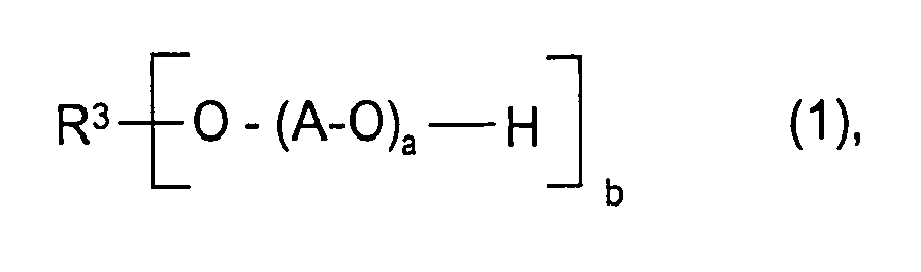
- a für eine Zahl von 5 bis 70,
- b für eine Zahl von 1 bis 10
- (A-O) für eine C2- bis C4-Alkoxygruppe,
- R3 für eine Kohlenwasserstoffgruppe mit 1 bis 20 Kohlenstoffatomen und 1 bis 10 Hydroxylgruppen stehen.
- In einer weiteren bevorzugten Ausführungsform entspricht das Polyalkylenglykolprepolymer der Formel (2)

- a für eine Zahl von 5 bis 70,
- (A-O) für eine C2- bis C4-Alkoxygruppe, und
- R4 und R5 unabhängig voneinander für Wasserstoff oder eine C1- bis C6-Alkylgruppe stehen, wobei jedoch mindestens einer der Reste R4 oder R5 für Wasserstoff steht,
- Der verwendete Zink-Cobalt-Dimetallcyanidkatalysator (im Folgenden auch "DMC-Katalysator" genannt) ist aus dem Stand der Technik bekannt. Er enthält Zn3[Co(CN)6]2.
- Das erfindungsgemäße Verfahren wird vorzugsweise wie folgt durchgeführt.
- Der Startalkohol wird vorzugsweise in einer Konzentration von 1 bis 40 Gew.-%, insbesondere 5 bis 30 Gew.-%, in einem Druckreaktor in einem Polyalkylenglykolprepolymer gelöst. Der pulverförmige DMC-Katalysator wird in einer Konzentration von vorzugsweise 100 - 600 ppm in diesem Gemisch homogen dispergiert. Das Reaktionsgemisch wird unter Stickstoff auf eine Temperatur von vorzugsweise 90 bis 170°C, insbesondere auf eine Temperatur von 110 - 150°C aufgeheizt. Bei dieser Temperatur wird eine Teilmenge des Alkylenoxids zudosiert. Nach Anspringen der Polymerisationsreaktion, erkennbar am Druckabfall und der Temperaturerhöhung im Reaktor, wird die zur Erreichung der jeweiligen Viskosität des Schmiermittelbasisöls notwendige restliche Menge des Alkylenoxids zudosiert.
- Die so erhaltenen, erfindungsgemäßen Polyalkylenglykole sind demnach α-Alkoxy-Ω-hydroxy-Copolymere, α-Ω-dihydroxy-Copolymere, α-Ω-trihydroxy-Copolymere und α-Ω-tetrahydroxy-Copolymere aus den Monomeren Ethylenoxid, Propylenoxid und/oder Butylenoxid in beliebiger Zusammensetzung. Bevorzugt als SchmiermittelBasisöle sind solche Polyalkylenglykole, die Propylenoxid in einem Anteil von mindestens 20 Gew.-% enthalten. Weiterhin sind solche Polyalkylenglykole bevorzugt, die eine mittlere Molmasse von 700 - 50000 g/mol, bevorzugt 700 - 10000 g/mol aufweisen. Weiterhin sind solche Polyalkylenglykole bevorzugt, die bei 40°C kinematische Viskositäten von 20 bis 40000 mm2/s, bevorzugt 20 bis 6000 mm2/s aufweisen.
- Die erfindungsgemäßen Polyalkylenglykole enthalten im allgemeinen 10 bis 100 ppm DMC-Katalysator und weisen eine enge Molmassenverteilung mit geringen niedermolekularen flüchtigen Anteilen auf.
- Ein weiterer Vorteil des erfindungsgemäßen Verfahrens zur Herstellung von Polyalkylenglykolen ist die im Vergleich zum Herstellungsverfahren mit alkalischer Katalyse wesentlich geringere Reaktionszeit, die benötigt wird, um eine bestimmte Viskosität zu erreichen.
- Die erfindungsgemäßen Polyalkylenglykole sind je nach dem Verhältnis der eingesetzten Alkylenoxide mehr oder weniger wasserlöslich. Durch Zusatz üblicher Schmierstoffadditive und Korrosionsinhibitoren, wie z.B. Phosphorsäureester, oder Schwefelverbindungen wie Merkaptobenzothiazol oder Triazolen und aminischen Korrosionsinhibitoren können aus den erfindungsgemäßen Polyalkylenglykol-Schmiermittel-Basisölen fertig formulierte Schmierstoffe für verschiedene Anwendungen wie zum Beispiel Getriebeöle, Hydrauliköle, Schmierfette oder Metallbearbeitungsflüssigkeiten formuliert werden.
- Darüber hinaus können den Polyalkylenglykolen zur Herstellung fertig formulierter Schmierstoffe noch übliche Antioxidantien in Mengen bis zu 5000 ppm zugesetzt werden. Übliche Antioxidantien sind z.B. phenolische Antioxidantien wie BHT, para-Methoxyphenol, Hydrochinon oder BHA, oder aminische Antioxidantien wie polymeres Trimethyldihydrochinolin.
- In einem 5 Liter Druckreaktor wird 754 g eines Gemischs aus einem α-Butoxy-Ω-Hydroxy-Polypropylenglykol (80 Gew.-%) mit Molmasse 800 g/mol und Butoxydipropylenglykol (20 Gew.-%) vorgelegt. Unter Stickstoff wird zu diesem Gemisch 160 ppm des in
EP 1 276 563 beschriebenen DMC-Katalysators hinzugefügt. Das Gemisch wird unter Stickstoff auf eine Temperatur auf 130°C aufgeheizt und bei einem Druck von etwa 2 bar eine Menge von 3468 g Propylenoxid so dosiert, dass die entstehende Reaktionswärme abgeführt werden kann. Der Zeitraum der Dosierung beträgt etwa 2 Stunden. Das entstehende α-Butoxy-Ω-Hydroxy-Polypropylenglykol zeigt folgende Charakteristik: Molmasse (Zahlenmittel aus GPC) Mn = 2500 g/mol, Molmasse (Gewichtsmittel aus GPC) Mw = 2600 g/mol, Polydispersität = Mw/Mn = 1,04, OH-Zahl = 21,8 mgKOH/g, kinematische Viskosität bei 40°C = 181 mm2/s, kinematische Viskosität bei 100°C = 31 mm2/s, Dichte bei 20°C = 0,996 g/cm3. 1H-NMR Endgruppen Analytik: Verhältnis Butyl : sek-OH : Allyl = 1 : 1: 0,01. Der Gehalt an VOCs (flüchtige organische Anteile) bestimmt nach DIN 55649 beträgt 0,98 g/Liter. - In einem 5 Liter Druckreaktor wird 343 g eines Gemischs aus einem α-Butoxy-Ω-Hydroxy-Polypropylenglykol (80 Gew.-%) mit Molmasse 800 g/mol und Butoxydipropylenglykol (20 Gew.-%) vorgelegt. Unter Stickstoff wird zu diesem Gemisch 200 ppm des in
EP 1276563 beschriebenen DMC-Katalysators hinzugefügt. Das Gemisch wird unter Stickstoff auf eine Temperatur auf 130°C aufgeheizt und bei einem Druck von etwa 2 bar eine Menge von 2780 g Propylenoxid so dosiert, dass die entstehende Reaktionswärme abgeführt werden kann. Der Zeitraum der Dosierung beträgt etwa 3 Stunden. Das entstehende α-Butoxy-Ω-Hydroxy-Polypropylenglykol zeigt folgende Charakteristik: OH-Zahl = 15,6 mg KOH/g, Molmasse (Zahlenmittel aus GPC) Mn = 3400 g/mol, Molmasse (Gewichtsmittel aus GPC) Mw = 4000 g/mol, Polydispersität = 1,18, kinematische Viskosität bei 40°C = 360 mm2/s, kinematische Viskosität bei 100°C = 58 mm2/s, Dichte bei 20°C = 0,998 g/cm3. 1H-NMR Endgruppen Analytik: Verhältnis Butyl : sek-OH : Allyl = 1 : 1,05 : 0,01. Der Gehalt an VOCs (flüchtige organische Anteile) bestimmt nach DIN 55649 beträgt 0,98 g/Liter. - In einem 5 Liter Druckreaktor wird 551 g eines Gemischs aus einem α-Ω-Di-Hydroxy-Polyoxyethylen-oxypropylenglykolcopolymer (90 Gew.-%) Molmasse 2000 g/mol und Dipropylenglykol (10 Gew.-%) vorgelegt. Unter Stickstoff werden zu diesem Gemisch 400 ppm des in
EP 1 276 563 beschriebenen DMC-Katalysators hinzugefügt. Das Gemisch wird unter Stickstoff auf eine Temperatur auf 145°C aufgeheizt und bei einem Druck von etwa 2 bar eine Menge von 783 g eines Gemischs aus Ethylenoxid und Propylenoxid (Verhältnis 64 : 36 Gew.-%) im Zeitraum von 3 Stunden so dosiert, dass die entstehende Reaktionswärme abgeführt werden kann. Das entstehende α-Ω-Di-Hydroxy-Poly-oxyethylen-oxypropylen-glykol-copolymer zeigt folgende Charakteristik: OH-Zahl = 53,4 mg KOH/g, Molmasse (Zahlenmittel aus GPC) Mn =2000 g/mol, Molmasse (Gewichtsmittel aus GPC) Mw = 2350 g/mol, Polydispersität = 1,18, kinematische Viskosität bei 40°C = 225 mm2/s, kinematische Viskosität bei 100°C = 43 mm2/s, Dichte bei 20°C = 1,085 g/cm3. 1H-NMR Endgruppen Analytik: Verhältnis prim-OH : sek-OH : Allyl = 0,34 : 1 : 0,01. Der Gehalt an VOCs (flüchtige organische Anteile) bestimmt nach DIN 55649 beträgt 0,96 g/Liter. - In dem Produkt aus Beispiel 1 werden bei 60 bis 90°C 0,5 % Isotridecylphosphat, 0,5 % phenolisches Antioxidans (4,4-Methylen-bis-(2,6-ditertbutylphenol), 300 ppm Tolyltriazol und 3,5 % N-phenylstyrolisiertes Benzylamin gelöst. Man erhält ein Getriebeschmiermittel der ISO-VG (Viskositätsklasse nach DIN 51519) 150 das im FZG-Test nach DIN 51354 die Laststufe 12 erreicht.
- In einem 5 Liter Druckreaktor werden 20,8 g Butoxydipropylenglykol und 4,4 g Kaliumhydroxid vorgelegt. Durch Anlegen von Vakuum bei ca. 100°C für 1 Stunde wird das Gemisch getrocknet. Anschließend wird das Gemisch unter Stickstoff auf eine Temperatur von 130°C aufgeheizt und bei einem Druck von etwa 3 bis 6 bar eine Menge von 1966 g Propylenoxid so dosiert, dass die entstehende Reaktionswärme abgeführt werden kann. Der Zeitraum der Dosierung beträgt etwa 30 Stunden. Das entstehende α-Butoxy-Ω-Hydroxy-Polypropylenglykol zeigt folgende Charakteristik: Molmasse (Zahlenmittel aus GPC) Mn = 3300 g/mol, Molmasse (Gewichtsmittel aus GPC) Mw = 5400 g/mol, Polydispersität = Mw/Mn = 1,31, OH-Zahl = 20 mg KOH/g, kinematische Viskosität bei 40°C = 372 mm2/s, kinematische Viskosität bei 100°C = 60 mm2/s, Dichte bei 20°C =1 ,00 g/cm3. 1H-NMR Endgruppen Analytik: Verhältnis Butyl : sek-OH : (Allyl+Propenyl) = 1 : 2,08 : 0,7. Der Gehalt an VOCs (flüchtige organische Anteile) bestimmt nach DIN 55649 beträgt 1,95 g/Liter.
- Durch die Bildung niedermolekularer Anteile wird hierbei die Molmassenverteilung deutlich verbreitert und die Polydispersität erhöht. Ebenso entstehen mehr niedermolekulare flüchtige Anteile (VOCs). Aus diesem Grunde ist auch die Reaktionszeit, die benötigt wird die vorgegebene ISO VG Klasse zu erreichen wesentlich länger.
Claims (15)
- Verfahren zur Herstellung von Polyalkylenglykolen, indem man ein Gemisch aus einem ein- oder mehrwertigen Alkohol und einem Polyalkylenglykolprepolymer mit einem C2- bis C4-Alkylenoxid oder einer Mischung solcher Alkylenoxide in Gegenwart eines Katalysators, der Zn3[Co(CN)6]2 enthält, umsetzt, wobei der ein- oder mehrwertige Alkohol ein Molekulargewicht von bis zu 500 g/mol aufweist, sowie 1 bis 20 Kohlenstoffatome und 1 bis 10 Hydroxylgruppen enthält, und das Polyalkylenglykolprepolymer das Additionsprodukt eines C2- bis C4-Alkylenoxids oder einer Mischung solcher Alkylenoxide in einer Menge von mindestens 500 g/mol an einen ein- oder mehrwertigen Alkohol mit 1 bis 20 Kohlenstoffatomen und 1 bis 10 Hydroxylgruppen ist.
- Verfahren nach Anspruch 1, worin das Gewichtsverhältnis des Gemischs aus Polyalkylenglykolprepolymer und ein- oder mehrwertigem Alkohol vor der Alkoxylierung zwischen 99 : 1 und 60 : 40 liegt.
- Verfahren nach Anspruch 1 und/oder 2, wobei der DMC-Katalysator in einer Konzentration von 100 bis 600 ppm vorliegt.
- Verfahren nach einem oder mehreren der Ansprüche 1 bis 3, worin das Polyalkylenglykolprepolymer ein Additionsprodukt von C2- bis C4-Alkylenoxid oder einer Mischung solcher Alkylenoxide an einen Alkohol mit 2 bis 12 Kohlenstoffatomen und 1 bis 6 Hydroxylgruppen ist.
- Verfahren nach einem oder mehreren der Ansprüche 1 bis 4, worin das Polyalkylenglykolprepolymer der Formel 2 Propylenoxid in einem Anteil von mindestens 20 Gew.-% als Monomer enthält.
- Verfahren nach einem oder mehreren der Ansprüche 1 bis 5, worin der Startalkohol 2 bis 12 Kohlenstoffatome und 1 bis 6 Hydroxylgruppen enthält.
- Verfahren nach einem oder mehreren der Ansprüche 1 bis 6, worin der Startalkohol R'-OH ausgewählt ist aus Monoalkoholen der Formel R'-OH mit R' = C1-C20-Alkyl oder R' = C1-C20-Alkyl-(O-(C2-C4)-Alkylen)n- mit n = 1, 2, oder 3
Diolen der Formel HO-R2-OH mit R2= C2-C6-Alkylen, -(C2-C4)-Alkylen-O-(C2-C4)-Alkylen- oder -(C2-C4)-Alkylen-O-(C2-C4)-Alkylen-O-(C2-C4)-Alkylen- ,
Glycerin, Trimethylolpropan oder Pentaerythritol. - Verfahren nach einem oder mehreren der Ansprüche 1 bis 7, worin als Alkylenoxide Ethylenoxid, Propylenoxid, Butylenoxid oder Gemische daraus eingesetzt werden.
- Verfahren nach einem oder mehreren der Ansprüche 1 bis 8, worin die Alkoxylierung bei einer Temperatur von 90 - 170°C erfolgt.
- Polyalkylenglykole, herstellbar nach dem Verfahren gemäß einem oder mehreren der Ansprüche 1 bis 9.
- Polyalkylenglykole gemäß Anspruch 10, welche eine mittlere Molmasse von 700 bis 50000 g/mol und kinematische Viskositäten bei 40°C zwischen 20 bis 40000 mm2/s aufweisen.
- Polyalkylenglykole gemäß Anspruch 10 und/oder 11, welche eine Polydispersität D = Mw/Mn gemäß GPC Analyse von weniger als 1,25 aufweisen.
- Polyalkylenglykole nach einem oder mehreren der Ansprüche 10 bis 12, worin die flüchtigen Anteile bestimmt gemäß DIN 55649 kleiner als 1200 ppm sind.
- Verwendung der Polyalkylenglykole nach einem oder mehreren der Ansprüche 10 bis 13 zur Formulierung von Schmiermitteln.
- Verwendung der Polyalkylenglykole nach einem oder mehreren der Ansprüche 10 bis 13 zur Formulierung von wässrigen Hydraulikflüssigkeiten.
Applications Claiming Priority (1)
| Application Number | Priority Date | Filing Date | Title |
|---|---|---|---|
| DE102006006696A DE102006006696A1 (de) | 2006-02-14 | 2006-02-14 | Polyalkylenglykol-Schmiermittelbasisöle mit enger Molmassenverteilung |
Publications (2)
| Publication Number | Publication Date |
|---|---|
| EP1818353A1 true EP1818353A1 (de) | 2007-08-15 |
| EP1818353B1 EP1818353B1 (de) | 2008-10-22 |
Family
ID=37969807
Family Applications (1)
| Application Number | Title | Priority Date | Filing Date |
|---|---|---|---|
| EP07001849A Revoked EP1818353B1 (de) | 2006-02-14 | 2007-01-29 | Verfahren zur Herstellung von Polyalkylenglykol-Schmiermittelbasisölen mit enger Molmassenverteilung |
Country Status (6)
| Country | Link |
|---|---|
| US (1) | US20070191647A1 (de) |
| EP (1) | EP1818353B1 (de) |
| JP (1) | JP2007217691A (de) |
| AT (1) | ATE412023T1 (de) |
| DE (2) | DE102006006696A1 (de) |
| ES (1) | ES2313687T3 (de) |
Families Citing this family (7)
| Publication number | Priority date | Publication date | Assignee | Title |
|---|---|---|---|---|
| DE102009002371A1 (de) * | 2009-04-15 | 2010-10-21 | Evonik Goldschmidt Gmbh | Verfahren zur Herstellung von geruchlosen Polyetheralkoholen mittels DMC-Katalysatoren und deren Verwendung in kosmetischen und/oder dermatologischen Zubereitungen |
| CN104822813A (zh) * | 2012-12-12 | 2015-08-05 | 陶氏环球技术有限责任公司 | 浓金属加工流体和金属加工方法 |
| JP6823813B2 (ja) * | 2017-07-11 | 2021-02-03 | 日油株式会社 | 潤滑油組成物 |
| JP6939394B2 (ja) * | 2017-10-18 | 2021-09-22 | 日油株式会社 | グリース用基油 |
| EP3914633B1 (de) * | 2019-01-23 | 2023-11-15 | Clariant International Ltd | Dispergiermittel |
| JP2021195538A (ja) * | 2020-06-11 | 2021-12-27 | 三洋化成工業株式会社 | 金属加工油用基油 |
| CN113831528A (zh) * | 2021-11-08 | 2021-12-24 | 浙江劲光实业股份有限公司 | 一种聚亚烷基二醇聚醚的制备方法 |
Citations (4)
| Publication number | Priority date | Publication date | Assignee | Title |
|---|---|---|---|---|
| US5563221A (en) * | 1995-06-21 | 1996-10-08 | Arco Chemical Technology, L.P. | Process for making ethylene oxide-capped polyols from double metal cyanide-catalyzed polyols |
| DE19903274A1 (de) * | 1999-01-28 | 2000-08-03 | Basf Ag | Verfahren zur Herstellung von Polyetherpolyolen |
| US6359101B1 (en) * | 1999-12-15 | 2002-03-19 | Synuthane International, Inc. | Preparing polyether polyols with DMC catalysts |
| WO2004029131A1 (de) * | 2002-09-23 | 2004-04-08 | Basf Aktiengesellschaft | Verfahren zur herstellung von polyetheralkoholen |
Family Cites Families (11)
| Publication number | Priority date | Publication date | Assignee | Title |
|---|---|---|---|---|
| US3580847A (en) * | 1967-06-16 | 1971-05-25 | Wyandotte Chemicals Corp | Hydraulic fluid |
| US3829505A (en) * | 1970-02-24 | 1974-08-13 | Gen Tire & Rubber Co | Polyethers and method for making the same |
| US5470813A (en) * | 1993-11-23 | 1995-11-28 | Arco Chemical Technology, L.P. | Double metal cyanide complex catalysts |
| US5482908A (en) * | 1994-09-08 | 1996-01-09 | Arco Chemical Technology, L.P. | Highly active double metal cyanide catalysts |
| US5777177A (en) * | 1996-02-07 | 1998-07-07 | Arco Chemical Technology, L.P. | Preparation of double metal cyanide-catalyzed polyols by continuous addition of starter |
| US5783513A (en) * | 1997-03-13 | 1998-07-21 | Arco Chemical Technology, L.P. | Process for making double metal cyanide catalysts |
| DE19958355A1 (de) * | 1999-12-03 | 2001-06-07 | Bayer Ag | Verfahren zur Herstellung von DMC-Katalysatoren |
| MXPA02010329A (es) * | 2000-04-20 | 2003-05-23 | Bayer Ag | Procedimiento para la preparacion de catalizadores de cianuro bimetalico. |
| US20030157723A1 (en) * | 2001-12-04 | 2003-08-21 | Dave Smith | Immunoassay chemistry cassette barcode for system customization |
| CN100344740C (zh) * | 2002-08-05 | 2007-10-24 | 新日本石油株式会社 | 润滑油组合物 |
| US6713599B1 (en) * | 2003-03-31 | 2004-03-30 | Basf Corporation | Formation of polymer polyols with a narrow polydispersity using double metal cyanide (DMC) catalysts |
-
2006
- 2006-02-14 DE DE102006006696A patent/DE102006006696A1/de not_active Withdrawn
-
2007
- 2007-01-29 DE DE502007000171T patent/DE502007000171D1/de not_active Revoked
- 2007-01-29 EP EP07001849A patent/EP1818353B1/de not_active Revoked
- 2007-01-29 AT AT07001849T patent/ATE412023T1/de not_active IP Right Cessation
- 2007-01-29 ES ES07001849T patent/ES2313687T3/es active Active
- 2007-02-13 JP JP2007031702A patent/JP2007217691A/ja not_active Withdrawn
- 2007-02-13 US US11/705,944 patent/US20070191647A1/en not_active Abandoned
Patent Citations (4)
| Publication number | Priority date | Publication date | Assignee | Title |
|---|---|---|---|---|
| US5563221A (en) * | 1995-06-21 | 1996-10-08 | Arco Chemical Technology, L.P. | Process for making ethylene oxide-capped polyols from double metal cyanide-catalyzed polyols |
| DE19903274A1 (de) * | 1999-01-28 | 2000-08-03 | Basf Ag | Verfahren zur Herstellung von Polyetherpolyolen |
| US6359101B1 (en) * | 1999-12-15 | 2002-03-19 | Synuthane International, Inc. | Preparing polyether polyols with DMC catalysts |
| WO2004029131A1 (de) * | 2002-09-23 | 2004-04-08 | Basf Aktiengesellschaft | Verfahren zur herstellung von polyetheralkoholen |
Also Published As
| Publication number | Publication date |
|---|---|
| DE102006006696A1 (de) | 2007-08-23 |
| ATE412023T1 (de) | 2008-11-15 |
| EP1818353B1 (de) | 2008-10-22 |
| DE502007000171D1 (de) | 2008-12-04 |
| JP2007217691A (ja) | 2007-08-30 |
| ES2313687T3 (es) | 2009-03-01 |
| US20070191647A1 (en) | 2007-08-16 |
Similar Documents
| Publication | Publication Date | Title |
|---|---|---|
| EP1818353B1 (de) | Verfahren zur Herstellung von Polyalkylenglykol-Schmiermittelbasisölen mit enger Molmassenverteilung | |
| DE602005002649T2 (de) | Alkylenoxidcopolymere enthaltende funktionelle flüssigkeiten mit geringer pulmonaler toxizität | |
| DE69914330T2 (de) | Hochmolekulargewichtpolyole, verfahren zu ihrer herstellung und verwendung | |
| DE69804234T2 (de) | Direkte polyoxyalkylierung von glyzerin mit doppel-metall-cyanid-katalyse | |
| DE69624424T3 (de) | Viskositätsstabile isocyanatterminierte Prepolymere sowie eine bessere Lagerstabilität aufweisende Polyoxyalkylen-Polyetherpolyole | |
| EP2655474B1 (de) | Verfahren zur herstellung von polyetherpolyolen | |
| EP0293715A2 (de) | Polyether, Verfahren zu ihrer Herstellung und Schmiermittel, die diese Polyether enthalten | |
| EP2205658B1 (de) | Verfahren zur herstellung von polyetheralkoholen aus ungesättigten startern mit aktiven wasserstoffatomen | |
| EP3083757A1 (de) | Verfahren zur aufarbeitung von alkalischen polyetherpolyolen | |
| EP1073689B1 (de) | Verfahren zur herstellung langkettiger polyetherpolyole | |
| DE68926491T2 (de) | Verfahren zur Hestellung von Polyetherpolyolen mit verminderter Ungesättigtheit | |
| EP1517940A1 (de) | Dmc-katalysatoren, polyetheralkohole sowie verfahren zu deren herstellung | |
| DE602005002950T2 (de) | Verfahren zur herstellung von polyetherpolyolen | |
| EP0184713A2 (de) | Stabilisierte Schmierstoffe auf der Basis von Polyethern | |
| WO2010072769A1 (de) | Verfahren zur herstellung von polyether-blockcopolymeren | |
| EP0136396A2 (de) | Verwendung ausgewählter Polyetherole und Polyisocyanate zur Herstellung von Klebmitteln auf Polyurethanbasis | |
| DE102009019698A1 (de) | Neue Schmierleistungsadditive, ein Verfahren zu deren Herstellung und deren Verwendung | |
| EP4314111A1 (de) | Neue polyether auf basis von 2,3-epoxybutan und verfahren zu deren herstellung | |
| EP4222238B1 (de) | Schaumarme flüssigkeiten mit biologisch abbaubaren polyalkylenglykol-rheologiemodifikatoren | |
| EP1487946B1 (de) | Thermisch stabile polyalkylenglykole als schmiermittel f r k ltemaschinen | |
| EP1240235A1 (de) | Verfahren zur herstellung von polyetherpolyolen | |
| DE69422408T2 (de) | Basisfluidum für schmiermittel | |
| EP1280844B1 (de) | Hochfunktionelle polyetherpolyole und verfahren zu deren herstellung | |
| DE2808573A1 (de) | Verfahren zur herstellung eines linearen hochmolekularen elastomeren copolymers auf basis von thiodiethanol | |
| EP0367011A2 (de) | Polyoxyalkylenblockcopolymere, Verfahren zur Herstellung und ihre Verwendung |
Legal Events
| Date | Code | Title | Description |
|---|---|---|---|
| PUAI | Public reference made under article 153(3) epc to a published international application that has entered the european phase |
Free format text: ORIGINAL CODE: 0009012 |
|
| AK | Designated contracting states |
Kind code of ref document: A1 Designated state(s): AT BE BG CH CY CZ DE DK EE ES FI FR GB GR HU IE IS IT LI LT LU LV MC NL PL PT RO SE SI SK TR |
|
| AX | Request for extension of the european patent |
Extension state: AL BA HR MK YU |
|
| RIN1 | Information on inventor provided before grant (corrected) |
Inventor name: STRASSER, ANTON Inventor name: SCHOLZ, GUIDO, DR. Inventor name: POELLMANN, KLAUS, DR. Inventor name: VYBIRAL, REINHARD, DR. |
|
| 17P | Request for examination filed |
Effective date: 20080215 |
|
| 17Q | First examination report despatched |
Effective date: 20080327 |
|
| AKX | Designation fees paid |
Designated state(s): AT BE BG CH CY CZ DE DK EE ES FI FR GB GR HU IE IS IT LI LT LU LV MC NL PL PT RO SE SI SK TR |
|
| GRAP | Despatch of communication of intention to grant a patent |
Free format text: ORIGINAL CODE: EPIDOSNIGR1 |
|
| RTI1 | Title (correction) |
Free format text: METHOD FOR MANUFACTURING POLYALKYLENGLYCOL LUBRICANT BASE OILS WITH A DENSE MOLAR MASS DISTRIBUTION |
|
| GRAS | Grant fee paid |
Free format text: ORIGINAL CODE: EPIDOSNIGR3 |
|
| GRAA | (expected) grant |
Free format text: ORIGINAL CODE: 0009210 |
|
| AK | Designated contracting states |
Kind code of ref document: B1 Designated state(s): AT BE BG CH CY CZ DE DK EE ES FI FR GB GR HU IE IS IT LI LT LU LV MC NL PL PT RO SE SI SK TR |
|
| REG | Reference to a national code |
Ref country code: GB Ref legal event code: FG4D Free format text: NOT ENGLISH |
|
| REG | Reference to a national code |
Ref country code: CH Ref legal event code: EP |
|
| REG | Reference to a national code |
Ref country code: IE Ref legal event code: FG4D Free format text: LANGUAGE OF EP DOCUMENT: GERMAN |
|
| REF | Corresponds to: |
Ref document number: 502007000171 Country of ref document: DE Date of ref document: 20081204 Kind code of ref document: P |
|
| PGFP | Annual fee paid to national office [announced via postgrant information from national office to epo] |
Ref country code: ES Payment date: 20081217 Year of fee payment: 3 |
|
| REG | Reference to a national code |
Ref country code: ES Ref legal event code: FG2A Ref document number: 2313687 Country of ref document: ES Kind code of ref document: T3 |
|
| NLV1 | Nl: lapsed or annulled due to failure to fulfill the requirements of art. 29p and 29m of the patents act | ||
| PG25 | Lapsed in a contracting state [announced via postgrant information from national office to epo] |
Ref country code: BG Free format text: LAPSE BECAUSE OF FAILURE TO SUBMIT A TRANSLATION OF THE DESCRIPTION OR TO PAY THE FEE WITHIN THE PRESCRIBED TIME-LIMIT Effective date: 20090122 Ref country code: LT Free format text: LAPSE BECAUSE OF FAILURE TO SUBMIT A TRANSLATION OF THE DESCRIPTION OR TO PAY THE FEE WITHIN THE PRESCRIBED TIME-LIMIT Effective date: 20081022 |
|
| PGFP | Annual fee paid to national office [announced via postgrant information from national office to epo] |
Ref country code: FR Payment date: 20081215 Year of fee payment: 3 |
|
| PG25 | Lapsed in a contracting state [announced via postgrant information from national office to epo] |
Ref country code: FI Free format text: LAPSE BECAUSE OF FAILURE TO SUBMIT A TRANSLATION OF THE DESCRIPTION OR TO PAY THE FEE WITHIN THE PRESCRIBED TIME-LIMIT Effective date: 20081022 Ref country code: PT Free format text: LAPSE BECAUSE OF FAILURE TO SUBMIT A TRANSLATION OF THE DESCRIPTION OR TO PAY THE FEE WITHIN THE PRESCRIBED TIME-LIMIT Effective date: 20090323 Ref country code: NL Free format text: LAPSE BECAUSE OF FAILURE TO SUBMIT A TRANSLATION OF THE DESCRIPTION OR TO PAY THE FEE WITHIN THE PRESCRIBED TIME-LIMIT Effective date: 20081022 Ref country code: IS Free format text: LAPSE BECAUSE OF FAILURE TO SUBMIT A TRANSLATION OF THE DESCRIPTION OR TO PAY THE FEE WITHIN THE PRESCRIBED TIME-LIMIT Effective date: 20090222 Ref country code: LV Free format text: LAPSE BECAUSE OF FAILURE TO SUBMIT A TRANSLATION OF THE DESCRIPTION OR TO PAY THE FEE WITHIN THE PRESCRIBED TIME-LIMIT Effective date: 20081022 Ref country code: SI Free format text: LAPSE BECAUSE OF FAILURE TO SUBMIT A TRANSLATION OF THE DESCRIPTION OR TO PAY THE FEE WITHIN THE PRESCRIBED TIME-LIMIT Effective date: 20081022 Ref country code: PL Free format text: LAPSE BECAUSE OF FAILURE TO SUBMIT A TRANSLATION OF THE DESCRIPTION OR TO PAY THE FEE WITHIN THE PRESCRIBED TIME-LIMIT Effective date: 20081022 |
|
| PGFP | Annual fee paid to national office [announced via postgrant information from national office to epo] |
Ref country code: DE Payment date: 20081212 Year of fee payment: 3 |
|
| REG | Reference to a national code |
Ref country code: GB Ref legal event code: 732E Free format text: REGISTERED BETWEEN 20090507 AND 20090513 |
|
| PLBI | Opposition filed |
Free format text: ORIGINAL CODE: 0009260 |
|
| REG | Reference to a national code |
Ref country code: IE Ref legal event code: FD4D |
|
| PLBI | Opposition filed |
Free format text: ORIGINAL CODE: 0009260 |
|
| PG25 | Lapsed in a contracting state [announced via postgrant information from national office to epo] |
Ref country code: EE Free format text: LAPSE BECAUSE OF FAILURE TO SUBMIT A TRANSLATION OF THE DESCRIPTION OR TO PAY THE FEE WITHIN THE PRESCRIBED TIME-LIMIT Effective date: 20081022 Ref country code: RO Free format text: LAPSE BECAUSE OF FAILURE TO SUBMIT A TRANSLATION OF THE DESCRIPTION OR TO PAY THE FEE WITHIN THE PRESCRIBED TIME-LIMIT Effective date: 20081022 Ref country code: IE Free format text: LAPSE BECAUSE OF FAILURE TO SUBMIT A TRANSLATION OF THE DESCRIPTION OR TO PAY THE FEE WITHIN THE PRESCRIBED TIME-LIMIT Effective date: 20081022 Ref country code: DK Free format text: LAPSE BECAUSE OF FAILURE TO SUBMIT A TRANSLATION OF THE DESCRIPTION OR TO PAY THE FEE WITHIN THE PRESCRIBED TIME-LIMIT Effective date: 20081022 |
|
| PGFP | Annual fee paid to national office [announced via postgrant information from national office to epo] |
Ref country code: BE Payment date: 20090119 Year of fee payment: 3 |
|
| 26 | Opposition filed |
Opponent name: BAYER MATERIALSCIENCE AG Effective date: 20090714 |
|
| PLAX | Notice of opposition and request to file observation + time limit sent |
Free format text: ORIGINAL CODE: EPIDOSNOBS2 |
|
| 26 | Opposition filed |
Opponent name: BASF SE Effective date: 20090717 Opponent name: BAYER MATERIALSCIENCE AG Effective date: 20090714 |
|
| PG25 | Lapsed in a contracting state [announced via postgrant information from national office to epo] |
Ref country code: CZ Free format text: LAPSE BECAUSE OF FAILURE TO SUBMIT A TRANSLATION OF THE DESCRIPTION OR TO PAY THE FEE WITHIN THE PRESCRIBED TIME-LIMIT Effective date: 20081022 Ref country code: SE Free format text: LAPSE BECAUSE OF FAILURE TO SUBMIT A TRANSLATION OF THE DESCRIPTION OR TO PAY THE FEE WITHIN THE PRESCRIBED TIME-LIMIT Effective date: 20090122 Ref country code: MC Free format text: LAPSE BECAUSE OF NON-PAYMENT OF DUE FEES Effective date: 20090131 |
|
| RDAF | Communication despatched that patent is revoked |
Free format text: ORIGINAL CODE: EPIDOSNREV1 |
|
| PG25 | Lapsed in a contracting state [announced via postgrant information from national office to epo] |
Ref country code: SK Free format text: LAPSE BECAUSE OF FAILURE TO SUBMIT A TRANSLATION OF THE DESCRIPTION OR TO PAY THE FEE WITHIN THE PRESCRIBED TIME-LIMIT Effective date: 20081022 |
|
| REG | Reference to a national code |
Ref country code: FR Ref legal event code: TP |
|
| PGFP | Annual fee paid to national office [announced via postgrant information from national office to epo] |
Ref country code: IT Payment date: 20090131 Year of fee payment: 3 |
|
| RDAG | Patent revoked |
Free format text: ORIGINAL CODE: 0009271 |
|
| STAA | Information on the status of an ep patent application or granted ep patent |
Free format text: STATUS: PATENT REVOKED |
|
| REG | Reference to a national code |
Ref country code: CH Ref legal event code: PL |
|
| 27W | Patent revoked |
Effective date: 20091009 |
|
| GBPR | Gb: patent revoked under art. 102 of the ep convention designating the uk as contracting state |
Effective date: 20091009 |
|
| PG25 | Lapsed in a contracting state [announced via postgrant information from national office to epo] |
Ref country code: LI Free format text: LAPSE BECAUSE OF THE APPLICANT RENOUNCES Effective date: 20081022 Ref country code: CH Free format text: LAPSE BECAUSE OF THE APPLICANT RENOUNCES Effective date: 20081022 |
|
| PG25 | Lapsed in a contracting state [announced via postgrant information from national office to epo] |
Ref country code: GR Free format text: LAPSE BECAUSE OF FAILURE TO SUBMIT A TRANSLATION OF THE DESCRIPTION OR TO PAY THE FEE WITHIN THE PRESCRIBED TIME-LIMIT Effective date: 20090123 |
|
| PG25 | Lapsed in a contracting state [announced via postgrant information from national office to epo] |
Ref country code: LU Free format text: LAPSE BECAUSE OF NON-PAYMENT OF DUE FEES Effective date: 20090129 |
|
| PG25 | Lapsed in a contracting state [announced via postgrant information from national office to epo] |
Ref country code: HU Free format text: LAPSE BECAUSE OF FAILURE TO SUBMIT A TRANSLATION OF THE DESCRIPTION OR TO PAY THE FEE WITHIN THE PRESCRIBED TIME-LIMIT Effective date: 20090423 |
|
| PG25 | Lapsed in a contracting state [announced via postgrant information from national office to epo] |
Ref country code: TR Free format text: LAPSE BECAUSE OF FAILURE TO SUBMIT A TRANSLATION OF THE DESCRIPTION OR TO PAY THE FEE WITHIN THE PRESCRIBED TIME-LIMIT Effective date: 20081022 |
|
| PG25 | Lapsed in a contracting state [announced via postgrant information from national office to epo] |
Ref country code: CY Free format text: LAPSE BECAUSE OF FAILURE TO SUBMIT A TRANSLATION OF THE DESCRIPTION OR TO PAY THE FEE WITHIN THE PRESCRIBED TIME-LIMIT Effective date: 20081022 |