EP1809489B1 - Radnaben-gelenk-einheit - Google Patents
Radnaben-gelenk-einheit Download PDFInfo
- Publication number
- EP1809489B1 EP1809489B1 EP05796223A EP05796223A EP1809489B1 EP 1809489 B1 EP1809489 B1 EP 1809489B1 EP 05796223 A EP05796223 A EP 05796223A EP 05796223 A EP05796223 A EP 05796223A EP 1809489 B1 EP1809489 B1 EP 1809489B1
- Authority
- EP
- European Patent Office
- Prior art keywords
- bearing
- joint
- wheel hub
- journal
- constant velocity
- Prior art date
- Legal status (The legal status is an assumption and is not a legal conclusion. Google has not performed a legal analysis and makes no representation as to the accuracy of the status listed.)
- Expired - Lifetime
Links
Images


Classifications
-
- F—MECHANICAL ENGINEERING; LIGHTING; HEATING; WEAPONS; BLASTING
- F16—ENGINEERING ELEMENTS AND UNITS; GENERAL MEASURES FOR PRODUCING AND MAINTAINING EFFECTIVE FUNCTIONING OF MACHINES OR INSTALLATIONS; THERMAL INSULATION IN GENERAL
- F16D—COUPLINGS FOR TRANSMITTING ROTATION; CLUTCHES; BRAKES
- F16D3/00—Yielding couplings, i.e. with means permitting movement between the connected parts during the drive
- F16D3/16—Universal joints in which flexibility is produced by means of pivots or sliding or rolling connecting parts
- F16D3/20—Universal joints in which flexibility is produced by means of pivots or sliding or rolling connecting parts one coupling part entering a sleeve of the other coupling part and connected thereto by sliding or rolling members
- F16D3/22—Universal joints in which flexibility is produced by means of pivots or sliding or rolling connecting parts one coupling part entering a sleeve of the other coupling part and connected thereto by sliding or rolling members the rolling members being balls, rollers, or the like, guided in grooves or sockets in both coupling parts
- F16D3/223—Universal joints in which flexibility is produced by means of pivots or sliding or rolling connecting parts one coupling part entering a sleeve of the other coupling part and connected thereto by sliding or rolling members the rolling members being balls, rollers, or the like, guided in grooves or sockets in both coupling parts the rolling members being guided in grooves in both coupling parts
-
- F—MECHANICAL ENGINEERING; LIGHTING; HEATING; WEAPONS; BLASTING
- F16—ENGINEERING ELEMENTS AND UNITS; GENERAL MEASURES FOR PRODUCING AND MAINTAINING EFFECTIVE FUNCTIONING OF MACHINES OR INSTALLATIONS; THERMAL INSULATION IN GENERAL
- F16D—COUPLINGS FOR TRANSMITTING ROTATION; CLUTCHES; BRAKES
- F16D3/00—Yielding couplings, i.e. with means permitting movement between the connected parts during the drive
- F16D3/16—Universal joints in which flexibility is produced by means of pivots or sliding or rolling connecting parts
- F16D3/20—Universal joints in which flexibility is produced by means of pivots or sliding or rolling connecting parts one coupling part entering a sleeve of the other coupling part and connected thereto by sliding or rolling members
- F16D3/22—Universal joints in which flexibility is produced by means of pivots or sliding or rolling connecting parts one coupling part entering a sleeve of the other coupling part and connected thereto by sliding or rolling members the rolling members being balls, rollers, or the like, guided in grooves or sockets in both coupling parts
- F16D3/223—Universal joints in which flexibility is produced by means of pivots or sliding or rolling connecting parts one coupling part entering a sleeve of the other coupling part and connected thereto by sliding or rolling members the rolling members being balls, rollers, or the like, guided in grooves or sockets in both coupling parts the rolling members being guided in grooves in both coupling parts
- F16D3/2237—Universal joints in which flexibility is produced by means of pivots or sliding or rolling connecting parts one coupling part entering a sleeve of the other coupling part and connected thereto by sliding or rolling members the rolling members being balls, rollers, or the like, guided in grooves or sockets in both coupling parts the rolling members being guided in grooves in both coupling parts where the grooves are composed of radii and adjoining straight lines, i.e. undercut free [UF] type joints
-
- B—PERFORMING OPERATIONS; TRANSPORTING
- B60—VEHICLES IN GENERAL
- B60B—VEHICLE WHEELS; CASTORS; AXLES FOR WHEELS OR CASTORS; INCREASING WHEEL ADHESION
- B60B27/00—Hubs
-
- B—PERFORMING OPERATIONS; TRANSPORTING
- B60—VEHICLES IN GENERAL
- B60B—VEHICLE WHEELS; CASTORS; AXLES FOR WHEELS OR CASTORS; INCREASING WHEEL ADHESION
- B60B27/00—Hubs
- B60B27/0005—Hubs with ball bearings
-
- B—PERFORMING OPERATIONS; TRANSPORTING
- B60—VEHICLES IN GENERAL
- B60B—VEHICLE WHEELS; CASTORS; AXLES FOR WHEELS OR CASTORS; INCREASING WHEEL ADHESION
- B60B27/00—Hubs
- B60B27/0015—Hubs for driven wheels
- B60B27/0021—Hubs for driven wheels characterised by torque transmission means from drive axle
- B60B27/0026—Hubs for driven wheels characterised by torque transmission means from drive axle of the radial type, e.g. splined key
-
- B—PERFORMING OPERATIONS; TRANSPORTING
- B60—VEHICLES IN GENERAL
- B60B—VEHICLE WHEELS; CASTORS; AXLES FOR WHEELS OR CASTORS; INCREASING WHEEL ADHESION
- B60B27/00—Hubs
- B60B27/0015—Hubs for driven wheels
- B60B27/0036—Hubs for driven wheels comprising homokinetic joints
- B60B27/0042—Hubs for driven wheels comprising homokinetic joints characterised by the fixation of the homokinetic joint to the hub
-
- B—PERFORMING OPERATIONS; TRANSPORTING
- B60—VEHICLES IN GENERAL
- B60B—VEHICLE WHEELS; CASTORS; AXLES FOR WHEELS OR CASTORS; INCREASING WHEEL ADHESION
- B60B27/00—Hubs
- B60B27/0094—Hubs one or more of the bearing races are formed by the hub
-
- F—MECHANICAL ENGINEERING; LIGHTING; HEATING; WEAPONS; BLASTING
- F16—ENGINEERING ELEMENTS AND UNITS; GENERAL MEASURES FOR PRODUCING AND MAINTAINING EFFECTIVE FUNCTIONING OF MACHINES OR INSTALLATIONS; THERMAL INSULATION IN GENERAL
- F16C—SHAFTS; FLEXIBLE SHAFTS; ELEMENTS OR CRANKSHAFT MECHANISMS; ROTARY BODIES OTHER THAN GEARING ELEMENTS; BEARINGS
- F16C19/00—Bearings with rolling contact, for exclusively rotary movement
- F16C19/02—Bearings with rolling contact, for exclusively rotary movement with bearing balls essentially of the same size in one or more circular rows
- F16C19/14—Bearings with rolling contact, for exclusively rotary movement with bearing balls essentially of the same size in one or more circular rows for both radial and axial load
- F16C19/18—Bearings with rolling contact, for exclusively rotary movement with bearing balls essentially of the same size in one or more circular rows for both radial and axial load with two or more rows of balls
- F16C19/181—Bearings with rolling contact, for exclusively rotary movement with bearing balls essentially of the same size in one or more circular rows for both radial and axial load with two or more rows of balls with angular contact
- F16C19/183—Bearings with rolling contact, for exclusively rotary movement with bearing balls essentially of the same size in one or more circular rows for both radial and axial load with two or more rows of balls with angular contact with two rows at opposite angles
- F16C19/184—Bearings with rolling contact, for exclusively rotary movement with bearing balls essentially of the same size in one or more circular rows for both radial and axial load with two or more rows of balls with angular contact with two rows at opposite angles in O-arrangement
- F16C19/186—Bearings with rolling contact, for exclusively rotary movement with bearing balls essentially of the same size in one or more circular rows for both radial and axial load with two or more rows of balls with angular contact with two rows at opposite angles in O-arrangement with three raceways provided integrally on parts other than race rings, e.g. third generation hubs
-
- F—MECHANICAL ENGINEERING; LIGHTING; HEATING; WEAPONS; BLASTING
- F16—ENGINEERING ELEMENTS AND UNITS; GENERAL MEASURES FOR PRODUCING AND MAINTAINING EFFECTIVE FUNCTIONING OF MACHINES OR INSTALLATIONS; THERMAL INSULATION IN GENERAL
- F16C—SHAFTS; FLEXIBLE SHAFTS; ELEMENTS OR CRANKSHAFT MECHANISMS; ROTARY BODIES OTHER THAN GEARING ELEMENTS; BEARINGS
- F16C2326/00—Articles relating to transporting
- F16C2326/01—Parts of vehicles in general
- F16C2326/02—Wheel hubs or castors
-
- F—MECHANICAL ENGINEERING; LIGHTING; HEATING; WEAPONS; BLASTING
- F16—ENGINEERING ELEMENTS AND UNITS; GENERAL MEASURES FOR PRODUCING AND MAINTAINING EFFECTIVE FUNCTIONING OF MACHINES OR INSTALLATIONS; THERMAL INSULATION IN GENERAL
- F16D—COUPLINGS FOR TRANSMITTING ROTATION; CLUTCHES; BRAKES
- F16D3/00—Yielding couplings, i.e. with means permitting movement between the connected parts during the drive
- F16D3/16—Universal joints in which flexibility is produced by means of pivots or sliding or rolling connecting parts
- F16D3/20—Universal joints in which flexibility is produced by means of pivots or sliding or rolling connecting parts one coupling part entering a sleeve of the other coupling part and connected thereto by sliding or rolling members
- F16D3/22—Universal joints in which flexibility is produced by means of pivots or sliding or rolling connecting parts one coupling part entering a sleeve of the other coupling part and connected thereto by sliding or rolling members the rolling members being balls, rollers, or the like, guided in grooves or sockets in both coupling parts
- F16D3/223—Universal joints in which flexibility is produced by means of pivots or sliding or rolling connecting parts one coupling part entering a sleeve of the other coupling part and connected thereto by sliding or rolling members the rolling members being balls, rollers, or the like, guided in grooves or sockets in both coupling parts the rolling members being guided in grooves in both coupling parts
- F16D2003/22326—Attachments to the outer joint member, i.e. attachments to the exterior of the outer joint member or to the shaft of the outer joint member
-
- Y—GENERAL TAGGING OF NEW TECHNOLOGICAL DEVELOPMENTS; GENERAL TAGGING OF CROSS-SECTIONAL TECHNOLOGIES SPANNING OVER SEVERAL SECTIONS OF THE IPC; TECHNICAL SUBJECTS COVERED BY FORMER USPC CROSS-REFERENCE ART COLLECTIONS [XRACs] AND DIGESTS
- Y10—TECHNICAL SUBJECTS COVERED BY FORMER USPC
- Y10S—TECHNICAL SUBJECTS COVERED BY FORMER USPC CROSS-REFERENCE ART COLLECTIONS [XRACs] AND DIGESTS
- Y10S464/00—Rotary shafts, gudgeons, housings, and flexible couplings for rotary shafts
- Y10S464/904—Homokinetic coupling
- Y10S464/906—Torque transmitted via radially spaced balls
Definitions
- the invention relates to a wheel hub constant velocity joint unit in which a wheel hub with a through hole, which carries an internal shaft toothing, is clamped to the outer joint part of a constant velocity joint on which a pin is formed with an outer shaft toothing, wherein inner shaft toothing of the through hole and outer shaft toothing engage the pin, and a double-row wheel bearing is pushed onto the wheel hub, which comprises an inner bearing ring on which an end face of the outer joint part is directly supported.
- a screw which is supported on the outside of the wheel hub and which is screwed into a threaded hole in the journal, serves to tension.
- Such a unit is out of the DE 203 20 496 U1 known, which corresponds to the preambles of claims 1, 7, 9 and 11.
- Arrangements of this type are used on driven, in particular steered wheels of motor vehicles, wherein the wheel and optionally a brake disc are screwed to the flange of the wheel hub, while the constant velocity joint an integral part of a drive shaft (side shaft) forms, consisting of an intermediate shaft, an inner sliding joint and consists of the constant velocity joint mentioned here, which can be designed as a constant velocity joint (front wheel drive) or also as a sliding joint (rear wheel drive).
- the bearing arrangement is to be used in a wheel carrier or steering knuckle.
- the interpretation is to dimension the wheel bearing as small as possible, both for cost reasons with respect to the wheel bearing as well as in terms of the size of the wheel carrier or stub axle.
- the pin diameter is designed on the outer joint part to the required minimum strength, the pin diameter at the same time determines the inner diameter of the wheel hub and thus indirectly, on the strength-related wall thickness of the hub, the inner diameter of the wheel bearing. Due to the elasticity of the pin designed in this way, it comes with torque change, especially in torque surges, which are passed through the assembly to relative movements between the outer joint part and the inner bearing race at the mutual abutment surfaces. This leads to noise and also to fit corrosion.
- a first solution lies in a significantly reduced center distance of joint and bearing in the ratio of given sizes for the bearing width and the joint diameter.
- other solutions are in a qualitatively modified dimensioning of the pin, which is shown much shorter and thicker. This also changes the inner diameter of the wheel hub and thus indirectly the inner diameter and the pitch circle diameter of the wheel bearing.
- Advantageous effects are a substantial increase in the tilting rigidity of the bearing and an increase in the bearing load capacity and thus the bearing life.
- the qualitatively changed dimensioning can be defined by different characteristic size ratios, which differ qualitatively from the previously used size ratios.
- the ratio of bearing width B L and pin diameter at the bearing base D Z is less than 1, ie B L / D Z ⁇ 1.
- Another preferred embodiment provides that the ratio of pin length L Z and pitch circle diameter of the bearing balls is less than 0.5, ie L Z / TKD ⁇ 0.5.
- the ratio of the used tooth length L DEL . and pitch diameter of the bearing balls is less than 0.25, ie L VEZ. / TKD ⁇ 0.25.
- the ratio of pitch circle diameter of the bearing balls and bearing width is greater than 1.9, ie TKD / B L > 1.9.
- another embodiment is characterized in that the cross-sectional area A E of the wheel hub in the region of a separate bearing inner ring and square of the elongation length L DEHN a screw for connecting the hub and outer joint part is greater than 0.2, ie A E / L DEHN 2 >0; 2.
- the rigidity in the strained volume of the wheel hub with the cross section A E can be shown.
- the ratio of center distance A GL between constant velocity universal joint and wheel bearing on the one hand and pin diameter on the journal base D Z on the other hand is less than 2, ie A GL / D Z ⁇ 2 in particular, the ratio of center distance between constant velocity universal joint and wheel bearing on the one hand and pin diameter at the journal base D Z on the other hand less than 1.5, ie A GL / D Z ⁇ 1.5, in particular less than 1.2, ie A GL / D Z ⁇ 1.2.
- a particularly torsionally stiff pin is achieved in the construction in order to minimize the relative movements between the bearing inner ring and hinge stop surface.
- a third solution assumes that the ratio of pitch circle diameter of the wheel bearing TKD and pin length L Z is greater than 2, ie TKD / L Z > 2. It may be preferably provided that the ratio of pitch circle diameter of the wheel bearing TKD and pin length L Z greater Is 2.25, ie TKD / L Z > 2.25, in particular greater than 2.85, ie TKD / L Z > 2.85.
- a torsional stiffness of the wheel bearing is coupled to the rotational stiffness of the pin to minimize the noise generated by the relative movement between the bearing inner ring and the joint stop surface, as well as the influence of the deformations, in particular the wheel hub during operation.
- the ratio of center distance A GL between constant velocity universal joint and wheel bearing on the one hand and pin length L Z on the other hand is greater than 1.95, ie A GL / L Z > 1.95, wherein the ratio in particular greater than 2.0 should be, ie A GL / L Z > 2.0.
- the wheel bearing comprises only a separate bearing inner ring.
- the wheel hub axially opposite to the inner shaft toothing has a diameter reduction of the through hole to further increase the strength of the hub.
- the pin has a central threaded bore into which a screw for clamping the wheel hub is screwed to the outer joint part.
- the joint is a fixed joint, wherein the center of the joint M G is defined axially by the plane of the ball centers with the joint extended.
- the joint is a sliding joint, wherein the center of the joint M G is defined axially by the plane of the ball centers in the extended and set to the center of the axial displacement V S joint.
- a wheel hub unit 11 for a drive wheel of a motor vehicle is connected to a constant velocity fixed joint 12 for connection to a drive shaft.
- the wheel hub unit 11 comprises a bearing unit 13 and a wheel hub 30, wherein the bearing unit 13 is mounted on the wheel hub 30 and axially clamped between the wheel hub 30 and constant velocity fixed joint 12.
- the wheel hub 30 includes a flange for screwing a wheel to which a brake disc can be screwed.
- the wheel hub 30 further has a passage opening 29 in which an internal shaft toothing 14 is formed from the side of the joint. At the flange a central substantially radial support surface 15 is formed.
- the constant velocity fixed joint 12 is formed in the manner of a UF joint and includes an outer joint part 16, an inner joint part 17, torque transmitting balls 18 and a ball cage 19. The balls are held and guided in pairs of outer ball tracks 20 in the outer joint part and inner ball tracks 21 in the inner joint part.
- a substantially radial support surface 22 is formed on the hub side.
- a central pin 23 is attached to the outer joint part, which carries an outer shaft toothing 24, which engages in the inner shaft toothing 14 of the hub.
- the pin further has a continuous central threaded bore 25 is formed, into which a screw 27 is screwed, which is supported with its screw head 28 on the radial support surface 15 of the flange 12.
- the double-row bearing 13 comprises a bearing outer ring 31 which can be inserted into a wheel carrier and unspecified outer bearing grooves for two rows of bearing balls 32, 33 is formed.
- a first inner bearing groove for the ball row 32 is formed directly in the wheel hub 30, while a second ball groove for the second ball row 33 is formed in a separate bearing inner ring 34.
- the bearing inner ring 34 projects axially beyond the wheel hub 30, so that the bearing arrangement 13 can be prestressed by the action of the support surface 22 on the outer joint part by means of the screw 27 supported on the support surface 15.
- the arrangement after the FIGS. 1 and 2 is designed to minimize the pitch circle diameter TKD of the wheel bearing.
- the pin 23 is designed for minimum strength and has at a relatively small pin diameter D Z a large journal length L Z.
- D Z the distance between the constructive bearing center M L and the constructive joint means M G increases ; this distance is denoted by A GL .
- L GZ the distance also drawn from the center of the joint to the end of the pin, which is denoted by L GZ and corresponds approximately to A GL + L Z / 2.
- the pitch circle diameter PCD of the joint is drawn.
- the support length L S of the bearing which has a so-called O-configuration, the lines of action of the balls lie on symmetrical conical surfaces which open to each other, and the bearing width B L of the camp.
- a wheel hub unit 41 for a drive wheel of a motor vehicle is connected to a fixed constant velocity joint 42 for connection to a drive shaft.
- the wheel hub unit 41 comprises a bearing unit 43 and a wheel hub 60, wherein the bearing unit 43 is mounted on the wheel hub 60 and axially braced between the wheel hub 60 and constant velocity fixed joint 42.
- the wheel hub 60 includes a flange for screwing a wheel to which a brake disc can be screwed.
- the wheel hub 60 further has a passage opening 59 in which an internal shaft toothing 44 is formed from the side of the joint. At the flange a central substantially radial support surface 45 is formed.
- the constant velocity fixed joint 42 is formed in the manner of a UF joint and includes an outer joint part 46, an inner joint part 47, torque transmitting balls 48 and a ball cage 49.
- the balls are held and guided in pairs of outer ball tracks 50 in the outer joint part and inner ball tracks 51 in the inner joint part.
- a substantially radial support surface 52 is formed on the hub side.
- a central pin 53 is attached to the outer joint part, which carries an outer shaft toothing 54, which engages in the inner shaft toothing 44 of the hub.
- a continuous central threaded bore 55 is further formed, into which a screw 57 is screwed, which is supported with its screw head 58 on the radial support surface 45 of the wheel hub 60.
- the support surface 45 is in this case formed on a diameter reduction 56 of the passage opening 59.
- the double-row bearing 43 comprises a bearing outer ring 61 which can be inserted into a wheel carrier and unspecified outer bearing grooves for two rows of bearing balls 62, 63 is formed.
- a first inner bearing groove for the ball row 62 is formed directly in the wheel hub 41, while a second ball groove for the second ball row 63 in a separate bearing inner ring 64 is formed.
- the bearing inner ring 64 projects axially beyond the wheel hub 60, so that the bearing arrangement 43 can be prestressed on the outer joint part 46 under the action of the support surface 52 by means of the screw 57 supported on the support surface 45.
- the inventive arrangement according to the Figures 3 and 4 a short thick and thus torsionally stiff pin.
- the micro-movements occurring so far under varying torque between the support surface on the outer joint part and the corresponding counter surface on the separate bearing inner ring no longer occur in the joint according to the invention.
- a wheel hub unit 71 for a drive wheel of a motor vehicle is connected to a constant velocity sliding joint 72 for connection to a drive shaft, wherein a bearing unit 73 is mounted on the wheel hub unit 71 and axially clamped between the wheel hub unit 71 and the constant velocity sliding joint 72.
- the wheel hub 90 includes a flange for screwing a wheel to which a brake disc can be screwed.
- the wheel hub 90 further has a passage opening 89 in which an inner shaft toothing 74 is formed from the side of the joint forth.
- On the flange is a central in formed substantially radial support surface 75.
- the constant velocity sliding joint 72 is formed like a VL joint and includes an outer joint part 76, an inner joint part 77, torque transmitting balls 78 and a ball cage 79.
- the balls are held and guided in pairs of outer ball tracks 80 in the outer joint part and inner ball tracks 81 in the inner joint part.
- a substantially radial support surface 82 is formed on the hub side.
- a central pin 83 is attached to the outer joint part, which carries an outer shaft toothing 84, which engages in the inner shaft toothing 74 of the hub.
- the pin further has a continuous central threaded bore 85 is formed, into which a screw 87 is screwed, which is supported with its screw head 88 on the radial support surface 75 of the wheel hub 90.
- the support surface 75 is in this case formed on a diameter reduction 86 of the passage opening 89.
- the double-row bearing 73 comprises a bearing outer ring 91 which can be inserted into a wheel carrier and unspecified outer bearing grooves for two rows of bearing balls 92, 93 is formed.
- a first inner bearing groove for the ball row 62 is formed in a bearing inner ring 94, while a second ball groove for the second ball row 63 is formed in a bearing inner ring 95.
- the bearing inner ring 94 is axially over the hub 90, so that the bearing assembly 73 can be biased by the action of the support surface 82 on the outer joint part by means of the supporting surface 75 on the support screw 87.
- the inventive arrangement according to the Figures 5 and 6 a short thick and thus torsionally stiff pin.
- the micro-movements occurring so far under varying torque between the support surface on the outer joint part and the corresponding counter surface on the separate bearing inner ring no longer occur in the joint according to the invention.
Landscapes
- Engineering & Computer Science (AREA)
- Mechanical Engineering (AREA)
- General Engineering & Computer Science (AREA)
- Rolling Contact Bearings (AREA)
- Coupling Device And Connection With Printed Circuit (AREA)
- Auxiliary Devices For And Details Of Packaging Control (AREA)
- Mounting Of Bearings Or Others (AREA)
Description
- Die Erfindung betrifft eine Radnaben-Gleichlaufdrehgelenk-Einheit bei welcher eine Radnabe mit einer Durchgangsöffnung, die eine innere Wellenverzahnung trägt, mit dem Gelenkaußenteil eines Gleichlaufdrehgelenks verspannt ist, an dem ein Zapfen mit einer äußeren Wellenverzahnung angeformt ist, wobei innere Wellenverzahnung der Durchgangsöffnung und äußere Wellenverzahnung des Zapfens ineinandergreifen, und ein zweireihiges Radlager auf die Radnabe aufgeschoben ist, die einen inneren Lagerring umfaßt, an dem sich eine Stirnfläche des Gelenkaußenteils unmittelbar abstützt. Eine sich außen an der Radnabe abstützende Schraube, die in ein Gewindeloch im Zapfen eingedreht ist, dient der Verspannung. Eine solche Einheit ist aus der
DE 203 20 496 U1 bekannt, die den Oberbegriffen der Ansprüche 1, 7, 9 und 11 entspricht. Anordnungen dieser Art werden an angetriebenen, insbesondere gelenkten Rädern von Kraftfahrzeugen verwendet, wobei am Flansch der Radnabe das Rad sowie gegebenenfalls eine Bremsscheibe angeschraubt werden, während das Gleichlaufdrehgelenk einen integralen Bestandteil einer Antriebswelle (Seitenwelle) bildet, die aus einer Zwischenwelle, einem innenliegenden Verschiebegelenk und dem hier genannten Gleichlaufdrehgelenk besteht, das als Gleichlauffestgelenk (Vorderradantrieb) oder ebenfalls als Verschiebegelenk (Hinterradantrieb) ausgebildet sein kann. Die Lageranordnung ist in einem Radträger bzw. Achsschenkel einzusetzen. - Bei bekannten Anordnungen der genannten Art geht die Auslegung dahin, das Radlager möglichst klein zu dimensionieren, sowohl aus Kostengründen in Bezug auf das Radlager als auch im Hinblick auf die Baugröße des Radträgers bzw. Achsschenkels. Unter dem genannten Gesichtspunkt wird der Zapfendurchmesser am Gelenkaußenteil auf die benötigte Mindestfestigkeit ausgelegt, wobei der Zapfendurchmesser zugleich den Innendurchmesser der Radnabe und damit indirekt, über die festigkeitsbedingte Wandstärke der Nabe, den inneren Durchmesser des Radlagers bestimmt. Infolge der Elastizität des in dieser Weise ausgelegten Zapfens kommt es bei Drehmomentänderung, insbesondere bei Drehmomentstößen, die durch die Anordnung durchgeleitet werden, zu Relativbewegungen zwischen Gelenkaußenteil und Radlagerinnenring an den wechselseitigen Anschlagflächen. Dies führt zu Geräuschentwicklung und ebenfalls zur Passungskorrosion.
- Hiervon ausgehend liegt der Erfindung die Aufgabe zugrunde, ein neuartiges Konzept für eine Einheit der genannten Art bereitzustellen, die eine höhere Steifigkeit bei kurzer Bauweise sichert und die vorgenannten Nachteile vermeidet. Gemäß der vorliegenden Erfindung liegt eine erste Lösung in einem wesentlich verkürzten Mittenabstand von Gelenk und Lager im Verhältnis von gegebenen Größen für die Lagerbreite und den Gelenkdurchmesser. Gemäß der vorliegenden Erfindung liegen weitere Lösungen in einer qualitativ veränderten Dimensionierung des Zapfens, der wesentlich kürzer und dicker dargestellt wird. Hiermit ändert sich zugleich der Innendurchmesser der Radnabe und damit mittelbar der Innendurchmesser und der Teilkreisdurchmesser der Radlagerung. Vorteilhafte Auswirkungen sind eine wesentliche Erhöhung der Kippsteifigkeit der Lagerung und eine Erhöhung der Lagerbelastbarkeit und damit der Lagerlebensdauer.
- Die obengenannten Relativbewegungen zwischen Gelenkaußenteil und Radlagerinnenring werden vermieden bzw. deutlich verringert. Hierfür ist zum einen der größere Querschnitt des Zapfens und damit die größere Torsionsfestigkeit, zum anderen der größere Wirkradius der Wirkfläche der wechselseitigen Abstützung zwischen Gelenkaußenteil und nunmehr größerem Lagerinnenring ursächlich.
- Die qualitativ geänderte Dimensionierung kann über verschiedene charakteristische Größenverhältnisse definiert werden, die sich von bisher verwendeten Größenverhältnissen qualitativ unterscheiden.
- Nach einem ersten Lösungsansatz wird festgelegt, daß die Hälfte der Summe aus Teilkreisdurchmesser PCD der Gelenkkugeln im Gleichlaufdrehgelenk und Lagerbreite BL größer ist, als der Mittenabstand AGL zwischen der Gelenkmitte MG des Gleichlaufdrehgelenks bei gestrecktem Gelenk und der geometrischen Mitte ML des Radlagers. Bevorzugte Ausführungsformen und Weiterbildungen werden nachstehend angeführt.
- Nach einer ersten bevorzugten Ausführung ist vorgesehen, daß das Verhältnis aus Lagerbreite BL und Zapfendurchmesser an der Lagerbasis DZ kleiner 1 ist, d. h. BL / DZ < 1.
- Eine andere bevorzugte Ausführung sieht vor, daß das Verhältnis aus Zapfenlänge LZ und Teilkreisdurchmesser der Lagerkugeln kleiner 0,5 ist, d. h. LZ / TKD < 0,5.
- Nach einer weiteren bevorzugten Ausführungsform wird vorgeschlagen, daß das Verhältnis der genutzten Verzahnungslänge LVERZ. und Teilkreisdurchmesser der Lagerkugeln kleiner 0,25 ist, d. h. LVEZ. / TKD < 0,25.
- Daneben wird nach einer weiteren Ausführungsform vorgesehen, daß das Verhältnis aus Teilkreisdurchmesser der Lagerkugeln und Lagerbreite größer 1,9 ist, d. h. TKD / BL > 1,9.
- Schließlich zeichnet sich eine weitere Ausführungsform dadurch aus, daß die Querschnittsfläche AE der Radnabe im Bereich eines separaten Lagerinnenrings und Quadrat der Dehnlänge LDEHN einer Schraube zur Verbindung von Radnabe und Gelenkaußenteil größer 0,2 ist, d. h. AE / LDEHN 2 > 0,2. Durch diese Kennzahl kann die Steifigkeit im verspannten Volumen der Radnabe mit dem Querschnitt AE aufgezeigt werden.
- Nach einem zweiten Lösungsansatz ist vorgesehen, das Verhältnis aus Mittenabstand AGL zwischen Gleichlaufdrehgelenk und Radlager einerseits und Zapfendurchmesser an der Zapfenbasis DZ andererseits kleiner 2 ist, d.h. AGL/DZ < 2. Hierbei wird insbesondere vorgeschlagen, das Verhältnis aus Mittenabstand zwischen Gleichlaufdrehgelenk und Radlager einerseits und Zapfendurchmesser an der Zapfenbasis DZ andererseits kleiner 1,5, d.h. AGL/DZ < 1,5, insbesondere kleiner 1,2 ist, d.h. AGL/DZ < 1,2. Damit wird ein besonders drehsteifer Zapfen in der Konstruktion erreicht, um die Relativbewegungen zwischen Lagerinnenring und Gelenkanschlagfläche zu minimieren.
- Eine dritte Lösung geht davon aus, daß das Verhältnis aus Teilkreisdurchmesser des Radlagers TKD und Zapfenlänge LZ größer 2 ist, d.h. TKD/LZ > 2. Hierbei kann bevorzugt vorgesehen sein, daß das Verhältnis aus Teilkreisdurchmesser des Radlager TKD und Zapfenlänge LZ größer 2,25 ist, d.h. TKD/LZ > 2,25, insbesondere größer 2,85 ist, d.h. TKD/LZ > 2,85. Damit wird zur Drehsteifigkeit des Zapfens eine Kippsteifigkeit des Radlagers gepaart, um die Geräuschbildung durch die Relativbewegungen zwischen Lagerinnenring und Gelenkanschlagfläche, als auch den Einfluß der Verformungen, insbesondere der Radnabe, im Betrieb zu minimieren.
- Schließlich ist nach einer weiteren Lösung vorgesehen, daß das Verhältnis aus Mittenabstand AGL zwischen Gleichlaufdrehgelenk und Radlager einerseits und Zapfenlänge LZ andererseits größer 1,95 ist, d.h. AGL/LZ > 1,95, wobei das Verhältnis insbesondere größer 2,0 sein soll, d.h. AGL/LZ > 2,0.
- Mit sämtlichen vorgenannten Definition werden bekannten Größenverhältnisse von Einheiten der genannten Art verlassen und eine Einheit mit sprunghaft verbesserten Eigenschaften garantiert. Ersichtlich ist dies auch an der Kennzahl DZ 4 der Widerstandsmomente, die auf über 2 · 106 mm4 steigt, und der Kennzahl DZ 4/LZ der auf die Zapfenlänge bezogenen Widerstandsmomente, die auf über 106 mm3 steigt.
- Die genannten erfindungsgemäßen Lösungen können auch in Kombination mehrerer oder aller Ansätze miteinander zur vorteilhaften Anwendung kommen.
- Nach einer bevorzugten Ausführungsform, die für alle vorgenannten Lösungen gilt, wird vorgesehen, daß das Radlager ausschließlich einen separaten Lagerinnenring umfaßt. Nach einer weiteren günstigen Weiterbildung ist vorgesehen, daß die Radnabe axial entgegengesetzt zur inneren Wellenverzahnung eine Durchmesserreduzierung der Durchgangsöffnung aufweist, um die Festigkeit der Nabe weiter zu steigern. Weiter wird vorgeschlagen, daß der Zapfen eine zentrale Gewindebohrung aufweist, in die eine Schraube zur Verspannung der Radnabe mit dem Gelenkaußenteil eingedreht ist. Schließlich ist in günstiger Weise vorzusehen, daß der Schraubenkopf sich im Bereich der Durchmesserreduzierung an einer Stützfläche der Radnabe abstützt.
- Wie bereits eingangs angeführt, ist es bei allen vorgenannten Lösungen möglich, daß das Gelenk ein Festgelenk ist, wobei die Mitte des Gelenks MG axial durch die Ebene der Kugelmitten bei gestrecktem Gelenk definiert ist. Alternativ hierzu kann bei allen Lösungen vorgesehen sein, daß das Gelenk ein Verschiebegelenk ist, wobei die Mitte des Gelenks MG axial durch die Ebene der Kugelmitten bei gestrecktem und auf die Mitte des axialen Verschiebewegs VS eingestellten Gelenks definiert ist.
- Ein bevorzugtes Ausführungsbeispiel einer erfindungsgemäßen Radnaben-Gelenk-Einheit ist im Vergleich mit einer Einheit nach dem Stand der Technik in den Zeichnungen dargestellt und wird nachstehend beschrieben.
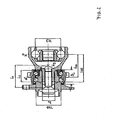
- Figur 1
- zeigt eine Einheit nach dem Stand der Technik im Längsschnitt unter Angabe allgemeiner Bezugsziffern;
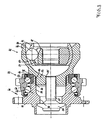
- Figur 2
- zeigt die Einheit nach
Figur 1 unter Angabe charakteristischer Kenngrößen; - Figur 3
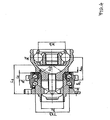
- zeigt eine erfindungsgemäße Einheit mit einem Gleichlauffestgelenk unter Angabe allgemeiner Bezugszeichen;
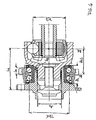
- Figur 4
- zeigt die Einheit nach
Figur 3 unter Angabe charakteristischer Kenngrößen; - Figur 5
- zeigt eine erfindungsgemäße Einheit mit einem Gleichlaufverschiebegelenk unter Angabe allgemeiner Bezugszeichen;
- Figur 6
- zeigt die Einheit nach
Figur 5 unter Angabe charakteristischer Kenngrößen. - In den
Figuren 1 und2 ist jeweils eine Radnabeneinheit 11 für ein Antriebsrad eines Kraftfahrzeuges mit einem Gleichlauffestgelenk 12 zur Verbindung mit einer Antriebswelle verbunden. Die Radnabeneinheit 11 umfaßt eine Lagereinheit 13 und eine Radnabe 30, wobei die Lagereinheit 13 auf die Radnabe 30 aufgezogen und zwischen Radnabe 30 und Gleichlauffestgelenk 12 axial verspannt ist. Die Radnabe 30 umfaßt einen Flansch zur Anschraubung eines Rades, an dem auch eine Bremsscheibe angeschraubt werden kann. Die Radnabe 30 weist weiterhin eine Durchgangsöffnung 29 auf, in der von Seiten des Gelenkes her eine innere Wellenverzahnung 14 eingeformt ist. Am Flansch ist eine mittige im wesentlichen radiale Abstützfläche 15 ausgebildet. Das Gleichlauffestgelenk 12 ist nach Art eines UF-Gelenkes ausgebildet und umfaßt ein Gelenkaußenteil 16, ein Gelenkinnenteil 17, drehmomentübertragende Kugeln 18 sowie einen Kugelkäfig 19. Die Kugeln sind in Paaren aus äußeren Kugelbahnen 20 im Gelenkaußenteil und inneren Kugelbahnen 21 im Gelenkinnenteil gehalten und geführt. Am Gelenkaußenteil 16 ist radnabenseitig eine im wesentlichen radiale Stützfläche 22 ausgebildet. Weiterhin ist ein zentraler Zapfen 23 am Gelenkaußenteil angesetzt, der eine äußere Wellenverzahnung 24 trägt, die in die innere Wellenverzahnung 14 der Nabe eingreift. Im Zapfen ist weiterhin eine durchgehende zentrale Gewindebohrung 25 ausgebildet, in die eine Schraube 27 eingedreht ist, die sich mit ihrem Schraubenkopf 28 auf der radialen Abstützfläche 15 des Flansches 12 abstützt. Das zweireihige Lager 13 umfaßt einen Lageraußenring 31, der in einen Radträger eingesetzt werden kann, und nicht näher bezeichnete äußere Lagerrillen für zwei Reihen von Lagerkugeln 32, 33 ausbildet. Eine erste innere Lagerrille für die Kugelreihe 32 ist unmittelbar in der Radnabe 30 ausgebildet, während eine zweite Kugelrille für die zweite Kugelreihe 33 in einem separaten Lagerinnenring 34 ausgebildet ist. Der Lagerinnenring 34 steht axial über die Radnabe 30 über, so daß die Lageranordnung 13 unter Einwirkung der Stützfläche 22 am Gelenkaußenteil mittels der sich an der Stützfläche 15 abstützenden Schraube 27 vorgespannt werden kann. Die Anordnung nach denFiguren 1 und2 ist auf eine Minimierung des Teilkreisdurchmessers TKD der Radlagerung ausgelegt. Hierbei ist der Zapfen 23 auf seine Mindestfestigkeit ausgelegt und weist bei relativ geringem Zapfendurchmesser DZ eine große Zapfenlänge LZ auf. Hierdurch wächst der Abstand zwischen der konstruktiven Lagermitte ML und der konstruktiven Gelenkmittel MG; dieser Abstand ist mit AGL bezeichnet. In gleicher Weise der ebenfalls eingezeichnete Abstand von der Gelenkmitte bis zum Zapfenende, der mit LGZ bezeichnet ist und etwa AGL + LZ / 2 entspricht. Als weitere charakteristische Größe ist inFigur 2 der Teilkreisdurchmesser PCD des Gelenks eingezeichnet. Daneben finden sich noch die Stützlänge LS des Lagers, das eine sogenannte O-Konfiguration aufweist, wobei die Wirklinien der Kugeln auf symmetrischen Konusflächen liegen, die sich zueinander öffnen, sowie die Lagerbreite BL des Lagers. - In den
Figuren 3 und4 ist jeweils eine Radnabeneinheit 41 für ein Antriebsrad eines Kraftfahrzeuges mit einem Gleichlauffestgelenk 42 zur Verbindung mit einer Antriebswelle verbunden. Die Radnabeneinheit 41 umfaßt eine Lagereinheit 43 und eine Radnabe 60, wobei die Lagereinheit 43 auf die Radnabe 60 aufgezogen und zwischen Radnabe 60 und Gleichlauffestgelenk 42 axial verspannt ist. Die Radnabe 60 umfaßt einen Flansch zur Anschraubung eines Rades, an dem auch eine Bremsscheibe angeschraubt werden kann. Die Radnabe 60 weist weiterhin eine Durchgangsöffnung 59 auf, in der von Seiten des Gelenkes her eine innere Wellenverzahnung 44 eingeformt ist. Am Flansch ist eine mittige im wesentlichen radiale Abstützfläche 45 ausgebildet. Das Gleichlauffestgelenk 42 ist nach Art eines UF-Gelenkes ausgebildet und umfaßt ein Gelenkaußenteil 46, ein Gelenkinnenteil 47, drehmomentübertragende Kugeln 48 sowie einen Kugelkäfig 49. Die Kugeln sind in Paaren aus äußeren Kugelbahnen 50 im Gelenkaußenteil und inneren Kugelbahnen 51 im Gelenkinnenteil gehalten und geführt. Am Gelenkaußenteil 46 ist radnabenseitig eine im wesentlichen radiale Stützfläche 52 ausgebildet. Weiterhin ist ein zentraler Zapfen 53 am Gelenkaußenteil angesetzt, der eine äußere Wellenverzahnung 54 trägt, die in die innere Wellenverzahnung 44 der Nabe eingreift. Im Zapfen ist weiterhin eine durchgehende zentrale Gewindebohrung 55 ausgebildet, in die eine Schraube 57 eingedreht ist, die sich mit ihrem Schraubenkopf 58 auf der radialen Abstützfläche 45 der Radnabe 60 abstützt. Die Stützfläche 45 ist hierbei an einer Durchmesserreduzierung 56 der Durchgangsöffnung 59 ausgebildet. Das zweireihige Lager 43 umfaßt einen Lageraußenring 61, der in einen Radträger eingesetzt werden kann, und nicht näher bezeichnete äußere Lagerrillen für zwei Reihen von Lagerkugeln 62, 63 ausbildet. Eine erste innere Lagerrille für die Kugelreihe 62 ist unmittelbar in der Radnabe 41 ausgebildet, während eine zweite Kugelrille für die zweite Kugelreihe 63 in einem separaten Lagerinnenring 64 ausgebildet ist. Der Lagerinnenring 64 steht axial über die Radnabe 60 über, so daß die Lageranordnung 43 unter Einwirkung der Stützfläche 52 am Gelenkaußenteil 46 mittels der sich an der Stützfläche 45 abstützenden Schraube 57 vorgespannt werden kann. Bei einem erfindungsgemäßen Gelenk der in denFiguren 3 und4 gezeigten Art ist ein qualitativ größerer Teilkreisdurchmesser TKD der Lageranordnung zugelassen, da zur deutlichen Reduzierung des Abstandes AGL zwischen der Lagermitte ML und der Gelenkmitte MG ein deutlicher qualitativer Zuwachs des Zapfendurchmesser DZ vorgenommen worden ist. Dieser Zuwachs im Zapfendurchmesser DZ erlaubt eine Verkürzung der Zapfenlänge LZ. Auch inFigur 4 sind als weitere Kenngrößen, auf die in der Beschreibung bzw. in den Ansprüchen Bezug genommen wurde, der Teilkreisdurchmesser PCD des Gelenkes, die Lagerbreite BL sowie die Stützlänge LS der Lageranordnung gezeigt. Ebenfalls sind die Dehnlänge LDEHN der Schraube und die ringförmige Querschnittsfläche AE der Radnabe unter dem separaten Lagerinnenring bezeichnet. Auch hier hat die Lagerung eine O-Konfiguration mit Wirklinien der Kugeln, die auf symmetrischen zueinander offenen Konusflächen liegen. - Im Vergleich mit einer Anordnung nach den
Figuren 1 und2 , bei der der Zapfen im Durchmesser minimiert ist und dabei relativ verdrehweich ist, zeigt die erfindungsgemäße Anordnung nach denFiguren 3 und4 einen kurzen dicken und damit verdrehsteifen Zapfen. Die bisher unter wechselndem Drehmoment auftretenden Mikrobewegungen zwischen der Stützfläche am Gelenkaußenteil und der entsprechenden Gegenfläche am separaten Lagerinnenring treten beim erfindungsgemäßen Gelenk nicht mehr auf. - In den
Figuren 5 und6 ist jeweils eine Radnabeneinheit 71 für ein Antriebsrad eines Kraftfahrzeuges mit einem Gleichlaufverschiebegelenk 72 zur Verbindung mit einer Antriebswelle verbunden, wobei eine Lagereinheit 73 auf die Radnabeneinheit 71 aufgezogen und zwischen Radnabeneinheit 71 und Gleichlaufverschiebegelenk 72 axial verspannt ist. Die Radnabe 90 umfaßt einen Flansch zur Anschraubung eines Rades, an dem auch eine Bremsscheibe angeschraubt werden kann. Die Radnabe 90 weist weiterhin eine Durchgangsöffnung 89 auf, in der von Seiten des Gelenkes her eine innere Wellenverzahnung 74 eingeformt ist. Am Flansch ist eine mittige im wesentlichen radiale Abstützfläche 75 ausgebildet. Das Gleichlaufverschiebegelenk 72 ist nach Art eines VL-Gelenkes ausgebildet und umfaßt ein Gelenkaußenteil 76, ein Gelenkinnenteil 77, drehmomentübertragende Kugeln 78 sowie einen Kugelkäfig 79. Die Kugeln sind in Paaren aus äußeren Kugelbahnen 80 im Gelenkaußenteil und inneren Kugelbahnen 81 im Gelenkinnenteil gehalten und geführt. Am Gelenkaußenteil 76 ist radnabenseitig eine im wesentlichen radiale Stützfläche 82 ausgebildet. Weiterhin ist ein zentraler Zapfen 83 am Gelenkaußenteil angesetzt, der eine äußere Wellenverzahnung 84 trägt, die in die innere Wellenverzahnung 74 der Nabe eingreift. Im Zapfen ist weiterhin eine durchgehende zentrale Gewindebohrung 85 ausgebildet, in die eine Schraube 87 eingedreht ist, die sich mit ihrem Schraubenkopf 88 auf der radialen Abstützfläche 75 der Radnabe 90 abstützt. Die Stützfläche 75 ist hierbei an einer Durchmesserreduzierung 86 der Durchgangsöffnung 89 ausgebildet. Das zweireihige Lager 73 umfaßt einen Lageraußenring 91, der in einen Radträger eingesetzt werden kann, und nicht näher bezeichnete äußere Lagerrillen für zwei Reihen von Lagerkugeln 92, 93 ausbildet. Eine erste innere Lagerrille für die Kugelreihe 62 ist in einem Lagerinnenring 94 ausgebildet, während eine zweite Kugelrille für die zweite Kugelreihe 63 in einem Lagerinnenring 95 ausgebildet ist. Der Lagerinnenring 94 steht axial über die Radnabe 90 über, so daß die Lageranordnung 73 unter Einwirkung der Stützfläche 82 am Gelenkaußenteil mittels der sich an der Stützfläche 75 abstützenden Schraube 87 vorgespannt werden kann. Bei einem erfindungsgemäßen Gelenk der in denFiguren 5 und6 gezeigten Art ist ein qualitativ größerer Teilkreisdurchmesser TKD der Lageranordnung zugelassen, da zur deutlichen Reduzierung des Abstandes AGL zwischen der Lagermitte ML und der Gelenkmitte MG ein deutlicher qualitativer Zuwachs des Zapfendurchmesser DZ vorgenommen worden ist. Dieser Zuwachs im Zapfendurchmesser DZ erlaubt eine Verkürzung der Zapfenlänge LZ. Auch inFigur 4 sind als weitere Kenngrößen, auf die in der Beschreibung bzw. in den Ansprüchen Bezug genommen wurde, der Teilkreisdurchmesser PCD des Gelenkes, die Lagerbreite BL sowie die Stützlänge LS der Lageranordnung gezeigt. Ebenfalls sind die Dehnlänge LDEHN der Schraube und die ringförmige Querschnittsfläche AE der Radnabe unter dem separaten Lagerinnenring bezeichnet. Die Gelenkmitte MG liegt mittig zwischen dem nach beiden Seiten davon angetragenen halben Verschiebeweg VS/2. Auch hier hat die Lagerung eine O-Konfiguration mit Wirklinien der Kugeln, die auf symmetrischen zueinander offenen Konusflächen liegen. - Im Vergleich mit einer Anordnung nach den
Figuren 1 und2 , bei der der Zapfen im Durchmesser minimiert ist und dabei relativ verdrehweich ist, zeigt die erfindungsgemäße Anordnung nach denFiguren 5 und6 einen kurzen dicken und damit verdrehsteifen Zapfen. Die bisher unter wechselndem Drehmoment auftretenden Mikrobewegungen zwischen der Stützfläche am Gelenkaußenteil und der entsprechenden Gegenfläche am separaten Lagerinnenring treten beim erfindungsgemäßen Gelenk nicht mehr auf. -
- 11, 41, 71
- Radnabeneinheit
- 12, 42, 72
- Gleichlaufdrehgelenk
- 13, 43, 73
- Radlagerung
- 14,44,74
- innere Wellenverzahnung
- 15,45,75
- Stützfläche (Radnabe)
- 16, 46, 76
- Gelenkaußenteil
- 17,47,77
- Gelenkinnenteil
- 18,48,78
- Kugel
- 19,49,79
- Kugelkäfig
- 20, 50, 80
- Kugelbahn außen
- 21, 51, 81
- Kugelbahn innen
- 22, 52, 82
- Stützfläche (Gelenkaußenteil)
- 23, 53, 83
- Zapfen
- 24, 54, 84
- äußere Wellenverzahnung
- 25, 55, 85
- Gewindebohrung
- 56, 86
- Durchmesserreduzierung
- 27, 57, 87
- Schraube
- 28,58,88
- Schraubenkopf
- 29,59,89
- Durchgangsöffnung
- 30,60,90
- Radnabe
- 31,61,91
- äußerer Lagerring
- 32,62,92
- Kugelreihe
- 33,63,93
- Kugelreihe
- 34, 64, 94
- innerer Lagerring
- 95
- innerer Lagerring
- TKD
- Teilkreisdurchmesser Lager
- DZ
- Zapfendurchmesser
- LZ
- Zapfenlänge
- ML
- Lagermitte
- MG
- Gelenkmitte
- AGL
- Abstand Lagermitte - Gelenkmitte
- LGZ
- Abstand Gelenkmitte - Zapfenende
- PCD
- Teilkreisdurchmesser Gelenk
- LS
- Stützlänge Lagerung
- VS
- Verschiebeweg
- AE
- Querschnittsfläche Radnabe
- LDEHN
- Dehnlänge Schraubenschaft
Claims (18)
- Radnaben-Gleichlaufdrehgelenk-Einheit, bei welcher eine Radnabe (60, 90) mit einer Durchgangsöffnung (59, 89), die eine innere Wellenverzahnung (44, 74) trägt, mit dem Gelenkaußenteil (46, 76) eines Gleichlaufdrehgelenks (42, 72) verspannt ist, an dem ein Zapfen (53, 83) mit einer äußeren Wellenverzahnung (54, 84) angeformt ist, wobei innere Wellenverzahnung (44, 74) der Durchgangsöffnung (59, 89) und äußere Wellenverzahnung (54, 84) des Zapfens (53, 83) ineinandergreifen, und ein zweireihiges Radlager (43, 73) auf die Radnabe (60, 90) aufgeschoben ist, die einen inneren Lagerring (64, 94) umfaßt, an dem sich eine Stirnfläche (52, 82) des Gelenkaußenteils (46, 76) unmittelbar abstützt,
dadurch gekennzeichnet,
daß die Hälfte der Summe aus Teilkreisdurchmesser PCD der Gelenkkugeln des Gleichlaufdrehgelenks und Lagerbreite BL größer ist als der Mittenabstand AGL zwischen Gleichlaufdrehgelenk (42, 72) und Radlager (43, 73), d. h. (PCD + BL) /2 > AGL. - Einheit nach Anspruch 1,
dadurch gekennzeichnet,
daß das Verhältnis aus Lagerbreite BL und Zapfendurchmesser an der Lagerbasis DZ kleiner 1 ist, d. h. BL / DZ < 1. - Einheit nach Anspruch 1,
dadurch gekennzeichnet,
daß das Verhältnis aus Zapfenlänge LZ und Teilkreisdurchmesser der Lagerkugeln TKD kleiner 0,5 ist, d. h. LZ / TKD < 0,5. - Einheit nach Anspruch 1,
dadurch gekennzeichnet,
daß das Verhältnis der genutzten Verzahnungslänge LVERZ. und Teilkreisdurchmesser der Lagerkugeln TKD kleiner 0,25 ist, d. h. LVERZ. / TKD < 0,25. - Einheit nach Anspruch 1,
dadurch gekennzeichnet,
daß das Verhältnis aus Teilkreisdurchmesser der Lagerkugeln TKD und Lagerbreite BL größer 1,9 ist, d. h. TKD / BL > 1,9. - Einheit nach Anspruch 1,
dadurch gekennzeichnet,
daß das Verhältnis aus Querschnittsfläche AE der Radnabe (60,90) im Bereich eines separaten Lagerinnenrings (64, 94) und Quadrat der Dehnlänge LDEHN einer Schraube (57, 87) zur Verbindung von Radnabe (60,90) und Gelenkaußenteil (46, 76) größer 0,2 ist, d. h. AE / LDEHN 2 > 0,2. - Radnaben-Gleichlaufdrehgelenk-Einheit, bei welcher eine Radnabe (60, 90) mit einer Durchgangsöffnung (59, 89), die eine innere Welleverzahnung (44, 74) trägt, mit dem Gelenkaußenteil (46, 76) eines Gleichlaufdrehgelenks (42, 72) verspannt ist, an dem ein Zapfen (53, 83) mit einer äußeren Wellenverzahnung (54, 84) angeformt ist, wobei innere Wellenverzahnung (44, 74) der Durchgangsöffnung (59, 89) und äußere Wellenverzahnung (54, 84) des Zapfens (53, 83) ineinandergreifen, und ein zweireihiges Radlager (43, 73) auf die Radnabe (60, 90) aufgeschoben ist, die einen inneren Lagerring (64, 94) umfaßt, an dem sich eine Stirnfläche (52, 82) des Gelenkaußenteils (46, 76) unmittelbar abstützt,
dadurch gekennzeichnet,
daß das Verhältnis aus Mittenabstand AGL zwischen Gleichlaufdrehgelenk (42, 72) und Radlager (43, 73) einerseits und Zapfendurchmesser an der Zapfenbasis DZ andererseits kleiner 2 ist, d.h. AGL/DZ < 2. - Einheit nach Anspruch 7,
dadurch gekennzeichnet,
daß das Verhältnis aus Mittenabstand AGL zwischen Gleichlaufdrehgelenk (42, 72) und Radlager (43, 73) einerseits und Zapfendurchmesser an der Zapfenbasis DZ andererseits kleiner 1,5 ist, d.h. AGL/DZ < 1,5 , insbesondere kleiner 1,2 ist, d.h. AGL/DZ < 1,2. - Radnaben-Gleichlaufdrehgelenk-Einheit, bei welcher eine Radnabe (60, 90) mit einer Durchgangsöffnung (59, 89), die eine innere Wellenverzahnung (44, 74) trägt, mit dem Gelenkaußenteil (46, 76) eines Gleichlaufdrehgelenks (42, 72) verspannt ist, an dem ein Zapfen (53, 83) mit einer äußeren Wellenverzahnung (54, 84) angeformt ist, wobei innere Wellenverzahnung (44, 74) der Durchgangsöffnung (59, 89) und äußere Wellenverzahnung (54, 84) des Zapfens (53, 83) ineinandergreifen, und ein zweireihiges Radlager (43, 73) auf die Radnabe (60, 90) aufgeschoben ist, die einen inneren Lagerring (64, 94) umfaßt, an dem sich eine Stirnfläche (52, 82) des Gelenkaußenteils (46, 76) unmittelbar abstützt,
dadurch gekennzeichnet,
daß das Verhältnis aus Teilkreisdurchmesser des Radlagers TKD und Zapfenlänge LZ größer 2 ist, d.h. TKD/LZ > 2. - Einheit nach Anspruch 9,
dadurch gekennzeichnet,
daß das Verhältnis aus Teilkreisdurchmesser des Radlager TKD und Zapfenlänge LZ größer 2,25 ist, d.h. TKD/LZ > 2,25, insbesondere größer 2,85 ist, d.h. TKD/LZ > 2,85. - Radnaben-Gleichlaufdrehgelenk-Einheit, bei welcher eine Radnabe (60, 90) mit einer Durchgangsöffnung (59, 89), die eine innere Wellenverzahnung (44, 74) trägt, mit dem Gelenkaußenteil (46, 76) eines Gleichlaufdrehgelenks (42, 72) verspannt ist, an dem ein Zapfen (53, 83) mit einer äußeren Wellenverzahnung (54, 84) angeformt ist, wobei innere Wellenverzahnung (44, 74) der Durchgangsöffnung (59, 89) und äußere Wellenverzahnung (54, 84) des Zapfens (53, 83) ineinandergreifen, und ein zweireihiges Radlager (43, 73) auf die Radnabe (60, 90) aufgeschoben ist, die einen inneren Lagerring (64, 94) umfaßt, an dem sich eine Stirnfläche (52, 82) des Gelenkaußenteils (46, 76) unmittelbar abstützt,
dadurch gekennzeichnet,
daß das Verhältnis aus Mittenabstand AGL zwischen Gleichlaufdrehgelenk (42, 72) und Radlager (43, 73) einerseits und Zapfenlänge LZ andererseits größer 1,95 ist, d.h. AGL/LZ > 1,95. - Einheit nach Anspruch 11,
dadurch gekennzeichnet,
daß das Verhältnis aus Mittenabstand AGL zwischen Gleichlaufdrehgelenk (42, 72) und Radlager (43, 73) einerseits und Zapfenlänge LZ andererseits größer 2,0 ist, d.h. AGL/LZ > 2,0. - Einheit nach einem der Ansprüche 1 bis 12,
dadurch gekennzeichnet,
daß das Radlager (43) ausschließlich einen separaten Lagerinnenring (64) umfaßt. - Einheit nach einem der Ansprüche 1 bis 13,
dadurch gekennzeichnet,
daß die Radnabe (60, 90) axial entgegengesetzt zur inneren Wellenverzahnung (54, 84) eine Durchmesserreduzierung (56, 86) der Durchgangsöffnung (59, 89) aufweist. - Einheit nach einem der Ansprüche 1 bis 14,
dadurch gekennzeichnet,
daß der Zapfen (53, 83) eine zentrale Gewindebohrung (55, 85) aufweist, in die eine Schraube (57, 87) zur Verspannung der Radnabe (60, 90) mit dem Gelenkaußenteil (46, 76) eingedreht ist. - Einheit nach Anspruch 15,
dadurch gekennzeichnet,
daß der Schraubenkopf (58, 88) sich im Bereich der Durchmesserreduzierung (56, 86) an einer Stützfläche (45, 75) der Radnabe (60, 90) abstützt. - Einheit nach einem der Ansprüche 1 bis 16,
dadurch gekennzeichnet,
daß das Gelenk ein Festgelenk (42) ist, wobei die Mitte des Gelenks MG axial durch die Ebene der Kugelmitten bei gestrecktem Gelenk definiert ist. - Einheit nach einem der Ansprüche 1 bis 17,
dadurch gekennzeichnet,
daß das Gelenk ein Verschiebegelenk (72) ist, wobei die Mitte des Gelenks MG axial durch die Ebene der Kugelmitten bei gestrecktem und auf die Mitte des axialen Verschiebewegs VS eingestellten Gelenk definiert ist.
Applications Claiming Priority (2)
| Application Number | Priority Date | Filing Date | Title |
|---|---|---|---|
| DE102004054907A DE102004054907A1 (de) | 2004-11-12 | 2004-11-12 | Radnaben-Gelenk-Einheit |
| PCT/EP2005/011059 WO2006050785A1 (de) | 2004-11-12 | 2005-10-14 | Radnaben-gelenk-einheit |
Publications (2)
| Publication Number | Publication Date |
|---|---|
| EP1809489A1 EP1809489A1 (de) | 2007-07-25 |
| EP1809489B1 true EP1809489B1 (de) | 2009-04-15 |
Family
ID=35427390
Family Applications (1)
| Application Number | Title | Priority Date | Filing Date |
|---|---|---|---|
| EP05796223A Expired - Lifetime EP1809489B1 (de) | 2004-11-12 | 2005-10-14 | Radnaben-gelenk-einheit |
Country Status (8)
| Country | Link |
|---|---|
| US (1) | US7824272B2 (de) |
| EP (1) | EP1809489B1 (de) |
| JP (1) | JP4938677B2 (de) |
| KR (1) | KR101264073B1 (de) |
| CN (1) | CN100554005C (de) |
| AT (1) | ATE428579T1 (de) |
| DE (2) | DE102004054907A1 (de) |
| WO (1) | WO2006050785A1 (de) |
Cited By (1)
| Publication number | Priority date | Publication date | Assignee | Title |
|---|---|---|---|---|
| DE102015203413A1 (de) | 2015-02-26 | 2016-09-01 | Schaeffler Technologies AG & Co. KG | Radlageranordnung |
Families Citing this family (21)
| Publication number | Priority date | Publication date | Assignee | Title |
|---|---|---|---|---|
| DE102005054284B4 (de) | 2005-11-11 | 2009-02-05 | Gkn Driveline Deutschland Gmbh | Gleichlaufgelenk-Radnaben-Anordnung mit Hohlanbindung |
| DE102006030682A1 (de) | 2006-07-04 | 2008-01-17 | Schaeffler Kg | Radnaben-Gelenk-Einheit |
| JP5117128B2 (ja) * | 2007-07-02 | 2013-01-09 | Ntn株式会社 | 車輪用軸受装置 |
| DE102008003646A1 (de) | 2008-01-09 | 2009-07-16 | GM Global Technology Operations, Inc., Detroit | Radnabengelenkeinheit für ein Fahrzeug |
| JP5121526B2 (ja) * | 2008-03-25 | 2013-01-16 | 本田技研工業株式会社 | シャフトドライブ装置 |
| US8616779B2 (en) | 2010-11-29 | 2013-12-31 | Honda Motor Co., Ltd. | Shortened driveshaft stem |
| DE102012008155A1 (de) | 2012-04-24 | 2013-10-24 | Volkswagen Aktiengesellschaft | Gleichlaufgelenk für ein Kraftfahrzeug sowie Anordnung aus einem Gleichlaufgelenk und einer Radnabe |
| DE102012105958A1 (de) * | 2012-07-04 | 2014-01-23 | Thyssenkrupp Steel Europe Ag | Verfahren zur Herstellung eines Verbindungselements zur Übertragung von Drehbewegungen |
| KR101431095B1 (ko) * | 2012-12-24 | 2014-08-21 | 주식회사 일진글로벌 | 구동 휠 베어링장치 |
| KR101532076B1 (ko) * | 2013-08-14 | 2015-06-29 | 주식회사 일진글로벌 | 구동 휠 베어링장치 |
| KR102131856B1 (ko) | 2013-11-04 | 2020-07-08 | 현대모비스 주식회사 | 허브 베어링 |
| KR101599155B1 (ko) * | 2014-12-30 | 2016-03-02 | 현대위아 주식회사 | 등속조인트 |
| CN104802593B (zh) * | 2015-04-16 | 2017-01-25 | 南京航空航天大学 | 轮毂轴承单元 |
| DE102019130321B4 (de) * | 2019-11-11 | 2022-04-14 | Audi Ag | Radlagereinheit für ein Kraftfahrzeug sowie Verfahren zum Herstellen einer Radlagereinheit |
| DE102022121486A1 (de) | 2022-08-25 | 2024-03-07 | Audi Aktiengesellschaft | Radlagereinheit für ein Kraftfahrzeug sowie Kraftfahrzeug |
| KR102887849B1 (ko) | 2023-09-05 | 2025-11-18 | 주식회사 일진글로벌 | 자동차용 휠 허브 베어링 유닛 |
| KR102925608B1 (ko) | 2023-12-26 | 2026-02-11 | 주식회사 일진글로벌 | 센터볼트 체결 구조를 가지는 자동차용 휠 허브 베어링 유닛 |
| KR102925615B1 (ko) * | 2023-12-26 | 2026-02-11 | 주식회사 일진글로벌 | 휠 허브 조인트 어셈블리 |
| KR102939143B1 (ko) | 2023-12-26 | 2026-03-13 | 주식회사 일진글로벌 | 자동차용 휠 허브 베어링 유닛 |
| KR102925618B1 (ko) | 2023-12-26 | 2026-02-11 | 주식회사 일진글로벌 | 자동차용 휠 허브 베어링 유닛 |
| KR102925610B1 (ko) | 2023-12-26 | 2026-02-11 | 주식회사 일진글로벌 | 개선된 강성 구조를 가지는 자동차용 휠 허브 베어링 유닛 |
Family Cites Families (14)
| Publication number | Priority date | Publication date | Assignee | Title |
|---|---|---|---|---|
| DE3430067C1 (de) * | 1984-08-16 | 1989-04-06 | Löhr & Bromkamp GmbH, 6050 Offenbach | Gelenkwelle |
| DE3536796A1 (de) * | 1985-10-16 | 1987-04-16 | Kugelfischer G Schaefer & Co | Zweireihiges waelzlager, insbesondere fuer raeder von kraftfahrzeugen |
| JPH0375003A (ja) * | 1989-08-17 | 1991-03-29 | Kurata:Kk | 洋服等の皺伸ばし機能を具えた家具 |
| JPH0375003U (de) * | 1989-11-27 | 1991-07-29 | ||
| JPH1191307A (ja) * | 1997-09-26 | 1999-04-06 | Ntn Corp | ハブユニット |
| JPH11190346A (ja) | 1997-12-26 | 1999-07-13 | Ntn Corp | 車輪用軸受ユニット |
| JP2001225605A (ja) * | 2000-02-16 | 2001-08-21 | Nsk Ltd | 自動車用車輪駆動装置 |
| JP4193344B2 (ja) * | 2000-08-22 | 2008-12-10 | 日本精工株式会社 | 車輪用駆動ユニット |
| WO2002028668A2 (en) * | 2000-09-29 | 2002-04-11 | Nsk Ltd. | Bearing unit for wheel drive |
| JP3902392B2 (ja) * | 2000-10-10 | 2007-04-04 | Ntn株式会社 | 駆動車輪用軸受装置 |
| JP4613462B2 (ja) * | 2001-08-08 | 2011-01-19 | 株式会社ジェイテクト | 車軸用軸受装置 |
| JP3650746B2 (ja) * | 2001-09-17 | 2005-05-25 | Ntn株式会社 | 車輪用軸受の固定構造及び車輪用軸受 |
| DE10338172B3 (de) | 2003-08-20 | 2005-06-23 | Gkn Driveline Deutschland Gmbh | Radnaben-Drehgelenk-Anordnung |
| DE20320496U1 (de) * | 2003-12-16 | 2004-10-07 | Fag Kugelfischer Ag | Nabe |
-
2004
- 2004-11-12 DE DE102004054907A patent/DE102004054907A1/de not_active Withdrawn
-
2005
- 2005-10-14 EP EP05796223A patent/EP1809489B1/de not_active Expired - Lifetime
- 2005-10-14 WO PCT/EP2005/011059 patent/WO2006050785A1/de not_active Ceased
- 2005-10-14 DE DE502005007104T patent/DE502005007104D1/de not_active Expired - Lifetime
- 2005-10-14 CN CNB2005800463498A patent/CN100554005C/zh not_active Expired - Lifetime
- 2005-10-14 US US11/667,621 patent/US7824272B2/en active Active
- 2005-10-14 AT AT05796223T patent/ATE428579T1/de not_active IP Right Cessation
- 2005-10-14 KR KR1020077010766A patent/KR101264073B1/ko not_active Expired - Lifetime
- 2005-10-14 JP JP2007540517A patent/JP4938677B2/ja not_active Expired - Lifetime
Cited By (1)
| Publication number | Priority date | Publication date | Assignee | Title |
|---|---|---|---|---|
| DE102015203413A1 (de) | 2015-02-26 | 2016-09-01 | Schaeffler Technologies AG & Co. KG | Radlageranordnung |
Also Published As
| Publication number | Publication date |
|---|---|
| CN100554005C (zh) | 2009-10-28 |
| KR20070113189A (ko) | 2007-11-28 |
| DE502005007104D1 (de) | 2009-05-28 |
| DE102004054907A1 (de) | 2006-09-14 |
| JP2008519722A (ja) | 2008-06-12 |
| US7824272B2 (en) | 2010-11-02 |
| WO2006050785A1 (de) | 2006-05-18 |
| JP4938677B2 (ja) | 2012-05-23 |
| KR101264073B1 (ko) | 2013-05-15 |
| ATE428579T1 (de) | 2009-05-15 |
| US20080242433A1 (en) | 2008-10-02 |
| CN101155700A (zh) | 2008-04-02 |
| EP1809489A1 (de) | 2007-07-25 |
Similar Documents
| Publication | Publication Date | Title |
|---|---|---|
| EP1809489B1 (de) | Radnaben-gelenk-einheit | |
| WO2008003293A2 (de) | Radnaben-gelenk-einheit | |
| DE102005054283B4 (de) | Radnaben-Drehgelenk-Anordnung mit Stirnverzahnung | |
| DE19843632B4 (de) | Gleichlaufgelenk | |
| EP2142386B1 (de) | Lageranordnung einer über ein drehgelenk antreibbaren radnabe eines kraftfahrzeuges | |
| DE2329554C2 (de) | Anordnung zur Lagerung einer antreibbaren Radnabe eines Motorfahrzeugs | |
| DE10338172B3 (de) | Radnaben-Drehgelenk-Anordnung | |
| EP1910100B1 (de) | Radlageranordnung mit stirnverzahnung | |
| DE60117098T2 (de) | Vorrichtung für Antriebsrad eines Motorfahrzeuges | |
| DE102004054908B4 (de) | Gelenkaußenteil eines Gleichlaufdrehgelenks für eine Radnaben-Gelenk-Einheit | |
| WO2005050044A1 (de) | Gelenkaussenteil mit abstützscheibe | |
| DE2626170C3 (de) | Differentialgetriebe mit kombiniert gelagerten Zentralrädern | |
| DE102004055786A1 (de) | Radlagereinheit | |
| DE19842408A1 (de) | Fahrzeuganstriebsstrang | |
| DE102005054285B3 (de) | Radnaben-Drehgelenk-Anordnung mit Stirnverzahnung und Radlagerung | |
| DE2721098A1 (de) | Universalgelenk | |
| EP3819136B1 (de) | Radlagereinheit für ein kraftfahrzeug sowie verfahren zum herstellen einer radlagereinheit | |
| EP1912800B1 (de) | Radlagereinheit | |
| DE102005036660A1 (de) | Radlagereinheit | |
| DE112022001732T5 (de) | Radlagervorrichtung | |
| DE1836832U (de) | Bremsscheibe, insbesondere fuer schienenfahrzeuge. | |
| DE102018129285A1 (de) | Radlager für ein Kraftfahrzeug | |
| DD224552B1 (de) | Kombinierte anordnung einer vorderen fahrerhauslagerung fuer kippbare fahrerhaeuser | |
| DE102005027516A1 (de) | Pedale | |
| DE102024122767A1 (de) | Abtriebskegelrad für ein Kegelraddifferenzial, Kegelraddifferenzial, Antriebseinheit und Kraftfahrzeug |
Legal Events
| Date | Code | Title | Description |
|---|---|---|---|
| PUAI | Public reference made under article 153(3) epc to a published international application that has entered the european phase |
Free format text: ORIGINAL CODE: 0009012 |
|
| 17P | Request for examination filed |
Effective date: 20070418 |
|
| AK | Designated contracting states |
Kind code of ref document: A1 Designated state(s): AT BE BG CH CY CZ DE DK EE ES FI FR GB GR HU IE IS IT LI LT LU LV MC NL PL PT RO SE SI SK TR |
|
| RAP1 | Party data changed (applicant data changed or rights of an application transferred) |
Owner name: GKN DRIVELINE DEUTSCHLAND GMBH Owner name: SCHAEFFLER KG |
|
| DAX | Request for extension of the european patent (deleted) | ||
| GRAP | Despatch of communication of intention to grant a patent |
Free format text: ORIGINAL CODE: EPIDOSNIGR1 |
|
| GRAP | Despatch of communication of intention to grant a patent |
Free format text: ORIGINAL CODE: EPIDOSNIGR1 |
|
| GRAS | Grant fee paid |
Free format text: ORIGINAL CODE: EPIDOSNIGR3 |
|
| GRAA | (expected) grant |
Free format text: ORIGINAL CODE: 0009210 |
|
| AK | Designated contracting states |
Kind code of ref document: B1 Designated state(s): AT BE BG CH CY CZ DE DK EE ES FI FR GB GR HU IE IS IT LI LT LU LV MC NL PL PT RO SE SI SK TR |
|
| REG | Reference to a national code |
Ref country code: CH Ref legal event code: EP Ref country code: GB Ref legal event code: FG4D Free format text: NOT ENGLISH |
|
| REG | Reference to a national code |
Ref country code: IE Ref legal event code: FG4D |
|
| REF | Corresponds to: |
Ref document number: 502005007104 Country of ref document: DE Date of ref document: 20090528 Kind code of ref document: P |
|
| NLV1 | Nl: lapsed or annulled due to failure to fulfill the requirements of art. 29p and 29m of the patents act | ||
| PG25 | Lapsed in a contracting state [announced via postgrant information from national office to epo] |
Ref country code: LT Free format text: LAPSE BECAUSE OF FAILURE TO SUBMIT A TRANSLATION OF THE DESCRIPTION OR TO PAY THE FEE WITHIN THE PRESCRIBED TIME-LIMIT Effective date: 20090415 Ref country code: FI Free format text: LAPSE BECAUSE OF FAILURE TO SUBMIT A TRANSLATION OF THE DESCRIPTION OR TO PAY THE FEE WITHIN THE PRESCRIBED TIME-LIMIT Effective date: 20090415 Ref country code: ES Free format text: LAPSE BECAUSE OF FAILURE TO SUBMIT A TRANSLATION OF THE DESCRIPTION OR TO PAY THE FEE WITHIN THE PRESCRIBED TIME-LIMIT Effective date: 20090726 |
|
| PG25 | Lapsed in a contracting state [announced via postgrant information from national office to epo] |
Ref country code: SE Free format text: LAPSE BECAUSE OF FAILURE TO SUBMIT A TRANSLATION OF THE DESCRIPTION OR TO PAY THE FEE WITHIN THE PRESCRIBED TIME-LIMIT Effective date: 20090715 Ref country code: IS Free format text: LAPSE BECAUSE OF FAILURE TO SUBMIT A TRANSLATION OF THE DESCRIPTION OR TO PAY THE FEE WITHIN THE PRESCRIBED TIME-LIMIT Effective date: 20090815 Ref country code: LV Free format text: LAPSE BECAUSE OF FAILURE TO SUBMIT A TRANSLATION OF THE DESCRIPTION OR TO PAY THE FEE WITHIN THE PRESCRIBED TIME-LIMIT Effective date: 20090415 Ref country code: PL Free format text: LAPSE BECAUSE OF FAILURE TO SUBMIT A TRANSLATION OF THE DESCRIPTION OR TO PAY THE FEE WITHIN THE PRESCRIBED TIME-LIMIT Effective date: 20090415 Ref country code: NL Free format text: LAPSE BECAUSE OF FAILURE TO SUBMIT A TRANSLATION OF THE DESCRIPTION OR TO PAY THE FEE WITHIN THE PRESCRIBED TIME-LIMIT Effective date: 20090415 Ref country code: SI Free format text: LAPSE BECAUSE OF FAILURE TO SUBMIT A TRANSLATION OF THE DESCRIPTION OR TO PAY THE FEE WITHIN THE PRESCRIBED TIME-LIMIT Effective date: 20090415 |
|
| REG | Reference to a national code |
Ref country code: IE Ref legal event code: FD4D |
|
| PG25 | Lapsed in a contracting state [announced via postgrant information from national office to epo] |
Ref country code: RO Free format text: LAPSE BECAUSE OF FAILURE TO SUBMIT A TRANSLATION OF THE DESCRIPTION OR TO PAY THE FEE WITHIN THE PRESCRIBED TIME-LIMIT Effective date: 20090415 Ref country code: IE Free format text: LAPSE BECAUSE OF FAILURE TO SUBMIT A TRANSLATION OF THE DESCRIPTION OR TO PAY THE FEE WITHIN THE PRESCRIBED TIME-LIMIT Effective date: 20090415 Ref country code: DK Free format text: LAPSE BECAUSE OF FAILURE TO SUBMIT A TRANSLATION OF THE DESCRIPTION OR TO PAY THE FEE WITHIN THE PRESCRIBED TIME-LIMIT Effective date: 20090415 Ref country code: CZ Free format text: LAPSE BECAUSE OF FAILURE TO SUBMIT A TRANSLATION OF THE DESCRIPTION OR TO PAY THE FEE WITHIN THE PRESCRIBED TIME-LIMIT Effective date: 20090415 Ref country code: EE Free format text: LAPSE BECAUSE OF FAILURE TO SUBMIT A TRANSLATION OF THE DESCRIPTION OR TO PAY THE FEE WITHIN THE PRESCRIBED TIME-LIMIT Effective date: 20090415 |
|
| PLBE | No opposition filed within time limit |
Free format text: ORIGINAL CODE: 0009261 |
|
| STAA | Information on the status of an ep patent application or granted ep patent |
Free format text: STATUS: NO OPPOSITION FILED WITHIN TIME LIMIT |
|
| PG25 | Lapsed in a contracting state [announced via postgrant information from national office to epo] |
Ref country code: SK Free format text: LAPSE BECAUSE OF FAILURE TO SUBMIT A TRANSLATION OF THE DESCRIPTION OR TO PAY THE FEE WITHIN THE PRESCRIBED TIME-LIMIT Effective date: 20090415 |
|
| 26N | No opposition filed |
Effective date: 20100118 |
|
| PG25 | Lapsed in a contracting state [announced via postgrant information from national office to epo] |
Ref country code: BG Free format text: LAPSE BECAUSE OF FAILURE TO SUBMIT A TRANSLATION OF THE DESCRIPTION OR TO PAY THE FEE WITHIN THE PRESCRIBED TIME-LIMIT Effective date: 20090715 |
|
| BERE | Be: lapsed |
Owner name: SCHAEFFLER K.G. Effective date: 20091031 Owner name: GKN DRIVELINE DEUTSCHLAND G.M.B.H. Effective date: 20091031 |
|
| PG25 | Lapsed in a contracting state [announced via postgrant information from national office to epo] |
Ref country code: MC Free format text: LAPSE BECAUSE OF NON-PAYMENT OF DUE FEES Effective date: 20091031 |
|
| REG | Reference to a national code |
Ref country code: CH Ref legal event code: PL |
|
| PG25 | Lapsed in a contracting state [announced via postgrant information from national office to epo] |
Ref country code: LI Free format text: LAPSE BECAUSE OF NON-PAYMENT OF DUE FEES Effective date: 20091031 Ref country code: BE Free format text: LAPSE BECAUSE OF NON-PAYMENT OF DUE FEES Effective date: 20091031 Ref country code: CH Free format text: LAPSE BECAUSE OF NON-PAYMENT OF DUE FEES Effective date: 20091031 Ref country code: GR Free format text: LAPSE BECAUSE OF FAILURE TO SUBMIT A TRANSLATION OF THE DESCRIPTION OR TO PAY THE FEE WITHIN THE PRESCRIBED TIME-LIMIT Effective date: 20090716 |
|
| PG25 | Lapsed in a contracting state [announced via postgrant information from national office to epo] |
Ref country code: GB Free format text: LAPSE BECAUSE OF NON-PAYMENT OF DUE FEES Effective date: 20091014 |
|
| PG25 | Lapsed in a contracting state [announced via postgrant information from national office to epo] |
Ref country code: AT Free format text: LAPSE BECAUSE OF NON-PAYMENT OF DUE FEES Effective date: 20091014 |
|
| PG25 | Lapsed in a contracting state [announced via postgrant information from national office to epo] |
Ref country code: IT Free format text: LAPSE BECAUSE OF FAILURE TO SUBMIT A TRANSLATION OF THE DESCRIPTION OR TO PAY THE FEE WITHIN THE PRESCRIBED TIME-LIMIT Effective date: 20090415 |
|
| PG25 | Lapsed in a contracting state [announced via postgrant information from national office to epo] |
Ref country code: LU Free format text: LAPSE BECAUSE OF NON-PAYMENT OF DUE FEES Effective date: 20091014 |
|
| PG25 | Lapsed in a contracting state [announced via postgrant information from national office to epo] |
Ref country code: HU Free format text: LAPSE BECAUSE OF FAILURE TO SUBMIT A TRANSLATION OF THE DESCRIPTION OR TO PAY THE FEE WITHIN THE PRESCRIBED TIME-LIMIT Effective date: 20091016 |
|
| PG25 | Lapsed in a contracting state [announced via postgrant information from national office to epo] |
Ref country code: TR Free format text: LAPSE BECAUSE OF FAILURE TO SUBMIT A TRANSLATION OF THE DESCRIPTION OR TO PAY THE FEE WITHIN THE PRESCRIBED TIME-LIMIT Effective date: 20090415 |
|
| PG25 | Lapsed in a contracting state [announced via postgrant information from national office to epo] |
Ref country code: CY Free format text: LAPSE BECAUSE OF FAILURE TO SUBMIT A TRANSLATION OF THE DESCRIPTION OR TO PAY THE FEE WITHIN THE PRESCRIBED TIME-LIMIT Effective date: 20090415 |
|
| PG25 | Lapsed in a contracting state [announced via postgrant information from national office to epo] |
Ref country code: PT Free format text: LAPSE BECAUSE OF FAILURE TO SUBMIT A TRANSLATION OF THE DESCRIPTION OR TO PAY THE FEE WITHIN THE PRESCRIBED TIME-LIMIT Effective date: 20090915 |
|
| REG | Reference to a national code |
Ref country code: FR Ref legal event code: PLFP Year of fee payment: 11 |
|
| REG | Reference to a national code |
Ref country code: FR Ref legal event code: PLFP Year of fee payment: 12 |
|
| REG | Reference to a national code |
Ref country code: FR Ref legal event code: PLFP Year of fee payment: 13 |
|
| REG | Reference to a national code |
Ref country code: FR Ref legal event code: PLFP Year of fee payment: 14 |
|
| REG | Reference to a national code |
Ref country code: DE Ref legal event code: R082 Ref document number: 502005007104 Country of ref document: DE Representative=s name: NEUMANN MUELLER OBERWALLENEY & PARTNER PATENTA, DE Ref country code: DE Ref legal event code: R081 Ref document number: 502005007104 Country of ref document: DE Owner name: SCHAEFFLER TECHNOLOGIES AG & CO. KG, DE Free format text: FORMER OWNERS: GKN DRIVELINE DEUTSCHLAND GMBH, 63073 OFFENBACH, DE; SCHAEFFLER KG, 97421 SCHWEINFURT, DE Ref country code: DE Ref legal event code: R081 Ref document number: 502005007104 Country of ref document: DE Owner name: GKN DRIVELINE DEUTSCHLAND GMBH, DE Free format text: FORMER OWNERS: GKN DRIVELINE DEUTSCHLAND GMBH, 63073 OFFENBACH, DE; SCHAEFFLER KG, 97421 SCHWEINFURT, DE |
|
| PGFP | Annual fee paid to national office [announced via postgrant information from national office to epo] |
Ref country code: DE Payment date: 20241022 Year of fee payment: 20 |
|
| PGFP | Annual fee paid to national office [announced via postgrant information from national office to epo] |
Ref country code: FR Payment date: 20241025 Year of fee payment: 20 |
|
| REG | Reference to a national code |
Ref country code: DE Ref legal event code: R071 Ref document number: 502005007104 Country of ref document: DE |