EP1798147B1 - Behälter zum Transportieren von Waren unter kontrollierter oder modifizierter Atmosphäre - Google Patents
Behälter zum Transportieren von Waren unter kontrollierter oder modifizierter Atmosphäre Download PDFInfo
- Publication number
- EP1798147B1 EP1798147B1 EP06125726A EP06125726A EP1798147B1 EP 1798147 B1 EP1798147 B1 EP 1798147B1 EP 06125726 A EP06125726 A EP 06125726A EP 06125726 A EP06125726 A EP 06125726A EP 1798147 B1 EP1798147 B1 EP 1798147B1
- Authority
- EP
- European Patent Office
- Prior art keywords
- chamber
- gas
- container
- goods
- modified atmosphere
- Prior art date
- Legal status (The legal status is an assumption and is not a legal conclusion. Google has not performed a legal analysis and makes no representation as to the accuracy of the status listed.)
- Not-in-force
Links
- CURLTUGMZLYLDI-UHFFFAOYSA-N Carbon dioxide Chemical compound O=C=O CURLTUGMZLYLDI-UHFFFAOYSA-N 0.000 claims abstract description 45
- 238000003860 storage Methods 0.000 claims abstract description 34
- 235000011089 carbon dioxide Nutrition 0.000 claims abstract description 15
- 239000003507 refrigerant Substances 0.000 claims description 6
- 238000000605 extraction Methods 0.000 claims 1
- 238000005057 refrigeration Methods 0.000 abstract description 3
- 238000009470 controlled atmosphere packaging Methods 0.000 abstract 1
- 238000009448 modified atmosphere packaging Methods 0.000 abstract 1
- 239000007789 gas Substances 0.000 description 31
- 238000001816 cooling Methods 0.000 description 18
- 229910002092 carbon dioxide Inorganic materials 0.000 description 15
- 239000001569 carbon dioxide Substances 0.000 description 15
- 238000004806 packaging method and process Methods 0.000 description 13
- 235000013305 food Nutrition 0.000 description 8
- 239000000203 mixture Substances 0.000 description 6
- 239000001301 oxygen Substances 0.000 description 6
- 229910052760 oxygen Inorganic materials 0.000 description 6
- QVGXLLKOCUKJST-UHFFFAOYSA-N atomic oxygen Chemical compound [O] QVGXLLKOCUKJST-UHFFFAOYSA-N 0.000 description 5
- IJGRMHOSHXDMSA-UHFFFAOYSA-N Atomic nitrogen Chemical compound N#N IJGRMHOSHXDMSA-UHFFFAOYSA-N 0.000 description 4
- 239000011261 inert gas Substances 0.000 description 4
- 239000000126 substance Substances 0.000 description 4
- 239000007788 liquid Substances 0.000 description 3
- 235000013372 meat Nutrition 0.000 description 3
- 230000001681 protective effect Effects 0.000 description 3
- 238000011010 flushing procedure Methods 0.000 description 2
- 238000000034 method Methods 0.000 description 2
- 229910052757 nitrogen Inorganic materials 0.000 description 2
- 235000013311 vegetables Nutrition 0.000 description 2
- 241000251468 Actinopterygii Species 0.000 description 1
- 235000011299 Brassica oleracea var botrytis Nutrition 0.000 description 1
- 235000017647 Brassica oleracea var italica Nutrition 0.000 description 1
- 240000003259 Brassica oleracea var. botrytis Species 0.000 description 1
- 244000138502 Chenopodium bonus henricus Species 0.000 description 1
- 235000008645 Chenopodium bonus henricus Nutrition 0.000 description 1
- 240000008415 Lactuca sativa Species 0.000 description 1
- 235000015173 baked goods and baking mixes Nutrition 0.000 description 1
- 238000004320 controlled atmosphere Methods 0.000 description 1
- 238000007599 discharging Methods 0.000 description 1
- 239000003814 drug Substances 0.000 description 1
- 235000013399 edible fruits Nutrition 0.000 description 1
- 230000000694 effects Effects 0.000 description 1
- 238000001704 evaporation Methods 0.000 description 1
- 238000005429 filling process Methods 0.000 description 1
- 235000012055 fruits and vegetables Nutrition 0.000 description 1
- 230000004941 influx Effects 0.000 description 1
- 238000004519 manufacturing process Methods 0.000 description 1
- 235000013622 meat product Nutrition 0.000 description 1
- 239000005022 packaging material Substances 0.000 description 1
- 235000013606 potato chips Nutrition 0.000 description 1
- 239000002243 precursor Substances 0.000 description 1
- 238000005086 pumping Methods 0.000 description 1
- 235000015504 ready meals Nutrition 0.000 description 1
- 230000001105 regulatory effect Effects 0.000 description 1
- 230000002040 relaxant effect Effects 0.000 description 1
- 230000029058 respiratory gaseous exchange Effects 0.000 description 1
- 235000012045 salad Nutrition 0.000 description 1
Images
Classifications
-
- F—MECHANICAL ENGINEERING; LIGHTING; HEATING; WEAPONS; BLASTING
- F25—REFRIGERATION OR COOLING; COMBINED HEATING AND REFRIGERATION SYSTEMS; HEAT PUMP SYSTEMS; MANUFACTURE OR STORAGE OF ICE; LIQUEFACTION SOLIDIFICATION OF GASES
- F25D—REFRIGERATORS; COLD ROOMS; ICE-BOXES; COOLING OR FREEZING APPARATUS NOT OTHERWISE PROVIDED FOR
- F25D3/00—Devices using other cold materials; Devices using cold-storage bodies
- F25D3/12—Devices using other cold materials; Devices using cold-storage bodies using solidified gases, e.g. carbon-dioxide snow
- F25D3/125—Movable containers
-
- A—HUMAN NECESSITIES
- A23—FOODS OR FOODSTUFFS; TREATMENT THEREOF, NOT COVERED BY OTHER CLASSES
- A23B—PRESERVATION OF FOODS, FOODSTUFFS OR NON-ALCOHOLIC BEVERAGES; CHEMICAL RIPENING OF FRUIT OR VEGETABLES
- A23B2/00—Preservation of foods or foodstuffs, in general
- A23B2/70—Preservation of foods or foodstuffs, in general by treatment with chemicals
- A23B2/704—Preservation of foods or foodstuffs, in general by treatment with chemicals in the form of gases, e.g. fumigation; Compositions or apparatus therefor
- A23B2/708—Preservation of foods or foodstuffs, in general by treatment with chemicals in the form of gases, e.g. fumigation; Compositions or apparatus therefor in a controlled atmosphere, e.g. partial vacuum, comprising only CO2, N2, O2 or H2O
-
- A—HUMAN NECESSITIES
- A23—FOODS OR FOODSTUFFS; TREATMENT THEREOF, NOT COVERED BY OTHER CLASSES
- A23B—PRESERVATION OF FOODS, FOODSTUFFS OR NON-ALCOHOLIC BEVERAGES; CHEMICAL RIPENING OF FRUIT OR VEGETABLES
- A23B2/00—Preservation of foods or foodstuffs, in general
- A23B2/80—Freezing; Subsequent thawing; Cooling
- A23B2/805—Materials not being transported through or in the apparatus with or without shaping, e.g. in the form of powders, granules or flakes
-
- F—MECHANICAL ENGINEERING; LIGHTING; HEATING; WEAPONS; BLASTING
- F25—REFRIGERATION OR COOLING; COMBINED HEATING AND REFRIGERATION SYSTEMS; HEAT PUMP SYSTEMS; MANUFACTURE OR STORAGE OF ICE; LIQUEFACTION SOLIDIFICATION OF GASES
- F25D—REFRIGERATORS; COLD ROOMS; ICE-BOXES; COOLING OR FREEZING APPARATUS NOT OTHERWISE PROVIDED FOR
- F25D17/00—Arrangements for circulating cooling fluids; Arrangements for circulating gas, e.g. air, within refrigerated spaces
- F25D17/04—Arrangements for circulating cooling fluids; Arrangements for circulating gas, e.g. air, within refrigerated spaces for circulating air, e.g. by convection
- F25D17/042—Air treating means within refrigerated spaces
-
- F—MECHANICAL ENGINEERING; LIGHTING; HEATING; WEAPONS; BLASTING
- F25—REFRIGERATION OR COOLING; COMBINED HEATING AND REFRIGERATION SYSTEMS; HEAT PUMP SYSTEMS; MANUFACTURE OR STORAGE OF ICE; LIQUEFACTION SOLIDIFICATION OF GASES
- F25D—REFRIGERATORS; COLD ROOMS; ICE-BOXES; COOLING OR FREEZING APPARATUS NOT OTHERWISE PROVIDED FOR
- F25D2400/00—General features of, or devices for refrigerators, cold rooms, ice-boxes, or for cooling or freezing apparatus not covered by any other subclass
- F25D2400/38—Refrigerating devices characterised by wheels
Definitions
- Protective gas packaging is used for the packaging of food.
- the packaging is flushed before closing with an inert gas or a mixture of various inert gases, such as nitrogen, oxygen or carbon dioxide.
- air is to be withdrawn from the packaging in the first place.
- Known examples of this are fresh meat, potato chips, etc.
- modified atmosphere type of packaging
- the atmosphere in the package changes over time only slightly, depending on the gas tightness of the packaging used.
- the situation is different with the packaging of chemically active goods. So consume so-called “breathing" goods such as ready salad, broccoli u. dergl. Oxygen and generate CO 2 .
- the atmosphere that sets in the packaging is usually also modified ("modified atmosphere", MA).
- the composition of the atmosphere depends in particular on the properties of the goods, the packaging used and the temperature.
- the goods are usually packed with elaborate machines under vacuum, then welded and provided with a protective gas atmosphere.
- Examples of corresponding packaging machines are in the EP 1 106 084 A2 and in the WO 01/56888 A1 specified.
- this method is disadvantageous if the goods are to be offered open at the dealer, such as fruits and vegetables, since the recipient of the goods must remove the packaging time-consuming and cumbersome.
- EP 0 368 839 A1 is a container for storing biological substances, especially foods such as meat, baked goods, fruits or vegetables known. To extend the shelf life, the substances are stored in a room under reduced pressure. To control the humidity, a sensor is provided which emits a signal for actuating a vacuum pump connected to the container when a moisture limit value is exceeded. However, a modified atmosphere generated specifically in the container is not provided in this article.
- a container for transporting goods which has a gastight sealable chamber and a suction port for connecting the chamber to a suction device. After loading the goods, a vacuum is created in the chamber, by means of which the goods can be kept fresh, without the goods having to be vacuum-packed for this purpose.
- this document does not describe the generation of a modified or controlled atmosphere in the chamber nor is it possible to cool the goods during transport.
- a cooling container which contains a chamber for storing the goods to be transported and a storage module for receiving dry ice.
- the dry ice sublimates into cold carbon dioxide gas, which flows into the storage chamber, where it creates a low-oxygen and at the same time cold atmosphere.
- This document describes a mobile cooling container for perishable goods, which are kept fresh by the cold content of dry ice.
- the stored in a storage module dry ice sublimates during transport and flows as a cold gas in a container in which the cooling goods are located.
- a disadvantage of these objects is that the atmosphere surrounding the goods is changed by the influx of carbon dioxide and not all goods are suitable for transport in a carbon dioxide-rich atmosphere.
- the object of the invention is therefore to provide a way to transport goods, especially food under a modified atmosphere, which ensures safe transport under a freely chosen modified atmosphere while cooling the transported goods, and which is easy to use and without elaborate packaging machines and packaging materials.
- the container according to the invention thus comprises a closable chamber in which the goods are received during transport. Via a gas connection, gas is supplied from an external gas source, for example nitrogen-rich inert gas, before or after filling with the product. In addition, the atmosphere existing within the container can be simultaneously extracted via another gas connection ("gas flushing"). Upon arrival at the destination, the chamber is opened, the goods removed and the container is available for refilling.
- the transport container according to the invention is particularly suitable for goods that are offered open at the dealer, such as fish, fresh meat, meat products, ready meals and vegetables, but it is also suitable for other sensitive goods, such as pharmaceutical or chemical products.
- the container according to the invention is also thermally connectable to a cold source, wherein as a source of cold a gas-tight from the chamber separate storage module is provided for a cryogenic refrigerant.
- a cold source wherein as a source of cold a gas-tight from the chamber separate storage module is provided for a cryogenic refrigerant.
- the chamber is only thermally connected to the cold source; a gas exchange between the source of cold and the chamber does not take place. From the storage module, the chamber is separated by a gas-tight, pressure-resistant, but thermally conductive wall.
- the temperature is an essential parameter for the transport of respirable goods in order to influence the activity of the goods and thus the composition of the modified atmosphere.
- the cold source is, for example, a refrigeration unit or a cryogenic cold source in which a cold gaseous or liquefied gas serves as a refrigerant.
- the cold source is preferably a storage module which is arranged in the container and filled with dry ice, which is separated in a gas-tight manner from the chamber in which the product is stored and thus from the modified atmosphere.
- Dry ice has a temperature of -79 ° C. at a pressure of 1 bar and sublimates to form gaseous carbon dioxide.
- the modified atmosphere and / or the goods are in thermal contact with the dry ice and thereby cooled.
- Such arrangements for transport cooling of food are for example from the EP 0 823 600 B1 or the EP 1 048 228 B1 known.
- the storage module is filled by relaxing from supplied liquid carbon dioxide with dry ice, wherein during the filling process, the resulting during the expansion of carbon dioxide gas is sucked through a separate line from the storage module.
- a small gas exchange takes place between the carbon dioxide in the cooling module and the atmosphere of the goods contained storage area, penetrates the subject of the EP 1 048 228 B1 cold carbon dioxide gas into the storage area and cools it directly, but not only the composition of the atmosphere is changed, but also the stored food directly come into contact with the very cold refrigerant.
- the chamber is configured pressure-resistant.
- the goods can also be transported under a vacuum or in the production of modified Atmosphere can be made before introducing the protective gas, a vacuum inside the chamber.
- the vacuum resistance can also be used to sequentially suck oxygen-rich gas from the chamber and then fill in inert gas. In order to produce as pure a modified atmosphere as possible, this process can also be repeated several times in succession.
- the chamber is separably connected to the container and can be set as a separate and separately from the container filled and emptied module in this.
- the chamber preferably has thermally well-conducting walls or wall sections and can be introduced into the storage area of one of the abovementioned arrangements for transport cooling, for example.
- this leads to the chamber in the storage area is surrounded by the evaporating refrigerant, without the atmosphere present in the chamber is mixed with the refrigerant.
- chambers are provided, which are filled with the same modified atmosphere or with different atmospheres.
- the chambers are either firmly arranged in the container or can, in an alternative embodiment, set in the container and removed individually if necessary.
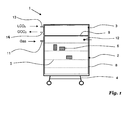
- FIG. 1 schematically shows a container according to the invention for transporting food.
- the container 1 for transporting food according to the invention comprises a storage chamber 2 and a cooling module 3 and is accommodated on a mobile transport rack 4, which is of no further interest here.
- the container can also be designed as a stackable container or as a container in order to ensure a particularly efficient transport of the goods with suitable vehicles.
- the storage chamber 2 is provided with a plurality of drawer inserts 5 for receiving goods 6 to be transported fitted.
- the storage chamber 2 and the cooling module 3 are enclosed by pressure-resistant and the outer wall of the container 1 towards thermally insulated walls 8. From the cooling module 3, the storage chamber 2 is separated by a gas-tight, pressure-resistant, but thermally conductive wall 9.
- the storage chamber 2 can be closed in a gas-tight manner by means of a thermally insulated and pressure-resistant door, not shown here. Furthermore, the storage chamber 2 has a gas connection 11 for supplying a gas or gas mixture into the storage chamber 2 and / or for pumping gas out of the storage chamber 2.
- a controlled or modified atmosphere can be generated via the gas connection 11, either by gas exchange ("gas flushing"), ie by aspirating the air while simultaneously introducing the modified atmosphere substantially constant pressure, or by creating a vacuum and then introducing the modified atmosphere.
- gas exchange gas exchange
- the subsequent transport of the goods 6 thus takes place under a controlled or modified atmosphere, without the need for separate packaging of the goods.
- the storage chamber 2 is opened and the goods are removed.
- the container 2 is then available again for a loading of goods.
- a vacuum can also be generated inside the storage chamber 2 for the duration of the transport.
- the atmosphere in the storage chamber 2 can also be changed during the transport continuously or at predetermined time intervals; the composition of the atmosphere can also be regulated as a function of specific parameters such as pressure or the oxygen concentration, the parameters being detected at suitable measuring devices 12.
- the cooling module 3 is a cooling module intended for holding dry ice, as is known, for example, from US Pat EP 0 823 600 B1 is known.
- the cooling module 3 comprises an inner area for receiving the dry ice and a connection 13 for supplying pressurized liquid carbon dioxide and a connection 14 for discharging gaseous carbon dioxide.
- the cooling module 3 is filled with dry ice in such a way that liquid carbon dioxide under pressure from a here not shown reservoir via the terminal 13 flows into the interior of the cooling module 3 and is thereby relaxed to form carbon dioxide snow and carbon dioxide gas. The resulting carbon dioxide gas is removed via the connection 14 and an adjoining line.
- adsorbers can also be arranged which, if required, bind gases, for example oxygen, CO 2 or CO, and thus keep the atmosphere in the storage chamber 2 constant even within respired goods, even when the goods are in the air.
- the storage chamber 2 can also be connected as a module separable with the container 1.
- a container 1 can also be equipped with a plurality of storage chambers, in which optionally different modified atmospheres are used.
- the container 1 is not only suitable for the transport of food and its precursors, but can also be used for other goods in which the modified atmosphere transport is advantageous, such as for certain chemicals or pharmaceuticals.
Landscapes
- Engineering & Computer Science (AREA)
- Chemical & Material Sciences (AREA)
- Life Sciences & Earth Sciences (AREA)
- Combustion & Propulsion (AREA)
- General Engineering & Computer Science (AREA)
- Food Science & Technology (AREA)
- Polymers & Plastics (AREA)
- Zoology (AREA)
- Wood Science & Technology (AREA)
- Physics & Mathematics (AREA)
- Mechanical Engineering (AREA)
- Thermal Sciences (AREA)
- Chemical Kinetics & Catalysis (AREA)
- Packages (AREA)
- Warehouses Or Storage Devices (AREA)
- Control And Other Processes For Unpacking Of Materials (AREA)
- Processing And Handling Of Plastics And Other Materials For Molding In General (AREA)
Description
- Für die Verpackung von Lebensmitteln werden so genannte Schutzgasverpackungen verwendet. Dabei wird die Verpackung vor dem Verschließen mit einem Inertgas oder einer Mischung aus verschiedenen inerten Gasen, wie Stickstoff, Sauerstoff oder Kohlendioxid, gespült. Hierdurch soll in erster Linie Luft aus der Verpackung abgezogen werden. Bekannte Beispiele hierfür sind Frischfleisch, Kartoffelchips u.a. Bei dieser als "Modifizierte Atmosphäre" bekannten Art der Verpackung ändert sich die Atmosphäre in der Verpackung im Laufe der Zeit nur geringfügig in Abhängigkeit von der Gasdichtheit der verwendeten Verpackung. Anders sieht es bei der Verpackung von chemisch aktiven Waren aus. So verbrauchen so genannte "atmende" Waren wie beispielsweise Fertigsalat, Broccoli u. dergl. Sauerstoff und erzeugen CO2. Die Atmosphäre, die sich in der Verpackung einstellt, ist hierbei in der Regel auch modifiziert ("Modifizierte Atmosphäre"; MA). Die Zusammensetzung der Atmosphäre hängt insbesondere von den Eigenschaften der Ware, der verwendeten Verpackung und der Temperatur ab.
- Zum Transport von Waren unter modifizierter Atmosphäre werden die Waren in der Regel mit aufwändigen Maschinen unter Vakuum verpackt, anschließend verschweißt und mit einer Schutzgasatmosphäre versehen. Beispiele für entsprechende Verpackungsmaschinen sind in der
EP 1 106 084 A2 und in derWO 01/56888 A1 - Aus der
EP 0 368 839 A1 ist ein Behälter zum Aufbewahren von biologischen Substanzen, insbesondere Lebensmitteln, wie Fleisch, Backwaren, Obst oder Gemüse bekannt. Zur Verlängerung der Haltbarkeit werden die Substanzen in einem Raum unter Unterdruck gelagert. Zur Kontrolle der Feuchtigkeit ist ein Sensor vorgesehen, der bei Überschreiten eines Feuchtigkeitsgrenzwertes ein Signal zum Betätigen einer mit dem Behälter verbundenen Vakuumpumpe abgibt. Eine gezielt im Behälter erzeugte modifizierte Atmosphäre ist bei diesem Gegenstand jedoch nicht vorgesehen. - Aus der
DE 29 19 900 A1 ist ein Behälter zum Transportieren von Waren bekannt, der eine gasdicht verschließbare Kammer und einen Sauganschluss zum Anschließen der Kammer an eine Saugeinrichtung aufweist. Nach dem Einladen der Waren wird in der Kammer ein Vakuum erzeugt, durch welche die Waren frisch gehalten werden können, ohne dass die Waren hierzu vakuumverpackt sein müssen. Diese Druckschrift beschreibt jedoch weder die Erzeugung einer modifizierten oder kontrollierten Atmosphäre in der Kammer, noch ist eine Kühlung der Waren beim Transport möglich. - Aus der
EP 10 48 228 B1 ist ein Kühlbehälter bekannt, der eine Kammer zum Aufbewahren der zu transportierenden Waren sowie ein Speichermodul zur Aufnahme von Trockeneis enthält. Während des Transports sublimiert das Trockeneis zu kaltem Kohlendioxidgas, das in die Aufbewahrungskammer einströmt und dort für eine sauerstoffarme und zugleich kalte Atmosphäre sorgt. Ähnliches gilt für einen aus derEP 0 823 600 A2 bekannten Gegenstand. Diese Druckschrift beschreibt einen fahrbaren Kühlbehälter für verderbliche Waren, die durch den Kälteinhalt von Trockeneis frisch gehalten werden. Das in einem Speichermodul gelagerte Trockeneis sublimiert während des Transports und strömt als kaltes Gas in einen Behälter ein, in dem sich die kühlenden Waren befinden. Nachteilig bei diesen Gegenständen ist, dass die die Waren umgebende Atmosphäre durch den Zustrom des Kohlendioxids verändert wird und nicht alle Waren für den Transport in einer Kohlendioxidreichen Atmosphäre geeignet sind. - Aufgabe der Erfindung ist es demnach, eine Möglichkeit zum Transportieren von Waren, insbesondere Lebensmitteln unter modifizierter Atmosphäre anzugeben, die einen sicheren Transport unter einer frei gewählten modifizierten Atmosphäre bei gleichzeitiger Kühlung der transportierten Waren gewährleistet, und die einfach in der Handhabung ist und ohne aufwändige Verpackungsmaschinen und Verpackungsmaterialen auskommt.
- Gelöst ist diese Aufgabe mit einem Behälter zum Transportieren von Waren mit den Merkmalen des Anspruchs 1.
- Entsprechend den aus der
EP 0 368 839 A1 oder derDE 29 19 900 A1 bekannten Gegenständen umfasst der erfindungsgemäße Behälter also eine verschließbare Kammer, in der die Ware während des Transports aufgenommen wird. Über einen Gasanschluss wird, vor oder nach dem Befüllen mit der Ware, Gas aus einer externen Gasquelle zugeführt, beispielsweise stickstoffreiches Inertgas. Ergänzend kann über einen weiteren Gasanschluss gleichzeitig die innerhalb des Behälters vorhandene Atmosphäre abgesaugt werden ("Gas - Flushing"). Bei der Ankunft am Zielort wird die Kammer geöffnet, die Ware entnommen und der Behälter steht für eine neuerliche Befüllung zu Verfügung. Der erfindungsgemäße Transportbehälter eignet sich insbesondere für Ware, die beim Händler offen angeboten wird, wie beispielsweise Fisch, Frischfleisch, Fleischwaren, Fertigmahlzeiten und Gemüse, er ist jedoch auch für andere empfindliche Waren geeignet, beispielsweise für pharmazeutische oder chemische Produkte. - Der erfindungsgemäße Behälter ist zudem mit einer Kältequelle thermisch verbindbar, wobei als Kältequelle ein von der Kammer gasdicht getrenntes Speichermodul für ein kryogenes Kältemittel vorgesehen ist. Damit ist es möglich, beim Transport unter modifizierter Atmosphäre die Temperatur einzustellen und zu kontrollieren. Die Kammer ist dabei lediglich thermisch mit der Kältequelle verbunden; ein Gasaustausch zwischen der Kältequelle und der Kammer findet nicht statt. Vom Speichermodul ist die Kammer durch eine gasdichte, druckfeste, jedoch thermisch leitende Wand getrennt. Die Temperatur ist gerade beim Transport von atmenden Waren ein wesentlicher Parameter, um die Aktivität der Ware und damit die Zusammensetzung der modifizierten Atmosphäre zu beeinflussen. Bei der Kältequelle handelt es sich beispielsweise um ein Kühlaggregat oder eine kryogene Kältequelle, bei der ein kaltes gasförmiges oder verflüssigtes Gas als Kälteträger dient.
- Bevorzugt handelt es sich bei der Kältequelle um ein im Behälter angeordnetes, mit Trockeneis gefülltes Speichermodul, das von der Kammer, in der die Ware gelagert ist, und somit von der modifizierten Atmosphäre gasdicht getrennt ist. Trockeneis besitzt bei einem Druck von 1 bar eine Temperatur von -79°C und sublimiert unter Entstehung von gasförmigem Kohlendioxid. Die modifizierte Atmosphäre und/oder die Ware stehen mit dem Trockeneis in thermischem Kontakt und werden dadurch gekühlt.
- Derartige Anordnungen zur Transportkühlung von Lebensmitteln sind beispielsweise aus der
EP 0 823 600 B1 oder derEP 1 048 228 B1 bekannt. Bei den Gegenständen dieser Druckschriften wird das Speichermodul durch Entspannen von zugeführtem flüssigem Kohlendioxid mit Trockeneis befüllt, wobei während des Befüllvorgangs das bei der Entspannung entstehende Kohlendioxidgas durch eine separate Leitung aus dem Speichermodul abgesaugt wird. Während beim Gegenstand derEP 0 823 600 B1 ein nur geringer Gasaustausch zwischen dem Kohlendioxid im Kühlmodul und der Atmosphäre des die Ware enthaltenen Lagerbereichs stattfindet, dringt beim Gegenstand derEP 1 048 228 B1 kaltes Kohlendioxidgas in den Lagerbereich ein und kühlt diesen direkt, wodurch jedoch nicht nur die Zusammensetzung der Atmosphäre verändert wird, sondern zudem die gelagerten Lebensmittel unmittelbar mit dem sehr kalten Kältemittel in Berührung kommen. - Vorteilhafterweise ist die Kammer druckfest ausgestaltet. Damit kann die Ware auch unter einem Vakuum transportiert werden oder bei der Herstellung der modifizierten Atmosphäre kann vor dem Einleiten des Schutzgases ein Vakuum im Innern der Kammer hergestellt werden. Die Vakuumfestigkeit kann auch dazu genutzt werden, nacheinander sauerstoffreicheres Gas aus der Kammer abzusaugen und anschließend inertes Gas einzufüllen. Um eine möglichst reine modifizierte Atmosphäre zu erzeugen kann dieser Vorgang auch mehrfach hintereinander wiederholt werden.
- In einer weiter vorteilhaften Ausgestaltung der Erfindung ist die Kammer trennbar mit dem Behälter verbunden und kann als separates und separat vom Behälter befüll- und entleerbares Modul in diesen eingestellt werden. Bevorzugt weist die Kammer dabei thermisch gut leitende Wände oder Wandabschnitte auf und kann beispielsweise in den Lagerbereich eines der oben genannten Anordnungen zur Transportkühlung eingebracht werden. Im Falle einer Anordnung, wie sie aus der
EP 1 048 228 B1 bekannt ist, führt dies dazu, dass die Kammer im Lagerbereich vom verdampfenden Kältemittel umspült wird, ohne dass die in der Kammer vorhandene Atmosphäre mit dem Kältemittel vermischt wird. - Zweckmäßigerweise werden mehrere separate, gasdicht voneinander getrennte Kammern vorgesehen, die mit der gleichen modifizierten Atmosphäre oder mit unterschiedlichen Atmosphären befüllt werden. Die Kammern sind dabei entweder fest im Behälter angeordnet oder können, in einer alternativen Ausgestaltung, in den Behälter eingestellt und bei Bedarf einzeln entnommen werden.
- Anhand der Zeichnung soll ein Ausführungsbeispiel der Erfindung näher erläutert werden. Die einzige Zeichnung (
Fig. 1 ) zeigt schematisch einen erfindungsgemäßen Behälter zum Transportieren von Lebensmitteln. - Der erfindungsgemäße Behälter 1 zum Transportieren von Lebensmitteln umfasst eine Aufbewahrungskammer 2 sowie ein Kühlmodul 3 und ist auf einem hier nicht weiter interessierenden mobilen Transportgestell 4 aufgenommen. Anstelle der Ausführung mit einem Transportgestell kann der Behälter auch als stapelbarer Behälter oder als Container ausgelegt sein, um einen besonders effizienten Transport der Ware mit geeigneten Fahrzeugen zu gewährleisten. Die Aufbewahrungskammer 2 ist mit mehreren Schubeinsätzen 5 zur Aufnahme von zum Transport bestimmten Waren 6 ausgestattet. Die Aufbewahrungskammer 2 und das Kühlmodul 3 werden von druckfesten und zur Außenwand des Behälters 1 hin thermisch isolierten Wänden 8 umschlossen. Vom Kühlmodul 3 ist die Aufbewahrungskammer 2 durch eine gasdichte, druckfeste, jedoch thermisch leitende Wand 9 getrennt. Die Aufbewahrungskammer 2 kann mittels einer hier nicht gezeigten, thermisch isolierten und druckfest ausgestalteten Tür gasdicht verschlossen werden. Weiterhin besitzt die Aufbewahrungskammer 2 einen Gasanschluss 11 zum Zuführen eines Gases oder Gasgemisches in die Aufbewahrungskammer 2 hinein und/oder zum Abpumpen von Gas aus der Aufbewahrungskammer 2 heraus. Über den Gasanschluss 11 kann somit nach der Beladung der Aufbewahrungskammer 2 mit Waren 6 eine kontrollierte oder modifizierte Atmosphäre erzeugt werden, und zwar entweder durch laufenden Gasaustausch ("Gas-Flushing"), also durch das Absaugen der Luft bei gleichzeitigem Einbringen der modifizierten Atmosphäre unter im wesentlichen gleich bleibendem Druck, oder durch Erzeugung eines Vakuums und anschließendes Einbringen der modifizierten Atmosphäre. Der anschließende Transport der Waren 6 erfolgt also unter einer kontrollierten oder modifizierten Atmosphäre, ohne dass es einer gesonderten Verpackung der Waren bedarf. Am Ankunftsort wird die Aufbewahrungskammer 2 geöffnet und die Waren werden entnommen. Der Behälter 2 steht sodann wieder für eine Beladung mit Waren zur Verfügung. Anstelle der modifizierten Atmosphäre kann auch ein Vakuum im Innern der Aufbewahrungskammer 2 für die Dauer des Transports erzeugt werden. Durch den Gasanschluss 11 kann die Atmosphäre in der Aufbewahrungskammer 2 auch während des Transports laufend oder in vorgegebenen Zeitabständen verändert werden; die Zusammensetzung der Atmosphäre kann auch in Abhängigkeit bestimmter Parameter wie Druck oder der Sauerstoffkonzentration geregelt werden, wobei die Parameter an geeigneten Messeinrichtungen 12 erfasst werden.
- Bei dem Kühlmodul 3 handelt es sich um ein zur Aufnahme von Trockeneis bestimmtes Kühlmodul, wie es beispielsweise aus der
EP 0 823 600 B1 bekannt ist. Das Kühlmodul 3 umfasst einen Innenbereich zur Aufnahme des Trockeneises sowie einen Anschluss 13 zum Zuführen von unter Druck stehendem flüssigem Kohlendioxid und einen Anschluss 14 zum Abführen von gasförmigem Kohlendioxid. Das Kühlmodul 3 wird in der Weise mit Trockeneis befüllt, dass flüssiges Kohlendioxid unter Druck aus einem hier nicht gezeigten Vorratsbehälter über den Anschluss 13 in den Innenbereich des Kühlmoduls 3 einströmt und dabei unter Entstehung von Kohleindioxidschnee und Kohlendioxidgas entspannt wird. Das entstehende Kohlendioxidgas wird über den Anschluss 14 und eine sich hieran anschließende Leitung abgeführt. Durch geeignete Einrichtungen, wie sie im Detail beispielsweise in derEP 0 823 600 B1 beschrieben werden, wird verhindert, dass der Trockeneisschnee nicht vom Gasstrom mitgerissen wird, sondern im Innenbereich des Kühlmoduls 3 verbleibt. Es befindet sich somit während des Transports eine bestimmte Menge Trockeneis im Kühlmodul 3, das langsam sublimiert und Kälte an die thermisch leitende Wand 9 abgibt. Durch thermischen Kontakt des im Innern der Aufbewahrungskammer 2 befindlichen Gases wird die Aufbewahrungskammer 2 und damit die darin befindlichen Waren 6 zuverlässig und anhaltend gekühlt. - In der Aufbewahrungskammer 2 des Behälters 1 können auch Adsorber angeordnet werden, die bei Bedarf Gase, beispielsweise Sauerstoff, CO2 oder CO binden und somit die Atmosphäre in der Aufbewahrungskammer 2 auch bei atmenden Waren innerhalb vorgegebener Grenzen konstant halten. Die Aufbewahrungskammer 2 kann auch als Modul trennbar mit dem Behälter 1 verbunden sein. Ein Behälter 1 kann auch mit mehreren Aufbewahrungskammern ausgerüstet werden, in denen ggf. unterschiedliche modifizierte Atmosphären zum Einsatz kommen.
- Der Behälter 1 ist nicht nur für den Transport von Lebensmitteln und deren Vorprodukte geeignet, sondern kann auch für andere Waren, bei denen der Transport unter modifizierter Atmosphäre vorteilhaft ist, eingesetzt werden, wie beispielsweise für bestimmte Chemikalien oder Pharmazeutika.
-
- 1.
- Behälter
- 2.
- Aufbewahrungkammer
- 3.
- Kühlmodul
- 4.
- Transportgestell
- 5.
- Schubeinsatz
- 6.
- Waren
- 7.
- -
- 8.
- thermisch isolierte Wand
- 9.
- thermisch leitende Wand
- 10.
- -
- 11.
- Gasanschluss
- 12.
- Messeinrichtung
- 13.
- Anschluss
- 14.
- Anschluss
- 15.
- Messeinrichtung
Claims (5)
- Behälter (1) zum Transportieren von Waren, insbesondere Lebensmitteln, unter kontrollierter oder modifizierter Atmosphäre, umfassend eine gasdicht verschließbare Kammer (2) zum Aufbewahren von zu transportierenden Waren (6), die mit wenigstens einem Gasanschluss (11) zum Verbinden mit einer externen Gasquelle oder mit einer Absaugeinrichtung ausgerüstet ist,
dadurch gekennzeichnet, dass
die Kammer (2) mit einer Kältequelle (3) thermisch verbindbar ist, wobei als Kältequelle (3) ein von der Kammer (2) durch eine gasdichte, druckfeste, jedoch thermisch leitende Wand (9) getrenntes Speichermodul (3) für ein kryogenes Kältemittel vorgesehen ist. - Behälter nach Anspruch 1, dadurch gekennzeichnet, dass als Kältequelle (3) ein Speichermodul (3) für Trockeneis vorgesehen ist.
- Behälter nach Anspruch 1 oder 2, dadurch gekennzeichnet, dass die Kammer (2) zur Herstellung eines Vakuums druckfest ausgestaltet ist.
- Behälter nach einem der vorhergehenden Ansprüche, dadurch gekennzeichnet, dass die Kammer (2) trennbar mit dem Behälter verbunden ist.
- Behälter nach einem der vorhergehenden Ansprüche, gekennzeichnet durch mehrere gasdicht voneinander getrennte Kammern (2).
Priority Applications (1)
| Application Number | Priority Date | Filing Date | Title |
|---|---|---|---|
| PL06125726T PL1798147T3 (pl) | 2005-12-14 | 2006-12-08 | Pojemnik do transportowania produktów w kontrolowanej albo modyfikowanej atmosferze |
Applications Claiming Priority (1)
| Application Number | Priority Date | Filing Date | Title |
|---|---|---|---|
| DE102005059627A DE102005059627B3 (de) | 2005-12-14 | 2005-12-14 | Behälter zum Transportieren von Waren unter kontrollierter oder modifizierter Atmosphäre |
Publications (2)
| Publication Number | Publication Date |
|---|---|
| EP1798147A1 EP1798147A1 (de) | 2007-06-20 |
| EP1798147B1 true EP1798147B1 (de) | 2009-07-01 |
Family
ID=37708177
Family Applications (1)
| Application Number | Title | Priority Date | Filing Date |
|---|---|---|---|
| EP06125726A Not-in-force EP1798147B1 (de) | 2005-12-14 | 2006-12-08 | Behälter zum Transportieren von Waren unter kontrollierter oder modifizierter Atmosphäre |
Country Status (4)
| Country | Link |
|---|---|
| EP (1) | EP1798147B1 (de) |
| AT (1) | ATE435158T1 (de) |
| DE (2) | DE102005059627B3 (de) |
| PL (1) | PL1798147T3 (de) |
Cited By (3)
| Publication number | Priority date | Publication date | Assignee | Title |
|---|---|---|---|---|
| CN107352129A (zh) * | 2017-07-16 | 2017-11-17 | 李年贵 | 一种水果保鲜装置 |
| CN110145909A (zh) * | 2019-06-12 | 2019-08-20 | 扬州熊猫汽车科技服务有限公司 | 一种车载果蔬保鲜箱 |
| CN110371490A (zh) * | 2019-08-01 | 2019-10-25 | 安徽冠东科技有限公司 | 一种溢流混合式果蔬低压低温储存盒 |
Families Citing this family (5)
| Publication number | Priority date | Publication date | Assignee | Title |
|---|---|---|---|---|
| US8166872B2 (en) | 2008-03-12 | 2012-05-01 | Whirlpool Corporation | Modified atmosphere for food preservation |
| DE102009043634B4 (de) * | 2009-09-29 | 2012-08-09 | Messer Austria Gmbh | Vorrichtung und Verfahren zum Transportieren feuchtigkeitsempfindlicher Produkte |
| DE102014223982B3 (de) * | 2014-11-25 | 2016-04-28 | Volkswagen Aktiengesellschaft | Prozessanordnung zur Herstellung eines faserverstärktenKunststoffbauteils |
| FR3075000B1 (fr) * | 2017-12-19 | 2021-09-17 | Air Liquide | Systeme permettant la mise sous atmosphere controlee de denrees perissables ou thermosensibles notamment pour le transport et le stockage de ces denrees sur des palettes |
| CN110617662B (zh) * | 2019-09-23 | 2024-04-12 | 青海省药品检验检测院 | 一种药物储藏用低温恒温恒湿柜 |
Family Cites Families (11)
| Publication number | Priority date | Publication date | Assignee | Title |
|---|---|---|---|---|
| ZA711635B (en) * | 1971-04-19 | 1971-11-24 | African Oxygen Ltd | A storage and transport unit |
| DE2227313C2 (de) * | 1972-06-05 | 1984-03-08 | Kohlensäure-Werke Rudolf Buse Sohn GmbH & Co, 5462 Bad Hönningen | Kühlcontainer zum Frisch- und Kühlhalten von Nahrungsmitteln |
| DE2716021C2 (de) * | 1977-04-09 | 1982-05-27 | Ahlmann-Sanitär-u. Kunststofftechnik GmbH, 2370 Rendsburg | Kühlcontainer |
| DE2919900A1 (de) * | 1979-05-17 | 1980-11-27 | Joseph Maier | Einrichtung zur aufbewahrung von verderblichen guetern, insbesondere von lebensmitteln |
| EP0368839B1 (de) | 1988-11-09 | 1993-09-08 | Sm Vacuum Solich & Mayer | Verfahren zum Aufbewahren von biologischen Substanzen, sowie Einrichtung zur Durchführung dieses Verfahrens |
| EP0437419A3 (en) * | 1990-01-09 | 1991-10-23 | Sm Vacuum Solich & Mayer | Process for storing and keeping food fresh as well as apparatus for carrying out this process |
| US5658607A (en) * | 1993-07-08 | 1997-08-19 | Chiquita Brands, Inc. | Process for shipping and ripening fruits and vegetables |
| FR2752049B1 (fr) * | 1996-07-30 | 1998-09-11 | Olivo | Conteneur isotherme avec reserve de frigories |
| DE19919934A1 (de) * | 1999-04-30 | 2000-11-02 | Tv Kohlensaeure Technik & Vert | Vorrichtung und Verfahren zur Temperaturhaltung von Lebensmitteln |
| IT1314270B1 (it) * | 1999-12-06 | 2002-12-06 | Roberto Comi | Procedimento ed apparecchiatura per il confezionamento in atmosferamodificata di prodotti alimentari, in particolare prodotti da forno |
| IT1316348B1 (it) * | 2000-02-04 | 2003-04-10 | Mauro Scolaro | Apparecchiatura per il confezionamento sotto vuoto o in atmosferamodificata di prodotti, particolarmente per prodotti alimentari e |
-
2005
- 2005-12-14 DE DE102005059627A patent/DE102005059627B3/de not_active Expired - Fee Related
-
2006
- 2006-12-08 AT AT06125726T patent/ATE435158T1/de active
- 2006-12-08 EP EP06125726A patent/EP1798147B1/de not_active Not-in-force
- 2006-12-08 DE DE502006004118T patent/DE502006004118D1/de active Active
- 2006-12-08 PL PL06125726T patent/PL1798147T3/pl unknown
Cited By (3)
| Publication number | Priority date | Publication date | Assignee | Title |
|---|---|---|---|---|
| CN107352129A (zh) * | 2017-07-16 | 2017-11-17 | 李年贵 | 一种水果保鲜装置 |
| CN110145909A (zh) * | 2019-06-12 | 2019-08-20 | 扬州熊猫汽车科技服务有限公司 | 一种车载果蔬保鲜箱 |
| CN110371490A (zh) * | 2019-08-01 | 2019-10-25 | 安徽冠东科技有限公司 | 一种溢流混合式果蔬低压低温储存盒 |
Also Published As
| Publication number | Publication date |
|---|---|
| DE102005059627B3 (de) | 2007-06-21 |
| ATE435158T1 (de) | 2009-07-15 |
| EP1798147A1 (de) | 2007-06-20 |
| DE502006004118D1 (de) | 2009-08-13 |
| PL1798147T3 (pl) | 2009-12-31 |
Similar Documents
| Publication | Publication Date | Title |
|---|---|---|
| DE69526039T2 (de) | Verfahren und Vorrichtung zum Fördern und Lagern von gekühlten Waren | |
| DE68902452T2 (de) | Verfahren und anlage zur aufbewahrung von erzeugnissen. | |
| EP0120271B1 (de) | Verfahren und Vorrichtung zum Inertisieren von Transport-Containern | |
| EP1798147B1 (de) | Behälter zum Transportieren von Waren unter kontrollierter oder modifizierter Atmosphäre | |
| DE102013224659A1 (de) | Kühlschrank und Verfahren zur Konservierung von Lebensmitteln in einem Kühlschrank | |
| EP1088191B1 (de) | Befüll- und entnahmemodul für ein kühlmodul und verfahren zum befüllen eines kühlmoduls | |
| JP2012245005A (ja) | 酸化的に分解され得る食品を輸送または保管するシステムおよび方法 | |
| DE112011100483T5 (de) | Flüssigluft-Kühlsystem für Speicherbehälter | |
| WO2011076701A1 (de) | Befüllvorrichtung zum befüllen eines einem kühlbehälter zugeordneten kältemittel-aufnahmefachs mit einem kryogenen kältemittel | |
| EP0368839B1 (de) | Verfahren zum Aufbewahren von biologischen Substanzen, sowie Einrichtung zur Durchführung dieses Verfahrens | |
| EP1110043B1 (de) | Vorrichtung und verfahren zum kühlen eines behälters | |
| DE69904630D1 (de) | Beutel zum aufbewahren und transportieren von sterilen produkten in pulverform und zum herstellen von lösungen aus diesen produkten in diesem beutel | |
| DE3035460A1 (de) | Verfahren und vorrichtung zur frischhaltung und konservierung von verderblichen produkten, insbesondere lebensmitteln | |
| DE3833753A1 (de) | Verfahren und vorrichtungen zum tiefkuehlen von kohlendioxidgasfoermig und stickstoff-gasfoermig aus druckbehaeltern, beziehungsweise luft aus druckflaschen oder -erzeugern und deren tiefkalte anwendung | |
| EP4015946A1 (de) | Isolationsbehälter für den temperaturgeführten transport von pharmazeutischen produkten | |
| EP2382878B1 (de) | Transportbehälter | |
| EP0298481B2 (de) | Verfahren und vorrichtung zum sauerstoffreien verpacken von Produkt | |
| EP0280961A1 (de) | Verfahren zur Verlängerung der Haltbarkeit von Gütern und dafür geeignete Beutel | |
| DE60112087T3 (de) | Tablett aus offenporigem expandierten Kunststoff für Gemüse | |
| WO2001092797A1 (de) | Verfahren zum frischhalten verderblicher güter innerhalb eines vorratsschrankes sowie vorratsschrank zum durchführen dieses verfahrens | |
| EP1145640A1 (de) | Gas-Behandlungssatz und seine Verwendung zum Behandeln von Lebensmitteln und/oder Pflanzen | |
| EP1092649A1 (de) | Vorrichtung zur Aufrechterhaltung einer Gasatmosphäre | |
| EP1141638A1 (de) | Isolierbehälter mit befüllbarem kühlmodul | |
| DE102010027465A1 (de) | Verfahren zum Verpacken von Lebensmitteln in nicht formstabilen Verpackungseinheiten unter Schutzgas | |
| EP0581121B1 (de) | Verfahren und Vorrichtung zum sauerstofffreien Verpacken von Ware |
Legal Events
| Date | Code | Title | Description |
|---|---|---|---|
| PUAI | Public reference made under article 153(3) epc to a published international application that has entered the european phase |
Free format text: ORIGINAL CODE: 0009012 |
|
| AK | Designated contracting states |
Kind code of ref document: A1 Designated state(s): AT BE BG CH CY CZ DE DK EE ES FI FR GB GR HU IE IS IT LI LT LU LV MC NL PL PT RO SE SI SK TR |
|
| AX | Request for extension of the european patent |
Extension state: AL BA HR MK YU |
|
| 17P | Request for examination filed |
Effective date: 20071220 |
|
| 17Q | First examination report despatched |
Effective date: 20080124 |
|
| AKX | Designation fees paid |
Designated state(s): AT BE BG CH CY CZ DE DK EE ES FI FR GB GR HU IE IS IT LI LT LU LV MC NL PL PT RO SE SI SK TR |
|
| GRAP | Despatch of communication of intention to grant a patent |
Free format text: ORIGINAL CODE: EPIDOSNIGR1 |
|
| GRAS | Grant fee paid |
Free format text: ORIGINAL CODE: EPIDOSNIGR3 |
|
| GRAA | (expected) grant |
Free format text: ORIGINAL CODE: 0009210 |
|
| AK | Designated contracting states |
Kind code of ref document: B1 Designated state(s): AT BE BG CH CY CZ DE DK EE ES FI FR GB GR HU IE IS IT LI LT LU LV MC NL PL PT RO SE SI SK TR |
|
| REG | Reference to a national code |
Ref country code: GB Ref legal event code: FG4D Free format text: NOT ENGLISH |
|
| REG | Reference to a national code |
Ref country code: CH Ref legal event code: EP |
|
| REG | Reference to a national code |
Ref country code: IE Ref legal event code: FG4D |
|
| REF | Corresponds to: |
Ref document number: 502006004118 Country of ref document: DE Date of ref document: 20090813 Kind code of ref document: P |
|
| PG25 | Lapsed in a contracting state [announced via postgrant information from national office to epo] |
Ref country code: SI Free format text: LAPSE BECAUSE OF FAILURE TO SUBMIT A TRANSLATION OF THE DESCRIPTION OR TO PAY THE FEE WITHIN THE PRESCRIBED TIME-LIMIT Effective date: 20090701 |
|
| NLV1 | Nl: lapsed or annulled due to failure to fulfill the requirements of art. 29p and 29m of the patents act | ||
| REG | Reference to a national code |
Ref country code: PL Ref legal event code: T3 |
|
| PG25 | Lapsed in a contracting state [announced via postgrant information from national office to epo] |
Ref country code: SE Free format text: LAPSE BECAUSE OF FAILURE TO SUBMIT A TRANSLATION OF THE DESCRIPTION OR TO PAY THE FEE WITHIN THE PRESCRIBED TIME-LIMIT Effective date: 20090701 Ref country code: ES Free format text: LAPSE BECAUSE OF FAILURE TO SUBMIT A TRANSLATION OF THE DESCRIPTION OR TO PAY THE FEE WITHIN THE PRESCRIBED TIME-LIMIT Effective date: 20091012 Ref country code: FI Free format text: LAPSE BECAUSE OF FAILURE TO SUBMIT A TRANSLATION OF THE DESCRIPTION OR TO PAY THE FEE WITHIN THE PRESCRIBED TIME-LIMIT Effective date: 20090701 Ref country code: LT Free format text: LAPSE BECAUSE OF FAILURE TO SUBMIT A TRANSLATION OF THE DESCRIPTION OR TO PAY THE FEE WITHIN THE PRESCRIBED TIME-LIMIT Effective date: 20090701 Ref country code: EE Free format text: LAPSE BECAUSE OF FAILURE TO SUBMIT A TRANSLATION OF THE DESCRIPTION OR TO PAY THE FEE WITHIN THE PRESCRIBED TIME-LIMIT Effective date: 20090701 Ref country code: IS Free format text: LAPSE BECAUSE OF FAILURE TO SUBMIT A TRANSLATION OF THE DESCRIPTION OR TO PAY THE FEE WITHIN THE PRESCRIBED TIME-LIMIT Effective date: 20091101 |
|
| REG | Reference to a national code |
Ref country code: IE Ref legal event code: FD4D |
|
| PG25 | Lapsed in a contracting state [announced via postgrant information from national office to epo] |
Ref country code: LV Free format text: LAPSE BECAUSE OF FAILURE TO SUBMIT A TRANSLATION OF THE DESCRIPTION OR TO PAY THE FEE WITHIN THE PRESCRIBED TIME-LIMIT Effective date: 20090701 Ref country code: NL Free format text: LAPSE BECAUSE OF FAILURE TO SUBMIT A TRANSLATION OF THE DESCRIPTION OR TO PAY THE FEE WITHIN THE PRESCRIBED TIME-LIMIT Effective date: 20090701 |
|
| PG25 | Lapsed in a contracting state [announced via postgrant information from national office to epo] |
Ref country code: PT Free format text: LAPSE BECAUSE OF FAILURE TO SUBMIT A TRANSLATION OF THE DESCRIPTION OR TO PAY THE FEE WITHIN THE PRESCRIBED TIME-LIMIT Effective date: 20091102 Ref country code: BG Free format text: LAPSE BECAUSE OF FAILURE TO SUBMIT A TRANSLATION OF THE DESCRIPTION OR TO PAY THE FEE WITHIN THE PRESCRIBED TIME-LIMIT Effective date: 20091001 |
|
| PG25 | Lapsed in a contracting state [announced via postgrant information from national office to epo] |
Ref country code: IE Free format text: LAPSE BECAUSE OF FAILURE TO SUBMIT A TRANSLATION OF THE DESCRIPTION OR TO PAY THE FEE WITHIN THE PRESCRIBED TIME-LIMIT Effective date: 20090701 Ref country code: RO Free format text: LAPSE BECAUSE OF FAILURE TO SUBMIT A TRANSLATION OF THE DESCRIPTION OR TO PAY THE FEE WITHIN THE PRESCRIBED TIME-LIMIT Effective date: 20090701 Ref country code: CZ Free format text: LAPSE BECAUSE OF FAILURE TO SUBMIT A TRANSLATION OF THE DESCRIPTION OR TO PAY THE FEE WITHIN THE PRESCRIBED TIME-LIMIT Effective date: 20090701 Ref country code: DK Free format text: LAPSE BECAUSE OF FAILURE TO SUBMIT A TRANSLATION OF THE DESCRIPTION OR TO PAY THE FEE WITHIN THE PRESCRIBED TIME-LIMIT Effective date: 20090701 |
|
| PLBE | No opposition filed within time limit |
Free format text: ORIGINAL CODE: 0009261 |
|
| STAA | Information on the status of an ep patent application or granted ep patent |
Free format text: STATUS: NO OPPOSITION FILED WITHIN TIME LIMIT |
|
| PG25 | Lapsed in a contracting state [announced via postgrant information from national office to epo] |
Ref country code: SK Free format text: LAPSE BECAUSE OF FAILURE TO SUBMIT A TRANSLATION OF THE DESCRIPTION OR TO PAY THE FEE WITHIN THE PRESCRIBED TIME-LIMIT Effective date: 20090701 |
|
| 26N | No opposition filed |
Effective date: 20100406 |
|
| PG25 | Lapsed in a contracting state [announced via postgrant information from national office to epo] |
Ref country code: MC Free format text: LAPSE BECAUSE OF NON-PAYMENT OF DUE FEES Effective date: 20100701 |
|
| PG25 | Lapsed in a contracting state [announced via postgrant information from national office to epo] |
Ref country code: GR Free format text: LAPSE BECAUSE OF FAILURE TO SUBMIT A TRANSLATION OF THE DESCRIPTION OR TO PAY THE FEE WITHIN THE PRESCRIBED TIME-LIMIT Effective date: 20091002 |
|
| PG25 | Lapsed in a contracting state [announced via postgrant information from national office to epo] |
Ref country code: IT Free format text: LAPSE BECAUSE OF FAILURE TO SUBMIT A TRANSLATION OF THE DESCRIPTION OR TO PAY THE FEE WITHIN THE PRESCRIBED TIME-LIMIT Effective date: 20090701 |
|
| PG25 | Lapsed in a contracting state [announced via postgrant information from national office to epo] |
Ref country code: LU Free format text: LAPSE BECAUSE OF NON-PAYMENT OF DUE FEES Effective date: 20091208 |
|
| PG25 | Lapsed in a contracting state [announced via postgrant information from national office to epo] |
Ref country code: HU Free format text: LAPSE BECAUSE OF FAILURE TO SUBMIT A TRANSLATION OF THE DESCRIPTION OR TO PAY THE FEE WITHIN THE PRESCRIBED TIME-LIMIT Effective date: 20100102 |
|
| REG | Reference to a national code |
Ref country code: CH Ref legal event code: PL |
|
| GBPC | Gb: european patent ceased through non-payment of renewal fee |
Effective date: 20101208 |
|
| PG25 | Lapsed in a contracting state [announced via postgrant information from national office to epo] |
Ref country code: TR Free format text: LAPSE BECAUSE OF FAILURE TO SUBMIT A TRANSLATION OF THE DESCRIPTION OR TO PAY THE FEE WITHIN THE PRESCRIBED TIME-LIMIT Effective date: 20090701 |
|
| PG25 | Lapsed in a contracting state [announced via postgrant information from national office to epo] |
Ref country code: CY Free format text: LAPSE BECAUSE OF FAILURE TO SUBMIT A TRANSLATION OF THE DESCRIPTION OR TO PAY THE FEE WITHIN THE PRESCRIBED TIME-LIMIT Effective date: 20090701 |
|
| PG25 | Lapsed in a contracting state [announced via postgrant information from national office to epo] |
Ref country code: CH Free format text: LAPSE BECAUSE OF NON-PAYMENT OF DUE FEES Effective date: 20101231 Ref country code: LI Free format text: LAPSE BECAUSE OF NON-PAYMENT OF DUE FEES Effective date: 20101231 |
|
| PG25 | Lapsed in a contracting state [announced via postgrant information from national office to epo] |
Ref country code: GB Free format text: LAPSE BECAUSE OF NON-PAYMENT OF DUE FEES Effective date: 20101208 |
|
| PGFP | Annual fee paid to national office [announced via postgrant information from national office to epo] |
Ref country code: PL Payment date: 20121015 Year of fee payment: 7 |
|
| PGFP | Annual fee paid to national office [announced via postgrant information from national office to epo] |
Ref country code: AT Payment date: 20121127 Year of fee payment: 7 Ref country code: FR Payment date: 20130107 Year of fee payment: 7 |
|
| PGFP | Annual fee paid to national office [announced via postgrant information from national office to epo] |
Ref country code: BE Payment date: 20121217 Year of fee payment: 7 |
|
| PGFP | Annual fee paid to national office [announced via postgrant information from national office to epo] |
Ref country code: DE Payment date: 20131231 Year of fee payment: 8 |
|
| BERE | Be: lapsed |
Owner name: MESSER GROUP G.M.B.H. Effective date: 20131231 |
|
| REG | Reference to a national code |
Ref country code: AT Ref legal event code: MM01 Ref document number: 435158 Country of ref document: AT Kind code of ref document: T Effective date: 20131208 |
|
| REG | Reference to a national code |
Ref country code: FR Ref legal event code: ST Effective date: 20140829 |
|
| PG25 | Lapsed in a contracting state [announced via postgrant information from national office to epo] |
Ref country code: BE Free format text: LAPSE BECAUSE OF NON-PAYMENT OF DUE FEES Effective date: 20131231 |
|
| PG25 | Lapsed in a contracting state [announced via postgrant information from national office to epo] |
Ref country code: AT Free format text: LAPSE BECAUSE OF NON-PAYMENT OF DUE FEES Effective date: 20131208 Ref country code: FR Free format text: LAPSE BECAUSE OF NON-PAYMENT OF DUE FEES Effective date: 20131231 |
|
| PG25 | Lapsed in a contracting state [announced via postgrant information from national office to epo] |
Ref country code: PL Free format text: LAPSE BECAUSE OF NON-PAYMENT OF DUE FEES Effective date: 20131208 |
|
| REG | Reference to a national code |
Ref country code: PL Ref legal event code: LAPE |
|
| REG | Reference to a national code |
Ref country code: DE Ref legal event code: R119 Ref document number: 502006004118 Country of ref document: DE |
|
| PG25 | Lapsed in a contracting state [announced via postgrant information from national office to epo] |
Ref country code: DE Free format text: LAPSE BECAUSE OF NON-PAYMENT OF DUE FEES Effective date: 20150701 |